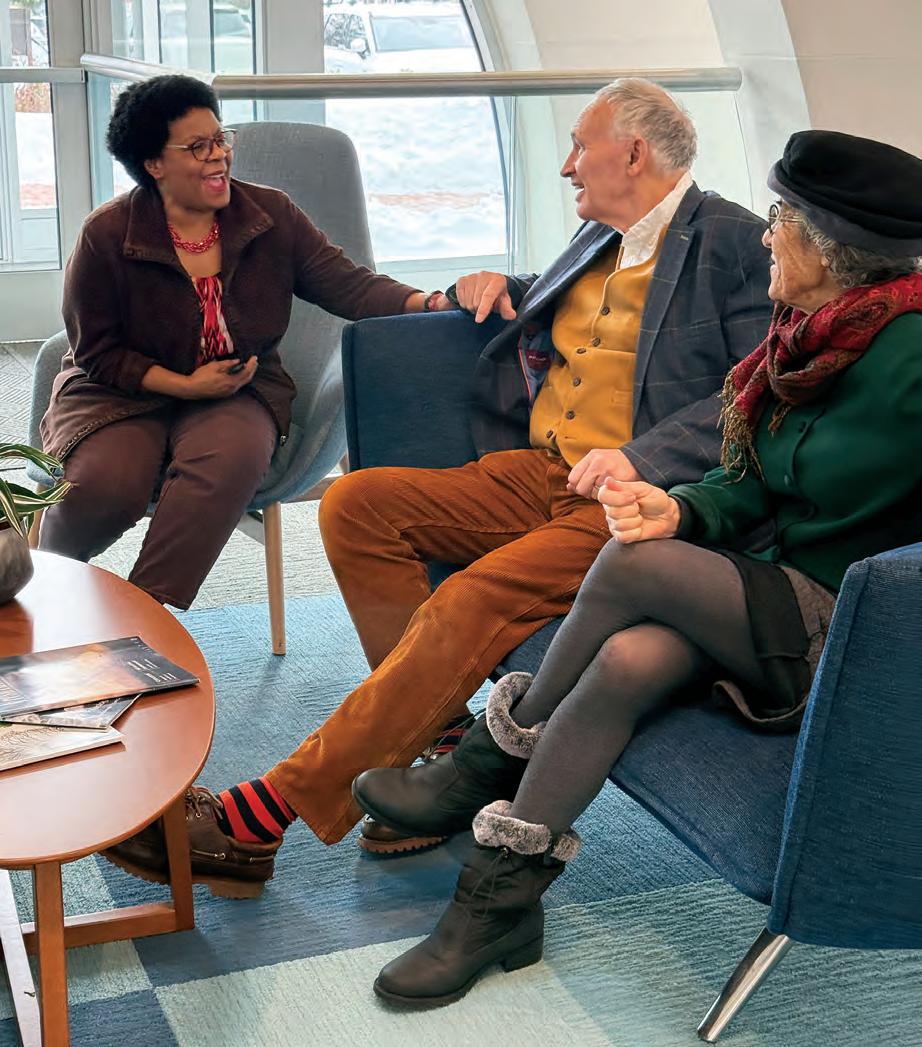
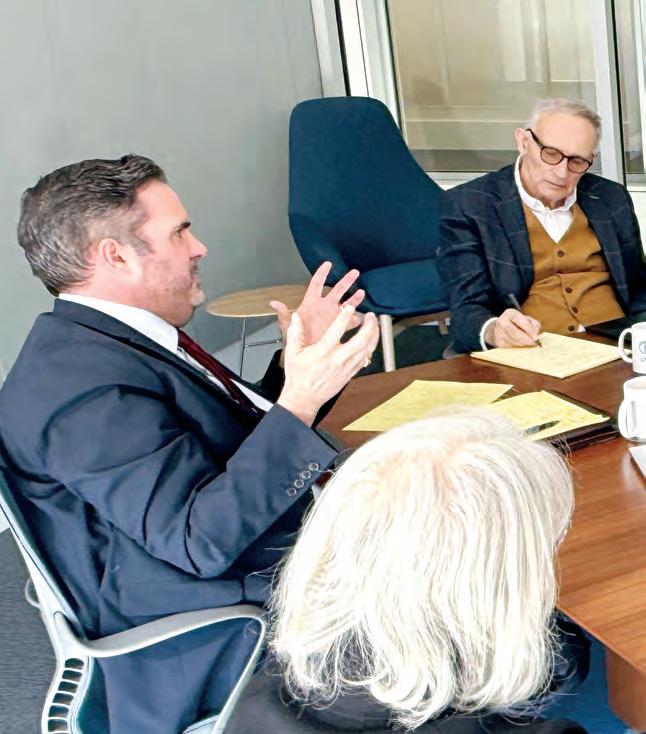
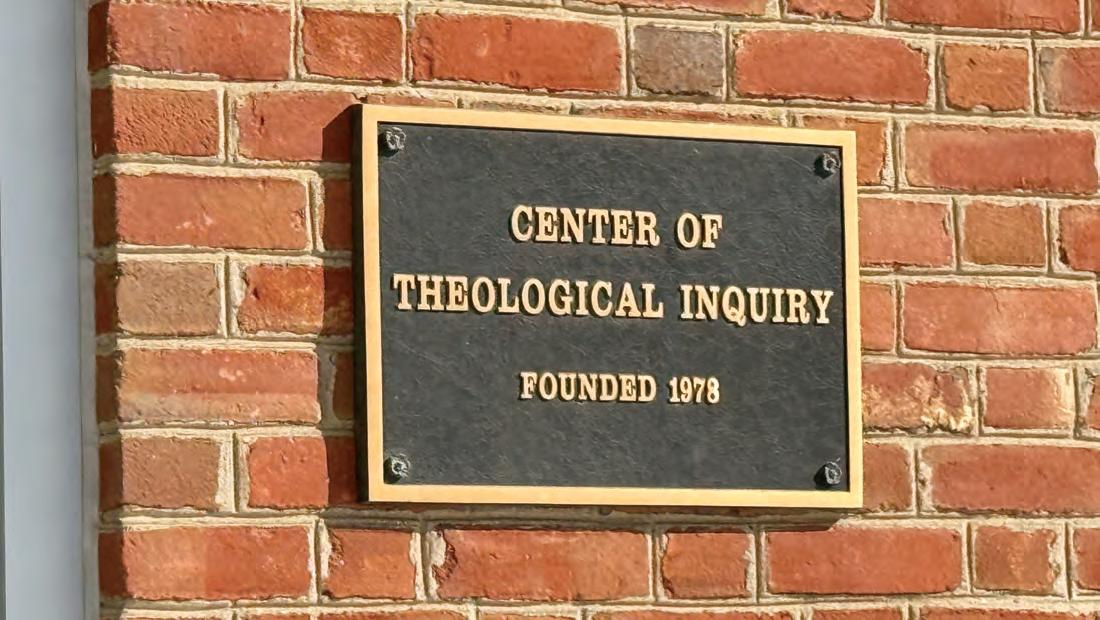
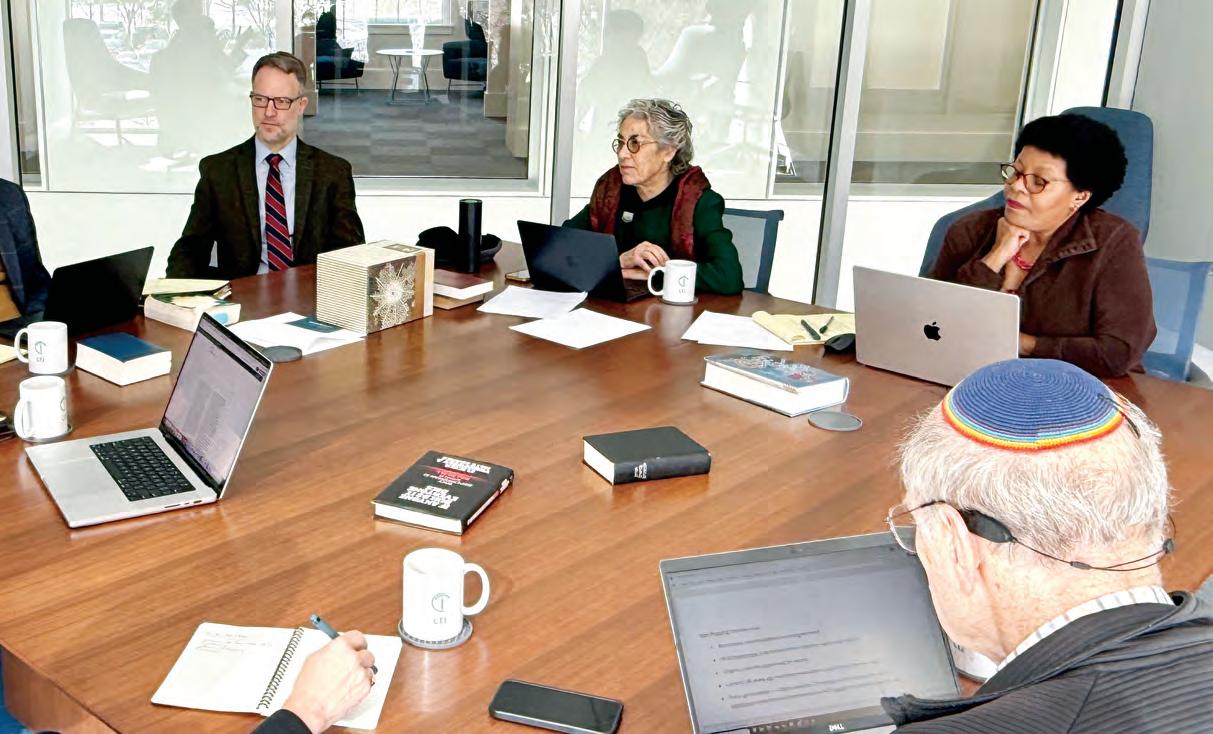
CTI undertakes rigorous exploration of all dimensions of faith and reason in the service of God for the benefit of church, culture, and all creation. In our inquiry we are sustained by our belief that the truth is one, and by our hope that our efforts will ignite a theological renaissance.
OUR PROGRAM Hope for our Theological Future
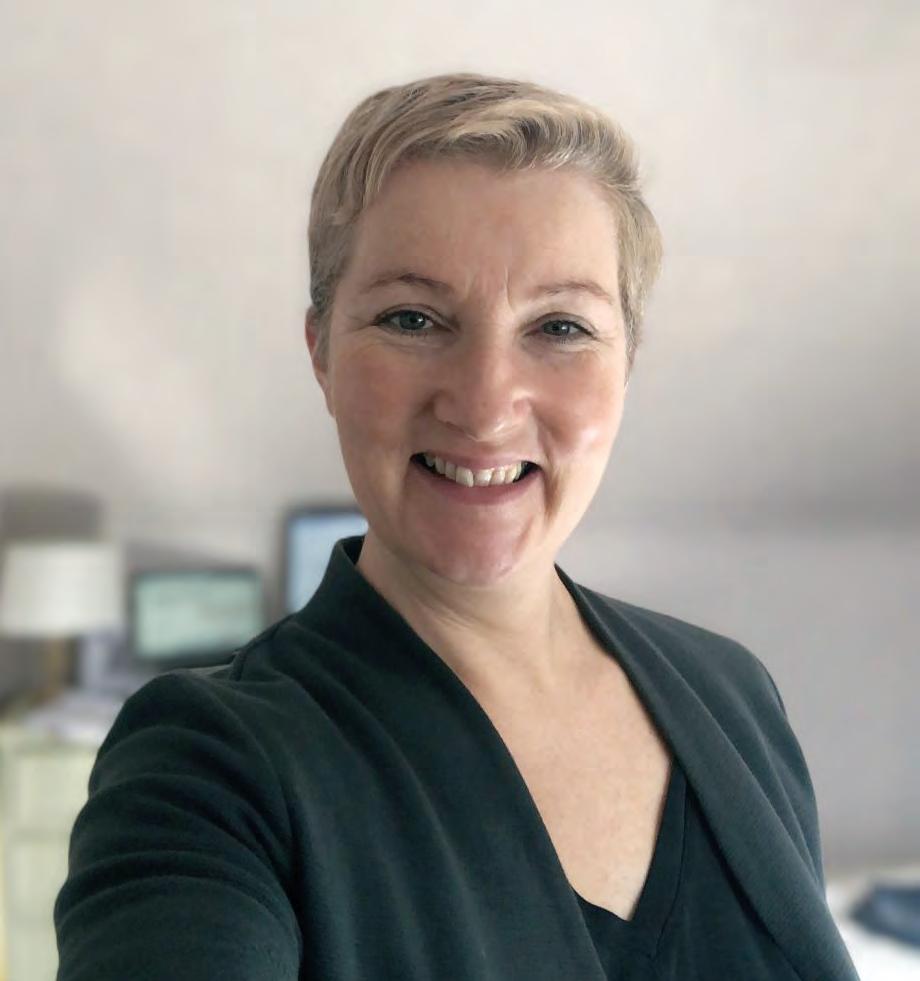
Bette Jane (B.J.) Booth
— FROM THE DIRECTOR —
— FROM THE DIRECTOR —
For Whom the Bells Toll
The turn of the year in Scotland is often called “The Bells.” It is the moment between Old Year’s Night and New Year’s Day when the bells on church and town steeples chime at Midnight, ringing out the old and ringing in the new. Those bells came to mind in writing this farewell column as Director, ringing out not just the past year but the last twenty years.
As I looked back on my two decades in office, and started to make lists of all the research topics we covered and events we held over that period, three bell-shaped word clouds emerged, now graphically illustrated on the front cover of this issue of Fresh Thinking. Allow me to ring each of these bells in turn, and not just to mark my passing as the old Director! Rather, I want to recall what I heard in each of their sonorous chimes.
The Inquiry Bell
This first bell cloud names the twelve inquiries CTI has run over twenty years, convening research groups in residence and online to work together on interdisciplinary themes, everything from the foundations of international law to the sources of human flourishing. What I heard from these inquiries at their best was the sound of thinkers chiming in tune with one another across disciplinary borders. This was best expressed by Francis Clooney SJ, Professor of Comparative Theology at Harvard and a longstanding CTI Member. Frank said this after participating in CTI’s inquiry on the societal implications of astrobiology: I think all of us go away from this consultation with a certain sense of confidence that the great knowledge of the past, the expertise of science in the current moment, and our global planetary future can be usefully connected and that if we really want to face up to issues that concern us today, we have confidence that we can draw on all the resources of our human race.
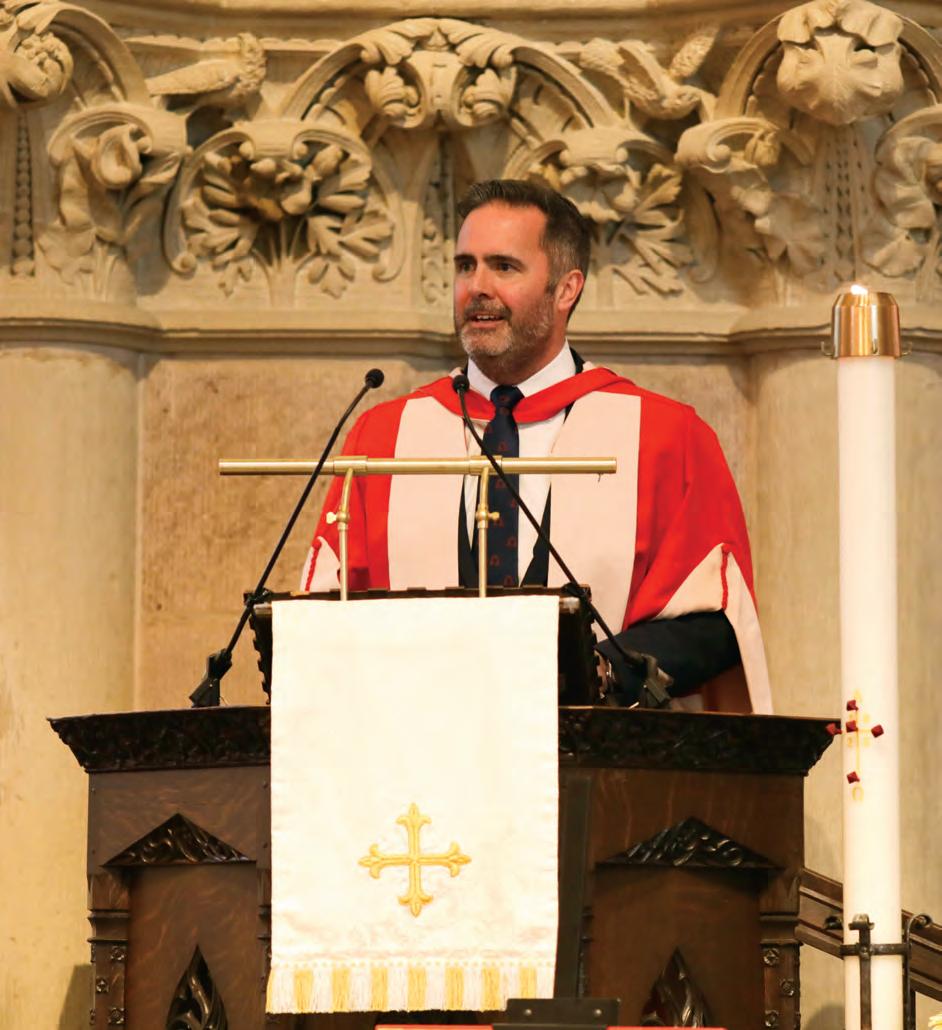
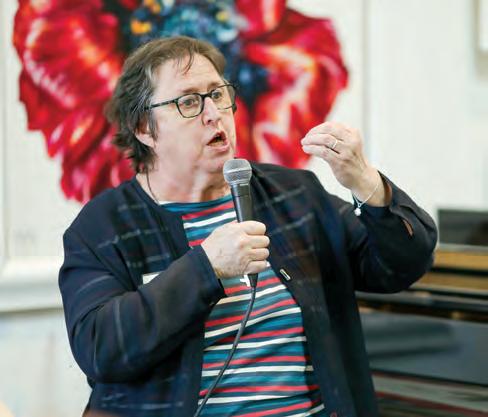
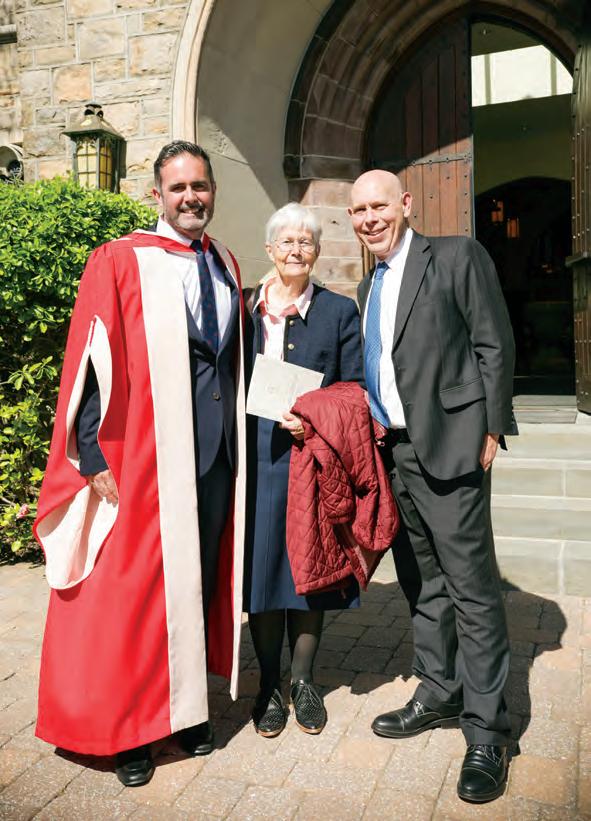
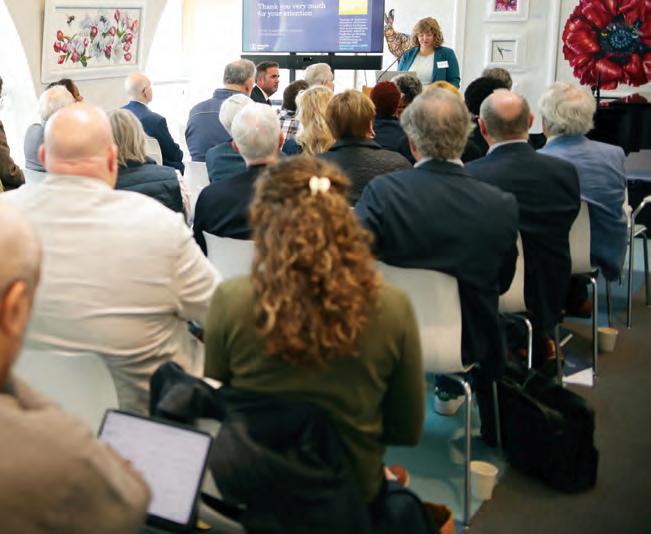
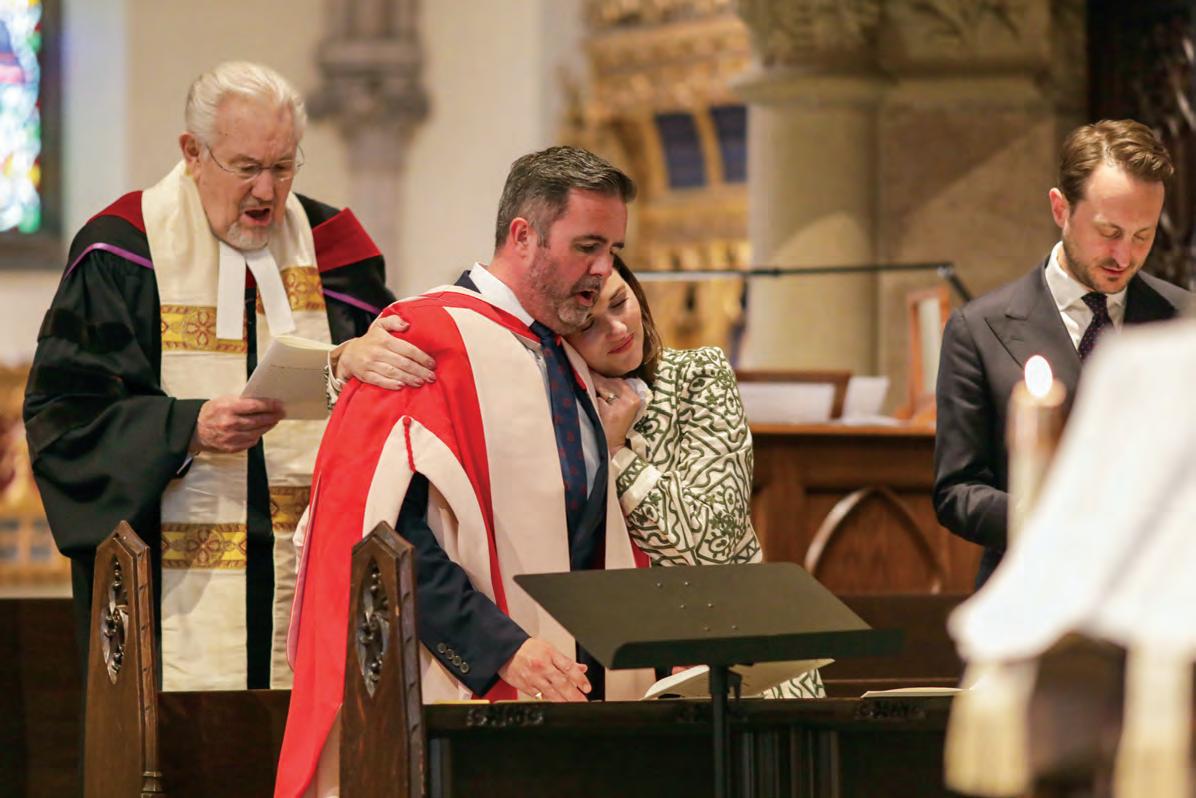
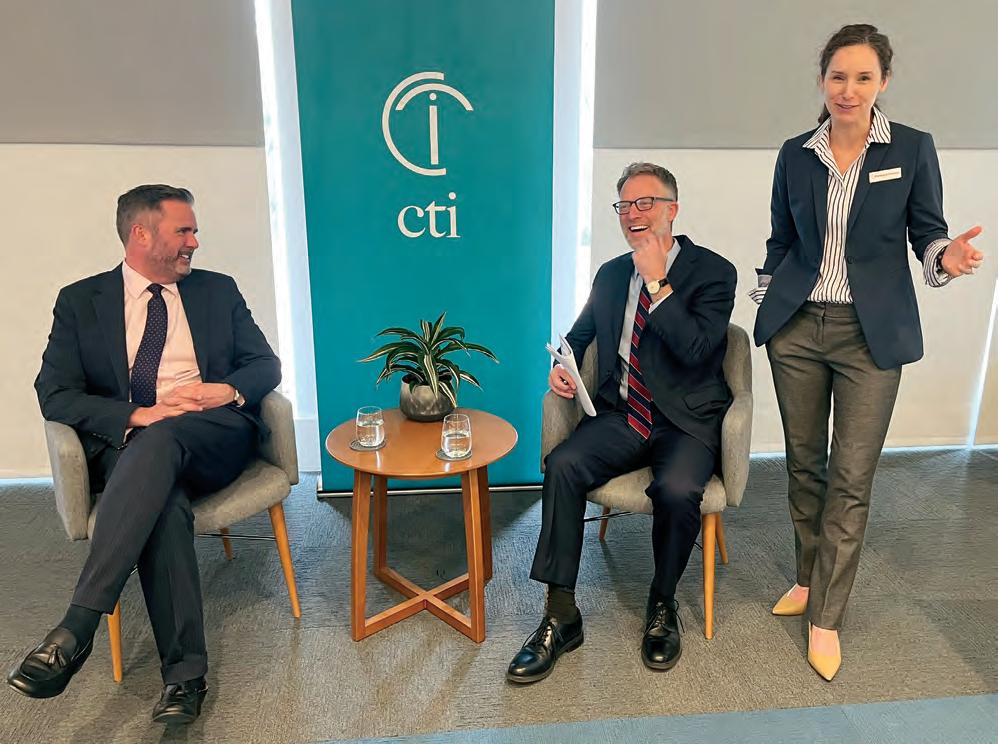
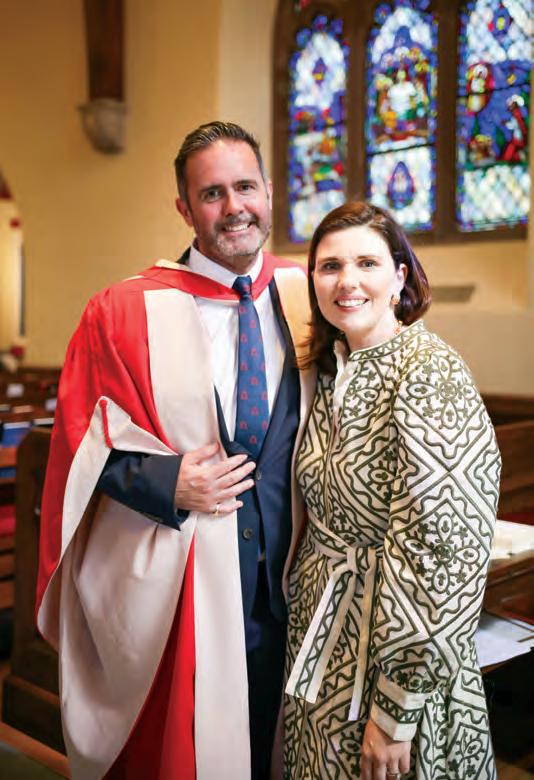
In April 2026 I was deeply honored to have been installed as the Director of CTI, and privileged to have so many people from our global community join in the celebrations. Leading voices from across the world and across the fields of Theology, Literature, Ethics, Music, and Science offered stellar lectures, performances, and panels. And it was a delight to see so many of CTI’s friends at the service of installation. CTI is committed to bringing about a theological renaissance in church, academy, culture, and society. The conference around the installation embodied the breadth and ambition of this vision, and showed what is possible.
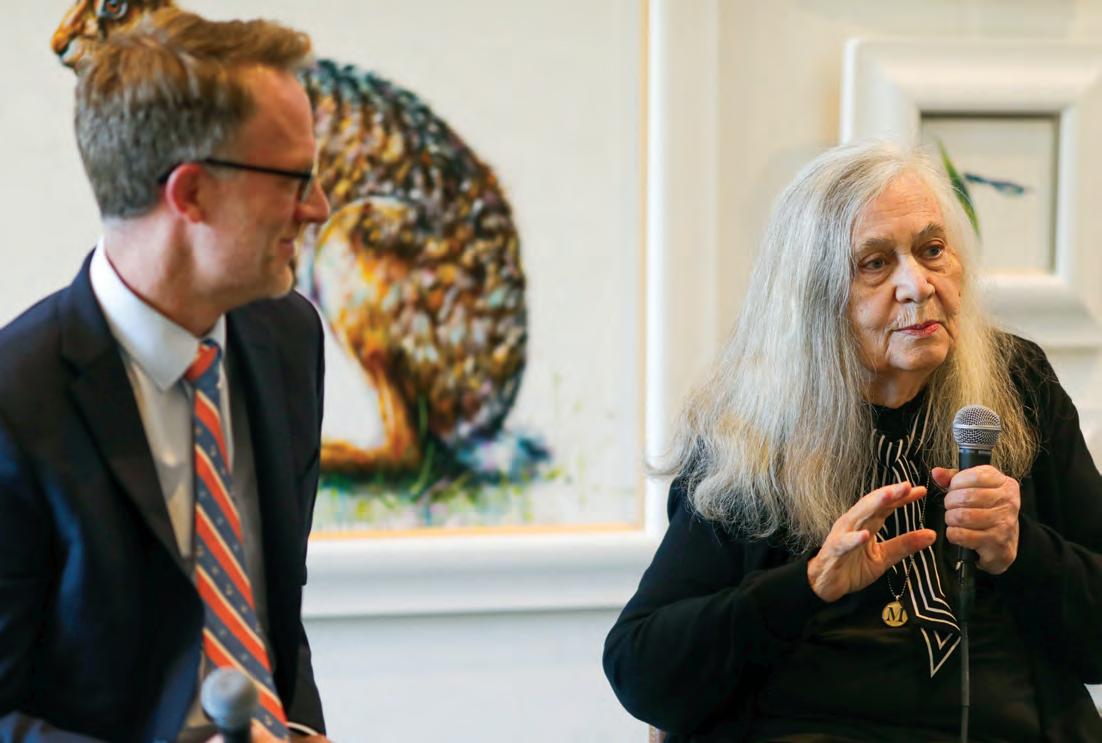
There were lectures not only on theology and history but also what theological engagement might mean for our understanding of exoplanets and alien life, for engagement with AI, and for poetry and literature. Check out our YouTube channel for recordings of such notable figures as novelist Marilynne Robinson, poet Micheal O’Siadhail, and theologian and concert pianist Jeremy Begbie.
CTI’s work is only possible because of the generosity of our supporters. We hope you might be prepared to join with us in supporting the work we do by making a donation to our annual fund. We are grateful for all of you who have already given so generously. Our financial year ends on June 30th, and we humbly ask that you might consider making a donation to support our endeavors if you have not done so already.
CTI is the world’s only institute for advanced studies dedicated to Theology. Your partnership and support make possible the work of casting theological light on the big questions of the world today. Theological research has been critically underfunded over the last decades. Your gift could make all the difference in bringing about a renewal of Theology so that its significance for our world can be maximized.
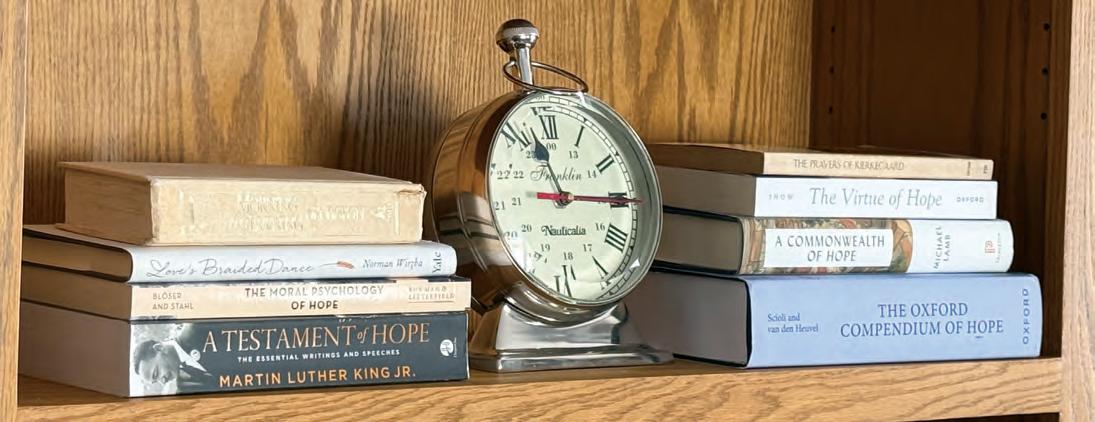
The inauguration showed not only what Theology at its best can do: the inauguration also showed how necessary it is for Theology to have a central role in our world today if we are to move to a more hopeful tomorrow. Partner with us as we try to turn despair to hope through the deep research into the deep and pressing issues we face in the current world.
– Tom Greggs Director
INAUGURATION Weekend at CTI
A Celebration of Theology
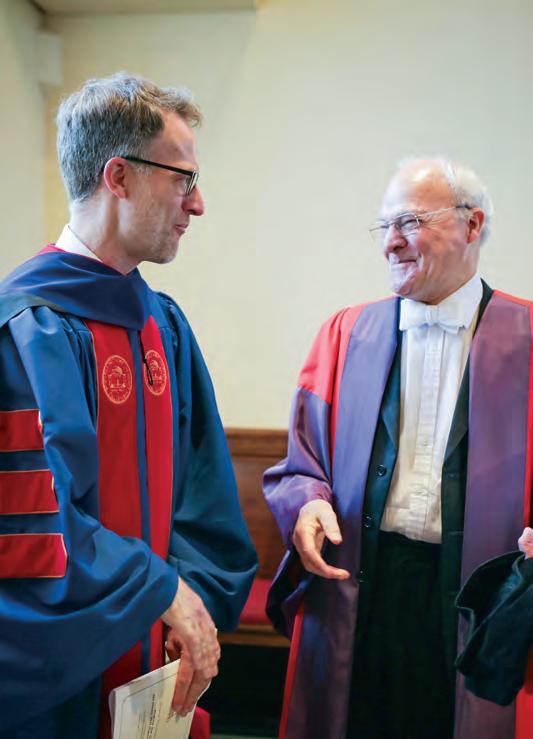
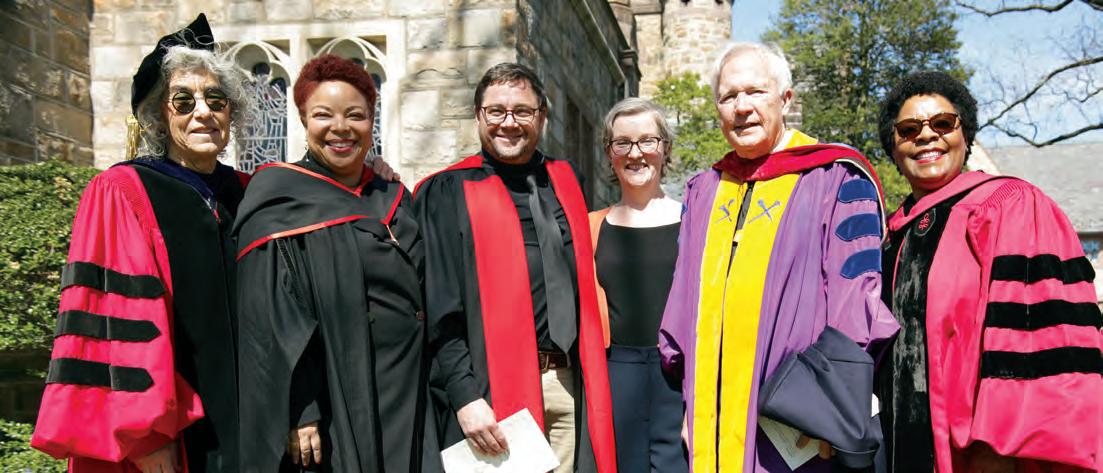
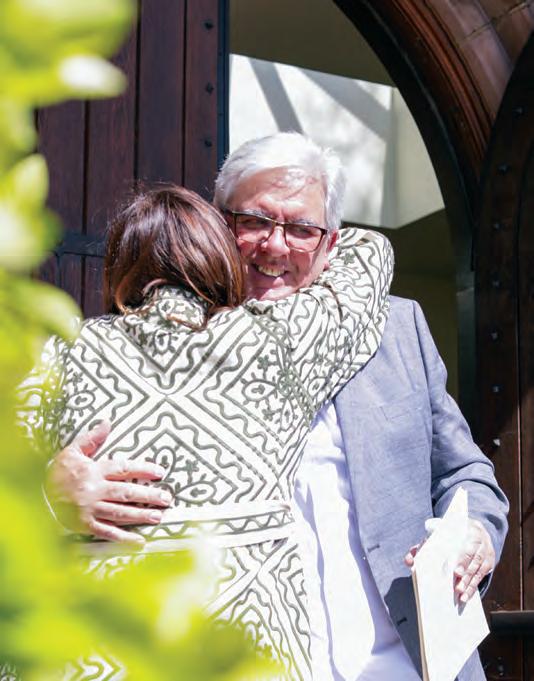
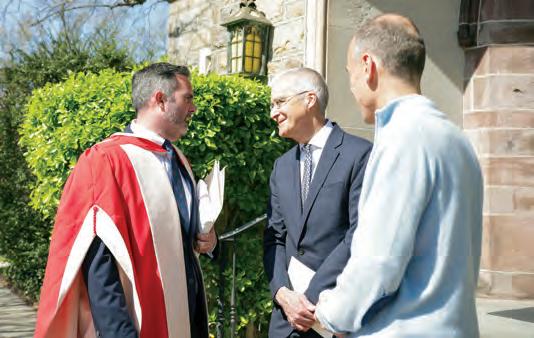
From April 10th to 12th, 2026, CTI marked a significant milestone with a richly layered Inauguration Weekend honoring the installation of Tom Greggs as its fifth Director. Convening leading scholars, pastors, artists, and institutional partners, the weekend featured a festive renewal of CTI’s leadership as well as sustained, multi-disciplinary reflection on the nature, tasks, and opportunities for theology in an era of fragmentation, polarization, and technological upheaval.
Envisioned as “A Celebration of Theology,” the weekend encompassed three days of lectures, panels, performances, and worship that spanned historical reflection, doctrinal inquiry, and contemporary ethical exploration. It began informally on Thursday evening with a dinner hosted by Heather and Tom Greggs at the Director’s Residence, setting a convivial tone for what would prove an intellectually stimulating and spiritually resonant gathering.
Rebuilding Bridges in a Fragmented Age
The formal program opened Friday morning with a keynote by Heath Carter of Princeton Theological Seminary. Titled “Bridges Built, Burnt, and Remade: Reflections on 280 Years of Theology in Princeton,” Carter’s lecture traced the complex interplay between theology, institutional life, and American public culture from the founding of the College of New Jersey in 1746 to the present. Drawing on the legacy of leading Princeton figures such as John Witherspoon and Charles Hodge, Carter explained how theological institutions have historically functioned as both bridge-builders and bridge-burners, noting that Princeton’s Presbyterian roots helped galvanize revolutionary sentiment—earning it the British epithet “the Seminary of Sedition”—but failed to prevent its complicity with slavery. Citing the observation that “in land wars and culture wars, bridges are among the first things to be burned,” Carter argued that the erosion of mediating institutions, particularly amid the decline of mainline Protestantism, has contributed to today’s intense political and social polarization. His call to rebuild those bridges set a thematic trajectory for the weekend by envisioning theology as a constructive force capable of reconnecting fractured domains of knowledge, community, and public life.
The Task of Theology Today
While Carter’s lecture concerned the etiology of contemporary fragmentation, Virginia Theological Seminary theologian Katherine Sonderegger addressed theology’s present vocation. In her address “On the Task of Theology in Our Day,” Sonderegger advanced the striking thesis that theologians must recover confidence in the doctrine of God. This “theological confidence,” she argued, is not reducible to dogmatism or rhetorical force. Rather, it is a cultivated disposition that combines intellectual rigor, spiritual attentiveness, and a joyful boldness exemplified by Karl Barth. Moreover, its core conviction is that theology is undertaken coram Deo—that is, in the presence of the living God—who claims the entirety of human existence. Sonderegger also offered a provocative defense of specu-
INAUGURATION Weekend at CTI
lative theology as disciplined metaphysical reflection that can deepen theological understanding when grounded in the biblical witness. Her emphasis on metaphysical realism, the centrality of doctrine, and the theological foundations of salutary pastoral care underscored a recurring sentiment of the weekend, namely that theology must neither retreat into abstraction nor reduce to activism but instead combine scholarship with engagement.
Why Theology Matters
An afternoon panel on “Why Theology Matters” explored these subjects further. Former CTI Director of Research Robin Lovin highlighted James McCord’s founding vision for theology at CTI as an integrative discipline capable of
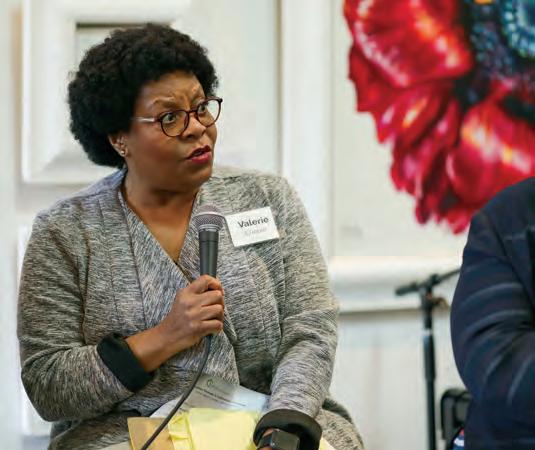
countering the fragmentation of knowledge. Lovin suggested that today the greater challenge is not fragmentation but polarization—driven in part by the politicization of theology itself. In such a context, theology must recover its capacity for genuine inquiry rather than succumb to ideological deployment. Fellow panelist and CTI Senior Fellow Valerie Cooper offered a sobering reminder of theology’s significance by observing that “bad theology wounds, kills, and alienates.” From historical justifications of slavery to manifold contemporary exclusions, Cooper contended that distorted theological claims continue to have devastating consequences. Sister Gemma Simmonds, Director of the Religious Life Institute, noted pervasive contemporary theological illiteracy and recalled G. K. Chesterton’s observation
that when belief in God declines, belief in anything may take its place. Complementing Cooper’s and Simmonds’ remarks, current CTI member William Willimon characterized theology’s critical functions as exposing idolatry and helping the church faithfully receive and communicate the “news” of the gospel. Together, the panelists presented theology as at once constructive, corrective, and indispensable to both church and society.
Music, Unity, and the Work of the Spirit
The day concluded with a lecture and performance by Jeremy Begbie, the McDonald Agape Director of Duke University Initiatives in Theology and the Arts, which offered a captivating multi-modal meditation on music and Trinitarian theology. Blending presentation with pianistic illustration, Begbie demonstrated that music provides a powerful analogue for the work of the Holy Spirit by binding together, opening outward, preserving particularity, anticipating the future, and generating creative newness. Drawing on the Augustinian tradition, Begbie described the Spirit as the bond of love between Father and Son—a dynamic mirrored in musical practices such as harmony and improvisation. Especially in times of ecclesial division, he suggested, communal singing can become a site where unity in Christ is not merely extolled but enacted.
INAUGURATION Weekend at CTI
Theology in a Technological Age
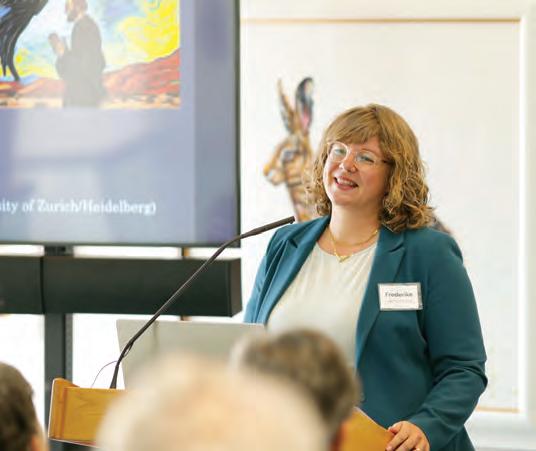
Saturday’s sessions considered theology’s engagement with contemporary challenges, particularly the rise of artificial intelligence (AI). University of Zurich Professor Frederike van Oorschot opened the day with a lecture on “Imagining the Human, God, and Technology,” in which she contextualized AI within broader social imaginaries and highlighted how emerging technologies reshape both practical life and fundamental human self-understanding.
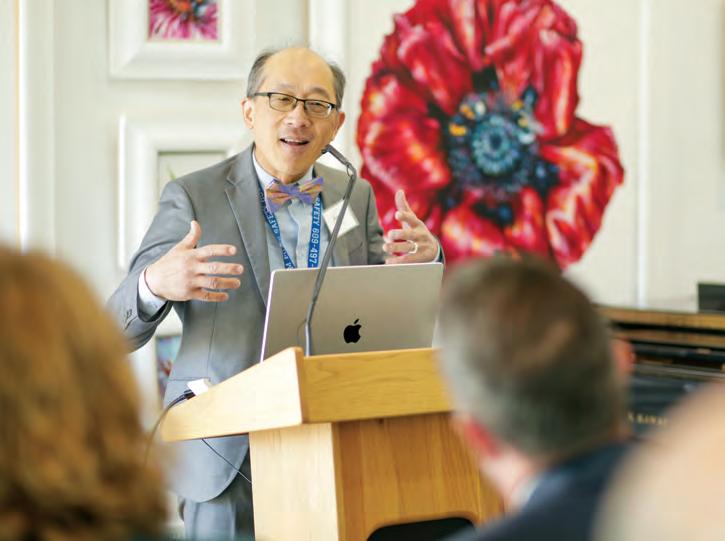
Tom Greggs’s Inaugural Lecture, “Be Transformed by the Renewing of Your Mind: A Vision for Theology” extended and developed the weekend’s principal motifs. Connecting CTI’s founding context—suffused by nuclear anxieties and Cold War animosities—with the prevailing ethos of AI-induced pessimism and social polarization, Greggs maintained that theology may exert a vital reparative influence. Recalling Reinhold Niebuhr’s residence at the Institute for Advanced Study in 1958, Greggs traced CTI’s origins to a time when theological reflection enjoyed sustained conversation with scientific and ethical research at the highest levels. Insisting that a similar dialogue has become exigent once again, Greggs echoed Niebuhr’s admonishment against utopian thinking and commended a vision of theology as making sense of God and all things in relation to God that is rooted in faithful scholarship and oriented toward practical transformation.
Expanding Theological Horizons
Subsequent sessions explored theology’s engagement with science, scripture, and ethics. Durham University Professor David Wilkinson examined the theological implications of astrobiology, challenging assumptions about human uniqueness while affirming the credibility of Christian doctrine amidst recent cosmological discoveries. Thereafter, Wilkinson’s Durham colleague Grant Macaskill offered a sophisticated critique of exclusively narrative approaches to scripture. Arguing that the biblical witness cannot be reduced to a single overarching story, Macaskill proposed that it is instead largely devoted to “world-building”—the creation of a symbolic and moral universe in which believers participate.
Macaskill claimed that this hermeneutical shift has considerable implications for Christian ethics, particularly in an era marked by otherwise debilitating doubts about historical progress. An interview with novelist and essayist Marilynne Robinson provided a lyrical counterpoint to these analytical lectures and cast theology as a shared human inheritance affording crucial insight into the nature of reality. Urging theologians to cultivate renewed attentiveness to the depth and mystery of quotidian existence, Robinson reminded the weekend’s participants that “the world is a seething miracle.”
Art, Worship, and Installation
Saturday also featured signal artistic contributions, including an evocative poetry reading by Micheal O’Siadhail and an ethereal musical performance by Jon Guerra, as well as an exhibition of nature painter Georgina McMaster’s extensive oeuvre entitled “All Things Wild and Wonderful: Symbols of God’s Glory and the Fullness of Creation.” These elements instantiated the event’s holistic vision of theology as encompassing not only intellectual inquiry but also aesthetic and spiritual expression.
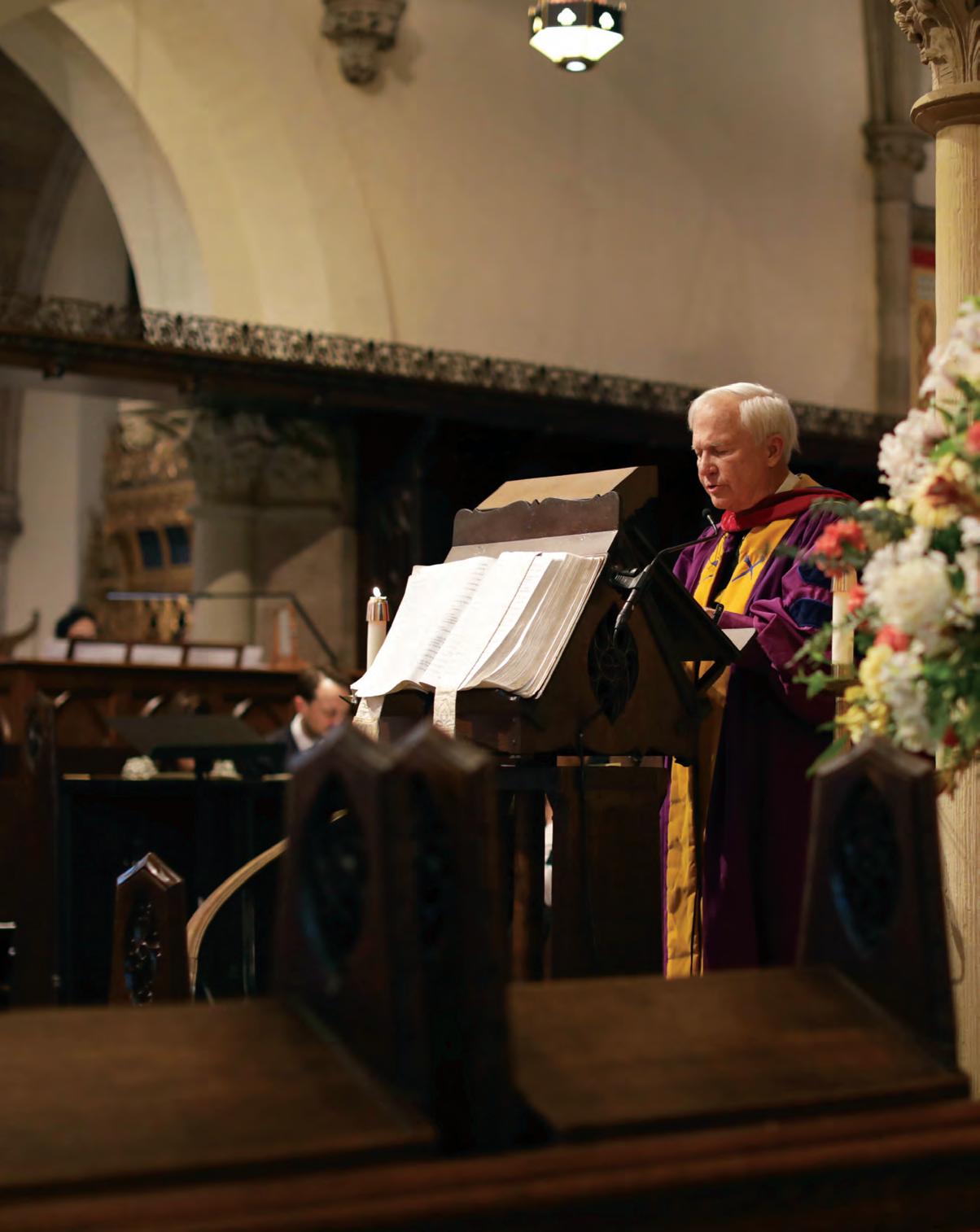
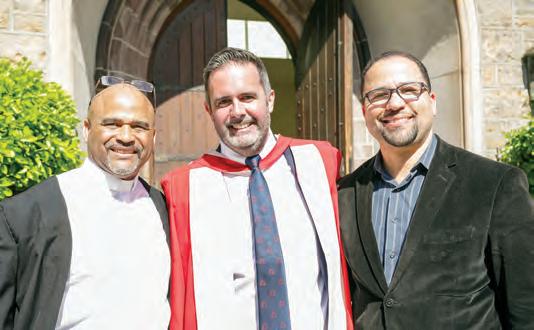
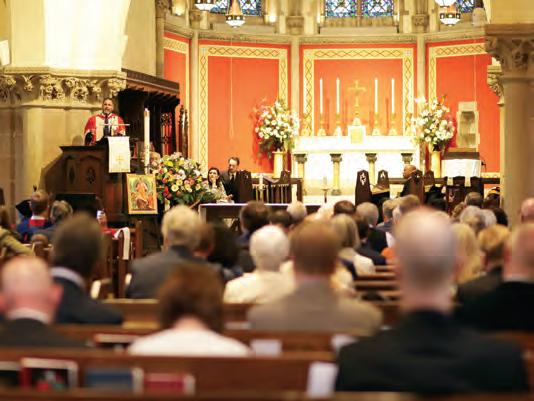
The weekend culminated Sunday afternoon with the Service of Installation in the spectacular sanctuary of Princeton’s Trinity Episcopal Church. Comprising an academic procession, hymns, prayers, readings, a sermon from Greggs, and a rite of inauguration officiated by CTI trustees and distinguished guests, the service manifested the doxological heart of sound theology.
A Reinvigorated Mission
A palpable excitement about CTI’s future animated the weekend’s concluding reception. Amidst a social moment marked by division, apprehension, and technological transformation, the celebration exemplified the capacity of rigorous interdisciplinary theological inquiry to build bridges, cultivate understanding, and contribute to catalyzing cultural renewal. With Tom Greggs’s leadership, CTI is poised to realize that promise as it pursues a theological renaissance in service to God for the benefit of the church, society, and all creation.
– Frederick Simmons
Inquiry on the Future of Theology
DANIEL LEE HILL
This past fall, my family and I traveled from Waco, Texas in our newly washed minivan, stuffed to the brim with Barth’s Dogmatics, O’Donovan’s Ethics, and more Matchbox cars than can be counted, to study theology’s future at CTI with an international team of theologians, ethicists, historians, and biblical scholars. Each week we gathered in a colloquy where one colleague presented their “working paper” on the future of theology, which we had read beforehand. We spent roughly an hour and a half discussing the contribution before breaking for lunch, which often amounted to a continuation of the conversation for another hour or so. Over the course of the semester, we read and discussed papers on topics ranging from critiques of Christian supersessionism to the future of the black church in the racialized climate of North America. I contributed a paper on the nature of theological knowledge and the doctrine of illumination.
The experience was invigorating, not least because of my habit of bicycling to and from the office each day. I am rarely exposed to and engaged by thinkers outside my discipline and area. Conversely, I would be surprised if before this fall a biblical scholar had read a single word I had written—and not without reason! Theological research can become siloed, focused on one’s particular area of interest. Indeed, I rarely read papers from my colleagues here at Baylor in biblical studies or ethics, and infrequently attend lectures unrelated to theological anthropology or ecclesiology. Much of this has to do with taste or affect, something we each spend years cultivating in light of the projects that we pursue and the questions we find alluring. Some of it results from personal, ecclesial, and institutional commitments that impinge upon a finite creature’s capacity to direct their attention to a wide range of interests. But the result can be a kind of naïveté or even ignorance. Yet the colloquy at CTI provides a snapshot of the goods a dialogical approach to theology can offer. Each week I sat in a room with distinguished scholars to engage in the common pursuit of knowing and speaking rightly about the living God and the world in relation to God. This is not to suggest that all of my colleagues at CTI pursue theology in the same manner or with the same goals. And for that very reason, we each found our insights and concerns challenged, sharpened, and encouraged. It was truly a gift.
This way of thinking theologically at CTI pertains to the subject of the inquiry I participated in at CTI: the future of theology. It seems to me that to speak of this future we must say two things at once. First, we must speak of theology’s absolute future, the future God has promised to bring about for His people and the knowledge He has promised to convey to those He brings near to Himself. Whatever future theology is destined for, it is nestled within the future of God, the future that belongs to God and whose realization depends upon God. This future involves a kind of perfection in human modes of knowing, a seeing God in the face of Jesus Christ, and an awareness of the manifold ways in which creaturely relations are held by this selfsame eternally begotten one. But second, there is also the immediate future, theology’s future tomorrow, and the next day, and the next. And the future of this theology, one CTI works well to harbor and cultivate, must be one that strives to bring prayer, worship, and God-talk back into relationship with one another. It will be a theology that refuses to segregate knowing and loving, theory and adoration. It will be a theology whose knees are calloused, whose hands are clasped, and whose back is bent in humble adoration of the Humble One who stoops low and who stoops first so that we might dare to speak of Him in fits and starts. And it will be a theology that is not ashamed to learn of Christ alongside Christ’s church.
My son, a newly minted three years old at the time of our pilgrimage to Princeton, has repeatedly asked me when we are returning to “our house in Princeton.” I too have been indelibly marked by my time at CTI, for it is a place where theologians of all shapes and sizes have the time to think, to deliberate, and to build; where truth is pursued and hospitality and collegiality are maintained; and where godliness is indeed counted a great gain. What CTI is building in New Jersey is thus quite the site (and sight) to see. If there is to be a theological renaissance in the years to come, I am quite sure that CTI will have more than its part to play in bringing that future into being.
Daniel Lee Hill is Assistant Professor of Christian Theology at Baylor University.
Scriptural Reasoning and CTI
PETER OCHS
Abrahamic Scriptural Reasoning (SR) is a practice of interreligious study across the borders of scriptural traditions. As described in many publications and websites, SR began in the early 1990s as a cooperative venture by faculty at the University of Cambridge and the University of Virginia; by the 2000s, it was practiced more broadly by congregations and groups of students and adult learners. Initially addressed to scholars of Islam, Christianity, and Judaism, SR gradually included scholars and students of Indian, Chinese, and other traditions. Currently, Abrahamic SR remains the most widespread practice.
Readers of Fresh Thinking may enjoy a more intimate origin story. I was blessed to have enjoyed a year’s fellowship at CTI in the mid-1990s during the Rev. Daniel Hardy’s tenure as Director. Toward the end of my stay, I was treated to a double blessing when Rev. Hardy’s son-in-law, Prof. David Ford, came for a visit, and we three enjoyed extended discussions about the place of scriptural study in academic programs of theology and religious studies. We had a shared sense that there was far too little study of scripture in both theology and religious studies and that, when it appeared in the curriculum, there was little or no attention to what we considered the force or performance of biblical texts and biblical commentary. There was attention to plain sense, grammar, philology and, especially, to academic accounts of the historical settings of texts and commentary. But there was almost no attention to how specific texts and commentaries might affect the behavior of individuals and communities over the many generations and in the present moment as well. There was therefore little attention to the history of biblical interpretation and to the range of interpretive practices that are utilized today. There was little or no attention to tradition- and denomination-specific practices of reading and interpretation nor, finally, to interactions among such practices in the people who performed them.
After returning to our homes in the UK and USA, we continued the discussion long-distance until we met again in person at that year’s American Academy of Religion annual meeting. There, I invited Hardy and Ford to attend the Jewish Textual Reasoning (TR) session, also being held at the annual meeting. Founded in the late 1980s, TR is a tradition-specific practice of shared scriptural study across significant denominational and disciplinary differences. Jewish TR promotes group study of carefully prepared rabbinic scriptural commentaries. At the annual meeting, approximately 40 of us would sit around a long table, with a large refreshment table to one side, with prayer books on another table in case the time for afternoon or evening prayer arose,
with excerpts of rabbinic and scriptural texts before each of us, and as needed books of traditional sources and dictionaries. We would have prepared essays by two or three participants, each one interpreting a rabbinic commentary on some texts from the Tanakh. After brief comments from these participants, the session would proceed. Each of us would in turn briefly reread and offer words about a text and commentary: not to explain the readings but to observe something surprising or troubling in the texts, then turning to the next person, and so on around the table. Each person might add additional words about the given text, or words about another text-and-commentary, or words in response to the previous speaker. The procedure is intrinsic to classical and contemporary rabbinic study, except that we might cite comments out of our disciplines of history, biblical or Talmudic study, philosophy, or public work as rabbis or teachers. We never sought agreement or a shared conclusion to any of our readings. During our sessions, disagreement generated insight, laughter, song, and deep reasoning, attracting comments from each of our various specializations and interests.
Hardy and Ford were deeply moved by the textual study and enchanted, as well, by the accompanying laughter and song. After the session, we wondered if there were some ways to conduct shared study not only within but also across the borders of the Abrahamic scriptural traditions. Over several years, we and others experimented with many study practices until we discovered and refined what we call Scriptural Reasoning (SR). There are various ways to practice SR, with facilitators adjusting SR practice to the character and environment of each group. In the prototypical practice, participants are provided three small sets of verses, for example one set from each of the Abrahamic canons of scripture: the Tanakh (Hebrew Bible), the New Testament, and the Qur’an. Verses appear in the original languages and in a group’s common language so that all the participants can read them. After brief introductions to the verses, participants read passages aloud and then question one another
about puzzling or surprising features of each verse, sometimes each word. Participants explore the plain sense as if each participant from whatever background could read each verse with equal facility.
Consider, for example, a 2002 SR annual meeting. Prompted by Scripture’s accounts of Moses and Pharoah, Shaul Magid was troubled by the Exodus account of God’s hardening Pharoah’s heart (Ex 4:21). Magid feared that, by denying Pharoah’s free will, God has imposed “cruel and unusual punishment.” Stanley Hauerwas asked Magid, “Why would you ever be led as a reader of scripture to think the creature can assume a stance that puts God in the dock? Consider Paul’s claim in Romans 9:14-16 that ‘it depends not on human will or exertion, but on God who shows mercy.’” Vincent Cornell reported that, in the Qur’anic narrative, “Pharaoh appears as Moses’ foil. … Pharaoh … is the epitome of the arrogant, unjust, and egoistic man of power, … who arrogates to himself the attributes that right-fully belong to Allah … By contrast, Moses epitomized submission to tawhid (divine unity) and the divine Law, without the intermediary power of self-reliance (tadbir).”
Such discussions did not lead to agreement; each scholar had reasons to read the text a certain way and then argue for that reading. The ideal fruit of SR is something different than agreement: it is deep learning across different canons and different opinions. I like to say that the goal is to transform contradictories (claims that cannot coexist) into contraries (mere differences) so that conflictual differences become complementary differences.
SR discussions tend to include personal reflections and memories, but conversation always returns to the text. The facilitator suggests when it is time to move on to the next text and reminds the group that, in SR, no one speaks too much or too little, no one seeks to convince all others of any claim or belief, but everyone shares wonderments and ideas about what a passage may mean. The goal is not comparative shopping among the canons but fresh observations about
individual verses, pericopes, and then broader or comparative issues raised by the verses, then back to the plain sense. Here are two illustrations of how CTI has nurtured the development and refinement of SR from its beginnings to today.
In 2006, with the generous support of William Storrar and Walter Alston, Princeton Seminary Professor William Stacy Johnson and I invited fourteen scholars to devote three years to biannual “work weeks” of inter-Abrahamic scriptural study. This was the first occasion for Muslim-Christian-Jewish study within the walls of CTI. Our gathering included four scholars of Islamic studies, five scholars of Jewish studies, and seven scholars of Christian studies. We began each workweek with two days of scriptural reasoning followed by three days of medieval commentaries on our scriptural texts. Facing a time of profound tensions among Jews, Christians, and Muslims in the world, we sought to practice and publicize an event of hospitality among devotees of each of these traditions and their sub-denominations. Our theme—which became the title of our multi-authored book—was “Crisis, Call, and Leadership in the Abrahamic Traditions.” We studied texts and commentaries both for their own sake (letting the words lead us wherever they would) and, slowly (so as not to rush ahead of the words). We discussed and debated lessons about how our traditions call us to respond to religious, social, and environmental crises such as the crises of interreligious disrespect and hatred, societal indifference to poverty, and religious/secular tensions especially between traditional and historical critical practices of scriptural study.
The study was remarkable, opening a celebratory sense of what we learn from our own and each other’s scriptural canons. Participants remarked with surprise that the deeper they studied and appreciated the other canons, the deeper they loved and enjoyed their own. Our intellects were opened as well, plumbing subtleties in scriptural language, pressing each other for more clarity in our claims about the
major themes of crisis, hatred, and poverty. And there was something more: I don’t think I ever had more fun and felt more joy than in the wondrous weeks of work we shared with each other. As I say this, I picture 15 other faces moved by joy, speaking puns, turning back-and-forth all week between intense thinking and even screams of laughter. In the late afternoons we would put our texts down and turn to music—singing, guitar, piano. Then storytelling, sometimes moving—even tearful—personal narratives, then words of mutual discovery, then laughter again. It became a community of high thinking and deep friendship and care. In our contributions to the shared book, the sixteen of us spent time apart, researching and composing individu-
al inquiries into crisis and response. Introducing his study, “Hagar and Esau…,” Kepnes wrote that “At the urging of my scriptural reasoning colleagues…I found that I could work with [the figure of Esau] as a warrant for…[dialogue].” He wrote that Hagar, the “other” to Sarai, was also ha-ger (in Hebrew), the “stranger” whose name is antitype of Abraham’s offspring who “will be strangers in a land that is not theirs” (Gen. 15:13). Introducing his essay on “Qur’an and the Image of the Other…,” Aminrazawi wrote of SR, that “I still can’t define it but I can feel it. It was not another ecumenical … dialogue for the sake of peace, love, and universal brotherhood. It was a cathartic process, exploring the complex interaction between unity and multiplicity of
the Abrahamic traditions, seeing oneself through others and how perceived commonalities might well be the sources of divergence.” Introducing her essay, “In the Bosom of Abraham…,” Astell wrote that “for me, the scriptural reasoning seminar was a mountaintop experience, a grace filled and plainly transformative period of interpersonal exchange unlike any other I’ve known on this earth…Pouring over each other’s sacred texts together, like the sages of old, with the excitement of every new discovery…Witnessing each other at prayer, voicing passionate concerns for peace and sharing a sense of historical urgency… to which we struggle to respond, weathering occasional tensions when they arose… Giving and receiving warm hospitality…All these experiences seem to me miraculous in their hopefulness.”
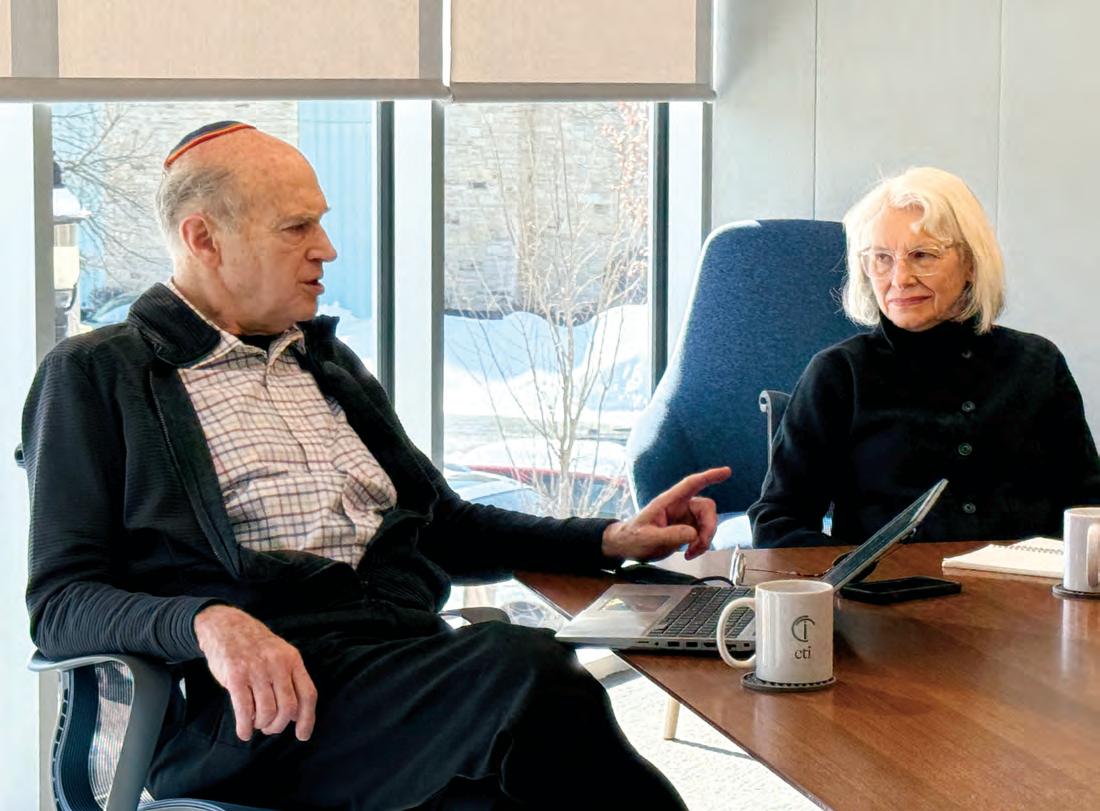
In January 2026, CTI Director Tom Greggs invited a handful of what he generously called his “mentors” to spend a month together at CTI. We would practice SR study for its own sake and then discuss our Scripture-spawned ruminations about the future of Christian theology’s dialogue with Judaism, Islam, and the secular university. The invitees—David and Deborah Ford, Steven Kepnes, Peter and Vanessa Ochs, Laurie Zoloth and Marc Berkson, along with resident scholar Valerie Cooper—were treated to hospitality worthy of Abraham and Sarah. We retold the story of Daniel Hardy’s leadership at CTI, shared our gratitude for his and Will Storrar’s guidance. We gathered around Tom Greggs to hear his visions for Christian theology at CTI, for SR at CTI, and from CTI and SR into the university and the broader society. His visions deepened and energized our practice of SR and our trust in CTI and its splendid future. Toward the end of our stay, I was treated to an online interview with Joshua Mauldin. And what a treat. The theme was SR, and, before I offered an overview of the practice, Josh and I simply did SR. We chose Psalm 82: “God stands in the divine assembly pronouncing judgment among the divine beings.” What divine beings? We gazed at many seriously different readings as if they stood side by side. But
it wasn’t relativism and it wasn’t the way our individual denominations usually read. So, what is SR? Josh suggested it was like an in-between activity, neither commanding us to act nor removing us from the environment of sacrality. An activity that invited some experimentation into the Abrahamic tent, before we returned home to enjoy our customary canons that now sparkled even more.
Peter Ochs is the Edgar M. Bronfman Professor of Modern Judaic Studies Emeritus at the University of Virginia and a co-founder of the Society for Scriptural Reasoning.
Center of Theological Inquiry Convenes Workshop on Technology and AI
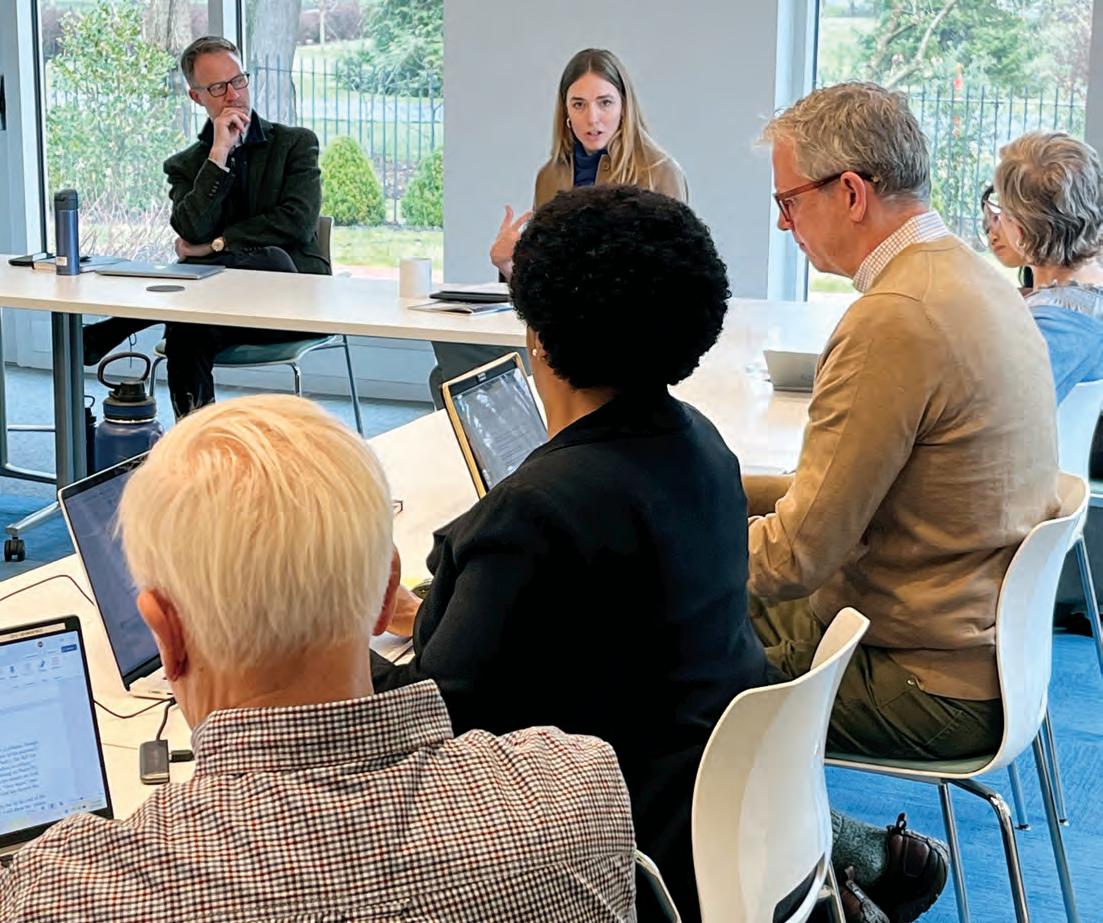
On March 26 and 27, 2026, luminaries from the digital humanities, education, and media joined CTI scholars in the AI cohort of its From Despair to Hope project for a workshop on technology and artificial intelligence (AI). Devoted to structured reflection on these scholars’ project research, the workshop examined the grounds and contours of credible hope in an age suffused by technology and increasingly shaped by AI.
Project consultant Rebecca Dorsey began the workshop with a collaborative exercise inviting participants to articulate what they sought to gain from and contribute to their two days together, establishing a supportive and convivial spirit among the participants. CTI Director Tom Greggs then framed the gathering as an opportunity to clarify individual research projects, contextualize them within the project’s overarching study of hope, and consider how theological inquiry might foster broader societal reckonings with emerging technologies. Greggs recalled CTI’s founding vision—to bring theological scholarship at the highest level to bear on pressing contemporary concerns—and observed that few questions are more urgent than the nature and grounds of hope in a technological age.
The workshop’s first day featured presentations from members of the AI residential cohort, each exploring AI from different disciplinary perspectives. Elise Edwards opened these presentations by offering a threefold framework for decision-making, distinguishing between machine learning, design thinking, and spiritual discernment. While AI excels at statistical pattern recognition and design thinking prioritizes human-centered problem solving, Edwards argued that spiritual discernment uniquely attends to questions of justice, personal formation, and the good—criteria that must ultimately govern whether and how AI is deployed.
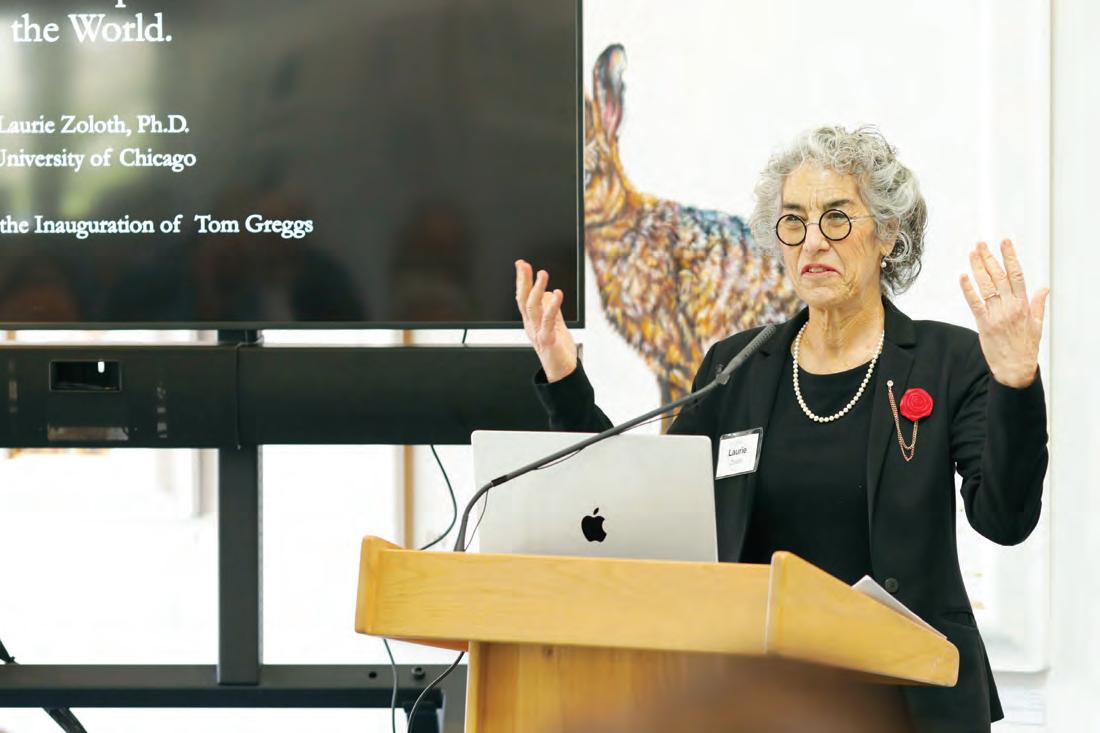
Next, Laurie Zoloth placed current technological anxieties within a wider historical and philosophical setting and explained how the emergence of new forms of intelligence
complicate traditional understandings of human being that prioritize rationality. Drawing on ancient and modern sources alike, Zoloth explored how longstanding definitions of human beings as “thinking things” must change given the advent of other thinking entities.
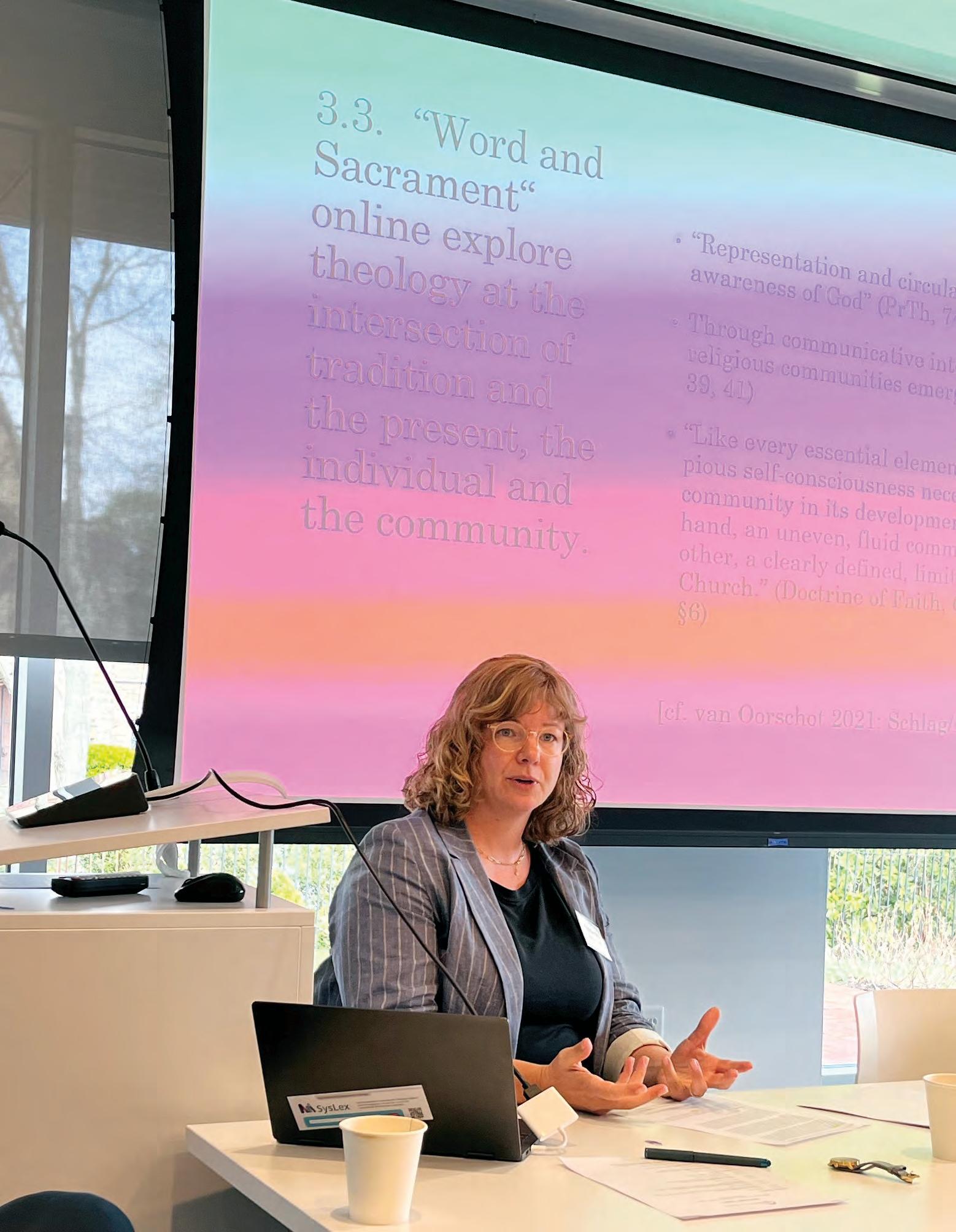
Thereafter, Henco van der Westhuizen drew on Charles Taylor, Hannah Arendt, and Jürgen Moltmann to reconsider the relationships between language, thought, and hope. He warned that contemporary AI systems, which treat language primarily as a computational tool, risk narrowing human self-understanding by reducing both thinking and hope to instrumental and predictive categories. In contrast, van der Westhuizen commended a richer, inherently relational anthropology and a more robust account of hope as openness to a future that exceeds calculation.
Other presentations addressed the ethical and theological implications of AI. Paula Sweeney examined how AI’s benefits and burdens are unevenly distributed, noting that while the technology significantly broadens access to elite services, it simultaneously threatens those who provide them. Drawing on Rawlsian and Scanlonian social justice frameworks, she intends to develop ethical criteria that furnish a principled distinction between instances in which resistance to AI is justified and instances in which its adoption is morally required.
In the final presentation of the day William Willimon emphasized that Christianity’s valorization of hope is unusual and that its commitment to hope as an eschatological reality inclines Christians to express their hope through poetic imagery rather than technical discourse. Greggs closed by suggesting that AI compels renewed reflection on the special characteristics of the human, and he pointed to love and the capacity to receive grace as two of them.
The workshop’s second day started with a synthesis of the previous day’s key claims and questions as distilled by CTI postdoctoral fellow Charles Guth. Guth identified the distinction (or lack thereof) between human and artificial in-
telligence, the nature and value of human personhood, and the conceptual complexity of hope itself. Subsequent panels brought external experts into focused conversation with the cohort. Clifford Anderson and Benjamin Glaser explored developments in digital and computational humanities, highlighting both the opportunities AI presents for theological inquiry and the challenges it poses to traditional forms of scholarly labor. Anderson noted that while AI is reshaping fields such as computer programming—transforming it from a craft into a form of oversight—it also raises fundamental questions that the humanities are uniquely equipped to address.
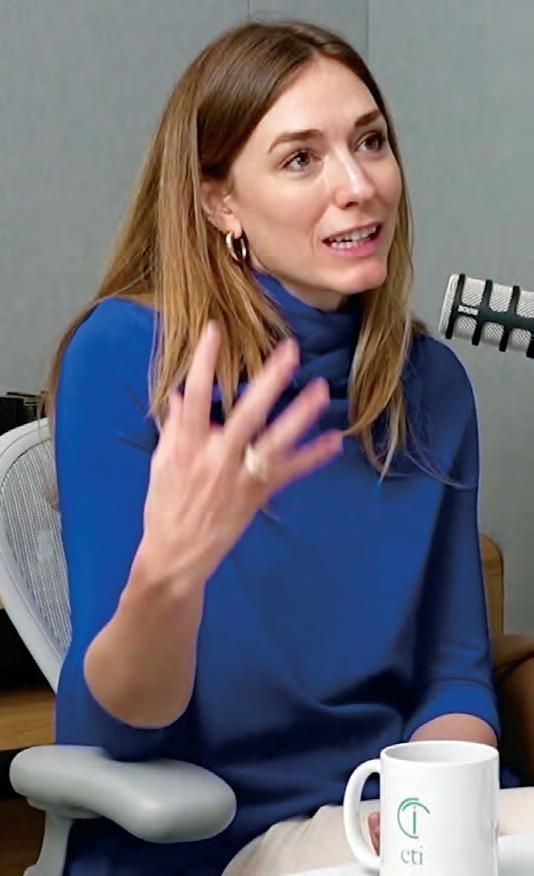
A second panel featuring Andrew Calis, Gretchen Huizinga, and Matthew Walther examined the ethical and practical dimensions of AI deployment. Huizinga, drawing on her experience in the technology sector, distinguished between “responsible” and “righteous” AI, arguing that the moral character of those who design and use these systems remains decisive. She also cautioned against the widespread technological pursuit of a frictionless “milieu of ease,” suggesting that such a world may ultimately undermine human flourishing.
In his closing reflections, Greggs returned to the workshop’s central concern with hope. While acknowledging that AI may offer forms of proximate or instrumental hope, he insisted that ultimate hope cannot be genuinely rooted in technology itself. Instead, Greggs maintained that theology has a crucial role to play in articulating a more enduring vision of hope capable of addressing the deeper sources of contemporary despair. In his judgment, the workshop underscored two enduring insights: that AI invites renewed inquiry into the nature of the human person, and that the fears it provokes echo longstanding cultural and theological narratives—from Prometheus to Frankenstein. Engaging these questions, he suggested, is precisely the task to which CTI’s From Despair to Hope project is dedicated. The gathering concluded with a final panel discussion and closing dinner, marking not an endpoint but a continuation of the cohort’s shared work at the nexus of theology, technology, and hope.
From Research Excellence to Global Impact
How theological inquiry changes culture and society
How do we ensure that the very best research is done— and that it also makes a real difference to the world?
At the Center of Theological Inquiry (CTI), we believe these are not two separate goals.
For us, excellence in research and excellence in impact are one and the same mission.
Deep, Sustained Inquiry: Where Impact Begins
Everything starts with deep work done through sustained research. Scholars come to CTI as senior professors and researchers working on major projects that address the big questions of our age—questions about meaning, ethics, responsibility, hope, technology, politics, health, and human flourishing.
This work is demanding and often slow. It involves long periods of study, debate, and re-thinking. Frequently, it is only through this sustained inquiry that we discover what the real work actually needs to be. This focused study is not a luxury; it is the very condition for uncovering wisdom that endures.
Scholarly books: Trust, Legitimacy, and Authority
From this deep inquiry comes high quality research articles, outputs and books—the gold standard of world-leading academic research. These publications synthesize entire fields, test arguments rigorously, and offer new perspectives that reshape how specialists think and teach.
Crucially, this deep research provides legitimacy and trust. The publications demonstrate why an insight is sound, responsible, and worthy of attention. But at CTI, books are not an end in themselves; they are the hinge between inquiry and impact—the point at which ideas earn the authority to travel further.
Going public: Ideas on the Move
Because the scholarship is rigorous, its insights can responsibly go public. Ideas developed and tested in books are translated into podcasts, articles, lectures, public conversations, and media engagement. This is not dilution, but direction of travel: research moving outward, grounded in evidence and argument. Here, theology enters public life—not as opinion, but as disciplined research leading to wisdom capable of informing debate.
A Theological Renaissance: Renewing the Life of the Church
The Church today is navigating profound cultural, moral, and spiritual challenges. In such a moment, renewal cannot come from techniques or programs alone. It requires deep theological wisdom—wisdom that is faithful, credible, and capable of guiding the Church in complex times.
At the Center of Theological Inquiry, renewal begins where most donors never see it: in faithful, interdisciplinary research into fundamental questions. Scholars at CTI ask hard questions about God, humanity, hope, suffering, ethics, and the future of Christian witness. This work is patient and rigorous, but it is essential.
The primary fruit of this research is books and articles— publications that give theology authority, depth, and trustworthiness. These books shape preaching, teaching, moral discernment, and leadership across the Church.
From this deep foundation, theology flows into the Church’s daily life:
• preaching that speaks truthfully in a compelling way
• leadership formed by wisdom rather than reaction
• witness grounded in thought, research, and evidence— not impulse
This is how renewal takes root—not quickly, but enduringly.
A Theological Renaissance: Renewing the University
The modern university is rich in expertise but often poor in wisdom. Many of the deepest questions—about meaning, value, human dignity, hope, and responsibility—are
left unaddressed or fragmented across disciplines. CTI exists to renew theology’s place within the intellectual life of the university.
Through sustained interdisciplinary inquiry, theology enters deep conversation with the sciences, humanities, and social thought. This work generates new perspectives on big questions, ethical and philosophical insight, and credible ways of bridging faith and reason.
Even more so than with the Church, the center of gravity here must be the scholarly monograph and associated research articles. But at CTI, these research publications become the very means by which theology:
• advances knowledge
• shapes curricula and teaching
• informs public engagement beyond the academy
Over time, this work forms future scholars who go on to become teachers, leaders, and public intellectuals. In this way, theological inquiry decisively renews the university’s contribution to society.
A Theological Renaissance:
Renewing Culture and Society
The world is desperately in need of vision, wisdom, and hope. CTI is committed to the belief that the best research must also make a difference in the world.
As our research ideas circulate, they shape the church, the academy, and the wider world. They also contribute to public conversations, helping societies reason more carefully about moral, cultural, and existential questions. Over time, this work contributes to renewed thought and culture:
• debates are reframed
• moral perspectives are clarified
• public reason is enriched
• cultural imagination is expanded. The impact of theological inquiry is not always immediate—but it is profound. As ideas disseminate, they reshape debate, inform moral imagination, and contribute to renewed public reasoning. Over time, CTI’s theology, formed by rigorous engagement with other disciplines and communicated with care, helps bring about cultural renewal and lasting social change.
Ideas shape people. People shape institutions. Institutions shape societies.
By insisting on depth and communication, CTI ensures that its groundwork truly counts on the ground.
Hope in the Age of Artificial Intelligence
From Despair to Hope: The Gift of the (Im)Possible Journey
AMOS YONG
How, if at all, do we get from despair to hope? I am thinking about this question in April of 2026, amid a USA/Israel war with Iran that we have all been living through. On the one hand, when a ceasefire was announced at one point, many desired a lasting truce that would lead to the cessation of hostilities, and that itself was hopeful, or at least such possibilities animated the negotiations then. On the other hand, the ceasefire gave way to a blockade, and who knows what else might be next, not to mention that any announced “deal” would be neither believable nor fully implemented before being superseded by other “emergencies.” Equally relevant, for realist postures, is that no peace is on the horizon for Ukraine, not to mention other civil wars in the Sudan, Myanmar, and Somalia, alongside various insurgencies around the world. The point is that the world exists under an apocalyptic cloud and even downpour of the sort that, as my American Theological Society colleague Stephen Ray reminds us, is best understood not as a specific sequence of events related to the so-called “end of the world” but as the ongoing threat and experience of destruction that human people groups have had to traverse for millennia. Against this broader global backdrop, there may be no exit from the felt despair of our times.
It is here that I am glad to be less a political theorist and more a political theologian: if the former part of me might be despairing, the latter can still be hoping, not about what we can do but about what God has promised. Yet I need to be careful to delineate how the divine assurances might be generative of hopefulness amid our desperation. Hence I return to the central text of my Pentecostal Christian community, that related to the Day of Pentecost developments recounted by St. Luke in the Book of Acts, chapter 2. Intriguingly, at the heart of this Lukan passage is an apocalyptic foreboding: about God sending the divine breath— the divine wind or spirit—in the last days amid blood, fire,
and smoke on the earth and the darkening of the sun and moon in the heavens (Acts 2:17-19). If for Christian futurists such might refer to apocalyptic terrors at the end of time ushering in the final devastation of an evil world, for the apostolic community, this was a prior prophetic passage (from the Book of Joel in the Old Testament) that talked about the divine response to a horrific and catastrophic plague of locusts that was in turn encouraging for the believing faithful living amid the constraints imposed by the imperial Roman world order. Read in this Lukan context, then, hope amid apocalyptic times is possible only because God is: God is present, God is attentive, God is intervening, not always in ways we want or need, nor even in forms we can recognize, to be sure. More to the point, earlier the disciples had asked Jesus if it was now the moment for the divine intermediation to deliver Israel from Roman rule (Acts 1:6). Jesus’ response was to say that on issues of timeliness, only the Father knows, but what is important is that the divine breath was promised to arrive, even in a rushing, swirling, and enveloping manner, and be available to accompany us as needed. If hope is in the divine wind, rather than in our vision of expectations for such divinity, then there may be a path out of our cynicism and melancholy.
The contours of this trek are charted in the Pentecost narrative then, by the divine breath enabling the listening to and understanding of others different from us. This was not a straightforwardly orchestrated conversation, but one marked by bewilderment, amazement, and perplexity. A cacophony of questions carried the discussion: “Are not all these who are speaking Galileans? And how is it that we hear, each of us, in our own native language? … What does this mean?” (Acts 2:7-8, 12a). The hope of Pentecost is less that we can somehow come up with a ten-point peace plan for the world, or whatever other set of responses we might think alleviates our ailments, but that through the testimonies of strange others, “we hear them speaking about God’s deeds of power” (Acts 2:11b). Comprehension remains possible, even across our seemingly uncrossable chasms of vastly divergent voices, languages, cultures, ethnicities, nations, and peoples of the world, and we might even come to recognize
that the divine is at work in our midst. The point is that somehow, understanding can unfold, and if that is the case, hope is found in and emerges from such dissonant dialogue, through mutual querying, in and out of the multitude of our common and interactive humanity.
If this Pentecost-hope is nevertheless either initially too transcendent (dependent on the unpredictable blowing of the divine wind) or secondarily too abstractly collective (inclusive of nations that are faceless), then the latter part of this passage brings such hope very close to home: “For the promise is for you, for your children, and for all who are far away, everyone whom the Lord our God calls to him” (Acts 2:39). This is the promise made to those who were ruined by the locust plague, and who struggled amid the forces of Mediterranean imperialism, that “everyone who calls on the name of the Lord shall be saved” (Acts 2:21). Even if I might be despairing of and for myself, I cannot but hope for something better for my three children, and now for my six grandchildren. Those without descendants of their own may have nieces and nephews, and when we look into the eyes of these younger generations, we find ways to (stir up the impossible and) hope.
Is the divine promise dependable, sufficiently so that our hopes might not be merely fideistic? My Pentecostal community is often too triumphalistic, which itself results in giving hope a bad name since expectations inevitably fail to be met. Yet rather than jettisoning this primary Pentecostal text, I re-read it in our despondent situation not just as a speculative theologian but as a parent, now also with the mother of my children and the grandmother of our kids’ kiddoes. And here, I note also that the Lukan promise itself is presented not in a general theological sense, but as a specifically filial pledge: the promise of the divine spirit is given by the Father to the Son (Acts 2:33), and now also through brothers and sisters of the latter to their children and their children’s children, extending surely beyond the fourth and fifth generation. From this perspective, the promise is warranted less rationally—e.g., it is neither that God in the classical sense will intervene according to how the world has
been predetermined (which neo-classical theists have questioned in any case), nor that God as relationally construed can out-maneuver all creaturely freedoms to bring about divinely preferred purposes (which feminist and postcolonial theologians have expressed skepticism about)—than existentially: if I know that despite my shortcomings I will still do all I can to keep promises made to my children, then to the degree I am a theist, I can also hope that the divine source of creation will also keep covenants with creatures fashioned in the divine image, the brothers and sisters adopted through the Son by his Spirit.
The journey from despair to hope remains a tortuous one. If philosophers have deconstructed the notion by highlighting how it “lives” between the now and the not-yet, between
what lies within human agency and what extends beyond that agency, between what is reasonable and what is non-rationalizable, then the preceding suggests that hope in times and conditions of bleakness is a gift. More specifically, for religious and theistically inclined folks, it is a divine gift, fluttering in and out of our own breathing, which is bridged at least in part by our receiving some of what is extended from ahead of us.
Amos Yong is Professor of Theology and Mission at Fuller Theological Seminary, and a Senior Fellow at CTI.
Hope in the Age of Artificial Intelligence
Reflections on my Year at CTI
ELISE EDWARDS
Ihave spent two semesters at CTI, first thinking about the future of theology with Beverly Gaventa, Eric Gregory, Daniel Lee Hill, Mark Lindsay, and Sonia Lindsay, and then participating in the technology and AI cohort in the current project on theology, hope, and despair. CTI’s project, “From Despair to Hope: Interdisciplinary Theology in the Service of Building Spiritual Capital,” asks what it would look like to develop and apply new, interdisciplinary theologies of hope in domains where despair prevails and hope is yearned for. What makes this gathering of scholars so compelling and distinct is the way it foregrounds hope. It is unmistakably theological, but it also reaches beyond the walls of church, seminary, and university to ponder an issue (AI)
that is not particularly Christian. I was excited to join this cohort because it affords me the time and space to wrestle with a topic I know is incredibly important and timely, but also challenging to engage because it is so new and unfolding so quickly that our reflection often lags behind it. I am daunted by the kinds of change AI introduces and by the ways those changes may deepen the political, economic, and social pressures of our moment. But that is why I wanted to be part of this project: it gives me the chance to think with other scholars about how theology can help us understand what is at stake.
In higher education, AI has already changed the way we think about assessment, writing, and research, and despair often appears in anxiety about what may be lost if students outsource too much to AI tools. Beyond that, there is deeper dread about what happens if AI begins to replace workers in fields like education, writing, design, and programming. For me, the pressing question is not just how to adapt to these changes, but how to hold together the pain of this transition without letting despair have the final word. That is why hope matters. Hope is not the same as optimism, because it does not assume everything will turn out well. In the Christian tradition, hope is wed to faith and love; it is grounded in the assurance of God’s grace and providence, so that even when the future is uncertain, we are not left without a path forward. I am convinced that theological hope is more of a practice than an emotion; it is something cultivated in action and clarified in communion with others working toward common goods. That conviction informs the questions at the center of my research: How can Christians critically assess and help build the futures for which we hope? What helps us enflesh our imagination so that we cultivate just and hopeful, not naïve, visions of that future?
When our cohort began with an online phase in October, I had these concerns in mind but did not yet have a specific research project. I needed to learn more about AI before I could identify a compelling question and navigate
the existing and emerging scholarship and public discourse surrounding it. Our weekly digital meetings around shared readings enabled me to begin learning what artificial intelligence is and to become familiar with central concepts like John Searle’s “Chinese Room” argument, which asks whether a system can appear to understand language without really understanding it. As a scholar situated in Black feminist, womanist, and liberationist ethics, I already knew that AI raises concerns about justice and fairness, especially the ways it can reproduce bias from data and previous design decisions, as well as concerns about privacy and consent. Our readings and conversations expanded that set of concerns to include the distinction between intelligence and understanding. AI and other forms of machine learning can be very good at pattern recognition or prediction without genuine comprehension, which is one reason the Chinese Room argument matters. I also began to think more carefully about ongoing debates about AI and human agency, especially the issue of how much decision-making should remain with people rather than be delegated to systems. These questions are deeply relevant to racial, gender, and economic justice, which is central in my work.
My monograph, Architecture, Theology, and Ethics: Making Architectural Design More Just (Lexington Books, 2024), takes up a related theme about agency. There, I argue that built environments shape human action and form the conditions of possibility and impossibility for life within them. Because these environments are designed by human beings, not created by God, human decision-makers bear responsibility for what they do and how we are enabled to live within them. That same kind of argument extends to AI, which is also a product of human design. These systems are increasingly being used, often without adequate transparency or consent, to make decisions about health care, policing, housing, and credit. There is strong evidence that credit and mortgage AI can reproduce historical discrimination because it is trained on data shaped by redlining, unequal lend-
ing, and other structural inequalities, and that medical AI can inherit bias from uneven testing, labeling, and race and ethnicity data quality. These are concerns for anyone who cares about justice, but Christians especially ought to care about the effects on the “least of these” and about systemic inequalities when we proclaim good news about a basileia of God in which the first shall be last and the last shall be first.
This spring, our cohort began the residential phase, and that setting was crucial for the development of my work. Being close to Princeton University and Princeton Theological Seminary placed us in the kind of shared intellectual environment where collaborative inquiry could unfold. In this season, I have been able to focus on being a learner rather than a leader or teacher, a necessity for doing exploratory work and learning about AI. Some of us in the cohort attended a two-day class on AI for humanities scholars offered by Princeton University. I had the peculiar experience of being a university instructor who found herself in a classroom where I did not understand what was going on, and I mean that in the best way. The first session left many of us befuddled, but by the end of the second day, I had a clearer sense of how large language models work, and that knowledge helped sharpen the conceptual map I am developing. What made that experience worthwhile was not simply the content, but the company. I was learning alongside the other fellows—scholars who are brilliant and generous and perhaps as confused as I was! That shared head-scratching and our follow-up conversations made vulnerability possible, which was crucial for presenting work-in-progress in our weekly colloquy and public workshop. There are very few academic spaces where I can be honest about what I do not know and present work I have not yet refined. Theological inquiry requires humility before God and each other, but creating academic spaces where humility can be demonstrated is difficult and rare. The fellows, along with Tom Greggs, Joshua Mauldin, Fred Simmons, and Charles Guth created the conditions for that kind of theological work. I am deeply
Hope in the Age of Artificial Intelligence
grateful for CTI’s culture of collaborative inquiry, because it allowed me to think freely, ask questions, and take the time to develop my own project.
I have been developing a cluster of essays and chapters that hold the tensions of hope and despair together and treat discernment as a communal practice for navigating them. This area of research came into sharper focus as I prepared for our Workshop on Technology and AI in late March, when CTI welcomed distinguished guests whose work spans artificial intelligence, theology, the humanities, journalism, and public discourse. I used that setting to test a conceptual map I am developing that distinguishes between three logics for decision-making in an age of AI: predictive AI, design thinking, and spiritual discernment. These three decision-making logics shape what Christian communities notice, hope for, and do when they encounter AI. I argue that it is theologically urgent to reclaim spiritual discernment as our primary framework for reflection, rather than letting predictive AI or design thinking lead, as they often do behind the scenes. Cultivating discernment is how we refuse to let AI become an invisible force that determines our futures, and how we recover spiritual and aesthetic practices as forms of moral agency and resistance. To resist a sense of technological inevitability, AI needs to be more visible and disclosed so that we can thoughtfully and publicly engage it and deliberate
about its risks and rewards. I want this work to invite the academy, religious communities, and public intellectuals to take seriously what Christians already know from Black church traditions, womanist theology, and architectural practice: imagination, beauty, contemplation, and participatory agency are not luxuries; they are essential to justice and survival.
This research is already leading me to create scholarly publications, podcast episodes, and presentations intended for the public phase of the cohort’s work. But my time at CTI has also given me intangible gifts I did not anticipate. This was a season of intellectual and personal growth, made possible by an unusually thoughtful and generous group of scholars and public intellectuals who I now count as friends. The daily culture I benefitted from this spring at CTI was shaped by all the fellows—Valerie, Eric, Paula, Henco, Will, Amos, and Laurie—and others who welcomed me and my ideas: Tom, Josh, Michelle, Fred, Charles, Sara, and Sarah. Hospitality and friendship helped create a space in which theological inquiry could be pursued with vulnerability, humility, and joy. I am immensely grateful for it.
Elise Edwards is Associate Professor of Religion at Baylor University.
How to Respond to Social Problems Caused by Artificial Intelligence
PAULA SWEENEY
My new friends and colleagues and I sit around a table at CTI with one shared, niggling worry: we can all name plenty of ways that AI technologies fill us with despair, but what can we possibly say about AI and hope? Will we all be superfluous as AI technologies easily create what used to be uniquely human fare: clever, creative discourse and dialogue with an appearance of understanding? Will future generations even bother to read our carefully constructed prose when they can simply have key points summarized for them in a microsecond? What is the future of education? Will people lose the ability to think deeply about the “big questions”? We worry for others. We worry for ourselves! We feel a bit angry. We feel a bit hopeless. And then we remember our shared objective: finding hope in AI technologies.
With this $4.5 million Templeton Foundation-funded project From Despair to Hope: Interdisciplinary Theology in the Service of Building Spiritual Capital, Tom Greggs, Director of CTI, set us a difficult task: find the space for hope in a world that seems filled with anxieties and worries—a world filled with despair. Tom was driven to devise this project not least because of an awareness that despair begets despair. Ac-
cordingly, we have a duty to those around us and to future generations to strive to find and nurture sources of hope. We are not talking of naïve optimism here but justified, rational hope. The funded project will facilitate interdisciplinary investigations in five areas: civics; youth; health; entrepreneurship and this initial phase, AI technologies.
Anyone acquainted with Tom will know that he is not one to take the easy way when the difficult way is required for real progress. It is also not a surprise, if you know Tom, that the project is designed to be both deeply theoretical—what is hope? what is despair?—and thoroughly applied and practical—how can theology be of service here? What should we be doing about despair in our communities?
Involvement in this residential project is, for me, a delight. But to my colleagues here I suspect I am a bit of an oddity. Although each applies themselves to distinct disciplinary questions, each would also count themselves as a theologian. I, on the other hand, am a philosopher. And, although theologians do engage with philosophers, they tend to be in dialogue with the “Continental” philosophers such as Heidegger, Derrida, Levinas, Kierkegaard, and Husserl. I am an analytic philosopher. Can there really be much of a
Hope in the Age of Artificial Intelligence
difference, you might ask? Yes, there can. Continental philosophers use historical, interpretive, and literary methods to investigate human existence and meaning and to criticize culture and society. Analytic philosophers are not particularly interested in metaphors—they worry that behind the metaphor lie muddled thinking, fallacious reasoning, and poorly delineated concepts. Analytic philosophers are committed to, some might say obsessed with, precision and careful argumentation. Here is an old joke to illustrate. Three philosophers spot a single white sheep in Scotland. The Continental philosopher declares that Scottish sheep are white. The Pragmatist declares that at least one Scottish sheep is white. The analytic philosopher states that at least one Scottish sheep is white on at least one side.
What can an analytic philosopher bring to a research project such as this? What we are trained to do is break a problem down into parts, to analyze the concepts being applied, to search for hidden assumptions that have been built upon. We aim to bring clarity. We are interested less in style and prose and more in arguments. Give an analytic philosopher an argument and they will tell you the flaws in it. (We don’t get invited to many parties.)
As our group discussions around hope, despair, and AI technologies have continued, I have tried to pull myself back from both AI hysteria and naïve optimism. Is there an alternative, clearer way to frame our attitude towards AI? I recalled that, historically, technological progress creates winners and losers. Railway systems enabled economic growth yet brought severe disruption to landscapes and community economies. Textile machines reduced the cost of materials for everyone yet deskilled communities and destroyed the careers of skilled workers. Televisions transformed entertainment, education, and access to culture yet replaced family interaction, reduced physical activity, and promoted consumerism. Artificial intelligence intensifies this familiar pattern. It promises transformative benefits for millions
through improving the quality and accessibility of education, healthcare, and other hitherto costly expertise while bringing profound loss to others, through job displacement, undermining of professional identity, and the erosion of skills and values. Given this, our starting point shouldn’t be “Is AI good or bad?” or even “Is this particular AI technology good or bad?”. We should be asking “Whom does this AI technology benefit and whom does it harm and what, if anything, should I do about it?”
More precisely, once we realize that there are both winners and losers, we can ask a further, neglected, question: how should the “losers” of progress respond if they know that many others will benefit from that same progress? Should they resist, protest, and attempt to block its adoption? Should they accept that they are a victim of justified progress and walk away? Or should they help shape the very process that looks set to disadvantage them? In my project I draw on contemporary examples from AI innovation, historical cases of technological change, and core concepts in moral and political philosophy to develop a framework for thinking about this trilemma. At a time when AI is disrupting work, care, and human relationships, my aim is to offer a philosophically grounded account of what we owe each other when the benefits of progress fall unevenly.
But how does all of this relate to hope? First, it reminds us that many AI technologies are hopeful to some, even if they are not hopeful to us. You might be appalled by the idea of social robots providing companionship to the elderly in care homes—in an ideal world, elderly people would have readily available access to human companions!—but a care home resident is less concerned with the ideal and more concerned with alleviating their real-life loneliness. Educators might resist the role that AI will play in disrupting education, but it is clear that AI also has the potential to radically democratize education for many and personalize education provision for others. My aim is to provide a framework for determining
when we have moral justification for rejecting technological change that harms us but benefits others and when we have moral justification for accepting or even helping with the process of change.
The second point of hope that falls out of the project is that it is action-guiding. The framework allows us to determine which technological changes are morally justified, which are not, and where we should focus our energies as individual citizens. If, for example, we determine that the use of AI technologies in healthcare provision is morally justified (because so many are set to benefit) but we are worried about the livelihoods of displaced healthcare workers, perhaps we should focus our energies on pushing for support for displaced professionals, rather than putting our energies into fighting against the use of AI in healthcare. If, on the other hand, by applying our framework we determine that the use of AI technologies in credit profiling or surveillance is morally wrong, bringing very tiny benefits to many but severely harming minorities, we should put our energies into resisting the use of such technologies.
It has been a privilege to be part of this initial cohort of scholars-in-residence on the From Despair to Hope project. As we continue to engage with the difficult questions of the project together, I benefit greatly from the wisdom of my new colleagues and companions. We share our work in a weekly colloquium, each contributing constructively to shape individual projects. But we also meet daily over coffee, lunch, and sometimes a glass of wine, where the conversations continue and the wonderful thing that is collaborative research begins to work its magic. When this project ends there will still be more to say about hope, despair, and AI technologies but I am grateful to Tom, CTI, and the Templeton Foundation for bringing this group together and supporting us to make a solid start.
Paula Sweeney is Senior Lecturer in Philosophy at the University of Aberdeen.
Hope in the Age of Artificial Intelligence
A Conversation with CTI Member Laurie Zoloth
Joshua Mauldin: CTI’s current project is on hope in an age of artificial intelligence. Are you hopeful about AI?
Laurie Zoloth: Every human gesture is a moral gesture, and the creation of new technology arises out of a combination of deeply human impulses: curiosity to know the world, yearning about fixing a world that seems to be bro-
ken but repairable, frustration with creaturely limits. So, in that sense, all invention is born into a structure of hope, for it is always about the possibility, not the present reality.
I am intrigued and curious about the power of AI, and, like almost everyone I encounter, both taken by its oddity and capacity, and hopeful that it could be a tool that we might use to make progress in solving difficult and complex problems. Its newness and its capacity often take me by surprise,
and it is astonishing when it suddenly completes a task in seconds that used to take hours. But when it is confidently incorrect, it is deeply troubling, of course. Because I have hope in imperfect human persons, and in our capacity to be thoughtful and competent despite those imperfections while we work at creating a good society, I continue to have hope that we will create and then limit AI as we have done with other powerful technology. Ethical and theological refection on that task is a way that academics participate in the work. That is a goal worth working toward, and that is the tangible outworking of hope.
What are some distinctive ways that the Jewish tradition thinks about hope?
In a sense, Jewish thought has always had to grapple with hope in a time of despair. Since the first exile and destruction of the first Temple, the collapse of the Jewish state, the destruction of the Second Temple, the loss and dispersion of the Jewish people, and then the long history of Jewish persecution and unstable diaspora, Jews have always lived knowing that their lives, families, and communities may be upturned at best and destroyed at worst. This made having a sense of possibility and faith critically important. Until the mid-twentieth century, when an actual nation-state was established, the idea of a future return to the land promised by God to the people Israel stood as sign of the hope within the tradition. Thus, the national anthem of Israel became HaTikvah, the hope, a song sung long in advance of the existence of the modern state. In exilic theology, especially post-Shoah, Jewish thought has had to live within the traditional idea of God as hidden, possibly in exile as well, and thus the task of the Jew and the location of the concept of hope is something closer to the idea of duty. Here, in the place of theodicy, Jews traditionally turn to the tasks of the present as understood by the rabbinic and medieval authori-
ties as the 613 mitzvot. One key idea is that study of the text of the Torah, and the ongoing exegesis and interpretation of the text, allow for an ongoing move toward communal and personal moral action. Here, the argument is made that the Messiah or messianic age will come not to perfect the world but the day after the world is made perfect. The hope, then, is centered on the duty to live morally, rightly, and Jewishly in this world.
What led you to become a scholar of religious ethics and to specialize in bioethics?
I was a trade union organizer when I was young, and there were few opportunities for that project, one of which was hospital work. I worked as a nurse, and came to the determination that women needed a trade union (which was successful) and a strong contract to assure them of safe conditions in the actual work of nursing, which became more and more important as I moved into the very high-tech world of the NICU. I worked nights, and went to graduate school in the daytime. I took classes in literature, then in Jewish thought when I encountered the philosopher David Hartman, who was teaching at the University of California at Berkeley. He pointed out that I was interested in technology, healthcare, critically ill babies, and Judaism, and told me to stop studying fiction and begin studying philosophy so that I could enter this new field of ethics: bioethics. I was lucky to have had him as a mentor. I was lucky again to have Karen LeBacqz, who was on the National Bioethics Advisory Committee, as an advisor, and to have the many brilliant teachers at the Graduate Theological Union to include me in their projects—lawyer Larry Nelson, John Golenski, SJ, Ted Peters, and others. Scientists in Silicon Valley working with stem cells, physicians at the Bay Area hospitals wondering about ventilators and heart transplants, researchers at nearby NASA Ames thinking about animal research and
Hope in the Age of Artificial Intelligence
space flight, all were then seeking a new sort of advice, advice about the meaning and the limits of their work. Many turned to the faculty in religion, theology, and philosophy, inviting us into a fascinating and important conversation about how to apply ethics in the contemporary world.
Let’s discuss the project you are working on at CTI this semester.
My work in bioethics has often taken a difficult ethical dilemma—climate change, stem cell research, end of life care, genetic manipulation—and reviewed what is being argued about how we might proceed and then turning to traditional texts and practices of religion, especially scriptural texts of the Abrahamic faiths, to lift up arguments made by these communities when faced with similar dilemmas. The long conversation of Western philosophical and theological thought was created and passed on over two millennia by people who often were living in despairing times, and were often confronted by startling new technologies, from the invention of the plow to the Industrial Revolution to nuclear power, and it has been my contention that careful and thoughtful reflection on these texts yields important insights for our time. I have turned especially to the texts of rabbinic literature, such as the Talmud, and the writings of modern Jewish thinkers such as Emmanuel Levinas and Hannah Arendt, both of whom wrote about how one lives a moral life even in the face of terrible loss and danger. Here at CTI, I have been reading about the many different ways theologians think about hope, both proximate and eschatological hope. Like many of our cohort, I am learning as much as I can about how AI works, focusing my attention on the use of neural networks to create “other speaking things” that
reason, judge, and frame knowledge. Good ethics begins with understanding the science and technology. Finally, I want my project to be located in the contemporary debate, which I believe is important for all theological projects and in the last year, we have seen a rapid increase in the pace, intensity, and gravitas of the debate.
Is there anything else you wish to share with our readers?
It is important to reflect carefully on the way that market forces and geopolitical forces affect the debate. Much of the resistance to AI, and many of the objections to its development, are not about this particular technology but about the way that technology is controlled and then exchanged by powerful global leaders outside of democratic processes. This is, of course, not new. But there may be some issues that are unique to AI that would be at stake no matter what socioeconomic system surrounds it, and those seem to me to be the critical ones. These include questions about existential safety. First and most importantly, the alignment issue that scholars like Yudowsky have raised about scenarios in which AI take full control of the physical world from humanity and destroy it. Secondly, and for morality and theology also critical, are the issue of virtues, about the kind of persons that we become when this technology is ubiquitous. Finally, if the neural networks are creating independent moral agents, other speaking things, there is the question of our duties and obligations to them.
Laurie Zoloth is the Margaret E. Burton Professor of Religion and Ethics at the University of Chicago.
A Conversation with CTI Member William Willimon
Joshua Mauldin: How does the task of preaching make one a better theologian?
William Willimon: As Bonhoeffer said, there’s only one preacher, Christ. A preacher preaches as a way of allowing Christ to have his say among his people. The weekly task of going to scripture and, in prayer, saying, “Give me something to say to your people that they are unlikely to hear anywhere else,” is wonderful training for a theologian. In fact, I’d say there’s a bunch of irrelevant, boring theology out there because it’s theology for nobody and nowhere in particular. The best reason for doing theology in the first place is proclamation. I’m not sure if we’d need theology if it weren’t for God’s people asking, on a weekly basis, “Any word from the Lord?”
What advice can you share for preachers?
Old people like me are always eager to give advice; but there are few takers. My chief recommendation is try to stay in love with the Word, the word who is Jesus Christ, who loves to say things to us we’d rather not hear, keep loving Scripture, the only reliable source for anything definitive about Jesus. Then, pray that God will give you the guts to tell the congregation what you’ve heard. Fortunately, being forced by your vocation to go empty-handed to scripture on
a weekly basis on your way to a sermon, whether you feel like it or not, is a wonderful means of staying in love with the Savior and the text that got you into this vocation in the first place.
What did you learn about theology and the church by being a bishop?
There’s no good reason for doing episcopacy, or pastoral ministry, or church other than one that’s theological. You have got to be convinced that Jesus works through sinners to save sinners or being a bishop is the most futile of occupations. The best part of being a bishop was to get to have a front row seat to observe the miraculous way Christ utilizes being-redeemed sinners in little out of the way Alabama crossroads that you have never heard of to save the world.
Theological education is facing a lot of challenges. How might CTI play a role in facing these challenges?
The church in North America is in bad need of a refurbished rationale for our work. We have got to think our way out of the morass that is Mainline Protestantism today. There’s a lot to be said for sociology, gender-studies, psychology, and gardening, but none of that will help the
Hope in the Age of Artificial Intelligence
church into the future. Only God-talk can do that. CTI has a long tradition of keeping the main thing, the main thing. Helping us preachers find the words to speak of the Word, who has spoken to us as Jesus Christ, is a demanding endeavor. The work of CTI is essential.
There is a lot of despair around these days. What gives you hope?
I’m learning, in my thinking here at CTI, that the Christian life is lifelong training in how to let go of false hopes in order to be more fully embraced by the one and only steadfast, ultimate hope, Jesus Christ. I’m feeling less hopeful for lots of things I once hoped for. Maybe that’s what octogenarians do: just read Ecclesiastes. Perhaps these losses prepare me better to embrace the sole object of faith, hope, and love that’s worth having.
What are your thoughts on artificial intelligence?
We’ve been doing a deep dive into AI here at CTI. I’ve learned a lot, but the more you know about AI the more you know what we don’t know. Right now I’m feeling a bit exhausted thinking about AI. I’ll just say this. Right now, at this moment, I’m thinking that AI is most interesting as our latest and most creative idolatry. AI is the god that we thought we deserved: it’s omnipotent, omniscient, efficient, on demand, instant, and sycophantic. So much easier to get along with than the God of Israel and the church. The worst you can say of AI is that it was made by us, sinners all. I therefore think that iconoclasm is in order, in regard to AI. Too harsh? That’s what comes from being a preacher.
LIGHTNING ROUND
Your biggest theological influence?
Karl Barth.
Most difficult biblical book for you to preach on?
Proverbs.
One book every seminarian should read?
Dogmatics in Outline, by Karl Barth.
What are you reading now?
Thomas Mann, The Magic Mountain. Mann lived across the street from CTI. The Magic Mountain is all about death, fragility, the ending of one world, the beginning of another, the deceit and conceit of medicine. Perfect for reading in 2026.
What’s your next writing project?
A book on Christian hoping, for the church and its leaders that AI could never hope to write.
William Willimon is Professor of the Practice of Christian Ministry at Duke Divinity School, and a Bishop of the United Methodist Church.
New York Times Reporter Lauren Jackson Visits CTI Cohort on Technology and Artificial Intelligence
On March 23, 2026, CTI welcomed New York Times reporter Lauren Jackson as a featured guest in its ongoing colloquy series for the From Despair to Hope project’s residential cohort on Technology and Artificial Intelligence. Jackson— whose work spans religion, technology, and contemporary culture, and who also edits The Morning and hosts Believing for the Times—brought journalistic versatility, acuity, and empathy to a topic at the heart of CTI’s current inquiry: the spiritual implications of artificial intelligence.
Jackson opened the discussion with an overview of AI-mediated spirituality, a rapidly expanding array of technologies that includes religious apps, digital devotional tools, and AI-driven chatbots offering spiritual counsel. Available at all hours and capable of responding with indefatigable patience, such systems provide unprecedented accessibility to religious knowledge and practice. And as these technologies’ astonishing popularity attests, they are already assuaging widespread yearnings. Moreover, many founders of religious apps and AI spiritual tools appear genuinely motivated by a desire to address spiritual hunger.
Nevertheless, Jackson cautioned that this success and sincerity do not eliminate the importance of critical scrutiny, since “meeting people where they are is not the same as leading them where they need to go.” For one thing, AI systems hallucinate, generating plausible but inaccurate or distorted content, often due to limitations or biases in their training data. For another, AI systems are often optimized to be affable and affirming, but religious and spiritual maturation frequently depends on guidance that challenges, corrects, or unsettles. Such AI sycophancy risks fostering entrenchment and delusion—even idolatry—rather than growth and wisdom. Finally, Jackson noted that AI-mediated spirituality may attenuate community. While religious traditions are typically constituted by shared practices, institutions, and relationships that provide spiritual formation and accountability, these technologies may encourage individualized and privatized religiosity.
Given this context, Jackson identified three areas where theology might play an especially important role in shaping the future of AI, not just as it mediates spirituality but generally. First, theology can contribute to the development of ethical guardrails for this new technology by offering normative frameworks capable of guiding the design, deployment, regulation, and use of AI. Second, theology can help articulate a robust account of human dignity. This will likely prove particularly pertinent as AI disrupts labor markets—including white-collar professions traditionally associated with identity and purpose—depersonalizes relationships and replaces human beings as the highest intelligence on the planet. Third, theology can provide doctrinal-
ly sophisticated, historically sensitive, and spiritually sound wisdom to correct AI-generated distortions in spiritual content.
Jackson concluded by acknowledging the pervasive pessimism that often surrounds contemporary discussions of AI. In response, she invoked a recent conversation with University of Virginia public theologian Charles Mathewes, who appealed to Augustine’s famous contention that “we are the times.” For Mathewes— and, Jackson suggested, for the present moment more broadly—this Augustinian insight is less a description than an exhortation. Accordingly, Jackson urged CTI’s scholars to marshal their distinctive expertise to help shape the future of AI in ways that nurture genuine human spirituality and flourishing.
CTI Hosts McDonald Agape Foundation Colloquium
From April 13 to 15, 2026, CTI convened theologians, historians, and church leaders for a McDonald Agape Foundation Colloquium on Word and Sacrament Beyond Christendom. Building on the conversations and excitement of CTI’s Inauguration Weekend, the gathering extended and deepened CTI’s exploration of theology’s role in a rapidly shifting ecclesial and cultural landscape. Across a series of sophisticated presentations and wide-ranging discussions, participants examined how proclamation, sacrament, and ecclesial practice are being reconfigured in contexts where Christianity is no longer culturally central.
Prophetic Interruption and Transformed Presence
The colloquium opened with a presentation by CTI Director Tom Greggs, who framed the proceedings with a synopsis of his pneumatological ecclesiology. Drawing on his ongoing Dogmatic Ecclesiology project, Greggs identified three “ontic experiences” of the Holy Spirit in the church—participation, encounter, and transformation—through which the body of Christ is constituted as a speaking and responsive community. Next, Greggs located the church’s identity within Christ’s threefold office of prophet, priest, and king. Noting that the prophetic dimension of ecclesial life is not an internal possession but an asymmetric interruption—a
divine address that comes from without—Greggs argued that such interruption belies progressivist interpretations of history and tradition by attributing genuine transformation to divine initiative rather than immanent continuity. Greggs then explained that Christ’s ascension does not mark a diminishment but a pneumatological transformation of God’s presence that is no longer constrained by spatio-temporal limitations yet remains anchored in the concrete particularity of the Son’s incarnate life. Given such presence, Word and sacrament prove privileged sites where the risen Christ addresses and forms the church.
Inductive Theology, Contemporary Practice, and The Lord’s Supper
Frederike van Oorschot (University of Zurich) broadened Greggs’s reflection by explicitly considering contemporary practices of faith, particularly in digital ecclesial contexts. Beginning with the classical Reformation claim that the church is marked by the preaching of the Word and the right administration of the sacraments, van Oorschot proposed an inductive approach to theology that starts from lived experience rather than abstract system. Utilizing categories of confession, community, and performance, she explored how online ecclesial practices may instantiate forms of Word and sacrament that challenge inherited assumptions about presence, mediation, and participation.
In the first day’s final session, Paul Nimmo (University of Aberdeen) focused van Oorschot’s discussion of sacramental theology by arguing that the Reformed tradition understands the Lord’s Supper as a human act of thanksgiving, renewal, and witness undertaken in response to divine grace. Affirming Karl Barth’s claim that thanksgiving is the basic posture of the covenant partner, Nimmo maintained that the Supper does not effect salvation but participates in its unfolding by bearing witness to a reconciliation with God that is both accomplished and awaited in Christ.
Proclamation, Witness, and Prayer
Philip Ziegler (University of Aberdeen) began the second day of the colloquium by appealing to the Barmen Declaration to contend that proclamation is central to Protestant ecclesiology. Interpreting proclamation as essentially a matter of witness, Ziegler used the concept capaciously to encompass not only preaching and public statements but also a form of life ordered toward the coming reign of Christ. Moreover, because proclamation as witness is irreducibly Christological and eschatological, Ziegler contended that it properly culminates in prayer, namely the petition that the God proclaimed would be present and active.
William Willimon (Duke University) elaborated on the eschatological orientation of proclamation that Ziegler identified by reflecting on the homiletical significance of surprise. In a cultural context that increasingly values usefulness over truth, Willimon insisted that Christian proclamation must resist reduction to pragmatic utility by resolutely bearing witness to the unexpected, disruptive reality of God’s action in Christ.
Ignatian Formation, Racial Reconciliation, and Reimagining the Big Tent
After lunch at Princeton Theological Seminary, Gemma Simmonds (Margaret Beaufort Institute) introduced an overtly spiritual perspective to the colloquium by delineating the dynamics of Ignatius’ Spiritual Exercises. Describing a process of formation that prioritizes prayer, discernment, and transformative encounter with divine grace, Simmonds explained how the Exercises’ cultivation of receptivity to God enables a movement from self-knowledge to participation in the life of Christ.
Valerie Cooper (Duke University) developed the ethical implications of such spiritual formation by blending sociological analysis and theological critique to explore race relations in the wake of the June 17, 2015 massacre at Mother Emanuel AME Church in Charleston, South Carolina. Contextualizing contemporary American racial divisions within a history of ecclesial complicity and continuing congregational segregation, Cooper argued that the religious revivals and awakenings that might otherwise overcome these long-
standing divides through their transcendence of entrenched identities have been dissipated by Christian disunity. Yet just as church factiousness manifests and exacerbates racial discord, Cooper urged that genuine church communion can catalyze and realize racial reconciliation.
In the day’s final presentation, Heath Carter (Princeton Theological Seminary) extended Cooper’s historical analysis by contesting the received “great divorce” account of twentieth-century American Protestantism with an alternative genealogy in which earlier forms of evangelicalism were marked by deliberate commitment to cooperative social engagement. Tracing the rise and eventual fragmentation of this “big-tent” Protestantism, Carter highlighted the tensions inherent to attempts to sustain unity across doctrinal and political differences. His analysis underscored the colloquium’s repeated recognition that the church’s identity is continually negotiated amid Christianity’s calls to holiness and mission.
Ordination, Embodiment, and Apologetics
Reconsidering the pastoral role amidst institutional contraction, Edwin Chr. Van Driel (Pittsburgh Theological Seminary) opened the last day of the colloquium by commending John Calvin’s contention that ordained ministers function as ambassadors of Christ and so are authorized to speak and act in God’s name through the proclamation of the Word and administration of the sacraments. Noting that ordination so conceived proves more a matter of discerned vocation and ecclesial recognition than credentialing or professional training, Van Driel suggested that such a reconceptualization may allow the church to sustain its witness as denominational structures become increasingly unstable.
Luke Powery (Duke University) subsequently explored the embodied character of proclamation by emphasizing that preaching is incarnational as well as interpretive, and hence a matter of deed along with word, flesh along with sound. Through virtuoso vocal performance and theological reflection, Powery foregrounded the ways that proclamation participates in the embodied reality of Christ’s life, death, and resurrection.
Thereafter, John Swinton (University of Aberdeen) deepened Powery’s emphasis on embodied proclamation by examining what it means to communicate the Word to those for whom verbal language is inaccessible or insufficient. Harnessing scripture and doctrine, Swinton presented a multivocal understanding of proclamation wherein the church’s community life becomes a primary medium of the gospel’s intelligibility, particularly in post-Christendom contexts.
David Wilkinson (Durham University) concluded the colloquium by proposing that with the passing of Christendom, Christian apologists should cultivate an intellectual and imaginative environment hospitable to faith rather than recur to prior generations’ defensive and adversarial modalities. Appreciatively engaging with the work of Alister McGrath and the witness of John Polkinghorne, Wilkinson accentuated the importance of affirming the goodness of creation while also upholding the gospel’s confrontation and transformation of deleterious cultural assumptions and arrangements.
Word and Sacrament after Christendom
For all their disciplinary, doctrinal, and denominational diversity, the colloquium’s various presentations were united by a common commitment to exploring how Word and sacrament should be understood and enacted in settings where the church has been culturally marginalized. Among an array of answers, several common themes emerged. First, the church is fundamentally responsive, constituted by divine address and action rather than human initiative. Second, since proclamation and sacrament are irreducibly embodied and communal, they require concrete expression and
shared forms of life. Third, ecclesial practices must be reimagined without being relinquished as the church adapts to a post-Christian milieu.
If the Inauguration Weekend articulated a renewed vision for theology at CTI, the McDonald Agape Foundation Colloquium demonstrated how that vision might be practically pursued. By combining doctrinal analysis, historical assessment, and reflection on contemporary experience, the gathering exemplified CTI’s commitment to rigorous, interdisciplinary inquiry in the service of church and world.
– Frederick Simmons
My Theological Journey
CHARLES GUTH III
Last August, I joined the Center of Theological Inquiry as the McDonald Agape Postdoctoral Research Fellow. The position is generously funded by the McDonald Agape Foundation, and I owe particular thanks to Peter McDonald for his personal encouragement and support.
My primary responsibility at CTI is to serve as the research assistant to Director Tom Greggs. I also participate in CTI’s weekly research colloquy and the many conferences, workshops, and lectures CTI hosts throughout the year. Joining this intellectual community has been a joy. The Center is characterized by a rare combination of unwavering commitment to excellence and generosity of spirit. I could not ask for a more stimulating environment in which to grow as a theologian.
CTI is also exceptional for its interdisciplinarity. Christian theologians and ethicists work alongside philosophers, historians, scientists, and Jewish and Muslim scholars. I find this environment a natural fit, as I am something of an intellectual mongrel. My thinking draws from systematic theology, moral philosophy, and biblical studies, and from traditions as different as Thomism, liberation theology, Reformed dogmatics, and American pragmatism. In an academic landscape of increasingly narrow specialization, CTI fosters the kind of broad, dialogical thinking I hope characterizes my own work.
My academic formation began at Wheaton College, where I majored in philosophy. Wheaton’s philosophy program provided remarkably fertile intellectual ground, especially due to its diversity. I studied with both analytic and continental philosophers, and I learned moral and political theory from classical conservatives, Kantian liberals, and post-Marxists alike. Because Wheaton is a confessional school, our inquiries were rooted in the history of Christian thought, especially Augustine and Aquinas. As a result, my education was as much in philosophy of religion as in philosophy proper. I was deeply influenced by Wittgenstein-inspired Thomists such as Elizabeth Anscombe and especially Herbert McCabe, whose intellectual creativity and vivid prose remain an inspiration for me.
More than any substantive commitments, however, my time as an undergraduate shaped my intellectual temperament. The philosophy faculty modeled productive disagreement and genuine friendship across difference, teaching me to treat past thinkers as conversation partners, to prize careful argumentation and epistemic humility, and above all to approach scholarship as a way of seeking truth in community rather than as an intellectual game.
Although I considered pursuing a Ph.D. in philosophy, I became increasingly interested in how metaphysical and evaluative commitments shape real human lives and communities. I also began to discern a vocation to serve the Church intellectually—much to my chagrin as a pastor’s kid! So, I went to Princeton Theological Seminary, where I completed both my M.Div. and Ph.D.
Formal theological study expanded my intellectual horizons in important ways. I gained much greater appreciation
for Christianity’s complex history and irreducible diversity. From liberation and feminist theologians I learned that religious language has profound social effects—for good and ill—and therefore that theology must sometimes take the form of ideology critique. This insight led me to a Fulbright Research Fellowship at the University of Geneva, where I examined how Calvinist marriage theology has often reinforced the subjugation of women.
During my graduate studies, I was especially influenced by three outstanding teachers: Marilyn McCord Adams, Jeffrey Stout, and John Bowlin. In different ways, each impressed on me the extent to which doctrinal claims depend on ethical assumptions. Through their influence, I began to think of the theological topics that interest me most—doctrine of God, salvation, Christian life, and eschatology—as revolving around what I call the “ethics of divine-human relationship.” By this I mean the roles and norms that structure divine-human relations, the acts and attitudes that mediate these relations, and the value they have for both God and us.
This led me to my current book project, Covenant and Friendship with God. In it, I argue that God’s aim in covenanting with humanity is to foster the trust that is a precondition for enjoying friendship with God. Such friendship, I argue, is a central component of human flourishing, which is why reconciled relationship with God is itself the principal gift God gives in salvation. Beyond these theses, however, I hope to demonstrate that because so much doctrine concerns the ethics of divine-human relationship, moral philosophy is a vital tool for systematic theology.
Working on this project has refined my sense of what theology is. At its best, theology is not a dry academic exercise but a vital spiritual discipline. It helps us understand what it means to love God and our neighbors, as well as why a good life is a life of loving fellowship. During this time of crisis for American Christianity, we need to recover this vision of theology more than ever. I am grateful to be working at an institution devoted to exactly that.
Charles Guth is the McDonald Agape Foundation Postdoctoral Research Fellow at CTI.
A Cognitive Scientist at CTI
SARAH JOO
As a PhD student in cognitive science, it is impossible these days to not be aware of—and constantly talking about—AI. This is the perspective from which I came to CTI’s workshop on technology, AI, and theology’s role in responding to these advancements.
Day to day, some of my interactions with AI are practical. Pedagogical conversations center student AI use, writing and debugging analysis code has become so much faster as we outsource it to AI, and designing experimental stimuli now regularly involves AI image generation.
Much of my interaction with AI is also, however, scientific. After all, the very foundations of modern AI come out of research in cognitive science. While there is a vast conceptual and technical distance between simple artificial neural nets and systems like ChatGPT or Claude, the former is the basis of any sort of machine learning. And the idea of artificial neural nets requires the idea of natural neural nets— human brains. Instead of thinking of neurons as symbolic storage units, where each neuron stores one concept, cognitive science has moved on to a connectionist model. In short: conceptual structure exists in the infinite possible network of connections between neurons, not in individual neurons themselves. This is, of course, grossly oversimplified, but I think even the basic picture helps illustrate an intuition about how connectionism can account for the extraordinary generativity of human conceptual structure. Building artificial intelligence systems based in a similar connectionist logic is also at the root of how these systems, too, can be so extraordinarily generative. I give this extremely brief history of machine learning and cognitive science because I want to make clear that the entwining of these fields really does seem inevitable. Machine learning doesn’t exist without cognitive science, and an interest in human minds has long proceeded in part by trying to build a system that tries to best capture how humans learn and interact with the world.
Now, however, this scientific attention to AI feels like it might be swallowing up more of my field than any of us
imagined—and more than some of us (myself certainly included) wanted. AI is flashy, fast-advancing, and publicly interesting. Perhaps most importantly, it is also well-funded, often by private industry grants in an era when research funding is facing deep cuts across all fields. It can seem like everyone around me is working, somehow, on AI, whether that means building systems, studying the output of large language models, theorizing about interpretability, breaking down human-computer interaction, or comparing infant and machine learning.
And yet—CTI’s workshop in March 2026 was full of conversations about AI that I have never had before. Some of my typical conversations about AI are practical; most are scientific. Very few are existential.
At CTI, the question of how we respond to AI and exist in a world with AI is fundamentally embedded in a larger intel-
lectual project: Where does hope come from in the world we actually find ourselves in today? And that larger frame was at the forefront of the conversations in CTI’s workshop. This perspective is perhaps best expressed by comments shared by Director Tom Greggs towards the end of the workshop. He named two main themes that emerged from conversations across the workshop. First, returning to the wider project on hope: What are the “loci of hope”? Where do we turn to find hope? And second, turning more specifically to AI: What does it mean to be human, when what makes us distinctive can no longer be that we are the “apex of creation”?
I’m far more interested in these questions than the ones I find many of my colleagues in cognitive science asking. That’s not because I think the science being done in my department or any other is unthoughtful or bad. I’m lucky to be surrounded by fantastic scientists in the form of friends, mentors, and colleagues. I think they’re thinking about their work carefully. I think everyone cares about making good, evidence-based arguments, about motivating them well, about making tractable progress. I respect the work. I’m just also not convinced it can even approach the most interesting questions.
Getting to hang around CTI for the last year has let me experience a place where I think people are at least thinking about those questions. And while I am not a theologian, I find myself convinced when Dr. Greggs said that CTI ought to be part of addressing these questions because “ancient resources of faith may have something to say to the problems of today.” I’m not sure exactly what it is that faith might have to say, but I think that any sort of shared text, community, or practice that has accompanied so much of human history is worth paying attention to. I also want to pay attention to anything that feels like the opposite of AI: things which are slow, difficult to explain, accompanied by emotional or artistic or even spiritual reactions that cannot always be captured by the intellectual, and which involve people coming physically together in the same place. And surely theology has something to say about that.
When I first learned that AI was CTI’s first area of focus for their new research project, I’ll admit that my first reaction was disappointment. The fact that even CTI was thinking about AI felt like, to borrow the drama of CTI’s own language, a source of despair. Even theologians, even in a center like this in a project untouched by big tech grants, weren’t immune from the AI craze. I was here because I wanted to think about questions that went beyond my field and my own projects; in no small part, that meant wanting to think about something other than AI. I suppose I was hoping to find at least one place untouched by the way that generative AI was changing the world.
Several months in, and on the other side of CTI’s workshop on technology and AI, I’m happy to say that was the wrong first impression. I find it hopeful that such a place as CTI exists, where people are trying to have these conversations. I agree with Dr. Greggs’ final closing words that “At our very best this is what we should be doing.” “This” is having conversations about theology across different people, areas, spheres of work, and expertise—and doing so in ways that bear on existential, human questions. This workshop included people who are leading librarians working in digital humanities, journalists and writers, podcasters, a poet, an English professor…not to mention the cohort of visiting scholars who have spent the last year thinking about AI from their respective perspectives. While this kind of interdisciplinary engagement is not at all easy, it is encouraging to find a place where it’s being actively attempted. Being in a room that is even trying to have that challenging, messy, existential conversation is exciting, fascinating, and ultimately hopeful.
Sarah Joo is a Social Impact Fellow at CTI, in partnership with Princeton University. After completing a master’s degree in cognitive science at Princeton, she will enter the M.Div. program at Harvard Divinity School in fall 2026.