A n E ss A y on th E
F und A m E nt A l P rinci P l E s
o F o PE r A tiv E o ccultism
To Accompany Three Oil Paintings by Mihran K. Serailian

Manly P.
Hall
A n E ss A y on th E
F und A m E nt A l P rinci P l E s
o F o PE r A tiv E o ccultism
To Accompany Three O il Paintings by Mihran K. Serailian
with th E E ss A ys : A n s ynth E tic E mbl E m A tic c ross A nd s A cr E d i m A g E s : Visible Representations of Divine Principles
 by Manly P. Hall
AN ESSAY ON THE FUNDAMENTAL PRINCIPLES OF OPERATIVE OCCULTISM
Copyright © 19xx by the Philosophical Research Society, Inc.
All Rights Reserved. This book or parts thereof, may not be reproduced in any form without written permission from the publisher.
ISBN-10: 0-89314-867-9
ISBN-13: 978-0-89314-867-6
(Originally Published, 1962)
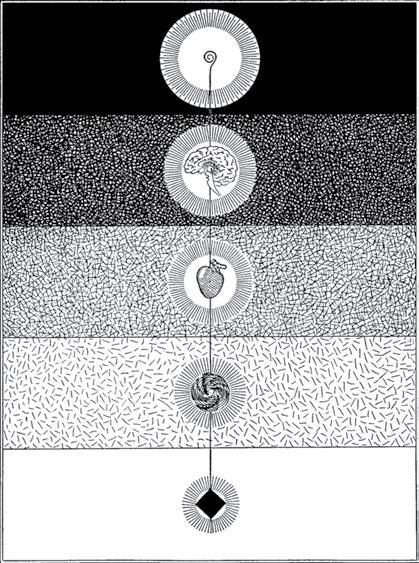
Cover Art: “The Planes of the Generating Sphere” (by Howard W. Wookey, from “Lectures on Ancient Philosophy” by Manly P. Hall)
Layout & Design for this 2007 Edition by Paul Kjell Austad
Published by
The PhilosoPhical ReseaRch socieTy
3910 Los Feliz Boulevard
Los Angeles, CA 90027 USA
Telephone 323.663.2167
Fax 323.663.9443
Website www.prs.org
E-mail info@prs.org
Printed
in the United States of America at the PRS campus in Los Angeles, California
• 3 • CONTENTS Page Fundamental Principles of Operative Occultism ................................................................ 7 A Synthetic Emblematic Cross ........................... 40 Sacred Images: Visible Representations of Divine Principles ............................................. 47 2 ILLUSTRATIONS Page The Opening of the Third Eye .............................. 5 The Seven Spinal Chakras 29 A Synthetic Emblematic Cross ........................... 41
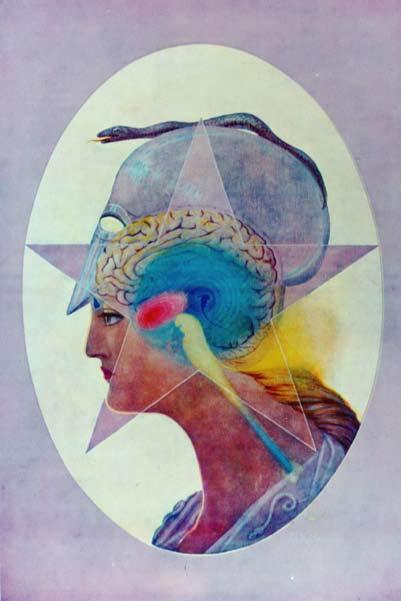
THE OPENING OF THE THIRD EYE
This painting of the head of Minerva shows, in part, the activities of the pineal gland and the pituitary body at the time of the phenomenon commonly termed “the opening of the Third Eye.” The Kundalini fire is seen rising upward through the spinal canal into the pons of the medulla oblongata. The golden light radiating from the base of the brain, at the back, gradually increases in size and intensity until it forms the nimbus, or halo, of the saint. The pituitary body is here shown surrounded by an elliptic rose aura. The pineal gland—the Third Eye of the Mysteries—is here depicted as blue in color and surrounded by a radiating blue aura. In reality, however, this aura includes within itself all the colors of the spectrum, but blue decidely predominates. The tiny vibrating finger on the pineal gland points directly toward the pituitary body. This finger, vibrating at a very high rate of speed, is the actual cause of true spiritual illumination.
• 4 •
• 5 •
Reproduced from an oil painting by the well-known Armenian artist, Mihran K. Serailian.
• 6 •
FUNDAMENTAL PRINCIPLES OF OPERATIVE OCCULTISM
The question is asked, “What must I do to unfold the divine powers latent within myself? While it is not possible to give a direct answer to this question, we may cast some light on the subject by defining the fundamental principles upon which the Mystery Schools of all ages were established as institutions of philosophic, ethical, and religious culture.
The Schools of the Mysteries are composed of illumined men and women who have been accepted into the company of the Immortals. To reach this exalted position requires an almost inconceivable amount of preparatory labor; for if man would associate with these advanced types of humanity, he must raise himself to their level.
Realizing that nothing is more dangerous than the indiscriminate circulation of occult secrets, the Mysteries established their schools for the purpose of concealing rather than revealing knowledge. They were the original and sole custodians of all the divine arts and sciences, the secret keys to which they revealed only to those whom they considered qualified to receive them. Inasmuch as man’s power increases with his knowledge, the secrets of Nature’s finer forces cannot be revealed to him until he has passed through the Mysteries, which test him as to
• 7 •
Manly Palmer Hall
his motive and demand certain standards of moral and philosophic excellence.
Before the candidate is in a position to begin his studies in occult philosophy (which, if successfully completed, will result in discipleship and final admission into the Mysteries) he must first lay the groundwork by familiarizing himself with certain systems of ethics and gain at least reasonable proficiency in several material arts and sciences.
(1) The candidate must realize the value of education.
While the ignorant person may be capable of spiritual growth, the fact remains that man’s ethical progress is seriously retarded through ignorance of the material arts and sciences. Not realizing the great value of discipline, many students of the occult sciences ridicule modern educational systems, which excel because they discipline the mind. Learning how to study is a prerequisite to effective studying. Before it is possible to think, it is necessary to train the mind in reason, continuity, and logic—the essentials of thought. In the last analysis, all the socalled material arts and sciences are reflections of the Secret Wisdom. A man with an understanding of mathematics cannot help but know more of the Divine Plan than one without. Pythagoras demanded proficiency in music, mathematics, and astronomy of all candidates seeking admission into his school.
Before a candidate can honestly seek admission to the Temple of Wisdom, he must prepare his offerings and bring them to the Temple. The only possible offering which he can make is himself, and this offering is acceptable only when it is usable for the dissemination of wisdom. The more nearly perfect that vehicle is, the greater its usefulness. If able to speak a dozen languages, he has a decided asset. If skilled in chemistry, gifted in oratory, clear in thought, he has valuable talents which can be quickly turned to the service of mankind. If the candidate, regardless of his sincerity, presents himself at the door of the Temple ignorant and untrained, it is first necessary to equip him for his work. This preparatory training requires years. A person willing to consecrate himself un-
• 8 •
Fundamental Principles of Operative Occultism
selfishly to the service of God—the first requisite for entrance into the Temple—should certainly be willing first to educate himself by learning what the material world has to teach. He must never seek for the Masters of Wisdom until he has something of real value to offer them, for usefulness is to a great measure limited by intelligence.
(2) The candidate must understand the importance of continuity.
The curse of the modern world is its inability to finish the enterprises which it begins. As a child starts several things but completes none of them, so the child-mind in man vacillates from one activity to another. Failure to achieve is the result of scattering the power of the mind over too great an area of endeavor. Man can cultivate no quality more essential to his spiritual well-being than that of finishing what he begins. Success can never be achieved in the material world without at least a reasonable development of the power of continuity. In matters pertaining to occultism, the same is true. A person who studies several lines of philosophy may call himself broadminded, but if he carry none of these lines to a successful culmination he is, in reality, “scatter-brained” Again and again such a person turns off and tries a new road, when just a few more steps upon the old one would have brought him within sight of achievement.
(3) The candidate must recognize his debt to society.
If in his zeal to unfold his spiritual nature he neglects those daily labors which have been assigned to him in the material world, he can never hope to attain true spirituality. Each individual born into the physical world has obligations which if not assumed by him must be carried by others. Among the Hindus, for example, the debt which the Brahmin owes to the race that produces him is very keenly felt. This debt is not paid until a son is born to him and he has lavished upon it the parental regard and care which he previously received from his parents.
• 9 •
Manly Palmer Hall
Woe to those who neglect their fellow creatures to serve their God! In this world it is necessary first to earn the right to leisure time which is essential for personal improvement. The chief reason why people are always confronted by problems is that they are ever seeking to evade problems. So many say, “Life is just one difficulty after another,” when, in reality, it is the same difficulty presenting itself again and again, because it is not mastered. The candidate is urged to face and settle each problem of his life. In this way perplexities are eliminated and more leisure is available for ethical progress. The prosaic duties of daily life are the elements out of which character is built, and those unable to cope with them are as useless in things spiritual as they are in things material.
Occult development is an exceedingly slow process. The results of the time and energy expended are often imperceptible. This brings discouragement; the candidate gives up the struggle, considering the task before him a hopeless one. Discouragement is one of the temptations placed in the way of the candidate by the Mysteries, for in spiritual matters he who can be discouraged is not worthy of encouragement. It is by means of discouragement that mediocre minds are eliminated. Recognizing the difficulty of preserving mental continuity, the Mysteries demand it of their candidates, for only those who year after year struggle on to the single goal, wandering in darkness but with onepointedness and perfect faith, are considered worthy to enter the Temple—the House of the Immortals.
(4) The candidate must realize the importance of motive.
An analysis of motives generally demonstrates them to be basically selfish, regardless of how unselfish they may appear. Only those who assume the study of occultism with the highest and most unselfish motives can hope to succeed in this the supreme science. In the present age nearly every one has ulterior motives, most of which center around the aggrandizement of the individual not-self, mistaken for the Self. We desire power that we may be recognized as powerful; we desire wisdom
• 10 •
Fundamental Principles of Operative Occultism
that we may be recognized as wise; we gravitate about important people in the hope that we may shine a little with their reflected glory; we seek to be virtuous that one man may say to another, “There goes a godly person!” To the average person it is inconceivable that greatness should not promenade. And yet an analysis of the men and women who have become great—either in spiritual or material affairs—reveals, in the majority of cases, humble, retiring individuals whose greatness is never offensive. Those who study occultism, hoping thereby to improve their material condition, fail utterly. Before power can be safely entrusted to man, he must become supremely indifferent to it. Perfect unselfishness is perfect consecration to the service of the One Universal Self.
Before anyone begins a study of the mystic sciences with the hope that he will add to the dignity of his position or to the weight of his coffers, he should consider for a moment the social, financial, and worldly position of those who during the ages past have been recognized as exponents of occultism and philosophy. Count Cagliostro, languishing for years in prison; Marshal Ney, an exile living under an assumed name; Abbe Villars, murdered for writing his Romance of the Gnomes—these are but a few examples demonstrating the rewards which the world holds out to those who try to educate it. In order to serve more effectively, a few initiates (such as Comte de St. Germain and Francis Bacon) were placed in positions of world power. But with this increased dignity came increased responsibility. The crown of spiritual adeptship is a far heavier one than the crown of material rulership. The use of occultism for the gratification of personal ends constitutes black magic.
It is for these reasons that the applicant is asked, “What motive urges you to take up these arts and sciences? Is it your supreme and all-ensouling desire to be of unselfish service to humanity?” To these questions some reply, “Gladly will I die for truth.” To them the answer is, “That is not enough. Will you live for truth?” A few brief moments and the act of martyrdom is consummated; a few seconds of pain and the soul of man is beyond the reach of the executioner. This is a tremendous sacrifice—a glorious death. But the daily living, surrounded
• 11 •
Palmer Hall
by problems and worries, year after year of disappointments—this is the supreme test of unselfishness. Until the soul can find perfect joy in giving, perfect companionship in aloneness, perfect sufficiency in the power of truth, perfect abundance in the gratitude of the few and the scorn of the many—until such a state is reached the disciple is not ready to leave the broad road on which the world walks and take the thorn-lined path which leads to conscious immortality.
Years are spent by the Masters testing the hearts of candidates. Those who begin spiritual unfoldment find difficulties of all kinds rising before them. The even tenor of human existence is shattered, temptations of all kinds confront the seeker, and it is only when he rises triumphant above them all that he is usable in the great plan of human progress. In a man of little mind selfishness is a small sin; should that man develop a great mind and control the destinies of thousands, the small sin (if left unmastered) becomes a great menace. The impotent selfishness of ignorance becomes the potent tyranny of power.
Occasionally we find persons who, if not in some way restrained by Nature, would become archdoers of evil. But Nature, Delilah-like, has shorn them of their locks. One such case will suffice to demonstrate the principle: A sardonic iconoclast, with a tongue like a two-edged sword, who ruthlessly—even gleefully—destroyed hope, love, and faith in the hearts of others, was struck with paralysis which, affecting his tongue, made speech a slow and painful process. His heart is still filled with malice; in fact he is more malignant than before, but his power to injure others has been taken from him. All men are born with many faculties and members paralyzed. Some are filled with malignancy, held in curb only by their inability to vent their spleen. All human beings have latent faculties and powers, but all are not privileged to develop them at this time. Before it would be safe to loosen the tongue of the malignant creature who calls himself man, it would first be necessary to transmute the bitterness in his heart.
In a similar manner, before it would be advisable to liberate man from the natural paralysis of ignorance, there should be assurance that
• 12 •
Manly
Fundamental Principles of Operative Occultism
the newly awakened faculties shall be a blessing to humanity and not a curse. Before the Masters give man the power to loosen his tongue, his heart must be purified so that the power which is given to him shall not frustrate the plan of true spiritual unfoldment. This is the real reason for the periods of probationship. During these periods the mind and heart are cleansed of those things which, if given power of expression, would work evil. When the supreme forces of Nature are placed in the hands of the newly raised initiate, his heart, his mind, and his soul must accept these gifts with divine humility without thought of self, and use them for the greatest good to the greatest number.
(5) The candidate must shun all kinds of psychism and phenomenalism.
The fundamental purpose of occultism is not to equip a disciple with the power to see auras, elementals, or thought-forms. Nor is it concerned with the processes of bringing those who have passed on into communication with bereaved relatives on the material plane. Occultism is, first, an ethical philosophy; second, an operative science. As the candidate obeys the laws imposed upon him by the Mysteries and as he is faithful in his discharge of the new duties which he is assuming, he gradually and sequentially unfolds the various parts of himself. His faculties become so sensitized that he is able to see at each step of his growth that which is essential for him to see and sense that which is essential for him to sense. Clairvoyance is an effect and not a cause; it is the result of certain adjustments of the life and a gradual regeneration of the bodily parts and members. True occult growth is so slow that it is almost imperceptible, the faculties unfolding from within outward like the petals of a flower. To hasten these natural processes beyond a certain point is to endanger the sanity and health of the candidate.
So-called clairvoyance may take many forms. A student may reach a comparatively high degree of Chelaship and still be unaware of any extension of sense perception such as is commonly associated with spiritual growth, while a person possessing many psychic powers may be totally unfitted even to enter upon the path of Chelaship. One of the
• 13 •
surest signs of true occult unfoldment is a peculiar extension of sense perception or the mental sense of awareness, which might be called “clair-cognizance.” The average person would describe this condition as a form of mental clarity or acuteness. Instead of presenting itself through the organs of vision or hearing, occult cognition sometimes comes in a purely intellectual form, the mind becoming actually aware of occult truths and philosophic verities without any involvement of the lesser senses.
An example of this is the student who desires to learn the color vibration of a certain invisible organ or part of the body. The mind instantly replies that it is red, without actually giving any color impression—the information coming more as words imprinted upon the mind than in any other form—yet the mind itself registers no awareness of words spoken either physically or spiritually. Apparently the mind of itself announces the color to be red.
In things pertaining to occult philosophy, this faculty seems to be the particular reward of the teacher. If the lay instructor is actually in contact with the higher worlds he will learn far more while he is teaching than will those to whom he is explaining the subjects under discussion, the “clair-cognizance” revealing spontaneously that which the faculties of the mind under normal conditions could not reason out in months. This is the only so-called psychic faculty the coming of which should not be viewed with a certain amount of apprehension. The premature development of clairvoyance and psychism is a serious impediment to the spiritual growth of the student, who is all too likely to wander astray in the byways of the astral plane and end in the blind alley of transcendentalism.
(6) The candidate must realize that with the increase of knowledge there is a proportionate increase of responsibility.
With the acquirement of knowledge, the student must acquire the sense of discrimination, so that he may use most intelligently the information he has received. Nearly all who take up the study of occultism
• 14 •
Manly Palmer Hall
Fundamental Principles of Operative Occultism
eventually become teachers of its abstruse sciences. It is proper that they should do this, for as they themselves were instructed they but pay their natural debt by becoming instructors of others. The lay teacher should realize, however, that he becomes accountable for the use which others make of the knowledge he entrusts to them. He cannot shift this burden on to the Mystery Schools; he must bear it himself. For this reason he must he as wise as the gods if he would save himself from the karmic reactions of the forces which he has enabled others to set in operation.
In occultism the initiate speaks only for himself. Unless actually upon an official errand for the School to which he belongs, he never makes the esoteric Orders in any way responsible for his individual utterances and actions. Unless specifically ordered to do so, the emissaries of the Mysteries speak only for themselves—never for the higher initiates. Those illumined minds who represent the Schools of the Mysteries in the world need no heralding, nor do they require credentials from the invisible Brotherhood to which they belong. Never do they announce themselves, for their power lies not in their affiliations but in themselves. Why should an initiate tell the world that he is a superman? Unless he demonstrates it by his actions, the world will not accept him as such; and if the exceptional qualities of his intellect prove it, the claim is unnecessary.
All over the world there are hundreds of individuals and institutions claiming to represent the secret Schools of the Ancient Wisdom. Few of these organizations, and still fewer of the individuals, can successfully defend their claims in the face of a critical analysis of their principles and policies. Those disciples truly consecrated to the service of the invisible Schools have make it their policy to refrain from even mentioning the august bodies which they so inadequately represent, until that time when the invisible Order no longer could be discredited by their actions. The true disciple would rather die than compromise his Master or the School into which he hopes sometime to be initiated. He can protect the institution only by assuming personal responsibility for all
• 15 •
Palmer Hall
that he says and does. Then his faults disgrace no one but himself. Only when he has reached the point of complete spiritual illumination does he reveal the source of his knowledge, and then only to a limited few.
One of the laws of occultism is that in order to receive, one must give. Those desirous of greater insight into things spiritual must earn the right to that broader understanding by the intelligent use of that knowledge already possessed. The student-teacher must realize that he is personally responsible for whatever effects his theories and doctrines may have upon the minds and bodies of others. By instruction we actually change the course of others’ lives; we direct them into new channels of mental and physical activity; we change the tenor of their existence. If directly or indirectly these changes are not beneficial to them, we who gave them the knowledge become responsible before the gods for the results of our indiscretion.
In a similar manner, those who teach us are responsible for our actions and the use we make of the wisdom they have shared with us. Hence, when the disciple fails, it is the Master who suffers most. Most of all, we are responsible if we place in the hands of those unfitted to receive it that knowledge of Nature’s forces which enables one person to injure another. If we are not mentally developed to that point where we can determine beforehand, with a reasonable amount of certainty, the integrity of the person to whom we intend to reveal occult secrets, we are not far enough advanced to possess such secrets ourselves.
In justice to himself, therefore, no one should be in a hurry to go forth serving humanity, lest in his impetuosity he destroys not only others but himself with them. The groundwork should be laid first, but when such a one feels that he is equipped to disseminate a message, he should do it reverently, with deep consideration and no little trepidation, saying to himself: “I am responsible from now on for the use and interpretation placed by others upon the words that come out of my mouth. Therefore, I will choose them with care, consider them in the light of my truest and highest intelligence, and send forth with each prayer that it shall serve only the cause of good. I will not claim to be
• 16 •
Manly
anything or anyone, but will let my works speak for me, for I am only as great as my works. If it be the will of the Masters that I should in time reach an exalted position as their messenger, I will then (if they so desire it) be their chosen and authorized mouthpiece. But until the day of that supreme achievement if a man should ask me who I am, I shall answer that I am a voice crying in the wilderness. If he should ask who sent me, I shall answer that my soul sent me. If he should ask by what authority I teach men, I shall answer that I am my own authority. If he should ask what message I bring, I shall answer that I bring no message, but only interpret according to my light that message which is eternally here. And if he should ask, ‘What reward have we if we follow you?’ I shall answer that the accomplishment of labor is the reward of labor.”
(7) The candidate must maintain a constructive mental attitude.
All thinking people are dissatisfied with existing conditions. They also realize that the universe is ruled by the Law of Cause and Effect, and that in order to improve affairs it is first necessary to establish those remedial and corrective causes the natural result of which will be universal peace and enlightenment. It is imperative that we accept things as we find them in this world; and instead of complaining or criticizing if they are not in accordance with our desires, let us set about with diligence and intelligence to create newer and better conditions. If his mind he soured or his nature be established in the habit of complaining, the prospective candidate bars himself from the service of the Masters.
Since life is so serious an affair, it has well been said that the sense of humor is a saving grace. We become useless to our fellow creatures if we permit ourselves to be oppressed by the weight of the world’s woe.
It is a mistake to believe that seriousness can take the place of integrity. There is no substitute for the happy smile or the normal, healthy attitude toward the problems of life. The candidate need not cultivate thoughtless optimism but rather that attitude of mind which sees the hand of God in everything and realizes that all things are working to-
• 17 •
Fundamental Principles of Operative Occultism
Palmer Hall
gether for the ultimate good of each. The iconoclast is a useful and important member of society, but he never attains the highest state of usefulness because his mind is on a tangent.
Man is much like an apple: some people mellow with age, while others rot; some are deepened and sweetened by experience, while others are hopelessly soured. Those who become soured have failed utterly. They are mentally diseased and incapable of constructive thinking. Sourness is often the result of self-pity, one of the most subtle and terrible forms of egotism. It is egotism that makes people actually believe that they are so important that Nature singles them out to heap infirmities upon them. No one who pities himself has any inherent sense of justice. Without a perfect faith in a natural justice, man cannot attain the heights of either philosophy or religion. Make it one of the fundamental rules of your life that you will never be sorry for yourself. If you become a slave of self-pity, you will soon become a legitimate object of pity on the part of intelligent people.
These seven cardinal requirements therefore constitute the ethical foundation of occultism. Without consecration of the life to the attainment of proficiency in these qualities of character, it is useless to go on—if such a thing were possible. The foundation must come first. Most of the failures in mysticism and philosophy result from neglect of the ethical basis. The superstructure of esotericism must be raised upon the solid rock of virtue and integrity, for without this foundation it inevitably falls.
Man cannot prepare himself for philosophic pursuits in a few weeks or even a few years. He must build slowly and solidly, realizing that one step properly taken is worth many taken haphazard and without direction. When the general self-improvement is fairly well advanced, it is then time for the student to prepare himself along certain special lines of endeavor which will peculiarly fit him for occult attainment. This is not the first step but the second, and is not to be taken until the initial groundwork has been thoroughly established.
• 18 •
Manly
Fundamental Principles of Operative Occultism
With each advancing step the candidate finds the standards of life more exacting and difficult of attainment, with deviation from these ideals productive of ever-increasing sorrow and suffering. The requirements of the law for the initiate are much more strict than for the average individual, for the initiate can possess his transcendent powers only by sacrificing everything else. The would-be disciple of the Ancient Wisdom, after having schooled himself in the seven principles described above, must now turn his attention to the choice of that particular line of endeavor and that particular School of the Mysteries in which he feels he will be most useful. The qualities previously developed by the first ethical training are now tested, for only by their aid can the selection be intelligently made. While the path of accomplishment differs in each School, all the Mystery Schools teach the same fundamental doctrines and ultimately attain the same results.
Let us suppose that you have chosen one of the Eastern Schools. Before you can actually begin your studies, you must familiarize yourself with the particular ethical code which it disseminates. The School will educate you in certain concepts and attitudes which, when incorporated into your life, have a marked effect upon the invisible nature. Only when these effects reach a certain point is it safe for you to begin any special system of so-called spiritual development. Although the sevenfold cardinal requirements are applicable to persons in any walk of life (whether religiously or atheistically inclined), the more advanced requirements are concerned directly with the individual need of the student. This more advanced code is open to the consideration of all who have conducted themselves worthily according to the primary requirements. But woe to those who, ignorant, selfish, and otherwise unqualified, dabble in any form of occult science without first overcoming the more important faults of the lower nature! The proof of man’s sincerity is his willingness to sacrifice, and the occult student must sacrifice his own lower nature if he would enter the Temple of Wisdom.
Again and again, the student of occult philosophy deplores the fact that he cannot discriminate between the true and the false. He reveals
• 19 •
his dilemma by saying: “Oh, if I only knew which of the paths of discipleship I ought to take! If I were only sure that this teacher is really qualified to instruct in these subjects! If I could only be certain that this book is the one I should study! But I am afraid to trust my decision on these matters. Won’t you please decide for me?”
Such questions demonstrate beyond all doubt that the mind of the student has not matured to the point where it is capable of discrimination. Not knowing right from wrong and incapable of dividing the real from the unreal, too many students are seeking advanced spiritual instruction when their ethical education is hopelessly inadequate. If you do not know what you want to do, you are not ready to do anything. You must first develop sufficient ethical perception to be cognizant of what you want to accomplish. The lack of such discrimination is much too common among occultists and is often the unsuspected cause of their inability to attain spiritual unfoldment. Many students feel that this ethical training by itself, is a waste of time and that it is far more desirable to become immediately engrossed in arcane traditions. The lack of this mental and moral cultural effectually disqualifies the candidate for the steps which follow; the inevitable result is sorrow, suffering, incompetence, and disappointment.
Assuming that you have carefully considered the seven cardinal requirements already described, it is now in order to analyze the more specific factors with which the candidate must familiarize himself.
(1) The first—and most important—is the selection of the person or institution whose instruction will constitute your course of occult procedure. Consider with us for a moment the attitude of the Eastern mystics on this vital subject.
The assistance of a properly qualified teacher is essential to the progress of the student. Just as a plant grows in the light of the sun, warmed and vitalized by its Pranic emanations, so the disciple unfolds, flower-like, nurtured and assisted by the spiritual radiance of his Master. The aura of a highly evolved adept is also of great assistance to a young student
• 20 •
Manly Palmer Hall
Fundamental Principles of Operative Occultism
who as yet is unable completely to create certain atmospheres for himself. Gradually the perfect and continued communion between Master and disciple brings them very close together in spiritual understanding. A beautiful friendship is born between the two, which gradually merges into a perfect and impersonal love. The Guru (teacher) comes to know the innermost thoughts of his disciples. He tests the student by bringing him into the presence of temptation and encouraging him to be strong. He perceives where the student is weak. He discovers the faults in the nature which inhibit attainment, and by wise counsel aids his “spiritual son” to avoid pitfalls and blind alleys.
While the Guru may have many exoteric students, he seldom takes more than twelve at one time into the esoteric phase of his instruction. He realizes that no one can properly direct the studies of too large a number at one time and give each of them the individual help which is so necessary. He realizes that he is the parent of a spiritual infant who is being nurtured in the nature of his disciple, and that this spiritual child needs almost constant attention during the early stages of its growth. By carefully observing these requisites, the Master protects the life and health of his disciples and leads them step by step to the state of accomplishment which they could not reach unaided.
To study for a few weeks or even months with an unknown teacher (even though he may be suspected of having great intelligence) and then to attempt to work out by yourself future exercises and systems of development is the height of madness, for the daily unfoldment resulting from occult exercises requires intelligent supervision by a teacher who is prepared for any and all emergencies. Hence the disciple who undertakes the actual operative processes of spiritual regeneration generally lives (for a time, at least) with his teacher, so that every hour of the day or night the Master is within call. In India, the chelas remain with their teachers for an entire lifetime to make certain that each step in attainment is properly completed and the subsequent work correctly outlined.
• 21 •
Manly Palmer Hall
Who is qualified to instruct in the operative mysteries of either Eastern or Western occultism? The answer is, Only an initiate or the disciple of an initiate. An initiate is one whose attainment to a position of spiritual understanding has been in harmony with the laws of attainment. Therefore he must be and is in consistency with the laws which have produced him. Not only this, but he must be of that Ray of the Mysteries which is devoted to teaching. Many great initiates are not in the teaching Ray; therefore never take disciples. Others, again, are so highly advanced that none but initiates are eligible to their instruction, as in the case of the Master J. The laws of attainment demand purity of life and purpose; simplicity of demeanor and appearance; humility of mind and heart; selflessness, kindliness, wisdom, and absolute freedom from the taint of worldliness and commercialism. And on either side of this narrow path which the disciple must walk are the pitfalls of Dugpa magic.
We should also bear in mind that there are few, if any, Westerners who are qualified to teach the esoteric principles of Eastern occultism. Many are attempting to do so, but their bungling efforts demonstrate their incompetence. The East deals in subtleties, and occultism is a subtle science, everything depending upon inflections which are totally beyond the average Western intellect. While Western scholars may learn to understand the general outline of Eastern occultism, even a lifetime in India or Tibet will not qualify them as teachers of Eastern esotericism, unless during their sojourn in the Orient they have actually been initiated into the Eastern Mysteries. Even then there are certain key secrets which the Brahmins, for instance, will not reveal to any person of a race or caste different from their own. For this reason most of the concepts promulgated by Westerners are hopelessly erroneous or, at best, incomplete. None but the East apparently can understand the East, for it is a world totally different in attitudes and concepts from the one with which we are familiar.
Then, again the Hindus themselves (while far more religious and philosophical as a race than the Western peoples) are not all qualified to
• 22 •
A Synthetic Emblematic Cross
teach these abstruse occult sciences. As the average Christian minister is comparatively ignorant concerning mystical Christianity, so a great number of Orientals have little knowledge of the finer points of their faith. While it is true that the percentage of Orientals who understand their religion is much higher than the percentage of Christians who understand Christianity, the mere fact that a person comes from the Orient is no assurance that he is qualified to instruct concerning the secret teachings of his faith. It requires a highly advanced Oriental to adjust his doctrine to the Western world, for if presented without certain adjustments it is almost useless. In choosing an instructor in any line of occult science, then, great care and discrimination must be used and an acid test applied. The point where lack of true understanding is most evident is in the commercial attitude, and if the student will eliminate from his list pseudo-occultists with axes to grind, he will escape the majority of the pitfalls.
(2) The second point is the consideration of the time element. Time is the primary prerequisite of occult growth. The disciple may expect it to require at least twenty years to attain success in even the first degrees. In the early part of the disciple’s training he will probably find it necessary to receive his instruction from someone in the physical world, but as he goes higher and acquires the ability to separate his consciousness from his lower vehicles, he may receive his instruction from teachers and initiates working through the subtle essences of the invisible worlds.
No layman, either in the East or in the West, is qualified to begin the practice of so-called occult exercises without special preparation covering a period of years. Even in the East, where the mind is concerned with occultism and philosophy from infancy, special preparation is required before even the simplest of the exercises are begun. Even though a student has delved into occultism for years and has attended countless lectures, he is not justified in thinking that he is ready for deep esoteric work. Unless during those years he followed a certain prescribed and systematic course of training, he must begin to do so,
• 23 •
Palmer Hall
and until he has achieved success therein he is not ready for deeper or more complicated forms of culture. Notwithstanding the fact that he considers himself a highly developed person, he must begin at the bottom and pass through his years of probationary work just the same as the disciple who apparently is far less informed. The true occultist realizes that it is not always how long we are at a thing, but how intelligently we pursue our labors that counts; and many who have spent an entire lifetime have achieved comparatively little.
It is for the Guru (and not the chela) to decide when the period of probationship is completed, for the teacher is capable of investigating man’s invisible spiritual nature, upon which the record of accomplishment is imprinted. The period of time for the first probationship is usually from two to five years. Pythagoras of Crotona demanded five years of self-purification before he would even discuss the matter of spiritual unfoldment with a candidate applying for membership in his university.
During these years of preparation the disciple adjusts his entire life to the work to which he looks forward. He becomes permeated with certain spiritual and intellectual attitudes, and thus comes en rapport with the holy science. It means that every atom and molecule of his quaternary constitution must be purified and made over. The organism must be unfolded, and every part of the structure must thrill and vibrate in a peculiar manner. What does this mean? It means that the attainment of spiritual power is impossible unless the life, mind, and body are dedicated entirely to that labor. It also means that so much depends upon the teacher into whose hands the student places himself that it is, in reality, a matter of life and death.
(3) The third point for the candidate to realize is the necessity of remaining silent concerning any esoteric secrets which may be revealed to him. He may discuss the theoretical part of occultism with any whom he feels deserving of such information, but the operative secrets he must reveal to no one. They are given to him as Master to disciple, and
• 24 •
Manly
Fundamental Principles of Operative Occultism
are for him alone. The curse of the gods is upon the head of the man who reveals the hiding place of his Lord for thirty pieces of silver. The Christ in you is the secret and powerful spiritual nature—the miracleworker, the divine, invisible man. The one who reveals the nature and power of this secret Lord betrays his divine Master (the spiritual nature) and turns its power over to the hands of the mob (his own lower animal nature). At the hands of the mob, the Christ (the secret power) is crowned with a wreath of thorns and taunted as a king. He is given the kingdom of death to rule and is scourged by the soldiers. In the hands of the mob nature in man, the secret and divine power, which has thus been betrayed, is crowned with sorrow; the divine science is prostituted that ignorant mortals may by the aid of spiritual powers secure material prosperity, marital happiness, or improve lagging business conditions.
Approach with the utmost care, therefore, the subject of occult exercises. Remember that the esoteric secrets of occultism are designed for the use of only that illumined few who, having first consecrated their lives to the unfoldment of the spiritual powers latent within them, have reached a point after many years where they are qualified to assume the responsibility of liberating their spiritual natures from the bondage of matter. For the layman—ethically unprepared and wholly ignorant concerning the operation of occult currents and forces—to dabble with any form of occult exercises is almost certain to result disastrously.
(4) The candidate must realize the great danger of becoming involved in black magic. The line of demarcation between black and white magic is so fine that even those highly advanced must exercise eternal watchfulness in order to avoid involvements in Dugpa sorcery. To a great degree, the difference between black and white magic lies in the motive. An impersonal and unselfish attitude is the surest protection against black magic, but many other things (especially self-control) are necessary to insure that the candidate shall escape the dangers of sorcery. Both the white magician and the black magician use identical forces. The former, however, grows through his constructive use of the divine
• 25 •
Palmer Hall
sciences, whereas the latter slowly but inevitably destroys himself by their perversion.
The attainment of transcendental powers must be either through the regeneration and scientific reconstruction of the body—the gradual liberation of the consciousness enmeshed within the form—or else through sorcery, black magic, necromancy. Woe to him who believes even for a moment that he can tamper with black magic and survive! Both the East and West are filled with Dugpas—black magicians, who by the perversion of occult forces have become temporarily manipulators of cosmic energy. Gradually, but inevitably, these Dugpas are drawn into the maelstrom of their own evil and perish. The great danger which confronts haphazard students is that they may develop spiritual forces within their bodies to a degree where they can be used by the Dugpas for one purpose or another before they have developed the strength and enlightenment to use these forces to any good end. Thus many really good people become unconscious doers of evil because they are not sufficiently intelligent to understand the right application of the forces they have awakened within themselves.
(5) The candidate must realize that the application of commercial terms to occult values is a direct prostitution of this most sacred of all sciences. While a teacher of philosophy (like a professor of botany or mathematics) may be, and should be, remunerated for his efforts (which remuneration may be accepted to a moderate degree without prostituting his science), the operative secrets of occultism must never be involved in any form of commercialism. They have no commercial value. To attempt the buying or selling of them is one of the most heinous of sins. By operative secrets we mean that knowledge which will assist the individual to personally unfold by secret, but scientific, processes the latent forces or faculties of his own nature. These must not, shall not, and can not be bought or sold.
When a man is decorated by a government for a deed of valor, he does not have to buy the medal that is pinned on his breast. The same rule applies with respect to the secret doctrine, which is revealed to
• 26 •
Manly
Fundamental Principles of Operative Occultism
man as the reward for spiritual, moral, and intellectual valor. When the disciple is ready, it is an inconceivable and unpardonable sin to deny him that which is by right of merit. To sell the secrets of the invisible world to one unworthy to know them and incapable of earning them, is sacrilege; to try to sell them to one who has already earned that wisdom by virtue of the superior qualities of his own nature is also a sacrilege.
To place the great secrets of occultism in writing is dangerous, and brings a heavy karmic debt down upon the head of the one so foolish as to do it; and to sell a document containing such secrets compounds his karmic obligations. When revealed to the public, all material dealing with operative occultism must be veiled. And when it seems desirable to reveal the theory behind these processes, certain keys must always be omitted, so that a careless reader may not be able to hurt himself by experimenting with the information thus gained. These facts are well known to those entrusted with esoteric information, and any who break these rules demonstrate their total unfitness to instruct students in the mysteries of the occult sciences.
(6) The candidate must beware of unbalance. Equilibrium can be safeguarded by continual emphasis of the ideal of symmetry. The student should always bear in mind that one virtue is not sufficient to make a saint, no matter how excellent that one virtue may be. Man must grow symmetrically—his heart, his mind, and his body must coordinate and complement each other. He must achieve the condition of mental, spiritual, and physical equilibrium. If the mind is over developed, the scientist results; if the heart dominates, the religious fanatic and emotionalist is produced; if the physical nature controls, the materialist is the inevitable product. It is only when all three of these parts unite in the glorification of the divine nature that the composite unit—the spiritual philosopher—becomes a reality.
The most common occult exercises taught to the general public today are various forms of concentration and breathing. Many of these exercises are hopelessly incorrect. Both concentration and breathing (when
• 27 •
THE SEVEN SPINAL CHAKRAS
This painting of the CHAKRAS is based upon a number of drawings brought from India by Mr. Hall in 1924. In the Orient, diagrams of the Chakras are comparatively common, but several symbols not generally included have been added, which make the painting more complete. The most important additions consist (1) of the interlaced triangles behind the figure, the body of the Yogi himself forming the upright triangle; (2) the beam of golden light rising from the BRAHMARANDRA, or GATE OF BRAHMA, in the crown of the head; and (3) the SAHASRARA, or THOUSAND-PETALED LOTUS, in the upper part of the brain, which is generally pictured as an inverted lotus-like cap but is here shown as a great flower-like sunburst, with a white center and concentric rings of petals.
• 28 •

• 29 •
Reproduced from an oil painting by the well-known Armenian artist, Mihran K. Serailian.
Manly Palmer Hall
properly understood) have their place, for both profoundly influence the entire constitution of man. But neither or these alone nor both together will produce any permanent or satisfactory results, unless at the same time the nature possesses certain other virtuous qualities and has adjusted itself to the general plan of spiritual unfoldment. You may use a perfectly correct form of Yoga breathing, but if your body is impure you will never attain any but harmful results. You may sacrifice all to your gods and be a vegetarian for an entire lifetime, and yet practically nullify the good resulting from these practices by failure to control an obstinate temper which you have tolerated in spite of efforts you have made to overcome other faults. The possible value of any concentrative exercise which you may attempt will be destroyed by an uneradicated streak of selfishness; an unconquered egotism will continually prevent the consummation of a lifetime of endeavor. If you dislike but one person, you can never attain upon the path of white magic. Any occult development which may be made without conquering these qualities within the nature lays the student open to the perils of Dugpa sorcery and black magic.
It is because of the necessity of controlling and transmuting all of the lower qualities of the nature that the years of probationship are so essential. During this period of battle with self, the sincere student gets hold of the threads of his life and begins to make the adjustments necessary before the actual spiritual work can begin. It is not by destroying the lower nature that man becomes virtuous; it is by the transmutation and regeneration of every base quality and attitude that he achieves divinity. This gradual process of self-conquest ultimately brings the disciple to the state of complete self-control. From that point attainment is not so difficult, for having controlled self, he is the master of the universe.
All occultists know that true spirituality is not to be gained through either extremes or excesses. Those who try to become ascetics by retiring from the world and rejecting the problems of life, those who fast, those who neglect the problem of daily existence—such cannot achieve, for in the last analysis, only that which is natural and in harmony with
• 30 •
Fundamental Principles of Operative Occultism
common sense can produce permanent benefit. It is the failure to observe these requisites that has caused so much misunderstanding with respect to occultism today. People desire to unfold clairvoyant powers and enter a Nirvana of happiness, peace, and selfish enjoyment. They believe that occultism will vicariously solve their problems. All this is wrong, for no one can attain occultism who has not first given up the desire for earthly happiness and proved his courage and ability to master the problems which beset him in this mortal sphere.
(7) The candidate must next consider the esoteric interpretation of the so-called material arts and sciences. Astronomy, mathematics, music, rhetoric, geometry, grammar, and logic are often called the seven liberal arts and sciences. There are, in reality, forty-nine great arts and sciences. An extract from occult anatomy will show how esoteric science differs from material—or exoteric—science. Turn to the painting of the seven spinal chakras. In the picture the general form of the chakras has been carefully preserved, special emphasis being placed upon the correct number of petals. In the secret teachings, to each of these petals is assigned a letter of the Sanskrit alphabet. The human figure has been made semi-transparent, as it might appear to one actually gazing upon a Yogi in meditation. The Yogi is apparently suspended in the air, for the power of sight which would enable one to see the chakras would take no cognizance of the physical earth upon which he is sitting. The plate is, of course, diagrammatic and must not be considered too literally.
Study carefully the flower-like centers upon the spinal column of the Yogi. Through the center of the seven flowers passes the tube Sushumna, which corresponds to the sixth ventricle of science, a tiny tube passing through the center of the spinal cord. On the left side of Sushumna is another tube called Ida, and on the right side a third called Pingala. These are the poles of the central tube—the sharp and flat of Sushumna itself. These two tubes are profoundly influenced by the nostrils on their respective sides. The Ida and Pingala cross at the base of the skull and both rise out of the four-petaled lotus at the base of the spine. The Ida, Sushumna, and Pingala together are the chief of the
• 31 •
Manly
Palmer Hall
Nadis, and of these three the Sushumna is the most important. In the ordinary individual the tube of the Sushumna is closed, but by Yoga it is opened so that there is a direct connection between the sacral plexus at the base of the spine and the pineal gland in the head.
According to Hindu allegory, Kundalini—the goddess of the serpent fire—descends into man through the umbilical cord at the navel, but when the umbilical cord is cut, this serpentine power coils itself in the sacral plexus, where it rests upon the triangular bone at the end of the sacrum. This triangular bone is shown as an inverted triangle in the Muladhara, the four-petaled lotus-blossom at the base of the spine. Here Kundalini remains coiled until through occult exercises she is caused to rise through Sushumna into the brain, where she awakens the activity of the third eye—the pineal gland. This third eye is the link connecting man with the spiritual world or, to be more correct, with the higher spiritual nature of himself. The anthropos, or overman, which never descends into incarnation, was called by the Greeks the Cyclops—the giant who had but one eye, which eye was the pineal gland, by means of which the higher ego was capable of seeing downward into the human nature and the human ego was capable of seeing upward into Buddhi, or the overman. Kundalini is more or less excited into rising as the result of the ascending essences in Ida and Pingala.
Here we have the caduceus of Hermes. The two serpents coiled around the staff are Ida and Pingala, the central staff is Sushumna, the bulb at the upper end of the rod is Sahasrara, and the wings are Ajna—the two-petaled lotus above the bridge of the nose. There is some dispute among Eastern occultists as to whether the pineal gland is actually the thousand-petaled lotus. Some affirm that it is, others that it is not but that a higher center in the brain is actually the Sahasrara.
Let us now consider the centers from the lower upward. That division or step of Yoga called Pranayama is devoted to awakening Kundalini from her coils and causing her to rise upward through the chakras. As she contacts these in turn they result in an extension of consciousness. Each of the five lower centers distributes one of the five forms of Prana,
• 32 •
A Synthetic Emblematic Cross
or the broken-up energy of the sun. Each of the seven chakras also has a corresponding tattva, or breath—a motion or condition of spiritual air. Beginning at the bottom of the spine and working upward, the centers are as follows:
First, Muladhara. This has four petals and an inverted triangle in the center. The tattvic power of smell is associated with this chakra. It is probably correlated with the Church of Ephesus mentioned in the Book of Revelation, and corresponds to the sacral ganglion of modern science.
Second, Svadhishthana. This is the second from the bottom and contains six petals, with a crescent in the center. Its tattvic correspondent governs the sense of taste. It probably corresponds to the Church of Pergamos and is the prostatic plexus of modern science.
Third, Manipura. This is the third chakra from the bottom, containing the red triangle. It has ten petals and is associated with the epigastric plexus and the navel. Of the seven churches it is probably Smyrna and is associated with the tattva of sight.
Fourth, Anahata. This is the fourth from the bottom and its symbol is two interlaced triangles. This chakra has twelve petals and is associated with what is commonly called today the cardiac plexus. It is probably the Church of Thyatira and its tattvic power is the sense of touch.
Fifth, Vishuddha. This is the fifth chakra from the bottom and consists of a white circle surrounded by sixteen petals. It is known to modern science as the pharyngeal plexus. Its tattvic correspondent gives the sense of hearing and it is probably related to the church of Sardis.
Sixth, Ajna. This is the cavernous plexus of the brain and is the sixth from the bottom. The lotus consists of two petals caused by the fanning out of spiritual rays, one to either side. It is probably related to the Church of Philadelphia and its tattvic power is to give the quality of thought.
• 33 •
Palmer Hall
Seventh, Sahasrara. This is the thousand-petaled lotus, the highest of the sacred seven. Its tattvic power is purely spiritual. It is probably related to the Church of Laodicea and corresponds either with the pineal gland or an unknown center directly above it. When Kundalini reaches this point, divine consciousness is attained.
The passage of Kundalini upward towards Sahasrara is marked by a gentle warmth. As it rises the lower part of the body becomes cold, until only the head remains warm. The condition is also accompanied by other phenomena. Woe to the unhappy mortal who raises Kundalini prematurely to the brain! The sting of the fiery serpent is most deadly, as those well know who have seen the results of her premature raising. She will burn her way to the brain and destroy the reasoning qualities of the mind.
Such, in brief, is the story of the chakras and that science called Yoga—the art of developing and controlling them. The story of these centers is clearly set forth in the Book of Revelation, where the seven seals, the seven trumpets, the seven vials, and the seven voices all refer to the spinal centers and the various mysteries concerning them. The warning can not be too strongly emphasized that, while the study of the theory of Yoga will acquaint you with many of the mysteries of Nature and of your own constitution, the practice of it should be limited to such as have united themselves with those schools of Eastern philosophy, of which it is the esoteric work. It is well that all should know the theory, but woe to the foolish mortal who attempts the practice without proper instruction and guidance!
The system of training through which disciples must pass in order to prepare themselves for the highest honors of occultism is rigorous. Take, for example, the eight steps which the Yogi is expected to climb to union with the Divine Self. While these processes differ in each of the Schools, they are equally severe and exacting in all; for it is only after the neophyte has shown his ability to master and directionalize every force in his organism that he is given the secret keys by means of
• 34 •
Manly
Fundamental Principles of Operative Occultism
which he can control the destiny of creation. The eight steps of the Yogi School are: Yama, Niyama, Asana, Pranayama, Pratyahara, Dharana, Dhyana, and Samadhi. What does each stage imply? What qualities must the disciple unfold in order to reach the final stage of perfect spiritual union with the Supreme Self? These are questions which we shall try to answer.
The first step is Yama. Under the heading of Yama, an exceedingly strict control of the mental nature begins, for the disciple is placing his foot upon the first step which leads to Self. Here he must cease destructive activities forever. He must no longer kill either the body, the hope, or the faith of any living creature. He must become absolutely truthful. His words must be carefully thought out before they are spoken. In spite of his truthfulness, he must never hurt. Unquestionable honesty must be cultivated. He must not even desire after a thing which is not his own; and he must also give up the sense of possession over that which is his own, realizing that it is only loaned to him that he may use it for the glorification of God. He must cease receiving gifts of any kind. The only thing which he is permitted to receive is sufficient food for his existence and sufficient clothing to cover his body. (This last is not literally practical in the Western world.) He must gradually cultivate a beauty within his own soul so that he radiates peace, tranquility, harmony, and strong yet merciful sympathy. He must live to do good, serving all things and loving all things. He must have no enmity, but must love his enemies as he loves his friends, and both of these he must love impersonally. Only when he has accomplished this has he actually achieved the first step in his long path toward the liberation of Self. It is only when we have achieved this perfect peace within ourselves that we are ready to go on; yet how many American students are trying to concentrate and develop spiritual powers who have not even begun the conquest of their lower natures or the purification of their bodies! This is one of the chief contributory causes behind the tragedies of modern occultism.
• 35 •
Palmer Hall
The second step is Niyama. This stage is even more difficult than the first, for it demands perfect self control. It also requires the perfect conservation of energy. Wasteful expenditures of life energies must cease. Nothing shall be wasted; the tongue shall be held in restraint to speak only when speech is necessary; the energies of all parts of the body shall be conserved and used only to accomplish that which is essential. Then must come cleanliness of mind, soul, and body, for unless all parts are clean in their structure and expression, spirituality cannot be attained. There must come the development of the sense of peace—the realization that all things are as they should be; that all activity is united to the attainment of good; that the Supreme One is actually controlling His world.
In this stage the disciple reads the books of wisdom, familiarizes himself with the secret Scriptures, and ponders and meditates upon the symbols and allegories. To consummate this stage, he surrenders himself and all that he is to God, living only to serve God, and claiming nothing for himself. He must withhold nothing. Regardless of his own likes and dislikes, he must offer himself to the Supreme One without reservation or hesitation. Whatever God wills to be done, he will do it; at all times of the day or night he is at the command of the Father. When he has achieved this perfect condition of willingness to be that which God would will him to be, the disciple is then ready to begin the study of body postures—an art which serves many purposes.
The third step is Asana. The purpose of this step is to gain control over the muscles and members of the physical body. It is one of the secret sciences, and consists of a series of body postures, the assuming of which causes various muscles and nerves to come into play which otherwise are not used. Its consummation is the ability of the mind to control the function of every organ and part of the human body, so that when the mind so wills, the heart will stop beating and the individual still live. This complete bodily control has a considerable influence upon the length of life, and according to the Hindus, will considerably lengthen the span of human existence. A careful consid-
• 36 •
Manly
Fundamental Principles of Operative Occultism
eration of these stages will reveal the fact that they are all devoted to the problem of mastering the not-self and bringing the tangible nature under the control of the intangible spiritual man. When this stage has been successfully passed, the candidate comes to the next step, which is the control of the solar force within the body.
The fourth step is called Pranayama. This involves to a certain degree the science of breathing. Prana is the life power from the sun. The flow of this force can be controlled by the mind and, to certain degree, by the breath. There is a certain individuality in breathing. This individuality can be affected by timing the breath and is somewhat governed by the nostril used in inhaling and exhaling. Pranayama is closely related to the science of the chakras, for by means of its exercises the goddess Kundalini is caused to rise through the spinal canal. It also has to do with the purifying of the nerves, for the Pranic energy flows through the nerve canals. This is a hazardous procedure, however, for the average Occidental, and he is warned to leave it entirely alone unless he has already advanced through many stages of spiritual growth. It is far better and wiser not to discuss the exact method by means of which this breath force is directed.
The fifth step is Pratyahara. At this point the disciple begins one of the most difficult of all occult processes—the control of the mind. Few people realize how wild and erring their minds are. The mind wanders ever from one thing to another. Control seems almost impossible, for the very element with which it must be controlled is the element which is wandering. Pratyahara may be termed the process of separating the mind from the illusions of the senses and turning it more and more upon the contemplation of Reality. The mind must be controlled: it must think only when it is told to think and as it is told to think; it must be directionalized by the will of the individual. When man is master of his thoughts and feelings, when he is in perfect possession of his mind, he has accomplished the fifth step. Today the average person cannot think clearly because interest sways his judgment. He thinks in
• 37 •
Palmer Hall
favor of the things he loves and against the things he hates; he blames some people and exonerates others, when both are guilty of similar offenses. This is because the mind is a servant of the senses and is incapable of free and unprejudiced thought. To the correction of this the mind and the senses are gradually separated, so that the desires, lusts, greeds, and passions are no longer capable of turning the mind from the contemplation of things as they are. When this has been accomplished, the disciple is then ready for the next step.
The sixth step is Dharana. The mind, having been controlled, is now directionalized. It is turned to this point or to that and held there unwaveringly. In order to be most useful to man, the mind must be capable of pointing. It must reach such a condition that, like a single beam of light, it can be turned in any direction and held there for any desired length of time. When placed in a certain position, the mind remains there until the will of the operator moves it. When the stage of Dharana is achieved, the center of intelligence seemingly can be moved so that it is centered in almost any part of the body. The sense of feeling can be restricted to any given area. By this means the mind also can be forced to turn inward and see the internal parts of the body. It profoundly influences whatever point to which it is directed, because it is so finely pointed that its shaft is almost solid enough to affect the physical organs. When all thought can be enclosed and limited to certain areas at will, it is called the accomplishment of Dharana.
The seventh step is Dhyana. This is a continuation of the previous step and is the natural outcome of it. When the mind has become capable of pointing itself to any part of the human structure and of being held there continuously, a condition of contemplation results. In this way, an understanding of the invisible causal nature of the object contemplated is achieved; or as one Eastern mystic says, “The mind begins to flow towards the point established.” Gradually everything else ceases to exist except the point, and the mind, absorbing its lower illusory nature, draws near to a perfect knowledge and consciousness of itself.
• 38 •
Manly
Fundamental Principles of Operative Occultism
The eighth and final step is Samadhi. It is attained when the mind is capable of ascending higher by its pointing or focalizing than the sense of I. The individual lives, he is conscious, and he thinks; but he is above the sense of I. He is temporarily universalized, and when he returns to his normal state of consciousness he brings back with him an overwhelming sense of the relationship of things which he never before possessed. Samadhi is brought on by a tremendous exertion of will power, in which the mind turns its focal ray to contemplate something greater even than itself. Thinking of this tremendous thing, it is temporarily part of the thing of which it thinks, and dwells in limitless Space and limitless Mind. The mind later drawing itself downward from Samadhi enters the restricted area of human intelligence to experience a sense of oppression as a person might feel if he were ushered into a small, ill-ventilated, poorly-lighted room. 2 FINIS
• 39 •
A SYNTHETIC EMBLEMATIC CROSS
The cross is the most universal of all religious symbols. Examples of crosses are to be found in the sculpture of nearly all ancient peoples. A cross was hung about the necks of the initiates of the Eleusinian Mysteries of Greece. It was painted upon the foreheads of candidates passing through the pyramid Mysteries of Central America, and is a symbol for God among the North American Indians. It is a curious fact that the cross, or X, has been so often associated with the power of the decimal system, being the Roman numerical symbol for 10. A similarly shaped hieroglyph is used by both the Japanese and Chinese for the number 10. Crosses have been discovered in the temples of the Brahmins. One of the most remarkable is an emblem of cruciform pattern found in the Brahmin temples carved out of the rock on the Island of Elephanta in the harbor of Bombay.When the Spaniards arrived in Central America, they discovered the Maya Indians worshipping crosses. At least one of these Maya crosses found its way into a Christian cathedral and now stands unchanged above the high altar.
The Egyptian cross of life—the crux ansata—was often referred to as the key to the Mysteries. Many of the gods and goddesses of the Egyptian pantheon are shown carrying the crux ansata in their hands, and it was not uncommon to bury these emblems with the dead. Several Egyptian
• 40 •

• 41 •
Reproduced from an oil painting by the well-known Armenian artist, Mihran K. Serailian.
A SYNTHETIC EMBLEMATIC CROSS
The theme of this painting is a symbolic cross designed by Mr. Hall in the early summer of 1923. The cross represents a composite of the emblems and figures of the various Mystery schools gathered to form one harmonious pattern, thus signifying the unification of all religious and philosophic doctrines into one perfect and beautiful unit—a condition which must first come to pass before the ideals of Univeral Brotherhood can be realized. The original design has not been altered in any way, but in the oil painting two additions have been made. The first addition is the radiating spectrum behind the cross and the second is the cahin of twelve globes, the latter signifying the zodiacal constellations in their appropriate colors. Soon after the design was completed, the cross was reproduced in diamonds, platinu, gold and enamel, and presented to Mr. Hall by his Los Angeles congregation.
• 42 •
A Synthetic Emblematic Cross
carvings show blessings in the form of crosses issuing from the mouths of the gods, and when the Pharaoh pardoned his enemies the words of pardon are similarly shown. In its wanderings, the crux ansata reached the Easter Islands, far off the coast of South America. There is now an Easter Island figure in the British Museum, brought there many years ago by a sailing ship, which shows the Egyptian cross of life clearly and unmistakably carved upon the reverse side of the statue.
There is also a radiating spectrum, the colors of which symbolize the rates of vibration through which manifest the seven creative Spirits. The spectrum is also a suitable emblem for the auric bodies radiating from the purified and regenerated soul. From each of the twelve globes pours a stream of force. These represent the celestial zodiac—twelve divine, eternal lights, each symbolized by a suitable color. The signs begin with the upper left globe (which is red) and is denominated Aries; they continue from left to right throughout the zodiac. The second globe is red orange and is called Taurus; the third—orange is Gemini; and so on around the entire circle.
The cross, then, is a synthetic emblem, combining the emblems of the Mystery Schools as these symbols are united in the nature of man. All of the symbols of the Mystery Schools exist within man and are related to certain centers of his consciousness. Thus, this cross is a macrocosmic and microcosmic figure, setting forth the mystery of human regeneration as that mystery is concealed within the seven lesser and five greater Schools of Divine Wisdom.
The custom of crucifying candidates at the time of initiation into the Mysteries is very old. The Greeks and Persians included symbolic crucifixions in the initiatory rituals of their Mysteries. Candidates were sometimes laid upon cross-shaped altars, at other times they were actually bound to crosses of wood or stone. The Scandinavian Drottars used crosses in their rituals, and the fylfot cross (more commonly known as the swastika) is a symbol sacred to the Chinese, the Hindus, the Scandinavians, and the American Indians. It is also called the hammer of Thor. It is a spinning cross and is used by the Orientals to sym-
• 43 •
Palmer Hall
bolize the spinning vortices of force in the spinal chakras. The Druids worshipped their God, Hu, under the form of an oak tree, whose top was cut off some feet above the ground and fastened crosswise to the top of the vertical trunk. The Persians also revered the cross and used it to symbolize Ahura-Mazda, their god of light and truth.
Since the cross was an object of universal adoration, it is difficult to find a more fitting basis for a synthetic symbol. It is incorrect to look upon the cross as an exclusive Christian symbol or limited in any way to Christianity. Even the most bigoted investigator must accept the universality of the cross—the supreme symbol of life, regeneration, forgiveness, and resurrection among all peoples of the pagan and Christian worlds.
Many early writers did not associate Christ with the cross. The story of His crucifixion was apparently originated sometime after His death. Christians revere this emblem as a constant reminder of the supreme sacrifice of their leader, while the pagans view it as emblematic of the processes in Nature by means of which growth and unfoldment are continued through the periods of cosmic manifestation. Among the Buddhists and Brahmins, the cross is an emblem of life, light, and truth, and not connected with the Passion of Jesus Christ. It is revered as typical of the supreme and eternal sacrifice of the spiritual forces of Nature, perverted and destroyed by the sins of the flesh, which must be regenerated and transmuted before the candidate is eligible for acceptance into the fraternity of the immortals.
In our design the cross is white, the color of purity. The four arms of the cross are commonly associated with the four elements, from which the lower bodies of all living things are formed. Man has a mental body, an astral body, a vital body, and a physical body. In the midst of these dwells his spiritual nature, crucified in the form of a flower upon substantial substances. The cross with its four symbolic beasts— the famous Cherubim of Ezekiel and Revelation—is symbolic of the mind, the heart, the vitality, and the physical nature. Physical substance itself is divided into four major divisions or elements, commonly called
• 44 •
Manly
A Synthetic Emblematic Cross
earth, water, fire, and air, and known to science as carbon, hydrogen, nitrogen, and oxygen. These four are the basis of all material form and are appropriately symbolized by the cross. The cross is the symbol of the tangible, visible constitution of the human being. By stretching out his arms, man causes his body to assume the shape of the cross. Thus, the white cross signifies the purified body of the candidate cleansed and prepared to enter the temple of the Mysteries. The Egyptian priests wore only linen robes when entering the temples of their gods. While they often protected their bodies from the excesses of temperature by enveloping themselves in furs, it was considered necessary to leave the skins of animals outside the temple; for nothing pertaining to the animal is worthy to enter the house of God. By the animal is understood, of course, man’s animal nature—the irrational part of himself—for nothing but the rational part is capable of knowing or worshipping the gods.
The cross may be black to symbolize impurity, or white to symbolize purity. It may be silver to symbolize fecundity, or gold as emblematic of spiritual virility. In every case it typifies the condition of man’s nature. When of base metal, it represents the unregenerate man; when of wood, the sufferer; when of stone, the intellectually and spiritually potent. In short, the cross is the symbol of the expression of the objective, visible constitution of man; and the substances of which it is composed signify the spiritual status of the objective nature.
Behind our symbolic cross is a zodiac surrounding a series of forty-nine emanating lines (not shown in the plate). The lines represent the forty-nine fires or spiritual centers which are objectified in both the Macrocosm and the Microcosm. The zodiac represents the twelve Holy Animals. Pythagoras taught a peculiar doctrine of transmigration, claiming that the souls of men took upon themselves the bodies of animals. What he really meant was that the souls of mankind, coming into creation through the zodiacal band, took upon themselves the forms of the constellations; for all forms of cosmic life come into
• 45 •
manifestation through one of the constellations and are therefore said to assume the forms of beasts.
Crucified upon the cross is the seven-rayed Logos—the one spiritual Creator, manifested through His seven Logi or Planetary Lords, each of which is represented by a point of the star. The colors upon the points are somewhat arbitrary, but there is a reason why they are in the peculiar order shown. Although Mercury is usually symbolized as yellow, here it is violet, because the latter color is composed of blue (the spiritual nature) and red (the animal nature); the mind (Mercury) is the point of blending between them.
The triangles at the extremities of the cross signify the elements, and the diamonds the spiritual essences manifesting through the elements. The twelve knobs on the arms of the cross are the twelve disciples who ate the last supper with their Lord. The knobs are also the twelve Initiates constituting the Great White Lodge—the twelve Immortal Mortals who control the destiny of the world. In the midst of the cross is a fifth diamond (a fifth element) the sacred element of the ancients. The center of the cross symbolizes the heart-the seat of the divine spiritual nature in man. Outside the diamond is a rose enclosed within the cup of a ten petaled-lotus thus combining the Rosicrucian and Buddhist Mysteries. The diamond in the midst of the cross is the Philosopher’s Stone—the human soul, produced through a transmutation and regeneration of the four elements which, tinctured with the spiritual soul power, are transmuted from base metals into gold.
• 46 •
Manly Palmer Hall
2
SACRED IMAGES:
Visible Representations of Divine Principles
A number of years ago I was in a little town, Darjeeling, on the northern boundary of India where it met Tibet. There were several visitors from various countries and the hotel management decided it would be appropriate to give a little entertainment in the Tibetan spirit. About half a dozen Tibetan dancers with their masks and regalia were brought in to entertain, among them a boy about eight years old, a cute, chubby little rascal whom everyone liked immediately. When the time for the dance came he put on one of the most grotesque masks you would ever want to see. He really looked like a nightmare. Everyone knew it was the little boy, but during the dance he moved over very rapidly toward the audience as though he were getting ready to attack them, and you should have seen the audience scatter. They all knew it was the little boy, but with the mask something happened—a real spirit, ancient and primordial, moved in on these people. Subconsciously they were terrified.
In the Japanese Noh drama many of the themes are highly sacred. In the various performances the actors are nearly always concealed behind wood-carved masks that are well painted and decorated. They have no expression except that of the original carving, but under a careful han-
• 47 •
Palmer Hall
dling of lights, particularly by the postures of the head in relationship to the source of light, these faces seem to change. In moments of joy the face really seems to smile, and in sorrow the face looks very tragic. While it is done with a wooden mask, everyone feels it. The skill with which the mask is handled is the principal factor.
In the Southwest of the United States there are ritualistic dances by the various Indian tribes—the Zunis, Hopis, and Navahos. These dances often include masked figures. Everyone knows that these masked figures are members of the local community. At one of these I attended, a man with a mask very carefully developed but rather crude in concealment had two children in the audience. They knew that it was their father, but when he danced toward them with the sacred pollen they knelt instinctively as though he were a god. Something happens when the masks begin to take a part in religious rituals.
Masks were used in Egypt, we know—in the temple mysteries—and even today the various carvings and manuscripts of Egyptian origin show human beings with the masks of birds and animals.
The Greeks also used masks in their theater. Nearly always a mask becomes a complete change of personality. If accompanied by adequate religious ritual the mask becomes the secret of the development of a peculiar theological belief that there was a divine power in the mask. Worn correctly and under ritual supervision, it brought a deity into contact with humanity. In the course of time mask cults have faded, but in many primitive countries they still survive.
It is almost impossible for the average person to understand a completely abstract principle. It is very hard to visualize something that has no form or to visualize an energy which is completely unembodied. From very early times it apparently became necessary to present nearly all of the important truths of life symbolically. We have wonderful symbolic books like “Aesop’s Fables” or “Pilgrim’s Progress.” We have very wonderful ancient sculpturing and statuary, paintings, carvings of all kinds, and icons which are presumed to have certain sacred value in themselves. You can go from one end of the world to the other among
• 48 •
Manly
Sacred Images
middle class groups of people, and if you ask the average person if he believes that these statues are actually divine or have spiritual power in themselves, nearly everyone will answer “no.” Even in the midst of a vast array of this imagery, nearly everyone accepts the fact that it is symbolical, that it represents something that cannot be directly seen—a power in nature which is in itself invisible.
The idea of this type of symbolism apparently arose from man’s study of his own environment. It gradually dawned upon him that pure life in its own essence is invisible. We know it is present because of what it does, but we do not know what it is. Therefore, when we begin to study life we have to do it by examining living things. We are not able to understand the substance of energy or of vitality or of force, but we are able to estimate its consequences.
If we look around us in nature we see an infinite diversity of living things, all of these living things supported by one essential, basic life principle. Under such conditions it must be somewhat obvious that this life principle has many appearances. It has as many forms and appearances as forms and appearances exist in nature. It is not only represented by picture; it is represented by sound or color. It is represented by mathematical formulas and astronomical observations, and it is represented now by a very complex group of chemical and electronic symbols.
Yet underneath all of this vast array of symbolism it is obvious that there is one invisible life principle, and this principle, separated from all living things, is almost impossible to define. The only way we can define it is to reveal it through its own works. Our ancient forebears were certain that all creation was a revelation of one principle. Therefore, in order to make a diagram or picture of this principle something had to be found that could be equated with everything that exists. This symbol had to be inclusive enough to reveal the utter diversity of the Divine Power, yet at the same time sufficiently integrated to represent the fact that this Divine Power was in the Ultimate One, an indivisible principle manifesting constantly through utter diversity.
• 49 •
Manly Palmer Hall
It therefore seemed quite proper to select various symbols to represent this one indivisible but invisible unity at the source of existence. The Greeks had their pantheons of gods; so did the Egyptians and the Latins. The Hindus had a vast mass of celestial beings. Buddhism has its Bodhisattvas and Arhats, and nearly always religion and philosophy had behind the visible order of things the concept of an invisible government, one which controls all things because it is by its very substance and essence in full possession of everything necessary for absolute leadership. This type of philosophy has resulted in what we might term “religious art.” This religious art is not limited to strange peoples far away; it is present in our own cathedrals and churches. Religious art is present in many private homes. Wonderful figures and representations of sacred persons or sanctified individuals are to be found in painting and sculpturing in our own local environment.
How does it happen that we create this imagery? Artists, particularly in the early period of Gothic art in Europe, invented a complete language of symbolical attributes by means of which it would be possible to distinguish the degrees of sanctity or divinity present in the various representations that they made. Whether it was the great Michelangelo’s “Moses” or the tremendous symbolical value of the Raphael and Rembrandt sacred paintings, it is always the same: a sacred image to present an invisible principle.
This is also the only way that we can represent the various virtues and vices of humanity. How can generosity be defined to a person that has no understanding of the word? The best way is through an action, and so we have the various parables and legends of scripture. “The Good Samaritan” represents generosity. This and other parables such as “The Prodigal Son” are word patterns created to express virtues which are common to human beings, but which cannot be communicated without some relationship to a practical action.
The pictures of religious personalities in all parts of the world are sometimes considerably confusing, In many instances it looks as though some people have more of these images than might be neces-
• 50 •
Sacred Images
sary. Within cultures these images change their appearances and the materials from which they are fashioned. They develop expressions and likenesses largely tribal or racial and therefore differing in various areas and communities. Yet this tremendous, almost incalculable mass of sacred imagery is now becoming of great interest to not only the psychologist but to the anthropologist, the mystic, the metaphysician, and the symbolist in general, because these images tell us something. They tell us of man’s eternal search for realities; the very images which look unreal are part of this struggle to attain reality.
Some time ago an East Indian gentleman was having a discussion with a missionary who was having a little difficulty trying to understand how this well cultured Indian gentleman was able to respect an image with a number of arms and several heads So he tried to explain this to the missionary He said: “How, now, would you do some of these things? Suppose we say that a horse has a head, a dog has a head, a bird has a head, and a fish has a head, Now all of these heads are parts of something. They are parts of life. All of these creatures are alive. One life is within them, Therefore, if we want to make a picture of life we must make a cluster of living things to represent it. No matter how many of these we put together or pile up, they will not be adequate because there will be more kinds of life than we can picture. There will be more attitudes and virtues within human life than we can depict Consequently, the only thing we can do is to suggest that the Divine Power at the source of things animates all life and therefore if we try to picture it we should perhaps try to picture it made up of living things.”
In Egypt the Serapeum deity in the great Alexandrian library is said to have been a deity. It is a figure made of a kind of wicker work Within that wicker work are all forms of life—plants, flowers, symbols of animals and birds, all kinds of things. It is a wicker work filled with every type of life that the Egyptians could put into it. Therefore, to them it seemed perfectly appropriate that this should represent the spirit of life, a spirit moving through living things, a spirit that should remind us forever of the unity of life and our own kinship with living things.
• 51 •
Manly Palmer Hall
It became increasingly practical to create this elaborate pictorial representation of the various activities of natural law. In Alexandria the astronomers tried to do this with the universe. The Brahmins perhaps did a little better. But all of them came to the realization that the universe was in some way an archetypal figure, a pattern, a picture—if we wanted to picture the Divine Power at the source of life, what more adequate, immediate symbol could be available than the solar system, the cosmos? There could be no way in which we could go beyond life, but everything we could reach is part of life, Therefore, life expands and extends. As the Brahmins pointed out, the main problem with imagery is that it is inadequate, It is not that we have too much of it; it is that we cannot possibly have an imagery structure that is complete in all of its attributes.
It was only a step, then, to the use of language as a way of putting forms into words and transmitting them. Language could go on and on; never could there be enough words or enough language symbols to take care of everything, In the fifteenth and sixteenth centuries the unabridged dictionary was a very slender little volume in English; today it is an inconceivably complicated volume. And still there are not enough words to tell all we know. In the same way, there are not enough symbols in nature to tell all that we believe about creation, about Deity, about the infinite unfoldment of living things.
Thus we find in the Greek and other religions also the development of mythologies These mythologies were stories about the gods, about spirits, ghosts or superphysical beings of one kind or another. To the ancient people without exception, generation was the most important symbol that existed to their knowledge, for it was a way in which life was perpetuated It was the one way in which the mystery of death was solved forever in eternal life. All the processes of creation that we might now carry on in a laboratory by means of chemicals or mathematical symbols were anciently represented by the ordinary activities of human life. Therefore, to the primitive people deity was a tribal chieftain Now they knew he was not; there is no evidence whatever that the ancients
• 52 •
were truly ignorant of this. All they knew was that they had to have a symbol, so deity had to be represented by a parent because the parent was the most important, valuable and venerated individual in the material world, and the family was a social unit to carry on the processes of life in this world.
It was only a step from understanding or interpretation to realize that the great collective, the entire cosmos, the absolute unity of all life was also a family. By means of using the symbolism of family, motivations which might dominate creative processes could be understood. Children respect their parents, admire them if they are worthy of admiration (sometimes even if they are not because of traditional allegiances). Family in all of its aspects becomes a basis of culture The Chinese were especially avid in their symbolism, using the family as the symbol of home, community, nation, race, and the universe. All these were families ruled over by matriarchies or patriarchies
Another interesting point in connection with this is that as we go further back, the same thing happened that still occurs very frequently in family life— the mother takes the supreme position. The Emperor Julian in his oration to the mother of the gods, as well as many other ancient symbols and systems, conveyed the clear indication that the maternal principle was the most important In Egypt, all of the great families, especially the pharaohs, trace their genealogies from the mother’s side of the house—the name descended from the mother Matriarchy was also the basic philosophical, political structure of the American Indians, especially the Iroquois League. Always the mother was the guardian, the brood mother, and the symbol of generation, procreation, and the fertility of god.
Even today it has been noted with some interest that in Christianity there are very few, if any, known churches that are dedicated primarily to God the Father, but rather to either Christ or the Virgin Mary. Of course later the saints come in, both male and female, but the great majority of religious belief in medieval Catholicism was centered upon Mary the Mother
• 53 •
Sacred Images
Manly Palmer Hall
In Japan and China, the Indian Bodhisattva, Avalokitesvara, was a male being, but in Japan and China it was feminized, and mercy was personified as the Goddess Kannon or Kuan Yin, and this was the mercy of the eternal. It was the attribute of everlastingness, and every virtue, every desirable quality be came embodied as a being that more or less exemplified all of the virtues of that particular attribute, whichever it might be. Wherever there was a great need for mercy, compassion and understanding, the image of this power had to emerge as an experience of the people. They could not live without it.
We have other qualities that had to be personalized such as justice, We know that justice is not a person; yet justice has been personified many times in different nations and races by an appropriate symbol, often the deity Jupiter or Zeus. It so happens that from the mythology Zeus might not have been all that justice ought to be There are some reports to the contrary But when we have justice here it is not always all that it ought to be. Wherever man created an image to represent a divine power, he embodied in it the weakness of himself. The image could never be the perfection; it could only be a symbol of something greater than himself. The human being with his strengths and his weaknesses, his hopes and his fears, his constant striving for security in a material existence—all these elements created theologies Great systems of gods, godlings, and angels were created to bring certain ideas to the people.
In most of the ancient religions there were what we call heroes, Heroes were ordinary mortals lifted by some virtue to an almost divine estate. Greek heroes such as Hercules, Ulysses, Achilles and Orpheus were heroic beings, Yet they were born of the flesh. They were mortal but they became immortal and therefore the immortal mortals. They inhabited a region between heaven and earth. Every faith and religion has had them in some form, intercessors between man and that which is superior to himself. Also the concept of the school was expanded and extended so that, to the mystically minded, school lasted for the entire lifetime and the most important experiences of schooling were those occurring in mature life. There were always teachers, always interces-
• 54 •
sors between weak humanity and the divine power that fashioned all things.
One good example of this intercession is found in Egypt. The one and only beloved son of Osiris, the god of the quick and the dead, was Horus, the hawk headed, though not always represented with the hawk’s head. He was the head of the army of the sacred hawk who was to fight the last war against evil. Horus appears with his father in the various papyri of the “Book of the Dead,” the book or manuscript buried with those who had passed on, containing symbolically the story of the afterlife. This became another important system of symbolism.
In this particular case, the soul of the deceased comes into the Hall of Judgment to be weighed against truth. It was not assumed that the deceased was perfect; it was accepted that certain imperfections were inevitable, but in the main he must have kept the rules of human decency. He must have been honorable and honest. He must have been able to recite the negative confession of faith without lying, exaggerating or misrepresenting because he was doing it in the presence of the jury. Our jury system is first seen on the Egyptian monuments and has continued to the present time, with the judge in our system representing Osiris.
When the soul was weighed and found wanting a little too much for preservation in the land of the blessed, at that moment Horus, this only begotten, came into the presence of his father to plead for the soul. He asked to take upon himself the sin of the offending soul. Let him expiate the sin and let the soul go on to peace. This was part of the Egyptian ritual. According to the Egyptian belief, if the individual were reasonably virtuous he went into the Elysian Fields, into the beautiful land of the blessed dead. But the fact he went there did not necessarily change him because in the land of the dead the Nile always overflowed its banks, the crop was always abundant, but the souls of the dead all worked
Death was not a symbol of sitting back and playing a musical instrument. Death was to live in a world as beautiful as Egypt but ruled by
• 55 •
Sacred Images
Palmer Hall
divine law so that there could be no sin or crime. Every individual had the right to earn his own way, have the security he had earned— it could not be taken from him. There is a story of the banker who after death passed the examination and went on to the afterlife. Whether you are a banker, a farmer or anything else is all in yourself. You are what you believe you are. This man believed he was a banker and as a result of this believing found himself in the other world seated comfortably at a table with his scales, making money, changing currency, doing all the services of banking and enjoying himself until it came time for him to come back again into embodiment. As an honest man he became a happy banker because that is what he wanted to be. The priest wanted to be a better priest, the philosopher a greater philosopher. Each life, each embodiment, and each attain ment was according to the need and to the acceptances of the person. The more advanced the individual, the more lofty the afterlife, but where it was simple it could still be beautiful. The Egyptians believed that the farmer had just as good a heaven and just as much happiness as the greatest priest. Each was in the condition that fulfilled its needs and these needs, as they grew and expanded through time, were fulfilled by right conduct
All this symbolism is found carved on temple walls, bound in the ancient manuscripts and in the records that have descended from scholars who lived in those days. Thus there are all kinds of symbols that are necessary to make life significant to the person. But in the course of time something has happened that is unfortunate. We have lost this world of fairy tales, this world of symbols, this marvelous adventurous realm in which virtue does survive and succeed and those who live well live happily ever after. There was a deeper believing than we have today that probably came nearer to believing true than the beliefs we cherish in our modern society.
There seems to be a lack of the love of beauty, of the recognition of the divine warmth of existence. We have become so interested in law, so interested in processes, so concerned with computerizations that we have forgotten the beauty and dignity of a universe of gentle, construc-
• 56 •
Manly
tive emotions—a universe in which love, friendship, understanding, security, and mutual helpfulness are the great ideals.
Where there was a mystical theology it was easy to sustain these concepts. Even though some always disobeyed them, the majority lived hopefully with the understanding that somewhere in space was an orderliness which would protect and preserve them. Their belief in God made them sharers in a divinely guided world, a universe of eternal benevolence. As we lost track of this, as the gods seemed to retire to their distant Olympian thrones and the world was left open to politicians, economists, and industrialists, something went wrong. The wonderful overtones were lost and are now generally regarded as superstitions.
It is considered now a superstition to believe in the presence of this eternally divine power. Yet if we look out at life and get a distance from the narrow particulars with which we are concerned, this universe of beauty, of love and friendship, of life does still exist. It is everywhere. Every natural process that makes up the vast pageantry of existence is essentially a beautiful process. It is meritorious, gentle, kind, and all the mistakes that we make someway get cleared up, We do solve the problems, we do go on, and most persons do dream of better conditions than they know now.
All of this was a heritage from the past and people lived according to it. Today the anthropologist will say that they were very childish. Maybe they were childish, but Jesus said of children: “Of them is the kingdom of God.” The same , thought occurs in the writings of Chinese philosophers, especially Mencius and Lao-Tse. The child heart is the thing we have lost, and we have lost with it the fairy tale and the legend. We have lost Hans Christian Anderson and the Brothers Grimm. We have lost a world of fantasy which unfortunately faded away but has never actually been disproved—that there might be beauty we do not recognize, that there may be love we do not know how to experience. These things are there but we have lost contact with them.
Luther Burbank told me one afternoon in Santa Rosa that we think we have five senses and we think we are pretty smart because we have
• 57 •
Sacred Images
Palmer Hall
them, but he was convinced from his own research that animals and plants have more than twenty sensory perceptions—more than we have but not focussed on the same level as ours. They have worlds of their own, and in those worlds laws that are beautiful, kind, and good are operating. We may not be able to understand them; our treatment of these various creatures does not show understanding in many instances; but all forms of life have hope, have some internal power within themselves. Burbank used to talk to his plants and they did what he wanted them to.
Students from the universities were sent to Santa Rosa and did everything that Burbank did but they would not bother to talk to the plants, and theirs died. The only one apparently who was ever able to carry it on successfully was Burbank’s old Chinese gardener. He got down on his knees and had heart-to-heart talks with the callalily and it did what he wanted it to do. But all the highly specialized students with great knowledge of botany and horticulture got nowhere.
The world of make-believe, so-called, is very largely a world of love, a world in which things are more beautiful than we thought they were—a world in which something very warm, very close, and very divine is near us at all times, which our ancient forebears were almost able to see. In one of the dialogues of Socrates he and his disciples gathered in a grove by the side of the road to have scholarly discourse. Socrates asked the disciples to join him in prayer to the muses, the nymphs, and the hamadryads that they would come and share knowledge with him. He believed in these things, and he was one of the world’s great philosopher thinkers.
We have gradually cut off the invisible. We have made it so unreal. We have done this because we feel that we have outgrown the old symbolism. We feel that the imagery of the past was not good enough. We do not believe that there were gods on the peak of Olympus because too many people now have climbed Olympus and found nothing there. What all of these people have forgotten or over looked in the whole situation is the tremendous symbolism of it. It was not the
• 58 •
Manly
physical Olympus where the gods lived. Olympus was the symbol of a superior or higher state of consciousness, something that rose like a majestic mountain peak with snow and glaciers, something on which the light of the sun shone in many colors. It was a symbolic mountain, a mysterious place somewhere, the axis of the world where divinity dwelt. People believed this and in some way were better for that belief. It was much better for them to have those kinds of beliefs be cause they carried with them certain responsibilities and duties. Those who believe in the reality of things unseen have to obey what they believe and have the courage to live well. If there were gods, you had to so abide with your neighbor that these gods would not punish you but would reward you with proper abundance and security.
Among the American Indians, the Siberian shaman, the Shinto of Japan, and in many of the folk beliefs of Africa we had the story of the medicine priest, the born mystic who was the leader of the tribe. In almost all ancient communities the mystics were the leaders because they were the ones who could speak with the gods. There were the Irish mystics who were able to go into the world of the fairy people under the earth, and would carry messages back and forth. Among the Hopis, the snake people carried the messages of man to the earth mother, and the thunderbird raised the messages to the sky father. All these things are legends, but they stand for something. They stand for thoughtfulness, for some kind of inner experience of communion.
The Indian medicine priest was not trained in medicine as we know it. He was not ordained into the ministry. He had none of the physical associa tions that we would compare with theology today. He was a little boy born in a tribe who had perhaps a family of fifty or a hundred people which constituted his world. Here he lived, wandering with them from place to place as they moved in search of food. They said he was a very thoughtful child. He seemed to be a little different from most of the others. He was always quiet, he was rarely involved in the games of the young people He was not much interested in hunting or anything of that nature. He would sit and look at the sky, or he would
• 59 •
Sacred Images
Manly Palmer Hall
watch the bird’s flight. He was just a strange lad.
As he grew older he did his vigil, for every Indian had to go out and have a long heart-to-heart talk with nature. He had to leave even that little family he belonged to and go out into the desert or the forest or the wilderness. There, facing his prayer plumes and smoking the pipe of sacrament, he would have to sit. He would have to meditate and vigil sometimes for five or six nights, but always in the end the vigil was rewarded as the voices came to him. The voices came to all those little Indian boys and girls. What was more important still, the voices gave to each one of these his death song. One of the great duties of the voices was to take away forever the fear of death. Why? Because to these Indians in their way of life, life swallowed up death more perhaps than we realize. There was only life—something we cannot really say with a full conscience in many cases in our days. While the Indian was out there on vigil he had the vision of the thunderbird, which was the phoenix. His totem was the great symbol of regeneration, the bird that rose victoriously from the ashes of its own death. If this was the totem that appeared to him, he was the priest. It was then his duty to serve his people as a religious leader.
Among these people, as in many other clergies, the garments of the priest always combined male and female raiment. They had a life apart. Prayer and meditation were their way, They consoled the sick, comforted the dying. They performed many secret rites of simple magic which they understood and named. They also went out and found the herbs They did not learn about herbs from another medicine man; they had to go out in vigil and be told these herbs by voices from within themselves. These voices were called the voices of the olds and of the trues and of all the wisdom of their people from the beginning of time. These priests had remarkable experiences. There is a great deal of difficulty on most Indian reservations to prevent non-Indians from trying to get medical help from the old priests. They would much rather take a chance on the old medicine man than they would on modern science.
• 60 •
In any event, these things were part of a great tradition. The world was filled with life. The Romans had their Lares and Penates, spirits that lived under the hearthstones in the kitchen. The Chinese had the equivalent: the Chinese kitchen god While everyone might say that that was pretty superstitious, it was probably responsible for the fact that the Chinese and the Romans and the Greeks who had these beliefs had very little indigestion. If you were a home maker, when you prepared the meal these little spirits were there watching you, If you did the wrong thing they said: “Uh unh, it is not going to be digestible.” They also kept laws and rules of what man should be fed and they expected these rules to be obeyed. Most of all, they insisted that the cook be happy. Any grudging cook would to them be a source of indigestion. If you were not happy, if you did not sing doing these simple acts of life, then everybody was sick or suffered and the food was tainted by the attitude of the cook. It probably would not hurt us any to believe this; it might possibly be of some value. It certainly would improve the general attitudes of families. Under these old mythological systems, families were much closer because they held common beliefs and common responsibilities.
When the emperor of China in the old days came to the annual ceremony of giving honor to his father—the celestial emperor in heaven above—he went out alone, took off all of his robes of glory, put on a simple white garment and went alone to pray at the altar of heaven. There in a very important ritual the emperor, who believed that he was the son of heaven and appointed by heaven to rule his people by the will of heaven, knelt down and prayed. He asked heaven to forgive him the mistakes of life, and if in his country there was hunger, political disturbance, contention, discord, war, intolerance or intemperance, the emperor asked his celestial father: “Let me carry the blame I am the ruler. If I have not been able to rule according to the rules of heaven, punish me, not them, for a nation that is in trouble is in trouble because its leaders have not kept the rules.” This was China. While a lot of people today will not believe in Shang Ti’s imperial heaven, there are some practical aspects of that subject which might be given further
• 61 •
Sacred Images
Palmer Hall
consideration as to what constitutes the source of the responsibility for the tranquility and peace of a country.
The Japanese have a very delightful ceremony every year in which the spirits of the dead come back. Now this apparently arose in China originally in what is referred to as ancestor worship. Ancestor worship to us would be completely unbelievable or at least not very likely, but in China and Japan ancestor worship is important. The spirits come back, according to them, on a certain day of the year, and the family go with lanterns to the cemetry to bring back the spirit of their relatives in a little procession to their home. They do not see the relative, but they know he is there, and they have a special seat at table for him and give him a feast,
They know that he knows, by reading their minds, what their thoughts are. Therefore, it is necessary to have a pretty clean mind and to be sure that all is well. When the ancestor comes he is going to be interested in certain things. If he is pleased with what he sees he will go back to the other world for another year and be very happy in a heavenly state. But if the condition of his living descendants is not good, if they have not kept the rules, when he goes back he is very sorrowful. It is a great mistake in Chinese and Japanese logic for the ancestors to be sorrowful because there is only one reason why they can be, and that is because their living descendants have failed. What the ancestor wants to know, for example, is if the family is in debt. Before this ceremony it is considered necessary that every bill be paid, even if it is necessary to sell half the family belongings to do it. Also, the spirit wants to know if the husband and wife are congenial, happy together, and working together for a common good, if all the children are happy, well-fed, have had proper religious training, are obedient and glad of the family they belong to. The children, in turn, are taught to be prepared so that when they grow up and their parents go into the world of spirits, their parents will be always welcome to come back and find that their children are happy, contented, living well, working hard, and are cheerful and religion-centered.
• 62 •
Manly
Sacred Images
The end product has certain advantages: it makes these people want to try harder than most of us to keep the values that we must all keep if we expect to get along. If we had some other way of making those values, it would be different. When we took all of the gods out of the heavens, the spirits out of the forests, lakes, and mountains, when we began to think only in terms of our own personal advantages in this world and forgot there was any other until too late, we sacrificed some beautiful superstitions to get a group of new, unpleasant superstitions that are just as unprovable. There is really no way in which we can prove that there are not celestial beings. We cannot say that all the in habitants of nature are visible to us, because we have a very limited visual field. We would have to deny many experiences which we accept without question. Yet in a mysterious way we have lost the fantasy. We have lost the charm, beauty, and wonder of life of these older people, a life in which there was much more individual integrity, even though there were many times of great trouble.
The ancients who had these beliefs had what they believed to be irrefutable evidence that these beliefs were true. They realized what we find out in a different way, but they realized even in their time that the individual who violently breaks the rules of life nearly always suffers, and probably always suffers, although perhaps sometimes we are not present to see the suffering. Those who have not love, beauty, and truth in their hearts are sick. In those days they found that all of the good things of life seemed to come to them from an invisible cause. They found that in suffering and misery they wanted to raise up their voices in prayer. We still pray because someway we know that beyond our unbelief there is a greater believing that is true.
We do not have to go back to the superstitions of the past, but we do need to deepen our own believing. We need to have a greater resource in personal internal insights. Today things are breaking more or less in that direction. More and more the importance of the unseen is regaining its domination in life. More and more we are beginning to realize that we cannot live by bread alone. We also are beginning to recognize
• 63 •
Manly Palmer Hall
the tremendous importance of visualizing a larger universe with greater rules, greater purposes, and greater achievements than those of one little planet. We are also coming more and more to realize that to discover the great truths of life we will have to do what the old Indian, the Egyptian priest, the Greek mystic, or the early Christian saint did—we have to commune with life itself. We have to be still and know if we want to know what the rules are. We cannot simply take these rules from each other. We have to search inside of ourselves for the source of these rules. We have to make peace with our own inner lives, and we cannot do this without a recognition of a divine presence available to us at all times.
Gradually there is a return of the mystics and the belief in the sages and saints of old. There is a greater need for the recognition that the processes of nature are not merely automatic. The Greeks believed that flowers and trees were taken care of by little elemental spirits who guarded them and guided their destinies, that everything which lives has a protector, and everything which lives must in its own turn protect something else. Man, being a comparatively advanced creature, has many things it must protect. Man must gain the wisdom and the will to be the good gardener on his planet. He must also be the kindly guardian and custodian of other forms of life less than his own. At the same time that he is serving he is then earning the right to enjoy an intercession of power greater than his own. His religion must be based upon service. As he serves others, so he is served. As he brings joy to the life about him, a greater power brings joy and contentment to him.
Everywhere in life there seems to be an intelligence working, working within each of us. Long ago someone came upon the very important realization that this Divine Power has its seat in us, that there is a tremendous divinity locked with in each of us, and the face of that divinity is visible in our face. Actually, God has as many appearances as there are creatures, and the deities are all of them embodied within forms and work through these forms into manifestations. Through meditation upon the archetypal forms of these principles we slowly transform the
• 64 •
universe. It is no longer just a mass of laws, chemicals, and processes. The universe becomes what one of the Buddhist priests I knew called it: “the great commune.” The universe is one vast culture, one tremendous world. It is a cosmic universal democracy. The universe presents equal opportunities for all, and special privileges for none. This great commune has as its ultimate the manifestation of its purpose and patterns in every structure that man himself builds.
Architecture, according to the Vetruvian canons, was a human representation of the laws of life as they relate to stress, pressure, and harmony of form and materials. Therefore, the building was the symbol of an invisible building composed of the eternal principles of mathematics and science. In the same way, everything we build, everything we construct in our own minds and hearts is based upon great archetypal forms that exist forever in nature, and all these archetypes are alive. They are not just dead things. There is nothing dead. Even the belief in death cannot kill us because there is something inside of us always, and this thing that is inside of us symbolizes itself outward into various forms of manifestation.
The Greek heroes represented those who by internal achievements transcended humanity. They were still of the human family, but they had earned a conscious participation in the divine life. They were children of God who had discovered their heritage and were therefore chosen to perform the works of God. We call them saints. In other religions they are called arhats, sages, initiates, adepts, They represent those human beings who have found their way back to the realization of the Divine Plan. As Milton in his “Paradise Lost” unfolds the invisible structure of the universe, filling it with beings, all of them vital, powerful forces, so I suspect that one of these days our astronomers and physicists are going to rediscover that all these principles and energies and substances that they work with are beings—that there is no substance from the smallest atom floating in a sunbeam to the greatest galaxy which is not composed of light.
• 65 •
Sacred Images
Manly Palmer Hall
Every unit of existence is alive, and wherever there is life there is growth, unfoldment, evolution, and process. Wherever there is life, the eternal is breaking through the temporal. That which must be is achieving a victory over the mistakes, the limitations, the frustrations that have resulted from ignorance. Always, everything is alive, and when a thing is alive we approach it a little differently If we have a kitten or a puppy we feed it, cuddle it, love it, and we talk to it. We believe in it because we can see its life, but all around us are forms of life that we do not see readily. Even though we do see them we do not really feel their presence as we should. At some time we are going to realize that there is nothing in the universe that has not a destiny of its own, and that all labor in every case is to advance the destiny of the thing as it is and not simply bind it to our purposes.
We have a destiny to fulfill. Everything is growing and moving, but it is growing and moving in an intelligent, living pattern. This is part of the burden of the mandala symbolism which we find in many Asiatic countries. It is a picture of the universe of values. It is a picture of space inhabited by life rather than by body alone. Every planet becomes a living thing. Every star is a divine principle. We may call this a kind of belief. We may even liken it to heathenism, but the substance of it is inevitable. With a certain amount of reintegration and reinterpretation we shall find that there is nothing in the universe except various stages of divinity.
This divinity which we cannot estimate we have symbolized in various ways. The symbolism is very humble, very inadequate but, after all, man is the highest creature that man knows. Therefore, he has made God in his own image. This does not mean that he has made it merely in the image of the body of man. The God that man has fashioned in his own image also contains within it the infinite potential that is also in the potential of man himself. Man who makes deity in his own image bestows upon this image the infinite capacity which man recognizes in himself. He realizes that this deity is a vast being and man himself is a somewhat less being. But to the cells and atoms of his own body man is a universe and to some little tiny cell within his bloodstream man is
• 66 •
greater than the whole creation, as we see it, and every little cell faces in its time the same black hole we are trying to explore in the cosmos.
There is a cosmos within us. There is an infinite life, and every living thing in us is alive. Out of this pageantry the ancients decided there were only two kinds of beings, both alike in principle but one visible and the other in visible, one perceptible, the other beyond perception, that there was no such a thing anywhere as death, no such a thing as the lack of life, and no living thing that is not controlled by a Divine Law. The embodiment or personfication of that Divine Law as it operates on all levels of nature is theology. The mystery of all the deities is nothing more nor less than man giving a being to a principle which operates.
Man has made deity out of a reality which is invisible, but this reality he knows from daily living he shares in. He knows that he is alive. He knows that the greatest mystery of all is his own existence and that this existence is impossible unless behind the visible form of things is a vast invisible causal pattern, the archetype of everything that is visible. Wherever the human being has created a picture of this archetype, he has made it up of beings which become in a sense the personification of processes. He makes them into beings because he has discovered in himself that processes are intelligent.
The ray of the sun has not only its warmth but its wisdom, and every drop of water in the ocean is not only wet but is composed of an infinite solicitude for life. All living things of every condition have moral purposes. All forces operate morally; they are not immoral unless man attempts to dispose of them maliciously. Where the individual wishes to misuse a force, that force turns upon him; the force is never bad but the force will correct the errors of the wayward.
There is only one thing to really understand, and that is that we live in the visible half, the visible hemisphere of a great unity of life. We live in something that is ever living, ever loving, ever kind, ever helpful, ever searching to make us better, ever contributing to the happiness which we all desire. And between us and this realization is a small material personality, a series of customs based upon misinformation and misin-
• 67 •
Sacred Images
Palmer Hall
struction by means of which we have closed off the reality of the greater part of the universe in which we live. We have cut everything down to our own level and taken away from ourselves all the overtones. The moment you take the overtones from music, you destroy the music.
The most important part of life is the part we do not see but constantly experience. We feel it, sense it, know it exists, and it is this over exist ence that justifies our mortal existence. In art particularly we see this, but we observe with great tribulation, so to say, the way in which we have closed out that which we did not want to understand. We have tried to prove conclusively that existence is an amoral state. We want to believe that there are no integrities that can interfere with an individual doing what he pleases. We want to have the feeling that we are not disobeying anything because there is nothing to disobey. We want to live as we please. We want to advance the various causes without interference. Little by little these materialistic instincts and appetites are getting us deeper into trouble.
If at the end of the era of superstition we came into a wonderful scientific enlightenment and everything was better ever after, we might pause for a moment. But I think it is well to realize that as our idealism fails in our procedures of life, our materialism has moved us from one disaster into another. In the last hundred years of human civilization, while it has had the greatest materialistic enlightenment and has been preaching its code of materialism industriously, this last hundred years is probably one of the most difficult and tragic the world has ever known. We have had many times before that were not good, but we have never before had the combination of wisdom and experience we now potentially possess being used as badly as we are using it today.
All of the achievements of science and education have not, generally speaking, protected the human being from his own mistakes. There is only one way in which he can be protected, and that is by protecting himself. He has to protect himself by not making the mistakes because, as in the case of health, an individual who is disobedient to the laws of health long enough finally reaches the point where his condition is
• 68 •
Manly
incurable. It is not possible for us to continue without ultimately getting into serious trouble. We need desperately to remember the living universe and our responsibility to it. We do not have to worship the deity on the ceiling of the Sistine Chapel in Rome, throwing out the sun in front and the moon behind. No one believes that God is an old gentleman. The principle of wisdom, the sage, the great thinker, the grandfather, the wise one of old—this was the nearest thing to picture that could not be pictured in its fullness. Thus, Deity became parent, and parent became like father and mother, which became the basis of an artistry with these interpretations.
The Hindus do not believe that God has many arms and many heads in our sense of the word, but they do believe that every head in the world is part of the divine head and every arm is one of the divine arms. Every living thing is part of an abstract divinity that is the fullness of all things. We need to get back to the concept that we live in a family rather than an institution. We have more or less institutionalized human society. We are living in a combination of a technical laboratory and a reform school. We are being guarded against our own mistakes by the people who are responsible for making most of the mistakes. We are not born to live in a constant condition of punishment, retribution, or anxiety, but to live together as a visible part of the great unity of life which is the whole world, the whole universe of which every part is alive, and every part something we can reach.
One of the mysteries of prayer that has been a problem for a long time is how God listens to all the prayers. The answer is that there is a God in the person who is praying and that is available to that person at all times. It is the divine part of himself with which he must form an occasional union. He must experience the presence of a power greater than his objective personality. And the pure power of life within himself is one with the life of all that exists, the Divine Power infinitely diversified.
When we begin to live more in the charm, quietude, peace, and joy of faith, and the security of inner convictions, things are going to be
• 69 •
Sacred Images
Manly Palmer Hall
much better all around. We have gained a little something of intellectual brittleness by our present course of procedure but we have lost the power to love in a simple, honest way. We have lost that power of love which makes us wish to give of our love. In the “Song of Solomon” the wise king described love in three ways, First of all he says in the opening part of the canticles: “My beloved is mine.” About halfway through the book he says: “My beloved is mine and I am my beloved’s.” And at the end of the book he says simply: “I am my beloved’s.” The self has disappeared. This is part of the experience that we all have to have. Until we find the simple love of each other we are not going to be able to experience, define, or image the love of God correctly.
We must restore the intangible world of beauty within ourselves. We need to have our own legends, our own lore, and our own mysteries— our own great music, great poetry, and great artistry. If we do not restore these values, the lack of them will lock us forever in a materiality that has no existence except in ourselves. We must release ourselves into the larger world which is practically populated with nothing but deities because every principle is there. Sometime we are going to reach up there and realize that among the deities which exist in a world that was fashioned for it is humanity itself. We are of the gods, we are part of the gods, and it is our privilege and our duty to claim our heritage by right conduct. Only in this way can we understand the symbolism, but it is a valid symbolism. The ancients were wise enough to make everything alive; we have been foolish enough to believe that we could kill anything. The only thing that we can really destroy even temporarily is our own hope, and we have done that long enough.
We must not only restore the kingdom of heaven but also the garden of earth which was entrusted to us—a beautiful place for all human beings to live. When we do that, according to the promise, then the Lord will be with us in the cool of the evening and we shall know the whole mystery of life. It is a problem of fantasy, perhaps, a fantasy that is stronger than life or death, a fantasy that is eternal.
• 70 •
Works on Occult Philosophy by Manly P. Hall
M AN , THE GRAND SYMBOL OF THE MYSTERIES : Thoughts in Occult Anatomy
This unique volume of thought-provoking essays shows how the human body reveals the laws and principles operating throughout the universe. Illustrated with plates from rare works on Rosicrucianism, Hermetic sciences, cabala, and more traditional texts on anatomy and physiology. Comprehensive index.
$12.00. Hardback. 254pp. ISBN: 0-89314-513-0
$8.00. Paperback. 254pp. ISBN: 0-89314-389-8
Pamphlets on Occultism by Manly P. Hall
M AGIC , A Treatise on Esoteric Ethics
An essay enabling individuals to distinguish between “black” and “white” magic, thereby avoiding practices and disciplines which may be detrimental to character and dangerous to physical health.
$5.95. Pamphlet. 72pp. ISBN: 0-89314-384-7
T HE S ACRED M AGIC OF THE Q ABBALAH : The Science of Divine Names
This essay sheds light on the doctrines of the old rabbis and the Pythagoreans regarding the science of the divine names and the mystery of numbers.
$5.95. Pamphlet. 47pp. ISBN: 0-89314-844-X
UNSEEN FORCES
An illustrated treatise on the denizens of the invisible worlds, including the “Dweller on the Threshold,” and the individual’s connection with them.
$5.95. Pamphlet. 55pp. ISBN: 0-89314-385-5
Visit Our Online Catalog at www.prs.org/prspub.htm
• Consciousness
Studies
•
T RANSFORM YOUR PERSPECTIVE AN d YOUR LIFE | In today’s global postmodern world, a holistic, multicultural, evolutionary and spiritual perspective is a necessity in every life enterprise . For those lacking these consciousness skills, today’s world presents a crisis; for those possessing them, a wide opportunity and a promise. With a graduate degree from UPR, you can more fully realize your highest potential and become a dynamic participant for achieving universal cultural and spiritual harmony in our time.
W HAT OUR g RA d UATES b ECOME | Our graduates are inspired by the aspiration to become leaders of society with the capacity for living well and doing good as teachers, writers, scholars, life-coaches and administrators.
Online Learning | the wave of the future
• nication technologies to teach its graduate courses
UPR utilizes universally accessible online and telecommu-
• the Internet and/or a Cd player
Learn in your free time and wherever you can access
• leading teachers of wisdom
Enjoy the privilege of interacting with the world’s
•
Online learning keeps tuition at affordable rates
For complete information, including a Catalog visit our website at http://www.uprs.edu
e-mail | registrar@uprs.edu

phone | 800.548.4062
fax | 323.663.9443
UNIVERSITY OF PHILOSOPHICAL RESEARCH 3910 Los Feliz Boulevard, Los Angeles, CA 90027
A CONTEMPORARY W IS d OM A CA d EMY
U NIVERSITY of PHILOSOPHICAL R ESEARCH
M ASTER ’ S dE g REES
Nationally Accredited
Transformational Psychology
ISBN-10: 0-89314-867-9
ISBN-13: 978-0-89314-867-6
About the Author
Manly P. Hall founded the Philosophical Research Society, Inc., a non-profit organization in 1934, dedicated to the dissemination of useful knowledge in the fields of philosophy, comparative religion, and psychology. In his long career, spanning more than seventy years of dynamic public activity, Mr. Hall delivered over 8000 lectures in the United States and abroad, authored over 150 books and essays, and wrote countless magazine articles.
V isit us A t www. prs . org