Debate GUEST OPINION
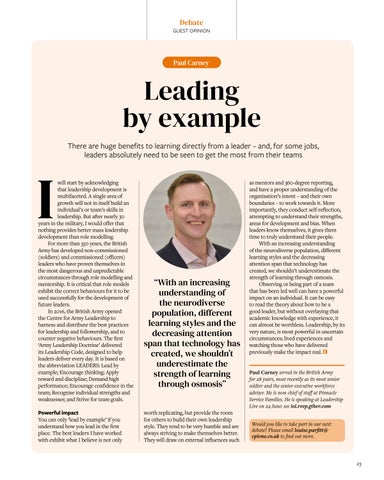
Paul Carney
Leading by example There are huge benefits to learning directly from a leader – and, for some jobs, leaders absolutely need to be seen to get the most from their teams
I
will start by acknowledging that leadership development is multifaceted. A single area of growth will not in itself build an individual’s or team’s skills in leadership. But after nearly 30 years in the military, I would offer that nothing provides better mass leadership development than role modelling. For more than 350 years, the British Army has developed non-commissioned (soldiers) and commissioned (officers) leaders who have proven themselves in the most dangerous and unpredictable circumstances through role modelling and mentorship. It is critical that role models exhibit the correct behaviours for it to be used successfully for the development of future leaders. In 2016, the British Army opened the Centre for Army Leadership to harness and distribute the best practices for leadership and followership, and to counter negative behaviours. The first ‘Army Leadership Doctrine’ delivered its Leadership Code, designed to help leaders deliver every day. It is based on the abbreviation LEADERS: Lead by example; Encourage thinking; Apply reward and discipline; Demand high performance; Encourage confidence in the team; Recognise individual strengths and weaknesses; and Strive for team goals. Powerful impact You can only ‘lead by example’ if you understand how you lead in the first place. The best leaders I have worked with exhibit what I believe is not only
“With an increasing understanding of the neurodiverse population, different learning styles and the decreasing attention span that technology has created, we shouldn’t underestimate the strength of learning through osmosis” worth replicating, but provide the room for others to build their own leadership style. They tend to be very humble and are always striving to make themselves better. They will draw on external influences such
as mentors and 360-degree reporting, and have a proper understanding of the organisation’s intent – and their own boundaries – to work towards it. More importantly, they conduct self-reflection, attempting to understand their strengths, areas for development and bias. When leaders know themselves, it gives them time to truly understand their people. With an increasing understanding of the neurodiverse population, different learning styles and the decreasing attention span that technology has created, we shouldn’t underestimate the strength of learning through osmosis. Observing or being part of a team that has been led well can have a powerful impact on an individual. It can be easy to read the theory about how to be a good leader, but without overlaying that academic knowledge with experience, it can almost be worthless. Leadership, by its very nature, is most powerful in uncertain circumstances; lived experiences and watching those who have delivered previously make the impact real. Paul Carney served in the British Army for 28 years, most recently as its most senior soldier and the senior executive workforce adviser. He is now chief of staff at Pinnacle Service Families. He is speaking at Leadership Live on 24 June: see iol.rsvp.gther.com Would you like to take part in our next debate? Please email louise.parfitt@ cplone.co.uk to find out more.
23