24
IN PROFILE
COP28’s focus on water security is likely to influence global policies significantly. It’s anticipated to drive governments to reconsider their approach to construction practices by incorporating sustainability as a core principle”
conditions (aridity, climate change), socio-economic factors (rapid population growth, urbanisation), technological interventions, and policy issues (inefficient water management and use practices) Asked about the current solutions regional governments and municipalities have unveiled to meet the aforementioned challenges, Dake outlines: • Cloud seeding: Governments have used cloud seeding to increase rainfall. While this has resulted in increased water supplies, it has also caused unexpected excessive rainfall and flooding, disrupting public life • Water recycling: Some GCC countries have begun implementing water recycling for agricultural and landscaping use. This is a promising initiative but needs to be scaled up to make a significant impact • Infrastructure improvements: Governments are investing in infrastructure to improve June 2023 | MEConstructionNews.com
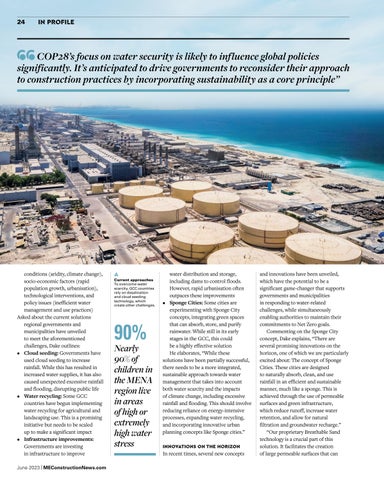
Current approaches To overcome water scarcity, GCC countries rely on desalination and cloud seeding technology, which create other challenges.
90%
Nearly 90% of children in the MENA region live in areas of high or extremely high water stress
water distribution and storage, including dams to control floods. However, rapid urbanisation often outpaces these improvements • Sponge Cities: Some cities are experimenting with Sponge City concepts, integrating green spaces that can absorb, store, and purify rainwater. While still in its early stages in the GCC, this could be a highly effective solution He elaborates, “While these solutions have been partially successful, there needs to be a more integrated, sustainable approach towards water management that takes into account both water scarcity and the impacts of climate change, including excessive rainfall and flooding. This should involve reducing reliance on energy-intensive processes, expanding water recycling, and incorporating innovative urban planning concepts like Sponge cities.” INNOVATIONS ON THE HORIZON
In recent times, several new concepts
and innovations have been unveiled, which have the potential to be a significant game-changer that supports governments and municipalities in responding to water-related challenges, while simultaneously enabling authorities to maintain their commitments to Net Zero goals. Commenting on the Sponge City concept, Dake explains, “There are several promising innovations on the horizon, one of which we are particularly excited about: The concept of Sponge Cities. These cities are designed to naturally absorb, clean, and use rainfall in an efficient and sustainable manner, much like a sponge. This is achieved through the use of permeable surfaces and green infrastructure, which reduce runoff, increase water retention, and allow for natural filtration and groundwater recharge.” “Our proprietary Breathable Sand technology is a crucial part of this solution. It facilitates the creation of large permeable surfaces that can