L
oss, devastation, hopelessness and fear. Cotton producers across Oklahoma feared losing their crops and their livelihoods. In the late 1990s, Oklahoma cotton farmers were falling victim to the industry’s No. 1 enemy: the boll weevil. A pest known for feeding and laying eggs in cotton squares, the insect destroys the bolls of the plant. After years of searching for the answer, five men banded together to form the Oklahoma Boll Weevil Eradication Organization and revive what is now the ninth nationally ranked cotton-producing state, according to the Oklahoma Department of Agriculture, Food and Forestry. “When we started, I was optimistic,” said Mark Nichols, OBWEO founding vice president. “The other men were extremely skeptical or negative about the program.” The founding members of the OBWEO
were Oklahoma cotton producers: Leon King, Hydro; Mark Nichols, Altus; Jerry McKinley, Frederick; Ron Whittenberg, Canute; and the late Sam Pfenning, Hobart. The founding members had viable help forming the board from the late Miles Karner, the former area extension entomologist for Oklahoma Cooperative Extension Service, and Sancho Dickinson, ODAFF program manager. “We formed the board in February 1996, voted on the program in November, and sprayed the first spray to suspend the weevils’ growth in the fall of 1998,” said Jerry McKinley, OBWEO founding chairman and 1961 OSU College of Agricultural Sciences and Natural Resources agronomy alumnus. “We saw the first economic benefit during the 1999 harvest.” In the beginning, the men had mutiple farmers who were against them, said John
Henderson, OBWEO executive director. However, within a short period of time, the farmers noticed how much cotton the weevil destroyed, he said. “The boll weevil ate the top part of the crop, so that cotton would never produce,” Henderson said. “Nobody knew the advantage of the boll weevil eradication program until it started.” Henderson said farmers had to live with the boll weevil taking half their crop each year, causing millions of acres to have decreased production rates. Once the program started, they produced Oklahoma’s highest yields since the boll weevil entered the state. “We started the board, we educated ourselves, and then we educated the people,” Jerry McKinley said. “We passed the program with an 88 percent vote of cotton farmers, which was amazing.” Some areas in Oklahoma were so devas-
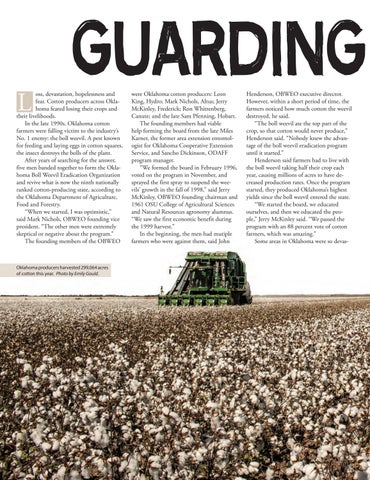
Oklahoma producers harvested 299,064 acres of cotton this year. Photo by Emily Gould.
66 | WINTER/SPRING 2017
cjp_66_67_OBWEO.indd 2
11/17/16 9:04 PM