DEEDS & DON’ TS
strategies the Trust has developed in response to the increasing complexities of the deal-making involved in conserving properties as East End land becomes scarcer and more valuable. “What made this project possible was not only strong financial support from the community, but also the town’s simultaneous purchase of an agricultural conservation easement using money from its Community Preservation Fund,” says Quarty. According to Halsey, whose family has lived in Southampton for twelve generations, the easement restricts the use of the land only to farming and thereby protects it from other forms of development indefinitely. Another project in the works is the renovation of the Garden House at Bridge Gardens, a fiveacre gem in Bridgehampton that was donated to the Peconic Land Trust in 2008. “The gardens are a beautiful place to host discussions on a broad range of topics,” says Bridge Gardens director Rick Bogusch, “but it has become clear that a formal year-round public space is needed to accommodate small group meetings and programs both indoors and outdoors.” As such, the Trust recently tapped Oza Sabbeth Architects to transform the Garden House into a multifunctional educational center (they are currently in the fundraising phase). “Community support and private charitable donations are
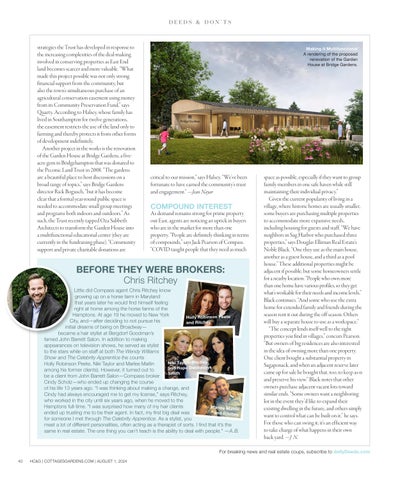
Making it Multifunctional A rendering of the proposed renovation of the Garden House at Bridge Gardens.
critical to our mission,” says Halsey. “We’ve been fortunate to have earned the community’s trust and engagement.” —Jean Nayar
COMPOUND INTEREST
As demand remains strong for prime property out East, agents are noticing an uptick in buyers who are in the market for more than one property. “People are definitely thinking in terms of compounds,” says Jack Pearson of Compass. “COVID taught people that they need as much
BEFORE THEY WERE BROKERS: Chris Ritchey
Little did Compass agent Chris Ritchey know growing up on a horse farm in Maryland that years later he would find himself feeling right at home among the horse farms of the Hamptons. At age 19 he moved to New York Holly Robinson Peete City, and—after deciding to not pursue his and Ritchey initial dreams of being on Broadway— became a hair stylist at Bergdorf Goodman’s famed John Barrett Salon. In addition to making appearances on television shows, he served as stylist to the stars while on staff at both The Wendy Williams Show and The Celebrity Apprentice (he counts Niki Taylor, Ritchey Holly Robinson Peete, Niki Taylor and Marlee Matlin and Hope Dworaczyk among his former clients). However, it turned out to Smith be a client from John Barrett Salon—Compass broker Cindy Scholz—who ended up changing the course of his life 13 years ago. “I was thinking about making a change, and Cindy had always encouraged me to get my license,” says Ritchey, who worked in the city until six years ago, when he moved to the Hamptons full-time. “I was surprised how many of my hair clients Marlee Matlin and Ritchey ended up trusting me to be their agent. In fact, my first big deal was for someone I met through The Celebrity Apprentice. As a stylist, you meet a lot of different personalities, often acting as a therapist of sorts. I find that it’s the same in real estate. The one thing you can’t teach is the ability to deal with people.” —A. B.
space as possible, especially if they want to group family members in one safe haven while still maintaining their individual privacy.” Given the current popularity of living in a village, where historic homes are usually smaller, some buyers are purchasing multiple properties to accommodate more expansive needs, including housing for guests and staff. “We have neighbors in Sag Harbor who purchased three properties,” says Douglas Elliman Real Estate’s Noble Black. “One they use as the main house, another as a guest house, and a third as a pool house.” These additional properties might be adjacent if possible, but some homeowners settle for a nearby location. “People who own more than one home have various profiles, so they get what’s workable for their needs and income levels,” Black continues. “And some who use the extra home for extended family and friends during the season rent it out during the off season. Others will buy a separate house to use as a workspace.” “The concept lends itself well to the tight properties you find in villages,” concurs Pearson. “But owners of big residences are also interested in the idea of owning more than one property. One client bought a substantial property in Sagaponack, and when an adjacent reserve later came up for sale he bought that, too, to keep as-is and preserve his view.” Black notes that other owners purchase adjacent vacant lots toward similar ends. “Some owners want a neighboring lot in the event they’d like to expand their existing dwelling in the future, and others simply want to control what can be built on it,” he says. For those who can swing it, it’s an efficient way to take charge of what happens in their own back yard. —J. N.
For breaking news and real estate coups, subscribe to dailyDeeds.com 40
HC&G | COTTAGESGARDENS.COM | AUGUST 1, 2024