Business Now 2027 Industry Greats The secret to Farsons’ success
36 Food & Drink Malta’s promising young chefs
68 Malta’s Most Beautiful Businesses A look inside Marnisi Wine Estate
72 In Depth Can Malta shift towards a more productivity-led economy?
104
Official Partners
Cover Story The ones to watch
22
BusinessNow
Contents
Business Now
con tents
26
Cover Story
THE ONES TO WATCH: FIVE FOUNDERS BUILDING AMBITIOUS COMPANIES FROM MALTA Sarah Muscat Azzopardi meets five founders building companies from Malta with their sights set well beyond it, to find out what it takes to compete with global incumbents from a small island – and what the country needs to produce more companies like theirs.
Industry Greats
THE BREWERY THAT ALMOST WASN’T
Farsons Group Chairman Louis Farrugia and CEO Michael Farrugia speak to Dean Muscat about legacy, leadership, and why the willingness to adapt has been the true secret to the company’s success.
36 Interview
SUPPORTING BUSINESS THROUGH TRADE MISSIONS AND SOFT DIPLOMACY
Malta’s High Commissioner to the UK, Prof. Stephen Montefort, speaks to Kevin Schembri Orland about his role in strengthening bilateral ties and supporting Maltese businesses interested in investing in the UK.
42
w
BusinessNow
Contents
23
w
72
Malta’s Most Beautiful Businesses A VISION THREE DECADES IN THE MAKING
Beautiful on the outside and uncompromising within, Marnisi Wine Estate is the culmination of a vision that has been quietly taking shape over three decades. CEO Jeremy Cassar speaks to Dean Muscat about the pursuit of quality, betting on the future of Maltese wine and why the best things take time.
Food & Drink
THE NEXT COURSE: TWO YOUNG CHEFS MAKING THEIR MARK ON MALTA’S CULINARY SCENE Sarah Muscat Azzopardi sits down with George Attard, Head Chef at Level Nine in Gozo and winner of the 2026 MICHELIN Young Chef Award, and Kimberley Ellul, named Most Promising Young Chef of the Year 2026.
68 In Depth
THE PRODUCTIVITY PROBLEM: CAN MALTA’S ECONOMY GROW WITHOUT ADDING MORE PEOPLE?
Edward Bonello asks economist JP Fabri, Grant Thornton’s George Vella, AI academic Prof. Alexiei Dingli and Malta Chamber CEO Marthese Portelli what it will take to grow by getting more value out of every job.
104
Meet the Artist
BETWEEN THE ARCHIVE AND THE FILM SET
Interdisciplinary artist and filmmaker Charlie Cauchi speaks to Sarah Muscat Azzopardi about cinema’s long affair with the island, the shifting question of Maltese identity, and why a little doubt does us good.
118
BusinessNow
Editorial
PUBLISHER Content House Quad Central, Q2, Level 2, Central Business District, CBD 1040 Tel: 2132 0713 info@contenthouse.mt www.contenthouse.mt EDITOR Sarah Muscat Azzopardi HEAD OF SALES & BUSINESS DEVELOPMENT Marie Claire Camilleri OPERATIONS AND CLIENT RELATIONSHIP MANAGER Sue Ann Pisani OPERATIONS AND ADMINISTRATION EXECUTIVE Daniel Sant CREATIVE DIRECTOR & DESIGN Nicholas Cutajar COVER PHOTO Bernard Polidano – Shot on location at MICAS – Malta International Contemporary Art Space
Editorial IN THIS EDITION OF BUSINESS NOW, WE TURN OUR FOCUS TOWARDS AMBITION, RESILIENCE, AND THE CRITICAL SHIFTS SHAPING MALTA’S ECONOMIC LANDSCAPE, picking the brains of established leaders and trailblazing innovators to find out what it takes to not only thrive locally, but to build meaningful impact on the global stage. In our cover story, we sit down with five forward-thinking founders building ambitious businesses from Malta. Facing the unique realities of scaling from a small island, they share candid insights and reflect on what the local ecosystem must foster to produce more high-growth companies. Turning to macro-economic priorities, our In Depth feature tackles one of the country’s most pressing dilemmas: can Malta’s economy expand sustainably without continuously adding to its workforce? On an international note, this issue features an exclusive conversation with Malta’s High Commissioner to the UK, Prof. Stephen Montefort, detailing how trade missions and soft diplomacy are creating new pathways for local firms looking abroad.
FOLLOW US ON
Content House would like to thank all the protagonists, contributors, partners, advertisers, and the creative team that have made this publication a success. Articles appearing in this publication do not necessarily reflect the views of Content House. All rights reserved. Reproduction in whole or in part without written permission of the publishers is strictly prohibited. Business Now is the largest business magazine of its kind, published by Content House, one of Malta’s largest media organisations. Business Now Magazine is the sister brand of BusinessNow.mt, Malta’s fastest-growing business news portal. This publication is distributed to leading companies and businesses operating in different sectors including those in the services sector, manufacturing, retail, ICT and software development, importation, shipping and freight, recruitment, accountancy and audit, corporate and legal, communications, new technology, and many more. Business Now’s exclusive distribution network also reaches leading CEOs and business leaders. The business magazine is also distributed to creative and marketing agencies, Government ministries, departments and entities, embassies and consulates, banks, and architecture firms, as well as to car showrooms, business centres and yacht marinas. Beyond the free distribution network, Business Now is also available at leading newsagents around Malta.
In our Industry Greats feature, Farsons Group Chairman Louis Farrugia and CEO Michael Farrugia look back on the legacy of a household name, discuss generational leadership, heritage, and why a steadfast willingness to adapt has been vital to safeguarding the company’s enduring success. True to our tradition of balancing business with the finer elements of island life, this edition also explores the dedication behind creative and artisanal pursuits. First, we visit the picturesque Marnisi Wine Estate, and in our food and drink section, we celebrate the next generation of culinary talent, profiling award-winning chefs George Attard and Kimberley Ellul. Finally, we conclude with a chat with artist and filmmaker Charlie Cauchi, who reflects on cinema, heritage, and the evolving nature of Maltese identity. Enjoy the issue,
Sarah Muscat Azzopardi
25
26
BusinessNow
Cover Story
The ones to watch: Five founders building ambitious companies from Malta Sarah Muscat Azzopardi meets five founders building companies from Malta with their sights set well beyond it, in fields as far apart as advanced materials, electric mobility, payments, quantum cybersecurity and board games, to find out what it takes to compete with global incumbents from a small island – and what the country needs to produce more companies like theirs.
PHOTOS BY BERNARD POLIDANO SHOT ON LOCATION AT MICAS – MALTA INTERNATIONAL CONTEMPORARY ART SPACE
BusinessNow
Cover Story
27
28
BusinessNow
Cover Story
‘I’d take an island full of people who want you to succeed over a big market where nobody notices you’ Dr Keith M. Azzopardi is Co-Founder and CEO of Smart Materials, the Maltese company behind the Huggah mattress brand. Huggah is built on Zetic®, a patented auxetic foam the company developed in collaboration with the University of Malta’s Metamaterials Unit.
“Honestly, I can’t imagine building Smart Materials anywhere else,” begins Keith, who describes Maltese people as resourceful and quick to rally behind anyone with a passion. “There’s a real sense of community. I’ve lost count of the times someone opened a door for us just because they believed in what we were doing.” He credits Government’s support for innovation and hard tech, and accepts the drawbacks that come with an island base: shipping is a challenge and the home market is small. “But I’d take an island full of people who want you to succeed over a big market where nobody notices you.” Winning international attention, Keith says, was the easy part, since others had tried to produce a material like Zetic®, and the industry was watching. The harder battle was in the mind. “When you’re creating something that has never existed, something which giants have failed to do, you have to believe in what you are doing and get people to believe in a vision they can’t see yet, find the resources, and keep a team motivated through a long stretch of failure. Then one day, it works,” he recalls. “We were stubborn enough to keep going, and we managed to crack it.”
you’re in it together. But when things get tough, they need you to lead.” Looking at what Malta needs next, he starts with a national habit of keeping quiet. “Maltese companies have been and continue succeeding abroad. But we don’t tend to shout about our wins, and I think we should, because when a young founder sees someone from their own town selling into Europe, it changes what they believe is possible.” Beyond that, he would like to see a stronger network and real support for companies expanding abroad. “We are small and on a global scale we need to leverage each other. Once a few companies break through, it snowballs.”
The move from laboratory to factory floor brought a fresh set of problems. “Everything is new. You can’t just order the machine you need, so you have to find something close and adapt it,” the Smart Materials CEO explains. Every increase in volume felt like starting over, but the lessons travelled with the team. “That know-how becomes an asset nobody else has. It’s hard, but it’s also a lot of fun. Seeing something that started in a lab actually solve people’s problems still gives me goosebumps.”
The first market for their newly developed material came as something of a surprise. At international conferences, Keith says, Smart Materials drew interest from top players in automotive, aerospace and sport, yet the strongest pull came from sleep. “The market chose for us. It’s probably the hardest application technically, because of the scale, but it’s also one of the biggest prizes. Conventional foam fights you. Zetic® adapts to you and hugs you, which is where the name Huggah comes from.” Huggah mattresses are now on sale in Malta and Gozo.
Keith speaks openly about the personal toll. “This is a five- to 10year mission at the very least, and you need to protect your mental health to keep pushing on the hard days,” he reflects. “I’ve also learned that it’s okay to be vulnerable with your team, so they know
The choice was personal too. “My mum suffered from back pain when I was a kid, and I want to help people sleep better, and wake up feeling better. That’s why we say we want to change a million lives,” he shares. “Mattresses are just the first chapter.”
BusinessNow
Cover Story
29
‘Numbers travel further than a postcode’ Jerry Hang is Founder and CEO of MannaEV, the Malta-based electric mobility company that leases electric motorcycles to delivery riders and runs a battery-swap network to keep them on the road. Recently, the company was selected as a top 50 finalist in the European Startup Prize for Mobility, and also joined the first Techstars x EIT Urban Mobility Founder Catalyst cohort. “Malta chose me as much as I chose Malta,” laughs Jerry, who is quick to point out that his birthday falls on 8th September, Malta’s Victory Day. Originally from Malaysia, he arrived on the island in 2023 after building companies across Malaysia, Singapore and China. “What I found was a country small enough to move fast in and serious enough to be taken seriously on the world stage. In Malta you can meet a regulator, a bank and a potential customer in the same week. Try that in a large market as a foreign founder.” The limits are just as clear to him. “Nobody builds a global company because of a market of half a million people. But that constraint forces discipline. We had to design for export from day one, because there was never an option to grow lazily on a big domestic base.” For the MannaEV founder, the toughest obstacle has been neither product nor technology. “It’s credibility!” he says. Tell a global platform or a fleet operator that your company is headquartered in Malta, and “the first reaction is often polite confusion”. His competitors, he notes, have raised hundreds of millions, while MannaEV has raised €750,000 since 2024, all from angel investors. Jerry wears that figure with pride. “We are proud to shout that we are the least funded, but the most capital-efficient startup within our category.” “The only way through it was proof. We stopped pitching and started building,” he continues. “Today we are live in six countries, and profitable in Malta and Kenya. Numbers travel further than a postcode.” Malta itself has been the proving ground. Jerry calls the island “brutal in the best possible way”, with its dense, narrow roads, an urban delivery economy running at full intensity, and riders working long shifts in the heat. “If a battery, a bike or a swap process fails, it fails here quickly and visibly. That is enormously valuable.” Everything the company now deploys in Nairobi and Bangkok, he says, was refined on Maltese roads first. That includes, he adds, its distributed swap model, in which a local retailer becomes a swap point and the company avoids building expensive swap stations of its own, an idea that “came directly from operating in a place with no space to build anything”. Fuel and downtime eat into thin last-mile margins, Jerry explains, and the usual electric alternatives trade that problem for hours of charging or costly centralised stations. MannaEV’s answer is a battery a third of the size of the market standard and three times as powerful – one that sits on an ordinary shop shelf and charges from a normal socket. “Any corner shop becomes a swap point
overnight, with no construction and no grid upgrade. Riders swap in 90 seconds and return to earning. The result is better economics for the operator, higher take-home for the rider, and cleaner air for the city. Sustainability only scales when it is also the cheaper option.” What Malta lacks, in his view, is patient risk capital: local investors willing to back hardware, infrastructure, sustainability and deep tech, where returns take longer to arrive than in software. “We built to over €260,000 in monthly recurring revenue on angel money alone. That should not have been necessary,” he argues. “If Malta wants exportable innovation rather than exportable talent, capital has to be willing to sit still for longer.” Jerry’s staying power goes back to his late father, the CEO reveals. “He started several businesses and failed. My mother eventually left because he could not provide stability. Most people would read that as a cautionary tale. I saw a superhero, not because he won, but because he never stayed down,” he smiles, referring to it as the cockroach spirit. “You can step on a cockroach, and it simply keeps going,” he smiles. “I started selling comic books at a night market at 11 because of him. Everything since has been the same instinct.”
BusinessNow
Cover Story
31
‘The objective has never been to become a successful Maltese payments company’ Samuel Barrett is Co-Founder and CEO of Paytently, the Sliema-based payments company that uses machine learning to help merchants route online transactions. In October 2025, Paytently announced that it had been granted a Payment Institution licence by the Malta Financial Services Authority. Samuel had been living in Malta for years before he started Paytently, having moved to the island from London in 2016, and he knew exactly what it could offer. “I knew first-hand the depth of experience here, particularly across payments, fintech and regulated gaming,” he notes. “There is a concentration of talent and industry knowledge that is quite unique for a country of this size.” The size of the home market settled the strategy early on. “You simply cannot build with a domestic mindset. For us, that was actually an advantage. Paytently had to be international from day one. We built the business in Malta, but we never built it just for Malta.” Like Jerry, the Paytently CEO names credibility as the hardest barrier. “When you’re a young company sitting across the table from major banks, card schemes, acquirers or global merchants, nobody gives you credibility because you have a good idea,” he observes. “You earn it through execution.” For Paytently, that meant investing early in technology, compliance and regulatory infrastructure, and then delivering for merchants consistently. “Once you demonstrate that you can solve complex problems and operate to the standards expected of much larger organisations, the conversation changes very quickly.” His critique of the industry is pointed. “Too many payment gateways are still passive infrastructure. They connect a merchant to payment providers, but the merchant is often left to work out how to optimise that infrastructure themselves.” Paytently uses machine learning alongside transaction data to help determine how payments should be routed, he
explains, based on factors such as the issuer, geography, currency, transaction behaviour and historical performance. “Merchants don’t really care about having another payment gateway. They care about converting more customers, reducing friction and generating more revenue. That’s the problem we’re trying to solve.” The lesson that has served him best is learning not to become too emotional about either the highs or the lows. “Building a company is rarely linear. There are weeks where everything appears to be working and weeks where several things go wrong simultaneously. I’ve learned to focus on what we can control, make decisions quickly and keep moving forward,” Samuel reflects. “Resilience isn’t pretending things aren’t difficult. It’s being able to deal with difficult situations without losing sight of where you’re trying to go.” He sees an opportunity for Malta to move from attracting international businesses to creating them – building companies capable of becoming global leaders. Getting there will take more growth capital, more experienced operators and more founders willing to build beyond Malta from the outset. “We also need to celebrate entrepreneurship while accepting that building genuinely innovative companies involves risk and, inevitably, some failure along the way.” On whether a Malta address has helped or hindered him, his answer is short: “Both.” The island gives Paytently access to deep experience in payments, regulation and gaming, he says, “but when you’re building internationally, your location only gets you so far. Tier-one partners ultimately care about governance, compliance, technology, security and whether you can deliver.” The CEO’s conclusion is clear. “Being headquartered in Malta is part of our identity, but our standards and ambitions have to be global. The objective has never been to become a successful Maltese payments company. It’s to build a global payments company that happens to have been created in Malta.”
32
BusinessNow
Cover Story
‘Malta is small and connected enough to allow us to build a nationwide quantum network’ Prof. André Xuereb is Founder and CEO of Merqury Cybersecurity, which develops the technology that lets organisations run quantum-secure communications over the networks they already have. A professor of physics at the University of Malta, he also serves as Malta’s Ambassador for Digital Affairs. Merqury was born, André says, “out of necessity and a sense of being in the right place at the right time”. In June 2019, Malta was among the first seven EU Member States to sign the declaration behind EuroQCI, a plan for an ultra-secure quantum communication infrastructure across the Union, with each country building its own national network. André, who had set up the University of Malta’s quantum research group, saw an opening. “I took it upon myself to develop the idea. I identified a gap in the market and launched the company to address it,” he recalls. “Malta is small and connected enough to allow us to build a nationwide quantum network, providing an ideal launchpad for us to develop and deploy our technologies.” The physicist is adamant that the threat his company addresses is being underestimated. “Organisations and countries are already storing data being sent today to decrypt it using quantum computers in five to 10 years’ time,” he warns. “If the data you are handling today needs to be kept secret for longer than that – think banks, hospitals, and governments – then it is important to account for the quantum threat immediately, particularly because the transition can take long to implement.” “Quantum networks are the only long-term solution to this problem,” he maintains. “Where we found our unique niche is in developing the technologies that allow organisations to deploy quantum networks into their systems without overhauling their existing infrastructure.” The company is technical lead on PRISM, Malta’s multi-million-euro national quantum communications testbed, and has worked with international partners like Airbus Defence and Space to demonstrate quantum-secure connections over existing infrastructure. “That hands-on experience is what we bring to our partnerships: an understanding of how to make the technology work outside the laboratory,” André says, adding that Merqury is now building towards commercial deployments across Europe.
Talk of obstacles brings him first to an advantage. “Let me answer a different question first,” he offers. “The single biggest advantage was the speed at which we could move.” Because Merqury had a view of everyone involved, from infrastructure providers to end users, it could fill gaps in the market quickly. “Large integrators tend to see only part of the problem and to move slowly, giving us a real advantage.” The biggest obstacle, he continues, is “the difficulty of raising private finance locally, without which going from startup to scale-up is practically impossible.” That shortage of capital tops his list of what the country is missing. “The EU lags behind the US for venture capital. Countries like Malta trail the rest of the EU; we must find ways to attract more venture capital into our startup ecosystem.” Procurement comes close behind. “In industries such as ours, the anchor customer is the public sector. In contrast to many of its counterparts elsewhere, the Maltese public sector does not regularly engage in innovation procurement, robbing local startups of the opportunity to demonstrate commercial traction in Malta,” he maintains. The journey has changed him substantially, André acknowledges, and nothing matters more to him as a manager than a team he can trust to deliver. His own days cover strategy, bookkeeping, overall management, human resources “and probably 100 other things,” he states, adding, “it would be impossible to get anything done if I could not delegate technical design to our CTO Noel Farrugia, for example, or chasing leads to our Head of Strategic Partnerships, Jake Schembri. As a technical person, I had to learn to focus on real-world needs, using rigorous testing and feedback to move forward rather than pursuing perfection for its own sake.”
BusinessNow
Cover Story
35
‘We are not just punching above our weight, we’re punching mammoths’ Prof. Gordon Calleja is Co-Founder and Director of Mighty Boards, the board game studio that in 2026 became the first Maltese company to win the Kennerspiel des Jahres, Germany’s award for the best game for experienced players, with Rebirth. An academic at the University of Malta’s Institute of Digital Games, he is the author of two books on game experience published by MIT Press. “We are still reeling from that honour,” Gordon admits. “We dreamt of one day being nominated, not winning it so soon!” Rebirth, designed by Reiner Knizia and published by Mighty Boards with German partner Frosted Games, took the prize in July 2026, following an earlier breakthrough in the US, where Barnes & Noble named the studio’s Art Society its Game of the Year in 2024. Between them, he says, the two awards “have taken our games from the smaller hobbyist market to the larger, general market”, with Rebirth now selling in bookshops and toy shops as well as game stores, particularly in Germany, France and the US. Basing the company anywhere other than Malta was never considered. “It’s our home country. We have always been committed to contribute to the creation of local talent and local products that elbow their way into the international stage,” he affirms. The biggest early advantage, by his account, was Arts Council Malta. Funds he received personally, before Mighty Boards existed, helped get his first games onto Kickstarter and the studio to fairs abroad, “which cost a bomb”. Those early campaigns were successful enough, he recalls, for the team to start operating internationally. Gordon is refreshingly candid about the rest. “Being based in Malta has presented a lot of challenges, and they have, in all honesty, outweighed the benefits.” In his telling, Malta had no home industry to speak of, too few local backers to carry a Kickstarter campaign through the first hours that decide it, and, until recently, no dedicated board game shops, which left the founders learning traditional distribution from scratch. With no veteran local designers to learn from either, “we had to learn by trial and error.” Finding staff for highlevel artistic and creative roles has been hard, he adds, and keeping foreign employees in Malta harder still, which he puts down to rising prices and a decline in quality of life and the environment. Pressed for the single greatest obstacle, he highlights the disconnection from established industry players to network, and the difficulty of getting to foreign conventions that are a must in the industry. With no national scene in which to gain a foothold, the studio had to establish itself in several countries at once initially through online reach and Kickstarter, while competing with giants such as Hasbro, Mattel and Asmodee. “We go toe to toe with these guys in every product we launch and we have to simply make games that are at the same level, or better. We are not just punching above our weight, we’re punching mammoths.” Speaking for Malta’s creative industries, he would like to see a culture of honest critique take root. “There is a lack of healthy,
critical engagement with each other’s work and some sort of fear of offending a creator if anything but gushing positivity is showered upon them,” he observes. Ambition needs to shift as well, so that Europe and then the wider world become the baseline market. “There is still too much focus on the local market and let’s face it, the local market for most avenues of creative output at scale is small.” Building a grand company was never the plan. In board games, the designer usually creates the game system while the publisher controls the art and product design, and Gordon wanted visual control over the rich story worlds in his games, so he joined forces with his partners David Chircop and Mark Casha, to design and publish their own games. The principle behind their success, he says, is “single-minded perseverance and the goal to make things that would eventually stand with the best of them, right from day one. I take that and work hard on it for as long as is needed to achieve it. Everything else follows.”
36
BusinessNow
Industry Greats
PHOTOS BY JUAN ELLUL
BusinessNow
Industry Greats
37
The brewery that almost wasn’t Nearly 100 years on, Farsons Group remains one of Malta’s most enduring businesses, and shows no signs of slowing down. Chairman Louis Farrugia and CEO Michael Farrugia speak to Dean Muscat about legacy, leadership, and why the willingness to adapt has been the true secret to the company’s success.
IT STARTED WITH A FIRE. In June 1919, an angry mob burned down the Victoria Steam Roller Flour Mill in Ħamrun, in what became known as the Sette Giugno riots, triggered by food shortages and soaring prices in the aftermath of WWI. The mill, owned by the Farrugia family, was reduced to ash. Standing in the ruins, 20-year-old Lewis V. Farrugia faced a decision: rebuild what had been lost, or take the family business somewhere entirely new. He chose the latter. Lewis steered the family first into industrial gas production before entering brewing, a venture that brought them into contact with the Simonds brewery in England, and eventually led to the formation of Simonds Farsons in 1929.
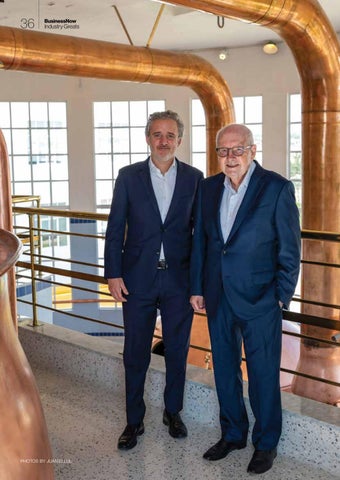
Reflecting on that crossroads moment his father faced a century ago, Farsons Chairman Louis Farrugia muses: “It was clever of my father to say, let’s do something different.” There is an unspoken awareness of what that decision set in motion as he speaks, seated alongside his son and Farsons’ CEO Michael, in the Redler Room at The Brewhouse, a building originally designed by his own father, who was an architect by training. Without that entrepreneurial spark, it is possible that none of this would exist. Neither Chairman nor CEO describes joining Farsons as an inevitable career path. And yet, for both men, the pull eventually proved impossible to resist. Louis’s father died when he was just five, but he still remembers visiting him
BusinessNow
Industry Greats
at the brewery, seeing him in his office. In his youth, he spent some 15 years in the UK, pursuing his education and qualifying as a chartered accountant, before returning to Malta in 1974 and taking over the brewery four years later.
39
“It was clever of my father to say, let’s do something different.” Louis Farrugia
“It’s like a magnet,” he says. “You feel attracted towards the idea that your family has come up with this investment, and you feel a duty towards it.” Taking the helm also meant leading the brewery through one of the more precarious periods in Malta’s economic history. In the 1980s, Farsons operated in a market shielded by import licences that restricted foreign competition, a form of state protection that Louis knew could not last. “I knew that things were going to change. Obviously, the discussion at the time was all about free trade and open markets, and unless we adapted ourselves, we would not have a business.” What followed was a long and deliberate programme of investment. The production facility that took shape from the 1990s onwards, and has continued to this day, represents well over €100 million committed to ensuring that Farsons could compete with the Heinekens and Coca-Colas of the world. It is within that same time period that Michael’s earliest and most vivid memories of the business were formed. “I remember walking on the production floor, the clinking of the bottles, the workers on the shop floor, walking down the long corridors full of pipes and steam,” he remembers fondly. After reading history at the University of Edinburgh, Michael moved to London and then Brussels, where he worked within the European institutions and the politics of international relations. He also holds an MBA from Warwick Business School. It was in Brussels, the beer capital of Europe, that his thoughts began to turn to Farsons in earnest. Surrounded by the brands of the continent’s major brewers, he found himself asking a simple question: why weren’t Farsons’ beers here?
The question prompted conversations with his father, and eventually, a decision to return to Malta. He joined the newly established export team – comprised of two people – selling roughly one container of beers every other month. Demand steadily increased. From there, he worked through logistics, marketing, technical services, sales, and operations. “I was very happy to get my hands dirty,” he recalls. “I left no stone unturned.” By the time he was appointed CEO in July 2026, succeeding Norman Aquilina, 20 years of moving through the business had given him a deep, granular understanding of every part of the operation. “I learned a great deal,” he says simply of the move that felt like a natural next step. That export business he helped kick-start remains central to how Farsons thinks about its future. The Middle East has become an established market, with neighbouring opportunities now in view.
40
BusinessNow
Industry Greats
“We’ve got a very ambitious agenda. But I’m very motivated to keep on building on the business and take us into the next century.” Michael Farrugia
Italy is served by more than 20 distributors across the mainland and Sicily. A franchise agreement for Kinnie production in Ghana marked a significant new initiative in Africa. “It’s a long game,” Michael says. “You have to think long term, invest in your brands, find the right markets.” Looking ahead, Michael has been setting out what he describes as the company’s lean, green and digital agenda. “This appointment has allowed me to accelerate that agenda and really drive the business forward,” he says. “For me, being lean, green and digital means operational excellence and building a culture of continuous improvement. We have a strong foundation, but we cannot stand still. We need to keep investing in our people, our brands and our capabilities to remain competitive and maintain high standards of customer service.” For Louis, there is a clear satisfaction in seeing the company continue to evolve under the next generation and knowing that Farsons’ reputation for good governance will continue. “My satisfaction,” Louis adds, reflecting on Michael’s efforts, “is that we have a company which has adapted responsibly to the times we live in. We are not the same company we were 50 years ago. And that is why we’ve survived.” Nowhere is that more tangible than in The Brewhouse itself, the transformation of Farsons’ original 1950 Art Deco building in Mrieħel into a mixed-use destination. When brewing operations moved to a modern facility in 2012, the Grade 2 listed building could have been left behind. Instead, with an investment of around €20 million and working with acclaimed architect Ian Ritchie, the original copper brewing vessels, pipes, and industrial machinery were preserved
PHOTO BY DEAN MUSCAT
and incorporated into the design. “We saw this as an opportunity to showcase our brewery, our history, our brands, and engage with the community at a deeper level,” Michael explains. This perhaps finds its fullest expression in the Farsons Brewery Experience. This immersive visitors centre tells the story of Simonds Farsons Cisk through the decades with a depth and affection that only a family could bring to its own history. That it ends in a gift shop stocked with retro-inspired Kinnie T-shirts and Cisk caps is proof that these brands have become something people want to take home. Father and son move through the exhibition area, pausing at different points, each with their own relationship to what is on display. Louis stops at his father’s drafting table, Michael at the advertisements from the days when Farsons was supplying beer to the British servicemen letting off steam on Strait Street. Then there is the safe. Salvaged from the Flour Mill during the Sette Giugno riots, it sits in a corner of the exhibition, still slightly battered – a piece of furniture that has no business surviving a century, and yet here it is. According to family lore, a female employee rescued it from the rioters, determined to protect her personal belongings inside. It is difficult not to see something symbolic in the artefact. The fire that forced a decision that gave rise to everything standing around it. Now, with Michael at the helm and Louis guiding the business he has helped shape for more than five decades, that same instinct to adapt, to move forward, to do something different, remains. “We’ve got a very ambitious agenda,” Michael says of the challenges and opportunities ahead. “But I’m very motivated to keep on building on the business and take us into the next century.” Clearly, the flame that started it all is still burning.
42
BusinessNow
Interview
Supporting business through trade missions and soft diplomacy Malta and the United Kingdom share a long-standing relationship, with the UK continuing to be an important partner for Malta. Malta’s High Commissioner to the UK, Prof. Stephen Montefort, speaks to Kevin Schembri Orland about his role in strengthening bilateral ties and supporting Maltese businesses interested in investing in the UK.
UPON BEING APPOINTED HIGH COMMISSIONER IN 2025, Professor Stephen Montefort set out his three key priorities. The first was to use his diplomatic role to showcase Malta at its best, while strengthening the country’s relationship with the UK and making inroads within the Commonwealth. The second was to support the Maltese community in the UK, as well as those planning to study or work there. The third, he says, was to strengthen Malta-UK trade and business ties, “and to get the UK as interested in Malta as possible.” A respected doctor specialising in respiratory medicine, Prof. Montefort has held several important positions throughout his career, including Vice Dean of the Medical School and Head of the Department of Medicine at the University of Malta, and was a council member of the Malta Medical Council and the Malta Council of Health. In 2020, he was made a Member of the National Order of Merit of Malta
BusinessNow
Interview
43
H.E. Prof. Montefort presenting his letters of credence to his Majesty King Charles III in March 2025
in recognition of his medical service and research in respiratory medicine. “Becoming a diplomat was never in my career plan,” he reveals. “When this was offered to me, I was apprehensive at first, but now more than ever I feel that diplomacy has many aspects in common with medicine.” Both, he explains, require developing trust, building personal relationships and being a good listener. There are also similarities between academia and diplomacy, he adds, highlighting “the importance of visibility, attending and addressing conferences and meetings, and writing reports to make both yourself and the institution as visible as possible.” In his current role, this helps people associate him with Malta and recognise that, despite its small size, the country is represented and contributing across as many fora as possible, he maintains. Turning to the current trade and business relationship between the two countries, he describes it as “very
strong,” citing shared language, the number of Maltese graduates from UK universities and Commonwealth ties – as important factors. The UK sees Malta as a trusted partner in an important strategic position, he says. The island nation can also serve as a bridge to the EU, providing a channel into the single market and North Africa while still operating within EU rules and structures. In promoting trade and business between the two countries, the High Commissioner is a strong supporter of trade delegations. Together with Trade Malta, Malta Enterprise, the Malta Financial Services Authority (MFSA) and the Institute of Tourism Studies (ITS), he helped organise a trade delegation to the UK in 2026, involving around 50 Maltese businesses and entities. The delegation focused on cities outside London, visiting Liverpool, Wrexham and Cardiff. The sectors represented included some of Malta’s most important industries, among them financial services, hospitality, digitalisation, artificial intelligence (AI),
BusinessNow
Interview
45
Prof. Montefort receiving his letters of credence from the President of Malta in January 2025
maritime and aviation services, and advanced manufacturing, including pharmaceuticals and electronics. In financial services, “among other things, we are trying to entice family offices to open in Malta,” he says. These are all sectors in which he sees room for growth, both for businesses in Malta that are looking to expand into the UK, and for efforts to attract businesses to Malta. He reveals that a similar delegation will travel to Manchester and Scotland in early 2027. Reflecting on recent discussions in Scotland, Prof. Montefort highlights Malta’s interest in renewable energy, noting that Scotland is a major player in the energy sector. The focus on areas outside London reflects several considerations, the High Commissioner explains. He already promotes Malta in London throughout the year, while other parts of the UK tend to be more receptive. London is also a saturated and expensive market, and businesses in certain sectors there might view Malta as a competitor. “When you visit places like Cardiff which also have a Maltese community, Malta already has a good name, and they are open for business.” The High Commissioner has also opened Malta House, which houses the High Commission in London, to many entities including Trade Malta, the MFSA and Finance Malta, allowing
“Malta is promoting itself well, including through the important contacts made and trade delegations organised.”
them to use the premises for meetings and seminars. “When people meet them here, they know that the entities they are meeting with are being endorsed by the Maltese Government,” he says. “Malta House was always looked at as a place Maltese citizens would go to renew their passports, but it is much more than that.” Asked what support the High Commission can offer Maltese businesses looking to do business with UK companies, Prof. Montefort highlights the value of its endorsement, as well as the availability of Malta House as a venue for business meetings. He also places considerable value on soft diplomacy as a means of promoting Malta, including through cultural events in which Maltese representatives participate. One example was the Edinburgh Fringe arts festival in 2026, which he also attended. He points to another event organised last year: Maltese Culinary Week, during which a delegation of ITS lecturers and students prepared Maltese food and served Maltese wines at receptions and diplomatic dinners. More recently, the High Commissioner brought a delegation of eight ambassadors to Malta, where they met senior Government officials and representatives of agencies including Malta Enterprise, Trade Malta and the Malta Chamber of Commerce. “We showed them around the country. We took them to Gozo and visited various tourist attractions, Maltese restaurants and vineyards. They could feel the warm Maltese welcome,” he explains, noting that such visits offer another way of bringing Malta and its businesses to the attention of international contacts. In 2027, the High Commission is planning a series of cultural events in the UK, working with a cultural representative through Arts Council Malta. The aim is to use culture to build connections, he says, “using culture to build bridges”. One of Malta’s advantages is its agility, the High Commissioner continues. “Our politicians and senior managers are more
46
BusinessNow
Interview
“Our politicians and senior managers are more accessible than their UK counterparts. The fact that Malta is so practical and agile means our small size is an advantage over larger countries. This is a very important point which we try to push forward.”
accessible than their UK counterparts. The fact that Malta is so practical and agile means our small size is an advantage over larger countries. This is a very important point which we try to push forward.” On the flip side, the country’s size does pose an issue, but Malta always punches above its weight. Malta has made considerable inroads in the UK, he explains, adding that it remains one of Malta’s biggest markets. Total trade in goods and services between the UK and Malta, including exports and imports, reached £5.2 billion in 2025.
“Malta is promoting itself well, including through the important contacts made and trade delegations organised,” he affirms. Commenting on two particular sectors, Prof. Montefort identifies financial services as an area of strong collaboration between Malta and the UK, noting that the MFSA frequently sends representatives to support this work. The film sector also offers promise, he says, revealing that the Film Commission and the High Commission have been working to attract interest in investment in a large soundstage in Malta. “Malta has a very good reputation in the film industry here.” One challenge raised by foreign businesses considering investing in Malta is bureaucracy. However, Prof. Montefort believes the issue is receiving increasing attention. One advantage, he says, is that certain entities like the MFSA operate as one-stop-shops, which he describes as an attractive feature. Turning to the Commonwealth, the High Commissioner believes Malta has made considerable inroads and stresses that the island nation is a highly respected member. Having recently been elected Chairperson of the Commonwealth Secretariat’s Board of Governors, Prof. Montefort also serves as the Chair of the Executive Committee of the Commonwealth Foundation. “We are one of the few countries that hosted CHOGM twice in a decade, and our Foreign Affairs Minister chairs the Commonwealth Ministerial Action Group, one of its most important bodies,” he notes. The Secretary-General of the Commonwealth has identified trade, business and climate as key strategic priorities, he continues. This could lead to further discussions on trade between member countries, the High Commissioner explains. “The Commonwealth represents 2.7 billion people, and there is a lot of potential there.” He also points to the pharmaceutical sector as an example of the investment opportunities available to Malta, noting that several Indian pharmaceutical companies have opened operations on the island in recent years. He sees potential to attract further investment in this and other sectors. Looking ahead, he intends to continue using soft diplomacy and trade missions as key tools to promote Malta’s strengths and deepen ties between the two countries. Meanwhile, he strives to keep contact with Malta’s business community in the UK, through a monthly meeting of the UK chapter of the Malta Business Network, which takes place at the High Commission.
Prof. Montefort presenting his copie d’usage on his arrival to the UK, to Victoria Busby OBE in her capacity as director of protocol
48
BusinessNow
Trade
Building bridges for Malta’s global ambitions Less than a year into her tenure as CEO of TradeMalta, Tania Brown talks to Edward Bonello about steering the organisation towards creating an ecosystem that nurtures long-term business relationships and deeper commercial networks, while positioning Malta as a bridge between continents. TANIA BROWN TOOK THE HELM OF TRADEMALTA AT SOMETHING OF A CROSSROADS FOR THE ORGANISATION. Established in 2015 as Malta’s strategic enabler of international trade and exports, TradeMalta celebrated 10 successful years of trade promotion and exportation support last year, yet, at the same time, the global economic and geopolitical landscape is undergoing significant change, and that calls for a moment of reflection.
“Our aim is to find the best opportunities for Malta-based businesses to internationalise, however, we are looking at the larger picture – the long game,” Ms Brown declares from the outset. “We traditionally consider trade as a point-to-point transaction, however, in an increasingly shifting landscape, we want TradeMalta to help businesses build functioning ecosystems, identify opportunities early and leverage them consistently to build long-standing international relationships.”
BusinessNow
Trade
“At the centre of our strategic focus are SMEs, as they form the spine of our economy.”
PHOTOS BY JUAN ELLUL
In fact, for Ms Brown, TradeMalta is now at the ideal juncture to consolidate its excellent operation, while asking the hard questions about what it is that Malta-based businesses need when they seek to internationalise, and what they are likely to need in five or 10 years’ time. “At the centre of our strategic focus are SMEs, as they form the spine of our economy. From our experience, they are increasingly the ones with the ambition to look beyond our shores as they would have outgrown our relatively small domestic market due to their success. Our role is to craft the perfect platform on which they can get export-ready, often involving the direct support of other business-support organisations such as The Malta Chamber and the Gozo Business Chamber, Malta Enterprise, MFSA, the Malta Development Bank, Xjenza Malta and many other partners in Malta’s ecosystem. Businesses shouldn’t feel like they’re solving a complex puzzle at every stage of their journey – that is our job to crack!” Ms Brown explains. Once fully deployed, TradeMalta’s support develops into a positive feedback loop, with experienced companies and entrepreneurs at the centre, offering their guidance. “We are lucky to have a strong community of businesses and entrepreneurs who have lived the challenges of internationalisation, absorbed the risks along the way, pivoted when the going got tricky, and emerged with a great track record. Their experience is the most powerful lesson that businesses coming up behind them can ever hope to learn. Some are large operators, but a good many sit firmly in the SME category, and their experience is precisely what inspires our own future trade missions.” Diversification, agility and an openness to markets Malta has not traditionally looked towards are, in Ms Brown’s view, the qualities that will define TradeMalta’s next chapter.
This vision has already started taking shape, in the form of her first trade mission as CEO, to the United Kingdom last May – one which is being referred to as an early success story. “Notwithstanding everything the UK has been through politically, the economy there is proving to be rather promising, and the private sector is actively seeking new partnerships. That is exactly the sort of opportunity we are seeking,” Ms Brown observes. “We all know that the UK is one of Malta’s oldest partners, but that doesn’t mean no opportunities exist there. In fact, we sought to look away from saturated London, seeking partnerships in Cardiff and Wrexham in Wales, as well as Liverpool. We pitched Malta’s well-established advantages: similar time zone, brief three-hour flight away, similar financial services and judicial frameworks, shared Commonwealth, and a historical familiarity that gets any conversation going. However, we went deeper, leveraging Malta’s EU membership, our geographic position and close links to both Europe and North Africa. Malta’s vocation to build bridges once again proved to be successful,” Ms Brown notes. Designing the mission relied heavily on groundwork laid by Malta’s High Commissioner Stephen Montefort and Consul General in Wales, Reuben Mifsud, whose support proved to be invaluable. This demonstrates how ongoing support and conversations with Malta’s diplomatic corps can create tangible opportunities for our country. The mission targeted sectors where Malta already has genuine interest and credibility, among them technology, fintech and medtech, software and systems development, high-end manufacturing and engineering, as well as hospitality and related services, with life sciences and education flagged as areas for future follow-up.
49
50
BusinessNow
Trade
“A mission only opens doors. The real work starts afterwards,” she states in no uncertain terms. “When collaborating with a jurisdiction like the UK, it works for both sides of the fence. It works for our partners because they are not operating within an unfamiliar culture; it works for us because it saves us resources we would otherwise spend building relationships from scratch,” she says. Ms Brown is equally interested in sectors and prospects that may offer a stiffer challenge, particularly those that do not necessarily fit squarely within Malta’s traditional export profile and may require additional support to get off the ground. “Culture and the arts, education, the circular economy, water and renewables may not be automatically associated with Malta’s traditional export portfolio, yet this shouldn’t stop us from supporting businesses in these sectors that have a strong opportunity to grow internationally. Malta Arts Council’s own internationalisation pillar shows us how this shift is already underway, and we are interested in creating the right synergies in this direction. Ours is a predominantly services-based economy, after all, and services have to be recognised as exports in their own right,” Ms Brown adds. Deciding where TradeMalta looks next is, she says, a deliberately disciplined process, and one that goes beyond the purely economic case. “We should be promoting Malta’s geographic and geopolitical position as much as its economic one. We are establishing networks that are long-term and sustainable, and once they take root, they tend to open doors everywhere,” she says. Latin America and North America, sub-Saharan Africa and the MENA region all feature prominently among the markets under active consideration, guided by where Malta has diplomatic missions and seasoned boots on the ground already. “There are three things we always take care of when we design a mission: demand in the target market; our capacity here at home to deliver on our promises; and the strength of our networks and diplomatic presence in that destination. This includes long-standing relationships with bodies such as the Commonwealth. The geopolitical landscape has shifted so much that we have to remain constantly attuned to developments in those markets, backed by serious, ongoing research,” Ms Brown attests. This research effort sits at the heart of TradeMalta’s ambitions, as its team of economists – the largest single unit within the organisation – is tasked with identifying trading partners, managing relationships with
“We want to be strategic partners for Malta-based businesses which are ambitious enough to think big.”
BusinessNow
Trade
51
“A mission only opens doors. The real work starts afterwards.”
exporters and tracking shifting conditions, as well as reaching out to companies that have not yet realised they have export potential. “We are often impressed by the great export potential that exists locally, even though the businesses themselves may not be aware of it,” Ms Brown remarks. “While their organisation might not be ready to take on the internationalisation journey, many businesses produce goods and services that are ripe for export. It is our job to convince them to believe in themselves, offer them all the support they need and support them at every step of the way towards building long-lasting relationships internationally.” “We want to be strategic partners for Malta-based businesses which are ambitious enough to think big. We are constantly updating our export register, because that is the first place a potential partner will look when they search for Malta,” she continues. In fact, a revamped, more user-friendly website and a new services and relationship management system are both under way. “In today’s business environment, no one has time to waste searching for information. Our aim is to make it as easy as possible for both local businesses and potential international partners to find what they need.” Looking further ahead, Ms Brown situates all of this within Malta’s Vision 2050, which she describes as a blueprint for how the country needs to position itself over the next quarter of a century. “We need to build an economy that transcends the next generation. That means treating each individual sector as an integrated element of the larger ecosystem in the long-term national interest, rather than siloed elements that don’t communicate with each other. That way, we can build a resilient structure that supports businesses as they grow, and as they become more ambitious and seek opportunities far and wide. That remains TradeMalta’s objective along with the rest of Malta’s economic network.,” she concludes.
52
BusinessNow
Insurance
From local roots to global reach: Mapfre Malta enters a new chapter In an interview with Lyndsey Grima, Mapfre Malta CEO Etienne Sciberras discusses the transition from Mapfre Middlesea to Mapfre Malta, the thinking behind the rebrand and why retirement planning needs to become a greater priority for Maltese households.
PHOTO BY BERNARD POLIDANO
BusinessNow
Insurance
FOR DECADES, MAPFRE MIDDLESEA HAS BEEN ONE OF THE FAMILIAR NAMES IN MALTA’S INSURANCE MARKET. Now, that name is changing. The transition to Mapfre Malta marks more than a change in corporate identity. It reflects a broader transformation within Mapfre Group, as the business invests in technology, evolves its approach to customer engagement and seeks to draw more closely on its international capabilities. For CEO Etienne Sciberras, however, the rebrand is not about breaking with the past; but rather about building on the company’s established local presence while aligning more closely with the global group behind it. “We are very proud of our heritage and where we started,” Mr Sciberras explains. “We are grateful to our employees and to those who came before us who helped grow the company to what it is today. Now is the time to align more tightly with the group. It is about evolution, continuity and progress.” The refreshed Mapfre brand identity is the result of a broader global rebranding exercise spanning the group’s operations across continents. With more than 90 years of history, Mapfre has undergone significant changes in recent years, particularly in how it uses technology and engages with customers.
“We have been transforming at a group level, both in terms of technology and how we approach our customers. It is now time for us to manifest that transformation externally through a refreshed brand.”
“We have been transforming at a group level, both in terms of technology and how we approach our customers. It is now time for us to manifest that transformation externally through a refreshed brand,” Mr Sciberras says. The updated visual identity introduces warmer, more approachable colours and a redesigned clover symbol – elements which convey a more accessible and human side of the business, while the patterns within the clover reflect movement and dynamism. Yet for Mr Sciberras, the most important aspect of the rebrand is what remains unchanged. “We are not changing our values. Our identity is changing visually, but our core values remain intact. Integrity, solvency and professionalism are still at the heart of what we do, and our customers will continue to benefit from what Mapfre stands for,” he maintains. The rebrand, then, is less a break with the past than an attempt to bring the local business closer to the wider group while communicating more effectively with customers. That distinction matters in an industry where customers often turn to their insurer during some of life’s most uncertain moments. Trust cannot be created through branding alone; it is built through the experience customers have when they need their insurer most. “Trust is earned through actions,” Mr Sciberras says. “Logos are important, but trust is earned through what you do. It is about being close to the local market and our customers, knowing their needs, and retaining the level of service and the way we treat people.” That local connection remains central to the company’s identity. While the Mapfre name strengthens its association with the wider group, the Malta designation also underlines the business’s connection to the market it serves. “What makes Mapfre Malta unique is that we combine our international expertise and capabilities and our local knowledge of the market. That is extremely valuable to our customers,” the CEO continues.
53
54
BusinessNow
Insurance
“What makes Mapfre Malta unique is that we combine our international expertise and capabilities and our local knowledge of the market. That is extremely valuable to our customers.” The wider Mapfre Group also maintains a social dimension through its Fundación Mapfre, which supports initiatives aimed at creating positive change in communities around the world. At a local level, the company is similarly focused on developing its people, investing in training, and ensuring its teams are equipped to respond to changing customer expectations. Although the transition to Mapfre Malta amounts to a significant milestone, Mr Sciberras is already anticipating the opportunities that a more unified global identity could create. The company intends to build on the momentum generated by the rebrand, drawing more extensively on the group’s resources, innovation and expertise to identify solutions that could benefit the Maltese market. “The landscape is changing rapidly, and we are conscious of that,” he says. “We are investing both globally and locally to provide our customers with the best in class tools and financial and insurance solutions possible.” For Mapfre Malta, the objective is to use technology not simply to modernise its appearance, but to improve the way it serves customers and anticipate their changing needs. This future-oriented approach is equally relevant to the group’s life assurance business, Mapfre Msv Life, which, through its longstanding partnership with Bank of Valletta, focuses not only on immediate financial protection but also on helping customers achieve long-term financial well-being. As Malta’s population ages and life expectancy increases, questions surrounding retirement adequacy are becoming increasingly important. For Mr Sciberras, who also oversees a group with a strong presence in retirement savings through Mapfre Msv Life, the issue is particularly close to home.
BusinessNow
Insurance
Like many European countries, Malta is facing demographic pressures that are placing greater focus on the sustainability and adequacy of retirement income. Declining birth rates and increasing life expectancy can create challenges for pension systems, while the financial needs of retirees continue to evolve.
are keen to see how this will take shape in Malta.” The debate around pensions, Mr Sciberras emphasises, must go beyond policy conversations. It also involves making financial literacy more accessible and helping individuals understand the real-world implications of saving for retirement.
“The key challenge is adequacy. The state pension is capped at two thirds of a pensionable income*, and if people do not prepare for the future, they may find it difficult to maintain the lifestyle they would like to enjoy during retirement,” he warns. And although awareness of supplementary pensions has been growing, Mr Sciberras believes there is still work to be done to encourage more people to take action, particularly at an earlier stage in their working lives.
Mapfre has already sought to contribute to this effort. Last year, the company launched a pension guide to encourage people to understand the importance of preparing for retirement and starting to save early. “Financial education is not only the responsibility of Government. Both the private and public sectors have a role to play, and we have been trying to do our part as Mapfre,” he says.
Still, encouraging people to prioritise retirement savings is not always straightforward. For younger generations, long-term financial planning can compete with more urgent expenses and financial commitments. The CEO stresses that education, financial incentives, and joint efforts between the public and private sectors all have a role to play in changing that behaviour. “We should not underestimate the role of insurance in long-term investments,” he says. “It is an important sector that enjoys the trust of consumers and is highly regulated, particularly when it comes to capital requirements. The insurance industry has proved to be resilient.” He also sees potential in automatic enrolment schemes, which may encourage more employees to participate in supplementary pension arrangements through their workplaces. “Autoenrolment could make a difference. It has been an important differentiator in other markets, and we
Looking towards the next decade, Mr Sciberras hopes Mapfre Msv Life will continue to play a leading role in Malta’s evolving pensions market, helping customers build greater financial resilience and work towards their long-term goals. “We would like to stay in a leading position in the pension space and continue to build a more financially strong future,” he says. “We want to remain a key part of our customers’ financial paths, providing the vehicles that enable them to achieve their financial goals and give them peace of mind.” With ongoing investment in its people, technology, and resources, he believes the company can remain responsive to the needs of a changing market. Mapfre Malta’s rebrand may be new, but the ambition is firmly rooted in the same principles that have guided the business for generations: building trust, serving customers, and preparing for the future.
“The landscape is changing rapidly, and we are conscious of that. We are investing both globally and locally to provide our customers with the best in class tools and financial and insurance solutions possible. ” * Circa €29,000 for people born in 1962 or after.
55
56
BusinessNow
Banking
Strengthening corporate banking amid a new era of regulatory change As the European regulatory landscape evolves, Sparkasse Bank is strengthening its processes and systems to help corporate clients navigate the changing environment. Here, the bank’s Managing Director, Paul Mifsud, speaks to Rebecca Anastasi about how the institution is adapting to new legislative and compliance expectations, while continuing to deliver value to its client base.
“We are seeing regulation extend beyond traditional prudential requirements into areas such as financial crime, digital operational resilience, cyber risk, data, payments, outsourcing and emerging technologies,” he says, pointing to the Digital Operational Resilience Act (DORA), the EU’s new AML framework, and euro-area payment provisions as examples of regulatory developments placing greater emphasis on risk, incident management, and security.
Such changes are having a substantial impact on corporate banking, Mr Mifsud explains, since “regulation is no longer something that sits primarily within the compliance department.” Rather, regulatory adherence must become a priority across a bank’s operations. “For corporate banking, therefore, regulation increasingly influences how banks onboard clients, assess risk, design products, manage technology, execute payments and maintain relationships. The successful bank will be one that can combine regulatory discipline with a genuinely good client experience,” he asserts. In tandem, strong governance is founded on “clearly defined responsibilities and independent oversight,” Mr Mifsud continues. “Sparkasse operates a threelines-of-defence model: business functions form the first line; risk management, compliance and AML/CFT provide the second line; and internal audit provides the third line. That separation is important
“At Sparkasse, we see regulatory change as an opportunity to strengthen the way we operate and the value we provide to our clients.”
PHOTOS BY BERNARD POLIDANO
“THE EUROPEAN REGULATORY LANDSCAPE IS BECOMING MORE COMPREHENSIVE, MORE TECHNOLOGYDRIVEN and increasingly focused on resilience rather than simply compliance,” says Paul Mifsud, Managing Director of Sparkasse Bank, which has been operating in Malta for 26 years and has witnessed significant changes in legislative expectations over that time.
BusinessNow
Banking
57
because it means risk is not simply identified by the people responsible for generating business; there are independent control functions that challenge and oversee the business,” he explains. Within this context, the bank’s priorities are fundamentally being driven by the need to help its clients adapt to these regulatory shifts while mitigating any challenges they may create. “At Sparkasse, we see regulatory change as an opportunity to strengthen the way we operate and the value we provide to our clients. Our approach is fundamentally risk-based and relationship-led. We focus on understanding the client’s business, ownership structure, activities, transaction profile and regulatory environment rather than treating due diligence as a purely documentary exercise,” the Managing Director insists. The reshaping of Europe’s regulatory landscape is, thus, not an obstacle, but a foundation upon which to further nurture reliable and well-established relationships, where knowledge becomes vital to trust. “Fundamentally this is about knowing our clients and understanding their businesses,” Mr Mifsud adds. “When a bank genuinely understands how a client operates, who ultimately owns the business, what jurisdictions it operates in, what its expected transactions look like and what risks are inherent in its business model, the relationship becomes much stronger,” he asserts. Moreover, such a deep understanding of clients’ businesses “enables us to distinguish between unusual activity that requires investigation from activity that is usual simply because the client’s business is specialised. It also creates predictability. A regulated corporate client wants to know that its banking partner understands its regulatory obligations and will be there as those obligations evolve. A robust understanding of a customer’s business model gives both sides confidence that the relationship is being managed responsibly,” Mr Mifsud continues, further insisting that “done properly, this creates the trust on which the relationship can develop.” In this respect, Sparkasse can distinguish itself from its competitors through the specialised expertise it offers, the ease of communication provided by its team, as well as the deep relationships it fosters with its clients and partners, its Managing Director stresses. “That combination of technology, specialist knowledge and human interaction is an important differentiator,” he attests.
58
BusinessNow
Banking
“A regulated corporate client wants to know that its banking partner understands its regulatory obligations and will be there as those obligations evolve.”
Elaborating further, Mr Mifsud says that firstly, “Sparkasse has deliberately developed expertise in sectors and businesses where regulatory understanding is particularly important. Our corporate banking proposition is supported by experienced bankers, while the bank also has significant expertise in areas such as custody and depositary services for investment funds.” Furthermore, “we aim to combine that specialist knowledge with accessibility. Clients want to be able to speak to someone who understands their business when an issue is complex. Finally, we see the relationship as long-term. The objective is not simply to open an account or execute a transaction; it is to understand where the client is going and develop banking solutions around that journey.” Trust is, therefore, “demonstrated through the everyday banking experience.” In practice, this means “having knowledgeable people available when clients need them; being clear about requirements; protecting client information; processing payments accurately; maintaining strong controls; and providing reliable access to banking services,” he says. It also translates into transparent processes and systems, including “being clear with clients about what information is required, why it is required and how the banking relationship is governed. In a regulated environment, clarity is an important component of trust,” Mr Mifsud attests. Sparkasse’s Managing Director also provides concrete examples of how the bank is enabling regulated businesses to flourish amid increasing compliance and regulatory requirements. “With regards to regulated corporate clients, our specialist corporate banking approach is designed to support businesses operating in regulated industries, with an onboarding team that can support and execute.” Secondly, “eligible customers can maintain separate operational and client-segregated accounts, which can be particularly relevant to businesses that hold money on behalf of their own customers.” Furthermore, in working with Sparkasse Bank, “more transaction-intensive customers can receive account and transaction information in formats such as SWIFT messages, XLS or CSV and/or API connectivity, helping them integrate banking information into their own operational processes.” Finally, the bank’s “custody and depositary expertise provides infrastructure to regulated investment businesses including UCITS, AIFs and professional investor funds.” The common theme underpinning these efforts, he says, is that “we are not simply providing an account; we are providing regulated businesses with an ecosystem, a banking infrastructure through a harmonised platform where payments, FX, credit, treasury and investment services come together seamlessly.”
Harnessing the potential of technology becomes crucial in this context, he highlights. “Technology is increasingly an enabler of both compliance and customer service. The challenge is to use technology intelligently, automating processes where automation improves speed and consistency, while retaining appropriate human judgement where risk or complexity requires it,” he insists. Looking ahead, Mr Mifsud predicts that the regulatory and technological landscape will continue to evolve swiftly. As a result, “cybersecurity and operational resilience will remain major priorities. The European Central Bank’s (ECB) 2026-28 supervisory priorities specifically highlight cybersecurity, third-party risk, digitalisation and responsible use of artificial intelligence (AI),” he explains.
BusinessNow
Banking
The emergence and adoption of AI also present a challenge, for, while “AI can improve banking processes and risk management,” it can “simultaneously make cyber threats more sophisticated.” Yet, such developments could also create opportunities, he says. “Banks that can combine strong controls with efficient digital processes will be able to provide regulated businesses with something increasingly valuable: certainty. For Sparkasse, this means continuing to invest in people, technology, risk management and operational resilience while remaining close to our clients. We want regulation to become part of the value proposition rather than something that sits separately from it,” he insists. In this respect, over the next 12 months, Mr Mifsud would like to see “Sparkasse be recognised as an even stronger specialist banking partner for regulated businesses,” with the bank associated with three things: “trust, expertise and responsiveness,” he concludes.
“Banks that can combine strong controls with efficient digital processes will be able to provide regulated businesses with something increasingly valuable: certainty.”
59
60
BusinessNow
Retail
Lidl Malta and the evolution of retail value As shopping habits shift and expectations rise, Lidl Malta is shaping modern retail around three pillars: technological innovation, local sourcing and environmental responsibility. Lidl Malta Director Owen Micallef sits down with Edward Bonello.
BusinessNow
Retail
THE VALUE THAT SHOPPERS LOOK FOR IN A SUPERMARKET HAS EVOLVED CONSIDERABLY OVER RECENT YEARS – extending well beyond the price on the shelf and taking into consideration elements like the time a visit takes, the provenance of what ends up in the basket and the way the business behind it conducts itself. For Lidl Malta, meeting those expectations calls for a balance between digital innovation, a meaningful collaboration with local producers and a clear sense of accountability for its environmental impact. Owen Micallef, its Lidl Malta Director, sees that balance as central to what retail leadership means today. “Customers today measure value in more ways than one. Price will always matter, but so does the time they spend in store, the confidence they have in where their food comes from and the trust they have in the way we operate. Our role is to deliver on all of these at once, and that is what guides the decisions we take, whether we are developing new technology, working with local suppliers or reporting on our environmental performance,” Mr Micallef says. The most visible of these developments comes this November, with the launch of Scan & Go on the Lidl Plus app – a feature that allows shoppers to scan items on their smartphone in real time as they make their way through the aisles, packing their chosen goods directly into their bags. Real-time basket tracking lets customers keep an eye on their spend as they roam the aisles, while digital coupons are applied automatically, so that the time spent waiting at checkout is reduced significantly, and shoppers can remain in full control of both their budget and their time.
PHOTOS BY PHOTOCITY MALTA
Scan & Go joins other features on the app designed to make the shopping journey more efficient, including Lidl Pay, which enables contactless mobile payment directly within the Lidl Plus app, allowing customers to scan, pay and leave without the need for physical cards or cash. Alongside these is Lidl Points, a fully integrated loyalty scheme through which customers earn points on their everyday shopping and unlock personalised digital coupons, exclusive rewards and free products.
“Technology in retail should make life simpler for the customer, and that is the thinking behind every feature we add to the Lidl Plus app.”
61
62
BusinessNow
Retail
“Local producers are an essential part of our value offer, and our customers appreciate knowing that what they buy has been grown or reared in Malta.” “Technology in retail should make life simpler for the customer, and that is the thinking behind every feature we add to the Lidl Plus app. With Scan & Go, shoppers can see exactly what they are spending as they go about their daily shopping, their coupons are applied without them having to think about them, and they no longer need to queue at checkout. Alongside Lidl Pay and Lidl Points, these features give people a faster, more personal way to shop and put them firmly in control of their visit,” Mr Micallef explains. Innovation on the app goes hand in hand with Lidl Malta’s commitment to local partnerships, as the company continues to deepen its relationships with agricultural cooperatives and domestic producers. The company now collaborates with more than 30 local suppliers across key food sectors including fresh produce, bakery, dairy and livestock. One such fruitful collaboration is with the Farmers Central Cooperative Society Ltd (FCCS Ltd), which supplies fresh fruit and vegetables, while a more recent expansion has brought 100 per cent fresh Maltese pork to its stores in collaboration with K.I.M. Ltd. Partnerships of this kind go beyond placing local products on the shelves, as they also help producers make the transition into standardised, pre-packaged retail formats of consistently high quality, as well as providing the island’s farmers and breeders with a long-term commercial platform backed by stability in demand. “Local producers are an essential part of our value offer, and our customers appreciate knowing that what they
buy has been grown or reared in Malta. Working with more than 30 local suppliers including the FCCS for fresh fruit and vegetables and K.I.M. for Majjal ta’ Malta allows us to support them in meeting modern retail standards while giving them the security of steady, predictable demand. For farmers and breeders, that kind of stability makes it possible to plan and invest in their future,” Mr Micallef continues.
BusinessNow
Retail
63
The third pillar concerns the way the business accounts for its own impact, and here, Lidl Malta has taken a notable step forward with the publication of its first-ever Sustainability Magazine. The publication sets out the company’s local ESG initiatives in detail, together with its milestones in waste reduction and the progress it has made in reducing its carbon footprint, offering stakeholders and shoppers alike a clear view of the work being carried out across its operations in Malta. For Mr Micallef, openness of this kind has become an integral part of leading a business responsibly. “Modern leadership demands total transparency, as both stakeholders and shoppers deserve full visibility into how a business operates responsibly. Our first Sustainability Magazine is our way of providing exactly that. It sets out what we have achieved in reducing waste and lowering our carbon footprint, and it holds us accountable for the progress we still intend to make,” he maintains. None of these developments would be possible without the people who bring them to life in stores and across the business every day, and Lidl Malta has made its reputation as an employer of choice an integral part of its approach to modern retail. Its recognition as a Top Employer reflects the value the company places in its workforce, from the people who welcome customers on the shop floor to the teams
working behind the scenes on logistics, supplier relations and digital services. Lidl recognises that the same qualities it seeks to offer its customers – including reliability and fairness – are equally important to the people who work for it.
“Modern leadership demands total transparency, as both stakeholders and shoppers deserve full visibility into how a business operates responsibly.”
64
BusinessNow
Architecture
Premju Galizia 2026: Malta’s finest architecture takes centre stage
A contemporary art space beneath the Floriana bastions, a Gozo primary school, and a restored Valletta church were among the projects honoured as Malta’s national architecture awards were co-organised by the Kamra tal-Periti and the Planning Authority for the first time.
BusinessNow
Architecture
PHOTO BY JEAN MARC ZERAFA
PHOTO BY PIETRO SAVORELLI
MICAS, the Malta International Contemporary Art Space in Floriana
ON SATURDAY 17TH OCTOBER, THE GRANDMASTER’S PALACE IN VALLETTA welcomed architects, engineers, designers, clients and contractors to the ceremony of the Premju Emanuele Luigi Galizia 2026. It capped a week that took architecture among the public, with a children’s design workshop at Teatru Manoel, an informative talk about the man behind the award, and live presentations by the finalists to the jury. For the first time, the Kamra tal-Periti (Malta’s Chamber of Architects) and the Planning Authority organised the awards together, through a joint committee set up to raise the standard of the awards, broaden their scope and strengthen the recognition of professional excellence. The 2026 theme, Building with., captured the spirit of awards that are submitted on behalf of the whole project team, from client to contractor.
PHOTO BY KEVIN FARRUGIA
A double win beneath the bastions MICAS, the Malta International Contemporary Art Space in Floriana, first won the Adaptive Reuse Award, with the jury praising a single, confident gesture that gives the fortifications a renewed civic life. It was then chosen from among all the category winners for the evening’s highest honour, the Overall Award. The jury described a project of national significance that shelters the space beneath the fortifications with an elegant roof, preserves the natural conditions that once fell on the walls, and creates remarkable spaces for contemporary art. The honour also makes MICAS eligible to compete in a European-level architecture award.
65
66
BusinessNow
Architecture
PHOTO BY ALEX ATTARD Primary School, Rabat, Gozo
The winners and why they won Across the categories, the jury kept returning to the same qualities: restraint, respect for context and value beyond budget. Built Heritage Conservation Award – The Jesuits’ Church, Valletta. An impeccable and modest restoration, patiently researched, documented and detailed, that keeps the building fully legible as a 17th-century temple. Public Projects Award – Rabat Gozo Primary School. A modernist building safeguarded and transformed, with restraint and a modest budget, into a school with a new life. Single Dwelling Design Award – Dar Sikada, Għargħur. A radical approach to heritage that unsettles the chronology of old and new, combining close attention to process and detail with an innovative landscape design. Workplace Design Award – SAMA, Ħamrun. A moment of wonder in a harsh place. Working on a limited budget, the team brought softness
and comfort to children living within an institution, adapting to their scale and achieving remarkable value for its cost. Hospitality Design Award – Stilla San Mikiel Guesthouse, Cospicua. An elegant, assured intervention that preserves a sense of place, joining old and new without mimicry and offering inspiration to its neighbourhood. Unbuilt Projects Award – URNA. A multidisciplinary proposal that breaks away from archaic typologies and turns the quarry into a place of ritual and memory. Multi-Unit Residential Design, Commendation – Salvina, Mellieħa. A contemporary structure that supports long-standing family traditions: modern, yet at ease within its context. Architectural Design Student Medal – BastuBaħar, by Matthias Galea Souchet. An extensive volumetric study with a deep sensitivity to context, proposing a novel approach to beach life that turns seasonality upside down.
URNA at London Design Biennale
BusinessNow
Architecture
Role models The Galizia Leadership Award, presented by Planning Authority Executive Chairman Johann Buttigieg, went to Steve Zammit Lupi for his passionate advocacy for sustainable mobility and community. As president of Rota, he campaigned for streets designed around people, and as Mayor of Ħaż-Żebbuġ, he has carried that conviction into local leadership. The Lifetime Achievement Award, presented by Kamra talPeriti President Perit André Pizzuto, honoured Perit Joseph Bugeja for more than 50 years shaping Malta’s relationship with the sea. He led the civil engineering works of Malta International Airport, oversaw the reclamation of 30 hectares for Freeport Terminal 2, served as the Freeport’s General Manager from 1997 to 2004, and has lectured at the University of Malta since 2014.
Codes and the National Architecture Policy, encouraging professionals to take part in the upcoming public consultation. Perit André Pizzuto, President of the Kamra tal-Periti, described the night as an opportunity to celebrate the profession and the architects whose projects have made a difference to people’s lives, expressing the hope that this first joint edition marks the beginning of broader collaboration. What the evening said Taken together, the winners and the speeches carried a few clear messages. Quality is not a matter of size or budget: a Gozo school and a small guesthouse in Cospicua stood alongside a national cultural landmark. Heritage is a starting point, not a constraint. Good architecture is a team effort, and collaboration between the profession and the planning regulator can raise the bar for everyone. The winners were chosen by an international jury of five: Esra Serdar Aydınoğlu, Pepe Gascón, Dmitri Jajich, Andrea Griletto and Richard Beckett, with Perit Chris Briffa as Local Head Juror. The edition was supported by Attard Materials, the JMV Group, Vivendo, the Macmed Group, FORM and ESS. Emanuele Luigi Galizia believed that good work is a public duty. This year’s winners showed that his standard is alive and well. premjugalizia.org
PHOTO BY KEVIN FARRUGIA
Voices from the evening Opening the ceremony, Minister for Infrastructure, Planning and Employment Jonathan Attard described quality in the built environment as a national responsibility rather than an optional extra. “The decisions we make today and the places we create will shape the quality of life of future generations,” he said. “We must therefore continue working together to raise standards, promote excellence and ensure that we leave behind a country of which future generations can be proud.” He also highlighted the ongoing work with the Kamra on the Building
67
Steve Zammit Lupi receiving his award
68
BusinessNow
Food & Drink
The next course: Two young chefs making their mark on Malta’s culinary scene As the Maltese Islands undergo a culinary renaissance, Sarah Muscat Azzopardi sits down with George Attard, Head Chef at Level Nine in Gozo and winner of the 2026 MICHELIN Young Chef Award, and Kimberley Ellul, named Most Promising Young Chef of the Year 2026. Together, they discuss their career journeys, influences and ambitions, and what it takes for a new generation of chefs to make its mark. PHOTOS BY INIGO TAYLOR SHOT ON LOCATION AT THE VALLETTA DESIGN CLUSTER
BusinessNow
Food & Drink
IN RECENT YEARS, THE MALTESE ISLANDS HAVE UNDERGONE SOMEWHAT OF A GASTRONOMIC TRANSFORMATION. What was once characterised by traditional Mediterranean staples and hotel dining rooms has matured into a sophisticated, internationally accredited culinary ecosystem. Yet behind the Michelin plaques and tasting menus is an industry driven by immense physical graft, precision economics, and high-stakes service. Forming part of this generational shift are two talents whose work typifies Malta’s culinary future. Thirtytwo-year-old George Attard commands the pass as Head Chef of Level Nine at The Grand, perched above the Mgarr harbour in Gozo. A graduate of the Institute of Tourism Studies (ITS), he has worked extensively across Scotland and Malta – including formative stints at Michelin-starred addresses – having recently returned to his native Gozo in 2025. His delicate, hyper-seasonal narrative earned him the coveted 2026 MICHELIN Young Chef Award. Across the channel, 23-year-old pastry chef Kimberley Ellul has emerged as one of the island’s most formidable young talents. With training at prestigious estates in Ireland under her belt, followed by working alongside celebrated local chef Letizia Vella at The Golden Fork, Kimberley’s restraint, scientific curiosity, and culinary elegance recently saw her crowned Most Promising Young Chef of the Year 2026 at the Definitive(ly) Good Guide Restaurant Awards. She currently works at Mediterranean fusion restaurant Adura in Mellieha, while continuing her studies at ITS. Meeting the young chefs at the Valletta Design Cluster’s industrial kitchen, I am keen to pick their brains about culinary identity, and the future of Maltese hospitality. As we delve in, I’m unsurprised to learn, given their early industry recognition, that neither George nor Kimberley fell into the kitchen by accident. Rather, their early paths reflect a decisive commitment to what would become their culinary careers. “I recall cooking with my mum during Sunday lunches when I was maybe 10 or 11 years old,” says George, reflecting on the moment he realised the kitchen was his calling. “When I entered secondary school, I chose Home Economics, and my interest grew. Even in the
scouts, I was always the one cooking during camping activities,” he says, reflecting on how he continued his studies through to A-Level. “When university didn’t happen, I already knew: I wanted to make this my living. I entered ITS, took a summer waiting job, and threw myself into the trade.” For Kimberley, the pull was pastry. “Since I was very young, I used to bake with my mum – cakes, muffins, pastries,” she explains. Then, in secondary school, taking Home Economics was the catalyst. “At first, I wanted to be a nutritionist, however, over time I realised that cooking was not just something that I enjoyed but something that I wanted to build my career around.” Yet while fine dining is often romanticised, professional kitchens are unyielding commercial environments, and the pair acknowledge that their chosen path is far from an easy one. “Working in kitchens demands long hours – it’s that simple,” says George candidly. “I say this to my team and colleagues: if you don’t genuinely love what you’re doing, you will become inconsistent. It turns into a chore. When you’re pulling 15-hour shifts, the only thing that sustains you is the passion, and that satisfaction at the end of service when a guest tells you that you’ve served them the meal of their life.” Kimberley echoes the sentiment, pointing out that kitchen stamina is as much psychological as it is physical. “During peak seasons, you are working 12 to 15 hours a day,” she notes. “Breaks are almost nonexistent – you often grab a bite on your feet. But one of the greatest challenges is adapting to the pressure and fast pace of a professional kitchen. It has taught me that being organised and staying calm is very important. You also work alongside many different people, some of whom you may not get along with, so you have to learn to adapt and stay professional.” Certainly, no great chef emerges in a vacuum. Both George and Kimberley attribute their technical foundations to exacting mentors who instilled rigorous standards. For George, culinary influences range from global figureheads to the mentors he worked alongside on the line. “Chefs like Yannick Alléno, Daniel Humm, and
69
70
BusinessNow
Food & Drink
I worked with taught me the opposite side of the coin: that simplicity is supreme. You don’t need to overcomplicate a dessert to achieve excellence. Finally, working with Chef Letizia Vella taught me discipline, seamless teamwork, and uncompromising professionalism on the pass.” When conversation turns to culinary philosophy, both chefs exhibit a maturity that favours balance and flavour over theatrics. “I define my food as contemporary Mediterranean, driven strictly by the product,” states George. “Produce comes first. Before a plate is conceptualised, the ingredient must be local, peakseason, and fresh. Only then do skills and technique come into play. Plating is important, but if the flavour harmony isn’t there, or the temperature is wrong, an artistic plate is meaningless. My focus is always on temperature, balance, and flavour.” Kimberley adopts an equally disciplined, minimalist approach in her pastry work. “My philosophy is modern yet focused on good ingredients and clear and distinct flavours,” she says. “I try to keep my dishes balanced and not to overcrowd the plate so that every element will have a purpose. Experimenting with new ingredients and finding new ways to transform them is one of my approaches towards cooking and creating new ideas.”
Clare Smyth set benchmarks for me,” he explains. “Locally, Tyrone Mizzi, who was my head chef at Bahia, taught me how to work, how to establish a clear culinary identity, and understand the soul of food. And Kurt Micallef impacted me too – his understanding of gastronomy is unparalleled. Every kitchen you step into leaves its mark on you.” Meanwhile, Kimberley’s formative milestones took place largely across the Irish Sea, where she completed demanding pastry internships. “My executive pastry chef in Ireland never simply gave orders; he walked me through the science behind every formulation, the exact role of temperatures, and the underlying chemical reactions. Then, the second head chef
“If Malta wants to compete on the world stage, our agriculture, logistics, and wholesale networks must operate with the same professionalism expected in a Michelin kitchen.” George Attard
Our discussion turns to the island terroir. While Malta has made rapid strides, Gozo retains a distinct, rugged identity that offers chefs an extraordinary pantry. At Level Nine, George’s dining room may overlook the harbour, but when it comes to sourcing, his gaze is directed inward. “I am Gozitan, yet this is my first professional head chef role in Gozo,” George smiles. “Being in this kitchen has grounded me. I have made it my mission to put Gozo on the fine-dining map.” His signature dishes reflect this hyper-local commitment: “In our savoury and pastry courses, we use milk from local Gozitan herds, sea salt harvested from the ancient Qbajjar salt pans, and thyme honey gathered 500 metres from our kitchen door. We’ve even partnered with Gozo Cottage to harvest Gozitan olives exclusively for our private-label restaurant olive oil,” he maintains, revealing that the team has also recently created a pre-dessert inspired by a personal childhood memory. “My father owned a laundry in Gozo, which was right next to an ice cream factory. Growing up, instead of folding towels, I’d take five breaks a day to sneak next door for a bubblegum-tipped ice cream cone. Today, we serve a refined bubblegum granita with popping candy inspired by that.” Yet the chef is also vocal about the hurdles facing Maltese gastronomy, primarily consistency. “When we talk about consistency, it isn’t merely about chefs’ technique – it’s about the supply chain,” he insists. “It is useless having exceptional local honey or heritage potatoes on a Tuesday if the supplier cannot guarantee identical quality by Friday,” he quips, affirming that, if Malta wants to compete on the world stage, our agriculture, logistics, and wholesale networks must operate with the same professionalism expected in a Michelin kitchen.
BusinessNow
Food & Drink
Kimberley agrees, noting that local appreciation for domestic produce still requires cultivation. “People often assume imported ingredients are superior, which isn’t the case,” she asserts. “Maltese potatoes, for instance, have an exceptional mineral density due to our specific soil,” she maintains, noting that, when restaurant kitchens use ingredients like local prickly pears or domestic fruits, they are supporting local farmers and preserving the economic loop. With international internships, digital connectivity, and social media, both chefs recognise that their generation operates in a vastly different landscape than their predecessors. They suggest that previous generations may have been somewhat insular due to lack of international exposure. “Today, we have immediate access to global techniques, and can exchange concepts in real time. This generation of chefs are also willing to experiment.” “Getting out there and learning is one of the most important parts of the process,” continues George. “Because you can take all that knowledge and apply it to Maltese products. It is now our chance to put Gozo and Malta on the map.” Kimberley agrees, adding that the industry must back domestic culinary professionals: “Maltese restaurant owners need to continue investing more in local talent and local producers, rather than just hiring anyone to fill a gap. Promoting Maltese cuisine internationally will make it stand out and show other countries that our food is unique.” Asked what is essential to survive and thrive in commercial kitchens, Kimberley stresses that mental attitude is paramount: “Having a positive mindset is a must. Everyone can have a bad day, and everyone is dealing with problems that no one else knows about, but in the kitchen you have to focus on your work. Having a good attitude, staying motivated, and pushing through difficult times is essential. As a young chef, I also think that you shouldn’t be afraid to make mistakes, because mistakes help you improve.” Expanding on this, and the advice they would offer to young chefs and apprentices stepping into a commercial kitchen for the first time, Kimberley notes that emotional resilience must go hand-in-hand with patience: “This career is not a marathon, so don’t compare your journey and progress to someone else’s. Everyone has their own journey. Most importantly, work hard, stay passionate, stay disciplined, and take every opportunity to improve and grow, because at the end of the day you will be the one who needs to be proud of your journey and carve out your own path.” Looking towards the future, Kimberley remains characteristically grounded: “Even though I won Most Promising Young Chef and I’m very grateful for it, my main focus is to keep learning and improving,” she says. “The kitchen is always evolving, and it’s about staying hungry to learn. I want to show that you don’t need to change an ingredient to make it exciting – by using local ingredients, you can still create modern, creative, and refined
dishes. I want my food to reflect my creativity and prove that simple is better.” For George, the horizon also remains anchored in continuous self-improvement and consistency on the line rather than industry accolades: “I think my competition is always me, not everyone else. I’m always challenging myself. Awards like the Michelin Young Chef Award are an honour, but rewards and recognition come and go. The most important thing is to have happy clients and to be consistent. Step by step, having a good team around me – because I wouldn’t be where I am without them – we are growing together.”
“I want to show that you don’t need to change an ingredient to make it exciting – by using local ingredients, you can still create modern, creative, and refined dishes.” Kimberley Ellul
71
72
BusinessNow
Malta’s Most Beautiful Businesses
A vision three decades in the making Beautiful on the outside and uncompromising within, Marnisi Wine Estate is the culmination of a vision that has been quietly taking shape over three decades. CEO Jeremy Cassar speaks to Dean Muscat about the pursuit of quality, betting on the future of Maltese wine and why the best things take time.
PHOTOS BY JON WRIGLEY
BusinessNow
Malta’s Most Beautiful Businesses
PULL OFF THE MAIN ROAD TO MARSAXLOKK, JUST BEFORE YOU REACH THE WORLD WAR II PILLBOX, AND FOLLOW THE NARROW FARM LANE AS IT WINDS TOWARDS THE FIELDS. The vineyard appears on the right, and as you drive a little further, the hubbub of the island immediately starts to fall away. Then, the building comes into view. Set behind an iron gate, it cuts cleanly against the blue of the sky, its honey-coloured Maltese limestone at first seeming to belong entirely to a different time. Look closer, however, and another sensibility emerges. The monolithic façade, articulated by recessed and projecting stone blocks that play with light and shadow, has a distinctly contemporary precision. It is an architectural vocabulary that draws from Maltese heritage without
becoming nostalgic, using limestone, timber and rock to create a dialogue between old and new. This is Marnisi Wine Estate, inaugurated in September 2026 after decades in the making. Few know better what it has taken to get here than Jeremy Cassar, fourth-generation
“Wine is made in the vineyard. That means that the grape has to be great for the wine to be great.”
73
74
BusinessNow
Malta’s Most Beautiful Businesses
member of the Cassar family and Marnisi CEO. Strolling through the garden grounds, he explains that the family first acquired the estate in 1992, planting its first vines two years later. From the outset, Marnisi was conceived as a specialist vineyard, focused on Bordeaux-style red blends rooted in the earthy character of the terra rossa soil. Yet while the vineyards have been cultivated for decades, the larger ambition for Marnisi has taken considerably longer to realise. “We had wanted to do this for a long time,” Jeremy says, “but other priorities arose as part of the business, and we wanted to continue investing in the wine sector as a whole.” When the opportunity arose to secure crucial EU funding, however, the timing finally felt right. For Jeremy, this was never simply a matter of adding a new facility to the family portfolio. It was an opportunity, one backed by more than €5.8 million in total investment, to make a longterm bet on what Maltese wine could become, and to pursue that ambition without compromise.
The architecture alone is a showstopper. But aesthetics alone do not a great wine estate make. The wine itself must be worthy of the setting. “We didn’t cut any corners with this winery,” he says. “From a winemaking perspective, we’ve gone as far as possible and worked with the best suppliers in the world.” The thinking, he explains, was to maximise quality at every stage, from the vineyard to the glass, with the technology and expertise to support that goal. “Wine is made in the vineyard,” he says. “That means that the grape has to be great for the wine to be great.” Here, at least, nature has been generous. The fertile soils of the south and the intensity of the Maltese sun provide a foundation that no amount of technology can replicate. The task of the winemaker, as Jeremy sees it, is not to impose on what the land gives, but to protect and express it. That protection begins the moment the grapes are harvested. The winery’s gravity-fed system is designed to minimise intervention at every stage of production. “From a technological
BusinessNow
Malta’s Most Beautiful Businesses
75
“The gravity-fed system is very important as it reduces the risk of oxidation and preserves the integrity of the fruit.”
perspective, I’m most proud of the gravity-fed system that we have,” the CEO notes. “It’s very important as the system reduces the risk of oxidation and preserves the integrity of the fruit.” From there, the wine descends into a cellar that is, in itself, an architectural statement. Timber ribs curve overhead in smooth arches, their rhythm evoking the interior of a barrel. Within this space, the vessels of choice are primarily concrete tanks, as Jeremy is cautious about oak. Excessive ageing in barrels, he argues, can overpower the natural character of a wine – the very thing he is working to express. Concrete, by contrast, offers neutrality and preserves the expression of the grape varieties to produce something elegant and balanced. The tanks are, he notes with a smile, also essentially indestructible, designed to last for generations. The current portfolio comprises four red wines, with a white variety in development. The first bottles to emerge from the new winery are not expected before 2028, but Jeremy will get an earlier look. “Once I taste the result,” he says, “it’s going to give me a new idea as to the value behind all this investment.”
76
BusinessNow
Malta’s Most Beautiful Businesses
Thankfully, the public need not wait quite so long for its own tasting of Marnisi. The estate operates an open-door policy, Monday to Saturday. The visitor experience is designed to bring together the vineyard, the architecture and the wine itself, and Jeremy is particular about what that should feel like. “We want people to enjoy a 360-degree view of the estate,” he explains. “We want them to appreciate nature, give them a walk around, followed by tastings with the right glassware to appreciate the elegance of our wines.” Beyond tastings, the estate can host wine dinners and events, indoors and out, working with several chefs and culinary partners to ensure that even the hospitality offering reflects the high standards of the place. Since opening, the response has caught even Jeremy slightly off guard. “The comments that we get are that this is world-class,” he says. “It’s lovely to receive, and I say this with absolute humility – it really makes you feel proud. I think one of the key ingredients of being a serious winemaker is to be proud but humble at the same time.”
There is little doubt that Marnisi has the credentials to draw a more discerning visitor to the south of the island. Asked about how Marnisi aims to contribute to and capitalise on Malta’s quality tourism agenda, Jeremy is wary of treating reputation as something that can be manufactured overnight. The estate will build its name through the quality of its wines and word will travel in its own time. “We need to communicate more,” he acknowledges, “but we’re not in a rush. This is here to stay.” In the meantime, the vines will continue to grow, the wines will age, and the estate will gradually find its place in Malta’s evolving wine and tourism landscape. As Jeremy sees it, there is no need to rush what is built to last.
“We want people to enjoy a 360-degree view of the estate. We want them to appreciate nature, give them a walk around, followed by tastings with the right glassware to appreciate the elegance of our wines.”
BusinessNow
Tech
79
The safest way to take a risk IN 1996, VOLVO SENT A CAR TOWARDS A TORNADO. At the time, everyone knew what Volvo stood for. Safety. Solidity. Sensible engineering. It was the car chosen by meticulous people who checked the weather forecast before leaving home – and probably packed an umbrella just in case.
Artificial intelligence and agentic coding have put extraordinary creative power into ordinary hands. People no longer need large development teams or enormous budgets to turn an idea into working software. A founder can build a prototype over a weekend. An employee can automate a process that has frustrated the business for years. A customer can become a creator simply by describing what they need.
It was respected. Trusted. And perhaps, a little boring. Then came Twister. The campaign followed storm chasers heading towards the danger while everyone else fled from it. Suddenly, safety meant something different. It was not about staying home, avoiding risk or living cautiously. It was what allowed you to go further. Because when you trust what is protecting you, fear becomes freedom. That idea feels especially relevant today.
The distance between imagining and building has never felt shorter. But the distance between building something and building something ready for the real world remains significant. Software created quickly can carry vulnerabilities its creator can’t see. Sensitive data can be exposed. Systems can break under pressure. An application that works perfectly for 10 people may fail spectacularly for 10,000. Then come privacy requirements, cybersecurity standards, integrations and regulations – none of which disappear simply because the product was easy to create. As technology makes building easier, it also makes attacking easier. The same acceleration is available on both sides. This does not mean we should slow down. It means we need a stronger vehicle. The roles in the technology market are shifting. Tomorrow’s creator may not be a software company. It could be a retailer, a logistics specialist, a financial adviser – or someone with a powerful idea and a laptop. Technology partners must therefore play a different role too. At Born Digital, our job is not to stand between creators and their ambition. It is to help carry that ambition safely into the world: strengthening its foundations, testing its limits and ensuring it can withstand the environment in which it must perform. Because risk without the right foundations is dangerous. With them, it becomes an adventure. www.born.mt E: calvin@born.mt; T: 9949 5850
80
BusinessNow
Finance
The local advantage: Why Maltese businesses are choosing Moneybase Business Alan Cuschieri, founder and CEO of Moneybase, sits down with Dean Muscat to explain how Moneybase Business is helping Maltese businesses of every size manage their money, cut administrative friction and grow, all without losing the local touch.
A QUICK ONLINE SEARCH FOR “OPEN A BUSINESS ACCOUNT ONLINE” turns up no shortage of international fintech platforms promising an account with payments, cards and other financial services, all from your phone, in minutes. The convenience is undeniable, and increasingly, it’s what business owners expect. But for a Maltese enterprise operating in a distinct local economy and regulatory environment, there’s real value in working with a financial institution that is based here and understands the market it serves. It’s at this intersection of digital-first convenience and local expertise that Alan Cuschieri has built Calamatta Cuschieri Moneybase’s digital offering since its first platform launch in 2011.
“As Malta’s leading financial services group we are focused on helping Maltese businesses grow and succeed,” Alan says. The group already serves businesses across industries as diverse as retail, maritime, aviation, manufacturing and property holdings. “And whilst we are equipped to serve large companies, we are equally committed to the smaller businesses that make up the fabric of Malta’s economy. Every business, regardless of its size, should have access to the right tools and the financial expertise to manage its money better and grow.” It’s a natural continuation of the group’s evolution. Calamatta Cuschieri has been part of Malta’s financial services industry since 1971, and went online in 2011 with its first trading
BusinessNow
Finance
81
PHOTOS BY BERNARD POLIDANO
“Every business, regardless of its size, should have access to the right tools and the financial expertise to manage its money better and grow.”
platform. Moneybase followed in 2022, bringing payments and investments together in a single app. A year later, Moneybase Business extended the same thinking to companies, offering local businesses an account with a local IBAN, opened within 48 hours. The 48-hour turnaround promise grew out of a problem Alan had seen first-hand through the group’s relationships with local businesses. Companies, whether starting up locally or setting up in Malta from abroad, were facing lengthy delays when trying to open a bank account. “We were approached by several clients who were finding it took ages to open a business account, and once they had one the technology was dated,” he explains. “They were looking for a better way of doing things.”
82
BusinessNow
Finance
“We want to make it easy and cost effective for businesses to manage their finances. That’s why a single Moneybase account can hold multiple IBANs and wallets, so a business can separate funds by project, department or currency without opening entirely new accounts.” Moneybase Business was built to fix that, and from day one it went well beyond the account itself, bringing global payments, currency conversions, approval rules across multiple accounts and other treasury management tools together in one place. “We want to make it easy and cost effective for businesses to manage their finances,” says Alan. “That’s why a single Moneybase account can hold multiple IBANs and wallets, so a business can separate funds by project, department or currency without
opening entirely new accounts. Point-of-sale terminals can also be linked directly to a Moneybase account, so that revenue lands instantly where a business wants it.” That same instinct to strip out anything that slows a business down shows up in the platform’s recent Xero integration, which connects a Moneybase account directly to the client’s accounting software. “With the tap of a button, the transactions are in the accounting system, ready for reconciliation,” Alan explains. The recently introduced Corporate Cards extend that same principle to everyday spending. Businesses can issue physical or virtual cards, set spending limits and monitor expenditure across employees, while individual users can freeze their own cards whenever needed. “You have full visibility of what’s going on,” Alan says. “Receipts can be photographed and attached directly to transactions, so the accounts team sees them instantly and they are ready for reconciliation through Xero. That gives a clearer picture of who’s spending what, where, and against which budget, without the usual pile of paper receipts and manual admin.” The group’s investment heritage also comes into play. Rather than letting surplus money sit idle in an account, Moneybase
BusinessNow
Finance
83
“With Moneybase, we want our clients to get the best of the technology, and at the same time, the comfort of dealing with an MFSA-regulated company, with real people you can talk to and who understand how business is done in Malta.”
Business lets clients put it to work in a range of products including cash funds and treasury bills. “These tools help CFOs and finance managers manage their liquidity and earn interest without locking it away,” says Alan. Cash funds, he notes, have proved especially popular. “You can even buy in and get out of the cash fund on the same day with no transaction fees.” That matters most for businesses holding cash buffers against working capital needs or opportunities they are not yet ready to commit to. The relationship also extends to helping businesses raise capital when they need to grow. Through bond issues, Alan says the group has supported several Maltese companies in raising finance, with record volumes and a growing number of repeat issuers who have repaid one bond and gone on to raise another for new projects.
Client feedback has played a real part in how Moneybase Business has developed, and Alan expects it to keep shaping what comes next. “We run regular forums where we share our roadmap with clients and ask for their feedback, including the challenges they’re facing and what they’d like to see from our platform,” he says. And while Moneybase’s tools and innovations are an important part of its appeal, Alan believes the real difference is that clients get access to an expert team. Many of the international platforms competing for business today are licensed abroad. Being based and regulated in Malta, he argues, gives clients greater peace of mind. “With Moneybase, we want our clients to get the best of the technology,” he says, “and at the same time, the comfort of dealing with an MFSA-regulated company, with real people you can talk to and who understand how business is done in Malta.”
BusinessNow
Banking
The human edge in corporate banking In recent years, MeDirect has strengthened its corporate services function, placing greater emphasis on human contact and accessibility alongside enhanced digital capabilities. Here, the bank’s Head of Corporate Services Sean DeBattista speaks to Rebecca Anastasi about how the institution is positioning itself for continued growth.
PHOTOS BY BERNARD POLIDANO
84
BusinessNow
Banking
OVER THE PAST 18 MONTHS, MEDIRECT HAS INCREASED ITS MALTESE CORPORATE CLIENT BASE BY MORE THAN 40 PER CENT, ACCORDING TO THE BANK’S INTERIM ANNUAL REPORT, RELEASED IN JUNE 2026. Indeed, today, the bank boasts over 780 client relationships built around what Sean DeBattista, MeDirect’s Head of Corporate Services, describes as a personal and boutique offering, strengthened by a sophisticated digital framework. “MeDirect’s corporate services have evolved from being a complementary business line – one that sits alongside our retail offering – into a strategic growth pillar, with our client relationships extending to a range of businesses, including SMEs and family-owned companies, as well as larger corporations and service providers. This has been driven by two key aspects: our digital capability and the human experience we provide,” Mr DeBattista attests.
taking priority across all businesses.” Moreover, clients prioritise “the speed of service and the cost of such services”, with many companies viewing, for instance, the onboarding procedures of traditional banks as onerous and time-consuming. “At MeDirect we have adapted to these changing circumstances by becoming a digital bank. We invest heavily in technology to streamline our processes and strengthen our risk and compliance function, while always keeping the customer at the heart of what we do and deliver,” he asserts. While many other banks operate through mechanisms that are “too complex”, MeDirect has sought to simplify its operations to “ensure we work closely with our clients and offer one-to-one services.” Referring specifically to onboarding, Mr DeBattista explains that “we offer one of the fastest onboarding turnarounds among Maltese banks.”
The bank’s Head of Corporate Services describes the transformation of customer expectations which has occurred over the past few years as a shift that MeDirect has been prepared to meet. “Having worked with corporate clients in this industry for over 15 years, I have seen their expectations evolve considerably. Today, businesses expect a faster onboarding experience, easy digital access, highly responsive service and far greater transparency when it comes to charging structures. Many of these companies are also working internationally, so they need banking solutions that support cross-border opportunities,” he explains.
Maintaining strong customer relationships also depends on accessibility, which, he argues, can be “as simple as taking a call whenever our clients need something.” A dedicated MeDirect relationship manager is assigned to each client, allowing the bank to develop a deeper understanding of their individual needs. “This gives us the edge over other banks locally. We are smaller, so we can select the types of clients we onboard and we are able to get to know them well. If, for instance, there’s an issue with a payment, we don’t even need to speak to the client. Instead, we would know and understand the issue, so we can proceed with releasing the funds without too much effort,” he explains.
Elaborating further, Mr DeBattista notes that corporate clients are operating within an increasingly regulated environment. “The regulatory landscape continues to become more sophisticated, with compliance increasingly
This investment in the bank’s corporate services function represents a “natural expansion of our strategy”, Mr DeBattista highlights. “We have already built a strong proposition in our retail and wealth management area. Now,
“We invest heavily in technology to streamline our processes and strengthen our risk and compliance function, while always keeping the customer at the heart of what we do and deliver.”
85
86
BusinessNow
Banking
we’re spending time and effort to build the corporate angle of the business, to help us further deepen our relationship with existing clients who may need this form of support, or new clients who are seeking a new banking partner,” Mr DeBattista states. As part of this strategy, MeDirect launched its corporate banking platform two years ago. Mr DeBattista explains that the platform is “user-friendly, simplifying processes so that our clients can upload bulk payments, download statements, and integrate accounting software.”
“Clients are using our technology more and more, and they’re appreciating the capabilities it provides. For our corporate clients, we are further investing in this: we will soon be launching phase one of our digital onboarding platform, which will eliminate much of the paperwork. We will be one of the first banks locally to introduce this functionality,” he stresses, adding that “our technology is proprietary; we build it according to what our clients tell us. If an issue is raised, we can react and adapt to it.”
Such an investment in the bank’s corporate revenue stream forms part of MeDirect’s efforts to diversify its client base, while creating synergies across its functions: “Investing in corporate clients strengthens our ability to support the real economy while building sustainable growth for MeDirect,” the Head of Corporate Services attests, adding that “our goal is to consolidate our services” and serve as a one-stop shop for their clients.
In this respect, MeDirect is also able to leverage artificial intelligence (AI) in its offering. “We have integrated AI into certain tools, and we see its potential in the way it can assist in the processing of applications and automatic functions. However, obviously, we
“For MeDirect, investing in this space could translate into faster growth, particularly if we have the right products and digital platforms required by clients. On the clients’ side, businesses are becoming increasingly digital, investment-focused and driven by international connections – priorities which we share,” he notes. The bank’s client base spans a wide range of industries. “The strength of the book we have at the moment is that it’s diversified and increasingly growth-oriented. We are seeing strong interest from professionals in property, technology, gaming and affiliates, for instance. We do not have a heavy concentration of partners from any one sector, but our client base is broad,” the Head of Corporate Services explains. Nonetheless, challenges remain. In this regard, Mr DeBattista highlights evolving regulations, external threats and increasingly stringent client demands. “The cybersecurity landscape is becoming more sophisticated, regulatory frameworks continue to evolve and customer expectations are constantly changing. Our focus is to continue to pursue growth and technological innovation, always within the bounds of our legal and ethical responsibilities.” Elaborating further on the role technology plays at MeDirect, Mr DeBattista stresses that it is central to the bank’s processes, operations and relationships. As evidence of this, MeDirect’s June 2026 interim annual report highlighted a 57 per cent increase in platform logins, reaching 6.87 million in the first six months of the year, with clients closing almost 400,000 trades via the online platform.
“Investing in corporate clients strengthens our ability to support the real economy while building sustainable growth for MeDirect.”
BusinessNow
Banking
cannot delegate our decision-making to AI; we believe it should enhance our offering as bankers, but it cannot replace the traditional banking-client relationship. Banking remains a business built on trust and judgement,” Mr DeBattista insists. Looking ahead, the Head of Corporate Services sees much to celebrate. “We are entering a very exciting phase. As a group, we’ve been acquired by [the Czech] Banka CREDITAS – or, as our CEO says, we’ve entered a new marriage – and they’ve injected a substantial amount of capital into the business. This gives us the firepower to continue investing heavily and fast-track our digital offering, while advancing our priorities, which include expanding our current client base, growing our retail and wealth management
87
streams, and enhancing our operational efficiency. These remain central to our objective to give a better experience to our clients, for sustainable growth comes from maintaining customer trust,” Mr DeBattista concludes.
“Banking remains a business built on trust and judgement.”
88
BusinessNow
Tech
‘Human in command’: Making AI work for people For IDEA Consulting’s Head of Consulting, Adrian Mizzi, the question facing businesses is no longer whether to use artificial intelligence, but how to make the best use of it. He sits down with Edward Bonello.
As Head of Consulting at IDEA Consulting, Adrian sees a lesson in that anecdote for organisations facing AI today. His mantra, in fact, underlines the value of the ‘human in command’, retaining the responsibility for the decisions that matter, while technology handles complicated, time-consuming work.
PHOTOS BY IAN ATTARD
ADRIAN MIZZI OFTEN LOOKS TO CHESS WHEN THINKING ABOUT THE FUTURE OF ARTIFICIAL INTELLIGENCE (AI). A chess aficionado himself, Adrian recalls a time when computer chess engines were barely capable of challenging the best human players. It wasn’t long, though, before that time came, and chess bots started giving international grandmasters a run for their money. Their rise quickly prompted fears about what would happen to the game – yet players began training with those same engines, using them to test techniques and improve their game.
BusinessNow
Tech
89
“AI will be another era we live in; another phase of technology.”
“AI will be another era we live in; another phase of technology,” he says. “We are still exploring the tip of the iceberg, and now is the time to understand how to use it properly, because we have hardly started.” At IDEA Consulting, that understanding begins with evidence, as the firm works with organisations across strategy, research, analytics, workforce development, governance and technology-led change. Rather than treating AI as an end, Adrian describes starting with an organisation’s data and examining where work can be improved. “We start from the data and the evidence,” he explains. “That allows us to see where processes can be optimised and where technology can take on the complicated and
Dr Luca Nguyen, Senior Consultant
mundane work. But the human must remain at the centre,” he underlines. Adrian’s interest in the relationship between people and technology stretches back to the start of his career. He entered University in 1992, reading for a degree in Electrical Engineering, since an IT course hadn’t been created yet. He has since obtained an MBA and worked across technology leadership, consulting, research and management, in both the public and private sectors. He describes himself as inquisitive and inclined to examine the other side of an argument, particularly when a new technology is met with either excitement or alarm. He has also made himself the subject of an experiment, as he wrote in his memoir ‘Diary of an IT Madman’, published in December 2025.
90
BusinessNow
Tech
“We have a moral obligation to teach people how to use [AI] well, while helping educators understand how they can use it to teach in a more engaging and effective way.” The work was developed entirely through prompts to multiple AI platforms – a process which involved 17 iterations and around 15,000 commands. He describes it as a way of excavating his own thinking and is now beginning PhD research into those same prompts. “AI gave me a way to organise my thoughts and assemble a book,” he reflects. “I wanted to understand what I had done, as well as what the technology had made possible.” His second book, ‘Prompt and Circumstance’, explores how to use AI – and how he produced the first. In parallel, he is now working on two further books focused on AI, management and the future of work. The experience, he reveals, has sharpened his interest in what technology might enable people to do, given the right support and skills. That interest extends to education, which is particularly close to Adrian’s heart as a father of
four, including triplet daughters. He challenges the broad claim that AI inevitably weakens learning, as, in his view, the outcome depends on how a student uses it. “If it’s used as a shortcut around thinking, then the naysayers are right, but if it is used as a tool for practice and understanding, then it can be another weapon in our arsenal of personal growth,” he maintains. On a practical level, Adrian recalls helping his daughters scan their study notes and using AI to generate tests and exam questions in a gamified way that they enjoyed. The process of studying was hence rendered fun, and all three subsequently achieved excellent grades in their exams. “This is a practical example of how the technology can support disciplined study. Granted, the work of learning remains with the student, but it is evident that students who use AI properly may do better. Those who use it to be lazy may not. We have a
From left to right: Adrian Mizzi, Head of Consulting, and Malcolm Camilleri, Training & Development Executive
BusinessNow
Tech
91
Dr Luca Nguyen, Senior Consultant
moral obligation to teach people how to use it well, while helping educators understand how they can use it to teach in a more engaging and effective way,” he affirms. Adrian’s outlook on AI is optimistic but grounded in the scale of changes technology has already made to everyday life. “Take a simple Christmas card that used to take months to reach Australia just a few decades ago. Today, a similar message takes seconds to make the trip halfway around the globe, rendering the exchange instant. This is the awesome power that we have seen develop in front of our very eyes in a few decades. Can you imagine what other amazing developments lay ahead of us?” “AI may open up previously unfathomable possibilities, though its value will depend on the choices people make as they adopt it,” Adrian warns – and that is the principle he brings back to consulting. Organisations have incredible opportunities to work more effectively with data and technology than they ever had
before, but lasting revolutionary change requires a clear purpose and an inspired team equipped to guide it. “We need to ask how human life can improve through technology,” Adrian says. “Keep the human in command and use the tools to help people do more,” he concludes.
“AI may open up previously unfathomable possibilities, though its value will depend on the choices people make as they adopt it.”
92
BusinessNow
Events
The team behind your successful event One experienced team, three distinctive venues, and a tailored approach to event planning and catering. Bastions View builds its events offering on the strengths of the people who bring each occasion to life. Edward Bonello meets some of the team’s key players. EVERY EVENT THAT RUNS SMOOTHLY OWES MUCH OF ITS SUCCESS TO THE WORK CARRIED OUT BEHIND THE SCENES, long before the first guest arrives. Much of it is done by people the guests may never even meet. At Bastions View, the Maltese hospitality company whose portfolio includes two accommodation options and seven catering establishments, this responsibility is shared by a team spanning sales, event planning, culinary, operations
and service – the people at the centre of the company’s events business. Three of its establishments also serve as event venues, each offering a distinctive setting suited to a different occasion. Port Gillieru sits on the shores of St Paul’s Bay, commanding impressive views of the Mediterranean Sea; Bottegin Palazzo Xara is housed within an 18th-century palazzo in the heart of historical Rabat; while MUŻA Restaurant forms part of Malta’s National Museum of Art in Valletta. Together, the
BusinessNow
Events
PHOTO BY INIGO TAYLOR
three venues give Bastions View the flexibility to host corporate events, conferences, product launches, networking functions, private celebrations and weddings, matching each occasion with a backdrop that suits it. From the very first enquiry, clients are taken through the various options available to them, from choice of the venue itself to menu planning, event layouts, beverage packages, entertainment and every detail that makes the occasion special. For Darina Dubchak, Sales Executive at Port Gillieru, this contact with clients lies at the heart of her role. “I believe that every celebration deserves to feel uniquely yours. My role is to listen to each client, understand their vision and guide them through every decision. On the day itself, they should feel completely relaxed, knowing that every detail has been taken care of. When the experience feels seamless and they can
“I believe that every celebration deserves to feel uniquely yours. My role is to listen to each client, understand their vision and guide them through every decision.” Darina Dubchak, Sales Executive, Port Gillieru
93
simply enjoy the occasion with their guests, we know we have done our job,” Ms Dubchak says. Food, naturally, plays a central part in any event, and Bastions View handles its catering in-house, with its culinary teams creating menus tailored to each occasion. Executive Chef Duncan Camilleri regards this as one of the company’s defining strengths,
94
BusinessNow
Events
“We draw inspiration from the character of each venue, from fresh seaside flavours at Port Gillieru and creativity influenced by art at MUŻA, to traditional flavours with a contemporary touch at Bottegin.” Duncan Camilleri, Executive Chef, Bastions View
PHOTO BY INIGO TAYLOR
allowing the kitchen to respond to both the distinctive qualities of the venue and the wishes of the client. “We take pride in our in-house catering team. Having the team in-house allows us to work closely with every client and create a menu tailored to their vision, preferences and guests. We also draw inspiration from the character of each venue, from fresh seaside flavours at Port Gillieru and creativity influenced by art at MUŻA, to traditional flavours with a contemporary touch at Bottegin. The result is an experience that feels truly personal, shaped by both the client and the setting,” Mr Camilleri explains. Traditional flavours find a fitting home at Bottegin Palazzo Xara, nestled in the heart of Rabat within an 18th-century palazzo that was once the residence of the noble Xara family. The building’s historic architecture and traditional Maltese character lend a timeless elegance to any gathering held here, and the venue offers two distinct spaces in which to host events. The Baroque Hall is well suited to indoor celebrations and formal gatherings, while the Secret Garden provides an elegant outdoor setting for receptions and events under the stars. This versatility makes the palazzo well suited to corporate dinners, networking functions, product launches and receptions, as well as weddings and private celebrations. In Valletta, MUŻA Restaurant offers the opportunity to host events within Malta’s National Museum of Art, housed inside the historic
BusinessNow
Events
95
PHOTO BY INIGO TAYLOR
Port Gillieru, meanwhile, carries a kind of heritage of its own – as part of the iconic Gillieru complex in St Paul’s Bay, an established Maltese landmark where generations have gathered to celebrate by the sea. The venue’s flexible indoor and outdoor spaces can accommodate anything from intimate gatherings to large-scale events of up to 500 guests. Its highlight is a waterfront terrace, which offers uninterrupted views across the bay towards St Paul’s Islands and makes an exceptional setting for open-air dining, receptions and corporate gatherings. Indoors, the expansive Main Hall can accommodate conferences, presentations, seated dinners and standing functions. Its built-in lighting and sound equipment can support a professional conference just as readily as it can transform the space for a party. Offering an alternative to city venues, Port Gillieru combines a professional setting with a distinctive seaside backdrop. At the same time, it is also known for its memorable themed events, for which the Bastions View team coordinates the catering, décor and entertainment to create a fully immersive experience for guests. Despite the differences between a seafront landmark, a historic palazzo and a national art museum, they share one important common denominator: the team that works across all three, bringing the same standards and attention to detail to every occasion. Gregely Barati, Sales Executive at MUŻA Restaurant and Bottegin Palazzo Xara sees this shared effort as the most rewarding part of the work. “What makes our work especially meaningful is the way our team works together, with each person contributing their own expertise, ideas and attention to detail. We share the same goal: to create the best possible experience for every guest, bringing people together through exceptional events, hospitality, food and a genuine sense of place.”
PHOTO BY INIGO TAYLOR
Auberge d’Italie. Surrounded by art, history and culture, guests are offered a setting that differs from a conventional venue. La Valette Bar & Bistro, characterful and welcoming, suits receptions, networking events and informal corporate gatherings, whereas the Donato Private Room offers an elegant and intimate setting for private dinners, meetings and more intimate celebrations. The Mediterranean Courtyard, meanwhile, allows guests to enjoy receptions and dining experiences under the stars, framed by the Baroque architecture of the museum itself. Combined with its central location in the capital, the venue is particularly suited to events shaped by art, culture and history.
“What makes our work especially meaningful is the way our team works together, with each person contributing their own expertise, ideas and attention to detail.” Gregely Barati, Sales Executive, MUŻA Restaurant and Bottegin Palazzo Xara
96
BusinessNow
Business
Building growth on trusted relationships CLA Malta Director Chris Borg speaks to Ramona Depares about the firm’s growing international reach, the opportunities emerging through technology and new markets, and why trusted client relationships remain central to its ambitions.
PHOTOS BY INIGO TAYLOR
BusinessNow
Business
WITH MORE THAN HALF A CENTURY OF COLLECTIVE EXPERIENCE BEHIND IT, CLA Malta builds on the combined heritage of KSi Malta and CSA Malta, two well-established firms with deep roots in the Maltese market and client relationships spanning decades. Today, the firm provides a broad range of professional services to businesses and individuals. Audit, tax and statutory reporting remain at its core, complemented by private-client services, legal and tax advisory, as well as a growing focus on technology and artificial intelligence (AI). The challenge, Director of Private Clients and Strategic Growth Chris Borg says, is to continue modernising and diversifying while preserving the relationships on which the firm was built. “Our strongest demand is currently in global residency and relocation solutions,” Mr Borg begins. “We assist clients with the Malta Permanent Residence Programme, tax residency solutions and Citizenship by Merit applications. High-networth individuals are increasingly seeking optionality, looking for stable and credible jurisdictions that offer long-term security for their families and businesses. Malta continues to be an attractive EU-based solution in that respect.” The organisation is also seeing strong demand for audit services, particularly among regulated entities as compliance expectations continue to rise. Looking ahead, Mr Borg sees significant growth potential in sectors such as blockchain, digital assets and investment funds. “These are
all areas where we already support a growing portfolio of clients,” he attests. This expanded range of services reflects CLA Malta’s positioning as more than a traditional accounting and advisory firm. In practical terms, Mr Borg says, this means taking a broader view of clients’ needs. The firm currently counts around 150 professionals across multiple disciplines, giving it the breadth to provide an integrated service under one roof. “Rather than dealing with several service providers, clients can access coordinated advice across residency, tax, legal, corporate and audit matters. We see our role as advisers, not just service providers, helping clients make decisions that support their long-term objectives,” Mr Borg elaborates, adding that the organisation’s focus is on delivering joinedup, strategic support that ultimately helps build lasting relationships based on trust and results. This holistic approach also extends to CLA Malta’s international growth strategy. “The international client base complements, rather than replaces, our strong domestic client base. We are seeing increasing interest from markets such as the United States, South Africa and Turkey, alongside more established flows from the UK, continental Europe and the Gulf region.” Much of this activity, he confirms, comes from high-net-worth individuals, family offices, investment funds and businesses operating in the digital assets and technology sectors.
“We are seeing increasing interest from markets such as the United States, South Africa and Turkey, alongside more established flows from the UK, continental Europe and the Gulf region.”
97
98
BusinessNow
Business
“Being part of CLA Global gives us a significant advantage. We can coordinate cross-border advice and connect clients with trusted professionals worldwide while maintaining the personalised service of a local firm,” Mr Borg says. For Malta-based clients working with CLA Global, the combination of local relationships and global reach offers tangible advantages, particularly when expanding or operating across borders. “Through CLA Global, we have access to more than 200 locations worldwide, allowing us to connect clients with professionals we know and trust, rather than making introductions based solely on geography. As the International Growth Leader for Malta within CLA Global, a key part of my role is building those relationships across the network and helping create opportunities between member firms,” he says, adding that the organisation invests heavily in those connections. “When trusted advisers know each other and work closely together, clients benefit from faster communication, better coordination, and more effective cross-border solutions. For clients, that means access to global expertise combined with local knowledge, delivered through a single trusted adviser who can coordinate support across multiple jurisdictions.” Mr Borg’s role, in fact, combines private clients with strategic growth, two areas that – in practice – have significant overlap. He describes working closely with individuals and families on residency, citizenship and tax matters, often supporting them through significant personal and financial decisions. At the same time, he also focuses his efforts on expanding CLA Malta’s presence locally and internationally through referral networks, industry engagement and opportunities within CLA Global. “We are active with organisations like The Malta Chamber and the Malta Institute of Accountants,
“When trusted advisers know each other and work closely together, clients benefit from faster communication, better coordination, and more effective cross-border solutions.”
BusinessNow
Business
99
“Being part of CLA Global gives us a significant advantage. We can coordinate cross-border advice and connect clients with trusted professionals worldwide while maintaining the personalised service of a local firm.”
while also participating in international conferences across sectors including maritime, fintech, and residency and citizenship. There is considerable overlap between these responsibilities, of course, and many of our strongest client relationships originate from the connections and trust built through these activities,” he elaborates.
complex compliance requirements, onboarding procedures, and reporting obligations. For clients, this means looking for advisers who can help them navigate this complexity while maintaining momentum and supporting growth. Against this backdrop, Mr Borg sees technology and AI as two of the biggest areas for investment.
Asked whether his background, spanning industry, practice and tax, helped him identify such opportunities when he joined CLA Malta, Mr Borg affirms that working directly with clients and helping them find practical solutions has always been one of the most satisfying aspects of his role.
“We see AI as a transformative force both in how we operate and in the services we provide to clients. We also see significant opportunities in fintech, capital markets, and investment funds, while continuing to strengthen our private client and family office offerings,” he says, adding that beyond service lines, the organisation is also investing heavily in international visibility, professional relationships, and the continued development of its global network, which Mr Borg believes will be a key driver of future growth.
“When I joined, I saw a firm with strong technical expertise, an excellent team and access to a global network that few competitors can match. The opportunity was to be more intentional in turning that network into meaningful relationships and business opportunities,” he states. That remains a key focus for Mr Borg, who is working to strengthen referral channels, build trusted connections, and raise the firm’s profile, both locally and internationally. Of course, as with all sectors, this also brings its challenges. One of these, he says, is recruiting and retaining skilled talent. “Businesses across all sectors are finding it increasingly difficult to attract and retain skilled professionals. Many are therefore looking internationally and making use of initiatives such as the Highly Skilled Individuals Rules, which provide attractive tax incentives for eligible professionals relocating to Malta,” he says. Another major consideration is regulation, as many businesses are required to navigate increasingly
Looking ahead, Mr Borg views continued investment in people, technology and innovation as central to CLA Malta’s next phase of growth. “This requires continued investment in our people, our capabilities and innovation. At the same time, growth should never come at the expense of what makes us different.” The personal approach and close client relationships remain central to the very DNA of the organisation, he believes. And, equally importantly, for CLA Malta, success is not measured purely by size. “If we can continue expanding our international reach, strengthening our capabilities and embracing innovation while preserving the personal service that defines CLA Malta, I would consider that a real success,” he concludes.
100
BusinessNow
Business
Beyond the numbers: Leadership, judgement and the modern CFO Lyndsey Grima speaks to Kenneth J Frendo, CFO and Company Secretary of The Miller Group, about how nearly four decades in finance have shaped his approach to leadership, strategic decision-making and governance, while exploring the evolving role of the CFO and the impact of technology and artificial intelligence.
PHOTOS BY INIGO TAYLOR
BusinessNow
Business
“The numbers tell us what has happened and provide evidence about what may happen next, but somebody still needs to interpret what those numbers mean for the business.”
FOR KENNETH J FRENDO, CFO AND COMPANY SECRETARY OF THE MILLER GROUP, ALMOST FOUR DECADES IN FINANCE HAVE NOT ONLY CHANGED THE WAY he approaches numbers but also fundamentally influenced his approach to leadership.
transformation of the CFO role itself. When he first started out, finance was largely associated with accounting, controls, budgets and explaining what had already happened. Those disciplines remain fundamental, but today, he says, they are “the starting point rather than the finishing point.”
“My understanding of leadership has changed enormously over the years,” he reflects. “When you are younger, and particularly coming from a finance background, there can be a tendency to associate good leadership with technical competence, having the answers and making the right decisions. Experience gradually teaches you that leadership is much more about judgement, listening, trust, and above all, people.”
Mr Frendo had already begun thinking about this transformation more than two decades ago. During his Master’s studies in finance in the early 2000s, he researched the changing role of finance and what the finance function of the future might look like. Many of the themes emerging at the time pointed towards finance becoming more integrated into the wider business: moving beyond historical reporting to support decision-making, understand value creation, assess risk and contribute directly to strategy.
That philosophy has been shaped not only by professional experience, but by life beyond the workplace. Mr Frendo speaks candidly about losing his eldest son, Jerome, at just 20 years of age, while he was still carrying significant management and finance responsibilities.
More than 20 years later, many of those ideas have become part of everyday business practice, although the pace of technological development, particularly artificial intelligence (AI), has gone beyond what could have been predicted.
The experience reinforced a lesson that now sits at the heart of his approach to leadership: behind every job title is a human being. “Sometimes the colleague sitting across the table during a meeting may be dealing with something far more important than whatever happens to be on the agenda that same morning,” he reflects.
“For me, being a strategic CFO does not mean trying to become the CEO or believing that finance should dominate the organisation,” Mr Frendo says. “It means bringing a particular perspective to the collective decisionmaking process.” That perspective remains rooted in financial discipline, from investment and risk to return, cash generation and sustainability. However, today’s finance leader also needs to understand operations, markets, people, technology and strategy.
For Mr Frendo, empathy means recognising that people bring their own pressures, ambitions and personal circumstances to work, even when those circumstances are not visible. That awareness has also influenced his approach to decision-making.
“I therefore see the modern CFO increasingly as an interpreter and business partner,” he explains. “The numbers tell us what has happened and provide evidence about what may happen next, but somebody still needs to interpret what those numbers mean for the business.”
“My responsibility is to analyse, challenge where appropriate, express my professional opinion clearly and honestly, and then respect the collective decision-making and governance structures within the organisation,” he explains. The evolution of Mr Frendo’s own career mirrors the
This is perhaps the biggest evolution he has witnessed: finance has moved “from primarily recording the journey to helping inform its direction.” Indeed, financial discipline and strategic ambition are sometimes presented as competing priorities, but Mr Frendo sees them as complementary.
“Nothing professionally prepares you for something like that,” he says. “Somehow, life and work have to continue.”
101
102
BusinessNow
Business
“The discipline lies in understanding what could go wrong, while strategy requires you also to understand what could go right.”
The numbers remain critical when evaluating a major business decision. Investment requirements, expected returns, cash implications, downside scenarios and the assumptions behind projections all need to be tested. Yet experience has also taught him that there are limits to what a spreadsheet can tell you: “a spreadsheet cannot make a strategic decision for you.” Strategic positioning, market presence, timing, competitive advantage, organisational capability and even the cost of not pursuing an opportunity can all influence an outcome yet may be difficult to quantify. “The numbers are therefore an essential part of the story, but occasionally they are not the whole story,” he maintains. For this reason, Mr Frendo believes finance should test ambition rather than simply restrain it. That means asking uncomfortable questions,
BusinessNow
Business
103
“I am very enthusiastic about technology and AI, but I don’t believe that enthusiasm alone should ever mean abandoning professional judgement.”
stress-testing assumptions and understanding the downside, but also recognising that business inevitably involves calculated risk. One of his strongest lessons is the importance of intellectual honesty. “Never manipulate the numbers to justify the decision you already want to make,” he advises. “Start with the evidence, challenge your own assumptions, and remain prepared to change your mind.” Ultimately, he believes, “the discipline lies in understanding what could go wrong, while strategy requires you also to understand what could go right.” Technology has already transformed the finance function, and AI is accelerating that transformation. Tasks that once required considerable manual effort can increasingly be automated, while information can be analysed faster and potentially provide deeper insight. “I am very enthusiastic about technology and AI, but I don’t believe that enthusiasm alone should ever mean abandoning professional judgement. AI can assist judgement, but it should not replace ownership of judgement,” the CFO asserts. That makes governance increasingly important. As organisations adopt more sophisticated technology, they need clarity around accountability, controls, data quality, confidentiality and how these tools are being used. “The faster our tools become, the more important it is that somebody remains accountable for the outcome,” he maintains. The shift is also changing the skills expected of finance professionals. Technical financial knowledge remains essential, but tomorrow’s finance leaders will also need to understand technology, governance, risk and strategy. “They don’t need to become programmers, lawyers, or IT specialists,” Mr Frendo says, “but they do need enough understanding to ask intelligent questions and recognise where specialist expertise is required.” Despite the seniority of his position, Mr Frendo strongly
emphasises that his career has never been an individual achievement. “I have been fortunate to work with many people throughout my career… colleagues, finance teams, fellow managers, advisers, and professionals. A CFO may carry responsibility for the finance function, but no CFO produces accounts, manages cash, implements systems or supports a growing business alone. Behind all those responsibilities are teams of people,” he shares. Mr Frendo’s reflections extend beyond the workplace. He speaks of the support of his wife and children throughout a career marked by long days, difficult periods, professional studies and significant responsibilities. Their support, he says, has been immeasurable. It is perhaps this combination of professional discipline and personal perspective that most clearly defines his approach. For those beginning a career in finance or business leadership, Mr Frendo’s advice is straightforward: build technical competence, but do not stop there. “Learn the business rather than only the accounts. Understand strategy. Become comfortable with technology. Understand governance. Learn to communicate, and above all, learn about people.” He also stresses the importance of continuing to learn. Experience is valuable, but it should never become an excuse to stop adapting. “One of the dangers of accumulating experience is starting to believe that experience itself is enough. It’s not true. The world changes too quickly for that,” he states. And perhaps most importantly, seniority should never be confused with always being right. “Have the courage to express your professional opinion. Have the humility to listen to other perspectives and recognise that leadership is ultimately about contribution rather than status.” After almost four decades, that may be the lesson Mr Frendo values most – a title can define a role, but it does not define the quality of a leader. “Whatever title appears after your name, the quality of the people around you and the trust you build with them will matter far more than the title itself,” he reveals.
104
BusinessNow
In Depth
The productivity problem: Can Malta’s economy grow without adding more people? For a decade, Malta’s economy has grown alongside its ballooning workforce. With infrastructure under strain and the labour market stretched to its limits, Edward Bonello asks economist JP Fabri, Grant Thornton’s George Vella, AI academic Prof. Alexiei Dingli and Malta Chamber CEO Marthese Portelli what it will take to grow by getting more value out of every job. ON PAPER, MALTA’S ECONOMIC STORY OVER THE PAST DECADE HAS BEEN ONE OF REMARKABLE SUCCESS. In real terms, GDP rose from €11.3 billion in 2015 to €20.4 billion in 2025. However, a closer look reveals that the growth may not have all been the result of improved productivity. According to The Malta Chamber, nearly 69 per cent of the increase in Gross Value Added came from an expanding workforce, under 10 per cent from a shift into higher value-added sectors, and only around three per cent from genuine productivity improvements. “That model has reached its limits. By the end of 2025, Malta had 9,544 vacancies against just 1,236 registered unemployed. There is simply no more room to import our way out of the problem, and the knockon effects are real: traffic congestion alone is estimated to have cost the economy €770 million in 2025, equivalent to 3.4 per cent of GDP,” says Dr Marthese Portelli, CEO of The Malta Chamber of Commerce, Enterprise and Industry. “The Chamber’s position, echoed by the IMF, which stated in February 2026 that Malta’s labour-dependent growth model appears to be approaching its limits, is that continuing to compete on headcount rather than value-added output is now actively undermining our competitiveness, not sustaining it.” For economist JP Fabri, the last 10 years present somewhat of a paradox. “We have experienced some of the strongest economic and employment growth in Europe, yet this has not been matched by an equally strong improvement in productivity,” he explains. “An economy can grow because it employs more people, uses more capital and consumes more physical resources, or because it becomes better at generating value from the resources it already has. Malta’s recent growth model has leaned heavily towards the former.”
Seen from the client side, George Vella, Managing Partner and Head of Advisory Services at Grant Thornton, rejects the idea that businesses would prefer to hire their way to growth. “It is a fallacy to think that businesspeople would prefer to throw bodies at a problem, before finding ways of increasing productivity. It is solid business logic to continuously drive, yearn and lead for higher productivity, and it forms an integral part of all solid business plans,” he says. “In professional services firms, artificial intelligence (AI) is immensely contributing to this focus by providing new tools, opening new opportunities and redefining business models. So, what I am seeing with many of our firm’s clients is a renewed focus on re-definition and restructuring of internal business processes with the ultimate objective of achieving best-inclass productivity levels.” Mr Vella is equally confident in the instincts of local business. “Had it not been for the fact that our businesspeople always kept operating ahead of the curve, we would not have experienced the growth in the economy that we have been witnessing for decades. Our businesses have constantly outgrown their European competitors to solidly carve a strong reputation for being shrewd and capable entrepreneurs.” Meanwhile, technology, with a special emphasis on AI, is often hailed as the solution to all woes, but just how much can technology really
“The objective should not be less growth, but better growth: moving progressively from an economy dependent on increasing inputs towards one driven by skills, technology, capital deepening, innovation and higher value added.” JP Fabri
PHOTO BY ICREATEMOTION PHOTOGRAPHY
BusinessNow
In Depth
105
deliver in actual terms? Prof. Alexiei Dingli, Professor of AI at the University of Malta and founder of Digital Brain, offers a deliberately conservative estimate. “Realistically, I would expect AI and automation to add around 0.3 to 0.7 percentage points to Malta’s annual productivity growth (in line with OECD estimates), assuming adoption continues to increase and businesses move beyond simply using tools such as ChatGPT towards redesigning actual workflows,” he explains. “Over five years, this could mean roughly 1.5 per cent to 3.5 per cent more output per worker than Malta would otherwise have achieved, rising to around three per cent to seven per cent over 10 years. So, if we assume that Malta’s nominal GDP was approximately €25 billion in 2025 (according to the NSO), using today’s economy as a simple baseline, an additional 1.5 per cent to 3.5 per cent would be equivalent to roughly €370 million to €860 million of additional annual economic output after five years. A three per cent to seven per cent uplift would be worth approximately €740 million to €1.7 billion annually after 10 years. This is deliberately a conservative calculation because it assumes today’s GDP remains the reference point; if Malta’s economy continues to grow, the euro value would be higher.” Why, then, has Malta leaned so heavily on headcount? “Part of the explanation lies in the incentives that firms have faced. When demand expands, a business can increase production by employing additional workers or by investing in technology, machinery, management systems and organisational changes that allow its existing workforce to produce more. For much of the past decade, additional labour was relatively accessible. Expanding headcount was often quicker, simpler and less risky than undertaking the more difficult process of transforming how a business operates,” Mr Fabri argues. “Migration consequently became an extremely effective pressure-release valve for the Maltese economy.” “The issue is therefore not that the model was inherently flawed, but that its continued success increasingly depends on adding more inputs, particularly labour, to generate additional output,” he continues. “For a small and densely populated island economy, there are obvious limits to how far this can be taken. The objective should not be less growth, but better growth: moving progressively from an economy dependent on increasing inputs towards one driven by skills, technology, capital deepening, innovation and higher value added.” Mr Vella believes the pace of change is now being set by employees themselves. “Everyone is exposed to AI tools in their everyday life. Organisations that do not empower their employees to continuously find better ways of how to go about their daily tasks; and concurrently, do not facilitate the implementation of these improved ways, are at the risk of being left behind, because employees rightly expect widely available tools to be available also at the place of work,” he says. At company level, Prof. Dingli expects larger gains. “At individual company level, the effect can be much greater. Businesses that properly redesign highly automatable processes could achieve 10 per cent to 30 per cent productivity improvements in those functions (McKinsey),” Prof. Dingli says. “The biggest potential in Malta is likely to be in financial services, insurance, iGaming, ICT, professional services, tourism, retail, logistics, and government administration because these sectors involve large amounts of information processing, documentation, communication, scheduling, and
“Technology and offshoring of work to workers based overseas are natural solutions that one would need to seriously consider. One of the obstacles to these kinds of investments is surely fear of the unknown. When we embrace change rather than fear it, we help ourselves and our organisations to grow and become more productive.” George Vella
decision support. What’s for sure is that much of the productivity gain will happen quietly inside computers rather than through visible robots.” There are deeper structural factors too, as Malta’s enterprise base remains dominated by micro and small businesses. “Small firms are not necessarily unproductive, but size can constrain investment in technology, specialist skills, management capability, research and development and internationalisation,” Mr Fabri says. “The objective should be to help more Maltese firms make the transition from small domestic businesses into larger, better-capitalised and internationally competitive companies.” “Malta has accumulated considerable wealth, but a significant proportion of private investment and bank financing continues to gravitate towards property. Capital committed to real estate is capital that may not be financing machinery, software, intellectual property, research, technology or a promising company attempting to scale internationally,” he warns. For Prof. Dingli, the main obstacle to adoption is no longer awareness but mindset. “I believe the biggest barrier is no longer awareness, but skills, implementation capability and mindset. Most Maltese business leaders
BusinessNow
In Depth
107
“Most Maltese business leaders know AI exists, and many are already experimenting with it. The real challenge is knowing where to use it, what value it can create, how to integrate it, whether the data is suitable, and how to manage the risks.” Prof. Alexiei Dingli know AI exists, and many are already experimenting with it. The real challenge is knowing where to use it, what value it can create, how to integrate it, whether the data is suitable, and how to manage the risks,” he says. “There is also a more fundamental issue,” he continues. “Many businesses still treat AI as another software purchase, asking, ‘Should I buy this system?’ rather than ‘How can I redesign this process or improve the way the business operates?’ That is the wrong starting point. AI adoption is primarily about process re-engineering and business transformation, with technology acting as the enabler. Cost does matter, particularly for smaller businesses, but the €30 or €50 monthly subscription is rarely the main expense. The real costs are usually integration, poor data, process redesign, staff training, governance and specialist support. Another misconception is that AI simply means ChatGPT, Gemini or Claude. It does not. These are only the latest and most visible examples within a much broader field comprising thousands of different technologies.” Mr Vella is equally direct about what businesses should be doing with the support they already receive. “With the wide-ranging subsidies that Maltese businesses are receiving, it would be extremely foolish of them not to be investing. The money they are saving on reduced energy bills and transport costs should be at least re-allocated to investments,” Mr Vella argues. “Let us capitalise on the competitive advantage that operating in a stable, fast-growing and sheltered economy like ours provides to businesses. Coupled with the reduced mobility and increased population density, these conditions create natural incentives to invest in tools and systems that can alleviate these pressure points.
Technology and offshoring of work to workers based overseas are natural solutions that one would need to seriously consider. One of the obstacles to these kinds of investments is surely fear of the unknown. When we embrace change rather than fear it, we help ourselves and our organisations to grow and become more productive.” Prof. Dingli points to IKEA as an example. Between 2021 and 2023, its AI-powered customer-service chatbot, Billie, resolved around 47 per cent of customer enquiries and generated almost €13 million in savings, yet instead of cutting staff, IKEA reskilled around 8,500 call centre employees for higher-value work such as remote interior design and digital sales, while remote channel sales reached around €1.3 billion in FY22. “Importantly, I would not claim that AI alone generated that €1.3 billion because IKEA reports it as total remote sales, not revenue attributable solely to Billie,” he says. “The lesson is more important than the number: AI took over repetitive work, while people were moved into activities that could create more value and generate revenue. The objective should not be to ask how many employees we can remove, but how technology can free existing employees to serve more customers, sell more, be more productive, innovate and grow without headcount having to increase at the same rate as output.” That shift will only work if the workforce is ready for it, and skills emerge as a recurring concern across the board. “The gaps are most acute in STEM, digital and technical/vocational competences, precisely the skills a higher-value economy needs,” Dr Portelli says. “Only 13.9 per cent of Malta’s tertiary students were enrolled in STEM subjects in 2023, down from 21.5 per cent in 2015, and STEM graduates made up 23.7 per cent of all graduates, below the EU average of 25.2 per cent. Reform is underway; a National Skills Council, curriculum changes, and a new education strategy to 2030, but implementation has to accelerate and stronger, structured dialogue between industry and educators is essential so that training pipelines can respond to real, not assumed, labour market needs.” Mr Fabri agrees that education remains a crucial catalyst for the expected transition. “Education is fundamental to that transition. Malta needs a much closer relationship between its education system and the productive economy, with greater emphasis on technical and vocational pathways, apprenticeships, digital skills, management capabilities and lifelong learning. In an economy being transformed by AI and automation, education can no longer be viewed primarily as something that happens before a person enters employment. Continuous reskilling will increasingly become part of the country’s economic infrastructure,” he says. Prof. Dingli puts it in practical terms. “The starting point should be to stop thinking about replacing jobs and start redesigning work. Break every role into tasks: which can be automated, which can be augmented by AI, and which should remain human because they depend on judgement, relationships, creativity, or accountability. Ask, ‘How can 10 people produce what previously required 15?’, not, ‘How can we
108
BusinessNow
In Depth
considerable progress in putting Government services online, but digitisation should not be confused with genuine digital transformation. The next step is creating interoperable systems in which data can flow securely across Government, supported by digital identity and verifiable credentials, reducing duplication and the administrative burden on citizens and businesses. Time spent navigating unnecessary bureaucracy is ultimately lost productive capacity,” Mr Fabri says.
reduce 10 people to five?’ If AI frees 20 per cent of someone’s working week, that capacity should be redirected towards sales, customer service, innovation, quality, training or expansion. Policymakers should support large-scale reskilling, micro-credentials, and practical SME transformation programmes, but businesses must take responsibility for identifying painful processes, testing AI on real problems, measuring the value created, and then scaling what works. They also need proper governance, good data and stronger scrutiny of vendors rather than buying technology because it happens to carry an AI label.” What would make the shift happen faster? For Dr Portelli, three measures stand out. “Three things would move the needle fastest,” the Chamber CEO explains. “Firstly, corporate tax reform. We’re proposing the rate come down from 35 per cent, the highest in the EU, to 25 per cent for all businesses and further to 20 per cent for compliant companies, freeing up capital that businesses can reinvest in automation, technology and higher-value activity rather than simply more staff. Secondly, targeted investment incentives, grants and tax treatment that specifically reward technology adoption and process efficiency, so that investing in productivity is at least as attractive, financially, as hiring another worker. Thirdly, we need the state to fix the frictions that force businesses into a labour-intensive posture in the first place, streamlined, digitised work-permit processing, an audit of public sector redundancy so surplus capacity can move into the private sector and infrastructure investment (such as energy security and traffic), that removes the hidden costs currently eating into the return on any productivity investment. None of this works in isolation – it has to be a coordinated package, not one-off measures.” Mr Fabri makes a similar case for coherence, arguing that a real shift needs more than another strategy or funding programme. “It requires productivity to become an organising principle of economic policy. Decisions about education, infrastructure, taxation, digitalisation, investment, migration and industrial policy should increasingly be assessed against a common question: will this enable Malta to generate more value from its existing resources?” he says, adding that industry must lead too. “Government can create the right incentives and remove obstacles, but it cannot make firms productive by decree. Malta is not starting from zero. There are encouraging initiatives across digitalisation, skills, innovation and economic development. The weakness remains fragmentation. The diagnosis is increasingly understood; the challenge is translating that understanding into execution. Malta has made
“The greatest risk is not necessarily a dramatic economic crisis. It is a much more gradual process of diminishing returns, in which Malta continues to record economic growth while each additional increment of growth produces progressively smaller improvements in living standards,” Mr Fabri warns. “If productivity remains weak, additional economic growth requires more workers. More workers increase population and therefore demand for housing, transport, electricity, water and services. For a geographically constrained country, that cannot be an indefinite development strategy.” Dr Portelli sees the next five years as a clear fork in the road, and a time of reckoning may be closer than we think. “If this transition goes well, in five years Malta looks like a smaller, denser, but genuinely richer economy. Growth increasingly driven by value added and innovation rather than sheer headcount, wages rising because output per worker is rising, and the pressure on housing, infrastructure and public services easing because we’re no longer dependent on ever-larger inflows of labour just to stand still,” she says. “If it doesn’t go well, we face what our own analysis has called structural decline, a continuation of the current trajectory where infrastructure keeps falling further behind population growth, competitiveness erodes as costs rise faster than productivity and Malta prices itself out of the very investment it needs to move up the value chain. We’ve deliberately framed this choice for the incoming administration as the ‘Readiness Premium’ argument. Investing proactively now is always lower than the ‘Resilience Tax’ we’d otherwise pay later. This is why the Chamber has urged that productivity, education, energy and competitiveness be treated as national priorities that don’t change every time Government changes.” For Mr Fabri, the choice facing the country is a question of what kind of growth it wants. “The choice facing Malta is therefore not between growth and no growth. It is between continuing to rely predominantly on expansion and building an economy capable of generating more value from what it already has. The challenge for the coming decade is to move from volume to value, from headcount to capability, and ultimately from growth driven by expansion to growth driven by productivity,” he concludes.
“Continuing to compete on headcount rather than value-added output is now actively undermining our competitiveness, not sustaining it.” Dr Marthese Portelli
110
BusinessNow
Business
Code, culture and curated spaces: The vision behind Casa Rooms Director and co-owner of Casa Rooms Cecil McCarthy speaks to Sarah Muscat Azzopardi about engineering a corporate turnaround, pioneering bespoke artificial intelligence for short-let operators, and redefining property management across Malta, Gozo, and Sicily.
WHEN CECIL MCCARTHY AND HIS BUSINESS PARTNERS COMPLETED THE ACQUISITION OF CASA ROOMS IN LATE 2021, MALTA’S PROPERTY AND HOSPITALITY SECTORS WERE NAVIGATING UNCHARTED TERRITORY. Emerging from the acute disruptions of the global COVID-19 pandemic, the well-known property management brand was operating at a sustained loss, its legacy portfolio was fragmented, and the broader rental landscape was grappling with rapid structural shifts. For many investors, stepping into a distressed operational business during such volatility would have represented an untenable gamble. For Cecil, it proved an irresistible challenge. With a background spanning computer networking, VoIP telecommunications, and the fast-paced international iGaming industry – alongside more than 15 years at the forefront of local real estate and property management – Cecil McCarthy approached the turnaround with the analytical mindset of a systems architect. “Casa Rooms was a 14-year-old brand name with immense heritage, but it had reached a critical crossroads,” he reflects. In 2020, it had been sold to Valletta Boutique Living (VBL), who were solely focused on securing assets within the capital. When VBL carved out the Valletta properties and offered the remaining portfolio in December 2021, the legacy entity was bleeding under the weight of operational inefficiencies.
At the time, Cecil was operating his own turnkey contracting and property management firm alongside real estate agency, Island Properties. In a decisive strategic realignment, he sold the real estate arm to Alliance under Michael Bonello, who also acquired the original Casa Rooms Limited entity. Then, through a private agreement, McCarthy merged his active turnkey and property management operations with the Casa Rooms brand, consolidating the entire enterprise under a new operational vehicle: CR RM Malta Ltd. “My conviction came down to operational discipline,” Cecil explains. “The brand had undeniable goodwill, but the back-end infrastructure required modernisation. Casa Rooms Limited was running at a loss because of systemic inefficiencies, and once we migrated operations into CR RM Malta Ltd and deployed rigorous, cloud-based systems, the business turned profitable almost immediately.” But stabilising the balance sheet was only the first challenge. The more pressing operational hurdle lay in assembling and leading a team capable of handling a portfolio that doubled virtually overnight. “Doubling your portfolio overnight stretches you to the absolute limit if you do not have the manpower to sustain it,” Cecil notes.
BusinessNow
Business
111
PHOTOS BY BERNARD POLIDANO
On an island where skilled labour is scarce, building a cohesive team required creative recruitment and a clear cultural ethos. “When hiring, my philosophy centres on two non-negotiables: swift thinking and unwavering dedication,” he asserts. Integrating an increasingly international workforce also brings its own cultural complexities. Cecil observes that the local Maltese workforce has historically been defined by an agile, sleeves-rolled-up work ethic, accustomed to absorbing high seasonal pressure. “Bridging the gap between varying international workplace expectations and the demanding tempo of Maltese hospitality requires coaching and patience,” he explains. This friction is further compounded by a historical lack of professional regulation across the sector. Having served for years as Secretary of the Estate Agents Section within the Malta Developers Association – working alongside figures like Douglas Salt and Michael Bonello to establish mandatory licensing for estate agents – Cecil is acutely aware of the regulatory void that still surrounds property management. “In property management, there is still virtually no formal certification,” he says. “When you employ someone, you are asking them to master technical pricing, legal compliance, and
“Once you solve the local operational puzzle and establish clear SOPs, the business model becomes truly scalable.” multi-channel distribution from day one. Without standardised training, the learning curve is steep. Today, we bridge that gap by using technology and artificial intelligence (AI) to streamline communications and operational workflows, but the need for sharp, dedicated people remains paramount.” Over the subsequent four years, Casa Rooms expanded at a remarkable pace, growing its managed inventory by nearly 200 per cent and extending its operational footprint into Gozo and Sicily. Behind this rapid scaling, Cecil reveals, was a period of intense personal sacrifice and meticulous operational design. “On a personal level during that first year, you inevitably sacrifice your life,” he admits candidly. “You are on the
112
BusinessNow
Business
ground from dawn until midnight every day – troubleshooting emergencies, refining internal processes, and absorbing the pressure until your team develops the competence to take tasks off your plate.” Meanwhile, expanding across borders demands an acute understanding of local logistics. In Gozo, for instance, securing dependable, high-standard cleaning companies and fluent, client-facing local personnel proved challenging. Furthermore, physical building maintenance in the Maltese context carries unique quirks that confound foreign operators. “The way properties function in Malta is fundamentally different from abroad,” Cecil points out. “Abroad, gas is piped directly into the home; in Malta, we manage and deliver gas cylinders. Abroad, water tanks are never placed on the roof because they would freeze in winter; in Malta, water is fed directly to the kitchen main while roof tanks supply the bathrooms. It requires specific local knowledge and specialised maintenance experience.” To overcome these logistical hurdles, Cecil codified every facet of the business into rigorous Standard Operating Procedures (SOPs). “Once you solve the local operational puzzle and establish clear SOPs, the business model becomes truly scalable,” he explains. “What you execute successfully for one property, you can replicate across hundreds. Operating entirely in the cloud allows us to manage cross-border assets with centralised visibility and local agility.” Indeed, Cecil’s technical background proved to be one of Casa Rooms’ key differentiators. Rather than relying on off-the-shelf software, he leveraged his IT roots to build proprietary systems from the ground up. “Back in 2015, I partnered with a software developer from my school days to build our own internal enterprise tool,” he recalls. And as AI matured, Cecil recognised an opportunity to resolve one of the industry’s most persistent operational challenges: calendar and revenue management. Managing complex pricing and minimum-stay requirements across hundreds of properties on multiple online travel agencies had historically absorbed dozens of hours each week. In response, Cecil and his development team created RatePilot.tech – a cutting-edge tool integrated directly via API with their Property Management System, Hostaway.
“When hiring, my philosophy centres on two nonnegotiables: swift thinking and unwavering dedication.”
Cecil is quick to differentiate RatePilot from conventional dynamic pricing engines. “In the industry, property managers are rightly sceptical of black-box dynamic pricing algorithms like Airbnb Smart Pricing, which simply drives rates down to maximise occupancy at the expense of yield,” he explains. “RatePilot functions as an intelligent copilot,” Cecil continues. “Think of it as having 300 experienced listing assistants managing 300 individual property calendars simultaneously. Through natural language prompts, the manager instructs the AI on the desired commercial strategy. The AI analyses the calendars, runs the optimisations, and generates a structured preview. The manager reviews, verifies, tweaks if necessary, and applies the changes across all channels with a single click.”
BusinessNow
Business
113
“I have never believed in hoarding proprietary knowledge. If a tool can elevate the entire industry, it should be shared.”
And, true to his philosophy of collaborative industry growth, Cecil is currently finalising formal certification and direct partnership with Hostaway to launch RatePilot.tech publicly to the global property management community. “I have never believed in hoarding proprietary knowledge,” he insists. “If a tool can elevate the entire industry, it should be shared.” Certainly, the launch of RatePilot arrives at a decisive moment for the Maltese property market. Following a 25-year boom sustained by fiscal incentives and buyto-let lending, the market is now entering a phase of mature consolidation. “As the Central Bank of Malta recently noted, the economic kettle is losing some of its steam,” Cecil observes. “The water is still hot, but the steam is no longer pouring out. In the immediate post-pandemic period, virtually every owner demanded a short-let strategy based on the rule of thumb that short lets generated double the revenue of a long-term lease. Today, that margin has compressed significantly. If a property is just an average, generic flat, the net returns of short-term and long-term rentals have converged.” This structural shift prompted Cecil to pivot Casa Rooms towards high-end curation through the introduction of Casa Lux. “Casa Lux was born from the conviction that not all properties are created equal,” Cecil explains. “It is unfair to owners of exceptional, architecturally distinguished properties to bundle their assets alongside standard inventory in a single portfolio. Casa Lux caters strictly to high-calibre spaces: properties with generous proportions, exceptional natural light, curated interiors, smart home automation, private pools, and architectural character.” Casa Lux properties benefit from dedicated boutique operational teams, bespoke storytelling marketing, and direct pricing oversight drawn from Cecil’s extensive market experience. “Instead of generic listing descriptions, we tell the story of the property. We also leverage direct SEO and meta-search indexing so our properties rank at the top of search engines,” he maintains, noting, “today’s high-net-worth travellers are using AI tools to curate their itineraries, and our Casa Lux properties are structured to feature directly with those recommendations. Furthermore, this rigorous standard allows us to qualify our portfolio for elite global distribution networks, including Homes & Villas by Marriott.”
Yet even the most sophisticated software and curated portfolios cannot insulate an operator from external infrastructure shocks. When Malta faced severe nationwide power grid outages during peak summer heatwaves, Cecil’s leadership was put to the test. “You cannot install a commercial diesel generator in every residential apartment block, so operational agility and honesty become your only effective tools,” he reflects. Rather than deflecting blame, Casa Rooms executed an emergency protocol anchored in transparent communication. The team created real-time briefing templates for incoming guests, embedding live updates from the Malta Chamber of Commerce, national news coverage, and live utility outage maps. “We gave every guest an unambiguous choice: stay with our full concierge support, or cancel immediately with a 100 per cent refund, no questions asked,” he states. “Because we responded within seconds – utilising AI-assisted guest communication channels closely monitored by our team – guests felt respected. Across hundreds of active bookings during that crisis, we recorded only four or five cancellations. In hospitality, problems will inevitably arise; the difference between a five-star review and a reputational disaster is the speed, empathy, and integrity of your response.” Reflecting on the journey from acquiring a distressed balance sheet to directing an expanding, cross-border hospitality tech company, Cecil is unequivocal about the lessons he has internalised. “One of the hardest lessons I have had to learn was that managing the assets themselves is not the most challenging part. The real challenge is managing property owners’ expectations, as everyone has their own idea of how the service provided should operate,” he maintains, adding, “but perhaps the greatest lesson has been learning to prioritise quality over raw volume.” “In the early stages of scaling, you are naturally driven by numerical targets to satisfy balance sheets, board members, and shareholders. But once you achieve operational sustainability, chasing volume for the sake of it dilutes your brand and exhausts your team. The future of sustainable hospitality lies in managing distinctive, high-performing spaces exceptionally well, rather than accumulating mediocre units,” Cecil concludes. For more information, please visit www.casarooms.com and www.ratepilot.tech
114
BusinessNow
Interview
The MIA’s role in strengthening Malta’s competitiveness Throughout 2026, The Malta Institute of Accountants (MIA) has pursued its mission to uphold professional standards and ethics, create opportunities for its members and contribute to policymaking. CEO Maria Cauchi Delia speaks to Rebecca Anastasi about the Institute’s achievements and priorities, and its role in strengthening Malta’s long-term competitiveness.
ESTABLISHED DURING THE FIRST HALF OF THE TWENTIETH CENTURY, the Malta Institute of Accountants (MIA) has long championed good governance, promoted careers in accountancy and supported the development of the profession in Malta. This year, the Institute has strengthened its structures, expanded engagement with members and policymakers and continued to address issues ranging from sustainability and talent shortages to digitalisation as well as the responsible adoption of artificial intelligence (AI). These efforts form part of a broader contribution to Malta’s competitiveness, CEO Maria Cauchi Delia says. “We advocate for a regulatory environment and governance structures that protect Malta’s reputation while enabling innovation, investment and business success. This is particularly important for a small jurisdiction competing internationally, where efficiency, legal certainty and ease of doing business are critical advantages. Across all areas, our position is
consistent: Malta needs regulation that supports public trust while allowing the country to remain agile, innovative and competitive,” she says. Ms Cauchi Delia believes that the accountancy profession is uniquely placed to contribute to these objectives. “Accountants operate across every sector of the economy, giving the Institute a broad perspective on the practical impact of policy, regulation and administrative processes on businesses, investment and growth. Our priority is therefore to engage early with Government, policymakers, regulators and standard setters, ensuring that decisions are informed by technical expertise and economic realities,” she explains. The Institute’s policy work has focused principally on five areas: taxation, AML, sustainability, talent development and digitalisation. To better address these priorities, the MIA has refreshed its strategic direction and strengthened its governance structures in recent months. It has
BusinessNow
Interview
115
PHOTOS BY BERNARD POLIDANO
“strengthened internal operations, reformed supporting bodies and clarified priorities to create a more coherent and agile structure. Moreover, as from this year, fixedmembership committees were replaced by more flexible taskforces, allowing the Institute to draw on a broader pool of expertise and respond more quickly to specific issues. These changes have also allowed us to address emerging needs while widening participation across the membership,” the CEO attests. These reforms have helped establish “a more outwardlooking operating model built on direct member engagement, stronger regulatory relationships and greater national and international representation,”
“Across all areas, our position is consistent: Malta needs regulation that supports public trust while allowing the country to remain agile, innovative and competitive.”
116
BusinessNow
Interview
“The MIA has contributed to discussions concerning Malta’s National AI Strategy, AI adoption in financial services, responsible governance in gaming and AI in audit quality assurance.”
she says. The changes, she adds, reflect a broader decision about how the Institute must operate “to remain resilient, relevant and capable of leading the profession through the next phase of change.” Closer engagement with members, policymakers and international counterparts has also led to several new initiatives. “New platforms such as the Meet the Regulator Series brought members into dialogue with the key regulatory authorities in the jurisdiction, while The MIA Audit Excellence Series converted quality-assurance findings into practical guidance for our members. We also launched member outreach visits, giving firms an opportunity to discuss their priorities and operational challenges directly with us,” she outlines. The Institute has also maintained an active role in shaping policy and regulation. “Over a period of 12 months covered by the Institute’s annual report, the MIA represented the profession in 79 consultations, feedback exercises, technical discussions and stakeholder engagements at national, European and international levels. Our objective throughout was to promote high standards while ensuring that regulation is clear, proportionate and workable,” Ms Cauchi Delia explains. Attracting new entrants to the profession remains another priority. This year, the fifth edition of #AccountsForYou, the MIA’s initiative to showcase careers in accountancy, engaged almost 2,000 students, bringing total participation since 2021 to more than 7,770. “In parallel, recognising Malta’s immediate shortages, the Institute has advocated for effective labour mobility and the attraction of qualified foreign professionals, while supporting their integration into Malta’s
BusinessNow
Interview
accountancy community and wider economy,” Ms Cauchi Delia notes. She believes that investment in skills is essential not only to the profession but also to Malta’s broader economic prospects. “Naturally, talent is equally central to national competitiveness. The Institute continues to promote investment in education and lifelong learning and labour mobility, alongside closer alignment between academia, industry and Malta’s future economic needs. Our technical proposals for Budget 2027, participation in Malta Vision 2050 and national skills discussions reflect this wider contribution,” she affirms. Digitalisation is another key area of the MIA’s work, particularly as AI begins to change how accountancy services are delivered. The Institute is investing in training and development to help members understand the opportunities offered by these technologies, while addressing the risks and responsibilities associated with their use. “AI is already changing how information is processed, risks are identified and routine work is performed. Over the coming months, adoption is likely to be most visible in research, data analysis, document review, reconciliations, anomaly detection and the preparation of first drafts. We expect these tools to become more embedded in audit, tax, reporting and internal finance processes. This does not remove the need for accountants. It increases the value of professional judgement, scepticism and accountability,” the CEO insists. AI also presents opportunities for the profession to evolve. “The opportunity is to reduce repetitive work and enable accountants to devote more time to analysis, risk management and strategic advice,” she says. However, these opportunities come with responsibilities. “The risks include confidentiality, cybersecurity, weak governance, overreliance on automated outputs and unclear accountability. AI should therefore be viewed as a tool for progress, but this brings with it new responsibilities,” she adds.
To help members prepare for an increasingly AI-enabled profession, the MIA is organising training and development activities focused on the use of such technologies. “Through our conferences, we explore how technology, AI and real-time reporting can help practices move from compliance-led work towards higher-value advisory services. In this sense, we are pursuing collaborative initiatives with relevant organisations, bringing together complementary expertise to address key developments and challenges in the digital landscape,” Ms Cauchi Delia says. The Institute has also contributed to policy discussions on AI alongside the authorities. “The MIA has contributed to initiatives concerning Malta’s National AI Strategy, AI adoption in financial services, responsible governance in gaming and AI in audit quality assurance. We consistently advocate proportionate regulation, robust governance and practical implementation. Our aim is not merely to help members use new tools, but to use them responsibly and confidently,” she says. Looking ahead, Ms Cauchi Delia urges Malta’s accountancy community to approach the changes ahead with confidence, curiosity and a clear sense of purpose. “The profession is changing, but its value is not diminishing. On the contrary, organisations and society need trusted professionals who can interpret complexity, uphold standards and help turn information into responsible decisions.” The MIA, she adds, will continue to support its members as the profession evolves. “The MIA will continue to lead, support, train and represent its members throughout this transition. However, the Institute is strongest when members participate, share their expertise and help shape its work. Together, we can build a profession that is resilient and innovative, provides rewarding opportunities for new talent and continues contributing meaningfully to Malta’s economic and social development,” Ms Cauchi Delia concludes.
“Together, we can build a profession that is resilient and innovative, provides rewarding opportunities for new talent and continues contributing meaningfully to Malta’s economic and social development.”
117
BusinessNow
Meet the Artist
Between the archive and the film set Interdisciplinary artist and filmmaker Charlie Cauchi was selected as one of three artists to represent Malta at the 2026 Venice Biennale. Back in Malta, she speaks to Sarah Muscat Azzopardi about cinema’s long affair with the island, the shifting question of Maltese identity, and why a little doubt does us good.
PHOTO BY DAVID MONTENARO GAUCHI
118
BusinessNow
Meet the Artist
PHOTO BY DARREN AGIUS
STEP INSIDE CHARLIE CAUCHI’S VALLETTA HOME AND THE BUSTLE OF THE STREET OUTSIDE SEEMS TO FALL AWAY. In the mid-century modern living room, we are surrounded by books and records, and the ambience is moody and still. Her home office is another matter. Crammed with ideas and post-it notes ringing her screen, it is easy to picture her work taking shape here, somewhere between the archive and the film set.
Malta, at the 61st International Art Exhibition, alongside Adrian Abela and Raphael Vella, in an exhibition curated by Margerita Pulè under the title No Need to Sparkle: Experiments in Love and Revolution. “I think people underestimate how significant it is in an artist’s career to represent their country,” she begins. “It really is a privilege, but it’s also quite daunting because there is a lot of responsibility. You’re not just presenting your work; your country is being represented on a global stage.”
Born in London and now based in Valletta, Charlie studied film at Queen Mary University of London and has spent years on two connected subjects: Malta’s relationship with the moving image, and the Maltese who left it. Her Latitude 36 project, part of the Valletta 2018 European Capital of Culture programme, gathered stories from Maltese emigrant communities abroad, including the community in Michigan, US. Her research into the island’s film history became Titles to Talkies, a book on the first 50 years of cinema in Malta, launched in February 2026. With fellow artist Romeo Roxman Gatt, she also co-founded Rosa Kwir, Malta’s first dedicated LGBTQI+ gallery and archive.
She remembers visiting a Malta Pavilion about a decade ago and thinking, “I want to show in this space.” Now she has. “It was a dream come true, I’m not going to dismiss that. But it is a lot of pressure,” she admits. “It was also nice to have two other people to share that with.”
We meet while the Biennale is still running, with Charlie showing in the Malta Pavilion commissioned by Arts Council
“Maybe you aren’t seeing Malta on screen specifically, but a lot of Maltese hands have been involved in that making.”
Her piece, DOLCE, takes Federico Fellini’s La Dolce Vita as its framework, in particular the famous opening in which a helicopter carries a statue of Christ across Rome. Fellini made the film when the city was known as ‘Hollywood on the Tiber’, a magnet for big-budget American productions. “It kind of reminded me of Malta in that sense, in that we have become the Hollywood of the Mediterranean,” Charlie explains. “That moniker came about, we could say, when the first Gladiator was shot.” The spark came in 2023 at the Hamrun Chocolate Festival, where Charlie saw a statue of Russell Crowe as Maximus, crafted entirely out of chocolate by Tiziano Cassar. “The craftsmanship was amazing,” she recalls. “But I could not stop thinking about the statue of Jesus in La Dolce Vita which flies across Rome.” For her, Fellini’s image captured an Italy in flux. “What Fellini is doing when Jesus flies across… there’s so much
119
BusinessNow
Meet the Artist
121
PHOTO BY SAMUELE CHERUBINI
“Doubt is not necessarily a negative thing. It’s about being inquisitive and curious.”
PHOTO BY NIELS POLTARD
to unpack there, but it is the country in a state of change, looking at celebrity culture and the influence of media.” In DOLCE, the chocolate gladiator, or a replica of it, takes Christ’s place, and instead of the real Rome, it flies across Ridley Scott’s fake one. “It also looks at different ways that Malta is used in film – and sometimes we notice and sometimes we don’t,” she says of the work. I ask how decades of playing other places have shaped the way the island is seen. “Sometimes people won’t notice that it is Malta. In a way, we are rendered invisible,” she replies. “But that also demonstrates how our history has allowed us to play all these places, so it’s not necessarily a negative.” Whenever she mentions Steven Spielberg’s Munich, much of which was shot here with Malta standing in for cities such as Beirut and Tel Aviv, people are surprised. She sees Malta playing itself more often now, whether in international productions that write the island into their scripts or in local films, but resists tidy verdicts either way. “I don’t believe in a strict good or bad; I think there’s always a grey area and there are different ways of interpreting this.”
curator can speak more to the overall theme, but for me, doubting well, especially now at a time when you don’t know what is real and what isn’t, means it is good to doubt. It is good to ask questions,” she reflects. DOLCE builds that doubt into the work itself. “In my work I have a statue that is a replica of a replica of a replica, and then it melts. It’s this idea of: what are you actually seeing here? Doubt is not necessarily a negative thing. It’s about being inquisitive and curious.” That curiosity extends to identity, including her own. “For a long time, it was very difficult to understand that idea of home,” Charlie says. “I moved to Malta when I was very young, but we would spend every Easter, every Christmas, and every summer here anyway up until the age of 10. So, it never felt like I wasn’t here, but it also did feel like I wasn’t entirely here.” That distance has stayed with her. “I think this sense of always having a bit of distance from something is still a factor in my work… I think never feeling like I belong to anywhere has made me want to understand other places and other people.” She does not believe you need to leave the island to see it differently, however. “A lot of us live in silos in our own little groups and bubbles, but you can go out of those and find different communities and people, and you still learn a lot about yourself.” Still, time away has one advantage she feels we overlook: “It allows you to miss something. I don’t think we consider that enough.”
What she does want audiences to notice is the work behind the illusion. DOLCE cuts to the behind-the-scenes at the director’s call, as the crew emerges from hidden spaces. “The idea of labour is very important for me,” she says. “It can take an army to make a film. Maybe you aren’t seeing Malta on screen specifically, but a lot of Maltese hands have been involved in that making.”
I ask what the world misses about Malta beyond the postcard image of palazzos and azure waters. Every place seen through the lens of tourism shows one side, she points out. “I don’t think identity is fixed. We’re not homogeneous. There is a lot of variety, and I’m interested in pulling those nuances out. It is about enveloping yourself in a space and in those surroundings. If you’re just looking at the veneer of something, you’re never going to get that.”
Arts Council Malta framed the pavilion around ‘radical uncertainty’ and the idea of ‘doubting well’, and Charlie has her own take. “The
Some things are true, she allows, such as being close-knit in such a small space. “But I’m always hesitant to say, ‘This is what the
122
BusinessNow
Meet the Artist
PHOTO BY ALEXANDRA PACE PHOTO BY ALEXANDRA PACE
Maltese are,’ because it’s also always in flux.” Hence her interest in local stories told by local filmmakers. “Even if you are telling a Maltese story, it doesn’t always have to be couched in grand history. It could be mundane, and it could be a story that someone in another country can see themselves in because it’s universal,” she maintains.
On Malta’s place at the crossroads of migration and border politics, Charlie is careful. “I always find this question difficult because I don’t want to be prescriptive or speak on behalf of other artists,” she says. “For me personally, art is a powerful platform to start conversations and raise questions. Art has that power, and it’s important to utilise it, even if not all art has to be overtly political.”
“Rosa Kwir started out of necessity,” Charlie continues. “Artist Romeo Roxman Gatt and I had both returned from London around the same time. We were both here thinking: besides the institutional spaces, where else can we show work that can be a bit more provocative, subversive, or simply gentler?” Romeo’s project on unwritten queer histories, focusing on the transmasculine community, became the starting point for a space and archive that has since opened up to broader queer perspectives, with curator Sarah Chircop also joining the project last year. Since then, she has seen more spaces open, a larger artist community, and greater professionalisation. “There are still issues with how artists are remunerated and how much invisible labour goes unrecognised, but things have improved significantly since we opened Rosa Kwir,” she smiles.
When I ask which issues feel most pressing to her, she mentions a project she is working on about the environment, where the challenge is to find the human angle rather than rely on data or tragedy. “How do you bring an audience in without terrifying them?”, she posits. Beyond that, the artist adds, how we treat each other as human beings “is one of the most important things we should be talking about right now”.
In her practice, research and invention are hard to separate. “I don’t know if it’s a balance; both kind of contaminate each other,” she says. Titles to Talkies is, in her words, “very factual”, yet the same research feeds speculative work such as DOLCE. “You read something in an archive, put it away, and then remember it years later, and it becomes a piece of art. To me, it’s all one continuous practice.” For the business community, she is direct. “Businesses really should be backing artists, films, and culture in general. We can’t just keep relying solely on state funding; there really should be private investment as well,” she argues. Picking up my point that culture is soft power, she adds, “it can also be very lucrative”. She would like to see artists treated as equals of professionals in any other industry. “Artists also bring a lot of transferable skills to the table that businesses could benefit from. Building that bridge through private investment is essential.”
“Businesses really should be backing artists, films, and culture in general. We can’t just keep relying solely on state funding; there really should be private investment as well.”
Away from bienniales and deadlines, she keeps things simple. “To be honest, I will binge-watch a series or watch films. That is where I find comfort. If I go out, as I live in Valletta, I tend not to leave the city!” For a quick escape, she takes a book and sits somewhere for a coffee; the Phoenicia, just outside City Gate, is “always a nice bit of respite because it feels like being both home and away from home at the same time”. Her advice to artists short on time, resources, or inspiration starts with not giving up. “There will be moments when you want to give up, and they come often. Try not to. When you have those moments, make sure you are surrounded by people you trust and who will listen. Community is key.” Indeed, collaboration runs through her own work. “I’m not a solo painter in a studio; I enjoy working with people who have different skill sets. You learn from others, they bring things to the table that you don’t know, and you can help them in return. That exchange is integral,” she concludes.
PHOTO BY NIELS POLTARD