VOLUME 19/ISSUE 3
PP: 255003/06831
MEDIA + PRODUCTION + MANAGEMENT + DELIVERY www.content-technology.com
HYPER-DENSITY SDI/IP CONVERSION AND ROUTING PLATFORM 25/100GbE | 192 I/O (HD-BNC) per 2U | LICENSE-BASED
ISSN 1448-9554
JUNE 2022
YOUR STORY The most comp l e te v i d e o p ro d u c ti o n sy stem o n th e p l a n e t!
60P
Broadcast Bundle TriCaster® TC1 REPLAY REDEFINED.
Live Sports Production 3Play® 3P1
BETTER TOLD Ultima te p ro d u c ti o n at y o u r fi n ge rti p s .
House of Worship Bundle TriCaster® Mini
NDI®
You have a story to tell Communicating effectively has never been more important than it is right now and creating content that is just as good as network style TV is what people expect. Ensure your content is available and accessible with one of the most complete video production systems on the planet.
Contact sales@blonde-robot.com.au for more information or use the QR code to find your local reseller. Distributed by Blonde Robot Pty Ltd. www.blonde-robot.com.au
VOLUME 19/ISSUE 3
JUNE 2022
News Operations... page 23. REGULARS 02 EDITOR’S WELCOME 46 INDUSTRY FOCUS 48 CLASSIFIEDS
10
08
FEATURES 06 NEWS+PEOPLE Telstra Adopts Fetch TV
Tech, Buys 51% of Company; Brisbane’s ProCam Picks FUJINON HK Lenses; Australia’s New Communications Minister.
10 CAMERAS & LIGHTING Cinematographers
Recognised Across ANZ; Father and Son Create New Features with Blackmagic; ATOMOS NINJA Supports OM SYSTEM ProRes RAW; Quasar Science Rainbow Series LEDs; Dream Chip AtomOne mini Zoom; IMAX to Build New Film Cameras; 4K Ultra HD Camera from Hitachi Kokusai.
22
16 SPORTSCASTING beIN ASIA PACIFIC
Selects Globecast for Managed Media Services; Brompton and CT Group Power Seven’s Winter Olympics Wall; Marvel Stadium Goes AR; Sporting Codes Score with NFTs; Managing bandwidth in remote production; AFL Leverages Archive Content with Dalet Flex; Matt Stone Racing Chooses Comms from D2N; and more.
22 NEWS OPERATIONS SBS Launches Free-
38 CONTENT+TECHNOLOGY ISSN 1448-9554 PP:255003/06831 Broadcastpapers Pty Ltd (ABN 34 095 653 277) PO Box 165 Surry Hills, NSW 2010, Australia www.broadcastpapers.com PUBLISHER: Phil Sandberg Tel +61 (0)2 4368 4569 Mob +61 (0)414 671 811 papers@broadcastpapers.com
to-Air Multilingual News Channel; Etere’s Nunzio Newsroom Software; Vizrt Graphics Now on GV AMPP; LiveU’s Ingest Cloud; IBM and The Weather Company Expand Max Velocity; AutoIntegration of Stringr Live News Feeds with TVU; AccuWeather’s Weathershow Creator; Robotics Moves at NINE with Vinten.
ADVERTISING MANAGER: Adam Buick Mob +61 (0)413 007 144 adam@broadcastpapers.com PRODUCTION MANAGER: Lucy Salmon Mob +61(0)412 479 662 production@broadcastpapers.com DESIGN & LAYOUT Wide Open Media Mob +61 (0)419 225 348 www.wideopenmedia.com.au PRINTING: SOS Printing, Sydney
28 POST-PRODUCTION Digistor to Upgrade
Post Production for National Broadcaster; SIGGRAPH Asia Computer Animation Festival; Autodesk Invests in RADiCAL 3D AI Motion Capture; Cloud-Native Editing from Qvest; EditShare’s FLEX for Cloud Editing; New Cintel Scanner Light Source.
31 MEDIA IN THE CLOUD Telstra and Silver
Trak Digital Launch 5G Cinema Content Delivery; New Blackmagic Cloud Store; Cinedeck Cloud Ingest Solutions; MAM and Shared Storage Bundle from Quantum; Dreamstime Copyright Infringement Tracker; Etere Transcoder Adds Transwrapping.
34 AUDIO, RADIO, PODCASTING PAT-
LAWO Future Radio; NZ Govt to Boost Pacific Shortwave Radio; New Standard for Loudspeaker Measurement; RØDECaster Pro II; AI-Powered Dialogue Cleaner; Solid State System T Broadcast Platform; Cloud Remote Contribution from Comrex; New NUGEN Audio Analysis Suite; ENCO Remote Radio Automation; Wireless Mics from Sony.
42 CONTENT DELIVERY The View from
Kiloview; Cinegy Highlights Real-Time 8K; Mediaproxy Brings LogServer Upgrades; Dielectric Introduces FM Pylon Antenna; Tightrope Media Distribution Server; LAWO Converts in All Directions; Crystal Vision IP/ SDI VIdeo Processing.
COPYRIGHT NOTICE: All material in Broadcastpapers’ Content+Technology Magazine is protected under Australian Commonwealth Copyright Laws. No material may be reproduced in part or whole in any manner without prior consent of the Publisher and/or copyright holder. DISCLAIMER: Broadcastpapers Pty Ltd accepts no responsibility for omissions or mistakes made within, claims made or information provided by advertisers.
NEWS + PEOPLE For the latest news visit www.content-technology.com
THE SKY IS THE LIMIT.
HYPER-DENSITY SDI/IP CONVERSION AND ROUTING PLATFORM 25/100GbE | 192 I/O (HD-BNC) per 2U | LICENSE-BASED
KEY FEATURES Drop-in replacement for legacy SDI routers via all-in hardware/software bundles IP-native virtualized, highly modular SDI routing system SD, HD and UHD (4x 3G and 12G) on all inputs and outputs Up to 192 SDI connectors (4x 48) per unit Software-defined, flexibly licensable features for budget-effective performance; pay-as-you-go HOME native for time-critical, intuitive operation; Ember+ and REST API control support. (De)centralized, distributed, remote and cloud operation Based on open industry standards: ST2110, ST2022-7, RAVENNA, AES67
P: 02 9476 1272 E: sales@proaudiotv.com.au
NEW ZEALAND www.proaudiotv.co.nz P: 0800 002 417 E: sales@proaudiotv.co.nz
Professional Audio & Television Pty Ltd
NEWS + PEOPLE
AUSTRALIA www.proaudiotv.com.au
lawo.online/next22
3
EDITOR’S WELCOME
Connecting Past to Present By Phil Sandberg
FOR MUCH OF the last decade, those morallyambivalent geeks at the MetaFaceZuckerVerse have been focused on the mobile device, and on video. Indeed, they seemed to pick the trend while many pundits opined the demise of the traditional television set. According to market analytics company Statista, the number of mobile phone video viewers worldwide grew from 1.43 billion to 2.33 billion from 2016 to 2021.
and desktop losing more market share.”
LEGACY BROADCASTERS
As detailed in Innovid’s 10th annual Global Benchmarks Report, 2021 saw CTV surpass mobile as the channel with the greatest share of global video impressions, with nearly half (46%) of all video impressions, up from 40% in 2020. Meanwhile, mobile declined from 43% to 39%, showing that consumers continue to flock to streaming devices to consume content.
Now, however, there is somewhat of a countertrend on the rise. While it’s not exactly the return of the traditional television set, it does have a similar form factor in the shape of the connected TV.
Some of the report’s key takeaways and findings include:
Of course, the traditional home of traditional broadcasters has been the traditional TV set and, and while most linear free-to-air broadcasters have embraced the app world for both linear and catch-up services, there remains the problem of visibility in the crowded (and global) app marketplace. With the remote controls of many CTVs featuring short-cut buttons to international streaming giants such as Netflix and Amazon Prime, localised providers could be forgiven for feeling lost in the app shop.
ersburg Moscow
16:00
17:00
18:00
19:00
20:00
21:00
02:00
01:00
00:00
24:00
23:00
22:00
21:00
20:00
19:00
18:00
17:00
According to Jessica Hogue, GM Measurement and Industries with online advertising technology company Innovid, “CTV devices are now the most dominant platform for video ad impressions. As more consumers have transitioned to streaming, advertisers are shifting spend to the channel, and we expect that trend to continue with mobile
• North America led the pack on CTV impression share by region, with 48% of all video impressions attributable to CTV, followed by EMEA and LATAM (22%), then APAC (11%). • U.S. CTV campaigns reached, on average, just over 9% of the 95 million CTV households that Innovid serves, highlighting a massive runway for advertisers when it comes to CTV reach. • The study showed a low level of ad frequency, on average 4.08 exposures, indicating considerable leeway for advertisers to reach new households without risking oversaturation. For the full report, visit https://info.innovid. com/2022-global-benchmarks-report/
22:00
One solution to this issue is “Predominance”, the legislated prime positioning of traditional broadcasters’ apps on the UI of connected television sets. It is an approach championed by industry groups such as Australia’s Free TV. According to Free TV Chairman, Greg Hywood, without urgent action on Prominence, “Australians risk not being able to find live TV channels and broadcaster video-on-demand content services on new Smart TVs and other devices. That’s why we have been calling this the most critical issue in media regulation.”
03:00
• Every vertical increased their video contribution to CTV ads in 2021 with Travel leading the way with 63% of CTV video impression share, followed by Auto (60%), QSR (58%), CPG (52%), and Retail (51%).
The source of this counter-trend has, like many recent trends, been the COVID-19 pandemic and its associated restrictions on the movement of people. Both helping and helped by the rise in streaming services during the pandemic, connected TV has produced somewhat of a renaissance for the widescreen in the lounge room. 16:00
15:00
While mobile phones have been long described as the computer in your pocket, connected TVs are the phone on the stand or the wall of your living room. While they lack SIM cards or the ability to make calls through a phone network, many CTV sets enable users to make video calls and are compatible with a wide range of entertainment apps.
• While global video saw year-over-year increases across all devices, CTV grew at over two times the rate of mobile and desktop, landing CTV as the device with the greatest share (46%) of global video impressions.
If enacted, it is a move that will, no doubt, come under challenge, but it is one way of preserving local voices. Time will tell.
Keep safe, thanks for reading, and look after each other, Phil Sandberg – Editor/Publisher papers@broadcastpapers.com +61(0)414671811
2022 C+T DEADLINES
23:00
Beijing
AUSTRALIA/NEW ZEALAND EDITION
Seoul
JULY-AUGUST 2022 Editorial Submissions: Ad Bookings: Ad Artwork:
Tokyo
Tehran Shanghai
Hong Kong Mumbai
‘ASIAPAC’
Bangkok
ASIA
ASIA EDITION
Jakarta
AUG-SEPT 2022 Editorial Submissions: Ad Bookings: Ad Artwork:
22-08-22 22-08-22 29-08-22
For more information www.content-technology.com +61-(0)414 671 811 Email: papers@broadcastpapers.com
00
00
0
00
00
00
00
00
00
0
00
The C+T (Time) Zone.
0
00
Sydney
00
EDITOR’S WELCOME
ANZ
4
11-07-22 11-07-22 8-07-22
New URSA Broadcast G2
Next generation camera with 6K digital film sensor, dual gain ISO, H.265, Blackmagic RAW and more! The new Blackmagic URSA Broadcast G2 is an incredibly powerful camera designed for both traditional and online broadcasters. The 3 cameras in 1 design allows it to work as a 4K production camera, a 4K studio camera or a 6K digital film camera! It’s a perfect solution for broadcasters because it uses the lenses and batteries you already own! No other broadcast camera is so flexible!
Compatible with B4 Broadcast Lenses
Get Digital Film Quality for Broadcast
Use Common Media and File Formats!
The large 6K sensor combined with Blackmagic generation 5 color science gives
You can record in ProRes 422 HQ and ProRes 422 into QuickTime files. The new
you the same imaging technology used in digital film cameras. The 6K sensor
Blackmagic URSA Broadcast G2 model can even record into H.265 for incredibly
features a resolution of 6144 x 3456 so it’s flexible enough for broadcast and
small files at 60:1 to 285:1 compression ratios, in 10-bit broadcast quality. Plus
digital film work. When using B4 lenses, you get a 4K window of the sensor for
you can record to Blackmagic RAW files, a revolutionary new format designed
Ultra HD broadcast use.
to capture and preserve the quality of the sensor data from the camera.
The URSA Broadcast G2 features a B4 broadcast lens mount that includes optics specifically designed to match the camera’s sensor. B4 lenses are fantastic because they are par-focal, so the image stays in focus as you zoom in and out, so you don’t need to constantly chase focus as you shoot. You also get full electronic lens control to adjust focus, iris and zoom using the camera’s controls, or remotely!
Exceptional Low Light Performance The new URSA Broadcast features incredible low light performance so you can shoot using ambient light or even under moonlight! The Blackmagic URSA Broadcast G2 features gain from -12dB (100 ISO) up to +36dB (25,600 ISO) so it’s optimized to reduce grain and noise in images, while maintaining the full dynamic range of the sensor.
www.blackmagicdesign.com/au
Blackmagic URSA Broadcast G2
$6,299
Camera shown with optional accessories and lens.
Learn More!
NEWS + PEOPLE For the latest news visit www.content-technology.com
Telstra Adopts Fetch TV Tech, Buys 51% of Company TELSTRA HAS ENTERED into an agreement with Fetch as its new platform for Telstra TV and to evolve Telstra’s home and entertainment proposition. Telstra TV launched in 2015 and currently has around 800,000 active subscribers, operating on the Roku platform. “Telstra TV has been successful and popular in Australian homes as it provides a simple way to discover and watch content from streaming services and free-to-air, and is a key platform for Foxtel streaming services, Kayo, Binge and Flash,” said Telstra Group Executive of Product and Technology, Kim Krogh Andersen. “While the current Telstra TV product remains popular, the underlying technology platform needs to evolve to support a deeper level of engagement through content offers, account management and rewards through Telstra Plus. It also needs to support future entertainment options and be delivered via the hardware options customers want including Smart TVs. “After a strategic review of our options, we have selected Fetch TV for its ability to deliver this functionality at scale for our customers, given Fetch’s software development capability,
innovative roadmap and strong track record delivering capability for other Australian telco partners. “Becoming a trusted partner in the home remains an important growth opportunity for Telstra. As homes become more digitally connected, the integration of that technology – including the Smart Modem, smart meter and a platform for streaming media which can also be used for AR, VR and the metaverse – will become even more critical. While they all do different things, if they can work together seamlessly, it will help enable customers to get the most out of their connectivity. That’s why Telstra is investing in an ‘open’ technology platform and for us to have access to an onshore team who can deliver on a relevant product roadmap for Telstra and telcos,” he said. The deal will see Telstra invest around $50 million including provision for onboarding Telstra TV customers onto Fetch. This will result in Telstra acquiring a 51 per cent stake in the company, at a valuation of around AUD$100 million. Fetch TV will continue to operate standalone with Telstra as a majority shareholder. Fetch
TV’s incumbent shareholders, Astro Holdings, will retain a 49 per cent share in the company. Telstra will consolidate Fetch TV’s accounts post completion. Telstra TV as a product continues in the market, however services will be progressively migrated to the Fetch TV platform. Fetch TV recently began rolling out its latest Set-Top-Box (STB), the Mighty Gen 4 Personal Video Recorder (PVR) which features four DVB-T2 tuners, HDMI V2.1 with HDCP 2.3, 4GB of RAM, 8GB of flash memory, 24K DIMPS processing speed, Wi-Fi 6 capability, Bluetooth 5.0, and 1TB of storage. Fetch TV currently has approximately 670,000 active subscribers through its Australian Retail Service Providers (RSP) relationships including Optus, iiNet, Aussie Broadband, Primus and Dodo. Fetch TV is also sold via leading retailers such as JB Hi-Fi, Harvey Norman and The Good Guys. The transaction is subject to regulatory approval. Visit http://www.fetchtv.com.au/ and https://www.telstra.com
NEWS + PEOPLE
Brisbane’s Pro-Cam Picks FUJINON HK Lenses
6
WITH OVER 30 YEARS of experience in video hire and production, the team at ProCam has one of Brisbane’s biggest ranges of professional and broadcast cameras, lenses, audio and lighting, plus a comprehensive range of props and editing services. As well as running a broadcast rental business, the company also undertakes productions for the legal profession and films natural history productions. Recently, the company required some high-end performance cine zoom lenses and for that they turned to FUJIFILM and its FUNINON HK Premier Series. As Pro-Cam owner, Ian Bates, explained, “We have used FUJINON lenses for over 30 years so when the opportunity to purchase an HK 75-400mm T2.8 and an HK1885mm T2.0 came up, we jumped at it. The HK Premier Series are the ultimate in high performance cine zoom lenses and we began using them immediately.” One of Pro-Cam’s clients, Randall Wood, is currently using one of the new HK Premier 75-400 lenses to shoot ‘Flyaways. The untold story’. “Randall took one of the new HK Premier 75-400 lenses to the Great Sandy Strait in Queensland to film the migration,” Ian Bates
continued. “Many of the shots are dawn and dusk so a fast, premium, long lens was required and the HK Premier 75-400 was the ideal choice.” Pro-Cam has also serviced the legal profession with corporate video for over 30 years shooting CLE training at the Queensland Law Society with Panasonic box cameras and FUJINON lenses. Bates added, “We have a similar (l-r) FUJIFILM Australia’s Simon Murphy with Pro-Cam rental manager Renee Bailey and owner Ian set-up with the Bates, and Pro-Cam’s new FUNINON HK Premier Series lenses. Queensland Bar Association. As part at the Queensland Concert of music exceptional quality and are really of this arrangement, deGroots with the Queensland Symphony one of a kind in the marketplace. Wills and Estates lawyers recently Orchestra. approached us to produce a highWe do a lot of live work, so prime Bates said, “Two cameras had the end production on succession lenses are not an option, however new HK Premier lenses and the law in our studio. This was filmed we need the quality of primes. We other two had FUJINON Cabrios. on two Varicams, one with the have 10 Panasonic Varicams, so We ISO recorded in 4K and live FUJINON 18-55 F2. The second we need a lot of matching glass for streamed the switch in HD to camera used a 19-90 FUJINON judges all over the world. Cabrio lens. We then edited the talk shows, low light stage plays programme and played it out “As a long time FUJIFILM client and concerts and the FUJINON delayed with a live Q&A.” we can trust FUJINON to deliver lenses are ideal for these types of exceptional lenses that will meet Pro-Cam has also recently used productions.” the expectations of our clients. four Varicam 35s and FUJINON lenses to shoot a piano competition These lenses are very fast, of Visit https://www.fujifilm.com/au
SMALL
FORM FACTOR
BIG
INTEGRATED IP GATEWAYS
VirtU 48-S
• Highest-density HD/3G gateway solution with up to 96 video signals per RU • Ideal for your gradual IP migration path • No extra frame for gateway processors saving valuable rack space and cabling
MuoN A SFP
IMPACT
STANDALONE IP CONVERTERS • Miniature UHD, 3G, HD Processing and Gateway frame • Ideal for remote utilization of MediorNet IP Apps, such as the IP MultViewer and JPEG-XS Apps • Installation close to signal sources and destinations, e.g. mountable at the back of a screen or next to a camera.
CORE IP NETWORK SOLUTION
FusioN 6B & 3B
• High-density, versatile media processing frame for UHD, 3G and HD • Save rack space; no leaf switch required • IP to IP processing, encode/decode and IP gateways
VirtU 32
MuoN B SFP
DISTRIBUTED IP VIDEO NETWORKS MediorNet IP solutions are deployed in a variety of production environments around the globe. Whether rack-mounted in the engine room or locally installed in the studio or remote production location, MediorNet IP solutions provide the benefit of an incredible Small Form Factor technology. MediorNet IP brings a high degree of flexibility to productions and a high degree of scalability to production infrastructures.
www.riedel.net
/VIDEO
NEWS + PEOPLE
Australia’s New Communications Minister INDUSTRY BODIES FREE TV and Commercial Radio Australia have welcomed the recentlyelected Albanese Government’s announcement of Michelle Rowland as Minister for Communications. Prior to entering Parliament in 2010 as the Federal Member for Greenway, Ms Rowland was a senior lawyer specialising in competition and regulation in the telecommunications, media and technology sectors. She was appointed Shadow Minister for Communications in 2016. Bridget Fair, Free TV CEO, said, “I have valued the consistent engagement we have had with Minister Rowland during her time as Shadow Minister and we look forward to working with her in this important portfolio. “Minister Rowland has extensive experience as Shadow Minister and a background in communications, law, and broadcasting policy, which will be greatly valued in this role as the media industry continues to develop and change in the coming years.
In its 2022 Federal Election Policy Manifesto, Free TV outlined the key policy priorities for commercial television broadcasters, including: legislating prominence of Free TV services on content distribution platforms; renewing and expanding the anti-siphoning list, reducing the broadcast spectrum tax and addressing the future of remote broadcast services. Free TV says these issues will form the basis for engagement with the Minister over the coming months, and has welcomed commitments already made by the Labor Government on some of these issues. Ford Ennals, the chief executive officer of peak industry body Commercial Radio Australia, which represents all commercial stations including ARN, NOVA Entertainment, SCA and Nine Entertainment, also congratulated the Minister on her new role. “This is an excellent appointment. Minister Rowland has deep media expertise and the radio industry welcomes her stated commitment
to bringing Australia’s media laws into the digital age. “We will be looking to meet with the Minister soon to discuss a broad range of policy issues, foremost of those will be how to ensure listeners can continue to have free and easy access to radio on new devices such as smart speakers and connected cars without undue interference from tech gatekeepers. “Eighty per cent of Australians listen to commercial radio every week and the industry is a major provider of local news and information to regional areas, so it’s critical that action is taken now to level the playing field with digital
platforms. “The industry also remains focused on removing regulatory inequalities to ensure a sustainable future for commercial radio. One example is the media blackout rule, which prevented election advertising on radio during the final few days of the campaign but did not include digital media. This unnecessary rule has costly implications for our members, and inevitably flows through to the ability to fund content production and newsrooms,” Mr Ennals said.
Lemac Bolsters Inventory with FUJINON Cine Lenses LEMAC FILM AND DIGITAL is a company started over 40 years ago by a passionate cinematographer and a lover of technology. Known for always buying the best technology available for the rental arm of its business, the company recently bolstered its inventory with the purchase of high-end FUJINON HK 75-400mm and HK18-85mm lenses from FUJIFILM Australia.
NEWS + PEOPLE
Lemac’s national rentals manager, Tim Jordin, explained, “When the opportunity came up for Lemac to purchase the FUJINON HK 18-85mm T2.0 and the HK 75-400mm T2.8 Premier zooms, we were very excited. We are constantly adding to our rental fleet and it has never been more important than now to have a diverse offering.”
8
The Lemac family and brand are as passionate and dedicated today as John Bowring was when he started the company back in 1975. Whether it’s for feature film, drama, reality, TVC, documentary, corporate, shorts, music clip, live event, webcasts, news or current affairs Lemac pride themselves on having the technology to
produce only the very best results. Jordin continued, “Whatever story or message you want to tell, on whatever medium, no matter whether you need to rent it, buy it, install it, learn it, produce it, deliver it or even archive it we can help you do it. The FUJINON Premier HK Series of zooms fit into this ethos perfectly as they are amongst the best Lemac national rentals manager, Tim Jordin with the company’s new lenses in the world. FUJINON HK Premier Series lenses. They offer a great balance between Premista Full Frame zoom prime lens standards. That said performance and usability with lenses so, according to Jordin, and with their minimal breathing their fast T-stops and great buying the HK Premier lenses and gentle bokeh, their pictures focal length ranges. Their look was a clear, logical and obvious combat the stereotype and really is modern and yet still offers addition. do look amazing. In short, these that extra emotion that results HK Premier lenses are perfect for He concluded, “A big part of in an organic feel to the images tracking vehicle work, drama, TVC people’s hesitations when created.” or even live events. They are by considering a zoom lens is the all standards a fantastic offering In recent years Lemac has had speed of the lens and the way that Lemac is proud to offer our considerable success with the they feel in comparison to a customers.” FUJINON ZK Cabrio range and prime. FUJINON could have were the first in the country to offer the full range of FUJINON
called these Variable Primes, as they are very fast even by some
Visit http://www.fujifilm.com/au and https://www.lemac.com.au/
ABE2022 REGISTER AT abeshow.com
August 9-11, Doltone House Darling Island, Pyrmont.
2022 ABESHOW Exhibitors include
The 2022 ABE Exhibition, Conference and Workshops are returning to Doltone House, Darling Island, Pyrmont, from August 9–11.
4Amber Technology 4Pacific Live Media 4Arri 4Professional Audio & Television (PAT) 4Blonde Robot
Hear from industry experts on hot topics such as IP production and delivery, 4K, HDR, HEVC, OTT, VR, cloud broadcasting and more.
4Digistor
4Ross Video
4FujiFilm
4Silvertrak
4Intraware
See the latest solutions to empower production and delivery of your content. Register now for updates & notifications on speakers and attendees.
4Rohde & Schwarz
4Sony Australia
4Magna Systems & Engineering
4Studiotech
4Onair Solutions
4TVU Networks
4Panasonic
4VizRT
4Techtel
MEDIA PARTNER
PMS 356
NEWS + PEOPLE
4Dalet
PMS Cool Gray 8
9
CAMERAS & LIGHTING
CAMERAS & LIGHTING
Cinematographers Recognised Across ANZ AT THIS YEAR’S FUJINON FUJIFILM Australian Cinematographers Society (ACS) National Awards held at the Hilton Hotel in Adelaide, it was Stefan Duscio ACS who won the prestigious Australian Cinematographer of the Year Milli Award. Duscio also won a Gold Tripod in the Feature Films – Budget $2m and over category for his work on The Dry. New ACS national president, Erika Addis, presented Hall of Fame Awards to Kim Batterham ACS, Malcolm Ludgate ACS and Patricia Walter (deceased). The Life Membership Award went to David Brill AM ACS, David Hudspeth, Velinda Wardell ACS and JoAnne Bouzianis Sellick. Bonnie Paku was given the John Leake OAM ACS Emerging Cinematographer Award. The National Judges Merit Award went to Joshua Lamont ACS for Ancient Remains. The Bob Miller ACS Technical & Innovation Achievement Award was taken out by Pawel Achtel ACS for his approach to designing and manufacturing his 9 x 7 camera. The ACS CineKids 10-12 years old Award of Distinction was won by Jacob Hudson for Party Time, the CineKids 13-15 years old Gold Award went to Eli Holliday for Wards of Erda and a Gold Award for Student Cinematography was awarded to Vu Tuan Kiet (Jake) Nguyen for It’s Not You. Other Gold Tripod winners included Jack Saltmiras who won the John Bowring ACS Station Breaks & Promos for The Voice 2021 – Channel 7, Liam Brennan took home the Music Videos award for Short Lived Love – Brad Cox and Brant Cumming who won the Syd Wood ACS Local / National News award for Palliative Care – ABC News.
Dave Cameron NZCS ACS.
Stefan Duscio ACS.
The Neil Davis International News award went to Timothy Myers ACS for Lisa Montgomery Execution – BBC News and Myers also took the Current Affairs award for Horror in Skidmore – The Lisa Montgomery Story – BBC News. Don Buppapirak won in Entertainment & TV Magazine for Myth – George Maple and Richard Chataway ACS won the Art, Innovation & Specialised Cinematography award for The Better Angels. The Ron Taylor AM ACS Wildlife & Nature award went to Benjamin Cunningham for Attenborough’s Life in Colour S1 E1 Blue Moon Butterflies, the Documentaries award went to Rudi Siira for Geeta, Dramatised Documentaries was won by Edward Gill for The Witch of Kings Cross and Cameron Zayec and Branco Grabovac took out the gong for Short Films with Rainbow. The Gold Tripod for Feature Films – Budget under $2m went to Brendan Barnes SASC for Toorbos.
Corporate – Branded Content, Education & Events – Stefan Jose for Audi – Electric Eye Commercials – Local / Regional – Drew English and Tyson Perkins for The Upside Commercials – National / International – Luke Bickley for Your Story Starts Here – Kindle Meanwhile, in New Zealand, the NZCS Cinematographer of the Year was awarded to Dave Cameron NZCS ACS. Cameron took out the award for Secrets, the third film in series one of The Gulf, available via Netflix. The series title refers to the Hauraki Gulf, east of Auckland, where the drama series was shot. Cameron is based in Tāmaki Makaurau and is a gold award winner from previous NZCS Awards, and has won gold awards for his cinematography in Australia.
Other Gold Tripod Winners were:
The NZCS Al Guilford Emerging Cinematographer award was given to Raymond Edwards for the feature film, Cousins.
Corporate – Corporate Branding & Advertising – Joshua Lamont ACS for Tasmanian
Visit https://nzcine.com/ and http://www.cinematographer.org.au
Father and Son Create New Features with Blackmagic MARK ROBERTS Blackmagic Design has announced that the upcoming feature films, “The Ninth Order” and “The Red Shoes: Next Step” were both shot using Blackmagic URSA Mini Pro 12K digital film cameras. The films were shot by father and son filmmakers Nick and Jesse A’hern, who also completed post production on the films using DaVinci Resolve Studio editing, colour grading, visual effects (VFX) and audio post production software and DaVinci Resolve Speed Editor keyboard.
CAMERAS & LIGHTING
“The Ninth Order” is Nick’s first film as Director as well as Director of Photography. The film features “Wolf Creek” star John Jarratt, and was shot entirely in the Blue Mountains of Australia. The supernatural drama follows the journey of Jada, an ordinary teenager who is thrust into the mystical world of a centuries old group, called the Ninth Order, following the death of her estranged father.
10
“The Red Shoes: Next Step” was Jesse’s first foray into directing with Nick, working as B Cam operator, and stars American dancer and actress Juliet Doherty. It follows the life of a young dancer who becomes unmoored after witnessing a tragic accident. With choreography by former Australian Ballet lead Daniel Gaudiello, “The Red Shoes: Next Step” was shot entirely in Sydney during the lockdowns of July 2021. Nick and Jesse both gravitated toward URSA Mini Pro 12K cameras for the two new films. The camera’s look and ease of workflow when paired with DaVinci Resolve Studio, as well as its low cost, were key reasons. With “The Ninth Order,” Nick also used a Blackmagic Pocket Cinema Camera 6K
Pro digital film camera. “The colour and depth that these cameras produce is incredible. It gives a look and feel similar to 35mm film. I’m seeing more and more indie DIrected by Nick A’hern, ‘The Ninth Order’ starring John Jarret. filmmakers starting to use these cameras because not only do you get a great image, but the cost gives you so much more freedom in your budget to do things you never thought would be possible,” said Nick. Ties to the Australian film industry run deep with the A’hern family. Nick, an experienced cinematographer who has worked on numerous documentaries, including “Steam Across the Mountains” and “Wake in Film,” saw his son Jesse follow him into the industry as a producer and director five years ago after working in the music industry and studying as a drummer. Visit https://www.blackmagicdesign.com
CAMERAS & LIGHTING
CAMERAS & LIGHTING
11
CAMERAS & LIGHTING
IMAX to Develop New Fleet of Film Cameras IMAX CORPORATION has begun development on a new fleet of next generation IMAX film cameras – building on its more than fifty-year legacy of innovation to meet growing demand for its technology among a broader and more diverse group of filmmakers and artists. In cooperation with Kodak, Panavision, and FotoKem, IMAX will develop and deploy at least four new film cameras over the next two years – growing its existing fleet of film cameras by 50% – with the first new camera being put into use by late 2023. The Company is working with the world’s most accomplished filmmakers and cinematographers, including Jordan Peele and Christopher Nolan, to identify new specs and features for the prototype
development phase already underway. The next release filmed with the current generation of IMAX film cameras and KODAK 65mm film will be Jordan Peele’s Nope, hitting screens on July 22, 2022, while Christopher Nolan’s Oppenheimer is currently shooting with IMAX Film Cameras. “As IMAX grows as a global platform for entertainment and events, we want to offer more filmmakers, storytellers and artists the opportunity to create with our unrivalled end-to-end technology,” said Megan Colligan, President of IMAX Entertainment. “From our connected global network to IMAX Enhanced for the home, the IMAX Experience provides a more expansive creative canvas than ever, and these new film cameras will enable a new generation of creators along with those who
already love working with the cameras a better way to unlock the power of IMAX.” New and improved features being explored for the new IMAX film cameras include a quieter design and a number of usability enhancements. IMAX’s existing fleet of cameras and lenses are also undergoing major upgrades as part of the program. Several industry partners are also joining IMAX in the initiative to strengthen the global and future support of its film cameras. • Kodak will offer enhanced technical support and manufacturing of the 65mm film stock.• Integrated, fixed-cost face recognition. • Panavision will continue to provide a global network of service and maintenance for IMAX
camera productions worldwide along with new tools and technical support for the cameras. • FotoKem will work alongside the IMAX camera and post-production departments to improve production • Kodak will offer enhanced technical support and manufacturing of the 65mm film stock. IMAX film cameras feature a proprietary 15 perf horizontal 65mm frame size. They are ideally suited for productions destined for IMAX theatres capable of presenting film in the 1.43 aspect ratio. The use of IMAX film cameras and 1.43 aspect ratio is a creative choice made wholly by filmmakers, who today are further aided by IMAX’s ‘Filmed for IMAX’ program. The program enables filmmakers
to maximise the full potential of The IMAX Experience throughout testing, production, and post-production – so they may maximise the unique immersive nature of IMAX cinemas. Used in documentary filmmaking since 1971’s North of Superior, IMAX film cameras have been to the deepest depths of the oceans, the top of Mount Everest, and launched into space more than any human being. In 2008, The Dark Knight became the first Hollywood title to use IMAX film cameras – the first of fourteen Hollywood blockbusters to do so, ranging from 2015’s Star Wars: The Force Awakens to last year’s No Time to Die. Visit www.imax.com
4K Ultra HD Camera from Hitachi Kokusai
CAMERAS & LIGHTING
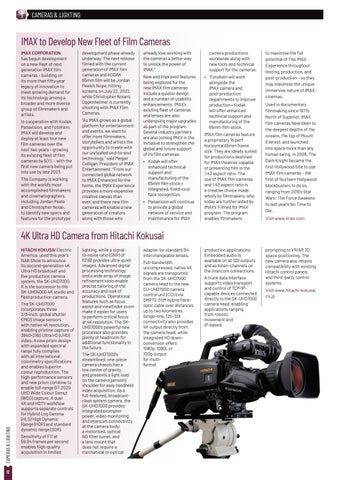
HITACHI KOKUSAI Electric America. used this year’s NAB Show to announce its second-generation 4K Ultra HD broadcast and live production camera system, the SK-UHD7000. It is the successor to the SK-UHD4000 4K studio and field production camera.
12
The SK-UHD7000 incorporates three 2/3-inch, global shutter CMOS image sensors with native 4K resolution, enabling pristine capture of 3840×2160 Ultra HD (UHD) video. A new prism design with expanded spectral range fully complies with all international colorimetry specifications and enables superior colour reproduction. The high-performance sensors and new prism combine to enable full-range BT.2020 UHD Wide Colour Gamut (WCG) capture. A dual 4K and HDTV workflow supports separate controls for Hybrid Log Gamma (HLG) High Dynamic Range (HDR) and standard dynamic range (SDR). Sensitivity of F11 at 59.94 frames per second enables high-quality acquisition in limited
lighting, while a signalto-noise ratio (SNR) of 62dB provides ultra-quiet images. Advanced digital processing technology and a wide array of image refinement tools enable precise tailoring of the accuracy and look of productions. Operational features such as focus assist and viewfinder zoom make it easier for users to perform critical focus at 4K resolution. The SKUHD7000’s powerful new processor also provides plenty of headroom for additional functionality in the future. The SK-UHD7000’s streamlined, one-piece camera chassis has a low center of gravity and presents a light load on the camera person’s shoulder for easy handheld video acquisition. As a full-featured, broadcastclass system camera, the SK-UHD7000 provides integrated prompter power, video monitoring, and intercom connectivity at the camera body; a motorised, optical ND filter turret; and a lens mount that does not require a mechanical or optical
adapter for standard B4 interchangeable lenses. Full-bandwidth, uncompressed, native 4K signals are transported from the SK-UHD7000 camera head to the new CU-UHD7000 camera control unit (CCU) via SMPTE 311M hybrid fibreoptic cable over distances up to two kilometres. Single-link, 12G-SDI connectivity also provides 4K output directly from the camera head, while integrated HD downconversion offers 1080p, 1080i, or 720p output for multiformat
production applications. Embedded audio is available on all SDI outputs and as listen-channels on the intercom connections. A trunk data interface supports video transport and control of TCP/IPcapable devices connected directly to the SK-UHD7000 camera head, enabling applications ranging from robotic movement and IP-based
prompting to VR/AR 3D space positioning. The new camera also retains compatibility with existing Hitachi control panels and third-party control systems. Visit www.hitachi-kokusai. co.jp
CAMERAS & LIGHTING
ATOMOS NINJA Supports OM SYSTEM ProRes RAW Over HDMI ATOMOS’ NINJA V and NINJA V+ now support recording of Apple ProRes RAW over HDMI for the OM-1 Micro Four Thirds (MFT) camera from OM SYSTEM. The NINJA V/V+ will record 12-bit ProRes RAW video at the DCI 4K standard up to 60fps. The HDR display of the NINJA V/ V+ provides an accurate preview of the image from the OM-1. The device offers the ability to choose
between HLG and PQ (HDR10) standards to suit individual requirements. The five-inch touchscreen provides access to a range of software tools including waveforms, false colour, check focus, framing guides, LUTs and image magnification. ProRes RAW clips recorded from the OM-1 will support White Balance and ISO adjustment sliders
in Apple Final Cut Pro. The ProRes RAW format gives filmmakers latitude when adjusting the look of their images and extending brightness and shadow detail, making it ideal for HDR workflows. Both ProRes RAW, and the higher bandwidth, less compressed ProRes RAW HQ are supported. Manageable file sizes speed up and simplify file transfer,
media management, and archiving. ProRes RAW is fully supported in Final Cut Pro, Adobe Premiere Pro and Avid Media Composer along with a collection of other apps including ASSIMILATE SCRATCH, Colorfront, FilmLight Baselight and Grass Valley Edius. Visit www.atomos.com
Quasar Science Rainbow Series LEDs QUASAR SCIENCE has announced the launch of its latest linear LED lighting range for motion picture and content creation. The Rainbow 2 and Double Rainbow tubular LED lights create intense, realistic lighting with multiple individually controllable pixels, delivering highquality white light and saturated colour that work in the tightest of spaces thanks to their sleek lowprofile shape. The slim Rainbow 2 (R2) is available in three lengths (2-, 4- or 8-foot) featuring a single row of 10, 24 or 48 pixels, while the Double Rainbow (RR) is uniquely configured with two rows of pixels totalling 20 or 48 across two sizes (2- or 4-foot) for a beautiful and powerful light that
produces more realistic animation enabling an artistic workflow like no other lights available. Quasar Science’s research into the physics and control of light has developed a colour engine that produces dramatically more accurate colours and control. Both the RR and R2 luminaires feature Quasar’s RGBX Spectral Science Color Engine (RGBX SSCE) using more than one quintillion diode combinations, producing greater than one billion unique colours. Another industry first is the Spectrum Control feature which grants the ability to choose the spectral quality of any colour point the lights can produce. 100 percent
on this parameter gives the optimal spectrum for that colour, and 0% gives the spikiest RGB-only spectrum. Networking capabilities for today’s data-heavy productions are addressed with new Rainbow Series communications hardware. Rainbow fixtures accept every industry-standard wired and wireless protocol including DMX, CRMX, W-DMX, Bluetooth, sACN and Art-Net, providing advanced networking architecture with no need for additional data boxes,
receivers, or transmitters. The R2 has a built-in ethernet node, expanding data versatility while the RR is equipped with both an ethernet node and a network switch. Visit www.quasarscience.com
Dream Chip Announces AtomOne mini Zoom
The zoom functionality has been designed to facilitate more effective shot reframing – making the camera even more effective for deployment in unusual and creative locations. The base aperture stands at F1.6 – 2.9mm, providing for a wide angle 130° shot, and allows for the frame to be reduced to a 66° angle shot at 9mm. With such a miniature size, the
camera can be added to a range of locations without being obtrusive or interfering in the action; for instance. Production teams are able to maintain full creative control over all elements of a shot, as the AtomOne Mini Zoom maintains full iris control on a remote basis and can be colour matched with other cameras in the production setup using multi matrix colour support. The net result is immaculate, crisp, high-quality images which creatives can use to enhance their productions. The decision to add a zoom functionality product to the already extensive AtomOne range – which includes super-slow motion and underwater models – comes from the success the original product
met with in the market, and recognition that enhancements would yet further extend the range of applications for which the camera is suitable. The process was undertaken both as a result of ongoing innovation within Dream Chip and consultation with existing customers – resulting in a product that is both responsive to the needs of the broadcast market, but also pushes the expectations of what can be achieved. The new AtomOne mini Zoom is also notable for its camera housing, which not only uses materials selected specifically to give a robust structure and sleek look, but also moves all points of connection within the housing to reduce the risk of connection fatigue or failure. This is particularly important due
OWN THIS SPACE! Get your products on the desks of key industry decision makers in print and online.
to the fact that the miniature size of the camera means that it is often deployed in challenging conditions where there is a high risk of impact or vibration. In addition to the Zoom function, Dream Chip have partnered with Bradley Remote in order to add the potential for pan-tilt functionality, turning the AtomOne mini Zoom into one of the smallest PTZ cameras on the market. Not only beneficial in the sports market, this adds potential to the camera in fields outside of broadcast – creating opportunities for much more discrete AV recording in commercial, entertainment, religious and educational settings. Visit www.atom-one.de
FOR OUR ADVERTISING RATES AND OPTIONS Contact Adam Buick adam@broadcastpapers.com or +61 (0) 413 007 144
CAMERAS & LIGHTING
DREAM CHIP has released the new AtomOne Mini Zoom camera, a miniature camera that now introduces zoom functionality. With dimensions of just 60x80mm and a weight of only 267g, the camera delivers crystal clear images, working on a rolling shutter basis with a 1/2.5-inch sensor, and allowing for resolution of up to 1080p60.
13
CAMERAS & LIGHTING
Sony Expands Imaging Options WITH THE INTRODUCTION of its new HDC-3200, Sony says it is building out its portfolio and filling in the gaps with a more affordable 4K system, ensuring users have an option that provides everything they need, without paying for capabilities that aren’t required. The HDC-3200 is a fibre-based, cost-effective system camera that shares many of the features common to Sony’s HDCseries including a 2/3-inch type 3CMOS image sensor with global shutter, 4K and HDR and support for numerous signal formats. The HDC-3200 is compatible with the existing lineup of Sony viewfinders, large lens adapters and IP transmission systems. It is planned to be available in May 2022. Sony is also introducing two new large lens adaptors, the HDLA3505 and HDLA-3501. The robust HDLA-3505 can be used with the HDVF-EL70 and HDVF-EL75. It has an LCD panel that allows for assignable settings at the press of a button and simple monitoring via SDI Input. The HDLA-3501 complements the new HDC-3200, providing a cost-effective 4K system. It is designed to operate with the HDVF-L750 viewfinder and enables easy access to the camera head while supporting rear panel operation. Both options offer Sony systems cable-less interface and instant attachment to and detachment from the camera. It is planned to be available in June 2022.
CAMERAS & LIGHTING
In addition, Sony’s PVM-X series 4K, HDR monitors available in 18-, 24- and 32-inch sizes, will see new enhancements with the Version 4.0 firmware release scheduled for August 2022. New features include two new optional licenses to support signal conversion and 3D LUT Output. Timecode and audio output capabilities will also be added to the enhanced monitor output. The firmware will also feature in monitor display, parallel remote and chroma up as well as support for closed captioning.
14
Thanks to the success of the original VENICE, Sony has expanded its Cinema Line with the introduction of the flagship VENICE 2 camera. The VENICE 2 features a new 8.6K full-frame CMOS image sensor, internal X-OCN and 4K Apple ProRes 4444 and 422 HQ recording with a smaller body. It has an impressive 16 stops of dynamic range, extreme low light capability, highlights that roll-off, and natural skin tones. In addition, the VENICE
2 has a Dual Base ISO of 800/3200, eight stops of built-in ND filters, and is now shipping. The HDC-F5500 system camera with Super 35mm 4K CMOS global shutter image sensor also enables creative expression with a cinematic look. Featuring shallow depth of field, high frame rate capability of 4K 120fps, and the ability to seamlessly systemise with other Sony system cameras, it has been used on marquee sporting events and the most influential motion picture and music awards events, among others. To complement its imaging solutions, Sony is updating its UWP-D fourth generation wireless microphone series: the URXP41D dual channel receiver and convenient UWP-D27 pack. The new portable receiver offers simplified functionality, userfriendly features, and digital audio interface via the SMAD-P5 MI (Multi Interface) shoe adapter, compatible with many of Sony’s camcorders. In addition, Sony’s flagship PXW-Z750 4K HDR shouldermount camcorder has been embraced by the reality community. It was recently selected by CBS’s Survivor, alongside additional models including the FX6, for a total of nearly 50 of Sony’s cameras. Connecting and Managing Networks Through the Power of IP Sony is building out its portfolio of solutions that allow content creators to design, deploy and manage environments that are on-premise, across a geographical region or in the cloud. Nevion, a Sony group company’s VideoIPath media orchestration platform recently announced it is adding broadcast control including tally distribution, salvos, alias naming, endpoint grouping and destination monitoring.This enables simple, cost-effective support for the complete production lifecycle, ideal for managing IP-based broadcast facilities, virtual
routing, production trucks and mobile units. Additionally, the update adds support for Sony’s NS-BUS IP-based management protocol to the extensive list of equipment interfaces already compatible with VideoIPath, including Sony hardware panels and connection management to Sony’s SDI-IP converters and XVS series switchers. Sony also offers a powerful solution for production orchestration and facilities management: Live Element Orchestrator Meanwhile, camera-to-cloud capabilities enable more freedom and flexibility for efficient productions from the field or front lines. Sony’s next generation camera-to-cloud solution, C3 Portal (C3P), offers cost-effective file operations by tightly integrating Sony acquisition devices and remote operations. C3P enables remote camera control, remote file access and secure, efficient transfer of files to Ci, or the destination of your choice. C3P’s new mobile app enhances the file transfer process through the use of cameras and mobile devices. Flexible metadata workflows support custom and automated metadata tagging of camera clips, resulting in simplified search and identification for fast content retrieval. Visualising Vibrant New Worlds Virtual production has transformed the worlds of broadcast and cinema by offering new ways to bring the virtual and physical worlds together in real-time. This revolutionary technology combines cinema cameras, LED displays, and game engine technology to increase
freedom, flexibility, and efficiency on set. Sony’s Crystal LED B-series has been custom designed for virtual production. The B-series is scalable, available in a 1.26 or 1.58mm pixel pitch, and allows productions to build LED volumes to the size and resolution that meets their needs. With incredible brightness, each panel features the anti-reflection coating, 170° wide viewing angle, and a wide colour gamut. Combined with the Sony VENICE camera series, these technologies allow content creators to enjoy consistently accurate and flexible colour matching between the camera and wall and incredible resolution and dynamic range that creates realistic images. To better serve the virtual production community and other emerging markets such as eSports, Sony recently launched a dedicated group that brings together the expertise and resources from across Sony’s imaging business to help identify and solve customer needs, while developing new standards. Additionally, Hawk-Eye has introduced the first iteration of its new solution, Hawk-Eye Replay, a product suite that serves as a high-performance, cost-effective, remote clipping, replay and highlights solution. Following the success of Every Shot Every Hole, Hawk-Eye’s award-winning golf production technology, this new offering combines with the company’s optical tracking and data platforms to create a powerful production solution. https://pro.sony/en_AU/ and https://pro.sony/en_NZ/
CAMERAS & LIGHTING
Marshall’s Global and Rolling Shutter Cameras with Genlock
The CV568 and CV368 POV camera models offer a 1/1.8-inch Global Shutter 3.2MP sensor and 25% larger pixel size, for ultra-fast, low latency capture even in low light environments. The CV568 Miniature HD Camera is built into the same miniature sized body as other Marshall CV503/CV506 cameras, and have rear panel protection, interchangeable M12 lenses, secure locking connections and remote adjust/match features. The CV368 Compact HD Camera follows the same body design as the CV344/
CV346 cameras with slightly larger CS mount lens type and a wide variety of variable and fixed lens options available. The CV568/CV368 models pack a much larger, more powerful Global Shutter sensor with Genlock (signal-sync), producing crystal clear images. Global shutter improves performance in fastpaced action, racing and movement to reduce motion blur, lean or distortion within the field-of-view. Global shutter sensors perform better in these environments as all pixels are exposed simultaneously. The Marshall CV566 and CV366 Genlock POV cameras are built around the Sony 1/2.8-inch CMOS solid-state rolling shutter image sensor featuring 2.2 Megapixels and Tri-Level (Genlock) Sync feature, which is next generation performance on the company’s POV cameras. Both cameras deliver exceptional video performance from a micro sized body through 3G-SDI and HDMI. The next generation Sony sensors provide clear HD images with true colour
IO Industries Launches New Video Recorder – Rodeo IO INDUSTRIES recently announced Rodeo, an ultra-compact, rugged, video recorder, designed for RAW recording from high-performance video cameras. Rodeo is ideal for demanding applications such as volumetric capture, 4D face/body scanning, motion analysis and industrial trouble-shooting; and is an excellent choice for multicamera setups. Rodeo’s performance specs are impressive. Its video interface is CoaXPress 2.0, the standard popularly used in newer generation scientific and industrial cameras utilising large format image sensors with high data rates. Rodeo’s FPGA-based lossless compression engine delivers an effective recording rate of 2GByte/ sec (camera output) to an internal SSD (up to 2TB).
application software is optionally available to Rodeo users. This software provides live video monitoring, video download, recording control and access to camera settings. An optional SDK is available for developers. Rodeo is compatible with a broad range of cameras made by IO Industries and other camera manufacturers. Contact IO Industries for questions about camera compatibility. Key Features: • Camera Interface: CoaXPress 2.0 (Quad CXP-3/5/6 and Dual CXP-10/12). • Recording Performance: 2GByte/s camera output. • (assuming 18.5 percent compression is achievable).
Features include a precise multicamera shutter and timecode synchronisation with accurate time-stamping. Rodeo’s 10GbE copper/fibre interface connects to a network switch for PC control and monitoring, providing the scalability required for setups with 100+ cameras. Rodeo’s SDI video output provides a secondary path for low-latency live monitoring over SDI infrastructure.
• Camera Compatibility: Cameras from IO Industries and third party manufacturers.
IO Industries’ StudioCap-VC
Visit www.ioindustries.com
• Storage Media: Internal 2TB SSD. • Control Interface: 10 Gigabit ethernet. • Mechanicals: 60.2mm (W) x 62.0mm (H) x 130.4mm (D). 670g. • Compatible Software: StudioCap-VC.
even in low light (0.01Lux) and the ability to switch to night mode (0.005Lux) where IR light wavelengths can be captured. Both allow users to choose HD resolutions up to 1920x1080p (progressive), 1280x720p (progressive) and 1920x1080i (interlaced) with a selection of frame-rates up to 60fps. All four cameras’ tri-level sync allows multiple cameras to be plugged into HD workflows already in sync (genlock), which enables seamless transitions between cameras with minimal amount of delay. Tri-level sync runs at a higher frequency making the signal sync more accurate and more seamless. Marshall also exhibited its CV-PTHEAD Micro Pan/Tilt Mount Head for its miniature camera line. The CV-PT-HEAD is compatible with all
Marshall CV500 series cameras as well as Marshall’s CV344, CV346, CV366, CV368 and CV355-10X. The CV-PT-HEAD body is less than 3.5-inches tall and less than 2-inches wide creating one of the smallest P/T footprints available. The CV-PT-HEAD comes with an IP65 weatherproof rating, which means it is dust-tight and protected against water under pressure from any angle. There is a built-in camera power supply delivering a constant 12V to the camera socket as well as camera control data. Visit www.marshall-usa.com
AJA Ki Pro GO v4.0 Firmware AJA VIDEO SYSTEMS’ v4.0 firmware for its Ki Pro GO multi-channel H.264 recorder delivers enhanced playback and control functionality to give users more flexibility in the field. This free update introduces thirdparty file playback support alongside a host of new settings improvements that help ensure more seamless setup and operation across production, post, and proAV environments. Features include: • Intuitive playback of .mp4 files originating from supported third-party applications, including Adobe Premiere Pro, Apple Final Cut Pro, Avid Media Composer and Blackmagic Design DaVinci Resolve. • Ability to set each device to generate 0, 1, 2, 3 or 4 B-frames individually on each channel for smaller file sizes. • New alarm functionality that makes it easy to clear outdated alerts after errors are corrected.
• Updated REST API that enables remote device shut-off. “Modern production and proAV environments demand flexibility in the field, especially when recording multiple simultaneous HD and SD video feeds, and we designed Ki Pro GO with this in mind. Ki Pro GO users have expressed a desire to play out H.264 files generated within their NLE applications on Ki Pro GO, which this update enables. Ki Pro GO v4.0 firmware is an extension of our work and continued commitment to helping professionals get the most out of their gear,” said AJA President Nick Rashby. Visit www.aja.com
CAMERAS & LIGHTING
IMARSHALL ELECTRONICS recently announced its CV568/ CV368 Global Shutter Cameras with Genlock and CV566/CV366 Rolling Shutter Cameras with Genlock. These new POV cameras feature the latest in sensor technology, with the CV568/CV368 Global Shutter Cameras having a 1/1.8inch Global Shutter 3.2MP sensor and the CV566/CV366 Genlock POV cameras are built around the next generation Sony 1/2.8-inch CMOS solid-state rolling shutter image sensor.
15
SPORTSCASTING beIN ASIA PACIFIC Selects Globecast for Managed Media Services GLOBECAST, the global solutions provider for media and content management, has announced that sports content provider beIN ASIA PACIFIC has selected it to provide multifaceted media processing and delivery services to the sports provider’s Asia-Pacific division.
management. The company is also supplying satellite, fibre and IP streaming distribution. Globecast will also host the sports provider’s OTT platform for the region as well as providing the ability to create and distribute pop-up channels as and when required.
beIN ASIA PACIFIC is part of beIN MEDIA GROUP and is headquartered in Singapore. It operates in 11 countries across the Asia-Pacific region – Australia, New Zealand, Cambodia, Hong Kong, Indonesia, Laos, Malaysia, Philippines, Thailand, Timor-Leste and Singapore. beIN offers a comprehensive line-up of live sporting events through its channel, beIN SPORTS and live streaming app, beIN SPORTS CONNECT. With 15 unique channel feeds, beIN offers fans extensive live sports coverage in Thai, Bahasa, Cantonese and English. beIN SPORTS is available on major pay-TV platforms in the region.
Shakunt Malhotra, Managing Director of Globecast in Asia, said, “We are a global company with the technical resources and operations to provide a seamless end-to-end service, not least across the highly valuable and competitive sports market. We are highly connected internally and externally, allowing easy content contribution, fully managed media processing, playout and distribution.”
Globecast will be providing a wide range of services including cloud and on-prem playout, sports contribution services and content
Globecast says it is well set up for sports content and channel providers, with its Asian operation benefitting from breakout rooms specifically designed to integrate additional sports feeds into a live channel. Live commentary and editing capabilities, Live camera position, alongside AR advertising, are also available as services.
Sabil Salim, Vice President Media Technology and Operations of beIN ASIA PACIFIC, said, “As a major sports broadcaster with a wide array of live events, we had to ensure that we partner with a media services company that can meet our requirements and align with our goals. This isn’t only about the very impressive technical capabilities Globecast has demonstrated, it’s also about the fact the company has a Shakunt Malhotra, Managing Director significant background in of Globecast in Asia, “Our cutting-edge sports. This is very much about facilities and technology setup is designed the quality of the content – vital to fully support the needs of valuable, to sports fans – and the fast, fast-moving sports content.” flexible way this can be gathered, processed and played out across multiple languages and cultures. and scale recognises the value we They genuinely understand the demands of sports fanatics, which is bring to the market across multiple services all managed by a single, at the heart of what we do.” integrated global supplier. We will Malhotra said, “Our cutting-edge facilities and technology setup is ensure each and every fan gets designed to fully support the needs the most immersive experience of valuable, fast-moving sports possible.” content. We are very pleased that a company of beIN SPORTS reach Visit https://www.globecast.com
Brompton and CT Group - the Power Behind Seven’s Winter Olympics Wall 2022 HAS MARKED a new era of remote broadcast experience, with Australia’s Seven Network working with Australia’s CT Group, part of the NEP Live Events, to create a virtual production environment with a top-end LED wall powered by Brompton Technology Tessera processing. “CT provided LED backdrops for Seven Network’s sports hostings during the pandemic, when travelling to venues wasn’t possible,” says Michael Judges, Senior Project Manager for CT Australia & New Zealand. “As a result of this positive experience, we built a template with the client which they were subsequently able to use on the Tokyo and Beijing host broadcasts.” Judges explains that for this project, Seven Network wanted the highest resolution LED panels available to provide the ultimate background for the broadcast.
SPORTSCASTING
“This resulted in a high pixel density, so we used two 4K outputs from a media server into two Brompton Tessera SX40 processors to manage this,” he adds.
16
CT installed Unilumin 1.8mm LED panels with an overall screen size of 19.5m by 2.5m, curved around a 5m radius. Also deployed are four active and four back up Tessera SX40 processors in redundancy mode, as well as eight Tessera XD
10G data distribution units offering the team greater piece of mind and ensuring a stress-free day-to-day workflow. “Tessera processing is very robust, and the redundancy system works well,” explains Judges. “Additionally, Brompton processors are easy to use and provide powerful features for managing screen brightness and colour on camera. The panels were run in the specific Operating Mode that reduces panel brightness while still maintaining usable bit depth, which is essential for television.” According to Judges, the client was very pleased with the result and would like to continue working with CT on other projects this year. “All high-quality images and videos looked great on the broadcast and the presenters were able to be very close to the screen without causing any moiré effect,” Judges concludes.
Seven’s Winter Olympics 2022 LED wall powered by Brompton Technology. Image credit: Australia’s CT Group, part of the NEP Live Events.
“Following the success of this project, Seven Network is going to utilise the entire system for other televised broadcasts during 2022. This speaks volumes about the high quality of all the elements within the system, including the industry renowned Brompton Tessera processors.” Visit https://www.bromptontech.com/
SPORTSCASTING
ross.video/anz
SPORTSCASTING
POWERING YOUR FAN ENGAGEMENT
17
SPORTSCASTING
Managing Bandwidth in Remote Production Remote production is a very attractive proposition, with many practical benefits. Even if we were to put aside necessary health implications and social distancing, there are big environmental benefits in reducing the number of people travelling to events. By Stephen Tallamy, CTO, EditShare REMOTE PRODUCTION is a very attractive proposition, with many practical benefits. Even if we were to put aside necessary health implications and social distancing, there are big environmental benefits in reducing the number of people travelling to events. The challenge is to provide sufficient connectivity to allow all the production and post production teams access to the content in a timely manner, within what may be constrained bandwidth. This means working with tools to maximise productivity while minimising the amount of data that needs to be moved. The first step is to organise the raw footage. Whether the main server is at the remote sports event, at the broadcast headquarters or in the cloud, it makes sense to make the initial shot selections on the server, rather than transferring everything to the edit workstation, particularly if the editor is also working remotely. To achieve the absolute minimum of data transfer, particularly if you are working in Ultra HD resolution or higher, your software
should allow you to create a shot list or even a rough cut on the server. Only the required content plus handles then needs to be transferred to the editor. This will have two benefits: the editor gets the material faster so can start working sooner, and there is less material to work through which boosts productivity. The second step is to minimise the size of each clip. Editing tools like Adobe Premiere Pro are designed to bring in full resolution clips, but generally work with proxies which are generated internally. In remote editing, it makes sense to create the proxies on the server then transfer the smaller files to the editor. This is a big saving on bandwidth. The EditShare solution offers two sorts of proxy: the “streaming proxy” which is an MPEG-4 file tailored to be lightweight for internet delivery; and the “editing proxy” which is in H.264 or ProRes, and supports multiple audio tracks for maximum flexibility in post. These solutions work with all popular edit workstations. Many popular software packages allow you to readily switch between proxy and full resolution versions
of the content if available.
where it is needed.
Proxy resolution versions of workin-progress can also be sent to producers for checking. They can tag comments to timecodes and return the messages to the editor.
To achieve the maximum boost in productivity, there needs to be good integration between the editing and server management software tools. All editing platforms now offer a degree of open integration.
There are two routes to finishing the project, which will depend on the nature of the job. For a prestige project, the editor will want to see the final version in all its full resolution glory. That means relinking to the original footage. Smart software will only download the parts of the project you need for the final conform. Where speed is of the essence, which is common in sports and other live events, then you want to avoid the time taken to transfer full resolution clips out to the editor, then transfer a very large finished file back again. The solution is to upload the EDL to a remote renderer, or Adobe Media Encoder, hosted on the server. The EDL is, of course, a relatively tiny file so is transferred virtually instantaneously. Conversely, the server has heavyweight processing power so conforms the finished version very quickly, and the finished file is
Probably the most open is Adobe Premiere Pro. This allows us to implement an EditShare window within the edit platform, so the editor can carry out all of these tasks – from pre-selection and proxy generation to producer collaboration and relinking and conformation – without leaving the familiar environment. The real benefits of remote production are realised when everyone is working where they are most efficient. Media can now be readily moved over IP networks and the open internet, but such file transfers place demands on bandwidth, and that can slow workflows. Smart solutions minimise this bandwidth and time overhead, allowing the production team to deliver the best results, as quickly as possible. Visit https://www.editshare.com
Onyx-IP Encoder and Decoder from DBS DOMO BROADCAST SYSTEMS (DBS) has announced the Onyx-IP family of encoders and decoders. Featuring low latency and allowing for video to be transmitted down two different paths, the Onyx is designed for live sports coverage and remote production.
SPORTSCASTING
The Onyx HEVC is a broadcast-quality H.265 encoder, offering compression ratios on video resolutions up to 4K UHD. It is suitable for remote production applications over leased lines or satellite, handling 4 HD or 1 UHD feed with ultra low latency.
18
According to Richard Lane, Broadcast Engineering Lead at Domo Broadcast Systems, “Onyx encoders can stream across dual networks using a variety of IP formats including SRT, at
bitrates of up to 120Mb/s. If one network should fail, the transmission will still make it through the other. So, viewers get to see the action in closer to real time, and broadcasters reduce the risk of dead air by having a back-up transmission path.” The use of ST2022-7 technology at the decoder ensures glitch free recovery from network errors or path failover. For legacy systems and satellite modem connections, the Onyx encoder is equipped with ASI inputs and outputs. “Transmitting over IP can add security risks — we know broadcasters don’t want to risk having their
valuable content stolen,” adds Lane. “The Onyx takes care of that. Broadcasters can employ built-in encryption mechanisms, such as AES over SRT or BISS, to protect their content.” The Onyx’s quad mode allows four HD inputs to be synchronised and encoded with end‐to‐end latencies as low as 40ms. This high‐density and low‐latency encoding is ideal for coverage of live sporting events. Visit https://www.domobroadcast.com
SPORTSCASTING
Marvel Stadium Goes AR
Sporting Codes Score with NFTs
TELSTRA, GOOGLE and Accenture have joined forces to develop a new 5G powered augmented reality (AR) wayfinding experience at Melbourne’s Marvel Stadium that superimposes digital information onto a realworld environment. The AR wayfinding experience uses Telstra 5G technology, delivered on Google Cloud, with machine learning and computer-vision powered by the ARCore Geospatial API from Google. Google trekker devices were used in the development of the experience to create a metric model of Marvel Stadium that represents the appearance and position of the physical 3D world. GPS readings and environment scans were then matched with 360-degree images using the ARCore Geospatial API. The convergence of cloud, the ARCore Geospatial API and 5G networking gives users the ability to interact with content, digital character displays, virtual brand experiences and indoor wayfinding, among other features. Telstra is working with the AFL and Marvel Stadium to launch the new AR wayfinding experience ahead of next year’s footy season. Kim Krogh Andersen, Telstra Group Executive Products and Technology said: “This collaboration with two major technology players marks another important step in our ambition to create one of the world’s most technologically advanced stadiums here in Australia. It will enable us to deepen our partnership with the AFL and deliver more immersive and innovative experiences for fans at Marvel Stadium.” Alister Dias, VP, Australia & New Zealand, Google Cloud said,: “Google Cloud’s technology will underpin next-generation 5G capabilities, transforming the way people interact with the physical environment around them. Not only will it make it easier to explore the grounds at Marvel Stadium, but it also has huge potential to create more immersive and interactive experiences for fans.” Telstra has been working with the AFL to evolve the stadium experience, which includes a 5G upgrade to support connectivity for fans and applications such as artificial intelligence, in-stadium streaming and on-field player performance tracking.
RARIO, CREATOR OF the world’s first Cricket NFT platform, and NFT marketplace design and development firm BlockTrust have signed a licencing deal with Cricket Australia and the Australian Cricketers’ Association that will see collectible NFTs (non-fungible tokens) from Australian cricket and playto-earn virtual gaming made accessible to cricket fans globally.
Visit http://www.telstra.com http://www.accenture.com and https://www.marvelstadium.com.au
Visit https://nft.cricket.com.au or https://rario. com/ and http://www.museframe.com.au/
Non-fungible Tokens are unique representations of real-world assets (for example, trading cards), made ownable and tradeable using blockchain technology. In the case of cricket, the NFTs range from cricketing moments to player images, including officially licensed broadcast vision. According to Rario, engagement possibilities include collectibles introducing fans to the game’s history, gaming experiences allowing collectors to play games against each other, to trading card sets that act as visual coaching tools for children. Meanwhile, Adelaide-based start-up Muse Frame is collaborating with AO Metaverse, the virtual platform of the Australian Open tennis tournament, to supply customised digital frames to display AO Artball nonfungible tokens (NFTs). Muse Frames are exclusively manufactured to display NFTs, including stills, video and sound. They come in 10.1-inch (HD resolution), 21-inch (4K), 32-inch (4K), and 55-inch (4K) frame sizes. The Muse Frame collects, verifies and showcases NFT art in a way smart TVs or devices around the home cannot.
Australia’s newest equipment rental company
LiveU
Remote production
• Transmitters: LU800, LU600, LU300, LU200 • Receivers: LU2000, LU4000, Video Return
• In-Field Transmission • In-House Production
Streaming solutions
Cameras
• LiveU, AJA, Teradek, Kiloview, NDI
OB systems Multi-Camera OB Trailer Ross Video (Carbonite Ultra, PPC, Xpression) TriCaster (TC2, TC1, Mini, 3P1 etc) vMix, Blackmagic Design
Audio • Yamaha | Sennheiser | Dante
Tech support, advice and more… www.gamedayhire.tv info@gamedayhire.tv 1300 GDHIRE (434 473)
SPORTSCASTING
• • • •
• Sony: F800, PMW500, Z280, Z190, X70, EX3, EX1 • JVC: HM850E, PZ100WE | Canon: XA25 • BirdDog: P400, P200, A200, P100, PF120
19
SPORTSCASTING
AFL Leverages Archive Content with Dalet Flex DALET HAS ANNOUNCED that the Australian Football League (AFL) is using Dalet Flex to manage the cloud-based digitisation and workflow modernisation project of its video archives. The subscription-based implementation of Dalet’s cloud-native media logistics, which was done in collaboration with partner Telstra Broadcast Services, enables AFL to tackle a large-scale technical uplift of its rich game content stored on 22,000 physical tapes and reimagine the way they share and resell the high-value game content. “As custodians of the history of the game, it’s really important that we provide a simple way for future generations to access and experience the game’s rich history,” comments Spencer Wilson, Operations and Broadcast Manager for the AFL. “Dalet Flex provides a single source of truth for this mammoth archive. You can use Dalet Flex to search the archives, pull content and package it for monetisation for any type of sales channel. The core design of the system tracks not only media assets but manages commercial agreements, compliance requirements and transactions tied to those assets. This allows us to set up an on-demand service that radically changes how we can share with our broadcast customers and fans.” As the governing body of the professional Australian rules football, AFL is the guardian of the league’s video archives, preserving historical game content for its club members since the very first game captured on film in 1909. Concerned with degradation and loss of valuable assets and the growing storage requirements for each of the 400 plus games
shot in progressive formats, the organisation sought to digitally preserve its entire archive. The AFL used Telstra Purple to configure the Amazon Web Services data servers and data centres that stored the digitised game content and Dalet Flex to facilitate key media logistics functions including archival searches, retrievals, and packaging of content for on-demand and multi-platform distribution. The new on-demand media request workflow enables AFL to significantly expand the use of historical game content and deepen fan engagement from discovery of favourite club heroes of the past to the history of the game. Dalet Sports Content Strategy and Fan Engagement The AFL archive project comes on the heels of several high profile sports transformations including Lega Serie A, the National Rugby League of Australia, Arsenal Football Club, and the Ligue de Football Professionnel, all of which implemented Dalet solutions to drive new video strategies to expand their multigenerational fan engagement across digital channels.
“For years, AFL has been producing content and delivering to their fans all ‘for the love of the Game.’ They are leveraging Dalet Flex to enhance their video strategy, and transform from a sport organisation that oversees an archive to a media-savvy sport organisation that utilises technology to optimise their high-value content,” comments Ren Middleton, Regional Sales Manager ANZ, Dalet. “Innovative on demand and digital video strategies take experience and understanding. We are able to bring all of our best practices delivering video solutions to a number of iconic leagues and teams, and deliver faster, more efficient, more impactful workflow solutions like AFL ondemand archive.” Visit https://www.dalet.com/solutions/sportsteams-leagues-federations/
Matt Stone Racing Chooses Comms from D2N Technology Solutions MATT STONE RACING (MSR) was first established in 2011 by team owner Matt Stone and is based on the Gold Coast in Queensland. MSR compete in various Australian racing championships and series and have won titles in the Dunlop Super2 Series, Touring Car Masters and V8 Utes. MSR has also been the backbone of developing young and successful talent in Australia. Recently MSR had a requirement for a high-end motorsport comms solution and for that they turned to the industry’s specialists – D2N Technology Solutions. Matt Stone Racing Supercars’ Data Engineer, Marc Mastrodomenico, explained, “We needed some serious, reliable and high-end motorsport radio communications between the drivers, engineers and mechanics. In our sport that means there’s only one company you go to – D2N Technology Solutions.”
SPORTSCASTING
D2N supplied MSR with high quality Kenwood NX series radios and MRTC x3 PTT headsets allowing for quick, clear comms between drivers and engineers.
20
Mastrodomenico continued, “In the past headsets provided by third parties proved not to be up to the job in terms of build quality, strength, audio clarity and programming flexibility. However, since D2N has come on board these issues are no longer active.”
Mastrodomenico has had nothing but positive feedback about the excellent results achieved with the D2N comms solution. He continued, “D2N’s MD, Jason Owen, is fantastic to communicate with. If ever there is an issue, we know it will be solved as quickly as humanly possible.” During race events D2N-supplied headsets and radios are used while MSR’s cars are on track for engineers to communicate with the drivers, constantly updating them about all aspects of the race. Engineers will also speak to mechanics on “listen only” radios instructing what setups changes are to be made on the cars during pit stops. For MSR a typical signal path involves UHF analogue and digital Rx and Tx frequencies. Mastrodomenico clearly has nothing but praise about the D2N solution adding, “D2N supplies us with the best dedicated motorsport radio comms solutions. Other products tried and tested by Matt Stone Racing have proven to be difficult to program and not last in the rough conditions motorsport presents. D2N’s solution is simply excellent and their friendly staff also provide timely support for their high-quality products. The whole package is brilliant.” According to Mastrodomenico the D2N comms solution gives Matt Stone Racing a crystal-clear
edge over its competitors. He concluded, “The D2N comms solution gives us crystal-clear comms during loud intense situations. Jason and his team’s promptness in shipping out ordered items on time is excellent and we are never left waiting. The technical support we receive from Kenwood is fast and efficient via D2N and quite honestly the entire D2N sales, service and support offering is second to none.” Matt Stone Racing recently confirmed that they will be entering the new Gen3 era of Supercars racing with the support of Chevrolet Racing. MSR conducted a thorough review of what would be best for the team in all key areas of the operation before coming to this very important decision for the team’s future success in Supercars. Visit http://www.d2n.com.au/
SPORTSCASTING
AI-Driven News and Sports Production from Vislink VISLINK RECENTLY showcased its latest solutions for automated, AI-driven remote production for live news and sports at NAB 2022. Vislink’s chief AI offerings include IQ Sports Producer, a live sports production and streaming solutionVislink AI Image vPilot and SportsProducer March 2022b that provides high-quality, economical video coverage for both professional and grass-roots sports, and vPilot, an AI-driven studio content production system that creates professional productions easily and affordably without a camera operator or director team. Vislink automated production systems feature the industry’s most advanced AI-powered action-tracking technology that has been developed and extensively deployed by Mobile Viewpoint. They combine premium-quality camera systems, including the recentlyannounced StellarCam, HCAM wireless camera systems for sideline reporting,
and professional-grade remote production technologies that leverage Vislink’s 50plus years’ heritage covering prestigious lives news and sports events. The result is a comprehensive, highly cost-effective technology platform that enables the production of sub-Tier 1 sporting events with video quality and production values equivalent to Tier 1 event coverage – all without the need for onsite staff. For content owners, this opens up access to new revenue streams by automatically producing a wide range of events that may have been previously unprofitable to cover due to onsite production team costs. Alternatively, the multi-camera AI production can deliver a richer and more immersive production than may be possible using a single camera. Including the vPilot AI studio production system allows engagement-building elements such as expert opinion and match analysis to be added to the program. This helps content rights holders
expand viewer counts and engagement levels and deliver a better return on event coverage. These events can be distributed to audiences across numerous channels, including social media, OTT platforms, CDNs (content delivery networks) and as live playout for broadcast TV. “Content owners are always looking for creative ways to monetise their content and distribute it using the widest range of available channels,” said Mickey Miller, CEO of Vislink. “Using our AI-automated production systems, any team, association or other content owner can now profitably capture and stream live games at levels of video quality simply not available on other systems. We provide outstanding opportunities for increasing audiences and fan engagement, and innovative subscriber and advertising options – even with limited budgets or production resources.” Visit www.vislink.com
FOR-A Expands Slow Motion Solutions FOR-A CORPORATION is expanding its focus on live sports production with the introduction of the SMV-ONE, an HD slow-motion visualiser, which creates smooth slow-motion footage from live or archived video. Plus, the FT-ONESS4K 4K ultra slow-motion camera has also been upgraded with colour matching presets with other companies’ cameras, an advanced workflow, and integration with EVS servers. SMV-ONE HD slow-motion visualiser A cost-effective alternative to standard replay systems, the SMV-ONE allows the creation of slow-motion video while recording live sports coverage. Housed in a compact 1 RU chassis, the SMV-ONE supports 1080i or 1080p HD-SDI video and up to 20x slow motion. Its unique precision interpolation technology enables smooth, slow-motion video between the virtual images it generates and source frames. The SMV-ONE is controlled through included remote control software or via an optional remote control unit. In addition to slow motion playback at various speeds, it offers play, pause, rewind, fast forward, and skip back functions. The camera connects to the
SMV-ONE via an HD-SDI cable, and up to four cameras can be connected in an optional configuration. Beyond sports production, the SMV-ONE can be used to repurpose past surveillance video or other recorded material as slow-motion video for training. Plus, with control via LAN, it can also be used for remote monitoring of factory assembly lines. Already in use worldwide on a variety of projects, the FT-ONE-SS4K now offers an advanced feature set that includes a dual 2/3-inch CMOS sensor system, which delivers improved performance and versatility for live sports and feature film production. Its imaging system can achieve up to 1000fps high frame rate with high sensitivity and high density. FT-ONE-SS4K ultra slow-motion camera With its B4 lens mount, the compact FT-ONESS4K works with industry standard box lenses and does not sacrifice brightness like cameras that include a PL lens mount and require a lens
conversion adaptor. The camera also delivers simultaneous live 4K Ultra HD output and super slo-mo playback output, so it can be included within a conventional camera workflow. Based on user feedback, the FT-ONESS4K supports an advanced slow-motion workflow designed to integrate within existing production environments. With its pre-configured colour matching presets, the camera integrates easily into a production using standard speed cameras from other manufacturer. Plus, the camera now links directly to EVS servers for easier, smoother playback. Visit www.for-a.com
Field Zoom Lens for 4K Broadcast Cameras
Canon’s new UHD-DIGISUPER 122AF features a zoom range of 8.2 mm at the wide end and 1000 mm at the telephoto end—a 122x zoom ratio, the world’s most powerful zoom range for AFequipped field zoom lenses for 2/3-inch sensor
4K broadcast cameras. What’s more, the lens employs a built-in 2x extender that allows users to increase the zoom range two-fold, realising a 16.4 mm focal length at the wideangle end and a 2000 mm focal length at the telephoto end. Alongside the new lens, Canon will also release two new focus demand models for AFequipped lenses used with HD or 4K broadcast cameras. These accessories enable focus control and provide a variety of powerful support capabilities, including the ability to switch between three sizes of AF frames, move the AF frame within the screen, AF mode switching, and
three different focus curve modes. The UHD-DIGISUPER 122AF, FDJ-S31 and FD-S41 will be available in early July 2022. https://www.canon.com.au
SPORTSCASTING
THE UHD-DIGISUPER 122AF is Canon’s new flagship field zoom lens for 4K broadcast cameras, and the company’s first to include built-in AF. With the addition of AF with highspeed and high-accuracy subject tracking, this new lens enables capture of immersive, high-resolution video, thus meeting a wide range of needs at on-location 4K workspaces such as sporting events, concerts, etc.
21
NEWS OPERTAIONS OPERATIONS SBS Launches Free-to-Air Multilingual News Channel AFTER YEARS OF PREPARATION SBS Australia has launched SBS WorldWatch, an all-new freeto-air multilingual news channel. The dedicated 24-hour channel features news bulletins from leading international broadcasters in more than 35 languages and is home to SBS’s Arabic and Mandarin television news bulletins – SBS يبرعNews and SBS 中文 News. The launch of the channel builds on SBS’ expanding range of multilingual services for audiences across TV, radio and digital platforms. According to James Taylor, Managing Director, SBS: “Our multilingual strategy sits at the heart of SBS and we are very excited to extend our offering with the launch of the SBS WorldWatch channel, which sees us further expand our in-language news bulletins for people whose preferred language may not be English. “Our Mandarin and Arabic news programs, which we soft launched on SBS OnDemand earlier this year, will have a prime-time home on the SBS WorldWatch channel – a very real demonstration of how we are delivering on our Charter in providing both local and international news to these communities.”
SBS WorldWatch broadcasts international news services from 30 countries – bringing Australians different perspectives from around the globe, and enabling culturally and linguistically diverse communities to catch up on world news in their preferred language. Produced by two dedicated teams of bilingual journalists and broadcast in prime time, SBS’ new locally produced half hour Arabic and Mandarin television news bulletins – SBS يبرع News and SBS 中文News – provide impartial coverage, insightful context and balanced analysis of the major national and international stories, in language, every weeknight. SBS Director of News and Current Affairs, Mandi Wicks, said the launch of SBS WorldWatch is a further demonstration of SBS’ commitment to meeting the needs of a culturally and linguistically diverse Australia. SBS WorldWatch expands SBS’s commitment to providing comprehensive news and information across its network – in English through SBS World News, and in more than 60 languages across SBS Radio services, podcasting, and
digital platforms – and the multilingual services the network has been delivering to Australians for more than 45 years. For Australian viewers, SBS WorldWatch is available on free-to-air television (channel 35) and on SBS On Demand. SBS WorldWatch is the network’s sixth free-toair channel joining SBS, National Indigenous Television (NITV), SBS VICELAND, SBS Food and SBS World Movies. Visit https://sbs.com.au/worldwatch
NEWS OPERATIONS
IBM and The Weather Company Announce Max Velocity Expansion
22
THE LATEST INNOVATIONS to the Max Platform, Max Velocity and Max Alert Live, were recently unveiled by IBM and its subsidiary The Weather Company at the National Association of Broadcasters (NAB) show in Las Vegas. Like it did over a decade ago with its first real-time weather graphics rendering system, The Weather Company aims to transform the broadcast industry with Max Velocity, a new browser-based video storytelling tool designed to allow media clients to create high-quality digital content quickly and easily from any environment for publishing across platforms. The new tool, available now, helps accelerate storytelling, combining template-based video creation with weather data, interactive mapping and streamlined person-to-person interviews. The browser-based technology allows users to publish the videos from a remote live shot, the studio, or while working from home – anywhere with an internet connection. It is built on top of Max Cloud, a modern, hybrid cloud platform designed to help broadcasters collaborate at scale and increase their content output. “Our customers want to work from different environments and leveraging cloud-based workflows can help make that possible with Max Velocity. It addresses today’s evolving needs of the media industry to report from any location utilising high-quality weather graphics expected by audiences, while keeping their infrastructure and assets protected,” said Joe Fiveash, vice president of strategy and media solutions, IBM’s The Weather Company. “As part of IBM, we have the experience, investment and expertise to provide powerful tools at scale. Station groups can use this type of innovation to help realise operational efficiencies, as well as create more content that can potentially be used to help generate advertising revenue.”
The availability of Max Velocity on the secured and highly available Max Cloud helps drive increased collaboration among station groups and disaster recovery that the security and scalability of IBM Cloud can deliver. Max Velocity is engineered to enable broadcasters to: Expand and improve storytelling capabilities – Max Velocity’s easy-touse interface allows team members, or even a sponsor, to create videos quickly whenever and wherever they choose without needing specialised skills or professional hardware. Publish from anywhere – Stories can be told from a browser-based device (i.e., laptop, tablet or mobile phone) while at a local school or even at the county fair – anywhere with an internet connection. To add interviews or outside perspective, external experts using a tablet or mobile device can also be brought into the story from remote locations with the click of a button. Optimise resources and teamwork – Using Max Velocity, station resources, whether in the same city or across the country, can help produce weather content when needed, especially during severe weather events. Potentially drive digital revenue – Creation of video content using Max Velocity can potentially be used to generate advertising opportunities across digital and broadcast platforms. The integrated remote interview component allows for quick and easy production of native advertising content. Educate viewers with climate change content – Thanks to a new collaboration with Climate
Central, a nonprofit news organisation that shares independent climate-related video by its scientists and science reporters, Max Velocity provides quick access to engaging content to help tell deeper climate and weather stories. In late June, Max Alert Live, the newest component of the alerting platform, will debut to help keep audiences informed and safe by notifying them of disruptive weather events. The solution will utilise the familiar Max user interface and cloud-based technology, so alerts can be managed from anywhere with an internet connection. Once available, broadcasters will be able to match their current on-air look with modern graphics that dynamically adapt to the changing weather to convey the urgency of the emerging threat. By directly integrating data from the National Weather Service (NWS), Max Alert Live will have the ability to automatically trigger messages that scroll across the bottom of the screen when predetermined weather alerts are issued by the NWS. Visit www.ibm.com
NEWS OPERATIONS
News Leads the Way at Nine Sydney Building on the technology platform deployed in its news studio, Nine Entertainment has expanded its use of Vinten Studio robotics and Autoscript-IP prompting solutions at its SMPTE2110, IP-based headquarters in North Sydney.
According to Will Lennox, Broadcast Engineer with Nine, the build-out is the culmination of a selection and testing process which began before the network moved from its old HQ in the Sydney suburb of Willoughby. “We tested the Vinten control system back in a lab we had at TCN and we dabbled in automation previously at that same facility,” says Lennox. “So, moving here, we were confident in knowing that we could control that. What we hadn’t experienced was the StarTracker [real-time optical camera tracking system from Mo-Sys], so that’s something new for us that we’ve added to this facility. That’s something we had to test and it was a bit bumpy at first with the tracking, but retracking and re-mapping the star map as we put new equipment up as the building was being built was the key to that and we’ve had pretty great success with that so far.” So, StarTracker enables you to take a snapshot of the studio and the camera positions? “Yes. The sensors, the StarTracking infrared sensors on the top of our Vinten heads, allow us to manually move the heads around to map the star map using reflective “stars” on the ceiling which then tracks its position in a 3D environment. And if we ever have issues with that, we return it back to its home position, turn it back on after a repower and it goes, yes, I know where I am. But that usually doesn’t happen, so it’s good like that, and you can actually map multiple star maps, so we could potentially move our full peds into other studios and it would work in there as well. Initially, this set-up was used for news, wasn’t it? “Yes. It was used for news. So that was in Studio B, which is one of our mid-sized studios. We now use the same technology in Studio A, which is our larger studio which Stan is also using. So, they use that in combination with a jib and a steadicam as well. They can remotely control the PEDs using the VRC control panels, which we use serial to IP converters as well so we can point those control panels at any of the Vinten servers if we need to. But they can use those, they just recall shots and that will map in that star map perfectly fine.” Why did Nine decide on the Vinten set-up? “The Vinten set-up runs a service called VRC automation, and VRC automation integrates with our Mosart system. With our newsroom control system, ENPS in this case, we utilise templates that Mosart can use to recall shots in Vinten. So we have saved templates in our newsroom control system that allow
producers to recall specific shots just by inserting those. The Mosart control aspect is recalling saved shots on the Vinten software by shot ID, in this instance. You can have pilots saving shots on the fly and then instantly recalling that same shot, or editing those shots as needed. So that’s something that we leverage in our automation control rooms significantly.” Does that get down to customised shots for specific presenters? “Yes, for sure. For sure. You need to be able to frame up for different presenters each show. If you have saved shots for all of them, that’s fine, or you can ad-hoc save over a shot that pre-exists and you get your pan/tilt/zoom, you get your movement of your camera, like your peds as well, all in one shot and you can change transition times, zoom times, all within the software. It’s all customisable, but then automated as well so you get the benefits of both.”
Will Lennox, Broadcast Engineer with Nine.
moving cameras. We can move them manually, but for the two shots that we require at those angles where you’ve only got the height drive ped, then, yes, we didn’t see it as an advantage to then go the full automated FP-188+ ped. So in A, massive studio, studio floor having four fully automated StarTracking peds and heads seemed a bit more viable, getting a full range of different shots and customisability was definitely the option in there and, at first, it was supposed to be an ad-hoc space so we wanted
And the cameras that you are using are Sony? “Yes, so we’ve got the Sony HDC-3100 camera heads. We’ve got those on all our Vinten peds. We use a combination of the peds, though. So, we’ve got two FP-188+ peds in our midsized studio. Sony HDC-3100 camera head with Autoscript-IP prompter atop a Those are the Vinten pedestal in Nine’s North Sydney news studio. fully robotic peds and we’ve got four in the larger studio, in A. Our news studio has two FE-165s which are the manual, just height to give anyone that was using it that ability.” controlled, and then it’s got the two FP-188+, so How does this set-up sit within the Nine IP full tracking. ecosystem? “We use a combination of PEDs we use one “We are primarily a 2110 facility, but we do just height control, then we have one fully still have some baseband devices which automated ped, then height controlled, then you can’t get away from with some vendors. fully automated ped. We have a camera on the So, interestingly I would say we are a hybrid roof constantly monitoring the studio floor, so facility in that aspect. For our cameras, 2110 pilots or TDs can make sure they’re not going is certainly fine with the Sony HDCU-3100’s. to bump into anything and then they can recall Those are the hybrid base stations with shots in between. We use a combination of optional SMPTE2110 in/out boards, so we can both, just the height drive and fully XYZ moving utilise those perfectly fine. They use 25GB peds to get the effects that we desire.” SFPs which allows you to get all your I/O, audio, What’s the reason for that combination? video, ancillary if you need it through the 2110 “The studio floor is actually quite small in B for environment and we can split it out as we need news. It doesn’t need to have four fully dynamic it and distribute it through the facility.
NEWS OPERATIONS
NINE RECENTLY COMPLETED a build-out of its Main Production Studio (Studio A) following that of its News and Today Show Studio, and its Current Affairs studio, with Vinten and Autoscript integration overseen by Amber Technology.
23
NEWS OPERATIONS
“For autocue, we’ve got the Autoscript XBox-IP which we then feed baseband into our intermediate devices which are Lawo V__matrix frames, we then distribute them through IP or back to baseband to the monitor on the studio floor. Then we utilise the HD IP hand controllers for control of autocue, so more IP. Anywhere where we can avoid running serial, or running SDI, we will change it if we can, serial to IP, you know, SDI to 2110. Yes, IP hand controllers, that’s the aim here, not to be running anything other than fibre between floors.” How crucial is master clock timing in all this? “It’s pretty massive. We have to use PTP – PTP is the core of the facility. PTP within the 2110 environment is very important. You have to make sure that your network infrastructure can support the structure of the master and slave clocks properly. If you drop a switch and you don’t have the right structure, timing can skew. A perfect example of this is the EVS train, for example. If you don’t have stable PTP, you can see your train jump significantly. Having PTP plus genlock running through the facility for legacy devices is massive and if you drop timing, you have significant observable discrepancies as with any broadcast facility..” “In 2110, sometimes it doesn’t portray issues in the same way as you would see a loss of signal in traditional methods, so analysing new ways in which you can see packet loss and seeing these time discrepancies is a skill that we’re still picking up, though we’re getting used to and it’s helping us analyse, especially with audio, when there are issues, or where there are potentially timing discrepancies and where there needs to be fixes made or adjustments. And I think working with vendors has helped us with that too. We say we can hear crackly audio. They respond saying it sounds like packet loss, and it’s like, whoa, okay. That’s something we now associate. So knowing the differences between hardware crackle and 2110 packet loss is an example of a skill that we’ve picked up.” And how are live crosses handled?
NEWS OPERATIONS
“We have VSM as our orchestration layer. So, within that we have remotes that have specific re-clocking attributes on them which are Lawo V__matrix frame settings that we can apply to streams coming in. We’ve got multiple mediums which come into the facility, so we’ve got the Dejeros, we’ve got Skype PCs, we’ve got Zoom, and they all go into different hardware that can be converted to IP or are IP native so we can feed vision to floor monitors, and we can feed the audio into our talkback system. The advantage of 2110 in this case is massive because we can separate streams, we can take an audio stream and feed it into our talkback, independently of the video. It’s already stripped out because it’s 2110. We can feed video wherever it needs to go. We like to keep an edge environment in which everything inside our video or our media network is only 2110.
24
So, edge devices will do conversions at that point, whether it’s 2022-6 or it’s VC2, we like to bring that up to the base standard within our environment and then use flow policies, utilising layer 3 switching, to control multicast subnets. So, keeping that structure and those
standards allow us to keep a higher quality of standard and it gives us so much more flexibility within our facility. So, routing that video, routing that audio becomes super easy, we can get it to wherever it needs to go. And if you have legacy receive devices, SDI monitors, HDMI screens, we use Riedel fusion frames. In this case, the Fusion converts all our IP around the facility to SDI if we need to go into SDI monitors or also has the ability to output mini HDMI to go to HDMI monitors as well. So those have been key in getting that video to all of these sort of niche little places. We run fibre through the facility, they receive that, and then they will convert to our SDIs and to our mini HDMIs.” Do the on-air talent have any control over any of the camera systems?
Part of the Mo-Sys StarTracker star map for camera positioning.
“In our automated control rooms, we have floor techs and pilots so they will mostly manage that for them. There is an element of – because we have IP TV internally as well, in which producers and talent, if they want, can control the TVs at their desks and we feed that system with our own I/O so we can route sources into that and then they can select those as channels. But, on the floor, it’s usually more of the floor techs or talent communicating with the control room if they believe changes need to be made. Though in one of our smaller studios talent can frame themselves up with a remote but this isn’t the case in our larger studios” When Nine was still in Willoughby, the 2110 standard was freshly minted. Has your approach evolved as the standard has evolved? “Yes. I think NMOS [Networked Media Open Specification] is a good example of that. Different vendors utilising NMOS in different ways, so some not integrating it at all, some using different standards. At the end of the day, that also comes down to how our orchestration layer can handle that. And if it can’t at all, we will go to manual SDPs [session description protocol files]. We can extract those, manually edit them and use those as sources instead of actually talking to senders. That’s more of a manual way. We can still keep dynamic routing, we can still route that anyway. It’s just a bit more manual and that’s a last resort. So, it’s a perfect example of things still slowly catching up.
“Our IP infrastructure and the IP allocation, multicast allocation was done by our infrastructure networking team and those guys have done an awesome job to the point where even I can follow it closely, so I can allocate multicast addresses within full VLANs which separate bandwidth. It’s awesome. Having Layer 3 management over the top and being able to monitor streams, the bandwidth that they are using, if they are actually connected between devices in our switch infrastructure. It’s cool tech and I can only see it getting better from here.” How key was Amber Technology’s involvement with the Vinten system? “Yes, they are definitely key, especially with the StarTracker in the initial setup. So each time we’ve had to remap the star map, they’ve come out, they help us, they actually pull the sensor off the side of the camera to move it around to map that because it’s a lot easier to just move the sensor than it is the entire ped and, yes, they’ve been heaps of help when we’ve had any issues with that. Because we initially mapped it with no lighting up, nothing above, so it was just straight star map and they could map it fine, but then once all our kit was up, we had some issues, some were being blocked and what not, so remapping that was key and they came out and helped us remap that every time. They helped us set up the Vinten system. When we had issues with our Vinten system at any point, they would come out and have a look at it, very responsive. It’s been good.”
NEWS OPERATIONS
Vizrt Graphics Available on GV’s AMPP VIZRT AND GRASS VALLEY have announced that Viz Trio, powered by Viz Engine, can now be added as a module in the Grass Valley AMPP system for cloud-based live production and playout. Using the integration, customers will be able to easily and smoothly access, connect and deploy the Vizrt graphics playout tool via Grass Valley’s AMPP. “The GV Media Universe is all about giving our customers access to the world’s best capabilities using our world class workflows – and Vizrt graphics provide our customers with
premium graphics across any live production they wish to use them on. We are proud, and excited to see what our customers achieve using first-rate Vizrt graphics,” says Sydney Lovely, CTO at Grass Valley. “Graphics are the most powerful tool a visual storyteller has access to, and engaging, realistic graphics add visual quality and explain complex concepts in seconds – adding immeasurable benefit to the audience and the customer. Now even more storytellers can access and use our innovative, creative
graphics tools from within the AMPP system,” states Gerhard Lang, CTO at Vizrt. To further showcase its commitment to cloud capabilities, Grass Valley also recently joined the NDI ecosystem and now has access to NDI’s Advanced SDK which enhances AMPP apps with a bandwidth-efficient NDI|HX, or NDI|HX3, plus parallel access to a high number of video sources over remote networks and cloud connections. Visit www.vizrt.com and www.grassvalley.com
Tag Metadata and Auto Record with LiveU’s Ingest Cloud
With the increasing amount of live content, manual processes create bottlenecks in production workflows. Automation tools speed up this process and enable the reallocation of human resources. LiveU Ingest automatically records every piece of live content while applying the respective metadata generated by the NRCS (Newsroom Computer System). Storage costs are reduced because content is filtered and trimmed before being transferred to the MAM (media asset management) system,
ensuring that only relevant content is moved. With all video feeds instantly accessible over a cloud web portal, field crews and production teams can view, trim, download, and publish the assets online from anywhere. Samuel Wasserman, CEO and Co-founder, LiveU said, “We are proud to offer our latest innovation for cloud production workflows, strengthening LiveU’s overall position in the cloud. LiveU Ingest provides concrete benefits, helping production teams to manage their content more efficiently, while giving them peace of mind to never miss a thing! Customers are looking for ways to increase viewership and build their business by expanding their reach. Ingest makes this possible, accelerating the time to convert assets into digital media
so content can be published quickly across multiple platforms. As it’s all done in the cloud, it fits easily into an existing remote production (REMI) workflow. We’re already getting excellent feedback from customers who are using Ingest for cloud-based news and other productions.” As a hybrid cloud workflow solution, LiveU Ingest is powered by the LiveU cloud video platform and seamlessly integrated with LiveU’s end-to-end contribution, distribution, and orchestration solutions as well as other production systems and tools. The solution fits into any production set-up and is easy to implement with minimal ramp-up required. Visit www.liveu.tv
NEWS OPERATIONS
LIVEU RECENTLY LAUNCHED its automatic recording and story metadata tagging solution for cloud and hybrid production workflows. LiveU Ingest enables users to process video content faster by accelerating story metadata association, while cutting production costs.
25
NEWS OPERATIONS
AccuWeather Unveils Weathershow Creator System ACCUWEATHER RECENTLY announced the introduction of the Weathershow Creator and Display System, which will enable meteorologists to significantly upgrade the effectiveness of their weather presentations and help local stations deliver a superior weather broadcast with motion, interactivity and unique capabilities. Weathershow Creator stands alone as the latest must-have system for local TV stations, with all the data needed to produce a sophisticated and highly rated weather show quickly and easily. Weathershow Creator is a major advancement in weathercast technology and was recently on display for live demonstrations at this year’s NAB show. The display system is the only allin-one interactive weather system that includes all the information a meteorologist needs to create a complete weather presentation, including advanced radar, satellite imagery, data and on-air graphics that are automatically updated with up-to-the-second severe
weather information, so when stations are on the air, they show the latest data, often ahead of the competition. Weathershow Creator display system can stand alone or complement existing weather systems, delivering greater interactivity and more movement and motion than is available with other systems. While engaging the viewer through transitions and the dynamic nature of the presentation, this display system allows multiple scenes to be displayed simultaneously, giving meteorologists the ability to easily pivot between them and adjust their on-air weather segment quickly when actual conditions change with up-to-thesecond, real-time updates from a single touch to the screen. Weathershow Creator’s unique capabilities include six live HD video inputs and dozens of video feeds and the highest level of street labelling, providing the ability to zoom into a neighbourhood with greater localisation, detailed mapping magnifying the level of local detail for a highly personalised viewing experience as well as
the most sophisticated and advanced telestration tools to give broadcasters the control and ability to highlight what is on screen. “We are thrilled to showcase this advanced dynamic weather show and display system, Weathershow Creator, along with our highly popular StoryTeller+, at NAB, and we invite stations to come by and experience these tools, so we can show them all the unique capabilities our solutions offer for a better weather show,” said Keith Ackers, Senior Account Executive of TV Systems and Partnerships.
“These superior tools will surely elevate every weather show performance.” Stations do not have to participate in the AccuWeather Brand and Forecast Partnership, a marketby-market arrangement for exclusive use of the superior AccuWeather forecast and powerful AccuWeather brand, to purchase Weathershow Creator. However, AccuWeather is offering additional exclusive capabilities for those stations who do or choose to participate in the partnership. Visit www.accuweather.com
Zero Density Launches Real-Time Graphics Learning Portal ZERO DENSITY has announced the launch of a new online learning platform for creators of real-time broadcast graphics and virtual sets, ‘Zero Density Academy’. Featuring more than 50 in-depth video lessons, Zero Density Academy enables broadcasters to learn future-proof skills and
earn a globally-recognised certification – all for free. “When we released our Reality software, we were the first to make high-end compositing happen in real-time, live on broadcast,” says Faraz Qayyum, Head of Academy at Zero Density. “We’ve since helped clients
like Fox Sports, The Weather Channel, and Warner Media to enhance their virtual studio production workflows with Reality ecosystem which enables them to deliver photorealistic immersive experiences to their global audience. We then made Reality Engine freely available
on our website, where it’s been downloaded tens of thousands of times. Now, we are taking the next step: sharing all we know about creating immersive broadcast graphics by launching Zero Density Academy.” Visit www.zerodensity.tv
AutoIntegration of Stringr Live News Feeds into TVU MediaSource
NEWS OPERATIONS
TVU NETWORKS has announced the automatic integration of curated live news feeds from Stringr on TVU MediaSource – its AI-based platform that allows anyone to download or stream raw feeds in real time. With its team of over 120,000 videographers, Stringr delivers live news content from the U.S. and internationally.
26
TVU MediaSource delivers breaking, live news such as the ongoing conflict in Ukraine, and feeds from the U.S. Capitol Hill attack on January 6th, 2021; Tokyo’s Summer Games, and the closing ceremonies for Expo 2020 Dubai. Including live Stringr feeds within TVU MediaSource strengthens TVU Network’s overall efforts to expand the
availability of content for story creation. “This integration is a powerful way to provide our customers with more live content, without additional equipment or staffing costs,” said Paul Shen, CEO, TVU Networks. “Including Stringr feeds within TVU MediaSource and within our larger TVU ecosystem streamlines the entire remote production workflow – from story editing through to live broadcast. Customers can search for content within MediaSource and pull that video immediately into their stories and broadcasts.” Subscribers to the TVU MediaSource platform’s RSS feeds will receive notifications when a new event begins for even greater ease of access on the TVU
platform.
building content.
“This is an important partnership for live news creators,” said Lindsay Steward, CEO and Co-founder, Stringr. “With our network of videographers covering breaking news 24/7 and the powerful TVU MediaSource AI engine’s ability to locate footage in real-time, this integration will save news producers time and resources while empowering them to cover even more local news.”
The Stringr Remote Video Sourcing solution is the first step in creating a complete remote production (REMI) workflow for any newsroom by providing access to the world’s largest videographer network so broadcasters can get news video faster than any other solution. Stringr enables media organisations to source video footage – original HD b-roll clips, live feeds and professional video content – all in real-time. With Stringr’s remote video sourcing options, producers can cover more news stories, from more locations, without having to send a crew onsite.
As a part of TVU MediaSource, TVU Search allows users to clip and download content from live feeds from any location using simple and robust clipping tools. Producers can select and use any desired text from TVU Search’s speech recognition to start
Visit www.tvunetworks.com
NEWS OPERATIONS
The ultimate automated studio solution
The Voice of a new generation The next generation of prompting is here. Autoscript Voice for WinPlus-IP uses revolutionary advanced speech recognition technology to free presenters and production staff from their scroll control devices.
Powerful support for superior productions. Heavy duty robotic pedestals with Startracker.
Contact Amber Technology for a demonstration
Authorised Distributor for Australia and New Zealand www.ambertech.com.au email: broadcast@ambertech.com.au phone: 1800 251 367
NEWS OPERATIONS
Part of
27
POST PRODUCTION Digistor to Upgrade Post Production for National Broadcaster IN ONE OF THE LARGEST contracts awarded of its kind, Digistor has won the nationwide post production upgrade for one of Australia’s major national broadcasters. The upgrade encompasses existing postproduction facilities and the broadcaster’s editing platform, with Digistor providing and installing a hybrid on-premise and cloud solution with remote editing capability and automated speech to text. The new upgraded solution also includes a powerful production asset management (PAM) layer to organise and automate production workflows. Digistor’s new solution not only replaces a legacy system, but also brings significant workflow improvements and efficiencies whilst leveraging the cloud to enable remote workers and teams to seamlessly collaborate, regardless of their location. The new upgrade and solution includes many of the key technologies that Digistor specialises in, including EditShare storage, both EFS on-prem and EditShare FLEX cloud solutions (previously known as EFSv). There’s also comprehensive FLOW media management tools, AirFLOW media sharing, FLOW NLE integrations for remote editorial and FLOW
Automation to orchestrate workflows. Alongside and integrated with these are HelmutFX to manage multi-user Adobe Premiere Pro projects and production workflows, and Audimus AI-based automated transcription. All new hardware and software will be tightly and seamlessly integrated with the broadcaster’s existing networking and server environment by Digistor’s team, and the cloud components of the system will be hosted by AWS. In addition to providing, installing and commissioning the new hardware and software components, Digistor engineers will work closely with EditShare to provide a range of services during the implementation. These include workflow discovery to understand, redesign and define workflows to improve productivity, a detailed design phase, project management, and full implementation. Digistor will also provide the broadcaster with comprehensive staff training services including, superuser training, train-thetrainer and administrator training.
When the training has been completed, the new system will then be supported by Digistor’s premium and highly-acclaimed Customer Assurance Plan. This new and major contract comes after many years of Digistor having long and successful associations with all of Australia’s major broadcasters, where they supply and support solutions for editing, graphics, live broadcast, storage, asset management, playout and distribution – often leveraging the cloud and remote workflows. A key, important and common aspect in all of these solutions are
the technical services that Digistor provides to ensure all projects are successfully implemented and supported over the life of the solution. In more EditShare-based news, Digistor has also recently designed, installed and rolled-out a multipetabyte solution in Sydney for a global religious organisation, providing them with the significant benefits and expertise that come with all of Digistor’s large-scale deployments. Visit http://www.digistor.com.au/
SIGGRAPH Asia Computer Animation Festival Calls for Submissions
POST PRODUCTION
THE SIGGRAPH Asia 2022 Computer Animation Festival (SACAF 2022) is now open for submissions. The festival invites creators from around the world to submit their projects and help showcase the world’s most innovative and exciting computer animation. This coming December, SACAF 2022 will convene in Daegu, South Korea to celebrate the vibrant, diverse, and inspiring world of computer animation. From short films to scientific visualisations to AI-enhanced deep fakes, this year’s festival promises its most expansive program ever.
28
An international jury of top computer animation experts will judge the best works entered in each category; from that pool of top picks, they will hand out three prestigious 2022 awards: Best Student Project, Jury Special, and Best in Show. In addition, judges will select between 30-40 (or more) “best of the best” works from across the submission pool, to be curated into the two “stars” of the festival: the always spectacular Electronic Theater and Animation Theater screenings. If it’s animated, and a computer was used at some part of its production, SACAF 2022 wants to see it! Join the festivities and help
the festival honour the best in CG animation - submit your latest projects in any of the following categories: • Computer Animated Shorts: Includes character animation, narrative works, experimental works, opening sequences, game cinematics, selections and/or montages of animated television series, new-media format. • Animated Feature Films: Selections and/or montages of computer animation created for animated feature films. • Music Videos: Commissioned and/or independent works that use any combination of computer animation, digital effects, and live-action to illustrate, enhance, and/or complement a musical creation. • TV and Web Commercials: Advertisements created entirely or partially with computer animation and/or digital effects. This category also includes promotional spots, broadcast bumpers and graphics, and public service announcements. • Visualisations and Simulations: Computer
animations created to explain, analyse, or visualise information for applications including scientific research, architecture, engineering, systems simulations, education, and documentary projects. • Visual Effects for Films and TV Programs: Selections and/or montages of visual effects created for live-action films and/or for television programs. • Real-Time Animation: Game, web, and mobile animations that are rendered in the same amount of time that it takes to play them back. Real-time technology demos are also encouraged! Real-time technology demos should be submitted to Real-Time Live! • Others: Computer Animations that do not fit in any of the above categories. The submission deadline is 31 July 2022. Visit https://sa2022.siggraph.org/en/ submissions/computer-animation-festival
POST PRODUCTION
Sony Enhances Workflows in the Cloud CLOUD IS INCREASINGLY important in providing secure accessibility, streamlining media workflows and facilitating enhanced collaboration. Sony’s Ci Media Cloud Services, an ecosystem of cloud-based applications built for media organisations to collect, organise, collaborate, deliver, and archive media assets, has been continuing to enhance its offerings to create a more valuable solution for several applications. For post-production, Ci’s Workflow app provides functionality for a secure VFX pull workflow that enables VFX frames to be automatically delivered to VFX houses by simply submitting an edit decision list (EDL) to Ci. Productions must first upload original camera files (OCF) to
Ci where preview proxies are created. To initiate the VFX pull workflow, an EDL is submitted to Ci. Ci locates the referenced OCF and converts the referenced clips to the desired output format. The generated frames are dynamically provisioned to the VFX vendor who is notified when delivery is complete. Benefits of the app include increased speed and lower operational costs, and it helps solve common ownership and accessibility challenges. Ci’s improvements for collaboration, which can benefit editing and sports users, among others, includes in-app commenting, clipping and livestreams, which simplify the way creative teams review and collaborate on content and allows for quicker publishing to social media.
Ci is also integrated with Sony’s Hawk-Eye technology to receive live streams from sports venues, allowing officials to review, mark up and collaborate on decisions in near real time, regardless of location. This workflow makes content readily available to licensees and rights holders. Additional enhancements to Ci include a Ci Mobile app on iOS and Android for viewing content and a tvOS app for screening content on Apple TV 4K, as well as more granular control of BYOS3, 6 times faster livestream ingest and Japanese localisation. https://pro.sony/en_AU/ and https://pro.sony/en_NZ/
EditShare Introduces FLEX for Unprecedented Power in Cloud Editing EDITSHARE RECENTLY announced it’s FLEX cloud solutions at NAB2022. This suite of media asset management and storage software solutions provides a straightforward way for businesses, large and small, to take full advantage of cloud services and workflows. FLEX reflects the powerful business trends in post today, including the migration to a ‘work anywhere’ environment, with ready access to content wherever the creative staff need to be. In adopting cloud storage and processing, it also meets the move towards an OpEx financial model, with the cloud hosting and storage fees flexing to reflect the level of business. “EditShare began leading the industry’s shift to the cloud a few years ago by expanding many of its existing core product capabilities – openness, interoperability and scale – to the cloud,” commented Stephen Tallamy, CTO, EditShare. “EditShare FLEX is the result of these investments and we’re excited to show the industry how it can greatly simplify how their
teams may choose to work.” Leading the new initiatives is FLEX Cloud Edit. In its simplest form it provides media asset management, high performance softwaredefined storage, and virtual workstations in the AWS cloud. The real beauty of FLEX is that it provides a powerful but completely open hosting environment, so users are free to use whatever editing software they prefer. FLEX Cloud Edit+ adds accelerated file transfer capabilities using the CloudDat transfer software from Data Expedition Inc. It also provides comprehensive workstation management using Teradici’s Cloud Access Manager, all tightly integrated into an intuitive, single-sign on EditShare environment. FLEX Cloud Sync provides synchronisation of content between local EFS arrays and archive storage with leading cloud providers. By automating backup to the cloud, EditShare FLEX Cloud Sync makes it easy to retire LTO
tape libraries and gain the huge resilience and availability that major cloud providers offer. As necessary, a FLEX Cloud Edit system can be spun up using all of the content in a customer’s FLEX Cloud sync backup. “We continually listen to what the industry is telling us, and this is a direct response to current demands,” said Tallamy. “With FLEX, our customers can maintain full control over their working environment and the security of their content, while gaining the huge benefits of remote working and editing-in-the-cloud. Visit https://editshare.com
Blackmagic Announces New Cintel Scanner Light Source faster HDR film scanning. This is because the new light source is six times more powerful, and there are tens of kilowatts of power contained in the illumination flash when each frame of the film is scanned. Previously, HDR film had to be scanned at a slower rate of 10 frames per second. Now the film can be scanned at 30 frames per second. That’s up to three times faster than before. There is also a new film inspection mode. This lets customers check the condition of the film, so they can see if there is any dust or scratches. The customers simply need to press and hold the stop button and the light source will be adjusted so the light is more single direction and then dust and scratches can be seen. On the current
generation Cintel film scanners, the spherical light source can not change the direction of light as it is always diffused. The light source can be fully controlled in software, which means the customer gets better control and can check the film before scanning. Visit www.blackmagicdesign.com
August 9-11, Doltone House Darling Island, Pyrmont Sydney
REGISTER AT abeshow.com
POST PRODUCTION
BLACKMAGIC DESIGN recently announced a technology demonstration at NAB 2022, of a new high intensity light source for Cintel film scanners that lets customers get better quality from scanned film and much higher film scanning speeds. The new light source technology is much higher power than the light source used on the previous generation of Cintel film scanners. It consists of a square array of 576 high power LEDs arranged into a grid pattern, and then focused onto the film using a new light cylinder. This new design provides more than twice the silicon area for generating light and the result is much more light is directed at the film. The new light source technology allows much
29
POST PRODUCTION
Autodesk Invests in RADiCAL, AI-powered 3D Motion Capture AUTODESK HAS ANNOUNCED an investment in RADiCAL, the New York-based developer of a born in the cloud, AI-powered 3D motion capture solution. This investment marks the latest move by Autodesk toward what it says is democratising end-to-end production in the cloud for content creators, and builds on the recent acquisitions of Moxion and LoUPE. Through its collaborative real-time platform, RADiCAL democratises 3D motion capture, human virtualization and analysis at massive scale. RADiCAL’s proprietary AI combines modern deep learning strategies, human biomechanics, and computer graphics to estimate, track, and reproduce skeletal joint rotations in 3D from a single conventional video feed. From videos to metaverses, this data can be used to automate the animation of 3D characters and avatars. Requiring no special hardware, training or custom coding, RADiCAL’s cloud-based
solution removes the barrier to entry typically associated with 3D motion capture and character animation, making the technology accessible to everyone, everywhere, at any time. Aspiring professionals can use its powerful AI to start creating engaging animated characters and hone their skills for more advanced 3D animation work.
to working with RADiCAL to extend the sophisticated AI engine powering its solution to put collaborative real time motion capture capabilities in the hands of additional professional creators. As we continue to build out our vision for cloud-based content-creation, partners are key to driving innovation.”
Content creators around the world, including facilities and educational institutions such as Aircards, Surreal Events, Savannah College of Art & Design, Full Sail University and others are already using RADiCAL to incorporate motion capture into their projects at scale. This investment from Autodesk will fuel RADICAL’s efforts to further advance its market-leading AI to serve a growing community, and support professional animation and VFX workflows.
“We have deep roots in media and entertainment technology development, and many of us are long- time users of tools like Maya and 3ds Max,” said Gavan Gravesen, founder & CEO, RADiCAL. “We’re thrilled Autodesk is supporting our mission to become the market standard for fast, accessible, and advanced 3D motion capture. This investment will help us expand the capabilities of our AI, scale our cloud infrastructure, and uplevel collaborative editorial features for the film, television and games markets.”
“RADiCAL’s accessible, easy to use solution appeals to up-and-coming artists and next gen content creators,” said Diana Colella, senior vice president, Autodesk Media & Entertainment. “We look forward
Visit https://www.autodesk.com and https://getrad.co/
Cloud-Native Editing from Qvest EFFICIENT WORKFLOWS, instant access to workstations and video content via individual dashboards and limitless collaboration in the cloud: Qvest offers a new remote editing solution tailored to the current needs of broadcasters, publishers, network agencies and post-production specialists. The basis for it is the qibb integration platform by Techtriq, which enables professional media workflows in the cloud. Qvest’s cloud-native editing solution enables media professionals to edit video files in a highly intuitive and efficient way, with complete flexibility wherever they work thanks to cloud technology. The cloud management platform is as powerful as on-premises solutions and is designed for maximum flexibility. The purely digital working environment can be scaled up from one to a theoretically unlimited number of
workstations and scaled down again in a very short time. Qvest’s completely web-based solution includes comprehensive project and cost management functions as well as the relevant applications from Adobe. Thanks to PC-overIP protocol, the cloud system can also be intuitively operated by professionals working with moving images on their home screens. For example, up to 3 UHD monitors can be used per workstation, with consistently high performance similar to an on-premises workflow environment. Depending on requirements, frame-accurate video editing in real time up to a resolution of 4K is possible with the cloud architecture - scalable at the touch of a button depending on demand and workload. Automatic cloud backups prevent any data loss. The platform enables the smooth interaction and continuous integration of third-party
applications such as Adobe Premiere Pro, LucidLink, Helmut4, Teradici, and Leostream. For optimal control of resources in the cloud, data can be visualised via a dashboard to identify budget-relevant developments early on and act as needed. Qvest is a certified Adobe service partner for video and audio and uses Amazon Web Services for the cloud infrastructure. Qvest’s cloud editing is based on the qibb integration platform. The end-to-end media solution combines services with a low-code workflow editor, dashboard system and security tools. qibb thereby offers maximum flexibility, vendor independence and control of the modular media systems. The library of preintegrated applications and workflows enables fast integrations and easy maintenance in operation for professional use cases such as editing, archiving or playout. Visit https://www.qvest.com
POST PRODUCTION
Maxon Redshift Supports AMD Radeon PRO Graphics
30
MAXON, THE DEVELOPERS OF professional software solutions for editors, filmmakers, motion designers and visual effects artists, has announced that artists can now use select AMD Radeon PRO graphics cards to create photorealistic images with its productionclass Redshift render engine. Redshift now offers high-performance rendering via AMD (HIP), Apple (Metal) and Nvidia (CUDA) technologies, while anyone can work with Redshift materials and rendering thanks to Redshift CPU. The AMD dedicated GPU programming environment, Heterogeneous Interface for
Portability (HIP) is designed for programming high performance kernels on GPU hardware. HIP is a C++ runtime API and programming language that allows easy migration from existing CUDA® code. This means that developers can write their GPU applications and, with very minimal changes, be able to run their code in any environment with comparable performance across platforms. Redshift also supports rendering with mixed devices like RS CPU and AMD Radeon™ PRO graphics cards, opening possibilities for individuals or studios with a variety of hardware setups – whether it is Nvidia on one
machine, AMD on another, or CPU only. To run Redshift on the supported AMD Radeon™ PRO W6800 graphics card will require the AMD Software: PRO Edition 22.Q1 driver available from the AMD website later this quarter. Redshift is also validated on the AMD Radeon™ PRO VII graphics card. Both AMD Software and Redshift support for AMD Radeon PRO graphics cards on Windows are currently in a closed technology preview and development is actively ongoing. Visit https://www.amd.com/MaxonRedshift
MEDIA IN THE CLOUD Telstra, Silver Trak Digital Launch 5G Cinema Delivery TELSTRA AND MEDIA ASSET management specialists Silver Trak Digital have launched a new 5G content delivery service, Cinema Direct. Described as Australia’s fastest, most robust, and most secure delivery of digital content over 5G for cinemas, content distributors and movie studios, Cinema Direct requires no cabling, can be installed and working very quickly, and is backed by Telstra’s entire network infrastructure and support teams. As Silver Trak Digital COO Christian Christiansen explains, “Cinema Direct enables content distributors to send and cinemas to receive digital content over Telstra’s 4G and 5G networks via Silver Trak’s media asset management system. We install and maintain all the required technology at no cost to the distributors or cinemas and then content can be ordered and delivered via the Silver Trak Digital online portal.” By leveraging Telstra’s 5G technology, Cinema Direct is designed as an enterprise grade wireless content delivery solution suitable for any distributor and cinema in Australia. Cinema Direct operates over 5G for most metropolitan cinemas and 4G in rural areas.
While Silver Trak takes care of media management, Telstra provides the managed master control, scheduling and assurance. First line support is then provided by Telstra Broadcast Services Master Control Facilities and second line support by Telstra Network Operations. For added security, any content delivered by Cinema Direct is contained within a secure network, separate from any other traffic and only available to Silver Trak Digital’s clients. Christiansen adds, “Cinema Direct has been developed as install and maintenance free for all users, particularly cinemas and content distributors. Over time, the Cinema Direct ecosystem will develop such that it will create and enable additional revenue streams for cinemas through the availability of rich media services. This means live sporting events, concerts and other exclusive content can be delivered at super high quality to any venue connected to Cinema Direct live in real-time, at any time, with the simple click of a button.” Christiansen says Cinema Direct provides distributors wanting a cost effective way of having content delivered to cinemas is just one of the benefits of the 5G solution. The “live” content capabilities of Cinema Direct will also
allow cinema audiences to view a whole range of content they would previously not have had access to. Andreas Eriksson, Head of Telstra Broadcast Services added, “Content delivery over Telstra’s 5G network is obviously a huge benefit of delivering Cinema Direct. We are also excited at the prospect of entertaining, providing the appropriate viewing rights, to potentially thousands of Australians who could not access, for example, a sold-out concert or sporting event.’’ Visit https://www.silvertrak.com.au/ cinemadirect
New Blackmagic Cloud Store
Blackmagic Cloud Store is network storage solution for film and television where large media files need to be shared between multiple users for editing, colour-correction, audio post and VFX work. Unlike IT industry storage products that are rack mounted and have loud cooling fans, the Blackmagic Cloud Store is an elegant vertical design that’s portable. It’s also whisper quiet so it can be used on location. Internally it has an array of flash memory cards working in parallel for speed and data protection. The four 10G ethernet ports operate as a switch so customers can connect four separate computers, or they work together using ‘link aggregation’ for a 40G ethernet speed. There is also an HDMI monitoring output so customers can watch a live graphic view of the storage operating on a TV or monitor. The Blackmagic Cloud Store is available in 20TB, 80TB and 320TB models. M.2 flash memory cards are used for reliability, high access speeds and zero seek times. The M.2 cards are arranged in parallel RAID 5 groups
so they can operate faster than a single card. That ensures high speed combined with fault tolerance. Users can set up a local cache of their Dropbox files. This makes working much faster because files are instantly available without needing to be loaded from the internet. Blackmagic Cloud Store will constantly work to stay in sync. Plus customers can also save space on their computer by moving cached Dropbox files to the Blackmagic Cloud Store so they are accessible to everyone on their local network. Customers can even sync multiple Blackmagic Cloud Stores via Dropbox so people in different geographic locations can collaborate without latency because everyone has a local copy of the files. Simply connect a TV or monitor to see live status of the Blackmagic Cloud Store. The storage map shows a graphic representation of the memory core and where the read and write access is happening for the connected users. There are also four graphs that show customers the data transfers on the four main 10G ethernet connections. The main space indicator shows customers the capacity of the memory core and how much is currently used. The status for each Dropbox connection is also shown. It’s even possible to see connected users and the power supply status.
The Blackmagic Cloud Store has four high speed 10G Ethernet ports. With a built-in ethernet switch, each port can be plugged into a separate computer, or they can be used together for 40G ethernet. Two extra 1G ethernet ports let customers keep the 10G ethernet ports free for faster computers. Blackmagic Cloud Store has a USB-C to ethernet adapter built in and users can access it simply by plugging their computer into the USB-C port on the store. The two USB-C ports on the Blackmagic Cloud Store can be used for loading and backup of files. If customers connect a media card reader or a USB-C disk to the ingest port, then all files on that disk will be loaded into the cloud store. When customers need to change settings, customers can use the Blackmagic Cloud Store utility available for Mac and Windows. The utility also lets customers add Dropbox sync folders. Visit https://www.blackmagicdesign.com
MEDIA IN THE CLOUD
BLACKMAGIC DESIGN’S Blackmagic Cloud Store is a high performance network storage solution with four 10G ethernet connections and a parallel memory core that can sustain maximum possible transfer speeds on each 10G ethernet port, all at the same time.
31
MEDIA IN THE CLOUD
Smart NVMe Switch Host Adapters ATTO TECHNOLOGY has unveiled the ATTO ExpressNVM S48F Smart NVMe Switch Host Adapter. The first of a new product family built on the NVMe interface specification, ATTO ExpressNVM Smart NVMe Switch Host Adapters help organisations quickly scale NVMe storage capacity to support high-performance storage server applications without sacrificing performance. They are a value add and cost-effective solution for OEMs and System Builders, providing a framework to develop enterprise NVMe storage arrays for local and distributed storage networks As organisations modernise their data centres, NVMe storage has become the next step in enterprise architectures. Yet despite its performance potential, many organisations struggle with manageability when NVMe is scaled. NVMe was designed to work over a PCIe bus where the synchronisations and command translation requirements defeat the benefits of NVMe devices when
accessed remotely. While NVMe connectivity is available on the motherboard for many servers, the lack of choices, customisation, and the number of drives able to be connected limit scalability and configuration options. These challenges are compounded with the ongoing supply chain issues which are forcing server manufacturers to limit SKUs and motherboard configurations. ATTO ExpressNVM Adapters provide greater purchasing and design flexibility options for OEMs and system integrators who choose to add these adapters to their storage solution toolkits. In turn, their customers can add intelligence to their NVMe deployments and restore key management and monitoring capabilities that are lacking from most onboard solutions. Designed for consistent and persistent latency, the new ATTO ExpressNVM Smart NVMe Switch Host PCIe 4.0 Adapters address scalability issues with the ability to connect up to eight NVMe drives
per card. They allow for scalable NVMe storage solutions and feature extensive management and analytics unrivalled by any other solution available today, including: An FPGA management engine that adds management capabilities based on proprietary ATTO eCORE technology. • Real-time alerts to manage and monitor attached drives with in-band and out-of-band analytic tools that provide a granularity not possible with other solutions. • Enterprise-ready management capabilities, including reliability statistics and capacity utilisation – all without adversely impacting performance or latency. • ExpressNVM Smart NVMe Switch Host Adapters The S48F Smart NVMe Switch Host Adapter supports eight drives and features:
• 4 x 8 internal SlimSAS Connectors. • x16 PCIe 4.0 host bus interface. • Supports all major operating systems via inbox hardware drivers. • Enhanced management driver support for Windows and Linux. • Support for multiple NVMe drive types M.2, U.2, U.3 EDSFF. ATTO enterprise software includes: • ATTO CLI Tools – For advanced topology display / configuration. • ATTO Tool Ecosystem – Similar look and feel across multiple Operating Systems. Management and analytics includes: • ATTOview analytics and monitoring – PCIe switch, NVMe drive status, NVMe drive health, NVMe drive performance. • Alerts generated by metric collection and analytics. Visit www.atto.com
Dreamstime Launches Copyright Infringement Tracker
Archiware Moves Data Between Tape, Cloud and Disk
DREAMSTIME, one of the world’s leaders in photo licensing and largest stock photo communities, has launched a proprietary copyright tracking tool, LicenseGuard. The tool will monitor, detect, and flag potentially unlicenced usages of the agency’s visual content across the Internet, using AI-powered scanning technology, visual recognition algorithms, and human review. LicenseGuard includes cease and desist mechanisms and post-usage options, allowing Dreamstime’s contributors and copyright notice recipients to resolve claims quickly and fairly.
ARCHIWARE GMBH, the provider of data management software, has announced the P5 Data Mover. The new extension will be available in the upcoming version 7.1 of the Archiware P5 data management platform.
“LicenseGuard is designed to safeguard the copyright of content creators and motivate image users to follow industry-accepted ethical practices. It ensures that copyright owners’ work is protected and
remunerated while image users can secure a carefree media usage experience with the appropriate license agreement,” Dreamstime’s CEO Serban Enache explains. The tool checks and matches images in Dreamstime’s library across the web, so all the agency’s contributors benefit from the tool for free and without specific enrolment. Dreamstime currently hosts and markets 185 million images for approximately 875,000 contributors, thus making it an extensive database for copyright tracking. Notices sent to infringers include Dreamstime’s specially designed Universal Royalty-Free and Extended licences that grant postusage permission for unlicensed media in use. Visit www.dreamstime.com
The P5 Data Mover is an extension of the P5 Archive module. It offers policy-based moving and copying of archived data between tape, cloud and disk storage. This HSM-like extension offers flexibility for any storage strategy. Data can easily be migrated or copied between storage tiers. A migration plan runs periodically and selects data according to a predefined age. This way, users can automatically move data from hot storage to cold storage
and in any direction they need. Additional features in the upcoming P5 version 7.1 cater towards data security, transfer and access. Multi- factor authentication provides an added layer of security. UNC path support enables easy access to network source and target storage. The MHL checksum manifest of LTFS archived data ensures that the source data has been saved and recovered without any alterations. New integrations with the P5 data management platform include Seagate, OpenDrives, and GB Labs. Visit www.archiware.com
MEDIA IN THE CLOUD
Etere Transcoder Adds Transwrapping
32 32
ETERE HAS ANNOUNCED a free upgrade included in ETERE 32.2 Etere Transcoder – a Transwrapping feature that allows transcoding without reencoding. The new feature enable users to trim a local file, capture a
network stream to a local file, or transcode a list of files in a single file of the same or different container. In this process, the software extracts data packets from a source and the same packets can be used to create new frames in the output file.
Subsequently, when the packets are processed within a single thread, they remain unchanged. The Transwrapping Technology can be used when there is no format change between inputs and outputs. The technology allows around 50 times faster
processing, and also has no quality degradation in comparison with traditional transcoding. The software update is a free release for all Etere users on a support contract. Visit www.etere.com
MEDIA IN THE CLOUD
Cinedeck Demonstrates Cloud Ingest Solutions CINEDECK DEMONSTRATED its latest cloud-based ingest solutions at NAB 2022. Since thelast in-person NAB in 2019, Cinedeck has transitioned to cloud-based solutions, which it says have been key to enabling its customers to navigate the challenges of the past couple of years, while also opening up new opportunities to improve flexibility, scalability, and cost-efficiency, without compromising on quality. Launched in February 2022, Cinedeck CD2 makes it quick and easy for broadcasters and content producers to ingest raw footage ready for editing and distribution. The solution was launched in response to the industry need for greater flexibility over managing elements of broadcast production remotely, specifically ingest. Users can ingest using CD2 and distribute live thanks to Edit While Record and Playout While Record features. For non-live, ingested content can be scheduled using the Cinedeck multi-channel control app. It also enables multi-camera ingest and supports a wide range of input formats, including JPEG2000, XAVC, ProRes, DNxHR, 4K Multicam, and Cinedeck recorders. In addition, it supports all major input sources, such as SRT, NDI, 3G/12G and IP-2110. CD2 provides a broad selection of text metadata elements that can be burned into the video image of a file while its recording. It also provides
control of character out as an overlay on the user interface and the SDI video output and/or as a burn-in to the encoded video with fully adjustable position, size and colour. It is simple to integrate with other parts of the production and postproduction workflow because it offers a fully customisable RESTful API. Cinedeck Capture 2 Cloud makes it simple for users to carry out on demand cloud encoding of edit ready formats. Whether it’s a single input or multiple inputs, Cinedeck’s intuitive user interface will power through record sessions for NDI and SRT inputs. It supports on demand edit ready formats including ProRes, DNxHR, XDCAM, JPEG2000, XAVC and AVC. In addition, recorded media can be easily connected directly to the user’s Media Asset Management system and cloud-based storage.
based ingest has many benefits for broadcasters and content producers. Not only is there a clear reduction in hardware costs, it is also extremely flexible. Its scalability enables vendors to handle data heavy jobs without investing in costly ingest infrastructure. Added to that, when managing ingest systems in the cloud, it becomes easier to integrate with other tools and adapt workflow more quickly. In current times when there is still a level of uncertainty about what is around the corner, the ability to work flexibly is a huge advantage.”
Jane Sung, COO, Cinedeck, commented: “Cloud
Visit https://cinedeck.com
Quantum Announces New M&E Products
“What’s remarkable about the new H4000 Essential is that we’ve brought the most important capabilities of two powerful platforms – CatDV and StorNext – and taken away the complexity and time in configuring and managing them separately and setting up production workflows. The H4000 Essential is the fastest solution to stand up for a new project or a new team – whether working directly on the storage, collaborating remotely from the field, managing multiple
projects simultaneously, or all the above,” said Dave Clack, Vice President and General Manager, Cloud Software and Analytics, Quantum. “For the first time, these industry-leading technologies are in reach of small creative groups everywhere.” “Switch is a fast-moving, agile brand and experience agency for leading content and enterprise brands – our work bridges digital and brand marketing with virtual and hybrid meeting events, tradeshows, and field marketing. We have multiple projects in flight constantly across our team, so it’s important to us to have an allin-one content management and storage solution like the H4000 Essential for our fast-moving deliverables,” said Darren Temple, CEO and President of Switch. The H4000 Essential features are purpose-built for the needs of small, independent creative teams and include: • StorNext collaborative shared storage systems of starting at either 48TB or 96TB of raw storage in a compact 2U server, expandable up to 384TB with purchase of additional storage. • A highly-available dual-controller architecture.
• An intuitive out of the box user experience designed for creative professionals to get up and running quickly. • 25GbE networking connection to customer networks. • Unified StorNext and CatDV account creation with StorNextpowered SMB storage volume sharing. • StorNext shared storage operations to trigger file ingesting, metadata extraction, proxy and filmstrip creation without needing ‘file tree polling’.
Based Analytics (CBA) software for remote, proactive system monitoring. • Available archiving plugins for Backblaze B2 Cloud Storage, or choice of S3-compatible storage. • The available archive plugins are a powerful way to extend CatDV’s searchable catalog as projects are completed and moved to cloud storage, yet keep them available for fast recall as needed on the H4000 Essential.
• Quantum CatDV pre-installed and pre-configured for use by up to 10 named users, including use of Adobe Premiere Pro CatDV Panel.
“We love empowering agile, creative teams with cloud storage that delivers ease, flexibility, and immediate availability when they need it. Pairing the H4000 Essential’s impressive feature set with the Backblaze B2 Archive plugin does just that – it lets customers grow and protect archives at any scale while maintaining visibility into all the content they have stored on Backblaze B2 via the powerful visual catalogs the UI provides,” said Nilay Patel, Vice President of Sales and Partnerships at Backblaze.
• Integration with Quantum Cloud-
Visit www.quantum.com
• Automatic content ingest, metadata extraction, proxy, thumbnail, and filmstrip creation. • Automatic content cataloging and indexing based on folder structure, made immediately available to all users. • Highly efficient StorNext and CatDV integration to avoid file system polling that can impact performance.
MEDIA IN THE CLOUD
QUANTUM CORPORATION has announced the release of the H4000 Essential, an all-in-one appliance that integrates Quantum CatDV media asset management and Quantum StorNext 7 shared storage software on the award-winning H4000 storage platform. The H4000 Essential provides highly available shared storage and automatic content indexing, discovery, and workflow collaboration for small creative teams. It does not require specialised IT skills to support, can be up and running in minutes, and offers unique features that integrate media management and storage so these teams can spend more time creating and less time searching for content.
33 33
AUDIO, RADIO RADIO, PODCAST AUDIO Digital soundwaves
NewsBoss Appoints PAT NZ as Exclusive Distributor PROFESSIONAL AUDIO & TELEVISION, one of the leading broadcast suppliers in New Zealand and Australia, has announced it has been appointed as the exclusive NewsBoss distributor in New Zealand. NewsBoss is described as one of the most powerful, flexible and user-friendly newsroom system available on the market. NewsBoss sits in the centre of many of the best newsrooms worldwide, from single user sites to integrated national networks with hundreds of staff. The impending release of the NewsBoss mobile app MoJo, expands the tools for reporters to stay connected to their Newsroom from any device, anywhere. MoJo gives reporters the ability to record and edit audio, write and edit scripts, submit content and keep up to date with all of the precious content in their system. Professional Audio and Television says it is looking forward to growing the NewsBoss brand on both sides of the Tasman by leveraging its own experience and knowledge in Radio, Audio and Newsroom workflows. NewsBoss complements PAT’s existing Radio product portfolio, making it a one stop shop for an all-in-radio solution.
According to PAT, one of the best things about NewsBoss is the fact it is developed and supported in this corner of the globe. The NewsBoss team are quick to act, famous for their ability to connect into other systems and are customer driven with a commitment to constant development and enhancements. Customer feedback is encouraged and regularly incorporated in new features and technologies. NewsBoss Co-Founder and Director of Product Marketing, Kurt Lass says, “Professional Audio and Television [L-R]: Bob Miller – Director of Software Engineering & are the perfect match for NewsBoss. Co-Founder of NewsBoss; Mike Heard – Senior Solution There is no other company we feel Architect Professional Audio & Television ANZ. more comfortable with representing us in New Zealand. Their experience, willingness to create custom integrations ability to deliver time-critical projects on 24/7 at short notice is incredibly refreshing. services, and in depth understanding of audio News happens fast and it is important to be give us faith that NewsBoss will continue to supported when you need it most. The PAT dominate in this market.” team is delighted to represent NewsBoss PAT Senior Solution Architect in New Zealand, exclusively in New Zealand and we are looking Mike Heard says, “PAT’s thorough knowledge forward to a long and prosperous relationship of NewsBoss positions us well to continue between our companies.” growing the NewsBoss footprint in NZ. The Email sales@proaudiotv.co.nz or sales@ NewsBoss attention to detail, understanding of Newsroom workflows, training agenda and proaudiotv.com.au
NZ Govt to Boost Pacific Shortwave Radio THE NEW ZEALAND Government has allocated some NZD$4.4 million in its Budget 2022 for a new transmitter for shortwave service RNZ Pacific. RNZ Pacific broadcasts into the wider Pacific on shortwave 24 hours a day, collaborating with 22 broadcasting partners across the region. Its current primary transmitter is nearing end of life, and its other transmitter has in effect already been retired. According to RNZ Chief Executive and Editorin-Chief, Paul Thompson, “The value of the RNZ Pacific service can’t be underestimated.
Our voice reaches all parts of the Pacific, at times with critical information such as cyclone warnings. During the Tonga eruption, when the undersea cable was cut, RNZ Pacific short wave was a lifeline source of information. “This investment secures a productive future for our unique voice. The attraction of the shortwave service is its robustness, and the ability to have the signal travel great distances, and achieve good audiences.” Since the Australian Broadcasting Corporation (ABC) ceased its shortwave broadcasting, the only other shortwave broadcaster in the
region is Radio China. Thompson says RNZ can now start work on its infrastructure development with a new transmitter likely to take approximately 12 months to get in place subject to further project planning. Also in the NZ Government’s 2022 Budget, some NZD$327 million over three years has been allocated for a new public media entity which will see a merger of Television New Zealand with its radio counterpart, RNZ, scheduled to begin operations in mid-2023. Visit https://www.rnz.co.nz
AUDIO, RADIO, PODCAST
AES Adopts New AES75 Standard for Loudspeaker Measurement
34
THE AUDIO ENGINEERING SOCIETY has announced the adoption and publication of AES75-2022, “AES standard for acoustics – Measuring loudspeaker maximum linear sound levels using noise.” The new standard addresses the need for a practical and cohesive procedure for the prediction of loudspeaker performance. AES75 is the result of extensive work by the AES Standards Committee’s SC-04-03-A Task Group, cochaired by Merlijn van Veen (senior technical support and education specialist at Meyer Sound) and Roger Schwenke, Ph.D. (Meyer Sound senior scientist and innovation steward). Predictive evaluation of loudspeaker performance based on published specifications has traditionally been challenging due to inconsistencies in both
measurement procedures and in how measured parameters are reported. “Until now,” explains Roger Schwenke, “reading an SPL number on a datasheet often inspired more questions than answers regarding test signals used and procedures for measurement. Most important to the end user is how the loudspeaker will perform with typical audio signals and whether the numbers can be compared apples-to-apples with numbers from one datasheet to another. “AES75 addresses these issues by providing a detailed procedure as well as a specific test signal, M-Noise, whose RMS and peak levels as functions of frequency have been shown to better represent typical program material. Furthermore, AES75 is designed to be independently verifiable, using analysers and microphones typically used by audio
professionals. By being independently verifiable, AES75 provides system specifiers and users a much more enforceable metric to use in quotes and architectural specs.” The M-Noise test signal is based on Meyer Sound’s analysis of hundreds of music selections spanning all genres. The procedures documented in AES75 provide measurement of maximum linear sound levels by incrementally increasing playback levels until the magnitude or coherence of a loudspeaker’s acoustic reproduction of the M-Noise test signal reaches an unacceptable state. The AES75 test procedures cover performance measurements of both selfpowered and externally powered loudspeakers. Visit https://www.aes.org/publications/ standards/search.cfm?docID=116
AUDIO, RADIO, PODCAST
It’s time for change…
www.d2n.com.au www.calrec.com
AUDIO, RADIO, PODCAST
D2N – Technology Solutions is proud to announce that it is now the Australian distributor for the entire Calrec range.
35
AUDIO, RADIO, PODCAST
Divining the Future of Radio MORE CLOUD, MORE IP, more redundancy and more security. That was the word on the future of radio from LAWO and ANZ distributor Professional Audio & Television at the recent Future Radio seminars held in Sydney and Auckland. Speaking at the event, Johan Boqvist, Senior Product Manager for LAWO’s radio product portfolio, outlined what the company sees coming in terms of system design and what end-users should consider when they are thinking about moving applications or solutions into the cloud. “We covered the different types of cloud models that are available on the market for third party vendors and also which applications we see, from the Lawo perspective, that make sense, that actually push to either a private or to a public cloud,” says Boqvist. “I think we see the Lawo products fitting in both use cases. It all depends on the application scenario and what you want to achieve and what are your goals with moving something that is normally running on-prem to cloud-based, so it all depends on the application scenario. “It’s very hard to pick, saying, hey, this is the solution that fits all, so it will be a combination. We’ve talked a lot about hybrid approaches, even if it’s a technology shift from baseband to IP. We also see that hybrid is also the best combination. “We had a discussion about virtual interfaces versus physical interfaces. So, this is also a huge topic and, here we see again, that most likely the hybrid approach is the best solution for the majority of the customers.
AUDIO, RADIO, PODCAST
“Then we have some customers that go more to the right or more customers that go to the left, they go full hybrid, full cloud, but I think some are in between. And the Lawo product portfolio, I mean, we offer everything from baseband physical hardware control into purely software-based virtualised cloud deployments.”
36
lot of broadcast manufacturers talk about IP security and it’s kind of always pushed a bit to the side and, for us, it was really important that Lawo would tackle that subject head-on.” “We cover 12 different topics that need to be considered when you are designing your IP infrastructure,” says Johan Boqvist, “but if I were to pick one, I would say authentication. It’s so important that regardless if it’s an end user or if an end user is the device – I mean, a device can be everything from an IO box to a console to a piece of software. It needs to authenticate against the backend system so that if something happens, there is logging history behind it so that you can see what actually happened to the specific device or to the user. Without authentication, you have a big security gap for sure.” According to Karl Schöning, LAWO’s Head of Radio Solutions, despite the move away from COVID-19 lockdowns, remote production is still on the table for broadcasters around the world. “It’s going to be a permanent fixture,”he says. “In fact, we are designing systems that actually are integrating that sort of philosophy quite deeply into whole operations. So, it’s definitely a case of staying. We see it definitely with a lot of broadcasters integrating it now very much more deeply into their infrastructures and I think it’s a good thing. “Our mission here,”adds Johan Boqvist, “is to offer the exact same workflow conditions and user experience regardless of the location of the production, so if it’s from the sofa, from the bed, from a reporter’s home or from a shopping mall or an event or a music theatre or back in the broadcast facility inside the studio. I mean, our mission is to offer the same user experience and user interfaces.” But it’s not just the location of production elements that will continue to change in the future, says Boqvist, so too will the types of content radio broadcasters will be required to produce.
Every broadcaster has different workflows and different requirements,” adds Professional Audio & Television (PAT) Managing Director, Patrick Salloch, “but one thing that kind of stood out for me was latency in monitoring. How do I move something into the cloud, but still have a minimal latency for the talent so the talent can still produce content? What can I put into the cloud and where do I have to do my local processing?
“What we’re really working on and what we spend most of our time on in the discussions with customers is to see how our products can integrate with either existing tools that are needed for creating a radio show or with upcoming new types of tools that is required by the customers which, in this case, would be sort of future radio, which is maybe not traditional transmission radio, like FM or DAB, it’s more on the social media platforms. For example, we see a lot of podcast productions.
“The other thing that I think really stood out, after recent events in Australia and in other places around the world, was IP security. A
“Because we are not offering a full, complete range of products to create your radio studio or your radio show with the Lawo portfolio, we
Johan Boqvist, Senior Product Manager, Radio, with LAWO.
need to integrate. So, our solutions offer this and we have a tight integration with the majority of, for instance, of automation playout vendors which are sort of shifting from having a traditional run down and they work more in object-based audio production.”
“We covered the different types of cloud models that are available on the market for third party vendors and also which
applications we “I think the knowledge and the learning that see, from the Lawo broadcasters have in the IP space right perspective, that now is only going to give it more power make sense, that and more strength,” adds Mike Heard, actually push to Solutions Architect with PAT. “If you either a private or to look at traditional broadcast engineers, a public cloud IP might scare them, there’s going to be a tipping point where those guys really need to adapt and learn these new technologies and these new ways because it is going to change broadcast. And the addition of cloud technologies with heightened awareness around security, with the need to control different devices in a studio from a camera or a light or a TV that has a logo on it only starts to increase the functionality, and the look and feel of the station, the way that radio is delivered to customers - not just in the car, but on a phone or a tablet. So it’s a really exciting place to be.” Visit https://www.lawo.de and https://www.proaudiotv.com.au
Join Us Online! https://content-technology.com for advertising opportunities contact adam@broadcastpapers.com
AUDIO, RADIO, PODCAST
Shine on. The all-new diamond. lawo.online/diamond-RT
lawo.com/products/diamond
AUSTRALIA www.proaudiotv.com.au P: 02 9476 1272 E: sales@proaudiotv.com.au
NEW ZEALAND www.proaudiotv.co.nz P: 0800 002 417 E: sales@proaudiotv.co.nz
Professional Audio & Television Pty Ltd
AUDIO, RADIO, PODCAST
diamond video
37
AUDIO, RADIO, PODCAST
RØDE Updates Podcasting with RØDECaster Pro II RØDE HAS UNVEILED the RØDECaster Pro II, a fully integrated audio production studio for content creators of all kinds. Designed and made in RØDE’s state-of-the-art facilities in Sydney, Australia, key features include: • Ultra-low-noise, high-gain Revolution Preamps • High-performance quad-core audio engine • Studio-quality APHEX audio processing • Powerful on-board effects, including reverb, echo, robot, pitch shifting and more. • SMART pads for triggering sounds, voice effects, MIDI commands and mixer actions – eight banks of eight pads for 64 unique actions • Endless customisation, with nine individually assignable channels, onboard granular editing, fully programmable SMART pads and more. • Advanced Bluetooth connectivity with wide-band speech for ultra-highquality phone call integration and audio streaming, wireless monitoring, and more • Unrivalled connectivity, with dual USB-C interfaces for connecting two computers or mobile devices, studio-grade Neutrik combo inputs for connecting microphones and instruments, plus Wi-Fi, Ethernet and more • 5.5-inch high-definition touchscreen (with haptic feedback) and rotary encoder for easy navigation and control “The RØDECaster Pro marked a monumental step forward in creative audio technology,” says RØDE CEO Damien Wilson. “It was a truly groundbreaking innovation, the likes of which had never been seen before, and it has had a significant impact on the growth of podcasting over the last four years. When developing the RØDECaster Pro II, we went in with a similar mindset to the original: we wanted to create
something truly revolutionary once again, but this time our focus was all creators, not just podcasters. We designed it completely from the ground up to deliver unprecedented performance and complete adaptability in any creative application, from gaming and streaming to music production. And, of course, it’s still the most powerful podcasting console available. This is not simply an evolution of the RØDECaster Pro. It’s a completely new beast unlike anything you’ve seen before.” The RØDECaster Pro II is fully customisable and can adapt to any creative recording application, from livestreaming and gaming to podcasting to music production. The RØDECaster Pro II is available to pre-order and will be shipping in June. This is also just the beginning for the RØDECaster Pro II. According to the company, the quad-core audio engine unlocks huge potential for feature upgrades and enhancements, and the console will continue to evolve with future updates. The RØDECaster Pro II will be launched alongside a suite of accessories, including the RØDECover 2, a high-quality protective cover, as well as a VESA mount, carry bags, coloured cables, and more. Visit https://rode.com/rodecaster-pro-ii
AI-Powered Dialogue Cleaner LYNX TECHNIK, provider of modular signal processing interfaces, has announced its new Instant Dialog Cleaner yellobrik module, which is designed to isolate speech and dialog by removing complex background noises in live broadcasts as well as recorded audio. The IDC1411 incorporates powerful Deep Neural Networks (DNN) AI technology from Audionamix and resolves many audio challenges that arise in broadcast and professional av environments. With the help of this technology, the IDC 141 analyses audio and removes (in real-time) background noises e.g., road and air traffic, nature sounds, music and other ambient noises. This audio cleaning process separates the dialog and speech from the noises, providing a crisp audio signal that only contains the spoken word. The AI technology automatically detects the voice regardless of the surrounding noises and preserves the real integrity of the dialog, unlike other available noise reduction tools, which are often not adequate. This tool is especially useful for live broadcasts, recording, editing and mixing audio from noisy broadcast and AV environments. For example:
commentators reporting in noisy stadiums, journalists reporting news in outdoor settings and so on. Like many other yellobriks, the IDC 1411 is supported by the new yellobrik RCT 1012 Rack Controller, enabling monitoring, parameter adjustment and third party automation via an ethernet network or VPN, from any workstation. The IDC 1411 is compatible with LynxCentraal and yelloGUI, LYNX Technik’s free software applications that offer users advanced settings for yellobriks and other LYNX Technik products. Visit https://www.lynx-technik.com
Audio-First Ad Attribution Solution
AUDIO, RADIO, PODCAST
VERITONIC HAS ANNOUNCED the launch of its audio Attribution solution, helping brands track and measure audio ad performance across any app, hosting platform or listening device. A key component of Veritonic’s audio research and analytics platform, Attribution helps advertisers better understand the impact of their audio creative and gain actionable insights that further the ROI on their advertising dollars.
38
“As advertising dollars increasingly flow into audio, brands need the assurance that only Veritonic’s end-to-end measurement and analytics can provide,” said Scott Simonelli, Chief Executive Officer of Veritonic. “Attribution is the perfect addition to our platform of audio research and measurement solutions, providing data-driven advertisers, brands, and agencies with the tools and insights they need to optimise their campaigns for greater ROI.”
Attribution is part of Veritonic’s suite of Campaign Performance tools which also includes Brand Lift. The preeminent combination provides companies with independent, full-funnel campaign performance data on top-of-the-funnel branding initiatives through bottom-of-the-funnel conversions and transactions. Veritonic’s Attribution solution enables users to glean actionable insights on how audio is driving action on a given landing page, including site visits, cart activity, transaction data, and more. Through an intuitive and interactive dashboard, brands can determine which publisher and specific ads had the highest impact, then use that data to optimise ad performance. Visit https://www.veritonic.com
SUPERIOR. PORTABLE. WIRELESS. AUDIO, RADIO, PODCAST
distributed by
jands.com.au
Industry-setting Axient ® Digital sound and performance. Now available to audio professionals in film & portable broadcast. shure.com/ADX5D
AUDIO, RADIO, PODCAST
On location. In the field. Or at the studio. Wherever production takes you, the ADX5D lets you capture clean, clear audio with standard slot-in portability.
39
AUDIO, RADIO, PODCAST
Cloud Remote Contribution from Comrex COMREX RECENTLY showcased its newest remote contribution solution called Gagl at the 2022 NAB Show in Las Vegas. Gagl is a new cloud service that delivers conferenced audio from multiple contributors in high-quality. Gagl allows between one and five users to send and receive audio from computers and smartphones. Participants can connect and send audio by simply clicking a link using any common web browser. Their audio is conferenced (if there’s more than one user), and delivered to a Comrex hardware codec such as an ACCESS or BRIC-Link. All participants can hear other participants, and the codec can send audio back to them. Gagl could be used as the hub for a round-robin reporting program or for a “morning zoo” radio show to support multiple simultaneous connections at once. Because it offers low latency, it’s appropriate for call-in talk radio. Gagl could also be used to allow a single contributor to
connect back to the studio from a computer or smartphone. Designed with audio quality in mind, Gagl provides stable connections with limited bandwidth. Gagl uses the Opus audio encoder, with a bit rate that delivers both voice and music in excellent quality. Gagl also delivers audio directly to a Comrex codec with all the stability enhancements, pro-grade audio connections, and features that hardware codecs provide. With a simple user interface, Gagl is easy for users with any level of technical expertise to use. Gagl works with Comrex hardware IP audio codecs including the AES67compatible ACCESS NX Rack IP audio codec and ACCESS MultiRack multi-channel IP audio codec as well as the BRIC-Link series – a sneak peak of the next addition to the BRIC-Link codec line was also featured at the 2022 NAB Show. Visit https://www.comrex.com
Solid State System T Broadcast Platform SOLID STATE LOGIC recently presented its System T production platform at the 2022 NAB Show. System T is designed to bring a new level of capabilities to both sports and entertainment production. As the demands of quality broadcast production continues to evolve in the worlds of sports and entertainment programming, Solid State Logic’s System T platform is able to serve live-to-air broadcasters, OTT/streaming services and media production houses alike with powerful, best-in-class capabilities that include sophisticated remote production and support for immersive and next generation audio (NGA) content – which is becoming increasingly common as broadcasters look to distribute higher-value content their audiences. Solid State Logic’s System T platform delivers the ultimate control and redundancy so production environments can operate flexibly, and according to their specific needs. With networked control surfaces, powerful software, intelligent I/O interfaces and sophisticated processing engines, System T
can impart a distributed and decentralised workflow – increasing teams’ ability to collaborate no matter where they are situated. System T delivers a seamless, remote production experience for production teams: • Console to console control over any network, including public internet with a VPN. • Virtualised control with SSL’s T-SOLSA System T software on a COTS computer hardware or virtual machine. • All control positions utilise the same GUI design for a unified user experience. For immersive and NGA production, System T offers powerful, best-in-class capabilities such as: • Native immersive / NGA bus formatting for efficient 3D panning.
• Ability to output immersive mixes in parallel to stereo, surround and more. • A 360° transcoder enables users to connect spatial audio microphones – such as Sennheiser’s AMBEO microphone – directly to the console. • New TE1 & TE2 engines offer scalable processing packs to accommodate the increase in DSP required for immersive. Visit https://www.solidstatelogic.com
NUGEN Audio Unveils New Audio Analysis Suite
AUDIO, RADIO, PODCAST
NUGEN AUDIO RECENTLY demoed its forthcoming Halo Vision plug-in to attendees of the 2022 NAB Show. Designed for 3D, surround and immersive audio workflows, Halo Vision is a customisable, real-time visual analysis suite operating in up to 7.1.2 channels for the AAX, VST3 and AU formats. Inspired by the brand’s renowned Halo Upmix and Halo Downmix solutions, Halo Vision features a variety of modules that provide audio professionals with a clearer understanding of every aspect of their sound.
40
Among the available tools are a Correlation Matrix, Correlation Web and Spectrum, as well as expanded versions of NUGEN’s Frequency Haze and Location Haze functions, and a True Peak meter for each channel. These modules all support mix engineers in their decision-making
and troubleshooting process, allowing them to pinpoint problem areas that might be missed using ears alone. “Halo Vision can be customised, rearranged and resized to suit any specific workflow, making it perfect for a broad spectrum of immersive sound projects, from music to film,” says Dr. Paul Tapper, CEO, NUGEN Audio. Designed to display colour-coded phase relationships between every channel, the Correlation Matrix also features a larger arched meter for more detailed analysis and anticorrelation alerts at a user-defined threshold. Additionally, the Correlation Web module shows a network of channels with an interconnecting line between each pair, which light up when the phase relationship between the two channels becomes anti-correlated.
With low frequencies at the centre and high frequencies on the outer edge, the circular Frequency Haze displays frequency content across the surround field, with channel labels in typical speaker positions. Furthermore, the Location Haze tool provides a visualisation of the perceived location of the audio, showing energy distribution across the surround field, with brighter sections indicating increases in the strength. When set to ‘combined’ mode, the Spectrum view displays a level-against-frequency graph for all channels in one spectrum, while the ‘groups’ mode groups channels into separate overlayed spectrums. Finally, the incorporated True Peak Meter provides a dBTP level meter for each channel. Visit https://nugenaudio.com
AUDIO, RADIO, PODCAST
ENCO Remote Radio Automation Interface
WebDAD lets users remotely manage and control studio-based ENCO DAD radio automation systems from anywhere with an internet connection. Supporting remote access for everything from uploading content and modifying playlists to voice tracking, WebDAD lets users efficiently manage their operations and keep their station on-air even when personnel can’t be physically in the studio. The most visible WebDAD 3.0 enhancement is the modernised redesign of its browserbased user interface. Layout changes enable more intuitive operation and streamline workflows for key features, while selectable dark/light modes let users tailor the look to their preferences and working environment. Reactive forms retain information across interface screens, minimising the need to re-enter the same data in different sections
of the workflow. Performance optimisations also improve the responsiveness of the interface to users’ actions. WebDAD 3.0 bolsters security with more granular control over user permissions, such as the ability to restrict access to specified libraries, functions, and systems. Meanwhile, added support for third-party accessibility assistance tools improves usability for people with impairments or disabilities. Other updates include a simplified deployment model for easier installation and upgrades, as well as enhanced cross-browser support. WebDAD 3.0 is expected to be released this summer, with an easy upgrade path from current WebDAD installations to the new version. In addition to enabling remote management of on-premises DAD systems, WebDAD also serves as the user interface for ENCO’s DAD Disaster Recovery (DAD-DR) solution. A cloudbased companion to DAD automation systems, DAD-DR is always ready to take over program
UWP-D Wireless Mics from Sony SONY HAS LAUNCHED the new URX-P41D two-channel portable receiver, supporting MI (Multi Interface) shoe with Digital Audio Interface. The URX-P41D, boasts all the key features included in the 4th Generation UWP-D Series, such as improved high sound quality from Digital Audio Processing, NFC Sync for quick and easy set-up from Receiver to Transmitter and functions such as Auto Gain mode and Output level control, making the job of recording sound even easier. As part of the market leading UWP-D Series, the URXP41D will work with all UWP-D transmitters (backwards compatible with previous generations) and will be available as a stand-alone receiver and as part of a new kit, the UWP-D27, which will include two UTX-B40 Bodypack Transmitter. The URX-P41D is ideal for many users ranging from broadcast and news productions, to run and gun style interviews, or documentaries and series productions, using Sony’s XDCAM camcorders and Alpha interchangeable lens cameras. https://pro.sony/en_AU/ and https://pro.sony/en_NZ/
and ad playout on a moment’s notice in case of a natural disaster or critical technical failure. Providing a fully featured clone of the broadcaster’s on-premises DAD deployment, DAD-DR stays in continual synchronisation with changes made on the local DAD system to ensure that backup content is up to date and that all scheduled ad spots will run. Through WebDAD, DAD-DR users can remotely update playlists, add new content, voice track shows, and perform library maintenance even if their physical station is completely out of commission or inaccessible. Visit https://www.enco.com
PHABRIX Adds Dolby E/ED2 Decoding PHABRIX is pleased to announce the inclusion of a new Dolby E decoding and metadata analysis option in the latest release (V4.6) for its Qx and QxL Series rasterisers. The latest addition to these advanced rasteriser ranges, the PHQXODOLBY option, allows users to decode a Dolby E or ED2 Dolby Atmos audio stream routinely used in Live Broadcast applications and obtain a clear view of Dolby E metadata. The new update heralds a host of additional benefits to customers working with Dolby E or ED2 audio streams. Chief amongst these is a Dolby E decoder and metadata analyser that allows users to check the correct timing of Dolby E packets in the audio signal of an SDI or ST 2022-6 broadcast chain. Providing a clear and accessible view of Dolby E metadata, the option also makes it possible to monitor Dolby audio from any of the SDI/2022-6 embedded audio, 2110-30/-31 audio flows or AES inputs. PHQXO-DOLBY also enables metering and monitoring of the decoded audio, along with the ability to separately measure the loudness of a 5.1 or stereo 2.0 decoded program. A new ‘Dolby view mode’ is provided for the Audio Meter window which displays the eight channels of decoded Dolby E audio together with a configurable stereo 2.0 downmix, whilst the Dolby program metadata facilitates automatic
identification and configuration of the meter channels. A status display of parameters presents Dolby E source, line positioning, dialogue level and downmix program source. Decoded audio may be routed to the AES Outputs for external monitoring. In addition, users can take advantage of built-in Cyclic Redundancy Check (CRC) error reporting, which affords a real-time check on the creation and transfer of the Dolby E stream through the broadcast network. Moreover, for SDI and 2022-6 interfaces, a live update of Dolby E line timing is provided. Colour-coding of the line number label indicates when the line number is within the ideal range (white), within the acceptable range (yellow) or outside the acceptable range (red). Phillip Adams, CEO, PHABRIX comments: “The story of our worldrenowned Qx and QxL products is one characterised by refinements and additions, and that continues with this latest release geared towards broadcasters working with Dolby E or ED2 audio streams. With the V4.6 release they now have access to a host of decoding, metering and monitoring capabilities that will ensure their Dolby audio workflows can be managed and processed more easily and efficiently.” Visit https://www.phabrix.com
AUDIO, RADIO, PODCAST
THE NAB SHOW in Las Vegas formed the backdrop as ENCO provided a first look at WebDAD 3.0, the next generation of its browser-based, remote radio automation control interface. The new version will feature a completely revamped architecture designed to improve the user experience while laying the foundation for future functionality and scalability.
41
CONTENT DELIVERY Terrestrial, Mobile, Broadband
CONTENT DELIVERY
Video Transport - the View from KiloView
42
FOUNDED IN 2011, Kiloview develops IP-based video transmission solutions, including video encoders and decoders, as well as NDI (Network Device Interface) software products and NDI-based converters. The company provides these solutions to broadcasters, as well as the AV, education and corporate sectors, among others. The company’s video transmission technology utilises SRT (Secure Reliable Transport). Originally developed by North American company Haivision, SRT is an open source video transport protocol and technology stack that optimises video streaming performance across unpredictable networks such as the public Internet. On the conversion side, the company offers solutions for converting from Baseband SDI, HDMI, HD, UHD, 3G SDI and 12G SDI. According to Judy Zuo, Vice General Manager with Kiloview Electronics, “We can provide the solution from all our products, like the video encoders or the NDI converters. We can convert all those sources to whatever in the whole workflow, no matter what their destination requires. For example, if they have the requirement to receive the NDI sources, then they can get our products to convert it to NDI; or if they want to do those kind of remote production with SRT, then they can choose our SRT encoders to SRT; and, of course, if they want to convert any IP streams to their NDI workflow, then they can use our media gateway to do all those kind of conversion. “In general, we are just trying to provide a kind of solution which will be really flexible. We are providing cost effective solutions for maybe the customers with small sized studios. That’s generally what we are just trying to provide, based on our solutions.” Complementing these devices is the company’s server-based bonded cellular platform. Embedded in a number of KiloView transmitters, KiloLink handles the bonding of a signal across multiple cellular networks or between cellular and fixed networks. It allows the signal to be transmitted over two cellular connections, for example, and then reconstructs it in the cloud for delivery,
enabling low cost remote production workflows. “As an example,” says Judy, “a customer in China previously, for a production, needed to get maybe more than 100 persons to travel and to gather together. During the pandemic, it’s not that possible. The production part and the shooting parts are all separated. We definitely see quite a lot of the customers in different areas, they actually have this kind of request. Remote transmission from the production centre and the field, they are all separated. Based on technology like SRT, they can easily bring the content Australia’s Create Engage streaming with KiloView technology supplied by Digistor. together to do the remote probably will be taken by about 60 NDI 5 it’s really bringing NDI to production.” destinations. If we didn’t have a the Internet. Previously, we are Bringing it all home is the system like our NDI Core, then that more talking about NDI for local company’s server-based NDI Core would not be possible.” production, but now with NDI 5, which basically acts like an NDI with all those new tools like NDI Other server-based solutions routing switcher. Bridge and NDI Remote, we can include intercom and multiView. “We developed this NDI Core easily connect all those video NDI 5 system to centrally manage all sources. 2021 saw the release of NDI version NDI input and output sources,” “We can see further if, in the long 5 and, since then, KiloView has says Judy. “With the system, we run, NDI probably will be even been busy updating its solutions can get a single NDI input and we more important for the IP industry to take advantage of the new can copy it and we can just output because of all those features. standard. unlimited NDI outputs. Same also Currently, the only thing we see NDI 5 features NDI Bridge which for inputs. Unlimited NDI inputs is probably it actually depends on enables a secure bridge between can all be connected to the system, the hardware; we say the hardware any NDI network regardless of and then we can directly do the performance sometimes if based location, NDI Remote which switching; we can do the routing on the current NDI, the SDK and allows anyone using just a URL to and everything. It’s similar to the also the toolsets that they currently contribute live audio and video traditional matrix but it is more provide. It really depends on using an Internet-connected than that because we can copy, we hardware performance.” device, like a camera phone or can amplify that, and we can do all While adoption of NDI and IP-based a web browser, to another point kinds of switching. We can centrally transmission is moving faster anywhere in the world. Other manage all those sources. We can In Europe and North America, features include: self define the switching. We can implementations are taking create different kinds of panels. • NDI Audio Direct which provides hold in APAC with deployments We can get one source to unlimited seamless integration of NDI in countries such as Singapore, destinations. audio into software-based audio Malaysia and China. “At the same time, we can also workflows; “It’s quite related to a lot of factors,” support auto switching, so we • Reliable UDP (RUDP) designed says Judy, “like the culture, people can create a playlist. We can get to make video transfers via WAN are a little bit more conservative. all the sources in, and then we and WiFi more resilient with less For IP-based video transmission can set how long we can play with configuration required; or IP-based production systems, this source, and then we switch • Support for Apple silicon they are just trying to apply it in, to another source, so it can be systems, bringing full NDI maybe not the main production self-defined enough to make it all capability to all macOS, iOS, tvOS system, but new media, the web, automatic. and iPadOS devices; live streaming. But people are “A typical application we previously • Adobe Premiere and Final Cut definitely seeing the benefit of did was for China Central Pro support; and IP systems, IP solutions, and this Television, the CCTV. In one of trend is moving forward and we • Support for genlock - even their studios, they have more than can definitely see, year by year, it’s remotely, as well as selection of 60 inputs and outputs. Any of the improving.” network adapters, and more. destinations will take randomly Visit https://www.digistor.com.au “NDI 5 is a big, revolutionary from any of the sources, so that means, if from the same signal, it update,” says Judy, “because with and https://www.kiloview.com/en/
CONTENT DELIVERY
PACKET BURSTS THE AUSTRALIAN COMPETITION AND CONSUMER COMMISSION (ACCC) has published NBN Co’s proposed variation to its Special Access Undertaking, which is a key part of the regulation of the NBN. It sets the maximum prices and terms and conditions for broadband providers to access the NBN until 2040. The ACCC has released a consultation paper on the proposed variation and invites submissions from interested parties. The variation seeks to incorporate fibre-to-thenode and other copperbased technologies in the Special Access Undertaking, to create a single regulatory framework that covers all network technologies. The variation also proposes significant changes to product and pricing commitments, the framework for NBN Co’s cost recovery, and rules for how the ACCC assesses network expenditure. The ACCC invites feedback
from interested parties on the proposed variation by 8 July 2022. Visit https://www.accc. gov.au ++++++++++++++++++++++++ TELSTRA HAS ANNOUNCED that the first direct subsea cable to connect Australia with the US will be ready for service in July 2022. The Southern Cross NEXT cable (SX NEXT) will enhance connectivity between Australia and New Zealand and the US, with branching units to Fiji, Kiribati, and Tokelau. Telstra is a 25 per cent shareholder of the Southern Cross Cables Network (SCCN), the owner of SX NEXT. SX NEXT will be the first single span express cable, and the first direct cable, to connect Australia to the US, making it the shortest subsea route. It is also the only cable that has landing stations in Tokelau and Kiribati in the Pacific Islands. SX NEXT has a four-fibre pair cable system capable of transporting 72Tbps. The cable is built
using up to 400G Dense Wavelength Division Multiplexing (DWDM) technology and purposebuilt landing stations, which will deliver high-speed connectivity and low latency between countries, as well as a resilient network infrastructure for the Pacific region. When SX NEXT launches, it will allow different data streams to be sent simultaneously over a single optical fibre network and enable a higher data transfer rate and optimise network investment. There are 12 international submarine cables connecting Australia to the rest of the world, and the SX NEXT cable will be the third cable in the SCCN ecosystem. The SX NEXT cable spans approximately 15,857km along the sea floor. SX NEXT complements the existing Southern Cross and Endeavor-AAG cable systems in connecting Australia and the US. Visit https://www.telstra. com.au/
++++++++++++++++++++++++ BAI COMMUNICATIONS Australia (BAI) has reconfirmed its strategic priority in aiming for net zero emissions by 2040. BAI’s Towards Carbon Neutral (TCN) program in Australia will see the communications infrastructure provider invest $20 million over five years to reach a 65% reduction of its absolute scope 1 and 2 emissions by 2030 from the 2010 baseline and achieve net zero emissions by 2040. BAI is already well advanced on its path to net zero, thanks to important investment in energyefficient assets and green energy solutions such as replacement of highpower Digital Television (DTV) transmitters with more efficient ones and the introduction of solar-powered sites in BAI’s broadcast transmission network. The decommissioning of several broadcast services, such as analogue television, also helped accelerate BAI’s
plans to reduce energy consumption. Key initiatives and targets to reduce BAI’s carbon footprint include: • Solar photovoltaic (PV) installation: a major program of work to install solar panels at 36 sites, and batteries at four of the sites. • FM antenna replacement: undertaking four major streams of work to replace ageing FM antennas with double aperture ones. • FM transmitter upgrade: replacement of ageing equipment with more energy efficient options at three sites. While the TCN plan currently includes carbon offsetting to support achieving net zero emissions by 2040, BAI expects this provision to be reviewed, with scope to investigate and add incremental energy-saving initiatives to the plan. Visit https://www. baicommunications.com/
Proudly integrating contribution & distribution technology into your infrastructure PMS 356
PMS Cool Gray 8
Winner of Emmy® Award for Pioneering Achievements in Internet Streaming for Live Video
Net Insight’s Nimbra 400 is the most reliable internet contribution and distribution solution on the planet. Proven for years, praised by customers and now awarded with an Technology & Engineering Emmy® Award.
+612 9906 1488 for a demonstration
techtel.tv for technology partners & projects
@TechtelAuNZ for latest news
CONTENT DELIVERY
netinsight.net
43
CONTENT DELIVERY
PHABRIX Qx Series Software Adds NMOS Send and Receive PHABRIX HAS ANNOUNCED the latest V4.5 software release for its Qx and QxL hybrid IP/SDI, 4K/UHD and HDR/WCG rasterisers. The release extends and enhances the Qx Series’ existing ST 2110 NMOS toolset, adding generation and transmission capabilities for the QxL; together with enhanced configuration controls, NMOS node status overviews and access to an IS-05 JSON tree view for both the Qx and QxL. This release also provides the Qx and QxL with class leading optional PCAP utility and selectable display of either ATCLTC or ATC-VITC for mixed ANC timecode environments. The QxL now has the option for detection and analysis of 444 Extended UHD (EUHD) video formats for LED wall and graphics card applications. New features include: • A suite of AMWA NMOS tools that provide flexibility when
integrating with an NMOS controller and associate network Topology. • An updated NMOS receiver for Qx/QxL now provides much more detailed information on the state of the NMOS API to assist with the analysis and debug of NMOS interoperability. • QxL now includes an NMOS sender to accompany the 211020/30/31/40 generator with support for both 422 and 444 video formats in 2110-20. • A new EUHD option available on the QxL provides support for Analysis and Generation of UHD/4K YCbCr/RGB 444 formats in the range 47.95P – 60P. • A new, flexible 25G full line rate 4GB PCAP capture tool for QxL (10G line rate and 1GB PCAP for Qx) available as a PCAP license. The tool provides a flexible range
of options for your capture of the live IP traffic on either a single or dual Media interfaces while in 2110 Mode. • Improved remote operation, now with the ability to operate screen
capture and PCAP remotely whilst running VNC • The QxL can now both Generate and Analyse 10 and 12-bit PsF formats in ST 2110. Visit www.phabrix.com
Cinegy Highlights Flexible Support for Businesses and Real-Time 8K AS THE INDUSTRY returned to face-to-face engagement at NAB Show 2022, Cinegy demonstrated how its solutions flexibly support customers as their businesses evolve to meet shifting market demands. Visitors to the show also saw demonstrations of a range of Cinegy solutions, including Cinegy Air PRO, Cinegy Capture PRO, Cinegy Multiviewer, Cinegy Convert and Cinegy Archive, within which the Daniel2 codec is an integral part. In addition, Cinegy highlighted how it has optimised its entire product line to be 8K-ready and deployed in the cloud. One of the early adopters of the open source SRT (Secure Reliable Transport) protocol, Cinegy has SRT baked into all technology, including the license,
which removes any concerns about whether users have the legal right, proper subscription, or adequate bandwidth to deploy the software. Jan Weigner, Managing Director at Cinegy commented: “The last two years have accelerated migration to technologies – such as the cloud – but customers still need to adopt these new ways of working in alignment with their unique strategic vision. We understand that every customer is at a different point on their journey, so our highly flexible approach means broadcasters can migrate all or parts of their workflow in a way that works for their business. NAB is something the whole industry is looking forward to and we are excited about meeting customers and partners face-to-face once again.”
Cinegy Air PRO simplifies multi-channel delivery, allowing customers to run many channels with flexibly configurable features from a single unit. Cinegy Capture PRO reinvents the acquisition and transcode process, allowing operators to work with a rich client interface running anywhere on the network, and simultaneously generating all versions needed for archive, editing and remote working. Running as a service operating on commodity IT equipment, Cinegy Multiviewer displays and analyses signals from multiple sources, raising alerts for any detected signal problems. Designed to function like a network-based print server, Cinegy Convert is for performing repetitive export and conversion tasks by
printing material to predefined formats and destinations to save time that can be applied to higher value creative tasks. A media asset management solution for any organisation with an archive or productions to manage, Cinegy Archive delivers advanced logging and metadata accumulation over the entire lifecycle of the media assets, making these easily searchable and reusable, and saving time and money. Cinegy Daniel2 is the only way to play professional quality 8K streams on affordable, commodity hardware or even a consumergrade laptop. Now further optimised, the codec is ubiquitous through the software product range. Visit https://home.cinegy.com
The proliferation of channels and explosion in streaming over recent years has demanded more sophisticated monitoring as media services and playout facilities have had to accommodate a wide range of distribution platforms and technologies, including Next Gen TV, IP-driven workflows and cloud migration. In response to this, Mediaproxy continues to develop new functionality for LogServer to offer the most efficient and comprehensive monitoring technology available.
Mediaproxy’s latest developments include advanced clustering of decentralised systems on IP networks, including the cloud, plus a new pooled interface platform that provides highly optimised systems configuration at scale. This feature marks a new era in distributed access, set-up and configuration across entire organisations that have both extended local and global footprints across both on-prem and cloud.
Mediaproxy Brings LogServer Upgrades
CONTENT DELIVERY
MEDIAPROXY returned to Las Vegas for the 2022 NAB Show to demonstrate the latest upgrades to its LogServer logging and monitoring system. These include extended support for SMPTE ST 2110, NMOS, advanced SCTE Ad-Insertion trigger monitoring and configuration across pooled clusters of distributed systems.
44
LogServer is a software-based compliance platform that has been developed over the past 20-plus years to reliably log and monitor broadcast and OTT sources. This
is to ensure that sources and content across all services comply with regulations and provide a high quality of experience (QoE) for viewers, regardless of what devices they are using. LogServer is able to integrate seamlessly into any operational environment, whether on-premises, virtual or in the cloud, and supports video, audio and real-time data from a wide range of current broadcast sources, including 4K, HDR, 10-bit, HEVC, TSoIP, SMPTE ST 2110/2022-6/2022-7, Zixi and SRT.
Visit www.mediaproxy.com
CONTENT DELIVERY
Dielectric Introduces FM Pylon Antenna DIELECTRIC WILL SOON bring the high-efficiency, low windload, and reliable innovation of its broadband pylon TV antennas to FM broadcasters. Dielectric’s new FMP antennas represent the broadcast industry’s first slot cavity microstrip FM antenna product family, bringing novel benefits to high-power FM broadcasters. Benefits include multicasting, pattern flexibility, increased reliability and small tower footprint. The engineering breakthroughs include reducing the antenna Q factor, which improves the bandwidth from one to 20%; and stabilising the H:V ratio across the band. The 20% bandwidth translates to full FM band operation, which is the key goal of the FMP antenna’s design. Dielectric has also included its patented parasitic dipole, which adds a vertical component to the existing horizontal signal. This creates more pattern options for FM broadcasters, including elliptical and circular polarisation, and contributes to the substantial bandwidth increase. While Dielectric’s special pylon designs for FM radio differ from TV systems, the FMP family
carries over many traditional pylon antenna benefits including optimal downward radiation, smaller size and lower weight. For example, FMP antennas reduce the number of parts used in equivalent ringstyle antennas by more than 60%. The streamlined componentry also improves reliability over the long term as there are far fewer parts to repair or replace. The pylon design also provides broadcasters and tower crews with top-mounting options, in addition to the traditional sidemounted configurations of ring antennas. This is ideal for highpower FM stations that want a true top-mounted omnidirectional antenna. The FMP can handle input powers of 100kW and higher, which also makes the antenna excellent for combined operation of multiple stations. Dielectric’s FMP designs use full-wavelength spacing between antenna elements. This reduces the number of antenna elements required compared to ring-style designs, which require halfwavelength spacing, hence more elements, to cover the full FM band. The efficient design is also easy to scale. Antennas are built in four-layer building blocks and can
be increased to eight or 12 bays to suit higher power requirements and elevation pattern gains. Dielectric’s abilities and drive to push innovation is showcased further with the actual FMP antenna design process, which was completed in a virtual environment and then quickly built to validate the designs. This process would traditionally take years and numerous iterations of parts to develop the antenna. Dielectric recently established a team of specialised engineers to create new designs quickly and efficiently using HFSS (High Frequency Simulation Software),
which greatly accelerated the development process. “We are always looking at ways that we can bring antenna design concepts from one market to another and advance the technology for modern and future broadcast systems,” said Pelletier. “We have now adapted what was long a solution for mostly single-channel TV operations for both broadband TV and FM broadcasting, which very much differentiates our product portfolio from competitors.” Visit www.dielectric.com
FURTHERING ITS MISSION to help community broadcasters reach larger audiences on more devices, Tightrope Media Systems has introduced the new Cablecast VIO OMNI all-in-one, channel-ina-box system for multi-platform video distribution. Combining channel scheduling, playout, closed captioning, live streaming, and VOD publishing in one space-efficient server, VIO OMNI lets media organisations easily and efficiently bring their content everywhere their viewers want to see it. “Every community media organisation would love to reach viewers on every possible consumer device,” said Steve Israelsky, President, Cablecast Community Media. “However, until now, smaller centres may not have been able to implement a comprehensive, cross-platform video initiative due to limited staffing or budgets. Cablecast VIO OMNI consolidates our proven channel automation, live streaming, VOD publishing, closed captioning, and bulletin board capabilities in a single box, making it even more accessible and affordable for small operators. It’s a game-changer for single-channel community broadcasters such as
public access television stations, school boards, and municipalities providing transparency of their government meetings.” VIO OMNI’s unified ‘add once, publish everywhere’ workflow makes achieving media platform ubiquity remarkably simple and efficient. As live or file-based content is added or scheduled for the 24/7 cable channel, VIO OMNI automatically performs any required transcoding for online, mobile, and OTT delivery without any additional effort required. Categorised VOD collections publish identically across all of these platforms and can be dynamically updated with new content based on rich metadata. VIO OMNI’s turnkey web page templates let organisations present live streams, VOD clips, and program schedule in a stylish layout. With the addition of Cablecast Cloud Solutions, VIO OMNI also brings live and ondemand content to iOS and Android mobile devices; OTT platforms including Roku, Apple TV, Amazon Fire TV, and Google (Android) TV, and social media outlets including Facebook Live and YouTube Live. Unlike proprietary video hosting platforms, VIO OMNI lets customers
retain full control of their content and won’t insert advertising or suggest third-party content. VOD chaptering lets viewers jump directly to topics of interest in long-form videos such as municipal meetings, and related documents such as meeting agendas can be embedded alongside the video player. While Cablecast VIO OMNI is deployed as an on-premises enterprise server, users can remotely manage all aspects of the system – from content scheduling to publishing and playout – through its intuitive, mobile-friendly web interface. VIO OMNI servers include SDI input and output for recording and playout alongside support for any number of IP-based
input sources including NDI, RTP, RTMP, RTSP and HLS streams. Cross-platform simulcasting of live virtual meetings and events is also available with the optional Cablecast RTMP service. Closed captions of both live and file-based content can be automatically generated for all platforms through the Cablecast VIO OMNI user interface. Intelligent speech-to-text conversion is performed using Cablecast’s cloud-based captioning engine with a usage-based billing model. Meanwhile, the tightly-integrated Cablecast CG software enables organisations to incorporate bulletin boards, crawls, and logo bugs into their channels. Visit www.cablecast.tv
CONTENT DELIVERY
Tightrope Unleashes Multi-Platform Media Distribution Server
45
001 >> LAWO PAT FUTURE OF RADIO >>
002 >> LAWO PAT FUTURE OF RADIO >>
005 >> LAWO PAT FUTURE OF RADIO >>
003 >> LAWO PAT FUTURE OF RADIO >>
006 >> METEXPO22 >>
007 >> METEXPO22 >>
INDUSTRY FOCUS
008 >> METEXPO22 >>
46
004 >> LAWO PAT FUTURE OF RADIO >>
009 >> METEXPO22 >>
010 >> METEXPO22 >>
INDUSTRY FOCUS
012 >> METEXPO22 >>
013 >> METEXPO22 >>
014 >> METEXPO22 >>
017 >> PAT ARCHIE ROSE >>
018 >> PAT ARCHIE ROSE >>
020 >> PAT ARCHIE ROSE >>
021 >> PAT ARCHIE ROSE >>
023 >> PAT ARCHIE ROSE >>
015 >> METEXPO22 >>
016 >> METEXPO22 >>
019 >> PAT ARCHIE ROSE >>
022 >> PAT ARCHIE ROSE >>
See more photos at www.facebook.com/phil.sandberg
INDUSTRY FOCUS
011 >> METEXPO22 >>
47
POSITION VACANT CLASSIFIED
+ EVENTS
Senior Broadcast Systems Engineer Professional Audio & Television Pty Ltd. Hornsby, Northern Suburb of Sydney. PAT has a vacancy for a Senior Broadcast Systems Engineer based in the north of Sydney. We are an authorised reseller and solutions provider for brands such as ARISTA, LAWO, Densitron IDS, TSL Products, Meinberg, Mobile Viewpoint, ENCO, Boland, RTW, CyanView, Boland Communications, Genelec, Qbit, StudioHub, DSA Volgman, AngryAudio, DreamChip, NVIDIA and other leading brands. The role: The Senior Broadcast Systems Engineer role is a critical position performing end-to-end planning and documentation of deployment, configuration, testing and commissioning procedures for high-profile broadcast system projects. An intimate knowledge of IP broadcast networks is a MUST.
Typical responsibilities will include: • Assisting Senior Management with pre sales; • Project Management, planning and documentation; • Formulation of testing and deployment plans; • Broadcast systems configuration, testing and commissioning; • Liaison with manufacturers project teams and customer stakeholders; • Co-operate with our Service & Support Department To be the successful candidate for this position, you will have a combination of project engineering experience in digital IP broadcast system environments, together with outstanding customer-facing communication skills. System integration experience is a MUST.
As the performance of this role impacts state of the art broadcast IT systems and infrastructure deployments, a minimum of w5 years’ experience in similar broadcast technology environments is essential.
The successful candidate will have the following skills: • IT knowledge across server and networking fundamentals; • Track record of high quality, accurate documentation;
Get all the latest industry updates in one place, join us online.
• Excellent interpersonal, administrative and communication skills; • Flexibility to travel nationally & internationally as COVID restrictions are lifted; • Clean driving record and Class C drivers license We are offering the successful candidate the chance to join a very successful team of high achievers, an attractive salary package and the chance to work on some of the most cutting-edge broadcast projects in Australia and New Zealand.
Apply to: management@proaudiotv.com.au with a one-page cover letter explaining why you are the right person for the job and your CV. Only applicants with Australian or New Zealand citizenship or permanent Australian residency and work rights are eligible to apply.
https://content-technology.com contact adam@broadcastpapers.com for advertising opportunities
48
Jands…………………….………………………………….39 L AWO……………………….…………………………………..3 Pacific Live Media…………….…….……………………..19,25 Professional Audio & Television…………….……….FC,37 Riedel………………………………………..………………….7 Ross Video…………….….….…………….………………………17
Sony Australia…………………………………………………….11 Techtel……………………………………………………………..43 Vitec……………………………………………………………..27 Webinar Channel.tv………………………………………….IBC
CLASSIFIED + EVENTS
CLASSIFIED + EVENTS
ADVERTISER INDEX ADVERTISER INDEX B l a c k m a g i c ABE2022………………………………….…………….…….9 Blackmagic Design…………….…….…………….…………….5 Blonde Robot…………….……….…………….……………IFC,1 D2N Technology Solutions……………….…………….…..35 FujiFilm Australia…………….….….……………….……..46,47 Grass Valley…………….…………….…………….………….OBC
48
the Free Library of Technology & Business Videos
SO MANY WEBINARS, SO LITTLE TIME? CATCH UP ON-DEMAND, LEARN ON YOUR TERMS.
REGISTRATION IS FREE AT >
CAMERAS THAT ADAPT
HD, UHD, HDR, AND UP TO 6X SPEED WHEN YOU NEED IT grassvalley.com Copyright © 2022 Grass Valley Canada. All rights reserved.