ISSUE 14.4 Fall 2022
C
Silicon Valley’s Innovative and Creative Culture
PROFILES
BRIGHTON DENEVAN Sand Artist
CONTENT MAGAZINE, SAN JOSE $14.95
FEATURING: Cade Cowell | Kathy Aoki | Manik | SJ Creative Ambassadors 2022
BAUNFIRE.COM
SAN JOSE, CALIFORNIA
A DIGITAL AGENCY FOCUSED ON WEB
CELEBRATE CREATIVITY
EVERY DAY! Join San José's month-long festival of creativity this October.
WeCreate408.org © 2019 Sam Rodriguez Art
LEARN MORE
C CONTENT ISSUE 14.4 “Profiles”
Fall 2022
Cultivator Daniel Garcia Editors Elizabeth Sullivan, Samantha Peth Katherine Hypes, Katie Shiver Virginia Graham, Grace Olivieri Laura Johnston Community Partnerships Kristen Garcia Design Kevin Peth
Photographers Stan Olszewski, Peter Salcido Ronnie Patania, Arabela Espinoza Jay Aguilar Writers Michelle Runde, Brandon Roos Esther Young, Johanna Harlow David Ma, Ethan Gregory Dodge Demone Carter, Kah Mun Chia, Alyssarhaye Graciano, Katie Shiver Taran Escobar-Ausman, David E. Valdespino Jr.
Publisher SVCREATES
This is our 60th issue and the last issue of our 10th year; we present profiles of diverse creatives from all types of disciplines, from the fantastic sand sculptures of Brighton Denevan to the social justice work of Mary Jessie Celestin’s San Jose Strong, to the entrepreneurial shift of karate champion Joane Orbon and rising soccer star Cade Cowell. This diversity in our region makes me celebrate and enjoy living here. You may not be a fan of every genre, but the commitment and passion for each individual’s craft are inspirational and admirable. We are honored to share the lives and works of the people featured in this issue and hope that you find and enjoy a creative connection to the community through the vast options here; whether Chinese dance or rap, there is a place for you to engage, support, and create.
Thank you, Daniel Garcia THE CULTIVATOR
IN THIS ISSUE
Chinese Performing Arts of America | Kathy Aoki | Joane Orbon | Jordan “Gatsby” Melvin To participate in CONTENT MAGAZINE: daniel@content-magazine.com Membership & sponsorship information available by contacting kristen@content-magazine.com
501(c)(3)
CONTENT MAGAZINE is a quarterly publication about the innovative and creative culture of Silicon Valley, published by
.
CONTENT PROFILES 14.4.
Fall 2022 San Jose, California
CULTURE 8 San Jose Strong, Mary Jessie Celestin MOVEMENT 12 Chinese Performing Arts of America, Lihong Zhang 16 San Jose Earthquakes, Cade Cowell 22 Karate Champion and Sensei, Joane Orbon
Joane Orbon, pg. 22
ART & DESIGN 28 Artist, Vanessa Niembro de Paz 34 Artist, “Manik” Nicholaus James Dalton 42 Artist, Kathy Aoki 48 Land Artist, Brighton Denevan 56 San Jose Creative Ambassadors Stephanie Barajas, Ricardo Cortez, Eric Hayslett, Amy Hibbs, Brandon Luu, & Dana Harris Seeger MUSIC 70 Rapper, Jordan “Gatsby” Melvin 74 Album Picks, Needle to the Groove 76 Contributors Manik, pg. 34
All materials in CONTENT MAGAZINE are protected by United States copyright law and may not be reproduced, distributed, transmitted, displayed, published, broadcast, or modified in any way without the prior written consent of Silicon Valley Creates, or in the case of third party materials, the owner of that content. You may not alter or remove any trademark, copyright or other notice from copies of this content. For further information, or to participate in the production or distribution, please contact us at editor@content-magazine.com.
Kathy Aoki, pg. 42
CONTENT magazine’s production is powered by
Cade Cowell, pg. 16
WEST VALLEY COLLEGE
CREATE CULTURE
CHANGE APPLY TODAY! westvalley.edu/art-design @wvccilkersoad
Certificate, associate’s degree and transfer programs accredited by the National Association of Schools of Art and Design.
DESIGN: Architecture, Interiors, Fashion, and UX PERFORMING ARTS: Music, Dance, Film, and Theater VISUAL ARTS: Studio and Art History
8
Profiles Discover Sight &14.4 13.1 Sound 13.2
W
Mary Jessie Celestin Writer, musician, engineer, organizer, activist, and founder of San Jose Strong
M
Written by Ethan Gregory Dodge Photography by Arabela Espinoza sanjose-strong.github.io/home Instagram mary_celestin sanjose_strong SoundCloud maryjessie
any in the South Bay likely know 23-year-old Mary Jessie Celestin as the founder of San Jose Strong, a grassroots racial and social justice organization. Others may know her as maryjessie, the name under which she writes, produces, and performs music. To some, she may be a fellow classmate with whom they recently graduated from Berkeley’s master’s in civil engineering program, or from Harvey Mudd’s undergraduate engineering program before that. Or perhaps they know she’s an aspiring novelist currently working on a science fiction and fantasy trilogy. All of these skills and achievements play a major role in the type of artist, activist, and person Celestin is today. “I’ve been writing since I was seven,” she says. “I started telling my mom a story about this mutant squid and these three mermaids who had to hide from the squid. My mom
put it together that this was my way of processing things and that I had a very active imagination. So she encouraged me to sit down for thirty minutes a day and write my story.” Soon after, Legend of the Mutant Squid was published in her elementary school. A few years later, Celestin’s homeroom teacher provided her with a journal to document each week’s school activities and learnings. After each entry, Celestin was to give the journal to her mother who, in turn, would write her daughter a letter based on the passage. Unbeknownst to Celestin, this was not a general assignment for the whole class, but rather a request from her mother who was undergoing treatment for stage 3 ovarian cancer and, at the time, couldn’t be as physically present in her daughter’s life as she would have liked. “My parents are trailblazers, both in their own right,”
she says. Not only did her mother defeat cancer, but she was also the first in her family to go to college. Together, her parents chose to move to California where her father was able to find a space working for tech startups in Santa Clara County. The two now support Celestin as she blazes her own trails, both playing important roles in her creative process. “My mom is my primary editor,” Celestin says. Her dad will often help her brainstorm and develop characters. “My fantasy and creative writing are expansive to the totality of me as a person and my worldview,” Celestin shares. Her music, on the other hand, “is contained to seasons, moods, and moments,” she says. While she has been writing stories since childhood, she didn’t start singing and writing songs until 2018. Prior to that, she played the viola in the San 9
“My fantasy and creative writing are expansive to the totality of me as a person and my worldview.” -Mary Jessie Celestin
10 Profiles 14.4
Jose Youth Symphony through high school, but it wasn’t until taking an Afro-Cuban drumming class her freshman year of college that she found a community to help cultivate her creativity through music. “In that class, there were a lot of cool musicians doing cool stuff,” she says. Among those musicians was Tahiv McGee, one of Celestin’s current producers on her albums. He invited her to hang out at some jam sessions. It was there that she found songwriting came fairly naturally. “We just all started collaborating together and that was the birth of maryjessie,” she shares. Celestin released an EP the following year in 2019 titled Welcome to September. The six tracks capture the feelings she experienced in one single fall day. Her 2020 full length album, I Swear I’m Not a Zombie, communicates feelings around events in her life after they had
passed. “I definitely process first, act first, and feel later,” she says. “It’s me expressing what those feelings are.” Her upcoming album, Sad Girl Sunshine, set to be released later this year, captures Celestin’s “self-evolution.” Every three tracks center around a “core theme, aspect, season, or mood and mapping it out into a sonic world,” she says. In the summer of 2020, Celestin was home from college due to the COVID-19 pandemic. Once, while taking a midterm exam in her parents’ downtown apartment, she heard the gags of people inhaling tear gas. She also attended protests herself and witnessed similar events. “I remember that we couldn’t open the window because of the tear gas and that there was a literal tank on our street,” she shares. As a Black woman born to a Haitian-American father and a Cape Verdean American mother, Celestin was
familiar with the racism she was witnessing both locally and nationally. Feeling overwhelmed, Celestin felt moved to act and launched San Jose Strong. Composed of several committees run by dozens of volunteers, the organization seeks to fight systemic oppression of all marginalized individuals. “I really did not plan to start San Jose Strong,” she says. “It was very much me reacting to an identified need and then identifying what that issue was. I essentially took the national conversation and centered it in San Jose.” Her skill of world-building, honed by a lifetime of creative writing, has proven crucial to identifying those systemic biases. “I love understanding the history and context of how something got here and knowing the whole layout of something.” C
11
張麗虹 Executive Director Lihong Zhang 12 Profiles Discover Sight &14.4 13.1 Sound 13.2
W
CHINES E S T R A G N I M R O F R E P OF AMER ICA Breaking Boundaries with Performing Arts
Written by Kah Mun Chia Chinese Translation by Lihong Zhang Photography by Peter Salcido cpaasv.org Instagram Chineseperformingartsofamerica
When crafting a performance, the Chinese Performing Arts of America (CPAA) have three basic principles that the artistic troupe follows: the performance must promote inclusivity and diversity, the performance must be aesthetically pleasing, and the artists must put their hearts and souls into it. “I feel that cultures are amazing in that without you noticing, they change your perspective. Presented in the form of art…they imperceptibly touch your heart,” said Feng Han, the artistic director. Han choreographs and directs most of CPAA’s acts alongside executive director Lihong Zhang and the creative team whose ideas propel CPAA’s sublime artistry. Based in San Jose, CPAA recently celebrated their 30th anniversary in April with a visually stunning four-part performance, paying homage to the Tang Dynasty of China. Han, a very accomplished and successful choreographer, explained that the night was an ode to the golden age of the Tang Dynasty. Due to the extensive efforts and resources Emperor Tang Ming Huang and Consort Yang spent cultivating contemporary artistic talent, the Tang Dynasty produced numerous iconic works of art that are revered to this day. Both prolific and passionate artists, their epic love story continues to inspire Chinese culture and art. “The two of them seemed to be connected not just intellectually, but also spiritually, which further elevated and
immortalized their love for each other,” said Han. Complete with some original music scores and all outfits composed and designed in-house, CPAA’s dynamic creative team highlighted the diversity of cultures in the Tang Dynasty with the expansion of the Silk Road that spanned many regions and nations by incorporating dance styles from other cultures as well, to better represent the community CPAA serves.
在構思一場演出的時候,飛揚藝術團有三大 基本原則:推動多元文化,文化包容;具有藝術 審美;能夠達到共鳴,感染人們心靈。 “我覺得文化的力量就是它的潛移默化,通 過藝術形式,不知不覺中影響你的内心” 韓峰 說。 韓峰是飛揚藝術團的藝術總監,他和執行 總監張麗虹和飛揚藝術團創作團隊帶著他們的 理念推動著飛揚藝術團的創作和不斷地探索新 的藝術高度。 位於加州聖荷西的飛揚藝術團剛剛在2022年 四月在聖荷西藝術中心上演了一部四個篇章的 大型演出,主題背景是中國歷史上的唐朝,一個 經濟繁榮文化昌盛的時代,締造了無數直到今 天仍被世人傳頌的文化瑰寶。因爲他們的資源 和在藝術上的深厚造詣和執著,唐明皇和楊貴 妃對這個時期的詩詞,繪畫 和戲曲等等都有著 重大影響,他們的愛情故事也是被千古流傳。 “ 是心靈上的彼 此感應更加 地升華了他們 的愛 情” 韓峰說。 13
Images courtesy of CPAA. Top image by Jancie Chen. Bottom Image by Yingjun Photo
14 Profiles 14.4
Even though they were founded in 1991, their hallmark 30th anniversary celebration was actually delayed a year due to complications caused by the COVID-19 pandemic. CPAA operations came to a halt when shelter-in-place orders started. During this time, they filmed a documentary to record their experiences with the pandemic. Their facility, which consists of three multipurpose auditoriums and 10 rehearsal rooms, hosts over 40 performing arts troupes and offers a repertoire of classes, including dance of all genres and styles, classical Chinese musical instruments, martial arts, acrobatics, as well as Chinese painting, calligraphy, and oil painting, among other activities. This meant that when the pandemic started, the community that formed around CPAA also had their lives uprooted. However, they adapted. Zhang said that though Han was initially reluctant to teach dance and performing arts classes virtually, it was necessary both for him and his students. She explained that performers often used dance or other mediums to express themselves, so to strip that ability away from them would have been detrimental to their mental health, especially considering that the shelter-in-place policies left many people feeling isolated. “Dance is a kind of language that doesn’t use words, so doing it online needed more care and attention,” said Han. With COVID, there also came an increased rate of Asian hate crimes, even as the pandemic wound down and shelter-in-place orders were lifted. While safety wasn’t a big concern due to the tight-knit community CPAA has formed, they were worried about assaults against the elderly, as they often hosted tai chi classes and other community events during the day where many elderly people gather. “It’s not right. It’s like we’re going backwards,” said Zhang. The art troupe resolved to create a project for the younger members and students to express how they felt about the situation. They made a video series where young Asian Americans got the opportunity to talk about their relationship with their identity and perform self-made choreography. It was a great way to engage and check in with the younger members of the community. “Everyone has different experiences, and some of their stories … help other people connect and comfort them,” said Zhang. A big part of why CPAA continued to offer a wide selection of classes, even throughout the pandemic, is their passion to pass on the spirit of the Chinese culture and its practices to future generations, as was the wish of founder Ann Woo who passed in 2017. Woo loved and learned classical Chinese dance styles from cassette tapes which inspired her to establish a community with people passionate about Chinese performing arts. From there, she expanded CPAA to serve the diverse community of San Jose, accepting anyone with an open heart to celebrate arts and culture. Han explained that CPAA uses art as a way to build bridges between different cultures. “The most attractive thing about using art to connect with others is that with art, you’re not lecturing anyone,” said Zhang, which she mentioned is the maxim that the art troupe embodies. C
一些自創的音樂和全部自行設計的華麗服裝讓演出盡善盡美, 在這場演出當中,飛揚藝術團的創作團隊設計融入了不同文化背 景的舞蹈來突出表現鼎盛唐朝文化的包容和多元,絲綢之路遍 及亞洲許多國家和區域。這也是飛揚藝術團所在社區的一個寫 照。 飛揚藝術團創建於 1991年,他們的三十周年慶祝因爲 Covid-19 的影響延後了一年。由於 Shelter-in-place, 飛揚藝術團一度進入 全部實體活動的停頓,在那段時間,他們製作了紀錄片 “逆風飛 揚” 來記錄疫情中整個團隊的團結,努力和堅韌的信心。飛揚藝 術團擁有一個有三個多功能禮堂,十個排練廳的飛揚藝術中心, 它是四十幾個中小型藝術團隊的家。在飛揚藝術中心有各種類 別的舞蹈,中國和其他族裔傳統音樂器樂,功夫,雜技,書法, 中國繪畫,西洋繪畫,舞臺劇,等等,疫情當中飛揚藝術團和所 有這些團隊都受到了不同程度的影響。 但是,他們調整再出發了。 張麗虹說開始的時候韓峰還是比較猶豫在網上教舞蹈表演藝 術課,但是大家也知道舞蹈演員需要不斷的提高,需要有一個持 續的訓練來保持身體和心理的健康,保持一個喜悅的社交環境。 不能讓疫情把一個團隊的凝聚力帶走。 “在網上的話,言傳身教的效果 可能就會稍微吃力一些。” 韓峰 說。 疫情中開始出現一些仇恨亞裔的 事件,但 是在疫情情 況轉好,人們 不再shelter-in-place的時候這個 情況并沒有好轉。雖然在飛揚藝術 團,飛揚藝術中心附近,安全還不 是一個問題,但是看到很多個例都 是爭對年長的亞裔,飛揚藝術中心 在白天也是有很多年長退休人員的太極,排舞等活動,每一個亞 裔都有感覺義不容辭地需要做些什麽。 “這種情況是不對的,我們是在退步。” 張麗虹說。 飛揚藝術團的亞裔美國人項目Asian American project, 其 中包括一系列的文化藝術項目讓亞裔和亞裔的後代更多的思考, 通過藝術形式來表達,探索他們的身份,家庭的歷史,從而更為 他們自己擁有的文化遺產感到驕傲。 “我們每個人的經歷都不 一樣,有些經歷。。。會幫助,連接和感染其他人。” 張麗虹說。 飛揚藝術團的堅持,在疫情中也沒有停止,它的動力是要把中 國文化的精髓傳出去,傳下去,這也是飛揚藝術團創始人Ann Woo (2017年不幸去世)締造的理念。Ann 熱愛中國舞蹈,從 錄像帶上學習舞蹈開始到建立飛揚藝術團,她希望讓所有在聖 荷西附近,喜歡熱愛藝術的人們可以有一個平臺來自由地慶祝 和表現多元文化藝術的美好和包容。 韓峰解釋説飛揚藝術團是通過藝術來建立一座橋梁,來連接 不同的文化。 “用藝術來溝通,我覺得最大的魅力就是,它不是 説教。” 張麗虹說。這就是飛揚藝術團的宗旨。
“Dance is a kind of language that doesn’t use words, so doing it online needed more care and attention.” -Feng Han
15
CC Since signing the San Jose Earthquakes’ youngest pro contract, teen Cade Cowell has emerged as a crowd favorite and an MLS All-Star.
CADE
COWELL
Written by Brandon Roos | Photography by Daniel Garcia sjearthquakes.com | Instagram: cc4_official
16 Profiles 14.4
17
18 Profiles 14.4
T
here is plenty of buzz around what Cade Cowell has already accomplished before turning 21, and in turn, just what he’s capable of in the future. But don’t bother telling him about it— he’s too focused on turning that “potential” into fact. The rising star is a bit more noticeable this season on field for the San Jose Earthquakes, sporting a long mane that’s best described as a blonde mullet-mohawk hybrid. He’s also got a cheetah tattooed on his thigh, a nod to his signature speed. If defenders choose to dismiss that warning sign, they likely won’t forget the number 44, and the name Cowell, should he pass them by. Good luck catching up. Though he’s transitioned from heralded youth signing to first team crowd favorite in only a few seasons, his quick success is the result of a near lifetime devoted to sport. Starting with soccer and tee ball at age four, he, like his siblings, was involved in team sports practically from the time he could walk. Work ethic and competition have been part of Cowell’s makeup ever since. His first big move came in 2015 when he joined Pleasanton’s Ballistic United, one of the premier youth teams in Northern California. The next year, at age 13, he started to have serious doubts about whether he could actually turn pro. In addition to his normal team practices and games, Cowell would wake up extra early to lift with his dad, and then find time to run drills together after practice in the evenings. There was little time for anything other than soccer, and he was wondering if all the extra effort would pay off. In 2017, he broke through in spectacular fashion, netting 34 goals in 32 games. His unreal speed and aggressive attacking instincts established him as the most sought-after youth prospect in California. Over the span of a year, he went from running thankless drills to touring academy facilities of professional clubs throughout the western U.S. All were eager to sign him. “That’s what kept me in the sport,” he says of the interest. “When all these things happen, it makes you want to train even harder. You see that those talks and long drives were worth it.” 19
While the Earthquakes didn’t have the same amenities as some of the other academies he visited, they did possess the asset most important to him. “It was close to home,” he shares with no hesitation. “You can’t beat having your family behind you for every single home game.” He joined the Earthquakes academy in 2018, commuting nearly 100 miles each way to participate in training part-time. To help further his professional ambitions, his parents allowed him to move to San Jose and live with a host family. Alex Saunders, the Earthquakes’ director of operations, gladly took him in—and even taught him how to iron. Saunders had become a family friend over the years, first taking note of Cowell’s talent when he was 11. In early 2019, at 15 years and 102 days old, Cowell became the youngest player in Earthquakes—and Bay Area team sports—history to sign a major professional contract. At only 18, he’s already become a Quakes fan favorite, regularly
“ I was born with speed and athleticism, but I need to work on my technical stuff. My touch will never be as good as some of these guys, so [I need to] do all the boring stuff to improve it.” receiving a friendly roar from the crowd when his name is called by the stadium announcer. His goals have become highlight fodder, showcasing an explosiveness that can change any game in an instant. The 2021 season was his best to date, earning him a spot on the MLS All-Star team. It’s a career highlight he places alongside his appearances for the U.S. Men’s National Team. Even with his busy schedule, he still makes time for family whenever possible, riding back with them to his native Ceres after home games to enjoy quality time together before returning to San Jose for training. He likes video games, but he’s far from being glued to social media. Instead, he likes to simplify the world when he’s able. “I fish all the time. That’s what I love to do to get away from soccer,” he shares, recalling family trips to the Modesto Reservoir and Lake McClure. When asked about the best soccer advice he’s ever received, he mentions a phrase former teammate and current assistant coach Chris Wondolowski would repeat to him: Don’t try to go out there and score. As Cowell explains, “It means don’t do too much. Just do the little things right, and that big moment will come.” Wondo’s advice fits Cowell’s own philosophy well and serves as a reminder to trust the process. “It’s all I’ve ever done,” he says of his relentless work ethic. “My dad, mom, grandpa, they’ve all told me that you’re not going to do anything without working. I was born with speed and athleticism, but I need to work on my technical stuff. My touch will never be as good as some of these guys, so [I need to] do all the boring stuff to improve it.” His ultimate goal is to play professionally in Europe, alongside the best players in the world. Scouts and sources say that move is only a matter of time. If his journey thus far is any indication, his constant focus on improvement will place him in the driver’s seat to make that dream a reality. C
Without Myself (within myself) 20 Profiles 14.4
21
Joane Orbon Champion Mindset Inside and Outside of the Dojo
“It is such magic inside my dojo,” says Sensei Joane Orbon about her United Bay Area Karate Club (UBAKC), located in South San Jose. UBAKC was established in August 2021, and the dojo’s burgeoning popularity belies the short time it has been open. Driving by, you’ll see lines of eager students ready for the next class, trainings going into the evening, and a collective enthusiasm spilling out the front doors. This “magic” Joane speaks of is the result of her journey and the hard lessons she learned along the way. Joane is a third-degree black belt in the school of Goju-Ryu Karate. Goju-Ryu karate was named from a poem entitled “Hakku Kenpo,” (Eight Laws of the Fist). The third law of the poem translates to, “everything in the universe inhales soft and exhales hard.” GojuRyu, therefore, means hard-soft style, made up of both closed-fist, linear attacks (gō, hard) and open-hand techniques with circular movements ( jū, soft). It was a serendipitous moment when Joane’s dad opened the yellow pages to find an activity for her, embarking her on her martial arts journey at the age of seven. It’s difficult not to believe that in some way, martial arts, and more specifically Goju-Ryu Karate, was something she was destined for. While Joane exhibited a natural talent for martial arts, getting to where she is now has been “no Cinderella story.” The passion and grit it took to achieve her dreams is a big part of what defines Joane and are values she passes down to her students. The drive to succeed was modeled by her parents who worked hard to make ends meet after they came from the Philippines, started a family, and moved to Stockton, California. The world of karate immediately took over her life. Winning her first gold championship in San Jose at the age of eight, Joane knew she wanted this to be her life and that she wanted “to be a world champion.”
22 Profiles 14.4
Written by Taran Escobar-Ausman Photography by Daniel Garcia Clothes Evaro Italia Make-up Moni Sebestyen ubakc.com Instagram ubakc.sanjose
23
24 Profiles 14.4
Joane accomplished all this while attending school, where she also excelled as a straight-A student. She continued to get better, and as she approached her teens, it was time to take her momentum to the next level. She made the National Junior Team, but this meant traveling to the Continental Championships in Santiago, Chile, which she had to pay for. Her family, however, was starting to feel the effects of the 2008 economic recession. Joane had to “breathe in” for the first time. As the great Sensei Seikichi Toguchi said, the philosophy of Goju helps one “deal effectively with the fluctuations of life.” At the age of 12, Joane utilized her open-handed techniques outside of training, and got a taste of entrepreneurship. With the support of her family, she hustled. She started selling candy at school. Her mom sold lunch boxes to her co-workers. The family rolled lumpia to sell. It paid off, and she won her first North/South America Continental Championship. Oh, and she was still a straight-A student. Between the ages of 12 and 18 she dominated the USA Championships and was mentally ready for the world stage. At 17, she started to incorporate CrossFit and strength conditioning to prepare her body for joining the Senior National Team. When she finally joined the Senior team, however, it was a whole new reality she wasn’t prepared for. She explains, “Between North and South America I was fine, but now I was stepping into the realm of Europe, Asia, and Africa. A completely different game.” 25
Time to breathe in again. At 21, Joane moved to Indonesia and then to Kazakhstan to train full-time for nearly three years. Then in 2016, the Olympics announced karate would officially be part of the games for 2020. Joane reached out to her network and started a GoFundMe to fund her training while also competing independently around the world to rank and qualify. Exhale. She became ranked #6 in the world and joined the Philippine National Team, winning bronze for the team in the 2019 Southeast Asian Games. When COVID hit, things got interrupted. Joane moved to San Jose, to join her family who had moved from Stockton. With competing at a standstill, Joane’s good friend and entrepreneur, Mike Lee, pushed her to do something during this time. So, she started teaching outdoor classes. She started passing out flyers, making cold calls, connecting with other entrepreneurs, and taking a deep dive into social media for the first time. It paid off and soon she had a loyal following. Though this was happening during COVID, her outside classes were just what kids, and parents, needed at this time. As she explains, “Everything worked out the way it did. COVID gave me time to build my building out.” The success of her outside classes allowed her to get her business license and eventually sign a lease for a proper dojo. UBAKC represents a lot to Joane on many levels. It represents the success of her entrepreneurship and the chance for other little girls to see what is possible. It represents the Filipino community and the respect of her family’s journey. “I am representing a lot of people. I am representing underrepresented people and communities all over. I am just a little girl from Stockton who just happened to make it out,” she says. She wants her students to earn and fight for their goals while instilling in them values she sees missing: commitment, perseverance, respect, and dedication. She tells her students, “I am going to mold you to treat everything you do with a champion mindset.” Don’t let Joane’s toughness fool you, though. She has a big heart and will do anything to support her students, from finding financial support to reaching out to other contacts to help with training. Her combination of high expectations and dedication to each student is why she recently was made head coach of the USX Team, an expeditionary developmental team that prepares young athletes around the country to qualify for the USA National Karate Team. Joane has come full circle and is now giving back and lifting others in her community, especially the little girls in her dojo that look up to her. She tells her students, “You always train hard. You don’t take anything personally, especially when challenged to do better. Be willing to push friends up when they’re down. And always support everyone. The hardest you’ll be hit is here in the dojo. That’s my dojo culture.” C
“You always train hard. You don’t take anything personally, especially when challenged to do better. Be willing to push friends up when they’re down. And always support everyone. The hardest you’ll be hit is here in the dojo. That’s my dojo culture.”
Joane is wearing Evaro Italia, www.evaro.it Red jacket: Vima silk jacket dress, Italian silk with Swarovski crystal buttons, $920. Black jumpsuit: Monica lace deep-V jumpsuit, taffeta and Italian lace with sequin belt, $820.
26 Profiles 14.4
27
28 Profiles 14.4
Vanessa Niembro de Paz
T
Written by
Katie Shiver Photography by
Peter Salcido vanessandepaz.com Instagram vanessa_niembro_de_paz
he pandemic reaffirmed how much painting is a part of Vanessa Niembro de Paz. When the studio where she rented space closed, she stopped painting. But it only lasted about two months, because her family called her a crazy person and hated her not-painting self. “They could tell I wasn’t painting,” she says. Vanessa wasn’t always a painter. In her home country of Spain, she studied and worked 13 years in industrial engineering, going to art classes on the weekends. In 2011, she came to America with her three children for her husband’s job. “I would follow him anywhere,” Vanessa says lovingly of her husband, José. It was then that she decided to take the opportunity to embrace her art. She had a lot of ideas but was lacking the techniques to express what she wanted. She took classes at De Anza College and in the Stanford Continuing Studies program. In class she struggled with not only the language barrier but also with dyslexia, until she brought her kids to art classes—the patient instructor happened to speak Spanish. Vanessa’s breakout series, The Homeless Soul, was inspired by homelessness in San Francisco. It was a drastic contrast to homelessness she’d seen in Europe, where she feels there is more societal help. At first, she was afraid of the people she en-
countered, but through painting realized the “humanity, the history that they have in their eyes.” The six paintings were exhibited in the now-closed Vine Bistro cafe, near SJSU. “It was very exciting to see for the first time what other people felt when they were looking at my paintings,” she says. During the pandemic, in her garage-turned-studio, Vanessa painted people with no background, alone on the canvas to evoke the loneliness of the lockdown. Drip technique represented the fear, angst, and hopes, dripping off in an uncertain future. Paintings from this series were displayed at the San Jose Airport for the Holding the Moment exhibition during May 2021. Vanessa explored the human body in a series where each canvas was a frame in which someone was exposed naked, similar to a phone frame where we expose our lives. Unlike in Spain, the nudeness was unordinary. “[Californians] want to see it, but don’t want it in their houses or their cafes,” she muses. “It shocked me a little.” So, she changed techniques within this theme, using newspaper collage, then moving from figurative to abstract. All the abstracts sold, with a secret. These were layered pieces: the realistic layer dried for a month or two, covered with white, and then the same image but abstract with29
30 Profiles 14.4
Above Three Graces Opposite page Top (L to R): Menina, Unchanging Stance,Curiosity #2 Bottom: Inside the box #3, Inside the box #3
This page Top: Essential Worker Bottom: Unemployed Opposite page Top: Uncomfortable News Bottom: Run Into the News
“In the future if somebody is going to x-ray my pieces, they are going to find the real painting.”
-Vanessa Niembro de Paz
out the skin. “You can feel it’s a woman or it’s a man there, but you cannot see a lot of skin,” Vanessa shares. She was inspired after reading about museums x-raying canvases. “In the future, if somebody is going to x-ray my pieces, they are going to find the real painting,” she says. Vanessa was raised in Madrid, although her mother returned to her hometown of León to deliver her. Her art-loving family taught her to appreciate museums, travel, and other cultures. She has been recreating famous European masterpieces with twists, like modernizing and blurring details on the Infanta Margarita Teresa in a Blue Dress by Diego Velázquez as a commentary that she supports the monarchy but “that they should do things in a good way or they are going to disappear,” a critique that rings true of any political system. She loves cooking and sharing conversation around the table for hours, things she also blames on her Mediterranean roots. She paints with headphones blasting music from Queen, the Rolling Stones, Nirvana, and Bon Jovi to Spanish musicians like Joaquín Sabina, Jarabe de Palo,
and La Oreja de Van Gogh. “Depending in what part of the process I’m working…I love singing with my headphones while I’m painting….I’m a horrible singer,” she says. Vanessa’s setbacks have included living in a foreign country and being labeled an “emerging artist” at over 40 years old—she thought this term was only used for young people. After accepting her talent and trusting herself, her current setback is how to bring attention to her art. She feels the large size of her paintings might restrict where they can be displayed. “I don’t like limits, but my car is my limit,” she says of the fact that she can’t paint anything bigger than what she can fit in her car. Vanessa emphasizes not to be afraid and not to waste time. She is driven by pushing herself to use new techniques, and “sometimes the result is terrible. I don’t care…The only way you can find what is working, is you try…It’s not easy because the comfortable zone is a great place to be… But I don’t have time to do things again…I feel that I started too late,” Vanessa shares. C
33
Manik Written by David E. Valdespino Jr. Photography by Daniel Garcia njdart.com Instagram manikdub 34 Profiles 14.4
Round rhythmic rainbows line the walls of Art Ark Gallery, like apertures exposing the center of black holes, showing only the ambient arc of color circling Manik’s methodical processes. Nicholaus James “Manik” Dalton’s sandy blonde dreadlocks hang down to the cuff of his baggy Dickies and work-worn boots. A mixture of hip-hop, reggae, and ambient rhythms floats throughout the gallery. The canvased colorful vertices contrasted against the gallery’s white walls seem to transcend the metaphysical and draw viewers in. Creation is the method, and intersectional spectrums of sight and sound are the madness.
NICHOLAUS JAMES DALTON Spinning colors toward the spiritual.
35
36 Profiles 14.4
Vortices
“I can’t spin a wall, so I will have to work backward in my process. There are a few different ways I have worked out. I think the bigger the circles, the bigger the impact.” Zen Roach
-Nicholaus James Dalton 37
Amalgam
Circle Metaphysical 38 Profiles 14.4
Known simply as “Manik” to most, Dalton got his nickname while digging through his mother’s record collection as a kid. Jimi Hendrix’s 1967 album Are You Experienced caught his eye, and the song “Manic Depression” altered his name forever. Born and raised in San Jose, Dalton describes his love for downtown: “Skaters, indie bands, hip-hop, punks—it was a very colorful underground scene. You could have one conversation with someone, and your ideas could spark exponentially.” That kind of exponential spark has inspired Dalton’s most recent work. He explains, “During the pandemic, everything slowed down. That was my opportunity. I give it up to Francisco Ramirez, a friend and fellow artist. I would always start pieces and never finish them. It was great to see the process, but Francisco nudging me [with], ‘you should do a show. You should do more,’ got me to start painting backgrounds and framing pieces.” As his nickname would suggest, Manik’s creative pursuits span multiple genres and disciplines. By day, Dalton is a craftsman, woodworking for his family business, Heritage Mill Work. He approaches his day job much like his art: “Definitely creative, but
sometimes I am limited to what the client wants. I function as a manager, laborer, designer, quoter, sales, all of it.” Most of his art installations are framed in exotic wood, which he stains himself, explaining, “I am a builder, so I mixed the stains, and the frames are handmade with alder and poplar. If you don’t frame pieces with something nice, they lose some of their impact.” Dalton’s artistic philosophy blends cultures of sight, sound, and spirituality. In his most recent work, he attempts to harness “something spontaneous, perfect, but perfect because it is organic. I came up with a concept called OCTMO, organic creations through mechanical operations. The perfect circle, a ray of light, waves, you see all of these things in nature.” Using his trade skills, he creates massive mechanical spinning turntables to spin his canvas. Once the mechanical processes are fabricated, he relies on meditative intentions, themes, and intuition to guide his painting. He explains, “I play really loud music, and most of the time, I start from the center. I like going with a theme when picking colors, but I also love seeing one color after the next pop, contrast, and move against the others. It never gets old. I try not to think about it too much. Just do.” Meditation fuels the work Dalton calls “Circle Metaphysical”—his methodical practice of painting one circle after the next allows him the opportunity to zone in on the present. He explains, “Yeah, it’s hundreds of colors, but one hundred colors are nothing when you meditate.” Dalton hopes his introspective process is communicated to those who view his work, but he understands that each person will react differently, explaining, “It’s a vibe, a feeling. The colors are vibrations. Is it sucking you in, or is it blowing you out? I prefer to lightly focus on a piece and feel the pulse. If I am
i n a.bad m e n tal state, I might feel differently about all these colors.” When Dalton is not painting in his warehouse or working his day job, you can find him in the studio creating ambient new-wave music, producing reggae, or hosting a Sunday morning radio show on KKUP. Dalton is currently recording his own ambient music: “I have been working on a huge arsenal of sound for years. I want to do large colorful installations of interactive art and music. Step on the ground, and it makes a noise. Sit on a rock, and it twinkles.” Dalton’s upcoming plans are to explore color theory, collaborate with small businesses, and paint murals. “I can’t spin a wall, so I will have to work backward in my process. There are a few different ways I have worked out. I think the bigger the circles, the bigger the impact.” C
“Perfect, but perfect because it is organic.…The perfect circle, a ray of light, waves—you see all of these things in nature.” -Nicholaus James Dalton
39
Manik
Powers
40 Profiles 14.4
Big Metaphysical Trip
41
Kathy Aoki
Written by David E. Valdespino, Jr. Photography by Ronnie Patania kaoki.com Instagram kathy_aoki_artist 42 Profiles 14.4
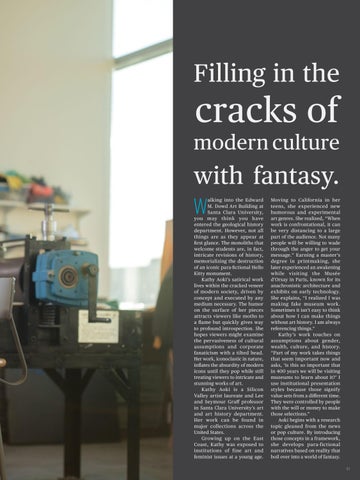
Filling in the
cracks of
modern culture
with fantasy. W
alking into the Edward M. Dowd Art Building at Santa Clara University, you may think you have entered the geological history department. However, not all things are as they appear at first glance. The monoliths that welcome students are, in fact, intricate revisions of history, memorializing the destruction of an iconic para-fictional Hello Kitty monument. Kathy Aoki’s satirical work lives within the cracked veneer of modern society, driven by concept and executed by any medium necessary. The humor on the surface of her pieces attracts viewers like moths to a flame but quickly gives way to profound introspection. She hopes viewers might examine the pervasiveness of cultural assumptions and corporate fanaticism with a tilted head. Her work, iconoclastic in nature, inflates the absurdity of modern icons until they pop while still treating viewers to intricate and stunning works of art. Kathy Aoki is a Silicon Valley artist laureate and Lee and Seymour Graff professor in Santa Clara University’s art and art history department. Her work can be found in major collections across the United States. Growing up on the East Coast, Kathy was exposed to institutions of fine art and feminist issues at a young age.
Moving to California in her teens, she experienced new humorous and experimental art genres. She realized, “When work is confrontational, it can be very distancing to a large part of the audience. Not many people will be willing to wade through the anger to get your message.” Earning a master’s degree in printmaking, she later experienced an awakening while v isiting the Musée d’Orsay in Paris, known for its anachronistic architecture and exhibits on early technology. She explains, “I realized I was making fake museum work. Sometimes it isn’t easy to think about how I can make things without art history. I am always referencing things.” Kathy’s work touches on assumptions about gender, wealth, culture, and history. “Part of my work takes things that seem important now and asks, ‘is this so important that in 400 years we will be visiting museums to learn about it?’ I use institutional presentation styles because those signify value sets from a different time. They were controlled by people with the will or money to make those selections.” Aoki begins with a research topic gleaned from the news or pop culture. By introducing those concepts in a framework, she develops para-fictional narratives based on reality that boil over into a world of fantasy. 43
44 Profiles 14.4
Opposite Page Top: Buried Bourgeois Bust, Digital Painting on Somerset, 24 “x 40” | 2022 Bottom: Disgraced Patriarchal Monuments, Mixed Media Installation, Approx. 10’ x 12’ x 8 ‘ | 2020 45
46 Profiles 14.4
Opposite Page Top: Hello Kitty Monument Mixed media diorama installation, 15’ x 13’ x 8’, 2018. Bottom: Good Riddance (Jefferson Davis statue) Photopolymer intaglio with watercolor, 7.25” x 9.75” | 2021 This Page Above: The Brazilian Photopolymer Intaglio print, 8” x 10” | 2009.
She adds, “I try to lure viewers in with familiar formats and then slip in my commentary. It is not just conceptual—I want to provide a visual reward. We hold certain expectations, stereotypes, or values as the way things should be, but when you see them shaken up, they become funny. If you are willing to go down the rabbit hole, you get more bang for the buck.” Her wo r k l e ve r a g e s traditional styles and ancillary materials to make her fictional narratives seem real. While her orig inal passion for printmaking is still a large portion of her portfolio, she enjoys continuously pushing her technique and allowing the medium to follow her ideas. She adds, “I have done printmaking, sculpture, dioramas, virtual rea l it y, a n i mat ion s, a nd motion g raphics. In that way, my technical skills have expanded far beyond what I was trained in school.”
Working as a professor has allowed her to learn through teaching, taking advantage of prior knowledge, and benefiting from a classroom of mistakes and problem-solving. Silicon Valley’s experimental, anythinggoes culture has inf luenced her process. A concept may crystallize in her mind, but she explains, “Everything is always harder than I imagine, but I continue to jump right in, thinking ‘how hard can it be?’ I craft a show based on key pieces that fit exactly into the project. If one piece fails, it creates a hole in the narrative. I am always working on a deadline to bring everything to that level. I don’t have any time for failures.” Kathy’s art is filled with questions once a v iewer identifies the loopholes within the concept. She believes “artwork has a lasting impact when it brings up questions instead of seeing something and saying, ‘I know that’ and moving
on. The imagery is important to me because it allows people to believe. You can’t unsee something.” Kathy is taking on a role as Associate Dean for the College of Arts and Sciences at Santa Clara University, and exhibiting in New Museum Los Gatos beginning in August 2022 and the B. Sakata Garo Gallery in Sacramento in 2023. She is experimenting with new forms of photopolymer intaglio printmaking, with goals of going bigger than ever before, constantly weaving between concept, medium, and approach. Kathy explains, “I hope that people understand the breadth of my work, the ideas behind it and the sense of humor. It is not a hobby. The work is funny, but this is very serious to me.” C
47
48 Profiles 14.4
Sand Master Brighton Denevan M
Written by Johanna Harlow Portraits by Stan Olszewski Artwork Photography by Brighton Denevan Instagram brightondenevan
any Santa Cruzians love to enjoy the surf and sand. But Brighton Denevan digs deeper. To this local land artist, a beach isn’t just a beach—it’s an expansive canvas. “I think the framing of this cave is really nice,” Brighton notes, shovel in hand as he surveys a small San Gregorio beach cave near Half Moon Bay. Despite the icy wind gusting outside this grotto, he’s in flipflops—proof he’s a Santa Cruz native through and through. A partial pattern in the sand spiderwebs beneath his feet. When passersby stumble across one of Brighton’s massive sandetched patterns, they might attribute his work to aliens taking a beach day, leaving crop circles in their wake. Brighton’s artistic dialogue with the elements has taken him across California, the states beyond, and even to countries like Mexico, Colombia, and Saudi Arabia. His patterns vary from spiraling to labyrinthine, radial to patchwork-like—many with the intricacy and flavor of Celtic or Mayan detailing, some with basket-woven textures or florals. He also seeks inspiration from the Fibonacci sequence, a naturally occurring pattern found in everything from pinecones to nautilus shells. “There’s so much freedom beyond the gallery walls…It’s not constrained within the frame of the building,” Brighton says of his alfresco art. “If it’s out in nature, it’s wild and spilling out into the world and forces are acting on it.” As he explores environment-as-medium, Brighton’s experienced eye notes the topography of the shoreline, the color of the sand, even the fineness of the granules. “Bigger grains mean the sand dries out faster,” he explains. This causes messier designs. Wet sand, on the other hand, means crisp patterns. Weather impacts the final result too: “If it’s really sunny, it might dry it out. Or if it’s windy, it might just turn it into sand dunes.” With a deep tan layered in countless beach days and eyes that match the coastline, it’s not surprising to learn Brighton grew up a stone’s throw from the Pacific. He spent a spirited childhood running 49
along the Santa Cruz bluffs, splashing in the surf, and watching his dad work the sand. “In the nineties, I was always hanging out with pops,” Brighton notes, explaining that his father, Jim Denevan, is also a land artist. In those early years—while Jim dragged a big stick or rake across the shores for hours on end—young Brighton would make miniature versions. “I’d be trying to entertain myself. I’d be making little sand sculptures, little worlds in the sand,” Brighton recalls. “It taught me patience,” he shares with a laugh. Watching a sand master at work seems to have been an education by osmosis for Brighton—though at first, he didn’t consider sand art an option because he didn’t want to simply follow in someone else’s footsteps. For years, Brighton admits to telling himself, “That’s dad’s thing. I can’t do that.” He adds, “I hadn’t broken out of the box I’d put myself in.” That changed during the pandemic. “It led to me wanting to break through all the barriers and do some experiments.” These days, the father and son have collaborated on many projects. “We both have our ideas and bounce them off each other, which makes both of our stuff better,” says Brighton. Partnering on a number of sand designs does lead to certain similarities in styles; though as Brighton sees it, “Nature’s the original artist. We’re just copycats.” That said, Brighton has also forged his own path. “My father has always had this obsession with doing the biggest thing ever,” he chuckles. “At one point, I was driving a circle at a hundred miles an hour and you could barely even tell it was a curved line because the thing was as wide as a city.” Brighton, on the other hand, prefers “smaller,” more intricate designs. “I’ve really been enjoying doing stuff that’s 30 feet across,” he shares. Brighton was also the one to introduce drones to the family art. In the early days, Jim positioned his designs close to cliffsides to achieve a seagull’s eye view. Even so, “It’s an oblique angle,” Brighton observes. But he runs a drone business, which allows him to 52 Profiles 14.4
53
54 Profiles 14.4
showcase his creations (as well as his dad’s) right above the center point. That advancement in aerial technology also ensures easy preservation of designs long after high tide sweeps the shores clean. As Brighton reminisces on his many projects, he fondly recalls a collaboration with his landscaper friend. After his buddy showed up at one of Brighton’s radial sand labyrinths with a dozen Christmas trees in tow (tossed after the holiday season) the two set to work installing them around the edge of the circle. “It was amazing seeing the forest on the beach and walking amongst the trees,” Brighton recalls. “And then me and my buddy doused them in some flammable stuff and we lit them on fire. It was insane.” Another favorite project was an international art exhibition he made with his dad for Desert X in Saudi Arabia. “Angle of Repose” consisted of 364 concentric circles in triangular sand mounds that ranged in size from bread loaves to small houses with a mountain of firewood at its center. The installation was so visually stunning that singer Alicia Keys danced among its hills. Brighton describes the sun causing shadows to play across the mounds throughout the day. “And at night when you have the fire coming from the center, it shoots all the shadows perfectly, radiating out like a flower.” “In Saudi, there was this beautiful golden sand like I’ve never seen before,” he reflects, adding that there’s another continent he’d like to bring an installation to. “There’s some sand in Africa that’s the color of red velvet cake. And it’s sitting right next to white clay somehow because it’s different weight. So that would be really fun to get into.” But no matter where Brighton finds his sand, one thing will remain as constant as the tide: the results will be otherworldly. C
55
Sleeping Twins by Dana Harris Seeger 56 Profiles 14.4
2 2 0 2 2 2 0 2 San Jose Creative Ambassadors Written by Alyssarhaye Graciano | Photography by Daniel Garcia bit.ly/sjoca | Instagram: sjculture
Art is not only a reflection of the times, but often our community. Art is conversation. Art is poetry. It is ambient sounds, technology, and even paperwork. The San Jose Office of Cultural Affairs recognizes the need for art on a day-to-day basis and has selected six members of the San Jose community as Creative Ambassadors to carry on this mission. The 2022 Creative Ambassadors are Stephanie Barajas, Ricardo Cortez, Eric Hayslett, Abby Hibbs, Brandon Luu, and Dana Harris Seeger. The artists represent a range of artistic disciplines and share a deep commitment to highlighting the intersectionality of San Jose’s creativity, culture, and community. Creative Ambassadors are selected through a competitive panel review process that considers the applicant’s artistic track record and history of community engagement. Emphasis is also placed on artists who are deeply rooted within the San Jose community. Practicing artists of all disciplines are invited to apply. The role of Creative Ambassadors is to champion the power of creative expression and engage residents in finding their own creative
voices. Ambassadors serve a one-year term from January first through the end of the year. During this time they produce a creative project that invites active participation from residents and celebrates the diversity of San Jose’s cultural communities. Additionally, the Ambassadors’ scope of work includes encouraging creative expression through social media, participating in interviews, and helping to promote and participate in the WeCreate408 campaign (wecreate408.org). WeCreate408 is a month-long creative challenge hosted by the San Jose Office of Cultural Affairs scheduled for October 2022. The goal of having the Ambassadors help promote the campaign is to inspire more of San Jose’s residents to join in. In doing so, residents will experience the arts as a vital means of connection to themselves and to others, while elevating their own creativity and celebrating the role it plays in their everyday lives. Support for the 2022 Creative Ambassadors is provided in part by grants from the National Endowment for the Arts and the David and Lucille Packard Foundation. C
57
58 Profiles 14.4
“ART AS A SOCIAL PRACTICE Stephanie Barajas COMBINES MY LOVE FOR ART AND MY PASSION TO HELP BUILD THE COMMUNITY.” instagram: stephroars
Stephanie Barajas seems to do it all, from acting, to photography, to arts administration. Born and raised in Mexico, Barajas immigrated to the Bay Area when she was 14. Watching movies as a young child inspired her to become an actor, despite having stage fright. Barajas overcame her fear through high school drama club and went on to study theater at the University of Southern California. Today, Barajas is building a career in arts administration by working with nonprofits. As a steering committee member for genARTS Silicon Valley, Barajas curates art events throughout the South Bay. “The idea of joining a group in my own community, practicing new skills, and trying new things with a safety net was really amazing; genARTS allowed me to invest time in community arts and work with a group of likeminded people.” Barajas’s creative expression project, I Am My Body, is a zine that shares portraits and interviews from diverse communities. Her project examines the relationship one has with their body and the issues they face related to their physical appearance. “Growing up as a fat brown girl really impacted the things I did, the things I didn’t do, and how I presented myself in theater school.” As a Creative Ambassador, Barajas aims to create a safe space for community members to discuss and reflect on their bodies. “We all have different struggles, but at the end of the day, we have to go through life in our respective bodies.” C
59
“I PRIDE MYSELF AS A CREATOR AND AN AFICIONADO OF Ricardo CortezTHE OBSOLETE USING PERSONAL EXPERIENCE AND CULTURAL IDENTITY AS A FRAMEWORK FOR MY ARTISTIC EXPRESSION.” 408art.com instagram: tijuanarickart
Ricardo Cortez embodies San Jose’s culture at its core, combing his love of art and the lowrider community. He earned his master of fine arts in digital art at San Jose State University. Cortez developed his graphic design and fine art practice within the intersection of technology, sculpture, and culture. It reimagines his Chicanismo, suggesting a new approach in studying our active relationships with technology and longing for nostalgia. He continues to exhibit, teach, and produce culturally significant work that encourages interaction, inviting the audience to become an integral part of the art. By day, Cortez works as a marketing director at the Miller Center for Social Entrepreneurship of Santa Clara University. He is actively cataloging a digital archive of rare lowrider print material and remains dedicated to his pursuit of service to the community. During Cortez’s term as Creative Ambassador, he will produce a series of workshops for youth that will culminate in a community art exhibition. The project, and Cortez himself, is infused with inspiration from San Jose. “My creative expression project revolves around mixing lowriders, art, and technology to show the San Jose youth how we can create new media art.” In the workshops, participants will produce one-of-a-kind sound-reactive artworks. “What inspires me is knowing that I live in a city that was the foundation of innovation that spread across the country. From computers to the San Jose lowriders that reimagined paint jobs and hydraulics, San Jose has been the epicenter of so many things.” C
60 Profiles 14.4
61
62 Profiles 14.4
“I ALWAYS SAY, BE KIND EricYOURSELF Hayslett TO AND BE KIND TO ONE ANOTHER. IT IS THE RIGHT THING TO DO.” e2musicpro.com instagram: the_drive_thruu
Eric Hayslett spreads joy daily, blurring the lines between work and fun through sound. You might catch him touring as a musician, teaching after-school music programs, or producing his morning radio show, The Drive Thru, on KKUP.org, 91.5 FM. Hayslett is the founder of e2music productions, media and, education, where he creates and teaches after-school workshops like Lyrically Speaking and Drum It Up throughout and beyond the Bay Area. Devoted to teaching music and spreading kindness, Hayslett acts as mentor for the Links Incorporated San Jose Chapter—Arts Facet. He has also led workshops for the San Jose Multicultural Artists Guild’s arts education program for the last 17 years. Hayslett’s creative expression project will center around a series of percussion workshops for families in the Stevens Creek and San Tomas neighborhoods of San Jose. “I designed a concept to repurpose, re-engineer, and recycle reusable containers into percussion instruments.” Starting with an empty water bottle, Hayslett developed a process to clean each item and test various materials to create a range of sounds. “I started filling containers with different types of materials, everything from popcorn, beans, sand, dirt, and rocks. I utilized what I had around me without creating more waste. The different sounds that I was able to create inspired me to apply for the Creative Ambassadors program.” The community created their own reimagined instruments through Hayslett’s Repercussions workshop at the San Jose Museum of Art. C
63
“I’M INSPIRED BY MY SURROUNDINGS Amy Hibbs IN SAN JOSE’S URBAN STREETS AND GARDENS TO WHOLENESS TO WHAT IS amyhibbs.com instagram: instahibbs
Amy Hibbs is a visual artist and environmentalist whose work addresses themes of belonging and empathy through interaction with the urban landscape. With a desire to increase healing for individuals, communities, and ecosystems, Hibbs uses a variety of media and techniques to highlight the dualities of joy and pain, beauty and disgust, slow and fast. Having received her master of fine arts from Mills College and the Graduate Affiliate Award from the Headlands Center for the Arts, Hibbs continues her art practice by way of cyanotype, painting, drawing, and more recently, branching into social practice. “I’ve always been really sensitive to what the observer or the viewer is experiencing when they look at art. I think a lot about what that might be for the other person.” The Transformation Station, Amy’s creative expression project as a Creative Ambassador, is a participatory art piece that uses the creative output of visitors to feed hungry composting worms. Participants are invited to contribute a bad thought, deadly secret, or expression of grief in the form of a drawing or words on newsprint paper. The paper is then shredded and fed to the worms. The resulting worm castings are rich fertilizer for nourishing plant life. “This project not only allows people to interact with the piece but by extension to interact with me. I wanted to have that connection with them on a deeper level than just putting something on the wall and observing them from afar while they look at it.” C
64 Profiles 14.4
65
66 Profiles 14.4
“I WANT TO GIVE BACK Brandon Luu TO THE CITY THAT I LOVE. I LOVE IT TOO MUCH TO LEAVE.” instagram: bluubasaur | weartsanjose
Born and raised in San Jose, Brandon Luu is quickly becoming the voice of our future. By day he teaches middle school, and in his spare time he serves on the board of directors for Poetry Center San Jose. A local through and through, Luu received his master of fine arts in creative writing from San Jose State University. “For me, it’s home, from the people that walk the streets, to those hills that mark the backdrop with the sky.” Poetry is something Luu has felt strongly about for some time, noting that it’s an opportunity to bring people together, regardless of age or circumstance. “It’s a form of expression that sets itself apart as a hybrid between language and feeling. People often ask, ‘Do you have to understand a poem totally for it to leave you with a feeling?’ I’ve learned that however you come to understand that feeling, it’s valid.” As a Creative Ambassador, Luu will produce a creative expression project focused on community poetry. The project’s core is based on the creation of a collaborative art piece titled We Are San Jose. The piece will feature work by local Asian artists and poets. Luu will host a social media campaign to collect art, photos, and videos that showcase different parts of San Jose. Those images will become the inspiration for poems, which will then be compiled into a mural. “I hope to bring people in San Jose the feeling of expression through multiple layers: visually, physically, and audibly.” C
67
“COMMUNITY DRIVES ME. CONNECTING Dana Harris Seeger WITH OTHER ARTISTS HELPS THE PUBLIC SEE WHAT IMPACT ARTISTS HAVE ON LOCAL AND GLOBAL COMMUNITIES.” danaharrisseeger.com instagram: danaharrisseeger
An artistic all-star, Dana Harris Seeger is a painter, printmaker, educator, and entrepreneur. Her work is often influenced by her experience growing up as a second-generation Baltic American. “Feeling drawn to a world that is in my blood, but not in my memory, is what motivates me to create layered works in lithography, screen printing, collage, and encaustic.” A cofounder of the School of Visual Philosophy—part art studio and part school—Harris Seeger muses, “Without having the school I feel like I wouldn’t have a connection with the community. I wouldn’t have been able to have a solo show at the Triton or even become an artist laureate back in 2020. We’ve created a hub for artists and the people of San Jose. Having this space helps me stay connected. It is what keeps me in San Jose and what keeps me doing what I’m doing.” Harris Seeger’s creative expression project, Dialects of Art, includes a series of public lectures designed to help artists communicate their stories through artwork and understand how visuals translate across cultures. She will collaborate with artists from different cultural backgrounds working in different mediums throughout the project. The lectures will culminate in a podcast set to release later this year. “While art is a universal language, there are still different dialects and nuances within the language. I am not only trying to get local communities to understand the artists’ impact; I want the artists themselves to realize their impact.” C
68 Profiles 14.4
69
70 Profiles 14.4
Jordan Gatsby Melvin
How a young rapper from North Carolina found his creative wonderland in San Jose
J
Written by Ethan Gregory Dodge Photography by Jay Aguilar Instagram jaayy_gatsby SoundCloud jaydotgatsby
ordan “Gatsby” Melvin was raised in Fayetteville, North Carolina, by a mother who loved R&B and a father who loved funk, two genres the 23-year-old rapper still loves to this day. But it didn’t stop there. “I was listening to anything that sounded good in my ears,” he says. When asked about inspirations for his own musical productions, Gatsby quickly listed over one dozen artists and producers, including Nas, Wu-Tang Clan, Public Enemy, A Tribe Called Quest, Busta Rhymes, J Dilla, DJ Premier, and Pimp C— rest in peace. All of these individuals were creating music during what is known as the Golden Age of hip-hop music. “The Golden Age is the Golden Age because, if you ask me, there was no better music being made,” Gatsby says. “There was so much passion, so much energy behind the music.” When Gatsby first heard the 2006 song “U and Dat,” by Vallejo’s own E-40 in collaboration with T-Pain, it was his first intro-
duction to the Bay Area’s unique style of hip-hop—commonly referred to as “hyphy”—and he loved it. “When I heard that for the first time, it was so different. I realized that it wasn’t just accepted [in the Bay], it was huge,” he says. He admired the acceptance of that difference. Over a decade later in 2018, at the age of 20, he decided to relocate permanently to San Jose. “It’s a creative wonderland,” he says. “The Bay Area is such a close-knit community when it comes to creativity. Everyone feels welcome.” He wasn’t getting that vibe from the East Coast’s “hustler culture,” and he didn’t feel it in Southern California, either. “The creative community of Southern California doesn’t care about you or what you’re doing unless you’re ‘somebody.’ I think that’s hella wack,” he says. “ ‘Nobodies’ are made into ‘somebodies’ every single day. It’s all about access and opportunity.” About his lyrics, Gatsby says, “My lyrics are real life. They’re 71
72 Profiles 14.4
“The Bay Area is such a close-knit community when it comes to creativity. Everyone feels welcome.” -Jordan “Gatsby” Melvin
about interactions that I have either seen, learned from, or was involved with.” Being a Black man in the United States, his real-life experiences often lead him to rap about Black oppression and liberation. He aspires to channel that same energy into his music. “I put a lot of myself, what I truly believe, and my heart into my songs. Because I want them to mean something. I want them to provoke people so much that it damn near radicalizes them. Naturally, his lyrical influences are more than musical artists. “I spend a lot of time educating myself,” he says. “I watch a lot of documentaries and interviews.” The subjects of those documentaries and interviews are often civil rights leaders such as Malcolm X, Marcus Garvey, Elijah Muhammad, James Baldwin, and Fred Hampton. “I love listening to what all these people have to say. If they were alive today, the world would be completely different.” Since arriving in San Jose, Gatsby has used that access and opportunity to stay busy in his quest to become a “somebody.” In 2021 alone, he released two albums, Currently Unnamed and Quake Space, and played almost a dozen shows despite not having a car. “I’ve performed in every major city in California, other than Hollywood,” he says. “I’ve been everywhere, and I’ve built a name for myself off of my grind.” His most recent album, Butter, was released this past July. Gatsby is confident that grind will eventually lead him to world-
wide success. In fact, if optimism and confidence were a disease, Gatsby would be patient zero in the next pandemic. “I think my chances of making it big are so high,” he says. “My music sounds incredible. Even if you don’t like the lyrical content, you cannot say that my music does not sound good. With my passion and my drive, there’s nothing that can stop me from making my dreams come true.” The topic of oppression is not only a consistent throughline in his musical poetry but also peppered his interview for this piece. He claims that during the Golden Age, record labels—“the bourgeoisie”—didn’t realize how powerful media, and hip-hop in particular, can be. Now, he says, the music industry actively works to promote hip-hop artists that perpetuate negative stereotypes of Black culture. “The labels see to it that only people who are pushing a negative influence to youth are going to make it. Over time, that has built a society that only values artists perpetuating these negative stereotypes.” That’s something he believes he can help change. “Media is the most powerful weapon in the world. Hip-hop, I believe, is the most popular genre in the world. If you can effectively control what you want to emulate, I genuinely feel that you can control the future. I plan to be something the world has never seen, heard, felt, or experienced. If not my music, what I do outside of music is going to change the whole world.” C
73
ALBUM PICKS
Curated by Needle to the Groove Instagram: needletothegrooverecords
Kevin Morby
Quelle Chris
This Is a Photograph
DEATHFAME
Kevin Morby’s seventh studio album, This Is a Photograph, is a meditation on the bittersweet lessons of the past and the vulnerability of immortality, a theme given weight by old family photographs discovered after his dad had a health scare. Morby fleshes out this concept with his trademark retro folk-rock sound adding new dimensions with string arrangements and some of his strongest lyrical devices to date. The existential burden of Father Time becomes integral to the proceedings. Morby sings on “Bittersweet, TN,” “Devoted myself to the passing of time… // The living took forever, but the dying went quick.” The mighty Mississippi River further entwines the proceedings with metaphors of time and destiny. Morby purposefully hunkered down in one of the River’s most mythical and alluring cities, Memphis, to draw meaning from a place known for straddling this life and the next. The song “Coat of Butterflies” serves as the album’s thematic core, which gracefully eulogizes the enigmatic Jeff Buckley, whose drowning in the Mississippi on the banks of Memphis added to the town’s eerie and mythic pull. The sprawling piece shimmers with simple, intertwining guitar, piano, and harp, which is all tied down with the surprising collaboration with jazz drummer, Makaya McCraven. Buckley’s own struggles with fame and purpose in life become research notes on Morby’s own vision quest filling the album, “Yeah, the sky can lift the river, and spread it out over the farm / Life’s just one long day, babe, but I’ve been awake all day long.” The album further solidifies Morby’s staying power as he continues to grow out of the shadows of his influences and refines his simple, yet magnetic, vocal delivery. Rather than his sound being an impressionistic facsimile of artists past, Morby examines snapshots of their lives to honor their influence. He sings on “Goodbye Good Times,” “I miss the good times, Mama, they’ve gone out of style / And I don’t remember how it feels to dance, goodbye to good times.”
I have long felt the world has failed many great artists and musicians. There are way too many examples of artists bestowing great work upon the world only to be ignored and uncompensated in their lifetime. To make matters worse, sometimes we can only give artists their proverbial flowers after they die. It’s part of the cruel joke of creating art. But does it have to be that way? This is one of the questions Quelle Chris asks on his latest album, DEATHFAME. Quelle Chris is among the small cadre of rappers whom I consider to be the vanguard of the form. What makes him special, even amongst his most talented peers, is his ability to communicate complex ideas in a way that feels simple and accessible. This existential artistic quandary is worked out over a production pallet that ranges from dark and sludgy to light and hopeful. This is perhaps best captured on the song “So Tired You Can’t Stop Dreaming.” On this track, which has a brilliant feature from Navy Blue, Quelle Chris opines, “If Heaven’s got a ghetto hell’s got a resort.” Another track that captures Quelle Chris’s talent for working at the intersection of happy and sad is “How Could They Love Something Like Me,” where Chris isn’t rapping at all but rather singing in a heartfelt way that doesn’t compromise his signature style. This speaks to the breadth of DEATHFAME, which also has several amazing tracks that fall into the category of rap for rap’s sake. Songs like “Feed the Heads,” “King Is Back,” and “CUI Podest” show that as artsy as Quelle Chris is, he is still not above crushing sucka emcees. The production duties for DEATHFAME were split between Quelle Chris himself and frequent collaborator Chris Keys. Soul-stirring piano riffs and grungy slowed-down samples collide to make a sound that is undeniably Quelle Chris. Let’s give him his flowers now.
(Dead Oceans) Released: May 13, 2022 Written by Taran Escobar-Ausman
Favorite Track: “Coat of Butterflies” KEVINMORBY.COM Social media: kevinmorby
74 Profiles 14.4
(Mello Music Group) Released: May 13, 2022 Written by Demone Carter
Favorite Track: “So Tired You Can’t Stop Dreaming” QUELLECHRIS.BANDCAMP.COM Instagram: quellechris
ELUCID
Staples Jr. Singers
I Told Bessie
When Do We Get Paid
One of the year’s top standouts, I Told Bessie, comes from Bed-Stuy Brooklyn’s Chaz Hall, better known as ELUCID, one half of indie-rap powerhouse Armand Hammer, whose work has quietly bubbled to the surface in recent years—notably 2021’s Haram, a vaunted album with stalwart producer, the Alchemist. Originally from Jamaica, Queens, ELUCID’s latest is a reference to his grandmother Bessie who is revealed to have been his earliest supporter. It’s a sentimental album that doesn’t immediately hold itself to be particularly personal, yet it’s peppered with wisdom that covers both complex emotions of the human condition, as well as modern day New York where it was crafted. ELUCID’S breakneck delivery is hurling, typically through clusters of detail that punctures the varied production. His writing gives you fragments of imagery that reveal itself not unlike when a camera slowly pulls back on its subject. On the ominous “Split Tongue,” he says: “Vibrating between flesh and teeth, air escapes. / Calling your name when least expected… / no strays, no mistakes.” I Told Bessie features a mixed bag of beneath-the-surface producers who construct a bevy of fitting backdrops for ELUCID’s powerful stanzas. Child Actor, August Fanon, and Sebb Bash are just a few names adding stellar contributions. Past collaborators Kenny Segal and the Alchemist also reliably put their mark on the album. Cuts like “Bunny Chow” and “Betamax” are a marriage of avant-garde rap modernism between ELUCID and his cast of chosen beatsmiths. The 13-track release is not background music to be sure. An all-star cast of contemporaries also fasten their name to the victory—Pink Siifu and Quelle Chris, as well as ELUCID’s longtime partner, Backwoodz’s label chief and one of modern rap’s most poignant writers, billy woods, who appears on three cuts. The year in rap thus far has been an embarrassment of riches, with mainstreamers like Drake and Kendrick tossing their hat into the ring at the midway mark. However, the indie rap scene proves vital as well, with many standouts offering equally compelling yet contrasting material. This is ELUCID’s third solo album, but it feels more like an arrival.
Authenticity burns white hot from the opening notes of “Get on Board,” the first song on the Staples Jr. Singers’ nearly lost album, When Do We Get Paid. It’s a fitting primer for the 11 songs that follow: sparse yet soulful, informal yet intimate, searching yet faithful. Deeply inspired by the Staple Singers (the group’s name pays homage to their heroes), When Do We Get Paid calls out to God while keeping it funky. This is uplifting music wrought from, and created despite, hard times, a product of growing up in the Deep South post-Jim Crow. It’s also music recorded by teens not defined by tradition. Paid is the group’s only full-length effort. Recorded in a long-gone studio in Tupelo, Mississippi, in 1975 and released that same year, the album was long confined to the ears of those who happened to pick up a record while the group was touring the region with other gospel acts. The shouted group vocals on “I’m Looking For a Man” spill over an untidy joy that feels more suited to a house party or tent revival than a Sunday worship service. There’s an unvarnished quality to the tunes in general that stands in contrast to the ornate, choir-led gospel of Rev. James Cleveland and the subtle harmonic mastery of classic jubilee quartets like the Dixie Hummingbirds. There’s also an eeriness that pervades the album you wouldn’t expect from devotional music. “Somebody Save Me” carries a blues edge, the vocals from Annie Brown Caldwell and Edward Brown injecting a life-or-death urgency that grates against the slow stroll of the rhythm section. On “Too Close,” A.R.C. Brown’s contemplative lead guitar serves as the song’s emotional linchpin as lines like “Don’t you know I’m too close?” give the impression that the devil is right on singer Edward’s heels. Rough around the edges but brimming with fire and spirit, When Do We Get Paid is not afraid of sharing about the scrapes earned on the road to salvation.
(Backwoodz Studioz) Released: June 10, 2022 Written by David Ma
Favorite Track: “Betamax” ELUCID.BANDCAMP.COM Twitter: elucidwho
(Luaka Bop) Released: May 6, 2022 Written by Brandon Roos
Favorite Track: “Somebody Save Me” JUNIORSINGERS.COM Instagram: junior.singers
75
CONTRIBUTORS The production of CONTENT MAGAZINE would not be possible without the talented writers, editors, graphic artists, and photographers who contribute to each issue. We thank you and are proud to provide a publication to display your work. We are also thankful for the sponsors and readers who have supported this magazine through sponsorships and memberships. Be a part of the CONTENT community. Contact us at:
Editor@content-magazine.com
JAY AGUILAR Jay is a Polaroid enthusiast from the Bay Area. His primary photography format is Polaroid film and using vintage Polaroid cameras to capture portraits of musicians, creatives, and friends/family. Instagram: thepolaroidjay
ON THE COVER Brighton Denevan not only creates stunning sand sculptors but also documents his work with aerial photography. Read more about Brighton on page 48. Instagram: brightondenevan
76 76 Profiles 14.4
SEEK 10.0
ALYSSARHAYE GRACIANO Alyssarhaye is a fiber artist, pattern designer, teacher, and writer born and raised in San José. Her mission is to connect people and communities through art. When not art-ing, you’ll find her riding a bike.
ETHAN GREGORY DODGE Ethan is a freelance journalist based in San Jose. Ethan covers topics ranging from culture to social justice and their intersection with surveillance and policing in the 408.
Instagram: blacksheepmade
Twitter: egd_io
DAVID ELISEO VALDESPINO JR. Born in Oakland and raised in the East Bay, David is a bicycle programs coordinator by day while playing music, writing, and spinning vinyl by night. David strives to cultivate empathy by broadening perspectives. Instagram: thedaveed
KEVIN PETH Kevin is a freelance art director from the South Bay Area. He helps brands develop creative and impactful visual identities. Instagram: kevin.peth
ELIZABETH SULLIVAN Elizabeth is a copyeditor and poet with an MFA from the University of Washington. She lives with her husband and numerous bees, chickens, and goats, and is fond of making and eating cheese washed down with a moderate amount of mead.
MONI SEBESTYEN Moni is a hair/makeup artist in the Bay Area. She works at her own salon in Los Gatos. She does weddings, photo shoots, celebrities and will travel to wherever her brushes will take her. Instagram: hair_makeupbymoni
C
OPEN STUDIOS a r t to u r 2 0 2 2
first three weekends in october
Hermelinda Vasquez-Matias, artist #318
300+ studios free App & Guide
PrESENtING SPoNSor
MaJor SPoNSorS
sAntAcruzopenstudios.com
AC_OSAT2022_ContentAd_8.5x5.75_v1.indd 1
7/22/22 3:21 PM
NEW SHOW!
PODCAST Conversations with Silicon Valley‘s Creatives
KELLY AKASHI: FORMATIONS
FREE + OPEN LATE!
FRI, SEP 2, 6–9pm
Celebrate the opening of Kelly Akashi: Formations with music by a local DJ. Late-night bites + cash bar at El Cafecito, by Mezcal. Before the evening ends, get your shopping in at the Museum Store—also open late until 9pm! Visitors 2 years and older are required to wear a mask. See SJMUSART.ORG/SAFETY for more. Artwork: Kelly Akashi, Inheritance, 2021. Poston stone, cast lead crystal, heirloom (grandmother's ring), 6 × 8 × 6 inches. Courtesy of the artist, François Ghebaly Gallery, and Tanya Bonakdar Gallery.
110 SOUTH MARKET STREET / SJMUSART.ORG www.content-magazine.com
NEW HOURS: THU 4–9pm / FRI 11am–9pm / SAT–SUN 11am–6pm
SILICON VALLEY’S
INNOVATIVE & CREATIVE
CULTURE made in san jose, ca
NEXT ISSUE
Discover 15.1 Next
Pick-Up Party Depending upon County Health Ordinances
SAN JOSE 2022 social media: contentmag
ANNUAL MEMBERSHIP- $42.00 SINGLE ISSUE- $14.95
SUPPORT
www.content-magazine.com