TOP!1 DOCTORS 2016
C E L E B R AT I N G
Memphis • THE CITY MAGAZINE • W W W.MEMPHISMAGAZINE.COM
40 Y E A R S
THE CITY MAGAZINE
VOL XLI NO 4 | JULY 2016
THREE OF A KIND! How Jennifer and Ashton Hall’s identical triplets made Memphis medical history.
USA $4.99
0 7
—1 6
DISPLAY UNTIL AUGUST 10, 2016
MM07_2016_Cover_v07.indd 1
ASHTON AND JENNIFER HALL, W I T H S O N S L E O , W Y L D E R , A N D C O LT O N B O R N AT R E G I O N A L O N E H E A LT H
6/20/16 3:10 PM
T:9” S:8”
The BMW 3 Series
roadshowbmw.com 901-365-2584
T:10.875” S:9.875”
START WITH PERFORMANCE. THE REST WILL FOLLOW. THE BMW 3 SERIES.
Driving isn’t about commuting or carpooling. It’s about performance. It’s about enhanced steering and suspension systems providing an even greater command of the road. It’s about the joy of near-perfect weight distribution, and the intelligence of Adaptive LED headlights that hug corners right before you do. When performance is given the highest consideration, the rest just falls into place. And – in the case of the 3 Series – the rest of the automotive world follows.
Special lease and finance offers will be available through BMW Financial Services.
Roadshow BMW | 405 N. Germantown Parkway | Memphis-Cordova, TN 38018 | 901-365-2584 | roadshowbmw.com ©2016 BMW of North America, LLC. The BMW name, model names and logo are registered trademarks.
MM_FullPage_TrimSize_9x25_11x125.indd 1
6/8/16 9:39 AM
Convenient access to outpatient care just got better. At the new Baptist Medical Group–Outpatient Care Center, we bring exceptional care from the largest regional network of physicians straight to our patients in one convenient location. Our newly renovated center provides quicker access to specialized care including more diagnostic services, therapies and rehabilitation care. It’s just one more way Baptist is helping families get better. Please call 901-757-3473 to find out more about our diagnostic and rehabilitation services.
Get Better. 9 0 1 -7 5 7-3 47 3 | 2 1 0 0 E X E T E R R D . G E R M A N TOW N , T N 3 8 1 3 8
MM_FullPage_TrimSize_9x25_11x125.indd 1
6/8/16 9:40 AM
THE EXPLORER II Built to accompany intrepid explorers, engineered for adventures to extreme frontiers. It doesn’t just tell time. It tells history.
rolex
MM_DoublePageSpread_18x25_11x125.indd 2
oyster perpetual and explorer are
ÂŽ
trademarks.
6/13/16 10:23 AM
OYSTER PERPETUAL EXPLORER II
MM_DoublePageSpread_18x25_11x125.indd 3
6/13/16 10:23 AM
MINIMALLY INVASIVE SURGERY REHABILITATION
SCOLIOSIS
INNOVATIVE
P H Y S I C A L T H E R A P Y
BULGING, RUPTURED & DEGENERATIVE DI SC S
NECK & BACK PAIN SPINAL STENOSIS NECK & BACK SURGERY
NUMBNESS ∙ HERNIATED DISCS SPI NAL DEFOR M ITIES ∙ S CI A T I CA ∙ B O N E SPURS
PAIN BLOCKS
SPINAL FUSION SPINAL TUMORS
For spine related disorders or injuries, Semmes Murphey will help you
GE T YO U R NO R M A L B AC K
WWW.SEMMES-MURPHEY.COM
MM_FullPage_TrimSize_9x25_11x125.indd 1
∙ APPOINTMENTS CALL (901) 522-7722
6/6/16 8:48 AM
T:8”
SUMMER EVENT Performance that moves you. Beauty that stops you in your tracks. Introducing the all-new C-Class Coupe. Engineered for superior sportiness and equipped with Dynamic Select — a feature that allows you to alter the driving dynamics to your exact liking — the C-Class Coupe will send you, and your heart, racing in seconds. Yet its stunning good looks will just as quickly bring you to a halt. The completely redesigned C-Class Coupe. MBUSA.com/C-Coupe
T:9.875”
The cars of a lifetime; the event of a summertime. The Mercedes-Benz Summer Event. The stars have aligned this summer, and it’s a moment you don’t want to miss. Come in now to the Mercedes-Benz Summer Event and get an exceptional offer on the exhilarating C 300 Sport Sedan, the technologically advanced GLC, or the innovative GLE — the most intelligent SUV in its class. But hurry — the cars are made to last, but the offers are not. See your authorized Mercedes-Benz dealer today. MBUSA.com/SummerEvent
THE 2016
GLC
STARTING AT
$
38,950*
Mercedes-Benz of Collierville 4651 S. Houston Levee Road, Collierville, TN (901) 316-3535 www.mbcollierville.com
Mercedes-Benz of Memphis 5389 Poplar Avenue, Memphis, TN (901) 345-6211 www.mbofmemphis.com
2016 GLC 300 and 2016 GLE 350 shown in Iridium Silver metallic paint. 2016 C 300 Sedan shown in Cardinal Red metallic paint. Optional equipment shown. *MSRP excludes all options, taxes, title, registration, transportation charge and dealer prep. Options, model availability and actual dealer price may vary. See dealer for details. ©2016 Authorized Mercedes-Benz Dealers For more information, call 1-800-FOR-MERCEDES, or visit MBUSA.com.
HEADLINE: 24 pt. • BODY COPY: 10 pt MM_FullPage_TrimSize_9x25_11x125.indd 1
200 Varick St. New York, NY 10014 : Phone 212-805-7500
6/6/16 8:50 AM
A gathering of family and friends will always be the cornerstone of a Celebration of Life.
Memphis Funeral Home offers its new Life Remembrance Center as the perfect choice for these gatherings. Unique? Indeed. The only one of its kind in the Mid-South.
MEMPHIS FUNERAL HOME Caring For a Lifetime. Since 1931.
5599 Poplar Avenue, Memphis, TN 38119 • (901) 725-0100
MM_FullPage_TrimSize_9x25_11x125.indd 1
6/14/16 11:21 AM
T HE CI T Y M A G A Z INE—SINCE 1976
&7
26
VOL XLI NO 4 | JULY 2016
128
40 THE TOP DOCTORS 2016 C E L E B R AT I N G
Memphis • THE CITY MAGAZINE • W W W.MEMPHISMAGAZINE.COM
Y E A R S
!1
THE CITY MAGAZINE
VOL XLI NO 4 | JULY 2016
THREE OF A KIND! How Jennifer and Ashton Hall’s identical triplets made Memphis medical history.
30
ROAD TRIP
L. A. 120
132
USA $4.99
0 7
—1
ASHTON & JENNIFER HALL, W ITH SONS LEO, W Y LDER , & BEA R B O R N AT R E G I O N A L O N E M E D I C A L C E N T E R
6
DISPLAY UNTIL AUGUST 10, 2016
on the cover
A family portrait with triplets, 2016. PHOTOGRAPH BY LARRY KUZNIEWSKI
53
MEMPHIS TOP DOCTORS FOR 2016 Up Front
Features
13 in the beginning 26 A Voice for Jessica An open investigation into the murder of a young 14 spotlight woman lingers into its sixth year as family and 18 fine print friends search for answers. ~ by shara clark 20 city journal 30 The Man Behind the Who Concert From our October 1980 issue, an account 22 front and center of Bob Kelley’s efforts to rock the Mid24 out and about South Coliseum. ~ by mark j. davis 44 The Bear, the Wolf, and the Lion
Chronicles of a modern miracle: the Hall family’s identical triplets. ~ by cara ellen modisett
53 Top Doctors Memphis (ISSN 1622-820x) is published monthly for $15 per year by Contemporary Media, Inc., 460 Tennessee Street, P.O. Box 1738, Memphis, TN 38101 © 2016. Telephone: 901-521-9000. For subscription info, please call 901-5219000. Subscription customer service mailing address is Memphis magazine, P.O. Box 1738, Memphis, TN 38101. All rights reserved. • Periodicals Postage Paid at Memphis, TN. Postmasters: send address changes to Memphis, P.O. Box 1738, Memphis, TN 38101.
A comprehensive guide to the finest physicians in the Mid-South. Plus profiles of four doctors who appeared on our very first list in 1996.
98 great memphis homes The Perfect Spot
Thoughtful touches transform a historic property in East Memphis into a new home for the Spotts family. ~ by anne cunningham o’neill
106 Saved by Soccer
Ten years after calamity, Collierville’s Kevin Hensley will play for the U.S. Paralympic National Team in Rio. ~ by frank murtaugh
120 travel
L.A. Story The City of Angels offers something for everybody. ~ by chris mccoy
128 ask vance
Dark Shadows’ Lara Parker Our trivia expert solves local mysteries of who, what, when, where, why, and why not. ~ by vance lauderdale
130 books
Dimestore Lee Smith pulls from days spent among the aisles of her father’s store for a new collection of essays. ~by richard j. alley
132 dining out
Surprise! It’s Fried Chicken Served as tacos, tortas, small plates, and menu specials, Memphis fried chicken offers more than meat and threes.
136 city dining
Tidbits: Sweet Cake Shop; plus the city’s most extensive dining listings.
144 l ast stand
Realer Than Real Reality television has reduced the most important issues of the day — even the presidency — into 15-second sound bites. ~ by eileen townsend
JULY 20 16 • MEMPHISMAGA ZINE.COM • 7
007_MM07_2016_TOC.indd 7
6/20/16 3:04 PM
BONUS
In This Issue 2016MEDICALGUIDE
STANDARD OF EXCELLENCE SINCE 1950
SPECIAL ADVERTISING SECTION
FOR OVER 50 YEARS, Adams Patterson has been delivering comprehensive women’s health care, offering the latest, most practical solutions. We were the first to introduce both the MonaLisa Touch laser for vaginal revitalization and SculpSure, non-invasive body contouring to the MidSouth. Whether you are a young woman just starting your family or are transitioning through menopause, we will address your concerns with a full evaluation. Our individualized approach allows us to be certain that the preventive, medical, educational, surgical, or cosmetic services you receive from us are tailor-made to suit you. All of our partners are board-certified specialists and clinical instructors at the University of Tennessee — Memphis. If you are looking for an experienced and knowledgeable team offering the most advanced solutions, Adams Patterson is your health and beauty resource. We provide comprehensive medical and surgical services in these areas: • Gynecology • Menopause management • Routine and high-risk obstetrics • Contraception
Memphis Magazine’s
THE 2016
We also perform the following procedures in our office: • MonaLisa Touch™ Laser Treatment for Vaginal Revitalization • SculpSure Non-Invasive Body Contouring • Kybella, Injections used for the reduction of submental fat, also known as a “double chin” • Endometrial Ablation for heavy periods • Essure® — Permanent birth control procedure We offer in-office screening and diagnostic services for: • Digital mammography • Bone densitometry • High-definition ultrasound with 4-D images • Genetic screening • Amniocentesis
ADAMS PATTERSON GYNECOLOGY & OBSTETRICS Back row, left to right: Dr. Judith Williams, Dr. Todd Chappell, Dr. Miriah Denbo, and Dr. Frank King Front row, left to right: Dr. Leigh Keegan, Dr. Sharon A. Butcher, Dr. Leah Tonkin, Dr. Regina Healy, and nurse practitioner, Darby Heitman
In addition, we offer Nexplanon contraceptive implants, and Mirena, Skyla and Paragard IUD insertion. Our doctors have special expertise in robotic surgery for outpatient hysterectomy, including one of the only surgeons in the Mid-South performing Single-Site® “Virtually Scarless” Robotic surgery and other minimally invasive procedures. Moreover, our aesthetic services include Botox® Treatment, Latisse® — to help promote eye lash growth, Obagi and Jan Marini® Skin Care Products, Juvederm® Ultra Cosmetic Fillers, and Chemical Peels, as well as Sclero Therapy for treatment of spider leg veins and Advanced Laser Therapy.
Baptist Women’s Hospital 6215 Humphreys Blvd. Suite 301 Memphis, TN 38120 Methodist Germantown Hospital 7705 Poplar Avenue Building B, Suite 220 Germantown, TN 38138 901.767.3810 adamspatterson.com
72 • M E M P H I S M A G A Z I N E . C O M • J U L Y 2 0 1 6
FACE
MM_AdamsPattersonGynecologyAndObstetricsOBGYN_July16_fp.indd 72
6/17/16 11:08 AM
INS T IT U T ION A L A ND INDI V IDUA L PRACTITIONER PROFILES
OF
ORIENTAL RUGS
pages 72 - 96 Profiles of the area's leading medical practices and physicians.
Coming in September
2015 Memphis Area
INDEPENDENT
SCHOOLS
GUIDE
MAIS_September2015_Final.indd 1
appraisals handwash/cleaning sales reweaving repairs color run restoration pet and other stain removals moth damage odor removal and much more
8/18/15 10:52 AM
MEMPHIS A S SOCI AT ION OF INDEPENDEN T SCHOOL S GUIDE A comprehensive guide to alternative quality education through independent schools in the Memphis area.
Coming in October SUSAN G.
Master Weaver Ali Taghavi Restoring a antique Persian Farahan rug.
®
SATURDAY, OCTOBER 31, 2015
A special publication of
DOWNTOWN | MEMPHIS, TN
MM_RaceForTheCure_2015_Cover.indd 2 MM_RaceForTheCure_2015.indd 1
9/14/15 3:05 PM 9/17/15 10:57 AM
MEMPHIS MID SOU T H SUS A N G KOMEN R ACE F OR T HE CURE GUIDE 3554 Park Avenue, Memphis, TN • (901) 327-5033 • taghavirugs.com
The official race-day program has bonus distribution to participants at the 2016 event. O C T O B E R
2 0 1 6
2016
VESTA HOME SHOW GUIDE In this issue of Memphis magazine you'll find the 2016 include a 4-color rendering, floor plans, list of suppliers and VESTA Home Show Guide. The West TN Home Builders a general description with facts about each home. Additional Association has selected Ainsley Manor in Fayette County content will includes a feature story on the Ainsley Manor for this much anticipated 2016 VESTA Home Show. The Show development and other pertinent information about the show will be open October 8 - 30 to the 20,000 expected visitors and the featured homes. from Memphis and the Mid-South and will feature five fabulous You will be reaching more than 61,470+ affluent Memphis homes, each built to VESTA's highest design and decorating magazine readers, plus BONUS CIRCULATION will be standards. distributed at the 2016 VESTA HOME SHOW. The VESTA Home Show Guide becomes a coveted reference resource for the thousands of attendees and will
SPACE RESERVATION DEADLINE:
ADVERTISING MATERIALS DEADLINE:
August 22, 2016
August 29, 2016
For more information, please contact:
JEFFREY GOLDBERG (o)901.575.9431 • (c)901.606.7542 goldberg@memphismagazine.com
please e-mail artwork to: art@memphismagazine.com and cc your account executive.
V E S TA HOME SHOW GUIDE The official guide for the 2016 show at Ainsley Manor, featuring floor plans, renderings, and information about aspects of every home in the show. For more information on advertising or our upcoming special sections, please contact Margie Neal at margie@memphismagazine.com 8 • MEMPHISMAGA ZINE.COM • JULY 20 16
007_MM07_2016_TOC.indd 8
6/20/16 12:32 PM
GIVE YOUR FINANCES THE SAME CARE AS YOU DO YOUR PATIENTS In today’s uncertain markets, having a bank that tends to your financial health is vital. First Tennessee Medical Private Banking can help with today’s needs and tomorrow’s goals. Our Relationship Managers offer guidance and solutions tailored to medical professionals. So you can focus on your priority: your patients. To make an appointment with a Relationship Manager, please contact: Robin Thomas Vice President Medical Private Banking ph: 865-971-2128 email: rlthomas@ftb.com
Michelle Hardin Senior Vice President and Manager Medical Private Banking ph: 865-971-2117 email: jmhardin@ftb.com
Rick Rushing Senior Vice President Medical Private Banking ph: 865-971-2570 email: jrrushing@ftb.com
©2016 First Tennessee Bank National Association. Member FDIC. www.firsttennessee.com
MM_FullPage_TrimSize_9x25_11x125.indd 1 FTB_WEA_0324_07816_2016MPB_9x10.875_4c_DocAndChild.indd 1
6/16/16 9:26 AM 6/13/16 2:51 PM
Memphis
EAT
THE C IT Y MAGAZ INE
General Excellence Grand Award Winner City and Regional Magazine Association 2007, 2008, 2010, 2014
&7
PUBLISHER/EDITOR kenneth neill EXECUTIVE EDITOR michael finger MANAGING EDITOR frank murtaugh ARTS & LIFESTYLE EDITOR anne cunningham o’neill
PLAY
FASHION EDITOR augusta campbell FOOD EDITOR pamela denney ASSOCIATE EDITORS shara clark, eileen townsend CONTRIBUTING EDITORS richard j. alley,
jackson baker, john branston, tom jones, vance lauderdale EDITORIAL ASSISTANT sam cicci
4
CREATIVE DIRECTOR brian groppe PRODUCTION OPERATIONS DIRECTOR margie neal ADVERTISING ART DIRECTOR christopher myers
STAY
GRAPHIC DESIGNERS jeremiah matthews,
bryan rollins PHOTOGRAPHY justin fox burks, nicholas scott
hall, laura jean hocking, larry kuzniewski, chip pankey
4
SENIOR ACCOUNT EXECUTIVES joy bateman,
sloane patteson taylor ACCOUNT EXECUTIVE zach scott ADVERTISING ASSISTANT cristina mccarter
4
published by contemporary media, inc. 460 tennessee street, memphis, tn 38103 901-521-9000 p • 901-521-0129 f subscriptions: 901-521-9000
4
CHIEF EXECUTIVE OFFICER kenneth neill CHIEF OPERATING OFFICER molly willmott
1 BASS PRO DRIVE | MEMPHIS, TENNESSEE 38105 BASSPRO.COM/PYRAMID
CONTROLLER ashley haeger DIRECTOR OF BUSINESS DEVELOPMENT jeffrey a. goldberg
BP160322
EDITORIAL DIRECTOR bruce vanwyngarden DIGITAL MANAGER kevin lipe DISTRIBUTION MANAGER lynn sparagowski EVENTS MANAGER jackie sparks-davila
Memphis Magazine’s
MARKETING/COMMUNICATIONS MANAGER kendrea collins
FACE
EMAIL MARKETING MANAGER britt ervin
THE 2016 OF
COFFEE
IT DIRECTOR joseph carey OFFICE MANAGER celeste dixon
&7 july 2016
ARTISAN COFFEES
SCRATCH BAKERY - SODA FOUNTAIN
BREAKFAST - LUNCH - DINNER cafeeclectic.net Harbortown - Midtown - Highland
member: City and Regional Magazine Association member: Circulation Verification Council
10 • M E M P H I S M A G A Z I N E . C O M • J U L Y 2 0 1 6
007_MM07_2016_TOC.indd 10
6/20/16 12:32 PM
MM_FullPage_TrimSize_9x25_11x125.indd 1
6/17/16 10:58 AM
ON THE WEB
Highlights from memphismagazine.com
O
ur revised, revamped, and reader-friendly website is designed to supplement the
printed magazine you are holding in your hands. Visit our site for further reading by writers in this issue, including thoughts and notes on what’s happening in our city, Q&As with local movers and shakers, and more.
W H AT ’S ON T HE W EBSIT E RIGH T NOW ? JULIE R AY'S weekly “FIV E THING S T O DO THIS W EEKEND ” guides. VA NCE L AUDERDA L E shares a newly discovered rare photo of ELV IS PRE SLE Y . H A MBURGER HELPER : A Collegiate Guide to the BE S T BURGERS in Memphis. GE T T ING OU T Our website offers a complete events
CELEBRATING NEW HAPPENINGS
ALL AROUND TOWN Harahan Bridge Bike + Pedestrian Crossing... Beale Street Riverboat Docking Station... Bass Pro in the Pyramid... Crosstown Mixed-Use Renewal... Overton Square Renewal... Tiger Lane... Hattiloo Theater... Shelby Farms Green Line and Trail System... 60 Miles of Bike Lanes... Shelby Farms New Master Plan — The Largest Urban Park in the US!
CELEBRATING 35 YEARS SELLING
ALL AROUND TOWN
calendar, accessible on the home page, searchable by date and type of event.
E AT ING OU T Since 1868
Jimmy Reed, President 901.682.1868 JimmyReedRealtor.com
For the most comprehensive
RE S TAUR A N T LIS T INGS in town — arranged by name, location, neighborhood, and even the type of food served — go to
Proudly supporting MY “City of Choice”
MEMPHISM AG A ZINE.COM
12 • M E M P H I S M A G A Z I N E . C O M • J U L Y 2 0 1 6
007_MM07_2016_TOC.indd 12
6/20/16 12:32 PM
IN THE BEGINNING | by kenneth neill
The Vampire Season
Ask Questions. Get Answers!
T
hough I’m well aware that many of my fellow Memphians “love the heat,” I confess to having a bad attitude towards our city’s usually unbearable summers. I’m obviously happy to call Memphis home. But every year, I look forward to the summer months with minimal enthusiasm.
Officially, of course, the Northern Hemi- from my home on the South Bluffs to the Racsphere summer begins on June 21st. Growing quet Club. I devised an off-the-beaten track, up in New England, that meant very little to nine-mile route that took me through downme, since “summer” usually started on Fourth town, into Central Gardens, out through Cooof July weekend and ended around Labor Day. per-Young, and along Tuckahoe and Shady Here in Memphis, June 21st is pretty mean- Grove all the way to Mendenhall. When runingless, since the season’s warm-up act has ning, summer became my favorite season: the usually taken the stage long before then. For sounds of the crickets, the tree-frogs, the owls me, sanity-threatening Memphis summer offi- and what have you right along largely empty cially starts on that first night over which the streets were magnificent. Yes, it was essential mercury fails to drop below 80 degrees. For that you cover yourself with skeeter spray, but the same humidity that in the daylight hours the record, that date this year was June 17th. We probably won’t see the 60s on the ther- seemed so stifling somehow became soothing mometer again until after Labor Day. Until as you moved along ever so quietly in the still, then, don’t look for me to sweat-inducing summer be hanging out on the golf night. course or walking about It’s a long time since I around town. I consider ran my last marathon (1998, today’s automatic car-startto be precise), but I still ers one of the twenty-first think of those wonderful century’s greatest invenevenings when I’m sitting tions — essential to life in with friends and neighbors summertime Memphis — on my front porch, actualsince it allows me to drive ly right along one of my regular Downtown/East away five minutes later Memphis routes, not far in air-conditioned comfort. Yes, call me names, from Chickasaw Gardens. but when summer comes The nights are marked by around, I avoid the great the same familiar sounds, outdoors at all costs, at least with the addition of quiet until the sun goes down. conversations by insect-reThat’s the bad news. The sistant candlelight over good is that I spring to life wine and cheese, some of June 1988 whenever that glowing great import but most of disc sinks slowly over the Mississippi. And none whatsoever. But each and every one is special, in its own here’s why. After my first decade in Memphis, I decided right. Every now and then on the porch, we to become a somewhat serious runner. Want- sight an iridescent June bug, lighting up the ing to run marathons (I eventually finished 13), still night air. It’s a glorious way to celebrate I realized I couldn’t very well train and take Memphis and its summers, and now one of my whole summers off. So that’s when I became favorite parts of living here. a vampire. Yes, I know, this makes me a faux Memphian, No, I wasn’t into blood-sucking, but I did even after four decades resident in these parts. find a way to stay fit that also fit the climate: And yes, I admit to lacking the meteorological I ran only at night between June and Septem- fortitude of a genuine Memphian, those of ber. It wasn’t too long before this became my you who head off to Destin or Gulf Shores on year-round training pattern. In fact, after a Fourth of July weekend. Some indeed do like few years, I realized that almost the only time it hot. But I only like it that way after dark. I ever ran in the daylight was in actual races! That’s how and when I discovered the mag— Kenneth Neill nificence of Memphis summer nights. Back Publisher/Editor in the 1990s, my twice-weekly long run was
If your home mortgage lender can’t answer all your questions, RUN - don’t walk - to one who can.
Learn About Home Mortgages. Listen to Ludy Callaway, The Mortgage Lady, 8-9AM Mondays on KWAM-AM990.
Ludy Callaway
Vice-President I-Bank Mortgage Division
901-494-4400
ludy@i-bankonline.com
NMLS #267872
A
Plac
e
Here For All Your Pre and Post-Surgical Needs Largest Selection In Memphis Regalia Shopping Center 6150 Poplar Ave Memphis, TN 38119 (901) 683-0210 J U L Y 2 0 1 6 • M E M P H I S M A G A Z I N E . C O M • 13
SPOTLIGHT | A Summons to Memphis | University of Memphis Holiday Inn | June 2, 2016 | Photography by Don Perry
1
2
3
4
10
M
magazine hosted its fourth-annual “Summons to Memphis” last month at the University of Memphis Holiday Inn. Chattanooga mayor Andy Berke spoke to a large contingent of local business leaders about the remarkable growth he’s witnessed in Tennessee’s fourth-largest city. Emphasizing the need for innovation hubs, Berke noted Chattanooga’s world-class wireless infrastructure, a new standard for cities in the digital age. — by Frank Murtaugh e mphi s
5
1 Keynote speaker Chattanooga mayor Andy Berke 2 AC Wharton and John Pontius 3 Tara Isabelle, Anne Thompson, and Laurie Christensen 4 William Franklin, Margaret Yancey, Aarti Bowman, Alan Balducci, and Duncan Galbreath 5 Lora Jobe, Claire Rossie, Deirdre Malone, Derwin Sisnett, and Roby Williams 6 Willy Bearden and Kim McCollum 7 Paul Winter and Laura Fenton 8 Paul and Jennifer Chandler, Kathy Kelley and Teresa Sloyan 9 Berry Jones and Jack Belz 10 Mike Warr and Mayor Mark Luttrell
9
8
7
6
14 • M E M P H I S M A G A Z I N E . C O M • J U L Y 2 0 1 6
014_MM07_2016_Spotlight01_SummonsToMemphis.indd 14
6/20/16 1:02 PM
JUANNA PHILLIPS
MATT TALLEY
LITA HURSTON REED
CARRIE DAVID ANDERSON
TESTER
SUE RUBY
SHELDON ROSENGARTEN
RYAN ANDERSON TRACY
THORNTON
MELONIE SAIN
PAULA SANSOM
MYRA SHEDDAN
WEBSTER
OWNER ALEESA
OWNER JIM
Relocation CATHLEEN LINDA SHARON ASHELIZABETH BLACK EILEEN
TURNER
MARTHA SHIPP
BLACK JIM BLACK
CHERNY
BLUM DAVID OKEON
ALTA SIMPSON
OWNER
ASHLEY JIMMYBONDS
REED
FRAN MELODY BARNETT BOURELL
JO LYN BEAVER
r nals
ce!
LEEN CK
Need help getting wired into Memphis? Job for your Spouse? The right schools?
FRAN JO LYN CATHLEEN CEYLON SUE Special needs? The Relocation experts FRAN SUE JO LEANNE LYN CATHLEEN CEYLON CLARK SUE RAMONA BARBARA MARGARET SANDI BARBARA RAMONA JON TRACY MARGARET KATIE of Marx &CLARK Bensdorf can help.BLACK WeRAMONA wrote CEYLONCAMILLA BARBARA MARGARET SANDI BARNETT BEAVER BLACKWELL JR. BONNER MEG BARBARA the book on Relocation to Memphis. Call BARNETT BEAVER BLACK BLACKWELL JR. BONNER BRONZE BURKE BUTCHER CHAPMAN CLARK BRINNER DUFOUR CHAPMAN CHAPMAN DOUGAN BURKE NICHOLS COOK BLACKWELL JR. BONNER BROOKS BRONZE BURKE BUTCHER CLARK DICKENS ESCUE DUFOUR for your free newcomers packet.
Real Estate and Investment Company
B
Call Eileen Cherny, Director of Relocation Services at 800-866-0092 or 901-682-1868
● ● ● Established 1868
Whether listing or looking call (901) 682-1868 and visit: MandBrealtors.com
NNA ULY
A N REED
VID TER
MEGLINDA DONNA RIP BILL JAKE LAURENCE LINDA KELLY MARIA JERRY JERRY ASHLEIGH LAURENCE MEGRIP DONNA RUTH RIP BILL JAN BARBARA BARBARA HERNDON ESCUE HARWOOD DUFOUR LAWHEAD KENNER KAPLAN LAURENCE ERB HANEYJAN GILLULY KRAHN LUCIUS JERRY ASHLEIGH RIP DUFOUR BILL ESCUE LUCIUS HOWSER KAPLAN GILLULY KENNER HANEY HANEY LINDA HARWOOD HARWOOD JUANNA H BARBY LUCIUS HOWSER KAPLAN KENNER HANEY HARWOOD HARWOOD PERLBERG PHILLIPS
SUE RUBY MATT TALLEY
LITA JUANNA MINDY OKEON LITA BARBYBARBY MIKE SUE GREG LITA COURTNEYSHELDON PAULA MARY MYRA ALTA JUANNA MARTHA SHELDON MELONIE MATTINGLY HURSTON REED HURSTONSHIPP REED PHILLIPS MURRAH PERLBERG HURSTON REED ROSENGARTEN FRANCES PITTS PERLBERG PARKER RENFROW RUBY SANSOM SHEDDAN SIMPSON PHILLIPS ROSENGARTEN SAIN SUE PAULA MYRA ALTA MARTHA MELONIE JIM RUBY SANSOM SHEDDAN SIMPSON SHIPP SAIN SIMPSON
DIANE BARBY BENSON MALKIN PERLBERG
SHELDON ROSENGARTEN
Celebrating 147 Years Selling all Around Town Relocation
SHELDON JIM ROSENGARTEN
Call One Of Our Seasoned Professionals With 25 Years OWNER OWNER OWNER Average Experience! MELONIE ANGIE DAVID SHARON TRACY MATTJIM SAIN DAVID JIMMY SIMPSON STREET
STEPHANIE DAVID SHARON TRACY ELIZABETH JIM EILEEN MATT OWNER OWNER Relocation SHEAHAN SIMPSON TESTER TURNER OWNER THORNTON BLACK TESTER CHERNY TALLEY SIMPSON WEBSTER OKEON THORNTON REED TALLEY SHARON TRACY JIM ELIZABETH DAVID JIMMY EILEEN TURNER THORNTON BLACK CHERNY WEBSTER OKEON REED
Call One Of Our Seasoned Professionals With 25 Years Average Experience! TERI TROTTER
ERIN VAN DRIMMELEN
•••
Call One Of Our Seasoned Professionals With 25 Years Average Experience!
Need help getting wired into Memphis? Job for your Spouse? The right schools? Special needs? The Relocation experts of Marx & Bensdorf can help. We wrote ● the ● book ●on Relocation to Memphis. Call for your free newcomers packet.
Established 1868 Real Estate and Investment Company
WARD WALTHAL
TURNER
Need help getting wired into Memphis? Job for your Spouse? The right schools? Special needs? The Relocation experts of Marx & Bensdorf can help. We wrote the book on Relocation to Memphis. Call for your free newcomers packet. LAUREN
E
Whethe
Real Estate and I
Call Eileen Cherny, Director of HARKINS WIUFF Relocation Services at 800-866-0092 or 901-682-1868
●
Established 1868 Esta Real Estate and Investment Company Call Eileen Cherny, Director of Relocation Services at 800-866-0092 ● ● ● Whether listing or looking call (901) 682-1868or 901-682-1868 and visit: MandBrealtors.com Established 1868 Whether listing or looking call (901) 682
ng or looking call (901) 682-1868 and visit: MandBrealtors.com SVP/RELOCATION & CLIENT SERVICES
EILEEN CHERNY
OWNER
OWNER
JIMMY REED
DAVID TESTER
2014
2015
Explore our firm and the market at www.marx-bensdorf.com
5860 Ridgeway Center Parkway, Suite 100 • Memphis, Tennessee 38120 • 901-682-1868
MM_FullPage_TrimSize_9x25_11x125.indd 1
6/20/16 2:35 PM
SPOTLIGHT | Night at the Lorraine | National Civil Rights Museum | June 4, 2016 | Photography by Don Perry
1
2
3
8
I
t’s great to see so many people come out,” said Carolyn Bailey Champion, daughter of the museum’s late owner Walter Bailey, as guests mingled in the lobby of the National Civil Rights Museum. Night at the Lorraine gathered the spirit of Memphis into a successful inaugural event; local restaurants, such as Lunchbox Eats, Rizzo’s Diner, and Belle: A Southern Bistro, gave out samples to hungry guests coming from the open bars, while others flocked to the silent auction for a chance to win Grizzlies tickets or dinner at The Peabody. Inside and out, live bands performed ’60s hits like “Love and Happiness,” while guests were treated to a full tour of the museum. — by Sam Cicci
4
1 Tina Swift, Susan Hatley, Debra Hammons, Reese Walker, Wanda Boga, Gloria Gross, and Veronica Jackson 2 Brandon Valentine, Taylor White, and Joshua McMurray 3 Joey Beckford, Sandra Reed, and Teresa Jenkins 4 Cara, Micah, Sheril, and Jake Greenstein 5 Jessica Walker, Dr. Charles Allen Champion, Mrs. Carolyn Bailey Champion, and Dr. Carol Champion 6 Robert and Kim Cox, Veronica and Brett Batterson 7 Trence and Tiffany Jackson, David Johnson 8 Asia and Michael Meador 7
6
5
16 • M E M P H I S M A G A Z I N E . C O M • J U L Y 2 0 1 6
016_MM07_2016_Spotlight02_SweetLorraine.indd 16
6/20/16 3:15 PM
41,985 JAGUAR BLUFF CITY 6335 Wheel Cove Memphis, TN 38119 901-844-9400 www.jaguarbluffcity.com
MM_FullPage_TrimSize_9x25_11x125.indd 1
6/8/16 9:41 AM
FINE PRINT
Ten Rules for a Good Book Club Summer beach reading is for wimps.
by john branston 4. Remember that nightmare where you’re back in school and haven’t read the book and the test is in two hours and you may or may not be naked? Forget it. Nobody has nightmares about book club. No one gets called on or called out, and lectures and showing off are taboo. 5. Celebrity biographies and self-help books are out, even though the “new release” shelf at the library and the best-seller lists are full of them. The authors are usually looking for prospects or, worse, converts. Avoid them. In a book club you should be at a point in your life where you are what you are and comfortable in your own skin. Or you may be asked to leave.
1. Do not choose a book with lists such as this one. Pick a real book, with chapters and big words and some context and cred.
7. Going off-topic is all right, to a point. A serious effort must be made to actually discuss the book, the author, the subject, or the historical period. Reading wine labels is not a book club. 8. No women, no wives. Or, no men, no husbands. Go unisex. Spouses say hello and discreetly disappear. Mixed company enlivens politics, cocktail parties, bedrooms, and boardrooms, but a book club is a throwback. What happens in book club . . . It helps if the members come from different places, occupations, and backgrounds, but share a long residence in Memphis, otherwise the stories and gossip fall flat or leave some people out.
2. Book clubs are old-fashioned, aggressively so. Once in session, no television, no smartphones, no texting, no distractions, no Facebook. A book club is strictly face to face. “Date change” and “when are we meeting?” are acceptable subRipping a book that is ject lines in the email message string, too long, too dated, too which will become hopelessly conboring, or too complicated fusing by the time the group meets anyway. can be as entertaining as
9. Meet on a weeknight for an hour or two, no more. “I have to work tomorrow” is always a valid excuse for leaving even if everyone knows you’re lying and you don’t even have a job. savoring a good one. 3. The meeting interval matters. The atmosphere should include booze Weekly is too short. Quarterly is too but not be boozy. Dinner is not essential but highly advisable. Food and drink are the lubrilong. Two months feels about right, but you must time cants of conversation. your read so you don’t finish too soon and forget the book, as with dreams and jokes, or too late, so you 10. The host chooses the book and provides the meal, don’t finish at all, as with required reading in high school and college. Pick a date and hope for the best; giving a double meaning to “bringing something to achieving consensus is a fool’s errand. the table.”
ILLUSTRATION BY ARTISTICCO LLC | DREAMSTIME
R
eal Men and Real Women join a book club to improve their minds. But before you tackle something timely like Ron Chernow’s 731-page Alexander Hamilton, better think twice. Book clubs are as treacherous as email or Facebook, except you actually have to deal with each other’s blasphemy, quirks, and wrongheadedness in person. Remember the golden rule — what we should read and what we will read are two different things — as well as these 10 tips, and your club just might work.
6. Quirky personal favorites and classics are fine, as is the occasional dud. Ripping a book that is too long, too dated, too boring, or too complicated can be as entertaining as savoring a good one. The group is not going to stay on-topic most of the time anyway. A personal story can make a book choice memorable. Beware that the classics you had to read in high school may not hold up well. How in the hell did we ever read them as teenagers?
18 • M E M P H I S M A G A Z I N E . C O M • J U L Y 2 0 1 6
018_MM07_2016_FinePrint.indd 18
6/14/16 12:50 PM
Memphis Minded Dominique DeFreece ’18 Every summer, several Rhodes students participate in the college’s Summer Service Fellowship program, an intensive, nine-week experience that challenges them to engage in significant community projects. Among those participating this summer, is Dominique DeFreece, a junior international studies and history double-major from Delhi, New York, who is spending 40 hours a week volunteering at Literacy MidSouth. “I am developing a literacy toolkit to be used with learners whose literacy abilities range from the 5th- to 12th-grade equivalency levels. Most literacy programs focus on very young children or adults, and this toolkit will help fill a gap. Many of us take for granted how the ability to read street signs, understand prescription bottles, and fill out job applications influences what we can do on a day-to-day basis. I hope that I can make at least one person’s life easier by improving their literacy capabilities.”
Celebrating 90 years in Memphis rhodes.edu
Memphis Minded Ad Campaign..indd 11 MM_FullPage_TrimSize_9x25_11x125.indd 1
6/13/16 3:12 PM 6/15/16 9:10 AM
CITY JOURNAL
Service with a Smile by tom jones
Y
ears ago, after listening to the latest idea for revitalizing downtown, former Beale Street developer John Elkington facetiously said Memphis is always chasing the latest trend, but “usually, it’s 10 years after everyone else.” Back then, his comment was met with knowing laughter, but maybe, just maybe, Memphis is closing the gap.
ServiceMaster will be the third largest private employer in Downtown, but the importance of its decision extends far beyond the number of jobs.
ServiceMaster is the latest in a national trend in recent years of Fortune 1000 companies leaving their suburban headquarters to relocate downtown, but it is the first of its kind in Memphis. In Chicago alone, AT&T, Motorola, Sara Lee, Walgreens, United Airlines, and Archer Daniels Midland have moved. In Seattle, Expedia is spending $229 million to adapt existing buildings for its new downtown waterfront headquarters. The locations for corporate headquarters used to be decided by where the CEO wanted to live, but more and more, these decisions are being guided by where the most desirable workers want to live — college-educated 25- to 34-year-olds. Research shows that jobs follow people; the most mobile, coveted workers are younger ones, and today they want to live in an urban environment. In other words, companies are simply following the talent, because these 25- to 34-year-olds have a strong preference for living within three miles of the central business district. In fact, 51 percent have this preference, compared to just 12 percent in 1990. ServiceMaster, like other companies that need to attract younger workers, is placing bets that a Downtown headquarters will be a magnet for them. This trend in urban living is paying big dividends in other cities, and there is anecdotal evidence that Memphis is catching up. Then again, when compared to other cities, the percentage of college-educated 25- to 34-year-olds is diminished by the fact that a three-mile circle around downtown Memphis takes in thousands of acres of Arkansas fields.
More than anything, the ServiceMaster announcement moved all the talk about a Downtown renaissance from hyperbole and closer to reality. It is likely that before ServiceMaster opens downtown, the Harahan Bridge’s pedestrian walkway will be completed; the Tennessee Brewery, Chisca Hotel, and Union Station, against all odds, will be transformed, and perhaps even plans for the Pinch Historic District revitalization will be under way. When ServiceMaster’s 1,200 workers and St. Jude Children’s Research Hospital’s 2,000 new employees come online, Downtown employment will climb 10 percent. Together, they reverse a 15-year trend that dramatically reduced the number of workers downtown as major employers moved eastward. And yet, downtown’s cupboard isn’t bare. It is home to the state’s largest creative agency at Archer Malmo; the state’s largest law firm, Baker Donelson; the state’s largest bank, First Tennessee; and downtown’s other Fortune 500 company, AutoZone. Much of downtown’s momentum has been bicoastal — South Main’s $500 million building boom on the south and Bass Pro Shops’ 3 million visitors on the north — but ServiceMaster is a huge boost for the core, and its announcement that its headquarters will include a technology and startup center is right on message for the emerging creative district plans for the area. Often, local government and public agencies take a laissez-faire attitude toward downtown’s major investments and marquee projects. The openings are celebrated, but then nothing is done to leverage them by connecting them and the lack of programming fails to deliver the vibrancy that characterize successful downtowns. For example, although there are millions of people visiting the outdoor wonderland at The Pyramid, with no trolleys on the tracks at its doorstep and no marketing plan aimed at them, Bass Pro customers often drive, park, shop, and leave without learning more about what to do downtown. Today, with so many new assets that downtown did not have only five years ago and with the promise that the next five years will be transformative, the priority should be to activate downtown to such a degree that it turns the corner once and for all, and sends the message that people and companies should get on board now or miss out on the most exciting times in its recent history. ServiceMaster will be the third largest private employer in downtown, but the importance of its decision extends far beyond the number of jobs. Only a few months ago, there were long odds against the company staying in Memphis, and if it had chosen Atlanta or Dallas, the damage to Memphis’ civic psyche and its national brand would have been devastating. ServiceMaster has made its decision, and now it’s up to the powers-that-be to decide to deliver the energetic, vibrant, and active downtown that ushers in that new urban era for our city.
RENDERING COURTESY SERVICEMASTER
ServiceMaster’s move to Peabody Place will bring even more energy to a burgeoning Downtown.
20 • M E M P H I S M A G A Z I N E . C O M • J U L Y 2 0 1 6
020_MM07_2016_CityJournal.indd 20
6/14/16 12:49 PM
SMALL MEETINGS. BIG IMPACT. Here’s what our Clients are saying about The Westin Memphis Beale Street: We’ve had this meeting at the Westin Memphis Beale Street 3 years in a row. Each year has been great, but this year was even better!!! Kudos to the staff!!! - Steve F. What’s not to Love? Location to FedEx Forum - Team was comfortable - Food was great - Service was terrific.- Jay D We always receive the best customer service from the Westin! - Mark G. I had high expectations, but I was still really impressed. AV was set up early and ran well, the food was delicious and the service was great, not disruptive to the speaker or presentation in the least. Hospitality is what Westin does best, and we really felt taken care of from the moment we walked in, to the minute we left. Staff was friendly and helpful, parking and valet was convenient, the entire event seemed very turn-key, leaving our team not having much to do beyond enjoy the event. Shaina G. Everyone was professional and handled everything beautifully. Great work! - Jessica G.
Contact our Professional Sales and Events Team to help plan your next event! 901-334-5920 • westin.com/bealestreet
The Westin Memphis Beale Street 170 Lt. George W. Lee Avenue, Memphis, TN 38103
MM_FullPage_TrimSize_9x25_11x125.indd 1
6/13/16 10:11 AM
FRONT AND CENTER
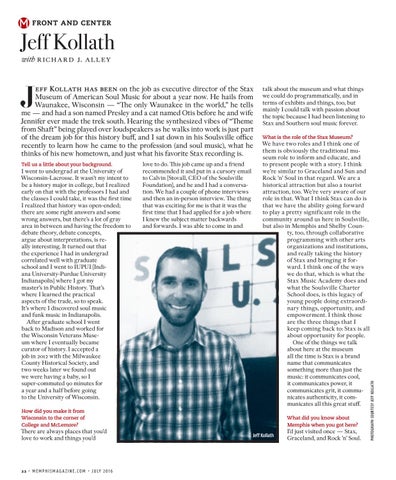
Jeff Kollath with richard j. alley
Tell us a little about your background.
I went to undergrad at the University of Wisconsin-Lacrosse. It wasn’t my intent to be a history major in college, but I realized early on that with the professors I had and the classes I could take, it was the first time I realized that history was open-ended; there are some right answers and some wrong answers, but there’s a lot of gray area in between and having the freedom to debate theory, debate concepts, argue about interpretations, is really interesting. It turned out that the experience I had in undergrad correlated well with graduate school and I went to IUPUI [Indiana University-Purdue University Indianapolis] where I got my master’s in Public History. That’s where I learned the practical aspects of the trade, so to speak. It’s where I discovered soul music and funk music in Indianapolis. After graduate school I went back to Madison and worked for the Wisconsin Veterans Museum where I eventually became curator of history. I accepted a job in 2012 with the Milwaukee County Historical Society, and two weeks later we found out we were having a baby, so I super-commuted 90 minutes for a year and a half before going to the University of Wisconsin.
love to do. This job came up and a friend recommended it and put in a cursory email to Calvin [Stovall, CEO of the Soulsville Foundation], and he and I had a conversation. We had a couple of phone interviews and then an in-person interview. The thing that was exciting for me is that it was the first time that I had applied for a job where I knew the subject matter backwards and forwards. I was able to come in and
talk about the museum and what things we could do programmatically, and in terms of exhibits and things, too, but mainly I could talk with passion about the topic because I had been listening to Stax and Southern soul music forever. What is the role of the Stax Museum?
We have two roles and I think one of them is obviously the traditional museum role to inform and educate, and to present people with a story. I think we’re similar to Graceland and Sun and Rock ’n’ Soul in that regard. We are a historical attraction but also a tourist attraction, too. We’re very aware of our role in that. What I think Stax can do is that we have the ability going forward to play a pretty significant role in the community around us here in Soulsville, but also in Memphis and Shelby County, too, through collaborative programming with other arts organizations and institutions, and really taking the history of Stax and bringing it forward. I think one of the ways we do that, which is what the Stax Music Academy does and what the Soulsville Charter School does, is this legacy of young people doing extraordinary things, opportunity, and empowerment. I think those are the three things that I keep coming back to: Stax is all about opportunity for people. One of the things we talk about here at the museum all the time is Stax is a brand name that communicates something more than just the music: it communicates cool, it communicates power, it communicates grit, it communicates authenticity, it communicates all this great stuff.
How did you make it from Wisconsin to the corner of College and McLemore?
There are always places that you’d love to work and things you’d
What did you know about Memphis when you got here?
Jeff Kollath
I’d just visited once — Stax, Graceland, and Rock ’n’ Soul.
PHOTOGRAPH COURTESY JEFF KOLLATH
J
eff Kollath has been on the job as executive director of the Stax Museum of American Soul Music for about a year now. He hails from Waunakee, Wisconsin — “The only Waunakee in the world,” he tells me — and had a son named Presley and a cat named Otis before he and wife Jennifer ever made the trek south. Hearing the synthesized vibes of “Theme from Shaft” being played over loudspeakers as he walks into work is just part of the dream job for this history buff, and I sat down in his Soulsville office recently to learn how he came to the profession (and soul music), what he thinks of his new hometown, and just what his favorite Stax recording is.
22 • M E M P H I S M A G A Z I N E . C O M • J U L Y 2 0 1 6
021_MM07_2016_FandC.indd 22
6/16/16 10:51 AM
That was early on in my deep dive into Southern music as a whole. My foundational music from where all else springs is the Allman Brothers. As I started collecting music, that’s where I learned about Muscle Shoals and FAME [Studios], learned about the guys that played in Macon. Sometime along the way, I picked up Dusty in Memphis. I bought the record, which is amazing, but that’s the first time I started paying attention to who played on which record and where it was recorded. When I was going out looking for records or trying to find new stuff to listen to, if it said FAME, if it said Muscle Shoals, if it said American, and if it said Stax, there’s a pretty good chance this record’s going to be good. After a year, what do you think of Memphis?
I like Memphis. There’s an authenticity here that people are drawn to. To me, it comes from the music and it comes from the art, and that’s what the people who come to Stax are coming for. It sounds cheesy, but it’s just a real place. Authenticity isn’t always clean and crisp, so a lot of places might run away from that, but I think Memphis is really starting to embrace that because I think that it’s an important part of the history. It’s an important part of the culture. What’s your favorite Stax exhibit?
Hall of Records. It communicates so much about Stax. It’s chronological by label so you can see the vision. You can see where they were headed business-wise, genre-wise, and musically. It became not just about R&B and soul records anymore, it became about becoming a fully formed, fully realized record company. I knew a fair amount, but there are records out there I still haven’t listened to and didn’t know existed until I started working here. And your favorite Stax recording?
Melting Pot. Booker T. & the M.G.’s.
the
I N N O V A Ta wI aOr dNs NOW ACCEPTING NOMINATIONS
B
usiness is pushed forward by change and evolution, and it is those in the forefront of that evolution — the tinkerers, the questioners, the visionaries — who keep the machine of commerce oiled.
But who are these people? We want to know. Send us your best and brightest nominations for our fourth annual Innovation Awards issue coming in October. Please include any pertinent biographical or business information, and why the person, business, or organization should be recognized as a leader among innovators.
Email your nomination to richard@insidememphisbusiness.com Deadline for nominations is July 15, 2016.
2016 VOTED BEST BBQ SANDWICH BY
MEMPHIS MAGAZINE
2249 Central Ave
901-272-9377 4375 Summer Ave
901-767-4672
DOWNTOWN LOCATION: 147 Butler Ave.
901-672-7760
Catering: 901-527-9990 WWW.CBQMEMPHIS.COM
J U L Y 2 0 1 6 • M E M P H I S M A G A Z I N E . C O M • 23
021_MM07_2016_FandC.indd 23
6/20/16 12:04 PM
OU T A ND A BOU T |
7.2016 | compiled by sam cicci
7.8 - 10
Cirque du Soleil
71st Annual Overton Park Junior Golf Tournament
Cirque du Soleil: Ovo
W
hen a mysterious egg appears in the insects’ habitat, it causes them to contemplate their life cycles through Brazilian-inspired music and amazing acrobatic feats. Dive into their majestic world as Cirque du Soleil takes you along for their latest thrilling performance. The Ovo, “egg” in Portuguese, fuels an energy of discovery through 10 acts designed to entertain the whole family. FedExForum, 191 Beale St., 205-2525; fedexforum.com
7.9
7.10 - 16
One of the South’s best live performance groups brings its new grooves to the Levitt Shell. With over 10 years of touring experience, and a sound that appealed to Prince, John Legend, and Michael Bublé, Sharon Jones sure knows how to tour. Countless time on the road playing venues and festivals hasn’t slowed them down, and the band is currently slated to release their fifth album, so get ready for some funk and support the Shell! As one of the few ticketed events, proceeds go towards the Levitt Shell’s annual fundraiser, STARS AT THE SHELL. Levitt Shell 1928 Poplar Ave.
Did you know that Broadway shows written by women are 18 percent more profitable than those written by men?
Sharon Jones and the DapKings
7.8 - 29
2016 Summer Movie Series
The Orpheum continues its excellent summer series with more film classics on Thursday and Friday evenings. Screenings take place at both the Orpheum Theatre and the Halloran Center, which means double the fun, with pre-movie activities that include themed drinks, a selfie-station, and musical performances. Show off your knowledge at movie trivia, and then experience an eclectic world of cinema, with selections such as Pan’s Labyrinth, Tootsie, North by Northwest, The Karate Kid, and more. The Orpheum Theatre, 203 S. Main Box Office: 525-3000; orpheum-memphis.com; or, Halloran Center. Please note venue when purchasing tickets.
Women’s Theatre Festival of Memphis
Based at the Hattiloo Theatre in Midtown, the Women’s Theatre Festival of Memphis brings together some great minds in theater from New York, Pennsylvania, Florida, the Carolinas, Arizona, California, Washington, DC, and Tennessee. Consisting of 34 performances, 6 workshops, and daily solo performances, the Festival is a must-attend for any aficionados of the stage. Hattiloo Theater 37 Cooper St. Tickets: 525-0009
7.15
Alabama Shakes
Fresh off two Grammy Awards, Best Rock Song for “Don’t Wanna Fight,” and Best Alternative Music Album for Sound & Color, Alabama Shakes bring their soulful sound to Memphis at the Mud Island Amphitheatre. Rising to prominence in 2010, the blues rock band recorded their first album in Nashville and toured extensively throughout the Southeast
Sharon Jones and the Dap-Kings
24 • M E M P H I S M A G A Z I N E . C O M • J U L Y 2 0 1 6
024_MM07_2016_Calendar.indd 24
6/20/16 2:11 PM
Venice Tile & Marble
showroom
3665 S. Perkins Rd. • Mon-Fri 8:00-5:00 Sat 9:00-1:00
901-547-9770 • venice-tile.com Walker Zanger • Ann Sacks • Sonoma • Artistic Tile
Photo courtesy of Walker Zanger
you make our work possible. Medical • Wellness • Outreach After 28 years, our mission is before breaking into the big-time with hits like “Hold On” and “Always Alright.” Don’t miss out on seeing one of America’s rising new acts. Mud Island Amphitheater 125 N. Front St. All tickets available through Ticketmaster.
7.22-8.13
“Fish”
Crosstown Arts hosts “Fish,” an exploration of a magical underwater world created by Laura Jean Hocking, Sarah Fleming, and Christopher Reyes. Using the artists’ experiences as both traditional and digital artists (sculpting, film, and more) “Fish” is a fully immersive exhibit that combines established video, audio, and sculptural practices with innovative technology. Crosstown Arts 422 N. Cleveland St. 507-8030
7.18- 20
71st Annual Overton Park Junior Golf Tournament
Once you’ve had your fill of talented professionals at the FedEx St. Jude Classic, get your fix by supporting the next generation of golfers. The Links at Overton Park are open to all kids age 6-17. The first day, athletes will be assessed by their ability, but for the rest of the weekend, let the games begin! Entry is $10. Overton Park Clubhouse 2080 Poplar Ave.
unchanged. Thanks to the generous support of Memphians like you, the Church Health Center will continue to improve the health of our community for years to come.
901-272-7170 | churchhealthcenter.org
7.29
Spillit Story Slam: Adventures and Travels
Everyone, says the Spillit organization, has a story to tell. But are you ready to tell yours? Spillit Story Slam is a verbal storytelling competition: ten contestants are drawn from a hat and each has five minutes of uninterrupted focus to share their tales. If you’re ready to talk, give your true, unscripted story your best shot. Amurica, 410 N. Cleveland St. spillitstories@gmail.com
12/11/2015 3:39:15 PM
MemphisMag_12.11.15.indd 1
Service You Deserve. Someone You Trust.
Patty Everitt, Realtor Relocation Certified and Fine Home Specialist Patty Everitt REALTOR
CRS, ABR, GRI, E-PRO, AHWD
968 Civic Center Dr. #103, Collierville, TN 38017 901-259-8500 Office | 901-487-7709 Cell Patty@PattyEveritt.com J U L Y 2 0 1 6 • M E M P H I S M A G A Z I N E . C O M • 25
024_MM07_2016_Calendar.indd 25
6/20/16 2:11 PM
A Voice for Jessica
An open investigation into the
murder of a young woman lingers into its sixth year as family and friends search for answers. by shara clark
MT. CARMEL PHOTOGRAPH BY NICHOLAS SCOTT HALL
026_MM07_2016_Jessica.indd 26
6/16/16 10:53 AM
“Some guys are here, in the back room. They’re talking about me,” Jessica Lewis told her mother, Susan Spence, in a panicked phone call. “I think something bad’s going to happen. I think they’re going to kill me.” “Who is? What’s going on? Let me come get you,” Susan insisted, frantic, unsure if this was another drug-induced, paranoid call from the daughter she felt she’d already lost, or, if this time, there was truth in her words. At 28, Jessica had suffered with addiction for a few years. She’d smoked methamphetamine and shot heroin. A North Mississippi native, she’d fallen in with a bad crowd from South Memphis, people who helped her get the drugs she needed to secure her fix. Her boyfriend, *Ramon (whom she never introduced to friends), kept her on a tight leash and encouraged her self-destructive habits. Her drug dealer, *Garvin, was a 40-something-year-old man who lived off Shelby Drive near Elvis Presley Boulevard in a house littered with guns, baggies of cocaine and meth ready to be sold, and vagrants using drugs. A kitchen freezer was filled with gallon-sized bags of pills. Armed men stood watch at the front door. Despite Jessica’s shift in scenery, she played it off to friends as though nothing was amiss. She thought she could walk away whenever she wanted. In the last year of her life, Jessica had been living between Ramon’s house in South Memphis and the Bellevue Inn, a motel at 1250 S. Bellevue near South Parkway. She’d told her mother she’d been given a free room in exchange for housekeeping. Susan didn’t know what to believe anymore — Jessica had been “gone” a long time. Susan had received many worrisome phone calls from Jessica over the past couple of years — saying she needed money or to be picked up from some sketchy part of town — but there was more urgency on the other end of the line this time. Jessica’s voice was tinged with fear. Susan heard a man bellow, agitated, in the background, “Who are you talking to?” “I’m talking to my mama!” Jessica responded with a defiant huff. A few mumbled words, some shuffling, then, “Mama, I’ve got to call you back.” Click. She wouldn’t return that call until the next morning. “Everything is OK,” Jessica said, as if nothing had happened. “Everything is fine.” They never spoke again.
Jessica’s high school senior portrait
* Some names in this story have been changed as to not interfere with an ongoing investigation.
J U L Y 2 0 1 6 • M E M P H I S M A G A Z I N E . C O M • 27
026_MM07_2016_Jessica.indd 27
6/16/16 10:53 AM
Jessica Lewis was murdered on February 20, 2011, just two weeks after that phone call. She was a daughter, a mother, and a friend — my friend. The autopsy showed signs of physical abuse: bruises and cuts and skinned knees. The cause of death: a gunshot wound to the head. Her body was found in Mt. Carmel Cemetery, an unkempt graveyard at Elvis Presley and Elliston in South Memphis. “Jessica’s gone,” Ramon told Susan in a phone call two days after the murder. “Gone where?” she asked. “She’s dead,” he said, and gave her the detective’s phone number. According to Ramon, Jessica had been missing for six days. But Susan felt like he knew more than he was admitting. Over the coming months and years, as the investigation lingered and then slowed, it would become increasingly clear that it wasn’t just Jessica’s addiction that precipitated her murder, but the lengths she went to obtain the drugs.
THE LOST GIRL(S)
T
Jessica Lewis was murdered on February 20, 2011, just two weeks after that phone call. She was a daughter, a mother, and a friend — my friend.
he first time Jessica sold her body for drug money could have her loved ones scarcely heard from her. been as early as 2007. In hindsight, While we were readying for the funeral, the signs were there, but back then, friends another local woman with a history of prosand family chalked her odd behavior up to titution, 44-year-old Rhonda Wells, met an drug use. all-too-similar fate as Jessica’s. She, too, died from a gunshot wound to the head, and her Her funeral was held Saturday, February body was discovered in the same overgrown 26, 2011. I hadn’t seen her since the fall of 2008, not long after she’d spent more than a month cemetery Jessica was found just four days earin rehab at a local recovery facility. Four years lier. In the following weeks, local television earlier, she’d started using methamphetamine news stories surfaced, sensationalizing the with the man who’d later homicides with headlines father her second child. like “Possible Serial KillWith him she delved into er Targeting Prostitutes” criminal activity, pawning and “Prostitutes Found stolen items (some from Murdered in South Memher own mother’s home) to phis Cemetery,” each time support their habit. Soon egregiously flashing the after, she entered a custody victims’ mugshots across battle over her first child TV and computer screens and lost — her son went with no measure of sensito live with his father and tivity toward the deceased stepmother. or their families. That was when I cut ties According to headlines, with her. Not because she these women weren’t was an addict (yet; at the daughters, mothers, sisters time, I didn’t know the — they were just “prostiextent of it), but because tutes.” If they had been I didn’t want to be around magazine editors, like myThe surviving 2011 victim, Katrina, the drug use, even socially. self, would their profession helped investigators create this I assumed it was a phase have been advertised withcomposite sketch of the suspect. she’d outgrow but was selfout consideration of other ishly too busy with my own details — namely that they life to do more than distance myself. I failed were human beings who were murdered? One thing that stood out from the fleeting to keep in touch with her and, like many close to her, was oblivious to where the last three news coverage was this: a pattern. Prior to Jesyears had taken her. It wasn’t until her viewsica’s murder, on January 27th, a “known prosing that I heard the word “prostitute” used to titute,” 31-year-old Tamakia McKinney, was describe my friend. She had been arrested at found dead in the middle of Hemlock Street. least twice for prostitution in Memphis, and News stations reported that another pros-
titute, Marnicia Shaw, was found murdered in a hotel room on Brooks Road on February 12th. Two days after the discovery of Wells’ body, a fifth would-be victim, a self-professed prostitute identified only as Katrina, was shot in the face, thrown from a car, and left for dead on Ledger Street. Katrina survived and was able to give police a description of the suspect. Each incident occurred less than a mile from Mt. Carmel Cemetery, an area not far from Graceland and a hotbed of criminal activity in Memphis. Soon, news coverage ceased, but families and friends of victims were left in the dark to grieve without much hope for closure. (Though investigators were responsive in the months after Jessica’s death, earlier this year when Susan called to check on the status of her daughter’s case, she was told that no notes had been made in her file since 2013.) Whoever took the lives of these women is still unknown. The wound opened again in 2015 when news surfaced of another woman with a history of prostitution, 25-year-old Juanita Gilmore, found dead on September 16th in Hollywood Cemetery, a plot of land adjoining Mt. Carmel, separated by railroad tracks. Gilmore had been stabbed multiple times, her body bludgeoned to the point of being almost unrecognizable. Known as a haven for drugs and prostitution by night, Mt. Carmel is deceptively peaceful by afternoon’s light. About three miles north of Graceland and as many miles south of the Stax Museum of American Soul Music, traffic flows along the cemetery’s east border on a strip of Elvis Presley Boulevard lined with boarded-up buildings. Neighborhood homes face the southern side of this graveyard where Tom Lee, the hero who saved 32 people from drowning in the Mississippi River in 1925, was laid to rest in 1952. In recent years, the cemetery has fallen into decrepitude, with tombstones sinking and crumbling and saplings growing through marked burial plots. The west end is bordered by the canopy of a small forest of tall trees. Just last May, the Memphis Police Department (MPD) was again called to investigate the cemetery after someone reported that it looked like existing graves had been disturbed or new graves had been dug. (The newest headstones I saw were dated 2001.) The search turned up nothing on this occasion, but sites like Mt. Carmel and Hollywood Cemetery merit patrol. According to Assistant District Attorney Olivia Brame, “cemetery killings” are extremely common. Many times, a killer will bury a victim right where someone else has already been buried. “They’re incredibly hard to find,” she says. “We may not even know about it.” Pointing to cases of local cemetery contin u ed on page 11 4
28 • M E M P H I S M A G A Z I N E . C O M • J U L Y 2 0 1 6
026_MM07_2016_Jessica.indd 28
6/16/16 3:25 PM
Š2014 Porsche Cars North America, Inc. Porsche recommends seat belt usage and observance of all traffic laws at all times.
Adrenaline shots. Now administered via ignition key. The rush is immediate. A 340-horsepower twin-turbo V6. Standard PDK double-clutch transmission. Active all-wheel drive with Porsche Traction Management for maximum grip in varying driving conditions. The new Porsche Macan S is built around our defining belief that every drive should be unforgettable. And every car should be a sports car. Discover a more adrenalized life with a test drive. Porsche. There is no substitute.
The new 2015 Macan S
Gossett Porsche 1875 Covington Pike Memphis TN 38128 (901) 388-8989 www.gossett.porschedealer.com
Porsche recommends
MM_FullPage_TrimSize_9x25_11x125.indd 1
6/13/16 10:10 AM
EDITOR’S NOTE: As Memphis magazine is now in its Fortieth Anniversary year, each month we are publishing stories from our four-decade archive, stories that we think today’s readers of the magazine will find of interest and value. This month’s selection, from our October 1980 issue, takes readers behind the scenes (and into the offices) of Mid-South Concerts, a tiny company operating out of a Midtown garage apartment, but one that was responsible for bringing some of the world’s biggest performers to Memphis. “Rock Around the Clock,” by freelance contributor Mark J. Davis, looked at the myriad details involved in booking The Who for a sold-out 1980 concert at the Mid-South Coliseum. Those were flush times for Mid-South Concerts, but they wouldn’t last. Company founder Bob Kelley, apparently depressed that his firm had lost its lucrative contract with the Memphis in May Beale Street Music Festival, and troubled by competition from other promoters, took his own life in 1998. Ironically, his former vice-president, Jim Holt, was named president of Memphis in May that same year (see sidebar on page 40), a position he still holds today.
1980 THE BUSINESS BACKSTAGE
THE MAN : Y E L BEH KEL I B ND O B
THE WHO CONCERT by m a r k j. dav is
S
hy hints of an April dawn filter through Bob Kelley’s bedroom curtains. It’s 5:30 a.m., and the telephone is ringing, waking up a man who usually sleeps until 7. Kelley recognizes the crisp New Yorkese on the line as belonging to Paul Smith, a booking agent for Premier Talent, Inc., which counts among its clients some of the biggest names in music: Jethro Tull, Bruce Springsteen, Boston, Van Halen, and The Pretenders, to name but a few. Smith has forgotten the difference in time zones between New York and Memphis and apologizes for calling at this hour. Then he gets straight to the point. His clients are mapping out a major summer tour and want Memphis on their list.
30 • M E M P H I S M A G A Z I N E . C O M • J U L Y 2 0 1 6
030_MM07_2016_40thFlashback_TheWhoConcert.indd 30
6/14/16 12:45 PM
Bob Kelley PHOTOGRAPH BY LARRY KUZNIEWSKI
030_MM07_2016_40thFlashback_TheWhoConcert.indd 31
J U L Y 2 0 1 6 • M E M P H I S M A G A Z I N E . C O M • 31
6/13/16 5:13 PM
Immediately, Kelley is wide awake, well aware that unlike most leg man, so to speak. At only 21 years of age, the intense but good-nashows, this one is a sure bet. By 5:33 a.m., it’s in the books: a rock- tured Holt has nailed down a job many men wait years for, and he takes and-roll legend, The Who, will play Memphis sometime in early July. it seriously. His office is as heterogeneous as his job. In one corner is a Kelley pulls himself upright in his king-sized bed and grins smugly pile of books, clothes, a picnic basket, and other unrelated items. There to himself. He’s wide awake, but he’s dreaming. The dream ends with are also an old-fashioned water cooler, a table-top refrigerator, a fancy a briefcase full of money. copying machine by the door, an ancient Adler electric typewriter, and As usual, the actual business day at Mid-South Concerts begins finally a small, efficient desk, complete with calculator, file folders, and around 9:30 a.m., with Jill Thornton unlocking a not-too-substantial a large calendar. Once a concert is booked and Kelley’s bet is on, it is door to a small four-room office which is little more than a converted Holt who puts the pieces in order. This morning, he and Jill share Kelapartment located over an old garage ley’s excitement over the booking of in the backyard of Kelley’s midtown The Who, knowing there is much to home. Once inside, she starts a pot be done before July 10. of strong coffee on a one-burner hot Upstairs, Kelley bids a good plate and lights an old space heater to morning to Frankie Watkins, the chase the last bit of winter’s lingering quiet 29-year-old business manager chill. The phone is already ringing, and of Mid-South Concerts, who dechances are that it is someone wantscribes herself as a “financial strategist” whose job it is to constantly ing to talk to Kelley, the 34-year-old revise the budget and cash flow of founder, owner, president, and “oddsmaker” of Mid-South Concerts, Inc., the company. A demure woman the busiest concert promotion firm in with a round and gentle face, WatMemphis. kins is not a rock-and-roll fan, but Around 10:30 a.m., after a quick she feels this is an asset in her job; breakfast shared with the morning it keeps her objective. Her office paper and the latest issue of Billboard magazine, Kelley — a tall, solid, adjoins Kelley’s and both are much neater than the ones downstairs. athletic type — dons a business suit of gym shorts and jersey and There is a small banner above Watkins’ closet door — a quote credited leaves the house for the 30-foot trek to “the office.” Old Sport has risen to Bertolt Brecht: “If there are obstacles, the shortest line between for the day too, and on the way Kelley, in a good mood, foregoes the two points may be the crooked line.” Watkins says this is Mid-South’s perfunctory pat-on-the-head in favor of a little chat with his “retired motto and business creed. rock-and-roll hound dog.” Once inside, he greets Jill and listens attenJust as you don’t walk into Vegas with a handful of promissory notes, tively as she recites the messages she has already taken this morning. neither do you promote rock-and-roll concerts with MasterCharge. The first call was from the road manager of a This is strictly a cash business, and as such, it offers many opportunities for unscrupulocal New Wave band wanting to impress Kelley with the potential his group has. Jill, who at lous practices. “I could walk out of here BRUCE BOYD OF CURTIS 23 possesses a poise beyond her years, knows with all kinds of money,” Watkins admits, that a call like this would only be a nuisance “and Kelley would never know it. I write the LIMOUSINES WILL PICK to her boss, and she’s tactfully promised to put checks, which he never sees, and I balance UP THE WHO EN TOUR AGE the young man on a call-back list. Everybody the books. Now, that’s not a good bookkeepAT THE A IR PORT ON wants to be a star. The young man’s name goes ing practice, and if a CPA firm came in here at the bottom of the list. they would not be happy with our system.” J ULY 9TH A ND DELIVER Thornton will handle anywhere from 80 to But Watkins points to her Southern BapTHEM TO THEIR HOTEL . tist background and the fact that she must 120 calls today; if there were a show tonight, IF FOR A N Y R E ASON A the number could easily go much higher. In the submit to a polygraph test periodically as DOCTOR IS NEEDED, course of a year, Mid-South Concerts, which safeguards. “I think Kelley checked me out regularly promotes shows in Little Rock, pretty thoroughly when he hired me,” she FOR TR E ATMEN T OR Jackson (Mississippi), and Nashville, as well says. “Kelley is a gambler, so I have to be the MEDIC ATION, DR. GEORGE as Memphis, will sweeten Ma Bell’s coffers level-headed one. In this business, accountNICHOPOULOS WILL BE to the tune of $14,000. The company’s four ing is not a major factor until the night of the principals sometimes seem oblivious to “office show — and then all Kelley wants to know AT THE BA ND’S SERVICE . hours” and are often available only by phone. is, ‘How much did I make?’” Much of Mid-South’s profits are invested The Who concert alone may require 30 or 40 in bank notes and bonds at First Tennessee long-distance calls to work out details, and Kelley promotes between 70 and 80 such shows a year. He will call Bank. They are good customers of the bank and have earned access New York on the WATS line this afternoon to clear with Paul Smith to unsecured, instant, short-term loans should an emergency arise, the tenth of July as the date for The Who concert. though that privilege has yet to be invoked. Such an “emergency” Before mounting the narrow stairs to his second floor office, Kelley would occur if Mid-South had a cash flow problem at the same time sticks his head into the next room to tell Jim Holt the news. Though that a “sure bet” concert such as the Rolling Stones came along — an “Vice-President” is Holt’s official title at Mid-South Concerts, he might offer that even a banker couldn’t refuse. From the offices of Premier better be called “Chief of Protocol and Technical Arrangements” — a Talent in New York, Paul Smith, who deals with promoters from
WHO TICKET PHOTOGRAPH COURTESY RON HALL
THE WHO CONCERT
32 • M E M P H I S M A G A Z I N E . C O M • J U L Y 2 0 1 6
030_MM07_2016_40thFlashback_TheWhoConcert.indd 32
6/13/16 5:24 PM
WHERE STYLE IS IN SEASON TENNESSEE TAXFREESHOPPING JULY 29 - JULY 31, 2016 H&M | Gap | Buckle | Express
4674 MERCHANTS PARK CIRCLE | COLLIERVILLE 901.854.8240 | ShopCarriageCrossing.com
MM_FullPage_TrimSize_9x25_11x125.indd 1 CCR-6216-A97D AD2 Memphis Mag August Issue.indd 1
6/6/16 8:523:02 AM PM 5/31/16
er
IN STONE
Aft
Be fo
re
CLEANING | SEALING | RESTORATION SERVICES . . . For All Your Stone Care Needs!
by Craig Brown, LLC
901-331-4435 Brick · Slate · Mex Tile · Crab Orchard · Blue Stone · Limestone · Marble · Granite · Concrete · and More!
across the nation, describes Mid-South Concerts in particular as “very solvent,” “tight,” and generally “copacetic.” In 1979, Mid-South Concerts alone grossed over $2 million. At last, Kelley settles into his own office, which is surprisingly free of the usual business clutter. On the wall behind his desk are four plaques, each with a gold-colored record and a message of appreciation for Kelley from the band giving it. Then there are the pictures. Pictures of some of the biggest names in entertainment — Linda Rondstadt, Bob Dylan, Dave Mason, Joni Mitchell, the Rolling Stones — some of them autographed. These are Kelley’s trophies — mementoes of some gambles he’s taken, and some “sure bets” he couldn’t let pass. It’s a demanding business, and among other things, he confides, it has already cost him a wife. “Yeah, it was the business,” he says. “I got so caught up in it, I lost the marriage, but I think I’ve sort of mellowed out some now.” His regrets, if he has any, are a well-kept secret. A radio dominates one corner of his office and he automatically flips it on FM-100 when he arrives. It stays on throughout the day, emitting a constant, almost subliminal strain of music, old and new. It’s one way Kelley keeps tabs on the musical “pulse” of the city. Perhaps the biggest reason rock stars go on tour is that tour exposure sells albums. Radio exposure, in turn, sells the tour. The amount of airplay a particular artist receives on local radio enters into calculating the chances for success should he want to “play Memphis.” So Kelley listens to the radio. “I’ve got to know who a band is and how the people in the area are receiving them to get an idea of their strength,” he explains. In the same corner as the receiver is a stack of music industry magazines — Rolling Stone, for example and “trades” such as Billboard. These are a promoter’s dope sheets and play their own part in the oddsmaking process. The successful promoter spends several hours a week studying the ups and down of both artists and their music, and industry trends in general. Dominating Kelley’s corner is a heavy wooden desk which could very well be government issue — army surplus, perhaps – perched on four old bricks to allow room beneath for Kelley’s linebacker legs. His chair — a high, ladder-back, cane-bottom job — completes an eclectic set. It is here that much of the “science” of concert promotion is practiced. Kelley learned his trade at Concerts West, a national promotion firm based in Dallas. He moved here about nine years ago to establish a company of his own. “Memphis is an up-and-coming market,” he says. “There’s a world of opportunity here, and I wanted to get in on some of it.” Mid-South Concerts also promotes some 30 to 40 shows a year outside the Memphis area — hence the “Mid-South” of its title. In New York and
34 • M E M P H I S M A G A Z I N E . C O M • J U L Y 2 0 1 6
030_MM07_2016_40thFlashback_TheWhoConcert.indd 34
6/16/16 9:24 AM
2016
Refresh. Refuel. Renew.
Social Hour Daily 11am–6pm REFRESH with our daily drink specials $5 well drinks, $5 house wine, beer specials & social plates perfect for sharing
Social Sunday Brunch REFUEL before the work week begins with our social Sunday brunch, made to order juices, smoothies, and special Bruch Cocktails. Sunday Brunch Menu served 11a.m. to 4p.m.
Summer Wine Dinners July 28, August 25 & September 22 RENEW - Heat up the summer romance or build relationships with friends & colleagues while enjoying Chef Ana Gonzalez’s specially created five course dinner expertly paired with wine $60 + tax and gratuity and seating begins at 6p.m.
Crafted Private Cocktails Wine Room REIMAGINED - drop in out of the bleu to try one of our hand crafted cocktails featuring seasonal ingredients, fresh herbs & fruit and house made syrups. Caribbean Rum Punch, Basil Martini, Bleu Steel, Sweet Tea Smash, Bourbon Carrot Mule and more.
REGALE your family, friends or business colleagues with a custom menu prepared by Chef Ana Gonzalez. Whether it be a Bridal Luncheon, Baby Shower, Business Meeting, or Reunion – BLEU is for YOU.
Hosting an event? Book Downtown’s best wine room for your upcoming breakfast, luncheon, reception, dinner, or special event. Call and reserve today. 221 S 3rd St., Memphis, TN 38103 | downtownbleu.com | 901.334.5950 for reservations Across from FedEx Forum in Downtown Memphis
COMPLIMENTARY VALET PARKING
MM_FullPage_TrimSize_9x25_11x125.indd 1
6/8/16 9:41 AM
California, Kelley’s associates describe him and his company as “very professional,” and “one of the major local promotion companies in the country.” While cities such as Atlanta, Mobile, and Orlando are often considered “risky” in the business, Memphis is becoming “an important city in rock-and-roll,” according to another agent at Premier Talent. Memphis promoters, he explains, are willing to support “unknowns” and the “progressive” new artists such as The Pretenders and The Knack when other local promotion companies haven’t the means or the inclination to do so. Says Kelley: “You have to give the people a little something ‘extra’ and something new and they usually won’t let you down.”
W
We believe that each new day is an opportunity to be embraced — especially for those living with Alzheimer’s disease or other forms of memory loss. Every day we offer fun and engaging activities such as painting and pottery sessions, as well as pet therapy and a variety of music programs, all at an affordable price. It’s through activities like these that we strive to provide your loved one a day full of purpose and fun while offering a much needed break for you. To find out how we can help you and your family seize the day and live it to the fullest, call 901-854-1200 to arrange a tour or visit pagerobbins.org. Page Robbins Adult Day Center 1961 S. Houston Levee Road, Collierville, TN 38017 Page Robbins, an independent 501(c)3 organization, appreciates your charitable investments.
ithin two weeks of Paul Smith’s early-morning phone call, Kelley has secured the concert date (July 10, 1980) from E. E.“Bubba” Bland, the Mid-South Coliseum manager, and cut the deal with Smith over the telephone. In the morning mail, Watkins has received the contract, which stipulates the financial details agreed to over the phone. The first thing she notices is that The Who are requiring double the usual amount of insurance. “You have to understand they’ve been very strict about that since ‘the stampede’ in Cincinnati,” she explains*. She calls Dick Burns of Cook-Treadwell and Harry Insurance to inform him of the date of the show and the additional insurance required. The second thing she notes is that the contract limits the promoter to a profit from the show of only 5 to 7 percent of the gross. This is not unusual for a band of The Who’s fame, and because of the almost guaranteed success of the show, it is an acceptable clause. The show will make around $130,000, so Kelley stands to make a minimum of $6,500 if he stays within his own budget. If The Who had not been the sure bet that they are, then Watkins and Kelley would have worked up a cost sheet before deciding whether to promote the show. Already available is a “Hotness Research” worked up on many groups by Jim Holt and held in file for just such occasions. For each group, record sales and local radio request levels are researched and the data used in the decision process. Kelley’s desk is littered with stacks of the sheets elaborately breaking down the cost elements of putting on a show: supporting talent, catering, stagehands, advertising, staging costs, forklift rental, electrical hookups, security, ticket printing and commissions, facility rent and staffing, royalties, insurance, and taxes. The promoter pays for everything but concessions, which is the exclusive domain * On December 3, 1979, eleven fans were killed and many others injured when the crowd rushed the stage during a Who concert in Cincinnati, mistaking a sound check for the beginning of the show.
36 • M E M P H I S M A G A Z I N E . C O M • J U L Y 2 0 1 6
030_MM07_2016_40thFlashback_TheWhoConcert.indd 36
6/16/16 10:48 AM
Injuries don’t clock out at 5 p.m. Just because you’re injured outside normal office hours doesn’t mean you have to make a trip to the ER. The specialists at Campbell Clinic are available to treat your breaks and sprains on evenings and weekends. GERMANTOWN Mon – Thurs, 5-8pm | Sat, 8-11am 1400 S. Germantown Rd. SOUTHAVEN Mon – Thurs, 5-8pm 7545 Airways Blvd. ©2016 Campbell Clinic P.C. All rights reserved. Campbell Clinic is a registered trademark of Campbell Clinic P.C.
MM_FullPage_TrimSize_9x25_11x125.indd 1 CAMP-0151 2016 PRINT 4M 10.125x12.75 AH-MM.indd 2
6/6/16 8:53 4/28/16 5:20 AM PM
Think OrthoMemphis
™
C O N G R AT U L AT I O N S T O O U R T O P D O C T O R S
R. JEFFREY COLE, MD
DAVID DENEKA, MD
RANDALL HOLCOMB, MD
MICHAEL NEEL, MD
Hand & Upper Extremity
Knee, Shoulder, Sports Medicine,
Knee, Shoulder, Sports Medicine,
Orthopaedic Oncology, Arthritis
Surgery, Adult & Pediatric
& General Orthopaedics
& General Orthopaedics
Surgery, Hip & Knee Reconstruction
MEMPHIS CLINIC
S O U T H AV E N C L I N I C
6286 Briarcrest Avenue | Memphis, Tennessee 38120
7580 Clarington Cove | Southaven, Mississippi 38671
901.259.1600 — main
901.261.7828 — urgent
M - TH: 8a-8p | F: 8a-5p — urgent care walk-in hours
care
901.259.1600 — main
901.261.7828 — urgent
care
M - F | 8a-5p — urgent care walk-in hours
Lauren Harkins Wiuff (901) 682-1868 (901) 859-3565 www.laurenharkinswiuff.com
of the host facility. Whatever is left over, if anything, is profit — cash profit. Likewise, any loss incurred is a cash loss. And losses do occur. Kelley reluctantly remembers Crosby, Stills and Nash in the Liberty Bowl in the summer of 1974 as his biggest loser thus far. “Bad karma,” he explains simply. “It just wasn’t the time for CSN in the stadium.” And in 1976, Mid-South made the grievous error of scheduling two rock groups, Heart and Yes, on the same night in different Memphis arenas; as a result, Heart, one of the hottest properties in the business, won’t even consider Mid-South as a promoter when in the area. “A real bummer,” sighs Kelley. On the other hand, there was the unlikely combination of the Mahavishnu Orchestra, a progressive jazz group, and the Marshall Tucker Band, a rather raucous Southern rockand-roll band, that proved quite a success when promoted on the same bill. “It’s all in how you play your cards,” says Kelley. And no two cards are the same. Attached to The Who contract is a “rider,” which is basically a document containing the artists’ instruction on how they want their show to be handled — the nitty-gritty technical aspects. The Who’s rider is 30 pages long, covering items such as stage size and placement, power requirement, T-shirt concessions, transportation to and from the show, food needs, and the number of stagehands needed to load and unload the trucks. It covers “everything” according to Holt, and in essence outlines the job he is expected to do. After determining the stage size and mixing console placement, and the number of chairs he can set up on the main floor, Holt has Watkins inform Martha High of the Coliseum box office of the number of tickets needed. The Who tickets are ordered from the Quick-Tick printing company of Houston. Watkins then calls Janis Habbaz, president of the Ticket Hub, so that she can prepare for the ticket distribution when they arrive about a month prior to the show. Habbaz is herself a product of Mid-South Concerts, having worked for Kelley for several years before taking over the Hub. She holds an exclusive contract with Mid-South covering all their ticket sales, and hers too is a lucrative business that involves an element of risk. The Hub gets a 5 percent commission on ticket sales with a minimum of $100 on the front end. “What people don’t realize is that tickets are money to me — literally,” explains Habbaz. For any given show, tickets are printed for the entire facility to be used. After culling a portion of the tickets for its own box office, the facility sends the rest of the tickets to Ticket Hub for distribution to its outlets. “The Hub has three outlets out of town and nine in town,” according to Habbaz, “and every ticket must be accounted for — any missing tickets will cost me the face value of the tickets.” A
38 • M E M P H I S M A G A Z I N E . C O M • J U L Y 2 0 1 6
030_MM07_2016_40thFlashback_TheWhoConcert.indd 38
6/17/16 10:28 AM
Score extra points with a sports physical now. No Appointment Necessary - $25 With the school year winding down, it’s the perfect time for your child’s sports physical. You’ll beat the back-to-school rush and know your child is ready to play. So gather your forms, make an appointment, and put yourself ahead of the game. Julie Carpenter, M.D. Board Certified in Family Medicine
Call 888-812-3672 to make an appointment today. memphisdocs.com/stayhealthy
MM_FullPage_TrimSize_9x25_11x125.indd 1
6/8/16 9:42 AM
single show may involve from 6,000 to 12,000 tickets, and if there are five or six shows being promoted simultaneously, which is not unusual, the potential for confusion is obvious. The risks are worth it, however, and in a year, the Ticket Hub and its outlets will have handled over half a million tickets. Assume an average ticket price of seven dollars — a very conservative estimate — and you’ve got a business turning over $3.5 million a year in Memphis. The next contact Holt makes is with Otis “Woody” Woodward, an earthy old gentleman who is the business agent for the International Alliance of Theatrical Stagehand Employees (IATSE). Woodward “knows the Coliseum better than anyone,” says Holt, and is in charge of all the work to be done there. “This union we have here in Memphis … is probably the best stagehand union in the country,” proclaims Holt. Bands often start their tours in Memphis because they can count on their show starting off with competent and professional equipment handling at the very least. A stagehand will make around $6.50 an hour setting up The Who concert and may work as much as a 16-hour day. Woodward will have received a copy of The Who’s rider well before the day of the show, and Holt leaves the Coliseum set-up almost completely in his hands. About the time that tickets go on sale a month before the show, Mid-South receives a letter from The Who organization requesting several bits of local information. In his reply, Holt supplies the following answers: The capacity of the Coliseum is 11,999. Showtime will be at 8 p.m., July 10th. Bruce Boyd of Curtis Limousines will pick up The Who entourage at the airport on July 9th and deliver them to their hotel. If for any reason a doctor is needed, for treatment or medication, Dr. George Nichopoulos will be at the band’s service. Horn and keyboard service may be acquired at Amro Music or Sound South, respectively. Recommended restaurants are Justine’s, Folk’s Folly, The Pier, and The Rendezvous. And finally, recommended hotels are the Hyatt Regency and the Holiday Inn-Central. The Who later choose the Hyatt from the list, but skip the nightspots and restaurants. On a Saturday afternoon about a month before the show, the Ticket Hub announces that tickets will go on sale the next day at noon. During that night, hundreds of kids jam the Hub’s parking lot, drinking, smoking, sleeping, and practicing the beer-can rowdiness which seems to be generally characteristic of rabid Who fans, most of whom are after the precious stage-front tickets. Within hours of the box office’s opening, most of the tickets are gone, although the show is not officially declared a sell-out until just hours before it is to begin. Over the course of the next couple of weeks, Holt spends more and more time on the tele-
JIM HOLT
T
he Who concert on July 10, 1980, was actually the second-biggest event of that week in the life of Jim Holt. It topped the Blues Brothers concert (same venue, two nights later), but served merely as a prelude to Holt’s wedding on July 13th (in New Jersey). But as a young events promoter, that summer blockbuster served as a career launching pad. “I moved to Memphis in June 1979, so was just a year into the concert business,” says Holt, today president of Memphis in May. “It was probably the biggest show at that point, stature-wise, we had done. The Who were just a notch or two below the Rolling Stones in terms of notoriety at that point in their career.” The show took place just seven months after the trampling deaths of 11 fans at a Who concert in Cincinnati. Did this weigh on Holt’s mind? “It was a different scenario,” explains Holt. “You had a lot of arenas back then that did generaladmission seating. Here in Memphis, it was always reserved seating. So that wasn’t a big issue, but that incident in Cincinnati changed a lot of venues around the country.” Holt laughs at the mere mention of the word sashimi. “I thought my career was coming to an abbreviated end,” he says. “I was responsible for all the elements necessary for the show. I didn’t even know what sashimi was 36 years ago. Assumed my caterer would be able to get it . . . and they told me they couldn’t. I was calling Japanese restaurants in Atlanta, St. Louis, Nashville.” So you could say The Who concert was a grand success for Holt — Roger Daltrey adjusted his dinner plans without complaint — before the first song was even played. Holt worked with Bob Kelley for 14 years and learned much from the founder of Mid-South Concerts. (Chief among the lessons: “Never trust a booking agent.”) He was working in Nashville in March 1998 when he learned of Kelley’s suicide. “He was the most important mentor of my entire career,” says Holt. “I remember being devastated when I got the call [about Kelley’s death]. I was in disbelief. He was going through tragic situations personally and there were some business challenges. He was in a dark moment. It was difficult to process.” Holt last saw Kelley over lunch at the Barksdale Restaurant in the fall of 1997. Later in 1998, he took the helm at Memphis in May, where he’s been ever since. — Frank Murtaugh
phone, tending to arrangements. He speaks to Dean Lotz, former pro football player and present owner of the Nautilus health club, about his “T-Shirt security force,” a group of 12 or 15 weight-lifters occasionally hired by Mid-South to supplement Murray Guard’s security force around the stage. With Chris Johnson of Seessel’s grocery he arranges an extensive supply of food and drink to feed everyone from technicians to stagehands on the day of the concert. The list looks like a menu for a battalion of junk food addicts: donuts, cookies, coffee, Coke. Holt then calls Leon Kreeger of the “Mr. Bourbon” liquor store to arrange delivery of two or three cases of assorted wines and alcohol to the performers’ dressing room on concert night. Then Jim Holt works on a couple of “extras” which he hopes will pay off in the future. He calls his friend Gary Strong, of the Malibu Grand Prix entertainment center, and arranges for delivery of a “Space Invaders” video pinball machine to The Who’s dressing room the day before the concert. He knows they’ll have some time to kill between equipment checks in the afternoon and wants them to have something to remember him by. A promoter has to think of these things. It was MidSouth Concerts, for instance, who provided the Rolling Stones with their own backstage swimming pool on that sweltering July 4th in 1975; and Jackson Browne with a half-dozen fertilized eggs for breakfast; and Van Halen with a box of M&Ms from which all the brown ones had been removed. For thinking of “extras” to satisfy a band’s quirks and passions, a promotional firm will be rewarded with an unofficial sanction to handle that band anytime they are in the area. Perhaps the best and most consistent “extra” is the contact that Holt makes about a week before the show. He calls on Mrs. Mable Winfrey to cater the band’s backstage meal. Mrs. Winfrey works out of a tiny kitchen in her South Memphis home, providing the stars with authentic home-style meals. She has impressed the likes of John Denver, Linda Rondstadt, Teddy Pendergrass, and Queen, and is said to make “the road” a little less lonely for those whose home it is. Everything has gone smoothly thus far, but about four days before the show, Holt is to run into his first major headache. The phone call comes from Delton Bass, who works with The Who’s road crew. A change had been made in The Who’s food rider, and Holt is reminded that band member Roger Daltry requires a Japanese dish prepared from raw fish called sashimi. This special request wouldn’t normally cause a problem, except that there is only one restaurateur in town who knows the dish, and he only gets it once a month — flown in fresh from Chicago. More disturbing is an evident shortage of bottled Bitter Lemon in Memphis, another
40 • M E M P H I S M A G A Z I N E . C O M • J U L Y 2 0 1 6
030_MM07_2016_40thFlashback_TheWhoConcert.indd 40
6/16/16 10:48 AM
“essential” part of The Who’s somewhat eccentric food requirements. Holt has neglected the two items, thinking them relatively easy to find, but with two days left until the show, he discovers that he is wrong. Panic sets in, for it is the lack of little details such as these that can negate all the good will a dressing room pinball machine will offer. For two days, Holt sweats out his oversight, aware that his reputation as an effective provider depends on one thing: raw fish.
hard rock shows.” One can imagine the good officer lining up his men sometime before the show like a bunch of fighter pilots before that crucial dog-fight, tapping his palm with a swagger-stick and addressing them as if they were his sons. “Men, this is going to be a tough one ….” And around 6:30 or so, they’ll solemnly file out to their posts, readying themselves for anything from some high punk brandishing a stiletto to intermission Frisbee-throwers gotten out of hand. The Coliseum’s security force is meant more to tage call at the Coliseum is be seen than heard tonight — a reminder at 8 a.m., July 10. Jim Holt has already that even rock-and-roll has rules. Still, the been here an hour, pacing back and affable Officer Downs insists, “Discretion is forth in the loading area like a man on trial the better part, you know, of valor.” for his life, his head still pounding with nightBy mid-afternoon, the sound and light mares of man-eating sashimi. The stagehands crews have gotten their equipment moved in are shuffling about, waiting for instructions and set up. The stage is now flanked by two from boss Woody. The IATSE has some 35 mammoth banks of flat-black speaker cases fulltime members in Memphis, and about in every size, as if shielding it from enemy half of them are here this morning, looking fire; of course, in the end, these battle-scarred like refugees from some father and son wil- wooden boxes will be The Who’s ultimate derness camp. Woody gathers three or four weapons tonight. The light-rigging men are of them in a small swinging from a huddle around him truss about 20 feet and mumbles for a above the stage like while, apparently a couple of nimble HOLT H AS NEGLECTED monkeys, weaving giving assignments TWO ITEMS A ND PA NIC together hundreds to different work SETS IN. IT IS LIT TLE crews. They finally of feet of heavy-duDETA ILS LIK E THIS break, and assemty electric cable. T he e qu ip m e nt bling their crews, set TH AT C A N NEGATE A LL to work like a colony crew in general is a THE GOODWILL TH AT A of converted drones. hard-looking bunch DR ESSING ROOM PINBA LL But the platform of fellows, road-weathey erect over the ry, tattooed, and reM ACHINE C A N OFFER. next couple of hours sembling a gang of is sturdy enough to modern-day pirates. support a whole herd They’re an existenof Cadillacs, and slowly it becomes obvious tial lot, calmly flirting with death — “the how they have earned the praise of their big bang,” they call it — every day. Some of peers. Sometime later, in fact, one of The that cable is as thick as a man’s wrist and Who’s seasoned road crew, a pot-bellied Yul will handle eight or nine hundred amps, and Brenner in a ten-gallon hat, allows simply, according to one real skinny guy with hideous “Damn nice stage here … real solid. Gonna do scars all the way up his right arm, “that ain’t some rockin’ on this baby.” Then the bald man no tickle.” of few words spits on a narrow apron behind a As the afternoon wears on, and the difstack of wood, rubbing the spot away with the ferent systems are being cranked up, the toe of his boot. By noon, stage construction is “sound” of electricity issues from the speakfinished and the stagehands break for lunch. ers assembled on stage. One of the sound Jim Holt has logged about five miles back at men calls it “the Buzz” — a sign of a bad the loading dock, and The Who’s roadies and connection somewhere. At the huge mixing console on the main floor, a tall boney fellow equipment men move into action. Out on the main concourse, north, Bub- is manipulating a whole wall of color-coded ba Bland and Officer Charles Downs, chief switches, trying to find the right combination, of Coliseum indoor security, have been and cursing into the intercom leading up to watching late ticket purchases much of the the stage. A reporter gets too close, and the morning. Downs, whose rather laid-back sound man casts a chilling sidelong glance demeanor seems out of place in a uniform, his way and hunches over the board as if to is determining what kind of show, or more protect it from prying eyes, muttering some specifically, what kind of crowd to expect veiled threats about how he’d like to “break tonight. “Some kids come in here so high at somebody’s face.” He returns to the matter at noon, you know they’re going to be trouble hand and orders a new cable for the left bank at 8. But that’s mostly for those, you know, of speakers. It’s getting close to 5 and activity
S
Horseshoe Lake 30 Minutes from Memphis
Lake Front Homes • 215 Lake Estates Drive $99,000 • Pecan Circle 38’ lakefront lot $60,000 • Pete Strieff Boat Launch 50’ lakefront lots $79,000
• 2773 Horseshoe Circle 2BR, 2BA $397,000 • 2791 Horseshoe Circle 3BR, 2BA $295,000 • 11807 Horseshoe Circle 3BR, 2.5BA $599,000 • 200 Pecan Circle 2 BR, 1 BA, $95,900 • Several Condominiums Available $139,000 • 190 Pecan Circle Lakefront Home 3BR, 3BA $295,000
• 1371 Horseshoe Circle 5BR, 4BA $449,000 • Bonds Landing New 2br 2ba cabin $189,000 • 2579 Horseshoe Circle 3BR 2BA, pier $349,000
• Bream Road 100’ lakefront lot $189,000
Outdoor Properties, LLC Joey and Pat Burch
501-454-1782 www.outdoorproperties.com
HAPPINESS GRANTED. The Clinic of Plastic and Reconstructive Surgery, P.A.
CELESTE LaCHAPELLE, B.S., R.N. Nationally recognized as a leading injector of BOTOX®, Dysport®, Perlane L®, Juvederm XC® V O L U M A™ X C
1000 Brookfield Road, Suite 100 Memphis, TN 38119 Ph. 901.765.4700 Fax 901.685.2717
J U L Y 2 0 1 6 • M E M P H I S M A G A Z I N E . C O M • 41
030_MM07_2016_40thFlashback_TheWhoConcert.indd 41
6/21/16 12:45 PM
DESOTO FOOT CARE & PEDI-SPA 9065 Sandidge Center Cove • Suite C Olive Branch, MS
Dr. Carla A. Martin is caring and compassionate with her holistic approach to healthy beautiful feet. Complete care for your feet, both medically and cosmetically.
Dr. Carla A. Martin Podiatrist
(662) 893-0533
www.MyDesotoFootCare.com
Landau
Group Programs Your Image, Made Better. •
Wide selection of inventory in brands, fabrics, styles, and sizes
•
Personalized on-site service includes consultations, fittings, and delivery
•
Value Adds - embroidery, monogramming, and alterations services
For more info please call our Outside Sales Department 901-523-9655
Locations: Cordova
Trinity Commons
Germantown
The Shops of Forest Hill
Midtown
Medical Center
is getting feverish. Hookup men are swarming around the stage and in the wings there is a comment about the top blowing off the Coliseum if things don’t cool down. It sounds serious. Real or imagined, there seems to be a pressure building, like when you go up to a mountain and can’t pop your ears. Showtime is imminent. Backstage, life is just as hectic. Already, unused equipment is being rolled into place for the “load out” at the end of the night. In the middle of it all is a tall black guy in a doctor’s O.R. smock, stethoscope, and swimming trunks. He’s smoking a huge stinking cigar and roller-skating back and forth between two backstage gates. No one seems to pay him much mind. But the crew here seems leery of anyone not in their club snooping around asking questions. There is an ante-world of the promotion industry that is not usually visible even to those who might be right in the middle of it. Whether that is a calculated coverup or not is hard to tell, but even Kelley, who has been here twice already today, assumes a low profile — slipping in, checking signals with a still-nervous Jim Holt, and ever so quietly slipping back out when satisfied that everything is okay. Outside, the same crowd that littered the Ticket Hub with the detritus of rock-and-roll addiction is at it again. Says a blank, smiling, sad-eyed youngster on whom an appeal to reason would be wasted now, “It’s gonna be The Who, man. It’s gonna be heaven.” MidSouth Concerts has brought the people what they want. Back on the main floor, “The Buzz” continues. Tempers won’t stand up much longer in this tension, and the profanity increases proportionally with the feedback. When the new cable is finally installed, the sound man delivers a short, all-but-prayerful directive: “Plug it in and see what happens.” Success is what happens, and he can’t help flashing a little smile — albeit an evil-looking one — for the place is quiet at last, and his job is all but over until showtime. Almost immediately it seems as if someone has opened a door somewhere and vented a little of that pressure. And if the final equipment check goes smoothly, maybe the top won’t blow off after all. It’s safe now, and Ray Moore dispatches his small army of usherettes to start popping down the folding seats — about 12,000 of them tonight — with a skill that only practice brings. The time is 5:45. Six p.m. is dinner time, and it’s Mrs. Winfrey to the rescue. The menu tonight includes country-fried steak, peas, squash, salad, and cornbread. For 15 precious minutes, the only sounds backstage are smacking lips and contented groans. After a resounding belch, the Yul Brenner of the West shakes his naked head: “Mable, this stuff is dynamite.” After dinner, the atmosphere is decidedly more re-
42 • M E M P H I S M A G A Z I N E . C O M • J U L Y 2 0 1 6
030_MM07_2016_40thFlashback_TheWhoConcert.indd 42
6/15/16 9:02 AM
laxed. From The Who’s dressing room comes the “blip, blip, beebeep” of the Space Invaders, and by 7:45, Mrs. Winfrey and her assistants are just “trying to pack it up and get it out.” Sitting crouched in a small closet in a hallway directly behind the stage is a guy named Jim. Fifty-ish, with that lean and hungry look that seems to prevail among these people, he’s a Coliseum electrician and his sole duty tonight is to raise and lower the house lights when given the cue over the headset he wears. He’s hunched over a tattered copy of Lady Chatterly’s Lover, silently mouthing the words as he reads, oblivious to the activity around him. At 8, the cue comes, Jim does his job, and the show is on. The Who rushes the stage as if running from Death itself. Outside in the halls, the elderly ticket-takers adjust the cotton in their ears while inside, the fans crawl like some huge animal closer and closer to the stage, and perhaps to the brink of deafness. This is “the test,” and a sell-out crowd proves success. Even Jim Holt is here, in a fine mood, for he has just been told that after sashimi every night for the last three weeks, Roger Daltry is sick of it anyway. The pressure is on The Who, now. Somewhere near the end of the show, Kelley, Watkins, and a clean-cut man who speaks with a thick English brogue and carries a briefcase meet in the subdued light of the Coliseum boardroom. The man is known to Mid-South Concerts only as “Regis.” Faint smiles flicker across the faces of the three while cost sheets, invoices, and contracts are checked for accuracy one last time. Everyone satisfied? Only a gentle nod — but it tells the story. Bart Maverick could appreciate this. These are the trappings one might expect to find at a gentleman’s game of chance — silver jewelry, manicured hands, fine clothing. There is thick carpet, leather chairs, and paneled walls. There are cigars and low lights and a cool quiet word. And there is money — lots of it … more money than many men see in a year. This is the Payoff. Kelley hands a pile of cash to the mysterious tour accountant, who puts it in his briefcase and then leaves as quietly as he came. Kelley will count his later. Now, as the cigar in the ashtray struggles for its last breath, Bob Kelley simply sits back and chuckles to himself … a chuckle that any winner could understand.
Purposefull.
The Farms at Bailey Station is coming. And, along with it, unparalleled opportunities to live better, fuller and with a sense of purpose as never before. Enjoy the perfect balance of city and country life as you cultivate new friendships with likeminded individuals. Make an appointment to learn more. Call (901) 328-4850 today. 10013 Grand Central Circle East, Collierville, TN 38017 (901) 328-4850 | thefarmsatbaileystation.com
Mark J. Davis was a frequent contributor to Memphis magazine in the early 1980s, introducing readers to life at Southland Greyhound Park and taking them inside this city’s old pool halls. He also explored issues within the Memphis Fire Department and profiled polititian Minerva Johnican. After a 20-year stint in IT management with a major athletic wear company, he now serves as editor/publisher of a small denominational magazine based in Memphis. J U L Y 2 0 1 6 • M E M P H I S M A G A Z I N E . C O M • 43
030_MM07_2016_40thFlashback_TheWhoConcert.indd 43
6/17/16 1:58 PM
COLTON
(THE BEAR)
WYLDER
( THE WOLF)
44 • M E M P H I S M A G A Z I N E . C O M • J U L Y 2 0 1 6
044_MM07_2016_Triplets_v2.indd 44
6/20/16 1:30 PM
the
BEAR the WOLF and the LION
Chronicles of a Modern Miracle IDENTICAL TRIPLETS
I
by cara ellen modisett
t was midnight on November 8, 2014, when Jennifer Hall’s water broke. This was not part of the plan. The plan was: hospital at 25 weeks, C-section around 34. This was week 30, and Leo had other ideas.
Never mind that Leo was a 2-pound infant sharing a placenta
with his two brothers who didn’t weigh much more than he did. The whole family — Jennifer, her husband Ashton, and their
LEO
( T HE LION)
PHOTOGR APH BY L ARRY KUZNIE WSKI
044_MM07_2016_Triplets_v2.indd 45
three unborn sons — had traveled halfway around the world in preparation for the triplets’ arrival.
J U L Y 2 0 1 6 • M E M P H I S M A G A Z I N E . C O M • 45
6/20/16 3:00 PM
the BEAR the WOL Fand the LION “No one wanted to see the babies come out that early,” says Jennifer. She’d been more uncomfortable for several days and it turned out she’d been in labor. No one knows how long. “I was really frantic and panicked and worried and crying,” she says. “Leo was ready. No one else was ready. My heartbeat was racing.” It wasn’t their first carefully laid plan to go awry. Jennifer and Ashton were in the Philippines getting ready to relocate to London when Jennifer, feeling nauseated, exhausted, and “really cranky,” took a pregnancy test. “I thought I was probably pregnant because what else does that to you? Besides malaria.” She was right. Still, she sensed something was different and she wondered if she might have twins. A few days after arriving in London, she and Ashton made their way to obstetrician Dr. Donald Gibb. “’There’s a heartbeat,’” Ashton remembers the technician studying the sonogram. “’There’s a heartbeat.’ “Then the lady goes — ‘oh.’ She waits 10 seconds … she tears up and says, ‘There’s three.’ “They called the doctor in from a lecture. We were there for about four and a half hours.” Gibb explained the rarity of the pregnancy — “it’s almost unheard of” — identical triplet boys sharing the same placenta. In fact, Ashton and Jennifer only know of two other sets of identical triplet boys in the world. Jennifer, originally from New York City, and Ashton, born in Colorado, met in Bali, where Ashton was working as a chef and Jennifer was food and beverage director for the same resort. They had moved together to the Philippines and had gotten married in 2013. “We were dating for seven months, we were married for seven months, we were pregnant for seven months,” says Jennifer. They both wanted big families and to continue to live abroad. Following the Philippines, Ashton had an opportunity to open a restaurant in New York City. In preparation for that, they moved to London. After that they would be headed to the Middle East, then Miami, then New York in about 9 months time. Jennifer’s pregnancy — and the rarity and risk of her pregnancy — changed everything. “At least half of London knew we were having triplets,” says Ashton. But they had to make a decision. Gibb told them Jennifer
would need care, and that this would be a difficult journey. Their two best options — one: New York City. Two: Memphis, Tennessee, and the Sheldon B. Korones Newborn Center and Neonatal Intensive Care Unit at Regional One Health. Specifically, Gibb said go to Dr. Giancarlo Mari, professor and chairman of the Department of Obstetrics and Gynecology at the University of Tennessee Health Science Center. He and his team of medical professionals were doing groundbreaking work in research and practice, in particular with high-risk pregnancies. His main office is at Regional One, though he also works at Le Bonheur, Baptist, and Methodist. They knew they would have lots of doctor appointments — twice a week, and a longer
one every two weeks — as the babies and Jennifer were monitored. “You’re going to be really heavy,” Jennifer says she was told. “You’re not going to want to walk a lot.” Finding an affordable apartment with room for three children would be difficult. And launching a new restaurant while going through a difficult pregnancy, birth, and new parenthood … “New York just didn’t make a lot of sense.” There was one more good reason to go to Tennessee: Ashton’s parents. They had moved to Germantown nine years before — his father, Stephen L. Hall, was general manager of Ridgeway Country Club. His sister, Valarie Hall, was a sous chef there (cooking runs in the Hall blood, but more on that later). Memphis it was.
J
ennifer and Ashton arrived in Memphis in June, and after a lot of phone calls were able to get an appointment with Mari. When Jennifer was at 12 weeks, she came in for another sonogram and to make a plan. “Often these pregnancies have problems,” says Mari. “One baby may die in utero.” If that happens, there is a 20 to 25 percent chance that others will develop neurological complications such as cerebral palsy. “Sometimes these complications can be for the entire life.” Another risk is twin-to-twin transfusion syndrome, when blood f low from one baby reroutes to the other two — a complication Mari and his team have done a great deal of pioneering research on. “I think it’s one of the most challenging cases that an obstetrician can have. When we have patients like Jennifer, we become a team. It’s very important that they can call me anytime — I give them my cell phone number — I’m 24 hours available to them. And we worked very, very well together.” Mari was straightforward about what they could expect. It was important, he says, to “tell them up-front what could happen in the pregnancy. These are the possibilities in this pregnancy — hopefully these will not happen. “I think that everything has to be up front, in such a way that there are no surprises. “I knew it was not going to be easy,” continues Mari. “In a certain way I was glad that I was dealing with them … but I knew that it was a pregnancy that could potentially have many complications.” But in the end, it is simple: “This is my job, and this is what I do.”
M
a r i ’ s c a r eer c om bi n e s practice — he estimates he’s delivered more than a thousand babies during his career so far — with research and education, particularly through his work at UTHSC, which trains many of the doctors working at hospitals and practices throughout the Memphis area. “We are the only center that trains doctors who are obstetricians and gynecologists to become specialists in high-risk obstetrics,” says Mari, whose own training is from the University of Naples in Italy
46 • M E M P H I S M A G A Z I N E . C O M • J U L Y 2 0 1 6
044_MM07_2016_Triplets_v2.indd 46
6/20/16 1:30 PM
PHOTOGRAPHS COURTESY HALL FAMILY
J U L Y 2 0 1 6 • M E M P H I S M A G A Z I N E . C O M • 47
044_MM07_2016_Triplets_v2.indd 47
6/20/16 1:30 PM
and from Yale University. He’s practiced on three continents — Europe, Asia, and the United States. From the beginning, the focus of his work, research, and practice has been the fetus and the mother. He recalls that when he started his studies, “we did not know much about the fetus. At that time the fetus was not considered a patient yet, because it was unreachable.” Fetal medicine was beginning to develop as a field. “I traveled to London — I was in Rotterdam in the Netherlands — and [in London] were some of the top centers for fetal medicine in the world at the time. “It was in 1985 that I had the opportunity to start research with a new tool that became available to obstetricians.” That to ol was Doppler ultra-sonography. Ultrasound made it possible for doctors to finally see and study the unborn fetus. “The reason why I came to Memphis is this: The infant mortality was extremely high,” says Mari, and he saw that there was a gap in the sort of medical care that could change that. “When people talk about infant mortality, they think that the pediatrician deals with that.” But in fact, infant mortality “starts with the pregnancy and sometimes before the pregnancy. It is not just a pediatric issue.”
W
e never entertained the thought that something was going to go wrong,” says Ashton. The question arose: What if one is at risk? Do you sacrifice him for the other two? “That conversation was very quick, and poignant.” The answer: “We’re having three kids.” In the first ultrasounds, the boys looked like “butterf lies,” Jennifer says. “I guess that around 15 weeks they started budding out a little bit. They lost their tails, a tadpole before it becomes a frog. You can see little
Why move to Memphis, Tennessee? The Sheldon B. Korones Newborn Center and Neonatal Intensive Care Unit at Regional One Health. Specifically, Dr. Giancarlo Mari, chair of Obstetrics and Gynecology at the University of Tennessee Health Science Center.
hands and things. “And then it got really cramped. They never slept. They were constantly moving.” Ashton talks about the boys’ personalities, which became clear long before they were born. “We got to know our boys in utero.” He and Jennifer even named them in utero. “Once they were large enough,” says Ashton, “they established their little homes.” Each one was situated in his own spot inside Jennifer’s body. Wylder: “He was dancing … or punching Colton.” He “lived low” in Jennifer’s belly. “Without question Wylder is wild, the climber, absolute extremes — he’s either the happiest or the lowest.” Colton goes by his middle name, Bear. “He lived in the midd le ,” s ays A shto n . “Every once in a while he’d wake up,” push the other two boys apart. Now a year and a half old, “Bear is just a pure, physical being — he runs at you to hug you and nearly knocks you over … he will growl at you, and will lovingly growl at you.” Leo, the smallest, the one who decided it was time to be born nearly a month early, “lived right up here,” says Ashton, pointing to a spot under his own right shoulder. “We wanted him to have a good, strong name.” His middle name, Robert, is after Ashton’s grandfather. “Leo is absolutely so strongwilled, if he wants to do something there is no stopping him. “He is also the brains.” At eight months he figured out how to work the fastenings on his overall and how to get through a three-step security gate. “We have a lion, a bear, and a wolf,” says Ashton. “And Jennifer’s a Scorpio. I’m the lone Libra trying to keep everyone happy.”
PHOTOGRAPH BY LARRY KUZNIEWSKI
the BEAR the WOL Fand the LION
48 • M E M P H I S M A G A Z I N E . C O M • J U L Y 2 0 1 6
044_MM07_2016_Triplets_v2.indd 48
6/20/16 3:13 PM
L
eo, Wylder, and Colton (Bear) were born at 4 a.m. on November 9, 2014. Wylder spent the next 30 days in the Neonatal ICU; Bear, 31; and Leo, the next 60. Today, the five Halls live in a house in Bartlett. Ashton, who learned how to be a chef from his father, following him around kitchens as a boy and as a teenager, is working with his father again — in 2014 he was hired as executive chef at the Ridgeway Country Club. The boys, as we go to press, are 19 months old. Amazingly, they are all now in normal height and weight ranges — Leo still a little smaller, 24-and-a-half pounds to Wylder and Bear’s 27 and 27-and-a-half pounds. They’re all within a few inches of three feet tall. Wylder is still dancing, Bear is still pushing, Leo is still strong. The boys love water and books and fuzzy blankets, and their nursery with its three beds and leather recliner. And they’re plenty active. “When they started crawling, everything went up,” says Jennifer. “Once they started climbing, everything went in the garage. “Bear is taking his clothes off right now, and he thinks it’s hilarious. Leo’s always the first one to do something. He’s about three
THE SHELDON B. KORONES NEWBORN CENTER AND NEONATAL INTENSIVE CARE UNIT AT REGIONAL ONE HEALTH
A
graduate of the University of Tennessee, the late Dr. Sheldon B. Korones founded the city’s first neonatal ICU in 1968; the current center at Regional One Health now bears his name. Since its foundation, what is now the Korones Newborn Center has treated over 45,000 premature babies, including the Hall triplets, born there in 2014. Since 2009, Dr. Ramasubbareddy Dhanireddy has served as the center’s medical director. He’s also medical director of Le Bonheur Children’s Hospital NICU and is Sheldon B. Korones Professor of Pediatrics, Obstetrics and Gynecology at UT. “When I came [to Memphis],” says Dhanireddy, “[Korones] was still here; I believe we overlapped at least three years,” Dhanireddy says. “I have tremendous respect for Dr. Korones; in fact, that’s what attracted me to come to Memphis: the fact that I would follow in his footsteps. He was a pioneer.” That balance of research, practice, teaching, and sense of mission are part of what has made Memphis a center for perinatal and neonatal care, and what prompted a London doctor to send the Halls here. Research conducted by Dr. Giancarlo Mari (the Halls’ obstetrician) and his colleagues has helped improve neonatal medical treatment around the world. For example, “many fetuses in the past died due to unnecessary and risky procedures used to diagnose fetal anemia,” says Mari. Today, because of their research, doctors around the world use ultrasound for diagnosis as a result of a paper the team published in the
January 6, 2000, edition of the New England Journal of Medicine. “Now the entire world uses the technique we have developed,” says Mari. “Sometimes [good] things happen, and I was lucky enough to have that happen.” “The advances we’ve made in the last 38 years are tremendous,” says Dhanireddy. When he was in
Dr. Giancarlo Mari training, for example, a baby born weighing less than 1,000 grams (a little more than two pounds) was nonviable; the only treatment, sadly, was compassionate care. Over that period, mortality rates for 1,000-gram “preemies” have dropped from 100 to just 5 percent. Today, Dhanireddy sees the Korones Newborn Center’s work as vital. “When you save a newborn baby, you save 70, 80, 90 years,” he says. “We need to protect and improve the future of our newborns and children so that, as a nation, we have a brighter future.”
PHOTOGRAPH BY AMIE VANDERFORD
A
s Jennifer’s pregnancy progressed, she was consuming 4,500 calories a day and staying as active as she could. In early October she was admitted to Regional One to be observed until her scheduled C-section in December. “They are angels,” says Jennifer of the staff. “They treat your kids like they’re theirs. They pick up the phone at any hour of the day or night. We didn’t have any major hiccups.” Until November 8th, when her water broke, at just 30 weeks and six days. “They did a quick ultrasound to see who it was,” she says. Leo. The medical staff wasn’t completely surprised, saying, “He gives us trouble all the time!” “They put up my side rails and put me on an elevator,” says Jennifer. They whisked her away to labor and delivery and worked on slowing down the contractions. “So, we’re going to have some babies,” was Mari’s announcement.
J U L Y 2 0 1 6 • M E M P H I S M A G A Z I N E . C O M • 49
044_MM07_2016_Triplets_v2.indd 49
6/20/16 1:30 PM
PHOTOGRAPH BY LARRY KUZNIEWSKI
the BEAR the WOL Fand the LION
50 • M E M P H I S M A G A Z I N E . C O M • J U L Y 2 0 1 6
044_MM07_2016_Triplets_v2.indd 50
6/20/16 1:31 PM
PHOTOGRAPHS BY LARRY KUZNIEWSKI PHOTOGRAPH BY LARRY KUZNIEWSKI PHOTOGRAPHS COURTESY HALL FAMILY
pounds lighter than the other two — he doesn’t eat a lot. He likes avocados and he likes cake. He’s not a big fan of meat,” so she mixes chicken with quinoa, mashed potatoes, or rice. “Wyld is such a funny little clever guy. He loves to sit in things.” How are their parents? “They’re my first children. I have no point of reference,” says Ashton. “You settle into varying degrees of exhaustion. There’s the giddy exhaustion, there’s the near-tears exhaustion, there’s the eyes-hurt exhaustion. It is nonstop, and my wife is just amazing.” “You mix up words, you forget what time it is,” says Jennifer. “It’s wild, it’s a whole lot of fun watching them grow. I feel so lucky that I was allowed to be part of their life. As far as brushing hair and having clean clothes, that’s all secondary.”
“You settle into varying degrees of exhaustion. There’s the giddy exhaustion, there’s the near-tears exhaustion, there’s the eyes-hurt exhaustion. It is nonstop.” The Halls focus on structure, on a nurturing, safe environment, on good food, and time outdoors. Ashton, when he looks at the boys, sees “happy, just happy. They’re funny. I see Jenny’s best qualities — in the pure, unadulterated love of all of them — they are just love. I see all the potential in the world, the three of them together — what couldn’t they do?” There’s still monitoring to do — autism could still show up, and they’re watching for that until the boys turn three. But they are healthy. “We haven’t even had an ear infection,” says Jennifer. “I think the last time when I saw them was when they were a year old,” says Mari. “It was their birthday party. They are beautiful.” He laughs slightly to himself. “When we have this kind of success, we feel worth for what we are doing. There are no words that can explain what you feel.”
J U L Y 2 0 1 6 • M E M P H I S M A G A Z I N E . C O M • 51
044_MM07_2016_Triplets_v2.indd 51
6/20/16 1:31 PM
www.uthsc.edu
The University of Tennessee is an EEO/AA/Title VI/Title IX/Section 504/ADA/ADEA institution in the provision of its education and employment programs and services.
MM_FullPage_TrimSize_9x25_11x125.indd 1
6/13/16 10:05 AM
MEMPHIS TOP DOCTORS FOR 2016 Castle Connolly Medical Ltd. is a healthcare research and information company founded in 1991 by a former medical college board chairman and president to help guide consumers to America’s top doctors and top hospitals. Castle Connolly’s established nomination survey, research, screening, and selection process, under the direction of an MD, involves many hundreds of thousands of physicians as well as academic medical centers, specialty hospitals, and regional and community hospitals, all across the nation. Castle Connolly’s physician-led team of researchers follows a rigorous screening process to select top doctors on both the national and regional levels. Its online nominations process — located at www.castleconnolly.com/nominations — is open to all licensed physicians in America who are able to nominate physicians in any medical specialty and in any part of the country, as well as indicate whether the nominated physicians is, in their opinion, among the best in their region in their medical specialty or among the best in the nation in their medical specialty. Careful screening of doctors’ educational and professional experience is essential before final selection is made among those physicians most highly regarded by their peers. The result: We identify the top doctors in America and provide you, the consumer, with detailed information about their education, training, and special expertise in our paperback guides, national and regional magazine “Top Doctors” features, and online directories. Doctors do not and cannot pay to be selected and profiled as Castle Connolly Top Doctors. Physicians selected for inclusion in this magazine’s “Top Doctors” feature may also appear as Regional Top Doctors online at www.castleconnolly.com, or in a Castle Connolly Top Doctors® guide, such as America’s Top Doctors® or America’s Top Doctors® for Cancer.
W
hen Memphis magazine presented its first Top Docs issue in 1996, the world of healthcare was very different than it is today. For one thing, few patients (if any) searched for a doctor “online.” If
technology at our fingertips has undergone a transformation — it’s actually undergone several — imagine what it’s done for medical research and the treatment of human ailments, large and small. How a “Top Doc”is defined today uses different criteria than what was utilized two decades ago. That said, you’ll find a few esteemed physicians on this year’s list who also appeared in that 1996 issue. We profiled four of them here, each an example of sustained and adaptive excellence in their specialty. ALLERGY & IMMUNOLOGY
JOSEPH S. FAHHOUM, MD
Allergy & Asthma Specialists of Memphis 2006 Exeter Rd., Germantown, TN 38138 901-202-4100 Asthma & Allergy
GREGORY A. HANISSIAN, MD Baptist Memorial Hospital - Memphis Hanissian Allergy 2101 Merchants Row, Suite 3 Germantown, TN 38138 901-751-9696 Asthma & Allergy, Immune Deficiency
D. BETTY LEW, MD
CARDIAC ELECTROPHYSIOLOGY
ERIC E. JOHNSON, MD
Baptist Memorial Hospital - Memphis Stern Cardiovascular Foundation 8060 Wolf River Blvd., Germantown, TN 38138 901-271-1000 Arrhythmias, Pacemakers
JEFFREY E. KERLAN, MD
Baptist Memorial Hospital - Memphis Stern Cardiovascular Foundation 6027 Walnut Grove Rd., Suite 112 Memphis, TN 38120 901-271-1000 Atrial Fibrillation, Defibrillators
DAVID ZHI-QIANG LAN, MD
Le Bonheur Children’s Hospital UT Le Bonheur Pediatric Specialists 51 N. Dunlap St., Suite 400, Memphis, TN 38105 901-866-8816 Pediatric Allergy & Immunology, Immune Deficiency
Baptist Memorial Hospital - Memphis Stern Cardiovascular Foundation 8060 Wolf River Blvd., Germantown, TN 38138 901-271-1000 Arrhythmias
PHILLIP L. LIEBERMAN, MD
CARDIOVASCULAR DISEASE
Baptist Memorial Hospital - Memphis Allergy & Asthma Care 7205 Wolf River Blvd., Suite 200 Germantown, TN 38138 901-757-6100 Asthma & Allergy, Rhinitis, Anaphylaxis
CHRISTIE F. MICHAEL, MD
Le Bonheur Children’s Hospital UT Le Bonheur Pediatric Specialists 51 N. Dunlap St., Suite 400, Memphis, TN 38105 901-866-8816 Asthma & Allergy, Autoimmune Disease
TODD D. EDWARDS, MD
Baptist Memorial Hospital - Memphis Stern Cardiovascular Foundation 8060 Wolf River Blvd., Germantown, TN 38138 901-271-1000 Transplant Medicine - Heart
STEVEN S. GUBIN, MD
Baptist Memorial Hospital - Memphis Stern Cardiovascular Foundation 8060 Wolf River Blvd., Germantown, TN 38138 901-271-1000 Preventive Cardiology, Echocardiography
J U L Y 2 0 1 6 • M E M P H I S M A G A Z I N E . C O M • 53
053_MM07_2016_TopDocsLayout.indd 53
6/20/16 12:20 PM
DR. LEE MCCALLUM
O
MIDSOUTH FAMILY MEDICINE
riginally from Henderson, Tennessee, Dr. Lee McCallum, MD, received a bachelor of science degree from Southwestern at Memphis (now Rhodes College), and a Doctor of Medicine from the University Health Science Center in Memphis. He trained at a family medical practice in Jackson, Tennessee, before returning to town in 1988. Since he began practicing, McCallum has seen a change in the field of medicine in the way that referrals have become necessary to see a cardiologist or internist and the like. This has put family medicine practitioners in the forefront as “first responders” of a sort, he says. “Statistics show that the average family physician can take care of about 90 percent of the problems that come into their office,” he says. “So just because you have a rash you don’t have to go to a dermatologist, and just because you have a belly ache, you don’t have to go to a GI.” He also says there’s more of a focus on global care, and a lot more on preventa-
JASON I. INFELD, MD
tive care with regular physicals. Medicine is a family business as his father was a physician as well, and the younger McCallum spent time helping around the office. He gravitated naturally towards the study of medicine in general, if not the specialty of family medicine in particular. Not at first, at least. “But as I went through the various rotations and specialties, I liked a little bit of everything,” he says. “I didn’t just want to be a surgeon, and I didn’t want just to delivery babies, so I logically ended up in family practice where you can see some of all of that.” McCallum makes the point that, while a family physician is a general practitioner, family medicine is a board-certified subspecialty. He takes great pride in this fact as his father was a pioneer in seeing that it became certified and was one of the first to do so in the mid-1970s. “He was always a good role model to follow and was quite instrumental in the state of Tennessee and nationally as well,” he says. “He had a passion for medicine and I share that same passion, and I really enjoy seeing patients and doing what I do.” A family physician is trained to see a patient “from the day you’re born until the day you die” and having been in practice since 1988, McCallum is at the point in his career where those he first saw as babies are now adults having their own children. “It’s very rewarding,” he says. — Richard J. Alley
KARL T. WEBER, MD
Baptist Memorial Hospital - Memphis Stern Cardiovascular Foundation 8060 Wolf River Blvd., Germantown, TN 38138 901-271-1000 Non-Invasive Cardiology, Echocardiography, Echocardiography - Transesophageal, Congenital Heart Disease
CHILD & ADOLESCENT PSYCHIATRY
DAVID H. KRAUS, MD
JERRY D. HESTON, MD
Baptist Memorial Hospital-Memphis Stern Cardiovascular Foundation 8060 Wolf River Blvd., Germantown, TN 38138 901-271-1000
FRANK A. MCGREW III, MD
Baptist Memorial Hospital - Memphis Stern Cardiovascular Foundation 8060 Wolf River Blvd., Germantown, TN 38138 901-271-1000 Congestive Heart Failure, Acute Coronary Syndromes
DANIEL E. OTTEN, MD
Baptist Memorial Hospital - Memphis Stern Cardiovascular Foundation 8060 Wolf River Blvd., Germantown, TN 38138 901-271-1000
HOLGER P. SALAZAR, MD
Baptist Memorial Hospital - Memphis Stern Cardiovascular Foundation 8060 Wolf River Blvd., Germantown, TN 38138 901-271-1000
STACY C. SMITH, MD
Baptist Memorial Hospital - Memphis Stern Cardiovascular Foundation 8060 Wolf River Blvd., Germantown, TN 38138 901-271-1000 Heart Disease in Women
MAUREEN A. SMITHERS, MD
Methodist Healthcare Sutherland Cardiology Clinic 7460 Wolf River Blvd., Germantown, TN 38138 901-763-0200 Non-Invasive Cardiology, Heart Failure, Coronary Artery Disease, Arrhythmias
Regional One Health Outpatient Center 880 Madison Ave., Floor 5, Memphis, TN 38103 901-545-7185 Congestive Heart Failure
Le Bonheur Children’s Hospital St. Jude Children’s Research Hospital Child & Adolescent Psychiatric Associates 1135 Cully Rd., Suite 100, Cordova, TN 38016 901-752-1980 ADD/ADHD, Depression, Asperger’s Syndrome
CHILD NEUROLOGY
AMY L. MCGREGOR, MD
Le Bonheur Children’s Hospital UT Le Bonheur Pediatric Specialists 848 Adams Ave., Suite L400, Memphis, TN 38103 901-287-5060 Epilepsy
JAMES W. WHELESS, MD
Le Bonheur Children’s Hospital St. Jude Children’s Research Hospital UT Le Bonheur Pediatric Specialists 848 Adams Ave., Suite L400, Memphis, TN 38103 901-287-5060 Epilepsy/Seizure Disorders
CLINICAL GENETICS
JEWELL C. WARD, MD/PHD
6029 Walnut Grove Rd., Suite 404 Memphis TN 38120 901-726-1056 Inflammatory Bowel Disease, Colon & Rectal Cancer, Anorectal Disorders, Laparoscopic Surgery
JUSTIN MONROE, MD
Saint Francis Hospital - Memphis Methodist Le Bonheur Germantown Hospital Memphis Surgery Associates 6029 Walnut Grove Rd., Suite 400 Memphis, TN 38120 901-726-1056 Colon & Rectal Cancer, Inflammatory Bowel Disease/ Crohn’s, Ulcerative Colitis, Hemorrhoids
DERMATOLOGY
REX A. AMONETTE, MD
Memphis Dermatology Clinic 1455 Union Ave., Memphis, TN 38104 901-726-6655 Skin Cancer, Mohs Surgery
LUELLA G. CHURCHWELL, MD Dermatology East 1335 Cordova Cove, Germantown, TN 38138 901-753-2794
KATHRYN SCHWARZENBERGER, MD Methodist University Hospital - Memphis UT Dept. of Dermatology Memphis Medical Center 930 Madison Ave., Suite 801, Memphis, TN 38103 901-866-8805 Skin Infections, Contact Dermatitis, Rheumatologic Dermatology
Le Bonheur Children’s Hospital UT Le Bonheur Pediatric Specialists 51 N. Dunlap St., Suite 400, Memphis, TN 38105 901-866-8818 Inborn Errors of Metabolism, Metabolic Genetic Disorders, Phenylketonuria (PKU), Reproductive Genetics
FRANK G. WITHERSPOON JR., MD
COLON & RECTAL SURGERY
Le Bonheur Children’s Hospital UT Le Bonheur Pediatric Specialists Pediatric Dermatology 51 N. Dunlap St., Suite 235 Memphis, TN 38105 866-870-5570 Pediatric Dermatology
JOSHUA A. KATZ, MD
Saint Francis Hospital - Memphis Baptist Memorial Hospital - Memphis Memphis Surgery Associates
Memphis Dermatology Clinic 1455 Union Ave., Memphis, TN 38104 901-726-6655 Skin Cancer, Mohs Surgery
TERESA S. WRIGHT, MD
54 • M E M P H I S M A G A Z I N E . C O M • J U L Y 2 0 1 6
053_MM07_2016_TopDocsLayout.indd 54
6/20/16 12:20 PM
At West Cancer Center, we’ve been advancing cancer care and research for more than three decades. Our collaborative, multidisciplinary approach with our partners at Methodist Healthcare and the University of Tennessee Health Science Center has been instrumental in developing, testing and delivering innovative and personalized treatments that strengthen hope and support our patients as they ďŹ ght on against cancer. westcancercenter.org
MM_FullPage_TrimSize_9x25_11x125.indd 1
6/6/16 8:54 AM
DR. PHILLIP LIEBERMAN ALLERGY AND ASTHMA CARE
I
n the 20 years since he was named a “Top Doctor” by this magazine in 2016, Dr. Phillip Lieberman, MD, has witnessed dramatic changes in his field of allergy and asthma care, as well as in the general world of medicine. “We can do things today that I couldn’t envision for our patients years ago,” he says. “We’ve seen advances for our patients which have reduced their hospital stays and improved their mortality rate.” Just 20 years ago, patients with particularly severe forms of asthma had a survival rate of just five years, “so a diagnosis of certain types of asthma was as egregious as certain forms of cancer.” He specifically cites inhaled corticosteroids and long-acting bronchodilators as literal life-savers. “They not only improve the lifespan, but the quality of life,” he says. “These patients used to miss days, even weeks, of work and went to the hospital three or four times a year. Now most of these patients are hospital-free and can enjoy more normal lives.” He’s also seen major improvements in diagnostics and laboratory work, using what are called “markers for inflammation” to assess the internal activity of a disease like asthma. By having more specific knowledge of the extent of a patient’s condition, “it helps us to reduce drug loads,” he says. “If certain markers are absent, for example, we can minimize the amount of drugs we give that patient, and then reduce the side effects.” With “Dr. Google” at everyone’s fingertips, and so many overthe-counter drugs available, Lieberman — and just about every other physician — knows patients all too often have diagnosed
DEVELOPMENTAL-BEHAVIORAL PEDIATRICS
FREDERICK B. PALMER, MD
Le Bonheur Children’s Hospital UT Le Bonheur Pediatric Specialists Boling Center for Developmental Disabilities 711 Jefferson Ave., Memphis, TN 38105 901-448-6512 Autism Spectrum Disorders, Cerebral Palsy
TONI M. WHITAKER, MD
Le Bonheur Children’s Hospital UT Le Bonheur Pediatric Specialists Boling Center for Developmental Disabilities 711 Jefferson Ave., Memphis, TN 38105 901-448-6512 Developmental & Behavioral Disorders, Autism Spectrum Disorders
DIAGNOSTIC RADIOLOGY
HARRIS L. COHEN, MD
Le Bonheur Children’s Hospital Department of Radiology, Suite G216 848 Adams Ave., Memphis, TN 38103 901-287-6938 Pediatric Radiology, Fetal Ultrasound/Obstetrical Imaging, Ultrasound
SUE C. KASTE, DO
St. Jude Children’s Research Hospital 262 Danny Thomas Place, MS 220 Memphis, TN 38105 901-595-3347 Bone Density in Pediatric Cancer, Pediatric Radiology
their condition before they see a doctor. In fact, he recently attended a medical conference in Chicago that addressed the problem with OTC medications. “The drugs that have been the most debated about whether they should be available over the counter are the intranasal corticosteroids,” he says, referring to the nose sprays used to treat hay fever and other seasonal allergies. “For the most part, these drugs are safe, but nearly all the medical associations have spoken out against their release over the counter,” he says. Lieberman feels that patients need what he calls “a learned intermediary — someone who truly understand the patient’s condition. In many cases, patients are simply not using these medications properly, and they are not getting the gain they hoped for.” So what’s ahead for the next 20 years? Lieberman has already witnessed the shift toward individual physicians affiliating with larger groups and hospitals. “This gives them centralized quality control, billing, and other advantages,” he says. “But I hope these larger groups will use their power to improve the physician’s own decision-making process, which is often curtailed by paperwork, bureaucracy and financial restrictions.” As just one example, he cites a drug that has proven effective against a disorder called hereditary angioedema, a swelling of the throat that can be fatal. “It’s been clearly shown to prevent these episodes, but it’s expensive, so you have to get authorization to prescribe it,” he says. “And right now that process takes three months.” The necessary paperwork “has just exploded in recent years,” he says, “and we go through bureaucratic maneuvers needed to get better care for our patients.” Still, over the years, the good far outweighs the bad, “and we’re far better off than we were when I first began practicing 41 years ago,” he says. “It’s been a great ride, and I’ve loved every minute of it.” — Michael Finger
JAMES E. MACHIN, MD
Baptist Memorial Hospital - Memphis Mid-South Imaging & Therapeutics 6019 Walnut Grove Rd., Memphis, TN 38120 901-747-1000 Ultrasound, MRI, CT Body Scan
ENDOCRINOLOGY, DIABETES & METABOLISM
A. JAY COHEN, MD
Baptist Memorial Hospital - Memphis The Endocrine Clinic 5659 S. Rex Rd., Memphis, TN 38119 901-763-3636 Diabetes
SAMUEL E. DAGOGO-JACK, MD Methodist University Hospital 880 Madison Ave., Memphis, TN 38103 901-448-5318 Diabetes
THOMAS A. HUGHES, MD
Saint Francis Hospital - Memphis G2Endo Endocrinology & Metabolism 6005 Park Ave., Suite 510, Memphis, TN 38119 901-537-7000 Cholesterol/Lipid Disorders, Diabetes
BEVERLY J. WILLIAMS-CLEAVES, MD Baptist Memorial Hospital - Memphis Methodist University Hospital - Memphis Comprehensive Diabetes & Metabolic Center 2829 Lamar Ave., Memphis, TN 38114 901-744-3362 Thyroid/Lipid Disorders, Diabetes
FAMILY MEDICINE
O. LEE BERKENSTOCK, MD Baptist Memorial Hospital - Memphis Primary Care Specialists 3109 Walnut Grove Rd. Memphis, TN 38111 901-458-0162
TINA K. BURNS, MD Methodist Healthcare MidSouth Family Medicine 9047 Poplar Ave., Suite 105, Germantown, TN 38132 901-752-2300
MARLAH H. MARDIS, MD
OccuMed 1785 Nonconnah Blvd., Suite 120 Memphis, TN 38132 901-345-6700 Occupational Medicine, Preventive Medicine
LEE W. MCCALLUM, MD
Methodist Healthcare MidSouth Family Medicine 8115 Country Village, Cordova, TN 38016 901-752-2300
LLOYD E. ROBINSON, MD OccuMed 1785 Nonconnah Blvd., Suite 120 Memphis, TN 38132 901-345-6700 Preventive Medicine
56 • M E M P H I S M A G A Z I N E . C O M • J U L Y 2 0 1 6
053_MM07_2016_TopDocsLayout.indd 56
6/20/16 12:20 PM
Consolidated Medical Practices of Memphis, PLLC CMPM, a “group practice without walls,” was established in 2008 to provide compassionate, convenient, and efficient care for those in the Mid-South. Its 31 physicians are located across the area, from Midtown to Oakland. CMPM is a unique alternative to the current employed physician practice models. The physicians enjoy practice autonomy while benefiting from the economies of scale and scope provided by a larger group. CMPM is the new face of the Medical Practice in a rapidly changing healthcare environment.
6799 GREAT OAKS DRIVE #250, GERMANTOWN, TN 38138
MM_FullPage_TrimSize_9x25_11x125.indd 1
|
Doctors include: Derene Akins, Reuben Avila, George Burghen, John Buttross, Tommy Campbell, Laura Engbretson, Arthur Franklin, Hettie Gibbs, Malini Gupta-Ganguli, Ara Hanissian, Gina Hanissian, Greg Hanissian, Thomas Hughes, Mary Margaret Hurley, David Iansmith, Kashif Latif, Shannon Malone ,Edward Muir, Phillip Northcross, Mohammad Qureshi, Nidal Rahal, Rabia Rehman, George Van Rushing, Mohamed Shala, Henry Stamps, Allison Stiles, T. George Stoev, Ralph Taylor, Barton Thrasher, Randy Villanueva, and Angela Watson
901.821.8300
|
MEDICALOFMEMPHIS.COM
6/8/16 9:43 AM
DR. GREGORY JENKINS
M
BAPTIST MEDICAL GROUP
edicine is changing from an individual sport to a team sport,” says Dr. Gregory Jenkins, MD, who has practiced internal medicine in Memphis for 27 years and today sees patients, many of them suffering from diabetes, hypertension, and high cholesterol, at his Baptist Medical Group office in Cordova. For diabetes patients, for example, “We have diabetes educators involved, nutritionists involved, and the pharmacists are much more involved now,” he says. “Ultimately that’s better for the patient.” While medical technologies have changed a great deal through the years, the core of Jenkins’ work has not: visiting with patients. “That’s really the sweet spot of internal medicine — being able to interview and talk with patients.” And with widespread access to information via the internet, the people he treats today are much more knowledgeable. “They are more sophisticated and willing to share in some of the decision-making,” Jenkins says. If deciding on a new cholesterol medication, for example, a patient may choose to research it before it’s prescribed. “A more informed patient is better because you can talk about things that perhaps they’ve already heard about, or if they want to do more research, they can easily do it. It’s actually turned out to be a very positive thing,” he says. As for treatments for some of the more common ailments
CHARLES J. WOODALL, MD
Baptist Memorial Hospital - Memphis BMG Family Physicians Group 7685 Winchester Rd., Memphis, TN 38125 901-752-6963
GASTROENTEROLOGY
RICHARD S. AYCOCK, MD
Baptist Memorial Hospital - Collierville Methodist Le Bonheur Germantown Hospital Gastro One 8000 Wolf River Blvd., Suite 200 Germantown, TN 38138 901-747-3630 Liver Disease, Gastroesophageal Reflux Disease (GERD), Endoscopy & Colonoscopy
EDWARD L. CATTAU JR., MD
Baptist Memorial Hospital - Memphis Methodist Le Bonheur Germantown Hospital Gastro One 8000 Wolf River Blvd., Suite 200 Germantown, TN 38138 901-747-3630 Endoscopy
MICHAEL S. DRAGUTSKY, MD Baptist Memorial Hospital - Memphis Gastro One 1324 Wolf Park Drive Germantown, TN 38138 901-755-9110
KENNETH I. FIELDS, MD
Baptist Memorial Hospital - Memphis Gastrointestinal Specialists
Jenkins sees, like diabetes, there has been a boom in new medications and options available for medical management. “Most of the things I use to treat diabetes now weren’t available when I trained and when I went into practice 27 years ago. So that’s been very exciting,” he says. Smartphones and apps have given more power to the patient in regard to managing chronic diseases. Websites, like that of the American Diabetes Association, bring a wealth of information right to a patient’s fingertips, and apps that track steps and calories give patients incentive to be more active and proactive about their health. Technology has even allowed for a new type of continuous glucose monitoring for diabetes sufferers. “Fascinatingly, these can send a message to their iPhone to alarm them that their blood sugar is running low or high,” Jenkins says. The advent of electronic health records has also enhanced his practice across the board, giving him “the ability to communicate with other doctors and hospitals and outpatient facilities more seamlessly,” he says. The data stored in the electronic records also helps keep track of patients who may need special attention. “If he or she hasn’t been in for a certain length of time, perhaps their diabetes is not well-controlled. In the past, you had your paper chart and you waited for them to come back in; now you can have the computer give you a list of all the patients who have elevated sugars who haven’t been seen in a specified period of time and call them in. That’s beneficial.” Technology has also helped with culling data for population studies and population health-management. “It’s an exciting time to be in medicine,” Jenkins says. “There’s so much we can do to help increase the well-being of a population.” — Shara Clark
80 Humphreys Center Drive, Suite 200 Memphis, TN 38120 901-761-3900 Endoscopy, Gastroesophageal Reflux Disease (GERD), Colon Cancer Screening, Gastrointestinal Disorders
HAND SURGERY
JAMES H. CALANDRUCCIO, MD
ROBERT S. WOOTEN, MD
Baptist Memorial Hospital - Collierville Methodist Le Bonheur Germantown Hospital Campbell Clinic 1400 S. Germantown Rd., Germantown, TN 38138 901-759-3100 Hand & Upper Extremity Surgery
ZIAD H. YOUNES, MD
Baptist Memorial Hospital - Collierville Campbell Clinic 1400 S. Germantown Rd., Germantown, TN 38138 901-759-3100 Hand & Wrist Surgery
Baptist Memorial Hospital - Memphis Gastro One 1324 Wolf Park Drive Germantown TN 38138 901-755-9110 Celiac Disease, Crohn’s Disease Saint Francis Hospital - Memphis Gastro One 2999 Centre Oak Way, Germantown, TN 38138 901-684-5500 Endoscopy & Colonoscopy, Inflammatory Bowel Disease
DAVID L. CANNON, MD
R. JEFFREY COLE, MD
JOSEPH T. SANTOSO, MD
Baptist Memorial Hospital - Memphis Methodist Le Bonheur Germantown Hospital OrthoMemphis 6286 Briarcrest Ave., Suite 200, Memphis, TN 38120 901-259-1600 Hand & Upper Extremity Surgery, Sports Injuries, Trauma, Carpal Tunnel Syndrome
LINDA M. SMILEY, MD
PATRICIA E. ADAMS-GRAVES, MD
GYNECOLOGIC ONCOLOGY Methodist Healthcare Baptist Memorial Hospital - Memphis West Cancer Center 7945 Wolf River Blvd., Memphis, TN 38138 901-683-0055 Ovarian Cancer, Cervical Cancer, Uterine Cancer Methodist Healthcare Baptist Memorial Hospital - Memphis West Cancer Center 7945 Wolf River Blvd., Memphis, TN 38138 901-683-0055 Cervical Cancer, Uterine Cancer, Ovarian Cancer
HEMATOLOGY Regional One Health Outpatient Center 880 Madison Ave., Memphis, TN 38103 901-545-8535 Sickle Cell Disease
58 • M E M P H I S M A G A Z I N E . C O M • J U L Y 2 0 1 6
053_MM07_2016_TopDocsLayout.indd 58
6/20/16 12:20 PM
At IHMS – Internal Health and Medical Services, we offer a variety of services to meet you and your family’s needs! We offer BHRT-Bio-Identical Hormone Replacement Therapy (in Pellet form for extended symptom relief) for men and women, as well as Primary Healthcare for acute and chronic medical management. Hormones are responsible for our sense of wellbeing, our mental clarity and focus, our sexual desire and many other functions needed for a happy and healthy life. A few of the physical symptoms of hormone deficiency may include: Fatigue, Insomnia, Nigh Sweats, Weight Gain, Mood Swings, and Decreased Sex Drive. If you are having any of the listed symptoms, you may benefit from BHRT.
Margaret Henderson-Lee
MSN, APRN, FNP-BC
Primary Care Provider/Bio-Identical Hormone Replacement Specialist
Call us today to schedule an appointment for your FREE consultation! Visit our website at http://www.ht-ca.com/margarethendersonleefnp/ Like us on Facebook at IHMS, or watch channel WMCTV-5 to view our advertisements!
MM_FullPage_TrimSize_9x25_11x125.indd 1
Internal Health and Medical Services 2289 West Street / Germantown, TN 38138 Office: 901.421.5174 / Fax: 901.421.5967 ht-ca.com/margarethendersonleefnp/
6/6/16 8:55 AM
DR. NOEL K. FRIZZELL
D
LE BONHEUR CHILDREN’S HOSPITAL, PEDIATRIC CONSULTANTS
r. Noel K. Frizzell, MD, is quite active outside his medical profession, playing bluegrass music on his banjo or enjoying the outdoors by golfing and biking. Those activities, however, are short breaks from Frizzell’s three decades in medicine. After graduating from medical school at the University of Tennessee, he began his practice in 1981, working for 10 years at the school’s Department of Pediatrics while building the General Pediatric Practice. In 1991, he left to form his current practice, Pediatric Consultants. With such extensive experience, it’s easy for him to reflect on what has changed in his profession. “Pediatrics has changed enormously in the 35 years I’ve been doing it. When I started, it was more acute illness, and a lot of the hospitalizations were more for infections. Some things we really don’t see much of any more; a lot of things I guess we don’t see as much as we did in the early 1980s in terms of infection, and the vaccines have made a huge difference. We see a lot of other problems that have evolved — more medical complexities. Kids with multiple diagnoses of multiple epidemics. The obesity epidemic is new; that wasn’t around in the 1980s.”
MARGARET GORE, MD
Methodist Le Bonheur Germantown Hospital Baptist Memorial Hospital - Memphis BMG Integrity Oncology 6286 Briarcrest Ave., Suite 308, Memphis, TN 38120 901-680-5190 Hematologic Malignancies, Hematology-Benign, Bleeding/ Coagulation Disorders
DONALD S. GRAVENOR, MD
Baptist Memorial Hospital - Memphis Family Cancer Center Foundation 6029 Walnut Grove Rd., Suite 301 Memphis, TN 38120 901-747-9081 Anemia, Leukemia & Lymphoma, Lymphoma, NonHodgkin’s, Multiple Myeloma
EDWARD S. MUIR, MD
Baptist Memorial Hospital - Memphis Methodist Le Bonheur Germantown Hospital Consolidated Medical Practices Memphis 6799 Great Oaks Rd., Suite 150, Memphis, TN 38138 901-259-9794 Leukemia & Lymphoma, Bone Marrow & Stem Cell Transplant
SANDEEP K. RAJAN, MD
Methodist University Hospital - Memphis West Cancer Center 7945 Wolf River Blvd., Memphis, TN 38138 901-683-0055 Leukemia & Lymphoma, Hematology - Benign
INFECTIOUS DISEASE
MICHAEL G. THRELKELD, MD
Baptist Memorial Hospital - Memphis Methodist University Hospital - Memphis 1068 Cresthaven Rd., Suite 250, Memphis, TN 38119 901-685-3490
With Pediatric Consultants having been purchased by Le Bonheur, Frizzell no longer has to work closely with some of the newer, less savory developments in the medical field. “Most people who know me well know I’m not a fan of the healthcare/ insurance industry. It’s something that’s gotten even worse over the years, having to negotiate with payers. I don’t do that anymore; I work for a big corporation now. My practice was acquired two years ago. One of the benefits is that I don’t have to deal with insurance payers anymore.” One of the biggest changes that Frizzell is looking to study is the emergence of medical complexities. “If I’ve carved out a niche for myself, it’s for kids with medical complexities, and I’m going to be spending more time on that over the next few years. That’s where I’m headed in the next few years, to try and help provide care to some of the more complex pediatric patients. Sometimes kids come out of ICU and they’ve got chronic lung disease and they’ve got oxygen dependence, and they may have had some misadventure from a brain injury. So they’re dealing with a lot of specialists and medication. It’s about taking care of the kids with a variety of medical problems and helping to navigate the healthcare system for those families.” Despite the difficulties involved with pursuing a career in medicine, Frizzell wouldn’t change a thing. “As far as practicing medicine, some people my age say they wouldn’t encourage young people to go into medicine,” he says. “I would do it all over again, no regrets. It’s challenging, but I love what I do.” — Sam Cicci
INTERNAL MEDICINE
CHARLES W. MUNN, MD
JOAN MICHELLE ALLMON, MD
Bartlett Internal Medicine Group 6570 Summer Oaks Cove Bartlett, TN 38134 901-373-7100
JAMES E. BAILEY, MD
Baptist Memorial Hospital - Memphis 8138 Country Village Drive Cordova, TN 38016 901-260-3100 Preventive Medicine, Diabetes, Hypertension
Collierville Internal Medicine 1500 W. Poplar, Suite 202, Collierville, TN 38017 901-861-9090 Preventive Medicine Regional One Health Outpatient Center 880 Madison Ave., Memphis, TN 38103 901-545-6969 Hypertension, Preventive Medicine
ROBERT BURNS, MD
Saint Francis Hospital - Memphis Geriatrics Group of Memphis 2714 Union Ave., Suite 150 Memphis, TN 38112 901-725-0872 Geriatric Medicine, Dementia
GEORGE CHU, MD
Mid-South Internal Medicine 7550 Wolf River Blvd., Suite 102 Germantown, TN 38138 901-767-5000
WILLIAM C. CUSHMAN, MD VA Medical Center - Memphis Memphis VA Medical Center 1030 Jefferson Ave. Memphis, TN 38104-2127 901-523-8990 Hypertension, Preventive Cardiology
GREGORY K. JENKINS, MD Baptist Memorial Hospital - Memphis 8138 Country Village Drive Cordova, TN 38016 901-260-3100
H. HOWARD NEASE, MD
CATHERINE R. WOMACK, MD Methodist Healthcare UT Methodist Physicians 57 Germantown Court, Suite 100 Memphis, TN 38018 901-758-7888 Women’s Health, Preventive Medicine, Obesity
INTERVENTIONAL CARDIOLOGY
CLARO F. DIAZ, MD
Methodist Healthcare Sutherland Cardiology Clinic 7460 Wolf River Blvd., Germantown, TN 38138 901-763-0200 Peripheral Vascular Disease, Interventional Cardiology, Coronary Artery Disease
MICHAEL A. NELSON, MD
ProActive Heart & Vascular 7751 Wolf River Blvd., Germantown, TN 38138 901-297-4000 Angioplasty, Cardiac Catheterization, Preventive Cardiology, Echocardiography
MATERNAL & FETAL MEDICINE
GIANCARLO MARI, MD
Le Bonheur Children’s Hospital 51 N. Dunlap St., Suite 305, Memphis, TN 38103 901-287-6981 Fetal Therapy, Obstetric Ultrasound, Pregnancy - High Risk
60 • M E M P H I S M A G A Z I N E . C O M • J U L Y 2 0 1 6
053_MM07_2016_TopDocsLayout.indd 60
6/20/16 12:20 PM
MM_FullPage_TrimSize_9x25_11x125.indd 1
6/20/16 2:36 PM
MEDICAL ONCOLOGY
ALEKSANDAR JANKOV, MD Baptist Memorial Hospital - Memphis Family Cancer Center Foundation 6029 Walnut Grove Rd., Suite 301 Memphis, TN 38120 901-747-9081
C. MICHAEL JONES, MD
Methodist Le Bonheur Germantown Hospital Baptist Memorial Hospital-Memphis The Jones Clinic 7710 Wolf River Circle, Germantown, TN 38138 901-685-5969
MICHAEL J. MAGEE, MD
Baptist Memorial Hospital - Memphis Baptist Memorial Hospital - Desoto Baptist Medical Group 80 Humphreys Blvd., Suite 330 Memphis, TN 38120 901-752-6131 Breast Cancer
RAYMOND U. OSAROGIAGBON, MD
Baptist Memorial Hospital - Memphis Boston Baskin Cancer Foundation 80 Humphreys Blvd., Suite 330 Memphis, TN 38120 901-752-6131 Esophageal Cancer, Lung Cancer, Gastrointestinal Cancer, Sickle Cell Disease
THOMAS W. RATLIFF, MD
Baptist Memorial Hospital - Memphis Boston Baskin Cancer Foundation 80 Humphreys Blvd., Suite 330 Memphis, TN 38120 901-752-6131 Bone Marrow Transplant, Hematologic Malignancies
LEE S. SCHWARTZBERG, MD
Methodist Healthcare West Cancer Center 7945 Wolf River Blvd., Memphis, TN 38138 901-683-0055 Breast Cancer, Lung Cancer, Stem Cell Transplant
NEONATAL-PERINATAL MEDICINE
RAMASUBBAREDDY DHANIREDDY, MD Regional One Health Le Bonheur Children’s Hospital Regional One Health Newborn Center 853 Jefferson Ave., Suite E201 Memphis, TN 38163 901-448-5950 Neonatal Care, Prematurity/Low Birth Weight Infants
AJAY J. TALATI, MD
Regional One Health Le Bonheur Children’s Hospital UT Medical Group, Div. of Neonatology 853 Jefferson Ave., Suite E201 Memphis, TN 38103 901-448-5950 Neonatal Care, Infections - Neonatal, Prematurity/Low Birth Weight Infants, Neonatal Nutrition
NEPHROLOGY
LYNN EBAUGH, MD
Baptist Memorial Hospital - Memphis Baptist Memorial Hospital - Collierville East Memphis Nephrology 7640 Wolf River Circle, Floor 2 Germantown, TN 38138 901-755-0208
OMAR O. HAMZE, MD
Saint Francis Hospital - Memphis Methodist Hospital - North Kidney Care Consultants 3950 New Covington Pike, Suite 300 Memphis, TN 38128 901-382-5256 Dialysis Care
NAWAR E. MANSOUR, MD
Methodist University Hospital - Memphis Baptist Memorial Hospital - Memphis Kidney Specialists PC 1325 Eastmoreland Ave., Suite 335 Memphis, TN 38104 901-726-1199
VINAYA RAO, MD
LEE S. STEIN, MD
Baptist Memorial Hospital-Collierville Neurology Clinic 8000 Centerview Parkway, Suite 300 Cordova, TN 38108 901-747-1111 Multiple Sclerosis, Epilepsy
MERRILL S. WISE III, MD
Methodist University Hospital UT Methodist Physicians 1265 Union Ave., Suite 184, Memphis, TN 38104 901-516-9183 Transplant Medicine-Kidney
Methodist University Hospital - Memphis Mid-South Pulmonary Specialists 5050 Poplar Ave., Suite 300, Memphis, TN 38157 901-276-2662 Sleep Disorders, Narcolepsy
MARC H. STEGMAN, MD
NEURORADIOLOGY
Methodist University Hospital - Memphis Kidney Group of Memphis 2225 Union Ave., Suite 100, Memphis, TN 38104 901-726-1161
NEUROLOGICAL SURGERY
KENAN ARNAUTOVIC, MD
Baptist Memorial Hospital - Memphis Methodist University Hospital - Memphis Semmes Murphey Neurologic & Spine Inst. 6325 Humphreys Blvd., Memphis, TN 38120 901-522-7700 Chiari’s Deformity, Acoustic Neuroma, Skull Base Surgery, Brain & Spinal Cord Tumors
FREDERICK A. BOOP, MD
Le Bonheur Children’s Hospital St. Jude Children’s Research Hospital Semmes Murphey Neurologic & Spine Inst. 6325 Humphreys Blvd., Memphis, TN 38120 901-522-7700 Pediatric Neurosurgery, Brain Tumors, Chiari’s Deformity, Epilepsy
KEVIN T. FOLEY, MD
Methodist University Hospital - Memphis Baptist Memorial Hospital - Collierville Semmes Murphey Neurologic & Spine Inst. 6325 Humphreys Blvd., Memphis, TN 38120 901-522-7700 Spinal Surgery, Minimally Invasive Spinal Surgery
JON H.ROBERTSON, MD
Methodist University Hospital - Memphis Baptist Memorial Hospital - Memphis Semmes Murphey Neurologic & Spine Inst. 6325 Humphreys Blvd., Memphis, TN 38120 901-522-7700 Brain & Spinal Cord Tumors, Skull Base Tumors, Stereotactic Radiosurgery, Acoustic Neuroma
NEUROLOGY
TULIO E. BERTORINI, MD
Methodist University Hospital - Memphis Wesley Neurology Clinic 1211 Union Ave., Suite 400, Memphis, TN 38104 901-725-8920 Clinical Neurophysiology, Neuromuscular Disorders, Electromyography (EMG)
MAROUN T. DICK, MD
Baptist Memorial Hospital - Collierville Neurology Clinic 8000 Centerview Parkway, Suite 300 Cordova, TN 38018 901-747-1111 Epilepsy, Sleep Disorders
MARK S. LEDOUX, MD/PHD
Methodist University Hospital - Memphis Wesley Neurology Group 1211 Union Ave., Suite 400, Memphis, TN 38104 901-725-8920 Movement Disorders, Dystonia, Deep Brain Stimulation
BARBARA CAPE O’BRIEN, MD Baptist Memorial Hospital - Collierville Neurology Clinic 8000 Centerview Pkwy, Suite 300 Cordova, TN 38018 901-747-1111 Alzheimer’s Disease, Multiple Sclerosis
DAVID E. BUECHNER, MD
Methodist University Hospital - Memphis Memphis Vascular Center 7695 Poplar Pike, Germantown, TN 38138 901-683-1890 Interventional Neuroradiology
OBSTETRICS & GYNECOLOGY
AHMAD AZARI, MD
Baptist Memorial Hospital for Women Baptist Medical Group 80 Humphreys Blvd., Suite 201 Memphis, TN 38120 901-227-9820 Minimally Invasive Surgery, Laparoscopic Hysterectomy
T. FRANKLIN KING, MD
Baptist Memorial Hospital for Women Adams Patterson Gynecology & Obstetrics 6215 Humphreys Blvd., Suite 301 Memphis, TN 38120 901-767-3810 Pregnancy - High Risk, Pelvic Surgery
FRANK WEN-YUNG LING, MD
Baptist Memorial Hospital - Memphis Methodist Le Bonheur Germantown Hospital Women’s Health Specialists 7800 Wolf Trail Cove, Germantown, TN 38138 901-682-9222 Pain - Pelvic & Perineal, Vulvar & Vaginal Disorders, Menstrual Disorders
CLAUDETTE J. SHEPHARD, MD
Regional One Health Outpatient Center 880 Madison Ave., Suite 3E01 Memphis, TN 38103 901-515-3800 Adolescent Gynecology, Child Abuse
ROBERT L. SUMMITT JR., MD
Baptist Memorial Hospital for Women Methodist Le Bonheur Germantown Hospital Women’s Health Specialists 7800 Wolf Trail Cove, Germantown, TN 38138 901-682-9222 Urinary Incontinence, Pelvic Reconstruction, Urogynecology
OPHTHALMOLOGY
JAMES C. FLEMING, MD
Methodist University Hospital - Memphis University Clinical Health Hamilton Eye Institute 930 Madison Ave., Suite 200, Memphis, TN 38103 901-448-6650 Oculoplastic & Reconstructive Surgery
JAMES F. FREEMAN, MD
Memphis Eye and Cataract Associates 6485 Poplar Ave., Memphis, TN 38119 901-767-3937 Cataract Surgery, Glaucoma, Cornea Transplant, Laser Surgery
SUBBA R. GOLLAMUDI, MD
Baptist Memorial Hospital - Memphis Saint Francis Hospital - Memphis Eye Specialty Group 825 Ridge Lake Blvd., Memphis, TN 38120 901-685-2200 Corneal Disease, Cataract Surgery
62 • M E M P H I S M A G A Z I N E . C O M • J U L Y 2 0 1 6
053_MM07_2016_TopDocsLayout.indd 62
6/20/16 12:20 PM
84 N. Main | Collierville, TN 38017 | 901.861.7111 Monday-Friday 10:00-5:00 | Saturday 11:00-4:00 www.FirstFruitCollection.com
• Adult and Adolescent Intensive Outpatient and Partial Hospitalization Programs • Day & Evening Program Options • Treats Depression, PTSD, Bipolar Disorder,Anxiety / Panic Attacks, Anger Issues, Obsessions, Addictions • Comfortable, Secure, Private Setting OFFERING: • Free Screening Assessments • Individual, Family/Couples, Group Therapies • A Variety of Therapuetic Approaches • Medication Monitoring
1-877-PSYCH-4-U • psycamore.com Restoring Health, Renewing Hope
MM_FullPage_TrimSize_9x25_11x125.indd 1
7165-G Getwell Road, 243 Beauvoir Road, 2540 Flowood Drive, Southaven, MS 38672 Ste. B, Biloxi, MS 39531 Flowood, MS 39232 (662) 349-2818 (228) 385-7744 (601) 939-5993
6323 Ranch Dr., Suite A, Little Rock, AR 72223 Phone: 501.313.0007
6/20/16 4:15 PM
NATALIE C. KERR, MD
The top doctors choose to work at the best place for kids.
Le Bonheur Children’s Hospital St. Jude Children’s Research Hospital University Clinical Health Hamilton Eye Institute 930 Madison Ave., Suite 400, Memphis, TN 38103 901-448-6650 Pediatric Ophthalmology, Strabismus, Cataract - Pediatric, Genetic Disorders - Eye
M. CATHLEEN SCHANZER, MD
Saint Francis Hospital - Memphis Southern Eye Associates 5350 Poplar Ave., Suite 950, Memphis, TN 38119 901-683-4600 Cataract Surgery
RICHARD E. SIEVERS, MD
Saint Francis Hospital - Memphis Mid-South Retina Associates 6005 Park Ave., Suite 624-B, Memphis, TN 38119 901-682-1100 Retina/Vitreous Surgery
MATTHEW W. WILSON, MD
St. Jude Children’s Research Hospital Methodist University Hospital - Memphis University Clinical Health Hamilton Eye Institute 930 Madison Ave., Suite 200, Memphis, TN 38103 901-448-6650 Eye Tumors/Cancer, Retinoblastoma, Melanoma - Ocular
Where Every Child Matters
ORTHOPAEDIC SURGERY
SUSAN M. AUSTIN, MD
Le Bonheur Children’s Hospital Baptist Memorial Hospital for Women The Austin Center 146 Timber Creek Drive, Suite 101 Cordova, TN 38108 901-753-4543 Pediatric Orthopaedic Surgery, Cerebral Palsy, Scoliosis
FREDERICK M. AZAR, MD
Methodist University Hospital - Memphis Campbell Clinic 1400 S. Germantown Rd., Germantown, TN 38138 901-759-3100 Shoulder Surgery, Rotator Cuff Surgery
JAMES H. BEATY, MD
Le Bonheur Children’s Hospital Campbell Clinic 1400 S. Germantown Rd. Germantown, TN 38138 901-759-3100 Pediatric Orthopaedic Surgery, Fractures-Pediatric, Hip Disorders - Pediatric, Clubfoot
DAVID A. DENEKA, MD
Methodist Le Bonheur Germantown Hospital Baptist Memorial Hospital - Memphis OrthoMemphis 6286 Briarcrest Ave., Suite 200, Memphis, TN 38120 901-259-1600 Sports Medicine, Shoulder & Knee Surgery
lebonheur.org
JAMES L. GUYTON, MD
Specializing in: • SVF Deployment (rich in stem cells) • Partial Knee Replacement • Custom Total Knee surgery • Hip & Shoulder surgery
Methodist Le Bonheur Germantown Hospital Campbell Clinic 1400 S. Germantown Rd., Germantown, TN 38138 901-759-3100 Joint Replacement, Pelvic Trauma
RANDALL L. HOLCOMB, MD
Schrader Orthopedics & Stem Cell Treatment Center
927 Cordova Station Ave., Cordova, TN 38018 901.465.4300 • www.schraderorthopedicsandstemcell.com
Baptist Memorial Hospital - Memphis Methodist Le Bonheur Germantown Hospital OrthoMemphis 6286 Briarcrest Ave., Suite 200, Memphis, TN 38120 901-259-1600 Sports Medicine, Knee Surgery, Shoulder Surgery
G. ANDREW MURPHY, MD
Methodist Le Bonheur Germantown Hospital Campbell Clinic 1400 S. Germantown Rd., Germantown, TN 38138 901-759-3111 Foot & Ankle Surgery
64 • M E M P H I S M A G A Z I N E . C O M • J U L Y 2 0 1 6
053_MM07_2016_TopDocsLayout.indd 64
6/20/16 12:20 PM
MICHAEL D. NEEL, MD
Baptist Memorial Hospital - Memphis Methodist Le Bonheur Germantown Hospital OrthoMemphis 6286 Briarcrest Ave., Suite 200, Memphis, TN 38120 901-259-1600 Musculoskeletal Cancer, Hip & Knee Reconstruction, Arthritis
JEFFREY R. SAWYER, MD
Le Bonheur Children’s Hospital Campbell Clinic 1400 S. Germantown Rd., Germantown, TN 38138 901-759-3111 Pediatric Orthopaedic Surgery, Scoliosis, Spinal DeformityPediatric, Spinal Trauma
WILLIAM C. WARNER JR., MD
Le Bonheur Children’s Hospital Campbell Clinic 1400 S. Germantown Rd., Germantown, TN 38138 901-759-3100 Pediatric Orthopaedic Surgery, Spinal Surgery, Scoliosis
OTOLARYNGOLOGY
NEAL S. BECKFORD, MD
Baptist Memorial Hospital - Memphis Saint Francis Hospital - Memphis Otolaryngology Assocs. of the Mid-South 7675 Wolf River Circle, Suite 202 Germantown TN 38138 901-737-3021 Vocal Cord Disorders, Laryngeal & Voice Disorders
BRUCE L. FETTERMAN, MD
Methodist Le Bonheur Germantown Hospital Mid-South Ear, Nose and Throat 7600 Wolf River Blvd., Suite 220 Germantown, TN 38138 901-755-5300 Neuro-Otology
S
erving the Mid-South since 1982. Specializing in kidney diseases and hypertension. State-of-the-art facilities with dedicated clinics for glomerular disorders, polycystic kidney diseases and transplant nephrology. Our nephrologists also provide dialysis for both acute inpatient and chronic outpatient hospitals and clinics throughout the Mid-South region.
“Always There, Always Care.” Dr. Jacinto Hernandez, M.D. • Dr. Julio P. Ruiz, M.D. • Dr. Bernadette Deogaygay, M.D. Dr. Patrick Kulubya, M.D. • Dr. Konrad Stepniakowski, M.D., FASN • Jim Angell F.N.P. Dominga Hernandez, Executive Director • Dr. Naing L. Htike, M.D.
6490 Mt. Moriah Ext., Suite 200, Memphis, TN 38115 • 901.565.0244 2047 Highway 51 South, Covington, TN 38019 • 901.565.0244 7318 Southcrest Parkway, Southaven, MS 38671 • 662.349.8323 310 South Rhodes, West Memphis, AR 72301 • 870.735.7290 midsouthnephrologyconsultants.com
DEAN A. KLUG, MD
Methodist Le Bonheur Germantown Hospital Baptist Memorial Hospital - Memphis Mid-South Ear, Nose and Throat 6286 Briarcrest Ave., Suite 300 Memphis, TN 38120 901-755-5300 Sinus Disorders
PHILLIP R. LANGSDON, MD
Regional One Health Baptist Memorial Hospital - Memphis The Langsdon Clinic 7499 Poplar Pike, Germantown, TN 38138 901-755-6465 Facial Plastic Surgery, Rhinoplasty Revision
BRIAN J.MCKINNON, MD
Baptist Memorial Hospital - Memphis Methodist University Hospital - Memphis Shea Ear Clinic 6133 Poplar Pike, Memphis, TN 38119 901-761-9720 Hearing & Balance Disorders, Cochlear Implants
MERRY E. SEBELIK, MD
VA Medical Center - Memphis Memphis VA Medical Center 1030 Jefferson Ave., Memphis, TN 38104 901-523-8990 Head & Neck Cancer, Thyroid & Parathyroid Cancer & Surgery, Skin Cancer - Head & Neck
PAIN MEDICINE
DORALINA L. ANGHELESCU, MD St. Jude Children’s Research Hospital Dept. of Anesthesiology/Pain Management 262 Danny Thomas Place, MS 130 Memphis, TN 38105 901-595-4032 Pain Management-Pediatric, Pain - Cancer
ARCHITECTURE . INTERIORS . PL ANNING Memphis . Baton Rouge . Celebration . Dallas . Little Rock New Orleans . Philadelphia . Princeton . W W W.LRK .COM
contin u ed on page 68 J U L Y 2 0 1 6 • M E M P H I S M A G A Z I N E . C O M • 65
053_MM07_2016_TopDocsLayout.indd 65
6/20/16 12:20 PM
OUTLIERS. DISRUPTO
Top Row (l to r): Dr. Robert Davis, Dr. Matthew Ballo, Dr. Mary Gupta, Dr. Shekhar Gangaraju, Dr. Lebron Cooper, Dr. Guy Reed, Dr. Darryl Quarles Middle Row (l to r): Dr. Chris Fleming, Dr. Catherine Kaczorowski, Dr. Harris Cohen, Dr. Kathy Schwarzenberger, Dr. Christoper Knott-Craig, Dr. Benny Weksler, Dr. Gabor Tigyi Bottom Row (l to r): Dr. Teresa Waters, Dr. James Eason, Dr. Ade Adebiyi, Dr. Aaron Waite, Dr. Jennifer Sullivan, Dr. Mark Bugnitz
MM_DoublePageSpread_18x25_11x125.indd 2
6/6/16 8:58 AM
PTORS. SUPERSTARS.
T H E I R R E SUM E S R E A D L I K E NOV E L S . T H E Y H AV E N O L O V E F O R T H E S TAT U S Q U O . Whether in a lab, a lecture hall or a patient’s bedside, their presence is unmistakable. They were brought to Memphis to build a better school of medicine. But rest assured, these relentless pursuers of progress will not be content until they change everything — for the better.
myUTdoc.com MM_DoublePageSpread_18x25_11x125.indd 3
6/6/16 8:58 AM
contin u ed from page 65
ALAN J. KRAUS, MD
Saint Francis Hospital - Memphis Methodist Le Bonheur Germantown Hospital Memphis Pain Clinic 99 Market Center Drive, Collierville, TN 38017 901-754-3365 Pain - Back & Neck, Spinal Cord Stimulation
KIT S. MAYS, MD
Mays & Schnapp Pain Clinic & Rehab Center 55 Humphreys Center Drive, Suite 200 Memphis, TN 38120 901-747-0040 Pain - Interventional Techniques, Pain - Neuropathic
AUTRY J. PARKER JR., MD
HORNE and WELLS, PLLC Left to right: Carlissa Shaw, Murray B. Wells, Arthur E. Horne III, and Aaron A. Neglia
Endless Pursuit of Justice If you have been injured, discriminated against or find yourself in trouble, call the trial attorneys that remember why they are here. 81 Monroe Ave., Suite 400, Memphis, TN 38103 901.507.2521 | HorneWells.com
Saint Francis Hospital - Memphis Baptist Memorial Hospital - Memphis Semmes Murphey Clinic 6325 Humphreys Blvd., Memphis, TN 38120 901-522-7700 Spinal Cord Stimulation, Pain - Chronic, Pain- Back & Neck, Complex Regional Pain Syndrome
MOACIR SCHNAPP, MD
Mays & Schnapp Pain Clinic & Rehab Center 55 Humphreys Center Drive, Suite 200 Memphis, TN 38120 901-747-0040 Pain - Interventional Techniques, Pain - Neuropathic
PEDIATRIC CARDIOLOGY
VIJAYA M. JOSHI, MD
ALBERTO S. PAPPO, MD
BENJAMIN R. WALLER III, MD
JOAN C. HAN, MD
PEDIATRIC GASTROENTEROLOGY
DENNIS D. BLACK, MD
Le Bonheur Children’s Hospital UT Le Bonheur Pediatric Specialists 51 N. Dunlap St., Suite 400, Memphis, TN 38105 901-866-8821 Nutrition, Obesity
MARK R. CORKINS, MD
Please Visit My Website at www.joshuaspotts.com for more info. and my FREE mobile app download.
MELISSA M. HUDSON, MD
St. Jude Children’s Research Hospital 262 Danny Thomas Place, MS 735 Memphis, TN 38105 901-595-3445 Cancer Survivors - Late Effects of Therapy, Hodgkin’s Lymphoma
St. Jude Children’s Research Hospital Oncology Department 262 Danny Thomas Place, MS 260 Memphis, TN 38105 901-595-4329 Leukemia, Lymphoma
Le Bonheur Children’s Hospital UT Le Bonheur Pediatric Specialists 848 Adams Ave., Memphis, TN 38103 866-870-5570 Cardiomyopathy, Congenital Heart Disease, Transplant Medicine-Heart
Le Bonheur Children’s Hospital Endocrinology Department 848 Adams Ave., Memphis, TN 38103 901-287-7337 Diabetes, Obesity
901.361.4211 C 901.756.8900 O josh@joshuaspotts.com
DANIEL M. GREEN, MD
St. Jude Children’s Research Hospital Epidemiology & Cancer Control 262 Danny Thomas Place, MS 735 Memphis, TN 38105 901-595-5817 Wilms’ Tumor, Fertility in Cancer Survivors, Cancer Survivors - Late Effects of Therapy
JEFFREY A. TOWBIN, MD
PEDIATRIC ENDOCRINOLOGY
Joshua spotts
AMAR J. GAJJAR, MD
St. Jude Children’s Research Hospital Neuro-Oncology Department 262 Danny Thomas Place, MS 260 Memphis, TN 38105-2794 901-595-2544 Brain Tumors, Medulloblastoma, Neuro-Oncology, Drug Development
St. Jude Children’s Research Hospital Oncology Department 262 Danny Thomas Place, MS 260 Memphis, TN 38105 901-595-2322 Sarcoma - Soft Tissue, Melanoma, Gastrointestinal Stromal Tumors
Le Bonheur Children’s Hospital UT Le Bonheur Pediatric Specialists 848 Adams Ave., Suite L400, Memphis, TN 38103 901-866-8817 Echocardiography, Fetal Cardiology
Le Bonheur Children’s Hospital 848 Adams Ave., Memphis, TN 38103 901-287-7337 Congenital Heart Disease
“find your spot.”
WAYNE L. FURMAN, MD
St. Jude Children’s Research Hospital Oncology Department 262 Danny Thomas Place, MS 260 Memphis, TN 38105 901-595-2403 Neuroblastoma, Drug Development
Le Bonheur Children’s Hospital UT Le Bonheur Pediatric Specialists 51 N. Dunlap St., Suite 400, Memphis, TN 38105 901-287-7337 Nutrition, Inflammatory Bowel Disease, Celiac Disease
PEDIATRIC HEMATOLOGYONCOLOGY
MELODY J. CUNNINGHAM, MD Le Bonheur Children’s Hospital UT Le Bonheur Pediatric Specialists 848 Adams Ave., Memphis, TN 38103 866-870-5570 Palliative Care
CHING-HON PUI, MD
RAUL C. RIBEIRO, MD
St. Jude’s Children’s Research Hospital 262 Danny Thomas Place, MS 260 Memphis, TN 38105 901-595-3694 Leukemia & Lymphoma
VICTOR M. SANTANA, MD
St. Jude Children’s Research Hospital Oncology Department 262 Danny Thomas Place, MS 274 Memphis, TN 38105-2794 901-595-2801 Solid Tumors, Clinical Trials, Ethics
WINFRED C. WANG, MD
St. Jude Children’s Research Hospital Le Bonheur Children’s Hospital 262 Danny Thomas Place, MS 800 Memphis, TN 38105-2729 901-595-4055 Sickle Cell Disease, Bone Marrow Failure Disorders, Anemia-Aplastic
PEDIATRIC INFECTIOUS DISEASE
ELISABETH E. ADDERSON, MD St. Jude Children’s Research Hospital 262 Danny Thomas Place, MS 320 Memphis, TN 38105 888-226-4343 Infections in Immunocompromised Patients
JOHN DEVINCENZO, MD
Le Bonheur Children’s Hospital UT Le Bonheur Pediatric Specialists 51 N. Dunlap St., Suite 400, Memphis, TN 38105 901-866-8827
68 • M E M P H I S M A G A Z I N E . C O M • J U L Y 2 0 1 6
053_MM07_2016_TopDocsLayout.indd 68
6/20/16 12:20 PM
PATRICIA M. FLYNN, MD
St. Jude Children’s Research Hospital Le Bonheur Children’s Hospital 262 Danny Thomas Place, MS 282 Memphis TN 38105 901-595-6476 AIDS/HIV, Infections in Immunocompromised Patients, Clinical Trials
901.870.1938
PEDIATRIC NEPHROLOGY
BETTINA H. AULT, MD
Le Bonheur Children’s Hospital UT Le Bonheur Pediatric Specialists 51 N. Dunlap St., Suite 400, Memphis, TN 38105 901-866-8822 Hemolytic Uremic Syndrome, Kidney Failure, Anemia
JOHN J. BISSLER, MD
Le Bonheur Children’s Hospital UT Le Bonheur Pediatric Specialists 51 N. Dunlap St., Suite 400, Memphis, TN 38105 866-870-5570 Kidney Disease, Tuberous Sclerosis Complex (TSC)
ROBERT J. WYATT, MD
Le Bonheur Children’s Hospital UT Le Bonheur Pediatric Specialists 51 N. Dunlap St., Suite 400, Memphis, TN 38105 901-866-8822 Kidney Disease-Autoimmune, Berger’s Disease (IgA Nephropathy)
PEDIATRIC OTOLARYNGOLOGY
C. BRUCE MACDONALD, MD
Le Bonheur Children’s Hospital UT Le Bonheur Pediatric Specialists 51 N. Dunlap St., Ground Floor - Suite 10 Memphis, TN 38105 866-870-5570 Hearing & Balance Disorders, Head & Neck Surgery, Neuro-Otology, Ear Disorders/Surgery
JEROME W. THOMPSON, MD
Le Bonheur Children’s Hospital UT Le Bonheur Pediatric Specialists 51 N. Dunlap St., Suite G10, Memphis, TN 38105 901-287-7337 Tonsil/Adenoid Disorders
PEDIATRIC PULMONOLOGY
ROBERT SCHOUMACHER, MD
Le Bonheur Children’s Hospital UT Le Bonheur Pediatric Specialists 51 N. Dunlap St., Suite 400, Memphis, TN 38105 901-287-5222 Cystic Fibrosis, Sleep Disorders/Apnea
PEDIATRIC RHEUMATOLOGY
LINDA K. MYERS, MD
Le Bonheur Children’s Hospital UT Le Bonheur Pediatric Specialists 51 N. Dunlap St., Suite 400, Memphis, TN 38105 901-287-7337 Juvenile Arthritis
PEDIATRIC SURGERY
ANDREW M. DAVIDOFF, MD St. Jude Children’s Research Hospital Le Bonheur Children’s Hospital St. Jude Children’s Research Hospital Department of Surgery 262 Danny Thomas Place, MS 133 Memphis, TN 38105 901-595-4060 Neuroblastoma, Cancer Surgery
JAMES W. EUBANKS III, MD
Le Bonheur Children’s Hospital UT Le Bonheur Pediatric Specialists 51 N. Dunlap St., Suite 235, Memphis, TN 38105 901-287-6031 Minimally Invasive Surgery, Chest Wall Deformities, Pediatric Cancers, Trauma
Steve Weber
New Construction Whole House Renovation Kitchens, Baths, & Additions
webercd.com Modern Dentistry of Memphis Dr. John Reddick and Dr. Mark MacGaw Smiles that compliment the portrait.
“There is a certain beauty & power that becomes paramount in the ability to reinvent oneself & see oneself as truly; to reveal a portrait of oneself that had laid hidden unduly. I was, I smile, now I am... Confi-dent!” 6750 Poplar Ave., Forum Bldg. One #700, Germantown, TN 38138 901.761.3726 • 901.754.3033 • www.Confi-Dentsmiles.com
J U L Y 2 0 1 6 • M E M P H I S M A G A Z I N E . C O M • 69
053_MM07_2016_TopDocsLayout.indd 69
6/21/16 9:29 AM
MAX R. LANGHAM JR., MD
Le Bonheur Children’s Hospital UT Le Bonheur Pediatric Specialists 49 N. Dunlap St., 2nd Floor, Memphis, TN 38105 901-287-6031 Transplant - Liver, Congenital Anomalies, Liver Cancer, Wilms’ Tumor
Ronald B. Lynn, MD
Shiva Shankar Natarajan, MD
PEDIATRIC UROLOGY
DANA W. GIEL, MD
Le Bonheur Children’s Hospital St. Jude Children’s Research Hospital UT Le Bonheur Pediatric Specialists 770 Estate Place, Memphis, TN 38120 901-287-4030 Neurogenic Bladder, Wilms’ Tumor
Rahul V. Sonone, MD
K. Nicole Jalandoni, MD
GERALD R. JERKINS, MD
Sajish E. Jacob, MD
Laura H. Porch, FNP
Neurophysiology Lab EEG • EMG/NCV Video EEG Epilepsy Monitoring Botox and Dysport Administration Multiple locations in West TN and North MS 901-405-0275 • Toll Free: 1-855-Neurodr memphisneurology.com
PATRICIA L. EBY, MD
Baptist Memorial Hospital for Women Saint Francis Hospital - Memphis Cosmetic Surgery Specialists of Memphis 6401 Poplar Ave., Suite 360, Memphis, TN 38119 901-752-1412 Cosmetic Surgery, Facial Rejuvenation
WILLIAM L. HICKERSON, MD
Le Bonheur Children’s Hospital UT Le Bonheur Pediatric Specialists 1920 Kirby Pkwy., Suite 100, Memphis, TN 38138 901-751-0500 Urinary Reconstruction, Neurogenic Bladder
Regional One Health Regional One Burn Center 890 Madison Ave., Suite TG032, Memphis, TN 38103 901-448-2579 Burns - Reconstructive Plastic Surgery, Trauma Reconstructive Plastic Surgery
PEDIATRICS
ROBERTO D. LACHICA, MD
SEEMA ABBASI, MD
Helen C. Ly, MD
GEORGE L. BURRUSS, MD
Baptist Memorial Hospital - Memphis Plastic Surgery Group of Memphis 80 Humphreys Center Drive, Suite 100 Memphis, TN 38120 901-761-9030 Cosmetic Surgery - Face, Cosmetic Surgery - Breast, Rhinoplasty, Cancer Reconstruction
Baptist Memorial Hospital - Memphis River City Pediatrics 6401 Poplar Ave., Suite 610, Memphis, TN 38119 901-761-1280
NOEL K. FRIZZELL, MD
Le Bonheur Children’s Hospital Methodist Le Bonheur Germantown Hospital Pediatric Consultants 51 N. Dunlap St., Suite 410, Memphis, TN 38105 901-523-2945 Chronic Illness
JANET D. GEIGER, MD
Baptist Memorial Hospital - Memphis River City Pediatrics 6401 Poplar Ave., Suite 610, Memphis, TN 38119 901-761-1280
CHARLES C. HANSON, MD
Methodist Le Bonheur Germantown Hospital Baptist Memorial Hospital for Women Laurelwood Pediatrics 5050 Sanderlin Ave., Memphis, TN 38117 901-683-9371
DEBORAH D. NELSON, MD
Le Bonheur Children’s Hospital UT Le Bonheur Pediatric Specialists 51 N. Dunlap St., Suite 400, Memphis, TN 38105 901-287-7337
ANGELA M. SCHULZ, MD
Baptist Memorial Hospital - Memphis River City Pediatrics 6401 Poplar Ave., Suite 610, Memphis, TN 38119 901-761-1280
ELLEN J. STECKER, MD
Baptist Memorial Hospital for Women Methodist Le Bonheur Germantown Hospital University Plastic Surgeons 1068 Cresthaven Rd., Suite 500, Memphis, TN 38119 901-866-8525 Liposuction & Body Contouring, Cosmetic Surgery - Face & Body
ROBERT D. WALLACE, MD
Methodist Le Bonheur Germantown Hospital University Plastic Surgeons 1068 Cresthaven Rd., Suite 500, Memphis, TN 38119 901-866-8525 Cosmetic Surgery - Face & Body, Craniofacial Surgery, Reconstructive Plastic Surgery, Cosmetic Surgery - Breast
PULMONARY DISEASE
RICHARD L. BOSWELL, MD
Methodist University Hospital - Memphis Mid-South Pulmonary Specialists 5050 Poplar Ave., Suite 800, Memphis, TN 38157 901-276-2662 Asthma
MATTHEW W. MABIE, MD
Methodist University Hospital - Memphis Mid-South Pulmonary Specialists 5050 Poplar Ave., Suite 800, Memphis, TN 38157 901-276-2662
WILLIAM S. RICHARDS, MD
Methodist University Hospital - Memphis Mid-South Pulmonary Specialists 5050 Poplar Ave., Suite 800, Memphis, TN 38157 901-276-2662 Respiratory Infections, Lung Disease
EDWIN O. TAYLOR, MD
Baptist Memorial Hospital - Memphis River City Pediatrics 6401 Poplar Ave., Suite 610, Memphis, TN 38119 901-761-1280
Methodist University Hospital - Memphis Mid-South Pulmonary Specialists 5050 Poplar Ave., Suite 800, Memphis, TN 38157 901-276-2662 Pulmonary Hypertension, Pulmonary Infections
PLASTIC SURGERY
RADIATION ONCOLOGY
R. LOUIS ADAMS, MD
Baptist Memorial Hospital - Memphis Plastic Surgery Group of Memphis 80 Humphreys Center Drive, Suite 100 Memphis, TN 38120 901-761-9030 Breast Cosmetic Surgery, Breast Reconstruction, Breast Augmentation, Liposuction
PETER A. ALDEA, MD
Baptist Memorial Hospital - Memphis Saint Francis Hospital - Memphis Cosmetic Surgery Specialists of Memphis 6401 Poplar Ave., Suite 360, Memphis, TN 38119 901-752-1412 Breast Cosmetic Surgery, Tummy Tuck/Abdominoplasty, Liposuction & Body Contouring
LARRY E. KUN, MD
St. Jude Children’s Research Hospital Le Bonheur Children’s Hospital 262 Danny Thomas Place, MS 282 Memphis, TN 38105 901-595-3565 Brain Tumors, Pediatric Cancers
THOMAS E. MERCHANT, DO/PHD St. Jude Children’s Research Hospital Department of Radiation Oncology 262 Danny Thomas Place, MS 210 Memphis, TN 38105 901-595-3604 Brain Tumors-Pediatric
contin u ed on page 9 6
70 • M E M P H I S M A G A Z I N E . C O M • J U L Y 2 0 1 6
053_MM07_2016_TopDocsLayout.indd 70
6/20/16 12:20 PM
leave a good
impression
Reed Family Dentistry believes in leaving a lasting impression on the lives of our patients. It is more than just dental health — it is about becoming a part of your life. We have been building relationships with families like yours for over 65 years. Let us become a part of your family. At Reed Family Dentistry, we treat people, not just teeth. To start a relationship that will have you on your way to insuring your long-term dental health, give us a call today.
Call or Visit today! 8020 Highway 51 North in Millington • 901-872-3391 or 1003 S. College St. in Covington • 901-475-0805 • www.reedfamilydentistry.com
A reputation for excellence, built one patient at a time. Our Physicians: Dr. Owen B. Tabor, Jr., Dr. Greg Wolf, Dr. Robert P. Lonergan, Dr. Jay M. Saenz, Dr. Sam Schroerlucke, Dr. Judith R. Lee-Sigler and Dr. Tyler A. Cannon EAST MEMPHIS: 1244 Primacy Pkwy, Memphis, TN 38119 BARTLETT: 2996 Kate Bond Rd, Suite 305, Memphis, TN 38133 901.767.8662
MM_FullPage_TrimSize_9x25_11x125.indd 1
/
www.tabororthopedics.com
6/20/16 8:49 AM
2016MEDICALGUIDE
FOR OVER 50 YEARS, Adams Patterson has been delivering comprehensive women’s health care, offering the latest, most practical solutions. We were the first to introduce both the MonaLisa Touch laser for vaginal revitalization and SculpSure, non-invasive body contouring to the MidSouth. Whether you are a young woman just starting your family or are transitioning through menopause, we will address your concerns with a full evaluation. Our individualized approach allows us to be certain that the preventive, medical, educational, surgical, or cosmetic services you receive from us are tailor-made to suit you. All of our partners are board-certified specialists and clinical instructors at the University of Tennessee — Memphis. If you are looking for an experienced and knowledgeable team offering the most advanced solutions, Adams Patterson is your health and beauty resource. We provide comprehensive medical and surgical services in these areas: • Gynecology • Menopause management • Routine and high-risk obstetrics • Contraception
SPECIAL ADVERTISING SECTION
We also perform the following procedures in our office: • MonaLisa Touch™ Laser Treatment for Vaginal Revitalization • SculpSure Non-Invasive Body Contouring • Kybella, Injections used for the reduction of submental fat, also known as a “double chin” • Endometrial Ablation for heavy periods • Essure® — Permanent birth control procedure We offer in-office screening and diagnostic services for: • Digital mammography • Bone densitometry • High-definition ultrasound with 4-D images • Genetic screening • Amniocentesis In addition, we offer Nexplanon contraceptive implants, and Mirena, Skyla and Paragard IUD insertion. Our doctors have special expertise in robotic surgery for outpatient hysterectomy, including one of the only surgeons in the Mid-South performing Single-Site® “Virtually Scarless” Robotic surgery and other minimally invasive procedures. Moreover, our aesthetic services include Botox® Treatment, Latisse® — to help promote eye lash growth, Obagi and Jan Marini® Skin Care Products, Juvederm® Ultra Cosmetic Fillers, and Chemical Peels, as well as Sclero Therapy for treatment of spider leg veins and Advanced Laser Therapy.
ADAMS PATTERSON GYNECOLOGY & OBSTETRICS Back row, left to right: Dr. Judith Williams, Dr. Todd Chappell, Dr. Miriah Denbo, and Dr. Frank King Front row, left to right: Dr. Leigh Keegan, Dr. Sharon A. Butcher, Dr. Leah Tonkin, Dr. Regina Healy, and nurse practitioner, Darby Heitman
Baptist Women’s Hospital 6215 Humphreys Blvd. Suite 301 Memphis, TN 38120 Methodist Germantown Hospital 7705 Poplar Avenue Building B, Suite 220 Germantown, TN 38138 901.767.3810 adamspatterson.com
72 • M E M P H I S M A G A Z I N E . C O M • J U L Y 2 0 1 6
MM_AdamsPattersonGynecologyAndObstetricsOBGYN_July16_fp.indd 72
6/17/16 11:08 AM
SPECIAL ADVERTISING SECTION
THE AUSTIN CENTER, PLLC, IS committed to excellence in pediatric orthopedic and musculoskeletal care. Dr. Susan Austin is a pediatric orthopedic and spine surgeon that has been named as one of the country’s top doctors by U.S. News and World Report. She is an experienced clinician who has been practicing orthopedic surgery in the Mid-South since 1995. Her specialty is pediatric orthopedics and pediatric spine problems. Dr. Austin was the fourth woman to graduate from the prestigious residency program offered through the Campbell Clinic and the University of Tennessee. She augmented her training with an additional year of fellowship education at the Texas Scottish Rite Hospital for Children in Dallas, Texas. She has extensive experience in treating complex orthopedic problems such as cerebral palsy and scoliosis. She also has extensive experience in fracture management and routine children’s orthopedic problems. Dr. Austin is a member of the Pediatric Orthopedic Society of North America. She is Board Certified and has been re-certified through 2018.
At the Austin Center, PLLC, we strive to bring every child to their full potential. From the child with a fractured ankle to a child with severe developmental disabilities, we work to provide each child with the individual attention that they deserve. Each child is evaluated as a unique person. At the Austin Center, PLLC, your child is given that special attention that will help them overcome simple problems such as strains and sprains or things as complex as a congenital limb deficiency. We treat clubfeet, gait abnormalities, fractures and dislocations, back pain, and scoliosis. We won’t treat you like the big box clinics — your child is more than just a number. Same-day appointments are available for emergencies. We want to be a source of comfort for you and your child when faced with injuries or pain. Children are our sole focus. Come be a part of our special clinic. We accept all major insurance plans and want to be your first choice in pediatric orthopedic care. We can be contacted by phone at (901) 753-4543 or (901) 753-4KID or check out our website at theaustincenter.com.
2016MEDICALGUIDE
THE AUSTIN CENTER, PLLC Left to right: Lyndsey Bruce, Susan M. Austin, MD and Adrienne Lacina
2277 West Street, Suite 100 Germantown, TN 38138 901.753.4543 www.theaustincenter.com
J U L Y 2 0 1 6 • M E M P H I S M A G A Z I N E . C O M • 73
MM_AustinCenterPLLC_July16_fp.indd 73
6/20/16 8:31 AM
2016MEDICALGUIDE
SPECIAL ADVERTISING SECTION
THE CHARLES RETINA INSTITUTE, founded in 1984, is proud to serve the citizens of Memphis and the Mid-South with adult and pediatric Vitreoretinal medical and surgical consultations daily. We specialize in the treatment of retinal detachments, diabetic retinopathy, macular degeneration, retinopathy of prematurity, macular surgery as well as other retinal and vitreous problems. Our physicians are innovators, true leaders and educators on Vitreoretinal surgery. Dr. Charles is a Mechanical and Electrical Engineer and developed the majority of technology and techniques used by Vitreoretinal Surgeons worldwide. Our textbook, Vitreous Microsurgery, currently in its 5th edition, has been translated into six languages and has been a leading source of retina surgery education worldwide since Dr. Charles’ first edition in 1981. We are committed to providing the best level of retina care available and to have the top medical retina technology for our patients. We are available for medical and surgical consults and second opinions.
CHARLES RETINA INSTITUTE Left to right: Jorge Calzada, M.D., Steve Charles, M.D., and Mohammad Rafieetary, O.D.
1432 Kimbrough Road Germantown, TN 38138 901.767.4499 • charlesretina.com
74 • M E M P H I S M A G A Z I N E . C O M • J U L Y 2 0 1 6
MM_CharlesRetinaInstitute_Jul16_fp.indd 74
6/17/16 11:07 AM
2016MEDICALGUIDE
SPECIAL ADVERTISING SECTION
WHEN YOU VISIT THE OFFICE of Dr. Christopher Cooley, you become part of a caring dental family. Along with his highly trained, professional staff, Dr. Cooley is committed to listening to your needs and providing care that works for your lifestyle. Our team believes our patients should feel informed and comfortable during every step of their dental treatment. We believe that when our patients are relaxed and happy, they maintain better oral health. Dr. Cooley takes the time necessary to constantly improve his skills and the technological capabilities of the practice. He has trained with many of the best clinicians in the country, and insists on the best materials and highest quality lab work available. Thereby, you benefit from the latest treatment techniques, including innovative advances in patient comfort, the highest-quality and longest-lasting materials, and the most aesthetically pleasing results. Dr. Cooley is a lifetime Memphian who graduated in 1976 with honors from the University of Tennessee Knoxville, then from the University of Tennessee College of Dentistry in 1982. Dr. Cooley has undergone training with the Hornbrook Group and PAClive, the country’s top program for hands-on continuing education for dentists. Dr. Cooley is also a proud member of: the American Dental Association, American Academy of Cosmetic Dentistry, Tennessee Academy of Cosmetic Dentistry and the Crown Council. These organizations keep Dr. Cooley abreast of developing studies in the fields of cosmetic, restorative and general dentistry. Dr. Cooley and his entire team love to volunteer their time and efforts both locally and globally taking care of patients in Memphis and Shelby Co. and on mission trips to the Dominican Republic. Dr. Cooley always welcomes new patients into his office with most referrals coming from existing, very satisfied patients. The highest compliment we receive is when our patients refer their family and friends.
CHRISTOPHER COOLEY, DDS
7938 Wolf River Blvd. Germantown, TN 38138 901.754.3117 www.cooleydds.com
J U L Y 2 0 1 6 • M E M P H I S M A G A Z I N E . C O M • 75
MM_DrChristopherCooleyDDS_Jul16_fp.indd 75
6/17/16 11:07 AM
2016MEDICALGUIDE
SPECIAL ADVERTISING SECTION
COMMITTED TO EXCELLENCE: THE ART OF PATIENT CARE The highly skilled physicians and medical staff at GI Specialists Foundation are experts in helping prevent, diagnose, treat and cure everything from heartburn to intestinal cancers. What distinguishes our team of doctors, nurses, technicians and anesthetists is an unwavering commitment to patient care. Patients receive ample time to ask questions and discuss concerns in an unhurried, nurturing environment. You’ll appreciate the convenience of the on-site surgical center, fully equipped with the latest diagnostic and surgical equipment. To ensure maximum safety and comfort, our certified nurse anesthetists monitor patients throughout their entire procedure. For added convenience choose from our other satellite locations: Brighton, Collierville, Covington, Millington and Marion, Arkansas. YOU CAN PREVENT COLORECTAL CANCER! A colonoscopy takes just 15 minutes and could save your life — screenings are recommended for everyone 50 years or older. Polyps detected and removed before they become cancerous are the best way to prevent colon cancer. Whether you’re seeking prevention, diagnosis or treatment, call us today to schedule your appointment — or visit us online for more detailed information. GI Specialists Foundation is proud to be a member of Baptist Medical Group; we accept most insurance plans.
BMG GI SPECIALISTS FOUNDATION, INC. Left to right: Gerald Lieberman, MD; Rande Smith, MD; Paul Bierman, MD; Ken Fields, MD; Edward Friedman, MD
MAIN OFFICE AND SURGERY CENTER: Baptist East, 80 Humphreys Center Suite 200, Memphis, TN 38120 901.201.6200 www.gispecialistsmemphis.com
76 • M E M P H I S M A G A Z I N E . C O M • J U L Y 2 0 1 6
MM_GastrointestinalSpecialists_Jul16_fp.indd 76
6/17/16 11:06 AM
2016MEDICALGUIDE
SPECIAL ADVERTISING SECTION
KIDNEY CARE CONSULTANTS, PC is a comprehensive medical practice specializing in the diagnosis and management of Hypertension and Kidney Disease. We are committed to providing our patients with the best specialized care. Our board-certified nephrologists include Dr. Omar Hamze, Dr. Rehan Shafique, Dr. Minesh Pathak and Dr. Mark Nader. We also have two nurse practitioners on our team: Karen Reames and Dorothy Alexander, each with nearly a decade of nephrology experience. Dr. Hamze founded Kidney Care Consultants in 2008 and has been practicing nephrology since 2004. He is a Fellow of the American Society of Nephrology and the American College of Physicians. He has been voted one of the Mid-South’s “Top Docs” in nephrology for the past 3 years. This is an honor bestowed upon him by his peers. Dr. Rehan Shafique is board certified in Internal Medicine and Nephrology. He is a Fellow of the American Society of Nephrology. He has special expertise in the field of transplant nephrology. Due to his strong background, he works closely with patients pertaining to a wide variety of renal disorders. His areas of interest include management of chronic kidney disease, electrolyte and glomerular disorders. Dr. Shafique has a strong background in renal transplantation and works closely with our post-transplant patients. Dr. Minesh Pathak has been practicing nephrology since 2006. During his fellowship at UMMC, he worked on a highly published study determining the association of fluid weight gain in severely sick patients with sepsis and cardiac disease. His goal is directed towards early intervention of severely sick patients and a strong emphasis on minimizing risk of progression of chronic kidney disease. Dr. Mark Nader is board certified in internal medicine and nephrology. He completed his internal medicine residency at Mount Sinai Hospital and did his nephrology and hypertension training at Georgetown University. He has a strong interest in clinical and translational research, particularly as related to chronic kidney disease and glomerulonephritis. Dr. Nader’s clinical interests include chronic kidney disease, resistant hypertension, Lupus Nephritis, and onconephrology. We have several convenient locations: 3950 New Covington Pike Suite 300, 6025 Walnut Grove Rd. Suite 400 at Baptist Memphis, 2076 Union Avenue Suite 201, Midtown and a Ripley, Tennessee, location: 868 Hwy 51 South. We provide a wide range of services: Nephrology consultations, Hypertension consultations, Renal Transplant Management, Hemodialysis and Peritoneal Dialysis Management and End Stage Renal Disease classes. To learn more, please visit our website at kidneycarememphis.com or call us at 901.382.5256.
KIDNEY CARE CONSULTANTS, PC Left to right: Dorothy Alexander, FNP, Minesh Pathak, MD, Omar Hamze, MD, FASN, FACP, Karen Reames, ANP, Mark Nader, MD, and Rehan Shafique, MD, FASN
901.382.5256 kidneycarememphis.com
J U L Y 2 0 1 6 • M E M P H I S M A G A Z I N E . C O M • 77
MM_KidneyCareConsultants_Jul16_fp.indd 77
6/20/16 11:32 AM
2016MEDICALGUIDE
SPECIAL ADVERTISING SECTION
TOGETHER KIT S. MAYS, M.D. AND MOACIR SCHNAPP, M.D. have created what is now the oldest and most well-regarded pain management facility in the Mid-South. Dr. Mays’ and Dr. Schnapp’s clinical and pharmacologic research and pioneering work in nerve blocks spans over three decades. Effective treatment requires comprehensive evaluation by experienced physicians. The patients seen by Dr. Mays and Dr. Schnapp have access to diagnostic expertise gained from years of interventional pain management. For the best clinical outcome and functional improvement, diagnosis and treatment may include nerve blocks, medication management, and physical therapy. The physicians confer to make decisions on patient care. They are a perfect balance as personality opposites, but in pain management, they have one focus: relieving the suffering patient and meeting the challenges of the patient in pain. Their interest also extends to the design, development and production of rehabilitation instruments for the treatment of complex regional pain syndrome. They broke new ground together, and now continue in their indefatigable quest for answers and advances in the treatment and management of patients with pain. Each patient is treated individually with compassion, and always see a physician on each visit. Mays and Schnapp Pain Clinic and Rehabilitation Center is the only CARF certified outpatient pain clinic in the state as well as the region and is a Tennessee certified pain management clinic. The physicians’ private practice, physical therapy, and ambulatory surgery center are all in one convenient location. When the problem is pain, we’re here to help: world class care in the heart of the Mid-South.
MAYS AND SCHNAPP PAIN CLINIC AND REHABILITATION CENTER Left to right: Moacir Schnapp, MD and Kit S. Mays, MD
55 Humphreys Center Drive Suite 200 Memphis, TN 38120 901.747.0040 www.maysandschnapp.com
78 • M E M P H I S M A G A Z I N E . C O M • J U L Y 2 0 1 6
MM_MaysAndSchnapp_July16_fp.indd 78
6/17/16 11:05 AM
2016MEDICALGUIDE
SPECIAL ADVERTISING SECTION
DR. ARCOT has six board certifications including interventional cardiology, cardiology, venous disease, vascular, and endovascular medicine. He received his cardiovascular training at the University of CaliforniaSan Francisco and has trained several practicing cardiologists in peripheral vascular percutaneous intervention. Dr. Arcot was voted most Compassionate Doctor 2010-2014 on Vitals.com. Memphis Cardiology and Vein Center was voted among the best clinics in the Commercial Appeal 2014 and 2015. At Memphis Vein Center, we treat all types of vascular problems from the simple to the very complex including varicose veins, DVT, peripheral arterial disease, and leg ulcers. Dr. Arcot and his highly qualified medical team, who are board certified in their respective fields, offer comprehensive treatment for all vascular conditions including venous and arterial diseases. Varicose veins are abnormal veins that occur in the legs. They can be small, thin, purple lines (called spider veins), or they can appear as thick, bulging, or knotty veins. SYMPTOMS OF VARICOSE VEINS: • Achy, tired, heavy feeling in the area of the varicose veins • Leg cramps, restless legs at night
• Burning or throbbing pain along with swelling of the legs • Itching, rashes, bleeding • Discoloration of the foot • Non-healing ulcers • History of blood clots While most people think that varicose veins are simply a cosmetic issue, an underlying medical problem often causes varicose veins; it’s called venous reflux/venous obstruction. In a normal vein, valves work to move the blood back to the heart. When a valve malfunctions it causes the blood to pool in the vein, a disorder known as venous insufficiency, which causes varicose veins. The procedure is covered by most insurance companies. Memphis Vein center is a nationally certified outpatient state of the art accredited vascular facility (ICAVL) to offer all modalities to treat varicose veins, including endovenous laser ablation treatment (EVLT), radio frequency (VNUS) and venous stenting for May-Thurners syndrome, as well as ultrasound guided sclerotherapy, and a microsurgical procedure called phlebotomy. Please visit memphisvein.com for further information about varicose veins including personal testimonials and before-and-after pictures.
MEMPHIS VEIN CENTER Back row: Alina Toun, Whitney Bates, Alyssa Beasley, Kayla Lee, and Huyen Tang Middle row: Lindsey Mack, Kristy Farmer, Kishore Arcot, MD, FACC, FSVM, Cathy Chandler, RN, and Casonya Jordan Front row: Precious Wright, Ashley Treadaway, Julie Changkachith, and Melissa O’Quinn
6005 Park Avenue Suite 225B Memphis, TN 38119 901.767.6765 www.memphisvein.com
J U L Y 2 0 1 6 • M E M P H I S M A G A Z I N E . C O M • 79
MM_MemphisVeinCenter_Jul16_fp.indd 79
6/16/16 10:17 AM
2016MEDICALGUIDE
SPECIAL ADVERTISING SECTION
MID-SOUTH OB-GYN provides comprehensive healthcare for women across the age spectrum with individualized, compassionate care and an emphasis on patient empowerment. The group specializes in yearly wellness/preventive care; gynecological disorders; pre-conception/ fertility counseling; obstetric care for uncomplicated and high-risk pregnancies; non-invasive genetic testing; contraception, including long-term and permanent solutions; MonaLisa Touch for vaginal atrophy; nutrition counseling; and aesthetic services, including Botox, Radiesse, Perlane-L, laser treatments, Latisse and Obagi skincare products, Pellevé for facial tightening and PelleFirm for body tightening. Located in a state-of-the-art facility designed to meet patients’ needs, Mid-South OB-GYN has on-site ultrasonography and surgical suites to accommodate minimally invasive surgeries, incision-free procedures, and uterine ablations. Complimentary 3D/4D ultrasounds are given to every expectant mother for Baby’s first picture. The single, central location helps to ensure that you see your personal physician for each visit. Mid-South OB-GYN physicians have received awards from Baptist Memorial Hospital for Women for their leadership roles and The University of Tennessee for excellence in clinical teaching, as well as certifications by the American Board of Obstetrics & Gynecology. They serve Baptist Women’s Hospital and Methodist Germantown Hospital, and maintain community involvement through senior Medical Staff leadership positions and volunteer service programs. A team of support staff shares the vision of creating the best experience possible for each patient, whether it be scheduling referral appointments or just checking in on you after an office procedure. Staff is available for questions and concerns at all times to provide every patient with the information and reassurance she needs. To find out more or schedule an appointment please call 901.747.1200, or visit www. midsouthobgyn.com.
MID-SOUTH OB-GYN Herbert A. Taylor, M.D., Thomas D. Greenwell, M.D., Judi L. Carney, M.D., Paul D. Neblett, M.D., Candace D. Hinote, M.D., Mary Katherine Johnson M.D.
6215 Humphreys Blvd., Suite 100 Memphis, TN 38120 901.747.1200 www.midsouthobgyn.com A DIVISION OF WOMEN’S CARE CENTER OF MEMPHIS, MPLLC
80 • M E M P H I S M A G A Z I N E . C O M • J U L Y 2 0 1 6
MM_MidSouthOBGYN_Jul16_fp.indd 80
6/17/16 11:04 AM
SPECIAL ADVERTISING SECTION
MEMPHIS TOP DOC FOR INTERVENTIONAL CARDIOLOGY 2014, 2015 and 2016. We feel fortunate and privileged to be the recognized Venous Insufficiency and Varicose Vein treatment leaders of the Mid-South. ProActive Heart & Vascular offers comprehensive Cardiac and Vascular care, advanced treatment for Varicose Veins and Cosmetic Spider Veins as well as specialized treatment for Peripheral Arterial Disease (PAD). At ProActive we offer the truly personalized attention that you deserve to address the vascular cause of your leg symptoms, be it your arteries or your veins, in addition to comprehensive cardiac care from prevention to cutting-edge treatment. We take the time to get to know you as a person and to explain your vein issues and the options we can offer to provide you the relief you deserve so you can get back to the active lifestyle you once had. We pride ourselves in fully discussing the veins you can’t see beneath the skin that are the frequent cause of leg discomfort, swelling, Charlie horse, and disturbed sleep such as restless legs that are such common problems for so many people. Dr. Nelson is board certified in Internal Medicine, General Cardiology, Nuclear Cardiology, Interventional Cardiology, Vascular Medicine, and Endovascular Disease as well as Phlebology (Vein Disease). Originally from New York, Dr. Nelson earned his medical degree at the Albert Einstein College of Medicine and completed his internship and residency in Internal Medicine at Yale University. Dr. Nelson continued his training at Emory University for his fellowship in General Cardiovascular Disease and then completed advanced fellowship training in Interventional Cardiology, Vascular Disease, and Peripheral Vascular Interventions at Beth Israel Deaconess Medical Center of Harvard University.
2016MEDICALGUIDE
PROACTIVE HEART & VASCULAR Michael A. Nelson, MD
7751 Wolf River Boulevard Germantown, TN 38138 901.297.4000 901.531.8344 (f) proactivehv.com
J U L Y 2 0 1 6 • M E M P H I S M A G A Z I N E . C O M • 81
MM_ProactiveHeartAndVascular_July16_fp.indd 81
6/17/16 11:03 AM
2016MEDICALGUIDE
SPECIAL ADVERTISING SECTION
KATHRYN A. SNEED DMD, MBA understands passion. As a wife, a mother of three, and an owner of a dental practice, it is obvious she is passionate about serving the needs of others. She is the founder and CEO of Sneed Dental Arts, located in Collierville. Dr. Sneed and her team of dental professionals provide gentle and compassionate care in a warm friendly environment. Dr. Kathryn Sneed is dedicated to staying at the top of her field, and has completed advanced training in dental implants, sedation, orthodontics, cosmetic dentistry, and family and general dentistry. She is considered the “best of the best” with facial esthetics utilizing Botox and fillers. With over 4,000 Facebook likes, Kathryn A. Sneed DMD, MBA is known by her colleagues and her patients as a leader, both in the dental office and beyond. When not in the office, she can be found teaching exercise classes at Lifetime Fitness or teaching Bible Study at Central Church. Dr. Kathryn Sneed is a woman empowered, empowered by touching the lives of all those she comes into contact with. Come visit Sneed Dental Arts, and enjoy an experience unlike any other.
SNEED DENTAL ARTS Kathryn A. Sneed, DMD, MBA
1122 Poplar View Lane N. Collierville, TN 38017 901.853.2575 SneedDentalArts.com
82 • M E M P H I S M A G A Z I N E . C O M • J U L Y 2 0 1 6
MM_SneedDentalArts_July16_fp.indd 82
6/17/16 11:03 AM
SPECIAL ADVERTISING SECTION
UT REGIONAL ONE PHYSICIANS is an academic physician group offering expert care with the patient at the center of every decision. Regional One Health and the University of Tennessee Health Science Center (UTHSC) partnered to form UT Regional One Physicians to enhance the delivery of health care throughout the region. UT Regional One Physicians offers primary care and more than 20 medical specialties including cardiology; ear, nose and throat (ENT); endocrinology; gastroenterology; obstetrics and gynecology; physical and rehabilitative medicine; general surgery; rheumatology and more. Through a true partnership, UT Regional One Physicians is a smart approach to integrating an academic mission and personalized physician care to improve patient outcomes and the health of the community. With more than 180 physicians and advanced practitioners, UT Regional One Physicians is the largest academic-affiliated physician organization in the Mid-South. All physicians in UT Regional One Physicians are UTHSC faculty members. To find a UT Regional One Physicians provider, visit UT-ROP.org.
2016MEDICALGUIDE
UT REGIONAL ONE PHYSICIANS Row 1 left to right: Olivia Cabigao, MD, Anesthesiology; Mario Ray, MD, Hospitalist; Santhosh Koshy, MD, Interventional Cardiology; George Maish III, MD, Trauma Surgery; Kelly Kempe, MD, Vascular Surgery; Patrick Malone, MD, Internal Medicine Row 2 left to right: Hafsa Memon, MD, Urogynecology; Pallavi Khanna, MD, OB/GYN; Cyrilyn Walters, MD, Internal Medicine; Victor Feldbaum, MD, OB/GYN; Marcia Bradford, MD, Internal Medicine Row 3 left to right: Aneel Kumar, MD, Hospitalist; Khyati Kothari MD, Psychiatry; Bruce Steinhauer, MD, Internal Medicine; Laura Sprabery, MD, Internal Medicine; Martin Croce, MD, Trauma Surgery; Matthew Mutter, MD, Urology; Raymond Lebron Cooper, MD, Anesthesiology Row 4 left to right: Giancarlo Mari, MD, Maternal Fetal Medicine; Muhammad Afzal, MD, Diagnostic Radiology; Colin Howden, MD, Gastroenterology; Linda Moses, MD, Gynecology; Anthony Hicks, MD, Internal Medicine; Robert Morrison, MD, Infectious Disease; Kanak Das, MD, Gastroenterology; James Bailey, MD, Internal Medicine
877 Jefferson Avenue, Memphis, TN 38103 East Campus: 6555 Quince Road | Memphis, TN 38119 901.545.7100 • regionalonehealth.org/utrop J U L Y 2 0 1 6 • M E M P H I S M A G A Z I N E . C O M • 83
MM_RegionalOneHealth_July16_fp.indd 83
6/20/16 8:52 AM
2016MEDICALGUIDE
SPECIAL ADVERTISING SECTION
WITH A HISTORY OF clinical excellence coupled with a commitment to groundbreaking research, West Cancer Center provides multidisciplinary care to almost 35,000 patients each year. This dedication to both compassion and innovation has been the foundation of our mission since the doors opened more than three decades ago. Today, it remains pivotal in realizing our vision to continue to provide our patients the most cutting-edge, innovative and comprehensive care possible. As the Mid-South’s leader in adult cancer care and research, West Clinic combined forces with Methodist Healthcare and the University of Tennessee Health Science Center to form West Cancer Center in 2012. This innovative partnership unites the foremost leaders in education, research and patient care to advance the field of oncology care and research. Combining the premier medical oncologists and researchers with the foremost leaders in radiation, gynecologic, surgical and thoracic surgical oncology fosters a collaborative environment where the net result is overall improvement in the patient’s care. This commitment to collaborative care is further realized with our new comprehensive cancer center on Wolf River Boulevard, which opened in November 2015. In addition to unparalleled clinical expertise, West Cancer Center’s Department of Research is an integral component to providing each patient with the most individualized care possible. The Research Program combines clinical research in the patient-focused setting with translational methodology in the University of Tennessee Health Science Center laboratories — creating a true bench-to-bedside model to deliver the most innovative and effective care for our patients. In addition to basic and translational science, patients at West Cancer Center also have access to the therapies of tomorrow, today through the cancer center’s robust clinical trial offerings. For more information on West Cancer Center’s locations, programs and services, visit www.westcancercenter.org.
WEST CANCER CENTER Left to right: William H. West, MD; Lee Schwartzberg, MD; Ellen Crouse, Patient; Kurt Tauer, MD; and Erich Mounce, CEO of West Cancer Center
7945 Wolf River Blvd Germantown, TN 38138 901.683.0055 www.westcancercenter.org
84 • M E M P H I S M A G A Z I N E . C O M • J U L Y 2 0 1 6
MM_IntegrityOncology_WestCancerCenter_Jul16_fp.indd 84
6/17/16 11:05 AM
SPECIAL ADVERTISING SECTION
2016MEDICALGUIDE
ANTON DIAS PERERA, MD DR. ANTON DIAS PERERA IS a vascular and endovascular surgeon who specializes in treating patients with complex vascular disease. He is board certified in vascular surgery and general surgery by the American Board of Surgery. His areas of interest include peripheral arterial disease (PAD), aortic aneurysm repair (thoracic, abdominal and thoraco-abdominal), carotid disease, mesenteric artery disease and varicose vein disease. He undertakes complex aortic and peripheral arterial problems using both open and endovascular techniques. His group, Cardiovascular Surgery Clinic, provides a broad range of cardiovascular surgical services including openheart surgery. Practice location has a state-of-theart angiography and intervention suite and a vascular laboratory for outpatient services.
CARDIOVASCULAR SURGERY CLINIC, PLLC 6029 Walnut Grove Rd, Suite 401 Medical Plaza Building 3, Memphis, TN 38120 901.747.3066 • antondiaspereramd.com
JAYA VENKATARAMAN, MBBS, MD DR. JAYA IS A board-certified pediatrician with over 16 years of experience in caring for children. She is a fellow of the American Academy of Pediatrics, an affiliation that signifies a commitment to the highest standards of pediatrics. She aims to bring her personal touch to the practice of medicine, and redefine the office visit: short wait times, convenient appointments, and in today’s hectic pace, an unhurried visit where she will take the time to listen to you and your child. She manages all aspects of childhood illness from birth through college, and has a special interest in child development, and pediatric allergy, particularly in management of children with asthma. She believes in the importance of educating families so they can take the best possible care of their children. Dr. Jaya enjoys spending time with her husband and daughter, and understands the challenges and joys of raising a well-balanced child. Her hobbies include traveling, and tending to her garden and exotic potted plants.
DR. JAYA’S PEDIATRICS 3180 Professional Plaza, Suite 111 Germantown, TN 38138 901.854.5455 • drjayaforkids.com
J U L Y 2 0 1 6 • M E M P H I S M A G A Z I N E . C O M • 85
MM_TD16_Jul16_Templates_1x2h.indd 85
6/20/16 2:37 PM
2016MEDICALGUIDE
SPECIAL ADVERTISING SECTION
JENNIFER VALLI, AASECT CERTIFIED THERAPIST JENNIFER VALLI IS A licensed psychotherapist specializing in sexual health. Sex is one of the deepest and most powerful experiences, yet it can cause tremendous shame when it doesn’t go smoothly. Valli focuses on improving emotional and physical intimacy, offering individuals and couples an opportunity to talk through their thoughts on these sensitive issues in a nonjudgmental space. She draws from 23 years of experience in psychiatry, with additional comprehensive training in sexual therapy and sex education from the University of Michigan. She is a licensed therapist in Tennessee but also certified with the American Association of Sexual Educators, Counselors and Therapists, and shares information and specific suggestions based on current research in the field. Whether it has been months or years, it’s possible to add intimacy into your relationship.
Wolf River Boulevard Office Complex 1384 Cordova Cove, Suite 1, Germantown, TN 38138 www.JenniferValli.com
LOU ADAMS, MD DR. LOU ADAMS HAS been a member of the Memphis Plastic Surgery community since 1985 and his peers have consistently chosen him as one of the BEST DOCTORS OF AMERICA since 1996. He specializes in facial aesthetic, body contouring, and breast surgery. Dr. Adams is known for his appropriately conservative approach to surgery for women who want to regain their figure after pregnancy or weight loss. This surgery may include liposuction, a tummy tuck, a breast augmentation or a breast lift. Dr Adams is particularly proud of his work with women who have lost a breast to cancer. The Komen Race for the Cure recently recognized him for his 20 years of care for women with breast cancer.
PLASTIC SURGERY GROUP OF MEMPHIS 80 Humphreys Center, Suite 100 Memphis, TN 38120 901.761.9030 • (F) 901.473.6505 memphisplasticsurgery.com 86 • M E M P H I S M A G A Z I N E . C O M • J U L Y 2 0 1 6
MM_TD16_Jul16_Templates_1x2h.indd 86
6/20/16 4:25 PM
SPECIAL ADVERTISING SECTION
2016MEDICALGUIDE
MILES C. MOORE, DDS MEMPHIS CENTER FOR FAMILY & COSMETIC DENTISTRY features a one-of-a-kind dentist and the most advanced dental care in the field. Dr. Miles C. Moore and his team will redefine your dental experience with compassion, understanding, and upmost respect. He uses the latest cosmetic techniques to provide high-quality aesthetic and restorative dentistry. Dr. Moore also offers a full range of treatments beyond cosmetic dentistry to encompass all of your dental needs. Dr. Moore’s office is up to date with cutting-edge technology offering CBCT-guided implant placement, impression-free dentistry, and Invisalign treatment. Whether you are seeking a complete smile makeover, “invisible braces,” or a regular check-up, our relaxed setting and down-to-earth team are waiting to provide you with exemplary service. After one visit you will realize what all of his patients are raving about!
MEMPHIS CENTER FOR FAMILY & COSMETIC DENTISTRY 725 W. Brookhaven Circle Memphis, TN 38117 901.761.2210 • beautifulsmiles.org
MINESH PATHAK, MD KIDNEY DISEASE IS an often unrecognized, silent disease caused by uncontrolled high blood pressure and diabetes. The diagnosis and treatment of kidneyrelated diseases requires an in-depth evaluation of various risk factors. Obesity, vascular abnormalities, autoimmune diseases, and kidney stones have been linked to renal failure. Dr. Pathak is a boardcertified Nephrologist and member of The American Society of Nephrology and The National Kidney Foundation. He provides compassionate care with the highest-quality treatment of kidney disease. His goal is to provide early, preventive education along with diagnosis and relevant treatments of specific conditions to lessen the risk of progression to kidney failure and to improve a patient’s quality of life. Dr. Pathak takes great interest in understanding the needs of his patients and providing them with quality care with the least invasive treatment.
KIDNEY CARE CONSULTANTS 6025 Walnut Grove Road, Ste. 400 Memphis, TN 38120 901.382.5256 J U L Y 2 0 1 6 • M E M P H I S M A G A Z I N E . C O M • 87
MM_TD16_Jul16_Templates_1x2h.indd 87
6/20/16 9:02 AM
2016MEDICALGUIDE
SPECIAL ADVERTISING SECTION
NIDAL RAHAL, MD, FAAFP, ABFM, ABHPM DR. NIDAL RAHAL has been in private medical practice for 18 years. His specialty is in Family Medicine, Geriatrics, Hospice and Palliative care with special interests in elderly population. Dr. Rahal provides a unique practice module, combining inpatient geriatric practice at Methodist Germantown Hospital with outpatient clinical practice in his office and multiple assisted living facilities in the city of Memphis, Germantown and Olive Branch. He is board certified in family practice, hospice care and palliative medicine. Dr. Rahal finished his residency at UT, Family Medicine department in 2002, Geriatrics medicine Fellowship at UT, Knoxville 2002-2003. His professional memberships include American College of Physicians, American Academy of Family Physicians and the American Medical Association. Dr. Rahal is a Clinical Assistant Professor for UT, family medicine department. He considers it an honor to help tutor and guide medical students, interns, and residents in experiencing family practice medicine first hand. Dr. Rahal is the Medical Director of Crossroads Hospice and The Village of Germantown. Dr. Rahal strives, to provide all of his patients with the best possible medical care, personal touch and an exceptional experience. He looks forward to serving you and those you love.
EAST MEMPHIS INTERNAL MEDICINE 6027 Walnut Grove, Suite 317, Memphis, TN 38120 901.818.3921 • (f) 901.767.3056
PHILLIP R. BOWDEN, MD DR. PHILLIP R. BOWDEN IS the founder of MidSouth Gastroenterology Group. He is the first Gastroenterologist to build a freestanding Ambulatory Surgery Center in Memphis. Dr. Bowden has a reputation for fighting against Colon Cancer, providing painless care and excellent service to his patients. As a board-certified gastroenterologist, Dr. Bowden believes in taking an innovative approach to preventive health care. He is one of a small group of gastroenterologists in the country who are trained in Bariatric Gastroenterology. With the addition of bariatric medicine to his practice and the creation of Better Body Memphis, Dr. Bowden is committed to combating the rapidly rising obesity epidemic in the Mid-South.
MID-SOUTH GASTROENTEROLOGY GROUP 1417 Monroe Avenue, Memphis, TN 38104 COLONICS OF MEMPHIS 1717 Kirby Parkway, Memphis, TN 38120
88 • M E M P H I S M A G A Z I N E . C O M • J U L Y 2 0 1 6
MM_TD16_Jul16_Templates_1x2h.indd 88
6/20/16 11:42 AM
2016MEDICALGUIDE
SPECIAL ADVERTISING SECTION
PHILLIP R. LANGSDON, MD, FACS DR. PHILLIP LANGSDON HAS provided world-class expertise in facial cosmetic surgery for over 25 years. He is the only surgeon in this area of the nation whose practice has been limited to plastic surgery of the nose and face. He has been voted a member of “America’s Top Plastic Surgeons” and “America’s Best Doctors.” The Langsdon Clinic has been voted ‘Best Cosmetic Surgery’ in the Commercial Appeal for the past five years. The Langsdon Clinic is solely specialized in the face, eyelids and nose. Seeing each person’s face as unique, Dr. Langsdon treats the common and the complicated cases. Dr. Langsdon is board-certified by the American Board of Facial Plastic and Reconstructive Surgery. The Langsdon Clinic’s on-site, state-licensed surgical center is private for strict confidentiality and focused care. Dr. Langsdon and his team of experts use state-of-the-art equipment and believe in providing natural results and compassionate care in a comfortable, personal, private, and convenient atmosphere. Dr. Langsdon is President-Elect Memphis Medical Society / Director- Southern Region, American Academy of Facial Plastic & Reconstructive Surgery / Professor & Chief, Division of Facial Plastic Surgery, Dept. of Otolaryngology-Head & Neck Surgery University of Tennessee Health Science Center, Memphis.
7499 Poplar Pike, Germantown, TN 38138 901.755.6465 • www.drlangsdon.com
SUSHMA PAREKH, MD SUSHMA PAREKH, MD, with her experienced team at Vein Memphis, has treated countless patients in the Tri-State area with varicose veins, spider veins as well as restless leg syndrome, swelling of the ankles, leg fatigue, and leg cramps. All these symptoms stem from a condition called “venous insufficiency” or “venous reflux” which is the reverse flow of blood in superficial leg veins causing stagnation of blood in the veins. Sushma Parekh, MD, a board certified radiologist trained in diagnostic ultrasound and interventional procedures, and her qualified staff focus on diagnostic and treatment options with state -of-the-art equipment, all performed in a beautiful office setting in Germantown, Tennessee.
VEIN MEMPHIS, LLP 7656 Poplar Pike, Germantown, TN 38138 901.333.2525 • veinmemphis.com J U L Y 2 0 1 6 • M E M P H I S M A G A Z I N E . C O M • 89
MM_TD16_Jul16_Templates_1x2h.indd 89
6/20/16 9:05 AM
2016MEDICALGUIDE
SPECIAL ADVERTISING SECTION
ALEXANDRA OLIVE GARRETT, DDS, LLC
CHRISTINA T. ROSENTHAL, DDS, MPH
SPECIAL INTERESTS: Cosmetic Smile Makeovers, Invisalign braces, Botox and Juvederm, and comprehensive family dental care. Education: Mississippi State University and University of Tennessee College of Dentistry BOARD CERTIFICATIONS: General Dentistry, Invisalign certification MEMBERSHIPS: American Academy of Cosmetic Dentistry, American Dental Association, Tennessee Dental Association, Memphis Dental Society, and Academy of General Dentistry
SPECIAL INTERESTS: Family dentistry, cosmetic dentistry, public health FELLOWSHIP: 2014-15 Joseph L. Henry Oral Fellow, Harvard University MEMBERSHIPS: American Dental Association, Tennessee Dental Association, Memphis Dental Society, American Public Health Association
Dentistry – Cosmetic & General
GERMANTOWN COSMETIC AND FAMILY DENTISTRY 2026 Exeter Road, Suite 2, Germantown, TN 38138 901.347.3527 • http://www.gtownsmiles.com/
General Dentistry
PARADIGM DENTAL CENTER, LLC 4730 Riverdale Road, Suite 3, Memphis, TN 38141 901.758.2127 • www.paradigmdentalcenter.com
ELIZABETH H. LEE, DDS
THOMAS P. CHU, MD
SPECIAL INTERESTS: Cosmetic smile design, Comprehensive restorative dentistry EDUCATION: Christian Brothers University, #1 in class at University of Tennessee College of Dentistry MEMBERSHIPS: Am. Academy of Cosmetic Dentistry, Am. Dental Assoc., Tennessee Dental Assoc., Memphis Dental Society, Am. Assoc. of Women Dentists, Fellow of the Am. College of Dentists PERSONAL INTERESTS: Health and nutrition, mission trips to Kenya, spending time at the lake ADDITIONAL INFORMATION: Now offering dental implants. Experienced in Six Month Smiles adult braces. Licensed in conscious sedation.
SPECIAL INTERESTS: Hair restoration, tumescent liposuction, Laser surgery for sun freckles and tattoos featuring the PicoSure laser, Laser surgery for fat reduction featuring the SculpSure laser, Laser surgery for spider veins, facial aging and birthmarks. Physicianadministered botulinum toxins and fillers. BOARD CERTIFICATIONS: Internal Medicine and Dermatology FELLOWSHIP TRAINING: Cosmetic Surgery
Dentistry - Cosmetic & General
DR. LEE’S BEAUTIFUL SMILES 5180 Park Avenue, Suite 280, Memphis, TN 38119 901.763.1600 • www.elizabethleedds.com
Dermatologic & Cosmetic Surgery
520 Trinity Creek Cove, Cordova, TN 38018 901.755.2511 • (f) 901.758.1965 www.drthomaschu.com
JENNIFER D. COCHRAN, DDS, PLC
ULRIC DUNCAN, MD
SPECIAL INTERESTS: Family and cosmetic dentistry, education and prevention, minimally invasive treatment, Invisalign braces EDUCATION: University of Tennessee College of Dentistry, DOCS BOARD CERTIFICATION: Board certified in general dentistry, Invisalign certification, certified green dental practice MEMBERSHIPS: American Dental Association, Tennessee Dental Association, Memphis Dental Society, EcoDentistry Association, Donated Dental Services
SPECIAL INTERESTS: Colonoscopy, Upper Endoscopy, Capsule Endoscopy, CT Scan, EGD, Fibro Scan, Rectal Manometry, InterStim Therapy, Hemorrhoid Treatment, Hepatitis C, Weight Management BOARD CERTIFICATIONS: Board Certified in Internal Medicine, Board Certified in Gastroenterology MEMBERSHIPS: American Society for Gastrointestinal Endoscopy (ASGE), American Gastroenterology Association (AGA), National Medical Association, American Medical Association
Dentistry - Family & Cosmetic
EVERGREEN FAMILY DENTISTRY 1723 Kirby Parkway, Memphis, TN 38120 901.757.9696 • www.EvergreenFamilyDentistry.com
Gastroenterology
DELTA GASTROENTEROLOGY-DELTA ENDOSCOPY CENTER — DELTA MEDICAL WEIGHT MANAGEMENT 9140 Highway 51 North, Southaven, MS 38671 400 Northwest Plaza, Senatobia, MS 38668 1005 City Ave N, Ripley, MS 38663 • 662.280.8222 • deltagastro.net
KENAN CLINTON, DDS
HERBERT A. TAYLOR III, MD
SPECIAL INTERESTS: Endodontics EDUCATION: University of Tennessee, B.S., Science; University of Tennessee Dental School; University of Alabama at Birmingham, certificate in postgraduate endodontics. MEMBERSHIP: American Association of Endodontists, Tennessee Dental Association. ADDITIONAL INFORMATION: Dr. Clinton enjoys spending time with his family and participating in dental mission trips to Honduras
SPECIAL INTERESTS: Gynecology care, Duke University alumnus BOARD CERTIFICATIONS: American Board of Obstetrics & Gynecology, Clinical Teaching Facility Department of OB-GYN, University of Tennessee, Memphis ADDITIONAL INFORMATION: 40 years of clinical practice and senior partner with Mid-South OB-GYN. P.C. Named among the physicians rated highest by patients for overall experience of care, according to a national survey conducted by the U.S. Agency for Healthcare Research and Quality and endorsed by the National Quality Forum. Hobbies include: golf, reading and fine dining
General Dentistry
6401 Poplar Ave Suite 260 Memphis, TN 38119 901.682.8847 • (f) 901.682.8891
Gynecology
MID-SOUTH OB/GYN 6215 Humphreys Blvd., Suite 100, Memphis, TN 38120 901.747.1200 • (f) 901.747.1221 • www.midsouthobgyn.com
90 • M E M P H I S M A G A Z I N E . C O M • J U L Y 2 0 1 6
MM_July16_MedicalProfiles_1x8h_Profiles.indd 90
6/20/16 9:48 AM
SPECIAL ADVERTISING SECTION
2016MEDICALGUIDE
RANDY VILLANUEVA, MD
MIRIAH B. DENBO, MD
SPECIAL INTERESTS: Adult Disease and Geriatric Care BOARD CERTIFICATION: Internal Medicine EDUCATION: University of Santo Tomas College of Medicine, Philippines. Residency at St John’s Episcopal Hospital, New York MEMBERSHIPS: American College of Physicians and American Medical Association, Student Brotherhood of Titans Fraternity ADDITIONAL INFORMATION: Traditional Internal Medicine/ Primary Care practice, both office and hospital base, visits several assisted living facilities and retirement homes. President of East Memphis Internal Medicine.
SPECIAL INTERESTS: General obstetrics and gynecology, contraceptive management, basic infertility and reproductive endocrinology, and minimally invasive treatments including laparoscopy, hysteroscopy and robotic-assisted procedures BOARD CERTIFICATION: American Board of Obstetrics & Gynecology HOBBIES: Reading, camping, and hiking
Internal Medicine
EAST MEMPHIS INTERNAL MEDICINE 6027 Walnut Grove, Suite 317, Memphis, TN 38120 901.818.3921
Obstetrics & Gynecology
ADAMS PATTERSON GYNECOLOGY & OBSTETRICS Baptist Women’s Hospital 6215 Humphreys Blvd., Ste. 301, Memphis, TN 38120 Methodist Germantown Hospital 7705 Poplar Ave., Building B, Ste. 220, Germantown, TN 38138 adamspatterson.com • 901.767.3810
SHARON A. BUTCHER, MD
THOMAS D. GREENWELL, JR., MD
SPECIAL INTERESTS: General obstetrics and gynecology, high-risk obstetrics, and minimally invasive treatments including laparoscopy, hysteroscopy and robotic-assisted procedures BOARD CERTIFICATION: American Board of Obstetrics & Gynecology HOBBIES: Running, cycling, cooking, and spending time with her family and friends
SPECIAL INTERESTS: Complete obstetrics & gynecology care for women of all ages BOARD CERTIFICATIONS: American Board of Obstetrics & Gynecology, diplomate; American College of Obstetrics & Gynecology, fellow ADDITIONAL INFORMATION: University of Tennessee Ob-Gyn Residency site director at BHW, 2001 to present; Physician Champion for Epic Baptist Memorial Healthcare; & managing partner of Mid South
Obstetrics & Gynecology
ADAMS PATTERSON GYNECOLOGY & OBSTETRICS Baptist Women’s Hospital 6215 Humphreys Blvd., Ste. 301, Memphis, TN 38120 Methodist Germantown Hospital 7705 Poplar Ave., Building B, Ste. 220, Germantown, TN 38138 adamspatterson.com • 901.767.3810
Obstetrics & Gynecology
MID-SOUTH OB/GYN 6215 Humphreys Blvd., Suite 100, Memphis, TN 38120 901.747.1200 • (f) 901.747.1221 • www.midsouthobgyn.com
JUDI CARNEY, MD
REGINA G. HEALY, MD
SPECIAL INTEREST: General OB/GYN, Preconception Counseling and Recurrent Pregnancy Loss BOARD CERTIFICATIONS: American Board of Obstetrics & Gynecology ADDITIONAL INFORMATION: Medical School at the University of Virginia; Residency at UT Memphis: Assistant Residency Site Director at Baptist Memorial Hospital for Women: President of Medical Staff at Baptist Memorial Hospital for Women
SPECIAL INTERESTS: Minimally invasive surgery including laparoscopy, hysteroscopy and robotic-assisted procedures, high-risk obstetrics, long-acting birth control, and vaginal revitalization with the MonaLisa Touch Laser BOARD CERTIFICATION: American Board of Obstetrics & Gynecology HOBBIES: Running, cooking, spending time with her husband and 3 children
Obstetrics & Gynecology
MID-SOUTH OB/GYN 6215 Humphreys Blvd., Suite 100, Memphis, TN 38120 901.747.1200 • (f) 901.747.1221 • www.midsouthobgyn.com
Obstetrics & Gynecology
ADAMS PATTERSON GYNECOLOGY & OBSTETRICS Baptist Women’s Hospital 6215 Humphreys Blvd., Ste. 301, Memphis, TN 38120 Methodist Germantown Hospital 7705 Poplar Ave., Building B, Ste. 220, Germantown, TN 38138 adamspatterson.com • 901.767.3810
B. TODD CHAPPELL, MD
CANDACE HINOTE, MD, MPH
SPECIAL INTERESTS: General and high-risk obstetrics, minimally invasive procedures including robotic-assisted procedures as well as in office procedures. He now also specializes in Single-Site® “virtually Scarless” Robotic surgery BOARD CERTIFICATION: American Board of Obstetrics & Gynecology HOBBIES: Exercise, Golf, attending University of Memphis & Grizzlies games
SPECIAL INTERESTS: Obstetrical and high-risk pregnancy care, long-acting reversible contraceptive options, menopausal care, MonaLisa Touch, minimally invasive surgery, adolescent care and education RESIDENCY: University of Tennessee Health Science Center, Memphis MEMBERSHIPS: Diplomate of the American Board of Obstetrics & Gynecology, American Congress of Obstetricians & Gynecologists, American Institute of Ultrasonographic Medicine ADDITIONAL INFORMATION: Clinical faculty for UT Memphis, MPH in Epidemiology from New York Medical College, Award for Excellence from UTHSC in Reproductive Endocrinology 2011 HOSPITAL AFFILIATIONS: Methodist Germantown Hospital and Baptist Memorial Hospital for Women
Obstetrics & Gynecology
ADAMS PATTERSON GYNECOLOGY & OBSTETRICS Baptist Women’s Hospital 6215 Humphreys Blvd., Ste. 301, Memphis, TN 38120 Methodist Germantown Hospital 7705 Poplar Ave., Building B, Ste. 220, Germantown, TN 38138 adamspatterson.com • 901.767.3810
Obstetrics & Gynecology
MID-SOUTH OB/GYN 6215 Humphreys Blvd., Suite 100, Memphis, TN 38120 901.747.1200 • (f) 901.747.1221 • www.midsouthobgyn.com J U L Y 2 0 1 6 • M E M P H I S M A G A Z I N E . C O M • 91
MM_July16_MedicalProfiles_1x8h_Profiles.indd 91
6/20/16 9:48 AM
2016MEDICALGUIDE
SPECIAL ADVERTISING SECTION
MARY KATHERINE JOHNSON, MD
SHWETA V. PATEL, MD
SPECIAL INTERESTS: Obstetric care for low and high risk pregnancies, contraception, gynecologic care and surgery, including office and minimally invasive procedures EDUCATION: University of Memphis, BS; University of TN Health Science Center, College of Medicine, Memphis, MD and Residency training in the Department of Obstetrics and Gynecology MEMBERSHIPS: Alpha Omega Alpha Honor Medical Society; Am. College of Obstetricians and Gynecologists; Am.Institute of Ultrasound in Medicine; Am. Society for Colposcopy and Cervical Pathology HOSPITAL AFFILIATIONS: Methodist Germantown Hospital and Baptist Memorial Hospital for Women
SPECIAL INTERESTS: General obstetrics and gynecology, sexual health and wellness, vaginal revitalization, high-risk obstetrics, minimally invasive surgery including vaginal, laparoscopic and hysteroscopic procedures, pelvic organ prolapse and urinary incontinence BOARD CERTIFICATION: American Board of Obstetrics & Gynecology HOBBIES: Health and fitness, women’s health blogger, travel, music and creative arts
Obstetrics & Gynecology
MID-SOUTH OB/GYN 6215 Humphreys Blvd., Suite 100, Memphis, TN 38120 901.747.1200 • (f) 901.747.1221 • www.midsouthobgyn.com
M. LEIGH KEEGAN, MD Obstetrics & Gynecology
SPECIAL INTERESTS: Menopause, vaginal and pelvic surgery, contraception, STD education, evaluation, and treatment, routine and high-risk obstetrics, and abnormal pap smears as well as staying up-todate on the latest advances in Obstetrics and Gynecology BOARD CERTIFICATION: American Board of Obstetrics & Gynecology HOBBIES: Reading, gardening, travel, riding horses, and raising animals. She also enjoys spending time with friends and family.
ADAMS PATTERSON GYNECOLOGY & OBSTETRICS Baptist Women’s Hospital 6215 Humphreys Blvd., Ste. 301, Memphis, TN 38120 Methodist Germantown Hospital 7705 Poplar Ave., Building B, Ste. 220, Germantown, TN 38138 adamspatterson.com • 901.767.3810
Obstetrics & Gynecology
ADAMS PATTERSON GYNECOLOGY & OBSTETRICS Baptist Women’s Hospital 6215 Humphreys Blvd., Ste. 301, Memphis, TN 38120 Methodist Germantown Hospital 7705 Poplar Ave., Building B, Ste. 220, Germantown, TN 38138 adamspatterson.com • 901.767.3810
CHARLES G. RYAN, JR., MD Obstetrics & Gynecology
SPECIAL INTERESTS: Gynecologic care for women of all ages, robotic surgery, high risk obstetrics including multiple births, basic infertility, laparoscopy, contraceptive management, abnormal paps, and minimally invasive office procedures BOARD CERTIFICATIONS: American Board of Obstetrics and Gynecology MEMBERSHIPS: American Medical Association, Mississippi Medical Association, DeSoto County Medical Association HOBBIES: Family, church, travel, golf, reading, guitar, tennis, and all sporting events
CORNERSTONE WOMEN’S CENTER 6819 Crumpler Blvd, Suite 101, Olive Branch, MS 38654 662.890.5559 • (f) 662.893.8323
T. FRANKLIN KING, MD
W. DAVID STINSON III, MD
SPECIAL INTERESTS: General & high-risk obstetrics, gynecology, & pelvic surgery, minimally invasive pelvic surgery including laparoscopy hysteroscopy, and vaginal revitalization with the MonaLisa Touch Laser BOARD CERTIFICATION: American Board of Obstetrics & Gynecology HOBBIES: Golf, reading, running, and attending Memphis Redbirds & Auburn football games ADDITIONAL INFORMATION: He has been named one of the Top Docs in Memphis Magazine 3 years in a row
SPECIAL INTEREST: Robotic Hysterectomy, complete obstetrics and gynecology care, PCOS EDUCATION: Vanderbilt University, University of Memphis, UT Medical School, Stanford University, and Louisiana State University BOARD CERTIFICATION: American Board of Obstetrics and Gynecology HOSPITAL AFFILIATIONS: Baptist Memorial Hospital for Women; Methodist Germantown Hospital; St. Francis Hospital – Bartlett
Obstetrics & Gynecology
ADAMS PATTERSON GYNECOLOGY & OBSTETRICS Baptist Women’s Hospital 6215 Humphreys Blvd., Ste. 301, Memphis, TN 38120 Methodist Germantown Hospital 7705 Poplar Ave., Building B, Ste. 220, Germantown, TN 38138 adamspatterson.com • 901.767.3810
Obstetrics & Gynecology
315 South Walnut Bend Rd., Cordova, TN 38018 901.755.8880 • (f) 901.755.8366 • wdavidstinsonmd.com
PAUL NEBLETT, MD
TANJA TODD, MD, FACOG
SPECIAL INTERESTS: Obstetrics care for low-and high-risk pregnancies. Gynecology, preconceptual planning and contraceptive management EDUCATION: Fellow, American College of Obstetrics & Gynecologists; diploma from American Board of Obstetrics & Gynecology AWARDS: Recipient of the Baptist Memorial Hospital for Women Physicians Champion Award & the Louie C. Henry Excellence in Teaching Award. ADDITIONAL INFORMATION: University of Tennessee – Memphis Clinical Teaching Facility Department of OB/GYN
SPECIAL INTEREST: Gynecology and Obstetrical Care, Menopausal Care, Laparoscopic and Robotic Surgery. BOARD CERTIFICATION: American Board of Obstetrics and Gynecology EDUCATION: Memphis State University, University of Tennessee, M.D. PRIVILEGES: Methodist Germantown Hospital, Baptist Memphis Hospital, Baptist Women’s Hospital, East Memphis Surgery Center, and Germantown Surgery Center. HOBBIES: Quilting, sewing, reading, and various charities.
Obstetrics & Gynecology
MID-SOUTH OB/GYN 6215 Humphreys Blvd., Suite 100, Memphis, TN 38120 901.747.1200 • (f) 901.747.1221 • www.midsouthobgyn.com
Obstetrics & Gynecology
GERMANTOWN OB, GYN PLLC 7516 Capital Drive, Germantown, TN 38138 901.753.4200
92 • M E M P H I S M A G A Z I N E . C O M • J U L Y 2 0 1 6
MM_July16_MedicalProfiles_1x8h_Profiles.indd 92
6/20/16 9:50 AM
2016MEDICALGUIDE
SPECIAL ADVERTISING SECTION
LEAH C. TONKIN, MD
JEFFREY A. DLABACH, MD
SPECIAL INTERESTS: General obstetrics and gynecology, adolescent gynecology, vaginal revitalization with the MonaLisa Touch Laser, high-risk obstetrics, and minimally invasive surgery including laparoscopy, hysteroscopy and robotic-assisted procedures BOARD CERTIFICATION: American Board of Obstetrics & Gynecology HOBBIES: Health and fitness, cooking, reading, and photography
SPECIAL INTERESTS: Orthopaedic surgery, sports medicine, D1 Sports Training BOARD CERTIFICATIONS: American Board of Orthopaedic Surgery, CAQ Sports Medicine MEMBERSHIPS: American Academy of Orthopaedic Surgeons, Arthroscopy Association of North America, American Orthopaedic Society for Sports Medicine LICENSURES: TN, MS
Obstetrics & Gynecology
ADAMS PATTERSON GYNECOLOGY & OBSTETRICS Baptist Women’s Hospital 6215 Humphreys Blvd., Ste. 301, Memphis, TN 38120 Methodist Germantown Hospital 7705 Poplar Ave., Building B, Ste. 220, Germantown, TN 38138 adamspatterson.com • 901.767.3810
Orthopaedics
ORTHO ONE 99 Market Center Drive, Collierville, TN 38017 • 901.861.9610 9085 E. Sandidge Center Cove, Suite 200, Olive Branch, MS 38654 • 662.890.2663 www.orthoone.org
S. GREGORY PORTERA, MD, FACOG
ROBERT M. PICKERING, MD
SPECIAL INTERESTS: Urogynecology & Pelvic Reconstructive Surgery, General Gynecology BOARD CERTIFICATIONS: American College of Obstetrics & Gynecology FELLOWSHIP: Urogynecology & Pelvic Reconstructive Surgery ADDITIONAL INFORMATION: University of Tennessee, Dept of OBGYN, Memphis, Section of Urogynecology HOSPITAL AFFILIATIONS: Baptist Memorial Hospital for Women, Methodist Germantown Hospital MEMBERSHIPS: ACOG, SGS, American Urogynecologic Society
SPECIAL INTERESTS: Orthopaedic surgery, sports medicine, D1 Sports Training BOARD CERTIFICATIONS: American Board of Orthopaedic Surgery MEMBERSHIPS: American Medical Society, Arthroscopy Association of North America, Regional Mid-America Orthopaedic Association LICENSURES: TN, MS
Obstetrics & Gynecology Urogynecology
CENTER FOR URINARY & PELVIC DISORDERS 6215 Humphreys Blvd., Suite 110, Memphis, TN 38120 901.227.9610
CARL E. FLINN, MD
Ophthalmology — Pediatric SPECIAL INTERESTS: Pediatric Ophthalmology and Adult Strabismus EDUCATION: University of Tennessee/Memphis, M.D.; Georgia Tech, B.S.; residency: Medical College of Georgia, chief resident BOARD CERTIFICATION: Ophthalmologist FELLOWSHIP: Department of Pediatric Ophthalmology, Emory University, Atlanta, Georgia
773 Estate Place, Memphis, TN 38120 901.681.4040
Orthopaedics
ORTHO ONE 99 Market Center Drive, Collierville, TN 38017 • 901.861.9610 9085 E. Sandidge Center Cove, Suite 200, Olive Branch, MS 38654 • 662.890.2663 www.orthoone.org
NANCY A. CHASE, MD, FAAP, FACC Pediatric Cardiology
SPECIAL INTERESTS: Pediatric Cardiology for infants, children, adolescents, and young adults BOARD CERTIFICATIONS: Pediatrics and Pediatric Cardiology MEMBERSHIPS: American Heart Association, American College Of Cardiology, American Academy of Pediatrics, Memphis Journal Review Club, Friends of Mei-Ann Chen (MOS), Piper, Wolf River Pipes & Drums BOARD MEMBERSHIPS: Memphis Medical Society, Memphis Acoustic Music Association, Memphis Chamber Music Society
NANCY A CHASE, MD, PEDIATRIC CARDIOLOGY 805 Estate Place, Memphis, TN 38120 901.287.4150 • (f) 901.287.4153
STEVEN R. SHUM, OD
J. KEVIN STAMPS, MD
SPECIAL INTERESTS: Family eye care and eyewear with emphasis on hard-to-fit contact lens patients, bifocal contacts, myopia reduction therapy, and kerataconus contacts and dry-eye therapy BOARD CERTIFICATIONS: American Optometric Association, TN Optometric Association, Orthokeratology Society of America PROFESSIONAL MEMBERSHIPS: American Optometric Association, TN Optometric Association, W. TN Optometric Association
SPECIAL INTERESTS: Congenital Heart Disease, Advanced Cardiac Imaging, Echocardiography, Fetal Echocardiography, Cardiac MRI, Screening and Prevention of Sudden Death in Athletes. FELLOWSHIPS: UT Health Science Center (Pediatric Cardiology and General Pediatrics), Harvard University and Children’s Hospital Boston (Pediatric Cardiology/Cardiac MRI) BOARD CERTIFICATIONS: Pediatric Cardiology and General Pediatrics, American Board of Pediatrics ADDITIONAL INFORMATION: Serving Memphis, North and Central Mississippi, and West Tennessee
Optometry
2109 West Street, Suite 1, Germantown, TN 38138 901.754.6020 • (f) 901.754.9882 www.drstevenrshum.com
Pediatric Cardiology
MEMPHIS PEDIATRIC HEART 6215 Humphreys Blvd., Suite 211, Memphis, TN 38120 • 901.259.2440 4428 S. Eason Blvd. Suite B., Tupelo, MS 38801 2892 South Lamar Blvd., Oxford, MS 38655 • 901.259.2440 • www.mpheart.com J U L Y 2 0 1 6 • M E M P H I S M A G A Z I N E . C O M • 93
MM_July16_MedicalProfiles_1x8h_Profiles.indd 93
6/20/16 10:59 AM
2016MEDICALGUIDE
SPECIAL ADVERTISING SECTION
SONIA M. ALVAREZ, MD
PETROS KONOFAOS, MD, PHD
SPECIAL INTERESTS: Aesthetic surgery; adult and pediatric reconstructive surgery; breast surgery BOARD CERTIFICATIONS: American Board of Surgery and American Board of Plastic Surgery MEMBERSHIPS: American College of Surgeons; Association of Women Surgeons; American Medical Association
SPECIAL INTERESTS: Migraine surgery; craniofacial surgery; maxillofacial surgery; pediatric plastic surgery; microvascular surgery, nerve microsurgery; reconstructive surgery BOARD CERTIFICATIONS: Greek Boards of Plastic Surgery; European Boards of Plastic, Reconstructive & Aesthetic Surgery FELLOWSHIPS: (Microsurgery) UTHSC, Memphis, TN (Pediatric & Plastic Surgery & Craniofacial Surgery) UTHSC, Memphis, TN (Maxillofacial & Adult Craniofacial Surgery) UTHSC, Memphis, TN MEMBERSHIPS: Athens Medical Association; Hellenic Society of Plastic Reconstructive and Aesthetic Surgery; World Society for Reconstructive Microsurgery
Plastic Surgery
UT MEDICAL GROUP, INC. UNIVERSITY PLASTIC SURGEONS 1068 Cresthaven Road, Suite 500, Memphis, TN 38119 901.866.8525 • (f) 901.302.2525 • www.utmedicalgroup.com
Plastic Surgery
UT MEDICAL GROUP, INC. UNIVERSITY PLASTIC SURGEONS 1068 Cresthaven Road, Suite 500, Memphis, TN 38119 901.866.8525 • (f) 901.302.2525 • www.utmedicalgroup.com
UZOMA BEN GBUILE, MD, FACS
ROBERTO D. LACHICA, MD
SPECIAL INTERESTS: Aesthetic surgery; skin cancer reconstruction; body contouring surgery; flap reconstruction of complex wounds; head and neck reconstruction BOARD CERTIFICATIONS: American Board of Surgery and American Board of Plastic Surgery FELLOWSHIPS: (Craniofacial surgery) UTHSC, Memphis and Hospital Necker-Enfants Malades, Paris, France MEMBERSHIPS: Fellow, American College of Surgeons; American Society of Plastic Surgeons (Candidate Member); AMA
SPECIAL INTERESTS: Aesthetic reconstructive breast surgery; body contouring; facial rejuvenation; cosmetic surgery; reconstructive surgery of the upper and lower extremities BOARD CERTIFICATIONS: American Board of Plastic Surgery MEMBERSHIPS: American Society for Aesthetic Plastic Surgeons; American Society of Maxillofacial Surgeons; American Society of Plastic Surgeons; Association of Academic Chairmen of Plastic Surgery; American College of Surgeons
Plastic Surgery
UT MEDICAL GROUP, INC. UNIVERSITY PLASTIC SURGEONS 1068 Cresthaven Road, Suite 500, Memphis, TN 38119 901.866.8525 • (f) 901.302.2525 • www.utmedicalgroup.com
Plastic Surgery
UT MEDICAL GROUP, INC. UNIVERSITY PLASTIC SURGEONS 1068 Cresthaven Road, Suite 500, Memphis, TN 38119 901.866.8525 • (f) 901.302.2525 • www.utmedicalgroup.com
WILLIAM L. HICKERSON, MD, FACS
EDWARD LUCE, MD
SPECIAL INTERESTS: Burn surgery; plastic & reconstructive surgery; wound care surgery BOARD CERTIFICATIONS: American Board of Surgery and American Board of Plastic Surgery MEMBERSHIPS: Am. Burn Assoc.; Am. Assoc of Plastic Surgeons; Am. College of Surgeons; Am. Medical Association; Am. Society of Maxillofacial Surgeons; Am. Society of Plastic Surgeons; Am. Trauma Society; Assoc. of Academic Chairmen of Plastic Surgery; Harwell Wilson Surgical Society; Memphis & Shelby County Medical Society; Southern Medical Assoc.; Southeastern Society of Plastic & Reconstructive Surgeons; Tennessee Medical Assoc.; Wound Healing Society
SPECIAL INTERESTS: Cosmetic & reconstructive breast surgery; cosmetic surgery of the body and neck; general reconstructive surgery BOARD CERTIFICATIONS: Am. Board of Surgery with a subspecialty certification in Critical Care; Am. Board of Plastic Surgery MEMBERSHIPS: Alpha Omega Alpha National Medical Honor Soc.; Am. Assoc. for Surgery of Trauma; Assoc. of Plastic Surgeons; Am. Burn Assoc.; Cleft Palate Assoc.; College of Surgeons; Am. Medical Assoc.; Am. Soc. of Plastic Surgeons, Past President; Am. Soc. of Maxillofacial Surgeons; Am. Surgical Assoc.; International Soc. of Surgery; Plastic Surgery Educational Foundation; Plastic Surgery Research Council; Society of Head & Neck Surgeons; Southeastern Soc. of Plastic & Reconstructive Surgeons; Southern Surgical Assoc.
Plastic Surgery
UT MEDICAL GROUP, INC. UNIVERSITY PLASTIC SURGEONS Burn Center, 890 Madison Avenue, Suite TG032, Memphis, TN 38103 901.448.2579 • (f) 901.302.2480 • www.utmedicalgroup.com
Plastic Surgery
UT MEDICAL GROUP, INC. UNIVERSITY PLASTIC SURGEONS 1068 Cresthaven Road, Suite 500, Memphis, TN 38119 901.866.8525 • (f) 901.302.2525 • www.utmedicalgroup.com
RONALD J. JOHNSON, MD, FACS
ALEX SENCHENKOV, MD, FACS
SPECIAL INTERESTS: Aesthetic facial surgery and body contouring BOARD CERTIFICATIONS: Diplomate, American Board of Surgery, 1978-1989; Diplomate, American Board of Plastic Surgery, 1981 (Lifetime) MEMBERSHIPS: American Society for Aesthetic Plastic Surgery, American Society of Plastic Surgeons, American Association of Plastic Surgeons; Fellow, College of Surgeons
SPECIAL INTERESTS: Reconstructive microsurgery — breast; head & neck & limb salvage; head & neck surgery; sarcoma & melanoma; cosmetic surgery; minimally invasive thyroid & parathyroid surgery BOARD CERTIFICATIONS: American Board of Surgery and American Board of Plastic Surgery FELLOWSHIPS: (Head & Neck Surgical Oncology) University of Cincinnati, Ohio (Microvascular Reconstructive Surgery) University of Pittsburgh, PA (Plastic & Reconstructive Surgery) Mayo Clinic, Rochester, MN MEMBERSHIPS: Fellow, American College of Surgeons; American Head & Neck Society; American Society for Reconstructive Microsurgery
Plastic Surgery
7910 Wolf River Blvd., Germantown, TN 38138 901.737.1050 • www.cosmedex.com
Plastic Surgery
UT MEDICAL GROUP, INC. UNIVERSITY PLASTIC SURGEONS 1068 Cresthaven Road, Suite 500, Memphis, TN 38119 901.866.8525 • (f) 901.302.2525 • www.utmedicalgroup.com
94 • M E M P H I S M A G A Z I N E . C O M • J U L Y 2 0 1 6
MM_July16_MedicalProfiles_1x8h_Profiles.indd 94
6/20/16 12:11 PM
2016MEDICALGUIDE
SPECIAL ADVERTISING SECTION
ROBERT D. WALLACE, MD
FRANK A. OGNIBENE, DPM
SPECIAL INTERESTS: Breast cosmetic and reconstructive surgery; cleft lip and palate surgery; cosmetic surgery of the face and body; craniofacial surgery BOARD CERTIFICATIONS: American Board of Otolaryngology and American Board of Plastic Surgery FELLOWSHIPS: (Craniofacial surgery) Hospital Necker-Enfants Malades, Paris, France MEMBERSHIPS: American Association of Plastic Surgeons; American Society of Maxillofacial Surgeons; American Society of Plastic Surgeons; Association of Academic Chairmen of Plastic Surgery; Southeastern Society of Plastic Surgeons; Tennessee Society of Plastic Surgeons
MEDICAL SCHOOL: Ohio College of Podiatric Medicine EDUCATION: Long Island University, B.S. RESIDENCY: Memphis Eye and Ear Hospital BOARD CERTIFICATIONS: Diplomate, American Board of Podiatric Surgery; board certified in foot and ankle surgery MEMBERSHIPS: Fellow, American College of Foot and Ankle Surgeons HOSPITAL AFFILIATIONS: Baptist Memorial Hospital, Methodist Hospital, St. Francis Hospital, Delta Medical
Plastic Surgery
UT MEDICAL GROUP, INC. UNIVERSITY PLASTIC SURGEONS 1068 Cresthaven Road, Suite 500, Memphis, TN 38119 901.866.8525 • (f) 901.302.2525 • www.utmedicalgroup.com
Podiatry
2120 Exeter Rd., Suite 220, Germantown, TN 38138 901.757.0045 • (f) 901.756.4413
J. GARNETT MURPHY, MD, FACS Plastic & Reconstructive Surgery
SPECIAL INTERESTS: Facelifts, Blepharoplasty, Breast Augmentation, Breast Reconstruction, Abdominoplasty, Liposuction, Breast Reduction BOARD CERTIFICATIONS: American Board of Surgery, American Board of Plastic and Reconstructive Surgery, Past President of Tennessee Society of Plastic Surgeons, Life Member Southeastern Society of Plastic Surgeons
CLINIC OF PLASTIC AND RECONSTRUCTIVE SURGERY 1000 Brookfield, Suite 100, Memphis, TN 38119 901.765.4700 • (f) 901.685.2717
W. MURRAY BUTLER, DPM Podiatry
SPECIAL INTERESTS: Podiatry / Ankle and Foot Surgery BOARD CERTIFICATIONS: American College of Foot and Ankle Surgeons MEMBERSHIPS: Tennessee Podiatric Medical Association, American Podiatric Medical Association, American Podiatric Sports Medicine Association, Associate of American College of Foot and Ankle Surgeons ADDITIONAL INFORMATION: Dr. Butler is an avid runner and participates in triathlons locally
ORTHO ONE 99 Market Center Drive, Collierville, TN 38017 • 901.861.9610 9085 E. Sandidge Center Cove, Suite 200, Olive Branch, MS 38654 • 662.890.2663 www.orthoone.org
CARLA A. MARTIN, DPM Podiatry
SPECIAL INTERESTS: Family Podiatry, Conservative and Surgical Correction of Foot Problems, Diabetic Foot Specialist, Diabetic Educator, Laser Treatment for Fungus Toe Nails and Plantar Wart Treatment EDUCATION: Temple School of Podiatric Medicine, Philadelphia, PA BOARD CERTIFICATIONS: American Board of Podiatric Multiple Specialists MEMBERSHIPS: American Board of Multiple Specialists of Podiatric Association, Mississippi Podiatric Medical Association, American Diabetic Association, American Podiatric Medical Association
To advertise in the 2017 Medical Guide please contact Margie Neal at: 901.521.9000 or margie@memphismagazine.com.
DESOTO FOOT CARE & PEDI-SPA 9065 E. Sandidge Cove, Suite C, Olive Branch, MS 38654 662.893.0533 J U L Y 2 0 1 6 • M E M P H I S M A G A Z I N E . C O M • 95
MM_July16_MedicalProfiles_1x8h_Profiles.indd 95
6/20/16 10:59 AM
MEMPHIS TOP DOCTORS FOR 2016 contin u ed from page 70
JENNY TIBBS, MD
Saint Francis Hospital - Memphis Radiation Oncology 5959 Park Ave., Memphis, TN 38119 901-765-2050 Prostate Cancer, Sarcoma
REPRODUCTIVE ENDOCRINOLOGY
LAURA DETTI, MD
Regional One Health Reproductive Medicine 6555 Quince Rd., Suite 501, Memphis, TN 38119 901-515-3100 Infertility, Minimally Invasive Surgery, Uterine Fibroids, Pregnancy Loss - Recurrent
RAYMOND W. KE, MD
Baptist Memorial Hospital - Memphis Fertility Associates of Memphis 80 Humphreys Center, Suite 307 Memphis, TN 38120 901-747-2229 Infertility - IVF, Polycystic Ovarian Syndrome, Menopause Problems
WILLIAM H. KUTTEH, MD/PHD
Baptist Memorial Hospital for Women Methodist Le Bonheur Germantown Hospital Fertility Associates of Memphis 80 Humphreys Center, Suite 307, Memphis TN 38120 901-747-2229 Miscarriage - Recurrent, Infertility - Female, Fertility Preservation in Cancer, Minimally Invasive Surgery
RICHARD E. FINE, MD
Baptist Memorial Hospital for Women Methodist Healthcare Margaret West Comprehensive Breast Center West Cancer Center 7945 Wolf River Blvd., Germantown, TN 38138 901-516-4300 Breast Cancer & Surgery
NOSRATOLLAH NEZAKATGOO, MD Methodist University Hospital UT Methodist Physicians 1265 Union Ave., Suite 184, Memphis, TN 38104 901-516-9183 Transplant - Kidney, Transplant - Pancreas & Liver
ALYSSA D. THROCKMORTON, MD Baptist Memorial Hospital for Women Methodist Le Bonheur Germantown Hospital Baptist Medical Group Memphis Breast Care 6215 Humphreys Blvd., Suite 208 Memphis, TN 38120 901-227-8950 Breast Cancer & Surgery
LINDI HANNA VANDERWALDE, MD Baptist Memorial Hospital for Women Methodist Le Bonheur Germantown Hospital Baptist Medical Group Memphis Breast Care 6215 Humphreys Blvd., Suite 208 Memphis TN 38120 901-227-8950 Breast Cancer & Surgery, Nipple Sparing Mastectomy
GUY R. VOELLER, MD
SLEEP MEDICINE
Baptist Memorial Hospital - Memphis Methodist Le Bonheur Germantown Hospital University Clinical Health Minimally Invasive Surgery 6029 Walnut Grove Rd., Suite 106 Memphis, TN 38120 901-866-8530 Minimally Invasive Surgery, Hernia, Gastrointestinal Surgery, Adrenal Surgery
ROBERT W. SCHRINER, MD
THORACIC & CARDIAC SURGERY
DANIEL C. MARTIN, MD
Regional One Health 880 Madison Ave., Suite 3E14, Memphis, TN 38103 901-515-3800 Reproductive Surgery, Tubal Ligation Reversal
Baptist Memorial Hospital - Collierville Memphis Lung Physicians 1500 W. Poplar, Suite 309, Collierville, TN 38017 901-850-1170 Sleep Disorders/Apnea, Narcolepsy
SURGERY
STEPHEN W. BEHRMAN, MD
Baptist Memorial Hospital - Memphis BMG Surgical Specialists 6027 Walnut Grove Rd., Suite 203 Memphis, TN 38120 901-226-5957 Gastrointestinal Cancer, Pancreatic Cancer, Inflammatory Bowel Disease
JAMES D. EASON, MD
Methodist University Hospital Le Bonheur Children’s Hospital UT Methodist Physicians 1211 Union Ave., Suite 340, Memphis, TN 38104 901-516-9183 Transplant - Liver, Liver & Biliary Surgery, Liver Surgery Complex, Transplant - Kidney - Adult & Pediatric
JAMES W. BLATCHFORD III, MD
Saint Francis Hospital - Memphis Saint Francis Hospital - Bartlett Thoracic & Cardiovascular Surgery Assocs. 6005 Park Ave. Loewenberg Bldg., Suite 802, Memphis, TN 38119 901-236-0508
GREGORY W. FINK, MD
Methodist Healthcare The Cardiovascular Center 7655 Poplar Ave., Suite 350, Germantown TN 38138 901-761-2470 Heart Valve Surgery, Endovascular Surgery, Coronary Artery Surgery, Minimally Invasive Surgery
HARVEY E. GARRETT JR., MD
Baptist Memorial Hospital - Memphis Cardiovascular Surgery Clinic 6029 Walnut Grove Rd., Suite 401 Memphis, TN 38120 901-747-3066 Aortic Surgery, Lung Surgery, Heart Valve Surgery, Robotic Surgery
DARRYL S. WEIMAN, MD
VA Medical Center - Memphis Department of Surgery 1030 Jefferson Ave., Floor 3, Room CW353 Memphis, TN 38104 901-577-7352 Cardiothoracic Surgery, Lung Cancer, Esophageal Surgery
BENNY WEKSLER, MD
Methodist Healthcare UT Methodist Physicians 1211 Union Ave., Suite 300, Germantown, TN 38138 901-448-2918 Minimally Invasive Thoracic Surgery, Lung Cancer, Esophageal Cancer, Thymoma and Thymic Cancer
UROLOGY
ANTHONY L. PATTERSON, MD
Regional One Health Department of Urology 6555 Quince Rd., Suite 500, Memphis, TN 38119 901-515-5700 Laparoscopic Surgery, Kidney Stones, Urologic Cancer
THOMAS B. SHELTON
Methodist Le Bonheur Germantown Hospital Methodist University Hospital - Memphis The Conrad Pearson Clinic 1325 Wolf Park Drive, Suite 102 Germantown, TN 38138 901-252-3400 Brachytherapy, Erectile Dysfunction, Kidney Stones, Prostate Benign Disease
ROBERT W. WAKE, MD
Regional One Health Department of Urology 6555 Quince Rd., Suite 500, Memphis, TN 38119 901-515-5700 Prostate Cancer, Erectile Dysfunction, Kidney Stones, Incontinence-Male & Female Vascular & Interventional Radiology
PHILLIP T. ZENI JR., MD
Baptist Memorial Hospital - Memphis Mid-South Imaging & Therapeutics 6027 Walnut Grove Rd., Suite 114 Memphis, TN 38120 901-747-1007 Uterine Fibroid Embolization, Peripheral Vascular Disease
VASCULAR SURGERY
HUGH FRANCIS III, MD
Saint Francis Hospital - Memphis Methodist Le Bonheur Germantown Hospital Memphis Surgery Associates 6029 Walnut Grove Rd., Suite 404 Memphis, TN 38120 901-726-1056
MICHAEL J. ROHRER, MD
Methodist University Hospital UT Methodist Physicians Vascular Surgery 1325 Eastmoreland Ave., Suite 310 Memphis TN 38104 901-448-4100 Endovascular Stent Grafts, Peripheral Vascular Disease, Minimally Invasive Surgery
96 • M E M P H I S M A G A Z I N E . C O M • J U L Y 2 0 1 6
053_MM07_2016_TopDocsLayout.indd 96
6/20/16 2:05 PM
Let’s Talk . . . NEW
About Quality All gastroenterologists don’t provide the same quality of patient care. Gastro One is the only group in the mid-south that can prove their quality exceeds the state and national averages. We collect and report our quality through a national registry that is a data repository and benchmarks our physicians against other gastroenterologist throughout the nation. We have years of independent reports that show our quality of patient care is better.
_LOC
1325 E Mem astmore l phis , Ten and, Suit e ness ee 38 435 104
ATIO
N!
About Value
“Value” considers both quality and cost. Since we are market leaders for quality and are low cost providers, Gastro One offers excellent value. Our group has the most experience, very high patient satisfaction scores, and even though we are the largest GI group in the mid-south we still treat every patient like a member of our family.
GASTROENTEROLOGISTS Ali A. Akbar, M.D. Richard S. Aycock, M.D. Joseph G. Baltz, Jr., M.D. Alex E. Baum, M.D. Edward L. Cattau, Jr., M.D. Sufiyan H. Chaudhry, M.D. Sufi Michael S. Dragutsky, M.D. Raif W. Elsakr, M.D. Farees T. Farooq, M.D. Conar P. Fitton, M.D. Randall C. Frederick, M.D. Christopher M. Griffith, M.D. William G. Hardin, M.D. Frederick R. Harris, M.D. 8000 Wolf River Blvd. Suite 200 Germantown, Tennessee 38138 901-747-3630
John D. Ward, M.D. Robert S. Wooten, M.D. Gary A. Wruble, M.D. Lawrence D. Wruble, M.D. Ziad H. Younes, M.D.
Terrence L. Jackson, Jr., M.D. Paul D. King, M.D. Rolando J. Leal, M.D. Michael J. Levinson, M.D. Christopher D. Miller, M.D. Sri L. Narra, M.D. Eric J. Ormseth, M.D. Raj Ramachandran, M.D. Geza Remak, M.D. James H. Rutland, III, M.D. David D. Sloas, M.D. Carles R. Surles, Jr., M.D. William Z. Taylor, M.D. Bryan F. Thompson, M.D. T. Carter Towne, M.D. 3350 N Germantown Rd. Bartlett, Tennessee 38133 901-377-2111
2999 Centre Oak Way Germantown, Tennessee 38138 901-684-5500
GI PATHOLOGISTS Yongxin Chen, M.D. Michael A. Huba, M.D. Pamela B. Sylvestre, M.D. NURSE PRACTITIONERS Chantil D. Jeffreys, N.P. Ashleigh N. Ray, N.P.
7668B Airways Blvd. Southaven, Mississippi 38671 662-349-6950
1325 Eastmoreland, Suite 435 Memphis, Tennessee 38104 901-377-2111
1324 Wolf Park Dr. Germantown, Tennessee 38138 901-755-9110
76 Capital Way #E Atoka, TN 38004 901-755-9110
www.gastro1.com
MM_FullPage_TrimSize_9x25_11x125.indd 1
6/17/16 11:11 AM
GREAT MEMPHIS HOMES
Perfect Spot
the
transform
Thoughtful touches a historic house in East Memphis into a new home for the Spotts family. b y a n n e c u n n i n g h a m o ’ n e i l l | p h o t o g r a p h y b y c h i p pa n k e y 98 • M E M P H I S M A G A Z I N E . C O M • J U L Y 2 0 1 6
098_MM07_2016_GreatHome.indd 98
6/13/16 5:42 PM
I
thought it might be interesting to look into what kind of house a young realtor with his finger on the pulse of this city’s “hot” properties for sale would purchase for himself and his family. In this case the realtor is Joshua Spotts of Crye-Leike, and the handsome historic house he and his wife bought a year ago is located on one of the most beautiful streets in East Memphis. J U L Y 2 0 1 6 • M E M P H I S M A G A Z I N E . C O M • 99
098_MM07_2016_GreatHome.indd 99
6/13/16 5:42 PM
great memphis homes
above: The large, light-filled kitchen features a beautiful beamed ceiling, grassclothcovered walls, handsome pendant lights and a custom table — not to mention fabulous views out back.
Built in 1917 by famous Memphis architect Noland Van Powell, the home’s provenance is impeccable. A number of prominent Memphians with names you would surely recognize have lived there over the years, and movie buffs might be interested to know it was featured in The Firm as the home of Mitch McDeere’s boss. Josh Spotts and his wife, Dr. Caley Spotts, a physician with Inpatient Physicians of the Mid-South had not really planned to move from their Chickasaw Gardens house. It had been a warm and much beloved home for their three young children — Sophia, Hazel, and baby Miller — and Dr. Spotts admits she cried when they left. On the other hand, the good news is their new home, which is not far from the old one, has some of the same character and feel of the previous house. All of which has made the transition much easier. Faced with a large, four-bedroom house on almost two acres with a pool and poolhouse, Spotts promised his very busy wife that they would “take their time” in
decorating. But as it turned out — and somewhat true to form — he decided “to speed things up.” The first order of business was to make the old home feel open and airy. In some cases the couple has used Belgian linen sheers on the home’s original, vintage windows — the better to take in the leafy outside views. Many of the plaster walls were painted shades of white to lighten things up a bit, with an exception being the navy color used in the handsomely appointed dining room. (Josh Spotts told me that their wonderful painter, Monica Ferri, practically lived with them for three months since, for example, in the case of the master bedroom’s grey color scheme, Monica had to paint it six times to get “just the right shade.”) Lighting is especially important to Josh — you could say that it is truly “his thing.” As a result he told me that he is indebted to Cory Wheat of Colonial Electric for all his wiring efforts to add ceiling lights inside the
100 • M E M P H I S M A G A Z I N E . C O M • J U L Y 2 0 1 6
098_MM07_2016_GreatHome.indd 100
6/13/16 5:42 PM
left: The existing pool and poolhouse are perfect features of the almost two-acre property — and a special treat for the family’s three children.
below: The family room is the heart of the home with its warm-toned oriental rug, comfortable sofa and leather chairs, and the stylish light fixtures, which are a Josh Spotts specialty.
Movie buffs might be interested to
The Firm know it was featured in
as the home of
Mitch McDeere’s boss.
J U L Y 2 0 1 6 • M E M P H I S M A G A Z I N E . C O M • 101
098_MM07_2016_GreatHome.indd 101
6/13/16 5:42 PM
great memphis homes
house. And where there was once little or no outside lighting, in Spotts’ words, there are now “hundreds of LED lights everywhere on the grounds.” The Spottses did not have an interior designer and instead bought what they liked in the hope “it would all come together.” Caley Spotts admittedly likes to have personal photos and sentimental items dotted around the house, while her husband is a bit more spartan. I attribute much of his decorative expertise not only to his intrinsic good taste, but also to his experience in staging homes for sale, which often calls for significant de-cluttering.
Evian
“Tulip,” the family frog, swims in an aquarium filled with
natural spring water.
I particularly love the large, light-filled kitchen with its beamed ceiling, grasscloth-covered walls, and handsome pendant lights. Josh, however, is thinking that he would like to make some changes in what to me seemed a perfect space, so we must stay tuned. There is also an elegant little sitting room off the kitchen with metallic wallpaper and a silver sisal rug. It is also the home of “Tulip,” the family frog, who swims in an aquarium filled with Evian natural spring water (I kid you not!). The family has accumulated furnishings and artwork from a number of different sources for all the rooms: rugs from Kiser’s; paintings by local artists including Paul Edelstein (they have three), John Robinette, and Ron Olson; chairs from Restoration Hardware; chandeliers from Horchow and a Junior League estate sale; and lamps from Worlds Away — the list goes on and on. I found, too, that Josh is a gold mine of tips when it comes to finding very affordable furniture. He mentioned in particular Cotton and Country Fabric and Home Décor Outlet in Hughes, Arkansas, and Frugal Home Finds on the new Highland strip here in Memphis as great sources.
right: The large, creamycolored entrance hall is a mix of traditional and modern elements and sets the tone for the home’s light and airy décor. 102 • M E M P H I S M A G A Z I N E . C O M • J U L Y 2 0 1 6
098_MM07_2016_GreatHome.indd 102
6/13/16 5:42 PM
top: Navy drapes add definition to light walls and inherited antique chairs take pride of place in the center of the luxurious living room.
left: This elegant small sitting room off the kitchen is a cozy retreat, featuring metallic wallpaper and a silver sisal rug.
above: The spacious master bedroom provides a soothing oasis of calm (hopefully!) for two busy professionals living with three children.
J U L Y 2 0 1 6 • M E M P H I S M A G A Z I N E . C O M • 103
098_MM07_2016_GreatHome.indd 103
6/13/16 5:42 PM
great memphis homes
104 • M E M P H I S M A G A Z I N E . C O M • J U L Y 2 0 1 6
098_MM07_2016_GreatHome.indd 104
6/13/16 5:42 PM
Of course antiques are in the mix, such as the living room’s marble-topped table from Wildwood Antiques in Etowah, Arkansas, and the grandfather clock purchased from the home’s previous owners. There are cherished inherited family pieces — too many to name — such as the living room chairs, a piano, and the dining room table. The little rocking chair in the family room was a gift from a close friend and is dear to the heart of the lady of the house. She used it to rock Hazel to sleep and it’s still used to comfort one-year-old baby Miller. The Spottses became engaged in California’s Napa Valley so they both love the artwork on the dining room wall, which is made up of foils from wine bottles. The three Spotts children are lucky indeed, as they have a large playroom upstairs not to mention the swimming pool outside. They were all home while we photographed the house, which was a treat and allowed us to have them sit for a family portrait. I have to tell you that observant little Hazel, when she took a look at our photographer and his lighting paraphernalia, said, “Daddy, what are all those um-
brellas doing here?” Very cute! There is a beautiful front porch with swings, while in the back are gorgeous gardens with old-growth boxwoods, azaleas, and magnolias. There is also a blue slate patio, washed brick pathways, and a fountain. An especially magical effect is that the property just seems to stretch back endlessly. The Spottses say they were particularly excited “to unearth” parts of the large garden, including a low brick wall, that had become a bit overgrown over the years, and they have plans to do more work in the future. The Spottses love to entertain, and this home along with its magnificent grounds is a perfect party house. I can attest to having been a guest at some of their memorable Christmas parties where Joyce Cobb joyfully entertained us. In fact, on the day after we photographed the house they were having a big pre-wedding party for Caley’s sister. This is certainly a taste of things to come. And of course they are planning a 100th birthday party for their home next year. I do hope they will remember me on their guest list!
opposite page: This handsome Restoration Hardware “dome” chair fills a corner of the family room. above: In contrast to the lighter colors of other rooms, the dining room is painted dark blue and features an inherited dining table and old-world chandelier. inset: A sweet Spotts family portrait (left to right): Sophia, Josh, Hazel, Miller, and Caley. .
J U L Y 2 0 1 6 • M E M P H I S M A G A Z I N E . C O M • 105
098_MM07_2016_GreatHome.indd 105
6/13/16 5:42 PM
SOCC
SAVED BY
Kevin Hensley (10) in action against Venezuela at the 2015 World Championship. PHOTOGRAPH COURTESY U.S. SOCCER
106 • M E M P H I S M A G A Z I N E . C O M • J U L Y 2 0 1 6
106_MM07_2016_Paralympics.indd 106
6/16/16 11:13 AM
CCER Ten years after calamity, Collierville’s Kevin Hensley will play for the U.S. Paralympic National Team in Rio. by frank murtaugh
R andy Hensley knew something was wrong when he saw his son’s backpack in the kitchen sink. Two days before Christmas in 2006, Randy and his wife, Donna, returned to their Collierville home around lunchtime after doing some holiday shopping. They expected to be greeted — maybe not formally, but nevertheless — by their 14-year-old son, Kevin. “We had bought some things and were unloading them,” remembers Randy. “I called out to him and he didn’t answer, but we figured he was in the back of the house, maybe watching TV. I walked back toward the bathroom and saw him lying on his bedroom floor. My first thought was that he was pulling a prank. I nudged him, told him to get up. But when I looked at him more closely, I saw that his eyes were half open. Drool was coming out of his mouth.” Randy and his wife picked up their only child, carried him to their car, and drove immediately to Baptist Memorial Hospital-Collierville. Wondering the entire drive, what the hell has happened to our son? J U L Y 2 0 1 6 • M E M P H I S M A G A Z I N E . C O M • 107
106_MM07_2016_Paralympics.indd 107
6/16/16 10:59 AM
Kevin was a big kid, already six feet tall. He weighed 160 pounds. He was approaching elite status as a soccer player, having played since he was 5 years old, most recently for an Olympic Development Team (ODT). As a freshman at Collierville High School, Kevin was a few short weeks from taking the field as a member of the Dragons, the next mile-marker on a path the Hensley family was certain would lead to Division I college soccer. This was not the kind of boy you find crumpled, unresponsive, on his bedroom floor. Fast-forward a decade, to 2016, and Kevin Hensley — U.S. Soccer’s 2015 Disabled Player of the Year — is training for the Paralympics. He will lead the U.S. Paralympic National Team (PNT) in the eight-team soccer tournament this summer in Rio de Janeiro. Less than 10 years after being found on that bedroom floor by his parents, Hensley will play on a soccer pitch with the world watching.
os em y! D ing turda k o C o r y Sa Eve
celebrating 45 years
We have all the outdoor kitchen appliances you need...and then some.
3686 Summer Avenue | Memphis, TN 901.458.7541 · Mon.-Sat. 9-5 | kenrashmemphis.com PHOTOGRAPH COURTESY RANDY HENSLEY
Casual Furniture • Barstools • Gas Logs • Grills • Accessories & Gifts
G
Both Sheree Hoffman and Jenna McDonald, attorneys at the Hoffman Law and Mediation Office, understand that it is usually in the best interest of clients and their children to avoid litigation whenever possible. Divorce does not have to be a “dog fight”! We can help alleviate anxiety, save money and negotiate the best agreement for you and your family. Whether your case is resolved through mediation, the collaborative law process or litigation, choosing the best attorney is essential. Contact us to discuss your specific situation. Sheree L. Hoffman, Attorney / Hoffman Law and Mediation Office 7515 Corporate Centre Drive / Germantown, TN 38138 901.754.9994 / www.hoffmanfamilylaw.com
rowing up, I fell in love with soccer, and I had a few friends who played with me all the way through high school,” says Hensley. He played baseball and basketball until middle school, but soccer “was always the main thing.” A defender, Hensley made up for a lack of foot speed with toughness, an ability to head the ball skillfully, and the vision to help coordinate a team’s attack from the back line. “When I made the ODT in middle school,” says Hensley, “I knew [soccer] was going to be what got me a college scholarship. Being with my best friends every day, training, made it a lot easier. I was playing year-round before high school, going to camps every summer.” Hensley’s youth coach, Tony Posner, played in the development system for Manchester United in England and infused a love for the game — particularly as played by the Red Devils — that energizes Hensley to this day. “I could tell you the club’s history,” says Hensley. “I love that you don’t necessarily have to be the best team to win games. If you work hard enough, you can get a [win], maybe just one time out of ten. It takes every single player on the field to win games. If one player doesn’t
108 • M E M P H I S M A G A Z I N E . C O M • J U L Y 2 0 1 6
106_MM07_2016_Paralympics.indd 108
6/16/16 10:59 AM
perform, it can cost you the game. That team aspect really plays into it for me.”
T
he mystery of Hensley’s trauma in December 2006 weighed heavily at the Baptist ER. He had suffered a concussion four years before — playing basketball — but this seemed like far too severe a reaction to be related. Randy and Donna were asked about drug use. While they felt certain Kevin didn’t experiment with narcotics, they agreed to search his room. A CT scan revealed nothing abnormal. But Donna noticed that her son’s right hand had started to curl. Randy ran his keys across the bottom of his son’s right foot, and it didn’t move. “At that point,” says Randy, “panic set in.” The doctors returned and administered tPA, a drug specialized to break down blood clots in stroke victims. “I started getting emotional,” says Randy. “They moved us out of the room. I had a 14-year-old son, an athlete. What do you mean . . . stroke?” Hensley was transferred to the Le Bonheur ICU, where he would spend the next 10 days, including a Christmas his family will never forget. An MRA (which reveals images of blood vessels) finally confirmed the doctors’ and family’s suspicion. Kevin had suffered a stroke. But why? And how? “The MRA revealed that Kevin had suffered some kind of trauma to his neck,” says Randy. “The doctors asked us if we could remember an event about three weeks earlier, when he could have hurt his neck. Three weeks earlier, he was training in Cookeville, Tennessee. He’d gone up for a header, been undercut, and fell to the turf, slamming his neck. He said he didn’t feel really well on the way home. The neurologist said that trauma probably dissected an artery in his neck. It eventually healed and threw the clot. It couldn’t have come from any other extremity; had to be above his heart. Otherwise it would have had to pass through a hole in his heart, which he didn’t have.” Strokes are insidious. They attack the most vital part of the human anatomy — our brain — without warning. Furthermore, the symptoms of a stroke can be subtle: lightheadedness, a reduced sensation of touch, weakness in an arm, drooping on one side of the face. Kevin Hensley showed no signs of any of these right up to the moment he collapsed on that December morning almost 10 years ago. “I had done some training,” he says. “Nothing unusual, and had some stomach pain on the drive home. I just thought it was from working out.” Upon regaining full consciousness, Kevin couldn’t even identify his parents’ names, but he gradually — quickly, when measured in life terms — regained what he considered a normal state. But while still at the hospital, Kevin tried to toss a Nerf basketball into a
With ten locations With ten locations across the Memphis across thearea, Memphis Healthcare Realty area,ten Healthcare Realtysource for With locations is the go-to Withsource ten locations is the go-to for across the Memphis
across Realty the Memphis area, Healthcare on Baptist Memorial area, Healthcare Realty Baptist Memorial ison the go-to source for Hospital campuses. Hospitaliscampuses. the go-to source for A variety of locations on Baptist Memorial A variety of locations and levels of build-out With ten locations Hospital campuses. onofBaptist Memorial and levels build-out provide move-in ready across the Memphis campuses. move-in ready Aprovide varietyHospital of locations suites, time-share area, Healthcare Realty suites, time-share and levels of build-out is the go-to source for and ability A space variety of the locations With ten locations With ten locations space and the ability provide move-in ready to levels build to suit. and of build-out across the Memphis to build to suit.the Memphis across suites, time-share on Baptist Memorial provide move-in ready
area, Realty space and theHealthcare ability area, Healthcare Realty Hospital campuses. It’s your move. suites, time-share the It’sbuild youris move. to to suit.go-to is the go-to source source for for
A variety of locations space and the ability and levels of build-out It’s your move. to Baptist build to suit. on provide move-in onready Baptist Memorial Memorial Hospital suites, time-share Hospital campuses. campuses. space and the ability It’s your move. A A variety variety of of locations locations to build to suit.
and and levels levels of of build-out build-out
It’s your move.provide move-in ready provide move-in ready
suites, suites, time-share time-share space space and and the the ability ability to build to to build to suit. suit. It’s It’s your your move. move.
J U L Y 2 0 1 6 • M E M P H I S M A G A Z I N E . C O M • 109
106_MM07_2016_Paralympics.indd 109
6/16/16 10:59 AM
Thousands of Gowns Sizes 2-32 Special Plus-Size Boutique Area Personal Consultant for Each Bride
SEMI - ANNUAL 1/2 PRICE SALE DATE July 6 – July 30, 2016
BRINKLEY, ARKANSAS Appointment required. Call 870.734.3244 and visit lowsbridal.com
MM_FullPage_TrimSize_9x25_11x125.indd 1
6/14/16 11:22 AM
nearby hoop — with his right hand — and the ball sailed several feet over the basket. “I remember having tests done, but I was never frightened or scared,” says Kevin today. “To be honest, I was 14 and felt fine when I woke up. I didn’t really know what a stroke was. I didn’t understand how serious it was, or how serious it could have been.” Hensley walked out of that hospital shortly after New Year’s Day and was back in classrooms at Collierville High School when school resumed, as though nothing abnormal had happened over his holiday break. But his condition was far from normal, even if his ailment was quite invisible. “I got right back into our preseason training for soccer,” says Hensley. “I couldn’t head the ball; strictly running. My goal when I got out of the hospital was still to play college soccer. I was still going to get there. Having
$35
Strokes are insidious. They attack the most vital part of the human anatomy
that mindset got me through a lot of stuff.” The Collierville jayvee team went undefeated that spring with Hensley manning his position . . . again, as though nothing was abnormal. “If I didn’t have soccer,” says Hensley, “I would have shut down.” Soccer came easily and helped fuel Hensley’s rehabilitation, but not academics. He had difficulty with short-term memory and taking tests became a rigorous chore. Many teachers grew impatient with Hensley’s struggles, his invisible barrier to learning making a more severe impact one year to the next. “It was frustrating to be an honors student,” says Hensley, “to have never had any trouble with school, then after the stroke, struggling with little stuff. It was a struggle to study. I honestly didn’t want to go. I wouldn’t have gone to school if I didn’t get to play soccer after school. I didn’t want to show [signs of the stroke] on the soccer field, because that would be weakness. I didn’t want to show it in the classroom, because there were people who’d make fun of me. If I had to take a test in another room, I’d be called stupid or dumb. I just wanted to be like every other kid.” As much as Hensley labored in class, he continued to excel on the soccer field, all the while playing for a wheelchair-bound coach (Ken Mears was paralyzed in an accident as a teenager). Hensley earned all-state honors as a senior in 2010 and accepted a partial scholarship to play at Carson-Newman University in Jefferson City, Tennessee. He played that fall for the Eagles, but the academic struggles only intensified. He returned to Memphis in 2011 and enrolled in community college courses. Hensley finally realized some benefits from ADHD medication. (“Just being able
挀爀攀愀琀椀漀渀 猀琀甀搀椀漀猀
— our brain — without warning.
䐀伀一ᤠ吀 䐀伀 䄀 䈀伀刀䤀一䜀
眀眀眀⸀挀爀攀愀琀椀漀渀洀攀洀瀀栀椀猀⸀挀漀洀
栀 攀 愀 搀 猀 栀 漀 琀 ⼀ 瀀漀 爀 琀 爀 愀 椀 琀 眀攀搀搀椀渀最⼀瀀爀漀搀甀挀琀 瘀椀搀攀漀⼀ǻ氀洀⼀瀀栀漀琀漀
䄀䜀䄀䤀一 J U L Y 2 0 1 6 • M E M P H I S M A G A Z I N E . C O M • 111
106_MM07_2016_Paralympics.indd 111
6/20/16 2:40 PM
A Celebration of Fine-Craft PHOTOGRAPH COURTESY U.S. SOCCER
& Finely-Crafted Libations
September 17&18 The Racquet Club an in-door art fair coupled with tastings of wines and distilled spirits. tickets at eventbrite.com Presented by Artworks Foundation www.artworks.foundation
to focus in lectures, reading and studying.”) Refusing to give up soccer, he played in a men’s league at the Mike Rose Soccer Complex and began coaching a U-11 team for the Lobos program. Just as he will never forget December 23, 2006, Kevin Hensley has December 19, 2013, emblazoned in his memory, a moment too big and too life-changing to be lost in his cognitive battles. Shopping at a grocery store (preparing for a party he was hosting that night), Hensley received a call from Stuart Sharp, the new coach of the U.S. Paralympic National Team. “He asked me about my story,” remembers Hensley, “speaking in this thick Scottish accent. He said he wanted me to come train with the Paralympic National Team in California. I didn’t know what that was. I told him, ‘If you look at me, you’re not going to be able to tell I have any disability at all.’ He said, ‘That’s exactly what we want.’” Sharp had read an online story by ESPN (originally posted in 2009) about Hensley’s stroke recovery and return to high school soccer. The Scottish coach felt Kevin would fit perfectly into his plans for the PNT. “I didn’t know what to expect,” says Hensley. “I didn’t know what level it would be. The first camp [in Carson, California] wasn’t so great. Coach Stuart had just taken over. Three or four of the current players were with us then. [The PNT roster consists of 14 players.] Coach Stuart assured me it would get much better, and it has.”
P
aralympic players must be ambulant with any of the following three neurological conditions: cerebral palsy, traumatic brain injury, or the lingering effects of a stroke. Athletes compete under four classifications, from C-5 (least mobile) to C-8 (most mobile; Kevin Hensley’s classification). There are seven players to a side (including the goalie) with at least one
C-5 or C-6 on the field at all times and at most a single C-8 player. It’s a fast game, one often swung by goals in transition, following turnovers. There are two 30-minute halves. The field and goals for Paralympic competition are slightly smaller than regulation soccer. “If you push too many players forward,” explains Hensley, “you’re gonna get beaten coming back. Playing center-midfield as I do, it’s a ton of running. It’s different than 11-a-side, but after playing for three years now, I’m comfortable with it. You have to think about playing a teammate’s proper foot, because he might be disabled on one side. Things you don’t think about in a normal game.” “The first tournament we saw, in Canada, we were blown away,” says Randy. “The pace, the physicality. These players still slide-tackle, still knock you down. Most of them still head the ball. One player looked like he had two left feet, and you watched him take the field thinking there’s no way he could play soccer. And he was beating people to the ball. He might trip and fall down . . . but every player does.” As the first player Sharp actively recruited for the PNT, Hensley has grown under the coach’s steady, watchful eye. “He came to the team technically sound,” says Sharp. “You could tell he had an understanding of the game, and he played at a fairly high level. But even over the last nine months, his technical ability, his tactical understanding, and his game management have improved significantly. He’s worthy of wearing the U.S. crest on international soil. He works hard at camp, but he goes back and watches a lot of game footage. He’s constantly questioning his performance and trying to improve. There’s no substitute for heart.” Hensley has faced skeptics, those who see a strong, fit athlete with no apparent disabilities . . . playing soccer against men with cerebral palsy? Look at you. How is your team not killing everyone?
112 • M E M P H I S M A G A Z I N E . C O M • J U L Y 2 0 1 6
106_MM07_2016_Paralympics.indd 112
6/16/16 10:59 AM
“They’ve never seen a game,” says Hensley. “They don’t realize how mobile players actually are.” Hensley’s disability surfaces when he reaches extreme fatigue, often at the end of a half. His right knee will lose its ability to fully support his stride, sometimes buckling under his weight. [Another identifying factor doesn’t impact Hensley much as a soccer player: His right hand can squeeze at less than half the strength of his left.] Hensley fills more of a play-making — and goal-scoring — role for the PNT than he did for Collierville High. He found the back of the net in key wins at the 2015 World Championship in England, where the U.S. fell to the Netherlands in the quarterfinals. The U.S. team will face the Dutch again in Rio de Janeiro as part of Group A, which also includes Argentina and the group’s favorite, Russia. Group B consists of Ukraine (another favorite), Brazil, Ireland, and Great Britain. [The top two finishers in each group advance to the tournament’s semifinals.] Hensley likes the draw. “We’ve beaten the Dutch before,” he says. “We’ve beaten Argentina.” According to Hensley, Russian players are paid handsomely to perform — and win — at elite tournaments. The team captain is said to have received a BMW after the team won last years’ World Championship. For comparison’s sake, Hensley earns a moderate amount through a sponsorship with Dick’s Sporting Goods. He will not make a living, by any means, as a disabled soccer star. But a coaching career for Hensley may have no ceiling. “He’s a thoughtful leader,” says Sharp. “He’s not the loudest person around training camp. He’s not the one leading chants in the dressing room. He’s quietly assured, and measured in anything he says. When he speaks, every single player listens. They have the utmost respect for his thoughts and guidance.”
A
fter Rio, Hensley would like the PNT to establish a permanent residency where the team could train. Until that happens, he’ll return to the Memphis area to coach and play whenever possible. “My main goal is to play soccer every day,” says Hensley. “I still love to play, and I want to play at a high level as long as I can.” From a heap on his bedroom floor to a national player of the year honor, Kevin Hensley has spent the last decade of his soccer life on a path with more directional shifts than a Manchester United counter-attack. When connecting the dots, Hensley mentions the support of his family and friends as the fuel, and his mindset the engine. “I can’t imagine my life,” he says, “without soccer being there.” Goals remain to be scored. And a few others achieved. The 15th Summer Paralympics take place September 7-18 in Rio.
PEEL LAW FIRM
CATASTROPHIC INJURY & WRONGFUL DEATH LAW Injury lawyer David B. Peel has been handling serious injury auto accidents, tractor-trailer crashes, deaths and disabilities for over 20 years. At the Peel Law Firm we make a difference in the lives of injured victims against incredible odds. Contact Us Today!
8582 U.S. Highway 51 North, Millington, TN 38053 901.872.4229 | DavidPeel@PeelLawFirm.com | PeelLawFirm.com
us at } Visit
www.memphismagazine.com J U L Y 2 0 1 6 • M E M P H I S M A G A Z I N E . C O M • 113
106_MM07_2016_Paralympics.indd 113
6/17/16 10:23 AM
A Voice for Jessica
police [or anyone else] being able to see, so that works against us.” Wilkie does not believe Juanita Gilmore’s 2015 case is connected to those of the 2011 victims besides the location where they were found and the situations that likely led up to their murders. “I think that one was more personal, even more personal than the others,” he says. But the killer(s) took them to “the cemetery, no doubt fully intending to kill and leave them right there … obviously no intention of them ever leaving that final spot, so they went with the intent to discard their bodies,” Wilkie says. “I am sure that at that point all of them knew what was happening, and that it was the end.”
contin u ed from page 28
RE MOVING THE LABE L
killings in the last five years, Brame says, “These are just the bodies that we’ve found in Shelby County. There are more out there.” To date, neither Gilmore’s case nor those of the 2011 victims have been solved. But MPD Homicide Sergeant Robert Wilkie believes the same suspect is to blame for four of the five 2011 cases, and that someone out there knows something that can help them catch the culprit. Though he can’t confirm they’re looking for a serial killer, Wilkie says that “two cases are for sure forensically linked together, and there are four cases that we believe are all the same person.” Wilkie says DNA was lifted from some of the victims (including Jessica), but there hasn’t yet been a Combined DNA Index System (CODIS) match. According to FBI.gov, as of April 2016, the National DNA Index (NDIS) contains more than 12 million offender profiles, 2 million arrestee profiles, and nearly 700,000 forensic profiles. In that same time period, CODIS has produced more than 300,000 hits assisting in as many investigations. The system continually tests random samplings of DNA, says Wilkie, but to date, “nothing has come back from any of the DNA.” Over the past five years, Jessica’s family and friends have often wondered if she hadn’t had the shameful “prostitute” label slapped across her case file, would her murderer still be on the loose? “I understand why they might think that,” Wilkie says, “that we as investigators or police would look down simply because of their profession — but part of that profession is no witnesses. They are doing illegal actions, so they’re going to places that are secluded or dark or where no one’s going through or where no video is, intentionally, to avoid capture. They’re trying to keep away from the
efore becoming an addict, Jessica was a good girl, a precocious girl who blossomed into an admirable young woman, a mother of two boys. It didn’t add up. She’d excelled in school — the type of person who rarely had to crack a book to study, eager to learn and teach others who weren’t as quick to catch on to new concepts. She was on the Horn Lake Middle School dance team, and though she wasn’t necessarily the most popular kid in class, she was genuine, easygoing, and had friends in every social clique. After high school, she was pursuing a medical degree at Northwest Mississippi Community College (and later Delta Technical), and through school, she had always held down legitimate jobs, including a stint at a desk job with a prestigious local hospital. Jessica was beautiful. She often flat-ironed her shoulder-length, strawberry-blonde curls, and she had style — her closet was full of body-hugging jeans and cute tops to adorn her near-hourglass, athletic figure. Even as a teen, smile lines creased her face. When she’d laugh, her cheeks rounded and her bright blue eyes gleamed through squinted lids — that guttural laugh still resonates in my memory. I’d known her since middle school. We worked part-time jobs together and our boyfriends were in a band, performing at venues on Beale Street and elsewhere. We’d help the guys carry in gear, lugging guitars and microphones backstage like VIPs. Before we turned 21, we’d use fake IDs to order Jack and Coke,
B
then dance all night with our crew of friends at the foot of the stage under flashing, colored lights. We thought we were rock stars. But she had a way about her — Susan described her as a “lightning rod.” She always forged the way, and no one argued it. Jessica had her first child at 20, the first of my close friends to venture into motherhood. She was the most beautiful pregnant woman I’d ever seen; her belly grew outward as the rest of her petite frame stayed the same. When her son was born, she radiated love and light. She was planning a wedding with the child’s father, and from the outside her life looked picture perfect. But it wasn’t. She soon struggled through a downward spiral that led to an early grave. As a nod to her never having to experience any more pain, Susan chose one of Jessica’s favorite Pink Floyd songs — “Comfortably Numb” — to play at her funeral. But seeing her in a coffin — gaunt, lifeless, a scarf covering the bruising on her chest and neck — it was hard to see beyond the pain. Susan, like Jessica, is petite and has the same rounded, smiling cheeks, hers framed by short brown hair that curls under the edge of her face. She’s gentle-natured and demure, but much more resilient than most women I know. Susan lost her brother, husband, daughter, and father all within a year’s time, enduring more heartache in one year than some experience in a lifetime. She leans on her faith in God for strength. But it has only been in the last year that she’s been able to shed some of the shock of losing her daughter. In that time, we’ve met on occasion to sort through Jessica’s old photos, to attempt to decipher exactly how her life took the turn it did, and share memories of the happier times. Talking about those times, there’s a shift in Susan’s demeanor — a light comes on inside. As she describes the only child she ever gave birth to, Susan smiles through tears. She remembers how driven, talented, and radiant Jessica was growing up. How Jessica, as a bright-eyed, energetic youngster, looked forward to Easter weekend each year because her Aunt Mary would take her out for a “girls day” to shop for the perfect dress. She remembers beaming with pride at Jessica’s school graduations, seeing her readying for prom, and admittedly being a bit annoyed by her habit of noisily rummaging through her makeup bag in the car, fixing herself up on the road. She recalls her late husband, David, Jessica’s step-dad (she called him “Day-Day”) teaching her how to drive a car, and then sending her
114 • M E M P H I S M A G A Z I N E . C O M • J U L Y 2 0 1 6
026_MM07_2016_Jessica.indd 114
6/16/16 10:53 AM
off to her first job working concessions at the local ball field. And seeing her, as a young woman, glowing through two pregnancies, giving birth to sons a few years apart. “The memories will never leave, just like with her friends,” Susan says. The memories are all we have left. We lost Jessica — first to addiction and later to a lifestyle none of us can grasp. She suffered in silence in the last years of her life, as do many addicts and trafficking victims who tend to block out family and friends and live with a level of shame that’s hard to come back from. Addiction envelops all aspects of a person’s being. “It’s not a matter of caring about your family or loving your children . . . That’s how powerful addiction is,” says Allen Richardson, executive director of Serenity Recovery Center. Richardson has been a licensed alcohol and drug abuse counselor for more than 20 years. “Addiction is an illness just like diabetes or cancer,” he says. “Once a person gets addicted, they can’t ‘just stop.’ It’s like asking someone to stop breathing. They don’t have a choice.” Society tends to view addicts as second-class citizens. “Until it hits their family,” Richardson says. “Addiction crosses all socioeconomic lines, races, and backgrounds, particularly with heroin now. We’ve seen a big uptick in the usage of heroin, and it’s mainly with college students and higher-income-bracket families.” Though Jessica received long-term treatment and attended substance-abuse meetings, she did not make it out the other side. (Her case is one of many; know there is hope for addicts seeking recovery.) “They say don’t enable them, but if I had continued to enable her, would she still be alive?” Susan asks. “I tried everything I could to help her, but I still feel like I could have done more — any parent would.” As for memories, there is another Susan will never forget: the call about Jessica’s death. Driving home from work, she had to pull over. “I felt like I was giving birth to her, like someone was ripping her out of me; like someone was taking my baby,” she says. There would never be another Easter outfit. Her final shopping trip for Jessica would be to purchase the clothes she would bury her in. “It doesn’t matter who you are or where you came from, nobody deserves to be killed like that,” Susan says. Thinking of how Jessica’s last moments must have gone, before being dragged through a South Memphis cemetery and shot in the head on a wintry February
night, clothed in only underwear and one sock, she shudders. “She was cold. Jessica didn’t like to be cold.”
A DANGEROUS PATH
P
rostitution is often not a choice. Or what seemed like a choice at first may quickly turn into enslavement. While a number of factors can lead a person to this lifestyle, among them drug addiction or an abusive home life, prostitutes physically, sexually, or emotionally abused, or are often victims, manipulated, exploited, and addicts who’ve dissociated from their families controlled by traffickers or pimps. and friends. Pimps often give sex workers a Even so, prostitution is sometimes glam- nightly quota and force them to work hours orized in Memphis and elsewhere. A 2005 on end with limited sleep. A meal, a new outMemphis-made film, Hustle & Flow, portrays fit, or a hit of a favorite drug may be used as the life of a fictional Memphis pimp, DJay, incentive and reward, and punitive actions who aspires to become a rapper. With the are taken against those who resist (in addihelp of one of his prostitutes, he records a tion to deprivation of the aforementioned hit song — the movie’s title track, “It’s Hard “luxuries”). out Here for a Pimp,” scored a “Best Original “Can you imagine walking up and down Song” Academy Award for its writers, local the same 20 yards of real estate over and over rap group Three 6 Mafia. again until you got picked up because you Since 1974, an annual gath- knew if you stopped you were going to get ering of pimps, called the beat?” asks MPD Lieutenant Christopher Players Ball, has been held Moffatt, who spent several years supervising at various locations across the Memphis VICE team and participated the U.S. and honors pimps in prostitution stings. “I can’t imagine the nationwide — with one gar- despair . . . the hopelessness. Think about nering the “Pimp of the Year” this: That woman who’s on the side of the award. The Players Ball has road, 6:30 in the morning, sun’s peeking, she’s been explored in various doc- been there all night long, walking that same umentaries, including HBO’s stretch with the exception of the times she Pimps Up, Ho’s Down and the [got in a stranger’s car]. That’s her break from Hughes brothers’ American walking.” Pimp. A regional Players Ball The horrific violence Yarbrough’s victakes place in our city each tims endured included “being beaten with year. belts, coat hangers, crowbars, padlocks, But the lifestyle is anything and dog chains; being thrown down stairs; but glamorous. having their heads smashed in car doors; One of Memphis’ most notorious sex traf- having their legs burned with irons; and ficking cases was that of Terrence “T-Rex” being scalded with boiling water.” One vicYarbrough, a pimp who in 2013 was sentenced to nearly 45 years in prison for 10 counts of sex trafficking, after transporting women from Memphis to Tunica, The memories are all we have left. We Mississippi, to prostitute. lost Jessica — first to addiction and later According to a U.S. Department of Justice press to a lifestyle none of us can grasp. release, victims and witnesses testified that Yarbrough “lured vulnerable victims, some as tim testified that when she refused to work young as 15 years old, into prostitution with for him, Yarbrough threatened to prostitute false promises of love, family, and prosperity. her 9-year-old daughter. Evidence showed that any time a victim reRegarding this case, and others like it, Shelfused to engage in prostitution, Yarbrough re- by County District Attorney General Amy sorted to threats, intimidation, and violence.” Weirich says, “That’s the ultimate level of the Predators like Yarbrough prey on the weak abuse and power and control these women — runaway youths, women who have been are dealing with every day . . . It’s the same J U L Y 2 0 1 6 • M E M P H I S M A G A Z I N E . C O M • 115
026_MM07_2016_Jessica.indd 115
6/16/16 10:53 AM
dynamic we see with domestic violence. It’s all about that ‘You’ve got to have me to survive, and I’m the one that’s going to supply you with the drugs that you’re addicted to, the roof over your head, the food, the everything [mentality].’” In Memphis, 484 people were arrested for prostitution-related crimes last year — a number that has dropped dramatically over the last 10 years (1,415 arrests in 2005), but the crime itself has not diminished. According to Moffatt, the dip can be attributed, in part, to MPD’s policing priorities and lack of manpower. As well, a portion of the business has moved off
committed by a pimp or trafficker or a soblatantly advertising their business and lifestyle on public profiles. ciopathic stranger (customers, called Johns or tricks). Johns are often predators, too, and Skimming the pages of Just Busted every though public perception does not place the week, I’d find other local women who’d been same level of shame on them, there would be arrested for prostitution and search public no business without them. records to see if they lived or worked near Many Johns physically abuse the women where Jessica had been walking the streets. they patronize. A South Memphis sex workSome of them have arrest records dating back er named Porshe, who says she resorted to more than 10 years, selling themselves for as prostitution to pay her bills when she was little as $10 to strangers in Memphis for an unable to find a job, has often found herself entire decade. in dangerous situations, and recently a local All of the digging has only led to more John has been threatening to kill women on questions: Why is prostitution so prevalent her “track” (areas known for prostitution). in certain areas of town (Brooks Road, Summer and Tillman, Lamar and Democrat, the This John, she says, set fire stretch of Elvis Presley/S. Bellevue between to her friend, and to escape, McLemore and Mallory)? What can be done the victim threw acid on him — a defense weapon she to curb the crime? Why won’t the women who carries with her daily in case walked with and knew Jessica come forward of attack. The victim did not with information? While MPD was willing report the incident to police. to comment for this story, there are only so By the time Jessica realized she Jessica’s boyfriend, Ramon, many answers they’re able to give on an open couldn’t easily walk away from the in an off-camera TV news incase. But will they ever close the case? Will it ever be solved? terview after her death, said situation she had gotten herself into, he didn’t think it was a serial she was in way too deep. killer who’d killed her, but a HOPE FOR THE LOST pimp she’d refused to give a the streets and online in recent years, with sex cut of her money. Was Ramon her pimp? If at Tia, a colorful Kentucky workers advertising as escorts on websites, not, did he know him? Jessica was with Ranative, spent 30 years as an addict making it easier to conduct business in private. mon when she called her mother in a panic working truck stops across the UnitProstitution is categorized as a class A or prior to her death — she seemed to be aware ed States. Tia is a convicted prostitute in five class B misdemeanor in Tennessee, dependof imminent danger. But MPD told Susan he states, has been arrested more than 250 times, ing on whether the offense occurred near a had been ruled out as a suspect. No witnesses and was entered into drug treatment 10 times. church or school, punishable with fines and ever spoke up. Tia did not have a pimp, other than her crack jail time. Despite such a punishment, and In recent months, as I’ve tried to retrace pipe, she says, “and the pipe was a tough taskconsidering that many of those involved in Jessica’s footsteps and gain a better undermaster.” sex work have been violently coOnce, she was stopped by poerced, it isn’t a victimless crime. lice in Texas and the officer told In 2011, the Tennessee General her she’d had a missing person’s Assembly removed prostitution as report out on her for six years. “He a prosecutable crime for minors. stood in front of me and he called my mother,” Tia says. “He did not But, Weirich asks, “If a 17-year-old tell my mother I was all right, he is a victim, how can an 18-year-old be a defendant?” told my mother I was alive — “No little girl says, ‘I can’t wait because he knew that there was to walk down Lamar and sell my nothing all right about me.” body for $10,’” adds Assistant DisTia hitched a ride with a trucktrict Attorney Abby Wallace, who er to Memphis and, for the first works in the DA’s Special Victims time in her years of living this Unit. “They are programmed — lifestyle, got an eerie feeling. “I whether it be by an abusive home don’t know if he ever hurt anylife or a pimp — to think that they body or if that was just God’s way The author (right), Jessica (second from right), and friends gather for a are only worth $10 and that they of saying, ‘I’m trying to get you to group photo at the Horn Lake High School graduation in 2001. are useless. They feel that society where I need you to be,’” she says. sees them that way as well, so they Tia quit the truck-stop circuit and don’t cooperate with police, don’t spent some time walking “tracks” report abuse, and don’t come to each others’ standing of where she’d been and who she in Memphis, but it wasn’t until she was physiaid.” may have been with, I’ve felt closer to her than cally attacked by a would-be robber that she had a life-changing breakthrough. It has not been proven that Jessica or the ever, and filled with heavy regret. Admittedly, other 2011 victims were under the control of I’ve confused telling her story with trying “I fought that man like I was fighting for my a pimp at the time of their murders. But their to solve her case. I’ve found myself up many life. But do you know why? He wasn’t getting nights at 3 a.m., searching the far corners of my dope. Or my money. It wasn’t even about bodies were all found within a two-block Facebook looking for people with whom she stretch and within a month’s time, suggesting saving my own life,” she says. “I got away from that these weren’t just random killings. The may have had a connection — and in the him. I went home and smoked. And when it question remains as to whether they were process have found several Memphis pimps come time to go out the door to get some
P
116 • M E M P H I S M A G A Z I N E . C O M • J U L Y 2 0 1 6
026_MM07_2016_Jessica.indd 116
6/16/16 10:53 AM
more money, I couldn’t go. For the first time in my life, I was afraid of doing what I did.” Tia’s is among the survivor stories women who’ve been arrested for prostitution (and who meet qualifying criteria) hear at Lives Worth Saving, a prostitution intervention initiative created in a joint effort by the DA’s office, MPD, and RestoreCorps, a local nonprofit that offers life-saving resources for sex-trafficking victims. The class meets monthly (with the exception of March during Waffle Shop) at Calvary Episcopal Church, and since its inception in December 2014 has hosted more than 150 women. Those who attend the four-hour educational seminar are eligible for reduced criminal penalties and are given information on resources available to start anew. Providers who offer rehabilitation, job-skills training opportunities, and housing are on hand for those interested. Using local resources like those present at Lives Worth Saving (A Step Ahead Foundation, the Salvation Army, A Way Out, HopeWorks, and others), Tia managed to turn her life around. She has since gotten married, received a bachelor’s degree from the University of Memphis, and today is an instructor for HopeWorks, a nonprofit that serves the under-resourced through outreach programs that develop individual worth. In addition to hearing survivor stories, class participants see a presentation from the District Attorney’s office. “Can anyone picture themselves as a homicide victim? Does anybody in here know any homicide victims?” asks Assistant DA Brame. “You have a target on your back.” The presentation proceeds with a photo slideshow of real Memphis crime scenes where sex workers were found dead. The murders are categorized with names like “the drainage ditch,” “the motel murder,” “the sidewalk tallboy,” and “the alley.” A particularly gruesome image was that of “the river dump,” in which the victim had been stuffed into a garbage can with holes cut out of the top. The top was tied down before the can was thrown into the river. The photo showed a hand with well-manicured nails peeking out, curled around the underside of the lid. She tried to escape until her last breath. There are ways out of this lifestyle. It’s often a matter of awareness — of warning signs (like those discussed in this story) and of options for those who need help. But by the time Jessica realized she couldn’t easily walk away from the situation she had gotten herself into, she was in way too deep. She’d reached out to her mother around Christmas 2010, less than two months before her murder, saying she was ready to turn her life around, “dry out” for good, and come home. “I felt it — she didn’t like what she was doing. And I know she felt ashamed and didn’t want to reach out to friends because we
“I will make your investment of time and money my #1 priority.” Maria Krahn
Affiliate Broker 901.481.0253 901.682.1868 ext. 322 mkrahn@marx-bensdorf.com mariakrahnrealtor.com marx-bensdorf.com
•••
ESTABLISHED 1868
5860 Ridgeway Center Pkwy, Suite 100 Memphis, TN 38120 www.marx-bensdorf.com
Custom Compounding for People and Pets 785 Brookhaven Circle E • Office 901-682-2273 • Fax 901-682-4146 PeoplesCustomRx.com J U L Y 2 0 1 6 • M E M P H I S M A G A Z I N E . C O M • 117
026_MM07_2016_Jessica.indd 117
6/16/16 10:53 AM
talked about it,” Susan says. “In her wildest dreams she never would have thought she would end up like that. And separating her life from her children: She wouldn’t have done that voluntarily. The drugs, of course, played a part, but the pressure of a pimp — I think she just knew there was no easy way out. And I was so naive about it that I just didn’t know.” Though Jessica was among the “cemetery killing” victims found atop another’s grave, she did receive a proper burial in a peaceful plot in Northridge Woodhaven Cemetery in Millington. Her tombstone reads “Our sunshine, Mama’s baby girl,” and the gravesite sits in the Garden of Honor next to her grand-
Babalu Tacos & Tapas 2115 Madison Ave Memphis, TN 38104 901.734.6459 babalutacos.com
memphisflyerburgerweek.com
father and other veterans who’ve served our country. Her children, now 8 and 13 years old, have been adopted by family members, and, though they miss their mother terribly, have strong support systems. Susan sees so much of her daughter in them; Jessica lives through them. As hard as it has been to accept that my friend met this fate, and as difficult as it has been for her mother to talk about it, our aims are many. Assistant DA Wallace sums one up: “Change the perception. There are too many people who think that there are segments of our society that are disposable, that they don’t matter, whether they be homeless people or prostitutes or drug users,” she says. “These are all human beings who have a story.” Another: “I want the people who did this to her to face justice. This needs to be solved,” Susan says, “not only for us, but for those other ladies and their families, too. I know they hurt just as much as I do.” Susan adds, “If there’s somebody out there who has a family member who’s into drugs, maybe they can get through to them quicker. If her story makes a difference in even one life, that’s a special tribute to Jessica, just to be able to be her voice. She was my life. She was my joy. And I’m never going to get over her.”
118 • M E M P H I S M A G A Z I N E . C O M • J U L Y 2 0 1 6
026_MM07_2016_Jessica.indd 118
6/20/16 3:12 PM
1948 Vanderhorn Dr., Memphis, TN 38134 | 901-384-0070 | www.bishophome.com
MM_FullPage_TrimSize_9x25_11x125.indd 1
6/15/16 9:11 AM
ROAD TRIP
PHOTOGRAPH BY TREKANDSHOOT | DREAMSTIME
L.A. Story
^6
THE CIT Y OF A NGELS OFFERS SOMETHING FOR EVERYBODY.
^6
by chris mccoy above: An unusual perspective from behind the iconic Hollywood sign shows Los Angeles stretching as far as the eye can see.
T
he early morning flight from Memphis to Los Angeles is perhaps the most beautiful I’ve ever taken. Make sure you get a window seat. You take off before dawn. The terminator—the line between day
and night—is moving west at 1,300 mph while you’re cruising along in the same direction at 485 mph. That means the morning lasts a long, long time, as you slowly lose a race with the sun. You can see mists rising above Arkansas lakes and, a few hours later, peaks in the Arizona desert illuminated by golden morning light. The landscape isn’t fully illuminated until you’re making the long, slow descent into the multicolored Southern California sprawl.
120 • M E M P H I S M A G A Z I N E . C O M • J U L Y 2 0 1 6
120_MM07_2016_Travel.indd 120
6/20/16 12:36 PM
TA K E T IME T O R E SE A R C H Y OUR R OU T E S , A ND S C HE DUL E A MPL E T IME T O GE T W HE R E Y OU’R E G OING . TA X IS A ND R IDE SH A R ING A PP S S UC H A S UBE R OR LY F T A R E T HE T OUR IS T ’ S F R IE ND .
PHOTOGRAPH BY TREKANDSHOOT | DREAMSTIME
PHOTOGRAPH BY LAURA JEAN HOCKING
S
The awakening city thrums with activity and promise. During final approach, you see it on the right: a sign on a distant hill, just big enough to be legible: HOLLYWOOD. Los Angeles is a fairyland built out of the desert and dreams. It’s hard to imagine a more awesome place. Then you’re dumped into L.A.’s Monday morning rush hour traffic. According to NOAA, the weather in Los Angeles is sunny 73 percent of the time. Without the changing weather to discuss, small talk in L.A. inevitably turns to traffic. Like Memphis weather, it’s highly variable and occasionally life threatening. Getting around this sprawling tangle of a metropolis quickly and efficiently requires both years of practice and a willingness to improvise. GPS helps, and some old L.A. hands will tell you that the widespread use of Google Maps’ real-time traffic information feature has actually smoothed the flow of travel a little bit. But the bottom line is this: It’s challenging for a newbie to get around. Take time to research your routes, and schedule ample time to get where you’re going. Taxis and ridesharing apps such as Uber or Lyft are the tourist’s friend. The good news? There’s so much to see and do in L.A, you’re going to be close to something fun no matter where you’re staying.
UNI V E R S A L A P P E A L
ixty one years after it opened, Disneyland remains one of L.A.’s marquee-level attractions. But Universal Studios is busy challenging the House of Mouse’s dominance. Giving the public a peek at a working movie-production house has been a tradition at Universal since the studio was founded, with the modern tram tours dating from 1965. The Bates Motel and Bruce, the mechanical shark from Jaws, remain the star attractions, but they are joined every year by new filmic landmarks, such as an unnervingly realistic crashed airplane set from Stephen Spielberg’s version of War of The Worlds. In the Universal theme park, the lifesized recreation of Springfield from The Simpsons has been a big hit. But it’s the newly opened “Wizarding World of Harry Potter” that could prove to be a game-changer. The generation of kids whose imaginations grew up in Hogwarts can now visit the magic school, zoom through a quiddich match with their hero, get their own wand at Ollivanders, and feast on shephard’s pie and butterbeer at the The Three Broomsticks. The Wizarding World has been hopping since it opened earlier this spring, so be sure you get your tickets in advance. And we thought Memphis had long commutes. Traffic in Los Angeles can be a bit challenging for tourists.
PHOTOGRAPH BY ROZA | DREAMSTIME
Frankenstein’s Monster casually strolls through the Universal Studios back lot. The famous Studio Tour is a Los Angeles must-see.
J U L Y 2 0 1 6 • M E M P H I S M A G A Z I N E . C O M • 121
120_MM07_2016_Travel.indd 121
6/20/16 12:37 PM
ROAD TRIP
LOS ANGELES IF Y OU’ V E G O T T IME W HIL E Y OU’R E ON HOL LY W OOD B OUL E VA R D , A ND Y OU WA N T T O SE E W H AT T HE S TAT E OF T HE A R T IN MO V IE T HE AT E R S L OOK S L IK E , C AT CH A F L IC K AT T HE C ON S TA N T LY E V OLV ING DOL B Y T HE AT R E . the Griffith Observatory, once a cutting-edge astronomical facility, now a historic landmark dedicated to science education. Its planentarium show was the setting for a pivotal scene in James Dean’s Rebel Without A Cause, and the show’s modern incarnation is just as impressive as it was 50 years ago. And, if you’re feeling frisky, there’s a hiking trail from the Observatory parking lot to the nearby Hollywood sign. The 3.3mile trail offers the best views of Los Angeles, hands down.
T
T IN SE L T O W N
he city abounds with movie landmarks, big and small. The Hollywood Walk of Fame at Hollywood and Vine is the cliche L.A. tourist destination, but it’s definitely something worth experiencing at least once in your life. I got chills examining the handprints and footprints outside the TCL Chinese Theatre. Known for decades as Grauman’s (a name by which it is still informally referred in many circles), it was the go-to site for prestige film premieres ever since Cecil B. DeMille showed his epic King of Kings there in 1927. Its most famous modern premiere was in May 1977, when Star Wars made its debut to an enraptured crowd. Today, the sidewalk out front contains handprints from both Humphrey Bogart and C-3PO. If you’ve got time while you’re on Hollywood Boulevard, and you want to see what the state of the art in movie theaters looks like, catch a flick at the constantly evolving Dolby Theatre. Or if you’re hungry, have lunch at the famous Musso and Frank Grill, which has been a staple since 1919. And don’t forget to visit Larry Edmund’s Bookshop, where you will find a dizzying array of tomes about filmmaking and Hollywood history. One of the city’s crown jewels is
I
E AT, SHOP, R E PE AT
f you’re looking for some nightlife, you can start on the legendary Sunset Strip. In the early days of Hollywood, this stretch of Sunset Boulevard was the preferred hangout for the glamorous. Still kicking from those days is the Chateau Marmont, the hotel with legendarily thick walls where Hollywood royalty hid out to misbehave. It’s hard to get a reservation in the hotel’s terrace restaurant, but you might have better luck popping into Bar Marmont for a champagne cocktail. Later, as the Strip’s glamour gave way to seediness, it would become ground zero for the Los Angeles music scene. Today, musical landmarks like the Whiskey A Go-Go, where bands from The Doors to Motley Crüe launched their Visitors won’t go hungry in Los Angeles. Our writer ate at Singapore’s Banana Leaf, located inside the Los Angeles Farmers Market, three times in one week.
PHOTOGRAPH BY CHRIS MCCOY
PHOTOGRAPH BY LAURA JEAN HOCKING
The stars have left their mark on the sidewalk outside the TCL Chinese Theatre on Hollywood Boulevard. Here, Humphrey Bogart shares handprints with Roy Rogers.
122 • M E M P H I S M A G A Z I N E . C O M • J U L Y 2 0 1 6
120_MM07_2016_Travel.indd 122
6/20/16 12:37 PM
Established.
Experienced. Expanding.
TheVillage at Germantown: 10 years and growing. The Village at Germantown is busy adding more Independent Living residences. The Village offers a private residential lifestyle with the services you need today, as well as into the future. You have the assurance of on-site assisted living, skilled nursing care and memory care, should you ever need it. And we’ve added a new Enrichment Center offering Adult Day Services and a new Memory Care Center—open to the public—right in the heart of Germantown!
We’re now welcoming new neighbors as well as continuing to add exciting and fulfilling opportunities for our existing and future residents.
We invite you to come experience "The Village Difference." Call today for your sneak preview of Independent Residences and specials on Adult Day Services and Memory Care!
901-737- 4242 Independent Living 901-752- 2580 Healthcare Center 7820 Walking Horse Circle, Germantown, TN 38138 |
www.village-germantown.com
Live your life— your way, every day — at The Village! MM_FullPage_TrimSize_9x25_11x125.indd 1
6/17/16 11:13 AM
PHOTOGRAPH BY CHRIS MCCOY
With its vibrant nightlife, it’s probably no surprise that Los Angeles is a breakfast town. Du-Par’s claims to offer the best pancakes in America. Who’s arguing?
REAL PEOPLE REAL NEEDS REAL SOLUTIONS Visit mifa.org to volunteer.
careers, and the Rainbow Room, which combines a traditional Italian restaurant with a hard rock attitude, remain in cleaned-up form. When you wake up after a night on the town, you’re going to need some food. One unexpected discovery I made about L.A. is that it’s a breakfast town. The oldest restaurant in the city, the no-nonsense diner Du-Par’s, claims to have the best pancakes in America, and after tasting them, I don’t doubt it. You can fuel up there for a day of shopping at the supremely funky Los Angeles Farmer’s Market and the adjoining mall, The Grove. To me, it’s this area that really represents a cross section of L.A. On the one hand, it’s a century-old collection of small shops offering groceries and food from dozens of different cultures (I recommend the Singapore’s Banana Leaf. I ate there three times in one week.) Right next door is The Grove, a Hollywood shopping mecca with a two-story Apple Store, a Nordstroms, a flagship Nike store, and even a Tascen book store. Nothing else better sums up Los Angeles’ fusion of past, present, and future. The breakfast obsession extends to restaurants with more haute-cuisine leanings, such as BLD, which features a vegan benedict so delicious that many meat eaters go for it over more conventional morning starters. But where L.A. cuisine really excels is in the more out-ofthe-way places — the dives and greasy spoons. Everybody’s got their favorite,
124 • M E M P H I S M A G A Z I N E . C O M • J U L Y 2 0 1 6
120_MM07_2016_Travel.indd 124
6/20/16 12:37 PM
PHOTOGRAPH BY MSGHITA | DREAMSTIME
Venice Beach still attracts the offbeat and unusual, including the On the Waterfront Cafe, a restaurant on the famous Venice boardwalk in Los Angeles.
such as the famous Sunset Grill, a cozy deli seemingly that has been immortalized by its fans in song and on-screen. Then, of course, there’s the Mexican food. The food-truck craze started in Los Angeles, with people chasing around their favorite mobile taco outlets. Angelenos will make a distinction between Tex Mex, the style of food which is most familiar to Americans, and the “real” Mexican cuisine which can be found all over this heavily Hispanic city. My visit to Guisados, a humble little restaurant with a big following, was enough to convince me that West Coast tacos are simply next-level.
I
R E A C H T HE BE A C H
t’s the warm ocean breezes that give L.A. its Mediterranean climate, and the beach has been an inextricable part of the city’s culture since the beginning. There are no shortage of awesome beaches along the Pacific Coast Highway, but Venice Beach is perhaps the most famous. It was ground zero for a lot of California weirdness in the 1960s, and much of that vibe is still in place. There’s a huge skate park that is always zipping with activity. A stroll along the boardwalk will take you past beach stores selling sunglasses and hats, as well as other, more exotic beach paraphernalia. But there are also small, elegant wine bars where you can sit and grab a sip, and the wide sandy beach and golden sunsets do not disappoint.
Broadway Pizza House Legendary Pizza Since 1977
2581 Broad Avenue (901) 454-7930
629 South Mendenhall (901) 207-1546
Memphis Magazine’s
THE 2016
FACE OF
PIZZA
J U L Y 2 0 1 6 • M E M P H I S M A G A Z I N E . C O M • 125
120_MM07_2016_Travel.indd 125
6/20/16 12:37 PM
PHOTOGRAPH BY CHRIS MCCOY
The kinetic sculpture Metropolis II, on display at the Los Angeles County Museum of Art, gives viewers a sense of the energetic spirit of the City of Angels.
L
ME T R OP OL I S
os Angeles may not be the first city you think of as a museum mecca, but the Los Angeles County Museum of Art (LACMA) has a worldclass collection and the resources to host a rotating selection of touring exhibits. Among the most striking pieces of the permanent collection is the Rain Room, where motion sensors and computers conspire to allow visitors to walk untouched through an artificial downpour. But my favorite art piece in all of L.A. is Metropolis II, a giant kinetic sculpture that must be seen to be believed. Some 11,000 toy cars and trucks race along hundreds of feet of tracks winding through whimsical, abstracted cityscapes made from found materials, including half a disco ball. As the cars whirr by going who knows where, you get the sense that the spirit of the Los Angeles has descended on this little corner of the city. Airfares out of Memphis have been dropping this year, so visiting the City of Angels is more practical than it has been in years. I used Expedia.com to find a very reasonable price on the daily Delta nonstop. Book well in advance for maximum savings. Los Angeles is one of America’s great cities, so there’s so much more to see and do there than can be contained in one column. To dig deeper into the city, you can check out websites such as Los Angeles Magazine (lamag.com), LAist for food and arts news (laist.com), Time Out Los Angeles for a deep take on shows and events (timeout. com/los-angeles), and the always great travel site Lonely Planet (lonelyplanet. com/usa/los-angeles). 126 • M E M P H I S M A G A Z I N E . C O M • J U L Y 2 0 1 6
120_MM07_2016_Travel.indd 126
6/20/16 12:37 PM
MM_FullPage_TrimSize_9x25_11x125.indd 1
6/8/16 9:45 AM
ASK VANCE
Lara Parker Our trivia expert solves local mysteries of who, what, when, where, why, and why not. Well, sometimes.
by vance lauderdale
Lara Parker — known to friends as Lamar Rickey — in the 1970s.
DEAR VANCE: Whatever happened to Lara Parker, the
Memphis woman who starred in the TV series Dark Shadows? — l.v., memphis.
DEAR L.V.: Depending on your age, you may remember this talented woman as Lara Parker. Those from an earlier generation may recall her as Lamar Rickey. But her real name is Mary. Allow me to explain. Mary Lamar Rickey was born in Knoxville in 1937, but moved to Memphis at a very young age with her family. Her middle name pays tribute to her great-great-grandfather, a Mississippi statesman with the remarkable name of Lucius Quintus Cincinnatus Lamar. As an attorney and congressman in the mid-1800s, he played a role in Mississippi’s secession from the Union, but after the war tried to work out the conciliation between the South and the North. (Yes, Lamar Avenue here is named after him.) The young woman’s parents were Albert and Ann Rickey. Her father was a prominent attorney in Memphis, and her mother played a role in many civic groups here. In other words, she was well-connected. Lamar — she preferred that name to Mary — graduated from Central High School, took classes at the Memphis Academy of Arts, and then attended Vassar College, where she studied philosophy. After two years, she came back to Memphis, telling reporters, “I After Dark Shadows, wanted to be home, and Parker remained one of it’s a good school.” “It” the hottest actresses of was Southwestern at Memphis, now known her day, guest-starring of course as Rhodes on such well-known College, but why was a shows as Hawaii-Five-O, college student talking to reporters anyway? Kung Fu, Remington Well, she had begun apSteele, The Incredible pearing in several plays here, mainly working Hulk, and others. with the old Front Street Theatre, and then in 1958, at the young age of 19, she was selected to be Wink Martindale’s lovely assistant on his hit TV show, Dance Party. Talking to Press-Scimitar reporters about this new gig, she took pains to point out, “Please don’t give anyone the idea I’m a square. I like rock-and-roll. Elvis is terrific. I like Pat Boone. Sinatra is a favorite, and I also like Tommy Sands.” Dance Party was a huge hit, helping to make Wink Martindale (who’s been mentioned on these pages about a hundred times) a national star. But Rickey wanted more, so she left home to attend graduate school in creative writing at the University of Iowa. About this time, Lamar Rickey evolved into Lara Parker. I guess you figured that out. She didn’t tell me where she picked up the name “Lara” but “Parker” came after a trip to Europe, when she met an artist named Tom Parker, who came back to Iowa with her. They soon married, and with two children, settled down on a farm near Whitewater, Wisconsin, so Tom could teach at a nearby university. “But by the time the children were 6 and 7 years old,” she told Commercial Appeal reporter William Thomas, in a cover story that ran in the old Mid-South magazine, “I knew that I just couldn’t sit there and look at those fields for the rest of my life.”
128 • M E M P H I S M A G A Z I N E . C O M • J U L Y 2 0 1 6
086_MM07_2016_Vance.indd 128
6/14/16 12:48 PM
PHOTOGRAPHS COURTESY SPECIAL COLLECTIONS, UNIVERSIT Y OF MEMPHIS LIBRARIES
When her husband landed a teaching job closer to New York, she joined a professional touring company and “I did seven leads in seven plays. I worked with New York actors, and eventually moved to New York, living in the Phoebe Warren House for Girls,” which she thought would be filled with aspiring actresses, but “instead, it was a smelly, ill-kept place full of disagreeable old ladies.” She was only in New York three weeks when “I just walked in and got the part in Dark Shadows,” she told Thomas. “They were casting a witch and they’d seen a lot of dark-haired, sexy girls. I came in looking blond and angelic and younger than my age. I think I just happened to hit them right, and everything fell into place.” Dark Shadows, a “gothic/horror soap opera,” was one of ABC-TV’s biggest shows from 1966 to 1971. If you’re not familiar with this series, one of the first in that genre, it’s almost impossible to describe it in the space I have here, but it basically focused on the witches, warlocks, vampires, and other unsavory characters who came to inhabit the normally sleepy village of Collinsport, Maine. Viewers were understandably slow to embrace such a show, at a time when its main competition was the decidedly more family-friendly Let’s Make a Deal, but they eventually warmed to it. In fact, one critic believes Dark Shadows was “distinguished by its vividly melodramatic performances, atmospheric interiors, memorable storylines, numerous dramatic plot twists, adventurous music score, broad cosmos of characters, and heroic adventures.” It’s ironic, because that’s the blurb I was hoping somebody would write for my forthcoming 57-volume autobiography, Bound for Glory. But if you think describing the show is hard, you may appreciate the challenge of trying to summarize the character played by Lara Parker, a time-traveling witch and vampire named Angelique Bouchard. You see, Angelique was born as Miranda DuVal in Martinique in the seventeenth century, and — no, I’m sorry, I just can’t do it. It’s too complicated. Let’s just say that over the six years the program aired, Angelique lived (and died!) over a three-century period, changed her name (and appearance) at least a half-dozen times, and — according to one synopsis — possessed all these powers: conjuration, elemental control, mediumship, necromancy, spell casting, telekinesis, and voodoo. Needless to say, it was a role with considerable range, and Parker recalled, “I came to enjoy playing an evil, conniving woman.” Despite its huge cult following, ABC canceled Dark Shadows in 1971, replacing it with the game show Password. I doubt the viewers who had followed the gothic-horror lives of the Collins family stuck around for the new show.
Afterwards, Parker remained one of the hottest actresses of her day. She appeared in several Broadway productions and in 1972 moved to Los Angeles, guest-starring on such well-known shows as Hawaii-Five-0, Kung Fu, Remington Steele, The Incredible Hulk, and many others. After a divorce from Tom Parker, she married a contractor named Jim Hawkins, raised three kids, and somehow found the time to work on a series of novels and short stories based on the characters from Dark Shadows. Her third novel, Wolf Moon Rising, came out in 2012. She also taught college in L.A. and conducted workshops in horror writing in New York City. If I’ve given you the impression that she stays very busy in “retirement” then I’ve done my job. In 2012, she made a cameo in the remake of Dark Shadows starring Johnny Depp. She’s contributed dialogue to more than a dozen audiobooks based on Dark Shadows or the immortal life of her character, Angelique. But it’s not always about that. She’s written scripts and screenplays; formed a company called Old Canyon Press to publish an illustrated collection of verse, Bugs and Critters I Have Known, written by her mother and aunt; has appeared in the crime drama Doctor Mabuse; and in 2014 starred in the TV mini-series, Theatre Fantastique. She also maintains a website (laraparker.com), where she offers DVDs of Dark Shadows and movies where she’s appeared, along with autographed books and photos. Not a bad career at all for the girl who got her start spinning records on Dance Party.
Got a question for vance? EMAIL: askvance@memphismagazine.com
MAIL: Vance Lauderdale, Memphis magazine,
460 Tennessee Street #200, Memphis, TN 38103 ONLINE: memphismagazine.com/ask-vance
left: In 1972, Parker told readers of Mid-South magazine about her life after Dark Shadows. The setting is her parents’ home in Memphis. top: A publicity shot from 1958.
J U L Y 2 0 1 6 • M E M P H I S M A G A Z I N E . C O M • 129
086_MM07_2016_Vance.indd 129
6/14/16 12:48 PM
BOOKS
Dimestore Lee Smith pulls from days spent among the aisles of her father’s store for a new collection of essays.
by richard j. alley
M
y wife Kristy and I celebrated our 22nd wedding anniversary last month. I fell for her in high school, in part, because she was a reader. She was a reader long before I was, and for years she told me, “You have to read Fair and Tender Ladies.” Lee Smith’s story of Ivy Rowe, a girl who grows into womanhood and finds her strength in the Appalachian Mountains, is Kristy’s favorite novel of Smith’s. And for years I shrugged the suggestion off even as I delved into Hemingway and Cheever and Barry Hannah and Toni Morrison.
And then I did. I read Fair and Tender Ladies with the momentum of a child running downhill until I hit bottom. The last line of the book has always brought my wife to tears, and I felt as though I knew her even better than I had before. This is the power of literature. Over the years, luck and fate would smile on us and we came to know Smith personally a little bit. We’ve been to readings, we’ve gone out for drinks, we’ve corresponded. For a couple of avid readers, getting to know a favorite author is the equivalent of a film buff sharing a tub of popcorn with Martin Scorsese. When I won the fiction contest in this magazine back in 2010, Smith sent me a complimentary and encouraging email. I printed it and clipped it out, and it’s pinned to the bulletin board in front of me as I write this. I read it any time I feel I need a little push. And I return to her prose for a push as well — her novels and short stories — and now the collection of essays that make up the new memoir, Dimestore: A Writer’s Life (Algonquin Books of Chapel Hill). Here, Smith is open and honest about writing, about the South, family and its secrets, change, and loss. It is nostalgic and poignant, funny and sad, and has been compared favorably to Eudora Welty’s memoir, One Writer’s Beginning. As prolific as she’s been over her four decades of publishing, she’s never before written book-length nonfiction. So why now? “ . . . [A] writer cannot pick her material any more than she can pick her parents; her material is given to her by circumstances of her birth, by how she first hears language,” writes Smith in the essay “Driving Miss Daisy Crazy; or, Losing the Mind of the South.” Smith’s material throughout her career has blossomed from one place: the hard-scrabble earth of Grundy, Virginia. It’s coal-mining country where her father was raised and would later own the Ben Franklin dimestore. Her mother was from a family of means on Chicoteague Island off the coast of Virginia, the daughter of an oyster magnate, a “high roller and harness racer,” she writes. The yin and yang of their backgrounds would become the backdrop for Smith who was, by her own admission, an oddity among the mountain folk of Grundy. “I was this weird, overly imaginative, little child who would pretend to have pneumonia all the time so I could stay home from school and just read books for days on end,” she said recently from her vacation home in Maine (she lives the rest of the year in Hillsborough, North Carolina). Speaking with her by phone is like catching up with a favorite grandmother as she laughs easily at her own stories. In fact, like your grandmother, she began our conversation with a tale of woe involving a hacked computer. Despite this blip in her vacation, the laughter is there as always. In the essay “A Life in Books,” she writes about the use of humor to talk about the scariest things — “things we couldn’t articulate and deal with otherwise. It is another way of whistling past the graveyard.” Smith is known for her fiction and novels that include Fancy Strut, Saving Grace, The Last Girls, On Agate Hill, and The Christmas Letters, among many others. Writing nonfiction does not come naturally to her, yet the voice of the storyteller shines through the facts and timelines. “I just think you get to a point in your life where you
130 • M E M P H I S M A G A Z I N E . C O M • J U L Y 2 0 1 6
130_MM07_2016_Books.indd 130
6/16/16 11:02 AM
really want to remember things, and for me the best way to remember anything is to write it down,” she said. “To me, they’re not so much about me as they are about people and places that have meant a great deal to me.” Smith is one of the great creators of place and setting, and she was spurred further into her nonfiction by the loss of a particular place. “The dimestore would be demolished along with three dozen other Main Street stores and a score of homes as part of the drastic and daring $177 million Grundy Flood Control and Redevelopment Project . . . ,” she writes in the essay “Dimestore,” portions of which are taken from her 2005 Washington Post story on the event after witnessing the razing of her father’s store. Other essays touch on the tangible aspects of memory with a recipe box kept from her mother’s kitchen, annual trips to Baltimore for “lady lessons” with her grandmother and aunt, her summers in Maine and the book she carries along, and the tragic loss of her son at the age of 33. Diagnosed with schizoaffective disorder while in high school, he would eventually die of acute myocardiopathy brought on by weight gain due to an antipsychotic drug. A line of depression runs through the Smith family, and she writes openly about how it affected both of her parents in the essay “Kindly Nervous.” But it’s the essay “Good-bye to the Sunset Man,” framed within the story of taking her son’s ashes to scatter in the waters off Key West, that will jar a reader to the core. Smith’s mother and father both suffered from depression, her father being hospitalized off and on at Highland Hospital in Asheville, North Carolina, where Josh would later be hospitalized. (The institution’s most famous patient, F. Scott Fitzgerald’s wife, Zelda, is the subject of Smith’s last novel Guests on Earth.) Family illness is the very subject Smith might have learned to avoid in conversation during those summerwhile meanwhile I was falling apart,” Smith said. “She time “lady lessons.” And certainly Miss Daisy, the name was the friend I needed and she just got me through a she’s given her conscience, a metaphorical minister of really hard time. I always loved her.” manners detailed with great humor in the essay prior Smith grew up hearing the stories of her elders and to the one about her son’s death, would have warned it was the cadence of those voices that led her to her her against discussing such history. But the illnesses of her son and parents are her story, too, she told me, own, she said, with Oral History. “That was the first one and part of the reason she wanted to where I finally figured out how to use my Smith grew up hearing bring them into the light is to help own language, which is the Appalachian the stories of her elders erase the stigma of mental illness. “If language which is very close to real dialect,” she said. “My fiction is always very we can just talk about it and speak and it was the cadence openly about it then we can help each much about language and I just could of those voices that led other, we can understand more, we never do that, I tried and tried and tried. can work towards better facilities in I wrote a hundred pages and then I threw her to her own. the community,” she said. it away and decided I would just pretend Asking a writer to name the favorite book she’s writ- like someone was taping each one and each character would tell his or her own story. So I just let them speak ten is akin to asking her to name a favorite child, so and it was the first time I was able to write and use my Smith considered the question carefully before offering own native language.” Oral History and Fair and Tender Ladies as two important works in her canon and her life. Throughout the more Smith still works every morning — writing by challenging times in her life, it was the writing that hand on a legal pad — to craft honest stories that saw her through, a regular schedule of writing even help her to remember and celebrate her past and her being prescribed at one point by her therapist. Fair and place. They are stories that help us all to know ourTender Ladies was written during a period that saw her selves better as readers, as mothers and fathers, as divorced from her first husband, her mother’s death, parents and spouses. Smith writes: “This is the main and Josh’s hospitalization. Protagonist Ivy Rowe, she thing that has not changed about the South, in my said, became her role model. “Terrible things kept opinion — that will never change. We Southernhappening to her and she just got gutsier and stronger ers love a story, and we will tell you anything.”
Lee Smith
J U L Y 2 0 1 6 • M E M P H I S M A G A Z I N E . C O M • 131
130_MM07_2016_Books.indd 131
6/16/16 11:02 AM
DINING OUT
Surprise! It’s Fried Chicken. Served as tacos, tortas, small plates, and menu specials, Memphis fried chicken offers more than meat and threes.
by pamela denney | illustrations by anna rose
O
nce upon a time in Memphis, a chance encounter with fried chicken at a traditional Italian restaurant started a culinary free-for-all that spanned three weeks, half a dozen friends, and 15 meals out — all centered around the iconic fried food. Sounds like a food writer’s fairytale assignment, right? Only the story is true, the food writer is me — now five pounds heavier — and the fried chicken at Pete and Sam’s is a menu staple, not a novelty. Surprisingly compatible with pizzas and pastas, the fried chicken entrée was both excellent and inspiring, jumpstarting my celebratory approach to July’s National Fried Chicken Day: Rediscover Memphis fried chicken in new places and new ways. My criteria were simple: No celebrity chicken (sorry Gus’s); no soul food chicken (we love you Uncle Lou’s), and no chicken chains (Pirtle’s still rocks). Beyond these rules, my wanderings were diverse, but not inclusive. The more I looked, the more I found, confirming that Memphis fried chicken in its countless incarnations is the city’s go-to comfort food for dinner, lunch, and brunch.
132 • M E M P H I S M A G A Z I N E . C O M • J U L Y 2 0 1 6
132_MM07_2016_DiningOut.indd 132
6/16/16 3:25 PM
A favorite trio showcases tradition and invention. Fried chicken biscuit at Porcellino’s Craft Butcher ( $6)
Hearty and deconstructed, Porcellino’s chicken biscuit is a riotous cultural mash-up starting with the bird (a heritage French farm breed), the brine (a mix of kimchi, Sriracha, fish sauce, and pickle juice), and the biscuit’s spicy honey made with Gochujang, a hot pepper paste from Korea. The chicken’s fry technique, however, is decidedly Southern: double-dredged in seasoned flour, dipped in buttermilk, deep-fried in soybean oil, and nestled in a buttermilk biscuit, warm, flakey, and sliced in half. “We also spray a little pickle brine on the chicken right at the end,” explains sous chef Michael Holland. “It’s the spicy honey and the pickle taste — inside and outside the chicken — that makes the biscuit so good.” 711 W. Brookhaven Circle (901-762-6656)
Half a fried chicken dinner at Pete and Sam’s ( $14)
In the entryway to Pete and Sam’s hangs a framed menu from 1960, the year the popular Italian restaurant moved to its longstanding location on Park. Stained and charming, the menu lists foods still served at the restaurant today, including fried chicken dinners for just under $2. “I can’t tell you why, but fried chicken has always been on the menu,” says owner Sammy Bomarito, explaining the restaurant’s deceptively simple recipe: Dredge chicken in seasoned floor and deep-fry to order. Amen. Plated with cabbage and carrot slaw, the four fragrant pieces fried extra-crispy
are so steaming hot that you will start to eat with a knife and fork before blissfully abandoning tableware in favor of your fingers. 3886 Park Ave. (901-456-0694)
Southern fried chicken taco at El Mero Taco ( $4)
Chefs Clarissa and Jacob Dries met in Austin while attending Le Cordon Bleu, and the food they make together blends Clarissa’s Mexican heritage with Jacob’s Memphis roots. Since September, the couple has collaborated for their food truck El Mero, which means “the best,” an apt description also for the couple’s fried chicken taco. “Our marriage is in the taco,” Clarissa says. “Jacob’s from Memphis, so that’s the fried chicken. I’m from Mexico, so that’s the jalapeños.” More specifically, the chefs pickle jalapeños for a perky addition to the taco’s queso, cilantro, diced tomatoes, and buttermilk chicken brined overnight. Paired with chilled and spicy corn salad (so good!), the taco reinvigorates lunch on the Ridgeway Loop, where El Mero frequently parks on Tuesdays. @MeroTaco
Global flare reinvents a Southern classic. Watermelon and Wings at the Beauty Shop ( $13.75)
Milanesa de pollo torta at Los Comales Restaurant ( $7)
Kentucky Roll at Red Koi Japanese Cuisine ( $6.75)
KFC at Local ( $12)
In 2002, when Karen Carrier opened the Beauty Shop, she experimented with Szechuan pepper dust for a Caribbean twist on wings. “I made it too hot, so I sat down to a large chunk of watermelon to cool me off,” Carrier said about the recipe’s summertime inception. On the menu ever since, her signature dish combines six deep-fried wings — plump with meat and glistening with sweet chili lime sauce — with toasted cashews and Maytag blue cheese crumbled into chunks. Watermelon offers a cool palate respite or a tangy surprise, depending on where the slices land on the plate. 966 S. Cooper St. (901-272-7111)
Tucked inside the Ridgeway Trace shopping center, Red Koi is the kind of Japanese restaurant people in Memphis love. The menu is far-reaching and includes dozens of specialty rolls like the Kentucky, a roll with a heart of chicken katsu, or Japanese fried chicken. To make katsu, chefs dip cutlets into seasoned flour, egg, and Panko and deep-fry. For Kentucky Rolls, sushi chefs roll together chicken katsu, avocado, and cream cheese and zigzag honey/mayo across the top. The eight-piece roll is particularly good at happy hour, when generous pours of wine are a dollar off. 5847 Poplar Ave., Suite 101 (901-767-3456)
Although the red and green salsas and the basket of crispy chips are tempting at Los Comales, try to wait until after the Milanese de pollo torta comes to the table. Served inside a football-shaped bolillo about eight inches long, the light, chewy bread complements the sandwich’s many fillings — tomatoes, avocados, shredded iceberg, pickled jalapeños, refried beans, and mayonnaise — mashed together as a sandwich spread and crumb-coated chicken breast, butterflied and fried. Although other Mexican restaurants along Summer likely serve something similar, fresh ingredients and fast, affable service help the hearty torta at Los Comales stand out. 4774 Summer Ave. (901-683-9530)
The ongoing national craze for Korean food gets a man-sized Southern spin at Local with a fried chicken sandwich so magnificent it needs a cocktail pick to hold it together and two hands to eat. Before getting started, ask for more napkins and then dig in. Korean barbecue sauce — sticky, sweet, and not too spicy — drapes over two pieces of chicken breast, deep-fried in seasoned flour and layered inside a soft brioche bun. Sweet pickles made in-house add a fresh taste of summer to a heap of shoestring fries fragrant with rosemary and malt vinegar aioli, served alongside. 95 S. Main St. (901-473-9573) 2126 Madison Ave. (901-725-1845)
J U L Y 2 0 1 6 • M E M P H I S M A G A Z I N E . C O M • 133
132_MM07_2016_DiningOut.indd 133
6/16/16 3:25 PM
Weekday specials perk up lunch and dinner menus. Tuesday lunch special at Mortimer’s ( $9)
The secret to Mortimer’s fried chicken is a cast-iron skillet and 80-year-old Evalina Edwards, who started cooking in 1956 for Vernon Bell when he owned the Little Tea Shop downtown. When Bell’s daughter, Sara, opened Mortimer’s in 1981, Edwards came along, and today her fried chicken (two pieces of dark meat, or white meat, or one of both) still rules Tuesday lunch. Her technique? “Mix the chicken in flour and seasoning and fry it when the oil gets hot,” Edwards says. And how does she know the chicken is done? “By looking. When it comes to the top of the oil, I know it’s crispy and ready to eat.” Suggested sides: sweet tea, deviled eggs, and turnip greens. 590 N. Perkins Rd. (901-761-9321)
Wednesday lunch special at Capriccio Grill ( $13)
Served in a peach-colored pasta bowl, the chicken special at Capriccio Grill is a lapidary presentation with rustic roots. Locally sourced collard greens build a base for the dish after six hours on the stovetop cooked with garlic powder, onion powder, and seasoned salt. Some fat helps out, too. “We save bacon fat from
breakfast and add a little to our greens, just like our moms did,” explains chef Derek Smith. Two legs and a thigh, marinated in buttermilk and Sriracha, dunked in flour, and deep-fried to order finish the dish, along with a splash of vinegar sauce, house-made. Suggested sides: lemonade, pimento cheese, and cheddar cheese-topped rolls. Inside The Peabody, 149 Union Ave. (901-529-4000)
Friday night special at Heritage Tavern & Kitchen ( $10)
Mike Miller spent years mastering fried chicken at Patrick’s, and he happily uses the recipe on Friday nights at Heritage Tavern, his second restaurant in East Memphis. Chicken prep begins overnight with a dry marinade in the restaurant’s seasoning blend. The next day, cooks dunk legs and breasts in buttermilk and hot sauce, dredge the pieces in seasoned flour, deep-fry them to a dark golden brown, and finish the chicken in the oven. Says Miller about the oven technique: “We spread out the pieces on a grated sheet pan to cut down on the grease and to give the chicken its nice juicy texture.” Suggested sides: local draft beer, white onion slaw, and wilted garlic spinach 6150 Poplar Ave., Suite 122 (901-761-8855)
Do you know the history of chicken and waffles?
T
he most p opul a r B r itish c o ok b o ok in colonial America, The Art of Cookery by Hannah Glasse, featured a “Brown Fricasey” recipe that fried breaded chicken pieces in butter and then stewed the chicken in pickles and mushroom gravy. Dutch immigrants in Pennsylvania popularized waffles in America during the 1600s, pairing waffles with pulled chicken and gravy. So did Thomas Jefferson when he returned from France during the 1790s with a waffle iron. Chicken and waffles became a staple in soul food restaurants during the Harlem Renaissance when the Wells Super Club put the pairing on its late-night menu to attract musicians and revelers. The craze spread to Hollywood, where the first Roscoe’s House of Chicken & Waffles opened in 1976. The restaurant still has several locations in California. And what about fat and fluffy Belgium waffles, a favorite mate for fried chicken today? They were introduced to Americans at the 1964 Worlds Fair in New York City.
Tennessee Fried Chicken
(From Mrs. John M. McGregor) Home-cooked fried chicken is a point of pride for people who make their own cut-up fryer in a treasured cast-iron skillet. While fry techniques differ in subtle ways, most Southern recipes — like this one from the first Woman’s Exchange cookbook published in 1964 — combine varying amounts of flour, seasoning, buttermilk, and oil for frying. 2 and a half lbs. fryer 1 qt. buttermilk Salt and pepper 2 c. flour 2 t. baking powder 1 t. paprika 3 c. shortening 1 c. salad oil Cut up chicken. Soak in buttermilk. Drain off buttermilk. Mix salt, flour, pepper, baking powder, and paprika. Place in bowl, add chicken, work dry ingredients into chicken with hands. Put shortening and oil in skillet; heat well. Drop in chicken; turn often to brown. Frying time: 15-20 minutes.
(Reprinted with permission from the Woman’s Exchange of Memphis.)
134 • M E M P H I S M A G A Z I N E . C O M • J U L Y 2 0 1 6
132_MM07_2016_DiningOut.indd 134
6/16/16 3:25 PM
, K N I R D , T A E &
d e i r r a M e B HAVE YOU TIED THE KNOT IN THE LAST YEAR OR SO?
&
WANT TO HAVE YOUR WEDDING INCLUDED IN MEMPHIS MAGAZINE?
Go to memphismagazine.com and see how to commemorate your special day in our inaugural wedding issue that arrives in homes and on newsstands January 1, 2017, featuring Portfolio: Weddings of the Mid-South, which includes brides and grooms from across the Mid-South, and all the enchanting details of their happy day. EARLY SUBMISSION DEADLINE AUGUST 1, 2016 FINAL DEADLINE: OCTOBER 1, 2016
Go to memphismagazine.com
for more information on how to submit
photos, editorial, guidelines, and other details.
MM_FullPage_TrimSize_9x25_11x125.indd 1
6/20/16 2:41 PM
PHOTOGRAPHS BY JUSTIN FOX BURKS
1
CityDining
OUR IN-DEP TH GUIDE TO MEMPHIS-A R E A R ESTAUR A NTS.
2
3
TIDBITS
Sweet Cake Shop by pamela denney
W
4
5
1 Bakers Jorge Acosta, left, and Jose Martinez show off their colorful cupcakes at the new Sweet Cake Shop, located on South Main Street on the second floor of (2 + 3) Maciel’s Tacos & Tortas. Some of the shop’s scrumptious desserts include (4) red velvet cake and (5) margarita cupcakes with a squeeze of tequila.
hen baker Jorge Acosta sets a platter of margarita cupcakes on the bakery’s glass-top counter, I am almost breathless with anticipation. Butter cream icing fragrant with lime swirls into domes, and sugar crystals wink at me like raindrops in the sun. A candied lime slice nestles in the icing on one side, and on the other, a tiny pipette filled with tequila to squeeze on my tongue. Could a cupcake be any cuter? Well, actually, yes, because every cake served at Sweet Cake Shop marries the whimsy and expertise of Acosta and José Martinez, who worked together at La Ilusion Bakery on American Way before opening their own shop downtown in early May. There’s the spicy chocolate cupcake topped with a chili de árbol and a miniature Mexican f lag, and the watermelon cupcake with icing that ruff les capriciously like a rumba dancer’s skirt. Both are signature f lavors. Located upstairs from Maciel’s — a don’t-miss restaurant for tacos and tortas — the bakery is a culinary blend of Mexican and American tastes and techniques. “We are from a Texas border town,” Martinez says about Piedras Negras, where he and Acosta learned to bake. “So we saw Mexico and America get mixed together.” Scrumptious layer cakes illustrate the bakers’ cultural influences. Red velvet tastes like a Southern classic from a holiday table, but chocoflan — chocolate cake topped with a deep layer of flan — is a traditional Mexican dessert often served at birthday parties. Like the bakers’ desserts, Sweet Cake Shop exudes good cheer, thanks to its personable owners, its colorful ambience, and its reasonable prices — $2.50 per cupcake/ $3.50 per slice. Coffee and fresh-squeezed juices join the menu line-up. 45 S. Main (upstairs from Maciel’s Tacos & Tortas) (901-526-0037) $
We celebrate our city’s community table and the people who grow, cook, and eat the best Memphis food at
MEMPHISMAGAZINE.COM/FOOD-DINING
136 • M E M P H I S M A G A Z I N E . C O M • J U L Y 2 0 1 6
136_MM07_2016_CDL.indd 136
6/16/16 11:04 AM
M
emphis magazine offers this restaurant listing as a service to its readers. The directory is not intended as a recommendation of the establishments included, nor does it list every restaurant in town. It does, however, include most of the city’s finer restaurants, many specialty restaurants, and a representative sampling of other Bluff City eating establishments. No fast-food facilities or cafeterias are listed, nor have we included establishments that rely heavily on take-out business. Restaurants are included regardless of whether they advertise in Memphis magazine. The guide is updated regularly, but we recommend that you call ahead to check on hours, prices, and other details. Suggestions from readers are welcome; please contact us. Email dining@memphismagazine.com. BAR LOUIE—Serves small plates, flatbreads, sandwiches, burgers, ABUELO’S MEXICAN FOOD EMBASSY—Mejores de la salads, and such large plate entrees as blackened fish tacos and baked casa — beef and stuffed shrimp — is a specialty here, along with tilapia Veracruz, quesadillas, chili rellenos, and chicken mac-and-cheese. 2125 Madison. 207-1436. L, D, WB, X, $-$$ medallions. 8274 Highway 64 (Bartlett). 672-0769. L, D, X, $-$$ BAR-B-Q SHOP—Dishes up barbecued ribs, spaghetti, bologna; also pulled pork shoulder, Texas toast barbecue sandwich, chicken ABYSSINIA RESTAURANT—Ethiopian/Mediterranean menu includes beef, chicken, lamb, fish entrees, and vegetarian sandwich, and salads. Closed Sun. 1782 Madison. 272-1277. L, D, dishes; also a lunch buffet. 2 600 Poplar. 321-0082. L, D, X, $-$$ X, MRA, $-$$ ACRE—Features seasonal modern American cuisine in a stylish BARDOG TAVERN—Classic American grill with Italian influence, setting using locally sourced products; also small-plates/bar. Closed Bardog offers pasta specialties such as Grandma’s NJ Meatballs, as well as salads, sliders, sandwiches, and daily specials. 73 Monroe. 275-8752. for lunch Sat. and all day Sun. 690 S. Perkins. 818-2273. L, D, X, $$-$$$ B (Mon.-Fri.), L, D, WB, X, $-$$ AGAVE MARIA—Menu items at this Mexican eatery include BARI RISTORANTE ENOTECA—Authentic Southeastern duck tacos, shrimp and scallop enchiladas, and salmon sashimi Italian cuisine (Puglia) emphasizes lighter entrees. Serves fresh fish tostadas; also family-style chef’s seasonal selections. 83 Union. and beef dishes and a homemade soup of the day. 22 S. Cooper. 341-2096. L, D, X, $-$$ 722-2244. D, SB, X, MRA, $-$$$ ALCHEMY—Southern fusion, locally grown cuisine features small BAYOU BAR & GRILL—New Orleans fare at this Overton and large plates; among the offerings is the pan-seared hanger steak Square eatery includes jambalaya, gumbo, catfish Acadian, shrimp with duck-fat-roasted fingerling potatoes; also handcrafted cocktails dishes, red beans and rice, and muffalettas; also serves some favorites and local craft beers. Closed for dinner Sun. 940 S. Cooper. from the former Le Chardonnay. 2094 Madison. 278-8626. L, D, 726-4444. D, SB, X, $-$$ WB, X, $-$$ ALDO’S PIZZA PIES—Serving gourmet pizzas — including Mr. BEAUTY SHOP—Modern American cuisine with international T Rex — salads, and more. Also 30 beers, bottled or on tap. 100 S. flair served in a former beauty shop. Serves steaks salads, pasta, and seafood, including pecan-crusted golden sea bass. Closed for dinner Main. 577-7743; 752 S. Cooper. 725-7437. L, D, X, $-$$ Sunday. 966 S. Cooper. 272-7111. L, D, SB, X, $-$$$ AMERIGO—Traditional and contemporary Italian cuisine includes pasta, wood-fired pizza, steaks, and cedarwood-roasted fish. 1239 BEDROCK EATS & SWEETS—Memphis’ only Paleo-centric restaurant offering such dishes as pot roast, waffles, enchiladas, Ridgeway, Park Place Mall. 761-4000. L, D, SB, X, MRA, $-$$$ chicken salad, omelets, and more. Closed Sun. 327 S. Main. 409ANDREW MICHAEL ITALIAN KITCHEN—Traditional Italian cuisine with a menu that changes seasonally with such entrees 6433. B, L, D, X, $-$$ as Maw Maw’s ravioli. Closed Sun.-Mon. 712 BELLE-A SOUTHERN BISTRO— DINING SYMBOLS Brisket in a bourbon brown sugar glaze, W. Brookhaven Cl. 347-3569. D, X, $$-$$$ and chicken with basmati rice are among ANOTHER BROKEN EGG B — breakfast the specialties; also seafood entrees and CAFE—Offering several varieties of eggs such vegetables as blackened green benedict, waffles, omelets, pancakes, L — lunch tomatoes. Closed for dinner Sun. and all day beignets, and other breakfast fare; also D — dinner Mon. 117 Union Ave. 433-9851. L, D, burgers,sandwiches, and salads. . 6063 SB — Sunday brunch WB, X, $-$$$ Park Ave. 729-7020. B, L, WB, X, $ WB — weekend brunch BENIHANA—This Japanese steakhouse THE ARCADE—Possibly Memphis’ serves beef, chicken, and seafood grilled at oldest cafe. Specialties include sweet X — wheelchair accessible the table; some menu items change potato pancakes, a fried peanut butter and MRA — member, Memphis monthly; sushi bar also featured. 912 Ridge banana sandwich, and breakfast served all Restaurant Association Lake. 767-8980. L, D, X, $$-$$$ day. 5 40 S. Main. 526-5757. B, L, D $ — under $15 per person without BHAN THAI—Authentic Thai cuisine (Thurs.-Sat.), X, $ includes curries, pad Thai noodles, and drinks or desserts ASIAN PALACE—Chinese eatery serves vegetarian dishes, as well as seafood, pork, seafood, vegetarian items, dim sum, and $$ — under $25 and duck entrees. Closed for lunch Sat.-Sun. more. 5266 Summer Ave. 766-0831. L, D, X, $$$ — $26-$50 and all day Mon. 1324 Peabody. 272$-$$ $$$$ — over $50 1538. L, D, X, MRA, $-$$ A-TAN—Serves Chinese and Japanese SHADED — new listing BLEU—This eclectic restaurant features hibachi cuisine, complete with sushi bar. A American food with global influences and specialty is Four Treasures with garlic local ingredients. Among the specialties are a 14-oz. bone-in rib-eye sauce. 3445 Poplar, Suite 17, University Center. 452-4477. L, D, and several seafood dishes. 221 S. Third, in the Westin Memphis X, $-$$$ Beale St. Hotel. 334-5950. B, L, D, WB, X, $$-$$$ AUTOMATIC SLIM’S—Longtime downtown favorite specializes BLUE DAZE BISTRO—Serving American cuisine with Cajun in contemporary American cuisine emphasizing local ingredients; also flair; lunch entrees include the Black & Bleu Salad and a crab cake extensive martini list. 83 S. Second. 525-7948. L, D, WB, X, MRA, sandwich; dinner entrees range from salmon to Cajun cream penne $-$$$ pasta. Closed for dinner Sun., and all day Mon.-Wed. 221 E. BABALU TACOS & TAPAS—This Overton Square eatery Commerce St., Hernando (MS). 662-469-9304. L, D, SB, X, $-$$$ dishes up Spanish-style tapas with Southern flair; also taco and BLUE NILE ETHIOPIAN—Kabobs, flavorful chicken and lamb enchilada of the day; specials change daily. 2115 Madison. 274stew, and injera (flatbread) are traditional items on the menu, along 0100. L, D, SB, X, $-$$ with vegetarian options. 1788 Madison. 474-7214. L, D, X, $-$$ BAHAMA BREEZE—Baby back ribs, Jamaican chicken wings, BLUEFIN RESTAURANT & SUSHI LOUNGE—Serves and coconut shrimp are among the entrees at this Caribbean-fusion Japanese fusion cuisine featuring seafood, duck, and steaks, with restaurant. 2830 N. Germantown Pkwy. (Cordova). 385-8744. L, seasonally changing menu; also, a sushi bar and flatbread pizza. D, X, MRA, $-$$ Closed for lunch Sat.-Sun. 135 S. Main. 528-1010. L, D, X, MRA, BANGKOK ALLEY—Thai fusion cuisine includes noodle and $-$$ curry dishes, chef-specialty sushi rolls, coconut soup, and duck and BOMBAY HOUSE—Indian fare includes lamb korma and seafood entrees. Closed for lunch Sat. and all day Sun. at Brookhaven chicken tikka; also, a daily luncheon buffet. 1727 N. Germantown location; call for hours. 121 Union Ave. 522-2010; 2150 W. Poplar Pkwy. (Cordova). 755-4114. L, D, X, $-$$ at Houston Levee (Collierville). 854-8748; 715 W. Brookhaven BONEFISH GRILL—Serves wood-grilled fish,as well as steaks, Cl. 590-2585. L, D, X, MRA, $-$$ chicken and pork entrees. 1250 N. Germantown Pkwy. (Cordova). BAR DKDC— Features an ever-changing menu of international 753-2220; 4680 Merchants Park Circle, Carriage Crossing “street food,” from Thai to Mexican, Israeli to Indian, along with (Collierville). 854-5822. L (Fri.-Sat.), D, SB, X, $-$$$ specialty cocktails. Closed Sun.-Mon. 964 S. Cooper. 272-0830. D, BONNE TERRE—This inn’s cafe features American cuisine with a X, $ Southern flair, and a seasonal menu that changes monthly. Offers
CIT Y DINING LIST Angus steaks, duck, pasta, and seafood. Closed Sun.-Wed. 4715 Church Rd. W. (Nesbit, MS). 662-781-5100. D, X, $-$$$ BOOKSELLERS BISTRO—Serves soups, sandwiches, quiche, salads, pasta, and seafood, including shrimp polenta; a specialty is pesto pasta. The Booksellers at Laurelwood, 387 Perkins Extd. 374-0881. B, L, D, WB, X, $-$$ BOSCOS—Tennessee’s first craft brewery serves a variety of freshly brewed beers as well as wood-fired oven pizzas, pasta, seafood, steaks, and sandwiches. 2120 Madison. 432-2222. L, D, SB (with live jazz), X, MRA, $-$$ BOUNTY ON BROAD—Offering family-style dining, Bounty serves small plates and family-sized platters, with such specialties as grilled pork loin and stuffed quail. Closed Mon. 2 519 Broad. 410-8131. D (Tues.-Sat.), SB, X, $-$$ BOZO’S HOT PIT BAR-B-Q—Barbecue, burgers, sandwiches, and subs. 3 42 Hwy 70, Mason, TN. 901-294-3400. L, D, $-$$ BRAZIL FLAVOR—Offers daily buffet with traditional Brazilian dishes. Closed Monday. 8 014 Club Center Dr. 746-9855. L, D, $ BRASS DOOR IRISH PUB—Irish and New-American cuisine includes such entrees as fish and chips burgers, sandwiches, salads, and daily specials. 1 52 Madison. 572-1813. L, D, SB, $ BROADWAY PIZZA HOUSE—Serving a variety of pizzas,including the Broadway Special, as well as sandwiches, salads, wings, and “soul-food specials.” 2581 Broad. 454-7930; 627 S. Mendenhall. 207-1546. L, D, X, $-$$ BROOKLYN BRIDGE ITALIAN RESTAURANT— Specializing in such homemade entrees as spinach lasagna and lobster ravioli; a seafood specialty is horseradish-crusted salmon. Closed Sun. 1779 Kirby Pkwy. 755-7413. D, X, MRA, $-$$$ BROTHER JUNIPER’S—Breakfast is the focus here, with specialty omelets, including the open-faced San Diegan omelet; also daily specials, and homemade breads and pastries. Closed Mon. 3519 Walker. 324-0144. B, X, MRA, $ THE BRUSHMARK—New American cuisine with a menu that changes seasonally; offers sandwiches, salads, soups, pastas, and crepes. Closed Mon. and Tues. Brooks Museum, Overton Park, 1934 Poplar. 544-6225. L, WB, X, $-$$ BRYANT’S BREAKFAST—Three-egg omelets, pancakes, and The Sampler Platter are among the popular entrees here. Closed Tuesday. 3965 Summer. 324-7494. B, L, X, $ BUCKLEY’S FINE FILET GRILL—Specializes in steaks, seafood, and pasta. (Lunchbox serves entree salads, burgers, and more.) 5355 Poplar. 683-4538; 919 S. Yates (Buckley’s Lunchbox), 682-0570. L (Yates only, M-F), D, X, MRA, $-$$ BUNTYN CORNER CAFE—Serving favorites from Buntyn Restaurant, including chicken and dressing, cobbler, and yeast rolls. 5050 Poplar, Suite 107. 424-3286. B, L, X, $ THE BUTCHER SHOP—Serves steaks ranging from 8-oz. fillets to a 20-oz. porterhouse; also chicken, pork chops, fresh seafood. 107 S. Germantown Rd. (Cordova). 757-4244. L (Fri. and Sun.), D, X, MRA, $$-$$$ CAFE 1912—French/American bistro serving such seafood entrees as grouper and steamed mussels: also crepes, salads, and French onion soup, 243 S. Cooper. 722-2700. D, SB, X, MRA, $-$$ CAFE ECLECTIC—Spanish omelets, and chicken and waffles are among menu items, along with sandwiches, wraps, and burgers. 603 N. McLean. 725-1718; 111 Harbor Town Square. 590-4645; 510 S. Highland. 410-0765. B, L, D, SB, X, MRA, $ CAFE KEOUGH—European-style cafe serving quiche, paninis, salads, and more. 12 S. Main. 509-2469. B, L, D, X, $ CAFE OLE—Now under new ownership, this 23-year-old eatery specializes in authentic Mexican cuisine; one specialty is the build-yourown quesadilla. 959 S. Cooper. 343-0103. L, D, WB, X, MRA, $-$$ CAFE PALLADIO—Serves gourmet salads, soups, sandwiches, and desserts in a tea room inside the antiques shop. Closed Sun. 2 169 Central. 278-0129. L, X, $ CAFE PIAZZA BY PAT LUCCHESI—Specializes in gourmet pizzas (including create-your-own), panini sandwiches, and pasta. Closed Sun. 139 S. Rowlett St. (Collierville). 861-1999. L, D, X, $-$$ CAFE PONTOTOC—Serves a variety of internationally inspired small plates, as well as salads and sandwiches. Closed Mon. 314 S. Main. 249-7955. L, D, WB, X, $-$$ CAFE SOCIETY—With Belgian and classic French influences, serves Wagyu beef, chicken, and seafood dishes, including bacon-wrapped shrimp, along with daily specials and vegetarian entrees. Closed for lunch Sat.-Sun. 212 N. Evergreen. 722-2177. L, D, X, MRA, $$-$$$ CANVAS—An “interactive art bar” serving salads, sandwiches, and flatbreads. 1737 Madison. 619-5303. L, D, $ CAPITAL GRILLE—Known for its dry-aged, hand-carved steaks; among the specialties are bone-in sirloin, and porcini-rubbed Delmonico; also seafood entrees and seasonal lunch plates. Closed for lunch Sat.-Sun. Crescent Center, 6065 Poplar. 683-9291. L, D, X, $$$-$$$$ CAPRICCIO GRILL ITALIAN STEAKHOUSE—Offers prime steaks, fresh seafood (lobster tails, grouper, mahi mahi), pasta, and several northern Italian specialties. 149 Union, The Peabody. 529-4199. B, L, D, SB, X, MRA, $-$$$$
J U L Y 2 0 1 6 • M E M P H I S M A G A Z I N E . C O M • 137
136_MM07_2016_CDL.indd 137
6/16/16 11:04 AM
CIT Y DINING LIST CASUAL DINING
These establishments offer American cuisine in a relaxed atmosphere. While some serve ethnic entrees, the emphasis is on steaks, salads, sandwiches, pasta, fish and seafood. Also some soul-food and homestyle cooking.
CHILI’S—7810 Poplar (Germantown). 756-5203; 4609 Poplar. 685-2257; 8100 Giacosa Pl. 372-3132; 287 W. Goodman Rd. (Southaven). 662-349-7002; 237 Market Blvd. (Collierville). 853-7520; 1260 N. Germantown Pkwy. (Cordova). 756-7771; 8526 Highway 51 (Millington). 872-0555. COLTON’S STEAKHOUSE—8030 J. ALEXANDER’S—2670 N. GermanHighway 64 (Bartlett). 383-8445; 8051 town Pkwy. (Cordova). 381-9670. Goodman Rd. (Olive Branch). 662-890-4142. APPLEBEE’S—2114 Union Ave. 725-7136; COMO STEAKHOUSE—203 Main St. 2890 Bartlett Blvd. (Bartlett). 213-5034; Como, MS. 662-526-9529. 710 DeSoto Cove (Horn Lake, MS). 662-772THE COVE—2559 Broad Ave. 730-0719. 5914; 7515 Goodman Rd. (Olive Branch, THE CUPBOARD—1400 Union. MS). 662-893-7555. 276-8015 AJAX DINER— 118 Courthouse Sq., ELWOOD’S SHACK—4523 Summer. Oxford, MS. 662-232-8880. 761-9898. BELLY ACRES—2102 Trimble Pl, 529EVERGREEN GRILL—1545 Overton 7017. Park. 249-2393. BLUE AND WHITE RESTAURANT—1355 U.S. 61 N., Tunica, T.G.I. FRIDAY’S—185 Union, Double Tree Hotel. 523-8500; 176 E. Goodman MS. 662-363-1371. Rd. (Southaven). 662-349-4223; 7733 BLUE PLATE CAFE—5469 Poplar. Winchester Rd. 752-1369; 8325 Highway 761-9696; 113 S. Court. 523-2050. 64. 372-2539. BLUE SHOE BAR & GRILL—Hotel KEM’S RESTAURANT—2751 New Memphis, 2625 Thousand Oaks Blvd. Brunswick Rd., Holiday Inn & Suites. 266362-6200. 1952. BON TON CAFE—150 Monroe. LBOE—2021 Madison Ave. 725-0770. 525-0883. LOGAN’S ROADHOUSE—2710 N. CAJUN CATFISH Germantown Parkway. 381-5254; 5901 COMPANY—1616 Sycamore View Poplar. 684-2272; 7755 Winchester Rd. Rd. 383-8958; 336 New Byhalia Rd. 759-1430; 6685 Airways Blvd. (Southaven). Collierville. 861-0122 662-772-5015. CHEDDAR’S—7684 Winchester. MAC’S BURGERS—4698 624-8881; 2147 N. Germantown Pkwy. Spottswood. 512-4604. 380-1119. MIDTOWN CROSSING THE CHEESECAKE FACTORY—2760 N. Germantown Pkwy, GRILLE—394 N. Watkins. 443-0502. O’CHARLEY’S—6045 Stage Rd., #74. Suite 193 (Wolfchase). 937-1613. 373-5602 (Bartlett); 1040 N. Germantown CARRABBA’S ITALIAN GRILL—Serves chicken Bryan, calamari, various pastas, and other “old-world” Italian entrees. 4600 Merchant’s Park Cl., Carriage Crossing (Collierville). 854-0200; 5110 Poplar. 685-9900. L (Sat.-Sun.), D, X, $-$$$ CASABLANCA—Lamb shawarma is one of the fresh, homemade specialties served at this Mediterranean/Moroccan restaurant; fish entrees and vegetarian options also available. 1707 Madison. 4216949; 5030 Poplar. 725-8557. L, D, X, $-$$ CATFISH BLUES—Serving Delta-raised catfish and Cajun- and Southern-inspired dishes, including gumbo and fried green tomatoes. 210 E. Commerce (Hernando). 662-298-3814. L, D, $ CELTIC CROSSING—Specializes in Irish and American pub fare. Entrees include shepherd’s pie, shrimp and sausage coddle, and fish and chips. 903 S. Cooper. 274-5151. L, D, WB, X, MRA, $-$$ CENTRAL BBQ—Serves ribs, smoked hot wings, pulled pork sandwiches, chicken, turkey, nachos, and portobello sandwiches. Offers both pork and beef barbecue. 2249 Central Ave. 272-9377; 4375 Summer Ave. 767-4672; 147 E. Butler. 672-7760. L, D, X, MRA, $-$$ CHEZ PHILIPPE—Classical/contemporary French cuisine presented in a luxurious atmosphere with a seasonal menu focused on local/regional cuisine. Afternoon tea served Wed.-Sat., 1-3 p.m. (reservations required). Closed Sun.-Tues. T he Peabody, 149 Union. 529-4188. D, X, MRA, $$$$ CIAO BABY—Specializing in Neapolitan-style pizza made in a wood-fired oven. Also serves house-made mozzarella, pasta, appetizers, and salads. 890 W. Poplar, Suite 1. 457-7457. L, D, X, $ CIAO BELLA—Among the Italian and Greek specialties are lasagna, seafood pasta, eggplant rolotini, gourmet pizzas, and vegetarian options. Closed for lunch Sat.-Sun. 565 Erin Dr., Erinway Shopping Center. 205-2500. L, D, X, MRA, $-$$$ CITY GROCERY—Southern eclectic cuisine; shrimp and grits is a specialty. Closed for dinner Sunday. 152 Courthouse Square (Oxford, MS). 662-232-8080. L, D, SB, X, $$-$$$ COLETTA’S—Longtime eatery serves such specialties as homemade ravioli, lasagna, and pizza with barbecue or traditional toppings. 2850 Appling Rd. (Bartlett). 383-1122; 1063 S. Parkway E. 948-7652. L, D, X, MRA, $-$$ CORKY’S—Popular barbecue emporium offers both wet and dry ribs, plus a full menu of other barbecue entrees. Wed. lunch buffets, Cordova and Collierville. 5259 Poplar. 685-9744; 1740 N. Germantown Pkwy. (Cordova). 737-1911; 743 W. Poplar
CLUBS/PUBS/SPORTS BARS Pkw. 754-6201; 357 W. Goodman Rd. 662-349-6663 (Southaven); 656 W. Poplar (Collierville). 861-5811. THE OLIVE GARDEN—7778 Winchester. 624-2003; 8405 Highway 64, Wolfchase Galleria. 377-3437; 6615 Airways (Southaven). 662-536-3350; 5679 Poplar, #1. 761-5711. OSHI BURGER BAR—94 s. Main. 341-2091. OUTBACK STEAKHOUSE— 1110 N. Germantown Parkway. 751-9800; 2255 Union Ave. 728-5100; 125 W. Goodman Rd. (Southaven). 662-349-7488. MRA. RAFFERTY’S—4542 Poplar. 374-0096; 505 N. Germantown Pkwy. 755-4799. RUBY TUESDAY—1653 Sycamore View. 382-9280;7535 Winchester. 7556570. SIDECAR CAFE—2194 Whitten. 388-0285. SILVER CABOOSE—132 E. Mulberry (Collierville). 853-0010. SKIMO’S—1166 N. Houston Levee, #107. 756-5055. MRA. SOUL FISH CAFE—862 S. Cooper. 725-0722; 3160 Village Shops Dr. (Germantown). 755-6988. 4720 Poplar. 590-0323. MRA. SPAGHETTI WAREHOUSE—40 W. Huling. 521-0907. STONEY RIVER—7515 Poplar. 2071100. TUGS—River Inn, 51 Harbor Town Square. 260-3344. MRA. VINEGAR JIM’S—12062 Forrest (Arlington). 867-7568. WOLF RIVER CAFE—460 U.S. 194 (Rossville). 853-2586.
(Collierville). 405-4999; 6434 Goodman Rd., Olive Branch. 662893-3663. L, D, X, MRA, $-$$ COZY CORNER—Serving up ribs, pork sandwiches, chicken, spaghetti, and more; also homemade banana pudding. Closed Sun.Mon. 745 N. Parkway. 527-9158. L, D, $ THE CRAZY NOODLE—Korean noodle dishes range from bibam beef noodle with cabbage, carrots, and other vegetables, to curry chicken noodle; also rice cakes served in a flavorful sauce. Closed for lunch Sat.-Sun. 2015 Madison. 272-0928. L, D, X, $ CURRY BOWL— Specializes in Southern Indian cuisine, serving Tandoori chicken, biryani, tikka masala, and more. Weekend buffet. 4141 Hacks Cross. 207-6051. L, D, $ DEJAVU—Serves Creole, soul, and vegetarian cuisine, including po-boys, jambalaya, and shrimp and grits. 51 S. Main. 505-0212. L, D, X, $-$$ DERAE RESTAURANT—Ethiopian and Mediterranean fare includes fuul, or fava beans in spices and yoghurt, goat meat and rice, and garlic chicken over basmati rice with cilantro chutney; also salmon and tilapia. Closed Monday. 923 S. Highland. 552-3992. B, L, D, $-$$ DIRTY CROW INN—Serving elevated bar food, including poutine fries, fried catfish, and the Chicken Debris, a sandwich with smoked chicken, melted cheddar, and gravy. 855 Kentucky. 207-5111. L, D, $ ECCO—Mediterranean-inspired specialties range from rib-eye steak to seared scallops to housemade pastas and a grilled vegetable plate; also a Saturday brunch. Closed Sun.-Mon. 1585 Overton Park. 4108200. L, D, X, $-$$ EIGHTY3—Contemporary menu of steaks and seafood offers a variety of eclectic specialties; also weekly specials, small plates, appetizers, and patio dining. 83 Madison Ave. 333-1224. B, L, D, WB, X, MRA, $-$$$ EL MEZCAL—Serves burritos, chimichangas, fajitas, and other Mexican cuisine, as well as shrimp dinners and steak. 402 Perkins Extd. 761-7710; 694 N. Germantown Pkwy. (Cordova). 755-1447; 1492 Union. 274-4264; 11615 Airline Rd. (Arlington). 867-1883; 9045 Highway 64 (Lakeland). 383-4219; 7164 Hacks Cross Rd. (Olive Branch). 662-890-3337; 8834 Hwy. 51 N. (Millington). 872-3220; 7424 Highway 64 (Bartlett). 417-6026; 9947 Wolf River (Collierville) 853-7922. L, D, X, $ EL PORTON—Fajitas, quesadillas, and steak ranchero are just a few of the menu items. 2095 Merchants Row (Germantown). 7544268; 8361 Highway 64. 380-7877; 3448 Poplar, Poplar Plaza.
From Beale Street night spots to neighborhood bars/grills, these places dish out a variety of food. Many offer live entertainment, and patrons can’t miss the large-screen TVs. ALEX’S TAVERN—1445 Jackson. 278-9086. ALFRED’S—197 Beale. 525-3711. MRA. B.B. KING’S BLUES CLUB—143 Beale. 524-5464. MRA. BEALE STREET TAP ROOM—168 Beale St. 576-2220. BELMONT GRILL—4970 Poplar. 767-0305; 9102 Poplar Pike (Germantown). 624-6001. MRA. BLIND BEAR SPEAKEASY—119 S. Main, Pembroke Square. 417-8435. BLUE MONKEY—2012 Madison. 272-2583; 513 S. Front. 5276665. BLUES CITY CAFE—138 Beale St. 526-3637. MRA. BROOKHAVEN PUB & GRILL—695 W. Brookhaven Circle. 680-8118. MRA. BUFFALO WILD WINGS—3770 Hacks Cross Rd. 737-9463; 7188 Airways (Southaven). 662-349-7776; 8385 Highway 64. 3809294. DOUBLE J SMOKEHOUSE & SALOON—124 E. G.E. Patterson. 347-2648. EARNESTINE & HAZEL’S—531 S. Main. 523-9754. MRA. EAST END GRILL—7547 Highway 64. 937-1392; 7956 Winchester Rd. 432-4256. MRA. FLYING SAUCER DRAUGHT EMPORIUM—130 Peabody Place. 523-7468; 1400 Germantown Pkwy. 755-5530. MRA. FOX AND HOUND ENGLISH PUB & GRILL—847 Exocet Dr. 624-9060; 5101 Sanderlin Ave. 763-2013; 6565 Town Center Crossing (Southaven). 662-536-2200. GRAWEMEYER’S—520 S. Main. 800-1553. HADLEY’S PUB—2779 Whitten Rd. 266-5006. HARD ROCK CAFE—126 Beale. 529-0007. HICKORY TAVERN—4600 Merchants Park Cir. 861-0196. HIGH POINT PUB—477 High Point Terrace. 452-9203. HUEY’S—1927 Madison. 726-4372; 1771 N. Germantown Pkwy. (Cordova). 754-3885; 77 S. Second. 527-2700; 2130 W. Poplar (Collierville). 854-4455; 7090 Malco Blvd. (Southaven). 662-3497097; 7825 Winchester. 624-8911; 4872 Poplar. 682-7729; 7677 Farmington Blvd. (Germantown). 318-3030. MRA. JERRY LEE LEWIS’ CAFE & HONKY TONK—310 Beale St. 654-5171. KING JERRY LAWLER’S HALL OF FAME BAR & GRILLE—159 Beale St. 523-1940. KING’S PALACE CAFE—162 Beale. 521-1851. MRA. MEMPHIS SPORTS PUB—5012 Park Ave. 767-8632. MIDTOWN CROSSING GRILLE—394 N. Watkins. 443-0502. MURPHY’S—1589 Madison. 726-4193. MRA. NEIL’S MUSIC ROOM—5727 Quince Rd. 682-2300. NEWBY’S—539 S. Highland. 730-0520. OLD ZINNIE’S—1688 Madison. 726-5004. PATRICK’S—4972 Park Ave. 682-2852. MRA. P & H CAFE—1532 Madison. 726-0906. PIG ON BEALE—167 Beale. 529-1544 ROCKHOUSELIVE—2586 Poplar. 324-6300. 5709 Raleigh LaGrange. 386-7222. R.P. TRACKS— 3547 Walker. 327-1471. RUM BOOGIE CAFE— 182 Beale. 528-0150. SAMMY HAGAR’S RED ROCKER BAR & GRILL— Southland Park, 1550 North Ingram Blvd. (West Memphis). 872-7353670. SILKY O’SULLIVAN’S—183 Beale St. 522-9596. MRA. THE SILLY GOOSE—100 Peabody Place. 435-6915. THE SLIDER INN—2117 Peabody. 725-1155. SOUTH OF BEALE— 361 S. Main. 526-0388. T J MULLIGAN’S—8071 Trinity Rd. (Cordova). 756-4480; 2821 N. Houston Levee Rd. 377-9997. UBEE’S—521 S. Highland. 323-0900 WESTY’S—346 N. Main. 543-3278 . THE WINDJAMMER—786 E. Brookhaven Cl. 683-9044.
138 • M E M P H I S M A G A Z I N E . C O M • J U L Y 2 0 1 6
136_MM07_2016_CDL.indd 138
6/16/16 11:04 AM
CIT Y DINING LIST 452-7330; 1805 N. Germantown Parkway (Cordova). 624-9358; 1016 W. Poplar (Collierville). 854-5770. L, D, X, MRA, $-$$ EMERALD THAI RESTAURANT—Spicy shrimp, pad khing, lemon grass chicken, and several noodle, rice, and vegetarian dishes are offered at this family restaurant. Closed Sunday. 8950 Highway 64 (Lakeland). 384-0540. L, D X, $-$$ ERLING JENSEN—Presents “globally inspired” cuisine: specialties are rack of lamb, big game entrees,and fresh fish dishes. 1044 S. Yates. 763-3700. D, X, MRA, $$-$$$ EVELYN & OLIVE—Jamaican/Southern fusion cuisine includes such dishes as Kingston stew fish, Rasta Pasta, and jerk rib-eye. Closed for lunch Sat. and all day Sun.-Mon. 630 Madison. 748-5422. L, D, X, $ EXLINES’ BEST PIZZA—Serves pizza, Italian dinners, sandwiches, and salads. 2935 Austin Peay. 388-4711; 6250 Stage Rd. (Bartlett). 382-3433; 2801 Kirby Parkway. 754-0202; 7730 Wolf River Blvd. (Germantown). 753-4545; 531 W. Stateline Rd. 662-342-4544 (check online for additional locations). L, D, X, $ 4DUMPLINGS—Chicken with celery and pork with Napa cabbage are among the hand-made dumpling varieties; also serves Asian tacos, and noodle and rice meals. Closed Sunday. 6515 Poplar. 762-4184. L, D, X, $ THE FARMER—Serving upscale Southern cuisine, with a focus on locally grown ingredients. Among the specialties are smoked beef tenderloin and shrimp and grits. Closed for dinner Sun.-Mon. 262 S. Highland. 324-2221. L, D, X, $-$$ FELICIA SUZANNE’S—Southern cuisine with low-country, Creole, and Delta influences, using regional fresh seafood, local beef, and locally grown foods. Entrees include shrimp and grits. Closed Sun. and Mon. Brinkley Plaza, 80 Monroe, Suite L1. 523-0877. L (Fri. only), D, X, MRA, $$-$$$ FERRARO’S PIZZERA & PUB—Rigatoni bolognese and capellini pomodoro are among the pasta entrees here, along with pizzas (whole or by the slice), with a variety of toppings. 111 Jackson. 5222033. L, D, X, $-$$ FIREBIRDS—Specialties are hand-cut steaks, slow-roasted prime rib, and wood-grilled salmon and other seafood, as well as seasonal entrees. 8470 Highway 64 (Bartlett). 379-1300; 4600 Merchants Circle, Carriage Crossing (Collierville). 850-1637. L, D, X, $-$$$ THE FIVE SPOT—Tucked behind Earnestine & Hazel’s, this popular eatery features innovative bar food by chef Kelly English. 531 S. Main. 523-9754. D, X, $-$$ FLEMING’S PRIME STEAKHOUSE—Serves wet-aged and dry-aged steaks, prime beef, chops, and seafood, including salmon, Australian lobster tails, and a catch of the day. 6245 Poplar. 7616200. D, X, MRA, $$$-$$$$ FLIGHT RESTAURANT & WINE BAR—Serves steaks and seafood, along with such specialties as pork rib-eye and roasted duck, all matched with appropriate wines; also gourmet plate lunches. Closed for lunch Sat.-Sun. 3 9 S. Main. 521-8005. L, D, X, MRA, $-$$$ FLYING FISH—Serves up fried and grilled versions of shrimp, crab, oysters, fish tacos, and catfish; also chicken and burgers. 105 S. Second. 522-8228. L, D, X, MRA, $-$$ FOLK’S FOLLY ORIGINAL PRIME STEAK HOUSE— Specializes in prime steaks, as well as lobster, grilled Scottish salmon, Alaskan king crab legs, rack of lamb, and weekly specials. 551 S. Mendenhall. 762-8200. D, X, MRA, $$$-$$$$ FORMOSA—Offers Mandarin cuisine, including broccoli beef, hotand-sour soup, and spring rolls. Closed Monday. 6685 Quince. 7539898. L, D, X, $-$$ THE FOUR WAY—Legendary soul-food establishment dishing up such entrees as fried and baked catfish, chicken, and turkey and dressing, along with a host of vegetables and desserts. Closed Monday. 998 Mississippi Blvd. 507-1519. L, D (call to check hours.), $ FRATELLI’S—Serves hot and cold sandwiches, salads, soups, and desserts, all with an Italian/Mediterranean flair. Closed Sunday. 750 Cherry Rd., Memphis Botanic Garden. 766-9900. L, X, $ FRIDA’S—Mexican cuisine and Tex-Mex standards, including chimichangas, enchiladas, and fajitas; seafood includes shrimp and tilapia. 1718 Madison. 244-6196. L, D, X, $-$$ FUEL CAFE—Focus is on natural “Americana” dishes with such specialties as bison burgers, grass-fed beef dishes, and wild-caught fish; also vegan and gluten-free entrees. Closed Sun.-Mon. 1761 Madison. 725-9025. L, D, X, $-$$ GERMANTOWN COMMISSARY—Serves barbecue sandwiches, sliders, ribs, shrimp, and nachos, as well as smoked barbecued bologna sandwiches; Mon.-night all-you-can-eat ribs. 2290 S. Germantown Rd. S. (Germantown). 754-5540. L, D, X, MRA, $-$$ GOLDEN INDIA—Northern Indian specialties include tandoori chicken as well as lamb, beef, shrimp, and vegetarian dishes. 2097 Madison. 728-5111. L, D, X, $-$$ GREEN BAMBOO—Pineapple tilapia, pork vermicelli, and the soft egg noodle combo are Vietnamese specialties here. 990 N. Germantown Parkway, #104 (Cordova). 753-5488. L, D, $-$$ GREENCORK—Wine-on-tap bar serves seasonal menu of modern Southern cuisine. Specialty is the picnic basket, which includes cheese
truffles and daily selections of premium meats. Closed Sun.Mon. 2156 Young Ave. 207-5281. D, X, $-$$ GRIDLEY’S—Offers barbecued ribs, shrimp, pork plate, chicken, and hot tamales; also daily lunch specials. Closed Tues. 6842 Stage Rd. (Bartlett). 377-8055. L, D, X, $-$$ FRANK GRISANTI’S ITALIAN RESTAURANT— Northern Italian favorites include pasta with jumbo shrimp and mushrooms; also seafood, fillet mignon, and daily lunch specials. Closed for lunch Sunday. Embassy Suites Hotel, 1022 S. Shady Grove. 761-9462. L, D, X, MRA, $-$$$ RONNIE GRISANTI’S ITALIAN RESTAURANT—This Memphis institution serves some family classics such as Elfo’s Special and chicken ravioli, along with lighter fare and changing daily chef selection. Closed Sun. Sheffield Antiques Mall, 684 W. Poplar (Collierville). 850-0191. L (Mon.-Sat.), D (Thurs.-Sat.), X, $-$$$ THE GROVE GRILL—Offers steaks, chops, seafood, and other American cuisine with Southern and global influences; entrees include crab cakes, and shrimp and grits, also dinner specials. 4550 Poplar. 818-9951. L, D, SB, X, MRA, $$-$$$ GUS’S WORLD FAMOUS FRIED CHICKEN—Serves chicken with signature spicy batter, along with homemade beans, slaw, and pies. 310 S. Front. 527-4877; 215 S. Center St. (Collierville). 853-6005; 2965 N. Germantown Pkwy. (Cordova). 373-9111; 730 S. Mendenhall. 767-2323; 505 Highway 70 W., Mason, TN. 901-294-2028. L, D, X, MRA, $ HALF SHELL—Specializes in seafood, such as King crab legs; also serves steaks, chicken, pastas, salads, sandwiches, a ”voodoo menu”; oyster bar at Winchester location. 688 S. Mendenhall. 682-3966; 7825 Winchester. 737-6755. L, D, WB, X, MRA, $-$$$ HAPPY MEXICAN—Serves quesadillas, burritos, chimichangas, vegetable and seafood dishes, and more. 385 S. Second. 529-9991; 6080 Primacy Pkwy. 683-0000; 7935 Winchester. 751-5353. L, D, X, $ HAVANA’S PILON—Tiny eatery serving Cuban cuisine, including fried plantains in a pilon topped with shrimp, ropa vieja (shredded beef in tomato sauce), roasted pork, and a Cuban sandwich. Closed Sunday. 143 Madison. 527-2878. L, D, X, $ HERITAGE TAVERN & KITCHEN—Featuring classic cuisine from the country’s five regions, including lobster rolls, fried chicken, smoked tamales, Green Goddess shrimp, and more. 6150 Poplar, Regalia. 761-8855.L, D, WB, X, $-$$$ HIGH POINT PIZZA—Serves variety of pizzas, subs, salads, and sides. Closed Monday. 477 High Point Terrace. 452-3339. L, D, X, $-$$ HM DESSERT LOUNGE—Serving cake, pie, and other desserts, as well as a selection of savory dishes, including meatloaf and mashed potato “cupcakes.” Closed Sunday and Monday. 1586 Madison. 290-2099. L, D, X, $ HOG & HOMINY—The casual sister to Andrew Michael Italian Kitchen serves brick-oven-baked pizzas, including the Red-Eye with pork-belly, and small plates with everything from meatballs to beef and cheddar hotdogs;and local veggies. Closed for lunch Mon. 707 W. Brookhaven Cl. 207-7396. L, D, SB, X, $-$$$ HONG KONG—Cantonese and Mandarin standards are sweetand-sour chicken, and pepper beef. Closed Sunday. 3966 Elvis Presley. 396-0801. L, D, X, $ HOUSTON’S—Serves steaks, seafood, pork chops, chicken dishes, sandwiches, salads, and Chicago-style spinach dip. 5000 Poplar. 683-0915. L, D, X $-$$$ I LOVE JUICE BAR—Serving an extensive line of juices and grab-and-go lunch items. 553 S. Cooper. 612-2720. L, D, X, $ IMAGINE VEGAN CAFE—Dishes range from salads and sandwiches to full dinners, breakfast items served all day. 2299 Young. 654-3455. L, D, SB, X, $ INDIA PALACE—Tandoori chicken, lamb shish kabobs, chicken tikka masala are among the entrees; also, vegetarian options and a daily lunch buffet. 1720 Poplar. 278-1199. L, D, X, $-$$ INTERIM—Offers American-seasonal cuisine with emphasis on local foods and fresh fish; macaroni and cheese is a house specialty. Closed for lunch Sat. 5040 Sanderlin, Suite 105. 818-0821. L, D, SB, X, MRA, $-$$$ INTERSTATE BAR-B-Q—Specialties include chopped porkshoulder sandwiches, ribs, hot wings, spaghetti, chicken, and turkey. 2265 S. Third. 775-2304; 150 W. Stateline Rd. (Southaven). 662-393-5699. L, D, X, MRA, $-$$ ITTA BENA—Southern and Cajun-American cuisine served here; specialties are filet Oscar and shrimp and grits, along with steaks, chops, seafood, and pasta. 145 Beale St. 578-3031. D,X, $$-$$$ JASMINE THAI AND VEGETARIAN RESTAURANT—Entrees include panang chicken, green curry shrimp,and pad thai (noodles, shrimp, and peanuts); also vegetarian dishes. Closed Mon.-Tues. 916 S. Cooper. 725-0223. L, D, X, $ JIM ’N NICK’S BAR-B-Q—Serves barbecued pork, ribs, chicken, brisket, and fish, along with other homemade Southern specialties. 2 359 N. Germantown Pkwy. 388-0998. L, D, X, $-$$ JIM’S PLACE/JIM’S PLACE GRILLE—Features American, Greek, and Continental cuisine with such entrees as pork tenderloin, several seafood specialties, and hand-cut charcoal-grilled steaks.
Closed for lunch Sat. and all day Sun. 518 Perkins Extd. 766-2030; 3660 Houston Levee (Collierville). 861-5000. L, D, X, MRA, $-$$$ JOE’S CRAB SHACK—Serves a variety of seafood, along with chicken, steak, and pasta. 7990 Horizon Center Blvd. 384-7478. L, D, X, $-$$$ JULLES POSH FOOD CO.— The changing menu features seasonal “cooking light” dishes such as salmon-shrimp cakes with green salad and roasted sweet potato wedges; also cold-pressed juices, to-go dishes, and desserts. 6300 Poplar. 509-8675. B, L, D, X, $-$$ JUST FOR LUNCH—Serves sandwiches, quiche, salads, fresh fish including fried oysters, daily specials, and homemade rolls. Closed Sunday. 3092 Poplar, Chickasaw Oaks Plaza. 323-3287. L, D (Thurs. only), X, MRA, $-$$ KOOKY CANUCK— Offers prime rib, catfish, and burgers, including the 4-lb. “Kookamonga”; also late-night menu. 97 S. Second. 578-9800; 1250 N. Germantown Pkwy. 1-8002453 L, D, X, MRA, $-$$$ LA BAGUETTE—An almond croissant and chicken salad are among specialties at this French-style bistro. Closed for dinner Sun. 3088 Poplar. 458-0900. B, L, D (closes at 7), X, $ LA PLAYITA MEXICANA—Specializes in seafood and Mexican entrees, including red snapper, tilapia, oysters, chimichangas, tostados, and taco salad. 6 194 Macon (Bartlett). 3772282. L, D, X, $-$$ LA TAQUERIA GUADALUPANA—Fajitas and quesadillas are just a few of the authentic Mexican entrees offered here. 4818 Summer. 685-6857. L, D, $ LAFAYETTE’S MUSIC ROOM—Serves such Southern cuisine as po boys and shrimp and grits, and wood-fired pizzas; also live music. 2119 Madison. 207-5097. L, D, WB, X, $-$$ LAS DELICIAS—Popular for its guacamole, house-made tortilla chips, and margaritas, this restaurant draws diners with its chicken enchiladas, meat-stuffed flautas, and Cuban torta with spicy pork. Closed Sunday. 4002 Park Ave. 458-9264; 5689 Quince. 8002873. L, D, X, $ LAS TORTUGAS DELI MEXICANA—Authentic Mexican food prepared from local food sources; specializes in tortugas — grilled bread scooped out to hold such fillings as brisket, pork, and shrimp; also tingas tostados and such sides as steamed corn. Closed Sunday. 1215 S. Germantown Rd. 751-1200. L, D, X, $-$$ LEONARD’S—Serves wet and dry ribs, barbecue sandwiches, spaghetti, catfish, homemade onion rings. and lemon icebox pie; also a lunch buffet. 5465 Fox Plaza. 360-1963. L, X, MRA, $-$$ LITTLE ITALY—Serving New York-style pizza as well as subs and pasta dishes. 1495 Union. 725-0280, L, D, X, $-$$ THE LITTLE TEA SHOP—Downtown institution serves up Southern comfort cooking, including meatloaf and such veggies as turnip greens, yams, okra, and tomatoes. Closed Sat.-Sun. 69 Monroe. 525-6000, L, X, $ LOCAL GASTROPUB—Eclectic entrees with a focus on locally grown products include lobster mac-and-cheese and pork osso bucco. 95 S. Main. 473-9573; 2126 Madison. 725-1845. L, D, WB, X, MRA, $-$$ LOFLIN YARD—Beer garden and barbecue restaurant with barbecue and vegetarian fare cooked on a custom-made grill. 7 W. Caroline. 249-3046. L (Sat. and Sun.), D, $-$$ THE LOOKOUT AT THE PYRAMID—Serves Southern fare, including catfish tacos and crawfish tails, atop The Pyramid with a panoramic view of the river. 1 Bass Pro Dr. 620-4600/291-8200. L, D, X $-$$$ LOS COMPADRES—Serves enchiladas, burritos, tamales, tacos, and vegetarian dishes; also Cuban entrees. 3295 Poplar. 458-5731. L, D, X, $-$$ LOST PIZZA—Offering pizzas (with dough made from scratch), pasta, salads, sandwiches, tamales, and more. 2855 Poplar. 5721803; 5960 Getwell, Southaven. 662-892-8684. L, D, X, $-$$ LOTUS—Authentic Vietnamese-Asian fare, including lemon-grass chicken and shrimp, egg rolls, Pho soup, and spicy Vietnamese vermicelli. 4970 Summer. 682-1151. D, X, $ LYFE KITCHEN—Serving healthy, affordable wraps, bowls, sandwiches, and more; entrees include roasted salmon and “unfried” chicken. 6201 Poplar. 684-5333; 272 S. Main. 526-0254. B, L, D, WB, X, $ LYNCHBURG LEGENDS—This restaurant with a Jack Daniels’ theme and Southern cuisine serves such entrees as Bourbon Street salmon, buttermilk-fried chicken, and grilled steak and wild mushroom salad. Double Tree Hotel, 5069 Sanderlin. 969-7777. B, L, D, X, $- $$$ MACIEL’S TORTAS & TACOS—Entrees include tortas, hefty Mexican sandwiches filled with choice of chicken, pork, or steak. Also serving fried taco plates, quesadillas, chorizo and pastor soft tacos, salads, and more. Closed Sun. 4 5 S. Main. 526-0037. L, D, X, $ THE MAJESTIC GRILLE—Housed in a former silent-picture house, features aged steaks, fresh seafood, and such specialties as roasted chicken and grilled pork tenderloin; offers a pre-theatre
J U L Y 2 0 1 6 • M E M P H I S M A G A Z I N E . C O M • 139
136_MM07_2016_CDL.indd 139
6/16/16 11:04 AM
CIT Y DINING LIST
Stuttering Didn’t Keep Him Out of the Spotlight
LOCALITY GUIDE BARTLETT
Abuelo’s Applebee’s Cajun Catfish Company Coletta’s Colton’s Steakhouse Dixie Cafe El Porton Exlines’ Best Pizza Firebirds Gridley’s Hadley’s Pub La Playita Mexicana O’Charley’s Ruby Tuesday Sekisui Side Car Cafe Side Porch Steakhouse Tops Bar B-Q
Moe’s Southwest Grill T.J. Mulligan’s O’Charley’s Olive Garden On the Border Osaka Japanese Outback Steakhouse Pasta Italia Pei Wei Asian Diner The Presentation Room Pyro’s Fire Fresh Pizza Rafferty’s Red Lobster Romano’s Macaroni Grill Sekisui Shogun Skimo’s Tannoor Grill Zaytos
CHICKASAW GARDENS/ DOWNTOWN Agave Maria UNIV. OF MEMPHIS
Aldo’s Pizza Pies Alfred’s The Arcade Automatic Slim’s Bangkok Alley Bardog Tavern B.B. King’s Blues Club Bedrock Eats & Sweets Belle — A Southern Bistro Bleu Blind Bear Speakeasy Blue Monkey Bluefin Blues City Cafe Bon Ton Cafe Brass Door Irish Pub Burrito Blues Mexican Grill Cafe Eclectic COLLIERVILLE/WEST TN. Cafe Keough (ARLINGTON, COVINGTON, Cafe Pontotoc MILLINGTON, OAKLAND) Capriccio Bangkok Alley Central BBQ Bonefish Grill Chez Philippe Bozo’s Hot Pit Bar-B-Q City Market Cafe Piazza Cozy Corner Cajun Catfish Company DeJaVu Carrabba’s Italian Grill Dirty Crow Inn Chili’s Double J Smokehouse & Saloon Ciao Baby Earnestine & Hazel’s Corky’s Eighty3 Crepe Maker Felicia Suzanne’s El Mezcal Ferraro’s Pizzeria El Porton Five Spot Emerald Thai Flight Firebirds Flying Fish Ronnie Grisanti’s Italian Restaurant Flying Saucer Gus’s Fried Chicken T.G.I. Friday’s Hickory Tavern Grawemeyer’s Huey’s Gus’s Jim’s Place Grille Happy Mexican Manila Filipino Hard Rock Cafe Mulan Havana’s Pilon Osaka Japanese Huey’s Memphis Pizza Cafe Itta Bena Pig-N-Whistle King’s Palace Cafe Sekisui Kooky Canuck Silver Caboose Little Tea Shop Stix Local Vinegar Jim’s Loflin Yard Wolf River Cafe Lookout at the Pyramid CORDOVA LYFE Kitchen Bahama Breeze Maciel’s Tortas & Tacos Bombay House McEwen’s on Monroe Bonefish Grill The Majestic Brazil Flavor Marmalade Butcher Shop Mesquite Chop House Cheddar’s Mollie Fontaine Lounge Chili’s The Office@Uptown Corky’s Onix Crazy Italians Oshi Burger Bar East End Grill Paulette’s El Mezcal Pearl’s Oyster House El Porton Pig on Beale T.G.I. Friday’s Pink Diva Cupcakery & Cuisine Flying Saucer Ray’z World Famous Dr. Bar-B-Que Green Bamboo Rendezvous, Charles Vergos’ Gus’s Rizzo’s Diner Happy Mexican Rum Boogie Cafe Hunan Palace Silky O’Sullivan’s Huey’s South of Beale J. Alexander’s South Main Sushi & Grill Jerry Lee Lewis’ Cafe & Honky Tonk Spaghetti Warehouse Jim N Nick’s Bar-B-Q Spindini Joe’s Crab Shack The Terrace Logan’s Roadhouse Texas de Brazil
Photo credit: Joe Fulcher
A-Tan Brother Juniper’s Cheffie’s Derae El Porton The Farmer Just for Lunch La Baguette Los Compadres Lost Pizza Medallion Newby’s Osaka Japanese Pete & Sam’s Rock’n Dough Pizza R.P. Tracks Woman’s Exchange
Perseverance and hard work helped actor James Earl Jones deal effectively with stuttering. Darth Vader didn’t prevail in the movies, but you can. We can help. 800-992-9392 StutteringHelp.org THE
STUTTERING FOUNDATION
®
A Nonprofit Organization Since 1947—Helping Those Who Stutter
Post Office Box 11749 Memphis, TN 38111-0749
Tugs Twilight Sky Terrace Uncle Buck’s Fishbowl & Grill Westy’s
EAST MEMPHIS
Acre Andrew Michael Italian Kitchen Asian Palace Bangkok Alley Belmont Grill Blue Plate Cafe Booksellers Bistro Broadway Pizza Brookhaven Pub & Grill Buckley’s Fine Filet Grill Buntyn Corner Cafe Carrabba’s Italian Grill Casablanca Central B B Q Chili’s Ciao Bella City East Corky’s Dixie Cafe El Mezcal El Porton Fino’s from the Hill Folk’s Folly Fox & Hound Fratelli’s The Grove Grill Half Shell Hog & Hominy Houston’s Huey’s Interim Erling Jensen Jim’s Place Las Delicias LYFE Kitchen Lynchburg Legends Marciano Mayuri Indian Cuisine Dan McGuinness Pub Mellow Mushroom Memphis Pizza Cafe Mortimer’s Mosa Asian Bistro Napa Cafe Neil’s New Hunan Old Venice One & Only BBQ Patrick’s Porcellino’s Craft Butcher Rafferty’s Sekisui Pacific Rim Soul Fish Cafe Staks Taziki’s Mediterranean Cafe Three Little Pigs Whole Foods Market
GERMANTOWN
Belmont Grill The Cheesecake Factory Chili’s City East El Porton Exlines’ Best Pizza Germantown Comm. Mellow Mushroom Memphis Pizza Cafe Mesquite Chop House New Asia Petra Cafe Royal Panda Russo’s New York Pizzeria & Wine Bar Sakura Soul Fish Cafe Stoney River Steakhouse and Grill West Street Diner
MEDICAL CENTER The Cupboard Evelyn & Olive Sabor Caribe Sabrosura Tops Bar-B-Q Trolley Stop Market
MIDTOWN
Abyssinia Alchemy Aldo’s Pizza Pies Alex’s
Applebee’s Babalu Tacos and Tapas Bar DKDC Bar Louie Bar-B-Q Shop Bari Barksdale Restaurant Bayou Bar & Grill Beauty Shop Belly Acres Bhan Thai Blue Nile Ethiopian Boscos Bounty on Broad Broadway Pizza House The Brushmark Cafe 1912 Cafe Eclectic Cafe Ole Cafe Palladio Cafe Society Canvas Celtic Crossing Central B B Q The Cove Cozy Corner The Crazy Noodle The Cupboard Dino’s Ecco El Mezcal Evergreen Grill Fino’s from the Hill Frida’s Fuel Cafe Golden India Greencork HM Dessert Lounge Huey’s I Love Juice Bar Imagine Vegan Cafe India Palace Jasmine Thai Java Cabana Lafayette’s Music Room Little Italy LBOE Local Mardi Gras Memphis Maximo’s on Broad Memphis Pizza Cafe Midtown Crossing Grille Molly’s La Casita Mulan Chinese Bistro Murphy’s Old Zinnie’s Otherlands Outback Steakhouse P & H Cafe Pei Wei Asian Diner Pho Binh Pho Saigon Restaurant Iris Robata Ramen & Yakitori Bar Saigon Le Schweinehaus The Second Line Sekisui The Slider Inn Soul Fish Cafe Stone Soup Strano Sicilian Kitchen Sweet Grass Tart Tsunami Young Avenue Deli
NORTH MISSISSIPPI
Ajax Diner Applebee’s Blue and White Blue Daze Bistro Bonne Terre Catfish Blues Chili’s City Grocery Colton’s Steakhouse Como Steakhouse Corky’s Fox & Hound Huey’s Lee’s Family Restaurant Logan’s Roadhouse Lost Pizza McEwen’s Dan McGuinness Pub Memphis Barbecue Company
Memphis Pizza Cafe Mesquite Chop House Nagoya O’Charley’s Olive Garden Osaka Japanese Cuisine Outback Steakhouse Ravine Sekisui Tuscany Ital Steakhouse
PARKWAY VILLAGE/ FOX MEADOWS Blue Shoe Bar & Grill Leonard’s Jack Pirtle’s Chicken Three Little Pigs Bar-B-Q
POPLAR/I-240
Amerigo Benihana Blue Plate Cafe Brooklyn Bridge Capital Grille, The P.F. Chang’s Chipotle Exlines’ Best Pizza 4Dumplings Fleming’s Frank Grisanti’s Happy Mexican Heritage Tavern & Kitchen Julles Posh Food Co. Mister B’s Olive Garden One & Only BBQ Owen Brennan’s Pyro’s Fire-Fresh Pizza Red Koi River Oaks Ruth’s Chris Salsa Seasons 52 Sekisui Wang’s Mandarin House
RALEIGH
Exline’s Best Pizza
SOUTH MEMPHIS Coletta’s The Four Way Interstate Bar-B-Q Jack Pirtle’s Chicken
SUMMER/BERCLAIR Bryant’s The Cottage Elwood’s Shack High Pockets High Point Pizza La Taqueria Guadalupana Lotus Nagasaki Inn Orr Restaurant Pancho’s Panda Garden Queen of Sheba Tops Bar-B-Q
WEST MEMPHIS/ EASTERN ARK.
The Cupboard Pancho’s Sammy Hagar’s Red Rocker Bar & Grill
WHITEHAVEN Hong Kong Marlowe’s
WINCHESTER
Cheddar’s East End Grill Curry Bowl Formosa Half Shell Happy Mexican Huey’s Logan’s Roadhouse Olive Garden Red Lobster Ruby Tuesday T.G.I. Friday’s Tops Bar-B-Q Tycoon
140 • M E M P H I S M A G A Z I N E . C O M • J U L Y 2 0 1 6
136_MM07_2016_CDL.indd 140
6/17/16 10:52 AM
e
ne
use
LAGE/ S
B-Q
chen
a
use
HIS
LAIR
pana
S/
Rocker
CIT Y DINING LIST T UNICA TA BLES CHICAGO STEAKHOUSE AT THE GOLDSTRIKE—1010 Casino Center Dr., Robinsonville, MS, 1-888-24KSTAY /662-357-1225. DON B’S STEAKHOUSE AT THE FITZ —711 Lucky Ln., Robinsonville, MS, 1-888-766-LUCK, ext 6501. FAIRBANKS AT THE HOLLYWOOD—1150 Casino Strip Blvd., Robinsonville, MS, 1-800-871-0711 JACK BINION’S STEAK HOUSE AT HORSESHOE—1021 Casino Center Drive, Robinsonville, MS, 1-800-303-SHOE. menu and classic cocktails. 145 S. Main. 522-8555. L, D, WB, X, MRA, $-$$$ MANILA FILIPINO RESTAURANT—Entrees include pork belly cutlet with lechon sauce, and shrimp and vegetables in tamarind broth; also daily combos, rice dishes, and chef specials. 7 849 Rockford (Millington). 209-8525. L, D, X, $ MARCIANO MEDITERRANEAN AND ITALIAN CUISINE—Rack of lamb with roasted potatoes and demiglaze is among the entrees; also steaks, seafood, and gourmet pizza. 780 Brookhaven Cl. 682-1660. D, X, $-$$ MARDI GRAS MEMPHIS—Serving Cajun fare, including an etoufee-stuffed po’boy. 496 Watkins. 530-6767. L, D, X, $-$$ MARLOWE’S—In addition to its signature barbecue and ribs, Marlowe’s serves Southern-style steaks, chops, lasagne, and more. 4381 Elvis Presley Blvd. 332-4159. D, X, $-$$ MARMALADE RESTAURANT & LOUNGE—Southern homestyle entrees include catfish, honey-baked ham, steaks, and shrimp, all with a choice of three vegetables. Closed Sun. and Mon. 153 G.E. Patterson. 522-8800. D, X, $ MAXIMO’S ON BROAD—Serving a tapas menu that features creative fusion cuisine. Closed Mon. and Tues. 2617 Broad Ave. 452-1111. L, D, SB, X, $-$$ MAYURI INDIAN CUISINE—Serves tandoori chicken, masala dosa, tikka masala, as well as lamb and shrimp entrees; also a daily lunch buffet, and dinner buffet on Fri.-Sat. 6524 Quince Rd. 753-8755. L, D, X, $-$$ MCEWEN’S ON MONROE—Southern/American cuisine with international flavors; specialties include steak and seafood, sweet potato-crusted catfish with macaroni and cheese, and more. Closed Sun., Monroe location. 120 Monroe. 527-7085; 1110 Van Buren (Oxford). 662-234-7003. L, D, SB (Oxford only), X, MRA, $$-$$$ DAN MCGUINNESS PUB—Serves fish and chips, shepherd’s pie, burgers, and other Irish and American fare; also lunch and dinner specials. 4694 Spottswood. 761-3711. 3964 Goodman Rd. 662890-7611. L, D, X, $ MEDALLION—Offers steaks, seafood, chicken, and pasta entrees. Closed for dinner Sunday. 3 700 Central, Holiday Inn (Kemmons Wilson School of Hospitality). 678-1030. B, L, D, SB, X, MRA, $-$$$ MELLOW MUSHROOM—Large menu includes assortment of pizzas, salads, calzones, hoagies, vegetarian options, and 50 beers on tap. 9155 Poplar, Shops of Forest Hill (Germantown). 907-0243; 5138 Park Ave. 562-1211. L, D, X, $-$$ MEMPHIS BARBECUE COMPANY—Offers spare ribs, baby backs, and pulled pork and brisket, along with such sides as mac and cheese, grits, and red beans. 709 Desoto Cove, Horn Lake (MS). 662-536-3762. L, D, X, $-$$ MEMPHIS PIZZA CAFE—Homemade pizzas are specialties; also serves sandwiches, calzones, and salads. 2087 Madison. 7265343; 5061 Park Ave. 684-1306; 7604 W. Farmington (Germantown). 753-2218; 797 W. Poplar (Collierville). 861-7800; 5627 Getwell (Southaven). 662-536-1364. L, D, X, MRA, $-$$ MESQUITE CHOP HOUSE—The focus here is on steaks, including prime fillet, rib eyes, and prime-aged New York strip; also, some seafood options. 5960 Getwell (Southaven). 662-890-2467;
88 Union. 527-5337; 3165 Forest Hill-Irene (Germantown). 2495661. D, SB (Germantown), X, $$-$$$ MISTER B—Features New Orleans-style seafood and steaks. Closed for lunch Sat. and all day Sun. 6655 Poplar, #107. 751-5262. L, D, X, MRA, $-$$$ MOLLIE FONTAINE LOUNGE—Specializes in tapas (small plates) featuring global cuisine. Closed Sun.-Tues. 679 Adams Ave. 524-1886. D, X, MRA, $ MOLLY’S LA CASITA—Homemade tamales, fish tacos, a vegetarian combo, and bacon-wrapped shrimp are a few of the specialties. 2006 Madison. 726-1873. L, D, X, MRA, $-$$ MORTIMER’S—Contemporary American entrees include trout almondine, several chicken dishes, and hand-cut steaks; also sandwiches, salads, and daily/nightly specials. Closed for lunch Sat.Sun. 590 N. Perkins. 761-9321. L, D, X, $-$$ MOSA ASIAN BISTRO—Specialties include sesame chicken, Thai calamari, rainbow panang curry with grouper fish, and other Pan Asian/fusion entrees. 850 S. White Station Rd. 683-8889. L, D, X, $ MULAN—Hunan Chicken, tofu dishes, and orange beef served here; some sushi, too. 2059 Houston Levee (Collierville). 850-5288; 2149 Young. 347-3965. L, D, X, $-$$ NAGASAKI INN—Chicken, steak, and lobster are among the main courses; meal is cooked at your table. 3951 Summer. 454-0320. D, X, $$ NAGOYA—Offers traditional Japanese cuisine and sushi bar; specialties are teriyaki and tempura dishes. 7075 Malco Blvd., Suite 101 (Southaven). 662-349-8788. L, D, X, $-$$$ NAM KING—Offers luncheon and dinner buffets, dim sum, and such specialties as fried dumplings, pepper steak, and orange chicken. 4594 Yale. 373-4411. L, D, X, $ NAPA CAFE—Among the specialties is miso-marinated salmon over black rice with garlic spinach and shiitake mushrooms. Closed for lunch Sat. and all day Sun. 5101 Sanderlin, Suite 122. 683-0441. L, D, X, MRA, $$-$$$ NEW ASIA—Specializing in authentic Chinese food, including roast Peking duck. 2075 Exeter, Suite 90. 758-8388. L, D, X, $ NEW HUNAN—Chinese eatery with more than 80 entrees;also lunch/dinner buffets. 5052 Park. 766-1622. L, D, X, $ THE OFFICE@UPTOWN— Offering sandwiches, wraps, pizza, soups, salads, and several vegetarian options. Closed Sunday. 594 N. Second St. 522-1905. B, L, D, X, $ OLD VENICE PIZZA CO.— Specializes in “eclectic Italian,” from pastas, including the “Godfather,” to hand-tossed pizzas, including the “John Wayne”; choose from 60 toppings. 368 Perkins Ext. 767-6872. L, D, SB, X, MRA, $-$$ ON THE BORDER—Dishes out such Tex-Mex specialties as fajitas and Southwest chicken tacos; also fresh grilled seafood specials. 8101 Giacosa Pl. (Cordova).881-0808; 6572 Airways (Southaven). 662-6554750. L, D, WB, X, MRA, $ ONE & ONLY BBQ—On the menu are pork barbecue sandwiches, platters, wet and dry ribs, smoked chicken and turkey platters, a smoked meat salad, barbecue quesadillas, and more. 1779 Kirby Pkwy. 751-3615; 567 Perkins Extd. 249-4227. L, D, X, $ ONIX RESTAURANT—Serves American seafood and pasta dishes. Closed for lunch Sat., all day Sun., and for dinner Mon. 4 12 S. Main. 552-4609. L, D, X, $-$$ ORR RESTAURANT—Serves Mediterranean/African cuisine, such as lamb Kowzi flavored with raisins and roasted nuts and served with white bean soup. 661 N. Mendenhall, Suite 101. 275-8692. L, D, X, $-$$ OSAKA JAPANESE CUISINE—Featuring an extensive sushi menu as well as traditional Japanese and hibachi dining. Hours vary for lunch; call. 3670 Houston Levee (Collierville). 861-4309; 3402 Poplar. 249-4690; 7164 Hacks Cross. 662-890-9312; 2200 N. Germantown Pkwy. 425-4901. L, D, X, $-$$$ OWEN BRENNAN’S—New Orleans-style menu of beef, chicken, pasta, and seafood; jambalaya, shrimp and grits, and crawfish etouffee
COFFEEHOUSES/BOOKSTORE CAFES
In addition to gourmet coffees and drinks, these eateries generally serve pastries, sandwiches, soups, and salads, and some have a wider range of menu items. AVENUE COFFEE—786 Echles. 454-3348. BARNES & NOBLE BOOKSELLERS— 2774 N. Germantown Pkwy. 386-2468; 4610 Merchants Park Cl., #521 (Collierville). 853-3264. BELLA CAFFE—Pink Palace Museum, 3050 Central. 3206320 BLUFF CITY COFFEE—505 S. Main. 405-4399. THE BOOKSELLERS AT LAURELWOOD— 387 Perkins Extd. 683-9801. CARITAS VILLAGE COFFEE SHOP— 2509 Harvard. 327-5246.. CITY AND STATE—2625 Broad. 249-2406.
JAVA CABANA—2170 Young. 272-7210. MUDDY’S GRIND HOUSE—585 S. Cooper. 683-8844. OTHERLANDS—641 S. Cooper. 278-4994. MRA. QAHWA COFFEE BAR—Claridge House, 109 N. Main.800-2227. SQUARE BEANS ESPRESSO + GELATO— 103 N. Center St. (Collierville). 854-8855. STARBUCKS—1850 Union Ave. 729-4288; 3388 Poplar. 320-1021; 5201 Poplar. 818-9954; 2955 Kirby Whitten (Bartlett), 266-2497; 180 Goodman Rd. E. (Southaven). 662-349-0342; 8140 Goodman Rd. (Olive Branch). 662-890-9507. For more listings, check online. TAMP & TAP—122 Gayoso. 207-1053 THE UGLY MUG— 4610 Poplar. 552-3165.
F A S T- C A S U A L
Fresh cuisine prepared while you wait and served in an upscale setting. Not your typical fast-food restaurants, most serve beer, wine, and liquor. BONEHEADS—555 Perkins Extd. 746-8867. BURRITO BLUES MEXICAN—156 Beale. 528-1055. CHIPOTLE MEXICAN GRILL—5865 Poplar, Ridgeway Trace, #104. 416-1944; 2760 N. Germantown Pkwy. 620-0469. CRAZY ITALIANS—1250 N. Germantown Pkwy., #105 (Cordova). 347-2449. CREPE MAKER—4630 Merchants Park Cir., #731 (Collierville). 861-1981. GENGHIS GRILL—2362 N. Germantown Parkway. 584-0412; 7706 Winchester. 522-5048; 5849 Poplar, #117, Ridgeway Trace. 308-4040. HUMDINGERS—6300 Poplar. 260-8292; 1134 N. Germantown Parkway (Cordova). 271-2912. MOE’S SOUTHWEST GRILL— 465 N. Germantown Parkway (Cordova). 737-5058. 6300 Poplar Ave., #108. 685-5685; 3660 S. Houston Levee (Collierville). 457-7227; 3546 Walker. 590-0192 THE PASTA KITCHEN—875 W. Poplar (Collierville). 316-5119. SWANKY’S TACO SHOP—6641 Poplar (Germantown). 737-2088. 4770 Poplar. 730-0763; 711 Southcrest Pkwy, #101 (Southaven). 662-655-0662. MRA. TAZIKI’S MEDITERRANEAN CAFE— 540 S. Mendenhall. 290-1091. are specialties. Closed for dinner Sunday. The Regalia, 6150 Poplar. 761-0990. L, D, SB, X, MRA, $-$$$ PANCHO’S—Serves up a variety of Mexican standards, including tacos, enchiladas, and mix-and-match platters; also lunch specials. 3600 E. Broadway (West Memphis). 870-735-6466. 717 N. White Station. 685-5404. L, D, X, MRA, $ PANDA GARDEN—Sesame chicken and broccoli beef are among the Mandarin and Cantonese entrees; also seafood specials and fried rice. Closed for lunch Saturday. 3735 Summer. 323-4819. L, D, X, $-$$ PASTA ITALIA—Northern Italian cuisine features homemade stuffed pastas; a specialty is rosetta al forno; also serves fish and steaks. Closed Sun.-Mon. 8130 Macon Station Dr., Suite 106. 751-0009. D, X, $$$-$$$$ PAULETTE’S—Presents fine dining with a Continental flair, including such entrees as filet Paulette with butter-pepper cream sauce and popoovers with strawberry butter; also changing daily specials. R iver Inn. 50 Harbor Town Square. 260-3300. B, L, D, WB, X, MRA, $-$$$ PEARL’S OYSTER HOUSE—Downtown eatery serving seafood, including oysters, crawfish, and stuffed butterfly shrimp, as well as beef, chicken, and pasta dishes. 299 S. Main. 522-9070. L, D, SB, X, MRA, $-$$$ PEI WEI ASIAN DINER—Serves a variety of Pan-Asian cuisine, including Japanese, Vietnamese, Korean, and Thai. Noodle and rice bowls are specialties; a small plates menu also offered. 1680 Union Ave., #109. 722-3780; 2257 N. Germantown Pkwy. 3821822. L, D, X, $-$$ PETE & SAM’S—Serving Memphis for 60-plus years; offers steaks, seafood, and traditional Italian dishes, including homemade ravioli, lasagna, and chicken marsala. 3886 Park. 458-0694. D, X, $-$$$ PETRA CAFÉ—Serves Greek, Italian, and Middle Eastern sandwiches, gyros, and entrees. Hours vary; call. 6641 Poplar Ave. (Germantown). 754-4440; 9155 Poplar (Germantown). 7555440; 1560 Union. 505-2812. L, D, X, $-$$ PINK DIVA CUPCAKERY & CUISINE— Vegetarian/vegan fare, including cupcakes and build-your-own ramen and mac and cheese bowls. Closed Thurs. and Sun. 936 Florida. 946-0056. L, D, $ PF CHANG’S CHINA BISTRO—Specialties are orange peel shrimp, Mongolian beef, and chicken in lettuce wraps; also vegetarian dishes, including spicy eggplant. 1181 Ridgeway Rd., Park Place Centre. 818-3889. L, D, X, MRA, $-$$ PHO BINH—Vietnamese, vegetarian, and Cantonese specialties include lemon tofu and spring rolls. Closed Sunday. 1615 Madison. 276-0006. L, D, $ PHO SAIGON—Vietnamese fare includes beef teriyaki, roasted quail, curry ginger chicken, vegetarian options, and a variety of soups. 2946 Poplar. 458-1644. L, D, $ PIG-N-WHISTLE—Offers pork shoulder sandwiches, wet and dry ribs, catfish, nachos, and stuffed barbecue potatoes. 6084 Kerr-Rosemark Rd. 872-2455. L, D, X, $ PORCELLINO’S CRAFT BUTCHER—Small plates, charcuterie selections, specialty steaks, house-made pastries, and innovative teas and coffees are offered at this combination butcher
J U L Y 2 0 1 6 • M E M P H I S M A G A Z I N E . C O M • 141
136_MM07_2016_CDL.indd 141
6/16/16 11:04 AM
CIT Y DINING LIST
billy currington JUly 29 TH • 8:30PM
REO speedwagon AUGUST 25 TH • 8:00PM
Sheryl crow
SEPTEMBER 23 RD • 8:30PM TICKETS ON SALE NOW!
To purchase TruGreen® lawn tickets, visit ticketmaster.com. For more information, call 901-636-4107.
Happily Ever After Begins at Acre Celebrating weddings and receptions Where cuisine, ambience & service are second to none.
901 818-ACRE 690 S Perkins Rd. Memphis, TN acrememphis.com
shop and restaurant featuring locally sourced menu items. 711 W. Brookhaven Cl. 762-6656. B, L, D, X $-$$ PRESENTATION ROOM, THE—American bistro run by the students of L’Ecole Culinaire. Menu changes regularly; specialties may include such items as a filet with truffle mushroom ragu. Closed Fri.-Sun. 1 245 N. Germantown Pkwy (Cordova). 754-7115. L, D, X, $-$$ PYRO’S FIRE-FRESH PIZZA—Serving gourmet pizzas cooked in an open-fire oven; wide choice of toppings; large local and craft beer selection. 1 199 Ridgeway. 379-8294; 2035 Union Ave. 208-8857; 2286 N. Germantown Pkwy. 207-1198. B, L, D, X, $ QUEEN OF SHEBA— Featuring Middle Eastern favorites and Yemeni dishes such as lamb haneeth and saltah. 4792 Summer. 207-4174. L, D, $ RAVINE—Serves contemporary Southern cuisine with an emphasis on fresh, locally grown foods and a menu that changes weekly. Closed Mon.-Tues. 5 3 Pea Ridge/County Rd. 321 (Oxford, MS). 662-2344555. D, SB, X, $$-$$$ RAY’Z WORLD FAMOUS DR. BAR-B-QUE—Serves dry-roasted barbecue, pulled or chopped pork, beef brisket, ribs, salads, and more. Closed Mon. 302 S. Main. 527-9026. L, D, X, $ RED KOI—Classic Japanese cuisine offered at this family-run restaurant; hibachi steaks, sushi, seafood, chicken, and vegetables. 5847 Poplar. 767-3456. L, D, X $-$$ RED LOBSTER—Specializes in crab legs, lobster, and shrimp dishes; also pastas, salads, steaks, and chicken. 8161 Highway 64 (Cordova). 387-0056; 6535 Airways (Southaven). 662-536-1960; 7750 Winchester. 759-9045. L, D, X, $-$$ RENDEZVOUS, CHARLES VERGOS’—Menu items include barbecued ribs, cheese plates, skillet shrimp, red beans and rice, and Greek salads. Closed Sun.-Mon. 52 S. Second. 523-2746. L (Fri.-Sat.), D, X, MRA, $-$$ RESTAURANT IRIS—French Creole cuisine includes shrimp and delta-grind grits, and New York strip stuffed with fried oysters and blue cheese. Closed Sun. 2146 Monroe. 590-2828. D, X, MRA, $$-$$$ RIVER OAKS—A French-style bistro serving seafood and steaks, with an emphasis on fresh local ingredients. Closed for lunch Sat. and all day Sun. 5871 Poplar Ave. 683-9305. L, D, X, $$$ RIVERFRONT BAR & GRILL—Beale Street Landing eatery serves Southern American specialties, including Tom Lee Catfish, and Tennessee Caviar, a fresh veggie salsa of black-eyed peas and cilantro with pimento cheese and toast points; also sausage-cheese appetizer. Closed Monday. 251 Riverside Dr. 524-0817. L, D, X, $ RIZZO’S DINER—Chorizo meatloaf, lobster pronto puff, and brisket are menu items at this upscale diner, Closed for dinner Sun. and all day Mon. 492 S. Main. 304-6985. L, D, WB, X, $-$$ ROBATA RAMEN & YAKITORI BAR— Serves ramen noodle bowls and Yakitori skewers as well as rice and noodle dishes, and sake. 2116 Madison. 410-8290. D, WB, X, $ ROCK’N DOUGH PIZZA CO.—Specialty and custom pizzas made from fresh ingredients; wide variety of toppings. 3445 Poplar Ave., Ste. 1. 512-6760. L, D, X, $$ ROMANO’S MACARONI GRILL—Serves MediterraneanItalian cuisine, including hand-crafted pasta Milano and penne rustica, and create-your-own pasta; also steaks, seafood, and salads. 2859 N. Germantown Pk wy. (Cordova). 266-4565. L, D, X, $-$$ ROYAL PANDA—Hunan fish, Peking duck, Royal Panda chicken and shrimp, and a seafood combo are among the specialties. 3120 Village Shops Dr. (Germantown). 756-9697. L, D, X, $-$$ RUSSO’S NEW YORK PIZZERIA AND WINE BAR— Serves gourmet pizzas, calzones, and pasta, including lasagna, fettucine Alfredo, scampi, and more. 9087 Poplar, Suite 111. 7550092. L, D, WB, X, MRA, $-$$ RUTH’S CHRIS STEAK HOUSE—Offers prime steaks cut and aged in-house, as well as lamb, chicken, and fresh seafood, including lobster. 6120 Poplar. 761-0055. D, X, MRA, $$$-$$$$ SABOR CARIBE—Serving up “Caribbean flavors” with dishes from Colombia, Venezuela, Puerto Rico, and Cuba. Closed Sunday. 662 Madison. 949-8100. L, D, X, $ SABROSURA—Serves Mexican and Cuban fare, including arroz tapada de pollo and steak Mexican. 782 Washington. 421-8180. B, L, D, X, $-$$ SAIGON LE—Vietnamese/Chinese specialties include calamari with ginger, and pork chops with mushrooms; vegetarian options too. Closed Sunday. 51 N. Cleveland. 276-5326. L, D, X, $-$$ SAKURA—Sushi, tempura, and teriyaki are Japanese specialties here. 2060 West St. (Germantown). 758-8181. 4840 Poplar. 572-1002. L, D, X, $-$$ SALSA—Mexican-Southern California specialties include carnitas, enchiladas verde, and fajitas; also Southwestern seafood dishes such as snapper verde. Closed Sun. Regalia Shopping Center, 6150 Poplar, Suite 129. 683-6325. L, D, X, $-$$ SCHWEINEHAUS—Serving Bavarian-influenced fare with a Southern twist; includes wurst platters, pork schnitzel, sauerbraten, and more; also a wide variety of beers. 2 110 Madison. 347-3060. L, D, X, $-$$
142 • M E M P H I S M A G A Z I N E . C O M • J U L Y 2 0 1 6
136_MM07_2016_CDL.indd 142
6/16/16 11:04 AM
CIT Y DINING LIST SEASONS 52—This elegant fresh grill and wine bar offers a seasonally changing menu using fresh ingredients, wood-fire grilling, and brick-oven cooking; also a large international wine list and nightly piano bar. Crescent Center, 6085 Poplar. 682-9952. L, D, X, $$-$$$ THE SECOND LINE—Kelly English brings “relaxed Creole cuisine” to his new eatery; serves a variety of po-boys and such specialties as barbecue shrimp, and andouille, shrimp, and pimento cheese fries. 2144 Monroe. 590-2829. L, D, WB, X, $-$$ SEKISUI—Japanese fusion cuisine, fresh sushi bar, grilled meats and seafood, California rolls, and vegetarian entrees. Poplar/Perkins location’s emphasis is on Pacific Rim cuisine. Menu and hours vary at each location. 2 5 Belvedere. 725-0005; 1884 N. Germantown Pkwy. (Cordova). 309-8800; 4724 Poplar (between Perkins & Colonial). 767-7770; 2130 W. Poplar (Collierville). 854-0622; 1255 Goodman Rd. (Horn Lake). 662-536-4404; 2990 Kirby-Whitten (Bartlett). 377-2727; 6696 Poplar. 747-0001. L, D, X, MRA, $-$$$ SHOGUN JAPANESE RESTAURANT—Entrees include tempura, teriyaki, and sushi, as well as grilled fish and chicken entrees. 2324 N. Germantown Pkwy. (Cordova). 384-4122. L, D, X, $-$$ SIDE PORCH STEAK HOUSE—In addition to steak, the menu includes chicken, pork chops, and fish entrees; homemade rolls are a specialty. Closed Sun.-Mon. 5689 Stage Rd. (Bartlett). 3772484. D, X, $-$$ SOUTH MAIN SUSHI & GRILL— Serving sushi, nigiri, and more. 520 S. Main. 249-2194. L, D, X, $ SPINDINI—Italian fusion cuisine with such entrees as wood-fired pizzas, gorgonzola stuffed filet, and fresh seafood; pizza specials on Mon.; large domestic whiskey selection. 383 S. Main. 578-2767. D, X, $$-$$$ STAKS— Offering pancakes, including Birthday Cake and lemon ricotta. Menu includes other breakfast items such as beignets and French toast, as well as soups and sandwiches for lunch. 4615 Poplar. 509-2367. B, L, WB, X, $ STIX—Hibachi steakhouse with Asian cuisine features steak, chicken, and a fillet and lobster combination, also sushi. A specialty is Dynamite Chicken with fried rice. 4680 Merchants Park Circle, Avenue Carriage Crossing (Collierville). 854-3399. L, D, X, $-$$ STONE SOUP CAFE— Cooper-Young eatery serving soups, salads, quiche, meat-and-two specials; and daily specials such as Italian roast beef. Closed Monday. 993 S. Cooper. 922-5314. B, L, SB, X, $ STRANO SICILIAN KITCHEN & BAR—Presenting a Sicilian/Mediterranean mix of Arab, Spanish, Greek, and North African fare, Strano serves small plates, wood-grilled fish, and hand-tossed pizzas such as the King Alaska, with salmon and chevre. Closed Mon. 948 S. Cooper. 275-8986. L, D, SB, X, $$-$$$ SWEET GRASS—Low-country coastal cuisine includes such specialties as shrimp and grits. Closed Mon. The restaurant’s “sister,” Sweet Grass Next Door, open nightly, serves lunch Sat.-Sun. 937 S. Cooper. 278-0278. D, SB, X, $-$$$ TANNOOR GRILL—Brazilian-style steakhouse with skewers served tableside, along with Middle Eastern specialties; vegetarian options also available. 830 N. Germantown Pkwy. 443-5222. L, D, X, $-$$$ TART—Combination patisserie, coffeehouse, and restaurant serving rustic French specialties, including baked eggs in brioche, topped with Gruyere, and french breads and pastries. 820 S. Cooper. 725-0091. B, L, WB, X, $-$$ TERRACE—Creative American and Continental cuisine includes such entrees as filet mignon, beef or lamb sliders, five-spice salmon, and grilled vegetarian eggplant; also small plates. Rooftop, River Inn of Harbor Town, 50 Harbor Town Square. 260-3366. D, X, $$ TEXAS DE BRAZIL—Serves beef, pork, lamb, and chicken dishes, and Brazilian sausage; also a salad bar with extensive toppings. 150 Peabody Place, Suite 103. 526-7600. L (Wed.-Fri.), D, SB, X, $$-$$$ THREE LITTLE PIGS—Pork-shoulder-style barbecue with tangy mild or hot sauce, freshly made cole slaw, and baked beans. 5145 Quince Rd. 685-7094. B, L, D, X, $ TOPS BAR B-Q—Specializes in pork barbecue sandwiches and sandwich plates with beans and slaw; also serves ribs, beef brisket, and burgers. 1286 Union. 725-7527. 4183 Summer. 324-4325; 5391 Winchester. 794-7936; 3970 Rhodes. 323-9865; 6130 Macon. 371-0580. For more locations, go online. L, D, X, $ TROLLEY STOP MARKET—Serves plate lunches/dinners as well as pizzas, salads, and vegan/vegetarian entrees; a specialty is the locally raised beef burger. Also sells fresh produce and goods from local farmers; delivery available. Saturday brunch; closed Sunday. 704 Madison. 526-1361. L, D, X, $ TSUNAMI—Features Pacific Rim cuisine (Asia, Australia, South Pacific, etc.); also a changing “small plate” menu. Specialties include Asian nachos and roasted sea bass. Closed Sunday. 928 S. Cooper. 274-2556. D, X, $$-$$$ TUSCANY ITALIAN STEAKHOUSE—Filet mignon, beef tenderloin, and various seafood and pasta dishes are served up here.
DELI DISH
Serving sandwiches and salads, burgers and bagels, wings and chicken, these are popular spots.
Get Connected Today!
BOGIE’S—715 S. Mendenhall. 761-5846. MRA; 2098 LaSalle Place. 272-0022. MRA; 80 Monroe. 525-6764; 2028 W. Poplar (Collierville). 854-8555. CHEFFIE’S —483 High Point Terrace. 343-0488. CHING’S HOT WINGS—1264 Getwell. 743-5545. CITY EAST BAGEL & GRILLE—6698 Poplar at Kirby. 754-2660. CITY MARKET—66 S. Main. 729-6152. CORDELIA’S TABLE—737 Harbor Bend Rd. 526-4772. FINO’S FROM THE HILL—1853 Madison. 272-3466; 703 W. Brookhaven Cir. 334-4454. MRA. HOLIDAY HAM—2087 Union. 881-6433; 585 Erin Dr. 7634499; 7652 Poplar (Germantown). 869-6650; 3750 Hacks Cross Rd., #112. 624-4848 JASON’S DELI—1213 Ridgeway. 685-3333; 1585 Chickering (Cordova). 844-1840; 3473 Poplar. 324-3181. KWIK CHEK—2013 Madison. 274-9293. LENNY’S SUB SHOP—2893 Poplar. 320-0022; 7424 Stage Rd. 937-0800; 22 N. Front. 543-9230; 521 S. Highland. 454-7077; 2095 Exeter, Suite 30 (Germantown). 755-0750; 4970 Raleigh-LaGrange. 371-9979; 1016 W. Poplar (Collierville). 8548299; 4726 Spottswood. 202-4800; 4740 Showcase. 368-4215; 8950 Hwy. 64 (Lakeland). 12 S. Cooper. 276-5775; 6300 Poplar, #111. 761-2403. MRA. LETTUCE EAT SALAD COMPANY—6641 Poplar, Suite 106. (Germantown), 552-5604. LUCCHESI’S BEER GARDEN—84 S. Reese. 452-3002. LUCCHESI’S RAVIOLI—540 S. Mendenhall. #3. 7669922. LUNCHBOX EATS—288 S. Fourth. 526-0820. MCALISTER’S DELI—3482 Plaza Ave. 452-6009; 7990 Trinity Rd. (Cordova). 737-7282; 7710 Poplar (Germantown). 753-1507; 975 580 S. Mendenhall. 763-2711; 3855 Hacks Cross. 881-6068; 6600 Stage Rd. (Bartlett). 213-3311. 9091 Poplar (Germantown) 756-5292. NEWK’S EATERY—3680 S. Houston Levee (Collierville). 861-1221; 2200 Germantown Pkwy. (Cordova). 377-8796; 5336 Poplar. 820-0415. PANERA BREAD—714 N. Germantown Pkwy. (Cordova). 754-5813; 4530 Poplar. 767-3116; 5865 Poplar, Ridgeway Trace. 683-9384; 7850 Poplar. 759-1439; 7501 Goodman Rd. (Olive Branch). 662-890-1985. PARADISE CAFE—6150 Poplar, Suite 120. 821-9600. JACK PIRTLE’S FRIED CHICKEN—3571 Lamar. 7941254; 2520 Mt. Moriah. 565-0203 RAFFE’S DELI—3358 Poplar. 458-5110. SCHLOTZSKY’S DELI—4758 Poplar. 763-0741. UNCLE LOU’S FRIED CHICKEN—3633 Millbranch. 332-2367. WHOLE FOODS MARKET—5014 Poplar. 685-2293. YOUNG AVENUE DELI—2119 Young. 278-0034.
Did you know…
There are 5,196 nonprofits in the Mid-South outside of churches, with more than 1,000 in Shelby County
Nonprofits in the Mid-South employ more than 43,000 people
5910 Goodman Rd. (Olive Branch, MS). 662-895-3663. L, D, WB. X, $-$$$ TWILIGHT SKY TERRACE—Offers small plates of tostados, nachos, flatbreads, paninis; also hand-crafted cocktails and sweeping rooftop views of the downtown Memphis skyline. Open, weather permitting. The Madison Hotel, 79 Madison. 333-1224. L (Sat.Sun.), D, WB.X, $ TYCOON—Among the Asian entrees are spicy garlic shrimp, Thai gumbo, and special house noodle soup. 3307 Kirby Parkway. 362-8788. B, L, D, X, $ UNCLE BUCK’S FISHBOWL & GRILL—Burgers, pizza, fish dishes, sandwiches, and more served in a unique “underwater” setting. Bass Pro, Bass Pro Drive, 291-8200. L, D, X, $-$$ WANG’S MANDARIN HOUSE—Offers Mandarin, Cantonese, Szechuan, and spicy Hunan entrees, including the goldensesame chicken; next door is East Tapas, serving small plates with an Asian twist. 6065 Park Ave, Park Place Mall. 763-0676. L, D, X, MRA, $-$$ WOMAN’S EXCHANGE TEA ROOM—Chicken-salad plate, beef tenderloin, soups-and-sandwiches, and vegetable plates are specialties; meal includes drink and dessert. Closed Sat.Sun. 88 Racine. 327-5681. L, X, MRA, $ ZAYTOON—Serves such Mediterranean cuisine as shish kebabs, falafel, hummus, and gyros. 694 N. Germantown Pkwy. (Cordova). 754-6366. L, D, X, $
You’re Not Alone—The Alliance is here to help! Learn more about the Mid-South’s premier resource for nonprofit organizations. Visit us at: www.npexcellence.org J U L Y 2 0 1 6 • M E M P H I S M A G A Z I N E . C O M • 143
136_MM07_2016_CDL.indd 143
6/20/16 8:35 AM
LAST STAND
Realer than Real
Another difference: The script of The Bachelorette is far worse than that of The Bachelor. It’s made for a different era. Instead of coherent monologues, what the contestants say is basically sub-lingual, a mash-up of single-syllable names and meme-able catchphrases. Reality television has reduced the most important issues The series anti-hero, a meathead named Chad, repeats of the day — even the presidency — into 15-second sound bites. things like “I’m not that bad of a guy” and uses the word “wussies” an improbable amount of times. At one point, by eileen townsend while negotiating a conflict, Chad delivers this string of linguistic meaninglessness: few nights ago, I was watching lapvision. That’s a portman“Sup? Alright. Chris wants me to kind of explain, teau of “television” and “laptop” that I just invented to refer to generally, some of the issues we’ve had in the house. the way I mostly consume shows: in bed, under the covers, past Generally, I’m not here to start issues with any of you 10 p.m., with my personal computing device tilted to a glare-less angle. guys. I mean, like, you’re a good guy, I’m sure, probably. I don’t have an issue with you . . . I hope no one else I don’t have consistent show-watching habits. Southhas any issues. I hope the rest of this time here can be pretty cool, generally.” ern Protestantism has impressed me with the kind of river-runs-deep guilt that makes me use most of my The script of The Bachelorette is nothing if not a spare time to try and better myself. Watching Hulu or prime example of how reality television has changed Netflix or Amazon Prime always make me feel like I’m our language for good, replacing nuance with nonlosing good hours that I should be spending in sober sense, bolsterisms, and bullyisms (“Great!” “Generally!” reflection. “Wussies!” “Winners!” “Fired!”) designed for quick-cut There is no way to reflect soberly on The Bachelorediting. Smart producers know that the audience is ette — the most recent reality show that I’ve watched something like me: listless and ADD, texting the most instead of reading an Emerson essay, or whatever my laughable moments in the episode to groups of similarly forefathers would have wanted — and yet, I will try distracted friends. here, because The Bachelorette is important. To quote Michael Jackson: We are the world. And I began watching the show because a friend told me Chad is not a single meathead, but a full-blown to watch it. I was suspicious. A decade ago, archetype. People laugh at Donald Trump’s use of dumb phraseology — his ability to take any topic and personalize it simply Trump, like the by saying something like, “Pickles. producers of Pickles are great! I have the best pickles.” The sharpest critique of The Bachelorette, Trump’s language thus far is vidknows that we get eo, available on YouTube, called our information “Trump Has No Chill at the 9th GOP Debate.” It mashes up footin 15-second age of Jeb Bush looking sad and increments. Trump repeating “Jeb is a MESS” with the random interjections of an airhorn. No one can finish their sentencI binge-watched the series’ more popular es, except, of course, Trump, who basically progenitor, The Bachelor, a show in which a crowd of says: “Generally, I’m not here to start issues with any of you guys” before starting lots of issues. 20 or so eligible women compete for the proposal of an Trump, like the producers of The Bachelorette, knows acceptably rich and hot man. The Bachelor is like a long advertisement for how getting your teeth whitened that we get our information in 15-second increments. and owning a hair-straightening iron can score you a He knows that everyone likes a good reality-TV bully, diamond. It’s good enough, but elementary, considering and that the only thing you can do in a room with a that the Kardashians are on their 11th season, and we bunch of shirtless men who are all competing for the now have reality shows like Naked and Afraid (exactly same token — in this case the presidency — is to make what it sounds like). a scene. As with reality TV, we are obsessed with figBut The Bachelorette is nothing like The Bachelor beuring out what’s really real: Where does Trump, the cause, while the patriarchy has basically readied us to character, meet Trump the man? watch women competing for a man while maintaining We can’t ignore what reality TV has done to reality. the guise of friendship, it is profoundly weird to watch We shouldn’t. Now is the moment to stop pretending 20 men coexist in competition for a single woman. If that we aren’t paying attention. We should watch shows like The Bachelorette very, very closely, and you watched The Bachelorette without sound, you might surmise that it is a show about how many shirtless talk about them. We have to meet the Donalds and dudes you can fit on a single sectional couch without Chads of this world head-on, in the light of day, with a fight breaking out. complete sentences.
ILLUSTRATION BY FINEVECTOR | DREAMSTIME
A
144 • M E M P H I S M A G A Z I N E . C O M • J U L Y 2 0 1 6
144_MM07_2016_LastStand.indd 144
6/20/16 1:04 PM
Regional One Health has created a new care experience at our new location in East Memphis, where 385 crosses Kirby Parkway. Multispecialty care, physical therapy, pain management, specialty women’s services, urology, and a pharmacy are offered at this modern and convenient health care campus. It’s not just our job to create new, convenient services that help you live a healthier life; it’s what we love to do. Call 901-515-EAST to schedule an appointment or visit RegionalOneHealth.org/East for more info.
AN APPOINTMENT WITH
convenience.
East Campus • 6555 Quince Road • Memphis, TN 38119
Pub: Memphis Magazine
MM_FullPage_TrimSize_9x25_11x125.indd 1 Size: 9"x10.875"
RegionalOneHealth.org/East
Client: Regional One Health 6/17/16 Job No: 53519
10:57 AM
474 Perkins Extended, Memphis | 3384 Peachtree Road N.E., Atlanta | 2160 Bandywood Drive, Nashville
MM_FullPage_TrimSize_9x25_11x125.indd 1
6/20/16 8:46 AM