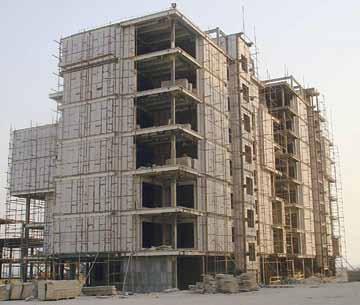
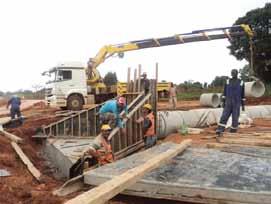
Two experienced workers can install 50- 80 Sqm wall per day.
Saves 10-45% time for project completion,get your rent faster.
Clean and with minimum on site wastage
Add: Mombasa Rd, between Lab & Allied and Plaza 2000, Nairobi. Tel: 020-2617700, 0733338888, 0787888555, 0722837999 Email: sales@hkbckenya.com or hkbc.kenya@gmail.com Website: www.hkbckenya.com
Guest - Architect Ibrahim Haruna President, Nigeria Institute of Architects [NIA] Director/partner at Multi-systems Consultants, Architects, Planners and Project Managers and a part-time Senior Lecturer in the Department of Architecture, Ahmadu Bello University
Personality Eng. Dr. Anania Mbabazi is the current Chairman of Uganda Association of Consulting Engineers [UACE].
Construction
The publisher does not accept responsibility for the accuracy or authenticity of advertisements or contributions contained in the journal. Views expressed by contributors are not necessarily those of the publisher.
Irene Kabuzire, Elaine Young, Emmanuel Onsomu, Newton Mthethwa, Lindsay Wagner
WEB / GRAPHIC DESIGN
Augustine Ombwa O. Frankline May Moses Ngunjiri
ADVERTISING EXECUTIVES
Kenya Frances Lagoussis (Mombasa), Trizah Njoroge, Alvan Wamae Faustine Salleh
South Africa: Christine Tamukedde, Manoko Thosago, Prince Moyo Tabitha Muthoni,Winnie Sentabire, Angeline Ntobeng, Nqobile Ndlovu
Uganda: Penny Komugisha, Betty Nabakooza
Botswana: Dickson Manyudza, Gerald Mazikana
Ethiopia: Haimanot Tesfaye
Tanzania: Tom Kiage
Malawi: Anderson Fumulani
Ghana: Samuel Hinneh
Zimbabwe: Cyri’l Zenda
Rwanda: Collison Lore
Nigeria: Seni Bello
China:Weng Jie
Published by Group Africa Publishing Ltd
Botswana Office
Cadline (Pty) Ltd.
P/Bag 494 Gaborone, Botswana.
Tel: +267 318 7101
Fax: +267 318 102
E-mail: botswana@ groupafricapublishing.com
China Office
Hangzhou Oversea Advertising Ltd
55-3-703 Guan Lane, Hangzhou, Zhejiang 310003, China
Tel: +86-571- 87063843
Fax: +1-928-752-6886 (retrievable worldwide)
Email: china@ groupafricapublishing.com
Ethiopia Office
Haymi Advertising Services
22 Mazoria, Genet Bldg 4th Flr
P.O. Box 1316 - 1110 Addis Ababa
Tel: +251 118 955 855
Cell: +251 930 099 152
Email: haymiadvert@yahoo.com
Ghana Office
Apex Media Africa
P.O. Box 2558 Accra GP +233 (0)302 942 528 apex@groupafricapublishing.com
Kenya Office
Northwest Ventures Ltd
P.O. Box 16414 Nairobi 00100
Tel: +254 20 2679809, 2679808, 2091305
Email: kenya@ groupafricapublishing.com
Malawi Office
Centre for Media Advocacy
P.O. Box 1732, Blantyre, Malawi
Tel: 2659954854
E-mail: malawi@ groupafricapublishing.com
Zimbabwe Office
CMC Media Publications (Pvt) Ltd, P.O. Box 4828, Harare, Zimbabwe
The Site Board
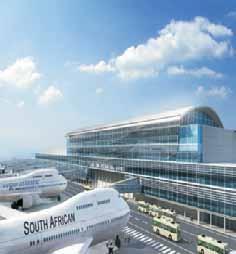
African airports a hub for economic activity
Only three of Africa’s airports all in South Africa were listed among the world's top 100 airports, ranked 22nd, 26th, and 28th respectively during the 2013 Skytrax World Best Airport Awards held at Passenger Terminal EXPO, Geneva, Switzerland. Cape Town International Airport emerged the Best Airport in Africa, followed by Durban King Shaka International Airport and Johannesburg (Tambo) International Airport in 2nd and 3rd places respectively.
These results seen against the backdrop of The Airport Cities 2013 which was held at the end of April in Johannesburg are a sobering reminder of how much needs to be done to improve air travel on the continent.
During the Airport Cities 2013 it was recognized that airports are a key driver of economic development and speaking during the event Federal Airports Authority of Nigeria president and CEO George Uriesi stated that less than one in every 20 Africans have access to air transport today which offered huge opportunity.
Nothwithstanding Nigeria’s negative airport legacy, Uriesi stated that the country presented promising opportunities, being highly populated with good tourism and business potential. Additional airport-enhancing projects were also in the pipeline.
These sentiments are probably true for every other African country and this key infrastructure will need keen attention if African is to get anywhere under the top ten best airports in the world.
E-mail: zimbabwe@ groupafricapublishing.com
Tanzania Office
Daas Agencies Ltd
P. O. Box 96061
Tel: (022) 2124328
Fax: (022) 2124328, Dar es Salaam
E-mail: tanzania@ groupafricapublishing.com
Nigeria Office
B23/24, Aishetu Emoewa Plaza 196, Iju Water Works Road, Ifako Ijaye Lga,Agege, Lagos.
Tel: 234-1-7347860
Email: nigeria@ groupafricapublishing.com
South Africa Office
College Publishers Ltd
1st Floor Oak Street, Oakfields, Randburg, Johannesburg
Tel: +27 11 781 4253
Fax: +27 11 781 4287
Email: crinfo@ groupafricapublishing.com
Uganda Office
Trine Media Ltd
2nd Floor Greenland Towers, Kampala Road, Uganda
P.O. Box 37690, Kampala
Tel: 256 414 340394/ 312 287770
Fax: 256 414 340393
Email: uganda@ groupafricapublishing.com
Rwanda Office
Kolline & Hemed Inc., B.P. 3328, Kigali, Rwanda
Tel: +250 03 748106
E-mail: rwanda@ groupafricapublishing.com
Website: www.kollinehemed.org
Robert Barnes
June 2013
Concrete Batching Plants
Batching plants offer greater consistency in the mix of ingredients thus assuring a higher quality of concrete
Project management and Arbitration Services
Industry professionals today offer a one stop shop for successful project management as well as arbitration services.
August 2013
Concrete Vibrators
We look at concrete vibrators which play an important part in consolidating freshly poured concrete.
Partitions
Get to know the trends in design, development and installation of demountable office partitions.
July 2013
Prefabricated buildings
Looking at the lower cost of constructing modular offices and homes
Generators
Getting the right generator to provide reliable standby power supply.
September 2013
Security
Keeping unwanted guest out and our valuables in. We take a look at the emerging trends in locks including access control systems.
Wet Services
In this issue we look at submersible pumps that find use in boreholes, drainage, sewage pumping, general industrial pumping and slurry pumping.
The editor accepts letters and manuscripts for publication from readers all over the world. Include your name and address as a sign of good faith although you may request your name to be withheld from publication. We reserve the right to edit any material submitted .
Send your letters to: info@constructionreviewonline.com
Ethiopia’s ICT Park Materialises Ethiopia
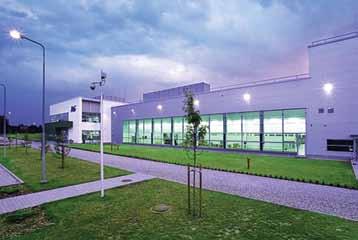
The Ministry of Communications & Information Technology (MoCIT) is to start the construction of an ICT Park “ethio ICT” with a total financial outlay of 5 billion Br. (US$270.4million). The Park is aimed at boosting information technology services and offering reliable mobile broadband infrastructure in the country.
The construction of the park, whose design is finalised with construction set to begin within a month, is planned to be hosted on 200ha of land behind Bole International Airport, in Bole District, according to Brehane Keleta, manager of the project. Private operators, ZTE, Techno Mobile and Security Innovation Network (SINET) have obtained 25,000m2 plots, each, to establish their own ICT incubation centres, manufacturing plants and software development centres in the Park.
More than 12 local and international companies have also registered and taken office space in the Park, according to Brehane. Addis Alemayehu, member of the board of directors of ICT-ET, a sectoral association, and managing director of 251 Communications said softwares that operate in local languages will also be developed in the Park.
Ghana’s Foreign Ministry gets New Office Complex
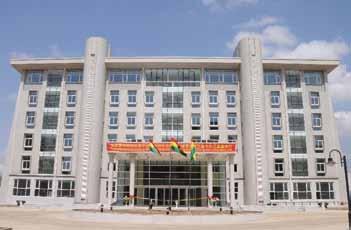
The Chinese government has handed over a US$16-million five-storey office complex to the Ministry of Foreign Affairs and Regional Integration at a ceremony in Accra. The building, which has 141 offices, a 300-capacity conference room and other mini-conference halls, a library, a canteen, among other facilities, becomes the new permanent office complex for the ministry.
The facility, which forms part of an interest-free loan agreement under already existing trade relations between the governments of Ghana and China, was constructed within 17 months by the Yanjian Group, a Chinese construction company. To enable the re-location of the ministry into the building at the earliest opportune time, the Chinese government is equipping the complex with free furniture, office supplies and equipment to the tune of US$1.3 million.
The construction of the new facility became necessary when, in 2009, the Ministry of Foreign Affairs building was razed down by fire, a situation which led to the re-location of the ministry to the Flagstaff House, the present seat of government.
Roads Upgrade Creates Trade Boost
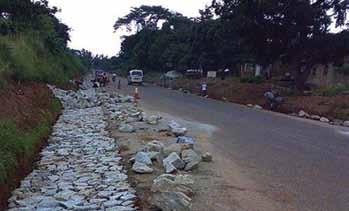
The upgrading of the Ush18billion (US $6.9million) roads by Kampala Capital City Authority (KCCA) in Kawempe, 5 miles north of Kampala city, has created a marked trade boost in the area. According to KCCA spokesperson, Peter Kaujju, the road that is in its final stages of construction has opened a good transport network and business opportunities for the people in the region.
He said the road has contributed greatly to traffic decongestion along the major routes of Gayaza-Kampala and Bombo road in the morning and evening hours and more people are looking to investing along the road.
In a bid to reduce traffic bottlenecks in the city, the World Bank gave KCCA Ush18billion (US$7million) to pave three roads in Nakawa and Kawempe divisions. The money is a boost to the Ush45billion (US$17.5million) allocated by central government this financial year towards maintaining city roads.Some of the roads under upgrade include the Kalerwe - Ttula road (3.3km) and Kawempe - Mpererwe (2.6km).
The Park is aimed at boosting information technology services and offering reliable mobile broadband infrastructure in the country.
The building, which has 141 offices, a 300-capacity conference room and other mini-conference halls, a library among other facilities, becomes the new permanent office complex for the ministry.
The upgrading of the US$6.9million roads by Kampala Capital City Authority (KCCA) in Kawempe, 5 miles north of Kampala city, has created a marked trade boost in the area.
Nigeria
South Africa
Nigeria
Surveyors Urged to Support Transformation Agenda
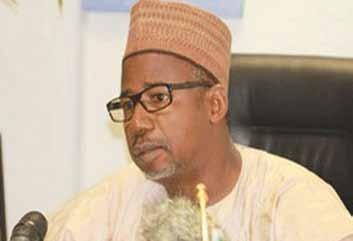
Minister of Federal Capital Territory, FCT, Senator Bala Mohammed has called on surveyors to support the Transformation Agenda of the present administration in its efforts to increase the housing stock and infrastructure, especially in the FCT. He made this call at the investiture of 2013-2015 Senate members of the Nigerian Institute of Quantity Surveyors, FCT Chapter held in Abuja.
Senator Bala said that the appeal is necessary because of the crucial role surveyors can play towards provision of housing, health facilities, education and infrastructure amongst several others. The Minister said the FCT is under construction and that there are still many bushes to clear, concretes to mix and costs to estimate. He said the concern currently is how to achieve value for money in the midst of limited funding.
In the pursuit of this goal, FCT Administration has evolved a land swap policy: a public-private partnership -PPP-initiative designed to use land as equity to deliver joint-venture infrastructure projects. He said that despite the effort of the present administration to increase the housing stock and infrastructure, Abuja still suffers housing and infrastructure deficits.
P & G’s Multi-category Manufacturing Plant
Procter & Gamble (P&G) is to invest around R1.6billion (US$173million) by building a multi-category manufacturing plant for both the local and export markets in South Africa. Dimitri Panayotopoulos‚ the company's vice chairman in charge of global business units‚ said at a press conference held jointly with the Department of Trade and Industry recently that they aim to make SA P&G's manufacturing hub for the markets of southern and eastern Africa.
He added that their global strategy is to maintain their strong momentum in developing markets adding that the investment will create at least 500 jobs at P&G. The company's brands include Head & Shoulders‚ Pampers and Gillette. Construction of the new plant is expected to start next year with production scheduled to start in 2016 or early 2017.
Global brands are progressively looking to emerging markets and Africa presents a compelling investment case for retailers. The Economist Intelligence Unit predicts that by 2030‚ Africa's top 18 cities could have a combined spending power of US$1.3trillion.
OLAM Unveils Plans to Set up a Processing plant
OLAM Nigeria Limited has unveiled its intention to set up a N3 billion (US$19million) sesame processing plant in Shagamu, Ogun State. OLAM Nigeria is the subsidiary of Olam international, the world's largest supplier of cashews and sesame seeds.
Speaking in Lagos, when the management team of the Nigerian Export Promotion council (NEPC) was on a tour of the company's Sesame Seed Factory, the country Head of OLAM, Mr. Mukul Mathur revealed that the exportation of Sesame Seeds from Nigeria to Europe and Asia has increased over the years. He said every home in Europe and Asia eats oil made from Sesame seed exported from Nigeria.
He listed some challenges faced as those from cultivation to processing, as well as delays at the seaport, high cost of transportation and electricity, saying that they are major challenges confronting the growth of the industry.
Abuja suffers housing and infrastructure deficits according to Minister of Federal Capital Territory, Senator Bala Mohammed.
OLAM Nigeria Limited has unveiled its intention to set up a US$19million sesame processing plant in Shagamu, Ogun State.
The new plant in South Africa will create at least 500 jobs.
Hitachi Zaxis Dash 5 Compact Excavators
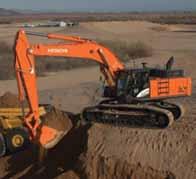
The ZX35U-5, ZX50U-5 and ZX60USB-5 are the newest compact excavators to join the Zaxis Dash 5 lineup by Hitachi. The compact excavators deliver the same reliability, performance and operator comfort as the preceding Dash-3 series, with numerous customer-driven enhancements.
“By specializing exclusively on excavators, we took the time to listen to our customers and incorporate their suggestions into the Dash-5 compact excavators,” said Mark Wall, product marketing manager at Hitachi. “We’ve designed operator-friendly machinery that contains power and performance, stability and durability — all things operators need on the job site. With their easy-to-maneuver compact packages, it makes working around job site obstructions easy to do.
www.hitachiconstruction.com
Vermeer’s RTX250 is a rubber-tracked, steerable pedestrian trencher that is designed for the needs of rental businesses and utility contractors. The RTX250 uses a 27-hp (20.1 kW) Kohler electronic fuel injected (EFI) gas engine that delivers power to dig 8-in.-wide (20.3 cm) trenches up to 48 in. (121.9 cm) in depth.
This trencher is simple to operate with a two-handlebar VZ steering system that allows easy mobility and operation without the need for numerous joysticks or significant operator training. A dedicated platform means additional counterweights are not necessary in order for the unit to trench properly and maintain proper balance, according to the manufuacturer. The dedicated rubber track system is designed to minimize ground pressure. The undercarriage is designed for traction in tough soil conditions while keeping speed and stability constant. The unit is 35.5 in. (90.2 cm) in width — a small footprint for maneuvering in tight areas, such as residential yards and congested job sites.
www.vermeer.com
The SnowEx Mini Pro 575 tailgate spreader is designed to be an ideal option for both large and small snow and ice control contractors. The Mini Pro 575 offers a maximum torque transmission and an innovative spreader control system, according to the manufacturer. Intended for spreading salt, sand and de-icing materials on roads, driveways, parking lots and recreational paths, the Mini Pro 575 comes standard with a receiver hitch mount. Optional mounting kits include a utility mount and three-point mount for tractors. Built with a lowmaintenance, direct-drive system, the Mini Pro 575 offers trouble free operation.
With no belts, pulleys or chains, downtime is minimized. Mounted in a weather-tight enclosure, the direct-drive system includes a 12-volt DC motor and maximum torque transmission. The spreader control system makes the Mini Pro 575 user-friendly.
www.trynexfactory.com
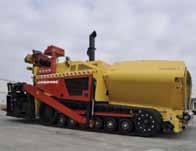
Dynapac has launched the next generation series of F1000 pavers to the North American market designed to meet the interim Tier 4 emission regulations. The F1000 pavers are available in both track and wheeled options to appeal to owners, operators and service crews. Production is taking place at the Dynapac plant in Garland, Texas. To meet the new emission regulations, the upgraded paver series have been equipped with the Cummins QSB 6.7 liter interim Tier 4 engine.
The engine delivers 220 hp at 2000 rpm or 230 hp at 1800 rpm. The Cummins interim Tier 4 engine also provides a direct flow air cleaner and new technology in the form of Exhaust Gas Recirculation (EGR), Diesel Oxidation Catalyst (DOC), and Diesel Particulate Filter (DPF) systems. Dynapac adjusted the paver duty cycle so that regeneration of the DPF system occurs without disturbing the paving operation in most conditions. A high pressure fuel injection system reduces fuel consumption up to 5 percent over earlier engines. The interim Tier 4 engine reduces exhaust emission of particulate matter by 90 percent and NOx by 45 percent.
www.dynapac.us.
Vermeer RTX250 Pedestrian Trencher
SnowEx Mini Pro 575
Nigerian Society of Engineers
Apparently dissatisfied with its remuneration packages, Nigerian consulting engineers have said that the 1996 government approved scale of fees are obsolete and no longer tenable. This was one of the issues raised at a recent meeting of the Nigerian Society of Engineers (NSE) and CEOs of federal government agencies and those occupying key positions in government held at the Transcorp Hilton Hotel Abuja.
President of NSE, Engr. Mustafa Balarabe Shehu, in his speech at the event, said the special dinner was to create a forum for interaction to chart a course for the promotion of the advancement of engineering, science and technology to move Nigeria forward. He said topics discussed included strategies to ensure that engineering takes its rightful place in the scheme of things and to ensure qualified engineers are placed appropriately as heads of MDAs.
Shehu said NSE has been granted the right to host the Federation of African Engineering Organisations (FAEO) Secretariat permanently in Nigeria and said his inauguration as the President -Elect of the Federation will take place this month. He said NSE is yet to receive any response from the FCT Administration on its request for a piece of land for the mass housing scheme and called for members support for the completion of the on-going National Enineering Centre Abuja Phase 2 project.
The Gateway to the 380million consumer market of the East African region.
The 16th Buildexpo 2013 - International Trade Expo on Building & Construction Products, Equipment & Machinery is the largest trade event held annually in Tanzania. The exhibition attracts exhibitors from more than 30 countries and visitors from all over East & Central Africa, thus giving exhibitors an excellent opportunity to explore several countries in one time.
Over the past few years, Tanzania has emerged as a major regional trade centre. This is mainly due to a very friendly and business like atmosphere it offers to foreign investors and products. Duties are considerably low and re-exports to neighbouring countries are either very low or exempted.
Africa Energy Forum 2013
Date: 18th -20th June 2013
Venue: Barcelona International Convention Centre (CCIB), Barcelona, Spain
Contact: Amy Offord
Email: amy.offord@energynet.co.uk
Website: www.africa-energy-forum.com
The 15th Africa Energy Forum (AEF) will take place from 18-20th June 2013 at Barcelona’s International Convention Centre (CCIB). Africa Energy Forum is the international marketplace where governments and power utilities of Africa unite with the energy industry to focus on delivering power infrastructure projects in Africa. All the players in the industry will be in the same place at the same time.
The Africa Energy Forum has an established reputation for delivering valuable content combined with the highest standards of service and care. It is this reputation which has enabled AEF to retain a loyal annual following of delegates, sponsors and partners as well as attracting consistent growth every year from new business markets. The AEF exhibition is the hub of the Forum where investors can promote their products and services and discuss how best to overcome current challenges faced within the market.
President of Nigerian Society of Engineers, Engr. Mustafa Balarabe Shehu.
China Communications Wins US$488million
Lapsset Corridor Project Tender
China Communications Construction Company has won a US$488million (KES41 billion) tender to construct the first three berths at the port of Lamu in Mombasa, Kenya. This is according to, Silvester Kasuku, chief executive of the Lamu Port-South Sudan-Ethiopia (Lapsset) corridor project. He said that a consortium of companies led by the China Communications had won the tender, signaling the start of the multi-billion shilling project.
Kasuku said they are doing the seed investment by constructing the first three berths just to break the ground and put government commitment and investment and provide incentives for private sector investors to come on board. He added that the first three berths in the port of Lamu will be completed in three years during which the government will be preparing a business plan on how private investors can be involved, with private public partnerships (PPPs) and joint ventures seen as possible models.
Lapsset corridor project, a US$24billion (KES 2 trillion) infrastructure development, aims to link South Sudan and Ethiopia to the Lamu port by building a superhighway, a railway and an oil pipeline.
Spring Valley Business Park Launched
Suraya Property Group is making its entry into the lucrative commercial property market with a state-of-the-art development dubbed Spring Valley Business Park.
The business park located along Lower Kabete Road in Nairobi, Kenya, about a five-minute drive from Westlands, will comprise five office blocks in phase one and a four-star hotel in phase two. Phase one of the Spring Valley Business Park, whose groundbreaking is scheduled for mid June, is expected to be completed in one and a half years.
According to Suraya Property Group CEO, Pete Muraya, the Silver Valley will be a low density, high quality development that will not allow high traffic businesses such as public supermarkets. Mr. Muraya said among Spring Valley’s main targets are banks which offer VIP corporate banking, a trend catching up fast and serves only a handful of persons at a given time reducing congestion at the business park.
In its construction, Spring Valley Business Park will borrow much from green technology in order to keep up with the latest trends.
Kenya
Bryprop Becomes First Firm to Receive Green Building Award
Bryprop, one of Johannesburg's niche sectional title property development firms, is enhancing its focus on sustainability, an area expected to deliver both cost savings and greater comfort for building occupants, as well as revenuegenerating opportunities in the market.
Bryprop has just become the first firm in Gauteng to receive a Green Building Council Five-Star award for its development of Block E, Upper Grayston. Bryprop is now developing Block F next door and is targeting a six-star GBCSA rating for that building, which will be complete by June 2013. Ron Henderson, director of Bryprop, said sustainability is at the core of their construction model adding that they are constantly seeking new ways to decrease environmental footprint while still maintaining revenues.
Components to its buildings, such as recycling, waste management, local sourcing, and community mass transport positioning, are also attracting attention from interested tenants. Henderson said in terms of market opportunities, a huge part of Bryprop’s current and future revenues depends on major global trends, such as urbanisation, climate change and global warming.
a.b.e. Opens new Dustless powder Plant
As part of its sustainable development programme, the Chryso Southern Africa Group has built a new plant for the dustless manufacture of cementitious powdered products at the Boksburg premises of a.b.e. Construction Chemicals, which is part of the Group. The new state-of-the-art powder plant, which started operating at the end of November last year, replaces a 30-year-old production facility that required modernisation and is, unlike its predecessor, almost fully automated.
Mario Marais, a.b.e. Construction Chemicals General Manager Operations, says many of the products a.b.e. supplies to the construction and hardware retailing sectors were first produced more than 70 years ago. Marais says over the years, the need to produce the products with meticulous care to achieve top quality has remained unchanged, but globally there is today a far greater emphasis on respecting the environment and the safety of the company’s staff.
The investment in the new powder plant, coupled with the upgrading of the company’s Isipingo plant, where a.b.e. bitumen-based products are manufactured, form part of the Chryso Southern Africa Group’s continuing commitment to investing in future growth and sustainable development.
Spring Valley Business Park construction will borrow much from green technology.
Bryprop is enhancing its focus on sustainability as well as revenue-generating opportunities.
The Group is commitment to investing in future growth and sustainable development.
The first three berths in the port of Lamu will be completed in three years during which the government will be preparing a business plan on how private investors can be involved.
SIAC- Arabtec JV to Build SECON Nile Towers Project
The Saudi Egyptian Construction Company (SECON) has signed an EGP 928 million (US$136.4million) construction agreement with the Emirati-Egyptian alliance, Arabtec Construction L.L.C in joint venture with Industrial Engineering and Construction Company (SIAC) to build its “Secon Nile Towers” mega project located at Maadi Nile Corniche in Cairo.
The scope of work includes the construction of two 23-storey towers, which are expected to be completed early 2016. The first tower is a 5-stars Hotel Tower, and the second tower is for touristic - residential use. Eng. Darwish Hassanin, Chief Executive Officer of SECON, said signing the agreement with Arabtec - SIAC JV is another step forward to complete Secon Nile Towers after signing the hotel management agreement with Hilton Worldwide in the past few weeks.
He said this project is the first Egyptian-Saudi project of its kind marking the strength of Egypt-Saudi diplomatic and economic ties and emphasize the kingdom’s interest in pumping more investments to boost Egypt’s economic growth.
Association Partners
Kenya
- Architectural Association of Kenya
- Institute of Quantity Surveyors of Kenya
- Institute of Engineers of Kenya
- Association of Consulting Engineers of - Kenya
- Association of Professional Societies of East Africa APSEA)
- Kenya Property developers Association
- Institution of Surveyors of Kenya
Namibia
Institute of Namibian Quantity Surveyors
Association of Consulting Engineers of Namibia
Uganda
Institute of Surveyors of Uganda
Botswana
Institute of Botswana Quantity Surveyors
Ethiopia
Construction Contractors Association of Ethiopia
PMSA Constructs Cutting-Edge Showroom
Pan Mixers South Africa (PMSA), the largest supplier of concrete, brick, block and paving making machinery and technology in Africa since 1976, has completed the construction of a stateof-the art and a cutting-edge showroom almost entirely from concrete in Jet Park, Johannesburg, South Africa.
The two-storey 700 square metres showroom is earmarked to house the sales and marketing offices in order to highlight the endless possibilities that concrete offers in modern day construction, states PMSA marketing and sales manager Quintin Booysen.
The concrete panels used in the construction of the showroom each weigh up to seven tons and this necessitated the company to work closely with contractors to ensure that the necessary quality and precession was met in order to ensure that a world class facility is delivered.
The panels had to be pulled up into the right position so that they can be positioned in such a way that they are not just decorative, but also that they are structural elements of the room.
Zimbabwe
- Zimbabwe Institute of Quantity Surveyors
- Zimbabwe Institute of Engineers
- The Construction Industry Federation of Zimbabwe (Cifoz)
Ghana
- Ghana Institute of Engineers
- Architects Registration Council
- Ghana Institute of Surveyors
- Ghana Green Builders Association
- Ghana Institute of Planners
Tanzania
- Tanzania Institute of Quantity Surveyors
- Construction Regulation Board (CRB)
- Tanzania’s Registration Board of Architects and Quantity Surveyors (AQSRB)
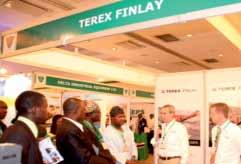
Terex Construction First Dealer In West Africa
Terex Construction has announced leading international equipment services specialist, Zero48, as its first dealer in
Terex Construction has announced leading international equipment services specialist Zero48 as its first dealer in West Africa to further strengthen its global dealer network and to meet customer needs in the region.
Zero48, through its subsidiary company, IBS Sarl, will distribute Terex® construction equipment in Guinea and will initially focus on selling Terex articulated and rigid trucks, and other construction products, with a plan to distribute more of the Terex range in the future. With Guinea's economy largely dependent on agriculture and mineral production, the new relationship between Zero48 and Terex Construction will be ideal to meet the demands for trucks in the mining industry and for construction machines to develop new infrastructures.
Potential owners of Terex trucks will also be reassured to know that Zero48, through its subsidiary company IBS Sarl, can provide aftermarket support for the trucks when they are out in the field, in addition to numerous equipment monitoring solutions.
South Africa
- ASAQS
- SAICE
- South African Council for the Quantity Surveying Profession
- Khuthaza ( Women for Housing)
- Concrete Manufacturers Association
- Green Building council of SA
- South African Property Owners Association
- Master Builders South Africa
Nigeria
- Association of Consulting Engineers Nigeria
- Association of Professional Women Engineers Of Nigeria
- Council of Registered Builders of Nigeria
- The Nigerian Institute of Architects
- American Association of Petroleum Geologists Africa Region
The scope of work includes the construction of two 23-storey towers which are expected to be completed early 2016.
The two-storey 700 square metres showroom is earmarked to house sales and marketing offices.
West Africa.
Date: 25th - 27th March,2013, Venue: JW Marriot, Malaysia.
Participants
Construction, Engineering & Public Works Inspection 2012 Conference
Date: 20 th- 21st August 2012 Venue: Cape Town, South Africa
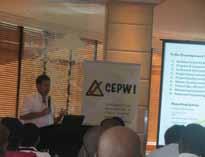
Participants follow conference proceedings.
A delegate contributes to the discussion
Delegates at a gala dinner.
MOU signing between ZCorp HCSEZ, Abu Dhabi and DaeguGyeongbu
Delegates contribution during conference discussion.
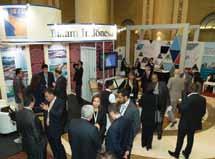
Delegates networking at the one-stop-shop trade exhibition
Conference delegates discussion.
Opening panel discussison
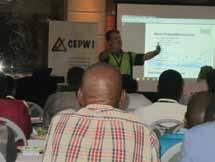
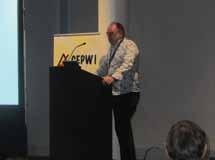
Guest speaker addressing delegates.
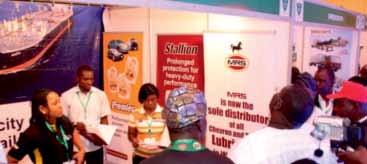
visit exhibition stands
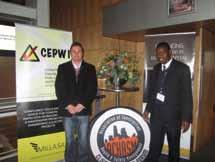
ACHASM stand.
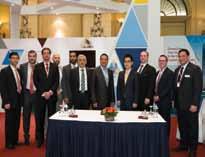
Guests pose for a photo
Architect Ibrahim Haruna
Architect Ibrahim Haruna
President, Nigeria Institute of Architects [NIA]
Architect Ibrahim Haruna emerged as the president of the Nigeria Institute of Architects (NIA) on November 19, 2011 after serving in different committees of council and as the 52-yearold institute’s 1st and 2nd Vice-President. He is director/partner at Multi-systems Consultants, Architects, Planners and Project Managers and a part-time Senior Lecturer in the Department of Architecture, Ahmadu Bello University, Zaria where he holds a Masters degree. Architect Haruna attended the National Institute of Strategic Studies, Kuru in 1991 and the Harvard Business School, Boston in 2007. In this interview with Construction Review, he shares his experiences, accomplishments and aspirations as president of NIA.
What is the Vision of Nigeria Institute of Architects?
Our vision is to attain excellence in the creative management of physical environment. A comparison of the skyline - take Lagos, Ibadan or Enugu some 50 years back to the skyline of today will show that we have achieved a lot. Nigerian architecture has also really been impacted upon to reflect our physical environment and the aspirations of our people more closely. These changes reflect in the sizes of spaces, of sitting room, location of kitchen and many other aspects.
What have been noteworthy milestones in the development of the institute?
effectiveness. We have succeeded in controlling admissions in the schools of architecture to match the facilities that are available through intensified accreditation of the schools. In 2012, we visited 10 schools on accreditation and 8 have been successfully accredited. Many more will be done this year.
We have also been encouraging and gradually attracting practitioners to put a few hours in academics. The action of one of our senior and respected elder Femi Majekodunmi who has given a lot of his time to the University of Lagos is worth emulating. I also find time to lecture once a week as a member of the Association of Architectural Educators of Nigeria [AACHES]. Abroad, in the UK for example, most lectures take place between 5pm and 10pm because most of the lecturers there are practitioners.
Additionally, we encourage the formation of schools of architecture near big cities with large concentrations of architects so that the schools can take advantage of this, and have organized several workshops and visits to industries.
What are the problems plaguing the building industry?
Architect Ibrahim Haruna is director/ partner at Multi-systems Consultants, Architects, Planners and Project Managers and a parttime Senior Lecturer in the Department of Architecture, Ahmadu Bello University, Zaria where he holds a Masters degree.
Abuja has been rated as one of the fastest growing capitals in the world, even though it is a completely new one. This is quite significant because at least 80% of the development in Abuja is handled strictly by Nigerian architects or with their collaboration. Also, at the inception of NIA, Ahmadu Bello University, Zaria was the only school of architecture in Nigeria. Today, there are about 22 such schools.
There was only one lady in my class in those days but with the NIA encouraging the formation of the Female Architects of Nigeria [FAN], the ratio of males to females in an average architecture class today is about 50-50.
As Presidents of NIA, what are some of your chievements during your tenure? When I came in we had just moved from a rented building into an uncompleted Phase one of our Secretariat, which was not at all conducive for effective operation. We have since completed our secretariat building in Abuja. We have also reorganized the secretariat, recruited more staff and organized re-training for them for more
The most obvious problem is the collapse of buildings which have become rampant. This is obvious in a situation where everybody ascribes on to himself the knowledge of construction, especially in a system where the guilty always finds a way of escaping justice. There is also the infiltration of foreigners into the Nigerian building industry without complying with the necessary protocols. Both problems are caused by the lack of implementation of laws. Abuja has been rated as one of the fastest growing capitals in the world, even though it is a completely new one.
What needs to be done to alleviate these problems?
We must find a way of enforcing the law, and this is a task involving every sector not just the building industry. The institute is encouraging more members to get involved in politics, that way the spirit of the Professional Code of conduct may add more sanity to the political class. The laws can be monitored. Government should give Nigerian professionals more encouragement through more patronage.
Personality
Eng. Dr. Anania Mbabazi
Bsc in Engineering (civil) Masters of Engineering Science (Construction Management) PhD in Civil Engineering (Project Management.)
Educational Background
Eng. Dr. AnaniaMbabazi holds a Bachelors of Science degree in Engineering (Civil), 1st Class Honours, from Makerere University, Uganda, Masters of Engineering Science (construction management) from University of New South Wales, Australia and a Doctor of Philosophy degree (PhD) in civil engineering (project management) from the University of Waterloo, Canada.
Professional Experience
He is a Registered Engineer with the Uganda Engineers Registration Board [ERB], a Fellow of the Uganda Institution of Professional Engineers [UIPE] with over 20 years of experience in conducting research studies, preparing feasibility studies, preliminary designs, detailed designs, procurement, construction supervision and supervision in the defects liability period of infrastructure projects (airports, roads, building and water projects).
Strategic Management Experience
Eng. Dr. AnaniaMbabazi is also a member of board of directors of a number of corporate and professional organizations including:
• Chairman, Uganda Association of Consulting Engineers [UACE]; 2011-13;
• Board Member, National Social Security Fund, Investment And Project Monitoring Committee, Sept 2012-May 30, 2015
• Board of Directors, Civil Aviation Authority: 2010-2013.
• Board of Directors, Uganda Communication Commission [Rural Communications Development Fund]: 2010-2012.
• Board of Directors, Crossroads Programme: Roads Industry Council: 2011-2015.
• Board of Directors, Operation Research Society of East Africa [ORSEA] - Uganda Chapter Board, Makerere University Business School: 2010-2013.
• President, Federation of Engineering Institutions of East Africa [FEIEA], 2010-12
• President, Uganda Institution of Professional Engineers [UIPE], 2008-10;
• Chairman of the Board of Directors, ILISO Consulting (Pty) Limited, Uganda: 2012+
Uganda Association of Consulting Engineers [UACE].
Eng. Dr.AnaniaMbabazi is the current Chairman of Uganda Association of Consulting Engineers [UACE].
His zeal is to strive to be the best at whatever he does and his interest in strategic planning and making organizations adopt best practice corporate government philosophies (with training from Harvard Business School, USA) not only makes him proud but also sets him apart from other engineers. He is proud to be among the most thought after new breed of strategic thinkers reshaping boardsin Uganda.
Brief on UACE
Founded in 1993, The Uganda Association of Consulting Engineers is a body responsible for representing the professional concerns and general business interests of its members in the field of consulting engineering in Uganda. Accordingly UACE caters for its members with regard to engineering professional ethics, standards, and client/consultant/contractor relationships.
The main objectives are:
• Promote members business interests,
• Develop members professionally through capacity building programmes,
• Ensure that members comply with professional standards,
• Acting as a forum for networking for members to exchange and share ideas and experiences,
• Promote the use of standard procedures and systems developed and published by FIDIC, where appropriate.
Challenges to the association
According to Eng. DrAnaniaMbabazi the current challenges faced in the association include, lack of adequate support from government – as a result of slow/lack of implementation of legal framework, competition from international consultants, lack of qualified and experience local staff, corruption in the construction sector and the country as well as low level of economic growth in the country.
Important issues to the association
• Have the enabling laws in place and enforce them
• Capacity building of national staff
• Improved financial services to the sector
• Empowering the national staff and companies to take on the lead role in national development.
Read more on this article at http://www.constructionreviewonline.com
Founded in 1993, The Uganda Association of Consulting Engineers is a body responsible for representing the professional concerns and general business interests of its members in the field of consulting engineering in Uganda.
Eng. Dr. Anania Mbabazi
Durable Flooring
Commercial and industrial floors have to withstand tremendous stress wrought by the heavy human traffic and sometimes harsh environment that they face.
Compiled by Torah Onyango, Yvonne Andive and Ann Kagumu Hospitals, restaurants, kitchens, offices, factories, education facilities and stadia are just some of the facilities that face heavy pounding and need durable floors that will serve for years to come and yet be pleasing to the eye. We give you a peek at what is out there on offer and what the current trends are on durable flooring.
Thanks to the know-how and specialization achieved in the field, IDEAL WORK is the European leader in the production of high quality products and systems for the decorative and architectural concrete flooring industry, operating in over 25 countries worldwide. Ideal Work offers a wide range of quality products, equipment and tools for decorative concrete surfaces, providing everything needed on your construction site.
IDEAL WORK offers concrete surface solutions, allowing you to create unique decorative surfaces quckly using just a few specific tools which require little investment.
To ensure a high-quality product, IDEAL WORK is directly involved in the technical and commercial training for owners, managers and applicators.
With almost 130 years’ experience in tile production, Royal Mosa in Maastricht stands apart internationally for innovative products that are not only ceramic but also made of glass and steel. Moreover, at Mosa the manufacturing process is organized in such a way that the company can find a solution for every problem, in constant dialogue with architects.
Restrained or colourful, geometrically formal or as a polymorphous mosaic, tiles can be used to achieve a wide variety of effects that strengthen architectural form and space. Moreover, tiles are functional, practical in use and maintenance, and long-lasting. Functionality and appearance determine the quality of an architectural design. Mosa contributes to this with tiles that are distinctive, innovative and of high aesthetic quality. But Mosa innovations do not focus exclusively on products. Mosa is the first tile
manufacturer worldwide to obtain a Cradle to Cradle ® Silver certificate for nearly its full product range. Sustainability is a cornerstone of Mosa’s mission and principles. This is an intrinsic element of a sustainable product such as tiles and of the operations of a quality-conscious company of the nature of Mosa. Cradle to Cradle is an innovative, positive and integral approach to sustainability that avoids reduction and is based on the unlimited reuse of materials: “waste is food”.
This approach is highly compatible with Mosa’s philosophy, as they are convinced that the future lies solely with sustainable products which are manufactured in a responsible manner and do not pose health risks. This is a responsibility which Mosa share with you, their customers. Moreover, this responsibility is further emphasized by the regulations that increasingly prescribe the use of sustainable construction materials.
TechWear Innovations Ltd specializes in the application and distribution of MMA (Methyl Methacrylate) resin based flooring systems.
Their MMA line of products is manufactured in Germany by SILIKAL. SILIKAL has been a leader in the resin coating industry for over 50 years and is credited for countless breakthroughs and innovations in application techniques and product development, within this sector.There are numerous advantages to an MMA floor over other types of flooring. These include: Hygienic (anti-bacterial and fungal, no joints or grouting, wall coving), Fast curing. ( Each layer can cure in a maximum of two hours allowing an entire floor to be laid over night, costing a business a limited amount in down time).
Durable
Having a minimum life of 15 years and being able to withstand a pressure of up to 100 Newton’s per mm2, MMA floors are perfect for all forms of industrial and commercial use, Aesthetics: With an endless range of color options, countless finishes, and the ability to incorporate logos and pictures within the floor, MMA floors are not only functional but also beautiful.
Resistance
MMA floors are resistant to all forms of acids, lyes, greases, oils, salts and other aggressive materials.The floor can also be applied outdoor as its naturally UV resistant, Practical: MMA floors create flat, non-slip, nonskid surfaces just like a customer needs them: monolithic, non-crack, dust-free, easy to clean and easy to care for, Safe: MMA floors can be
non-slip and anti-static ensuring the safety of the work force and the customers, 2-5 year warranty depending on the state of the sub-floor we are applying MMA coating on.
TechWear Innovations Ltd not only sells and does application of the MMA flooring system, they also offer training and certification to contractors interested in adding the MMA floor in to their brand portfolios.
The training courses concentrate on both practical applications of the product as well as theory as both in our minds are equally important. Their main customers currently are institutions. These include a full range of customer types including but not limited to: Food Processing factories, hospitals and clinics, restaurant kitchens, Warehouse’s, supermarkets, high-traffic areas (airports, exhibition halls, showrooms), automotive industry (tire centers, work shops, mechanics), shopping malls, manufacturing plants, and parking lots.
TechWear Innovations Ltd serves the entire East African market including Tanzania, Kenya, Uganda, Burundi, and Rwanda. Although sales have been focused on Nairobi, they are planning an aggressive expansion plan into the neighboring east African countries.
Read more on this article at www.constructionreviewonline.com/forum
Gaia Di Palma g.dipalma@dipalmassociati.com www.artigo.com
EVERGLOBAL TRADING L.L.C
Priti Patel
dubai@ever-global.com www.ever-global.com
Ideal Work
The Best Partner For Your Great Projects
Reasons to Chose Ideal Work Leadership
Thanks to the know-how and specialization achieved in the field, Ideal Work is the European leader in the production of high quality products and systems for the decorative and architectural concrete flooring industry, operating in over 25 countries worldwide.
Wide Range of Products
IDEAL WORK offers a wide range of quality products, equipment and tools for decorative concrete surfaces, providing everything needed on your construction site.
The Best Investment
IDEAL WORK offers concrete surface solutions, allowing you to create unique decorative surfaces quckly using just a few specific tools which require little investment.
Materials
Available Worldwide
Easily handled on site, work does not require large shipments by your company.
Training
To ensure a high-quality product, IDEAL WORK is directly involved in the technical and commercial training for owners, managers and applicators.
Socio-Economic Advantage
IDEAL WORK provides know-how through providing technical training of local manpower, improving both cost savings and employment level in the area.
Technical Support
IDEAL WORK has technical staff that can provide expert and complete support to designers, companies, installers and end clients.
Technical Assistance On Site
IDEAL WORK offers a special service that provides coaching and supervision for major projects and technical assistance on site
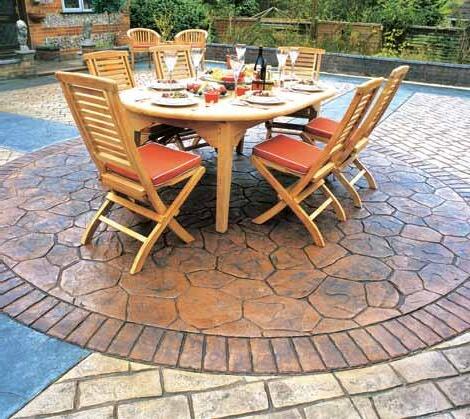
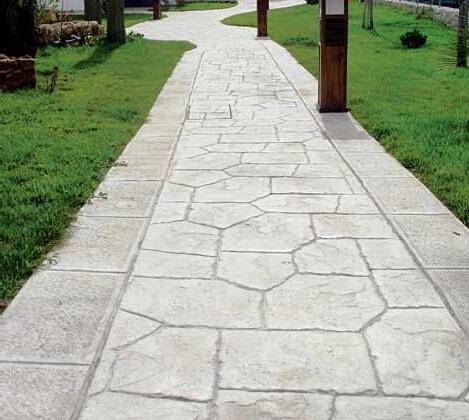
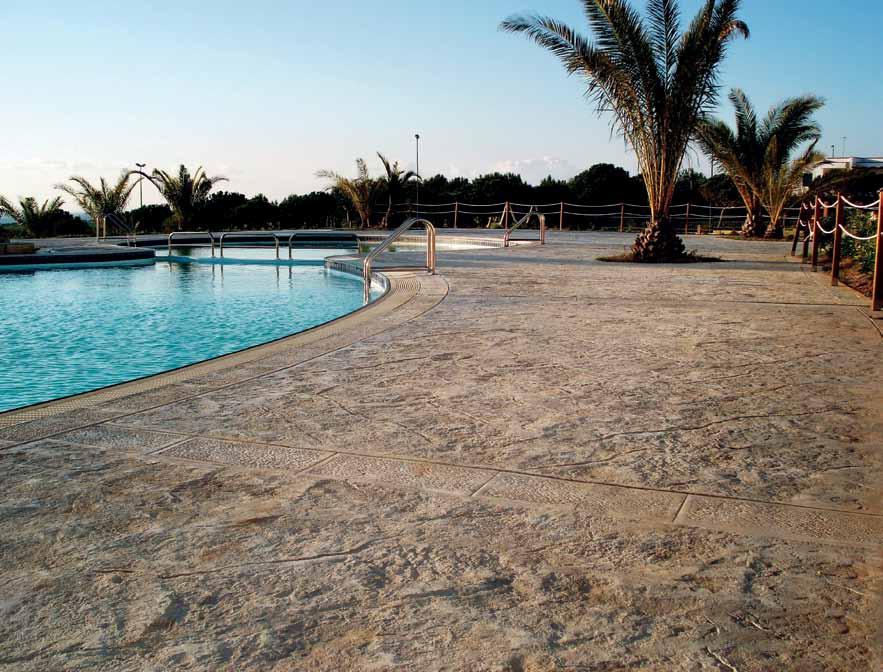
Stamped Concrete Ideal Work
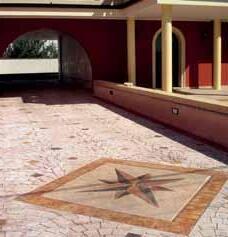
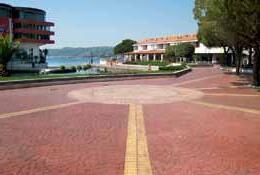
Concrete surface of great scenic effect for large spaces
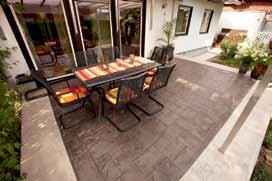
The best choice for the outdoor areas of hotels and residential complexes, resorts, squares/ plazas, streets, sidewalks, villas, gardens, swimming pools and spa areas.
Reasons To Choose Stamped
Concrete By Ideal Work
Beauty
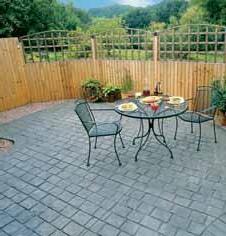
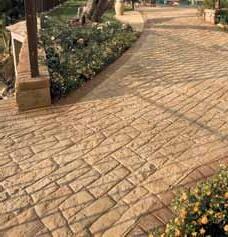
Recreates the beauty of natural stone, rock, ceramic, brick and even wood with great aesthetic and cosmetic effect.
Custom Finishes
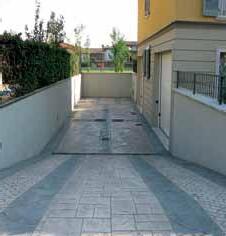
Flexible in shape, colours and effects, using various types of decorative techniques including acid staining, contrasting coloured joints, greek key borders or decorative rosettes.
Concrete
Made of concrete material, available everywhere in the world.
Monolithic
Made by a monolithic concrete slab reinforced with polypropylene fibers and welded mesh which can be installed on any kind of substrate and is not affected by depressions or settling.
Economical
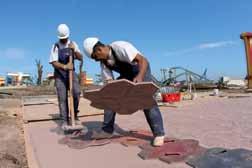
Can be created quickly using just a few special tools, with minimal investment costs. The technique consists of replicating the surface of different materials using moulds of different shapes and textures, placed and pressed on the fresh concrete. The process reproduces the original and natural contours and appearance of stone, slates, brick and even wood. This is known as the imprinting techinque.
For Any Climatic Conditions
The perfect solution both for both hot and cold climates thanks to the special sealers that protect and cover the surface making it mould, dust, slip and absorption resistant. For extreme conditions, special sealants are available that make the surface completely resistant to external agents.
Resistant
It can support both pedestrian and vehicular traffic through treatment before moulding with products which create a special shell, increasing resistance to abrasion.
Durable
Easy to clean and maintain, retaining its perfect appearance over time.
International References:
IDEAL WORK has a legacy of prestigious projects worldwide including:
• Disneyland Paris
• Auditorium Oscar Niemeyer
• Dall'Ava restaurant
• University of wine - Conegliano
• Hotel Etoile de mer - Lebanon
• Disney store - Rome
• Rainbow Magicland - Rome
• Theme park Miragica Italy
• Hamburg Zoo
• Università LIU, Beirut - Lebanon
• Goteborg tramway
• Thermal park - Lithuania
• Public parks
• Belgrade Orient express Venice
• Portoroz Promenade Slovenia
• Tourist villages - Cuba
• Hotel Casinò Park - Slovenia
• Hotel Bernardin - Slovenia
• Historic centre of Koper
• Air force academy - Caserta
• Water park - Jesolo
• Gardaland - Verona
• Nike store London
• Benetton store Wien
• Tramway – Algeri
Stone tiles
Cobble stone
Cranes in the Construction Industry
By Torah Onyango
A crane is a lifting machine that principally works with the use of pulleys and cables. For the construction industry, cranes are valuable assets because they make working with heavy machinery and construction materials easy.
The invention of cranes made things easy for humankind because without them, loading, unloading and lifting had to be done by human hands. This would consume more time and the entire system was not efficient at all.
Different types of cranes exist depending on the particular job that needs to be completed. They include Tower Crane, Vehicle Mounted Cranes, Rough Terrain Crane, Crawler Crane and Aerial Cranes. Other types of mobile cranes used in construction are floating cranes. Floating cranes are usually used in waterway construction such as bridges, ports and dams. Floating cranes are either mounted on pontoons or on special barges.
Stahl Crane Systems
STAHL Crane Systems supplies the most comprehensive range of products for lifting technology in the world. STAHL Crane Systems has been around for over 130 years. With their high-performing development team and countless pioneering inventions, they have succeeded in decisively influencing the technological progress within the industry. Their well-conceived standard product range, further advanced into sophisticated special-purpose solutions and explosion-protected hoists, has enabled them to achieve worldwide success.; Their well- engineered products, Chain hoists, wire rope hoists, winches, drive and control technology as well as condition monitoring systems are premium class – both technically and economical.
Straightpoint
Straightpoint, world leaders in the design and manufacture of force measurement, load monitoring and suspended weighing loadcells, offers a full range of devices for the construction industry for use with cranes, including its bestseller, the Radio link Plus load cell. This 'belowthe-hook' load cell is frequently used with loads being lifted by tower cranes or chain hoists, to ensure the safety of the operators, equipment and loads. It includes an audible overload alarm as well as a remote handheld device so the operator can stand at a safe distance to check the load.
Ideal for use in the construction market, the weatherproof Radio link Plus includes an industryleading battery life of up to 1600 hours, no external antennae that can easily become damaged in the construction environment (it's wireless, so all antennae are internal), a large range of capacities from 1-300t and can also be linked to wireless accessories to, for example, log the data straight to the user's PC to provide an audit trail or record of test. Emerging trends are that the wireless versions of Straightpoint's loadcells are more and more in demand.
In addition, an increasing number of enquiries are being received for software integration solutions to devices such as ipads and tablets. Straightpoint has built bespoke solutions for customers and is looking to offer a standard solution in the near future. Straight point works with 26 partners, supplying their products to every continent of the world, although due to growth of the business, it is seeking additional partners to work with.
Read more on this article at www.constructionreviewonline.com/forum
Compiled by Yvonne Andiva, Torah Onyango and Ann Kagumu
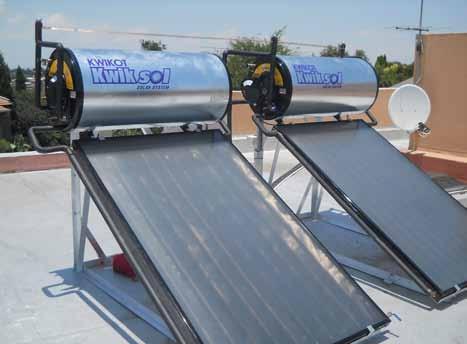
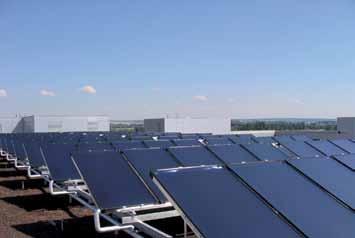
Africa is a continent well endowed with sunshine throughout the year making it ideal for solar water heating (SWH) systems in residential houses. The additional fact that there is a prevailing lack of cheap electrical power where it is available makes the case for SWH even more compelling. This environment means that there is a huge largely untapped market demand just waiting to be harnessed.
Residential solar thermal installations are either passive or active depending on whether the water is pumped into circulation or whether it circulated due to phenomena called thermosiphon flow. In Africa what seem to be most popular are the passive systems that are recognized by their characteristic storage tank fitted horizontally atop the solar collectors on rooftops where the sun’s rays can be best captured.
The amount of heat delivered by a solar water heating system depends primarily on the amount of heat delivered by the sun at a particular place (the insolation). In most parts of Africa the insolation can be relatively high, e.g. 7 kW.h/m2 per day, which is about twice as high as in temperate areas subject of course to local weather patterns.
This means that cost wise it is also cheaper to put up a SWH because of the smaller size needed to produce the same amount of hot water. Costs is the significant restraining aspect when considering putting up an SWH but with recent improvements in technology the payback period if one had used electrical or gas systems has come down significantly to well below ten years.
South African outlook
South Africa is facing an electricity shortage with the demand for electricity growing beyond what Eskom can supply. In order to mitigate system restraints, Eskom has various programmes promoting energy efficiency and the use of alternative energy. Promoting the use of sustainable resources is important if South Africa is to reach its energy savings targets set by the South African government, which requires renewable energy to replace 10,000GWh of electricity by 2013.
The Department of Energy estimates that 23percent of this target can be met through solar water heating and Eskom is therefore actively encouraging consumers to switch to solar water heating. To fund the Solar Water Heater Rebate Programme, which was started in 2008, National Energy Regulator of South Africa (NERSA) allocated funds, to cover programme development, marketing and funding the incentives to consumers to pay rebates for five years, after this period the programme will be reviewed.
Savings per 1 kWh
In South Africa, it is possible to apply for rebates on the purchase of SABS and Eskom approved solar water heating systems following installations by Eskom accredited installers. By providing rebates through its network of accredited suppliers and installers, Eskom is making quality solar water heaters more accessible and affordable to consumers.
Read more on this article at www.constructionreviewonline.com/forum
A division of Solupro (Pty) Ltd We specialise in purpose‐suited renewable energy technologies through the supply and installa�on o� high �uality residen�al � commercial/industrial energy applica�ons�
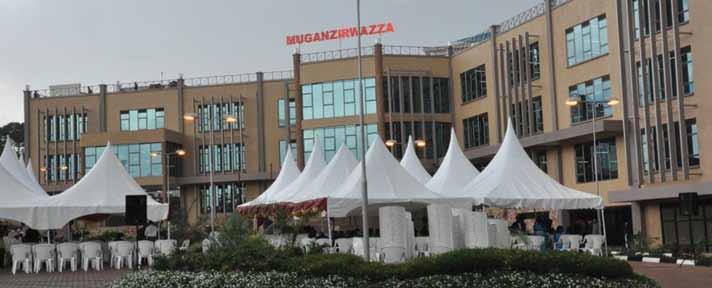
Muganzirwazza Commercial Plaza A Maiden Real Estate Project of Buganda Kingdom
Along Mutesa 1 road stands the magnificent Muganzirwazza Commercial Complex. The multimillion, modern style down town business Plaza was commissioned by His Majesty the Kabaka of Buganda, Ronald Muwenda Mutebi II in 2012. This is the first major real estate development that has been done by the Buganda Kingdom since the 1960’s.
Developed and supervised by the collective and dedicated efforts of the Buganda Land Board, the expansive Muganzirwazza Commercial Complex is named after Nakazzi Muganzirwazza - the Namasole (queen mother) of the late King Muteesa I.
Background
Buganda Land Board is an organization established by the Kingdom of Buganda to manage that part of estate returned to the Kabaka of Buganda under the Traditional Rulers Restitution of Assets and Properties Act. CAP 247 of the laws of Uganda.
Buganda Land boards’ current strategic plan targets developing and professionally managing land and estates belonging to Buganda Kingdom with a purpose of creating sustainable revenue inflows to support the kingdoms outreach programs in education, health and micro-economic development.
One focal point in this strategy is investment in real estate, which steered the construction of this magnificent complex - a project that commenced in November 2008 and took four years to complete.
Location
The complex is located in Katwe near the Kibuye round-about, off the Kampala –Entebbe Road. This strategic location near a major junction makes
the complex easily accessible and convenient. The fact that it is located out of the city centre saves one from Kampala’s growing traffic jams.
Project size
Located on a 1.64 acres of land, Muganzirwazzi is a commercial building with total rentable space amounting to 8,007m2. The inner floor space is 6,217m2, roof terrace 1,790 m2 and car slots parking space of 200.
The complex has a lower and upper ground floor, 1st and 2nd floors as well as a roof terrace. At Muganzirwazza, one will be able to find Nakumatt supermarket, Orient Bank, Tropical Bank, Bank of Africa, Saloons, boutiques, restaurants as well pharmacies.
Design aspects /Finishes
The concrete structure features a laminated glass and steel façade. Chint electric products were used supplied by Electrical Excellence whereas electrical and mechanical designs were done by M&E Associates. Tiles were supplied by Victoria tiles Limited, and Decra tiles were used for roofing. Allied plumbers provided the plumbing services for the entire Plaza.
The complex has aluminum doors and windows as well as wooden ones all from Casements Africa. The general painting of the building was done by local contractors under Carl investments Limited.
Challenges
According to the Head of Investments at the board, Mr. Sebuwufu Roland, the greatest challenge was financial constraints. The structure was set up using owner’s equity so in moments when no money was available at hand; the project was slowed thus extending the date of completion.
He adds that the finishing phase was done at a time the economy was battling with an increase in inflation which was compounded by the fluctuation of the dollar, meaning that the board had to renegotiate with the suppliers who increased their initial bills of quantities to cater for the changes.
Way Forward
Buganda Land Board is embarking on the completion of Bulange Plaza whose construction halted in the early 1970’s. The Kingdom is strategically planning on investing more in real estate projects to boost its revenue base.
The investments head revealed that there are other opportunities that exist within the Kingdom which he says can be explored under (Public Private Partnerships)PPP approach and establishment of joint ventures, to maximize the return on Land.
As a global specialist in electric industry, We also supply MCB, MCCB, ACB, Contactors, Overload Relays, Starters, Pilot Devices, Inverters,Soft Starters, Power Relays, Capacitors, Transformers, Automatic Voltage Regulators, Switch disconnectors, etc.
The Sole Distridutor of in Uganda We are proud to be associated with Muganzirwazza Plaza as Electrical Contractor
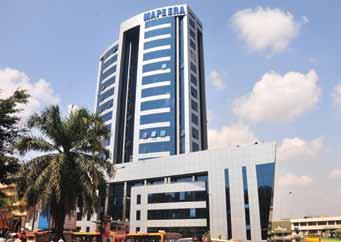
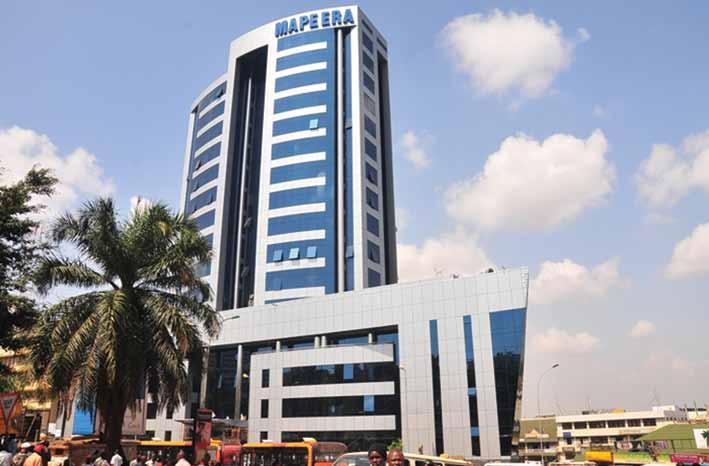
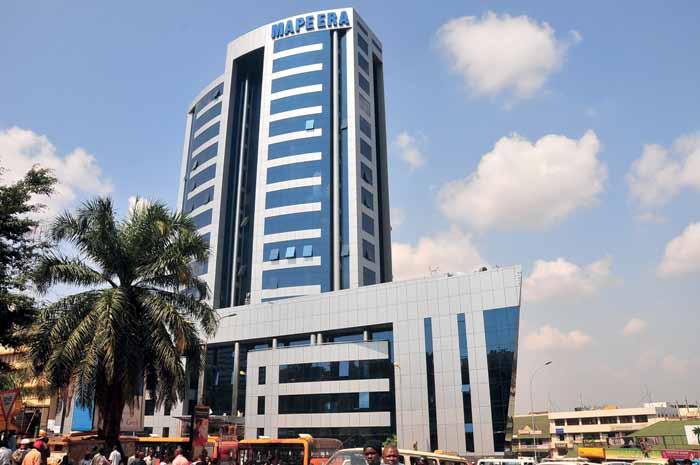
The unveiling of Centenary Bank’s magnificent Mapeera House, is a sign that the Bank has come of age, is robust and ready to lead the banking industry. Along the coordinates of Latitude: 0.3146: Longitude 32.5780 and Located on Kampala Road, the main business Street in Kampala, the new state of the art Mapeera House – Centenary Bank’s Headquarters can be seen from all over the City of Kampala, Uganda.
The location of Mapeera House on the busy Kampala and Burton Streets next to the beehive of activity at the Kampala City Square will enable the Bank massively grow its customer base to record numbers in a short time. In business, location can be of maximum advantage and this is what Centenary Bank has utilized to its advantage.
With a majestic 19 floors and beaming with radiance, the building gives a fresh face and new hope to its occupants. It is a modern high rise building with very unique architectural core and one of the most beautifully designed buildings in Kampala.
The building was constructed using the locally generated resources of the Bank which has 1.2
million loyal customers. The Bank’s capital has in the last 25 years grown close to Shs.140 billion (US$54.2million) with assets nearing Shs.1trillion (US$388million).
The building is a memory of the beloved Rev. Fr. Simeon Lourdel (1853-1890), also referred to in French as MonPere commonly known as Mapeera. He was the first Catholic Priest to set foot in Uganda in 1879.
Having been born to a humble background, to a farmer father and a gentle yet energetic mother, Rev. Fr. Simeon Lourdel was a hard worker himself and the perfect role model for the work of Centenary Bank.
Project Scope
Designed by Ssentoogo and Partners, one of the oldest architectural firms whose reputation graces most of Kampala’s skyline, the multi billion Mapeera House boasts of 20,000m2 of office space and about 16,000m2 for parking.
Overall, the iconic building whose construction began in September 2007 and unveiled in June 2012, comprises of a 5-storey podium and a 12
storey tower with banking and office facilities and basement floors with 106 parking slots ensuring that there is a parking space for every two of over two hundred occupants. The 5 storey podium floors house the banking hall on the ground floor, staff offices on the first, second and third floors and a staff canteens on the fourth floor.
Services and Facilities
The building houses 24 tellers, two bulk cash counters, four corporate banking suites and 16 automated teller machines (ATMS), arguably the highest single concentration of ATMS in one location in Uganda. The corporate banking facility is very unique with VIP lounges, and entertainment facilities and all under central air-conditioning which gives it a quiet and amicable environment.The building is fitted with full air-conditioning, lifts, CCTVs, 24 hour power supply, intelligent security, fire and safety fittings as well as wheel chair access to different floors. These services contribute to the compliance of an ideal state-of-the art office facility.
Materials used
The building is a reinforced concrete framed structure finished in glass and aluminum cladding. Staircases, toilets and lobbies are tiled with granite and non slip ceramic tiles. Office floors are all carpeted. The interior design was outsourced from a prominent Thai Company, ensuring that every inch of the building is teeming with beauty. The building has double curtain walling windows to cut off the fumes, noise and dust from the surrounding busy streets so the inside is quite cool and nice.
To top it all, the building uses natural lighting on all sides which gives it a natural feel from the inside.Mapeera House is a testimony of years of careful planning and diligence in financial management of the highest quality service to millions of ordinary Ugandans and indeed the wider Ugandan Community by the Bank over the past 25 years. For a Bank that has diligently served the people of Uganda for so many years, Mapeera House is undoubtedly a symbol of strong heritage and a brighter future of Centenary Bank.
We are proud to be the contractor of the Kampala Capital City’s Newest Jewel - Mapeera House.
We congratulate the client and team on this job well done
MAPEERA HOUSE
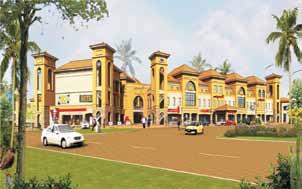
THE BUGOLOBI VILLAGE MALL
Upgrading of Kabale - Kisoro Road
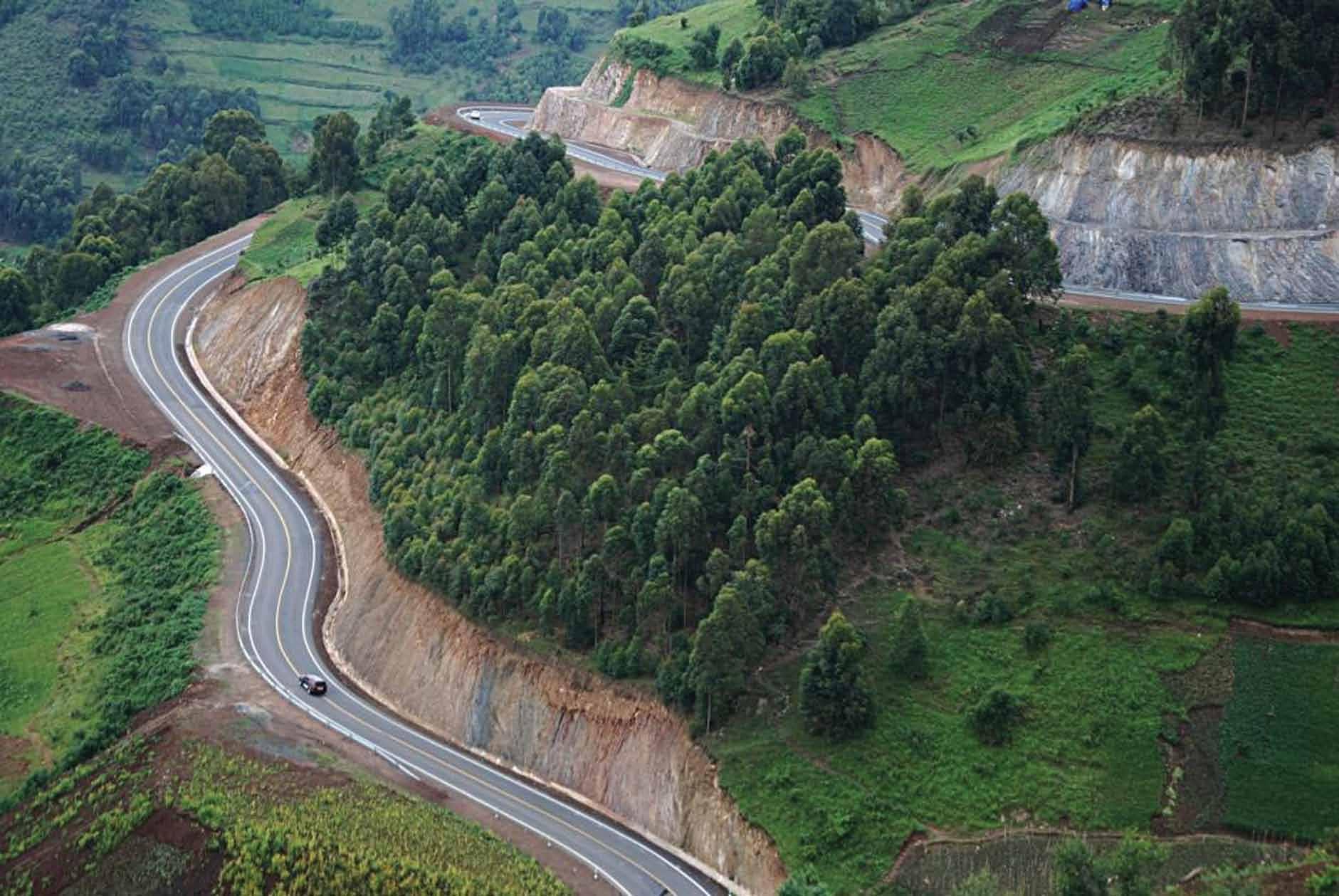
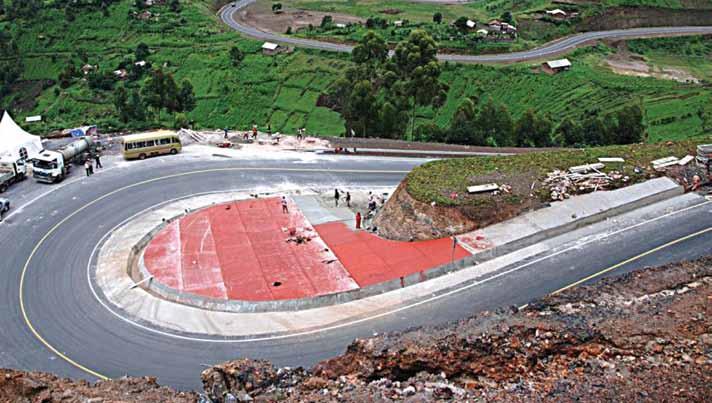
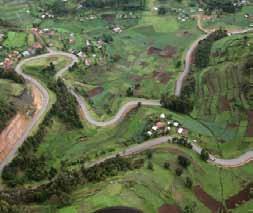
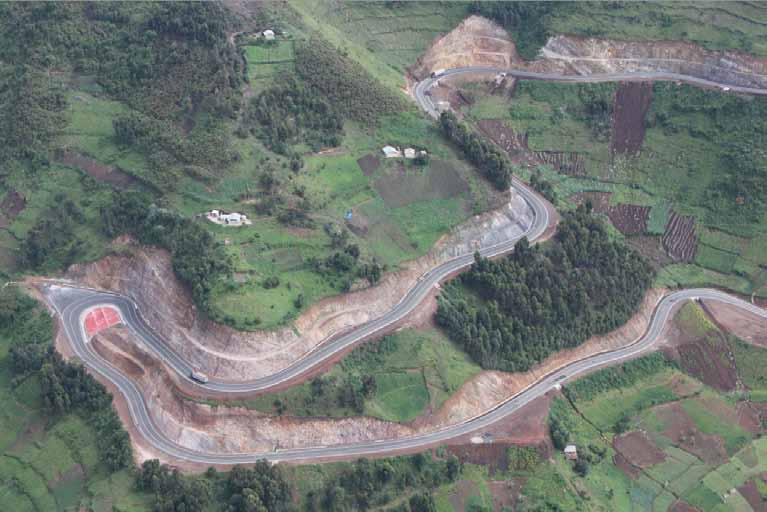
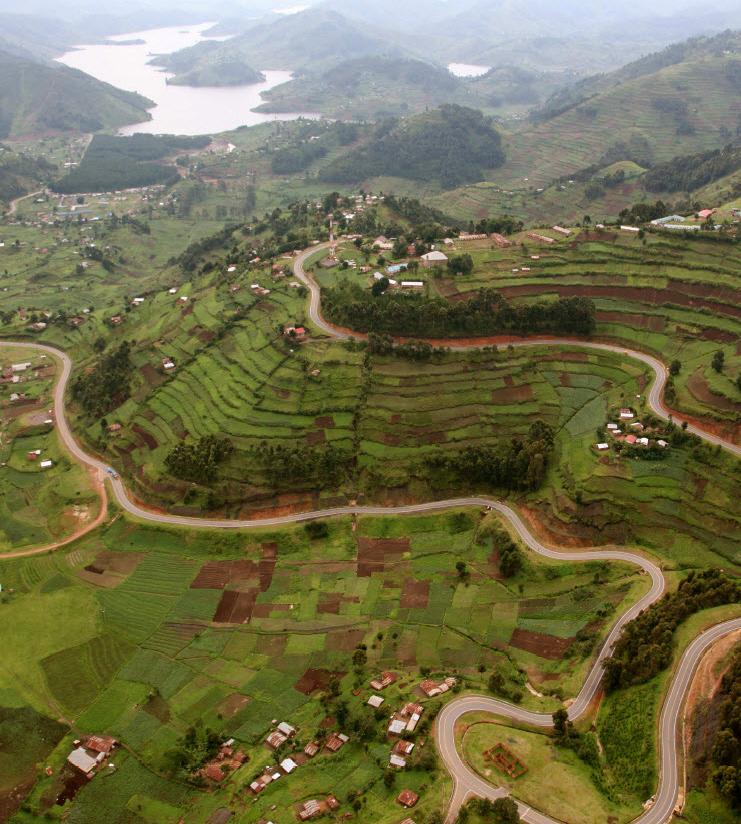
The Kabale-Kisoro road in Western Uganda is one of the country’s most scenic routes. It passes through an extensive bamboo forest, as well as the “Kanaba Gap”, where a clear view of the volcanoes in Rwanda can be seen. It’s not surprising that the road is a favourite for both tourists and locals alike.
This Northern Corridor Route acts as Uganda’s main transport artery to and from the Port of Mombasa in Kenya. It is also a vital link to the Indian Ocean for neighbouring countries of Rwanda, Burundi and the Democratic Republic of Congo (DRC). Construction of the100km road commenced in 2007. The project was initially projected to cost US$90million, but the original designs were changed, increasing the cost to US$140million.
The road starts at the town of Kabale, connects to Kisoro and runs through to the DRC border at Bunagana. At Kisoro town, a 6km spur connects the road to Kyanika at the Rwandan border, thus connecting the road networks of both DRC and Rwanda. It also has a 5km long southern diversion
Project team
Employer
Uganda National Roads Authority
Contractor
SBI International holdings AG (Uganda)
road to the airstrip at Kisoro, which connects the Kisoro–Kyanika link.
Background of the road construction
The Government of Uganda received a loan from the African Development Fund towards the cost of the Road Sector Support Project 1. A portion of this fund was used for the upgrading of the KabaleKisoro gravel road to paved (bitumen) standard. The Uganda National Roads Authority was the implementing agency for the scheme, which was constructed by SBI International Holdings, AG.
SBI is part of an international construction and development group that specialises in large scale housing and commercial building, roads, tunnels, bridges, airports and other infrastructure projects. Mott MacDonald was responsible for design review and construction supervision on the project, working in association with Kagga and Partners.
Scope of work
The road was originally a Class C gravel road, before being upgraded to paved road standard.
Design Review and Construction Supervision
Mott MacDonald
Construction Supervision
Kagga & Partners
The carriageway now has a 6m asphalt surface width throughout, with asphalt surfaced shoulders of 1m in mountainous terrain and 1.5m in flat terrain.
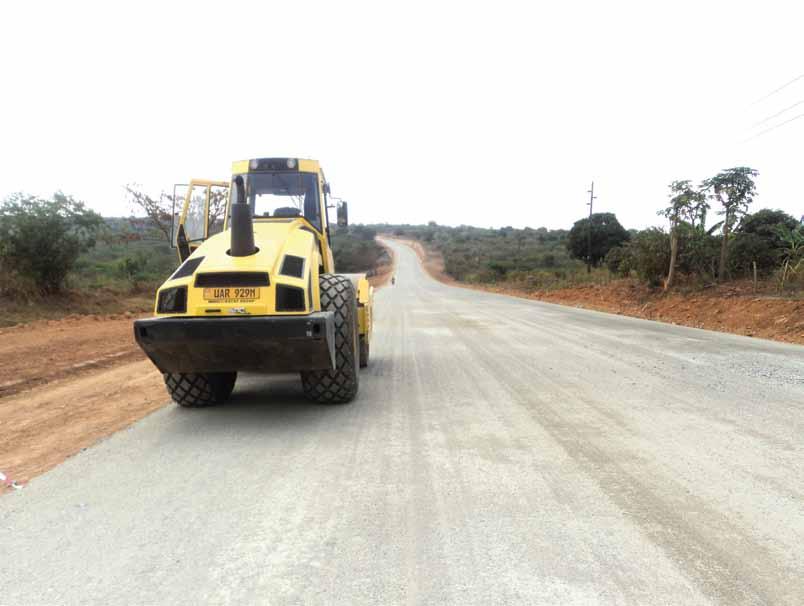
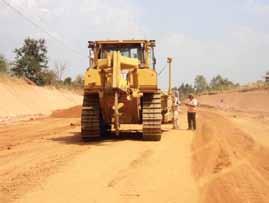
The scope of works for the upgrading included; cutting and filling operations to provide relevant road width, preparation of roadbed and construction of sub-base, roadbase and placement of asphalt concrete or double surface seal surfacing, rehabilitation and maintenance of drainage pipes and structures, construction of new drains and culverts, construction of stone filled gabion walls, construction of footways, parking areas for lorries, buses etc, provision of road signs and markings together with guard rails, landscaping and grassing.
Materials used
Local materials were used throughout construction and existing road material was used where possible to achieve the required roadbed strength. This stopped the need to import gravel material. Construction materials used included bitumen, cement, steel, asphalt and pavers which were all
Suppliers
Hima Cement
Shell, Total, Kobil, Termcotank
Steel Rolling mills e.t.c
in conformity with the industry standards. Impact of the road construction on the environment.
There is always an impact to the environment, with any road construction activity. However, during the construction of the Kabale-Kisoro highway, the team of contractors endeavoured to minimise the risks. According to Mr. Shay Cameo, managing director of SBI International holdings AG, an environmental management plan was prepared and approved by the Uganda National Environment Management Authority before construction started. This provided guidelines to ensure that minimum disruption to the environment was achieved during construction.
SBI contracted a consultant who visited the project on a regular basis to advise on best practice in environmental preservation. All borrow pits and quarries used during construction have now been reinstated – some are fully rehabilitated while others are in the process of full rehabilitation.
The scheme also included a number of social implications. Nancy Engerran, senior project manager at Mott MacDonald, stated that a special provision was made in the contract for HIV/AIDS and sexually transmitted disease alleviation measures, as well as gender management throughout the period of construction. Education,
testing, treatment and provision of condoms all formed part of the measures.
Economic activities around the area
There has been tremendous growth in different businesses in agriculture, retail merchandise, urbanisation and tourism since the completion of the project. “Tourist visits to the Bwindi and Mgahinga national parks and other tourist sites such as Lake Bunyonyi are expected to increase, since it now takes half of the time it used to take to reach these areas,” commented Mr. Shay.
Besides improving regional co-operation in the Great Lakes Region, the upgrading of the road will also enhance the administrative and social coverage.
The road has reduced the journey time from Kabale to Kisoro significantly, while also improving road safety for travellers. According to regular road users along the route, journey time has been shortened by 40percent.
Challenges faced
Foremost, the hilly terrain of the area made work difficult for those involved on the project. Additional challenges were faced as the road passes through ecologically sensitive areas of the Ebuya Forest Reserve, as well as Lake Bunyonyi and landslide-
prone steep mountain terrain. The road stretch is also close to the Bwindi Impenetrable Forest and Mountain Mgahinga Gorilla National Park.
Secondly, the road had to be widened by cutting rocky surfaces to achieve the desired width, while at the same time remaining open to traffic throughout the construction period. This was extremely difficult, bearing in mind the topography and the narrow existing road.
Theft of construction materials onsite was also a concern. Not only did this delay construction, but also caused financial problems as additional materials that had not been budgeted for had to be bought to replace stolen supplies. At the same time, the location of many of the swamps along the route required additional geotechnical investigations to help propose the best solution to avoid them.
All of these challenges, when coupled with the fact that the construction of the Kabale-Kisoro road was completed during the rainy season show that the project was not an easy one. But the project was successfully completed on time in September 2012, a truly impressive feat and by no means thanks to the experience, hard work and diligence of everyone involved.
MOTT MACDONALD Global experience with
local insight
We offer multidisciplinary engineering management and consultancy development services from our East Africa regional base in Kampala.
We have locally based skills and experience in:
■ Water
■ Power
■ Roads
■ Railways
■ PPP
■ Health and education
Mott MacDonald is a global management, engineering and development consultancy. Our US$1.5 billion business spans 140 countries. We’ve been working in Uganda since 1981 and are proud to have supported UNRA on the delivery of the landmark Kabale to Kisoro Road.
For more information please contact Ronald Athiyo:
e ronald.athiyo@mottmac.com www.mottmac.com
Uganda National Roads Authority
Plot 5, Lourdel Road, Nakasero, P.O. Box 28487.
Tel: +256 312 233 100; +256 414 318 000
Fax: +256 414 232 807; +256 414 347616
Email: roadinfo@unra.go.ug or executive@unra.go.ug
Website: www.unra.go.ug
MAJOR ROAD WORKS UPDATE JANUARY 2013
Kabale-Kisoro-Bunagana/Kyanika Road: This road is a continuation of the Northern Corridor Route linking Kabale through Kisoro to the Rwanda border at Kyanika and D.R Congo border at Bunagana. The road was completed in November 2012.
Fort Portal – Bundibugyo-Lamia Road (103KM): The upgrading of Fort Portal – Bundibugyo-Lamia Road (103KM) started in 2010. The road project starts from Fort Portal town and descends through the foothills of Rwenzori mountains through Bundibugyo town to Lamia the border post with the Democratic Republic of the Congo. The contractor has completed 80% of the works and the road is scheduled for completion in 2013.
Nyakahita – Kazo – KamwengeFort Portal road (208km): The works under this project are being executed under three separate packages
Nyakahita - Kazo section, Kazo-Kamwenge section and Kamwenge-Fort Portal section. On Nyakahita - Kazo section, contractor has completed over 60% of the works and the road is scheduled for completion in 2013. On Kazo-Kamwenge section, contractor has completed over 50% of the works. Contracts for the first two sections commenced in May 2011. Kamwenge-Fort Portal will commence in early 2013.
Jinja-Kamuli and Tororo- MbaleSoroti (156Kms): Works on these road corridors are being implemented following a staged approach that involves the recycling of improved existing pavement materials to restore the road pavement. Work on these roads started in 2011 and will be completed at the end of 2013. On Jinja-Kamuli, the contractor has completed about 40% of the works. On Tororo-MbaleSoroti road, the contractor has com-
pleted 30% of the works.
Kawempe-Luwero-Kafu( 166Km)
Overlay Construction: Having concluded the initial phase of staged rehabilitation works, a contract for the second and final phase comprising overlay works commenced in May 2011. This involves applying another layer on the existing road, road marking and installation of road signs. The contractor has completed over 95km of the overlay.
Mbarara-katuna Road
The Government of Uganda (GoU) has obtained grants from the European Development Fund towards the cost of reconstruction of the priority section of the Northern Corridor route (NCR) from Mbarara through Ntungamo and Kabale to Katuna. Physical works involve reconstruction and widening of the entire road to 11m carriageway road including shoulders.
1 Mbarara – Kikagati 75.0 Ongoing works
2 Gulu-Atiak 73.0 Ongoing works
3 Vurra – Arua –Koboko – Oraba 92.0 Ongoing works
4 Malaba/ Busia –Bugiri 82.0 Ongoing works
5 Mukono – Jinja 52.0 Ongoing works
6 Ishaka – Kagamba 35.0 Ongoing works
7 Kaiso-Tonya-Hoima 85.0 Ongoing works
8 Kampala-Masaka Phase 2 62.0 Ongoing works
9 Kampala-Entebbe Highway 51.4 Contract Awarded – Works commenced in November 2012. The compensation process for affected persons has also commenced.
Upcoming Major Projects
The procurement process for contractors with the capability to organize funding for road development projects supporting the primary growth sectors has started. The selected contractors shall be responsible for organizing funding for construction works for the roads in the Lot in which the company will be short listed and for execution of construction works. The roads covered under this programme include the following: Page 1 of 1 Road Name
The roads below are ready for construction. These projects will commence in FY 2012/13.
3 Mbarara-Bypass
Kolin Construction, Tourism, Industry and Trading Co. Inc. is proud to do the �irst work in the Sub-saharan Africa in Bunyoro Region by upgrading Hoima - Kaiso-Tonya Road. We are proud to be partners with the Government of the Republic of Uganda in the Roads Development Programme.
Dar es Salaam to get a Bus Rapid Transport system
By William Gatambi
The on-going infrastructure development of Dar es Salaam Rapid Transit (DART) system in Dar es Salaam phase one along Morogoro Road and its branches, is a trunk and feeder service which differentiates itself from the current mode of urban public transport popularly known as daladala in several ways.
The design of the DART system involves the construction of segregated exclusive bus lanes along Morogoro Road and its feeder roads to enable DART buses users from getting stranded on the road as these buses won’t be affected by congestion.
Enclosed bus stations
Other distinctive features of what is being constructed for the system along the road include fully closed bus stops that feel like a metro station, where passengers will pay to enter the DART station through a turnstile rather than paying the bus conductor, contrary to what is happening with the current daladala operators. The beauty of these prepaid boarding stations is that they will reduce the boarding and alighting time per passenger.
It goes without saying that Dar es Salaam with its large and growing population and economic importance to the nation, needs a public transport system which is mass-oriented, fast, comfortable and affordable to all people. By applying simple mathematics, one of the results of ignoring such a public transport system in the city of Dar es Salaam would negatively impact the national economy.
Another consideration in designing any such system is to determine how much benefit it could bring in terms of improved mobility, greater access to transport, and improved environmental quality. The Dar es Salaam Transport Policy and System Development Master Plan reveals that 90 percent
of Dar es Salaam residents either walk, cycle or commute by bus to work. The study continues to elaborate that 56 percent of Dar es Salaam residents make walking trips, 41 percent use public transport popularly known as daladala and the rest use motorised two and three wheelers and cars to move about.
The call to improve traffic mobility is an urgent task as the current system is characterized by poor standards of comfort, safety and reliability, with low regard to convenience and dignity for bus travellers which is accompanied by negative impact on city traffic through competitive behaviour by daladala drivers in over speeding, over-crowding and causing fatal road accidents.
The poor delivery of urban public transport has been associated with fragmented ownership in the public bus transport sector that results also into the inability to effectively regulate it causing the industry to be unmanageable. The growth in private car ownership and use which is generated by income increases in some people is another factor that escalates traffic jams in the city.
The option for DART by the Dar es Salaam government authorities is a result of critical analysis aided by experts in transportation industry from countries whose BRT systems are fully operational. The best examples are found in Brazil and Columbia.
Lost productive time
The rapid increase of cars on roads causes adverse effects in many forms of the national economy including wasting time of motorists and passengers as part of a non-productive activity for most people which simply reduces regional economic health, delays which normally result in late arrivals for employment, meetings and education may cause loss of businesses and perhaps being victim of disciplinary action for employees, to mention a few.
To implement DART, demolitions should be done; even if they are costly and take time. The idea here is to construct a city for the next 200 years at least. It is better to do a shorter DART with quality urban design around it, than one very long without quality architecture.
For the DART project to operate, downtown Morogoro Road will most likely have to become pedestrian only. Zurich, for example, is one of the richest city in the world yet 60 percent of its population takes public transport everyday and 20 percent walk or cycle. In Manhattan, New York’s central island, more than 90 percent of its inhabitants do not own a car. They use public transport. And if they want to go the week-end to the beach or the countryside, they rent a car. These are a few benefits of BRT system.
On the other hand, trains would have much helped to alleviate the hassles of public transportation in the Dar es Salaam City had it not been extremely expensive to establish and run. Experts in BRT system, worldwide content that BRT capital costs are as little as 2 percent of those of train.
Furthermore, BRT costs less to operate and goes significantly faster than train service. The experts in the field say, BRT is also far more flexible than rail transit. Since rail lines are fixed, they cannot respond to changes in employment and land use, whereas BRT service can be rerouted and shifted over time to correspond with the changing transportation needs of a city. It can be installed quickly, not requiring years of construction, and various aspects of it can be phased in over several years.
However, with excellent performance in the country economy in future, the government may deem it proper to embark on establishing other modes of urban public transport in order to continue ameliorating public transport in all Tanzania emerging cities.
PVC meets building and construction needs
PVC, short for polyvinyl chloride, is one of the fastest growing construction materials achieving greater use as more additives are discovered that give it improved and more versatile characteristics. PVC’s popularity stems from its lightweight, water resistance and maintenance free nature. In the developed world over 60 percent of PVC is used in the building and construction sector.
PVC resin alone is a raw material. It can be made into products with a wide range of properties from soft and flexible to light and rigid. The outcome is often determined by additives. Other ingredients must typically be added to convert PVC resin into a finished product. These can include heat stabilizers, lubricants, and fillers. One of the most common types of additives to be blended with PVC is plasticizers, such as butylglycolate, epoxy resins, and dialkylazelates. Its appeal stems from the fact that it is a thermoplastic, meaning it can be melted down and reformed. PVC is replacing traditional building materials such as wood, concrete and clay in many applications. Versatility, cost effectiveness and an excellent record of use mean it remains the most important polymer for the construction sector.
Uses of PVC
Window and door profiles are increasingly being made out of PVC materials. Specifiers and consumers choose PVC windows because they are tough and durable, require low maintenance, do not rot, offer design flexibility, are competitive in terms of price, and can be easily processed and fabricated.
Piping
Pipes and ducts have been a preserve for PVC for a while now. They are competitive in terms of cost, easy to install and require low maintenance. Pipes can be made in a range of profiles to meet specifiers needs. The extrusion process, plus the fact that PVC is light in weight, allows long sections of pipe to be made, minimising the number of joints that reduces the cost of assembly.
PVC has very good chemical resistant properties and can be used above or below ground for the transport of many substances from drinking water to oil and gas. PVC pipes are also used as ducting in the telecommunications industry for carrying cables and wiring. Pipes made from PVC have good abrasion resistance, are not
damaged by special equipment used for clearing blocked pipes and are resistant to damage from sharp-edged backfill materials. PVC pipes can be easily coloured for different applications in line with existing regulations for underground pipe installations. In domestic plumbing applications, PVC pipes are light and easy to install. They are also less likely to burst in freezing weather than the traditional alternatives and do not build up scale deposits.
PVC pipes have the advantages of being a poor conductor of heat or sound. Several pipe designs for sewerage have been developed; solid, corrugated and foam-core twin-wall pipes. Ribbed PVC designs used for underground pipes have increased rigidity and provide potential for weight savings. The ribbed designs have a smooth inner wall to allow free flow. These pipes also have much greater impact strength than clay pipes.
Insulation
In many applications electricity is transported by wiring or cabling that is either insulated and/ or sheathed with PVC, protecting users from potentially lethal electric shocks. Most brown goods such as video recorders, compact disc players and television sets utilise PVC cables.
White goods such as cookers, fridge-freezers, washing machines and tumble dryers make extensive use of PVC cabling. Indeed, nearly all household wiring uses PVC. In offices PVC cabling is extensively used in equipment for telephones, fax machines, photocopiers, computers and other office equipment. Rigid PVC can also be used for applications such as computer housings and keyboards, as well as for cable housings such as trunking, skirting and conduits.
Cladding
PVC cladding is designed as a long life product requiring little maintenance. PVC's durability, high thermal insulation and excellent weathering performance with good resistance to UV light and ozone, mean that cladding can remain in place for many years. PVC roofing membranes are easy to install, totally waterproof, maintenance free, economically priced.
Flooring
PVC is the main plastic used for sheet and tile flooring. Vinyl flooring is hardwearing, warm
underfoot, cost effective and easy to keep clean as it has a pore-free surface. It is low maintenance, needs no polishing or treating, and is hygienic and fire resistant. It is also easy to join separate sheets together by welding, which prevents water or moisture from seeping through gaps. In design terms, it is available in a wide variety of colours and finishes that can simulate tiles, wood or stone. Vinyl coated wallpapers offer durable, washable wall coverings. They are long lasting and available in a wide range of colours, patterns and textures.
Fencing posts
A new PVC product is set to revolutionise the commercial and domestic fence market. Designed to be used in both post and rail fencing applications, the system is lightweight and easy to handle. Made from PVC, the fence is totally weatherproof and colourfast. It has a recycled core and virgin outer skin, making it resistant to sunlight and environmentally friendly.
In comparison to traditional materials, the PVC fence wins hands down. It weighs just 9% of its concrete alternative, making it easy and safer to install. Fences are designed to keep out people and animals. PVC is extremely strong and resistant to vandalism, and unlike wood, will not rot or require costly annual maintenance. Indeed, the PVC fence has been tested successfully to withstand high impacts and strong winds.
PVC makes a major contribution to the quality, safety and cost-effectiveness of construction materials, as well as helping to reduce the environmental impact of completed projects. Furthermore, PVC has a versatility that helps it meet modern and future design needs. In addition to new projects, PVC is also widely used in refurbishment, where it often replaces traditional materials such as clay and wood.
While opponents of the use of PVC exist, substitution of PVC by other materials on environmental grounds would require additional research without proven technical benefits and at a higher cost. For now though replacement of PVC by other materials would lead to a cost increases which would not only have negative economic consequences but also have wider social impacts, such as in the availability of affordable housing.
Standard Bank Rosebank’s Green Rated Building
Standard Bank South Africa, a leading financial institution is currently completing a five-star design rated green building development situated on the corner of Bolton Avenue and Oxford road, Rosebank, Johannesburg to consolidate its business units.
The new 65000m2 building commenced construction in 2009 with occupation earmarked for 2013. The new building will allow Standard bank to consolidate all head office business units in the CBD complex, Constantia Valley Office Park and the Rosebank building. These business units are currently disbursed in numerous buildings within the CBD and other decentralized nodes. The benefits of this three node campus strategy are the elimination of concentration risk in one
location and enhanced business continuity in the event of problems experienced at any one of the nodes. The development incorporates energy demands with seamless technology aimed at balancing an effective working environment and reducing carbon footprint.
“Sustainability is a holistic approach,” Stewart Shaw-Taylor, Head CIB Real Estate Standard Bank says.
“So, we are particularly pleased that everything we’ve done at Standard Bank Rosebank contributes to the creation of a sustainable environment, both internally and externally, for staff, as well as for visitors and for the public use park area.”
From architectural design, landscaping, interior designs, water usage, facades, electrical, material usage, air-conditioning systems, lifts and escalators, this building has demonstrated Standard Bank’s environmental awareness.
The development uses a gas powered trigeneration plant, South Africa’ second, to produce the energy for base load electricity, heating, and cooling. Energy Efficient lighting and an intelligent lighting system that automates the dimming and switching off of lights according to the availability of natural light and office occupancy will enable the building to save energy and its carbon footprint
The development consists of two large footprint buildings of nine and eleven floors over five
ZTE, a Global Leader in Telecommunications Equipment and Network Solutions
Z T E , a glo bal leader in the provision of telecommunica�ons equipment and network solu�ons was founded in 1985 Z T E is China’s largest telecommunica�ons equipment compa ny opera�ng in more tha n 140 countries across the globe and is listed on bo th the Hong Kong a nd Shenzhen Stock Exc hange.
Z T E has ex hibited a deep understanding of the industry a nd custo mer needs over the years, ta king advantage of the 18 R& D centres , 70 000 strong workforce in delivering innova�ve products and bus iness solu�ons. T he I C T solu�ons focus on s ix major industries , and they enta il the E nergy industry, Transpor ta�on, Governme nt and Public ��li�es , La rge Enterprises, and S M B
Smart Grid Solu�ons provided by Z T E include Rene wa ble Energy Solu�ons, Power Communica�o n Solu�o n, A M I Solu�o n, Power Surveilla nce Solu�on, Power Informa�oniza�o n Solu�o n, and Power Automa �o n Solu�o n
According to Evan Wang C T O for Z T E Government & Enterprise in Middle East and Africa, the reason they s ponsored Power & Electricity World Africa 2013 is that, ‘Power a nd Electr icity is one of the most importa nt fie lds in terms of Z T E s I C T strategy and Africa is our key market’. ‘ W e hope to have the deep insight o n the industry trend of po wer a nd electricity, understand the marke t and kno w more about our compe�tors ’ products and solu�ons’.
P E W A serves as a good pla�orm to promo te Z T E ’ solu�ons interact with customers , vendors a nd also to exc hange ideas a nd to help power u�li�es to improve their efficiency.
With e xcellen t a dvanced pro ducts, customized solu�o ns and high quality services, Z T E sma rt grid has been widelydeployed in more tha n 50 countries and 70 customers in electric power industry Some of the major projects that Z T E has partnered with in Africa inc lude
Z E S KO in Zambia, Fiberco in South Africa
E D E L in Angola etc
17F ZTE Corporation
No. 19 Hua Yuan Donglu Hai Dian District Beijing, China 100191
super-basement levels, standing east and west of a central multi-volume atrium extending the flow of the public piazza into the building. At upper levels, the buildings step back to create a sculpted u-shaped forms modulating the façade, while the expansively glazed atria create transparency into the heart of the bank. Escalators enable informal interaction and animate the volume of the atrium.
In addition, a ground floor restaurant, meeting centre, multi pause areas and meeting spaces line the upper levels of the atrium adding to the interior and piazza activity.
The development has incorporated an urban garden design with, flower garden entailing 422 indigenous trees species, and lawn area created above a 5 level parking basement which accommodates 3 925 parking bays. Standard Bank’sRosebank development has a wide treelined boulevard providing a shaded walk from Baker Street to the main entrance lobby and is complemented by one of the longest linear water features in the Johannesburg area. The granite rocks in the water feature have been recycled from a quarry.
The façade entails a glass curtain wall system covering more than 65 percent of the vertical external surfaces of the building, and extending for 12 500 square metres equivalent to 50 tennis courts. It is also triple glazed with built in remotely activated shading blinds. The blinds can be retracted into the framing system to enable maximum natural light on cloudy days.
A Digital Addressable Lighting Interface (DALI) system connecting the 4 500 luminaries in the office areas to a computer, enabling lighting to be re-configured without re-writing fittings has been incorporated. While different lights will be programmed to respond to different situations without affecting the surrounding lights. Five Dynamic UPS generators each producing
1.65MW, provide the building with full “No-Break” back-up power.
Water will also be conserved inside the building through efficient fittings such as dual flush toilets, low flow shower heads and tap aerators. The rain water harvesting will reduce potable water demand by 56%. The fire sprinkler system will return water from pump test cycles to the fire water storage tanks, reducing the amount of water lost due to regulatory testing of the fire protection system.
In addition air-conditioning system uses a mixed air cooled chillers and water cooled chillers, while fresh air is preconditioned using indirect evaporative cooling in summer and reverse cycle heating in winter. The building has the ability to manage lift and escalator trips to ensure passengers move through the building in the most efficient manner. The equipment has low-energy features, lowering power consumption.
The interior design reflects Standard Bank’s values, ensuring that a unified ideology flows seamlessly from the outside to the inside and also uses clear glass and screening devices that define spaces while providing a sense of privacy.
The use of materials such as granite, marble, stone and natural timber for their quality, permanence and integrity reflect the company’s values, ensuring that a unified ideology flows seamlessly from the outside to the inside. The Standard Bank Rosebank complex is designed to encourage greater levels of collaboration, greater sharing of knowledge, and greater interaction across different workgroups. The workplace provides a much richer variety of work settings to meet the bank’s diverse activities and needs.
Evan Wang, CTO, Middle East Africa & Newton Mthethwa, CR South Africa Editor at the “Power & Electricity World Africa 2013" exhibition
We strive to do it right, first time, every time, with zero defects.
• IES is one of the Leading HVAC (Heating, Ventilation and Air Conditioning) contract engineering and Industrial Design Service Providers in the country specializing in air treatment since 1945.
• HVAC Project Management - IES HVAC Project Managers are always delivering the completed project right, first time, every time, on time and to specification.
• Key members of IES Management Team have a combination total of over 180 years of service.
• IES provides systems Specifications and Process engineering integrity
• IES has state of the Art Manufacturing Facilities.
• We offer quality products, services and workmanship and these are provided as a standard.
• We have Engineering Expertise and Experience.
Certifications
Registered with:
CONSTRUCTION INDUSTRY DEVELOPMENT
BOARD (CIDB)- Level 7ME
ISO 9001 Compliant - Gauteng only
BBBEE Compliant
Green Point Stadium
Moses Mabhida Stadium
Cape Town International Airport
South African Reinforced Concrete Engineers
Construction industry is experiencing a downward trend and the reinforced concrete industry has not been spared, although tonnage throughput by members of the association showed a modest increase over the previous year, volumes are still well below historical norms.
The adverse trading environment has been exacerbated by the labour unrest, transport strikes, onerous health and safety requirements and the increase in overdue payments and credit risks due to financial pressures on the construction companies.
The reinforced industry has shown remarkable resilience in overcoming these obstacles and will no doubt meet future challenges with the same robust determination. Along with the rest of the construction industry, the reinforcing sector eagerly awaits the roll out of the government infrastructure spend to give the necessary boost in volumes, particularly in view of the decreasing workload in the power stations currently under construction.
Accreditation of steel yards has continued with encouraging results in the improvements of general house-keeping and safety standards. South African Reinforced Concrete Engineers (SARCEA) fully supports the intensification of the training initiative by maintaining that the success of these training programmes will not only benefit the industry, our clients and the general public but will have a significant impact on all the employees and their families who are directly dependent on the well-being and development of the industry.
The emerging sub-contractors who fix most of the rebar are products of the training scheme and this made SARCEA to participate fully in the development work done by the Construction, Education and Training Authority and the Department of Labour.
The reinforcing industry has advanced technologically, particularly in the handling, quick and efficient cutting, bending and placing in position of reinforced bars. The industry still face challenges similar to those faced by previous generations, however, today the problems are of greater complexity and are solved at a greater pace.
In order to promote a fully professional approach to the detailing of reinforcing steel, SARCEA has for many years provided lectures, assisted by a video and backed by site and steel yard visits, to final year University, Technikon and Draughting School Students.
Valsir S.p.A was founded in 1987 as branch of the Fondital Group , Holding leader in the plumbing and hea ng market , with a sales turnover of over 1,200 mi llion U S D and 2.600 employees worldwide.
Valsir S.p.A. manufacturing factories are located in northern Italy, Brescia area, with joint-ventures in Portugal, Poland, Russia, Romania, Ukraine, France, Sweden and South Africa.
commitment that requires responsible use of energy reso urces , huge investments in research and c ous technological innova on in its products, 100% made in italy.
Valsir Mission for 2013 -2015 is to expand in Afr ica and Middle East.
Valsir has been producing drainage and water supply systems since 25 years : a full range of high density polyethylene ( H D P E) pipes and s; polypropylene ( P P) push-fit pipes and s ; Silere ® soundproof pipes and and Triplus® high resistance push -fit pipes and s.
Valsir S.p.A. is today a solid and expanding company with goo d forecast. The interna nal plumbing market has witne ssed Valsir ’s co uo us and considerable growth over the past years, in fact t he company has always dis uished itself for its technological innov n and the quality of its prod on processes.
In 2001 Valsir was one of the first plumbing companies in the world to be awarded with the I S O 9001:2000 quality ate by D N V, the interna onal a on organiza on. In May 2010 Valsir was again by I S O according to I S O 9001:2008.
Valsir vity has always been based on principles of sustainability , a constant
The range also includes an innova e choice of in-wall and exposed flush cisterns, accompanied by an elegant range of design push plates and the revo lu nary Ariapur ® air renewal system As for the supply systems Valsir produces P E X pipe, P E X-Aluminium-P E X yer pipe Pexal ® and a complete range of P P S U Pexal Gas ® system for gas supply, a large choice of siphons, underfloor hea g and cooling systems , Rainplus® the innova ve siphonic rainwater drainage system and flo or level shower systems.
Valsir S.p.A. has an efficient and fast pre-sales and a er sales service, provides marke g and commercial support for its dealers al l around the world and the guarantee of o ne of the European premium brands.
For info : www.valsir.it mauro. fassina@valsir.it
alsir 1
Valsir 2
Valsir 1
The Association of Construction Health and Safety Management
Improving safety through the proposed amended Construction Regulations (2013)
The Association of Construction Health and Safety Management (ACHSM) is a registered (section 21) company in South Africa and has been established to provide all those working as (Occupational Health and Safety) OHS Agents, OHS Consultants and OHS Managers/ Administrators working in construction companies, under the terms of the Construction Regulations 2003 with an advisory and representative body to assist in the development of this field and activity. The Association provides a forum, in which the necessary knowledge base can be developed and disseminated, provides guidance and training for construction OHS Agents and for others affected by the Regulations, and provides a central source
of information for clients seeking Construction OHS Agents, Construction OHS Consultants and Construction OHS Managers/Administrators.
The Proposed Amended Construction Regulations (2013)
Due to the unacceptably high death and injury rates in the South African construction industry, combined with the minimal impact that the present Construction Regulations (2003) has had in reducing these levels over the past ten years, the Department of Labour decided to embark some four years ago with a renewed focused intent on improving the regulatory and policing framework to reduce and reverse this dismal
situation.The proposed amended Construction Regulations (2013) are far more stringent in its approach to the various statute duty holders being the Construction Clients, Designers, Principal Contractors and Contractors and there is also an obligation (an “absolute duty”) on the Construction Client to appoint a Construction Health and Safety Agent to assist him/her in the complete fulfilment of their statute duties on “permitable” (as defined) workprojects.
Eppen‐Burger & Associates
Anton Salvete
Construc�on �ealth & �afety Agents
Construction Contractors Association of Ethiopia
Construction Contractors Association of Ethiopia (CCAE) was established in October 28, 1991 to overcome the obstacles facing contractors (main actors of the construction industry) and to help them play their appropriate role in the development of the construction industry.
First the Association had a few members and leaders. However, following the growth of the construction industry in the country, the number of members has increased as the activities of Association are expanded and enhanced.
Most contractors in the country are members of the Association and they now enjoy several benefits. Members attend workshops, conferences and discussion forum which are aimed at seeking solutions for problems that members face while they undertake their activities. It also enhances the awareness of its members through the dissemination of government proclamations, regulations and directions and other information related to the construction industry.
Over 1400 members
On top of that the Association serves as a bridge between contractors and government with the objective of creating a healthy working relations. The associations success has enabled it to attract a membership that now exceeds 1,400 making it one of the largest in the industry.
CCAE has now become the first choice of contractors as it enables its members to meet easily with other actors in the construction industry and share experience, work together and seek solution for problems through discussion and consultation.
The Association has made several achievements over the last five years. One of these is related to the success achieved in re-organizing and strengthening the office of the Association which has been able to build its capacity by equipping its office with computers, furniture and other office materials. Consequently, the Association now has a meeting hall which its member can use at a minimum fee.
The Association has also begun providing library services to both its members and other bodies who are in the construction industry after establishing a resources center which has a collection of information and documents on the sector.
The activities of the Association go beyond the domestic arena. It also works with international institutions in order to have international and standard experience.
One of the points which is worth mentioning here is the cooperation that the Association has had with pro-invest and BGV (from Germany) projects
which assisted the Association to be more accessible to its members.
Proposal
Leaders of the Association have exerted their maximum efforts to strengthen the Association by drawing international lessons and experiences obtained through visits made to foreign countries.
Having seen the experience of South Africa and Tanzania, leaders of CCAE have submitted a proposal to concerned government institutions regarding the significance of a National Construction Industry Council to enable the development of the industry in the country.
Based on the proposal submitted, activities are being undertaken to establish a National Construction Industry Council, which is an umbrella organization of which members are from both government institutions and experts and representations of the construction industry, which is aimed at seeking solutions to problems seen in the industry.
CCAE does several things to help its members get experience from people who are involved in construction. One of these is organizing an annual “Ethio-Con,” which is an International Construction Trade fair where members of CCAE will have the opportunity to meet local and foreign construction
materials suppliers, and service providers, exchange experience, conclude business deals, form partnership and relations and become familiarized with new technological developments.
CCAE has managed to successfully and consecutively organize “Ethio-Con” International Construction Trade Fair for the last nine years. This trade fair has become one of the biggest trade fairs in the country in terms of numbers of participants, content and organization.
Creating networks
CCAE has effectively organized a large number of Ethiopian participants to attend trade fairs held every year in Las Vegas in America and in Cologne City, Germany. These have helped Ethiopian participants from the construction industry to be able to share experience and to create networks.
The Association also provides its members with diverse information using different means. One of these is Mendek (which means Building) a quarterly magazine published by the association to inform its members about current issues related to the industry.
The issues include research findings and different articles which are believed to have an impact on the sector. Besides, CCAE participates in national and international issues in order to broaden its scope of activities.
CCAE is now in as better position in terms of its financial status and strengthening its internal
organizational system. The performance and audit report of the Association is monitored and evaluated by its general assembly held every year. As part of its effort to serve its members, Construction Contractors Association of Ethiopia has planned to undertake several activities which include aggressively working to increase its members, opening branch offices in regions to serve members in the regions, closely working with international trade fair organizers in America, Europe, and far east countries so that Ethiopians who are engaged in construction industry will be able to familiarize themselves with new advancements in science and technology by participating in international trade fairs held in countries indicated above.
CCAE is set to benefit from the country’s Growth and Transformation Plan (GTP) aimed at bringing about speedy economic development in order to help transform the nation fully implemented in 2015.
Railway Infrastructure Development program
One of the things which has been given special attentions in the GTP (from 2010-2015) is the transport sector where the target set by the end of 2015 is to provide quality transport service at a competitive price. For this, an objective has been set to expand local industries which will produce materials needed for the development of transport infrastructure. The GTP has given due attention to the building of Railway Transport networks as railway enable to transport inputs and products in
bulk at a reduced cost and time. When we think of building infrastructure for railway in Ethiopia, building a transport network is fundamental and requires building the capacity of local civil engineering and construction companies through skill and technology transfer which contribute to run railway transport in a sustainable manner.
This will help to achieve the following objectives: To have 40-50 companies engaged in design and civil construction, 20 metal engineering and electromechanical companies capable of building body parts for simple city train etc.
Housing Development Program
Housing Development Program is the sector which is included in the growth and Transformation Plan of the country. The Housing Development Program encompasses building houses in cities, construction of houses and other related services at sugar development project sites and construction of ten new universities.
When this program is implemented at the end of 2015, the following things will be achieved: 170, 000 houses with a total floor width of 10.8 million square meters, will have been constructed. This is estimated to generate employment opportunities for 92,430
Construction of Houses for Sugar Development Projects
The Sugar Development Project includes expansion of the existing sugar factories at Wonji Showa, Metehara, Fincha and the completing
Ethiopia
unfinished construction at Tendaho sugar project. 17,230 dwelling houses and 308 service provision (non-residential houses) are under construction and they will have been completed by the end of the project time at Tendaho Sugar Development project.
Project for Construction of New Universities
Under this project, construction of ten new universities have been started in several regions. These new universities include Ambo, Metu, Bure Hora, Woldya , Debere Tabor, Hossanea and Wolkite, and the Addis Ababa Science & Technology University.
Energy Development Project
Based on the GTP, a target has been set to generate from 8000-10,000 Megawatt electricity power until the end of 2015. To achieve this grand objective, the following sub objectives have been planned:
1. Constructing hydroelectricity generating plants with a capacity of 4,993 Mega and 22,000 Giga watts.
2. Building wind energy generating plants with a capacity of 764 Mega to 2,988 Giga watts.
3. Constructing geothermal energy generating plants with a capacity of 75 mega to 526 Giga watts.
4. Completing studies for the construction of
hydroelectricity generating plants which have a capacity of 8602 mega to43363 Giga watts and begin construction.
5. Completing studies for the construction of geothermal energy generating plants with a capacity of 375mega and 2589 Giga watts and begin construction.
6. Make available a master plan for wind energy generation by undertaking studies at places indicated by the wind map.
7. Creating and building engineering team which has the capacity to undertake design and evaluate energy generation.
Construction of more than 6,000 km electric lines Expansion until 2015.
1. Completing the construction of 2,224km electric lines expansion works.
2. Until the end of the planned period, 6035km electric lines expansion work will be completed. From 6035 km electric lines, 434km is with 500kilo volt, 945km is with 400 kilo volt, 3387 km is with 230 kilo volt and 1269km with 132kilo volt.
3. 22 distribution centers will be reconstructed.
At the end of the planned period, there will be 20, 899 institutions related to water. These institutions will create employment opportunities for 47,804 people. From this figure, 20, 899 are middle level people and the remaining 26,905 are daily
laborers.
Irrigation Development
Medium and large irrigation will be undertaken by the end of plan period i.e. 2015.
1. Increase the land which is ready now for irrigation from 462,114 hectares to 1,208,448 hectares and complete the design and detail study in order to ensure the sustainability of the irrigation.
2. Increasing irrigated land from 127,246.6 hectares, which is medium and large irrigation, to 785,582.6 hectare.
3. Re-establishing and expansion of 5570 hectares land which designated for medium and large irrigation.
4. Undertaking designs and detail studies for 15 medium and large irrigation projects which will make 364,613 hectares of land to be ready for irrigation.
5. These irrigation projects totally are expected to create employment opportunities for 115, 961 people. From this figure, 12,422 are professionals who are 10+3 completes and more than that. 238 local and foreign consultants are required for 238 medium and large irrigation projects assuming that one consultant is required for each project. From 238 consultants, 35 should be class one consultants for large projects and the remaining 203 consultants can be class two consultants.
YASART ENGINEERING PLC
Committed to Your Electromechanical Requirement!!
Pumps for different applications: submersible, dewatering, surface, fire fighting, domestic supply, irrigation p pp g gg ppyg and others