August 2026 Component Manufacturing Advertiser Magazine
Component manufaCturing A dverti $ er
Serving the Structural Building componentS induStry
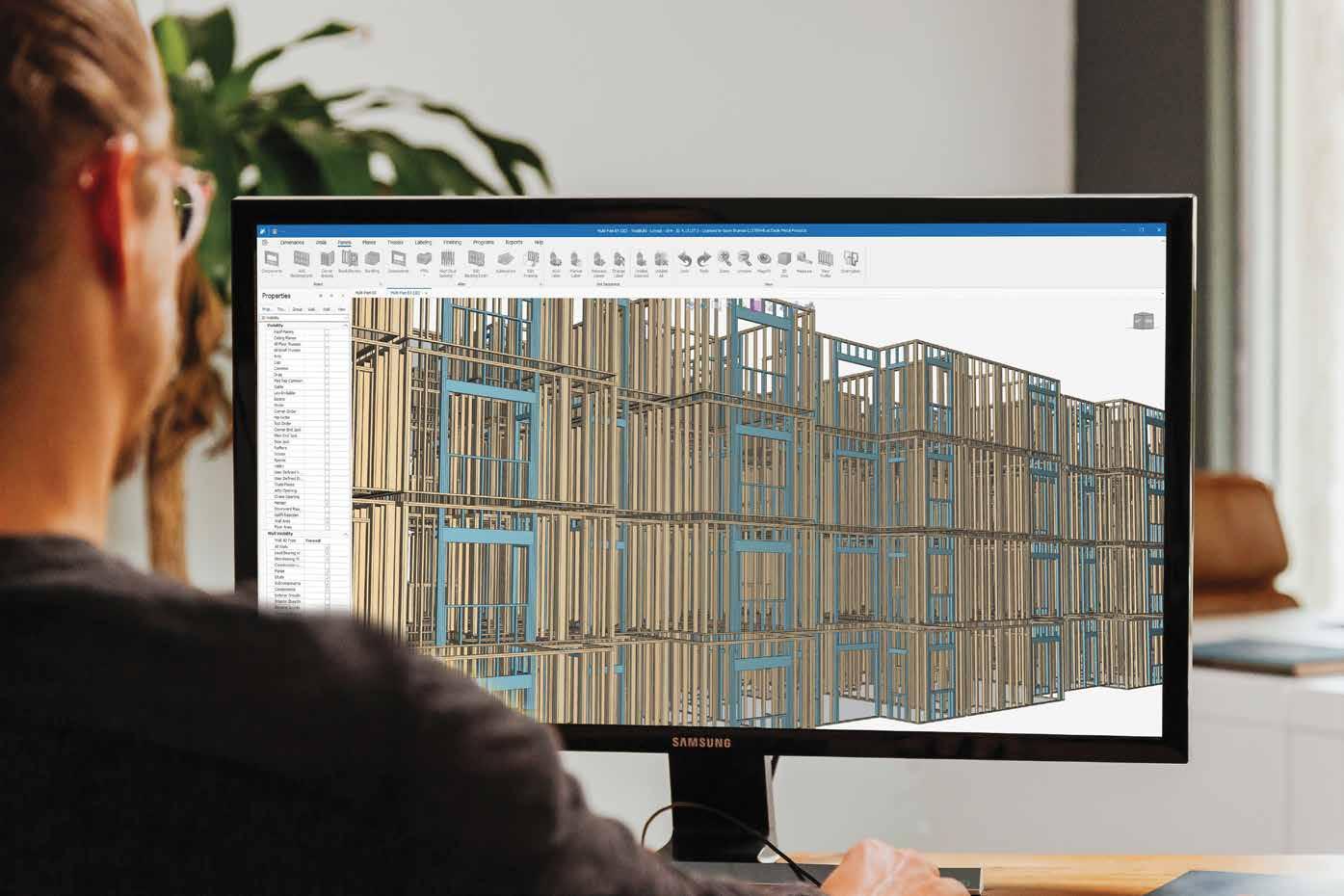
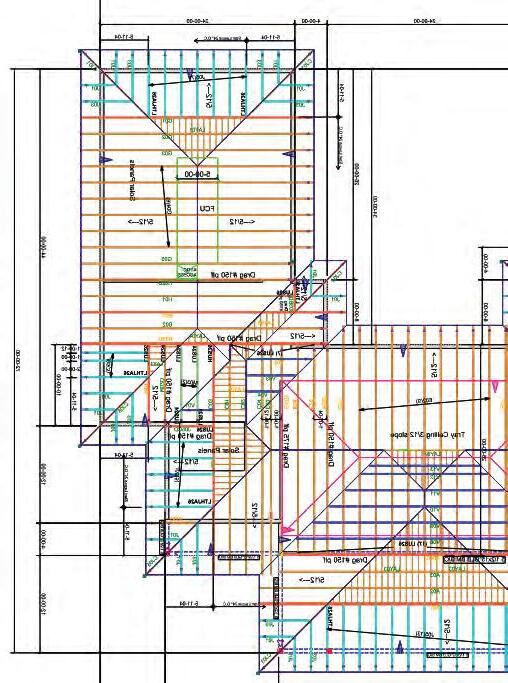
Elevate Your Wall Panel, Floor Truss or Roof Truss Manufacturing with 4Ward Design Solutions’ Precision Component Design Services!
Extend your existing capabilities with 4Ward’s design expertise. Without the hassle and expense of training your own designers, partnering with us guarantees that each wall panel, floor truss or roof truss will be designed for structural integrity and production and field efficiency.
Achieve cost efficiency without compromising on excellence.
Our cost sensitive approach ensures maximum value for your investment.
Build Smarter
Leverage our expertise, ensuring every component is attentively designed for optimal performance and durability.
A dverti $ er Component manufaCturing
Anna Stamm – Advertiser Forum: Excitement is Building for BCMC 2026
Joe Kannapell: Home Building Technology, Part XVIII: Planned Communities and Off-site Construction
Glenn Traylor: What are the Benefits of QA and Safety Audits?
Wendy Boyd – Spida Machinery: Find Smarter Production Solutions at BCMC 2026
Ed Lim – LimTek Solutions: Symmetrical Batching is Cut-by-Truss at High Velocity
Michael Bell – Enventek: The Real Cost of a Component Saw
Todd Drummond Consulting, LLC: Freedom to Choose Any Plate Vendor – Without Disrupting Your Operation
Matt Van Stelle – Paragon: Lean Building: How Paragon’s Philosophy Reflects Your Shop Floor
Garry Roehr – AMT Robotics: What Should Be Measured to Improve ROI on a Wall Panel Line?
Lesko Financial Services Team: Positive Signs for Growth Despite Uncertainty
Thomas McAnally – TheJobLine: We’re Your Recruiter Down the Hall
Geordie Secord – Design Connections: How Design Talent is Your Best Preventative Maintenance Program
Frank Woeste – All Things Wood: History of L/480, Evolution to L/360, and 21st Century Options
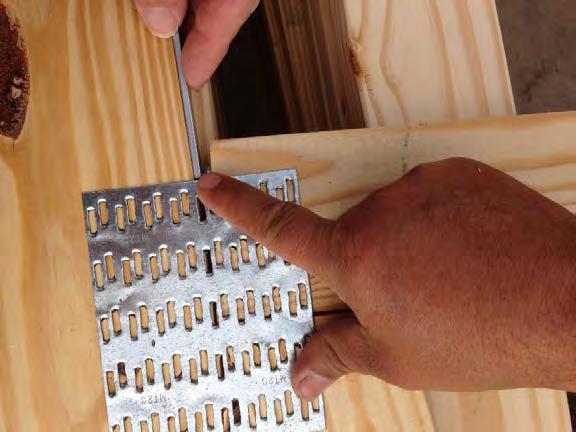
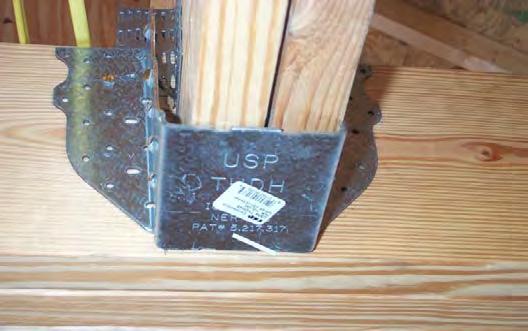
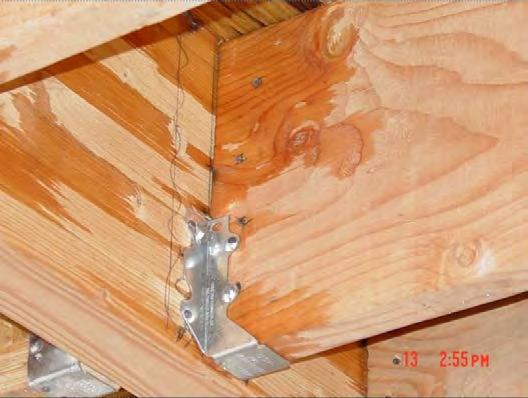
Will Kidd, P.E. – MiTek: Top Installation Mistakes That Affect Structural Connector Capacity
Christine Wagner – SBCA: What to Expect at BCMC 2026
Joe Kannapell – The Last Word: Celebrating 50 Years of Trusses with Shelter Systems
A dverti $ er Component manufaCturing
New & Used Equipment
Saws
Truss Equipment
Panel Equipment
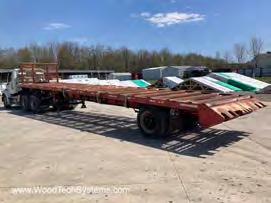
Trucks & Trailers
Misc. Equipment
Door | Stair | Window Equipment
Calendar of Events
Safety First
TheJobLine - Jobs & Candidates
Industry News
Directory
Hiring-Zone - Jobs & Subcontractors
4Ward Solutions Group
Acceptance Leasing & Financing
All Points Technical
Alpine
AMT Robotics
BuyMetrics
Clark Industries, Inc.
CT Darnell Construction
Eagle Metal Products
Eide Machinery Sales, Inc.
Enventek
Fitzgerald Group
Hiring-Z one
HOLTEC USA
Hundegger, Inc.
LimTek Solutions
MiTek
Panels Plus
Paragon
Precision Equipment Truss Trailers
ROGworx Automation
Simpson Strong-Tie
Spida USA
The Hain Company
TheJobLine
Timber Products Inspection
Todd Drummond Consulting, LLC
Triad | RUVO | Merrick Machine
Truss Machine Works
Vekta Automation
Wasserman & Associates
West Fraser
Wolf X Machina
Wood Tech Systems
Inside
Published Monthly
Publisher Thomas McAnally twm@componentadvertiser.org
Editor Anna L. Stamm 800-289-5627 x 3 anna@componentadvertiser.org
Distributed FREE Via e-mail subscription Download PDF or Read on line at www.componentadvertiser.com
News of Interest and Advertising inquiries can be submitted to: anna@componentadvertiser.org
An Open Forum for many sources.
Deadline 20th of each month. Articles, Trade Names, and Logos are the property of their respective owner or creator unless otherwise noted
Disclaimer: We reserve the right to refuse any advertisement or material that we deem not in the interest of the industry or the Advertiser. Permission to use content is the responsibility of the contributor including permissions to use any likeness of persons.
The Advertiser is provided “As Is” including typographical errors, omissions, and mistakes both intentional and unintentional.
Believe it at your own risk!
Copyright 2008-2026
Component Manufacturing Advertiser
The Advertiser 7586 Becks Grove Road Freetown, Indiana 47235 no reproduction in whole or in part without permission from the component manufacturing advertiser
Archive Copies Available On Line www.componentadvertiser.com
Anna L. Stamm Director of Communications and Marketing Component Manufacturing Advertiser.
CAdvertiser Forum
Excitement is Building for BCMC 2026
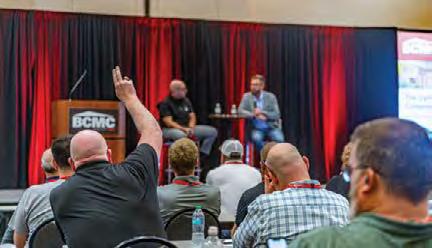
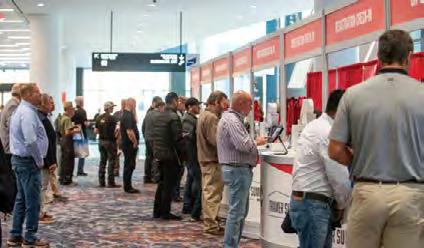
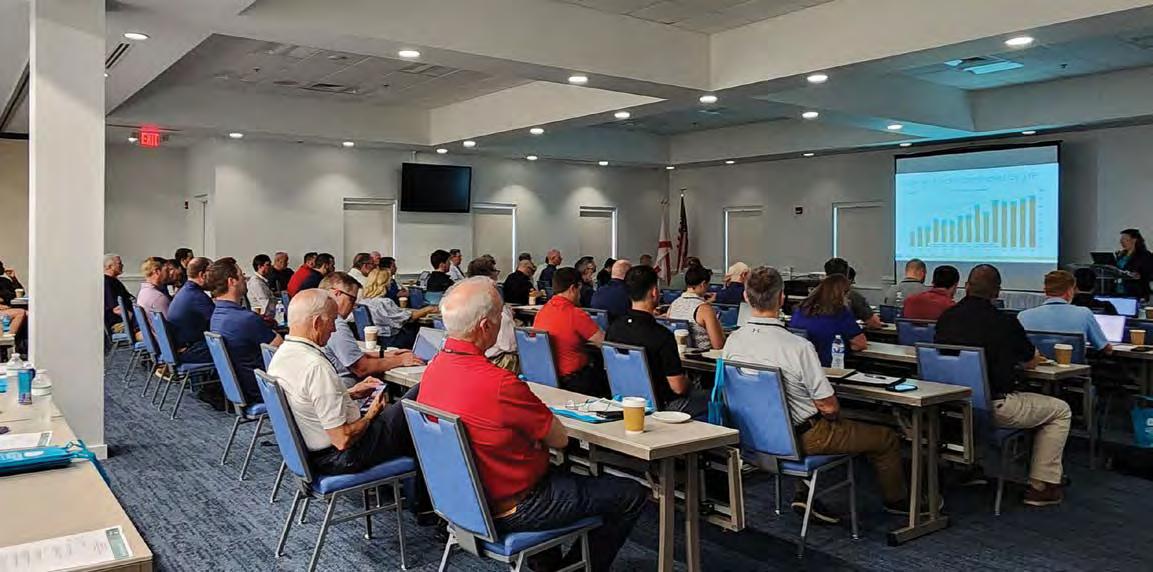
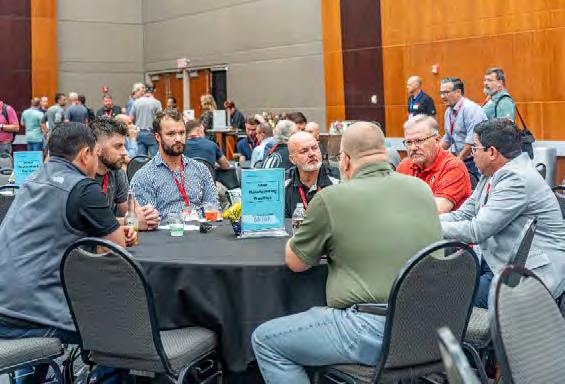
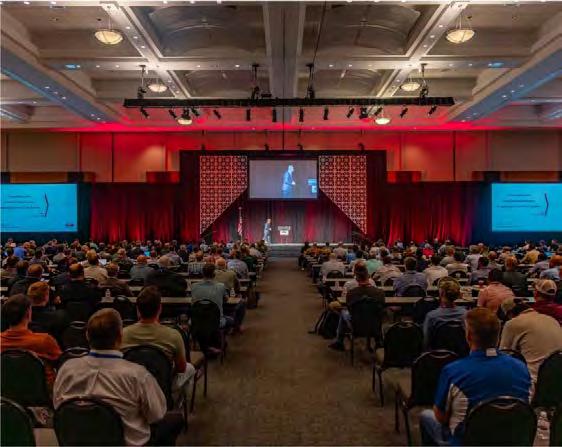
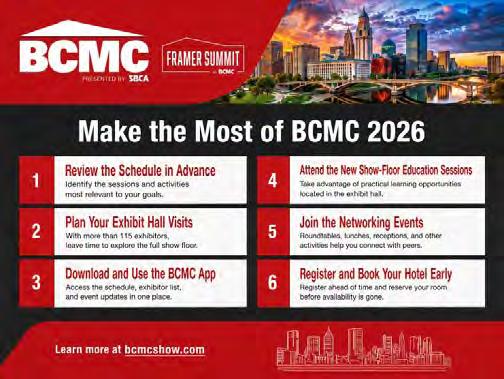
an you feel the excitement building? Exhibitors are readying their booths, speakers are preparing their sessions, and in only a few weeks, the industry will be gathering in Columbus, OH for the Building Component Manufacturers Conference (BCMC). If you haven’t booked your travel yet, it’s time!
Bringing the Industry Together
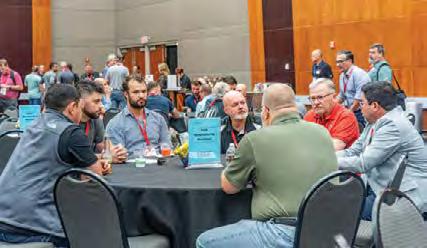
One of the most important aspects of BCMC is how it brings people together in one place for a few days each fall. In this digital age, being in the same building with this many friends and colleagues presents countless opportunities! In many ways, our industry friends are like family and this can feel like a reunion.
From friendly chats to business decision-making and everything in between, the annual show lets people interact in multiple venues.
All About the Booths
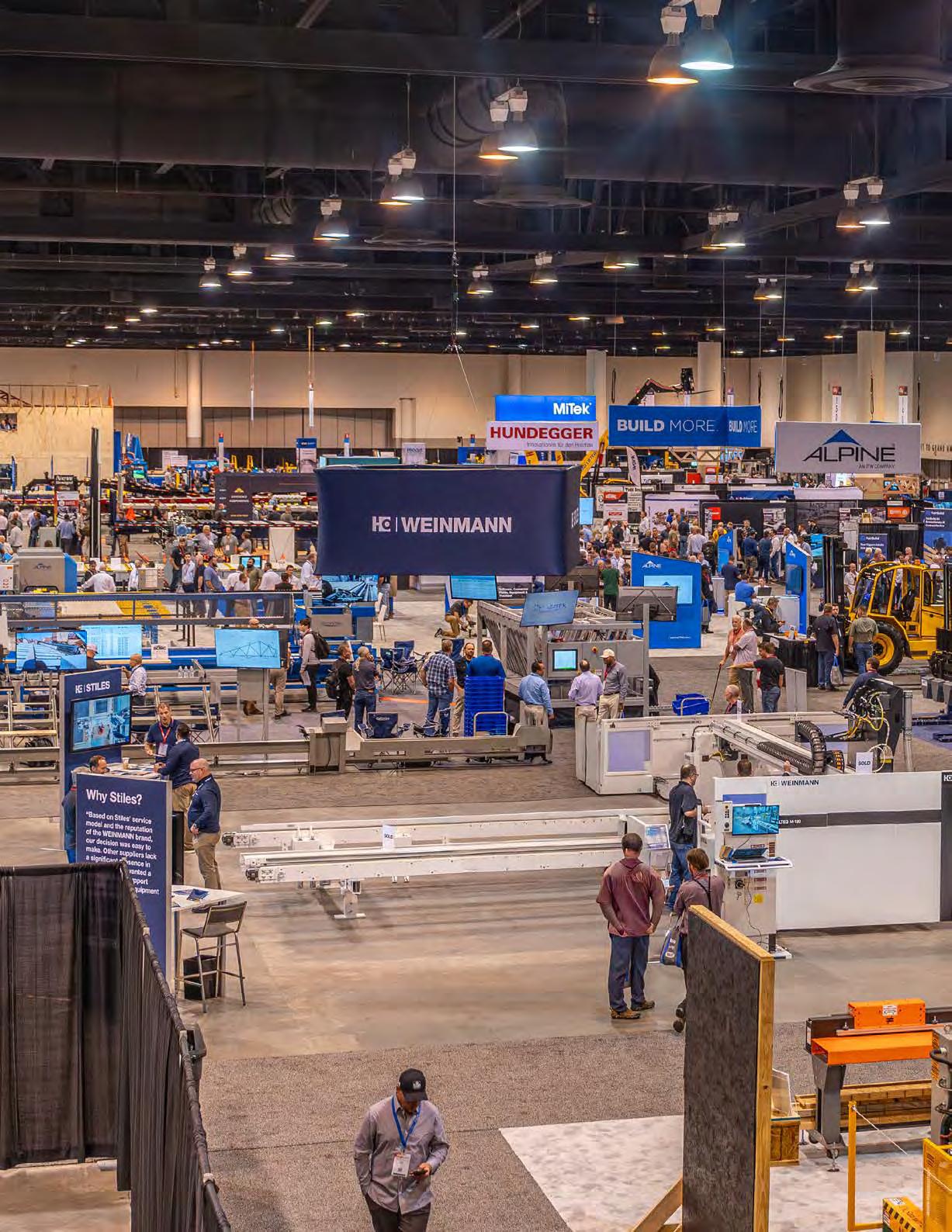
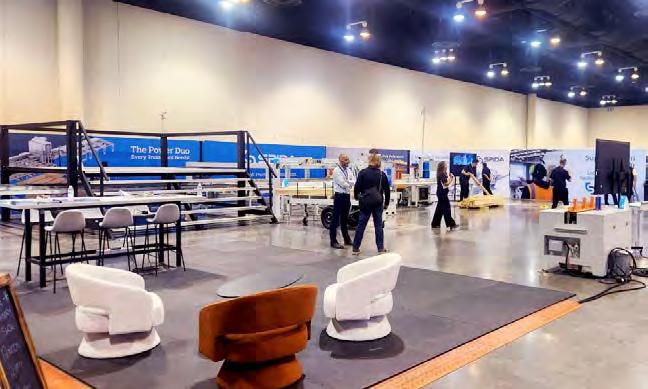
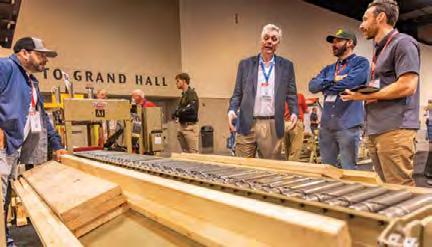
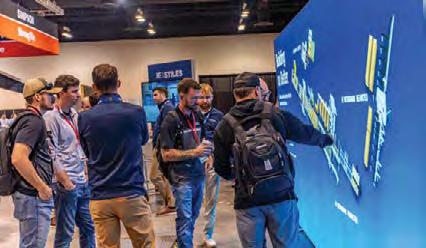
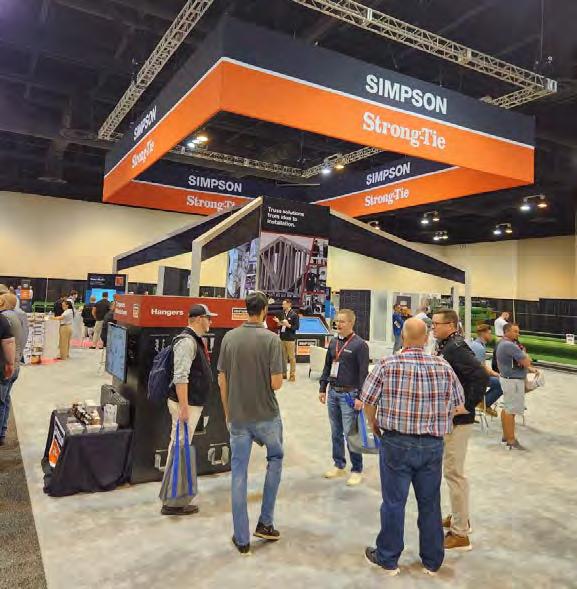
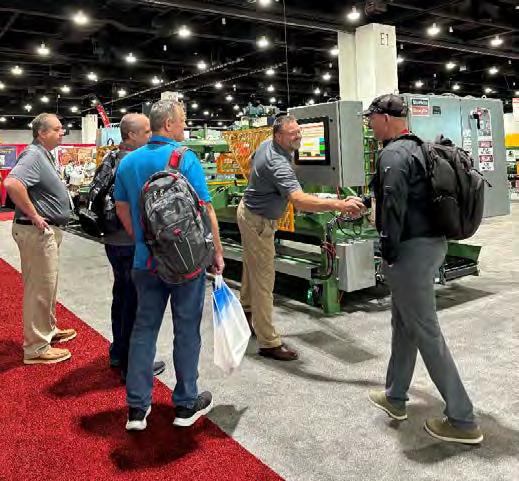
Undoubtedly, the #1 reason to attend BCMC is the exhibitor booths. Our annual tradeshow hosts an impressive array of industry suppliers, all of whom are eager to show what they have to offer. In fact, in this issue, you’ll see several ads and articles that include booth numbers and hint at what you’ll be able to see first-hand in September.
Activities, Education, and More
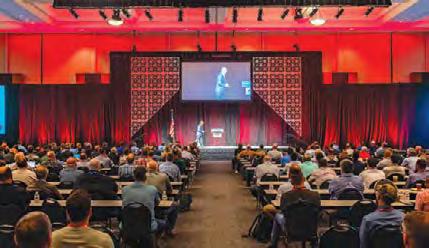
BCMC is the single best opportunity all year to connect with colleagues face-to-face for business and pleasure. Component manufacturers and equipment manufacturers, consultants and suppliers, managers and staff — you can see them all at the show. Check out the cover story from SBCA on page 160 for more details.
Will You Be in Columbus?
Who, and what, will you see at the show? Be a part of the industry’s main event and connect with your colleagues in September.
BUILD SMARTER
Automation
Not
EXPERIENCE WHAT’S POSSIBLE
See how new innovations in technology, service, and automation can help you stay one step ahead.
BID WITHOUT BOTTLENECKS
DEFEND AGAINST DOWNTIME
OPTIMIZE FOR OUTPUT
Visit our booth to see what’s new and what’s next—including exclusive demonstrations and key insights—only at BCMC.
September 14-18, 2026 | Columbus, OH
MII.COM/BCMC
Free expert-led MiTek sessions are available.
Monet DeSauw FWA 500 Floor Web Cutter
• Push Button Powered Blade Angulations
• Single Push Button Setting for 2 Blades per Side
• Servo Positioning on Infeed, Angle & Outfeed Pusher
• Over Travel Protection
• Ink Jet Printer
• Lumber Optimization Program
• Belt Waste Conveyor
• 480 Volt / 3 Phase / 60 Amp
• Includes 5 Day Onsite Installation & Training
• Optional Monet DeSauw Live Deck, Bunk Feeder & Incline Belt Waste Conveyor FOB MO Call For Pricing
• Touch Screen User Interface with Backup Mechanical Controls
• 3 Operating Modes: Auto, SemiAuto & Manual
• All 20 Axes of Movements are Computer & PLC Controlled
• Comprehensive Setup Screens Display Each Piece with Setup Data
• Anti-Collision & Optimizing Programming
• Auto Calibration Productivity & Time Tracking
• Maintenance Diagnostics
• Variable Speed Conveyor (0-50 Flights per Minute)with Powered Hold Downs
• (1) 30” x 80 Tooth Blade (27 3/4” Scarf on PAE)
• (4) 16” x 40 Tooth Blades (13 1/2” Scarf on Centerline)
• Pneumatic Blade Brakes on all 5 Blades
• 16 1/2” to 20’ Length Capacity (11” Minimum on Square End Blocks)
• Vibrating Waste Conveyor Under Saw
• 480 Volt / 3 Phase
• Includes 4 Day Onsite Installation & Training
• Add $2,900 for Extra Set of Blades
• Optional Live Deck, Label Printer, Ink Jet Printer, Catcher Display & Incline Belt Waste Conveyor.
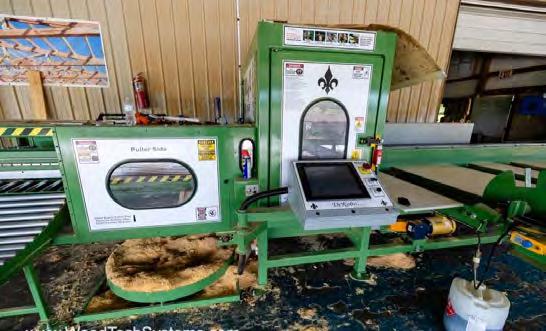
Monet DeSauw DeRobo Linear Saw
Monet DeSauw DeSawyer 2000 Automated Saw
By Joe Kannapell
OHome Building Technology, Part XVIII: Planned Communities and Off-site Construction
n my way to the component plants that supply The Villages, the most well-known planned community in Florida, I drove through the vastly expanding reaches of America’s last remaining bastion of true production building. When I entered the new 424-acre Governor Rick Scott Industrial Park, I encountered an off-site construction complex like none other that assembles the walls and the roofs for this massive development. As I contemplated the huge scale of The Villages’ investment in this complex, I wondered if this would go the way of other captive component plants, like Hovnanian’s more modest facility that built several thousand houses along the New Jersey shore and then closed after it exhausted the land supply. But, I soon learned that The Villages still has 25,000 acres available for future expansion, dwarfing the total size of its most celebrated predecessor communities, and it possesses many more advantages.
The most critical driver of home building efficiency is the ability to progress street-by-street at a steady and continuous pace. While this worked well when huge tracts of land were available in the past, they were never large enough to sustain more than five years of steady growth. For example, after William Levitt filled out each of his three Levittowns, he was unable to find large enough tracts in high growth areas. Likewise, after Del Webb filled out his 25 square miles of desert in his original Sun City near Phoenix, he had to begin anew in Sun City West where he was only able to acquire 12 square miles of land. By contrast, The Villages has developed only about 65% of the 57 square miles of land under its ownership.
Equally important to sustain large developments is a steady, sustainable influx of qualified buyers. While Levitt capitalized initially on the large influx of returning World War II servicemen, by the time he opened his final development in New Jersey in 1958, that supply had largely diminished, and Levitt was unable to find other suitable opportunities elsewhere. By contrast, the four Sun City communities around Phoenix have enjoyed a continuous inflow of about 50,000 new residents annually for over 60 years. However, The Villages has benefitted from the inflow of about 200,000 new residents annually to Florida. Also critically important is that at least 60% of incoming residents to Florida are able to buy a home in their first year.
Also contributing to the growth of The Villages is the wide appeal of its offerings, and the variety of building methods it has tried. Fortunately, roof trusses have always been a staple of its residential structures, while its numerous new commercial complexes often feature conventional steel and concrete construction. Residential wall construction has evolved from concrete block to poured-in-place to precast concrete walls and also to wood framed walls. The Villages remains the largest proving grounds for residential construction technology.
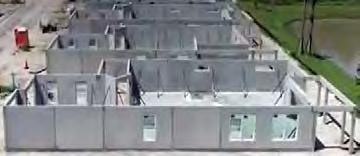
The Villages’ breakneck pace of on-site construction is supported by one of the largest off-site construction complexes housed in a new, first class, rail-served industrial park. Driving into the complex, I first encountered the precast wall plant and the large number of adjacent storage racks, some of which were loaded with panels stored vertically, back-to-back. Since this structure was one of the first constructed in this complex, and since precast panels can replace both concrete block and wood panels, it is worth knowing more about them.
The Villages’ precast plant harnesses the best German technology that is widely used in most of the world that eschews use of wood framed walls. The panels are fabricated on a highly automated line in modular lengths, approximating the lengths of typical wood-framed panels. After curing for at least 24 hours, finished panels are raised vertically and placed in steel racks designed to fit the bed of low-boy flatbed trailers for transport to jobsites. Precast panels contain insulation and are mainly used in repetitive, rectangular floorplans of courtyard and veranda homes that gain increased curb appeal by varying roof truss designs.
Beyond the precast plant is an even larger and more impressive sloped-steel structure housing the wood wall panel plant, containing three exterior and four interior conventional Panels Plus lines fed by Hornet II saws. In addition to supplying fully panelized homes, this facility builds all the interior panels for the precast units, providing increased flexibility for their interior spaces. Since this is a captive facility, The Villages’ designers have optimized the design of header and junction configurations.
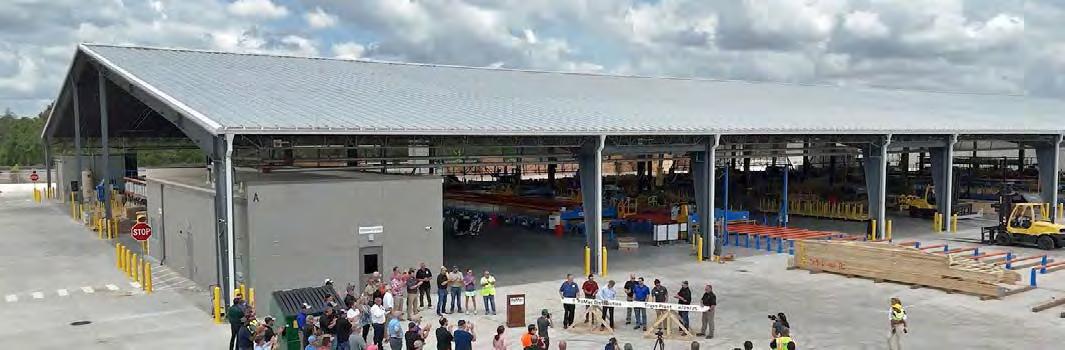
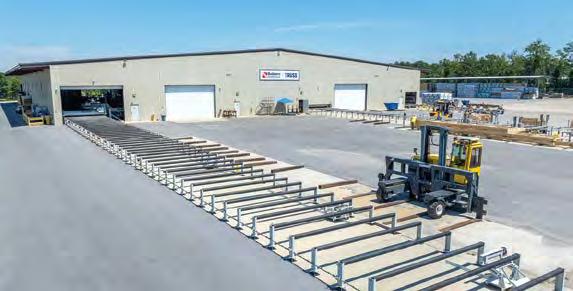
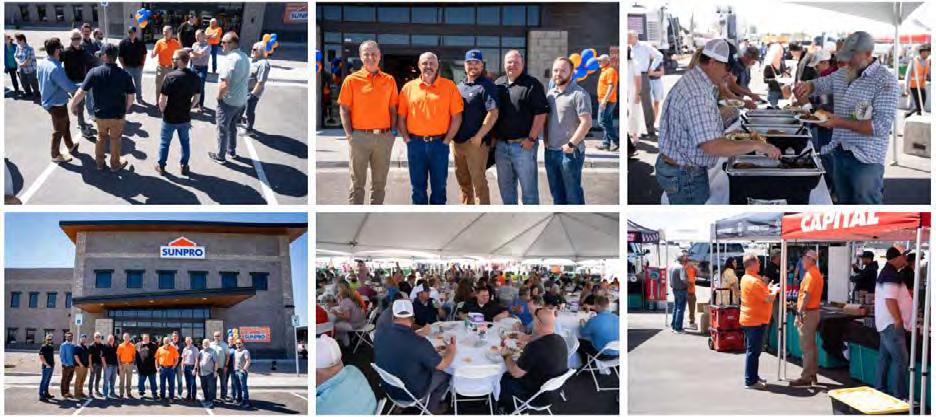
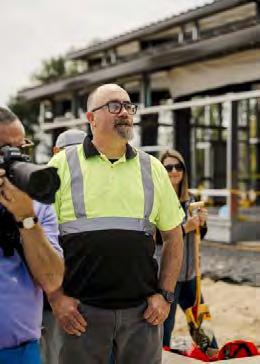
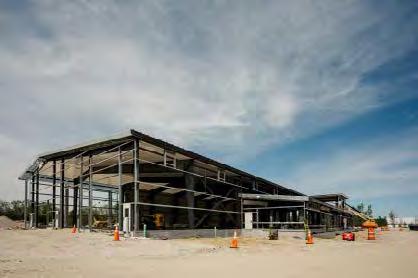
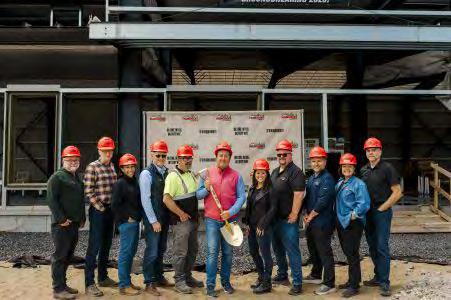
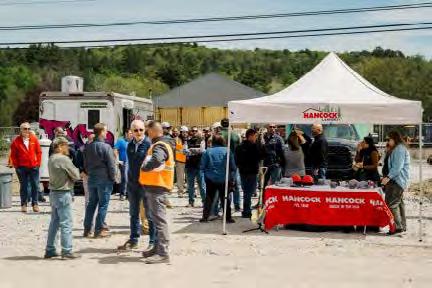
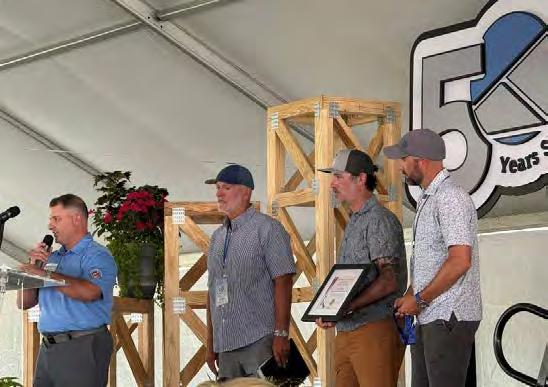
At the end of the industrial park is the impressive truss plant, which had its “board cutting” ceremony shown in the photo on May 7, 2025, featuring $25 Million of truss equipment, including four MiTek Wizard lines fed by Blade II saws. The panel and truss plants are part of RoMac Building Supply, which is a family owned and operated company independent of The Villages’ development and ownership. This entire complex operates at the same or higher level of efficiency as the new BFS plant north of Houston and the new Sunpro plant in St. George, Utah. Along with its adjacent wall panel plant, the RoMac complex rivals the twin plants of Automated Products, now part of US LBM, in central Wisconsin.
Each of these plants benefits by supplying prosperous housing markets, and together they portend a great future for the component industry. However, this RoMac facility, fueled by the relentless pace of The Villages, will likely maintain the highest capacity utilization, thereby providing one of the highest returns on investment.
Equip your customers for faster framing.
Introducing the Simpson Strong-Tie ® EasyFrame automated marking system. A combination saw and printer, EasyFrame cuts detailed wall panel framing members that are pre-marked for fast, accurate assembly. Designed for efficiency, EasyFrame prints framing plans directly onto lumber, including locations of boards, connectors, wiring and more. It can be paired with a manual or automated saw, and features a blade enclosure for safety. Powerful software also lets you ensure precision and optimize material use. EasyFrame is supported by our installation and onboarding services, training and technical expertise. It’s a smart way to equip customers for wall panel jobs while setting your business apart.
Add EasyFrame to your lumber sales area. To learn more, visit go.strongtie.com/easyframe or call (800) 999-5099.
– Bill McAlpine, Co-founder of Alpine
In 1966, we designed 200 trusses for three customers. Since then, our team has helped build millions of homes in North America through high-quality component manufacturing.
A lot has changed in 60 years, but our commitment to partnership has always been at the core of what we do. At Alpine, our team fosters lasting relationships with customers and collaborates on solutions. Our industry innovations have been driven by challenges we’ve seen component manufacturers face. We truly want to see everyone succeed.
Like the plaque in our Orlando o ce reads, “Find good people and grow old with them.” So here’s to six decades of innovative, solution-forward component manufacturing—all thanks to our team members and customers who made it possible.
The truss industry relies on 3rd party quality assurance services to provide random visits to review the plants Quality Assurance program along with their operations. If your plant needs to comply with the IRC, IBC and to those who depend on solid, experienced QA expertise, we ask you to consider selecting Timber Products Inspection, Inc. (TP) as your choice for 3rd party inspections.
Proudly serving the forest products industry for over 50 years, TP brings the expertise you need to ensure your business is successful. As a responsible partner, TP delivers to clients, employees, and the industries we serve the confidence to drive value through the effective use of our diverse professional team.
TP would like to welcome the following authorized agents to our inspection team, each of whom have many years of experience in the truss industry!
• Al Coffman
• Jean Hart • Curt Holler • Chuck Ray
Glenn Traylor • Elliot Wilson
If you have questions about how you can make this selection, please contact your authorized agent above or Glenn Traylor at 919-280-5905 or trusguy@gmail.com. https://www.tpinspection.com/ https://www.tpinspection.com/auditing-services/truss
By Glenn Traylor
TWhat are the Benefits of QA and Safety Audits?
he term “audit” generally induces visions of tax audits. You imagine endless questions and boxes of records, as you attempt to produce documentation to defend what you’ve done. Importantly though, these visions are not what should come to mind when you think of a quality assurance or safety third-party audit.
Third-party audits for QA and safety are not a penalty or a punishment – they are procedures to ensure compliance with ANSI/TPI 1 and OSHA regulations. In fact, audits provide many benefits.
What Audits Contribute
The following demonstrate some of the benefits of third-party audits conducted by non-biased professionals.
1. Validation: An audit verifies your compliance with ANSI/TPI 1 and OSHA regulations and guidelines.
2. Perspective: An audit puts another set of eyes on your operations from a person with a broad perspective. The auditor has an advantage that is improved with compliance audits experience in multiple environments and styles.
3. Risk Control: An audit identifies potential issues or problems that can escalate and lead to losses and liability for the component manufacturer.
4. Objectivity: An auditor’s basis is a standard of quality. It is a series of best practices that are shared among the auditor’s clientele. This sharing strengthens each individual’s quality program.
5. Knowledge Base: An auditor’s knowledge of the codes and requirements are to a level of detail that is not reasonably obtainable for a component manufacturing manager.
6. Uniqueness: Audits are inherently unique to each plant and personnel. They are specific to the plant’s safety and quality program.
7. Accuracy: Due to its objective position, the results of a third-party audit often provide a more accurate view of what is occurring within a plant environment.
8. Graded Results: While initial results often show lower audit scores, many fabricators realize that the results and evaluation can uncover long-standing issues of non-compliance and opportunities for loss that can be immediately fixed, thereby leading to a positive ROI for the audit program.
9. Targeted Attention: Audits conducted by third parties are not a stress on in-house time and labor resources. Unlike an in-house quality review, the third-party auditor enters a location for the sole purpose of conducting the audit. They are not interrupted by the need to complete a job, conduct an employment interview, or deal with a customer situation.
The Bottom Line
The use of a third-party audit can bring great value to any manufacturer. Companies in other industries have seen that using a third party to conduct all audits throughout an organization or supplementing a third party for some of the audits brings a fresh set of eyes and a different approach to the research, review, and analysis of shop results, which can lead to reduced loss and overall earnings improvement.
Instead of dreading your next audit, consider it an opportunity to review your business and ensure you’re protecting your product quality and your bottom line.
An ANSI/TPI 1 3rd Party Quality Assurance Authorized Agent covering the Southeastern United States, Glenn Traylor is an independent consultant with over four decades of experience in the structural building components industry. Glenn serves as a trainer-evaluator-auditor covering sales, design, PM, QA, customer service, and production elements of the truss industry. He also provides project management specifically pertaining to structural building components, including on-site inspections, expert witness and ANSI/TPI 1 compliance assessments. Glenn provides new plant and retrofit designs, equipment evaluations, ROI, capacity analysis, and CPM analysis.
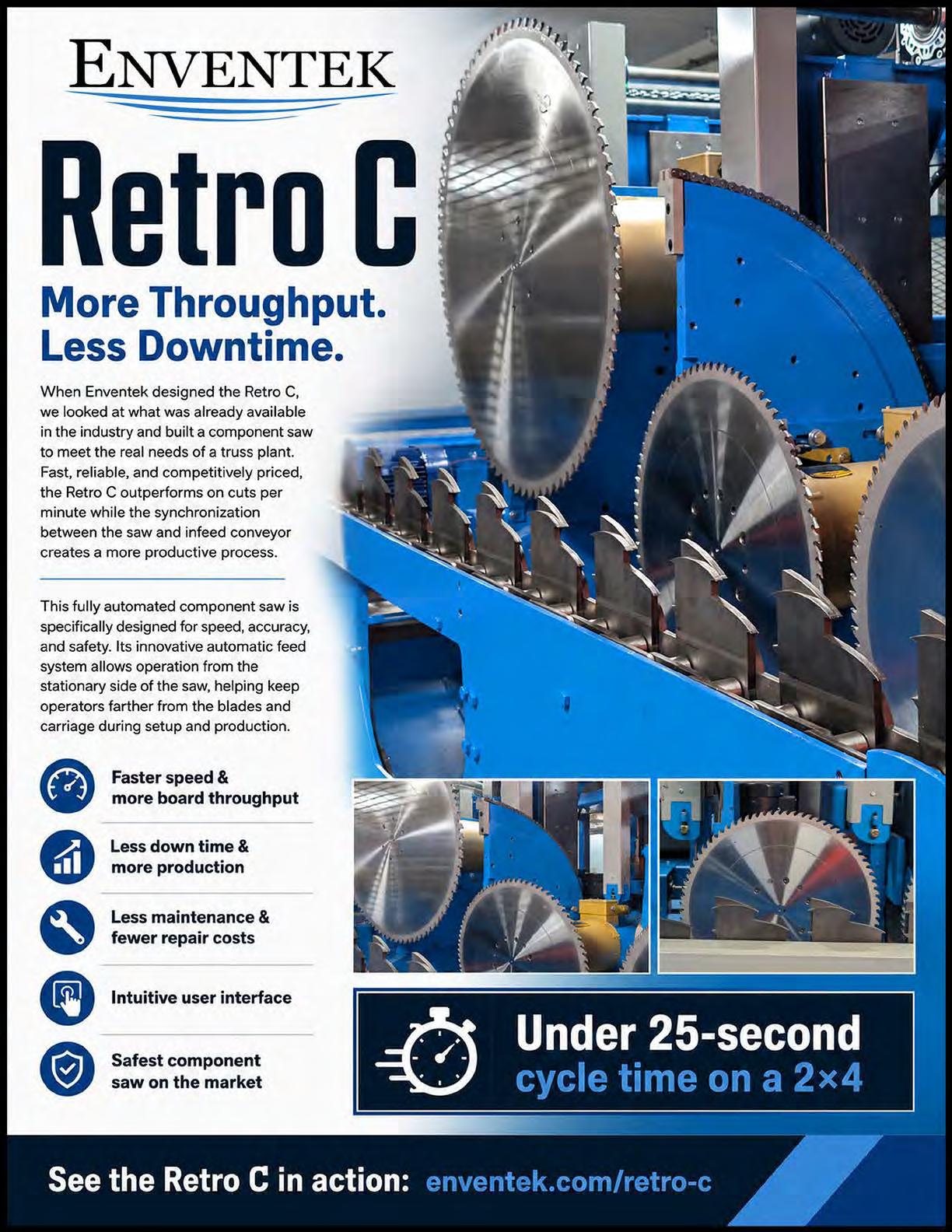
The Auto-Feeding RetroC
The Amazing RetroC by Enventek
A complete wood processing system proven to profitably feed cut lumber to truss plants of all sizes.
Easy to use, simple robust automation that is scalable with less labor. A RetroC holds calibration.
Out Produces Any Saw in Batch Cut or Cut by Truss Mode
Auto-Feeding, no upper hold-downs (just 15 automation axes) with electronic braking. Efficient material handling that will significantly increase cut piece production with reduced operating costs and improve truss build times with consistently accurate cut pieces.
The Magic of SpeedCatch - No Catching Labor
Catching labor is eliminated with our optional SpeedCatch cart system. Sophisticated SpeedCatch software enhances the efficiency of truss production by effectively collating and organizing the lumber at the truss tables. SpeedCatch upgrades the RetroC to a comprehensive one-person (sawyer) wood processing system.
• Ink Jet Printer
• Scrap Conveyor
• Tops, Bottoms, Webs, Sliders, Wedges and Scissor Bottoms
• 5 HP Motor (230 Volt / 3 Phase) with 24" Blade
• Touch Screen Computer
• XL-Cut Software
• 3 Chain Auto Feeder
• Some Spare Parts & Ink
& Trailers
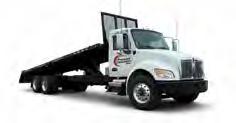
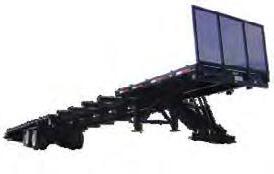
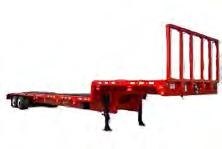
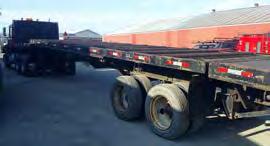
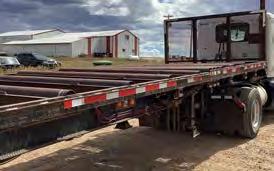
• Stretch Roll-Off Trailers
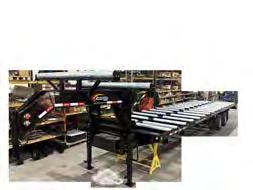
• Go oseneck Roll-Off Trailers
Modular Equipment
• Pacific Automation or MiTek Mobile Home Press
Cutters
Truss Equipment
• Roller Gantry & Hydraulic Press Systems
• Finish Rollers
• Truss Stackers
• Floor Truss Machines
• Lumber Splicers
• Jack Tables
• C-Clamp Presses
Material Handling That Fits
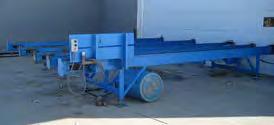
Indoor Truss Exiting Conveyors
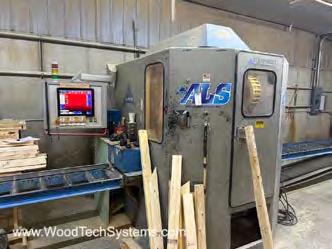
2005 Alpine ALS 276C Linear Saw
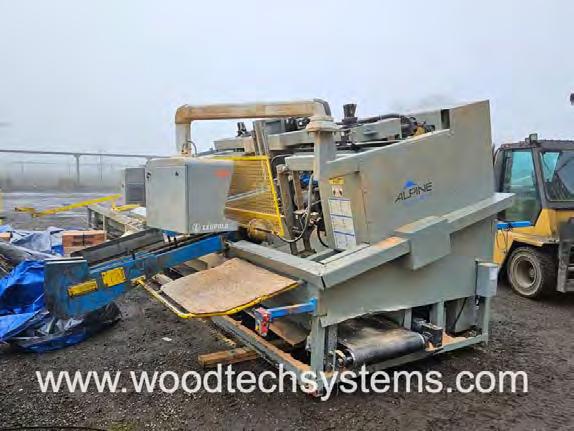
2005 Alpine ALS 276C Linear Saw: Cuts wall and truss parts from lumber depths 2×4 through 2×12, 60”+ scarf cuts, internally optimizes material (up to 11 7/8″ x 1.5″ EWP) Includes 20 foot idler roller infeed conveyor and 15 foot idler roller outfeed conveyor, and under-saw scrap conveyor with belt-type incline. All servo controlled functions, Microsoft Windows 10 Pro o/s (can be upgraded to Windows 10 LTSC for additional cost), 7.5 HP motor with 20” carbide tipped blade. Includes digital manual and Zebra brand label maker, model 105SL. No ink printer is included. 220 volt, 3 phase, 100 Amp electrical required. 125 PSI air required.
EZ-SET AUTO JIGGING EXCLUSIVE & PATENTED DESIGN
Automatic Truss Jigging System to drastically reduce setup times. Allows for 100% embedment on the table, with top & bottom chord pucks in the same slot. TopSider or standard configurations available for conventional kick-leg, walk-thru, or our new trackless 8' and 10' continuous table systems. Systems for other roller & hydraulic gantries are coming soon. Available in new machine installations or for retro-fitting your existing table. The TopSider is exclusively applicable for “kick or flip leg” style truss presses such as the Tri-Axis & Lumbermater®
FEATURES / APPLICATIONS
• Capable of 100% On-Table Nail Plate Embedment
• Two Pucks Per Slot
• 24", 26", and/or 30" Spacing
• Compatible with all current major design software
• Multiple Simultaneous Layouts
13 1/2” Capacity
• Foot Pedal Operation
• Dust Outlet
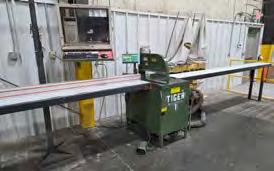
• TigerStop 16’ Programmable Stop
• Automatic Positioning of Stop via Simple and Intuitive Controls
• Infeed/Outfeed Plastic Top Tables with stands
• Excludes: Dust Collector and Adjacent Computer in Orange Cabinet $13,500 NOW $10,900 FOB NE Wasserman & Associates 800-382-0329 www.wasserman-associates.com
Smarter Production Starts Here
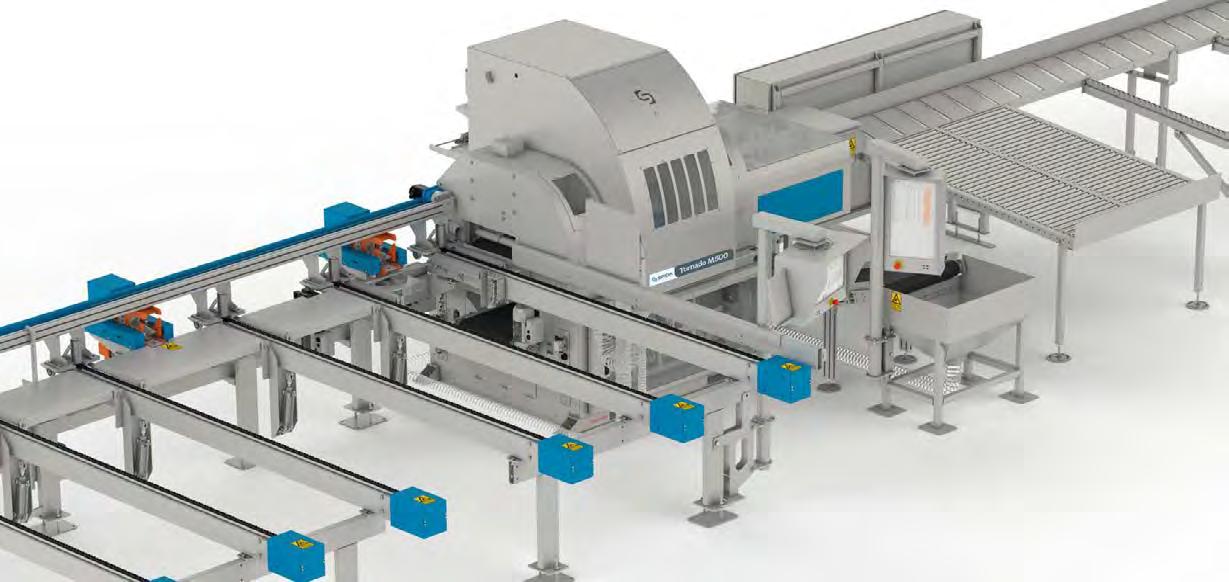
Visit Spida at BCMC 2026 and we’ll help you explore smarter ways to improve workflow, reduce manual touchpoints, and plan for future production capacity.
You’ll find practical solutions at the Spida booth #1139 View
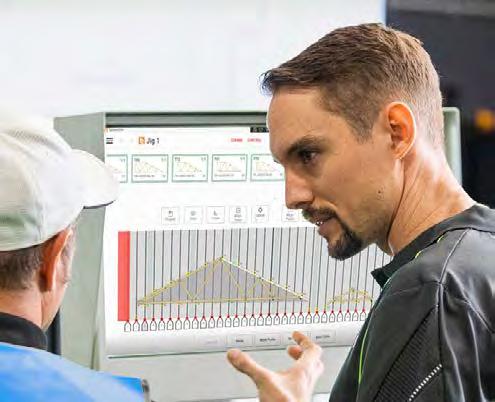
Try the Truss Jig Simulator
Build Your Own Wall Line
Explore Truss Cutting Solutions
Share Your Manufacturing Goals with our team
Keen to get more from your factory floor?
If you’re interested in how software, automation, wall production and truss production can work for you, come and chat with us.
Let’s discuss how tailored solutions could support your next step.
Wendy Boyd Chief Customer Officer Machinery Group Spida Machinery
Find Smarter Production Solutions at BCMC 2026
Often, when we write about BCMC, it’s after the event – when we’re looking back and reflecting on the exchanges we had, the questions we were asked, and the ideas that stayed with us long after the show floor closed. This year, I wanted to write before the event, as we look forward to the valuable conversations that will take place at BCMC.
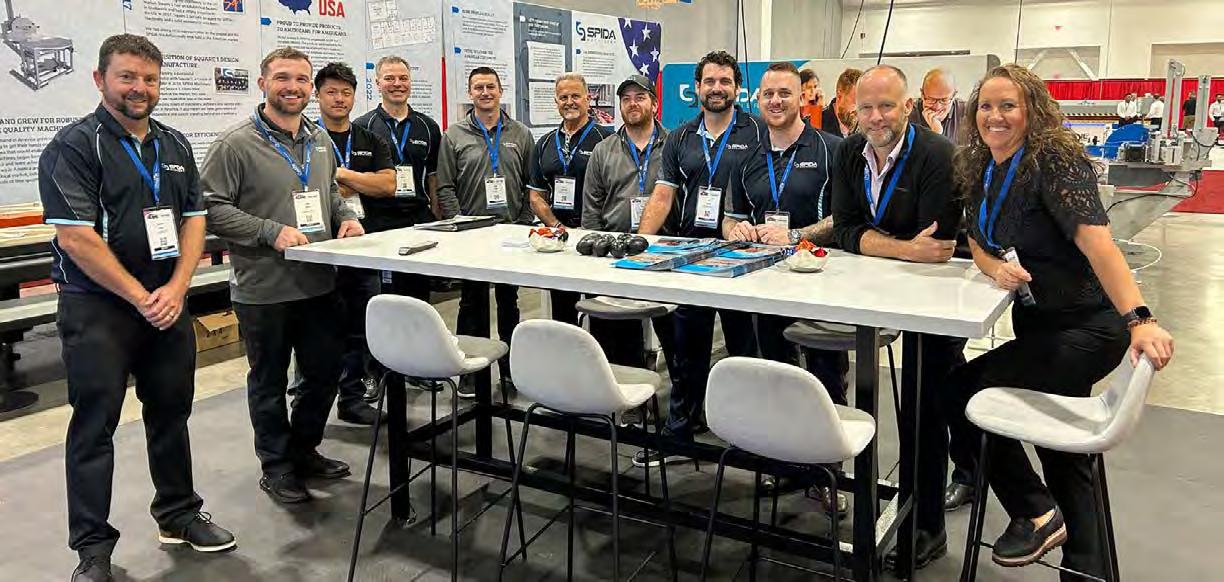
In September, the structural building components industry will come together again at BCMC, this year in Columbus, Ohio. For Spida Machinery, it’s always an event we look forward to, not just because it gives us a chance to share with you what we’re working on, but because it gives us time with the people who matter most – owners, plant managers, detailers, and teams who are working every day to keep production moving.
It also brings our international Spida team together, which is something I always enjoy, giving us a valuable opportunity to connect, collaborate, and share the camaraderie that comes from having everyone in one place.
Smarter Production Starts with a Conversation
Every manufacturer’s operation is different. The pressures may be familiar – labor availability, workflow bottlenecks, changing demand, material movement, production visibility, and the need to get more from the factory floor – but the right answer is rarely one-size-fits-all. That is why we believe smarter production starts with a genuine conversation.
At this year’s BCMC, our booth is being designed around those conversations. There will be product innovation to explore and software and automation to experience in a more interactive way. But more importantly, there will be practical discussions about how those ideas could apply to your operation, your workflow, your available space, your production goals, and your team.
What You’ll See at the Spida Booth
When visiting us, you can expect software, automation, and innovation to be front and center!
• Try our Truss Jig Simulator and see how automated jigging software can support better control, efficiency, and workflow in truss assembly.
• Explore wall production concepts by building your own wall line and thinking about how different machinery options could fit your footprint and production needs.
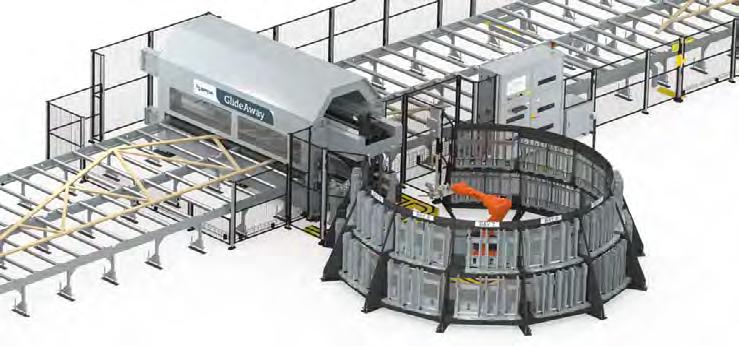
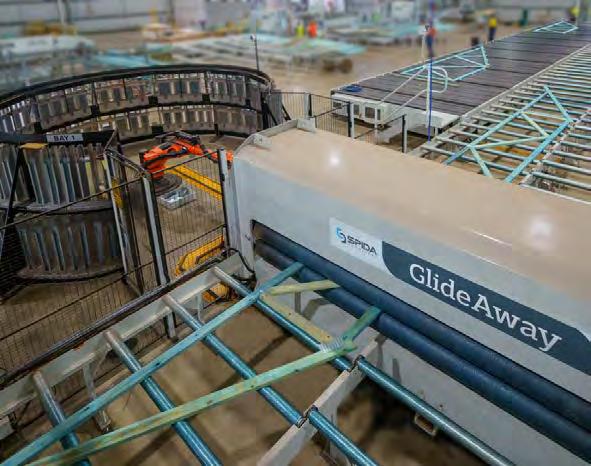
• Learn about GlideAway innovation and how one-touch automation can support more streamlined truss production.
• Talk with us about connected cutting solutions, including the PieceGiver and PieceMaker, and how improving material flow at the start of production can strengthen everything that follows.
• Discover more about truss assembly, including our Roller Plant solution, and the broader ways machinery, software, layout, and support can work together to create an efficient production environment.
For me, smarter production is not just about adding another machine. It’s about understanding the whole manufacturing journey and helping you make decisions that support your business now and into the future.
That is where partnership matters. Anyone can talk about features and specifications, but the real value comes when we can sit down with you, listen to what is happening in your plant, and help you think through what might make the biggest difference. Maybe you are trying to reduce manual touchpoints. Maybe you are planning for growth. Maybe you are looking at software, automation, factory layout, serviceability, or the next stage of production capability. Whatever the starting point, the conversation needs to begin with your goals.
The Right People for All Your Questions
The Spida booth will have our experts from across the business, including sales, software, installation, service, support, and product specialists. That mix is intentional. We know the questions you bring to BCMC do not always sit neatly in one category. You may want to talk through software integration, installation planning, operator training, machinery capability, local support, spare parts, future upgrades, or how a solution would actually work on your floor. Our team members are here to help you, so you can get the information you’re seeking from someone who understands each part of the journey.
Real Conversations, Practical Answers
One of the things I have always appreciated about BCMC is how open the conversations are. People are willing to talk honestly about what is working, what is not, and what they are trying to improve. Those conversations help us too. They challenge us to keep listening, keep improving, and keep developing solutions that respond to the real needs of component manufacturers across North America, Canada, and other international sectors.
So, if you’re heading to Columbus this September, I hope you will stop by and see us at Spida Machinery Booth #1139. Come with a specific challenge, a future plan, a question about software or automation, or simply a curiosity about what smarter production could look like in your plant. We would value the opportunity to talk it through with you.
For us, BCMC is not just a trade show. It is a place where ideas are shared, relationships are strengthened, and the future of our industry is discussed by the people building it every day. We’re looking forward to being part of that again and most of all, we’re looking forward to real conversations with you.
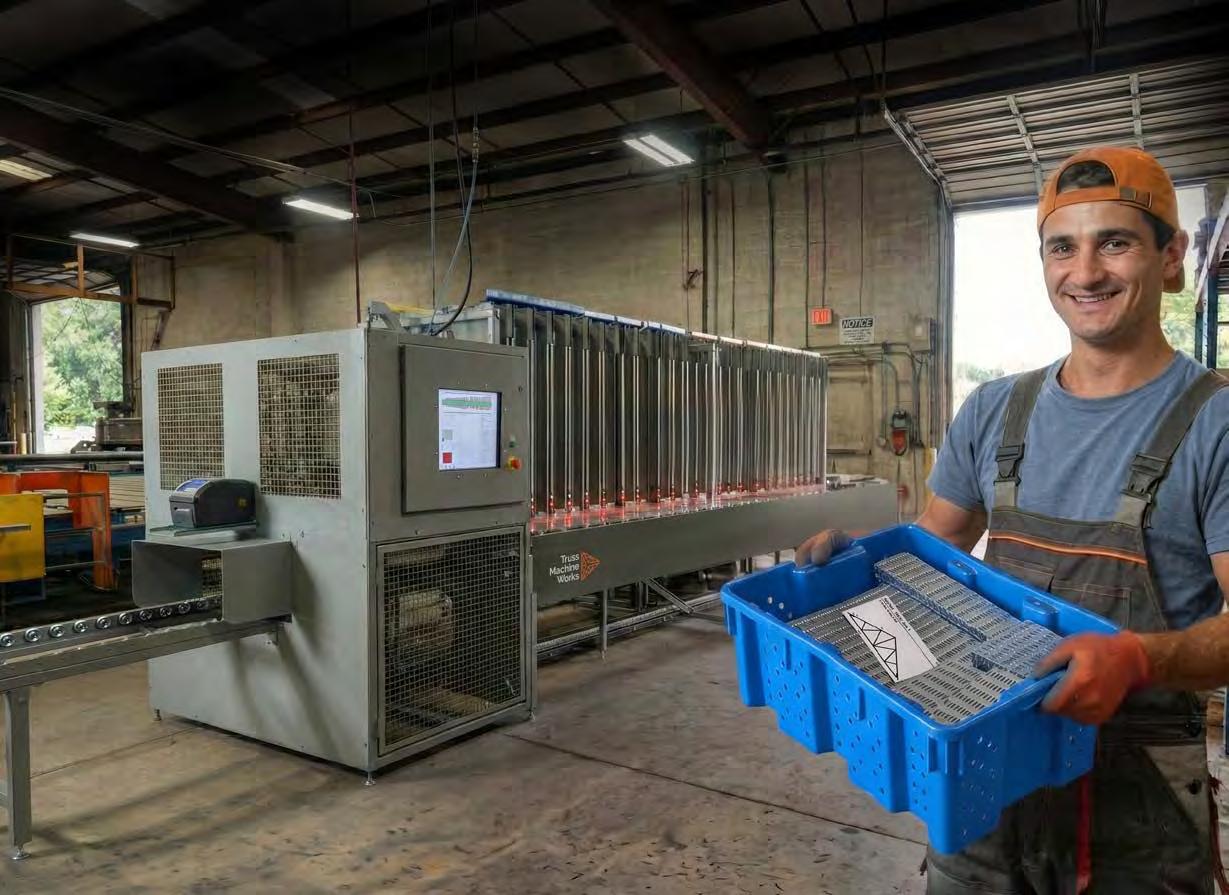
Faster plates More Trusses
Click Here to see the Plate Picker™ in action!
Or visit our website at www.trussmachineworks.com
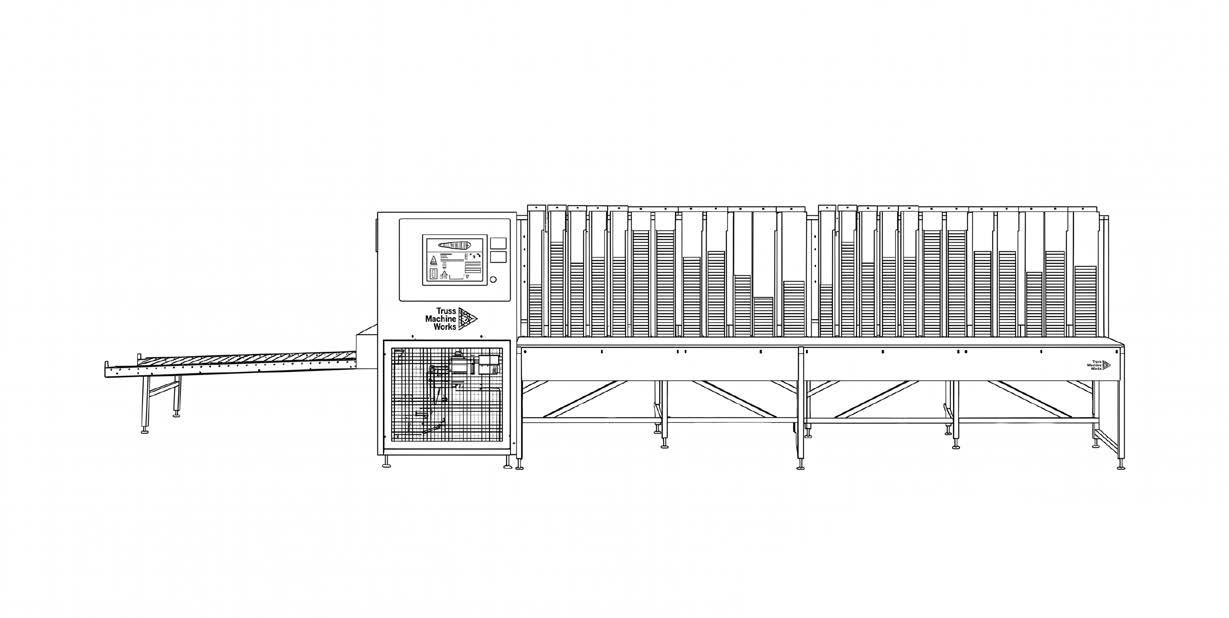
Robotic placement insures no wasted space in bins
Integrates with skate-wheel receiver or conveyor to table
The Plate Picker™ uses a nesting algorithm to tightly pack and sequence plates in the exact order needed for assembly.
Sorting schemes include truss type, per truss, dense pack, and more
Magazine system covers 95-99% of plate sizes needed
Modular design sized for your plant
$118,997 FOB GA
2014 Monet DeSawyer 2000
(Non-servo) five-blade, automated component saw using a touch screen interface and Windows 10 OS for direct input. Operates in automated or manual input mode. (1) 10 h.p., 30″ diameter blade with PAE setup & (4) 5 h.p. 16″ diameter blades with center line setup. 16″ blades cut angles from 3º to 115º, 30″ blade from 3º to 100º . Minimum 90/90 cut is 10 inches and shortest 4-angle cut is 18 inches. Cuts 2×4 through 2×12 lumber up to 20 feet in length.
• Control Cabinet Enclosure with Touch Screen Computer
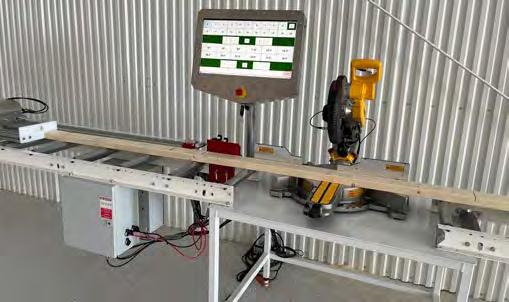
• DeWalt Model DWS780 Miter Saw
• Support Table for DeWalt Saw
• 10' Infeed Roller Conveyor
• Excludes Dust Collector & Spida Annual Support Fee
$19,900 NOW $18,900 FOB ND Wasserman & Associates 800-382-0329 www.wasserman-associates.com
2024 ASI Chop Saw Automation
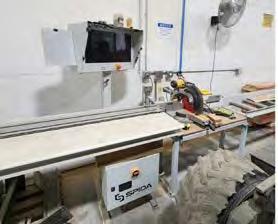
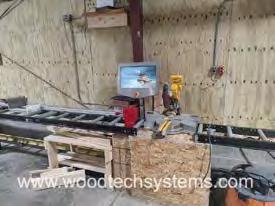
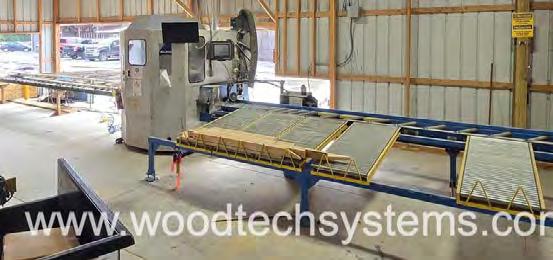
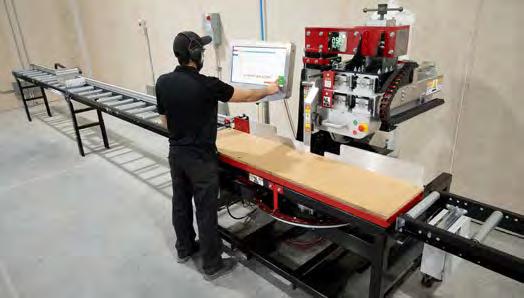
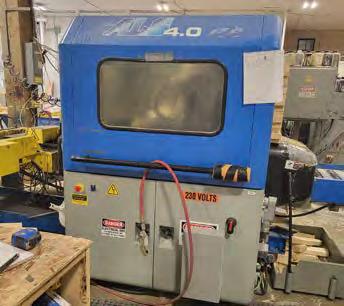
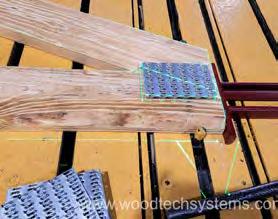
Wall panel cutting station with conveyors. Cuts and marks wall panel pieces up to (2) 2x-boards high. Includes a DeWalt 12″ dia. blade mitre saw, 20-ft long length measure, 16-ft long outfeed conveyor, ASI “Basic” wall panel cutting software with Lenovo PC, plate marker on two 1.5″ edges/1 edge per board and manual. Software reads EHX, TRS, Sapphire XML, EZY, CYB, WCD, ASI, BTL & BTLx files. HMI display available in English, Spanish & French. 120 volt, 1 phase electrical required.
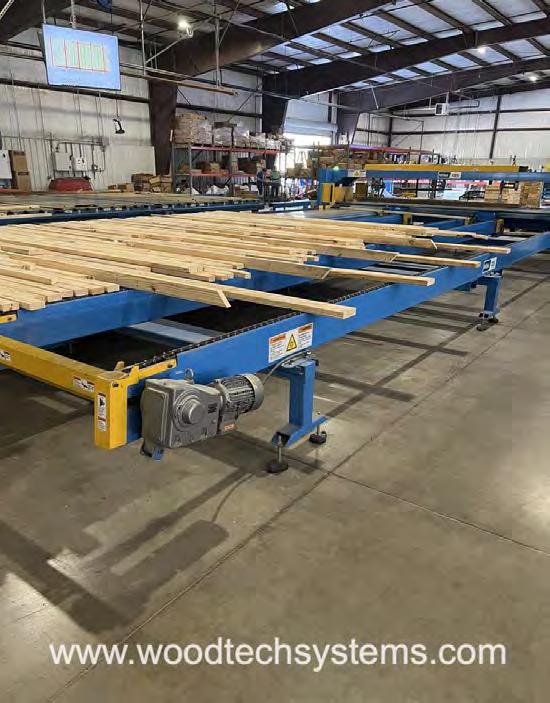
$39,997 FOB NY Wood Tech Systems 765-751-9990
www.woodtechsystems.com
1994 Timbermill Model MH5G-20
Component Saw
Five blades cut lumber from 2″ x 4″ through 2″ x 12″, 4″ x 2″ lengths from 12 inches to 20 feet, including four-angle floor webs from 18 inches. All powered movements. Saw includes (1) 30″, (2) 20″ and (2) 14″ blades, analog scales, chain-drag scrap conveyor with chain-drag scrap incline, and an extra set of blades. Additionally this saw includes an extensive spare parts inventory including: Contacts/Starters, fuses, push buttons, limit switches, crank handles, scales/rulers/dials, angulation, conveyor, and saw motors, universal joints, and arms for outfeeds. 480 volt, 3 phase electrical required.
$17-924 FOB NC Wood Tech Systems 765-751-9990
www.woodtechsystems.com
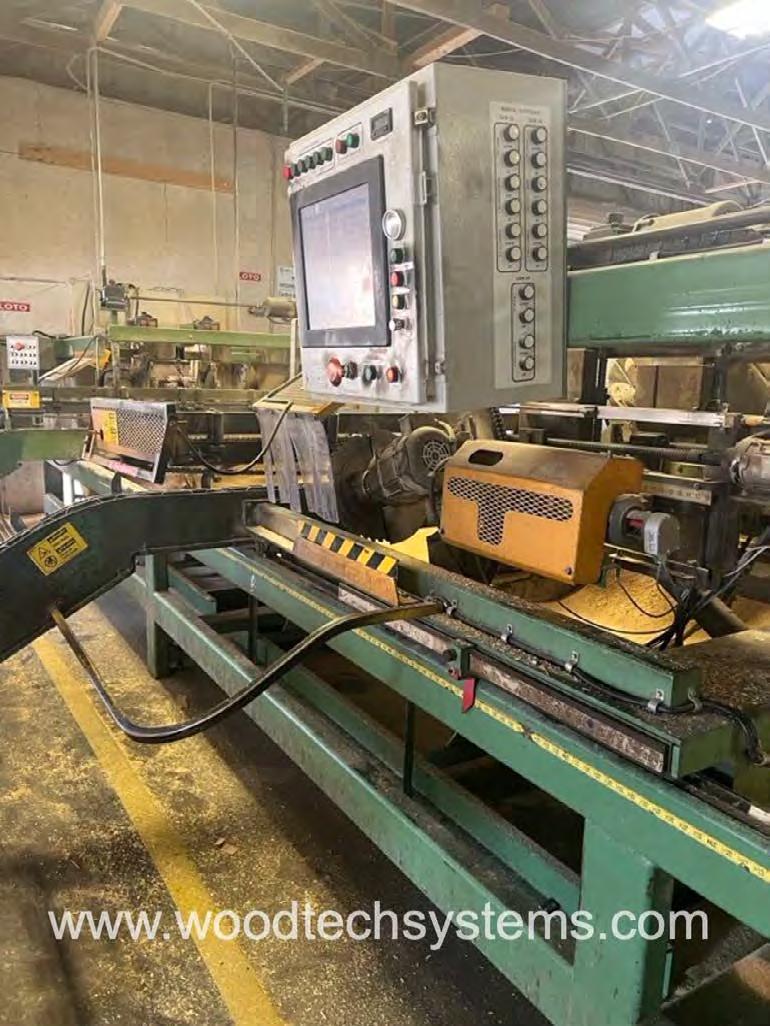
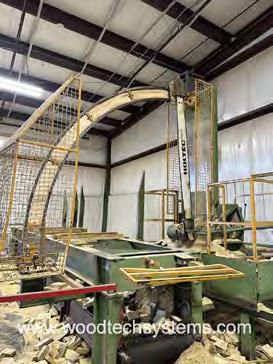
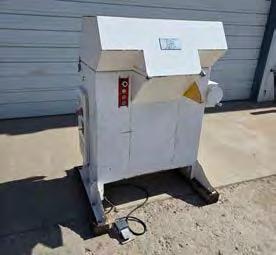
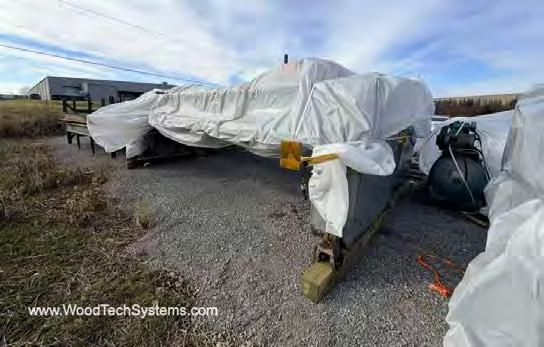
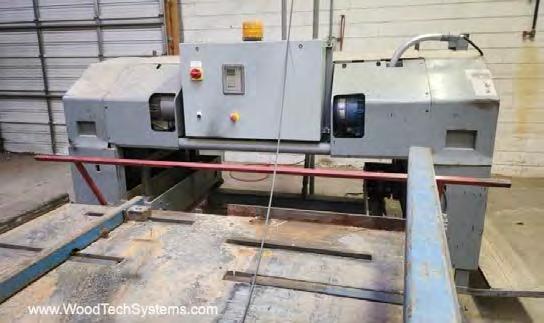
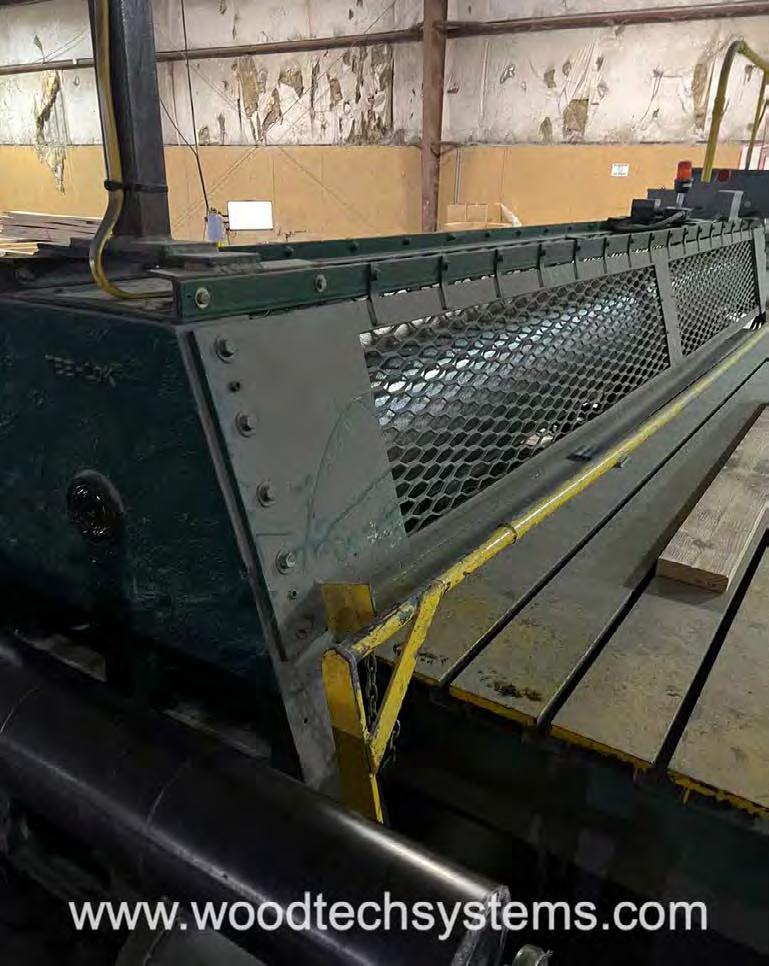
1994 Holtec Bunk Saw Station 20-ft long fixed frame with steel alignment stands, and rough-top waste conveyor belt. Cuts bunks of lumber up to 16-ft long with a 40″ x 44″ cross-section, in a single pass. Includes guide frame, manual / analog length measurement, manual rack & pinion gantry movement, an automated oiler (has a leak that needs repair) for the saw bar, one 0.404″ pitch chain, and OEM “longlife” saw bar. Also includes a flat conveyor under saw & an incline. (NOTE: This saw is not best suited for PET studs, instead great for precut bunks, and nominal cut EWP).
$19,897 FOB GA
Wood Tech Systems 765-751-9990
www.woodtechsystems.com
$48,900 FOB BC
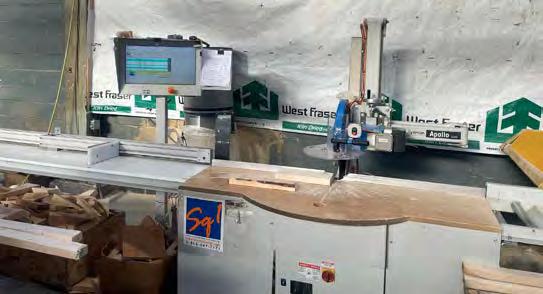
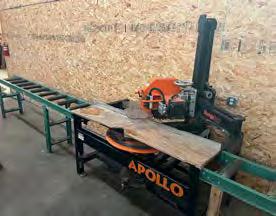
2019 Spida Automated Apollo Saw
• Automated Length Stop and Automated Saw Angulation as directed by Truss Design Software Output
• 20' of Steel Framed/Plastic Top Table with Automated 20' Length Stop
• 10' Infeed Roller Conveyor
• Dust Collection System
• Excludes: Installation/Training & Annual Technical Support Fee
• Video available upon request
• Price in US Dollars
Alpine ALS 276C Linear Saw $39,990 FOB OH
Cuts wall and truss parts from lumber depths 2×4 through 2×12, 60”+ scarf cuts, internally optimizes material (up to 11 7/8″ x 1.5″ EWP) Includes 20 foot OEM auto-infeed conveyor and 15 foot OEM outfeed conveyor, and under-saw scrap conveyor with belt-type incline. All servo controlled functions, Microsoft Windows XP OS, 7.5 hp motor with 20” carbide tipped blade. Includes spare infeed/outfeed belt and any available spare parts. No printer is included. The door latch needs to be repaired. 220v / 3 ph power, 125 PSI air required.
Edmond Lim, P.Eng. LimTek Solutions Inc.
Symmetrical Batching is Cut-by-Truss at High Velocity
For years, component manufacturers have faced a classic operational dilemma: choose the high-volume speed of traditional batch cutting on component saws or opt for the simplified material flow of cut-by-truss on linear saws. Because linear saws could “stretch”/optimize lumber, this encouraged many plants to simplify material feeding by staging just four to six bunks of 14- to 20-foot stock directly beside the saw. The trade-off was downstream complexity in this effort to minimize waste: this lumber “stretching”/optimized cutting produced a mixed, out-of-sequence outfeed that had to be manually “de-scrambled” by the sawyer. Without that step, valuable time would be lost at the tables, sorting through optimized cut pieces. This operational reality helped drive the shift toward inefficient “mini-batch” processing associated with “cut-by-truss” workflows on linear saws. Linear saws struggle to match the sheer throughput of multi-blade component saws on long runs.
The RetroC bridged this gap by introducing Symmetrical Batch Mode, a specialized sawing scheme designed to execute cut-by-truss manufacturing at component-saw velocity for varied roof-truss packages. This includes long runs and is especially good on complex jobs like hip roofs paired with cathedral ceilings.
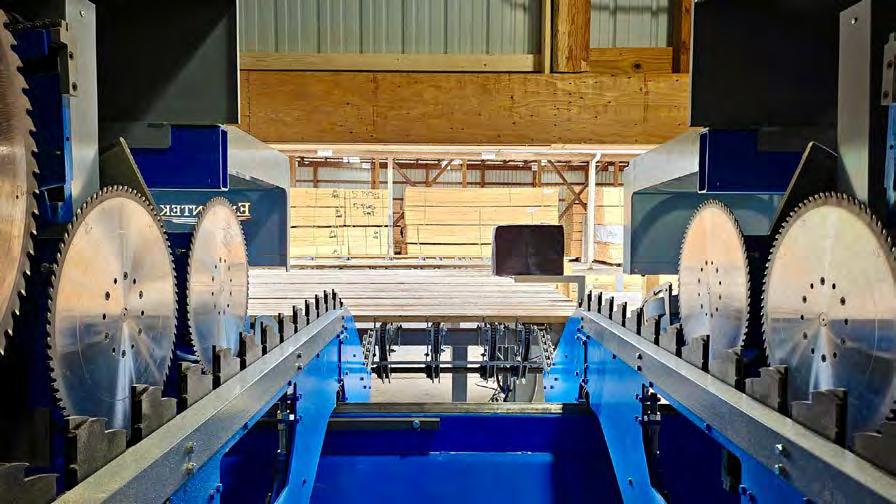
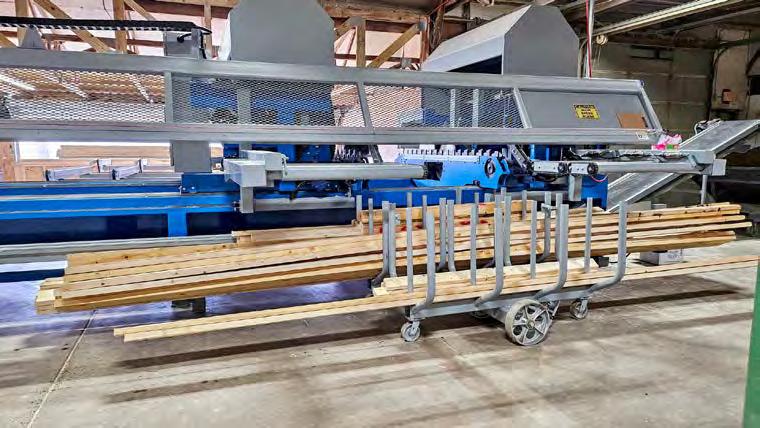
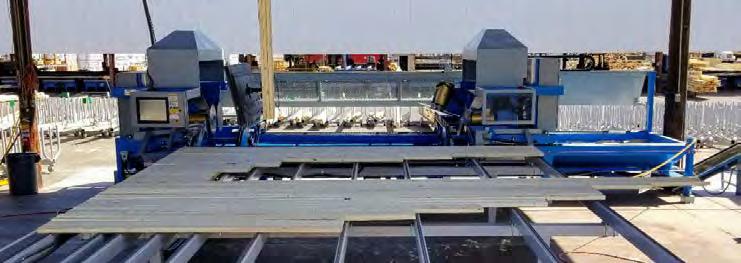
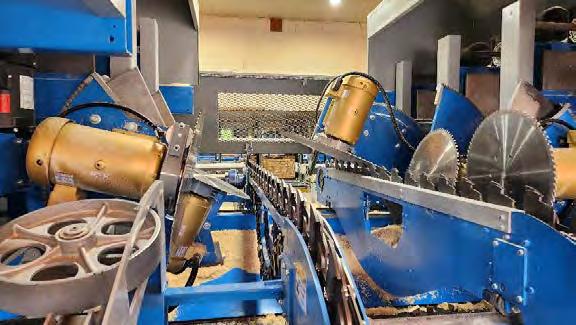
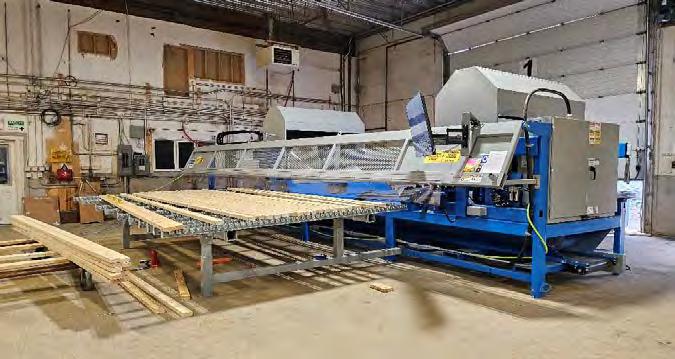
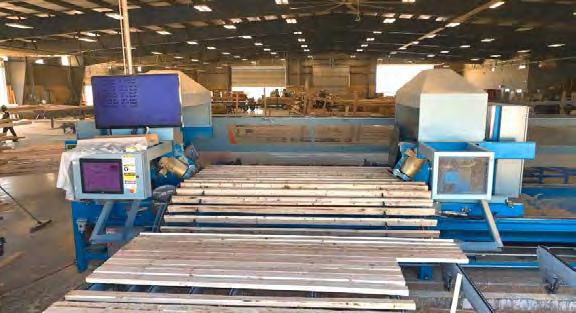
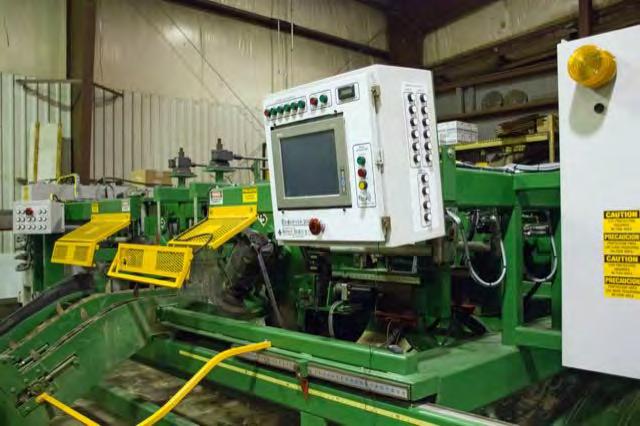
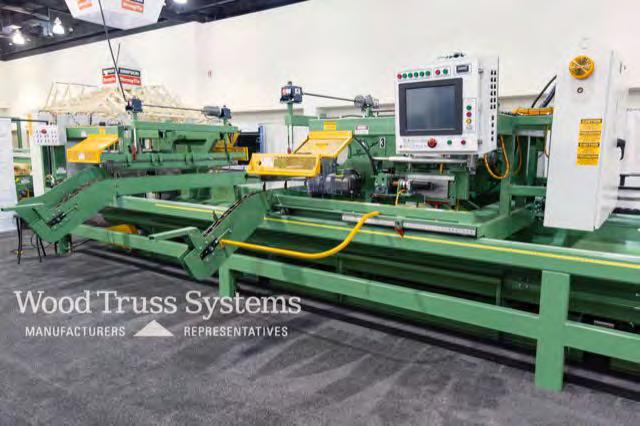
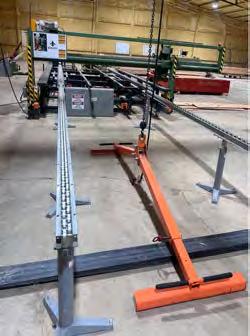
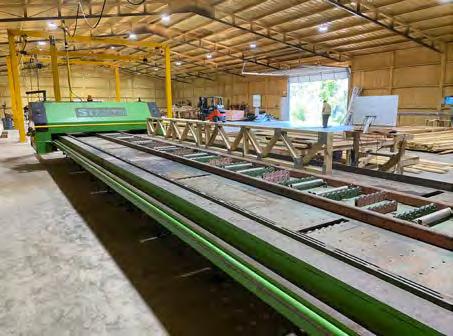
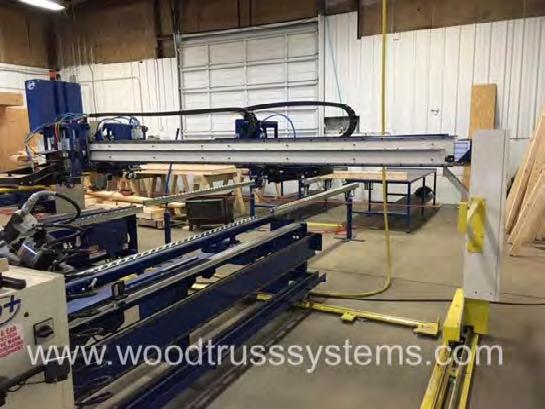
The first photo shows the unique design elements of the RetroC compared to other component saws and linear saws that facilitates symmetrical batching:
• Sawyer stays on the left fixed end of the saw
• Lumber is auto-fed into the saw by optional Lumber PickLine or by traditional forklift
• Precision lumber stop/end trimming on the left fixed end
• No upper lumber hold-downs
• Electronic blade braking is fast and significantly reduces maintenance
• Only 15 axes of automation
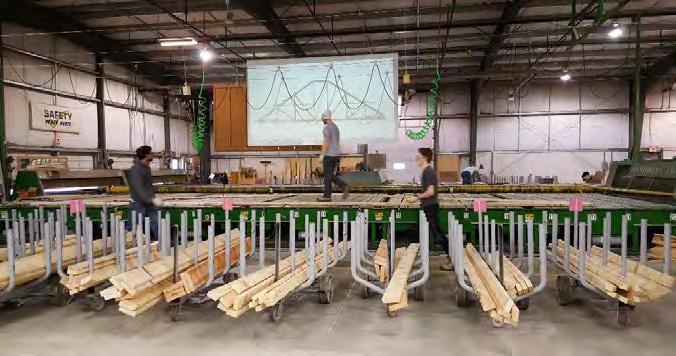
• Optional SpeedCatch auto-fill cart lumber sorting system (shown in the background)
• RetroC Symmetrical Batch Mode is high velocity cut-by-truss at volume.
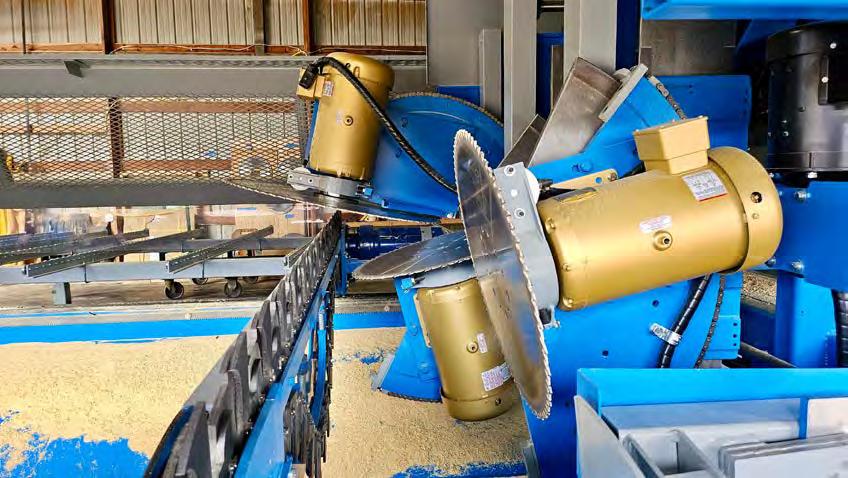
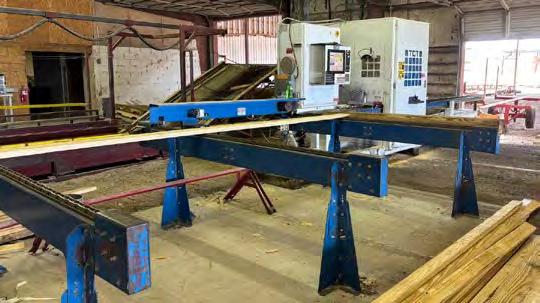
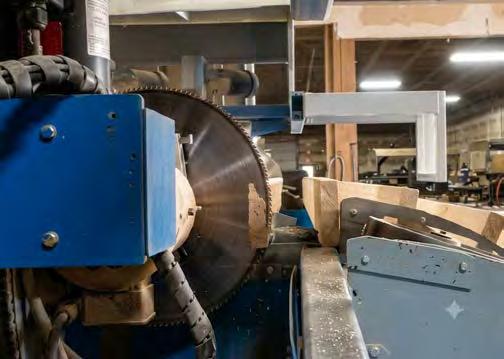
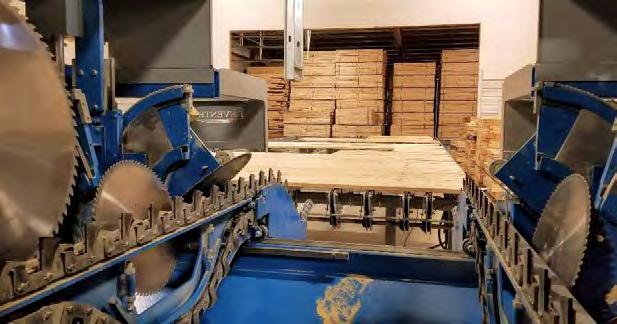
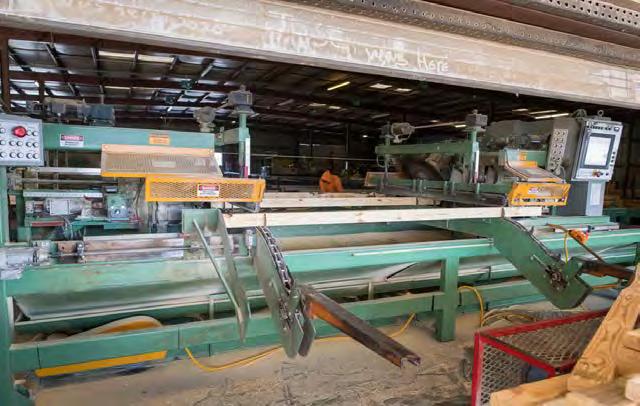
Zooming in, the second photo shows off the RetroC’s signature “no upper holddowns” in feed, which eliminates at least four unnecessary axes of mechanics and automation along with fast electronic blade braking for high reliability.
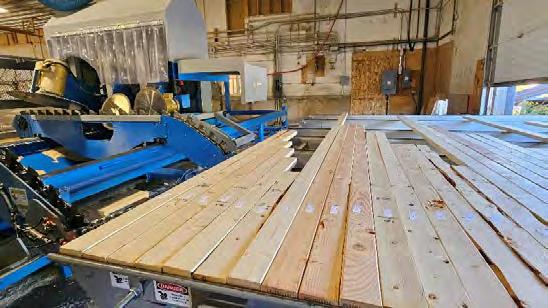
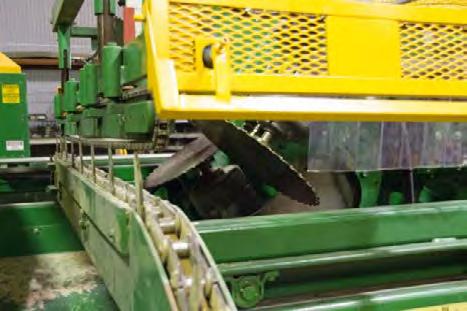
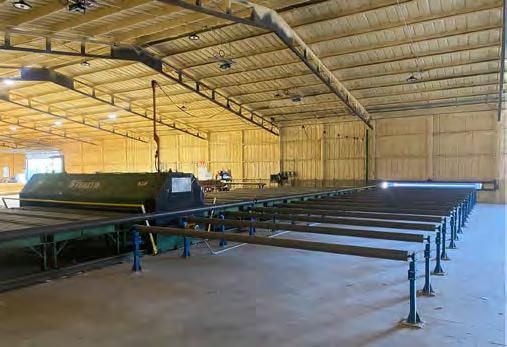
The third photo shows precision end trimming feathering the end of the boards and the RetroC’s lumber clamping, which enables the auto-feeding of lumber just like a linear saw.
The Symmetrical Batching Scheme Unique to the RetroC
As an auto-feeding component saw, the RetroC sets up so fast that it could also operate in a cut-by-truss mode. However, the real power of the RetroC is in the sophisticated batching software that enables the RetroC to outperform linear saws by batching complete roof-truss packages — even where every truss is different, such as hip roofs with cathedral ceilings. The key challenge is logistical: how to feed the complex mix of lumber required for cut-by-truss, and how to collate the cut pieces so they arrive at the build stations in an organized, build-ready sequence — without manual de-scrambling behind the RetroC.
This need led to Enventek’s development of the Lumber PickLine and SpeedCatch auto - fill carts: an integrated plant material-handling and sawing system designed to efficiently supply multiple truss lines with just one to two workers. Sophisticated software was developed for “Symmetrical Batch Mode” to orchestrate the process from picking lumber to collating cut lumber into the SpeedCatch carts to speed up truss building.
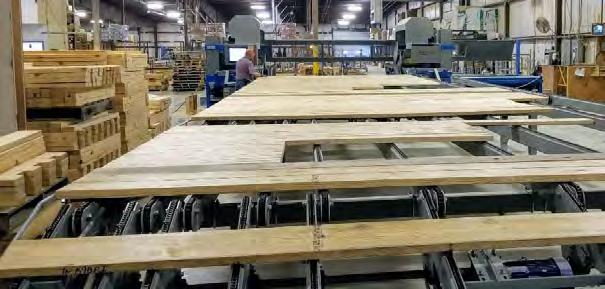
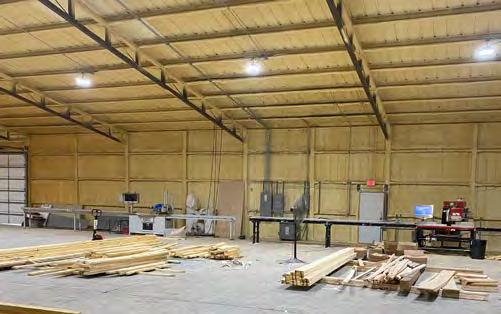
The top photo shows the RetroC sawyer work area on the left fixed end of the saw, which is safer and less physically demanding. The lumber on the deck is an example of a “symmetrical batch scheme” for multiple truss setups within the same batch. Also note how lumber “shorts” (usually 2 ft to 4 ft) are located behind the sawyer for the sawyer to place on the front deck to lessen the load on the lumber picker.
The next photo shows a single cut-by-truss scheme. The RetroC gains efficiency and volume by batching multiple trusses in larger batches, just like how the trusses are scheduled to be built on the same jig, which eliminates the inefficiency of mini-batches on linear saws to literally cut one truss at a time.
How Symmetrical Batch Works
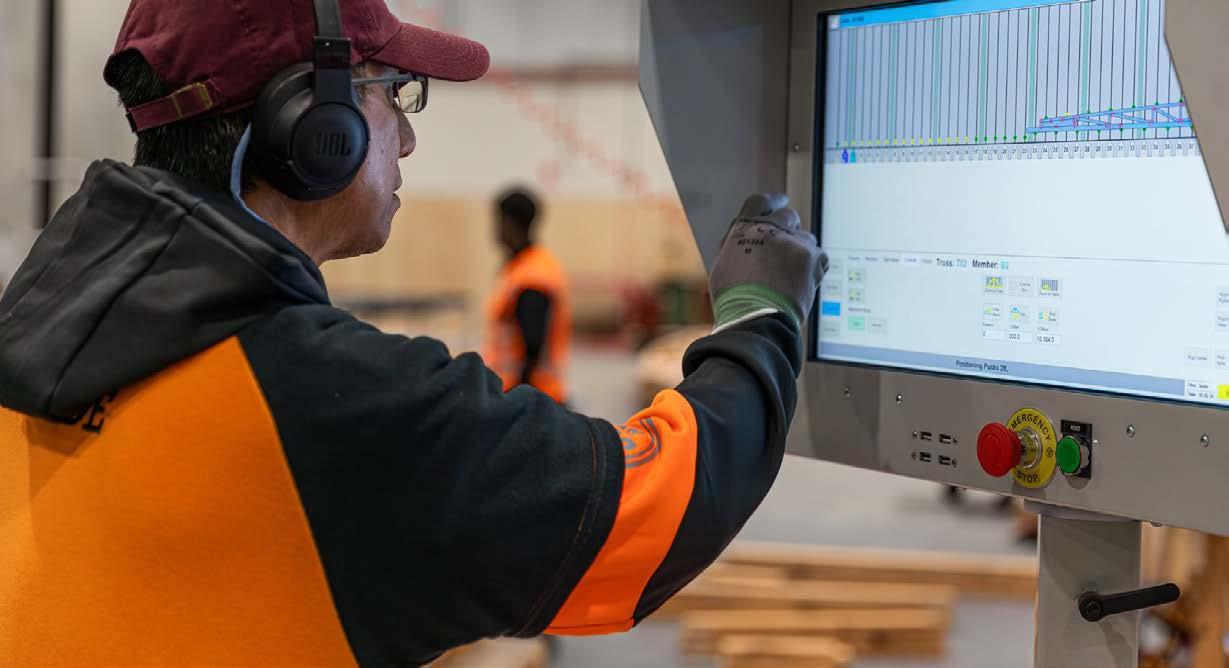
Driven by PlantOne’s dedicated plant optimization software displaying truss details over each truss jig, Symmetrical Batching consolidates what would typically be eight separate mini-batches on a linear saw into a single, continuous run.
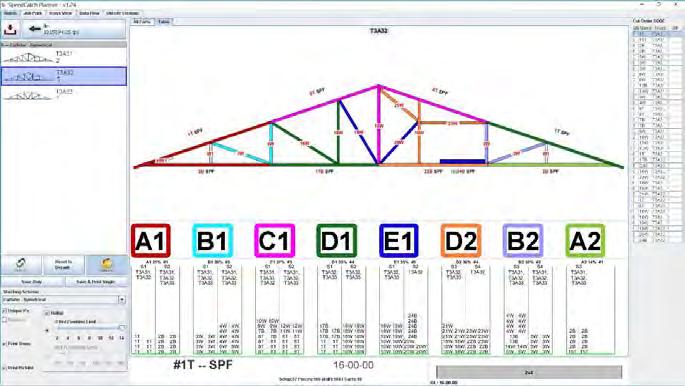
Rather than processing each truss style sequentially or requiring manual de-scrambling at the outfeed, the software coordinates the picking, feeding, and cutting of the raw lumber while pairing a series of outfeed carts. Carts are paired behind the saw — for example, pairing Carts A1 & A2, B1 & B2, and C1 & C2 — to be separated at the truss build tables to the “left and right” of jig.
The image is the Symmetrical Batch of three unique trusses; T3A31 Qty 2, T3A32 Qty 5, and T3A33 Qty 1. A batch of trusses that would have been cut on a linear saw in eight separate mini-batches is done by the RetroC in one batch with no catching labor.
To execute this job, SpeedCatch carts A1, B1, C1, C2, B2 and A2 were positioned in front of the truss build table. A1 and A2, B1 and B2, C1 and C2 were paired behind the RetroC at the time of cutting.
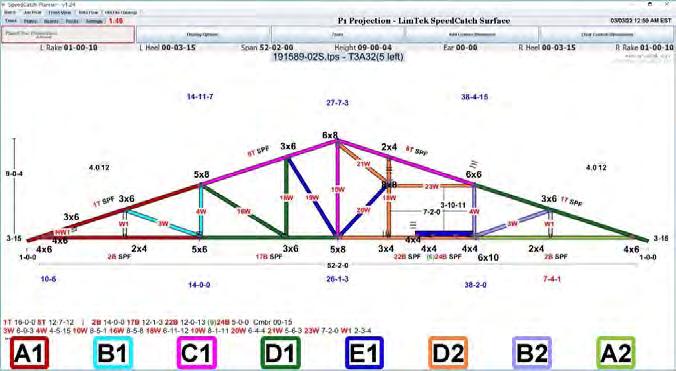
The top image shows the PlantOne detail of Truss T3A2 Qty 5 displayed above the truss build table color coded to the SpeedCatch carts. Carts D1 and D2, and E1 were positioned in front of the truss build table with the additional pieces needed for T3A2.
Then, PlantOne displayed the detail of Truss T3A33 Qty 1 above the truss build table color coded to the SpeedCatch carts. Cart E2 was added for the final pieces needed for T3A33.
PlantOne projection over the truss jig enhances the efficiency of having color coded cut pieces collated in front of the truss build table along with the corresponding carts positioned near each area of deployment.
The RetroC has proven itself to be a standardized, accurate, reliable, high velocity wood processor capable of feeding multiple truss jigs with over 120 installations ranging from forkliftfed RetroCs with manual catching to Fully Loaded RetroCs fed lumber from PickLines with auto-fill SpeedCatch carts or any combination thereof. The RetroC has become the anchor of small, medium, and large truss plants.
When you’re ready to Feed Your Beast and see these efficient and effective systems for yourself, let us know! https://limteksolutions.com/#solutions
HUNDEGGER
lnnovationen fur den Holzbau
HUNDEGGER
Hundegger leads the way in automation innovation for the truss component industry. Our advanced CAMBIUM software offers cutting-edge automation and digitalization solutions, revolutionizing operations, boosting productivity, and driving sustainable growth for manufacturers like you.
We go beyond standard mechanization; we champion true Automation. The Hundegger TD-II isn't just a saw-it's a transformative, comprehensive solution designed to streamline your production process. From retrieving lumber to optimizing, nesting, stacking, destacking, sorting, buffering, and precise delivery, our system ensures peak efficiency and productivity, tailored specifically to truss component manufacturing.
REVOLUTIONIZE YOUR TRUSS MANUFACTURING WITH THE HUNDEGGER TD-II
Harness the power of data with Hundegger's advanced CAMBIUM TACTICAL software. It meticulously tracks and optimizes your production, ensuring more automated operations and significant productivity gains.
We provide state-of-the-art automation and control solutions that set the industry standard. Our focus on industrial automation and robotics positions Hundegger as the leader in enhancing performance and efficiency in truss component manufacturing and beyond.
Hundegger products are essential for future-proofing your business. Elevate your productivity and secure your competitive edge with our advanced technologies and automation solutions, meticulously designed to meet the unique demands of component manufacturers today and tomorrow.
Don't get left behind. Invest in the future with true automation from Hundegger and see your business thrive.
New Monet DeSawyer ESC (Servo Controlled) Component Saw
Monet DeSauw model Desawyer ESC enhanced servo-controlled ( ESC) component saw with touch screen user interface with backup mechanical controls. Includes three operating modes: Auto (download setups from LAN or USB), Semi-auto (touch screen setup entry), and Manual (backup push-button switches for powering all movements). Includes over-travel protection, comprehensive setup screens, auto sequencing, auto-calibration and pneumatic brakes on all five () blades. One (1) 30” blade and four (4) 16” blades. Manual cut limits are 18” min., 11” min. square edge blocks, 20’ max cut. Belt under-saw waste conveyor. Voltage: 480 volt/3 phase/60 Amp. Air: 50 PSI at 5 CFM. One-year warranty included. Can be paired with a model PD-6 lumber feed system at an additional cost. Heavy duty 80 RIV chain feed system. 16’ wide x 20’ long x 36” deck height. Transfers 3’ to 20’ lumber. Includes auto-feed control, foot pedal override, forward & reverse, variable speed control with HD double-bearing construction. Other additional-cost options include, inkjet marking, label printing, backside screen display, spare blades and incline scrap conveyor.
$386,000 FOB MO
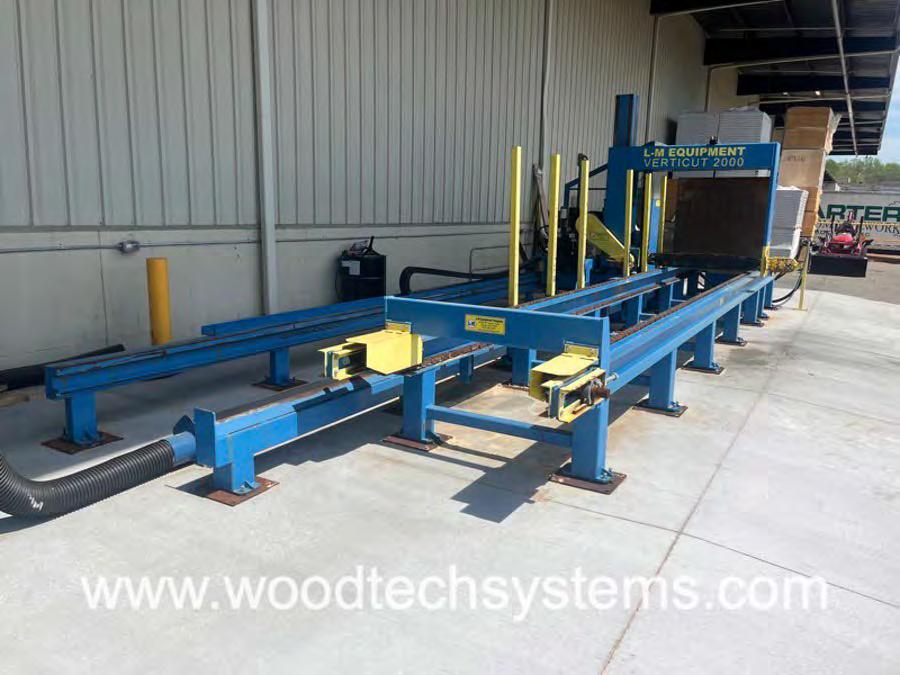
2022 L-M Verticut 2000 Precision End Trim Saw
The V2k comes equipped with a 15 HP 460/230 volt High-E three phase TEFC motor driving a Double ended Premium “Stellite” inlaid saw bar with a spring loaded chain tensioner and an automatic oiler. The Powered Carriage option uses a Servo Motor to control a touch screen HMI display used to interface with the Servo Carriage Drive coupled to the V-Wheel powering the carriage along a precision track. Squaring the material to be cut is accomplished via an optional live chain deck that moves the lumber into a fixed Precision Ground “Bump Wall” that is controlled hydraulically using a hand valve. Other system options feature the Zipper Duct option, which includes a “JET” JCDC-3 Cyclone dust collector
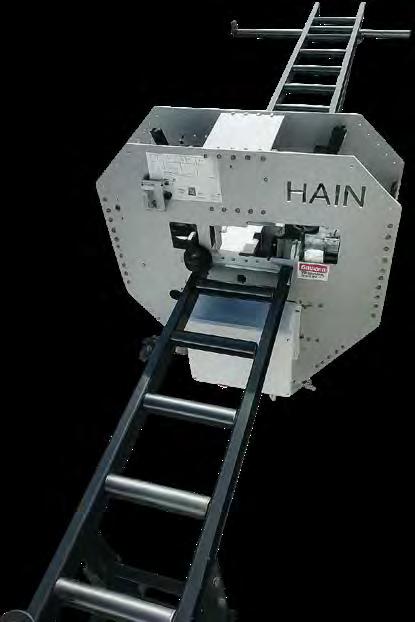
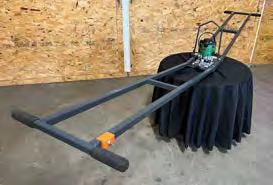
Hain Systems Framer
The Hain Systems Framer (HSF) will help you build square and accurate wall panels for residential or commercial construction applications. It will help you cut building costs by saving time and improving your quality. It’s a reliable, efficient and proven system that features a ruggedly simple design. The HSF is based on a proven design with over 20 years of actual production use and maintenance experience. It comes fully assembled and is designed for portable job site framing or in-plant permanent installation. The table has many optional attachments and will support Mylar Tape wall layout or any other type of layout. The optional gun rails can also be retro-fit to any table.
Details:
Table Construction: Thick-wall Structural Steel Tubing, Jig Welded for Accuracy
Height: 12 inches
feet (720”)
Air Supply: 90 psi (10 CFM Air Flow Recommended)
Depth: 12 inches
Electrical Supply: 120 VAC
Powder Coat: Industrial Gray
Dimensions: Height: 43”
Length: 16’ or 20’
Width: Adjustable 8’ to 10’ or 8’ to 12’
Shipping Weight: 3000 lbs
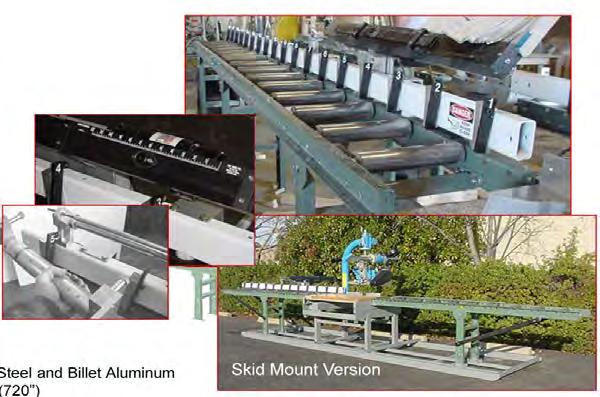
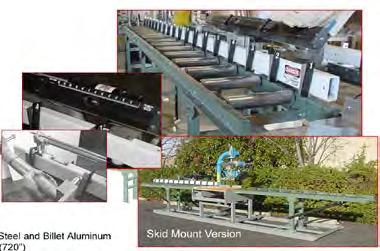
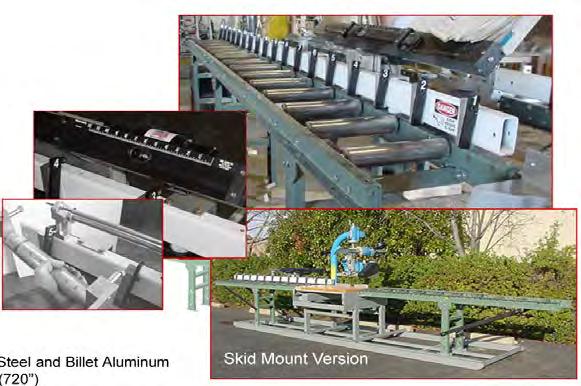
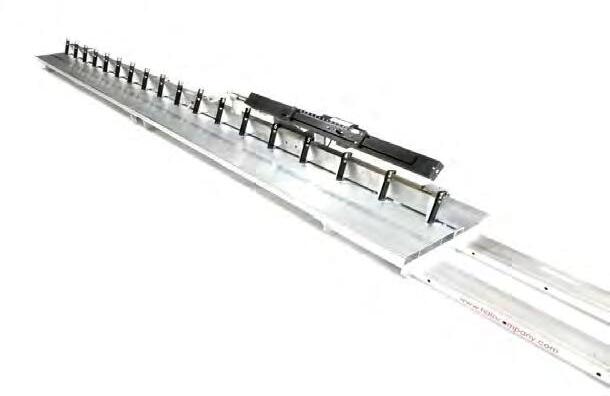
If you are looking for the fastest, most consistent way to measure and cut your product, then the Hain Measuring System (MEA) is your answer. The MEA changes from one length t any length instantly, up to 60’, without changing the operator’s position on the line. It is also highly accurate (+/- .010) and quickly moves from one length to the next in seconds. The MEA is designed for quick and easy setup and is simple to use. Even a first time user will be productive with little or no training required. It can adapt to any saw and can be mounted to any surface so that you can integrate the MEA with your existing setup. The MEA is versatile allowing “left” or “right” handed operation and measurement in “feet and inches” or “inches” depending on your preference. The MEA is also available in a “Skid Mounted” version. 2
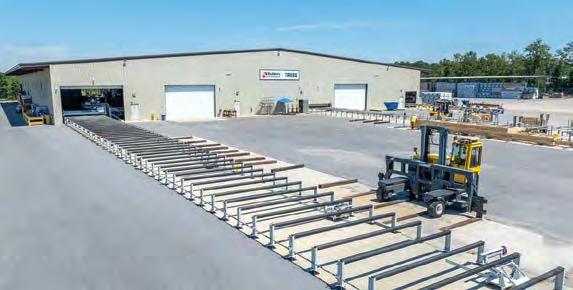
A truss plant isn’t just about square footage. It’s
• Facilities tailored to your operation and equipment
• Smarter layouts for safer load-ins and faster turns
• Integrated storage and optimized SKU management
With nearly 40 years of LBM experience and more than 4,500 completed projects, we build turnkey truss facilities designed to perform from day one.
A dverti $ er
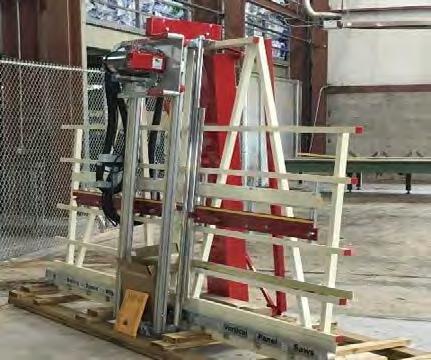
Striebig Optisaw, model
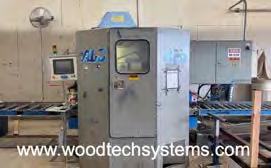
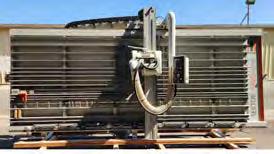
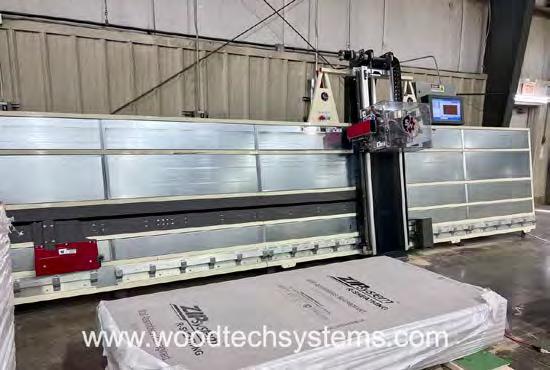
Optisaw Automatic (Type # 5164) vertical panel saw station, with angled frame supporting material being cut: Max. cutting height (vertical) 5′-4″, max. cutting length (horizontal) 15′-1″, max. cutting thickness 2.36″. Both vertical and horizontal analog measuring scales on frame. Cutting head manually rotates from vertically to horizontally for rip vs. cross-cutting, adjustable spacers for repetitive cuts, 5.25 HP saw motor, 9.84″ diameter blade, guide bearings for travel , push button controls, e-stop button and dust extraction hose (no vacuum included). Overall footprint of station 19′-1″ wide x 4′7″ deep x 7′-10″ height. Sold for $36,000 new. 208 volt, 3 phase electrical required.
$14,490 FOB AZ Wood Tech Systems 765-751-9990
www.woodtechsystems.com
• Automated Setup via Download or SemiAutomated Setup via Touch Screen
• Servo Controlled Saw
• 23 Axes of Automation
• Typical setup time is less than 14 Seconds
• Five Blades (3-18", 1-20" and 1-32") with Blade Brakes
• Cut 2x3 thru 2x12 from 2'-6" to 20'
• Waste Conveyor (under saw)
• Spare Parts: Danaher S1808 Module and Fox Drive Six Pack
• 480 Volt / 3 Phase
• E xcludes Incline Waste Conveyor (adjacent to saw)
• Video available upon request
• Price is US Dollars
2000 Alpine AutoMill Component Saw 2000 Alpine AutoMill model 343H, (5) blade component saw, cuts lumber from 2×3 through 2×12, from 18″ to 20′, 4-angle floor webs from 18″. Includes powered length and angulation, digital readouts, (1) 32″, (3) 18″ & (1) 20″ blade, shaker under-saw scrap conveyor, incline, PC with Windows 98 o/s, and outfeed conveyor. Decommissioned in 2018. Stored indoors. 480 volt ,3 phase electrical required.
$10,497 NOW $5,997 FOB ON Wood Tech Systems 765-751-9990
www.woodtechsystems.com
Alpine AutoMill RS Parts
Alpine AutoMill RS Parts per Uploaded PDF
$23,500 NOW $19,500 FOB GA Wasserman & Associates 800-382-0329 www.wasserman-associates.com
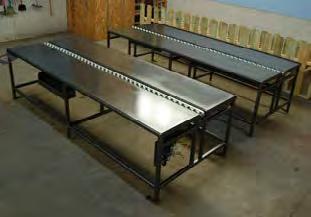
NEW Hain 20' Powered Measuring System
Adapts to Any Saw. Left or Right Hand Operation. Feet & Inches System (Stops at 12” Centers) or Inches System (Stops at 10” Centers). Motor: 1/4 HP Linear Actuator (110 Volt). Stop Rail: 2 x 4 x 1/4” Aluminum Extrusion. Stops: Jig Bored Steel. Stop Blocks: Machine Billet Aluminum. Optional Lengths from 5’ to 60’. Optional Gang Stop. Add $890 per 10’ Section of Heavy Duty Roller Conveyor with Stands
$8,990
Wasserman & Associates
800-382-0329
www.wasserman-associates.com
By Michael Bell
The Real Cost of a Component Saw
When The Truss Company purchased its first RetroC component saw in 2014, the company was understandably skeptical. At the time, the RetroC was still a relatively new product, and some questioned whether it could hold up in a high-volume production environment. The saw would be expected to operate for three shifts a day, cut over 30,000 board feet per shift, and remain accurate and easy to maintain. At one point, the head of maintenance jokingly remarked that the machine probably would not last a year under that kind of workload.
More than a decade later, that original RetroC is still used daily and remains an integral part of a fleet that has grown to seven saws operating across multiple facilities. That proven track record has shifted the conversation from initial purchase price to something far more important: total cost of ownership. A component saw’s true cost includes more than the amount shown on the original invoice. Maintenance, replacement parts, downtime, employee training, productivity, usable life, and resale value all affect what the equipment ultimately costs a truss plant.
For The Truss Company, the long-term benefits of the RetroC are worth a closer look. With more than 56 combined years of operation, The Truss Company has spent just under $70,000 on parts — an average of only about $1,200 per saw annually. Throughout that time, its RetroCs have remained fast, accurate, and reliable.
The RetroC also benefits from Enventek’s long-term approach to equipment ownership: continually improving and supporting existing machines rather than requiring customers to replace them every five or ten years to gain access to the latest features and capabilities. As a result, RetroCs rarely appear on the used-equipment market — and those that have become available have sold for more than $200,000. For owners who purchased their saws five to ten years ago for approximately $250,000 to $300,000, that retained value represents remarkably low depreciation after years of production.
After purchasing seven RetroC saws over eight years, The Truss Company’s experience demonstrates that the lowest-cost machine is not necessarily the one with the lowest purchase price. It is the machine that continues cutting day in and day out while requiring the least amount of time and money to keep it operating. What began as a cautious investment has become a long-term example of what total cost of ownership really means. For The Truss Company, the true value of the RetroC is not found in a single line item or purchase price on a spreadsheet. It is found in years of dependable operation, manageable parts costs, continued improvements, and equipment that retains its usefulness and value long after many other machines would have been replaced.
• Automated Wall Panel Component Cutting & Marking as directed by your Wall Panel Design Software
• S600 Up-Cut Saw (Square Cut Only)
• 7.5 HP / 3 Phase Braked Saw Motor with 24" Blade
• Enclosed Hood & 2 Hand Control for Operator Safety
• 20' of Steel Framed/Plastic Top Table with Automated Length Stop/Plate Positioner
• 10' Infeed Steel Framed/Plastic Top Table
• 24" Industrial Touch Screen Computer
• Ink Jet Printer marks Wall Member Locations, Wall ID & Job Name
• Dust Collector
• Current use is a low volume shop
• Excludes: Installation/Training & Annual Technical Support Fee
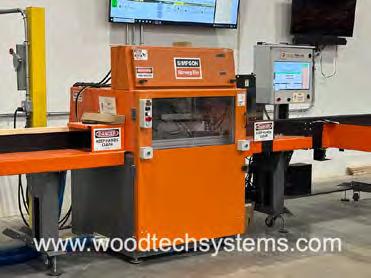
New Simpson Strong-Tie EasyFrame Saws
A fast method for cutting and marking structural wood components for use in wall panels and trusses. It features high resolution printing on the dimensional lumber and an internal optimization program to reduce waste. The marking system marks the framing layout in sequence using InkJet printing. There are three models available: the EasyCut Angle 24, EasyCut Straight 24, and the Chop Saw version. All three models provide high-resolution printing and optimization. Each comes with an EasyFrame infeed and outfeed, which can be adjusted in length to fit your needs using 2-ft and 6-ft modules.
SAWS
2019 Spida Gen 8 Apollo Saw with Automation
Saw with automation features a 17″ touch screen, with Win.7 O/S for truss cutting software. Cuts automated angles from 10 to 170 degrees, cross-cut maximum depth of up to 5.9 inches, with scarf cuts of up to 36 inches long. Automated turntable for setting angles and length stop/pusher. Saw features a 7.5 HP, 3ph motor, with direct drive of its 17.7-inch diameter blade, includes stroke limiter, plexiglass cutting shield, MDF profiled cutting bench top with a dust collection port. 48″ x 72″ tubular steel saw frame. Includes 20-ft. in-feed, 10-ft. outfeed roller conveyor, material in from the left to right outfeed of cut material. 230 / 460 volt, 3 phase electric required.
$49,490 FOB BC
Wood Tech Systems 765-751-9990
www.woodtechsystems.com
2006 Monet B500 XE Component Saw
Includes analog readouts, push-button movement controls for angles, manual movement for length, mechanical backup counters, (1) 30″ diameter blade, (4) 16″ diameter blades, powered chain infeed with upper hold-downs and shaker pan waste conveyor. Cuts angles from 8 to 115-degree angles. Minimum 90/90 cut is 10 inches and shortest angle cut is 18 inches. Cuts 2×4 through 2×12 lumber up to 20 feet in length. Includes horizontal shaker-pan waste conveyor (needs a bracket support repair), one spare set of blades, one incline conveyor and any available spare parts. Blade 2 sometimes has a vibration issue. 480 volt, 3 Phase, 60 Amp electrical required.
$31,997 FOB WA
Wood Tech Systems 765-751-9990
www.woodtechsystems.com
• Serial #9029
• Servo Driven Single Blade Linear Saw
• Automated Cutting with Software Download to Operator Console
• 20' Capacity Loading Conveyor Systems
• Automated Infeed Wheel
• Automated Clamping & Positioning System
• Angle & Bevel Drive for Roof Truss,
Floor Truss & Wall Panel Cutting
• 20' Capacity Outfeed Table with Ink Jet Printer
• 5 Arm Storage Deck (adjacent to saw outfeed table)
Speed Up Your Production of wall panels, windows, doors, and other sub components
Block Sizes: 2x4 & 2x6 framing lumber, any length
Nail Cycle Time: 1 nail 1 sec; 2 nail 2 sec; 3 nail 3 sec
Machine Set Up Time: 1 sec from any prior set up
Air Supply: 125 psi at 30 CFM, nothing less
Electrical Supply: 120 VAC
Frame: 1/4” steel plates mounted to heavy duty roll top tables and 2x2 skids mounted no install
Transfer System: Pneumatic transfer for
Covers: 3/16” thick
Shipping
NEW!
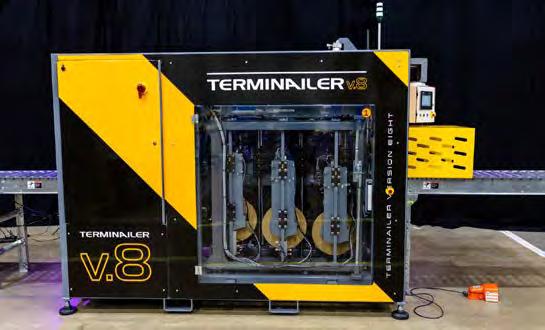
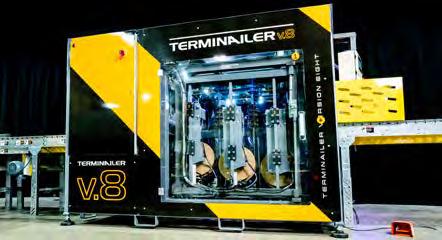
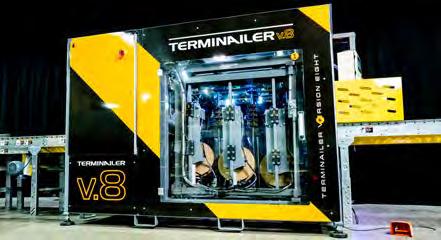
Terminailer
Price: $237,900
FOB: ND
The Terminailer all but shatters the stereotypical myth that sub-component equipment is essentially peripheral – unimportant. And it does so by quickly and accurately driving far more framing nails in your wall panel jobs than ever before. Whether in your shop or in the field, one operator sets the pace for production and quality, which reduces labor costs and other aspects of overhead.
The new Terminailer V.8 improves on the previous generation Terminailer in several key ways:
All new HMI/Software
• Siemens Pivoting HMI Touchscreen display to operate from either side
• On-screen tutorial for all menu items
• Operator now controls functions such as process speed, nail spacing, nail patterns, etc.
• Simplified input commands
Nail Feed Complete Redesign
• All new frame to allow for redesigned nail coil placement with direct feed path
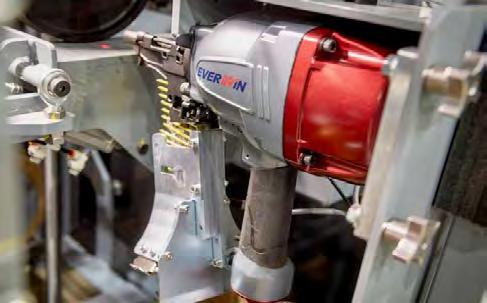
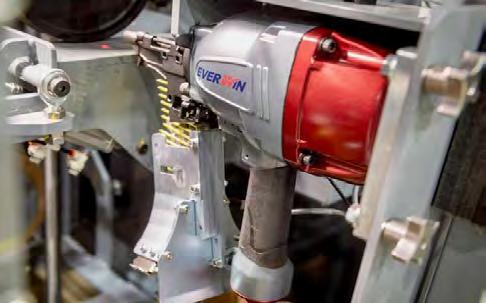
• EverWin PN90-PAL industrial tools now standard equipment
• New nail guides with spring-loaded tensioners
• Nail coils move with vertical travel of the nail guns
Reengineered air system
• SMC “Soft–Start” Pneumatics
• Simplified air for control to all components: lift–cylinders, triggers, stop–gate, etc.
• Direct air supply to each nail gun for improved nailing performance
• All pneumatic elements are clearly labeled for EZ service and adjustment
• “Block–wheel” redesign for 3X increased applied force
• Approximately 1,200# of applied clamping force resulting in straighter finished
• Subcomponents from even the poorest lumber
• Larger doors for easier access to interior elements including coil–nail spools
Terminailer is an event-driven, sub-component assembler that will quickly and accurately drive 30% to 70% of the framing nails in any wall panel job. In your shop or in the field, one operator sets the pace for production and quality. The Terminailer functions independent of design software, requires zero set-up time when switching between any configuration, and requires no special operator training.
The Terminailer is easy to move around the shop so its location can evolve as your shop evolves. With all of the nailing occurring in the closed main chamber, nail injuries and nail location misfires are eliminated, making your plant that much safer.
With nearly ten years of development from people that know machinery, it is assembled to exacting standards, well supported, and it is easily maintained with shelf-item parts. Terminailer: vetted, tested, and ready to drive maximum productivity for you. Be sure to check out our videos below for a quick review of this revolutionary machine!
208 volt, 3-phase, 21 (full load) Amps, 60 Hz electrical required. 50 SCFM @ 100 PSI air required. Net weight 7,000 lbs..
1999 Alpine SpeedCut
Centerline Pull-Arm Saw
1999 Alpine Metra Cut, model SSA-17, pull arm, centerline saw. 16″ blade, maximum cutting depth of 6″, maximum scarf length of 31″, 164 deg. cutting range and 5 HP motor. Includes push-button on/off controls and analog angle measure on turntable. Need re-assembly. 220/440 volt, 3 phase electrical required.
Call For Pricing, FOB OR Wood Tech Systems
765-751-9990
www.woodtechsystems.com
New Monet Power Deck Infeed Decks
Heavy-duty, 5-chain feed system to bring material to the infeed of the component saw. 16′ wide x 20′ long x 36″ high. Transfers 6′ to 20′ lumber lengths. Option for 6-arm Power Deck available at an additional cost. Features auto-feed advance, foot pedal override forward and reverse, variable speed control, double bearing construction, softstart and soft-stop and e-stop cable. Base price shown. 480 volt, 3 phase, 15 Amp electrical required. (Prices start at $31,000.) Wood Tech Systems
765-751-9990
www.woodtechsystems.com
manufaCturing
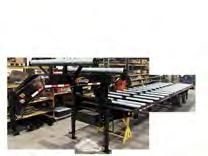
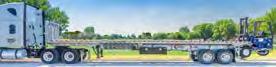
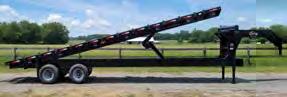
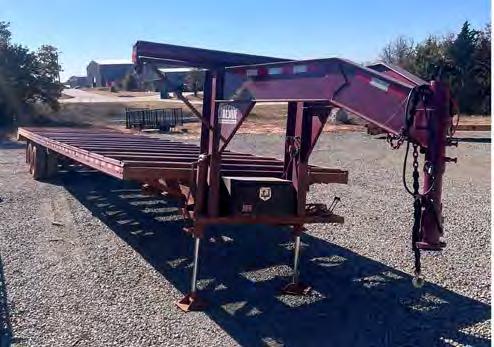
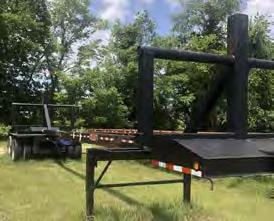
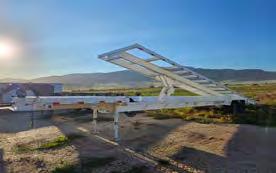
GOOSENECK ROLL OFF TRUSS TRAILERS
$129,997 NOW $79,997
2016 Alpine AutoMill
HP Component Saw
Alpine AutoMill HP, model 349C component saw. Servo controlled computerized saw sets up in 2 to 19 seconds and downloads from a network, or by using a touch screen for ease of operation. Five-head automated component saw works in both automated (downloading files), semiautomated control (via touch-screen input) or manual mode. It has (23) axes of automated movement, enhanced diagnostics, and auto management reporting.
The HP cuts from 2′-6″ to 20′-0″ long material in size range from 2×3″ through 2×12″, and 4-angle floor webs from 2′-0″. Includes [3] 18″, [1] 20″ and [1] 30″ blades with air brakes, Windows 7 o/s and under-saw scrap conveyor. The Windows 7 o/s can be upgraded to a version of Windows 10 that will be supported until 2032, at an additional expense.
Also includes over $8,000 in spare parts. 480 volt, 3 phase, 100 Amp electrical required. 90 PSI @ 69 SCFM air required.
FEED SMARTER
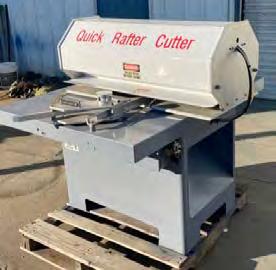
Used Hain Quick Rafter Cutter
• Reconditioned in December 2020
• Board Sizes: 2x4 and 2x6
• Motors: Two 1 HP / 220 Volt or 440 Volt / 3 Phase
• Angle Adjustment: Manual Rotation with Air Brake
• Air Supply: 90 PSI
• Carriage: Steel Rails with Steel Dual V Rollers
• Pedestal: 3/16" Formed Steel
• Saw Housing: 1/2" Billet Aluminum
• Covers: 10 Gauge (1/8" thick) Steel
• Fully Enclosed for Safety
$12,500 NOW $9,900 FOB AZ Wasserman & Associates 800-382-0329 www.wasserman-associates.com
In answer to the demands of high-volume customers comes the Monet DeSauw FWA 500 CA (Automated Controls) floor web saw. The 500 CA is perfect for component manufacturers who routinely run floor trusses in high volumes with variable web geometry. Another primary feature is enhanced safety through automation which eliminates the need to open the saw motor cabinets other than for periodic service. The 500 CA includes automation for all blades, including the fixed cut-off blade for minimal waste. Lumber infeed speed is variable up to sixty (60) boards per minute, while the powered carriage utilizes rack and pinion drive with airlock for set accuracy throughout the production run. Your operator will easily download batches to the 500 CA saw from your design software via an ethernet connection to a MS Windows 10 industrial PC with a 17″ monitor housed in a stand-alone console. If you frequently batch floor web cutting, and if enhanced safety with increased productivity are a concern, then an automated Monet FWA 500 CA may be the right selection for you. More information click Here
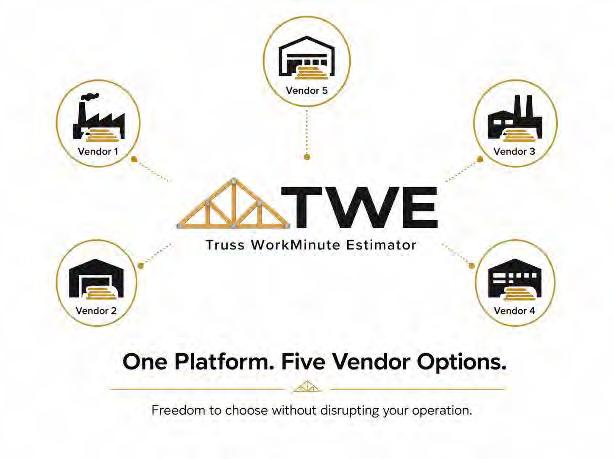
Designed to work seamlessly with all 5 major plate vendors - without disrupting your operation.
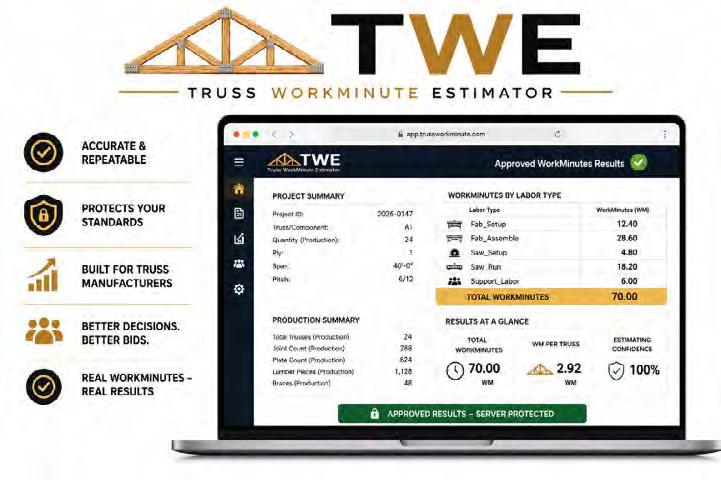
Why TWE
Automated labor work-minute calculations based on equipment and material selection
Provides automated work-minute comparisons with traditional pricing methods
Built on time-and-motion study principles and lean manufacturing best practices
Better visibility for estimating, scheduling, staffing, and capacity decisions
Release & Beta
Expected release: Mid-Fall 2026
Beta participants wanted
Qualified participants may receive a generous trial period of up to one year.
Supports proper plate-vendor agreements and responsible software use.
Todd Drummond
Todd Drummond
Freedom to Choose Any Plate Vendor — Without Disrupting Your Operation
Most component manufacturers (CMs) do not choose a plate vendor based only on connector plate pricing. The decision also affects engineering, technical support, training, production planning, software, reporting, and other parts of the business. Over time, those systems can become so connected that changing vendors feels almost impossible.
A CM may technically have choices, but the cost, risk, and disruption can make those choices impractical. For a decision maker, that is more than a software concern. It can limit the company’s ability to make the best supplier decision for the business.
That is one of the problems the Truss WorkMinute Estimator, or TWE, is being developed to address.
At its expected mid-fall 2026 release, TWE will work seamlessly with all five major plate vendors, giving CMs the freedom to choose the supplier that best fits their business without disrupting the rest of their operation.
Development is well underway, and TDC will share more about this offering in the coming months. Specific technical details will remain limited until the appropriate time. For now, the focus is on what TWE will do for the CM.
Bargaining From a Position of Strength
When the cost and disruption of changing plate vendors become too great, the CM loses bargaining strength because the vendor knows the company has limited practical alternatives.
This does not mean a company should threaten to change suppliers or treat the relationship as adversarial. Strong plate-vendor relationships are valuable. Good suppliers should be treated honestly, fairly, and with respect.
However, the relationship should continue because both parties provide value, not because the CM feels trapped. Practical alternatives allow management to discuss pricing, service, support, and long-term expectations with greater confidence. That is bargaining from a position of strength.
TDC Supports Proper Plate-Vendor Practices
TDC’s position regarding plate-vendor engineering software is clear. TDC will not encourage, endorse, or knowingly assist a CM in using one plate vendor’s engineering software with a competing vendor’s connector plates. TDC strongly opposes that practice.
Acceptance of the TWE software license will require each CM to confirm that it will not use one vendor’s engineering software with another vendor’s connector plates unless it has the engineering software provider’s express written permission. Each CM will remain fully responsible for understanding and complying with its platevendor agreements, software licenses, product approvals, and related requirements. TWE does not grant or imply permission to combine competing vendors’ engineering software and plates.
Plate vendors invest millions of dollars in engineering software, product testing, approvals, research, training, technical support, and continued development. Their plate sales support those investments, and the entire industry benefits from that work.
A CM changing plate vendors should make a complete and legitimate change that honors its contracts, engineering requirements, product requirements, and safety responsibilities. Supplier freedom and contractual integrity can and should exist together.
Automated Labor Work-Minute Calculations
The other major benefit of TWE, and likely its greatest day-to-day operating value, is automated labor work-minute calculation.
Labor costs should always be considered and minimized, but management also needs to know how much productive time and manufacturing capacity each work order is expected to consume. Without dependable work-minute standards, estimating, scheduling, staffing, and performance measurement rely too heavily on broad averages or individual judgment.
TWE will automate work-minute calculations based on the equipment and material selections used by the CM. Equipment type, lumber sizes, material-handling requirements, setup conditions, cutting methods, assembly processes, and production quantities can all change the work required. TWE will account for those differences and provide a practical labor expectation for each work order.
This is more useful than applying one general labor factor to every truss. Traditional pricing methods such as material markup, square footage, board footage, or truss count may still provide valuable comparisons. TWE will allow management to compare its automated work-minute results with those established methods and with the expected gross margin from the order.
The purpose is not to force a company to abandon what already works. It is to add a consistent measurement based on the equipment, materials, and manufacturing methods selected for the work.
TWE is being built using time-and-motion study principles, practical manufacturing experience, and lean manufacturing best practices. A useful labor standard should represent the work required under a capable process with proper equipment, trained employees, good material flow, and limited waste.
A poor process should not become the standard simply because it has been repeated for years. Excess walking, waiting, searching, poor staging, rehandling, unnecessary movement, and avoidable equipment delays should be treated as improvement opportunities, not accepted as normal operating conditions.
A dependable work-minute expectation gives management a practical baseline. Expected time can be compared with actual performance to determine whether the estimate needs adjustment or the production process needs improvement. This information can support pricing, scheduling, staffing, capacity planning, job selection, performance measurement, and continuous improvement.
The purpose is not to replace experienced managers. It is to automate a difficult process so those managers can make better decisions with more consistent information.
Development and Beta Participation
The initial TWE release is expected in mid-fall 2026. TDC is seeking a limited number of CMs to participate in beta testing before that release.
Qualified participants may receive a generous trial period of up to one year in exchange for meaningful real-world testing and honest feedback. The strongest participants will be companies willing to compare TWE’s automated work minutes with actual production experience, identify weaknesses, and help ensure the final product provides practical value to management. Please contact me if your group would like to participate and have a strong say in how the application will be developed for all users.
The objective is straightforward: give CMs greater control over supplier decisions, automate practical labor standards based on their equipment and material selections, and improve the use of the manufacturing resources they already have.
Todd Drummond Consulting helps manufacturers identify what is limiting performance, whether it begins with workflow, labor visibility, capacity planning, training, scheduling, handoffs, or leadership decisions. With nearly 40 years of manufacturing experience and almost 25 years as a full-time consultant, I provide practical guidance that helps leaders simplify work, improve flow, reduce waste, protect margins, and move forward with confidence. Review my client testimonials to see what other manufacturers have said about working with Todd Drummond Consulting.
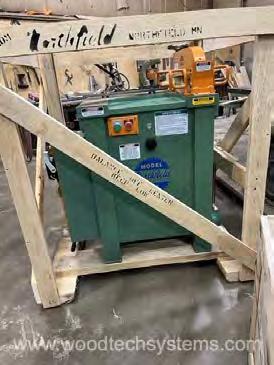
NEW 2023 Northfield model 410 upcut saw available for immediate shipment. 90/90 degree cuts to 4″ x 10″ capacity (fence forward position) to 2″ x 14″ (fence rearward position). Saw is configured for material from left to right, with 3″ x 6″ air operated cylinder, filter, regulator, lubricator, 10 HP motor, enclosed steel base with cast iron table, magnetic starter and adjustable operating speed from 20 to 60 CPM. Includes optional two-palm controls, additional 4″ dust outlet, NEMA 12 electrics with fused disconnect and two 18″ diameter 60 tooth blades with 1″ diameter bore. 460 volt, 3 phase electrical required.
$18,630 FOB MN Wood Tech Systems
765-751-9990
www.woodtechsystems.com
2005 Alpine ALS 276C Linear Saw
2005 Alpine ALS 276C linear-feed saw (Refurbished in 2015). Cuts wall and truss parts from lumber depths 2×4 through 2×12, 60”+ scarf cuts, internally optimizes material (up to 11 7/8″ x 1.5″ EWP). Includes 15-foot idler roller infeed conveyor, 15-foot idler roller outfeed conveyor, and under-saw scrap conveyor with belt-type incline. All servo-controlled functions, Microsoft Windows 10 OS, 7.5 hp motor with 20” carbide tipped blade. Includes any available spare parts. No printer is included. 230v, 3 ph power, 70A electrical required. Includes step-down transformer. 125 PSI air required.
$39,991 NOW $35,997 FOB OR Wood Tech Systems
765-751-9990
www.woodtechsystems.com
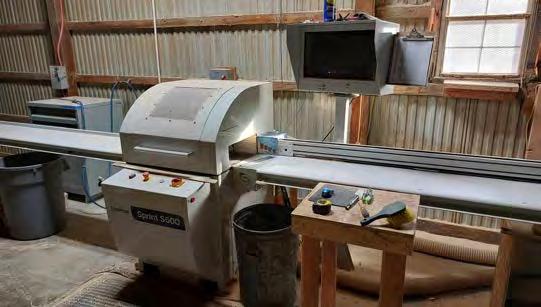
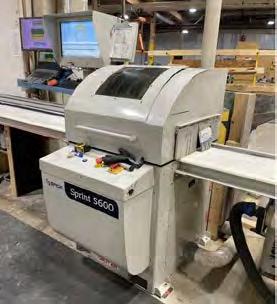
2022 Spida Sprint S600 Wall Panel Saw
• Automated Wall Panel Component Cutting & Marking as directed by your Wall Panel Design Software
• S600 Up-Cut Saw (Square Cut Only)
• 7.5 HP / 3 Phase Braked Saw Motor with 24" Blade
• Enclosed Hood & 2 Hand Control for Operator Safety
• 20' of Steel Framed/Plastic Top Table with Automated Length Stop/Plate Positioner
• 20' Infeed Steel Framed/Plastic Top Table
• Industrial Touch Screen Computer
• Ink Jet Printer marks Wall Member Locations, Wall ID & Job Name
• Spare Parts
• Excludes: Dust Collector, Installation/ Training & Annual Technical Support Fee
$60,000 FOB WI
Wasserman & Associates
800-382-0329
www.wasserman-associates.com
Used TCT EZ Trimmer
• Model CT041-2000
• 2x3, 2x4 & 2x6 Capacity
• Double 45 Degree Bevels on Pitches from 0/12 thru 12/12
• Cycle Time: 15 Pieces / Minute
• Air: 9 CFM at 80 PSI
• Electrical: 230 Volt / 3 Phase /20 Amp / 5 HP Motor
$11,500 FOB AZ
Wasserman & Associates
800-382-0329
www.wasserman-associates.com
Truss solutions from idea to installation.
Transform your truss operation with an integrated solution from Simpson Strong-Tie. The industry leader in truss plates now brings you a full suite of software, equipment, hardware and services to drive truss component manufacturing from idea to installation. Start with CS Director™ , CS Truss Studio™ , CS EWP Studio™ and CS Producer™ for design, layout, production and project management. Use our powerful Monet DeSauw industrial saws to cut webs, chords, stair stringers, rafters and wedges with speed and precision. Specify the optimal connectors, anchors and Strong-Drive ® structural fasteners for every project. You can also complement your team with our professional truss design services at any time. Altogether, you have a smart solution made to increase productivity, ensure high quality and take your business to the next level.
To learn more, contact your representative at (800) 999-5099 or visit us
$18,880 NOW $17,000 FOB MB Wasserman & Associates 800-382-0329 www.wasserman-associates.com
2004 Manual Apollo Saw
• 5.5 HP Motor (3 Phase) with 18" Blade
• 6" Maximum Cut Depth with 36" Stroke for Long Scarf Cuts
• Minimum Angle of 10 Degress (160 Degree Angular Movement)
• Turntable Air Brake
• Variable Stroke Limiter & Saw Barrier Guard for Safety
• 15' of Roller Conveyor with Stands
• New Blade Guard (in box)
$11,500 NOW $10,500 FOB NE Wasserman & Associates 800-382-0329 www.wasserman-associates.com
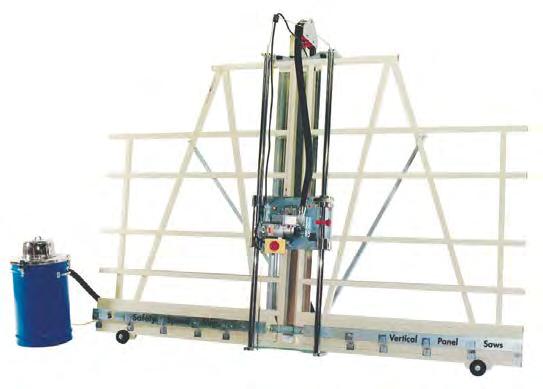
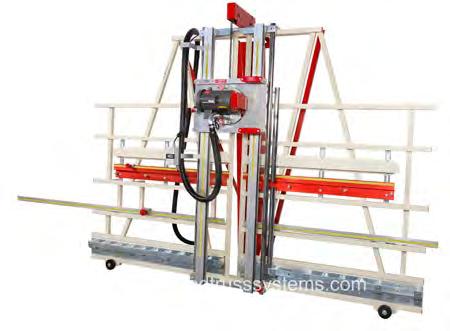
Safety Speed Cut Model 7000 Panel Saw
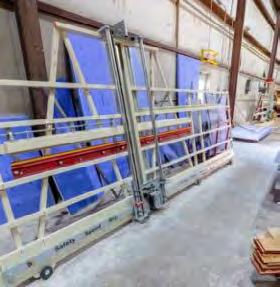
Safety Speed Manufacturing model 7000, vertical panel saw, 3 HP induction motor, 64 inch crosscut, 2-inch maximum thickness, accuracy within 1/64th of an inch, 96" tall x 10-foot-wide welded steel frame with integrated stand and linear V-guides, enclosed counterweight system, adjustable vertical and horizontal rules. Quick changes from vertical to horizontal cutting. Includes machined aluminum material rollers, hold down bar, wheels, quick stop gauges and material hold downs. Dust collection ready. Options available include lower frame width extension to 13-ft, digital readouts, laser guide, stop bar, vacuum, and midway fence.
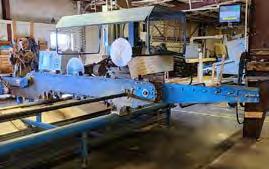
Cuts wall and truss parts from lumber depths 2×4 through 2×12, cuts bevels from 90 to 25 degrees, 60”+ scarf cuts, optimizes material, production rates +2000 pieces per 8 hr. shift. Includes 16- foot ICC-brand infeed deck, 20-foot-long infeed roller and 16-foot powered outfeed conveyor, Matthews “Mperia V” series 8000 printer (one 3
½” face) added in 2022, and undersaw belt scrap conveyor. All servo controlled functions. Windows 10 o/s. Includes Servotronix upgrade, recent saw head bushing, bevel motor and gearbox installed in 2024, spare blade, all available spare parts and digital operator’s manual.
• New saw design with double slide minimizing footprint
• Roller slide reducing risks of injury by lowering the effort pulling the saw
• Hybrid aluminum-steel construction combining the robustness of steel for the frame with the lightness of aluminum for the moving head
• High resistance powder coat paint surface finish
• Blade travel adjusts automatically depending on the saw angle
• Saw arbor type 5 HP motor with integrated mechanical brake
• (575 Volts – 3 phases)
• Angles from 10° to 110°
• Head overall travel length of 26in
• 18in saw blade
• 5.5in cutting height
• Complete « wrap-around » blade guard
• 4in dust collector connection
• 4.0 kW Motor with 10” Blade (2.36 cutting depth)
• 230 Volt / 3 Phase
• Cutting Length: 14’ / Cutting Height:
• Automatic Mode: Plunge, Saw & Return with Variable Speed Control
• Top & Bottom Sawing Beams with Pneumatic Arrest
• Digital Horizontal Cutting with Motor-Driven Precision Adjustment
• Digital Longitudinal Stop with Fine Adjustment
• Pneumatic Support Grid
• Dust Extraction Port
• Like New Condition
• A 2016 COIMA FI6000 Dust Collector is available at additonal expense Panel Saw - $21,900 Dust Collector - $7,900 FOB CA Wasserman & Associates 800-382-0329 www.wasserman-associates.com
Time To Hire?
We’re here when you need help! visit: www.thejobline.com email: twm@thejobline.com STRICTLY CONFIDENTIAL!
Safety Speed Manufacturing Model 7400 XL Panel Saw
Ready for long hours of accurately cutting OSB, fiberglass reinforced sheathing, and virtually any other sheathing material specified. The 7400 XL features a quiet 3 HP induction motor, 64 inch crosscut, 2 1/8″ maximum thickness, accuracy within 0.005 inches, 96" tall x 13-foot-wide welded steel frame with integrated stand and linear V-guides, enclosed counterweight system, adjustable vertical and horizontal rules. Quick changes from vertical to horizontal cutting. Includes machined aluminum material rollers, hold down bar, wheels, quick stop gauges and material hold downs. The 7400 XL is dust-collection-ready for easy connection. Options available include digital readouts for vertical cuts, laser guide, stop bar, dust vacuum and midway fence. $15,399
New Monet DeRobo Linear Saw
New, DeRobo linear saw by Monet organizes "fill" boards to increase optimization of each board, can produce unlimited scarf cuts, cuts 1 or 2 boards at a time and cuts webs, chords, wedges, rafters and open-stair stringers. Works with all major connector plate manufacturer's software. Features include 22 inch blade, left-to-right feed direction standard, lumber push and pull grippers for more accuracy, ink marking on the 1 1/2" face of the incoming boards and small piece capture and delivery to the front of the saw for easy access. Infeed deck and bunk feed are shown as options only. 480 volt, 3phase. $257,000 FOB MO.
2006 Alpine Speed Rafter Cutter
• Simplified compound cutting for hip, valley and jack rafters (double & single compound cuts)
• Two Worm-Drive Circular Saws (110 Volt / 30 Amps)
• Saw Turntable (for angle cutting)
• Saw Carriage (for up to 45 degree bevel cutting)
• Infeed & Outfeed Roller Conveyor with Stands
$4,900 NOW $4,250 FOB CA Wasserman & Associates
800-382-0329
www.wasserman-associates.com
Price Reduction!
2003 Koskovich Auto Omni Component Saw
• 5 Blade Automated Component Saw
• Cuts 2x3 through 2x12 from 11" to 20'-0"
• Computer, Enclosure & Stand
• Waste Conveyor (under saw)
• E xcludes Incline Waste Conveyor (adjacent to saw)
• Video available upon request
• Add $12,500 for 6 Chain Live Deck $16,500 NOW $14,900 FOB ND Wasserman & Associates 800-382-0329 www.wasserman-associates.com
Used - 2005 Model 305 Infeed Conveyor Designed for use with all component saws. To include: Soft Start ~ Soft Stop Inverter System. Programmable load sensing; Overload / Jamb sensing shut down feature. Gear motor providing conveyor speed of 36' per minute. Forward and reversing controls for location at both ends of conveyor unit. Material capacity range - 4' through 24' lumber. Chain deck pedestals 20' long with cross bracing. Staging area at the saw independent of the live deck system. 30,000lb. Deck capacity. Call for pricing
Eide Machinery Sales, Inc. 612-521-9193
www.eidemachinery.com
Safety Speed Manufacturing
Gypsum Cutter
Lose the dust and noise for processing material such as DensGlass®, or other gypsum products with the Safety Speed model VGC 515 cartridge cutting system. Easily process full sheets of gypsum wall panel sheathing of material in widths up to 64". Fully portable, and with NO power or air required, the VGC 515 is dust and noise free to easily score gypsum material that rolls effortlessly to an integral edge used for breaking scored material. Features blade cartridges for quick exchange in less than a minute and uses off-the-shelf utility knife blades. Includes two cutting/scoring cartridges, removable clamping bar, integral counterweight, both left & right measuring tapes, wheels for portability, free-standing 90" tall x 10-ft wide frame and 5-foot Quick Stop system for accurate, repetitive cutting.$6,399 FOB MN Wood Tech Systems 765-751-9990 www.woodtechsystems.com
NWH 76" Finish Roller
• 76" Long x 24" Diameter Rollers
• Throat Opening is adjustable from 1 1/2" to 5 1/2" (currently set at 1 1/2")
Reduce labor and operator fatigue by taking advantage of the SpeedWorx automated vertical panel saw. This one-person station cuts wood sheathing sheets up to 50 inches x 10 feet, and up to 2-inch thickness, using a fast 1-button cutting setup with CNC accuracy to 1/32 of an inch (0.03125″). The usage of each sheet is optimized through automated sequencing. The photos of raw materials illustrate the drastic reduction of scrap material thanks to implementing the Rogworx saw station.
Visual user interface with standard ‘Auto Fill’ feature makes choosing the job and sheet-cutting order easy to determine. Files are downloadable allowing for minimum waste. Saw station reads WBX file format (Alpine) or EHX file format (MiTek) or CSV files with manipulation. System offers full optimization and sequence panel parts, looking ahead through the job based on your specification. The cutting chamber automatically switches from rip to cross-cutting. All this in a 100-square-foot footprint, approximately 25′ long x 4′ deep, so it can fit within existing facilities. Includes advanced dust collection. Integrated printing for labeling parts is available as an option (additional $14,000).
$143,500 (Base)
FOB MN
$355,000 Location: MO
New, Monet DeSawyer 2000, computerized, five-bladed component saw, sets up in 15 to 17 seconds, can run in manual mode, downloads projects from a network or manually using display screen controls. Features all powered movements, cuts from 15" 90/90 cuts to 20 foot length, 2 x 3" to 2 x 12" lumber depths and internal brakes are standard. Options include enhanced servo controls featuring autocalibration, catcher's display and either shaker or belt scrap conveyor and incline. 440 volt, 3 phase electrical.
By Matt Van Stelle, Product Manager, Paragon
Lean Building: How Paragon’s Philosophy Reflects Your Shop Floor
In the mid-20th century, Toyota revolutionized manufacturing with a clear idea: eliminate waste, optimize the flow of value, and improve continuously. Lean manufacturing changed how physical goods are built by putting the worker’s time and effort at the center of every decision.
At Paragon, we hold truss software to that same standard. Eliminating waste and respecting the time of estimators, designers, and manufacturers shapes our daily conversations and the products we build. This discipline is as transformative for software development as it was for the production of physical goods.
Walk the Floor
We start by listening. Lean practitioners call this “going to Gemba” — getting close to where the work happens instead of theorizing from a distance. No feedback is too small, because a minor missing feature to one person can be the roadblock stopping a designer from getting a job out the door.
A small UI nitpick becomes a serious irritant when you hit it 100 times a day. If a designer has to dig through a labyrinth of menus to raise a heel height or adjust a splice, those extra clicks add up. When multiplied across an entire design team, a tiny detail becomes a real drain on productivity. That lost time spent thinking, hunting, and redoing work is the waste, or muda, we eliminate.
Reduce Friction
Component manufacturers spend energy applying lean principles on the shop floor: timing motions, removing wasted steps, and keeping the line moving. We believe the design office deserves that same scrutiny. In software, that discipline is called UX, or user experience design.
Where a lean specialist might run a time-motion study on an assembly station, a UX designer studies how a user moves through a screen to streamline the interaction, then redesigns the interaction so the next step is obvious rather than a guess. The goal is to minimize cognitive load and keep designers in flow. They should be near their tools, free from menu-bloat, and able to work within a logic that matches their own design process.
Small Batches and Continuous Delivery
When it comes to our product roadmap, we cannot anticipate every need up front or ship a onceand-for-all solution. Business requirements change and material markets shift. Lean production favors small batch sizes over one enormous run that cannot be corrected mid-stream.
Modern software teams apply this through Agile development. We plan and ship in frequent increments, ensuring the roadmap remains a reflection of what customers need rather than a fixed bet made months in advance. Because Paragon is web-based, a finished feature goes from our team to your screen the moment it is ready, with nothing to download or install. Think of it as just-in-time delivery for software — no inventory of updates piling up between us and you.
Poka-Yoke for Code
Great design isn’t helping anyone until it works flawlessly on your screen. We rely on automated testing, which functions like poka-yoke on an assembly line: error-proofing built into the process so a defect is stopped before it reaches a customer. For example, even small modifications to our truss analysis calculations must be vetted against thousands of engineer-approved designs.
Between that automated safety net, hands-on testing by real users, and our own team doing daily work inside the software, we ship roughly 50 high-impact updates a year without compromising the workflows you depend on.
The Path Forward
Operational freedom means you keep control of your business. You shouldn’t be forced to choose between hardware vendors or proprietary software stacks. The right approach is to find technology that serves your team’s needs, without being locked into a single ecosystem.
Every process and product has room for improvement, including ours. By staying agile, and by respecting your designers’ time as much as your operational freedom, we aim to be the ideal partner for your own lean journey.
Come See Us at BCMC
We’ve been working hard to bring more of the component manufacturing workflow together in one connected and intelligent platform. Visit us at BCMC to see the latest Paragon updates, explore powerful new capabilities, and get an early look at what we’re building next. We can’t wait to show you how it all comes together.
• High Performance Linear Feed Saw (Non-Beveling)
• H igh Performance L1 & L2 Motors and Gear Boxes
• Servo Blade Motor with 20.5" Blade
• Blade Motor was replaced in Late 2024
• Touchscreen Monitor
• Mattthews Ink Jet Printer
• 8' Automated Live Deck
• Outfeed Queue System
• Waste Conveyor
• 230 Volt / 3 Phase
• Excludes Dust Collector
• V ideo available upon request
• Price in in US Dollars
Can produce unlimited scarf cuts, webs, chords, wedges, rafters and open-stair stringers from up to 20′ material including 2×4 through 2×12. Two operating modes “Auto” and “Semi-Auto” via touch-screen interface. The system includes a 20’ Monet infeed deck and outfeed with an OEM conveyor. Saw is a Z-CONFIGURATION, left-in (front-side) to right-out (back-side), and can be reconfigured to a more common U-configuration at OEM’s facility. Features a 5-HP, 22-inch blade, positive lumber push and pull grippers for improved accuracy, and multi-plunge action for long scarf cuts. Includes Matthews ink marking on the 1 1/2″ edge, small-piece capture and delivery to the front of the saw for easy access, a belt-type scrap conveyor, and all available spares.
New Monet 5-head, floor truss web saw, cuts 4-angle, 4×2 floor truss webs from 13 inches and 90-90 blocks from 7 inches, to 4 foot long maximum length. Features 10-board magazine feed, powered, fixedquadrant angulation, manual carriage standard, scrap conveyor and cut-off blade. Options available for longer carriage length, incline scrap conveyor, and choice of shaker or belt scrap conveyor. 440 volt, 3 phase, 60 Amp electrical. 50 PSI air at 5 CFM required. $83,000 FOB MO
www.woodtechsystems.com New Monet FWA 500 Floor Web Saw
• 10 Each - Standard 20 Ton Track Mounted Heads with 10" x 10" Platens (refurbished in 2011)
• 6 Each - 2011 Double 40 Ton Track Mounted Heads with 10" x 15" Platens
• 2 Each - 2021 Double 40 Ton Track Mounted Heads with 10" x 15" Platens
• 2 Each - 10 HP Two Stage Hydraulic Systems with Controls (230 Volt / 3 Phase)
• Track System for 55' Scissor & Flat Bottom Trusses
• 1 Each - Peak Head Track (perpendicular to base line)
• 2 Each - Movable Bottom Chord Tracks (to adjust for pitch)
• 8 Each - Floating Tracks for Top Chord Head
• Clamping Package: Peak, End Stop, Camber Stops & Air Clamps
• Air & Hydraulic Manifolds with Quick Connectors for Heads
• 26 Each - 14' Powered & Idle Exiting Rollers with Stands $89,900 NOW $59,900 FOB AR
Retrofit & Upgrade Solutions For Every Line!
Don’t let outdated equipment limit your line’s potential! Keep your line running with WizardPDS® Retrofits & Upgrades, and achieve the same efficiency as the newest press lines in the industry! Our automated options can breathe new life into any new, used, or discontinued line. Whether you aim to automate a section of your tables or upgrade your entire system, WizardPDS® Automation is equipped to manage any standard truss, short runs, complex jobs, and jack trusses effortlessly.
Your table, automated.
We bring the best together!
• 14’ x 24” Diameter Gantry Roller (Model 14RT)
• 7 1/2 HP Motor (208 Volt / 3 Phase)
• 14’ x 64’ Steel Slotted Top Table with End Eject Rollers (Raised Track)
Our tailor-made suite of software supports every step of the frame and truss manufacturing process.
We combine software, automation and local support to drive better performance in your plant.
+ Our software works in perfect tandem with our machinery - get in touch with us to learn more.
Keynote Speaker
Jesse Itzler
Serial Entrepreneur, #1 NYT bestselling author, and endurance athlete, Jesse Itzler has built and sold companies like Marquis Jet and ZICO Coconut Water and is a part owner of the Atlanta Hawks. At BCMC, he’ll share powerful insights on mindset, resilience, and performance.
What Should Be Measured to Improve ROI on a Wall Panel Line?
By Gerhard (Garry) Roehr, P.Eng.
We often measure productivity and capacity using units that are readily available. Sometimes this can be described as looking for lost car keys under a streetlamp not because that’s where they were lost but because that’s where the light is better. Examples of readily available units for a wall panel line are lineal feet and board feet. Because these metrics are not very reflective of the variety of wall panels produced, seasoned managers will use variations on a theme – categorizing different types of walls and/or dividing board feet by lineal feet to try to obtain some measure of relative complexity. If we look at a long enough period of time, we can apply factors to get these metrics to accurately predict average production rates.
Issues with the standard solutions – What is lost is variability of actual versus predicted times on a given shift, job, or specific panel. This means we don’t have a good grasp on whether the pricing model is using one type of panel or one type of job to subsidize another.
The AMT Robotics Solution – Why not use attributes that to this point are harder to get in order to better predict production times, especially at the bottleneck of the line (which sets the overall pace of the line)? Even better, why not match these attributes with the specific capabilities of the machine?
For example, we can divide the number of sheathing nails in a panel by the number of nailing heads to predict time. We can also factor in the density of the nailing pattern, nail reload time, and time to move the next panel into position (more predictable on a powered conveyor versus a manual process). Once we are confident that we can accurately predict the time to sheath an individual panel, then we can use sensors to dig into the various reasons why actual times are different than predicted times on an aggregate or granular basis. Was there a delay in moving the panel off the line? Was the next panel not ready? Did nail coil reloading take longer? Was there a pause due to rework?
Armed with this information, it becomes easier to rally the production team to focus on the lowest hanging fruit to improve overall line performance.
Hopefully our approach makes sense – we are always open to new ideas on how to make these systems even better. Reach out when you’re ready to discuss using data to improve your productivity.
ACTUALLY, WE CAN SAY QUITE A LOT WITH LASER ACCURACY.
To see meaningful labor savings, quality improvement and production gains, SL Lasers with their easy-to-see green light are nothing short of illuminating. They enhance worker accuracy and productivity, regardless of experience or primary language. They can reduce tedious setup time by up to 70%. No complex training or costly service agreements are required. And SL Lasers integrate seamlessly with any component design software and are quickly installed over existing equipment. We’ve been trailblazers in wood component laser projection since its very beginning, and we’re still delivering more rapid ROI for roof truss, wall and floor panel producers every day. Contact our enlightening team at Wood Tech Systems to see how SL Laser can deliver for you.
productivity of any
Price Reduction!
Baumeister Lumber Splicer
• Vertical Hydraulic Press with 3"x 12" Platen Size
• 2x3 and 2x4 Lumber Material (3" x 10" maximum plate size)
• Magnetic Platens to hold plates in the correct position
• Working Pressure: 1600 PSI
• Dual press cycle activation for safety
• 208, 240 or 480 Volt / 3 Phase (10 HP)
• Video available upon request
• Excludes: Infeed/O utfeed Roller Conveyor
• Optional 2x6 Capacity (up to 16" long plate) Splicer is available
Call for pricing FOB PA Wasserman & Associates 800-382-0329 www.wasserman-associates.com
$14,900 NOW $13,900 FOB IA Wasserman & Associates 800-382-0329 www.wasserman-associates.com
EMSI Field Repair Press
EMSI 10 Ton Field Repair Truss Press
System. Complete with: 1/2 HP, 115 Volt, 50/60 Cycle Universal Motor – Operates at voltage as low as 60 volts. 10,000 PSI Portable Power Pack with Two Speed Operation – 200 cu in/min @ 0–200 psi, 20 cu in/min @ 200–10,000 psi and Externally Adjustable Relief Valve (unit weight 55 lbs.). C-Clamp Assembly with 8" Maximum Reach, 4" x 5" Pressing Platen (optional platen available for 4” x 2”). Independent 10 Ton Hydraulic Cylinder. 10’ Hydraulic Hose Assembly with Quick Disconnect Coupling. Handle with 24 Volt Remote Electrical Pendant.
Call for Price Eide Machinery Sales, Inc. 612-521-9193 www.eidemachinery.com Four Eagle Production Presses with Jig Table
• (4) Eagle Production Presses (1 new in 2023, 2 with new pumps within the last 3 years, 1 with older Simplex motor)
End-eject floor machine with floor finish roller press, 40-ft working length, builds 12″ to 24″ deep 4×2 floor trusses. Clamping is ontable air cylinders with toggle controls. Includes idler roll leading to floor finish press. Gantry press head has a 7 HP drive motor. Includes electrical panel and inverter installed in 2024. Needs safety bar repairs. Model RF2300. Made in the Czech Republic. Floor finish press, 12″ diameter rolls, 5 HP motor. $51,997 FOB
The TruStance Pedestal Jig System was developed to solve the problems associated with pedestal jig systems, while retaining and enhancing all the advantages. The system features track mounted pedestals with a track and lockdown design, movable pedestals, and a roller lift assembly. The pedestal tops are 30″ above the floor, creating a comfortable working height. The ability to configure the system in a very small footprint makes it ideal for any size truss plant. It is designed to use with a ‘C-clamp’ type press.
With the ability to install the interchangeable crossmembers and angle iron stops on both track mounted and movable pedestals, the system can be configured to meet the needs of even the most complicated truss designs.
Movable pedestals can be moved and locked down efficiently; the 4″ thick steel base provides the weight needed to keep them in position.
Bottom chord pedestals are installed on the steel track mounted to the floor. Pedestals are easy to move and rigidly lock into place with threaded rod locks.
The optional air activated roller lift assembly raises the truss above the jig to be easily ejected. Its versatile design allows it to be configured for any set-up.
TruStance recommends a (16) pedestal system for roof trusses to 60-ft in span. 120 volt, 1 phase, 20 Amp electrical required. 50 PSI air required.
S
New Replacement 14' x 24" Roll for Finish Roller
• 14' Long x 24" Diameter Roll
• .0969" Wall Thickness
• 3 7/16" Shaft (keyed at each end)
• Taper Lock Bushings to Secure the Shaft (no welding & easy to replace)
$15,900 FOB PA Wasserman & Associates 800-382-0329 www.wasserman-associates.com
C-clamp system with strut table, 48-ft maximum span, 14-ft maximum height trusses. Includes 48-ft of stand-alone strut frames, (3) complete boom sub-assemblies with hydraulic fluid reservoirs, (1) boom sub-assembly for parts, (1) ’07 MiTek TK8 clamp with 8″ throat, (1) ’12 MiTek TK6 clamp with 6″ throat, (2) ’23 Eagle TP-300 clamps, and one Eagle clamp for parts. Includes any available spare motors, strut / strut extenders and hardware. Decommissioned January 2025. The MiTek presses are 110 volt, 1-phase. The Eagle presses are 220 volt, 1-phase.
$37,997 NOW $24,994 FOB TN Wood Tech Systems 765-751-9990 www.woodtechsystems.com
• 24” Diameter x 14’ Long Rollers (custom lengths available)
• Removable Shaft Replacement in Rolls
• Simplified Roll Height Adjustment
• 14' Long x 4" or 5" (Inside Diameter) Schedule 40 Pipe
• Tube Steel Stands (7" Height Adjustment - Height to be Specified)
• 4 Bolt Flange Bearings
• Idle and Motorized Rollers
• 1/4 HP Motors (240/480 Volt-3 Phase) with Controls
• 1" and 1 1/4" Cold Rolled 24" Shafts Baffled
• 6 to 8 Week Delivery
• 14' x 24" Diameter Gantry Roller (Model 14RT)
• 7 1/2 HP Motor (208 Volt / 3 Phase)
• 14' x 72' Steel Slotted Top Table with Side Eject Skatewheel Ejectors (Raised Track)
• (2) 5'-6" Park Sections
• Wizard (GEN 1 and GEN 2) Automated Jigging (36 Rails) with Computer/Cabinet
• Excludes: Exiting Truss Conveyor/Receivers and Finish Roller
• Add $40,000 for Used Pacific Automation Finish Roller
• Prices are in US Dollars $280,000 NOW $252,000 FOB AB
eject Call For Pricing
Eide Machinery Sales, Inc.
612-521-9193
Used Pacific AutoPress 16 RT (1) AutoPress 16RT high speed Hydraulic Gantry with 14' X 30" Press Platen | (11) 1” Steel J-Slot Steel/Plastic Top Table sets 8’ wide X 16' | (28) WizardPDS® ChannelS® spaced 24” o/c. | (11) Pneumatic Rack & Pinion End Eject Lifters for end ejection of truss. | (1) Zone control air system for truss ejectors. | 88’ Overhead power supply to Gantry. | Recessed Raised 85# Floor Track. | Wired for 480 Volt X 3 Phase Operation. Call For Pricing
Eide Machinery Sales, Inc.
612-521-9193
Used - Pacific AutoPress 14 LT AutoPress 14LT high speed Hydraulic Gantry with 14' X 24" Press Platen| 2017 (7) WizardPDS® Ready 1” Steel Slotted Top Table sets 8’ wide X 14' | 2017 (28) WizardPDS® assemblies spaced 24” o/c, complete.| 2017 (7) Pneumatic Rack & Pinion End Eject Lifters for end ejection of truss, positioned between table sets.| (1) Zone control air system for truss ejectors. | 56’ Overhead power supply to Gantry. | 85# RR Floor Track | Gantry Park stations. | Wired for 480 Volt X 3 Phase Operation
Call For Pricing
Eide Machinery Sales, Inc.
612-521-9193
www.eidemachinery.com
Used - Pacific Automation 60 foot
Peak Up Stacker
Set of (7) lift arms with indexing heads. | Adjustable pop-up platform / single target for triggering stacking cycle. | Powered truss conveyor as shown. | Control panel with auto and manual stacking mode. | Machine wired for 480 Volt / 3 phase operation
Call For Pricing
Eide Machinery Sales, Inc.
612-521-9193
www.eidemachinery.com
Used - Pacific AR16 Finish Press
Complete the plate embedment process in roof and/or floor trusses with the Pacific Automation Auto Roll 16 Finish Press System. | (1) Pacific Automation Auto Roll Finish Press
Slotted steel top tables | 62’ & 85# RR track with anchor plates | Side Eject | Machine wired for 480 Volt / 3 phase operation
Call For Pricing
Eide Machinery Sales, Inc. 612-521-9193
www.eidemachinery.com
• 2 Each - Tee-Lok 14' x 18" Diameter Gantry Rollers with Ride Platform
• Gantry Floor Rail with Table Support
• 15 Each - Tee-Lok 8' x 14' Drilled & Tapped Steel Top Tables (stored outside)
• Roof Truss Jig Hardware
• Skatewheel Ejectors (between tables)
• Skatewheel Receivers (between truss rollers)
• Tee-Lok 14' x 24" Diameter Finish Roller (stored outside)
• Excludes Inside & Outside Truss Rollers
• Available Early May
• Video available upon request
TRUSS EQUIPMENT
Used Tee-Lok Roof Press With WizardPDS (1) TOF Tee-Lok Roof Gantry | (7) 72”
Slotted steel top tables | 55' of table with 45’ of WizardPDS® Gen 1 Tables | 62’ & 85# RR track with anchor plates | Side Eject | Machine wired for 480 Volt / 3 phase operation - Transformers available for voltage changes.
Call For Pricing Eide Machinery Sales, Inc. 612-521-9193
Call For Pricing Eide Machinery Sales, Inc. 612-521-9193
www.eidemachinery.com
Positive Signs for Growth Despite Uncertainty
By the Lesko Financial Services Team
The U.S. began the second half of 2026 with optimism: celebrating the 250th anniversary of its founding, amid the exhilaration of hosting the Word Cup, fresh from the largest IPO in history, and marking a record high stock market after a strong earnings season.
Adding to the hopeful anticipation for quarters 3 and 4 were a cease-fire in the war with Iran and ongoing negotiations for a more permanent peace. The move away from open conflict in the Middle East and around the Strait of Hormuz helped cool soaring energy costs and brought some relief at the gas pump just as the busiest vacation season geared up.
Economists continued to be heartened by resilient consumer spending which remained the driver of GDP growth along with investment and exports.
The U.S. economy grew at an annualized rate of 2.1% in the first quarter of 2026, with a nominal GDP reaching approximately $31.86 trillion. The official advance estimate for the second quarter is scheduled for release at the end of July, but the Federal Reserve’s real-time model currently predicts a 1.7% growth rate.
Other hopeful signs at mid-year included a better-than expected report on job growth, a Federal Reserve meeting under a newly appointed chairman and their decision to leave interest rates unchanged, stock market highs boosted by AI enthusiasm and investment, and anticipation of steady economic growth for the rest of the year.
Signs of Optimism
The outlook for the first quarter shows an economy well positioned to build on the growth pillars of the first half of the year. AI enthusiasm and investment and the data center buildout it requires points to continued actual growth replacing what was once feared to be just speculation. One additional sign as the quarter began was an unexpected slight cooling of inflation in June.
Spikes in energy prices due to the Iran war had driven inflation up and sparked fears the Fed might be looking to raise, rather than lower, interest rates. The cease-fire brought oil prices down and hopes for a possible interest rate cut began to surface once more, although Fed Open Committee members remained divided on the issue. Newly appointed Fed Chairman Kevin Warsh oversaw his first meeting in June. The next Fed meeting on interest rates is at the end of July.
Much of how the third and fourth quarter economy will shake out rests upon uncertain ground with an almost daily shifting of the situation surrounding the Iran war and the Strait of Hormuz.
Uncertainty Ahead
The cease-fire and state of negotiations ended without fanfare and a sense of limbo or even a stalemate seems to be the pervasive atmosphere, although the U.S. and Iran continued air strikes. There are conflicting reports on the Strait of Hormuz. And even though the U.S. is not as dependent on oil traffic as many European countries are, the energy market is global and prices will continue to be affected.
Many analysts were pleasantly surprised that the resumption of hostilities didn’t initially cause prices to surge as much as when the war began at the end of February. And some energy exporters developed alternative shipping routes which have no doubt helped. However, recent expanded attacks on oil tankers in the Red Sea has renewed the surge in oil prices with fears of prolonged disruptions.
One other important factor as we move into the next two quarters is the political arena. The mid-term elections and the country’s deep partisan divisions can inject a worrisome uncertainty of their own.
For the time being, a cautious optimism has found new footing as we passed the midpoint of 2026. But much of that is dependent on the avoidance of a prolonged war in Iran.
Our Investment Committee Outlook
The Lesko Investment Committee (IC) continues to focus on the major issues at hand including the ongoing conflict in the Middle East. The reescalation does draw concerns that pressure on global energy prices, as well as the considerable cost of elevated defense spending, could put a damper on the global economy and the markets.
We’re also focused on Q2 earnings season which just began. For the markets to march higher into the second half of the year, we’ll need to see strong earnings and guidance, especially from the large technology companies that markets rely on for leadership and capital investment.
As a result of changing trends globally, the IC has been rigorously evaluating asset allocation models and investment options, including alternatives to traditional asset classes like stocks, bonds, and cash. The effort is focused on offering the best risk/reward scenarios for our clients.
The Committee’s initial projection of an annual S&P 500 return of 7–9 % has already been achieved. If the war is to continue and corporate earnings don’t meet expectations, we would anticipate a market correction that could exceed 10%. As always, we will continue to monitor economic and market conditions closely.
Even though uncertainty will continue to affect the markets and the economy, our team is committed to helping you navigate the upcoming challenges. Recent experience reminds us that volatility and even uncharted waters can present opportunities as we allow our strategies to be tested and refined. It’s critical for you to stay invested and remain patient, sticking to a plan based on your unique financial position, risk tolerance, and investment timeline. Please don’t hesitate to contact us with any questions or comments. We hope you have a healthy and prosperous season with the best part of Summer ahead.
•
•
•
•
•
•
•
•
•
• Conveyor
•
1987 Alpine RAM Roof Gantry Line with 1995 2nd Head
1987 Alpine tracked roof truss gantry with 1995 second gantry press head: 14′ x 151-ft working length system includes (1) 1987 14-ft x 18-inch diameter gantry head with 5 HP motor, (1) 1995 Alpine model 700 RAM Roll-AMaster gantry head, 14-ft x 18-inch diameter roll and 5 HP motor, (21) 14-ft x 67-inch wide tables with slotted steel tops and skatewheel ejectors, (21) receiving arms, (313) feet of crane rail, all available aisle pads & hardware, and electrical bus bar supply. 208 volt, 3 phase, 21.5 Amps electrical required for each press head. Center conveyor and finish press shown in some of the photos are not included.
• 10 Each - Reconditioned 76" Slotted Top Tables with New Skatwheel Ejectors
• New Roof Truss Jig Hardware
• 2 Each - New Park Sections
• Excludes: Powered Transfer Roller, Powered Exiting Conveyor & Outside Conveyor/Stacker (available at additonal cost)
• Add $47,500 for Reconditioned 14' x 24" Diameter Finish Roller
80′ Side Eject Klaisler Tracked gantry System
80′ Side Eject Klaisler Tracked gantry System – 80′ working length side eject gantry system includes (19) 56″ x 14′ plastic top tables, (2) 24″ diameter gantry rollers, Klaisler model #: TR214-24, 14-ft final roller with 24″ diameter rolls, and rail track.
$83,893
FOB KY
www.woodtechsystems.com
Klaisler 40′ Floor Truss Gantry
Klaisler Floor Truss Machine with riding platform and 24″ dia. roller. Builds trusses up to 40′ in length. Side-eject, push-button controls with riding operator’s platform. Twin 5 h.p. gear-drive systems, raised crane rail, 230v, 3 phase, with dual-safety bars.
$44,997
FOB KY
Teelok 115-ft Side-eject Roof Gantry Line
Teelok Roof Gantry -115-ft working length, side-eject system with (18) Tee-Slot tables 6×14′ each, (2) Tee-Lok 14’x18″ dia. roller gantries, (2) 6×8-ft slotted steel parking stations that can be used to build heel conditions, (2) end masts, festoon electrical supply cable and any available jigging hardware. Tables are slotted steel with skate wheel ejectors. Four of the tables are missing ejectors. The center conveyor system and transfer roll shown in some of the photos are not included. 230 / 460 volt 3 phase electrical required.
2005 MiTek Hydraulic Splicer Model 88560-501
Splices 2″ x 4″ chords with a maximum plate size of 3″ x 12″. Dual hand controls with foot-pedal activation allows for safer operation, 3- second cycle time, 5 HP, hydraulic system with 20 gallon reservoir. Small footprint 54″ L x 38″ W x 36″ H (working height). 230v, 3 phase power.
• Need some rewelding/fastening of table clamping system
$26,900 FOB NM
Wasserman & Associates
800-382-0329
www.wasserman-associates.com
• Safety Bars on Both Sides
• 10 HP / 230 Volt / 3 Phase
• Video available upon request
$27,500 FOB NE
Wasserman & Associates 800-382-0329
www.wasserman-associates.com
MiTek / Tee-Lok Steel Production Tables
MiTek / Tee-Lok Production Tables – Ten (10) tables designed for track on floor systems. Tables are fully-reconditioned 6′ x 14′ slotted, 3/4″ steel-top tables with new skate-wheel ejectors, and air controls. Priced per each.
$8,395 FOB OH
Wood Tech Systems
765-751-9990
www.woodtechsystems.com
Truss Stacker, stacks roof trusses from 20-ft to 60-ft spans. Includes (6) pedestals at 12-ft on center, (4) receiving arms, (6) receiver stands, (1) continuous drive shaft, (1) 3 HP Sumimoto drive, (1) electrical control panel, and (1) 50-ft adjustable target rail. Also includes a set of (6) additional custom receiving arms. Roller conveyors not included. 208 volt, 3 phase, 15 Amp electrical required.
765-751-9990
www.woodtechsystems.com
Tee-Lok Floor Truss Machine
Tee-Lok Floor Truss Machine, model TeeFloor Side-eject, trackless operation, with slotted top builds floor trusses from 12″to 26” width (depth) up to 42’ in length. Gantry features a 24 inch diameter roll, end-stops, with updated short-throw, table-top pneumatic cylindar clamping. Machine was previously reconditioned by seller. Overall length is 50′, 220 volt, 3 phase electrical service.
$39,445 FOB OH
We’re Your Recruiter Down the Hall
For more than 20 years, we’ve referred to The JobLine as “Your Recruiter Down the Hall.” It isn’t just a slogan. It’s the philosophy that has guided how we’ve partnered with employers throughout the structural building components industry.
Think about it. When you have a production issue, you walk down the hall to your production manager. If engineering has a question, you stop by the design manager’s office. When accounting needs an answer, you know exactly where to go. So why should recruiting be any different?
When it’s time to hire a truss designer, wall panel designer, production manager, sales representative, estimator, or plant manager, you shouldn’t have to start from scratch with someone who knows nothing about your business. You should be able to walk down the hall and talk with someone who understands your products, your software, your customers, and the kind of people who thrive in your company. That’s exactly what we’ve worked to become for our clients for more than three decades.
After more than 30 years recruiting exclusively within the structural building components industry, and after spending years on the manufacturing side as a General Manager, Design Manager, Engineering Manager, Estimating Manager, and working my way up from the plant floor, I understand what employers are looking for because I’ve been the person making those hiring decisions.
I remember sitting behind the desk with a stack of resumes wondering which candidates were actually qualified and which simply knew how to write a good resume, if they wrote it at all. I tried to differentiate between those two types of candidates myself, but I often wished I had some extra insight into who looked good “on paper” and who was the “real deal.”
Anyone can list software names. Anyone can claim they have experience. Anyone can say they "learn quickly." But can they independently design complex roof systems? Have they actually designed wall panels? How much production experience do they have? Have they supervised people? Have they worked in singlefamily production, multifamily, commercial, agricultural, or floor trusses? Were they the lead designer or simply helping someone else? Those are the questions that matter.
Today’s hiring managers don’t have the time — or the budget — to gamble on candidates who might work out. Every hiring decision affects productivity, customer satisfaction, training costs, and the morale of the entire department.
That’s why our job begins long before you ever see a candidate. Most applicants initially provide only enough information to create a basic resume. That’s where our work starts.
We interview candidates in detail, organize their experience, clarify their responsibilities, verify software knowledge, document the products they’ve designed, identify the markets they’ve served, and understand what they actually accomplished instead of simply listing where they worked.
The result isn’t just another resume. It’s a standardized candidate profile that allows employers to compare candidates quickly and accurately. Every profile follows the same format. You don’t have to interpret dozens of different resume styles or guess what a candidate really did.
Within seconds, Page One tells you what you need to know:
• How many years of experience do they have?
• Which software have they used?
• What products have they designed?
• What markets have they served?
• What management experience do they have?
The first page tells you if the candidate is worth your time, and then the remaining pages provide the detailed information needed to evaluate their technical background and determine whether they’re a fit for your organization.
We also recognize that experience and skill aren’t always the same thing. Someone may have 20 years in the industry yet still have significant gaps in their technical knowledge. Another designer with fewer years may consistently outperform peers because they’ve developed stronger engineering fundamentals and problem-solving skills.
Quantifying those differences is one reason we developed our Truss Design Skills Evaluation. Over the years, thousands of designers have completed our assessment, allowing us to compare candidates against an extensive industry benchmark. Rather than relying solely on years of experience, employers gain insight into a candidate’s strengths across multiple technical areas, including truss design principles, layout, mathematics, engineering concepts, speed, and overall proficiency. It doesn’t replace an interview, but it gives employers another valuable tool to help reduce hiring risk.
Perhaps the greatest advantage of having “Your Recruiter Down the Hall” isn’t filling today’s opening. It’s preparing for tomorrow’s.
The best recruiting relationships begin long before a position opens. We encourage employers to share anticipated hiring needs 6 to 12 months in advance. That lets us begin identifying potential candidates, building relationships, and understanding who may become available before the position becomes critical. When the right person appears, we already know who needs them. That’s how a trusted recruiter should work.
So before posting another opening on a national job board and sorting through hundreds of resumes from applicants you’ve never heard of — many of whom have little or no experience in our industry — take a walk down the hall instead.
Knock on the door marked The JobLine. Your recruiter has been expecting you.
Roof Truss, Floor Truss & Wall Panel Plant
• 300' x 80' Building & Adjacent Land (for sale or lease)
• Used CMF 14' x 60' Roller Gantry System
• Powered Transfer Roller & Powered Exiting Conveyor
• Reconditioned Klaisler Finish Roller
• Outside Non-Powered Conveyor
• 2025 3 Head SL Laser Truss Projection System
• 2025 ASI Automated Truss Saw
• 2022 Spida Automated Apollo Saw
• Used CMF Trackless Floor Truss Machine
• 2022 Complete Wall Panel Line (Component Table, Framing Table with Panel Bridge, Conveyor)
• 2022 Craneveyor Crane System with Electric Hoist & Wall Panel Lift
• 2022 Spida Ink Jet Plate Marker
• 2024 Lakeside 40' Gooseneck Roll-Off Trailer
• Material Carts & Wall/Truss Dollies
• Located in Edmond, OK (north side of Oklahoma City)
Klaisler Roller Gantry System
• 2 Each - Klaisler 14' Gantry Roller with Safety Bars
• Klaisler 14' x 24" Diameter Finish Roller
• 25 19 Each - 4' x 14' Plastic Top Tables with Skatewheel Ejectors
• 178 LF of Floor Rail
• Excludes: Inside Powered Exit Conveyor, and Outside Conveyor
$89,895 NOW $45,000 FOB KY
Clark Floor Truss Jig
The Clark floor truss jig allows for on-table building of floor trusses for hydraulic press tables. The jig has pneumatic clamping and allows you to build floor trusses from 10″ to 24″ in depth up to 40 ft. long.
$5,990 FOB OH Wood Tech Systems 765-751-9990 www.woodtechsystems.com
$39,890 FOB BC Wood Tech Systems 765-751-9990 www.woodtechsystems.com 800-382-0329 |
New TruStance Portable Plate Press
This is the first, self-contained, truly portable repair unit used to press metal truss plates into dimensional lumber at virtually any location. Wood component (roof and floor truss) manufacturers, as well as builders, frequently require a tool to repair metal plate connected, wood truss components. The complete unit is mounted to a wagon built from square tubular steel. Extremely compact at only 28” wide and about 32” long the wagon features four wheels on soft-rubber solid tires, and a steering axle on the front with a handle that makes the unit easily maneuverable. The wagon contains the hydraulic power unit and an area for a portable gas generator. A rack in the back securely stores the C clamp, a standard 25′ hydraulic hose, and an electric power-supply cable.
green Cad-Pro LAP Lasers. Includes mounting brackets, distribution box, projector cables, remote control, and all available system hardware and instructions. 30 mW lasers are better suited to Canadian facilities, but could work in a US location with some additional steps due to regulations.
The clamp is manufactured from T1 steel, cut into a C-shape with a steel tube welded to the front that securely holds the hydraulic cylinder. Pressing is easily performed with a 4×4 magnetized steel platen that holds and presses the truss connecter plates. The C-clamp that weighs less than 30 pounds, features a throat that opens to 4-1/2” inches to accept either 4 x 2 or 2 x 4 lumber. It has a push on and release off switch to cycle the unit. A 10,000-psi electric-overhydraulic power unit pumps hydraulic fluid through a 10,000-psi hose to activate a 10-ton hydraulic cylinder with a 3.9 inch stroke. The unit can be powered by 120v electric power or an optional 120v, 2200-amp (output), gasoline powered Honda generator, which can also act as a portable power supply out in the field for other singlephase equipment.
• Pressing Capability: 4.5” throat opening presses 2×4 through 4×2, includes a standard 25-foot, HD 10,000 PSI hose, with a 10 TON, 4”x4” magnetized pressing platen.
• Electric/Hydraulic: SPX Hydraulic Technologies – Rockford, IL USA 10,000 PSI / 700 BAR. 10 ton pressing capability
• Power Source: The unit is powered by a standard 120v/15 amp electric power or an optional 120v, gasoline powered Honda generator with 2200-watt output capability, which can also act as a portable power supply for other single-phase equipment.
• Warranty: One year from date of purchase on manufactured unit, OEM warranties on hydraulic and optional gas motor
Pointer
Auto Return
Since 2006, we've been helping businesses of all kinds build their online presence. We make websites and software for the construction industry to empower companies to reach a wider customer base and engage their audiences. Companies all around the world work with us to make websites and apps that people actually want to use. Reach out to Wolf X Machina if you're a business and you want a website that actually drives results.
SINGLE TOOL WOOD WALL SHEATHING MACHINE
This machine is designed to fasten Sheathing to wall panels made from 2x4 to 2x10, dimensional and engineered lumber. The wall panel is rolled into the sheathing machine from the Framer or Squaring table and clamped to ensure the wall panel is square. The operator then uses the bridge to fasten the sheathing to the wall.
The design concepts used in the single tool bridge are based on that of the multi tool bridge which has been in production for many years. The advantages of the single tool over the multiple tool bridge are more flexibility in the fastener spacing both in the field, on seams, and while stitching the top and bottom plates, fewer tools to maintain.
Features:
• Touchscreen & Joystick operation
• One touch preset buttons for nail spacing and wall height
• Servo driven system
• Nail spacing accuracy
• Table clamping controls on both ends
• 12’4” x 16’ length
Options:
• Single tool beam with plate stitchers
• Dual beam single tool
• Multiple screw tool bridge
• 16’4” x 16’ length
• Custom lengths available
• Pop-up Skatewheel Conveyor
• Powered Height Adjustment (6'-11" to 12'-5" wall heights)
• Fixed Squaring Stops
• Excludes Tool Dollies
• 110 Volt / 20 Amps
• Add $6,600 for Stud Locators at 16" & 24" O.C.
• Add $3,500 for 1 Pair of 15' Skatewheel Conveyor with Stands
• Ad d $13,900 for Sub-Component Layup Tables with Pop-up Skatewheel Conveyors
• E QUIPMENT FINANCING available from SLS Financial Services $39,500 FOB NE
ProStack Wall Panel Stacker
Reduced labor, increased safety, the benefits just keep stacking up. Stacking wall panels at the end of your production line can be a real labor-intensive and safety-challenging task. But it doesn’t have to be now, thanks to ProStack. This innovative wall panel stacker literally stacks from the bottom up, reducing awkward overhead lifting & placement, and the risk of head injury. Plus, ProStack frees up at least one worker to return more productively to your core task—building wall panels. Enhanced worker safety and productivity is what ProStack is all about.
Developed for commercial wall panel production facilities this is the remarkable ProStack, fully automated wall panel stacker. The ProStackrelieves your build team from creating a stack of wall panels and keeps them building walls instead. Stacks 2×4 through 2×8 walls up to 20′ in length and up to 12′ in height (taller by special order). The ProStack will automatically center or left or right justify each layer including multiple wall segments on the same layer. For ease of loading in your yard or on the build site, fork pockets are created in two ways: The operator can attach blocking up to 5″ tall to the last wall of the stack prior to entering the stacker, or two shorter walls can be spread apart prior to the second to last row of the stacker. Designed without any overhead frame or apparatus, so no crane inspections are required. The ProStack is “event driven”, so there is no need to read a file. Setup and installation is easy too, without the need for complex training or disruption to workflow. So free up your team to do what they do best, and you need to do most, and let ProStack stack your wall panels instead. ProStack can even operate with your existing powered conveyors or select our optional matching conveyors (see the video shown below). 208 volt, 3 phase, 43 Amp base model electrical required. No air required. Footprint is 26′-5″L x 19′-3″W. For additional information Click Here
2026 ProStack Automated Wall Panel Stacker with Overhang Option - Stacks 2x4 through 2x8 walls up to 20' in length and up to 12' in wall height. The ProStack will automatically center, left-justify, or right-justify each layer including multiple wall segments on the same layer. Fork pockets are easily created for ease of loading in your yard or on the build site. There is no overhead frame or apparatus, so no hardhats or crane inspections are required. The ProStack is "event driven," so there is no need to read a file or update software.
This ProStack with the Overhang option allows stacking wall panels with sheathing overhangs up to 18". It can be paired with the optional tilt in-feed and/ or powered out-feed conveyors. Please call us today for full details, terms, and pricing. 208 volt, 3 phase, 49 Amp electrical required. Footprint is 26'-5"L x 19'-3"W.
SUBCOMPONENT TABLES
The Panels Plus Subcomponent Tables are designed for building rough opening sections. They feature pop-up rollers, a squaring edge, and a manual telescoping side to easily adjust and set the wall height. The pop-up rollers make it easy to move product down the production line.
Subcomponent Tables can be adjusted to match the height of your station or system, making it easy to transition subcomponents from the Component Tables to your desired location.
Design Connections
How Design Talent is Your Best Preventative Maintenance Program
There is a strange double standard in how component manufacturing plants allocate capital. Owners and general managers often view sales and production as the ultimate profit centers, treating the design department as a necessary evil: a cost center eating overhead without generating tangible benefit.
When an automated component saw requires a $20,000 preventative maintenance overhaul, management signs the purchase order without blinking. If property and liability insurance premiums spike, the company pays because protecting your hard assets is non-negotiable. Yet, when budgeting for an elite, senior designer — a professional who directly controls the efficiency of those saws and safely engineers $2 million or more in production volume annually — management suddenly shifts to an austerity mindset. They resist a competitive and substantial designer salary, viewing it as overhead rather than the most effective preventative maintenance program to keep production flowing. They fail to realize that the healthy gross margin captured on two million dollars of complex custom framing vastly outweighs their payroll cost.
The Equipment Maintenance Paradox
Skipping routine maintenance on an inline saw is a recipe for disaster. If bearings fail or blades are dull, the line stops, output drops, and the shop floor bleeds money. Your design room operates under the exact same mechanical reality. An under-trained design professional equals running a precision saw with a warped blade. The software might turn green, but if the job is poorly designed, it introduces delays and lost productivity downstream.
An elite designer ensures the data feeding your automated tables is flawless. They don’t just clear projects off their monitors; they design for setup efficiency, lumber optimization, and smooth installation. By investing in top-tier design talent, you are performing preventative maintenance on your entire assembly flow before lumber is even picked.
Designers as Business Interruption Insurance
We spend tens of thousands annually on commercial insurance to protect against catastrophic failures or litigation. We treat it as an essential shield to keep the business flowing through a crisis.
In everyday operations, your senior designer is your operational insurance policy. When complex projects hit the design queue with missing details or conflicting load paths, a junior designer often misses the discrepancy. The result? Cascading field back-charges, engineering delays, and fractured client relationships.
A seasoned designer catches those red flags early. They bridge the gap between sales and the client, solving framing nightmares on paper before they become expensive, time-wasting design errors on a busy job site. That isn’t just overhead; it is risk mitigation that protects your primary accounts and keeps margins intact.
Balancing the Blame: Ledger Logic vs. Production Power
To shift this operational culture, we have to look closely at where the logic breaks down on both sides of the manager’s desk.
• Management’s Role: You must stop measuring design talent strictly by what they cost per hour. Start measuring them by the volume they unlock. If an elite designer consistently feeds your plant $2 million in clean, profitable, error-free production files every year, they aren’t an expense line. They are a high-yield profit center. When you avoid hiring top-tier talent to bypass a higher salary, you don’t save money — you simply inherit the massive hidden costs of shop-floor downtime and field back-charges.
• Design Manager’s Role: Design leaders must get better at translating their department’s value into standard operational language. Management speaks in metrics like uptime, asset depreciation, and risk management. Stop asking for a bigger budget based on workload alone. Frame your staffing needs around timely design results, efficient and structurally sound designs, and happy clients.
Protecting the Flow
Automated machinery is just an expensive iron without the internal brainpower to run it efficiently. You wouldn’t skimp on replacing worn saw blades or try to negotiate down your commercial insurance premiums by exposing your plant to liability. Stop treating your highest-producing human assets as discretionary overhead. Give your design room the structural investment it needs, secure the elite talent required to anchor your workflow, and view that salary line for what it truly is: the ultimate preventative maintenance for your bottom line.
The Industry Health Check
Truss manufacturing isn’t just about surviving this month’s shipping volume; it relies on long-term operational foresight. When you treat your highest-producing design assets as discretionary overhead, you let your plant’s internal brainpower atrophy. At The JobLine, we recognize that elite design talent is the operational engine keeping your plant profitable. We specialize in connecting component manufacturers with top-tier North American design leaders who generate millions in volume and protect your production floor from costly field errors. If you are ready to invest in a design professional who acts as insurance for your business flow, or if you are a top-tier designer looking for a firm that values your true operational impact, let’s connect.
If you want help finding that next perfect component designer or design job in Canada, please contact me. If your work is in the mass timber world anywhere in North America, I’d love to talk to you about connecting you to that next great job or candidate. You can reach me at secord@ thejobline.com, or 800-289-5627 ext. 2. I’m also happy to engage at: LinkedIn.com/in/geordiesecord www.thejobline.com
Inspired by ten years of intensive field experience and the ample and detailed feedback of numerous customers, we’re pleased to introduce the most advanced, most enhanced and high-performance Terminailer yet - Terminailer V.8. Drawing on invaluable time in the trenches closely evaluating Terminailer’s performance under varying conditions, our engineers have incorporated critical learning and insight to enhance simplicity, performance and operator control. Just part of what V.8 offers includes:
•Vastly enhanced operator control for even greater productivity
•A redesigned nail-feed supplying EverWin PN90-PAL industrial nail guns
•Simplified pneumatics featuring direct air-supply to all six nail guns
•Even more sub-component profiles for wall design flexibility
•Rugged durability with pharmaceutical grade assembly
Developed by people who know well the mechanics, safety considerations and business aspects of wall panel production, Terminailer V.8 combines more enhancements & operator-friendly features than ever to take your productivity to the next level and beyond. Contact us to learn even more and to put the V.8 performance in motion at your facility.
THE MOST TRUSSED NAME IN LUMBER
Why do so many manufacturers rely on West Fraser for mechanically graded lumber? With over 30 North American mills, 14 of which produce MSR, we run a highly dependable supply chain in both SYP and SPF.
Our ability to identify higher grade lumber imparts predictable strength and consistency to high-performing trusses and other products. Why not let our high production standards support yours?
Truss us – we won’t let you down.
Wall Panel Lift
* 8’- 12’ Wall Height
* 1,000 LB Capacity
* Easy Adjustment
* Hoist and Crane Sold Separate
Handle Bar Router
* 8’ - 12’ Wall Height
* 2 Person Operation
* 3 ¼ hp Production Router
* 120 Volt /1 Phase/15 Amp
Lay-Up Tables
* 10’ x 10’ Working Area
* Lift & Extend Rollers
* Squaring Lip
* Nail Tray
Skate Rollers
* 15’ Standard Length
* Adjustable Height
* Sturdy Stands
* Custom Lengths Available
$13,900.00
$3,500.00 $3,000.00 $1,950.00
HUNDEGGER
lnnovationen fur den Holzbau
HUNDEGGER
Hundegger leads the way in automation innovation for the truss component industry. Our advanced CAMBIUM software offers cutting-edge automation and digitalization solutions, revolutionizing operations, boosting productivity, and driving sustainable growth for manufacturers like you.
We go beyond standard mechanization; we champion true Automation. The Hundegger TD-II isn't just a saw-it's a transformative, comprehensive solution designed to streamline your production process. From retrieving lumber to optimizing, nesting, stacking, destacking, sorting, buffering, and precise delivery, our system ensures peak efficiency and productivity, tailored specifically to truss component manufacturing.
REVOLUTIONIZE YOUR TRUSS MANUFACTURING WITH THE HUNDEGGER TD-II
Harness the power of data with Hundegger's advanced CAMBIUM TACTICAL software. It meticulously tracks and optimizes your production, ensuring more automated operations and significant productivity gains.
We provide state-of-the-art automation and control solutions that set the industry standard. Our focus on industrial automation and robotics positions Hundegger as the leader in enhancing performance and efficiency in truss component manufacturing and beyond.
Hundegger products are essential for future-proofing your business. Elevate your productivity and secure your competitive edge with our advanced technologies and automation solutions, meticulously designed to meet the unique demands of component manufacturers today and tomorrow.
Don't get left behind. Invest in the future with true automation from Hundegger and see your business thrive.
Processes 16-ft long max. material via a 16-ft long infeed and 16-ft long outfeed conveyor, material pusher, PC and enclosure. The PF90 has the potential to mark each component with critical information that speeds the layout and assembly process. System automatically pushes the lumber from the load position to each cut position and signals the saw to make the cut. Primary saw has had new drive belts, ram valves, touchscreen monitor and print heads installed. Includes second PF-90, located inside of the modified 40-ft high-cube container, can be used for parts.
$25,997 FOB AZ Wood Tech Systems
765-751-9990 www.woodtechsystems.com
2024 Panels Plus Squaring Station – B
This station (model PP55015) is designed to hold a framed wall panel square while sheathing is applied and manually tacked in place. Standard table has a capacity for clamping walls from 16′ L to 12’4″ wall height and materials from 2×4 through 2×12. Telescoping function is operated by foot-pedal or push-button controls. This Squaring Station was never installed. $42,750
THE BENEFITS JUST KEEP EASILY, SAFELY, NEATLY STACKING UP.
Stacking wall panels at the end of your production line can be a real labor-intensive and safety-challenging task. But it doesn’t have to be now, thanks to ProStack . This innovative wall panel stacker literally stacks from the bottom up, reducing awkward overhead lifting & placement, and the risk of head injury. Plus, ProStack frees up at least one worker to return more productively to your core task—building wall panels. Enhanced worker safety and productivity is what ProStack is all about.
ProStack
By: DAK Automation
Setup and installation is easy too, without the need for complex training or disruption to workflow. So, free up your team to do what they do best, and you need to do most, and let ProStack stack your wall panels instead. Contact us to learn more today. For a ProStack demonstration video, scan the QR code below.
(3) Circa 2000 Triad Gen 1 Framing Stations
Circa 2000 Triad Generation 1 wall panel framing stations. Three (3) available at this location. Each includes power telescoping height adjustment and air lift-outs (no tools or tool dollies). Builds 2×4 or 2×6 walls to 20′-1″, from 6′-4″ to 12′-3″ height. 120vac, 1 phase electrical required. 100 psi air required.
$12,997 FOB NY Wood Tech Systems 765-751-9990 www.woodtechsystems.com
New Panels Plus Wall Panel Framing Equipment
Consider Panels Plus wall panel assembly equipment for manufacturers of wood or steel wall panels, floor-panels, and related framing components. Panels Plus is an employee owned, ISO certified, manufacturing company that builds state-of-the-art equipment featuring durable construction, with fit and finish second to none in the structural building component industry. The referenced base framing table allows you to assemble from 7-12 foot wall heights, at industry standard 16 foot lengths, at a working height of 29 to 32 inches. This framer design includes controls at each end of table, squaring stops and pneumatic clamping for consistent wall panel quality. Frames 2x4 or 2 x 6 walls, with color-coded, steel stud locators at 16 and 24 inches O.C. spacing. Includes pop-up skate wheels for easy transfer of completed wall frame. Framing table can be configured to receive wall framing light bars, other options include custom buildable wall heights, lengths and auto-indexing of optional 2 or 3 tool carriages.
Additionally from Panels Plus are sheathing tables with features that include foot pedal control at squaring end of table, with squaring stops, roller conveyors at both sides, single pendant controls for bridge, tool spacing at 6 inch centers with 3 inch bridge shift for offset nailing. Tool bridges can accommodate from 2 x 4 to 2 x 8 walls, with seam tilt being standard equipment Panels Plus Tool Bridges are available with single beam or dual beam design for two different tool mounts on one bridge. Squaring stations, sub-component tables, conveyors and panel lifts are also available to complete the configuration of the wall panel assembly line. Price includes factory installation and training. 50 CFM at 120 psi air. 120 or 230 volt, 1 phase electrical.
ProStack Wall Panel Tilt In-Feed Conveyor
Solving the problem of missed fasteners on exterior sheathing remains one of the primary reasons for call back charges and exceptions noted during jobsite building inspections. Clearly finding and resolving missed fasteners or “shiners” becomes mission critical before a sheathed wall panel leaves the production line. Our shop-proven, tilting conveyor makes the process safe, fast, and labor efficient. The ProStack tilt in-feed safely lifts wall segments to 45º in 5 seconds for inspection and on to 75º for easy to reach repairs. This tilt system is also excellent for installing blocking , windows, and other details in your wall panel segments. More information click here. 72,665 FOB ND
$37,525 FOB ND
ProStack Wall Panel In-Feed Conveyor
ProStack powered in-feed conveyor was engineered to deliver wall panel segments at a matched speed and height into the ProStack automated wall panel stacker. Built for smooth operation and assembled with laser cut, powder-coated finish steel. Base model conveys wall panel segments up to 12’ in height and up to 16’ in length for wall segments up to 1,600 lbs. Extended length systems come in standard 20′ and 24’ length capacity. All models come with adjustable working heights and variable conveyor speeds.
Powered in-feed conveyor section, synchronized chain drive under top and bottom plate for open access, 5-HP, 208v, 3Ph power. Adjustable working height from 28” to 34”. 16′ length capacity.
Inspired by ten years of intensive field experience and the ample and detailed feedback of numerous customers, we’re pleased to introduce the most advanced, most enhanced and high-performance Terminailer yet - Terminailer V.8. Drawing on invaluable time in the trenches closely evaluating Terminailer’s performance under varying conditions, our engineers have incorporated critical learning and insight to enhance simplicity, performance and operator control. Just part of what V.8 offers includes:
•Vastly enhanced operator control for even greater productivity
•A redesigned nail-feed supplying EverWin PN90-PAL industrial nail guns
•Simplified pneumatics featuring direct air-supply to all six nail guns
•Even more sub-component profiles for wall design flexibility
•Rugged durability with pharmaceutical grade assembly
Developed by people who know well the mechanics, safety considerations and business aspects of wall panel production, Terminailer V.8 combines more enhancements & operator-friendly features than ever to take your productivity to the next level and beyond. Contact us to learn even more and to put the V.8 performance in motion at your facility.
ADT/Viking Fastrac 10' Portable Sheathing Bridge
• Model FX-1000
• 2 Person Operation
• Programmable Fastener Patterns
• Laser Pointer for Stud Location
• Sensors to Detect Sheathing
• 120 Volt / 1 Phase / 4 Amps
• Paslode Model P275C Coil Nailer
• Video available upon request
$15,000 FOB CA Wasserman & Associates 800-382-0329 www.wasserman-associates.com
Saws
• Automated Component & Linear Saws (2010 & Newer)
• Monet DeSauw or TimberMill Manual Component Saws
• Floor Web Saws
• Spida (Apollo) Saws with Truss Automation
• Bunk Cutters
Truss Equipment
• Roller Gantry & Hydraulic Press Systems
• Finish Rollers
• Truss Stackers
• Floor Truss Machines
• Lumber Splicers
• Jack Tables
• C-Clamp Presses
Trucks & Trailers
• Stretch Roll-Off Trailers
• Go oseneck Roll-Off Trailers
Modular Equipment
• Pacific Automation or MiTek Mobile Home Press Contact Wasserman & Associates for a Fair Market Value Assessment of your Used Equipment
Operational, Needs Work, and Parts Only equipment will be considered!
ALLTHINGSWOOD
By Frank Woeste
THistory of L/480, Evolution to L/360, and 21st Century Options
he principle of limiting deflection in proportion to span was first established by Thomas Tredgold, a prominent British engineer born in 1788. He recognized that for a floor to be functional, its bending (deflection) needed to be restricted based on its length. Tredgold originally recommended a stricter limit of L/480 to ensure structural stiffness. This specific ratio was found to be the “threshold of perception” for cracking in lath and plaster ceilings attached to the underside of floors (European Steel Design Education Program).
Evolution to L/360 in North America
Tredgold’s deflection limit under a concentrated load was introduced to America from England and subsequently evolved to L/360 (span/360) under a uniform load of 40 psf. The adaption was made around 1885 by Frank E. Kidder, based on the opinions of architects and engineers known to him rather than on factual data. As early as the 1940s, it was recognized that there was little information available to support this early established rule-of-thumb criterion for deflection.
In 1958, the Federal Housing Administration 1958 FHA No. 300 Standard specified “that design deflections of floor joists under total loads – comprising specified live loads plus actual dead loads – shall not exceed 1/360 of the clear span of the member up to 15 ft (approximately 4.6 m), or ½ in (approximately 12.7 mm) for the member over 15 ft. This deflection criterion was “established on the basis of reducing vibration on floors or that which will not be visually objectionable on ceilings and roofs” (Engineering Structures, March 2025, Zhang, Zhou, and Chui).
The 1958 FHA Minimum Property Standards for One and Two Living Units deflection criterion is noteworthy for several reasons:
a) Actual dead load was included in a L/360 deflection check,
b) The intent was to reduce vibrations or not be visually objectionable on ceiling, and
c) The allowable deflection was L/360 up to 15-ft.; ½ inch for all spans greater than 15-ft.
The FHA Minimum Property Standards were established to assure present and “continuing utility, durability and desirability” as well as compliance with basic safety and health requirements. This historical focus on “continuing utility” aligns with modern building resiliency objectives, which prioritize post-event functional recovery and inservice performance following environmental hazards.
CABO One and Two Family Building Code
The first edition of the Council of American Building Officials (CABO) One and Two Family Dwelling Code was published in 1971. The 1971 edition was significant because it was the first nationally coordinated model code specifically for detached one- and two-family dwellings, replacing separate regional provisions that had existed in the BOCA Basic Building Code, UBC, and SBC.
The deflection limit for floor members under live-load only was L/360 in the 1971 CABO. By the early 1970s, L/360 for floor live-load deflection was uniform across all three regional model codes and the CABO dwelling code. The deflection requirement was carried forward and was ultimately incorporated into the 2000 International Residential Code (IRC).
2012 North Carolina Residential Code
In the 2012 Edition of the NC Residential Code, Table R301.7 included a footnote “f” for joists, built-up beams, and trusses used for “Floors and plastered ceilings” (UpCodes North Carolina IRC R301.7):
f. When floor spans exceed 20 feet, joists, built-up beams and trusses shall not be spaced greater than 24 inches and deflection shall not exceed L/480.
Other than this 2012 NC residential code requirement, I am not aware of any additional code requirements in the U.S. However, the ceramic tile (TCNA) and stone industries (NSI) have had additional floor deflection requirements for decades (2025 TCNA Handbook, Natural Stone Institute).
Opportunities for Engineered Floor Systems
It is important for a floor system designer:
a) To be knowledgeable of how design decisions can impact floor performance in-service, and
b) Embrace above-code floor-system-design benefits by educating Owners and Homebuilders on the design options that are available to improve floor performance in-service meeting the expectations of the Owner.
Regarding a), design measures that will likely impact I-joist and floor truss performance are well known. For example, for decades the I-joist industry has recommended L/480 (minimum) for a live-load deflection limit. In addition, Trus Joist® conducted floor performance research in the 1990s. Based on their research, a TJ-ProTM calculator is available that gives multiple design options (TJI® depth/type and spacing) by entering the desired TJI® performance rating tied to customer satisfaction, sheathing thickness, sheathing fastening, and ceiling condition.
Regarding b), the suggestion to pursue above-code floor system designs by educating Owners and Homebuilders of available options and benefits to improve floor performance with respect to appearance and occupant comfort is consistent with the intent of the 1958 FHA No. 300 Standard residential floor design.
For 4x2 wood trusses, strongback bracing has been recommended for decades and the impact on the floor system cannot be overstated in terms of load sharing of substantial concentrated loads or dynamic loads, such as a large kitchen island or front-loading clothes washer. Recommended strongback sizing and connections are given in Table 3 of a 1998 JLC article, Preventing Floor Vibration. In lieu of using nails, ¼ by 2-7/8 in. structural screws can be used to create gap-free connections from the strongback to the truss vertical webs.
Note: Design professionals should recognize that the ANSI/TPI 1-22 Wood Truss Design Standard does not require floor-truss strongbacks. To ensure their use, designers should specify the strongback size, location(s), and connections to vertical webs in the architectural or structural plans.
Solid Sawn Joist (SSJ) Recommendations
Unlike for I-joist and trusses, I am not aware of published above-code solid-sawn joist design recommendations. Code conforming joist designs near maximum span can yield objectional floors with respect to annoying vibrations and/or excessive or differential deflection in-service. For other than a crawlspace application, repairing an objectionable floor could be extremely disruptive for the homeowner and costly as well.
Virginia Tech Floor Performance Testing
Led by Professors J. D. Dolan, P. E. (Professor Emeritus, WSU) and T. M. Murray, P. E. (Professor Emeritus, VT), a research program at Virginia Tech (VT) on solid-sawn joists, I-joist, and metalplate connected (MPC) floor trusses was conducted in the 1990s to develop a design method to predict the vibrational performance of wood joist floors.
Thirteen full-scale floors (16’x16’) were constructed with joists (solid-sawn, I-joists, and floor trusses) at 16-inches o.c. The applied dead floor load was 10 psf for solid-sawn and I-joists, and 15 psf for 4x2 floor trusses.
In all cases, the joists were sheathed with 23/32” rated T&G floor sheathing, glued and screwed. Each floor was “excited” by dropping a weight, and the dynamic response variables were recorded by electronic means. A researcher was in the center of the floor on a chair, and the subject recorded when vibration was detected. An additional 73 in-situ floors were evaluated using heel drop tests with second-party evaluation of annoyance. These floors were tested as empty rooms as well as furnished rooms to validate the design criteria.
The main objective of the research was to validate a “fundamental frequency” model that could be used to confirm that a typical joist design under a 40 psf live load would be acceptable to most residential occupants. The fundamental frequency of joists can be calculated using the equation developed by Murray (1991) Building Floor Vibrations:
Eq. 1
where: ƒ is the fundamental frequency of the joist in Hz (cycles per second),
E is the modulus of elasticity in psi,
I is the moment of inertia in inches4,
W is the total supported permanent (dead) load in lbs, and
L is the joist span in inches.
It should be noted that W is the actual dead load, not design dead load that is typically greater.
The Virginia Tech full-scale testing program revealed that satisfactory floor performance could be expected (Johnson 1994, Shue 1995) when the fundamental frequency of the joist (or joist system) is:
Empty floor, f ≥ 15 Hz
Furnished room, f ≥ 14 Hz
Occupants are very sensitive to vibrations in the range of 7–10 Hz. In theory, joist designs (or floor system designs) that vibrate well above 7–10 Hz should be judged by the occupants as acceptable because they can’t feel the higher frequencies. Generally, wider joist spacing (24” o.c. versus 12” o.c.) will produce a higher frequency because deeper members with a greater bending stiffness (EI) will be required to meet the building code deflection requirements.
For the calls we received on floor vibration, the most common scenario stems from the use of 30 psf live load, L/360 live-load deflection limit, and joists at 12” o.c. Using Equation 1, the required input data for a 2x10 No. 2 joist at 12” o.c. were:
E = 1,400,000 psi
I = bd3 /12 = 98.93 ins.4
L = 19’x12 in/ft = 228 ins.
W = [19.0 ft. x (12”/12”/ft.)] x 7 psf (actual dead) = 133 lbs.
Substituting the data into Equation 1 yields: Eq. 2
Thus, the calculated frequency is near the middle of the most sensitive range of vibration for humans (8–10 Hz). The example calculation demonstrates how a “code conforming” floor can be problematic with respect to annoying vibration. At least for lower live loads, closely spaced joists at allowable maximum span may yield objectionable floors.
System Effects on Joist Vibration
When a joist bears on a beam (girder) with a separate stiffness and natural frequency, the two interact to produce a theoretical combined frequency. Therefore, the frequency of the joists and any girder used to support the joists must be combined using the equation:
For example, when fjoist = fgirder = 15 Hz, the system equation yields:
The instructive aspect of this formula and results is valuable — for a floor system involving joists bearing on a stiff support (wall) and the other end on a floor girder, one or both of the components must have a fundamental frequency greater than 15 Hz for the system frequency to be above the most sensitive range of 7–10 Hz for humans.
Alternative Floor Framing Design
When I queried ChatGPT with this question, “Regarding first time new home buyers, what are the five most common complaints about their home in the second through fifth year of occupancy?”, it yielded these results:
By the second through fifth year of occupancy, first-time homebuyers have typically moved beyond the initial warranty period and begin to experience issues associated with normal aging, deferred maintenance, and construction quality. Surveys from the National Association of Home Builders (NAHB), J.D. Power U.S. Home Builder Customer Satisfaction Studies, insurance claims data, and home inspection organizations consistently show that the nature of complaints shifts after the first year.
Common Homeowner Complaints During Years 2–5 of Occupancy
Complaints 3 and 5 can be wall and floor framing related, including the initial moisture content of the lumber at the time of installation that can contribute to creep deflections. Clear spans less than 15-ft are unlikely to generate structural performance complaints, whereas spans greater than 15-ft can be problematic with respect to vibration, objectional deflection, or differential deflections.
Option 1a. Adjust Maximum Code Spans
A direct design practice for individual simple span joists would be to continue to use tabulated IRC 40 psf LL maximum span tables for spans equal to or less than 15-ft. For spans greater than 15-ft, multiply the maximum span by 0.91 that will (conservatively) convert deflection limited L/360 (Blue) spans to L/480 (Orange) spans (Figure 1). Continued
This option has a discontinuity at 180 ins., reducing the allowable deflection from 0.50-in. to 0.38-in. An alternative is given as Option 1b.
Option 1b. Blue L/360 and Green ½ Inch
Another option for residential designers and framing contractors to offer customers, especially first-time homebuyers, the “Blue-Green” option is to lessen the likelihood of floor performance issues as the typical homebuyer would not be aware of the potential in-service outcomes stemming from longer span floors permitted by the L/360 live-load deflection limit. In the interest of all parties involved, a customer’s choice should be documented for the owner and floor framing designer and contractor.
Option 2. IRC Design with Natural Frequency Check
Option 2 requires two steps, using the IRC to confirm safety (Dead and Live) and a second check based on the designer’s experience in selecting a natural frequency limit that balances floor performance with additional framing costs.
Step A. Select a joist spacing (wider is better for higher frequency), clear span required, size, species group, and grade. Going to the 2024 IRC Table R502.3.1(2) for 16-in. o.c., 40 psf live load, and 10 psf dead load, select a joist that is greater than or equal to the tabulated clear span needed. For example, assuming a clear span of 15-3 is needed, select a 2x10 No.2 SPF (NLGA) that has the maximum span of 15-5. Thus, the selected joist would be adequate for strength under a 50 psf total load.
Step B. This step requires professional judgment based on their experience and knowledge of the subject as to what f-value may be suitable for meeting the expectations of the homeowner. The predicted f for the design span of 15-2 can be calculated by Equation 1 as shown previously:
Actual dead load, W, for the 15-3 (183-ins.) joist at 16-in. o.c. is 142-lbs, E is 1.4 million psi, and I is 98.9-in.4. The result is:
Albeit close to the most sensitive 7–10 Hz range, the value of 12.3 provides some protection above the most sensitive range. The 2x10 joist (without flexible supports) outcome is consistent with a longstanding opinion that for solid-sawn joist spans less than or equal 15-ft., L/360 designs provide adequate in-service performance and are not likely to yield “bouncy floor” complaints.
Had one end of the 15-3 joist been supported by a girder, the predicted joist system frequency (Eq.2) would be lower than 12.3 Hz. If the girder design had the same frequency as the joists, the system f would be 8.7 Hz and in the most sensitive range (7–10 Hz) for humans.
For crawlspace applications, closer pier spacings such as 8-ft. should be considered using at least L/600 to protect the calculated joist frequency. For example, assume a girder was designed using L/600 and the calculated girder frequency (Eq. 2) was 20 Hz. The system frequency would be 10.5 and close to the most sensitive range. As in this example case, selecting joist spans near the maximum can be problematic with respect to floor performance.
Summary
This article provides structural engineers with a valuable historical and technical perspective on residential floor deflection criteria, demonstrating that the widely accepted L/360 live-load deflection limit evolved primarily from historical convention rather than rigorous scientific validation. By tracing the progression from Thomas Tredgold’s original L/480 recommendation through the 1958 FHA standards and modern residential codes, this article highlights that current code requirements represent minimum life-safety provisions rather than optimum serviceability criteria. It emphasizes that homeowner satisfaction is increasingly governed by floor performance in service — particularly vibration, excessive deflection, and differential deflection — which often become apparent only after the builder’s warranty period has expired. Beyond reviewing the historical evolution of deflection limits, this article offers practical guidance for engineers designing wood floor systems.
About the Author
Frank Woeste, P.E., Professor Emeritus, Virginia Tech (VT), conducted wood engineering research and taught wood design courses throughout his 26-year tenure at VT. In cooperation with other faculty and wood industry professionals, he has developed and participated in VT continuing education programs for more than 30 years.
CT Darnell Construction’s design-build approach
With nearly 40 years of LBM experience and more than 4,500 completed projects, we build turnkey truss facilities designed to perform from day one.
Faster plates More Trusses
Click Here to see the Plate Picker™ in action!
Or visit our website at www.trussmachineworks.com
Robotic placement insures no wasted space in bins
Integrates with skate-wheel receiver or conveyor to table
The Plate Picker™ uses a nesting algorithm to tightly pack and sequence plates in the exact order needed for assembly.
Sorting schemes include truss type, per truss, dense pack, and more
Magazine system covers 95-99% of plate sizes needed
Air Trac Air Ride Suspension 148 Inch Wheelbase Dual Fuel Tanks
Tires are Very Good
$35,000 FOB PA Wasserman & Associates 800-382-0329
www.wasserman-associates.com
JDH Trussmaster 42'-60' Stretch Roll-Off Trailer
• Hydraulic Lift
• Sliding Tandems
• Air Ride
• Roller Locks & Brakes
• Headache Rack
• DOT is current
• Video available upon request
$29,500 FOB CO Wasserman & Associates 800-382-0329 www.wasserman-associates.com
2005 Rayfab 32′ Roll Off Trailer
32′ Rayfab trailer features 5th wheel connection, locking rollers, straps, a 10,000 lb axle, electric brakes, spring suspension, and 2 speed landing gear. Manufacturer states the lightweight trailer is ideal for oneton trucks. Trailer weighs approximately 5,420 lbs. DOT expired February 2025.
$7,990 FOB OH Wood Tech Systems 765-751-9990 www.woodtechsystems.com
Extendable pole trailer
Used for 60' span roof trusses, peak down
Retracted length - 35'. O.A.
Extended length - 45' O.A.
Adjustable 2' Increments
Outer tube frame - 8" square tube
Inner tube frame - 6" square tube
Axles - (2) 25,000 LB Capacity Each Axle width -102"
Anti-lock brake system
Parking brakes on both axles
Wheels - 10 stud outboard drums
Tires - 11 R 22.5 radials
Rims - 22.5 steel unimount (8) alum wheels
Suspension - Watson air ride with dump valve
Landing gear - 2 speed
Bumper - standard
Lights - DOT Specs, LED Package (2) truss stands (4) winches with straps
$29,900 NOW $14,900 FOB SC Wasserman & Associates 800-382-0329
www.wasserman-associates.com
40′ Wabash truss trailer features a sliding single axle, a fifth wheel connection, and locking rollers. The trailer has a current DOT certification and an estimated 80% brake life remaining and 75% tire tread remaining.
$11,900 FOB OH Wood Tech Systems 765-751-9990 www.woodtechsystems.com
Be in the KNOW
Consider the Benefits of MSRLPC Membership
All who produce, supply, and use machine stress rated lumber are invited to join the MSR Lumber Producers Council. Membership supports the annual MSR Workshop, which brings together members of the entire lumber supply chain and offers a unique opportunity for participants to network and gain a broader perspective on the MSR market and opportunities for growth.
As a component manufacturer, understanding what you’re buying and how it’s produced is critical. If you are bidding and designing jobs months in advance and don’t have a pulse on the MSR supply in North America, you can find yourself in a pickle. Material availability is not optional—it’s foundational to profitability.”
—Porter Clark, Hiwassee Builders Supply Inc.
•
•
Sub Component Nailer
SBCA Knowledge Center
JDH Trussmaster 48-ft rolloff trailer features 5th-wheel connection, sliding tandem axle, locking split rollers, and hydraulic lift neck. Current DOT inspection valid through 1 October 2025. 60% brakes remaining. Six tires at 50% tread remaining and two tires at 40% tread remaining. 68,000 GVWR.
$11,997 NOW $6,997 FOB IA As-is, Where-is Wood Tech Systems 765-751-9990
2014 Precision 48′ roll off trailer features tandem axle, fifth wheel connection, locking rollers, ABS brakes, and hydraulic lift neck. Estimated 50% tire tread remaining. $17,990 FOB WI Wood Tech Systems 765-751-9990
2021 Big John peak down extendable pole trailer. Transports up to 60′ peak down trusses with a retracted length of 35 ft. O.A., and an extended length of 45 ft. O.A. Adjustable in up to 2 ft. increments. Outer tube frame is 8″ sq. tub and inner frame is 6″ sq. tub. Features 2 axles with anti-lock brake system and parking brakes on both axles. Trailer features air ride suspension with dump valve and 2 speed landing gear. $23,890 NOW $14,990 FOB NC Wood Tech Systems 765-751-9990 www.woodtechsystems.com
By Will Kidd, PE Test & Regulatory Engineer
RTop Installation Mistakes That Affect Structural Connector Capacity
eal-world performance may not always match tested values. In light-frame construction, structural connectors are often treated as commodity hardware — selected from a catalog, installed in the field, and assumed to perform as designed. In reality, structural connectors are highly engineered components whose allowable load values are derived from a combination of engineering calculations, standardized laboratory testing, and code-recognized evaluation.
It is important to distinguish allowable load values from ultimate or peak test loads. Ultimate test loads represent the maximum load achieved during laboratory testing prior to failure. Allowable load values, however, are reduced values developed from testing and engineering analysis that incorporate safety factors and other limitations intended for use in structural design.
Those published allowable load values are not universal. They are conditional depending on a number of factors.
Structural connector allowable load values are based on specific conditions including, but not limited to:
• The specific fastener types used
• Full installation of all required fasteners
• Proper geometry and fit-up conditions
• Controlled laboratory testing conditions.
Allowable load values are then developed and formalized through product evaluation reports, which establish how structural connectors comply with building codes and standards.
When installation in the field deviates from those tested conditions — even slightly — the published allowable load values may no longer apply.
Understanding where these deviations occur is critical, because many of the most common installation issues are not obvious, yet have a significant impact on structural performance.
Field Conditions versus Tested Conditions
Structural connector allowable load values are developed through a combination of engineering analysis and physical testing in accordance with standards and acceptance criteria, such as ASTM D7147 Standard Specification for Testing and Establishing Allowable Loads of Joist Hangers and ICC-ES Acceptance Criteria for Joist Hangers and Similar Devices (AC13). The engineering analysis typically incorporates provisions from the American Wood Council (AWC) National Design Specification® (NDS®) for Wood Construction, along with applicable steel and concrete design standards where required. Allowable load values are typically governed by the lowest of:
• Calculated design strength based on AWC and NDS®
• Measured load at a defined deflection limit
• Ultimate failure load reduced by a prescribed safety factor.
These values are established under controlled laboratory conditions:
• All required fasteners are installed
• Correct fastener size and penetration are achieved
• Members are properly aligned with minimal gaps
• Loads are applied in defined directions and at specified rates.
This creates a reliable and repeatable baseline for developing allowable load values. However, it also means that deviations in the field can directly undermine the basis of those published values.
Wrong Fastener: A Common But Critical Error
One of the most frequent installation issues is the use of incorrect fasteners without verification. Nails specified in load tables are often not used in the field due to availability, convenience, or simply a lack of understanding that not all fasteners are equivalent.
Table 1. Replacement nail adjustment factors.
Structural connector allowable load values are based on specific fastener properties, including diameter, length, material strength, and ductility, as defined in the AWC NDS®. Even small changes — such as using a smaller diameter nail — can require a reduction in allowable load value. Likewise, substituting different fastener types, such as screws, can alter connection behavior significantly.
Wood species also play an important role in fastener performance. Published allowable load values are commonly based on specific gravity values associated with particular wood species, such as Douglas Fir-Larch, Southern Pine, or Spruce-Pine-Fir. When other lumber species or engineered wood products are used, adjustments to allowable load values may be required.
The assumption that a “stronger” or more readily available fastener will automatically perform better is often incorrect. Without proper verification, using the wrong fastener invalidates the basis of the published allowable load value.
Missing Fasteners and Incomplete Installation
Structural connector allowable load values assume that all required fasteners are installed in the designated locations. In practice, skipped nail holes are common, especially in tight or difficult-to-access areas.
This directly reduces the allowable load value. Structural connectors rely on load sharing across multiple fasteners, and removing even a few disrupts that balance. In many cases, the reduction is not proportional, because loads become concentrated on the remaining fasteners.
Incomplete fastening is especially critical in high-load applications such as hangers, holddowns, and shear wall boundary connections, where even a small reduction in fastener quantity can significantly reduce overall connection performance.
Nail Penetration: An Overlooked Requirement
Proper nail penetration is critical to achieving the intended connection strength. Full nail allowable load values require that fasteners penetrate the supporting member to a depth proportional to the nail diameter. Reduced allowable load values apply when penetration falls below the full penetration requirement but still exceeds the minimum allowable penetration. Table 2 shows the minimum penetration for full and reduced values for various nail sizes.
Table 2. Minimum Fastener Penetration Table
When penetration is insufficient:
• Shear and withdrawal values are reduced
• Load transfer into the supporting member is compromised
• The connection may provide little or no structural resistance.
This issue commonly arises when shorter fasteners are used, supporting members are thinner than required, or installation conditions reduce effective embedment depth.
Although insufficient penetration may not be visible after installation, it can significantly reduce structural connector performance.
Fit-Up and Geometry: Small Gaps, Big Consequences
Structural connector performance depends heavily on proper fit between members. In the field, gaps and misalignment are common, particularly at joist-to-header interfaces.
Many structural connector tests assume only a minimal gap between the supported member and supporting member, often approximately 1/8 inch. When larger gaps exist between the joist and header, effectiveness is reduced and load transfer behavior changes. In some cases, uplift capacity may be significantly reduced or eliminated altogether.
Similarly, using a structural connector that does not properly match the member size can create installation and performance issues. Oversized hangers may prevent proper fastener installation and introduce unintended movement, while undersized or shallow hangers used on deeper members can create stability concerns and reduce load transfer effectiveness.
These geometric inconsistencies disrupt the intended load path and reduce overall structural connector performance.
Alteration of Structural Connectors in the Field
Structural connectors are manufactured and tested in specific configurations. Altering a structural connector in the field changes the tested geometry and invalidates the basis of the published allowable load value.
Common field modifications include:
• Cutting connector flanges
• Bending flanges or tabs
• Trimming portions of hangers to fit framing conditions.
These modifications may appear minor, but they can significantly affect how loads are transferred through the structural connector and into the supporting members.
Structural connectors should never be cut, bent, or otherwise altered unless specifically permitted by the manufacturer and approved by the Engineer of Record.
Why These Mistakes Matter More Today
Modern light-frame construction places increasing demands on structural connectors. Larger openings, higher design loads, and more complex load paths mean that structural connectors and connections in general are often the controlling elements in a structure.
At the same time, published allowable load values already incorporate safety factors and assume ideal installation conditions. Field deviations reduce or eliminate those margins.
As a result, installation quality has a direct and measurable impact on structural connector performance.
Ensuring Proper Structural Connector Installation
Proper structural connector installation begins with understanding that allowable load values are valid when installation matches the tested and approved conditions. Builders, installers, designers, and inspectors should reference:
• Manufacturer installation instructions
• Product evaluation reports such as ICC Evaluation Service or IAPMO Uniform Evaluation Service
• Published catalogs and technical guides
• Applicable building code requirements
• Manufacturer technical bulletins and websites.
Continued next page
When uncertainty exists regarding proper installation, the manufacturer’s technical support or engineering services and the Engineer of Record should be consulted before proceeding.
Taking the time to verify correct fasteners, geometry, penetration, and installation requirements helps ensure that the installed connection performs as intended and maintains compliance with the applicable code requirements.
Conclusion
Structural connector allowable load values are not fixed properties — they are the result of a controlled system of testing, specific conditions, engineering assumptions, and installation requirements. When any part of that system is altered in the field, the published allowable load values may no longer apply
The most common installation mistakes — using the wrong fasteners, missing nails, insufficient penetration, poor fit-up, and field alteration of connectors — are often viewed as minor issues. In reality, they can significantly reduce or completely invalidate structural connector performance.
As the industry continues to rely more heavily on engineered connections, ensuring that installation matches design intent is essential. The connection between code compliance and real-world structural performance ultimately depends on proper execution in the field.
ACTUALLY, WE CAN SAY QUITE A LOT WITH LASER ACCURACY.
To see meaningful labor savings, quality improvement and production gains, SL Lasers with their easy-to-see green light are nothing short of illuminating. They enhance worker accuracy and productivity, regardless of experience or primary language. They can reduce tedious setup time by up to 70%. No complex training or costly service agreements are required. And SL Lasers integrate seamlessly with any component design software and are quickly installed over existing equipment. We’ve been trailblazers in wood component laser projection since its very beginning, and we’re still delivering more rapid ROI for roof truss, wall and floor panel producers every day. Contact our enlightening team at Wood Tech Systems to see how SL Laser can deliver for you.
productivity of any
Tandem Axles | Air Ride Suspension : Air Operated Load Control, Air Operated Pin Locks | Mesh Between Rollers | Beaver Tail | Strap Locks and Winches | LED
Lighting | 11.4 Ton Self Contained Power | (1) Heachache Rack
$17,500 NOW $10,500
Eide Machinery Sales, Inc. 612-521-9193
www.eidemachinery.com/equipment/
• Bed Length: 36'
• GVWR: 26,000 Lbs
•
•
• Locking Rollers
•
•
$17,500 NOW $10,500 Eide Machinery Sales, Inc. 612-521-9193
www.eidemachinery.com/equipment/ trailers
for Both Trailers Wasserman & Associates 800-382-0329
$59,900 FOB CA Wasserman & Associates 800-382-0329
EZ-SET AUTO JIGGING EXCLUSIVE & PATENTED DESIGN
Automatic Truss Jigging System to drastically reduce setup times. Allows for 100% embedment on the table, with top & bottom chord pucks in the same slot. TopSider or standard configurations available for conventional kick-leg, walk-thru, or our new trackless 8' and 10' continuous table systems. Systems for other roller & hydraulic gantries are coming soon. Available in new machine installations or for retro-fitting your existing table. The TopSider is exclusively applicable for “kick or flip leg” style truss presses such as the Tri-Axis & Lumbermater®
FEATURES / APPLICATIONS
• Capable of 100% On-Table Nail Plate Embedment
• Two Pucks Per Slot
• 24", 26", and/or 30" Spacing
• Compatible with all current major design software
• Multiple Simultaneous Layouts
•
•
•
• Auto Indexing (as material is removed)
• 6,000 Lb Capacity
• W hite Powder Coat Finish (Optional Custom Colors)
• Made in the USA with USA Steel
THE BENEFITS JUST KEEP EASILY, SAFELY, NEATLY STACKING UP.
Stacking wall panels at the end of your production line can be a real labor-intensive and safety-challenging task. But it doesn’t have to be now, thanks to ProStack . This innovative wall panel stacker literally stacks from the bottom up, reducing awkward overhead lifting & placement, and the risk of head injury. Plus, ProStack frees up at least one worker to return more productively to your core task—building wall panels. Enhanced worker safety and productivity is what ProStack is all about.
ProStack
By: DAK Automation
Setup and installation is easy too, without the need for complex training or disruption to workflow. So, free up your team to do what they do best, and you need to do most, and let ProStack stack your wall panels instead. Contact us to learn more today. For a ProStack demonstration video, scan the QR code below.
FC Curtis CA Series Compresso
FC Curtis model E-15 two-stage, piston drive, air compressor with dryer and 80 Gal. horizontal storage tank, 175 PSI, and 5 HP drive motor. Sold for $4,200 new. 480 volt, 3 phase electrical required.
$2,495 FOB AZ Wood Tech Systems 765-751-9990 www.woodtechsystems.com NAPA 25 HP Compressor with Dryer (BU-1) 2005 NAPA 25 HP rotary screw compressor model 8025B, with Rogers CLS46 dryer. Compressor reconditioned in 2021. 125 PSIG, 8,292 hours. 460 volt, 3 phase, 29 Amp electrical required.
EMSI Teeter Cart Width – 46” / Length – 73” / Load Capacity – 2850 pounds / Pneumatic tires – 14.5 inch / Maximum utility in truss plants, panel plants, and lumber yards / Quick Assembly by bolting parts together / All hardware is supplied / Upright 2 x 4’s not supplied / Medium duty tires rated at 1500 lbs each are included.
Call for Price
Eide Machinery Sales, Inc. 612-521-9193 www.eidemachinery.com
Used PCS 5 Chain Live Deck
• PCS Hercules Heavy Utilization 5 Chain Live Deck
• Auto Feeder or Foot Pedal Control
• 3 HP / 3 Phase Motor
$7,500 FOB WI
Wasserman & Associates 800-382-0329
www.wasserman-associates.com
$11,997 NOW $9,997 FOB OR Wood Tech Systems 765-751-9990 www.woodtechsystems.com
NEW GALVANIZED STEEL STRAPPING 1 1/4" wide x .035 thick. $95 per coil.
Two-head LAP Laser system, model CADPro, 10 mW green lasers. 0.5mm beam width, laser class 3R. Includes PRO SOFT TP 5.1 software, all available mounting brackets, distribution box, projector cables, remote control, hardware and manuals. Can work in a US location with some additional regulatory steps. OEM installation & support available for an additional fee of approx. $5,000. 110v, 1 phase electrical required.
$21,995 Wood Tech Systems 765-751-9990
www.woodtechsystems.com
2017 SL-Laser Truss Projection System
• (6) 2017 SL-Laser ProDirector 6 Heads
• Currently used with Desktop PC & Monitor
• Original SL Laser Touch Screen/Cabinet is included
• Excludes SL-Laser Software License
• Price in US Dollars
$52,500 FOB ON
BAM Pre-Hung Door Machine Titan Series Builders Automation Machinery (BAM) Titan series pre-hung door machine. Designed to produce between 150 and
250 doors per day. Multi-function door machine capable of doors 1'-6″ to 4′-0″ in width, and both 6′-8″ or 8′-0″ door heights. Processes both 1 3/8″ and 1 3/4″ thick door slabs. Machines the door, hinge jamb and strike jamb all at the same time. Capable hinge sizes include 3 1/2″ x 3 1/2″, 4″ x 4″, 4 1/2″ x 4 1/2″ with 5/8″ radius. Cycle time with flush hinge routing is 45 seconds. 10′ long x 7′-6″ wide footprint. Shipping weight 4,000 lbs.
information Click Here
www.woodtechsystems.com
Simpson Strong-Tie Unveils Next-Generation Solutions at BCMC 2026
By Simpson Strong-Tie Staff
Join us at our booth at the BCMC Show in Columbus for a first look at the latest innovations designed to empower component manufacturers. Simpson Strong-Tie is excited to showcase new software, advanced equipment, and personalized services – all engineered to help your business grow.
Discover Our Latest Software
We are excited to announce we will be showcasing new software solutions at this year’s show. CS Cornerstone™ Wall helps with the design of wall panels and is an all-in-one software offering that combines building modeling with structural wood component design and analysis. We will also be debuting CS Cloud Director, a cloud-based management solution designed to improve profitability and streamline operations for component manufacturers. These two, along with our other Component Solution software offerings, will be available for hands-on demonstrations with one of our Simpson Strong-Tie representatives.
Explore Equipment Solutions
Our Monet DeSauw and EasyFrame™ Automated Marking saws will once again be on display at this year’s show. In addition, we will be displaying our newest truss fabrication equipment offerings, the floor and roof gantry tables and our finish roller. Stop by and see how our industry’s leading solutions can empower the growth of your business.
Complimentary Services
Our truss design services provide a personal Project Manager to help guide customers through the design process using our Component Solutions Truss Studio software. Let us show you how our services can be a game-changer for your company.
Happy Hour Merriment
Our Happy Hour event this year is at the Stories on High Rooftop Bar on Wednesday night. Network with industry peers and our Simpson Strong-Tie team in a relaxed setting. More details are available with your Simpson Strong-Tie representative or will be available in our booth.
Code-listed Hardware
Simpson Strong-Tie’s innovative connectors, fasteners and anchors provide you with strength and support for your building needs. Stop by our booth to see our latest in hangers, connectors, and component hardware solutions.
We look forward to welcoming you at our booth and sharing how Simpson Strong-Tie’s innovations can drive your business forward.
The truss industry relies on 3rd party quality assurance services to provide random visits to review the plants Quality Assurance program along with their operations. If your plant needs to comply with the IRC, IBC and to those who depend on solid, experienced QA expertise, we ask you to consider selecting Timber Products Inspection, Inc. (TP) as your choice for 3rd party inspections.
Proudly serving the forest products industry for over 50 years, TP brings the expertise you need to ensure your business is successful. As a responsible partner, TP delivers to clients, employees, and the industries we serve the confidence to drive value through the effective use of our diverse professional team.
TP would like to welcome the following authorized agents to our inspection team, each of whom have many years of experience in the truss industry!
• Al Coffman
• Jean Hart • Curt Holler • Chuck Ray
Glenn Traylor • Elliot Wilson
If you have questions about how you can make this selection, please contact your authorized agent above or Glenn Traylor at 919-280-5905 or trusguy@gmail.com. https://www.tpinspection.com/ https://www.tpinspection.com/auditing-services/truss
Bar Frame with Makita Switches
• 3 1/4 HP / 120 Volt / 1 Phase / 15 Amp
• Includes 2 Router Bits
$3,000 FOB NE. Wasserman & Associates 800-382-0329 www.wasserman-associates.com
Custom Slotted Steel
Low-profile Tables, Qty: (13)
Quantity of thirteen (13) custom-built, slotted steel tables, each 6′-8″ wide x 14′0″ deep x 1′-4″ tall. Table top building surface is 6″ x 1/2″ thick bar stock over 3″ channel, and 3/4″ diameter threaded rod adjustable feet. Slots are 3/4″ wide. No truss hardware included. Can be purchased in various quantities.
$1,875 ea. FOB Ontario Wood Tech Systems 765-751-9990 www.woodtechsystems.com
Used - Quincy 25 Horsepower Screw Compressor Taken from service $3500
Eide Machinery Sales, Inc. 612-521-9193
www.eidemachinery.com
SL-Laser Model ProDirector 7 Projection System
Improved model ProDirector 7, green-color laser projection system from SL-Laser. Projects roof truss, floor truss and wall panel design images accurately onto building surface for faster setup and fabrication times. New employees are productive more quickly, with less training required. Each laser head provides 21′ projection length (at 15-foot ceiling heights). New model PD7 projector heads are smaller in size than previous models, have diodes that are easier than ever to swap out and maintain, and project an even clearer line onto the building surface.FOB NC Wood Tech Systems 765-751-9990 www.woodtechsystems.com
2005 NAPA 15 HP Compressor
2005 NAPA rotary screw compressor, 15 HP, reconditioned in 2021, 25,887 hours, model H80158. 460 volt, 3 phase, 20 Amp electrical required.
$8,991 NOW $4,991 FOB OR Wood Tech Systems 765-751-9990 www.woodtechsystems.com
Highly Accurate: +/- .010 Inches
Stop Rail: 2 x 4 x 1/4 Aluminum Extrusion
Stops: Jig Bored Steel
Stop Blocks: Machine Billet Aluminum
Internal Components: Hardened, Ground and Polished Steel and Billet Aluminum
Dimensions:
Length: 5 feet (60”) to 60 feet (720”)
Height: 12 inches
Depth: 12 inches
If you are looking for the fastest, mist consistent way to measure and cut your product, then the Hain Measuring System (MEA) is your answer. The MEA changes from one length t any length instantly, up to 60’, without changing the operator’s position on the line. It is also highly accurate (+- .010) and quickly moves from one length to the next in seconds. The MEA is designed for quick and easy setup and is simple to use. Even a first time user will be productive with little or no training required. It can adapt to any saw and can be mounted to any surface so that you can integrate the MEA with your existing setup. The MEA is versatile allowing “left” or “right” handed operation and measurement in “feet and inches” or “inches” depending on your preference. The MEA is also available in a “Skid Mounted” version.
Visit msrlumber.org to find:
• Design Values Comparison Tool
Compare MSR lumber reference design values with visually graded dimensional lumber by species.
• History of the MSR Lumber Industry
Spanning eight decades, the industry’s robust history has been captured for the first time in one place.
• Sources for MSR Lumber
Filter by species, grade and dimension to locate products from MSRLPC members.
• Educational Resources
Find helpful information for current and potential MSR lumber users.
Valuable WEBSITE Resources
“Lumber buyers don’t often have access to truss design software to easily determine the allowable substitutions that may inform their purchasing decisions in a meaningful way. This tool helps with that and provides valuable information about species substitution, which is becoming more common in today’s market. It’s a one-stop shop.”
—George Hamilton, MSRLPC Board & Website Committee Member
2020 (Reconditioned) Clark Column Laminator
(OEM Reconditioned in 2020) Features the capacity of producing 3-ply to 5-ply columns up to 40 feet in length from 2”x 6”, 2”x 8”, or 2”x 10” boards. The hydraulic pressing clamps secure the entire length of the post on all four sides during the assembly and computerized nailing process to ensure that the plies are kept tightly together producing a straight & true laminated column. Options included hydraulic ejection and handling systems, planing of finished columns for smooth, uniform surface, industrial nailers, and in-line hydraulic plate press for material splicing.
New ASI Ink Jet Plate Marker
• Automated Wall Panel Parts Cutting & Marking as directed by Wall Panel Design Software Output
• 20' Roller Conveyor with Servo Motor Controlled Length Stop/Plate Pusher
• 10' Infeed Roller Conveyor
• 24" Lenovo Touch Screen Computer (Windows 11 Pro OS)
• ASI Basic L Plate Cutting/Marking Operating Software
• 4 Head Ink Jet Plate Marker (marks 2 plates on edge)
• 110 Volt / 1 Phase
• Includes Onsite Installation & Training
• Excludes Saw & Dust Collector
• Add $2,250 for Dewalt Sliding Miter Saw with Saw Support Table
• Other Saw Options Include: Existing Saws, ASI Radial Arm Saw, Lauderdale Hamilton Up Cut Saw & Vista Angle Boss Saws
• Video available upon request
BAM Stair Wedge Saw
Builders Automation Machinery (BAM) model 2220, stair wedge saw station automatically produces wood wedges used to lock stair treads and risers into slots cut into the stair stringers…
2023 MiTek Component
Delivery System (CDS)
Quantity of two, priced per each. Automated conveyor system for moving cut boards from a linear saw towards assembly tables. Cut boards move from the linear saw to a staging conveyor with the ability to divert boards for use later. Board capacities from 2×3″ minimum to 2×12″ maximum, to 20-ft maximum length. Shortest lengths governed by the linear saw. Each CDS includes operator bridge platform, HMI control stands with touchscreen tablet, one 5-ft transfer conveyor, one 22-ft push conveyor, one 30-ft staging conveyor assembly, one 10-ft staging conveyor, one power and control module, one 24″ wide bridge, pushbutton emergency stop and any available spare parts
$178,995 FOB GA
2006 SL-Laser ProDirector 4, 3-Head System
3-head system includes three (3) projectors with universal mounts, one (1) PC terminal with stand and all available cables. Green laser projection. Lasers project roof truss, floor truss and wall panel design images accurately onto building surface for faster setup and fabrication times. More information here
$12,995 FOB KS
Wood Tech Systems 765-751-9990
www.woodtechsystems.com
Hain Vent Block Drill
Hain Company Vent Block Drill. From the OEM’s website, “The Vent Block Drill is designed to make lumber, truss and wall panel manufacturing yards more efficient by easily converting scrap wood into useable vent (frieze) blocks. By simply inserting a block, the VBD has one button to press and the rest is automatic. It can drill 1, 2, 3, or 4 holes and you can adjust the block size in 15 seconds or less. The VBD processes each job quickly and tests have shown that it will produce in excess of 360 vent blocks per hour. Operation is simple and even a first time user can begin drilling blocks in a matter of minutes. The machine is enclosed for safety and the back cover can easily be removed for maintenance.”
5 HP motor, block sizes 2×4 through 2×12 on center drill holes, or 2×14 off-center drill holes. Carbide tipped drill bits. 10 ga. aluminum construction. 60″ x 60″ x 33″ height. 100 PSI air required. 440 volt, 3 phase electrical required. Net weight 750 lbs.
$9,995 NOW $8,499 FOB OR Wood Tech Systems
765-751-9990
www.woodtechsystems.com
2020 Ranger RS Lumber Retrieval System
• Fully Automatic Laser Guided Lumber Retrieval System
• 5 Lumber Carts (6' to 20' Lumber)
• Vertical Dividers for Magazine Carts
• Vacuum Pick Head System
• Perimeter Safety System (Light Curtains, Fencing & Gate)
• 50' x 28' Footprint
• 5 Extra Custom Built Lumber Carts
• De signed to fit Monet Deasuw DeRobo Saw
• Available July 2024
• Video available upon request $94,900 NOW $79,900 FOB NE Wasserman & Associates 800-382-0329 www.wasserman-associates.com
• S eller will provide forklift for equipment dismantle/load.
$12,000 NOW $9,900 FOB WI
Wasserman & Associates 800-382-0329
www.wasserman-associates.com
BAM Staircase Assembly Clamp Builders Automation Machinery (BAM) staircase assembly clamp, model 2210, accommodates up to 20 foot long stringers with a maximum width of 54″…
2015 SL-Laser (7) Head Projection System
2015 SL-Lasers PD-6 Projector system. Fixed-head laser projection system allows for quick and accurate laser-guided setups, consisting of (7) GREEN laser heads for 140-feet of projection at 15’ table-to-ceiling height. Includes one SL touchscreen PC control, any available cables & universal mounting brackets. OEM installation and one-time software license required. 120 volt, 1 phase electrical, OEM Software license and installation required.
$59,497 FOB OR
www.woodtechsystems.com
Update your Pro Stair Shop OR add a new profit center to your existing business!
Wedge Cutter
Turn your off-cut scrap into profits.
The Triad Wedge Cutter cuts wedges OR glue blocks from 1x or 2x material.
Walk-Away, Hands-Free Operation with automatic shutoff when no material is detected.
wopenStringer Saw
Re-Engineered for even Higher Capacity: Cuts up to 4 LVL Open Stringers at one time, up to 16" wide
Multi-purpose Stair Router
FOB PA Wasserman & Associates
800-382-0329
www.wasserman-associates.com
1/2 HP Motor (115/208-230 Volt)
$1,900 NOW $1,750 FOB NE.
& Associates
Spida Ink Jet Plate Marker
• Aut omated Wall Panel Component Cutting & Marking as directed by your Wall Panel Design Software
• DeWalt Miter Saw with Saw Table
• 20' of Steel Framed/Plastic Top Table with Automated Length Stop/Plate Positioner
• 10' Infeed Steel Framed/MDF Top Table
• Workstation, Control Cabinet Enclosure & 17" Touch Screen Integration
BAM “Ovation”
Door Machining Center (DMC)
New Builders Automation Machinery “Ovation” series, door machining center (DMC). Fully programmable, two-stage door machine featuring (27) axes of operation. Can be specified with either two or four front machining heads. Machine is side-eject, direct-drive with helical gear racks and gear protection from dust. The door loader is driven by an absolute encoder; no stepping motors, belts or exposed ball screws are used.
More information Click Here
Price based on configuration Wood Tech Systems
765-751-9990
www.woodtechsystems.com
• Made in the USA with USA Steel $2,210 FOB SD Wasserman & Associates 800-382-0329 www.wasserman-associates.com Sweed Scrap (Band) Chopper with Stand
• Ink Jet Printer marks Wall Member Locations, Wall ID & Job Name
• Current use is a low volume shop
• Excludes: Dust Collector, Installation/ Training & Annual Technical Support Fee
$45,000 NOW $38,500 FOB MO Wasserman & Associates 800-382-0329 www.wasserman-associates.com
Builders Automation Machinery (BAM) door loader, model 2001. Allows you to stack door slabs horizontally and feeds them into a horizontal door machine like the BAM model 996E-TS. Mechanically adjusts door stack height vertically as slabs are fed into machine. Clamp automatically adjusts to type and size of door slab: steel, solid-core or hollowcore, from 6-ft to 8-ft heights. Electronic, programmed controller manages the loading process. Loader positions the door stacks adjacent to the door machine
drive train
approximately (30) seconds per
By Christine Wagner SBCA Director of Marketing & Communications
What to Expect at BCMC 2026
The Building Component Manufacturers Conference (BCMC) and Framer Summit returns to Columbus, Ohio, September 14–18, bringing together component manufacturers, suppliers, framers, and industry professionals for a week centered on practical learning, emerging technology, and face-to-face connection.
The week begins with optional networking activities, including a golf outing and bike ride, before the education program gets underway Tuesday. Attendees can choose from sessions led by industry experts, peers, and suppliers on topics reflecting the challenges and opportunities companies are navigating today. The 2026 program includes discussions on operational efficiency, quality, relationships with builders, workforce development, succession planning, building codes, regulatory compliance, artificial intelligence, and digital tools. Education sessions are open to all attendees, allowing participants to explore the topics most relevant to their roles, teams, and businesses.
Wednesday and Thursday shift much of the activity to the exhibit hall, where attendees can see equipment, software, products, and emerging technologies in action. Bringing over 115 exhibitors together in one place gives attendees a valuable opportunity to compare solutions, ask questions, and connect directly with the companies serving the industry. Live demonstrations and conversations with exhibitors offer a closer look at ideas that could improve production, strengthen operations, or create new efficiencies.
New this year, show-floor education sessions will bring additional learning opportunities directly into the exhibit hall. Attendees can hear practical insights and explore timely industry topics while remaining close to the equipment, technology, and exhibitors featured throughout the show floor.
The general sessions will also provide broader business and market perspectives. Wednesday’s BCMC Kick-Off will include the 2026 SBCA Industry Awards ceremony, recognizing individuals whose leadership, service, and contributions have made a meaningful impact on the industry. Following the awards presentation, entrepreneur, author, and endurance athlete Jesse Itzler will deliver the keynote address, sharing insights on mindset, resilience, leadership, and performance. On Thursday, Todd Tomalak, Principal, Advisory of Building Products at Zonda, will provide an economic forecast focused on housing market trends and the forces likely to shape construction in the months ahead.
The value of BCMC comes not only from what happens on stage or across the show floor, but from the ideas, solutions, and relationships attendees take home with them.
Make plans now to join us in Columbus, September 14–18. Visit www.bcmcshow.com to explore the schedule, reserve your hotel, and register for BCMC 2026!
BCMC also offers many ways to build relationships and continue conversations beyond the classroom and show floor. Industry roundtables, the new BCMC Welcome Party, Celebrating Women in Construction Lunch, the IT Roundtable, the Joe & Adam Kannapell 5K Run/Walk, and the BCMC Industry Celebration are just some of the opportunities attendees will have to connect throughout the week.
CalENdar of EvENts
AUGUST 2026
August 6 Midwest Bldg Suppliers Assoc (MBSA) Sycamore Scramble Anderson, IN
August 6
August 11–12
SBCA of the Capital Area Meeting and Orioles Game Baltimore, MD
BLD Connection MN Links & Lures Onamia, MN
August 11–12 Mid-States 2026 Fall Rendezvous Phoenix, AZ
August 17–19 University of Texas Bldg Professional Inst (BPI) of Texas—West Lubbock, TX
August 18 SBCA Quality Bootcamp Grand Rapids, MI
August 19 SBCAMN Summer Meeting and Twins Game Minneapolis, MN
August 25–28 Intl Woodworking Fair (IWF) 2026 Atlanta, GA
SEPTEMBER 2026
September 3 Midwest Bldg Suppliers Assoc (MBSA) White Pine Classic Stanwood, MI
September 10 Offsite Construction Summit Denver, CO
September 10–12 Build Show Live San Antonio, IX
September 14–18 Building Component Manufacturers Conference (BCMC) Columbus, OH
September 14–19 Intl Manufacturing Technology Show (IMTS) Chicago, IL
September 15 Forest Economic Advisors (FEA) Forest Products Forum Portland, OR
September 15–17 Lumbermens Merchandising Corp (LMC) Leadership Summit Seattle, WA
September 17 Mountain States Lbr & Bldg Mat Dealers (MSLBMDA) Clay Shoot
September 21–24 North Am Wholesale Lumber Assoc (NAWLA) Wood Basics Corvallis, OR
September 23–25 Construction Suppliers Assoc (CSA) Conference & Tradeshow St. Simons Isl, GA
September 23–25 Lumbermens Assoc of Texas (LAT) 140th Annual Convention Lost Pines, TX
September
September
Sept 30–Oct 2
October
OCTOBER 2026
October 6–8 Mass Timber+ (formerly IWBC) Philadelphia, PA
October 6–8 Natl Assoc of Home Builders (NAHB) Fall Leadership Meeting Detroit, MI
October 7–9 Construction Specifications Institute (CSI) 2026 Natl Conference Phoenix, AZ
CalENdar of EvENts
October
October
NOVEMBER 2026
Safety First!
Safety First!
Safety Meeting Topics
Meeting Topics
Investigación de accidentes
From State Fund, CA.
From State Fund CA.
Accident Investigation
Back Injuries - Get Your Workers Back in Control
Accidents are unplanned and unexpected events that cause injury, property damage, and/or financial loss in the workplace. Incidents or “near misses” don’t result in loss, but have the potential to do so.
Jokes about nagging back pain get stand-up comedians a lot of laughs, but back strains and sprains are not at all funny, nor should they be an unavoidable curse to anyone.
Back injuries suffered in California’s workplaces last year ran up a bill of millions of dollars. Those disabling back injuries were no laughing matter for the workers who lost time from work or from their personal activities. The sad truth is that most of the pain and lost time could have been prevented if workers had been more aware of how their backs function and how to safely lift bulky or heavy loads.
Ideally, safety programs focus on preventing accidents and incidents, but if one occurs, have an accident investigation procedure ready and train your employees how to use it. Investigate ALL accidents and injuries; the severity determines the extent of the investigation. Handled properly, accident investigation helps you look at problems, solve them, improve your safety programs, and prevent future accidents.
The back is a network of fragile ligaments, discs, and muscles which can easily be thrown out of order. The back’s complex design breaks down when it is forced to perform activities it was not designed to do.
Accident investigation should prevent recurrence. Adhering strictly to fact finding in a neutral, non-confrontational manner identifies the true attitudes, behaviors, and other factors that led to the problem. Analyzing facts and asking a neutral “why” question helps find the root cause of the accident. For example, if employee error caused the accident, dig further to determine why the employee made the error.
One sure way to risk injuring the back is to lift heavy or bulky loads improperly or unassisted. The unsupported back cannot operate like a derrick or a crane boom. Lifting with the back twisted or bent just begs for a pulled muscle or ruptured disc. The back can be damaged quickly but can take a long time to heal. So workers should be encouraged to do their lifting with good sense and a little extra help from a co-worker or mechanical aid.
Accident investigation should not be used to blame, punish or exonerate workers and managers; true facts will not emerge in this environment. If you investigate an accident just to complete paperwork and satisfy insurance requirements, you will erode confidence in the system and you won’t achieve your goal of prevention and loss reduction.
Workers should learn to squat over the item to be lifted, and face it squarely. In this position, the back gets added lifting strength and power from the legs and arms. Teach workers to tilt the item on edge with its long axis straight up so the the center of the weight is as high as possible above the ground. Next, the worker should move up close to the item, because the backbone must act as a supporting column, and it takes the least strain close in. In this position, the worker is ready to lift. Still squatting, the feet should be set with legs pointed right at the load, with the back straightened, the worker may then grasp the load with both arms and slowly stand up with it.
A supervisor in the affected area is the best person to conduct an investigation because they are most familiar with the tools, equipment, and people involved. Experts in equipment, outside agencies, and other technical resources may also be needed.
A good way to help workers learn the right from the wrong way to lift, is to have them practice lifting correctly a few times. They will notice that the correct way to lift is the easiest way to lift the load, with the least strain and awkwardness. To lift the wrong way will, over time, cause injury and pain and then no one will be laughing.
Start your investigation by securing the scene, placing equipment out of service if necessary, and taking photos. Interview victims and witnesses. Collect evidence and records and document your observations. Find the contributing factors to determine the accident’s root cause. Document the recommended corrective actions, the people assigned to complete them, and a due date for completion.
Mantenga bajo control la espalda de los trabajadores
Los accidentes son eventos no planificados e inesperados que causan lesiones, daños a la propiedad y/o pérdidas económicas en el lugar de trabajo. Los incidentes o “casi accidentes” no causan pérdidas, pero tienen el potencial de hacerlo.
Las bromas acerca de los persistentes dolores de espalda proporcionan a los cómicos de micrófono una fuente de innumerables carcajadas, pero los esguinces y distensiones de la espalda no tienen nada de cómico, ni deben constituir un padecimiento inevitable para ninguna persona.
Idealmente, los programas de seguridad están dirigidos a prevenir accidentes e incidentes, pero si uno ocurre, tenga listo un procedimiento de investigación de accidentes y capacite a sus empleados en su implementación. Investigue TODOS los accidentes y lesiones; la gravedad determina el alcance de la investigación. Si se conduce correctamente, la investigación del accidente le ayuda a identificar problemas, solucionarlos, mejorar sus programas de seguridad y prevenir futuros accidentes.
En California, el año pasado las lesiones de la espalda sufridas en los sitios de trabajo representaron millones de dólares, una cantidad de dinero que no tiene nada de cómico. Ni tampoco lo tienen esas incapacitantes lesiones de la espalda para los trabajadores, quienes perdieron tiempo de trabajo o tiempo para sus actividades personales. La triste verdad es que la mayoría del dolor y el tiempo perdido pudo haberse prevenido si los trabajadores hubieran estado más conscientes de la forma en que funciona la espalda y de cómo levantar sin peligro cargas pesadas o voluminosas.
La espalda está formada por una red de frágiles ligamentos, discos y músculos que pueden lesionarse muy fácilmente. El complejo diseño de la espalda se lesiona cuando se le fuerza a realizar actividades para las que no ha sido diseñado.
La investigación del accidente debe prevenir que éste se repita. La adherencia estricta al hallazgo de los hechos de una manera neutra y sin enfrentamiento identifi ca las actitudes, los comportamientos y otros factores reales que condujeron al problema. El análisis de los hechos y hacer las preguntas en un “por qué” neutro ayuda a encontrar la raíz del accidente. Por ejemplo, si el accidente fue causado por error de un empleado, averigüe más a fondo para determinar por qué el empleado cometió el error.
Una forma en que con toda seguridad se expone a una lesión de la espalda consiste en levantar cargas pesadas o voluminosas de manera inadecuada o sin asistencia. La espalda, sin soporte, no puede trabajar como una grúa o brazo de izamiento. Al levantar algo con la espalda torcida o doblada, se expone a un desgarramiento muscular o a una hernia discal. La espalda puede lesionarse rápidamente, pero demora mucho tiempo en sanarse. Por esto, debe estimularse a los trabajadores para que al levantar objetos lo hagan con sentido común y con la ayuda de un compañero de trabajo o de un dispositivo mecánico.
La investigación del accidente no debe usarse para culpar, castigar o exonerar a trabajadores y gerentes; en ese ambiente no saldrá a la luz la verdad. Si investiga un accidente simplemente para completar el papeleo y cumplir con los requerimientos del seguro, erosionará la confianza en el sistema y no alcanzará su objetivo de prevención y reducción de pérdidas.
Los trabajadores deben aprender a ponerse completamente de frente y en cuclillas sobre el objeto que van a levantar. En esta posición, la espalda aprovecha la fuerza y resistencia adicionales de las piernas y los brazos. Enseñe a los trabajadores a inclinar el objeto sobre el borde con su eje más largo hacia arriba, de manera que el centro de gravedad se ubique lo más arriba posible sobre el suelo. A continuación, el trabajador debe colocarse cerca del objeto para hacer que la columna vertebral se comporte como una columna de apoyo y exija así el menor esfuerzo. En esta posición, el trabajador estará listo para levantar el objeto. Desde la posición en cuclillas, con los pies colocados de manera que las piernas apunten directamente hacia la carga, y con espalda derecha, el trabajador puede entonces sujetar la carga con ambos brazos y ponerse de pie lentamente.
La mejor persona para conducir la investigación es un supervisor en el área afectada, porque es el más familiarizado con las herramientas, los equipos y las personas afectadas. También puede que se necesiten expertos en equipos, agencias externas y otros recursos técnicos.
Comience su investigación resguardando la escena, retirando de servicio equipos y, si fuera necesario, tomando fotos. Entreviste a las víctimas y a los testigos. Reúna pruebas y registros y documente sus observaciones. Encuentre los factores contribuyentes para determinar la causa que dio origen al accidente. Documente las acciones correctivas, las personas asignadas para completar las mismas y la fecha límite para terminarlas.
Un buen método de aprendizaje consiste en hacer que los trabajadores practiquen varias veces la forma correcta de levantar un objeto. Al hacerlo notarán que es la forma más fácil de levantarlo, ya que requiere el menor esfuerzo e incomodidad. Cuando los trabajadores se acostumbran a cargar objetos de manera incorrecta, con el tiempo sufren lesiones y dolores, y ninguno sentirá deseos de reír.
or
or that
complies with all laws, regulations or standards.
Senior Designer - J15413
Southern Alberta
Remote Truss Designer J14203 Indiana
Remote Wall Panel Designer - MiTek J15407 SoCal
Remote Truss & Wall Panel Designer J15406 So Cal
Component Manufacturing Technical Sales Engineer J15360 Western US
Mass Timber Sales/Business Development-J15338 Central Ontario
Mass Timber Engineer-J15337 Central Ontario
Senior Truss Designer-J15300 Eastern Ontario
Truss Designer-J15299 Eastern Ontario
These are our clients normal job postings. Many are not hiring right now, but we will work with you to make sure you are considered when they are actively hiring. Many will consider a perfect fit candidate now. Don’t wait to apply!
We are currently reconfirming all candidates and will be posting here next month
These candidates have confirmed their availability
ID: C17224
Remote Truss Designer
Remote Truss Design Manager
Relocation: USA - ALL States, Ohio
This senior-level truss designer brings more than a decade of experience designing floor and roof truss systems for multifamily, commercial, and residential construction. His background includes remote and in-office roles, high-volume production environments, and technically complex projects. He is highly proficient in MiTek MBA, eFrame, and Sapphire Structure and is known for producing accurate, efficient, and code-compliant designs with minimal supervision. In addition to hands-on design work, he has experience supporting training and development initiatives and reviewing work for quality and consistency. He communicates effectively with sales, production, and field teams to resolve design challenges and maintain project momentum. He is seeking a long-term opportunity where he can contribute at a senior level while supporting quality, efficiency, and strong design standards. This is one of the best candidates I have seen this year. Definitely "A" list... I'm not saying more about him for confidentiality reasons.
Relocation: Tennessee, Alabama, Florida, Kentucky, North Carolina
26 years Technical Sales & Design experience, 2 as Design Manager. Roof truss, floor truss, wall panels, EWP, component framing package, I-Joist and installed services experience. Current with MiTek Sapphire, TJ Expert, AutoCAD software. Single/multi family, light commercial, tract markets. Estimates sales in the current market to be in the $1.5-2M range in truss and panels, provided estimates, designed plans, scheduling and customer service.
6 years experience as Plant Manager with another 6 years in Design (one of our very few ACE designers): Facilitated the truss sale, design, & delivery for lumber salesmen lacking truss experience. Developed own customer base by selling trusses. Design layouts of floor and roof truss systems for multifamily/commercial projects. Proficient use of MiTek Engineering, eFrame, AutoCAD, TJBeam, and Excel programs. He has some Sapphire experience but not as a Truss Designer. He expects to need 30 days to get back up to speed and re-learn Sapphire.
14+ years' experience as Plant Manager including staff development, workforce management and training, meeting production goals, asset management, maintenance and capital improvements, budget development and reporting, and assuring company policies were implemented across all departments.
Compensation: Upper $40's per hour as a Remote Truss Designer to start with review and adjustment to actual value based on his abilities in 30-60 days.
Thom's Notes: One of our top 1% Truss Design ACE's. Open to other remote opportunities that he is qualified to fill including Sales or Estimating. Will travel.
30 year industry veteran, started as a Truss Designer, earned his way to Design Manager over 20+ designers. MiTek - Advanced, AutoCAD proficient. BSCE - PE.
Compensation: Open??
Thom's Notes: PE with Mid Atlantic seals
ID: C10507
Senior Management - Truss/Panel/ Lumber/Installed Services Relocation: USA - Western
I am a Diverse driven individual seeking a position in the fast paced construction component industry where my professionalism in sales, business and leadership skills along with a strong proven background in, General Management, Operations, Sales Management, strategic alliances, business development, team building, P&L experience and Customer Satisfaction will play an integral part in growing new business, nurturing existing business or developing company operations
to meet the highest level of efficiencies, standards and safety while having fun doing it!
INdustry NEWs
New Home Sales Edge Higher as Affordability Challenges Persist
Posted July 24, 2026 on NAHB Now | The News Blog of the National Association of Home Builders. Reprinted with permission.
Affordability challenges continued to weigh on the new-home market in June, as elevated mortgage rates, rising inflation and broader economic uncertainty kept many prospective buyers on the sidelines.
Sales of newly built single-family home rose 1.6% in June to a seasonally adjusted annual rate of 628,000, up from an upwardly revised May estimate, according to newly released data from the U.S. Department of Housing and Urban Development and the U.S. Census Bureau. The pace of new home sales is down 5.6% from a year earlier.
“The pace of new home sales has remained constrained in recent months by elevated mortgage rates,” said Bill Owens, chairman of the National Association of Home Builders (NAHB) and a home builder and remodeler from Worthington, Ohio. “Builders continue to use incentives to support sales, with NAHB survey data showing that 62% of builders offered some form of incentive in June.”
“New home sales are gaining some momentum at the more affordable range of the market, with homes priced below $300,000 accounting for 23% of June sales, up from 16% a year earlier,” said NAHB Chief Economist Robert Dietz. “However, that price point is generally only achievable in markets with lower development and construction costs, particularly with respect to lower state and local regulatory costs.”
A new home sale occurs when a sales contract is signed, or a deposit is accepted. The home can be in any stage of construction: not yet started, under construction or completed. In addition to adjusting for seasonal effects, the June reading of 628,000 units is the number of homes that would sell if this pace continued for the next 12 months.
New single-family home inventory in June was virtually unchanged at 485,000 units, down 0.2% from May, and down 3.2% compared to a year ago. This represents an elevated 9.3 months’ supply at the current building pace. According to NAHB analysis, due to rising resale single-family inventory and elevated new construction inventory, combined new and existing home inventory stands at just above a 5.2 months supply, the highest level since the fall of 2014.
The median new home sale price in June fell 3.3% from May to $398,300, and was down 2.7% from a year ago, largely due to builder price cuts and some geographic shift in mix to the more affordable Midwest.
Regionally, on a year-to-date basis, new home sales are up 2.6% in the Midwest but fell in the other three regions, with declines of 4.7% in Northeast, 4.9% in the South and 10.1% in the West.
NEWs
U.S. Sawmill Output Continues to Shrink
Posted July 2, 2026 on NAHB Now | The News Blog of the National Association of Home Builders Reprinted with permission.
The lumber industry in the United States is showing signs of tightening capacity, a trend that could have implications for home builders if demand accelerates in the future.
According to the Federal Reserve’s G.17 Industrial Production report, U.S. sawmill production declined in the first quarter of 2026, marking the second consecutive quarterly decrease.
On a four-quarter moving average basis, production slipped 0.4% from the previous quarter, although it remained 1.7% above the same period last year. Overall, sawmill output has been largely unchanged since 2023 after the sharp production gains that followed the pandemic.
While production has edged lower, the industry’s utilization rate increased modestly to 71.8%, up from 71.2% in the fourth quarter of 2025. The higher utilization rate is likely an indication of declining sawmill capacity given the production decline in the first quarter. Based on the Census Bureau and Federal Reserve data, NAHB estimates that U.S. sawmills’ full production capacity fell 6.0% over the year.
Lumber prices moved modestly higher during the first quarter. Softwood lumber prices — a key driver of residential construction costs — increased 6.1% from the previous quarter. However, softwood lumber prices were 3.8% lower than a year prior.
Source: G.17 Industrial Production and Capacity Utilization, Quarterly Survey of Plant Capacity Utilization; NAHB Analysis
NAHB Director of Tax and Trade Policy Analysis Jesse Wade provides more detail, including hardwood lumber pricing and sawmill employment trends, in this Eye On Housing article.
INdustry NEWs
Builder Sentiment Stays Weak as Affordability Concerns Persist
Posted July 16, 2026 on NAHB Now | The News Blog of the National Association of Home Builders. Reprinted with permission.
Economic uncertainty and persistent affordability challenges driven by rising material prices, high land costs, and elevated mortgage rates continue to weigh on builder sentiment.
Builder confidence in the market for newly built single-family homes fell two points to 34 in July, down from an upwardly revised reading of 36 in June, according to the National Association of Home Builders (NAHB)/Wells Fargo Housing Market Index (HMI) released today. Sentiment has remained below 40 for 15 consecutive months, the longest such stretch since 2012.
“Many potential buyers remain on the sidelines as they wait for lower mortgage rates, more certainty on inflation and a clearer economic outlook,” said NAHB Chairman Bill Owens, a home builder and remodeler from Worthington, Ohio. “The recently enacted 21st Century ROAD to Housing Act contains important provisions on land-use and zoning, regulatory reform and financing tools that address obstacles facing builders and buyers, but these reforms will take time to implement.”
“With the HMI below 40 for 15 straight months, affordability remains the home building industry’s primary challenge, as elevated mortgage rates, costly land, rising material prices, and persistent skilled labor shortages continue to affect the market,” said NAHB Chief Economist Robert Dietz. “Looking ahead, the newly enacted housing law is a positive step that will help expand housing supply and lower overall housing costs, although more policy change is needed at the state and local level.”
The latest HMI survey also revealed that 37% of builders cut prices in July, up from 35% in June and 32% in May. The average price reduction was 6% in July, the same rate as the previous month. The use of sales incentives was 63% in July, up slightly from 62% in June, and marking the 16th consecutive month this share has reached 60% or higher.
All of the HMI sub-indices posted declines in July. The HMI index gauging current sales conditions fell one point to 37, the index measuring future sales dropped two points to 43 and the index charting traffic of prospective buyers posted a two-point decline to 23.
Looking at the three-month moving averages for regional HMI scores, the Northeast rose one point to 45, the Midwest increased two points to 45, the South fell one point to 33 and the West dropped one point to 26.
HMI tables can be found at nahb.org/hmi. More information on housing statistics is also available at Housing Economics PLUS.
Posted July 17, 2026 on NAHB Now | The News Blog of the National Association of Home Builders Reprinted with permission.
Strong multifamily growth pushed overall housing starts higher in June, while singlefamily production remained sluggish as elevated mortgage rates, rising construction costs and persistent labor shortages continued to weigh on the market.
Overall housing starts increased 19% in June to a seasonally adjusted annual rate of 1.43 million units, according to a report from the U.S. Department of Housing and Urban Development and the U.S. Census Bureau.
The June reading of 1.43 million starts is the number of housing units builders would begin if development kept this pace for the next 12 months. Within this overall number, single-family starts decreased 0.2% to an 895,000 seasonally adjusted annual rate and are down 3.2% compared to June 2025. The multifamily sector, which includes apartment buildings and condos, increased 76.2% to an annualized 532,000 pace and are up 17.2% compared to June 2025.
“Single-family housing starts fell in June as elevated mortgage rates and higher construction financing costs continued to weaken builder confidence and housing demand,” said Bill Owens, chairman of the National Association of Home Builders (NAHB) and a home builder and remodeler from Worthington, Ohio. “The newly enacted housing bill includes key provisions to help builders increase supply, including streamlined regulations and incentives for local zoning reforms, but it will take time for these measures to take effect.”
“Builders continue to face a difficult cost environment,” said Danushka Nanayakkara-Skillington, NAHB’s assistant vice president for forecasting and analysis. “Higher long-term Treasury yields have kept mortgage rates elevated, while rising building material prices, transportation costs and insurance expenses are making new construction more expensive. The monthly decline underscores the ongoing challenges facing residential construction despite a persistent shortage of available homes.”
On a regional and year-to-date basis, combined single-family and multifamily starts were 4.5% higher in the Northeast, 1.2% higher in the Midwest, 1.7% higher in the South and 4.4% lower in the West. Overall permits decreased 3% to a 1.37-million-unit annualized rate in June. Single-family permits decreased 2.4% to an 871,000unit rate and are down 0.2% compared to June 2025. Multifamily permits decreased 4.2% to an annualized 496,000 pace and are down 5.7% compared to June 2025.
Looking at regional permit data on a year-to-date basis, permits were 15.2% higher in the Northeast, 1.4% higher in the Midwest, 6.3% lower in the South and 0.7% higher in the West. The number of single-family homes under construction is at 582,000 units, while number of apartments under construction is at 682,000 units.
NEWs
Latest Tariff Actions Add Uncertainty to Housing Market
Posted July 24, 2026 on NAHB Now | The News Blog of the National Association of Home Builders
Reprinted with permission.
Recent tariff developments could create more uncertainty for home builders over building material supply chains and pricing. On July 20, President Trump imposed a 50% tariff on a broad range of Canadian goods, including cement, plywood and furniture. The action would not affect other existing tariffs on key building materials, including softwood lumber, steel, aluminum and copper.
The tariffs on Canadian products are set to take effect in 30 days. They would be imposed under Section 338 of the Tariff Act of 1930, which allows tariffs of up to 50% on imports from countries that discriminate against the United States. Trump said the tariffs are in response to Canadian tariffs on U.S. cars, dairy and alcohol products. Unlike previous tariff actions, goods covered by the U.S.-Canada-Mexico Agreement would not be exempt. The 30-day delay gives the United States and Canada time to negotiate an agreement that could avert the tariffs.
Section 122 Tariffs Expire, New Levies Imposed
Meanwhile, the temporary 10% global tariffs Trump imposed in February under Section 122 of the Trade Act of 1974 expired on July 24. Those tariffs came after the Supreme Court struck down his authority to impose tariffs under the International Emergency Economic Powers Act.
To replace the expiring Section 122 tariffs, the administration announced new duties under a different authority. Citing a ban on imports made with forced labor, the Office of the United States Trade Representative released a fact sheet stating that the U.S. will impose tariffs of 10% to 12.5% on imports from 60 nations under Section 301 of the Trade Act of 1974, which targets unfair trade practices affecting U.S. commerce. The new duties took effect July 24.
The new tariffs will apply to most imports from the 60 nations. Exemptions include some products, such as oil, gas and fertilizer, as well as goods that qualify for duty-free treatment under the U.S.-Canada-Mexico Agreement. Additional tariffs could also be coming. The administration is still investigating whether 16 nations have engaged in excess manufacturing, driving down prices and putting U.S. companies at a competitive disadvantage.
Canadian Softwood Lumber Tariffs Set to Fall
In a positive development, the U.S. Commerce Department is poised to lower anti-dumping and countervailing duties on Canadian softwood lumber imports from a combined 35% to 25% in mid-August. The decision is part of the regular review process the United States uses to provide relief to American companies and industries affected by unfair trade practices.
NAHB continues to closely monitor the changing tariff landscape. With housing affordability already near historic lows, we continue to urge the Trump administration to exempt building materials from its broader tariff strategy and avoid new trade barriers that could worsen the housing crisis.
INdustry NEWs
New Residential Construction, June 2026
July 17, 2026 – The U.S. Census Bureau and the U.S. Department of Housing and Urban Development jointly announced the following new residential construction statistics for June 2026:
Building Permits – Privately-owned housing units authorized by building permits in June were at a seasonally adjusted annual rate of 1,367,000. This is 3.0 percent below the revised May rate of 1,410,000 and is 2.3 percent below the June 2025 rate of 1,399,000. Single-family authorizations in June were at a rate of 871,000; this is 2.4 percent below the revised May figure of 892,000. Authorizations of units in buildings with five units or more were at a rate of 445,000 in June.
Housing Starts – Privately-owned housing starts in June were at a seasonally adjusted annual rate of 1,427,000. This is 19.0 percent (±15.9 percent) above the revised May estimate of 1,199,000 and is 3.5 percent (±14.3 percent)* above the June 2025 rate of 1,379,000. Single-family housing starts in June were at a rate of 895,000; this is 0.2 percent (±10.2 percent)* below the revised May figure of 897,000. The June rate for units in buildings with five units or more was 513,000.
Housing Completions – Privately-owned housing completions in June were at a seasonally adjusted annual rate of 1,392,000. This is 3.3 percent (±14.1 percent)* above the revised May estimate of 1,347,000 and is 1.5 percent (±17.1 percent)* above the June 2025 rate of 1,372,000. Single-family housing completions in June were at a rate of 964,000; this is 6.6 percent (±11.0 percent)* above the revised May rate of 904,000. The June rate for units in buildings with five units or more was 413,000.
The July report is scheduled for release on August 18, 2026. View the full schedule in the Economic Briefing Room: www. census.gov/economic-indicators/. The full text and tables for this release can be found at: www.census.gov/construction/ nrc/
NEWs
Sunpro Celebrates Grand Opening in Sugar City
July 14, 2026—Sunpro recently celebrated the grand opening of its new Sugar City, Idaho location, welcoming guests from across the area to tour the facility, eat lunch and spend time with the team.
Guests toured the new location and learned more about the products and services available. The event was an opportunity to thank the customers and partners who have played a role in Sunpro’s growth in Southeast Idaho.
“This facility has been a goal that our team has worked hard towards for a long time,” said Bob Mortensen, Area Manager at Sunpro. “We’re excited to welcome people here to show them what we have built, and what we are still in the process of building. Most of all, we look forward to continued service to our customers and to help build better communities in the areas we serve.”
One of the best parts of the celebration was seeing familiar faces from across the region gather in one place. Throughout the day, hundreds of customers stopped by to visit with Sunpro team members and the 40+ vendors in attendance.
The Sugar City location adds to Sunpro’s presence in the area and gives customers a more convenient option nearby. But as much as the building matters, the day really came back to the relationships behind it, including the customers who’ve been there along the way and the ones the team is just getting to know
Sunpro appreciates everyone who came by to support the opening and is looking forward to being part of the Sugar City community.
About Sunpro Corporation
Sunpro Corporation is a prominent building materials supplier and construction services company with over 20 locations across Utah, Idaho, and Colorado. Founded in 1937 and headquartered in Lindon, Utah, it is a family-owned subsidiary of Clyde Companies, Inc. The company provides building supplies, lumber, insulation, custom doors, windows, and hardware to professional contractors and homeowners. In addition to supplying materials, they offer residential and commercial installation services and operate retail hardware and home centers.
INdustry NEWs
RDP Partners With Carolina Structural Systems to Boost Jobs & Forestry in Virginia
July 16, 2026—Rural Development Partners LLC (RDP) invested $12 million in New Markets Tax Credits (NMTC) to help Carolina Structural Systems (CSS) expand their operations to Emporia, Virginia. Expansion brings 58 new jobs, economic development, and growth to Virginia’s forest products sector. NMTC investor for the project is Regions Bank. NMTCs will help construct and equip a new 53,480 SF manufacturing facility, strategically positioned to serve major markets spanning from Richmond, Virginia to Atlanta, Georgia. The expansion will solidify the footprint of regional forestry products while reinforcing their commitment to responsible growth and community partnership across the Southeast sector of the nation.
New Markets Tax Credits
NMTCs were instrumental in Carolina Structural Systems’ (CSS) decision to expand to Emporia. In addition to the economic boost their decision provides to this rural community, NMTCs will enable CSS to ramp up operations quickly, invest in employee training, and ensure the facility reaches full production capacity without delay. State, regional and local leaders are enthusiastic about the scale of long-term economic and community benefits envisioned for Emporia, Virginia, and the surrounding community.
“Carolina Structural Systems is proud to partner with the Commonwealth of Virginia and Greensville County. This location is strategically located between the growth in the area north of Raleigh, while giving us access to the Richmond Market. Once we decided that our Company’s growth was going to be in this region, the folks involved with this project made Virginia an easy choice. All of us at Carolina Structural Systems are excited to get underway and the Greensville County Economic Development team have made us feel like part of their community while helping us navigate construction issues while providing real assistance in placing employees.” – Dave Green, General Manager at Carolina Structural System
About Carolina Structural Systems, LLC
Founded in 2016, Carolina Structural Systems is an American-owned manufacturer of custom wood trusses and structural wood products, serving the residential and light commercial construction markets. Guided by its mission to deliver quality products, on time, at competitive prices, the Company integrates skilled craftsmanship and advanced design technology to create reliable, high-performance structural systems.
About Rural Development Partners, LLC
Rural Development Partners is a Community Development Entity with a national service area eligible to apply for an annual allocation of Federal New Markets Tax Credits. From 2004 through 2026, RDP has won fourteen NMTC awards from the US Treasury totaling $906.7 million. Funding has helped 59 businesses and nonprofits expand to provide quality jobs, economic impacts, and healthy food access in underserved communities. RDP seeks to serve and partner with businesses, non-profits, communities, and government entities that share their mission to build public-private partnerships for catalytic job growth and healthy food access in rural America. Learn more about RDP and the NMTC program by visiting our website, or social media platforms at Facebook, LinkedIn, and YouTube.
INdustry NEWs
Hancock Hosts Ceremonial Groundbreaking and Hires GM for Oxford CM Facility
June 30, 2026 — Hancock Lumber recently celebrated two significant milestones for the Oxford Components Manufacturing facility—hosting a ceremonial groundbreaking event and officially hiring Brian Mills as General Manager. Once complete, the 44,000-square-foot Oxford facility will feature advanced automation and the latest technology that will support the production of wall panels, pre-cut and labeled framing packages, stair systems, and more! Construction crews are making incredible progress toward its completion—this week Team Hancock delivered engineered wall panels and floor trusses manufactured at their existing manufacturing facilities in Windham and Fairfield, Maine.
“This is a really exciting milestone,” said Hancock Project Manager Dan Lauze. “We’ve received and will be installing the very products we manufacture every day— built with the precision and quality our customers rely on—to construct the facility that will allow us to produce even more of them. It’s a full-circle moment.” Other exciting advancements in construction include nearly completed roofing and siding, interior framing, + window installation; over 1,000 cubic yards of concrete placed for the warehouse slab, and various utilities being installed in preparation for opening in early 2027.
Groundbreaking Ceremony — May 21, 2026
In late May, Team Hancock welcomed employees, project partners, builders, and community members to the active jobsite in Oxford for a ceremonial groundbreaking. This is Hancock’s return to the Oxford Hills region, after opening one of its first retail stores in South Paris in 1972 with David Hancock and Leon Truman at the helm. At the time, this was a huge move for the company to expand beyond its homebase of Casco where the entire company’s operations existed. The South Paris store remained open for several decades before the decision to consolidate and move to what is now the current Bridgton lumberyard and kitchen design showroom.
Ceremonial
Project Manager Dan Lauze
INdustry NEWs
Executive Chairman Kevin Hancock helped host the groundbreaking ceremony and spoke to the significance of the Oxford community, what the state-of-the-art facility means to Hancock Lumber as a strategic way forward, and the company’s long-term commitment to builders.
“This is not a short-term investment. This is not a dip-your-toe-in-the-water investment. This is the real deal—real money, real commitment. There’s so much trust in this. We’re trusting our customers first in telling us that this is something worth investing in. Then we’re trusting our sellers and customers and managers to do the work of filling up that plant with orders of products for amazing job sites all over the markets we serve. When we roll, we roll together—this is owners lined up, directors lined up, executives lined up, managers lined up, sellers lined up, customers lined up. When we roll, we roll together—and now we roll.”—Kevin Hancock
After Kevin’s welcome, attendees toured the site, taking a step inside the facility, asking questions, and learning more about what this new investment will provide once complete.
Brian Mills Joins Team Hancock as Oxford Components Manufacturing General Manager
In addition to all the facility developments and construction happening at the Oxford site, Team Hancock is thrilled to announce that Brian Mills has been hired as the new General Manager of the Oxford manufacturing facility.
Brian brings more than 30 years of experience in the building materials industry, including significant leadership experience overseeing component manufacturing operations. During his time with Builders FirstSource (BFS), he managed multiple facilities including wall panel and truss plants, along with lumberyards and other business units across several markets. Brian also launched the roll out of precut and labeled framing packages in the New Mexico market. His background includes driving revenue growth, improving operational performance, and maintaining a strong focus on safety across complex operations.
“What initially drew my interest to Hancock Lumber was the focus on shared leadership and the idea of creating an organization where every voice felt trusted, respected, valued, heard, and empowered. The culture is the most impressive I’ve seen and is readily apparent no matter who you speak to or what location they work in. This incredible culture, coupled with the obvious commitment to investing and reinvesting in the company, makes the decision to join Team Hancock the easiest decision of my career.”—Brian Mills, Oxford Components General Manager
Please join us in welcoming Brian to Hancock Lumber, and stay tuned for more updates from Oxford!
Executive Chairman Kevin Hancock
New GM Brian Mills
INdustry NEWs SEA Grants Call For Submissions
July 17, 2026—The SEA Grant Program assists Structural Engineers Associations (SEAs) in growing their associations and promoting the structural engineering field through innovative initiatives.
Across the country, Structural Engineers Associations (SEAs) are brimming with creative ideas to strengthen our profession—mentorship programs, student outreach, seismic education, and more. But too often, those ideas stall without the resources to bring them to life.
That’s where the NCSEA Foundation’s SEA grant fund comes in. By pooling support from donors nationwide, the Foundation provides SEAs with the boost they need to launch programs that grow and sustain our profession from the ground up.
Your donations have already powered efforts like:
Texas Student Chapters – Establishing new SEA student chapters at Texas Tech and the University of Texas at Arlington—introducing thousands of students to structural engineering and creating a pipeline for future leaders.
Wisconsin Young Member Group – Expanding a new YMG from casual socials into statewide training, site tours, and symposiums that keep young engineers engaged and thriving.
San Diego Seismic Outreach – Reviving a program that teaches earthquake science to 1,800+ middle school students, complete with shake table demonstrations—sparking early interest in engineering and reaching underserved communities.
Evaluation Process
A subcommittee of the NCSEA Foundation Board will serve as the evaluation committee for the grant applications. Once the winning grants are selected by the subcommittee, they must be reviewed and approved by the NCSEA Foundation Board of Directors. In addition to the above information, several key factors will be evaluated with every grant application:
Does the program support one or more of the Foundation’s pillars: People, Advocacy, or Innovation?
How will the grant request advance the practice of structural engineering or strengthen your SEA?
What is the potential impact of the program on the structural engineering profession or public awareness?
Applications for 2026 are now open. Full eligibility requirements, evaluation criteria, and the application itself are all available on our Submittable form. Apply by August 16, 2026.
Download the SEA Grant Application
INdustry NEWs
SLB Is Building Momentum for Lumber Demand Growth
June 30, 2026 — The SLB has released its Q1 2026 Report, highlighting strong early progress as the organization continues implementing its strategic plan, From Niche to Mainstream. In the first quarter of 2026, SLB-funded programs advanced efforts to strengthen wood’s competitive position through project conversions, code advocacy, education, and targeted market engagement across high-opportunity sectors—including multifamily, commercial, education, and industrial construction.
Key Q1 highlights include:
• SLB-funded programs generated 514 MM BF of incremental lumber demand in Q1, putting the organization on track toward its 2026 goal of 1,350 MM BF. Programs influenced 410 projects representing 22 million square feet of construction
• The environmental benefit of increased lumber use in Q1 included 430,000 metric tons of CO₂ stored and 900,000 metric tons of CO₂ avoided, delivering a total carbon benefit of 1.33 million metric tons of CO₂.
• SLB Education continued expanding wood design education nationwide through faculty workshops, field trip sponsorships, and new curriculum resources, helping more students and educators gain practical knowledge of lumber-based building systems.
• WoodWorks influenced 105 projects directly and 410 projects directly or indirectly, generating 222 MM BF of incremental lumber demand. Its technical support helped advance wood adoption in K–12 schools, taller light-frame multifamily projects, and mass timber developments.
• Think Wood continued strengthening market preference for wood through targeted content, case studies, and experiential trade show activations, adding 4,876 new contacts and improving lead conversion to 44%.
• The American Wood Council (AWC) delivered important code and standards wins during the 2027 I-Code cycle, helping protect market access for wood products while preventing unnecessary construction costs that could disadvantage lumber-based construction.
• New strategic initiatives like the Accelerator Cities Program and AI-driven tools are helping the SLB and its funded programs scale expertise, improve responsiveness, and unlock new demand in priority regional markets.
For full program updates, additional stories, and more detail on Q1 results, view the Q1 2026 Report below. As always, we welcome industry feedback at info@softwoodlumberboard.org.
View the Q1 Report in English
INdustry NEWs Statistics Canada: Investment in Building Construction, May 2026
July 20, 2026—The total value of investment in building construction edged down $66.8 million (-0.3%) to $23.4 billion in May. The decline in the residential sector (-0.5%) was moderated by a slight increase in the non-residential sector (+0.2%). Year over year, investment in building construction grew 5.9% in May.
On a constant dollar basis (2023=100), the total value of investment in building construction declined 0.4% from the previous month to $21.3 billion in May, but it was up 3.1% year over year.
Single-family component drives the decline in residential investment
In May, investment in residential building construction decreased $83.0 million to $16.2 billion. The decline was driven by the single-family component (-1.9%), while the multi-unit component (+0.7%) experienced an increase.
Investment in single-family construction was down $140.7 million to $7.4 billion in May. New Brunswick (-$36.5 million) and Quebec (-$36.4 million) led the decrease and were supported by declines across six other provinces and two territories.
Investment in multi-unit construction edged up $57.8 million to $8.8 billion in May. Growth in British Columbia (+$52.5 million), Ontario (+$44.8 million), Manitoba (+$30.8 million) and Saskatchewan (+$23.8 million) was moderated by declines in two provinces and two territories, led by Alberta (-$80.1 million).
Industrial component leads non-residential sector
In May, the value of non-residential investment in building construction edged up $16.1 million to $7.1 billion. Growth in the industrial component (+1.8%) was moderated by slight declines in the commercial (-0.2%) and institutional (-0.1%) components.
Investment in the industrial component increased $25.7 million to $1.5 billion in May, led by British Columbia (+$14.5 million) and Ontario (+$10.9 million). Overall, four provinces and two territories contributed to the growth in this component.
Investment in the commercial component edged down $8.0 million to $3.5 billion in May. The decrease was largely attributable to British Columbia (-$9.6 million) and Ontario (-$6.8 million). Gains in Quebec (+$5.9 million) and Alberta (+$2.3 million) moderated the overall decline. Investment in institutional construction decreased $1.5 million to $2.2 billion in May. Declines in eight provinces and three territories (-$12.5 million in total) were tempered by an increase in Ontario (+$10.9 million).
For more information on construction, please visit the Construction statistics portal. For more information on housing, please visit the Housing statistics portal.
See how new innovations in technology, service, and automation can help you stay one step ahead.
BID WITHOUT BOTTLENECKS
DEFEND AGAINST DOWNTIME
OPTIMIZE FOR OUTPUT
Visit our booth to see what’s new and what’s next—including exclusive demonstrations and key insights—only at BCMC.
September 14-18, 2026 | Columbus, OH
MII.COM/BCMC
Free expert-led MiTek sessions are available.
Joe Kannapell, P.E.
DThe Last Word
Celebrating 50 Years of Trusses with Shelter Systems
espite wide recognition of the Hikel name, the Hikel’s themselves would point to their long-tenured people for their success. In fact, the youngest of their three generations, Ryan, said at their 50-year celebration on July 24, “We’re not the Hikel family, we’re the Shelter family.” To all the acclaim earned by Shelter for its amazing 50 years, let me add my own.
Shelter became a consummate manufacturing powerhouse by never straying far from its roots near the docks on the industrial side of Baltimore, close to a famous national monument. That’s where Dwight Hikel (1938–2017) worked at a pioneering floor truss producer, Fort McHenry Lumber. In the summers, as a single father, he brought his son and future partner, Joe, to do odd jobs around the plant. He also gained his business and life partner by marrying Linda.
Not long after their marriage, Fort McHenry began supplying floor trusses to a job site in New Jersey, which brought Dwight in contact with Lenny Sylk, in a life-changing occurrence that led Dwight to partner with Lenny and Chris Ditzel in a new truss plant. Together they selected an ideal location less than an hour north, with easy access to the growing Baltimore suburbs and also less than an hour from the booming northern Viriginia suburbs. Most importantly, their Westminster, MD location was 20 miles from central Pennsylvania’s abundant supply of farm labor. Since several states would be served by this new entity, the name Allstate Components seemed appropriate.
Fortunately, along with the burgeoning demand for trusses and a plentiful supply of labor came the manufacturing expertise and systems from Lenny Sylk. While Lenny brought them the same machinery that was being used by most of Dwight’s competitors, Lenny’s team had modified it to maximize its throughput, and they also supplied Dwight with video training cassettes. This do-it-yourself approach on truss equipment would continue to resound to the present. And Dwight’s startup equipment is still in use today, although with further enhancements and much improved material handling.
Allstate grew quickly along with the housing growth nearby, as evidenced by the rapid expansion of the planned community of Columbia, MD midway between Baltimore and Washington, D.C., which attracted over 40,000 new residents during the 1970s and an additional 30,000 during the 1980s. Dwight acquired the
world-record-holding Hydro-Air Glide-Away vertical truss press, which enabled Allstate to acquire major tract builders. However, several large builders started their own component plants, and the residential home sales slowed. That led Dwight to diversify sales, attempting wall panel fabrication and turnkey framing, none of which worked to Allstate’s strengths.
In 1979, two of Lenny Sylk’s initiatives accrued to the benefit of Allstate. First, he renamed his New Jersey plant, and his then three partner plants including Dwight’s, to the iconic and apt name Shelter Systems. He also brought his Forest Products truss design computer programs to all four plants. Initially, this expedited engineering turnaround and provided better optimization of truss designs. In the long run, it awakened Dwight and his team to the potential of using computer technology to manage all aspects of the business. In 1990, Lenny increased the productivity of all seven of his partner plants across the U.S. by installing On-Line Data’s truss software.
By then, Joe was managing the growing sales force and continuing to influence the direction of the business, and Linda was managing its finances. Linda became a tremendous resource to Dwight when he decided to break from Lenny and negotiate buying Lenny’s share of Shelter in Maryland, which nearly exhausted the business and personal resources of the Hikels. However, when that purchase was completed in May 1993, the industry was three years into a 17-year housing expansion that would soon enable the Hikels to refill the coffers of Shelter Systems Limited and enable the Hikels to increasingly exercise their entrepreneurial instincts.
By the year 2000, no one knew the business better than Joe, having worked for 25 years in nearly every facet of a component plant, and he began to focus on the future. That prompted him to make the sacrifices few leaders make in mid-career, especially while running business operations, and take on the rigors of earning his MBA. That included visiting businesses overseas, which awakened his grasp of what was possible. With degree in hand, he joined his father and management team in exploring how a brand-new Shelter Systems plant would look.
I have never witnessed a more thorough and rigorous search than the one conducted by the Shelter team exploring North America to uncover every possible approach to truss manufacturing. Once they realized that their current cutting and assembly equipment rivaled the productivity of alternatives, they worked on improving material handling. That crucial focus encouraged them to do what I have never seen a CM do, to redirect valuable plant floor space from manufacturing to lumber storage, and to develop from scratch, with MiTek’s help, an innovative lumber storage and retrieval system (LSR) like none other to feed their saws. Once they mapped out their complete manufacturing system, they designed a building around it and put Dwight in charge of the construction. When their 2006 grand opening coincided with the onset of the Great Recession, the Hikels found out that the substantially reduced cost structure of their new plant enabled them to survive that downturn.
The new facility launched Shelter on a course that would soon yield more than $50 Million in annual truss sales, dwarfing the reported $1.5 Million that they paid Lenny for his share of the business. Through the 2010s, Dwight and Joe accelerated their industry leadership, both earning the coveted SBCA Hall of Fame award as well as four other major industry awards. Unknown to most of us, but highlighted at this 50th celebration, was untold hours and dollars contributed to charitable and community-centered organizations too. Congratulations to the entire cast of Shelter Systems Limited for continuing their stellar record of responsible and successful entrepreneurship.