


A dverti $ er Component manufaCturing Serving the Structural Building componentS induStry S The Cover story on page 48 by LimTek Solutions


Anna Stamm – Advertiser Forum: The Pretext of Being Diplomatic
Joe Kannapell: Floor Truss Technology, Part V: Current Machines
Wendy Boyd – Spida Machinery: BCMC 2023—Thanks for an Amazing Show
Todd Drummond Consulting, LLC: TDC’s Educational Session on Component Manufacturing Operations
Glenn Traylor: How Do I Maintain Lumber Grade Qualifications When I Cut Off the Grade Stamp?
Tracy Roe: Eagle Metal Celebrating Success at BCMC 2023
Edmond Lim, P.Eng. –LimTek Solutions: Pick, Cut, Build—Talking Shop at BCMC 2023
Ed Serrano – Vekta: Making the Case for Automation
Eide Integrated Systems: The Best in Industry Automation at BCMC 2023
Carl Villella – Acceptance Leasing: Why Your Local Bank May Not Be Your Best Option
Landon Boucher – MiTek: What Makes a Good Salesperson?
Thomas McAnally – The JobLine: Building Your Own Home – Part VIII Moving Inside and Cash Flow
Geordie Secord – Design Connections: Make Competition About More Than Price
MiTek Staff: Wood Member-To-Wood Member Gaps
Daniel Hensington –Simpson Strong-Tie: Top Five Most Downloaded Engineering Letters
Joe Kannapell – The Last Word Can Crooked Lumber Defeat Robotics?
A dverti $ er Component manufaCturing Serving the Structural Building componentS induStry S The Inside Articles 6 10 19 27 35 43 48 55
66 77 84 92 98 113 114 134


EMBRACE THE FUTURE OF MANUFACTURING WITH SWIFT AND EFFICIENT ADOPTION OF THE NEWEST TECHNOLOGY, LED BY THE INDUSTRY EXPERTS! 4W Tomasz Cwik Automation & Robotics Specialist tomasz@4wardconsult.com 313.513.1630 Mike Ruede Jr. Automation & Robotics Specialist mike@4wardconsult.com 951.297.0085 CONNECT WITH OUR EXPERTS 4WARDSOLUTIONSGROUP.COM THE -AUTOMATIONRACE IS ON. ARE YOU READY? BOOK YOUR 4WARD AUTOMATION ASSESSMENT TODAY.
$ er
Thomas McAnally twm@componentadvertiser.org
Editor Anna L. Stamm 800-289-5627 x 3 anna@componentadvertiser.org
Distributed FREE Via e-mail subscription Download PDF or Read on line at www.componentadvertiser.com
News of Interest and Advertising inquiries can be submitted to: anna@componentadvertiser.org An Open Forum for many sources.
Deadline 20th of each month. Articles, Trade Names, and Logos are the property of their respective owner or creator unless otherwise noted
Disclaimer: We reserve the right to refuse any advertisement or material that we deem not in the interest of the industry or the Advertiser. Permission to use content is the responsibility of the contributor including permissions to use any likeness of persons.
The Advertiser is provided “As Is” including typographical errors, omissions, and mistakes both intentional and unintentional.
Advertisers Sections 4Ward Solutions Group Acceptance Leasing & Financing Acer, Inc All Points Technical Alpine Clark Industries, Inc. Eagle Metal Products Eide Integrated Systems, LLC | ProCut, LLC EstiFrame Technologies Fitzgerald Group HOLTEC USA Hundegger USA LimTek Solutions MiTek Panels Plus ROGworx Automation Simpson Strong-Tie Spida USA The Hain Company TheJobLine Timber Products Inspection Todd Drummond Consulting, LLC Triad | RUVO | Merrick Machine Vekta Automation Wasserman & Associates Wolf X Machina Wood Tech Systems ...................................................................... 4,107 ................................................. 13,51,77 ..................................................................................... 44,88,133 ............................................................................. 33,87 ..................................................................................... 21,74 .............................................................................. 8,64 ............................................................... 14,42,43 ............................... 22,66,68 ..................................................................... 40,108 .................................................................................. 71,83 .................................................................................... 15,70 ........................................................................ 9,39,83,100 ....................................................................... 1,32,48,50 ..................................................................................... 12,84,112,113 ................................................................................. 79,87,136 ....................................................................... 46,47 ................................................ 16,62,114,122,123,124 ..................................................................... 18,19,52,78,82,94 ..................................................................... 9,29,41,65 .......................................................................... 17,87,92,98,109 .......................................................... 34,104 ...................................................... 26,27 ................................................ 2,72,102 ........................................................................ 30,54,55 ............................... 7,17,33,45,51,61,69,76,79, 80,87,89,90,96,97,100,103 ..................................................................................... 83 ............................. 13,17,20,23,24,25,31,33,38,39,53, 58,59,61,63,71,73,75,79,81,87,95,103 New & Used Equipment Saws Truss Equipment Panel Equipment Trucks & Trailers Misc. Equipment Modular Manufacturing Door | Stair | Window Equipment Giggles Safety First Calendar of Events Industry News Directory Hiring Zone Published Monthly Publisher
Believe it at your own risk!
Component Manufacturing Advertiser The Advertiser 7586 Becks Grove Road
Indiana
no reproduction in whole or in part without permission
component manufacturing advertiser Archive Copies Availabl On Line www.componentadvertiser.com Inside A dverti
Component manufaCturing Serving the Structural Building componentS induStry S The ................................................................................................ 7 .............................................................................61 .............................................................................71 ............................................................................89 ............................................................................91 ..............................................................97 ................................................101 ....................................................................................................101 ............................................................................................105 ...............................................................................106 .........................................................................................118 .................................................................................................130 ............................................................................................132
Copyright 2008-2023
Freetown,
47235
from the
Anna L. Stamm Director of Communications and Marketing Component Manufacturing Advertiser.

Don’t Be Cruel
Advertiser F Forum

The Pretext of Being Diplomatic
When you are responsible for relaying a message between two parties, do you always tell the message as told to you? If not, how much do you change it, and why do you change it?
Obviously, when it comes to altering messages, we can all agree that you don’t need to be cruel and say hurtful things. So let’s just set aside that exception and focus on less obvious cases.
For Whose Convenience?
Let’s consider the cases where someone is altering a message for a reason they deem more important than simply being direct. Often, this is justified as being for the benefit of one of the parties involved. The “oh, they would have phrased it differently, but I can be more diplomatic” alteration. But, here’s the catch – altering that message is a form of lying. And, just like lying, there can be consequences. So, was the message really changed for that person’s “benefit,” or was a different dynamic in play?
White Lies or Dangerous Miscommunication?
Yes, I have an actual situation that serves as a reminder that “being diplomatic” can be a very bad thing to do. As I was sitting with my sister in her hospital room, we asked the nurse for an update on the doctor – he had promised to come that Monday but had not appeared by late afternoon. After contacting him, she returned to tell us: “oh, he agrees with your other doctors so he doesn’t need to come.” Well, because the other doctors had most definitely not agreed on the next steps, we were very upset. We asked her to contact him again and relay our shock, disappointment, and confusion at receiving that message. Some time later, she returned to tell us he would fit us in the next day.
So, what was the true message he had told her: “he was sorry he was too busy but would come the next morning.” That message made sense. That message did not leave us wondering how our oncologist could have possibly thought anything was decided without his input or ours. That message would not have led to the confrontation we had the next day, during which we all found out what the actual messages were.
Of course, I would like to give this nurse the benefit of the doubt and chalk it up to a failed attempt to tell us a message she thought we were rather hear, as opposed to the message she was asked to relay. Even so, I wonder how much was self-interested motivation, attempting to tell us a message that would placate us, in her opinion, and keep us from asking further questions. Perhaps she was just being “diplomatic” –but unfortunately, this lie was hurtful and nearly ruined an important relationship.
PHONE: 800-289-5627 FAX: 800-524-4982 Read/Subscribe online at www.componentadvertiser.com Don’t Forget! You Saw it in the Adverti$$er October 2023 #15291 Page #6 A dverti $ er Component manufaCturing m The
Monet DeSauw FWA 500 Floor Web Cutter
• Push Button Powered Blade Angulations
• Single Push Button Setting for 2 Blades per Side
• Electronic Digital Readouts
• Backup Mechanical Indicators
• Cuts 4 Angle Webs, Cantilever Webs (2 piece webs) & Square Blocks
• Magazine Lumber Feed for 3x2, 4x2 and 6x2 Lumber 12 1/2” to 48 1/2” Length Capacity (7” Minimum on Square Blocks)
• 60 Pieces per Minute
• (4) Internal 16” Blades & (1) External 16” Cut-Off Blade
• Pneumatic Blade Brake on External Blade
• Dust Hoods
• Belt Waste Conveyor (under saw)
• Add $4,200 for 12’ Incline Waste Conveyor (adjacent to saw)


• Add $1,900 for Extra Set of Blades
• 480 Volt / 3 Phase FOBMO
Call For Pricing
Monet DeSauw DeRobo
Linear Saw
• Automated (Truss Design Software Download) or SemiAutomated (Touch Screen Entry) Operation
• All Movements are Computer & PLC Controlled
• Comprehensive Setup Screens Display Each Piece with Setup
Data
• 22” x 40 Tooth Blade on PAE Cut 1 or 2 Boards up to 20’ (2 Second Plunge Cut)
• Cut Chords, Webs, Rafters, Wedges & Stair Stringers
• Cut Long Scarfs by MultiPlunging
• Servo Positioning on Infeed, Angle & Outfeed Pusher
• Over Travel Protection
• Ink Jet Printer
• Lumber Optimization Program
• Belt Waste Conveyor
• 480 Volt / 3 Phase / 60 Amp
• Includes 5 Day Onsite Installation & Training
• Optional Monet DeSauw Live Deck, Bunk Feeder & Incline Belt Waste Conveyor FOB MO Call For Pricing

Monet DeSauw DeSawyer
2000 Automated Saw
• Touch Screen User Interface with Backup Mechanical Controls
• 3 Operating Modes: Auto, SemiAuto & Manual
• All 20 Axes of Movements are Computer & PLC Controlled
• Comprehensive Setup Screens Display Each Piece with Setup Data
• Anti-Collision & Optimizing Programming

• Auto Calibration Productivity & Time Tracking
• Maintenance Diagnostics
• Variable Speed Conveyor (0-50 Flights per Minute)with Powered Hold Downs
• (1) 30” x 80 Tooth Blade (27 3/4”
Scarf on PAE)
• (4) 16” x 40 Tooth Blades (13 1/2”
Scarf on Centerline)
• Pneumatic Blade Brakes on all 5 Blades
• 16 1/2” to 20’ Length Capacity (11” Minimum on Square End Blocks)
• Vibrating Waste Conveyor Under Saw
• 480 Volt / 3 Phase
• Includes 4 Day Onsite Installation & Training
• Add $2,900 for Extra Set of Blades
• Optional Live Deck, Label Printer, Ink Jet Printer, Catcher Display & Incline Belt Waste Conveyor.
Call For Pricing FOB MO
Buy Factory Direct From Wasserman & Associates at the same price as the Manufacturer, and get the added support and care you need to be up and running FAST! WE’LL EVEN HELP SELL YOUR USED EQUIPMENT TOO!
PHONE: 800-289-5627 FAX: 800-524-4982 Read/Subscribe online at www.componentadvertiser.com Don’t Forget! You Saw it in the Adverti$$er October 2023 #15291 Page #7 A dverti $ er Component manufaCturing m The 800-382-0329 | www.wasserman-associates.com
NEW! NEW! NEW! NEW SAWS!
CONSIDERING EQUIPMENT? CONSIDER CLARK.
EZ-SET AUTO JIGGING EXCLUSIVE & PATENTED DESIGN
Automatic Truss Jigging System to drastically reduce setup times. Allows for 100% embedment on the table, with top & bottom chord pucks in the same slot. TopSider or standard configurations available for conventional kick-leg, walk-thru, or our new trackless 8' and 10' continuous table systems. Systems for other roller & hydraulic gantries are coming soon. Available in new machine installations or for retro-fitting your existing table. The TopSider is exclusively applicable for “kick or flip leg” style truss presses such as the Tri-Axis & Lumbermater®


FEATURES / APPLICATIONS
• Capable of 100% On-Table Nail Plate Embedment
• Two Pucks Per Slot
• 24", 26", and/or 30" Spacing
• Compatible with all current major design software
• Multiple Simultaneous Layouts
Lumbermater® is a registered trademark of Illinois Tool Works, Inc., or ITW.
EQUIPMENT FOR TRUSS & COMPONENT MANUFACTURERS WWW.CLARK-IND.COM / GENERAL@CLARK-IND.COM LOCAL 417-235-7182 • US TOLL FREE 800-743-9737
2Seconds
That'sallthetimeittakes
todrillstudsforrunningRomexorotherelectricalwireinthewallpanels
Motor: HeavyDuty5HP-3phase-220vor440v(Pleasespecifywhenordering)
MotorcarriagebearingandspindleassemblymountedonBlanchardgroundsteelplate
LinealmotionishardenedandgroundVbearingsandrails

BlockSizes: 2x4through2x12infiniteheightsettingtocenter
AirSupply: 100psi10CFM

Drills: 2wing3/4'”CarbideTippedcanaccommodatesmallerorlarger
Spindles: AlloySteelpolishedandgroundprecisionshafting
Frame: 2"SteelWithPowderCoatFinish
Covers: 10Gauge(1/8"Thick)Aluminumremovable

Dimensions: Height-60inches,Width-33inches,Depth-33inches
Shippingweight: 750lbs.-(Includingcrate)
MADEINAMERICABYAMERICANS
PHONE: 800-289-5627 FAX: 800-524-4982 Read/Subscribe online at www.componentadvertiser.com Don’t Forget! You Saw it in the Adverti$$er October 2023 #15291 Page #9 A dverti $ er Component manufaCturing m The 916-508-3558• ww w.thehaincompany.com SeetheStudDrillerinaction! Goto https://youtu.be/AnODX5vPesE forademonstration
Work Smar ter
Floor Truss Technology, Part V: Current Machines
 By Joe Kannapell

Component manufacturers learned one very painful floor truss lesson in the 1970s that needed to be remedied in the 1980s – nightmare repairs can result from plates not being fully embedded. That predicament usually resulted from insufficient tonnage to fully press the larger plates found on double chords, near off-center chases, or on special end details. Suppliers rectified this with an array of solutions, one of which broke the mold and another set the standard for the next 40 years.
Nearly all new machines in the 1980s were roller gantries, based on the 40-foot-long “flip and back plate” models of the 1970s, with one unique exception, the Structur-Span extruder machine conceived by Jim Adams, a decorated WWII pilot and TPI founder. He created the J.D. Adams Company in the 1950s, a full-service plate and machinery company that was later sold to Truswal. The Structur-Span could handle the largest and heaviest gauge truss plates, and was very labor efficient, as attested by Don Hershey and Carol Shoffner. Though it has been supplanted by other machines, the out-of-the-box design of the Structur-Span may be the best choice for floor depths greater than 24 inches and on spans up to 32 feet.

Alpine debuted its second generation floor machine, the SpeedRoll, as part of its big equipment splash at the first dedicated industry equipment show, the 1980 BCMC in Louisville. The Speed-Roll replaced Alpine’s prior offering, the System 42 Fabricator, that had a light duty vertical press head without sufficient power to seat larger plates. The very name of the new machine announced its superiority to the start-and-stop traverse of the Fabricator, or any vertical press machine. With rollers on the top and the bottom of the kick-leg table, and a larger motor than the Clary, plate embedment was much improved. And being exhibited adjacent to the venerable Roll-A-Master roof machine gave the Speed-Roll an extra degree of credibility at BCMC. At the same time, Alpine implicitly signaled its full embrace of roller technology and their intent on becoming a full-fledged machinery supplier.
Tee-Lok introduced its own version of a kick-leg machine, with air cylinders in the center of the table, each protected by adjacent skate rollers to preclude damage when a truss is flipped to the opposite side. Tee-Lok’s 24-inch rollers and powertrain provided better embedment than the 18-inch rollers on Alpine’s or Clary’s floor machines. However, on all machines with floating tables like these three, plating was compromised if the kick legs were damaged or if the floor was not level. In addition, over many years of use, and thousands of pressing cycles, these ½-inch thick tables are subject to bowing due to metal fatigue, which also negatively affects plate embedment.

PHONE: 800-289-5627 FAX: 800-524-4982 Read/Subscribe online at www.componentadvertiser.com Don’t Forget! You Saw it in the Adverti$$er October 2023 #15291 Page #10 A dverti $ er Component manufaCturing m The Continued next page
In contrast to the equipment made by plate suppliers, a hulking floor machine arrived in 1980 from an independent that acquired a nick-name apropos for both the machine and the inventor. This behemoth, dubbed the Fatman and built by Ronnie Wright, towered over all the other roller gantry floor machines, and set a standard still in force today. The Fatman rode on the table itself, eliminating the risk posed by poorly maintained kick legs, or an uneven floor.
With this machine, Ronnie demonstrated both the welding prowess he had gained in his dad’s shop and that he honed in Clary’s plant building component saws. He left Clary in 1968 to start his own business, Production Equipment and Engineering, and built roller equipment for Alpine. In the late 1970s, he began working on a floor machine that would correct the shortcomings of existing machines.
The Fatman led the competition with the following features:

• Better plate embedment because the gantry head is fixed vertically between an elastic pad on top of a tube-steel section welded to the table and a V-shaped bearing angle welded to the bottom of the support structure.
• More accurate camber by providing separate adjustments at each jig.
• Easier flipping and ejection due to pop-up lifters on both infeed and outfeed sides of the table.
• Capability for end ejection via exit rollers in the table.
• E xpandability because the table has intermediate floor supports, additional sections can be readily added on in the truss plant.
• Operator riding platform
Hydro-Air also upped its game by doubling the plate pressing power of its Beaver floor machine from 40 to 80 tons. However, by the early 1990s, this would be of little consequence. Going forward the table-riding roller gantry machines would the preferred way for CMs to exploit the three fundamental advantages of floor trusses – longer spans, open webs, and easier installation.

Next Month: The Last Round of Floor Machines
Since 1970, Joe Kannapell has worked as programmer, Chief Engineer, Marketing Manager, and Sales VP for MiTek, plus 7 years at truss plants, retiring at the end of 2020.
PHONE: 800-289-5627 FAX: 800-524-4982 Read/Subscribe online at www.componentadvertiser.com Don’t Forget! You Saw it in the Adverti$$er October 2023 #15291 Page #11 A dverti $ er Component manufaCturing m The

MII.COM/FLOOR-TRUSS Helping Builders Save Time + Reduce Costs Increase the value of the advanced component package you provide to builder customers with open web floor trusses. Builders who partner with their component manufacturer to design their builds using floor trusses can gain efficiencies in shorter cycle times and reduced waste compared to I-Joists. Are you ready to help builders design for floor trusses from the start? Talk to a MiTek Representative to get started.
2004 Omni Miser Saw
• Model RTWF (Automated Rood Truss & Wall Panel Cutting Saw)


• 5 HP Motor with 16" Blade (cuts 2x3 through 2x12 up to 16' in length)
• Ink Jet Printer (Two Faces)
• Incline Live Deck
• 6 Magazine Feeders - (3) 2x4 and

•
• Spare

•
•
•
•
Safety Speed Manufacturing Model
7400 XL Panel Saw
Safety Speed Manufacturing, model 7400 XL*, vertical panel saw, 3 HP induction motor, 64 inch crosscut, 2 1/8" maximum thickness, accuracy within 0.005 inches, 13 foot long welded steel frame with integrated stand and linear V-guides, enclosed counterweight system, adjustable vertical and horizontal rules. Quick changes from vertical to horizontal cutting. Includes machined aluminum material rollers, hold down bar, wheels, quick stop gauges and material hold downs. Dust collection ready. Options available include digital readouts for vertical cuts, automated length measuring, laser guide, stop bar, vacuum and midway fence. 208-230/460 volt, 3 phase electrical (208-230 single phase, 2 HP power optional +$100.00).

$14,499 Base, FOB MN. Wood Tech Systems 765-751-9990
www.woodtechsystems.com


PHONE: 800-289-5627 FAX: 800-524-4982 Read/Subscribe online at www.componentadvertiser.com Don’t Forget! You Saw it in the Adverti$$er October 2023 #15291 Page #13 A dverti $ er Component manufaCturing m The SAWS
Start smarter... Grow faster... Achieve more... cvillella@acceptlease.com | www.acceptlease.com 894 Beaver Grade Road, Suite #304 - Moon Township, PA. 15108 Phone: 412-262-3225 Fax: 412-262-1154 Keep More of Your CASH Eliminate Yearly Financial Reporting Low Fees Fixed Payment Programs No Additional Collateral Now offering short term Working Capital Loans “Serving the Component Industry Since 1996” Start smarter... Grow faster... Achieve more...
NEW!
(3) 2x6
Feeder
• Bunk(Bulk)
with Enclosure & Stand
• Computer
Waste Conveyor
Incline
Parts
Dust Collector
Grizzly
Phase
480 Volt / 3
Feeder #1 does not work
Magazine
length/angle accuracy
10% of the cuts
Currently has
issues on about
available upon request
FOB WI
& Associates
765-751-9990 www.woodtechsystems.com Safety Speed Manufacturing Model 6400 Panel Saw Safety Speed Manufacturing model 6400 vertical panel saw, 3 HP worm drive motor, 64 inch crosscut, 1 3/4" inch maximum thickness, accuracy within 1/64th of an inch, 10 foot welded steel frame with integrated stand and linear V-guides, enclosed counterweight system, adjustable vertical and horizontal rules. Quick changes from vertical to horizontal cutting. Includes machined aluminum material rollers, hold down bar, wheels, quick stop gauges and material hold downs. Dust collection ready. Options available include lower frame extensions, digital readouts, laser guide, stop bar, vacuum and midway fence. 120 volt. Starting at $5,799 FOB MN. NEW! REPRESENTATIVES 765-751-9990 www.woodtechsystems.com New Monet FWA-500 AC Automated Floor Web Saw Call For Pricing FOB MO Additional Information Here NEW!
• Video
$15,000
Wasserman
800-382-0329 www.wasserman-associates.com
THE NEWEST PANEL DESIGN PLATFORM AVAILABLE


TRUEBUILD ® LAYOUT WITH PANEL DESIGN FUNCTIONALITY WAS WRITTEN FROM THE GROUND UP TO DELIVER COMPLETE MODEL CONTROL TO PANEL DESIGNERS.
Learn More About Our W all Pan e l F u nctionalit y at Ea gle

#TIMETOBUILD
EMPOWERING GREAT COMPONENT MANUFACTURERS
Plates. Hangers. Fasteners. Connect with the industry standard.
Over the years, many truss and component manufacturers have come to rely on code-listed truss connector plates from Simpson Strong-Tie. Known for strength, quality and reliability, they’re part of a total solution that can help your operation run even more efficiently. Choose from a wide selection of framing angles and straps. Specify heavy-duty girder hangers. And secure them all with speed and ease using our Strong-Drive ® structural fasteners. Backed by industry-leading product availability and service, you can take truss components — and your business — to the next level.
Find out what a total solution can do for you. To learn more, visit go.strongtie.com/componentsolutions or call (800) 999-5099.

Integrated Component Solutions | Products, Software and Service for Smarter Building
© 2023 Simpson Strong-Tie Company Inc. TRUSS23-HARD
Equipment Wanted!
Saws
Automated Component & Linear Saws (2010 & Newer)
Monet DeSauw or TimberMill
Manual Component Saws
Floor Web Saws
Spida (Apollo) Saws with Truss Automation
Bunk Cutters
Truss Equipment
Roller Gantry & Hydraulic
Press Systems
Finish Rollers
Truss Stackers
Floor Truss Machines
Lumber Splicers

Jack Tables C-Clamp Presses
Trucks &
• Stretch Roll-Off Trailers

• Go oseneck Roll-Off Trailers

Modular
• Pacific Automation or MiTek Mobile Home Press Contact

Terminailer XP
Price: $224,000
FOB: MN
800-382-0329 | www.wasserman-associates.com
Don’t just do it, nail it. It’s a brand new day in wall-panel production, with a whole new way of doing things better.
Terminailer®, a revolutionary, event-driven, nailing machine that completely defies any preconceived notions about sub-component assembly.
Terminailer all but shatters the stereotypical myth that subcomponent equipment is essentially peripheral – unimportant. And it does so by quickly and accurately driving far more framing nails in your wall panel jobs than ever before. Whether in your shop or in the field, one operator sets the pace for production and quality. And that reduces labor costs and other aspects of overhead.
Terminailer is an event-driven, sub-component assembler that will quickly and accurately drive 30% to 70% of the framing nails in any wall panel job. In your shop or in the field, one operator sets the pace for production and quality. The Terminailer functions independent of design software, requires zero set-up time when switching between any configuration, and requires no special operator training.
The Terminailer is easy to move around the shop so it’s location can evolve as your shop evolves. With all of the nailing occurring in the closed main chamber, nail injuries and nail location miss-fires are eliminated, making your plant that much safer.

With nearly ten years of development from people that know machinery it is assembled to exacting standards, well supported, and it is easily maintained with shelf-item parts. Terminailer: vetted, tested, and ready to drive maximum productivity for you. Be sure to check out our videos below for a quick review of this revolutionary machine!

PHONE: 800-289-5627 FAX: 800-524-4982 Read/Subscribe online at www.componentadvertiser.com Don’t Forget! You Saw it in the Adverti$$er October 2023 #15291 Page #17 A dverti $ er Component manufaCturing m 800-289-JOBSJobLine.com, inc. Time To Hire? We’re here when you need help! visit: www.thejobline.com email: twm@thejobline.com STRICTLY CONFIDENTIAL! 765-751-9990 www.woodtechsystems.com NEW!
Trailers
Equipment
for a Fair Market Value Assessment of your Used Equipment Operational, Needs Work, and Parts Only equipment will be considered! SAWS Whirlwind Model 1000 Cut-Off Saw
5 HP Motor with 14" Blade • 2 3/16" x 8 1/4" Capacity • Pneumatic Blade Guard/Lumber Clamp • Foot Pedal Control
Dust Collection Outlet
460 Volt / 3 Phase
1 Left Hand & 1 Right Hand Model Available $3,500 Each FOB NC Wasserman & Associates 800-382-0329
Wasserman & Associates
•
•
•
•
www.wasserman-associates.com
The PieceMaker
Fast, accurate cutting for your manufacturing centre.

THE AUTOMATED LINEAR SAW EVERY TRUSS PLANT NEEDS

US fabricators agree they are loving the PieceMaker in their production facility. Full optimisation with the ability to look ahead panel by panel or job by job. Cuts standard and custom mitres, birdsmouths, raking plates and studs, low angles, long cuts, large timber sections and all your normal standard cutting.
With a short lead time to have installed in your factory, enquire about the PieceMaker today!
spida.com E sales@spida.com T +1 866 647 7771
By Wendy Boyd Chief Customer Officer Machinery Group Spida Machinery


BCMC 2023—Thanks for an Amazing Show
The word I used to describe BCMC 2022 in Columbus last fall was “awesome,” so choosing a single word for 2023 I have to pick “amazing.” From start to finish, everyone participating in this year’s Building Component Manufacturers Conference in Indianapolis, from attendees and exhibitors, did an amazing job making this one of the best shows yet!
As promised, we featured our Raked Wall Extruder and Frame Line, demonstrating how we can speed up any manufacturer’s wall line for both raking walls and common walls. Our new machinery is designed to improve efficiency and increase productivity, and it will streamline processes, reduce setup times, automate tasks, and enhance workflow integration.
We were pleased to introduce our new Automated Roller Plant Truss manufacturing line that will reduce operational costs and save on maintenance. In single or multiple truss set-up, this new technology will handle the intricacies needed to get your jobs done.

And of course, we showcased the PieceMaker, the most cost-effective and intuitive Linear Saw on the market. Thank you to everyone who visited the booth to talk about our machinery and attend our live sessions!
I couldn’t have asked for a better show—it truly was amazing. On behalf of our entire Spida team, thank you to everyone for making it possible!

PHONE: 800-289-5627 FAX: 800-524-4982 Read/Subscribe online at www.componentadvertiser.com Don’t Forget! You Saw it in the Adverti$$er October 2023 #15291 Page #19 A dverti $ er Component manufaCturing m The
4,001,398


That’s the total trigger count from all six nail guns combined on an installed Terminailer.® For a machine that was a little over two years old, that is a big number; a real tribute to the durability of the machine’s components and engineering.

Yes, that number represents a pretty darn impressive mechanical milestone to be sure, but what is really impressive is that human hands were saved from millions of repetitive motions and potentially costly nailing accidents.
With just a sole operator, Terminailer drives a whole lot of improvement in efficiency and output. This amazing sub-component assembler quickly and precisely drives 30% to 70% of the framing nails in any wall panel job—be it batch, or just–in–time production. All with no complicated training, software or set-up time required when switching configurations. Add increased safety and easy maintenance with off-the-shelf parts, and you can see why Terminailer should be driving greater productivity in your plant.
Put things together like never before.

www.TERMINAILER.com 765-751-9990 Terminailer ® is a registered trademark of Construction Industry Innovations, LLC Copyright 2023 All Rights Reserved
Terminailer® and
Terminailer XP
IntelliVIEW Suite Manage. Design. Build.
The industry’s most powerful integrated component design, engineering, and management software for steel and wood-framed structures.

iCommand
Manage projects, customers, materials, pricing & inventory
iModel Design truss layout & profiles
iDesign Optimize material usage & engineer trusses


iPanel
Design wall layouts, panelize, bundle, break & stack
eShop
Maximize crew productivity & improve manufacturing efficiency
The IntelliVIEW Suite is a fully integrated software solution for the layout and design of a building’s rough framing elements—including roof and floor trusses, wall panels, solid sawn, EWP, sheathing and various ancillaries.
The IntelliVIEW Suite provides the industry’s most complete analysis of the design, cost information and bill of materials—promoting increased profits by reducing plate and lumber use.
Ask those who know. They’ll tell you about the people at Alpine who make a difference.

BUILD MORE. alpineITW.com | 800.521.9790
ProCut™ UC Linear Saw Series ~ Safe. Accurate. Clean.
Precise cutting up to 4-boards high! The ProCut™ UC Linear Saw Series is configurable to any assembly line; providing a safe, accurate way to cut your lumber, while keeping your materials moving on your line.

Maximize your output with ProCut™ Material Handling Systems
Load the ProCut™ with a stockpile of lumber strategically positioned near the Linear Infeed Conveyors. Select and arrange the materials according to their processing sequence. The lumber is then supplied to the ProDeck™ Lumber Infeed, where it gathers and is delivered to the sawyer for processing.


After being cut by the ProCut™, the material is transported to an accumulator where it is assembled and combined with all the other components required for the job. From there, the material is conveyed to the staging area at each truss assembly workstation. The staging areas at the table provide an uninterrupted supply of perfectly cut and organized material.
Enhance the efficiency of your plant by removing carts and reducing congestion in staging areas. By utilizing the ProCut™ saw along with the ProDeck™ and our Custom Material Handling Systems, you can customize a setup that optimizes the flow of precisely cut parts and materials, delivering them directly to your assembly stations.
The ProCut™ UC Linear Saw Series offers many variations to suit your plant and assembly line. Let us design a system for you.
UC LINEAR SAW SERIES ™ UC LINEAR SAW SERIES ™
Cut materials at the staging area of each truss assembly workstation.
Cut materials organized and staged with all components for the job.
ProCut UC - 4 Linear Saw
ProCut LLC (612) 521-9193 www.eidemachinery.com/emsi-procut/
2006 Alpine AutoMill SC
Automated Component Saw

• Model 348B
• Automated Setup via Download or Semi-Automated Setup via Touch
Screen Input
• 23 Axes of Automation
• Sets up in 2 to 15 Seconds
• Five Blades cut 2x3 thru 2x12 up to 20'
• Waste Conveyor (under saw)
• Excludes Incline Waste Conveyor (adjacent to saw) and Live Deck (in fronnt of saw)
• 480 Volt / 3 Phase
• Video available upon request
$38,900 NOW $32,900 FOB TX
Wasserman & Associates
800-382-0329
www.wasserman-associates.com
2001 Alpine AutoMill RS Component Saw
2001 Alpine AutoMill RS component saw, model 343H. Computer controlled saw sets up in 2 to 19 seconds and downloads from a network or by using a touch screen for ease of operation. Windows 98 operating system. Five-head automated component saw works in both automated (downloading files) and semi-automated control via touchscreen input. It has [23] axes of automated movement, enhanced diagnostics, auto management reporting. Cuts from 13″ to 20′ long material in size range from 2×3″ through 2×12″. Includes [3] 18″, [1] 22″ and [1] 32″ blades with air brakes and belt under-saw scrap conveyor. 480v/60Hz/3Ph power.
$28,997 FOB FL
Wood Tech Systems 765-751-9990

www.woodtechsystems.com

Safety Speed Cut Model 7000 Panel Saw
Safety Speed Manufacturing model 7000, vertical panel saw, 3 HP induction motor, 64 inch crosscut, 2 inch maximum thickness, accuracy within 1/64th of an inch, 10 foot welded steel frame with integrated stand and linear V-guides, enclosed counterweight system, adjustable vertical and horizontal rules. Quick changes from vertical to horizontal cutting. Includes machined aluminum material rollers, hold down bar, wheels, quick stop gauges and material hold downs. Dust collection ready. Options available include lower frame extensions, digital readouts, laser guide, stop bar, vacuum and midway fence. 208-230/460 volt, 3 phase electrical (208-230 single phase, 2 HP power optional +$100.00). $10,199 Base, FOB MN.

New L-M Equipment Verticut 2000 PET / Bunk Saw Station
The L-M Verticut 2000 is a true Precision End Trim (PET) saw that is capable of holding a 1/16th accuracy all day long. Made in the USA, the V2k comes equipped with a 15 HP 460/230 volt High-E three phase TEFC motor driving a Double ended Premium “Stellite” inlaid saw bar with a spring loaded chain tensioner and an automatic oiler to lubricate the .404 pitch custom profile semi chisel saw chain.
Rather than a single pivot-point, the saw assembly is mounted on a mandrel box that is guided by cam followers on a steel frame that is raised and lowered by a hydraulic cylinder. A console with the saw controls moves with the saw assembly along a track positioned using a manual “V” wheel geared drive or optional Hydraulic drive
The V2k is unlike other imported systems that are basically a Portable Yard Saw on a cutting rack with a best cutting accuracy of +/- 1/8″ (meaning up to ¼” accuracy variance between units of lumber). The V2k from L-M provides +/- 40 thousands, assuring consistent PET precision from unit to unit.
Another advantage L-M has over the competition is their commitment to personal service with unlimited phone assistance and technical help. Their team has traveled the country working on crosscut saws for many years and they know their equipment inside and out. L-M is a familyowned business that prides themselves in doing the job right and building long term relationship that is vital to their business: “Built to last as long as our customers since 1946”.
Price based on configuration
FOB OR
765-751-9990
PHONE: 800-289-5627 FAX: 800-524-4982 Read/Subscribe online at www.componentadvertiser.com Don’t Forget! You Saw it in the Adverti$$er October 2023 #15291 Page #23 A dverti $ er Component manufaCturing m The SAWS 765-751-9990 www.woodtechsystems.com
NEW!
www.woodtechsystems.com
NEW!

Call


Condition: New Location: MO


PHONE: 800-289-5627 FAX: 800-524-4982 Read/Subscribe online at www.componentadvertiser.com Don’t Forget! You Saw it in the Adverti$$er October 2023 #15291 Page #25 A dverti $ er Component manufaCturing m The 765-751-9990 www.woodtechsystems.com NEW!
New Monet DeSawyer 2000 Component Saw
New, Monet DeSawyer 2000, computerized, five-bladed component saw, sets up in 15 to 17 seconds, can run in manual mode, downloads projects from a network or manually using display screen controls. Features all powered movements, cuts from 15" 90/90 cuts to 20 foot length, 2 x 3" to 2 x 12" lumber depths and internal brakes are standard. Options include enhanced servo controls featuring autocalibration, catcher's display and either shaker or belt scrap conveyor and incline. 440 volt, 3 phase electrical. for Pricing
All Things Being Equal, a Gain of Three Net Profit Points is a Low Bar for TDC. A Gain of Only One Point Would Easily be 10x the TDC Investment for Most Companies

All Departments Sales, Design, Manufacturing, and Admin


✓ Proven and Practical Process Improvement with Lean Manufacturing based on Refined Industrial Engineering.

✓ Increase Overall Productivity in all Departments. Not Just the Manufacturing Area.
✓ Achieve Real Labor Reduction Costs Per Sales Dollar.


✓ Reduce Mistakes and Improve Quality.
Equipment and Building Design Recommendations
✓ Material flow, Equipment, and Building Design.
✓ Unbiased with Absolutely No Referral Fees.

✓ Too Many Vendors have Suggested Costly Facilities and Equipment Choices with Significant Constraints that Could have been Avoided with TDC.
Time Standards Development


✓ Productivity Scheduling, Efficiencies Measurement, Productivity Incentive Programs, and Labor Cost Estimations.
✓ Units based on Work Minutes, R.E., or S.U
✓ See Article: A 1 Industries – Leader in Wood Truss Industries


Proper Productivity Incentive Programs for All Departments

✓ Based on Proven Industrial Engineering Practices
“…. Todd’s services included plant efficiency, design efficiency, better organization, man minutes per truss type, and more.

Just implementing a few of Todd’s suggestions will more than pay for his services in a short amount of time. …”
“….It was an investment well spent because I not only learned a completely different way to view labor metrics, but I came out of it with a completely different mindset on pricing, scheduling, and staffing. ….”
www.todd drummond.com todd@todd drummond.com (603) 748 1051
Brad Emmert—President Brazil, IN
Shane Soule President Bremen, IN
Read Dozens of Client Testimonials (Link) Referrals for Well Established Expert Services Lumber Purchasing Streamlined and Simplified Expert Recruiting Services for Mid to Executive Level Personnel Quote Roof, Floor or Panels 10x Faster than Using the Design Programs AppWright—Seamless Project Communications For Every Department
TDC’s Educational Session on Component Manufacturing Operations
If you were unable to attend my educational session at BCMC, Component Manufacturing Should Not Be Operated as an LBM Supplier by TDC, or if you attended and still have questions, I invite you to download the presentation, now available as a PDF.
During the presentation, we discussed what should be industry norms but are not. If your group is open to exploring this new information, you may gain a fresh perspective on your business.
Key Topics Covered:
• Work Minutes: Learn why work minutes offer better pricing, scheduling, and effective incentive programs, making them a superior measurement for wood trusses.


• Employee Demographics: Understand the differences in employee issues and explore what can be done differently.
• Potential Net Profit Gains: When implementing better practices, learn what are the potential net profit gains.
• Additional Considerations: Explore related topics, including why Just-In-Time is the number one lean tool, often misunderstood and misapplied.

Highlights from the educational presentation,
“Component Manufacturing Should Not Be Operated as an LBM Supplier by TDC,” include the following:
1. The Fallacy of Using Board Foot Units vs Work Minutes (R.E., S.U., Man-Minutes)


• Component Manufacturers (CMs) are in the business of creating manufactured products, not simply reselling lumber units. This approach is based on proven methods from Ph.D. Industrial Engineers.
• It’s crucial to explore the significance of using work minutes as a much more accurate measure for pricing, scheduling, and assessing productivity.
PHONE: 800-289-5627 FAX: 800-524-4982 Read/Subscribe online at www.componentadvertiser.com Don’t Forget! You Saw it in the Adverti$$er October 2023 #15291 Page #27 A dverti $ er Component manufaCturing m The
Continued next page
Todd Drummond
• Discover the typical gains that can be achieved when employing proper work minutes based on Industrial Engineering practices.
2. Two vs. Three Assembly Crew Labor and Productivity
• Consider the economic aspects of employing two assembly crew members vs. three for labor savings and potential gains.

• Reflect on why your group might be led astray in terms of equipment recommendations and the design of new facilities.
3. In dependently Owned CM Locations vs. LBM-Owned CM Locations
• Gain an understanding of the net profits typically achieved by independently owned CM locations in comparison to their LBMowned counterparts.
• Challenge the misconception that LBM operators can afford to sacrifice a few net profit points in exchange for gaining additional sales.
4. Challenges in LBM-Owned CM Operations
• Approximately 50% of CM operations owned by LBM companies face significant challenges in their relationship between LBM sales personnel and CM operations, even after years of operation.
5. Impact of High Employee Turnover

• High turnover results in a workforce divided into thirds: 1/3 with three or more years of experience, 1/3 with 1 to 3 years, and 1/3 with continuous turnover.
• Understand that high turnover leads to sales and net profit losses and that addressing personnel issues is more effective than simply investing in additional equipment.

6. Employee Practices and Profit Margins
• Find out how much CM operations with poor employee practices lose in potential net profits.
You can download the complete 20-page educational presentation, which contains easily comprehensible information, by accessing this link to TDC’s SugarSync PDF file: Component Manufacturing Should Not Be Operated as an LBM Supplier by TDC.

PHONE: 800-289-5627 FAX: 800-524-4982 Read/Subscribe online at www.componentadvertiser.com Don’t Forget! You Saw it in the Adverti$$er October 2023 #15291 Page #28 A dverti $ er Component manufaCturing m The
Continued next page
If you and your team aspire to achieve more in less time, consider TDC’s proven results in process improvement of employee practices, pricing, truss labor estimation, and other best-in-class practices. Tailored solutions are designed to meet your specific needs, going beyond typical software and equipment vendor recommendations.
Embrace the Drummond Method, and your company can realize cost savings and net profit gains that typically take months or years to accomplish, all within weeks or months, resulting in an average of 3 to 6-point net profit gains for CMs. All areas are addressed, not just manufacturing.

Don’t just take my word for it—read testimonials from satisfied clients with decades of expertise and experience: TDC Testimonials.
Website: www.todd-drummond.com
E-mail: todd@todd-drummond.com
• Phone (USA): 603-748-1051
• Copyrights © 2023
HSF Hain Systems Framer
Electrical Supply: 110 VAC
Motor: 1/4 HP, 110 VAC, Linear Actuator
Highly Accurate: +/- .010 Inches
Stop Rail: 2 x 4 x 1/4 Aluminum Extrusion

The Hain Systems Framer (HSF) will help you build square and accurate wall panels for residential or commercial construction applications. It will help you cut building costs by saving time and improving your quality. It’s a reliable, efficient and proven system that features a ruggedly simple design. The HSF is based on a proven design with over 20 years of actual production use and maintenance experience. It comes fully assembled and is designed for portable job site framing or in-plant permanent installation. The table has many optional attachments and will support Mylar Tape wall layout or any other type of layout. The optional gun rails can also be retro-fit to any table.
Stops: Jig Bored Steel
Stop Blocks: Machine Billet Aluminum
Details:
Internal Components: Hardened, Ground and Polished Steel and Billet Aluminum
Dimensions:
Length: 5 feet (60”) to 60 feet (720”)
Table Construction: Thick-wall Structural Steel Tubing, Jig Welded for Accuracy
Height: 12 inches
Depth: 12 inches
Air Supply: 90 psi (10 CFM Air Flow Recommended)
Electrical Supply: 120 VAC
Powder Coat: Industrial Gray
Dimensions: Height: 43”
Length: 16’ or 20’
Width: Adjustable 8’ to 10’ or 8’ to 12’
Shipping Weight: 3000 lbs
If you are looking for the fastest, most consistent way to measure and cut your product, then the Hain Measuring System (MEA) is your answer. The MEA changes from one length t any length instantly, up to 60’, without changing the operator’s position on the line. It is also highly accurate (+/- .010) and quickly moves from one length to the next in seconds. The MEA is designed for quick and easy setup and is simple to use. Even a first time user will be productive with little or no training required. It can adapt to any saw and can be mounted to any surface so that you can integrate the MEA with your existing setup. The MEA is versatile allowing “left” or “right” handed operation and measurement in “feet and inches” or “inches” depending on your preference. The MEA is also available in a “Skid Mounted” version.
theHAINCOMPANY 6125 Enterprise Drive, Unit 9 | Diamond Springs, CA 95619 530.295.8068 | sales@thehaincompany.com

PHONE: 800-289-5627 FAX: 800-524-4982 Read/Subscribe online at www.componentadvertiser.com Don’t Forget! You Saw it in the Adverti$$er October 2023 #15291 Page #29 A dverti $ er Component manufaCturing m The
Electrical Supply: 110 VAC Motor: 1/4 HP, 110 VAC, Linear Actuator Highly Accurate: +/- .010 Inches Stop Rail: 2 x 4 x 1/4 Aluminum Extrusion Stops: Jig Bored Steel Stop Blocks: Machine Billet Aluminum Internal Components: Hardened, Ground and Polished Steel and Billet Aluminum Dimensions: Length: 5 feet (60”) to 60 feet (720”) Height: 12 inches Depth: 12 inches If you are looking for the fastest, most consistent way to measure and cut your product, then the Hain Measuring System (MEA) is your answer. The MEA changes from one length t any length instantly, up to 60’, without changing the operator’s position on the line. It is also highly accurate (+/- .010) and quickly moves from one length to the next in seconds. The MEA is designed for quick and easy setup and is simple to use. Even a first time user will be productive with little or no training required. It can adapt to any saw and can be mounted to any surface so that you can integrate the MEA with your existing


IT’S ONE THING IN LIFE TO MAKE THE CUT. IT’S ANOTHER TO MAKE IT BETTER.
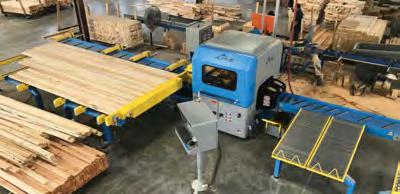
Designed for high-volume floor truss web output with even greater safety, the Monet DeSauw FWA-500 AC (for “automated controls”) offers the very latest in operator-friendly saw technology. Perfect for manufacturers running floor trusses in large volumes with variable web design, the 500 AC features automation for all blades, including the fixed cut-off blade for minimal waste. And without any need to open the saw motor cabinets, except for periodic service, you’ll benefit from enhanced safety as well. You might say that with the fully automated FWA-500 AC, Monet DeSauw has set a new standard. Again. Contact us today to discuss how this exceptional machine can positively impact your production goals.
765-751-9990 www.woodtechsystems.com
Wood Tech Systems is a registered trade name of Wood Truss Systems, Inc.
One month after installing a Double Lumber PickLine to feed two TCT Linear Saws:


"We are getting 3,000 to 5,000 bdft more each saw, than we were getting before the install.


We have shut down one Cybersaw and one TCT chord saw.
This equals about 3 less people 10 hours, and 2 less forklifts 10 hours.
Overall, it is a major improvement to our operation. We hope to have the chance to run it two shifts to further accelerate the payback.”
Tom Hollinshed, Owner
LimTek Solu�ons Inc.


6021 Yonge St., Unit 1019
Toronto, ON M2M 3W2
Tel: (416) 888-4457
Edmond.Lim@LimTekSolutions.com
Edmond.Lim@LimTekSolu�ons.com
LimTekSolu�ons.com


2004 Mitek Cyber A/T Component Saw
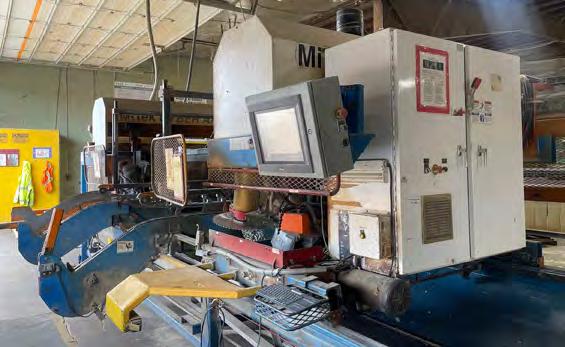
• Frame #433 - December 2004
• Fully Automated 5 Blade Component Saw

• 1-32" and 4-20" Blades cut 2x4 through 2x12 up to 16' in Length

• Touch Screen Computer with Computer Upgrade in 2014 (Windows 10)
• Catcher Display Screen
• Belt Waste Conveyor (under saw)
• Spare Blades & Parts
• 240 Volt / 3 Phase
• Electrical Transformer available at addition expense

• Excludes Incline Waste Conveyor (adjacent to saw)
• Videos available upon request $63,500 NOW $59,900
MA
New, DeRobo linear saw by Monet organizes "fill" boards to increase optimization of each board, can produce unlimited scarf cuts, cuts 1 or 2 boards at a time and cuts webs, chords, wedges, rafters and open-stair stringers. Works with all major connector plate manufacturer's software. Features include 22 inch blade, left-to-right feed direction standard, lumber push and pull grippers for more accuracy, ink marking on the 1 1/2" face of the incoming boards and small piece capture and delivery to the front of the saw for easy access. Infeed deck and bunk feed are shown as options only. 480 volt, 3phase. Call for pricing, FOB MO.
PHONE: 800-289-5627 FAX: 800-524-4982 Read/Subscribe online at www.componentadvertiser.com Don’t Forget! You Saw it in the Adverti$$er October 2023 #15291 Page #33 A dverti $ er Component manufaCturing m The Your Solution for Lack of Technical Staff ● PlanSwift Lumber and Building Material Takeoffs ● Truss and Wall Panel Design Experienced Staff ● EWP Layouts and much more! Eliminate your lack of technical resources to grow sales and increase the clock speed of your company Dave.AllPoints@gmail.com • www.AllPoints.Tech The Gold Standard in Technical Support Teams 800-382-0329 | www.wasserman-associates.com REPRESENTATIVES 765-751-9990 www.woodtechsystems.com
Monet DeRobo Linear Saw
New
NEW!
FOB
The truss industry relies on 3rd party quality assurance services to provide random visits to review the plants Quality Assurance program along with their operations. If your plant needs to comply with the IRC, IBC and to those who depend on solid, experienced QA expertise, we ask you to consider selecting Timber Products Inspection, Inc. (TP) as your choice for 3rd party inspections.

Proudly serving the forest products industry for over 50 years, TP brings the expertise you need to ensure your business is successful. As a responsible partner, TP delivers to clients, employees, and the industries we serve the confidence to drive value through the effective use of our diverse professional team.


TP would like to welcome the following authorized agents to our inspection team, each of whom have many years of experience in the truss industry!
• Al Coffman
• Jean Hart
• Curt Holler
• Chuck Ray
• Glenn Traylor
• Elliot Wilson
If you have questions about how you can make this selection, please contact your authorized agent above or Glenn Traylor at 919-280-5905 or trusguy@gmail.com.
https://www.tpinspection.com/ https://www.tpinspection.com/auditing-services/truss
Read/Subscribe online at www.componentadvertiser.com
By Glenn Traylor

How Do I Maintain
Lumber Grade Qualifications When
I Cut Off the Grade Stamp?
The past twenty years have brought many changes to the Metal Plate Connected Wood Truss Industry. These changes require manufacturing to change too, as the entire process continues to evolve and mature. Here is one situation where changes in manufacturing are necessary
Not too long ago, component manufacturers were required to maintain lumber stamps and markings throughout the manufacturing process to provide validation that the lumber they were using met design requirements. Back in the day, fabricators would purchase specific lengths from lumber manufacturers in increments that made sense for their operation with this need in mind. This lumber would be cut on component saws and the boards were designed to maintain their grade stamps.
Importantly, the component manufacturer (CM) has been allowed to crosscut lumber without impacting the lumber grade if the lumber was marked as that grade. (A “marking” exception can be short lumber, but that’s another article.)
Examination of the process
Today, with the advent of linear cutting, maintaining a lumber stamp is impractical if not virtually impossible. While this might be a disadvantage to grade traceability, the value the linear saw brings regarding higher yield and reduced labor makes the new problem worth the extra work.

To maintain compliance with the ANSI/TPI 1 standards, lumber must be selected that meets or exceeds all eight properties that define the grade. (For more on this topic, see my December 2021 article, “Can I Substitute Lumber of Another Grade or Species?”) When weekly in-house inspections are made, inspectors should verify lumber grades.

PHONE: 800-289-5627 FAX: 800-524-4982 Read/Subscribe online at www.componentadvertiser.com Don’t Forget! You Saw it in the Adverti$$er October 2023 #15291 Page #35 A dverti $ er Component manufaCturing m The
Continued next page
A generic lumber grade stamp
Linear saws use longer lumber to increase yield but cut off grade marks in the process
When 3rd party inspectors review the CM, this process should be repeated. So, with all the cutting up of lumber and the fact that lumber manufacturers normally stamp their products in one place, what should the CMs be doing to provide traceability of the lumber? How can CMs maintain the lumber’s pedigree? The following procedures and processes can be implemented in part or in total to help ensure compliance.
Receiving Lumber
1. When receiving lumber, transfer grade indicators by painting the end of lumber in the unit. Some lumber manufacturers already do this with a stamp. Caution, sometimes the wrong piece gets bundled with another grade at the lumber manufacturer, so be sure to watch for this situation.
2. Segregate lumber species and grades, and keep them segregated when storing lumber.
3. Limit the number of lumber grades inventoried at the plant.
4. For the typical CM, consider stocking limited grades of wide lumber. This would not be practical for high snow load regions or agricultural trusses.
5. Document your receiving process and keep records.
Processing Lumber
6. When rejecting lumber or reclaiming drops at the saw, make sure to segregate and tag unmarked lumber using your plant’s marking system or a manual process.
7. Although the linear saw’s batch program is very reliable, verify its process on occasion, at least monthly.
8. Mark process lumber with wax markers, using different colors for different lumber grades when grades become mixed (usually during the picking process).
9. Use the linear saw’s printing capabilities to mark components. A batch number printed on the cut material can provide an investigator the link to follow.
10. Be familiar with lumber grade requirements so problems can be spotted.
11. Document your lumber process and keep records.
The Bottom Line
The changes in cutting processes dictate a different approach to lumber traceability. In the old days, following grade marks worked well. Today, establishing a precise process is much more effective and provides the “paper trail” for audit. This process should be documented in your quality assurance program manual (QAP) and will become a review element during your 3rd party audit.
An ANSI/TPI 1 3rd Party Quality Assurance Authorized Agent covering the Southeastern United States, Glenn Traylor is an independent consultant with almost four decades of experience in the structural building components industry. Glenn serves as a trainer-evaluator-auditor covering sales, design, PM, QA, customer service, and production elements of the truss industry. He also provides project management specifically pertaining to structural building components, including on-site inspections and ANSI/TPI 1 compliance assessments. Glenn provides new plant and retrofit designs, equipment evaluations, ROI, capacity analysis, and CPM analysis.
Glenn Traylor Structural Building Components Industry Consultant http://www.linkedin.com/in/glenntraylor
PHONE: 800-289-5627 FAX: 800-524-4982 Read/Subscribe online at www.componentadvertiser.com Don’t Forget! You Saw it in the Adverti$$er October 2023 #15291 Page #36 A dverti $ er Component manufaCturing m The
“The Workshop is unique from other events because it’s specific to MSR. Having all of the content focused on a product that I know I’m using and I need to learn more about makes it a really valuable use of my time. Plus, I knew that everyone I talked to would be someone I could potentially do business with in the future.”
—Doug Ready, Wick Buildings, Mazomanie, WI

“I would encourage other component manufacturers to attend the workshop because it is an opportunity to gain a better understanding of MSR and how it can be used. That makes you a more responsible customer because you know how to maximize its use in the design of your product.”
—Porter Clark, Hiwassee Builders Supply Inc., Athens, TN

Fairfield Inn & Suites Charlotte Uptown 201 S. McDowell Street Charlotte, NC 28204 Hotel Deadline: April 3 Save the Date! Wednesday, 4/17 Golf Outing Social Hour Independent Dinner Thursday, 4/18 Educational Sessions Tour Hosted Dinner Friday, 4/19 Educational Sessions A PRIL 17-19 CHARLOTTE, North Carolina Learn more at msrlumber.org/workshop 2024 WORKSHOP
IF ONLY YOU COULD NAIL EVERYTHING IN LIFE THIS EASILY.
With a Terminailer XP, it takes only one person to drive between 30% and 70% of the framing nails in any given job . And all this nailing is done within a secure enclosure, so your people are protected from costly nailing injuries while eliminating literally millions of repetitive motions ( 4,001,398 repetitive motions to be exact , judging from the total nail count tallied recently on a two year-old Terminailer XP).
That’s a lot of nails successfully installed to be sure, and a lot of debilitating repetition your workers’ hands are spared, without any complicated training, software or lengthy setup time required.

Developed by people who know wall panel production, Terminailer XP boasts multiple repeat buyers, 20-plus machines performing exceptionally in the field and tens of millions of nails installed. Thoroughly field-proven, Terminailer is ready to drive greater productivity for you. Contact us today for more information.


765-751-9990 www.woodtechsystems.com
Wood Tech Systems is a registered trade name of Wood Truss Systems, Inc.
Used Hain Quick Rafter Cutter

• Reconditioned in December 2020
• Board Sizes: 2x4 and 2x6
• Motors: Two 1 HP / 220 Volt or 440 Volt / 3 Phase
• Saw Blades: 7 1/4" Carbide Tipped (set at 45 degrees)
• Angle Adjustment: Manual Rotation with Air Brake
• Air Supply: 90 PSI
• Carriage: Steel Rails with Steel Dual V Rollers
• Pedestal: 3/16" Formed Steel
• Saw Housing: 1/2" Billet Aluminum
• Covers: 10 Gauge (1/8" thick) Steel
• Fully Enclosed for Safety
$12,500 FOB AZ
Wasserman & Associates 800-382-0329
www.wasserman-associates.com
NEW!
2000 Automill 5-Blade Component Saw

2000 Timbermill model 343H, five (5) blade component saw cuts lumber from 2″ x 3″ through 2″ x 12″, lengths from 18 inches to 20 feet, including 4″ x 2″ four-angle floor webs from 18 inches. All powered movements, includes computer controls, (1) 30″, (1) 20″ and (3) 14″ blades, analog scales, shaker scrap conveyor, scrap incline and extra set of blades. 480 volt, 3 phase electrical required. 90 PSI air required.

$24,997 FOB ON
Wood Tech Systems 765-751-9990

www.woodtechsystems.com
REPRESENTATIVES
Monet FWA 500 Floor Web Saw
New, Monet five-head, floor truss web saw, cuts 4-angle, 4x2 floor truss webs from 16 inches and 90-90 blocks from 12 inches to four foot long maximum length. Features 10-board magazine feed, powered, fixed-quadrant angulation, manual carriage standard, shaker-pan scrap conveyor with short incline conveyor and cut-off blade. Option for longer carriage length, single-sided setup (shown in pictures, but not standard), dust hood and horizontal scrap conveyor. 480 volt, 3 phase. Call for pricing, FOB MO.
765-751-9990
www.woodtechsystems.com
PHONE: 800-289-5627 FAX: 800-524-4982 Read/Subscribe online at www.componentadvertiser.com Don’t Forget! You Saw it in the Adverti$$er October 2023 #15291 Page #39 A dverti $ er Component manufaCturing m The SAWS

2008 Alpine PF90 Wall Panel Saw 2008 Alpine PF 90 wall panel cutting and marking system. 3.5″ x 12″ maximum cutting profile, Inkjet option, cuts to 16 ft long. From the OEM’s literature, “Effortlessly handles two of the most critical and difficult processes in any wall panel operation – plate cutting and panel layout. At the rate of 1,000 linear feet per hour or more, uses data from the design software and accurately marks stud, cripple and jack locations, job and panel number, subcomponent and window/door locations, and even sheathing locations on both top and bottom plates simultaneously with ink-jet printing.


$8,499 FOB NY Wood Tech Systems 765-751-9990
www.woodtechsystems.com

Electrical Supply: 110 VAC
Motor: 1/4 HP, 110 VAC, Linear Actuator
Highly Accurate: +/- .010 Inches

Stop Rail: 2 x 4 x 1/4 Aluminum Extrusion


Stops: Jig Bored Steel
Stop Blocks: Machine Billet Aluminum
Internal Components: Hardened, Ground and Polished Steel and Billet Aluminum
Dimensions:
Length: 5 feet (60”) to 60 feet (720”)
Height: 12 inches
Depth: 12 inches
If you are looking for the fastest, most consistent way to measure and cut your product, then the Hain Measuring System (MEA) is your answer. The MEA changes from one length t any length instantly, up to 60’, without changing the operator’s position on the line. It is also highly accurate (+/- .010) and quickly moves from one length to the next in seconds. The MEA is designed for quick and easy setup and is simple to use. Even a first time user will be productive with little or no training required. It can adapt to any saw and can be mounted to any surface so that you can integrate the MEA with your existing setup. The MEA is versatile allowing “left” or “right” handed operation and measurement in “feet and inches” or “inches” depending on your preference. The MEA is also available in a “Skid Mounted” version.

PHONE: 800-289-5627 FAX: 800-524-4982 Read/Subscribe online at www.componentadvertiser.com Don’t Forget! You Saw it in the Adverti$$er October 2023 #15291 Page #41 A dverti $ er Component manufaCturing m The theHAINCOMPANY 6125 Enterprise Drive, Unit 9 | Diamond Springs, CA 95619 530.295.8068 | sales@thehaincompany.com
SAWS
A dverti$er Component manufaCturing S erving the S tructural B uilding c omponent S i ndu S try The Hiring Zone Building Component Industry's Job Board Employer to Candidate Direct Hiring No Recruiting Fees! Post your Opportunity... Candidates respond directly to you! For Additional Information Contact: twm@componentadvertiser.org or Call: 800-289-5627 x1 Visit our website: www.componentadvertiser.com/Hiring-Zone MORE INFORMATION HERE 2021
16' TigerStop • Oliver Model 5025.002 Upcut Saw • 7.5 HP / 230 Volt - 3 Phase • 18" Blade (4" x 9", 2" x 12" Capacity) • Foot Pedal Control • Open Interface to TigerStop (SET) • 16' TigerStop (TS16) with 18' Roller Table (TABR16) • Saw Attachment Plate (SAP) $19,900 FOB TX Wasserman & Associates 800-382-0329 www.wasserman-associates.com
dverti$er Component manufaCturing S erving the S tructural B uilding c omponent S i ndu S try The
Oliver Upcut Saw with
A
Design


to walls, to panels, and everything
Introducing a new level of design tools,
from the ground up.
From plans,
above.
built
and
ever. Learn more a t EagleMetal.com Continued next page
build faster than
By Tracy Roe
Celebrating Success at BCMC 2023
This year’s Building Component Manufacturers Conference and Framers Summit (BCMC | FS) in Indianapolis will be remembered as one for the record books. Attendance was great and you would be hard pressed to find someone who didn’t have a good time. My key takeaway from this show is the word BUZZ. There is certainly a buzz in the air!

Even before the show floor opened, the party got started, literally, with the SBCA 40th anniversary industry celebration. Whether or not you’ve been a part of our group since the founding of the Wood Truss Council of America in 1983, or journeyed with us through our years as WTCA – Representing the Structural Building Components Industry, everyone was welcome to enjoy this birthday bash for SBCA.
This year’s award recipients were celebrated at the party. Earning accolades were these outstanding SBCA members. Dave Brakeman of Alpine won SBCA’s 2023 Industry Leadership Award. Kevin Kraft of Alpine won SBCA’s Dick Bowman Industry Enthusiast Award. The Dwight Hikel Humanitarian Award was given to Tom Whatley of Eagle Metal. And, inducted into SBCA’s Hall of Fame was Norm McKenna of MiTek. The commitment and expertise of these fine individuals has helped all of us in this industry.

The party continued after the show floor opened, with 121 exhibitors across 65,000 sq ft. You name it and you could probably find it on display, and you could definitely find plenty of individuals ready to talk about the industry and all we have to offer.
To everyone who stopped by the Eagle Metal Products booth, thank you so much for taking the time to introduce yourself. If we missed you at the show, please reach out – we’d love to hear from you. In either case, be sure to mark your calendar for next year when we take BCMC to Milwaukee, October 7–11. Let’s keep the party going!
PHONE: 800-289-5627 FAX: 800-524-4982 Read/Subscribe online at www.componentadvertiser.com Don’t Forget! You Saw it in the Adverti$$er October 2023 #15291 Page #43


system is protected under U.S Patent #8,960 ,244 and other patents Acer Inc. 301 Industrial Drive Rushford, MN 55971 507-864-2220 www.acerinc.com Adaptable Efficiency With the Ranger Retrieval System The Ranger helps you wring maximum production from your saw investment . An automated saw deserves an automated feed system .


PHONE: 800-289-5627 FAX: 800-524-4982 Read/Subscribe online at www.componentadvertiser.com Don’t Forget! You Saw it in the Adverti$$er October 2023 #15291 Page #45 A dverti $ er Component manufaCturing m The 800-382-0329 www.wasserman-associates.com 2013 Monet DeSauw Finger Jointing Line • Monet DeSauw Cut-Off/Shaper Unit • Rook Metering Equipment Glue Machine ($22,900 New in 2021) • Monet DeSauw Finger Joint Press • Excludes Dust Collection System $52,900 NOW $42,500 FOB MO


Pick, Cut, Build—Talking Shop at BCMC 2023
We had non-stop traffic in the Enventek booth at BCMC 2023 in Indianapolis. Enventek (Dave and Larry Dalson, Michael Bell) and LimTek (Ed Lim) are the only turnkey in-line automation suppliers


for existing truss plants. We are gaining installed base momentum as word is spreading about our proven solutions that are robust and flexible. Yes, everyone knows about the amazing auto-feeding RetroC component saw, which is the only one of its kind in the component industry. We would love to sell you a standalone auto-feeding RetroC to replace your existing saws or add additional sawing capacity, but we would rather upsell you to our complete system – A Fully Loaded RetroC. That is really how to Feed the Beast!
We take great pride in every one of our installations. Every installation is different and we figure out how to get the right fit as every component plant is different and each plant has their own unique set of constraints whether it is yard layout, plant configuration, and/or people. A Fully Loaded RetroC standardizes how lumber is picked, cut, and presented to the truss builders. The component industry is actually a simple business – pick the lumber, cut the lumber, build the trusses. We have a proven robust complete system for that!

PHONE: 800-289-5627 FAX: 800-524-4982 Read/Subscribe online at www.componentadvertiser.com Don’t Forget! You Saw it in the Adverti$$er October 2023 #15291 Page #48 A dverti $ er Component manufaCturing m The
Continued next page
Edmond Lim, P.Eng. LimTek Solutions Inc.
The quiet before the storm, ready to talk shop at the booth. Thank you to all who spent time to sit down and talk shop with us.
Pick the Lumber
No forklifts running around all day. Bad lumber stays away from the saw and build tables. The picker is the first line of quality control. The picker follows the pick list on the WiFi tablet and the PickLine checks each board length, board width and the quantity against the pick list. We can install a standalone Lumber PickLine to feed any automated saw including all the major brand linear saws and any automated component saw whether the sawyer is on the fixed end or the movable carriage end.
Cut the Lumber
Less wear and tear on the sawyer gives the sawyer the opportunity and time to be the seond line of quality control. SpeedCatch is all software driven. The sawyer just cuts the lumber and SpeedCatch will fill the cart slots and eject the filled cart. All the sawyer has to do is make sure there is an empty set of carts queued behind the saw to be automatically pulled into the saw.
Build the Trusses
Lumber is collated and presented standardized in front of each truss build table from left to right of table by following the cart map as shown on the color-coded big screen. Boards are simply dragged/pulled onto the tables. The boards are oriented the right way. There is no helicoptering of boards. Because the carts are perpendicular to the tables and located closer to where they need to be, the wear and tear on the truss builders is reduced significantly.


When you’re ready to Feed Your Beast and see these efficient and effective systems for yourself, let us know! Inside and out, LimTek Process Organization Technology will help you squeeze out more truss production and deliver quality trusses with shorter lead times to better service your customers by organizing your truss fabrication processes to maximize your investment in automation. https://limteksolutions.com/#solutions

PHONE: 800-289-5627 FAX: 800-524-4982 Read/Subscribe online at www.componentadvertiser.com Don’t Forget! You Saw it in the Adverti$$er October 2023 #15291 Page #49 A dverti $ er Component manufaCturing m The


· Simplified Re-Design · Robust low maintenance · No upper hold downs · Electronic braking · Auto feeding lumber · Holds calibration · Out cuts any linear saw · Cut-by-Truss or Batch cut 6021 Yonge St., Unit 1019 Toronto, ON M2M 3W2 Tel: (416) 888 -4457 Edmond.Lim@LimTekSolu�ons.com LimTekSolu�ons.com
Twin Axis sheathing saw: Cuts X and Y axis simultaneously in one pass through the saw. Cuts up to 1″ thick, wood sheathing material, minimum width 3″. Fully enclosed to reduce noise, dust, and improve operator safety; automated via downloaded sheathing cutting files from wall design software. Includes 8 foot long idler infeed conveyor and outfeed conveyor with pop-up skate wheels, (1) spare blade and all available spare parts. 220v/440v, 3phase electrical saw, 120v, 1 phase electrical PC. 100 PSI at 14 CFM air required.


$17,991 NOW $11,950 FOB VA

Wood Tech Systems 765-751-9990
www.woodtechsystems.com
PHONE: 800-289-5627 FAX: 800-524-4982 Read/Subscribe online at www.componentadvertiser.com Don’t Forget! You Saw it in the Adverti$$er October 2023 #15291 Page #51 A dverti $ er Component manufaCturing m The A dverti$er Component manufaCturing S erving the S tructural B uilding c omponent S i ndu S try The SAWS EKSTROM-CARLSON MODEL E STRAIGHT LINE RIP SAW • 10 HP Arbor Motor • 3 HP Variable Speed Feed • 4" Maximum Thickness (when using 18" Blade) • 48" Throat • Adjustable Rip Fence • Overhead Holddown • Automatic Chain Oiler • Dust Outlets $10,500 FOB MI Wasserman & Associates 800-382-0329 www.wasserman-associates.com DANCO
• 3 3/8" Maximum Thickness • 13 1/2" Maximum Distance from Rip Fence to Outer Saw • 100 HP Arbor Motor • 2 HP Feed Motor • 7 1/2 HP Dust Collector • 480 Volt / 3 Phase • Waste Conveyor with Short Incline $35,000 NOW $27,900 FOB MN Wasserman & Associates 800-382-0329 www.wasserman-associates.com 2005 PCS / MiTek Twin Axis Sheathing Saw 2005
GANG-RIP SAW
PCS/MiTek
Start smarter... Grow faster... Achieve more... cvillella@acceptlease.com | www.acceptlease.com 894 Beaver Grade Road, Suite #304 - Moon Township, PA. 15108 Phone: 412-262-3225 Fax: 412-262-1154 Keep More of Your CASH Eliminate Yearly Financial Reporting Low Fees Fixed Payment Programs No Additional Collateral Now offering short term Working Capital Loans “Serving the Component Industry Since 1996” Start smarter... Grow faster... Achieve more... Price Reduction! 2019 Mitek Auto Deck (for Mitek Blade Saw) Five Chain Auto Deck (for Mitek Blade Saw) $18,900 FOB WI Wasserman & Associates 800-382-0329 www.wasserman-associates.com A dverti$er Component manufaCturing S erving the S tructural B uilding c omponent S i ndu S try The Like Money in the Bank. Service you can count on! 800-382-0329 | www.wasserman-associates.com 2019 Spida Automated Apollo Saw with Truss Automation • Automated Stop & Automated Saw Angulation as directed by Truss Design Software • Direct Drive 7.5 HP Motor with 18" Blade • Minimum Angle of 10 Degrees with 36" Stroke for Long Scarf Cuts • Automated 160 Degree Angular Movement • Variable Stroke Limiter & Plexiglass Shield for Operator Safety • Dust Extraction Outlet (Excludes Dust Collection System) • 20' of Steel Framed/MDF Table with Automated 20' Length Stop • 10' Infeed Roller Conveyor • Touch Screen Computer with Truss Cutting Operating Software • Excludes: Saw Installation/ Training & Spida Annual Tech Support Fee $47,900 FOB TX


$124,990.00 NOW $69,990 FOB SD Available March 2022

2006 Koskovich Omni Miser WFA with WoodRunner Lumber Retrieval


Servo controlled angulation axis of movement for cutting and making wall frame (square & angle cut) components. , “D” Print option (both faces, one edge). Includes 5 HP, 3450 RPM, arbor motor, computer monitor, console, 220/440v 3 Ph, spare blade. The WoodRunner Air Pick automated lumber retrieval system includes a single picking head with 10 bunks and 2 magazines. Includes manuals, all available spare parts and spare servo cards, and WoodRunner software source code. Available March 2022.

PHONE: 800-289-5627 FAX: 800-524-4982 Read/Subscribe online at www.componentadvertiser.com Don’t Forget! You Saw it in the Adverti$$er October 2023 #15291 Page #53 A dverti $ er Component manufaCturing m The 765-751-9990 www.woodtechsystems.com


Continued next page
By Ed Serrano Managing Director VektaUSA
Making the Case for Automation

Vekta Automation is in the business of just that – automating timber truss and frame plants. From the Razer saws to an advanced product offering, Vekta is introducing automation machinery for every stage of the truss and frame manufacturing process. We have automation that is reducing the reliance on people, improving safety and productivity, and reducing waste, all through software and clever pieces of machinery.
Every day, automation is evident in many business functions. To name a few, there’s finance, bookkeeping, stock control, customer service – our lives have endless options and solutions that use automation to increase efficiency, improve accuracy, and enhance productivity. Personally, I’ve embraced automation in many parts of my role. However, there is one area that has always been manual – and it is exactly what I’m doing now – writing articles about Vekta and case studies on our customers, sharing the advantages of our equipment and hopefully providing an entertaining read in this magazine.
So today I decided to embrace a form of automation that has taken the media by storm because it is being utilized for everything from real estate ads to resumes to high school English reports. I went to ChatGPT and asked it for an article on why a frame and truss plant needs Vekta Automation. Here is its response, with my additions in RED
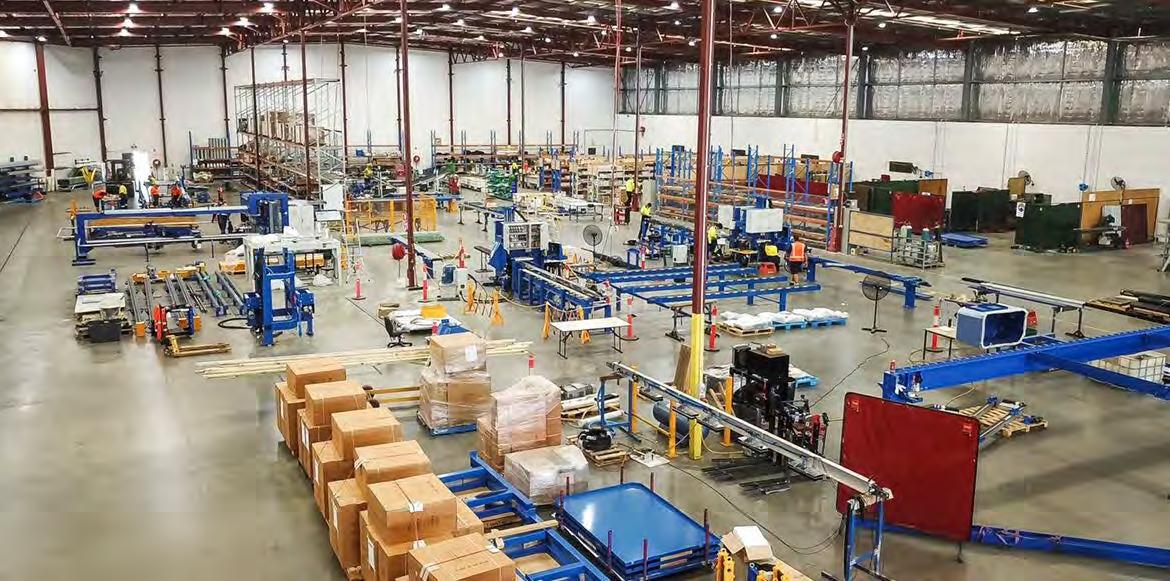
Enhancing Efficiency and Precision: The Case for Vekta Automation in Truss Manufacturing Plants
In today’s fast-paced and competitive manufacturing landscape, industries are constantly seeking innovative solutions to streamline their processes, increase efficiency, and deliver higher-quality products. One such industry that has significantly benefited from automation is truss manufacturing. Trusses, essential structural components used in construction projects, have long been produced using traditional methods. However, the advent of automation, specifically with the introduction of Vekta Automation, has revolutionized truss manufacturing plants, offering a range of advantages that propel them ahead in terms of productivity, precision, and overall operational excellence.
PHONE: 800-289-5627 FAX: 800-524-4982 Read/Subscribe online at www.componentadvertiser.com Don’t Forget! You Saw it in the Adverti$$er October 2023 #15291 Page #55 A dverti $ er Component manufaCturing m The
Continued next page
The Need for Automation in Truss Manufacturing

Truss manufacturing is a complex process that requires precise measurements, cutting, and assembly of wooden components. Traditional methods often involve manual labor, which can be time-consuming, labor-intensive, and prone to errors. These challenges can lead to inconsistencies in product quality, longer lead times, and increased production costs. To address these issues, truss manufacturing plants are turning to automation solutions like those offered by Vekta Automation.
Advantages of Vekta Automation in Truss Manufacturing Plants

1. Enhanced Precision: Vekta Automation utilizes advanced computerized systems to accurately measure, cut, and assemble truss components. This precision minimizes errors and ensures consistent quality across every truss produced. The elimination of human error results in structurally sound trusses that meet strict industry standards. Go, Vekta Razer!
2. Increased Productivity: Automation significantly reduces production cycle times by executing tasks with unparalleled speed and efficiency. Automated systems, such as those offered by Vekta, can seamlessly handle multiple truss designs and sizes, allowing for rapid transitions between different product lines. In other words, the Vekta Razer can cut whatever you throw at it!
3. Customization and Flexibility: Truss manufacturing plants often encounter varying customer requirements and design specifications. Vekta Automation machinery enables easy customization and adaptability, allowing plants to efficiently switch between different truss designs and adjust production parameters as needed. Made even simpler with a Vekta PackFeeder and Razer combination!
4. Reduction in Labor Costs: Automation reduces the reliance on manual labor, leading to decreased labor costs over time. Truss manufacturing plants can allocate human resources to higher-value tasks such as quality control, maintenance, and process optimization. With the labor market still tight, ChatGPT has smashed it with this point!
PHONE: 800-289-5627 FAX: 800-524-4982 Read/Subscribe online at www.componentadvertiser.com Don’t Forget! You Saw it in the Adverti$$er October 2023 #15291 Page #56 A dverti $ er Component manufaCturing m The Continued next page
5. Improved Safety: The automation of heavy lifting, cutting, and assembly tasks minimizes the risk of accidents and injuries associated with manual labor. This focus on safety creates a more secure working environment for plant personnel. This is a shout-out to the Vekta StakPro Truss and Frame systems! The Vekta StackPro range encompasses automated delivery and stacking of completed frames or trusses at the touch of a button.

6. Data-Driven Insights: Vekta Automation systems provide real-time data on production metrics, allowing plant managers to make informed decisions and optimize processes. This data-driven approach enhances efficiency, reduces waste, and contributes to continuous improvement. Vekta’s user-friendly software system ‘Simple’ gets an applause here! With the addition of the Real Time Optimizing feature, the manager and foreman have a real-time understanding of production priorities and throughput.

7. Sustainable Practices: Automation can lead to reduced material waste due to precise measurements and cutting. Additionally, the energy-efficient operation of automated systems contributes to more sustainable manufacturing practices. Any level of automation can have an impact on waste. For a framing line, the options could be something as simple as the Vekta Auto Nailing Framers or a top-end fully automated Vekta Raking Framer. Each piece of automated equipment is designed to reduce waste of material, time, over production, over processing, defects – any waste that impacts your business and your bottom line.

In a rapidly evolving manufacturing landscape, truss manufacturing plants must embrace automation to remain competitive and meet the demands of modern construction projects. Vekta Automation offers a comprehensive solution that enhances precision, boosts productivity, and enables customization in truss manufacturing. As the industry continues to adopt automation technologies, truss plants that integrate Vekta Automation’s products are well-positioned to lead the way in delivering high-quality truss components efficiently and effectively.
And there you have it – automation that will now allow me to have more time to focus on working on the business not in it or knock off early and spend time with my family. Thank you, ChatGPT.
PHONE: 800-289-5627 FAX: 800-524-4982 Read/Subscribe online at www.componentadvertiser.com Don’t Forget! You Saw it in the Adverti$$er October 2023 #15291 Page #57 A dverti $ er Component manufaCturing m The
New Monet DeSawyer ESC (Servo Controlled) Component Saw
Monet DeSauw model Desawyer ESC enhanced servo-controlled ( ESC) component saw with touch screen user interface with backup mechanical controls. Includes three operating modes: Auto (download setups from LAN or USB), Semi-auto (touch screen setup entry), and Manual (backup push-button switches for powering all movements). Includes over-travel protection, comprehensive setup screens, auto sequencing, auto-calibration and pneumatic brakes on all five () blades. One (1) 30” blade and four (4) 16” blades. Manual cut limits are 18” min., 11” min. square edge blocks, 20’ max cut. Belt under-saw waste conveyor. Voltage: 480 volt/3 phase/60 Amp. Air: 50 PSI at 5 CFM. One-year warranty included. Can be paired with a model PD-6 lumber feed system at an additional cost. Heavy duty 80 RIV chain feed system. 16’ wide x 20’ long x 36” deck height. Transfers 3’ to 20’ lumber. Includes auto-feed control, foot pedal override, forward & reverse, variable speed control with HD double-bearing construction. Other additional-cost options include, inkjet marking, label printing, backside screen display, spare blades and incline scrap conveyor.
$349,900 FOB MO

PHONE: 800-289-5627 FAX: 800-524-4982 Read/Subscribe online at www.componentadvertiser.com Don’t Forget! You Saw it in the Adverti$$er October 2023 #15291 Page #58 A dverti $ er Component manufaCturing m The NEW! 765-751-9990 www.woodtechsystems.com
Custom 3-Arm Infeed Decks
Two custom-built powered infeed decks, 3-arms each, 12′ x 12′ footprint each, touchpad controls and chain conveyors. One deck has a 5 HP drive and the other has a 10 HP drive. 480 volt, 3-phase electrical required.

10 HP price is $7,993 & the 5 HP price is $6,993.
Wood Tech Systems
765-751-9990
www.woodtechsystems.com
$14,499
2005 Alpine Speed Cut Saw with Speed Cut Express


• Alpine Metra-Cut Saw (5 HP-3 Phase) with 16" Blade
• Speed Cut Express Automation with Touch Screen Computer
• Automated Stop and Automated Saw Angulation as Directed by Truss Design Software
• Infeed/Outfeed Roller Conveyor with Stands


• Saw Barrier Guard $19,900 NOW $16,900 FOB ND
Wasserman & Associates 800-382-0329
www.wasserman-associates.com
2006 MiTek Cyber A/T Component Saw
2006 MiTek Cyber A/T Component Saw. Frame #521, Fully automated five-blade component saw, cutting performed by 2-16″ x 7 HP, 2-20″ x 7 HP, 1-32″ x 13 HP. Windows 7 PC in enclosure for fully automated or manual part input, all powered movements, cuts 2×3 thru 2×12 plus 4×2 lumber. Lengths cut from 14″ to 20 feet. Minimum 4-angle cut 22″ (17″ in manual mode) Belt scrap conveyor included with short incline (approx 4′). Includes skate wheel outfield conveyor and optional “Catcher Display”. Includes all available spare blades, spare parts, and manual with schematics. 2480v, 3ph power required.
765-751-9990
$89,990 FOB VA
www.woodtechsystems.com
Safety Speed Manufacturing Model 7400 XL Panel Saw Safety Speed Manufacturing, model 7400 XL*, vertical panel saw, 3 HP induction motor, 64 inch crosscut, 2 1/8" maximum thickness, accuracy within 0.005 inches, 13 foot long welded steel frame with integrated stand and linear V-guides, enclosed counterweight system, adjustable vertical and horizontal rules. Quick changes from vertical to horizontal cutting. Includes machined aluminum material rollers, hold down bar, wheels, quick stop gauges and material hold downs. Dust collection ready. Options available include digital readouts for vertical cuts, automated length measuring, laser guide, stop bar, vacuum and midway fence. 208-230/460 volt, 3 phase electrical (208-230 single phase, 2 HP power optional +$100.00).
NEW!
765-751-9990
pricing, FOB MO
www.woodtechsystems.com


PHONE: 800-289-5627 FAX: 800-524-4982 Read/Subscribe online at www.componentadvertiser.com Don’t Forget! You Saw it in the Adverti$$er October 2023 #15291 Page #59 A dverti $ er Component manufaCturing m The 765-751-9990 www.woodtechsystems.com NEW!
Monet DeWall Saw Monet DeWall 90/90 wall panel marking saw is a computer numeric controlled wall panel saw with touch screen user interface. Cuts and marks up to 2 boards at a time using 2x4 through 2x8 or cuts and marks one board at a time. Call for
Base FOB MN New
SAWS A dverti$er Component manufaCturing S erving the S tructural B uilding c omponent S i ndu S try The Like Money in the Bank. Service you can count on!
Visit
• Sources for MSR Lumber

Filter by species, grade and dimension to locate products from MSRLPC members.
• Educational Resources
Find helpful information for current and potential MSR lumber users.
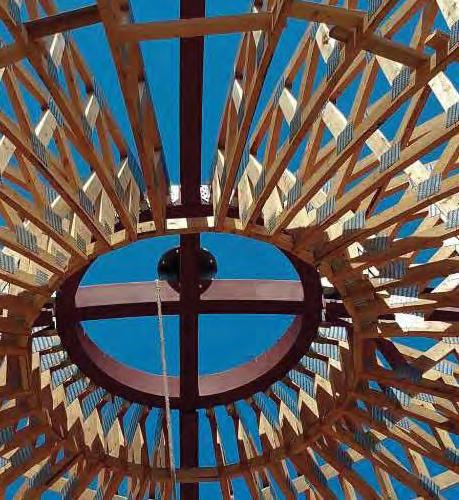


• NEW! Design Values Comparison Tool

Compare MSR lumber reference design values with visually graded dimensional lumber by species.
“Lumber buyers don’t often have access to truss design software to easily determine the allowable substitutions that may inform their purchasing decisions in a meaningful way. This tool helps with that and provides valuable information about species substitution, which is becoming more common in today’s market. It’s a one-stop shop.”
—George
Hamilton, MSRLPC Board & Website Committee Member
WEBSITE
Valuable
Resources
find: LEARN MORE AT: msrlumber.org
msrlumber.org to
Wescana Vertical Truss Stacker

• 4 Lifting Arms Stack Trusses from 20' to 60' Spans (2 HP / 3 Phase)

• Stacking Capacity of 30 Trusses with Indexing for Each Truss Stacked
• 28 Second Cycle Time
• Automatic Truss Sensors to Activate Lifting Arms
• PLC Controlled
• 7" Touch Screen User Interface
• Dual, Manual & Automated Electric Controls
• 70' Powered Outside Conveyor (1 HP / 3 Phase)

Call for Price - FOB Alberta
800-382-0329 | www.wasserman-associates.com
CMF Floor Truss Gantry
$59,997 FOB FL
Used CMF floor truss gantry, 30-ft working length with two parking tables and two end masts. Builds floor trusses from 24″ to 14″ deep. 48-ft overall length, built-in camber, clamping cylinders & skatewheel transfer rails on table. Gantry head has 10 HP drive motor with 24″ dia. roll, pendant control, safety sensors and safety bars. 120 / 240 volt, 3 phase electrical required. 120 PSI air required.

765-751-9990 www.woodtechsystems.com
Motor Drive System for Start & Stop
• Running Amber Beacon
• Reversing Red Beacon & Buzzer
• Emergency Stop Control Module
• Taper-Lock Sprockets
• S ealed Flanged Roller Bearings
• Revesing Magnetic Starter
• 2' per Second Travel Speed
PHONE: 800-289-5627 FAX: 800-524-4982 Read/Subscribe online at www.componentadvertiser.com Don’t Forget! You Saw it in the Adverti$$er October 2023 #15291 Page #61 A dverti $ er Component manufaCturing m The 800-382-0329 | www.wasserman-associates.com WESCANA TRACKLESS ROLLER GANTRY SYSTEM • Trackless Roller Gantry System • 24" Diameter x 1" Wall x 14' Long Gantry Roller • 7.5 HP / 3 Phase Gear Motor with Safety Brake • Contr olled Motor Drive System for Start & Stop • Safety Barrier & Electric Eyes • Front & Rear Emergency Shut Off Bar • Joystick Operation Control • Ride-On Platform at Table Height • 2' per Second Travel Speed • Continuous 3/4" Steel Slotted Top Table • Manual Roof Jig Hardware • Ejectors for Side or End Eject • 2 Park Sections • Optional W izard Ready Tables, Transfer Rollers, Exiting Conveyor, Finish Roller & Outside Conveyor NEW! 800-382-0329 | www.wasserman-associates.com • (2) 24" Diameter x 14' Long Rollers • 3 1/2" Diameter Shafts with Baffles • Dual 5 HP / 3 Phase Gear Motors • Front & Rear Emergency Shut Off Bar • Safety Barriers & Electric Eyes • Controlled
NEW!
Training. Support. Partnership. Experience service as a solution.
Strong businesses thrive on solid relationships. Working with Simpson Strong-Tie, you have direct access to dedicated professionals who are focused on customer success. As part of our services, experienced designers and licensed engineers take the time to listen and understand your unique project challenges. We also offer accredited training on truss connectors and comprehensive training on our design and management software. Plus, our innovative products are widely available and backed by expert service and support. It all adds up to solutions that are every bit as reliable as the people behind them. Team up with a proven industry partner. To learn more, visit go.strongtie.com/componentsolutions or call (800 ) 999-5099.

Integrated Component Solutions | Products, Software and Service for Smarter Building
© 2023 Simpson Strong-Tie Company Inc. TRUSS23-SERV
1994 Alpine Side-Eject Roof Truss Gantry Line
1994 Alpine side-eject roof truss gantry line, 110-ft working length, (15) tables with skatewheel ejectors, steel drilled/tapped bottom chords & plastic above. Includes (12) skatewheel receivers, 248-ft of crane rail, one 10 HP gantry head with 20″ diameter roll, two end masts and all available hardware. Head needs bogie wheel repair / replacement. Decommissioned in May of ’23. 240 volt, 3 phase electrical required. 120 PSI air required.

$148,997.00 FOB FL
PHONE: 800-289-5627 FAX: 800-524-4982 Read/Subscribe online at www.componentadvertiser.com Don’t Forget! You Saw it in the Adverti$$er October 2023 #15291 Page #63 A dverti $ er Component manufaCturing m The 765-751-9990 www.woodtechsystems.com

“We’ve been using MSR pretty much since day one when SCS was founded in 1987. It’s a crucial element for roof and floor trusses, especially with today’s challenging designs for residential and commercial construction. By using MSR, we reduce the overall fiber required for the design of our products. For example, a top chord on a roof truss might require 2x6 if only #2 is available but that can often be replaced with a 2x4 in MSR.”

—Dave Kipp, Structural Component Systems (SCS), MSRLPC member

Consider the Benefits of Membership

The MSR Lumber Producers Council (MSRLPC) represents the interests of machine stress rated lumber producers in the manufacturing, marketing, promotion, utilization, and technical aspects of MSR and MEL lumber. Suppliers, customers, and professionals may join as Associate members. Members enjoy reliable market data and opportunities for education, networking and online marketing.

Hain Systems Framer
Electrical Supply: 110 VAC
Motor: 1/4 HP, 110 VAC, Linear Actuator
Highly Accurate: +/- .010 Inches
Stop Rail: 2 x 4 x 1/4 Aluminum Extrusion

The Hain Systems Framer (HSF) will help you build square and accurate wall panels for residential or commercial construction applications. It will help you cut building costs by saving time and improving your quality. It’s a reliable, efficient and proven system that features a ruggedly simple design. The HSF is based on a proven design with over 20 years of actual production use and maintenance experience. It comes fully assembled and is designed for portable job site framing or in-plant permanent installation. The table has many optional attachments and will support Mylar Tape wall layout or any other type of layout. The optional gun rails can also be retro-fit to any table.
Stops: Jig Bored Steel
Stop Blocks: Machine Billet Aluminum
Details:
Internal Components: Hardened, Ground and Polished Steel and Billet Aluminum
Dimensions:
Length: 5 feet (60”) to 60 feet (720”)
Table Construction: Thick-wall Structural Steel Tubing, Jig Welded for Accuracy
Height: 12 inches
Depth: 12 inches
Air Supply: 90 psi (10 CFM Air Flow Recommended)
Electrical Supply: 120 VAC
Powder Coat: Industrial Gray
Dimensions: Height: 43”
Length: 16’ or 20’
Width: Adjustable 8’ to 10’ or 8’ to 12’
Shipping Weight: 3000 lbs
If you are looking for the fastest, most consistent way to measure and cut your product, then the Hain Measuring System (MEA) is your answer. The MEA changes from one length t any length instantly, up to 60’, without changing the operator’s position on the line. It is also highly accurate (+/- .010) and quickly moves from one length to the next in seconds. The MEA is designed for quick and easy setup and is simple to use. Even a first time user will be productive with little or no training required. It can adapt to any saw and can be mounted to any surface so that you can integrate the MEA with your existing setup. The MEA is versatile allowing “left” or “right” handed operation and measurement in “feet and inches” or “inches” depending on your preference. The MEA is also available in a “Skid Mounted” version.
theHAINCOMPANY 6125 Enterprise Drive, Unit 9 | Diamond Springs, CA 95619 530.295.8068 | sales@thehaincompany.com
PHONE: 800-289-5627 FAX: 800-524-4982 Read/Subscribe online at www.componentadvertiser.com Don’t Forget! You Saw it in the Adverti$$er October 2023 #15291 Page #65 A dverti $ er Component manufaCturing m The
Electrical Supply: 110 VAC Motor: 1/4 HP, 110 VAC, Linear Actuator Highly Accurate: +/- .010 Inches Stop Rail: 2 x 4 x 1/4 Aluminum Extrusion Stops: Jig Bored Steel Stop Blocks: Machine Billet Aluminum Internal Components: Hardened, Ground and Polished Steel and Billet Aluminum Dimensions: Length: 5 feet (60”) to 60 feet (720”) Height: 12 inches Depth: 12 inches If you are looking for the fastest, most consistent way to measure and cut your product, then the Hain Measuring System (MEA) is your answer. The MEA changes from one length t any length instantly, up to 60’, without changing the operator’s position on the line. It is also highly accurate (+/- .010) and quickly moves from one length to the next in seconds. The MEA is designed for quick and easy setup and is simple to use. Even a first time user will be productive with little or no training required. It can adapt to any saw and can be mounted to any surface so that you can integrate the MEA with your existing
AT: msrlumber.org/about
LEARN MORE & JOIN
The Best in Industry Automation at BCMC 2023
By Eide Integrated Systems

Ask anyone who attended the Building Component Manufacturers Conference (BCMC) in September and we think they will agree—the best in industry automation was on display in Indianapolis this year! We at Eide were very pleased to be a part of the great show this year.
We know everyone will take home a mental list of their own highlights from the show, but the following are some of the best from our point of view.
Of course, we had our Eide Integrated Systems/Wizard Booth where we were able to display our Universal Table and Operational WizardPDS® Retrofit Tables. The automated perimeter definition system is what gives our WizardPDS® tables their speed, accuracy, and setup efficiency.


Add as much or as little WizardPDS® automation as you need. It can be used for the entire table line or a 40’ section to capture the bulk of your schedule. New table installations and/ or retrofit table systems for existing lines are available.
What’s more, our Universal™ Table is designed exclusively for adding to and extending WizardPDS® Automation to your existing table line, even discontinued models.
PHONE: 800-289-5627 FAX: 800-524-4982 Read/Subscribe online at www.componentadvertiser.com Don’t Forget! You Saw it in the Adverti$$er October 2023 #15291 Page #66 A dverti $ er Component manufaCturing m The Continued next page
And don’t forget our separate booth for ProCut™, our linear saw series that’s configurable to any assembly line and provides a safe, accurate way to cut your lumber. In addition to ProCut™ with the ProDeck™ Lumber Infeed system, this year we expanded the booth to include Material Handling Delivery Systems. The Material Handling Systems deliver lumber from the ProCut to the truss assembly stations. This new Material Delivery System can be configured to improve the flow of perfectly cut parts and materials directly to your assembly stations


We featured Specialty Jack Tables that we made, requested by Desert Lumber. We retrofitted their MiTek tables with WizardPDS® Automation. The tables are designed to operate and build on both sides of the truss table, for their jack trusses. We also partnered with Scherer Bros. Lumber Co. and had them build the jack trusses shown on the specialty tables.
If we saw you in person at the show, thank you for stopping by!
If you were unable attend, please contact us to hear more about what we brought to the show…and what we can bring to your plant to improve your material handling, cutting, jigging, and more.
PHONE: 800-289-5627 FAX: 800-524-4982 Read/Subscribe online at www.componentadvertiser.com Don’t Forget! You Saw it in the Adverti$$er October 2023 #15291 Page #67 A dverti $ er Component manufaCturing m The
Automation & Expansions For Everyone
Known for its speed and precision, WizardPDS® is used in more new and existing table brands than ALL other systems combined. Add as much, or as little, WizardPDS® automation as you need; the entire table line or a 40’ section to capture the bulk of your short runs and complex designs. In fact, with the time-intensive setups dedicated to your WizardPDS® automation, your manual table is now free to maximize its potential with longer runs and basic geometry. WizardPDS® continues to lead the industry with innovative automation solutions for both roof & truss production.


Your table, automated.
We bring the best together!
Eide Integrated Systems, LLC 612-521-9193 www.eideintegratedsystems.com
2018 Clark Mini Barn Press
2018 Clark Mini Barn Press, builds rigid frames for sheds from 8 foot to 14 foot spans, to 3′-6″ height. Builds mansard and rafter shapes. Includes (5) track mounted heads with 8″ x 10″ platens, material clamps, 10 HP hydraulic power unit with manifold for air and fluid, ball valve controls, mounting track and all available jigging. 460 volt, 3 phase electrical required.
$19,997 FOB TX
Wood Tech Systems 765-751-9990
www.woodtechsystems.com
Horizontal
Model HVS, Two Unit, 2-Zone, 14’ Horzontal Stacking System. Two lifting units (one master and one slave) with integral electrics. A truss sensing system consisting of adjustable laser sensors mounted on slide rails. One indoor electric control enclosure & panel w/PLC and manual controls. A stacker-conveyor interface package comprised of (1) mounted 3-push button enclosure and (1) remotely mounted 2-push button enclosure (pause/ emergncy stop). Hand-held Wampfler
Remote Control System. 8 stacking rails and 4 stripping posts. Stack 1 5/8” thick x 14’ tall trusses up to 30 high. Stack a truss in approximately 40 seconds (cycle time). Stack up to 55’ or longer trusses on each side of the conveyor with minor assistance for truss sag, shorter lengths can be stacked unassisted. Excludes 77’ Walk Through Conveyor System. Two systems available at $25,000 NOW $19,900 Each. FOB NE.


Wasserman & Associates
800-382-0329
www.wasserman-associates.com
WESCANA FLOOR TRUSS MACHINE

• 7' x 40' Table with 3/4" Steel Table Top
• Two 5' Park Sections
• Truss Depths from 12" to 26"
• Truss Flip-Over Arms
• Side or End Ejectors
• Bui lt-In Camber for Clamping on Both Sides

• Air Cylinders Under Table
• 2 Contr ol Valves for Clamping
800-382-0329
• 1 Contr ol Valve for FlipOver Arms
• 1 Control Vlave for Ejectors
• 24" Diameter x 1" Wall Thickness Roller
• 10 HP / 3 Phase Gear Motor
• Front & Rear Emergency Shut-Off Bars
• Joystick Control
• 2' per Second Travel Speed
EMSI Field Repair Press
EMSI 10 Ton Field Repair Truss Press System. Complete with: 1/2 HP, 115 Volt, 50/60 Cycle Universal Motor – Operates at voltage as low as 60 volts. 10,000 PSI
Portable Power Pack with Two Speed Operation – 200 cu in/min @ 0–200 psi, 20 cu in/min @ 200–10,000 psi and Externally
Adjustable Relief Valve (unit weight 55 lbs.). C-Clamp Assembly with 8" Maximum Reach, 4" x 5" Pressing Platen (optional platen available for 4” x 2”). Independent
10 Ton Hydraulic Cylinder. 10’ Hydraulic Hose Assembly with Quick Disconnect Coupling. Handle with 24 Volt Remote Electrical Pendant.

Call for Price
Eide Machinery Sales, Inc.
612-521-9193
Pacific Peak Up Stacker
Used-as-is Pacific Automation 60’ peak up stacker / (4) lift arms with indexing heads / Adjustable pop-up platform / Target for triggering stacking cycle / Powered truss conveyor as shown / Center rolls can be moved to unload from top chord side / Control panel with auto and manual stacking mode.

$13,950
Eide Machinery Sales, Inc. 612-521-9193
www.eidemachinery.com
PHONE: 800-289-5627 FAX: 800-524-4982 Read/Subscribe online at www.componentadvertiser.com Don’t Forget! You Saw it in the Adverti$$er October 2023 #15291 Page #69 A dverti $ er Component manufaCturing m The TRUSS EQUIPMENT
2007 Clark Industries
Truss Stacker
| www.wasserman-associates.com
NEW!
S erving the S tructural B uilding c omponent S i ndu S try The
A dverti$er Component manufaCturing
Component manufaCturing S erving the S tructural B uilding c omponent S i ndu S try The Like Money in the Bank. Service you can count on! 800-382-0329 | www.wasserman-associates.com NEW IDLE & POWERED 14' TRUSS CONVEYOR (AZ) • 14' Long x 4" or 5" (Inside Diameter) Schedule 40 Pipe
Tube Steel Stands (7" Height Adjustment - Height to be Specified)
4 Bolt Flange Bearings
Idle and Motorized Rollers
1/4 HP Motors (240/480 Volt-3 Phase) with Controls
1" and 1 1/4" Cold Rolled 24" Shafts Baffled
6 to 8 Week Delivery NEW!
www.eidemachinery.com A dverti$er
•
•
•
•
•
•
PANEL EQUIPMENT
$13,000 FOB NE
Wasserman & Associates
800-382-0329
www.wasserman-associates.com
New Panels Plus Wall Panel Framing Equipment
Consider Panels Plus wall panel assembly equipment for manufacturers of wood or steel wall panels, floor-panels, and related framing components. Panels Plus is an employee owned, ISO certified, manufacturing company that builds state-of-the-art equipment featuring durable construction, with fit and finish second to none in the structural building component industry. The referenced base framing table allows you to assemble from 7-12 foot wall heights, at industry standard 16 foot lengths, at a working height of 29 to 32 inches. This framer design includes controls at each end of table, squaring stops and pneumatic clamping for consistent wall panel quality. Frames 2x4 or 2 x 6 walls, with color-coded, steel stud locators at 16 and 24 inches O.C. spacing. Includes pop-up skate wheels for easy transfer of completed wall frame. Framing table can be configured to receive wall framing light bars, other options include custom buildable wall heights, lengths and auto-indexing of optional 2 or 3 tool carriages.
$8,250 FOB TX
Wasserman & Associates 800-382-0329
www.wasserman-associates.com Carlson Mobile Framing Table
• Wall Lengths to 16'
• Manual Height Adjustment (7'-0" to 9'-3" wall heights)
• Tool Dollies with Senco Nail Guns
• Stud Locators
• Pop-Up Skatewheel Conveyor
• 1" Stroke Air Clamps
• Tool Box
$14,900 FOB VA
Wasserman & Associates 800-382-0329
www.wasserman-associates.com
Additionally from Panels Plus are sheathing tables with features that include foot pedal control at squaring end of table, with squaring stops, roller conveyors at both sides, single pendant controls for bridge, tool spacing at 6 inch centers with 3 inch bridge shift for offset nailing. Tool bridges can accommodate from 2 x 4 to 2 x 8 walls, with seam tilt being standard equipment Panels Plus Tool Bridges are available with single beam or dual beam design for two different tool mounts on one bridge. Squaring stations, sub-component tables, conveyors and panel lifts are also available to complete the configuration of the wall panel assembly line. Price includes factory installation and training. 50 CFM at 120 psi air. 120 or 230 volt, 1 phase electrical.


Used Idle, Powered & Transfer Rollers
• 14' Long x 4 1/2" Diameter, NonPowered, 30" Fixed Height - 10 Available at $800 Each
• 14' Long x 4 1/2" Diameter with 1/4 HP Motors, 30" Fixed Height - 7 Available at $1,250 Each


• 54' Long (3-18' Rollers Connected) x 6 1/2" Diameter with 1 1/2 HP Motor, 36" Height - $5,000

Wasserman & Associates 800-382-0329
www.wasserman-associates.com
Please be assured that your investment with any of our selected partners will not cost one penny more with the Fitzgerald Group as your purchasing contact. In addition, you will receive the full advantage of our Partner Relationships and Services NOT offered elsewhere. RFitzgerald@FitzGroup.com 719.528.5445
PHONE: 800-289-5627 FAX: 800-524-4982 Read/Subscribe online at www.componentadvertiser.com Don’t Forget! You Saw it in the Adverti$$er October 2023 #15291 Page #71 A dverti $ er Component manufaCturing m The 765-751-9990 www.woodtechsystems.com
CLICK HERE for more information NEW!
New Component Table with Skatewheel Conveyors Lift & Extend Skatewheel Conveyors. 10' x 10' Work Area with Squaring Lip. Gun Holster & Nail Tray.
A dverti$er Component manufaCturing S erving the S tructural B uilding c omponent S i ndu S try The
Viking/ADT Fastrac 10' Portable Sheathing Bridge Details Here
Fitzgerald Group, LLC a blending of excellent services
products,
that
the results you need
– getting conflicting info about what to do and the
and the systems you may need? Before you Buy - Ask yourself –do I need a salesman or a guide? If you want an Independent Guide that has your bottom-line results as the #1 priority, Call Me. If the salesman will do - we'll talk later... Also, don't let Financing Deals influence your best solution. FitzGroup can arrange – Zero down & No payments for 90
and
with answers
work...!© Not producing
or want
equipment
Days!
www.FitzGroup.com


PANEL EQUIPMENT
2021 Triad Router Bridge & Portion of V-Track
at Both Ends of Squaring Table
• Automated Field & Edge Nailing
Driving by Panel Pro Event Software & Your Programmed Nailing Patterns
• Simple Touchscreen Controls
• 2 Tool Carriages for Sheathing Nailing with Tilt Function for Seams

• 2 Paslode Nail Guns with High Load Coil Tray
• Auto Sheathing Bridge Return

• Includes 4 Pallets of Magnum Coil Nails (2 3/8 x .113)
• 480 Volt / 3 Phase
$29,900 FOB KS.
Wasserman & Associates
800-382-0329
www.wasserman-associates.com
The Generation 3 Framing Table has adjustable 20’ long walls. With just a push of a button, the width adjustment clamp is activated to clamp and square all components. The Generation 3 Framer features a wider table top, designed with the framer in mind. Our new Anti-Slip Surface allows the operator to work on a comfortable and safe surface.
Call for Price
Eide Machinery Sales, Inc.

612-521-9193
www.eidemachinery.com
2021 Triad Routing Bridge with approximately (20) feet of v-track. Fits over tables that build up to 12′ nominal height wall panels. Includes powered automatic bridge return, powered vertical router movement, manual fine adjustment wheel, manual vertical router travel with chain drive and (1) Milwaukee router, catalog #5625-20 120 volt, 1 phase, 15 Amp electrical required. No table included.
$28,970 NOW $5,000 FOB BC
Wood Tech Systems
765-751-9990
www.woodtechsystems.com
New Panels Plus Floor Cassette Framing Station
Price: $Call for pricing
FOB: MN
IBS Tool Bridge & Router Bridge
IBS multi-tool bridge with (24) tool stations. Bridge features auto-return, button controls and laser guide mount. Fits up to 12′ nominal rail centers. IBS router bridge features (1) router, laser guide mount and lever-switch button controls. Fits up to 12′ nominal rail centers. Sold as a pair. Includes all available floor mounted, v-rail. Both bridges missing laser sub-assembly. 120vac, 120psi air.
$15,975 NOW $5,995 FOB UT
Wood Tech Systems


765-751-9990
www.woodtechsystems.com

New Panels Plus floor framing machine, supports the structural members creating floor sections from 2" x 6" LVL through 2" x 10" to 2" x 12" dimensional lumber, 20" deep wood floor trusses or engineered wood / I-joists. Standard footprint of floor panels (cassettes) up to 12' wide x 45' long. Table consists of a fixed section and a track-guided, moveable section controlled by either a foot switch or push-buttons.
New Wall Panel Lift
• 8' to 12' Wall Heights
• 1,000 Lb Capacity
• Weight: 120 Lbs
• Excludes: Electric Hoist & Freestanding Bridge Crane

$1,950 FOB NE
Wasserman & Associates
800-382-0329
www.wasserman-associates.com
Includes a series of color-coded locator pins at 16", 19.2 and 24" on-center spacing and clamping with squaring feature including foot pedal control. The locators individually flip down if a joist comes out on top of them. After the floor is complete and unclamped, the floor section can be raised up on skate-wheel conveyors and rolled out or lifted off the table using an overhead crane. Table height is 24.5", OAL 45.5 ft, OAW 14.5 ft. 120 volt, 1 phase, 15 Amp electrical required. 90 to 120 PSIG at 15 CFM air required.
PHONE: 800-289-5627 FAX: 800-524-4982 Read/Subscribe online at www.componentadvertiser.com Don’t Forget! You Saw it in the Adverti$$er October 2023 #15291 Page #73 A dverti $ er Component manufaCturing m The A dverti$er Component manufaCturing S erving the S tructural B uilding c omponent S i ndu S try The 765-751-9990 www.woodtechsystems.com
NEW!
2007 VIKING 16' X 12' SQUARING TABLE WITH SHEATHING BRIDGE
16' x 12' Squaring Table with Powered Width Adjustment & Powered Chain Conveyor
Wall Panel Lengths up to 16', Wall Panel Heights from 4'-0" to 12'-2"
Swing Gates
•
•
•
Generation 3, Used 2018 Triad Framing Table
Alpine has it all—the right equipment, user-friendly software and dependable hardware to improve your teams efficiency. Alpine delivers the complete package for success—including comprehensive support and service that sets us apart within our industry.


Ask those who know. They’ll tell you about the people at Alpine who make a difference.


“We’ve worked with Alpine in creating top quality products surpassing customer expectations since 1984. Over the years Alpine team members have become more like family and we couldn’t do this without them!”
— Tolga Adak Florida Quality Truss Inc.
| 800.521.9790
BUILD MORE. alpineitw.com
Triad 12 ft Gen II Sheathing
Bridge & Track
Triad Generation II nail tool bridge with 60 ft of v-track, refurbished by Triad in 2021. Maximum panel height clearance 12′-3″. Includes locations for (3) tool mounts along the middle beam, top & bottom plate tool mounts, tilt-tool option, joy-stick controls, power bridge return, e-stop button, all available Paslode tool mounts, manual and all available spare parts. 120 volt, 1 phase electrical required. 100 PSI air required. $75,971 NOW $25,000 FOB CO


PHONE: 800-289-5627 FAX: 800-524-4982 Read/Subscribe online at www.componentadvertiser.com Don’t Forget! You Saw it in the Adverti$$er October 2023 #15291 Page #75 A dverti $ er Component manufaCturing m The NEW! New Panels Plus Combination Table Price: $Call for pricing FOB: MN 765-751-9990 www.woodtechsystems.com 765-751-9990 www.woodtechsystems.com 2007 Panels Plus Steel Wall Panel Sheathing Station $74,970 NOW $68,997 FOB MN 765-751-9990 www.woodtechsystems.com
Wasserman & Associates
Wall Panel Line Accessories
Wall Panel Lift

* 8’- 12’ Wall Height
* 1,000 LB Capacity
* Easy Adjustment
* Hoist and Crane Sold Separate
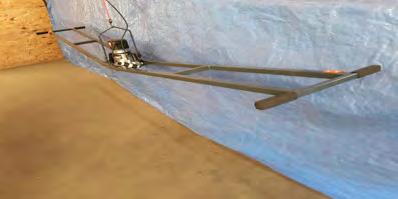

Handle Bar Router
* 8’ - 12’ Wall Height
* 2 Person Operation
* 3 ¼ hp Production Router
* 120 Volt /1 Phase/15 Amp
Lay-Up Tables


* 10’ x 10’ Working Area
* Lift & Extend Rollers
* Squaring Lip
* Gun Holster And Nail Tray
Skate Rollers
* 15’ Standard Length


* Adjustable Height
* Sturdy Stands
* Custom Lengths Available
$1,950.00
$3,000.00
$12,500.00
$3,000.00
EST. 1991
New
New
Equipment
Equipment
Why Your Local Bank May Not Be Your Best Option
Carl Villella, CLFP President, Acceptance Leasing & Financing Service

It’s easy to consider the bank down the block for your financing needs. After all, it’s close and you know the bank manager; it seems like you’re at the branch a lot dealing with the in’s and out’s of everyday business. But, is that bank always your best option for financing? How does 7.5% sound? As of this writing in September 2023, we can secure this type of rate for well qualified customers. We do not need a previous relationship to do it either.
When it comes down to dollars and sense for your financing options, you may want consider a commercial equipment broker. Working with a broker rather than your bank may make sense for these simple reasons:
• Banks have stricter lending criteria. With a bank, you may need a good credit score, a long business track record, and significant collateral to qualify for a loan. In comparison, a commercial finance broker has a number of programs available for all types of borrowers, and the only collateral needed is the equipment you’re financing.
• Banks usually have a longer approval process. At Acceptance Leasing and Financing, we have a one-page application. Once we have the quote and a few months bank statements, we’re ready to approve your request!
• Overall costs for borrowing from a bank can be higher. At Acceptance Leasing and Financing, we work with several funders to secure the lowest rate available. This month we have a special promotion for deals of $350K and above for qualified U.S. customers…a fixed payment rate of 7.5%. No compensating balances or restrictive covenants!
• Banks often make lending decisions based on relationships. This can be a disadvantage for new businesses or businesses that don’t have a long-standing relationship with the bank. At Acceptance Leasing and Financing, we process every application equally, whether you have a history with us or not.
We hope you will consider Acceptance Leasing and Financing Service for your next commercial equipment financing. Call us at 412 262-3225 to see how we can secure the financing you need to help your business grow.
We are Acceptance Leasing and Financing Service. Established in 1992, we pride ourselves on our Certified Leasing and Financing Professional designation. We are a member of SBCA and a frequent attendee of the BCMC trade shows. We can provide financing for any new and, regardless of age, used equipment (some limitations for used trucks and trailers apply).

PHONE: 800-289-5627 FAX: 800-524-4982 Read/Subscribe online at www.componentadvertiser.com Don’t Forget! You Saw it in the Adverti$$er October 2023 #15291 Page #77 A dverti $ er Component manufaCturing m The
Our Table Presses offer supreme versatility & functionality


The Mini 8 and Mini 10 are ideal for the frame & truss industry. With a 40t pressing head, the ability to press any truss, hip, jack or other pressing requirement is an absolute breeze!
Key features available include:
TABLE TOP OPTIONS: A plastic slotted table top with weg-it jigging or a steel top with 5.9” centred holes that accommodate bolt on truss jigging. Mini 8 ride on at ground level, 8ft wide / Mini 10 at table level, 10ft wide – Both can have Floor Truss Jigging as an optional extra.
spida.com
E sales@spida.com T +1 866 647 7771
Get in touch today, and learn how you can be more productive with the Mini 8 or Mini 10.
LIGHT GAUGE STEEL SHEATHING STATION

The Light Gauge Steel Sheathing Station offers flexibility in wall height, sheathing thickness, and screw spacing and screws sheathing to steel wall panels to ensure quality panels every time.
This model can be stand-alone or integrated into a full production line.


Various sizes and configurations are available.
BENEFITS
• Ergonomic working height
• Single person operation
• Flexibility with fastener spacing

• Fastens consistently and accurately


$26,977 NOW $14,997 FOB MD
Triad / Viking Wall Equipment
Triad squaring table with two bridges and one Viking power conveyor. Either bridge fits on the squaring table. Builds from 6′-9″ to 12′-3″ tall wall panels to 16′-0″ long. Triad squaring table, model G2SHSQ, has powered clamp / unclamp controls on either end of the fixed side of table.
Triad nailing bridge, model PSTT, has (24) tool mount locations with Paslode tool mounts, auto return and bottom plate laser sight mount. Changed by owner from staple tools to nail tools. Router bridge is manual travel. Viking powered conveyor 23 ft long with support platforms alongside both chains. Forward powered drive only. Foot pedal controls for drive motors. 120 volt, 1 phase electrical required. 100 PSI air required.
PHONE: 800-289-5627 FAX: 800-524-4982 Read/Subscribe online at www.componentadvertiser.com Don’t Forget! You Saw it in the Adverti$$er October 2023 #15291 Page #79 A dverti $ er Component manufaCturing m The NEW 12' X 16' FRAMING TABLE 800-382-0329 | www.wasserman-associates.com • Add $11,900 for Sub-Component Layup Tables with Pop-up Skatewheel Conveyors • EQUIPMENT FINANCING available from SLS Financial Services $38,000 FOB NE • Pop-up Skatewheel Conveyor • Powered Height Adjustment (6'-11" to 12'-5" wall heights) • Fixed Squaring Stops • Excludes Tool Dollies • 110 Volt / 20 Amps • Add $6,000 for Stud Locators at 16" & 24" O.C. • Add $2,750 for 1 Pair of 15' Skatewheel Conveyor with Stands NEW! 765-751-9990 www.woodtechsystems.com
WWW.PANPLUS.COM 1-866-726-7587


One Table System $87,900 Wasserman & Associates Framing Table With Panel Bridge -Laser Pointer -Bridge Auto Return -Bridge Tilt at Sheathing Seams -Programmable Fastener Patterns -Pop-Up Skatewheel Conveyors -6’-11” to 12’-5” Wall Heights -Fixed Squaring Stops -No Floor Rails *Includes Installation Support in the United States & Canada Wasserman & Associates 2341 Shepard Rd Milford NE 68405 Phone: 800-382-0329 Web: www.wasserman-associates.com $93,500 Additional Information Here 765-751-9990 www.woodtechsystems.com Call for Price
ProStack Wall Panel Stacker
Developed for commercial wall panel production facilities this is the remarkable ProStack, fully automated wall panel stacker. The ProStack relieves your build team from creating a stack of wall panels and keeps them building walls instead. Stacks 2×4 through 2×8 walls up to 20′ in length and up to 12 feet in height. The ProStack automatically centers each layer including multiple wall segments on the same layer, and the ability to “create” fork lift pockets for ease of loading in your yard or on the build site. It can stack left, right or center-justified. Designed without any overhead frame or apparatus, so no crane inspections are required. The ProStack is “event driven”, so there is no need to read a file. See the video link. 208 volt, 3 phase, 43 Amp base model electrical required. No air required. Footprint is 26′-5″L x 19′-3″W.
ProStack II can operate with your existing powered conveyors or select optional matching conveyors.
ProStack Wall Panel Tilt Infeed Conveyor:
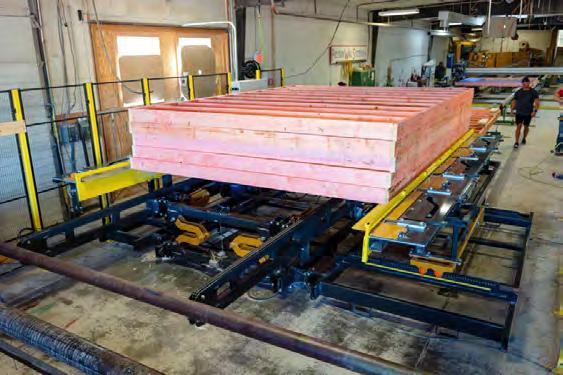

System can tilt wall panels (12’W x 16’L) to approx. 75º for working access to install blocking, windows, or inspection/repair of “shiners” on sheathed wall segments. System utilizes hydraulic power from an existing ProStack wall panel auto-stack system. 208 volt, 3 phase,
52 Amp
Powered Infeed
Conveyor section, Chain drive under top and bottom plate for access to inspect sheathing fasteners – 12’W x 16’L, adjustable working height from 28” to 34”. 208 volt, 3 phase, 52 Amp
Powered Out-Feed
Conveyor section, full-width, HD roll-top for easy access to banding operation. 12’W x 16’L, adjustable working height from 28” to 34”. 208 volt, 3 phase, 52 Amp
For additional features of the ProStack Wall Panel Stacker, click here.
www.woodtechsystems.com 765-751-9990
2007 Panels Plus Combo Table with Multi-tool Bridge
2007 Panels Plus Combination Table, allows you to frame, square and sheath wood wall panels on one,16 foot long table x 12 foot framer for wall heights from 6′-9” to 12’4”. Builds both 2×4 and 2×6 walls. Clamps wall prior to nailing. Table includes push button controls, color-coded stud locators at 16 inches & 24 inches o.c. spacing, squaring stops, motorized telescoping arms, skatewheel ejectors and powered tool bridge. Sheathing nailing bridge includes powered travel, joy-stick & key pad controls, air manifold, manual fine tuning, tilt and seam nailing. No tools or mounts included. 30 CFM at 120 psi air required, and 120 volt, 1-phase electrical required.
PHONE: 800-289-5627 FAX: 800-524-4982 Read/Subscribe online at www.componentadvertiser.com Don’t Forget! You Saw it in the Adverti$$er October 2023 #15291 Page #81 A dverti $ er Component manufaCturing m The 765-751-9990 www.woodtechsystems.com
$49,991 NOW 39,991 FOB TN A dverti$er Component manufaCturing S erving the S tructural B uilding c omponent S i ndu S try The Hiring Zone Building Component Industry's Job Board Employer to Candidate Direct Hiring No Recruiting Fees! Post your Opportunity... Candidates respond directly to you! For Additional Information Contact: twm@componentadvertiser.org or Call: 800-289-5627 x1 Visit our website: www.componentadvertiser.com/Hiring-Zone
New
Choose the Tornado M500 for efficiency
This Linear Saw automatically feeds, cuts, prints and ejects wall frame components - handling 20ft lengths, stacked 3 high.

SPEED ACCURACY EASE OF OPERATION INCREASED PRODUCTIVITY +


Boost your output with the Tornado M500, the most cost-effective addition to your plant.

E sales@spida.com T +1 866 647 7771 spida.com
We create transformative website and app experiences
Since 2006, we've been helping businesses of all kinds build their online presence. We make websites and software for the construction industry to empower companies to reach a wider customer base and engage their audiences. Companies all around the world work with us to make websites and apps that people actually want to use. Reach out to Wolf X Machina if you're a business and you want a website that actually drives results.
WOLF X MACHINA
www.wolfxmachina.com

info@wolfxmachina.com
Also, don't let Financing Deals influence your best solution. FitzGroup can arrange – Zero down & No payments for 90 Days!

Please be assured that your investment with any of our selected partners will not cost one penny more with the Fitzgerald Group as your purchasing contact. In addition, you will receive the full advantage of our Partner Relationships and Services NOT offered elsewhere. RFitzgerald@FitzGroup.com 719.528.5445
PHONE: 800-289-5627 FAX: 800-524-4982 Read/Subscribe online at www.componentadvertiser.com Don’t Forget! You Saw it in the Adverti$$er October 2023 #15291 Page #83 A dverti $ er Component manufaCturing m The Fitzgerald Group, LLC
results
need
getting conflicting
to do
and
systems
need?
you Buy - Ask yourself –do I need a salesman or a guide?
a blending of excellent services and products, with answers that work...!© Not producing the
you
or want –
info about what
and the equipment
the
you may
Before
If you want an Independent Guide that has your bottom-line results as the #1 priority, Call Me. If the salesman will do - we'll talk later...
www.FitzGroup.com
What Makes a Good Salesperson?
By Landon Boucher Director, Business Design

Some might say what makes a good salesperson is the results they deliver. In fact, I imagine this may be the most common response. I suppose I would have to agree, but I do think it matters greatly what results we are measuring. Are we merely considering revenue generated that can be directly traced back to that individual? I’ve worked with some incredible individual producers over the years. Some, regrettably, used tactics that would have a negative impact on long-term success, particularly for the organization that employed them. The immediate gains were there, but so was the disaster left in their path.
A career in sales is not for the timid. Success in sales requires tenacity, persistence, courage, and a willingness to embrace rejection as a catalyst for growth. I’m sure we could list several other relevant characteristics of a good salesperson. Still, none of these qualities will have real lasting value if the decisions a salesperson makes are not guided by good business ethics and a commitment to integrity. Often, integrity comes into question during a negotiation process. This is likely due to a poor understanding of what negotiation is. Negotiation is not two or more parties vying for the better end of a pending deal, at least not good negotiation. Good negotiation involves two or more parties working together to arrive at a better outcome for all involved. A good salesperson will take ownership of this process and lead their customer and company to develop long-term partnerships rooted in mutual trust and respect.
No matter how talented the salesperson is, the process is not likely to be an easy one. There are several barriers to overcome depending on the customer in question, and their history with your organization. Perhaps they’ve had promises broken? Good. Issues with billing? Good. Temperamental communication style? Good. They don’t like you? Good. Now, you’re probably asking yourself why I think these are good. It’s because every single issue your customer has, whether directly related to you, your business, or something else entirely, is an opportunity for you to add value. Every problem is an opportunity for you to provide a solution. Do this with consistency and your customer will learn to trust you. They will see that you are interested in what benefits them and willing to put in the work to make it happen. Once trust is established, opportunities for deals become available and the negotiation process can take place, where the salesperson takes the lead, steering his customer and his company toward shared success.
PHONE: 800-289-5627 FAX: 800-524-4982 Read/Subscribe online at www.componentadvertiser.com Don’t Forget! You Saw it in the Adverti$$er October 2023 #15291 Page #84 A dverti $ er Component manufaCturing m The Continued next page
In Chris Voss’ book Never Split the Difference, he writes “Put a smile on your face. When people are in a positive frame of mind, they think more quickly and are more likely to collaborate and problem solve. Positivity creates mental agility in both you and your counterpart.” It’s a great book and I highly recommend it to anyone in sales. It’s filled with several insightful quotes, little nuggets of truth you can take with you to guide your sales activity and customer engagement. This quote, however, is one of my favorites. One of my first jobs as a teenager was working for In-N-Out Burger. As a child, I didn’t smile much. In fact, where I grew up, it was frowned upon (dad joke level 10). It’s true though and if you’re familiar with InN-Out, you’re probably wondering how someone who didn’t smile even got hired to work there. It’s sort of the Disneyland of burger joints when it comes to friendly interactions between staff and customers. I was hired to work the graveyard shift, cleaning up the store after closing and preparing it for business the following day. So, I was never intended to interact with customers on this 2 am –10 am shift. Odd hours for a 16-year-old, but I had tested out of high school and was ready to work. After my first couple of weeks, I was asked to work a few hours of overtime cleaning tables and other tasks in the dining room. It didn’t take long for my manager to call me out, yelling “Landon!! Smile!” I looked back in anxious fear thinking I had done something wrong and was going to need to look for another job. What I saw when I looked back though wasn’t the look of disappointment. It was a smile. My manager, seeing the concerned look on my face, walked over and encouraged me again (although this time not shouting it across the floor) and asked, “why aren’t you smiling?” I nervously replied with, “I don’t think I have a nice smile.” He looked at me, his eyes welling up and asked, “why would you say such a thing?” I couldn’t find the words, so I just shrugged my shoulders like a typical teenager. He then proceeded to point out his missing teeth and other dental work on his to-do list, and instructed me to show my smile, “it lets people know you care.” He smiled so sincerely; I had never noticed the missing teeth or anything else. What I did see is exactly what he told me a good smile will show. I saw he cared.

A good smile isn’t about the appearance. It’s about the impact on others around you. Similarly, a good salesperson ought to be measured by the impact they make on others. Salespeople need to lead. Leadership, as John Maxwell puts it, “…is influence. Nothing less and nothing more.” Good leaders influence. Good salespeople lead their customers and their company toward growth.

PHONE: 800-289-5627 FAX: 800-524-4982 Read/Subscribe online at www.componentadvertiser.com Don’t Forget! You Saw it in the Adverti$$er October 2023 #15291 Page #85 A dverti $ er Component manufaCturing m The
The Industry-Leading Manufacturer of Panelized Wall Panel & Floor Cassette Equipment.


The Platinum Series Automated Sheathing Station is the most automated sheathing station that Panels Plus offers and reduces the amount of time an operator needs to be hands-on during the sheathing process. This sheathing station is driven using MiTek Software and completely fastens sheathing to studs, blocking, headers, and sill plates to ensure quality panels every time. This model can be a stand-alone unit, or integrated into a larger system. Various sizes and configurations are available.

•
•
•
CONSISTENCY
EFFICIENCY WWW.PANPLUS.COM 1-866-726-7587
SERIES AUTOMATED SHEATHING STATION
IMPROVE
INCREASE
PLATINUM
CONTACT US TODAY! Financing Options Now Available!
Fast credit
& broad terms
decisions
3 months deferred payment
Nothing down
Used Triad G2 Wall Assembly Equipment
Used Triad wall assembly equipment includes 16 ft x 12′-3″ max height framing station, model G2, with (2) two-tool dollies, squaring/ sheathing combo table, model G2 SH-SQ, with multi-tool mount nailing bridge and separate manual-drive router bridge, quantity of (6) 10 ft long x 2 ft wide idler roller conveyors with (4) legs, and Triad model FTCN component nailing station with four Hitachi NR83A nail tools.


Framer includes 16″ and 24″ color-coded stud locators, pop-up skate wheel conveyors, tool dollies have two tool mounts each (no tools) and powered height adjustment. Sheathing bridge includes joy-stick controls, tool offset, tool tilt, laser guide, power return and mounts for up to (23) Hitachi nail tools. Router and all available spare parts included. 120 volt, 1 phase, 30 Amp electrical required. 100 PSI air required.

PHONE: 800-289-5627 FAX: 800-524-4982 Read/Subscribe online at www.componentadvertiser.com Don’t Forget! You Saw it in the Adverti$$er October 2023 #15291 Page #87 A dverti $ er Component manufaCturing m The 800-382-0329 | www.wasserman-associates.com 2014 TRIAD RAKE WALL TABLE
Wall Lengths to 12' • Wall Heights to 40' • Powered Height Adjustment • Manually Adjustable Rake Side (0 to 12/12 pitch) • Adjustable Squaring Stop • Pop-Up Skatewheel Conveyors • Stud Locators at 16" and 24" Centers • Center Support Bar with Stud Locators • Excludes Tool Doilies • Price is in US Dollars $37,900 NOW $29,900 FOB Ontario 765-751-9990 www.woodtechsystems.com
•
$40,997 FOB CA Your Solution for Lack of Technical Staff ● PlanSwift Lumber and Building Material Takeoffs ● Truss and Wall Panel Design Experienced Staff ● EWP Layouts and much more! Eliminate your lack of technical resources to grow sales and increase the clock speed of your company Dave.AllPoints@gmail.com • www.AllPoints.Tech The Gold Standard in Technical Support Teams 800-289-JOBSJobLine.com, inc. Time To Hire? We’re here when you need help! visit: www.thejobline.com email: twm@thejobline.com STRICTLY CONFIDENTIAL! The
The Universal Infeed Deck from Acer Always Innovating
Dual elevators receive 2 boards at once from dual-head Rangers
Improved design increases throughput
Auto crown scanning and board flipping is standard
Smooth stacking mechanism for stacking saws
The Ranger Retrieval System is compatible with linear saws from Alpine and Vekta.
The Universal deck is available to suit each of these saws , with appropriate height and saw feed mechanism , as well as stacking and non -stacking variants .

system is protected under U.S. Patent #8,960 ,244 and other patents. Acer Inc. 301 Industrial Drive Rushford, MN 55971 507-864-2220 www.acerinc.com
2003 JDH TRUSSMASTER SIDEOFFLOADING TRUSS TRAILER
10,000 Lb Tandem Axles (Dual Wheels). 26,000 GVWR. Deliver Trusses Vertically. Stretch from 18' to 38'. Raise Loads Hydraulically. Air Brakes.


$6,900 FOB CA
Wasserman & Associates
800-382-0329
www.wasserman-associates.com
TRUCKS & TRAILERS
1995 Pines 45' Chip Trailer
• Modified by LMI TENN
• 8" Floor Cross Members
• Reinforced Roof
• 22.5 Tubeless Tires
• Sl iding Tandem Axle (for weight distribution) (FOB PA) $9,900

Wasserman & Associates 800-382-0329
www.wasserman-associates.com
2007 Freightliner Truck with Hiab Knuckle Boom Crane

• 2007 Freightliner M2 Flatbed Truck (168,000 Miles)
2001 Moffett M5500 forklift features 48″ forks with side shift, 12′ maximum lift height, 5,500 lb lift capacity and has 2,440 hours on it. Kubota 4 cylinder Diesel engine and Hydrostatic transmission.

$24,990 NOW $19,890 FOB OH
Wood Tech Systems
765-751-9990
www.woodtechsystems.com
36' Gooseneck Roll-Off Trailer
• 10,000 Lb Tandem Axles with Dual Wheels


• Self Contained Hydraulic Lift
• Manual Pin Locks on Rollers (some pins need new springs)
• Two Gooseneck Rollers
• Winches & Load Straps
• Electric Brakes
• Tires are Good
• Safety Inspection is Current
• Price in US Dollars
$19,500 FOB ON Wasserman & Associates
800-382-0329
www.wasserman-associates.com
2005 Imperial roll-off trailer, 53-ft long, ABS, locking rollers, sloped load, (8) winch tie-downs with straps. Brakes 70%, tires 95%. Current DOT inspection through September ’23. Infeed deck in photos not included.

$15,591 FOB FL
Wood Tech Systems 765-751-9990
www.woodtechsystems.com
1997 Lakeside JDH Trussmaster
42-60 ft Stretch Trailer (BL-2)
1997 Lakeside JDH Trussmaster 42′60′ – Lakeside trailer features 5th-wheel connection, sliding tandem axle, locking rollers and hydraulic lift neck. Current DOT inspection September 2023. 50% brakes and 50% tire tread remains. 26,000 GVWR.
$33,495 FOB MO
Wood Tech Systems 765-751-9990
www.woodtechsystems.com
• New Tires in 2022 ($12,000 Value)
• Hiab 322E-7 Hipro Crane (FOB WA) $89,000 NOW $75,000

TRUCKS & TRAILERS
1997 Lakeside JDH Trussmaster
36-51 ft Stretch Trailer (OR-1)
1997 Lakeside JDH Trussmaster 36′51′ – Lakeside trailer features 5th-wheel connection, sliding tandem axle, locking rollers and hydraulic lift neck. Current DOT inspection September 2023. 50% brakes and 50% tire tread remains. 26,000 GVWR
$28,997 FOB MO
Wood Tech Systems 765-751-9990
www.woodtechsystems.com
The
Roll-Off Trailer
• (2) 12,000 Lb Axles
• Hydraulic Disk Brakes
• 4" Pipe Rollers
• Hydraulic Roller Locks & Brakes
• Support Rollers Over The Gooseneck
• Diamond Metal Plate Between Rollers
• (8) Winches & Straps
• Single Cylinder Scissor Hoist
• Self Contained 12 Volt Hydraulic Pump
• Remote Control
• Lightly Used
• Ready for immediate delivery
$49,900 FOB IN
Wasserman & Associates
800-382-0329
www.wasserman-associates.com
PHONE: 800-289-5627 FAX: 800-524-4982 Read/Subscribe online at www.componentadvertiser.com Don’t Forget! You Saw it in the Adverti$$er October 2023 #15291 Page #89 A dverti $ er Component manufaCturing m The
800-382-0329
www.wasserman-associates.com
|
2001 Moffett M5500 Forklift
dverti$er
S erving the S tructural B uilding c omponent S i ndu S try
A
Component manufaCturing
2013 Precision Equipment
2005 Imperial 53-ft Roll-off Trailer
2023 Stoll 40' Truss Tran Gooseneck
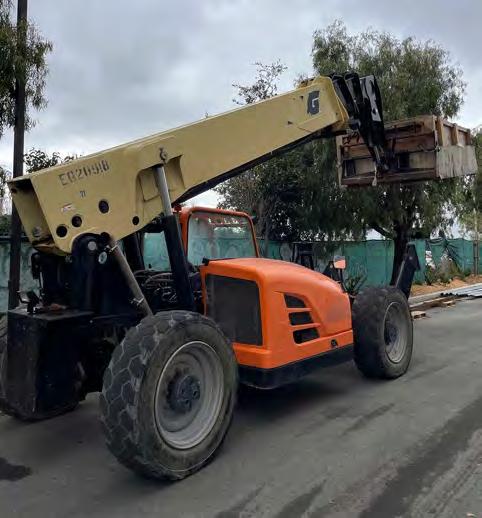


PHONE: 800-289-5627 FAX: 800-524-4982 Read/Subscribe online at www.componentadvertiser.com Don’t Forget! You Saw it in the Adverti$$er October 2023 #15291 Page #90 A dverti $ er Component manufaCturing m The www.wasserman-associates.com 800-382-0329 Buy Factory Direct From Wasserman & Associates at the same price as the Manufacturer, and get the added support and care you need to be up and running FAST! WE’LL EVEN HELP SELL YOUR USED EQUIPMENT TOO! 2015 JLG G10-55A Telehandler Lift • 10,000 LB Capacity • 55' Lift Height • 4 Wheel Drive • 3 Way Steer • 72" Fork Carriage • 60" Pallet Forks • Foam Filled Tires • Cummins QSB 4.5 Turbo Diesel • 4,350 Hours $69,900 FOB CA
TRUCKS & TRAILERS
1998 RAND 48' Roll-Off Trailer

• RAND Roll-Down 48 System (November 1998)
• Slanted Profile
• Hydraulic Bed Tilt

• Steel members protrude through the bed for easy loading and truss/lumber support

• Fixed Tandem Axles
• Spring Suspension
• Headache Rack
$24,500 FOB CA
Wasserman & Associates
800-382-0329
www.wasserman-associates.com
MISC.
Used Steel Material Carts

Total quantity of (54) steel material carts feature C-channel construction, with 4 caster wheels each: 2-fixed, 2-swivel allowing for maneuvering. Quantity of each size: (21)
3’x5′, (10) 3’x5′ heavier duty, (10) 3’x6′, (8)
3’x7′, (4) 4’x4′, & (1) 4’x7′, Configuration of frame and wheel size may vary.
$300 ea. FOB OH
Wood Tech Systems
765-751-9990
www.woodtechsystems.com
New
Video Here
$3,499 FOB CA
Wood Tech Systems
765-751-9990
www.woodtechsystems.com
1 1/4" wide x .035 thick. $159 per coil. $2,950 per skid (21 coils). FOB PA. Wasserman & Associates 800-382-0329
www.wasserman-associates.com
Hain 20' Powered Measuring System Adapts to Any Saw. Left or Right Hand Operation. Feet & Inches System (Stops at 12” Centers) or Inches System (Stops at 10” Centers). Motor: 1/4 HP Linear Actuator (110 Volt). Stop Rail: 2 x 4 x 1/4” Aluminum Extrusion. Stops: Jig Bored Steel. Stop Blocks: Machine Billet Aluminum. Optional Lengths from 5’ to 60’. Optional Gang Stop. Add $890 per 10’ Section of Heavy Duty Roller Conveyor with Stands

$8,990
Wasserman & Associates
800-382-0329
www.wasserman-associates.com
2005
(For Repair or Parts)
6 detection zones to locate missing plates. Horn & zone lights indicate missing plates. 12" to 60" adjustable height from floor. 110 Volt / 1 Phase. New control panel switches & lights in 2014. Needs circuit board repair or replacement and new tower light. Includes 4 extra detection zone boxes.
$2,500 NOW $1,500 FOB NE
Wasserman & Associates
800-382-0329
www.wasserman-associates.com
AMI Industrial Floor Carts

AMI's industrial floor trucks (material carts) are designed of hardwood construction, fitted with space-age phenolic, roller-bearing wheels, and ball bearing swivel casters for strength and durability. AMI's phenolic wheels resist shock without chipping. They are non-sparking, non-marking, and can be operated continuously between -50℉ and 260℉. They are unaffected by grease, oil or debris on your shop floor.


Series
AMI Industrial Floor Truck
Our swivel casters are precision built with perfectly aligned raceways. All cold-form parts are made to exacting tolerances from heavy-gauge steel, and are hardened for severe service and long wear. Series B-4 carts include four casters, one at each corner, to prevent "tri-cycling" of long lumber loads.
Standard Models Available
Max Load Weight (lbs.)
Sweed Scrap (Band) Chopper with Stand
1/2 HP Motor (115/208-230 Volt)
$1,900 NOW $1,750 FOB NE.
Wasserman & Associates 800-382-0329
www.wasserman-associates.com
EMSI Teeter Cart
Width – 46” / Length – 73” / Load Capacity
– 2850 pounds / Pneumatic tires – 14.5 inch

/ Maximum utility in truss plants, panel plants, and lumber yards / Quick Assembly by bolting parts together / All hardware is supplied / Upright 2 x 4’s not supplied / Medium duty tires rated at 1500 lbs each are included.

Call for Price Eide Machinery Sales, Inc.
612-521-9193
www.eidemachinery.com
2022 Powermatic Dual Bag Dust Collector. Industrial dust collector, dual-bag, 1800 CFM with 6″ port. Includes supply of 6″ flex hose. System has 10 Cu. Ft. capacity. 3HP, 3Ph, 5 amp, 460/V with onboard starter.

$5,497 FOB VA
Wood Tech Systems
765-751-9990
www.woodtechsystems.com
2748 27" x 48" Series "B" & "C" 2500
3248 32" x 48" Series "B" & "C" 2500
3260 32" x 60" Series "B" & "C" 2800
3660 36" x 60" Series "B" & "C" 2800
3672 36" x 72" Series "B" 4000
4072 40" x 72" Series "B" 4000
3696 36" x 96" Series "B" 4000
4896 48" x 96" Series "B" 4000
*Other models and sizes are available on request. FOB NC.
Wood Tech Systems
765-751-9990
www.woodtechsystems.com
Steel teeter carts, quantity of (16), for moving bulk material for production staging, can be used to deliver full units to sawyer or long cut material to an assembly area at a convenient working height. Size 72″ long x 46″ wide x 32″ high, 2,500 lb. load capacity. Feature (2) pneumatic tires/ steel wheel, and (2) swivel casters. Units shown without large tires: quantity of (3) at $500 each.
Wood Tech Systems
765-751-9990
www.woodtechsystems.com
PHONE: 800-289-5627 FAX: 800-524-4982 Read/Subscribe online at www.componentadvertiser.com Don’t Forget! You Saw it in the Adverti$$er October 2023 #15291 Page #91 A dverti $ er Component manufaCturing m The
MISC.
"B"
Hain Company Micro Mini Measuring System
Koorsen Connector Detector
NEW GALVANIZED STEEL STRAPPING
2022 Powermatic Dual-Bag Dust Collector
Used Teeter Carts
Building Your Own Home – Part VIII Moving Inside and Cash Flow


 By Thomas McAnally TheJobLine.com
As construction moves forward, the focus shifts from the exterior to the interior, making it harder to track progress from the outside. However, there’s still important work ahead. Tasks like leveling the surrounding area and ensuring proper grading away from the house are crucial. We’re also working on finishing the driveway and utility systems. We completed a significant portion of the septic work when we built the barn to service the RV. Now that the tank is in place at the house and all the connecting lines are ready, we can move forward and meet the requirements for a construction loan advance.
Managing schedules in construction is no easy task, and unexpected delays can throw a wrench into our plans. For instance, the drywall company’s project manager made an error with the delivery date, which could have caused a month-long setback due to their supplier’s prior commitments. To avoid this, the company owner took charge, starting the project earlier than planned and sourcing materials from an alternative supplier, ensuring they arrived the next day and preventing a three-week delay.
A similar situation unfolded with the hardwood flooring subcontractor. Missed deliveries and delays occurred due to a lack of follow-up by the buyer. To resolve this, they secured a better flooring supplier and opted for a higher-quality hardwood, which was transported from Minnesota to Indianapolis LTL, and from Indianapolis to the site by the owner the next day. This saved all but one week of a potential four-week delay.
As the hardwood flooring adapts to the climate-controlled environment inside the house, the cabinet maker and trim supplier now have stain color samples, resolving two major concerns and preventing two possible issues.
PHONE: 800-289-5627 FAX: 800-524-4982 Read/Subscribe online at www.componentadvertiser.com Don’t Forget! You Saw it in the Adverti$$er October 2023 #15291 Page #92 A dverti $ er Component manufaCturing m The
Continued next page
However, construction often comes with unforeseen challenges. For example, tile installation took longer than expected due to the complexity of the walk-through shower. Additionally, we had to address issues caused by improper gaps during underlayment installation, which occurred due to moisture exposure before the structure was dried in. The flooring contractor had to hand-plane the seams to ensure they were level, adding several days to the timeline and impacting the builder’s profit margin.

With major systems like electrical, plumbing, HVAC, and septic nearly complete but not yet fully finalized, cash flow management becomes a significant concern. Construction loans require inspections before releasing funds, with credits assigned based on completion percentages for each system. However, these standardized percentages may not align with the progress of a custom home. For example, a 4% credit for a fireplace, which our home doesn’t have, can reduce available credits until the project reaches 100% completion. This means we need to be prepared to cover various costs out of pocket, as contractors often require deposits and progress payments that may not align with the inspector’s credit system. This can range from a few thousand dollars to well over $100,000, depending on the contractors involved. In cases like ours, where the schedule resembles off-site production more than custom home building, significant cash outlays are necessary to keep things on track.

Next month: Dealing with communication issues.

PHONE: 800-289-5627 FAX: 800-524-4982 Read/Subscribe online at www.componentadvertiser.com Don’t Forget! You Saw it in the Adverti$$er October 2023 #15291 Page #93 A dverti $ er Component manufaCturing m The
The PieceMaker
Fast, accurate cutting for your manufacturing centre.
THE AUTOMATED LINEAR SAW EVERY TRUSS PLANT NEEDS
US fabricators agree they are loving the PieceMaker in their production facility. Full optimisation with the ability to look ahead panel by panel or job by job. Cuts standard and custom mitres, birdsmouths, raking plates and studs, low angles, long cuts, large timber sections and all your normal standard cutting.
With a short lead time to have installed in your factory, enquire about the PieceMaker today!
spida.com E sales@spida.com T +1 866 647 7771
Alpine Lumber Carousel
• 7 Bunk Capacity (up to 12' Lumber)
• Pushbutton Control Station
• 10 HP / 3 Phase Motor
• In working condition when removed in August 2023
$11,900 FOB Manitoba
Wasserman & Associates
800-382-0329
www.wasserman-associates.com
New
2017 L-M Double End-Bump Rollcase Station
Air Compressor

• Model GX11FF
• 15 HP Rotary Screw Air Compressor (230/460 Volt - 3 Phase)
• 13,443 Hours
• 51.7 CFM at 128 PSI
• 80 Gallon Tank
• Built-in Air Dryer does not work
• Includes separate 2012 Pneumatech AD-50 Air Dryer (1 Phase)
$4,250 FOB TX
Wasserman & Associates
800-382-0329
www.wasserman-associates.com
New, laser projection system from SL Laser. Projects roof truss, floor truss and wall panel design images accurately onto building surface, for faster setup and fabrication times. Each laser head provides 21' projection length (@15 foot ceiling heights). Includes system computer, cables, mounting hardware for attachment to customer's structure, factory installation, training and choice of green or red laser. Works with each connector plate manufacturer's design software. Modular nature of the laser heads allows for easy, future expansion of system length. 120 volt, 1 phase. FOB NC Wood Tech Systems 765-751-9990
www.woodtechsystems.com
2017 L-M Double End-Bump Rollcase. This unit serves an integral part of precision package cutting. The heavy duty steel fabricated main frame of the Rollcase is assembled with 10 bed rolls, machined from 5″ steel pipe. All ten (10) rolls are driven together with RC80 roller chain. Back up rolls are also mounted on the main frame to align the package squarely to the bumping surfaces. A hydraulic 40 gallon power unit delivering 20 GPM is used to power bed rollers that are driven to pound the package of lumber against a reinforced steel face, to flush up one end which either eliminates or reduces end trims. A variable speed drive allows for precision control during the bumping process. Includes 15 HP electric motor, motor starter, strainer, relief valve, return filter and all available accessories at the hydraulic unit. 230/460 volt, 3 phase electric power required.
$34,997 FOB OH
Wood Tech Systems

765-751-9990
www.woodtechsystems.co
Panels Plus Sub Component Nailer
• Maximum Clamp Opening: 17" x 17 1/2"


• 17 Vertical and 14 Horizontal Clamping Positions
• Vertical Nailing Capacity to 12"

• On/Off Switches for Each Nail Gun
• Button to Activate Squaring Stop
• Foot Pedal to Activate Clamping & Nailing
• 60" Long x 20" Wide Infeed & Outfeed Conveyor
• Assemble corners, trimmers, partition lead-ins, jack studs, ells, channels, headers & ladders

• Electrical: 120 Volt / 1 Phase
• Air: 20 CFM at 90 PSI
• Includes 4 Paslode Nail Guns with Extended Length Magazines
$7,000 FOB WI
Wasserman & Associates
800-382-0329
www.wasserman-associates.com
New Handle Bar Router
Porter Cable Model 7519 Production Router
Motor with Soft Start. Steel Handle Bar
Frame with Makita Switches. 120 Volt / 1 Phase / 15 Amp / 21,000 RPM. Includes 2 Router Bits. $3,000 FOB NE.
Wasserman & Associates
800-382-0329
www.wasserman-associates.com
• 18 HP Spindle with 5 Position
Typewriter Tool Changer
• X, Y and Z Servo Axis
• Q-CORE Controller (THM Version 8.73 - Windows7)
• Reads NC Files via Network or USB
Flash Drive
• 5' x 20' Fixed Table
• Roller Hold Down
• Program Side Fence
• Auto Tool Length
• Auto Lubrication
• Excludes Dust Collector
• The seller was cutting OSB Sheathing and 1 1/4" TimberStand Stair Stringers
• Video available upon request $29,500 FOB MN
Wasserman & Associates
800-382-0329
www.wasserman-associates.com
2016 5-Bay Ranger LRS, with (4) Magazines
2016 Ranger LRS designed to fit the MiTek Blade linear saw, includes (5) lumber carts, (4) lumber magazines, overall beam length of 50-ft with end column supports, footprint of 50′ x 52′. Pick head is screw-type. Includes light-curtain perimeter beam, operator’s console, perimeter safety fencing and rails for carts.


$81,995
FOB FL
765-751-9990
www.woodtechsystems.com
PHONE: 800-289-5627 FAX: 800-524-4982 Read/Subscribe online at www.componentadvertiser.com Don’t Forget! You Saw it in the Adverti$$er October 2023 #15291 Page #95 A dverti $ er Component manufaCturing m The
SL Laser Projection System
MISC.
2003 Thermwood C53DT CNC Router
2002 Atlas Copco Rotary Screw
A dverti$er Component manufaCturing S erving the S tructural B uilding c omponent S i ndu S try The
TRIAD GENERATION 3 FRAMING TABLE
Lengths to 76'
Powered Width Adjustment (6'-9" to 18'-3")
Joist Locators at 16", 24" and 19.2" Centers
Accommodates 2x8 through 2x12 Lumber, LVL, I-Joists & Open Web Floor Trusses
TRIAD STUD STITCHER WITH MATERIAL BRIDGE
Programmable Touch Screen
3 Tool Mounts on Each Side (Excludes Nail Guns)
Bridge Auto Return
4,000 Lb Capacity Material Bridge (joists, studs or drywall)

WE’LL EVEN HELP
$339,000
TRIAD TRIDENT NAIL BRIDEG WITH ROUTER
Programmable Touch Screen
3 Tool Mounts with Tilt Capacity (Excludes Nail Guns)
Router Mount (Excludes Router Motor)
Auto Sizing Plate Fire
Bridge Auto Return
Accommodates Horizontal & Vertical Decking
Needs replacement sensors
208 Volt / 3 Phase
New price was $481,488
Installation is available at additional expense
PHONE: 800-289-5627 FAX: 800-524-4982 Read/Subscribe online at www.componentadvertiser.com Don’t Forget! You Saw it in the Adverti$$er October 2023 #15291 Page #96 A dverti $ er Component manufaCturing m The www.wasserman-associates.com 800-382-0329 Buy Factory Direct From Wasserman & Associates at the same price as the Manufacturer, and get the added support and care you need to be up and running FAST!
SELL YOUR USED EQUIPMENT
TOO! 2021 Triad Floor Cassette System
NOW $289,000 FOB CO
Generation 3, Used 2018 Triad Framing Table
The Generation 3 Framing Table has adjustable 20’ long walls, with wall heights from 6’9” to 14’3”. Studs are placed between color-coded stud locators. With just a push of a button, the width adjustment clamp is activated to clamp and square all components. The Generation 3 Framer features a wider table top, designed with the framer in mind. Our new Anti-Slip Surface that allows the operator to work on a comfortable and safe surface. Call for Price Eide Integrated Systems, LLC 612-521-9193

www.eidemachinery.com


•
•
PHONE: 800-289-5627 FAX: 800-524-4982 Read/Subscribe online at www.componentadvertiser.com Don’t Forget! You Saw it in the Adverti$$er October 2023 #15291 Page #97 A dverti $ er Component manufaCturing m The MISC. 800-382-0329 | www.wasserman-associates.com Jenkins Model 195 Double End Machining Center
Refurbished in 2019
Please reference attached proposal for specifications Additional Details $115,000 FOB IA
A dverti$er Component manufaCturing S erving the S tructural B uilding c omponent S i ndu S try The MODULAR EQUIPMENT Hilman Model BSP-6P Rollers • 6 Ton Capacity. • Polyurethane Wheels. • Swivel Padded Top. • 54 48 Available $290 NOW $220 each FOB NE Wasserman & Associates 800-382-0329 www.wasserman-associates.com 800-382-0329 | www.wasserman-associates.com New Sub-Component Nailer • Assembles Trimmers, Jacks, L’s, Channels & Headers • 2x4 and 2x6 Capacity • Remote Fire & 3-Way Clamping • Staggered or Straight Line Nail Pattern • Squaring Stop • Foot Pedal Control • Reserve Air Tank • 5’ Infeed & Outfeed Roller Conveyor $25,000 FOB NE NEW! Used 6 Chain Live Deck • 22' Long • Foot Pedal Control • 480 Volt / 3 Phase • 2 Available at $11,900 Each $11,900 FOB WI Wasserman & Associates 800-382-0329 www.wasserman-associates.com Scrap Incline 20′ belt scrap conveyor with 8′ incline, 2′ wide. 240v, 30 amp power. $22,490 - FOB CA Wood Tech Systems 765-751-9990 www.woodtechsystems.com
Design Connections Make Competition About More Than Price

Anear certainty in the component business is that your customers will, to some extent at least, shop your price against your competition. Depending on the relationship history you have with your client, you may have the opportunity to match a lower price, but your competition will still be used as a benchmark. Is this a reasonable arrangement? Is it a productive process? Is there anything that can be done to minimize this?
First, some thought about the positive and negative impact of lower component pricing for the builder. Obviously, if a builder can save 10% on the truss package for a house, then that has the potential to flow straight to the bottom line. But what about the risks for the builder? It could be that the package offered by your competition is missing some elements of the package the builder is accustomed to receiving from you – commonly this could be things like gable ladders, lay-in gables, or even valley sets. Having to build any of these components on site, especially if it hasn’t been planned for, can very quickly consume that 10% savings. If your competitor can’t deliver product to site when promised, the resulting delays can be very costly. And, if that new supplier happens to make a mistake that causes delays on site, it is likely to result in much or all of that savings evaporating.

So, there are risks involved in your client looking at a different supplier. Business can often be considered a risk/reward environment. What is the relative reward? To take a simple example, let’s look at a typical house that would sell in a market near me for $750,000. The truss package for that house might be $15,000, or 2% of the home’s market value. Saving 10%, or even 20%, on the truss package is a potential savings of $1,500 to $3,000, but it is less than ½ of 1% of the value of the house. I don’t know about you, but I can’t think of anything that I commonly buy in which my decision-making process would be significantly swayed by a savings of less than 0.5%.
Of course, the reality is that this is common in the component world. Your client receives your quote and that of your competitors, and their eyes lock on the number at the bottom of the page –lowest number equals better number.
PHONE: 800-289-5627 FAX: 800-524-4982 Read/Subscribe online at www.componentadvertiser.com Don’t Forget! You Saw it in the Adverti$$er October 2023 #15291 Page #98 A dverti $ er Component manufaCturing m The
Geordie Secord, Senior Recruiter
TheJobLine.com – Canada
Continued next page
What can you and your sales force do to combat this? I must start by assuming that your business model isn’t built solely on being the lowest cost provider, no matter what, and that you have worked hard to establish and maintain a level of product and service that adds value. If your service model is to provide as complete a package of components as possible, be sure to highlight this on your written quotations and have your salespeople emphasize it when presenting your bids, don’t assume that your client will notice. If on time delivery is a key part of your service, be sure that your customer knows that you understand how important the schedule is. And, if you are confident in your schedule reliability, you can offer a guarantee if you are late – say 10% off on deliveries beyond the agreed date. If you have your scheduling down properly, this should never be an issue. Is product quality and accuracy your key deliverable? Have a written policy in place that backs up how you will respond IF something goes wrong, and then stand behind it. Finally, if you really have your act together, you can confidently offer a full package, delivered on time, and a product the builder can depend on.

As a side note, I hope that you consider the same types of possibilities when evaluating who you choose to purchase from. Is a cheaper connector plate worth using inefficient software? Is a cheaper EWP supplier worth dealing with inconsistent supply? We should ask the same questions of ourselves as we hope our customers will consider.

What other techniques do you have to combat the price-only mentality? I’d love to hear them.
If you want help finding that next perfect component designer or design job in Canada, please contact me. If your work is in the mass timber world anywhere in North America, I’d love to talk to you about connecting you to that next great job or candidate. You can reach me at secord@thejobline.com, or 800-289-5627 ext. 2. I’m also happy to engage at: LinkedIn.com/in/geordiesecord. www.thejobline.com
PHONE: 800-289-5627 FAX: 800-524-4982 Read/Subscribe online at www.componentadvertiser.com Don’t Forget! You Saw it in the Adverti$$er October 2023 #15291 Page #99 A dverti $ er Component manufaCturing m The

PHONE: 800-289-5627 FAX: 800-524-4982 Read/Subscribe online at www.componentadvertiser.com Don’t Forget! You Saw it in the Adverti$$er October 2023 #15291 Page #100 A dverti $ er Component manufaCturing m The 800-382-0329 | www.wasserman-associates.com
6' x 25' Table & 8' x 25' Table Available NEW! 800-289-JOBSJobLine.com, inc. Time To Hire? We’re here when you need help! visit: www.thejobline.com email: twm@thejobline.com STRICTLY CONFIDENTIAL! The
Wescana Jack Press & Table 35 Ton Hydraulic Press with 14" Wide Platen Press Roof or Floor Truss (4" Maximum Opening) Steel Frame Table with 1/4" Steel & 1" Plastic Top Slotted Jigging at 12" Centers | Joystick Control 7.5 HP
/ 3 Phase (208/230/460/575 Volt)
Parting ShotS
If you admired the drone shot on the cover of the September issue, then look no further
– Panaskopic Productions can help you capture the best images of your projects too!
Established in 2015, Panaskopic Productions provides drone services, photographs, and more. As California’s premier construction industry marketing team, we invite you to contact us to see how we can help you grow your business: 415-390-6562 or info@panaskopicproductions.com.

Door } Stair } Window Machines
BAM Door Loader, Model 2001

BAM “Ovation”
Door Machining Center (DMC)
New Builders Automation Machinery

“Ovation” series, door machining center (DMC). Fully programmable, two-stage door machine featuring (27) axes of operation. Can be specified with either two or four front machining heads. Machine is side-eject, direct-drive with helical gear racks and gear protection from dust. The door loader is driven by an absolute encoder; no stepping motors, belts or exposed ball screws are used.
More information Click Here
Price based on configuration
Wood Tech Systems

765-751-9990
www.woodtechsystems.com


RUVO MODEL 1300 DOUBLE END DOOR TRIM SAW
$4,250 FOB PA
Wasserman & Associates
800-382-0329
www.wasserman-associates.com
Dotul Door Stop Stitcher

Click Here for details
$4,900 NOW $3,600 FOB GA
Wasserman & Associates
800-382-0329
www.wasserman-associates.com
Builders Automation Machinery (BAM) door loader, model 2001. Allows you to stack door slabs horizontally and feeds them into a horizontal door machine like the BAM model 996E-TS. Mechanically adjusts door stack height vertically as slabs are fed into machine. Clamp automatically adjusts to type and size of door slab: steel, solid-core or hollowcore, from 6-ft to 8-ft heights. Electronic, programmed controller manages the loading process. Loader positions the door stacks adjacent to the door machine infeed to save effort of the operator. Pneumatic motor and heavy-duty drive train provide dependable continuous use. Cycle time approximately (30) seconds per loaded door slab.
Footprint approx. 10′ x 10′ x 11′. Weight 2,000 lbs. 120 volt, 1 phase, 15 Amp electrical required. 120 PSI at 20 CFM (1/2″ ID line min.) air required.
Price Based on Configuration
765-751-9990 www.woodtechsystems.com
PHONE: 800-289-5627 FAX: 800-524-4982 Read/Subscribe online at www.componentadvertiser.com Don’t Forget! You Saw it in the Adverti$$er October 2023 #15291 Page #101 A dverti $ er Component manufaCturing m The
giggles
NEW!
# 290 September 2023 #15290
dverti $ er Component manufaCturing Serving the Structural Building componentS induStry S The Cover story by MiTek USA on page 86
"Try blowing on it"
A


Builders Automation Machinery (BAM) model 2220, stair wedge saw station automatically produces wood wedges used to lock stair treads and risers into slots cut into the stair stringers…


Price based on configuration
FOB FL
765-751-9990
BAM Pre-Hung Door Machine Titan Series


Builders Automation
Machinery (BAM) Titan series pre-hung door machine. Designed to produce between 150 and 250 doors per day. Multi-function door machine capable of doors 1′-6″ to 4′-0″ in width, and both 6′-8″ or 8′-0″ door heights. Processes both 1 3/8″ and 1 3/4″ thick door slabs. Machines the door, hinge jamb and strike jamb all at the same time. Capable hinge sizes include 3 1/2″ x 3 1/2″, 4″ x 4″, 4 1/2″ x 4 1/2″ with 5/8″ radius. Cycle time with flush hinge routing is 45 seconds. 10′ long x 7′-6″ wide footprint. Shipping weight 4,000 lbs.
NEW!
More information Click Here

Price based on configuration
765-751-9990
PHONE: 800-289-5627 FAX: 800-524-4982 Read/Subscribe online at www.componentadvertiser.com Don’t Forget! You Saw it in the Adverti$$er October 2023 #15291 Page #103 A dverti $ er Component manufaCturing m The 800-382-0329 | www.wasserman-associates.com Builders Automation Stair Stringer Router More information here: http://goo.gl/mSsxyY NEW! 765-751-9990 www.woodtechsystems.com BAM Staircase Assembly Clamp Builders Automation Machinery (BAM) staircase assembly clamp, model 2210, accommodates up to 20 foot long stringers with a maximum width of 54″… Price based on configuration FOB FL NEW!
www.woodtechsystems.com
BAM Stair Wedge Saw
www.woodtechsystems.com NEW!
The truss industry relies on 3rd party quality assurance services to provide random visits to review the plants Quality Assurance program along with their operations. If your plant needs to comply with the IRC, IBC and to those who depend on solid, experienced QA expertise, we ask you to consider selecting Timber Products Inspection, Inc. (TP) as your choice for 3rd party inspections.
Proudly serving the forest products industry for over 50 years, TP brings the expertise you need to ensure your business is successful. As a responsible partner, TP delivers to clients, employees, and the industries we serve the confidence to drive value through the effective use of our diverse professional team.
TP would like to welcome the following authorized agents to our inspection team, each of whom have many years of experience in the truss industry!
• Al Coffman
• Jean Hart
• Curt Holler
• Chuck Ray
• Glenn Traylor
• Elliot Wilson
If you have questions about how you can make this selection, please contact your authorized agent above or Glenn Traylor at 919-280-5905 or trusguy@gmail.com.
https://www.tpinspection.com/ https://www.tpinspection.com/auditing-services/truss
Safety First!
Use Your Head, Wear Your Hard Hat
Your head is the most important part of your body. You think, feel, talk, smell, and hear with your head. Therefore, it makes sense that you should protect your head from any injury.
Wearing a hard hat is the first line of defense against head injuries on the job. A hard hat can protect your head against the hazard of falling material and guard against accidental bumping. The hard hat softens any blow to the head. It resists and deflects the blow and distributes the impact over a large area. The hat’s suspension acts as a shock absorber. Even if the hat dents or shatters, it still takes some of the force out of the blow and off your head. It can also shield your scalp, face, neck, and shoulders against spills or splashes.

Choose the hard hat most suitable for the work being performed and only wear approved hard hats manufactured to meet required standards. These are made to give your head maximum protection. Make sure your hat fits correctly. Hats that fit right provide you with the most comfort and protection.


The ability of a hard hat to protect a worker depends on the shock absorbing space between the shell and head by the suspension provided. Therefore, it is important that sweat bands and suspension straps by properly adjusted to obtain the maximum protection. Sunlight and heat can rot the sweatband and straps, so don’t leave your hard hat on the window ledge of your car. Take good care of your hard hat. Don’t drop it, throw it or drill holes in it. Inspect your hard hat every day for cracks, gouges, and frays or breaks in the straps.
Colors can be used to identify different crafts and supervisory personnel, and should be encouraged and given consideration when purchasing such equipment. All levels of supervision should set the example by wearing hard hats. Observe and comply with "Hard Hat Area” sites. Remember! A hard hat is a status symbol; it identifies a safe worker, one who believes in and practices safety.
Use la Cabeza, Póngase el Casco de Seguridad
La cabeza es la parte más importante de su cuerpo. Con ella se piensa, se siente, se habla, se huele y se escucha. Por lo tanto, tiene sentido protegerse la cabeza contra cualquier lesión.
La primera línea de defensa contra las lesiones a la cabeza en el lugar de trabajo es el uso del casco de seguridad. El casco protege la cabeza del peligro de caída de objetos y resguarda contra golpes accidentales. El casco reduce la intensidad de cualquier golpe a la cabeza. Resiste y desvía el golpe y distribuye el impacto sobre un área mayor. La suspensión interna del casco actúa como amortiguador. Aún en el caso de que el casco se quiebre o se abolle, absorbe parte de la fuerza del impacto, transmitiéndole menos a la cabeza. También puede resguardar el cuero cabelludo, la cara, el cuello y los hombros contra derrames o salpicaduras.
Elija el casco más apropiado para el tipo de trabajo que se ejecuta, y sólo use cascos aprobados y fabricados para cumplir con las normas aplicables. Éstos están diseñados para proporcionarle la máxima protección a la cabeza. También es importante asegurarse de que el casco le quede bien. Un casco de la talla correcta proporciona el máximo de confort y protección.



La habilidad del casco de proteger al trabajador depende del espacio para absorber impactos que la suspensión mantiene entre la coraza exterior y la cabeza. Por lo tanto, es importante que la banda y las correas de la suspensión estén ajustadas debidamente para obtener la máxima protección. La luz solar y el sudor pueden podrir la banda y las correas, por lo tanto no debe dejarse el casco bajo la ventana trasera del automóvil. Cuide su casco. No lo deje caer, no lo tire ni le taladre orificios. Inspeccione el casco cada día para asegurar que no tenga grietas, ni surcos y que las correas no tengan roturas ni estén deshilachadas.
Se pueden usar colores para identificar diferentes oficios y al personal de supervisión, y se debe tener en cuenta al efectuar la compra de dichos equipos. Todos los niveles de supervisión deben dar el buen ejemplo usando los cascos de seguridad. Observe y cumpla con los avisos de “Área de casco de seguridad” en los lugares de trabajo. Recuerde, el casco de seguridad es un símbolo de prestigio: identifica a un trabajador seguro, uno que practica y cree en la seguridad.


605.838.4240 fax 888.519.4130 toll-free 605.220.2342 mobile info@bigpicturesafety.com http://www.bigpicturesafety.com


The above evaluations and/or recommendations are for general guidance only and should not be relied upon for legal compliance purposes. They are based solely on the information provided to us and relate only to those conditions specifically discussed. We do not make any warranty, expressed or implied, that your workplace is safe or healthful or that it complies with all laws, regulations or standards.

PHONE: 800-289-5627 FAX: 800-524-4982 Read/Subscribe online at www.componentadvertiser.com Don’t Forget! You Saw it in the Adverti$$er October 2023 #15291 Page #105 A dverti $ er manufaCturing m The PHONE: 800-289-5627 FAX: 800-524-4982 READ/SUBSCRIBEONLINE AT WWW.COMPONENTADVERTISER.COM Don’t Forget! YOU SAW IT IN THE Adverti$er May 25th, 2012 #05144 PAGE #27 A dverti$er COMPONENT MANUFACTURING
Safety Meeting Topics
From State Fund CA.
Mylon Stark
October 4 – 6
October 5
October 8 – 10
October 9 – 10
October 11 – 13
October 12
October 12
October 15 – 17
October 16 – 18
October 18
October 18 – 20
October 18 – 20
October 23 – 25
October 24
October 25
October 27
November 1 – 3
November 3
November 3 – 6
November 5 – 7
November 6 – 8
November 7
November 7 – 10
November 8 – 10
November 10
November 13 – 15
November 13 – 15
November 13 – 15
November 14 – 16
Calendar of Events
OCTOBER 2023
ProDealer Industry Summitt 2023
Kansas City, MO
Georgia Component Manufacturers Assoc. (GCMA) Chapter Meeting online
International Code Council (ICC) 2023 Annual Conference and Expo
Future Place 2023
LBM Strategies 2023 Conference
Mid-America Lumbermens Assoc. (MLA) Sunflower Shootout
Truss Manufacturers Assoc. of Texas (TMAT) Golf and Chapter Meeting
NAHB Building Systems Housing Summit
Builder Connections 2023
Offsite Construction Expo—Berkeley
METALCON 2023
West Coast Lumber and Building Material Assoc. (WCLBMA) Annual Convention
LBM Advantage Fall Planning Conference
St. Louis, MO
Tampa, FL
Charlotte, NC
Manhattan, KS
Cedar Creek, TX
Washington, D.C.
Arlington, TX
Berkeley, CA
Las Vegas, NV
San Diego, CA
Boston, MA
Zonda’s Q4 Housing Market Forecast online
Lumber Dealers Assoc. of Connecticut (LDAC) Annual Meeting
Mid-Hudson Lumber Dealers Assoc. (MHLDA) Annual Meeting
NOVEMBER 2023
Design-Build Conference & Expo
American Lumber Standard Committee (ALSC) Annual Meeting
Lumber Quality Institute (LQI) Lumber Quality Workshop
Specialty Tools & Fasteners Distributors Assoc. (STAFDA) 47th Annual Convention & Trade Show
Lumbermens Merchandising Corp. (LMC) 2023 Expo
Northwest Truss Fabricators Assoc. (NWTFA) Chapter Meeting
National Council of Structural Engineers Assocs. (NCSEA) Structural Engineering Summit
North American Wholesale Lumber Assoc. (NAWLA) Traders Market
Mountain States Lumber & Building Material Dealers Assoc. (MSLBMDA) Brew Fest
Affordable Housing Finance (AHF) Live Summit
Autodesk University (AU) 2023
Plantsville, CT
Peekskill, NY
National Harbor, MD
Austin, TX
Salem, OR
San Antonio, TX
Philadelphia, PA
Portland, OR
Anaheim, CA
Columbus, OH
Denver, CO
Chicago, IL
Las Vegas, NV
University of Texas Building Professional Institute (BPI) of Texas—Central Texas Austin, TX
NAFCD + NBMDA 2023 Annual Convention
November 15 Offsite Construction Expo—Atlanta
November 15 – 17
RESNET 2023 Building Performance Conference
Colorado Springs, CO
Atlanta, GA
San Diego, CA
November 16 Zonda’s National Housing Market Update online
DECEMBER 2023
December 6 – 7
Northeast Retail Lumber Assoc. (NRLA) 130th Annual LBM Expo
Uncasville, MA
PHONE: 800-289-5627 FAX: 800-524-4982 Read/Subscribe online at www.componentadvertiser.com Don’t Forget! You Saw it in the Adverti$$er October 2023 #15291 Page #106 A dverti $ er Component manufaCturing m The
February 20 – 22
February 26 –
March 1
February 27 – 29
Calendar of Events
FEBRUARY 2024
LBM Advantage 2024 Annual Buying Show
EduCode 2024 Conference & Exhibition
National Association of Home Builders (NAHB) International Builders Show (IBS) 2024
MARCH 2024
March 26 – 28
March 26 – 28
April 23 – 25
National Hardware Show
Structural Building Components Assoc. (SBCA) and National Framers Council (NFC) Open Quarterly Meetings
APRIL 2024
American Building Materials Alliance (ABMA) 2nd Annual Advocacy Day
April 28 – May 1 LBM Advantage 2024 NextGen Leadership Conference
MAY 2024
May 14 – 16

Structural Building Components Assoc. (SBCA) and National Framers Council (NFC) Open Quarterly Meetings

Orlando, FL
Las Vegas, NV
Las Vegas, NV
Las Vegas, NV
Fort Worth, TX
Washington, D.C.
Denver, CO
Ashville, NC
Don’t see your event? Increase attendance and participation by listing your industry focused events here! E-mail details and event web-link to Anna@componentadvertiser.org. We can’t guarantee space for all events, but all industry related events will be added on a space available and interest to our reader priority.

PHONE: 800-289-5627 FAX: 800-524-4982 Read/Subscribe online at www.componentadvertiser.com Don’t Forget! You Saw it in the Adverti$$er October 2023 #15291 Page #107 A dverti $ er Component manufaCturing m The
FROM PAPER TO PRODUCTIVITY, WE MAKE GETTING STARTED SIMPLE FACTORY-IN-A-BOX BUSINESS PLANNING • FUND RAISING LAND ACQUISITION • FACILITY LAYOUT AND DESIGN FACILITY CONSTRUCTION • FACILITY SETUP TEMPORARY STAFFING RECRUITMENT & TRAINING PRODUCTION STARTUP • BEST PRACTICES AND SOP ESTABLISHMENT & TRAINING • MATERIAL SOURCING PRODUCT TO MARKET • AND MORE The 4Ward Factory-In-A-Box solution takes your idea from paper, to production. Our solution is flexible & customizable to correspond with your business plan, the end result is structured & repeatable. GET YOUR BUSINESS MOVING FORWARD. BOOK YOUR CONSULT TODAY. INFO@4WARDSOLUTIONSGROUP.COM 4WARDSOLUTIONSGROUP.COM

TheJobLine.com Careers in the Truss, Wall Panel and Engineered Wood Components Industry Job Opportunities Available Candidates Services & Products 800-289-5627 www.thejobline.com Since 1992
Full Time 32hrs 4x10 or Flexible With Full Benefits!
Are you a skilled Truss Designer or Wall Panel designer seeking a better work-life balance? Look no further! Our client is offering a unique opportunity for talented designers like you to thrive in an environment that respects your personal and professional needs.
In this position, you'll have the flexibility to choose from various working arrangements to accommodate your lifestyle. Some of our employers offer a 32-hour workweek with full benefits, allowing you to strike a perfect balance between your career and personal life. You can work in the office, remotely, or in a hybrid setup, depending on your location and skill level.
More Details Here
See
visit: www.thejobline.com
email: mail@thejobline.com
STRICTLY
HIRING NOW!
Remote Truss Designer
MiTek - J15228
Our client in Florida is looking for Remote Truss Designer NOW, before the end of the year! Work remote, or in an office location in Florida. They need ONE Basic or Intermediate level Remote Truss Designer. Fantastic benefits, compensation is very competitive, and they use MiTek software. Remote is an option if you have a home office and remote experience, or you can work in office. They may consider someone without remote experience, just depends on the skill level. Fantastic benefits, compensation is very competitive, and they use MiTek software. I can't say more about this opportunity here.

Compensation can be estimated based on your experience and skill 45 hours per week average.
Overtime hours are usually available. Call/email for details
See what we can do for YOU!
visit: www.thejobline.com
email: mail@thejobline.com
STRICTLY CONFIDENTIAL!
Remote Truss Designer J14203
Indiana
Remote Truss Designer - MiTek J15303
Florida or remote
Truss & Wall Panel Designer J15226
Northeast
Remote Truss Designer - Mega-Multifamily
J15302
Central time zone
Hybrid Remote Truss Designer - Single
Family J14212
Remote or in office (IN)
Senior Mega-Multifamily Designer J15301
Northern California
Remote Truss Designer - MiTek J15228
Florida
Truss Sales & Design - Truss/Framing
Packages J15245
Texas, Louisiana, Oklahoma
Residential Order Tech J15232
South
Truss Designer J15250
South
Truss Designer J15251
South
Truss Designer J15285
New England
Truss Designer J15286
Indiana
Truss Designer J15290
Ohio or Hybrid Remote
Truss Designer J14136
South
Truss Designer J10629
MO
Remote Wall Panel Designer - Production
Builder Market J14107
Remote Indiana
Truss Designer J14165
Carolinas
Truss Designer-J15300
Eastern Ontario
Truss Designer-J15299
Eastern Ontario
Roof & Floor Truss Designer - Alpine
J15297
Colorado
Director of Operations - Truss/Panel J15298
Georgia
Truss Designer - MiTek J15296
Northern California or Northern Nevada
Inside Sales J15289
Northern California or Northern Nevada
Agricultural & Commercial Truss Specialist-J15292
Southern Alberta
Design Manager - J15295
Western Ontario
Senior Truss Designer - J15294
Western Ontario
Truss Designer-J15293
Western Ontario
Regional Mega-Multifamily Truss Designer J15287
Southeast
Commercial/Mega-Multifamily Truss
Designer J15277
Nashville, TN
Wall Designer-J15284
Eastern Ontario
EWP Designer-J15283
Eastern Ontario
Truss Designer-J15282
Eastern Ontario
Lead Designer-J15281
Central Alberta
CFS Truss Designer J15269
Remote or in the Midewst
Truss Sales & Design - Truss/Framing
Packages J15279
TN
Senior Project Manager - Mass Timber
J15276
B.C.
Project Superintendent U.S. - Mass Timber J15273
U.S.
Project Superintendent Roaming - Mass
Timber J15274
North America
Chief Estimator/Precon Manager - Mass
Timber J15271
BC
Project Coordinator J15272
TN
Truss Designer - MiTek/Multifamily J14173
Texas
Remote Senior Truss Designer - Truss
J15266
South
Senior Truss Designer - Truss J15218
South
Truss Designer J15235
Montana
Mega-Multifamily Project Manager J15229
South/Southeast
PHONE: 800-289-5627 FAX: 800-524-4982 Read/Subscribe online at www.componentadvertiser.com October 2023 #15291 Page #110 TheJobLine.com, inc. 800-289-JOBS www.thejobline.com job opportunities available
TheJobLine.com
we can
YOU!
what
do for
CONFIDENTIAL!
TheJobLine.com
Get Current Job Opportunities Here
ID: C11370
General | Plant Manager/OperationsTruss/Panel/Framing Package Relocation: Texas, Arizona
20 years' experience. Started in production, advanced to Saw Supervisor, Production Manager, Plant Manager, now General Manager. As General Manager operated a $125M truss plant. Tripled output and reduced errors and labor cost. Developed and implemented standards and procedures to manage quality and costs. As Plant Manager (4 years), manage all the operation of the manufacturing plant, such as Productivity, logistics, efficiencies, costs. As Production Manager (12 years), manage all the areas of the manufacturing across the plant. Safety, quality control, efficiencies, HR, etc... Software: MiTek, Word, Excel, OptiFrame. Products: R & F Truss, Panel, Framing package. Markets: Single Family, Multifamily, Custom Homes. Bilingual English/Spanish spoken and written. Degree in Industrial Engineering.
Compensation: $90's+ bonus ($100k min)
ID: C13437
Remote Truss Designer | In Office Truss Designer | Design Manager Relocation: Ohio

If it is big, bad, ugly, or worse, I can handle it. I've done layout and profile work in autocad w/ some home brewed scripting, and ArchiCAD. Custom residential, a few track builders that had 3 base models and many options to track, some multi-family, and large commercial projects. Software: MiTek, AutoCAD, ArchiCAD, Truswal, Simpson, Eagle and others. Quick to pick up new software.
ID: C10853
Remote Design Manager | Remote Offshore Design Project Manager Relocation: Texas, Georgia, USA - South
Top level Engineering/Design Management candidate, 14+- years experience Truss, 4+- Panel experience. Has experience building and integrating offshore design resources with internal design departments and training design managers to better utilize offshore capabilities. Large volume manufacturer experience. MiTek Sapphire design/layout proficient. Too confidential to go into more detail.
Compensation: $120k+
ID: C18565
Designer: Truss/Panel, Wood/Steel, BIM
Relocation: North Carolina
Material take-offs, proposals, job-site meetings, Submittal Tracking, Excellent Problem-solving Skills, Material Ordering, Field Measuring, 3-D Modeling Program (3-D and 4-D BIM in-house), Generated
Available Candidates
material take-offs from the BIM model, Coordinated RFI's thru the BIM model, Clash detection between wood trusses, structural steel and LVL's. 3-D Scan's of job-sites. Scheduled / Distributed work to 6 designers Cross-trained all designers in roof floor and wall panels for whole-house design.
ID: C18370
Plant | Location | General Manager - Truss/ Panel
Relocation: California, Nevada
Highly experienced (20+ years) roof and floor truss, and wall panel manufacturing manager. Started in the plant as builder, then sawyer, supervisor, truck driver, maintenance manager, designer, outside sales, plant manager, operations manager, and general manager. OSHA trained, developed and implemented safety programs. Successful turn around experience, hands on ability to work with departments to combine individual strengths into one team effort, lower costs, and meet quality and volume expectations. Past experience negotiating better vendor programs to lower costs and improve inventory turns.
ID: C10507
Senior Management - Truss/Panel/Lumber/ Installed Services
Relocation: USA - Western
I am a Diverse driven individual seeking a position in the fast paced construction component industry where my professionalism in sales, business and leadership skills along with a strong proven background in, General Management, Operations, Sales Management, strategic alliances, business development, team building, P&L experience and Customer Satisfaction will play an integral part in growing new business, nurturing existing business or developing company operations to meet the highest level of efficiencies, standards and safety while having fun doing it!
ID: C11929
Location/General Manager - Truss/I-Joist/ Beams/EWP
Relocation: USA - ALL States
Schedule all production. Schedule all deliveries. Purchasing. Set company pricing. Invoicing. Receiving. Developed a system for outside sales staff to turn in truss orders. Designer. Primary duties: design, layout, and cutting/production documents. Secondary duties: checking others work, scheduling, customer service, inside sales, and training. Software used: Non-MiTek, AutoCAD, and CAD - Other. Component experience includes floor trusses, roof trusses, I-Joists, EWP, and hardware. Market experience includes tract, single family, single family custom, multi-family, light commercial, and agriculture. My
volume is $150k+- a month. Designed 1.25 million in 2012 for production. This total doesn't include quotes and is considerably less than my capability considering all other job duties.
ID: C18454
Remote Designer | Mega-Multifamily | Single Family Custom
Relocation: Minnesota
12 Years' experience. Create Estimating models for bids. Study blueprints for inconsistencies, collaborate with Design Manager and Sales to determine if more information is needed, design and engineer trusses, create a detailed truss layout to set trusses in the field, and provide support until project is successfully completed.
Mega-Multifamily, Multifamily, Single Family Custom. MiTek Sapphire and CAD. Tested low end of Senior Designer range.
ID: C11834
General/Regional Manager - Truss/Panel
Relocation: Maine, Massachusetts, New Hampshire, Ontario, Vermont
As District Manager: Responsible for the financial performance of three wood truss and wall panel plants, two Millwork and door assembly facilities and one installed labor location in multiple states. Group revenues increased from $50 million/year in to $70 million per year. Devised a “buy versus make” purchasing protocol in to ensure that internal truss and Millwork plants were operating at capacity before using outside vendors that supplied similar products. Spearheaded a “hub and spoke” organizational structure for three truss plants. This plan optimized scarce design talent, reduced clerical expenses, and synchronized output at each plant. Restructured the installed labor division to include material estimators, lumber salespeople and cost accounting methods in 2005. The changes resulted in a 400k gain in profits. Drafted corporate training material for fall protection and new hire safety orientation.
As General Manager: Won “Gold Store” award for exceeding company goals in profits, sales growth, and ROA. Served on a corporate manufacturing audit and operating performance team that made recommendations to under performing truss plants. Two of the facilities audited became “Gold Stores” the following year. When the sales of three district stores were allocated to the truss plant, the lost business ($1.5 million/year) was made up and organic sales grew by over 10%. Sales volume grew from $11 million per year to over $15 million per year.
ID: C18459
Remote Wall Panel Designer | Wall Panel Designer
Time To Hire?
Available Candidates
Relocation: Alberta, British Columbia, Ontario
8 Years' experience as a wall panel designer. Uses HSB CAD, AutoCAD, Autodesk Revit. Everything from Single family custom to multifamily and modular.
ID: C18468
Truss Designer | Wall Panel Designer
Relocation: Arizona, California, Nevada, Utah
Designer, truss and wall panel, MiTek, AutoCAD, iLevel, almost considered a senior designer. In addition to design, was responsible for training new designers. Also has iLevel, Open Joist 2000 experience. Wall panel design experience is in AutoCAD and later in Sapphire. Started in the industry in sales, then wall panel design, added truss, and I-Joist. 7 years' experience in truss design, 3 in wall panel, 10 in I-Joist design. Will consider relocation to indicated areas only. Will consider remote.
$26-28 hr.
PHONE: 800-289-5627 FAX: 800-524-4982 Read/Subscribe online at www.componentadvertiser.com October 2023 #15291 Page #111
inc. 800-289-JOBS www.thejobline.com
TheJobLine.com,
Current Candidates www.thejobline.com TheJobLine.com, inc. 800-289-JOBS
We’re here when you need help! visit: www.thejobline.com email: mail@thejobline.com or call Thomas McAnally for Personalized Service STRICTLY CONFIDENTIAL!
Maximize production with integrated off-site technologies


Increase the productivity of your component manufacturing operation with the latest off-site solutions and prefabrication technology. From software that manages many aspects of your business to machinery that maximizes your output, MiTek is committed to the growth of your business and the industry. Together, we’re unlocking the power of off-site construction. Together, we are innovating to meet the needs of an evolving market.
Are you ready to maximize productivity of your operation? Talk to a MiTek Representative to get started.
MII.COM/CM
By MiTek Staff
Wood Member-To-Wood Member Gaps
MiTek engineers are often asked what maximum gaps are allowed for wood memberto-wood member in metal-plate-connected wood trusses.
Gaps between wood members are addressed in Chapter 3 Quality Criteria for the Manufacture of Metal-PlateConnected Wood Trusses of the ANSI/TPI 1-2014 (National Design Standard for Metal Plate Connected Wood Truss Construction) and cannot exceed the tolerances listed in ANSI/TPI 1. These maximum gaps range between 1/16 in. and 1/8 in. depending on where the joints are located (i.e., heel, splice).

Per section 3.7.6.1, “…maximum gaps in all joints except floor Truss chord splices shall not exceed 1/8 in., where the gap is measured at each edge of the Metal Connector Plate for joints in which the plate edge is within the scarf, and measured at the end of the scarf for joints in which the plate edge is outside the scarf. Scarf is the portion of the joint in which it is intended that there be wood-to-wood contact between two Wood Members.
The maximum gap for floor Truss chord splices shall not exceed 1/16 in. across the entire scarf.
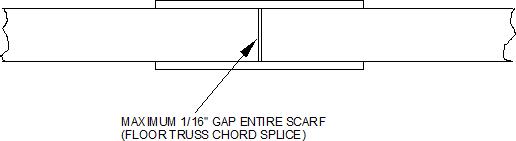
For joints designed with single points of contact between adjacent members as shown on the Truss Design Drawing, the maximum gap between all contact points shall not exceed 1/8 in.”

For additional information, or if you have questions, please refer to ANSI/TPI 1 or contact the MiTek Engineering department.

PHONE: 800-289-5627 FAX: 800-524-4982 Read/Subscribe online at www.componentadvertiser.com Don’t Forget! You Saw it in the Adverti$$er October 2023 #15291 Page #113 A dverti $ er Component manufaCturing m The
By Daniel Hesington
Top Five Most Downloaded Engineering Letters
Prior to joining Simpson Strong-Tie, I spent 13 years working as consulting structural engineer. As a specifier, I was amazed at the number of resources Simpson made available to me. From software, to blogs, to design guides, there were many resources to help me solve problems and streamline the design process. One resource that can sometimes be overlooked is the numerous engineering letters Simpson Strong-Tie engineers have authored to assist in the use of our products.
As a relatively new Simpson Strong-Tie employee, I’ve been doing a deep-dive to learn about all the tools and resources that we’ve created for the professionals who design or build structures with our products. Some of these were already very familiar to me, such as Anchor Designer™, and others I’m finding I wish I knew about in my designing days. Since I was used to specifying products the old-fashioned way (via the hard-copy catalogs), I didn’t visit the website much to search for product details or load tables. If I’d been to the website more, one resource I would have found that Simpson Strong-Tie regularly publishes, and updates, is our engineering letters.
Simpson Strong-Tie engineers create two different types of engineering letters: job-specific and generic. Job-specific letters are written to respond to a question from a specifier or customer pertaining to a specific job. The information in these letters is limited to the referenced job. Generic letters are written to address frequently asked questions or common installation issues that have been evaluated by Simpson Strong-Tie. The information in generic engineering letters is not limited to a specific job. Generic engineering letters are published on Strongtie.com, and they can be very helpful to specifiers and customers looking to solve general or recurring problems.

The engineering letters posted on our website can be located in several ways. Under Resource Center -> PDF Literature & Catalogs, you can find them by filtering by type on the sidebar. You can home in on a specific subset of engineering letters by choosing one or more of the 17 different categories.

PHONE: 800-289-5627 FAX: 800-524-4982 Read/Subscribe online at www.componentadvertiser.com Don’t Forget! You Saw it in the Adverti$$er October 2023 #15291 Page #114 A dverti $ er Component manufaCturing m The Continued next page
Another way to find engineering letters is to go directly to the product webpage. By clicking on the “Related Literature” link, you can select “Engineering Letter” from the different media types available. Choosing this option will show the available generic engineering letters that Simpson Strong-Tie engineers have written related to that product.

OK, so the moment we’ve all been waiting for…what are Simpson Strong-Tie’s most popular engineering letters? In other words, which ones are being downloaded the most often?
No. 5: Prescriptive spacing for the BVLZ:
The innovative BVLZ brick veneer ledger connector provides a code-compliant tested solution for adding a deck to an existing house that has a brick veneer exterior. With the BVLZ, the deck ledger can be attached to the rim joist through the existing veneer. This engineering letter has several tables with different prescriptive spacing requirements for installing the BVLZ to meet IRC requirements based on various framing or wall sheathing configurations.

No. 4: Introducing Simpson Strong-Tie H1A Hurricane Tie as a Replacement for H1:
In July 2023, Simpson Strong-Tie discontinued the popular H1 Hurricane Tie and replaced it with the new H1A. By repositioning the fastener locations in the new model, Simpson Strong-Tie engineers were able to increase the uplift capacity of this connector while at the same time reducing by two the number of fasteners into the truss/ rafter. To simplify the specification process, this helpful engineering letter directly compares the allowable loads of the new H1A truss/rafter tie to the previous H1 truss/rafter tie.

PHONE: 800-289-5627 FAX: 800-524-4982 Read/Subscribe online at www.componentadvertiser.com Don’t Forget! You Saw it in the Adverti$$er October 2023 #15291 Page #115 A dverti $ er Component manufaCturing m The
Continued next page
No. 3: Simpson Strong-Tie Holdowns on Cross-Laminated Timber Panels:

With the increase in popularity of mass timber generally and cross-laminated timber construction in particular, Simpson Strong-Tie has quite a few product options to support that market. However, this engineering letter provides CLT-to-concrete allowable loads for some of our holdowns that were originally designed for use with sawn lumber and other engineered wood products. Allowable tension loads are included for the HDQ, HHDQ, HDU, and HTT in two different holdown-to-CLT panel configurations.

With the increase in popularity of mass timber and cross-laminated timber construction in particular, Simpson Strong-Tie has quite a few product options to cover that market. Further illustrating the growing popularity of CLT construction, our second most frequently downloaded engineering letter was created to provide specifiers with additional CLT-panel-topanel and CLT- panel-to-concrete allowable loads for the ABR9020, ABR105, AE116, ABR255, and the E20/3. The allowable loads are for fastener and anchorage options not currently covered in our Mass Timber Construction guide. These heavy-duty angles transfer both in-plane and out-ofplane shear loads as well as resisting tension/uplift.
And finally, the most downloaded engineer letter is the LSSR2X replacement letter. Authored by Simpson Strong-Tie engineers in 2021, it introduced us to the LSSR slopeable/skewable rafter hangers that replaced their long-time predecessors: the LSU26, LSS28, and LSSU210. The patentpending, innovative hinged swivel seat on the LSSR easily adjusts up or down from 0 to 45 degrees, and the flange design allows for a skew from 0 to 45 degrees. Another key feature of the LSSR

PHONE: 800-289-5627 FAX: 800-524-4982 Read/Subscribe online at www.componentadvertiser.com Don’t Forget! You Saw it in the Adverti$$er October 2023 #15291 Page #116 A dverti $ er Component manufaCturing m The
No. 2: Simpson Strong-Tie Connectors for Cross-Laminated Timber Construction:
No. 1: Introducing Simpson Strong-Tie LSSR2X models to replace the LSU26, LSSU28, and LSSU210:
Continued next page
connector series is that it can be installed after the rafter has been tacked into place. To make it as easy as possible for customers and designers to specify the new product, the letter compares the allowable loads of the new hangers to those of the previous version.
Bonus: Reinforcement for LUS Joist Hangers Using Strong-Drive® SDWC TRUSS Screws:

It’s worth mentioning this engineering letter that provides a handy fix for a misinstalled LUS joist hanger. LUS joist hangers require 3” long common joist nails to achieve the published load capacities. Simpson Strong-Tie does not recommend the use of 0.148” x 1½” long nails into the double shear nail dome due to their lack of penetration into the header. Simpson Strong-Tie engineers have therefore tested and evaluated a reinforced connection that uses 4½” StrongDrive SDWC Truss screws driven through the joist into the header, providing adjustment factors to the published LUS allowable loads.
In addition to engineering letters, other literature that Simpson Strong-Tie publishes on the website includes fliers and brochures, technical and material safety data sheets, product guides, technical bulletins, installation guides, and, of course, catalogs. Not to mention all the other resources such as code reports, CAD, Revit, and PDF drawings and families, installation videos, links to our software and web applications, and our training and education portal. So invest some time on Strongtie.com when you get the chance, because you never know what you may find there to help you solve your next problem.
The article, Top Five Most Downloaded Engineering Letters, appeared first on Simpson Strong-Tie Structural Engineering Blog. To sign-up to receive the Engineering Blog in your inbox, go to seblog.strongtie.com/ subscribe.
Copyright © 2023 Simpson Strong-Tie Company Inc. All Rights Reserved
PHONE: 800-289-5627 FAX: 800-524-4982 Read/Subscribe online at www.componentadvertiser.com Don’t Forget! You Saw it in the Adverti$$er October 2023 #15291 Page #117 A dverti $ er Component manufaCturing m The
High Mortgage Rates Continue to Weaken Builder Confidence
Posted September 18, 2023 on NAHB Now | The News Blog of the National Association of Home Builders Reprinted with permission.

Persistently high mortgage rates above 7% continue to erode builder confidence, as sentiment levels have dropped below the key break-even measure of 50 for the first time in five months. Builder confidence in the market for newly built single-family homes in September fell five points to 45, according to the National Association of Home Builders (NAHB)/Wells Fargo Housing Market Index (HMI) released today. This follows a six-point drop in August.
“The two-month decline in builder sentiment coincides with when mortgage rates jumped above 7% and significantly eroded buyer purchasing power,” said NAHB Chairman Alicia Huey, a custom home builder and developer from Birmingham, Ala. “And on the supply-side front, builders continue to grapple with shortages of construction workers, buildable lots and distribution transformers, which is further adding to housing affordability woes. Insurance cost and availability is also a growing concern for the housing sector.”
“High mortgage rates are clearly taking a toll on builder confidence and consumer demand, as a growing number of buyers are electing to defer a home purchase until long-term rates move lower,” said NAHB Chief Economist Robert Dietz. “Putting into place policies that will allow builders to increase the housing supply is the best remedy to ease the nation’s housing affordability crisis and curb shelter inflation. Shelter inflation posted a 7.3% year-overyear gain in August, compared to an overall 3.7% consumer inflation reading.”
As mortgage rates stayed above 7% over the last month, more builders are reducing home prices again to bolster sales. In September, 32% of builders reported cutting home prices, compared to 25% in August. That’s the largest share of builders cutting prices since December 2022 (35%). The average price discount remains at 6%. Meanwhile, 59% of builders provided sales incentives of all forms in September, more than any month since April 2023. While more pricing-out is now occurring, the lack of resale inventory at the start of 2023 has shifted the new construction buyer mix. A special question in the September HMI survey revealed that 42% of new single-family home buyers were first-time buyers on a year-to-date basis in 2023. This is significantly higher than the 27% reading from a more normalized market in 2018.
Derived from a monthly survey that NAHB has been conducting for more than 35 years, the NAHB/Wells Fargo HMI gauges builder perceptions of current single-family home sales and sales expectations for the next six months as “good,” “fair” or “poor.” The survey also asks builders to rate traffic of prospective buyers as “high to very high,” “average” or “low to very low.” Scores for each component are then used to calculate a seasonally adjusted index where any number over 50 indicates that more builders view conditions as good than poor.
All three major HMI indices posted declines in September. The HMI index gauging current sales conditions fell six points to 51, the component charting sales expectations in the next six months also declined six points to 49 and the gauge measuring traffic of prospective buyers dropped five points to 30. Looking at the three-month moving averages for regional HMI scores, the Northeast fell two points to 54, the Midwest dropped three points to 42, the South fell four points to 54 the West posted a three-point decline to 47. HMI tables can be found at nahb.org/hmi. More information on housing statistics is also available at Housing Economics PLUS (formerly housingeconomics.com).
PHONE: 800-289-5627 FAX: 800-524-4982 Read/Subscribe online at www.componentadvertiser.com October 2023 #15291 Page #118 A dverti $ er Component manufaCturing m The Industry News
Construction Sector Jobs Increase Nearly 3% Since August 2022
Posted September 25, 2023 on NAHB Now | The News Blog of the National Association of Home Builders Reprinted with permission.
Nonfarm payroll employment increased in 33 states and the District of Columbia in August compared to the previous month, while 17 states lost jobs. According to the Bureau of Labor Statistics, nationwide total nonfarm payroll employment increased by 187,000 in August, following a gain of 157,000 jobs in July.
Year-over-year ending in August, 3.1 million jobs have been added, marking a more than full recovery of the labor market. Except for Mississippi and Rhode Island, all the other states and the District of Columbia added jobs compared to a year ago. The range of gains spanned 402,000 jobs in Texas to 1,400 jobs added in Vermont. Mississippi lost 700 jobs, while Rhode Island lost 6,900 jobs on a year-over-year basis. In percentage terms, Nevada reported the highest increase by 3.9%, while Rhode Island decreased by 1.4% compared to a year ago.
Construction sector jobs in the United States increased by 212,000 (2.7%) on a year-over-year basis. Texas added 21,100 jobs, while Missouri lost 2,700 construction sector jobs. In percentage terms, Wyoming had the highest annual growth rate (13%) in the construction sector, while North Dakota reported a decline of 3.8%.
On a month-over-month basis, the construction industry added a net 22,000 jobs in August compared to the previous month. NAHB Assistant Vice President for Forecasting and Analysis Danushka Nanayakkara-Skillington provides a breakdown of monthly data in this Eye on Housing post.

PHONE: 800-289-5627 FAX: 800-524-4982 Read/Subscribe online at www.componentadvertiser.com October 2023 #15291 Page #119 A dverti $ er Component manufaCturing m The Industry News
New Home Sales Weaken in August on Higher Mortgage Rates
Posted September 26, 2023 on NAHB Now | The News Blog of the National Association of Home Builders Reprinted with permission.
Elevated mortgage rates and challenging affordability conditions pushed new home sales down to their weakest rate since March.
Sales of newly built, single-family homes in August fell 8.7% to a 675,000 seasonally adjusted annual rate from an upwardly revised reading in July, according to newly released data by the U.S. Department of Housing and Urban Development and the U.S. Census Bureau. The pace of new home sales in August was up 5.8% from a year ago.
“Builders continue to grapple with supply-side concerns in a market with poor levels of housing affordability,” said Alicia Huey, chairman of the National Association of Home Builders (NAHB) and a custom home builder and developer from Birmingham, Ala. “Higher interest rates price out demand, as seen in August, but also increase the cost of financing for builder and developer loans, adding another hurdle for building.”
“Sales weakened in August with average mortgage rates above 7%,” said NAHB Chief Economist Robert Dietz. “While some builders were able to offset that effect via mortgage rate buydowns, rates moved higher this month, suggesting the pace of new home sales will weaken further for September.”
A new home sale occurs when a sales contract is signed or a deposit is accepted. The home can be in any stage of construction: not yet started, under construction or completed. In addition to adjusting for seasonal effects, the August reading of 675,000 units is the number of homes that would sell if this pace continued for the next 12 months.
New single-family home inventory in August was 436,000, down 5.2% compared to a year ago. This represents a 7.8 months’ supply at the current building pace. A measure near a 6 months’ supply is considered balanced. Of the total home inventory, including both new and resale homes, newly built homes represent an elevated share of 31% of those available for sale. And nearly 16% of total home sales in August were new homes.
“Builders are being more cautious about managing their inventory in this rising rate environment,” Dietz noted. “A year ago, 10% of the new home inventory listed for sale consisted of homes that had not yet started construction, and that share has now risen to 17% of the total inventory.”
The median new home sale price in August was $430,300, down roughly 2% compared to a year ago. Pricing is down both due to builder incentive use and a shift towards building slightly smaller homes.
Regionally, on a year-to-date basis, new home sales are up 4.8% in the Northeast, 4.4% in the Midwest and 1.9% in the South. New home sales are down 0.5% in the affordability-challenged West.
PHONE: 800-289-5627 FAX: 800-524-4982 Read/Subscribe online at www.componentadvertiser.com October 2023 #15291 Page #120 A dverti $ er Component manufaCturing m The Industry News
New Housing Starts Lower on Rising Mortgage Rates
Posted September 19, 2023 on NAHB Now | The News Blog of the National Association of Home Builders Reprinted with permission.
Higher mortgage rates averaging above 7% put a damper on single-family production in August, as builders also continue to face supply-side challenges in the form of elevated construction costs, a lack of skilled labor and a shortage of buildable lots.
Led by a sharp decline in multifamily production, overall housing starts fell 11.3% in August to a seasonally adjusted annual rate of 1.28 million units, according to a report from the U.S. Department of Housing and Urban Development and the U.S. Census Bureau.
The August reading of 1.28 million starts is the number of housing units builders would begin if development kept this pace for the next 12 months. Within this overall number, single-family starts decreased 4.3% to a 941,000 seasonally adjusted annual rate. Single-family starts are 2.4% higher than a year ago. The multifamily sector, which includes apartment buildings and condos, decreased 26.3% to an annualized 342,000 pace.
“High mortgage rates above 7% combined with low resale inventory and higher home prices are slowing housing production, as many first-time home buyers and younger households are struggling to purchase an affordable home,” said Alicia Huey, chairman of the National Association of Home Builders (NAHB) and a custom home builder and developer from Birmingham, Ala. “With high mortgage rates sending buyers to the sidelines, and a nationwide shortage of 1.5 million units, we need to increase the housing supply to get this market back into balance to meet the pent-up demand for when market conditions improve.”
“Despite higher demand for new construction stemming from a lack of resale inventory, home builders are feeling pessimistic about the housing market because of elevated mortgage rates hovering above 7%,” said Danushka Nanayakkara-Skillington, NAHB’s assistant vice president for forecasting and analysis. “Unfortunately, we expect mortgage rates to remain at higher levels as the Federal Reserve is likely to increase rates one more time later this quarter.”
The number of single-family units under construction is down 16.3% compared to a year ago at 676,000. Meanwhile, the number of apartments under construction increased to 1.01 million.
On a regional and year-to-date basis, combined single-family and multifamily starts are 22.8% lower in the Northeast, 13.6% lower in the Midwest, 8.8% lower in the South and 16.5% lower in the West.
Overall permits increased 6.9% to a 1.54 million unit annualized rate in August. Single-family permits increased 2% to a 949,000 unit rate. Single-family permits are also up 7.2% compared to a year ago. Multifamily permits increased 15.8% to an annualized 594,000 pace.
Looking at regional permit data on a year-to-date basis, permits are 22.9% lower in the Northeast, 17.2% lower in the Midwest, 13.3% lower in the South and 18.2% lower in the West.
PHONE: 800-289-5627 FAX: 800-524-4982 Read/Subscribe online at www.componentadvertiser.com October 2023 #15291 Page #121 A dverti $ er Component manufaCturing m The Industry News
Simpson Strong-Tie Introduces New HighCapacity, Load-Rated Concealed Beam Hanger for Mass Timber Construction

September 27, 2023, Pleasanton, Calif. — Simpson Strong-Tie, the leader in engineered structural connectors and building solutions, has introduced the Simpson Strong-Tie® HSKP™ heavy seated knife plate, a highcapacity, welded concealed beam hanger for mass timber structures designed to meet heavy loads while providing a hidden-connector, wood-only design aesthetic.
Engineered specifically to meet some of the heaviest mass timber beam loads, the HSKP is a code-listed, easyto-install connector that can accommodate larger mass timber beams while still providing a strong, secure wood-to-wood or wood-to-steel connection.
Installed in the factory with Strong-Drive® SDCF Timber-CF structural screws, the HSKP provides valuable time savings on the jobsite, and offers generous fit-up tolerance for easy beam placement. Strong and reliable, the HSKP is code listed for high-capacity loads up to 32 kips, and is ideal for a range of heavy beam applications where loads range from 20 to 32 kips.
“We’re excited to expand the range of our popular concealed beam hangers for mass timber,” says Thom Murphy, Senior Product Manager at Simpson Strong-Tie. “Along with our other structural solutions for mass timber, the HSKP will provide a heavy-duty solution to designers and contractors working on high-load mass timber projects, and delivers additional versatility to help build safer, stronger buildings, faster.”
Manufactured in the US, and readily available through the Simpson Strong-Tie nationwide distribution network, the HSKP provides tested strength, offers simplified and expedited installation, and is backed by expert service and support. To learn more, visit go.strongtie.com/HSKP
About Simpson Strong-Tie Company Inc.
Simpson Strong-Tie is the world leader in structural solutions — products and technology that help people design and build safer, stronger homes, buildings, and communities. As a pioneer in the building industry, we have an unmatched passion for problem solving through skillful engineering and thoughtful innovation. Our structural systems research and rigorous testing enable us to design code-listed, value-engineered solutions for a multitude of applications in wood, steel, and concrete structures. Our dedication to pursuing ever-better construction products and technology and to surrounding our customers with exceptional service and support has been core to our mission since 1956. For more information, visit strongtie.com and follow us on Facebook, Twitter, YouTube and LinkedIn.

PHONE: 800-289-5627 FAX: 800-524-4982 Read/Subscribe online at www.componentadvertiser.com October 2023 #15291 Page #122 A dverti $ er Component manufaCturing m The Industry News
Simpson Strong-Tie Introduces New, HeavyDuty Timber Drive™ Stand-Up Driver with Patent-Pending Gravity Feed Mechanism
September 20, 2023, Pleasanton, Calif. — Simpson Strong-Tie, the leader in engineered structural connectors and building solutions, has introduced Timber Drive™ – a first-of-its kind, heavy-duty structural fastening system designed for stand-up, semi-automatic operation while driving 3” to 6 ¼” structural screws.
Ideal for heavy-duty jobs that require repetitive fastening, such as decks, docks, boardwalks, piers, and flooring, as well as for fastening metal straps to wood, engineered wood, or mass timber panels, the ergonomic design of Timber Drive makes it a faster, easier way to work, and a patent-pending drop-feed loader allows for semi-automatic driving of a wide variety of Simpson Strong-Tie fasteners.
Engineered to vertically drive large structural screws without the operator having to bend over, the ergonomic Timber Drive structural fastening system causes less fatigue for knees, back, and shoulders, increasing user comfort, speed, and productivity.
Fastener loading has also been simplified to further boost speed and productivity on the jobsite with a patent-pending, gravity-powered drop-feed mechanism. Designed to accept a variety of different screw diameters, lengths, and head styles, the drop-feed loader allows a simple drop of the fastener, pull of the trigger, and drive.
With four adjustable countersink depth settings and two interchangeable nosepieces that accommodate either face-screwing or connector fastening, the Timber Drive system delivers unmatched versatility across the widest range of heavy-duty, repetitive fastening applications. The Timber Drive also features a positive placement tip that locates connector holes and provides true, straight, perpendicular driving when fastening metal straps to mass timber panels.
“From decks and docks to big flooring jobs and heavy-duty applications like piers, the Timber Drive fastening system provides a faster, easier way to work with less fatigue and is compatible with corded and cordless drivers using the Quik Drive G2 adapter,” says Simpson Strong-Tie group product manager Andrew Brigham. “And since the patent-pending, semi-automatic drop-feed loader works with structural screws featuring a wide variety of lengths, diameters, thread types and heads, Timber Drive provides greater stand-up fastening versatility than ever before.”

Safe, strong, fast, and efficient, the Simpson Strong-Tie Timber Drive structural fastening system offers a versatile, ergonomic way to quickly and easily drive large structural screws on heavy-duty jobs that require repetitive fastening.
To learn more about the heavy-duty Timber Drive™ stand-up driver from Simpson Strong-Tie, visit go.strongtie.com/ quikhd.
PHONE: 800-289-5627 FAX: 800-524-4982 Read/Subscribe online at www.componentadvertiser.com October 2023 #15291 Page #123 A dverti $ er Component manufaCturing m The Industry News
Simpson Strong-Tie Opens Three New Warehouse, Training, and Distribution Hubs to Optimize Product Availability in the Northwest and Rocky Mountain Regions

September 15, 2023, Pleasanton, Calif. — Simpson Strong-Tie, the leader in engineered structural connectors and building solutions, staged ribbon-cutting ceremonies today at three new warehouse, distribution, and training centers in Denver, Salt Lake City, and Kent, Washington. Part of a strategic investment to increase the Simpson Strong-Tie US distribution footprint, the new facilities will significantly expand the range of products available for next-day delivery across the Northwest.
The new distribution hubs include warehousing facilities, office space, training centers, and newly designed, two-story demonstration rooms to host contractors and lumber and building material (LBM) suppliers for project and product training classes. The new facilities are expected to create 50-plus new jobs as Simpson Strong-Tie deploys additional resources to optimize its US supply chain and ensure reliable product availability with faster and more timely delivery.
“These new locations, in combination with our manufacturing facility in Stockton California, will provide customers greater access to our products and solutions by offering a wide variety of inventory and expertise,” says Simpson Strong-Tie CEO Mike Olosky. “Simpson Strong-Tie is committed to offering next-day service to our customers throughout the Northwest, and these new locations move us in this direction.”
As supply chain woes have continued to impact building product and material availability for construction projects, Simpson StrongTie is investing heavily to grow their already robust US manufacturing and distribution presence. The simultaneous grand openings come on the heels of a groundbreaking in Columbus, Ohio, to build an expanded manufacturing and distribution center there. That project is expected to create an additional 120 jobs.
Office, warehousing, and training center square footage in the new Northwest distribution hubs include:
Kent, Washington: Office: 10,311 square ft. - Warehouse: 97,942 square ft. - Training Center: 1,870 square ft. - 2-Story Demo Room: 594 square ft.
Denver, Colorado: Office: 8,082 square ft. - Warehouse: 69,892 square ft. - Training Center: 2,756 square ft. - 2-Story Demo Room 1,044 square ft.
Salt Lake City, Utah: Office: 8,755 squre ft. - Warehouse: 61,258 square ft. - Training Center: 2,494 square ft. - 2-story Demo Room: 1,320 square ft.
For more information on Simpson Strong-Tie local distribution, manufacturing, training, and product testing and research and development facilities, visit strongtie.com/about/locations
PHONE: 800-289-5627 FAX: 800-524-4982 Read/Subscribe online at www.componentadvertiser.com October 2023 #15291 Page #124 A dverti $ er Component manufaCturing m The Industry News
A-1 Marks 46 Years of Visionary Leadership and Employee Empowerment

FORT PIERCE, Fla., September 18, 2023 – Employee-owned A-1 Global Holdings, Inc. (“A-1”), the premier provider of structural building components in the Southeastern United States, proudly celebrates its 46th anniversary. This milestone follows a transformative year that included the introduction of an Employee Stock Ownership Plan (ESOP”), a Silver Telly Award, and a facility expansion.
“Today, as we celebrate 46 years of innovation and excellence, we’re reminded of our long-term vision to be a 100year Company,” says John Herring, Founder and CEO. “Our commitment to using technology and focusing on our people has been the cornerstone of our success.”
A Year of Milestones
A-1 introduced its ESOP, allowing employees to acquire shares of stock in A-1 at no cost. “The A-1 ESOP represents the perfect alignment of Company goals, values, and rewards,” said Jan S. Beck, President of A-1 Global Holdings. “It makes clear that our people are front and center, and that’s exactly how we want it.”
A-1 set industry standards and released “The A-1 Difference,” a video that won a coveted Silver Telly Award this year. Mr. Beck said, “This award showcases our team’s dedication and aligns with our long-term vision.”
“As we mark another year of growth and achievement, we’re excited about the future,” says Michael Ruede, President of A-1 Industries of Florida, Inc. and A-1 Industries of Georgia, LLC. “We have several groundbreaking initiatives and products in the pipeline that will continue to redefine the industry and benefit our customers.”
A-1 recently expanded its Florida facility by 48,000 square feet, consistent with its rapid growth plans.
About A-1 Global Holdings
Founded in 1977, A-1 has over 400 employees and is a leading manufacturer of pre–engineered wood trusses and EZWALL® Innovative Framing SolutionTM. The Company reorganized last December as A-1 Global Holdings, Inc., the new parent company for A-1 Industries of Florida, Inc., and A-1 Industries of Georgia, LLC. A-1 currently has manufacturing facilities in Fort Pierce, Fla., and Bainbridge, Ga., and multiple employment opportunities in both locations for candidates who share the Company’s Core Values – Own it, Passionate, Honesty, and Respect. A-1’s employees are eligible to participate in the Company’s Employee Stock Ownership Plan.
For Further Information:
Michael Fagan
772 409-1010
Michael.Fagan@A1Industries.com
www.A1Industries.com
PHONE: 800-289-5627 FAX: 800-524-4982 Read/Subscribe online at www.componentadvertiser.com October 2023 #15291 Page #125 A dverti $ er Component manufaCturing m The Industry News
Nation’s Best Acquires Adams Building Supplies
September 1, 2023, DALLAS, Texas – Nation’s Best, recently ranked 40th in the Top 150 Industry Leaderboard, announces their acquisition of Adams Building Supplies, Inc. of Georgia.

Founded in 1917, this fourth generation two-location business caters to the high-end custom home builder segment with a heavy mix of premium lumber and building material products. “Our continued growth comes from adding bestin-class stores across the country,” said Kevin Pierce, Regional Vice President for Nation’s Best. “Adams Building Supplies has become a market leader, with well-run pro stores offering top-notch drive-through indoor yards. With locations in Hartwell and Toccoa, they’re also strategically located midway between Nation’s Best locations in the Carolinas, which will only strengthen our network and serve the area even better.”
Sister and brother owners Andrea A. Anderegg and Julian Adams are excited for the future of their family business. “It takes a lot of dedicated people to run a successful business and we’ve been blessed to have a team of trusted managers and associates over the years. We’re thrilled to know that Adams Building Supplies will now be in the hands of an experienced home improvement company like Nation’s Best and that our valued team will continue to be there every day to serve our community.”
Adams Building Supplies are the first Georgia-based businesses for Nation’s Best, now with 51 locations in 15 states. As part of Nation’s Best’s strategy, Adams Building Supplies will lease the real estate from the owners, maintain operations under their existing name, and retain the core team overseeing company operations alongside Nation’s Best, which will provide the strategic and financial support necessary to drive optimal growth and profitability.
About Nation’s Best
Nation’s Best Holdings, LLC was founded in 2019 and as of September 1, 2023, owns and operates 51 locations in 15 states with over 1,150 associates. Nation’s Best is committed to identifying and acquiring best-in-class independent home improvement stores to ensure their continued relevance as vibrant community resources. To learn more, visit www.nationsbest.net.
PHONE: 800-289-5627 FAX: 800-524-4982 Read/Subscribe online at www.componentadvertiser.com October 2023 #15291 Page #126 A dverti $ er Component manufaCturing m The Industry News
LBM-Network’s Jim Enter served as the advisor to Adams Building Supplies, Inc during the transition.
###
The SLB Generated 454 MM BF of Incremental Demand in Q2 2023
The SLB recently published its Q2 2023 Report, detailing the SLB and its funded programs’ activities that outperformed on a wide number of measures while defending existing market share and making strategic investments that will help grow and diversify revenue streams.
Key highlights include:
• 454 MM BF of incremental demand generated, which has a carbon benefit of 1.3 MM metric tons of CO2 stored and avoided.
• The American Wood Council launched its Wood Sourcing Tool and is expanding its lifecycle inventory database to meet the growing demand for more specific regional and mill-level environmental product declarations and fiber sourcing data.
• Think Wood increased its overall content output by nearly 70% in Q2, translating to 636,327 marketing engagements—up 263% QoQ and +143% YoY.
• WoodWorks directly influenced 129 projects and indirectly influenced 329 projects in Q2. Combined, the projects represent 22.5 MM SF of impacted wood construction, 203 MM BF of incremental lumber, 45 MM BF of incremental engineered wood products, and 142 MM SF of incremental wood structural panels.
• New accounts on the Wood Institute grew steadily and surged on an annualized basis by over 70%, owing to very strong performances in April and May. SLB Education completed three faculty development workshops benefiting 52 educators from 42 schools of architecture and engineering.
• New research reports from Forest Economic Advisors and Bully Pulpit Interactive provide critical insights including a better understanding of wood demand and public perceptions of wood when compared with competing materials, which will be used to remove barriers and grow new markets and building typologies.
For more detail, comprehensive program updates, and additional SLB news, view the Q2 2023 Report below. To share industry feedback or request that a printed report be mailed to you, please email us at info@softwoodlumberboard.org.
OPEN THE Q2 2023 REPORT IN ENGLISH
OPEN THE Q2 2023 REPORT IN FRENCH
About the Softwood Lumber Board
The Softwood Lumber Board (SLB) is an industry-funded initiative established to promote the benefits and uses of softwood lumber products in outdoor, residential, and non-residential construction. Programs and initiatives supported by the SLB focus on increasing the demand for appearance and softwood lumber products in the United States. https://www.softwoodlumberboard.org/ | info@ softwoodlumberboard.org

PHONE: 800-289-5627 FAX: 800-524-4982 Read/Subscribe online at www.componentadvertiser.com October 2023 #15291 Page #127 A dverti $ er Component manufaCturing m The Industry News
Building Codes and Standards: Bringing Science to Building Safety
We’ve developed the Code Council Periodic Table as a quick reference to all of the Code Council’s codes, standards and guidelines
The International Code Council is the leading global source of model codes and standards that are used to ensure safe communities and buildings worldwide. The Code Council’s system for developing model codes and standards is based on trust and transparency and has provided the highest level of safety in communities around the world.
The International Codes® (I-Codes), developed by the Code Council, are a family of fifteen coordinated, modern building safety codes that help ensure the design of safe, sustainable, affordable and resilient structures.
Code Council Standards are developed to address building industry challenges regarding code compliance. These standards are developed to ensure products, services and systems are safe, reliable and consistently perform the way they are intended to.
We’ve developed the Code Council Periodic Table as a quick reference to all of the Code Council’s codes, standards and guidelines.
To download this image, click here. To learn more about the Code Council’s Codes and Standards development, click here.
About the International Code Council
The International Code Council is a nonprofit association that provides a wide range of building safety solutions, including product evaluation, accreditation, certification, codification and training. It develops model codes and standards used worldwide to construct safe, sustainable, affordable and resilient structures.

PHONE: 800-289-5627 FAX: 800-524-4982 Read/Subscribe online at www.componentadvertiser.com October 2023 #15291 Page #128 A dverti $ er Component manufaCturing m The Industry News
Northwestern Lumber Association (NLA) + Mid-America Lumbermens Association (MLA) = BLD Connection
Earlier this month, it was announced that Mid-America Lumbermens Association (MLA) and Northwestern Lumber Association (NLA) have come together to form one of the largest building material and lumber associations
Stakeholders from across the organization spent months planning, participating in task force meetings and hearing input and perspectives from members, vendors, internal team members and industry partners. In the end, our Board of Directors made the unanimous decision to rebrand and rename the Association.
BLD Connection stands for Building Material & Lumber Dealers Connection. BLD Connection is not only a name but a call to action, asking members to build connection! It is an acronym for Building Material & Lumber Dealers but it also cleverly doubles as an abbreviation for the word Build!
NLA has a rich history, but our industry and our Association have evolved over time. Capturing this evolution and highlighting our essential value were main considerations during the renaming process.
Other important aspects included:
• Our members sell and provide building materials in addition to lumber.
• Our network supports the entire industry.
• Our membership now spans 10 states beyond the Northwest – from the Canadian border to the Southern border(s) of the Central United States. We also proudly support a number of members from Canada!
At the heart of this rebrand is the organization’s commitment to “building a stronger community” – a message that will shine through in every offering provided by the Association moving forward.
Next Steps
We have created a Frequently Asked Questions document to help answer questions about our rebrand, which you can access online. By now (or in the coming days), all member main contacts will receive a “BLD Box” to help answer questions about our rebranding and its impact on your membership and the services we provide.
The most important note is the launch of our newly-designed website— www.BLDConnection.org—on Oct. 1, 2023. We are excited for what our future holds and look forward to bringing even greater value to the industry, the region and our members for years to come! Welcome to BLD Connection!

PHONE: 800-289-5627 FAX: 800-524-4982 Read/Subscribe online at www.componentadvertiser.com October 2023 #15291 Page #129 A dverti $ er Component manufaCturing m The Industry News


PHONE: 800-289-5627 FAX: 800-524-4982 Read/Subscribe online at www.componentadvertiser.com Don’t Forget! You Saw it in the Adverti$$er October 2023 #15291 Page #130 A dverti $ er Component manufaCturing m The Advertiser Directory 4Ward Solutions Group www.4wardconsult.com 623-512-6770 ben@4wardconsult.com Acceptance Leasing & Financing Service, Inc. www.acceptlease.com 412-262-3225 cvillella@acceptlease.com Acer Inc. www.acerinc.com 507-864-2220 sales@acerinc.com Your Solution for Lack of Technical Staff ● PlanSwift Lumber and Building Material Takeoffs ● Truss and Wall Panel Design Experienced Staff ● EWP Layouts and much more! All Points was launched by Industry Veteran Dave Walstad with over 20 years of Offshore Experience to create the Gold Standard in Technical Support Teams. 1-941-713-4395 www.AllPoints.Tech Dave.AllPoints@gmail.com Offices in: Panama City Beach, FL USA HCMC (Saigon), Vietnam Bengaluru, India Eliminate your lack of technical resources to grow sales and increase the clock speed of your company. We have the network and experience you can count on Deploy Technical Teams from All Points! All Points Technical www.AllPoints.Tech 941-713-4395 Dave.AllPoints@gmail.com AN ITW COMPANY Alpine www.alpineitw.com 800-521-9790 mschwitter@alpineitw.com Clark Industries, Inc. www.clark-ind.com 800-743-9727 general@clark-ind.com Eagle Metal www.eaglemetal.com 800-521-3245 connect@eaglemetal.com Eide Integrated Systems eideintegratedsystems.com 612-521-9193 ext 204 tom@eidemachinery.com EstiFrame Technologies, Inc. www.estiframe.com 209-576-5000 cgifford@estiframe.com Fitzgerald Group, LLC www.fitzgroup.com 719-528-5445 rfitzgerald@fitzgroup.com HOLTEC USA Corporation www.holtecusa.com 813-754-1665 info@holtecusa.com Hundegger USA www.hundeggerusa.com 435-654-3028 steve@hundeggerusa.com LimTek Solutions limteksolutions.com 416-888-4457 edmond.lim@limteksolutions.com MiTek USA www.mitek-us.com 800-325-8075 customerservice@mii.com Panels Plus www.panplus.com 866-726-7587 tkaasa@panplus.com ROGworx Automation www.ROGworx.com 707-333-4507 sales@ROGworx.com
The Hain Company
www.thehaincompany.com
530-295-8068
sales@thehaincompany.com
TheJobLine.com

www.thejobline.com

800-289-5627
mail@thejobline.com
Timber Products Inspection

www.tpinspection.com


770-922-8000
Todd Drummond Consulting, LLC. www.todd-drummond.com

603-748-1051
todd@todd-drummond.com
Triad | Merrick Machine

www.triadmachines.com

800-568-7423 ext 133

mmcsales@merrickmachine.com


Vekta USA
www.vektausa.com
907-230-8276
info@vektausa.com

PHONE: 800-289-5627 FAX: 800-524-4982 Read/Subscribe online at www.componentadvertiser.com Don’t Forget! You Saw it in the Adverti$$er October 2023 #15291 Page #131 A dverti $ er Component manufaCturing m The Wasserman & Associates www.wasserman-associates.com 800-382-0329 sales@wasserman-associates.com Wolf X Machina www.wolfxmachina.com info@wolfxmachina.com Wood Tech Systems, Inc. www.woodtechsystems.com 765-751-9990 info@woodtechsystems.com Advertiser Directory
www.strongtie.com
web@strongtie.com
www.spida.com
Hain Company
Simpson Strong-Tie
800-999-5099
Spida Machinery USA
866-647-7771 sales@spida.com The
Welcome
News The New (JSMEA) or Job Site Measuring System has been released for production. New Videos Folding Measuring System Overview: About the Hain Company Products: Home Hain Engineering Services Company Overview Products Companies We Represent Hain Racing Products Request Form Contact Us Mailing List Used Products Leasing & Financing Services About Hain Racing Products All Measuring Systems
Systems Framer
Component Nailer
Rafter Cutter
Block Drills
Racing Offset Drive
Valve Cover Used Products
QRC
VBD
MEA
SCN
MMEA
Desauw
Saws
Web Saw
Handling Used Equipment Companies We Represent Festool Klaisler Mfg. Corp. The Koskovich Company
Desauw Inc. Mango Tech All Measuring Systems Folding Measuring System Table Measuring System
Manual Measuring
Extended Length Material Handler Both Vent Block Drills
Welcome to The Hain Company's website! Here you will find information about the Hain Company and its line of innovative products that can help streamline your company. Our products are diversely used throughout the manufacturing industry to speed production and reduce labor costs.
Hain
Sub
Quick
Vent
Hain
Aluminum
Refurbished
Refurbished
Refurbished
Refurbished
Refurbished
Monet
Component
Floor
Material
Monet
Portable Measuring System Measuring System
System
Contact our Advertisers for manufacturing and handling equipment, saws, plates and connectors, software, business management, financing, third-party inspections, employment services, transportation equipment, and much more! Your Company can be Listed in TheAdverti$er Contact Anna Stamm Anna@componentadvertiser.org 800-289-5627 x3
For Information on Any of these Job Opportunities
Visit: The Hiring Zone
CFS Wall Panel Estimator 230920
Employer: Client Confidential
We are a fast growing Midwest company that is looking for someone with at least 5-10 years experience doing costs estimates, takeoffs, and bids for commercial cold-formed steel load-bearing wall panel projects. Our niche is in the hospitality and assisted living/ retirement industries and we are in our 3rd year of consecutive record sales and profits.
Remote Truss Designer J15228
Employer: Client Confidential
Details: Our client in the Southeast is looking for Remote Truss Designer. Work remote, or in an office location. They need senior level Remote Truss Designers and Intermediate level may be considered. Fantastic benefits, compensation is very competitive, and they use MiTek software. Remote is an option if you have a home office and remote experience, or you can work in one of their offices. They may consider someone without remote experience, just depends on the skill level. Must be in the Southeast
Remote Truss & Panel Designer J15290
Employer: Client Confidential
Truss Designer for Single Family Custom and Production Builder projects. Products include floor and roof trusses, I-Joists, wall panels, MiTek. Panel experience is a plus! JobLine Senior Designer rating is preferred. Remote or hybrid remote may be available, depending upon skills and experience.
Hybrid Remote Truss Designer
- Single Family J14212
Employer: Client Confidential
If you are a mid to senior level Truss designer, able to design for mostly single family custom and production builder type projects, able to design in savings and create packages that work in the plant and on site, this is a job you should consider. The company uses MiTek but will consider other truss design software experience. This job requires someone who is used to working with repetitive tasks, but also finding savings and minimizing errors.
Truss Designer J15286
Employer: Client Confidential Products include floor and roof trusses, I-Joists, wall panels, MiTek. Panel experience is a plus! JobLine Senior Designer rating is preferred. This is an In-Office position only. No remote, but part time remote may be available, depending upon skills and experience.
Thom's Notes: One of my "A" list employers, great benefits, competitive compensation plus very competitive bonus program. When I place someone there, they stick! Very tight specifications for this employer. Relocation assistance is available.
Regional Mega-Multifamily Truss Designer Mega-Multifamily Estimator/ Designer needed to support multiple plants. Duties include modeling for estimating and full designs of multifamily projects. Intermediate or advanced skill level will be considered using JobLine's Truss Design Skills Evaluation. This job is local, remote (Eastern Time Zone), or hybrid. Relocation assistance is negotiable if you plan to work in the office. Please inquire
for additional details and to be considered for this position.
Compensation: $33-43hr based on skills and ability. average 45 hours a week. Can interview onsite or remotely.
Remote Mega-Multifamily Estimator J15227
Employer: Client Confidential Remote Mega-Multifamily Truss Estimator opportunity. Qualified candidates will already know the general duties and skills needed for this position and additional details can be obtained prior to approving presentation. Employer will consider 3+ years single family design experience. Training and position is remote. Expert level Remote MMF Estimators are afforded top consideration but the employer is very willing to train experienced single family designers wishing to become MMF Designers. This position is a stepping stone to a MMF Design job if you are interested.
Truss Designer - MiTek/ Multifamily J14173
Employer: Client Confidential
JobLine Senior Designer ranking and MiTek software experience (Sapphire preferred) is highly desirable for this position. Prefer someone with commercial and multifamily experience but strong Single Family Custom will be considered. Bring your friends! In-office position. Remote is not an option.
Lead Designer 22-0811-2
Employer: ProTec Panel & Truss
ProTec Panel & Truss is looking to add a Lead Designer to our team. The designer will be responsible for the production of detailed shop drawings for component manufacturing using Mitek Software. They will contribute to the Design Team's success by working with team members to check accuracy and assist entry level designers.
PHONE: 800-289-5627 FAX: 800-524-4982 Read/Subscribe online at www.componentadvertiser.com October 2023 #15291 Page #132 A dverti $ er Component manufaCturing m The theHiring Zone The Hiring Zone is operated by The Component Manufacturing Advertiser Magazine. All applications will be sent exclusively to the advertising company. job opportunities available A dverti$er Component manufaCturing S erving the S tructural B uilding c omponent S i ndu S try The Hiring Zone Building Component Industry Job Board
to Candidate Direct Hiring No Recruiting Fees! Post your Opportunity... Candidates respond directly to you! For Additional Information Contact: twm@componentadvertiser.org or Call 800-289-5627 x1 For Rates and Posting, visit our website: www.componentadvertiser. com/Hiring-Zone
Employer
Quality


system is protected under U.S. Patent #8,960 ,244 and other patents. Acer Inc. 301 Industrial Drive Rushford, MN 55971 507-864-2220 www.acerinc.com Solid Design + Skilled Craftsmanship = Reliable Machinery The math is simple: Automatic Retrieval + Your Linear Saw = Maximum Production Run the numbers. Ranger is the answer.
comprehensive testing , each Ranger is carefully packed for shipping
can be installed in one day Modular construction and thorough labeling of cables and components make the job easy.
After
Rangers
components and meticulous assembly minimize downtime. Infeed deck assembly versions available for 5 saw brands
TheLastWord
Can Crooked Lumber Defeat Robotics?
Arobot visited the BCMC Show floor again this year, and, for the first time, really showed its stuff, picking truss plates like there was no tomorrow. And its dynamic demo couldn’t be missed, as House of Design (HoD) positioned their Nail Plate Picking Cell right at the exhibit’s entrance. Further down the aisle were Randek and Trussmatic, who both have successfully deployed their own plate pickers in truss plants around the world. And, not to be overlooked, was Jim Urmson’s implementation 14 years ago. Surely these collective achievements have proven that robots can successfully process truss plates. Whether robots can handle crooked lumber is another matter and has been a bone of contention since the first automated equipment came to BCMC.
In 1998, Makron’s wall panel line was featured on the BCMC plant tour at Western Home Center in Cincinnati (see The Last Word from July 2019, The Second Wave of Automation?). While Makron’s extruder process had little in common with today’s robotics, it was one of the first European lines to be tested with American wood and to raise doubts that the line could handle its greater variability versus its European counterparts. This skepticism was underscored by the flood of “near perfect” German studs that arrived in panel plants in the early 2000s. Given that QC requirements are much more stringent for trusses than walls, CMs were rightly concerned that too many crooks and other lumber imperfections could impede the use of roof truss robotics.

Further to this point were the differing views expressed during 4Ward’s discussion panel on robotics at the Show moderated by Mike Ruede, Jr. One panelist speculated that a new material could take the place of lumber, and another suggested that Weyerhaeuser will be growing better trees and producing better wood. Others hold out the promise of 3D printing. I asked whether automated culling could be carried out at the component plant to which HoD’s CEO, Shane Dittrich, cited the mountain of culls produced when this was attempted at Katerra’s failed plant. Given that Katerra was processing Western Woods, the chance of successful automated culling of Southern Pine at component plants seems impractical, and I would say futile. Modern Southern Pine saw mills already employ much more extensive means than could ever be duplicated at a truss plant, including sonar to assess strength and two- or three-dimensional vision technology to identify defects.
PHONE: 800-289-5627 FAX: 800-524-4982 Read/Subscribe online at www.componentadvertiser.com Don’t Forget! You Saw it in the Adverti$$er October 2023 #15291 Page #134 A dverti $ er Component manufaCturing m The
Joe Kannapell, P.E.
Continued next page
Despite the impracticality of automated culling onsite, there are ways that truss plants can and will be able to use technology to improve the quality of materials entering robotic assembly. Currently, with Steve Aylsworth’s Ranger RS system by Acer, boards can be properly crowned. And in the future, with some lesser degree of automation, culls may be lessened by removing defective portions of boards and recapturing most of their value. Or by recognizing plate locations prior to sawing, boards could be flipped end-to-end to lessen the chance of defects in the plate area (see The Last Word from November 2022, The Last Word on Pre-Plating).

In summary, crooked lumber can defeat robotic systems, as occurred at Katerra, but doesn’t have to, as evidenced by the nearly two dozen robotic truss lines operating currently in the U.S. However, all of these lines are somewhat compromised by bad boards, and their long-term success depends on how well they adapt to the material at hand. While the likelihood that another material displaces wood is remote, any practical technology that can lessen rejects will be increasingly important as the number of robotic lines grows.
A Few Words on the 2023 Joe and Adam Kannapell BCMC 5K Run Walk
We ran where we began a dozen years ago, and we did better than ever at this year’s BCMC 5K. The weather was ideal as 70 of us set off just a block away from the lighted façade of Indiana’s State Capital. After passing the State Museum, we ramped down to the quiet refuge surrounding the now-finished riverwalk. There, in the middle of the bustling city of Indianapolis, we escaped downtown disruptions, and relished our trek down a wide manicured pathway skirting offices, residences, and even a beautiful memorial to Medal of Honor winners.
Over these years, we have immersed ourselves in so many scenic surroundings: the mighty Mississippi in New Orleans in 2012, the touristy San Antonio riverwalk in 2013, the redeveloped Milwaukee River walkway in 2015 and 2018, the Tennessee River in Knoxville in 2016, the parklike Scioto River trail in Columbus in 2019 and 2022, and bridging over the Missouri River in Omaha in 2017 and 2021.
All are invited on this annual event and encouraged to enter with a spirit of personal and physical renewal, the same spirit that lifted my late son Adam out of the scourge of mental illness. We look forward to joining you along the banks of the Milwaukee River at the 2024 Joe and Adam Kannapell 5K Run Walk.

PHONE: 800-289-5627 FAX: 800-524-4982 Read/Subscribe online at www.componentadvertiser.com Don’t Forget! You Saw it in the Adverti$$er October 2023 #15291 Page #135 A dverti $ er Component manufaCturing m The
The Industry-Leading Manufacturer of Panelized Wall Panel & Floor Cassette Equipment.

The Platinum Series Automated Sheathing Station is the most automated sheathing station that Panels Plus offers and reduces the amount of time an operator needs to be hands-on during the sheathing process. This sheathing station is driven using MiTek Software and completely fastens sheathing to studs, blocking, headers, and sill plates to ensure quality panels every time. This model can be a stand-alone unit, or integrated into a larger system. Various sizes and configurations are available.

•
•
•
CONSISTENCY
EFFICIENCY WWW.PANPLUS.COM 1-866-726-7587
SERIES AUTOMATED SHEATHING STATION
IMPROVE
INCREASE
PLATINUM
CONTACT US TODAY! Financing Options Now Available!
Fast credit
& broad terms
decisions
3 months deferred payment
Nothing down
