
A dverti $ er Component manufaCturing
S
Serving the Structural Building componentS induStry
"Why West Fraser is the Most Trussed Name in Lumber" Cover story on page 62


From plans, to walls, to panels, and everything above. Introducing a new level of design tools, built from the ground up. Design and build faster than ever. Learn more a t EagleMetal.com
Craig Webb – Webb Analytics: CS150 Reveals Biggest Revenue Drops at Dealers Since the Great Recession
Ron Piester – International Code Council:
Building Safety 101: Understanding the Basics for a Safer Tomorrow
Thomas McAnally – The JobLine: Enhancing Your Truss Design Team’s Performance with the JobLine Truss Design Skills Evaluation
Geordie Secord – Design Connections: Profitability Metrics and Margin Dollars
Rudolph Garza, Jr. – Alpine: Stitcher Gets a Makeover
MiTek USA: Proper Loading for Solar Panels
Dante Khachadourian – Simpson
Strong-Tie: The Birth of a Professional Engineer: Forging a Career at Simpson Strong-Tie
Joe Kannapell – The Last Word How Technology Can Enhance Our Lives
Inside
72 80 86 92 100 108 114 150

A dverti $ er Component manufaCturing
New & Used Equipment
Saws
Truss Equipment
Panel Equipment
Trucks & Trailers
Misc. Equipment
Modular Manufacturing
Door | Stair | Window Equipment
Safety First
Calendar of Events
TheJobLine - Jobs & Candidates
Industry News
Directory
Hiring Zone + Subcontract Designers Available
4Ward Solutions Group
Acceptance Leasing & Financing
Acer, Inc
Akhurst Machinery
All Points Technical
Alpine
BuyMetrics
Clark Industries, Inc.
Eagle Metal Products
Eide Integrated Systems, LLC | ProCut, LLC
Element Equipment
Fitzgerald Group
HOLTEC USA
Hundegger USA
LimTek Solutions
MiTek
Panels Plus
ROGworx Automation
Simpson Strong-Tie
Spida USA
The Hain Company
TheJobLine
Timber Products Inspection
Todd Drummond Consulting, LLC
Triad | RUVO | Merrick Machine
Vekta Automation
Wasserman & Associates
West Fraser
Wolf X Machina
Wood Tech Systems
Publisher
Thomas McAnally twm@componentadvertiser.org
Editor Anna L. Stamm 800-289-5627 x 3 anna@componentadvertiser.org
Distributed FREE Via e-mail subscription Download PDF or Read on line at www.componentadvertiser.com
News of Interest and Advertising inquiries can be submitted to: anna@componentadvertiser.org An Open Forum for many sources.
Deadline 20th of each month. Articles, Trade Names, and Logos are the property of their respective owner or creator unless otherwise noted
Disclaimer: We reserve the right to refuse any advertisement or material that we deem not in the interest of the industry or the Advertiser. Permission to use content is the responsibility of the contributor including permissions to use any likeness of persons.
The Advertiser is provided “As Is” including typographical errors, omissions, and mistakes both intentional and unintentional.
Believe it at your own risk! Copyright 2008-2024
Component Manufacturing Advertiser
The Advertiser 7586 Becks Grove Road Freetown, Indiana 47235 no reproduction in whole or in part without permission from the component manufacturing advertiser
Archive Copies Availabl On Line www.componentadvertiser.com
Advertisers Sections
.............................................................. 19,127 ................................................... 13,53,65 ............................................................................................. 60,110 ............................................................................... 38,88 ........................................................................... 27,67 .......................................................................................... 28,100,102 .......................................................................................... 49,69 ............................................................................
...........................................................................
..................................... 36,84 ............................................................................. 30,77 ........................................................................................ 95 .................................................................................... 15,70 ........................................................................
......................................................................
.........................................................................................
.................................................................................... 90,95,152 ........................................................................ 50,51 .........................................................
.........................................................................
.............................................................. 9,25,29,112,122 ................................................. 13,41,49,57,71,86,92,97,129,130 .............................................................. 32,128 ...................................................... 21,22 ..............................................
................................................................................
.............................
..................................................................................... 71 ....................
8,76
2,54
9,55,89,122
20,42,45,64
12,108,149
14,48,114,138,139
16,17,46,74,98
4,83,99,120
26,66
7,39,57,61,65,71,75,85,89,96, 105,106,107,109,112,113,118,119,121,123 ................................................................................. 1,35,62,78
13,29,31,37,39,40,41,47,52,55,56,57,58, 59,67,69,71,79,87,89,91,94,95,97,103,104,105,107,117,119,121,123
Published Monthly
Inside
Serving
S The ................................................................................................ 7 ............................................................................71 ............................................................................90 ...........................................................................109 ...........................................................................111 ...............................................................119 ................................................120 ............................................................................................125 ...............................................................................126 ......................................................... 129 .........................................................................................134 .................................................................................................146 ................................148
the Structural Building componentS induStry
 Anna L. Stamm Director of Communications and Marketing Component Manufacturing Advertiser.

MAdvertiser F Forum
Degrees of Safe or Sorry
ost will agree the adage, “better safe than sorry,” serves as a helpful warning sometimes. It’s an easy way for us to justify taking extra precautions, even when they seem unnecessary, because we’d rather do a little more first than suffer the consequences of a less desirable outcome. But how do we decide what’s enough?
Being Sorry
When we conduct our mental cost/benefit analysis of a situation, we weigh the possible worst outcome against the cost of extensive protection. For example, take my misbehaving clothes dryer, which last week decided to not stop running. The clock wound down, the drying period finished, all lights in the digital display turned off…and yet the drum kept turning. I turned the power back on so I could turn it off…but as long as the door was closed, the drum kept turning. It needed no programming, no lights, nothing but having the door closed. So, I unplugged it from the wall and considered my options. What’s my worst case? An electrical fire.
Being Safe
But next is the calculation of probabilities. Was this a fluke that just needed a “reset”? If I call a repairman, can I duplicate the problem so he can diagnose it? How much will it cost to fix, if it can be fixed? How much will it cost just to have a repairman come? (Hint: a service call costs A LOT these days.) So, do we spend hundreds of dollars even before we know if there’s a pattern or only a single incident?
Somewhere in the Middle
When deciding what’s safe enough, no one wants to spend too much unnecessarily, but neither do we want to “get burned.” We want to find a solution that balances up-front costs against possible bad outcomes.
My solution? I bought a new fire extinguisher! It costs a fraction of a service call and offers me a safety net while I monitor the situation closely. This time, I’ve chosen a modicum of safe while I hope to avert the sorry

PHONE: 800-289-5627 FAX: 800-524-4982 Read/Subscribe online at www.componentadvertiser.com Don’t Forget! You Saw it in the Adverti$$er June 2024 #16299 Page #6 A dverti $ er Component manufaCturing m The


Monet DeSauw FWA 500 Floor Web Cutter
• Push Button Powered Blade Angulations
• Single Push Button Setting for 2 Blades per Side
• Electronic Digital Readouts
• Backup Mechanical Indicators
• Cuts 4 Angle Webs, Cantilever Webs (2 piece webs) & Square Blocks
• Magazine Lumber Feed for 3x2, 4x2 and 6x2 Lumber 12 1/2” to 48 1/2” Length Capacity (7” Minimum on Square Blocks)
• 60 Pieces per Minute
• (4) Internal 16” Blades & (1) External 16” Cut-Off Blade
• Pneumatic Blade Brake on External Blade
• Dust Hoods
• Belt Waste Conveyor (under saw)
• Add $4,300 for 12’ Incline Waste Conveyor (adjacent to saw)
• Add $2,100 for Extra Set of Blades
• 480 Volt / 3 Phase
FOBMO Call For Pricing

Linear Saw
• Automated (Truss Design Software Download) or SemiAutomated (Touch Screen Entry) Operation
• All Movements are Computer & PLC Controlled
• Comprehensive Setup Screens Display Each Piece with Setup Data
• 22” x 40 Tooth Blade on PAE Cut 1 or 2 Boards up to 20’ (2 Second Plunge Cut)
• Cut Chords, Webs, Rafters, Wedges & Stair Stringers
• Cut Long Scarfs by MultiPlunging
• Servo Positioning on Infeed, Angle & Outfeed Pusher
• Over Travel Protection
• Ink Jet Printer
• Lumber Optimization Program
• Belt Waste Conveyor
• 480 Volt / 3 Phase / 60 Amp
• Includes 5 Day Onsite Installation & Training
• Optional Monet DeSauw Live Deck, Bunk Feeder & Incline Belt Waste Conveyor FOB MO Call For Pricing

DeSawyer
2000 Automated Saw
• Touch Screen User Interface with Backup Mechanical Controls
• 3 Operating Modes: Auto, SemiAuto & Manual
• All 20 Axes of Movements are Computer & PLC Controlled
• Comprehensive Setup Screens Display Each Piece with Setup Data
• Anti-Collision & Optimizing Programming
• Auto Calibration Productivity & Time Tracking
• Maintenance Diagnostics
• Variable Speed Conveyor (0-50 Flights per Minute)with Powered Hold Downs
• (1) 30” x 80 Tooth Blade (27 3/4” Scarf on PAE)
• (4) 16” x 40 Tooth Blades (13 1/2” Scarf on Centerline)
• Pneumatic Blade Brakes on all 5 Blades
• 16 1/2” to 20’ Length Capacity (11” Minimum on Square End Blocks)
• Vibrating Waste Conveyor Under Saw
• 480 Volt / 3 Phase
• Includes 4 Day Onsite Installation & Training
• Add $2,900 for Extra Set of Blades
• Optional Live Deck, Label Printer, Ink Jet Printer, Catcher Display & Incline Belt Waste Conveyor.
Call For Pricing FOB MO
Buy Factory Direct From Wasserman & Associates at the same price as the Manufacturer, and get the added support and care you need to be up and running FAST! WE’LL EVEN HELP SELL YOUR USED EQUIPMENT TOO!
PHONE: 800-289-5627 FAX: 800-524-4982 Read/Subscribe online at www.componentadvertiser.com Don’t Forget! You Saw it in the Adverti$$er June 2024 #16299 Page #7 A dverti $ er Component manufaCturing m The 800-382-0329 | www.wasserman-associates.com
Monet DeSauw DeRobo
Monet DeSauw
NEW! NEW! NEW! NEW SAWS!

EZ-SET AUTO JIGGING EXCLUSIVE & PATENTED DESIGN
Automatic Truss Jigging System to drastically reduce setup times. Allows for 100% embedment on the table, with top & bottom chord pucks in the same slot. TopSider or standard configurations available for conventional kick-leg, walk-thru, or our new trackless 8' and 10' continuous table systems. Systems for other roller & hydraulic gantries are coming soon. Available in new machine installations or for retro-fitting your existing table. The TopSider is exclusively applicable for “kick or flip leg” style truss presses such as the Tri-Axis & Lumbermater®

FEATURES / APPLICATIONS
• Capable of 100% On-Table Nail Plate Embedment
• Two Pucks Per Slot
• 24", 26", and/or 30" Spacing
• Compatible with all current major design software
• Multiple Simultaneous Layouts

Lumbermater® is a registered trademark of Illinois Tool Works, Inc., or ITW.
CONSIDERING EQUIPMENT? CONSIDER CLARK.
EQUIPMENT FOR TRUSS & COMPONENT MANUFACTURERS WWW.CLARK-IND.COM / GENERAL@CLARK-IND.COM LOCAL 417-235-7182 • US TOLL FREE 800-743-9737

Hain Systems Framer


The Hain Systems Framer (HSF) will help you build square and accurate wall panels for residential or commercial construction applications. It will help you cut building costs by saving time and improving your quality. It’s a reliable, efficient and proven system that features a ruggedly simple design. The HSF is based on a proven design with over 20 years of actual production use and maintenance experience. It comes fully assembled and is designed for portable job site framing or in-plant permanent installation. The table has many optional attachments and will support Mylar Tape wall layout or any other type of layout. The optional gun rails can also be retro-fit to any table.
Details:
Table Construction: Thick-wall Structural Steel Tubing, Jig Welded for Accuracy
Length: 5 feet (60”) to 60 feet (720”)
Height: 12 inches
Air Supply: 90 psi (10 CFM Air Flow Recommended)
Depth: 12 inches
Electrical Supply: 120 VAC
Powder Coat: Industrial Gray
Dimensions: Height: 43”
Length: 16’ or 20’
Width: Adjustable 8’ to 10’ or 8’ to 12’
Shipping Weight: 3000 lbs
If you are looking for the fastest, most consistent way to measure and cut your product, then the Hain Measuring System (MEA) is your answer. The MEA changes from one length t any length instantly, up to 60’, without changing the operator’s position on the line. It is also highly accurate (+/- .010) and quickly moves from one length to the next in seconds. The MEA is designed for quick and easy setup and is simple to use. Even a first time user will be productive with little or no training required. It can adapt to any saw and can be mounted to any surface so that you can integrate the MEA with your existing setup. The MEA is versatile allowing “left” or “right” handed operation and measurement in “feet and inches” or “inches” depending on your preference. The MEA is also available in a “Skid Mounted” version.


PHONE: 800-289-5627 FAX: 800-524-4982 Read/Subscribe online at www.componentadvertiser.com Adverti$$er June 2024 #16299 Page #9 A The
theHAINCOMPANY 6125 Enterprise Drive, Unit 9 | Diamond Springs, CA 95619 530.295.8068 | sales@thehaincompany.com Electrical Supply: 110 VAC Motor: 1/4 HP, 110 VAC, Linear Actuator Highly Accurate: +/- .010 Inches Stop Rail: 2 x 4 x 1/4 Aluminum Extrusion Stops: Jig Bored Steel Stop Blocks: Machine Billet Aluminum Internal Components: Hardened, Ground and Polished Steel and Billet Aluminum Dimensions: Length: 5 feet (60”) to 60 feet (720”) Height: 12 inches Depth: 12 inches If you are looking for the fastest, most consistent way to measure and cut your product, then the Hain Measuring System (MEA) is your answer. The MEA changes from one length t any length instantly, up to 60’, without changing the operator’s position on the line. It is also highly accurate (+/- .010) and quickly moves from one length to the next in seconds. The MEA is designed for quick and easy setup and is simple to use. Even a first time user will be productive with little or no training required. It can adapt to any saw and can be mounted to any surface so that you can integrate the MEA with your existing setup. The MEA is versatile allowing “left” or “right” handed operation and measurement in “feet and inches” or “inches” depending on your preference. The MEA is also available in a “Skid Mounted” version. theHAINCOMPANY 6125 Enterprise Drive, Unit 9 | Diamond Springs, CA 95619 530.295.8068 | sales@thehaincompany.com
Electrical Supply: 110 VAC Motor: 1/4 HP, 110 VAC, Linear Actuator Highly Accurate: +/- .010 Inches
Stop Rail: 2 x 4 x 1/4 Aluminum Extrusion Stops: Jig Bored Steel Stop Blocks: Machine Billet Aluminum Internal Components: Hardened, Ground and Polished Steel and Billet Aluminum Dimensions:
 By Joe Kannapell
Wall Panel Technology, Part III: A Dash of Software
By 1980, many component manufacturers were anxious to computerize their wall panel work, but they weren’t getting much help. Gang-Nail’s AutoPan was the only available solution, but it had such a steep learning curve that Gang-Nail no longer promoted it. Plus, they were singularly focused, like the other truss software suppliers, on converting their mainframe-based programs to personal computers (PCs). So, the job fell to a few lone entrepreneurs who realized that the advent of these new PCs gave them the ability to fill this need. And, the best of these machines gave them the power to reimagine the way software worked, replacing line input with interactive prompts, and stick figures with realistic graphics. Among the first to exploit these capabilities was Ted Dasher, who had experienced the frustration of doing panel drawings by hand.
Laying out and framing walls without computerization was tedious, but it was rule-based and didn’t yet involve engineering. Often a blueprint of the floor plan was annotated with critical dimensions and sent to the shop. Workers at the framing table followed well-practiced methods to frame around doors and windows, and to construct panel junctions. On repetitive units, templates were often made for each individual panel, usually on strips of wood called lath that had been used on plastered walls. The narrow strips of lath were cut to match the length of the panel, and they were marked similarly to what is known as “the bottom plate view” in today’s terminology. The panel shop of homebuilder K. Hovnanian, for example, had racks of these templates on the wall, labeled with unit type, level number, and whether they were for exterior or interior panels. The lath strips would be stacked in the reverse order that the panels were to be stacked. This methodology worked well in South New Jersey throughout the 1980s, where entire town house communities may have had only four unit types. Soon, however, increased complexity rendered these approaches impractical.
Into the fray entered Ted Dasher, who had been one of the pioneering programmers for Carol Sanford in the 1960s. Ted had left the plate business in 1970 to work in truss fabrication, and later he worked in construction. He learned wall panel technology while working for an apartment builder that prefabbed walls onsite. Though he had worked exclusively on truss design for Sanford, he had learned coding and how to interact with computer hardware. He decided to tackle wall panel design because he realized that the plate companies had largely monopolized truss design. And, with newly affordable hardware, he could do it by himself. But, Ted needed the right computer.
PHONE: 800-289-5627 FAX: 800-524-4982 Read/Subscribe online at www.componentadvertiser.com Don’t Forget! You Saw it in the Adverti$$er June 2024 #16299 Page #10 A dverti $ er Component manufaCturing m The Continued next page
Essential to doing design work was a machine that enabled visualization of the object being designed. Of the machines that came on the market in 1977, there was only one that had the graphical capability necessary, Hewlett-Packard’s HP 9845. At the time, the dominant machines were the Apple II and the Radio Shack TRS-80, but even though the HP 9845 cost 10 times as much as the other two, it was 10 times as efficient. And, it could be updated expeditiously via a high-speed tape drive. As a result, two former Sanford programmers chose the HP 9845: Bob Brooker, who created truss software marketed under the Forest Products Inc. (FPI) name, and Ted Dasher, who created wall panel software aptly named The Plan.

When Ted introduced The Plan at the BCMC Show in 1983, he quickly found a receptive audience. After the Show, Ted visited prospective users across the country. And, in the unlikely locale of Marks, Mississippi, with a population of 1,735, he encountered an inquisitive young man named Tommy Wood, whom Ted later hired. In the mid-to-late 1980s, Ted had Tommy making the rounds across the country installing The Plan, which acquainted both with the many nuances of panelization. As a result, Ted began to compile an unending wish list of software enhancements, just as was the case with truss software. Addressing most of these would be a monumental task, but continuing to chip away at them would increase his customer base and loyalty

Ted had gained about 100 users during the decade of the 1980s, despite the two-thirds reduction in housing starts that occurred during this period. But, most importantly, Ted demonstrated the potential of graphically oriented software and raised the expectations of CMs. Truss designers waited for the day that they would be able to import walls and construct truss layouts on top of them. Fortunately, they wouldn’t have to wait too long.
Next Month: Wall Panel Software Evolves
PHONE: 800-289-5627 FAX: 800-524-4982 Read/Subscribe online at www.componentadvertiser.com Don’t Forget! You Saw it in the Adverti$$er June 2024 #16299 Page #11 A dverti $ er Component manufaCturing m The

Increase the value of the advanced component package you provide to builder customers with open web floor trusses.
Builders who partner with their component manufacturer to design their builds using floor trusses can gain efficiencies in shorter cycle times and reduced waste compared to I-Joists.
Are you ready to help builders design for floor trusses from the start? Talk to a MiTek Representative to get started.
MII.COM/FLOOR-TRUSS
Helping Builders Save Time + Reduce Costs

TheJobLine.com
Software Territory Sales Representative –Component ManufacturersJ15336
You want to be an important member of a strong team of other makers who take pride in their work and support each other. As a Territory Sales Representative (TSR) – Component Manufacturing, you will be responsible for growing Truss sales in the Kansas, Missouri, Oklahoma, and Northern Arkansas Territory while creating and maintaining effective relationships with component manufacturing customers. Your goal for these relationships will be to promote the company's software suite and related hardware products. This encompasses job management, design and analysis for prefabricated metal plate connected wood trusses and engineered wood products. You will coordinate with and contribute to the overall branch and company efforts to profitably grow our business. You will also lead and participate in training sessions/workshops in and out of the territory. These workshops require scheduling, promotion, set-up, presentation, and take-down, as well as providing observation and suggestions for improvement. You will work with Regional Sales Managers, Product Management, Marketing, and other TSRs to develop/coordinate sales strategies and programs; and communicate appropriate market trends and field intelligence to provide to Management and Operations to ensure customer satisfaction. If career growth is important to you, we not only know how to help you with that, it’s what we love to do.





PHONE: 800-289-5627 FAX: 800-524-4982 Read/Subscribe online at www.componentadvertiser.com Don’t Forget! You Saw it in the Adverti$$er June 2024 #16299 Page #13 A dverti $ er Component manufaCturing m The Start smarter... Grow faster... Achieve more... cvillella@acceptlease.com | www.acceptlease.com 894 Beaver Grade Road, Suite #304 - Moon Township, PA. 15108 Phone: 412-262-3225 Fax: 412-262-1154 Keep More of Your CASH Eliminate Yearly Financial Reporting Low Fees Fixed Payment Programs No Additional Collateral Now offering short term Working Capital Loans “Serving the Component Industry Since 1996” Start smarter... Grow faster... Achieve more... 765-751-9990 www.woodtechsystems.com Safety Speed Manufacturing Model 6400 Panel Saw Safety Speed Manufacturing model 6400 vertical panel saw, 3 HP worm drive motor, 64 inch crosscut, 1 3/4" inch maximum thickness, accuracy within 1/64th of an inch, 10 foot welded steel frame with integrated stand and linear V-guides, enclosed counterweight system, adjustable vertical and horizontal rules. Quick changes from vertical to horizontal cutting. Includes machined aluminum material rollers, hold down bar, wheels, quick stop gauges and material hold downs. Dust collection ready. Options available include lower frame extensions, digital readouts, laser guide, stop bar, vacuum and midway fence. 120 volt. Starting at $5,799 FOB MN. NEW! REPRESENTATIVES 765-751-9990 www.woodtechsystems.com New Monet FWA-500 AC Automated Floor Web Saw Price Based on Configuration FOB MO Additional Information Here NEW! Visit www.thejobline.com for additional information
Plates. Hangers. Fasteners. Connect

Over the years, many truss and component manufacturers have come to rely on code-listed truss connector plates from Simpson Strong-Tie. Known for strength, quality and reliability, they’re part of a total solution that can help your operation run even more efficiently. Choose from a wide selection of framing angles and straps. Specify heavy-duty girder hangers. And secure them all with speed and ease using our Strong-Drive ® structural fasteners. Backed by industry-leading product availability and service, you can take truss components — and your business — to the next level.
Find out what a total solution can do for you. To learn more, visit go.strongtie.com/componentsolutions or call (800 ) 999-5099.
the
©
Simpson
TRUSS23-HARD Integrated Component Solutions | Products, Software and Service for Smarter Building
with
industry standard.
2024
Strong-Tie Company Inc.

MAXIMUS High-Volume Precision
Integrated
® AUTOCUT ® High-Volume Automated Crosscutting with programmable PLC Controls SELECUT ® High-Volume PET and Market Premium Length Crosscutting with Integrated Power Package
TRANSCUT ® II SERIES Portable Saws priced from $8,990* Stationary Systems priced from $31,999* Designed to cut whole bunks of lumber to length in less than 60 seconds with an accuracy of +/-1mm (.040”) and leave a planer finish. It's that simple. holtecusa.com *Specifications and prices are subject to changes without notice and results are based on HOLTEC installed V-Series systems using Scratcher® chain technology. Proper maintenance is essential for accuracy and longevity of cutting components and your results may vary. Photographs may show systems with optional accessories. All trademarks are the property of their respective owners. ©2023 HOLTEC USA Corporation. All rights reserved. EVERY CUT COUNT *
Crosscutting with
Package Aligner and Loop Bander
Squeeze
‘Set
& Forget’ With The Sheather 5 Gun 2 Saw
A fantastic addition to your wall frame line! You’ll have perfectly sheathed walls in minutes, without being labor intensive.

ONE TOUCH AUTOMATION PREVENTS SHINERS KEEPS UP WITH WALL EXTRUDER +
Suitable for all common walls and most raked walls, the Sheather 5 Gun 2 Saw is the ultimate in wall sheathing!
E sales@spida.com T +1 866 647 7771 spida.com
 Wendy Boyd Sales and Marketing Manager Spida Machinery
Design, Innovation, and Software Combine for Perfectly Sheathed Walls
We take pride in actively working with industry and our customers to ensure the machinery and equipment we manufacture is fit for purpose, effective, and continuously improving. One such example of this is in wall sheathing. While machinery for sheathing wall panels has been around for a number of years, the status quo in the industry has come with a number of limitations and areas where customers have demanded improvement. We’ve listened. Over the last few years, the team at Spida Machinery have been busy working on perfecting such a machine. We’re excited to announce the launch of our Sheather 5 Gun 2 Saw machine!
The intelligent design of the Sheather 5 Gun 2 Saw addresses key customer feedback, as well as providing additional benefits! Watch our Sheather 5 Gun 2 Saw video to see this machine in action!
You Asked, We Listened
One of the issues customers have with most sheathers is the fact that the bridge moves, meaning the operator does not have as much control and there’s an increased likelihood of shiners occurring. The Sheather 5 Gun 2 Saw bridge is stationary and the wall frame is automatically grabbed, the frame thickness is confirmed by a laser sensor, and the wall frame is then pulled through the machine, under the fixed gun bridge while the plates are nailed by the two fixed guns. It’s at this time that the stud is also grabbed from underneath, allowing straightening of any bowed studs, before the nail gun runs, leading to virtually no shiners compared to what’s present on other sheathing machines.

Another area that was often spoken about was the labor-intensiveness of sheather machines. The Sheather 5 Gun 2 Saw is a ‘Set and Forget’ machine. One-touch automation allows the operator to load each frame, hit ‘start panel’ and the machine will do the rest. The entire wall is nailed off without the operator being involved, so the operator can spend time on other tasks, before or after the sheathing component, on the wall line, or preparing other materials.
PHONE: 800-289-5627 FAX: 800-524-4982 Read/Subscribe online at www.componentadvertiser.com Don’t Forget! You Saw it in the Adverti$$er June 2024 #16299 Page #17 A dverti $ er Component manufaCturing m The Continued next page
And thirdly was the robustness of sheathers. Not only is the Sheather 5 Gun 2 Saw strong and durable, but it also comes with intelligent software that can be accessed by the 24” industrial flat touchscreen.
And Then We Added More
When designing the Sheather 5 Gun 2 Saw, not only did we want to incorporate customers’ feedback but also provide additional benefits.
The latest innovation to our Sheather is the two integrated saws. The saw heads traverse the full width of the frame and trim edges and cut opening tabs as required. Cutting tabs rather than complete cuts makes the wall panels easier to transport, and you’ll have reduced waste at your factory, as the cuts can be punched out on the construction site.
In addition, the Sheather 5 Gun 2 Saw has the capability to shoot more than 10 nails per second from all five nail guns. It comes with enhanced safety features including an interlocked safety guard and safety belt, and electrical panels built to UL Standard 508A.

The Sheather 5 Gun 2 Saw is the ultimate solution in wall sheathing and has come about from the perseverance, innovation, and expertise of the full Spida team. From the engineers perfecting the design to the fabricators finalizing the build, from the software team achieving one-touch automation to the technicians rigorously testing and tweaking – this has been a real team effort so that we can provide you with a fantastic addition to your wall frame line.

If you’re looking for a machine to do wall sheathing of common walls and most raked walls, without being labor intensive, then our Sheather 5 Gun 2 Saw is the ideal solution. Want to learn more about how this addition to your wall frame line will benefit you? Please get in touch with a Spida team member today.

PHONE: 800-289-5627 FAX: 800-524-4982 Read/Subscribe online at www.componentadvertiser.com Don’t Forget! You Saw it in the Adverti$$er June 2024 #16299 Page #18 A dverti $ er Component manufaCturing m The


One month after installing a Double Lumber PickLine to feed two TCT Linear Saws:
"We are getting 3,000 to 5,000 bdft more each saw, than we were getting before the install.
We have shut down one Cybersaw and one TCT chord saw.
This equals about 3 less people 10 hours, and 2 less forklifts 10 hours.
Overall, it is a major improvement to our operation. We hope to have the chance to run it two shifts to further accelerate the payback.”
Tom Hollinshed, Owner


LimTek Solu�ons Inc. 6021 Yonge St., Unit 1019 Toronto, ON M2M 3W2 Tel: (416) 888-4457 Edmond.Lim@LimTekSolutions.com LimTekSolutions.com Edmond.Lim@LimTekSolutions.com


Honest, Direct, and Unbiased Expert Advisement.
Improving net profits and reducing costs is why so many companies have engaged TDC's services. For over twenty years, TDC has consistently proven to be the go to expert for reducing costs and improving productivity in all areas. Our track record speaks for itself, instilling confidence in our clients. All this is achieved with no equipment vendor referral fees.

Willie Boyatt — VP Operations, Whitley City, KY
"The market and competition is growing more challenging, and we must stay competitive. Our truss plant was struggling in several areas, so we hired Todd Drummond to come in and assess our truss operation to help get us a game plan together to improve our operation and help us develop a growth plan. This investment was well spent because we learned so much in just a short time. Todd walked us through the things we needed to change immediately, why we needed to change them, and things we would need to change or improve as we grow. After the consultation, we went right to work changing the things he recommended, and the results have been a huge value increase in our operations. Thanks, Todd."

Brad Emmert President, Brazil, IN
“We had Drummond Consulting do a consultation at our Truss Plant. Todd’s services included plant efficiency, design efficiency, better organization, man minutes per truss type, and more. The value of Todd’s presentation and lean training was very beneficial to each of our team members. Just implementing a few of Todd ’s suggestions will more than pay for his services in a short amount of time. The value and benefits of Drummond Consulting will continue our improvement in the market while urging him not to consult with our competitors! ”
(Dozens of other testimonials are available on the testimonial webpage.)
All things being equal, a gain of three net profit points using TDC ’s best practices is a low bar for TDC. A gain of only one point would easily be more than 10x the TDC investment for most companies.


www.todd drummond.com todd@todd drummond.com (603) 748 1051

Retention and Staffing of Employees
If you are a manufacturer who desires high efficiency with high-quality products and services for your customers, then you know you need good employees to deliver them. Many claim that employees are the most important part of their business. So, it should not be a shock that poor productivity and quality issues are caused by too few employees and too many new employees. How can a company be at its most productive when constantly hiring and training new employees? I know what some of you are thinking at this very moment: “Oh, Todd, we treat our employees very well, and it’s not the company’s practices causing these issues.” But it is all about the employees if you truly want to resolve production and quality issues in any department. High turnover disrupts workflow and hampers the development of a skilled and experienced workforce, leading to lower productivity and compromised quality.

When Comparing to the Industry Net Profit Averages, Companies who have:
Best Employee Practices are Consistently 10% Above the Average. Poor Employee Practices are Consistently 10% Below the Average. TDC has Witnessed this Again and Again without Fail.
Industrial engineers are taught that most workers in semi-skilled positions take an average of three years to reach their full potential. Typically, a worker with three years of experience is twice as productive as a new hire. But don’t take my word for it, go ask any production manager how much more productive and higher quality the work of shop employees is when they have three years versus three months. Experienced workers also produce more units per hour at a higher quality standard with fewer mistakes. So how can any department within a company reach maximum output if they have a high percentage of new employees with very little experience? The answer is simple, they cannot.
I have heard my clients say all too often: “Oh, but Todd, how difficult is it to cut lumber or assemble trusses?” To focus on that deceptively simple question ignores the bigger picture. Let me give you an example to illustrate the hand-eye skills needed in the truss manufacturing process. If I am working on my house, adding a new room, or fixing the roof shingles, my wife will know this simply by seeing me at the end of the day. I do not have to say a word to her. Now, why is this? It is simple because, at some point in the day, I will have injured my hands in some way. That’s right, I will have smacked my finger or cut myself. I do not use my hands like this every day, so my hand-eye coordination is poor compared to any shop employee assembling trusses all day. Now, I consider myself a semi-intelligent individual who knows how to perform the different tasks involved in the truss manufacturing facility. (I teach how to do this faster and better for a living!)

PHONE: 800-289-5627 FAX: 800-524-4982 Read/Subscribe online at www.componentadvertiser.com Don’t Forget! You Saw it in the Adverti$$er June 2024 #16299 Page #22 A dverti $ er Component manufaCturing m The
Continued next page
Todd Drummond
But do you honestly believe that I, or maybe even you, would be as fast and as competent as your experienced truss assemblers? The same thing applies to your design staff. How much faster and of higher quality standards would component designers with years of experience be compared to someone who barely knows the design software? One should know that it takes a long time to be competent in using design software. If I cannot convince someone that they need to retain competent personnel for the highest quality and efficient output possible, then I truly pity their employees. By far and away, the worst companies I have witnessed with the most problems are always the ones that cannot find and keep the “right” employees or hire enough employees. The “right” employee is a common client term, which refers to the inability to attract and retain highly skilled and dependable employees because their company’s employee practices are less than optimal (and I’m being kind in using the term “less than optimal”).
Here is an exercise everyone should perform within their company: Choose a department, such as manufacturing, and add up the number of positions it would take to be fully staffed. Let us assume it requires 40 different positions, from the lumber pickers to the truss stackers. Now, here is the typical scenario in the USA: Approximately 1/3 of the group has been with the company longer than three years. Approximately 1/3 has been with the group for about one to three years. And the remaining are constantly being turned over because they only last weeks, let alone months. So, this would mean they have 40 x 0.33 = 12 new employees every year. But when you look at the actual hiring, you will most likely see 24 or more new hires per year. So, purely by the numbers, you have a greater than 50% turnover rate. Most companies in the USA have a 100% turnover rate, while in Canada, they have less than 30%. Have you ever stopped and thought about all the time being wasted trying to teach new people how to do their jobs correctly? How about just trying to catch all the mistakes the new hires are making? Any production manager will tell you it costs the company far more than most realize. If you retained just four new hires per year, you would be fully staffed with long-term employees within three years.

If you have a high turnover ratio, you have two problems:
1. Recognizing the right employees to keep.
2. Actually keeping them happy enough to stay with you.
If you have high new-employee turnover numbers, then it might be that you do not even recognize good employees when they cycle through your manufacturing area. And to top it off, even if you do recognize them, you are unable to retain them.
First, ask yourself this: Do you have to advertise for new hires and put the word out to get new applicants to apply for vacant positions, or do you have a stack of applications already to choose from? If you have to advertise, contact a temp agency, and maybe go to the local unemployment office to seek new hires, then you have problems. On the other hand, if potential employees are constantly asking about open positions within your company, this is a very good indicator that you’re a good employer to work for.
Now you should be asking yourself what are the most important things that employees desire from a company. If you think money is the number one issue, you would be mistaken.
PHONE: 800-289-5627 FAX: 800-524-4982 Read/Subscribe online at www.componentadvertiser.com Don’t Forget! You Saw it in the Adverti$$er June 2024 #16299 Page #23 A dverti $ er Component manufaCturing m The Continued next page
Human resources surveys performed year after year have shown the same results: When asked what the most effective motivation is to keep employees satisfied with their employment— (From the most important to least from the employee’s perspective)
1. Appreciation of Work Well Done
2. Being Part of the Discussions
3. Help with Personal Matters
4. Job Security
5. Good Wages (Note that this is not first)
6. Interesting Work
7. Promotion and Growth
8. Management Loyalty to Employees
9. Good Working Conditions
10. Tactful Discipline
Yes, there are some minor differences when dealing with employee age or gender. For instance, older employees and women rate job security higher in the ranking. Women also rate tactful discipline much higher. As with any survey, this only reveals the results of large groups of people, so individuals may have different priorities depending on their particular wants and needs. For instance, promotion and growth for some employees is paramount when they are seeking higher status and responsibilities. But, notice how good wages are positioned in 5th place in this survey? Survey after survey all find the same results that wages are normally the 4th or 5th in a list regarding employee satisfaction of employment. However, if your company has a high turnover rate and high employee vacancies, the number one reason is usually that you are not paying the correct market wages for the given positions. For more about employee pay issues, see my last article, “Increase Profits and Lower Labor Costs with an Effective Incentive Program for Every Group.”

Okay, now we can recognize all the other things that make for a happier and more content employee. In a nutshell, the best way I can describe the best managers and companies to work for is that they act more like coaches than military drill instructors. A coach is encouraging and focuses on good communication, while a drill instructor is an uncompromising my-way-or-the-highway kind of person. As a rule of thumb, you should be a coach 80% of the time and, when need be, a drill instructor less than 20% of the time. If you review the first two most important things employees want from the employer (appreciation of work well done and being part of the discussions), you will begin to understand that they want the manager to actually take time and let them know how they are doing and what is going on. So, to put it in as simple terms as possible: communicate the good work they do, communicate what is good work, and communicate what the company is doing overall. You may be very surprised that when you talk about future investments in equipment and other mundane things you normally would never discuss with employees, they will respond with great satisfaction because you took the time and appreciated them being part of the discussion. In fact, the aspect of letting others be part of the discussion is normally the one thing most managers fail to do the most. I cannot emphasize this enough: communicate, communicate, and communicate! A daily walk-around while saying a few words with all the employees goes a long way to improving morale. If they are part of a team, then start treating them like a team by talking with them daily.
Believe it or not, what was described is actually part of lean manufacturing because lean manufacturing is all about a team effort to get the work done faster and better. Time and again, I have had many clients actually improve their productivity in every department while reducing
PHONE: 800-289-5627 FAX: 800-524-4982 Read/Subscribe online at www.componentadvertiser.com Don’t Forget! You Saw it in the Adverti$$er June 2024 #16299 Page #24 A dverti $ er Component manufaCturing m The
Continued next page
overall manufacturing costs. People who have been in our industry for many decades are truly surprised by the improved bottom line when they implement my lean manufacturing suggestions. I hope you have found this informative. Drop me an email and let me know your thoughts.


The TDC team is your best source for learning about proven and practical lean manufacturing best practices combined with industrial engineering principles to keep your company at the leading edge of competitiveness. No one is better at providing your team with proven results for good employee practices, pricing, truss labor estimation, and so many other best-in-class practices. TDC’s tailored solutions are for the client’s specific needs. Go beyond the typical software and equipment vendor recommendations for your operations and do what many have dared to do. Embrace the Drummond Method, and your company can experience cost savings, and net profit gains that usually take months or years can be accomplished in weeks or months, resulting in an average of 3 to 6 point net profit gains for CMs. All areas are addressed, not just manufacturing. Please do not take my word about TDC’s services, though. Read the public testimonials many current and past clients with decades of expertise and experience have been willing to give: https://todd-drummond.com/testimonials/
Website: www.todd-drummond.com
E-mail: todd@todd-drummond.com
Copyrights © 2024
That'sallthetimeittakes todrillstudsforrunningRomexorotherelectricalwireinthewallpanels
Motor: HeavyDuty5HP-3phase-220vor440v(Pleasespecifywhenordering)
MotorcarriagebearingandspindleassemblymountedonBlanchardgroundsteelplate LinealmotionishardenedandgroundVbearingsandrails
BlockSizes: 2x4through2x12infiniteheightsettingtocenter
AirSupply: 100psi10CFM
Drills: 2wing3/4'”CarbideTippedcanaccommodatesmallerorlarger
Spindles: AlloySteelpolishedandgroundprecisionshafting
Frame: 2"SteelWithPowderCoatFinish
Covers: 10Gauge(1/8"Thick)Aluminumremovable
Dimensions: Height-60inches,Width-33inches,Depth-33inches
Shippingweight: 750lbs.-(Includingcrate)
MADEINAMERICABYAMERICANS


PHONE: 800-289-5627 FAX: 800-524-4982 Read/Subscribe online at www.componentadvertiser.com Don’t Forget! You Saw it in the Adverti$$er June 2024 #16299 Page #25
Component manufaCturing m The
A dverti $ er
• Phone (USA): 603-748-1051
•
916-508-3558• ww w.thehaincompany.com SeetheStudDrillerinaction! Goto https://youtu.be/AnODX5vPesE forademonstration
Work Smar ter 2Seconds


● PlanSwift Lumber & Bldg Mat Takeoffs
● Truss & Wall Panel Design Staff
● EWP Layouts and much more!


Dave Walstad - Panama City Beach, FL
Cell - 941-713-4395
Dave.AllPoints@gmail.com

“We’ve been using MSR pretty much since day one when SCS was founded in 1987. It’s a crucial element for roof and floor trusses, especially with today’s challenging designs for residential and commercial construction. By using MSR, we reduce the overall fiber required for the design of our products. For example, a top chord on a roof truss might require 2x6 if only #2 is available but that can often be replaced with a 2x4 in MSR.”
—Dave Kipp, Structural Component Systems (SCS), MSRLPC member
Consider the Benefits of Membership
The MSR Lumber Producers Council (MSRLPC) represents the interests of machine stress rated lumber producers in the manufacturing, marketing, promotion, utilization, and technical aspects of MSR and MEL lumber. Suppliers, customers, and professionals may join as Associate members. Members enjoy reliable market data and opportunities for education, networking and online marketing.


PHONE: 800-289-5627 FAX: 800-524-4982 Read/Subscribe online at www.componentadvertiser.com Don’t Forget! You Saw it in the Adverti$$er June 2024 #16299 Page #27 A dverti $ er Component manufaCturing m The LEARN MORE & JOIN AT: msrlumber.org/about
Material Takeoffs Slowing You Down? All Points Can Help You Sell More in 2024!
www.AllPoints.Tech
All Points integrates with Epicor’s BisTrack So you can be More Accurate, Faster.
IntelliVIEW Suite Manage. Design. Build.
The industry’s most powerful integrated component design, engineering, and management software for steel and wood-framed structures.
iCommand
Manage projects, customers, materials, pricing & inventory
iModel
Design truss layout & profiles
iDesign
Optimize material usage & engineer trusses
iPanel
Design wall layouts, panelize, bundle, break & stack
eShop
Maximize crew productivity & improve manufacturing efficiency


The IntelliVIEW Suite is a fully integrated software solution for the layout and design of a building’s rough framing elements—including roof and floor trusses, wall panels, solid sawn, EWP, sheathing and various ancillaries.
The IntelliVIEW Suite provides the industry’s most complete analysis of the design, cost information and bill of materials—promoting increased profits by reducing plate and lumber use.
Ask those who know. They’ll tell you about the people at Alpine who make a difference.

BUILD MORE. alpineITW.com | 800.521.9790

NEW!
• •
• • Automated Setup via Download or Semi-Automated Setup via Touch Screen Input
• 23 Axes of Automation
• Sets up in 2 to 15 Seconds
• Five
• Waste Conveyor (under saw)
• Excludes (adjacent to saw) and Live Deck (in


Safety Speed Manufacturing Model 7400 XL Panel Saw
Safety Speed Manufacturing, model 7400 XL*, vertical panel saw, 3 HP induction motor, 64 inch crosscut, 2 1/8" maximum thickness, accuracy within 0.005 inches, 13 foot long welded steel frame with integrated stand and linear V-guides, enclosed counterweight system, adjustable vertical and horizontal rules. Quick changes from vertical to horizontal cutting. Includes machined aluminum material rollers, hold down bar, wheels, quick stop gauges and material hold downs. Dust collection ready. Options available include digital readouts for vertical cuts, automated length measuring, laser guide, stop bar, vacuum and midway fence. 208-230/460 volt, 3 phase electrical (208-230 single phase, 2 HP power optional +$100.00).
$14,499 Base, FOB MN. Wood Tech Systems 765-751-9990 www.woodtechsystems.com
Hain Systems Framer
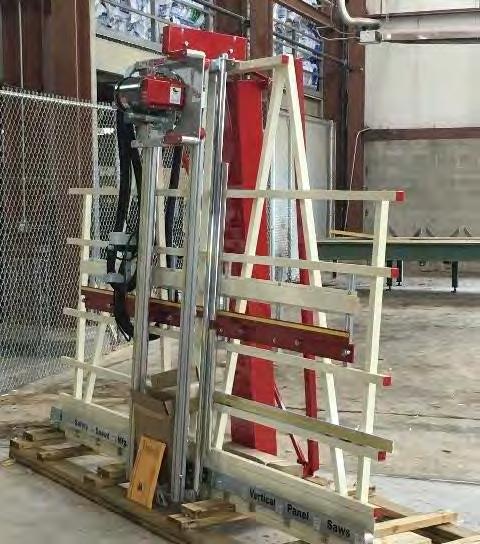
Safety Speed Cut Model 7000 Panel Saw
Safety Speed Manufacturing model 7000, vertical panel saw, 3 HP induction motor, 64 inch crosscut, 2 inch maximum thickness, accuracy within 1/64th of an inch, 10 foot welded steel frame with integrated stand and linear V-guides, enclosed counterweight system, adjustable vertical and horizontal rules. Quick changes from vertical to horizontal cutting. Includes machined aluminum material rollers, hold down bar, wheels, quick stop gauges and material hold downs. Dust collection ready. Options available include lower frame extensions, digital readouts, laser guide, stop bar, vacuum and midway fence. 208-230/460 volt, 3 phase electrical (208-230 single phase, 2 HP power optional +$100.00). $10,199 Base, FOB MN.
T+/- .010 Inches
Stop Rail: 2 x 4 x 1/4 Aluminum Extrusion
he Hain Systems Framer (HSF) will help you build square and accurate wall panels for residential or commercial construction applications. It will help you cut building costs by saving time and improving your quality. It’s a reliable, efficient and proven system that features a ruggedly simple design. The HSF is based on a proven design with over 20 years of actual production use and maintenance experience. It comes fully assembled and is designed for portable job site framing or in-plant permanent installation. The table has many optional attachments and will support Mylar Tape wall layout or any other type of layout. The optional gun rails can also be retro-fit to any table.
Stops: Jig Bored Steel
Stop Blocks: Machine Billet Aluminum
Details:
Internal Components: Hardened, Ground and Polished Steel and Billet Aluminum
Table Construction: Thick-wall Structural Steel Tubing, Jig Welded for Accuracy
Dimensions: Length: 5 feet (60”) to 60 feet (720”)
Height: 12 inches
Air Supply: 90 psi (10 CFM Air Flow Recommended)
Depth: 12 inches
Electrical Supply: 120 VAC
Powder Coat: Industrial Gray
Dimensions: Height: 43”
Length: 16’ or 20’
Width: Adjustable 8’ to 10’ or 8’ to 12’
Shipping Weight: 3000 lbs
If you are looking for the fastest, most consistent way to measure and cut your product, then the Hain Measuring System (MEA) is your answer. The MEA changes from one length t any length instantly, up to 60’, without changing the operator’s position on the line. It is also highly accurate (+/- .010) and quickly moves from one length to the next in seconds. The MEA is designed for quick and easy setup and is simple to use. Even a first time user will be productive with little or no training required. It can adapt to any saw and can be mounted to any surface so that you can integrate the MEA with your existing setup. The MEA is versatile allowing “left” or “right” handed operation and measurement in “feet and inches” or “inches” depending on your preference. The MEA is also available in a “Skid Mounted” version.

PHONE: 800-289-5627 FAX: 800-524-4982 Read/Subscribe online at www.componentadvertiser.com Don’t Forget! You Saw it in the Adverti$$er June 2024 #16299 Page #29 A dverti $ er Component manufaCturing m The SAWS 765-751-9990 www.woodtechsystems.com
NEW!
A S erving The
Electrical Supply: 110 VAC Motor: 1/4 HP, 110 VAC, Linear Actuator Highly Accurate: +/- .010 Inches Stop Rail: 2 x 4 x 1/4 Aluminum Extrusion Stops: Jig Bored Steel Stop Blocks: Machine Billet Aluminum Internal Components: Hardened, Ground and Polished Steel and Billet Aluminum Dimensions: Length: 5 feet (60”) to 60 feet (720”) Height: 12 inches Depth: 12 inches If you are looking for the fastest, most consistent way to measure and cut your product, then the Hain Measuring System (MEA) is your answer. The MEA changes from one length t any length instantly, up to 60’, without changing the operator’s position on the line. It is also highly accurate (+/- .010) and quickly moves from one length to the next in seconds. The MEA is designed for quick and easy setup and is simple to use. Even a first time user will be productive with little or no training required. It can adapt to any saw and can be mounted to any surface so that you can integrate the MEA with your existing theHAINCOMPANY 6125 Enterprise Drive, Unit 9 | Diamond Springs, CA 95619 530.295.8068 | sales@thehaincompany.com Electrical Supply: 110 VAC Motor: 1/4 HP, 110 VAC, Linear Actuator Highly Accurate:
BCE-MASTER

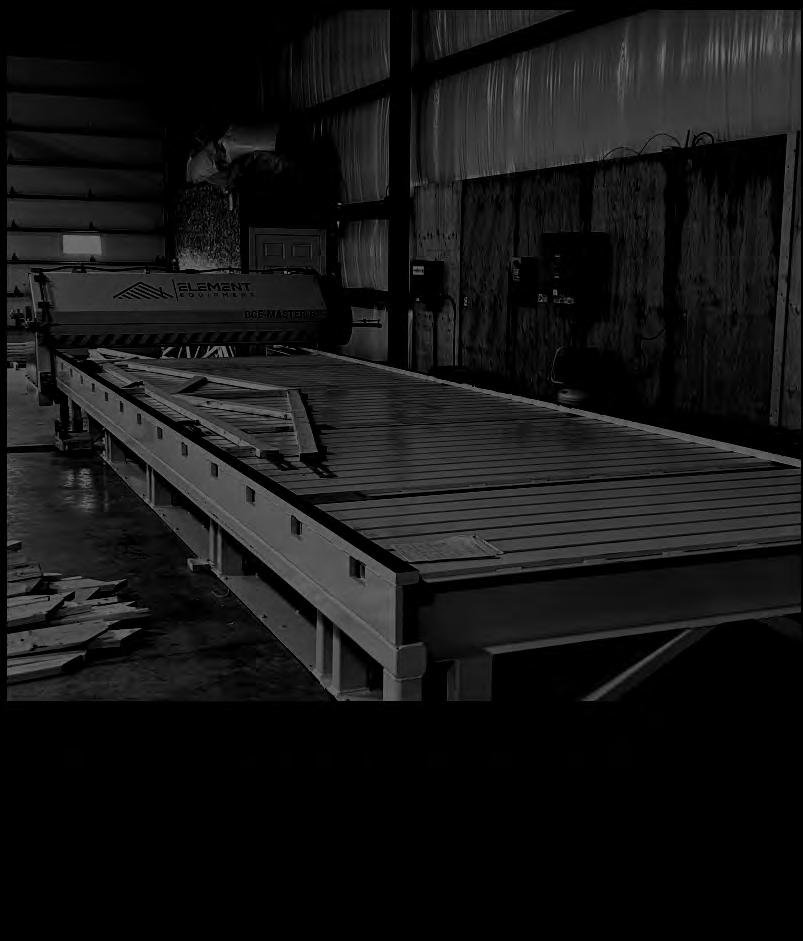


INTRODUCING THE ALL NEW AUTOMATiC OR MANUAL IN 8' & 10' WiDE
www.element-equipment.ca info@element-equipment.ca 1 (800) 799-4711
TOP
HEAVY DUTY TABLE
T-SLOT OPENING FOR JiGGiNG 20' TO 40' iN LENGTHS AT YOUR REQUEST
HERE
CONTACT US FOR MORE iNFO Our Latest Installation Project
Element Equipment a brand manufactured by GOW Group Inc. Experience the unparalleled expertise of our building components equipment manufacturing company, delivering top quality equipment built with the customer's needs in mind. SCAN
OR


The truss industry relies on 3rd party quality assurance services to provide random visits to review the plants Quality Assurance program along with their operations. If your plant needs to comply with the IRC, IBC and to those who depend on solid, experienced QA expertise, we ask you to consider selecting Timber Products Inspection, Inc. (TP) as your choice for 3rd party inspections.
Proudly serving the forest products industry for over 50 years, TP brings the expertise you need to ensure your business is successful. As a responsible partner, TP delivers to clients, employees, and the industries we serve the confidence to drive value through the effective use of our diverse professional team.
TP would like to welcome the following authorized agents to our inspection team, each of whom have many years of experience in the truss industry!
Al Coffman


Jean Hart
Curt Holler
Chuck Ray
Glenn Traylor
Elliot Wilson
If you have questions about how you can make this selection, please contact your authorized agent above or Glenn Traylor at 919-280-5905 or trusguy@gmail.com. https://www.tpinspection.com/ https://www.tpinspection.com/auditing-services/truss

Read/Subscribe online at www.componentadvertiser.com
•
•
•
•
•
•
 By Glenn Traylor
Does Fire Retardant Lumber Require Special Handling?
Fire retardant lumber, also called FRTW, is used when a project has a requirement to reduce the structures’ ability to burn and to reduce the structures’ contribution to the spread of fire. Most fire retardant materials also reduce the development of smoke and the release of hazardous gases in the event of a structural fire. Shown is an example of treated fire retardant lumber used for interior non-damp environments.
The use of FRTW lumber can increase a component manufacturers’ market, allowing them to participate in new segments of construction. To expand your market and start offering FRTW, however, you should begin by considering a few important aspects of its use and special handling issues that impact manufacturing. What special handling is required? Are there any special concerns? Can FRTW get wet?
Points to Consider

• FRTW can impact moisture content by absorbing moisture after its manufacture.
• FRTW is normally hygroscopic, that is, it attracts and holds water molecules through absorption from either direct contact or from the atmosphere.
• FRTW requires adjusted values when designing trusses. Most plate manufacturers reduce the allowable values for lumber of the same properties.
• Some fire retardant treatments can make lumber brittle; that means, using finish rollers may lead to breaks and may make the lumber unsuitable, so you should plan on having extra lumber to break.
PHONE: 800-289-5627 FAX: 800-524-4982 Read/Subscribe online at www.componentadvertiser.com Don’t Forget! You Saw it in the Adverti$$er June 2024 #16299 Page #33 A dverti $ er Component manufaCturing m The
Continued next page
• FRTW can increase potential corrosion of metal connectors. Shown is an example of corrosion attributed to wet installations.
• Unless labeled for exterior use, FRTW should not be subjected to excessive or prolonged exposure to moisture because this can affect the performance of the fire retardant treatment.
• In some cases, the project must be kept dry from your receipt of FRTW to your delivery of completed trusses.
• Some fire retardant chemicals have been suspected of contributing to rising rates of reproductive and endocrine problems, neurodevelopmental problems in children, and certain types of cancer; therefore, lumber should be controlled and a method for waste needs to be considered.
• For more information on “Fire-Retardant-Treated Wood and Alternative Methods,” see this previous article by Robert Glowinski, written when he was President and CEO of American Wood Council (AWC).
The Bottom Line

So, does FRTW require special handling? Absolutely, yes. Therefore, special efforts must be made to understand the specific precautions. This information should be available from your FRTW source. Some fire retardant wood can get wet, but not all. Wood that has been treated to control damp applications is designed to prevent water leaching, which removes needed chemicals or allows these chemicals to contribute to pollution concerns. This material should always be protected from excessive moisture. Some of the chemicals used to treat wood have been cited by health officials, so careful understanding of the specific product must be investigated to provide understanding of what PPE is required, how dust and waste should be handled, and what additional equipment limitations may exist. But once you understand the dynamics of FRTW, then you can begin offering it to your customers too.
An ANSI/TPI 1 3rd Party Quality Assurance Authorized Agent covering the Southeastern United States, Glenn Traylor is an independent consultant with almost four decades of experience in the structural building components industry. Glenn serves as a trainer-evaluator-auditor covering sales, design, PM, QA, customer service, and production elements of the truss industry. He also provides project management specifically pertaining to structural building components, including on-site inspections and ANSI/TPI 1 compliance assessments. Glenn provides new plant and retrofit designs, equipment evaluations, ROI, capacity analysis, and CPM analysis.
Glenn Traylor Structural Building Components Industry Consultant http://www.linkedin.com/in/glenntraylorPHONE: 800-289-5627 FAX: 800-524-4982 Read/Subscribe online at www.componentadvertiser.com Don’t Forget! You Saw it in the Adverti$$er June 2024 #16299 Page #34 A dverti $ er Component manufaCturing m The


Cutting & Material Solutions For Your Line!
Precise cutting up to 4-boards high! The ProCut™ UC Linear Saw Series is configurable to any assembly line; providing a safe, accurate way to cut your lumber, while keeping your materials moving on your line.
Maximize your output with ProCut™ Material Handling Systems
Load the ProCut™ with a stockpile of lumber strategically positioned near the Linear Infeed Conveyors. Select and arrange the materials according to their processing sequence. The lumber is then supplied to the ProDeck™ Lumber Infeed, where it gathers and is delivered to the sawyer for processing.
After being cut by the ProCut™, the material is transported to an accumulator where it is assembled and combined with all the other components required for the job. From there, the material is conveyed to the staging area at each truss assembly workstation. The staging areas at the table provide an uninterrupted supply of perfectly cut and organized material.
Enhance the efficiency of your plant by removing carts and reducing congestion in staging areas. By utilizing the ProCut™ saw along with the ProDeck™ and our Custom Material Handling Systems, you can customize a setup that optimizes the flow of precisely cut parts and materials, delivering them directly to your assembly stations.
The ProCut™ UC Linear Saw Series offers many variations to suit your plant and assembly line. Let us design a system for you.
ProCut™ UC Linear Saw ProDeck™ Auto 10 with WizardPDS® Automation Scrap Conveyor System Dust Collection Unit Safe Clean Accurate
UC LINEAR SAW SERIES ™
ProCut LLC www.procutsaws.com (612) 521-9193

LM I-Cut Package Cross Cut System

$116,995
$106,995 Location: OH
(Videos available here and here)
2017 LM Model “I-Cut” Package Cross Cut System S/N: 90917 – Heavy duty traveling saw carriage with a rigid engineered stationary steel frame to cut full-units of Wood-I’s, custom length studs, and other structural components. ( 48″x 52″ x 30′ maximum package). System includes: Saw Drive Assembly powered by a 15HP 220/460/575 3 Ph motor, 6″ DEP Stellite inlay saw bar, Automatic Bar/Chain Oiling System with a 3 Gallon reservoir, Take up assembly, and spring loaded idler wheel assembly, with vertical style saw bar drive assembly mounted using linear bearings, Electrical controls: NEMA 4 electrical enclosure, containing all necessary motor starters, relays and safety interlocks. All major electrical components are Allen Bradley industrial standard. Limit switches are mounted to turn off the saw motor at the bottom of the cut. Hydraulic Controls: Are powered by a 2HP Electric motor, directly coupled to a pump, return filter, relief valves, hoses and fittings. Options include: Laser Light, Digital Bi-Directional Readout, H.D. Waste Conveyors, single point dust collection (ducting only, cyclone unit not included)), high yield titanium carbide alloy saw bar.
System also includes a 2017 Double End-bump Rollcase S/N: 90817 as an integral part of package cutting. Hydraulically powered bed rollers are driven to pound the package of lumber against a reinforced steel face, to flush up one end that either eliminates or reduces end trims. System includes a full manual and all available spare parts. This unit serves an integral part of precision package cutting. The heavy duty steel fabricated main frame of the Rollcase is assembled with 10 bed rolls, machined from 5″ steel pipe. All ten (10) rolls are driven together with RC80 roller chain. Back up rolls are also mounted on the main frame to align the package squarely to the bumping surfaces. A hydraulic 40 gallon power unit delivering 20 GPM is used to power bed rollers that are driven to pound the package of lumber against a reinforced steel face, to flush up one end which either eliminates or reduces end trims. A variable speed drive allows for precision control during the bumping process. Includes 15 HP electric motor, motor starter, strainer, relief valve, return filter and all available accessories at the hydraulic unit. 230/460 volt, 3 phase electric power required.
PHONE: 800-289-5627 FAX: 800-524-4982 Read/Subscribe online at www.componentadvertiser.com Don’t Forget! You Saw it in the Adverti$$er June 2024 #16299 Page #37 A dverti $ er Component manufaCturing m The
765-751-9990 www.woodtechsystems.com
NOW


Equipment Solutions for the Offsite Construction Industry
X-COMBI | Complete Assembly Machine
A complete working station for the production of timber frame construction walls.
• Full PC control with two 19” touchscreens
• Automatic download from drawing software for interactive display of panel assembly framing
• Efficient and compact design, capable of manufacturing up to 200 prefabricated houses per year
Framing Cladding Nailing
Stapling Drilling Routing Application of Breather Paper Nailing of Batten Gluing
X-FLOC | Insulation Blowing Machine System
A fully automatic system used to fill prefabricated wall panels with cellulose, wood fibre, glass/rock wool, as well as composite materials.
• Full PC control with a 17” touchscreen
• Wall panel dimensions set in PLC to automatically calculate volume of material needed to fill cavity
• Compatible with all insulation materials available on the market
Insulating Nailing Stapling Routing Application of Breather Paper Nailing & Stapling of Battens


Building Trust. Creating Together.
Modular Building Automation designs and manufactures equipment for the offsite construction industry worldwide. A range of solutions available from individual machines and production lines to full modular factory setups.


www.akhurst.com | 1.888.265.4826 Akhurst Machinery Group

Saws
• Automated Component & Linear Saws (2010 & Newer)
• Monet DeSauw or TimberMill Manual Component Saws
• Floor Web Saws
• Spida (Apollo) Saws with Truss Automation
• Bunk Cutters
Truss Equipment
• Roller Gantry & Hydraulic Press Systems
• Finish Rollers
• Truss Stackers
• Floor Truss Machines
• Lumber Splicers
• Jack Tables
• C-Clamp Presses

2006 Alpine Speed Rafter Cutter
• Simplified compound cutting for hip, valley and jack rafters (double & single compound cuts)
• Two Worm-Drive Circular Saws (110 Volt / 30 Amps)
• Saw Turntable (for angle cutting)
• Saw Carriage (for up to 45 degree bevel cutting)
• Infeed & Outfeed Roller Conveyor with Stands
$4,900 NOW $4,250 FOB CA Wasserman & Associates 800-382-0329 www.wasserman-associates.com
Trucks & Trailers
• Stretch Roll-Off Trailers
• Go oseneck Roll-Off Trailers
Modular Equipment
• Pacific Automation or MiTek Mobile Home Press Contact Wasserman & Associates for a Fair Market Value Assessment of your Used Equipment Operational, Needs Work, and Parts Only equipment will be considered!

Whirlwind Model 1000 Cut-Off Saw
• 5 HP Motor with 14" Blade
• 2 3/16" x 8 1/4" Capacity
• Pneumatic Blade Guard/Lumber Clamp
• Foot Pedal Control
• Dust Collection Outlet
• 460 Volt / 3 Phase
• 1 Left Hand & 1 Right Hand Model Available
$3,500 NOW $2,800 Each FOB NC Wasserman & Associates 800-382-0329 www.wasserman-associates.com

Price: $229,000
FOB: ND

Don’t just do it, nail it. It’s a brand new day in wall-panel production, with a whole new way of doing things better.
Terminailer®, a revolutionary, event-driven, nailing machine that completely defies any preconceived notions about sub-component assembly.
Terminailer all but shatters the stereotypical myth that subcomponent equipment is essentially peripheral – unimportant. And it does so by quickly and accurately driving far more framing nails in your wall panel jobs than ever before. Whether in your shop or in the field, one operator sets the pace for production and quality. And that reduces labor costs and other aspects of overhead.
Terminailer is an event-driven, sub-component assembler that will quickly and accurately drive 30% to 70% of the framing nails in any wall panel job. In your shop or in the field, one operator sets the pace for production and quality. The Terminailer functions independent of design software, requires zero set-up time when switching between any configuration, and requires no special operator training.
The Terminailer is easy to move around the shop so it’s location can evolve as your shop evolves. With all of the nailing occurring in the closed main chamber, nail injuries and nail location miss-fires are eliminated, making your plant that much safer.
With nearly ten years of development from people that know machinery it is assembled to exacting standards, well supported, and it is easily maintained with shelf-item parts. Terminailer: vetted, tested, and ready to drive maximum productivity for you. Be sure to check out our videos below for a quick review of this revolutionary machine!
PHONE: 800-289-5627 FAX: 800-524-4982 Read/Subscribe online at www.componentadvertiser.com Don’t Forget! You Saw it in the Adverti$$er June 2024 #16299 Page #39 A dverti $ er Component manufaCturing m The A dverti$er Component manufaCturing S erving the S tructural B uilding c omponent S i ndu S try The 765-751-9990 www.woodtechsystems.com NEW!
Terminailer
800-382-0329 | www.wasserman-associates.com
Equipment Wanted!
SAWS
4,001,398

That’s the total trigger count from all six nail guns combined on an installed Terminailer.® For a machine that was a little over two years old, that is a big number; a real tribute to the durability of the machine’s components and engineering.
Yes, that number represents a pretty darn impressive mechanical milestone to be sure, but what is really impressive is that human hands were saved from millions of repetitive motions and potentially costly nailing accidents.

With just a sole operator, Terminailer drives a whole lot of improvement in efficiency and output. This amazing sub-component assembler quickly and precisely drives 30% to 70% of the framing nails in any wall panel job—be it batch, or just–in–time production. All with no complicated training, software or set-up time required when switching configurations. Add increased safety and easy maintenance with off-the-shelf parts, and you can see why Terminailer should be driving greater productivity in your plant.
Terminailer® and Terminailer XP Put things together like never before.


www.TERMINAILER.com 765-751-9990 Terminailer ® is a registered trademark of Construction Industry Innovations, LLC Copyright 2023 All Rights Reserved

2021 Powermatic Model 511 Panel Saw 2021 Powermatic model 511 panel saw. Vertical panel saw features a powerful 3HP worm-drive motor which rotates in the carriage, adding the versatility to perform rip cuts. The solid aluminum rollers assure smooth feeding of stock and perfect 90° cuts every time. This saw will handle panels up to 5-ft tall in unlimited length. Includes horizontal and vertical scales and casters for mobility, the counterweight system keeps the saw carriage in the desired position when loading or unloading panels. Features dual 4″ dust collection ports with nylon brush surrounding the blade for superior dust collection from the front and the rear side of the panel. 115v, 1-phase electrical required.
$6,799 FOB AZ
Wood Tech Systems
765-751-9990
www.woodtechsystems.com

2023 Northfield Model 410 Upcut Saw NEW 2023 Northfield model 410 upcut saw available for immediate shipment. 90/90 degree cuts to 4″ x 10″ capacity (fence forward position) to 2″ x 14″ (fence rearward position). Saw is configured for material from left to right, with 3″ x 6″ air operated cylinder, filter, regulator, lubricator, 10 HP motor, enclosed steel base with cast iron table, magnetic starter and adjustable operating speed from 20 to 60 CPM. Includes optional two-palm controls, additional 4″ dust outlet, NEMA 12 electrics with fused disconnect and two 18″ diameter 60 tooth blades with 1″ diameter bore. 460 volt, 3 phase electrical required.
$18,630 FOB MN
Wood Tech Systems
765-751-9990
www.woodtechsystems.com

Time To Hire?
We’re here when you need help! visit: www.thejobline.com email: twm@thejobline.com STRICTLY CONFIDENTIAL!

2008 Alpine PF90 Wall Panel Saw 2008 Alpine PF 90 wall panel cutting and marking system. 3.5″ x 12″ maximum cutting profile, Inkjet option, cuts to 16 ft long. From the OEM’s literature, “Effortlessly handles two of the most critical and difficult processes in any wall panel operation – plate cutting and panel layout. At the rate of 1,000 linear feet per hour or more, uses data from the design software and accurately marks stud, cripple and jack locations, job and panel number, subcomponent and window/door locations, and even sheathing locations on both top and bottom plates simultaneously with ink-jet printing.
$8,499 FOB NY
Wood Tech Systems 765-751-9990 www.woodtechsystems.com


Monet DeRobo Linear Saw
New, DeRobo linear saw by Monet organizes "fill" boards to increase optimization of each board, can produce unlimited scarf cuts, cuts 1 or 2 boards at a time and cuts webs, chords, wedges, rafters and open-stair stringers. Works with all major connector plate manufacturer's software. Features include 22 inch blade, left-to-right feed direction standard, lumber push and pull grippers for more accuracy, ink marking on the 1 1/2" face of the incoming boards and small piece capture and delivery to the front of the saw for easy access. Infeed deck and bunk feed are shown as options only. 480 volt, 3phase.
www.woodtechsystems.com
PHONE: 800-289-5627 FAX: 800-524-4982 Read/Subscribe online at www.componentadvertiser.com Don’t Forget! You Saw it in the Adverti$$er June 2024 #16299 Page #41 A dverti $ er Component manufaCturing m The REPRESENTATIVES 765-751-9990 www.woodtechsystems.com
New
$232,000, FOB MO. NEW! A dverti$er Component manufaCturing S erving the S tructural B uilding c omponent S i ndu S try The Hiring Zone Building Component Industry's Job Board Employer to Candidate Direct Hiring No Recruiting Fees! Post your Opportunity... Candidates respond directly to you! For Additional Information Contact: twm@componentadvertiser.org or Call: 800-289-5627 x1 Visit our website: www.componentadvertiser.com/Hiring-Zone
SAWS
NEW!
New
Measuring
Video
Hain Company Micro Mini
System
Here $3,499 FOB CA Wood Tech Systems 765-751-9990
800-289-JOBSJobLine.com, inc.
The

Automation Elements That Can Benefit Any Size Truss Plant
Do you think your plant is too small to be able to capture additional efficiencies? Or, maybe you’re satisfied with the growth your plant has experienced and you think you’ve attained an effective production system. Whether your plant is small, large, or somewhere in between, you can likely still benefit from additional automation.
The adaptability of the automation elements of a Fully Loaded RetroC system has been proven to profitably feed all sizes of truss plants. The Enventek automation elements have been honed and optimized for efficiency and robust low maintenance. The reliable, accurate, and productive workflow continuity of a Fully Loaded RetroC can benefit both small to medium-sized truss plants and large truss plants, existing or green field.
The automation elements are simple: “Pick the Lumber, Cut the Lumber, and Catch the Lumber.” The software that drives the system is sophisticated yet simple for the lumber picker and for the RetroC sawyer. Essentially this results in a two-worker system to feed multiple truss build tables as the catching of lumber is automated with the SpeedCatch auto-fill cart system.
Large Truss Plants
• In larger truss plants with higher production volumes, two sideby-side RetroC systems can further enhance efficiency and workflow continuity.
• By utilizing multiple RetroC systems simultaneously, the plant can handle larger quantities of collated cut lumber and maintain a consistently high production rate.

A birds’ eye view of two side-by-side RetroC saws from the auto-feed lumber conveyors in the foreground and the sea of auto-fill carts in the background
• The redundancy provided by having two RetroC systems ensures that production can continue smoothly even in the event of maintenance or downtime of one system.
• Overall, the use of two RetroC systems allows large truss plants to scale their operations effectively, meeting the demands of a larger market while maintaining efficiency and reliability.
PHONE: 800-289-5627 FAX: 800-524-4982 Read/Subscribe online at www.componentadvertiser.com Don’t Forget! You Saw it in the Adverti$$er June 2024 #16299 Page #42 A dverti $ er Component manufaCturing m The Edmond Lim, P.Eng. LimTek Solutions Inc. Continued next page
Small to Medium-Sized Truss Plants
• For smaller operations, a single Fully Loaded RetroC system can efficiently handle the process of handling collated cut lumber and delivering it to the truss build tables.
• The system’s optimization for efficiency ensures that the plant can maintain a smooth workflow, maximizing productivity while minimizing the need for excessive manual labor.
• By streamlining the handling and delivery of lumber, the RetroC system enables small to medium-sized truss plants to meet production targets more effectively and compete with larger competitors.
The goal of the RetroC’s sophisticated software is to increase truss build productivity by organizing lumber in front of the build tables. In the photo, note the mix of organized and staged lumber including 2x12 and 2x8 Southern Yellow Pine on this half of a run of 20 attic trusses.
With Any Saw
Whether for small to mediumsized truss plants or large-scale operations, the Fully Loaded RetroC system offers a flexible and optimized solution for handling collated cut lumber and facilitating efficient truss building. Its adaptability to different plant sizes underscores its versatility and effectiveness in the truss manufacturing industry.
But, did you know that an Enventek Lumber PickLine (automation element) can be configured to feed any automated saw? That means that any truss plant with an existing automated saw can potentially increase cut piece output and upgrade cutting schemes to better organize cut lumber for truss building.


PHONE: 800-289-5627 FAX: 800-524-4982 Read/Subscribe online at www.componentadvertiser.com Don’t Forget! You Saw it in the Adverti$$er June 2024 #16299 Page #43 A dverti
Component manufaCturing m The
$ er
A Lumber PickLine with a MiTek Blade saw
Continued next page
Efficiently organized lumber at the build table
You can efficiently “Pick the Lumber” for any linear saw, reclaim saw idle time, and upgrade cutting schemes all while saving cost by reducing the amount of expensive forklift lumber picking. Likewise, you can feed any automated component saw collated lumber with a Lumber PickLine. Although all five-bladed automated component saws can set up within 5 to 20 seconds, most automated component saws are still being run with “batch cutting” schemes in order to maximize saw output (at the expense of truss build productivity). Even so, you can leverage the quick setup capabilities of an automated component saw by integrating a Lumber PickLine to enable a component saw to “cutby-truss” which will enhance both “cut-by-truss” and “batch cut” schemes.

Integrating an Enventek Lumber PickLine with an existing automated saw can significantly enhance both the output and organization of cut pieces in front of truss build tables.

When you’re ready to Feed Your Beast and see these efficient and effective systems for yourself, let us know! Inside and out, LimTek Process Organization Technology will help you squeeze out more truss production and deliver quality trusses with shorter lead times to better service your customers by organizing your truss fabrication processes to maximize your investment in automation. https://limteksolutions.com/#solutions

PHONE: 800-289-5627 FAX: 800-524-4982 Read/Subscribe online at www.componentadvertiser.com Don’t Forget! You Saw it in the Adverti$$er June 2024 #16299 Page #44 A dverti $ er Component manufaCturing m The
A Lumber PickLine with an Alpine ALS 4.0 saw

· Simplified Re-Design
· Robust low maintenance
· No upper hold downs
· Electronic braking
· Auto feeding lumber
· Holds calibration
· Out cuts any linear saw
· Cut-by-Truss or Batch cut


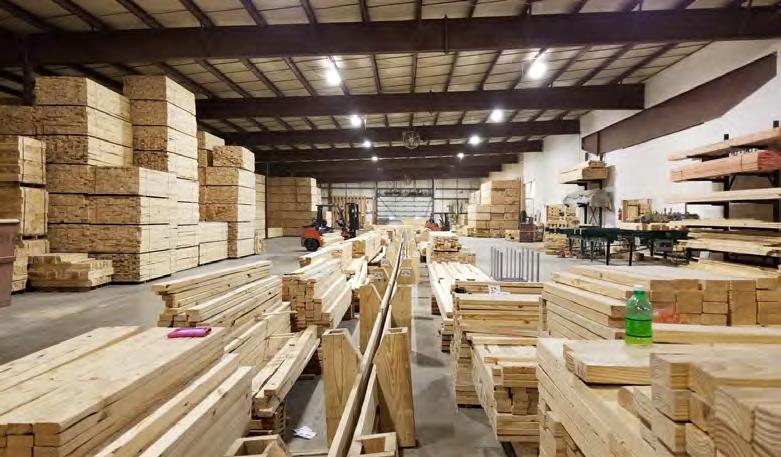

6021 Yonge St., Unit 1019 Toronto, ON M2M 3W2 Tel: (416) 888 -4457 Edmond.Lim@LimTekSolutions.com LimTekSolutions.com
Welcome to the Rolsplicer Generation II
Designed to efficiently splice two pieces of lumber together, handling 2x4 or 2x6. It uses nail plates to create chords for floor trusses, or where required longer top and/ or bottom plates for walls. The Rolsplicer has been updated and is now stacked with more benefits:
ENHANCED SAFETY FEATURES GREATER ALIGNMENT EASE OF USE

Visit our website to learn more and to see the capabilities of the Rolsplicer in action.
spida.com E sales@spida.com T +1 866 647 7771


$315,000 Location: MO

New, Monet DeSawyer 2000, computerized, five-bladed component saw, sets up in 15 to 17 seconds, can run in manual mode, downloads projects from a network or manually using display screen controls. Features all powered movements, cuts from 15" 90/90 cuts to 20 foot length, 2 x 3" to 2 x 12" lumber depths and internal brakes are standard. Options include enhanced servo controls featuring autocalibration, catcher's display and either shaker or belt scrap conveyor and incline. 440 volt, 3 phase electrical.
PHONE: 800-289-5627 FAX: 800-524-4982 Read/Subscribe online at www.componentadvertiser.com Don’t Forget! You Saw it in the Adverti$$er June 2024 #16299 Page #47 A dverti $ er Component manufaCturing m The 765-751-9990 www.woodtechsystems.com NEW!
New Monet DeSawyer 2000 Component Saw
Training. Support. Partnership. Experience service as a solution.

Strong businesses thrive on solid relationships. Working with Simpson Strong-Tie, you have direct access to dedicated professionals who are focused on customer success.
As part of our services, experienced designers and licensed engineers take the time to listen and understand your unique project challenges. We also offer accredited training on truss connectors and comprehensive training on our design and management software. Plus, our innovative products are widely available and backed by expert service and support. It all adds up to solutions that are every bit as reliable as the people behind them.
Team up with a proven industry partner. To learn more, visit go.strongtie.com/componentsolutions or call (800 ) 999-5099.
© 2024 Simpson Strong-Tie Company Inc. TRUSS23-SERV Integrated Component Solutions | Products, Software and Service for Smarter Building
TheJobLine.com
Truss Design & Estimating Manager
J15332
Our client is a growing floor and roof truss manufacturing company who provides high quality trusses, lumber, and provides responsive and exceptional customer service. Skilled and educated, the Truss Design Manager works full-time hours in the office. This position collaborates with sales, dispatch, estimating and production teams to ensure designs are successful and properly delivered to customers.
• At least five years of truss design experience and two years of design management experience; or seven years of combined education and experience.
• Experience managing truss design projects preferred.
• Great leadership skills to deliver clear and consistent feedback to their team members.
• Deadline management.
• Ability to articulately write reports and correspondences.
• Mathematical skills in all units of measurements using whole numbers, common fractions, percentages and ratios.
• Ability to define problems, collect data, establish facts, and draw valid conclusions.
• Prior experience using truss planning and designing software.
• MiTek experience is required.
• Coding and IT knowledge is a plus.
• Superior communication skills to deliver messages effectively and efficiently.
Compensation: Salary $130-150k DOE.
Complete benefits schedule is available for review to qualifying candidates.
Relocation assistance and interim housing expenses are negotiable.


PHONE: 800-289-5627 FAX: 800-524-4982 Read/Subscribe online at www.componentadvertiser.com Don’t Forget! You Saw it in the Adverti$$er June 2024 #16299 Page #49 A dverti $ er Component manufaCturing m The See what we can do for YOU! visit: www.thejobline.com email: mail@thejobline.com STRICTLY CONFIDENTIAL!


SPEEDWORX AUTOMATED PANEL SAW 4 Second Rip Cuts 4 Second Rip Cuts www.ROGworx.com Sales@ROGworx.com 833-ROG-WORX (764-9679) Watch it in action by scanning the QR code
and Auto-Nesting and Auto-Nesting
AutoFill button for Maximum Material Utilization
Labels parts as they cut. (printer optional)
Easy manual cuts and re-cuts
Import files from most major design suites
Industry-first sheathing saw that cuts angles.
Cuts OSB, CDX, Zip, Dense Glass and more.
Minimal airborne dust, even while cutting gypsum.

IF ONLY YOU COULD NAIL EVERYTHING IN LIFE THIS EASILY.

With a Terminailer XP, it takes only one person to drive between 30% and 70% of the framing nails in any given job . And all this nailing is done within a secure enclosure, so your people are protected from costly nailing injuries while eliminating literally millions of repetitive motions ( 4,001,398 repetitive motions to be exact , judging from the total nail count tallied recently on a two year-old Terminailer XP).
That’s a lot of nails successfully installed to be sure, and a lot of debilitating repetition your workers’ hands are spared, without any complicated training, software or lengthy setup time required.


Developed by people who know wall panel production, Terminailer XP boasts multiple repeat buyers, 20-plus machines performing exceptionally in the field and tens of millions of nails installed. Thoroughly field-proven, Terminailer is ready to drive greater productivity for you. Contact us today for more information.
765-751-9990 www.woodtechsystems.com
Wood Tech Systems is a registered trade name of Wood Truss Systems, Inc.
 Carl Villella, CLFP President, Acceptance Leasing & Financing Service

The Interest Rate Watch
If you are considering financing equipment at this juncture, you may be concerned about where interest rates are headed. You may be wondering if perhaps it might be better to wait until rates drop before you take that step to finance.
Darrell R. Spence, an economist with 31 years of experience who writes for the Capital Group, states that while the next step for the Federal Reserve will most likely be to cut interest rates, it is in no rush to do so.
Spence points out that the U.S. economy continues to grow at a healthy rate despite the rises in interest rates that the Fed has made. While inflation has slowed over the past several months, it is still not near the Fed’s inflation target rate of 2%. And going from around 3% where it is now to 2% will be the tough part. There’s no need to drop rates until inflation comes closer to hitting that target.

Something to think about: If you are waiting for interest rates to drop before financing, you may have a while to wait. And while waiting, you may miss your opportunity to integrate new or used equipment into your business to grow. Consider this point: Rates are still low by historical standards, and if you are considering terms of five years (the usual terms our clients request), the average monthly payment will only be minimally higher than if you wait for an interest rate cut.
What’s important is that the equipment you’re financing helps grow your business by taking advantage of market opportunities.
Talk to us about your needs at this point. We have lending programs that can work to your benefit. Call us today at 412 262-3225 to see how we can help.
We are Acceptance Leasing and Financing Service, Inc. We are in our 32nd year of business in 2024. Established in 1992, we pride ourselves on our Certified Leasing and Financing Professional designation. We are a member of SBCA and a frequent attendee of the BCMC tradeshows. We can provide financing for any new and, regardless of age, used equipment.
PHONE: 800-289-5627 FAX: 800-524-4982 Read/Subscribe online at www.componentadvertiser.com Don’t Forget! You Saw it in the Adverti$$er June 2024 #16299 Page #53 A dverti $ er Component manufaCturing m The
From plans, to walls, to panels, and everything above. Introducing a new level of design tools, built from the ground up. Design and build faster than ever. Learn more a t EagleMetal.com

Monet FWA 500 CA Automated Floor Web Saw
In answer to the demands of high-volume customers comes the Monet DeSauw FWA 500 CA (Automated Controls) floor web saw. The 500 CA is perfect for component manufacturers who routinely run floor trusses in high volumes with variable web geometry. Another primary feature is enhanced safety through automation which eliminates the need to open the saw motor cabinets other than for periodic service. The 500 CA includes automation for all blades, including the fixed cut-off blade for minimal waste. Lumber infeed speed is variable up to sixty (60) boards per minute, while the powered carriage utilizes rack and pinion drive with airlock for set accuracy throughout the production run. Your operator will easily download batches to the 500 CA saw from your design software via an ethernet connection to a MS Windows 10 industrial PC with a 17″ monitor housed in a stand-alone console. If you frequently batch floor web cutting, and if enhanced safety with increased productivity are a concern, then an automated Monet FWA 500 CA may be the right selection for you. Mofe information Here

PHONE: 800-289-5627 FAX: 800-524-4982 Read/Subscribe online at www.componentadvertiser.com Don’t Forget! You Saw it in the Adverti$$er June 2024 #16299 Page #55 REPRESENTATIVES 765-751-9990 www.woodtechsystems.com
NEW!
IF ONLY YOU COULD NAIL EVERYTHING IN LIFE THIS EASILY.
With a Terminailer XP, it takes only one person to drive between 30% and 70% of the framing nails in any given job . And all this nailing is done within a secure enclosure, so your people are protected from costly nailing injuries while eliminating literally millions of repetitive motions ( 4,001,398 repetitive motions to be exact , judging from the total nail count tallied recently on a two year-old Terminailer XP).
That’s a lot of nails successfully installed to be sure, and a lot of debilitating repetition your workers’ hands are spared, without any complicated training, software or lengthy setup time required.
Developed by people who know wall panel production, Terminailer XP boasts multiple repeat buyers, 20-plus machines performing exceptionally in the field and tens of millions of nails installed. Thoroughly field-proven, Terminailer is ready to drive greater productivity for you. Contact us today for more information.
765-751-9990 www.woodtechsystems.com
Wood Tech Systems is a registered trade name of Wood Truss Systems, Inc.

Time To Hire?
We’re here when you need help! visit: www.thejobline.com email: mail@thejobline.com STRICTLY CONFIDENTIAL!


Safety Speed Manufacturing Model 7400 XL Panel Saw
Safety Speed Manufacturing, model 7400 XL*, vertical panel saw, 3 HP induction motor, 64 inch crosscut, 2 1/8" maximum thickness, accuracy within 0.005 inches, 13 foot long welded steel frame with integrated stand and linear V-guides, enclosed counterweight system, adjustable vertical and horizontal rules. Quick changes from vertical to horizontal cutting. Includes machined aluminum material rollers, hold down bar, wheels, quick stop gauges and material hold downs. Dust collection ready. Options available include digital readouts for vertical cuts, automated length measuring, laser guide, stop bar, vacuum and midway fence. 208-230/460 volt, 3 phase electrical (208-230 single phase, 2 HP power optional +$100.00). $14,499




PHONE: 800-289-5627 FAX: 800-524-4982 Read/Subscribe online at www.componentadvertiser.com Don’t Forget! You Saw it in the Adverti$$er June 2024 #16299 Page #57 A dverti $ er Component manufaCturing m The 800-289-JOBSJobLine.com, inc.
The 765-751-9990 www.woodtechsystems.com NEW!
Base FOB MN New Monet DeWall Saw Monet DeWall 90/90 wall panel marking saw is a computer numeric controlled wall panel saw with touch screen user interface. Cuts and marks up to 2 boards at a time using 2x4 through 2x8 or cuts and marks one board at a time. Call for pricing, FOB MO NEW! 765-751-9990 www.woodtechsystems.com SAWS A dverti$er Component manufaCturing S erving the S tructural B uilding c omponent S i ndu S try The Used - Alpine Jack Rafter Cutter Parts Machine $500 – Make Offer Eide Machinery Sales, Inc. 612-521-9193 www.eidemachinery.com 800-382-0329 | www.wasserman-associates.com 2005 Omni Miser RTWF Saw • Model RTWF (Automated a Truss & Wall Panel Cutting Saw) • 5 HP Motor with 16" Blade (cuts 2x3 through 2x12 up to 20' in length) • Ink Jet Printer (One Face) • Incline Live Deck • 5 Magazine Feeders - (3) 2x4 and (2) 2x6 • Bunk(Bulk) Feeder • Computer with Enclosure & Stand • Price is in US Dollars $40,000 FOB BC
To achieve greater gains in your offsite construction facility, consider the powerful thinking and automated component manufacturing products offered by House of Design. Our collaborative process ensures solutions uniquely suited to your needs, all created with an eye toward maximizing efficiency, precision, quality and safety. Whether it’s roof and floor preplating, floor truss systems, wall panel openings and framing or our automated material distribution systems and solutions for modular factory builds.

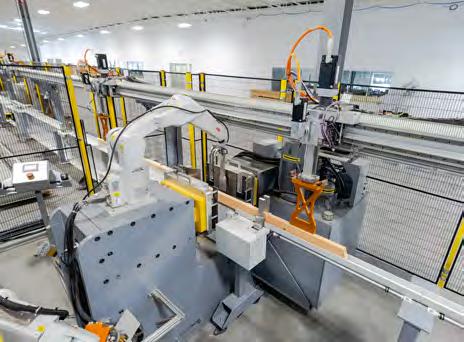
You’ll discover new ways to dramatically improve your process and throughput. From fully automated lines to modular cell applications, House of Design has the right solution for you. And if we don’t, we’ll create it. Contact the informative team representing us at Wood Tech Systems today to learn more.


EXPERIENCE IMPRESSIVE GAINS WITHOUT MOVING A MUSCLE AT ALL. 765-751-9990 www.woodtechsystems.com Wood Tech Systems is a registered trade name of Wood Truss Systems, Inc.

New Monet DeSawyer ESC (Servo Controlled) Component Saw
Monet DeSauw model Desawyer ESC enhanced servo-controlled ( ESC) component saw with touch screen user interface with backup mechanical controls. Includes three operating modes: Auto (download setups from LAN or USB), Semi-auto (touch screen setup entry), and Manual (backup push-button switches for powering all movements). Includes over-travel protection, comprehensive setup screens, auto sequencing, auto-calibration and pneumatic brakes on all five () blades. One (1) 30” blade and four (4) 16” blades. Manual cut limits are 18” min., 11” min. square edge blocks, 20’ max cut. Belt under-saw waste conveyor. Voltage: 480 volt/3 phase/60 Amp. Air: 50 PSI at 5 CFM. One-year warranty included. Can be paired with a model PD-6 lumber feed system at an additional cost. Heavy duty 80 RIV chain feed system. 16’ wide x 20’ long x 36” deck height. Transfers 3’ to 20’ lumber. Includes auto-feed control, foot pedal override, forward & reverse, variable speed control with HD double-bearing construction. Other additional-cost options include, inkjet marking, label printing, backside screen display, spare blades and incline scrap conveyor.
$349,900 FOB MO
PHONE: 800-289-5627 FAX: 800-524-4982 Read/Subscribe online at www.componentadvertiser.com Don’t Forget! You Saw it in the Adverti$$er June 2024 #16299 Page #59 A dverti $ er Component manufaCturing m The NEW! 765-751-9990 www.woodtechsystems.com


RANGER RS is a trademark of ACER INC The RANGER RS system is protected under U.S Patent #8,960,244 and other patents pending Acer Inc. 301 Industrial Drive Rushford, MN 55971 A 115 ' (35m ) Tandem Ranger Retrieval System set up for testing at the Acer plant . Ace r G o e s T h e L e ngt h 507-864-2220 www.acerinc.com From engineering to production and final testing , we pay attention to the details to build productive machinery for your plant . Ranger Retrieval Systems install quickly and feed your linear saw reliably for years .


PHONE: 800-289-5627 FAX: 800-524-4982 Read/Subscribe online at www.componentadvertiser.com Don’t Forget! You Saw it in the Adverti$$er June 2024 #16299 Page #61 A dverti $ er Component manufaCturing m The 800-382-0329 www.wasserman-associates.com 2013 Monet DeSauw Finger Jointing Line
Monet DeSauw Cut-Off/Shaper Unit
Rook Metering Equipment Glue Machine ($22,900 New in 2021)
Monet DeSauw Finger Joint Press • Excludes Dust Collection System $52,900 NOW $42,500 FOB MO
•
•
•
 By Greg Bates
Why West Fraser is the Most Trussed Name in Lumber
As North America’s largest lumber manufacturer, West Fraser supplies the truss market with mechanically graded lumber, dimension lumber, and premium products such as Prime, Select Structural, and HiLine.
Founded nearly seven decades ago
West Fraser began operations in 1955 when brothers Sam, Bill, and Pete Ketcham founded a small planing mill in Quesnel, British Columbia, Canada. The trio went on to develop mills throughout the region. Today, West Fraser is the largest wood products manufacturer in the world, with over 60 mills in the US, Canada, the UK, and Europe. Our entire product line is derived from responsibly sourced and sustainably managed forests, and is used in home construction, repair, and remodeling.
Mechanically graded lumber
North American truss manufacturers have come to rely on West Fraser for a steady supply of mechanically graded lumber to manufacture high-performing roof and floor trusses. Of West Fraser’s 32 North American lumber mills, 14 produce machine stress-rated lumber (MSR) and machine evaluated lumber (MEL), using both SYP and SPF.

Machine-graded lumber: The finer points
West Fraser was one of the first lumber manufacturers to move from visual grading to machine grading over 20 years ago. Visually graded lumber is assessed by humans who visually inspect each piece for defects and grade it accordingly, based on predetermined standards. In comparison, machine-graded lumber is evaluated using automated systems that utilize sensors and algorithms to measure characteristics such as density, moisture content, and knot size to assign a grade. Machine grading also tends to result in greater consistency and speed than human inspection. Regardless of how your lumber is graded, each piece of lumber is grade stamped, indicating its grade, dryness, mill number, and accrediting agency.
PHONE: 800-289-5627 FAX: 800-524-4982 Read/Subscribe online at www.componentadvertiser.com Don’t Forget! You Saw it in the Adverti$$er June 2024 #16299 Page #62 A dverti $ er Component manufaCturing m The Continued next page
Engineered wood: A long legacy of leadership and innovation

Oriented strand board (OSB) is a significant component of West Fraser’s product offering. Our company pioneered taller panels, beginning with 9’ and 10’ TallWall in 1996, followed by Windstorm and QuakeZone, engineered for high-wind and seismic areas, respectively. These three brands revolutionized homebuilding, not just by addressing geographical considerations, but by dramatically reducing net costs in build time, materials, labor, and waste.
Meeting your needs
Builders, engineers, component manufacturers, and contractors all count on West Fraser to supply their businesses and fuel their growth. The company’s focus on consistent quality, value, and managing a stable supply chain across North America underscores everything it makes and does for our valued customer base. For more information on how our products can meet your needs, please contact us at 916-276-7226 and/or gregory. bates@westfraser.com

PHONE: 800-289-5627 FAX: 800-524-4982 Read/Subscribe online at www.componentadvertiser.com Don’t Forget! You Saw it in the Adverti$$er June 2024 #16299 Page #63 A dverti $ er Component manufaCturing m The
· Simplified Re-Design
· Robust low maintenance
· No upper hold downs
· Electronic braking
· Auto feeding lumber
· Holds calibration
· Out cuts any linear saw
· Cut-by-Truss or Batch cut
6021 Yonge St., Unit 1019 Toronto, ON M2M 3W2 Tel: (416)
Edmond.Lim@LimTekSolutions.com LimTekSolutions.com
888 -4457

• 3 3/8" Maximum Thickness
• 13 1/2" Maximum Distance from Rip Fence to Outer Saw
• 100 HP Arbor Motor
• 2 HP Feed Motor
• 7 1/2 HP Dust Collector
• 480 Volt / 3 Phase
• Waste Conveyor with Short Incline $35,000 NOW $21,900 FOB MN Wasserman & Associates 800-382-0329
www.wasserman-associates.com

2005 PCS / MiTek Twin Axis Sheathing Saw 2005 PCS/MiTek Twin Axis sheathing saw: Cuts X and Y axis simultaneously in one pass through the saw. Cuts up to 1″ thick, wood sheathing material, minimum width 3″. Fully enclosed to reduce noise, dust, and improve operator safety; automated via downloaded sheathing cutting files from wall design software. Includes 8 foot long idler infeed conveyor and outfeed conveyor with pop-up skate wheels, (1) spare blade and all available spare parts. 220v/440v, 3phase electrical saw, 120v, 1 phase electrical PC. 100 PSI at 14 CFM air required.
$17,991 NOW $11,950 FOB VA Wood Tech Systems 765-751-9990 www.woodtechsystems.com

•
•
• 4" Maximum Thickness (when using 18" Blade)
• 48" Throat
• Adjustable Rip Fence
• Overhead Holddown
• Automatic Chain Oiler
• Dust Outlets $10,500 FOB MI

Custom 3-Arm Infeed Decks
Two custom-built powered infeed decks, 3-arms each, 12′ x 12′ footprint each, touchpad controls and chain conveyors. One deck has a 5 HP drive and the other has a 10 HP drive. 480 volt, 3-phase electrical required.
10 HP price is $7,993 & the 5 HP price is $6,993. Wood Tech Systems 765-751-9990 www.woodtechsystems.com

2021 Oliver Upcut Saw with 16' TigerStop
• Oliver Model 5025.002 Upcut Saw
• 7.5 HP / 230 Volt - 3 Phase
• 18" Blade (4" x 9", 2" x 12" Capacity)
• Foot Pedal Control
• Open Interface to TigerStop (SET)
• 16' TigerStop (TS16) with 18' Roller Table (TABR16)
• Saw Attachment Plate (SAP) $19,900 NOW $18,900 FOB TX Wasserman & Associates 800-382-0329
www.wasserman-associates.com

PHONE: 800-289-5627 FAX: 800-524-4982 Read/Subscribe online at www.componentadvertiser.com Don’t Forget! You Saw it in the Adverti$$er June 2024 #16299 Page #65 A dverti $ er Component manufaCturing m The A dverti$er Component manufaCturing S erving the S tructural B uilding c omponent S i ndu S try The SAWS EKSTROM-CARLSON MODEL E STRAIGHT
RIP SAW
LINE
10 HP Arbor Motor
3 HP Variable Speed Feed
DANCO
Wasserman & Associates 800-382-0329 www.wasserman-associates.com
GANG-RIP SAW
Start smarter... Grow faster... Achieve more... cvillella@acceptlease.com | www.acceptlease.com 894 Beaver Grade Road, Suite #304 - Moon Township, PA. 15108 Phone: 412-262-3225 Fax: 412-262-1154 Keep More of Your CASH Eliminate Yearly Financial Reporting Low Fees Fixed Payment Programs No Additional Collateral Now offering short term Working Capital Loans “Serving the Component Industry Since 1996” Start smarter... Grow faster... Achieve more... Price Reduction! 800-382-0329 | www.wasserman-associates.com 2005 Alpine AutoMill SC Component Saw • Model 348B • Automated Setup via Download or Semi-Automated Setup via Touch Screen Input • 23 Axes of Automation Sets up in 2 to 15 Seconds • Five Blades cut 2x3 thru 2x12 up to 20' • Waste Conveyor (under saw) • Incline Waste Conveyor (adjacent to saw) • Excludes: Live Deck (in front of saw) • 480 Volt / 3 Phase • Available March 2024 $40,000 NOW $22,900 FOB CO


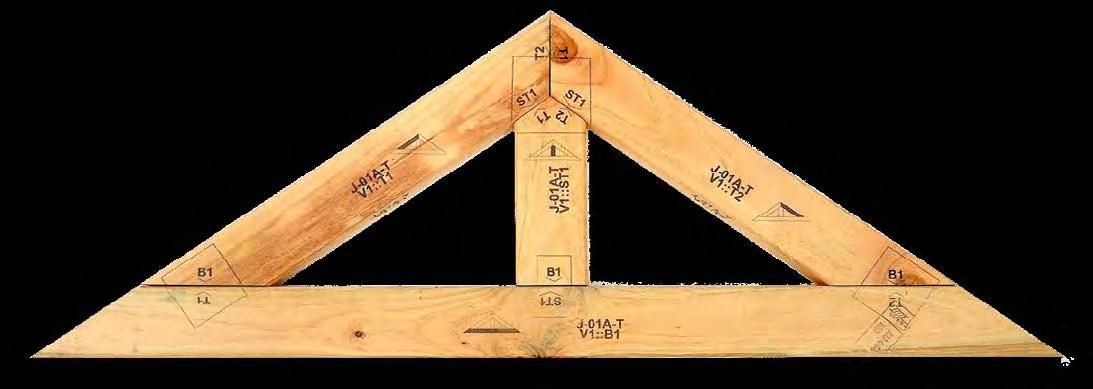

2001 MiTek Peak-Up Stacker (A)
2001 MiTek peak-up, vertical truss dual stacker system Model 71300 Mechanical only system includes (2) heavy-duty drives, auto-indexing, spring assisted receiver arms, holds up to 30 trusses from 16 foot to 80 foot in length, up to 14 foot height, with 40 sec. average cycle time. System control panel (NOT included) controls two separate setups or both units for long-span trusses. Arms work in sets of four adjacent arms or all eight arms at once per side. Includes (8) lifting arms, (8) stacking arms, (2) bridge targets, and (2) stacker units. Moveable activating starts the cycling process, bundle indexes back 1 1/2″ as each truss is stacked. NO conveyors or control panel is included. (Control Panel from OEM/Mii required at approximately $8,500) 230v, 3Ph electrical required. (Can be combined with the second system listed here to create opposing stackers for a double gantry line with a common center out-feed conveyor).


$24,900 Each FOB IL
2001 MiTek Peak-Up Stacker (B)
MiTek peak-up, vertical truss dual stacker system Model 71300 Mechanical only system includes (2) heavy-duty drives, autoindexing, spring assisted receiver arms, holds up to 30 trusses from 16 foot to 80 foot in length, up to 14 foot height, with 40 sec. average cycle time. System control panel (NOT included) controls two separate setups or both units for long-span trusses. Arms work in sets of four adjacent arms or all eight arms at once per side. Includes (8) lifting arms, (8) stacking arms, (2) bridge targets, and (2) stacker units. Moveable activating starts the cycling process, bundle indexes back 1 1/2″ as each truss is stacked. NO conveyors or control panel is included. (Control Panel from OEM/Mii required at approximately $8,500) 230v, 3Ph electrical required.


PHONE: 800-289-5627 FAX: 800-524-4982 Read/Subscribe online at www.componentadvertiser.com Don’t Forget! You Saw it in the Adverti$$er June 2024 #16299 Page #67 A dverti $ er Component manufaCturing m The Your Solution for Lack of Technical Staff ● PlanSwift Lumber & Bldg Mat Takeoffs ● Truss & Wall Panel Design Staff ● EWP Layouts and much more! www.AllPoints.Tech Cell - 941-713-4395 Dave.AllPoints@gmail.com Eliminate your lack of technical resources to grow sales and increase the clock speed of your company. We have the network and experience you can count on Deploy Technical Teams from All Points! Dave Walstad -
FL 765-751-9990 www.woodtechsystems.com 765-751-9990 www.woodtechsystems.com
Panama City Beach,
Consider the BENEFITS of Membership
The MSR Lumber Producers Council (MSRLPC) represents the interests of machine stress rated lumber producers in the manufacturing, marketing, promotion, utilization, and technical aspects of MSR and MEL lumber. Suppliers, customers, and professionals may join as Associate members to enjoy:
• Online Marketing
• Networking Opportunities
• Reliable Market Data
• Education
“There is no question that the MSR Lumber Producers Council meetings are worth your time to attend. The information you will receive from the guest speakers and members of the Council is unparalleled!”
—Sean Kelly,Automated Products Inc.


LEARN MORE & JOIN AT: msrlumber.org/about

Used - Metra Cut Radial Arm Saw (2x) Parts Machine
$500 – Make Offer
Eide Machinery Sales, Inc.
612-521-9193
www.eidemachinery.com

Used - 2005 Model 305 Infeed Conveyor Designed for use with all component saws. To include: Soft Start ~ Soft Stop Inverter System. Programmable load sensing; Overload / Jamb sensing shut down feature. Gear motor providing conveyor speed of 36' per minute. Forward and reversing controls for location at both ends of conveyor unit. Material capacity range - 4' through 24' lumber. Chain deck pedestals 20' long with cross bracing. Staging area at the saw independent of the live deck system. 30,000lb. Deck capacity. Call for pricing
Eide Machinery Sales, Inc. 612-521-9193
www.eidemachinery.com

$47,797 FOB IN
2017 MiTek Hornet Chop-Saw Model MC-20 2017 Mitek Hornet chop-saw Model MC-20, includes 20′ Roller bed infeed with 10 ft outfeed table. System features an automated “Rabbit” infeed pusher system for up to 19’1″ 2×4, 2×6 material, DeWalt Miter saw with saw mounting table, Inkjet system prints layout info on the 1.5″ edge of (2) stacked 2x’s per cycle, operator control panel with touchscreen and mouse. Required data input file .xml (Sapphire suite) or .ehx (ShopNet). 220 volt, 1 phase electrical required for saw, 120 VAC required for computer.
PHONE:
FAX: 800-524-4982 Read/Subscribe online at www.componentadvertiser.com Don’t Forget!
Saw it in the Adverti$$er June 2024 #16299 Page #69 A dverti $ er Component manufaCturing m The SAWS
800-289-5627
You
A dverti$er Component manufaCturing S erving the S tructural B uilding c omponent S i ndu S try The 765-751-9990 www.woodtechsystems.com
MAXIMUS High-Volume Precision
Integrated
® AUTOCUT ® High-Volume Automated Crosscutting with programmable PLC Controls SELECUT ® High-Volume PET and Market Premium Length Crosscutting with Integrated Power Package
TRANSCUT ® II SERIES Portable Saws priced from $8,990* Stationary Systems priced from $31,999* Designed to cut whole bunks of lumber to length in less than 60 seconds with an accuracy of +/-1mm (.040”) and leave a planer finish. It's that simple. holtecusa.com *Specifications and prices are subject to changes without notice and results are based on HOLTEC installed V-Series systems using Scratcher® chain technology. Proper maintenance is essential for accuracy and longevity of cutting components and your results may vary. Photographs may show systems with optional accessories. All trademarks are the property of their respective owners. ©2023 HOLTEC USA Corporation. All rights reserved. EVERY CUT COUNT *
Crosscutting with
Package Aligner and Loop Bander
Squeeze
• CMF "Stealth" 14' Gantry Roller with Track on Floor
• 12 Each - 4' x 14' Tables with Skatewheel Ejectors (Slotted Steel Bottom Chord with Plastic Top)
• 1 Table does not have the Skatewheel Ejector
• 2 of the Tables are missing the Air Cylinders
• Jig Hardware and Bridge Plates

• Excludes: Transfer Roller, Powered Truss Conveyor & Finish Roller
• Add $36,500 for 2000 Mitek 14' Finish Roller (WI)
• Add $83,000 for New 65' Transfer Roller, 65' Inside Powered Truss Conveyor & 60' Outside NonPowered Truss Conveyor (AZ)

2003 Alpine Floormaster floor truss machine with plate storage rack, endeject configuration, builtin splicer option and built-in camber. Tableguided gantry head (no rail) has 10 HP drive and double-80 LB chain. Builds floor trusses from 12″ to 24″ depths, to 40-ft long. Currently operated as a single-side machine, B-side requires pneumatic repairs to activate flip option, pop-up ejection, and clamping function. 460 volt, 3 phase electrical required.
$64,997 FOB OH

Since 2006, we've been helping businesses of all kinds build their online presence. We make websites and software for the construction industry to empower companies to reach a wider customer base and engage their audiences. Companies all around the world work with us to make websites and apps that people actually want to use. Reach out to Wolf X Machina if you're a business and you want a website that actually drives results.
X
www.wolfxmachina.com info@wolfxmachina.com

2005 MiTek roof truss
roller press, model #68300-460V, 14′ finish roller with 24″ diameter rolls, 1″ wall thickness, 4” continuous shaft, with 4 internal baffles. 10 HP soft-start drive system, 100 lb. chain, central grease fittings, H.D. spherical bearings, variable-speed push button controls, with one safety bar and one e-stop. 460v, 3 phase, 20 Amp electrical required. $39,997 FOB SC Wood Tech Systems 765-751-9990 www.woodtechsystems.com
PHONE: 800-289-5627 FAX: 800-524-4982 Read/Subscribe online at www.componentadvertiser.com Don’t Forget! You Saw it in the Adverti$$er June 2024 #16299 Page #71 A dverti $ er Component manufaCturing m The 2005 MiTek Roof Truss Finish Roller Press
TRUSS EQUIPMENT 765-751-9990 www.woodtechsystems.com
finish
2003 Alpine Floormaster Floor Truss Machine We
transformative website and app experiences
create
WOLF
800-382-0329 | www.wasserman-associates.com Commercial Machinery Fabricators 14'
64' Roller Gantry System
MACHINA
x
FOB AR 800-289-JOBSJobLine.com, inc. Time To Hire? We’re here when you need help! visit: www.thejobline.com email: mail@thejobline.com STRICTLY CONFIDENTIAL! The
$67,900

CS150 Reveals Biggest Revenue Drops at Dealers Since the Great Recession
You have to go back to the Great Recession 15 years ago to find as many LBM dealers reporting sales declines as we had in 2023. But the reasons are far different,and so are the consequences.
Three-quarters of the companies constituting the 2024 Construction Supply 150 reported revenue drops last year. The entire CS150’s U.S. operations sold $382.03 billion worth of goods. That’s 5.7% less than the year before. Reports haven’t been this bad since 2007 to 2009, when 84% to 93% of the companies in the ProSales 100 said sales had fallen year over year.
However, it’s wrong to read these numbers as reason for panic. The Great Recession was a deadly cocktail of toxic mortgages and homebuilding mania that ultimately led housing starts to plunge 75%. The drop in 2023 was more like a steep roller-coaster dip that came after a climb to unsustainable heights. And while 2023’s ride has been sobering, dealers have emerged safe—and optimistic for the future. On average, CS150 members predicted sales would rise 4.4% this year
How did we get on this roller coaster? In a word: Lumber.

In 2021, unprecedented rises in lumber prices caused the members of that year’s Construction Supply 150 to report a 19.2% gain in revenue. The next year, even with prices by year-end down more than 60% from where they were at the start, the CS150 membership posted a gain of 9.5%. (Every year, the CS150 membership changes a bit, so you can only compare each group’s numbers with what they did the previous year.)
In 2023, the average price for framing lumber fell roughly 48%. Dealers that rely heavily on the product—both as a commodity and as part of the cost of truss and panel manufacturing—got mauled. For instance, at Builders FirstSource, revenues from sales of lumber and sheet goods dropped nearly in half, accounting for close to 70% of the company’s revenue decline in 2023. Even big boxes suffered: The decline in lumber sales amounted to 36% of The Home Depot’s total sales drop, while at Lowe’s it can be said that lumber’s drop produced 25% of its overall decrease.
The Lumber Effect can be seen when you break down the CS150 membership by type of company. Sales at lumberyards with manufacturing operations went down 22.7%, while at lumberyards without manufacturing the drop was 12.8%. Hardware stores and home centers are much less dependent on lumber (aside from The Home Depot and Lowe’s), but they still reported 4.3% less revenue. Only specialty dealers—companies that primarily sell products like roofing and siding, with very little lumber—saw a sales increase. They rose 5.1%.
PHONE: 800-289-5627 FAX: 800-524-4982 Read/Subscribe online at www.componentadvertiser.com Don’t Forget! You Saw it in the Adverti$$er June 2024 #16299 Page #72 A dverti $ er Component manufaCturing m The
Continued next page
Craig Webb President, Webb Analytics
Lumberyards also were hurt by the 5.7% decline in single-family home starts. Specialty dealers benefited from the 2.3% rise in remodeling spending as well as from more commercial sales; multifamily units under construction were up 9.7%.
Big dealers kept getting bigger, with this CS150 class adding 516 branches to bring their total to 15,287. Of those, The Home Depot and Lowe’s have 3,761 branches in the U.S. (excluding distribution centers and warehouses), while the rest of the CS150 at year-end 2023 had 11,025, up 4.5% from 2022.
Employment changes were more modest, perhaps in recognition of the slowing sales. The entire CS150 had 887,381 employees at the end of 2023, up just 0.3%. Excluding The Home Depot and Lowe’s, the employee count rose 3.5% to 308,181.
(Note: All these numbers are for CS150 members’ U.S. operations. Their locations in Canada and Mexico contributed another $15.92 billion in revenue. That’s a sharp drop from 2022’s $21.1 billion because Lowe’s sold all of its Canadian operations. Store counts fell to 674 from 891. Exclude the Lowe’s selloff and you’ll find that sales dropped just 0.8% and the location count went up by 15.)
Once again, this report shows that LBM dealers do more than just sell stuff. Nearly half the CS150 also manufactures building products. Truss plants and door shops are most popular. A slightly different half of the group installs products, particularly windows, doors, and countertops. Forty-two percent of the revenues at 84 CS150 companies come from manufacturing and installations. That’s $18.37 billion of their $43.6 billion in total revenues.
The Construction Supply 150 are the biggest stars in a universe of tens of thousands of construction supply companies, and they definitely are the ones that count most. Webb Analytics estimates the CS150 figures in just over 64% of all revenues collected by all of America’s construction supply companies.
Along with benchmarks on such key performance indicators as sales per branch and per employee, Construction Supply 150 also covers IT spending. While this industry is known for being frugal about technology spending, the survey reveals great interest in software that lets customers track deliveries, see past orders, pay bills, and even check whether a product is in stock. There’s also budding interest in artificial intelligence. As for personnel issues, this year’s CS150 members reported having a slightly easier time finding truck drivers and yard workers than did last year’s CS150. The report also indicates one-fifth of all construction supply workers are female, just over one-third are members of minority groups, and 14% are over 65 years old.
The entire 61-page PDF report is available for download at https://www.webb-analytics.com
Webb Analytics is a data and research consultancy that helps executives in construction supply spot the trends, threats, and opportunities that matter most. It’s led by Craig Webb, one of the nation’s bestknown industry figures and the former editor-in-chief of ProSales, the construction supply industries most honored publication. Aside from the Construction Supply 150, Webb Analytics also produces an annual deals report, consults with dealers, publishes research reports, and speaks at industry events.
PHONE: 800-289-5627 FAX: 800-524-4982 Read/Subscribe online at www.componentadvertiser.com Don’t Forget! You Saw it in the Adverti$$er June 2024 #16299 Page #73 A dverti $ er Component manufaCturing m The
Reliable automated machinery, built to last for generations!

“The equipment is extremely durable to stand up to the beating it takes in a truss plant”.
Get in touch today and find out how our machinery can benefit your plant!
spida.com E sales@spida.com T +1 866 647 7771
Jackie Crutcher - Manager, Wilson Lumber

Wescana Vertical Truss Stacker
• 4 Lifting Arms Stack Trusses from 20' to 60' Spans (2 HP / 3 Phase)
• Stacking Capacity of 30 Trusses with Indexing for Each Truss Stacked
• 28 Second Cycle Time
• Automatic Truss Sensors to Activate Lifting Arms
• PLC Controlled
• 7" Touch Screen User Interface
• Dual, Manual & Automated Electric Controls
• 70' Powered Outside Conveyor (1 HP / 3 Phase)
Call for Price - FOB Alberta Wasserman & Associates 800-382-0329 www.wasserman-associates.com

2005 MiTek RoofTracker Gantry Head 2005 MiTek model #637510-501-460V
Roof Tracker roof truss gantry head, 24-inch diameter roll, 10 HP drive motor, (2) light curtains, e-stop button, mast for s/o-festoon electrical supply, and pendant controls. Tables and parking stations shown in photos are not included. 460 volt, 3 phase, 25 Amp electrical required.
$57,993 FOB SC Wood Tech Systems 765-751-9990 www.woodtechsystems.com

ROLLER GANTRY SYSTEM
• Trackless Roller Gantry System
• 24" Diameter x 1" Wall x 14' Long Gantry Roller
• 7.5 HP / 3 Phase Gear Motor with Safety Brake
• Contr olled Motor Drive System for Start & Stop
• Safety Barrier & Electric Eyes
• Front & Rear Emergency Shut Off Bar
• Joystick Operation Control

2000 Mitek 14' Finish Roller
• 14' Long x 24" Diameter Rollers
• Front & Rear Safety Bars
• 10 HP / 3 Phase Motor
• Ride-On Platform at Table Height
• 2' per Second Travel Speed
• Continuous 3/4" Steel Slotted Top Table
• Manual Roof Jig Hardware
• Ejectors for Side or End Eject
• 2 Park Sections
• Optional W izard Ready Tables, Transfer Rollers, Exiting Conveyor, Finish Roller & Outside Conveyor

• (2) 24" Diameter x 14' Long Rollers
• 3 1/2" Diameter Shafts with Baffles
• Dual 5 HP / 3 Phase Gear Motors
• Front & Rear Emergency Shut Off Bar
• Safety Barriers & Electric Eyes
• Controlled Motor Drive System for Start & Stop
• Running Amber Beacon
• Reversing Red Beacon & Buzzer
• Emergency Stop Control Module
• Taper-Lock Sprockets
• S ealed Flanged Roller Bearings
• Revesing Magnetic Starter
• 2' per Second Travel Speed
PHONE: 800-289-5627 FAX: 800-524-4982 Read/Subscribe online at www.componentadvertiser.com Don’t Forget! You Saw it in the Adverti$$er June 2024 #16299 Page #75 A dverti $ er Component manufaCturing m The A dverti$er Component manufaCturing S erving the S tructural B uilding c omponent S i ndu S try The 800-382-0329 | www.wasserman-associates.com WESCANA TRACKLESS
NEW! 800-382-0329 | www.wasserman-associates.com
NEW!
TRUSS EQUIPMENT 800-382-0329 | www.wasserman-associates.com
WI
$36,500 FOB


INNOVATION WE HAVE ALL YOUR NEEDS! GANTRY STACKER FINISH ROLLER






TruStance Portable Field Repair Press

This is the first, self-contained, truly portable FRP unit used to press metal truss plates into dimensional lumber at virtually any location. Wood component (roof and floor truss) manufacturers, as well as builders, frequently require a tool to repair metal plate connected, wood truss components. The complete unit is mounted to a wagon built from square tubular steel. Extremely compact at only 28” wide and about 32” long the wagon features four wheels on soft-rubber solid tires, and a steering axle on the front with a handle that makes the unit easily maneuverable. The wagon contains the hydraulic power unit and an area for a portable gas generator. A rack in the back securely stores the C clamp, a standard 25′ hydraulic hose, and an electric power-supply cable. The clamp is manufactured from T1 steel, cut into a C-shape with a steel tube welded to the front that securely holds the hydraulic cylinder. Pressing is easily performed with a 4×4 magnetized steel platen that holds and presses the truss connecter plates. The C-clamp that weighs less than 30 pounds, features a throat that opens to 4-1/2” inches to accept either 4 x 2 or 2 x 4 lumber. It has a push on and release off switch to cycle the unit. A 10,000-psi electric-over-hydraulic power unit pumps hydraulic fluid through a 10,000-psi hose to activate a 10-ton hydraulic cylinder with a 3.9 inch stroke. The unit can be powered by 120v electric power or an optional 120v, 2200-amp, gasoline powered generator, which can also act as a portable power supply out in the field for other single-phase equipment.
• Pressing Capability: 4.5” throat opening presses 2×4 through 4×2, includes a standard 25-foot, HD 10,000 PSI hose, with a 10 TON, 4”x4” magnetized pressing plates
• Electric/Hydraulic: SPX Hydraulic Technologies – Rockford, IL USA 10,000 PSI / 700 BAR. 10 ton pressing capability
• Power Source: 110V Dual Power via outlet plug in and/or optional gas-powered inverter generator at an additional price. Optional generator is a Honda EB 2200i Industrial, inverter motor, manual start, GFCI Protected,120 VAC at an additional cost of $1,450.00.
• Warranty: One year from date of purchase on manufactured unit, OEM warranties on hydraulic and gas motor.
$9,779 FOB MT

New House of Design Model AMD Pre-Plating Station
The House of Design AMD (Automated Material Delivery) pre-plating station is the heart of the automation configuration for roof or floor trusses. There are two robot arms enclosed within a 12 x 18-ft footprint, driven by your truss design software working in conjunction with the House of Design software, to receive cut material in-line and apply plates in the correct size and orientation. From this pre-plating station, there are many levels of automation that can be added to the station to further automate your truss assembly tables, or you can choose to deliver the completed boards manually. This station is operated by one person. You can choose to apply just the top plates to boards, or apply just chords or webs. Automation options include:
• Buf fer (conveyors) taking the plated material to the correct truss setup area for manual placement.
• Buffer (conveyors) taking the plated material to the correct truss setup area for automated placement.
• Both of these buffer options will work with existing roof or floor tables or in conjunction with a new roof table.
765-751-9990
PHONE: 800-289-5627 FAX: 800-524-4982 Read/Subscribe online at www.componentadvertiser.com Don’t Forget! You Saw it in the Adverti$$er June 2024 #16299 Page #79 A dverti $ er Component manufaCturing m The
www.woodtechsystems.com NEW!
Price: Price Based on Configuration FOB ID 765-751-9990 www.woodtechsystems.com NEW!
 By Ron Piester, Vice President of Membership & Strategic Engagement, International Code Council (ICC)
Building Safety 101: Understanding the Basics for a Safer Tomorrow
Building safety includes a wide range of best practices, including implementing fire suppression systems, conducting regular inspections on existing buildings, providing clear access to emergency exits, employing sustainable water and energy usage, and more.
By understanding and adhering to these practices, communities can mitigate the risk of accidents, and promote sustainable development and resilience efforts against potential disasters – ultimately creating a secure environment for everyone.
Every year during May, the International Code Council holds its Building Safety Month campaign to help raise awareness about the importance of building safety and educate the public on how to ensure their communities are resilient and sustainable.
Responsibility for building safety is crucial for us all, starting with understanding the basics and keeping our friends, families, and neighbors safe.
Understanding Building Codes and Standards
Modern building codes and standards help ensure the design and construction of safe, sustainable, and affordable buildings.
These codes are developed through careful deliberation and expert insight, created to safeguard lives and property in the face of potential hazards. Understanding where they come from can help us see why they’re important, however, the true strength of building codes lies in their adoption and proper implementation.
At the forefront of these efforts are organizations like the International Code Council, whose code development process for the International Codes® (I-Codes) has provided the highest level of safety in the world for more than 90 years.
Anyone can contact their local building department to understand which building codes and standards have been adopted in their community. Embracing the importance of these codes means prioritizing safety and resilience, laying the foundation for a secure built environment for generations to come.
PHONE: 800-289-5627 FAX: 800-524-4982 Read/Subscribe online at www.componentadvertiser.com Don’t Forget! You Saw it in the Adverti$$er June 2024 #16299 Page #80 A dverti $ er Component manufaCturing m The Continued next page
Building Safety at Home
Building safety isn’t just the responsibility of code officials and industry professionals, it’s something every person can actively contribute to as well.

Small actions at home, such as installing smoke alarms and carbon dioxide detectors, can make a big difference in preventing disasters and protecting lives. These devices can be literal lifesavers, alerting you to danger before it’s too late.
It is also important to educate yourself and your family about fire safety protocols. Knowing what to do in an emergency can be the difference between panic and a quick, safe evacuation. Maintaining a clear escape route is crucial to ensure there are no obstructions in case of an emergency, especially during a fire.
Additionally, if you’re into DIY projects, consider incorporating safety measures into your home improvements. From reinforcing structures to ensuring electrical safety, every effort adds another layer of protection to your home and community. When doing a DIY project, contact your local building department to make sure you are compliant with applicable building codes and standards.
By taking these individual actions, you not only safeguard your own home but also contribute to a safer environment for everyone.
Building Safety in Your Community
Community involvement is essential for ensuring building safety, as it empowers individuals to actively contribute to the resilience of their neighborhoods.
Advocating for the adoption and implementation of modern building codes, such as the I-Codes, is a crucial step in this process. By working together, communities can promote these codes, fostering safer environments for all. Also, engaging in disaster preparedness initiatives at the community and individual levels is vital for minimizing potential risks.
Additionally, advocating for accessibility features in buildings is crucial to ensure equal access and inclusion for all members of your community, including those with disabilities. These features not only enhance the quality of life for individuals with disabilities but also benefit everyone such as parents with strollers or elderly individuals with mobility limitations.
Building codes incorporate accessibility features by mandating specific requirements for things like automatic doors and bathroom facilities, ensuring that new and existing buildings are accessible to all.
PHONE: 800-289-5627 FAX: 800-524-4982 Read/Subscribe online at www.componentadvertiser.com Don’t Forget! You Saw it in the Adverti$$er June 2024 #16299 Page #81 A dverti $ er Component manufaCturing m The
Continued next page
Building Safety Careers and Membership Organizations
Helping to make communities safer begins with active participation, and becoming a building safety professional gives people the opportunity to make a real difference. A career in building safety allows individuals to play an indispensable role in ensuring the buildings in their community meet specific safety standards. To learn more about the different career opportunities within the industry, check out Week 3 of the Code Council’s Building Safety Month campaign.
Additionally, by joining a building safety member organization, like the Code Council, individuals gain access to a wealth of resources, networking opportunities, and professional advancement. However, the benefits extend far beyond personal growth, as community involvement lies at the heart of these member organizations.
Building Safety Education and Awareness
Building Safety Month serves as a platform for raising awareness about the importance of building safety in communities. A key aspect of its mission involves educating individuals about various building safety measures and practices.
Through this annual campaign, individuals can gain access to a wealth of educational resources aimed at enhancing their understanding of building safety best practices. From informative brochures to practical tip sheets, Building Safety Month provides a range of tools to empower communities to prioritize safety in their built environments.
By utilizing these resources and understanding building safety, individuals can make informed decisions and take proactive steps to ensure the sustainability and resilience of their surroundings.
To learn more about building safety and how to ensure you are taking proactive steps to ensure the safety of your home, check out the Code Council’s Building Safety Month website. In May and all year long, working together we can enhance building safety in every community.

PHONE: 800-289-5627 FAX: 800-524-4982 Read/Subscribe online at www.componentadvertiser.com Don’t Forget! You Saw it in the Adverti$$er June 2024 #16299 Page #82 A dverti $ er Component manufaCturing m The

Transform Your Track On Floor Tables


Take your WizardPDS® Retrofit to the next level! An EIS Trackless Upgrade helps keep work space clear for easy assembly of trusses on your tables! There is no need to remove or ship your tables anywhere; we can perform all the work right in your plant.
Eide Integrated Systems, LLC 612-521-9193 www.eideintegratedsystems.com We bring the best together!
...To Trackless!
table, upgraded.
Your
Before After
MiTek Roof Tracker III Added

2018 Clark Mini Barn Press
2018 Clark Mini Barn Press, builds rigid frames for sheds from 8 foot to 14 foot spans, to 3′-6″ height. Builds mansard and rafter shapes. Includes (5) track mounted heads with 8″ x 10″ platens, material clamps, 10 HP hydraulic power unit with manifold for air and fluid, ball valve controls, mounting track and all available jigging. 460 volt, 3 phase electrical required.
$19,997 FOB TX Wood Tech Systems 765-751-9990 www.woodtechsystems.com

Hydro-Air Mark 8 Truss Assembly System
2 Each - Mark-8 Mono-Presses (C-Clamp, Hydraulic Power Unit, Boom Assembly & Trolley)
1 Each - Mark-8 Mono-Press (working condition unknown)
25 Ton Press with 9" x 16 1/2" Platen Electric Feed Rail
4 Each - Partial Mark-8 Mono-Presses (For Parts - No C-Clamp)
16 Each - Magnetic Pedestals with Jig Hardware
48 Each - Partial Pedestals (missing electrical boxes and/or magnets)
44 Each - Pedestal Frames Only Steel Floor: 5/8" x 13' x 90'
Steel I-Beams & Columns to Support Mark8 Presses
Spare Parts
$48,000 NOW $40,000 FOB AZ Wasserman & Associates 800-382-0329 www.wasserman-associates.com

2007 Clark Industries
Horizontal Truss Stacker
Model HVS, Two Unit, 2-Zone, 14’ Horzontal Stacking System. Two lifting units (one master and one slave) with integral electrics. A truss sensing system consisting of adjustable laser sensors mounted on slide rails. One indoor electric control enclosure & panel w/PLC and manual controls. A stacker-conveyor interface package comprised of (1) mounted 3-push button enclosure and (1) remotely mounted 2-push button enclosure (pause/ emergncy stop). Hand-held Wampfler Remote Control System. 8 stacking rails and 4 stripping posts. Stack 1 5/8” thick x 14’ tall trusses up to 30 high. Stack a truss in approximately 40 seconds (cycle time). Stack up to 55’ or longer trusses on each side of the conveyor with minor assistance for truss sag, shorter lengths can be stacked unassisted. Excludes 77’ Walk Through Conveyor System. Two systems available at $25,000 NOW $19,900 Each. FOB NE. Wasserman & Associates 800-382-0329 www.wasserman-associates.com

WESCANA FLOOR TRUSS MACHINE
• 7' x 40' Table with 3/4" Steel Table Top
• Two 5' Park Sections
• Truss Depths from 12" to 26"
• Truss Flip-Over Arms
• Side or End Ejectors
• Bui lt-In Camber for Clamping on Both Sides
• Air Cylinders Under Table
• 2 Contr ol Valves for Clamping
• 1 Contr ol Valve for FlipOver Arms
• 1 Control Vlave for Ejectors
• 24" Diameter x 1" Wall Thickness Roller
• 10 HP / 3 Phase Gear Motor
• Front & Rear Emergency Shut-Off Bars
• Joystick Control
• 2' per Second Travel Speed

EMSI Field Repair Press
EMSI 10 Ton Field Repair Truss Press System. Complete with: 1/2 HP, 115 Volt, 50/60 Cycle Universal Motor – Operates at voltage as low as 60 volts. 10,000 PSI
Portable Power Pack with Two Speed Operation – 200 cu in/min @ 0–200 psi, 20 cu in/min @ 200–10,000 psi and Externally Adjustable Relief Valve (unit weight 55 lbs.). C-Clamp Assembly with 8" Maximum Reach, 4" x 5" Pressing Platen (optional platen available for 4” x 2”). Independent 10 Ton Hydraulic Cylinder. 10’ Hydraulic Hose Assembly with Quick Disconnect Coupling. Handle with 24 Volt Remote Electrical Pendant. Call for Price Eide Machinery Sales, Inc. 612-521-9193 www.eidemachinery.com

• 14' Long x 4" or 5" (Inside Diameter) Schedule 40 Pipe
• Tube Steel Stands (7" Height Adjustment - Height to be Specified)
• 4 Bolt Flange Bearings
• Idle and Motorized Rollers
• 1/4 HP Motors (240/480 Volt-3 Phase) with Controls
• 1" and 1 1/4" Cold Rolled 24" Shafts Baffled
• 6 to 8 Week Delivery
PHONE: 800-289-5627 FAX: 800-524-4982 Read/Subscribe online at www.componentadvertiser.com Don’t Forget! You Saw it in the Adverti$$er June 2024 #16299 Page #85 A dverti
er Component manufaCturing m The TRUSS EQUIPMENT
$
800-382-0329 | www.wasserman-associates.com
NEW!
A dverti$er Component manufaCturing S erving the S tructural B uilding c omponent S i ndu S try The
800-382-0329 | www.wasserman-associates.com NEW IDLE
POWERED 14' TRUSS
&
CONVEYOR (AZ)
NEW!
 By Thomas McAnally TheJobLine.com
Enhancing Your Truss Design Team’s Performance with the JobLine Truss Design Skills Evaluation

As a manufacturing manager, you understand the importance of having a skilled and efficient design team. If you’ve encountered our Truss Design Skills Evaluation, you know its thoroughness in assessing truss designers. This evaluation measures skills and experience across nine key areas and benchmarks them against the national average of thousands of designers we’ve tested over the years. It provides a clear understanding of a candidate’s capabilities, enabling you to make informed hiring decisions.
Imagine you’ve tested your entire department. You could then compare a candidate’s scores to those of your current team members, providing a realistic expectation of their potential contribution. Combined with phone or in-person interviews and work samples, this comprehensive evaluation arms you with valuable insights for decision-making.
But have you considered using this evaluation for your existing team? Assessing your current designers can reveal whether they are performing at their full potential. It’s not just about benchmarking potential hires; it’s a tool for overall team improvement. By evaluating your entire design team, you can identify individual strengths and weaknesses across the nine skill areas. This process can pinpoint areas for improvement, allowing you to address them effectively.
Identifying skills gaps can help you find appropriate short courses or training programs. Whether it’s improving math, design, blueprint reading, or writing skills, targeted training can significantly boost your team’s efficiency and accuracy. Organizational skills often impact design speed. Time management courses can help your team members learn to organize their tasks better and act on plans more effectively. As a manager, you might already be aware of some weaknesses within your team, but addressing them can be challenging. Instead of being the “bad guy” and taking up more of your time, a structured system can identify those needing improvement and assign tasks tracked with rewards for completion.
For instance, if Jim needs to enhance his trigonometry skills, as identified through our evaluation, you can enroll him in a short course at a community college. During annual reviews, you can set specific improvement goals, such as increasing his math scores by 50% by the next review, and attach a bonus that will serve as his incentive. This approach shifts the responsibility of improvement to the individual and their supervisor, with HR supporting the review process and any follow-up needed for the classes and training.
Investing in your team’s development will pay off for the company and the employees. By using our evaluation tools, you will be able to determine targeted training specific for each of your team members. These steps will lead to a stronger, more competent team, which in turn will help your business and your bottom line.
Please contact me if you would like to learn more about our Truss Design Skills Evaluation.

PHONE: 800-289-5627 FAX: 800-524-4982 Read/Subscribe online at www.componentadvertiser.com Don’t Forget! You Saw it in the Adverti$$er June 2024 #16299 Page #86 A dverti $ er Component manufaCturing m The
2007 Robbins Side-Eject Roof Truss Gantry


2007 Robbins roof truss gantry, side-eject with (2) gantry heads. Both heads have 30 inch diameter rolls and pendant controls. One gantry requires a new sprocket. 110-ft working length, 124-ft overall length. Includes (16) slotted steel top tables, with skatewheel ejectors, (2) electrical festoon cords for gantry heads, (2) gantry head masts, (1) 120′ powered transfer conveyor, (11) powered roller conveyors, (14) idler roller conveyors, (4) extra tables and all available floor-to-table mounting plates. Decommissioned in October of 2023. 480 volt, 3 phase electrical required.
$263,997 FOB QC
PHONE: 800-289-5627 FAX: 800-524-4982 Read/Subscribe online at www.componentadvertiser.com Don’t Forget! You Saw it in the Adverti$$er June 2024 #16299 Page #87 A dverti $ er Component manufaCturing m The 765-751-9990 www.woodtechsystems.com
Equipment Solutions for the Offsite Construction Industry
X-COMBI | Complete Assembly Machine
A complete working station for the production of timber frame construction walls.
• Full PC control with two 19” touchscreens
• Automatic download from drawing software for interactive display of panel assembly framing
• Efficient and compact design, capable of manufacturing up to 200 prefabricated houses per year
Framing Cladding Nailing
Stapling Drilling Routing Application of Breather Paper Nailing of Batten Gluing
X-FLOC | Insulation Blowing Machine System
A fully automatic system used to fill prefabricated wall panels with cellulose, wood fibre, glass/rock wool, as well as composite materials.
• Full PC control with a 17” touchscreen
• Wall panel dimensions set in PLC to automatically calculate volume of material needed to fill cavity
• Compatible with all insulation materials available on the market
Insulating Nailing Stapling Routing Application of Breather Paper Nailing & Stapling of Battens
Building Trust. Creating Together.
Modular Building Automation designs and manufactures equipment for the offsite construction industry worldwide. A range of solutions available from individual machines and production lines to full modular factory setups.
www.akhurst.com | 1.888.265.4826 Akhurst Machinery Group

$91,995.00 FOB QC
2019 MiTek Canada Side-Eject Floor Truss Gantry
2019 MiTek Canada floor truss gantry, side-eject, model 30, Type III builds floor trusses from 11.5″ to 26″ truss in depth, 30-ft max truss length, 40-ft overall length. Includes (1) trackless gantry head, 7.5 HP drive, 24″ diameter roll, safety bars,pendant controls and festoon electrical supply cord. Steel table includes (2) masts, flip arms, pop-ups and (2) parking stations. 575v, 3 phase electrical required.

2000 Mitek RoofGlider Gantry Roller Only
• Trackless Mitek RoofGlider Gantry Roller Only
• Model 82700
• 460 Volt / 3 Phase
• Includes Electrical/Control Panel, Ride Platform, Joystick Control & Safety Bars (not seen in some photos)
• Excludes Tables
$37,900 FOB WI

PHONE: 800-289-5627 FAX: 800-524-4982 Read/Subscribe online at www.componentadvertiser.com Don’t Forget! You Saw it in the Adverti$$er June 2024 #16299 Page #89 A dverti $ er Component manufaCturing m The 765-751-9990 www.woodtechsystems.com 800-382-0329 | www.wasserman-associates.com


The Industry-Leading Manufacturer of Panelized Wall Panel & Floor Cassette Equipment.

The Platinum Series Automated Sheathing Station is the most automated sheathing station that Panels Plus offers and reduces the amount of time an operator needs to be hands-on during the sheathing process. This sheathing station is driven using MiTek Software and completely fastens sheathing to studs, blocking, headers, and sill plates to ensure quality panels every time. This model can be a stand-alone unit, or integrated into a larger system. Various sizes and configurations are available.

IMPROVE CONSISTENCY INCREASE EFFICIENCY WWW.PANPLUS.COM 1-866-726-7587
PLATINUM SERIES AUTOMATED SHEATHING STATION
CONTACT US TODAY! Financing Options Now Available! • Fast credit decisions & broad terms • 3 months deferred payment • Nothing down

2007 VIKING 16' X 12' SQUARING TABLE WITH SHEATHING BRIDGE
• 16' x 12' Squaring Table with Powered Width Adjustment & Powered Chain Conveyor
• Wall Panel Lengths up to 16', Wall Panel Heights from 4'-0" to 12'-2"
• Swing Gates at Both Ends of Squaring Table
• Automated Field & Edge Nailing Driving by Panel Pro Event Software & Your Programmed Nailing Patterns
• Simple Touchscreen Controls
• 2 Tool Carriages for Sheathing Nailing with Tilt Function for Seams
• 2 Paslode Nail Guns with High Load Coil Tray
• Auto Sheathing Bridge Return
• Includes 4 Pallets of Magnum Coil Nails (2 3/8 x .113)
• 480 Volt / 3 Phase
$29,900 FOB KS. Wasserman & Associates 800-382-0329 www.wasserman-associates.com

2021 Triad Router Bridge & Portion of V-Track
2021 Triad Routing Bridge with approximately (20) feet of v-track. Fits over tables that build up to 12′ nominal height wall panels. Includes powered automatic bridge return, powered vertical router movement, manual fine adjustment wheel, manual vertical router travel with chain drive and (1) Milwaukee router, catalog #5625-20 120 volt, 1 phase, 15 Amp electrical required. No table included.
$28,970 NOW $5,000 FOB BC
Wood Tech Systems
765-751-9990
www.woodtechsystems.com

New Wall Panel Lift
• 8' to 12' Wall Heights
• 1,000 Lb Capacity
• Weight: 120 Lbs
• Excludes: Electric Hoist & Freestanding Bridge Crane
$1,950 FOB NE
Wasserman & Associates
800-382-0329
www.wasserman-associates.com


IBS Tool Bridge & Router Bridge
IBS multi-tool bridge with (24) tool stations. Bridge features auto-return, button controls and laser guide mount. Fits up to 12′ nominal rail centers. IBS router bridge features (1) router, laser guide mount and lever-switch button controls. Fits up to 12′ nominal rail centers. Sold as a pair. Includes all available floor mounted, v-rail. Both bridges missing laser sub-assembly. 120vac, 120psi air.
$15,975 NOW $5,995 FOB UT
Wood Tech Systems
765-751-9990
www.woodtechsystems.com

NEW!

New Panels Plus Floor Cassette Framing Station
Price: $Call for pricing
FOB: MN
New Panels Plus floor framing machine, supports the structural members creating floor sections from 2" x 6" LVL through 2" x 10" to 2" x 12" dimensional lumber, 20" deep wood floor trusses or engineered wood / I-joists. Standard footprint of floor panels (cassettes) up to 12' wide x 45' long. Table consists of a fixed section and a track-guided, moveable section controlled by either a foot switch or push-buttons.
Includes a series of color-coded locator pins at 16", 19.2 and 24" on-center spacing and clamping with squaring feature including foot pedal control. The locators individually flip down if a joist comes out on top of them. After the floor is complete and unclamped, the floor section can be raised up on skate-wheel conveyors and rolled out or lifted off the table using an overhead crane. Table height is 24.5", OAL 45.5 ft, OAW 14.5 ft. 120 volt, 1 phase, 15 Amp electrical required. 90 to 120 PSIG at 15 CFM air required.
PHONE: 800-289-5627 FAX: 800-524-4982 Read/Subscribe online at www.componentadvertiser.com Don’t Forget! You Saw it in the Adverti$$er June 2024 #16299 Page #91 A dverti $ er Component manufaCturing m The A dverti$er Component manufaCturing S erving the S tructural B uilding c omponent S i ndu S try The Like Money in the Bank. Service you can count on! 765-751-9990 www.woodtechsystems.com
PANEL EQUIPMENT


Design Connections Profitability Metrics and Margin Dollars
In the busy world of prefabricated components, there are three conflicting metrics that owners and managers look at to determine operational performance – board feet of lumber, sales dollars, and margin dollars.
I’ll start with what I believe is likely the most common but also the least informative – board feet of lumber, or fbm. Yes, I know that it is great to see large volumes of wood move through an efficient component plant. Bunks of lumber come in, are cut by automated saws, moved easily to the production tables, then out to the yard and quickly sent off to the job site. But fabricating stacks of components that consume large volumes of lumber tells us nothing about profitability. Also, 10,000 fbm of trusses for a cut-up custom house is not equivalent to the same volume of lumber used in a single run of large agricultural trusses, or for a number of “cookie cutter” type tract homes.
Of course, sales revenue is also popular. Running a plant that produces $30MM in components must be better than one that does $10MM, right? It’s the number that makes headlines and gets people excited about growth and expansion. But are your investors rewarded by sales dollars? Like the dazzling star of a high-budget movie, it’s flashy, attention-grabbing, and everyone wants to talk about it. But revenue is still only part of the picture. If your return per dollar of sales is low, it may be due to lack of productivity in your plant, sales incentives that promote gross sales rather than profitable sales, or a lack of attention to which jobs are profitable under your current pricing structure and which are not.
Finally, there is margin dollars. I like to think of this as what you can take to the bank. Certainly, fbm is not currency, and gross sales are not really yours since you need to pay for all your inputs, overheads, etc. before you get to take a penny to the bank. Margin dollars are what is left after you subtract the cost of producing and delivering those trusses from the sales revenue. In other words, it is the real profit, the actual money you get to keep and use to run and grow your business. Margin dollars may be less flashy, may be less readily apparent, but it is crucial.
PHONE: 800-289-5627 FAX: 800-524-4982 Read/Subscribe online at www.componentadvertiser.com Don’t Forget! You Saw it in the Adverti$$er June 2024 #16299 Page #92 A dverti $ er Component manufaCturing m The Geordie Secord, Senior Recruiter TheJobLine.com – Canada
Continued next page
Why Margin Dollars Matter
1. True Profitability Picture: Sure, high sales figures look impressive on paper, but they don’t always tell the whole story. You could be selling trusses left and right, but if your costs are eating up all that revenue, your bottom line is not going to be happy. Focusing on margin dollars helps businesses understand their real profitability.
2. Cost Control: Lumber prices can fluctuate, labor costs can rise, and before you know it, your margins are disappearing. By paying attention to margin dollars, companies can manage their costs more effectively, ensuring that they are not just moving money in and out, but keeping enough of it to sustain the business.
3. Sustainable Growth: Sales might soar if you lower prices, but if those sales do not translate into solid margins, you will eventually feel the pain. Margin dollars ensure that growth is not just about expanding but doing so sustainably and profitably.
4. Smart Pricing Strategies: Knowing your margins means you can set prices that keep you competitive while ensuring profitability. Smart pricing helps in maintaining a balance between volume and profitability.
5. Investor Appeal: Investors want to see the whole picture. They are not just interested in how much a company is selling, but how much it’s actually making. Consistently strong margins suggests a company is well managed and can weather various economic storms, making it a more attractive investment.
While board feet of lumber or sales revenue might be easy to relate to, it is the margin dollars that ensures your component plant remains profitable and sustainable. Anecdotally, I have had many experienced people in the truss industry tell me that you can’t make money selling only large runs of agricultural trusses or tract housing, but I know of plants that have been successful doing just that for years. Similarly, I have had people tell me that there is no money to be made in doing custom houses, you need repetition to be profitable, but again there are many plants that have done very well for decades doing just that.
So, what type of work generates margin dollars? Is it the large runs or repetition of tract homes? Or is it the cut up custom homes with lots of set ups and design time? Is it possible that it can be both, or neither, depending on your pricing strategy? I will expand on my thoughts on this next month, and I invite you to share your thoughts with me at secord@thejobline.com
If you want help finding that next perfect component designer or design job in Canada, please contact me. If your work is in the mass timber world anywhere in North America, I’d love to talk to you about connecting you to that next great job or candidate. You can reach me at secord@thejobline.com, or 800-289-5627 ext. 2. I’m also happy to engage at: LinkedIn.com/in/geordiesecord. www.thejobline.com
800-289-5627

PHONE:
FAX: 800-524-4982 Read/Subscribe online at www.componentadvertiser.com Don’t Forget! You Saw it in the Adverti$$er June 2024 #16299 Page #93 A dverti $ er Component manufaCturing m The
DO SOMETHING BRILLIANT WITHOUT HAVING TO BANG YOUR HEAD AGAINST THE WALL.
Stacking wall panels at the end of your production line can be a real labor-intensive and safety-challenging task. But it doesn’t have to be now, thanks to ProStack . This innovative wall panel stacker literally stacks from the bottom up, reducing awkward overhead lifting & placement, and the risk of head injury. Plus, ProStack frees up at least one worker to return more productively to your core task—building wall panels. Enhanced worker safety and productivity is what ProStack is all about.

ProStack
By: DAK Automation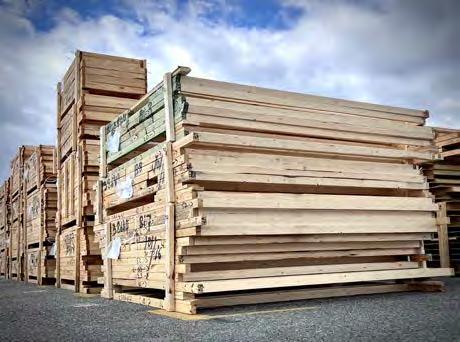
Setup and installation is easy too, without the need for complex training or disruption to workflow. So, free up your team to do what they do best, and you need to do most, and let ProStack stack your wall panels instead. Contact us to learn more today. For a ProStack demonstration video, scan the QR code below.


765-751-9990 www.woodtechsystems.com
Wood Tech Systems is a registered trade name of Wood Truss Systems, Inc.
The Fitzgerald Group, LLC
a blending of excellent services and products, with answers that work...!©
Not producing the results you need or want – getting conflicting info about what to do and the equipment and the systems you may need?
Before you Buy - Ask yourself –do I need a salesman or a guide?
If you want an Independent Guide that has your bottom-line results as the #1 priority, Call Me. If the salesman will do - we'll talk later...
Also, don't let Financing Deals influence your best solution. FitzGroup can arrange – Zero down & No payments for 90 Days!
Please be assured that your investment with any of our selected partners will not cost one penny more with the Fitzgerald Group as your purchasing contact. In addition, you will receive the full advantage of our Partner Relationships and Services NOT offered elsewhere.
RFitzgerald@FitzGroup.com
719.528.5445
www.FitzGroup.com


SQUARING STATION & ROUTING STATION
The Squaring and Routing Station incorporates a manual X-Y router bridge with the Panels Plus Squaring Station. This model consists of a squaring table designed to hold wall panels square while sheathing is tacked in place and rough openings are routed out, ensuring quality panels every time.
BENEFITS
• Ergonomic working height
• Single person operation
• Flexibility with fastener spacing
• Fastens consistently and accurately
• Improved employee safety

$68,997 Now $54,997
2019 Triad Steel Interior Framing Line
Wall framing line with model DQSF Diamond Quad framing station, RO-CAT tables and conveyors, designed to frame steel stud wall panels from 6′-9″ to 10′-3″ in height, to 16-ft long. Framing station includes two (2) twin-tool dollies with optional outlets and monitors, stud locators at 16″ and 24″ o/c spacing, and four (4) Senco SG2510 tools. Station clamps and includes pop-up skatewheel conveyors. Pair of RO-CAT tables include squaring lip, tool rest and pop-up skatewheel conveyors. Line includes two (2) 10-ft long stand-alone skatewheel conveyors and two (2) 15-ft long x 36″ wide, stand-alone idler roller conveyors. 100 PSI air required. 120 volt, 1 phase electrical required. 765-751-9990

www.woodtechsystems.com


PHONE: 800-289-5627 FAX: 800-524-4982 Read/Subscribe online at www.componentadvertiser.com Don’t Forget! You Saw it in the Adverti$$er June 2024 #16299 Page #95 A dverti $ er Component manufaCturing m
WWW.PANPLUS.COM 1-866-726-7587
Wall Panel Lift
* 8’- 12’ Wall Height
* 1,000 LB Capacity
* Easy Adjustment
* Hoist and Crane Sold Separate
Handle Bar Router
* 8’ - 12’ Wall Height
* 2 Person Operation
* 3 ¼ hp Production Router
* 120 Volt /1 Phase/15 Amp
Lay-Up Tables
* 10’ x 10’ Working Area
* Lift & Extend Rollers
* Squaring Lip
* Nail Tray
Skate Rollers
* 15’ Standard Length
* Adjustable Height
* Sturdy Stands
* Custom Lengths Available


$13,900.00

$3,500.00 $3,000.00 $1,950.00

EST. 1991
Wasserman & Associates Wall Panel Line Accessories New Equipment New Equipment

New Component Table with Skatewheel Conveyors
Lift & Extend Skatewheel Conveyors. 10' x 10' Work Area with Squaring Lip. Gun Holster & Nail Tray.
$13,900 FOB NE Wasserman & Associates
800-382-0329
www.wasserman-associates.com


New Panels Plus Wall Panel Framing Equipment
Consider Panels Plus wall panel assembly equipment for manufacturers of wood or steel wall panels, floor-panels, and related framing components. Panels Plus is an employee owned, ISO certified, manufacturing company that builds state-of-the-art equipment featuring durable construction, with fit and finish second to none in the structural building component industry. The referenced base framing table allows you to assemble from 7-12 foot wall heights, at industry standard 16 foot lengths, at a working height of 29 to 32 inches. This framer design includes controls at each end of table, squaring stops and pneumatic clamping for consistent wall panel quality. Frames 2x4 or 2 x 6 walls, with color-coded, steel stud locators at 16 and 24 inches O.C. spacing. Includes pop-up skate wheels for easy transfer of completed wall frame. Framing table can be configured to receive wall framing light bars, other options include custom buildable wall heights, lengths and auto-indexing of optional 2 or 3 tool carriages.
Additionally from Panels Plus are sheathing tables with features that include foot pedal control at squaring end of table, with squaring stops, roller conveyors at both sides, single pendant controls for bridge, tool spacing at 6 inch centers with 3 inch bridge shift for offset nailing. Tool bridges can accommodate from 2 x 4 to 2 x 8 walls, with seam tilt being standard equipment Panels Plus Tool Bridges are available with single beam or dual beam design for two different tool mounts on one bridge. Squaring stations, sub-component tables, conveyors and panel lifts are also available to complete the configuration of the wall panel assembly line. Price includes factory installation and training. 50 CFM at 120 psi air. 120 or 230 volt, 1 phase electrical.

ProStack Wall Panel Tilt In-Feed Conveyor
Solving the problem of missed fasteners on exterior sheathing remains one of the primary reasons for call back charges and exceptions noted during jobsite building inspections. Clearly finding and resolving missed fasteners or “shiners” becomes mission critical before a sheathed wall panel leaves the production line. Our shop-proven, tilting conveyor makes the process safe, fast, and labor efficient. The ProStack tilt in-feed safely lifts wall segments to 45º in 5 seconds for inspection and on to 75º for easy to reach repairs. This tilt system is also excellent for installing blocking , windows, and other details in your wall panel segments. More information click here. $62,970 FOB ND

$18,250 FOB ND
ProStack Wall Panel In-Feed Conveyor
ProStack powered in-feed conveyor was engineered to deliver wall panel segments at a matched speed and height into the ProStack automated wall panel stacker. Built for smooth operation and assembled with laser cut, powder-coated finish steel. Base model conveys wall panel segments up to 12’ in height and up to 16’ in length for wall segments up to 1,600 lbs. Extended length systems come in standard 20′ and 24’ length capacity. All models come with adjustable working heights and variable conveyor speeds.
Powered in-feed conveyor section, synchronized chain drive under top and bottom plate for open access, 5-HP, 208v, 3Ph power. Adjustable working height from 28” to 34”. 16′ length capacity.
PHONE: 800-289-5627 FAX: 800-524-4982 Read/Subscribe online at www.componentadvertiser.com Don’t Forget! You Saw it in the Adverti$$er June 2024 #16299 Page #97 A dverti $ er Component manufaCturing m The 800-289-JOBSJobLine.com, inc. Time To Hire? We’re here when you need help! visit: www.thejobline.com email: twm@thejobline.com STRICTLY CONFIDENTIAL! The 765-751-9990 www.woodtechsystems.com
CLICK HERE for more information NEW! PANEL EQUIPMENT
765-751-9990 www.woodtechsystems.com 765-751-9990 www.woodtechsystems.com
NEW! NEW! Video


You’ll be well looked after, with our complete offering. Contact the Spida Regional Account Manager for your region today and find out more! Want the best customer experience? Choose Spida Machinery for knowledge and expertise across your whole machinery journey. spida.com E sales@spida.com T +1 866 647 7771 SALES INSTALLATIONS SERVICE & SUPPORT FACTORY LAYOUTS Continued next page

 By Rudolph Garza, Jr., Alpine Product Owner
Stitcher Gets a Makeover
Imagine a looming deadline, a complicated 2D, multi-family floor plan. It will take days to get accurate measurements, manually. STITCHER® streamlines the process by capturing walls, openings, and intricate details with precision, transforming a 2D architectural drawing into a 3D model in a fraction of the time – saving 30% of overall design time.
STITCHER is an innovative software created to simplify complex design processes. In November, an updated version (2.0.8677) launched, improving STITCHER’s user interface and experience (UI/ UX). These updates, based on customer feedback, streamline the designer workflow with clean, easy-to-find tools and features, while improving the onboarding experience for new designers.

PHONE: 800-289-5627 FAX: 800-524-4982 Read/Subscribe online at www.componentadvertiser.com Don’t Forget! You Saw it in the Adverti$$er June 2024 #16299 Page #100 A dverti $ er Component manufaCturing m The Continued next page
Figure 1. Tools are now organized by tab and a progress bar appears at the bottom.
STITCHER Reimagined
STITCHER’s new interface provides designers with a step-by-step workflow to help quickly identify the process, as well as next steps (see Figure 1). The software’s tools and other valuable information are organized and categorized in color-coded tabs for easy identification (see Figure 2). Selecting levels and identifying critical information, like plumbing and electrical locations, has been added to user-friendly drop-down menus.

Figure 2. Some tools are now color-coded, matching the capture depictions.
These UI/UX enhancements improve the STITCHER workflow for all users, while also accelerating the learning curve for new designers. The new interface provides constant visibility into their progress within STITCHER, allowing designers to navigate with confidence. Seasoned designers will also be able to leverage STITCHER to its full potential. These enhancements empower designers to streamline their workflow and maximize designer efficiency. It’s as easy as 1–2–3.
Learn more about STITCHER’s automatic selection and measurement tools that help to analyze the varying styles of a builder’s plan, identify the building envelope, and automatically fill in the walls, openings, and fixtures. For more information or a demonstration, please contact info@alpineitw.com.
PHONE: 800-289-5627 FAX: 800-524-4982 Read/Subscribe online at www.componentadvertiser.com Don’t Forget! You Saw it in the Adverti$$er June 2024 #16299 Page #101 A dverti $ er Component manufaCturing m The AN ITW COMPANY
IntelliVIEW Suite Manage. Design. Build.
The industry’s most powerful integrated component design, engineering, and management software for steel and wood-framed structures.
iCommand
Manage projects, customers, materials, pricing & inventory
iModel
Design truss layout & profiles
iDesign
Optimize material usage & engineer trusses
iPanel
Design wall layouts, panelize, bundle, break & stack
eShop
Maximize crew productivity & improve manufacturing efficiency


The IntelliVIEW Suite is a fully integrated software solution for the layout and design of a building’s rough framing elements—including roof and floor trusses, wall panels, solid sawn, EWP, sheathing and various ancillaries.
The IntelliVIEW Suite provides the industry’s most complete analysis of the design, cost information and bill of materials—promoting increased profits by reducing plate and lumber use.
Ask those who know. They’ll tell you about the people at Alpine who make a difference.

BUILD MORE. alpineITW.com | 800.521.9790


Triad 12 ft Gen II Sheathing Bridge & Track
Triad Generation II nail tool bridge with 60 ft of v-track, refurbished by Triad in 2021. Maximum panel height clearance 12′-3″. Includes locations for (3) tool mounts along the middle beam, top & bottom plate tool mounts, tilt-tool option, joy-stick controls, power bridge return, e-stop button, all available Paslode tool mounts, manual and all available spare parts. 120 volt, 1 phase electrical required. 100 PSI air required.
PHONE: 800-289-5627 FAX: 800-524-4982 Read/Subscribe online at www.componentadvertiser.com Don’t Forget! You Saw it in the Adverti$$er June 2024 #16299 Page #103 A dverti $ er Component manufaCturing m The NEW! New Panels Plus Combination Table Price: $Call for pricing FOB: MN 765-751-9990 www.woodtechsystems.com 765-751-9990 www.woodtechsystems.com 2007 Panels Plus Steel Wall Panel Sheathing Station $74,970 NOW $68,997 FOB MN 765-751-9990 www.woodtechsystems.com
$75,971 NOW $25,000 FOB CO
2023 Panels Plus Single-Tool Sheathing Station

Featuring precision Gen. 2 controls, this system squares and sheathes wall panels ranging up to 16′ in length and up to 12′ -3″ wall height with dimensional material from 2×4 through 2×10. This late-model system includes a servodriven bridge with joy-stick controlled motion on the operator’s riding platform. The single, large-coil capacity tool carriage travels across the wall frame inserting sheathing fasteners at the spacing set by the operator. The stitchers will automatically insert fasteners through the sheathing into the top and bottom plates at your chosen spacing during the auto-return process. The bridge has 9 programmable presets for fastener spacing. Other features include: Single Beam Bridge, top and bottom plate stitchers, Operator Platform with Windows industrial touchscreen, and joystick control. Squaring table features a squaring edge, footswitch & push-button controls for telescoping side and horizontal outfeed rollers. 120 PSI at 60 CFM air.120 volt AC electrical required. Utilizes large-coil 15º wire-collated nails. (No nail tools included).
PHONE: 800-289-5627 FAX: 800-524-4982 Read/Subscribe online at www.componentadvertiser.com Don’t Forget! You Saw it in the Adverti$$er June 2024 #16299 Page #104 A dverti $ er Component manufaCturing m The 765-751-9990 www.woodtechsystems.com
185,000 FOB WI

• Pop-up Skatewheel Conveyor
• Powered Height Adjustment (6'-11" to 12'-5" wall heights)
• Fixed Squaring Stops
• Excludes Tool Dollies
• 110 Volt / 20 Amps
• Add $6,000 for Stud Locators at 16" & 24" O.C.
• Add $2,750 for 1 Pair of 15' Skatewheel Conveyor with Stands
• Add $11,900 for Sub-Component Layup Tables with Pop-up Skatewheel Conveyors
• EQUIPMENT FINANCING available from SLS Financial Services

2014 TRIAD RAKE WALL TABLE
• Wall Lengths to 12'
• Wall Heights to 40'
• Powered Height Adjustment
• Manually Adjustable Rake Side (0 to 12/12 pitch)
• Adjustable Squaring Stop

2021 Panels Plus light gauge steel (LGS) framing station, builds steel stud wall panels from 6′-9″ to 12′-3″ heights, from 1′-0″ to 20′0″ long. includes four (4) Graber SuperDrive tools with mounts, two tools per dolly, adjustable top and bottom plate stops, squaring stops and pop up conveyors. 110 volt, 1 phase, 30 Amp electrical required. 80 PSI at 10 CFM air required.
$71,993
• Pop-Up Skatewheel Conveyors
• Stud Locators at 16" and 24" Centers
• Center Support Bar with Stud Locators
• Excludes Tool Doilies
• Price is in US Dollars
$40,997 FOB CA

Used Triad G2 Wall Assembly Equipment
Used Triad wall assembly equipment includes 16 ft x 12′-3″ max height framing station, model G2, with (2) two-tool dollies, squaring/ sheathing combo table, model G2 SH-SQ, with multi-tool mount nailing bridge and separate manual-drive router bridge, quantity of (6) 10 ft long x 2 ft wide idler roller conveyors with (4) legs, and Triad model FTCN component nailing station with four Hitachi NR83A nail tools.
Framer includes 16″ and 24″ color-coded stud locators, pop-up skate wheel conveyors, tool dollies have two tool mounts each (no tools) and powered height adjustment. Sheathing bridge includes joy-stick controls, tool offset, tool tilt, laser guide, power return and mounts for up to (23) Hitachi nail tools. Router and all available spare parts included. 120 volt, 1 phase, 30 Amp electrical required. 100 PSI air required.
PHONE: 800-289-5627 FAX: 800-524-4982 Read/Subscribe online at www.componentadvertiser.com Don’t Forget! You Saw it in the Adverti$$er June 2024 #16299 Page #105 A dverti $ er Component manufaCturing m The NEW 12' X 16' FRAMING TABLE 800-382-0329 | www.wasserman-associates.com
$38,750 FOB NE
NEW! 800-382-0329 | www.wasserman-associates.com
$37,900 NOW $29,900 FOB Ontario 765-751-9990 www.woodtechsystems.com
765-751-9990 www.woodtechsystems.com 2021
Light-Gauge-Steel Framing Station
Panels Plus
FOB PA


-Laser Pointer -Bridge Auto Return -Bridge Tilt at Sheathing Seams -Programmable Fastener Patterns -Pop-Up Skatewheel Conveyors -6’-11” to 12’-5” Wall Heights -Fixed Squaring Stops -No Floor Rails *Includes Installation Support in the United States & Canada
PHONE: 800-289-5627 FAX: 800-524-4982 Read/Subscribe online at www.componentadvertiser.com Don’t Forget! You Saw it in the Adverti$$er June 2024 #16299 Page #106 A dverti $ er Component manufaCturing m The One
Wasserman & Associates Framing Table With Panel Bridge
Wasserman & Associates 2341 Shepard Rd Milford NE 68405 Phone: 800-382-0329 Web: www.wasserman-associates.com
Table System $94,900

$50,000 FOB HI
2019 Hornet Plate Marker
• Hornet Model MC-19 (Chop Saw)
• Aut omated Wall Panel Parts Cutting & Marking as directed by Wall Panel Design Software
• Length Stop/Plate Pusher with Roller Conveyor
• Infeed Roller Conveyor
• T ouch Screen Computer (Windows 10)
• Cut Builder Automation Controls
• Ink Jet Marker
• Bosch Glide Miter Saw
• Excludes Dust Collector
• Lightly Used
manufaCturing
ProStack Wall Panel Stacker
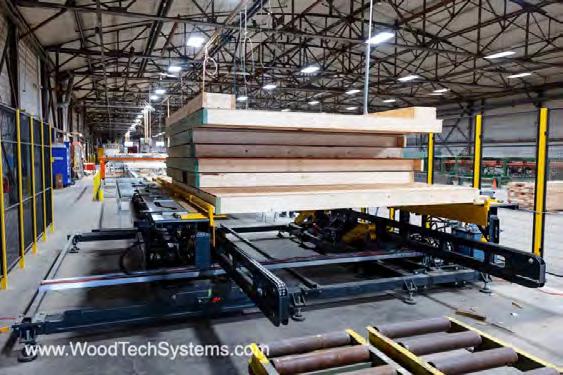
Reduced labor, increased safety, the benefits just keep stacking up. Stacking wall panels at the end of your production line can be a real labor-intensive and safety-challenging task. But it doesn’t have to be now, thanks to ProStack. This innovative wall panel stacker literally stacks from the bottom up, reducing awkward overhead lifting & placement, and the risk of head injury. Plus, ProStack frees up at least one worker to return more productively to your core task—building wall panels. Enhanced worker safety and productivity is what ProStack is all about.
Developed for commercial wall panel production facilities this is the remarkable ProStack, fully automated wall panel stacker. The ProStackrelieves your build team from creating a stack of wall panels and keeps them building walls instead. Stacks 2×4 through 2×8 walls up to 20′ in length and up to 12′ in height (taller by special order). The ProStack will automatically center or left or right justify each layer including multiple wall segments on the same layer. For ease of loading in your yard or on the build site, fork pockets are created in two ways: The operator can attach blocking up to 5″ tall to the last wall of the stack prior to entering the stacker, or two shorter walls can be spread apart prior to the second to last row of the stacker. Designed without any overhead frame or apparatus, so no crane inspections are required. The ProStack is “event driven”, so there is no need to read a file.
Setup and installation is easy too, without the need for complex training or disruption to workflow. So free up your team to do what they do best, and you need to do most, and let ProStack stack your wall panels instead. ProStack can even operate with your existing powered conveyors or select our optional matching conveyors (see the video shown below). 208 volt, 3 phase, 43 Amp base model electrical required. No air required. Footprint is 26′-5″L x 19′-3″W.
PHONE: 800-289-5627 FAX: 800-524-4982 Read/Subscribe online at www.componentadvertiser.com Don’t Forget! You Saw it in the Adverti$$er June 2024 #16299 Page #107 A dverti $ er Component manufaCturing m The
dverti$er Component
S erving the S tructural B uilding c omponent S i ndu S try The Hiring Zone Building Component Industry's Job Board Employer to Candidate Direct Hiring No Recruiting Fees! Post your Opportunity... Candidates respond directly to you! For Additional Information Contact: twm@componentadvertiser.org or Call: 800-289-5627 x1 Visit our website: www.componentadvertiser.com/Hiring-Zone
A
For
Here New www.woodtechsystems.com 765-751-9990 Call for Pricing FOB ND Video 800-382-0329 | www.wasserman-associates.com
additional information Click
By MiTek Staff
AProper Loading for Solar Panels
s the “Green” movement progresses and energy prices go increasingly higher, more and more homeowners and commercial developers are looking to utilize photovoltaic panels (solar panels) to help get them “off the grid.” It may seem that designing for solar panels is as easy as finding out how much the panels weigh, and adding point loads to their roof trusses either in the design phase or in a repair. Unfortunately, it is not always this simple. Some applications of solar panels do lay flat on the top chord of supporting trusses and thus, create a uniform load and not point loads, however this simple case is not the subject of this article. Typically, a key selling point that a solar panel installer has is that he/ she can minimize roof penetrations, thus reducing the possibility of roof leaks. While this may help reduce the likelihood of leaks, it can often create large point loads on the supporting trusses.
Before explaining some of the intricacies of how solar panels interact with roof trusses, you should be aware that if you are sending a repair or seal to MiTek that is the result of the installation of solar panels, your engineer at MiTek will ask that an independent engineer or qualified persons specify the loading for the panels. It is up to the independent engineer or qualified designer to determine if the resultant loads shall be considered as point loads or uniform loads, as well as the magnitude of those loads.
In residential applications, one typically has a pitched roof in which solar panels are mounted parallel to the roof pitch. If the roof has a low slope, the gravity loads of the solar panels can be magnified as the solar panel may hold snow, thus causing point loads from snow rather than a uniform load. The same holds true for wind loading as the wind uplift is accumulated through the solar array and directed to the posts that support the solar panel. Also, depending on the roof geometry, the solar panel may act as a sail and catch wind from under the panel thus creating very high uplift loads.
In many commercial applications, solar panels are put on flat roofs. In order to achieve higher efficiency, the photovoltaic panels will be posted to the roof such that the panels are at a pitch that will be angled toward the sun. With this geometry, snow can accumulate on the solar array, but can also slide off of the panel thus creating a drift on the low side of the panel. Also, wind can create many different loading scenarios.
Yet another concern that can come into play is that solar panels are often attached to trusses with lag screws that must land in the center of a 1.5” wide top chord. Depending on the diameter of the connector, a repair may be required due to the section loss of the wood in the top chord. MiTek recommends that all connections of solar panels be made into blocking that is run between trusses. This not only prevents the drilling of trusses, but also distributes any point loads between two trusses, thus decreasing the severity of any repairs.
All in all, the design and/or repair of roof trusses while adding solar panels is not something that is to be taken lightly. There are a lot of loading scenarios that should be examined. For additional information, or if you have questions, please contact the MiTek Engineering department.
PHONE: 800-289-5627 FAX: 800-524-4982 Read/Subscribe online at www.componentadvertiser.com Don’t Forget! You Saw it in the Adverti$$er June 2024 #16299 Page #108 A dverti $ er Component manufaCturing m The
PANEL EQUIPMENT

2007 Panels Plus Combo Table with Multi-tool Bridge
2007 Panels Plus Combination Table, allows you to frame, square and sheath wood wall panels on one,16 foot long table x 12 foot framer for wall heights from 6′-9” to 12’-4”. Builds both 2×4 and 2×6 walls. Clamps wall prior to nailing. Table includes push button controls, color-coded stud locators at 16 inches & 24 inches o.c. spacing, squaring stops, motorized telescoping arms, skatewheel ejectors and powered tool bridge. Sheathing nailing bridge includes powered travel, joy-stick & key pad controls, air manifold, manual fine tuning, tilt and seam nailing. No tools or mounts included. 30 CFM at 120 psi air required, and 120 volt, 1-phase electrical required.
$49,991 NOW 39,991 FOB TN Wood Tech Systems 765-751-9990
www.woodtechsystems.com
TRUCKS & TRAILERS

Used - 2014, R156 48” Roll -Off
Precision Trailer
Tandem Axles | Air Ride Suspension : Air Operated Load Control, Air Operated Pin Locks | Mesh Between Rollers | Beaver Tail | Strap Locks and Winches | LED
Lighting | 11.4 Ton Self Contained Power | (1) Heachache Rack
$29,900 NOW $24,900
Eide Machinery Sales, Inc. 612-521-9193
www.eidemachinery.com
The
TRUCKS & TRAILERS

Used - 2014, R157 48” Roll -Off
Precision Trailer
Tandem Axles | Air Ride Suspension : Air Operated Load Control, Air Operated Pin
Locks | Mesh Between Rollers | Beaver Tail | Strap Locks and Winches | LED
Lighting | 11.4 Ton Self Contained Power | (1) Heachache Rack
$29,900 NOW $24,900 Eide Machinery Sales, Inc. 612-521-9193
www.eidemachinery.com

2006 Tri-Star Gooseneck Roll-Off Trailer
• Bed Length: 23'-6"
• Overall Length: 32'-6"
• GVWR: 14,000 Lbs
• Split Locking Rollers
• 2 Rollers on Gooseneck
• Battery Operated Hydraulic Tilt Bed
• Electric Brakes
• Gooseneck or 5th Wheel Adapter Connection
• Out of service appoximately 2 years $15,900 FOB WI Wasserman & Associates 800-382-0329 www.wasserman-associates.com

1993 JDH Trussmaster 48'-70' Stretch Roll-Off Trailer
• Fixed Tandem
• Spring Suspension
• Roller Locks
• Winches & Straps
• Headache Rack
• Tires are Good (less than 5,000 miles on tires)
• DOT is Current
• Video available upon request
$19,900 NOW $16,900 FOB IN Wasserman & Associates 800-382-0329
www.wasserman-associates.com

• 2013 Freightliner Cascadia (Single Axle, Day Cab)
• 424 HP Cummins Diesel Engine
• 10 Speed Manual Transmission
• 543,000 Miles
• Late 1990's 42' Step Deck Roll-Off Trailer
• Electric over Hydraulic Tilt Bed (can also be operated with wet kit)


60" Pallet Forks
Foam Filled Tires
Cummins QSB 4.5 Turbo Diesel
4,350 Hours
PHONE: 800-289-5627 FAX: 800-524-4982 Read/Subscribe online at www.componentadvertiser.com Don’t Forget! You Saw it in the Adverti$$er June 2024 #16299 Page #109 A dverti $ er Component manufaCturing m The A dverti$er Component manufaCturing
erving the S tructural B uilding c omponent S i ndu S try
S
2013 Freightliner Truck with Used 42' Roll-Off Trailer 800-382-0329 | www.wasserman-associates.com 2015 JLG G10-55A Telehandler Lift • 10,000 LB Capacity • 55' Lift Height • 4 Wheel Drive • 3 Way Steer • 72"
800-382-0329 | www.wasserman-associates.com NOW
•
•
•
Fork Carriage
$59,900 FOB CA
•
IN
$34,900 FOB

RANGER RS is a trademark of ACER INC. The RANGER RS system is protected under U.S. Patent #8,960,244 and other patents pending . ACER INC PO Box 652 301 Industrial Drive Rushford, MN 55971 507-864-2220 www.acerinc.com Precision Design … for Precision Production Take your plant to the next level with the Ranger Retrieval System.

2003 JDH TRUSSMASTER SIDEOFFLOADING TRUSS TRAILER
10,000 Lb Tandem Axles (Dual Wheels). 26,000 GVWR. Deliver Trusses Vertically. Stretch from 18' to 38'. Raise Loads Hydraulically. Air Brakes.
$6,900 FOB CA Wasserman & Associates 800-382-0329 www.wasserman-associates.com

2001 Moffett M5500 Forklift
2001 Moffett M5500 forklift features 48″ forks with side shift, 12′ maximum lift height, 5,500 lb lift capacity and has 2,440 hours on it. Kubota 4 cylinder Diesel engine and Hydrostatic transmission.
$24,990 NOW $19,890 FOB OH Wood Tech Systems 765-751-9990 www.woodtechsystems.com

Reconditioned Lakeside
36'-51' Stretch Roll-Off Trailer
• Self-Contained Hydraulic Front End
• Sliding Tandems
• Roller Locks
• Headache Rack
• New Axles (Undercarriage)
• New Wheels, Tires & Brakes
• New Hydraulic System
• New Wiring & Light Sockets
• Sandblasted & Epoxy Painted
• DOT is Current $40,000 FOB ME
Wasserman & Associates 800-382-0329
www.wasserman-associates.com
TRUCKS & TRAILERS

1995 Pines 45' Chip Trailer
• Modified by LMI TENN
• 8" Floor Cross Members
• Reinforced Roof
• 22.5 Tubeless Tires
• Sl iding Tandem Axle (for weight distribution) (FOB PA) $9,900 Wasserman & Associates 800-382-0329
www.wasserman-associates.com

• Hydraulic Front End
• Sliding Tandems
• Roller Locks
• Headache Rack
• DOT is not current
• Additional photos & video are available upon request
2 Available at $23,900 Each Wasserman & Associates 800-382-0329 www.wasserman-associates.com

1993 Wabash 48-ft Roll-off Trailer
1993 Wabash model T-30 roll-off trailer, 48-ft long, 60% tire tread remains, 60% brakes remaining. Includes locking rollers, hydraulic lift, sliding axle, headache rack and ABS brakes. GVWR 68,000 lbs.
$14,997 FOB QC Wood Tech Systems 765-751-9990 www.woodtechsystems.com

1999 JDH Trussmaster 48' Roll-Off Trailer
• Hydraulic Front End
• Sliding Tandems
• Roller Locks
• Roller Brakes (not working)
• Winches & Straps
• Headache Rack
• Tires & Brakes are Good
• DOT is Current $19,900 NOW $17,500 FOB GA Wasserman & Associates 800-382-0329
www.wasserman-associates.com

1997 Lakeside JDH Trussmaster 36-51 ft Stretch Trailer (OR-1)
1997 Lakeside JDH Trussmaster 36′51′ – Lakeside trailer features 5th-wheel connection, sliding tandem axle, locking rollers and hydraulic lift neck. Current DOT inspection September 2023. 50% brakes and 50% tire tread remains. 26,000 GVWR
$28,997 FOB MO Wood Tech Systems 765-751-9990
www.woodtechsystems.com

1997 Lakeside JDH Trussmaster 42-60 ft Stretch Trailer (BL-2)
1997 Lakeside JDH Trussmaster 42′60′ – Lakeside trailer features 5th-wheel connection, sliding tandem axle, locking rollers and hydraulic lift neck. Current DOT inspection September 2023. 50% brakes and 50% tire tread remains. 26,000 GVWR. $33,495 FOB MO Wood Tech Systems 765-751-9990 www.woodtechsystems.com

2005 Usifab Roll-Splicer
Quantity of one 2005 Usifab Roll-splicer, varying diameter drive wheels press 2×3 and 2×4 dimensional lumber with plates up to (3″x15″). Can press 20 gauge, 20 gauge high-strength, 18 gauge & 16 gauge plates. 600v, 3 phase electrical required. $14,997 FOB QC
Wood Tech Systems 765-751-9990
www.woodtechsystems.com

Densetec Production Surface Material (HDPE)
Polymer Industries’ Densetec® High Density Polyethylene (HDPE) 3/4″ x 4′ x 10′ sheet material, qty 36 sheets. Used for replacing or creating highly durable production surfaces that exhibits the properties of high impact strength, abrasion resistance, and low coefficient of friction. The material’s durability makes it ideally suited for a variety of applications such as roof truss equipment, saw infeed, and numerous other industrial uses. Minimum qty. 18 sheets @ $220 ea. $3,960 – All 36 Sheets @ $200 ea. $7,200 (OEM cost is $280 per sheet).
Wood Tech Systems 765-751-9990
www.woodtechsystems.com
PHONE: 800-289-5627 FAX: 800-524-4982 Read/Subscribe online at www.componentadvertiser.com Don’t Forget! You Saw it in the Adverti$$er June 2024 #16299 Page #111
Component manufaCturing m The
A dverti $ er
MISC.
A dverti$er Component manufaCturing S erving the S tructural B uilding c omponent S i ndu S try The
2005 JDH Trussmaster 48' Roll-Off Trailer

Electrical Supply: 110 VAC
Motor: 1/4 HP, 110 VAC, Linear Actuator
Highly Accurate: +/- .010 Inches
Stop Rail: 2 x 4 x 1/4 Aluminum Extrusion
Stops: Jig Bored Steel
Stop Blocks: Machine Billet Aluminum
Internal Components: Hardened, Ground and Polished Steel and Billet Aluminum
Dimensions:
Length: 5 feet (60”) to 60 feet (720”)
Height: 12 inches
Depth: 12 inches
If you are looking for the fastest, most consistent way to measure and cut your product, then the Hain Measuring System (MEA) is your answer. The MEA changes from one length t any length instantly, up to 60’, without changing the operator’s position on the line. It is also highly accurate (+/- .010) and quickly moves from one length to the next in seconds. The MEA is designed for quick and easy setup and is simple to use. Even a first time user will be productive with little or no training required. It can adapt to any saw and can be mounted to any surface so that you can integrate the MEA with your existing setup. The MEA is versatile allowing “left” or “right” handed operation and measurement in “feet and inches” or “inches” depending on your preference. The MEA is also available in a “Skid Mounted” version.

• $1,700,000 Annual Sales
• 125' x 60' Building is Leased
• 24' x 12' Portable Office (fully equipped)
• Lumber & Plate Inventory
• 8' x 40' Storage Container (includes contents - tyvek, concrete bags, garage doors)
• Toyota 6,000 Lb Forklift (Diesel)
• Yale 6,000 Lb Forklift (Propane)
• 2023 Maxx-D 24' Tilt Flatbed Trailer
• 2021 Maxx-D 40' Gooseneck Tilt Roller Trailer
|
• (2) Hydro-Air Mark 8 C-Clamp Presses with 40 Pedestals
• Steel Support Structure & Steel Floor for Mark 8 System
• (2) Additional C-Clamps Only
• Field Repair Press
• (2) Chop Saws with Infeed/Outfeed Tables
• (3) Lumber Racks
• Lumber/Material Carts
• 2 CY Dumpster
• Air Compressor & Staple Guns
• Battery Operated Bander with 4 Rolls of Banding
• Other Misc Items

$50,000 FOB QB
New ASI Ink Jet Plate Marker
• Automated Wall Panel Parts Cutting & Marking as directed by Wall Panel Design Software Output
• 20' Roller Conveyor with Servo Motor Controlled Length Stop/Plate Pusher
• 10' Infeed Roller Conveyor
• 24" Lenovo Touch Screen Computer (Windows 11 Pro OS)
• ASI Basic L Plate Cutting/Marking Operating Software
• 4 Head Ink Jet Plate Marker (marks 2 plates on edge)
• 110 Volt / 1 Phase
• Includes Onsite Installation & Training
• Excludes Saw & Dust Collector
• Approximately $50,000 USD with DeWalt Sliding Miter Saw including Freight, Customs Brokerage Fees & Installation
• Other Saw Options Include: Existing Saws, ASI Radial Arm Saw, Lauderdale Hamilton Up Cut Saw & Vista Angle Boss Saws
• Video available upon request
PHONE: 800-289-5627 FAX: 800-524-4982 Read/Subscribe online at www.componentadvertiser.com Don’t Forget! You Saw it in the Adverti$$er June 2024 #16299 Page #112 A dverti $ er Component manufaCturing m The Truss Business For Sale in Indiana 800-382-0329
www.wasserman-associates.com
the
COMPANY 6125 Enterprise Drive, Unit 9
Diamond Springs, CA 95619 530.295.8068
sales@thehaincompany.com
HAIN
|
|

EMSI Teeter Cart
Width – 46” / Length – 73” / Load Capacity – 2850 pounds / Pneumatic tires – 14.5 inch / Maximum utility in truss plants, panel plants, and lumber yards / Quick Assembly by bolting parts together / All hardware is supplied / Upright 2 x 4’s not supplied / Medium duty tires rated at 1500 lbs each are included.
Call for Price
Eide Machinery Sales, Inc.
612-521-9193
www.eidemachinery.com

Used - Quincy


NEW GALVANIZED STEEL STRAPPING
1 1/4" wide x .035 thick. $159 per coil. $2,950 per skid (21 coils). FOB PA. Wasserman & Associates 800-382-0329
www.wasserman-associates.com

AMI Industrial Floor Carts
AMI's industrial floor trucks (material carts) are designed of hardwood construction, fitted with space-age phenolic, roller-bearing wheels, and ball bearing swivel casters for strength and durability. AMI's phenolic wheels resist shock without chipping. They are non-sparking, non-marking, and can be operated continuously between -50℉ and 260℉. They are unaffected by grease, oil or debris on your shop floor.
Series "B" AMI Industrial Floor Truck
Our swivel casters are precision built with perfectly aligned raceways. All cold-form parts are made to exacting tolerances from heavy-gauge steel, and are hardened for severe service and long wear. Series B-4 carts include four casters, one at each corner, to prevent "tri-cycling" of long lumber loads.

2005
(For Repair or Parts)
6 detection zones to locate missing plates. Horn & zone lights indicate missing plates. 12" to 60" adjustable height from floor. 110 Volt / 1 Phase. New control panel switches & lights in 2014. Needs circuit board repair or replacement and new tower light. Includes 4 extra detection zone boxes.
$2,500 NOW $1,500 FOB NE
Wasserman & Associates 800-382-0329
www.wasserman-associates.com

Hain 20' Powered Measuring System Adapts to Any Saw. Left or Right Hand Operation. Feet & Inches System (Stops at 12” Centers) or Inches System (Stops at 10” Centers). Motor: 1/4 HP Linear Actuator (110 Volt). Stop Rail: 2 x 4 x 1/4” Aluminum Extrusion. Stops: Jig Bored Steel. Stop Blocks: Machine Billet Aluminum. Optional Lengths from 5’ to 60’. Optional Gang Stop. Add $890 per 10’ Section of Heavy Duty Roller Conveyor with Stands $8,990
Wasserman & Associates 800-382-0329 www.wasserman-associates.com


Sweed Scrap (Band) Chopper with Stand
1/2 HP Motor (115/208-230 Volt)
$1,900 NOW $1,750 FOB NE. Wasserman & Associates
800-382-0329
www.wasserman-associates.com
Standard Models Available Max Load Weight (lbs.)
2748 27" x 48" Series "B" & "C" 2500
3248 32" x 48" Series "B" & "C" 2500
3260 32" x 60" Series "B" & "C" 2800
3660
4000
*Other models and sizes are available on request. FOB NC. Wood Tech Systems 765-751-9990 www.woodtechsystems.com
PHONE: 800-289-5627 FAX: 800-524-4982 Read/Subscribe online at www.componentadvertiser.com Don’t Forget! You Saw it in the Adverti$$er June 2024 #16299 Page #113
dverti
Component manufaCturing m The
A
$ er
MISC.
36" x 60" Series "B" & "C" 2800 3672 36" x 72" Series "B" 4000 4072 40" x 72" Series "B" 4000 3696 36" x 96" Series "B" 4000 4896 48" x 96" Series "B"
Koorsen Connector Detector
25 Horsepower Screw Compressors (2x) Taken from service | Optional: Refrigerated Air Dryer - $500 $3500 each Eide Machinery Sales, Inc. 612-521-9193 www.eidemachinery.com Used - Auto Omni Control Panel Set Control Panel Set for 5 Head Auto Omni Component Saw | Complete with Control Cards | Parts Machine $500 – Make Offer
Machinery Sales, Inc.
www.eidemachinery.com 800-382-0329 | www.wasserman-associates.com 2020 Ranger RS Lumber Retrieval System • Fully Automatic Laser Guided Lumber Retrieval System • 5 Lumber Carts (6' to 20' Lumber) • Vertical Dividers for Magazine Carts • Vacuum Pick Head System • Perimeter Safety System (Light Curtains, Fencing & Gate) • 50' x 28' Footprint • 5 Extra Custom Built Lumber Carts • Designed to fit Monet Deasuw DeRobo Saw • Available July 2024 • Video available upon request $94,900 NOW $89,900 FOB NE
Eide
612-521-9193
 By Dante Khachadourian
MThe Birth of a Professional Engineer: Forging a Career at Simpson Strong-Tie

y engineering journey began back in the early 2000s in the living room of our house, playing with wooden blocks and building towers as high as I could reach without letting them fall over onto little brothers (the authorities having jurisdiction [aka my parents] had a set a restriction in our home on the maximum height of unreinforced wood block structures). My nascent construction skills could have gone towards either architecture or engineering, but thankfully the latter won out as I evolved into a Lego fan, like many aspiring engineers. Pop is a civil engineer, so whether my tendencies toward engineering were founded primarily in nature or nurture may forever be in debate as I was encouraged to consider engineering as an enjoyable, profitable and generally amazing way to become an upstanding member of the community.
When I came of high school age (I was homeschooled K-12), I expressed my interest in engineering, and additional rigor ensued as I focused on STEM classes, and my parents accelerated my curriculum so that I could begin taking Advanced Placement tests before starting college. I also started taking classes full time at Modesto Junior College during my senior year. After taking a one-year stint at MJC, I transferred to CSU Sacramento. There I plunged full force into the general engineering and civil engineering classes, glad to have the general education courses behind me. In my senior year, I finally was able to take eagerly awaited elective design classes like wood, steel, and concrete design, with of course the associated labs that allowed us to touch, smell, and build with the materials we discussed in the classroom and learned from the white board. Those classes gave that final reassurance to me that I had chosen the right profession, because despite the long days and short nights, I loved what I was doing.
I especially appreciated that most civil engineering classes at Sacramento State were taught by licensed engineers, who had real-world experience that they incorporated into the classes. Many of them (Dr. Fell, Dr. Armstrong, Dr. Fogarty) were also kind enough to give me extracurricular advice on my future and my transition there from college. It was during my senior wood design class that I first encountered Simpson Strong-Tie on a professional level, when Professor Scott-Hallet had a Simpson guy named Sam Marcoux come in and talk about engineering with our class. In my entire college experience, Simpson was the only company that ever came into a classroom to speak to us, and it made a distinct impression on me, that these Simpson people thought that students were worth the time and efforts to go out of their way and to engage with us.
PHONE: 800-289-5627 FAX: 800-524-4982 Read/Subscribe online at www.componentadvertiser.com Don’t Forget! You Saw it in the Adverti$$er June 2024 #16299 Page #114 A dverti $ er Component manufaCturing m The Continued next page

After two and half long (but somehow also short — I’m convinced time flows differently on a college campus) years at Sacramento state, I graduated with a B.S. in civil engineering scl in the fall of 2019 (barely dodging the COVID scholastic experience, thank God). Despite my dad working at Simpson for 20+ years, my ending up at Simpson was by no means a foregone conclusion, primarily due to my ignorance of the wide variety of roles available here at Simpson. I finished my last college assignment on a Friday, and Monday I started full time at the structural design firm in Modesto where I had interned the previous summer. I was there for three years working on wood and steel structures, but just after obtaining my P.E. license, Pop happened to be in a meeting with Louay Shamroukh (my current supervisor) and mentioned offhand that I had just become licensed. So I found myself in Louay’s office a week later, and after he opened my eyes to the type and scope of work I could expect, I started shortly afterwards as an associate branch engineer at Simpson Strong-Tie.
It’s hard to typify a workday at Simpson because my responsibilities as a branch engineer cover such a wide variety of activities. I could be behind a computer punching numbers on a calculator to determine the load of a misinstalled product, walking the shop floor with a tape measure taking measurements to improve warehouse efficiency, or making presentations out in the field to help our customers better understand how to specify and use our products. Or you might find me building and crushing test specimens, on the phone with a homeowner who isn’t sure what the actual dimensions of a 2×4 are, and then on another call with the principal from an engineering firm discussing the nuances of an obscure code section. From preliminary product development and exploration to leading product demos for code officials or middle schoolers, or on a video call helping a specifier leverage our online web apps and resources to achieve higher productivity, there’s always something I can do to engage with our customers and elevate ourselves as a company.
PHONE: 800-289-5627 FAX: 800-524-4982 Read/Subscribe online at www.componentadvertiser.com Don’t Forget! You Saw it in the Adverti$$er June 2024 #16299 Page #115 A dverti $ er Component manufaCturing m The Continued next page
Collaborating with our sales folks, problem-solving with people in the engineering department, or learning from senior members of the team are all part of the continual exchange of knowledge that allows us to learn together as a company in our quest to help people design, build, and live in safer, stronger structures.
I would say that my schooling did a commendable job in preparing me for life as a professional engineer. Juggling class and assignment schedules, working together on projects and assignments with other students, and learning from professors and textbooks, all translated into my post-college career. Those skills correlate directly with managing a schedule as a professional, collaborating with coworkers and external clients to find solutions, and continuous learning from my colleagues and on my own to improve myself in my field. An innocuous-sounding class I took in junior college that became revolutionary for me was “Public Speaking,” and I would say that being able to communicate effectively and coherently in front of an audience is potentially the single most important soft skill that a professional can possess. Another step I took that I would highly recommend to any aspiring engineering student would be to get an internship at a company in your career field. Preferably, the internship would be at a company you might want to work for in the future so you can get a feel for the culture of the company, but pretty much any internship will give you a feel for what a professional environment is and how you can better prepare to enter that environment when you graduate.
I’ve been here at Simpson over a year now, not enough to claim complete knowledge about it but enough to have a pretty well-developed perspective. For me, there are two main factors that determine your satisfaction with your job: the work you are doing from day to day, and the people or environment where you’re doing it. For me, I really enjoy the type and variety of work that I get to do here at Simpson, and that keeps me engaged and motivated; going to work without dreading it and finding fulfillment in that work is an awesome feeling.
However, the people and culture here at Simpson are the best part of the job, penultimate to none. The company culture is well summarized in Barc’s Nine Principles, and there’s a camaraderie in the air reminiscent of a sports team. The folks around here are kind and supportive, and it is amazing to know that your coworkers have your back and are available to help. With all this in mind, it’s easy for me to understand now why my dad and so many other people have stuck around for the long haul at Simpson Strong-Tie.
“When people join our company, they don’t come for a bus stop. This is a career.” — Barc Simpson The article, The Birth of a Professional Engineer: Forging a Career at Simpson Strong-Tie, appeared first on Simpson Strong-Tie Structural Engineering Blog. To sign-up to receive the Engineering Blog in your inbox, go to seblog.strongtie.com/subscribe
Copyright © 2024 Simpson Strong-Tie Company Inc. All Rights Reserved
PHONE: 800-289-5627 FAX: 800-524-4982 Read/Subscribe online at www.componentadvertiser.com Don’t Forget! You Saw it in the Adverti$$er June 2024 #16299 Page #116 A dverti $ er Component manufaCturing m The
A dverti $ er

Alpine Lumber Carousel
• 7 Bunk Capacity (up to 12' Lumber)
• Pushbutton Control Station
• 10 HP / 3 Phase Motor
• In working condition when removed in August 2023
$11,900 FOB Manitoba Wasserman & Associates
800-382-0329
www.wasserman-associates.com

2002 Atlas Copco Rotary Screw Air Compressor
• Model GX11FF
• 15 HP Rotary Screw Air Compressor (230/460 Volt - 3 Phase)
• 13,443 Hours
• 51.7 CFM at 128 PSI
• 80 Gallon Tank
• Built-in Air Dryer does not work
• Includes separate 2012 Pneumatech AD-50 Air Dryer (1 Phase)
$4,250 FOB TX Wasserman & Associates
800-382-0329
www.wasserman-associates.com

Material Carts
36" x 62" Steel Framed Material Carts with 2 Vertical Metal Posts
6" Wheels (2 Fixed & 2 Swivel)
22 Available at $325 Each $6,500 for all
Wasserman & Associates 800-382-0329
www.wasserman-associates.com
MISC.

SL-Laser Model ProDirector 7 Projection System
Improved model ProDirector 7, green-color laser projection system from SL-Laser. Projects roof truss, floor truss and wall panel design images accurately onto building surface for faster setup and fabrication times. New employees are productive more quickly, with less training required. Each laser head provides 21′ projection length (at 15-foot ceiling heights). New model PD7 projector heads are smaller in size than previous models, have diodes that are easier than ever to swap out and maintain, and project an even clearer line onto the building surface.
System includes projector heads, cables, mounting hardware for attachment to customer’s structure, factory installation, training, and options for computer controls. Works with each connector plate manufacturer’s design software. Modular nature of the laser heads allows for easy future expansion of system length. 120 volt, 1 phase.
FOB NC Wood Tech Systems 765-751-9990 www.woodtechsystems.com

2010 SL-Laser PD-4 Laser System
2010 SL-Laser model ProDirector-4, 4-head system includes four (4) projectors with universal mounts, two (2) PC terminals with stands and all available cables. Green laser projection. In working order when decommissioned. Replacement cards no longer available. Projectors can be used to prolong the life of an existing PD-6 projector. 120 v, 1 phase electrical required.
$26,875 FOB QC Wood Tech Systems 765-751-9990
www.woodtechsystems.com

2017 L-M Double End-Bump Rollcase Station
2017 L-M Double End-Bump Rollcase. This unit serves an integral part of precision package cutting. The heavy duty steel fabricated main frame of the Rollcase is assembled with 10 bed rolls, machined from 5″ steel pipe. All ten (10) rolls are driven together with RC80 roller chain. Back up rolls are also mounted on the main frame to align the package squarely to the bumping surfaces. A hydraulic 40 gallon power unit delivering 20 GPM is used to power bed rollers that are driven to pound the package of lumber against a reinforced steel face, to flush up one end which either eliminates or reduces end trims. A variable speed drive allows for precision control during the bumping process. Includes 15 HP electric motor, motor starter, strainer, relief valve, return filter and all available accessories at the hydraulic unit. 230/460 volt, 3 phase electric power required.
$34,997 FOB OH Wood Tech Systems 765-751-9990 www.woodtechsystems.co

2021 All Lift Stand-Alone Jib Crane
2021 All Lift 3-Ton floor mounted jib crane with 18-ft span, 16-ft reach and 10′-6″ working height, with a 360° rotating boom, this heavy-duty jib crane can provide service to large areas. All Lift jib cranes feature a heavy wall structural steel pipe mast with a 78″ diameter reinforced base plate, allowing for continuous alignment and minimal deflection. The rolled steel I-beam features a tapered flange for smooth trolley travel, and safety end stops at both ends of the boom. (must be mounted on a 4′ deep cement foundation with rebar). System includes an electric 3-Ton capacity hoist with a trolley connecting to a Panels Plus panel lift with 12′ wall height capacity. New, this complete system costs approx. $25,000 (with “soft costs” that included freight and install, approx. $30k total). 230 volt electrical required.
$19,997 FOB az Wood Tech Systems
765-751-9990
www.woodtechsystems.co
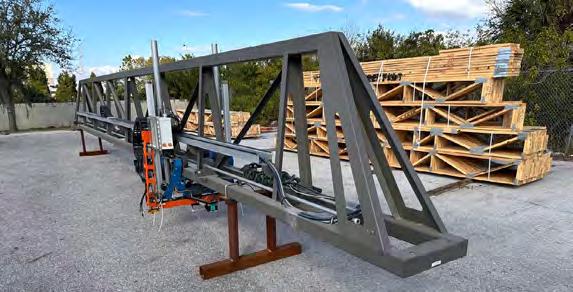
2016 5-Bay Ranger LRS, with (4) Magazines
2016 Ranger LRS designed to fit the MiTek Blade linear saw, includes (5) lumber carts, (4) lumber magazines, overall beam length of 50-ft with end column supports, footprint of 50′ x 52′. Pick head is screw-type. Includes light-curtain perimeter beam, operator’s console, perimeter safety fencing and rails for carts.
$81,995
PHONE: 800-289-5627 FAX: 800-524-4982 Read/Subscribe online at www.componentadvertiser.com Don’t Forget! You Saw it in the Adverti$$er June 2024 #16299 Page #117
Component manufaCturing m The
765-751-9990 www.woodtechsystems.com
FOB FL
2021 Triad Floor Cassette System

TRIAD GENERATION 3 FRAMING TABLE
Lengths to 76'
Powered Width Adjustment (6'-9" to 18'-3")
Joist Locators at 16", 24" and 19.2" Centers
Accommodates 2x8 through 2x12 Lumber, LVL, I-Joists & Open Web Floor Trusses
TRIAD STUD STITCHER WITH MATERIAL BRIDGE
Programmable Touch Screen
3 Tool Mounts on Each Side (Excludes Nail Guns)
Bridge Auto Return
4,000 Lb Capacity Material Bridge (joists, studs or drywall)
$339,000 NOW $289,000 FOB CO
TRIAD TRIDENT NAIL BRIDEG WITH ROUTER Programmable Touch Screen
3 Tool Mounts with Tilt Capacity (Excludes Nail Guns)
Router Mount (Excludes Router Motor)
Auto Sizing Plate Fire
Bridge Auto Return
Accommodates Horizontal & Vertical Decking
Needs replacement sensors
208 Volt / 3 Phase
New price was $481,488
Installation is available at additional expense
PHONE: 800-289-5627 FAX: 800-524-4982 Read/Subscribe online at www.componentadvertiser.com Don’t Forget! You Saw it in the Adverti$$er June 2024 #16299 Page #118 A dverti $ er Component manufaCturing m The www.wasserman-associates.com 800-382-0329
Factory Direct
Wasserman & Associates at the same price as the Manufacturer, and get the added support and care you need to be up and running FAST!
EVEN HELP SELL YOUR USED EQUIPMENT TOO!
Buy
From
WE’LL


Used Teeter Carts

Triad 20' Power Chain Conveyor
• Foot Pedal Control
• 2 Pairs available at $7,500 Each Wasserman & Associates 800-382-0329
www.wasserman-associates.com
Steel teeter carts, quantity of (16), for moving bulk material for production staging, can be used to deliver full units to sawyer or long cut material to an assembly area at a convenient working height. Size 72″ long x 46″ wide x 32″ high, 2,500 lb. load capacity. Feature (2) pneumatic tires/ steel wheel, and (2) swivel casters. Units shown without large tires: quantity of (3) at $500 each.
Wood Tech Systems 765-751-9990
www.woodtechsystems.com

FOB NE. Wasserman & Associates 800-382-0329 www.wasserman-associates.com


2008 Genie GTH-1056 Telehandler
Genie telehandler lifts up to 10,000 lbs over 10 ft high, and up to 5,000 lbs 56 ft high. Can also extend out 42 ft. carrying up to 3,000 lbs. Features a 74 HP diesel engine with 3 speed transmission. Also features 3-mode power steering (2-wheel, 4-wheel coordinated and crab), frame leveling +/- 10º, and Full time 4WD with front and rear limited slip differential (LSD). Vehicle weight is 31,900 lbs. 4,618 hours on the telehandler.
765-751-9990
www.woodtechsystems.com

PHONE: 800-289-5627 FAX: 800-524-4982 Read/Subscribe online at www.componentadvertiser.com Don’t Forget! You Saw it in the Adverti$$er June 2024 #16299 Page #119 A dverti $ er Component manufaCturing m The MISC. MODULAR EQUIPMENT Hilman Model BSP-6P Rollers • 6 Ton Capacity. • Polyurethane Wheels. • Swivel Padded Top. • 54 48 Available $290 NOW $200 each FOB NE Wasserman & Associates 800-382-0329 www.wasserman-associates.com 800-382-0329 | www.wasserman-associates.com New Sub-Component Nailer • Assembles Trimmers, Jacks, L’s, Channels & Headers • 2x4 and 2x6 Capacity • Remote Fire & 3-Way Clamping • Staggered or Straight Line Nail Pattern • Squaring Stop • Foot Pedal Control • Reserve Air Tank • 5’ Infeed & Outfeed Roller Conveyor $26,500 FOB NE NEW! Scrap Incline 20′ belt scrap conveyor with 8′ incline, 2′ wide. 240v, 30 amp power. $22,490 - FOB CA Wood Tech Systems 765-751-9990 www.woodtechsystems.com New Handle Bar Router Porter Cable Model 7519 Production Router Motor with Soft Start. Steel Handle Bar Frame with Makita Switches. 120 Volt / 1 Phase / 15 Amp / 21,000 RPM. Includes 2 Router Bits. $3,000
$59,900
FOB OH As-Is Where-Is
S erving the S tructural B uilding c omponent S i ndu S try The
A dverti$er Component manufaCturing


Door Machining Center (DMC) New Builders Automation Machinery
“Ovation” series, door machining center (DMC). Fully programmable, two-stage door machine featuring (27) axes of operation. Can be specified with either two or four front machining heads. Machine is side-eject, direct-drive with helical gear racks and gear protection from dust. The door loader is driven by an absolute encoder; no stepping motors, belts or exposed ball screws are used.
More information Click Here
Price based on configuration Wood Tech Systems 765-751-9990 www.woodtechsystems.com

Trucks & Trailers

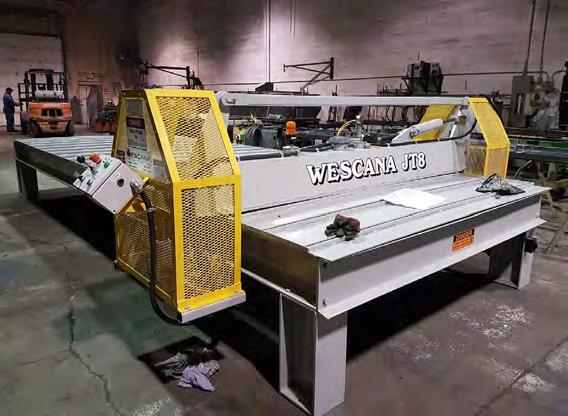
• Automated Component & Linear Saws (2010 & Newer)
• Monet DeSauw or TimberMill Manual Component Saws
• Floor Web Saws
• Spida (Apollo) Saws with Truss Automation
• Bunk Cutters
Truss Equipment
• Roller Gantry & Hydraulic Press Systems
• Finish Rollers
• Truss Stackers
• Floor Truss Machines
• Lumber Splicers
• Jack Tables
• C-Clamp Presses
• Stretch Roll-Off Trailers
• Go oseneck Roll-Off Trailers
Modular Equipment
• Pacific Automation or MiTek Mobile Home Press
Contact Wasserman & Associates for a Fair Market Value Assessment of your Used Equipment Operational, Needs Work, and Parts Only equipment will be considered!

Builders Automation Machinery (BAM) door loader, model 2001. Allows you to stack door slabs horizontally and feeds them into a horizontal door machine like the BAM model 996E-TS. Mechanically adjusts door stack height vertically as slabs are fed into machine. Clamp automatically adjusts to type and size of door slab: steel, solid-core or hollow-
programmed controller manages the
door machine
and heavy-duty drive train
approximately (30) seconds per
PHONE: 800-289-5627 FAX: 800-524-4982 Read/Subscribe online at www.componentadvertiser.com Don’t Forget! You Saw it in the Adverti$$er June 2024 #16299 Page #121 A dverti $ er Component manufaCturing m The 800-382-0329 | www.wasserman-associates.com Wescana Jack Press & Table 35 Ton Hydraulic Press with 14" Wide Platen Press Roof or Floor Truss (4" Maximum Opening) Steel Frame Table with 1/4" Steel & 1" Plastic Top Slotted Jigging at 12" Centers | Joystick Control 7.5 HP / 3 Phase (208/230/460/575 Volt) 6' x 25' Table & 8' x 25' Table Available NEW! Door } Stair } Window Machines Dotul Door Stop Stitcher Click Here for details $4,900 NOW $3,600 FOB GA Wasserman & Associates 800-382-0329 www.wasserman-associates.com RUVO MODEL 1300 DOUBLE END DOOR TRIM SAW $4,250 FOB PA Wasserman & Associates 800-382-0329 www.wasserman-associates.com BAM
“Ovation”
765-751-9990 www.woodtechsystems.com BAM
Door Loader, Model 2001
core, from 6-ft to 8-ft heights. Electronic,
Loader
the
infeed to save effort of the operator. Pneumatic motor
provide dependable continuous use. Cycle time
loaded door slab. Footprint approx. 10′ x 10′ x 11′. Weight 2,000 lbs. 120 volt, 1 phase, 15 Amp electrical required. 120 PSI at 20 CFM (1/2″ ID line min.) air required. Price Based on Configuration NEW! 800-382-0329 | www.wasserman-associates.com Equipment Wanted! Saws
loading process.
positions
door stacks adjacent to the

Hain Systems Framer
T+/- .010 Inches
Stop Rail: 2 x 4 x 1/4 Aluminum Extrusion
he Hain Systems Framer (HSF) will help you build square and accurate wall panels for residential or commercial construction applications. It will help you cut building costs by saving time and improving your quality. It’s a reliable, efficient and proven system that features a ruggedly simple design. The HSF is based on a proven design with over 20 years of actual production use and maintenance experience. It comes fully assembled and is designed for portable job site framing or in-plant permanent installation. The table has many optional attachments and will support Mylar Tape wall layout or any other type of layout. The optional gun rails can also be retro-fit to any table.
Stops: Jig Bored Steel
Stop Blocks: Machine Billet Aluminum
Details:
Internal Components: Hardened, Ground and Polished Steel and Billet Aluminum
Table Construction: Thick-wall Structural Steel Tubing, Jig Welded for Accuracy
Dimensions: Length: 5 feet (60”) to 60 feet (720”)
Height: 12 inches
Air Supply: 90 psi (10 CFM Air Flow Recommended)
Depth: 12 inches
Electrical Supply: 120 VAC
Powder Coat: Industrial Gray
Dimensions: Height: 43”
Length: 16’ or 20’
Width: Adjustable 8’ to 10’ or 8’ to 12’
Shipping Weight: 3000 lbs
If you are looking for the fastest, most consistent way to measure and cut your product, then the Hain Measuring System (MEA) is your answer. The MEA changes from one length t any length instantly, up to 60’, without changing the operator’s position on the line. It is also highly accurate (+/- .010) and quickly moves from one length to the next in seconds. The MEA is designed for quick and easy setup and is simple to use. Even a first time user will be productive with little or no training required. It can adapt to any saw and can be mounted to any surface so that you can integrate the MEA with your existing setup. The MEA is versatile allowing “left” or “right” handed operation and measurement in “feet and inches” or “inches” depending on your preference. The MEA is also available in a “Skid Mounted” version.
PHONE: 800-289-5627 FAX: 800-524-4982 Read/Subscribe online at www.componentadvertiser.com Don’t Forget! You Saw it in the Adverti$$er June 2024 #16299 Page #122 A dverti $ er Component manufaCturing m The
Electrical Supply: 110 VAC Motor: 1/4 HP, 110 VAC, Linear Actuator Highly Accurate: +/- .010 Inches Stop Rail: 2 x 4 x 1/4 Aluminum Extrusion Stops: Jig Bored Steel Stop Blocks: Machine Billet Aluminum Internal Components: Hardened, Ground and Polished Steel and Billet Aluminum Dimensions: Length: 5 feet (60”) to 60 feet (720”) Height: 12 inches Depth: 12 inches If you are looking for the fastest, most consistent way to measure and cut your product, then the Hain Measuring System (MEA) is your answer. The MEA changes from one length t any length instantly, up to 60’, without changing the operator’s position on the line. It is also highly accurate (+/- .010) and quickly moves from one length to the next in seconds. The MEA is designed for quick and easy setup and is simple to use. Even a first time user will be productive with little or no training required. It can adapt to any saw and can be mounted to any surface so that you can integrate the MEA with your existing theHAINCOMPANY 6125 Enterprise Drive, Unit 9 | Diamond Springs, CA 95619 530.295.8068 | sales@thehaincompany.com Electrical Supply: 110 VAC Motor: 1/4 HP, 110 VAC, Linear Actuator Highly Accurate:

BAM Stair Wedge Saw
Builders Automation Machinery (BAM) model 2220, stair wedge saw station automatically produces wood wedges used to lock stair treads and risers into slots cut into the stair stringers…
Price based on configuration FOB FL
765-751-9990
www.woodtechsystems.com


BAM Pre-Hung
Door Machine
Titan Series
Builders Automation
Machinery (BAM) Titan series pre-hung door machine. Designed to produce between 150 and 250 doors per day. Multi-function door machine capable of doors 1′-6″ to 4′-0″ in width, and both 6′-8″ or 8′-0″ door heights. Processes both 1 3/8″ and 1 3/4″ thick door slabs. Machines the door, hinge jamb and strike jamb all at the same time. Capable hinge sizes include 3 1/2″ x 3 1/2″, 4″ x 4″, 4 1/2″ x 4 1/2″ with 5/8″ radius. Cycle time with flush hinge routing is 45 seconds. 10′ long x 7′-6″ wide footprint. Shipping weight 4,000 lbs.
More information Click Here
Price based on configuration
765-751-9990 www.woodtechsystems.com

BAM Staircase
Assembly Clamp
Builders Automation
Machinery (BAM) staircase assembly clamp, model 2210, accommodates up to 20 foot long stringers with a maximum width of 54″…

Price based on configuration FOB FL
PHONE: 800-289-5627 FAX: 800-524-4982 Read/Subscribe online at www.componentadvertiser.com Don’t Forget! You Saw it in the Adverti$$er June 2024 #16299 Page #123 A dverti $ er Component manufaCturing m The 800-382-0329 | www.wasserman-associates.com Builders Automation Stair Stringer Router More information here: http://goo.gl/mSsxyY NEW! 765-751-9990 www.woodtechsystems.com
NEW!
NEW!
NEW!


• Sources for MSR Lumber
Filter by species, grade and dimension to locate products from MSRLPC members.
• Educational Resources
Find helpful information for current and potential MSR lumber users.
• NEW! Design Values
Comparison Tool
Compare MSR lumber reference design values with visually graded dimensional lumber by species. The MSRLPC website is a

to make informed purchasing decisions as well as those exploring design optimization with MSR Lumber. Check it out!
Valuable WEBSITE
msrlumber.org
find: LEARN MORE AT: msrlumber.org
Resources Visit
to
one-stop
shop for lumber buyers looking


Safety First!
Meeting Topics
From State Fund, CA.

Electric Tools - Grounds for Concern
Each year workers suffer shock when handling electrical tools and equipment. To protect workers against the hazards of electricity, teach them the basic facts about the causes of shock and death. One of the big problems in understanding the dangers of electrical shock is the mistaken belief that only high voltages kill. It’s not the voltage that kills, but the amount of current that passes through the body. The condition and placement of the body has a lot to do with the chance of getting a shock.
Water and electricity can be a fatal combination. Damp areas and metal objects can offer good shortcuts for electricity to reach the ground. If a worker’s hands are sweaty, if socks and shoes are moist or damp, if the floor is wet, or if the worker is standing in a puddle of water, the moisture will allow more current to pass through the body. If work is to be done with metal objects or in damp areas, workers should recognize the hazards and take necessary precautions. These precautions include rubber gloves and boots, rubber mats, insulated tools, and rubber sheets which can be used to cover exposed metal. Remembering a few tips can help avoid electrical accidents:
• Treat every electric wire as if it were a live one.
• Inspect equipment and extension cords before each use.
• Take faulty equipment or plugs with bent or missing prongs out of service for repair.
• Only qualified electricians should repair electrical equipment or work on energized lines.
• If a plug doesn’t have three prongs or if the receptacle doesn’t have three openings, make sure the tool is grounded in some other way before use.
• Never try to bypass an electrical system by cutting off the third prong of a plug.
• Turn off the power and report the smell of hot or burning plastic, smoke, sparks or flickering lights.
• Stop using a tool or appliance if a slight shock or tingling is felt.
• Never disconnect an electrical plug by pulling on the cord.
• Whenever working on an electric circuit, the circuit should be turned off and locked out at the circuit breaker or fuse box to ensure that the circuit cannot be accidentally turned on.
• Those who regularly work on or around energized electrical equipment should be trained in emergency response and CPR.
In wet, winter months, extra caution should be observed when working with electrical equipment or when working near grounded objects.
Herramientas EléctricasHay que Tener Cuidado
Cada año trabajadores sufren choques eléctricos al manejar herramientas y equipos eléctricos. Para proteger a los trabajadores contra los peligros de la electricidad, es necesario enseñarles los conocimientos básicos sobre las causas de los choques eléctricos y la posibilidad de muerte. Uno de los grandes problemas al comprender los peligros de los choques eléctricos es la creencia errónea de que sólo los altos voltajes pueden producir la muerte. Lo que mata no es el voltaje sino la cantidad de corriente que pasa a través del cuerpo. Las condiciones y la posición del cuerpo tienen mucho que ver con la probabilidad de recibir una descarga eléctrica.
El agua y la electricidad pueden ser una combinación fatal. Las áreas húmedas y los objetos metálicos le ofrecen un paso fácil a la electricidad para llegar hasta la tierra. Si un trabajador tiene las manos sudadas, si los calcetines o los zapatos están húmedos o mojados, si el piso está mojado, o si el trabajador está parado en un charco de agua, la humedad permitirá que pase más corriente a través del cuerpo. Si el trabajo se hace con objetos metálicos o en áreas húmedas, el trabajador debe reconocer los peligros presentes y tomar las precauciones necesarias. Estas precauciones incluyen guantes y botas de hule, alfombrillas de hule, herramientas aisladas y láminas de hule que pueden usarse para cubrir el metal expuesto.
Recordar algunas recomendaciones puede ayudar a evitar accidentes eléctricos:
• Trate todos los cables eléctricos como si tuvieran corriente.
• Inspeccione los equipos y cordones de extensión antes de cada uso.
• Saque de servicio para su reparación a todos los equipos defectuosos o que tengan clavijas de enchufe dobladas o faltantes.
• Sólo los electricistas calificados deben reparar los equipos eléctricos o trabajar en líneas eléctricas activas.
• Si el enchufe no tiene tres clavijas, o si el tomacorriente no tiene tres agujeros, asegúrese de que la herramienta esté conectada a tierra de alguna otra manera antes de usarla.
• Nunca trate de enchufar un equipo eléctrico cortándole la tercera clavija al enchufe.
• Corte toda la alimentación eléctrica y reporte cualquier olor de plástico caliente o quemado, humo, chispas o luces parpadeantes.
• Deje de usar la herramienta o equipo electrodoméstico si se siente un choque ligero o cosquilleo eléctrico.
• Nunca desconecte un enchufe tirando del cable eléctrico.
• Siempre que trabaje con un circuito eléctrico, éste deberá tener su alimentación desconectada y bloqueada en el cortacircuitos o caja de fusibles correspondiente para asegurar que alguien no pueda conectar accidentalmente la alimentación a dicho circuito.
• Las personas que normalmente trabajan en equipos eléctricos con corriente o en sus alrededores, deben estar entrenados para dar auxilio ante emergencias y en reanimación cardiopulmonar (RCP).
Durante los meses lluviosos de invierno, se debe tener aún más cuidado al trabajar con equipos eléctricos o cuando se trabaja cerca de objetos conectados a tierra.
The above evaluations and/or recommendations are for general guidance only and should not be relied upon for legal compliance purposes. They are based solely on the information provided to us and relate only to those conditions specifically discussed. We do not make any warranty, expressed or implied, that your workplace is safe or healthful or that it complies with all laws, regulations or standards.
PHONE: 800-289-5627 FAX: 800-524-4982 Read/Subscribe online at www.componentadvertiser.com Don’t Forget! You Saw it in the Adverti$$er June 2024 #16299 Page #125 A dverti $ er manufaCturing m The PHONE: 800-289-5627 FAX: 800-524-4982 �������������� ������ �� ��������������������������� Don’t Forget! ��� S�� �� �� ��� Adverti$$er January 2017 #10210 ���� ��� A dverti $ er COMPONENT MANUFACTURING THE
June 5
CalENdar of EvENts
JUNE 2024
Offsite Construction Summit Berkeley, CA
June 5 – 6 14th Annual Global Softwood Log & Lumber Conference Vancouver, BC
June 5 – 7
June 11 – 14
June 12
June 13 – 15
June 17 – 18
June 19 – 20
June 20
July 2
July 9 – 11
July 21 – 25
July 24
Florida Building Material Alliance (FBMA) Summer Conference Palm Harbor, FL
National Assoc. of Home Builders (NAHB) Spring Leadership Meeting Washington, D.C.
National Assoc. of Home Builders (NAHB) 2024 Legislative Conference Washington, D.C.
House-Hasson Gateway to Summer Buying Market Sevierville, TN
National Buyers Circle Anaheim, CA
Pacific Coast Builders (PCBC) Conference and Tradeshow Anaheim, CA
Offsite Construction Summit Minneapolis, MN
JULY 2024
Zonda’s Q3 Housing Market Forecast online
Structural Building Components Assoc. (SBCA) and National Framers Council (NFC) Open Quarterly Meetings Bellevue, WA
Southeast Lumber Manufacturers Assoc. (SLMA) Annual Conference Marco Island, FL
Mountain States Lumber & Building Material Dealers Assoc. (MSLBMDA) Golf Tournament Golden, CO
July 25 – 28 Building Material Suppliers Assoc. (BMSA) 2024 Summer Conference Chattanooga, TN AUGUST 2024
August 5 – 18
August 6 – 8
August 8 – 10
August 15
Sept 6 – 9
Sept 9 – 11
Sept 9 – 14
Sept 11 – 15
Sept 18
Sept 18 – 20
Sept 24
Sept 25 – 27
Sept 26 – 28
October 1 – 3
October 7 – 11
October 9 – 11
October 9 – 11
October 22
(SFPA) 38th Forest Products Machinery & Equipment EXPO
States Lumber & Building Material Dealers Assoc. (MSLBMDA) Clay
SEPTEMBER
OCTOBER
PHONE: 800-289-5627 FAX: 800-524-4982 Read/Subscribe online at www.componentadvertiser.com Don’t Forget! You Saw it in the Adverti$$er June 2024 #16299 Page #126 A dverti
er Component manufaCturing m The
$
Orgill
Event online
Fall Online Buying
Southern
Nashville, TN
Ace
Chicago,
Brighton,
Forest Products Assoc.
Hardware Fall Convention
IL
Mountain
Shoot
CO
2024
Do it Best Fall Market 2024 Indianapolis, IN
True Value Fall Reunion 2024 Orlando, FL
International
Chicago,
Manufacturing Technology Show – IMTS 2024
IL
National
Assoc. of Home Builders (NAHB) Professional Women in Building Week online
Offsite
Construction Summit Denver, CO
Gulf
Atlantic Building Products Expo – The Main Event Orlando, FL
Forest
Products
Portland,
Economic Advisors (FEA) Forest
Forum
OR
Construction Suppliers Assoc.
Conference
Miramar,
(CSA)
& Tradeshow
FL
United Hardware Fall Buying Market Rochester, MN
2024
National
San
Assoc. of Home Builders (NAHB) Fall Leadership Meeting
Antonio, TX
Building
Component Manufacturers Conference and Framer Summit (BCMC | FS) Milwaukee, WI
Zonda’s
Future Place Irving, TX
United
Hardware 2024 Fall Buying Market St. Cloud, MN
Zonda’s
Housing Market
Q4
Forecast online
CalENdar of EvENts
NOVEMBER 2024
Don’t see your event?
and participation by listing your industry focused events here! E-mail details and event web-link to . We can’t guarantee space for all events, but all industry related events will be added on a space available and interest to our reader priority.




PHONE: 800-289-5627 FAX: 800-524-4982 Read/Subscribe online at www.componentadvertiser.com Don’t Forget! You Saw it in the Adverti$$er June 2024 #16299 Page #127 A dverti $ er Component manufaCturing m The
October 23 – 23 Lumbermens Merchandising Corp (LMC) Expo Philadelphia, PA October 30 –November 12 Orgill Winter Online Buying Event online
Increase attendance
5 – 8 National Council of Structural Engineers Assoc. (NCSEA) Structural Engineering Summit Las Vegas, NV November 6 – 8 2024 DBIA Design-Build Conference & Expo Dallas, TX November 7 – 9 Build Show LIVE Austin, TX
8 Mountain States Lumber & Building Material Dealers Assoc. (MSLBMDA) BrewFest Denver, CO November 10 – 12 Special Tools & Fasteners Distributors Assoc. (STAFDA) 48th Annual Convention & Tradeshow Nashville, TN November 12 – 14 Mass Timber+ Conference (formerly IWBC) Philadelphia, PA November 13 – 15 North American Wholesale Lumber Assoc. (NAWLA) Traders Market Phoenix, AZ November 18 – 20 Affordable Housing Finance (AHF) Live Summit Chicago, IL November 20 Offsite Construction Summit Atlanta, GA BIM Management & Viewer Project Management Perpetual Inventory Management Procurement / MRP Warehouse & Fulfillment Supply Chain Management Production Management Timesheet Management Client Relations Management moducore.com CLOUD SOFTWARE FOR OFFSITE MANUFACTURING A Company Moducore User Moducore User
November
November
The truss industry relies on 3rd party quality assurance services to provide random visits to review the plants Quality Assurance program along with their operations. If your plant needs to comply with the IRC, IBC and to those who depend on solid, experienced QA expertise, we ask you to consider selecting Timber Products Inspection, Inc. (TP) as your choice for 3rd party inspections.
Proudly serving the forest products industry for over 50 years, TP brings the expertise you need to ensure your business is successful. As a responsible partner, TP delivers to clients, employees, and the industries we serve the confidence to drive value through the effective use of our diverse professional team.
TP would like to welcome the following authorized agents to our inspection team, each of whom have many years of experience in the truss industry!
• Al Coffman
• Jean Hart • Curt Holler • Chuck Ray
Glenn Traylor • Elliot Wilson
If you have questions about how you can make this selection, please contact your authorized agent above or Glenn Traylor at 919-280-5905 or trusguy@gmail.com. https://www.tpinspection.com/ https://www.tpinspection.com/auditing-services/truss
•
TheJobLine.com Careers in the Truss, Wall Panel and Engineered Wood Components Industry Job Opportunities Available Candidates Services & Products 800-289-5627 www.thejobline.com Since 1992

Are you a skilled Truss Designer or Wall Panel designer seeking a better work-life balance? Look no further! Our client is offering a unique opportunity for talented designers like you to thrive in an environment that respects your personal and professional needs.
In this position, you'll have the flexibility to choose from various working arrangements to accommodate your lifestyle. Some of our employers offer a 32-hour workweek with full benefits, allowing you to strike a perfect balance between your career and personal life. You can work in the office, remotely, or in a hybrid setup, depending on your location and skill level.
Outside Sales/Technical - Software Company. Cenrtal US J15336
Truss Designer - MiTek J15327
Florida (Central or Eastern Time Zone Candidates)
Remote Truss Designer J14203 Indiana
Truss Designer J14136 South
Truss Designer J11629 MO
Truss Designer - 32 hour week* J15310 Remote
LGS/CFS Estimator J14141 TN
CFS Truss Designer | Wall Panel Designer J15323 Midwest
Outside Sales - Wall Panels, EWP & Trusses Eastern Ontario
EWP Designer-J15283 Eastern Ontario
Senior Truss & EWP Designer - J15320 AB, BC, ON
Remote Senior Truss Designer - Truss J15266 South
Truss Plant Operations Manager J15318 Florida
Assistant Truss Plant Manager J15311 Central Florida
Production Manager/Inside SalesJ15316 Southern Ontario
Senior Truss Designer - J15315 Southern Ontario
EWP Designer - J15314 BC
Remote Truss Designer J15313 New England
Truss Designer J15285 New England
Truss Designer J14164 Florida
Truss Designer - MiTek - Remote or OS J15312 Florida or Remote (Central or Eastern Time Zone Candidates)
Remote MultiFamily Truss Designer Wall Panel Designer J5309 Central Timezone
Outside Sales - Multifamily Turn Key Framing J15308
Houston
Remote Truss Designer J15307 Full Time Remote
Implementation and Support Specialist J15306
100% Remote - Northeast
CFS Truss Designer J15269
Remote or in the Midwest
Remote Wall Panel Designer - J15304
Remote - Eastern US
Remote Truss Designer - MiTek J15303 Florida or remote
Remote Truss Designer - MegaMultifamily J15302 Central time zone
Hybrid Remote Truss Designer - Single Family J14212
Remote or in office (IN)
Senior Mega-Multifamily Designer J15301
Northern California
Remote Truss Designer - MiTek J15228 Florida
Residential Order Tech J15232 South
Truss Designer J15250 South
Truss Designer J15251 South
Truss Designer J15286 Indiana
Truss Designer J15290 Ohio or Hybrid Remote
Remote Wall Panel Designer - Production Builder Market J14107
Remote Indiana
Truss Designer J14165 Carolinas
PHONE: 800-289-5627 FAX: 800-524-4982 Read/Subscribe online at www.componentadvertiser.com June 2024 #16299 Page #130 TheJobLine.com, inc. 800-289-JOBS www.thejobline.com job opportunities available See what we can do for YOU! visit: www.thejobline.com email: mail@thejobline.com STRICTLY CONFIDENTIAL! TheJobLine.com See what we can do for YOU! visit: www.thejobline.com email: mail@thejobline.com
CONFIDENTIAL! TheJobLine.com Full Time 32hrs 4x10 or Flexible With Full Benefits!
STRICTLY
See Our Current Job Opportunities Here ATTENTION! We are in the process of rebuilding all of our job orders to better fit our new website. For an Up-ToDate list of available jobs, please visit our website www.thejobline.com
More Details Here
ID: C10968
Senior Wood Truss Designer - Part Time
Relocation: REMOTE, Florida, Alabama, Georgia
Candidate desires to use his career long industry experience to be the best Part Time Remote Designer you have. Prior truss plant owner for 10 years, strong production and operations management background, and JobLine Senior Designer rating in truss design using MiTek software. Also has FASTBeam experience. Products: floor & roof trusses. Markets: Single family custom, multi family, tract and light commercial. Was successful in creating strong teams in production, design and customer service, but the local economy and overwhelming competition was more than he could overcome from a small plant perspective. Degree: BSEE
Compensation: Based on employee or 1099 status.
Thom's Notes: I have worked with this candidate as an employer for years. Very detail oriented. Fair, honest, and customer service oriented. Very design/liability conscious. Scored 98
ID: C18659
CFS Truss Designer | Wood Truss Designer - Remote/Full-time or Part-time. Relocation: Florida, Georgia, Louisiana
I have accumulated nearly 40 years of experience in the truss industry. Initially, I served as a truss layout draftsperson for the first two years of my career, gradually progressing to roles such as estimator and truss designer. I enhanced my skills by completing truss design courses and seminars offered by MiTek Industries, a globally recognized software and hardware company. Throughout the majority of my career, I specialized as a wood truss designer. In the last 8 to 10 years, I assumed the role of a lightweight truss designer.
Over the course of my career, I diversified my responsibilities, undertaking roles such as estimator, field and job site inspector, plant supervisor, coordinator, and customer service representative.
Compensation: $30-32hr
ID: C10186
Remote CFS, LGS Designer - Multifamily/ Commercial
Relocation: Texas
One of my best CFS designers, the candidate has 20+ years experience in commercial, multifamily, and pagoda style structures. Want to know more, give me a call or make an inquiry.
ID: C10853
Remote Design Manager | Remote Offshore Design Project Manager
Relocation: Texas, Georgia, USA - South
Top level Engineering/Design Management
candidate, 14+- years experience Truss, 4+- Panel experience. Has experience building and integrating offshore design resources with internal design departments and training design managers to better utilize offshore capabilities. Large volume manufacturer experience. MiTek Sapphire design/layout proficient. Too confidential to go into more detail.
Compensation: $120k+
ID: C18549
Remote Wall Panel Designer
Relocation: USA - ALL States Wall panel designer with 10 years' experience including production builders, single family custom and small to medium multifamily projects. MiTek Sapphire software experience.
ID: C18426
Remote Truss Designer
Relocation: Colorado, Illinois, Indiana, North Carolina, South Carolina, Texas, Utah, Maryland, Florida, Georgia, Nebraska, REMOTE, Costa Rica, Pennsylvania, Tennessee, Virginia, Wisconsin, Wyoming, Washington DC, Rhode Island, Saskatchewan, Oregon, Ontario, North Dakota, New York, New Mexico, New Jersey, New Hampshire, Nevada, Montana, Mississippi, Minnesota, Massachusetts, Kentucky, Delaware, Conneticut, California, Arizona, Alaska
Offshore Truss Designer with MiTek experience. The candidate is a civil engineer with 6 years' truss design experience for companies in Texas and Florida. Prior work for BFS and smaller manufacturers. Bilingual Spanish/English with a company set up to make paying easy. Scored 89 on our truss design skills evaluation, which is near the senior designer level. He is also SBCA I & II certified. He is willing to go to work immediately.
Compensation: $65-75k as a subcontractor, no benefits or taxes.
We haven't represented offshore candidates in the past but feel this candidate is worth a shot. Please contact Thom for additional details.
ID: C11370
General | Plant Manager/OperationsTruss/Panel/Framing Package Relocation: Texas, Arizona
20 years' experience. Started in production, advanced to Saw Supervisor, Production Manager, Plant Manager, now General Manager. As General Manager operated a $125M truss plant. Tripled output and reduced errors and labor cost. Developed and implemented standards and procedures to manage quality and costs. As Plant Manager (4 years), manage all the operation of the manufacturing plant, such as Productivity, logistics, efficiencies, costs.
As Production Manager (12 years), manage all the areas of the manufacturing across the plant. Safety, quality control, efficiencies, HR, etc... Software: MiTek, Word, Excel, OptiFrame. Products: R & F Truss, Panel, Framing package. Markets: Single Family, Multifamily, Custom Homes. Bilingual English/Spanish spoken and written. Degree in Industrial Engineering.
Compensation: $90's+ bonus ($100k min)
ID: C10897
Design Manager/Senior Designer/PE/ Optimizer - Truss/Panel/EWP Relocation: REMOTE
30 year industry veteran, started as a Truss Designer, earned his way to Design Manager over 20+ designers. MiTek - Advanced, AutoCAD proficient. BSCE - PE.
Compensation: Open??
Thom's Notes: PE with Mid Atlantic seals
ID: C18565
Designer: Truss/Panel, Wood/Steel, BIM
Relocation: North Carolina Material take-offs, proposals, job-site meetings, Submittal Tracking, Excellent Problem-solving Skills, Material Ordering, Field Measuring, 3-D Modeling Program (3-D and 4-D BIM in-house), Generated material take-offs from the BIM model, Coordinated RFI's thru the BIM model, Clash detection between wood trusses, structural steel and LVL's. 3-D Scan's of job-sites. Scheduled / Distributed work to 6 designers Cross-trained all designers in roof floor and wall panels for whole-house design.
ID: C18370
Plant | Location | General ManagerTruss/Panel Relocation: California, Nevada
Highly experienced (20+ years) roof and floor truss, and wall panel manufacturing manager. Started in the plant as builder, then sawyer, supervisor, truck driver, maintenance manager, designer, outside sales, plant manager, operations manager, and general manager. OSHA trained, developed and implemented safety programs. Successful turn around experience, hands on ability to work with departments to combine individual strengths into one team effort, lower costs, and meet quality and volume expectations. Past experience negotiating better vendor programs to lower costs and improve inventory turns.
ID: C10507
Senior Management - Truss/Panel/ Lumber/Installed Services
Relocation: USA - Western
I am a Diverse driven individual seeking a position in the fast paced construction component industry where my professionalism in sales, business and leadership skills along with a strong proven

background in, General Management, Operations, Sales Management, strategic alliances, business development, team building, P&L experience and Customer Satisfaction will play an integral part in growing new business, nurturing existing business or developing company operations to meet the highest level of efficiencies, standards and safety while having fun doing it!
ID: C11834
General/Regional Manager - Truss/Panel
Relocation: Maine, Massachusetts, New Hampshire, Ontario, Vermont
As District Manager: Responsible for the financial performance of three wood truss and wall panel plants, two Millwork and door assembly facilities and one installed labor location in multiple states. Group revenues increased from $50 million/year in to $70 million per year. Devised a “buy versus make” purchasing protocol in to ensure that internal truss and Millwork plants were operating at capacity before using outside vendors that supplied similar products. Spearheaded a “hub and spoke” organizational structure for three truss plants. This plan optimized scarce design talent, reduced clerical expenses, and synchronized output at each plant. Restructured the installed labor division to include material estimators, lumber salespeople and cost accounting methods in 2005. The changes resulted in a 400k gain in profits. Drafted corporate training material for fall protection and new hire safety orientation.
As General Manager: Won “Gold Store” award for exceeding company goals in profits, sales growth, and ROA. Served on a corporate manufacturing audit and operating performance team that made
PHONE: 800-289-5627 FAX: 800-524-4982 Read/Subscribe online at www.componentadvertiser.com June 2024 #16299 Page #131 TheJobLine.com, inc. 800-289-JOBS www.thejobline.com Available
Available Candidates TheJobLine.com, inc. 800-289-JOBS Time To
Candidates
Hire? We’re here when you need help! visit: www.thejobline.com email: mail@thejobline.com or call Thomas McAnally for Personalized Service STRICTLY CONFIDENTIAL!
A dverti $ er
Component manufaCturing m
The recommendations to under performing truss plants. Two of the facilities audited became “Gold Stores” the following year. When the sales of three district stores were allocated to the truss plant, the lost business ($1.5 million/year) was made up and organic sales grew by over 10%. Sales volume grew from $11 million per year to over $15 million per year.
ID: C18459
Remote Wall Panel Designer | Wall Panel Designer
Relocation: Alberta, British Columbia, Ontario
8 Years' experience as a wall panel designer. Uses HSB CAD, AutoCAD, Autodesk Revit. Everything from Single family custom to multifamily and modular.
ID: C18387
Division Manager, VP Operations, President - Truss | Panel | Building Materials | Pro Dealer
Relocation: Arizona, Colorado, Florida, Georgia, Hawaii, Maryland, Texas, USASouth, Virginia, Washington DC, Wisconsin
Executive level manager, VP, President with $1+B P&L responsibility. Lumber, building materials, trusses, wall panels, and CFS background. Inquire to discuss this candidate.
ID: C18449
Estimator | Designer - Truss, Panel | Prior carpenter
Relocation: Ohio, Pennsylvania
Prepare and distribute estimates to competing bidders. Calculate labor, time, and material estimated per individual job. Read, analyze, and interpret residential and commercial blueprints. Ensure projects meet the proper building codes and standards for the industry. Communicate with prospective bidders both over the phone and in person. Design and engineer roof trusses, floor trusses, pre-fabricated wall panels, and EWP. Gained first-hand experience setting trusses in the field during prior construction job. Design roof systems to be most efficient and inexpensive when being constructed in the field. Design complete models in MiTek Sapphire. Design and engineer roof trusses and transfer loads throughout the structure as need. Also design and engineer beams and hangers when necessary.
ID: C12414
Truss Designer | Wall Panel Designer | All Hats
Relocation: Arizona
Engineered panel and truss design, developed material take off for turnkey build up, worked in coordination with multiple plants and design teams, worked closely with material suppliers on take offs and estimating.
I've worked for decades in the construction industry. Not only in new construction,
but additions and remodels as well using innovative designs for added value and to drive down cost. In addition to experience with MiTek, Wallbuilder and other design software packages, I have extensive manual trig/math skills. I use these to back check questionable loads as well to design from scratch in the field when needed. I have also written tutorials for the training of others and checked other designer's work as a Design Manager at a Panel Plant. All things being equal, I love working in components whether designing, cutting, building or setting components at the site.
ID: C18430
Truss Designer | Remote Truss Designer Relocation: USA - South, USA - Southwest, USA - ALL States
Extensive experience in truss estimating and design. Proficient in designing roof and floor trusses for a variety of projects including: custom homes, track homes, multi-family, mega-multifamily, and light commercial projects. I always get everyone involved with the project like architect, engineers, homeowners, and sales personnel Many times I go to the job site for the convenience of the framer and see what kind of condition or changes they might have; this way we will be working on the same page. Also included in my experience is purchasing material, negotiating contracts, setting up deliveries, steel and cmu detailing for steel columns and beams, with almost 25 years of experience in the construction business. MiTek Sapphire.
ID: C18367
Wall Panel Designer | Remote Wall Panel Designer | Mega-Multifamily Relocation: Utah
Remote wall panel design for medium to large scale MF. Remote estimating using MiTek Sapphire to get a more accurate material count. 100,000 - 500,000 sq ft MF projects primarily in the New England Market with the panel plant being in New Brunswick. Also worked on projects in the Arizona, Texas, and California markets.
Compensation: $70's+ (45+- hours)
ID: C18365
Intermediate Canadian Remote Truss Designer - Sapphire Relocation: Ontario
Remote Truss Designer available.. Currently provides technical support and designs to lumber distributors for roof systems for residential and commercial applications. Provides technical assistance and support to the distribution staff to meet client demands for engineered wood structural applications. Ensures that wood truss fabricators, lumber distributors and specifiers have adhered to established building standards, codes and practices. Maintains extensive knowledge of structural analysis programs such as MiTek SAPPHIRE Structure design software. Analyze/prepare engineered
wood designs and details for Design Engineer review and approval. Generate manufacturing information and quotations for sales team and management. Prepares the job for production. Canadian codes and standards experienced.
ID: C15958
Operations/Plant Manager - Millwork | Doors | Ply | Flooring Relocation: Colorado, Illinois, Indiana, Iowa, Kansas, Kentucky, Minnesota, Missouri, Montana, Nebraska, Nevada, North Carolina, South Dakota, Tennessee, Virginia, Wyoming
30 years' experience starting in production and advancing to multi-plant operations manager. Door experience includes managing three Production Managers and five Production Supervisors, consisting of 300 hourly employees producing 11,000 doors and 10,000 face frames per day. Responsible for the manufacturing functions of all mill operations, five frame component machining cells, three frame assembly operations, four door component machining cells, three door assembly clamps, three door profiling lines, two wide belt sanding lines and specialty machining and assembly cells.
Flooring experience: Responsible for all plant functions including budgeting and P&L. Managed six Department Managers: two Production Departments, Quality Assurance, Materials, Human Resources including SHE, and Plant Engineer/Maintenance Manager including the CI program. Their staffs consist of eleven Supervisors and 330 hourly employees. The door plant operation dries lumber, cuts dimension stock, assembles and sands the doors. The panel plant produces the veneered flat and raised center panels, by cutting engineered wood and veneer from flitch and pressing the veneer to the substrate. Both plants are equipped with finishing lines.
ID: C15995
Truss Designer - MiTek
Relocation: Florida
Truss Designer. Primary duties: design, layout, optimization, and cutting/production documents. Secondary duties: checking others work. Software used: MiTek and AutoCAD. Component experience includes floor trusses and roof trusses. Market experience includes single family, multifamily, light commercial, and agriculture. My volume was varied depending on projects. 2 years experience, MiTek software.
ID: C10789
Production Manager/Supervisor - Truss/ Panel
Relocation: Minnesota, Iowa, North Dakota, South Dakota, USA - Northwest, Wisconsin 20 years experience. Responsible for all aspects of truss and panel production, inventory, performance reviews. 65
workers, $9M year. WTCA quality control certified.
ID: C18277
Professional Engineer | Engineering Manager - Engineered Wood Products, Components Structural Hardware | Codes & Compliance
Relocation: Maryland, Minnesota, North Carolina, Pennsylvania, South Carolina, USA - Eastern, Virginia, Washington DC
Experienced and successful professional engineering manager with over 25 years experience in improving productivity and resolving structural problems for engineered wood product and truss manufacturers and developing innovative design software programs. Also skilled in building outstanding teams and relationships among sales, manufacturing, and engineering stakeholders. Highly educated with exceptional employment history & experience.
ID: C18250
Remote Senior Light Gage Steel Truss/ Panel Designer.
Relocation: Texas
Top level Light Gage Steel Senior Remote Designer with Truss and Panel and well as metal frame commercial project experience. Alpine, Truswal and Keymark experience.
ID: C17230
Remote Wall Panel Designer - Sapphire
Relocation: Newfoundland
My objective is to be part of a team/company and prove I am reliable, show my ability and my willingness to learn! In addition to being a newer wall panel designer, I have learned software such as Mitek Sapphire, Revit 2017, Bluebeam Revu 2016. I have recently done jobs such as designing garages and adding on additions to homes. Jobs I have worked in wall paneling include a massive wall panel job for the US (500,000+ SFT) and designed units for a senior complex. In addition to wall panels...I also add in blocking, windows, doors, etc. I also do bundling and paperwork as well.
ID: C16152
Mega-Multifamily General Manager
Relocation: Florida
Mega-Multifamily General Manager. Apply to discuss this candidate. Highly confidential.
ID: C13445
Truss Designer | Wall Panel Designer | Truss Cutting Technician
Relocation: Texas, Arizona
2 years' experience. Perfect entry level candidate. Design light gauge steel walls and trusses for residential homes and small commercial buildings. AutoCAD certificate with Architectural focus. From the candidate: I have a strong architectural background and come from a construction family. I've seen or worked in most facets of
PHONE: 800-289-5627 FAX: 800-524-4982 Read/Subscribe online at www.componentadvertiser.com Don’t Forget! You Saw it in the Adverti$$er June 2024 #16299 Page #132
Component manufaCturing m
A dverti $ er
the construction field. From masonry work to framing to roofing since I was a teenager. I'm very passionate about what I do , self motivated and always strive to be the best. Very picky with my work and I don't like to do anything wrong and failure is not an option for me. I always try to do whatever is needed to achieve company goals.
ID: C11781
Truss Design Manager
Relocation: New York
Worked on the most complicated custom projects, commercial buildings, and apartment complexes. Quickly became a team leader and was considered company wide as an expert in truss framing and computer applications. Provided training for a group of 30 experienced component designers in topics including load tracking, truss and layout optimization, and hardware specification. Optimization training helped to reduced material costs by 5%. Developed departmental procedures to increase consistency and accuracy of all designs and estimates. Reduced errors on repetitive projects by 25% by creating the master project file database, which organized and provided fast and easy access to project information. Streamlined estimating process for commercial construction projects. Analyzed the final cost of completed projects and applied results to new estimates. Reduced estimating time by 75% Managed up to 10 designers/sales reps. Software: MiTek, AutoCAD.
ID: C15999
Outside Sales - Truss | Wall Panel | EWP | Installed Sales
Relocation: Alabama, Georgia, Kentucky, North Carolina, South Carolina, Tennessee, Virginia
16 years' experience in outside sales of trusses, wall panels, engineered wood components, stairs and other building materials. Projects range from tract to high volume multifamily apartments. Has developed new territory, improved sales in lagging markets, and met or exceeded sales goals in most years. Has turn key installed sales experience, and has limited design skills from the past. Please inquire for additional information. Easy relocate.
ID: C15857
Senior Truss Designer | Remote Truss Designer | Design Manager
Relocation: California
Truss Designer. Primary duties: design, layout, optimization, cutting/production documents, and takeoff. Secondary duties: checking others work, scheduling, repairs, customer service, inside sales, and field measurements. Software used: MiTek and AutoCAD. Component experience includes floor trusses, roof trusses, I-Joists, EWP, and hardware. Market experience includes tract, single family, single family custom, multifamily, and light commercial. My volume was varied depending on projects. Has used
MiTek, Alpine, AutoCAD, and Microsoft Office programs.
The candidate has been out of the industry, working in parallel jobs, and wants to return to a design position. Scored Senior Designer using an HP calculator, 8 years after his last truss design job. Speed was faster than average too. It may take a little time for him to get up to speed on the latest software. Ranked 5 out of 5 in our system.
ID: C10810
Designer/Inside Sales - Truss Relocation: Virginia
6 years design experience, 1 inside sales. Primary duties: design, layout, optimization, cutting/production documents, and takeoff. Secondary duties: scheduling, repairs, customer service, inside sales, and field measurements. Software used: MiTek, AutoCAD, and CAD - Other. Component experience includes floor trusses and roof trusses. Market experience includes tract, single family, single family custom, multifamily, light commercial, and agriculture. My volume was varied depending on projects. Past carpenter and framer. Has an engineering related associates degree/ drafting
Compensation: $45k+
ID: C10234
Outside Truss Sales/Technical | Estimator Relocation: Colorado, Wyoming
35 years construction experience, 25 in truss sales. Sells Trusses wholesale. Sells Trusses to Builders and Owner Builders and service the account through Design, Pricing, Production, Delivery, Installation, and problem solving. Also service National accounts which involves solving all the in-field problems. Dealing directly with the project Supervisor on missing trusses, damaged, missing plates, trusses don't plane, don't work, design errors, bad deliveries, dealing also with the building inspectors, and project engineers.
Will also consider a remote estimator position.
Compensation: Mid $30's base plus commission.
ID: C15679
LGS Truss & Panel PE
Relocation: USA - Eastern, USA - South
As Engineering Manager I was responsible for oversight of all technical and engineering engagements. Design of light gauge metal trusses, wall panels, shear walls, for hotels, retirement homes and other commercial and residential structures. Making jobs viable by replacing red-iron with light gauge metal was key to solidifying more projects. I was actively engaged in computer software development of truss design and coordinating overseas programming efforts
into truss layout.
As Senior Technical Services Engineer, I held the nation-wide responsibility for all light gauge cold-formed steel truss engineering including field applied repair design. I provided technical advice and counsel to our staff and functioned as a subject matter expert (SME) for all three product divisions. As a result, I augmented my professional registrations to include 38 States, 1 District, and 1 Canadian Province.
ID: C15673
Outside Sales - Truss/EWP/I-Joist Relocation: North Carolina
I was responsible for calling on builders and retail lumberyards selling floor and roof trusses, LVL, EWP and hardware. I would talk to the builder or lumberyard salesperson to see what there exact needs were and would then do a hand takeoff to generate pricing. I was also available do make job site visits if there were any situations that needed resolved. I went to my new employer as an Account Manager we used Mitek along with management software. I was able to take 95% of my existing customers that knew how good a job I always did for them. I was able to grow the market from $0.00 to $2,500,000. I worked with track builders, custom home builders and light commercial. With my education and passion for the building industry it was easy for me to do my job. I enjoy dealing with people, reading blue prints and being able to provide my customers with valued engineering, a quality product and outstanding customer service.
ID: C14490
General Manager | Operations Manager | Turn Around Relocation: Colorado, Delaware, Illinois, Indiana, Iowa, Kentucky, Maryland, Michigan, New Jersey, New York, North Carolina, Ohio, Pennsylvania, Tennessee, Virginia, Washington DC, West Virginia, Arkansas, Massachusetts, Minnesota, Missouri, Montana, North Dakota, Rhode Island, South Carolina, South Dakota, Texas, Wisconsin, Florida, Georgia, Idaho, Kansas Full P&L turnaround of a family owned light gage steel panel manufacturing company. Turned it form a mom and pop, into a large, functioning manufacturing company that had systems, KPI programs, personnel development, and a growing customer base. Ready to help take your company to the next level.
ID: C11976
Design/Estimating/Sales - Truss/LGS Relocation: New York
Experienced wood & cold formed steel truss designer with 12 years experience using MiTek Industries and Aegis Metal Framing products and software. Seasoned sales professional with 8 years experience selling; wood roof & floor trusses and accessories, metal roof trusses and accessories, and the sale of component design and engineering
services. A highly motivated designer and sales person with a proven track record for achieving excellence, building long term business relationships, and providing impeccable service to contractors, engineers, architects, and developers throughout New York and New England. Specialize in design build and defense contracting from early pre-bid/qualification stages through installation.
ID: C11895
Designer - Truss/I-Joists, EWP
Relocation: California, USA - ALL States, Texas, Alaska
Designer. Primary duties: design and cutting/production documents. Secondary duties: checking others work and field measurements. Software used: Alpine and MiTek. Component experience includes floor trusses, roof trusses, I-Joists, EWP, and hardware. Market experience includes single family, single family custom, multifamily, and light commercial. BS Civil Engineering. Software: Alpine, MiTek, AutoCAD, Word, Excel.
ID: C11501
Production/Plant/Location ManagerTruss/Panel/I-Joist/Framing Package Relocation: North Carolina
20 years experience. Managed 6 different locations over 12 years. Started 2 panel plant from scratch.Increased production at all plants I managed. Was promoted to Manufacturing Manager in 2009 over multiple plants. Worked closely with the designers, became proficient with the MBA and MVP programs. Trained 3 different people to become plant managers. Can operate all saws, computer systems, forklifts, trucks. Started up a Panel Plant in 2004. Plant Manager of the year two out of the three years the program was in place. Only Manager to go two years in a row, at different locations with no accidents.
Compensation: $50-70k+ incentive with future opportunity for more.
PHONE: 800-289-5627 FAX: 800-524-4982 Read/Subscribe online at www.componentadvertiser.com Don’t Forget!
Saw it in the Adverti$$er June 2024 #16299 Page #133
You
The

The Impact of Mortgage Rates on Housing Affordability
Posted May 9, 2024 on NAHB Now | The News Blog of the National Association of Home Builders Reprinted with permission.
According to the latest press release from Freddie Mac, the average rate on a 30-year fixed-rate mortgage has now risen to approximately 7.25%. Based NAHB’s priced-out data, at this rate, only about 27.5 million (out of a total of 134.7 million) U.S. households could afford to buy a median-priced new home, based on their incomes and standard underwriting criteria.
As many analysts have noted, interest rates and house prices interact with each other to determine new home affordability. For example, if the costs of producing homes and the resulting prices to buyers were reduced (for instance, by adopting some of the measures in NAHB’s 10-point plan to lower shelter inflation), more than 4.5 million households would be priced into the market by reducing interest rates from 7.25% to 6.25%, which was the mortgage rate in mid-February 2023.

For example, in the table, approximately 27.5 million households are able to afford the median-priced new home at a 7.25% mortgage rate. If the rate fell back to 6.25%, the table shows an additional 4.5 million (for a total of approximately 32 million) households would be priced into the market.
This change is particularly relevant, as NAHB is currently projecting that the average mortgage rate will be near 6.25% by the end of 2024 — although there is considerable uncertainty around this number, largely because of uncertainty about what monetary policy the Federal Reserve will find necessary to contain inflation. The above table can be used to track the impact actual changes in mortgage rates are having on affordability of new homes over the rest of the year.
Paul Emrath, vice president for survey and housing policy research for NAHB, provides more information in this Eye on Housing post.
PHONE: 800-289-5627 FAX: 800-524-4982 Read/Subscribe online at www.componentadvertiser.com June 2024 #16299 Page #134 A dverti $ er Component manufaCturing m The INdustry NEWs
New Home Sales in April Down on Higher Mortgage Rates
Posted May 23, 2024 on NAHB Now | The News Blog of the National Association of Home Builders Reprinted with permission.
Mortgage rates that averaged above 7% since mid-April per Freddie Mac data acted as a drag on new home sales last month.
Sales of newly built, single-family homes in April fell 4.7% to a 634,000 seasonally adjusted annual rate from a downwardly revised reading in March, according to newly released data from the U.S. Department of Housing and Urban Development and the U.S. Census Bureau. The pace of new home sales in April is down 7.7% from a year earlier.
“The last four weeks mortgage rates have been above 7% and this is clearly causing many potential home buyers to sit on the fence,” said Carl Harris, chairman of the National Association of Home Builders (NAHB) and a custom home builder from Wichita, Kan. “However, in the weeks and months ahead, we expect mortgage rates to fall below 7%. Moderating rates, along with a dearth of existing inventory, should help new home sales recover as new construction will be needed to meet the demand for homes, especially during this crucial spring/summer season.”

“A lack of homes in the resale market combined with softening of the median new home price should incentivize home buyers to turn to new construction in the coming months,” said Danushka Nanayakkara-Skillington, NAHB’s assistant vice president for forecasting and analysis.
A new home sale occurs when a sales contract is signed, or a deposit is accepted. The home can be in any stage of construction: not yet started, under construction or completed. In addition to adjusting for seasonal effects, the April reading of 634,000 units is the number of homes that would sell if this pace continued for the next 12 months.
New single-family home inventory in April remained elevated at a level of 480,000, up 12.1% compared to a year ago. This represents an 9.1 months’ supply at the current building pace, which has been supported by the ongoing shortage of resale homes. Completed, ready to occupy inventory (97,000 homes in April) is up 42.6% from a year ago. However, that inventory type remains 20% of total inventory.
The median new home sale price in April was $433,500, down 1.4% from March, and up 3.9% compared to a year ago.
Regionally, on a year-to-date basis, new home sales are up 22.4% in the Northeast, 22.3% in the Midwest and 14.0% in the West. New home sales are down 10.5% in the South.
PHONE: 800-289-5627 FAX: 800-524-4982 Read/Subscribe online at www.componentadvertiser.com June 2024 #16299 Page #135 A dverti $ er Component manufaCturing m The INdustry NEWs
Higher Mortgage Rates Hammer Builder Confidence in May
Posted May 15, 2024 on NAHB Now | The News Blog of the National Association of Home Builders Reprinted with permission.
With mortgage rates averaging above 7% for the past four weeks per data from Freddie Mac, builder sentiment posted its first decline since November 2023.
Builder confidence in the market for newly built single-family homes was 45 in May, down six points from April, according to the National Association of Home Builders (NAHB)/ Wells Fargo Housing Market Index (HMI) released today.
“The market has slowed down since mortgage rates increased and this has pushed many potential buyers back to the sidelines,” said NAHB Chairman Carl Harris, a custom home builder from Wichita, Kan. “We are also concerned about the recent codes rules that require HUD and USDA to insure mortgages for new single-family homes only if they are built to the 2021 International Energy Conservation Code. This will further increase the cost of construction in a market that sorely needs more inventory for first-time and first-generation buyers.”

“A lack of progress on reducing inflation pushed long-term interest rates higher in the first quarter and this is acting as a drag on builder sentiment,” said NAHB Chief Economist Robert Dietz. “The last leg in the inflation fight is to reduce shelter inflation, and this can only occur if builders are able to construct more attainable, affordable housing.”
The May HMI survey also revealed that 25% of builders cut home prices to bolster sales in May, ending four months of consecutive declines in this metric. However, the average price reduction in May held steady at 6% for the 11th straight month. Meanwhile, the use of sales incentives ticked up to 59% in May from a reading of 57% in April.
Derived from a monthly survey that NAHB has been conducting for more than 35 years, the NAHB/Wells Fargo HMI gauges builder perceptions of current single-family home sales and sales expectations for the next six months as “good,” “fair” or “poor.” The survey also asks builders to rate traffic of prospective buyers as “high to very high,” “average” or “low to very low.” Scores for each component are then used to calculate a seasonally adjusted index where any number over 50 indicates that more builders view conditions as good than poor
All three HMI component indices posted declines in May. The HMI index charting current sales conditions in May fell six points to 51, the component measuring sales expectations in the next six months fell nine points to 51 and the gauge charting traffic of prospective buyers declined four points to 30.
Looking at the three-month moving averages for regional HMI scores, the Midwest increased three points to 49, the Northeast fell two points to 61, the South dropped two points to 49 and the West posted a four-point decline to 43.
HMI tables can be found at nahb.org/hmi. More information on housing statistics is also available at Housing Economics PLUS (formerly housingeconomics.com).
PHONE: 800-289-5627 FAX: 800-524-4982 Read/Subscribe online at www.componentadvertiser.com June 2024 #16299 Page #136 A dverti $ er Component manufaCturing m The INdustry
NEWs
Higher Interest Rates Keep SingleFamily Housing Starts Flat in April
Posted May 16, 2024 on NAHB Now | The News Blog of the National Association of Home Builders Reprinted with permission.
Single-family starts remained flat in April as interest rates moved above 7% last month and builders were dealing with tighter lending conditions.
Overall housing starts increased 5.7% in April to a seasonally adjusted annual rate of 1.36 million units, according to a report from the U.S. Department of Housing and Urban Development and the U.S. Census Bureau.
The April reading of 1.36 million starts is the number of housing units builders would begin if development kept this pace for the next 12 months. Within this overall number, singlefamily starts decreased 0.4% to a 1.03 million seasonally adjusted annual rate. However, this pace is 17.7% higher than a year ago. On a year-to-date basis, single-family starts are up 25.7%, totaling 335,600. The multifamily sector, which includes apartment buildings and condos, increased 30.6% to an annualized 329,000 pace.

“While the start of the year has seen an expansion for single-family home building because of a lack of existing home inventory, home building activity leveled off in April as higher interest rates, tighter lending conditions and lower home building sentiment acted as headwinds on new home construction,” said Carl Harris, chairman of the National Association of Home Builders (NAHB) and a custom home builder from Wichita, Kan. “Lower interest rates, particularly for builder and developer loans, will help builders to increase the pace of home construction in the months ahead.”
“Moving forward, the multifamily market will see additional declines for construction volume, while the pace of completions remains elevated,” said NAHB Chief Economist Robert Dietz. “April marked the fifth consecutive month for which the seasonally adjusted rate of multifamily completions was above 500,000. This additional rental supply will help lower shelter inflation, which is the last leg of the inflation policy challenge.”
On a regional and year-to-date basis, combined single-family and multifamily starts are 24.5% lower in the Northeast, 11.0% higher in the Midwest, 1.8% higher in the South and 8.4% higher in the West.
Overall permits decreased 3.0% to a 1.44 million unit annualized rate in April. Single-family permits decreased 0.8% to a 976,000 unit rate; this is the lowest pace since August 2023. Multifamily permits decreased 7.4% to an annualized 464,000 pace.
Looking at regional data on a year-to-date basis, permits are 9.3% higher in the Northeast, 8.5% higher in the Midwest, 2.8% higher in the South and 0.2% higher in the West.
After peaking in July 2023 at 1.02 million apartments under construction, active multifamily units under construction is declining quickly—down to 934,000 in April.
PHONE: 800-289-5627 FAX: 800-524-4982 Read/Subscribe online at www.componentadvertiser.com June 2024 #16299 Page #137 A dverti $ er Component manufaCturing m The INdustry NEWs

Building Talent Foundation and Simpson Strong-Tie Renew Partnership for Fourth Consecutive Year

(Washington DC and Pleasanton, CA) April 30, 2024 — Simpson Strong-Tie and Building Talent Foundation (BTF) announced the extension of their partnership into 2026 with a $900,000 investment from Simpson Strong-Tie over the next three years (2024–2026). In addition, Simpson Strong-Tie CEO Mike Olosky has joined the Building Talent Foundation Board of Directors, and VP of Strategic Partnerships and Engagement Annie Kao has joined BTF’s Advisory Council.
The partnership hit the ground running this year with 12 events planned nationwide introducing and promoting construction careers to diverse audiences. The first two events of 2024 were held in February for Spring Woods High School students in Houston, Texas, and for Carl Wunsche Sr. High School students in Spring, Texas. More than 60 students participated in Simpson Strong-Tie product demonstrations including the Quik Drive® PRO250G2 Subfloor System and H2.5A hurricane ties. Another three events followed in March and April, with students at Atlanta Technical College in Georgia, St. Philip’s College in San Antonio, and Grand Oaks High School in Spring, Texas.
Additional events are planned throughout the year in Texas, California and Florida. These are aimed to educate students about the construction industry, showcase Simpson Strong-Tie products and innovations, and provide insights into career opportunities within the construction trades.
“Getting more individuals into the construction trades is a key priority for us. Helping alleviate the labor shortage benefits our entire industry, so we’re excited to continue working with BTF on meeting their goals of bringing thousands of new employees into the trades,” said Olosky.
“We’re thrilled to extend our partnership with Simpson Strong-Tie and continue our joint commitment to promoting careers in construction, lifting people out of poverty and into meaningful jobs, and enhancing skilled trade education, in order to strengthen communities and the industry’s workforce,” said Branka Minic, Chief Executive Officer of BTF. “We deeply appreciate the continuous support from Simpson Strong-Tie, and we welcome Mike and Annie to our organization’s Board and Advisory body.”
About Building Talent Foundation
Building Talent Foundation (BTF) is a national nonprofit organization founded by the Leading Builders of America, with a purpose to address the acute and persistent talent shortage across residential construction. BTF’s mission is to advance the education, training and career progression of young people and people from underrepresented groups, helping them develop into skilled technical workers and business owners in residential construction. For more information, visit buildingtf.org and follow Building Talent Foundation on LinkedIn, Facebook, X, and Instagram.
About Simpson Strong-Tie Company Inc.
Simpson Strong-Tie is the world leader in structural solutions — products and technology that help people design and build safer, stronger homes, buildings, and communities. As a pioneer in the building industry, we have an unmatched passion for problem solving through skillful engineering and thoughtful innovation. Our structural systems research and rigorous testing enable us to design code-listed, value-engineered solutions for a multitude of applications in wood, steel, and concrete structures. Our dedication to pursuing ever-better construction products and technology and to surrounding our customers with exceptional service and support has been core to our mission since 1956. For more information, visit strongtie.com and follow us on LinkedIn, X, YouTube, Instagram, and Facebook.
PHONE: 800-289-5627 FAX: 800-524-4982 Read/Subscribe online at www.componentadvertiser.com June 2024 #16299 Page #138 A dverti $ er Component manufaCturing m The INdustry
NEWs
New SUBE Bridging Connector From Simpson Strong-Tie Delivers Faster, Simpler End-of-Wall Bracing
May 8, 2024, Pleasanton, Calif. — Simpson Strong-Tie, the leader in engineered structural connectors and building solutions, is introducing the SUBE bridging connector for cold-formed steel. The wall-stud bridging connector is designed to connect cold-rolled channel at the end of a wall or single-stud jamb condition, or at the ends of panel walls, curtain walls or load-bearing conditions. The result is faster and simplified bracing with less buildup.
SUBE connects to the open face of the stud, installing with two screws to the stud lips, effectively limiting drywall buildup to save time and money; the u-channel attaches to the bottom of the connector with two additional screws. Because the connector’s outer flanges allow it to fit snugly over the open side of the stud, no special tools or clamping is required. The design also eliminates sharp-point screw perforations, helping to create a safer work environment.

“By removing the potential for drywall bulge and onsite safety issues, contractors using the SUBE bridging connector can efficiently terminate end-of-wall bracing, saving both time and money,” said Clifton Melcher, Group Product Manager for Simpson Strong-Tie.
SUBE is crafted from 16-gauge steel with a galvanized (G90) finish. The connector’s design values ensure compliance with AISI S100 Sections C2.2.1 and C2.3 for axially and laterally loaded studs. Flexible design solutions accommodate web thicknesses of 33 mil (20 gauge) through 97 mil (12 gauge) and stud sizes of 3 5/8” and 6”.
For more information, visit SUBE Bridging Connector
About Simpson Strong-Tie Company Inc.
Simpson Strong-Tie is the world leader in structural solutions — products and technology that help people design and build safer, stronger homes, buildings, and communities. As a pioneer in the building industry, we have an unmatched passion for problem solving through skillful engineering and thoughtful innovation. Our structural systems research and rigorous testing enable us to design code-listed, value-engineered solutions for a multitude of applications in wood, steel, and concrete structures. Our dedication to pursuing ever-better construction products and technology and to surrounding our customers with exceptional service and support has been core to our mission since 1956. For more information, visit strongtie.com and follow us on LinkedIn, X, YouTube, Instagram, and Facebook.
PHONE: 800-289-5627 FAX: 800-524-4982 Read/Subscribe online at www.componentadvertiser.com June 2024 #16299 Page #139 A dverti $ er Component manufaCturing m The INdustry NEWs
INdustry NEWs

A-1 Celebrates Expansion of Employee Ownership at Special Events
FORT PIERCE, FLA – A-1 Global Holdings, Inc., a leading manufacturer of pre- engineered building components, is proud to announce significant milestones in its Employee Stock Ownership Plan (ESOP) during celebratory events held on April 25th and 26th at its Bainbridge and Fort Pierce locations, respectively. The events marked a key moment in A-1’s history, celebrating the addition of 235 employees to the Company’s ESOP. This expansion underscores A-1’s commitment to fostering an ownership culture where every employee has a stake in the Company’s success.
“A-1 is not just a workplace but a place where careers flourish and personal investments grow,” said John Herring, CEO and Chairman of A-1 Global Holdings. “These events not only celebrate our current success and growth but also reinforce our belief in sharing this success directly with our employees.” The ESOP is a powerful tool designed to empower A-1’s employees, providing them with a significant financial stake in the Company without any cost to them. This initiative aligns with A-1’s core values of Own it, Passionate, Honesty, and Respect, turning every team member into a co-owner deeply invested in the future.


Jan S. Beck, President of A-1 Global Holdings, highlighted the impact of the ESOP on company culture: “Our employees are the heart of A-1, and by extending ownership to more of our team, we enhance our capacity to work together toward shared goals. Our ESOP is more than a program. It’s a cornerstone of our strategy for future growth and a testament to our commitment to our team.” As A-1 continues to grow, the Company remains dedicated to ensuring that all employees contribute to and benefit from the success they help to create.
About A-1 Global Holdings
Founded in 1977, A–1 has over 465 employees and is a leading manufacturer of pre-engineered wood trusses and EZWALL® Innovative Framing SolutionTM. The Company reorganized in December 2022 as A-1 Global Holdings, Inc., the parent company for A-1 Industries of Florida, Inc. and A-1 Industries of Georgia, LLC. A-1 currently has manufacturing facilities in Fort Pierce, Fla. and Bainbridge, Ga., and multiple employment opportunities in both locations for candidates who share the Company’s Core Values – Own it, Passionate, Honesty, and Respect. A-1’s employees are eligible to participate in the Company’s Employee Stock Ownership Plan.
PHONE: 800-289-5627 FAX: 800-524-4982 Read/Subscribe online at www.componentadvertiser.com June 2024 #16299 Page #140 A dverti $ er Component manufaCturing m The
A-1 Bainbridge, Ga.
A-1 Fort Pierce, Fla.
Builders FirstSoure Raises More Than $1 Million for the Leukemia & Lymphoma Society at Annual Charity Event
May 16, 2024, IRVING, Texas--Builders FirstSource proudly announces that its recent Annual Charity Event for The Leukemia & Lymphoma Society (LLS) successfully raised over $1 million for LLS, demonstrating the company’s enduring commitment to fighting blood cancers. The event took place in Las Colinas, TX on May 9 and 10.
Since initiating its partnership with LLS in 2006, Builders FirstSource has helped raise more than $11 million towards critical research, patient support, and advocacy programs dedicated to advancing treatments and cures for blood cancers.


“We are deeply appreciative of the overwhelming support from our partners, which enabled us to make this significant contribution to The Leukemia & Lymphoma Society,” said Dave Rush, President and CEO of Builders FirstSource. “Every dollar raised represents our commitment to supporting those affected by blood cancers. Together, we are building hope and advancing the cause to find cures.”
The event featured Hall of Fame Basketball Coach Roy Williams as a keynote speaker, who discussed the profound impact cancer has had on his family and friends. He went on to draw parallels between teamwork in sports and life, emphasizing the importance of collaboration and leadership. “It’s amazing how much can be achieved when no one cares who gets the credit,” Williams noted.
“We are profoundly grateful to everyone who has celebrated, honored, and remembered those impacted by blood cancer,” expressed Coker Powell, LLS SVP and Chief Development Officer. “Through the unwavering support and generosity of Builders FirstSource and its partners, we are empowered to advance towards a world without blood cancer. Their steadfast support directly fuels LLS’s mission: pioneering cutting-edge treatments, providing vital resources to patients and families navigating their blood cancer journeys, and championing accessible and affordable healthcare for all.”
The 2024 event attracted sponsorship from notable companies including: Accenture, Alpine ITW, American Gypsum, Andersen Windows & Doors, The AZEK Company, Boise Cascade, Canfor, Capital Lumber, Century Communities, Cisco, Commvault, Cornerstone Building Brands, Composite Technology International, DAP Global Inc., Doman Building Materials Group, D.R. Horton, DuPont, EVOTEK, Georgia-Pacific, Great Southern Wood Preserving, Hampton Lumber, James Hardie, JELD-WEN, Knauf Insulation, LP Building Solutions, The Marwin Company, Meritage Homes, Metrie, M/I Homes, MiTek, MITER Brands, Novo Building Products, ODL, Okta, OrePac Building Products, Owens Corning, Ox Engineered Products, Pacific Woodtech, Pella Windows and Doors, Perficient, Plastpro, PrimeSource Building Products, Reeb, Simpson Strong-Tie, Specialty Building Products, Steves & Sons, Therma-Tru Doors, Trellix, Trex, Versatex Building Products, Weyerhaeuser, and Woodgrain.
Looking forward, Builders FirstSource aims to raise at least $2 million for LLS in 2024. The company will continue its engagement through various fundraising initiatives, including LLS’s Light The Night® walks, where blood cancer survivors and supporters gather to raise funds for research, advocacy, and patient services. More information on Builders FirstSource’s charity initiatives is available on its website.
PHONE: 800-289-5627 FAX: 800-524-4982 Read/Subscribe online at www.componentadvertiser.com June 2024 #16299 Page #141 A dverti $ er Component manufaCturing m The INdustry NEWs

Nation’s Best Acquires Gambles Hardware
Expands Presence in Colorado
May 1, 2024, DALLAS, Texas – Nation’s Best adds its fifty-seventh location, and second in the state, as it announces its acquisition of Gambles Hardware in Hotchkiss, Colorado, adding to its growing national footprint of locally-focused home improvement stores.
“When owner Kimberly Shay expressed an interest in selling her family’s hardware store so she could refocus her efforts on her other businesses in town, we stepped in to take a closer look at Gambles Hardware knowing that store could be a great fit within the Nation’s Best model,” says Tina Green, Regional Vice President of Operations for Nation’s Best’s West Region. “She and her late husband built up a solid store that aimed to serve all the community’s needs. The store is clean, welcoming, well- organized, and broad in its mix of diverse products across its 7,000 square feet of retail space.”
Founded in 1942, Gambles Hardware has built its 82-year reputation as the first-choice source for home improvement goods and services in Hotchkiss. They are known for their strong selection of plumbing and electrical products, gardening, and paint, as well as authorized dealers for in-demand brands.
Robert Debs, who oversees acquisitions for Nation’s Best, notes that the company intends to remain active on the acquisitions front this year. “Nation’s Best has no plans to slow down. With almost sixty stores now in operation under the Nation’s Best family of over thirty distinct brands, we have honed our winning formula for success. We are looking forward to continuing to demonstrate the value and relevance of independent home improvement across the country,” he adds.
As part of Nation’s Best’s strategy, Gambles Hardware will maintain operations under their existing name with its key management team overseeing company operations alongside Nation’s Best, which will provide the strategic and financial support necessary to drive optimal growth and profitability. Nation’s Best will also lease back the property from the owners, an approach that they have found favorable to both parties.
About Nation’s Best
Nation’s Best Holdings, LLC was founded in 2019 and currently owns and operates a growing number of locations across the United States. Nation’s Best is committed to identifying and acquiring best-inclass independent home improvement stores to ensure their continued relevance as vibrant community resources. To learn more, visit nationsbest.net
PHONE: 800-289-5627 FAX: 800-524-4982 Read/Subscribe online at www.componentadvertiser.com June 2024 #16299 Page #142 A dverti $ er Component manufaCturing m The INdustry NEWs
NEWs
US LBM Acquires Northern California Structural Building Component Manufacturer

National building materials distributor acquires California’s Better Built Truss
RIPON, CA, May 2, 2024 – US LBM, a leading distributor of specialty building materials in the United States, has acquired Better Built Truss, a top manufacturer and supplier of structural roof and floor components in Northern California.
Founded in 1964, Better Built Truss operates two facilities in Oakdale and Ripon, Ca. Primarily, Better Built Truss designs, manufactures and supplies roof and floor truss components to contractors, developers and multifamily, commercial and residential builders in Northern California. Jeff Qualle, who has led the business since 1996, will continue to run day-to-day operations.
With this acquisition, US LBM now operates 12 locations in Northern California, including three structural component manufacturing facilities; the company also operates Homewood Truss, which is located north of Sacramento.

“The team at Better Built Truss has great relationships with area builders in California, and a long history of providing exceptional service and solutions,” said US LBM President and CEO L.T. Gibson. “We continue to see demand for structural building components in Northern California, and the addition of Better Built Truss allows us to increase our capabilities and expand our customer base in the area.”
About US LBM
US LBM is the largest privately owned, full-line distributor of specialty building materials in the United States. Offering a comprehensive portfolio of specialty products, including windows, doors, millwork, wallboard, roofing, siding, engineered components and cabinetry, US LBM combines the scale and operational advantages of a national platform with a local go-to-market strategy through its national network of locations across the country. For more information, please visit uslbm.com or follow US LBM on LinkedIn.
PHONE: 800-289-5627 FAX: 800-524-4982 Read/Subscribe online at www.componentadvertiser.com June 2024 #16299 Page #143 A dverti $ er Component manufaCturing m The INdustry

84 Lumber Participating in 2024 HUD Innovative Housing Showcase
EIGHTY FOUR, Pa. (May 22, 2024) – 84 Lumber is participating in the 2024 Innovative Housing Showcase (IHS), hosted by the U.S. Department of Housing and Urban Development (HUD), by collaborating with the Structural Building Components Association (SBCA) and the National Framers Council (NFC) for the upcoming event scheduled June 7–9, 2024, at the National Mall in Washington, D.C.
The SBCA will be constructing a 2,400-square-foot structure in under eight hours on June 3, 2024. This one-day framing event will show the improved cycle times now possible with available offsite manufactured products such as floor trusses, wall panels, and roofing truss panels while highlighting what framers and offsite manufacturers accomplish when working together.
“I am thrilled to announce 84 Lumber’s collaboration with the Innovative Housing Showcase,” said Ken Kucera, VP of installed sales and manufacturing of 84 Lumber. “This public outreach effort will promote the importance of sustainable and cost-effective housing solutions for communities in need and we are grateful to be a part of it.”
84 Lumber, one of the SBCA’s largest national members, will be supplying all structural framing components, windows, and doors for this year’s project. With its strong ties to regional framing crews, the company aims to utilize these relationships to construct the structure efficiently and effectively.
According to the SBCA, nearly 70 percent of homes constructed in America leverage offsite construction technology, particularly in roof trusses, which dates back to the 1950s. This method not only decreases construction costs compared to traditional stick-framing, but also significantly enhances a home’s resilience against severe weather conditions, thus drastically underscoring its efficiency, cost-effectiveness, and durability in the construction industry.
“As this is SBCA and NFC’s third year of participating in HUD’s Innovative Housing Showcase, we definitely see the benefit of being part of this great effort,” said SBCA executive director Jess Lohse. “That’s why this year we are glad to have the opportunity to co-present this event with HUD and other housing and building organizations to provide information and knowledge of all the benefits and efficiencies components, such as trusses and wall panels, bring to the housing industry.”
The Innovative Housing Showcase aims to raise awareness about innovative and affordable housing designs and technologies to demonstrate how these advancements can boost housing supply, decrease construction costs, increase energy efficiency and resilience, and ultimately make housing more affordable for both homeowners and renters.
Following the end of the event, the framing crew will return to the National Mall and disassemble the structure before transporting it to Waynesboro, Virginia. The home will then be donated to a local Habitat for Humanity chapter, which will provide a home for a seven-person family desperately in need of affordable housing.
“In our area, 40 percent of all households are below the local household survival budget. Finding affordable housing is a huge challenge,” said Charlie Frankfort, board chairman of Habitat for Humanity-Waynesboro. “We are thrilled to be working with SBCA and NFC again this year to provide two more homes for families in need.”
This is the third year the SBCA and NFC have participated in the Innovative Housing Showcase. Both organizations remain devoted to highlighting the groundbreaking advancements in housing and design. To view the house built on the National Mall last year, click here.
84 Lumber is the leading supplier of building materials, manufactured components, and industry-leading services for single and multifamily residences and commercial buildings. The company operates more than 320 facilities in 33 states and is continuing to grow. To learn more, visit www.84Lumber.com or follow 84 Lumber on Facebook, Instagram or LinkedIn.
PHONE: 800-289-5627 FAX: 800-524-4982 Read/Subscribe online at www.componentadvertiser.com June 2024 #16299 Page #144 A dverti $ er Component manufaCturing m The INdustry NEWs
NEWs
The Creation of the First TornadoResistant Building Codes
May 21, 2024 – Tornadoes pose a significant threat to life and property due to their devastating power – they are responsible for claiming more lives annually in the U.S. than hurricanes and earthquakes combined. According to the National Oceanic and Atmospheric Administration (NOAA), the U.S. experiences an average of over 1,200 tornadoes each year, with about 60 of them reaching an intensity of EF-3 or higher on the Enhanced Fujita scale.
It is essential to take proactive measures for disaster prevention, including ensuring that buildings are constructed and maintained according to modern building codes and standards like the International Codes®. Such measures can greatly enhance the structural integrity of buildings, increasing their resilience against the destructive forces of tornadoes and ultimately saving lives.
Tornado-Resistant Building Design and Construction
For years, U.S. building codes lacked the inclusion of tornado-resistant design and construction requirements, resulting in an increase of property damage and loss of lives during such disastrous events. Thanks to the dedication of Long Phan and Marc Levitan, structural engineers at the National Institute of Standards and Technology (NIST), this has changed.
Phan and Levitan led a decade-long effort to create the world’s first tornado design standards which enable builders to construct buildings to withstand 97% of the tornadoes that occur in the U.S. each year.
Before their work, builders and engineers considered tornadoes as uncontrollable acts of nature – too severe, unpredictable and costly to incorporate into building design plans. This belief stemmed from the limitations of the original Fujita Scale, which until 2007 often exaggerated tornado wind speeds by disregarding factors like building quality and design when assessing damage.
In 2011, Phan and Levitan investigated a powerful EF5 tornado in Joplin, Missouri, and made a fascinating observation during their study: despite the tornado’s widespread destruction, a hospital complex managed to keep an entire floor intact because of its impact-resistant exterior. This finding suggested that it might be possible to design buildings to withstand tornadoes. As a result, Phan and Levitan recommended that NIST create national standards to guide building safety efforts.
“They translated important research into practical engineering terms that the average practitioner could use to design and build safer buildings,” said Dominic Sims, CEO of the International Code Council.
After an extensive consensus process, the American Society of Civil Engineers (ASCE) approved the new tornado wind load standard created through Phan and Levitan’s research in 2021. Additionally, a committee tasked with revising the International Building Code® unanimously adopted the new regulation for implementation in 2024.
To learn more about the creation of the first tornado-resistant building codes, click here.
For International Code Council resources on disaster preparedness, click here.
PHONE: 800-289-5627 FAX: 800-524-4982 Read/Subscribe online at www.componentadvertiser.com June 2024 #16299 Page #145 A dverti $ er Component manufaCturing m The INdustry


PHONE: 800-289-5627 FAX: 800-524-4982 Read/Subscribe online at www.componentadvertiser.com Don’t Forget! You Saw it in the Adverti$$er June 2024 #16299 Page #146 A dverti $ er Component manufaCturing m The Advertiser Directory 4Ward Solutions Group www.4wardconsult.com 623-512-6770 ben@4wardconsult.com Acceptance Leasing & Financing Service, Inc. www.acceptlease.com 412-262-3225 cvillella@acceptlease.com Acer Inc. www.acerinc.com 507-864-2220 sales@acerinc.com Akhurst Machinery www.akhurst.com 888-265-4826 sales@akhurst.com Your Solution for Lack of Technical Staff ● PlanSwift Lumber and Building Material Takeoffs ● Truss and Wall Panel Design Experienced Staff ● EWP Layouts and much more! All Points was launched by Industry Veteran Dave Walstad with over 20 years of Offshore Experience to create the Gold Standard in Technical Support Teams. 1-941-713-4395 www.AllPoints.Tech Dave.AllPoints@gmail.com Offices in: Panama City Beach, FL USA HCMC (Saigon), Vietnam Bengaluru, India Eliminate your lack of technical resources to grow sales and increase the clock speed of your company. We have the network and experience you can count on Deploy Technical Teams from All Points! All Points Technical www.AllPoints.Tech 941-713-4395 Dave.AllPoints@gmail.com AN ITW COMPANY Alpine www.alpineitw.com 800-521-9790 mschwitter@alpineitw.com BuyMetrics® www.buymetrics.com 888-485-8623 info@buymetrics.com Clark Industries, Inc. www.clark-ind.com 800-743-9727 general@clark-ind.com Eagle Metal www.eaglemetal.com 800-521-3245 connect@eaglemetal.com Eide Integrated Systems eideintegratedsystems.com 612-521-9193 ext 204 tom@eidemachinery.com Element Equipment by GOW Group Inc. www.element-equipment.ca 800-799-4711 info@element-equipment.ca Fitzgerald Group, LLC www.fitzgroup.com 719-528-5445 rfitzgerald@fitzgroup.com HOLTEC USA Corporation www.holtecusa.com 813-754-1665 info@holtecusa.com Hundegger USA www.hundeggerusa.com 435-654-3028 steve@hundeggerusa.com LimTek Solutions limteksolutions.com 416-888-4457 edmond.lim@limteksolutions.com MiTek USA www.mitek-us.com 800-325-8075 customerservice@mii.com


Advertiser Directory
Panels Plus www.panplus.com 866-726-7587 tkaasa@panplus.com

ROGworx Automation www.ROGworx.com 707-333-4507 sales@ROGworx.com
Simpson Strong-Tie www.strongtie.com 800-999-5099 web@strongtie.com Spida Machinery USA www.spida.com 866-647-7771 sales@spida.com
The Hain Company www.thehaincompany.com 530-295-8068 sales@thehaincompany.com
TheJobLine.com www.thejobline.com 800-289-5627 mail@thejobline.com Timber Products Inspection www.tpinspection.com 770-922-8000 Todd Drummond Consulting, LLC.
www.todd-drummond.com 603-748-1051 todd@todd-drummond.com


907-230-8276 info@vektausa.com
PHONE: 800-289-5627 FAX: 800-524-4982 Read/Subscribe online at www.componentadvertiser.com Don’t Forget! You Saw it in the Adverti$$er June 2024 #16299 Page #147 A dverti $ er Component manufaCturing m The Triad | Merrick Machine
www.triadmachines.com 800-568-7423 ext 133 LowellT@merrickmachine.com Vekta USA www.vektausa.com
Wasserman & Associates
West
Wolf X Machina
Wood Tech Systems, Inc.
www.wasserman-associates.com 800-382-0329 sales@wasserman-associates.com
Fraser www.strengthinlumber.com 916-276-7226 gregory.bates@westfraser.com
www.wolfxmachina.com info@wolfxmachina.com
www.woodtechsystems.com 765-751-9990 info@woodtechsystems.com
The Hain Company Welcome Welcome to The Hain Company's website! Here you will find information about the Hain Company and its line of innovative products that can help streamline your company. Our products are diversely used throughout the manufacturing industry to speed production and reduce labor costs. News Home Hain Engineering Services Company Overview Products Companies We Represent Hain Racing Products Request Form Contact Us Mailing List Used Products Leasing & Financing Services About Hain Racing Products All Measuring Systems Hain Systems Framer Sub Component Nailer Quick Rafter Cutter Vent Block Drills Hain Racing Offset Drive Aluminum Valve Cover Used Products Refurbished QRC Refurbished VBD Refurbished MEA Refurbished SCN Refurbished MMEA Monet Desauw Component Saws Floor Web Saw Material Handling Used Equipment Companies We Represent Festool
Your Company can be Listed in TheAdverti$er Contact Anna Stamm Anna@componentadvertiser.org 800-289-5627 x3
Truss & Wall Panel Designer 20-1130-1
Posted on Friday, April 12, 2024
Employer: Woodhaven Lumber
Located in central coastal NJ is a growing truss and wall panel manufacturer looking for an experienced truss & wall panel designer. The ideal candidate would be local to our central NJ market, but remote design is also a possibility. Previous experience with the Mitek suite of software is a plus.
We offer a competitive salary, paid holidays, paid time off, medical/dental/life/disability insurance, 401k and profit sharing.
Software Territory Sales Representative –Component Manufacturers J15336
Posted on Monday, April 08, 2024 Employer: Client Confidential
You want to be an important member of a strong team of other makers who take pride in their work and support each other. As a Territory Sales Representative (TSR) – Component Manufacturing, you will be responsible for growing Truss sales in the Kansas, Missouri, Oklahoma, and Northern Arkansas Territory while creating and maintaining effective relationships with component manufacturing customers. Your goal for these relationships will be to promote the company's software suite and related hardware products. This encompasses job management, design and analysis for prefabricated metal plate connected wood trusses and engineered wood products. You will coordinate with and contribute to the overall branch and company efforts to profitably grow our business. You will also lead and participate in training sessions/workshops in and out of the territory. These workshops require scheduling, promotion, set-up, presentation, and take-down, as well as providing observation and suggestions for improvement. You will work with Regional Sales Managers, Product Management, Marketing, and other TSRs to develop/ coordinate sales strategies and programs; and communicate appropriate market trends and field intelligence to provide to Management and Operations to ensure customer satisfaction. If career growth is important to you, we not only know how to help you with that, it’s what we love to do.
Remote Truss & Panel Designer J15290
Posted on Wednesday, June 07, 2023
Employer: Client Confidential
JobLine Senior Designer rating is preferred. Remote or hybrid remote may be available, depending upon skills and experience.
Remote Truss Designer J15228
Posted on Wednesday, June 07, 2023
Employer: Client Confidential
Details: Our client in the Southeast is looking for Remote Truss Designer. Work remote, or in an office location. They need senior level Remote Truss Designers and Intermediate level may be considered. Fantastic benefits, compensation is very competitive, and they use MiTek software. Remote is an option if you have a home office and remote experience, or you can work in one of their offices. They may consider someone without remote experience, just depends on the skill level. Must be in the Southeast
Remote Truss Designer - Multifamily J15302
Posted on Wednesday, June 07, 2023
Employer: Client Confidential
Multiple opportunities available: MegaMultifamily Truss Designers with MiTek software experience. The ideal candidate will have Mega-Multifamily experience but small-medium multifamily experience will be considered. This position is for intermediate or advanced level designers. In office or Remote possible if you are in the Central time zone. Please inquire for additional information.
Truss Designer - Local or Hybrid Remote J15285-2
Posted on Wednesday, June 07, 2023
Employer: Client Confidential
Design products include floor and roof trusses, I-Joists, (wall panels a pluss), MiTek software prefered but equal experience excepted. Panel experience is not required but is a plus and you can get panel training if you are interested. JobLine Senior Designer rating is preferred, but strong intermediate level designers will be considered. Full time remote or hybrid remote may be available, depending upon skills and experience.
Truss Designer for Single Family Custom and Production Builder projects. Products include floor and roof trusses, I-Joists, wall panels, MiTek. Panel experience is a plus!
Attention Off-Shore Designers
your
Single Contract Designers Only
List your Contract Design Service Here Contact
Thomas McAnally
twm@componentadvertiser.com
Employer to Candidate Direct Hiring No Recruiting Fees!
Post your Opportunity... Candidates respond directly to you!
For Additional Information Contact: twm@componentadvertiser.org or Call 800-289-5627 x1
For Rates and Posting, visit our website: www.componentadvertiser. com/Hiring-Zone
I design & layout roof trusses, floor trusses, I-Joists and EWP from PDF plans and specifications for pricing. Also engineering using MiTek, and uploads to Management or MBA. Once sold and field measurements are provided, I can update the
project and clean up the layouts and trusses to be ready for the shop. Most of my projects are single family tract and custom, but I have also done several small apartments, hotels, assisted living centers, and other commercial projects. I have 2+ years experience and scored above 6 years on JobLine's Skills test. References are available. Email Tom contracttrussdesign@gmail.com
PHONE:
FAX: 800-524-4982 Read/Subscribe online at www.componentadvertiser.com June 2024 #16299 Page #148 A dverti $ er Component manufaCturing m The thEHiriNg ZoNE The Hiring Zone is operated by The Component Manufacturing Advertiser Magazine. All applications will be sent exclusively to the advertising company. job opportunities available
dverti$er
manufaCturing S erving the S tructural B uilding c omponent S i ndu S try
Hiring Zone Building Component Industry Job
800-289-5627
A
Component
The
Board
For Information
on Any of these Job Opportunities Visit: The Hiring Zone SUBCONTRACT DESIGNERS AVAILABLE Remote Contract Truss Designer - MiTek Exp. Part-Time / Full Time
Place
ad here In the Hiring Zone Subcontract Designers Available Section

Maximize production with integrated off-site technologies
Increase the productivity of your component manufacturing operation with the latest off-site solutions and prefabrication technology. From software that manages many aspects of your business to machinery that maximizes your output, MiTek is committed to the growth of your business and the industry. Together, we’re unlocking the power of off-site construction. Together, we are innovating to meet the needs of an evolving market. Are you ready to maximize productivity of your operation? Talk to a MiTek Representative to get started.
MII.COM/CM
 Joe Kannapell, P.E.
TheLastWord
How Technology Can Enhance Our Lives
In June 2020, my column in these pages, “Fast Walking Through the Corona Crisis,” included a discussion on my Apple watch. At the time, I was impressed to discover how it could record our physical movements, and how it used our past experience to inspire us to be more active. Even though we faced daily challenges during the early days of the pandemic, there were still opportunities to be found, if we looked for them.
Although no longer bound by the constraints of the pandemic, I remain impressed with how technology can provide us with opportunities and advantages. Most importantly, I’ve also learned about its lifesaving features which accrue to all of us, especially those who are limited in their ability to move about. Here are the highlights:

Instant Emergency Notification was a Godsend for my wife after her recent stroke. When I was in the backyard, she fell out of her wheelchair while reaching for a book, and her watch immediately reacted. Because she was not hurt, she could dismiss the SOS and instead proceed with one more click to call me instantly so I could help. Because her watch was cellularenabled, she didn’t need to be near her iPhone and could talk to me on her watch while I hurried there. And even if she had been without cellular service, her watch could have automatically called 911 via a satellite connection! This was definitely a case of having potentially life-saving technology within arm’s reach – a benefit you hope never to have to use but can be very grateful to have.
Constant Activity Tracking remains my most used feature though. I enjoy monitoring my progress concisely with the now-familiar three rings that close if I reach my daily goals. For example, when I took a screen shot of my watch at 7:26 am four years ago, I was just short of my 720 calorie burn goal, but as I write this article at 1:10 pm, I’m over my calorie goal considerably. And on the moment that I exceed my goals, I get a noticeable tap on the wrist. It’s a subtle reminder that I’m doing well, and that I can stop for a minute and recognize that it’s good to be active and meeting my goals.
PHONE: 800-289-5627 FAX: 800-524-4982 Read/Subscribe online at www.componentadvertiser.com Don’t Forget! You Saw it in the Adverti$$er June 2024 #16299 Page #150 A dverti $ er Component manufaCturing m The
Continued next page

Monthly Challenges now encourage me to stretch myself to satisfy them. A clever Apple algorithm derives these challenges from my past activity and posts them on the first day of each month. In May, for example, I was challenged to close all three rings 23 times and I made it a mission to meet that goal!
Yearly Activity is summarized continuously on my iPhone, along with a commentary, for example, praising me for upping my calorie burn over the year or advising me to burn at least 1265 calories for the next 13 weeks to maintain my annual average of 1262 calories/day. It also saves Multi-year Activity in the iCloud, where it chronicles notable accomplishments in the sections entitled “Workout” and “Limited Edition Challenges.”


A Competitive Boost is just what the doctor (should have) ordered, and that’s what my watch constantly provides. At 5 pm today, for example, I noticed that I had only consumed 1014 calories, well short of the 1265 calories that I was advised to attain, and only 3% ahead of my friend Victoria. So, I was compelled to go out and exercise (trimming trees) until I “won.” That’s yet another compelling, life-enhancing advantage of this particular piece of technology, that has served 250 million people and me so well over the past eight years.
PHONE: 800-289-5627 FAX: 800-524-4982 Read/Subscribe online at www.componentadvertiser.com Don’t Forget! You Saw it in the Adverti$$er June 2024 #16299 Page #151 A dverti $ er Component manufaCturing m The


The Industry-Leading Manufacturer of Panelized Wall Panel & Floor Cassette Equipment.

LIGHT GAUGE STEEL FRAMING STATION

The Light Gauge Steel Framing Station is compatible with cold-formed steel C-channels and tracks. The framing table holds these materials squarely in place for fastening to ensure quality panels every time. This model is ideal for companies that manufacture light gauge steel wall panels, such as off-site building manufacturers, manufactured home builders, modular builders, and panelized construction.
OTHER POPULAR PANELIZING PRODUCTS


IMPROVE CONSISTENCY INCREASE EFFICIENCY
WOOD WALL FRAMING STATIONS WOOD WALL SQUARING STATIONS WOOD WALL SHEATHING STATIONS
STEEL FRAMING & SHEATHING WWW.PANPLUS.COM 1-866-726-7587
LIGHT GAUGE