

A dverti $ er Component manufaCturing Serving the Structural Building componentS induStry S The
Photo courtesy of Eagle Metal

INCREASE PRODUCTION. MAINTAIN A SMALL FOOTPRINT. EXPANDABLE.


Consisting of a Framing Station and Sheathing Station, the Exterior 2-Table Line frames and sheathes wall panels while maintaining a small footprint, perfect for those with limited space. This system is a great starting point for customers planning on adding more equipment as their business and budget grows.
Anna Stamm – Advertiser Forum: Seeing the Reason
Joe Kannapell: The Development of the Truss Plate, Part X: Split Decision on Truss Plates
Tony McCoy – Spida Machinery: Spida Machinery’s Automated Apollo Saw—Features
Todd Drummond Consulting, LLC: Will ‘Too Little, Too Late’ Define Your Company?
Glenn Traylor: Should We Seal All Engineered Drawings?
Tracy Roe – Eagle Metal: Catch the Early Bird Registration for BCMC 2023
Edmond Lim, P.Eng. –LimTek Solutions: Incremental CapEx and Accelerated ROI
Rob Bellian – Vekta: Wall Fabrication Solutions from Vekta
Carl Villella – Acceptance Leasing: The Advantages of Using a Broker
Thomas McAnally – The JobLine: Building Your Own Home – Part III: Permits, Inspections, and Scheduling
Geordie Secord – Design Connections: Training New Designers
Lesko Financial Services Team: Positive Trends Provide Hope for a Late Year Recovery
MiTek Staff: Correctly Defining Truss Members
Simpson Strong-Tie Staff: Mass Timber Diaphragm Options with Four Different Connection Types — How Our LDSS48 Light Diaphragm Spline Strap Evolved
Joe Kannapell – The Last Word Truss Machinery Follows the Plates
• Wall Height (standard): 6'9" to 10' 3"
• Wall Height (optional): 6'9" to 20 '3"
• Wall Lengths: 16' to 80'



Publisher Thomas McAnally twm@componentadvertiser.org
Editor Anna L. Stamm 800-289-5627 x 3 anna@componentadvertiser.org
Distributed FREE Via e-mail subscription Download PDF or Read on line at www.componentadvertiser.com
News of Interest and Advertising inquiries can be submitted to: anna@componentadvertiser.org An Open Forum for many sources. Deadline 20th of each month. Articles, Trade Names, and Logos are the property of their respective owner or creator unless otherwise noted
Disclaimer: We reserve the right to refuse any advertisement or material that we deem not in the interest of the industry or the Advertiser. Permission to use content is the responsibility of the contributor including permissions to use any likeness of persons.
The Advertiser is provided “As Is” including typographical errors, omissions, and mistakes both intentional and unintentional.
Copyright 2008-2023
Component Manufacturing Advertiser The Advertiser 411 Walnut Street #12250 Green Cove Springs, FL. 32043


We’ve all watched someone be dismissive of another person’s actions when they chalk them up to habit or reflex. In fact, there’s even a series of TV commercials that encourage people to not become like their parents. But, sometimes, it’s important to remember that actions and habits have developed for a reason.

In particular, one of the actions ridiculed in the commercial is a man cleaning his garbage cans. Well, I have two main comments to that. First, nobody actually wants to have to drag dirty and gross trash cans back and forth from the garage to the street, so it behooves us to keep them clean (although polishing them is excessive). Second, for anyone who has ever been at the receiving end of a trash-collector mix-up, it’s important to have a way to say “that’s my bin, and I’m not keeping your disgusting one!” Yes, that has happened to me, but fortunately I was able to return the bin that had rotten grass clippings in it, and now I make sure I have an undeniable way to identify my bins (although I have stopped short of putting my name on them). In this situation, a very specific experience led to my future actions. It’s not because I’ve gotten older, it’s because I don’t want to have to clean up someone else’s trash, literally.
Another thing that happens in these commercials is reminding people that there’s a reason it’s called, “it’s like being in an elevator.” Oh, I agree, more often than not, we all face forward and wait quietly until the doors open on our floor. But lately, I’ve noticed something. When my sister and I go to her chemotherapy treatments, we’ll often exchange pleasantries with folks who are riding in the elevator with us. It’s a very short ride (the facility only has two floors), and at least half the time we’re alone in the elevator. But when we’re not, we’ll often trade comments on the weather, or what a pretty scarf someone is wearing, and so on. Rather than that being age-related, I think it is a “Midwest” attitude of trying to be friendly. It definitely would be considered odd behavior where I lived in New York, but I can see it happening where I lived in Wisconsin, and that attitude has served us well down here in Oklahoma too.
So, the next time you find yourself ready to dismiss someone’s actions as being attributable to their age or general oddness, stop to consider what their true motivations may be. You might learn something about yourself in that process.
Monet DeSauw FWA 500 Floor Web Cutter
• Push Button Powered Blade Angulations
• Single Push Button Setting for 2 Blades per Side
• Electronic Digital Readouts
• Backup Mechanical Indicators
• Cuts 4 Angle Webs, Cantilever Webs (2 piece webs) & Square Blocks
• Magazine Lumber Feed for 3x2, 4x2 and 6x2 Lumber 12 1/2” to 48 1/2” Length Capacity (7” Minimum on Square Blocks)
• 60 Pieces per Minute
• (4) Internal 16” Blades & (1) External 16” Cut-Off Blade
• Pneumatic Blade Brake on External Blade
• Dust Hoods
• Belt Waste Conveyor (under saw)
• Add $4,200 for 12’ Incline Waste Conveyor (adjacent to saw)


• Add $1,900 for Extra Set of Blades
• 480 Volt / 3 Phase FOBMO
Call For Pricing
Monet DeSauw DeRobo
Linear Saw
• Automated (Truss Design Software Download) or SemiAutomated (Touch Screen Entry) Operation
• All Movements are Computer & PLC Controlled
• Comprehensive Setup Screens Display Each Piece with Setup
Data
• 22” x 40 Tooth Blade on PAE Cut 1 or 2 Boards up to 20’ (2 Second Plunge Cut)
• Cut Chords, Webs, Rafters, Wedges & Stair Stringers
• Cut Long Scarfs by MultiPlunging
• Servo Positioning on Infeed, Angle & Outfeed Pusher
• Over Travel Protection
• Ink Jet Printer
• Lumber Optimization Program
• Belt Waste Conveyor
• 480 Volt / 3 Phase / 60 Amp
• Includes 5 Day Onsite Installation & Training
• Optional Monet DeSauw Live Deck, Bunk Feeder & Incline Belt Waste Conveyor FOB MO Call For Pricing

Monet DeSauw DeSawyer
2000 Automated Saw
• Touch Screen User Interface with Backup Mechanical Controls
• 3 Operating Modes: Auto, SemiAuto & Manual
• All 20 Axes of Movements are Computer & PLC Controlled
• Comprehensive Setup Screens Display Each Piece with Setup Data
• Anti-Collision & Optimizing Programming

• Auto Calibration Productivity & Time Tracking
• Maintenance Diagnostics
• Variable Speed Conveyor (0-50 Flights per Minute)with Powered Hold Downs
• (1) 30” x 80 Tooth Blade (27 3/4”
Scarf on PAE)
• (4) 16” x 40 Tooth Blades (13 1/2”
Scarf on Centerline)
• Pneumatic Blade Brakes on all 5 Blades
• 16 1/2” to 20’ Length Capacity (11” Minimum on Square End Blocks)
• Vibrating Waste Conveyor Under Saw
• 480 Volt / 3 Phase
• Includes 4 Day Onsite Installation & Training
• Add $2,900 for Extra Set of Blades
• Optional Live Deck, Label Printer, Ink Jet Printer, Catcher Display & Incline Belt Waste Conveyor.
Call For Pricing FOB MO
Buy Factory Direct From Wasserman & Associates at the same price as the Manufacturer, and get the added support and care you need to be up and running FAST! WE’LL EVEN HELP SELL YOUR USED EQUIPMENT TOO!
Automatic Truss Jigging System to drastically reduce setup times. Allows for 100% embedment on the table, with top & bottom chord pucks in the same slot. TopSider or standard configurations available for conventional kick-leg, walk-thru, or our new trackless 8' and 10' continuous table systems. Systems for other roller & hydraulic gantries are coming soon. Available in new machine installations or for retro-fitting your existing table. The TopSider is exclusively applicable for “kick or flip leg” style truss presses such as the Tri-Axis & Lumbermater®


• Capable of 100% On-Table Nail Plate Embedment
• Two Pucks Per Slot
• 24", 26", and/or 30" Spacing
• Compatible with all current major design software
• Multiple Simultaneous Layouts
todrillstudsforrunningRomexorotherelectricalwireinthewallpanels
Motor: HeavyDuty5HP-3phase-220vor440v(Pleasespecifywhenordering)
MotorcarriagebearingandspindleassemblymountedonBlanchardgroundsteelplate
LinealmotionishardenedandgroundVbearingsandrails

BlockSizes: 2x4through2x12infiniteheightsettingtocenter
AirSupply: 100psi10CFM

Drills: 2wing3/4'”CarbideTippedcanaccommodatesmallerorlarger
Spindles: AlloySteelpolishedandgroundprecisionshafting
Frame: 2"SteelWithPowderCoatFinish
Covers: 10Gauge(1/8"Thick)Aluminumremovable

Dimensions: Height-60inches,Width-33inches,Depth-33inches
Shippingweight: 750lbs.-(Includingcrate)
MADEINAMERICABYAMERICANS

Four distinctly different types of truss plates came onto the market in the 1950s, but only two made it into the 1960s: the short toothed and the long toothed, neither requiring nails. These two types continued to evolve over the next decade, although along distinctly different paths, and under increasingly competitive conditions.


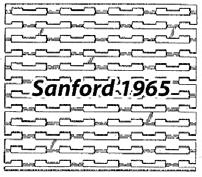
Carol Sanford was the first to re-evaluate his plate. Although this would involve extensive manual work redoing his dozens of engineering manuals, he surely realized that he had to develop a “no-nails” plate. His nearby competitor, Cal Jureit, brought this to light in a bold headline, “…eliminates hand-nailing altogether,” which he ran directly beneath Sanford’s ad in the 1958 American Builder Magazine. But Sanford knew how to remedy his shortcomings. He would repeat the extensive testing regimen that got him into the business. However, he was now the head of a thriving nationwide enterprise, so he needed help to manage this effort. Fortunately, Sanford had the foresight to hire a promising young civil engineer, Bill McAlpine, who undoubtedly contributed to the development of new plates and the associated engineering. Sanford and McAlpine collaborated on two new plate designs, both similar to the Ronel Barb-Grip but with many more clusters of teeth. These plates still lacked competitive gripping values, however, so the development work continued. In 1965, Sanford debuted the first plate with an innovative “two teeth per slot” design, and it was this muchimproved plate that would foreshadow today’s plate designs.

Ronel must have realized that they were trailing Sanford, and they were also motivated by the loss of patent protection on their BarbGrip plate (just as the Gang-Nail plate had lost its cases in Federal Court and upon appeal). Fortunately, like Sanford, Ronel brought on an enterprising young engineer, Mehmet Ilter, who went to work developing and testing a new plate design. After undergoing an arduous process, Ilter developed a plate with even greater grip strength than Sanford’s latest design. (After an illustrious engineering career, unfortunately Ilter passed away on March 26, 2023.)
Cal Jureit also realized that his 14-gauge plate was disadvantaged by the 16-gauge Atkins and HydroAir plates that he had failed to stop in court. And he no doubt was aware of the 20-gauge Sanford and Ronel plates that incorporated less than half the weight of steel. These concerns were compounded by Jureit’s fervent belief in the superiority of the long-tooth plate and vertical pressing, and he had ample justification for his beliefs.
The early roller plates had several drawbacks, especially when examined under thorough engineering rigor. The short teeth of the plug type plates often flared out nearly parallel to the surface of the lumber, severely decreasing their effectiveness. Shorter teeth were also more vulnerable to variances in steel hardness and manufacturing tolerances, especially when embedded with rollers with less than 16” in diameter. And finally, in head-to-head testing, the press-applied plate was about 10% stronger than the roller-applied plate.

Jureit’s goal was “to provide improved…connectors…which are less expensive,” but he did not address his 20-gauge competitors. Instead, he produced an 18-gauge plate, with a tooth length that was reduced from 13/16” to 9/16”. Of course, this plate was not rollable, and that extended tooth length would soon become a considerable constraint.
The period 1966–72 brought hundreds of new CMs into the business, as housing starts tripled. What attracted them to the truss business probably had nothing to do with the type of plate that they were being offered. Those were the days before mass communication, when inquiries to plate companies were answered with personal selling. And after new CMs had invested in a particular supplier, they first had to learn the complexities of the business before they could consider changing suppliers. However, economics eventually came to the forefront, especially as CMs had more choices of truss machinery.
For more on this story, see page 124, “The Last Word: Truss Machinery Follows the Plates”
Since 1970, Joe Kannapell has worked as programmer, Chief Engineer, Marketing Manager, and Sales VP for MiTek, plus 7 years at truss plants, retiring at the end of 2020.


Used Razer S5 Linear Saw
S5 Razer saw modules configured for either left-to-right cutting and/or “Z” shaped layout. AIT auto infeed tables. Vekta user interface software complete with the full version of the optimization algorithms. Stack cutting and side by side cutting
Contact for Pricing
Eide Integrated Systems, LLC 612-521-9193
www.eidemachinery.com

Safety Speed Manufacturing Model

7400 XL Panel Saw
Safety Speed Manufacturing, model 7400 XL*, vertical panel saw, 3 HP induction motor, 64 inch crosscut, 2 1/8" maximum thickness, accuracy within 0.005 inches, 13 foot long welded steel frame with integrated stand and linear V-guides, enclosed counterweight system, adjustable vertical and horizontal rules. Quick changes from vertical to horizontal cutting. Includes machined aluminum material rollers, hold down bar, wheels, quick stop gauges and material hold downs. Dust collection ready. Options available include digital readouts for vertical cuts, automated length measuring, laser guide, stop bar, vacuum and midway fence. 208-230/460 volt, 3 phase electrical (208-230 single phase, 2 HP power optional +$100.00).

$13,149 Base, FOB MN. Wood Tech Systems 765-751-9990
www.woodtechsystems.com


Electrical Supply: 110 VAC
Motor: 1/4 HP, 110 VAC, Linear Actuator
Highly Accurate: +/- .010 Inches
Stop Rail: 2 x 4 x 1/4 Aluminum Extrusion

The Hain Systems Framer (HSF) will help you build square and accurate wall panels for residential or commercial construction applications. It will help you cut building costs by saving time and improving your quality. It’s a reliable, efficient and proven system that features a ruggedly simple design. The HSF is based on a proven design with over 20 years of actual production use and maintenance experience. It comes fully assembled and is designed for portable job site framing or in-plant permanent installation. The table has many optional attachments and will support Mylar Tape wall layout or any other type of layout. The optional gun rails can also be retro-fit to any table.
Stops: Jig Bored Steel
Stop Blocks: Machine Billet Aluminum
Details:
Internal Components: Hardened, Ground and Polished Steel and Billet Aluminum
Dimensions:
Length: 5 feet (60”) to 60 feet (720”)
Table Construction: Thick-wall Structural Steel Tubing, Jig Welded for Accuracy
Height: 12 inches
Depth: 12 inches
Air Supply: 90 psi (10 CFM Air Flow Recommended)
Electrical Supply: 120 VAC
Powder Coat: Industrial Gray
Dimensions: Height: 43”
Length: 16’ or 20’
Width: Adjustable 8’ to 10’ or 8’ to 12’
Shipping Weight: 3000 lbs
If you are looking for the fastest, most consistent way to measure and cut your product, then the Hain Measuring System (MEA) is your answer. The MEA changes from one length t any length instantly, up to 60’, without changing the operator’s position on the line. It is also highly accurate (+/- .010) and quickly moves from one length to the next in seconds. The MEA is designed for quick and easy setup and is simple to use. Even a first time user will be productive with little or no training required. It can adapt to any saw and can be mounted to any surface so that you can integrate the MEA with your existing setup. The MEA is versatile allowing “left” or “right” handed operation and measurement in “feet and inches” or “inches” depending on your preference. The MEA is also available in a “Skid Mounted” version.
theHAINCOMPANY

6125 Enterprise Drive, Unit 9 | Diamond Springs, CA 95619 530.295.8068 | sales@thehaincompany.com
Design and build faster than ever. Learn

From plans, to walls, to panels, and everything above. Introducing a new level of design tools, built from the ground up.

Saws
• Automated Component & Linear Saws (2010 & Newer)
• Monet DeSauw or TimberMill
Manual Component Saws
• Floor Web Saws
• Spida (Apollo) Saws with Truss Automation
• Bunk Cutters
Truss Equipment
• Roller Gantry & Hydraulic Press Systems
• Finish Rollers
• Truss Stackers
• Floor Truss Machines
• Lumber Splicers
• Jack Tables
• C-Clamp Presses
Trucks & Trailers
• Stretch Roll-Off Trailers
• Go oseneck Roll-Off Trailers

Modular Equipment
• Pacific Automation or MiTek Mobile Home Press
Contact Wasserman & Associates for a Fair Market Value Assessment of your Used Equipment Operational, Needs Work, and Parts Only equipment will be considered!
800-382-0329 | www.wasserman-associates.com
Price: $224,000
FOB: MN
Don’t just do it, nail it. It’s a brand new day in wall-panel production, with a whole new way of doing things better.
Terminailer®, a revolutionary, event-driven, nailing machine that completely defies any preconceived notions about sub-component assembly.
1988 Clary Master 5-Blade Component Saw
1988 Clary Master, 5-blade component saw, rebuilt by seller in 2013. Cuts dimensional lumber from 1′-6″ at 90/90, to 20 ft lengths, 2×2″ through 2×12″. Includes analog displays for angles and length, powered angulation and length, shaker pan undersaw waste conveyor, (1) 32″ blade, (1) 22″ blade & (2) 18″ blades & (1) 16″ blade. Cuts 4-angle floor webs at 3′-0″ minimum. In working order when decommissioned in October of 2022. Includes belt incline, schematic drawing and all available spare blades. 480 volt, 3 phase electrical required.
$8,497 FOB ID
Wood Tech Systems

765-751-9990
www.woodtechsystems.com


Whirlwind Model 1000 Cut-Off Saw
• 5 HP Motor with 14" Blade
• 2 3/16" x 8 1/4" Capacity
• Pneumatic Blade Guard/Lumber Clamp
• Foot Pedal Control
• Dust Collection Outlet
• 460 Volt / 3 Phase
• 1 Left Hand & 1 Right Hand Model
Available $3,500 Each FOB NC
Wasserman & Associates 800-382-0329
www.wasserman-associates.com
Terminailer all but shatters the stereotypical myth that subcomponent equipment is essentially peripheral – unimportant. And it does so by quickly and accurately driving far more framing nails in your wall panel jobs than ever before. Whether in your shop or in the field, one operator sets the pace for production and quality. And that reduces labor costs and other aspects of overhead.
Terminailer is an event-driven, sub-component assembler that will quickly and accurately drive 30% to 70% of the framing nails in any wall panel job. In your shop or in the field, one operator sets the pace for production and quality. The Terminailer functions independent of design software, requires zero set-up time when switching between any configuration, and requires no special operator training.
The Terminailer is easy to move around the shop so it’s location can evolve as your shop evolves. With all of the nailing occurring in the closed main chamber, nail injuries and nail location miss-fires are eliminated, making your plant that much safer.

With nearly ten years of development from people that know machinery it is assembled to exacting standards, well supported, and it is easily maintained with shelf-item parts. Terminailer: vetted, tested, and ready to drive maximum productivity for you. Be sure to check out our videos below for a quick review of this revolutionary machine!



Last month’s article, Spida Machinery’s Automated Apollo Saw—Evolution, talks about the development of Spida saws from the CSS to the Apollo. For decades, Spida has been known for cutting-edge technology in our cutting equipment. This month, I’d like to take a closer look at some of the additional features that make the Apollo one of the best saws on the market.
Safety is a paramount consideration for Spida Machinery, so when developing the Automated Apollo Saw, we included 3 very important safety features and a couple more things to know about.
The first safety feature is called a Safe Grip (#1 in the picture). The Safe Grip is an air-actuated device that clamps down on the material next to the fence prior to the saw blade being pulled through the material on the bench top. No longer does there need to be hands near the cutting area. Note that the sawyer’s left hand is well away from the saw blade in the picture.
The second safety feature is a bright red laser light (#2 in the picture) – this laser tracks the direction of the saw blade as it’s being pulled across the bench. It serves as warning to keep all fingers, hands, arms, toes, ears, and other vital extremities away from the red laser line!
And the third safety feature (#3 in the picture) is the plexiglass shield that is attached directly to the saw blade shroud. It moves with the saw blade head and helps prevent small pieces and dust particles from flying around.

Additional safety and optional extras include two emergency shut off switches, a dust chute, and an optional, robust dust collection system.


As always – Spida recommends the proper PPE be worn in the workplace.
An essential part of our installation and training process is the time we spend with the intended operators of the machine and, of course, anyone else who wants to learn. We stay with you while you learn the software and the operational features and benefits. Safety is always paramount, so we spend time talking through each feature.
Every installation includes a brief safety review of the saw operation. Spida Machinery’s tech, Leland Dalzell, is shown here at a recent Automated Apollo Saw installation, going over the safety features of the saw with several potential sawyers. Training is usually completed in under 4 hours, with our techs staying with the sawyers for several additional hours of actual use to ensure there are no questions.

As I mentioned last month, the Automated Apollo Saw software has a very intuitive UI. The sawyers can load any job in the default path and start cutting truss members. What is presented in the cut list is a function of the utility software provided by the plate manufacturer. A job can include every member of a truss, or select pieces as determined by the utility program defaults.
The sawyer can recall any truss, or any member, in the event that a piece is broken or misplaced. In addition, the sawyer can also manually enter a truss member into the UI in special situations.

So, are you ready to learn more? Call your regional Spida Machinery Account Manager for more information and pricing. They can answer your questions and get you pricing information right away.


Built on a 65-year legacy of innovation and service, Simpson Strong-Tie knows the inherent value of people, products and processes working in harmony. Along with trusses and other structural components, manufacturers and builders need to integrate the right business elements. Using our open-platform design and management software, you’ll find it easier to connect with trusted partners and suppliers, collaborate on projects and control your workflow. It’s one of many solutions we provide to optimize your business, from a company of people who understand it like no other.
Leverage the power of continuous improvement. To learn more, visit our website at go.strongtie.com/componentsolutions or call (800) 999-5099.


Automated Component Saw

• Model 348B
• Automated Setup via Download or Semi-Automated Setup via Touch
Screen Input
• 23 Axes of Automation
• Sets up in 2 to 15 Seconds
• Five Blades cut 2x3 thru 2x12 up to 20'
• Waste Conveyor (under saw)
• Excludes Incline Waste Conveyor (adjacent to saw) and Live Deck (in fronnt of saw)
• 480 Volt / 3 Phase
• Video available upon request
$38,900 FOB TX
Wasserman & Associates
800-382-0329
www.wasserman-associates.com
Component Saw
2001 Alpine AutoMill RS component saw, model 343H. Computer controlled saw sets up in 2 to 19 seconds and downloads from a network or by using a touch screen for ease of operation. Windows 98 operating system. Five-head automated component saw works in both automated (downloading files) and semi-automated control via touchscreen input. It has [23] axes of automated movement, enhanced diagnostics, auto management reporting. Cuts from 13″ to 20′ long material in size range from 2×3″ through 2×12″. Includes [3] 18″, [1] 22″ and [1] 32″ blades with air brakes and belt under-saw scrap conveyor. 480v/60Hz/3Ph power.
$28,997 FOB FL
Wood Tech Systems 765-751-9990

www.woodtechsystems.com


Safety Speed Manufacturing model 7000, vertical panel saw, 3 HP induction motor, 64 inch crosscut, 2 inch maximum thickness, accuracy within 1/64th of an inch, 10 foot welded steel frame with integrated stand and linear V-guides, enclosed counterweight system, adjustable vertical and horizontal rules. Quick changes from vertical to horizontal cutting. Includes machined aluminum material rollers, hold down bar, wheels, quick stop gauges and material hold downs. Dust collection ready. Options available include lower frame extensions, digital readouts, laser guide, stop bar, vacuum and midway fence. 208-230/460 volt, 3 phase electrical (208-230 single phase, 2 HP power optional +$100.00). $9,332 Base, FOB MN.

The L-M Verticut 2000 is a true Precision End Trim (PET) saw that is capable of holding a 1/16th accuracy all day long. Made in the USA, the V2k comes equipped with a 15 HP 460/230 volt High-E three phase TEFC motor driving a Double ended Premium “Stellite” inlaid saw bar with a spring loaded chain tensioner and an automatic oiler to lubricate the .404 pitch custom profile semi chisel saw chain.
Rather than a single pivot-point, the saw assembly is mounted on a mandrel box that is guided by cam followers on a steel frame that is raised and lowered by a hydraulic cylinder. A console with the saw controls moves with the saw assembly along a track positioned using a manual “V” wheel geared drive or optional Hydraulic drive
The V2k is unlike other imported systems that are basically a Portable Yard Saw on a cutting rack with a best cutting accuracy of +/- 1/8″ (meaning up to ¼” accuracy variance between units of lumber). The V2k from L-M provides +/- 40 thousands, assuring consistent PET precision from unit to unit.
Another advantage L-M has over the competition is their commitment to personal service with unlimited phone assistance and technical help. Their team has traveled the country working on crosscut saws for many years and they know their equipment inside and out. L-M is a familyowned business that prides themselves in doing the job right and building long term relationship that is vital to their business: “Built to last as long as our customers since 1946”.
Price based on configuration
FOB OR
765-751-9990


Bill Weber Cascade Mfg. Co.
Call


Condition: New Location: MO


All Departments Sales, Design, Manufacturing, and Admin
• Proven and Practical Process Improvement with Lean Manufacturing based on Refined Industrial Engineering
• Increase Overall Productivity in all Departments Not Just Manufacturing
• Achieve Real Labor Reduction Costs Per Sales Dollar
• Improve Retention and Employee Management Practices
• Reduce Mistakes and Improve Quality

• Reduce 80% of the Repeated Questions asked Daily
• Decrease Training Time for New Employees
• Gain More of Your Valuable Time
Equipment and Building Design Recommendations
• Material flow, Equipment, and Building Design
• Unbiased with Absolutely No Referral Fees
• Pros/Cons and Expected Results
• Too Many Vendors have Suggested Costly Facilities and Equipment Choices with Significant Constraints that Could have been Avoided with TDC.
Time Standards Development


• Productivity Scheduling, Efficiencies Measurement, Productivity Incentive Programs, and Labor Cost Estimations
• Units based on Man Minutes, R.E., or S.U.
• See Article: A 1 Industries – Leader in Wood Truss Industries


Proper Productivity Incentive Programs for All Departments

• Based on Proven Industrial Engineering Practices
“We recently had Drummond Consulting do a consultation at our Truss Plant. Todd’s services included plant efficiency, design efficiency, better organization, man minutes per truss type, and more. The value of Todd’s presentation and lean training was very beneficial to each of our team members. Just implementing a few of Todd’s suggestions will more than pay for his services in a short amount of time. The value and benefits of Drummond Consulting will continue our improvement in the market while urging him not to consult with our competitors!” Read Dozens of Client Testimonials (Link)
All Things Being Equal, a Gain of Three Net Profit Points is a Low Bar for TDC. A Gain of Only One Point Would Easily be 10x the TDC Investment for Most Companies


Building history facts: Before the 2008 financial crash, there were about 2,100 wood truss and wall panel component manufacturing (CM) companies across North America. The vast majority of the locations were independently owned and operated. When the worst of the effects of the recession finally hit bottom, approximately 750 CMs remained operating. Since the 2008 crash, the building industry has grown and recovered quite well with one distinction: mergers and acquisitions have created a market where multi-location LBM and CM operations are a far more significant portion of the overall market.
Multi-location companies may be more prevalent now, but you would be mistaken if you thought job security was better with multi-location companies. I witnessed a phone conversation when a VP of a large multi-location LBM/CM company informed an area GM that the location would be shut down Monday. This conversation occurred on the Thursday before Monday’s closing, and it was the first the GM knew their site would be closed. Multi-location area operations are shut off like a light switch during market recessions, and the remaining locations pick up the previously served market. In contrast, independently owned operations normally will fight tooth and nail to remain in business and only shut down when their finances dry up.
As stated in previous articles, tough times are coming, and companies must prepare for them. All the capital expenditure on new buildings and automated equipment will not be enough. (See Don’t Be Blind to Simple Truths for the 2023 Build Season.) Sales of new homes are already slowing in many markets. With all the expansion of component manufacturing, it will add enormous pressure to reduce margins to maintain sales volume to keep the never-ending manufacturing capacity beast fed. Only real positive process improvement based on lean manufacturing continuous improvement will help a company weather the coming storm.

It will be too late for meaningful process improvements when tough times come. As Stephen Covey and Shigeo Shingo have stated, one must spend time on prevention and making improvements, or the problems will eventually overwhelm your group.


More often than not, protecting one’s perceived power and influence is a huge barrier to meaningful process improvement. Change may require responsibility shifts and realignment, and therefore, people will perceive it as a threat to their area of authority. Why would anyone allow themselves, and what they believe to be true, to be contradicted by someone else’s ideas that do not align with their perceived truth? This mindset is a significant cause of willful blindness.

Why can’t people correct the known problems or, at the very least, speak up and tell others about them? There are multiple reasons, but fear of retaliation and feelings of futility because such behavior is a part of corporate culture are the two biggest reasons. When people speak up about these problems, they are seen as troublemakers. In other words, in doing so, these people are butting into someone else’s area of responsibility and authority, which leads them to be perceived as a threat in some way which again will cause willful blindness.
The number one excuse for meaningful process improvement is the claim of a shortage of time.
Sadly, most deceive themselves, believing that not having enough time or protection of one’s perceived power is the true reason for avoiding making fundamental positive changes. The real issue for most is their pride. Each of us is guilty of the very human aspect of our personalities. Pride prevents us from seeing the true causes of our problems. We cannot see that change is needed, or if we recognize that the changes are necessary, our pride prevents us from admitting it.

“Modern cognitive theory states that people tend to perceive reality in light of pre-existing expectations and will ignore large amounts of contrary data before finally changing their minds.”
Psychology Studies - Author & Source Unknown
Some boastfully claim their group is not allowing themselves to be deceived by any particular ego or pride. If this is true among your group, why do so many claim board foot (BF) measurements is a practical and useful unit of measurement for roof truss manufacturing efficiency measurement, scheduling, or pricing? Those who are using BF for roof truss pricing are costing their company hundreds, if not millions, in lost profits. The numbers don’t lie, and yet so many insist that BF is the industry standard and it is good enough for them. But don’t take my word for it. Read about A-1 Industries in How One Wood Truss Industry Leader Uses Industrial Engineering Practices of Work Minutes to Excel.
Don’t let the phrase “too little, too late” describe your company when tough times come. Pride or ego is the actual barrier for most companies making meaningful improvements. An honest assessment and a review of all current practices are always warranted. Maybe your group should try a different approach to learning improved processes instead of using the same methods your group has grown accustomed to. The time for improvement is always now, so embrace continuous improvement in meaningful ways before it is too little too late.
No one is better at providing your team with proven results for process improvement of employee practices, pricing, truss labor estimation, and so many other best-in-class practices. TDC’s tailored solutions are for the client’s specific needs. Go beyond the typical software and equipment vendor recommendations for your operations and do what many have dared to do. Embrace the Drummond Method, and your company can experience cost savings, and net profit gains that usually take months or years can be accomplished in weeks or months, resulting in an average of 3 to 6-point net profit gains for CMs. All areas are addressed, not just the manufacturing. Please do not take my word for TDC’s services, though. Read the public testimonials many current and past clients with decades of expertise and experience have been willing to give: https://todd-drummond.com/testimonials/.
Website: www.todd-drummond.com • Phone (USA): 603-748-1051
E-mail: todd@todd-drummond.com • Copyrights © 2023


The Vekta P3 printer is used to print position-dependent information onto the cut members in real time.
The VEKTA P3 PRINTER is designed specifically with the need of the Frame & Truss industry in mind. The Vekta P3 Printer delivers accurate, high-quality printing including all the information you want without slowing down your saw.
The Vekta P3 printer is by far and away the most capable print system for the timber frame and truss industry in the world!

Vekta worked with the intellectual property of HP to build a custom print system specifically for the industry. The Vekta P3 was designed from the ground up, allowing Vekta to continuously increase the amount, type and format of data that can be printed onto the cut timber components.


And with every new version of Vekta software, additional printing capability is being added to the system.

Designed for high-volume floor truss web output with even greater safety, the Monet DeSauw FWA-500 AC (for “automated controls”) offers the very latest in operator-friendly saw technology. Perfect for manufacturers running floor trusses in large volumes with variable web design, the 500 AC features automation for all blades, including the fixed cut-off blade for minimal waste. And without any need to open the saw motor cabinets, except for periodic service, you’ll benefit from enhanced safety as well. You might say that with the fully automated FWA-500 AC, Monet DeSauw has set a new standard. Again. Contact us today to discuss how this exceptional machine can positively impact your production goals.
765-751-9990 www.woodtechsystems.com
One month after installing a Double Lumber PickLine to feed two TCT Linear Saws:


"We are getting 3,000 to 5,000 bdft more each saw, than we were getting before the install.


We have shut down one Cybersaw and one TCT chord saw.
This equals about 3 less people 10 hours, and 2 less forklifts 10 hours.
Overall, it is a major improvement to our operation. We hope to have the chance to run it two shifts to further accelerate the payback.”
Tom Hollinshed, OwnerLimTek Solu�ons Inc.


6021 Yonge St., Unit 1019
Toronto, ON M2M 3W2
Tel: (416) 888-4457
Edmond.Lim@LimTekSolutions.com
Edmond.Lim@LimTekSolu�ons.com
LimTekSolu�ons.com


• Automated Stop and Automated Saw Angulation as directed by Truss Design Software
• Direct Drive 5.5 HP (240 Volt - 3 Phase) with 18" Blade
• Minimum Angle of 9 Degrees with 24" Stroke for Long Scarf Cuts
• Automated 162 Degree Angular Movement
• Adjustable Stroke Limiter & Plexiglass Shield for Operator Safety
• Dust Extraction Outlet (Excludes Dust Collection System)
• 20' of Steel Framed/MDF Table with Automated 20' Length Stop
• 10' Infeed Roller Conveyor


• Touch Screen Computer with Truss Cutting Operating Software
• Excludes Installation/Training and Spida Annual Tech Support Fee

$42,900 FOB TX
New, DeRobo linear saw by Monet organizes "fill" boards to increase optimization of each board, can produce unlimited scarf cuts, cuts 1 or 2 boards at a time and cuts webs, chords, wedges, rafters and open-stair stringers. Works with all major connector plate manufacturer's software. Features include 22 inch blade, left-to-right feed direction standard, lumber push and pull grippers for more accuracy, ink marking on the 1 1/2" face of the incoming boards and small piece capture and delivery to the front of the saw for easy access. Infeed deck and bunk feed are shown as options only. 480 volt, 3phase. Call for pricing, FOB MO.
Replace your old equipment or add to your existing line with New - Legacy Gantries; Alpine, Klaisler Standard & Recessed Track, Robbins ‘No-Rail,’ Pacific Automation, and Universal™ Gantries for most other applications. WizardPDS® Ready - EIS Universal™ Tables add and extend WizardPDS® Automation to your table line. Compatible with ALL table & gantry types… even discontinued models.
Update or expand your old Material Handling Systems with the latest models of Lifters, Universal™Air Systems, Side-Off Rolls, and Walk Through Style Truss Conveyors. Everything you need; configured & installed to match your existing equipment, perfectly.


Contact Eide today and reinvest in what’s been working for you.

Used Hain Quick Rafter Cutter

• Reconditioned in December 2020
• Board Sizes: 2x4 and 2x6
• Motors: Two 1 HP / 220 Volt or 440 Volt / 3 Phase
• Saw Blades: 7 1/4" Carbide Tipped (set at 45 degrees)
• Angle Adjustment: Manual Rotation with Air Brake
• Air Supply: 90 PSI
• Carriage: Steel Rails with Steel Dual V Rollers
• Pedestal: 3/16" Formed Steel
• Saw Housing: 1/2" Billet Aluminum
• Covers: 10 Gauge (1/8" thick) Steel
• Fully Enclosed for Safety
$12,500 FOB AZ
Wasserman & Associates 800-382-0329
www.wasserman-associates.com
NEW!
2000 Automill 5-Blade Component Saw

2000 Timbermill model 343H, five (5) blade component saw cuts lumber from 2″ x 3″ through 2″ x 12″, lengths from 18 inches to 20 feet, including 4″ x 2″ four-angle floor webs from 18 inches. All powered movements, includes computer controls, (1) 30″, (1) 20″ and (3) 14″ blades, analog scales, shaker scrap conveyor, scrap incline and extra set of blades. 480 volt, 3 phase electrical required. 90 PSI air required.

$24,997 FOB ON
Wood Tech Systems 765-751-9990

www.woodtechsystems.com
Monet FWA 500 Floor Web Saw
New, Monet five-head, floor truss web saw, cuts 4-angle, 4x2 floor truss webs from 16 inches and 90-90 blocks from 12 inches to four foot long maximum length. Features 10-board magazine feed, powered, fixed-quadrant angulation, manual carriage standard, shaker-pan scrap conveyor with short incline conveyor and cut-off blade. Option for longer carriage length, single-sided setup (shown in pictures, but not standard), dust hood and horizontal scrap conveyor. 480 volt, 3 phase. Call for pricing, FOB MO.
765-751-9990
www.woodtechsystems.com

The truss industry relies on 3rd party quality assurance services to provide random visits to review the plants Quality Assurance program along with their operations. If your plant needs to comply with the IRC, IBC and to those who depend on solid, experienced QA expertise, we ask you to consider selecting Timber Products Inspection, Inc. (TP) as your choice for 3rd party inspections.

Proudly serving the forest products industry for over 50 years, TP brings the expertise you need to ensure your business is successful. As a responsible partner, TP delivers to clients, employees, and the industries we serve the confidence to drive value through the effective use of our diverse professional team.


TP would like to welcome the following authorized agents to our inspection team, each of whom have many years of experience in the truss industry!
• Al Coffman
• Jean Hart
• Curt Holler
• Chuck Ray
• Glenn Traylor
• Elliot Wilson
If you have questions about how you can make this selection, please contact your authorized agent above or Glenn Traylor at 919-280-5905 or trusguy@gmail.com.
https://www.tpinspection.com/ https://www.tpinspection.com/auditing-services/truss
 By Glenn Traylor

Recently, while conducting an ANSI/TPI audit, a splice caught my eye. When I investigated further, I realized that the bottom chord of the truss I was investigating had a very short, 2” chord segment. I immediately assumed the truss builders had cut a short block to make up for a miss-cut length of a chord segment. When I reviewed the shop drawings, I realized that the truss designer had designed a truss where the middle chord segment was 2” long. See the excerpt of the cut list and note item B2: This is Not an optimal situation.

We could debate the merits of plating a 2 x 3 ½ block – will it hold together without splitting into pieces while it transfers bending forces, and will it save money – but I believe the better discussion would be about the software. Specifically, shouldn’t we understand the limitations of design software? When the truss builder on the line asks, “Is this right?”, the answer should be more than just, “Build it per the drawing.”
About 6 months ago, an attic design caught my eye. The design had a rather large attic room span. I wondered if the truss had interior bearing. I requested an engineered drawing showing the calculations, lumber, particulars. Wow! I was surprised. The truss was designed as a clear span. In my decades of truss design experience, I was amazed the truss worked. Upon closer inspection, I realized that the truss was run on 2-inch centers… That would be an expensive house. I guess you could save on sheathing cost? Unfortunately, the results were generated by a less than scrupulous designer. They could not get the truss design to work, so they kept reducing the spacing until the truss ran. I was told it was just to get some cutting and pricing. The cutting made it to the shop… not a good thing.

These two situations illustrate the need for having an engineering review by an experienced truss designer. Truss design software can be misused, so blindly using designs without a qualified evaluation can lead to unacceptable outcomes.
One of the best ways to accomplish this evaluation would be to have every design sealed. Many companies do this on every truss, and it’s a very practical way to reduce risk. If not for every design, however, at the very least designs that are outside the ordinary should be reviewed and sealed.
Let’s review. Are seals required?
1. Some municipalities require sealed drawings on every truss, so it’s simply the cost of doing business.
2. If you are not in the group above, are you off the hook? No. Keep reading.
3. Even if seals are not required, seals are a very practical way to reduce risk.
4. Sometimes designers make mistakes.
5. Sometimes designers don’t have the experience they need.
6. Sometimes designers do things that they know they should not.
7. Truss design software is only a tool – it’s not an engineer in a box.
8. It’s probably overkill to reseal that 24’ fink truss you build 100 times per year, but what is the real cost?
9. At least seal the unusual designs.
10. Consider sealing girders.
11. Absolutely seal anything over 50’ or field-spliced or deep scissors.
12. If the project ever gets to court, I can guarantee it’s going to need a licensed engineer’s review and seal. Why not cover your bets? Get your seals before you build it. Beat the Christmas rush!
Many, many years ago I heard this comment by a prospective plate customer directed at another person but intentionally conveying a message to me. As a connector plate consultant, I listened very carefully. According to this person, “If the software generates a design, then the connector company should stand behind the design.” I responded sarcastically: “Right, because people never make mistakes and calculators are always right.” It was a cynical response, but my point was that a computer, a calculator, or a pencil will depend on the input data.
Sealed drawings may not be required, but they will keep you from hanging out on a limb!
 Glenn Traylor Structural Building Components Industry Consultant http://www.linkedin.com/in/glenntraylor
The MSR Lumber Producers Council (MSRLPC) represents the interests of machine stress rated lumber producers in the manufacturing, marketing, promotion, utilization, and technical aspects of MSR and MEL lumber. Suppliers, customers, and professionals may join as Associate members to enjoy:



“There is no question that the MSR Lumber Producers Council meetings are worth your time to attend. The information you will receive from the guest speakers and members of the Council is unparalleled!”
—Sean Kelly, Automated Products Inc.
2021 Oliver Upcut Saw with 16' TigerStop
• Oliver Model 5025.002 Upcut Saw
• 7.5 HP / 230 Volt - 3 Phase
• 18" Blade (4" x 9", 2" x 12" Capacity)
• Foot Pedal Control
• Open Interface to TigerStop (SET)

• 16' TigerStop (TS16) with 18' Roller Table (TABR16)
• Saw Attachment Plate (SAP)


$19,900 FOB TX
Wasserman & Associates

800-382-0329
www.wasserman-associates.com
2008 Alpine PF90 Wall Panel Saw

2008 Alpine PF 90 wall panel cutting and marking system. 3.5″ x 12″ maximum cutting profile, Inkjet option, cuts to 16 ft long. From the OEM’s literature, “Effortlessly handles two of the most critical and difficult processes in any wall panel operation – plate cutting and panel layout. At the rate of 1,000 linear feet per hour or more, uses data from the design software and accurately marks stud, cripple and jack locations, job and panel number, subcomponent and window/door locations, and even sheathing locations on both top and bottom plates simultaneously with ink-jet printing.
$8,499 FOB NY Wood Tech Systems 765-751-9990
www.woodtechsystems.com
1999 SpeedCut SSA-17 Pull Arm Saw with 20′ Hain Measuring System
1999 SpeedCut model SSA-17 centerline radial arm saw includes center-point cutting, turntable cutting system, and includes 20ft Hain Measuring System (HMS), 20 ft. infeed conveyor, 10 ft. outfeed conveyor.

$9,990 FOB OH
Wood Tech Systems

765-751-9990
www.woodtechsystems.com

Electrical Supply: 110 VAC
Motor: 1/4 HP, 110 VAC, Linear Actuator
Highly Accurate: +/- .010 Inches
Stop Rail: 2 x 4 x 1/4 Aluminum Extrusion

Stops: Jig Bored Steel
Stop Blocks: Machine Billet Aluminum
Internal Components: Hardened, Ground and Polished Steel and Billet Aluminum
Dimensions:
Length: 5 feet (60”) to 60 feet (720”)
Height: 12 inches
Depth: 12 inches
If you are looking for the fastest, most consistent way to measure and cut your product, then the Hain Measuring System (MEA) is your answer. The MEA changes from one length t any length instantly, up to 60’, without changing the operator’s position on the line. It is also highly accurate (+/- .010) and quickly moves from one length to the next in seconds. The MEA is designed for quick and easy setup and is simple to use. Even a first time user will be productive with little or no training required. It can adapt to any saw and can be mounted to any surface so that you can integrate the MEA with your existing setup. The MEA is versatile allowing “left” or “right” handed operation and measurement in “feet and inches” or “inches” depending on your preference. The MEA is also available in a “Skid Mounted” version.
4,001,398


That’s the total trigger count from all six nail guns combined on an installed Terminailer.® For a machine that was a little over two years old, that is a big number; a real tribute to the durability of the machine’s components and engineering.

Yes, that number represents a pretty darn impressive mechanical milestone to be sure, but what is really impressive is that human hands were saved from millions of repetitive motions and potentially costly nailing accidents.
With just a sole operator, Terminailer drives a whole lot of improvement in efficiency and output. This amazing sub-component assembler quickly and precisely drives 30% to 70% of the framing nails in any wall panel job—be it batch, or just–in–time production. All with no complicated training, software or set-up time required when switching configurations. Add increased safety and easy maintenance with off-the-shelf parts, and you can see why Terminailer should be driving greater productivity in your plant.
Put things together like never before.

Safety Speed Manufacturing Model 6400 Panel Saw


Safety Speed Manufacturing model 6400 vertical panel saw, 3 HP worm drive motor, 64 inch crosscut, 1 3/4" inch maximum thickness, accuracy within 1/64th of an inch, 10 foot welded steel frame with integrated stand and linear V-guides, enclosed counterweight system, adjustable vertical and horizontal rules. Quick changes from vertical to horizontal cutting. Includes machined aluminum material rollers, hold down bar, wheels, quick stop gauges and material hold downs. Dust collection ready. Options available include lower frame extensions, digital readouts, laser guide, stop bar, vacuum and midway fence. 120 volt. Starting at $5,169 FOB MN.

May 1st means that early-bird registration has opened, so it’s time to start planning your trip to join us in Indianapolis for this year’s Building Component Manufacturers Conference (BCMC)!
As a member of SBCA’s BCMC Committee, I always have a personal stake in the success of our show, and I’m expecting it be a great one this year. And, for the 5th year in a row, BCMC is combined with the National Framers Council (NFC) Framers Summit, so everyone can maximize their time and networking at the joint events.
Making this year extra special is that we’re celebrating our association’s 40th anniversary. Begun as the Wood Truss Council of America (WTCA) in 1983 and evolving through our time as WTCA – Representing the Structural Building Components Industry, we’re moving full steam ahead as the Structural Building Components Association (SBCA).

Mark your calendars and make your travel arrangements for:
September 18–22, 2023 Indiana Convention Center

100 South Capital Ave Indianapolis, IN 46225
With so many activities, BCMC week will fly by as quickly as a bird! Don’t delay, check out that early-bird pricing, make your reservations, and we’ll see you in Indy! www.bcmcshow.com
When you join us in Indianapolis, here’s what you can expect:


Monday, September 18, 2023 Back 9 (a TopGolf

September 19, 2023
September 20, 2023
September 21, 2023
September 22, 2022





Dealing with the industry’s long machinery lead times actually has given everyone an opportunity to get creative, to stop procrastinating, and to complete those naggingly important process improvement projects — even though that’s easier said than done! This month, I am expounding on the incremental CapEx theme of my articles of October 2020 “Process Organization for Existing Truss Plants,” September 2022 “Incremental CapEx ROI and Plant Tours,” and last month’s April 2023
“A Tailor-Made Lean Lumber Picking Solution.”

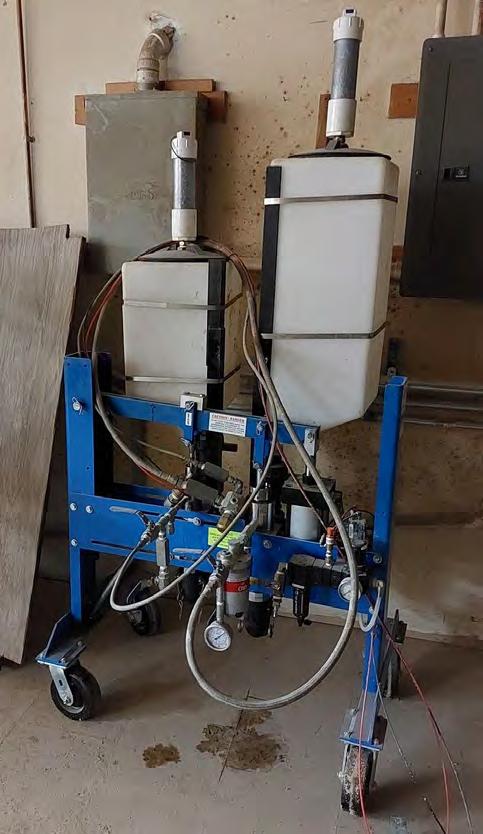
Shown on the satellite image is a two-phase incremental CapEx project not only designed to maintain Roof Truss production but also to add a Floor Truss line during the process improvement phases. The addition of a Double Lumber PickLine will result in increased cut parts, better organization of cut lumber at the build tables, and reduced operating costs without having to add a building addition, hence the accelerated ROI.
Phase One, which was completed just last month, entailed the relocation of a linear saw, “ALS2,” from inside the building to the outside wall beside another existing linear saw, “ALS1.” ALS1 also had to be shifted slightly to accommodate 20 ft long boards on the Double Lumber PickLine which will be installed in August during Phase Two.

ALS1 behind Door #1 and ALS2 behind Door #2 shown on the right in the photo will still be fed with forklift lumber picking in the meantime from the “Dense Lumber Storage” shown on the left. When Phase Two is completed, a Double Lumber PickLine will run down the middle of the existing yard and the truck path will be along the left side of the PickLine. Lumber from the Double PickLine will travel effortlessly along 32 ft conveyors to feed the two linear saws.
The second photo shows how ALS2 is taking up potential production space. By moving it from the middle of the building to an outside wall, we’ll reclaim the space and add to our ROI. Moreover, adding a Floor Truss line to the existing factory space immediately accelerates the ROI without the added cost of a building addition nor the hassle and delay of obtaining building and electrical permits.


Part of Phase One is modifying both ALS1 and ALS2 to a “Z pattern” of front in-feed from the PickLine and rear out-feed of cut lumber (see third and fourth photos).
Stay tuned for “After” photos, following Phase Two scheduled for August 2023.
Let LimTek Process Organization Technology help you squeeze out more truss production and deliver quality trusses with shorter lead times to better service your customers by organizing your truss fabrication processes to maximize your investment in automation. https://limteksolutions.com/


EKSTROM-CARLSON MODEL E
STRAIGHT LINE RIP SAW
• 10 HP Arbor Motor
• 3 HP Variable Speed Feed
• 4" Maximum Thickness (when using 18" Blade)
• 48" Throat
• Adjustable Rip Fence
• Overhead Holddown
• Automatic Chain Oiler
• Dust Outlets
$10,500 FOB MI
Wasserman & Associates 800-382-0329
www.wasserman-associates.com
DANCO GANG-RIP SAW
• 3 3/8" Maximum Thickness
• 13 1/2" Maximum Distance from Rip Fence to Outer Saw
• 100 HP Arbor Motor
• 2 HP Feed Motor
• 7 1/2 HP Dust Collector
• 480 Volt / 3 Phase
• Waste Conveyor with Short Incline $35,000 NOW $27,900 FOB MN
Wasserman & Associates 800-382-0329
www.wasserman-associates.com
2005 PCS / MiTek
Twin Axis Sheathing Saw

2005 PCS/MiTek Twin Axis sheathing saw: Cuts X and Y axis simultaneously in one pass through the saw. Cuts up to 1″ thick, wood sheathing material, minimum width 3″. Fully enclosed to reduce noise, dust, and improve operator safety; automated via downloaded sheathing cutting files from wall design software. Includes 8 foot long idler infeed conveyor and outfeed conveyor with pop-up skate wheels, (1) spare blade and all available spare parts. 220v/440v, 3phase electrical saw, 120v, 1 phase electrical PC. 100 PSI at 14 CFM air required.
$17,991 FOB VA
Wood Tech Systems 765-751-9990
www.woodtechsystems.com
Component manufaCturing S erving the S tructural B uilding c omponent
Used Spida Automated Truss Saw

• Automated Stop & Automated Saw Rotation as directed by Truss Software

• Generation 1 - Windows 98 (highly recommend Spida $32,000 Upgrade)
• 5.5 HP Motor (3 Phase) with 17.7" Blade
• Computer with Enclosure
• Outfeed Table with Automated Stop
• Infeed Roller Conveyor


$15,900 FOB KY
Wasserman & Associates
800-382-0329
www.wasserman-associates.com
Saw
2019 Mitek Auto Deck (for Mitek Blade Saw)
Five Chain Auto Deck (for Mitek Blade Saw)
$18,900 FOB WI
Wasserman & Associates
800-382-0329
www.wasserman-associates.com
• Model 344B
• Automated Setup via Download or Semi-Automated Setup via Touch Screen Input
• 19 Axes of Automation
• Sets up in 2 to 19 Seconds
• Five Blades cut 2x3 thru 2x12 up to 20'
• Waste Conveyor (under saw)
• Excludes Incline Waste Conveyor (adjacent to saw)
• 480 Volt / 3 Phase $29,900 FOB TX
Wasserman & Associates
800-382-0329
www.wasserman-associates.com
2000 Alpine Model 645 Pull Arm Saw with 20′ Speed Measure
2000 Alpine Model 645 radial arm saw includes center-point cutting, turntable cutting system, INCLUDES 20ft Speed Measure System with 20ft. infeed conveyor, 10ft. outfeed conveyor.

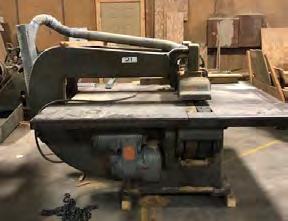
$8,990 FOB ON Wood Tech Systems
765-751-9990
www.woodtechsystems.com


$124,990.00 NOW $69,990 FOB SD Available March 2022


Servo controlled angulation axis of movement for cutting and making wall frame (square & angle cut) components. , “D” Print option (both faces, one edge). Includes 5 HP, 3450 RPM, arbor motor, computer monitor, console, 220/440v 3 Ph, spare blade. The WoodRunner Air Pick automated lumber retrieval system includes a single picking head with 10 bunks and 2 magazines. Includes manuals, all available spare parts and spare servo cards, and WoodRunner software source code. Available March 2022.


Skills shortages, increased costs, margin pressures, and continued demand for new builds across the housing market have in recent years accelerated the focus on automating the prefabrication of lumber wall frames, roof trusses, and lumber floors. Today, the prefabrication of lumber wall frames still presents a number of unique challenges which, when addressed with technology investments, can offer a variety of advantages over traditional methods of construction.
We already are seeing a shift with most builders seeking to capitalize on the manufactured offsite model by engaging various prefabrication businesses. The primary benefit of prefabrication is speed when compared with traditional on-site framing methods. Additionally, quality control processes mean that errors are reduced, leading to higher levels of accuracy on every project. Owner builders also benefit from improved safety standards through more accurate manufacturing techniques, enhanced environmental considerations due to sustainable sourcing practices, decreased production timeframes, and significantly reduced labor costs. Overall, the result is a home that offers greater investment value through high-quality aesthetics and lower construction costs through reduced wastage.
After perfecting the development of various systems and processes and with the increased demand on automating the “framing” manufacturing process, now Vekta is developing a portfolio of system solutions specifically to address the framing challenges experienced during the prefabrication and assembly processes. These new system solutions will support a variety of plant sizes and operator budgets, utilizing what we have learned over the past 15 years of catering to the prefabrication component. To date, we’ve developed products and automated systems that can automatically select, deliver, cut, print, and direct lumber components to various assembly areas in a wide array of plant sizes and layouts.
Vekta has also cleverly engineered automated systems to transfer assembled frames and trusses, automatically de-stack them, and even transfer them ready for loading and delivery. Today, one of Vekta’s key areas of R&D focus is perfecting the automation processes for the prefabrication of common parallel and raked wall panels.

In Australia, it is code to install noggins or “blocking” between all vertical member “studs” of a wall, typically this has to be done every 4 feet. However, in the U.S., structural sheathing typically keeps studs from buckling with only some blocking on tall walls or where horizontal joints are required for sheathing. Now, with the recent integration of Framequip, Vekta has a complete range of options cleverly designed to accommodate both markets.
After working closely for a number of years with the team at Framequip, both companies agreed to join forces earlier this year. Now, Vekta can deploy the best of Framequip’s range of Wall Framing, Nog/ Blocking Nailers, and Component Nailer solutions for our customers.
Framequip boasts a 37-year reputation of providing frame line manufacturing solutions. Ideally as the first step to adding wall frames to your product range, an initial investment comes in the form of the Framequip Standard Nailer. This is designed to support four nail guns mounted two each side enabling the plate to be fixed in one shot. If a productivity boost is then required, you can add the Auto Nailer to the Standard Nailer. The process of automation also continues on the material handling side, with roller conveyors and powered chain conveyor systems available as options. These outfeed conveyor systems are designed to buffer the framing queue, allowing finishing of the frames before de-stacking as well as reducing operator movement.

Vekta is also part-way through addressing the issue’s associated with more complex framing, such as Raking Frame prefabrication. A raking wall is where the height of the wall changes as you progress along the wall, which presents a different set of unique challenges for prefabricators. Vekta is proposing a nearly fully automated solution to address this. Currently in the final phases of development and testing, we expect to introduce this new innovation in mid to late 2024.
Today, manufacturing prefabricated wall frames, floor trusses, and roof trusses requires a combination of sophisticated equipment and technologies. To ensure the production of high-quality, cost-effective frames, prefabrication manufacturers must invest in modern machinery that is designed to increase productivity while reducing waste and costs. Vekta Automation is revolutionizing the industry by removing manual labor from many processes, allowing for faster frame assembly with fewer errors and ensuring the highest quality is delivered every time.


SAWS
Custom 3-Arm Infeed Decks
Two custom-built powered infeed decks, 3-arms each, 12′ x 12′ footprint each, touchpad controls and chain conveyors. One deck has a 5 HP drive and the other has a 10 HP drive. 480 volt, 3-phase electrical required.
10 HP price is $7,993 & the 5 HP price is $6,993.
Wood Tech Systems
765-751-9990
www.woodtechsystems.com
$13,149 Base FOB MN
2005
with Speed Cut Express
• Alpine Metra-Cut Saw (5 HP-3 Phase) with 16" Blade
• Speed Cut Express Automation with Touch Screen Computer
• Automated Stop and Automated Saw Angulation as Directed by Truss Design Software
• Infeed/Outfeed Roller Conveyor with Stands

• Saw Barrier Guard $19,900 FOB ND
Wasserman & Associates
800-382-0329
www.wasserman-associates.com
a blending of excellent services and products, with answers that work...!©
Not producing the results you need or want – getting conflicting info about what to do and the equipment and the systems you may need?
I need a salesman or a guide?
If you want an Independent Guide that has your bottom-line results as the #1 priority, Call Me. If the salesman will do - we'll talk later...
Also, don't let Financing Deals influence your best solution. FitzGroup can arrange – Zero down & No payments for 90 Days!
Please be assured that your investment with any of our selected partners will not cost one penny more with the Fitzgerald Group as your purchasing contact. In addition, you will receive the full advantage of our Partner Relationships and Services NOT offered elsewhere.
RFitzgerald@FitzGroup.com
719.528.5445 www.FitzGroup.com
Safety Speed Manufacturing Model 7400 XL Panel Saw


Safety Speed Manufacturing, model 7400 XL*, vertical panel saw, 3 HP induction motor, 64 inch crosscut, 2 1/8" maximum thickness, accuracy within 0.005 inches, 13 foot long welded steel frame with integrated stand and linear V-guides, enclosed counterweight system, adjustable vertical and horizontal rules. Quick changes from vertical to horizontal cutting. Includes machined aluminum material rollers, hold down bar, wheels, quick stop gauges and material hold downs. Dust collection ready. Options available include digital readouts for vertical cuts, automated length measuring, laser guide, stop bar, vacuum and midway fence. 208-230/460 volt, 3 phase electrical (208-230 single phase, 2 HP power optional +$100.00).

NEW!
765-751-9990
pricing, FOB MO
www.woodtechsystems.com



Building strong components requires innovation. Building a solid company requires teamwork. That’s why the people at Simpson Strong-Tie are committed to supporting you with a full suite of professional services, technical expertise and training resources. Based on your objectives, we offer tailored solutions to complement your team and help optimize manufacturing operations. Our open-platform design and management software also makes it easy to collaborate with project partners anywhere they’re located. So you can boost performance all the way from design to delivery.
Put industry-leading solutions and service on your team. To learn more, visit our website at go.strongtie.com/componentsolutions or call (800) 999-5099.


Since 2006, we've been helping businesses of all kinds build their online presence. We make websites and software for the construction industry to empower companies to reach a wider customer base and engage their audiences. Companies all around the world work with us to make websites and apps that people actually want to use. Reach out to Wolf X Machina if you're a business and you want a website that actually drives results.


(A)
2 x 12” diameter x 6’ long rollers powered by one 7 1⁄2 HP Sumitomo gear motor, with #80 Drive chain, 2-1/2″ diameter shafts, pillow–block roller bearings contained in a 3⁄4”Integrated laser-cut steel support frame. Roller press operates at 114’ Per minute fixed working speed, and includes front & rear emergency shut off bar, chain & sprocket guards, and integral mechanical fail-safe brake. Sold as is with no OEM warranty, 460 Volt 3-Phase power required.
$33,990 FOB IN
Wood Tech Systems

765-751-9990
www.woodtechsystems.com
(B)
2 x 12” diameter x 6’ long rollers powered by one 7 1⁄2 HP Sumitomo gear motor, with #80 Drive chain, 2-1/2″ diameter shafts, pillow–block roller bearings contained in a 3⁄4”Integrated laser-cut steel support frame. Roller press operates at 114’ Per minute fixed working speed, and includes front & rear emergency shut off bar, chain & sprocket guards, and integral mechanical fail-safe brake. Sold as is with no OEM warranty, 460 Volt 3-Phase power required.


$33,990 FOB IN
Wood Tech Systems 765-751-9990
www.woodtechsystems.com
•
J15287
Mega-Multifamily Estimator/Designer needed to support multiple plants. Duties include modeling for estimating and full designs of multifamily projects. Intermediate or advanced skill level will be considered using JobLine's Truss Design Skills Evaluation. This job is local, remote (Eastern Time Zone), or hybrid. Relocation assistance is negotiable if you plan to work in the office. Please inquire for additional details and to be considered for this position.
Compensation: $33-43hr based on skills and ability. average 45 hours a week. Can interview onsite or remotely.

•
•
•
•
•
•
•
Call for Price - FOB Alberta
No matter what press system you choose, setup time becomes build time. The patented open channel design of WizardPDS® ChannelS® makes retrofit possible to any existing table. Automate a portion of your table or the entire system. There is no need to remove or ship your tables anywhere; we perform all retrofit work right in your plant.

» NO manual jigging required
» “Snap - to” pin reassignment
» Reduces your jig setup time by 99%
» Works with all truss design software
» No jamming or debris build up with the exclusive and patented open channel design
2018 Clark Mini Barn Press, builds rigid frames for sheds from 8 foot to 14 foot spans, to 3′-6″ height. Builds mansard and rafter shapes. Includes (5) track mounted heads with 8″ x 10″ platens, material clamps, 10 HP hydraulic power unit with manifold for air and fluid, ball valve controls, mounting track and all available jigging. 460 volt, 3 phase electrical required.

$19,997 FOB TX
Wood Tech Systems 765-751-9990
www.woodtechsystems.com
Horizontal Truss Stacker
Model HVS, Two Unit, 2-Zone, 14’ Horzontal Stacking System. Two lifting units (one master and one slave) with integral electrics. A truss sensing system consisting of adjustable laser sensors mounted on slide rails. One indoor electric control enclosure & panel w/PLC and manual controls. A stacker-conveyor interface package comprised of (1) mounted 3-push button enclosure and (1) remotely mounted 2-push button enclosure (pause/ emergncy stop). Hand-held Wampfler
Remote Control System. 8 stacking rails and 4 stripping posts. Stack 1 5/8” thick x 14’ tall trusses up to 30 high. Stack a truss in approximately 40 seconds (cycle time). Stack up to 55’ or longer trusses on each side of the conveyor with minor assistance for truss sag, shorter lengths can be stacked unassisted. Excludes 77’ Walk Through Conveyor System. Two systems available at $25,000 NOW $19,900 Each. FOB NE.

Wasserman & Associates
800-382-0329
www.wasserman-associates.com

• 7' x 40' Table with 3/4" Steel Table Top
• Two 5' Park Sections
• Truss Depths from 12" to 26"
• Truss Flip-Over Arms
• Side or End Ejectors
• Bui lt-In Camber for Clamping on Both Sides
• Air Cylinders Under Table
• 2 Contr ol Valves for Clamping
800-382-0329
• 1 Contr ol Valve for FlipOver Arms
• 1 Control Vlave for Ejectors
• 24" Diameter x 1" Wall
Thickness Roller
• 10 HP / 3 Phase Gear Motor
• Front & Rear Emergency
Shut-Off Bars
• Joystick Control
• 2' per Second Travel Speed
MiTek Canada 75′ continuous top, end eject roof truss gantry system with Wizard automated jigging. Features (18) table sections with ejector rollers, (34) rails of Wizard automation at 24″ OC spacing for approximately 68′ of automation, (1) 8′ park stations, (1) 8′ park station with integrated conveyors leading to final roller, (1) table guided, pendant controlled gantry head, (1) 24″ diameter finish roller press, (8) 14′ interior idler rollers, (8) 14′ interior powered rollers, (13) short (approx. 7′) idler conveyors, and (4) 14′ 3-roller idler beds with an additional (2) powered rollers and (2) idler rollers outside. 208V, 3 phase power required. $674,990 FOB CA

Since 2006, we've been helping businesses of all kinds build their online presence. We make websites and software for the construction industry to empower companies to reach a wider customer base and engage their audiences. Companies all around the world work with us to make websites and apps that people actually want to use. Reach out to Wolf X Machina if you're a business and you want a website that actually drives results.
 Carl Villella, CLFP President, Acceptance Leasing & Financing Service

If there is a lesson to be learned from the recent collapse of Silicon Valley Bank in March, and the ripple effect that caused a run on Signature Bank, along with the staggering declines in the share prices of First Republic Bank and PacWest Bancorp, it is this: it’s unwise to depend solely on your local bank for your lending needs.
At Acceptance Leasing and Financing Service, we work with several funders: banks of different asset sizes, located in different areas of the country, focusing on different sectors of the economy. Our pool of funders is wide and deep, and it means that even through the recent turbulence in the banking sector, our funding sources remained steady and secure.
Unlike a local bank, we navigate the complex world of commercial equipment financing. We understand the terms and conditions. We know the equipment, and in many cases we know the vendors firsthand.

Because we have done commercial financing for many years, we close deals faster. We gather the right documents the first time around, and can turn a deal around quicker than a traditional bank.
And because we have longstanding relationships with many funders, we can help get approvals for “less-than-perfect” creditors. We know how to work alongside our funders to give them the comfort they need to approve a deal.
We think the reasons why you should choose us as your financing partner are compelling. We invite you to take advantage of our experience and expertise and call us at 412 262-3225.
We are Acceptance Leasing and Financing Service, located near Pittsburgh, PA. We’re in our 31st year of business. Established in 1992, we pride ourselves on our Certified Leasing and Financing Professional designation. A member of SBCA and a frequent attendee of the BCMC tradeshow, Acceptance Leasing and Financing Service, Inc. knows the equipment of the component manufacturing industry and is ready to assist you with your financing needs.

Used Triad wall assembly equipment includes 16 ft x 12′-3″ max height framing station, model G2, with (2) two-tool dollies, squaring/ sheathing combo table, model G2 SH-SQ, with multi-tool mount nailing bridge and separate manual-drive router bridge, quantity of (6) 10 ft long x 2 ft wide idler roller conveyors with (4) legs, and Triad model FTCN component nailing station with four Hitachi NR83A nail tools.

Framer includes 16″ and 24″ color-coded stud locators, pop-up skate wheel conveyors, tool dollies have two tool mounts each (no tools) and powered height adjustment. Sheathing bridge includes joy-stick controls, tool offset, tool tilt, laser guide, power return and mounts for up to (23) Hitachi nail tools. Router and all available spare parts included. 120 volt, 1 phase, 30 Amp electrical required. 100 PSI air required.
$40,997 FOB CA
Pacific Automation vertical roof truss stacker


Stacks up to (40) trusses or 60″ in depth of stack, from 14′ minimum span to 80′ maximum span. Includes (23) rollers with a 1 HP chain drive, electrical control panel, (6) stacking arms at 12′-0″ o/c spacing, powered by one 4,600 PSI heated pump, driving two hydraulic cylinders. 220 volt, 3 phase, 12 Amp electrical required.
$29,997 FOB KS
Wood Tech Systems
765-751-9990
www.woodtechsystems.com
Clary Kickleg Floor Truss Machine
• Model 388
• 7' Roller Press with Safety Bars & Ride Platform

• 40' Steel Plate Table with Pneumatic Clamping System

• Floor Track, Kicklegs & End Stands
• 5 HP Drive Motor (3 Phase)
• Installation is available at additonal expense
$24,900 FOB TX
Wasserman & Associates
800-382-0329
www.wasserman-associates.com
•
•
•
•
•
•
•
2019 MiTek Canada 40′ working length, end eject floor truss gantry system with floor truss finish roller and 40′ of outfeed rollers. Gantry is powered by pendant controls at a travel speed of 120 ft. per minute. 2 bay floor truss gantry with no flip mechanism that was built for robotics so the table tops will need to be reconfigured for manual building. 460V, 3 Phase power required.


Klaisler side-eject roof truss gantry system featuring (7) 56″ Klaisler tables with T & G plastic tops and side-pocket, skatewheel ejectors, (11) Koskovich Jet Set combo tables with skatewheel ejectors (work in pairs of 41.5″ & 21″ table sets), (1) Klaisler GR14-24 24″ diameter tracked gantry and (1) Klaisler GR 14-24 24″ diameter tracked gantry in need of repair. Includes (16) powered conveyor rollers and (16) idler conveyor rollers, (16) cam-follower receivers, (1) Klaisler TR 214-18 18″ diameter final roller press and (2) 20-ft outside conveyor sections. Also includes all available rail, base plates and all available jigging hardware and bridge plates. Purchased used but never installed by new owner. 230 volt, 3 phase electrical required.

$37,900
NOW $29,900 FOB Ontario
• Wall Lengths to 12'
• Wall Heights to 40'
• Powered Height Adjustment
• Manually Adjustable Rake Side (0 to 12/12 pitch)
• Adjustable Squaring Stop
• Pop-Up Skatewheel Conveyors
• Stud Locators at 16" and 24" Centers
• Center Support Bar with Stud Locators
• Excludes Tool Doilies
• Price is in US Dollars
800-382-0329 | www.wasserman-associates.com
2022 Triad 24' Framing Table with 12' Trident Panel/Router Bridge
$229,500 FOB WA
TRIAD GENERATION 3 FRAMING TABLE
Lengths to 24'
Powered Height Adjustment (6'-9" to 12'-3" wall heights)
Stud Locators at 16" and 24" Centers
Pop-up Skatewheel Conveyor
Trident Tool Dollies with Senco Nail Guns
TRIAD TRIDENT 12' PANEL/ROUTER BRIDGE
Touch Screen Programmable Fastener Spacing
Joystick Control
Bridge Auto Return
Single Laser Pointer
Tilt Tool Bar (for Sheathing Seams)
Auto Sizing Plate Fire (for Top & Bottom Plate)
$32,500 FOB NE
• Fra ming Table with Pop-Up Skatewheel Conveyor & Squaring Stops
• No Tool Dollies or Stud Locators on Framing Table
• Squaring Table with Roller Conveyor & Squaring Stops

• Wall Panel Lengths to 18'
• Powered Height Adjustment from 3'-11"to 12'-3"
• New Motors & Skatewheel Conveyor


• 110 Volt / 1 Phase
800-382-0329 | www.wasserman-associates.com
Senco Nail Guns
Router Motor & Extra Router Bits
3 Custom Skatewheel Conveyor Tables (10' x 10, 8' x 10' and 6' x 10')
Triad Wall Panel Lift
2 Triad Material Carts
2 Triad Tree Carts
Extra Senco Nail Guns & Parts
Shipping, Installation & Training is available at additional cost.
800-382-0329 | www.wasserman-associates.com
Developed for commercial wall panel production facilities this is the remarkable ProStack, fully automated wall panel stacker. The ProStack II relieves your build team from creating a stack of wall panels and keeps them building walls instead. Stacks 2×4 through 2×8 walls up to 20′ in length and up to 12 feet in height. The ProStack automatically centers each layer including multiple wall segments on the same layer, and the ability to “create” fork lift pockets for ease of loading in your yard or on the build site. It can stack left, right or center-justified. Designed without any overhead frame or apparatus, so no crane inspections are required. The ProStack is “event driven”, so there is no need to read a file. 208 volt, 3 phase, 45.3 full Amp load electrical required. No air required. Footprint is 26′-5″L x 19′-3″W.
ProStack II can operate with you existing powered conveyors or select optional matching conveyors:


ProStack Wall Panel Tilt In-Feed Conveyor: System can tilt wall panels (12’W x 16’L) to approx. 75º for working access to install blocking, windows, or inspection/repair of “shiners” on sheathed wall segments. System utilizes hydraulic power from an existing ProStack wall panel auto-stack system.

Powered In Feed conveyor section, Chain drive under top and bottom plate for access to inspect sheathing fasteners – 12’W x 16’L, adjustable working height from 28” to 34”.
Powered Out-Feed conveyor section, full-width, HD roll-top for easy access to banding operation. 12’W x 16’L, adjustable working height from 28” to 34”. Here are some of the features of the ProStack Wall Panel Stacker:
• Wall Length Max – 16’
• Wall Height Range – 8’ to 12’
• Material 2×4″ through 2×8″
• Total Weight capacity – 6,000 lbs.
• Total stack Height Max – 6’
• This unit stacks on-center
• System is able to stack on-center layers that have multiple wall segments
• Siemens® HMI touch-screen controls
• Full manual override controls via HMI
• Speed – 45-60 seconds per wall layer
• NO overhead components = no overhead hazards or annual inspections

2007 Panels Plus Combination Table, allows you to frame, square and sheath wood wall panels on one,16 foot long table x 12 foot framer for wall heights from 6′-9” to 12’4”. Builds both 2×4 and 2×6 walls. Clamps wall prior to nailing. Table includes push button controls, color-coded stud locators at 16 inches & 24 inches o.c. spacing, squaring stops, motorized telescoping arms, skatewheel ejectors and powered tool bridge. Sheathing nailing bridge includes powered travel, joy-stick & key pad controls, air manifold, manual fine tuning, tilt and seam nailing. No tools or mounts included. 30 CFM at 120 psi air required, and 120 volt, 1-phase electrical required.
Panels Plus Framing station, one station without tool carriages, for assembling wood wall panels up to 16′-0″ in length, 4′-0″ to 12′-4″ in height, includes stud locators, air clamping, sub-air tank, skate wheel ejectors and optional swing gates. Consists of a framing table with squaring edge, stud locators, pop-up rollers, foot switch, pushbutton controls- stationary side, and a motorized telescoping side. Includes optional UL certification. 10 CFM at 120 PSI air required. 110 volt, 1 phase electrical required.
Panels Plus Sub-component tables, one pair, one fixed and one adjustable table, each table 12 ft x 3′-6″ footprint with squaring edges on one long and one short side of one table with skate wheel ejectors, for sub-components up to 12′ long, 3′-6″ to 14′-0″ in height. The tables are for building rough opening sections. They feature pop-up rollers, a squaring edge, and a manual telescoping side to easily adjust and set the wall height. The pop-up rollers make it easy to move product down the production line. 5 CFM at 120 PSI air required.
Panels Plus conveyors, three pairs of In-feed 10 ft long skate wheel conveyors with stands.
$12,500 FOB NE
Wasserman & Associates
800-382-0329
www.wasserman-associates.com
Consider Panels Plus wall panel assembly equipment for manufacturers of wood or steel wall panels, floor-panels, and related framing components. Panels Plus is an employee owned, ISO certified, manufacturing company that builds state-of-the-art equipment featuring durable construction, with fit and finish second to none in the structural building component industry. The referenced base framing table allows you to assemble from 7-12 foot wall heights, at industry standard 16 foot lengths, at a working height of 29 to 32 inches. This framer design includes controls at each end of table, squaring stops and pneumatic clamping for consistent wall panel quality. Frames 2x4 or 2 x 6 walls, with color-coded, steel stud locators at 16 and 24 inches O.C. spacing. Includes pop-up skate wheels for easy transfer of completed wall frame. Framing table can be configured to receive wall framing light bars, other options include custom buildable wall heights, lengths and auto-indexing of optional 2 or 3 tool carriages.
Viking/ADT Fastrac 10' Portable Sheathing Bridge Details Here
$8,250 FOB TX
Wasserman & Associates
800-382-0329
www.wasserman-associates.com
Additionally from Panels Plus are sheathing tables with features that include foot pedal control at squaring end of table, with squaring stops, roller conveyors at both sides, single pendant controls for bridge, tool spacing at 6 inch centers with 3 inch bridge shift for offset nailing. Tool bridges can accommodate from 2 x 4 to 2 x 8 walls, with seam tilt being standard equipment Panels Plus Tool Bridges are available with single beam or dual beam design for two different tool mounts on one bridge. Squaring stations, sub-component tables, conveyors and panel lifts are also available to complete the configuration of the wall panel assembly line. Price includes factory installation and training. 50 CFM at 120 psi air. 120 or 230 volt, 1 phase electrical.
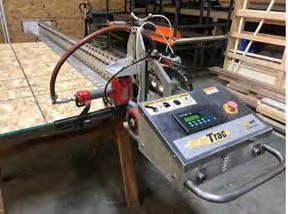


2006 Panels Plus Squaring Table with Multi-Tool Panel Bridge
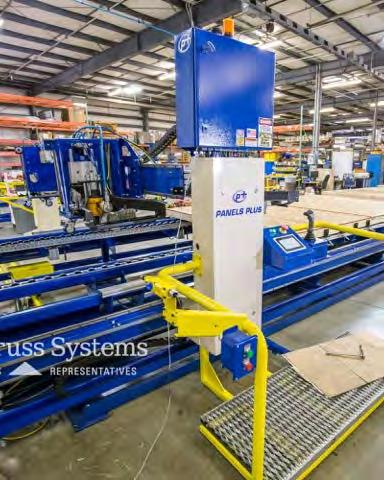
• Wall Lengths to 16'
• Powered Height Adjustment/ Clamping from 7'-11" to 12'-4"
• Hand Crank Panel Bridge with Remote Fire and Tilt
• Staple Gun Spacing at 6" Centers with 3" Bridge Shift
• Includes 21 Hitachi Staple Guns
• The Table & Bridge are Stored Inside
FOB KS $39,900
NOW $37,500

 By Thomas McAnally TheJobLine.com
With the loan in-hand, for construction to begin the next hurdle is permits. In my case, I received a combined shop/home permit, rather than separate permits for our house and then our shop. Even the building commissioner said I had put the cart before the horse, but we needed to build the shop first, so we could protect the RV (and us) over the long Indiana winter that came between us “moving here” from Florida and then having a place to “move into” once a house had been built.
After our shop/home permit was obtained, the next step was getting permits for water, septic, and electrical work. Something people may not realize is they can be separate permits and come from separate agencies. Permit offices can be backed up, and ours was. It took weeks to get the water and septic permits, but the electrical permit was a snap. Some of the permits required site inspections before they would be issued, and each jurisdiction had a specific inspection protocol.
Our excavator was building the driveway, installing the septic system, helping me run the electric from the meter to the shop and home, and running water from the road. He made sure that we got the inspections needed, and he knew each inspector and what they wanted before giving approval. Still, we had delays there too. Our septic inspector was the only one in the county, so when he got COVID, we almost had to stop everything and just wait. What saved us was the relationship our excavator had with him, so they could work things out to keep the construction on track sooner than later.
Each jurisdiction has inspection points that we have to follow, be it not covering utilities until the inspector confirmed depth, separation, and any needed sleeves at driveway crossings, or making sure that the Presby system was correctly laid out, connected, and had the correct media under it before covering. In spite of what I feared, inspections went relatively well on the shop and utilities, and now we’re ready to break ground on the home. I know that we need a footer inspection for the foundation, before concrete. The building inspector wants to see the framed home after rough plumbing, rough electrical, and fire blocking, but before insulation and drywall, and then have a final occupancy inspection when everything is done. We will revisit the utilities inspections, like when we built the shop, but this time for running them to the house. As long as I can give inspectors enough notice, and as long as subcontractors meet their dates, the project “should” flow nicely. It’s not IF but WHEN unscheduled delays will cause a general contractor to move subcontractors around on a calendar like chess pieces, or maybe more like checkers in my case.
Next Month: Project Management, Construction, Utilities, and “Dirt Work”
2007 VIKING 16' X 12' SQUARING TABLE
WITH SHEATHING BRIDGE
• 16' x 12' Squaring Table with Powered Width Adjustment & Powered Chain


Conveyor
• Wall Panel Lengths up to 16', Wall Panel Heights from 4'-0" to 12'-2"
• Swing Gates at Both Ends of Squaring Table
• Automated Field & Edge Nailing
Driving by Panel Pro Event Software & Your Programmed Nailing Patterns
• Simple Touchscreen Controls
• 2 Tool Carriages for Sheathing Nailing with Tilt Function for Seams
• 2 Paslode Nail Guns with High Load Coil Tray
• Auto Sheathing Bridge Return

• Includes 4 Pallets of Magnum Coil Nails (2 3/8 x .113)
• 480 Volt / 3 Phase
$29,900 FOB KS.
Wasserman & Associates
800-382-0329
www.wasserman-associates.com
2021 Triad Router Bridge & Portion of V-Track
2021 Triad Routing Bridge with approximately (20) feet of v-track. Fits over tables that build up to 12′ nominal height wall panels. Includes powered automatic bridge return, powered vertical router movement, manual fine adjustment wheel, manual vertical router travel with chain drive and (1) Milwaukee router, catalog #5625-20 120 volt, 1 phase, 15 Amp electrical required. No table included.
$28,970 NOW $5,000 FOB BC
Wood Tech Systems
765-751-9990
www.woodtechsystems.com
Price: $Call for pricing
FOB: MN
IBS Tool Bridge & Router Bridge
IBS multi-tool bridge with (24) tool stations. Bridge features auto-return, button controls and laser guide mount. Fits up to 12′ nominal rail centers. IBS router bridge features (1) router, laser guide mount and lever-switch button controls. Fits up to 12′ nominal rail centers. Sold as a pair. Includes all available floor mounted, v-rail. Both bridges missing laser sub-assembly. 120vac, 120psi air.
$15,975 FOB UT
New Panels Plus floor framing machine, supports the structural members creating floor sections from 2" x 6" LVL through 2" x 10" to 2" x 12" dimensional lumber, 20" deep wood floor trusses or engineered wood / I-joists. Standard footprint of floor panels (cassettes) up to 12' wide x 45' long. Table consists of a fixed section and a track-guided, moveable section controlled by either a foot switch or push-buttons.
Reconditioned dual 16’ foot long light bars, includes spare light board. Light bars are compatible with all light-bar equipped or ready IBS/Comsoft, Panels Plus, etc. wall panel equipment driven by ITW (IBS) or other compatible design software. 110 volt, single phase electrical. $18,890 NOW $16,550 FOB MN.
Wood Tech Systems
765-751-9990
www.woodtechsystems.com
Wood Tech Systems

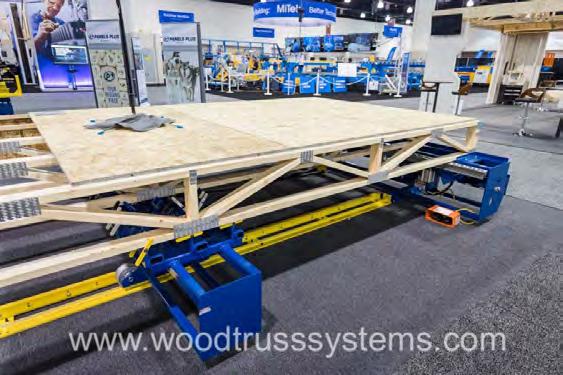
765-751-9990
www.woodtechsystems.com
New Wall Panel Lift
• 8' to 12' Wall Heights
• 1,000 Lb Capacity
• Weight: 120 Lbs
• Excludes: Electric Hoist & Freestanding Bridge Crane

$1,950 FOB NE
Wasserman & Associates
800-382-0329
www.wasserman-associates.com
Includes a series of color-coded locator pins at 16", 19.2 and 24" on-center spacing and clamping with squaring feature including foot pedal control. The locators individually flip down if a joist comes out on top of them. After the floor is complete and unclamped, the floor section can be raised up on skate-wheel conveyors and rolled out or lifted off the table using an overhead crane. Table height is 24.5", OAL 45.5 ft, OAW 14.5 ft. 120 volt, 1 phase, 15 Amp electrical required. 90 to 120 PSIG at 15 CFM air required.
The industry’s most powerful integrated component design, engineering, and management software for steel and wood-framed structures.
iCommand
Manage projects, customers, materials, pricing & inventory
iModel
Design truss layout & profiles

iDesign
Optimize material usage & engineer trusses


iPanel
Design wall layouts, panelize, bundle, break & stack
eShop
Maximize crew productivity & improve manufacturing efficiency

The IntelliVIEW Suite is a fully integrated software solution for the layout and design of a building’s rough framing elements—including roof and floor trusses, wall panels, solid sawn, EWP, sheathing and various ancillaries.


The IntelliVIEW Suite provides the industry’s most complete analysis of the design, cost information and bill of materials—promoting increased profits by reducing plate and lumber use.

Ask those who know. They’ll tell you about the people at Alpine who make a difference.

Triad Generation II nail tool bridge with 60 ft of v-track, refurbished by Triad in 2021. Maximum panel height clearance 12′-3″. Includes locations for (3) tool mounts along the middle beam, top & bottom plate tool mounts, tilt-tool option, joy-stick controls, power bridge return, e-stop button, all available Paslode tool mounts, manual and all available spare parts. 120 volt, 1 phase electrical required. 100 PSI air required. $75,971 NOW $25,000 FOB CO
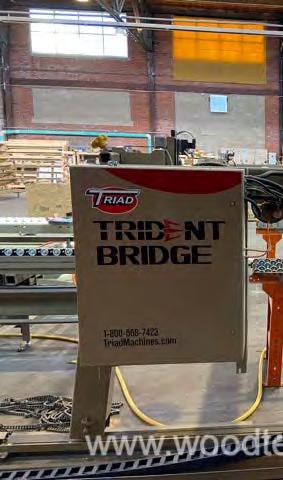


The Wood Wall Combo Station is an all-in-one system that frames, squares, and sheathes wall panels for quality panels every time. The Combo Station is designed for low-volume, entry-level operations and is compatible with lumber from 2×3 through 2×10. Designed with the rigors of a panel shop in mind, our equipment is developed with longevity and quality.
The Combo Station can be stand-alone or integrated into a full production line. Various sizes and configurations are available.


BENEFITS
• Ergonomic working height
• Improved squareness vs. traditional methods
• Superior wall panel consistency


• Flexibility with fastener spacing


• Fastens consistently and accurately


$26,977 NOW $19,997 FOB MD
Triad squaring table with two bridges and one Viking power conveyor. Either bridge fits on the squaring table. Builds from 6′-9″ to 12′-3″ tall wall panels to 16′-0″ long. Triad squaring table, model G2SHSQ, has powered clamp / unclamp controls on either end of the fixed side of table.
Triad nailing bridge, model PSTT, has (24) tool mount locations with Paslode tool mounts, auto return and bottom plate laser sight mount. Changed by owner from staple tools to nail tools. Router bridge is manual travel. Viking powered conveyor 23 ft long with support platforms alongside both chains. Forward powered drive only. Foot pedal controls for drive motors. 120 volt, 1 phase electrical required. 100 PSI air required.

Last month’s article, “The Designer Shortage—Where Can We Find Them?”, offered some suggestions for finding new component designers. This month, I have some suggestions for training those new hires effectively. And bear in mind, as I mentioned last month, I think it is extremely important that the industry continue to actively develop new designers to replace those of us who are aging out of the industry.
There are a few different approaches that CMs commonly use when they bring on a new designer:

1. Have the new hire attend in-person training with the connector plate supplier
2. Have them complete online training available through the plate supplier.
3. Use component association online training.

4. Pair the new designer with an experienced designer to get them started and answer questions as they come up.
5. Have the new designer complete training provided by dedicated trainers, either in-house or online.
1. Obviously, there are travel and accommodation costs associated with sending staff away for training. Aside from this though, it has been my experience that training provided by plate supplier technical support people often ends up being more of a software demonstration than training. I’ve attended many of these sessions over the years, and even with decades of experience it’s easy to get left behind. I always feel bad for the newer designers in attendance who are obviously quickly left behind. This training also focuses almost exclusively on software operation, without any real blueprint interpretation, building code discussion, or engineering.
2. Plate supplier-provided online training has gotten better over time, but still suffers from many of the same drawbacks as noted above. On top of that, unless your new designer manages to get an experienced designer to help with the inevitable questions, they are going to be left with many unanswered questions since the online training generally consists of prerecorded videos.
3. Training provided by industry associations tends to have a wider scope than that provided by plate suppliers, including such things as code interpretation, blueprint reading, some truss geometry, and so on. The main drawback is that, once again, it is a pre-canned presentation without anyone available to answer questions or provide greater explanations.
4. From a training perspective, pairing a new designer with an experienced designer can be great. Assuming of course that the experienced designer has the time and patience to address countless questions, the biggest drawback is that you now have two salaries tied up in training.
5. Some larger component manufacturers have invested the time and considerable cost in developing in-house training programs. I am aware of in-house programs in use that are up to 8 weeks in length before the trainee begins working on “real” work. They cover all the important items listed above, with the added benefit that everything is tailored to preferred in-house framing and processes. Of course, unless your company is large enough to justify the considerable time and effort to create the curriculum and supporting materials – which could easily run into multiple months of development time and tens of thousands of dollars – this really isn’t an option.
Component Design Center/Component Systems Institute provided training much like the fifth option above in the late 1990s and early 2000s. We successfully trained designers from across North America. Perhaps it’s time to think about bringing that training back in online form, but with a dedicated trainer available to help trainees with questions?
Let me know if your company has a different approach to training that you find works for your company. And let me know if third party online training would be of interest to your company. If so, please reach out, I’d love to hear from you.
If you want help finding that next perfect component designer or design job in Canada, please contact me. If your work is in the mass timber world anywhere in North America, I’d love to talk to you about connecting you to that next great job or candidate. You can reach me at secord@thejobline.com, or 800-289-5627 ext. 2. I’m also happy to engage at: LinkedIn.com/in/geordiesecord. www.thejobline.com


“We’ve been using MSR pretty much since day one when SCS was founded in 1987. It’s a crucial element for roof and floor trusses, especially with today’s challenging designs for residential and commercial construction. By using MSR, we reduce the overall fiber required for the design of our products. For example, a top chord on a roof truss might require 2x6 if only #2 is available but that can often be replaced with a 2x4 in MSR.”
—DaveKipp, Structural Component Systems (SCS), MSRLPC member

The MSR Lumber Producers Council (MSRLPC) represents the interests of machine stress rated lumber producers in the manufacturing, marketing, promotion, utilization, and technical aspects of MSR and MEL lumber. Suppliers, customers, and professionals may join as Associate members. Members enjoy reliable market data and opportunities for education, networking and online marketing.


2003 JDH TRUSSMASTER SIDEOFFLOADING TRUSS TRAILER

10,000 Lb Tandem Axles (Dual Wheels). 26,000 GVWR. Deliver Trusses Vertically. Stretch from 18' to 38'. Raise Loads
Hydraulically. Air Brakes.
$6,900 FOB CA
Wasserman & Associates
800-382-0329
www.wasserman-associates.com
• Modified by LMI TENN
• 8" Floor Cross Members
• Reinforced Roof
• 22.5 Tubeless Tires
• Sl iding Tandem Axle (for weight distribution) (FOB PA) $9,900
Wasserman & Associates 800-382-0329
www.wasserman-associates.com
2007
Step Deck Roller Trailer

40'-0" Lower Deck, 12'-6" Upper Deck
Hydraulic Tilt on Lower Deck
Lower Deck has 3 Split Load Lifts
Roller Locks (upper & lower decks)
GVWR: 37,000 KG (81,400 LB)
Air Ride Suspension
Tires & Brakes are Good
Winches & Straps
Price in US Dollars
$30,000 NOW $24,900 FOB ON
Wasserman & Associates
800-382-0329
www.wasserman-associates.com

1987 Barnes Pole Trailer
1987 Barnes pole trailer, model RTY. Carries trusses peak down, with spans from 28’6″ to 46′-0″. Includes bolster arms for shorter trusses, center chains and split support tubes. Has current Pennsylvania DOT inspection valid through March of 2023.


$8,129 NOW $6,909 FOB PA
Wood Tech Systems
765-751-9990
www.woodtechsystems.com
• 2007 Freightliner M2 Flatbed Truck (168,000 Miles)

• New Tires in 2022 ($12,000 Value)
• Hiab 322E-7 Hipro Crane (FOB WA) $89,000 NOW $75,000 800-382-0329 | www.wasserman-associates.com


2006
features
have approximately 20% life left, 6 tires have approximately 60% life left, and 2 tires have approximately 25% life left. Lights are all working and DOT expired 12/31/22.
As is, Where is
$11,990 FOB OH
Wood Tech Systems
765-751-9990
www.woodtechsystems.com
2001
$24,990 FOB OH

At the start of a new quarter, the economy is continuing its bumpy ride toward recovery while still showing mixed signals. Forecasts going forward are for slower growth throughout the next two quarters before picking up steam in the latter part of this year and going into the next.

There are lingering recession fears as the Federal Reserve’s interest rate hikes continue to impact manufacturing, investing, and borrowing. And some new concerns have surfaced, particularly in the banking sector. But after two full years of rising prices and a full year of Fed rate hikes, we can take a brief opportunity to step back, gain a little perspective, and brace for the tailwinds that still lie ahead.
The economy showed a surprising resilience in the first three months of the year, a large part of it due to the tight labor market. The Fed focused its concern on the employment picture and pledged to continue raising interest rates further while indicating they may come at a slower pace.
The markets remained volatile but spurred early optimism, with the S&P up about 6.5% and the investment grade bond market up 4.5% for the quarter. But these gains have been tempered by slower growth forecasts and the belief the economy will weaken and potentially land in at least a mild recession before accelerating toward growth.
New worries were added to growing fears about the economic recovery in March with the second and third largest U.S. bank failures (not including investment banks) in U.S. history. Massive uninsured deposits were among the contributing factors to the collapse of Silicon Valley and Signature banks.
The resulting solution for the FDIC to cover all depositors in these two troubled banks and for the Fed to step in with a bank lending plan to prevent future failures helped stave off a potential panic. But smaller and regional banks have seen withdrawals increase and bank stocks have suffered as fears linger.

Prices began rising sharply in March of 2021 coming out of the pandemic spurred by an awakening economy gearing up, supply chain problems, and a large amount of stimulus money pumped into the economy.
Inflation continued through the rest of 2021 and into 2022 and is now thought to have peaked in June of last year when it reached a 40-year high of 9.1% year-over-year. The CPI has been slowly declining since then and by this March has cooled to 5.0%.
A decline in energy prices is the main reason for the better-than-expected March number, although food and housing prices continue to rise more than the overall inflation rate. Economists expect inflation to continue to moderate through the remainder of the year.

The slowing inflation rate and forecasts of further cooling along with other economic indicators are likely to convince the Fed that it’s on the right track and encourage at least one or more interest rate hikes this year. The Fed reacted to banking jitters by slowing its most recent increase to a quarter of a percentage point at its March meeting.
Recent signals for the Fed include more layoff announcements, especially in the technology sector. At least some of this can be attributed to slowing post-pandemic demand, especially in industries that over-benefitted from Covid shutdowns.
Mortgages are also down on rising interest rates. The housing market has slowed but is still plagued with too little inventory. Other credit and lending are also down, also most likely a response to higher interest rates.
One additional indicator is a sense that higher interest rates and overall employment concerns may finally be softening consumer confidence as a greater number of households admit to financial stress. The end of pandemic stimulus money and the sunset of other pandemic relief measures have probably also been factors.
The general consensus among economic forecasters is a further cooling for this quarter and the next and continuing challenges until the picture brightens in the last three months of the year.
Post-tax time is a suitable time to review your own position with your advisor, see if you may be overexposed to risk, and make adjustments, if needed. As you prepare to meet those challenges, our advisors are ready to meet with you, virtually or in person, to help you greet Spring and Summer with renewed confidence and optimism.
www.leskofinancial.com
Wall Panel Lift

* 8’- 12’ Wall Height
* 1,000 LB Capacity
* Easy Adjustment
* Hoist and Crane Sold Separate


Handle Bar Router
* 8’ - 12’ Wall Height
* 2 Person Operation
* 3 ¼ hp Production Router
* 120 Volt /1 Phase/15 Amp
Lay-Up Tables


* 10’ x 10’ Working Area
* Lift & Extend Rollers
* Squaring Lip
* Gun Holster And Nail Tray
Skate Rollers
* 15’ Standard Length



* Adjustable Height
* Sturdy Stands
* Custom Lengths Available
$1,950.00
$3,000.00
$12,500.00
$3,000.00
Electrical Supply: 110 VAC
Motor: 1/4 HP, 110 VAC, Linear Actuator
Highly Accurate: +/- .010 Inches
Stop Rail: 2 x 4 x 1/4 Aluminum Extrusion
The Hain Systems Framer (HSF) will help you build square and accurate wall panels for residential or commercial construction applications. It will help you cut building costs by saving time and improving your quality. It’s a reliable, efficient and proven system that features a ruggedly simple design. The HSF is based on a proven design with over 20 years of actual production use and maintenance experience. It comes fully assembled and is designed for portable job site framing or in-plant permanent installation. The table has many optional attachments and will support Mylar Tape wall layout or any other type of layout. The optional gun rails can also be retro-fit to any table.
Stops: Jig Bored Steel
Stop Blocks: Machine Billet Aluminum
Details:
Internal Components: Hardened, Ground and Polished Steel and Billet Aluminum
Dimensions:
Length: 5 feet (60”) to 60 feet (720”)
Table Construction: Thick-wall Structural Steel Tubing, Jig Welded for Accuracy
Height: 12 inches
Depth: 12 inches
Air Supply: 90 psi (10 CFM Air Flow Recommended)
Electrical Supply: 120 VAC
Powder Coat: Industrial Gray
Dimensions:
Height: 43”
Length: 16’ or 20’
Width: Adjustable 8’ to 10’ or 8’ to 12’
Shipping Weight: 3000 lbs
If you are looking for the fastest, most consistent way to measure and cut your product, then the Hain Measuring System (MEA) is your answer. The MEA changes from one length t any length instantly, up to 60’, without changing the operator’s position on the line. It is also highly accurate (+/- .010) and quickly moves from one length to the next in seconds. The MEA is designed for quick and easy setup and is simple to use. Even a first time user will be productive with little or no training required. It can adapt to any saw and can be mounted to any surface so that you can integrate the MEA with your existing setup. The MEA is versatile allowing “left” or “right” handed operation and measurement in “feet and inches” or “inches” depending on your preference. The MEA is also available in a “Skid Mounted” version.
theHAINCOMPANY 6125 Enterprise Drive, Unit 9 | Diamond Springs, CA 95619 530.295.8068 | sales@thehaincompany.com
way to measure and cut your product, then the Hain Measuring System (MEA) is your answer. The MEA changes from one length t any length instantly, up to 60’, without changing the operator’s position on the line. It is also highly accurate (+/- .010) and quickly moves from one length to the next in seconds. The MEA is designed for quick and easy setup and is simple to use. Even a first time user will be productive with little or no training required. It can adapt to any saw and can be mounted to any surface so that you can integrate the MEA with your existing setup. The MEA is versatile allowing “left” or “right” handed operation and measurement in “feet and inches” or “inches” depending on your preference. The MEA is also available in a “Skid Mounted” version.


NEW GALVANIZED STEEL STRAPPING

1 1/4" wide x .035 thick. $159 per coil.
$2,950 per skid (21 coils). FOB PA.
Wasserman & Associates
800-382-0329
www.wasserman-associates.com
New Hain Company Micro Mini Measuring System
Video Here
$3,499 FOB CA
Wood Tech Systems
765-751-9990
www.woodtechsystems.com
MISC.
2017 CMF-Stealth Live Deck
2017 CMF-Stealth Live Deck, (6) rail/ pedestal design, 16′ wide x 20′ long, powered infeed for component saws. Handles lumber lengths from 3′ to 20′. Features guarded sprockets, heavy-duty construction, dual push-button controls at both ends of deck and adjustable base feet. Split-design, easily shipped and installed. Multi-voltage 3 phase motor. Steel panels between rails not included.

$28,497 FOB PA
Wood Tech Systems
765-751-9990
www.woodtechsystems.com
Hain 20' Powered Measuring System Adapts to Any Saw. Left or Right Hand Operation. Feet & Inches System (Stops at 12” Centers) or Inches System (Stops at 10” Centers). Motor: 1/4 HP Linear Actuator (110 Volt). Stop Rail: 2 x 4 x 1/4” Aluminum Extrusion. Stops: Jig Bored Steel. Stop Blocks: Machine Billet Aluminum. Optional Lengths from 5’ to 60’. Optional Gang Stop. Add $890 per 10’ Section of Heavy Duty Roller Conveyor with Stands
$7,890
Wasserman & Associates
800-382-0329 www.wasserman-associates.com
New Handle Bar Router
Porter Cable Model 7519 Production Router
Motor with Soft Start. Steel Handle Bar
Frame with Makita Switches. 120 Volt / 1
Phase / 15 Amp / 21,000 RPM. Includes 2
Router Bits. $3,000 FOB NE.
Wasserman & Associates
800-382-0329
www.wasserman-associates.com
EMSI Teeter Cart

Width - 46" / Length - 72" / Load Capacity - 3000 pounds / Pneumatic tires - 14.5 inch / Maximum utility in truss plants, panel plants and lumber yards / Quick assembly by bolting parts together / All hardware is supplied / Upright 2 x 4's not supplied. Medium duty tires rated at 1500 lbs each are included.
Call for Price
Eide Integrated Systems, LLC
612-521-9193
www.eideintegratedsystems.com
AMI Industrial Floor Carts

AMI's industrial floor trucks (material carts) are designed of hardwood construction, fitted with space-age phenolic, roller-bearing wheels, and ball bearing swivel casters for strength and durability. AMI's phenolic wheels resist shock without chipping. They are non-sparking, non-marking, and can be operated continuously between -50℉ and 260℉. They are unaffected by grease, oil or debris on your shop floor.


2005 Koorsen Connector Detector (For Repair or Parts)
6 detection zones to locate missing plates. Horn & zone lights indicate missing plates. 12" to 60" adjustable height from floor. 110 Volt / 1 Phase. New control panel switches & lights in 2014. Needs circuit board repair or replacement and new tower light. Includes 4 extra detection zone boxes.
$2,500 NOW $1,500 FOB NE

Sweed Scrap (Band) Chopper with Stand

1/2 HP Motor (115/208-230 Volt)
$1,900 NOW $1,750 FOB NE.
Wasserman & Associates
800-382-0329
www.wasserman-associates.com
Adjustable legs, side-rails, rough-top belt, 3-phase power As-Is, Where-Is.
$1,990 FOB KY
Wood Tech Systems
765-751-9990
www.woodtechsystems.com
2022 Powermatic Dual Bag Dust Collector. Industrial dust collector, dual-bag, 1800 CFM with 6″ port. Includes supply of 6″ flex hose. System has 10 Cu. Ft. capacity. 3HP, 3Ph, 5 amp, 460/V with onboard starter.
$5,497 FOB VA
Wood Tech Systems
765-751-9990
www.woodtechsystems.com
Our swivel casters are precision built with perfectly aligned raceways. All cold-form parts are made to exacting tolerances from heavy-gauge steel, and are hardened for severe service and long wear. Series B-4 carts include four casters, one at each corner, to prevent "tri-cycling" of long lumber loads.

Standard Models Available Max Load Weight (lbs.)

2748
3248
x 48" Series "B" & "C" 2500
3260 32" x 60" Series "B" & "C" 2800
3660 36" x 60" Series "B" & "C" 2800
3672 36" x 72" Series "B" 4000
4072 40" x 72" Series "B" 4000
3696 36" x 96" Series "B" 4000
4896 48" x 96" Series "B" 4000
*Other models and sizes are available on request. FOB NC.
Wood Tech Systems

765-751-9990
www.woodtechsystems.com
Wasserman & Associates
800-382-0329
www.wasserman-associates.com
When designing trusses for special loads or special conditions, it is important to define the individual truss members correctly. Without proper member definitions, trusses could be inadvertently under-designed and/or have incorrect analog. The most common member types are webs and chords. Top chord members form the top of the truss and are subjected to compressive and bending stresses. Bottom chord members establish the bottom of the truss and usually are carrying combined tension and bending stresses. Webs are members connecting the top and bottom chords of the truss, and typically carry axial (compression and tension) forces only.
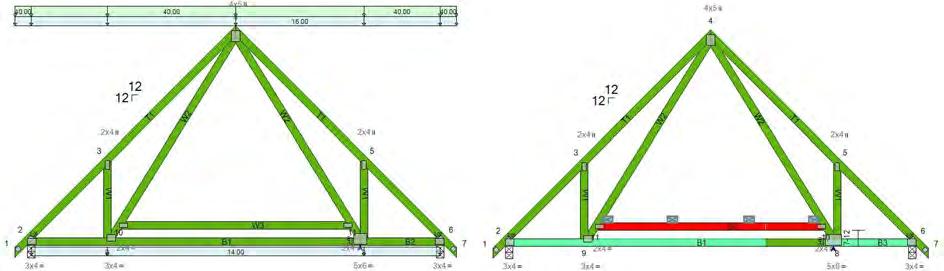

When you design the truss, you assign uniform loads such as top chord live load (TCLL), top chord dead load (TCDL), bottom chord live load (BCLL), and bottom chord dead load (BCDL). These loads will be automatically applied to chords only, webs will never be automatically loaded with any of the dead or live loads, except when the truss is designed as an attic truss.
Let’s review some examples. When adding a raised horizontal member over the bottom chord that will be used for storage, it should be defined as a bottom chord. Defining this member as a web will not load this opening automatically to support floor / storage load. Simply by changing the definition of this member to a bottom chord may cause the member failure with the new system generated load as shown below. If the member is defined as a web, additional load must be applied manually.
Another important scenario to consider is top chord bearing roof trusses / raised bearing trusses. If you have a top chord bearing truss or a truss with a raised bearing sitting on a block, you will have two end verticals. Be sure to define the member sitting on the bearing as a block and define the member stacked next to it as a top chord. This will ensure correct analog, proper loading and plating, and the program will automatically check for top chord reaction limits. This is handled automatically if you use the top chord bearing feature in the program.


Correct analog of truss with raised bearing
Some other scenarios to consider are the following:
• Parapet verticals should always be defined as top chord so that wind loading gets applied correctly.
• Exterior horizontal and vertical members of cantilevers should be defined as top chord and bottom chord, respectively, for proper wind load application.
• Stacked chords should be defined as the same chord type when a single chord isn’t sufficient.
• All horizontal members of ceiling trays should be defined as bottom chord to ensure that dead load is added to account for the weight of the ceiling material.
For additional information, or if you have questions, please contact the MiTek Engineering department.


The WoodRunner WR-2 lumber retrieval system seeks and retrieves the exact boards needed to cut. The core of the system is a trolley with an automated picking head. The trolley moves back and forth on a runway truss positioned over lumber carts while the picking head’s laser scans below. After locating the specific piece of lumber needed, the picking head uses a powerful vacuum to hold the board while moving it to the infeed deck.

Call for Price
Eide Integrated Systems, LLC 612-521-9193
New
Electrical Supply: 110 VAC
Motor: 1/4 HP, 110 VAC, Linear Actuator
Highly Accurate: +/- .010 Inches
Stop Rail: 2 x 4 x 1/4 Aluminum Extrusion

Stops: Jig Bored Steel
Stop Blocks: Machine Billet Aluminum
Internal Components: Hardened, Ground and Polished Steel and Billet Aluminum
Dimensions:
Length: 5 feet (60”) to 60 feet (720”)
Height: 12 inches
Depth: 12 inches
If you are looking for the fastest, most consistent way to measure and cut your product, then the Hain Measuring System (MEA) is your answer. The MEA changes from one length t any length instantly, up to 60’, without changing the operator’s position on the line. It is also highly accurate (+/- .010) and quickly moves from one length to the next in seconds. The MEA is designed for quick and easy setup and is simple to use. Even a first time user will be productive with little or no training required. It can adapt to any saw and can be mounted to any surface so that you can integrate the MEA with your existing setup. The MEA is versatile allowing “left” or “right” handed operation and measurement in “feet and inches” or “inches” depending on your preference. The MEA is also available in a “Skid Mounted” version.
6125 Enterprise Drive, Unit 9 | Diamond Springs, CA 95619 530.295.8068 | sales@thehaincompany.com
20′
New, laser projection system from SL Laser. Projects roof truss, floor truss and wall panel design images accurately onto building surface, for faster setup and fabrication times. Each laser head provides 21' projection length (@15 foot ceiling heights). Includes system computer, cables, mounting hardware for attachment to customer's structure, factory installation, training and choice of green or red laser. Works with each connector plate manufacturer's design software. Modular nature of the laser heads allows for easy, future expansion of system length. 120 volt, 1 phase. FOB NC Wood Tech Systems 765-751-9990
www.woodtechsystems.com
$22,490 - FOB CA Wood Tech Systems 765-751-9990
www.woodtechsystems.com
• Model GX11FF
• 15 HP Rotary Screw Air Compressor (230/460 Volt - 3 Phase)

• 13,443 Hours
• 51.7 CFM at 128 PSI
• 80 Gallon Tank
• Built-in Air Dryer does not work
• Includes separate 2012 Pneumatech AD-50 Air Dryer (1 Phase)
$4,250 FOB TX
Wasserman & Associates
www.eidemachinery.com theHAINCOMPANY
800-382-0329
www.wasserman-associates.com
• 18 HP Spindle with 5 Position
Typewriter Tool Changer
• X, Y and Z Servo Axis
• Q-CORE Controller (THM Version 8.73 - Windows7)
• Reads NC Files via Network or USB Flash Drive
• 5' x 20' Fixed Table
• Roller Hold Down
• Program Side Fence
• Auto Tool Length
• Auto Lubrication
• Excludes Dust Collector
• The seller was cutting OSB Sheathing and 1 1/4" TimberStand Stair Stringers
• Video available upon request
$29,500 FOB MN
Wasserman & Associates
800-382-0329
www.wasserman-associates.com
Purchased but never installed. Manual (x, y) movements, powered vertical movement. 15-ft wide bridge x 23 ft long x 14 ft height. Hoist moves at 16 feet per minute, includes pendant control, chain container and centering strap to minimize the need to reach for the control pendant. Last 3 photos show current condition & status. Other photos are of matching crane frame with hoist in place. 115 volt, 1 phase electrical required.
$16,690 FOB NV Wood Tech Systems 765-751-9990
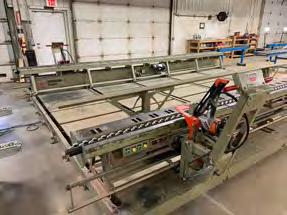

www.woodtechsystems.com
The Generation 3 Framing Table has adjustable 20’ long walls, with wall heights from 6’9” to 14’3”. Studs are placed between color-coded stud locators. With just a push of a button, the width adjustment clamp is activated to clamp and square all components. The Generation 3 Framer features a wider table top, designed with the framer in mind. Our new Anti-Slip Surface that allows the operator to work on a comfortable and safe surface. Call for Price Eide Integrated Systems, LLC 612-521-9193

www.eidemachinery.com


Floors and roofs on mass timber buildings are constructed from large panels of engineered wood, such as cross-laminated timber (CLT) or mass plywood. Designers join these prefabricated panels together on site to create a structural horizontal diaphragm to transfer wind and seismic loads to the vertical elements of the lateral force resisting system. Shear forces between panels must be transferred through these panel-topanel connections. Conventional wood structural panel sheathed diaphragms have shear capacities and fastener spacing tabulated in Special Design Provisions for Wind and Seismic (AWC SDPWS). Mass timber diaphragms, on the other hand, require some more design work by the designer.

Simpson Strong-Tie has provided designers with several diaphragm options to satisfy load requirements using four different connection types. Plywood splines are recessed into edge milling of the CLT panels and fastened with screws or nails. Steel splines can generally be installed on the surface of the CLT panels without edge milling, and are fastened with screws or nails. Butt joints are connected with fully threaded screws driven at an angle on alternating sides of the joint. Half-lap joints require edge milling so panels can overlap at the joint and the connection is made with screws driven perpendicular to the surface.


Steel splines are an economical solution, because they lower costs by reducing or eliminating manufacturing time for milling panel edges and are less susceptible to moisture damage during construction. Simpson StrongTie developed our MDSS Medium Diaphragm Spline Strap in 2020. The MDSS is a 14-gauge strap that uses our Strong-Drive® SDS Heavy-Duty Connector screws for the connection, spaced at 4″, 6″ or 8″ on center. And, of course, our load values are based on testing.
Our CMSTC16 (originally released in 2001, for you Simpson Strong-Tie history buffs) is a 16-gauge coil strap intended for tension applications. We tested the CMSTC16 as a spline connection to provide a lowercost, nailed solution for mass timber splines. Feedback from engineers and installers was generally positive, but there were also requests for a lighter-gauge strap that was a little wider to accommodate construction tolerances.


The LDSS48 Light Diaphragm Spline Strap was created to address these requests from customers. The 18-gauge strap is 3/4″ wider than the CMSTC16 and the holes are spread wider, creating more edge distance for the fasteners. We originally developed an embossed hole for our CSHP High-Performance Coiled Strap that allows nails to be installed using a standard framing nailer. We incorporated this dome hole into the LDSS to make pneumatic nail installation easier.
As we explored other fastener options, we noticed that the head of a Strong-Drive® WSV Subfloor screw fits nicely in the dome. So we tested the WSV in the dome hole to determine the allowable loads for a steel-to-wood connection — and they were great. This led us to load-rate our spline connection with both nails and WSV Subfloor screws. More testing followed.
This product started with a request for a lighter strap that was a little wider, with loads similar to those of plywood splines. There was a lot of collaboration between Manufacturing and the Connector and Fastener teams to assemble all the pieces. It was rewarding to see the LDSS48 evolve through research and development into a high-capacity solution that could be installed from a standing position using a collated Quik Drive screw.
The article, Mass Timber Diaphragm Options with Four Different Connection Types — How Our LDSS48 Light Diaphragm Spline Strap Evolved, appeared first on Simpson Strong-Tie Structural Engineering Blog. To sign-up to receive the Engineering Blog in your inbox, go to seblog.strongtie. com/subscribe.


Copyright © 2023 Simpson Strong-Tie Company Inc. All Rights Reserved
With a Terminailer XP, it takes only one person to drive between 30% and 70% of the framing nails in any given job . And all this nailing is done within a secure enclosure, so your people are protected from costly nailing injuries while eliminating literally millions of repetitive motions ( 4,001,398 repetitive motions to be exact , judging from the total nail count tallied recently on a two year-old Terminailer XP).
That’s a lot of nails successfully installed to be sure, and a lot of debilitating repetition your workers’ hands are spared, without any complicated training, software or lengthy setup time required.

Developed by people who know wall panel production, Terminailer XP boasts multiple repeat buyers, 20-plus machines performing exceptionally in the field and tens of millions of nails installed. Thoroughly field-proven, Terminailer is ready to drive greater productivity for you. Contact us today for more information.


Wescana Jack Press & Table


35 Ton Hydraulic Press with 14" Wide Platen Press Roof or Floor Truss (4" Maximum Opening)
Steel Frame Table with 1/4" Steel & 1" Plastic Top Slotted Jigging at 12" Centers | Joystick Control
7.5 HP / 3 Phase (208/230/460/575 Volt)
6' x 25' Table & 8' x 25' Table Available
800-382-0329 | www.wasserman-associates.com
BAM “Ovation”
Door Machining Center (DMC)
New Builders Automation Machinery

“Ovation” series, door machining center (DMC). Fully programmable, two-stage door machine featuring (27) axes of operation. Can be specified with either two or four front machining heads. Machine is side-eject, direct-drive with helical gear racks and gear protection from dust. The door loader is driven by an absolute encoder; no stepping motors, belts or exposed ball screws are used.
More information Click Here
Price based on configuration
Wood Tech Systems


765-751-9990
RUVO MODEL 1300 DOUBLE END DOOR TRIM SAW
$4,250 FOB PA
Wasserman & Associates 800-382-0329
www.wasserman-associates.com
Dotul Door Stop Stitcher

Click Here for details
Builders Automation Machinery (BAM) door loader, model 2001. Allows you to stack door slabs horizontally and feeds them into a horizontal door machine like the BAM model 996E-TS. Mechanically adjusts door stack height vertically as slabs are fed into machine. Clamp automatically adjusts to type and size of door slab: steel, solid-core or hollowcore, from 6-ft to 8-ft heights. Electronic, programmed controller manages the loading process. Loader positions the door stacks adjacent to the door machine infeed to save effort of the operator. Pneumatic motor and heavy-duty drive train provide dependable continuous use. Cycle time approximately (30) seconds per loaded door slab.
$4,900 NOW $3,600 FOB GA
Wasserman & Associates
800-382-0329
www.wasserman-associates.com
www.woodtechsystems.com 765-751-9990


Footprint approx. 10′ x 10′ x 11′. Weight 2,000 lbs. 120 volt, 1 phase, 15 Amp electrical required. 120 PSI at 20 CFM (1/2″ ID line min.) air required.
The truss industry relies on 3rd party quality assurance services to provide random visits to review the plants Quality Assurance program along with their operations. If your plant needs to comply with the IRC, IBC and to those who depend on solid, experienced QA expertise, we ask you to consider selecting Timber Products Inspection, Inc. (TP) as your choice for 3rd party inspections.
Proudly serving the forest products industry for over 50 years, TP brings the expertise you need to ensure your business is successful. As a responsible partner, TP delivers to clients, employees, and the industries we serve the confidence to drive value through the effective use of our diverse professional team.
TP would like to welcome the following authorized agents to our inspection team, each of whom have many years of experience in the truss industry!
• Al Coffman
• Jean Hart
• Curt Holler
• Chuck Ray
• Glenn Traylor
• Elliot Wilson
If you have questions about how you can make this selection, please contact your authorized agent above or Glenn Traylor at 919-280-5905 or trusguy@gmail.com.
https://www.tpinspection.com/ https://www.tpinspection.com/auditing-services/truss

From State Fund CA.
Many workers have been near an operating portable, abrasive saw or grinder without ever realizing their danger. Personal safety can be endangered by several functions of this type of machinery - by the power source, blade, wheel or from a disk failure or hazard from flying or airborne particles.

Before use, tools, cords and accessories should be inspected to insure safe operation. The equipment operator should be protected from electrocution by a ground-fault circuit interrupter or an assured equipment grounding conductor program. No one should ever be permitted to use an electrical tool in wet or damp areas. Operators of compressed air and hydraulically operated tools should make certain that supply pressure does not exceed the tool manufacturer’s recommendations. Excessive pressure can rupture hoses, damage tools, and increase operating speed beyond safe limits.
Some abrasive saws are gasoline powered and should only be used in well ventilated areas. Operators of gasoline powered equipment should comply with all flammable liquid storage or transportation guidelines, and follow applicable regulations. Here are some blade, wheel and disk tips worth remembering:
• Never use an unguarded tool
• Never force a blade, wheel or disk onto a tool
• Never use a blade, wheel or disk that has been dropped or otherwise damaged
• Never use excessive tool force

• Never stand in front of an operating tool
• Never exceed the safe maximum operating speed marked on the blade, wheel or disk


Workers should also be aware of the airborne health hazards which can come from abrasives and bonders in blades, wheels, or disks and also from the materials on which the saws and grinders are used. They should be instructed in the use of any personal protective equipment, including face or eye shields and respirators, necessary to protect them from physical or airborne hazards when working with or around portable abrasive saws and grinders.
Muchos trabajadores han estado cerca de una sierra o pulidora abrasiva portátil sin darse cuenta en ningún momento del peligro que corrían. La seguridad personal puede peligrar debido a varias funciones de este tipo de maquinaria: la fuente de alimentación eléctrica, un fallo de la hoja, la rueda o el disco o el peligro de partículas en el aire.
Antes de usarlas, las herramientas, los cables y los accesorios deben inspeccionarse para asegurar un funcionamiento no peligroso. El operador de los equipos debe estar protegido contra la electrocución por medio de un circuito interruptor a tierra o un programa de aseguramiento de puesta a tierra de equipos. No se debe permitir a nadie utilizar una herramienta eléctrica en zonas mojadas o húmedas. Los operadores de herramientas de aire comprimido e hidráulicas deben asegurarse de que la presión de suministro no exceda las recomendaciones del fabricante de la herramienta. La presión excesiva puede romper las mangueras, dañar las herramientas y aumentar la velocidad de operación más allá de los límites de seguridad.
Algunas sierras abrasivas funcionan con gasolina y solamente se deben utilizar en lugares bien ventilados. Los operadores de equipos que funcionan con gasolina deben cumplir con todas las normas de almacenamiento o transporte de líquidos inflamables y seguir los reglamentos aplicables.
Recuerde las siguientes recomendaciones relativas a hojas, ruedas y discos:
• No usar nunca una herramienta sin protección
• No forzar una hoja, rueda o disco a entrar en una herramienta
• No usar nunca una hoja, rueda o disco que se ha caído o que ha sufrido algún daño
• No usar nunca una fuerza excesiva con la herramienta
• No colocarse nunca frente a una herramienta en funcionamiento
• No exceder nunca la máxima velocidad de funcionamiento seguro marcada en la hoja, rueda o disco
Los trabajadores también deben tener conocimiento de los peligros para la salud en el aire, debido a los abrasivos y adhesivos en las hojas, ruedas o discos, y también a los materiales con los que se usan las sierras y pulidoras. Los trabajadores deben recibir instrucción en el uso de cualquier equipo de protección personal, incluidas las caretas de protección facial o las protecciones para la vista, así como los aparatos respiratorios que sean necesarios para protegerlos contra los peligros físicos o en el aire cuando trabajan con sierras o pulidoras abrasivas o cerca de las mismas.
The above evaluations and/or recommendations are for general guidance only and should not be relied upon for legal compliance purposes. They are based solely on the information provided to us and relate only to those conditions specifically discussed. We do not make any warranty, expressed or implied, that your workplace is safe or healthful or that it complies with all laws, regulations or standards.

MAY 2023
May 1 – 3
May 2 – 4
May 3 – 6
May 8 – 10
May 8 – 11
May 9
May 9 – 11
May 10
May 17
May 24 – 25
June 6 – 10
June 7 – 9
June 21
June 21 – 22
July 11
July 19
July 23 – 26
July 24 – 27
July 25 – 27
July 26
July 27
July 27 – 30
August 3 – 5
August 10
August 22
August 24
August 31
Builder 100 Leadership Summit
Structural Building Components Assoc. (SBCA) Open Quarterly Meeting
Structural Engineering Institute (SEI) Structures Congress 2023
Cold-Formed Steel Engineers Institute (CFSEI) 2023 Annual Expo
North American Wholesale Lumber Assoc. (NAWLA) Spring Wood Basics
Dana Point, CA
Nashville, TN
New Orleans, LA
New Orleans, LA
Vancouver, BC, Canada
Zonda’s Multifamily Market Update online
DesignBUILD 2023
Sydney, NSW, Australia
Zonda’s National Housing Market Update online
National Assoc. of Home Builders (NAHB) Virtual Townhall Meetings online
Pacific Coast Builders (PCBC) Conference and Tradeshow
JUNE 2023
National Assoc. of Home Builders (NAHB) 2023 Spring Leadership Meeting & Legislative Conference
Florida Building Material Alliance (FBMA) Summer Conference
Offsite Construction Expo—Toronto
National Framers Council (NFC) Regional Meeting & Golf Tournament
JULY 2023
Northwest Truss Fabricators Assoc. (NWTFA) 40th Annual Golf Tournament
Anaheim, CA
Washington, D.C.
Howey-in-the-Hills, FL
Toronto, Canada
Ellicott City, MD
Mukilteo, WA
Zonda’s National Housing Market Update online
Southeastern Lumber Manufacturers Assoc. (SLMA) Annual ConferenceSea Island, GA
University of Texas Building Professional Institute (BPI) of Texas—North Texas Irving, TX
Structural Building Components Assoc. (SBCA) Open Quarterly Meeting
Mountain States Lumber & Building Material Dealers Assoc. (MSLBMDA) Golf Tournament
Buffalo, NY
Golden, CO
Zonda’s Q3 Housing Market Forecast online
Building Material Suppliers Assoc. (BMSA) Summer Conference
AUGUST 2023
American Institute of Building Design (AIBD) Design & Build Conference
Midwest Building Suppliers Assoc. (MBSA) 2023 Sycamore Scramble Golf Tournament
Chattanooga, TN
Nashville, TN
Anderson, IN
National Assoc. of Home Builders (NAHB) Association Management ConferenceCincinnati, OH
Zonda’s Multifamily Market Update online
Midwest Building Suppliers Assoc. (MBSA) 2023 White Pine Classic Golf Tournament
SEPTEMBER 2023
Stanwood, MI
September 6 Zonda’s National Housing Market Update online
September 8 – 11 Do it Best Fall Market
September 11 – 14
Indianapolis, IN
North American Wholesale Lumber Assoc. (NAWLA) Fall Wood BasicsPeachtree, GA
September 14
September 18 – 20

September 19
Offsite Construction Expo—Denver
Lumbermens Assoc. of Texas (LAT) 137th Annual Convention & Expo
Denver, CO
Arlington, TX
Structural Building Components Assoc. (SBCA) 40th Anniversary Celebration Dinner Indianapolis, IN
September 19 – 21 National Assoc. of Home Builders (NAHB) 2023 Fall Leadership ConferencePalm Springs, CA
September 19 – 21 Southeastern Lumber Manufacturers Assoc. (SLMA) 2023 D.C. SummitWashington, D.C.
September 19 – 22 Lumbermens Merchandising Corp. (LMC) 2023 Leadership Summit

Columbus, OH
September 20 – 22 Northeastern Lumber Manufacturers Assoc. (NELMA) 90th Annual MeetingRockland, ME
September 26 Forest Economic Advisors (FEA) Forest Products Forum
September 26 – 28
Multifamily Executive (MFE) Conference
Portland, OR
Dallas, TX
September 27 – 29 Florida Building Material Alliance (FBMA) 2023 Trade Show & ConventionOrlando, FL
September 28 Midwest Building Suppliers Assoc. MBSA CONNECT Fort Wayne, IN OCTOBER 2023


October 8 – 10 2023 International Code Council Expo St. Louis, MO
October 9 – 10 Future Place 2023
Tampa, FL


BAM Stair Wedge Saw
Builders Automation Machinery (BAM) model 2220, stair wedge saw station automatically produces wood wedges used to lock stair treads and risers into slots cut into the stair stringers…


Price based on configuration
FOB FL
765-751-9990


Builders Automation
Machinery (BAM) Titan series pre-hung door machine. Designed to produce between 150 and 250 doors per day. Multi-function door machine capable of doors 1′-6″ to 4′-0″ in width, and both 6′-8″ or 8′-0″ door heights. Processes both 1 3/8″ and 1 3/4″ thick door slabs. Machines the door, hinge jamb and strike jamb all at the same time. Capable hinge sizes include 3 1/2″ x 3 1/2″, 4″ x 4″, 4 1/2″ x 4 1/2″ with 5/8″ radius. Cycle time with flush hinge routing is 45 seconds. 10′ long x 7′-6″ wide footprint. Shipping weight 4,000 lbs.
More information Click Here

Price based on configuration
765-751-9990

Truss Designer. MiTek software. Experience required: 2+ years. Components include: floor trusses, roof trusses and wall panel experience is a plus. Markets include lumber yards, single family, single family custom, and light commercial. Work Schedule: average 40-45 hours a week or more if interested.
Compensation hourly, plus overtime, and base pay from $22 to $28hr+-. ($45k-70's) Yr.+-) depending upon experience, monthly bonus based on production output/errors. Benefits include: Medical, Dental, Vision, retirement programs, and ESOP (Employee Stock Ownership Plan). Relocation is open to negotiation. Low cost of living. EOE (Equal Opportunity Employer). J15235
Not a remote job but who wants to work remote when the office is in Montana?
visit: www.thejobline.com
email: mail@thejobline.com
MiTek - J15228
Our client in Florida is looking for Remote Truss Designer NOW, before the end of the year! Work remote, or in an office location in Florida. They need ONE Basic or Intermediate level Remote Truss Designer. Fantastic benefits, compensation is very competitive, and they use MiTek software. Remote is an option if you have a home office and remote experience, or you can work in office. They may consider someone without remote experience, just depends on the skill level. Fantastic benefits, compensation is very competitive, and they use MiTek software. I can't say more about this opportunity here.

Compensation can be estimated based on your experience and skill 45 hours per week average.
Overtime hours are usually available. Call/email for details
visit: www.thejobline.com
email: mail@thejobline.com
Truss Designer J15286
Indiana
Regional Mega-Multifamily Truss Designer
J15287
Southeast
Truss & Wall Panel Designer J15226
Northeast
Design DirectorCentral Ontario J15265
Truss Sales & Design - Truss/Framing Packages J15279
TN
Truss Sales & Design - Truss/Framing Packages J15245
Texas, Louisiana, Oklahoma
Truss Designer - Remote (Alpine) J15278 Remote or in GA
Regional Manager - Truss & Wall Panel J15261
Pacific/Southwest
CFS Truss Designer J15269
Remote or in the Midewst
Truss Designer - Alpine J15265
Florida
Commercial/Mega-Multifamily Truss Designer J15277
Nashville, TN
Senior Project Manager - Mass Timber J15276
B.C.
Project Superintendent U.S. - Mass Timber J15273
U.S.
Project Superintendent Roaming - Mass
Timber J15274
North America
Chief Estimator/Precon Manager - Mass
Timber J15271 BC
Project Coordinator J15272 TN
Truss Designer - MiTek/Multifamily J14173 Texas
Remote Senior Truss Designer - Truss J15266
South
Senior Truss Designer - Truss J15218 South
General Manager | Operations ManagerTruss J15620
Southwest
Remote Mega-Multifamily Truss Designer J14177
Nation Wide
Outside Sales - Truss J14207
KY, TN, IN
Plant Manager - Truss/Panel J15258
Midwest
Truss & Wall Panel Designer J15259
Midwest
Truss Design/Estimating Manager J14171
Texas
Operations Manager - Truss ID: J15230
Southwest
Yard/Field Delivery Manager J15240
South
Remote Truss Designer - Alpine J15246
Midwest Candidate preferred
Outside Sales - Truss/Panel/EWP J10600
Southern IA
Truss Designer J14164
Florida
Advancement Opportunity to Production Manager Ji5219
South
Remote Multifamily Truss Estimator J15227 USA
Remote Mega-Multifamily Truss Design Manager J15234
Nationwide
Mega-Multifamily Project Manager J15229
South/Southeast
Senior Design/Design Manager | Alpine J15224
Knoxville, TN
General Manager - Truss J15221
South
Production Manager - Truss/Wall Panel/ Shipping/Maintenance J15217 KY
Remote Mega-Multifamily Design Checker J14187
Remote or in Texas
ID: C11370
General | Plant Manager/OperationsTruss/Panel/Framing Package Relocation: Texas, Arizona
20 years' experience. Started in production, advanced to Saw Supervisor, Production Manager, Plant Manager, now General Manager. As General Manager operated a $125M truss plant. Tripled output and reduced errors and labor cost. Developed and implemented standards and procedures to manage quality and costs. As Plant Manager (4 years), manage all the operation of the manufacturing plant, such as Productivity, logistics, efficiencies, costs. As Production Manager (12 years), manage all the areas of the manufacturing across the plant. Safety, quality control, efficiencies, HR, etc... Software: MiTek, Word, Excel, OptiFrame. Products: R & F Truss, Panel, Framing package. Markets: Single Family, Multifamily, Custom Homes. Bilingual English/Spanish spoken and written. Degree in Industrial Engineering.
Compensation: $90's+ bonus ($100k min)
ID: C13437
Remote Truss Designer | In Office Truss Designer | Design Manager Relocation: Ohio

If it is big, bad, ugly, or worse, I can handle it. I've done layout and profile work in autocad w/ some home brewed scripting, and ArchiCAD. Custom residential, a few track builders that had 3 base models and many options to track, some multi-family, and large commercial projects. Software: MiTek, AutoCAD, ArchiCAD, Truswal, Simpson, Eagle and others. Quick to pick up new software.
ID: C10853
Remote Design Manager | Remote Offshore Design Project Manager Relocation: Texas, Georgia, USA - South
Top level Engineering/Design Management candidate, 14+- years experience Truss, 4+- Panel experience. Has experience building and integrating offshore design resources with internal design departments and training design managers to better utilize offshore capabilities. Large volume manufacturer experience. MiTek Sapphire design/layout proficient. Too confidential to go into more detail.
Compensation: $120k+
ID: C18565
Designer: Truss/Panel, Wood/Steel, BIM
Relocation: North Carolina
Material take-offs, proposals, job-site meetings, Submittal Tracking, Excellent Problem-solving Skills, Material Ordering, Field Measuring, 3-D Modeling Program (3-D and 4-D BIM in-house), Generated
material take-offs from the BIM model, Coordinated RFI's thru the BIM model, Clash detection between wood trusses, structural steel and LVL's. 3-D Scan's of job-sites. Scheduled / Distributed work to 6 designers Cross-trained all designers in roof floor and wall panels for whole-house design.
ID: C18370
Plant | Location | General Manager - Truss/ Panel
Relocation: California, Nevada
Highly experienced (20+ years) roof and floor truss, and wall panel manufacturing manager. Started in the plant as builder, then sawyer, supervisor, truck driver, maintenance manager, designer, outside sales, plant manager, operations manager, and general manager. OSHA trained, developed and implemented safety programs. Successful turn around experience, hands on ability to work with departments to combine individual strengths into one team effort, lower costs, and meet quality and volume expectations. Past experience negotiating better vendor programs to lower costs and improve inventory turns.
ID: C10507
Senior Management - Truss/Panel/Lumber/ Installed Services
Relocation: USA - Western
I am a Diverse driven individual seeking a position in the fast paced construction component industry where my professionalism in sales, business and leadership skills along with a strong proven background in, General Management, Operations, Sales Management, strategic alliances, business development, team building, P&L experience and Customer Satisfaction will play an integral part in growing new business, nurturing existing business or developing company operations to meet the highest level of efficiencies, standards and safety while having fun doing it!
ID: C11929
Location/General Manager - Truss/I-Joist/ Beams/EWP
Relocation: USA - ALL States
Schedule all production. Schedule all deliveries. Purchasing. Set company pricing. Invoicing. Receiving. Developed a system for outside sales staff to turn in truss orders. Designer. Primary duties: design, layout, and cutting/production documents. Secondary duties: checking others work, scheduling, customer service, inside sales, and training. Software used: Non-MiTek, AutoCAD, and CAD - Other. Component experience includes floor trusses, roof trusses, I-Joists, EWP, and hardware. Market experience includes tract, single family, single family custom, multi-family, light commercial, and agriculture. My
volume is $150k+- a month. Designed 1.25 million in 2012 for production. This total doesn't include quotes and is considerably less than my capability considering all other job duties.
ID: C18454
Remote Designer | Mega-Multifamily | Single Family Custom
Relocation: Minnesota
12 Years' experience. Create Estimating models for bids. Study blueprints for inconsistencies, collaborate with Design Manager and Sales to determine if more information is needed, design and engineer trusses, create a detailed truss layout to set trusses in the field, and provide support until project is successfully completed.
Mega-Multifamily, Multifamily, Single Family Custom. MiTek Sapphire and CAD. Tested low end of Senior Designer range.
ID: C11834
General/Regional Manager - Truss/Panel
Relocation: Maine, Massachusetts, New Hampshire, Ontario, Vermont
As District Manager: Responsible for the financial performance of three wood truss and wall panel plants, two Millwork and door assembly facilities and one installed labor location in multiple states. Group revenues increased from $50 million/year in to $70 million per year. Devised a “buy versus make” purchasing protocol in to ensure that internal truss and Millwork plants were operating at capacity before using outside vendors that supplied similar products. Spearheaded a “hub and spoke” organizational structure for three truss plants. This plan optimized scarce design talent, reduced clerical expenses, and synchronized output at each plant. Restructured the installed labor division to include material estimators, lumber salespeople and cost accounting methods in 2005. The changes resulted in a 400k gain in profits. Drafted corporate training material for fall protection and new hire safety orientation.
As General Manager: Won “Gold Store” award for exceeding company goals in profits, sales growth, and ROA. Served on a corporate manufacturing audit and operating performance team that made recommendations to under performing truss plants. Two of the facilities audited became “Gold Stores” the following year. When the sales of three district stores were allocated to the truss plant, the lost business ($1.5 million/year) was made up and organic sales grew by over 10%. Sales volume grew from $11 million per year to over $15 million per year.
ID: C18459
Remote Wall Panel Designer | Wall Panel Designer
Relocation: Alberta, British Columbia, Ontario
8 Years' experience as a wall panel designer. Uses HSB CAD, AutoCAD, Autodesk Revit. Everything from Single family custom to multifamily and modular.
ID: C18468
Truss Designer | Wall Panel Designer
Relocation: Arizona, California, Nevada, Utah
Designer, truss and wall panel, MiTek, AutoCAD, iLevel, almost considered a senior designer. In addition to design, was responsible for training new designers. Also has iLevel, Open Joist 2000 experience. Wall panel design experience is in AutoCAD and later in Sapphire. Started in the industry in sales, then wall panel design, added truss, and I-Joist. 7 years' experience in truss design, 3 in wall panel, 10 in I-Joist design. Will consider relocation to indicated areas only. Will consider remote.
$26-28 hr.
Posted April 20, 2023 on NAHB Now | The News Blog of the National Association of Home Builders

Reprinted with permission.
The following is an excerpt from a recent Eye on the Economy newsletter written by NAHB Chief Economist Robert Dietz.
Data continue to show easing inflation, although certainly not at the rate the Federal Reserve and markets would wish. Nonetheless, signs suggest the Fed is near the end of its tightening cycle, which in turn sets the single-family sector on the path toward a rebound later this year and an outright calendar year increase in 2024.

Consumer prices in March saw the smallest year-over-year gain since May 2021, decelerating for the ninth consecutive month. While the shelter index (housing inflation) experienced its smallest monthly gain since November 2022, it continued to be the largest contributor (60%) of the total increase, less food and energy. Overall inflation was up 5% year over year in March, while shelter inflation was up 8.2%.
The Fed’s ability to address rising housing costs is limited, as shelter cost increases are driven by a lack of affordable supply and increasing development costs. Additional housing supply is the primary solution to tame housing inflation. The Fed’s tools for promoting housing supply are at best limited. In fact, further tightening of monetary policy will hurt housing supply by increasing the cost of AD&C financing. Nonetheless, the NAHB forecast expects to see shelter costs decline later in 2023.
Building material prices, as measured in the Producer Price Index (PPI) data, actually posted a 1% year-over-year decline in March — an indication of an overall slowing economy and an important leading indicator of where shelter prices are headed. That said, some items like electrical transformers remain a challenge for builders. As the shortage of distribution transformers continues, the PPI for power and distribution transformers increased 2% in March. Prices have surged 63.9% over the past two years and declined in just two months during that span.
Builders remained cautiously optimistic in April, as limited resale inventory helped to increase demand in the new home market. Single-family builder confidence in April rose one point to 45, according to the NAHB/Wells Fargo Housing Market Index. Currently, one-third of housing inventory is new construction, compared to historical norms of around 10%. More buyers looking at new homes, along with the use of sales incentives, have supported new home sales since the start of 2023. Builders note that additional declines in mortgage rates (to below 6%) will further boost demand.
Posted April 17, 2023 on NAHB Now | The News Blog of the National Association of Home Builders
Reprinted with permission.
Builders remained cautiously optimistic in April as limited resale inventory helped to increase demand in the new home market even as the industry continues to grapple with building material issues. Builder confidence in the market for newly built single-family homes in April rose one point to 45, according to the National Association of Home Builders (NAHB)/Wells Fargo Housing Market Index (HMI) released today. “For the fourth straight month, builder confidence has increased due to a lack of resale inventory despite elevated interest rates,” said NAHB Chairman Alicia Huey, a custom home builder and developer from Birmingham, Ala. “Builders note that additional declines in mortgage rates, to below 6%, will price-in further demand for housing. Nonetheless, the industry continues to be plagued by building material issues, including lack of access to electrical transformer equipment.”
“Currently, one-third of housing inventory is new construction, compared to historical norms of a little more than 10%,” said NAHB Chief Economist Robert Dietz. “More buyers looking at new homes, along with the use of sales incentives, have supported new home sales since the start of 2023. And while AD&C loan conditions are tight, there is not significant evidence thus far that pressure on the regional bank system has made this lending environment for builders and land developers worse.”
The HMI survey shows that the share of builders reducing home prices continues trending down, as 30% said they reduced prices in April, compared to 31% in March and February, 35% in December and 36% in November. The average price reduction in April was 6%, the same as in February and March but lower than in December (8%). The share of builders using incentives to bolster sales has edged up from 57% in February, to 58% in March to now 59% in April, but it’s still lower than it was last December (62%).
Derived from a monthly survey that NAHB has been conducting for more than 35 years, the NAHB/Wells Fargo HMI gauges builder perceptions of current single-family home sales and sales expectations for the next six months as “good,” “fair” or “poor.” The survey also asks builders to rate traffic of prospective buyers as “high to very high,” “average” or “low to very low.” Scores for each component are then used to calculate a seasonally adjusted index where any number over 50 indicates that more builders view conditions as good than poor.
The HMI index gauging current sales conditions in April rose two points to 51 and the component charting sales expectations in the next six months increased three points to 50. This marks the first time these components both returned to the 50+ range since June 2022. The gauge measuring traffic of prospective buyers remained unchanged at 31. This is the first time the traffic component failed to improve in 2023. Looking at the three-month moving averages for regional HMI scores, the Northeast rose four points to 46, the Midwest edged up two points to 37, the South increased four points to 49 and the West moved four points higher to 38. HMI tables can be found at nahb.org/hmi. More information on housing statistics is also available at Housing Economics PLUS (formerly housingeconomics.com).
Posted April 18, 2023 on NAHB Now | The News Blog of the National Association of Home Builders
Reprinted with permission.
Single-family production showed signs of a gradual upturn in March as stabilizing mortgage rates and limited existing inventory helped to offset stubbornly high construction costs, building labor shortages and tightening credit conditions.
Overall housing starts in March decreased 0.8% to a seasonally adjusted annual rate of 1.42 million units, according to a report from the U.S. Department of Housing and Urban Development and the U.S. Census Bureau.
The March reading of 1.42 million starts is the number of housing units builders would begin if development kept this pace for the next 12 months. Within this overall number, singlefamily starts increased 2.7% to an 861,000 seasonally adjusted annual rate. However, this remains 27.7% lower than a year ago. The multifamily sector, which includes apartment buildings and condos, decreased 5.9% to an annualized 559,000 pace.
“With builder sentiment climbing for four consecutive months and single-family starts continuing to move gradually higher from low levels since the beginning of the year, this indicates that a turning point for single-family construction will occur later this year after declines in 2022,” said Alicia Huey, chairman of the National Association of Home Builders (NAHB) and a custom home builder and developer from Birmingham, Ala. “However, builders are still challenged by ongoing supplychain issues and a skilled labor shortage.”
“We expect choppiness for single-family construction in the months ahead, with the 2023 data posting significant yearover-year weakness before improving on a sustained basis,” said NAHB Chief Economist Robert Dietz. “The multifamily market softened in March, and we anticipate ongoing declines for apartment construction in the months ahead due to tighter lending conditions in the commercial real estate sector.”

On a regional and year-to-date basis, combined single-family and multifamily starts were 8.3% lower in the Northeast, 34.5% lower in the Midwest, 11.5% lower in the South and 28.2% lower in the West.
Overall permits decreased 8.8% to a 1.41 million unit annualized rate in March. Single-family permits increased 4.1% to an 818,000 unit rate, but are down 29.7% compared to a year ago. Multifamily permits decreased 22.1% to an annualized 595,000 pace.
Looking at regional permit data on a year-to-date basis, permits were 24.5% lower in the Northeast, 25.3% lower in the Midwest, 15.7% lower in the South and 28.1% lower in the West.
The number of single-family homes under construction in March was 716,000, the 10th monthly decline. In March, builders completed 15,000 more homes than began construction, resulting in a decline for the construction pipeline.
There are now 958,000 apartments under construction, which is the highest level since the fall of 1973.

LEESBURG, VA, April 18, 2023 – The American Wood Council (AWC) is pleased to release a new, first-of-its kind online tool designed to help users better understand where their wood products are coming from and the safeguards in place throughout the supply chain to ensure sustainability measures. The tool will provide greater insight into the sourcing of wood products used in low-and zero-carbon construction. The pilot project of the website was funded by the Softwood Lumber Board and the U.S. Endowment for Forestry & Communities funding.
The new Wood Sourcing Tool tells the sustainability story through the incorporation of data based on a wood product’s mill grade stamp or region, information critical to tracking a specific product’s journey from the forest to the end user.
This new tool also features a set of frequently asked questions about sustainable forestry and regional facts about wood sourcing, information that can give users broader understanding about the wood products being used in buildings across the country.

“As questions around the sustainability of fiber supply continues to grow alongside interest in mass timber in commercial construction, this online Wood Sourcing Tool promises to provide regional, robust data that will provide assurances being sought by the architect, engineering and construction communities,” said AWC Vice President of Markets & Sustainability Rachael Jamison.
The sourcing data on the site is based on the ASTM D7612-21 standard, which offers a robust and objective framework for identifying wood product sources. Fiber sourcing data is provided by AWC member companies with manufacturing facilities in the United States and is updated on an annual basis, with 2021 data the most recent available and shown on the site.
When assessing the sustainability of wood products, there are three categories that are applied: Non-Controversial, Responsible, and Certified. Each gives different assurances of the practices that take place in the forests where the wood is grown and at the manufacturing site.
Additionally, AWC is offering a free webinar on Thursday, April 27 on, “Demonstrating Sustainability Through Standards.” This presentation will provide a basic background for stakeholders in the construction industry how the wood industry demonstrates the environmental attributes of wood products through standardized approaches that can be utilized by green building codes and rating systems and a peek at upcoming trends in this space.
###
The American Wood Council (AWC) represents 86 percent of the structural wood products industry and the more than 450,000 men and women working family-wage jobs in mills across the country. From dimension lumber to engineered wood products, we champion the development of data, technology, and standards to ensure the best use of wood products and recognition of their unique sustainability and carbon-reduction benefits. We are leaders in providing education to the design, code and fire official communities who view AWC as a trusted and credible resource. www. awc.org | @woodcouncil

April 10, 2023, Pleasanton, Calif. — Simpson Strong-Tie, the leader in engineered structural connectors and building solutions, will introduce the new Yield-Link® brace connection (YLBC), part of a full suite of structural steel innovations and resilient building solutions, at this year’s NASCC: The Steel Conference, to be held April 12–14 at the Charlotte Convention Center in Charlotte, NC.
Resilient building solutions and new product innovations to be showcased at Simpson Strong-Tie Booth 1532 include the new YLBC along with the Yield-Link moment connection and Edge-Tie™ system for cladding connections. Together, these solutions provide fabricators, erectors, engineers, building owners, and contractors with a tested, more economical solution for structural steel construction and improved resiliency from wind and seismic events.
The YLBC is an innovative structural steel solution for dissipating energy through a fuse connection, creating a resilient steel frame that protects beams, columns, and braces during seismic and wind events. Designed for simple incorporation into either new construction or retrofits, the YLBC requires no field welding, thus helping reduce testing and inspection costs.
Recently re-engineered, the one-piece Yield-Link moment connection likewise requires no onsite welding of moment connections, reducing welding inspection costs and dependency on shrinking labor pools. Because they’re designed to absorb damage and are easy to replace, Yield-Link connections also allow for less costly repairs and shorter recovery times after significant seismic and high-wind events.
Introduced in July 2022, the Edge-Tie™ system is designed to replace field-welded bent plate pour stops with a high-strength, straight-edge, channeled steel beam that accepts bolted connections to facilitate easy cladding installations. Long lengths provide an easy, cut-to-fit solution for steel buildings of any size, and the bolted connections eliminate the need for field welding, delivering faster, safer installation with less labor.
“Simpson Strong-Tie is excited to introduce the YLBC as part of an array of innovative product and technology solutions designed to help the structural steel industry build stronger and work smarter,” said Tim Ellis, market segment manager for structural steel at Simpson Strong-Tie. “Like the Yield-Link moment connection and Edge-Tie system, the YLBC provides fabricators, erectors, engineers, building owners, and contractors with innovative, easy-to-install solutions designed to reduce overall construction time and costs while providing built-in resiliency and fast repair after natural disasters.”
Backed by technical field support and integrated into several widely used design and detailing software tools, the YLBC, Yield-Link® moment connection, and Edge-Tie™ system make up a growing suite of proven structural steel construction solutions designed to simplify design and installation while enhancing building strength and resilience. For more information, please visit: strongtie.com/solutions/steel-construction.

To celebrate Building Safety Month 2023, we’re giving away three building-themed LEGO sets to three lucky winners!


April 17, 2023, Washington, D.C. – Do you have a memory of a unique building in your community, or is there a building in your community that holds special meaning to you?
To celebrate Building Safety Month 2023, we’re giving away one building-themed LEGO set to three lucky winners! To enter, submit a 30-second video in the form below answering one simple question: “What building in your community means the most to you, and why?”
The International Code Council will review all submissions and select the top three videos that best showcase a special building AND your creativity. The winning videos will be announced during the week of May 29th on our social media pages.
Winners will receive one of three popular building-themed LEGO sets, from the International Code Council, thanking them for their participation and support.

Don’t miss your chance to win by entering this contest online! Submissions will be accepted from April 17 through May 19th at 11:59pm ET.
The International Code Council is the leading global source of model codes and standards and building safety solutions. Code Council codes, standards and solutions are used to ensure safe, affordable and sustainable communities and buildings worldwide.

April 21, 2023—The Softwood Lumber Board (SLB) recently published its 2022 Annual Report, which details the organization’s work to grow and protect markets for softwood lumber.

“For the 11th consecutive year, we collectively delivered yearover-year growth in demand and impact for the softwood lumber industry, generating more than 2 billion board feet of incremental demand in 2022—a record in the SLB’s history,” said Cees de Jager, SLB President and CEO. “While we are incredibly proud of that result, we are equally proud that the sustainable impacts of wood products continue to be felt in the construction industry. Project conversions in 2022 resulted in a total carbon benefit— stored and avoided—of 5.3 million metric tons of CO2. That’s the equivalent of not burning 29,270 railcars of coal or the entire state of New Hampshire parking their gas-powered vehicles for a year.”
Since 2012, the SLB and its partners have cumulatively generated more than 11.8 billion board feet in demand; this equates to an average return of 84 incremental board feet for every $1 invested. Since 2015, the SLB’s efforts have created a net carbon benefit of nearly 29 million metric tons of avoided and stored carbon dioxide emissions.
In 2022, the SLB continued to target investments across its key program areas of codes, communications, conversions, and education through its funded programs, partnerships, and initiatives. Key accomplishments include:
• The American Wood Council influenced changes to the 2024 IBC that will allow for 100% exposed mass timber in 12-story buildings of Type IV-B construction. It also expanded tall mass timber code provisions, working with, and educating, code officials to bring the total number of states that have adopted the provisions in the 2021 code to 19, creating more opportunity than ever before to build with mass timber.
• Think Wood’s lead nurture program generated an 82% increase in leads ready to make specification decisions about using wood, qualifying more than 500 leads for potential project conversions.
• WoodWorks influenced more than 1,700 projects in 2022, representing 869 million board feet of incremental lumber demand. While the share of mass timber projects jumped from 21% to 26% in 2022, the vast majority, 74%, of the 465 projects directly supported by WoodWorks in 2022 were light-frame construction.

• The SLB’s education program launched a successful faculty outreach pilot program to address the significant gap in architecture education at universities and developed an advisory panel chaired by Virginia Tech architecture professor Edward Becker to help guide the program to deeper engagement with other faculty at select universities.
The SLB’s investment in programs like the 2022 Mass Timber Competition: Building to Net-Zero Carbon, with joint funding from the USDA Forest Service, helps showcase the power of mass timber as a building material but also increases adoption by featuring showcase projects that will inspire the projects of tomorrow. Download the full SLB 2022 Annual Report at www.softwoodlumberboard. org/annualreport
Auburndale, FL, April 5, 2023—US LBM, a leading distributor of specialty building materials in the United States, has opened a new floor and roof truss manufacturing facility and building materials yard in Auburndale, Fla.

The new, more than 100,600 square foot facility is located 40 miles northeast of Tampa and 60 miles southwest of Orlando and operates as part of US LBM’s Raymond Building Supply division, which serves professional builders across Florida. In addition to operating three roof truss lines and one floor truss line, the new location also supplies residential and commercial builders in central Florida with a range of materials, including lumber, engineered wood products, cabinetry, windows, custom millwork and exterior and interior doors.

The Auburndale location is Raymond Building Supply’s third truss facility in Florida; the division of US LBM also operates manufacturing facilities in North Fort Myers and Miami. US LBM has added 15 component manufacturing facilities through acquisitions and greenfield expansions over the past year.
“Florida continues to be a strong market for construction and prefabricated structural components, and this new plant allows us to support builders in both the Tampa and Orlando markets,” said US LBM President and CEO L.T. Gibson. “The new Auburndale location, along with the other manufacturing facilities we’ve added over the past 12 months, demonstrates our commitment to investing in solutions and services that help builders reduce construction time and more effectively manage their costs.”
US LBM is the largest privately owned, full-line distributor of specialty building materials in the United States. Offering a comprehensive portfolio of specialty products, including windows, doors, millwork, wallboard, roofing, siding, engineered components and cabinetry, US LBM combines the scale and operational advantages of a national platform with a local go-to-market strategy through its national network of locations across the country. For more information, please visit uslbm.com or follow US LBM on LinkedIn.


The Hain Company
www.thehaincompany.com
530-295-8068
sales@thehaincompany.com
TheJobLine.com

Welcome to The Hain Company's website! Here you will find information about the Hain Company and its line of innovative products that can help streamline your company. Our products are diversely used throughout the manufacturing industry to speed production and reduce labor costs.
www.thejobline.com

800-289-5627
mail@thejobline.com
Timber Products Inspection

www.tpinspection.com


770-922-8000
Sub
Hain

Todd Drummond Consulting, LLC. www.todd-drummond.com

603-748-1051
todd@todd-drummond.com
Triad | Merrick Machine

www.triadmachines.com

800-568-7423 ext 133
mmcsales@merrickmachine.com


Vekta USA
www.vektausa.com
907-230-8276
info@vektausa.com

Refurbished VBD
Refurbished MEA
Refurbished SCN
Refurbished MMEA
Outside Sales Representative
23-0307-1
Employer: Dutchcraft Truss & Component Inc.
Dutchcraft Truss & Component Inc. is seeking a seasoned motivated and hardworking individual to fill the position of Outside Sales Representative. The Outside Sales Representative would be responsible for building relationships, calling on customers, quoting, taking orders, and ensuring the customer is satisfied from start to finish. Dutchcraft Truss & Component Inc. will supply everything this person needs to be successful, car, gas, phone, and computer. This is a great opportunity for a hard-working individual to make a very good living.
Truss Designer J15286
Employer: Client Confidential
Products include floor and roof trusses, I-Joists, wall panels, MiTek. Panel experience is a plus! JobLine Senior Designer rating is preferred. This is an InOffice position only. No remote, but part time remote may be available, depending upon skills and experience.
Thom's Notes: One of my "A" list employers, great benefits, competitive compensation plus very competitive bonus program. When I place someone there, they stick! Very tight specifications for this employer. Relocation assistance is available.
Regional Mega-Multifamily Truss Designer
Mega-Multifamily Estimator/Designer needed to support multiple plants. Duties include modeling for estimating and full designs of multifamily projects. Intermediate or advanced skill level will be considered using JobLine's Truss Design Skills Evaluation. This job is local, remote (Eastern Time Zone), or hybrid. Relocation assistance is negotiable if you plan to work in the office. Please inquire for additional details and to be considered for this position.
Compensation: $33-43hr based on skills and ability. average 45 hours a week. Can interview onsite or remotely.
Truss Designer 23-0901-1
Posted on Monday, January 09, 2023
Employer: Simple Homes
Simple Homes is looking for a detail oriented designer to develop truss and
floor designs from architectural and structural drawings. The ideal candidate for this position enjoys hyper-focused work, sweats the small stuff, is a clear communicator and strong team player, and is excited about working for a rapidly growing company.
Remote Mega-Multifamily Estimator J15227
Posted on Monday, January 02, 2023
Employer: Client Confidential
Remote Mega-Multifamily Truss Estimator opportunity. Qualified candidates will already know the general duties and skills needed for this position and additional details can be obtained prior to approving presentation. Employer will consider 3+ years single family design experience. Training and position is remote. Expert level Remote MMF Estimators are afforded top consideration but the employer is very willing to train experienced single family designers wishing to become MMF Designers. This position is a stepping stone to a MMF Design job if you are interested.
Truss Designer - MiTek/Multifamily J14173
Posted on Monday, November 28, 2022
Employer: Client Confidential
JobLine Senior Designer ranking and MiTek software experience (Sapphire preferred) is highly desirable for this position. Prefer someone with commercial and multifamily experience but strong Single Family Custom will be considered. Bring your friends! In-office position. Remote is not an option.
Lead Designer 22-0811-2
Posted on Thursday, August 11, 2022
Employer: ProTec Panel & Truss
ProTec Panel & Truss is looking to add a Lead Designer to our team. The designer will be responsible for the production of detailed shop drawings for component manufacturing using Mitek Software. They will contribute to the Design Team's success by working with team members to check accuracy and assist entry level designers.
Remote Designer - Truss/Panel J14179
Posted on Friday, January 21, 2022
Employer: Client Confidential
This opportunity is for senior remote designers with truss and/or wall panel experience. Only highly capable designers with solid remote experience will be considered.
MiTek software experience preferred. The ideal candidate will have multifamily and single family experience. This advanced level designers only. Please inquire for additional information.


Increase the productivity of your component manufacturing operation with the latest off-site solutions and prefabrication technology. From software that manages many aspects of your business to machinery that maximizes your output, MiTek is committed to the growth of your business and the industry. Together, we’re unlocking the power of off-site construction. Together, we are innovating to meet the needs of an evolving market.
Are you ready to maximize productivity of your operation? Talk to a MiTek Representative to get started.
MII.COM/CM
Throughout the 1950s, plate manufacturers kept busy improving their plate designs, while they paid scant attention to the machinery that CMs needed to embed them. But, in the 1960s, they began focusing heavily on machinery and laid the foundation for developments that would shape truss manufacturing over the next 50 years. Three basic machine types followed: the roller, the beam press, and the C-frame.


For the short-tooth plate customers, machinery wasn’t a priority, as they could get by with a wood table and roller press, which is what Ronel Corp. employed. Carol Sanford suggested little more, indicating that CMs use “a roller table where each joint is placed under 50 tons of pressure,” and he didn’t introduce his own equipment until eight years after his plate invention. During those years, he tweaked his plate design five times. Surprisingly, Sanford started with a beam-type press.
Long-tooth customers had to apply considerable tonnage to embed plates. Cal Jureit set out on the beam-press methodology. By 1960, he had about 80 customers, and all of them would be pressing his second-generation plate, which used 14-gauge steel and had 13/16” long teeth. One CM has described how he used a 20-ton press to embed Gang-Nail plates, but this clearly limited the
plate sizes he could properly seat without pressing multiple times. Jureit didn’t introduce his first truss machine until six years after his plate invention, which was still two years before Sanford. It consisted of a steel framework to be filled with concrete onsite at the CM’s location, and it utilized a jig table that would shuttle through the press head. Jureit noted that nine of these tables were sold by 1964. In fact, this approach would characterize Gang-Nail equipment for the next twenty years.


In 1963, Jureit introduced his 18-gauge plate that had 9/16” long teeth, but with a much greater density, requiring a pressing force comparable to his 14-gauge design.

Bill Black, Sr. was the first to introduce a design of a C-Frame-type of multi-head machine; however, it appeared to be significantly underpowered, and it may not have been built as designed. It is likely that he also introduced a machine with a single head that could be moved by wheels or on a track to reach all joints of the truss. Walter Moehlenpah followed with a suspended C-Frame press head that was counterbalanced by the hydraulic reservoir and moved along an I-beam overhead. That machine was continually upgraded, as was his plate design.
Sanford’s first machine employed several beam-type hydraulic presses, but a few months later he introduced the pivotal development in the history of truss machinery: the roller gantry and finish roller combination. Over the next five years, he improved the table design but maintained this basic concept. Sanford’s several patents on this configuration were so effective that no one successfully challenged them, ceding a virtual monopoly to the Roll-a-Master until the early 1980s. When Sanford exited the business, he conveyed this patent to his former employees, Bill McAlpine and Charlie Harden.
The 1960s would prove to be a pivotal decade in innovation in both plate and machinery design, setting the stage for the present-day industry. Truswal would start up and Alpine would break away from Sanford. Many other fine companies were formed that brought a wide range of expertise and innovation into the industry. And the tremendous competition among all these players shaped an increasingly efficient industry going into the biggest housing boom in history.


TRUEBUILD ® LAYOUT WITH PANEL DESIGN FUNCTIONALITY WAS WRITTEN FROM THE GROUND UP TO DELIVER COMPLETE MODEL CONTROL TO PANEL DESIGNERS.
Learn More About Our W all Pan e l F u nctionalit y at Ea gle
