

A dverti $ er Component manufaCturing Serving the Structural Building componentS induStry S The EIS Wizard-Ready Tables, Auto Eject, and Exiting Conveyor Systems See Eide Integrated Systems cover story on page 54


TRUEBUILD ® LAYOUT WITH PANEL DESIGN FUNCTIONALITY WAS WRITTEN FROM THE GROUND UP TO DELIVER COMPLETE MODEL CONTROL TO PANEL DESIGNERS.
Learn More About Our W all Pan e l F u nctionalit y at Ea gle

Anna Stamm – Advertiser Forum: Selective Facts and Emotional
MSR Lumber Producers Council: MSRLPC Streamlines Design Values
Comparison with New Online Tool
Floor Truss Technology, Part I:
Wendy Boyd – Spida Machinery: 6 Reasons to Talk to Spida Machinery
Todd Drummond Consulting, LLC:
Improvement Considerations
Thomas McAnally – The JobLine: Building Your Own Home – Part IV: Project Management
Geordie Secord – Design Connections: Preventing Truss Collapses
Craig Webb – Webb Analytics: CS150 Shows Revenue Gains Dropped, Big Differences Persisted Between Lumberyards, Home Centers, Specialty Dealers
Information to Avert Failures?
LimTek Solutions: A “Feed the Beast” Hat Trick
Eide Integrated Systems: Building on a Legacy with Eide
Tim Grahn – Panels Plus: Efficiency Rules at Panels Plus
Carl Villella – Acceptance Leasing: The End of Interest Rate Hikes?
MiTek Staff: Load Duration Factor
Antoniya Evans – Alpine: Collect, Analyze, and Take Action with IntelliSheets By Alpine
Brianna Gleeson – Simpson Strong-Tie: Contributing to a New Youth Scout Den in New Zealand
Joe Kannapell – The Last Word The Component Industry Comes of Age
All Departments Sales, Design, Manufacturing, and Admin
• Proven and Practical Process Improvement with Lean Manufacturing based on Refined Industrial Engineering
• Increase Overall Productivity in all Departments Not Just Manufacturing
• Achieve Real Labor Reduction Costs Per Sales Dollar
• Improve Retention and Employee Management Practices
• Reduce Mistakes and Improve Quality

• Reduce 80% of the Repeated Questions asked Daily
• Decrease Training Time for New Employees
• Gain More of Your Valuable Time
Equipment and Building Design Recommendations
• Material flow, Equipment, and Building Design
• Unbiased with Absolutely No Referral Fees

• Pros/Cons and Expected Results
• Too Many Vendors have Suggested Costly Facilities and Equipment Choices with Significant Constraints that Could have been Avoided with TDC.
Time Standards Development





• Productivity Scheduling, Efficiencies Measurement, Productivity Incentive Programs, and Labor Cost Estimations
• Units based on Man Minutes, R.E., or S.U.
• See Article: A 1 Industries – Leader in Wood Truss Industries


Proper Productivity Incentive Programs for All Departments

• Based on Proven Industrial Engineering Practices

All Things Being Equal, a Gain of Three Net Profit Points is a Low Bar for TDC. A Gain of Only One Point Would Easily be 10x the TDC Investment for Most Companies

Brad
Emmert—President Brazil, IN“We recently had Drummond Consulting do a consultation at our Truss Plant. Todd’s services included plant efficiency, design efficiency, better organization, man minutes per truss type, and more. The value of Todd’s presentation and lean training was very beneficial to each of our team members. Just implementing a few of Todd’s suggestions will more than pay for his services in a short amount of time. The value and benefits of Drummond Consulting will continue our improvement in the market while urging him not to consult with our competitors!”
Read Dozens of Client Testimonials (Link)
Thomas McAnally twm@componentadvertiser.org
Editor Anna L. Stamm 800-289-5627 x 3 anna@componentadvertiser.org
Distributed FREE Via e-mail subscription Download PDF or Read on line at www.componentadvertiser.com
News of Interest and Advertising inquiries can be submitted to: anna@componentadvertiser.org An Open Forum for many sources. Deadline 20th of each month. Articles, Trade Names, and Logos are the property of their respective owner or creator unless otherwise noted
Disclaimer: We reserve the right to refuse any advertisement or material that we deem not in the interest of the industry or the Advertiser. Permission to use content is the responsibility of the contributor including permissions to use any likeness of persons.
The Advertiser is provided “As Is” including typographical errors, omissions, and mistakes both intentional and unintentional.

When I saw New York was going to ban gas stoves, my immediate thought was – damn, it’s CCA all over again. Making a complicated story very short – someone discovered that chromated copper arsenate (CCA)-treated playground equipment had leached arsenic into a playground, so a preservative treatment in use since the 1930s was effectively banned from all residential construction applications. As folks in this industry will recall, that CCA ban created a whole new set of problems in finding suitable alternatives, a.k.a. something that would work effectively without corroding the fasteners! Yes, for this anecdotal tale, I am omitting many details. Sure, if you do a Google search today, you’ll find statements such as “The EPA was concerned about risks to workers in wood-treatment facilities and residues on the skin,” but 20 years ago that’s not what got people upset and led to “manufacturers voluntarily discontinuing manufacturing chromated arsenicalstreated wood products for homeowner uses” in December 2003.
Yes, it is a fact that some arsenic leached somewhere at some point, but it was the emotional connection, those children on playgrounds, that kept the ball rolling. How many people had to struggle to find a suitable alternative? Would there be data? Would there be risks? What about the safety of construction with less reliable materials? Could anyone hear those concerns in the din?

I admit that I have yelled at my screen – “Where do you think electricity comes from!?!” So, I looked it up. In New York State, per the U.S. Energy Information Administration (EIA), “Natural gas, nuclear power, and hydroelectricity together have provided more than nine-tenths of New York State’s utility-scale (1 megawatt and larger) electricity net generation since 2012. … In 2021, natural gas fueled 46% of New York’s utility-scale in-state generation.” That says to me, owners of future homes will not be able to have gas stoves, gas furnaces, gas clothes dryers, or gas water heaters…but the electricity that runs their electric appliances has a 40/60 chance of coming from gas. At #2 on the list, nuclear power produced roughly 25% of the state’s electricity in 2021, but no one is worried about its environmental risks anymore. Nope, we’ll just decide that all electricity is clean energy, we’ll make believe that all future cars will be powered by the sun and the wind, that petroleum will be as easy to phase out as coal, and that none of these decisions will have serious negative consequences that will have to be addressed by someone at some point.
The moral of my story: beware of arguments framed with loud voices. They may have catchy emotional stories to tell, but they may ignore details and context. Sometimes, the loudest voice has the least to say.

Monet DeSauw FWA 500 Floor Web Cutter
• Push Button Powered Blade Angulations
• Single Push Button Setting for 2 Blades per Side
• Electronic Digital Readouts
• Backup Mechanical Indicators
• Cuts 4 Angle Webs, Cantilever Webs (2 piece webs) & Square Blocks
• Magazine Lumber Feed for 3x2, 4x2 and 6x2 Lumber 12 1/2” to 48 1/2” Length Capacity (7” Minimum on Square Blocks)
• 60 Pieces per Minute
• (4) Internal 16” Blades & (1) External 16” Cut-Off Blade
• Pneumatic Blade Brake on External Blade
• Dust Hoods
• Belt Waste Conveyor (under saw)
• Add $4,200 for 12’ Incline Waste Conveyor (adjacent to saw)


• Add $1,900 for Extra Set of Blades
• 480 Volt / 3 Phase FOBMO
Call For Pricing
Monet DeSauw DeRobo
Linear Saw
• Automated (Truss Design Software Download) or SemiAutomated (Touch Screen Entry) Operation
• All Movements are Computer & PLC Controlled
• Comprehensive Setup Screens Display Each Piece with Setup
Data
• 22” x 40 Tooth Blade on PAE Cut 1 or 2 Boards up to 20’ (2 Second Plunge Cut)
• Cut Chords, Webs, Rafters, Wedges & Stair Stringers
• Cut Long Scarfs by MultiPlunging
• Servo Positioning on Infeed, Angle & Outfeed Pusher
• Over Travel Protection
• Ink Jet Printer
• Lumber Optimization Program
• Belt Waste Conveyor
• 480 Volt / 3 Phase / 60 Amp
• Includes 5 Day Onsite Installation & Training
• Optional Monet DeSauw Live Deck, Bunk Feeder & Incline Belt Waste Conveyor FOB MO Call For Pricing

Monet DeSauw DeSawyer
2000 Automated Saw
• Touch Screen User Interface with Backup Mechanical Controls
• 3 Operating Modes: Auto, SemiAuto & Manual
• All 20 Axes of Movements are Computer & PLC Controlled
• Comprehensive Setup Screens Display Each Piece with Setup Data
• Anti-Collision & Optimizing Programming

• Auto Calibration Productivity & Time Tracking
• Maintenance Diagnostics
• Variable Speed Conveyor (0-50 Flights per Minute)with Powered Hold Downs
• (1) 30” x 80 Tooth Blade (27 3/4”
Scarf on PAE)
• (4) 16” x 40 Tooth Blades (13 1/2”
Scarf on Centerline)
• Pneumatic Blade Brakes on all 5 Blades
• 16 1/2” to 20’ Length Capacity (11” Minimum on Square End Blocks)
• Vibrating Waste Conveyor Under Saw
• 480 Volt / 3 Phase
• Includes 4 Day Onsite Installation & Training
• Add $2,900 for Extra Set of Blades
• Optional Live Deck, Label Printer, Ink Jet Printer, Catcher Display & Incline Belt Waste Conveyor.
Call For Pricing FOB MO
Buy Factory Direct From Wasserman & Associates at the same price as the Manufacturer, and get the added support and care you need to be up and running FAST! WE’LL EVEN HELP SELL YOUR USED EQUIPMENT TOO!
Automatic Truss Jigging System to drastically reduce setup times. Allows for 100% embedment on the table, with top & bottom chord pucks in the same slot. TopSider or standard configurations available for conventional kick-leg, walk-thru, or our new trackless 8' and 10' continuous table systems. Systems for other roller & hydraulic gantries are coming soon. Available in new machine installations or for retro-fitting your existing table. The TopSider is exclusively applicable for “kick or flip leg” style truss presses such as the Tri-Axis & Lumbermater®


• Capable of 100% On-Table Nail Plate Embedment
• Two Pucks Per Slot
• 24", 26", and/or 30" Spacing
• Compatible with all current major design software
• Multiple Simultaneous Layouts
todrillstudsforrunningRomexorotherelectricalwireinthewallpanels
Motor: HeavyDuty5HP-3phase-220vor440v(Pleasespecifywhenordering)
MotorcarriagebearingandspindleassemblymountedonBlanchardgroundsteelplate
LinealmotionishardenedandgroundVbearingsandrails

BlockSizes: 2x4through2x12infiniteheightsettingtocenter
AirSupply: 100psi10CFM

Drills: 2wing3/4'”CarbideTippedcanaccommodatesmallerorlarger
Spindles: AlloySteelpolishedandgroundprecisionshafting
Frame: 2"SteelWithPowderCoatFinish
Covers: 10Gauge(1/8"Thick)Aluminumremovable

Dimensions: Height-60inches,Width-33inches,Depth-33inches
Shippingweight: 750lbs.-(Includingcrate)
MADEINAMERICABYAMERICANS
 By Joe Kannapell
Floor trusses have been golden for the component industry for over half a century, and their origin is worth recounting and celebrating. Because of their flexibility and utility, wood trusses dominate apartment construction and have taken it up to 5 stories. Getting there, however, has required the collective minds of CMs and plate manufacturers over these years, developing innovative details that expedited construction and lowered costs. And as robotic manufacturing technology comes on stream, they’ll be even more competitive.
The predecessor to the wood-web floor truss was the steel-webbed TJL, developed by Art Troutner and Harold “Red” Thomas who formed Trus Joist in 1960. TJLs featured tubular metal webs connected to chords by steel pins. Their use spread quickly in the wood-friendly Northwest, and, as Trus Joist made deals with nationally franchised entities, they gradually made their way across the U.S. Trus Joist heavily promoted the TJL to architects and engineers through their highly effective representatives across the country, like Bruce Gordon, who later established Structural Systems in Maryland, and Steve Jones, who is now the proprietor of Structural Technologies in Virginia.

Another steel-webbed truss was introduced in 1968, by the inventive Carol Sanford, which provided CMs the opportunity to enter the business with minimal investment. Sanford’s innovation took advantage of the superior strength of steel in tension and incorporated it into a structure compatible with wood construction. His tension web was also easy to manufacture, since its flat ends did not contain teeth but only a series of holes that would receive the teeth of a conventional truss plate. His design also included steel reinforcement straps on both top and bottom chords to enhance their strength. These straps were essentially long truss plates that would be stacked in multiple layers as forces dictated: as shown here, none in the first panel, one in the second panel, two in the third panel, and three in the center panels.

While these steel straps would give truss chords incredible strength, the forces that resulted in the tension webs would increase substantially beyond their ability to be connected to single wood chords. It is not surprising that Sanford’s chief engineer, Bill McAlpine, did not sign on to this invention as he did others. McAlpine would have omitted these redundant straps, and so did the CMs who built these, like Hall of Famer Staton Douthit at Associated Truss in Texas. Another limitation of Sanford’s conception was the limited capacity of the top chord bearing detail shown here, which limited spans and made bottom chord bearing details preferable. Unfortunately, with bottom chord bearing end details comes the risk that trusses can be installed upside down, necessitating complete retrofitting. Despite these potential downsides, this product could be produced without a web saw, introduced the concept of a center duct chase, and was a valuable precursor to the wood-web floor truss.
Finally, in 1970, after Jack Schmitt gained control of Truswal, he introduced the wood-web floor truss based on the work of one of his early hires, Carl Virta. Not known is whether Virta or Schmitt were influenced by either the TJL or Sanford’s tension web. Yet both of these products opened the door for this great complement to roof trusses.
When plate manufacturers saw the (exaggerated) size and the large quantity of truss plates on Schmitt’s patent drawing, they rushed to develop their own offerings. Most of their existing design programs could handle simple span floor trusses by adding a fictitious diagonal at a centerline duct chase, but many struggled with off-center chases. Even the doubled chords shown on Schmitt’s end detail required design program adjustments, and we at Hydro-Air could not determine why Schmitt showed doubled chords at the end of a truss. We did prove the effectiveness of doubled chords that were located near center span where stresses were highest. And this is how the state-of-the-art advanced, design-by-design, at each design office until the industry know-how was aggregated in 1977 into Design Criteria for Parallel Chord Trusses (PCT–77).

During this same formative period, the main nemesis of the wood floor truss would also arise, the TJI. For many years, tract builders preferred the flexibility of open web design and the utility of wood web bearing details. However, the TJI and other I-joist products could be manufactured en masse, in a highly automated factory, with much lower labor costs than CMs could achieve. With the onset of automated processes though, this advantage can be lessened and the growth of floor trusses can be accelerated as they enter their golden years.
Next Month: Early Machinery
Since 1970, Joe Kannapell has worked as programmer, Chief Engineer, Marketing Manager, and Sales VP for MiTek, plus 7 years at truss plants, retiring at the end of 2020.

Safety Speed Manufacturing Model 7400 XL Panel Saw Safety Speed Manufacturing, model 7400 XL*, vertical panel saw, 3 HP induction motor, 64 inch crosscut, 2 1/8" maximum thickness, accuracy within 0.005 inches, 13 foot long welded steel frame with integrated stand and linear V-guides, enclosed counterweight system, adjustable vertical and horizontal rules. Quick changes from vertical to horizontal cutting. Includes machined aluminum material rollers, hold down bar, wheels, quick stop gauges and material hold downs. Dust collection ready. Options available include digital readouts for vertical cuts, automated length measuring, laser guide, stop bar, vacuum and midway fence. 208-230/460 volt, 3 phase electrical (208-230 single phase, 2 HP power optional +$100.00).
$13,149 Base, FOB MN. Wood Tech Systems 765-751-9990
www.woodtechsystems.com


Electrical Supply: 110 VAC

Motor: 1/4 HP, 110 VAC, Linear Actuator
Highly Accurate: +/- .010 Inches
Stop Rail: 2 x 4 x 1/4 Aluminum Extrusion


The Hain Systems Framer (HSF) will help you build square and accurate wall panels for residential or commercial construction applications. It will help you cut building costs by saving time and improving your quality. It’s a reliable, efficient and proven system that features a ruggedly simple design. The HSF is based on a proven design with over 20 years of actual production use and maintenance experience. It comes fully assembled and is designed for portable job site framing or in-plant permanent installation. The table has many optional attachments and will support Mylar Tape wall layout or any other type of layout. The optional gun rails can also be retro-fit to any table.
Stops: Jig Bored Steel
Stop Blocks: Machine Billet Aluminum
Details:
Internal Components: Hardened, Ground and Polished Steel and Billet Aluminum
Dimensions:
Length: 5 feet (60”) to 60 feet (720”)
Table Construction: Thick-wall Structural Steel Tubing, Jig Welded for Accuracy
Height: 12 inches
Depth: 12 inches
Air Supply: 90 psi (10 CFM Air Flow Recommended)
Electrical Supply: 120 VAC
Powder Coat: Industrial Gray
Dimensions:
Height: 43”
Length: 16’ or 20’
Width: Adjustable 8’ to 10’ or 8’ to 12’
Shipping Weight: 3000 lbs
If you are looking for the fastest, most consistent way to measure and cut your product, then the Hain Measuring System (MEA) is your answer. The MEA changes from one length t any length instantly, up to 60’, without changing the operator’s position on the line. It is also highly accurate (+/- .010) and quickly moves from one length to the next in seconds. The MEA is designed for quick and easy setup and is simple to use. Even a first time user will be productive with little or no training required. It can adapt to any saw and can be mounted to any surface so that you can integrate the MEA with your existing setup. The MEA is versatile allowing “left” or “right” handed operation and measurement in “feet and inches” or “inches” depending on your preference. The MEA is also available in a “Skid Mounted” version.
theHAINCOMPANY 6125 Enterprise Drive, Unit 9 | Diamond Springs, CA 95619 530.295.8068 | sales@thehaincompany.com


• Wall Height (standard): 6'9" to 10' 3"
• Wall Height (optional): 6'9" to 20 '3"
• Wall Lengths: 16' to 80'



Saws
• Automated Component & Linear Saws (2010 & Newer)
• Monet DeSauw or TimberMill
Manual Component Saws
• Floor Web Saws
• Spida (Apollo) Saws with Truss Automation
• Bunk Cutters
Truss Equipment
• Roller Gantry & Hydraulic Press Systems
• Finish Rollers
• Truss Stackers
• Floor Truss Machines
• Lumber Splicers
• Jack Tables
• C-Clamp Presses
Trucks & Trailers
• Stretch Roll-Off Trailers
• Go oseneck Roll-Off Trailers

• Pacific Automation or MiTek Mobile Home Press
Contact Wasserman & Associates for a Fair Market Value Assessment of your Used Equipment Operational, Needs Work, and Parts Only equipment will be considered!
800-382-0329 | www.wasserman-associates.com
Price: $224,000
FOB: MN
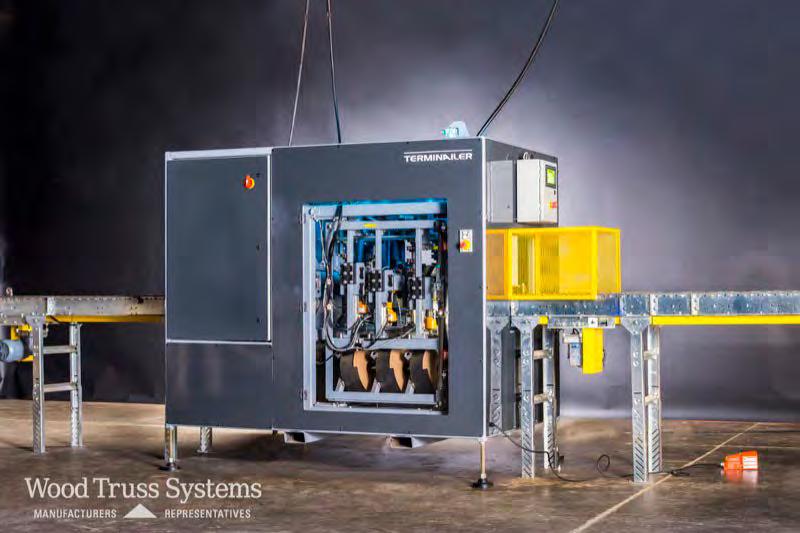
Don’t just do it, nail it. It’s a brand new day in wall-panel production, with a whole new way of doing things better.
Terminailer®, a revolutionary, event-driven, nailing machine that completely defies any preconceived notions about sub-component assembly.
1988 Clary Master 5-Blade Component Saw
1988 Clary Master, 5-blade component saw, rebuilt by seller in 2013. Cuts dimensional lumber from 1′-6″ at 90/90, to 20 ft lengths, 2×2″ through 2×12″. Includes analog displays for angles and length, powered angulation and length, shaker pan undersaw waste conveyor, (1) 32″ blade, (1) 22″ blade & (2) 18″ blades & (1) 16″ blade. Cuts 4-angle floor webs at 3′-0″ minimum. In working order when decommissioned in October of 2022. Includes belt incline, schematic drawing and all available spare blades. 480 volt, 3 phase electrical required.
$8,497 FOB ID
Wood Tech Systems

765-751-9990
www.woodtechsystems.com


Whirlwind Model 1000 Cut-Off Saw
• 5 HP Motor with 14" Blade
• 2 3/16" x 8 1/4" Capacity
• Pneumatic Blade Guard/Lumber Clamp
• Foot Pedal Control
• Dust Collection Outlet
• 460 Volt / 3 Phase
• 1 Left Hand & 1 Right Hand Model Available
$3,500 Each FOB NC
Wasserman & Associates
800-382-0329
www.wasserman-associates.com
Terminailer all but shatters the stereotypical myth that subcomponent equipment is essentially peripheral – unimportant. And it does so by quickly and accurately driving far more framing nails in your wall panel jobs than ever before. Whether in your shop or in the field, one operator sets the pace for production and quality. And that reduces labor costs and other aspects of overhead.
Terminailer is an event-driven, sub-component assembler that will quickly and accurately drive 30% to 70% of the framing nails in any wall panel job. In your shop or in the field, one operator sets the pace for production and quality. The Terminailer functions independent of design software, requires zero set-up time when switching between any configuration, and requires no special operator training.
The Terminailer is easy to move around the shop so it’s location can evolve as your shop evolves. With all of the nailing occurring in the closed main chamber, nail injuries and nail location miss-fires are eliminated, making your plant that much safer.

With nearly ten years of development from people that know machinery it is assembled to exacting standards, well supported, and it is easily maintained with shelf-item parts. Terminailer: vetted, tested, and ready to drive maximum productivity for you. Be sure to check out our videos below for a quick review of this revolutionary machine!


Spida Machinery specializes in the design, manufacturing, and distribution of various types of machinery for frame, truss, and component businesses throughout the world. With three remarkable, dedicated, and machinery-focused manufacturing sites across the globe, we bring together the best of software, hardware, engineering, electrical, innovation, manufacturing, and knowledge across the world in our people and manufacturing capabilities. The ways we can help you are endless – in your quest for machinery that is fit for your purpose and within your capex/budget plans.
So why should you reach out to us? Here are my top 6 reasons that explain what we can offer your business:
1. Product Selection: We can assist you in selecting the right machinery or equipment based on your specific needs and requirements. We have a diverse range of products designed to meet your business requirements.

2. Technical Expertise: Spida Machinery has a team of experts who possess deep technical knowledge and experience. We will provide guidance, advice, and support in understanding and operating machinery, troubleshooting issues, and optimizing performance.

a. We also go the extra mile and dedicate time and effort to ensure your machinery fits and flows well in your factory. We complete extensive machinery layouts and supply these back to you, to ensure understanding and buy-in from the outset.
b. We will map out your factory and talk with you to understand all parts of the business, ensuring no stone is left unturned when supplying your new machinery.
3. Maintenance and Repair: Spida Machinery offers a maintenance and repair service to ensure that the machinery you purchase remains in great working condition. This includes routine maintenance programs, preventative maintenance programs, inspections, and repairs to address any issues that may arise.

4. Training and Support: We provide a training program or resources to educate new operators of machinery to ensure they operate the machinery safely and efficiently. This will ensure that you and your staff develop the necessary skills to maximize productivity and minimize downtime.
5. Spare Parts and Accessories: Spida provides a dedicated team to ensure your spare parts and accessory requirements are addressed as soon as the needs arise. With major parts held in stock in most locations, our service and spares team is ready to help when needed.
6. Upgrades and Technology Advancements: As technology evolves, Spida has introduced upgrades and advancements to product lines and machinery. We will inform you when technology is moving forward and how we can assist with a transition plan. We want you to have the best when it comes to production and output and we will keep you running long into the future.
From manual to linear saws, from jack presses to roller presses, or from simple wall lines to complex wall lines with sheathing, we have the machinery and know-how to ensure your success. Give us a call and let’s discuss what you need.

P.S. We’ll have a Debut Performance of our Raked Framer at BCMC 2023! Don’t miss out on seeing the next evolution of our machinery – on display and building frames on-site. See you in Indianapolis in September!

The MSR Lumber Producers Council (MSRLPC) represents the interests of machine stress rated lumber producers in the manufacturing, marketing, promotion, utilization, and technical aspects of MSR and MEL lumber. Suppliers, customers, and professionals may join as Associate members to enjoy:


“There is no question that the MSR Lumber Producers Council meetings are worth your time to attend. The information you will receive from the guest speakers and members of the Council is unparalleled!”
—Sean Kelly, Automated Products Inc.As a truss component manufacturer, you already know Simpson Strong-Tie as a reliable partner in the construction industry. But our connections go beyond the products we make. Our people can help reinforce your network of builders, engineers, contractors, equipment manufacturers and suppliers, strengthening your existing relationships. Also, our open-platform software is integrated with the most widely-used systems, and can be customized to work with the machinery you choose. Backed by our expert service and support, you’ve got all the resources to succeed.
Grow your business ecosystem with a well-connected partner. To learn more, visit our website at go.strongtie.com/componentsolutions or call (800) 999-5099.


Automated Component Saw

• Model 348B
• Automated Setup via Download or Semi-Automated Setup via Touch
Screen Input
• 23 Axes of Automation
• Sets up in 2 to 15 Seconds
• Five Blades cut 2x3 thru 2x12 up to 20'
• Waste Conveyor (under saw)
• Excludes Incline Waste Conveyor (adjacent to saw) and Live Deck (in fronnt of saw)
• 480 Volt / 3 Phase
• Video available upon request
$38,900 NOW $34,900 FOB TX
Wasserman & Associates
800-382-0329
www.wasserman-associates.com
Component Saw
2001 Alpine AutoMill RS component saw, model 343H. Computer controlled saw sets up in 2 to 19 seconds and downloads from a network or by using a touch screen for ease of operation. Windows 98 operating system. Five-head automated component saw works in both automated (downloading files) and semi-automated control via touchscreen input. It has [23] axes of automated movement, enhanced diagnostics, auto management reporting. Cuts from 13″ to 20′ long material in size range from 2×3″ through 2×12″. Includes [3] 18″, [1] 22″ and [1] 32″ blades with air brakes and belt under-saw scrap conveyor. 480v/60Hz/3Ph power.
$28,997 FOB FL
Wood Tech Systems 765-751-9990

www.woodtechsystems.com


Safety Speed Manufacturing model 7000, vertical panel saw, 3 HP induction motor, 64 inch crosscut, 2 inch maximum thickness, accuracy within 1/64th of an inch, 10 foot welded steel frame with integrated stand and linear V-guides, enclosed counterweight system, adjustable vertical and horizontal rules. Quick changes from vertical to horizontal cutting. Includes machined aluminum material rollers, hold down bar, wheels, quick stop gauges and material hold downs. Dust collection ready. Options available include lower frame extensions, digital readouts, laser guide, stop bar, vacuum and midway fence. 208-230/460 volt, 3 phase electrical (208-230 single phase, 2 HP power optional +$100.00). $10,099 Base, FOB MN.

The L-M Verticut 2000 is a true Precision End Trim (PET) saw that is capable of holding a 1/16th accuracy all day long. Made in the USA, the V2k comes equipped with a 15 HP 460/230 volt High-E three phase TEFC motor driving a Double ended Premium “Stellite” inlaid saw bar with a spring loaded chain tensioner and an automatic oiler to lubricate the .404 pitch custom profile semi chisel saw chain.
Rather than a single pivot-point, the saw assembly is mounted on a mandrel box that is guided by cam followers on a steel frame that is raised and lowered by a hydraulic cylinder. A console with the saw controls moves with the saw assembly along a track positioned using a manual “V” wheel geared drive or optional Hydraulic drive
The V2k is unlike other imported systems that are basically a Portable Yard Saw on a cutting rack with a best cutting accuracy of +/- 1/8″ (meaning up to ¼” accuracy variance between units of lumber). The V2k from L-M provides +/- 40 thousands, assuring consistent PET precision from unit to unit.
Another advantage L-M has over the competition is their commitment to personal service with unlimited phone assistance and technical help. Their team has traveled the country working on crosscut saws for many years and they know their equipment inside and out. L-M is a familyowned business that prides themselves in doing the job right and building long term relationship that is vital to their business: “Built to last as long as our customers since 1946”.
Price based on configuration
FOB OR
765-751-9990
Alpine has it all—the right equipment, user-friendly software and dependable hardware to improve your teams efficiency. Alpine delivers the complete package for success—including comprehensive support and service that sets us apart within our industry.


Ask those who know. They’ll tell you about the people at Alpine who make a difference. BUILD


“We’ve worked with Alpine in creating top quality products surpassing customer expectations since 1984. Over the years Alpine team members have become more like family and we couldn’t do this without them!”
— Tolga Adak Florida Quality Truss Inc.
Call

Condition:


Design and build faster than ever. Learn

From plans, to walls, to panels, and everything above. Introducing a new level of design tools, built from the ground up.


Right now, many CMs are waking up to the increased pressures of a slowing home-building market, and all the capital investments they have made are just not going to be enough because all their competition has done the same. Now that the new build season is ramping up to full swing, the ones who will weather the coming storms know that process improvement will be the key determining factor to remain profitable and is not something that should or can wait until they have time. Regardless of how busy your management team feels, here are four examples of process improvement that your company should carefully consider.
Example #1: The endless push of continuously adding more designers, which includes overseas design groups, will have serious negative consequences on market wages and job security for many designers over the coming market storms. Of all the groups within a CM operation, the design group can be the most stubborn regarding process change, even when it benefits them. Instead of adopting new methods for their design process, they would instead add more hours and people, which includes low-wage overseas component designers. One area in most design groups that could make a real positive change to help them reduce the seemly endless hours is the quoting process. Using the design program is not the best use of their time in all cases. Ask yourself these critical questions.
1. What is the quote-to-order ratio within your company? Most average about 30%.
2. Must all of the projects be quoted using the design program? Or, could a high percentage of potential projects be processed using another method?
One excellent way to improve the productivity of the design group is to have them not use the design program for every project for job estimation. For instance, in most cases using an estimation program by Advanced Component Solutions is 10x faster than using the design program. Better yet, someone other than the design group could easily use this estimation program. In minutes, an accurate quote that includes the board footage, lumber cost, plate cost, labor cost, gross margins, and many other helpful project details needed for estimation is included. To the managers and

owners who resist this quoting method, ask yourself this question: Would you rather be able to process ten times the quote projects using a different program or hire and train other personnel to become designers?

Example #2: Lumber purchasing is another area for process improvement. Why are so many of you still doing all your buying activity using emails, spreadsheets, phone calls, and notepads instead of an organized toolset? Help your lumber purchasing personnel get organized with a program like Yesler. All your trading conversations, quotes, orders, and documents are in one easy-to-use place. A purpose-built tool helps buyers and traders to cultivate prospects, target specific trading partners with specific offers, and quickly convert conversations from quote to close. Both the buyers and traders will eliminate the clutter of email, phone, and text and gain efficiency with Yesler to make more trades. So to answer the unasked question, yes, even lumber purchasing can be improved upon by using better tools, such as Yesler.
Example #3: Communication should be the number one area for consideration for process improvement. Too many companies insist on reinventing the wheel, relying on their accounting system, or relying too heavily on the current truss plate vendor to help them solve this critical area. The most common response about how well their project communication system works for them is that they need more training and addons to make it work better. One of North America’s largest LBM and CM operations uses the truss program only for truss designing needs, not for the critical needs of communications and efficient management of the operation. This company uses AppWright to help efficiently manage its entire manufacturing operation. Those who have embraced better communication, such as using AppWright, learned long ago that they could simplify all project information for their sales team and every other department within their operations. Project processing becomes magnitudes better when it is automated, live up to the minute, and is vastly simplified because all the critical need-to-know information is always correct at the user’s fingertips. So many LBM and CM operations become so dependent on their truss plate vendors’ software solutions that it becomes virtually laughable to threaten them with another vendor’s services. This can all be mitigated by using AppWright.
Example #4: Far too many CMs do not feel they are being properly supported and treated fairly by their existing truss plate vendor. Larger CM operations felt their choices have been extremely limited, and now they are settling for this less-than-optimal service. Many do not know their current salesperson or technical support person who they can call upon to help them with an immediate event because of downsizing and turnover of their vendor’s personnel. Let me pause here and state very clearly that TDC has no bias or preference for whom your company chooses to partner with. My purpose is to provide as accurate information as possible to help your company make better decisions. Now having stated that, there is a small plate vendor (who is not so small anymore) that has refined its CM software, has an excellent reputation for service and support, and so now even the largest CMs may rely on it for their critical needs. TDC witnessed a demonstration by Carl Schoening of Eagle Metal, where he created the most ridiculous layout with multiple hip roofs, which contained barrel, trey, and vaulted ceilings. He made

this layout and engineered the trusses within minutes. Let me restate that Carl created this random complex layout and engineered trusses within minutes. Their layout and engineering software is very stable, extremely refined, and should be considered a serious contender for any CM operation, no matter the sales volume. As stated already, they have one of the best reputations for service and support. TDC predicts that for the BCMC 2023 trade show, one can expect Eagle Metal to be very busy. Good luck to those who are unhappy with their current plate vendor’s services and will want to have an in-depth private discussion during the show. If you are remotely interested, TDC highly recommends you start laying the groundwork now and not wait for the mad rush this coming end-of-year push.
Don’t let the phrase “too little, too late” describe your company when tough times come. Pride or ego is the actual barrier for most companies making meaningful improvements. An honest assessment and a review of all current practices are always warranted. Maybe your group should try a different approach to learning improved processes instead of using the same methods your group has grown accustomed to. The time for improvement is always now, so embrace continuous improvement in meaningful ways before it is too little too late.
No one is better at providing your team with proven results for process improvement of employee practices, pricing, truss labor estimation, and so many other best-inclass practices. TDC’s tailored solutions are for the client’s specific needs. Go beyond the typical software and equipment vendor recommendations for your operations and do what many have dared to do. Embrace the Drummond Method, and your company can experience cost savings, and net profit gains that usually take months or years can be accomplished in weeks or months, resulting in an average of 3 to 6-point net profit gains for CMs. All areas are addressed, not just the manufacturing. Please do not take my word for TDC’s services, though. Read the public testimonials many current and past clients with decades of expertise and experience have been willing to give: https://todd-drummond.com/testimonials/.

Website: www.todd-drummond.com • Phone (USA): 603-748-1051
E-mail: todd@todd-drummond.com • Copyrights © 2023


Designed for high-volume floor truss web output with even greater safety, the Monet DeSauw FWA-500 AC (for “automated controls”) offers the very latest in operator-friendly saw technology. Perfect for manufacturers running floor trusses in large volumes with variable web design, the 500 AC features automation for all blades, including the fixed cut-off blade for minimal waste. And without any need to open the saw motor cabinets, except for periodic service, you’ll benefit from enhanced safety as well. You might say that with the fully automated FWA-500 AC, Monet DeSauw has set a new standard. Again. Contact us today to discuss how this exceptional machine can positively impact your production goals.
765-751-9990 www.woodtechsystems.com
One month after installing a Double Lumber PickLine to feed two TCT Linear Saws:


"We are getting 3,000 to 5,000 bdft more each saw, than we were getting before the install.


We have shut down one Cybersaw and one TCT chord saw.
This equals about 3 less people 10 hours, and 2 less forklifts 10 hours.
Overall, it is a major improvement to our operation. We hope to have the chance to run it two shifts to further accelerate the payback.”
Tom Hollinshed, OwnerLimTek Solu�ons Inc.


6021 Yonge St., Unit 1019
Toronto, ON M2M 3W2
Tel: (416) 888-4457
Edmond.Lim@LimTekSolutions.com
Edmond.Lim@LimTekSolu�ons.com
LimTekSolu�ons.com


• Automated Stop and Automated Saw Angulation as directed by Truss Design Software
• Direct Drive 5.5 HP (240 Volt - 3 Phase) with 18" Blade
• Minimum Angle of 9 Degrees with 24" Stroke for Long Scarf Cuts
• Automated 162 Degree Angular Movement
• Adjustable Stroke Limiter & Plexiglass Shield for Operator Safety
• Dust Extraction Outlet (Excludes Dust Collection System)
• 20' of Steel Framed/MDF Table with Automated 20' Length Stop
• 10' Infeed Roller Conveyor


• Touch Screen Computer with Truss Cutting Operating Software
• Excludes Installation/Training and Spida Annual Tech Support Fee

$42,900 FOB TX
New, DeRobo linear saw by Monet organizes "fill" boards to increase optimization of each board, can produce unlimited scarf cuts, cuts 1 or 2 boards at a time and cuts webs, chords, wedges, rafters and open-stair stringers. Works with all major connector plate manufacturer's software. Features include 22 inch blade, left-to-right feed direction standard, lumber push and pull grippers for more accuracy, ink marking on the 1 1/2" face of the incoming boards and small piece capture and delivery to the front of the saw for easy access. Infeed deck and bunk feed are shown as options only. 480 volt, 3phase. Call for pricing, FOB MO.
Roof, Floor, and Wall components: Webs, Chords, Sliders and Wedges – up to 4-boards high! The ProCut™ Linear Saw Series is configurable to any assembly line – providing a safe, accurate way to cut your lumber, while keeping your materials moving on your line.
Feed the ProCut™ with bulk lumber staged around the Linear Infeed Conveyors. Materials are picked and placed in the order which it is to be processed. Lumber is fed to the ProDeck™ Lumber Infeed - where it accumulates and is dispensed to the sawyer.

From the ProCut™, the cut material is conveyed to an accumulator where it is grouped and placed together with all components for the job. The material is conveyed to the staging area at each truss assembly workstation. The staging areas at the table provide an uninterrupted supply of perfectly cut and organized material.

Eliminate the carts and congested staging areas in your plant. The ProCut™ saw, when used in combination with the ProDeck™ and our Custom Material Handling Systems, can be configured to improve the flow of perfectly cut parts and materials directly to your assembly stations.
The ProCut™ UC Linear Saw Series offers many variations to suit your plant and assembly line. Let us design a system for you.

Used Hain Quick Rafter Cutter

• Reconditioned in December 2020
• Board Sizes: 2x4 and 2x6
• Motors: Two 1 HP / 220 Volt or 440 Volt / 3 Phase
• Saw Blades: 7 1/4" Carbide Tipped (set at 45 degrees)
• Angle Adjustment: Manual Rotation with Air Brake
• Air Supply: 90 PSI
• Carriage: Steel Rails with Steel Dual V Rollers
• Pedestal: 3/16" Formed Steel
• Saw Housing: 1/2" Billet Aluminum
• Covers: 10 Gauge (1/8" thick) Steel
• Fully Enclosed for Safety
$12,500 FOB AZ
Wasserman & Associates 800-382-0329
www.wasserman-associates.com
NEW!
2000 Automill 5-Blade Component Saw

2000 Timbermill model 343H, five (5) blade component saw cuts lumber from 2″ x 3″ through 2″ x 12″, lengths from 18 inches to 20 feet, including 4″ x 2″ four-angle floor webs from 18 inches. All powered movements, includes computer controls, (1) 30″, (1) 20″ and (3) 14″ blades, analog scales, shaker scrap conveyor, scrap incline and extra set of blades. 480 volt, 3 phase electrical required. 90 PSI air required.

$24,997 FOB ON
Wood Tech Systems 765-751-9990
www.woodtechsystems.com
Monet FWA 500 Floor Web Saw
New, Monet five-head, floor truss web saw, cuts 4-angle, 4x2 floor truss webs from 16 inches and 90-90 blocks from 12 inches to four foot long maximum length. Features 10-board magazine feed, powered, fixed-quadrant angulation, manual carriage standard, shaker-pan scrap conveyor with short incline conveyor and cut-off blade. Option for longer carriage length, single-sided setup (shown in pictures, but not standard), dust hood and horizontal scrap conveyor. 480 volt, 3 phase. Call for pricing, FOB MO.
765-751-9990
www.woodtechsystems.com

The truss industry relies on 3rd party quality assurance services to provide random visits to review the plants Quality Assurance program along with their operations. If your plant needs to comply with the IRC, IBC and to those who depend on solid, experienced QA expertise, we ask you to consider selecting Timber Products Inspection, Inc. (TP) as your choice for 3rd party inspections.

Proudly serving the forest products industry for over 50 years, TP brings the expertise you need to ensure your business is successful. As a responsible partner, TP delivers to clients, employees, and the industries we serve the confidence to drive value through the effective use of our diverse professional team.


TP would like to welcome the following authorized agents to our inspection team, each of whom have many years of experience in the truss industry!
• Al Coffman
• Jean Hart
• Curt Holler
• Chuck Ray
• Glenn Traylor
• Elliot Wilson
If you have questions about how you can make this selection, please contact your authorized agent above or Glenn Traylor at 919-280-5905 or trusguy@gmail.com.
https://www.tpinspection.com/ https://www.tpinspection.com/auditing-services/truss
By Glenn Traylor

Recently, when a building owner started getting leaks in the roof and noticed unusual variations in the ceiling, I was asked to do an inspection to determine the best way to correct a deflection problem. Upon inspection, it was very evident that the roof trusses had not been installed correctly and lacked the fundamental bracing necessary for the trusses to perform their task. Because of the lack of top chord bracing on the base truss, the following problems were growing:

1. The classic “serpentine” or “S” pattern of chords had developed (see sketch), indicating buckling was occurring on the top chord of the base truss.
2. Heels of the base truss were starting to separate.
3. Interior webs were starting to break and crack due to the excessive forces exerted as the trusses deflected lower and lower.
4. Trusses were out of plane by as much as 6 inches.
The truss will collapse if no action is taken. Let me repeat that – the trusses will fail and the roof will come down. The problem is such that the building has been condemned and cannot be inhabited. Because of the scope of the problems and the separation of connectors, given the visible and other hidden damage, the trusses cannot be salvaged safely nor economically.
When asked by the building manager what caused the problem, I explained that it began the day the trusses were being set. Apparently, the framing contractor was not aware of the additional bracing requirements. As a result of the framing, the contractor has reduced the life span of this building significantly. Their lack of proper bracing will cost the building owner much more than the original cost of construction.
So now you are probably asking “does any of the responsibility for this problem fall onto the fabricator?”
Fabricators cannot monitor all of the projects where they provide materials, but they can provide the necessary information to help ensure their product’s proper installation. In this case, the history of these trusses and the transaction between the fabricator and client is not available to me; however, given the extremes in this situation, I feel certain that reasonable steps were not taken that would have avoided this outcome.
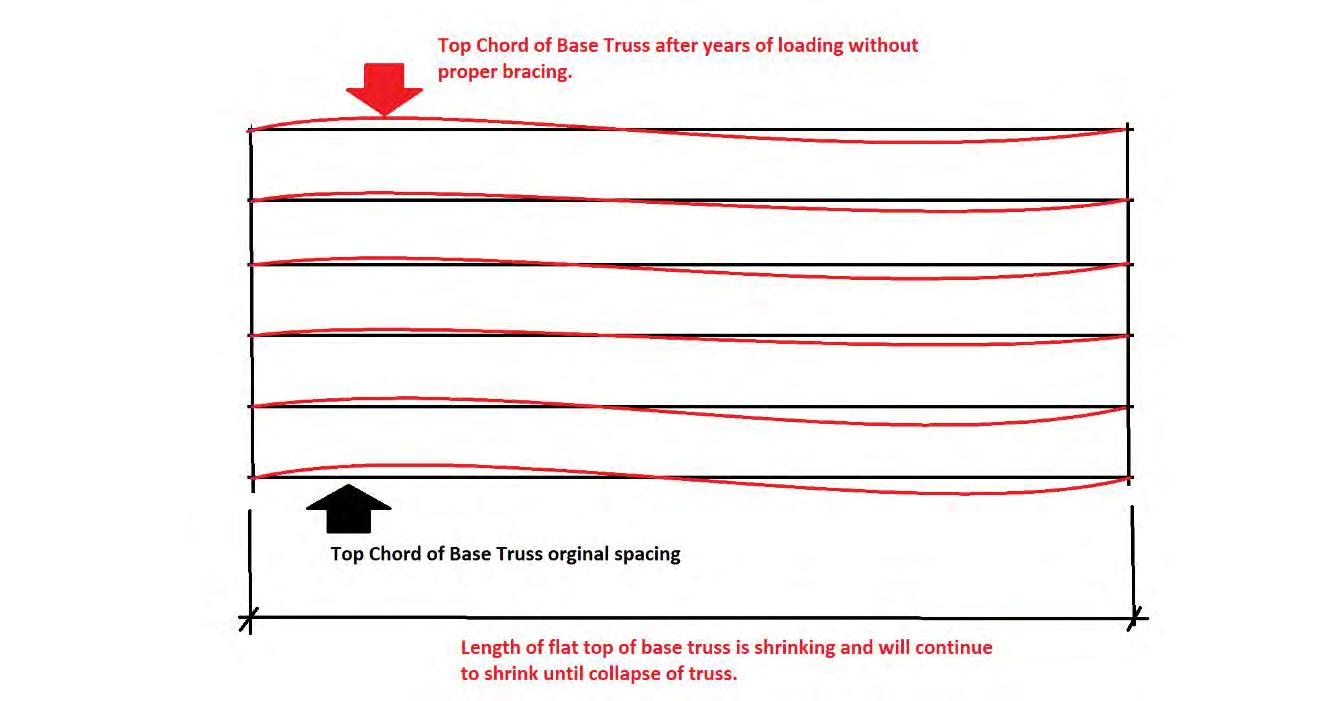

Key factors that should merit extra concern on a project are any of the following attributes:
A. Spans of 50’ or greater
B. Piggy-backed trusses
C. Large over-framed areas requiring significant bracing
D. Deep scissor trusses with a small pitch differential creating a high center of gravity
E. Inexperienced customers
F Field-spliced trusses
G. Community projects.
To help your contribution endure throughout its design life, however, you can consider taking the following steps.
1. Complete a needs assessment. These discussions are helpful to disclose limitations in education and experience that might create a problem.
2. Review what may be “obvious” potential problems and identify appropriate solutions.
3. Consider including SBCA’s BCSI booklet on all projects with any of the key factors listed above (they cost approx. $50 each). https://pubs.sbcacomponents.com/products/buildingcomponent-safety-information-booklet
4. Always provide Sealed Engineered Design, especially for projects that have a high degree of failure due to improper installation.
5. Include pertinent BCSI summary sheets with all orders. Make it part of your Jobsite Package. Make it part of your shipping items documenting that you supplied this information.
6. Avoid providing limited information or incomplete information on your own.
7. Integrate “bracing required” tags that make the field confront the need for additional bracing. These tags are durable and remain with the truss. https://pubs.sbcacomponents. com/collections/truss-tags
8. Spray paint or stamp bracing notifications on trusses at the points where bracing should be installed.
9. Sell bracing members that provide the bracing membrane. These can be similar to gable ends that are designed to lay on top to brace trusses. You can also provide flat “wall panels.” These are easy to manufacture and can utilize otherwise culled materials.
Working together with your client will help ensure their project is successful and will reduce your exposure to litigation. Your efforts will help your components achieve their ultimate value. It’s a win-win strategy.
Glenn Traylor Structural Building Components Industry Consultant http://www.linkedin.com/in/glenntraylor
2008 Alpine PF90 Wall Panel Saw 2008 Alpine PF 90 wall panel cutting and marking system. 3.5″ x 12″ maximum cutting profile, Inkjet option, cuts to 16 ft long. From the OEM’s literature, “Effortlessly handles two of the most critical and difficult processes in any wall panel operation – plate cutting and panel layout. At the rate of 1,000 linear feet per hour or more, uses data from the design software and accurately marks stud, cripple and jack locations, job and panel number, subcomponent and window/door locations, and even sheathing locations on both top and bottom plates simultaneously with ink-jet printing.


$8,499 FOB NY Wood Tech Systems 765-751-9990
www.woodtechsystems.com

Electrical Supply: 110 VAC
Motor: 1/4 HP, 110 VAC, Linear Actuator
Highly Accurate: +/- .010 Inches

Stop Rail: 2 x 4 x 1/4 Aluminum Extrusion


Stops: Jig Bored Steel
Stop Blocks: Machine Billet Aluminum
Internal Components: Hardened, Ground and Polished Steel and Billet Aluminum
Dimensions:
Length: 5 feet (60”) to 60 feet (720”)
Height: 12 inches
Depth: 12 inches
If you are looking for the fastest, most consistent way to measure and cut your product, then the Hain Measuring System (MEA) is your answer. The MEA changes from one length t any length instantly, up to 60’, without changing the operator’s position on the line. It is also highly accurate (+/- .010) and quickly moves from one length to the next in seconds. The MEA is designed for quick and easy setup and is simple to use. Even a first time user will be productive with little or no training required. It can adapt to any saw and can be mounted to any surface so that you can integrate the MEA with your existing setup. The MEA is versatile allowing “left” or “right” handed operation and measurement in “feet and inches” or “inches” depending on your preference. The MEA is also available in a “Skid Mounted” version.

4,001,398


That’s the total trigger count from all six nail guns combined on an installed Terminailer.® For a machine that was a little over two years old, that is a big number; a real tribute to the durability of the machine’s components and engineering.

Yes, that number represents a pretty darn impressive mechanical milestone to be sure, but what is really impressive is that human hands were saved from millions of repetitive motions and potentially costly nailing accidents.
With just a sole operator, Terminailer drives a whole lot of improvement in efficiency and output. This amazing sub-component assembler quickly and precisely drives 30% to 70% of the framing nails in any wall panel job—be it batch, or just–in–time production. All with no complicated training, software or set-up time required when switching configurations. Add increased safety and easy maintenance with off-the-shelf parts, and you can see why Terminailer should be driving greater productivity in your plant.
Put things together like never before.

Safety Speed Manufacturing Model 6400 Panel Saw


Safety Speed Manufacturing model 6400 vertical panel saw, 3 HP worm drive motor, 64 inch crosscut, 1 3/4" inch maximum thickness, accuracy within 1/64th of an inch, 10 foot welded steel frame with integrated stand and linear V-guides, enclosed counterweight system, adjustable vertical and horizontal rules. Quick changes from vertical to horizontal cutting. Includes machined aluminum material rollers, hold down bar, wheels, quick stop gauges and material hold downs. Dust collection ready. Options available include lower frame extensions, digital readouts, laser guide, stop bar, vacuum and midway fence. 120 volt. Starting at $5,599 FOB MN.


AGordie Howe hat trick is accomplished when a player gets a goal, an assist, and a fight in a hockey game.

A “Feed the Beast” hat trick is accomplished when a team of machinery wranglers installs a Lumber PickLine to feed a 3rd party automated saw, a standalone auto-feeding RetroC, and a fully loaded RetroC with SpeedCatch – all in the same week!
The machinery wranglers shown here are being treated to a well-deserved meal to cap off and celebrate their record-setting week of accomplishing the hat trick all while traveling from Vancouver Island, BC to Warsaw, VA and finishing up in Erlanger, KY. Congratulations on a job well done! At LimTek, we are committed to meeting our customers’ schedules as much as humanly possible, so we are not intimidated by a lot of hard work in a short period of time. Your investment is worth our time and effort!

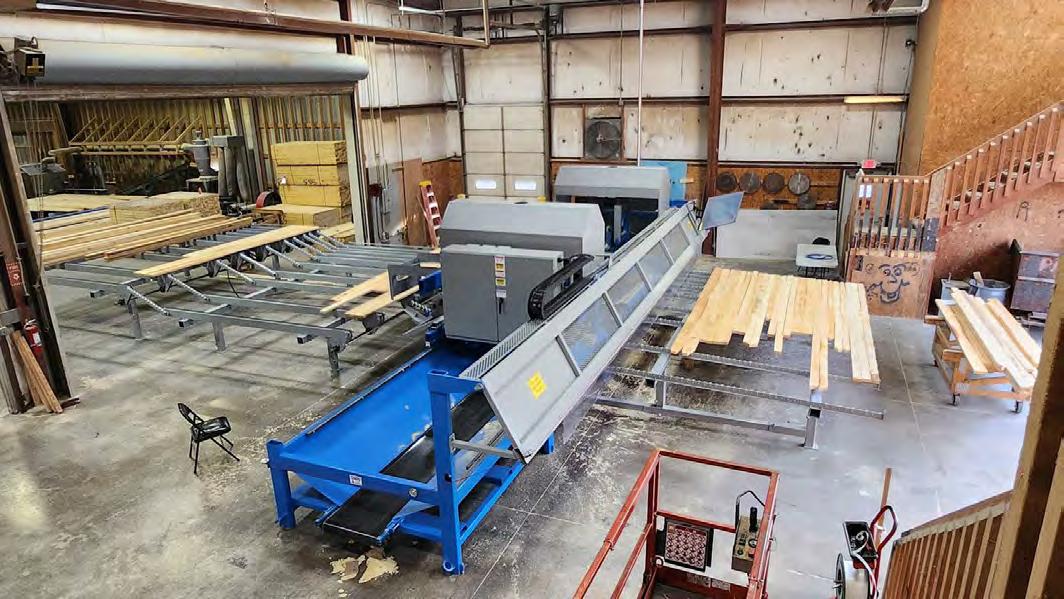
Shown in the photo is the under roof 52 ft SmartConveyor component of the exterior Lumber PickLine that will feed lumber continuously to the MiTek Blade saw in the background. For more information on this optimal setup, see my January 2022 article, “ Optimize Your Saw with a Lumber PickLine.”

A RetroC can only be fed lumber from the included front auto-feed SmartConveyor, which is normally done with a Lumber PickLine. If there really is no room for a PickLine (see my May 2022 article, “Debunking the ‘Automation Takes Too Much Space’ Myth”), the trick is to place a bunk live deck in front and above the 12 ft SmartConveyor. Bunk lumber can then be spilled onto the “waterfall” skate wheels which will help flatten the lumber on the SmartConveyor. Shown on the left is a 14 ft bunk live deck that is set 12 inches higher than the 12 ft SmartConveyor. Shown on the right side of the RetroC is a 10 ft lumber catch table and lumber cart that will have one or two lumber catchers stacking lumber from the catch table onto the lumber carts.

We are always on the lookout for machinery wranglers who are ready, willing, and able to travel. If you have what it takes to handle the Beast, please email your credentials.

Technology help you squeeze out more truss production and deliver quality trusses with shorter lead times to better service your customers by organizing your truss fabrication processes to maximize your investment in automation. https://limteksolutions.com/


EKSTROM-CARLSON MODEL E
STRAIGHT LINE RIP SAW
• 10 HP Arbor Motor
• 3 HP Variable Speed Feed
• 4" Maximum Thickness (when using 18" Blade)
• 48" Throat
• Adjustable Rip Fence
• Overhead Holddown
• Automatic Chain Oiler
• Dust Outlets
$10,500 FOB MI
Wasserman & Associates 800-382-0329
www.wasserman-associates.com
DANCO GANG-RIP SAW
• 3 3/8" Maximum Thickness
• 13 1/2" Maximum Distance from Rip Fence to Outer Saw
• 100 HP Arbor Motor
• 2 HP Feed Motor
• 7 1/2 HP Dust Collector
• 480 Volt / 3 Phase
• Waste Conveyor with Short Incline $35,000 NOW $27,900 FOB MN
Wasserman & Associates 800-382-0329
www.wasserman-associates.com
2005 PCS / MiTek
Twin Axis Sheathing Saw

2005 PCS/MiTek Twin Axis sheathing saw: Cuts X and Y axis simultaneously in one pass through the saw. Cuts up to 1″ thick, wood sheathing material, minimum width 3″. Fully enclosed to reduce noise, dust, and improve operator safety; automated via downloaded sheathing cutting files from wall design software. Includes 8 foot long idler infeed conveyor and outfeed conveyor with pop-up skate wheels, (1) spare blade and all available spare parts. 220v/440v, 3phase electrical saw, 120v, 1 phase electrical PC. 100 PSI at 14 CFM air required.
$17,991 FOB VA
Wood Tech Systems 765-751-9990
www.woodtechsystems.com
Used Spida Automated Truss Saw

• Automated Stop & Automated Saw Rotation as directed by Truss Software

• Generation 1 - Windows 98 (highly recommend Spida $32,000 Upgrade)
• 5.5 HP Motor (3 Phase) with 17.7" Blade
• Computer with Enclosure
• Outfeed Table with Automated Stop
• Infeed Roller Conveyor


$15,900 FOB KY
Wasserman & Associates
800-382-0329
www.wasserman-associates.com
2001
• Model 344B
Saw
• Automated Setup via Download or Semi-Automated Setup via Touch Screen Input
• 19 Axes of Automation
• Sets up in 2 to 19 Seconds
• Five Blades cut 2x3 thru 2x12 up to 20'
• Waste Conveyor (under saw)
Component manufaCturing S erving the S tructural B uilding c omponent
2019 Mitek Auto Deck (for Mitek Blade Saw)
Five Chain Auto Deck (for Mitek Blade Saw)
$18,900 FOB WI
Wasserman & Associates
800-382-0329
www.wasserman-associates.com
• Excludes Incline Waste Conveyor (adjacent to saw)
• 480 Volt / 3 Phase
$29,900 NOW $26,900 FOB TX
Wasserman & Associates
800-382-0329
www.wasserman-associates.com
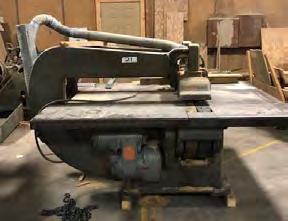
2000 Alpine Model 645 Pull Arm Saw with 20′ Speed Measure
2000 Alpine Model 645 radial arm saw includes center-point cutting, turntable cutting system, INCLUDES 20ft Speed Measure System with 20ft. infeed conveyor, 10ft. outfeed conveyor.

$8,990 FOB ON Wood Tech Systems
765-751-9990
www.woodtechsystems.com


$124,990.00 NOW $69,990 FOB SD Available March 2022



Servo controlled angulation axis of movement for cutting and making wall frame (square & angle cut) components. , “D” Print option (both faces, one edge). Includes 5 HP, 3450 RPM, arbor motor, computer monitor, console, 220/440v 3 Ph, spare blade. The WoodRunner Air Pick automated lumber retrieval system includes a single picking head with 10 bunks and 2 magazines. Includes manuals, all available spare parts and spare servo cards, and WoodRunner software source code. Available March 2022.


The legacy of the Eide name runs deep. Established in 1927, Eide Saw Company was a saw blade repair and supply company in the heart of Minneapolis’ milling and lumbering industry. Over the past 96 years, however, we have grown and expanded to keep pace with the ever-changing woodworking and fabricating industries.


In 1961, Eide Saw Company expanded from sharpening blades to power tools and became a top distributor of DeWalt. Always a service-oriented company, how and who Eide served changed with the times and the industry. Eide evolved into machinery supply for building components, with the first truss and assembly equipment – Lumbermate Connector plates. In 1985, Eide moved away from the general woodworking industry and focused on the building component industry. Eide Saw Company became Eide Machinery Sales, Inc. The shop expanded to rebuild and customize machinery, tables, and installations.
In 1999, Eide moved to its current location. Over the years, we’ve added distribution and manufacturing of the innovative WizardPDS® and ProCut systems. Our lines of equipment include those of many top manufacturers of the United States, along with quality lines of foreign machinery.
What’s more, we’re committed to helping you build on your company’s legacy. Our Universal™ tables allow you to expand any existing or discontinued line with WizardPDS®-ready tables. Eide’s upgrade and reconditioning services for Legacy gantries and material handling systems add years of life to older or discontinued lines. Our tables are adaptable to your situation and your needs, so that you can improve your production your way.
And why should you upgrade to the WizardPDS® Automated Perimeter Definition System? Because WizardPDS® delivers the speed and precision that will benefit any assembly line. In fact, it is used with more new and existing truss table brands than all other systems combined.

Whether new or existing tables, your entire table or a dedicated section to capture the bulk of your schedule, WizardPDS® automation can set the pace of the table – not a little manual jigging at the bottom/top chord or every-other slot. Automation is a big deal with the promise of a great return – why wouldn’t you want to automate with the truly revolutionary and 100% automated jigging system that sets the bar for all truss-table automation?
The WizardPDS® remains the industry leader and only 100% automated jigging system for your assembly line. A WizardPDS® ChannelS® retrofit is the best investment you can make to improve the efficiency of your line. WizardPDS® continues to lead with innovative automation solutions for roof truss production. It is the single greatest investment you can make to your assembly line ... and your bottom line.
Ready to see more? Check out the videos of the WizardPDS® in action and then give us a call at 612/521-9193. Eide’s sales and shop teams look forward to serving you.


Custom 3-Arm Infeed Decks
Two custom-built powered infeed decks, 3-arms each, 12′ x 12′ footprint each, touchpad controls and chain conveyors.

One deck has a 5 HP drive and the other has a 10 HP drive. 480 volt, 3-phase electrical required.
10 HP price is $7,993 & the 5 HP price is $6,993.
Wood Tech Systems
765-751-9990
www.woodtechsystems.com
$14,099 Base FOB MN
2005 Alpine Speed Cut Saw with Speed Cut Express

• Alpine Metra-Cut Saw (5 HP-3 Phase) with 16" Blade
• Speed Cut Express Automation with Touch Screen Computer
• Automated Stop and Automated Saw Angulation as Directed by Truss Design Software
• Infeed/Outfeed Roller Conveyor with Stands

• Saw Barrier Guard $19,900 FOB ND
Wasserman & Associates
800-382-0329
www.wasserman-associates.com

2006 MiTek Cyber A/T Component Saw. Frame #521, Fully automated five-blade component saw, cutting performed by 2-16″ x 7 HP, 2-20″ x 7 HP, 1-32″ x 13 HP. Windows 7 PC in enclosure for fully automated or manual part input, all powered movements, cuts 2×3 thru 2×12 plus 4×2 lumber. Lengths cut from 14″ to 20 feet. Minimum 4-angle cut 22″ (17″ in manual mode) Belt scrap conveyor included with short incline (approx 4′). Includes skate wheel outfield conveyor and optional “Catcher Display”. Includes all available spare blades, spare parts, and manual with schematics. 2480v, 3ph power required.
765-751-9990
$89,990 FOB VA
www.woodtechsystems.com
Safety Speed Manufacturing Model 7400 XL Panel Saw

Safety Speed Manufacturing, model 7400 XL*, vertical panel saw, 3 HP induction motor, 64 inch crosscut, 2 1/8" maximum thickness, accuracy within 0.005 inches, 13 foot long welded steel frame with integrated stand and linear V-guides, enclosed counterweight system, adjustable vertical and horizontal rules. Quick changes from vertical to horizontal cutting. Includes machined aluminum material rollers, hold down bar, wheels, quick stop gauges and material hold downs. Dust collection ready. Options available include digital readouts for vertical cuts, automated length measuring, laser guide, stop bar, vacuum and midway fence. 208-230/460 volt, 3 phase electrical (208-230 single phase, 2 HP power optional +$100.00).

NEW!
New
Monet DeWall 90/90 wall panel marking saw is a computer numeric controlled wall panel saw with touch screen user interface. Cuts and marks up to 2 boards at a time using 2x4 through 2x8 or cuts and marks one board at a time. Call for pricing, FOB MO
765-751-9990
www.woodtechsystems.com


Modern business relies on actionable data to drive decisions. That’s why truss component manufacturers rely on Simpson Strong-Tie. As a partner to the construction industry, we’re continuing to invest more resources in solutions built just for you. Our open-platform software can be integrated with your existing systems and equipment for smoother collaboration inside and outside the company. At the same time, it provides secure access to proprietary data, so customized reports can be created with greater ease and control. Use your data, your way, and drive business results.
Get the software you need to manufacture business success. To learn more, visit our website at go.strongtie.com/componentsolutions or call (800) 999-5099.


Since 2006, we've been helping businesses of all kinds build their online presence. We make websites and software for the construction industry to empower companies to reach a wider customer base and engage their audiences. Companies all around the world work with us to make websites and apps that people actually want to use. Reach out to Wolf X Machina if you're a business and you want a website that actually drives results.

Fitzgerald

ast fall, Panels Plus moved to a different location with more space, and I’m pleased to report that our staff was able to pull off this move with no interruption in business. Our customers continued to place orders at a record pace and our suppliers were able to send us the parts we needed in time to deliver our equipment on schedule. Since then, our operation has become more efficient due to the new building layout. We have been shrinking our backlog despite a 26% increase in incoming orders over this time last year. With our increased productivity, we can now deliver most equipment in four months.
As I look forward to the second half of the year, I have some concerns about our industry. Four of the five key indicators I watch are not favorable. I have read several articles regarding reduced business for builders and suppliers, and I hope this is not the case. It seems that the emphasis has moved from how many feet of walls and floors can be done in a week to what is the most cost-effective way to operate until the threat of recession has passed. Panels Plus can provide valuable information to help you set up the most efficient operation, ultimately helping to lower costs for your company.
Our team recently received valuable information from the field testing of our Automated Sheathing Station. The testing led to some software changes that will make the Automated Sheathing Station more flexible to accommodate the needs of each builder. These changes have been made to the Panels Plus software, and MiTek is in the process of developing an update to their ShopNET software as well, which is required to enable these features. The MiTek Production software package is required to take full advantage of the Automated Sheathing Station’s full capabilities. With this software change, we will soon be launching this product on the market.
To continue to grow our product offerings, Panels Plus has added a 90° Hydraulic Tilt Table in addition to our 75° table we already offer. The 90° Tilt Table allows walls to be rolled out vertically into rollouts where the walls can be picked and placed into vertical racks or further worked on in a vertical position.
We are still growing and plan to add another Regional Sales Manager to our team soon. We are looking for someone with experience in the building industry. It would be even better if they had experience building walls and floors with Panels Plus equipment. If you know someone that has these qualifications, gets along well with people, works hard, and likes to help people grow their business, please have them reach out to us at sales@panplus.com.


• 5' x 27' Table with Hydraulic Press


• Hydraulic System has been Rebuilt
• Unistrut Jigging with Plastic Top
• Joystick Press Travel
• 2 Push Buttons to Activate Press Cycle
• 480 Volt / 3 Phase
• Price in US Dollars
$42,900 FOB QC
800-382-0329 | www.wasserman-associates.com
Electrical Supply: 110 VAC
Motor: 1/4 HP, 110 VAC, Linear Actuator
Highly Accurate: +/- .010 Inches
Stop Rail: 2 x 4 x 1/4 Aluminum Extrusion
Stops: Jig Bored Steel
Stop Blocks: Machine Billet Aluminum
Internal Components: Hardened, Ground and Polished Steel and Billet Aluminum
Dimensions:
• 7' Gantry Roller with Safety Bars
• 40' Steel Table with Kick-Leg Supports and End Stands
• Air Cylinder Clamping with Jig Rails
• Floor Mounted Track
$33,500 FOB TX
800-382-0329 | www.wasserman-associates.com
Length: 5 feet (60”) to 60 feet (720”)
Height: 12 inches
Depth: 12 inches
If you are looking for the fastest, most consistent way to measure and cut your product, then the Hain Measuring System (MEA) is your answer. The MEA changes from one length t any length instantly, up to 60’, without changing the operator’s position on the line. It is also highly accurate (+/- .010) and quickly moves from one length to the next in seconds. The MEA is designed for quick and easy setup and is simple to use. Even a first time user will be productive with little or no training required. It can adapt to any saw and can be mounted to any surface so that you can integrate the MEA with your existing setup. The MEA is versatile allowing “left” or “right” handed operation and measurement in “feet and inches” or “inches” depending on your preference. The MEA is also available in a “Skid Mounted” version.


2018 Clark Mini Barn Press
2018 Clark Mini Barn Press, builds rigid frames for sheds from 8 foot to 14 foot spans, to 3′-6″ height. Builds mansard and rafter shapes. Includes (5) track mounted heads with 8″ x 10″ platens, material clamps, 10 HP hydraulic power unit with manifold for air and fluid, ball valve controls, mounting track and all available jigging. 460 volt, 3 phase electrical required.
$19,997 FOB TX
Wood Tech Systems 765-751-9990
www.woodtechsystems.com
Horizontal
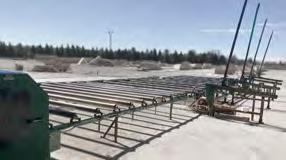
Model HVS, Two Unit, 2-Zone, 14’ Horzontal Stacking System. Two lifting units (one master and one slave) with integral electrics. A truss sensing system consisting of adjustable laser sensors mounted on slide rails. One indoor electric control enclosure & panel w/PLC and manual controls. A stacker-conveyor interface package comprised of (1) mounted 3-push button enclosure and (1) remotely mounted 2-push button enclosure (pause/ emergncy stop). Hand-held Wampfler
Remote Control System. 8 stacking rails and 4 stripping posts. Stack 1 5/8” thick x 14’ tall trusses up to 30 high. Stack a truss in approximately 40 seconds (cycle time). Stack up to 55’ or longer trusses on each side of the conveyor with minor assistance for truss sag, shorter lengths can be stacked unassisted. Excludes 77’ Walk Through Conveyor System. Two systems available at $25,000 NOW $19,900 Each. FOB NE.

Wasserman & Associates
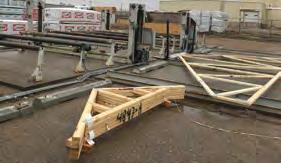
• 7' x 40' Table with 3/4" Steel Table Top
• Two 5' Park Sections
• Truss Depths from 12" to 26"
• Truss Flip-Over Arms
• Side or End Ejectors
• Bui lt-In Camber for Clamping on Both Sides
• Air Cylinders Under Table
• 2 Contr ol Valves for Clamping
• 1 Contr ol Valve for FlipOver Arms
• 1 Control Vlave for Ejectors
• 24" Diameter x 1" Wall Thickness Roller
• 10 HP / 3 Phase Gear Motor
• Front & Rear Emergency Shut-Off Bars
• Joystick Control
• 2' per Second Travel Speed
Alpine Mighty Mite Press
• 5' x 27' Table with Hydraulic Press

• Unistrut Jigging with Plastic Top (plastic needs replaced)
• 220 Volt / 3 Phase
$24,900 NOW $19,900 FOB TN
Wasserman & Associates
800-382-0329
www.wasserman-associates.com
800-382-0329
www.wasserman-associates.com
800-382-0329
Pacific Peak Up Stacker
Used-as-is Pacific Automation 60’ peak up stacker / (4) lift arms with indexing heads / Adjustable pop-up platform / Target for triggering stacking cycle / Powered truss conveyor as shown / Center rolls can be moved to unload from top chord side / Control panel with auto and manual stacking mode.

EMSI Field Repair Press
EMSI 10 Ton Field Repair Truss Press System. Complete with: 1/2 HP, 115 Volt, 50/60 Cycle Universal Motor – Operates at voltage as low as 60 volts. 10,000 PSI
Portable Power Pack with Two Speed Operation – 200 cu in/min @ 0–200 psi, 20 cu in/min @ 200–10,000 psi and Externally
Adjustable Relief Valve (unit weight 55 lbs.). C-Clamp Assembly with 8" Maximum Reach, 4" x 5" Pressing Platen (optional platen available for 4” x 2”). Independent
10 Ton Hydraulic Cylinder. 10’ Hydraulic Hose Assembly with Quick Disconnect Coupling. Handle with 24 Volt Remote Electrical Pendant.

Call for Price
Eide Machinery Sales, Inc.
612-521-9193
www.eidemachinery.com
$13,950
Eide Machinery Sales, Inc.
612-521-9193
www.eidemachinery.com
Since 2006, we've been helping businesses of all kinds build their online presence. We make websites and software for the construction industry to empower companies to reach a wider customer base and engage their audiences. Companies all around the world work with us to make websites and apps that people actually want to use. Reach out to Wolf X Machina if you're a business and you want a website that actually drives results.
Carl Villella, CLFP President, Acceptance Leasing & Financing Service

For those concerned that interest rate hikes will continue, the Fixed Income team at the Capital Group believe the last hike of 0.25% in early May will most likely be its last of the cycle. Many economists share that perception.
After 10 consecutive hikes by the Fed, inflation is cooling at 4.9% over the prior year in April, providing the Federal Reserve with what it was hoping to achieve.
For business owners, the industry-wide perception that interest rates will be flattening provides a greater comfort level when it comes to budgeting for new or used equipment. The urge to “jump in” and finance now, before rates jump in the near future, can stress out any owner.
Over the last few months, we at Acceptance Leasing and Financing have not noticed a slowdown in the number of applications and approvals. Although rates were climbing slowly, demand for products in the marketplace remained strong (as evidenced by strong employment numbers, and its inverse statistic, low unemployment).
Our clients met the demand with newer, updated equipment. The challenge many of them faced is long delivery lead times, and large down payments necessary to start an order. Our pre-funding to the vendor saved them a large cash outlay, and we were able to remove the risk of higher future rates by locking in the agreement with the initial deposit outlay.
We hope that as you plan for the months and years ahead, you’ll consider allowing us to assist you with your financing needs.
We have a number of financing programs to fit the needs of every type of borrower, from startups, to seasonal businesses, to well-established industry leaders.
We are Acceptance Leasing and Financing Service, located near Pittsburgh, PA. We’re in our 31st year of business. Established in 1992, we pride ourselves on our Certified Leasing and Financing Professional designation. A member of SBCA and a frequent attendee of the BCMC tradeshow, Acceptance Leasing and Financing Service, Inc. knows the equipment of the component manufacturing industry and is ready to assist you with your financing needs.


(A)
2 x 12” diameter x 6’ long rollers powered by one 7 1⁄2 HP Sumitomo gear motor, with #80 Drive chain, 2-1/2″ diameter shafts, pillow–block roller bearings contained in a 3⁄4”Integrated laser-cut steel support frame. Roller press operates at 114’ Per minute fixed working speed, and includes front & rear emergency shut off bar, chain & sprocket guards, and integral mechanical fail-safe brake. Sold as is with no OEM warranty, 460 Volt 3-Phase power required.
$33,990 FOB IN
Wood Tech Systems

765-751-9990
www.woodtechsystems.com
(B)
2 x 12” diameter x 6’ long rollers powered by one 7 1⁄2 HP Sumitomo gear motor, with #80 Drive chain, 2-1/2″ diameter shafts, pillow–block roller bearings contained in a 3⁄4”Integrated laser-cut steel support frame. Roller press operates at 114’ Per minute fixed working speed, and includes front & rear emergency shut off bar, chain & sprocket guards, and integral mechanical fail-safe brake. Sold as is with no OEM warranty, 460 Volt 3-Phase power required.


$33,990 FOB IN
Wood Tech Systems 765-751-9990
www.woodtechsystems.com
•
J15287
Mega-Multifamily Estimator/Designer needed to support multiple plants. Duties include modeling for estimating and full designs of multifamily projects. Intermediate or advanced skill level will be considered using JobLine's Truss Design Skills Evaluation. This job is local, remote (Eastern Time Zone), or hybrid. Relocation assistance is negotiable if you plan to work in the office. Please inquire for additional details and to be considered for this position.
Compensation: $33-43hr based on skills and ability. average 45 hours a week. Can interview onsite or remotely.

•
•
•
•
•
•
•
•
•
Call for Price - FOB Alberta
Used Triad wall assembly equipment includes 16 ft x 12′-3″ max height framing station, model G2, with (2) two-tool dollies, squaring/ sheathing combo table, model G2 SH-SQ, with multi-tool mount nailing bridge and separate manual-drive router bridge, quantity of (6) 10 ft long x 2 ft wide idler roller conveyors with (4) legs, and Triad model FTCN component nailing station with four Hitachi NR83A nail tools.
Framer includes 16″ and 24″ color-coded stud locators, pop-up skate wheel conveyors, tool dollies have two tool mounts each (no tools) and powered height adjustment. Sheathing bridge includes joy-stick controls, tool offset, tool tilt, laser guide, power return and mounts for up to (23) Hitachi nail tools. Router and all available spare parts included. 120 volt, 1 phase, 30 Amp electrical required. 100 PSI air required.
$40,997 FOB CA
Used Idle, Powered & Transfer Rollers
Pacific Automation vertical roof truss stacker


Stacks up to (40) trusses or 60″ in depth of stack, from 14′ minimum span to 80′ maximum span. Includes (23) rollers with a 1 HP chain drive, electrical control panel, (6) stacking arms at 12′-0″ o/c spacing, powered by one 4,600 PSI heated pump, driving two hydraulic cylinders. 220 volt, 3 phase, 12 Amp electrical required.

$29,997 FOB KS
Wood Tech Systems 765-751-9990
www.woodtechsystems.com
• 14' Long x 4 1/2" Diameter, NonPowered, 30" Fixed Height - 10 Available at $800 Each

• 14' Long x 4 1/2" Diameter with 1/4 HP Motors, 30" Fixed Height - 7 Available at $1,250 Each
• 54' Long (3-18' Rollers Connected) x 6 1/2" Diameter with 1 1/2 HP Motor, 36" Height - $5,000

Wasserman & Associates 800-382-0329
www.wasserman-associates.com
•
By the MSR Lumber Producers Council

The MSR Lumber Producer Council’s new Design Values Comparison Tool makes it possible for component manufacturers and other lumber buyers to easily build a comparison table based on species, size, and grade that includes design values for both visually graded and machine-graded dimensional lumber.

Example image from the MSRLPC Design Values Comparison
Tool that allows the user to build custom comparison results by selecting specific MSR grades and/ or dimensional grades by width in the species most used by component manufacturers.
“The market was lacking a concise tool that targeted the lumber species most often used in component manufacturing,” explains MSRLPC President George Hamilton, “so our Board agreed it was a worthwhile investment to make on behalf of our membership.”


The tool narrows the species available to SPF, SPF-S, SYP, DFL, DFL-N, DF-S, HF, and HF-N, while specifically highlighting values for machine-graded materials versus visually graded materials.
“Lumber buyers don’t often have access to truss design software to easily determine the allowable substitutions that may inform their purchasing decisions in a meaningful way,” says Hamilton. “This tool helps with that and provides valuable information about species substitution, which is becoming more common in today’s market. It’s a one-stop shop.”
If you’re looking to become a more nimble lumber buyer or are exploring the value of design optimization with machine-graded lumber, spend a few minutes with this new tool at https://www. msrlumber.org/design-values/. Questions and feedback can be directed to info@msrlumber.org
“We’ve been using MSR pretty much since day one when SCS was founded in 1987. It’s a crucial element for roof and floor trusses, especially with today’s challenging designs for residential and commercial construction. By using MSR, we reduce the overall fiber required for the design of our products. For example, a top chord on a roof truss might require 2x6 if only #2 is available but that can often be replaced with a 2x4 in MSR.”

—Dave Kipp, Structural Component Systems (SCS), MSRLPC member
The MSR Lumber Producers Council (MSRLPC) represents the interests of machine stress rated lumber producers in the manufacturing, marketing, promotion, utilization, and technical aspects of MSR and MEL lumber. Suppliers, customers, and professionals may join as Associate members. Members enjoy reliable market data and opportunities for education, networking and online marketing.

$37,900
NOW $29,900 FOB Ontario
• Wall Lengths to 12'
• Wall Heights to 40'
• Powered Height Adjustment
• Manually Adjustable Rake Side (0 to 12/12 pitch)
• Adjustable Squaring Stop
• Pop-Up Skatewheel Conveyors
• Stud Locators at 16" and 24" Centers
• Center Support Bar with Stud Locators
• Excludes Tool Doilies
• Price is in US Dollars
800-382-0329 | www.wasserman-associates.com
2022 Triad 24' Framing Table with 12' Trident Panel/Router Bridge
$229,500 NOW $199,500 FOB WA
TRIAD GENERATION 3 FRAMING TABLE
Lengths to 24'
Powered Height Adjustment (6'-9" to 12'-3" wall heights)
Stud Locators at 16" and 24" Centers
Pop-up Skatewheel Conveyor
Trident Tool Dollies with Senco Nail Guns
TRIAD TRIDENT 12' PANEL/ROUTER BRIDGE
Touch Screen Programmable Fastener Spacing
Joystick Control
Bridge Auto Return
Single Laser Pointer
Tilt Tool Bar (for Sheathing Seams)
Auto Sizing Plate Fire (for Top & Bottom Plate)
$32,500 FOB NE
• Fra ming Table with Pop-Up Skatewheel Conveyor & Squaring Stops
• No Tool Dollies or Stud Locators on Framing Table
• Squaring Table with Roller Conveyor & Squaring Stops

• Wall Panel Lengths to 18'
• Powered Height Adjustment from 3'-11"to 12'-3"
• New Motors & Skatewheel Conveyor
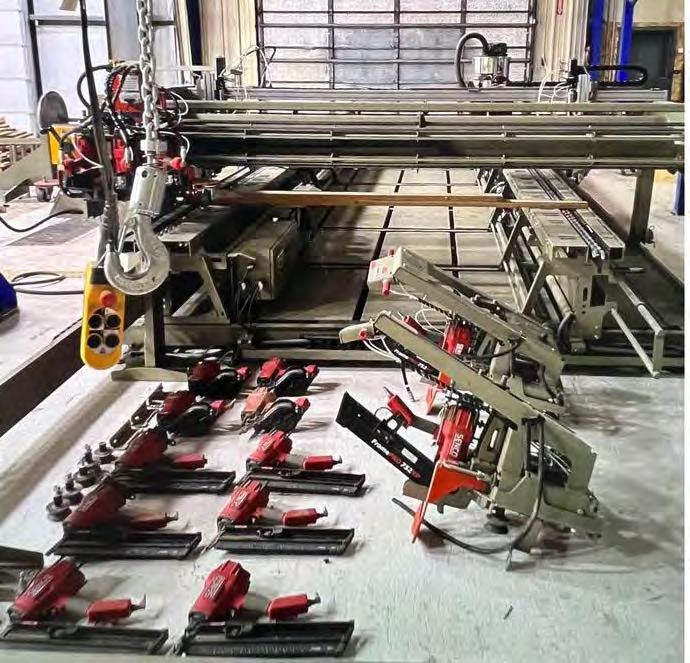

• 110 Volt / 1 Phase
800-382-0329 | www.wasserman-associates.com
Senco Nail Guns
Router Motor & Extra Router Bits
3 Custom Skatewheel Conveyor Tables (10' x 10, 8' x 10' and 6' x 10')
Triad Wall Panel Lift
2 Triad Material Carts
2 Triad Tree Carts
Extra Senco Nail Guns & Parts
Shipping, Installation & Training is available at additional cost.
800-382-0329 | www.wasserman-associates.com
Developed for commercial wall panel production facilities this is the remarkable ProStack, fully automated wall panel stacker. The ProStack II relieves your build team from creating a stack of wall panels and keeps them building walls instead. Stacks 2×4 through 2×8 walls up to 20′ in length and up to 12 feet in height. The ProStack automatically centers each layer including multiple wall segments on the same layer, and the ability to “create” fork lift pockets for ease of loading in your yard or on the build site. It can stack left, right or center-justified. Designed without any overhead frame or apparatus, so no crane inspections are required. The ProStack is “event driven”, so there is no need to read a file. 208 volt, 3 phase, 45.3 full Amp load electrical required. No air required. Footprint is 26′-5″L x 19′-3″W.
ProStack II can operate with you existing powered conveyors or select optional matching conveyors:


ProStack Wall Panel Tilt In-Feed Conveyor: System can tilt wall panels (12’W x 16’L) to approx. 75º for working access to install blocking, windows, or inspection/repair of “shiners” on sheathed wall segments. System utilizes hydraulic power from an existing ProStack wall panel auto-stack system.

Powered In Feed conveyor section, Chain drive under top and bottom plate for access to inspect sheathing fasteners – 12’W x 16’L, adjustable working height from 28” to 34”.
Powered Out-Feed conveyor section, full-width, HD roll-top for easy access to banding operation. 12’W x 16’L, adjustable working height from 28” to 34”. Here are some of the features of the ProStack Wall Panel Stacker:
• Wall Length Max – 16’
• Wall Height Range – 8’ to 12’
• Material 2×4″ through 2×8″
• Total Weight capacity – 6,000 lbs.
• Total stack Height Max – 6’
• This unit stacks on-center
• System is able to stack on-center layers that have multiple wall segments
• Siemens® HMI touch-screen controls
• Full manual override controls via HMI
• Speed – 45-60 seconds per wall layer
• NO overhead components = no overhead hazards or annual inspections

2007 Panels Plus Combination Table, allows you to frame, square and sheath wood wall panels on one,16 foot long table x 12 foot framer for wall heights from 6′-9” to 12’4”. Builds both 2×4 and 2×6 walls. Clamps wall prior to nailing. Table includes push button controls, color-coded stud locators at 16 inches & 24 inches o.c. spacing, squaring stops, motorized telescoping arms, skatewheel ejectors and powered tool bridge. Sheathing nailing bridge includes powered travel, joy-stick & key pad controls, air manifold, manual fine tuning, tilt and seam nailing. No tools or mounts included. 30 CFM at 120 psi air required, and 120 volt, 1-phase electrical required.
Panels Plus Framing station, one station without tool carriages, for assembling wood wall panels up to 16′-0″ in length, 4′-0″ to 12′-4″ in height, includes stud locators, air clamping, sub-air tank, skate wheel ejectors and optional swing gates. Consists of a framing table with squaring edge, stud locators, pop-up rollers, foot switch, pushbutton controls- stationary side, and a motorized telescoping side. Includes optional UL certification. 10 CFM at 120 PSI air required. 110 volt, 1 phase electrical required.
Panels Plus Sub-component tables, one pair, one fixed and one adjustable table, each table 12 ft x 3′-6″ footprint with squaring edges on one long and one short side of one table with skate wheel ejectors, for sub-components up to 12′ long, 3′-6″ to 14′-0″ in height. The tables are for building rough opening sections. They feature pop-up rollers, a squaring edge, and a manual telescoping side to easily adjust and set the wall height. The pop-up rollers make it easy to move product down the production line. 5 CFM at 120 PSI air required.
Panels Plus conveyors, three pairs of In-feed 10 ft long skate wheel conveyors with stands.
New Component Table with Skatewheel Conveyors

Lift & Extend Skatewheel Conveyors. 10' x 10' Work Area with Squaring Lip. Gun Holster & Nail Tray.

$12,500 FOB NE
Wasserman & Associates
800-382-0329
www.wasserman-associates.com
Consider Panels Plus wall panel assembly equipment for manufacturers of wood or steel wall panels, floor-panels, and related framing components. Panels Plus is an employee owned, ISO certified, manufacturing company that builds state-of-the-art equipment featuring durable construction, with fit and finish second to none in the structural building component industry. The referenced base framing table allows you to assemble from 7-12 foot wall heights, at industry standard 16 foot lengths, at a working height of 29 to 32 inches. This framer design includes controls at each end of table, squaring stops and pneumatic clamping for consistent wall panel quality. Frames 2x4 or 2 x 6 walls, with color-coded, steel stud locators at 16 and 24 inches O.C. spacing. Includes pop-up skate wheels for easy transfer of completed wall frame. Framing table can be configured to receive wall framing light bars, other options include custom buildable wall heights, lengths and auto-indexing of optional 2 or 3 tool carriages.
$8,250 FOB TX
Additionally from Panels Plus are sheathing tables with features that include foot pedal control at squaring end of table, with squaring stops, roller conveyors at both sides, single pendant controls for bridge, tool spacing at 6 inch centers with 3 inch bridge shift for offset nailing. Tool bridges can accommodate from 2 x 4 to 2 x 8 walls, with seam tilt being standard equipment Panels Plus Tool Bridges are available with single beam or dual beam design for two different tool mounts on one bridge. Squaring stations, sub-component tables, conveyors and panel lifts are also available to complete the configuration of the wall panel assembly line. Price includes factory installation and training. 50 CFM at 120 psi air. 120 or 230 volt, 1 phase electrical.


• Tool Dollies with Senco Nail Guns
• Stud Locators
• 1" Stroke Air Clamps
• Tool Box
$14,900 FOB VA
www.wasserman-associates.com
uilding

Prior to JobLine, I was a General Manager, and before that a Project Manager. That was more than 30 years ago, but hopefully I can shake off the dust and continue the process of building our forever home without too many problems.


Project Management is a catch-all name used by people who may or may not be a project manager. Take our biggest “subcontractor,” who was going to turn-key the home but then backed out due to distance, only offering to build the completed shell and interior framing. Their Project Manager is a great young man who has been on the job for 3 years, and was in construction prior to that. What I failed to pick up is that he is what I would call a Project Administrator. He keeps up with who is doing what and when they hope to be on site, and he’ll answer questions when asked. What he doesn’t do is manage. I mean, he knows who the foundation guys are and when the home office said they'd arrive, but on the day they were due I got a little nervous and sent him a text. About 30 minutes later, he called saying they were running late…by about a week! Now I know I should have checked with him the week prior, as the office still thought they were on time. Still, I blame myself for being too trusting and not proactive enough, but lesson learned. Thankfully, this one-week delay isn’t a big deal because my other subcontractors are at least 2 months out, but I will use this as a learning opportunity and be more proactive from this point on.
Finding a program or app to use was a challenge and the ones I found were either expensive or took too long to learn. So, I fell back to my trusty spreadsheets. After adjusting for the week delay, I have all of the trades’ lead times scheduled. I have a page called delays. They can be due to weather, a subcontractor, or me. Each delay is noted, especially weather delays, so that I can see why we go off the rails.
In the spreadsheet, I have pages for each trade with line items for lead times, work duration, sequences, bid line items, plus a section to record invoices. The cover page brings all of the bids, change orders, and other costs into a project cost tracker. Staying on budget is important, especially if you report to the banker. When we get a bill from the subcontractor, we have two payment forms. One is writing a check, and when we have a large enough total, I can get a bank draw to replenish personal funds. The other way, for larger payments, is a direct draw where we have the subcontractor submit their bill to the bank. Everything is planned, and everything is tracked against the plan.
So the best part, Breaking Ground, makes it real. We are really building a house! All of the planning, budgeting, refining, late nights, and long hours searching for the best subcontractors has led to this. Now we build.
2021 Triad Router Bridge & Portion of V-Track
at Both Ends of Squaring Table
• Automated Field & Edge Nailing
Driving by Panel Pro Event Software & Your Programmed Nailing Patterns
• Simple Touchscreen Controls
• 2 Tool Carriages for Sheathing Nailing with Tilt Function for Seams

• 2 Paslode Nail Guns with High Load Coil Tray
• Auto Sheathing Bridge Return

• Includes 4 Pallets of Magnum Coil Nails (2 3/8 x .113)
• 480 Volt / 3 Phase
$29,900 FOB KS.
Wasserman & Associates
800-382-0329
www.wasserman-associates.com
The Generation 3 Framing Table has adjustable 20’ long walls. With just a push of a button, the width adjustment clamp is activated to clamp and square all components. The Generation 3 Framer features a wider table top, designed with the framer in mind. Our new Anti-Slip Surface allows the operator to work on a comfortable and safe surface.
Call for Price
Eide Machinery Sales, Inc.

612-521-9193
www.eidemachinery.com
2021 Triad Routing Bridge with approximately (20) feet of v-track. Fits over tables that build up to 12′ nominal height wall panels. Includes powered automatic bridge return, powered vertical router movement, manual fine adjustment wheel, manual vertical router travel with chain drive and (1) Milwaukee router, catalog #5625-20 120 volt, 1 phase, 15 Amp electrical required. No table included.
$28,970 NOW $5,000 FOB BC
Wood Tech Systems
765-751-9990
www.woodtechsystems.com
Price: $Call for pricing
FOB: MN
IBS Tool Bridge & Router Bridge
IBS multi-tool bridge with (24) tool stations. Bridge features auto-return, button controls and laser guide mount. Fits up to 12′ nominal rail centers. IBS router bridge features (1) router, laser guide mount and lever-switch button controls. Fits up to 12′ nominal rail centers. Sold as a pair. Includes all available floor mounted, v-rail. Both bridges missing laser sub-assembly. 120vac, 120psi air.
$15,975 NOW $5,995 FOB UT
Wood Tech Systems


765-751-9990
www.woodtechsystems.com
New Panels Plus floor framing machine, supports the structural members creating floor sections from 2" x 6" LVL through 2" x 10" to 2" x 12" dimensional lumber, 20" deep wood floor trusses or engineered wood / I-joists. Standard footprint of floor panels (cassettes) up to 12' wide x 45' long. Table consists of a fixed section and a track-guided, moveable section controlled by either a foot switch or push-buttons.
New Wall Panel Lift
• 8' to 12' Wall Heights
• 1,000 Lb Capacity
• Weight: 120 Lbs
• Excludes: Electric Hoist & Freestanding Bridge Crane

$1,950 FOB NE
Wasserman & Associates
800-382-0329
www.wasserman-associates.com
Includes a series of color-coded locator pins at 16", 19.2 and 24" on-center spacing and clamping with squaring feature including foot pedal control. The locators individually flip down if a joist comes out on top of them. After the floor is complete and unclamped, the floor section can be raised up on skate-wheel conveyors and rolled out or lifted off the table using an overhead crane. Table height is 24.5", OAL 45.5 ft, OAW 14.5 ft. 120 volt, 1 phase, 15 Amp electrical required. 90 to 120 PSIG at 15 CFM air required.
The industry’s most powerful integrated component design, engineering, and management software for steel and wood-framed structures.
iCommand
Manage projects, customers, materials, pricing & inventory
iModel
Design truss layout & profiles

iDesign
Optimize material usage & engineer trusses


iPanel
Design wall layouts, panelize, bundle, break & stack
eShop
Maximize crew productivity & improve manufacturing efficiency

The IntelliVIEW Suite is a fully integrated software solution for the layout and design of a building’s rough framing elements—including roof and floor trusses, wall panels, solid sawn, EWP, sheathing and various ancillaries.


The IntelliVIEW Suite provides the industry’s most complete analysis of the design, cost information and bill of materials—promoting increased profits by reducing plate and lumber use.

Ask those who know. They’ll tell you about the people at Alpine who make a difference.

Triad Generation II nail tool bridge with 60 ft of v-track, refurbished by Triad in 2021. Maximum panel height clearance 12′-3″. Includes locations for (3) tool mounts along the middle beam, top & bottom plate tool mounts, tilt-tool option, joy-stick controls, power bridge return, e-stop button, all available Paslode tool mounts, manual and all available spare parts. 120 volt, 1 phase electrical required. 100 PSI air required. $75,971 NOW $25,000 FOB CO


Swing gates bolt onto either end of the Panels Plus stations and allow subcomponents and wall panels to roll freely from station to station without having to be lifted.


The swing gates allow walk-through passage between stations and can be swung back into place to prevent product from dropping between the stations. This allows the operator to move from one side of the line to the other without having to walk around the entire system line.
$26,977 NOW $14,997 FOB MD


Triad squaring table with two bridges and one Viking power conveyor. Either bridge fits on the squaring table. Builds from 6′-9″ to 12′-3″ tall wall panels to 16′-0″ long. Triad squaring table, model G2SHSQ, has powered clamp / unclamp controls on either end of the fixed side of table.
Triad nailing bridge, model PSTT, has (24) tool mount locations with Paslode tool mounts, auto return and bottom plate laser sight mount. Changed by owner from staple tools to nail tools. Router bridge is manual travel. Viking powered conveyor 23 ft long with support platforms alongside both chains. Forward powered drive only. Foot pedal controls for drive motors. 120 volt, 1 phase electrical required. 100 PSI air required.

Over the many years I’ve worked in the truss business, I’ve had the unfortunate experience of visiting numerous job sites where the trusses have collapsed. Without fail, every one of those collapses has been the direct result of improper bracing, improper hoisting, or a combination of both. In all but one case, the collapse occurred during construction. Fortunately, I have not been involved in any cases where there were fatalities, but there have been a number of people injured to varying extents.


There are great resources available that provide invaluable guidance on this topic, most notably is Building Component Safety Information – Guide to Good Practice for Handling, Installing, Restraining & Bracing of Metal Plate Connected Wood Trusses, or BCSI for short. There is no need for me to go into any great level of discussion about the contents of this guide, but I would say that if you are in the truss business and you are not familiar with the contents of BCSI, you should be. How can you expect your clients to properly install your product if you don’t fully understand the importance of proper handling and bracing yourself?
So rather than go over BCSI contents, I’m going to discuss a couple of common scenarios I have observed that led to trusses coming down. I should also say that every case of trusses collapsing I have witnessed involved longer span trusses, being used on either commercial or agricultural buildings. This is not to say that I think installers working on single family houses are necessarily doing a better job on following BCSI recommendations, I just believe that the factors leading to collapses are lessened by the nature of typical residential construction: relatively short spans, trusses in varying directions, shorter runs of the same truss. I also want to make it clear that I am not an engineer, and that you should seek advice from a professional engineer experienced in truss systems for further guidance.

If the jobs I observed had followed these common-sense recommendations, their outcomes would have been very different:

Use proper rigging during truss installation. In one case, 80’ trusses were being hoisted using two pick-up points running down from the crane line. The trusses in the air were bent easily 20’ out of plane. Of course, neither the lumber nor the plates are designed for this kind of stress. In this case, a truss snapped in half just before being set on the wall, and in doing so knocked all the other trusses over in domino fashion.
Use proper bracing. This can’t be over emphasized. Diagonal stability bracing needs to be provided in the plane of the roof, ceiling, and webs to keep the trusses from buckling prior to diaphragm installation. Installers often assume that the only bracing required is the continuous lateral bracing (CLB) shown on our truss designs. Worse, I have heard many truss company employees communicate the same to their clients. Any webs that need CLB also need diagonal bracing to tie the bracing to the ceiling and/or roof diaphragm. During construction of a new building for one of our lumber yard dealers, the trusses collapsed overnight during a small storm. Among other contributing factors was the complete absence of any diagonal or web bracing, and the presence of ~5’ long 1x4 “bracing” being used to brace the top chords of the 68’ span trusses.
Don’t rush the process. Several times I’ve seen cases where the installer is rushing to get the trusses up on the roof so they can send the crane away. I get it, crane time is expensive, and it can seem appealing to get the crane off the site as quickly as possible. But having this mindset leads to a greater likelihood that rigging, bracing, and other important items will be skipped. Encourage your clients to budget adequate crane time to allow safe truss installation. A thousand dollars of extra crane time is far less than the cost of new trusses, a fine from occupational health and safety, or most of all someone’s life.
Encourage your people to read BCSI so that they understand proper truss handling, installation, and bracing. They are your point of contact to your clients and the installers. Encourage your clients and their framers to do the same and encourage them to not only follow the guidelines but to seek assistance in advance if they have any questions.
Do you have other thoughts about how to prevent truss collapses? If so, please drop me a line.
If you want help finding that next perfect component designer or design job in Canada, please contact me. If your work is in the mass timber world anywhere in North America, I’d love to talk to you about connecting you to that next great job or candidate. You can reach me at secord@thejobline.com, or 800-289-5627 ext. 2. I’m also happy to engage at: LinkedIn.com/in/geordiesecord. www.thejobline.com


Electrical Supply: 110 VAC
Motor: 1/4 HP, 110 VAC, Linear Actuator
Highly Accurate: +/- .010 Inches
Stop Rail: 2 x 4 x 1/4 Aluminum Extrusion
The Hain Systems Framer (HSF) will help you build square and accurate wall panels for residential or commercial construction applications. It will help you cut building costs by saving time and improving your quality. It’s a reliable, efficient and proven system that features a ruggedly simple design. The HSF is based on a proven design with over 20 years of actual production use and maintenance experience. It comes fully assembled and is designed for portable job site framing or in-plant permanent installation. The table has many optional attachments and will support Mylar Tape wall layout or any other type of layout. The optional gun rails can also be retro-fit to any table.
Stops: Jig Bored Steel
Stop Blocks: Machine Billet Aluminum
Details:
Internal Components: Hardened, Ground and Polished Steel and Billet Aluminum
Dimensions:
Length: 5 feet (60”) to 60 feet (720”)
Table Construction: Thick-wall Structural Steel Tubing, Jig Welded for Accuracy
Height: 12 inches
Depth: 12 inches
Air Supply: 90 psi (10 CFM Air Flow Recommended)
Electrical Supply: 120 VAC
Powder Coat: Industrial Gray
Dimensions:
Height: 43”
Length: 16’ or 20’
Width: Adjustable 8’ to 10’ or 8’ to 12’
Shipping Weight: 3000 lbs
If you are looking for the fastest, most consistent way to measure and cut your product, then the Hain Measuring System (MEA) is your answer. The MEA changes from one length t any length instantly, up to 60’, without changing the operator’s position on the line. It is also highly accurate (+/- .010) and quickly moves from one length to the next in seconds. The MEA is designed for quick and easy setup and is simple to use. Even a first time user will be productive with little or no training required. It can adapt to any saw and can be mounted to any surface so that you can integrate the MEA with your existing setup. The MEA is versatile allowing “left” or “right” handed operation and measurement in “feet and inches” or “inches” depending on your preference. The MEA is also available in a “Skid Mounted” version.
theHAINCOMPANY 6125 Enterprise Drive, Unit 9 | Diamond Springs, CA 95619 530.295.8068 | sales@thehaincompany.com
way to measure and cut your product, then the Hain Measuring System (MEA) is your answer. The MEA changes from one length t any length instantly, up to 60’, without changing the operator’s position on the line. It is also highly accurate (+/- .010) and quickly moves from one length to the next in seconds. The MEA is designed for quick and easy setup and is simple to use. Even a first time user will be productive with little or no training required. It can adapt to any saw and can be mounted to any surface so that you can integrate the MEA with your existing setup. The MEA is versatile allowing “left” or “right” handed operation and measurement in “feet and inches” or “inches” depending on your preference. The MEA is also available in a “Skid Mounted” version.

Dramatic falls in lumber prices caused America’s biggest sellers of building materials to record in 2022 less than half the revenue gain they achieved the year before, Webb Analytics’ latest Construction Supply 150 (CS150) reveals.
The group, which arguably accounts for two-thirds of all construction product sales in America, took in $409.68 billion from their U.S. operations. That’s a 9.5% gain from the year before. In contrast, the members of last year’s Construction Supply 150 posted a collective 19.2% increase.
Subgroups within the CS150 saw even bigger changes, Webb Analytics found. Lumberyards with manufacturing capabilities recorded an 18.1% rise in revenue in 2022 compared with a 58.6% increase the previous year. Even home centers and hardware store chains were affected by lumber’s price plummet. Their revenues rose just 3.3% in 2022 vs. 11.1% the year before. In contrast, specialty dealers—companies that specialize in sales of roofing, siding, and similar products rather than lumber—posted roughly the same sales gain: 24.6% last year vs. 26.5% in 2021.
Prices paid at the mill for major lumber species dropped 62% to 73% between January and December last year. Much of the CS150 was affected—even giants like The Home Depot, which posted only a 4.3% rise in part because lumber sales rose 0.8% in 2022 compared with 18% a year before.
The entire 58-page PDF report is available for download at https://www.webb-analytics.com.
The number of branches in the U.S. run by CS150 members grew 5.3% to 14,972, and the fulltime employee count increased 3.4% to 992.248.
Some of these numbers might differ from what CS150 companies have reported publicly because the report separates members’ activity in Canada and Mexico. Operations in those countries added $20.81 billion worth of revenue to CS150 members’ coffers, 0.8% less than in 2021. The location count rose by nine to total 893.
The CS150 collects data for most but not all of the biggest building material suppliers, but it isn’t an exact list of the nation’s 150 biggest dealers because some private companies decline to reveal their numbers. Webb Analytics estimates the entire construction supply market has risen to $615 billion. Based on that estimate, the CS150 companies account for two-thirds of the total.

Among other findings:
• A total of 140 companies reported revenue gains, but only 117 grew faster than the 6% inflation rate.
• Consolidated numbers mask a lot of variations in the customers served by the CS150. For instance, operations with over $1 billion in revenue are up to 2-1/2 times less likely to sell to custom dealers than are dealers with under $1 billion. At the same time, billion-dollar dealers do half again as much business with production builders as do smaller companies, and they’re several times more active with commercial accounts.
• The report sheds more light on the role dealers play in manufacturing and installing building materials. Eighty-two companies showed some revenues from manufacturing and/or installing. Exclude The Home Depot and Lowe’s from those 82 and the remaining 80 generated 33.8% of their revenues—roughly $17.57 billion—from making and installing products.
• Credit-card transaction fees turned out to be a major expense in this low-profit-margin industry. The 94 dealers who provided data said the fees amount to 1.15% of their total revenues—roughly $180 million sent to card processors.
• The vast majority of responding CS150 members said they will hire a person with a misdemeanor on their criminal record, and 40% would hire someone who had a felony.
• Excluding The Home Depot and Lowe’s, CS150 members said women made up about 24.5% of their workforce, while 34% of employees were minorities.
• Companies that got 100% of their sales from professional builders and remodelers posted a 28.2% revenue gain, while businesses with more retail customers than pros saw only a 3.9% increase.
Every CS150 member is unique, just as every day spent surfing is a slightly different experience. Some rides are memorable, others just another day at the beach. In 2022, construction supply dealers experienced plenty of both.
Webb Analytics is a data and research consultancy that helps executives in construction supply spot the trends, threats, and opportunities that matter most. It’s led by Craig Webb, one of the nation’s best-known industry figures and the former editor-in-chief of ProSales, the construction supply industries most honored publication. Aside from the Construction Supply 150, Webb Analytics also produces an annual deals report, consults with dealers, publishes research reports, and speaks at industry events.

Wall Panel Lift

* 8’- 12’ Wall Height
* 1,000 LB Capacity
* Easy Adjustment
* Hoist and Crane Sold Separate


Handle Bar Router
* 8’ - 12’ Wall Height
* 2 Person Operation
* 3 ¼ hp Production Router
* 120 Volt /1 Phase/15 Amp
Lay-Up Tables


* 10’ x 10’ Working Area
* Lift & Extend Rollers
* Squaring Lip
* Gun Holster And Nail Tray
Skate Rollers
* 15’ Standard Length


* Adjustable Height
* Sturdy Stands
* Custom Lengths Available
$1,950.00
$3,000.00
$12,500.00
$3,000.00
2003 JDH TRUSSMASTER SIDEOFFLOADING TRUSS TRAILER

10,000 Lb Tandem Axles (Dual Wheels). 26,000 GVWR. Deliver Trusses Vertically. Stretch from 18' to 38'. Raise Loads
Hydraulically. Air Brakes.
$6,900 FOB CA
Wasserman & Associates
800-382-0329
www.wasserman-associates.com
• Modified by LMI TENN
• 8" Floor Cross Members
• Reinforced Roof
• 22.5 Tubeless Tires
• Sl iding Tandem Axle (for weight distribution) (FOB PA) $9,900

Wasserman & Associates 800-382-0329
www.wasserman-associates.com
2007
Step Deck Roller Trailer

40'-0" Lower Deck, 12'-6" Upper Deck
Hydraulic Tilt on Lower Deck
Lower Deck has 3 Split Load Lifts
Roller Locks (upper & lower decks)
GVWR: 37,000 KG (81,400 LB)
Air Ride Suspension
Tires & Brakes are Good
Winches & Straps
Price in US Dollars
$30,000 NOW $24,900 FOB ON
Wasserman & Associates
800-382-0329
www.wasserman-associates.com
2001 Moffett M5500 forklift features 48″ forks with side shift, 12′ maximum lift height, 5,500 lb lift capacity and has 2,440 hours on it. Kubota 4 cylinder Diesel engine and Hydrostatic transmission.


$24,990 FOB OH
Wood Tech Systems 765-751-9990
www.woodtechsystems.com
• 2007 Freightliner M2 Flatbed Truck (168,000 Miles)

• New Tires in 2022 ($12,000 Value)
1987
Pole Trailer 1987 Barnes pole trailer, model RTY. Carries trusses peak down, with spans from 28’6″ to 46′-0″. Includes bolster arms for shorter trusses, center chains and split support tubes. Has current Pennsylvania DOT inspection valid through March of 2023.

$8,129 NOW $6,909 FOB PA
Wood Tech Systems 765-751-9990
www.woodtechsystems.com
• Hiab 322E-7 Hipro Crane (FOB WA) $89,000 NOW $75,000 800-382-0329 | www.wasserman-associates.com

• Model 36DR (36' Bed Length)
• Tandem 10,000 Lb Axles with Dual Wheels
• Electric over Hydraulic Brakes
• Hydraulic Bed Tilt
• Locking Rollers
• E xtra Rollers on Gooseneck (for longer than 36' loads)
• Diamond Plate Floor
• Winches & Straps $24,500 FOB ME
Wasserman & Associates 800-382-0329
www.wasserman-associates.com
• 21,700 Lb Capacity
• 15' Mast with 182" Lifting Height
• 4' Forks with Side Shift & Fork Positioner
• Heated Cab
• 3,800 Hours
• Rebuilt Engine in Late 2022
(New Perkins Longblock, Compressor, Compressor Gear & Water Pump)
• Used less than 200 hours since engine rebuild
• Was used to load 70'+ long truss packs and post frame building packages
800-382-0329 | www.wasserman-associates.com


Porter Cable Model 7519 Production Router
Motor with Soft Start. Steel Handle Bar
Frame with Makita Switches. 120 Volt / 1 Phase / 15 Amp / 21,000 RPM. Includes 2 Router Bits. $3,000 FOB NE.
Wasserman & Associates
800-382-0329
www.wasserman-associates.com
New
MISC.
Sweed Scrap
Chopper with Stand
1/2 HP Motor (115/208-230 Volt)
$1,900 NOW $1,750 FOB NE.
Wasserman & Associates
800-382-0329
www.wasserman-associates.com
System
Video Here
$3,499 FOB CA
Wood Tech Systems
765-751-9990
www.woodtechsystems.com
1 1/4" wide x .035 thick. $159 per coil. $2,950 per skid (21 coils). FOB PA.
Wasserman & Associates 800-382-0329

www.wasserman-associates.com
Hain 20' Powered Measuring System Adapts to Any Saw. Left or Right Hand Operation. Feet & Inches System (Stops at 12” Centers) or Inches System (Stops at 10” Centers). Motor: 1/4 HP Linear Actuator (110 Volt). Stop Rail: 2 x 4 x 1/4” Aluminum Extrusion. Stops: Jig Bored Steel. Stop Blocks: Machine Billet Aluminum. Optional Lengths from 5’ to 60’. Optional Gang Stop. Add $890 per 10’ Section of Heavy Duty Roller Conveyor with Stands

$7,890
Wasserman & Associates
800-382-0329 www.wasserman-associates.com
EMSI Teeter Cart
Width – 46” / Length – 73” / Load Capacity
– 2850 pounds / Pneumatic tires – 14.5 inch / Maximum utility in truss plants, panel plants, and lumber yards / Quick Assembly by bolting parts together / All hardware is supplied / Upright 2 x 4’s not supplied / Medium duty tires rated at 1500 lbs each are included.


Call for Price Eide Machinery Sales, Inc. 612-521-9193

www.eidemachinery.com
AComponent manufaCturing
dverti$er
S erving the S tructural B uilding c omponent S i ndu S try
2022 Powermatic Dual Bag Dust Collector. Industrial dust collector, dual-bag, 1800 CFM with 6″ port. Includes supply of 6″ flex hose. System has 10 Cu. Ft. capacity. 3HP, 3Ph, 5 amp, 460/V with onboard starter. $5,497 FOB VA Wood Tech Systems

765-751-9990
www.woodtechsystems.com
AMI Industrial Floor Carts
AMI's industrial floor trucks (material carts) are designed of hardwood construction, fitted with space-age phenolic, roller-bearing wheels, and ball bearing swivel casters for strength and durability. AMI's phenolic wheels resist shock without chipping. They are non-sparking, non-marking, and can be operated continuously between -50℉ and 260℉. They are unaffected by grease, oil or debris on your shop floor.


Series
Our swivel casters are precision built with perfectly aligned raceways. All cold-form parts are made to exacting tolerances from heavy-gauge steel, and are hardened for severe service and long wear. Series B-4 carts include four casters, one at each corner, to prevent "tri-cycling" of long lumber loads.
Standard Models Available
2748
48" Series "B" & "C" 2500
3260 32" x 60" Series "B" & "C" 2800
3660 36" x 60" Series "B" & "C" 2800
3672 36" x 72" Series "B" 4000
4072 40" x 72" Series "B" 4000
3696 36" x 96" Series "B" 4000
4896 48" x 96" Series "B" 4000
*Other models and sizes are available on request. FOB NC.
Wood Tech Systems
765-751-9990
www.woodtechsystems.com
2005 Koorsen Connector Detector (For Repair or Parts)
6 detection zones to locate missing plates. Horn & zone lights indicate missing plates. 12" to 60" adjustable height from floor. 110 Volt / 1 Phase. New control panel switches & lights in 2014. Needs circuit board repair or replacement and new tower light. Includes 4 extra detection zone boxes.

$2,500 NOW $1,500 FOB NE
Wasserman & Associates
800-382-0329
www.wasserman-associates.com

Lumber has ability to handle higher stresses under shorter periods of time. This characteristic is known as Load Duration Factor. Load Duration Factor typically ranges from 0.9 to 1.6 and is based on the amount of cumulative time the load is applied to the structure. Per the National Design Specification® ( NDS ®) for Wood
Construction , normal load duration represents a load that fully stresses a member to its allowable design value by the application of the full design load for a cumulative duration of approximately ten years. Since wood has the property of carrying substantially greater maximum loads for short durations than for long durations of loading, reference design values for normal load duration shall be multiplied by load duration factor, CD, for other durations of load (except modulus of elasticity design values, E, and compression design values perpendicular to grain, Fc T ).

Dead loads are permanent, and they are expected to act on a structure for the life of that structure. Under dead loads only the allowable stress of the wood must be reduced by 10 percent.
The ten years load duration factor is typically used for the floor application. It is relative to “normal” loading, CD = 1.0, there is neither an increase nor decrease in the allowable stress.
The two months load duration, CD = 1.15, is applicable to design snow loads based on Minimum Design Loads and Associated Criteria for Buildings and Other Structures (ASCE/SEI 7-22). Wood can safely resist a 15-percent increase in its maximum allowable load as long as the total accumulated time under this load does not exceed two months.
The seven days load duration, CD = 1.25, is applicable to the typical roof live load (not snow): construction workers on the roof, walking on the roof during repairs, etc.
The ten minutes load duration factor, CD = 1.6, is applicable to design earthquake loads and design wind loads based on ASCE 7. This means wood can safely handle a 60-percent increase in its maximum allowable load if the total accumulated time under this load does not exceed 10 minutes.
Why is it important to understand? A designer who understands this concept will be able to make a better choice during the design process, for example, not using a CD = 1.25 (DOL – duration of load) for roof truss design in areas of heavy snow load or using DOL (CD) = 1.15 for roof trusses that will be used as a deck.
After truss loading conditions are selected, the software will run through all the load combinations as required by the building code and will automatically apply the load duration factor associated with the shortest duration load in each combination of loads (per NDS 2018 Edition, Section 2.3.2.2). For example, in load combination dead load (CD = 0.9) + snow load (CD = 1.15) + wind load (CD = 1.6), the actual stress due to combination of all these three loads can be adjusted by the load duration factor CD = 1.6.


Per NDS , load duration factor greater than 1.6 shall not apply to structural members pressure-treated with water-borne preservatives, or fireretardant chemicals. The impact load duration factor shall not be used in the design of connections or wood structural panels.
For additional information, or if you have questions, please contact the MiTek Engineering department.

20′
30 amp power.
$22,490 - FOB CA
Wood Tech Systems

765-751-9990
www.woodtechsystems.com
2002 Atlas Copco Rotary Screw Air Compressor
• Model GX11FF
• 15 HP Rotary Screw Air Compressor (230/460 Volt - 3 Phase)

• 13,443 Hours
• 51.7 CFM at 128 PSI
• 80 Gallon Tank
• Built-in Air Dryer does not work
• Includes separate 2012 Pneumatech
AD-50 Air Dryer (1 Phase)
$4,250 FOB TX
Wasserman & Associates
800-382-0329
www.wasserman-associates.com
New SL Laser Projection System
New, laser projection system from SL Laser. Projects roof truss, floor truss and wall panel design images accurately onto building surface, for faster setup and fabrication times. Each laser head provides 21' projection length (@15 foot ceiling heights). Includes system computer, cables, mounting hardware for attachment to customer's structure, factory installation, training and choice of green or red laser. Works with each connector plate manufacturer's design software. Modular nature of the laser heads allows for easy, future expansion of system length. 120 volt, 1 phase. FOB NC Wood Tech Systems 765-751-9990
www.woodtechsystems.com
• 18 HP Spindle with 5 Position
Typewriter Tool Changer
• X, Y and Z Servo Axis
• Q-CORE Controller (THM Version 8.73 - Windows7)
• Reads NC Files via Network or USB
Flash Drive
• 5' x 20' Fixed Table
• Roller Hold Down
• Program Side Fence
• Auto Tool Length
• Auto Lubrication
Electrical Supply: 110 VAC
Motor: 1/4 HP, 110 VAC, Linear Actuator
Highly Accurate: +/- .010 Inches
Stop Rail: 2 x 4 x 1/4 Aluminum Extrusion


Stops: Jig Bored Steel
Stop Blocks: Machine Billet Aluminum
Internal Components: Hardened, Ground and Polished Steel and Billet Aluminum
Dimensions:
Length: 5 feet (60”) to 60 feet (720”)
Height: 12 inches
Depth: 12 inches
We’re here when you need help! visit: www.thejobline.com email: twm@thejobline.com
• Excludes Dust Collector
• The seller was cutting OSB Sheathing and 1 1/4" TimberStand Stair Stringers
• Video available upon request
$29,500 FOB MN
Wasserman & Associates
800-382-0329
www.wasserman-associates.com
If you are looking for the fastest, most consistent way to measure and cut your product, then the Hain Measuring System (MEA) is your answer. The MEA changes from one length t any length instantly, up to 60’, without changing the operator’s position on the line. It is also highly accurate (+/- .010) and quickly moves from one length to the next in seconds. The MEA is designed for quick and easy setup and is simple to use. Even a first time user will be productive with little or no training required. It can adapt to any saw and can be mounted to any surface so that you can integrate the MEA with your existing setup. The MEA is versatile allowing “left” or “right” handed operation and measurement in “feet and inches” or “inches” depending on your preference. The MEA is also available in a “Skid Mounted” version.
theHAINCOMPANY
6125 Enterprise Drive, Unit 9 | Diamond Springs, CA 95619 530.295.8068 | sales@thehaincompany.com

Alpine’s iCommand® IntelliSheets takes business management to the next level, saving time with tools created for designers and managers. Originally introduced with IntelliVIEW® 22.02 software release, IntelliSheets creates custom job lists, tracks progress, and shares live reports easily with different users. Select the most relevant fields, set up sophisticated conditional formatting rules, and create filters to view your data in a convenient, actionable format.
Ensure everyone is on the same page—define, create, edit, and share sheets with different views within the team. This ad-hoc reporting tool allows users to separately collect and access job information. The sheet filters by the current user to highlight their assigned jobs.
From job lists, create to-do lists for designers, create revisions, identify jobs scheduled for delivery, or simply balance a design team’s workload by assigning a designer a list of jobs. Search by column or find jobs that contain one condition. The enhanced filtering and conditional formatting will highlight jobs that require special processing. The reporting possibilities are endless.
Manipulate data into different views and save to a number of formats (e.g., xlsx, csv, docx, txt, or pdf). Easily export to Microsoft Excel and continue your data analysis. All the filtering, formatting, and summations are exported with the data. This tool provides the ultimate access to data to help you make decisions quickly.

IntelliSheets organizes data into a compelling visual format. At a glance, you will be able to see a job status, delivery date, pricing, and take action. Users can edit many fields, including dates, designer, job status, custom fields, and notes.
IntelliSheets enables your team to work better with real-time data, ensuring projects stay on-track. Share todo lists, jobs scheduled for delivery, and a list of jobs with others for better collaboration. Protect your data and information with enhanced administration controls, allowing users to access sheets while preventing accidental alteration of data. Managers, designers, and office admins can perform their tasks with confidence.
Contact your local Alpine® Sales Representative or info@alpineitw.com to discover how these data-enhanced tools improve your business today.
Purchased but never installed. Manual (x, y) movements, powered vertical movement. 15-ft wide bridge x 23 ft long x 14 ft height. Hoist moves at 16 feet per minute, includes pendant control, chain container and centering strap to minimize the need to reach for the control pendant. Last 3 photos show current condition & status. Other photos are of matching crane frame with hoist in place. 115 volt, 1 phase electrical required.
$16,690 FOB NV Wood Tech Systems 765-751-9990


www.woodtechsystems.com
The Generation 3 Framing Table has adjustable 20’ long walls, with wall heights from 6’9” to 14’3”. Studs are placed between color-coded stud locators. With just a push of a button, the width adjustment clamp is activated to clamp and square all components. The Generation 3 Framer features a wider table top, designed with the framer in mind. Our new Anti-Slip Surface that allows the operator to work on a comfortable and safe surface. Call for Price Eide Integrated Systems, LLC 612-521-9193

www.eidemachinery.com


Wescana Jack Press & Table


35 Ton Hydraulic Press with 14" Wide Platen Press Roof or Floor Truss (4" Maximum Opening)
Steel Frame Table with 1/4" Steel & 1" Plastic Top Slotted Jigging at 12" Centers | Joystick Control
7.5 HP / 3 Phase (208/230/460/575 Volt)
6' x 25' Table & 8' x 25' Table Available
800-382-0329 | www.wasserman-associates.com
BAM “Ovation”
Door Machining Center (DMC)
New Builders Automation Machinery

“Ovation” series, door machining center (DMC). Fully programmable, two-stage door machine featuring (27) axes of operation. Can be specified with either two or four front machining heads. Machine is side-eject, direct-drive with helical gear racks and gear protection from dust. The door loader is driven by an absolute encoder; no stepping motors, belts or exposed ball screws are used.
More information Click Here
Price based on configuration
Wood Tech Systems

765-751-9990
www.woodtechsystems.com


RUVO MODEL 1300 DOUBLE END DOOR TRIM SAW
$4,250 FOB PA
Wasserman & Associates 800-382-0329

www.wasserman-associates.com
Dotul Door Stop Stitcher

Click Here for details
$4,900 NOW $3,600 FOB GA
Wasserman & Associates
800-382-0329
www.wasserman-associates.com
Builders Automation Machinery (BAM) door loader, model 2001. Allows you to stack door slabs horizontally and feeds them into a horizontal door machine like the BAM model 996E-TS. Mechanically adjusts door stack height vertically as slabs are fed into machine. Clamp automatically adjusts to type and size of door slab: steel, solid-core or hollowcore, from 6-ft to 8-ft heights. Electronic, programmed controller manages the loading process. Loader positions the door stacks adjacent to the door machine infeed to save effort of the operator. Pneumatic motor and heavy-duty drive train provide dependable continuous use. Cycle time approximately (30) seconds per loaded door slab.
Footprint approx. 10′ x 10′ x 11′. Weight 2,000 lbs. 120 volt, 1 phase, 15 Amp electrical required. 120 PSI at 20 CFM (1/2″ ID line min.) air required.
The truss industry relies on 3rd party quality assurance services to provide random visits to review the plants Quality Assurance program along with their operations. If your plant needs to comply with the IRC, IBC and to those who depend on solid, experienced QA expertise, we ask you to consider selecting Timber Products Inspection, Inc. (TP) as your choice for 3rd party inspections.
Proudly serving the forest products industry for over 50 years, TP brings the expertise you need to ensure your business is successful. As a responsible partner, TP delivers to clients, employees, and the industries we serve the confidence to drive value through the effective use of our diverse professional team.
TP would like to welcome the following authorized agents to our inspection team, each of whom have many years of experience in the truss industry!
•Al Coffman
•Jean Hart
•Curt Holler
•Chuck Ray
•Glenn Traylor
•Elliot Wilson
If you have questions about how you can make this selection, please contact your authorized agent above or Glenn Traylor at 919-280-5905 or trusguy@gmail.com.
https://www.tpinspection.com/ https://www.tpinspection.com/auditing-services/truss


From State Fund CA.

Slips and falls are a leading cause of workplace injuries. What do experts recommend as the single most important step to take in preventing slips and falls? Simple...keep floors clean, dry, and free of obstruction. When it comes to safeguards against slips and falls, nothing is more important than good housekeeping.

When you walk through a work area, look for spills, grease spots or dust (flour and machine byproducts can be highly slippery). Water spilled by drinking fountains or tracked in on wet or snowy days can create a major hazard. Look around and be aware of wet areas or objects on the floor. Then take the time to do something about it. Clean up the hazard or place cones or hazard signs nearby, warning of the danger. People can walk on extremely slippery surfaces by modifying their speed and stride, provided they know about the dangerous condition. It’s the lack of warning that can cause problems. An unexpected shift from a smooth to a slick surface heightens the likelihood of a slip or fall.
Look for signs of flooring change. Changes in lighting and floor color can conceal a change in friction or angle between adjacent surfaces. Wherever possible, waxes and polishes should cover an entire area, extending to natural breaks in flooring. Choose footwear according to floor surface.


Consider slips and falls when you’re doing a job. Some tasks, such as pushing loads, may require special attention to slip-resistant floor surfaces or carefully selected sole material and treads. For some jobs, better lighting or a stable brace is helpful. Carefully placed and mounted hand rails, poles or hip bars may help operators brace themselves. This reduces reliance on foot/floor friction, which thereby reduces the potential for slipping.
Slips can occur because of how you walk on a surface. Some simple things you can do to minimize your chance of slipping and falling would be to wear appropriate footwear; watch where you’re going; take slow, short steps where slip potential is high; and use hand holds where possible.


Los resbalones y las caídas son una de las causas principales de las lesiones que ocurren en el lugar de trabajo. ¿Qué recomiendan los expertos como lo más importante para evitar los resbalones y las caídas? Es sencillo... mantenga los pisos limpios, secos y sin obstrucciones. Cuando se trata de medidas de protección contra resbalones y caídas, nada es más importante que la limpieza y el saneamiento ambiental. Cuando usted camine por el área de trabajo, busque derrames, manchas de grasa o polvo (las harinas y los subproductos máquinas pueden ser altamente resbaladizos). El agua derramada en las cercanías de las fuentes de agua o acarreada al interior por el calzado en los días lluviosos o de mucha nieve pueden crear un peligro grave. Observe los alrededores e identifique las áreas mojadas y los objetos en el piso. Entonces tómese el tiempo necesario para corregir la situación. Limpie los derrames peligrosos o coloque conos o letreros de advertencia de peligro. Las personas pueden caminar sobre superficies sumamente resbaladizas si modifican su velocidad y paso, siempre que estén enteradas de las condiciones de peligro. Es la falta de advertencia lo que puede causar los problemas. Un cambio inesperado de una superficie uniforme a una superficie resbaladiza eleva la probabilidad de un resbalón o caída.
Busque signos de cambios en el piso. Los cambios en iluminación y color del piso pueden ocultar un cambio en la fricción o en el ángulo entre dos superficies adyacentes. Siempre que sea posible, los encerados y pulidos de pisos deberán cubrir un área completa, extendiéndose hasta los cambios existentes en el piso. Elija el calzado de acuerdo con la superficie del piso.
Al realizar un trabajo considere la posibilidad de resbalones y caídas. Algunas tareas, tales como empujar cargas, pueden requerir que se preste una atención especial a las superficies de pisos antideslizantes o a la selección cuidadosa del material de las suelas y el grabado de las mismas. Para algunos trabajos, resulta útil tener una mejor iluminación o un refuerzo lateral estable. Los pasamanos, las barandillas y los postes cuidadosamente colocados e instalados pueden ayudar a los operadores a apoyarse por sí mismos. Esto reduce la dependencia en la fricción entre el calzado y el piso, con lo cual se reduce el potencial de resbalones.
Los resbalones pueden ocurrir dependiendo de cómo usted camine sobre una superficie. Algunas cosas sencillas que usted puede hacer para reducir al mínimo su riesgo de sufrir resbalones y caídas es usar un calzado apropiado; ver bien por dónde camina, dar pasos lentos y cortos en las áreas donde el potencial de resbalones es elevado y usar los pasamanos en los lugares donde sea posible.
The above evaluations and/or recommendations are for general guidance only and should not be relied upon for legal compliance purposes. They are based solely on the information provided to us and relate only to those conditions specifically discussed. We do not make any warranty, expressed or implied, that your workplace is safe or healthful or that it complies with all laws, regulations or standards.

Our Simpson Strong-Tie New Zealand branch was established in 2010 and helps provide Simpson Strong-Tie products to our friends in New Zealand. Recently, the branch had the opportunity to help a local scouts club build a new den to accommodate their growing club.
In 2004, Simpson Strong-Tie acquired Quik Drive® fastening systems, a company based in Gallatin, Tennessee, USA. Quik Drive was available in New Zealand prior to the acquisition and has since continued to be distributed along with a wide range of Simpson Strong-Tie products following the establishment of a wholly owned subsidiary of Simpson Strong-Tie in New Zealand in 2010. This product range now includes fasteners, mechanical and chemical anchors, lateral systems, powderactuated tools, and connectors. The Simpson Strong-Tie sales team operates nationally and is backed with technical support and training experts to assist customers with specification and jobsite support.


The Motutara Waimauku Scout Group, a nonprofit group located in West Auckland, is home to 80 Keas, Cubs, Scouts and Venturers and many enthusiastic leaders and volunteers. Their group is part of the Scouts Aotearoa who form the largest informal education institution in New Zealand, serving more than 13,000 young people all across the country. The WSG’s purpose is to empower youth through adventurous experiences to lead lives that make a positive difference. They welcome all young people between the ages of 5–26 and are open to all genders, ethnicities, and religions.

The Motutara Waimauku Scout Group has been growing steadily and has now outgrown its little “den,” with well over 100 youth and leaders. Five years of persistence and planning have placed their new den site on its forever home on council land at the top of Pollard Lane in Waimauku. Because WSG are a nonprofit group, they rely heavily on local and regional support to enable them to complete these projects, so when they received the rebuild plans and could see that the structural elements were using Simpson Strong-Tie HTT4 tension ties, they reached out to us directly.
Their structural engineer had specified Simpson Strong-Tie HTT4 heavy-duty tension ties as part of a strong cross-bracing system for their rebuild project after fire damage. The manager contacted us to say they require 32 total brackets and wondered if Simpson Strong-Tie New Zealand would be able to help as they rely heavily on local and regional support to complete the project. We were happy to donate the products and help them out.


We donated 32 HTT4 tension ties as requested. The HTT is designed for heavy-duty holdown applications on single or double studs and offers a solution for resisting tension loads. These holdowns provide high-strength, post-pour, concrete-to-steel connections. The HTT is also suitable for residential and commercial projects, sub-diaphragm floors, seismic upgrades, and mid-floor vertical connection applications.
The scout group has now commenced the mammoth project of rebuilding the den to make it a space that the scouts and the community can be proud of. Structural work, replacing beams, and re-roofing are in progress. But there is still a huge amount to do — complete rewiring, plumbing, installing water tanks and septic systems, and painting, after which there will be the outdoor area, including the parking lot. They still have a long way to go and have a GoFundMe page to help raise needed money for the their new Scout den.
We are very proud to be supporting an organization that gives back to the local community and our youth.
The article, Contributing to a New Youth Scout Den in New Zealand, appeared first on Simpson Strong-Tie Building Strong Blog. To sign-up to receive the Building Strong Blog in your inbox, go to blog.strongtie.com.

Copyright © 2023 Simpson Strong-Tie Company Inc. All Rights Reserved

With a Terminailer XP, it takes only one person to drive between 30% and 70% of the framing nails in any given job . And all this nailing is done within a secure enclosure, so your people are protected from costly nailing injuries while eliminating literally millions of repetitive motions ( 4,001,398 repetitive motions to be exact , judging from the total nail count tallied recently on a two year-old Terminailer XP).
That’s a lot of nails successfully installed to be sure, and a lot of debilitating repetition your workers’ hands are spared, without any complicated training, software or lengthy setup time required.

Developed by people who know wall panel production, Terminailer XP boasts multiple repeat buyers, 20-plus machines performing exceptionally in the field and tens of millions of nails installed. Thoroughly field-proven, Terminailer is ready to drive greater productivity for you. Contact us today for more information.


June 1
June 6 – 10
June 7 – 8
June 7 – 9
June 15
June 21
June 21 – 22
July 11
July 19
July 23 – 26
July 24 – 27
July 25 – 27
July 26
July 27
July 27 – 30
August 3 – 5
August 10
August 16
August 22
August 23 – 25
August 24
August 31
JUNE 2023
Mid Atlantic SBCA Chapter Meeting and Dinner
National Assoc. of Home Builders (NAHB) 2023 Spring Leadership Meeting & Legislative Conference
Forest Economic Advisors (FEA) Global Softwood Log and Lumber Conference
Florida Building Material Alliance (FBMA) Summer Conference
Truss Manufacturers Assoc. of Texas (TMAT) Chapter Meeting and Round Rock
Express Baseball Game
Offsite Construction Expo—Toronto
National Framers Council (NFC) Regional Meeting & Golf Tournament
JULY 2023
Northwest Truss Fabricators Assoc. (NWTFA) 40th Annual Golf Tournament
Burlington, NJ
Washington, D.C.
Vancouver, BC, Canada
Howey-in-the-Hills, FL
Round Rock, TX
Toronto, Canada
Ellicott City, MD
Mukilteo, WA
Zonda’s National Housing Market Update online
Southeastern Lumber Manufacturers Assoc. (SLMA) Annual ConferenceSea Island, GA
University of Texas Building Professional Institute (BPI) of Texas—North Texas
Structural Building Components Assoc. (SBCA) Open Quarterly Meeting
Mountain States Lumber & Building Material Dealers Assoc. (MSLBMDA) Golf Tournament
Irving, TX
Buffalo, NY
Golden, CO
Zonda’s Q3 Housing Market Forecast online
Building Material Suppliers Assoc. (BMSA) Summer Conference
AUGUST 2023
American Institute of Building Design (AIBD) Design & Build Conference
Midwest Building Suppliers Assoc. (MBSA) 2023 Sycamore Scramble Golf Tournament
SBCA Minnesota Chapter Meeting and Minnesota Twins Game
Chattanooga, TN
Nashville, TN
Anderson, IN
Minneapolis, MN
National Assoc. of Home Builders (NAHB) Association Management ConferenceCincinnati, OH
Southern Forest Products Assoc. (SFPA) 2023 Forest Products Machinery & Equipment Expo
Nashville, TN
Zonda’s Multifamily Market Update online
Midwest Building Suppliers Assoc. (MBSA) 2023 White Pine Classic Golf Tournament
SEPTEMBER 2023
Stanwood, MI
September 6 Zonda’s National Housing Market Update online
September 8 – 11 Do it Best Fall Market
September 11 – 14
September 14
September 18 – 20
September 18 – 22
September 19
September 19 – 21
Indianapolis, IN
North American Wholesale Lumber Assoc. (NAWLA) Fall Wood BasicsPeachtree, GA
Offsite Construction Expo—Denver
Lumbermens Assoc. of Texas (LAT) 137th Annual Convention & Expo
Denver, CO
Arlington, TX
Building Component Manufacturers Conference and Framer Summit (BCMC | FS) Indianapolis, IN
Structural Building Components Assoc. (SBCA) 40th Anniversary Celebration Dinner
Indianapolis, IN
National Assoc. of Home Builders (NAHB) 2023 Fall Leadership ConferencePalm Springs, CA
September 19 – 21
September 19 – 22

September 20 – 22
September 22
September 26 – 28
September 27 – 28
Lumber Manufacturers Assoc. (SLMA) 2023 D.C.


Merchandising Corp. (LMC) 2023 Leadership Summit
OH
Lumber Manufacturers Assoc. (NELMA) 90th Annual MeetingRockland, ME
Executive (MFE) Conference
Economic Advisors (FEA) Industrialized Wood-Based Construction (IWBC) Conference at Greenbuild

Don’t see your event? Increase attendance and participation by listing your industry focused events here! E-mail details and event web-link to Anna@componentadvertiser.org. We can’t guarantee space for all events, but all industry related events will be added on a space available and interest to our reader priority.


Builders Automation Machinery (BAM) model 2220, stair wedge saw station automatically produces wood wedges used to lock stair treads and risers into slots cut into the stair stringers…


Price based on configuration
FOB FL
765-751-9990


Builders Automation
Machinery (BAM) Titan series pre-hung door machine. Designed to produce between 150 and 250 doors per day. Multi-function door machine capable of doors 1′-6″ to 4′-0″ in width, and both 6′-8″ or 8′-0″ door heights. Processes both 1 3/8″ and 1 3/4″ thick door slabs. Machines the door, hinge jamb and strike jamb all at the same time. Capable hinge sizes include 3 1/2″ x 3 1/2″, 4″ x 4″, 4 1/2″ x 4 1/2″ with 5/8″ radius. Cycle time with flush hinge routing is 45 seconds. 10′ long x 7′-6″ wide footprint. Shipping weight 4,000 lbs.
More information Click Here

Price based on configuration
765-751-9990

Truss Designer. MiTek software. Experience required: 2+ years. Components include: floor trusses, roof trusses and wall panel experience is a plus. Markets include lumber yards, single family, single family custom, and light commercial. Work Schedule: average 40-45 hours a week or more if interested.
Compensation hourly, plus overtime, and base pay from $22 to $28hr+-. ($45k-70's) Yr.+-) depending upon experience, monthly bonus based on production output/errors. Benefits include: Medical, Dental, Vision, retirement programs, and ESOP (Employee Stock Ownership Plan). Relocation is open to negotiation. Low cost of living. EOE (Equal Opportunity Employer). J15235
Not a remote job but who wants to work remote when the office is in Montana?
See
visit: www.thejobline.com
MiTek - J15228
Our client in Florida is looking for Remote Truss Designer NOW, before the end of the year! Work remote, or in an office location in Florida. They need ONE Basic or Intermediate level Remote Truss Designer. Fantastic benefits, compensation is very competitive, and they use MiTek software. Remote is an option if you have a home office and remote experience, or you can work in office. They may consider someone without remote experience, just depends on the skill level. Fantastic benefits, compensation is very competitive, and they use MiTek software. I can't say more about this opportunity here.

Compensation can be estimated based on your experience and skill 45 hours per week average.
Overtime hours are usually available. Call/email for details
visit: www.thejobline.com
email: mail@thejobline.com
Truss Designer J15286
Indiana
Regional Mega-Multifamily Truss Designer J15287
Southeast
Truss & Wall Panel Designer J15226
Northeast
Design DirectorCentral Ontario J15265
Truss Sales & Design - Truss/Framing Packages J15279
TN
Truss Sales & Design - Truss/Framing Packages J15245
Texas, Louisiana, Oklahoma
Truss Designer - Remote (Alpine) J15278
Remote or in GA
Regional Manager - Truss & Wall Panel J15261
Pacific/Southwest
CFS Truss Designer J15269
Remote or in the Midewst
Truss Designer - Alpine J15265
Florida
Commercial/Mega-Multifamily Truss Designer J15277
Nashville, TN
Senior Project Manager - Mass Timber J15276
B.C.
Project Superintendent U.S. - Mass Timber J15273
U.S.
Project Superintendent Roaming - Mass
Timber J15274
North America
Chief Estimator/Precon Manager - Mass
Timber J15271 BC
Project Coordinator J15272 TN
Truss Designer - MiTek/Multifamily J14173 Texas
Remote Senior Truss Designer - Truss J15266
South
Senior Truss Designer - Truss J15218
South
General Manager | Operations ManagerTruss J15620
Southwest
Remote Mega-Multifamily Truss Designer J14177
Nation Wide
Outside Sales - Truss J14207
KY, TN, IN
Plant Manager - Truss/Panel J15258
Midwest
Truss & Wall Panel Designer J15259
Midwest
Truss Design/Estimating Manager J14171
Texas
Operations Manager - Truss ID: J15230
Southwest
https://www.thejobline.com/candidatedescri ption?candidateId=8604
Yard/Field Delivery Manager J15240
South
Remote Truss Designer - Alpine J15246
Midwest Candidate preferred
Outside Sales - Truss/Panel/EWP J10600
Southern IA
Truss Designer J14164
Florida
Advancement Opportunity to Production Manager Ji5219
South
Remote Multifamily Truss Estimator J15227 USA
Remote Mega-Multifamily Truss Design Manager J15234
Nationwide
Mega-Multifamily Project Manager J15229
South/Southeast
Senior Design/Design Manager | Alpine J15224
Knoxville, TN
General Manager - Truss J15221
South
Production Manager - Truss/Wall Panel/ Shipping/Maintenance J15217 KY
Remote Mega-Multifamily Design Checker J14187
Remote or in Texas
ID: C11370
General | Plant Manager/OperationsTruss/Panel/Framing Package Relocation: Texas, Arizona
20 years' experience. Started in production, advanced to Saw Supervisor, Production Manager, Plant Manager, now General Manager. As General Manager operated a $125M truss plant. Tripled output and reduced errors and labor cost. Developed and implemented standards and procedures to manage quality and costs. As Plant Manager (4 years), manage all the operation of the manufacturing plant, such as Productivity, logistics, efficiencies, costs. As Production Manager (12 years), manage all the areas of the manufacturing across the plant. Safety, quality control, efficiencies, HR, etc... Software: MiTek, Word, Excel, OptiFrame. Products: R & F Truss, Panel, Framing package. Markets: Single Family, Multifamily, Custom Homes. Bilingual English/Spanish spoken and written. Degree in Industrial Engineering.
Compensation: $90's+ bonus ($100k min)
ID: C13437
Remote Truss Designer | In Office Truss Designer | Design Manager Relocation: Ohio

If it is big, bad, ugly, or worse, I can handle it. I've done layout and profile work in autocad w/ some home brewed scripting, and ArchiCAD. Custom residential, a few track builders that had 3 base models and many options to track, some multi-family, and large commercial projects. Software: MiTek, AutoCAD, ArchiCAD, Truswal, Simpson, Eagle and others. Quick to pick up new software.
ID: C10853
Remote Design Manager | Remote Offshore Design Project Manager Relocation: Texas, Georgia, USA - South
Top level Engineering/Design Management candidate, 14+- years experience Truss, 4+- Panel experience. Has experience building and integrating offshore design resources with internal design departments and training design managers to better utilize offshore capabilities. Large volume manufacturer experience. MiTek Sapphire design/layout proficient. Too confidential to go into more detail.
Compensation: $120k+
ID: C18565
Designer: Truss/Panel, Wood/Steel, BIM
Relocation: North Carolina
Material take-offs, proposals, job-site meetings, Submittal Tracking, Excellent Problem-solving Skills, Material Ordering, Field Measuring, 3-D Modeling Program (3-D and 4-D BIM in-house), Generated
material take-offs from the BIM model, Coordinated RFI's thru the BIM model, Clash detection between wood trusses, structural steel and LVL's. 3-D Scan's of job-sites. Scheduled / Distributed work to 6 designers Cross-trained all designers in roof floor and wall panels for whole-house design.
ID: C18370
Plant | Location | General Manager - Truss/ Panel
Relocation: California, Nevada
Highly experienced (20+ years) roof and floor truss, and wall panel manufacturing manager. Started in the plant as builder, then sawyer, supervisor, truck driver, maintenance manager, designer, outside sales, plant manager, operations manager, and general manager. OSHA trained, developed and implemented safety programs. Successful turn around experience, hands on ability to work with departments to combine individual strengths into one team effort, lower costs, and meet quality and volume expectations. Past experience negotiating better vendor programs to lower costs and improve inventory turns.
ID: C10507
Senior Management - Truss/Panel/Lumber/ Installed Services
Relocation: USA - Western
I am a Diverse driven individual seeking a position in the fast paced construction component industry where my professionalism in sales, business and leadership skills along with a strong proven background in, General Management, Operations, Sales Management, strategic alliances, business development, team building, P&L experience and Customer Satisfaction will play an integral part in growing new business, nurturing existing business or developing company operations to meet the highest level of efficiencies, standards and safety while having fun doing it!
ID: C11929
Location/General Manager - Truss/I-Joist/ Beams/EWP
Relocation: USA - ALL States
Schedule all production. Schedule all deliveries. Purchasing. Set company pricing. Invoicing. Receiving. Developed a system for outside sales staff to turn in truss orders. Designer. Primary duties: design, layout, and cutting/production documents. Secondary duties: checking others work, scheduling, customer service, inside sales, and training. Software used: Non-MiTek, AutoCAD, and CAD - Other. Component experience includes floor trusses, roof trusses, I-Joists, EWP, and hardware. Market experience includes tract, single family, single family custom, multi-family, light commercial, and agriculture. My
volume is $150k+- a month. Designed 1.25 million in 2012 for production. This total doesn't include quotes and is considerably less than my capability considering all other job duties.
ID: C18454
Remote Designer | Mega-Multifamily | Single Family Custom
Relocation: Minnesota
12 Years' experience. Create Estimating models for bids. Study blueprints for inconsistencies, collaborate with Design Manager and Sales to determine if more information is needed, design and engineer trusses, create a detailed truss layout to set trusses in the field, and provide support until project is successfully completed.
Mega-Multifamily, Multifamily, Single Family Custom. MiTek Sapphire and CAD. Tested low end of Senior Designer range.
ID: C11834
General/Regional Manager - Truss/Panel
Relocation: Maine, Massachusetts, New Hampshire, Ontario, Vermont
As District Manager: Responsible for the financial performance of three wood truss and wall panel plants, two Millwork and door assembly facilities and one installed labor location in multiple states. Group revenues increased from $50 million/year in to $70 million per year. Devised a “buy versus make” purchasing protocol in to ensure that internal truss and Millwork plants were operating at capacity before using outside vendors that supplied similar products. Spearheaded a “hub and spoke” organizational structure for three truss plants. This plan optimized scarce design talent, reduced clerical expenses, and synchronized output at each plant. Restructured the installed labor division to include material estimators, lumber salespeople and cost accounting methods in 2005. The changes resulted in a 400k gain in profits. Drafted corporate training material for fall protection and new hire safety orientation.
As General Manager: Won “Gold Store” award for exceeding company goals in profits, sales growth, and ROA. Served on a corporate manufacturing audit and operating performance team that made recommendations to under performing truss plants. Two of the facilities audited became “Gold Stores” the following year. When the sales of three district stores were allocated to the truss plant, the lost business ($1.5 million/year) was made up and organic sales grew by over 10%. Sales volume grew from $11 million per year to over $15 million per year.
ID: C18459
Remote Wall Panel Designer | Wall Panel Designer
Relocation: Alberta, British Columbia, Ontario
8 Years' experience as a wall panel designer. Uses HSB CAD, AutoCAD, Autodesk Revit. Everything from Single family custom to multifamily and modular.
ID: C18468
Truss Designer | Wall Panel Designer
Relocation: Arizona, California, Nevada, Utah
Designer, truss and wall panel, MiTek, AutoCAD, iLevel, almost considered a senior designer. In addition to design, was responsible for training new designers. Also has iLevel, Open Joist 2000 experience. Wall panel design experience is in AutoCAD and later in Sapphire. Started in the industry in sales, then wall panel design, added truss, and I-Joist. 7 years' experience in truss design, 3 in wall panel, 10 in I-Joist design. Will consider relocation to indicated areas only. Will consider remote.
$26-28 hr.
Posted May 18, 2023 on NAHB Now | The News Blog of the National Association of Home Builders

Reprinted with permission.
The National Association of Home Builders (NAHB) redesigned its Multifamily Market Survey (MMS) in the first quarter of 2023 to make it easier to interpret and more similar to the NAHB/Wells Fargo Housing Market Index for single-family housing. The MMS produces two separate indices. The Multifamily Production Index (MPI) had a reading of 50 for the first quarter while the Multifamily Occupancy Index (MOI) reading was 82.
The MPI measures builder and developer sentiment about current production conditions in the apartment and condo market on a scale of 0 to 100. The index and all its components are scaled so that a number above 50 indicates that more respondents report conditions are good than report conditions are poor.
The new MPI is a weighted average of four key market segments: three in the built-for-rent market (garden/low-rise, mid/high-rise and subsidized) and the built-for-sale (or condominium) market. The survey asks multifamily builders to rate the current conditions as “good,” “fair, or “poor” for multifamily starts in markets where they are active. For the first quarter, the component measuring garden/low-rise units had a reading of 57, the component measuring mid/high-rise units had a reading of 41, the component measuring subsidized units had a reading of 51 and the component measuring built-for-sale units had a reading of 42.
The MOI measures the multifamily housing industry’s perception of occupancies in existing apartments on a scale of 0 to 100. The index and all its components are scaled so that a number above 50 indicates more respondents report that occupancy is good than report it is poor.
The new MOI is a weighted average of three built-for-rent market segments (garden/low-rise, mid/high-rise and subsidized). The survey asks multifamily builders to rate the current conditions for occupancy of existing rental apartments in markets where they are active as “good,” “fair” or “poor.” For the first quarter, the component measuring garden/low-rise units had a reading of 84, the component measuring mid/high-rise units had a reading of 74 and the component measuring subsidized units had a reading of 87.
Because the previous version of the MMS series can no longer be used to compare with this quarter’s results, the redesigned tool asked builders and developers to compare current market conditions in their areas to three months earlier, using a “better,” “about the same” or “worse” scale. Sixty-seven percent of respondents said the market is “about the same” as it was three months earlier.
“Garden/low-rise units had the strongest production index of all four sectors covered in the survey, while subsidized units had the strongest occupancy index,” said Lance Swank, president and co-owner of Sterling Group, Inc. in Mishawaka, Ind., and chairman of NAHB’s Multifamily Council. “However, higher interest rates and increased construction costs are negatively impacting projects in certain parts of the country.”
“NAHB’s current forecast has multifamily starts declining by more than 10% per year in 2023 and 2024,” said NAHB Chief Economist Robert Dietz. “Commentary from multifamily builders indicates that it has become more difficult to obtain loans for multifamily development as a result of tightening financial conditions due to actions of the Federal Reserve, which reduce future apartment construction.” For additional information on the MMS, visit nahb.org/mms. For more information on the NAHB Multifamily program, please visit NAHB Multifamily.
Posted May 17, 2023 on NAHB Now | The News Blog of the National Association of Home Builders
Reprinted with permission.
A lack of existing inventory and stabilizing mortgage rates helped push single-family production up to the highest rate thus far in 2023 even as builders continue to deal with high construction costs, persistent labor shortages and tightening credit conditions for construction loans.
Overall housing starts in April increased 2.2% to a seasonally adjusted annual rate of 1.40 million units, according to a report from the U.S. Department of Housing and Urban Development and the U.S. Census Bureau.
The April reading of 1.40 million starts is the number of housing units builders would begin if development kept this pace for the next 12 months. Within this overall number, single-family starts increased 1.6% to an 846,000 seasonally adjusted annual rate. However, this remains 28.1% lower than a year ago. The multifamily sector, which includes apartment buildings and condos, increased 3.2% to an annualized 555,000 pace.
“Single-family starts are showing gradual improvement from the beginning of the year, and this is reflected in our builder sentiment surveys, which are up for five consecutive months,” said Alicia Huey, chairman of the National Association of Home Builders (NAHB) and a custom home builder and developer from Birmingham, Ala. “Due to a lack of inventory for resales, we expect to see further improvement for single-family production in the months ahead even as builders continue to grapple with supply-chain and labor shortages.”
“As the Federal Reserve nears the end of its tightening of financial conditions, we expect mortgage rates to moderate in the months ahead, and this will lead to a gradual improvement in single-family production,” said NAHB Chief Economist Robert Dietz. “Multifamily permits are down 23% year-over-year, and this indicates a slowdown for apartment construction is underway due to a tighter lending environment.”
On a regional and year-to-date basis, combined single-family and multifamily starts were 8.9% lower in the Northeast, 29.5% lower in the Midwest, 15.9% lower in the South and 29.7% lower in the West.
Overall permits decreased 1.5% to a 1.42 million unit annualized rate in April. Single-family permits increased 3.1% to an 855,000 unit rate, but are down 21.2% compared to a year ago. Multifamily permits decreased 7.7% to an annualized 561,000 pace.
Looking at regional permit data on a year-to-date basis, permits were 27.2% lower in the Northeast, 28.2% lower in the Midwest, 18.7% lower in the South and 28.6% lower in the West.
The number of single-family homes under construction in April fell to 698,000, down 16% from a peak total of 831,000 in May 2022.
There are now 977,000 apartments under construction, which is the highest level since September 1973.
Posted May 4, 2023 on NAHB Now | The News Blog of the National Association of Home Builders Reprinted with permission.
The National Association of Home Builders (NAHB), a Washington, D.C.-based trade association representing the housing industry, has named James W. Tobin III as the association’s new president and chief executive officer. Tobin, executive vice president and chief lobbyist at NAHB, will succeed CEO Jerry Howard, who is retiring from NAHB after more than 30 years. Tobin will assume the new post effective June 1, 2023.

Following an extensive search process, the NAHB Board of Directors on May 3 ratified the selection of the CEO Executive Search Committee to appoint Tobin to lead the 140,000-member association.
“Today is a big day for the future of our association. After a comprehensive search process and transition plan, we feel very confident that we have selected the best person to represent NAHB and serve as a key voice of the housing industry,” said NAHB Chairman Alicia Huey, a custom home builder and developer from Birmingham, Ala. “Jim brings more than 20 years of experience in the housing industry to the post. His proven track record of success in leading NAHB’s federal legislative advocacy makes him uniquely qualified to lead our association in the years ahead.”
Tobin joined NAHB in 1998. In his role as EVP, government affairs and chief lobbyist he directed the federal, state and local lobbying, as well as political activities for NAHB. He also guided the activities of the association’s political action committee, BUILD-PAC, and grassroots network. Before becoming NAHB’s chief lobbyist, Tobin was NAHB’s vice president for federal relations. Prior to NAHB, he was senior legislative assistant to former U.S. Representative Frank Riggs (Calif.) and former U.S. Representative Gary Franks (Conn.).
“I’m honored to have been selected as CEO of this outstanding organization,” said Tobin. “The work that our members do is incredibly important and has a huge impact in every community across this country. I look forward to representing our staff and members in advocating for the future of the housing industry.”
Tobin will be based at NAHB’s headquarters in Washington, D.C., where he will lead NAHB’s more than 200 staff. The CEO is also part of NAHB’s national leadership team which also includes the Senior Officers of the Board, who are elected annually by the Leadership Council.

Posted May 11, 2023 on NAHB Now | The News Blog of the National Association of Home Builders
Reprinted with permission.
Builders According to the latest Bureau of Labor Statistics Occupational Employment and Wage Statistics (OEWS) and analysis by NAHB, half of payroll workers in construction earn more than $54,540 and the top quartile (top 25%) make at least $77,030. In comparison, the U.S. median wage is $46,310, while the top 25% makes at least $73,460.
The OEWS publishes wages for more than 406 occupations in construction. Out of these, only 58 are construction trades. The other industry workers are in finance, sales, administration and other off-site activities.
The highest paid occupation in construction is CEO, with half of CEOs making more than $163,410 per year and the top 25% highest paid CEOs earning more than $234,090. Lawyers working in construction are next on the list, with the median wages of $156,000 and the top 25% earning more than $213,120. Out of the next 12 highest paid trades in construction, 11 are various manager positions.
Among construction trades, elevator installers and repairers top the median wages list, with half of them earning more than $100,480 a year and the top 25% making at least $123,020. Rock splitters/quarry are next on the list, followed by first-line supervisors of construction trades.
In general, construction trades that require more years of formal education, specialized training or licensing tend to offer higher annual wages. Median wages of construction and building inspectors are $64,070, and the wages in the top quartile of the pay scale exceed $85,400. Half of plumbers in construction earn more than $60,070, with the top quartile making over $79,390. Electricians’ wages are similarly high.
Natalia Siniavskaia, NAHB assistant vice president for housing policy research, provides more details in this Eye on Housing post.

11 May 2023, Pleasanton, Calif. — Simpson Strong-Tie, the leader in engineered structural connectors and building solutions, announced today the successful completion of a series of seismic tests on the tallest building yet subjected to earthquake simulations. Tests on the 10-story mass timber structure were conducted as part of the Natural Hazards Engineering Research Infrastructure (NHERI) TallWood Project, a research project funded by the National Science Foundation and building industry partners to prove the strength and seismic resiliency of mass timber as a low-carbon structural building material.
Seismic tests simulating both the 1994 magnitude 6.7 Northridge earthquake and the 1999 magnitude 7.7 Jiji earthquake were conducted at the Englekirk Structural Engineering Center at the University of California San Diego (UCSD), home to North America’s largest outdoor shake table and one of the two biggest earthquake simulators in the world, with a capacity of carrying and shaking structures weighing up to 2,000 metric tons across six axes of movement.
In addition to UCSD, a consortium of universities collaborated on the NHERI TallWood project, including the Colorado School of Mines; the University of Nevada, Reno; Colorado State University; the University of Washington; Washington State University; Oregon State University; and Lehigh University. The project also received support from the U.S. Forest Service and the USDA Forest Products Laboratory.
“Mass timber is part of a massive trend in architecture and construction, but the seismic performance of tall buildings made with these new systems is not as well understood as other existing building systems,” says Shiling Pei, principal investigator and associate professor of civil and environmental engineering at Colorado School of Mines.
The 10-story tall building is the tallest full-scale building ever tested on an earthquake simulation shake table, and features a new rocking wall lateral system designed for resilient performance, meaning the building will have minimal damage from design-level earthquakes and be quickly repairable after rare earthquakes.
In 2017, Simpson Strong-Tie collaborated with the project team to test a two-story mass timber building by simulating the Northridge earthquake. In addition to demonstrating that mass timber building systems can be seismically resilient, those tests helped the research team develop the design and analysis methods that were used for the 10-story building. Simpson Strong-Tie also conducts seismic research on earthquake simulators located at the company’s Tyrell Gilb research facility in Stockton, California.
“As a pioneer in the development of stronger, more resilient structural systems, Simpson Strong-Tie is excited to partner with the NHERI project team to advance the research of mass timber performance during seismic events,” says Steve Pryor, Advanced Research Manager at Simpson Strong-Tie. “These powerful earthquake simulations will help us better understand the resiliency of both structural and safety-critical nonstructural components in mass timber construction, and will help to validate mass timber as a building material for tall structures in seismically prone areas.”
During the tests, an array of sensors measured the impact of seismic forces across a variety of building systems. In addition to the rocking wall lateral system, the building features four exterior façade assemblies, a number of interior walls, and a 10-story stair tower. The full findings of the construction and testing of the building will be published later this year, and are expected to support continued adoption of mass timber as a strong and versatile building material for residential and commercial structures in areas prone to seismic activity. For more information on the NHERI TallWood tests, visit nheritallwood.mines.edu. For photography and video of the testing, visit shaketable.ucsd.edu. Additional media resources, including video and photography, are available online


A 10-story mass timber structure is undergoing seismic resilience testing at the University of California, San Diego, as part of the Natural Hazards Engineering Research Infrastructure (NHERI) TallWood Project. The industrywide initiative to prove the seismic resiliency of mass timber and its strength as a low-carbon structural building material is being supported by the SLB, Think Wood, WoodWorks, the Binational Softwood Lumber Council, and other industry partners. “These tests will prove mass timber’s viability as a safe and effective, as well as sustainable, alternative to steel-and-concrete buildings in seismically active areas, paving the way for broader adoption in taller mass timber structures nationwide,” says SLB President and CEO Cees de Jager.

The project is investigating the capacity of tall mass timber buildings to withstand major seismic events with a robust university-backed testing process using earthquake simulations to assess the material’s resiliency. The tests are examining the resilience of a new mass timber rocking-wall assembly that provides an alternative design option for mass timber construction in seismic areas. The testing—which WoodWorks President and CEO Jennifer Cover calls “a sharpening of the pencil” for building with mass timber in seismic zones—could pave the way for changes in building codes for residential and commercial structures that could lead to more widespread adoption of mass timber as a sustainable, strong, and versatile building material. The full findings of the construction and testing of the building are slated to be released this year.
Researchers held a media day on May 9 for two tests in which the building was subjected to shaking equivalent to the 6.7-magnitude Northridge Earthquake that struck Los Angeles in 1994 and the 7.7-magnitude Chi Chi Earthquake in Taiwan in 1999. A media outreach campaign supported by the SLB and other project stakeholders earned coverage for the successful test in national media such as ABC News; local media; and AEC trade publications including Engineering News-Record, which provided a detailed look at the extensive engineering expertise that went into the project from KPFF Consulting Engineers, LEVER Architecture, Timberlab, and others on the design and construction team. This media coverage—and more that will follow—will help spread the word about the resilience of mass timber, encouraging more interest from the AEC community and the general public. Check out a video from the shake table test online.

Educators at architecture and engineering schools will benefit from matching funds granted to the Softwood Lumber Board (SLB) by the U.S. Endowment for Forestry and Communities (the Endowment) to strengthen wood architecture and engineering education offered by accredited postsecondary schools. By providing $384,000 over the next three years, the grant ensures that the multiday faculty development workshop format piloted in 2022 by the SLB can become a series in 2023 and beyond.
Each workshop focuses on the design and construction of buildings with lumber-based mass timber systems and strategies for incorporating the subject into teaching, research, and outreach. The workshop will cover ways of crafting studio courses, leveraging partnerships with adjacent disciplines, navigating institutional frameworks, and understanding forest management and material supply. Lastly, the sessions allow connection and collaboration among colleagues from different institutions, fostering the exchange of ideas and resources.
The initial workshop was held on May 16–19, 2022, at Clemson University’s School of Architecture and Wood Utilization + Design Institute (WU+D) and attended by 20 faculty members from 18 institutions. Attendees cited several reasons for interest in the workshop, such as the enthusiasm for wood systems—especially mass timber—expressed by their students. They also valued the exposure to teaching approaches shared by the presenters.
Thanks to the Endowment’s support, three new workshops in a similar format will be offered in 2023. The first will be held May 18–20 at the TallWood Design Institute in Corvallis, Oregon, for the benefit of architecture faculty looking to improve their teaching of mass timber. The second, to be held June 12-14 at the WU+D at Clemson, is for engineering faculty. The third, June 26-28 at the University of Massachusetts Amherst, is for architecture faculty. The third workshop is still accepting applications. Additional workshops will be announced in the spring of 2024.
“Changing the way we build is a long-term goal that requires action not just by today’s practitioners but those who will lead us in the future. Targeted investments in collaborations between industry and academia can speed such change, and we enthusiastically support the SLB’s vision and achievement in this area,” said Pete Madden, CEO of the Endowment.
“The scarcity of faculty who can confidently teach wood design is an obstacle to expanding the topic in architecture and engineering programs. With the Endowment’s funding, we can directly advance wood design knowledge and support effective teaching, enabling emerging professionals to actuate the potential of wood use in the built environment,” said Reed Kelterborn, Director, Education, for the SLB.
To be eligible to attend, applicants must be full-time faculty at an accredited architecture or engineering school in the United States. Preference will be given to tenure-track candidates who express an interest in elevating the place of lumber systems in their materials classes. Travel expenses, lodging, and meals for workshop attendees are provided through the school by the SLB. Faculty members and schools who are interested in participating in the program should contact Reed Kelterborn at rkelterborn@softwoodlumberboard.org
FORT PIERCE, Fla., May 22, 2023 – A-1 Global Holdings, Inc., a leading manufacturer of pre-engineered building components, is delighted to announce that Robert Jardim has joined the leadership team as Vice President of Finance. He will lead A-1’s Accounting Department, including financial planning, analysis and reporting, tax and treasury. His hire compliments current and ongoing growth in A-1’s Accounting Department.

“Rob’s extensive experience in both large and small manufacturing firms makes him an ideal fit for this period of rapid growth at A-1,” said Jan Beck, A-1’s President. “We are extremely happy to welcome him to the team and look forward to his contributions to financial leadership and management during this very exciting time as we continue to scale our operations to meet the high order demands from our customers.”
Rob graduated from Bentley University with a Bachelor’s degree in Accounting and a minor in Systems Implementation and Design. He obtained his CPA license in Massachusetts. His career started in the public accounting sector, including Price Waterhouse. Rob spent the past 12 years for COMET, a publicly traded Swiss Technology company, in increasing roles from Vice President of Finance to Country General Manager for the North American Region.
“I’ve admired A-1’s team and technology, and I’m excited to join a Company that has not only been successful but also has the potential for considerable growth in the near future,” said Rob. “I look forward to working with A-1’s talented team to continue to build on the great success A-1 has seen in recent years.”

Founded in 1977, A-1 has over 370 employees and is a leading manufacturer of pre– engineered wood trusses and EZWALL® framing solutions. The Company recently reorganized as A-1 Global Holdings, Inc., the new parent company for A-1 Industries of Florida, Inc., and A-1 Industries of Georgia, LLC. A-1 currently has manufacturing facilities in Fort Pierce, Fla., and Bainbridge, Ga., and multiple employment opportunities in both locations for candidates who share the Company’s Core Values – Own it, Passionate, Honesty, and Respect. A-1’s employees are eligible to participate in the Company’s Employee Stock Ownership Plan.
For Further Information:
Michael Fagan
772 409-1010
Michael.Fagan@A1Industries.com
www.A1Industries.com
GRAND RAPIDS, Mich., Tuesday, May 2, 2023 – UFP Industries, Inc. announced first quarter 2023 results including net sales of $1.82 billion, net earnings attributable to controlling interest of $126 million, and earnings per diluted share of $1.98.
“Given the softer economy and general uncertainty in the markets, these results are in line with our expectations and, in some instances, better than we anticipated, thanks to the hard work of our UFP teammates,” said Chairman and CEO Matthew J. Missad. “Our experienced team continues to provide excellent value to our customers while efficiently managing the business with a determination to deliver strong results for our shareholders. Our strong cash flow, excellent balance sheet and prudent capital allocation enable us to take advantage of opportunities that may become available during this cycle. Of course, our operations will continue to make sure we are sized correctly for current demand, while still investing in product and service enhancements and innovations to create value for our customers. Our outlook remains positive, albeit at a lower level than 2021 and 2022.”
First Quarter 2023 Highlights (comparisons on a year-over-year basis):
• Net sales of $1.82 billion decreased 27 percent due to a 20 percent decrease in prices, an 8 percent decrease in organic unit sales, and a 1 percent increase in sales from acquisitions.
• New product sales of $167 million decreased 10 percent, largely due to lower lumber prices. New product sales as a percent of total sales rose to 9.1 percent from 7.4 percent in 2022.
• Adjusted EBITDA of $202 million decreased 31 percent, and adjusted EBITDA margin dropped to 11.1 percent from 11.7 percent in 2022.

• Diluted EPS of $1.98 represents a 34 percent decrease from last year.
Capital Allocation
UFP Industries maintains a strong balance sheet, with $145.3 million in net surplus cash (surplus cash less interest-bearing debt and cash overdraft) on April 1, 2023, compared to $409.8 million in net debt at the end of the first quarter of 2022. The company had approximately $1.7 billion of liquidity as of April 1, 2023.
$515.6 million in net sales, down 34 percent compared to the first quarter of 2022, due to an 18 percent decrease in selling prices and a 16 percent decrease in organic unit sales. Gross profit decreased 25 percent to $121.7 million, largely due to normalizing market pricing and a decline in volume among residential and manufactured housing customers in line with market conditions.
Read the complete press release online
About UFP Industries, Inc.
UFP Industries is a holding company whose operating subsidiaries – UFP Packaging, UFP Construction and UFP Retail Solutions –manufacture, distribute and sell a wide variety of value-added products used in residential and commercial construction, packaging and other industrial applications worldwide. Founded in 1955, the company is headquartered in Grand Rapids, Mich., with affiliates in North America, Europe, Asia and Australia. UFP Industries is ranked #401 on the Fortune 500 and #149 on Industry Week’s list of America’s Largest Manufacturers. For more about UFP Industries, go to www.ufpi.com
IRVING, Texas--(BUSINESS WIRE)--May, 24, 2023-- Builders FirstSource, Inc., the nation’s largest supplier of building products, prefabricated components, and value-added services to the professional market for new residential construction and repair and remodeling, announced today that it has published its 2023 Corporate Social Responsibility (CSR) report, highlighting advancements in environmental, social, and governance (ESG) across the Company in 2022. The report offers an overview of the initiatives and programs the Company has implemented to improve transparency and sustainability throughout the organization for the betterment of its team members, stakeholders, and partners. Highlights from the 2023 CSR report include:
Environment:
• Established Scope 1 and 2 greenhouse gas emissions baselines. The Company intends to set short-, medium-, and longterm reduction targets for Scope 1 and Scope 2 emissions no later than 2025
• >90% of the Company’s wood is from Sustainable Forestry Initiative (SFI) or Forest Stewardship Council (FSC) certified vendors
• >1.3 million trees saved in 2022 through the use of Builders FirstSource manufactured framing components versus traditional framing methods
Diversity:
• Launched WEBUILD, a new women-focused employee resource group, and expanded veteran hiring initiatives
• 99% of team members trained on diversity, equity, and inclusion (DEI) initiatives
• Executive ethnic and racial diversity increased in 2022 to 13% from 5% in 2021
Team Members & Community:
• Achieved a 22% annual reduction in our total recordable incident rate (TRIR) in 2022, doubling our targeted reduction. The Company has set a goal to reduce our TRIR by another 10% in 2023
• Extensive safety and on-the-job training for all team members
• Supported our local communities with more than $3.2 million in charitable giving in 2022

“In 2022, we took a step forward in our ambitions to reduce our greenhouse gas emissions, increase our use of sustainable materials, improve our safety performance, and foster a more diverse and inclusive culture while maintaining our industryleading position as an employer and supplier of choice. Our ESG programs aim to address topics deemed most important by our stakeholders, and we look forward to maintaining a dialogue on these issues. We recognize that achieving a sustainable future has its challenges, but we are ready to tackle them head-on as a team to foster greener homebuilding and a more inclusive environment for all,” commented Dave Rush, CEO of Builders FirstSource.
Investors can learn more about how Builders FirstSource approaches sustainability and view the 2023 CSR report on the ESG page of our Investor Relations website.
Headquartered in Irving, Texas, Builders FirstSource is the largest U.S. supplier of building products, prefabricated components, and value-added services to the professional market segment for new residential construction and repair and remodeling. We provide our customers an integrated homebuilding solution, offering manufacturing, supply, delivery and installation of a full range of structural and related building products. We operate in 42 states with over 500 locations and have a market presence in 47 of the top 50 and 86 of the top 100 MSAs, providing geographic diversity and balanced end market exposure. We service customers from strategically located distribution and manufacturing facilities (some of which are co-located) that produce value-added products such as roof and floor trusses, wall panels, stairs, vinyl windows, custom millwork and pre-hung doors. Builders FirstSource also distributes dimensional lumber and lumber sheet goods, millwork, windows, interior and exterior doors, and other specialty building products. www.bldr.com



The Hain Company
www.thehaincompany.com
530-295-8068
sales@thehaincompany.com
TheJobLine.com

Welcome to The Hain Company's website! Here you will find information about the Hain Company and its line of innovative products that can help streamline your company. Our products are diversely used throughout the manufacturing industry to speed production and reduce labor costs.
www.thejobline.com

800-289-5627
mail@thejobline.com
Timber Products Inspection

www.tpinspection.com


770-922-8000
Sub
Hain

Todd Drummond Consulting, LLC. www.todd-drummond.com

603-748-1051
todd@todd-drummond.com
Triad | Merrick Machine

www.triadmachines.com

800-568-7423 ext 133
mmcsales@merrickmachine.com


Vekta USA
www.vektausa.com
907-230-8276
info@vektausa.com

Refurbished VBD
Refurbished MEA
Refurbished SCN
Refurbished MMEA
Outside Sales Representative
23-0307-1
Employer: Dutchcraft Truss & Component Inc.
Dutchcraft Truss & Component Inc. is seeking a seasoned motivated and hardworking individual to fill the position of Outside Sales Representative. The Outside Sales Representative would be responsible for building relationships, calling on customers, quoting, taking orders, and ensuring the customer is satisfied from start to finish. Dutchcraft Truss & Component Inc. will supply everything this person needs to be successful, car, gas, phone, and computer. This is a great opportunity for a hard-working individual to make a very good living.
Truss Designer J15286
Employer: Client Confidential
Products include floor and roof trusses, I-Joists, wall panels, MiTek. Panel experience is a plus! JobLine Senior Designer rating is preferred. This is an InOffice position only. No remote, but part time remote may be available, depending upon skills and experience.
Thom's Notes: One of my "A" list employers, great benefits, competitive compensation plus very competitive bonus program. When I place someone there, they stick! Very tight specifications for this employer. Relocation assistance is available.
Regional Mega-Multifamily Truss Designer
Mega-Multifamily Estimator/Designer needed to support multiple plants. Duties include modeling for estimating and full designs of multifamily projects. Intermediate or advanced skill level will be considered using JobLine's Truss Design Skills Evaluation. This job is local, remote (Eastern Time Zone), or hybrid. Relocation assistance is negotiable if you plan to work in the office. Please inquire for additional details and to be considered for this position.
Compensation: $33-43hr based on skills and ability. average 45 hours a week. Can interview onsite or remotely.
Truss Designer 23-0901-1
Posted on Monday, January 09, 2023
Employer: Simple Homes
Simple Homes is looking for a detail oriented designer to develop truss and
floor designs from architectural and structural drawings. The ideal candidate for this position enjoys hyper-focused work, sweats the small stuff, is a clear communicator and strong team player, and is excited about working for a rapidly growing company.
Remote Mega-Multifamily Estimator J15227
Posted on Monday, January 02, 2023
Employer: Client Confidential
Remote Mega-Multifamily Truss Estimator opportunity. Qualified candidates will already know the general duties and skills needed for this position and additional details can be obtained prior to approving presentation. Employer will consider 3+ years single family design experience. Training and position is remote. Expert level Remote MMF Estimators are afforded top consideration but the employer is very willing to train experienced single family designers wishing to become MMF Designers. This position is a stepping stone to a MMF Design job if you are interested.
Truss Designer - MiTek/Multifamily J14173
Posted on Monday, November 28, 2022
Employer: Client Confidential
JobLine Senior Designer ranking and MiTek software experience (Sapphire preferred) is highly desirable for this position. Prefer someone with commercial and multifamily experience but strong Single Family Custom will be considered. Bring your friends! In-office position. Remote is not an option.
Lead Designer 22-0811-2
Posted on Thursday, August 11, 2022
Employer: ProTec Panel & Truss
ProTec Panel & Truss is looking to add a Lead Designer to our team. The designer will be responsible for the production of detailed shop drawings for component manufacturing using Mitek Software. They will contribute to the Design Team's success by working with team members to check accuracy and assist entry level designers.
Remote Designer - Truss/Panel J14179
Posted on Friday, January 21, 2022
Employer: Client Confidential
This opportunity is for senior remote designers with truss and/or wall panel experience. Only highly capable designers with solid remote experience will be considered.
MiTek software experience preferred. The ideal candidate will have multifamily and single family experience. This advanced level designers only. Please inquire for additional information.


Increase the productivity of your component manufacturing operation with the latest off-site solutions and prefabrication technology. From software that manages many aspects of your business to machinery that maximizes your output, MiTek is committed to the growth of your business and the industry. Together, we’re unlocking the power of off-site construction. Together, we are innovating to meet the needs of an evolving market.
Are you ready to maximize productivity of your operation? Talk to a MiTek Representative to get started.
MII.COM/CM

It’s worth recounting the 25 productive years that culminated in the establishment of WTCA/SBCA. Thanks to the leadership of some outstanding men, and their early embrace of technology, the component industry came together to claim its rightful place in the building industry, but it wasn’t easy. Many fine firms succumbed to the multiple housing downturns that racked homebuilding and component plants.
But those who did survive developed tremendous staying power, like Jack Littfin at Littfin Lumber Co. Jack started his truss business in 1971, while the economy was recovering from an oil price shock, and initially enjoyed a strong demand for trusses. At the end of his first year, housing starts began teetering, and then suddenly took the steepest and deepest plunge in industry history. Jack stayed with his new venture through this recession and two additional downturns and joined the group of CMs who launched WTCA. And Jack stayed at the helm until his 80th birthday.
Many other individuals who struggled mightily and whose companies didn’t survive went on to become great contributors, like Jack Dermer who experienced the devasting Texas downturn of the 1980s but stayed in Houston when Shelter Systems closed. During the very slow comeback in that largely stick-framed market, Jack started his own business, American Truss, and has persevered until this day. For his industry dedication along the way, he was elected to the SBCA Hall of Fame in 2013 and ascended to its presidency in 2017. Countless others who had to change jobs during these tumultuous times carried their hard-earned experience to other component plants and fortified these businesses.
Aiding industry growth were several new technologies that came to market and would change the way CMs did business in the pre-WTCA period. The personal computer brought design functions in-house, and, with the introduction of ethernet technology and Windows for Workgroups, made data accessible across the plant. The mouse and graphical user interface greatly simplified and optimized the design of complex trusses.
CMs who took advantage of these advances boosted their competitiveness and enhanced their service to builders. Lenny Sylk offered his own complete software package on the HP 9836 desktop computer. The late Tom Moore, owner of Tri-City Components’ four plants in the Carolinas, developed his own in-house design software system. Staton Douthit of Associated Truss was an early adopter of floor trusses in the Dallas area, and Ricks Wilson, owner of Truss & Component Company, introduced door and window components into San Antonio and surrounding markets.

CMs also brought in outside experts who advanced the state of the art of manufacturing. Dave Chambers and Don Hershey engaged John Houlihan’s industrial engineering expertise to advance manufacturing and estimating systems. They also were the first to install barcode readers at each machine for labor tracking. Paul Heckman of Engineered Building Components and Nick Linsmayer of Villaume Industries brought Jerry Koskovich into their operations and contributed to the development of the first computerized saw, the Auto-Omni. Other advancements assisted CMs, like the availability of overnight delivery by FedEx and the increased economy of cell phone service.
As industry leaders took advantage of the latest technology and resources, they raised the stature of the component industry, so that it became an essential part of the building process. Together they answered the call of a leading housing economist of the 1960s, George Cline Smith, who highlighted, “…the urgent need to improve construction productivity…through the labor-saving techniques… of prefabricated components…(or else) the single family house could easily price itself out of the market.” In other words, the component industry came of age and well deserved the launch of a strong industry association.
With the Panels Plus Squaring and Routing Station, you are one step closer to more automation. The Squaring and Routing Station incorporates our Squaring Station with a manual X-Y router bridge. It is designed to hold wall panels square while sheathing is tacked in place and rough openings are cut out. The router bridge turns a 2-person job into a 1-person operation. The router bridge features two hand cranks to move the router in the X and Y directions and is equipped with a pendant to control the bridge position.


Features:
• Manual X-Y Router Bridge


• Squaring Stops
• Footswitch & Push-Button Controls
• Horizontal Rollers
Options:
• Custom lengths available
