The Columbia Valley Pioneer • 29
May 26, 2006
Trains part of our valley history By Jonathan Hanna CPR Corporate Historian The sound and the sight of trains are a familiar sight in the Columbia Valley. Several dozen trains a day travel up and down the valley, taking coal from the coal mines in the Crowsnest Pass area north to Golden, where the cars are shipped to Vancouver and eventually to Japan, and then return empty. The coal trains have been running now for 35 years, ever since Japanese foundries developed an insatiable thirst for British Columbia coking coal. It has been more than 100 years since Canadian Pacific Railway opened its Crowsnest Pass line through the Columbia Valley and the 144-mile stretch of track remains an important rail link for the CPR. Canadian Pacific Railway’s Windermere Subdivision is fondly referred to as “the late-blooming bridge route.” It bridged CPR’s transcontinental main line through Golden with its route to the south through the Crowsnest Pass. But the complete bridging didn’t happen until World War I was under way in 1914. When CPR was building its original main line, construction crews reached Golden in November 1884. A whole year later, on November 7, 1885, the transcontinental railway was complete. And the last spike was driven two mountain passes away at the west end of Eagle Pass. Traffic to the west coast didn’t begin until the following summer in July 1886. CPR also wanted to mine and traffic in the rich minerals of Southern B.C.’s interior. CPR’s Crowsnest Pass line opened up in 1898, all the way to Nelson. All the way? Well, not quite. The railhead only reached as far Kootenay Landing at the southern end of Kootenay Lake. Railcars made the rest of the trip by barge to Nelson. In the meantime, a group of enterprising individuals chartered the Kootenay Central Railway in 1901. The charter allowed the railway to build south out of Golden through Fort Steele and beyond, to the international border. And, as a hedge, the provincially incorporated railway got federal approval to sell its line to either the CPR or the Great Northern Railway, which was American-based. Eventually, CPR prevailed over its American rail-
way rival and leased the Kootenay Central Railway Company for 999 years, beginning January 1, 1911. But the Kootenay Central Railway was much more of a paper railway than a real one. Very little construction had been done. But once CPR got into the act, construction went into high gear. On September 17, 1912, CPR put into service the completed portion of the track up from Colvalli, on the Crowsnest line, to Fort Steele. The following summer, on July 7, 1913, service south out of Golden extended beyond the original 12 miles all the way to Spillimacheen. And, in 1914, CPR extended the line south from Spillimacheen to Edgewater (about six miles north of Radium Hot Springs). CPR put this section into operation on September 12, 1914. Then, before the holidays, CPR opened up the entire Columbia River Valley connection between the main line and its Crowsnest line. The full deal went into service on December 23, 1914. Much later, in 1956, all properties and rights of the Kootenay Central Railway were dissolved and vested in the CPR. CPR had plans for this route. In 1959, it discontinued its Coquihalla line out through Hope and concentrated on the Columbia Valley route. Although passenger service was merely a skeleton service by this time, there was still great freight potential. In the spring of 1963, even the mixed trains (combination passenger and freight trains) through Windermere were no more. Nevertheless, CPR invested capital in the line and upgraded the route in the 1960s. And a good thing, too. Coal, no longer needed to fuel homes and locomotives, was about to come into big demand in Japan. So the line through Invermere was catapulted into prominence and full productive use. Coal, minerals and forest products from the B.C. interior could now come up the valley through Invermere and shoot west at Golden to the Pacific Coast on CPR’s main line. CPR’s tortuous westbound routes through the Kettle Valley, the Coquihalla and the B.C. interior lakes were discontinued in favor of the Columbia Lake-Lake Windermere route. In 2000, CPR passenger service returned to the valley. The railway company, long famous for passen-
ger service, introduced its most luxurious passenger train yet – the Royal Canadian Pacific. This luxurious cruise train would now pass through Invermere at least a half-dozen times a year on its Golden-Crowsnest Excursion tours and, some years, even more often with special culinary, fly-fishing, golfing or wine-tasting tours. The cruise train even parks overnight in the Invermere neighborhood. The Royal Canadian Pacific is made up of a converted parlour car, two converted sleeping cars, and an elite fleet of CPR business cars built in the late teens and the 1920s for the railway’s top executives. These business cars, on occasion, hosted the world’s rich and famous. Prime ministers and even past, present or future kings and queens have luxuriated on these cars. To name but a few – British Prime Minister Winston Churchill, the Duke and Duchess of Windsor, Princess Margaret, Princess Anne and Queen Elizabeth. Except for these occasional cruise trains, all other CPR vestiges of past passenger presence in the valley have been erased - except by accident. Literally, by accident. Other than the two significant railway stations bracketing the valley rail line at Golden and at Cranbrook, the most significant railway station on the line was the Lake Windermere log cabin station. At the head of Lake Windermere at the old steamboat dock and settlement of Athalmer, CPR built one of its rare but picturesque log cabin stations in 1923. The old Banff station buildings, both Lake Louise stations, the old Spence’s Bridge station, and the Glacier station at the mouth of the Connaught Tunnel, in the west; and the Montebello, Quebec, station in the east were, besides the Lake Windermere station, the only stations deemed worthy of a special log cabin construction. Some of the others have since disappeared. And the Lake Windermere log cabin station almost did, too, in 1975. A CPR coal train derailed as it passed by the log structure and sent coal cars crashing into the station. The lovely log cabin station was damaged quite extensively. But the locals and CPR alike resisted the urge to turn the 1920s timber into toothpicks. The station was relocated and rebuilt as a museum in Invermere.
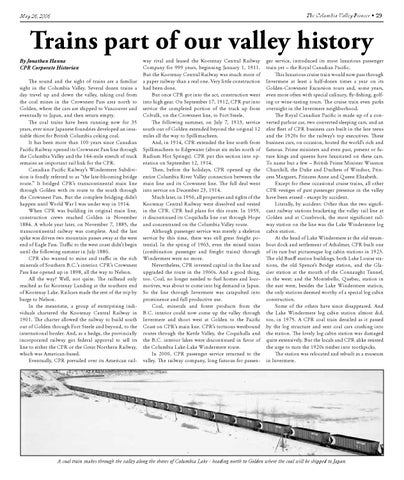
A coal train snakes through the valley along the shores of Columbia Lake - heading north to Golden where the coal will be shipped to Japan.