Copyrighted Material
i n t r od u c t i o n 21
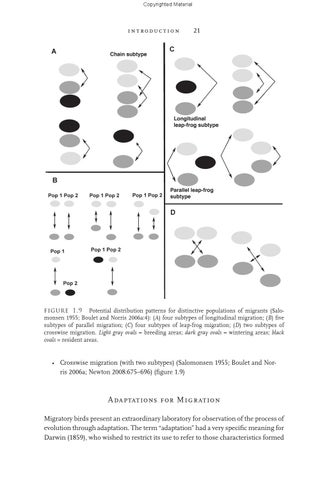
figure 1.9 Potential distribution patterns for distinctive populations of migrants (Salomonsen 1955; Boulet and Norris 2006a:4): (A) four subtypes of longitudinal migration; (B) five subtypes of parallel migration; (C) four subtypes of leap-frog migration; (D) two subtypes of crosswise migration. Light gray ovals = breeding areas; dark gray ovals = wintering areas; black ovals = resident areas.
• Crosswise migration (with two subtypes) (Salomonsen 1955; Boulet and Norris 2006a; Newton 2008:675–696) (figure 1.9)
Adaptations for Migration Migratory birds present an extraordinary laboratory for observation of the process of evolution through adaptation. The term “adaptation” had a very specific meaning for Darwin (1859), who wished to restrict its use to refer to those characteristics formed
rapp14768_book.indb 21
29/03/13 12:33 PM