w w w. h i g h l a n d v i e w a c a d e m y. c o m
Faculty’s Professional Development Impacts Students
H
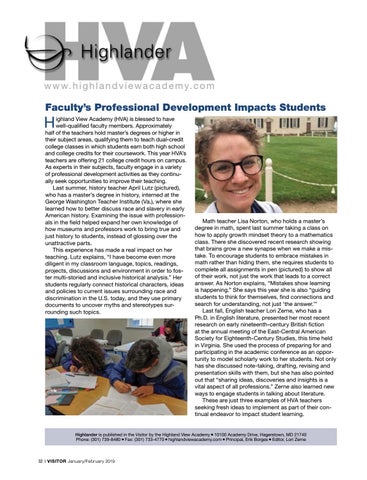
ighland View Academy (HVA) is blessed to have well-qualified faculty members. Approximately half of the teachers hold master’s degrees or higher in their subject areas, qualifying them to teach dual-credit college classes in which students earn both high school and college credits for their coursework. This year HVA’s teachers are offering 21 college credit hours on campus. As experts in their subjects, faculty engage in a variety of professional development activities as they continually seek opportunities to improve their teaching. Last summer, history teacher April Lutz (pictured), who has a master’s degree in history, interned at the George Washington Teacher Institute (Va.), where she learned how to better discuss race and slavery in early American history. Examining the issue with professionals in the field helped expand her own knowledge of how museums and professors work to bring true and just history to students, instead of glossing over the unattractive parts. This experience has made a real impact on her teaching. Lutz explains, “I have become even more diligent in my classroom language, topics, readings, projects, discussions and environment in order to foster multi-storied and inclusive historical analysis.” Her students regularly connect historical characters, ideas and policies to current issues surrounding race and discrimination in the U.S. today, and they use primary documents to uncover myths and stereotypes surrounding such topics.
Math teacher Lisa Norton, who holds a master’s degree in math, spent last summer taking a class on how to apply growth mindset theory to a mathematics class. There she discovered recent research showing that brains grow a new synapse when we make a mistake. To encourage students to embrace mistakes in math rather than hiding them, she requires students to complete all assignments in pen (pictured) to show all of their work, not just the work that leads to a correct answer. As Norton explains, “Mistakes show learning is happening.” She says this year she is also “guiding students to think for themselves, find connections and search for understanding, not just ‘the answer.’” Last fall, English teacher Lori Zerne, who has a Ph.D. in English literature, presented her most recent research on early nineteenth-century British fiction at the annual meeting of the East-Central American Society for Eighteenth-Century Studies, this time held in Virginia. She used the process of preparing for and participating in the academic conference as an opportunity to model scholarly work to her students. Not only has she discussed note-taking, drafting, revising and presentation skills with them, but she has also pointed out that “sharing ideas, discoveries and insights is a vital aspect of all professions.” Zerne also learned new ways to engage students in talking about literature. These are just three examples of HVA teachers seeking fresh ideas to implement as part of their continual endeavor to impact student learning.
Highlander is published in the Visitor by the Highland View Academy n 10100 Academy Drive, Hagerstown, MD 21740 Phone: (301) 739-8480 n Fax: (301) 733-4770 n highlandviewacademy.com n Principal, Erik Borges n Editor, Lori Zerne
32 | VISITOR January/February 2019