Forestry Class Explores Nature—God’s Second Book
C
atching butterflies, looking at worms under a microscope, constructing forest homes and digging in dirt happen to be part of the Virginia-based Manassas Adventist Preparatory School’s (MAPS) curriculum this year. As part of a pilot program, students in kindergarten and first grade are taking time to explore God’s second book of nature as part of a new forestry class. “I believe young children need to be spending more time in nature,” says Ruth Davis, the MAPS teacher who initiated the program. “With the rise of technology and many of my students living in the city, most don’t get a lot of time outdoors. Children learn as they play, and, more importantly, in play, children learn how to learn.” Davis attended several seminars at a teachers’ convention held last fall, inspiring her to see how she could implement the concept in her own school. Currently the 13 students spend two 45-minute class periods in the forestry class, which begins with a short lesson and review of guidelines for exploration. Then the students set off to discover, observe and investigate nature, armed with a wagonload of tools—nets, bug cups, shovels and rakes. Davis says she notices a difference in her students when they have more outside time. “This outlet to explore creatively and use their imaginations increases their focus and attention in the classroom,” she shares. “On the days we have forestry class, my students are not as easily distracted. Kids are also getting more courageous. Those who were afraid of bugs are now expert bug catchers. Kids who didn’t want to get messy now have mud on their hands, and those who were cautious before are now foraging new paths in the woods.”
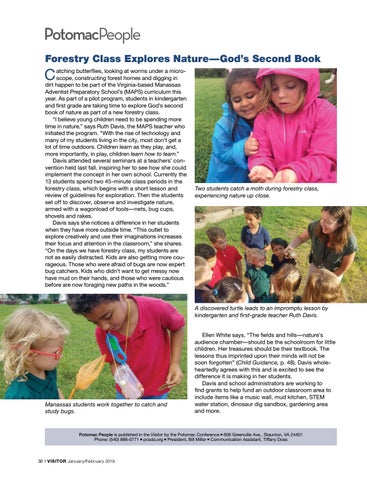
Two students catch a moth during forestry class, experiencing nature up close.
A discovered turtle leads to an impromptu lesson by kindergarten and first-grade teacher Ruth Davis.
Manassas students work together to catch and study bugs.
Ellen White says, “The fields and hills—nature’s audience chamber—should be the schoolroom for little children. Her treasures should be their textbook. The lessons thus imprinted upon their minds will not be soon forgotten” (Child Guidance, p. 48). Davis wholeheartedly agrees with this and is excited to see the difference it is making in her students. Davis and school administrators are working to find grants to help fund an outdoor classroom area to include items like a music wall, mud kitchen, STEM water station, dinosaur dig sandbox, gardening area and more.
Potomac People is published in the Visitor by the Potomac Conference n 606 Greenville Ave., Staunton, VA 24401 Phone: (540) 886-0771 n pcsda.org n President, Bill Miller n Communication Assistant, Tiffany Doss
30 | VISITOR January/February 2019