Method Read these instructions carefully before you start work. 1.
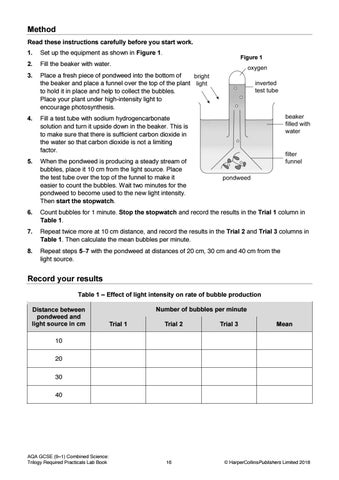
Set up the equipment as shown in Figure 1.
2.
Fill the beaker with water.
3.
Place a fresh piece of pondweed into the bottom of the beaker and place a funnel over the top of the plant to hold it in place and help to collect the bubbles. Place your plant under high-intensity light to encourage photosynthesis.
4.
Fill a test tube with sodium hydrogencarbonate solution and turn it upside down in the beaker. This is to make sure that there is sufficient carbon dioxide in the water so that carbon dioxide is not a limiting factor.
5.
When the pondweed is producing a steady stream of bubbles, place it 10 cm from the light source. Place the test tube over the top of the funnel to make it easier to count the bubbles. Wait two minutes for the pondweed to become used to the new light intensity. Then start the stopwatch.
6.
Count bubbles for 1 minute. Stop the stopwatch and record the results in the Trial 1 column in Table 1.
7.
Repeat twice more at 10 cm distance, and record the results in the Trial 2 and Trial 3 columns in Table 1. Then calculate the mean bubbles per minute.
8.
Repeat steps 5‒7 with the pondweed at distances of 20 cm, 30 cm and 40 cm from the light source.
Figure 1
Record your results Table 1 – Effect of light intensity on rate of bubble production Distance between pondweed and light source in cm
Number of bubbles per minute Trial 1
Trial 2
Trial 3
Mean
10 20 30 40
AQA GCSE (9–1) Combined Science: Trilogy Required Practicals Lab Book
16
© HarperCollinsPublishers Limited 2018