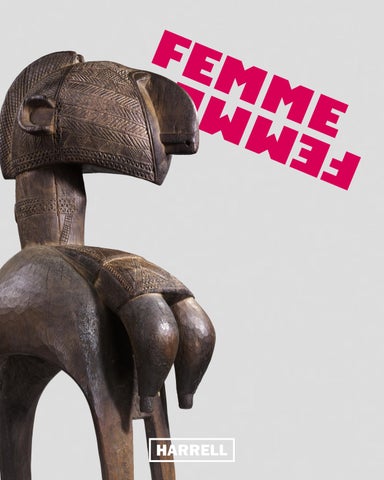
FE M
ME
F E M
M E
FEMME
INTRODUCTION In the dimly lit halls of history, there exists a narrative woven with threads of resilience, wisdom, and grace — a narrative that unfolds through the artistry of the classical African tradition. Within this rich tapestry, the feminine form emerges as a central motif, revered and celebrated for its profound symbolism and timeless beauty. Through their artistry, classical African sculptors sought to honor the divine feminine in all her manifestations, from the nurturing mother to the fierce warrior; from the wise elder to the playful maiden. At the heart of FEMME lies a celebration of the sacred mysteries of womanhood — the primal forces of creation and destruction, nurturing and protection, birth and rebirth. I invite you to create a picture in your mind. First we glimpse a mother, her arms outstretched in a gesture of love and nurturing. She embodies the essence of maternity, cradling her child with tenderness and devotion. In her eyes, we glimpse the wisdom of generations past, passed down through the oral traditions and ancestral rituals that define her cultural heritage. She is the keeper of stories, the guardian of traditions, and the embodiment of the timeless bond between mother and child. Beside her stands a healer, her hands adorned with beads and herbs, her gaze steady and focused. She channels the ancient wisdom of her ancestors, harnessing the power of nature and spirit to heal the body, mind, and soul. Through her rituals and remedies, she offers solace to those in need, bridging the gap between the physical and spiritual realms with her intuitive understanding of the human experience. In the background, a group of women gather in solidarity, their voices rising in song and celebration. They are the community builders, the pillars of support, and the catalysts for change within their communities. Through their collective efforts, they challenge injustice, uplift the marginalized, and foster a sense of belonging and empowerment among all who cross their path. On the periphery, a figure emerges from the shadows, her features obscured but her presence unmistakable. She is the ancestor, the guiding light, and the source of inspiration for future generations. Though her physical form may have faded into the mists of time, her legacy endures through the stories, songs, and traditions passed down from mother to daughter, from sister to sister, across the expanse of time and space. In the foreground, a young girl gazes into the distance; her eyes alight with hope and possibility. She is the future, the embodiment of dreams yet to be realized and potential yet to be unleashed. As she takes her place within the portrait, she carries with her the legacy of those who came before — a legacy of strength, courage, and unyielding determination. My hope in this show is to honor each woman from the above portrait. From the regal stature of a Luba-Zela kihona stool, to the intricate collaboration of an important Dan gunyege mask, each work serves as a testament to the intrinsic connection between women and the spiritual, social, and cosmological realms. In the Yoruba tradition of Nigeria, a rare female scepter of the god Eshu (normally presented as male) emerges as a potent symbol of maternal authority and spiritual prowess. Masterfully carved and with a deep patina from use, this scepter would have been wielded by devotees in ceremonies honoring Eshu, the divine trickster and messenger of the gods. Carved in exquisite detail and adorned with various bishimba, beads, and other accouterments of power, a superb nkisi figure from the Bwende culture of the Congo stands as both guardian and interpreter of the spiritual realm, its potent presence imbued with protective powers and maternal energy.
I am delighted to present this meticulously curated collection. Through a careful selection of thirteen works, each chosen for their rarity, quality and provenance, FEMME invites you on a transcendent journey across the African continent, offering a glimpse into the sacred realm of femininity. It is my hope that this collection will serve as a source of inspiration and empowerment, inviting viewers to embrace that divine feminine, not just within themselves but also within the world around them. Welcome to FEMME — a celebration of the feminine in classical African art.
COLE HARRELL May 2024
MASKS
Anthropomorphic Face Mask, NDOMA Unidentified Baule Artist, Cote d’Ivoire Wood, pigment H: 33cm PROVENANCE Collection of Sylvie LeCamp, Paris, France, acquired circa 1960 Private Collection, Haute Savoie, France, thence by descent Distinguished Private Collection, New York, acquired from the above Cole Harrell, New York CF The Barnes Foundation, Merion, Pennsylvania, inv. A189 (acquired from Paul Guillaume, 1922) Royal Museum for Central Africa, Belgium, inv. EO.1969.59.1103 (acquired in situ by de Lehaie, 1933) Coger-Dumont, Paris, 17 December 1981, lot 46 (acquired in situ by Pierre Loti, 1910) Sotheby's, New York, 13 May 2011, lot 179 (collection of Pierre Matisse, acquired 1953)
Baule mask side
Baule mask back?
Anthropozoomorphic Female Face Mask, KPAN or GOU Unidentified Baule or Guro Artist, Cote d’Ivoire Wood, pigment H: 33cm PROVENANCE Acquired in situ by Ambassador Gerald Scott (b. 1940) in Cote d’Ivoire, circa 1968 Collection of the Scott Family, Los Angeles, CA, circa 1968-2023 Private American Collection, acquired from the above, 2023 Cole Harrell, New York CF Gerbrands (Adrianus Alexander). Afrika. Kunst aus dem Schwarzen Erdteil" - 'Afrika. Kunst uit het zwarte werelddeel. Recklinghausen: Aurel Bongers, 1967#27 Expo cat: Traditionelle afrikanische Kunst. Dusseldorf: Galerie Alex Vomel, 1972 Expo cat.: Treasures from the Ivory Coast, New York: J.Camp Associates, Ltd, 1977:22, #41 Sotheby's. New York, African, Oceanic and Pre-Columbian Art, 18 November 2000, lot 83 Binoche & Giquello, Paris, Arts d'Afrique, d'Amérique et d'Océanie, 29 June 2021, lot 1
AN IMPORTANT DAN GUNYEGE OR ZAKPEI MASK
Anthropomorphic Female Face Mask and Coiffure, ZAKPEI or GUNYEGE Identified Dan Artist, Liberia Wood, plant fiber, cowrie (cyprea moneta), organic pigment Height of the Mask: 25cm PROVENANCE Collection of Alfred L. Sheinberg (1949-1992), New York, by 1977 James Camp, J. Camp Associates Ltd, New York, acquired from the above, 1977 Collection of Dr. Robert Plant Armstrong (1919-1984), Dallas, TX Christie’s, New York, The Robert Plant Armstrong Collection of African Art, 15 May 1985, lot 103 Collection of the Newark Museum of Art, Newark, New Jersey De-accessioned to benefit the Newark Museum of Art, 2019 Cole Harrell, New York EXHIBITED New York, NY, USA: Treasures from the Ivory Coast, J. Camp Associates Ltd, 24 September-5 November 1977 LITERATURE Cat: Treasures from the Ivory Coast, New York, J. Camp Associates, Ltd, 1977:29#81 “…this is a zakpai/zakpei fire mask or a gunyege runner mask. But read the comment by Marie-Noël Verger-Fèvre about a similar mask in the Barbier-Mueller collection (AHDRC 0137400): "The Barbier-Mueller Museum, Geneva, possesses a very similar mask, which has also retained its original, extremely ancient coiffure - a very rare feature in western collections. (Barbier, 1993, t. II, p. 60, inv. No. 1003-14). Writing about this mask, Marie-Noël Verger-Fèvre points out that although the round, latticed eye sockets generally denote gunyege racing masks and zapkei fire masks, the intricacy of the fibre postiche may well point to a much higher ranking figure - the "mask of the king" or go ge. It sometimes appears, in Dan country, alongside the leaders of lineage groups. It is a large mask that leaves the sacred dwelling only to announce the death of the 'king', or for other such serious matters. [...] Some are adorned with very intricate fibre postiches that mimic those of ancient warriors" (in Barbier, ibid.). (Source: AHDRC 0065919).” - François Mottas, regarding the present mask, 12 May 2024
Preceding Overleaf Mano woman in Que Congo, Liberia, by Loring Whitman, 1926 Photo courtesy A Liberian Journey: History, Memory, and the Making of a Nation
Anthropomorphic Female Face Mask, TANKAGLE or DEANGLE Unidentified Dan-Yacouba Artist, Cote d’Ivoire Wood, metal alloy, pigment, fiber, organic material H: 22cm PROVENANCE Merton D. Simpson (1928-2013), New York, NY, acquired 18 April 1964 Collection of William Brill (1918-2003), New York, NY, acquired from above before 1978, inv. 82 Private Collection, New York, NY, thence by descent, 2003 Sotheby's, New York, The William W. Brill Collection of African Art, 17 November 2006, lot 33 Lance Entwistle, London/Paris, UK/France, acquired at the above sale Cole Harrell, New York, acquired from the above, 2017 Beast Collection, Montréal, Canada, acquired from the above, 2017 LITERATURE Lehuard (Raoul), La collection William Brill, in Arts d'Afrique Noire, no.26, Arnouville, 1978:22 Robbins (Warren M.) and Nooter (Nancy Ingram), African Art in American Collections, Survey 1989, Washington/London: Smithsonian Institution Press, 1989:160, #298 Robbins (Warren M.) and Nooter (Nancy Ingram), African Art in American Collections, Pennsylvania: Schiffer Publishing, 2004, #298 “I would classify your mask as a deangle mask, ‘gentle and graceful, representing an idealized Dan form of beauty’ (Johnson, p.7), which can be seen in the very subtle treatment of the eyelids and slit eyes, in the prominent cheekbones, and in the well-defined mouth contours including the groove of the philtrum. The engraved band around the face would have led Fischer and Himmelheber to classify it as a tankagle mask, but for me it would only as a sub-category of the deangle mask…” - François Mottas, regarding the present mask, 12 May 2024
dan
dan
Anthropomorphic Female Face Mask, MFON EKPO Unidentified Ibibio Artist, South East Nigeria Wood, alloy, pigment H: 58cm PROVENANCE Collection of Hendrick “Rick” Elias (1925-2014), Weize, Belgium Galerie Elmar, Weize, Belgium Collection of Lionel Morley (b. 1941), Spain, acquired from the above Jo de Buck, Brussels, acquired from the above, 2009 Collection of Jean and Noble Endicott, New York, acquired from the above, 2009 Amyas Naegele, New York, NY, acquired from the above Cole Harrell, New York CF Christie's, London, Sale of The Meulendijk Collection of Tribal Art, 22 October 1980, lot 105 Loudmer, Paris, Arts Primitifs, 8 December 1985, lot 138 (collection of L. Van de Velde, Antwerp) AHDRC Archive no. 0092277 (collection of Vittorio Mangio, Italy)
A REDISCOVERED BAGA D’MBA YAMBAN MASK
Anthropomorphic Female Headdress, D’MBA YAMBAN Identified Baga Artist, Guinea Wood, organic pigment H: 104cm PROVENANCE Almost certainly acquired in situ by Emil Storrer (1917-1989), Zurich, circa 1950 Almost certainly Julius Carlebach, New York Private Collection, Detroit, Michigan, acquired circa 1970 Private Collection, Michigan, thence by descent Cole Harrell, New York CF Fine Arts Museum of San Francisco, San Francisco, CA, inv. 2008.38.17 (gift of the Erle Loran Family Collection) Kreeger Museum, Washington, D.C. (acquired from Julius Carlebach, 1968; acquired in situ by E. Storrer, 1952) Museum Rietberg, Zürich, Switzerland, inv. RAF 7 (acquired in situ by Emil Storrer, 1952)
Preceding Overleaf Masquerade, dance of Nimba by Beatrice Appia Photo courtesy The African Heritage Documentation & Research Center, Brussels
Photo courtesy Musée du Quai Branly, Paris
NOTES ON A REDISCOVERED BAGA MASK BY AURORE MARIANI
As famous, emblematic, iconic as it is rare, the Nimba mask, thus named by foreigners, D'mba by the Baga Sitemu, and Yamban by the Pukur (Izart, 1935: 22), can be literally transliterated as the "good spirit". The narrow corpus summarized by Frédéric Lamp (Art of the Baga, 1996, p. 155-179) forms only fifteen copies, thus cementing the sculptural language, and serving as a testament to the strength of belief of the Baga people, their resilience and their ability to reinvent their art and society. Discovered very early, mentioned for the first time in Manuel Alvares’s manuscript suggesting the existence of a D'mba entity around 1615, then documented by Nordeck in 1886, the first Nimba collected was by Lieutenant Brocard in the village of Tshalbonto, now preserved at the Quai Branly Museum, Paris, France. Later, in 1960, Hans Himmelheber, in his seminal work Negerkunst und Negerkünstle, approaches Baga statuary based on photographs provided by the Zurich collector and dealer Emil Storrer (1917-1989). From Storrer the most emblematic Nimba examples were brought back, including two additionals probably made by the same hand as the work in question. One of which is exhibited at the Kreeger Museum in Washington, and the second at the Rietberg Museum in Zürich. Much has been written about Nimba masks and their relationship to early Modernism. Between their monumentality, their symbolic power and their bold new stylistic presentation, Nimba masks famously inspired some of the greatest artists of the Modernist movement. Picasso acquired his Nimba in 1920-- it had such an influence on him that according to some art historians, the portraits and plastered heads of Marie-Thérèse Walter, with her projected aquiline nose, were directly inspired by that of his Nimba. These portraits showcased Picasso’s innovative ingenuity and desire to distance himself from realistic natural forms to achieve pushed abstraction by means of schematized shapes and geometric decorations (Van Geentruyen 1979, p.23).
Driven from their original lands of Fouta Djallon, forced into exile from the 15th to the 18th century due to Islamized Fulani invasions, the Baga settled in scattered groups in the north of the Guinea coast. The Baga oral tradition, recounts their arrival on the coast of Guinea, their need to establish, reconstitute their policies, laws and their society. In this process of reinvention, going hand in hand with the appropriation of new lands, it appeared fundamental and essential to recreate an artistic form representing the quintessence of women: idealized beauty, a founding icon, a guardian and protective image and symbol of the nurturing mother--images with whom they sought refuge for the fruitfulness and for the fertility of the earth. According to the Temne people, “the world was created by the spirit of the woman, she is the origin of life” (Lamp, 1982, p.244-283). Thus, wearing the mask was synonymous with carrying life, to the point that when giving birth, according to Sayers (1927: 111) women would say "I po’ sara a-ron," which literally translates to "I have carried the mask on my head." Initially, according to the testimonies of the Pukur, corroborated by the consultants of Sitemu, the Nimba mask was singular and sacred; it was kept in a place especially dedicated to it, where it received sacrifices. Later on, the original Nimba was reproduced and used for various ceremonies. The dancer of the sacred mask (Elder, Christian, Era, Pukur, 1986) performed a rhythmic, dynamic dance with "calm and vigorous steps at the same time, sometimes swirling and delicate." (Lamp, 1982). The dance was accompanied by jerky rhythms, drums called sëngbe, sanda castanets, and songs. The corpus of Nimba masks obey simple geometric canons composed of curves (heads and bust), separated from cylindrical shapes (neck and support). According to Mnar sculptor Sama Camara, Nimba masks “are inspired by human beings and at the same time evoke animal figures” (Mnar interview 2008). The head, with its full stretched volume, takes on the appearance of a half-circle; the large curved, hooked nose is, according to Marie-Yvonne Curtis, a reference to the hornbill bird, to fertility (Visions d'Afrique, Baga, 2018). The present example’s bell-form bust is announced by a subtle engraved decoration whose diamond could signify an adornment, a necklace that elegantly lies upon and enhances a
plunging chest. The breasts are rendered round and generous, in contrast to the more classic iconography of flattened breasts. Symbolizing fertility, intensity, and power, the round swollen breasts are as if full of milk. Her firm posture is reinforced by her stature, both static and dynamic. Her head is proud, facing forward and held up by her thick neck. The profile of her slightly arched chin, whose shape is subtly echoed by her crested, striated headdress, feels resolutely inventive, pushing towards abstraction, reinventing physical proportions through geometric volumes. African sculptures often borrow symbolic codes rooted in and referencing their ethnic identity. Among the Baga, this "norm" is not a rule, and we are faced with an exceptional aesthetic aspect, a confirmed curiosity; some of the attributes and ornaments characteristic of the Nimba do not correspond at all to those of Baga women from the past, but rather to those of women from other ethnic groups, more specifically the Fulbe women. By analyzing the photographic documentation from the first half of the 20th century, outside the Baga territory (photographic archives of the Fathers of the Holy Spirit, 1930 and Corrêa, 1943: 371), a remarkable and undeniable similarity appears between the hairstyles of the Fulbe women from Fouta Djallon, those of women from Sierra Leone, and the hairstyle of the Nimba. All of them are composed of a crest split in two, one at the top of the skull, the other plunging towards the front of the forehead, both reinforced by braided tresses. These sophisticated headdresses, sometimes adorned with long extensions extending along the face, could have been represented by the facial scarifications of the Nimba. According to Lamp, the double marks on the cheeks indicate a belonging to the Baga ethnic group, referencing the identity of the ancestor who gave birth to generations of Baga children, spiritually and physically nurturing them. Idolized and adored, when she emerged for ceremonial procession, men and women came to pay homage to her, and often in a customary gesture, their hands rested on their chests, affirming their fertility, imploring and showing respect for the nurturing power. This act, this gesture, also endowed the dancer with powerful fertility (Boris Kegel Konietzko, personal communication, 1958). The adoption of the Fulbe aesthetic style in the Nimba statuary, beautifully displayed in this remarkable work, can be considered as an acceptance, a recognition, a distinctive sign of belonging to the conventions of the most privileged status in society. This confirms the prestige of the Nimba as an unattainable tutelary entity, tending towards perfection, an object of desire, beauty, and adoration. Her elaborate, structured hairstyle, the richness of her ornamentation with fine engraved and incised decorations, magnify her beauty and reinforce her inaccessibility. However, her goodness, her generosity (enhanced by her full volumes and curves), expresses an ideal of Baga beauty. By exuding fertility, she symbolically ensures the survival of the community. With her strength and feminine power, she is associated with abundant harvests and sustainability. To fulfill these wishes, a spiritual entity was invoked in the sacred hut by the lineage chief who performed the customary sacrifices and offerings. Later associated with agricultural rites linked to the prosperity of the soil, she was taken out and danced from May in the sacred places of the village and along the rice fields to bless the land. She is the Mother of mothers in all her splendor and beauty.
Anthropomorphic Female Face Mask, OKUYI Unidentified Punu Artist, Gabon Wood, kaolin, pigment, raffia Height not including raffia: 30cm PROVENANCE Private Collection, New York Cole Harrell, New York CF Arts d'Afrique Noire, no.43, 1982:32 (acquired in situ Father René Guyader in Gabon between 1897-1925) Perrois (Louis) & Grand-Dufay (Charlotte), Punu, Milan: 5 Continents Editions, 2008: #7 (collection of the Abbey of Mortain, France, by 1931) Christie's, Paris, Art Africain et Océanien, 15 June 2010, lot 67
FIGURES
Anthropomorphic Maternity Ensemble Unidentified Turka or Gouin Artist, Burkina Faso Wood, natural pigment H: 42cm PROVENANCE Private American Collection, acquired circa 1970 Distinguished Private Collection, Brussels, acquired from the above Cole Harrell, New York CF Kjersmeier (Carl), Centres de style de la sculpture nègre africaine, Paris, Editions Albert Morancé/Kopenhagen, Fischers Forlag, Vol.1, 1935: plate 32 (acquired in situ by Carl Kjersmeier in Bobo Dioulasso, 1932) Metropolitan Museum of Art, New York, inv. 1984.521.3 (gift of Mr. and Mrs. Bernard Leyden, 1984) Sotheby's, Paris, Collection Nicole and John Dintenfass, Art African, 23 June 2006, lot 32
Tuka pic
Turka pic
Anthropomorphic Female Power Figure, NKISI Unidentified Zombo or Sosso Artist, D.R. Congo Wood, plant fiber, metal alloy, pigment, organic material H: 35cm PROVENANCE Henri Kamer (1927-1992), New York, NY, before 1973 Private Collection, thence by descent, 1992 Sotheby’s, New York, Important Tribal Art, 18 May 1992, lot 188 Collection of Allan Stone (1932-2006), New York, NY Private Collection, New York, NY Cole Harrell, New York LITERATURE Kamer (Henri), Arte Negra: Prima Mostra a Roma, Rome: Galleria il Silenus, 1973: #128 EXHIBITED Rome, Italy, Arte Negra, Galleria il Silenus, 1 October-24 October 1973 CF Phelps (Steven), Art and Artifacts of the Pacific, Africa and the Americas: The James Hooper Collection, London: Hutchinson, 1976:397, plate 240, #1853
Anthropomorphic Female Prestige Stool, KIHONA Unidentified Luba-Zela Artist, D.R. Congo Wood H: 54cm PROVENANCE Collection of Hans Hess OBE (1907-1975), Basel, Switzerland Collection of Arnold Bamert (1905-2006), Solothurn, Switzerland, acquired 1980 Distinguished Private Collection, New York, acquired from the above, 2004 Cole Harrell, New York LITERATURE Bamert (Arnold), Laude, (Jean), Afrika. Stammeskunst in Urwald und Savanne, Olten: Walter Verlag, 1980:270, #181 Bamert (Arnold), Laude, (Jean), Africana. L'art tribal de la forêt vierge et de la savane, Paris: Herscher, 1980:270, #181 Bamert (Arnold), Laude, (Jean), Africa: Tribal Art of Forest and Savanna, London: Thames & Hudson, 1980:270, #181 Expo cat.: Afrika: Maske und Skulptur, by Schaedler (Karl-Ferdinand), Olten: Historisches Museum Olten, 1989: #98 Schaedler (Karl-Ferdinand), Lexikon Afrikanische Kunst und Kulter, Munich: Klinkhardt und Biermann, 1994:404. Schaedler (Karl-Ferdinand), Encyclopedia of African Art and Culture, Munich: Panterra, 2009: 637 EXHIBITED Olten, Switzerland: Afrika. Maske und Skulptur, Historisches Museum Olten, 26 August-15 October 1989
Anthropomorphic Female Power Figure, NKISI Unidentified Bwende Artist, D.R. Congo Wood, pigment, beads, textile, iron alloy, organic material H: 22cm PROVENANCE Collection of Jacques Deprince, Brussels, by 1983 Jacques Hautelet (1931-2014), Brussels, acquired from the above, 1983 Collection of Robert Aaron Young, New York, Baltimore, acquired by 1990 Collection of Shirley (1927-2019), Marshall (1923-2006) Jacobs, Maryland, acquired from the above, 10 October 1990 Collection of Randi Jacobs (1955-2021), Maryland, thence by descent, 2019 Cole Harrell, New York LITERATURE Neyt (François), Arts traditionnels et histoire au Zaire/Traditional Arts and History of Zaire, Louvain-le-Neuve, Université Catholique de Louvain, 1981:103, #V.18 Expo cat.: Perspectives: Angles on African Art, Vogel (Susan), editor, New York: The Center for African Art, 1987:191 Lehuard (Raoul), Art Bakongo. Les centres de style, Paris: Arts d'Afrique Noire, vol. 1, 1989: 189, #B 4-3 EXHIBITED United States, Perspectives: Angles on African Art - Richmond, Virginia: The Virginia Museum of Fine Arts, 21 February-26 April 1987 - San Diego, California: San Diego Museum of Art, 23 May-16 August 1987 - New York: The Center for African Art, 18 September 1987-3 January 1988 - Birmingham, AL: The Birmingham Museum of Art, 31 January-27 March 1988 “Now this is a splendid thing...that awesome juxtaposition of life and medicine warns us that this image must have been used to protect not just a single person but a community.” - Scholar Robert Farris Thompson (1932-2021), writing about the present figure, 1987
Anthropomorphic Female Figure, NKISI Identified Songye-Tempa Artist, D.R. Congo, Sankuru Province Wood H: 29cm PROVENANCE Private Collection, Greenwich, CT Cole Harrell, New York CF Royal Museum for Central Africa, Tervuren, Belgium, inv. 18804 (acquired in situ by E. de Deken in 1887) Neyt (François), Songye. La Redoutable Statuaire Songye d'Afrique Centrale/Songye. The Formidable Statuary of Central Africa, Antwerp: Mercatorfonds, 2004:259, #226
Songye
Songey
Songye
A SUPERB YORUBA OLO ELAGBA ESHU SCEPTER
Anthropomorphic Female Ceremonial Staff, OLO ELAGBA Unidentified Yoruba Artist, Igbomina, Nigeria Wood, natural indigo pigment, metal alloy, cowrie (cyprea moneta), leather, twine H: 64cm PROVENANCE Collection of Christina and Rolf Miehler, Munich, Germany Pace Primitive, New York, USA, by 1993 Distinguished Private Collection, New York, USA, acquired from the above Cole Harrell, New York LITERATURE George Chemeche, Eshu: The Divine Trickster, Woodbridge, Suffolk:Antique Collectors' Club, 2013:204-205 CF Expo cat.: African Art, Detroit: Donald Morris Gallery, 1971: #25 (Collection of Morris W. Stein by 1971)
Preceding Overleaf Yoruba Idols by Raphaël Tuck & Sons, circa 1920 The Church Missionary Society, Lagos
Eshu pic
Produced in conjunction with the exhibition FEMME; Celebrating the Feminine Through Classical African Sculpture Presented by Cole Harrell/ Harrell Fine Art, New York 16 May – 30 June 2024
LAYOUT............................................................................Cole Harrell PHOTOGRAPHY..................................................Edward Parrinello
ACKNOWLEDGEMENTS Edwin Badia Dr. Tai-Heng Cheng Julianne Cross Jason Goudreau Professor François Mottas Aurore Mariani Dr. Amanda Maples Ariane Powell Guy van Rijn Titus van Rijn Victor Teicher Marie-Noël Verger-Fèvre Maureen Zarember Dr. David Zemanek
HARRELL FINE ART Cole Harrell, Director 291 7th Avenue New York, NY 10001
1.830.660.5089 www.coleharrell.com
M FE
M E F
E
M
M
E