Training & Practice Management / Formation et gestion d’une pratique
54
Using the CanMEDS Roles in Your Practice
New COA Bulletin series focuses on effective use of the CanMEDS framework
T
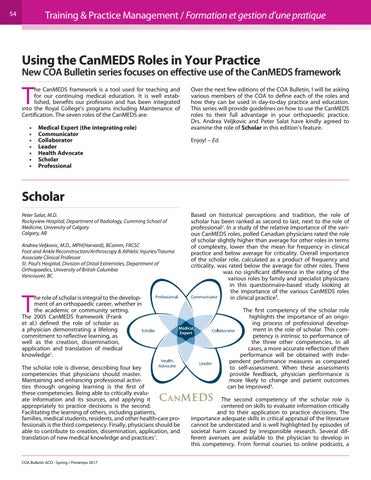
he CanMEDS framework is a tool used for teaching and for our continuing medical education. It is well established, benefits our profession and has been integrated into the Royal College’s programs including Maintenance of Certification. The seven roles of the CanMEDS are: • • • • • • •
Medical Expert (the integrating role) Communicator Collaborator Leader Health Advocate Scholar Professional
Over the next few editions of the COA Bulletin, I will be asking various members of the COA to define each of the roles and how they can be used in day-to-day practice and education. This series will provide guidelines on how to use the CanMEDS roles to their full advantage in your orthopaedic practice. Drs. Andrea Veljkovic and Peter Salat have kindly agreed to examine the role of Scholar in this edition’s feature. Enjoy! – Ed.
Scholar Peter Salat, M.D. Rockyview Hospital, Department of Radiology, Cumming School of Medicine, University of Calgary Calgary, AB Andrea Veljkovic, M.D., MPH(Harvard), BComm, FRCSC Foot and Ankle Reconstruction/Arthroscopy & Athletic Injuries/Trauma Associate Clinical Professor St. Paul’s Hospital, Division of Distal Extremities, Department of Orthopaedics, University of British Columbia Vancouver, BC
T
he role of scholar is integral to the development of an orthopaedic career, whether in the academic or community setting. The 2005 CanMEDS framework (Frank et al.) defined the role of scholar as a physician demonstrating a lifelong commitment to reflective learning, as well as the creation, dissemination, application and translation of medical knowledge1. The scholar role is diverse, describing four key competencies that physicians should master. Maintaining and enhancing professional activities through ongoing learning is the first of these competencies. Being able to critically evaluate information and its sources, and applying it appropriately to practice decisions is the second. Facilitating the learning of others, including patients, families, medical students, residents, and other health-care professionals is the third competency. Finally, physicians should be able to contribute to creation, dissemination, application, and translation of new medical knowledge and practices1.
COA Bulletin ACO - Spring / Printemps 2017
Based on historical perceptions and tradition, the role of scholar has been ranked as second to last, next to the role of professional2. In a study of the relative importance of the various CanMEDS roles, polled Canadian physicians rated the role of scholar slightly higher than average for other roles in terms of complexity, lower than the mean for frequency in clinical practice and below average for criticality. Overall importance of the scholar role, calculated as a product of frequency and criticality, was rated below the average for other roles. There was no significant difference in the rating of the various roles by family and specialist physicians in this questionnaire-based study looking at the importance of the various CanMEDS roles in clinical practice3. The first competency of the scholar role highlights the importance of an ongoing process of professional development in the role of scholar. This competency is intrinsic to performance of the three other competencies. In all cases, a more accurate reflection of their performance will be obtained with independent performance measures as compared to self-assessment. When these assessments provide feedback, physician performance is more likely to change and patient outcomes can be improved4. The second competency of the scholar role is centered on skills to evaluate information critically and to their application to practice decisions. The importance adequate skills in critical appraisal of the literature cannot be understated and is well highlighted by episodes of societal harm caused by irresponsible research. Several different avenues are available to the physician to develop in this competency. From formal courses to online podcasts, a