
Volume XLVII, No. 2 • Summer 2022 • Lancaster Pennsylvania, London REVIEWNumismaticClassicalEngland Classical Numismatic Group, LLC www.cngcoins.com

Contents Editorial 1 Terms of Sale 2 How to Order 2 Calendar 3 The ‘Supplicatio’ of Titus and Domitian: Atonement or Celebration? By Michael Gasvoda and David S. Michaels 4 Coins for Sale 9 The Handbook of Greek Coinage Series Information................................................... 84 Production Staff Managing Director: Mike Gasvoda Consulting Directors: Victor England, Jr. (U.S.) Eric J. McFadden (U.K.) Director - Sales and Consignments: Dave Michaels Chief Financial Officer: Steve Pruzinsky Managing Numismatists: David Guest (U.K.) Paul Hill (U.K.) Kenneth McDevitt (U.S.) Bill Dalzell (U.S.) Senior Numismatists Bradley R. Nelson (U.S.) D. Scott VanHorn (U.S.) Numismatists (U.S.): Jeffrey B. Rill Lance Hickman Tom DanielMullallyBurch Numismatists (U.K.): Caroline Holmes Stephen Lloyd Lancaster Office Manager: Dylan Ossman London Office Manager: Alexandra Spyra Office Staff: Julia DawnMotterAhlgren Jennifer Ventura Customer Relations Manager: Kate Rill Accounting: Sharon Pruzinsky (U.S.) Manager IT and Production: Travis Markel Photography: Christian Ventura Printing Control: Robert A. Trimble IT Consultant: A.J. Gatlin
There is no greater joy for a numismatic cataloger than working on a wonderful group of coins and writing historical stories to supplement their publication. This issue of the Classical Numismatic Review (CNR) has certainly been a joy to catalog, photograph and layout. I believe there is something here for everyone, be it an addition to your collection or a new piece of historical insight for a type of interest. Over seven months in the making, this is a terrific fixed price list!
The popularity of collecting remains at an all-time high no matter the collectible field involved. We see record prices with more regularity than ever before, and not just for extreme rarities. High grade common coins are also exploding in value. As prices climb, now is a wonderful time to be a consignor, but of course this brings the obvious challenge to a collector trying to remain competitive at auctions. None of us can predict with certainty how long this current trend will last, but we can say, at the moment, there is no sign of slowing down. Personally, I think this “new normal” actually makes the thrill of the chase that much more exciting and challenging. In response to this growing market demand CNG has added several new staff members, including: Steven Lloyd (London), our Islamic coin specialist; Julian Okun-Dubitsky in consignments; Daniel Burch in cataloging; Christian Ventura in photography; and recently Jennifer Ventura in shipping. Although we have battled recent outbreaks of Covid in both London and Lancaster, we are working at full speed to continue processing the incoming consignments. CNG Feature Auction 121, our next printed catalog feature auction, will be going online about the time this CNR is presented at the ANA World’s Fair of Money. We hope you will take the time to review it. Also closing shortly after the ANA show is our Keystone Auction 8. Continuing the tradition of this auction format, this sale includes several specialized collections presented in their entirety, including the Ken Bressett Collections of Ptolemaic and Byzantine coins. Also on offer are the RH Collection of Canadian Blacksmith Tokens and the Gasvoda Collection of Canadian Large Cents. Keystone 8 will be available for viewing at the ANA show. If you are thinking of consigning, there may never be a better time than the present. We welcome all inquires via phone, email, or in person at the ANA show. We are already building the Triton sale for January. Now is the time to consider what you might want to include in this marquee sale. In closing, stay safe, stay healthy, and happy collecting!
Mike ManagingGasvodaDirector CNG, LLC
1 Classical Numismatic Review Volume XLVII, No. 2 Summer 2022
Welcome to the Summer 2022 Classical Numismatic Review.
Digital Publications Archive
2 Terms of Sale
5. Payment. Orders may be paid by US$ check, credit card or wire transfer. US$ checks must be written on a US bank and may be sent to either office. We accept VISA and MasterCard; payment by credit card must be made within 14 days of the invoice date. Payment by credit card will be charged a 2.5% handling fee. Credit card payment may be arranged by phone, fax or mail. United States address and phone number: CNG, LLC, P.O. Box 479, Lancaster, PA, 17608., phone: 717-390-9194, fax: 717390-9978. United Kingdom address and phone number: CNG, LLC, 20 Bloomsbury St, London WC1B 3QA, phone +44 (20) 7495-1888, fax: +44 (20) 7499-5916. Office hours are 10AM to 5 PM Monday through Friday. US$ bank account for wire transfers will be provided by phone, fax or mail.
1. General Information. The point of sale for all items online is Lancaster, Pennsylvania. All orders are sent from Pennsylvania.
Digital versions of this and previous issues of the CNR are available to view or download in our Digital Publications Archive.
6. Shipment. Please provide a specific shipping address and advise us of any special shipping instructions. Unless other specific shipping instructions are indicated, coins are sent by U.S. Insured or Registered Mail.
A Note on How to Order As with our normal monthly uploads, these coins are available for purchase on our website, www.cngcoins.com. If you are viewing the virtual catalog, you may click on an image, which will bring you to the online lot description, where you can add the coin to your cart as usual.
4. Postage. All orders are charged for postage, insurance, and handling.
2. Guaranty and Return Privilege. All items are guaranteed genuine. Any coin order may be returned within fourteen days of receipt for any reason. Coins that have been encapsulated (“slabbed”) by a grading and/or authentication service may not be returned for any reason, including authenticity, if they have been removed from the encapsulation (“slab”). The customer shall bear the cost of returning all items and shall insure them for their full value. Books are not sent on approval and are not subject to return.
3. Sales Tax. Several states require us to collect and remit sales tax. Where applicable the appropriate tax will be charged to the customer invoice.


3 Major Show Schedule Additional Shows Listed on Our Online Calendar 51st New York International January 12-15, 2023 InterContinental New York Barclay Hotel 111 East 48th Street, New York January 12, Noon-7PM Preview January 13-15, 10AM-7PM (3PM on the 16th) Tables 506-508 in the Gallery (on the Mezzanine) Feature Auction Schedule CNG 121 - 6-7 October 2022 A Public Auction to be held in Lancaster, Pennsylvania Triton XXVI - 10-11 January 2023 A Public Auction to be held in New York City CNG 123 - May 2023 A Public Auction to be held in Lancaster, Pennsylvania Consignment Deadlines Feature Auction Consignment Deadlines Triton XXVI - 15 September 2022 CNG 123 - 15 February 2023 Deadlines for Electronic Auction Consignments Ongoing - About 90 days before scheduled sale Contact us early, as sales do fill up in a hurry. We may be contacted by email, fax, phone, or mail. Classical Numismatic Group, LLC Email: cng@cngcoins.com Mailing addresses & Phone numbers: Attention: Mike Gasvoda P.O. Box 479 Lancaster PA 17608 Phone: 717-390-9194 Fax: 717-390-9978 or Attention: Paul Hill (Ancients) or David Guest (British and World) 20 Bloomsbury St. London WC1B 3QA Phone: +44-20-7495-1888 Fax: +44-20-7499-5916.
According to Suetonius, before the flames had even died away, a pestilence broke out in Rome that took still more lives, although the nature of this disease remains a mystery. Perhaps a deadly toxin was triggered by the heat of the flames, or the blaze unleashed disease-ridden vermin on the populace?
So, the 12 months from mid-AD 79 to AD 80 would witness the death of a beloved emperor, the volcanic destruction of several Italian cities, a terrible fire in Rome, and a mysterious and deadly epidemic. Why wouldn’t the Roman people begin to wonder if their gods were angry with them? At any rate, Romans did not blame their young emperor for these disasters – indeed his biographer Suetonius calls Titus the “delight and darling of the human race” based largely on his tireless acts of compassion during this time of need.
The year AD 79 would prove to be one of the most event-filled in Roman history. On June 23, only a decade after the disruption of the Roman civil war, the emperor Vespasian died, leaving behind two sons, Titus and Domitian.
The ‘Supplicatio’ of Titus and Domitian: Atonement or Celebration?
Titus would succeed his father to the throne, with the younger Domitian continuing to serve as Caesar, or heir apparent. Although the rule of Titus is mostly described as positive, being one of Seutonius’ “good Emperors,” his short reign was not without turmoil. Just a few months into his reign (the date being uncertain but most likely in the autumn of AD 79), Mount Vesuvius erupted in violent fashion, devastating the communities of Pompeii and Herculaneum and covering a host of other properties, farms and estates, in volcanic ash and lava. Thousands died in horrible ways. Many of the lost properties were owned by elite Romans for use as summer villas and retreats. Titus would take personal interest in the Vesuvius eruption, traveling twice to the area to support relief efforts, while donating some of his own wealth for the cause. During Titus’ second visit to the Bay of Naples (AD 80), a major fire broke out in Rome. Although this fire wasn’t as catastrophic as Nero’s inferno of AD 64, it nonetheless burned for three days and destroyed or damaged significant structures, including the Pantheon, Temple of Jupiter, parts of the Theatre of Pompey, and other public and private buildings. Upon Titus’ return to Rome, he again aided in the recovery and repair efforts with more of his own personal wealth contributed.
4
By Michael Gasvoda and David S. Michaels
The year AD 80 would, however, have one important positive event as well. The Colosseum was completed and opened with 100 days of games. Perhaps this huge upbeat festival was just what the Romans needed after such a difficult 12 months! Titus pulled out all the stops to give the public a grand show: Gladiatorial games, beast fights, mock naval battles, and mass giveaways of food, cash and prizes were the order of the day. By all accounts it was a spectacular success. Still, given how the Flavians (Vespasian, Titus and Domitian) took every advantage of coinage to propagate their victorious Jewish war campaign in the early AD 70s, it is most unusual that the Colosseum was opened with seemingly minimal fanfare as reflected on the coinage of the day. There are a few obvious references to the grand event – an impressive bronze sestertius with an overhead view of the Colosseum and a gold aureus and silver denarius type depicting an elephant. But these were not struck in great numbers, to judge by the relative scarcity of surviving specimens.
RIC II.1 114 (Aureus) Reverse: Elephant walking left (592520)


Instead, far more commonly struck during this period is what numismatists call the “Supplicatio” or “Atonement Series” of Titus and Domitian. Starting during the reign of Titus after the eruption of Vesuvius, and continuing into the reign of his successor, Domitian, this curious and seemingly somber coinage remains an enigma. It has a clear theme in the depiction of devices related to Roman Gods, usually placed upon a pulvinar (throne), a curule chair, a tripod, or a sacrificial altar. That the reverse images of these coins are dedicated to Roman Gods is certain. What they are intended to relate to is less clear. The gods themselves are not depicted, just their symbols arranged in such a way as to suggest a sacrifice or an act of supplication– an “atonement,” if you will. Were the Romans, embodied by their emperor, pledging to make amends for whatever they had done to make the Gods inflict such disasters upon them –Vesuvius, the fire, the plague?
That, in any case, is the reading of Harold Mattingly and Edward Sydenham in the original 1926 edition of RIC Volume II. Their brief introduction to the section on Titus reads: “It was perhaps the eruption of Vesuvius that promoted the issue of… ‘supplicatio’ coins showing the exhibition of the emblems of the gods on ‘pulvinaria’ in their temples. Thus, the thunderbolt on the throne is for Jupiter, the corn-ears on throne for Ceres, the shield [actually a helmet] on throne (used by Domitian) for Minerva; the dolphin and trident may represent Neptune, the dolphin and tripod Apollo. The wreath on curule chairs is uncertain.”
One alternative reading is that these reverses reflect a tribute to the Roman Gods as victors in the war against Judaea and the people of the “one God” religion. The Colosseum was, after all, built with the spoils from the Judaean victory, and with the labor of thousands of Jewish slaves! This would be more in keeping with the historical use of reverse types on Roman coinage. In simple terms, were the Flavians saying “our gods are the correct ones to worship?”
5
In response to great catastrophes, there are many records of the Romans undertaking mass religious rituals, cleansing ceremonies, and even going to extremes like human sacrifice to placate their gods. But alluding to such acts on their coinage would have been anything but normal. Emperors, after all, showed their successes and intended propaganda on coinage. Would they take this opportunity to show their need for the support, or forgiveness, of the gods?
Perhaps, in this interpretation, the wreath-on-chairs image reflects the emperor’s personal act of supplication, laying aside his own laurel wreath, a symbol of office?
Struck for Titus (533811) RIC II.1 108 (Denarius) Reverse: Wreath on double curule chair. The emperor’s personal “supplicatio”? (539250) RIC II.1 112 (Denarius) Reverse: Dolphin entwined around anchor. A clear representation of Neptune.
In the new edition of RIC II, Part I (London, 2007), authors I.A. Carradice and T.V. Buttrey accept this view of the “supplicatio,” suggesting that the coins are linked to the religious rituals and public ceremonies for the dedication of the Colosseum. They note that pulvinaria are “sacred couches of the gods” and curule chairs are symbols of high office, not symbols of sacrifice (although altars and tripods certainly are sacrificial). This suggests “an association with public spectacles, such as the inauguration of the Colosseum, at which such seats for ‘honored guests’ would be provided,” they conclude. Far from evoking contrition, in this interpretation these reverses instead reflect celebration. Whether somber or celebratory, here is a list of the known “supplicatio” types (the numbers are from the 2007 edition of RIC; the coins listed here with inventory numbers are for sale in this edition of Classical Numismatic Review). Note that all of these types also exist in gold even though only denarii photos are shown, except for aurei offered for sale in this list. Photos with inventory numbers appear for sale later in the CNR.

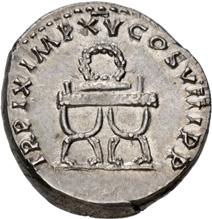


RIC II.1 123 (Denarius) Reverse: Draped chair with semicircular back surmounted by three crescent-like objects. RIC describes these as stars. A tribute to Diana? (531649) RIC II.1 124 (Denarius) Reverse: Draped chair surmounted by a triangular frame decorated with palmettes. RIC says these are corn ears which would relate to Ceres. (539251) RIC II.1 128 (Denarius) Reverse: Filleted tripod surmounted by dolphin. Possibly an addition of tribute to Apollo as well as Neptune.
Struck for Domitian as Caesar under Titus (592522) (509800) RIC II.1 270 (Aureus) and RIC II.1 266 (Denarius) Reverse: Garlanded and lighted altar. A tribute to all gods of Rome? (561066) (561098) RIC II.1 270 (Aureus) and RIC II.1 271 (Denarius) Reverse: Crested Corinthian helmet on draped pulvinar. A clear tribute to Domitian’s favorite goddess, Minerva.
6 (5611731) (563859) RIC II.1 117 (Aureus) and RIC II.1 119 (Denarius) Reverse: Draped seat surmounted by thunderbolt. A clear representation of Jupiter.

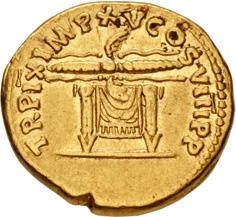


RIC II.1 54 (Denarius) Reverse: Dolphin entwined on anchor, again representing Neptune. (541046)
RIC II.1 34 (Denarius) Reverse: Draped seat surmounted by thunderbolt. A clear representation of Jupiter.
Struck for Domitian As Augustus (566202)
RIC II.1 74 (Denarius) Reverse: Filleted tripod surmounted by dolphin. Apollo and Neptune.
RIC describes these as stars. A tribute to Diana?
7
RIC II.1 95 (Denarius) Reverse: Wreath on double curule chair. The emperor’s personal “supplicatio”?
RIC II.1 20 (Denarius) Reverse: Garlanded and lighted altar. A tribute to all gods of Rome?
RIC II.1 31 (Denarius) Reverse: Draped chair with semicircular back surmounted by three crescent-like objects.


Suetonius states that, at the close of the inaugural Colosseum games, he wept publicly and was in a black mood afterward, complaining that “life was being undeservedly taken from him – since only a single sin lay on his conscience.” A short time later, on September 1, AD 81, he died at the age of 41, having reigned only 26 months.
Perhaps a clue can be found in Titus’ state of mind when the “supplication” series began. His biographers present him as a highly emotional man who reacted to the woes of his reign with extravagant grief and compassion.
And there is this: Although most of his biographers believed Titus’ death was due to natural causes, a persistent thread claims Domitian had a hand in it, or at least hastened his brother’s demise. Suetonius: “When Titus fell suddenly and dangerously ill, Domitian told the attendants to leave him for dead before he had actually breathed his last.” So, might Domitian, feeling some tinge of guilt for having pushed his brother onto the pyre, have continued this “supplication” coinage for a time to atone for the act that brought him the throne?
Many have pondered the nature of this “single sin” – speculation has ranged from regret over the destruction of the Jewish Temple, to sleeping with his brother’s wife, to altering his father’s will to exclude Domitian from the succession. Suffice it to say that Titus gives evidence of knowing his time was short – perhaps he knew well in advance that his illness was terminal? Perhaps he felt the gods were punishing him, and the Roman Empire as a whole, for this “single sin”? And might such knowledge have prompted an order to the Imperial mint that Rome’s coinage seek to placate the gods for this “sin” that weighed so heavily on his conscience?
8
In conclusion, one must admit that neither the “contrite” nor “celebratory” interpretation of this curious set of reverse designs is entirely satisfying. For example, neither idea explains why they continued into the reign of Domitian, whose early years included neither the disasters nor triumphs of his brother ’s reign.
In the end it might be impossible to fully know what prompted this series. But we are free to speculate!
5612280. EASTERN EUROPE, Imitations of Philip II of Macedon. 3rd century BC. AR Tetradrachm (26mm, 14.11 g, 9h). Laureate head of Zeus right / Horseman riding right, Λ over torch below, monogram to right. OTA A2; Lanz 351; cf. CCCBM I 4; Flesche 637 (this coin); KMW 963. Lightly toned with golden iridescence, patches of porosity on reverse. Near EF. $1950 Ex Giessener Münzhandlung 141 (10 October 2005), lot 12. 5612274. CENTRAL EUROPE, Vindelici. Early 1st century BC. AV 1/4 Stater (11mm, 1.86 g, 11h). ‘Vogelkopf’ type. Head of eagle(?) left; pellet above and below beak; all within wreath-like torc / Five pellets within torc. Kellner Type II C, 527; Allen & Nash 155 var. (six pellets, stater); Flesche 302 (this coin); KMW 449 var. (stater). Good VF. $7500 Ex Hauck & Aufhäuser 20 (16 October 2007), lot 9. 5612270. GAUL, Northeast. Morini. Circa 100-50 BC. AV Quarter Stater (8mm, 1.19 g). Pellet-in-annulet on plain convex surface / Triform central object resembling a tree; ziz-zag pattern, crescent, rosettes, and ornaments around. Depeyrot, NC V, 295; cf. D&T 255–6; Scheers 13; Flesche 221 (this coin); de la Tour 8722-8727. Minor edge splits. Good VF. Rare. $1750
5612288. EASTERN EUROPE, Imitations of Philip II of Macedon. 3rd century BC. AR Tetradrachm (25.5mm, 9.92 g, 1h). B-Reiter type. Struck in Transylvania. Laureate head of Zeus right / Horseman riding left, headdress ends in B shape. OTA 308/1; Lanz 656; CCCBM I 72; Flesche 695 (this coin); KMW 1229. Lovely iridescent tone. EF. A beautiful and artistic specimen. Rare. $9250 Ex Leu 79 (31 October 2000), lot 149.
9 Celtic Four Coins Published in Flesche


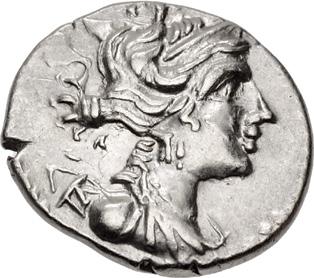
595498. GAUL, Massalia. Circa 125-90 BC. AR Drachm (16mm, 2.75 g, 5h). Light standard. Draped bust of Artemis right, wearing stephane, bow and quiver over shoulder / Lion standing left; ¬ below, ÅQ in exergue. F&P DRM-44-4; Depeyrot, Marseille 44/4. Slightly off center on reverse. EF. Struck from a wonderfully executed obverse die. $1500
595476. GAUL, Massalia. Circa 125-90 BC. AR Drachm (16.5mm, 2.55 g, 6h). Light standard. Draped bust of Artemis right, wearing stephane, bow and quiver over shoulder / Lion standing right, raising foreleg; ∏ between hind legs, ˚ below belly. F&P DRM-41-31; Depeyrot, Marseille 41/31. Lustrous, some die wear, very minor doubling on reverse. EF. $1500
5612268. GAUL, Northeast. Remi. Late 2nd-mid 1st century BC. AV Stater (17mm, 5.93 g, 7h). Celticized eye in profile; pellet-in-annulet within circle to right, pellets around / Celticized horse prancing left; circle-in-annulet below, pellet-in-annulet to left, pellets around. Depeyrot, NC VII, 75 (Treveri); D&T 177; Scheers 30 (Treveri); Flesche 246 (this coin); de la Tour 8815 (Treveri). Small edge split. Good VF. $4500 Ex Lanz 117 (24 November 2003), lot 37. Greek
10
595545. GAUL, Massalia. Circa 150-125 BC. AR Drachm (16.5mm, 2.51 g, 6h). Light standard. Draped bust of Artemis right, wearing stephane, bow and quiver over shoulder; to right, ∫ above d / Lion crouching right, raising foreleg; to right, ∫ above d. F&P DRM-38-6; Depeyrot, Marseille 8/6. Underlying luster, a little off center, very minor double strike on obverse. Near EF. $1250 Although the “crouching” lion only varies slightly from the standing lion. The difference is dramatic as viewed on the coin. The crouching lion is much scarcer than the standing lion type.
595556. GAUL, Massalia. Circa 125-90 BC. AR Drachm (15.5mm, 2.61 g, 6h). Light standard. Draped bust of Artemis right, wearing stephane, bow and quiver over shoulder / Lion standing right, raising foreleg; Å between hind legs, o below belly. F&P DRM-41-9; Depeyrot, Marseille 41/9. Lustrous, slightly off center. EF. $1250


596861. BRUTTIUM, Kaulonia. Circa 525-500 BC. AR Nomos (31mm, 7.91 g, 12h). Apollo advancing right, holding branch aloft in right hand, left arm extended, upon which a small daimon, holding branch in each hand, runs right; ˚å¨Ò to left; to right, stag standing right, head reverted; dot-and-cable border / Incuse of obverse, but daimon in outline and no ethnic; radiate border. Noe, Caulonia, Group A, 14; Gorini 3; HN Italy 2035; SNG ANS 147 (same obv. die); McClean 1591 (same dies). Deeply toned. In NGC encapsulation 4936399-012, graded Ch XF★, Strike: 5/5, Surface: 5/5. $32,500 Ex Mark and Lottie Salton Collection.
595520. GAUL, Massalia. Circa 125-90 BC. AR Drachm (17mm, 2.74 g, 5h). Light standard. Draped bust of Artemis right, wearing stephane, bow and quiver over shoulder / Lion standing left; ¬ below, ¬5E in exergue. F&P DRM-44-13; Depeyrot, Marseille 44/13. Underlying luster, traces of double strike on reverse, edge split. EF. $2250 Ex Freedman Collection
11
5603505. LUCANIA, Metapontion. Circa 340-330 BC. AR Nomos (20mm, 7.76 g, 6h). Bearded head of Leukippos right, wearing Corinthian helmet; ÅÂ5 to left / Barley ear with leaf to right; [ÂEtÅ upward to left], vertical thunderbolt above leaf. Johnston Class B, 4.3 (same dies); HN Italy 1574; SNG ANS –; SNG Copenhagen 1214. Deep old cabinet tone, hairline flan crack, a little off center on reverse. Superb EF. An excellent example of this type. $9250 Ex Roma II (2 October 2011), lot 22.
5604340. APULIA, Venusia. Circa 210-200 BC. Æ Nomos (34.5mm, 25.27 g, 5h). Head of Dionysos right, wearing ivy wreath and earring; † to left / Dionysos seated left, holding grape bunch in right hand and filleted thyrsos in left; @ • 5 to right. Burnett 4.2; HN Italy 719; SNG ANS 758; SNG Morcom 237; Basel 65. Dark grayish-green patina with spots of red, light smoothing. Good VF. Rare large bronze denomination for this city. $5500 Ex Kovacs XVI (29 September 2004), lot 16; David Freedman Collection (Triton V, 15 January 2002), lot 16.




12
5612158. SICILY, Leontini. Circa 450-440 BC. AR Tetradrachm (25mm, 17.40 g, 3h). Head of Apollo right, wearing laurel wreath / Head of roaring lion right; 6Eo-˜-t-5-[˜]o-˜ and four barley grains around. Boehringer, Münzgeschichte 41 (same obv. die as illustration); HGC 2, 667; SNG ANS 222–4 (same obv. die); Jameson 629 (same dies); Rizzo pl. XXIII, 1 (same dies). Lightly toned. EF. $12,500 Ex Triton I (2 December 1997), lot 253.
5600680. BRUTTIUM, Lokroi Epizephyrioi. Circa 344-318 BC. AR Nomos (22.5mm, 8.69 g, 2h). Time of Timoleon. Pegasos flying left; thunderbolt below / Head of Athena left, wearing Corinthian helmet with neck guard; ¬o˚rW@ to left. Spinelli Group I; Pegasi 13; HN Italy 2342; SNG ANS 513 (same dies); SNG Lloyd 648; Pozzi 1731. Lustrous. Choice EF. Well centered. $5500
5611717. SICILY, Entella. Punic issues. Circa 345/38-320/15 BC. AR Tetradrachm (26mm, 16.81 g, 3h). Head of Arethousa left, wearing wreath of grain ears, triple-pendant earring, and necklace; four dolphins around / Horse standing right; palm tree in background, crescent to upper left, poppy head below. Jenkins, Punic, Series 2c, 119 (O39/R108); CNP 176b; HGC 2, 277; SNG Lloyd 1618 (same dies); McClean 3039 (same dies). Attractive cabinet tone with golden iridescence around the devices, a hint of die rust and a little off center on obverse. EF. An attractive specimen. $22,500 Ex Numismatica Ars Classica 120 (6 October 2020), lot 328; 51 Gallery (9 December 2013), lot 118. Reportedly ex Blayaert Collection, purchased from Tradart in the 1980s.


598991. SICILY, Syracuse. The Gamoroi. Circa 500-490/86 BC. AR Tetradrachm (24mm, 16.94 g, 5h). Charioteer, holding reins in both hands, driving slow quadriga right; ߨRÅ above / Head of Arethousa left in incuse circle in center of quadripartite incuse square. Boehringer Series I, 23E (V17/R13); HGC 2, 1302; Bement 442 (same obv. die); Regling, Antike 261 (same dies); Traité I 2248, pl. LXXIV, 2 (same rev. die). Deep collection tone with some iridescence, light scratch in field on obverse. Near EF. $39,500
13
5612159. SICILY, Syracuse. Gelon I. 485-478 BC. AR Tetradrachm (28mm, 17.16 g, 11h). Struck circa 480-478 BC. Charioteer, holding kentron in right hand, reins in left, driving slow quadriga right; above, Nike, with wings spread, flying right, crowning horses with wreath held in both hands / Head of Arethousa right, wearing pearl tainia and necklace; s¨∞-A˚os5-o˜ and four dolphins around. Boehringer Series VIa, 66 (V32/R44); HGC 2, 1306; Pozzi 544 (all from the same dies). Old cabinet tone, slightly off center on obverse. VF. Struck on a broad flan. $8950 Ex Triton II (1 December 1998), lot 221.
5600093. SICILY, Syracuse. Second Democracy. 466-405 BC. AR Tetradrachm (29.5mm, 16.80 g, 12h). Unsigned dies in the style of Eumenes. Struck circa 415-409 BC. Charioteer, holding kentron in extended right hand and reins in left, driving fast quadriga left; above, Nike flying right, crowning charioteer with laurel wreath held in both hands / Head of Arethousa left, wearing hoop earring and pearl necklace; sUrÅ-˚os5o-@ and four dolphins swimming around. Fischer-Bossert, Coins 9 (V1’/R6); Tudeer 9 (V4/R6); HGC 2, 1328; Hermitage Sale II 348; de Luynes 1199 (same dies). Toned, flan crack, slightly off center on obverse. VF. $6750 Ex Oliver Talcott Banks Collection.


14 Referenced in CCO 5612612. SICILY, Syracuse. Philistis, wife of Hieron II. 275-215 BC. AR 16 Litrai – Tetradrachm (27mm, 13.27 g, 10h). Struck circa 218/7-215 BC. Diademed and veiled head left; filleted thyrsos to right / ∫Å%5¬5%%Å% f5¬5%t5do%, Nike, holding reins in both hands, driving slow quadriga right; Å to right. CCO – (D18/R15 – unlisted die combination); BAR Issue 65; HGC 2, 1556; BMC 553 (same dies); de Nanteuil 395 (same dies); Winterthur 989 (same dies). Toned, a few marks, light cleaning scratches in field on obverse. Near EF. Well centered. $9750 Ex Triton XII (6 January 2009), lot 115; Sternberg XX (20 April 1988), lot 448. This coin is referenced in CCO, erroneously as no. 10 under die combination 203, which has a different obverse die (D15). Ex Prospero Collection
598988. SKYTHIA, Tyra. Circa 330-310 BC. AR Drachm (17mm, 5.79 g, 5h). Head of Demeter facing slightly left, veiled and wearing grain ear wreath and necklace / Bull butting left; tUrÅ@o@ above. Zograph, Tyra 2; Anokhin 10; HGC 3, 1953. Old cabinet tone. Good VF. Very rare. Lovely head of Demeter. $6500 Ex Prospero Collection (New York Sale XXVII, 4 January 2012), lot 215. Artistic Dies 598992. THRACE, Mesambria. Circa 275/50-225 BC. AR Tetradrachm (30mm, 16.94 g, 12h). In the name and types of Alexander III of Macedon. Head of Herakles right, wearing lion skin / ∫Å%5¬EW% ŬE$Å@droU, Zeus Aëtophoros seated left; in inner left field, crested Corinthian helmet right above Z. Karayotov I 12 (O7/R11); Topalov, Messambria 13; Price 992; HGC 3, 1567; ANS inv. 1955.26.2 (same dies). Even medium gray tone, some light hairlines and marks. EF. Struck from artistic dies. $4750


5611719. KINGS of THRACE, Macedonian. Lysimachos. 305-281 BC. AR Tetradrachm (28mm, 17.05 g, 12h). Lampsakos mint. Struck 297/6-282/1 BC. Diademed head of the deified Alexander right, with horn of Ammon / ∫Å%5¬EW% ¬Us5ÂÅcoU, Athena Nikephoros seated left, left arm resting on shield, transverse spear in background; A to inner left, crescent on throne. Thompson 45; Müller 402; HGC 3, 1750b; SNG BN –. Lightly toned over lustrous surfaces. EF. High relief and bold portrait, with engraver’s guide circle still visible on the reverse. $7950
5611879. KINGS of THRACE, Macedonian. Lysimachos. 305-281 BC. AR Tetradrachm (28mm, 16.87 g, 3h). Alexandreia Troas mint. Struck circa 297/6-282/1 BC. Diademed head of the deified Alexander right, with horn of Ammon / ∫Å%5¬EW% ¬Us5ÂÅcoU, Athena Nikephoros seated left, left arm resting on shield, transverse spear in background; to inner left, head of ram left; star on throne. Meadows, Earliest 5, obv. die O5; Thompson 151; Müller –; HGC 3, 1750h. Light iridescent tone, a hint of porosity and a few faint hairlines. EF. Struck from artistic dies. $7500 Ex Peus 388 (1 November 2006), lot 156. Exceptional for Issue 598993. KINGS of THRACE, Celtic. Kavaros. Circa 230/25-218 BC. AR Tetradrachm (33mm, 16.46 g, 12h). In the name and types of Alexander III of Macedon. Kabyle mint. Head of Herakles right, wearing lion skin / ∫Ås5¬EWs ŬE$Å@droU, Zeus Aëtophoros seated left; in left field, Artemis Phosphoros standing facing above A erased in die. Draganov 874–5 var. (O5/R– [unisted rev. die]); Black Sea Hoard 8 (OA/R2 – this coin); Price 883; Peykov F2010; HGC 3, 1355. Even light gray tone, some faint hairlines, area of minor roughness on each side, small mark at edge on reverse. EF. $5500 Ex “Black Sea” Hoard, 8.
15


596862. MACEDON, Mende. Circa 460-423 BC. AR Tetradrachm (26mm, 17.13 g, 12h). Inebriated Dionysos, wearing chiton draped from his waist, holding in right hand a kantharos propped on his right knee, reclining left, head right, on the back of an ass standing right; before, bird perched right upon branch / µE@-dÅ-5-o@ within shallow incuse around quadripartite square in linear border ornamented with dots; all within incuse square. Noe, Mende 36 (this coin referenced); HGC 3, 545; SNG ANS 345 (same dies); Jameson 1964 (this coin). Attractive old cabinet tone, a few surface marks and deposits, mainly confined to reverse. Near EF. $47,500 Ex Mark and Lonnie Salton Collection; Robert Jameson Collection (publ. 1932); 1913 Kaliandra Hoard (IGCH 358). The Dionysiac types of Mende proclaim it as a famous wine producing city, as attested by its amphoras that have been found throughout the Mediterranean. On this delightful coin Dionysos, who rules wine and winemaking, is shown being carried home drunk from a symposium, a representation of careless joy which links the world of men with the Olympians – at least until the morning.
5603507. MACEDON, Akanthos. Circa 500-470 BC. AR Obol (9mm, 0.50 g). Head of lion facing / Quadripartite incuse square. AMNG III/2, 16; HGC 3, 390. Find patina. Near EF. Perfectly centered and struck. $1250 Ex Nomos 10 (18 May 2015), lot 22. Ex Salton & Jameson Collections, and the 1913 Kaliandra Hoard
598987. MACEDON, Akanthos. Circa 525-470 BC. AR Tetradrachm (26.5mm, 16.34 g). Lion right, attacking bull crouching left, biting into its hindquarter / Quadripartite incuse square. Desneux 26a (D24/R24) = Pozzi 718 (this coin); AMNG III/2, 5; HGC 3, 383. Toned, granular surfaces. Good VF. $9750 Ex Prospero Collection (New York Sale XXVII, 4 January 2012), lot 267; Prof. S. Pozzi Collection (Naville I, 14 March 1921), lot 718.
16 Ex Prospero and Pozzi Collections – Desneux Plate Coin


5603543. KINGS of MACEDON. Antigonos I Monophthalmos. As Strategos of Asia, 320-306/5 BC, or king, 306/5-301 BC. AR Drachm (17mm, 4.34 g, 12h). In the name and types of Alexander III. Abydos mint. Struck circa 310-301 BC. Head of Herakles right, wearing lion skin / ŬE$Å@droU, Zeus Aëtophoros seated left; / in left field, ivy leaf below throne. Price 1560; ADM II Series XIX. Lustrous, trace of die rust on obverse. Superb EF. $975
5601960. KINGS of MACEDON. Philip III Arrhidaios. 323-317 BC. AR Tetradrachm (28mm, 17.08 g, 3h). In the types of Alexander III. Babylon mint. Struck under Archon, Dokimos, or Seleukos I, circa 323-318/7 BC. Head of Herakles right, wearing lion skin / ∫Ås5¬EWs f5¬5ππoU, Zeus Aëtophoros seated left; in left field, wheel above :; W below throne. Price P189; SNG Alpha Bank 873 corr. (cites Price 191); SNG München –; SNG Saroglos –. A few light marks. Near EF. $3250 Ex Triton XIV (January 2011), lot 86. Born circa 359 BC, Arrhidaios was the illegitimate son of Philip II, king of Macedon, by a Thessalian dancer named Philinna. According to Plutarch, a poisoning attempt by Philip’s jealous wife, Olympias, left Arrhidaios mentally compromised and subject to epileptic fits. His halfbrother, Alexander III the Great, was quite fond of him and took him on all of his campaigns, although this was also a way of making sure he did not become a political pawn. When Alexander died in Babylon in June, 323 BC, a council of generals hammered out a compromise by which Arrhidaios was crowned as Philip III, to reign jointly with the infant son of the conqueror, Alexander IV. However, neither had any real power, this being held by a succession of regents. The new king proved as compliant and simple-minded as the generals had hoped, but in 320 BC, Arrhidaios married a niece of Philip II’s, Eurydike, who had enough ambition for the both of them. Eurydike plunged into the complex and deadly politics of the Diadochi. In 317 BC, she threw her support behind Kassander’s successful bid to become regent. Kassander left her and Arrhidaios in charge of Macedon while he went on campaign in Asia. However, Alexander’s mother Olympias raised her own army and invaded Macedon, capturing and ultimately executing the royal couple. The coinage of Philip III Arrhidaios is clearly based on that of Alexander, showing no innovations except for the name.
17
From the Lockett and Pozzi Collections
5603544. KINGS of MACEDON. Antigonos I Monophthalmos. As Strategos of Asia, 320-306/5 BC, or king, 306/5-301 BC. AR Drachm (17mm, 4.24 g, 11h). In the name and types of Alexander III. Abydos mint. Struck circa 310-301 BC. Head of Herakles right, wearing lion skin / ŬE$Å@droU, Zeus Aëtophoros seated left; / in left field, ivy leaf below throne. Price 1560; ADM II Series XIX. Lustrous, die wear and slightly off center on reverse. Superb EF. $875
589544. MACEDON, Terone. Circa 490-480 BC. AR Tetradrachm (29mm, 16.98 g). Amphora, central grape bunch hanging from handles / Quadripartite incuse square. Hardwick Group II; AMNG III/2, 1; HGC 3, 705; SNG ANS 741 (same dies); SNG Lockett 1371 = Pozzi 735 (this coin). Deep cabinet tone, some die wear on obverse. Good VF. Rare. $12,750 Ex Triton VI (14 January 2003), lot 143; Richard Cyril Lockett Collection (Part VI [Greek Part II], Glendining, 12 February 1958), lot 1286; Prof. S. Pozzi Collection (Naville I, 14 March 1921), lot 735.


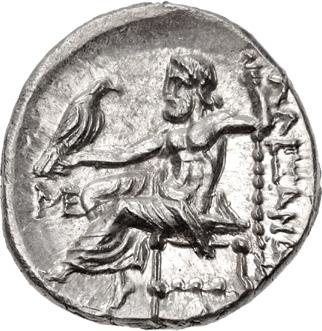
598994. KINGS of MACEDON. Kassander. As regent, 317-305 BC. AR Tetradrachm (25mm, 17.15 g, 3h). In the name and types of Alexander III. Amphipolis mint. Struck circa 316-311 BC. Head of Herakles right, wearing lion skin / ŬE$Å@ droU, Zeus Aëtophoros seated left; grain ear in left field, À below throne. Troxell, Studies, Issue L4; Price 130. Lightly toned around the devices. Superb EF. Well struck. $5750 Ex DMS Collection. Ex Hunt Collection
5607255. KINGS of MACEDON. Philip V. 221-179 BC. AR Tetradrachm (33mm, 16.39 g, 12h). Pella or Amphipolis mint; Ar–, mintmaster. Struck circa 188/7-184 BC. Head of the hero Perseus left, wearing winged helmet surmounted by griffin’s head; harpa in background; all in the center of a Macedonian shield / Club; 1 (mintmaster’s monogram) and ∫Ås5¬EWs above, f5¬5ππoU below, h to lower left, g to lower right; all within oak wreath tying to left; club to outer left. Mamroth, Philip 8; HGC 3, 1058; Hunt II 393 (this coin). Toned, a few minor deposits. Near EF. Attractive style. $6750 Ex Nelson Bunker Hunt Collection (Part II, Sotheby’s New York, 21 June 1990), lot 393; Leu 18 (5 May 1977), lot 127.
18
5612161. MACEDON (Roman Protectorate), Republican period. First Meris. Circa 167-149 BC. AR Tetradrachm (32.5mm, 16.94 g, 9h). Amphipolis mint. Diademed and draped bust of Artemis right, bow and quiver over shoulder, in the center of a Macedonian shield / Club; 1 and µÅkEdo@W@ above, ∏rWt˙% below; all within oak wreath, thunderbolt to left. Prokopov, Silver, Group I.B, 163 (O46/R137); HGC 3, 1103. Lightly toned, a few minor marks. Near EF. Well centered. $4500 Ex Gorny & Mosch 160 (8 October 2007), lot 1409.


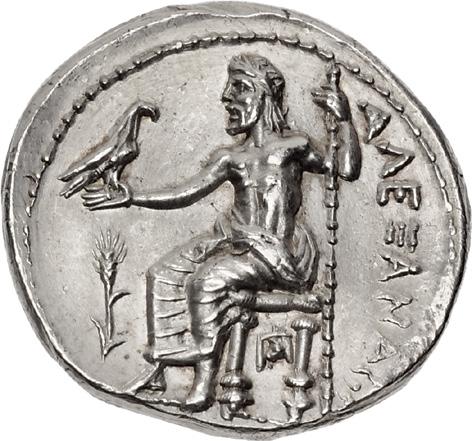


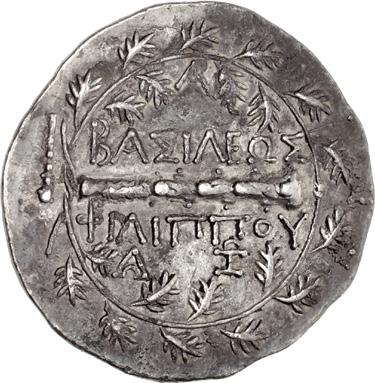
Head of Athena left, wearing Corinthian helmet with neck guard; + and tripod-in-wreath to left. Imhoof-Blumer, Akarnaniens 75 var. (monogram on rev.); Pegasi 29 var. (same); BCD Akarnania 82–3 var. (same); HGC 4, 755. In NGC encapsulation 4276190-005, AU★, Strike: 5/5, Surface: 5/5, Fine Style. $6500
19
5601930. BOEOTIA, Thebes. Circa 379-368 BC. AR Stater (19.5mm, 12.10 g). Eugi-, magistrate. Boeotian shield / Amphora; EU-˝5 across central field; all within concave circle. Hepworth 45; BCD Boiotia 518; HGC 4, 1331. Lightly toned. VF. Well centered. $1750
5601929. BOEOTIA, Thebes. Circa 425-375 BC. AR Hemidrachm (13.5mm, 2.53 g). Boeotian shield / Kantharos; club above, ax to left, Q-E∫ flanking base; all within incuse square. BCD Boiotia 411; HGC 4, 1348. Lightly toned. VF. Good metal for issue. $750
Ex Roy Iwata Collection; CNG inventory 157830 (July 2005).
5601923. AKARNANIA, Leukas. Circa 320-280 BC. AR Stater (19.5mm, 8.58 g, 6h). Pegasos flying left; A below / Helmeted head of Athena left; behind neck, Å and grape bunch on vine above amphora. Imhoof-Blumer, Akarnaniens –; BCD Akarnania –; Pegasi 129; HGC 4, 825. Lightly toned, underlying luster, minor die break on obverse. VF. $3750
599007. AKARNANIA, Anaktorion. Circa 350-300 BC. AR Stater (18mm, 8.52 g, 5h). Pegasos flying left; 5 below / Head of Athena left, wearing Corinthian helmet with neck guard; ¬Us5 above; tiny ¬, 5, and thymiaterion to right. ImhoofBlumer, Akarnaniens –; Pegasi 70 corr. (tiny ¬ not noted; same obv. die); BCD Akarnania 106 var. (no tiny ¬); HGC 4, 763. In NGC encapsulation 6290626-009, graded XF★, Strike: 5/5, Surface: 5/5. Very rare variety. $5750 Ex Mark and Lottie Salton Collection.
598990. AKARNANIA, Anaktorion. Circa 350-300 BC. AR Stater (20.5mm, 8.53 g, 7h). Pegasos flying left; 5 below /


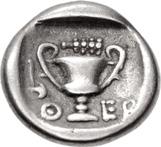


598989. ISLANDS off ATTICA, Aegina. Circa 350-338 BC. AR Stater (21mm, 12.24 g, 8h). Ni-, magistrate. Tortoise with segmented shell; Å-5 flanking / “Thin skew” incuse pattern; @-5 in upper incuses, dolphin in lower left. Milbank p. 51, a; cf. HGC 6, 445 (drachm); SNG Copenhagen 526; SNG Lockett 1998; BMC 190; Hunt II 433; Pozzi 1639. Attractive cabinet tone, a little die wear. Good VF. Very high relief obverse. $24,500 Ex H. M. Robinow Collection (Morton & Eden 51, 24 October 2011), lot 111; Sternberg XII (18 November 1982), lot 166.
599008. ATTICA, Athens. Circa 515-510 BC. AR Obol (8mm, 0.71 g). “Wappenmünzen” type. Wheel with four spokes / Irregular quadripartite incuse square. Seltman pl. IV, ν; Svoronos, Monnaies, pl. 1, 60–1; HGC 4, 1653; SNG Copenhagen 9; Dewing 1568; Jameson 2488 (this coin). In NGC encapsulation 6290919-007, graded Ch XF★, Strike: 5/5, Surface: 5/5. $12,500
Ex Mark and Lottie Salton Collection; Robert Jameson Collection (publ. 1923).
599009. ATTICA, Athens. Circa 500/490-485/0 BC. AR Tetradrachm (22mm, 16.61 g, 3h). Head of Athena right, with frontal eye, wearing crested Attic helmet decorated with small spiral on the bowl, and round earring / Owl standing right, head facing; olive sprig to left, AQE to right; all within incuse square. Seltman Group M, unlisted dies; Asyut Group IVa; HGC 4, 1590. In NGC encapsulation 6290616-008, graded VF, Strike: 5/5, Surface: 3/5. Well centered obverse, showing much crest. $7750
20 Ex Salton and Jameson Collections
Ex Mark and Lottie Salton Collection.
599010. ISLANDS off ATTICA, Aegina. Circa 480-457 BC. AR Stater (20mm, 12.15 g). Sea turtle, head in profile, with ‘T-back’ design on shell / Large square incuse with skew pattern. Meadows, Aegina, Group IIIa; Milbank Period III; HGC 6, 448; SNG Copenhagen 510; SNG Delepierre 1528–9; Boston MFA –; Dewing 1679; Rosen 221. Attractively toned, a few minor scratches. Near EF. Well centered and struck in high relief. $15,000 Ex Mark and Lottie Salton Collection. Ex Münzen und Medaillen AG FPL 137 (August 1954), no. 39. Ex Robinow Collection




596863. CORINTHIA, Corinth. Circa 350/45-285 BC. AR Stater (20mm, 8.55 g, 7h). Pegasos flying left; J below / Head of Athena left, wearing Corinthian helmet with neck guard; 5 below chin; to right, cock standing left on club. Ravel Period V, 1031; Pegasi 423; BCD Corinth 113; HGC 4, 1848. Attractively toned. In NGC encapsulation 6290607-011, graded AU★, Strike: 5/5, Surface: 5/5, die shift. $5750 Ex Mark and Lottie Salton Collection. 599011. CORINTHIA, Corinth. Circa 350/45-285 BC. AR Stater (21mm, 8.55 g, 6h). Pegasos flying left; J below / Head of Athena left, wearing Corinthian helmet with neck guard; to right, @ within wreath. Ravel Period V, 1069; Pegasi 386; BCD Corinth 128; HGC 4, 1848. Deeply toned. In NGC encapsulation 6290624-003, graded Ch XF★, Strike: 5/5, Surface: 5/5. Perfectly centered. $7500 Ex Mark and Lottie Salton Collection. 5611720. KINGS of PONTOS. Mithradates VI Eupator. Circa 120-63 BC. AR Tetradrachm (31mm, 16.72 g, 12h). Pergamon mint. Dated month 9, year 223 BE (June 74 BC). Diademed head right / ∫Å%5¬EW% Â5QrÅdÅtoU EU∏Åtoro%, stag grazing left; to left, star-in-crescent above n; to right, ˝˚s (year) above =; œ (month) in exergue; all within Dionysiac wreath of ivy and fruit. Callataÿ dies O48/R– (unlisted rev. die); HGC 7, 340; DCA 692; SNG Ashmolean 201 (same obv. die); Davis 186 (same obv. die); Pozzi 2100 (same obv. die). Attractively toned, a few light scratches. EF. Well centered and struck, with a wonderful portrait. $32,500 Mithradates is the Hellenistic monarch par excellence, his career driven by megalomaniacal ambitions leading to murderous assaults upon family and followers and disastrous foreign adventures against superior forces. His portraiture attempts to mimic the gods with its bold staring gaze and unruly, free-flowing hair, but at its most extreme is a personification of hysteria in its Dionysiac sense.
21
The Romans were not intimidated, and when Mithradates crossed over to Greece proper as ‘Liberator’, the Roman legions under Sulla smashed his army. Mithradates retreated to Pontus, from where he continued to skirmish with the Romans, suffering more defeats to the general Lucullus. In 63, having suffered a final defeat by Pompey and facing a revolt by his own son Pharnakes, the elderly king tried to commit suicide by taking poison, but he had inured himself to its affects by years of small counterdoses, and so had to be stabbed to death by one of his mercenaries.
At the age of 18, Mithradates overthrew his mother’s regency and embarked on a career of conquest, bringing most of the lands around the Black Sea into his domain. His expansionist aims inevitably brought him into conflict with Rome, and in preparation for the coming war he built up the largest army in Asia, unleashing it in 88 BC in what would be the First Mithradatic War. He sought to undermine the Roman power base by ordering the massacre of every Roman citizen in Asia in which nearly 80,000 people perished.


5601955. ISLANDS off CARIA, Rhodos. Rhodes. Circa 205-190 BC. AR Didrachm (19mm, 6.50 g, 12h). Xenokrates, magistrate. Radiate head of Helios facing slightly right / Rose with bud to right; $E@o˚rÅt˙% above; to left, snake coiled right; r-o flanking stem. Ashton 281; HN Online –; HGC 6, 1441. Lustrous. Choice EF. $1450 Ex CNG inventory 805867 (June 2011).
5603565. AEOLIS, Myrina. Circa 160-143 BC. AR Tetradrachm (32mm, 16.51 g, 12h). Stephanophoric type. Head of Apollo right, wearing laurel wreath / Apollo Grynios standing right, holding phiale and laurel branch; ï and ÂUr5@Å5o@ to left, omphalos and amphora at feet; all within laurel wreath. Sacks Issue 18, obv. die 10; SNG von Aulock 1664 (same obv. die); SNG Copenhagen 2221; BMC 11 (same obv. die). Attractive iridescent tone, underlying luster. EF. $5750
22
5601196. KINGS of PERGAMON. Eumenes I. 263-241 BC. AR Tetradrachm (28mm, 17.02 g, 12h). In the name of Philetairos. Pergamon mint. Struck circa 255/0-241 BC. Laureate head of Philetairos right / f5¬EtÅ5roU, Athena enthroned left, holding shield in right hand, left elbow resting on sphinx seated right; spear diagonally in background, ivy leaf to inner left, bow to outer right, v on throne. Westermark Group III, unlisted obv. die; SNG BN 1606–9; SNG von Aulock 1355. A few marks, trace deposits on reverse. EF. Fine style. $2500 When Lysimachos established the mint of Pergamon, he entrusted its treasury to the eunuch Philetairos. Philetairos changed his allegiance to Seleukos I, probably shortly before the Battle of Korupedion in 281 BC, where Seleukos defeated Lysimachos. Philetairos continued to acknowledge Seleukid primacy for some time, but soon struck a coinage with his own portrait and name. Similar to what was done in Ptolemaic Egypt, all of the subsequent kings of Pergamon continued to use these types on the coinage, and even kept Philetairos’ name. In 261 BC his successor, Eumenes I, defeated Antiochos I in battle near Sardis in Lydia, securing Pergamene independence. The remainder of Eumenes’ reign saw an expansion of Pergamene power, including the foundation of a number of cities, at the expense of the Seleukids. The city of Pergamon was built into a magnificent metropolis, complete with some of the finest buildings and artworks of the Hellenistic world and a library rivaling that of Alexandria.
5603569. IONIA, Phokaia. Circa 478-387 BC. EL Hekte – Sixth Stater (10mm, 2.52 g). Head of Io left; below, small seal left / Quadripartite incuse square. Bodenstedt Em. 96; SNG von Aulock –; Bement 1476; BMC 57; Boston MFA 1918; Gulbenkian 930; Weber 6081. A few hairlines. VF. $1750


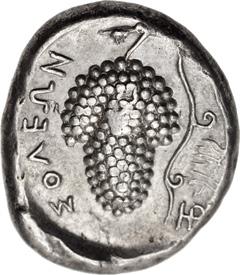
5612757. CILICIA, Soloi. Circa 410-375 BC. AR Stater (19mm, 10.65 g, 12h). Head of Athena right, wearing Attic helmet decorated with griffin / Grape bunch on vine tendril with leaves; so¬EW@ to left, A to lower right. Casabonne Type 5; SNG BN –; SNG Levante –; Triton XXV, lot 296 (same dies). Toned, underlying luster, minor die wear on obverse. Near EF. $2975
23
5603532. PAMPHYLIA, Aspendos. Circa 330/25-300/250 BC. AR Stater (23mm, 10.36 g, 12h). Two wrestlers grappling; E between / Slinger in throwing stance right; to right, triskeles above club; o between legs. Tekin Series 5; SNG BN 122; SNG von Aulock 4577. Toned, struck with worn obverse die. Good VF. $1250
5612661. CILICIA, Tarsos. Mazaios. Satrap of Cilicia, 361/0-334 BC. AR Stater (23mm, 11.01 g, 12h). Baal of Tarsos seated left, head and torso facing, holding eagle, grain ear, and grape bunch in extended right hand, lotus-tipped scepter in left; rt (TN in Aramaic) to left, M (M in Aramaic) below throne, zRtL`b (B’LTRZ in Aramaic) to right / Lion left, attacking bull left; ydzM (MZDY in Aramaic) above. Casabonne Series 2, Group D; SNG BN 335; SNG Levante Supp. 20; SNG von Aulock 5960. In NGC encapsulation 4938384-002, graded MS, Strike: 4/5, Surface: 5/5, Fine Style. $4950
599090. SELEUKID EMPIRE. Seleukos I Nikator. Second satrapy and kingship, 312-281 BC. AR Hemidrachm (12mm, 1.89 g, 6h). Attic standard. Aï Khanoum mint. Struck circa 286 BC. Laureate head of Zeus right / ∫Ås5¬EWs [sE¬EU˚oU], Athena, brandishing spear overhead, shield on arm, in biga of elephants right; anchor above. SC 278; SMAK S1HDA–3 (α3/ π3); cf. HGC 9, 48. Lightly toned, typical compact flan. Good VF. Rare. $775



24
599088. PHOENICIA, Arados. Uncertain king. Circa 420-400 BC. AR Shekel (18mm, 10.35 g, 12h). Head of Ba’alArwad right, wearing laurel wreath / Galley right; waves below; dotted linear border above. E&E-A Group III.1.1, C13; HGC 10, 29. Toned, slight roughness on obverse. VF. $1375 Ex Gorny & Mosch 280 (11 October 2021), lot 378. 596865. PHOENICIA, Sidon. temp. Ba`alšillem (Sakton) I-Ba’ana. Circa 425-401 BC. AR Dishekel (27mm, 27.16 g, 11h). Phoenician galley left before city wall with five towers; [M (M in Phoenician) above], two lions standing outward in exergue / King of Persia and driver in chariot drawn by two horses galloping left; M (M in Phoenician) above; below, incuse goat running left; all within dotted circle within incuse circle. E&E-S Group III.1.v, 256–60; Betlyon 15 (Ba’na’); Rouvier 1091; HGC 10, 232 (Ba’na’). Old collection tone. VF. A very well struck reverse with excellent detail for the series. $4250 Ex Mark and Lottie Salton Collection.
5612342. SELEUKID EMPIRE. Antiochos I Soter. 281-261 BC. AR Tetradrachm (25mm, 17.12 g, 5h). In the types of Alexander III of Macedon. Sardes mint. Head of Herakles right, wearing lion skin / ∫Å%5¬EW% Å@t5ocoU, Zeus Nikephoros seated left; in left field, ˚ above z. SC 321.1; HGC 9, 127 (same dies as illustration). In NGC encapsulation 5770648-001, graded XF, Strike: 4/5, Surface: 4/5. Rare Alexander type in the name of Antiochos. $3250
599089. SELEUKID EMPIRE. Antiochos I Soter. 281-261 BC. AR Hemidrachm (13mm, 1.85 g, 6h). Attic standard. Aï Khanoum mint. Diademed head right / ∫Å%5¬EW% Å@t5ocoU, horned and bridled horse’s head right, with braided, flamelike forelock; ò to right. SC 434; SMAK A1HDH-1–9 var. (unlisted dies); HGC 9, 137. Toned, slight roughness, cleaning marks on obverse. Good VF. Very rare. $875
5611882. SELEUKID EMPIRE. Antiochos I Soter. 281-261 BC. AR Tetradrachm (27.5mm, 17.15 g, 12h). Seleukeia on the Tigris mint. Diademed head right / ∫Å%5¬EW% Å@t5-ocoU, Apollo, nude, testing arrow in his right hand, left hand holding tip of bow set on ground to right, seated left on omphalos; Û to outer left, ¢ to outer right. SC 379.3d; ESM 157; HGC 9, 128g. Toned, minor scratch on obverse. Good VF. $3950 Ex Peus 378 (28 April 2004), lot 298.
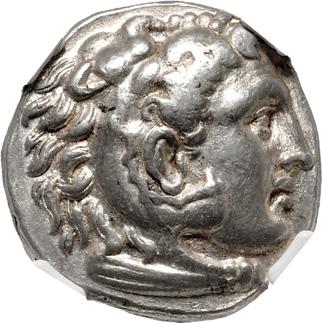


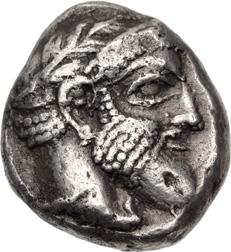


5601950. PHOENICIA, Tyre. 126/5 BC-AD 65/6. AR Shekel (28.5mm, 14.19 g, 1h). Dated CY 16 (111/0 BC). Head of Melkart right, wearing laurel wreath, [lion skin around neck] / Eagle standing left on prow; palm frond in background; to left, ?5 (date) above club; Ê to right, b (Phoenician B) between legs; tUroU 5Er&% ˚&5 &%U¬oU around. DCA-Tyre 42 (same obv. die as illustration); HGC 10, 357; DCA 919. Lightly toned, small deposit on obverse. EF. Well struck on a broad flan. $4750
One of the great cities of Phoenicia, Tyre was subject first to the Ptolemies and then to the Seleucids, and was an important mint for both dynasties. The city received a grant of autonomy from the Seleucid Crown in 126/5, whereupon Tyre immediately inaugurated a new civic coinage dated to the era of its autonomy, with certain affinities to the coinage it had formerly minted for its royal masters. The civic silver featured a new obverse type, a head of the Phoenician god Melqart, but the reverse type of an eagle standing on a prow was identical to the reverse of Tyre’s Seleucid coinage, which in turn had been an elaboration on the Ptolemaic eagle. Importantly, they are all dated with Greek numerals to a civic year commencing with the grant of autonomy, 126/5 BC. Half- and quarter-shekels were also struck. The early shekels, such as this fine specimen, are struck on relatively broad, thin flans and bear a striking image of a muscular, laureate Melqart looking very much like the Greek Herakles, with a lion skin knotted around his neck. Later issues, commencing in 20/19 BC, have a distinctly different fabric, being struck on compact, thick flans, with cruder images and lettering.
598703. PHOENICIA, Tyre. 126/5 BC-AD 65/6. AR Half Shekel (20.5mm, 6.19 g, 1h). Lifetime of Christ Issue. Dated CY 142 (AD 16/7). Head of Melkart right, wearing laurel wreath, [lion skin around neck] / Eagle standing left on prow; palm frond in background; to left, rÂ∫ (date) above club; to right, ˚r above s; [Phoenician letter between legs]; tUroU 5E[r`% ˚`5 `%] U¬oU around. Cf. DCA-Tyre 850; HGC 10, 358; DCA 922. Some light roughness, off center on reverse. Good VF. $1500
25 A Selection of Tyrian Shekels
5601198. PHOENICIA, Tyre. 126/5 BC-AD 65/6. AR Half Shekel (21.5mm, 7.09 g, 12h). Dated CY 48 (79/8 BC). Head of Melkart right, wearing laurel wreath, [lion skin around neck] / Eagle standing left on prow; palm frond in background; to left, ˙Â (date) above club; T to right, b (B in Phoenician) between legs; tUroU 5Er`% ˚`5 `%U¬oU around. DCA-Tyre 781; HGC 10, 358; DCA 921. In NGC encapsulation 6290842-002, graded Ch AU, Strike: 4/5, Surface: 3/5. $3950
598681. PHOENICIA, Tyre. 126/5 BC-AD 65/6. AR Shekel (25mm, 13.54 g, 12h). Lifetime of Christ issue. Dated CY 145 (AD 19/20). Head of Melkart right, wearing laurel wreath, [lion skin around neck] / Eagle standing left on prow, palm frond in background; to left, rÂE (date) above club; to right, ˚r above …; b (B in Phoenician) between legs; t¨[ro¨ 5Er`%] ˚`5 `%¨¬o¨ around. DCA-Tyre 520; HGC 10, 357; DCA 920. Slightly compact flan. VF. Well centered. $2500


536899. JUDAEA, Jewish War. 66-70 CE. AR Shekel (23mm, 14.21 g, 12h). Jerusalem mint. Dated year 2 (67/8 CE). Omer cup; @c (“Y[ear] 2” in Hebrew = date) above, L!Rc¥ LQc (“Shekel of Israel” in Hebrew) around / Sprig of three pomegranates; YcurQY 2¥Lcur¥ (“Jerusalem the holy” in Hebrew) around. Deutsch 33–50 var. (O4/R– [unlisted rev. die]); Meshorer 193; Kadman 8; Hendin 6388; Bromberg I 63 (same dies); Shoshana I 20202–3; Sofaer 7–8; Spaer 167–8. Lightly toned, a hint of die wear. Choice EF. Excellent surfaces. $9750
598667. PHOENICIA, Tyre. 126/5 BC-AD 65/6. AR Shekel (25.5mm, 13.22 g, 12h). Dated CY 164 (AD 38/9). Head of Melkart right, wearing laurel wreath, [lion skin around neck] / Eagle standing left on prow, palm frond in background; to left, r$d (date) above club; to right, ˚r above …; [Phoenician letter between legs]; t¨ro¨ 5Er`% [˚`5] `%¨¬o¨ around. DCA Tyre 606–9 var. (unlisted with this monogram); HGC 10, 357; DCA 920. A little off center. Good VF. $4250
598677. PHOENICIA, Tyre. 126/5 BC-AD 65/6. AR Shekel (24mm, 13.53 g, 1h). Dated CY 162 (AD 36/7). Head of Melkart right, wearing laurel wreath, [lion skin around neck] / Eagle standing left on prow, palm frond in background; to left, r$∫ (date) above club; to right, ˚r above ); ∫ (Phoenician B) between legs; [t¨ro¨ 5Er`% ˚]`5 `%¨¬o¨ around. DCA Tyre 598; HGC 10, 357; DCA 920. Compact flan, slight roughness. Near EF. $4250
26
598694. PHOENICIA, Tyre. 126/5 BC-AD 65/6. AR Shekel (24.5mm, 13.63 g, 1h). Dated CY 161 (AD 35/6). Head of Melkart right, wearing laurel wreath, [lion skin around neck] / Eagle standing left on prow, palm frond in background; to left, r$& (date) above club; to right, ˚r above ); ∫ (Phoenician B) between legs; t¨[ro¨ 5Er`% ˚`5] `%¨¬o¨ around. DCA Tyre 590; HGC 10, 357; DCA 920. Slightly off center. EF. Choice for issue. $4500 Tyrian shekels and half-shekels continued to be minted until about AD 65. They circulated widely in Judaea and, despite their overtly Pagan imagery, were accepted by the Jewish authorities as payment for the annual Temple tax. The infamous “30 pieces of silver” paid to Judas for betraying Jesus would likely have been Tyrian issues. This shekel was minted after the generally accepted dates for the crucifixion, April of either AD 30 or 33; however, Pontius Pilate was prefect in Judaea until AD 36, so a case could be made for the crucifixion occuring any year between AD 30 and 36.


27
5611894. JUDAEA, Bar Kochba Revolt. 132-135 CE. AR Zuz – Denarius (19.5mm, 3.50 g, 1h). Undated, attributed to year 3 (134/5 CE). #⁄o2C (“Shim‘on” in Hebrew) within wreath / Elongated kithara with three strings; 2LC∑R¥ ¡∑RHL (“For the Freedom of Jerusalem” in Hebrew) around. Mildenberg 84 (O14/R54); Meshorer 272; Hendin 6446; Bromberg 162 (same dies); Shoshana I 20393 (same dies); Spaer 218 (same dies). Lightly toned, overstruck on a denarius of Hadrian, with his profile visible on the obverse. Good VF. $2950
5612758. PERSIA, Achaemenid Empire. temp. Darios II to Artaxerxes II. Circa 420-375 BC. AV Daric (15mm, 8.33 g). Lydo-Milesian standard. Sardes mint. Persian king or hero, wearing kidaris and kandys, quiver over shoulder, in kneelingrunning stance right, holding spear and bow / Incuse punch. Carradice Type IIIb, Group C (pl. XIV, 42); cf. Meadows, Administration 323; BMC Arabia pl. XXV, 12; Sunrise 28. In NGC encapsulation 3990759-020, graded MS, Strike: 4/5, Surface: 5/5. $5750 Ex Heritage 3061 (7 January 2018), lot 29229. 5602902. PTOLEMAIC KINGS of EGYPT. Ptolemy I Soter. As satrap, 323-305/4 BC or king, 305/4-282 BC. AR Tetradrachm (28mm, 15.71 g, 12h). Ptolemaic standard. In the name of Alexander III of Macedon. Alexandreia mint. Struck circa 306-300 BC. Diademed head of the deified Alexander right, wearing elephant skin, aegis around neck with tiny d in scales / ŬE$Å@droU, Athena Alkidemos advancing right, brandishing spear in right hand and wearing shield on extended left arm; to right, helmet, (, and eagle standing right on thunderbolt. CPE 69; Svoronos 162; Zervos Issue 28, dies 492/a; SNG Copenhagen 29; McClean 9766 (same dies). Light iridescent tone. Good VF. $5500 Ex Classical Numismatic Group 50 (23 June 1999), lot 949. Ptolemy I Soter, the son of a Macedonian nobleman, was a friend and intimate of Alexander III the Great from boyhood and accompanied him on his great career of conquest, from 333-323 BC. Upon Alexander’s death in 323 BC, Ptolemy was granted the prized satrapy of Egypt, the richest of the formerly Persian provinces. Alone among the Diadochi (”successors”), he was content with his sphere of influence and did not risk all to succeed Alexander. However, he was not above using the great conqueror’s image and reputation to secure his own position. He hijacked Alexander’s funeral cortege as it was proceeding back to Macedon and had his embalmed corpse formally interred at Memphis in Egypt; later the body was relocated to a splendid mausoleum in Alexandria. Ptolemy’s early coinage is modeled on that of Alexander and carries the conqueror’s image and name, as seen on this remarkable tetradrachm, which shows Alexander wearing an elaborate elephant-skin headdress in honor of his victories in India, backed with a striking image of Athena in a fighting stance. Ptolemy declared his own kingship in 306 BC and was the only one of Alexander’s Successors to die peacefully, in his bed, in 283 BC, having founded a dynasty that would last three centuries.


595038. KYRENAICA, Kyrene. temp. Magas. Circa 294-275 BC. AR Didrachm (21mm, 7.66 g, 12h). Head of Zeus Karneios right / Silphion plant; 0 to upper left, crab to upper right, ˚U-rÅ across lower field. BMC 255; SNG Copenhagen 1243 var. (control marks in lower fields). Lightly toned. VF. Struck on a broad flan. $1650 Oriental Greek Issue With Crescent Below Head
595039. KYRENAICA, Kyrene. temp. Magas. Circa 294-275 BC. AR Didrachm (19.5mm, 7.63 g, 12h). Head of Zeus Karneios left / Silphion plant; to upper left, coiled serpent left; 5† to upper right, ˚U-rÅ across central field. BMC 243–5; SNG Copenhagen 1239. Lightly toned, a few light scratches. VF. $1550 Kyrene was the capital city of Kyrenaika on the North African coast immediately west of Egypt. Dorian Greek colonists founded Kyrene in 631 BC. The region played host to a wild-growing plant called silphion (or silphium), with a thick, striated and hollow stalk, broad horizontal branches, and yellow flowers that grew in bunches. The Greeks ascribed near magical properties to both the plant itself and its sap, called laserpicium by the Romans. Silphion had countless uses, including as a salve for burns, a treatment for hemorrhoids, cure for tetanus, and a seasoning for food, and was also described as having various properties associated with love and sex. From its earliest coinage, circa 525 BC, Kyrene featured the silphion plant and fruit on its coin designs. Ancient sources state that the Kyreneans found silphion impossible to cultivate and could only gather it from the fields where it grew wild. In the late Hellenistic and early Roman periods, over-harvesting and grazing by domesticated animals allegedly drove it to extinction. Pliny reported that the last known stalk of silphion was given to the Emperor Nero “as a curiosity.” A close relative of silphion likely exists today in the giant fennel plant, ferula communis, which still grows in North Africa and elsewhere.
28
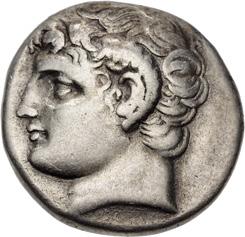
5612631. KINGS of PERSIS. Vādfradād (Autophradates) II. Early-mid 2nd century BC. AR Tetradrachm (25mm, 16.80 g, 7h). Istakhr (Persepolis) mint. Bearded head right, wearing diadem and kyrbasia adorned with eagle; crescent below / Fire temple of Ahura-Mazda; above, half-figure of Ahura-Mazda; to left, Vādfradād standing right, bow before; to right, eagle standing left on standard; traces of retrograde !%R†RP (prtrk’ = “fratarakā” in Aramaic) in exergue. van’t Haaff Type 546 var. (no crescent below head); K&M 3/1 var. (same); cf. DeMorgan, p. 403 and pl. XXVIII, 8 (for obv.); Sunrise 574 var. (same); Zeno –. Bright surfaces, traces of die rust, reverse struck with worn die. EF. Extremely rare, none in CoinArchives. $2975




Roman Provincial 5603574. MOESIA INFERIOR, Tomis. Gordian III. AD 238-244. Æ Medallion (36mm, 27.99 g, 12h). AYT K M ANT ΓOPΔ I A NOC AYΓ, radiate, draped, and cuirassed half-length bust left, gorgoneion on cuirass, raising right hand in salute and holding globe in left / MHT PO ΠON TOY TOMЄ ΩC, Gordian III, laureate, on horseback right, spearing enemy below. AMNG 3366; RPC VII.2 Online 1676; Varbanov 5586. Glossy green patina, lightly smoothed, slight double strike on reverse. Good VF. A bold and impressive medallion. $2250
The longest-reigning son of Eukratides I Megas, Heliokles “the Just” was the last Greek king to rule all of Baktria proper, although later IndoGreek kings might have reconquered portions of it. Heliokles appears to have fought a long rear-guard action against numerous invaders who poured into Baktria after the death of Eukratides, among them the Parthians, Scythians, and the Yuezhi, Asiatic steppe nomads and expert mounted archers in the same mold as the later Huns and Mongols. Ai Khanoum, the capital city, appears to have fallen suddenly about 145 BC, after which Heliokles moved his capital into the Kabul valley before finally being overwhelmed circa 130-125 BC. His coinage continues in the Greco-Baktrian tradition of exceptional portraiture, in which he appears as a rather stocky and care-worn ruler. His choice of a “thundering Zeus” as a reverse image harkens back to the very first Greco-Baktrian coinage of Diodotos I and II.
29 595792. BAKTRIA, Greco-Baktrian Kingdom. Heliokles Dikaios. Circa 145-130 BC. AR Tetradrachm (30mm, 16.84 g, 12h). Diademed and draped bust right / ∫å%5GE∑% to right, ˙¬5o˚¬EoU% to left, d5kÅ5oU in exergue, Zeus standing facing, holding thunderbolt and scepter; x to inner left. Bopearachchi 1U; Bopearachchi & Rahman 292; SNG ANS 642-8; MIG Type 284o; HGC 12, 169. Slight double strike, minor edge lamination. EF. $5250
5615455. BITHYNIA, Nicomedia. Valerian I, with Gallienus and Valerian II Caesar. AD 253-260. Æ Tetrassarion (24mm, 8.29 g, 7h). Struck AD 256-258. Laureate, draped, and cuirassed busts of Valerian I and Gallienus vis-à-vis; below and between them, bareheaded, draped, and cuirassed bust of Valerian II to right / Two temples seen in perspective, with serpent coiled around flaming altar between; above, a third temple seen from the front, within; statue of Demeter standing left, holding grain ears and long torch. RG 407; BMC 68; SNG Copenhagen 581; SNG von Aulock 7141. Dark brown patina, minor roughness, reverse slightly off center. Good VF. $695
The acclamation of Valerian II as Caesar in AD 256 provided the empire with a third ruler in addition to the already existent Augusti; Valerian’s father, Gallienus, and grandfather, Valerian I. To commemorate the occasion, Nicomedia produced special coinage with the theme of “three”: three rulers on the obverse, and three civic symbols on the reverse. In both cases, the obverses show the confronted busts of the co-emperors, Valerian I and Gallienus, with the young Caesar Valerian II between them. The arrangement was carefully considered: Valerian I, as senior emperor, occupied the position of honor at the left; both he and Gallienus as Augusti are radiate, while the young Caesar remained bare-headed. The reverse follows a similar pattern of “three”: three temples at Nicomedia. Provincial cities competed aggressively with each other to gain special permission from Rome to build temples dedicated to the emperor; upon earning these honors the cities attained neocorate status. The most famous and prosperous cities accumulated this honor two or more times. Nicomedia was especially fortunate, since it attained such status three times. Interestingly, Nicomedia had lost its third neocorate status under Severus Alexander, after Elagabalus’ damnatio memoriae, but regained it under Gallienus. This series commemorates the renewal of the awarding of the third neocorate.


30
5611722. MYSIA, Pergamum. Augustus. 27 BC-AD 14. AR Cistophorus (24.5mm, 11.94 g, 12h). Struck 27-26 BC. IMP • CAESAR, bare head right / AVGVSTVS, capricorn right, head left, bearing cornucopia on back; all within laurel wreath. Sutherland Group IV 129a (O4/R7); RPC 2211; SNG von Aulock 6568 (same obv. die). Attractive old cabinet tone, patch of iridescence, struck on a compact flan. EF. Wonderful portrait in high relief. $8750 The capricorn represents Octavian’s birth sign and appeared often as a coin type during his reign. Adding the cornucopia, or horn of plenty, to the back of the capricorn symbolizes the prosperity brought about through his efforts, and his victories are symbolized by the laurel wreath.
5611893. IONIA, Ephesus. Hadrian. AD 117-138. AR Cistophorus (27mm, 10.37 g, 12h). Struck after 129 AD. HADRIANVS AVG COS III P P, bare head right / DIA-NA across field, EPHESIA in exergue, cult statue of Diana of Ephesus within ornate tetrastyle temple set on three-tiered base; pediment decorated with figures flanking a central table with disk above, two recumbent figures in angles; decorated acrostolium. Metcalf, Cistophori 8 var. (O29/R-; unlisted reverse die); RPC III 1332 var. (rev. pediment); Pinder 70. Old cabinet tone with golden iridescence around devices. Good VF. Very rare variety. $7750 Ex Numismatica Ars Classica 87 (8 October 2015), lot 242; Gorny & Mosch 133 (11 October 2004), lot 317; Triton VI (14 January 2003), lot 964; Gorny & Mosch 112 (17 October 2001), lot 4210. Diana is the Roman version of the Greek goddess Artemis; she is normally depicted as a young huntress, dressed in a short chiton, carrying a bow and quiver of arrows, and accompanied by her hunting hounds. A distinct form of Artemis / Diana was worshipped in Ephesus, where an immense temple complex, one of the Seven Wonders of the Ancient World, was devoted to the goddess. The famous cult statue housed in the temple was distinctly Anatolian (i.e., non-Greek) in form: mummiform in shape and covered with a multitude of breasts that signify the original association of the goddess with fecundity. With the arrival of the Greeks, the popular tales of Artemis were transferred to this mysterious Ephesian goddess. Hadrian visited Ephesus during his imperial tour of AD 128-134, arriving at the city in March of AD 129, where he is sure to have made a pilgrimage to the great temple and gazed upon the statue.
5612153. IONIA, Ephesus. Claudius. AD 41-54. AR Cistophorus (26mm, 10.80 g, 6h). Struck AD 41-42. TI CLAVD CAES • AVG, bare head left / COM ASI across field, distyle temple of Roma and Augustus, enclosing standing facing figures of Augustus leaning left, holding spear in right hand, being crowned by Fortuna, holding wreath in right hand and cornucopia in left; ROM • ET AVG on entablature. RPC I 2221. Old cabinet tone with hints of iridescence, light scratches. Good VF. Superb portrait. $4250


596965. CILICIA, Tarsus. Caracalla. AD 198-217. Æ (36mm, 18.21 g, 1h). Struck AD 214/5. AVT KAI M AVP CЄVHPOC ANTΩNЄINOC CЄB, Π Π, bust left, clad in the crown and robes of the demiourgos priest; star below / ANTΩNЄINIANHC CЄV[HP AΔPIANH] TAPCOV MHT, A/M/K, ΓB, elephant walking right, carrying two sacks upon its back marked XP. Cf. SNG Levante 1047-1048; cf. SNG BN 1541; cf. BMC Lycaonia 196; cf. SNG Copenhagen 364; SNG von Aulock –; cf. McClean 9116 (same obverse die). Green and brown patina. Near EF. Rare, only three specimens in CoinArchives. $5750
31 Isopythic Games Issue
5603575. PAMPHYLIA, Side. Philip II. AD 247-249. Æ Pentassarion (33.5mm, 18.09 g, 7h). Struck AD 247. AYT K MAPK IOYΛ CЄOYHP ΦIΛIΠΠON CЄB, laureate, draped and cuirassed bust right, seen from behind; Є (mark of value) to right / ICOΠYΘIOC, prize table inscribed CIΔHTΩN holding agonistic crown, inscribed IЄPOC; beneath, amphora between two palms. SNG BN –; Watson 928; RPC VIII Online 21160. Attractive green patina, minor weakness and light roughness. Near EF. Very rare, only three known to RPC, two in CoinArchives. $2950
5615454. CILICIA, Diocaesarea. Philip I. AD 244-249. Æ Hexassarion (31mm, 15.41 g, 6h). Radiate, draped, and cuirassed bust right, seen from behind / Two Tychai facing one another, the one on the left seated, the one on the right standing and holding a rudder and cornucopia; below, the river-god Calycadnus swimming right. Staffieri, Diocaesarea 22 ; SNG BN 880-1 var. (arrangement of rev. legend); RPC VIII Online 2053; SNG Levante 676 var. (same). Green patina with earthen highlights. VF. Well struck for issue. $475
The Isopythic Games at Side were begun by Gordian III in AD 243 and celebrated again by Philip I in 247.
The elephant bronzes of Caracalla form a remarkable series of complex types and symbolism relating to the emperor’s journey through the eastern provinces in 214/15 AD. Caracalla is portrayed in imperial dress or else in the garb of the chief priest. The elephant bears a variety of gifts and offerings – the kiliarch crown, symbolizing the role of Tarsus as chief city of Cilicia; three palms (probably representing the three districts comprising Cilicia); two sacks containing offerings or money (on the present well-preserved coin the markings on the sacks can just be made out – XP for crisma (sacrificial oil) or crhmata (money); or on a few rare coins, all three items plus a fourth object that may be an imperial eagle. One can imagine a grand procession entering the city, led by a parade of elephants bearing the symbols of imperial might, provincial wealth, civic pride, and sacred piety.


42. Light toning over residual luster, minor metal flaw and light scratches on obverse. EF. $875
589541. CAPPADOCIA, Caesarea-Eusebia. Tiberius. AD 14-37. AR Drachm (18mm, 3.57 g, 11h). Struck circa AD 17-32.
Ex Roma E-Sale 63 (7 November 2019), lot 474. From the first Roman issue of Caesarea, the exact date of which is uncertain. The authors of RPC place it somewhere between AD 17 and 32.
TIBEPIOΣ KAIΣAP ΣEBAΣTOΣ, laureate head right / ΘEOY ΣEBAΣTOY YIOΣ, Mt. Argaeus surmounted by radiate and naked statue holding globe in right hand and long scepter in left. Ganschow, Münzen 33; RPC I 3620; Sydenham, Caesarea
594480. SELEUCIS and PIERIA, Antioch. Galba. AD 68-69. AR Tetradrachm (28mm, 15.05 g, 12h). Dated RY 2 (AD 68/9). [AYTOKPAT]ωP CЄPOYIOC ΓΑΛBAC CЄBACTOC, bare head right / Eagle standing left on wreath, with wings displayed, holding wreath in beak; palm frond to left, ЄTOYC B (date) in exergue. McAlee 310; RPC I 4197; Prieur 99. Struck on a broad flan, good metal, off center obverse. Near EF. Exceptional portrait. $4500
32
Considering the distance from Rome to Syria, it seems remarkable that Syrian mints were able to produce coin portraits of exceptional quality despite the brevity of reigns seen during the Year of the Four Emperors, AD 68-69. Galba, for example, ruled only a little more than seven months, only three of these from Rome. Yet in this time proper effigies of the elderly new Caesar were prepared and transported to widely dispersed imperial mints. McAlee attributes the Galba coinage normally assigned the Antioch to three different subsidiary mints. This issue, with the reverse of an eagle standing on a wreath, he assigns to a “wreath mint,” probably Tripolis, of which he notes the portraits “compare favorably with the best portraits of Galba on the coinage of Rome.” NGC MS 5/5, 5/5 5612675. SELEUCIS and PIERIA, Antioch. Philip I. AD 244-249. BI Tetradrachm (25mm, 12.72 g, 7h). Rome mint, 3rd officina. Struck AD 246. AVTOK K M IOYΛI ΦIΛIΠΠOY CЄB, laureate, draped, and cuirassed bust right, seen from behind / ΔHMAPX ЄΞOYCIAC, eagle standing facing, head and tail left, with wings displayed, holding wreath in beak; Γ to upper right, S C across field, MON VRB in exergue. McAlee 901c; RPC VIII Online 29031; Prieur 307. Lightly toned over lustrous mirrored surfaces. In NGC encapsulation 5872736-117, graded MS, Strike 5/5, Surface 5/5. $1250 599092. SELEUCIS and PIERIA, Antioch. Philip II. AD 247-249. BI Tetradrachm (27mm, 11.40 g, 6h). Struck AD 248. AVTOK K M IOYΛI ΦIΛIΠΠOY CЄB, laureate and cuirassed bust left, wearing baelteus / ΔHMAPX ЄΞOYCIAC YΠATOΔ, eagle standing left with wings displayed, holding wreath in beak; ANTIOCHIA, S C in exergue. McAlee 1051b; RPC VIII Online 47998; Prieur 461. Lightly toned. Well struck. In NGC encapsulation 4934478, graded MS, Strike: 5/5, Surface 4/5. $1175 5612674. SELEUCIS and PIERIA, Antioch. Herennius Etruscus. As Caesar, AD 249-251. BI Tetradrachm (26mm, 6h). 5th officina. Struck AD 250-251. ЄPЄNN ЄTOPOY MЄ KY ΔЄKIOC KЄCAP, bareheaded, draped, and cuirassed bust right; ••••• below / ΔHMAPX ЄΞOYCIAC, eagle standing right on palm frond, with wings displayed, holding wreath in beak; S C in exergue. McAlee 1152e; RPC IX Online 1756; Prieur 637. Toned. In NGC encapsulation 5872737-182, graded Ch AU. $750 594480 5612675 599092 5612674


5615452. EGYPT, Alexandria. Hadrian. AD 117-138. BI Tetradrachm (25.5mm, 13.72 g, 11h). Dated RY 13 (AD 128/9). Laureate, draped, and cuirassed bust right, seen from behind / ΠATHP ΠATPIΔOC around, clasped hands; L above, IΓ (date) below. Köln 994-6; Dattari (Savio) 1525; K&G 32.468; RPC III 5728; Emmett 848.13. Attractive find patina. Good VF. An outstanding example in exceptional metal. $795
•ΔHMAPX•ЄΞ•YΠATTOC•TO•Γ•, eagle standing facing, head and tail left, with wings displayed, holding wreath in beak; star between legs. Prieur & Amandry Group III, 34a; McAlee, Severan, Group III, 25; Prieur 1149. Lustrous. Good VF. $1500 5615451. EGYPT, Alexandria. Hadrian. AD 117-138. BI Tetradrachm (24mm, 12.84 g, 11h). Dated RY 10 (AD 125/6). Laureate, draped, and cuirassed bust right, seen from behind / Canopic jar to right; L ΔE KATOY (date) around. Köln 903; Dattari (Savio) 1325; K&G 32.351; RPC III 5578; Emmett 827.10. Toned, slight granularity. Good VF. Well struck and detailed canopic jar. $595 Canopic jars were used by the Egyptians to contain the internal organs that were removed from bodies in the process of mummification. Starting in the New Kingdom, the tops of the jars were carved or molded in the form of the heads of the four sons of Horus, who protected each organ: Hapy (baboon, lungs), Imsety (human, liver), Duamutef (jackal, stomach), and Qebehsenuef (falcon, intenstines). The one seen on the reverse of this tetradrachm represents Imsety. By Roman times, embalmed bodies no longer had the viscera removed; canopic jars were interred empty and were symbolic in nature.
33 NGC MS 5/5, 5/5 599091. SELEUCIS and PIERIA, Antioch. Trebonianus Gallus. AD 251-253. BI Tetradrachm (25mm, 10.98 g, 6h). 1st officina. Struck AD 251. AYTOK K Γ OYIB TPЄB ΓAΛΛOC CЄB, laureate, draped, and cuirassed bust right; • below / ΔHMAPX ЄΞOYCIAC, eagle standing facing, head and tail left, with wings displayed, holding wreath in beak; A between legs, SC in exergue. McAlee 1172a; RPC IX Online 1787; Prieur 656. Lightly toned, lustrous. In NGC encapsulation 5872737298, graded MS, Strike 5/5, Surface 5/5. $1475 5601932. SELEUCIS and PIERIA, Laodicea ad Mare. Septimius Severus. AD 193-211. AR Tetradrachm (25mm, 13.53 g, 11h). Struck circa AD 208-209. •AYT•KAI•CЄOYHPOC•CЄ•, laureate and draped bust right, seen from the front /


34 5601934. EGYPT, Alexandria. Gallienus. AD 253-268. Potin Tetradrachm (23.5mm, 10.43 g, 12h). Dated RY 9 (AD 261/2). AYT K Π ΛIK ΓAΛΛIHNOC CЄB, laureate and cuirassed bust right, seen from the front / Eagle standing left, wings folded, holding wreath in beak, palm over shoulder; ЄNATOV (date) upward in left field, L to right. Köln 2908-9; Dattari (Savio) 5286; K&G 90.56; Emmett 3802.9. Red-brown patina, high silver content. Good VF. Well struck. $750 Ex DMS Collection; Triskeles Auctions (27 June 2013), lot 911. Roman Republican 5612163. Anonymous. Circa 265 BC. Æ Aes Grave Sextans (36mm, 46.11 g, 12h). Rome mint. Scallop shell seen from outside; • • (mark of value) across lower field / Scallop shell seen from inside. Crawford 21/5; ICC 45; Sydenham, AG 65; HN Italy 292; RBW –. Green and brown patina, worn at high points. Good VF. $1650 Ex Münzen & Medaillen GmbH 9 (4 October 2001), lot 306; Müller 59 (23 September 1988), lot 292. 5612664. Anonymous. 211-208 BC. AV 60 Asses (14mm, 3.35 g, 5h). Rome mint. Bearded head of Mars right, wearing crested Corinthian helmet; çc (mark of value) to left / Eagle standing right on thunderbolt, with wings spread; rOÂA below. Crawford 44/2; Sydenham 226; Bahrfeldt 4a; Biaggi 3; BMCRR Rome 185-6; Kestner 285-6; RBW 160–1. In NGC encapsulation 4938385-042, graded Ch AU, Strike: 5/5, Surface: 4/5. $19,750 Ex Hess-Divo 298 (22 October 2003), lot 1098. The Roman Republic’s earliest large-scale issue of gold coins was part of the massive overhaul of Rome’s coinage system circa 211 BC, at the height of the Second Punic War against Carthage. A whole new system of coinage replaced the old one based on the silver didrachm, or quadrigatus, and clumsy cast Aes Grave. At the top end of the value scale, three gold coin denominations were now issued, all marked with their value in copper asses. All gold coins bore the same design: A helmeted head of Mars on the obverse, and an eagle standing on a thunderbolt on the reverse (the eagle represented Jupiter and was one of the identifying standards carried into battle by the legions). These included a gold 60-as piece, weighing about 3.4 grams, marked with a iX (VI times X); a 40-as piece (XXXX), and a 20-as piece (XX). A comparison of the weights of values of the precious metal denominations indicates the relative ratio of silver to gold at this time was about 12 to one. The gold for this considerable issue likely came from Rome’s capture and sack of Syracuse in 212 BC. Unlike the accompanying silver denarius and bronze denominations that were introduced during this reform, the gold issues were discontinued after a few years, and Rome would not resume any coinage in gold for another century and a half.
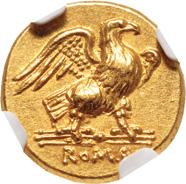


35 5612167. M. Baebius Q.f. Tampilus. 137 BC. AR Denarius (19mm, 3.98 g, 6h). Rome mint. Head of Roma left, wearing winged helmet, ornamented with griffin’s head, the visor in three pieces and peaked, single-pendant earring, and pearl necklace, hair arranged in three symmetrical locks; x (mark of value) below chin, TAÂpiL to right / Apollo driving galloping quadriga right, holding branch, bow, and arrow, and reins; rOÂA below horses,  • BAeBi • œ • F in exergue. Crawford 236/1c; Sydenham 489; Baebia 12; BMCRR Rome 935-7; Kestner 2138–9; RBW 975. Iridescent toning. EF. $1950 Ex CNG inventory 896179 (June 2011); Numismatica Ars Classica 59 (4 April 2011), lot 702. 5612170. C. Augurinus. 135 BC. AR Denarius (19mm, 3.93 g, 11h). Rome mint. Head of Roma right, wearing winged helmet, ornamented with griffin’s head, the visor in three pieces and peaked, wearing triple-pendant earring and pearl necklace, hair arranged in three symmetrical locks; • (mark of value) to left / Ionic column surmounted by statue; at base, two stalks of grain; on left, L. Minucius Augurinus standing right, holding patera, foot on modius; on right, M. Minucius Faesus standing left, holding lituus; C • A ug above. Crawford 242/1; Sydenham 463; Kestner 2195-6; BMCRR Rome 952-4; Minucia 3; RBW 999. Iridescent toning, slight peripheral weakness on reverse. EF. $1950 Ex Nomisma 35 (16 October 2007), lot 182.
5601924. Appius Claudius Pulcher, T. Manlius Mancius, and Q. Urbinius. 111-110 BC. AR Denarius (17mm, 3.89 g, 3h). Rome mint. Head of Roma right, wearing winged helmet, ornamented with griffin’s head, the visor in three pieces and peaked, wearing triple-pendant earring and pearl necklace, hair arranged in three symmetrical locks; quadrangular device to left / Victory, holding reins in both hands, driving triga right; Ap • CL • T • (ÂAL) • œ • ur in exergue. Crawford 299/1a; Sydenham 570; Claudia 2; BMCRR Rome 1290; Kestner 2552–3; RBW 1141. Attractive iridescent cabinet tone. Good VF. $875
5603405. Lucius Appuleius Saturninus. 104 BC. AR Denarius (20mm, 3.85 g, 6h). Rome mint. Head of Roma right, wearing winged helmet, ornamented with griffin’s head, the visor in three pieces and peaked, wearing triple-pendant earring and pearl necklace, hair arranged in three symmetrical locks / Saturn driving galloping quadriga right, holding harpa and reins; C below; L • ÍATurN in exergue. Crawford 317/3b; Sydenham 578a; Kestner 2588; BMCRR Rome –; Appuleia 1; RBW 1171. Iridescent toning. EF. $1450
Lucius Apuleius Saturninus was elected a moneyer in 104 BC, from whence he rose to Tribune of the Plebs from 103 to 100 BC as an ally to the “outsider” general and Consul Gaius Marius. At Marius’s behest, he introduced land reform measures rewarding retiring soldiers with large tracts of land in Italy and the provinces, which put him squarely at odds with the aristocrat-favoring optimates in the Senate. Like the Gracchi before him, he relied on the votes of the common people, along with violence and illicit coercion, to retain office and ram his program through. Ultimately he pushed things too far and lost the support of Marius, who ordered his arrest following the Senate’s “Ultimate Decree.” Kept in the Curia Hostilia awaiting trial, he and dozens of his supporters were murdered by the hired goons of his enemies, who climbed on the roof and pelted the prisoners with roof tiles. His descendants included the Triumvir Lepidus.


36
5603424. Pub. Crepusius. 82 BC. AR Denarius (18mm, 3.79 g, 8h). Rome mint. Head of Apollo right, wearing laurel wreath, scepter over shoulder; u below chin / Warrior on horse rearing right, brandishing spear in right hand; xuiiii to left, p • CrepuÍi in exergue. Crawford 361/1b; Sydenham 738; Kestner –; BMCRR Rome –; Crepusia 1a; RBW –. Iridescent toning, traces of underlying luster. EF. $775 Ex Leo Benz Collection (Part 1, Lanz 88, 23 November 1998), lot 330.
5603420. P. Cornelius Lentulus Marcellinus. 100 BC. AR Denarius (20mm, 3.96 g, 12h). Rome mint. Bareheaded bust of young Hercules right, seen from behind, wearing lion skin and holding club; shield and •/Q to left, rOÂA below / Roma standing facing, holding spear in left hand, being crowned by Genius of the Roman People, standing facing to right, holding wreath in left hand and cornucopia in right; •/Q/• between them; Leg • º • F in exergue; all within laurel wreath. Crawford 329/1a; Sydenham 604; Kestner –; BMCRR Rome 1720; Cornelia 25; RBW –. Attractive iridescent toning. EF. $1150 Ex Leo Benz Collection (Part 1, Lanz 88, 23 November 1998), lot 299.
5612178. C. Poblicius Q.f. 80 BC. AR Serrate Denarius (20mm, 4.09 g, 10h). Rome mint. Draped bust of Roma right, wearing helmet ornamented with griffin’s head, and at each side a feather; D above, rOÂA to left / Hercules, naked, standing left, and strangling the Nemean Lion; club on ground at his feet, bow case to left, D above left, C • pOBLiCi • œ • F to right. Crawford 380/1; Sydenham 768; Poblicia 9; Kestner –; BMCRR Rome 2899; RBW –. Light iridescent toning, traces of deposits and die rust, tiny hairline flan crack. Choice EF. Bold reverse. $3950 Ex Numismatica Ars Classica 15 (18 May 1998), lot 113.


Ex Numismatica Ars Classica 21 (17 May 2001), lot 253. Splendid Reverse 5601935. Q. Cassius Longinus. 55 BC. AR Denarius (18mm, 3.83 g, 6h). Rome mint. Head of Vesta right, wearing veil; œ • CAÍÍiuÍ to left, ueÍTA to right / Curule chair within Temple of Vesta; urn to left, voting tablet inscribed AC (Absolvo Condemno) to right. Crawford 428/1; Sydenham 917; Cassia 9; BMCRR Rome 3871; Kestner 3465; RBW 1533. Iridescent toning, slightly off center. Near EF. Well struck Temple of Vesta. $1950 Ex Pegasi BBS 141 (21 February 2012), lot 294. 5603490. Servius Sulpicius. 51 BC. AR Denarius (19.5mm, 3.82 g, 6h). Rome mint. Head of Apollo right, wearing laurel wreath; Íer downward to left, Í^p upward to right / Ornate naval trophy, consisting of a central vexillum atop prow of galley set on base, and decorated with rudder, palm frond, anchor, apluster and prow; to left, draped figure standing facing, head right; to right, naked Macedonian captive standing facing. Crawford 438/1; Sydenham 931; Sulpicia 1; RBW 1553. Old collection tone, scrapes on obverse. Good VF. Very rare. $5750 Ex I. Vecchi 4 (5 December 1996), lot 14. The moneyer, and the reverse of this rare type, remain somewhat enigmatic. He was clearly a member of the prestigious Sulpicia gens, perhaps the son of Servius Sulpicius Rufus, consul in 51 BC. The reverse seems to show the auction of captive slaves following a Roman naval victory. Which event the reverse commemorates, however, is uncertain. Pompey’s defeat of the pirates has been suggested as the key event, but this occurred in 67-66 BC, well before the issue was struck. Additionally, that victory involved none of the Sulpicii. Crawford suggests that it refers to the victory of C. Sulpicius Paterculus (possibly a direct ancestor of the moneyer), who prevailed in 258 BC over the Carthaginian admiral Hannibal Gisco in the First Punic War. Another alternative is that the reverse refers to the victory achieved by P. Sulpicius Galba Maximus over Macedon’s navy in 209/8 during the Second Punic War.
37 5603412. M. Piso M.f. Frugi. 58 BC. AR Denarius (18mm, 3.83 g, 5h). Rome mint. Terminal bust of Mercury right; to left, star above wreath; calix below chin / Â • piÍO Â F/Frugi in two lines above secespita and patera; all within laurel wreath. Crawford 418/2b; Sydenham 825; Calpurnia 23; Kestner 3424; BMCRR Rome 3634–5; RBW 1505. Iridescent toning, areas of slight surface crystallization, reverse slightly off center. Near EF. $2950


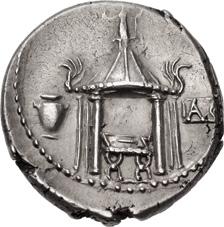

596966. Moneyer issues of Imperatorial Rome. L. Hostilius Saserna. 48 BC. AR Denarius (19mm, 3.82 g, 4h). Rome mint. Bare head of Gallia right, wearing long, disheveled hair; carnyx (Gallic trumpet) to left / Diana (Artemis) standing facing, laureate, wearing long hair falling down her shoulders and long flowing robes, holding spear in left hand and stag by its antlers in her right; ÍAÍerNA upward to left, L • hOÍTiLiuÍ downward to right. Crawford 448/3; CRI 19; Sydenham 953; Hostilia 4; BMCRR Rome 3996-8; Kestner 3541; RBW 1570. Iridescent toning, small die flaw on cheek, graffiti in obverse field, deposits on reverse. EF. $1275 Ex Hess-Divo 338 (3 December 2019), lot 1094; Bernhard Terletzki Collection (Künker 295, 25 September 2017), lot 582; purchased from Münzenhandlung Fritz Rudolf Künker, 4 July 2003; Auctiones 29 (12 June 2003), lot 441; Münzen und Medaillen AG 61 (7 October 1982), lot 346.
5603404. Moneyer issues of Imperatorial Rome. C. Antius C.f. Restio. 47 BC. AR Denarius (18mm, 4.01 g, 3h). Rome mint. Bare head right; reÍTiO to left / Hercules advancing right, head left, lion skin draped over left arm, holding club aloft in right hand, trophy in left; C • ANTiuÍ • C • F around from upper right. Crawford 455/1a; CRI 34; Sydenham 970; Antia 1; BMCRR Rome 4029-31; Kestner 3569-70; RBW 1593. Old cabinet tone. Good VF. Well centered and struck for issue. $3250
5603462. P. Cornelius Lentulus Marcellinus. 50 BC. AR Denarius (19mm, 4.24 g, 12h). Rome mint. Bare head of M. Claudius Marcellus right; triskeles to left; ÂArCeLLiNuÍ downward to right / M. Claudius Marcellus advancing right, carrying trophy into tetrastyle temple; ÂArCeLLuÍ downward to right, COÍ • œuiNœ downward to left. Crawford 439/1; cf. Campana, Denario 86; Sydenham 1147; Claudia 11; BMCRR Rome 4206-8; Kestner 3507-8; RBW 1554. Iridescent toning, traces of deposits. Near EF. $3250 Ex Classical Numismatic Group 36 (December 5, 1995), lot 2312.
38


598995. The Caesarians. Julius Caesar. April-August 49 BC. AR Denarius (18mm, 3.72 g, 3h). Military mint traveling with Caesar. Elephant advancing right, trampling on horned serpent; CAeÍAr in exergue / Emblems of the pontificate: simpulum, aspergillum, securis, and apex. Crawford 443/1; CRI 9; Sydenham 1006; RSC 49; BMCRR Gaul 27-30; Kestner 3515-8; RBW 1557. Attractive iridescent toning over lustrous surfaces, some faint hairlines. Superb EF. Well centered on a broad flan. $14,500 Ex Thomas A. Palmer Collection, purchased from Jonathan Kern, July 1989.
5603392. Moneyer issues of Imperatorial Rome. P. Accoleius Lariscolus. 41 BC. AR Denarius (20mm, 4.14 g, 1h). Rome mint. Draped bust of Diana Nemorensis right, hair closely bound with fillet; p • ACCOLeiuÍ LAriÍCOLuÍ around / Triple cult statue of Diana Nemorensis facing, supporting on their hands and shoulders a beam, above which are five cypress trees, the figure on left holding poppy in right hand, that on right holding lily in left hand. Crawford 486/1; CRI 172; Sydenham 1148; Accoleia 1; BMCRR Rome 4211-3; Kestner 3702-3; RBW 1701–2. Light iridescent toning, traces of underlying luster. Near EF. $2575
39
5607248. The Caesarians. Julius Caesar. February-March 44 BC. AR Denarius (18mm, 3.72 g, 7h). Lifetime issue. Rome mint; C. Cossutius Maridianus, moneyer. Laureate and veiled head right; CAeÍAr downwards to right, DiCT • iN • perpeTuO upwards to left / Venus Victrix standing left, holding Victory in extended right hand and resting left arm on shield set on globe to right; C • ÂAriDiANuÍ downwards to right. Crawford 480/16; Alföldi Type XIX, 23 (dies A6/R4); CRI 111; Sydenham 1067; RSC 9; RBW –. Lightly toned. In NGC encapsulation 6290513-004, graded Ch XF, Strike: 3/5, Surface: 4/5. Expressive portrait. $9750




596855598966
40 Attractive Caesar Portrait 596855. The Caesarians. Julius Caesar. 42 BC. AR Denarius (17mm, 3.86 g, 10h). Rome mint. L. Livineius Regulus, moneyer. Wreathed head of Caesar right; laurel branch to left, winged caduceus to right / Bull charging right; L • LiuiNeiuÍ above, reguLuÍ below. Crawford 494/24; CRI 115; Sydenham 1106; RSC 27; BMCRR Rome 4274-6; Kestner 3729-30; RBW 1730. Lightly toned. In NGC encapsulation 4936382-001, graded Ch XF ★, Strike: 5/5, Surface: 5/5, Fine Style. $27,500 Exceptional for Issue 598996. The Caesarians. Julius Caesar. 42 BC. AR Denarius (17mm, 3.76 g, 12h). Rome mint; L. Mussidius Longus, moneyer. Laureate head right / Rudder, cornucopia on globe, winged caduceus, and apex; L • ÂuÍÍiDiuÍ • LONguÍ in semicircle above. Crawford 494/39a; CRI 116; Sydenham 1096a; RSC 29; BMCRR Rome 4238-9; Kestner 3750; RBW 1742. Lightly toned. Near EF. Beautifully centered and well struck for issue. Rare as such. $27,500 Ex Dr. John Whitehead Collection; CNG inventory 804308 (December 2007); Hess-Divo 308 (24 October 2007), lot 128. Among the Finest Known 5603192. The Republicans. Brutus. Early 42 BC. AR Denarius (18mm, 3.96 g, 12h). Military mint, probably at Smyrna; P. Cornelius Lentulus Spinther, legatus. Emblems of the pontificate: securis, simpulum, and secespita; BruTuÍ below / Emblems of the augurate: capis and lituus; LeNTuLuÍ/ÍpiNT in two lines below. Crawford 500/7; CRI 198; Sydenham 1310; RSC 6; BMCRR East 80-1; Kestner 3770; RBW 1766. In NGC encapsulation 5780848-005, graded MS ★, Strike: 5/5, Surface: 5/5. Exceptional iridescent tone and strike. Among the finest known for issue. $19,500 Ex Nomos AG 2 (18 May 2010), lot 159.


5604288. The Triumvirs. Mark Antony. Autumn 32-spring 31 BC. AR Denarius (19mm, 3.74 g, 12h). Legionary type. Patrae(?) mint. Praetorian galley right; ANT • Aug above, iii • uir • r • p • C below / Aquila between two signa; Leg xuii • CLAÍÍiCAe above. Crawford 544/10; CRI 373; Sydenham 1238; RSC 50; BMCRR East 223; Kestner 3839; RBW 1835. Iridescent toning, area of peripheral weakness on obverse, reverse slightly off center. Good VF. $1950 Ex Leo Benz Collection (Part 1, Lanz 88, 23 November 1998), lot 871.
5604291. The Triumvirs. Mark Antony. Autumn 32-spring 31 BC. AR Denarius (18mm, 3.74 g, 6h). Legionary type. Patrae(?) mint. Praetorian galley right; ANT • Aug above, iii • uir • r • p • C below / Aquila between two signa; LeG xx across field. Crawford 544/36; CRI 380; Sydenham 1243; RSC 57; BMCRR East 215; Kestner 3864; RBW 1848. Iridescent toning, a couple of slight marks under tone. Good VF. $2450
5604287. The Triumvirs. Mark Antony. 42 BC. AR Denarius (18mm, 4.18 g, 6h). Rome mint; C. Vibius Varus, moneyer. Bare head right, wearing short beard / Fortuna, draped, standing left, holding Victory in outstretched right hand and cradling cornucopia in left; C • uiBiuÍ downwards to right, uAruÍ upwards to left. Crawford 494/32; CRI 149; Sydenham 1144; RSC 4; BMCRR Rome 4293-4; Kestner 3739-40; RBW –. Iridescent toning, light scratches and marks under tone, reverse slightly off center. Good VF. Strong portrait of Antony. $12,500 Ex Aretusa 4 (22 March 1996), lot 401.
41
Ex Gilbert Steinberg Collection (Numismatica Ars Classica, 16 November 1994), lot 126. The Curia Julia 5612338. The Triumvirs. Octavian. Autumn 30-summer 29 BC. AR Denarius (19mm, 3.89 g, 10h). Italian (Rome?) mint. Bare head right / iÂp • CAeÍAr on the architrave of the Roman Senate House (Curia Julia), with porch supported by four short columns, statue of Victory on globe surmounting apex of roof, and statues of standing figures at the extremities of the architrave. CRI 421; RIC I 266; RSC 122; BMCRE 631 = BMCRR Rome 4358; BN 52-5. In NGC encapsulation 6157871001, graded XF, Strike: 4/5, Surface: 4/5. $3350 Ex H.-J. Lückger Collection (Hess-Divo 335, 6 December 2018), lot 91; Peus 417 (2 November 2016), lot 85.


2) – Augustus. 27 BC-AD 14. AR Denarius (21mm, 3.88 g, 6h). Uncertain Spanish mint (Colonia Patricia?). Struck 17-16 BC. Bare head right / AVGVSTVS below, capricorn right, holding globe attached to rudder between front hooves; cornucopia above its back. RIC I 126; RSC 21; BMCRE 346-8 = BMCRR Rome 4374-6; BN 1266-7. Traces of find patina. Near EF. Superb portrait.
6) – Nero. AD 54-68. AR Denarius (17mm, 3.24 g, 6h). Rome mint. Struck circa AD 64-65. NERO CAESAR, laureate head right / AVGVSTVS GERMANICVS, Nero standing facing, radiate and togate, holding branch in right hand and Victory on globe in left. RIC I 47; RSC 45. Attractive toning, minor porosity. Near EF. Fantastic portrait. Ex Professor David R. Beatty, C.M., O.B.E. Collection (Classical Numismatic Group 114, 13 May 2020), lot 761; CNG Inventory 717644 (December 1999).
GERMAN IMP TR P, laureate head right / S P Q R/ OB/ C S in three lines in oak wreath. RIC I 83; RSC 86. Light iridescent toning around the periphery. Near EF. Fantastic portrait. Ex Künker 341 (1 October 2020), lot 5828.
4) – Gaius (Caligula), with Agrippina Senior. AD 37-41. AR Denarius (19mm, 3.35 g, 5h). Lugdunum (Lyon) mint. C • CAESAR • AVG • GERM • P • M • TR • POT •, bare head of Gaius (Caligula) right / AGRIPPINA • MAT • C • CAES • AVG • GERM, draped bust of Agrippina right. RIC I 8; Lyon 162 (unlisted dies); RSC 4 (Caligula and Agrippina Senior); BMCRE 8; BN 12-13; Mazzini 4 (Agrippina and Caligula). Iridescent toning over lustrous surfaces. Near EF. A pair of attractive portraits. Ex Thomas A. Palmer Collection; Berk BBS 68 (13 November 1991), lot 272.
42 Roman Imperial 5612849. A complete set of the Twelve Caesars in Silver. Featuring twelve (12) exceptional AR Denarii. Includes:
1) – The Caesarians. Julius Caesar. 42 BC. AR Denarius (18mm, 3.55 g, 9h). Rome mint; L. Mussidius Longus, moneyer. Laureate head right / Rudder, cornucopia on globe, winged caduceus, and apex; L • MVSSIDIVS • LONGVS in semicircle above. Crawford 494/39a; CRI 116; Sydenham 1096a; RSC 29; BMCRR Rome 4238-9; Kestner 3750; RBW 1742. Toned, minor porosity. Near EF. Fine style.
3) – Tiberius. AD 14-37. AR Denarius (16mm, 3.62 g, 10h). “Tribute Penny” type. Lugdunum (Lyon) mint. Group 2, AD 1518. TI CAESAR DIVI [AVG F] AVGVSTVS, Laureate head right, one ribbon on shoulder / PONTIF MAXIM, Livia (as Pax) seated right on chair, no footstool, holding spear and olive branch; ornate chair legs, three lines below throne. RIC I 28; Lyon 146; RSC 16b. Deeply toned, minor metal flaw, light deposits on reverse. Near EF. Struck from artistic dies. Ex Roma XVIII (29 September 2019), lot 1074; Gorny & Mosch 261 (4 March 2019), lot 648.
10) – Vespasian. AD 69-79. AR Denarius (18mm, 3.58 g, 6h). Rome mint. Struck AD 77-78. CAESAR VESPASIANVS AVG, laureate head right / IMP XIX, sow standing left, with three piglets below. RIC II.1 982; RSC 213. Deeply toned, die break on reverse. Near EF. Ex Benito Collection (Classical Numismatic Group 114, 13 May 2020), lot 797.
11) – Titus. AD 79-81. AR Denarius (18mm, 3.58 g, 6h). Rome mint. Struck 1 January-30 June AD 80. IMP TITVS CAES VESPASIAN AVG P M, laureate head right / TR P IX IMP XV COS VIII P P, pulvinar (throne) of Mars and Venus: curule chair, above which is a wreath. RIC II.1 108; RSC 318. Faint hairlines. Good VF.
12) – Domitian. AD 81-96. AR Denarius (19mm, 3.50 g, 6h). Rome mint. Struck AD 92-93. IMP CAES DOMIT AVG GERM PM TR P XII, laureate head right / IMP XXII COS XVI CENS P P P, Minerva standing right on capital of rostral column, brandishing spear and holding shield; at feet to right, owl standing facing. RIC II 740; RSC 281. Wonderful old cabinet tone. Choice EF. Ex Long Valley River Collection (Roma XX, 29 October 2020), lot 589; Numismatik Naumann 48 (20 November 2016), lot 561. Twelve (12) coins in lot. $97,500
9) – Vitellius. AD 69. AR Denarius (18mm, 3.46 g, 6h). Rome mint. Struck circa late April-20 December. [A VITEL]LIVS
5) – Claudius. AD 41-54. AR Denarius (19mm, 3.75 g, 12h). Lugdunum (Lyon) mint. TI CLAVD CAESAR AVG GERM P M TR P, Laureate head right / EX • S • C/ OB • CIVES/ SERVATOS in three lines within oak wreath. RIC I 16; von Kaenel Type 8; Lyon 17; RSC 35. Lightly toned with hints of iridescence. Good VF.
7) – Galba. AD 68-69. AR Denarius (18mm, 3.42 g, 12h). Rome mint. Struck circa July AD 68-January AD 69. IMP SER GALBA CΛESΛR ΛVG, laureate and draped bust right / DIVA AVGVSTA, Livia, draped, standing left, holding patera in right hand and long scepter in left. RIC I 189; RSC 55a. Lightly toned, hairlines. Near EF. Nicely centered with a wonderful bust of Galba. Ex Pecunem / Gitbud & Naumann Auction 9 (3 November 2013), lot 440.
8) – Otho. AD 69. AR Denarius (19mm, 3.28 g, 5h). Rome mint. Struck 15 January-8 March. IMP OTHO CAESAR AVG TR P, bare head right / PAX ORBIS TERRARVM, Pax standing left, holding olive branch in right hand and caduceus in left. RIC I 4; Muona Group 1, Type 5B, Portrait A; RSC 3. Light cabinet tone, scratches. Good VF. Great portrait.
43 Julius Caesar 49 - 44 BC Augustus 27 BC – 14 AD Tiberius 14 – 37 AD Caligula 37 – 41 AD Claudius 41 – 54 AD Nero 54 – 68 AD Galba 68 – 69 AD Otho 69 AD Vitellius 69 AD Vespasian 69 – 79 AD Titus 79 – 81 AD Domitian 81 – 96 AD The First Twelve Caesars of Rome (Birth of an Empire) Offered as a Collection at $97,500


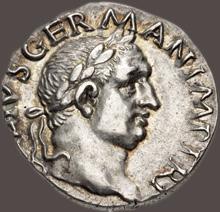


596857. Tiberius. AD 14-37. AV Aureus (18.5mm, 7.70 g, 5h). “Tribute Penny” type. Lugdunum (Lyon) mint. Group 2, AD 15-18. TI CΛESΛR DIVI ΛVG F ΛVGVSTVS, laureate head right; one ribbon on shoulderv / PONTIF MΛXIM, Livia (as Pax) seated right on chair, holding inverted spear in right hand and olive branch in left; ornate chair legs, double line below. RIC I 27 var. (three lines below); Lyon 145; Calicó 305a; BMCRE 39-41; BN 17. Light hairlines. Near EF. Attractive portrait style. $13,500 Ex Dr. Patrick Tan Collection (Gemini VII, 9 January 2011), lot 734; Numismatic Fine Arts (13 May 1991), lot 45 (part of; one of the front cover coins).
596858. Tiberius. AD 14-37. AR Denarius (21mm, 3.79 g, 6h). “Tribute Penny” type. Lugdunum (Lyon) mint. Group 4, AD 18-35. TI CΛESΛR DIVI ΛVG F ΛVGVSTVS, laureate head right; one ribbon on shoulder / PONTIF MΛXIM, Livia (as Pax) seated right, holding scepter and olive branch, feet on footstool; ornate chair legs, single line below. RIC I 30; Lyon 150; RSC 16a; BMCRE 48-60; BN 28–31. In NGC encapsulation 4281838-001, graded AU★, Strike: 5/5, Surface: 4/5. $4500 5603580. Agrippina Senior. Died AD 33. Æ Sestertius (36mm, 29.20 g, 7h). Rome mint. Struck under Claudius, AD 42-43. AGRIPPINA M • F • GERMANICI • CAESARIS •, draped bust right / TI • CLAVDIVS • CAESAR • AVG • GERM • P • M • TR • P • IMP • P • P • around large S • C. RIC I 102 (Claudius); von Kaenel Type 78; BMCRE 219-23 (Claudius); BN 236-40 (Claudius). Olive green patina. Good VF. Attractive portrait. $3750 Ex Phoibos Collection (Künker 326, 7 October 2019), lot 1315.
44
5611730. Augustus. 27 BC-AD 14. AR Denarius (18.5mm, 3.81 g, 6h). Uncertain Spanish mint (Colonia Patricia?). Struck 17-16 BC. Bare head right / AVGVSTVS below, capricorn right, holding globe attached to rudder between front hooves; cornucopia above its back. RIC I 126; RSC 21; BMCRE 346-8 = BMCRR Rome 4374-6; BN 1266-7. Beautiful cabinet tone. Superb EF. Wonderful portrait. Struck with fresh dies. Exceptional. $12,500 Ex Alba Longa Collection (Áureo & Calicó 339, 14 November 2019), lot 1164; Numismatica Ars Classica 21 (17 May 2001), lot 356.




As his great-grandfather Augustus did with Divus Julius Caesar, Gaius had coins struck which included a deified ancestor, in this case Divus Augustus. While later emissions of this type leave no doubt, since the legend DIVVS AVG PATER PATRIAE is included, this earlier denarius, struck in the opening months of the new reign, is more ambiguous: it is anepigraphic, the inclusion of stars argue for recent divinity (Augustus had been deified 23 years earlier), and the features on some of these coins somewhat resemble those of Tiberius. Combined with the historical evidence that Gaius had personally given Tiberius’ funeral oration and had asked the Senate to consider deification for Tiberius, this suggests that Gaius was testing the idea. The Senate, however, refused to pursue the matter further, and the portrait was soon altered to more closely resemble Divus Augustus.
564465. Gaius (Caligula), with Divus Augustus. AD 37-41. AR Denarius (19mm, 3.75 g, 12h). Lugdunum (Lyon) mint. 1st emission, after 18 March AD 37. C • CAESAR • AVG • GERM • P • M • TR • POT • COS •, bare head of Gaius (Caligula) right / Radiate head of Divus Augustus right; two stars flanking. RIC I 2; Lyon 157/2 (D18/R18 – this coin); RSC 11 (Caligula and Augustus); BMCRE 4-5; BN 3-8; Mazzini 11 (this coin); CNR XIII, 65/1 (this coin). Wonderful iridescent cabinet tone.
Choice EF. Certainly one of the finest surviving examples of the type. $49,500 Ex G.T. Collection of the Twelve Caesars (Roma XX, 29 October 2020), lot 493; Exceptional Roman Denarii Collection (Goldberg 80, 3 June 2014), lot 3115; Numismatic Fine Arts XXX (8 December 1992), lot 214; Tkalec (26 March 1991), lot 255; ESR (Eric von SchulthessRechberg) Collection (Hess-Leu [17], 23 March 1961), lot 65; Giuseppe Mazzini Collection, 11.
45 Ex Mazzini Collection – Pedigreed to 1957
Masterful Young Adult Portrait of Nero 598998. Nero. AD 54-68. AR Denarius (19mm, 3.63 g, 6h). Lugdunum (Lyon) mint. Struck AD 61-62. NERO • CAESAR • AVG • IMP •, youthful bare head right / PONTIF • MAX TR P VIII COS IIII • P • P, EX S C across field, Roma standing right, holding and inscribing shield supported on left knee, left foot on helmet; dagger and bow at feet to right. RIC I 34; WCN 49; Lyon 34; RSC 222a; BMCRE 37-38; BN 44. Light toning, traces of deposits on reverse. EF.Rare in this condition. $12,500


596859. Nero. AD 54-68. Æ Sestertius (36mm, 25.31 g, 6h). Lugdunum (Lyon) mint. Struck circa AD 65. NERO CLAVD CAESAR AVG GER P M TR P IMP P, laureate head left, globe at point of neck / ANNONA AVGVSTI CERES, S C in exergue, Annona standing right, holding cornucopia in left hand, facing Ceres seated left, holding grain ears in outstrethced right hand and torch in left; between them, modius on garlanded altar, ship’s stern in background. RIC I 389; WCN 404; Lyon 62; BMCRE –; BN –. Dark green-brown patina, minor smoothing. Near EF. Rare with this obverse legend. $12,500 Ex Lanz 138 (26 November 2007), lot 581; Numismatica Ars Classica 40 (16 May 2007), lot 664. Published in Hewitt • Referenced in RIC 5612156. Clodius Macer. Usurper, AD 68. AR Denarius (17mm, 3.46 g, 12h). Legionary issue. Carthage mint. Group III. L CLODI · MACRI, draped bust of Victory right, with wings folded upward; S C below / L IB above, AVG to right, LEG III across lower field, legionary aquila between two signa. RIC I 14 (this coin referenced); Hewitt Group C/1 (dies 12/15 – this coin); RSC 4; BMCRE p. 287, note 4; BN 4. In NGC encapsulation 5770285-002, graded XF ★, Strike: 4/5, Surface: 5/5. $57,500 Ex Schulman Vault Collection (Schulman 365, 22 October 2020) lot 1535; Münzen und Medaillen AG 25 (17 November 1962), lot 591; reportedly from the Tunis find, circa 1959. Clodius Macer, propraetore in North Africa, rose in rebellion against the reign of Nero during the Civil War in the spring of AD 68. The legion he commanded was Legio III Augusta, based in Numidia. He includes S C (senatus consulto) on his denarii, most likely to show that his revolt was not against the senate, but against Nero. All of Macer’s coins are extremely rare.
46
5612155. Nero. AD 54-68. Æ Sestertius (34mm, 27.96 g, 6h). Lugdunum (Lyon) mint. Struck circa AD 65. NERO • CLAVD • CAESAR • AVG • GER • P • M • TR • P • IMP • P • P, laureate head right, globe at point of neck / S C across field, Triumphal arch, hung with wreath across front and left side; above, Nero in facing quadriga escorted on right by Victory holding wreath and palm and on left by Pax holding caduceus and cornucopia; just below the quadriga on extreme left and right, two small figures of soldiers; on left side of arch in niche, figure of Mars standing facing, holding spear and round shield; ornamental reliefs on the faces and plinths of the arch. RIC I 392; WCN 410; Lyon 70; BMCRE 329; BN 77. Green-brown patina, minor smoothing. Near EF. An excellent portrait and terrific details on reverse. $14,500 Ex Helios 4 (14 October 2009), lot 262.


47 Hispania and Galba in Rebellion
592520. Titus. AD 79-81. AV Aureus (20mm, 7.15 g, 6h). Rome mint. Struck AD 80. IMP TITVS CAES VESPASIAN AVG P M, laureate head right / TR P IX IMP XV COS VIII P P, elephant, cuirassed, advancing left. RIC II.1 114; Calicó 775; BMCRE 42; BN 36; Biaggi 377. Hairlines. Near VF. An important historic type. $9750
The elephant on this aureus type represents one of the numerous species displayed in the newly constructed Flavian Amphitheater, or Colosseum, built by prisoners of the First Jewish War on the site of the Domus Aurea of Nero. Opened to the public during Titus’ rule in AD 80, and commemorated by Martial in de Spectaculis, the Colosseum was welcomed with great fanfare and games. During the opening ceremonies a great number of animals, including elephants, were both exhibited and slaughtered.
By AD 68, Servius Sulpicius Galba had governed Hispania for nearly eight years with a single Roman legion, VI Victrix, under his command. In April of that year, with Nero’s support crumbling, Galba proclaimed himself as representing the Senate and People of Rome, not Nero, thus taking the first steps that would lead to his brief, chaotic reign as emperor. However, the final collapse of Nero’s regime took several months, during which the Roman coinage reflected the uncertain political climate. This rare issue, struck in the name of Galba at an uncertain Gallic mint, refrains from depicting Galba’s portrait, instead showing a female profile personifying the province he governed, Hispania, while the reverse depicts him as a victorious Roman general (imperator) astride his steed.
5600695. Galba. AD 68-69. AR Denarius (18mm, 3.58 g, 6h). Uncertain mint in Gaul (Vienna?). Struck circa April to late autumn AD 68. SER • GALBA • IMP, Galba, in military attire, on horseback galloping right, extending right hand / HISPANIA, bareheaded and draped bust of Hispania right; to left, two javelins above round shield; to right, two stalks of grain. RIC I 86 var. (Galba brandishing javelin; RSC 76a; BMCRE 207-8; BN –. Toned, minor scratch, some cleaning marks. Good VF. $6500


48 A Selection of Issues from the Atonement Series see The ‘Supplicatio’ of Titus and Domitian: Atonement or Celebration? by Michael Gasvoda and David S. Michaels on page 4. Titus. AD 79-81. AV Aureus (19mm, 7.19 g, 5h). ‘Atonement’ series. Rome mint. Struck January-June AD 80. IMP TITVS CAES VESPASIAN AVG P M, laureate head right / TR P IX IMP XV COS VIII P P, pulvinar (throne) of Jupiter: square seat, draped and surmounted by horizontal winged thunderbolt. RIC II.1 117; Calicó 782; BMCRE 49; BN 42; Biaggi 382. Lustrous. Good VF. Well centered. $9750 Titus. AD 79-81. AR Denarius (15.5mm, 3.43 g, 6h). ‘Atonement’ series. Rome mint. Struck 1 January-30 June AD 80. IMP TITVS CAES VESPASIAN AVG P M, laureate head left / TR P IX IMP XV COS VIII P P, pulvinar (throne) of Jupiter and Juno: square seat, draped and surmounted by winged thunderbolt. RIC II.1 120; RSC 314; BMCRE 56; BN 43-4. Light iridescent toning over residual luster. Near EF. $1250
533811. Titus. AD 79-81. AR Denarius (17.5mm, 3.48 g, 5h). ‘Atonement’ series. Rome mint. Struck 1 January-30 June AD 80. IMP TITVS CAES VESPASIAN AVG P M, laureate head right / TR P IX IMP XV COS VIII P P, double curule chair, surmounted by a wreath. RIC II.1 108; RSC 318; BMCRE 66-9; BN 53. Lustrous. EF. $1750 Ex Jack A. Frazer Collection (Classical Numismatic Group Electronic Auction 460, 29 January 2020), lot 625; Ponterio 124 (17 January 2003), lot 453.
Please
563859.
531649. Titus. AD 79-81. AR Denarius (18mm, 3.56 g, 6h). ‘Atonement’ series. Rome mint. Struck 1 January-30 June AD 80. IMP • TITVS CAES VESPASIAN AVG P M •, laureate head right / TR P IX IMP XV COS VIII P P, pulvinar (throne) of Jupiter and Juno: square seat, draped, with tassels: it has a triangular frame on it, on which are eight vertical bars and one palmette. RIC II.1 124; RSC 313a; BMCRE 62; BN 50 var. (number of vertical bars). Attractive light toning with golden hues, underlying luster, patches of hairlines, flan flaw on reverse. EF. Wonderful portrait. $1750 Ex Jack A. Frazer Collection (Triton XXIII, 14 January 2020), lot 700; Ponterio 117 (18 January 2001), lot 417.
5611731.


49 539251. Titus. AD 79-81. AR Denarius (17mm, 3.57 g, 6h). ‘Atonement’ series. Rome mint. Struck 1 January-30 June AD 80. IMP TITVS CAES VESPASIAN AVG P M, laureate head right / TR P IX IMP XV COS XVIII P P, filleted tripod surmounted by dolphin. RIC II.1 128; RSC 321; BMCRE 78; BN 67. Lightly toned with residual luster, minor marks. Good VF. Well centered. $2575 Ex Benito Collection. 539250. Titus. AD 79-81. AR Denarius (17.5mm, 3.44 g, 5h). ‘Atonement’ series. Rome mint. Struck 1 January-30 June AD 80. IMP TITVS CAES VESPASIAN AVG P M, laureate head right / TR P IX IMP XV COS VIII P P, dolphin coiled downward around anchor. RIC II.1 112; RSC 309; BMCRE 72-5; BN 60-3. Some faint hairlines and porosity. Good VF. $1500 Ex Benito Collection. 592522. Domitian. As Caesar, AD 69-81. AV Aureus (19mm, 7.34 g, 6h). ‘Atonement’ series. Rome mint. Struck under Titus, AD 80-81. CAESΛR DIVI F DOMITIΛNVS COS VII, laureate head right / PRINCEPS IVVENTVTIS, garlanded and lighted altar. RIC II.1 265 (Titus); Calicó 918; BMCRE 91 (Titus); BN 74 (Titus); Biaggi 430. Broad flan, residual luster. VF. $8500 509800. Domitian. As Caesar, AD 69-81. AR Denarius (19mm, 3.54 g, 6h). ‘Atonement’ series. Rome mint. Struck under Titus, AD 80-81. CAESΛR DIVI F DOMITIΛNVS COS VII, laureate head right / PRINCEPS IVVENTVTIS, garlanded and lighted altar. RIC II.1 266 (Titus); RSC 397a; BMCRE 92-6 (Titus); BN 76-7 (Titus). Lovely light toning, lustrous, minor marks. EF. $1250 561066. Domitian. As Caesar, AD 69-81. AV Aureus (19mm, 7.20 g, 6h). ‘Atonement’ series. Rome mint. Struck under Titus, AD 80-81. CΛESΛR DIVI F DOMITIΛNVS COS VII, laureate head right / PRINCEPS IVVENTVTIS, pulvinar (throne) of Minerva: crested Corinthian helmet set on draped square seat. RIC II.1 270 (Titus); Calicó 920; BMCRE 97 (Titus); BN 78 (Titus). Minor surface marks. VF. $5500


5601928.
50
541046. Domitian. AD 81-96. AR Denarius (19mm, 3.45 g, 6h). ‘Atonement’ series. Rome mint. Struck 13 September–31 December AD 81. IMP CAES DOMITIANVS AVG P M, laureate head right / TR P COS VII DES VIII P P, dolphin right above filleted tripod. RIC II.1 74; RSC 568c var. (ravens below); BMCRE 22; BN 19. Light toning, some original find patina in legends. Near EF. Well struck and attractive. $1200 Hadrian. AD 117-138. AR Denarius (18mm, 3.10 g, 6h). Rome mint. Struck AD 133-circa 135. HADRIANVS AVG COS III P P, bare head right / SALVS AVG, Salus, draped, standing right, right hand extended, feeding out of patera in left hand snake coiled around and rising from altar to right. RIC II.3 2048; Strack 264δο; RSC 1335; BMCRE 716 and 718. Beautiful iridescent tone with underlying luster, a few very minor flan flaws on reverse. Choice EF. $2250 Ex Leu Numismatik 3 (27 October 2018), lot 240.
561098. Domitian. As Caesar, AD 69-81. AR Denarius (18mm, 3.51 g, 6h). ‘Atonement’ series. Rome mint. Struck under Titus, AD 80-81. CAESAR • DIVI F DOMITIANVS COS VII •, laureate head right / PRINCEPS IVVENTVTIS, pulvinar (throne) of Minerva: crested Corinthian helmet set on draped square seat. RIC II.1 271 (Titus); RSC 399a; BMCRE 102 (Titus); BN 79 (Titus). Light iridescent tone, slightly granular surfaces, minor deposits. EF. $1150
566202. Domitian. AD 81-96. AR Denarius (18.5mm, 3.39 g, 12h). ‘Atonement’ series. Rome mint. Struck 13 September–31 December AD 81. IMP CΛES DOMITIΛNVS AVG P M, laureate head right / TR P COS VII DES VIII P P, dolphin coiled downward around anchor. RIC II.1 54; RSC 568; BMCRE 20; BN 26. Faint scratches, some luster remains, die flaw on reverse. Near EF. $950


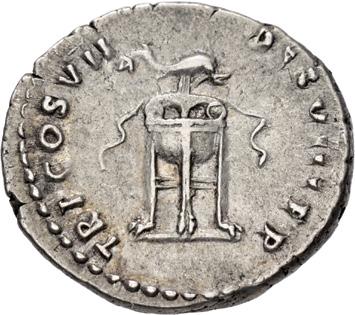


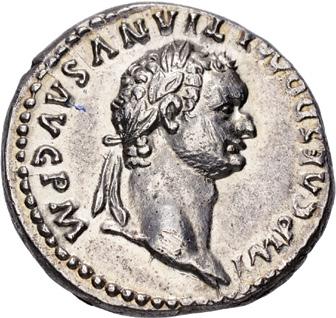


5600699. Caracalla. AD 198-217. AR Denarius (19mm, 3.14 g, 6h). Rome mint. Struck AD 216. ANTONINVS PIVS AVG GERM, laureate and bearded head right / P M TR P XVIIII COS IIII P P, Sol standing left, raising right hand and holding globe in left. RIC IV 281b; RSC 359; BMCRE 172-3. Choice EF. Well centered and struck with fresh dies. $750
51 Exceptional Faustina Junior Aureus 5603515. Faustina Junior. Augusta, AD 147-175. AV Aureus (20mm, 7.23 g, 6h). Rome mint. Struck under Antoninus Pius, circa AD 147-150. FAVSTINΛE ΛVG PII ΛVG FIL, draped bust right, wearing stephane, wearing hair bound in pearls at back of head / LAETITIΛE PV BLICΛE, Laetitia, draped, standing left, holding diadem in extended right hand and vertical scepter in left. RIC III 506c (Pius); Beckman, Faustina, Group I (dies fa6/LP2), a (this coin referenced and illustrating dies in plates); Calicó 2069a; BMCRE 1047; Biaggi 933. Lustrous. FDC. Struck with dies of artisitic merit, this coin is certainly among the finest, if not the finest known. $28,500 Ex Tkalec (22 April 2007), lot 236. 596860. Lucius Verus. AD 161-169. AR Denarius (18.5mm, 3.48 g, 2h). Rome mint. Struck AD 165. L VERVS AVG ARM PARTH MAX, laureate head right / TR P V · IMP III COS II, Parthian captive seated right, hands bound behind his back; at feet, bow, quiver and shield. RIC III 540 (Aurelius); MIR 18, 112-14/30; RSC 273. Attractive iridescent tone. In NGC encapsulation 4936390-002, graded Ch AU, Strike: 5/5, Surface: 4/5. $1350 598985. Commodus. AD 177-192. Æ Sestertius (32mm, 29.14 g, 6h). Rome mint. Struck AD 184. M COMMODVS AN TONINVS AVG PIVS, laureate head right / TR P VIIII IMP VI COS IIII P P, S C across field, Fides standing right, holding two stalks of grain in right hand and raising plate of fruits with left. RIC III 413; MIR 18, 598-6/30; Banti 478. Dark brown patina. Good VF. $2950 Ex CNG inventory 902141 (August 2011).


52 588855. Macrinus. AD 217-218. Æ As (25mm, 12.95 g, 12h). Rome mint. 2nd emission, AD 217-218. IMP CAES M OPEL SEV MACRINVS AVG, laureate and cuirassed bust right, wearing long beard / PONTIF MAX TR P II, COS II P P in exergue, S C across field, Macrinus, togate, standing left in triumphal quadriga of four horses pacing left, holding branch in right hand and short scepter in left; to right, behind him, Victory standing left, crowning him. RIC IV 162; Clay Issue 2; BMCRE 134. Dark green-brown patina. Good VF. $1250 599095. Gordian III. AD 238-244. Æ As (25mm, 11.34 g, 12h). Rome mint, 3rd officina. 8th-11th emissions, late AD 240-early 243. IMP GORDIANVS PIVS FEL AVG, laureate, draped, and cuirassed bust right / LAETITIA AVG N, S C across lower field, Laetitia standing left, holding wreath in right hand and anchor in left. RIC IV 300b. Green patina, lightly smoothed. EF. Rare in high grade. $875 Purchased from Freeman & Sear, 27 November 1998. Wonderful Hippopotamus 598986. Otacilia Severa. Augusta, AD 244-249. Æ Sestertius (26mm, 19.09 g, 12h). Ludi Saeculares (Secular Games) issue, commemorating the 1000th anniversary of Rome. Rome mint, 4th officina. 9th emission of Philip I, AD 248. MA[RCIA]
OTACIL SEVERA AVG, draped bust right, wearing stephane / SAECVLARES AVGG, S C in exergue, hippopotamus standing right. RIC IV 200a (Philip I); Banti 13. Dark brown patina, minor roughness on obverse. Good VF. A wonderful Hippopotamus. $1450 Ex Classical Numismatic Group 87 (18 May 2011), lot 1104. Continuing the tradition of Claudius and Antoninus Pius before him, the celebration of the Secular Games at the end of every century since the founding of Rome culminated during the reign of Philip I, as the city celebrated her 1,000th anniversary in AD 248. The legends on these issues almost exclusively read SAECVLARES AVGG, and feature a similar iconography from previous games, such as the she-wolf suckling the twins, the various wild beasts paraded through the amphitheater, and a cippus inscribed for the preservation of the memory of these events. Ex Biaggi Collection – Calicó Plate Coin 5603516. Diocletian. AD 284-305. AV Aureus (18mm, 5.09 g, 6h). Treveri (Trier) mint. Struck AD 303. DIOCLETI ANVS P AVG, laureate head right / IOVI CONSERVAT AVGG ET CAES NN, Jupiter seated left, holding thunderbolt in right hand and scepter in left; TR. RIC VI 52; Depeyrot 10B/1 (same dies as illustration); Calicó 4478 (this coin illustrated); Biaggi 1712 (this coin). Good VF. $27,500 Ex Numismatica Ars Classica 34 (21 November 2006), lot 201; Leo Biaggi de Blasys Collection. 588855 599095


53 5611889. Diocletian. AD 284-305. AR Argenteus (18mm, 2.68 g, 5h). Siscia mint. 1st emission, 2nd series, autumn AD 294-295. DIOCLETI ANVS AVG, laureate head right / VICTORIA SARMAT, Tetrarchs sacrificing over tripod before city enclosure with six turrets; –|–//–. RIC VI 36; Gautier, Argent 6; RSC 488h. Lustrous, hints of iridescent tone on reverse. Choice EF. $2450 5603585. Carausius. Romano-British Emperor, AD 286-293. Antoninianus (23mm, 4.37 g, 6h). ‘C’ mint. IMP C CARAVSIVS P F AVG, radiate, draped, and cuirassed bust right / PAX AVG, Pax standing left, holding up olive branch in right hand and transverse scepter in left; S|P//–. RIC V 484. Brown patina, hairline flan crack. EF. Wonderful portrait. $1950 Ex Künker 326 (7 October 2019), lot 1598. Apparently Unique 5603521. Constantius I. As Caesar, AD 293-305. AV Aureus (18.5mm, 5.06 g, 6h). Treveri (Trier) mint. 1st emission, autumn AD 293-early 294. CONSTA NTIVS N C, laureate head right / IOVI CONS ERVATORI, Jupiter enthroned left, holding thunderbolt in outstretched right hand and scepter in left; at feet to left, eagle standing left, head and tail right, with wings displayed, holding wreath in beak; PTR. RIC VI –; Zanchi & Estiot 14a (CCL 2/ R 6 – this coin, illustrated); Depeyrot –; Calicó 4847a (this coin illustrated). Lustrous, a few faint hairlines/scratches. Superb EF. The only example in CoinArchives. Apparently unique. $29,500 Ex Numismatica Ars Classica 24 (5 December 2002), lot 250; Tkalec (25 October 1996), lot 270.


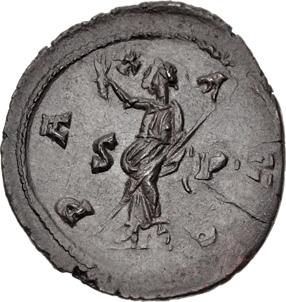


54 Ex Mazzini Collection – Pedigreed to 1957
5612764. Galerius. As Caesar, AD 293-305. AR Argenteus (19mm, 2.32 g, 6h). Ticinum mint. 1st emission, 2nd series, AD 294-295. MAXIMIAN VS CAESAR, laureate head right / VICTORIA SARMAT, Tetrarchs sacrificing over tripod before city enclosure with six turrets; –|–//–. RIC VI 17b; Gautier, Argent 12ar (this coin); RSC 208c. Light iridescent tone, lustrous. Choice EF. $1575 Ex DMS Collection; Berk BBS 168 (16 March 2010), lot 320. 5603586. Galerius. As Caesar, AD 293-305. AR Argenteus (20.5mm, 3.17 g, 6h). Thessalonica mint, 1st officina. 3rd emission, 1st series, circa AD 300. MAXIMIA NVS NOB C, laureate head right / CONCOR DIA M ILITVM, four-turreted city gate with doors; star above arch; *//TS •A•. RIC VI 8; Gautier, Argent 6; RSC 22A. Wonderful old cabinet tone. EF. Perfectly centered and struck on a broad flan. Rare type. $1950 5612629. Helena. Augusta, AD 324-328/30. Æ Follis (18mm, 2.92 g, 6h). Treveri (Trier) mint, 2nd officina. Struck under Constantine I, AD 327-328. FL HELENA AVGVSTA, diademed and mantled bust right, wearing pearl necklace / SECVRITAS REIPVBLICAE, Securitas standing left, holding branch pointing downward in right hand and raising pallium with left; STRE. RIC VII 508; LRBC 41. Silvering with toning. Near EF. $345
5603523. Galerius. As Caesar, AD 293-305. AV Aureus (17.5mm, 5.44 g, 6h). Treveri (Trier) mint. Struck AD 303. MAXIMI ANVS NOB C, laureate head right / IOVI CONSERVAT AVGG ET CAES NN, Jupiter seated left, holding thunderbolt in right hand and scepter in left; TR. RIC VI 53; Depeyrot 10B/3 (same dies as illustration); Calicó 4914 (same dies as illustration); Biaggi 1859 (same dies); Mazzini 121 (this coin). A few faint scratches. EF. Rare. $23,500 Ex Numismatica Ars Classica 46 (2 April 2008), lot 695; Giuseppe Mazzini Collection.


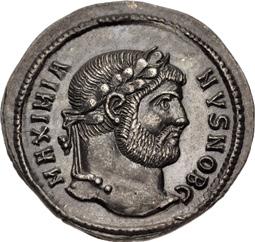


55 Pedigreed to 1925 5603526. Constans. AD 337-350. AV Solidus (21mm, 4.62 g, 6h). Treveri (Trier) mint. Struck December AD 343-November 344. FL IVL CONS TANS P F AVG, laurel and rosette-diademed, draped, and cuirassed bust right / OB VICTORIAM TRIVMFALEM, two Victories standing facing each other, holding between them wreath inscribed VOT/ X/ MVLT/ X•V in four lines; TR. RIC VIII 124; Depeyrot 4/4. Underlying luster, some minor marks. Near EF. $5750 Ex Demarete Collection (Stack’s Bowers & Ponterio 168, 8 August 2012), lot 20512; Don I. Soler Collection (Glendining, 24 November 1925), lot 181. 5604247. Constans. AD 337-350. Æ Centenionalis (25mm, 4.55 g, 5h). Thessalonica mint, 4th officina. Struck AD 348-350. Pearl-diademed, draped, and cuirassed bust right, holding globe / Soldier left, spearing fallen horseman; shield to lower right; TSΔ*. RIC VIII 116; LRBC 1647. Some toned silvering remains. Choice EF. Well struck on a broad flan. $575 5603529. Constantius II. AD 337-361. AV Solidus (22mm, 4.44 g, 6h). Treveri (Trier) mint. Struck AD 345. CONSTANTI VS AVGVSTVS, laurel and rosette-diademed, draped, and cuirassed bust right / VICTORIAE DD NN AVGG, two Victories standing facing each other, holding between them wreath inscribed VOT/ XX/ MVLT/ XXX in four lines; TR. RIC VIII 128; Depeyrot 6/2; Biaggi –. Light cleaning scratches on obverse, minor deposit on reverse. EF. Rare. $6250 Ex Numismatica Ars Classica 23 (19 March 2002), lot 1689. 5612632. Julian II. AD 360-363. Æ (19mm, 3.41 g, 1h). Sirmium mint, 2nd officina. Struck AD 361-363. D N FL CL IVLI ANVS P F AVG, pearl-diademed, helmeted, and cuirassed bust left, holding spear in right hand and shield on left arm / VOT/ X/ MVLT/ XX in four lines within wreath; BSIRM. RIC VIII 108; LRBC 1619. Brown patina. EF. $375


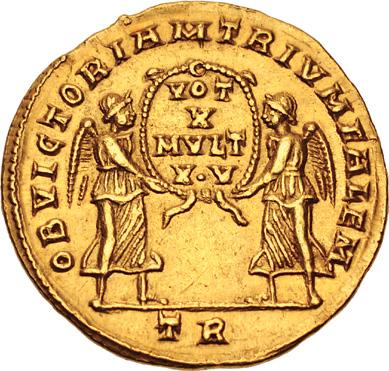

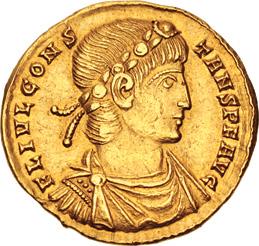

56 5615563. Gratian. AD 367-383. AR Miliarense (23mm, 4.35 g, 12h). Treveri (Trier) mint. Struck AD 367-375. D N GRATIA NVS P F AVG, pearl-diademed, draped, and cuirassed bust right / VIRTVS EXERCITVS, Gratian standing facing, head left, holding signum with right hand, placing left hand on shield set on ground; TRPS•. RIC IX 26e; RSC 52†b. Old cabinet tone with light iridescence, minor marks. Good VF. $4250 Flavius Gratianus was the son of Valentinian I, one of the last capable Western Roman rulers. In AD 367, at the age of eight, Gratian was proclaimed co-Augustus by his father. Only eight years later, in AD 375, Valentinian suffered an apoplectic stroke and died, leaving the western throne to the 16-year-old Gratian. A few days later, a cabal led by Gratian’s stepmother proclaimed his five-year-old half-brother, Valentian II, as co-emperor. To his credit, Gratian agreed to share power with his sibling. Gratian established his court at Trier, Germany, where this rare silver miliarense was struck. Gratian was a devout Christian and was the first emperor to refuse the title of Pontifex Maximus. In AD 378, Gratian was on his way east with reinforcements to fight the Goths when his uncle, the Eastern Emperor Valens, was killed in the catastrophic battle of Adrianople. After careful deliberations, Gratian chose the capable Theodosius I as Valens’ replacement. Gratian’s youth and ability seemed to promise a long reign, but in AD 383 the duke of Britain, Magnus Maximus, proclaimed himself emperor and crossed the channel. Gratian advanced to Paris to intercept him, but his troops, angered at his earlier refusal to raise their pay, deserted to the usurper. Gratian fled toward the Alps, but was overtaken at Lugdunum and executed on August 25, AD 383, at the age of 24.
5615323. Arcadius. AD 383-408. AV Solidus (21mm, 4.49 g, 12h). Ravenna mint. Struck AD 402-406. D N ARCADI VS AVG, pearl-diademed, draped, and cuirassed bust right / VICTORI A AVGGG, Arcadius standing right, holding labarum and Victory on globe, foot on captive below; R-V//COMOB. RIC X 1286; Ranieri 2-3; Depeyrot 7/2. Lustrous. EF. $2500 Brilliant Magnus Maximus Solidus
Maximus’ grab for power proved ill-advised, igniting a destructive civil war and fatally weakening the Western Empire, particularly in Britain and northern Gaul. It is claimed, however, that a descendent of his ended up marrying Vortigern, king of the Britons, and is it through this union that several Welsh kings claimed Maximus as an ancestor.
5607251. Magnus Maximus. AD 383-388. AV Solidus (21mm, 4.46 g, 6h). Treveri (Trier) mint. Struck AD 383-384. D N MAG MA XIMVS P F AVG, rosette-diademed, draped, and cuirassed bust right / RESTITVTOR REI PVBLICAE, Maximus, diademed and in military attire, standing facing, head right, holding labarum in right hand and in left, Victory standing left on globe holding wreath and palm frond; *|–//SMTR. RIC IX 76.2; Depeyrot 50/1 corr. (position of star); Biaggi 2309. A few faint marks and hairlines, otherwise lustrous and attractive. EF. Rare. $14,750 A capable general of Spanish birth, Flavius Magnus Clemens Maximus was appointed military commander of Britain in AD 380. Three years later, Maximus made a bid for the throne of the Western Roman Empire, then ruled by the young Gratian and his brother Valentinian II. After disposing of Gratian, Maximus proposed a three-way division of the Empire, with himself ruling Britain, Gaul, Germany and Spain, Valentinian II ruling Italy and Africa, and Theodosius I, another Spaniard, holding the East. During this period of relative calm, Maximus struck this gold solidus at the mint of Trier, with a reverse hailing him as the “Restorer of the Republic.” He was a zealous Christian who persecuted those whom he percieved as heretics, including the Spanish ascetic Priscillian and his followers; however, he showed respect for the Jewish faith. The uneasy equilibrium lasted about three years but, in AD 387, Maximus launched an invasion of Italy, provoking a final showdown with Theodosius. In a lightning campaign, Theodosius struck westward and defeated Maximus before he could fully marshal his forces. Both Maximus and his son Victor were summarily executed by Theodosius, who restored Valentinian II to the Western throne.


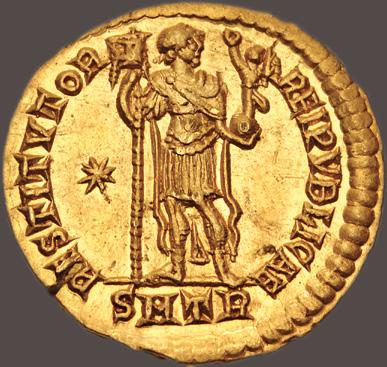
5615326.
57 Eugenius. AD 392-394. AR Siliqua (19mm, 2.07 g, 11h). Lugdunum (Lyon) mint, second officina. D N EVGENI VS P F AVG, pearl-diademed, draped, and cuirassed bust right / VRBS ROMA, Roma seated left on cuirass, holding Victory on globe in right hand and inverted spear in left; LVGPS. RIC IX 46; Lyon 230; RSC 18A. Attractive toning, hairline flan crack, slightly irregular edge. Near EF. Rare. $1975 Honorius. AD 393-423. AV Solidus (21mm, 4.42 g, 6h). Mediolanum (Milan) mint. Struck AD 397-402. D N HONORI VS P F AVG, pearl-diademed, draped, and cuirassed bust right / VICTORI A AVGGG, Honorius standing right, holding standard and Victory on globe, foot on captive; M|D//COMOB. RIC IX 35c = RIC X 1206a; Toffanin 486/2; Depeyrot 16/2. Lustrous, minor marks. Near EF. $1875 5615328. Theodosius II. AD 402-450. AV Solidus (21mm, 4.46 g, 6h). Constantinople mint, 2nd officina. Struck late AD 425-429. D N THEODO SIVS P F AVG, pearl-diademed, helmeted, and cuirassed bust facing slightly right, holding spear over shoulder in right hand and shield decorated with horseman motif in left / SALVS REI PVBLICAE, Theodosius II and Valentinian III seated facing on double throne, each nimbate and wearing consular robes, holding mappa in right hand, cruciform scepter in left; star above; B//CONOB. RIC X 237; Depeyrot 79/1. Lustrous, some light scratches on obverse. EF. $2775 Byzantine 5615329. Justinian I. 527-565. AV Solidus (21mm, 4.50 g, 7h). Constantinople mint, 6th officina. Struck 545-565. D N IVSTINI ANVS P P AVC, helmeted and cuirassed bust facing, holding globus cruciger and shield / VICTORI A AVCCC, Angel standing facing, holding long staff surmounted by staurogram and globus cruciger; star to right; ς//CONOB. DOC 9f; MIBE 7; SB 140. Lustrous, minor hairlines, small dig and trace deposits on reverse. EF $1250 Ex collection of a European ambassador, formed in the 1950s.
5615568.


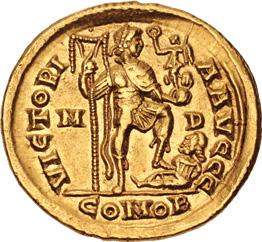


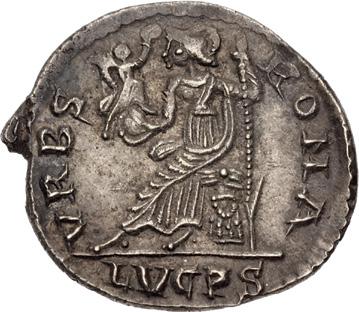


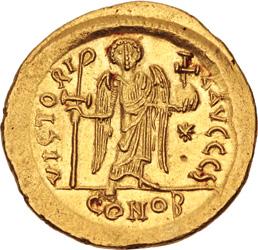


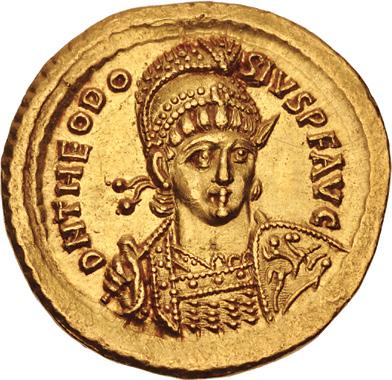
58 5612665. Phocas. 602-610. AV Solidus (22mm, 4.35 g, 7h). Constantinople mint, 10th officina. Struck 603. O N FOCAS PЄRP AVG, Draped and cuirassed bust facing, wearing crown with pendilia and holding globus cruciger / VICTORI A AVGG, Angel standing facing, holding long staff surmounted by staurogram and globus cruciger; I//CONOB. DOC 1d; MIBE 5; SB 616. Lustrous, edge lightly clipped. EF. $1750 5615332. Heraclius, with Heraclius Constantine and Heraclonas. 610-641. AV Solidus (20mm, 4.50 g, 6h). Constantinople mint, 4th officina. Struck 638/9-641. Heraclonas, Heraclius, and Heraclius Constantine standing facing, each wearing crown and chlamys and holding globus cruciger / VICTORIA AVςЧ, Cross potent set on three steps; monogram to left; Δ//CONOB. DOC 43c; MIB 50; SB 769. Lustrous. Near EF. $1250 Ex collection of a European ambassador, formed in the 1950’s. 5603589. Constans II. 641-668. AV Solidus (20mm, 4.43 g, 6h). Constantinople mint, 3rd officina. Struck 641-646/7. δ N CONSτAN τINЧS P P AVG, very small crowned and draped bust facing, holding globus cruciger in right hand / VICTORIA AVςЧ, cross potent set on three steps; Γ//CONOB. DOC 1a (Heraclonas); MIB 3a; SB 936. Lustrous. Choice EF. $1450 Ex Sincona 3 (25 October 2011), lot 3269; Tkalec (22 April 2007), lot 391. 5615335. Leontius. 695-698. AV Solidus (20mm, 4.45 g, 6h). Constantinople mint, 1st officina. D LЄO N PЄ AV, crowned bust facing, wearing loros, holding mappa and globus cruciger / VICTORIA AVςЧ, cross potent set upon three steps; A// CONOB. DOC 1a; MIB 1; SB 1330. Lustrous, trace deposits, reverse die crack. EF $2750 Ex collection of a European ambassador, formed in the 1950’s. Governor of the Theme of Hellas in Greece, Leontius was proclaimed Emperor after the overthrow of Justinian II in AD 695. His first mistake was not executing his predecessor; instead he cut off Justinian’s nose and banished him to Crimea. With the Byzantines in turmoil, the Arabs went on the offensive in North Africa and captured Carthage in AD 698. The fleet Leontius sent to relieve the city instead rebelled and proclaimed its admiral Apsimar as Emperor. Leontius abdicated and was initially spared, but was murdered after Justinian II’s return to power in AD 705. The coins of Leontius boast unusually realistic portraiture, portraying him as a portly man with a close-cropped beard.


5603590. Leo VI the Wise. 886-912. Æ Follis (26.5mm, 6.70 g, 6h). Constantinople mint. + LЄOҺ bAS ILЄVS ROm’, crowned and draped bust facing, holding akakia / +LЄOҺ/ ЄҺ ӨЄO ЬA/SILЄVS R/OmЄOҺ in four lines. DOC 8; SB 1729. Wonderful olive green patina. EF. $325
5615339. Leo III the “Isaurian”, with Constantine V. 717-741. AV Solidus (20.5mm, 4.46 g, 6h). Constantinople mint. Struck 724-731. ∂ NO LЄO N PA MЧLI, crowned and draped bust of Leo facing, holding globus cruciger and akakia / ∂ N CONS τANτINЧS H, crowned and draped bust of Constantine facing, holding globus cruciger and akakia. DOC 7f; Füeg 7.B.1; SB 1504. Fully lustrous, light scratches, minor weakness in the periphery. EF. $1750
59
Ex collection of a European ambassador, formed in the 1950s. Together reigning nearly 60 years, Leo III and his son Constantine V reshaped Byzantine society and preserved the empire’s core in the face of the onslaught of Arab armies and Slavic invaders alike. Born to a peasant family in northern Syria, Leo III rose to become commander of the Anatolikon Theme in Asia Minor. With the Arabs preparing a massive siege of Constantinople, Leo’s soldiers proclaimed him emperor in March of AD 717. Six months later, the long-anticipated siege commenced. Leo proved equal to the task of defending the capital, and with the help of a new secret weapon called Greek fire and a timely counterattack, the Arabs were utterly routed. In 740, Leo cemented his reputation as a peerless soldier by crushing the Arab army at the battle of Akroinon in Phrygia. He also instituted numerous reforms that strengthened the central government and improved fairness in the administration of law. But he is chiefly known for his policy of iconoclasm-- the destruction of sacred images, which he regarded as akin to the graven images condemned in the Ten Commandments. His efforts to enforce his beliefs on an unwilling clergy and populace became a true persecution late in his reign, and were even more zealously carried out by his son and successor, Constantine V, whose long reign was marked by further military success abroad and heavy-handed repression within. The iconoclast controversy sowed discord throughout the Byzantine world for more than a century and counteracted many of the reforms and victories achieved by father and son. Still, their efforts ensured the empire’s survival and paved the way for the great Macedonian Renaissance in the following century.
5615336. Tiberius III (Apsimar). 698-705. AV Solidus (19mm, 4.42 g, 6h). Constantinople mint, 8th officina. D τIbЄRI ЧS PЄ AV, crowned and cuirassed bust facing, holding spear and shield decorated with horseman motif / VICTORIA AVςЧ, cross potent set on three steps; H//CONOB. DOC 1g; MIB 1; SB 1360. Lustrous, light scratches on reverse, slightly off center. EF. $1775
Ex collection of a European ambassador, formed in the 1950s.
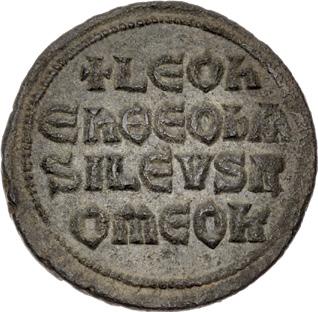


Ex
5607257.
Ų
แ •
599000.
S
•
• ѝƱȄ]n⌴ѝ] •
Ex
Early
Ex
mint. +
แ
•
5611381.
⌴SPtȄ= • S= • Ʊ⌴ƌƱS • ƱˊȄɀƱ • ʲt= • ˊ⌴dƱ
60 Eudocia, with Michael VII and Constantius. 1067. AV Histamenon Nomisma (25mm, 4.37 g, 6h). Constantinople Ih XIS RЄX RЄ NANTIΛI m, Christ Pantokrator enthroned facing / + MIX ЄV ΔK ΚωRP, Eudocia, holding jeweled scepter in right hand, standing facing on footstool, flanked by her sons Michael and Constantius, each holding globus cruciger and akakia. DOC 1.2; Füeg II 1.y; SB 1857. Toned, underlying luster. EF. Pleasing details. $5500 Moneta Imperii Romani Byzantini: The Collection of a Connoisseur (Stack’s, 12 January 2009), lot 3267. Medieval CRUSADERS, Knights of Rhodes (Knights Hospitaller). Hélion of Villeneuve. 1319-1346. AR Gigliato (27mm, 3.85 g, 4h). fˊ EȄƱ⌴ɀ= d= dƱ gˊ] ȶˊ, Grandmaster kneeling left before patriarchal cross on three steps / Ḧ , cross fleurée; each bar ending in shield with arms of the Order of St. John. Metcalf, Crusades 1175-1180 and 1182; CCS 4. Well struck and beautifully toned. EF. $1475 Classical Numismatic Group 40 (4 December 1996), lot 27. World AUSTRIA, Holy Roman Empire. Rudolf II. Emperor, 1576-1611. AR Quarter Taler (30mm, 12h). Dated 1603. Crowned and collared coat-of-arms. Moser & Tursky 356; Moser & Tursky, Rudolf R284; KM 44. Rich cabinet toning. In NGC encapsulation 21258746-026, graded MS 61. Very rare, especially in this condition. $3250 Koehlmoos Collection; Meister & Sonntag 9 (26 May 2010), lot 982.
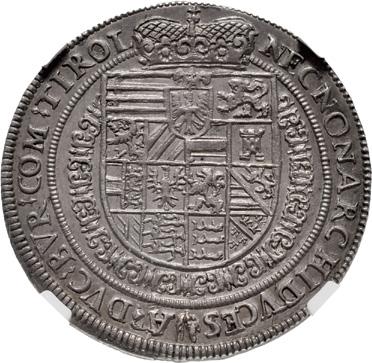


597644. GERMANY, Erfurt (Swedish occupation). Gustav II Adolf. 1611-1632. AV Ducat (22mm, 3.45 g, 2h). Dated 1634. Laureate bust right / Crowned coat-of-arms; mintmarks flanking. SB 12; Delzanno, Guldmynt 52.2; Friedberg 923; KM 54. In NGC encapsulation 6458842-001, graded AU 58. $3500 Finest Graded by NGC 597645. GERMANY, German Empire. Waldeck-Pyrmont (Principality). Friedrich. 1893-1918. AV 20 Marks (22m, 7.96 g, 12h). Berlin mint. Dated 1903 A. Bare head left / Crowned eagle with wings spread, head left, collared coat-of-arms on breast. Jaeger 288; cf. Friedberg 3869 (for business strike); KM (Y) 214. In NGC encapsulation 6459256-001, graded PF 66 Ultra Cameo. Very rare. A gem survivor from a reported mintage of only 150 proof strikes. The finest graded by NGC. $35,000 Ex A. Hess 243 (3 April 1974), lot 627. 597642 597643
61 597642. BELGIUM. Léopold I. 1831-1865. AV 25 Francs (23mm, 7.90 g, 6h). Bruxelles (Brussels) mint. Dated 1848 Bare head right / Crowned and mantled coat-of-arms over crossed scepters. Morin 1; Friedberg 405; KM 13.1. In NGC encapsulation 6459253-001, graded MS 62. $2750 597643. BELGIUM. Léopold I. 1831-1865. AV 25 Francs (23mm, 7.90 g, 6h). Bruxelles (Brussels) mint. Dated 1850. Bare head right / Crowned and mantled coat-of-arms over crossed scepters. Large head variety. Morin 3; Friedberg 407; KM 13.3. Attractively toned. In NGC encapsulation 6458834-001, graded MS 64. Rare in this exceptional grade. $5500
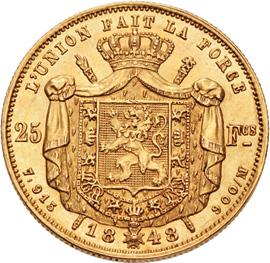


62 Enigmatic Bombay Issue 5607340. INDIA, Colonial. British India. Victoria. Queen of the United Kingdom of Great Britain and Ireland, 18371901. AV Mohur (26mm, 11.68 g, 12h). Continuous legend type. Uncertain, possibly Bombay mint. Dated 1841. VICTORIA QUEEN, young head left; date below; dot on truncation of neck / EAST INDIA COMPANY, lion advancing left; palm tree behind; in exergue, ONE MOHUR above, yek ashrafi (= one ashrafi) in Persian. S&W (online) 2.5C - this coin cited and illustrated; Pridmore –; cf. KM 461.1 (for type); Friedberg 1595a. In NGC encapsulation 6472716-001, graded MS 62+. A great rarity of the British Indian mohur series. $42,500 Ex F. Pridmore (Glendining, 17 October 1983) lot 10 (includes auction lot envelope with Pridmore collection ticket). Type 1 gold mohurs dated 1841 with continuous legend on obverse were struck at three mints: Calcutta, Madras and Bombay. Calcutta dominated production with a recorded mintage of 601,088. The output of Madras was much smaller at 32,276 while the Bombay mint struck a mere 5,960 such coins. Mohurs from Madras bear a small incuse S on truncation, but a means of distinguishing between the issues of the Calcutta and Bombay mints has proved elusive. When this coin was offered in the sale of the celebrated Fred Pridmore collection in 1983 it was suggested that the distinctive raised dot on truncation ‘was possibly the privy mark for the Bombay mint’ and raised dots are a diagnostic of Bombay mint coins from 1862. The dot-on-truncation variety was subsequently included in Krause Mishler’s Standard Catalogue and priced at more than double the plain truncation mohur but omitted by Paul Stevens and Randy Weir when compiling their monumental Uniform Coinage of India, published in 2012. Presumably neither author had seen a specimen. Our coin was recently shown to Paul Stevens who has published it on his online catalogue www.psindiancoins.com as S&W 2.5C with a rarity of RRR, the highest degree of rarity the author uses. This is the only dot-on-truncation type 1 mohur graded by NGC.
5607342. INDIA, Colonial. British India. Victoria. Queen of the United Kingdom of Great Britain and Ireland, 1837-1901. AV Mohur (26mm, 11.63 g, 12h). Divided legend type. Calcutta mint. Dated 1841. VICTORIA QUEEN, young head left; date below, serif on crossbar of 4; incuse W. W. on truncation of neck / EAST INDIA COMPANY, lion advancing left; palm tree behind; in exergue, ONE MOHUR above, yek ashrafi (= one ashrafi) in Persian. UCI 3.11; Pridmore 22(2); Friedberg 1595a. In NGC encapsulation 6471042-002, graded AU 58. $12,500
5607341. INDIA, Colonial. British India. Victoria. Queen of the United Kingdom of Great Britain and Ireland, 1837-1901. AV Mohur (26mm, 11.65 g, 1h). Divided legend type. Calcutta mint. Dated 1841. VICTORIA QUEEN, young head left; date below, serif on crossbar of 4; incuse W. W. on truncation of neck / EAST INDIA COMPANY, lion advancing left; palm tree behind; in exergue, ONE MOHUR above, yek ashrafi (= one ashrafi) in Persian. UCI 3.11; Pridmore 22(2); Friedberg 1595a. In NGC encapsulation 6471042-001, graded MS 62. $17,500



๘ ⍒ŷɇ Ḽ ēĿƱ Ḽ ʠ⎍Ʊ Ḽ ˶ɦLL= Ḽ ʁ!ýý⍒ Ḽ M⎍ēƱ Ḽ MƱSĿrĿrĿ Ḽ NɦÙ= , agnus Dei standing
banner on long
‘The mouton, so called because of the Agnus Dei to which the obverse design and legend were devoted, was first issued in France by John the Good in 1355, but its antecedents went back to a coin of Philip IV named, more reverently, the agnel. The French king no doubt selected the type out of piety, but it was probably the mundane association of the sheep with the textile industry which made the coin a popular subject for imitation by the princes of the Netherlands.’ (John Porteous. Coins in History)
63
๘ Ḧ
The illustrious line of the house of d’Este, the Dukes of Ferrara, ended abruptly when Duke Alfonso II in October 1597 without naming an heir. The seat was claimed by Alfonso’s cousin, Cesare d’Este, a claim which was backed by Holy Roman Emperor Rudolf II, but this claim was not recognized by the Pope. In 1598, the Papal state assumed direct control over the formerly independent duchy, and the governance of the territory was assumed by cardinal legate Paolo Aldobrandini. This exceptional type was struck in 1598 and represents the first Papal coinage for the mint at Ferrara. The obverse depicts a unique portrait of Clement VIII in prayer before a crucifix, while the reverse bears the coat of arms of the cardinal legate Aldobrandini. The dies were likely engraved in Rome and sent to Ferrara.
599065. LOW COUNTRIES, Vlaanderen (Flanders). Lodewijk II van Male. 1346-1384. AV Gouden lam – Mouton d’or (30mm, 4.58 g, 12h). Gand (Ghent) and Mechelen (Mechlin) mint. Struck 1356-1364. left, head upturned right, wearing nimbus crown and cradling cross fleurée; all within polylobe / ҡʖ=ý Ḻ ѝƩɃýƩ Ḻ ҡʖ=ý Ḻ ˆĿŷɃ⍒ Ḻ ҡʖ=ý Ḻ ƩɃʖĿˆ⍒˶, voided cross fleurée over short voided cross potent; at center, cinquefoil within polylobe; eagle in each angle; all within polylobe, with lis in each spandrel. Elsen 26; Delmonte, Or 457; De Mey, Flanders 188; Vanhoudt 2601; Den Duyts 166; Friedberg 155. In NGC encapsulation 6455612-003, graded MS 63. A beautifully struck specimen. Toned with rich golden luster. Conservatively graded in our opinion. $7750
5611915. ITALY, Papal (Papal state). Clement VIII. 1592-1605. AR Testone (30mm, 9.40 g, 6h). Ferrara mint (though engraved at Rome). Dated 1598. Bust left, wearing piviale, with hands clasped in prayer before crucifix to left / Sts. Peter, holding key and gospel, and Paul, holding sword, standing facing; between them coat-of-arms surmounted by tasseled gallero. MIR 1512/1; Muntoni 156; Berman 1486. Deep cabinet toning. Good VF. Exceptional for issue. $975 Ex Numismatic Ars Classica 81 (30 November 2014), lot 446.
LVē ýɦ Ḧ ō= below;


The earliest reference to the eight escudo coin is from 14 June 1587, when Spanish king Philip II visited the new Segovia mint, and the piece certainly saw major production by 1611. This should not be surprising – with the vast amounts of precious metals pouring out of the Spanish colonies in the New World, larger denominations were then in vogue, leading to the creation of not only a vast, crown-sized coinage in silver (eight reales), but in gold as well. In fact, though it was first created in Spain, the eight escudos was actually struck in much greater numbers in the Americas. Though formally termed an eight escudo piece, the colloquial names of this coin developed in a confusing manner. As the weight of the piece was set at 27.069, just a few tenths of a gram shy of an eighth of the Castilian mark, the coin became known as an onza in Europe. Sharing the name with both the coin and the weight led to some misunderstandings in the official records.
64 The Eight Escudo 597647. PERU, Colonial. Felipe V. King of Spain, second reign, 1724-1746. AV 8 Escudos (34mm, 26.95 g, 12h). Lima mint. Dated (1)727 L M. Coat-of-arms / Crowned pillars of Hercules set on ocean waves; L – · 8 · – ·M/ P · – · V · – · A/ 7 · – · 2 · – 7. Calicó 580; KM 38.2. In NGC encapsulation 6458806-002, graded MS 61. $19,500
British 5601120. ANGLO-SAXON, Kings of East Anglia. Beonna. Circa 749-760/5. AR Sceatt (14mm, 1.01 g, 10h). Mint in northern East Anglia (Thetford?); Efe, moneyer. Struck circa 757-760/5. ᛒᚾᚾᚪ around central pellet / in the angles of a long cross with central lozenge saltire pellet. Archibald Supp. – (Efe O6/R– [unlisted rev. die, similar to 25]) (Efe dies O1/R35) North 430/1; SCBC 945. Some light porosity under tone. Good VF. Rare. $6950 5609468. NORMAN. William I ‘the Conqueror’. 1066-1087. AR Penny (19mm, 1.38 g, 12h). Two Stars type (BMC v). Winchester mint; Anderboda, moneyer. Struck circa 1074-1077. ม ዩዢ⌦⌦ዞዦ ʼዞҟ ዢnዢዢ, crowned facing bust; stars flanking / ม anዝʼዛɭዝ ɭn ዩnዢü , cross botonnée with central annulet over quadrilateral with incurved sides. Harvey 1944 (dies A/a) corr. (rev. legend); SCBI –; BMC 388-9 var. (legends); North 845; SCBC 1254. Richly toned, minor die break. Good VF. $4250 Ex Classical Numismatic Group 82 (16 September 2009), lot 1375.
A second colloquial name, more popular in the Americas, took an even more convoluted route. When the first excelente, a coin bearing the confronted portraits of the two monarchs, was produced under Ferdinand and Isabella, any Spanish gold coin could be broadly referred to as a dobla, from the old Arabic double dinar. As the new excelente weighed twice that, it was termed a doblón, or double dobla. This coin was equivalent to a two-escudo piece, and when the four escudo was struck, it took the name doblón de a cuatro. The eight escudo thus became the doblón de a ocho – “double double of eight.” In English-speaking America, this was unfortunately abbreviated to simply “doubloon.”


65 Exceptional Portrait NORMAN. William I ‘the Conqueror’. 1066-1087. AR Penny (20mm, 1.40 g, 1h). Paxs type (BMC viii). Sandwich mint; Godwine, moneyer. Struck circa 1083-1086. ม ዩዢ⌦⌦ዞ⌦ዦ ʼዞม, crowned facing bust, holding scepter; annulet on right shoulder / ม Żɭዝዩዢnዞ ɭn ˫ዢዢn , cross pattée; letters of P A X S in annulets within quarters. P.W.P. Carlyon-Britton, “A Numismatic History of the Reigns of William I and II,” in BNJ VIII (1910), pl. XXI, 4 (this coin illustrated); SCBI 17 (Midland), 590 (same dies); BMC 915 (same dies); North 850; SCBC 1257. Toned. Near EF. A superb portrait coin struck on a broad flan. Rare. $4250 Ex E. Miller (Spink (27 March 2019), lot 102; P. Carlyon-Britton (Part I, Sotheby, 20 November 1916), lot 1271 (part of). 5612766. NORMAN. William II Rufus. 1087-1100. AR Penny (20mm, 1.48 g, 9h). Cross Voided type (BMC iii). Oxford mint; Æthelwine, moneyer. Struck circa 1092-1095. ม ዩዢ⌦⌦ዞ⌦ዦ ʽዞม, crowned facing bust; stars flanking / ม ዢዞŻ⌦ዩዢ ɭn ɭҟnዢ, voided cross pattée, with annulet at center; all over cross annulettée. Stainer 1 = SCBI 12 (Ashmolean), 198 var. (rev. legend); BMC –; North 853; SCBC 1260. Good VF. Struck in excellent metal and with a sharp portrait. Very rare. $7500 Ex Causeway Collection, purchased from Silbury Coins, April 2013.
5601123. NORMAN. Henry I. 1100-1135. AR Penny (21mm, 1.39 g, 10h). Double Inscription type (BMC xi). Hereford mint; Ravenswert, moneyer. Struck circa 1115. [...]ዞ è ዢዢ, crowned and draped bust left, holding cross-tipped scepter; two quatrefoils to left / ม ʼዞ⎍[...] ˫ዩዞ/ ม ʼͿ ɭn ዡዞʼዞ, small cross pattée; quatrefoils-in-annulets in outer legend. Pimprez 7 = Allen, The Mints and Moneyers of England and Wales 1066-1158: Addenda and Corrigenda,” in BNJ (2012), p. 90 (this coin); SCBI –; BMC –; North 867; SCBC 1272. Lightly toned, areas of weak strike, official edge snick. VF. Much as struck on a neat round flan. Extremely rare – one of only two known examples of this type for Hereford, and the sole example of this moneyer. $5750 Ex 2002 Pimprez (Oise) Hoard (Spink 170, 6 October 2004), lot 391.
5609467.


66 Third Coinage Noble 5608391. PLANTAGENET. Edward III. 1327-1377. AV Noble (34mm, 7.59 g, 12h). Third coinage, third period. Tower (London) mint. Struck 1346-1351. Ěĕ Ѿ±ˆ Ḻ ĕ Ḻ ŷˆ± Ḻ ˆĚҞ Ḻ ±Nŷǭ Ḻ Ӧ Ḻ ōˆ±Ný Ḻ ĕN˫ Ḻ ƇҹB, half-length figure of Edward standing facing within ship, holding sword and shield; bowsprit passes through bow / ม Ḻ Ʊ=Ƈý Ḻ ˸ˆ±N˫ƱĚN˫ Ḻ ʖĚˆḺ ⍴ĚĕƱѝ⍴ Ḻ Ʊǭǭɨˆѝ⍴ Ḻ ƱB±˸ Ḻ, cross fleurdelisée and feuillue; in center of cross,Ě within rosette within angled quadrilobe; in each quarter, crown above lion passant left; all within tressure of arches; trefoils in spandrels. Potter, Gold IIa (unlisted dies); Schneider –; Lockett 1225; North 1180; SCBC 1481; St. James’s 14 (30 September 2010), lot 3 (same dies, weight 8.59 g). In NGC encapsulation 6468631-001, graded AU 53 (incorrectly labeled S-1490 on ticket). Very rare. $13,500 Ex Baldwin’s FPL (Winter 2013-2014), no. BH001; T. Law (Stack’s Bowers & Ponterio 176, 13 August 2013), lot 20001; Seaby Coin & Medal Bulletin 799 (April 1985), no. EG33. Superb Treaty Period Noble 599066. PLANTAGENET. Edward III. 1327-1377. AV Noble (34mm, 7.81 g, 7h). Fourth coinage, Treaty period. Tower (London) mint. Struck 1361-1369. # ED Ѿ¨rD Ḻ DEi Ḻ ŷr¨ Ḻ rEҞ Ḻ ¨Nŷǹ Ḻ DNS Ḻ ƌӅÝ # ⎜ # ¨ʠ Ϳ= , half-length figure of Edward standing facing in ship, holding sword and shield; ornaments -11-11, ropes 3/2, quatrefoils 4/4, lis 4/4 / ຂ iƌý Ḻ ¨ѝͿEM Ḻ Ϳr¨NSiENS Ḻ ʖER Ḻ MEDiѝ Ḻ iǣǣɨrѝ Ḻ iÝ¥Ϳ, ornate cross with lis at ends and large E in center; crowned lions in quarters. Lawrence 1; Schneider 75; North 1231; SCBC 1502. In PCGS encapsulation 45214622, graded MS 64. A magnificent specimen, fully struck up and with significant luster. Very rare in this choice condition. $39,500 Ex S. English Collection, purchased from Spink, January 1965. Conservatively graded by PCGS in our opinion. This is the finest Treaty period Noble we have seen.


67 NGC MS 64 Annulet Noble 5600921. LANCASTER. Henry VI. First reign, 1422-1461. AV Noble (33mm, 6.95 g, 4h). Annulet issue. Tower (London) mint; im: lis. Struck 1422-circa 1430. ƌ ENˆiý= ჭ Di= $ ŷˆ¨= $ ˆEҞ $ ¨NŷȄ= $ ⎜ $ fˆ¨Ný= $ DNS $ ƌһÝ= (over ƌiÝ=), Henry standing facing in ship, holding sword and shield; annulet to left of hand; ornaments: –11–1; quatrefoils: 3/3; f type 1 and N type 2 / Ⴀ iƌ=ý ᛌ ¨ѝͿ= ი Ϳˆ¨NSiENS ი ʖEˆ ი MEDiѝM ი iǣǣɨˆѝ= ი iݨͿ, voided short cross potent over cross fleurée; in each angle, crown over lion passant over trefoil; at center, ƌ within angled quadrilobe; all within polylobe, with annulet and trefoils in spandrels; N type 1 and ʁ type 1. Whitton, Heavy 2a; Schneider 274-90 (for similar); North 1414; SCBC 1799. Toned with underlying luster. In NGC encapsulation 6466648-003, graded MS 64. $18,000
ĚNˆƱý=ḥ ĕƱ ḥ ŷˆ¨ ḥ ˆĚҞ ℽ ¨Nŷǭ=ḥ Ԥ ḥ ōˆ¨Ný=ḥ ĕN˫ ḥ ƌƱB
A rare very early Noble of the Annulet issue, note the Y over I in hYB. Extremely Rare Mule 594591. LANCASTER. Henry VI. First reign, 1422-1461. AV Noble (34mm, 6.86 g, 4h). Rosette-mascle/Pinecone-mascle issue mule. Tower (London) mint; im: –/lis. Struck circa 1431. ƌ, Henry standing facing in ship, holding sword and shield; lis and pellet to left of hand; ornaments: 1–1–1; quatrefoils: 3/3 / ჭ Ʃƌý= Ⴅ ¨ѝͿ= Ⴅ ˸ˆ¨NýƩĚN˫ Ⴅ ʖĚˆ ℽ ⍴ĚĕƩѝ⍴ Ⴅ Ʃǭǭɨˆѝ Ⴅ ƩB¨˸, voided short cross potent over cross fleurée; in each angle, crown over lion passant over trefoil; lis in second quarter; at center, ƌ within angled quadrilobe; all within polylobe. Whitton, Heavy 20a; Schneider 318 (same dies); North; SCBC 1817/1824. Toned. In NGC encapsulation 2119526027, graded MS 62. Extremely rare – apparently only one of three examples of this mule in private hands. $32,500 Ex V.J.E. Ryan (Part I, 28 June 1950), lot 46; Marno Collection.



Impressive Henry VIII Sovereign 599067. TUDOR. Henry VIII. 1509-1547. AV Sovereign (42mm, 15.31 g, 2h). Second coinage. Tower mint; im: lis (over sunburst)/arrow. Struck circa 1541. ᛄ ჭ ƌENRiýѝs Ḻ Dei Ḻ ŷr¨ýi¨ Ḻ rEҞ ᛄ ¨NŷȄiE Ḻ ET Ḻ fr¨Ný⎡ DNs= Ḻ ƌƱÙ⎡, Henry enthroned facing, holding scepter in left hand, globus cruciger in right; portcullis below / ሌ iƌEsѝs Ḻ ¨ѝTEዦ Ḻ Ϳr¨NSiENS Ḻ ʖEr Ḻ ዦEDiѝዦ Ḻ iǣǣɨrѝዦ Ḻ iݨͿ Ḻ, coat-of-arms within Tudor rose. Whitton 4 (dies O1d/R7); Schneider 570; North 1782; SCBC 2267. Some light hairlines in obverse field. Otherwise an imposing specimen. Richly toned. Good VF. Very rare. $90,000 Ex S. English Collection, bought from Spink, 4 June 1963; Dr. E.C. Carter Collection (purchased en bloc by Baldwin’s, 1950).
68 5611376. YORK. Edward IV. First reign, 1461-1470. AV Half Ryal (27mm, 3.79 g, 2h). Light coinage. Tower (London) mint; im: –/crown (over sun). Struck 1467-1468. ED Ѿ¨RD $ Di= ŷR¨ REҞ $ ¨NŷȄ $ Ԥ $ fR¨Ný, Edward standing facing in ship with bowsprit, holding sword and shield; large rose on hull and banner with large E in stern / ՟ DɨMiNE $ NE $ iN fѝRɨRE $ Tѝɨ $ ¨Rŷѝ¨S ME, radiant sun, with rose in center, over cross with lis at ends; crowned lion passant in each quarter; all within polylobe with trefoil on cusps and in each spandrel. Cf. Blunt & Whitton type VII; cf. Schneider 383 (for type); North 1554; SCBC 1959. Minor mark on reverse. VF. Very rare and apparently unrecorded with this mintmark. $4500 Ex Dr. Baumhauer Collection; Spink 164 (23 July 2003), lot 392. Blunt & Whitton record an example with the sun initial mark on the obverse and the crown on the reverse, as well as the sun over the crown on the reverse, for type VIII, but do not note any with crown over sun.


69 5611377. TUDOR. Henry VIII. 1509-1547. AV Crown of the Double Rose (25mm, 3.15 g, 5h). Third coinage. Tower (London) mint; im: pellet-in-annulet. Struck 1544-1547. ∂ ƌĚNˆƩý=Ⴅ Ⴅ ˆ⎍ͿƩǭ¨=Ⴅ ˆɨ˫¨ Ⴅ ˫ƩNĚ=Ⴅ ˫ʖƩ=, crowned rose; crowned h R flanking / ∂ ĕƩ=Ⴅ ŷˆ¨=Ⴅ ¨ŷǭƩ=Ⴅ fˆ¨Ný=Ⴅ Z Ⴅ ƌƩB=Ⴅ ˆĚҢ Ⴅ, crowned coat-of-arms; crowned H R flanking. Whitton p. 180, 3 var. (Roman H on rev. only); Schneider 6235 (same rev. die); North 1834; SCBC 2305. In NGC encapsulation 2124442-009, graded AU 58. $5250 Ex Dr. Baumhauer Collection. 5601052. TUDOR. Henry VIII. 1509-1547. AR Testoon (32mm, 7.23 g, 11h). Third coinage. Tower (London) mint; im: pellet-in-annulet. Struck 1544-1547. ∂ HenˊƩý! ℝ ! ĕ ! Ŷ ! aŶ⌦= ! ōˊa= ! Z ! HƩB= ! ˊeҢ , crowned facing bust / ∂ Pɨ˫⎍ዢ $$ de⎍⍴ $$ adƩ⎍˸ɨˊe⍴ $$ ⍴e⎍⍴, crowned rose; crowned flanking. Jacob dies O.12/R.16; Whitton B.5; North 1841; SCBC 2365. Toned, flan crack, scratch on obverse. Near VF. $3500 Ex H. Lingford Collection (with his ticket [Eaglen C46-2]). 5608385. TUDOR. Edward VI. 1547-1553. AR Crown (42mm, 30.52 g, 1h). Third period, fine silver issue. Tower (London) mint; im: У. Dated 1551. ӎ Ḧ ĚĕѾ¨ˊĕ=Ḧ ѝƩ Ḧ ĕ=Ḧ ŷ=Ḧ ¨ŷǰ Ḧ ōˊ¨Ný=Ḧ Z Ḧ ƌƩBĚ=ˊḦ ˊĚҢ /, Edward on horseback riding right / Ḧ ʖɨ˫ѝƩ Ḧ ĕĚѝ⍴=/ ¨ ĕƩѝͿɨˊ Ě=Ḧ ⍴Ěѝ=Ḧ ӎ Ḧ, coat-of-arms over long cross fourchée. Woodbridge dies A/5; North 1933; SCBC 2478. Softly struck on rump of horse, otherwise with an attractive cabinet tone. Full flan. Good VF. $8750


Ex Classical Numismatic Review XLL.1 (Winter 2017), no. 447000; Baldwin’s 101 (28 September 2016), lot 3204.
Scarce James I Quarter Laurel 5612767. STUART. James I. 1603-1625. AV Quarter Laurel (20.5mm, 2.28 g, 4h). Third coinage, crown gold. Tower (London) mint; im: lis. Struck 1623-1624. ჭ IACOBVS D : G : MAG : BRI : FRA : ET HI : REX, laureate, draped, and armored bust left; V (mark of value) to right; beaded inner circle / HENRIC 9 ROSAS REGNA ჭ IACOB9, crowned coat-ofarms over long cross fourchée. Schneider 98 var. (legends); North 2118; SCBC 2642B. Warm rose toning. VF. Well centered on a broad flan. Scarce variety. $1750
70 Pleasing Elizabeth Shilling 5614051. TUDOR. Elizabeth I. 1558-1603. AR Shilling (32mm, 6.19 g, 8h). Sixth issue. Tower (London) mint; im: woolpack. Struck 1594-1596. (woolpack) ELIZAB’· D’· G’· ANG’· FR’· ET : HIB’· REGI’, crowned bust 6B left, wearing ruff / (woolpack) POSVI DEV’· ADIVTORE M · MEV’·, coat-of-arms over long cross fourchée. BCW WK-2/WK-b3; North 2014; SCBC 2577. Attractively toned. Good VF. $1750 Ex C. Comber Collection.


71
CAROLVS · D · G · MAG · BRI · FRA · ET · HIB · REX უ ჼ , Archangel Michael slaying the Dragon; X to right / AMOR · POPVLI · PRESIDIVM · REGIS ჼ (over უ ), three-masted ship sailing left; royal coat-of-arms on mainsail; hull ornamented with lis and lions passant. Schneider, Tower dies 0-2a/R-4a; Brooker 2 (same dies); Schneider 102 (same dies); North 2145; SCBC 2683A. Toned. In NGC encapsulation 2119532-038, graded AU Details, holed. Rare. $6500 Ex Dr. Baumhauer Collection; Spink 67 (16 November 1988), lot 70; W.L. Raynes (Glendining, 15 February 1950), lot 220.
The association of disease with evil and the employment of the laying-on of hands to cure that disease/evil has been a part of human belief since at least the time of Jesus and the miracles associated with him. Among the numerous diseases that existed in medieval and modern Europe, one of the most heinous and virulent was the so-called morbium regis, or, as it was known in French, mal de roi – the King’s Evil. A form of scrofula, a tubercular infection of the lymph nodes that left untreated turned into suppurating sores. While various home remedies were known, the one perceived certain cure was the laying-on of hands by the king in his role as the anointed representative of Christ. Beginning in France under Robert II (996-1017) and in England under Edward the Confessor (1042-1066), this ritual became an important part of kingship and also a crucial test of royal legitimacy. As a part of the ritual, the afflicted would receive a coin as alms. Because of its association with this ritual, the coin would be kept to act as a talisman for the sufferer. By the time of Edward IV, the coin used was a gold denomination, the angel, that was perfectly suited for the ceremony as it bore a depiction of the Archangel Michael slaying the Dragon on the obverse and the royal ship-of-state – an allusion to the monarch – on the reverse. Under Henry VII (1485-1509), the practice was ritualized into a Divine Service and the coins themselves were a central part of the ceremony, retaining their relative intrinsic purity. Having first been threaded with a ribbon for suspension, the coin would be passed over the affected areas by the monarch, who would sometimes make the sign of the cross with the coin as well. Even after England had become a Protestant country, Queen Elizabeth I (1558-1603) continued to do the latter.
Three Charles Touch Pieces 594594. STUART. Charles I. 1625-1649. AV Angel (26mm, 3.95 g, 7h). Fine gold coinage. Tower (London) mint; im: Moor’s head and castle/castle (over Moor’s head). Struck 1627-1628.
Under the Stuarts, the ceremony took on special significance since they viewed it as an important component of their increasingly absolutist view of the divine right of kingship. While James I (1603-1625), owing to his Protestant background and the lack of such a ritual in Scotland, initially balked at performing the ritual, he soon acquiesced, although he removed everything in the ritual that remotely smacked of papism and invoked God in the actual healing. Under James I and Charles I (1625-1649), the coin itself underwent significant design changes to the reverse, including under Charles the replacement of the traditional legend with a more ironic one – AMOR POPVLI PRAESIDIVM REGIS (The People’s Love is the King’s Safeguard). Like his father, Charles I performed the ceremony only on Easter and Michaelmas, as well as on Progresses. In 1633, a few days after his Scottish Coronation, Charles touched about 100 people. To commemorate this event, special angels designed and struck by Nicholas Briot were used. During his captivity following the end of the Civil War, Charles continued to perform touchings; the coins and ribbons were supplied by those wanting to be touched. Under the Commonwealth, both the denomination and the ceremony ceased. When the ritual was reintroduced during the Restoration of Charles II (1660-1685) and his successors, a gold medalet, now specifically a touch-piece, was created to replace the angel. Designed solely for the touching ceremony and not meant to be used as currency, this medalet continued to employ the designs of the former angel (although now the ship was now modernized by depicting the Sovereign of the Seas accompanied by the legend SOLI DEO GLORIA (Alone to God the glory). The last reigning monarch to touch on British soil was Anne (1702-1714), who did so three months before her death. The Hanoverians refused to participate at all and the ritual died out in England, although in France it did so until the execution of Louis XVI (1774-1793), and was continued by the Stuart Pretenders until the death of Cardinal Henry Benedict Stuart, Henry IX to the Jacobites, in 1807.


594595. STUART. Charles I. 1625-1649. AV Angel (26mm, 3.95 g, 1h). Fine gold coinage. Tower (London) mint; im: heart/heart (over anchor). Struck 1629-1630. · CAROLVS · D’· G’· MAG’· BRI’· FR’· ET · HI · REX · ❤, Archangel Michael slaying the Dragon; X to left / AMOR POPVLI PRESIDIVM REGIS ❤ (over Ḋ ), three-masted ship sailing left; royal coat-ofarms on mainsail; hull ornamented with lis and lions passant. Schneider, Tower dies 0-7/R-5a (this coin illustrated for obv., pl. XV, 11); Brooker 3 (this coin); Schneider 104 (same dies); North 2145; SCBC 2684A. In NGC encapsulation 2119563-048, graded AU Details, holed. Very rare and with an excellent provenance. $6500 Ex Dr. Baumhauer Collection; H.G. Brooker Collection; Clonterbrook Trust (Glendining, 7 June 1974), lot 224; R.C. Lockett (English Part V, Glendining, 17 October 1961), lot 4433; R. Carlyon-Britton Collection.
594596. STUART. Charles I. 1625-1649. AV Angel (26mm, 4.07 g, 3h). Fine gold coinage. Tower (London) mint; im: star. Struck 1640-1641. CAROLVS · D’· G’· MAG’· BRI’· FR’· ET · HI · REX · ᛋ, Archangel Michael slaying the Dragon; X to left / ᛋ AMOR · POPVLI · PRESIDIUM · REGIS ·, three-masted ship sailing left; royal coat-of-arms on mainsail; hull ornamented with lis and lions passant. Schneider, Tower dies 0-24/R-23; Brooker 14 (same dies); Schneider 111 (same dies); North 2145; SCBC 2684A. In NGC encapsulation 2119532-039, graded AU Details, holed. Very rare with this mintmark. $6500 Ex Dr. Baumhauer Collection. 5601105. STUART. Charles I. 1625-1649. AV Unite (32mm, 8.97 g, 8h). Group D. Tower (London) mint; im: tun. Struck 1636-1638. (tun) · CAROLVS D’· G’· MA’· BR’· Fr’· ET HI’· REX ·, crowned and mantled bust 6 left; XX (mark of value) to right / · FLORENT · CONCORDIA · REGNA · (tun) ·, crowned coat-of-arms; crowned C R flanking. Schneider, Tower Group D, Class IIa; Brooker 98; Schneider 156 (same dies in a later state); North 2156; SCBC 2692. Attractively toned with hints of luster. In NGC encapsulation 6466648-002, graded AU 55. $6250
72


73
5611378. STUART. Charles I. 1625-1649. AV Crown (20mm, 2.29 g, 5h). Group B/C mule. Tower (London) mint; im: plume. Struck 1630-1631. (plume) · CAROLVS · D : G : MA : BR : FR : ET HI : REX ·, crowned and mantled bust 3 left; V (mark of value) to right / CVLTORES · SVI · DEVS · PROTEGIT (plume), crowned coat-of-arms; C R flanking. Brooker 200 (same dies); Schneider 238 (same rev. die); North 2184; SCBC 2713A. Small mark in crown. Good VF. Rare. $2250 Ex Dr. Baumhauer Collection.
5612768. STUART. Charles I. 1625-1649. AV Crown (18mm, 2.27 g, 1h). Group D, class I. Tower (London) mint; im: portcullis. Struck 1633-1634. (portcullis) CAROLVS · D’· G’· MA’· BR’· FR’· ET · HI’· REX, crowned and mantled bust 4 left; V (mark of value) to right / CVLTORES · SVI · [DEVS · PROTEG]IT, crowned coat-of-arms. Brooker 207 (same dies); Schneider 244 (same dies); North 2185; SCBC 2715. Underlying luster, minor rim scuff and small scratch on reverse. Near EF. Sharp portrait. $3250
595593. STUART. Charles I. 1625-1649. AV Unite (34mm, 8.75 g, 11h). Declaration type. Oxford mint; im: plume (with bands). Dated 1643. (plume) CAROLVS : D : G · MAG : BR : FR : ET HIBER : REX, crowned and mantled bust left, holding sword in left hand and laurel branch in right; XX (mark of value) to right / EXVRGAT · DEVS · DISSIPENTVR · INIMICI : (continuing into inner field) RELIG : PROT/: LEG : ANG :/ LIBER : PAR; three plumes above, 1643 below. Beresford-Jones dies VIII/13; Brooker 849-52 (same obv. die); Schneider 318 (same dies); North 2389; SCBC 2734. Richly toned. In NGC encapsulation NGC encapsulation 6466656-001, graded AU 55. An attractive example. $28,500 Ex Dr. Baumhauer Collection (there graded AU58 - oh the fickle ways of third party grading!); P. Finn FPL 14 (1998), no. 28. Finn noted that this coin was better than both the Beresford-Jones and Morrieson plate coins.


5605395.
74 STUART. Charles I. 1625-1649. AR Crown (44mm, 28.31 g, 9h). Exeter mint; im: castle. Dated 1645. ჼ : CAROLVS : D : G :MAG : BRI : FRA : ET : HI : REX :, Charles on horseback left, holding sword in right hand and reigns in left / ჼ CHRISTO : AVSPICE : REGNO · 1645 ·, coat-of-arms. Brettell, Exeter dies D/20; Brooker 1041 (same dies); North 2561; SCBC 3062. Toned, slightly double struck. Good VF. $2450 Ex Magnus & Lockett
5601136. STUART. Charles I. 1625-1649. AR Sixpence (25mm, 2.86 g, 10h). Exeter mint; im: rose. Dated 1644. შ CAROLVS · D · G · MA · BR · FR · ET · HI · REX, crowned and mantled bust left; VI (mark of value) to right / : 1 : 6 : შ : 4 : 4 : CHRISTO · AVSPICE · REGNO, coat-of-arms. Brettell, Exeter dies C/2, 8 (this coin); Brooker 1068-9 (same dies); North 2577; SCBC 3087A. Richly toned. Near EF. Good portrait. Rare in this condition and quality. $3500 Ex Magnus Collection (Spink 212, 28 March 2012), lot 958, purchased from Spink, May 1977; R.C. Lockett (Part II, 11 October 1956), lot 2534. 5608387. COMMONWEALTH. 1649-1660. AR Crown (45mm, 29.92 g, 6h). Tower (London) mint; im: sun. Dated 1652/1. ṓ · THE · COMMONWEALTH · OF · ENGLAND ·, coat-of-arms within wreath / · GOD · WITH · VS · 1652/1, two coats-ofarms; · V · (mark of value) above. ESC 5; North 2721; SCBC 3214. Toned. Near EF. Rare date. $7500 Ex Classical Numismatic Review XLII.2 (Spring 2017), no. 453270; Dix Noonan Webb 138 (12 December 2016), lot 2025, purchased from L. Bennett, January 2007.




tone. In NGC encapsulation 6455615001, graded AU 58. $1950 599062. STUART. Charles II. 1660-1685. AR Sixpence (28mm, 3.06 g, 2h). Hammered coinage, first issue. Tower (London) mint; im: crown. Struck 1660-1662. ՟ CAROLVS II D G MAG BRIT FRAN ET HIB REX, crowned and mantled bust left / · CHRISTO · AVSPICE · REGNO, coat-of-arms over short cross fourchée. ESC 1507; North 2765; SCBC 3309. A few light marks under rich old cabinet toning. Good VF. A wonderful example of the type. $4950 Ex Baldwin’s FPL (February 2016), no. 92; Baldwin’s 96 (24 September 2015), lot 3395; Classical Numismatic Review XXV (Summer/Fall 2000), no. 119; Davissons 13 (2 May 2000), lot 227.
599054. COMMONWEALTH. 1649-1660. AR Halfcrown (35mm, 15.12 g, 8h). Tower (London) mint; im: sun. Dated 1653. ṓ · THE · COMMONWEALTH · OF · ENGLAND ·, coat-of-arms within wreath / · GOD · WITH · VS · 1653, two coats-of-arms; · II · VI · (mark of value) above. ESC 431a; North 2722; SCBC 3215. Old cabinet tone. In NGC encapsulation 6455612-002, graded MS 61. $3500 Ex R. Richardson FPL (June 2018), no. 16; D. Tisbury (Part II, Spink 249, 6 December 2017), lot 127; J.M. Ashby (Spink 145, 12 July 2000), lot 2079; E.C. Carter Collection, purchased May 1958.
599059. COMMONWEALTH. 1649-1660. AR Sixpence (25mm, 2.97 g, 3h). Tower (London) mint; im: sun. Dated 1652. ṓ · THE · COMMONWEALTH · OF · ENGLAND ·, coat-of-arms within wreath / · GOD · WITH · VS · 1652, two coats-ofarms; · VI · (mark of value) above. ESC 1486; North 2726; SCBC 3219. Old cabinet
75


598813. STUART. Charles II. 1660-1685. AV Two Guineas. Royal Africa Company issue. Dated 1664. Elephant below bust. MCE 32; SCBC 3334. A most pleasing specimen. Toned with traces of luster. In NGC encapsulation 6466648-001, graded AU 53. $15,000 In 1660, the Royal Africa Company was given a monopoly of English trade in West Africa with the particular aim of exploiting the gold fields of the upper Gambia River. Coins were struck at the Royal Mint with gold from these endeavors, bearing the Company’s badge of an elephant and castle (sometimes an elephant only) under the effigy of the monarch. Initially these issues were so plentiful that the new milled gold issues were given the popular name the Guinea. After 1689, the Company lost its monopoly and in the 18th century elephant and castle coins were issued more infrequently. The Royal Africa Company was dissolved in 1752.
594598. STUART. Charles II. 1660-1685. AV Half Guinea. Dated 1676/4. 2nd bust. MCE 100 (overdate not noted); SCBC 3348. Toned with underlying luster. In NGC encapsulation 2119539-045, graded AU 58. $7250 Ex Dr. Baumhauer Collection.
76 595581. STUART. Charles II. 1660-1685. AR Shilling (31mm, 5.93 g, 3h). Hammered coinage, second issue. Tower (London) mint; im: crown. Struck 1660-1662. ՟ CAROLVS · II · D : G : MAG : BRI : FR : ET · HI : REX, crowned and mantled bust left; XII (mark of value) to right / · CHRISTO · AVSPICE · REGNO, coat-of-arms over short cross fourchée. ESC 1012; North 2763; SCBC 3314. Toned, minor areas of weak strike. VF. Very rare. A seldom seen type usually encountered in more worn condition. $3500 Issue of the Royal Africa Company




595582. STUART. Anne. 1702-1714. AR Shilling. Dated 1702. First bust. ESC 1128; SCBC 3583. An exceptional coin with flashing blue luster. In NGC encapsulation 6466648-004, graded MS 63. Tied for highest graded. The finest we have seen. $4250
599063. STUART. Charles II. 1660-1685. AR Crown (40mm, 29.79 g, 6h). Dated 1662. First bust, rose below. First shields. Edge undated. Broad tie type AA.3; ESC 15A; SCBC 3350. Richly toned with fresh surfaces. In NGC encapsulation 6455612004, graded AU55. Very rare in high grade. Conservatively graded by NGC in our opinion. $7500 Ex Spink Numismatic Circular CXVI.3 (June 2008), no. MS8473; Spink Numismatic Circular LX.5 (May 1952), no. 5002; Davidson Collection; G.J. Bascom (Sotheby’s, 15 June 1914), lot 198.
5611379. STUART (ORANGE). William III. 1694-1702. AV Half Guinea. Dated 1701. MCE 196; SCBC 3468. Most attractively toned with underlying luster. In NGC encapsulation 2124448-013, graded MS 63. Rare in this grade. $8500 Ex Dr. Baumhauer Collection.
599064. HANOVER. George II. 1727-1760. AR Crown (39mm, 29.90 g, 6h). Dated 1736 NONO. Roses and plumes in angles. ESC 121; SCBC 3686. Warm even cabinet tone. In NGC encapsulation 6455612-001, graded MS61. $6750 Ex Taisei/Spink (26 November 2017), lot 139; Heritage 3035 (3 September 2014), lot 30795.
77


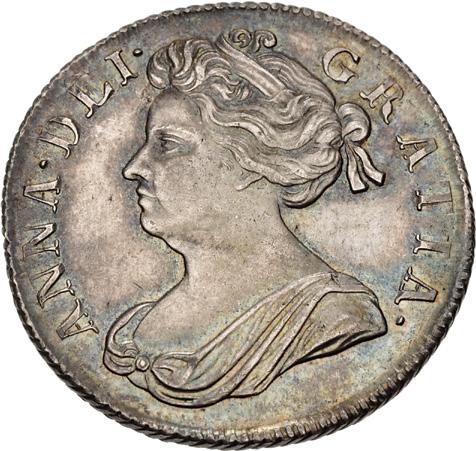


78 Mary Queen of Scots 5603862. SCOTLAND. Mary. 1542-1567. AV Three Pounds – Ryal (26.5mm, 7.51 g, 8h). First period. Portrait type. Edinburgh mint. Dated 1555. · MARIA · DEI · G · SCOTOR · REGINA $, bust left / · IVSTVS · FIDE VIVIT · 1555 ·, crowned coat-of-arms with rounded shield. Murray, 1555-8 13 (obv. die E); Burns 1-7 var. (legend stops); SCBI 35 (Ashmolean & Hunterian) 993 (same dies); SCBC 5397. In NGC encapsulation 6318986-004, graded AU Details, removed from jewelry. A very rare gold portrait coin of this renowned historical figure. $28,500 Ex Dr. Lawrence A. Adams (Classical Numismatic Group 100, 7 October 2015), lot 1091; Rev. Arnold Mallinson Collection (Spink 39, 6 December 1984), lot 126. Murray suggests that this very rare variety with rounded shield may have been struck in 1556. Standard Catalogue Plate Coin 5614055. SCOTLAND. James VI. 1567-1625. AR Six Shillings (26mm, 3.00 g, 10h). Ninth coinage, type I. Edinburgh mint. Dated 1605. (thistle) · IACOBVS · D · G · MAG · BRIT · FRAN · & · HIB · REX ·, crowned bust right; VI (mark of value) right / (thistle) QVÆ · DEVS · CONIVNXIT · NEMO · SEPERAT ·, coat-of-arms; 1605 above. Burns 3 (fig. 975) var. (obv. legend); SCBI 35 (Scottish), –; SCBC 5507 (3rd ed., this coin illustrated). Toned. Near EF. Attractive portrait. Possibly the finest known specimen of this extremely rare coin. $6750 Ex Chris Comber Collection; Davissons 28 (17 December 2009), lot 455; LaRiviere (Spink 179, 29 Mar 2006), lot 196; R. Shuttlewood (Spink Numismatic Circular [June 2001]), no. SC0001 (described as ‘magnificent’); Seaby Coin & Medal Bulletin 722 (October 1978), no. J130; H. Lingford Collection.


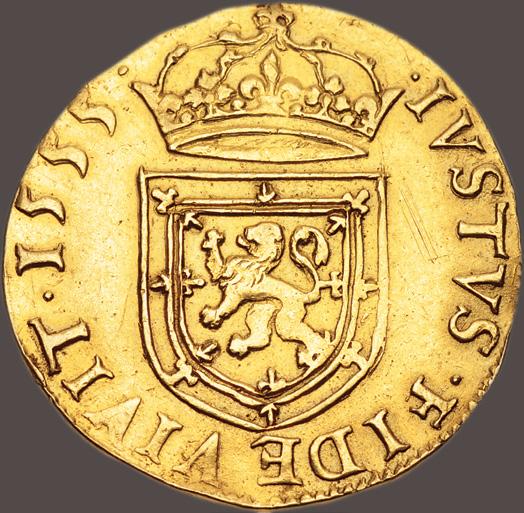


79 5614056. SCOTLAND. James VI. 1567-1625. AR Six Shillings (26mm, 2.86 g, 10h). Tenth coinage, type II. Edinburgh mint. Dated 1622. (thistle) · IACOBVS · D · G · MAG · BRIT · FRAN · ET · HIB · REX ·, crowned bust right; VI (mark of value) right / (thistle) · QVÆ · DEVS · CONIVNXIT · NEMO · SEPERAT ·, coat-of-arms; 1622 above. Burns 163 (fig. 986) var. (obv. legend); SCBI 35 (Scottish), 1379; SCBC 5508 (2nd ed., this coin illustrated). Toned, some light marks and minor edge split. Near VF. Very rare. The final year of issue. $1650 Ex Chris Comber Collection; Davissons 28 (17 December 2009), lot 456; LaRiviere (Spink 179, 29 Mar 2006), lot 200; J.K.R. Murray (Spink 57, 29 April 1987), lot 326 (part of); R.C. Lockett (Part V, Glendining, 18 June 1957), lot 401; R. Carlyon-Britton Collection. 5611380. SCOTLAND. Charles I. 1625-1649. AV Unite (36mm, 9.91 g, 6h). Third coinage, Briot’s issue. Edinburgh mint. Struck 1637-1642. CAROLVS ◊ D ◊ G ◊ MAG ◊ BRITAN ◊ FRAN ◊ ET ◊ HIB ◊ REX ◊ (thistle and small B), crowned and armored half-length bust right, holding lis-tipped scepter and globus cruciger / HIS ◊ PRÆSVM ◊ VT ◊ PROSIM, crowned coat-of-arms; crowned C R above quadrate stop across fields. Burns 3 (fig. 1032 – same dies); SCBI 35 (Scottish), 1392-6 (same dies); SCBC 5531. Toned. In NGC encapsulation 2125778-001, graded AU 58. $28,500 Ex Koehlmoos Collection; Münzen und Medaillen Basel 95 (4 October 2004), lot 458. A distinctly more worn example graded NGC AU55 brought $38,500 in the Sincona British Collection part II sale in May of this year. 5611916. SCOTLAND. Charles II. 1649-1685. AR Merk (27mm, 6.31 g, 8h). First coinage. Edinburgh mint. Dated 1671. CAROLVS · II · DEI : GRA ·, laureate, draped, and cuirassed bust right; thistle below / · MAG BRI · FRA ER · HIB REX · 16 71, cruciform coats-of-arms around XIII/4 (denomination); crowned monogram in angles. Burns 9 (fig. 1051); SCBI 35 (Ashmolean & Hunterian) 1585-6; SCBC 6511. Toned. In NGC encapsulation 6268036-005, graded VF 35. Clashed reverse die. $975 Ex Classical Numismatic Review XL.3 (Fall 2015), no. 417970; H. Manville (Dix Noonan Webb 47, 16 September 2005), lot 47; Spink Numismatic Circular CXI.1 (February 2003), no. SCO190.


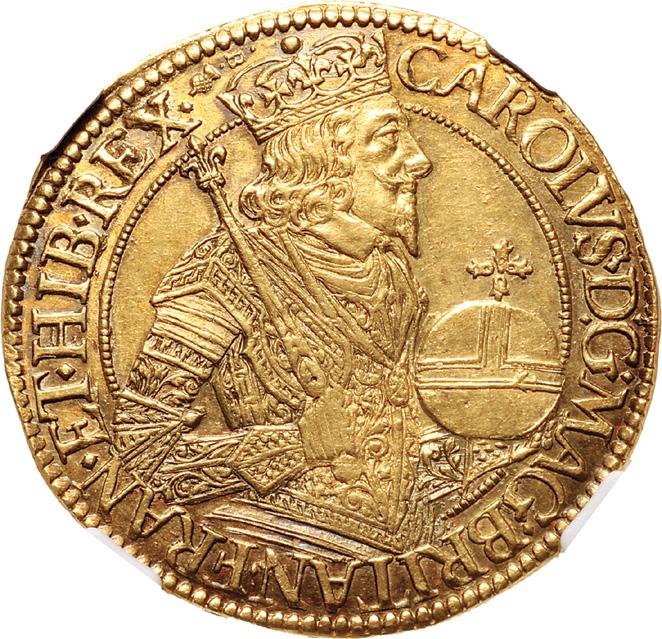


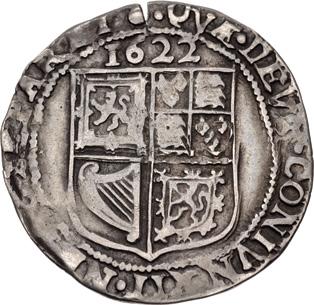
5603190. IRELAND. Edward IV. Second reign, 1471-1483. AR Groat (24mm, 2.05 g, 2h). Light ‘Cross and Pellets’ coinage, reduced standard. Waterford mint; im: pierced mullet; Germyn Lynch, mintmaster. Struck 1473-1478(?). , crowned facing bust within tressure of arches; lis at cusps, ŷ on breast / ḥ ʖɨ˫ѝƩ , long cross pattée; trefoils in quarters, saltires in 2nd and 4th trefoils. SCBI 22 (Copenhagen), 401; D&F 134; SCBC 6351. Toned. Good VF. $1450
ḥ ĚdѾ¨ˆd Ḻ dĚƩ Ḻ ŷˆ¨ Ḻ dN˫ Ḻ ƌӎBĚˆN
80 Very Rare Irish Farthing
Ḻ dĚѝ⍴ Ḻ ¨ dƩѝͿɨˆ Ě Ḻ ⍴Ěѝ⍴/ ýƩ⎍Ʃ Ϳ¨˫ Ѿ¨ͿĚ ˆŖɨˆ
5603189. IRELAND. Edward IV. First reign, 1461-1470. AR Groat (25mm, 2.79 g, 3h). Anonymous ‘Crown’ coinage. Dublin mint. Struck circa 1460-1463. Large crown in tressure of arches with nine arcs; trefoils at cusps, crosses in upper angles / ýƩ⎍Ʃ Ϳa˫ d⎍Bǭ ƩNƩĚ , long cross pattée; trefoils in quarters, annulets in 2nd and 4th trefoils. SCBI –; D&F 82; SCBC 6272A. Richly toned with considerable iridescence. Good VF. Very rare. A most attractive example of this issue. $6500 Ex G.E. Chapman (Glendining, 9 November 1978), lot 179. In 1459, the rebel Richard, Duke of York, arrived to Ireland and soon began preparations for his invasion of England and final overthrow of Henry VI. But to do so, he would need support of the Anglo-Irish parliament. The parliament shrewdly exploited the situation to declare Ireland’s independence from England and, among other items, enact a sweeping currency reform. Prior to the coinage of 1460, the AngloIrish coinage was struck at the same weight standard and in the same denominations as the English, an arrangement that allowed the wealth of Ireland to flow westward in the purses of English traders. To address this problem, the parliament devised a new currency regime with a reduced standard set to 3/4 sterling and new, uniquely Irish designs.
5605010. IRELAND. John. As King, 1199-1216. AR Farthing (10mm, 0.33 g). Second (’DOMinus’) coinage, group II. Dublin mint; Adam, moneyer. Struck circa 1198-1199. Mascle with trefoils at corners / Cross pattée; © ዝ © ዦ in quarters. Withers VI p. 31; O’S, Earliest 1; SCBI –; D&F 41; SCBC 6220. Light find patina. VF. Very rare. $3500 Superb Crown Groat
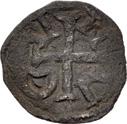
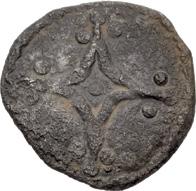


81 5603191. IRELAND. Elizabeth I. 1558-1603. AR Shilling (33mm, 8.98 g, 5h). First (base) coinage. Tower (London) mint; im: rose. Struck 1559. შ ELIZABETH · D’· G’· ANG’· FRA’· Z · HIB’· REGIN’·, crowned bust 1A left, wearing ruff / შ POSVI : DEVM : ADIVTORE : MEVM, crowned harp; crowned E R flanking. BCW RS-1B/RS-a1; SCBI –; D&F 239 var. (obv. legend); SCBC 6503. Lightly toned with attractive surfaces and traces of original luster, minor mark on reverse. Usual low relief. VF. $2000 Ex G.E. Chapman (Glendining, 9 November 1978), lot 239. 5612296. IRELAND, The Great Rebellion. Issues of the Lords Justices. 1642-1649. AR Crown (42mm, 29.74 g, 4h). ‘Ormonde Money’ issue. Issued 1643-1644. Large C R; crown above; all within linear and beaded border / Large V; S above; all within linear and beaded border . D&F 288; SCBC 6544. Toned, die break on obverse. VF. $2950 Ex P. Finn FPL 14 (1998), no. 510. British Medals 567706. STUART. Robert Devereux, 3rd Earl of Essex. 1591-1646. AV Oval Medalet (19mm, 4.52 g, 12h). On His Death. By Thomas Simon. Dated 14 September 1646. ROB : ESSEX : COM MIL · PARL : DVX · GEN :, bareheaded and draped bust right; · T S · F · below / HINC · ILLÆ · LACHRYMÆ ·, Grief seated on ground between broken and fallen pillar with right foot on column and left hand on base, raising right hand in mourning; column inscribed F · E · R · T (for fortitudo eius rempublicam tenuit); ABRVP : SEP : 14/·1646 · in two lines in exergue. Platt II Type C and pp. 88-92; MI 327/167 (this medal cited); Eimer –. Attractive red toning, trace of original suspension loop. Good VF. Extremely rare. $17,500 Ex North Yorkshire Moors [M. Lessen] (Part IV, Dix Noonan Webb 186, 21 January 2021) lot 1165; An Important Collection of Stuart Badges and British Commemorative Medals, the Property of a Gentleman (Spink 120, 9 July 1997), lot 343; A Fine Collection of British Historical and Commemorative Medals (Sotheby’s, 9 March 1989), lot 39; Greta Heckett (Sotheby’s, 25 May 1977), lot 213; J.G. Murdoch (Part IV, Sotheby, Wilkinson & Hodge, 2 June 1904), lot 64; T.M. Whitehead (Part IV, Sotheby, Wilkinson & Hodge, 5 May 1898), lot 42.


567710. COMMONWEALTH. Oliver Cromwell. Lord Protector, 1653-1658. AR Medal (49mm, 42.89 g, 12h). The Death of Oliver Cromwell. Of Dutch manufacture. Dated 3 September 1658. OLIVAR · D · G · RP · ANG · SCO · HIBERNIÆ · PROTECTOR, laureate and armored bust left / NON · DEFITIENT · OLIVA · SEP · 3 · 1658 ·, shepherd standing below olive tree, tending to his flock. Lessen, Funeral, –; MI 435/85; Eimer 200; van Loon (new edition) 1658.6. Iridescent toning, hint of double striking in legends, light hairlines and handling marks. EF. Very rare. $3950 Ex North Yorkshire Moors [M. Lessen] (Part IV, Dix Noonan Webb 186, 21 January 2021) lot 1255; R.C. and O.M.W. Warner; R.E. Ockenden (from O.M.W.W. 1964); purchased from R.E.O. 597529. STUART. Charles II. 1660-1685. AR Medal (32mm, 13.19 g, 6h). Restoration. By T. Rawlins(?). Dated 29 May 1660. · CVM · DVPLICATVR · ONVS · REDIT · MOYSES ·, Moses standing facing, holding sword, before Israelites making bricks while being beaten by Egyptian taskmasters / · IN ·/ ÆTER · MEMOR :/ CAROLI · II · MA : BRI :/ FRANC : ET · HIBERN :/ CLEMTISSIMI/ REGIS : REDS·/ 29 · MAII :/ 1660 within wreath. MI 562/56; Eimer 217. Richly toned with underlying luster, some light cabinet friction. Near EF. Rare. $3450 Ex B. Pearl Collection; Seaby Coin & Medal Bulletin 521 (January 1967), no. M25.
82
567711. COMMONWEALTH. Oliver Cromwell. Commander of the New Model Army, 1645-1653. Cast AR Uniface Medalet (23.5mm, 6.08 g). By Thomas Simon, circa 1650. Later circa 1750 strike after a circa 1650 original. HITHERTO · HATH THE · LORD HELPED VS, bareheaded and armored bust facing slightly right / Blank. Cf. Platt I Type Y and pp. 332; cf. Vertue, pl. XII; cf. MI 392/15 (for issue in lead); Eimer –. Attractively toned, fields lightly chased. VF. Extremely rare. $695 Ex North Yorkshire Moors [M. Lessen] (Part IV, Dix Noonan Webb 186, 21 January 2021) lot 1265; R.C. and O.M.W. Warner; R.E. Ockenden (from O.M.W.W. 1964); purchased from R.E.O; H. Montagu (Sotheby, Wilkinson & Hodge, 24 May 1897, lot 211 (part of).


83 597641. STUART. temp. Anne. 1702-1714. AR Medal (42mm, 37.47 g, 12h). Success of the Allies in Spain and Brabant. By Smeltzing. Dated 1706 (in Roman numerals). SIC OBSCURATUR GLORIA MAGNI REGIS, sun emerging from behind clouds over glove inscribed EUROPÆ; MDCCVI in exergue / DOMINUMQUE IN REGNA TULERE, medallion depicting head of Charles III of Spain right, with inscription CAROL III HISP REX, at center of three wreathed and turreted medallions depicting the bombardment of Barcelona, with inscription BARCINO LIBER XII MAY, the battle of Ramillies, with inscription PRŒL RAMIL XIIII MAY, and the entry into Madrid, with inscription INTRA MADRI XXVI IVNY; all set on crossed flags. Van Loon (new ed.) 1706.12; MI 291/101; Eimer –. Richly toned with underlying luster, a few light marks, die breaks on obverse. EF. Very rare. $4500 Ex B. Pearl Collection; Spink Numismatic Circular LXXIII.11 (November 1965), no. 6560. 5607295. STUART. temp. Anne. 1702-1714. AR Medal (42mm, 29.89 g, 12h). Battle of Oudenarde. By P. Müller. Dated 11 July 1708. SALVTARIVM SIDERVM APPARITIO, Castor and Pollux on horseback right, each holding spear; in exergue, EVENIL ET MARLEBO/ RVGII FELIX CON/IVNCTIO / VANDOM · IN FLANDR · SICVT IN ITAL · FVNDEM FVGIT · ET VT FVGIENDVS DOCET, view of the battle of Oudenarde; in exergue, MVLT · MILL · GALLORVM/ CLADES AD ALDENAR ·/ MD · C · IIX ·/ D · XI · IVL ·. Edge: NIL DESPERANDVM TEVCRO DVCE ET AVSPICE TEVCRO. Van Loon (new ed.) 1708.21; MI 324/150; Eimer –. Beautiful old cabinet toning. EF. $3750


The handbook of Greek CoinaGe SerieS by Oliver D. Hoover More than three decades have passed since David Sear published Greek Coins & Their Values, his revision of Gilbert Askew’s A Catalogue of Greek Coins published by B. A. Seaby in 1951. Since then, the field of ancient numismatics and the hobby of collecting ancient coins have changed so much that now Greek Coins & Their Values would require a complete revision to include all of the most current numismatic infor mation available, list the many new types and varieties unknown to Sear, and determine an approximate sense of rarity for all of these issues. In order to encompass this new material and create a viable reference for the beginning and specialized collector, such a handbook would have to be more than the two volumes which Sear found necessary. As a result, Classical Numismatic Group is publishing The Handbook of Greek Coinage Series, written by Oliver D. Hoover, in a series of 13 volumes, each covering a specified area of Greek coinage with the first being The Handbook of Syrian Coins: Royal and Civic Issues, Fourth to First Centuries BC (Volume 9 in the series). This series is designed to aid the user in the quick, accurate, and relatively painless identification of Greek coins, while providing a cross-reference for each entry to a major work, which will allow the inquirer to pursue more in-depth research on the subject. The subject-matter of each volume is arranged chronologically for royal issues, and regionally for the civic issues; within each region, cities are listed directionally, depending on the region. For those rulers or cities that issued coins concurrently in all three metals, these issues will be arranged in the catalog with gold first, followed by silver, and then bronze; each metal is arranged by denomination, largest to smallest. Known mints for the royal coinage are listed below the appropriate type, making an easy search for a specific mint. Each entry will include a rarity rating based on the frequency with which they appear in publications, public and private collections, the market, and/or are estimated to exist in public or private hands. No valuations are listed, since such values are generally out of date by the time of publication. An online valuation guide at will allow interested individuals the opportunity to gauge the market, and reduce the need for repeated updates of this series. Whether one purchases the entire set for their reference library, or the individual volume pertaining to one’s area of specialization, The Handbook of Greek Coinage Series should provide a useful staging-point from which collectors and interested scholars can pursue their research and interests.
Please see our website for additional volumes.
84 Hoover, Oliver D. Handbook of Coins of Macedon and Its Neighbors. Part I: Macedon, Illyria, and Epeiros, Sixth to First Centuries BC [The Handbook of Greek Coinage Series, Volume 3]. 2016. lxxviii and 431 numbered pp. Hardbound. (GR332) $65
Hoover, Oliver D. handbook of CoinS of bakTria and anCienT india Including Sogdiana, Margiana, Areia, and the Indo-Greek, Indo-Skythian, and Native Indian States South of the Hindu Kush. Fifth Century BC to First Century AD. [The Handbook of Greek Coinage Series, Volume 12]. 2013. lxxxiv + 389 numbered pages. (GR341) $65
Hoover, Oliver D. Handbook of of Coins of Northern and Central Greece: Achaia Phthiotis, Ainis, Magnesia, Malis, Oita, Perrhaibia, Thessaly, Akarnania, Aitolia, Lokris, Phokis, Boiotia, Euboia, Attica, Megaris, and Corinthia. [The Handbook of Greek Coinage Series, Volume 4]. 2014. lxxvii + 563 numbered pages (GR333) $65


CNGClassicalNumismaticGroup,LLC US OFFICE PO Box 479, Lancaster, PA 17608-0479 Phone (717) 390.9194 Fax (717) 390.9978 UK OFFICE 20 Bloomsbury Street, London WC1B 3QA, UK Phone +44.20.7495.1888 Fax +44.20.7499.5916 EMAIL & WEBSITE Email Websitecng@cngcoins.comwww.cngcoins.com


