
Gaza: The
Golgotha of
Combating injustice in Ukraine
Healing Syria
Fighting crimes against humanity in Ethiopia

COVER STORY
It Is Famine
42 4
The Last Word Perspectives from the president by Msgr. Peter I. Vaccari 20 24 6 30 38 14
Gazans are doing what they can to survive by Olivia Poust
FEATURES
Beacons of Hope
Parishes in Ukraine commit to social justice amid war text by Anna Klochko with photographs by Konstantin Chernichkin
A Letter From Georgia
Georgia’s civil society at risk of coming undone by Ani Ergemlidze
Healing Hands in the Shadows of War
Syrians rely on church networks for health care by Claire Porter Robbins
The Fallout
Foreign aid cuts hit anti-trafficking efforts in Ethiopia text by Lorenzo Milne with photographs by Petterik Wiggers
At Death’s Door
When famine is used as a weapon of war text and photographs by Diaa Ostaz
DEPARTMENTS
Connections to CNEWA’s world
t A woman and two children walk among destroyed buildings in Yarmouk, a district of Damascus, which once housed the largest Palestinian refugee community in Syria.



Front: A Palestinian woman grieves over the body of a family member, killed at a food distribution point in Gaza on 19 July.
Back: Rajaa Abdullah, 72, a Christian in Homs, Syria, relies on the church for assistance with her health care needs.
Photo Credits
Front cover, AFP via Getty Images; pages 2, 3 (upper left), 26, 28-29, back cover, Ahmad Fallaha; page 3 (top), Maria Grazia Picciarella/ SOPA Images/LightRocket via Getty Images; pages 3 (upper right), 9, Karam Saeed Al Bek; pages 3 (lower left), 14-15, 17-19, Konstantin Chernichkin; pages 3 (lower right and far right), 21-23, Antonio di Vico; page 4, Vatican News; pages 6-7, Doaa Albaz/Anadolu via Getty Images; pages 8, 10, 12-13, 39-41, 43, Diaa Ostaz; page 11, Mousa Ayyad; page 20, John Wreford/SOPA Images/LightRocket via Getty Images; pages 24-25, Spencer Platt/Getty Images; page 27, Raghida Skaff; pages 30-37, Petterik Wiggers.
ONE is published quarterly. ISSN: 1552-2016
CNEWA
Founded by the Holy Father, CNEWA shares the love of Christ with the churches and peoples of the East, working for, through and with the Eastern churches.
Volume 51 Number 3


CNEWA connects you to your brothers and sisters in need. Together, we build up the church, affirm human dignity, alleviate poverty, encourage dialogue — and inspire hope.
Publisher
Msgr. Peter I. Vaccari
Executive Editor
Michael J. La Civita
Editorial
Laura Ieraci, Editor
David Aquije, Contributing Editor
Barb Fraze, Contributing Editor
Elias D. Mallon, Contributing Editor
Creative
Timothy McCarthy, Digital Assets Manager
Paul Grillo, Senior Graphic Designer
Samantha Staddon, Graphic Designer
Elizabeth Belsky, Copy Writer
Officers
Cardinal Timothy M. Dolan, Chair and Treasurer
Msgr. Peter I. Vaccari, Secretary Tresool Singh-Conway, Chief Financial Officer
Editorial Office 220 East 42nd St, New York, NY 10017 1-212-826-1480; www.cnewa.org
©2025 Catholic Near East Welfare Association. All rights reserved. Member of the Catholic Media Association of the United States and Canada.

Connections to CNEWA’s world
‘Light of Wisdom’
Pope Leo XIV addressed a meeting of representatives of funding agencies supporting the Dicastery for the Eastern Churches (known by its Italian acronym, ROACO) on 26 June, noting that “today, violent conflict seems to be raging in the Christian East with a diabolical intensity previously unknown.”
He thanked the agencies, including the only organization founded to support the Eastern churches, CNEWA, for providing “a breath of oxygen to the Eastern churches” and “sowing seeds of hope in the lands of the Christian East.” He called for the “light of wisdom” of the Eastern churches “to be better known in the Catholic Church.”
CNEWA Out and About
Msgr. Peter I. Vaccari, CNEWA president, addressed ROACO members during their general assembly in Rome 23-26 June. He noted CNEWA’s efforts in the Middle East, Northeast Africa, India and Eastern Europe help to ensure the survival of Eastern Christianity, reminding participants that Pope Francis and Pope Leo have linked the great religious traditions of the East to a call for action. As CNEWA prepares to celebrate its centennial anniversary, that link between the great “traditions of spirituality” and the challenge to be instruments of hope and peace “is omnipresent in the regions where we work.”
Msgr. Vaccari visited several U.S. cities this past summer as well, addressing more than 250 people gathered for the Third North American Metropolitan Byzantine Catholic Assembly in Whiting, Indiana, on 19 July. He also visited parishes and donors in Portland, Maine, Milwaukee, Philadelphia and Orlando.

Bethlehem Emergency
In the first six months of 2025, more than 240 individuals in the West Bank’s Bethlehem area benefited from a CNEWA-Pontifical Mission program coordinating some $278,000 from North American and European funders, including Kinderhilfe Bethlehem; Embrace the Middle East; the Catholic Diocese of Stockholm; Vastenactie; and the Swiss Holy Land Foundation.
The project was in response to the “severe economic and humanitarian crisis” in the Palestinian West Bank since the start of the Israel-Hamas war. CNEWA-Pontifical Mission partnered with the municipalities
of Beit Sahour and Beit Jala to offer 60 people temporary jobs upgrading the digital presence of the two towns, such as websites, social media and online archives; improving public hygiene with a campaign to clean up solid waste and remove rubbish; and restoring jobs in cultural heritage. The grant also offered medical assistance to people identified by the Arab Orthodox Benevolent Society and tuition assistance to 110 Christian students for the 2024-2025 academic year.
Grants to Assist Children
Over the summer, CNEWA received two grants earmarked for projects in the Middle East and Africa. The
Pope Leo XIV greets Msgr. Peter I. Vaccari, CNEWA president, during an audience with ROACO members at the Vatican on 26 June.
Pulte Family Charitable Foundation awarded $70,000 toward CNEWA’s work with Fratelli Association’s psychosocial support for children and mothers at Our Lady of Fatima School in Lebanon. The program began in 2016 to assist Syrian refugees and develop activities for young people and adults. The Loyola Foundation awarded CNEWA $20,000 to install solar panels on Divine Providence Orphanage in Hebo, Eritrea. The orphanage, run by the Vincentian Fathers and the Daughters of Charity, is home to 38 children who lost their mothers at birth.
CNEWA
at the Napa Institute
CNEWA’s Communications and Marketing Director Michael J. La Civita participated in a panel discussion on “The Hope American Catholics Are Bringing to the Church International” at the 15th annual summer conference of the Napa Institute in Napa, California, 23-27 July. The Pontifical Mission Societies, U.S.A., and the Papal Foundation were also on the panel. Panelists spoke about their respective activities to advance the Gospel where endemic poverty, strife, persecution and environmental deprivation threaten the common good. Mr. La Civita stressed CNEWA’s commitment to program management and accountability, financial reporting, transparency and safeguarding.
CNEWA Galas
CNEWA is kicking off its centennial year with two galas this autumn. The first will be held in Ottawa on 7 November at St. Elias Banquet Center. The guests of honor are both from Lebanon: Good Shepherd Sister Marie Claude Naddaf and Michel Constantin, CNEWA’s regional director for
Lebanon, Egypt and Syria. The event also will celebrate 20 years of CNEWA operating in Canada.
The Fourth Annual “Healing and Hope” Gala Dinner in New York on 1 December will be at a private club on Fifth Avenue. Ukrainian Greek Catholic Archbishop Borys Gudziak of Philadelphia will be the guest of honor. Michèle B. Bowe, ambassador to Palestine for the Sovereign Order of Malta, will receive CNEWA’s Faith & Culture Award.
For tickets and sponsorship opportunities for the gala in New York, go to cnewa.org/events or email gala@cnewa.org. For information on the gala in Canada, go to cnewa.org/ca or email canada@cnewa.org.
CNEWA Wins 53 Awards
Judges for the Catholic Media Association conferred on CNEWA 53 media awards at its annual conference in Phoenix. CNEWA won more than eight “bests,” including firsts for CNEWA’s website and blog, and for ONE magazine’s reporting and photographs. ONE magazine editor Laura Ieraci and contributing editor Barb Fraze were co-presenters at the conference, held 24-28 June. Find the list of winning entries on the CNEWA blog.
CNEWA Rushes Aid to Gaza
As of press time, CNEWA had rushed more than $1.6 million in aid to Gaza since 2023, providing emergency food, medicines, medical care, psychological counseling and treatment, reaching more than 36,400 people. Responding to this famine, the president of the U.S. Conference of Catholic Bishops, Archbishop Timothy P. Broglio of the U.S.
Military Archdiocese, in a letter to his brother bishops dated 12 August, called for a “special collection to provide humanitarian relief and pastoral support for our affected brothers and sisters in Gaza and surrounding areas in the Middle East and send donated funds to CNEWA and C.R.S.”
“It is with great pastoral concern for the ongoing crisis in Gaza that I write to you today. Our church mourns the terrible suffering of Christians and other innocent victims of violence in Gaza and surrounding areas who are struggling to survive, protect their children, and live with dignity in dire conditions,” he wrote.
“The situation in Gaza and across the Middle East cries out for assistance of the Catholic community of the United States” and he added that parishes “take up this collection and send funds … as soon as possible.”
To read more from Gaza, please see “It Is Famine,” on page 6, and to rush your gift, please visit cnewa.org/what-we-do/ support-emergency-relief-inthe-holy-land
It Is Famine
In Gaza, people are doing what they can to survive
by Olivia Poust
Everything in Gaza has its price.
For Hani Farah, $20,000 bought refuge for him and his family — $5,000 per adult and $2,500 for each of his four children — six months after the IsraelHamas war began in October 2023.
This fee went to Hala Consulting and Tourism, an Egyptian company that registers Palestinians for emigration and moves them across the border. But there are no guarantees. Mr. Farah’s family did not appear on the list to cross into Egypt for a month after applying and paying for their registration in March 2024.
Eventually, they left for Cairo that April, where they now live in a state of flux, stuck in a cycle Mr. Farah says has left them “between the sky and the earth.” Without residency in Egypt, they are unable to receive visa approval, making it difficult to find a landlord that will rent an apartment to them and impossible for Mr. Farah to find work.
In Gaza, he was the executive secretary general of the only Y.M.C.A. in the strip, which cooperated with local partners to provide aid and services to the vulnerable. However, it was bombed on 17 December 2023,

destroying the building and rendering it inoperative.
Mr. Farah’s brother-in-law, Amin Edward Amin Sabagh, registered his family to leave Gaza for Cairo, too, but their names were never called, so they remain in Gaza City, stuck within the now-closed borders.
“We could lose our lives at any moment,” says Mr. Sabagh. He lives with his wife, Catherine, and their two children.
“We went from being a happy family living with dignity to a miserable family living in shelters lacking the most basic human necessities, with no food or clean
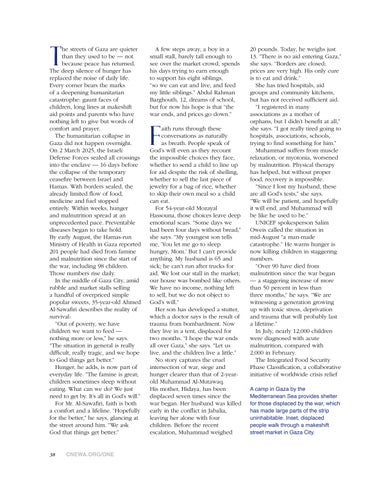
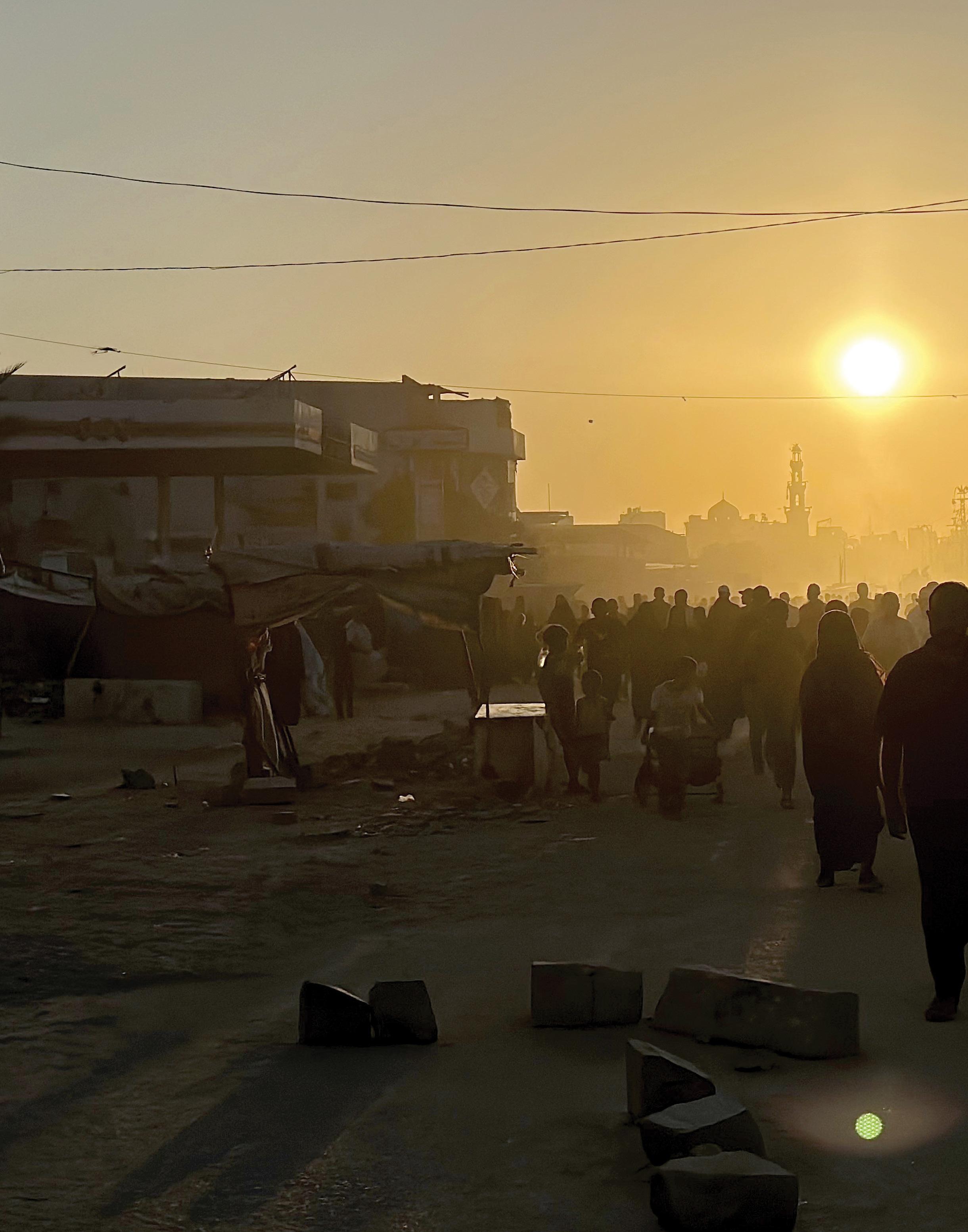
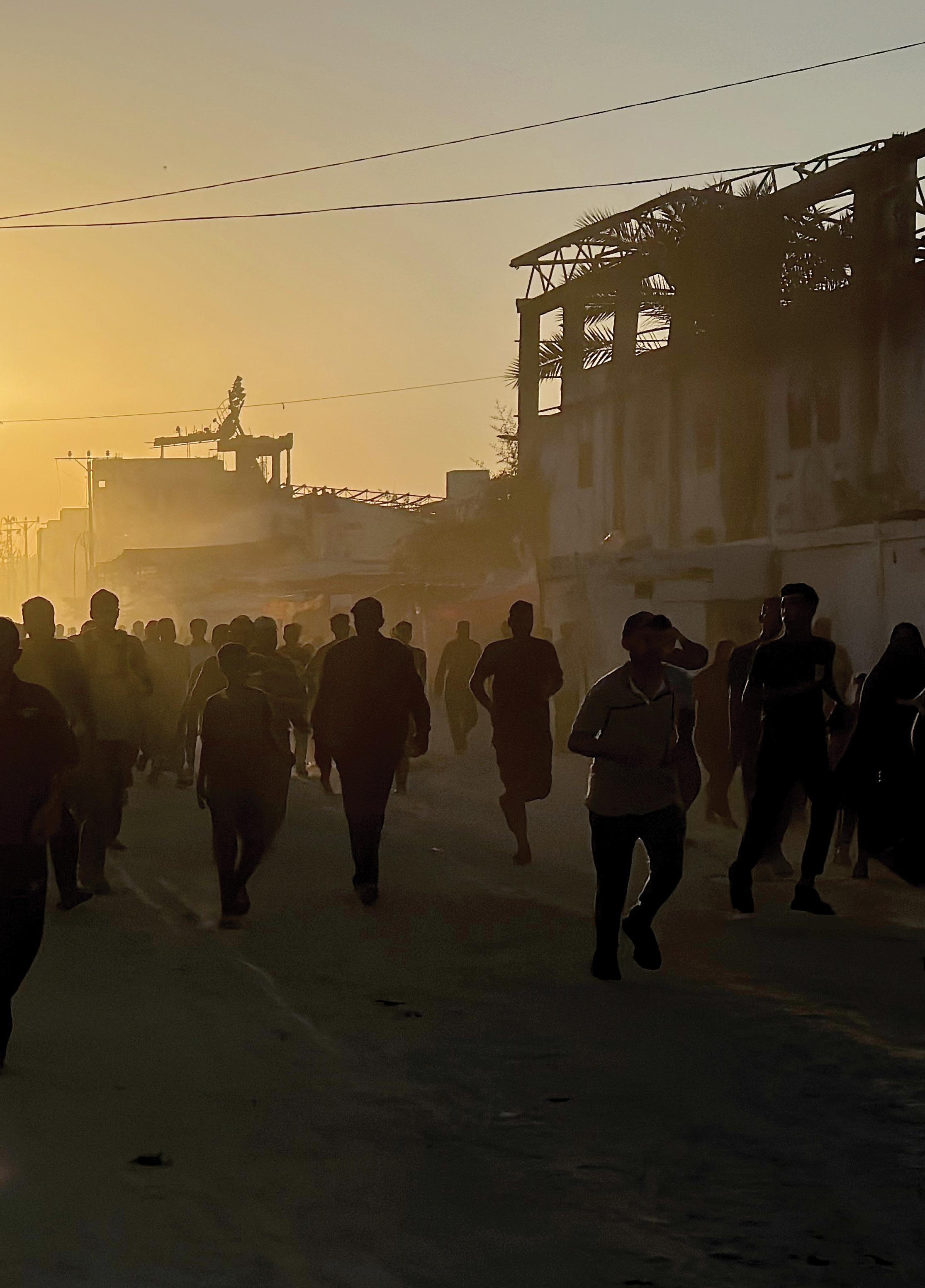
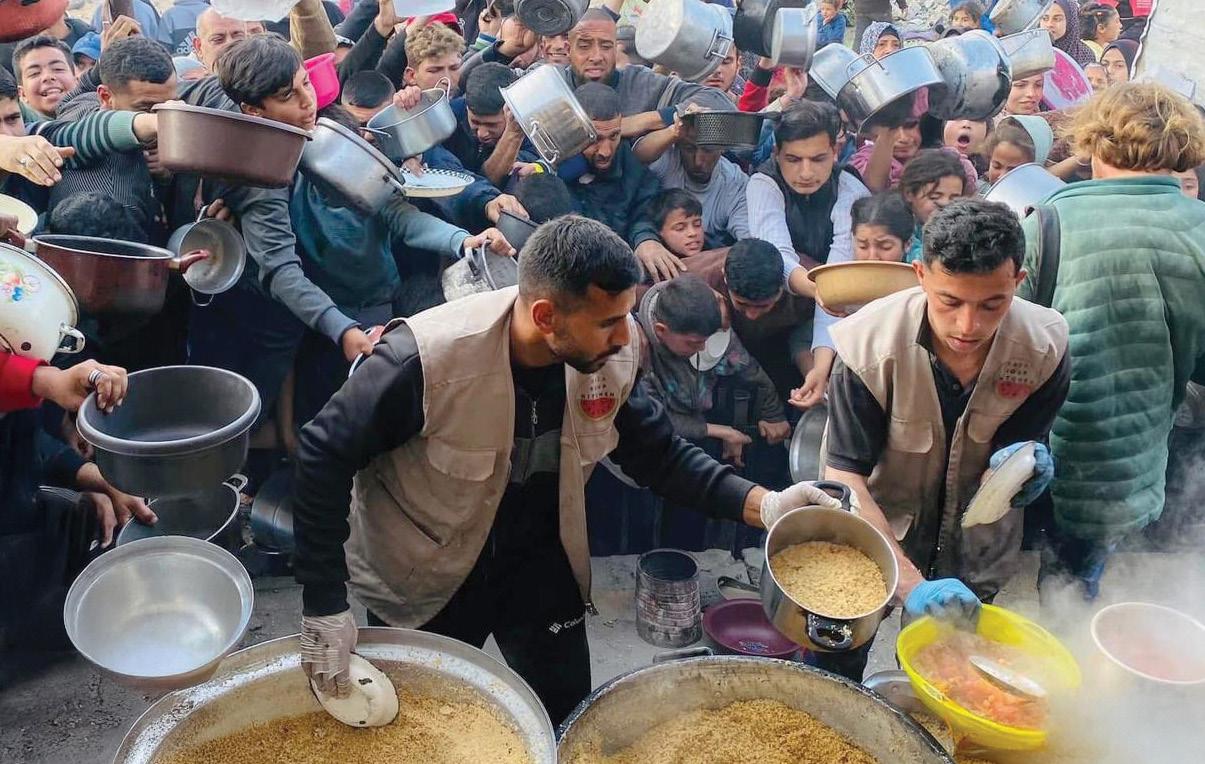
Merchants seek to sell their meager wares at exorbitant prices at a street market in Gaza. Opposite, facing famine, Gazans scramble for food at a distribution point in Gaza City. Previous spread, Palestinians walk a route, known as the “road of death” to retrieve food parcels from aid points in Khan Yunis, Gaza.
water,” he says. “We rely entirely on aid to provide us with food.”
A global collective aimed at assessing food insecurity worldwide announced on 29 July that “the worst-case scenario of famine” is underway in Gaza. The Integrated Food Security Phase Classification (I.P.C.) ranks global food insecurity on a five-point scale. Its data is used by the U.N. and other international agencies in decision-making and responseplanning.
Since its previous report on 12 May, the I.P.C. determined that instances of “extreme hunger” have doubled across households in
Gaza, pushing most Gazans into the final phase on the five-point scale: catastrophe and famine.
Mr. Sabagh’s children, Edward, 17, and Yanal, 12, documented their experiences in a written statement to ONE, dated 4 August.
“We sleep most of the day, so we don’t feel the pain of hunger,” they wrote. “We only eat once a day at 5 p.m. — a single piece of bread, if we can afford it.”
They listed the prices of basic food items: $50 per pound of sugar, $100 per pound of meat, $10 for a single egg. They have not eaten meat in more than 17 months, as it is inaccessible.
“For over a year and a half, we’ve lived through nonstop war, fear and destruction,” they wrote.
“Now, we are living through a new kind of war — a war of hunger. There is no food left in Gaza.”
Israel began a blockade on 12 March that has remained in effect, although it was eased on 19 May to allow some humanitarian aid into Gaza. The effects of this let-up were described as “a trickle” and “a drop in the ocean” by the I.P.C. and the United Nations.
The I.P.C.’s July alert also reported that one in three people are “going without food for days at a time,” and more than “20,000
“The ugliness of the war is that while the people in power are fighting against each other, it’s the innocent people who pay the price.”
children have been admitted for treatment for acute malnutrition between April and mid-July.” At least 16 children under the age of 5 died of hunger-related causes between 17 July and the alert’s publication on 29 July.
Pope Leo XIV has described the situation in Gaza as the “iniquitous use of hunger as a weapon of war.”
“Starving people to death is a very cheap way of waging war,” he said in his 30 June message to the Food and Agriculture Organization conference in Rome.
Nataly Sayegh, a socio-pastoral project coordinator with Caritas Jerusalem based in Gaza, shared her experience of famine. “We
started counting pieces of bread, saving portions for later, trying to make everything last just a bit longer,” she wrote.
“Hearing someone say, ‘There’s a food package,’ felt like a treasure — but even that was short-lived, and the need never stopped.”
The pursuit of food at aid centers has proven dangerous for Palestinians. The U.N. Office of the High Commissioner for Human Rights reported on 31 July that more than 1,300 Palestinians were “killed while seeking food” since 27 May; about 65 percent of them were killed near Gaza Humanitarian Foundation sites. Established by Israel in February
as a nongovernmental organization, the foundation receives U.S. support. In a statement on 5 August, U.N. experts called for the closure of the foundation on the grounds that its use of humanitarian aid as a vehicle for “covert military and geopolitical agendas” is in violation of international law.
In addition to inflated prices, cash withdrawals from banks are controlled by cash brokers, who take about 50 percent of every withdrawal, says Dr. Maher Ayyad, medical director of Al-Ahli Arab Hospital in Gaza City.
“Starving people to death is a very cheap way of waging war.”

“You lose half of your money just to have it in your hand,” he says.
The Christian hospital is operating amid shortages of essential resources, including medicines, specialized personnel, equipment, food, beds, and fuel for generators.
Hospital staff sometimes faint from hunger and, without proper nourishment, Dr. Ayyad expects patients will face even greater challenges healing because of a lack of nutrients. The 50-bed hospital has faced a 300 percent increase in occupancy because of the surge in casualties. Prior to the war, funding from church groups and UNRWA allowed the hospital to provide free medical care to vulnerable populations, including general medicine and surgeries, pediatric care and orthopedic surgeries. Now, nearly 90 percent of patients are casualty victims.
An airstrike on 13 April destroyed the genetics lab, some of the hospital clinics, the pharmacy, and a section of the emergency department where most patients were treated. A shortage of beds in the intensive care unit forced the hospital to accelerate its turnover rate for patients in need of ventilators and other intensive care. There are three I.C.U. beds with an occupancy of more than 150 percent.
“Sometimes, when they [had] casualties, the senior surgeon used to tell me to choose, to make priorities, which patients they have to take and which patients they have to leave to die … because we don’t have enough operating rooms or specialized personnel to take care of them,” says Dr. Ayyad.
Abdel Nasser Tanboura, 10, in Gaza waits to fill his water jug. Top right, the physiotherapy center of Al-Ahli Arab Hospital was repaired after an airstrike to accommodate 70 patients, mostly casualty victims.
The CNEWA Connection

Al-Ahli Arab Hospital in Gaza City remains one of the few longstanding CNEWA-funded projects still operating in Gaza, albeit under constant risk of bombardment and not without suffering considerable damage to its infrastructure. Since 9 October 2023, CNEWA has been providing the hospital with urgent medical aid and support for its besieged medical professionals. Since the start of the Israel-Hamas war, CNEWA has rushed more than $1.6 million in funds, collected from sources throughout the global Catholic community, to assist church-run organizations in the strip, reaching more than 36,400 people. For years, CNEWA also funded Gaza’s Y.M.C.A., the Atfaluna Society for the Deaf, the Pontifical Mission School for the Blind, Brotherhood Park and the Arab Orthodox Cultural Center, all important institutions in Gaza before they were destroyed in the recent conflict.
To support CNEWA’s mission in the Holy Land, call 1-866-322-4441 (Canada) or 1-800-442-6392 (United States) or visit cnewa.org/donate
In Jerusalem, Joseph Hazboun, regional director of CNEWAPontifical Mission for Palestine and Israel, says aid provided through the agency is purchased entirely within Gaza because “it’s too challenging and risky” to bring goods in from the outside.
The office staff remains in communication with families in Gaza, particularly those sheltering in the Catholic and Orthodox churches of the Holy Family and St. Porphyrios, to determine the needs on the ground and which
suppliers are available. Amid the current food shortages, the office coordinated with another partner agency, the Near East Council of Churches, to supply 22 pounds of vegetables to 444 families. The vegetables were purchased from local markets.
In addition to the 100 families sheltering at the Orthodox parish and the 145 families at the Latin church, Mr. Hazboun says his office provides aid to about another four families to the south. To date, CNEWA’s coordinated

“Christ is not absent from Gaza.”
response has assisted more than 36,400 people throughout the territory.
“The real tragic situation is outside the convents, where people are left without any support, and so we’re trying to reach out to as many as we can,” says Mr. Hazboun.
Cardinal Pierbattista Pizzaballa, Latin patriarch of Jerusalem, and Greek Orthodox Patriarch Theophilos III visited the two communities on 18 July.
“There, we encountered a people crushed by the weight of war, yet carrying within them the image of God,” Patriarch Theophilos said at a 22 July press conference after his visit.
“Christ is not absent from Gaza,” Cardinal Pizzaballa said at the same press conference. “He is there — crucified in the wounded, buried under rubble and yet present in every act of mercy, every candle in the darkness, every hand extended to the suffering.”
He said humanitarian aid is “a matter of life and death” and “refusing it is not a delay, but a sentence.”
Rami Tarazi, former director of the Arab Orthodox Cultural Center in Gaza City, was instrumental in securing aid through CNEWA-Pontifical Mission in the first days of the war. According to Mr. Hazboun, Mr. Tarazi contacted CNEWAPontifical Mission’s Jerusalem office with the request on 8 October 2023, a day after the war began, and it was approved immediately “without any secured funding.”
“This swift decision was critical,” he says. “The water was delivered on the morning of 9 October, just
Hidaya al-Mutawaq, a widow, and her son, Muhammad, are among those displaced and facing famine in Gaza.
hours before the supplier’s warehouse was destroyed.” This first round of aid provided a three-month supply of food and water for 1,600 people.
However, by the end of the month, on 30 October, the Israeli Defense Forces had flattened the Arab Orthodox Cultural Center in a targeted airstrike. Some 3,000 people had been sheltering there up until two days prior to the attack, when Mr. Tarazi was instructed by the Israeli military to evacuate the compound.
Mr. Tarazi fled Gaza in April 2024. As with Mr. Farah, he paid for the opportunity to leave: $12,500 for him, his wife and their son.
Their harrowing journey from North Gaza to the Rafah crossing took them past tanks, the sound of bombs, the smell of death, and along the sandy beach for about six miles. Once in Egypt, they waited for Mr. Tarazi’s parents, who had fled Gaza five months earlier for Turkey, where his mother received cancer treatment.
He and his family now live in Sydney, Australia, where Mr. Tarazi found a job as a support worker for people with disabilities. He remains in contact with CNEWAPontifical Mission to perform needs assessments.
“If there is no international intervention for Gaza, most of the people will die in Gaza, especially the elderly people and the children,” he says.
Mr. Hazboun implores “people with conscience” to realize the reality of this conflict.
“The ugliness of the war is that while the people in power are fighting against each other, it’s the innocent people who pay the price.”
Olivia Poust is the assistant director of the Center on Religion and Culture at Fordham University and former assistant editor of ONE.
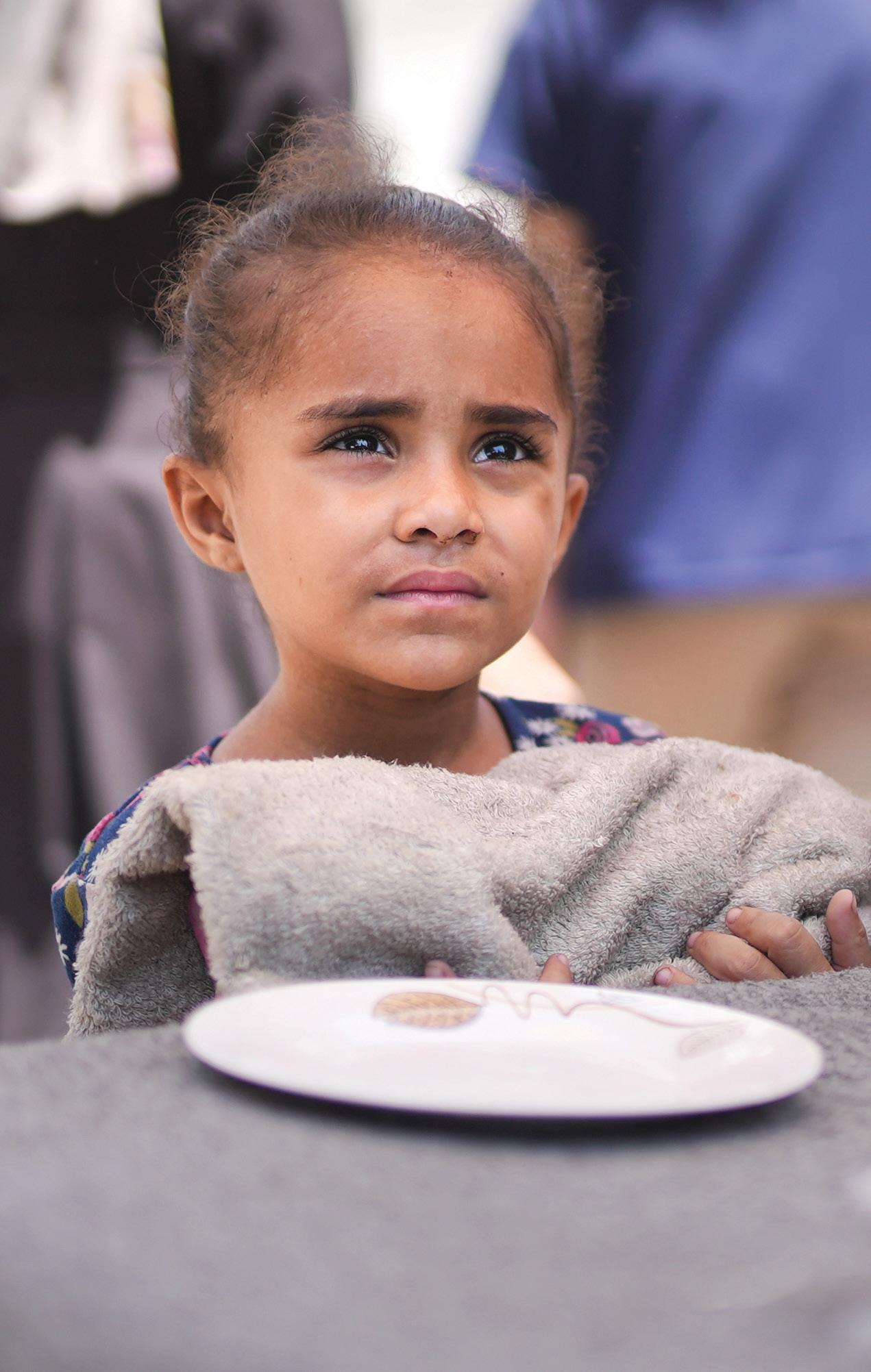
GAZA IS
Beacons of Hope
Ukrainian parish social ministries transform lives in times of war
text by Anna Klochko with photographs by Konstantin Chernichkin
From the lower level of an unfinished church in the city of Chortkiv, a solemn resonant chant rises. Amid the familiar prayers and hymns, the war ravaging Ukraine seems distant as the Reverend Volodymyr Zabolotnyi celebrates liturgy.
Afterward, a few elderly parishioners linger. They walk over to a small kitchen in the multipurpose hall that also serves as a temporary worship space until the main sanctuary dedicated to the new martyrs and saints of the Ukrainian people is completed. They tie on aprons and gather around a large table. It’s time to make pierogi.
“Their pierogi are always delicious and never fall apart in the pot,” Father Zabolotnyi says, explaining how many of the women find “comfort in this repetitive work” of making pierogi.
“Some of them have sons or grandsons serving on the front. Without something meaningful to do, where one can talk, reflect and feel useful again, one could lose one’s mind,” he adds.
Singing hymns as they work, those with loved ones on the front raise their voices louder, sealing the dough as they press more firmly and more deliberately.
Pierogi-making is at the heart of the parish’s social ministry, which donates copious quantities to the local hospital to feed the war-wounded soldiers undergoing rehabilitation.
“The boys will be well fed and recover faster,” Father Zabolotnyi says, noting the parish donated 22 pounds of pierogi that day.
The proceeds of pierogi sold in town benefit the construction of the church.
Caritas Ternopil hosts a family activity to break the isolation of war.


Since Russia’s full-scale invasion of Ukraine in 2022, more than 100 parishes of the Ukrainian Greek Catholic Church quietly became beacons of hope, launching over 70 social ministry projects. The aim of this nationwide initiative of Caritas Ukraine, the charitable arm of the Ukrainian Greek Catholic Church, is to strengthen local resilience, foster solidarity and bring to life Catholic social teaching.
Hanna Homeniuk, who leads the Social Cohesion Program for Caritas Ukraine, says the initiatives were “just seeds” eight years ago and have since “grown into laundries, bakeries, health care centers — places where love meets logistics.”
The program initially reached more than 30,000 people, but has grown since the full-scale Russian invasion began in February 2022. It now focuses on supporting rear-region communities, integrating displaced people and nurturing spaces for peaceful coexistence.
Ms. Homeniuk says these projects also help to ease the tensions that may arise among people who served in the war and those who did not, those who remained under occupation and those who returned after liberation. To bridge these divides, Caritas combines dialogue facilitation and psychological and pastoral
“People brought so much, even expensive baby strollers,” she recalls. “Russians shattered my faith in humanity. But here, it was restored.”
Back in Kharkiv, Ms. Habelko was a real estate agent. In Ternopil, a local realtor helped her find housing and refused a fee. Moved by his selflessness, Ms. Habelko decided not to ask a fee when helping other displaced families find housing. Volunteering, she realized, was more than a temporary distraction — it was a lifeline. She also experienced a new, more personal model of relationship between the church and its people.
Many families displaced from eastern Ukraine have been
“We’ve built something powerful — a network of people who want to serve, who want to heal and who want to lead real change.”
These initiatives have transformed local communities, providing a faith-appropriate response to basic human needs. Volunteers — some of whom once received assistance — receive donor-funded training and certification, eventually leading food drives, launching microenterprises and serving as project managers and grant writers.
While not all initiatives are profitable, the spirit of service is tangible as parishioners meet urgent local needs and restore dignity to the most vulnerable.
The program was created in 2016 as a response to the Russianbacked separatist war in the country’s eastern Donbas region and its subsequent occupation.
support with a culture of mutual care.
Anna Habelko, her husband and child fled the war in Kharkiv, eastern Ukraine. A broken evacuation train left them stranded in Ternopil with two suitcases and nowhere to go, but someone told her about the local Caritas center, where they were welcomed, given clothes, comfort and dignity.
To ease her anxiety, especially about the state of her mother, who remained behind in Kharkiv, Ms. Habelko began to volunteer. She joined the Social Wardrobe Project at Caritas Ternopil, helping to sort clothes and other items donated for those in need.
surprised when encountering the Ukrainian Greek Catholic Church for the first time, says Alina Muts, deputy director of Caritas Ternopil.
“People encountered a living church,” says Ms. Muts. “They discovered a new way of praying, a new understanding of God and of the liturgy.”
In addition to food and clothing, internally displaced people often need “a sense of belonging, emotional safety and spiritual care,” she says.
To meet this need, Caritas has organized pilgrimages, heritage tours, prayer groups and spiritual retreats to help them make new friends, adjust to their surroundings and feel at home.
Caritas Ternopil volunteers welcome Ukrainians displaced by the war in the countryʼs eastern regions at the train station in Ternopil last autumn.
With time, however, parishes and Caritas teams “also learned how to bring together the church, local authorities and the business community around meaningful initiatives,” she adds.
“Through communication and social enterprise training, and by learning how to respond in times of crisis, we’ve built something powerful — a network of people who want to serve, who want to heal and who want to lead real change.”
The Ukrainian Greek Catholic Eparchy of Buchach stretches across a patchwork of villages and small towns nestled in the rolling hills of western Ukraine, each with its own parish. Here, where tradition runs deep among tight-knit communities, the seeds of social ministry were sown before the war began and took root through patient, persistent work, especially as more than 11,000 people from eastern Ukraine took refuge there this past April.
The Reverend Roman Bronetskyi, director of Caritas Buchach and pastor of the Church of the Sacred Heart in Zalishchyky, is one of the architects of this quiet transformation. Six years ago, he and his team began visiting the eparchy’s 300 parishes, listening, encouraging and helping mostly elderly communities rediscover their capacity to serve.
“To launch a social initiative, it’s essential to have an active parish and a committed team — people who are ready to act,” he says.
“But what usually gives the first push is donor support and the inspiring examples of others. When parishioners see a neighboring
The CNEWA Connection

The social services charity of Ukraine’s Greek Catholic churches, Caritas Ukraine, instills in parish volunteers a deep sense of Catholic social teaching as the foundation for their work among the most vulnerable. With CNEWA’s support, local Caritas teams equip these projects with the tools they need.
“Thanks to preparation and the steady support of donors like CNEWA, they don’t start from scratch,” says Olena Karnaukh, community engagement manager at Caritas Ukraine, demonstrating when faith and compassion meet structure and support, even the smallest of parishes can drive meaningful change — even in times of war.
To support the work of CNEWA in Ukraine, call 1-866-322-4441 (Canada) or 1-800-442-6392 (United States) or visit cnewa.org/donate
community succeed, they are encouraged and begin to generate their own ideas. That’s how real development starts.”
In the small village of Hlibiv, volunteers at St. Onuphrius Parish — mostly women — took the training program with Caritas and began baking with a microgrant from the social ministry program.
“We gather with women from the parish to pray, to bake cookies and small pastries together and, before major holidays, we deliver them to elderly and isolated people, those in need of warmth and attention,” says Hanna Stasyuk, deputy director of Caritas Buchach.
“It’s not just baking. Each box carries our prayers. It’s an act of love.”
The limited market opportunities in the area mean the initiative would need additional support in logistics and marketing to grow beyond the 30 families it serves and become a sustainable business. For the women of the village, however, baking is more than a business.
Social ministry is “a ministry of love,” says Ms. Stasyuk. “It’s about sharing your time, your gifts, your heart. People always sense when you’re genuine.
“We’re often asked, ‘When will the next project begin?’ People have

seen how even small initiatives can unite, uplift and inspire.”
The Ukrainian Greek Catholic Church has fewer parishes in the eastern and central parts of the country, where the church had been liquidated during the tsars. In Fastiv, near the capital of Kyiv, the revival of the church began in 1996 — five years after Ukraine’s independence from the ashes of the Soviet Union — when a priest was given an abandoned municipal bathhouse to start anew. The Church of St. Demetrius the Great Martyr was established and has flourished.
Mykyta Dunaiev, a 23-year-old man with Down syndrome, assists as an altar server as the Reverend Vitalij Martyniuk celebrates the Divine Liturgy. The creak of the heavy church doors announces when another person has walked in, creating a draft that threatens to blow out the flickering candles.
“Ukraine is only beginning to develop a culture of [disability] awareness and inclusion,” says Father Martyniuk, who directs Caritas Fastiv. “Our society still has a long way to go in learning how to accept people with disabilities.”
When Mr. Dunaiev was 13, a fire destroyed his family home. The parish and the local council of the Knights of Columbus helped his mother, Vira Proshina, to rebuild the home. The teenager always loved to cook and dreamed of becoming a pastry chef. With Father Martyniuk’s guidance and Ms. Proshina’s unwavering belief in her son, the budding chef learned to be a pastry chef, but his job prospects were few.
Olga Sigumbaeva and fellow parishioners make pierogi for the local hospital in their church kitchen in Chortkiv, Ukraine.
“In a small town like ours, it’s incredibly difficult for people with disabilities to realize their potential,” Father Martyniuk says. “They are often left on the margins of society.”
Thus, the idea of an inclusive bakery — a place where Mr. Dunaiev could work and, by his example, inspire other young people with special needs — was born.
But just as parish volunteers, with support from Caritas Kyiv, prepared to launch the enterprise — an inclusive cookie workshop named Korzhyk after the traditional, sweet cookie — the full-scale war began. The project was postponed until April 2023.
Today, despite the war, families with children with special needs go regularly to Korzhyk, where Mr. Dunaiev leads cookie-making workshops. He keeps a notebook filled with favorite recipes and often creates his own.
With the support of seasoned pastry chefs, he carefully weighs and mixes ingredients for cookies, pastries and éclairs, operates mixers and blenders, prepares creams and fillings, and meticulously assembles and decorates each dessert.
“I’m so happy that I can work, bake cookies, earn money, and help my mom,” he says, beaming with the joy of knowing he is needed.
Korzhyk is self-sustaining, but additional support from charitable partners is needed for its expansion, which includes plans to relocate from the second floor of a building without an elevator to a storefront that is fully accessible.
Father Martyniuk says this would be the obvious next step.
Anna Klochko is a Ukrainian multimedia journalist based in Kyiv.

cnewa.org/donate

Georgia’s safety net — stitched together by churches, civil society and international partners — is at risk of coming undone.
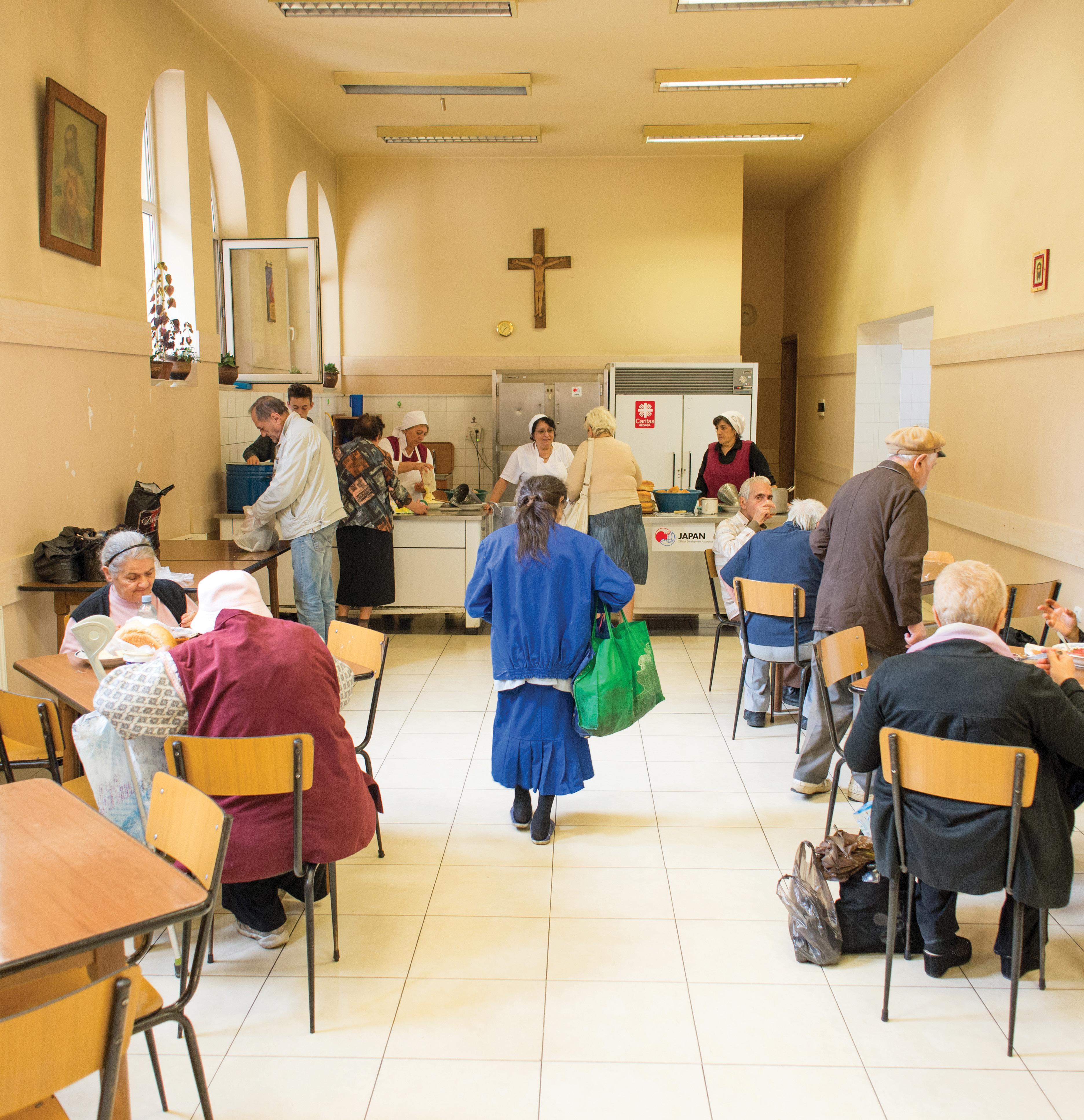
Every day, in the heart of the Georgian capital of Tbilisi, a soup kitchen opens its doors to nearly 400 older adults and children, offering not just food, but company, dignity. Nearby, children gather for counseling sessions that help them navigate trauma, loss and instability. Hundreds of people receive essential services daily, from mental and physical health care to warm beds, social support and the simple reassurance that someone still cares.
This is my country’s shared social safety net, not supported solely by the state, but stitched together by churches, such as the Catholic community’s social service charity, Caritas Georgia, civil society and international partners. This quiet web of care is fragile, but it works. Or at least, it did. For when suspicion replaces collaboration, the web loosens. Some changes come like a storm, impossible to ignore. And in 2024, Georgia changed.
A country that once welcomed democracy and worked with nongovernmental organizations turned away. Trust turned into doubt. Cooperation became control. The space for civil society began to shrink, and those who once helped to build a better future were now portrayed as enemies of the state. Overnight, rules changed and, despite a strong resistance, the Parliament of Georgia adopted the highly controversial “Law on Transparency of Foreign Influence.” Often referred to as the “Russian Law,” it bears a strong resemblance to Russia’s own “foreign agents” legislation — with the same
An elderly woman crosses the street in Old Tbilisi, a neighborhood in the Georgian capital. At right, Anahit Mkhoyan, director of Caritas Georgia, visits a Caritas-run day care center in Tbilisi.
undertone — suspicion. Soon, a new regulation followed, requiring all foreign grants and donations to be preregistered and approved by the state authorities before any activity begins. Claiming to “ensure transparency,” this law introduced layers of bureaucracy that threaten to disrupt even the most essential and immediate social programs.
Georgia’s civil society, long a key player in the country’s development, raised its voice. Streets filled with peaceful protesters for whom the new
a revised version, titled the “Law on the Registration of Foreign Agents.” Although reframed, the new law retained the core mechanisms of the original — expanding registration requirements and reinforcing control over foreign-funded organizations. The Office of Human Rights of the Organization for Security and Cooperation in Europe has warned that the law “harms civil society,” threatens freedom of association and risks being used to intimidate.

legislation signaled a shift away from the path toward greater ties with Europe, supported by the overwhelming majority of citizens. They chanted for dignity, for democracy and trust. The response came, not through dialogue but water cannons, tear gas, violence and mass arrests.
After widespread protests and international criticism, the Georgian Parliament formally repealed the “Law on Transparency of Foreign Influence” and adopted
The European Parliament declared the legislation “a serious setback for democracy,” and the European Commission froze Georgia’s candidacy in the European Union. The United States imposed sanctions on the officials involved. International donors began to reconsider their long-term presence.
The hardest questions were not being asked by politicians, but by ordinary people. This is not about partisan politics. It is about
“This isn’t about politics. It’s about presence. It’s about whether someone will show up when help is needed.”
presence. It is about whether someone will show up when help is needed. The implications of these changes are not limited to party politics — they are being felt on the ground.
According to Georgia’s National Statistics Office, approximately 864,000 pensioners and 185,000 households receive targeted social assistance. This program reaches almost a third of the country, with benefits ranging from 30-60 lari ($11-$22) per month, far below the subsistence monthly minimum of 252 lari ($193). Despite this support, many Georgians miss the qualifications and fall through the gaps. Government agencies address a portion of these needs, but humanitarian and civil society actors often play a complementary role: They fill gaps in service delivery, not as foreign influences, but as friends, especially in serving the elderly, people with special needs, displaced populations and youth.
According to Pawel Herczynski, the E.U. Ambassador to Georgia, NGOs “often provide vital social services, particularly to vulnerable communities,” and the Asian Development Bank confirms their essential role in health, education, food security and psychosocial support.
But this support is now under threat. More than 90 percent of nongovernmental organizations in Georgia, including Caritas Georgia, rely on foreign funding, and with the new legislation nearly 26,000 organizations could be affected,
according to a Council on Foreign Relations analysis from August 2024. Georgia’s aid infrastructure is now tangled in red tape, with programs delivering hot meals, mobile care or youth counseling facing grant freezes, reputational damage and legal uncertainty. For the people we help, these are not minor gaps, but lifelines lost.
If this trajectory continues, Georgia risks losing not only aid but also the mechanism of care that has held its society together. It will silence voices and reduce flexibility, and the ones left behind will be those most in need: the elderly, the poor and the displaced.
Now, we stand at a crossroads, between cooperation and isolation, between solidarity and suspicion, between service and fear. We must remember that democracy does not live in speeches. It lives in relationships. When we lose relationships, it takes more than laws to bring them back.
What is most concerning is not the additional paperwork but the erosion of trust — that slow, invisible damage that makes people question what they used to believe was good. When humanitarian actors are labeled as “influenced,” it becomes harder for the people we serve to accept our help. And in the space between fear and service, someone always suffers.
We are not talking about foreign interference. We are talking about bread on the table. Because at the end of the day, social protection is more than a policy — it is an act of faith. And faith, once shaken, is slow to restore.
Ani Ergemlidze is Caritas Georgia’s social protection program manager.

The Caritas Georgia Harmony Day Center in Tbilisi provides meals for seniors.

Healing Hands in tHe sHadows of war
Syrians rely on church networks for health care
text by Claire Porter Robbins
Dr. Antoine Dibs knows the streets of Aleppo like the back of his hand. Navigating the dusty, cramped and often chaotic roads, he greets familiar faces — men playing backgammon on street corners — while deftly avoiding motorbikes and tight turns to reach his patients. He climbs the unlit stairwells of apartment blocks, using his phone’s flashlight to cut through the darkness.
The surgeon visits a longtime patient, Rita Shahoud, who greets him with a warm smile. In her apartment, her twin pre-teens offer sweets and joke about sports. After the small talk, they get to the matter: Mrs. Shahoud’s heart disease and how she is managing now that her husband has left for
A homeless boy is treated for a leg injury at the largest public hospital in Damascus. Syria’s public health care system collapsed under neglect and a 14-year civil war.
Europe, hoping to claim refugee status, and earn income to cover her medical bills and find a way to have his family join him.
Mrs. Shahoud is among the many patients supported by Dr. Dibs through a health care support program sponsored by the Christian community. The initiative works through a diverse and far-reaching network of churches across Syria, its volunteers of physicians and caregivers providing financial assistance to those who cannot afford health care as well as an array of health care services, from covering medical debt and expensive medical analyses and surgeries to providing daily medications, emotional support and regular health check-ins.
While patients are often church members, aid is offered to anyone in need, regardless of creed.
The decade-long effort began during the 14-year civil war that devastated the lives of millions of
Syrians. It has helped around 1,500 Syrians each year, working through eparchies in urban and rural areas.
After his visit with Mrs. Shahoud, Dr. Dibs calls on Gila Asadouhi, a piano teacher, whose mother recently underwent knee replacement surgery, partially funded by the network. They chat about how her mother’s mobility has improved, how she has regained some independence, and how the procedure has lifted the spirits of everyone in the household. These moments — small victories in difficult times — are the rewards keeping him going.
Later, the physician visits Magi Azar, a widow in her 50s battling breast cancer. Although she continues to work, the cost of her mastectomy and ongoing treatment have pushed her to the financial brink. With support from the Maronite Church and the Aleppo chapter of the Society of St. Vincent de Paul, she receives
RESPONDING TO HUMAN NEEDS
debt relief and medical care overseen by Dr. Dibs. Ms. Azar says she has found community in women’s support groups organized through the Maronite community.
“They give me the strength to keep going,” she says.
The health care program is one of several initiatives the Society of St. Vincent de Paul runs in collaboration with parishes in Aleppo, involving education, psychosocial support and health care.
One of its biggest initiatives in Aleppo, where it has been active
for more than 50 years, is a home for seniors. Tucked behind the local Melkite Greek Catholic church, the home offers a refuge to senior citizens, many of whom no longer have kin in Syria, a haven filled with caregivers who tend to their charges with love and compassion. During the war, the Society of St. Vincent de Paul provided transportation for injured people and prostheses for amputees.
Gilberte Janji, who works at the seniors home and greets its residents with familiarity and warmth, says the Society of
St. Vincent de Paul supports 450 families in the Aleppo area. Ms. Janji anticipates the needs will continue for the near future.
“This is a prolonged crisis,” adds Alain Ayoub, who volunteers to manage the books for the Maronite archeparchy’s health care programs in Aleppo.
He says the need for health care remains staggering and unrelenting, but he sees the Christian community’s role as unwavering.
“As members of the church, we cannot say that we cannot help,” he says. “We must help.”
“People are trying to adapt. They’re feeling lost and have a big feeling of uncertainty about the future.”

While on paper Syria has a public health system, for lack of funds it failed to provide adequate care for the country’s population even during the pre-war years. For most Syrians, exorbitantly priced private care became the only option. Many went without health care, especially after the war devastated the country’s fragile health care infrastructure.
According to a review of 38 Syrian hospitals by the World Health Organization (WHO) in June 2012, only 50 percent were fully operational throughout the country, “due to lack of staff, equipment and medicine.” War exacerbated the staff shortage, as up to 70 percent of the nation’s health care workers fled the country, according to WHO estimates.
These factors not only hampered the treatment of the war wounded, but also of those needing treatment for other health concerns, including chronic or congenital conditions. The war and lack of access to health care services resulted in almost six million Syrians — more than one-quarter of the population — with permanent disabilities.
Staggering inflation and a lack of economic opportunity, compounded by international sanctions, have caused the cost of health care to skyrocket. Dr. Dibs, a surgeon, estimates open heart surgery, which cost about $2,500 before the war, soared to $6,000 during the civil war. The cost of treatments — major or minor — became unaffordable for a large portion of the population.
According to the United Nations
Dr. Antoine Dibs visits with Bika Qiu Mjian, far right, and her daughter Gila Asadouhi. Top right: A volunteer with the Blue Marists in Aleppo prepares a hot meal for elderly in need.
The CNEWA Connection

A staggering 90 percent of Syria’s population lives in poverty, and more than a quarter lives with permanent disabilities, physical and emotional. Syria’s intricate Christian network, which includes Catholic and Orthodox communities, offers financial and medical assistance to the most vulnerable, regardless of creed or ethnicity. Health care efforts, such as those highlighted here, whether in Aleppo, Damascus or in communities along the coast or the nation’s peripheries, need external financial and technical assistance to help fill the huge gaps in the once prosperous country. CNEWA remains committed to supporting the church’s many initiatives in restoring and rebuilding Syria.
To support CNEWA’s mission in Syria, call 1-866-322-4441 (Canada) or 1-800-442-6392 (United States) or visit cnewa. org/donate
Development Program, poverty in Syria rose from 33 percent in 2010 to 90 percent in 2024.
Bashar al-Assad’s government fell on 8 December 2024, after a surprise 12-day offensive by the Islamist rebel group Hayat Tahrir al-Sham. Syria is slowly emerging from years of isolation after U.S. President Donald Trump met with the new Syrian leader, Ahmad al-Sharaa, at a political summit in Saudi Arabia in May. The U.S. president committed to pulling down the sanctions the United States had imposed to punish the Assad regime for war crimes.
Syrians took to the streets to celebrate, aware of how the sanctions had trickled down into their daily economic realities, from
low daily wages to fuel scarcity and the prohibitive cost of diabetes medication. On 30 June, the U.S. president issued an executive order revoking a series of previous executive orders implementing sanctions. This followed the U.S. Congress introduction of legislation to repeal the 2019 Caesar Syria Civilian Protection Act.
While keeping their hopes alive that the situation will improve, internecine violence — the targeting of the Alawi community (to which the Al-Assad family belongs) along the coast in March; a suicide attack on the Orthodox parish church of Mar Elias in Damascus on 22 June; and clashes with the Druze community in the southern region of Sweida in July,

“As members of the church, we cannot say that we cannot help. We must help.”
which killed more than a thousand people — has dampened the enthusiasm of many Syrians, especially members of its diverse but vulnerable religious mosaic.
Yet, glimmers of hope remain.
Akram and Rajaa Abdallah live in a bright apartment in Homs adorned with rosaries and pictures of their children and grandchildren. Blocks away, buildings lie in ruins after the brutal siege of the city that lasted from 2011 to 2014. One of their daughters, a civil servant
earning just $10 a month, was trapped in the besieged area of the city for months. With no income, the family depended on the church, which helped fund Rajaa’s thyroid surgery and her and Akram’s vision treatments.
Sitting beside Melkite Greek Catholic Father Edwar Karam, Rajaa describes how their local parish has offered more than medicine. Their grandchildren are enrolled in catechism classes and other programs to keep them
occupied and involved, even amid the seemingly unending instability and stress of war.
“The church made us strong,” says Rajaa, adding “the most important thing is the feeling of community for the kids.”
The Blue Marists, a lay Catholic organization, has supported the work of the Marist Brothers in Aleppo since their founding in 2012. The 30 volunteers, led by Marist Brother
Rita Shahoud looks at her chest X-ray and medical files. She recently underwent heart surgery, funded by a CNEWA-supported Christian health network in Syria.
George Sabè, gained their nickname for the blue T-shirts they wear as they assist people in need.
Since the war began, says Brother George, the mental health of members of the community they serve has declined, becoming more fragile after the magnitude 7.8 earthquake in 2022 left thousands of people dead and displaced.
According to the WHO, nearly 20 percent of the population in northwest Syria — about one million people — was living with mental illness last autumn, but the area only had two psychiatrists and 78 doctors on hand. Brother George says an increasing number of people are seeking help.
“The war made people confront [the fact] that their futures and livelihoods are very unknown,” he says.
“They had and have an accumulation of fear: from the war, from the pandemic, from the earthquake.”
The Blue Marists, with external support including grants from CNEWA, provide individual and group counseling to people, ages 3 to 60, of all religions and ethnicities. These sessions aim to help beneficiaries build resilience and hope for their future.
Psychologist Bajat Azrie, who oversees the Blue Marists’ mental health programs, recounts some success stories — from teens orphaned by the war who now volunteer in their communities to a cancer patient who said her support group had helped her feel loved and uplifted at the end of her life. The Blue Marists have recorded greater success through group counseling.
“People are trying to adapt,” he explains. “They’re feeling lost and
have a big feeling of uncertainty about the future.”
Building community and bridging interfaith divides are at the heart of the approach of church groups with vulnerable populations. Father Jihad Youssef, head of the monastic community of Deir Mar Musa Monastery, north of Damascus, describes how neighbors from nearby al-Nabk, a small, predominantly Muslim city that faced intensive fighting in 2013, seek him out to share their struggles. They also receive assistance from the Christian community for medical bills.
Prior to the war, Deir Mar Musa accepted up to 50,000 visitors per year, primarily other Syrians from different religious communities curious to learn more about Christianity and the history of the medieval church, carved into the desert rockface. When the war stopped the flow of international visitors and all but eliminated international travel, the health care program allowed the monastic community to continue its mission, albeit on a smaller scale, of making meaningful connections with Muslim neighbors.
The heart of Deir Mar Musa’s mission is to promote not just interreligious coexistence, but a joyful embrace between all religious communities of the Middle East. Father Youssef says these moments of offering tea and comfort embody the very heart of Christ’s teachings.
Father Youssef believes the people of God are fulfilling the call of the Gospel “to be a bridge among communities” in their service to all Syrians, including in the provision of basic medicines for the most vulnerable, Christian or not.
Claire Porter Robbins is a freelance journalist and former aid worker in the Middle East and the Balkans.


The Fallout
Amid a surge of human trafficking in Ethiopia, foreign aid funding cuts are complicating efforts to stem the tide text by Lorenzo Hilne with photographs by Petterik Wiggers
Muhammad Omar was a child when he fled with his family from Eritrea. Military service of 18 months is mandatory there for all ablebodied citizens when they turn 18. However, once conscripted, few
know when, if ever, they will be discharged. Many Eritreans spend decades in the army, carrying out forced labor and drilling in the desert under a system human rights groups have compared with slavery. When Muhammad was
Muhammad Omar and his family fled Eritrea for Ethiopia. They now live in Addis Ababa. His older brother died while trying to migrate to Europe.
very young, his father was conscripted. The family has never seen him again.
Six years ago, when Muhammad’s elder brother was up for conscription, the family fled across Eritrea’s southern border into
ADVOCATING FOR JUSTICE & PEACE

“I can’t survive here,” says Muhammad, echoing
Female survivors of human trafficking find shelter at the convent of the Comboni Missionary Sisters in Addis Ababa. Above, Sister Yamileth Bolaños teaches the women English. Opposite, young women and girls at the convent share in friendship.
Ethiopia and settled in a camp for Eritrean refugees — tens of thousands of Eritreans have sought refuge in Ethiopia over the past two decades — but life was hard and, after a few months, Muhammad’s brother decided to head for Europe, hoping to earn enough money to support his family.
He was trafficked by migrant smugglers through Sudan and into Libya, where he was held hostage and beaten mercilessly. The traffickers called Muhammad’s
family and sent them videos of his brother being assaulted. They demanded a ransom from the family, then loaded his brother onto a rickety boat. As with so many other such vessels, it sank in the Mediterranean Sea. Muhammad’s brother drowned.
For Muhammad, the thought of following his brother was once unthinkable. He now lives with his grandmother and six other family members in a cramped apartment in Addis Ababa, Ethiopia’s capital. The rent is high but, until recently, life was bearable, in large part thanks to the support the family received from Jesuit Refugee Service (J.R.S.): 1,700 Ethiopian birr per month (roughly $12), in addition to rice, cooking oil and other food items.
That all changed in January, when the United States government announced an immediate pause on all funding for foreign aid programs. European countries, including France and Germany, also cut funding to foreign aid.
J.R.S. Ethiopia, which received most of its funding from the U.S. Bureau of Population, Refugees and Migration, subsequently suspended many programs. Since then, Muhammad and his family have received neither money nor food.
“I have no assistance; there is no one supporting me,” says Muhammad, a shy teenager with a warbling voice that is beginning to break. “Now I think I need to go abroad — even if I have to go through Libya.

echoing millions of youth living in Ethiopia.
“Not everybody dies on the journey. My brother was unlucky.”
The story of Muhammad and his brother is typical of many young people in the Horn of Africa, a region beset by chronic violence and extreme repression from which many want to escape. In recent years the situation has deteriorated further, especially in Ethiopia, where a civil war broke out in November 2020 as the Ethiopian government, in concert with Eritrea, sought to crush the Tigray People’s Liberation Front, the powerful ruling party in Ethiopia’s northernmost region of Tigray. By the time a peace deal was signed two years later, an estimated 600,000 people had been
killed. Some estimates suggest 10 percent of women in Tigray were raped as an act of war.
Nearly three years on, the peace deal has brought little healing. In 2023, another conflict broke out in the Amhara region, south of Tigray, as armed groups dissatisfied with the ceasefire agreement launched an insurgency against the government. A separate insurgency has raged since late 2018 in Oromia, Ethiopia’s largest region. Thousands of schools and hospitals across the country have been damaged or destroyed. At least 8 million children are not in school as a result, according to UNICEF.
Rampant instability recently brought the country close to economic collapse. In late 2023,
Ethiopia defaulted on its debt. In exchange for a bailout from the International Monetary Fund, in July 2024 the country agreed to implement significant economic reforms. The result was an immediate devaluation by more than 50 percent of Ethiopia’s currency, halving the value of ordinary Ethiopians’ wages and savings, reducing their purchasing power and skyrocketing the prices of food, rent and other essentials.
Already in 2022, the United Nations Development Program stated the multidimensional poverty rate in Ethiopia rose to 72 percent, a nearly 5 percent increase from 2019, due to the pandemic and the wars in Tigray and Ukraine. The 2024 currency
The CNEWA Connection

For decades, Catholic Near East Welfare Association has supported the work of the churches in Ethiopia and Eritrea, including initiatives of religious communities and eparchies, the Jesuit Refugee Service and its urban center for refugees in Addis Ababa, and the efforts of the Talitha Kum network to combat the scourge of human trafficking. In the wake of cuts of foreign aid by the United States and European states, some of CNEWA’s partner organizations are struggling to make ends meet and have turned to CNEWA to help fill the funding gaps.
To support CNEWA’s mission in Ethiopia and Eritrea, call 1-866-322-4441 (Canada) or 1-800-442-6392 (United States) or visit cnewa.org/donate
change is expected to make the situation worse.
“I can’t survive here,” says Muhammad, echoing millions of youth living in Ethiopia.
The years-long social and economic crisis engulfing Ethiopia has led to a surge in irregular migration that puts the lives of hundreds of thousands of people at the mercy of human traffickers. In 2023, at least 96,670 migrants from the Horn of Africa crossed the Red Sea into Yemen, according to the International Organization for Migration (I.O.M.); 95 percent left Ethiopia trying to reach Saudi Arabia and other countries in the Gulf. Between January and October last year the number of people leaving Ethiopia along the same route almost doubled to 184,701. Both figures represent only the migrants the I.O.M. has
been able to track. Several thousand people also head north to Europe through Libya, or south to South Africa each year. Many of these people fall into the hands of human traffickers, whose profits hinge on their ability to monetize cruelty.
According to a federal prosecutor, who requested anonymity and who works on human trafficking cases in Dire Dawa, a city in eastern Ethiopia that is a hub for irregular migrants, there are “chains of brokers [people smugglers] in all small towns” in Ethiopia. These brokers persuade people to trust them, painting pictures of the wonderful lives they will enjoy in Europe or the Gulf. Often they will cover a migrant hopeful’s travel expenses up to the Ethiopian border, the prosecutor says, where they are
Young people learn computer skills at Jesuit Refugee Service in Addis Ababa. Opposite page, Muhammad Omar participates in a typical coffee ritual with his aunts and grandmother in their apartment in Addis Ababa.
handed over to migrant smugglers from Sudan or Somalia. As with Muhammad’s brother, they are detained by the smugglers and subjected to beatings, torture and rape, and videos are sent to their families to extract a ransom.
Traveling through some of the world’s most violent and unstable countries — Sudan, Libya, Somalia, Yemen — migrants will often face this torture multiple times at the hands of various armed groups or smuggling gangs, and many die along the way.
Humanitarian and churchbased groups have been working to alleviate this suffering by assisting those at risk of being trafficked. However, as countries in the West have slashed aid budgets, these organizations are now struggling.
For instance, J.R.S. used to run workshops and training sessions for young refugees about the dangers of irregular migration and the brutality of human traffickers. It also provided vocational skills training in information technology, languages and music to help them find employment and discourage them from migrating. However, those programs have been suspended, says Solomon Brahane, J.R.S.’s country director for Ethiopia.
J.R.S. Ethiopia previously received much of its funding from the U.S. Bureau of Population, Refugees and Migration and the UNHCR; the former was completely cut off, while the latter was reduced. As a result, J.R.S. has laid off many staff, including half of the child protection officers responsible for identifying refugee
children who may be at risk of trafficking and in need of emergency support, and has redirected all its resources toward emergency assistance for only the most vulnerable families.
Over the past two months, Mr. Brahane says, many refugees who benefited from J.R.S.’s programs have left Ethiopia. Some of them will doubtless have been exposed to human traffickers, he says.
The Comboni Missionary Sisters in Ethiopia have managed to continue their work mostly unimpeded because they receive all their funding from private donors, says Sister Yamileth Bolaños.
As members of Talitha Kum, a global network of religious women committed to fighting human trafficking, a considerable part of their mission is helping women who have been trafficked or sexually abused.
“There is now a lot of sexual abuse in Ethiopia. It has increased enormously,” says Sister Yamileth. She works at her community’s convent, a cottage in the Haya Hulet neighborhood in Addis Ababa, where female survivors of sexual violence and human trafficking find a haven. “And some of these girls are very, very young. We are talking about 10 or 11 years old.”
In recent years, thousands of women have left for Saudi Arabia
and Dubai, where there is a high demand for maids, cooks and other domestic workers. In many cases these women experience heinous exploitation that amounts to human trafficking, says Sister Yamileth.
While often these women travel abroad legally, upon their arrival, employers confiscate their passports and force them to work without pay and with severe restrictions on their movement. Sister Yamileth recounts one story of a young woman whose employer kept her locked in a tiny kitchen, except when she had to clean the house. One day as she was cooking, a fire broke out in the kitchen where she was trapped. She suffered burns to 95 percent


“There is now a lot of sexual abuse in Ethiopia. It has increased enormously.”
of her body and spent two years in the hospital.
Eventually, the Ethiopian government intervened and repatriated her to Ethiopia, where she came into the care of the Comboni Sisters.
The sisters work with a local shelter, run by Comunità Voluntari per il Mondo, a charity that works with the Ethiopian government to take temporary care of women who have been victims of human trafficking or sexual abuse. The sisters will then welcome these women to their convent and provide psychological support and vocational training, such as baking or cosmetology. Once the women are ready to reintegrate into society, the sisters help them with finding work and housing and give them rent support for three months.
While the sisters have been effective in helping survivors, they have not been able to stem the tide of thousands who are leaving Ethiopia and being trafficked daily.
In Adigrat, a city that suffered terribly during the 2020-2022 war, young people are migrating in huge numbers. Many fall victim to the cruelty of human traffickers, and even if they are lucky enough to survive, the effects on their families are devastating.
“They sell a house, they sell a cow, they sell their chickens [to pay the ransom],” says Abune Tesfasellassie Medhin, bishop of the Eparchy of Adigrat. In this way, he adds, human trafficking is “accelerating poverty.”
Preventing this catastrophe requires finding ways to help people lead “productive lives,” he says, giving them a reason not to
lose hope and risk everything, including their life, on a perilous journey abroad. The Catholic community in Adigrat, which he shepherds, has been involved in various initiatives to this effect.
Women have traveled to Addis Ababa and benefited from the work of the Comboni Sisters.
Alongside the efforts of Talitha Kum, the eparchy organizes training sessions and workshops for young people at risk of irregular migration, as well as vocational training to increase their skills and employability so they may remain and earn a living in Ethiopia.
Yet many of these initiatives have been hampered by foreign aid cuts. In a world of declining foreign funding, Bishop Tesfasellassie says funds must be used more efficiently, which means giving a greater share of the available resources to local actors, who are close to the reality on the ground, with deep links to the community, rather than to big nongovernmental organizations.
“All these bureaucracies and matrices are tricks that only the fittest can survive,” he says. “To move the money among the powerful ones, they use these tricks.”
In that maze of bureaucracy, “only the highest-paid professionals can prepare ‘project proposals,’ not ordinary people who are working on the ground with huge cost-effectiveness,” the bishop says, explaining the requirements of funding that are often too complicated and timeconsuming to complete for those working in the field.
“We have big gratitude toward all people of goodwill and generosity,” he says. “But these processes need simplification, because the resources are not reaching us in time or helping us in solving problems.” n

Young women take an art class at the Jesuit Refugee Service center in Addis Ababa.
The streets of Gaza are quieter than they used to be — not because peace has returned. The deep silence of hunger has replaced the noise of daily life. Every corner bears the marks of a deepening humanitarian catastrophe: gaunt faces of children, long lines at makeshift aid points and parents who have nothing left to give but words of comfort and prayer.
The humanitarian collapse in Gaza did not happen overnight. On 2 March 2025, the Israeli Defense Forces sealed all crossings into the enclave — 16 days before the collapse of the temporary ceasefire between Israel and Hamas. With borders sealed, the already limited flow of food, medicine and fuel stopped entirely. Within weeks, hunger and malnutrition spread at an unprecedented pace. Preventable diseases began to take hold. By early August, the Hamas-run Ministry of Health in Gaza reported 201 people had died from famine and malnutrition since the start of the war, including 98 children. Those numbers rise daily.
In the middle of Gaza City, amid rubble and market stalls selling a handful of overpriced simple popular sweets, 35-year-old Ahmed Al-Sawafiri describes the reality of survival:
“Out of poverty, we have children we want to feed — nothing more or less,” he says. “The situation in general is really difficult, really tragic, and we hope to God things get better.”
Hunger, he adds, is now part of everyday life. “The famine is great; children sometimes sleep without eating. What can we do? We just need to get by. It’s all in God’s will.”
For Mr. Al-Sawafiri, faith is both a comfort and a lifeline. “Hopefully for the better,” he says, glancing at the street around him. “We ask God that things get better.”
A few steps away, a boy in a small stall, barely tall enough to see over the market crowd, spends his days trying to earn enough to support his eight siblings, “so we can eat and live, and feed my little siblings.” Abdul Rahman Barghouth, 12, dreams of school, but for now his hope is that “the war ends, and prices go down.”
Faith runs through these conversations as naturally as breath. People speak of God’s will even as they recount the impossible choices they face, whether to send a child to line up for aid despite the risk of shelling, whether to sell the last piece of jewelry for a bag of rice, whether to skip their own meal so a child can eat.
For 54-year-old Mozayal Hassouna, those choices leave deep emotional scars. “Some days we had been four days without bread,” she says. “My youngest son tells me, ‘You let me go to sleep hungry, Mom.’ But I can’t provide anything. My husband is 65 and sick; he can’t run after trucks for aid. We lost our stall in the market; our house was bombed like others. We have no income, nothing left to sell, but we do not object to God’s will.”
Her son has developed a stutter, which a doctor says is the result of trauma from bombardment. Now they live in a tent, displaced for two months. “I hope the war ends all over Gaza,” she says. “Let us live, and the children live a little.”
No story captures the cruel intersection of war, siege and hunger clearer than that of 2-yearold Muhammad Al-Mutawaq. His mother, Hidaya, has been displaced seven times since the war began. Her husband was killed early in the conflict in Jabalia, leaving her alone with four children. Before the recent escalation, Muhammad weighed
20 pounds. Today, he weighs just 13. “There is no aid entering Gaza,” she says. “Borders are closed; prices are very high. His only cure is to eat and drink.”
She has tried hospitals, aid groups and community kitchens, but has not received sufficient aid.
“I registered in many associations as a mother of orphans, but I didn’t benefit at all,” she says. “I got really tired going to hospitals, associations, schools, trying to find something for him.”
Muhammad suffers from muscle relaxation, or myotonia, worsened by malnutrition. Physical therapy has helped, but without proper food, recovery is impossible.
“Since I lost my husband, these are all God’s tests,” she says. “We will be patient, and hopefully it will end, and Muhammad will be like he used to be.”
UNICEF spokesperson Salim Oweis called the situation in mid-August “a man-made catastrophe.” He warns hunger is now killing children in staggering numbers.
“Over 90 have died from malnutrition since the war began — a staggering increase of more than 50 percent in less than three months,” he says. “We are witnessing a generation growing up with toxic stress, deprivation and trauma that will probably last a lifetime.”
In July, nearly 12,000 children were diagnosed with acute malnutrition, compared with 2,000 in February.
The Integrated Food Security Phase Classification, a collaborative initiative of worldwide crisis relief
A camp in Gaza by the Mediterranean Sea provides shelter for those displaced by the war, which has made large parts of the strip uninhabitable. Inset, displaced people walk through a makeshift street market in Gaza City.

At Death’s Door
When famine is used as a weapon of war text and photographs by Diaa Ostaz
organizations, including UNICEF, warned in mid-July that Gaza’s food consumption and nutrition indicators were at their worst since the war began. More than one in three people were going days at a time without eating, and half a million people — nearly a quarter of Gaza’s population — were enduring famine-like conditions.
“Every hour we wait, more children will die — if not from bombs, then from the humanitarian crisis that follows them around every corner,” Mr. Oweis says. While some aid trickles in, he described it as “a drop in the ocean of needs.”
Airdrops, though symbolic, are inefficient, expensive and dangerous, sometimes killing
people in the scramble for supplies. “They don’t compare to what could come in through land routes if full and unimpeded access is allowed,” he says.
At Al-Ahli Arab Hospital, medical director Dr. Maher Ayyad describes a health system on the brink of collapse.
“Really, it is catastrophic,” he says. “We are short of medicine, supplies, equipment. Our machines are damaged, and there are no spare parts or engineers to repair them. We are dependent entirely on generators, needing about 238 gallons of fuel daily — often unavailable.”
Much of the hospital’s trained staff has fled or been displaced.
“Sometimes we receive 400 casualties in a single day,” Dr. Ayyad says. “We cannot deal with all of these patients, and we are sorry to lose some because of shortages.”
While Al-Ahli is primarily a surgical hospital, famine’s shadow is visible there, too.
“We can see people are starving,” he says. “Some goods are in the market, but they are so expensive nobody can buy them.”
Dr. Ayyad expresses gratitude for the symbolic gestures of airdropped aid but warns that, without stopping the war, relief will always fall short.
“Please work for peace,” he urges. “Without stopping this war, the problem will go deeper and deeper.”
“We ask God that things get better.”

Take a closer look at this story through ONE’s exclusive audio and video content. u
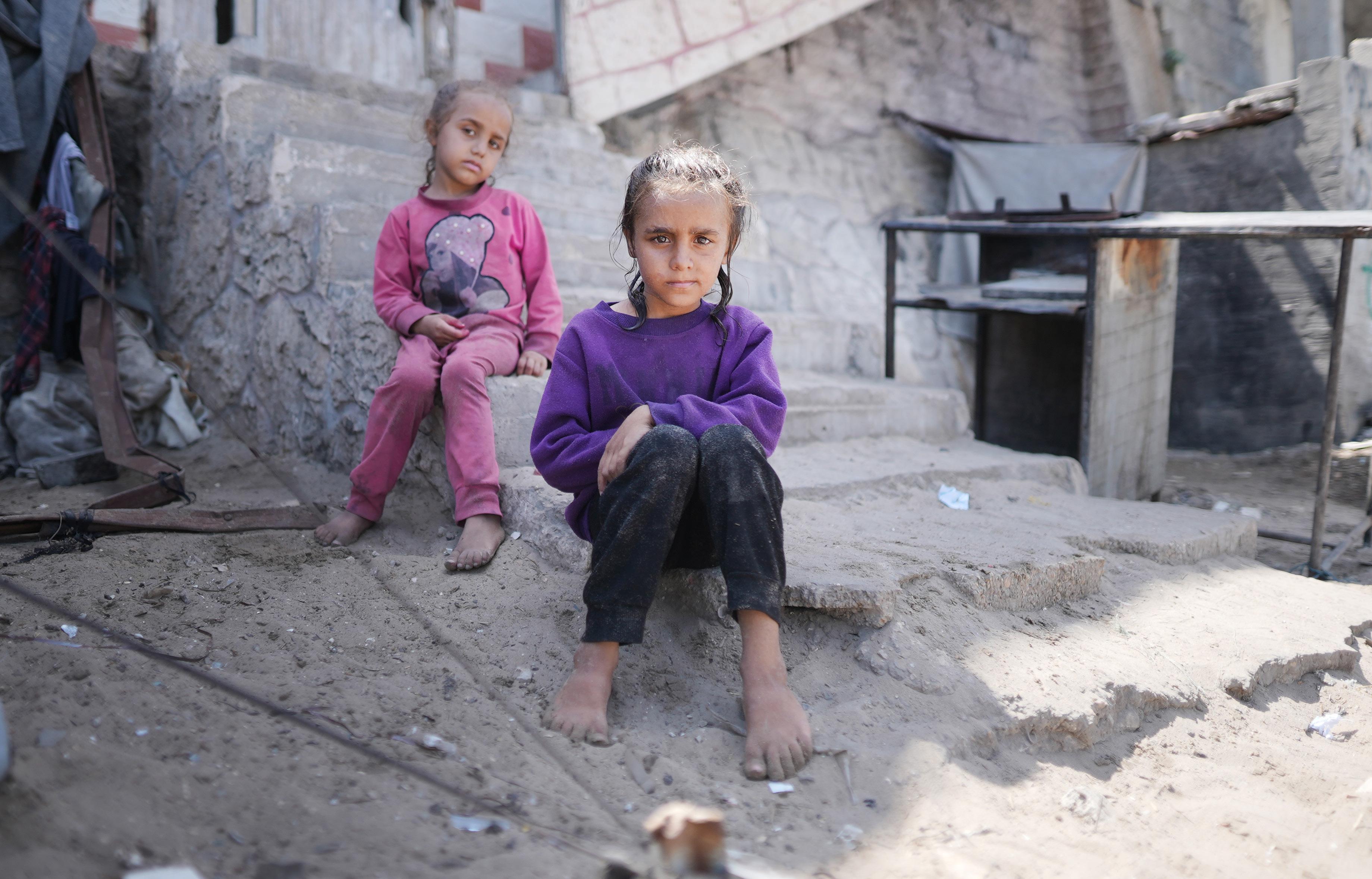
The layers of collapse in Gaza reach into every part of life. Drinking water is scarce, forcing people to drink untreated water that carries the risk of cholera and other diseases. Tens of thousands live in tents or overcrowded shelters, with no privacy and little safety. Livelihoods have been erased as markets are bombed, fishing is blocked, and farmland is inaccessible. Schools lie in ruins or serve as shelters, and many children have forgotten how to read or write under the weight of trauma. The Ministry of Health warns of a dangerous increase in Guillain-Barré syndrome and other diseases linked with poor nutrition and sanitation, calling the situation “a warning of a real, potential infectious disaster.”
The common refrain is not only that aid is scarce, but that it is uneven. “Some people eat and some don’t,” Mr. Al-Sawafiri says.
Ms. Hassouna describes how her family cannot reach aid drops, either because they are too far or the scramble is too dangerous. UNICEF’s Salim Oweis confirms this, saying that security risks, coordination delays and desperate crowds make it almost impossible to distribute aid fairly. The difference between survival and starvation, he says, can come down to whether someone is strong enough to run for a bag of flour.
Despite the destruction, there is a shared refrain: “Alhamdulillah,” praise be to God. Faith becomes the language that fills the space where certainty used to be.
For Mr. Al-Sawafiri, that means believing things will “get better and better.” For young Abdul Rahman, it means thanking God for whatever food comes. For Ms. Al-Mutawaq, it means viewing her son’s suffering as a test from God, one that will one day end.
International agencies insist this crisis is not inevitable — it is preventable. UNICEF has called for an immediate and permanent ceasefire, unrestricted entry of humanitarian and commercial supplies, and protection for civilians and aid workers. Without these steps, the warnings are stark: Famine will deepen, disease will spread, and more children will die.
“All the help will not be enough without stopping this war,” says Dr. Ayyad. “The situation is catastrophic. I hope soon the leaders will reach comprehensive peace in this area.”
As Gazans wait for peace, Ms. Hassouna repeats her faithfilled wish: “We have no objection to God’s will. But I hope the war ends completely, so we can live, and the children can live a little.”
Journalist Diaa Ostaz reports from Gaza.
Lynn Hassouna, 6, and her sister Razan, 5, are among the thousands of children displaced by the war. Opposite, as many buildings have been destroyed, merchants take to the streets of Gaza City to sell their meager wares.
The Last Word

The Jubilee Prayer
Father in heaven, may the faith you have given us in your son, Jesus Christ, our brother, and the flame of charity enkindled in our hearts by the Holy Spirit, reawaken in us the blessed hope for the coming of your Kingdom.
May your grace transform us into tireless cultivators of the seeds of the Gospel. May those seeds transform from within both humanity and the whole cosmos in the sure expectation of a new heaven and a new earth, when, with the powers of Evil vanquished, your glory will shine eternally.
May the grace of the Jubilee reawaken in us, Pilgrims of Hope, a yearning for the treasures of heaven. May that same grace spread the joy and peace of our Redeemer throughout the earth. To you, our God, eternally blessed, be glory and praise forever. Amen.
Perspectives
from the president
by Msgr. Peter I. Vaccari
“ ‘Peace be with you.’ When he had said this, he showed them his hands and his side. The disciples rejoiced when they saw the Lord. [Jesus] said to them again, ‘Peace be with you. As the Father has sent me, so I send you.’ ”
(Jn 20:19-21)
On 8 May, when Pope Leo XIV stepped out on the loggia after his election as the successor of St. Peter to greet the people in St. Peter’s Square and the entire world, he offered the salutation of the risen Christ to all.
He added:
“I would like this greeting of peace to resound in your hearts, in your families, among all people, wherever they may be, in every nation and throughout the world. Peace be with you!
“It is the peace of the risen Christ. A peace that is unarmed and disarming, humble and persevering. A peace that comes from God, the God who loves us all, unconditionally.”
Less than a week later, on 14 May, in his address to the participants in the Jubilee of the Eastern Churches, Pope Leo linked the “song of hope,” sung no better than by the “martyr churches” — a term Pope Francis used — of the East, to an appeal for peace — an appeal with its origin in the risen Christ.
Pope Leo describes Christ’s peace:
“Christ’s peace is not the sepulchral silence that reigns after conflict; it is not the fruit of oppression, but rather a gift that is meant for all, a gift that brings new life. Let us pray for this peace, which is reconciliation, forgiveness and the courage to turn the page and start anew.”
Hidaya al-Mutawaq and her malnourished son, Muhammad, are among the people in Gaza facing famine in the ongoing Israel-Hamas war.
In his address, the pope articulated the position of the Holy See as always open to dialogue in search of hope. He spoke of how “our neighbors are not first our enemies, but our fellow human beings; not criminals to be hated, but other men and women with whom we can speak.”
In the few months that Leo XIV has served as the successor of St. Peter, the world has seen how this “son of St. Augustine,” the first Augustinian pope, has dedicated so much of his public reflections to the theme of peace.
St. Augustine (354-430) wrote often on the theme of peace, especially in Book XIX of “The City of God.” Permit me to recommend a return to the writing and thought of St. Augustine if you wish to know the thinking of Pope Leo XIV.
If I may, a few additional reflections: Congratulations to CNEWA’s communications and marketing team, along with the creative services team, for the outstanding quality they continue to produce in CNEWA’s ONE magazine. At the annual June meeting of the Catholic Media Association in Phoenix, CNEWA won 53 media awards and 17 first place awards, including best website!
The current issue of ONE addresses humanitarian and pastoral concerns in regions of the world — including Syria, Ukraine, Georgia, Gaza and Ethiopia — where your prayers, informed by the news we share with you, and your extraordinary generosity bring a glimmer of hope to those we serve. Thank you.
May I also bring to your attention three very important initiatives on the part of CNEWA-Pontifical Mission:
• Our Gaza Emergency Relief Appeal: Again, here, I repeat the words of Pope Leo: “Gaza is starving.” Prayer, awareness and action constitute our priorities. The action must be now! CNEWA-Pontifical Mission is not working in isolation. We have the means to safely obtain essential supplies for people who are suffering and most in need at this hour! I beg for your assistance! Please go to our website to donate.

• CNEWA’s Second Annual Golf Classic: Please help us to build our network with your support for our golf event on Thursday, 16 October, at the Plandome Country Club in Long Island, New York. Join us for a day of golf or just for dinner at the club, or support us through a sponsorship opportunity.
• CNEWA’s Annual Gala Dinner: Please join us on 1 December at a private club in Manhattan at the event that will launch CNEWA’s centennial year. The guest of honor will be His Excellency, Archbishop Borys Gudziak, metropolitan archbishop of the Ukrainian Catholic Archeparchy of Philadelphia, and our Faith & Culture Award recipient will be Michèle B. Bowe, ambassador to Palestine for the Sovereign Order of Malta.
With my gratitude and prayers,

Peter I. Vaccari President
CNEWA a papal agency for humanitarian and pastoral support
220 East 42nd Street, New York, NY 10017 • 1-212-826-1480 • cnewa@cnewa.org
223 Main Street, Ottawa, Ontario K1S 1C4 • 1-866-322-4441 • www.cnewa.ca
