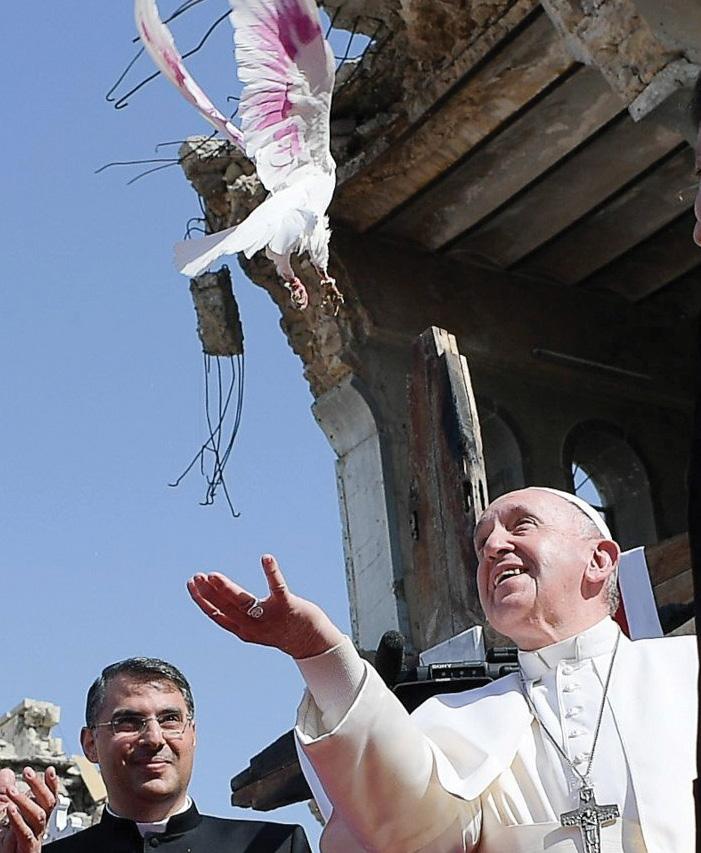
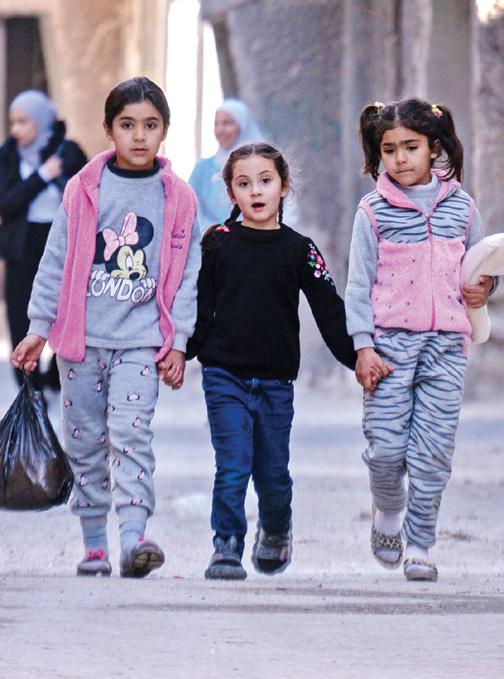
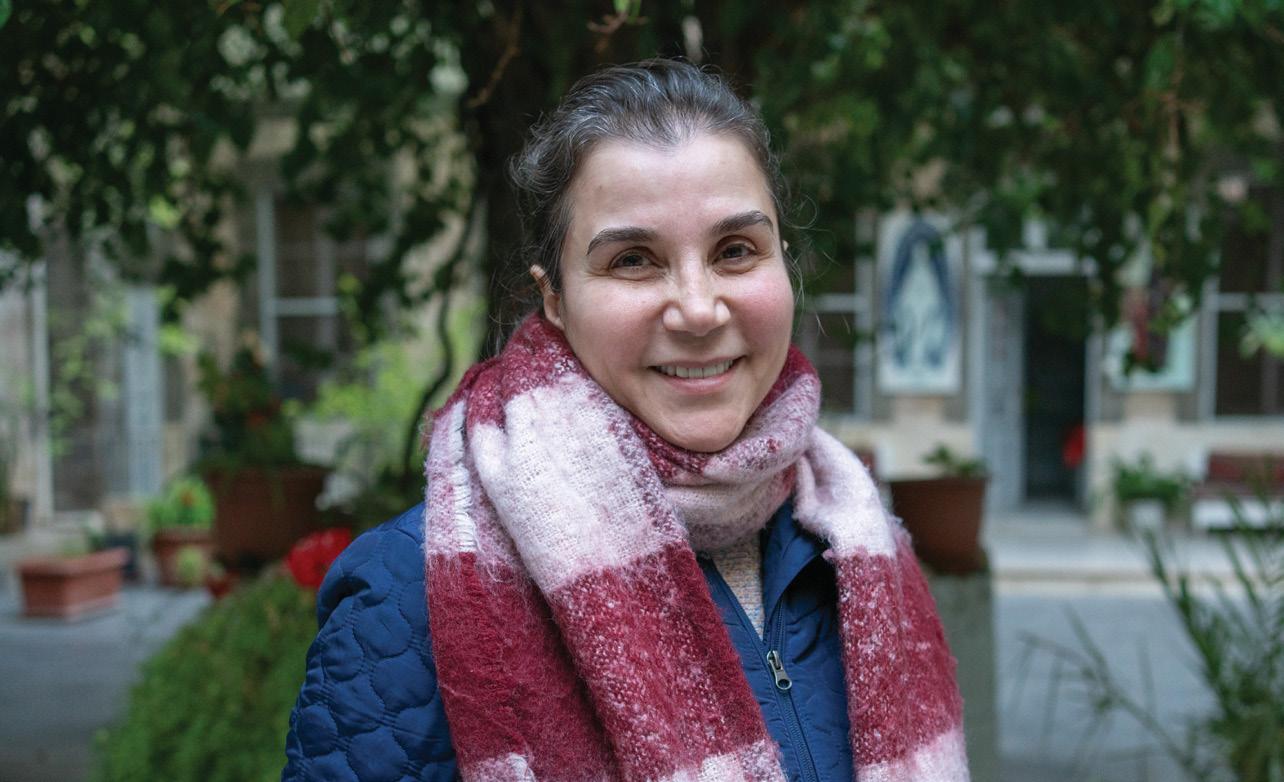
Our New Pontiff Legacy of Pope Francis Fear in the West Bank Lifelines in Syria
18 26 6
32 12
COVER STORY
Peace, Justice, Truth
Leo XIV begins his pontificate with a clear vision by Michael J. La Civita
FEATURES
A Pope for the Peripheries
Remembering Pope Francis and his legacy by Laura Ieraci and Barb Fraze
Landscape of Loss
West Bank Christians face a harrowing future by Fatima AbdulKarim
In Need of a Lifeline
Assisting children in post-Assad Syria text by Rosabel Crean with photographs by Ahmad Fallaha
Holding Their Own
The Middle East after U.S. funding cuts by Laure Delacloche
DEPARTMENTS
4
38
Connections to CNEWA’s world
The Last Word
Perspectives from the president by Msgr. Peter I. Vaccari
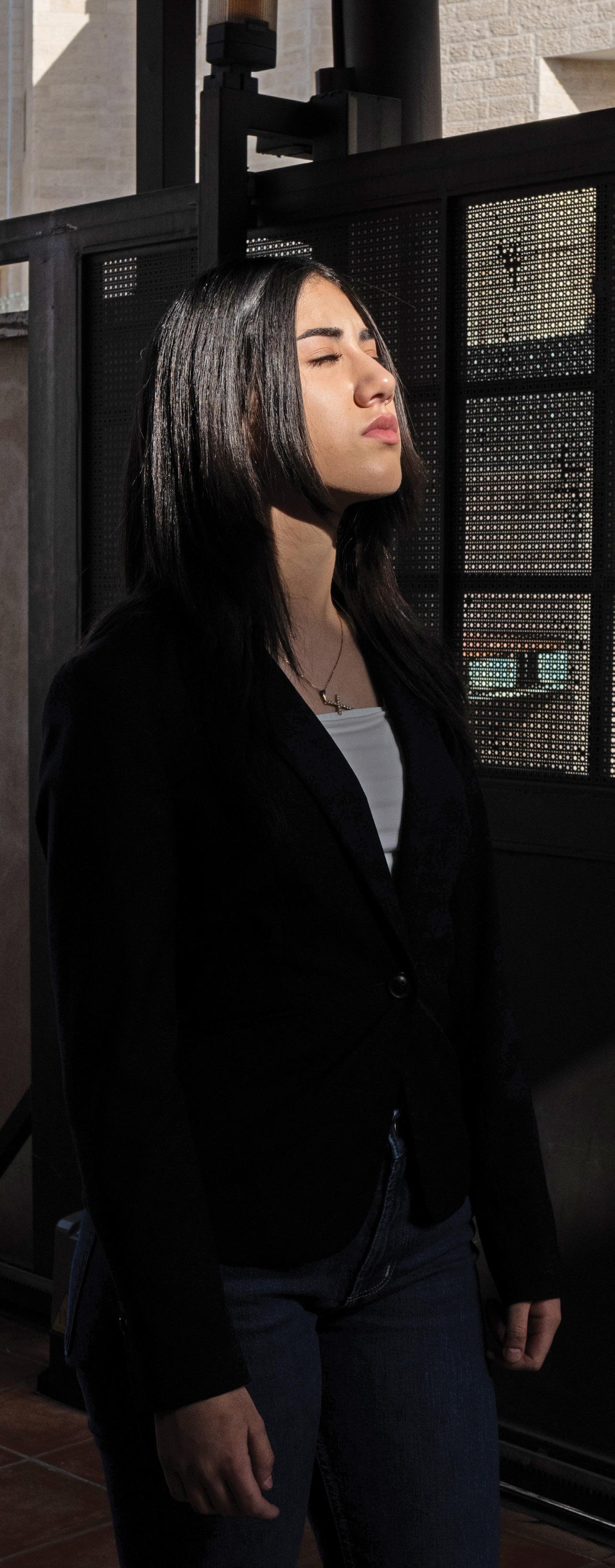
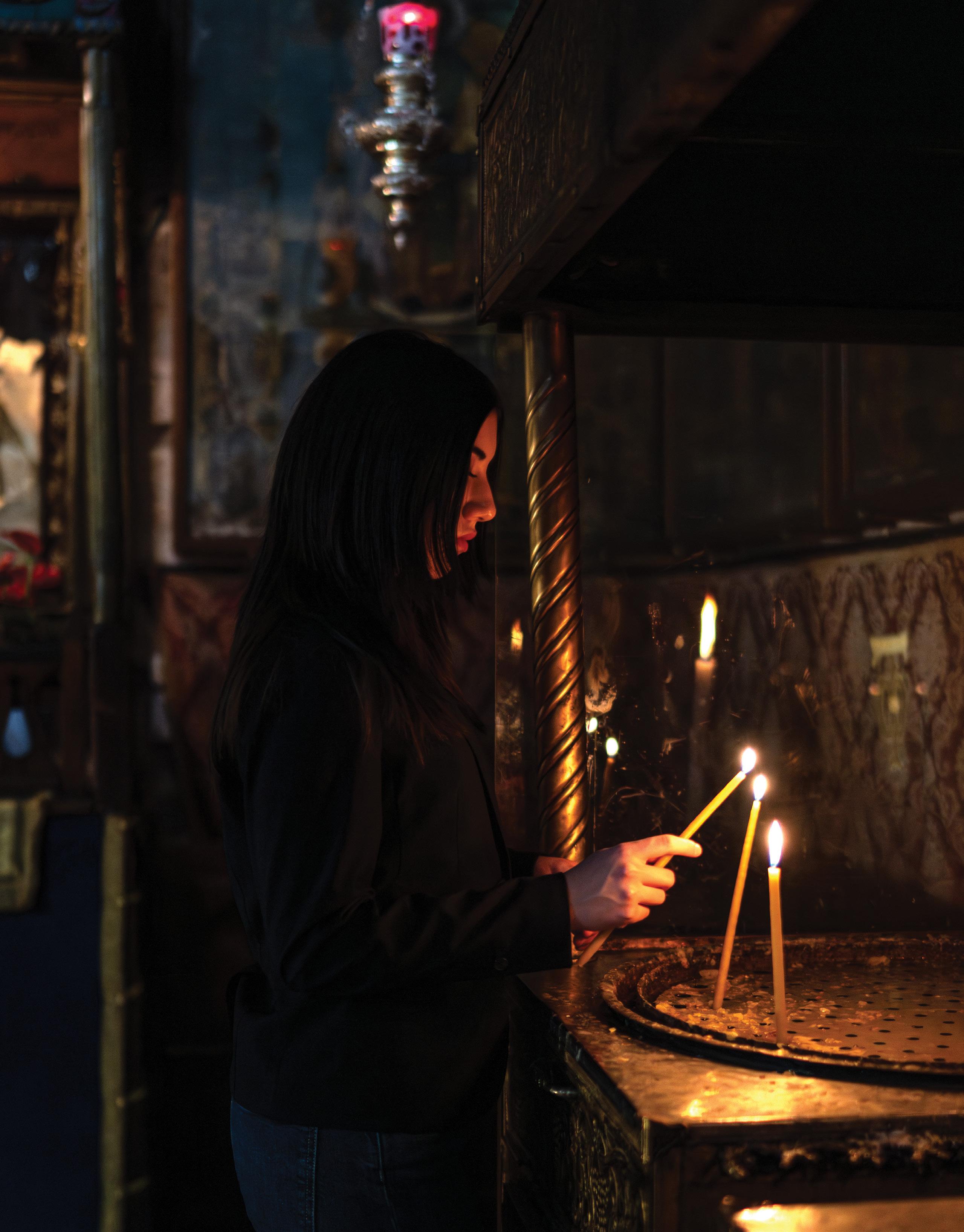
t Sally Nassar, like many young Christians in the West Bank, is considering a future abroad.
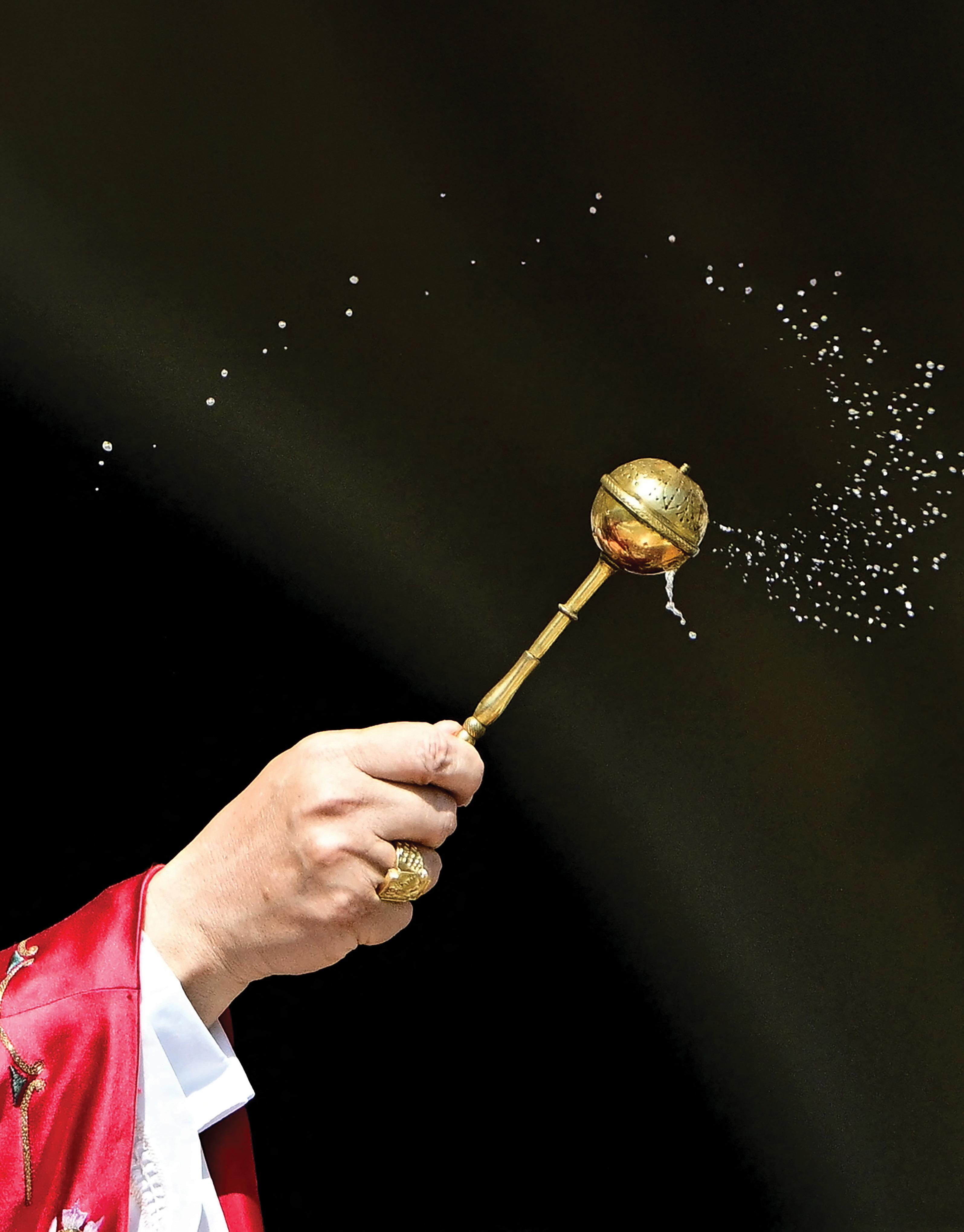
Front: Pope Leo XIV sprinkles holy water on the faithful in St. Peter’s Square, 8 June.
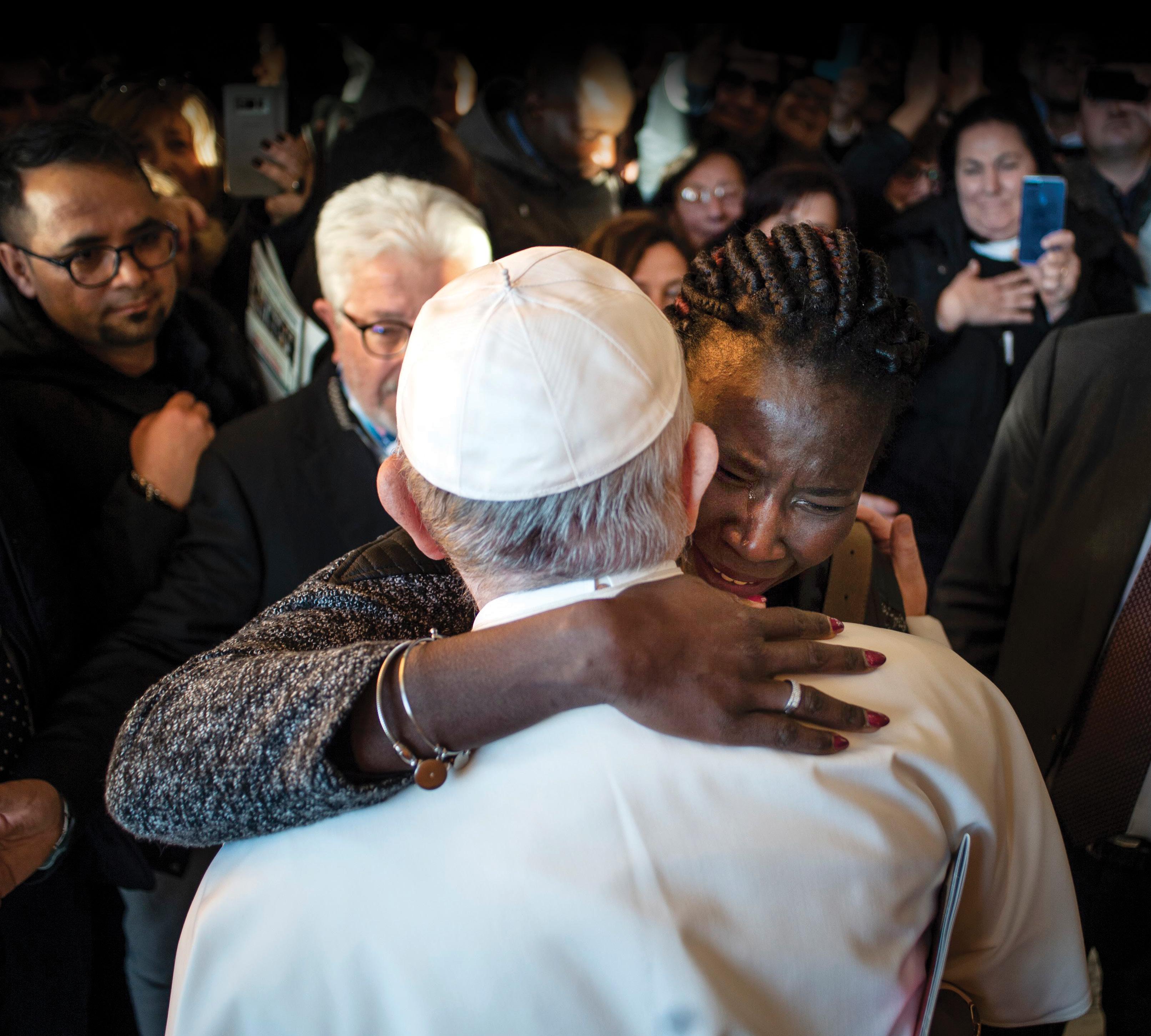
Back: A migrant hugged Pope Francis after he celebrated Mass outside Rome in 2019.
Photo Credits
Cover, p. 7, Tiziana Fabi/AFP via Getty Images; pp. 2, 20, 23-25, Samar Hazboun; p. 3 (top), Maria Grazia Picciarella/SOPA Images/ LightRocket via Getty Images; p. 3 (upper left), John E. Kozar/CNEWA; pp. 3 (upper right), 4, 10-11, 16, back cover, CNS photo/Vatican Media; pp. 3 (lower left), 38, IanDagnall Computing/Alamy Stock Photo; pp. 3 (lower right and far right), 26-31, Ahmad Fallaha; p. 5, Michael J. La Civita; p. 8, Vatican Media/Vatican Pool – Corbis/Getty Images; p. 9, OSV News photo/Marko Djurica, Reuters; p. 12, CNS/Paul Haring; p. 14, Vatican Media via Vatican Pool/ Getty Images; pp. 14-15, Tullio M. Puglia/Getty Images; p. 15, RealyEasyStar/Riccardo Squillantini/Alamy Stock Photo; p. 17, Andrea Bonetti/Greek Prime Minister’s Office via Getty Images; pp. 18-19, Andrew Lichtenstein/Corbis via Getty Images; p. 22, Jaafar Ashtiyeh/AFP via Getty Images; pp. 32-33, Raghida Skaff; p. 34, Maroun Bassil; p. 35, CNS photo/Ako Rasheed, Reuters; p. 36 Ahmad Gharabli/AFP. ONE is published quarterly. ISSN: 1552-2016
CNEWA
Founded by the Holy Father, CNEWA shares the love of Christ with the churches and peoples of the East, working for, through and with the Eastern churches.
Volume 51 Number 2
CNEWA connects you to your brothers and sisters in need. Together, we build up the church, affirm human dignity, alleviate poverty, encourage dialogue — and inspire hope.
Publisher
Msgr. Peter I. Vaccari
Executive Editor
Michael J. La Civita
Editorial
Laura Ieraci, Editor
David Aquije, Contributing Editor
Barb Fraze, Contributing Editor
Elias D. Mallon, Contributing Editor
Creative
Timothy McCarthy, Digital Assets Manager Paul Grillo, Senior Graphic Designer
Around the world, CNEWA cares for the smallest and most vulnerable — children growing up in violence, poverty and critical instability.
But it’s not just the love and care of the priests, sisters and staff who help them grow and thrive. It’s the kindness and generosity of people like you.
You know, in your heart, that all children deserve a life rich in possibility and joy.
You know our world is a darker place when children are denied compassion and love.
Become a monthly giver — and share your gift of compassion with children who have been hurt and discarded.
cnewa.org/donate
Connections to CNEWA’s world
Pope Leo Looks East
Within the first 10 days of his pontificate, Pope Leo XIV communicated unequivocally the importance of the Christian East, his concern about the crises in the regions where CNEWA works, and his commitment to advance Christian unity.
Pope Leo held an audience with thousands of Eastern Catholics on pilgrimage to Rome for the jubilee year on 14 May. He thanked them for their perseverance and witness and pledged the Holy See’s commitment to promote peace and reconciliation.
Later that day, he met privately with Major Archbishop Sviatoslav Shevchuk of the Ukrainian Greek Catholic Church and, on 18 May after his inauguration Mass, with Ukrainian President Volodymyr Zelensky and his wife. The Vatican press office did not release a statement about the latter. However, Catholic News Service reported Mr. Zelensky thanked the pope for the meeting in a social media post on his X account and “the Vatican for its willingness to serve as a platform for direct negotiations between Ukraine and Russia.”
“We are ready for dialogue in any format for the sake of tangible results. We appreciate the support for Ukraine and the clear voice in defense of a just and lasting peace,” he wrote.
The Vatican confirmed plans are underway for Pope Leo to travel to Iznik, Turkey — a trip Pope Francis had planned — the site of the ancient city of Nicaea, to commemorate the 1,700th anniversary of the First Ecumenical Council of Nicaea with Ecumenical Patriarch Bartholomew of Constantinople.
On 19 May, Pope Leo affirmed his commitment to ecumenical and interreligious dialogue at a meeting with leaders of other churches and religions who attended his inauguration, including the ecumenical patriarch, Orthodox Patriarch Theophilos III of Jerusalem, Mar Awa III, catholicos-patriarch of the Assyrian Church of the East, Anglican, Methodist and Lutheran leaders, and representatives of the Jewish, Muslim, Buddhist, Sikh and Jain communities.
“I consider one of my priorities to be that of seeking the re-establishment
of full and visible communion among all those who profess the same faith in God the Father, the Son and the Holy Spirit,” he said.
CNEWA in Rome
CNEWA hosted a series of events in Rome this spring, including a reception at the Holy See’s Dicastery for the Eastern Churches, cohosted by CNEWA board member Marina C. Perna. Guests from throughout Italy and the European Union were introduced to CNEWA’s mission and work, with emphasis placed on the close partnership between this agency of the Holy See and the dicastery, whose secretary, Archbishop Michel Jalakh, O.A.M., and undersecretary, Bishop Filippo Ciampanelli, spoke to the guests and led them through the dicastery’s historic offices, including its renowned chapel.
On 31 March, CNEWA cosponsored a presentation at the Pontifical Oriental Institute (PIO) of the book “Eastern Catholic Theology in Action,” organized by the PIO and the Toronto-based Metropolitan Andrey Sheptytsky Institute. The book is the first volume in a new
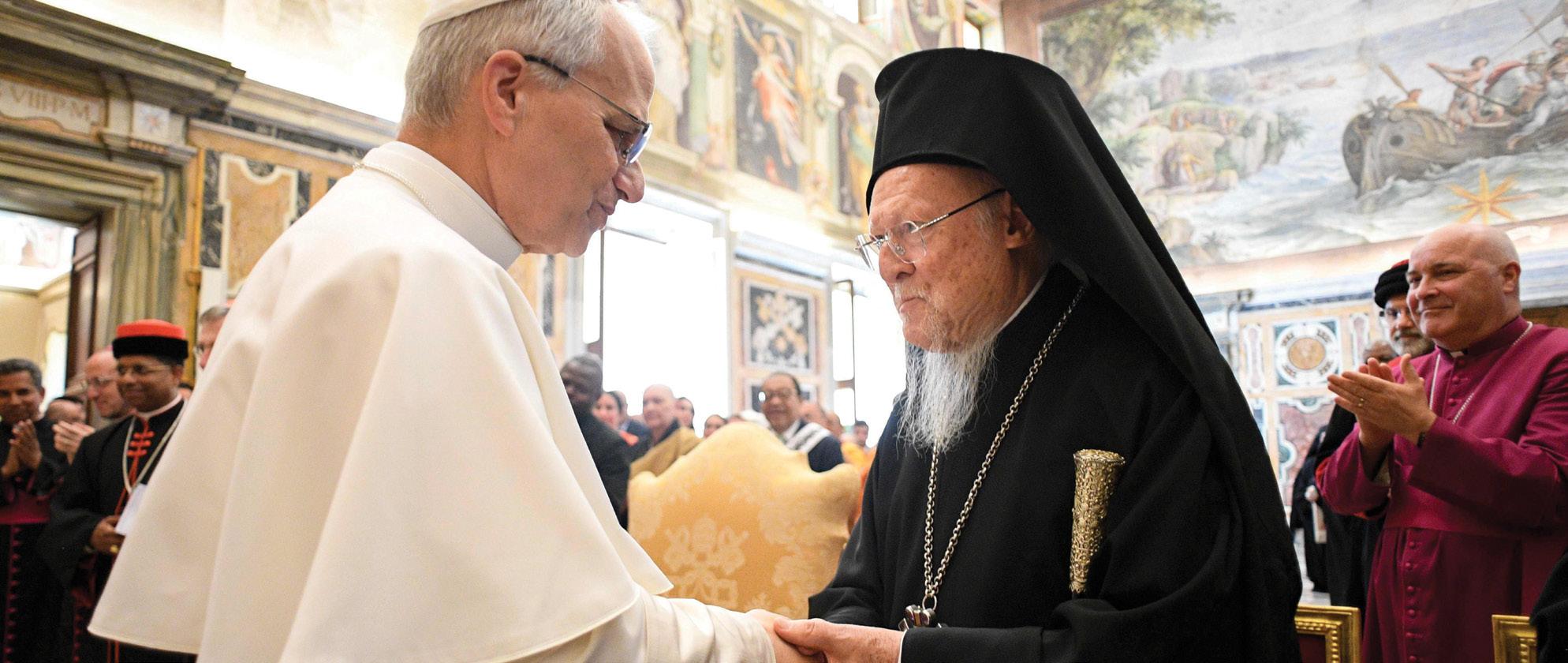
Pope Leo XIV greets Ecumenical Patriarch Bartholomew during a meeting with religious leaders at the Vatican on 19 May.
series by The Catholic University of America Press, titled “Eastern Catholic Studies and Texts.” This series is the first in the English language on contemporary Eastern Catholic theology.
On 28 April, CNEWA hosted a panel of journalists covering the Holy See, which included John and Elise Ann Allen of Crux, Cindy Wooden of Catholic News Service, Margherita Stancati of The Wall Street Journal, and William Cash, formerly of The Catholic Herald, and was moderated by CNEWA board member Amanda Bowman. They discussed the changing priorities of the church and how the pastoral vision of Pope Francis positioned the conclave (that later elected Leo XIV) differently from the previous one.
At a reception afterward, Msgr. Peter I. Vaccari, CNEWA president, presented CNEWA’s Faith & Culture Award to Mr. Allen “for his maddening ability to report on all things Catholic in the pursuit of truth, clarity and accountability.” Mr. Allen is the editor of the Catholic news website Crux. He has served as a senior Vatican analyst for CNN and had worked as the Vatican correspondent for National Catholic Reporter. He authored several books and conversations in book form, including one with CNEWA’s board chair, Timothy Cardinal Dolan, archbishop of New York.
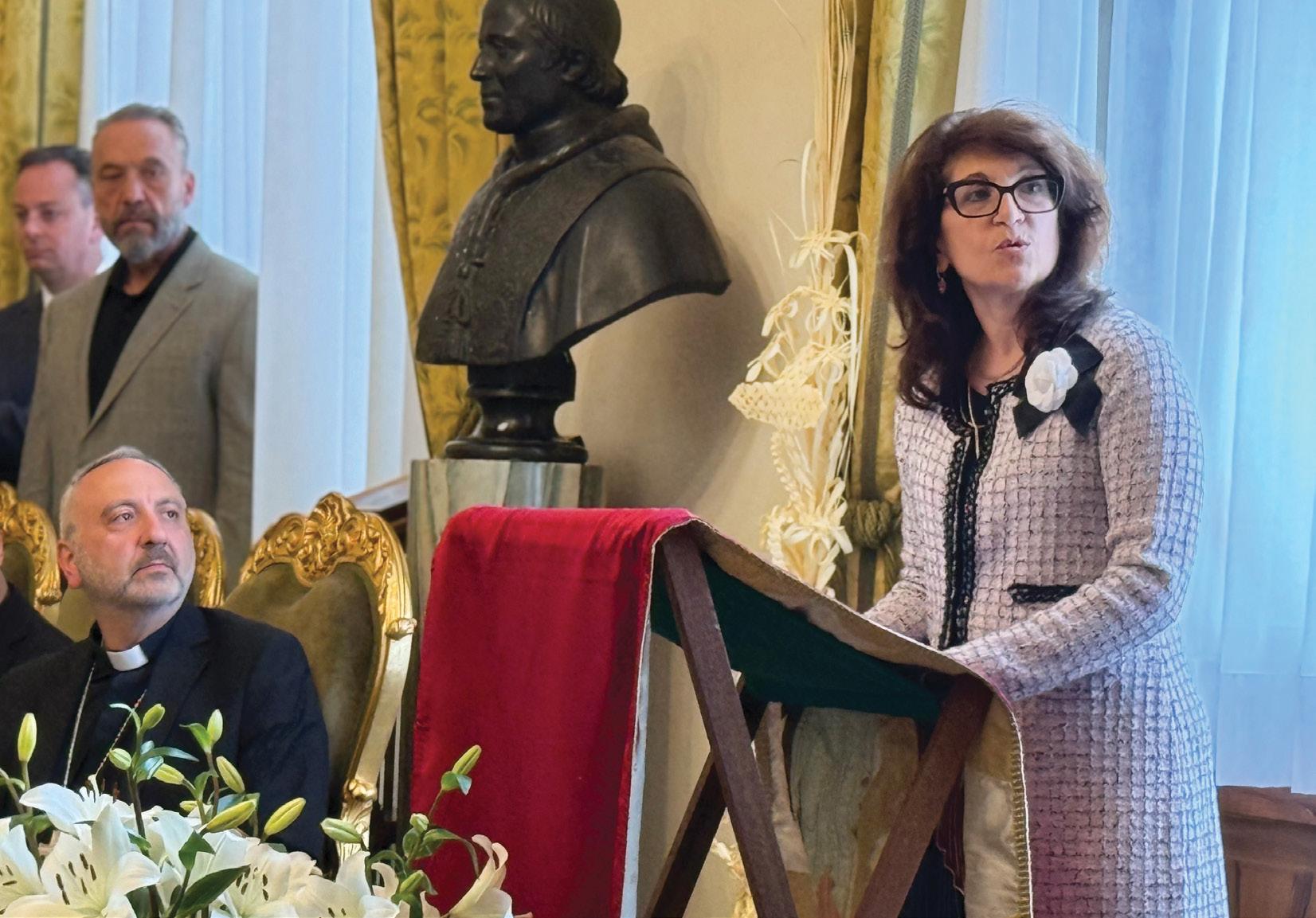
Marina C. Perna addresses guests at the Dicastery for the Eastern Churches.
The patriarch presented the award during a luncheon on 1 May at the Armenian Pontifical College in Rome. Thomas Varghese, CNEWA’s director of programs, and Brian McGinley, CNEWA’s director of development, were present, as were the ambassadors of Armenia and Lebanon to the Holy See, and priests and seminarians of the Armenian College.
Gala to Launch Centennial
reduced due to the recent cuts to U.S. foreign aid, said Tetiana Stawnychy, Caritas Ukraine president, during a meeting at CNEWA’s administrative center in New York in March.
CNEWA President Honored Armenian Catholic Patriarch Raphaël Bedros XXI Minassian honored Msgr. Vaccari with the “highest Armenian Catholic decoration of the Great House of Cilicia” for his unwavering commitment in service to the poor and vulnerable.
CNEWA will kick off its 100th anniversary with its fourth annual Healing & Hope Gala on 1 December at The University Club on Fifth Avenue in New York City. The guest of honor will be Metropolitan Borys Gudziak, archbishop of the Ukrainian Greek Catholic Archeparchy of Philadelphia. CNEWA’s Faith & Culture Award recipient will be announced at a later date. For information or tickets, call 212-826-1480, visit cnewa.org/events or email gala@cnewa.org
Caritas Ukraine Update
The 2025 response plan of the United Nations for Ukraine, originally aimed at helping 6.5 million people, will be
Caritas Ukraine, the charity of the Greek Catholic churches, is a main partner for CNEWA in the country, which has been at war since Russia commenced hostilities in 2014. More than 12.5 million people are in need, she said. Of these, 12 percent are children, 30 percent are elderly and 14 percent have special needs.
Peace, Justice, Truth
Leo XIV begins his pontificate with a clear vision
by Michael J. La Civita
Editors’ note: Each man elected pope brings a particular perspective in the exercise of his ministry. Yet there is an ever-evolving continuity as each successive pontiff builds on the stones laid by his predecessors. In his first weeks as pope, Leo XIV has articulated with clarity his vision for the church in a fractured world in need of healing and hope, a vision closely resembling that of Pope Pius XI when he established CNEWA as his vehicle of support to the Eastern churches nearly a century ago.
The 8 May election of U.S. Cardinal Robert Francis Prevost as bishop of Rome was a surprise to many. While there may or may not be a confluence of coincidences associated with his election and choice of name, Leo XIV’s succession comes at a pivotal time for humanity, one that resembles the era of Pope Leo XIII, who 134 years ago released his landmark social encyclical, “Rerum Novarum,” or as it is known in English, “On Capital and Labor.”
Human dignity. Theologians consider the encyclical, deeply wedded to Scripture, as the foundation of modern Catholic social teaching and our concept of social justice. In his encyclical, Pope Leo XIII, who led the church from 1878 to 1903, recognized the innate dignity of every human person, affirmed the church’s
support for the rights of laborers to fair and safe work and to form trade unions, while opposing socialism and laissez-faire capitalism.
“There are different reasons for [choosing to take the name Leo], but mainly because Pope Leo XIII in his historic encyclical ‘Rerum Novarum’ addressed the social question in the context of the first great Industrial Revolution,” the newly elected pope said in first address to the College of Cardinals on 10 May.
“In our own day, the church offers to everyone the treasury of her social teaching in response to another industrial revolution and to developments in the field of artificial intelligence that pose new challenges for the defense of human dignity, justice and labor.”
He concluded his address quoting Pope Paul VI, expressing his hope that his ministry will “pass over the whole world like a great flame of faith and love kindled in all men and women of good will. May it shed light on paths of mutual cooperation and bless humanity abundantly, now and always, with the very strength of God, without whose help nothing is valid, nothing is holy.”
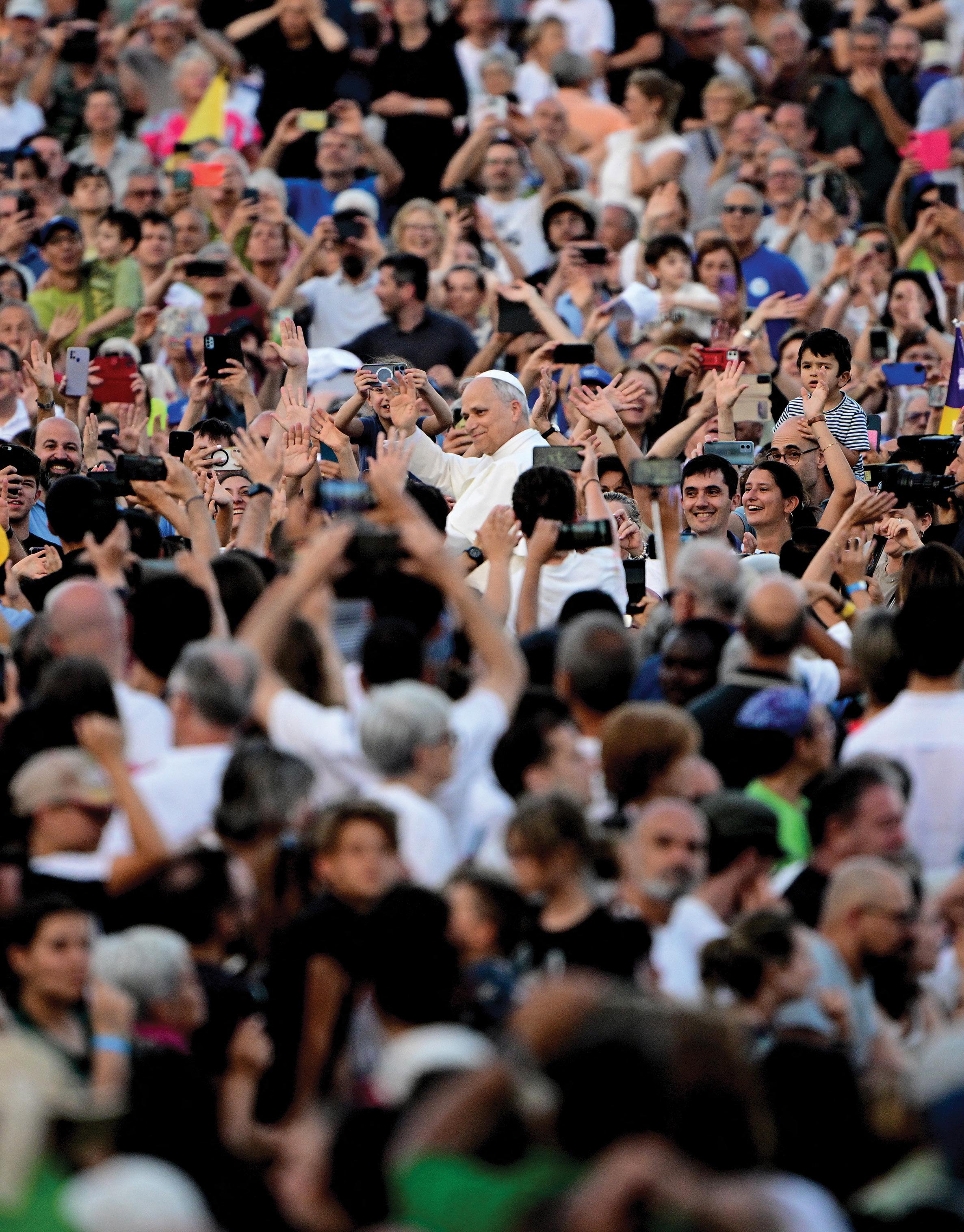
Pope Leo XIV waves to the crowd as he arrives in St. Peter’s Square for a Pentecost vigil prayer service, 7 June.
“Let us walk toward God and love one another.”
The ultimate bridge-builder. How the new pontiff will guide the barque of Peter as his successor as vicar of Christ — serving de facto as the world’s leading moral voice — dominates much of the international media. Yet it is clear, from his address to the cardinals cited above and in his first public words as pope spoken from the central balcony of St. Peter’s, that he intends to continue to build bridges, to be open to dialogue and encounter and to work toward justice and peace for all people.
“We must seek together how to be a missionary church,” said Pope Leo XIV, “a church that builds bridges, dialogue, always open to receive, like this square, with arms open to everyone, everyone who needs our charity, our presence, our dialogue, our love.”
In his address to the diplomatic corps accredited to the Holy See, he said, “In our dialogue, I would like us always to preserve the sense of being a family. Indeed, the diplomatic community represents the entire family of peoples, a family that shares the joys and sorrows of life and the human and spiritual values that give it meaning and direction.
“Papal diplomacy is an expression of the very catholicity of the church. In its diplomatic activity, the Holy See is inspired by a pastoral outreach that leads
it not to seek privileges but to strengthen its evangelical mission at the service of humanity.
“Resisting all forms of indifference, it appeals to consciences, as witnessed by the constant efforts of my venerable predecessor, ever attentive to the cry of the poor, the needy and the marginalized, as well as to contemporary challenges, ranging from the protection of creation to artificial intelligence. …
“In our dialogue, I would like us to keep in mind three essential words … The first word is peace. All too often we consider it a ‘negative’ word, indicative only of the absence of war and conflict, since opposition is a perennial part of human nature, frequently leading us to live in a constant ‘state of conflict’ at home, at work and in society. …
“From a Christian perspective — but also in other religious traditions — peace is first and foremost a gift. It is the first gift of Christ: ‘My peace I give to you’ (Jn 14:27). Yet it is an active and demanding gift. It engages and challenges each of us, regardless of our cultural background or religious affiliation, demanding … we work on ourselves. Peace is built in the heart and from the heart, by eliminating pride and vindictiveness and carefully choosing our words. For words too, not only weapons, can wound and even kill. …
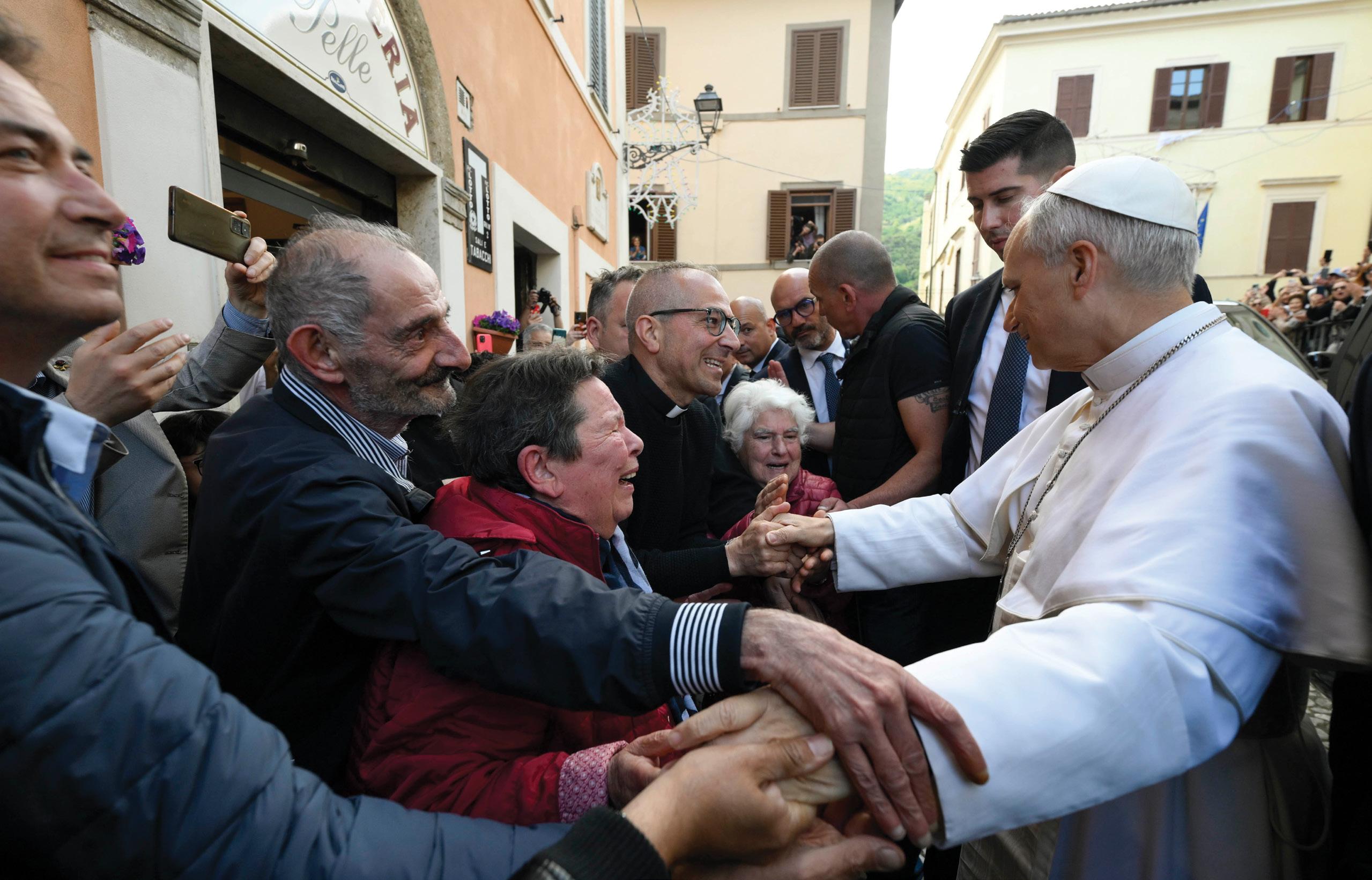
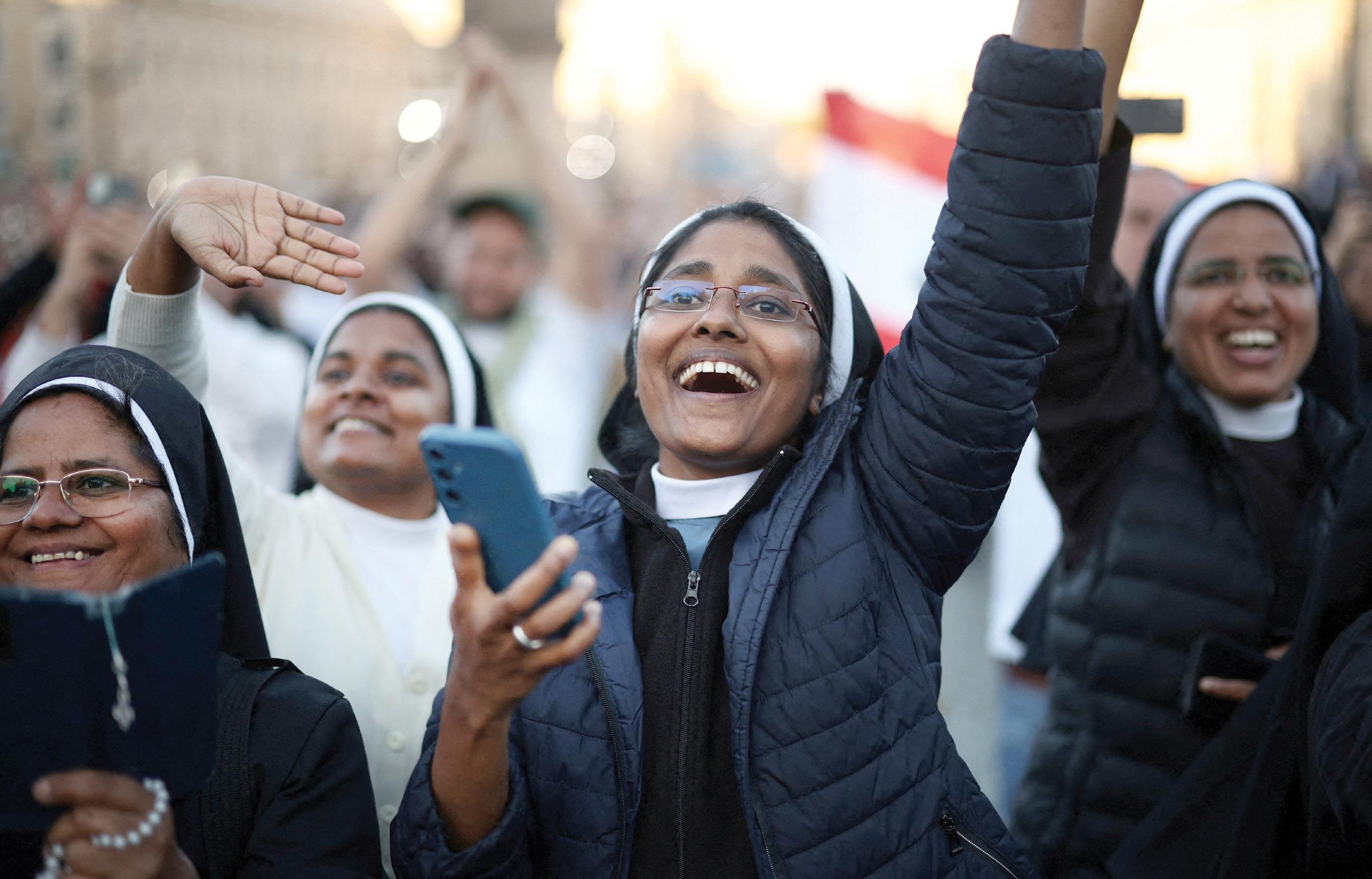
At left, on his first trip outside the Vatican, 10 May, Pope Leo greets passersby in front of the 12th-century Augustinian Shrine of the Mother of Good Counsel in Genazzano, east of Rome. Below, religious sisters in St. Peter’s Square cheer as Pope Leo appears on the central balcony of St. Peter’s Basilica after his election.
“The second word is justice. Working for peace requires acting justly. As I have already mentioned, I chose my name thinking first of all of Leo XIII, the pope of the first great social encyclical, ‘Rerum Novarum.’ In this time of epochal change, the Holy See cannot fail to make its voice heard in the face of the many imbalances and injustices that lead, not least, to unworthy working conditions and increasingly fragmented and conflict-ridden societies.
“Every effort should be made to overcome the global inequalities — between opulence and destitution — that are carving deep divides between continents, countries and even within individual societies. …
“The third word is truth. Truly peaceful relationships cannot be built, also within the international community, apart from truth. Where words take on ambiguous and ambivalent connotations, and the virtual world, with its altered perception of reality, takes over unchecked, it is difficult to build authentic relationships, since the objective and real premises of communication are lacking.
“For her part, the church can never be exempted from speaking the truth about humanity and the world, resorting whenever necessary to blunt language that
“Peace is first and foremost a gift. It is the first gift of Christ.”
“Let us build a church founded on God’s love, a sign of unity, a missionary church that opens its arms to the world.”
may initially create misunderstanding. Yet truth can never be separated from charity, which always has at its root a concern for the life and well-being of every man and woman.”
Finding unity in diversity. The effectiveness of Leo’s exercise of the Petrine Ministry, and of the witness of the Catholic Church to be instruments of peace, justice and truth, is, as the new pope sees it, tied to the church’s unity.
“I was chosen, without any merit of my own, and now, with fear and trembling, I come to you as a brother, who desires to be the servant of your faith
and your joy, walking with you on the path of God’s love, for he wants us all to be united in one family,” the Chicago-area native said in his homily inaugurating his pontificate.
“Love and unity: These are the two dimensions of the mission entrusted to Peter by Jesus. … when Jesus asks Peter, ‘Simon, son of John, do you love me more than these?’ (Jn 21:16), he is referring to the love of the Father. It is as if Jesus said to him, ‘Only if you have known and experienced this love of God, which never fails, will you be able to feed my lambs. Only in the love of God the Father will you be able to love
your brothers and sisters with that same ‘more,’ that is, by offering your life for your brothers and sisters.’
“Peter is thus entrusted with the task of ‘loving more,’ and giving his life for the flock. The ministry of Peter is distinguished precisely by this self-sacrificing love, because the Church of Rome presides in charity and its true authority is the charity of Christ. It is never a question of capturing others by force, by religious propaganda or by means of power. Instead, it is always and only a question of loving as Jesus did. …
“Brothers and sisters, I would like that our first great desire be for a united church, a sign of unity and communion, which becomes a leaven for a reconciled world.
“In this our time, we still see too much discord, too many wounds caused by hatred, violence, prejudice, the fear of difference, and an economic paradigm that exploits the Earth’s resources and marginalizes the poorest. For our part, we want to be a small leaven of
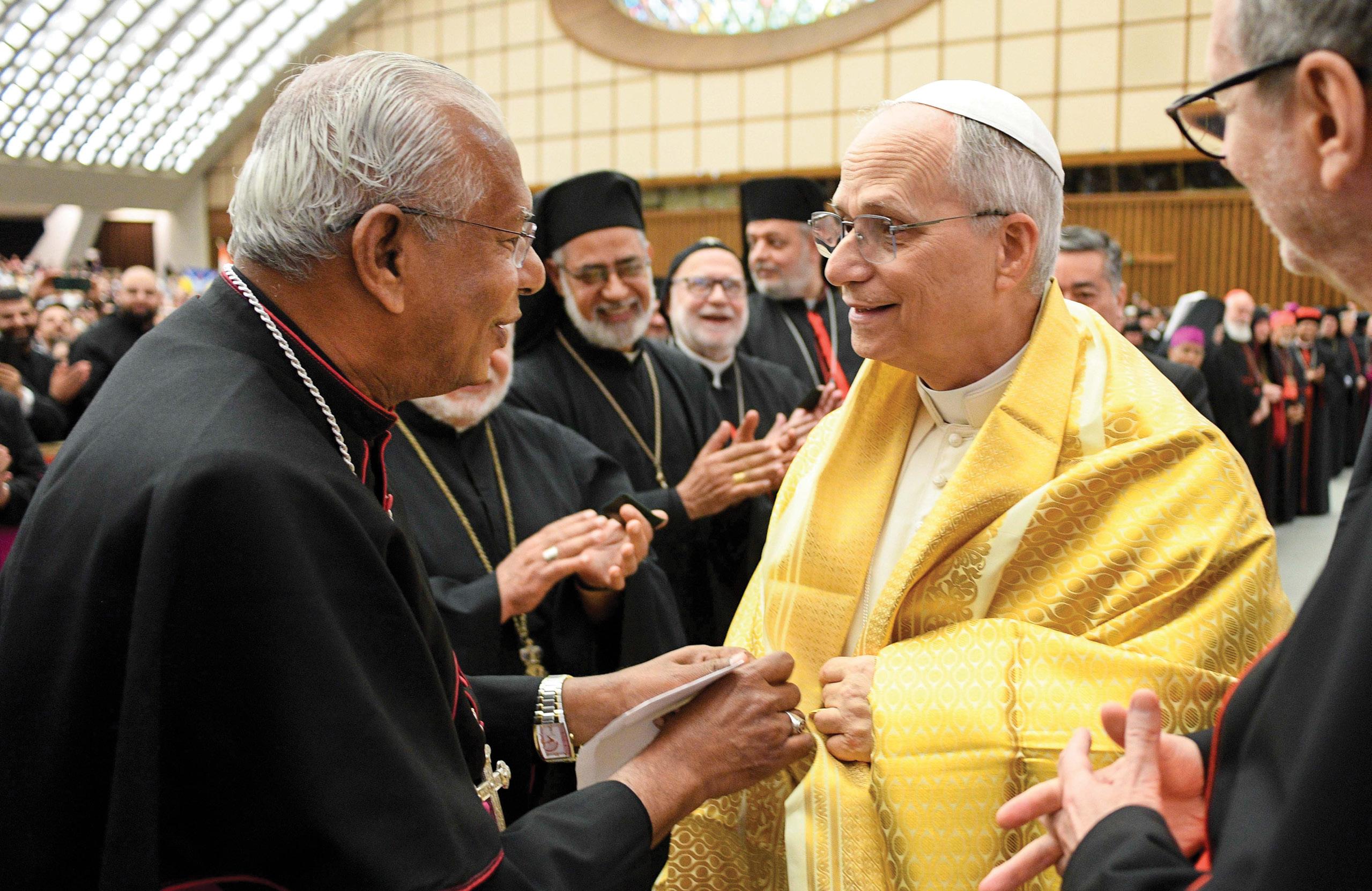
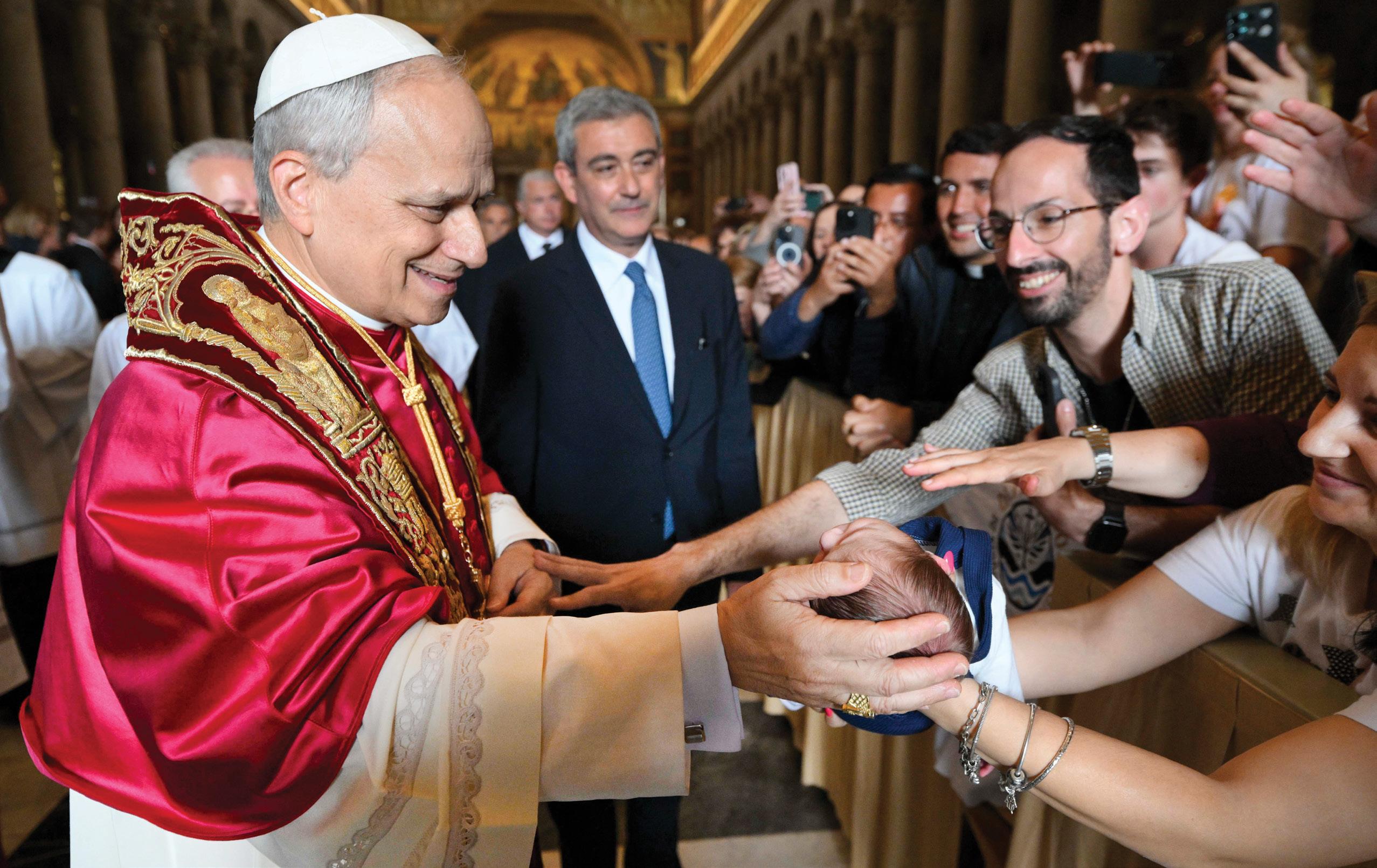
At left, Pope Leo greets Metropolitan Andrews Thazhath, archbishop of the Syro-Malabar Catholic Archeparchy of Trichur, India, after addressing participants in the Jubilee of the Eastern Churches at the Vatican on 14 May. Above, Pope Leo blesses a baby at the end of his first visit to the Basilica of St. Paul Outside the Walls in Rome on 20 May.
unity, communion and fraternity within the world. We want to say to the world, with humility and joy: Look to Christ! Come closer to him! Welcome his word that enlightens and consoles! Listen to his offer of love and become his one family: In the one Christ, we are one.
“This is the path to follow together, among ourselves, but also with our sister Christian churches, with those who follow other religious paths, with those who are searching for God, with all women and men of good will, in order to build a new world where peace reigns!
“This is the missionary spirit that must animate us; not closing ourselves off in our small groups, nor feeling superior to the world. We are called to offer God’s love to everyone, in order to achieve that unity that does not cancel out differences but values the personal history of each person and the social and religious culture of every people. …
“With the light and the strength of the Holy Spirit, let us build a church founded on God’s love, a sign of unity, a missionary church that opens its arms to the world, proclaims the Word, allows itself to be made ‘restless’ by history, and becomes a leaven of harmony for humanity.
“Together, as one people, as brothers and sisters, let us walk toward God and love one another.” n
A Pope for the Peripheries
Remembering Pope Francis and his legacy
by Laura Ieraci and Barb Fraze
Within eight months of his election on 13 March 2013, Pope Francis laid out his priorities in his apostolic exhortation, “Evangelii Gaudium” (“The Joy of the Gospel”). In this foundational document, he called for a renewed energy and commitment to evangelization and mission, a fervent living out of the Gospel in daily life through coherent witness to the love of God for all people.
Over the next 12 years, until his death on 21 April, Francis carried out his vision by challenging assumptions and interpretations of the Christian life.
His words — with phrases such as, “throwaway culture,” “the peripheries” and “Who am I to judge?” — and his actions, for example signing joint documents with Muslim leaders, often pricked at the conscience of the dominant cultures within the church and society.
“Evangelii Gaudium” highlighted his preferential option for the poor, not only for those with few means, but for those living on the margins of society, “the peripheries,” material and existential. This includes all those who are ill, imprisoned, disabled,
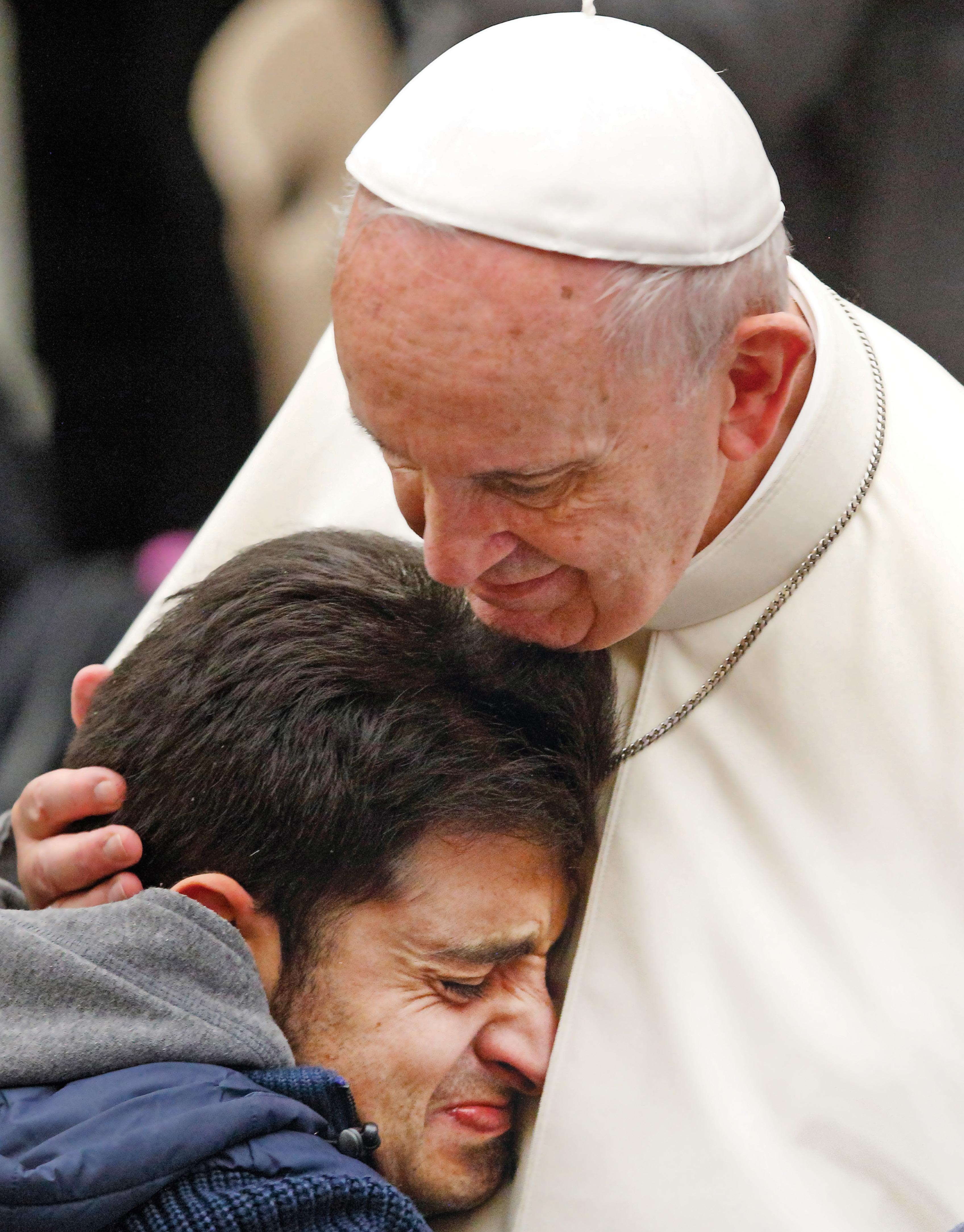
Pope Francis embraced a man during a General Audience with people with disabilities in January 2016.
abandoned, orphaned, discriminated against, and those denied access to the resources that should be available to all.
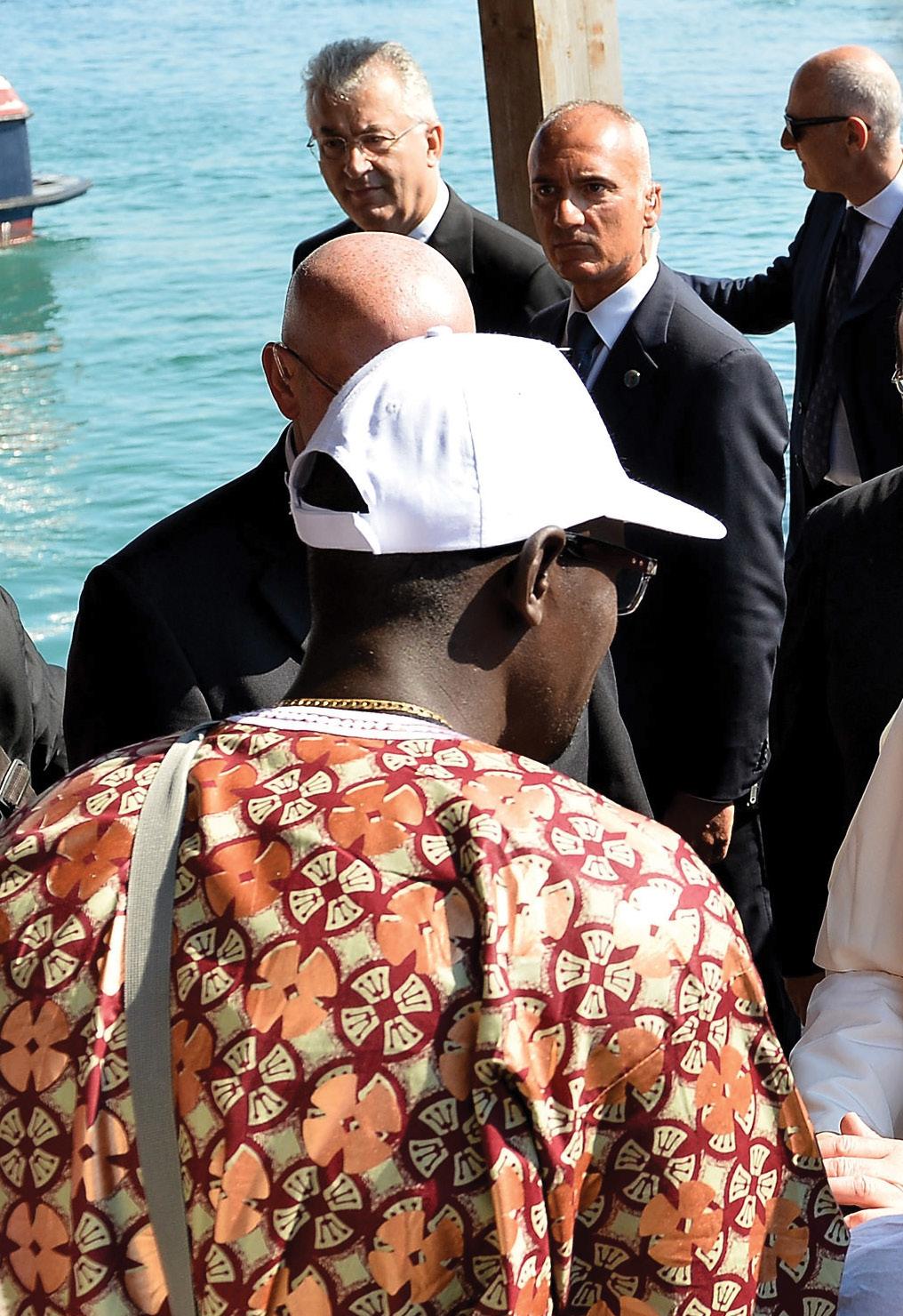
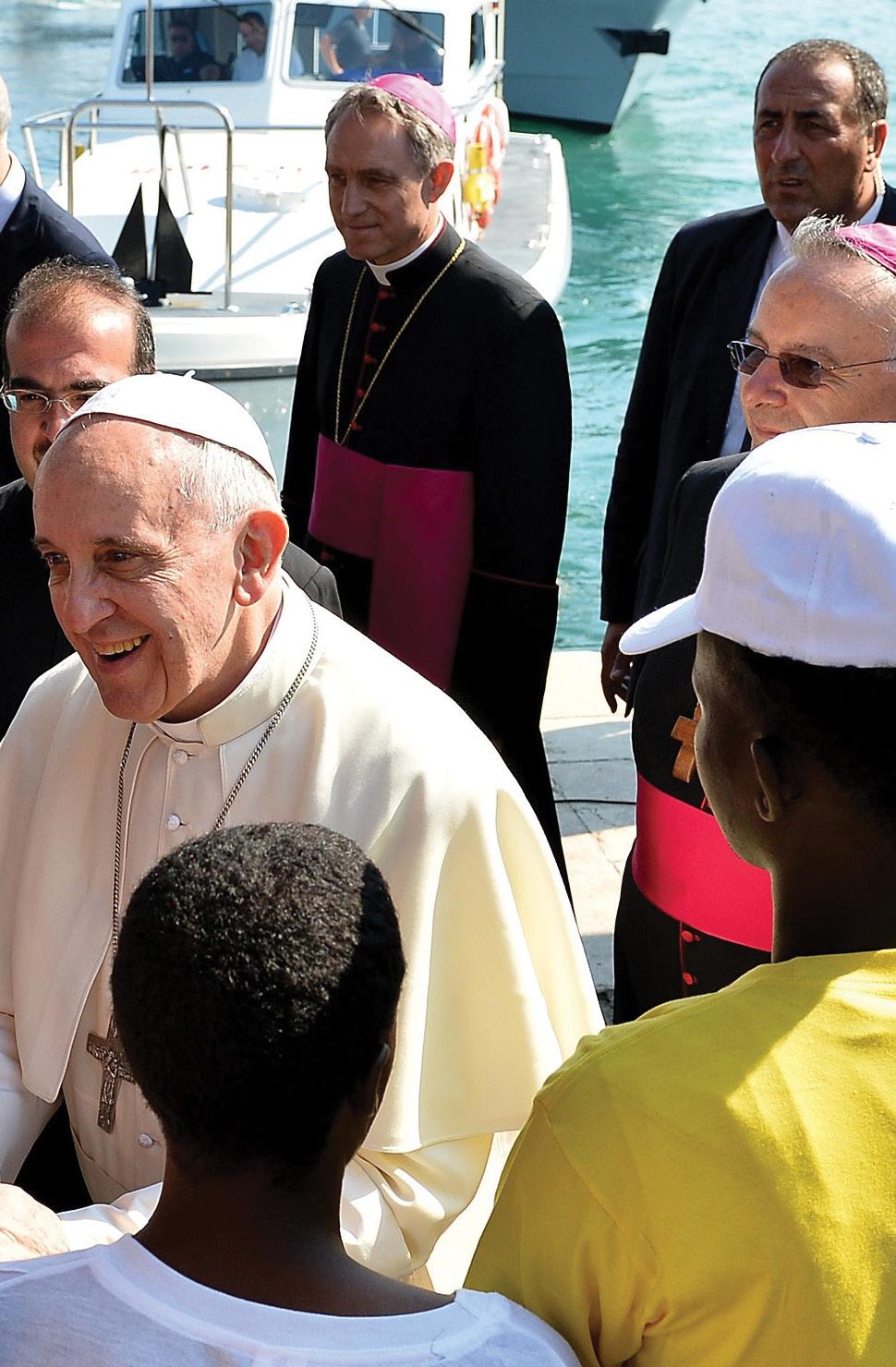
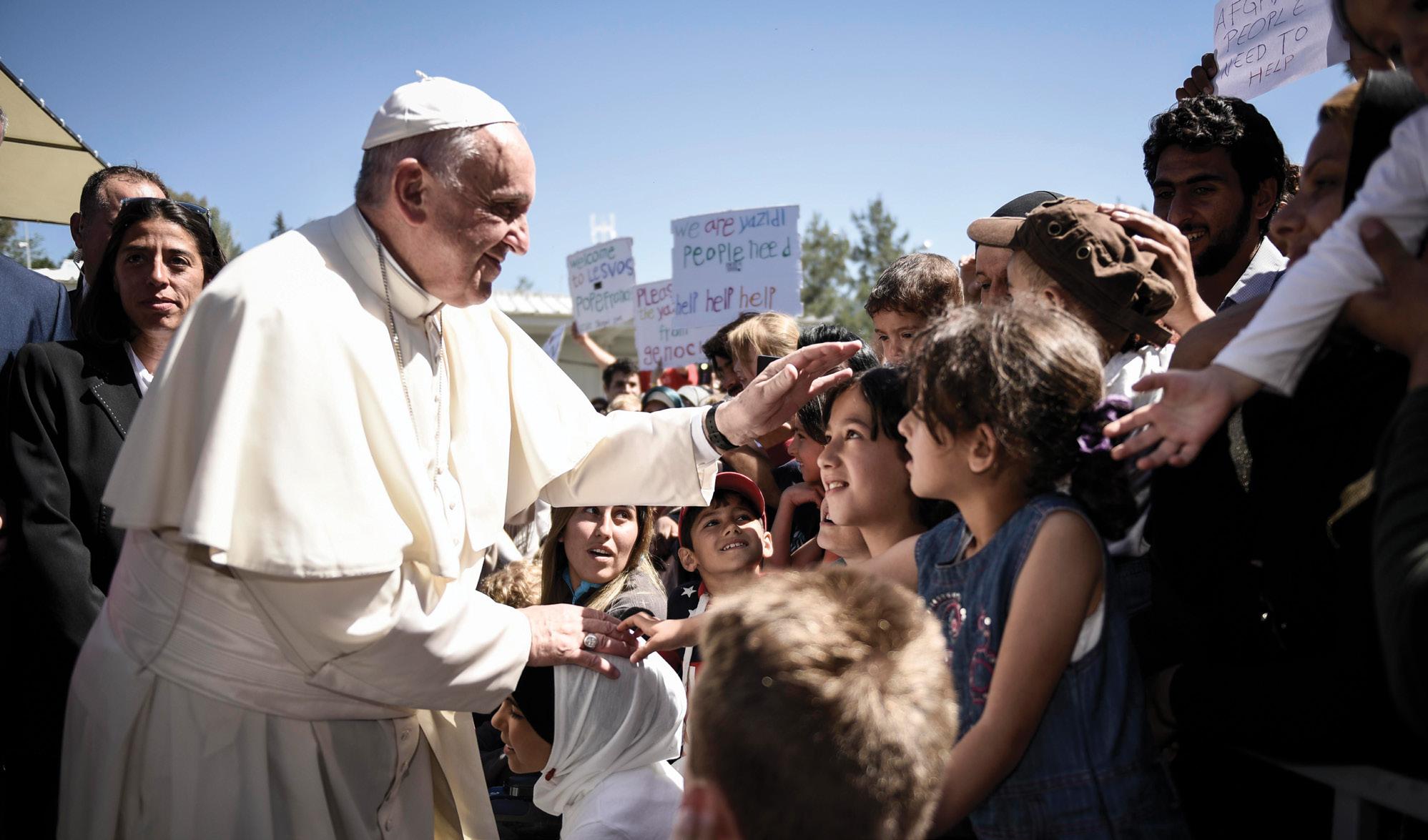
Among the people on the margins, migrants and refugees remained particularly close to the heart and mind of Pope Francis. His first visit outside Vatican City was to Lampedusa, an Italian island off the coast of Tunisia. There, he met migrants who landed on European shores in search of a better life and thanked those who welcomed them.
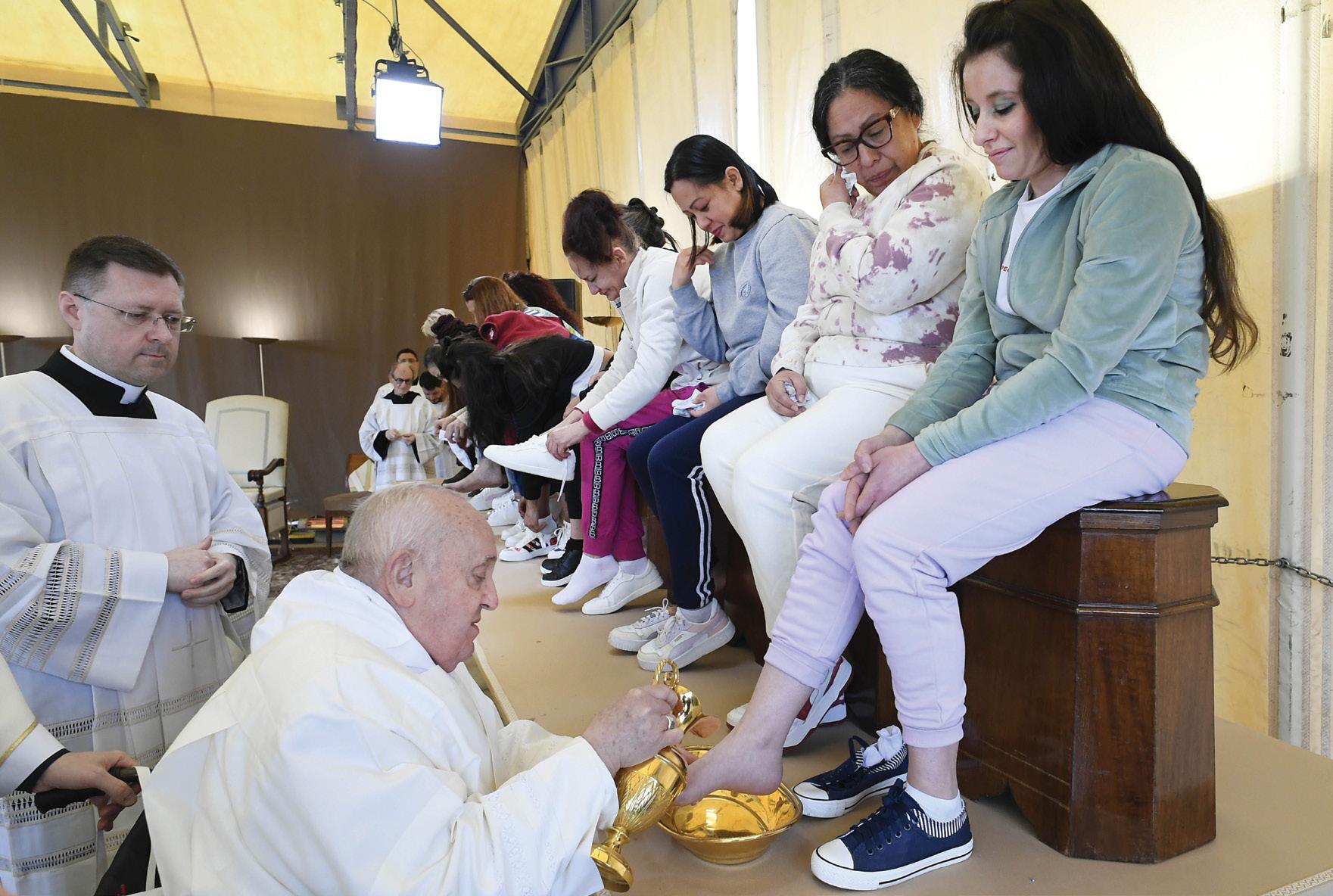
His concern for those on the margins in the Diocese of Rome included setting up public showers and a clinic at the Vatican for the homeless and washing the feet of inmates at the local prison each Holy Thursday.
His concern for the peripheries further afield included apostolic visits to countries previous pontiffs had not visited: Bahrain, Iraq, Mongolia, Myanmar, North Macedonia, South Sudan and the United Arab Emirates. In each of these countries, he prayed with and encouraged the minority Christian communities in the practice of their faith. In Iraq, where the so-called Islamic State decimated Christian and other vulnerable communities, he also met with representatives of dominant religious communities.
While visiting the United Arab Emirates in February 2019, Pope Francis and Sheik Ahmad el-Tayeb, grand
imam of al-Azhar, considered the leading theological school in the Sunni Muslim world, signed “A Document on Human Fraternity for World Peace and Living Together.” The document calls for “the adoption of a culture of dialogue,” “mutual cooperation” and “reciprocal understanding.” It also condemns war and “all those practices that are a threat to life, such as genocide, acts of terrorism, forced displacement, human organ trafficking, abortion and euthanasia.”
His witness to fraternity and peaceful coexistence among all people of good will are enshrined in his nearly 40,000-word encyclical, “Fratelli tutti, on Fraternity and Social Friendship.” Published in October 2022, “Fratelli tutti” holds up fraternity and friendship as means in building a more just and peaceful world, where the dignity and rights of each person are upheld.
“Evangelii Gaudium” also expressed Francis’ commitment to ecumenical dialogue and cooperation. His methodology, described as “the logic of personal encounter,” proved to be
practical, opting for a grassroots form of ecumenism based in prayer, presence, gestures, common witness and friendship rather than academic and formal dialogue.
In May 2014, he traveled to the Holy Land to meet with Ecumenical Patriarch Bartholomew of Constantinople to mark the 50th anniversary of the historic meeting in Jerusalem of their two predecessors — Pope Paul VI and Ecumenical Patriarch Athenagoras. They issued a joint declaration in which they confirmed their commitment to “continue walking together toward the unity for which Christ our Lord prayed to the Father.” The world watched as the two leaders prayed together at the Church of the Holy Sepulchre and then embraced — the start of their long friendship.
Six months later, on the feast of St. Andrew, the traditional founder and patron of the Church of Constantinople, Francis traveled to the ecumenical patriarchate in Istanbul to pray with Bartholomew again and to issue a second joint declaration reaffirming their commitment to “promote the full unity of all Christians.”
“I would like to join my tears to yours and tell you I am not close to you and
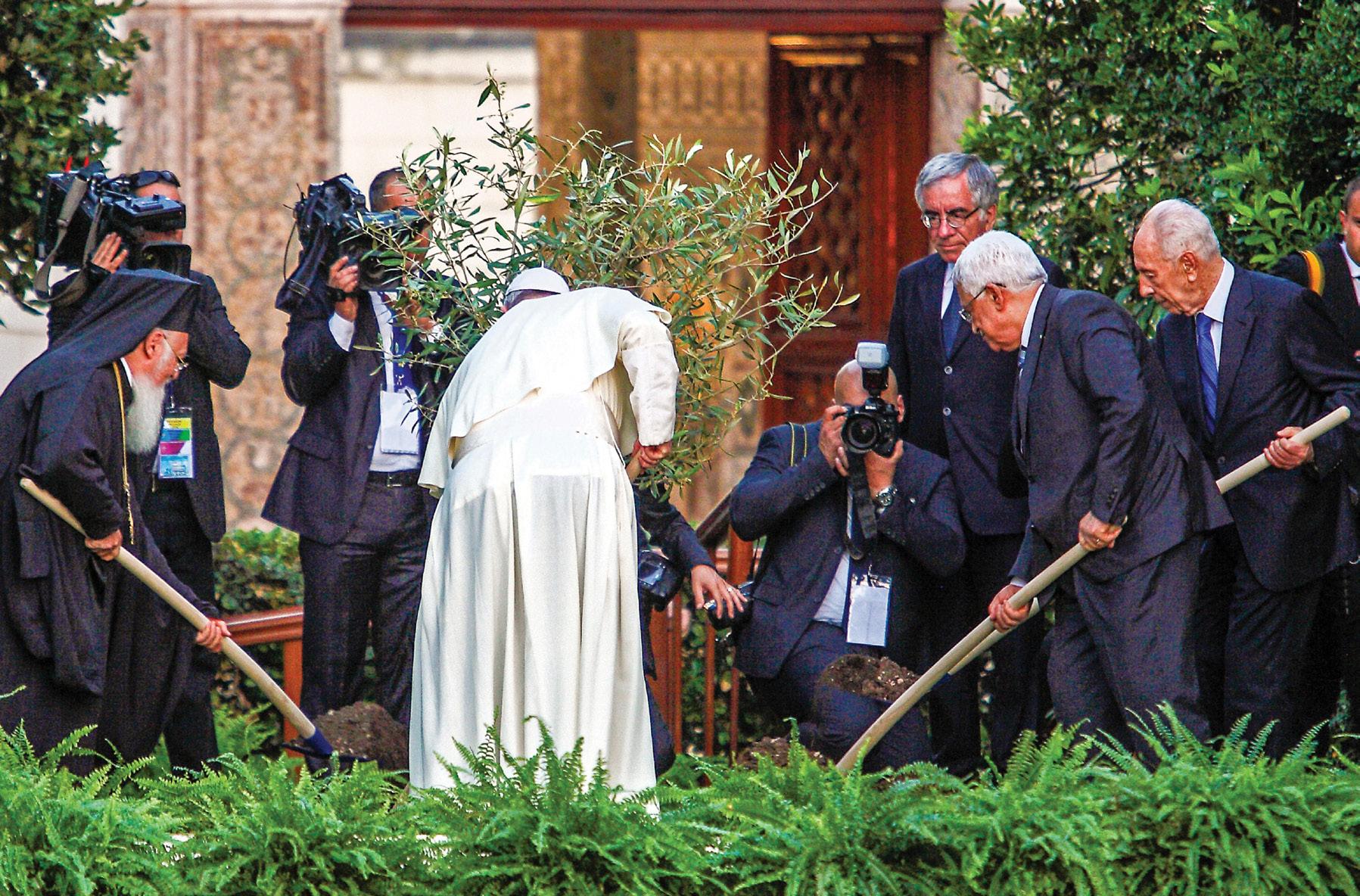
Witnessing to the “ecumenism of blood,” Francis added to the Roman Martyrology 21 Coptic Christians murdered by the Islamic State on a beach in Libya in 2015. And he declared the 10th-century mystic, monk and poet of the Armenian Apostolic Church, St. Gregory of Narek, a doctor of the church. He hosted leaders of other churches in his residence at the Domus Sanctae Marthae; met with them at a refugee camp in Lesbos, Greece, to draw attention to the humanitarian crisis surrounding the needs of migrants; and held summit talks on Syria and Lebanon with various religious and government officials. To further dialogue to advance peace, he planted trees in the Vatican Gardens, culminating in June 2024 with the planting of an olive tree with the Israeli and Palestinian ambassadors to the Holy See.
Synodality — a local and participatory model of governance common in the Eastern churches — was a recurring theme of Francis’ pontificate. First mentioned in “Evangelii Gaudium,” it took on greater importance in later years. With the
announcement in 2021 of a Synod of Bishops on synodality, a churchwide process of “walking together” began, and consultations were held in every diocese and eparchy of the Catholic communion of churches with the faithful at all levels.
Pope Francis understood synodality as a way for the people of God to journey together in dialogue and discernment and to take a more active role in the church’s evangelizing mission. He also viewed greater synodality as an avenue to reconcile differences among the Catholic and Orthodox churches. As early as 2017, in a message to Ecumenical Patriarch Bartholomew, Francis spoke of the need to examine synodality in the context of “the service of the communion of the church.”
At far left, Pope Francis washed the feet of inmates at a Roman prison on Holy Thursday 2024; center, in his first pastoral visit outside the Vatican, he met with migrants in Lampedusa, Italy, in 2013; right, he planted an olive tree with Ecumenical Patriarch Bartholomew, Palestinian President Mahmoud Abbas and Israeli President Shimon Peres at the Vatican Gardens in 2014.
that there is not a day when do not carry you in my heart and in my prayers.”
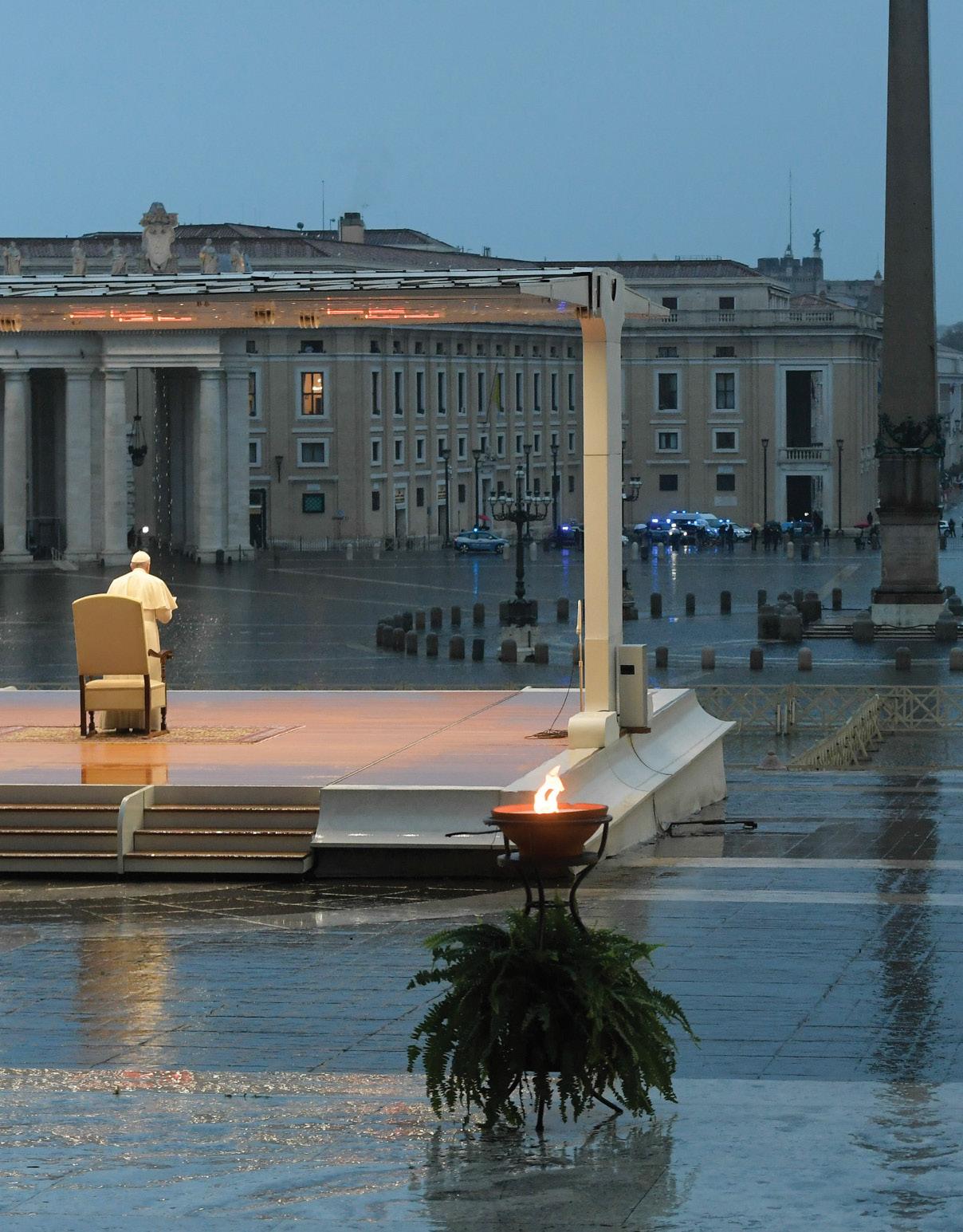
Francis prayed in an empty St. Peter’s Square during the COVID-19 pandemic. Opposite, he met with migrants at a detention center in Lesbos, Greece, in 2016.
Pope
His phrases … and actions … often pricked at the conscience of the dominant cultures both within the church and in society.
In addressing his texts and teachings to all people of good will, he tackled some of the most worrisome global issues of the day, providing a theological framework with which to understand them, including on the state of creation in his landmark social encyclical on the environment, “Laudato Si’, on Care for our Common Home.”
His calls for peace in Ethiopia, Gaza, Israel, Lebanon, Ukraine and numerous other countries were unceasing, and his expression of solidarity with those who suffered the injustices of war were concrete and heartfelt.
“I would like to join my tears to yours,” he said in a message to Ukrainians nine months after the start of Russia’s full-scale war on Ukraine, “and tell you that there is not a day when I am not close to you and do not carry you in my heart and in my prayers. Your pain is my pain.”
He then sent his almoner with medical supplies and ambulances to Ukraine at least nine times.
His expression of closeness to those who suffered was personal and paternal. From the third day of the Israel-Hamas war until two days before his death, he made nightly phone calls to Holy Family Church, the only Catholic parish in Gaza, to check in on his besieged flock.
“It was a great blessing to be able to speak with him,” Rosary Sister Nabila Saleh told Catholic News Service in October 2023. “He gave us courage and the support of prayer.”
As bishop of Rome, Francis’ pontificate could be summarized as truly that of the pontifex maximus — “ultimate bridge-builder” — reminding all that through God everyone, everyone, everyone is welcome in the church: “Todos, todos, todos.” n
Landscape of Loss
The tightened vise around Palestinian society threatens the Christian community’s
survival
by Fatima AbdulKarim
ADVOCATING FOR JUSTICE & PEACE
“Praying is an act of defiance. We fight to reach our churches, to keep them alive.”
Sally Nassar lights a candle at the Church of the Nativity in Bethlehem.
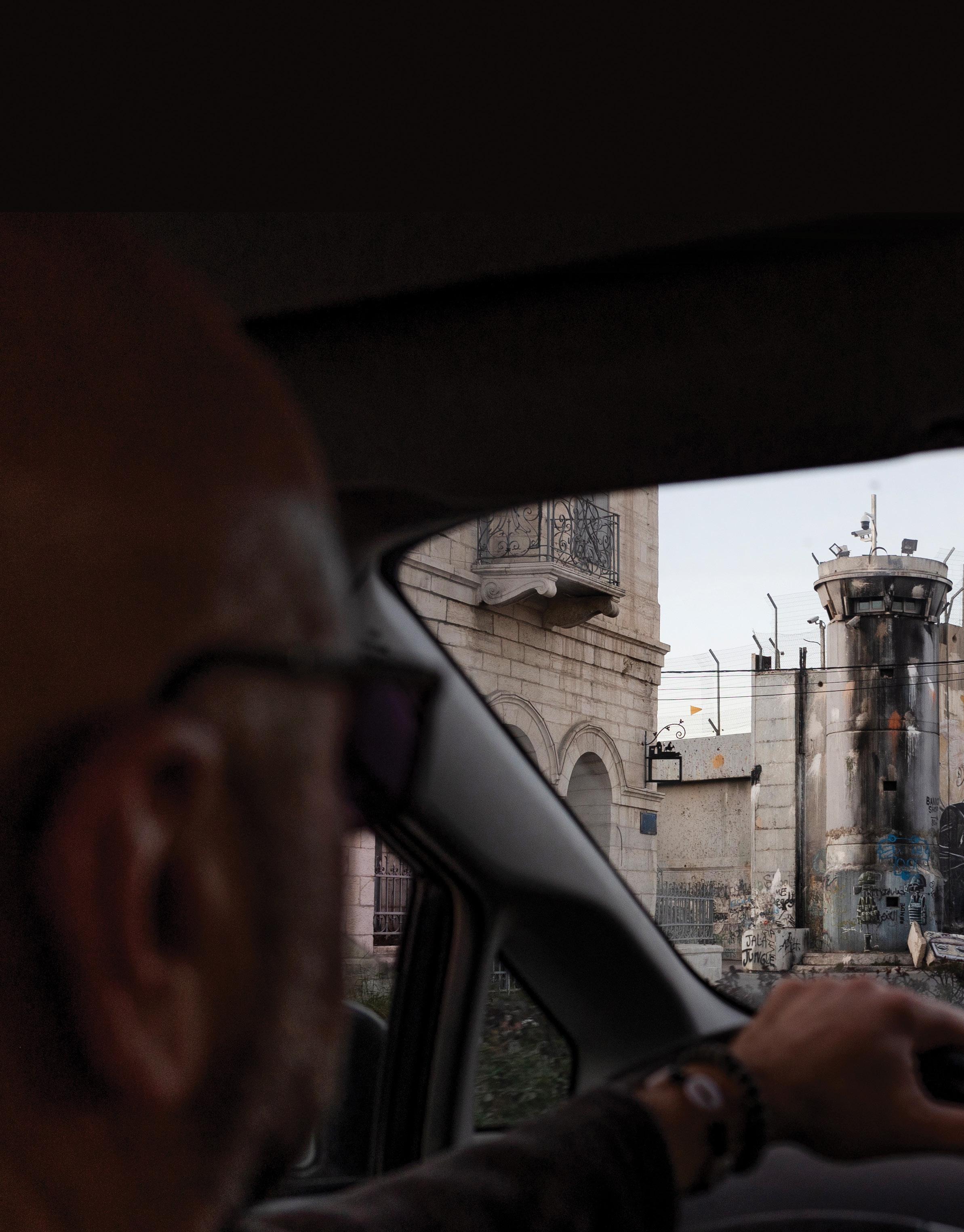
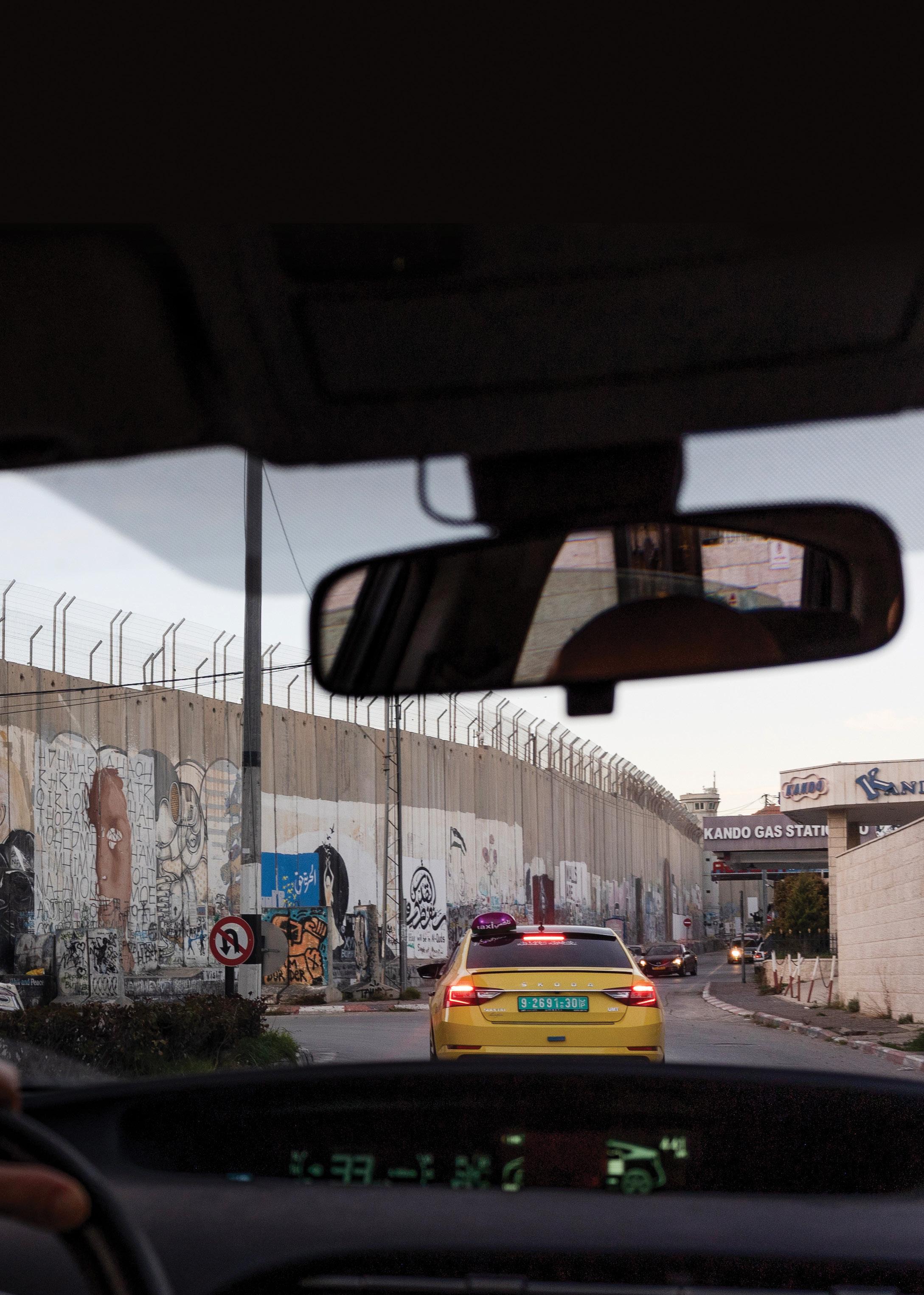
Previous page, the Israeli separation wall, as seen from Bethlehem, divides the West Bank from Israel.
Shahinda Nassar and her family have grown accustomed to the sound of the heavy tread of military boots echoing through Bethlehem’s ancient streets. Down the steps from Manger Square, just beyond the weathered stones of the Church of the Nativity, where, since the fourth century, pilgrims have kneeled at the place of Jesus’ birth, the Nassar family has learned to distinguish between ordinary footsteps and the ominous cadence of soldiers on patrol.
The metallic screech of military vehicles, the commands shouted through megaphones and the low rumble of armored jeeps idling outside have replaced the screech of tourist bus wheels and the mutters of translators and tour guides, which they miss.
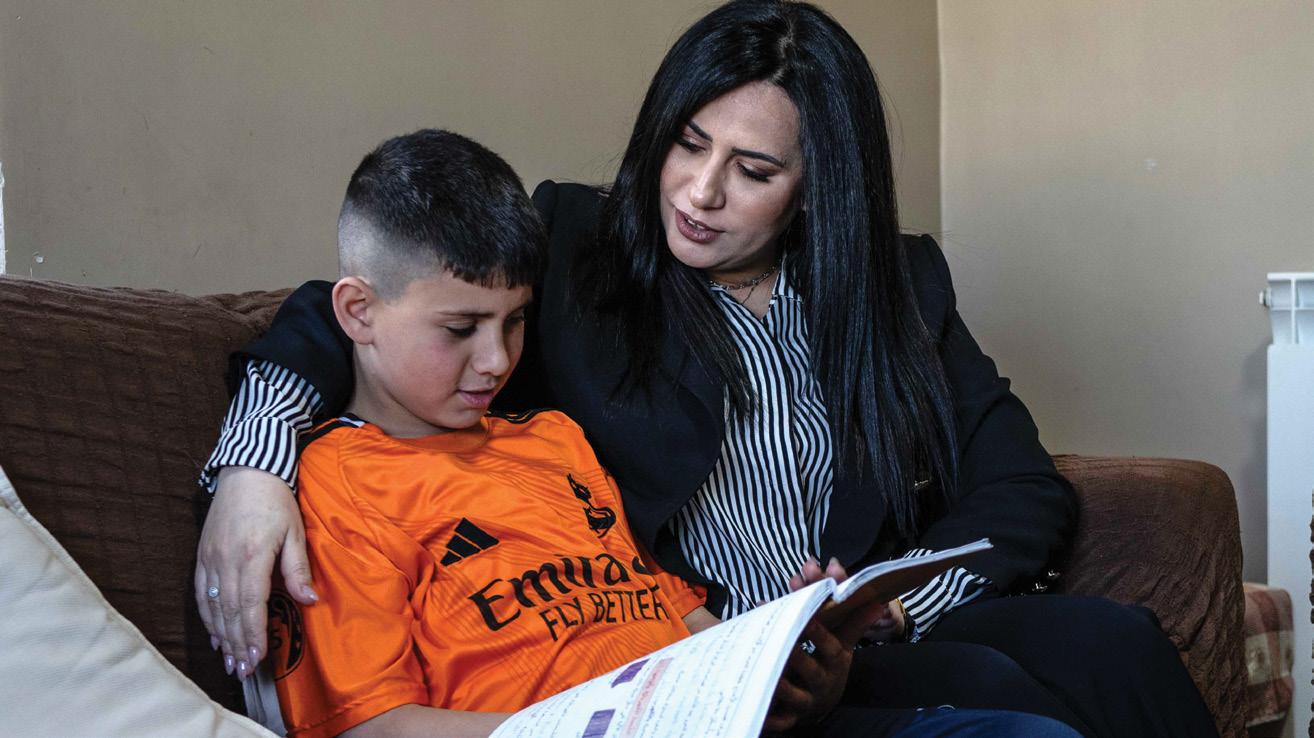
Mrs. Nassar, a 42-year-old administrator at Bethlehem University, spends her days battling the normalization of military occupation. The Catholic institution where she works, which has operated in the Lasallian tradition since its foundation by the Holy See in 1973, was the first university in the West Bank. Mrs. Nassar coordinates scholarship programs, builds professional networks and crafts arguments to convince students that remaining in their homeland is possible.
But when night falls and the distant glow of settlements in the surrounding hills between Bethlehem and Jerusalem twinkles like taunting stars, she lies awake wrestling with the same question that torments her daughter: Is survival possible for Palestinians in Palestine?
For Palestinians across the West Bank, the past 20 months of the Israel-Hamas war have brought not just another cycle of violence, but a fundamental shift in the Israeli government's strategy against them — a strategy that combines military
force, economic suffocation and psychological warfare, making daily life unbearable. The roadblocks that turn 10-minute drives into three-hour ordeals, the settler gangs that attack with impunity, the demolition orders that hang over entire neighborhoods, the midnight arrests that snatch fathers from their beds — each serves as another turn in the vise grip tightening around Palestinian society.
United Nations statistics point to a “displacement strategy.” Since the start of the war, settler violence in the West Bank has surged dramatically. Between October 2023 and July 2024, Israeli settlers, often accompanied by Israeli soldiers, launched more than 1,225 attacks on Palestinians in the West Bank, forcibly displacing at least 23 Palestinian communities. By the end of last year, they had seized more than 8,150 acres of Palestinian land for additional settlements — which are illegal according to international law — or restricted military zones, according to the United Nations Office for the Coordination of Humanitarian Affairs (OCHA).
In the two months after the cease-fire declared in January 2025, attacks on Palestinian refugee camps in the West Bank caused the displacement of about 40,000 people, according to the Israeli human rights group B’Tselem.
Beyond displacements, OCHA reported 926 Palestinians in the West Bank and East Jerusalem were killed in such attacks, from October 2023 to May this year, including at least 196 children.
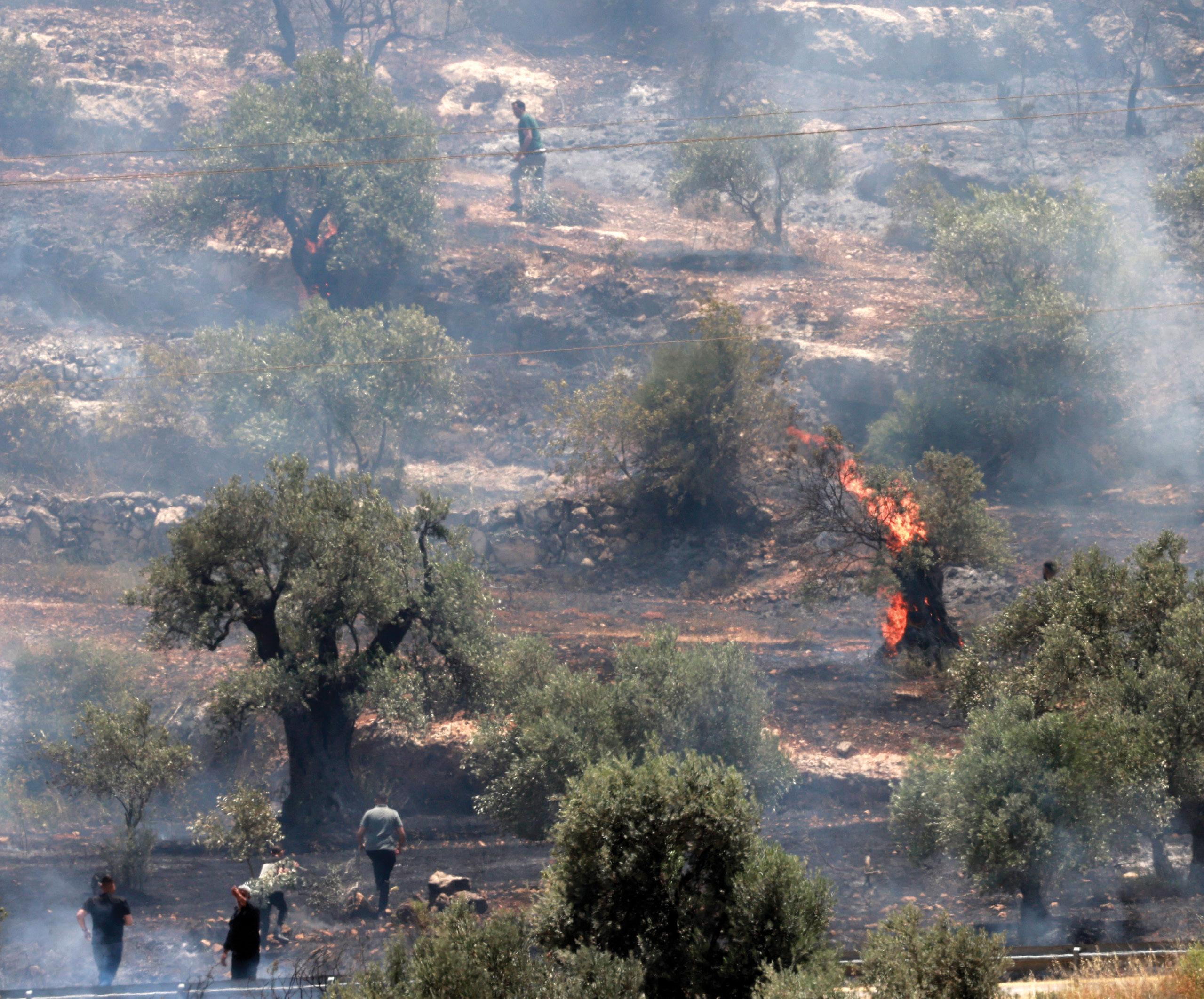
The U.N., as well as Israeli and Palestinian rights groups, say these attacks form a coordinated campaign of terror designed to fracture Palestinian communities. Each torched olive grove — some containing trees dating to Ottoman
times — severs another connection to the land. Every vandalized home, every desecrated cemetery, every child threatened while walking to school reinforces the same message: You are not safe here.
In her office at the university, Mrs. Nassar sees the consequences of these events in the resigned expression of her students.
“The most common thing I hear is, ‘I want to leave,’ ” she says, her fingers tracing the edge of a scholarship application. “But they don’t say it with excitement. It’s something they’re coerced into.”
The documents on her desk tell a story of forced decisions: graduate school applications to European universities; visa paperwork for the United States, Canada and Australia; desperate pleas for any escape route from the shrinking horizons of life under military occupation.
This coerced migration transcends political or social categories, evolving into an existential crisis for Palestinian society, particularly its Christian minority.
With Israel’s government aggressively expanding settlements and the formal annexation of West Bank territory proceeding in bureaucratic increments, Palestinians confront the visceral reality their homeland is being taken parcel by parcel.
In 2023, the Israeli government oversaw the most rapid settlement expansion in more than a decade, with more than 30,000 housing units advanced in East Jerusalem and the West Bank, according to the Office of the European Union Representative in the West Bank.
The watchdog group Peace Now reports 59 illegal settler outposts were established in 2024, compared with an average of
seven per year in the previous 20 years, giving rise to the claim of an Israeli policy to exploit wartime focus on Gaza to entrench permanent control over the West Bank.
Last year, the government accelerated de facto annexation, the construction of settler-only roads, the legalization and increased funding of formerly illegal outposts and the transfer of civilian control of West Bank land from the Israeli Defense Forces to the Settlement Administration in the Defense Ministry.
The international community’s muted response — occasional statements of “concern” without substantive action — has only emboldened the architects of this demographic engineering, Mrs. Nassar says.
Despite her efforts to provide scholarships for undergraduates who now stand at roughly 3,000 — nearly 200 left since the war began — Mrs. Nassar says educational opportunities are not enough to keep young Palestinians in their homeland.
“We try to give them the tools to build futures,” she says, “but the lived reality destroys the foundations those futures require.” Israeli policy restricts Palestinian movement through a military permit system and more than 800 checkpoints and other obstacles, according to OCHA. West Bank Palestinians need permits to work in Israel or settlements, access hospitals or visit family in Jerusalem, or farm near settlements. For instance, 32 percent of West Bank Palestinians who requested
“This land isn’t just a spiritual journey — it’s a lived experience of horrors.”
access to hospital care in Jerusalem and 87 percent who requested a permit to visit family in Jerusalem were denied. Even internal West Bank movement is controlled through sudden checkpoints, gates and restricted military zones that ban Palestinians from their farmland.
The Cremisan Valley, once a lush tapestry of terraced vineyards and ancient olive groves tended by Christian families for generations, now testifies to this attrition. The separation wall’s concrete slabs and razor wire slice through the landscape, isolating 87 percent of Christian-owned farmland from those families who cultivated it, according to a 2023 report by B’Tselem.
This fragmentation extends beyond agriculture into religious observance and practice. The 40 percent decline in church participation among Christian youth since 2020 reflects not declining faith, but the complicated logistics of religious practice under occupation, according to the ecumenical Diyar Consortium in Bethlehem.
The journey for a Christian from Bethlehem to pray in Jerusalem’s holy sites — once a short pilgrimage of under six miles — now requires permits that are routinely denied, checkpoints where armed soldiers scrutinize identification papers, and hours of waiting.
Sally Nassar, Mrs. Nassar’s 16-year-old daughter, articulates the psychological toll with a clarity that belies her youth.
Palestinians attempt to extinguish a fire in an olive grove in Salem, a West Bank village about 60 miles north of Bethlehem, reportedly started by Israeli settlers on 25 May. Above, Shahinda Nassar helps her son with his homework at their home in Bethlehem.
The CNEWA Connection
In the Holy Land, CNEWA-Pontifical Mission supports a network of Christian organizations offering health care, social services and education, including Bethlehem University and Shepherd’s High School. Our Jerusalem-based team also supports various initiatives that sustain economic activity to encourage the ongoing Christian presence in the land of Jesus and, in times of crisis, coordinates with partners to rush basic humanitarian aid to those displaced by the Israel-Hamas war and to those sheltering in place in Gaza and the West Bank.
To support CNEWA’s mission in the Holy Land, call 1-866-322-4441 (Canada) or 1-800-442-6392 (United States) or visit cnewa.org/donate
“I don’t see my future here,” she states matter-of-factly, her eyes glancing at her phone screen as she scrolls through social media. “You never know what will happen or when you’re going to die.”
Her words distill the essence of Palestinian adolescence under occupation — the constant calculation of risk in ordinary activities, the normalization of trauma, the premature acceptance of exile as the only path to safety.
For Sally and her peers, studying abroad represents not just academic opportunity, but survival.
“A lot of people are leaving not because they don’t like their heritage,” she explains, “but because they feel fear.”
The cumulative effect is a generation coming of age with the grim understanding that remaining
in their homeland may hinder their future, their dreams. Economic warfare manifests in every aspect of life in the West Bank. The Palestinian Central Bureau of Statistics recorded 42 percent graduate unemployment in 2024. With overall unemployment exceeding 30 percent that same year, even the most educated face endless struggles to maintain decent standards of living.
“What are we offering them to stay?” Mrs. Nassar asks rhetorically, her voice tinged with exhaustion.
“Can we give them a predictable future? Can we protect them?”
Bethlehem’s tourismdependent economy, once vibrant with pilgrim buses and souvenir shops, never recovered from the COVID-19
“Can we give them a predictable future? Can we protect them?”
pandemic and lockdowns. Even after international travel resumed, Israel’s permit system, increased checkpoints and roadblocks restricted visitor access to Palestinian areas. The wounded industry collapsed after war between Israel and Hamas began in Gaza, prompted by Hamas attacks on Israel in October 2023.
George Saadeh, the former deputy mayor of Bethlehem turned school principal, witnesses the consequences in his community.
“I know two families who left last month — one to Europe, another to the U.S.,” he says, his shoulders slumping slightly.
“We can’t blame them. They want safety and food for their children.”
Xavier Abu Eid, a Palestinian Chilean political scientist, interprets these developments as the manifestation of an exclusivist ideology that “pushes indigenous Christians and Muslims to either leave or accept inferior status.”
Mr. Abu Eid speaks from personal experience, having survived an attempted vehicular homicide by settlers near Jericho.
“We are left with no protection, while soldiers and settlers act with impunity,” he says.
The violence follows predictable patterns, according to Mr. Abu Eid. Israeli roadblocks increasingly cut off Palestinian towns from one another, and sometimes access from markets and medical facilities, while settlement outposts
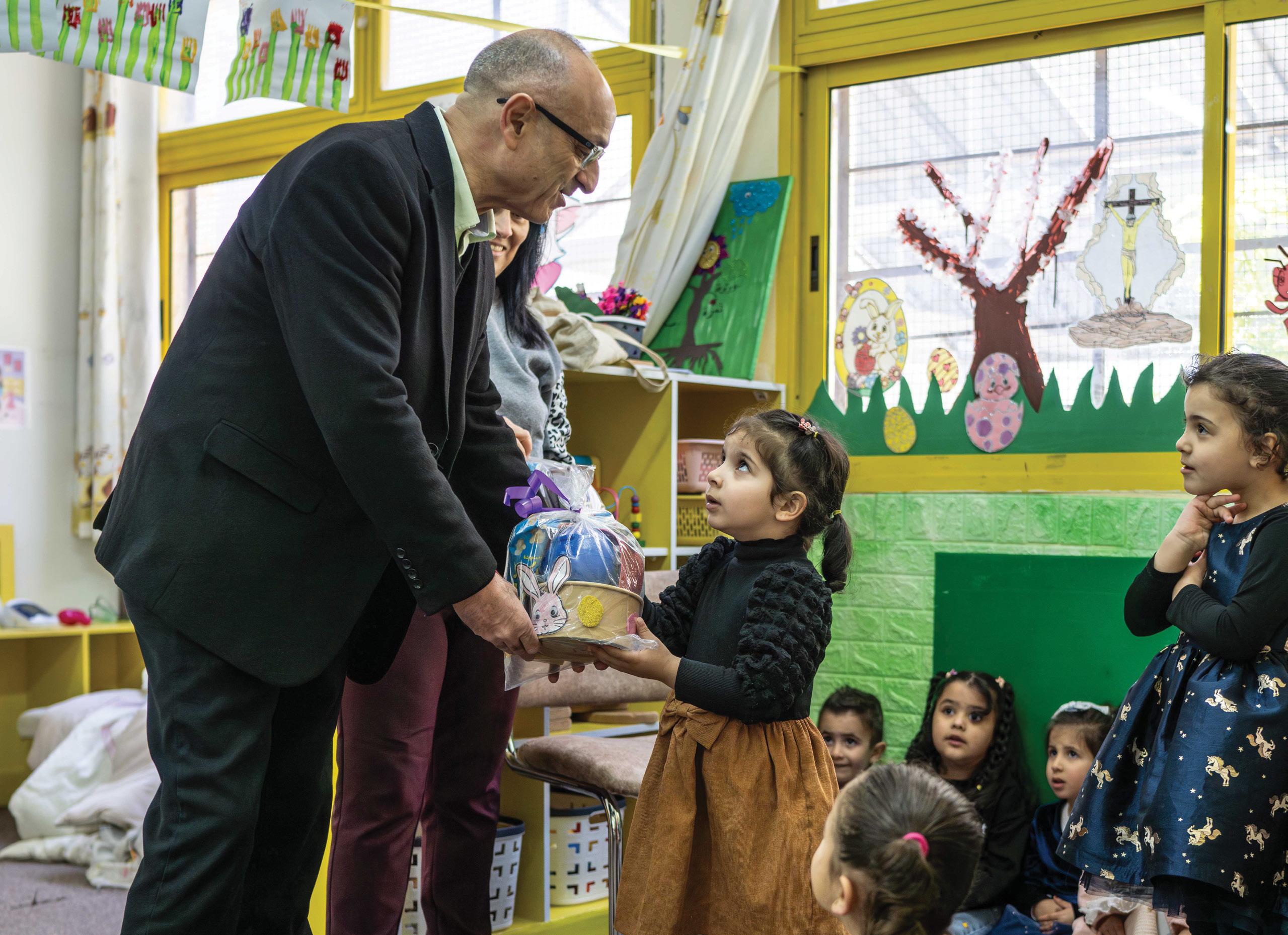
George Saadeh, who works for the school system of the Greek Orthodox Patriarchate of Jerusalem, visits students before Easter in the West Bank city of Beit Sahour.
metastasize across hilltops, encircling Palestinian communities in a noose of hostile architecture and a segregated road network that serves the settlements in the West Bank, but not Palestinian villages and cities.
The advancement of the “Greater Jerusalem” plan — a proposed bill in Israel that seeks to extend Jerusalem’s municipal boundaries by unilaterally annexing West Bank settlements, while excluding Palestinian neighborhoods — would expand Israeli sovereignty over occupied territory in violation of international law. Mr. Abu Eid warns “the areas where more than 90 percent of Palestinian Christians remain are at risk of being swallowed.”
In this environment, religious observance becomes an act of defiance. “Praying is an act of defiance,” he insists. “We fight to reach our churches, to keep them alive.”
Access to churches is in fact controlled by Israel’s movement restriction policy, says Mrs. Nassar, which limits access to the cities where the largest churches are located, such as Bethlehem, Jerusalem and Nazareth.
“This land isn’t just a spiritual journey — it’s a lived experience of horrors,” she says.
The Church of the Nativity exists in a bizarre duality — a magnet for the few international pilgrims who snap selfies at the Silver Star marking where Jesus was born, while outside its doors Palestinian worshipers navigate a maze of military barriers to attend liturgies.
Mr. Saadeh’s personal tragedy embodies the excruciating choices facing Palestinians. His voice
fractures when speaking of Christine, his 11-year-old daughter killed by Israeli forces at a checkpoint in 2005.
“I decided to stay, but I paid a heavy price,” he says.
Now overseeing Shepherd’s High School in Beit Sahour, part of the educational network of the Greek Orthodox Patriarchate of Jerusalem that serves 20,000 Palestinian children, Mr. Saadeh is unable to advise families to remain.
“The price is getting too high,” he says, his eyes clouding with grief and doubt.
The demographic crisis facing Palestinian Christians — now less than 1.5 percent of the population in the West Bank, East Jerusalem and the Gaza Strip — reflects the broader existential threat. Mr. Abu Eid clings to fragments of hope, noting that “many with foreign passports choose to stay. Even in Gaza … some refuse to leave.”
However, the exodus continues unabated, with Mrs. Nassar’s own children pleading, “Don’t wait for what’s happening in Gaza to happen here.”
Her response captures the moral urgency of the moment: “We don’t need Christians who are silent. We need those who challenge power. Your silence is a threat to peace.”
As the West Bank teeters on the brink of irreversible transformation — where “annexation occurs not through declarations but through bulldozers, settlements and systemic violence,” says Mr. Abu Eid — Mr. Saadeh says Palestinians face an impossible calculus: “exile and the loss of homeland or staying and risking losing everything else.”
“Our freedom is not impossible,” Mr. Abu Eid says, but the sands in the hourglass have become perilously thin.
Fatima AbdulKarim is a journalist based in Palestine.
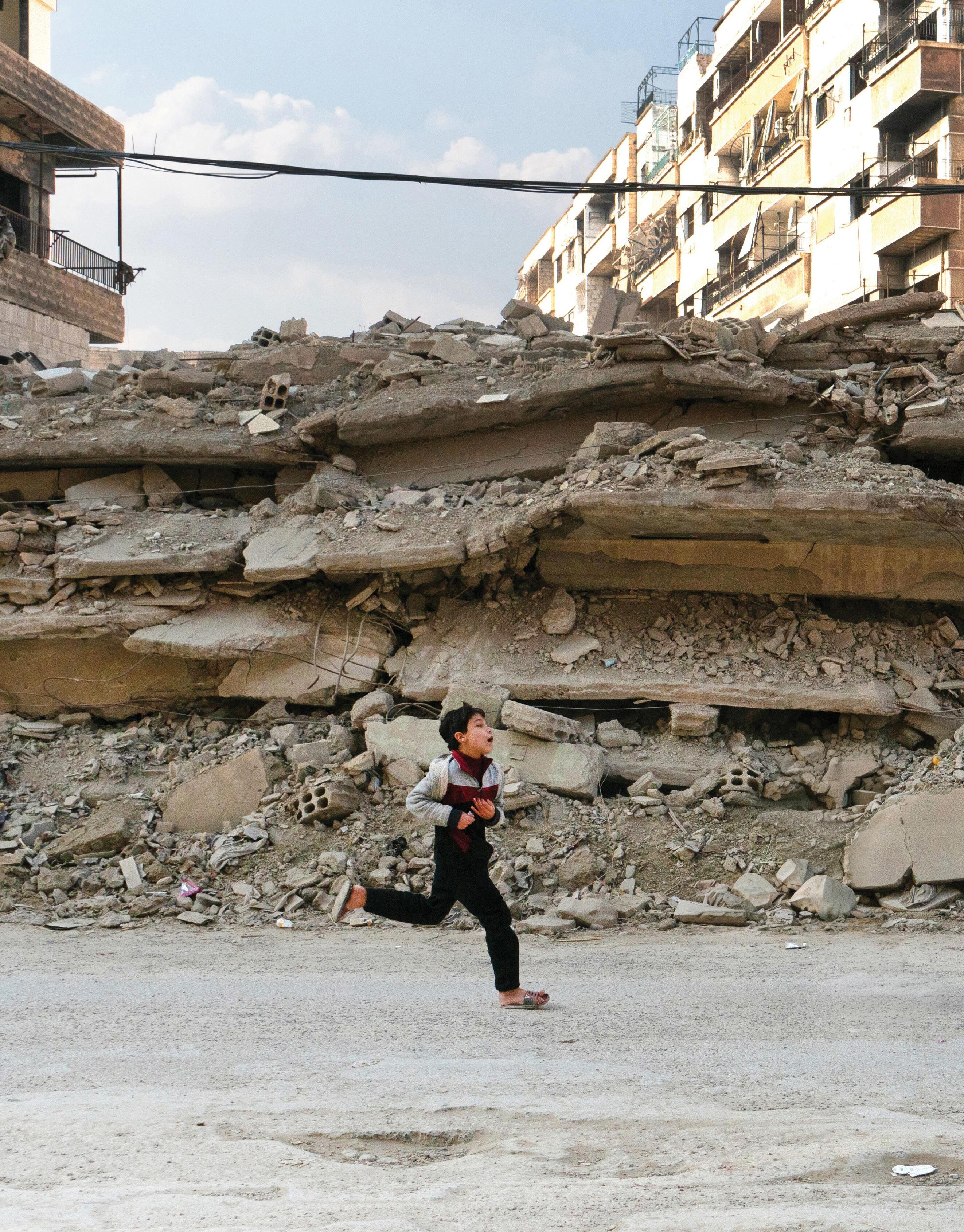
A child runs past the rubble of an apartment building destroyed in the Syrian civil war in Daraya, outside Damascus.
In Need of a Lifeline
Their families, neighborhoods, schools and homes battered by war, Syrian children find help and hope
text by Rosabel Crean with photographs by Ahmad Fallaha
Nicholas Nakoul can breathe a sigh of relief. This summer, after extending his studies to avoid military conscription, he will complete his economics degree at Damascus University.
Up until 8 December, when the 24-year rule of Bashar al-Assad ended abruptly, Mr. Nakoul had been failing exams deliberately to prolong his studies — a tactic used by many young men throughout Syria’s 14-year civil war — to avoid the draft.
The 24-year-old is among 150 volunteers at the Don Bosco Center in Al-Salihiya, a neighborhood northwest of the old walled city of Damascus, where he organizes sports activities for children and assists with administration.
His family is one of hundreds from the economically depressed suburb of Jaramana who come to the center regularly to benefit
from programming offered by the Salesians of Don Bosco, a community of religious founded by St. John Bosco in 1859 to serve impoverished children during the Industrial Revolution — a period of frenetic change in the West. Now present in more than 130 countries, the Salesians are present throughout the Middle East, Northeast Africa, India and Eastern Europe.
Mr. Nakoul was 11 when a nationwide anti-government revolution swept Syria, later erupting into a civil war that killed more than 650,000 people, according to the Syrian Observatory for Human Rights. According to the U.N. Refugee Agency, UNHCR, the war displaced more than 13 million people. The Syrian Network for Human Rights reports hundreds of thousands were arrested or disappeared.
“It was a nightmare for us,” says Mr. Nakoul. “It pushed us to think about going abroad.”
As the war began, young Nicholas started attending weekly activities and catechism classes at the Don Bosco Center.
“The center changed my life,” he says. “It made me more social; it raised my awareness and understanding about my daily life.”
Mr. Nakoul intends to work in banking upon graduation. Although job opportunities are limited in Syria’s current economy, he remains optimistic — a testimony to the support offered by the center, which continues to be a lifeline for families nervous about Syria’s new government.
Syria plunged into a new chapter on 27 November, when the Islamist rebel group Hayat Tahrir al-Sham
(H.T.S.) spearheaded a surprise 12-day offensive that culminated on 8 December in the capture of the capital of Damascus, forcing the Assad family, who had controlled Syria since 1971, to flee.
The group’s commander, Ahmed al-Shara, assumed leadership of the fractured nation and pledged to rebuild Syria as an inclusive society. Although concerns were raised over his past affiliation with Al Qaeda, he has told the country’s minority Alawite, Christian and
Druze communities that their rights would be respected in the predominantly Sunni Muslim nation.
On 31 December, about a month prior to being appointed interim president of Syria, Mr. Shara held a cordial public meeting with senior Christian leaders.
The Christian population in Syria, once estimated at 20 percent of the population, has dropped dramatically since the start of the 14-year war, from about 2 million people to less than 450,000,
according to the European Union Agency for Asylum.
Christian leaders in Syria say that, under the new government, they fear an implementation of strict Islamic law, which could encroach on religious freedoms. In March, two days of renewed internecine fighting, which killed more than 1,000 people, sparked fears of a return to civil war.
However, hope was renewed on 13 May, when U.S. President
“Everyone has a story; everyone has a miracle.”
Donald Trump announced the lifting of sanctions against Syria, which church leaders and humanitarian organizations had been requesting for years.
The U.S. first imposed sanctions on the country in 1979, imposing additional sanctions over decades.
The most recent set of sanctions, known as the Caesar Act, which went into effect in 2019, includes a provision allowing the president to suspend it. However, congressional action would be required to remove other sanctions. At the time of publication, it was unclear how long the process of unwinding sanctions would take and whether only some or all sanctions would be lifted.
Archimandrite Antoine Mousleh, vicar general of the Melkite Greek Catholic Archeparchy of Damascus, says the Melkite Church — one of the largest churches in Syria — is working to reassure families during this period of transition.
“In Syria, we have lived for thousands of years with each other, with different ethnic or religious groups, and it is a unique society,” Father Mousleh says.
While families continue thinking about leaving, their main priorities tend to be daily needs, he says. It is too soon to compare life for Christians under the Assad regime with the current situation, he adds.
Years of conflict, international isolation and the magnitude 7.8 earthquake in February 2023 sank the country into one of the world’s worst socioeconomic crises.
According to 2024 World Bank statistics, Syria’s gross domestic product — a monetary measure used to determine the health of
The CNEWA Connection
After 14 years of civil war, the children in Syria need adequate food, housing and schools. They also need spiritual and psychosocial support to help them heal from the trauma of war. With the support of CNEWA, programs of the church, such as those highlighted here, provide safe havens for children and young adults to develop their skills and to grow spiritually and intellectually. Church initiatives offer them hope for the future, alleviating some of the burdens on families who have known only violence for more than a decade.
To help CNEWA support its work in Syria, call 1-866-322-4441 (Canada) or 1-800-442-6392 (United States) or visit cnewa.org/donate
national economies — contracted by 54 percent between 2010 and 2021, and its currency depreciated by 141 percent against the U.S. dollar in 2023. Inflation rose by 93 percent that same year.
Limited job opportunities have forced men, women and children into informal work, such as selling smuggled fuel in plastic bottles or reselling bread from bakeries on the street.
The Melkite Greek Catholic Patriarchate, along with the Society of St. Vincent de Paul, helps about 320 needy families each month with food, clothing and medicines.
Males are traditionally the breadwinners in Syrian society. During the civil war, however, many disappeared — forcibly conscripted or abducted — or died
in the fighting, resulting in an increase of female-headed households.
Jacqueline Jirjis has been a single mother of three since 2013, when militants abducted her husband, Ghassan, along with others from their village of Maaloula. The ancient Christian village was overrun by the Syrian army, which at the time was fighting the Al Nusra Front, one of five Islamist militant groups that merged in 2017 to form the Islamic rebel group H.T.S.
The Lebanese army eventually found his body close to the Syrian border with Lebanon.
Ms. Jirjis and her children fled Maaloula in 2013 and have since lived in a one-room house in an
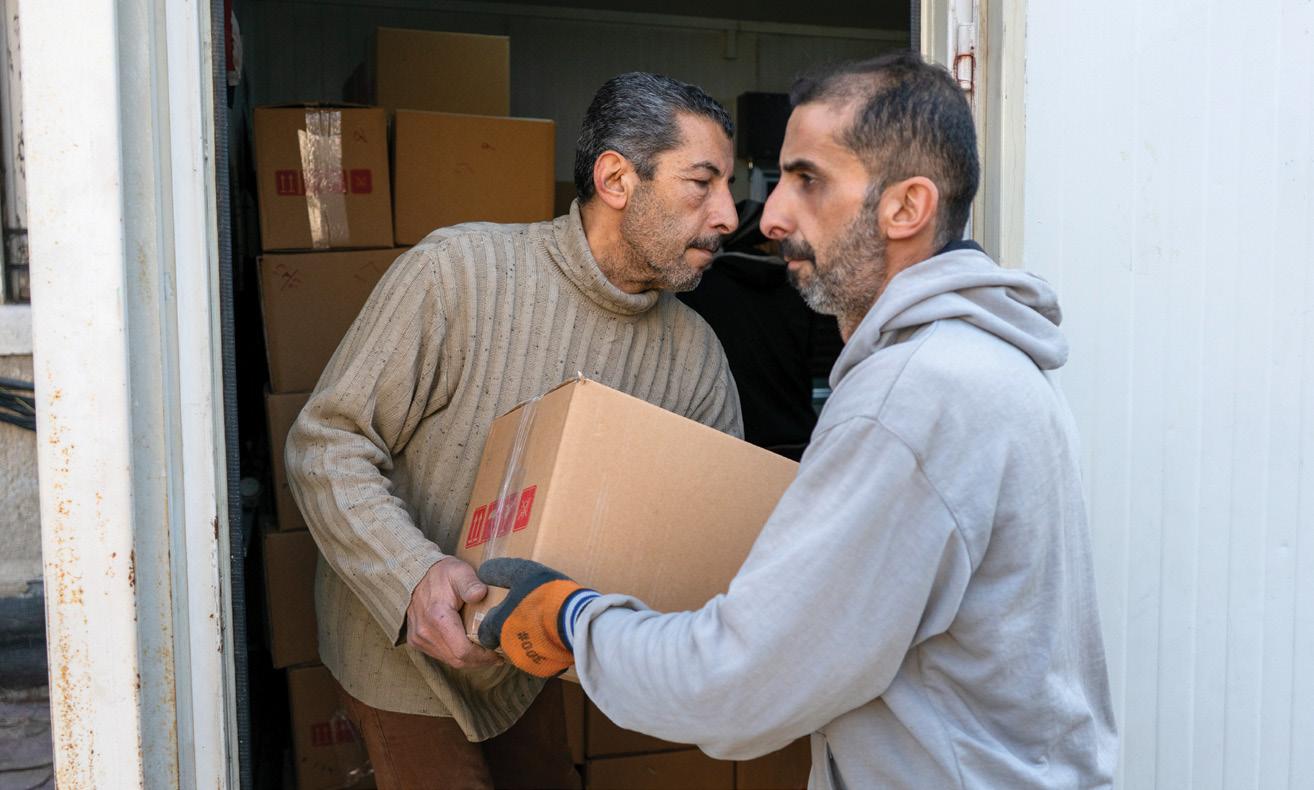
At left, Jacqueline Jirjis and her children live in Bab Touma, the Christian quarter of Damascus. Above, men deliver food aid coordinated by the Melkite Greek Catholic Patriarchate.
“We must not sit in a corner waiting for the future.”
alleyway in the old Christian quarter of Damascus.
Sara and Sidra, now 16 and 11 respectively, sit on the upper level of their bunkbed, their legs swinging. Azar, 15, sits on the floor beneath a framed image of the Virgin Mary and a photograph of his father. The paint is peeling off the wall and their few belongings are neatly folded on shelves above his head.
Schoolbooks sit on a side table. The children just returned from their morning lessons.
Ms. Jirjis, 48, fiddles with her hands as she speaks of their daily struggles and the assistance she has received with clothing and occasional food vouchers from the Congregation of the Religious of Jesus and Mary, a community of religious women founded in 19th-century France by St. Claudine Thévenet to work with vulnerable people.
“We mainly eat vegetables, as meat is too expensive,” says Ms. Jirjis, as she slices and fries potatoes in the small outdoor kitchen for the children’s lunch.
Azar in the meantime kicks a soccer ball in the yard; he hopes to be a soccer player. Sidra, who shows off her schoolbooks, would like to be a teacher, and Sara hopes to be a translator.
While the sisters’ mission is dedicated mainly to children, they began to address the needs of mothers as well. At their Hope Center outside Damascus, the sisters launched a microprojects initiative last year to help women establish small sewing or catering businesses.
Some 300 children and their parents also visit the sisters’ music center in Jaramana.
Syrians celebrate in the streets of Damascus on 13 May, after hearing the announcement that U.S. sanctions against Syria will be lifted.
“When we healed the children with the music, we discovered that, in the end, it was really the parents who needed healing more than the children,” says Sister Insaf Chahine, R.J.M.
“Everyone has a story; everyone has a miracle. What we say now is that God really saved us many times.”
The United Nations Children’s Fund, UNICEF, estimates that 85 percent of households in Syria “struggle to make ends meet” and more than 7 million children require aid, from nursing formula and clean drinking water to food, clothing and school supplies. As well, more than 2.4 million Syrian children, aged 5-17, are not in school, and more than 7,000 school facilities need repair after being damaged in the war.
Syria’s battered education sector also suffers from a teacher shortage, low teacher salaries and subsequently poor teaching.
Despite free public education, the cost of bus tickets, stationery and uniforms is still too much for many families to bear, says Marwa Alsharqawi, an education specialist with the Norwegian Refugee Council.
“Sometimes the calculation will make [parents] decide it is not worth [their children] going back to school, it is not worth the education,” she says.
The Don Bosco Center in Damascus is vital against this backdrop. The Salesians, who arrived in the city in 1990, have sought to alleviate some of the burdens on families and to increase educational opportunities for children through extracurricular activities, sports, art and music lessons, and catechism.
Some 860 children and 185 university students visit the center each weekend. During exam periods, the Salesians organize
tutoring sessions in math, English, science and Arabic, run by the older students, many of whom came to the center as children.
“Families cannot survive to the end of the month, especially as the majority [of parents] are public employees,” says Salesian Father Miguel Ángel Condo Soto, one of four priests at the center.
With the depreciation of state salaries due to the collapse of the Syrian pound, many parents have taken a second job to make ends meet, leaving them with less time for their children, he explains.
“This is to the detriment of the young people; they cannot develop familial or social skills,” says Father Condo, a Bolivian, who moved to Syria in 2022. The programming at the Don Bosco Center helps to fill gaps in the children’s psychosocial and spiritual development.
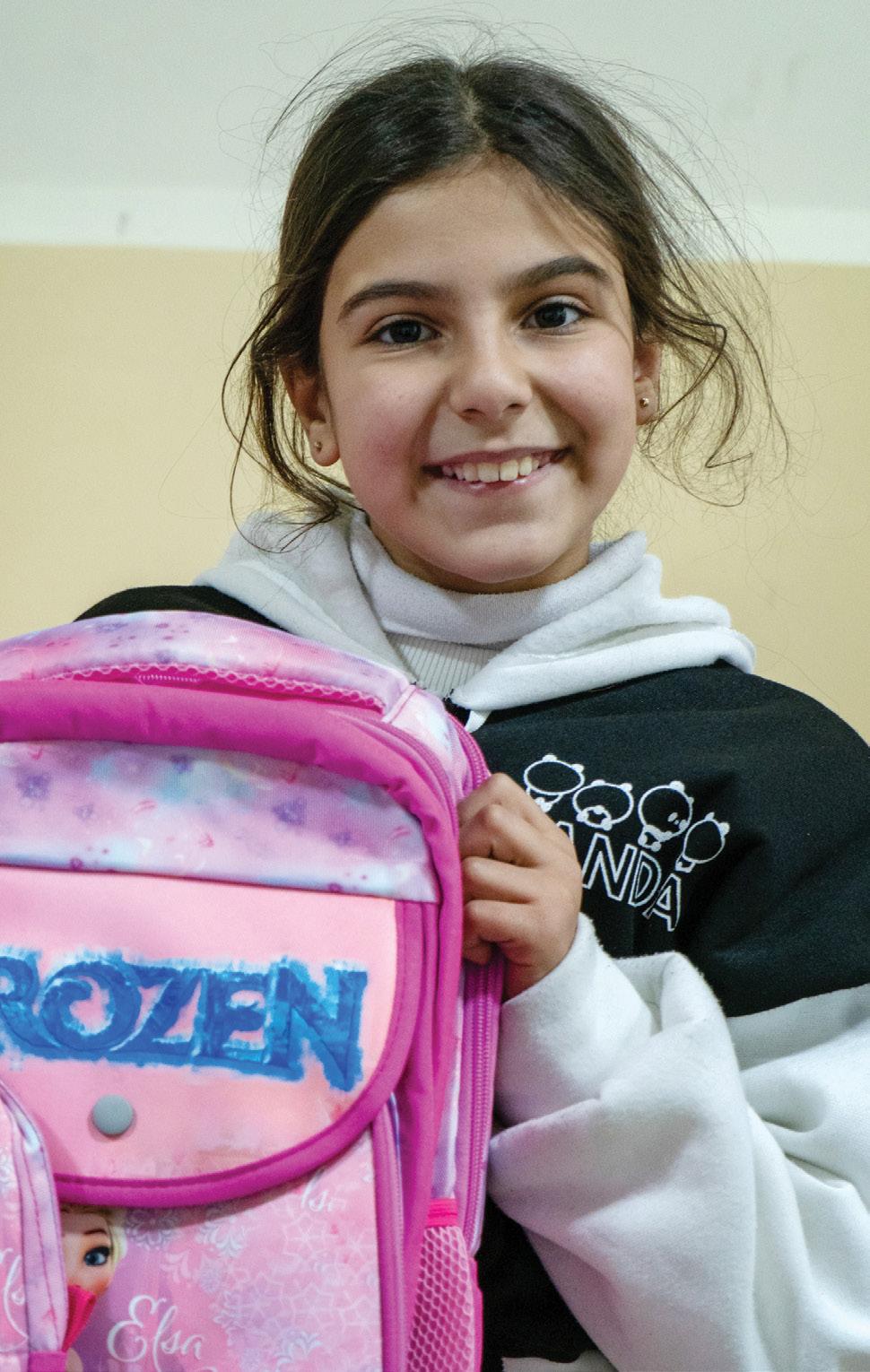
In January, Edward Bitar and Bassam Jarouj from Jaramana were among dozens of parents in line at the Don Bosco Center to collect school backpacks for their children.
“For more than 11 years [of war], we had nothing to entertain the children, except this center,” says Mr. Bitar.
Salesian Father Pedro Garcia, rector of the center, says despite the many unknowns families face under the new transitional government, the change offers a window of opportunity for young people to shape their future.
“We encourage the children to be the protagonists of their own lives,” he says.
“This is a very historical moment for the country in which there are lots of opportunities. We must not sit in a corner waiting for the future; each person must make an effort.”
Rosabel Crean, based in London, is a freelance journalist who covers the Middle East. Her work has been published in The Telegraph, New Lines Magazine and The Tablet.
At the entrance of St. Anthony Community Health Center, some 6 miles north of Beirut, a sticker reads, “USAID –From the American People –International Medical Corps.” It is a designation that no longer applies.
On 20 January, the U.S. administration issued an executive order freezing all government foreign assistance, initially for three months, through several departments and the U.S. Agency for International Development (USAID). The order was accompanied by a statement indicating the “foreign aid industry and bureaucracy are not aligned with American interests and in many cases antithetical to American values.”
The sudden freeze in U.S. government funding, vital for thousands of humanitarian projects — U.S. foreign assistance in 2024 totaled $56 billion worldwide — reverberated across the globe and stunned nonprofit agencies and their beneficiaries.
The decision reached St. Anthony Community Health Center quickly. Run by the Sisters of the Good Shepherd, the center received a stop-work order from International Medical Corps, which had been directing U.S. government funding to the health center since 2008.
“On a Sunday night, they sent us a message telling us that from Monday onward, they would stop covering the consultations, the blood tests, the medicines, the medical equipment and the medical imaging,” said Dr. Joelle Khalife, the dispensary’s medical director.
Initially, International Medical Corps only paused the funding, which represented a third of the health center’s annual budget.
“Two weeks later, the team explained to us, in a very courteous way, that our contract with them was terminated,” she said.
The consequences for the health center, which cares for 2,000 people monthly, were immediate.
“When we started charging our patients for what International Medical Corps used to cover, some of them stopped coming,” said Dr. Khalife. “Our patients come to us because they don’t have the financial means to access health care in private hospitals.”
“It was hard to explain to our patients how a decision taken in the United States leads to their health care expenses not being covered anymore,” she said. “But the Lord is with us. We will not close because of this funding problem.”
Good Shepherd Sister Antoinette Assaf, who manages international partnerships in Lebanon for her community, said these cuts have made an already difficult situation more challenging. Access to funding has become “increasingly hard” since the COVID-19 pandemic, she explained, and donor requirements have increased across the board as funding has decreased.
In mid-March, U.S. Secretary of State Marco Rubio announced 83 percent of USAID contracts were canceled and those remaining were integrated into the State Department, which had absorbed USAID in February. A month later, a final list of terminated grants had not yet been made public.
However, Geneva Solutions, an online news site that covers the work of international aid organizations, reported on 4 April that a leaked document indicated 77 percent of USAID grants — or “6,239 awards, worth $36bn in aid” — were terminated.
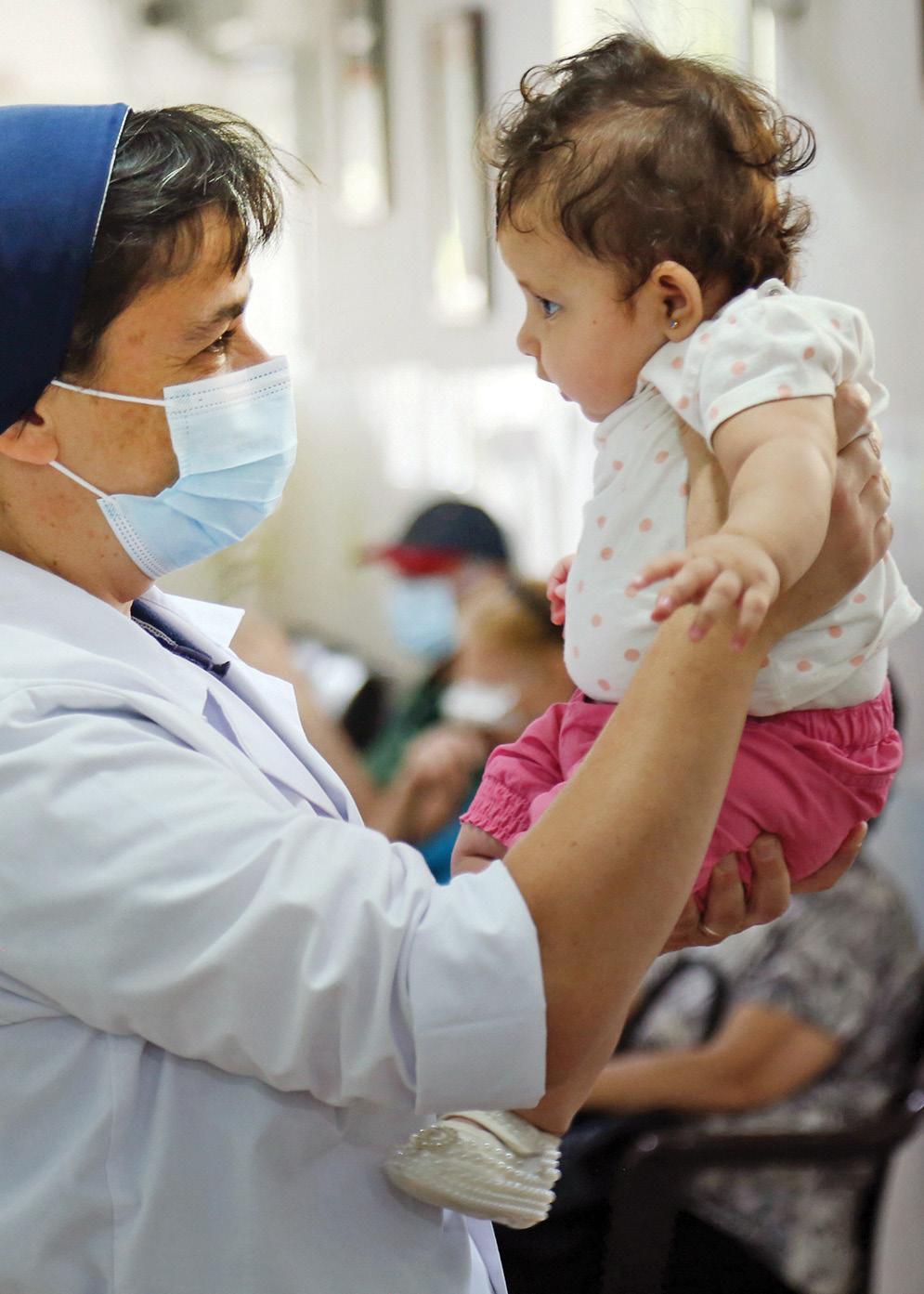
Good Shepherd Sister Antoinette Assaf assesses a child at St. Anthony Community Health Center in Roueissat, Lebanon.
Holding Their Own
Church groups continue to serve in the Middle East despite U.S. funding cuts
by Laure Delacloche
RESPONDING TO HUMAN NEEDS
The CNEWA Connection
The funding landscape for humanitarian work in the Middle East changed overnight with the elimination of U.S. government foreign aid earlier this year. While only two CNEWA-supported projects in Lebanon were affected directly, some partner organizations of the church reliant on U.S. foreign assistance were quick to request additional funding from CNEWA to help fill the gaps, said Michel Constantin, CNEWA’s regional director for Lebanon, Syria and Egypt. While CNEWA-funded projects in Jordan and Iraq were untouched by the cuts, Ra’ed Bahou, CNEWA’s regional director in Amman, anticipates more “financial pressure” to close the funding gaps.
Help CNEWA keep the work of the churches alive in the Middle East. Call 1-800-442-6392 (United States) or 1-866-322-4441 (Canada) or visit cnewa.org/donate.
On the list, the World Health Organization, United Nations Development Program, Mercy Corps and UNICEF were slated to lose from one-third to 98 percent of their U.S. government funding. U.N. Women and U.N.-Habitat were slated to lose all U.S. government funding.
The administration reconsidered a few cuts and, on 9 April, restored funding to World Food Program projects in Lebanon, Syria, Iraq, Jordan, Ecuador and Somalia and at least four awards to the International Organization for Migration.
Christian organizations also were impacted: Caritas, the humanitarian and development organization of
the Catholic Church, was slated to lose 25 percent of its U.S. government funding; World Vision, 16 percent.
“These budget cuts in development aid and international cooperation are detrimental to human development, especially affecting programs supporting refugees and other vulnerable groups,” said Karim el-Mufti, professor of political science, international affairs and international law at the Jesuit-run St. Joseph University of Beirut. This change in U.S. policy sheds light on the weight of U.S. assistance globally and throughout the Middle East, he said.
“Lebanon holds the prize of dependency on foreign aid, which
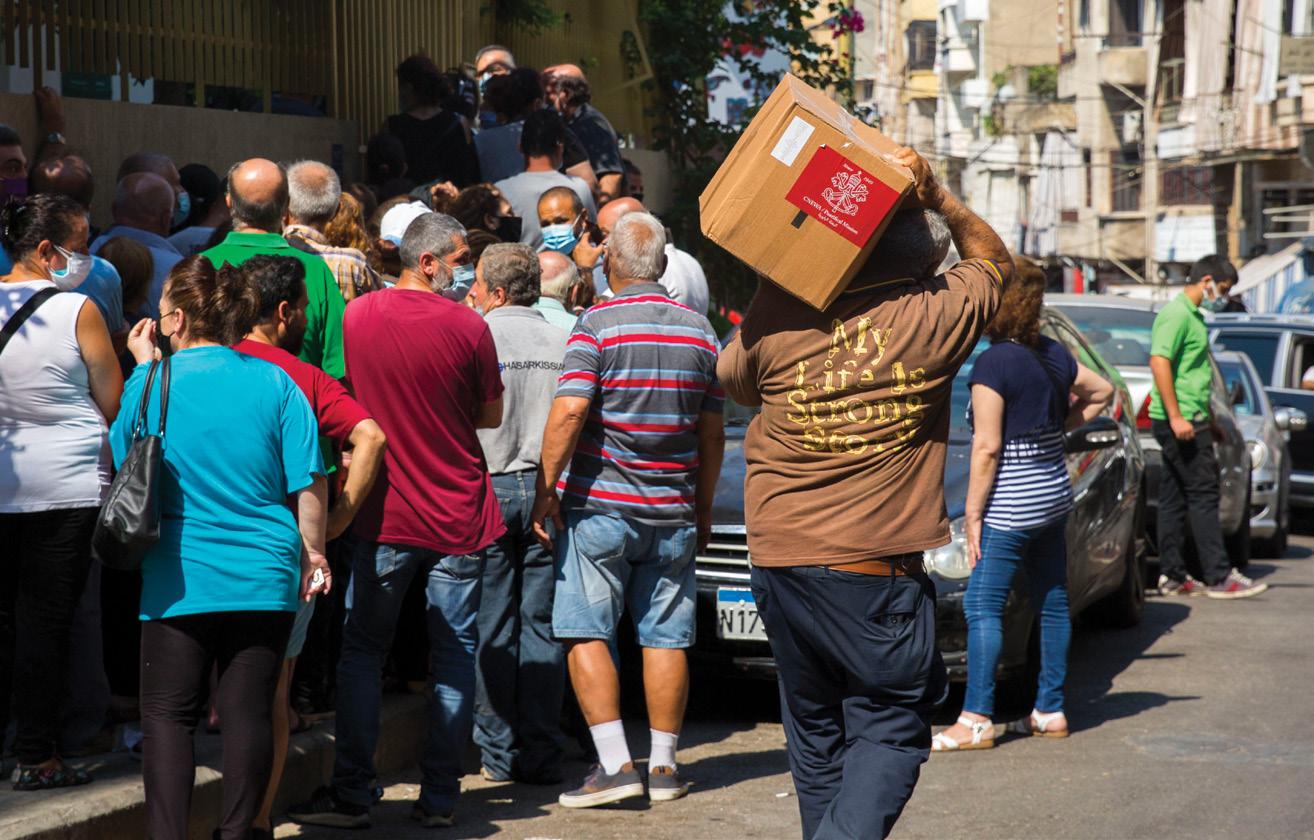
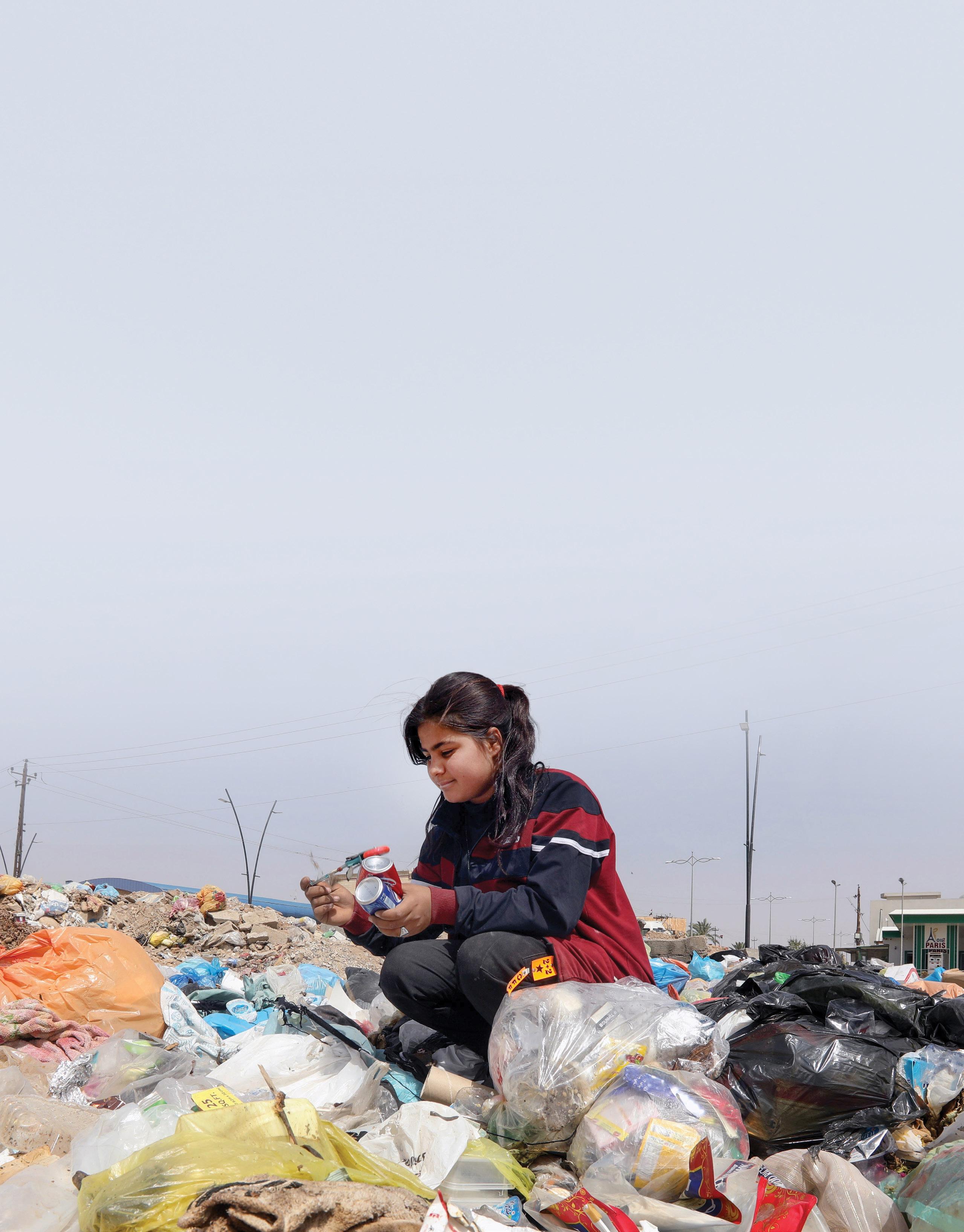
A man receives aid through the CNEWA-funded food box program at the Socio-Medical Intercommunity Dispensary in Nabaa, Lebanon. Opposite, an Iraqi girl collects cans from a garbage dump in Kirkuk, Iraq.
is the price of having a collapsed state,” said Mr. Mufti. “The Lebanese struggle to access basic services. Programs that were supported by the United States were very useful in terms of access to health care, education and basic amenities.”
In 2024, the country plunged from a war limited to the South and the Beqaa Valley into an all-out war between Hezbollah, a powerful Lebanese political party and Shiite militia, and Israel, lasting two months. That year, Lebanon had received nearly $390 million in U.S. assistance, 63 percent for economic development and the rest for aid to support the nation’s underfunded military. The U.S. also funded 20 percent of all U.N. projects in the country.
CNEWA has not received funding from the U.S. government since 2008, so its ability to maintain current funding commitments to partners remains intact.
“Out of 100 projects we support in Lebanon, so far only St. Anthony Community Health Center and another medical center are directly affected by the U.S. cuts,” said Michel Constantin, CNEWA’s regional director for Lebanon, Syria and Egypt.
However, since January, other humanitarian organizations have contacted his office with “requests to discuss funding issues.”
“I doubt we will be able to support them in a significant way, as our budget for 2025 is already finalized,” said Mr. Constantin.
Mr. Constantin said while he thinks most church institutions may find alternative funders, “the cuts will certainly affect the whole
social situation of the country in terms of the level and quality of services provided.”
In Lebanon, U.S. government funding supported education, health care and nutrition programs, said Laith Alajlouni, a research associate at the International Institute for Strategic Studies in Manama, Bahrain.
Programs for Palestinian and Syrian refugees in Lebanon, as well as internally displaced Lebanese, will be affected. The funding cuts also are expected to “slow down the humanitarian recovery and the reconstruction of Lebanon,” he said, which the World Bank has estimated at $11 billion.
Iraq and Jordan are also long-term recipients of U.S.government assistance. In 2024, Iraq received $333 million, while the Hashemite Kingdom of Jordan, which enjoys “most-favored-nation trade” status with the United States, received $1.75 billion in U.S. assistance.
The impact of the funding cuts on each country is likely to differ vastly, but the case of Jordan stands out, said Mr. Alajlouni.
“Half of U.S. foreign assistance [to Jordan] goes to [Jordan’s] national budget, and the other half is channeled toward the development sector through USAID,” he said.
An increased national deficit and a major decrease in access to health care, education and potable water are expected as a result.
According to The National, a state-run newspaper in the United Arab Emirates, 35,000 people in Jordan had lost their jobs to the funding cuts by early February, adding to the 21.4 percent unemployment rate at the end of 2024.
In Iraq, half of U.S. government assistance was directed to the military. The stoppage “will likely impact Iraq’s ability to defend itself against ISIS,” said Mr. Alajlouni, and may likely “push the country toward Iran.”
Iraqis affected “will be pushed to emigrate, which is a big problem for the Christian community.”
“Thirty-five thousand people in Jordan had lost their jobs to the funding cuts by early February, adding to the 21.4 percent unemployment rate.”
In Iraq’s development sector, the projects impacted are chiefly tied to democratization programs and refugees. According to the latest figures available from the UNHCR in April 2023, Iraq had 280,000 refugees and 1.2 million internally displaced people.
Ra’ed Bahou, CNEWA’s regional director for Jordan and Iraq, said CNEWA’s more than 100 projects across Jordan and Iraq were untouched by the funding cuts, but the impact on other organizations is evident.
“Key organizations, such as the World Food Program, Catholic Relief Services, Jesuit Refugee Service, are affected, with reduced capacity for food aid, education and emergency response,” he said.
Mr. Bahou anticipates “a lot more financial pressure” on his office, “especially within the health care sector,” without having the financial means “to fill the gap.”
CNEWA is among a small group of Catholic organizations, including L’Oeuvre d’Orient, an initiative of the Catholic Church in France, whose projects were left unscathed by the cuts.
Vincent Gelot, country director for L’Oeuvre d’Orient in Lebanon, Syria and Jordan, said his agency’s partners — religious congregations, dioceses and local associations — “are almost never helped by large international organizations and large funding bodies because they are private or because they are faith-based.”
However, Karam Abi Yazbeck, regional coordinator for Caritas Internationalis in the Middle East and North Africa, said “40 percent of our budget globally comes from the U.S. government.” Another
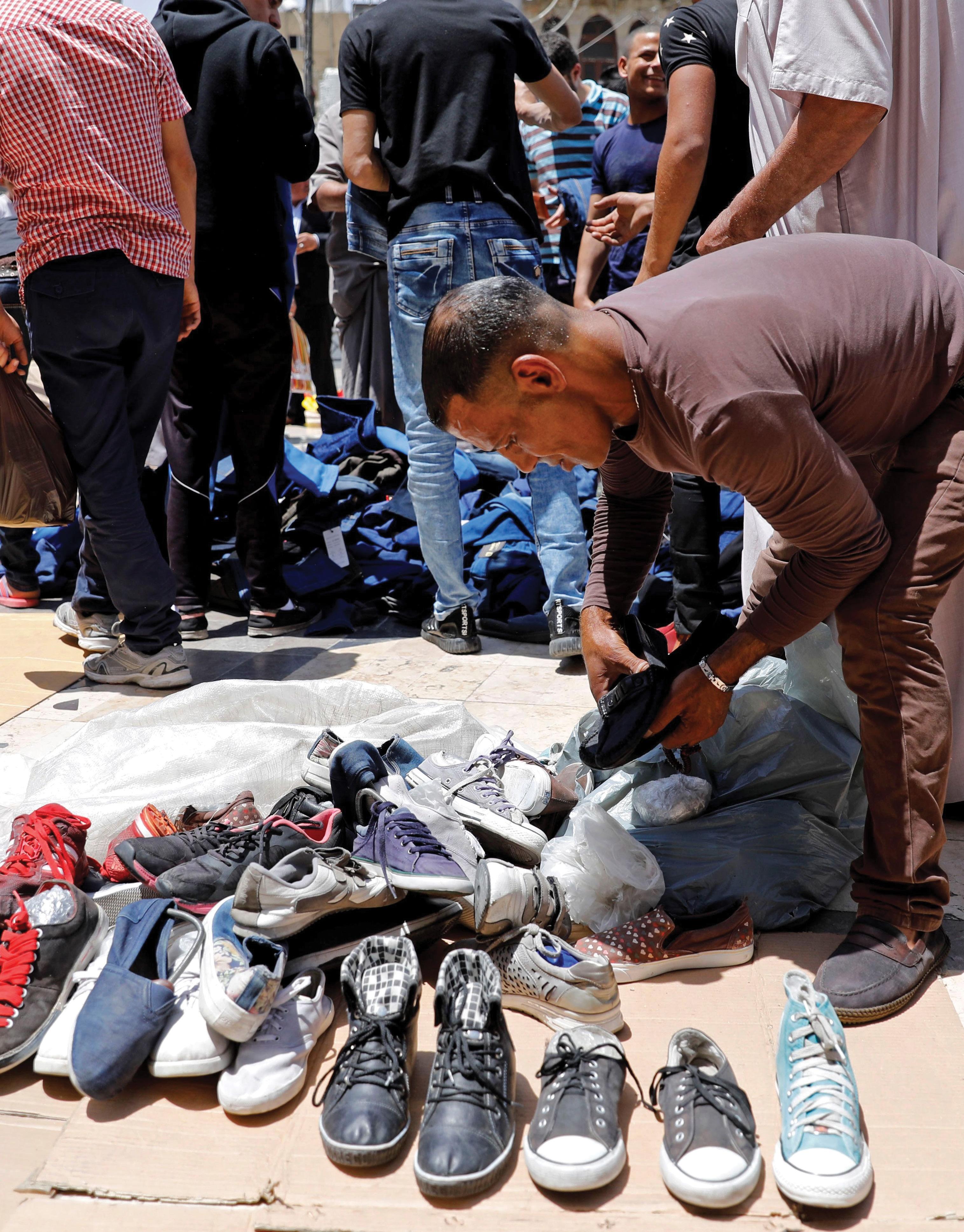
A man looks at second-hand shoes in an open-air market in central Amman. Cuts in USAID funding are expected to cause financial strain among many of the world’s most vulnerable.
major funder was Catholic Relief Services, which reportedly lost 62 percent of its funding in the government cuts.
He said Caritas had “a lot of concerns, as some communities rely heavily on our services.” In April, it was in the process of identifying new sources of funding and considering whether to reduce activities or close its office in Jordan.
Caritas Iraq lost about 20 percent of its annual budget — nearly $700,000 overnight. In response, it laid off 25 employees and was shifting its activities toward “projects that are less costly in order for our office to survive,” said Nabil Nissan, executive director of Caritas Iraq.
The funding cuts will impact the minority Christian communities in Iraq and Jordan — respectively less than 2 percent and 8 percent of the population.
“This happens in a context of high unemployment and difficult socioeconomic conditions for all segments of Iraqi society,” said Mr. Nissan.
“There are only rare opportunities of employment within state institutions, so [people affected] will be pushed to emigrate, which is a big problem for the Christian community.
“Implementing a project strengthens the presence of the church in the community,” he added. “It sends a message that Christianity is here in Iraq, and we demonstrate our values.”
Church-run organizations in the Middle East are in the process of adapting to the new funding context and are looking to Europe for additional assistance.
However, Mr. Alajlouni in Bahrain believes, even if European partners jump in, “gaps will remain” because “U.S. funding was significant.”
Laure Delacloche is a journalist based in Lebanon. The BBC and Al Jazeera have published her work.
The Last Word
Perspectives from the president
by Msgr. Peter I. Vaccari
“On the last and greatest day of the feast, Jesus stood up and exclaimed, ‘Let everyone who thirsts come to me and drink. Whoever believes in me, as scripture says: “Rivers of living water will flow from within him.” ’ ” (Jn 7:37-38)
On 8 May, Cardinal Robert Francis Prevost was elected pope, successor of St. Peter. He chose the name Leo XIV. This native son of Chicago is the first successor of St. Peter elected from the United States.
CNEWA-Pontifical Mission gives thanks to God and the movement of the Holy Spirit among the cardinal electors. I urge our readers and supporters to read and to pray with Pope Leo’s address to the participants of the Jubilee of the Eastern Churches on Wednesday, 14 May. In his address he echoes the sentiment of Pope Francis, who died on Easter Monday, in holding up the unique traditions of the Eastern churches. In addition, he recognizes the insight that Pope St. John Paul II shares in his encyclical “Orientale Lumen” on the unique historic role of the Eastern churches “ ‘as the original setting where the church was born.’ ”
This issue of ONE pays tribute to Pope Francis and introduces Pope Leo XIV in light of CNEWA’s mission.
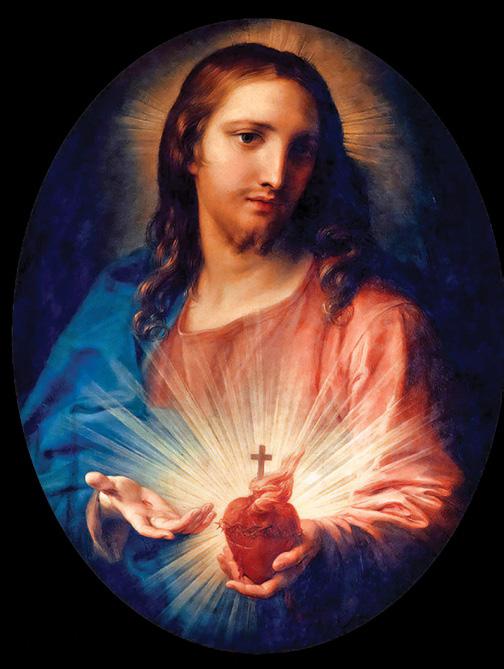
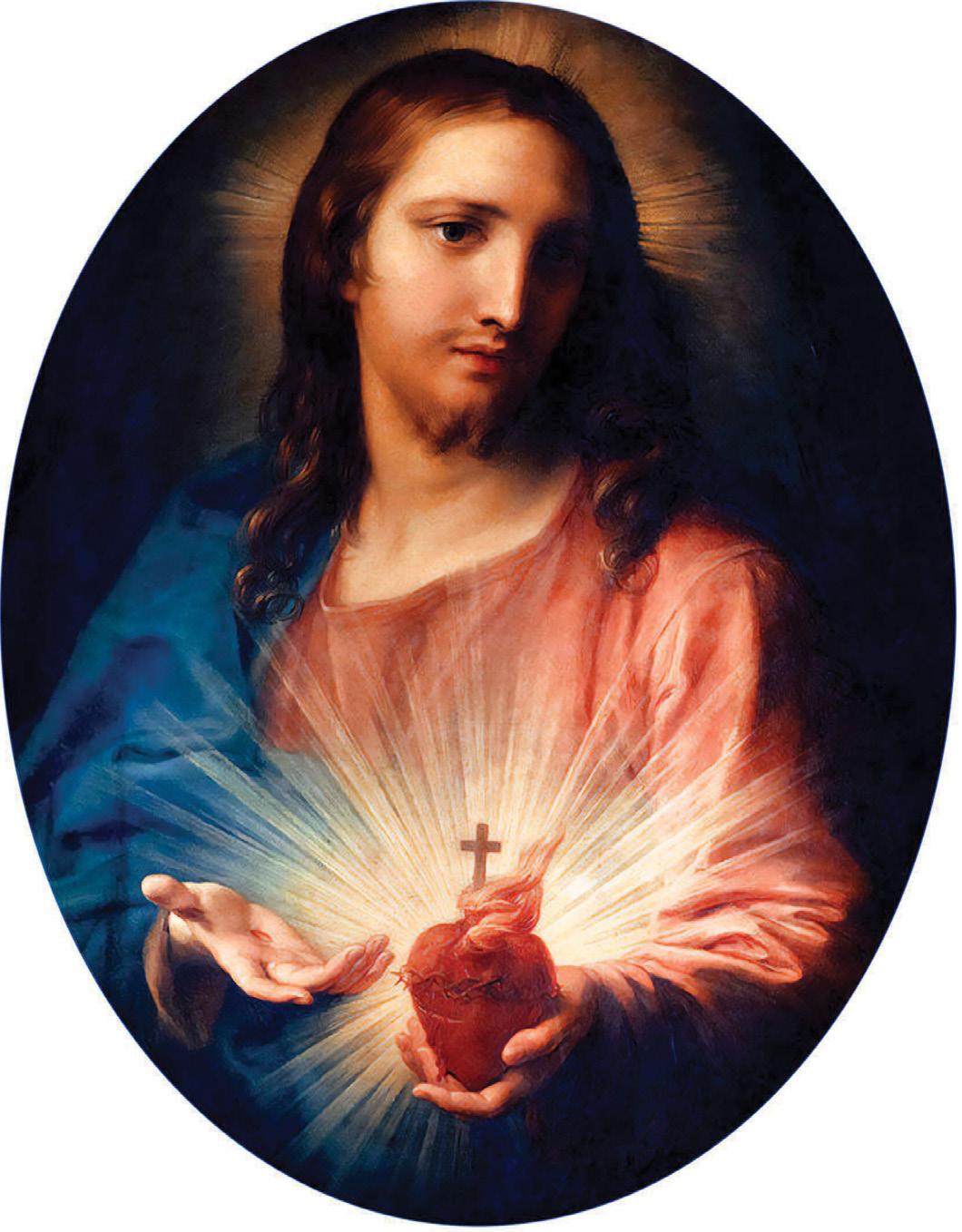
The most popular image of the Sacred Heart of Jesus, painted by Pompeo Batoni in 1767, is housed in Rome’s Church of the Gesù.
Pope Francis was a strong advocate and shepherd for the Eastern churches. Within the first 10 days of his pontificate, Pope Leo XIV demonstrated this same solicitude for the Eastern churches, as well as for the challenges and issues they face in the regions of the world where CNEWA works and where the experience of raw physical thirst is a story all too familiar.
However, beyond physical thirst, so many in our world experience deep and varied forms of thirst. How often do we feel the desert thirst for greater meaning and purpose, the thirst for adequate work to support our families, the thirst for meaningful relationships? The thirst to love and to be loved? The thirst for a life of greater virtue, that is, of prudence, justice, fortitude, temperance? The litany of our thirsts could go on.
In his encyclical on the Sacred Heart (“Dilexit nos”), issued last October, Pope Francis traces the biblical journey of God, who also thirsts. Yes, God thirsts to hold his people in the embrace of his love by promising them lifegiving water that will free them from the desert and cleanse them from their sins. The culmination of that divine thirst comes in the audacity of the mystery of the Incarnation, when God
becomes one like us in all things, save sin! The fulfillment of God’s plan comes, as the encyclical states: “From Jesus’ wounded side, the water of the Spirit poured forth … The pierced side of Jesus is the source of the love that God had shown for his people in countless ways.”
The bull of indiction that declares this year’s Jubilee of Hope links the virtue of hope to the Sacred Heart of Jesus: “Hope is born of love and based on the love springing from the pierced heart of Jesus upon the cross.”
In prayerful reflection and meditation on the meaning of the Sacred Heart of Jesus, the crucified and risen Jesus gives birth to hope and should then lead us to be willing to give our lives for others. The patristic tradition within the Catholic Church is consistent, clear, compelling and challenging. As expressed in “Dilexit nos,” Christ satisfies our thirst at the deepest level: “Our union with Christ is meant not only to satisfy our own thirst, but also to make us springs of living water for others.”
What incentives can be offered to Palestinians to remain in places like Bethlehem?
The article from Syria reports on how the church remains steadfast in its commitment to assisting children in need. In my visits to Syria, I have witnessed the lived trauma of people of all ages who experienced a 14-year civil war, COVID-19, the fall of the Assad regime, and the ongoing presence of extremist groups who fight to gain control of all aspects of life. Where do they turn for hope?
“Sacred Heart of Jesus, hope of all who die in you, have mercy on us!”
The situation in Lebanon, Jordan and Iraq is sensitive and tense. The internal geopolitics of these countries have been further impacted by the cuts in U.S. foreign aid. CNEWA does not receive U.S. foreign aid. However, other agencies have been directly impacted by the reduction or elimination of these funds. The impact of these cuts on our partners and the increased demand for assistance that CNEWA has received since then are covered in this edition.
(Litany of the Sacred Heart)
This edition of ONE highlights the dynamics and consequences of an authentic spirituality rooted in the Sacred Heart of Jesus that never permits us to grow weary of reaching out to those who are most vulnerable and thirsty. Michael J. La Civita, CNEWA’s director of communications and marketing and executive editor of this magazine, develops the messaging of CNEWA’s mission, engaged in an incarnational theology of Catholic social justice irrespective of international geopolitical shifts.
The crises in the Palestinian territories of the West Bank and Gaza continue to be of grave concern. CNEWA-Pontifical Mission denounces all extremist groups, including Hamas, and prays for a cease-fire and immediate return of all hostages. The right to self-governance and security must be assured to Israel and to Palestine. The article on the West Bank asks: What is the future of the Palestinian people?
The month of June is dedicated to the cultivation of a stronger personal relationship with Jesus through a healthy devotion to his Sacred Heart. From this relationship emerges the virtue of hope. We are further called to be agents of hope, especially during this jubilee year. This issue of ONE is all about that reality as it is experienced on the ground in CNEWA’s world.
Hope is not about dreams, personal goals and desires. It is about our thirst for the Kingdom of Heaven and eternal life. It is about our task to bring that kingdom, here and now, into our world so that the words we pray each day — “thy kingdom come, thy will be done, on earth, as it is in heaven” — challenge us.
With my gratitude and prayers,
Peter I. Vaccari
President
CNEWA a papal agency for humanitarian and pastoral support
220 East 42nd Street, New York, NY 10017 • 1-212-826-1480 • cnewa@cnewa.org