Church cares for people with H.I.V. and AIDS text by Anubha George with photographs by Sajeendran V.S.
FEATURES
Where ‘Truly Everything Is Positive’ Vulnerable girls find a haven with Franciscan Sisters text by Laure Delacloche with photographs by Nadia Bseiso
The Difference a Year Makes Refugees in Armenia persevere by Gohar Abrahamyan
Closing the Hunger Gap Sisters in Ethiopia care for children in need text by Hikma A. Abdulmejid with photographs by Petterik Wiggers
A Century of Catholic-Orthodox Relations by John Long, S.J.
DEPARTMENTS
4
38
Connections to CNEWA’s world
The Last Word Perspectives from the president by Msgr. Peter I. Vaccari
t Students lie down for naptime at Divine Providence School in Debre Berhan, Ethiopia.
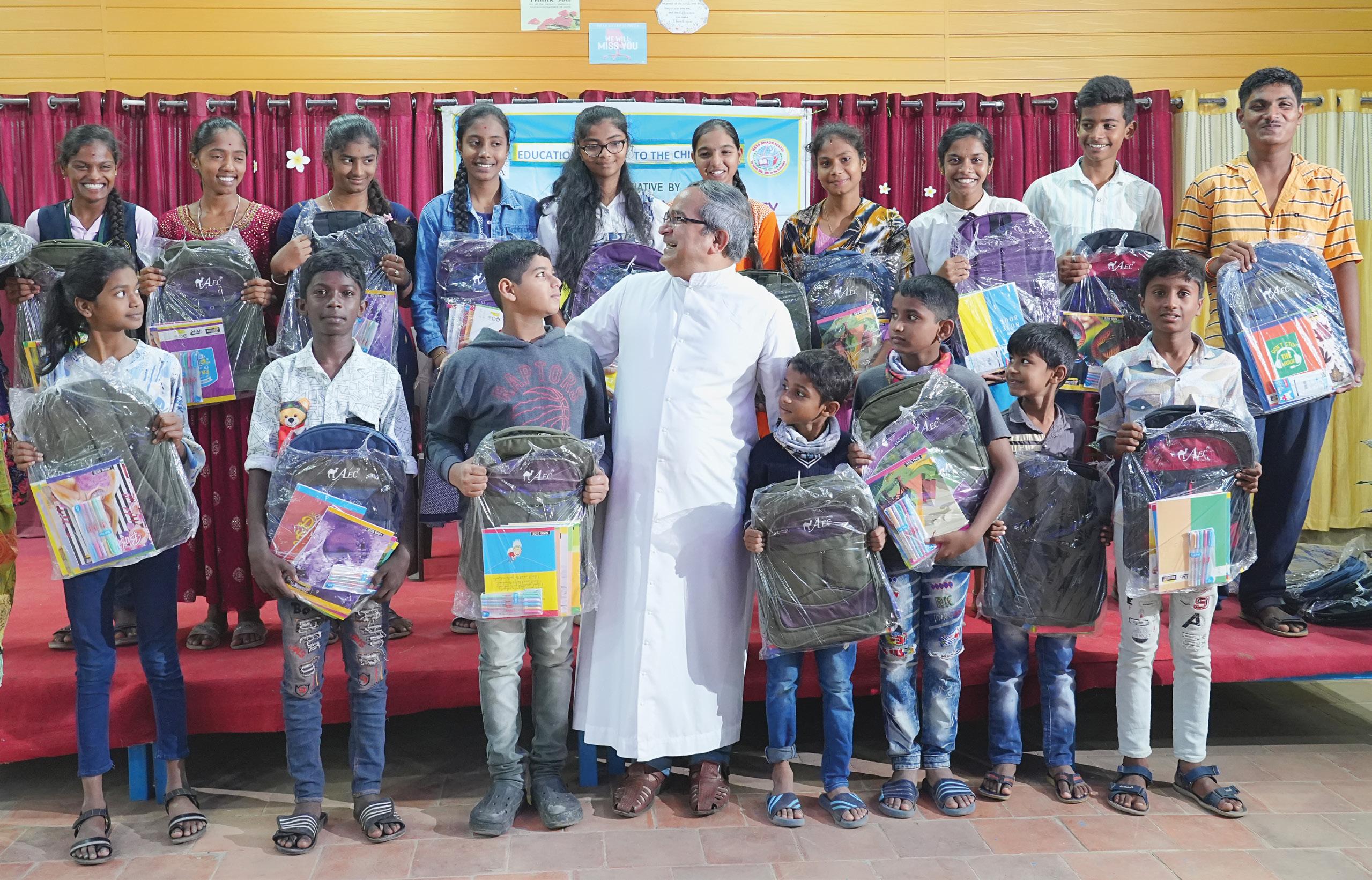
Front: Students in Mandya, India, receive educational support through a social service program of the Syro-Malabar Church.
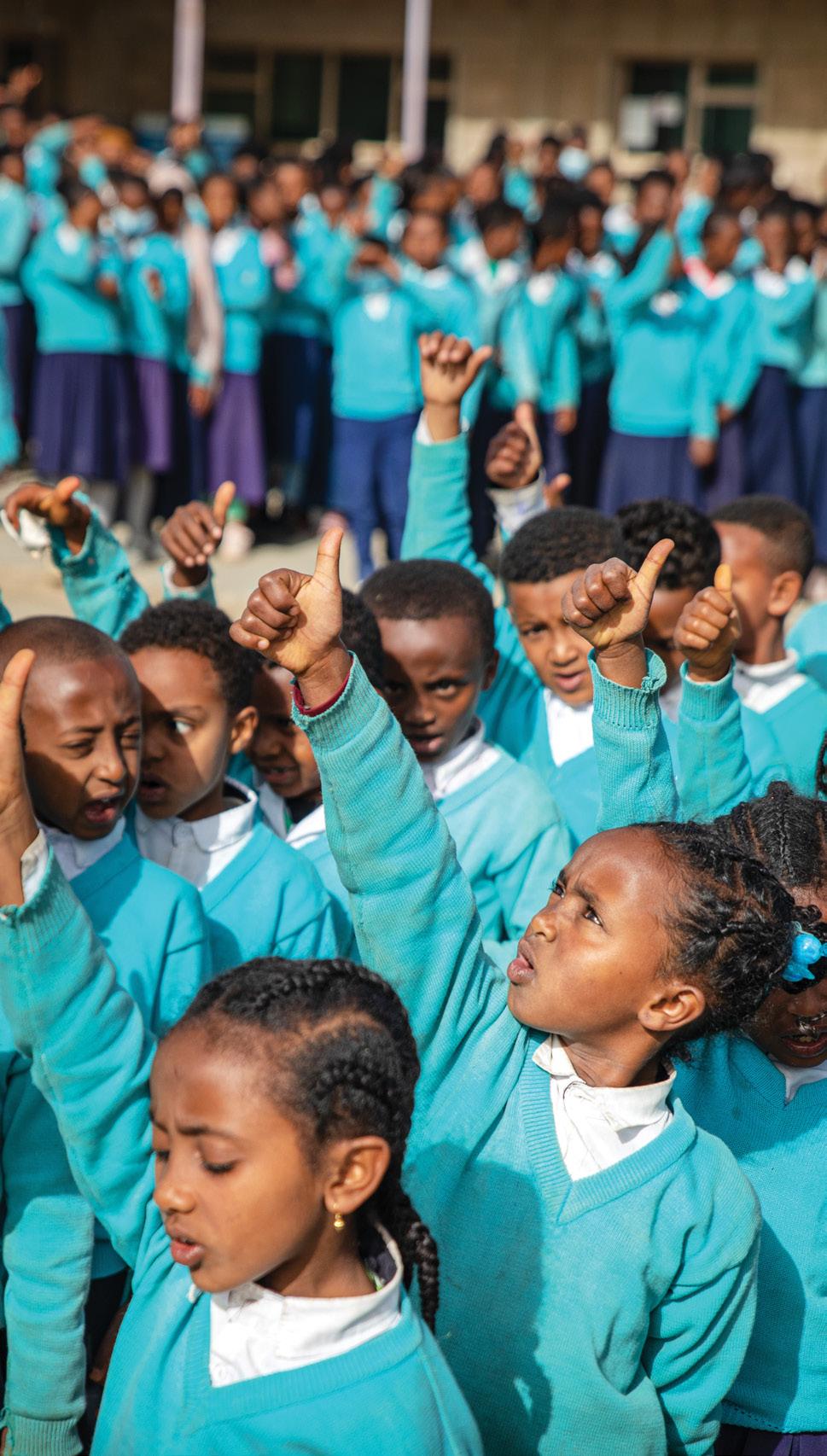
Back: Students at Divine Providence School in Debre Berhan, Ethiopia.
Photo Credits
Front cover, pages 12-17, Sajeendran V.S.; pages 2, 26-29, back cover, Petterik Wiggers; pages 3 (top), 37, CNS photo/Paul Haring; pages 3 (upper left and far right), 6, 8-11, Nadia Bseiso; page 3 (lower left), CNEWA-Pontifical Mission, Beirut; page 3 (lower right), Filippo Monteforte/ AFP/Getty Images; pages 4, 39, Riad El Hajj; page 5, Gerald Wutkowski; pages 19, 20-25, Nazik Armenakyan; page 20, Caritas Armenia; page 31, Bettmann/Getty Images; page 34, Andreas Solaro/AFP via Getty Images.
ONE is published quarterly. ISSN: 1552-2016
CNEWA
Founded by the Holy Father, CNEWA shares the love of Christ with the churches and peoples of the East, working for, through and with the Eastern churches.
CNEWA connects you to your brothers and sisters in need. Together, we build up the church, affirm human dignity, alleviate poverty, encourage dialogue — and inspire hope.
Publisher
Msgr. Peter I. Vaccari
Editorial
Michael J.L. La Civita, Executive Editor
Laura Ieraci, Editor
Olivia Poust, Assistant Editor
David Aquije, Contributing Editor
Elias D. Mallon, Contributing Editor
Creative
Timothy McCarthy, Digital Assets Manager
Paul Grillo, Graphic Designer
Samantha Staddon, Junior Graphic Designer
Elizabeth Belsky, Ad Copy Writer
Officers
Cardinal Timothy M. Dolan, Chair and Treasurer
Msgr. Peter I. Vaccari, Secretary
Editorial Office 1011 First Avenue, New York, NY 10022-4195 1-212-826-1480; www.cnewa.org
Msgr. Peter I. Vaccari, right, plates food at St. John the Merciful Table in Zahleh, Lebanon, with Melkite Archbishop Ibrahim Michael Ibrahim of Zahleh and Furzol, center, and the volunteer cook, on 25 July.
Commemorations continued for the 75th anniversary of Pontifical Mission, CNEWA’s operating agency in the Middle East, with a second pastoral visit to the region. Msgr. Peter I. Vaccari, president of CNEWA-Pontifical Mission, traveled to the Hashemite Kingdom of Jordan, Lebanon and Syria, from 14 to 26 July, accompanied by Tresool Singh-Conway, CNEWA’s chief financial officer, and Thomas Varghese, director of programs.
The trip began in the Jordanian capital, Amman, with visits to programs funded by CNEWA-Pontifical Mission, including Beit Mariam, a center for girls featured in this
Aid for Gaza Continues
At the time of publication, the distribution of humanitarian aid in Gaza was ongoing, as conditions there continued to plunge. CNEWAPontifical Mission was working with local parish partners and kitchens to distribute food, potable water, medical and other aid, including regular meals to 1,000 people in northern Gaza coordinated with the Greek Orthodox parish of St. Porphyrios.
edition (see page 6). A Mass commemorating the anniversary, celebrated by Archbishop Giovanni Pietro Dal Toso, papal nuncio to Jordan, was held at the Church of Mary of Nazareth on 17 July.
In Lebanon, the 75th anniversary was marked with a press conference at the Catholic Information Center in Beirut on 18 July. Cardinal Bechara Boutros Rai, Maronite patriarch of Antioch and all the East, presided at a Divine Liturgy commemorating the diamond jubilee and hosted a reception.
Msgr. Vaccari traveled to Syria, 22-24 July, where he met with bishops, consecrated men and women, and the lay leaders who conduct the work of the church in difficult circumstances.
“The historic role of Pontifical Mission has never been more important than at the present hour,” said Msgr. Vaccari from Amman.
In April, Msgr. Vaccari traveled to Israel and Palestine with Cardinal Timothy M. Dolan, chair of CNEWA’s board of trustees, kicking off the anniversary observations with Masses in Jerusalem and Beit Jala and visiting with those suffering amid the ongoing conflict between Israel and Hamas.
For more, visit our blog at cnewa.org
On 29 July, the church was hit by an Israeli missile, which failed to explode on impact; three people were injured by falling debris. Earlier in July, the CNEWAfunded Al Ahli Arab Hospital was included in a general evacuation order of several neighborhoods in Gaza City. By mid-August, more than 40,000 people (more than 39,000 Palestinians and almost 1,500
Israelis) had been killed in this conflict that began on 7 October.
Follow our blog for more updates on CNEWA’s work in Gaza.
CNEWA Board Elects Members
CNEWA’s international board of trustees elected two new members at its biannual meeting on 6 June, including Archbishop Richard W.
Smith of Edmonton, Canada, and philanthropist Amanda Bowman. They will begin their four-year term of service on 7 November. Cardinal Timothy M. Dolan, archbishop of New York, serves as the board chair.
CNEWA & ONE Win 58 Awards
CNEWA had another recordbreaking year at the annual Catholic Media Conference, held this year in Atlanta, 18-21 June, winning 58 awards for its various media, including ONE magazine, the agency’s website, videos and blog.
CNEWA also celebrated the magazine’s 50th anniversary by sponsoring two conference events on 21 June, including a breakfast and a discussion panel on the theme, “Conflict, Crisis and Hope: Eastern Christians in the World’s Hotspots.”
During the breakfast, Msgr. Vaccari conferred CNEWA’s Faith & Culture Award to Metropolitan Borys Gudziak of the Ukrainian Greek Catholic Archeparchy of Philadelphia for his promotion of the innate dignity of every human person and his defense of the role of faith in culture. The archbishop accepted the award via Zoom from Lviv, Ukraine.
The archbishop also participated in the panel that followed.
Michael J.L. La Civita, director of communications for CNEWA, moderated the discussion, which included Bishop Tesfaselassie Medhin of the Ethiopian Catholic Eparchy of Adigrat, Joseph Hazboun, regional director of CNEWA-Pontifical Mission’s Jerusalem office, and Laura Ieraci, editor of ONE. Bishop Medhin and Mr. Hazboun participated from Rome and Jerusalem, respectively.
Michael J.L. La Civita, left, executive editor of ONE and director of communications for CNEWA, and ONE editor Laura Ieraci participate at a panel on the Eastern churches at the Catholic Media Conference in Atlanta in June.
Promoting CNEWA in Rome
Ada Odino, a Milan-based lawyer and cherished friend of CNEWA, organized an event to promote the mission of the agency in Italy on 25 June. It was held at the Terrazza Babuino, a luxury hotel a short distance from the Spanish Steps.
Msgr. Vaccari, in Rome for the annual meeting of Catholic aid agencies dedicated to serving the Eastern churches, attended the event, along with CNEWA’s Rome team: the Reverend Marco Scandelli, legal representative, and Anna Cuzziol, office administrator. The occasion was a significant milestone for CNEWA’s initiative in Rome, which reopened in July 2023, providing an ideal platform to highlight CNEWA’s mission and discuss its ongoing activities in support of the Eastern churches.
CNEWA Gala: Save the Date
CNEWA’s third annual Healing & Hope Gala will be held Monday, 9 December, at a private club in Manhattan.
CNEWA will welcome as its guest of honor Archbishop Gabriele G. Caccia, permanent observer of the Holy See to the United Nations, whose calls for justice and peace remain a beacon of reason and hope.
CNEWA will present its Faith & Culture Award to Gayle M. Benson, owner of the New Orleans Saints, a prominent advocate for the presence of faith in culture, especially in her beloved city of New Orleans.
For information, call (212) 826-1480 or email gala@cnewa.org.
+ Where
‘Truly Everything Is Positive’
Vulnerable girls find a haven with Franciscan Sisters
text by Laure Delacloche with photographs by Nadia Bseiso
Each afternoon at Beit Mariam begins with an embrace. Sister Rabha Kayrouz, F.M.M., and her colleague Lorice Haddad open their arms wide to the 18 girls who arrive excited to share stories about their day.
Beit Mariam (House of Mary) is an after-school center situated in al Hashmi al Shamali, a low-income neighborhood east of the Jordanian capital, Amman.
The center welcomes Christian girls from the area five days a week and offers a safe space dedicated to education and personal growth through tutoring, psychosocial support and religious instruction.
“Have we all washed our hands?” asks Sister Rabha over the girls’ cheerful chatter. A hymn is sung, a prayer is said, and lunch is served.
Sister Rabha, the center’s director and a member of the Franciscan Missionaries of Mary, sits next to 10-year-old Sahar Khoury, encouraging her to have a few more spoonfuls of rice and meat.
Al Hashmi al Shamali is a diverse neighborhood, home to Christian and Muslim refugees from Palestine, Iraq and Syria. A main commercial street leads to narrow alleyways. Fresh laundry hangs to dry behind the barred windows of overcrowded apartment buildings, originally built as public housing for soldiers. Goats graze on meager vegetation and plastic trash bags, and at times nibble on broken olive branches children will give them. A herder stands at a corner, selling goat milk for 1 Jordanian dinar ($1.41) per quart.
Last year, with more than onethird of Jordanians living below the poverty line, the World Bank reclassified Jordan as a lower-tomiddle income status country. Many of the girls at Beit Mariam, whose
Aline Hijazeen, 11, and her sister Marelen, 9, attend Beit Mariam, a center for Christian girls in a suburb of Amman, Jordan.
fathers are mainly day laborers and whose mothers are largely unemployed, belong to this demographic.
“The core problems we tackle on a daily basis are poverty and ignorance,” says Sister Rabha.
She speaks of the consequences of poverty on girls: vitamin deficiencies in the absence of a balanced diet, health problems due to the inability of families to cover health care, cramped housing and conflict in the home.
“Girls are more overlooked within families, while boys are more likely to be encouraged,” she adds. “We chose to focus on those left behind.”
Sister Rabha’s biological sister, Sister Wardeh Kayrouz, F.M.M., founded Beit Mariam in 2011. One day, while on her regular visits with neighborhood families, she saw a Christian girl burning paper to bake a potato. This sight prompted her to start an apostolate for vulnerable Christian girls. Sister Wardeh has since moved to Lebanon, but Beit Mariam continues in the same house the local bishop donated at its start.
Christians make up 3 percent of the total population in Jordan; the rest is predominantly Sunni Muslim. Norig Neveu, a historian with the French Institute of the Near East, researches religious issues in the country. While Jordan has a “very rich Christian bourgeoisie” and “historically, large Christian merchant families played an intellectual role in the construction of the Jordanian state,” she says, “there is significant poverty in part of the existing Christian population, among both Christian refugees and Jordanians.”
“Open your grammar book,” Raghad Hijazeen instructs one girl while explaining to another how to calculate surface area. Ms. Hijazeen, a teacher at Beit Mariam, helps the six girls seated around her with patience and individual attention.
Pontifical Mission
@75
Editors’ note:
To commemorate the 75th anniversary of the founding of CNEWA’s operating agency in the Middle East, Pontifical Mission for Palestine, each edition of the magazine in this year of multiple anniversaries will feature at least one article on this special endeavor of the Holy See in the Middle East.
In the September edition, we feature a report on Beit Mariam, a center for vulnerable girls, located on the periphery of Amman, Jordan. Founded and operated by the Franciscan Missionaries of Mary, the center offers girls a safe place to grow in knowledge, friendship and faith.
Farah Haddad, 13, who started attending Beit Mariam a year ago, says the tutoring at the center — where adults “are strict regarding our studies but caring” — is useful.
“I understand at school, but I need someone to help while I am doing my homework. My average was 60.4 percent when I arrived, and now it is 80 percent,” she says.
The girls also receive guidance through difficult situations. Soul Hijazeen, 15, says a girl was bullying her at school.
“Sister Rabha told me to be more self-confident and not to mind her,” she recalls.
Maya Qaqish, 13, says she feels “stronger” having found supportive adults at Beit Mariam. “I am shy, and I am working on myself to get better at relationships,” she says.
Lorice Haddad started working as the supervisor at Beit Mariam eight years ago. Upon retiring from a long career as a secretary, she realized her monthly pension of 120 dinars ($170) was insufficient to
support her family and repay her husband’s loans.
“It is a small salary, but it is a gift from God to be working with this team,” she says. “Our biggest challenge is to give the girls the strength to face their lives.”
The center provides clothing and covers tuition and health care costs for the girls in greatest need. Ms. Haddad communicates these needs to the seven Christian women on Beit Mariam’s elected board, who try to meet the requests.
“The core problems we tackle on a daily basis are poverty and ignorance.”
“Prioritizing the needs is hard. In some homes, there is nothing: no stove, no carpets,” she says. “The girls depend on God, and after God they depend on me.”
Amani Masadeh, a nutritionist by training, joined Beit Mariam as a teacher a year ago.
“I had imagined poverty-stricken children, but when I arrived, I only saw cute girls wearing nice clothes,” she says. “Gradually, I realized that they seem to do well on the outside, but on the inside, it is a completely different story.
“In some homes, there is no mother to ask the girls if they are happy,” she says. “When they are upset, I show them that I am listening. This is efficient: They focus more on their homework, and they achieve things.”
The center’s holistic approach seems to pay off. Just last year, three girls learned to read, one alumna was admitted to university and two graduated with university degrees.
Increasing literacy rates among vulnerable girls is among the goals of the center. In March, the government released statistics indicating a decrease in illiteracy among women, from 9.5 percent in 2015 to 7.3 percent.
“Their education is their future,” says Sister Rabha.
Of the 200 girls the center has welcomed since its inception, about 30 completed higher education. Most married without going to university, and some did not complete high school, says Ms. Haddad.
Sister Rabha points out that if Beit Mariam did not exist, these girls “would either be at home or on the streets.” She says a verse in the Gospel of Mark (2:17) often comes to mind when reflecting on her
Sister Rabha Kayrouz, F.M.M., welcomes girls to Beit Mariam.
Top, Lorice Haddad assists Natalie Hijazeen, 10, with her English homework.
The CNEWA Connection
CNEWA’s global partners work tirelessly to ensure that girls have opportunities to thrive and build bright futures. Beit Mariam is one of more than 100 projects in Jordan supported by CNEWAPontifical Mission, allocating $24,000 to the center in 2023 — about half of the center’s annual budget. Through an after-school program that includes tutoring, psychosocial support and religious education, Beit Mariam ensures that Christian girls in Jordan have a safe place to grow, learn, nurture friendships and share in community.
To support opportunities for girls in CNEWA’s world, call: 1-800-442-6392 (United States) or 1-866-322-4441 (Canada) or visit cnewa.org/donate.
work: “Jesus heard this and said to them, ‘Those who are well do not need a physician, but the sick do. I did not come to call the righteous but sinners.’ ”
The unemployment rate for women in Jordan is almost twice as high as it is for men. While government statistics indicate the overall unemployment rate stands at 21.4 percent, this statistic jumps to 35 percent among women.
Reem Aslan is a gender specialist for the International Labor Organization’s Regional Office for Arab States and manages its Decent Work for Women Program in Jordan. She notes multiple reasons for this disparity.
“There are more women graduating from university than men, however their skills often
don’t match the job market’s needs,” she says. The high cost of transportation, family responsibilities and cultural norms for women present additional limitations.
“Women cannot work long hours because they still carry more of the unpaid work” of caring for the home, she says.
Beit Mariam provides employment for five women from the local community.
For Ms. Masadeh, the nutritionist, becoming a teacher at Beit Mariam was a rare opportunity compatible with her household duties.
“I am waiting for my daughters to grow up to get a full-time job,” she says. In the meantime, her salary of 180 dinars ($250) helps pay for some basic needs.
The economic hardships plaguing this community are expected to
persist due to the conflict between Israel and Hamas in Gaza and its regional consequences. U.N. agencies noted last November that the conflict will add “many economic pressures in Jordan, including low growth, high unemployment and informality, water scarcity” and subsequent calls for reform.
On a hot afternoon in June, the girls at Beit Mariam take a break to plant flowers in the center’s covered garden. Sister Rabha explains why she decided to install the corrugated steel roof.
“Their education is their future.”
“Children from the neighborhood were throwing rocks over the wall into the courtyard, shouting, ‘Christians!’ I got scared that a girl would be hurt.”
In principle, there is no discrimination against Christians in Jordan. The constitution indicates that Islam is the state religion but guarantees “the free exercise of all forms of worship and religious rites,” according to the U.S. State Department.
“Many initiatives regarding interfaith dialogue exist,” says Ms. Neveu, the historian. “There is a lot of control over discourse that would separate Christians from the rest of the society.”
Ra’ed Bahou, director of CNEWAPontifical Mission’s regional office in Amman, says while the Christian population in many Middle Eastern countries is dwindling, “Jordan is the exception.”
Girls study together during the afterschool program at Beit Mariam.
“The community is getting bigger with Christians from Iraq, Syria and the Philippines,” he says.
Despite state guarantees and a growing Christian community, some Christians perceive their daily reality differently.
Ms. Hijazeen, the teacher, is Roman Catholic and has been living in al Hashmi al Shamali for almost two years. “Here, people are used to living with one another,” she says. “However, some people call us ‘infidels.’ ”
Ms. Neveu says “these discriminatory comments and behaviors do not match” her research over the past 18 years and are likely “linked to a specific context in the neighborhood.”
Still, some Christian parents, like Walaa Qaqish, opt to send their children to a private Christian school for fear that their children will be bullied or persuaded to convert to Islam in a governmentrun school.
Ms. Qaqish is among 15 parents who come to Beit Mariam on Friday afternoons for parenting workshops. They learn about child stressors, such as academic pressure, financial hardship, overcrowding and violence, as well as how to create a healthier home.
According to a national study conducted by UNICEF in 2019, 73.9 percent of family caregivers in Jordan had used violence to discipline their children at least once.
“My husband and I don’t miss any of these meetings,” says Ms. Qaqish. “I realized there were things I was doing wrong, and — praise be to God — now I will change this. With my 2-year-old son, I can do right from the beginning.”
She recognizes the positive impact Beit Mariam has had on her daughter Maya, who “was scared of people” and would not speak with anyone.
“She developed a tick due to stress,” says Ms. Qaqish. “Since the day Maya started coming here, she has been improving. Her personality has changed more than her grades.”
She tells her children to run off and play before describing her family’s hardships: “We have two rooms in the house, one for my mother-in-law, and one for me, my husband and our three children.”
The family is carrying a large debt due to private school tuition.
Mushira Abdallah, Soul’s mother, appreciates the changes the parenting workshops have brought about in her family, too. “I used to give orders to my children, now there is a dialogue,” she says.
She also shares their financial struggles. Her husband’s monthly salary, 250 dinars ($353) — below the national minimum wage of 260 dinars — is their sole source of income and insufficient to cover necessities. The annual tuition for their three daughters at the private school is the equivalent of five months’ salary. In debt to the private school, the couple enrolled their daughters in a government-run school for the new academic year.
For their daughter Soul, starting at a new school was not the only big adjustment this August. Having completed grade 9, she aged out of the program at Beit Mariam — where “truly everything is positive,” she says — and can no longer attend.
Contemplating this fact in the courtyard at Beit Mariam in June, a shadow fell across the young girl’s face. Seeing this, Sister Rabha jumped in.
“You could come back after grade 12 and teach here,” she offered. “Would you like that?”
And Soul’s eyes lit up again.
Laure Delacloche is a journalist in Lebanon. Her work has been published by the BBC and Al Jazeera.
A Global Concern
Church-run programs care for those affected by H.I.V. and AIDS
text by Anubha George
with photographs by Sajeendran V.S.
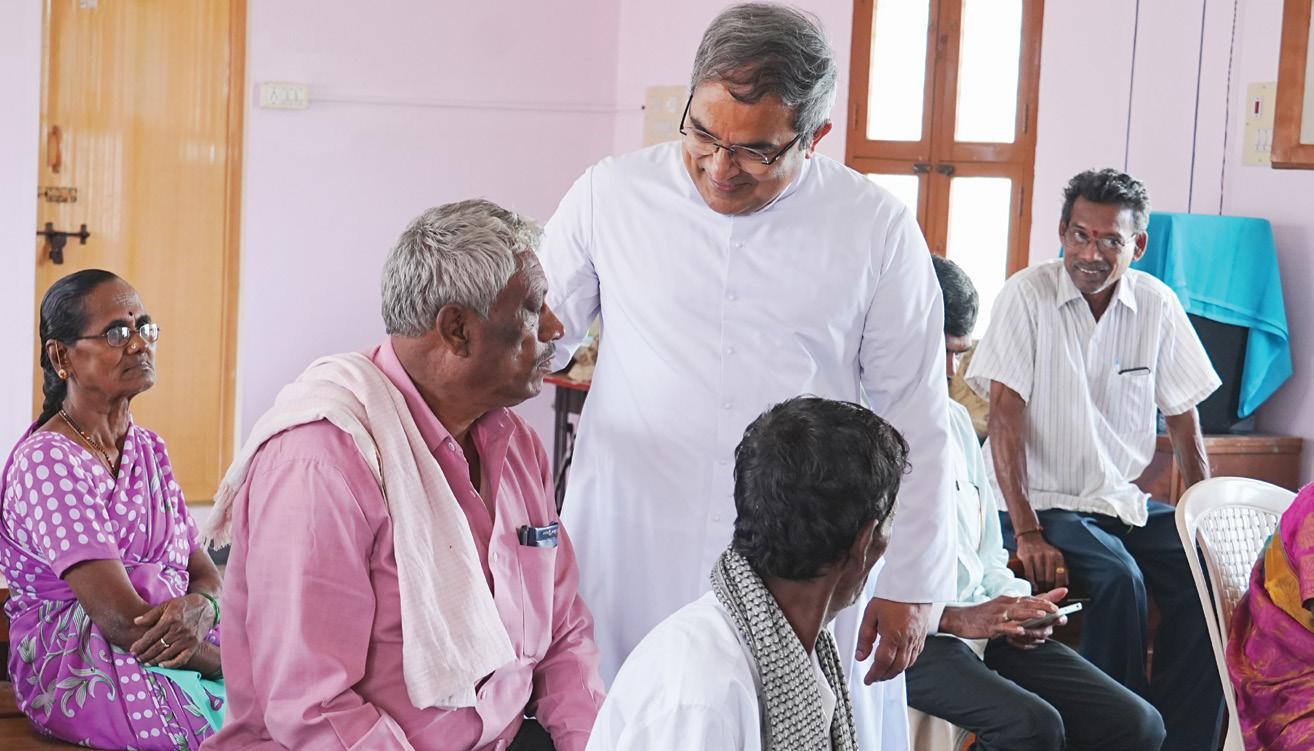
Dr. Sukurtha George teaches a session for women on H.I.V. prevention in Mandya, India, organized by Jyothir Vikasa Social Service Society of the Syro-Malabar Catholic Church.
RESPONDING TO HUMAN NEEDS
Sridevi M., orphaned by AIDS, dreams of becoming a doctor. Her mother had tested positive for H.I.V. while pregnant after a routine antenatal blood test. Then, Sridevi’s father, a trucker, also tested positive. He had been having unprotected sex with prostitutes while on the road.
Sridevi’s mother, determined to carry the pregnancy to term, began H.I.V. treatment. After birth, Sridevi was given H.I.V. medication for about six weeks and tested negative.
She was six when her mother and father died of AIDS. For the past 10 years, Sridevi, now a 16-year-old high school student, has been living at the convent of the Sacred Heart Congregation, a community of Syro-Malabar Catholic religious
sisters serving in the Shimoga district of Karnataka. As a lowercaste Hindu, Sridevi does not have a surname; only an initial follows her given name.
In Shimoga, Father Abraham Areeparambil, director of Malnad Social Service Society of the SyroMalabar Catholic Eparchy of Bhadravathi, has been working with H.I.V. and AIDS patients for nearly 20 years.
“These patients need sympathy, empathy, care and concern, just like anybody else,” he says. “Through treatment and support, they can lead a nearly normal life. Just like compassionate Jesus, we need to extend compassion to them.”
While H.I.V. has lost its profile as an urgent public health concern in
the West, it remains a disease of epidemic proportions in India, where 2.54 million people were estimated to be living with H.I.V. in 2023, according to the National AIDS Control Organization (NACO), ranking it among the five largest H.I.V. populations worldwide. India recorded almost 80,000 AIDSrelated deaths that same year.
Globally, H.I.V. and AIDS remain major public health concerns. According to UNAIDS, 39.9 million people worldwide were living with
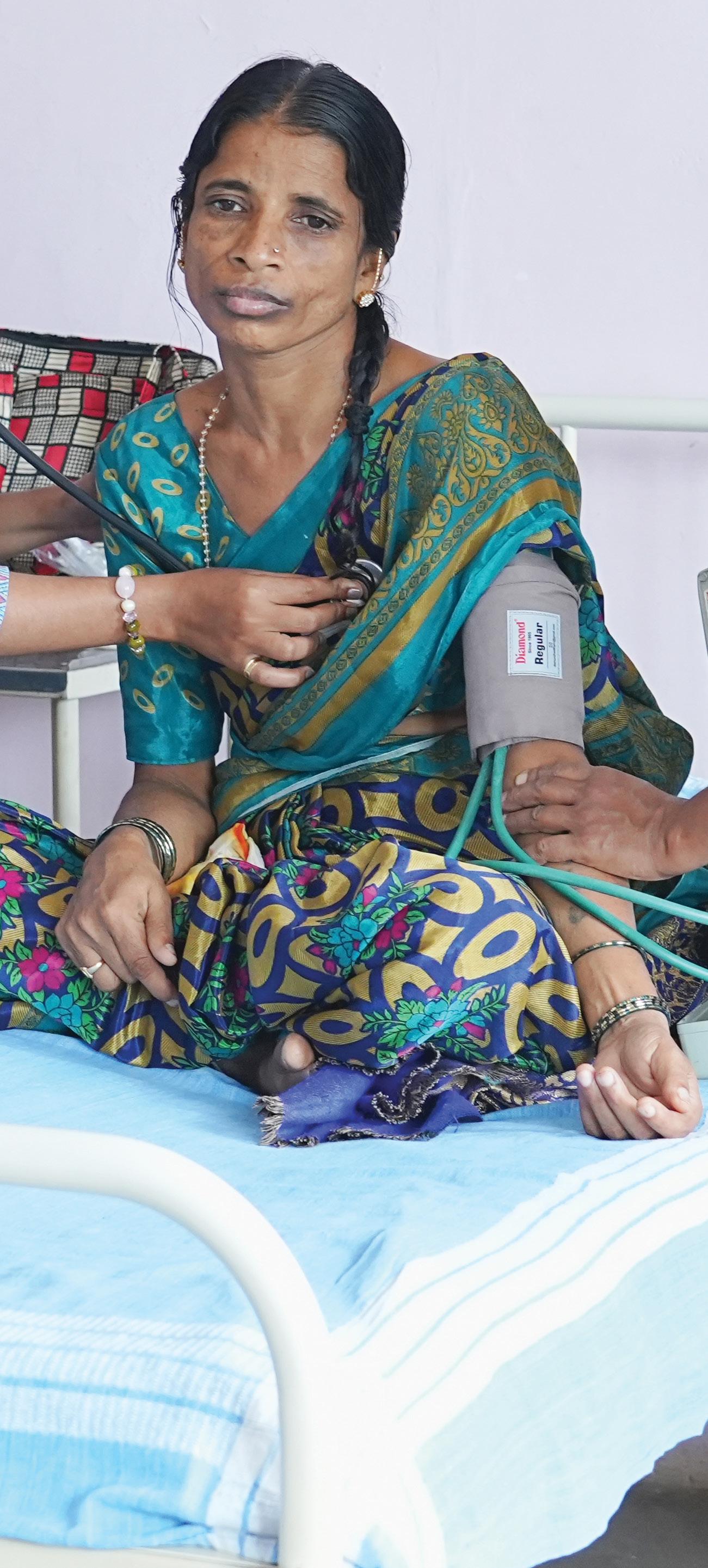
Father Abraham Areeparambil, right, and Sacred Heart Sister Rosaline Jose, below, tend to H.I.V. patients at the Navajeevan Holistic and Palliative Care Center in Bommanakatte, India.
“These patients need sympathy, empathy, care and concern, just like anybody else.”
H.I.V. at the end of 2023, with the majority in the Global South. SubSaharan Africa had the most cases, with a reported 25.9 million people living with H.I.V., compared with 6.7 million cases in Asia and the Pacific, and 2.3 million in Western and Central Europe and North America combined. To date, more than 42 million people worldwide are estimated to have died of AIDS since it was first diagnosed in 1981.
In India, the southern states of Maharashtra, Andhra Pradesh and Karnataka have among the highest H.I.V. infection rates in the country, according to NACO. In the largely rural state of Karnataka, the rate of infections per capita is higher than the national average.
Father Areeparambil recalls a concerning spike in cases in the state in 2007. “More industries had come up to Shimoga and, with that, more truck drivers and thus sex workers,” he says.
In response, in 2009, Malnad Social Service Society established the Navajeevan Community Care Center to care for H.I.V. and AIDS patients in Bommanakatte, a steel town in the Bhadravathi district of Karnataka. Within a short period, however, a decision was taken to rename it the Navajeevan Holistic and Palliative Care Center, due to the social stigma associated with H.I.V. and AIDS in India, stemming complaints from the local community.
“In India, the stigma of having H.I.V. or AIDS is huge,” says Father Areeparambil. “Most people tend to live in extended families. If your family members find out you are H.I.V.-positive, you’re almost always ostracized.”
While the center has about 200 patients in its catchment area, it also draws H.I.V. and AIDS patients from distant places who seek privacy and discretion during treatment.
The children of H.I.V. and AIDS patients are sometimes segregated
The CNEWA Connection
In India, which has one of the largest H.I.V.-positive populations in the world, the church is at the center of bringing healing and hope to those suffering with H.I.V. and AIDS. “We get some grants from the state government, but that’s not enough to run a hospital such as this,” says Father Sajeesh Thrikkodanmalil, director of Navajeevan Holistic and Palliative Care Center, which relies on the support of CNEWA to continue its mission. CNEWA provides additional funding to help offset the costs of the center’s essential services, as well as to other church-run organizations in India dedicated to this work.
To make a world of difference for those with H.I.V. or AIDS, call: 1-800-442-6392 (United States) or 1-866-322-4441 (Canada) or visit cnewa.org/donate.
or rejected by their peers due to the stigma as well.
“At times we manage to sort these problems out, at times we fail,” says Father Areeparambil about the center’s work with affected families. “But we’re here for them. We counsel the patients and their families.”
The priest says his faith encourages him to persevere when he feels tested by the challenging circumstances.
“Our presence as Christians itself is a witness to our Gospel values. And our witnessing is valuable for our Catholic Church,” he says. “I know Jesus is with me at all times.”
Father Sajeesh Thrikkodanmalil, director of the Navajeevan Center, says the center offers health care, food and medication to H.I.V. and
AIDS patients “irrespective of their faith.”
“Most of our patients are abandoned by their families or their husbands. For older patients, their children don’t want to look after them,” he says. “We help treat them and make sure they’re reintegrated into communities by providing them job opportunities.”
The center organizes public awareness programs about hygiene, nutrition and the general well-being of H.I.V. and AIDS patients. A large part involves educating people about the dangers of sexually transmitted infections — including among marginalized groups that may be at greater risk — and encouraging them to get tested if they have any flu-like symptoms and the slightest
“Just like compassionate Jesus, we need to extend compassion to them.”
suspicion they may be susceptible to H.I.V.
Dr. Deepa K.M. works at the Navajeevan Center. “In India, marginalized groups, such as sex workers, transgender people and gay men are often stigmatized, not just because they may be H.I.V.positive but also because they’re from socially excluded groups,” she says. “We know these people experience discrimination even from within their own communities.”
Sister Rosaline Jose of the Sacred Heart Congregation also works with patients at the Navajeevan Center.
“Some of our volunteers are H.I.V.-positive,” she says. “They understand what it’s like living with the condition. They also liaise with government hospitals and bring us
any patients who need support beyond medication.”
Sister Rosaline says they are also increasing awareness about people’s rights and responsibilities pertaining to H.I.V. and AIDS under Indian law.
“For example, a man with H.I.V. or AIDS, who knowingly marries a woman and gives her H.I.V., would be found guilty of spreading a life-threatening infection. This is a legally punishable offense and carries a jail term of two years,” she explains.
The country has been working with UNAIDS to implement a rigorous targeted intervention program to achieve the established 90-90-90 target: Identify 90 percent of individuals with H.I.V., give 90
Children affected by H.I.V. receive support from Malnad Social Service Society, where Father Abraham Areeparambil, front row, serves as director.
percent of those diagnosed antiretroviral therapy, and achieve sustained viral suppression in 90 percent of patients on antiretroviral therapy. The long-term goals are the elimination of mother-to-child transmission by 2025 and zero transmission by 2030.
Mandya, a district in Karnataka known for its sugarcane, has achieved a steady decline in H.I.V. cases this past decade. In 2014, Mandya was ranked second in the state for the
most H.I.V. patients; within a few years, it ranked 16th.
Father Roy Vattakunnel, director of Jyothir Vikasa Social Service Society of the Syro-Malabar Catholic Eparchy of Mandya, attributes the decline to effective awareness campaigns, mostly through community theater, posters and billboards, that “educate people against the spread of the virus.” The campaigns are implemented across the district in collaboration with government agencies, voluntary organizations and local communities.
The church-run charitable organization also collaborates “with the government in its prevention and treatment programs,” along with the support of voluntary service organizations, says Father Vattakunnel.
Its program dedicated to helping people affected by H.I.V. and AIDS, called Asha Kirana, extends its care to people who work in the sex industry, which has grown in Mandya alongside the influx of migrant workers in the sugarcane factories. Official 2021 statistics for Mandya indicate that 92 of the 1,221 female prostitutes registered with the Karnataka Sex Workers Union and 56 of the 991 registered male prostitutes were H.I.V.-positive.
Asha Kirana supports more than 350 patients by referring them to treatment centers and offering them counseling, nutritious meals and education about H.I.V. and AIDS. In the first half of 2024, the organization helped identify 14 new cases in Mandya and referred 55 patients to the local testing center.
“The government provides facilities for treatment for patients at the district hospital in Mandya. But because of social stigma, emotional and economic factors, patients aren’t always able to avail these services on their own,” says Father Vattakunnel. “That’s where we come in.
“Ultimately, our objective is to improve the quality and length of life of patients through emotional, spiritual, nutritional and social support.”
Meena K., one of the organization’s 11 staff members, says the predominantly patriarchal culture in Karnataka is a major challenge in connecting with women over issues related to health, H.I.V. and AIDS.
“Women here have to ask their husbands for permission for everything. Without that, they won’t even lift a finger,” she says, adding that it is equally challenging to speak with men who “are just not open to having a conversation and think they know best.”
She, too, tells the story of a man who was H.I.V.-positive and got married without disclosing it to his bride or her family. Then, during each of his wife’s three pregnancies, he coerced her into having an abortion, claiming he did not want to have children rather than disclosing his condition.
“Men don’t realize that, under Indian law, not disclosing your H.I.V. status when getting married is a punishable offense,” she continues. “In this part of Karnataka, men don’t like to be educated or informed. They don’t take their medication on time, neither do they go for regular blood tests.”
Asha Kirana also organizes monthly support group meetings to accompany H.I.V. and AIDS patients emotionally and psychologically.
“We need to make sure people feel supported and don’t give up on life,” says Father Vattakunnel.
“Ultimately, the goal is to have a H.I.V.- and AIDS-free future, where every individual can thrive and grow,” he says. “We have to do this, especially for the poor and neglected ones in society.”
Anubha George is a former BBC editor, based in Kerala, India.
cnewa.org I cnewa.ca
The Difference a Year Makes
Refugees in Armenia persevere
by Gohar Abrahamyan
The struggle continues for ethnic Armenians forcibly displaced almost a year ago from Nagorno-Karabakh, despite ongoing efforts to integrate them into Armenian society. They long for their ancestral homeland, live without permanent residence and face physical, financial and psychological challenges.
Nagorno-Karabakh, a region nestled in the South Caucasus mountains in present-day Azerbaijan, was for centuries predominantly ethnically Armenian. It was integrated into the Azerbaijan Soviet Socialist Republic as an autonomous region in 1923. With the end of the Soviet Union in 1991, the ethnic Armenians living there claimed independence and renamed the territory Artsakh. They fought a six-year war against Azerbaijan for this cause, starting in 1988. Despite a 1994 ceasefire, armed conflict would erupt occasionally between the two parties in the decades that followed.
In 2020, a second war broke, lasting 44 days, in which the ethnic Armenians lost most of the territory they had claimed 29 years earlier. Then, in September 2023, after a nine-month blockade, Azerbaijan launched a one-day military offensive, driving at least 102,000 ethnic Armenians from their homeland to the neighboring Republic of Armenia through a narrow lifeline, known as the Lachin corridor. Close to a third were under the age of 19.
Yulia Sargsyan and her family were among those forcibly displaced. They settled in Artashat in the Ararat province of Armenia. Ararat, with a resident population of about 260,000, welcomed more than 14,650 ethnic Armenians last year — the third-largest community of displaced persons in the country.
The 14-year-old reconnected with two close friends from her homeland, which helped her to adapt to her new environment.
Attending the local Little Prince Center, where she receives psychotherapy for her restless sleep and fear of loud noises and dark places — consequences of the trauma she experienced in NagornoKarabakh — has been helpful as well, she says.
“Teachers help and they encourage us to communicate with local children,” says Yulia, who initially had difficulty understanding the local Armenian dialect. “I’ve made many friends here and learned new skills, like needlework, which helps me relax.”
The center, run by Caritas Armenia, supports vulnerable children and their families. Psychologist Suzy Sargsyan works at the center with about 50 children from NagornoKarabakh and their parents. The children attend twice a week. They eat hot meals and participate in activities, such as painting, computer class, needlework, English lessons, sewing and sports.
Rima Avagyan, 69, and her granddaughter, Eva, 7, live together in Armenia after being forcibly displaced from Nagorno-Karabakh in September 2023.
RESPONDING TO HUMAN NEEDS
The CNEWA Connection
When more than 100,000 ethnic Armenians fled to Armenia after Azerbaijan gained control of Nagorno-Karabakh in 2023, CNEWA rushed aid to its partners, who provided them with care and necessities, including food and shelter. Now largely focused on recovery projects, including business support, housing improvements and economic development projects, CNEWA’s partners on the ground, Caritas Armenia and the Armenian Catholic Ordinariate, continue to support refugees as they integrate into Armenian society. They are not only providing for people’s immediate needs; they are providing hope for the future.
To support CNEWA in this work, call: 1-800-442-6392 (United States) or 1-866-322-4441 (Canada) or visit cnewa.org/donate
Caritas Armenia staff welcome refugees from Nagorno-Karabakh to Armenia in September 2023. Opposite, a nurse and social worker with Caritas Armenia visit Sonya Avanesyan, far right. The widow fled from Nagorno-Karabakh to Armenia last fall.
Ms. Sargsyan, the psychologist, also conducts individual and group sessions on how to manage stress and express emotion. Locals attend the group sessions as well — part of an initiative to help foster friendships and encourage
integration within the community. Such sessions were impossible when families first arrived from Nagorno-Karabakh and were focused on securing their immediate needs for food, shelter and clothing, she says.
The children from NagornoKarabakh were initially “lost and alienated,” she adds. However, since enrolling in school, making friends and participating in extracurricular activities, “they feel like they are part of us,” she says. Across Armenia, as of June, about 17,300 children from Nagorno-
Karabakh were enrolled in public schools, and about 3,800 young adults were attending universities or professional training institutions.
Ms. Sargsyan emphasizes the importance of working with parents. “A lot depends on the parents’ attitudes and perceptions,” she says.
Many of them suffer from anxiety, fear and emotional distress, and struggle to overcome their losses from war and their impoverished status in Armenia. Their psychological state impacts their children, who become depressed,
“These supports are vital for our neighbors in difficult situations, giving them hope and reminding them they are not alone.”
emotional and withdrawn, she says.
Ms. Sargsyan seeks to frame and explain these emotions from a psychological point of view.
“They went through war, blockade and deportation. I explain that in this situation, anxiety, insomnia, loss of appetite — these are all normal,” she says. “When a person understands what is happening, they can manage the situation.”
The Little Prince Center also offers courses in parenting and the trades, such as hairdressing, barbering, tailoring and
cosmetology, as well as work tools and machinery, such as sewing machines, to help parents earn a living.
“We give families stability and skills, so they can care for themselves,” says Anush Zazyan, a social worker at the center. “It’s not about endless help but empowering them to be self-sufficient.”
According to Tigran Khachatryan, Armenia’s deputy prime minister, as of 1 June, about 17,000 forcibly displaced people had found work, despite Armenia’s unemployment rate, which hovers around 12
percent, and more than 1,000 of them registered new businesses. As well, almost 800 health care workers from Nagorno-Karabakh were given additional training to work in Armenia’s health care sector.
However, according to the National Security Service, more than 10,300 forcibly displaced people had left Armenia as of 1 June for employment elsewhere.
Yulia’s father and brother, unable to find work in Armenia, moved to Russia in March. She and the rest of her family were planning to join them.
Vahe Poghosyan, 16, enrolled in the barbering course at Caritas.
“I’ve been studying for over a month and I am already cutting hair, although I have much to learn,” Vahe says.
Originally from Spitakashen, a village in Nagorno-Karabakh, he is living in a dilapidated house on the outskirts of Artashat with his parents, grandparents and two younger siblings. His parents are disabled, and the family is relying on him to be the main provider. Their housing situation is precarious since they do not have a signed lease. Vahe hopes he and his family will not be evicted before he completes his course.
Although the Armenian government has programs to support forcibly displaced people, including a monthly supplement of about $130 for housing and utilities, families often struggle to afford rent and need to move frequently.
The influx of people has created a housing crisis in Armenia, with rents skyrocketing due to high demand. Rent for a two-bedroom apartment, for instance, more than tripled since 2019, from $100 to $360.
In April, ARMSTAT, Armenia’s statistical committee, published new figures indicating that the permanent resident population in the country exceeded 3 million, an increase from 2.98 million a year earlier.
A month later, the Armenian government approved a state housing assistance program for forcibly displaced families from Nagorno-Karabakh who acquire Armenian citizenship. As of 1 June, 2,075 had applied for citizenship, of which 1,437 were granted, according to Arpine Sargsyan, deputy minister of internal affairs.
As well, nearly 97,000 people from Nagorno-Karabakh were granted temporary protection
Vahe Poghosyan, left, his two siblings, grandparents and parents live together on the outskirts of Artashat, Armenia, having fled Nagorno-Karabakh. Opposite, Vahe is learning to become a barber to help provide for his family.
certificates, which safeguards them under international law from being forcibly transferred to another country.
Armenian law also guarantees social benefits to those forcibly displaced, including a pension, maternity and child care benefits, and a one-time childbirth benefit. As of 1 June, more than 26,000 ethnic Armenians from NagornoKarabakh were receiving pensions and more than 80,000 were registered in the state’s primary health care program, according to Mr. Khachatryan, the deputy prime minister.
As these housing programs get underway, in response to the
Vahe’s parents are disabled, and the family is relying on him to be the main provider.
“Hundreds of people need our support; we cannot afford to be weak.”
shortage and high rents, the state has turned public spaces, such as gymnasiums and former kindergartens, into temporary residences. In June, for instance, about 40 people, including single parents with children, were sheltering in the former infectious disease hospital in Gyumri in Shirak province — an old building that had been abandoned — and living in extremely poor conditions, with a common kitchen and common bathrooms. Caritas Armenia was providing food and hygiene items.
“These supports are vital for our neighbors in difficult situations, giving them hope and reminding them they are not alone,” says
Gagik Tarasyan, executive director of Caritas Armenia. “Our vision remains unchanged. Inspired by the Bible and the social teachings of the Catholic Church, we strive to create an environment where people are never alone in their time of need.”
Armenia’s small Catholic community and its organizations have taken on greater responsibilities in caring for those displaced, with Caritas Armenia expanding its activities in the five provinces where it serves — Shirak, Lori, Gegharkunik, Syunik and Ararat. Together with the Armenian Catholic Ordinariate,
Refugees from Nagorno-Karabakh, sheltering in a former infectious disease hospital in Gyumri, Armenia, receive assistance from Caritas Armenia.
Caritas opened the doors of all its centers to those forcibly displaced.
The Reverend Grigor Mkrtchyan, rector of Holy Martyrs Cathedral in Gyumri, recalls how hundreds of people from Nagorno-Karabakh were welcomed in church facilities and supported directly by local church communities last autumn. Although the majority have moved on to different housing situations and towns — about 20 families whose members chose to be
baptized at the cathedral have remained in the city — Father Mkrtchyan says the church remains “in constant contact” with them.
“We urge them to participate in events. They need them,” he says. “The rule is only one: to live in Christ with love and forgiveness.”
One year since Azerbaijan’s mass evacuation of ethnic Armenians, most rapid response programs for those forcibly displaced have transitioned to early recovery programs, including business support, housing improvements and economic development projects, says Anahit Gevorgyan, programs manager for Caritas Armenia.
The organization is working closely with the Armenian government and the UNHCR, the U.N. Refugee Agency, on projects aimed at improving the situation for those forcibly displaced, she adds. With the government, Caritas Armenia plans to study the feasibility of providing more stable and improved housing. With the UNHCR, it is working to raise awareness among those forcibly displaced of their rights as refugees in international law, says Ms. Gevorgyan.
“The more supporters we have, the more we can do,” she says.
Vyacheslav Sargsyan, 67, lived in a spacious two-story house in Stepanakert in Nagorno-Karabakh his entire life. Since October 2023, he, his wife and their two daughters have been renting a dark, damp, ground-floor apartment in Artashat, far from the city center. The house sits on a curb. The main room is cramped and includes a corner kitchen, a bathroom, and a small sitting area with a sofa and two armchairs. The cupboard is almost empty.
Mr. Sargsyan recalls the day he left Stepanakert. “I went to our house to get some things, but the
enemy was already close. They pointed a weapon at me, and I couldn’t take anything,” he says.
Then, his health deteriorated dramatically. In Armenia, he was diagnosed with cancer. His wife says the surgeries and treatments have exhausted him, and their poor living conditions are deteriorating his health further. Their only support comes from Caritas Armenia, which has been running a program since 2016 that provides 60 seniors with medication, food and hygiene packages monthly, as well as clothes and bedding twice a year. The program includes events, like excursions and walks, for those who can participate.
Social workers, caregivers and nurses visit the senior Sargsyans regularly, check their health, provide food and medicine and assist with household chores. Mr. Sargsyan could not afford his medication without the support of Caritas.
“Just having someone visit us and exchange a few words is a big help,” he says. “We used to have a large social circle, but now we are completely alone.”
Nelly Tatosyan, a social worker, was among those forcibly displaced from Nagorno-Karabakh. The conflict in the region since 2020 caused her family to move once within the region and then to Armenia, where she joined Caritas Armenia in helping her compatriots adapt to a new life. In June, the 38-year-old mother of two was expecting her third child.
“I just try not to think too much, otherwise you can just go crazy,” she says.
“You must act, use every minute. Hundreds of people need our support; we cannot afford to be weak.”
A communications specialist, Gohar Abrahamyan covers issues of justice and peace in the Caucasus for local and international media.
Help those displaced by war to start again
cnewa.org I cnewa.ca Dive deeper into this story with ONE’s exclusive audio and video content.
Closing the Hunger Gap
Sisters in Ethiopia care for children in need
A. Abdulmejid
text by Hikma
with photographs by Petterik Wiggers
CHILDREN IN NEED
All students at Divine Providence School in Debre Berhan receive fresh bread daily.
The CNEWA Connection
CNEWA’s commitment to the poor and vulnerable in Ethiopia is exemplified through its feeding program, which provides nutritious food to more than 18,000 students, especially in the northern regions, from mid-February to June, typically food shortage months due to the planting cycle. For the past six years CNEWA has been supporting the feeding program at Divine Providence School in Debre Berhan, which provides healthy food for more than 100 students daily. “We are never short of flour and other things we need to produce meals for the school program,” says Sister Elfnesh Teklu, S.D.P., the community superior.
To help combat child hunger in Ethiopia, call: 1-800-442-6392 (United States) or 1-866-322-4441 (Canada) or visit cnewa.org/donate.
In the highlands of central Ethiopia, about 80 miles northeast of the capital, Addis Ababa, Debre Berhan sits at an altitude of 9,318 feet above sea level, the highest city on the continent. The ancient city in the northern Amhara region saw significant growth with the establishment of a wool and blanket factory in 1960, and then again with the construction of the Debre Berhan Industrial Park, an agro-processing hub, in 2019.
Despite the growth, many of its 154,000 residents face economic hardship. Poverty is driven by a confluence of factors, including inflation, poor agricultural conditions, high unemployment, an influx of internally displaced people caused by the war in the neighboring
region of Tigray (2020-2022), and unstable access to communications infrastructure. The ongoing armed conflict between the Ethiopian government and the Fano, a militia that claims to represent the Amhara people, has exacerbated these challenges.
However, numerous residents of Debre Berhan have found some relief among the Sisters of Divine Providence for Abandoned Children. Founded by Msgr. Francesco Torta in Piacenza, Italy, in 1921, this small congregation is dedicated to serving vulnerable children and families.
The congregation’s missionary impulse brought them to Ethiopia, in Mendida, north Shewa region, in 1971. They arrived in Debre Berhan in 1972, and in 1988, founded
Fresh bread is baked daily in the kitchen of Divine Providence School as part of a school-wide feeding program.
Divine Providence School, with only 48 students and two teachers. Today, more than 1,400 children are enrolled, from kindergarten to grade 8. About 3,500 students have graduated from Divine Providence School since its founding, and many among them moved on to high school and higher education.
The presence of the sisters in Debre Berhan has been transformative. In addition to providing excellent instruction, the school runs a daily breakfast program that provides fresh-baked bread to all students, from kindergarten to grade 4. Fresh bread replaced a program of packaged biscuits in 2006, when a benefactor donated an oven for the school kitchen.
“We started the feeding program when we observed that some of our students came to school without even having breakfast,” says Sister Elfnesh Teklu, S.D.P., community superior.
The school provides additional assistance, such as daily lunch, to those children most in need among the student population. The sisters also waive tuition for 80 students, and provide 50 students with all learning materials, as well as uniforms, made in the school’s sewing workshop.
Etenesh Abebe, a mother of two, says the sisters became a lifeline for her after her husband died.
“I was left with nothing. My daughter Tsion would cry from hunger,” she recalls. The sisters “encouraged me and started providing lunch for my daughter. Their kindness has been a blessing.”
“The feeding program has lifted a huge burden off my shoulders,” she continues. “Knowing Tsion is fed and cared for at school allows me to focus on finding work.”
Of the 110 students in the daily lunch program, 21 students come from nearby public schools.
“At the beginning of each year, the government identifies students who cannot afford meals and sends them to [Divine Providence] school, where they receive daily meals,” says Getnet Temtime, a government supervisor for several schools in the city, including Divine Providence.
Mr. Temtime says the academic performance of these 21 students “has notably improved.”
“The government had planned an initiative to provide milk and bread to students in government schools, but it was never implemented due to budget constraints and the ongoing conflict in the Amhara region,” he adds.
noticeably happier and more focused on learning since starting on the meal program.
As the primary provider for her family, Ms. Demelash says the food program has provided muchneeded relief.
“I struggle to feed my child every day. Before my child started attending the feeding program, I was constantly stressed about preparing meals for her,” she says.
She and her husband moved from Gondar in northern Amhara to Debre Berhan eight years ago, and her husband’s unstable employment and the high cost of living have placed a significant burden on the family.
Two brothers, Endrias and Yeabkal Tsegaye, also attend Divine
“Students who were once worried about their next meal can now focus on their studies.”
Divine Providence School fills this gap.
Ketema Kitaw, director at Atse Zereyaqob School in Debre Berhan, says the impact of the feeding program is evident and measurable among his students who walk over to Divine Providence School for lunch.
“Students who were once worried about their next meal can now focus on their studies,” he says. “The Divine Providence School’s feeding program has been a gamechanger, significantly improving students’ academic performance and well-being.”
Himanot Demelash says her daughter, Nuhamin Aklate, who attends kindergarten at Divine Providence School, has been
Providence School. Their father, Amare Tsegaye, says the school’s meal program has given him “peace of mind.”
He and his family fled the war in Tigray, where he worked as a teacher. Unable to find a teaching position in Debre Berhan, he took up a low-paying position as a security guard to support his family. His wife is unemployed, and he is the sole provider.
The meal program at the school not only nourishes the two boys, he says, but motivates them in their learning.
Hikma A. Abdulmejid is a freelance journalist and lecturer in journalism and communications at Addis Ababa University in Ethiopia.
cnewa.org I cnewa.ca
one @50
Editors’ note: To mark ONE’s 50th anniversary in 2024, each issue features a reprint of a ONE “classic” — an article that continues to capture the attention and interest of readers years after its publication.
This edition features a piece by Jesuit Father John Long on the evolution of Catholic-Orthodox relations in recent history.
In the last year of Father Long’s life, Michael La Civita, executive editor of ONE, sat down with the ecumenist and recorded his recollections. These conversations developed into this article, published in ONE in July 2005, two months prior to the author’s death.
Father Long was a leading ecumenist of his day, having served on the Pontifical Council for Promoting Christian Unity (1963-1980) and on the North American Catholic-Orthodox Theological Consultation.
Father Long’s explanation of the advances in CatholicOrthodox relations — and of centuries-old disputes yet to be overcome — will “challenge and inspire” readers on the path toward unity.
A Century of Catholic-Orthodox Relations
by John Long, S.J.
In the spring of 1962, while a graduate student, I visited Mount Athos, the famous monastic mountain in Greece. Though kindly received by the Orthodox monks, I was shown a painting depicting the Byzantine Emperor Michael Palaeologus and a Roman pontiff presiding over the execution of a group of Orthodox monks who had refused to accept the “union” of the Greek and Roman churches proclaimed at the Second Council of Lyon in 1274. That incident never occurred. But it was a sign of the historical memory of real or fanciful grievances that have colored Catholic and Orthodox relations for centuries.
In 1956, a priest from Fordham University took a group of undergraduate students to an Orthodox church. The Orthodox priest welcomed the group graciously and explained the arrangement and appearance of the
church. Pointing to the iconostasis — a screen of icons dividing the sanctuary from the nave of a church — he told them that the eucharistic sacrament for the sick was kept behind it. After leaving the church a student asked the Catholic priest whether the Orthodox had the Eucharist as did Catholics. When the priest said yes, the student rejoined, “I didn’t notice you making any sign of reverence. Is Christ really present?” “Yes,” said the Catholic priest, “but he doesn’t want to be.” Since the earliest days of the church, followers of Jesus Christ have been divided as to how to interpret and practice his teachings. Long before the Protestant Reformation divided the Christian West in the 16th century, no less than six movements — described often as economic, linguistic, philosophical, political or theological — divided the early church, principally the Christian East. In just four decades, we have
traveled far from when these stories were the norm. Little divides us today, however, except for the custom of being divided.
But lately there have been a fair number of statements about an “ecumenical winter” and the “faltering dialogue” between the churches of the Christian East and the Christian West. As we move into this new millennium, we need to reflect on our past and trace the considerable advances made thus far in our search for reconciliation and the restoration of full communion.
The first half of the 20th century. The lack of ecclesial communion between the various Catholic and Orthodox traditions is the result of a centuries-old growth of estrangement, tempered and at times exacerbated by efforts to reestablish full communion.
For centuries, Eastern and Western Christians had been able to
maintain fundamental ecclesial communion despite diversities. But estrangement moved into separation as each tradition insisted more and more on its vision of God’s revelation in his Son and the church as the only correct vision. Reestablishing full communion, therefore, meant a “return” of one community to the other. Attempts at global union were a failure as clergy and laity in both communities did not recognize the legitimacy of diversity in unity or the possibility that, fundamentally, communion among churches already existed.
This policy of return and uniformity was predominant in the Catholic and Orthodox churches until the middle of the 20th century. In the Catholic Church, return and uniformity were emphasized particularly after the Protestant Reformation. Unity was simply full communion with the church presided over by the bishop of Rome, outside of which there was
Pope Paul VI and Ecumenical Patriarch Athenagoras I of Constantinople exchange their “third kiss of peace” during a prayer service in the Vatican on 26 October 1967.
no church and little chance of salvation. Thus, full communion with Rome, individual or national, was encouraged, even as the ideal of universal communion began to be considered unattainable.
The actions of three early 20thcentury popes — Leo XIII, who encouraged the Eastern Catholic churches to restore and renew their own traditions while taking a more determined role in the life of the entire Catholic Church; Benedict XV, who established the Pontifical Oriental Institute and the Sacred Congregation for the Eastern Churches (both in 1917); and Pius XI, who encouraged the formation of Eastern Catholic communities with their proper hierarchies — while genuine in their respect for
the Orthodox were nevertheless based on the notion that the Orthodox had to “return” to Catholic communion. This remained the official policy of the Catholic Church under Pius XII.
In 1896, Ecumenical Patriarch Anthimos VII replied harshly to a letter on unity by Leo XIII, reiterating an Orthodox theme that to effect unity the popes must renounce the papacy and all the innovations of the second millennium: the introduction of the filioque — “and from the Son” in the Nicene Creed — papal infallibility and the doctrines of the Immaculate Conception and the Assumption of the Virgin Mary. Even as the Orthodox began to participate in the ecumenical movement in the 1920s, this did not include dialogue with the Church of Rome. Public protests continued against the activities — even the existence — of the Eastern Catholic churches, dubbed “uniates.” Old-style polemical books continued to be printed or reprinted and, in some Orthodox churches, rebaptism of Catholics continued.
Nonetheless, certain openings took place during this time. The Benedictine abbey in Amay, now in Chevetogne, in Belgium, was a pioneer. Theologians from Germany and France developed contacts with Orthodox theologians in Greece, Romania and Western Europe. And Catholic postwar social programs in Europe for the large number of Soviet-bloc Orthodox refugees slowly created a climate of trust and willingness. Ground was being prepared for a flowering of ideas that would lead to the renewed and reformed ecclesiology of Vatican II (1962-65).
A new ecumenical mentality. A distinct change between Catholics and Orthodox began with the pontificate of John XXIII and his calling of a council. One of the
declared objectives of Vatican II was to seek ways toward the unity of Christians. Not many people, however, understood what the pope meant; even his understanding of Christian unity developed as preparations for the council went forward.
The Orthodox churches were divided when they first heard of the council. Most considered the council an internal affair of the Catholic Church. Some in Greece and the Middle East showed cautious interest while the Russians
“
Little divides us today, however, except for the custom of being divided. ”
were hostile. Attitudes among the Orthodox churches of the Byzantine tradition changed, however, after Ecumenical Patriarch Athenagoras I called the First Pan-Orthodox Conference in September 1961.
For Catholics, preparations for the council included the question of non-Catholic observers. The newly created Secretariat for Promoting Christian Unity, after overcoming internal difficulties in Rome, issued invitations to various churches. Initially, the secretariat decided to invite the heads of the
various autocephalous (or independent) Byzantine Orthodox churches through the ecumenical patriarch. It soon became clear, however, that each church wished to decide the question of attendance for itself, resulting in confusion and uncertainty. Paradoxically, only the Moscow Patriarchate had two observers present for the opening session of the council.
This changed as the council fathers grew more open to the idea of observers and their roles were better defined. The Orthodox also determined that their church as a whole must decide on the opportuneness of theological dialogue with the Catholic Church and the structure and subjects that would characterize it. Each autocephalous church, however, was free to enter into whatever type of relationship it wished, as long as it did not imply that it spoke for all of Orthodoxy.
Serious dialogue with those Orthodox churches not in communion with Rome or Constantinople, better known as the “Oriental Orthodox” — the Armenian, Coptic, Ethiopian (and now Eritrean), Malankara and Syriac Orthodox — dates to this period. Though Catholic relations with these communities had not always been friendly, they nevertheless sent observers to various sessions of Vatican II.
The election of Pope Paul VI in June 1963 sparked a whole series of events that led to a change in climate. The exchange of gifts, letters and delegations between Rome, Constantinople and Moscow — Paul and Athenagoras consigning to oblivion the events of 1054, the year that the Catholic and Orthodox churches symbolically separated, comes to mind — were more than just diplomatic courtesies. They symbolized a deeper reality: the Catholic recognition of the sacramental life of these churches,
the ecclesial reality and pastoral authority of their bishops and priests, and the mission these churches had to their own people and to the world.
This reality was pronounced in the council’s “Unitatis redintegratio,” or Decree on Ecumenism, published on 21 November 1964. The basis for modern Catholic-Orthodox dialogue, the decree established the principle of real, if imperfect, communion between Christians and their churches and communities. But the council identified the “special position of the Eastern churches,” recognizing the apostolic origins of many of the beliefs and practices of these churches, the possession of true sacraments, especially the Eucharist, and the legitimacy of diversity in discipline and customs, “since these are better suited to the character of their faithful and better adapted to foster the good of souls. The perfect observance of this traditional principle — which indeed has not always been observed — is a prerequisite for any restoration of union.”
The council further said that legitimate diversity applies to differences in theological expressions of doctrine, which are “often complementary rather than conflicting.”
An event that characterized the thoughts expressed in the decree was Paul VI’s visit to Athenagoras in Istanbul in July 1967. The pope took the initiative, cutting through the prevailing thought among Catholics at the time that any visit of this type would bring patriarch to pope, who was the head of the preeminent see and therefore the church. By taking the initiative, Paul demonstrated that authority in the church did not always mean standing on protocol, but service; his visit showed his readiness to serve his Orthodox brothers and sisters. The pope used the visit to focus on the unity that existed between Catholics
and Orthodox, despite the real differences that remained. The pope cited the communion of the early church fathers, who accepted each other despite differences in customs and theological expressions of the one truth.
Dialogue of charity. As contacts intensified between Catholics and Orthodox, so too did an understanding of what divided the two: the lack of charity and mutual misunderstanding. “The true dialogue of charity,” declared Pope
“
We have learned to define ourselves by what we are not. ”
They stated further that “the dialogue of charity … must bear fruits of a cooperation that would not be self-seeking, in the field of common action at the pastoral, social and intellectual levels, with mutual respect for each one’s fidelity to his own church … [and we] hope for better cooperation in works of charity, in aid to refugees and those who are suffering and in the promotion of justice and peace in the world.”
With these words, Paul and Athenagoras laid a blueprint for the dialogue of charity. There is nothing sentimental or emotional here; it is by building according to this blueprint that one may arrive at a serious theological dialogue that can effectively tackle the questions of faith and practice that still separate us and prevent full sacramental and canonical communion.
Catholic-Byzantine Orthodox relations. Since the end of Vatican II, one may discern two distinct periods in Catholic and Byzantine Orthodox relations and perhaps the beginning of a third. The first, which begins with the end of the council in 1965 and ends roughly with the collapse of the Soviet Union in 1991, saw several significant advances toward reconciliation, including:
• Russian Orthodox recognition of mixed marriages before a Catholic priest (1967).
Paul and Ecumenical Patriarch Athenagoras in a common declaration in October 1967, “must be rooted in total fidelity to the one Lord Jesus Christ and in mutual respect for each one’s traditions. Every element that can strengthen the bonds of charity, of communion and of common action is a cause for spiritual rejoicing and should be promoted; anything that can harm this charity, communion and common action is to be eliminated with the grace of God and the creative strength of the Holy Spirit.”
• Permission to admit Catholics to Communion in Russian Orthodox churches when no Catholic church is available (1969).
• Theological discussions in Leningrad (1967), Bari (1970), Zagorsk (1973), Trent (1975), Odesa (1980) and Venice (1987) that tackled a variety of topics, including the social doctrine of the church, religious formation, the church in the world, secularization, evangelization, inculturation and the role of women.
• The creation of a CatholicOrthodox joint commission in 1978, delineating the objectives and methodology for dialogue, the purpose of which would be to re-establish full communion between the two churches.
• The first agreed statement of the commission, “The Mystery of the Church and of the Eucharist in the Light of the Mystery of the Holy Trinity,” produced in the second plenary held in Munich in 1982.
• The second agreed statement of the commission, “Faith, Sacraments and the Unity of the Church,” after lengthy discussions in Crete (1984) and Bari (1986 and 1987).
• A third statement, which examined the sacramental structure of the church, while agreed upon by the commission in New Valamo, Finland (1988). It nevertheless revealed the growing tensions between Catholics and Orthodox over the revival of the Eastern Catholic churches in the Gorbachev era. This resulted in the creation of a special subcommission to study the question of “uniatism.”
• The culmination of this era with the celebrations marking the 1,000th anniversary of the baptism of the Rus’, at which 16 officials of the Holy See, including nine cardinals and this author, participated. Pope John Paul II published two remarkable letters commemorating the anniversary, reiterating the principles and objectives of dialogue and the need for Eastern Catholics to participate in sincere ecumenical activity.
The second period, or “ecumenical winter,” coincides with
Pope Francis joins Patriarch Daniel of the Romanian Orthodox Church for a prayer service at the People’s Salvation Cathedral in Bucharest on 31 May 2019.
the revival of the Eastern Catholic churches of post-Communist Europe.
At the fifth plenary session of the Catholic-Orthodox joint commission held in Freising, Germany, in 1990, it was hoped the thorny issues of authority and primacy, including the special primacy of the bishop of Rome, would be addressed, but these hopes were dashed when the Orthodox members insisted that full consideration be given to the problem of “uniatism.”
The commission acknowledged that “uniatism” — the creation of an
“
True dialogue of charity must be rooted in total fidelity to the one
Lord Jesus Christ. ”
Eastern Catholic church drawn from a parallel Orthodox church — was perceived as a method of seeking unity among Catholics and Orthodox without taking into account that the Orthodox church is a sister church offering means of grace and salvation. Commission members called for the drafting of papers to examine the problem, but in a sense, they had already rejected “uniatism,” which opposed the common tradition of both churches. Ultimately a working paper formed the basis of the commission’s fourth agreed statement, “Uniatism,
Method of Union of the Past, and the Present Search for Full Communion,” published in Balamand, Lebanon, in 1993.
Balamand emphasized “communion” and “sister churches,” rejected church exclusivism (uniformity) and reaffirmed that Catholic missionary expansion at the expense of the Orthodox Church can no longer be accepted as a method of unity. Yet the commission acknowledged the right of the Eastern Catholic churches to exist and to answer the spiritual needs of their faithful. Obligated by their communion with the Church of Rome, their attitudes toward the Orthodox, however, should be guided by the principles outlined by Vatican II and the clarifying declarations of the popes. The Balamand statement also declared that the Eastern Catholic churches are to take a rightful place, locally and internationally, in the dialogues of charity and theology. Reaction to Balamand in both Catholic and Orthodox circles has been mixed. And despite the efforts of Pope John Paul II to remove dialogue obstacles and his numerous gestures — visits to the Orthodox churches of Antioch, Bulgaria, Georgia, Greece, Jerusalem, Romania and Ukraine; the return of relics taken by medieval Crusaders; designating churches for the liturgical use of various Orthodox communities in Rome — differences loom large. The Joint International Commission, even at its meeting in June 2000 in Emmitsburg, Maryland, has not been able to produce a statement since 1993.
The death last April of Pope John Paul II and the election of Joseph Cardinal Ratzinger as Pope Benedict XVI may mark the end of the “ecumenical winter” and the beginning of a thaw. Alexei II, patriarch of Moscow and all Rus’ (who, while recognizing the overtures and gestures of John Paul
II, has repeatedly accused the Ukrainian Greek Catholic Church of proselytizing at the expense of the Russian Orthodox Church), for example, said in a statement broadcast on Vatican Radio that one of the “crucial” challenges Catholics and Orthodox must address together is to bring Christian values back to Europe. He counted very much on Benedict to work together “against violence, egoism and moral relativism.”
Catholic-Oriental Orthodox relations. Catholic and Byzantine Orthodox differences with the Oriental Orthodox family of churches (Armenian, Coptic, Eritrean, Ethiopian, Malankara and Syriac) date to the great Christological controversies of the fifth and sixth centuries. Each of these churches possesses liturgical, monastic and pastoral traditions that are not easily grasped by Latin (Roman) or even Byzantine theologians.
Observers from all these churches exerted an active presence at Vatican II. The greatest of developments between Catholics and Oriental Orthodox, however, were initiated by a series of unofficial theological consultations established in 1964 by Franz Cardinal König, archbishop of Vienna.
The Pro Oriente Foundation brought together Catholic theologians and bishops and theologians of the various Oriental Orthodox churches who studied common problems, many of them pastoral, in depth.
There is agreement that the Christology expressed by these churches, which separated them from Rome and Constantinople, should not be considered a separating factor. We do not differ substantially in our understanding of Jesus Christ; in fact, our different theological formulas seek to express the same reality:
“We confess that our Lord and God and Savior and King of us all, Jesus Christ, is perfect God with respect to his divinity, perfect man with respect to his humanity,” stated Pope Paul VI and Coptic Orthodox Pope Shenouda III in May 1973.
“In him his divinity is united with his humanity in a real, perfect union without mingling, without commixtion, without confusion, without alteration, without division, without separation. His divinity did not separate from his humanity for an instant, not for the twinkling of an eye. He who is God eternal and invisible became visible in the flesh, and took upon himself the form of a servant. In him are preserved all the properties of the divinity and all the properties of humanity, together in a real, perfect, indivisible and inseparable union.”
While wordy, there are some very significant words missing — person, nature, hypostasis or substance — words around which the controversies of the fifth and sixth centuries swirled; words that led to bitterness, fratricide and separation that lasted almost 15 centuries. This common declaration was produced by getting to the reality of faith long hidden behind words and formulas.
To reconcile and restore full communion, the popes called for a joint commission to guide common study of tradition, patristics, liturgy, theology, history and practical pastoral problems, “so that by cooperation in common we may seek to resolve, in a spirit of mutual respect, the differences existing between our churches and be able to proclaim together the Gospel in ways that correspond to the authentic message of the Lord and to the needs and hopes of today’s world.
“With sincerity and urgency,” the popes declared, “we recall that true charity, rooted in total fidelity to the one Lord Jesus Christ and in mutual respect for each one’s traditions, is
an essential element of this search for perfect communion.
“In the name of this charity, we reject all forms of proselytism, in the sense of acts by which persons seek to disturb each other’s communities by recruiting new members from each other through methods, or because of attitudes of mind, that are opposed to the exigencies of Christian love or to what should characterize the relationships between churches. Let it cease, where it may exist.”
While the joint Catholic and Coptic Orthodox commission has accomplished some important work, particularly in its early years, the dialogue has not progressed. There are several reasons:
• Concerns for the position of the Copts in Egypt and the diasporas.
• Fears of Coptic Catholic proselytism, which do not seem well founded.
• Traditionalism among some Coptic Orthodox monastic and academic circles.
• Ambiguous Coptic Orthodox practices, such as the practice of “rebaptism” of Catholics who enter the Coptic Orthodox Church, usually through marriage.
Contacts with the Copts continue only occasionally. Relations with the Armenians, Malankara and Syrian Orthodox, however, continue to develop, opening avenues of theological understanding and pastoral collaboration, especially in education, charitable work and family life. In 2003 a joint Catholic-Oriental Orthodox international commission was established to provide a forum to further dialogue.
A new millennium — light and shadow. For those of us who have participated in the dialogue of the Catholic and Orthodox churches these past 40 years, it has been an exhilarating experience. Sometimes a healthy dose of realism is needed
Pope Francis and Karekin II, catholicos patriarch of the Armenian Apostolic Church, participate in a gesture of unity during an ecumenical meeting in Yerevan, Armenia, on 25 June 2016.
to remind us that, in order to achieve reconciliation and restore full communion, we must overcome a millennium of tension, discord, prejudice and hatred.
We have learned to define ourselves by what we are not. This attitude remains common in the world at large and among Christians in particular.
The events of the last 20 years — the unraveling of the Soviet Union and the decline of its allies, the increase of violence in the Middle East and the resurrection of nationalism in the Balkans, for example — have thrown this into relief by liberating many of the sentiments and feelings held in check for at least 50 years.
The Christians affected by these changes, particularly those who had once lived with some limited freedoms and those who now rise from the well of oppression, have to recognize that relations between the Christian East and the Christian West have evolved.
In Europe, the vast majority, clergy and laity alike, have been asked by their leaders (many of whom, rightly or wrongly, were perceived as collaborators with oppressive regimes) to accept ideas and participate in activities they understand as unfaithful to their traditions and faith. They fear for their national, cultural and spiritual identities, which seem threatened. And some comfortable institutions, structures that have withstood many tests over the centuries, may in fact have to be dismantled.
Daunted by the magnitude of Christian renewal and reevangelization, and strapped for
resources and personnel, some in positions of leadership have no time for ecumenism.
Catholics and Orthodox have a strong sense of the ecclesial and religious life anchored in tradition. We recognize that it is a living tradition in which the Holy Spirit is constantly at work, both in word and sacrament. The core of our disappointments in these last 15 years is our struggle to maintain the tension between “the revelation given once and for all to the saints” and to the Spirit who continues to speak. Since the end of the 19th century, that Spirit has been at work as Catholics and Orthodox have progressed from estrangement to reconciliation.
The events of the past decades cannot be undone. The documents published cannot be unwritten. They challenge and inspire and, as we continue in this new millennium, they will stand in judgment upon us if we avoid them.
The Last Word Perspectives from the president
by Msgr. Peter I. Vaccari
“Then the righteous will answer him and say, ‘Lord, when did we see you hungry and feed you, or thirsty and give you drink? When did we see you a stranger and welcome you, or naked and clothe you? When did we see you ill or in prison, and visit you?’ And the king will say to them in reply, ‘Amen, I say to you, whatever you did for one of these least brothers of mine, you did for me.’ ”
(Mt 25:37-40)
This year marks the 75th anniversary of Pontifical Mission, CNEWA’s operating agency in the Middle East, founded by Pope Pius XII in 1949 to assist the suffering and displaced Palestinian people.
I offer this reflection after the conclusion of the anniversary commemorations in Jerusalem (12-17 April), Amman (15-17 July) and Beirut (18-21 July). Since its founding, Pontifical Mission has faithfully served this region during times of war, COVID-19, natural disasters and a broad scope of sociopolitical and economic convulsions.
The most recent challenge is the ongoing devastation and loss of life that began on 7 October, with the attack of Hamas on Israel.
Cardinal Timothy M. Dolan, chair of CNEWA’s international board of trustees, led a CNEWA delegation to Israel and Palestine in April to mark the 75th anniversary. Thanks to Joseph Hazboun, regional director of CNEWA-Pontifical Mission in Jerusalem, and his team, we visited projects and programs, listened to Israelis and Palestinians, whose hearts have been broken by the endless cycle of violence, and participated at anniversary liturgies in Jerusalem and in Beit Jala in the West Bank.
On 14 July, I traveled to Jordan, together with Tresool Singh-Conway, CNEWA’s chief financial officer, and Thomas Varghese, CNEWA’s director of programs.
I thank Ra’ed Bahou, regional director of CNEWAPontifical Mission for Jordan, and his team for organizing our schedule in Amman. Visits to the Jesuit Center, the Franciscan Missionaries of Mary, the Teresian Community Center and Beit Mariam, an after-school
center for girls, demonstrated Pontifical Mission’s commitment to youth, lay leadership, refugees, the poor, victims of abuse and the promotion of greater dialogue and harmony among various cultures.
Our meeting with the apostolic nuncio, Archbishop Giovanni Pietro Dal Toso, confirmed Pontifical Mission’s communion with the Holy See. During the anniversary Mass on 17 July, the archbishop spoke about the gratitude of the Holy See for the work of Pontifical Mission in its “pastoral and humanitarian activity for Jordanians and for refugees.”
“Your work is a stone in the construction of a peaceful Middle East,” he said.
This is only possible thanks to the prayers and donations of our generous benefactors, most of whom live in North America.
On 18 July, we began our visit to Lebanon with a press conference at the media center of the Lebanese episcopal conference in Beirut. We spoke to the press about Pontifical Mission’s unique purpose and the partnership we desire with the media in telling our story.
I thank Michel Constantin, regional director of CNEWAPontifical Mission for Lebanon and Syria, and his team for organizing our itinerary in Lebanon, as well as my subsequent visit into Syria.
We visited two hospitals in Lebanon, including the Lebanese Hospital Geitawi where our Pontifical Mission team has been on the ground offering assistance before, during and after the explosion at the Beirut port on 4 August 2020.
On 19 July, Cardinal Bechara Boutros Rai, Maronite patriarch of Antioch and all the East, presided and preached at a Divine Liturgy commemorating the anniversary. About 300 guests attended from across Lebanon and Syria. Afterward, at a reception organized by our Beirut team, CNEWA-Pontifical Mission’s work was acknowledged with song and applause.
We also visited the Dbayeh refugee camp just outside Beirut, where we support health care and humanitarian, educational and awareness programs on behalf of the Palestinian, Lebanese and Syrian families in the camp. We attended a daylong workshop organized by Talitha Kum, an international network of Catholic women religious dedicated to the eradication of human trafficking in its multiple forms. “Talitha kum” is the phrase in Aramaic that Jesus spoke in the Gospel of Mark: “Little girl, I say to you, arise!” (5:41).
My visit to Syria on 22 July included time with our partners in Aleppo: the Maronite Archbishopric of Aleppo, the Blue Marists and the St. Vincent de Paul Society. In Homs, my visits were in support of the work of the Syriac Catholic Archbishopric of Homs, Hama and Nebeq, along with the Melkite Greek Catholic Archbishopric of Homs, Hama and Yabroud. CNEWAPontifical Mission’s work in Syria includes efforts to assist in rebuilding after the 2023 earthquake.
These visits to mark Pontifical Mission’s 75th anniversary reflect our desire to be faithful to the mandate of Jesus, found in Matthew 25:34-40: to feed the hungry, give drink to the thirsty and welcome the stranger.
Our teams in Jerusalem, Amman and Beirut are fiercely dedicated to the Gospel mandate and our papal ecclesial mission. We are there, “on the ground,” and
Tresool Singh-Conway visits with children at Dbayeh refugee camp outside Beirut, 19 July.
we offer our assistance with no questions as per religious faith, culture, language, gender, age or politics. We represent you, faithful Catholics, who support those most desperately in need of a glimpse of healing and hope. We seek to bring a smile to the face of every child, for children who smile are children of hope!
As we reflect on the grace of this anniversary, I ask of you three things: your prayers, your growing familiarity with our story and your generous donations according to your means.
The anniversary has taught me the urgency of this hour. Please be generous. Please plan to attend our third annual gala dinner in New York on 9 December. Send your check to our office by mail or donate online at www.cnewa.org. Thank you!
Finally, I congratulate and thank all those involved in the production of ONE magazine for the 58 media awards won at the Catholic Media Conference held in Atlanta in June. This year marks the 50th anniversary of CNEWA’s flagship media jewel! I applaud the level of collaboration among the communications and creative services teams along with all the journalists and photographers who report from the various regions where we work, and our regional staff on whose expertise the editorial team relies for stories from the field.
With my gratitude and prayers,
Peter I. Vaccari, President
CNEWA a papal agency for humanitarian and pastoral support
1011 First Avenue, New York, NY 10022-4195 • 1-212-826-1480 • cnewa@cnewa.org