
one God • World • Human Family • Church June 2024 Holding, Together @50 Years

20 28 6 32 14
COVER STORY
A Sign of Hope in the Holy Land Visit marks Pontifical Mission’s 75th anniversary by Judith Sudilovsky
FEATURES
No Generation Spared Church provides last safety net in southern Lebanon text by Laure Delacloche with photographs by Raghida Skaff
A Place to Belong Street youth in Georgia find support at Caritas text by Paul Rimple with photographs by Justyna Mielnikiewicz
Is Islam Compatible With Democracy? by John L. Esposito
‘Where Are We Going?’ Christians in Egypt navigate modern challenges by Magdy Samaan
DEPARTMENTS
4
38
Connections to CNEWA’s world
The Last Word Perspectives from the president by Msgr. Peter I. Vaccari
t Altar servers prepare for the entrance procession before Mass marking the 75th anniversary of Pontifical Mission at the Church of the Annunciation in Beit Jala in the West Bank, 14 April.


CNEWA.org CNEWA1926 CNEWA CNEWA CNEWA1926 one


Front: Cardinal Timothy M. Dolan visits Holy Family Children’s Home in Bethlehem, 13 April.
Back: Parents and children at the Emegobre Day Center in Tbilisi, Georgia, participate in an activity aimed at strengthening their relationship.
Photo Credits
Front cover, pages 2, 6-7, 38, Joseph Saadah; page 3 (top), CNS photo/Paul Haring; pages 3 (upper left), 14-17, 19, Raghida Skaff; pages 3 (upper right and far right), 20-27, back cover, Justyna Mielnikiewicz; pages 3 (lower left), 11, 12 (inset), 39, George Jaraiseh; pages 3 (lower right), 35-36, Hanaa Habib; page 4, Archdiocese of Cincinnati; page 5, Caritas Internationalis; pages 8, 10, 12-13, Michael J.L. La Civita; page 18, Marios Khairallah; page 29, CNS photo/Dylan Martinez, Reuters; pages 32-33, Gehad Hamdy/ picture alliance via Getty Images; page 34, Friedrich Stark/Alamy Stock Photo; page 37, Holly Pickett.
ONE is published quarterly. ISSN: 1552-2016 CNEWA
Founded by the Holy Father, CNEWA shares the love of Christ with the churches and peoples of the East, working for, through and with the Eastern Catholic churches.


CNEWA connects you to your brothers and sisters in need. Together, we build up the church, affirm human dignity, alleviate poverty, encourage dialogue — and inspire hope.
Publisher
Msgr. Peter I. Vaccari
Editorial
Michael J.L. La Civita, Executive Editor
Laura Ieraci, Editor
Olivia Poust, Assistant Editor
David Aquije, Contributing Editor
Elias D. Mallon, Contributing Editor
Creative
Timothy McCarthy, Digital Assets Manager
Paul Grillo, Graphic Designer
Samantha Staddon, Junior Graphic Designer
Elizabeth Belsky, Ad Copy Writer
Officers
Cardinal Timothy M. Dolan, Chair and Treasurer
Msgr. Peter I. Vaccari, Secretary
Editorial Office 1011 First Avenue, New York, NY 10022-4195 1-212-826-1480; www.cnewa.org
©2024 Catholic Near East Welfare Association. All rights reserved. Member of the Catholic Media Association of the United States and Canada.

OFFICIAL PUBLICATION CATHOLIC NEAR EAST WELFARE ASSOCIATION
Your gift helps to shine the light of Christ in a broken world When you remember CNEWA in your will, you give hope to families impacted by war, hunger, climate crises or human trafficking, and to all those who feel forgotten or afraid Provide a brighter future to those most in need with a bequest to CNEWA Contact us today to learn more: 1-866-322-4441 (Canada) 1-800-442-6392 (United States) Or visit cnewa.giftplans.org 38 20 32 14
Volume 50 NUMBER 2
Connections to CNEWA’s world
Spreading the Word

Msgr. Peter I. Vaccari, CNEWA president, has prioritized parish visits to meet more of the agency’s friends and donors and to introduce it to new audiences.
In February and March, he visited the archdioceses of Cincinnati and Louisville, Kentucky, and the dioceses of St. Augustine and Palm Beach in Florida.
In May, Msgr. Vaccari visited St. Michael the Archangel
Aid Continues in Gaza
CNEWA-Pontifical Mission continues to coordinate efforts and partner with local church and humanitarian organizations to provide basic needs for the people in Gaza impacted by the military conflict between Israel and Hamas.
From October until February, donations made by CNEWA provided hot meals to 760 displaced Gazans sheltering at two parish churches in Gaza City — St. Porphyrios and Holy Family — as well as those in the vicinity and other neighborhoods.
parish in Indianapolis, and he plans to visit parishes in Green Bay, Wisconsin, and Minneapolis in June.
It is a “privilege to preach” in these parishes and “to let people know how the Gospel is connected and can be connected in real life,” he said. “CNEWA is an example of how you can do it.”
Learn more about upcoming parish visits: cnewa.org
The aid also included essential medicines for those with chronic illnesses and diseases, as well as hygiene kits, diapers, fuel, cooking gas, bottled water and cleaning supplies.
In March and April, CNEWAPontifical Mission worked in coordination with a local communal food kitchen to deliver food aid to displaced people in Gaza City and Rafah. Donations given to CNEWA also support the ongoing delivery of food packages to 150 families in Gaza City and 400 families in Rafah.
Fighting Drought in Ethiopia
Drought in northern Ethiopia has made it difficult for children to attend school due to hunger, thirst and exhaustion. Argaw Fantu, CNEWA’s regional director in Ethiopia, fears as many as 200,000 will drop out for these reasons.
Mr. Fantu visited schools in the Eparchy of Adigrat in the northern Tigray region that are part of CNEWA’s feeding program, benefiting 8,000 students. These schools report students returning and improved performance thanks to the provision of nutritious biscuits.
4 CNEWA.ORG/ONE
Msgr. Peter I. Vaccari speaks at Mount Notre Dame High School in Cincinnati in February.
Bishop Tesfaselassie Medhin of Adigrat appealed to CNEWA for help: “The population of Tigray and neighboring regions have suffered years of war, drought and disease — and have demonstrated a resilience few can believe — and we pray that we make it through this crisis.”
Legislation Raises Red Flag
Georgia’s parliament passed “foreign agent” legislation on 14 May that could restrict the work of civil society and religious organizations, including its Armenian, Chaldean and Roman Catholic churches. The president vetoed the legislation, but Georgia’s majority ruling party overrode the veto on 28 May. The law will come into force once it is signed by the president or speaker of parliament and published.
Once enacted, the law will require organizations receiving more than 20 percent of their funding from abroad to register with the government as “agents of foreign influence,” thus enabling the government to monitor, limit or even shut down their activities. CNEWA supports the work of the churches in Georgia, such as Caritas, and will follow developments.
Similar legislation was passed last year but repealed due to public protest. The latest iteration of the bill drove thousands to protest in concern for the republic’s fragile democracy, prompting officials of the Orthodox Church to call for talks between legislators and protesters to resolve the “political crisis.”

Women on 19 March, sponsored by the Permanent Observer Mission of the Holy See to the U.N. and Caritas Internationalis.
Anahit Mkhoyan represented Caritas Georgia on the panel on the theme, “Fragile Contexts, Strong Women: The Role of Faith-Based Organizations in Promoting Women’s Leadership.” She spoke of the need for cultural and contextual awareness when effecting social transformation to ensure cultural values or practices are not contradicted and transformation is sustainable.
Save the Date!
CNEWA will be hosting its third annual Healing & Hope Gala on
Thursday, 5 December, at a private club in Manhattan. As in past years, the gala will recognize people who have demonstrated an outstanding commitment to the peoples served by the Eastern churches. Stay tuned for details!
CNEWA at the L.A. Congress
Father Elias Mallon, S.A., special assistant to the president of CNEWA, presented two talks during this year’s Religious Education Congress in Los Angeles in February. An expert on Middle East studies and Christian-Muslim dialogue, he spoke on “Two Thousand Years of Christianity in Mesopotamia,” and “Biblical ‘Geography’ and the Modern World.”
Caritas Georgia at the U.N. Catholic organizations, including longtime CNEWA partner Caritas Georgia, took part in an official side event of the United Nations’ Commission on the Status of


ONE@50 5 There is even more on the web Visit cnewa.org for updates And find videos, stories from the field and breaking news at cnewa.org/blog
Archbishop Gabriele G. Caccia, permanent observer of the Holy See to the U.N., and Anahit Mkhoyan of Caritas Georgia, participate in a panel at the U.N.
Pontifical Mission
Editors’ note:
To commemorate the 75th anniversary of the founding of CNEWA’s operating agency in the Middle East, Pontifical Mission for Palestine, each edition of the magazine in this year of multiple anniversaries will feature at least one article on this special endeavor of the Holy See in the Middle East.
In the June edition, we feature a report on the mid-April pastoral visit of Cardinal Timothy M. Dolan, archbishop of New York and chair of CNEWA, to Israel and Palestine. The visit underlined the anniversary with prayers, stops at projects funded and administered by CNEWAPontifical Mission and encounters with members of the faithful and civil society.

A Sign of inHope the Holy Land
Cardinal’s visit underlines 75th anniversary of Pontifical Mission
by Judith Sudilovsky
6 CNEWA.ORG/ONE @75
@75
Cardinal Timothy M. Dolan, right, visits the Latin Patriarchal Seminary of Beit Jala in the West Bank, 13 April.

The CNEWA Connection

Pontifical Mission for Palestine marks the 75th anniversary of its foundation this year. As CNEWA’s operating agency in the Middle East, Pontifical Mission has a decades-long commitment to serving communities in need in the Holy Land, regardless of religion, ethnic or national identity. Since 7 October, CNEWA-Pontifical Mission’s provision of social services promotes peace, encourages dialogue and instills healing and hope.
To support this crucial work of CNEWA in the Holy Land, call: 1-800-442-6392 (United States) or 1-866-322-4441 (Canada) or visit cnewa.org/donate
The armed conflict between Israel and Hamas, which threatens to expand within the Middle East, did not keep Cardinal Timothy M. Dolan, archbishop of New York and chair of CNEWA, from making a longplanned pastoral trip to the Holy Land in mid-April.
The visit marked the 75th anniversary of CNEWA’s operating agency in the Middle East, Pontifical Mission for Palestine, founded by Pope Pius XII in 1949 to coordinate worldwide Catholic aid to the most
vulnerable in the Holy Land. Today, as an agent of healing and hope in the troubled region, Pontifical Mission underlines the complexities of life lived by all those in the region, regardless of their religious, ethnic, political or national identity.
“This is an area deeply divided, but yet united almost in its heartbreak, united in its tears,” said Cardinal Dolan. “I don’t know if they are Israeli or Palestinian, or whether they are Muslim or Christian.
L. to r.: Joseph Hazboun, Msgr. Peter I. Vaccari and Cardinal Dolan gather after visiting Aida refugee camp, 14 April.
“I see mothers and babies. I see elders. I see married couples. I see grandmas and grandpas. I hear people, wherever they’re from, say: ‘We just want to be at home, secure with our families.’ ”
The cardinal was accompanied by Msgr. Peter I. Vaccari, president of CNEWA and Pontifical Mission, and Michael J.L. La Civita, director of communications for CNEWA-Pontifical Mission and lieutenant of the Eastern Lieutenancy (U.S.A.) of the Order of the Holy Sepulchre of Jerusalem, a chivalric order of the Catholic Church that has long collaborated with CNEWA-Pontifical Mission.
The trip, scheduled for 12-18 April, was cut a day short when return flights to North America were canceled after the escalation of hostilities between Israel and Iran took a dramatic course; Iran fired some 300 missiles and drones on Israel on 13 April. The CNEWA delegation sheltered in place that night in the basement of the Pontifical Institute Notre Dame of Jerusalem Center.
The launch was in retaliation for an Israeli strike on an Iranian diplomatic building in Syria on 1 April, which killed 12, including two Iranian generals. Israel linked one general to the planning of the 7 October attack in southern Israel by Hamas, which killed 1,200 people and took about 240 people hostage. Israel has retaliated for the Hamas attack with an ongoing military assault on Gaza that has killed some 35,000 Palestinians, most of them women and children.
During his visit, the cardinal met privately with family members of Israeli hostages, nearing their 200th day of captivity in Gaza. He remarked how these families gave him “great hope.”
8 CNEWA.ORG/ONE
A Pilgrimage to a Land of Broken Hearts
Author Michael J.L. La Civita joined CNEWA President Msgr. Peter I. Vaccari on a pastoral visit to the Holy Land, led by CNEWA Chair Cardinal Timothy M. Dolan in April. The trip uncovered one common element running across all peoples in the region: The hearts of all are broken.
He went to commemorate. The pastoral role of the archbishop of New York — shepherding more than 2.5 million Catholics in 10 counties of New York — also includes leading local, national and international initiatives of the church. One such initiative is Catholic Near East Welfare Association (CNEWA), which each archbishop of New York has chaired ex officio after the Holy See reorganized its governance in 1931.
Since Pope Benedict XVI appointed Timothy M. Dolan as archbishop of New York in 2009, he has led CNEWA delegations on pastoral visits to Lebanon (twice), Jordan,
“They said, ‘We will not let this shatter our dreams. We dream of having our people home. We dream of a secure place to live and raise our children. We dream of a free Palestine, of freedom from terrorism. We dream of an Israel that can be secure and open and neighbors of Palestinians. And those dreams will not be shattered.’ ”
He also met with Jewish, Muslim and Christian religious leaders, as well as with Palestinian President Mahmoud Abbas and Israeli President Isaac Herzog, whom he
India, Iraq, Poland, Slovakia and Ukraine. From 12-17 April, the cardinal traveled to Israel and Palestine to mark the 75th anniversary of Pontifical Mission for Palestine, CNEWA’s operating agency in the Middle East.
The anniversary commemorates the Holy See’s care for the vulnerable and the marginalized living in the lands we call holy. Moved by the dispossession of more than 750,000 Palestinians from their homes during the 1948 Arab-Israeli War — known as the Nakba, or catastrophe, in Arabic — Pope Pius established Pontifical Mission as an ad hoc committee to coordinate worldwide Catholic aid to assist them, placing its administration under CNEWA.
“We look at you as partners,” the cardinal said to the priests, religious and lay representatives of the many organizations that have partnered with CNEWA’s Pontifical Mission teams in Jerusalem, Amman and Beirut at a Mass of thanksgiving on 13 April at the chapel of the Pontifical Institute Notre Dame of Jerusalem Center, just outside the walls of the Old City.
“We look to you as members of our family. It’s always been part of the
urged to work toward achieving a just and lasting peace.
Cardinal Dolan celebrated two Masses of thanksgiving to mark the 75th anniversary of Pontifical Mission: the first in Jerusalem concelebrated with Cardinal Pierbattista Pizzaballa, Latin patriarch of Jerusalem, and the second at the Church of the Annunciation in Beit Jala, about 2 miles northwest of Bethlehem.
“We want to thank God for the privilege of helping the church and the Christian community in the land
charism of Pontifical Mission and Catholic Near East Welfare Association that we look upon our efforts, not doing something for you, not doing something to you, but doing something with you. With you, together. Together we are.”
Since the dispersal of Palestinian refugees, the Middle East has suffered decades of civil and military strife, political convulsions and socioeconomic collapse, impacting generations of Israelis and Palestinians, Iraqis and Jordanians, Lebanese and Syrians. Subsequently, the successors of Pope Pius XII extended the reach and scope of Pontifical Mission to provide humanitarian assistance to the most vulnerable throughout the region, regardless of ethnicity, national origin or religious identity.
called holy,” Cardinal Dolan said in Beit Jala. “In America, we say never forget where you come from. We Catholics, we Christians, never forget where we come from. We came from here. That is why it is such a privilege and an honor to cooperate with you in Pontifical Mission for Palestine. It is a duty and a joy.”
After Mass, the cardinal met with leaders from the Aida refugee camp, located on less than half a square mile between Bethlehem, Beit Jala and Jerusalem. It is home to 6,000
ONE@50 9

listened to their hearts and their minds, shared their grief and offered his consolation and that of all New Yorkers, whose hearts still ache after the attacks of 9/11.
coexist, but to dismantle the notion of the “other.”
He thanked them for their generosity of spirit, he thanked them for opening that door, and while acknowledging their broken hearts and crushed spirits, their anger and their fear for the fates of their loved ones, he asked them never to lose hope, to keep open their hearts in the hope of a just and lasting peace.
He went to inspire. “As we contemplate with gratitude 75 years of Pontifical Mission,” he said in his homily at Notre Dame, “I’m thinking of mothers.
“Mothers. Whenever there’s joy and whenever there’s sorrow in our lives, there’s the presence of mothers.
He went to listen. As a pastor, the archbishop of New York tends to the souls of all, Catholic and nonCatholic alike. Therefore, Cardinal Dolan was eager to meet with survivors of the 7 October terror attacks by Hamas on Israel, and with the families of those who have been taken hostage. He met them,
He remarked how those targeted by Hamas were the very people who had opened their doors to dialogue, sponsoring events for Israelis and Palestinians to get to know one another better, men and women who sought to put confrontation behind and to do more than just
“And with all the trauma, and all the difficulty, and all the challenges that God’s people here in the Holy Land have gone through, even up to now, mothers, with their babies and children, are always on the front line of needing love and support.
“I’m thinking of our Blessed Mother, Mary, for whom this was home as well. I’m thinking of our holy mother, the church.”
Pontifical Mission
“was one of the first international organizations that stood beside the refugees.”
10 CNEWA.ORG/ONE
Cardinal Dolan and Rabbi Noam Marans, far left, meet with families of Israeli hostages at Tantur Ecumenical Institute in Jerusalem, 16 April.
The cardinal was thinking, too, of his own mother, who died a few years ago.
“After she died,” he said, “it dawned on me that in a way I have no home. … For an unmarried priest, you always consider home where your mother lives.
“And it dawned on me though, as a Catholic, as a believer, we always have a mother. We always have a mother in the Blessed Mother of Jesus. We always have a mother in holy mother church. … We always have a mother church here in Jerusalem, in the Holy Land. So, for me to come and be with you is in many ways coming home.
“So, we’re at home here. We’re family. We are one, and that gives us great encouragement in our work, great hope in our work. And the harder things get, the more we hope, and the more we work.
“You do that well,” he concluded, “and you’re an inspiration to us.”
The next day — after Israel’s Iron Dome neutralized most of the drones and missiles fired by Iran in retaliation for Israel’s attack on an Iranian diplomatic structure in

Damascus — Cardinal Dolan traveled to the Palestinian Christian town of Beit Jala, a suburb of Bethlehem. He celebrated Sunday Mass at the Church of the Annunciation, a 19th-century structure packed with families eager to hear from the American prelate.
“These are days of distress and difficulty for you. … You have every reason to be afraid. To be sad. But when we walked into this church this morning, I did not see fear,” he
Ramallah, 14 April.
said, his voice picking up with urgency, feeling and volume.
“I did not see sadness. I heard you sing, Alleluia! Alleluia! I saw you smile. I saw your eyes welcoming us and that, my friends, gives us hope.
“And for that, I say, thank you.”
people whose families were displaced from 28 villages in western Jerusalem and western Hebron areas. Established in 1950, it is one of three refugee camps near Bethlehem and is surrounded by the Israeli separation wall and military towers.
“Pontifical Mission witnessed the emergence of the refugee issue and the Nakba and it was one of the first international organizations that stood beside the refugees, even before UNRWA was established,” Said al Azzah, head of the camp
committee, said. “It played a distinguished role in providing relief to the refugees, preserving their dignity and calling for justice for them according to the law.”
Khouloud Daibes, who serves as director of Bethlehem Development Foundation, told the cardinal in a private meeting that Christians play a vital role, providing more than one-third of the Palestinian population with health care, education and social services.
“Providing assistance for 75 years is a sign of Pontifical Mission’s
commitment and great will to help,” she told ONE. “It also connects the global Christian community with the Christian community in Palestine and shows the concern of the Holy See in the welfare of Palestinians, especially the refugees. It contributes to the resilience of their presence. It contributes to improvement of the quality of life under challenging situations.”
Pontifical Mission is a “sign of hope” for Palestinians, she said, and is appreciated as it continues to respond to current needs.
ONE@50 11
Cardinal Dolan meets with Palestinian President Mahmoud Abbas in


“This is an area deeply divided, but yet united almost in its heartbreak, united in its tears.”
During the cardinal’s visit, CNEWA-Pontifical Mission coordinated a ChristianMuslim seminar on the Mount of Olives on the incitement of hatred and the use of social media to this end. The discussion included educational initiatives intended to nurture greater understanding, tolerance and interreligious dialogue within the Palestinian community.
At a ribbon-cutting ceremony for the rehabilitation of the Home Notre Dame des Douleurs, the only non-private nongovernmental nursing home in East Jerusalem, Joseph Hazboun, regional director of CNEWA-Pontifical Mission in Jerusalem, said Christians represent only 1 percent of the Palestinian population, but serve almost 35 percent of Palestinians through CNEWA-sponsored institutions.
Combined, he said, these institutions contribute about $450 million annually to the local economy, provide more than 10,000 jobs and are the third-largest employer after the Palestinian Authority and the United Nations. These institutions are also “a hub of interreligious encounters where people of different faiths live dialogue on a daily basis and promote understanding and cooperation,” he added.
Diana Safieh, 83, moved into the nursing home last year. Seated in a wheelchair and relying on an oxygen tank to breathe, she recalled watching the construction of the home as a schoolgirl in 1950.
Ms. Safieh, who never married and whose siblings left Jerusalem after Israel took the eastern part of the city in 1967 with the Six-Day War, said the home is very important.
Cardinal Dolan and Msgr. Vaccari visit with Salesian Sister Vartohie Melkon in the Cremisan Valley and (inset) listen to community leaders at the Aida refugee camp in Beit Jala, 14 April.
“More and more people no longer have their children in the country, so they need to be assisted. This place is very, very needed,” she said.
Funded by the European Union East Jerusalem Program and implemented by CNEWA-Pontifical Mission, the renovations are expected to improve services and double the number of residents and staff once completed in October 2026.
At the nearby convent of the Comboni Missionary Sisters, Sister Anna Maria Sgaramella, C.M.S., spoke about the work of her religious community along the border of East Jerusalem, where Israel’s separation wall runs along the perimeter of their property and divides the village of Bethany.
The sisters run a kindergarten and vocational programs for the Bedouin communities in the Judean Desert outside Jerusalem. Their institutions are always appreciated and all the people they serve and employ are Muslim, she said.
At the kindergarten, children are taught to respect and appreciate others and their traditions, regardless of creed, and no forms of violence are tolerated, including toy weapons, she said.
Cardinal Dolan summarized his pastoral visit as an experience of “resurrection,” having seen both “darkness and light.”
“The path to peace is not about military weapons, not even about a lot of money, not even a lot about politics — although all of those are important,” he said. “It is all about love and service and caring for those who are suffering.”
Judith Sudilovsky is an awardwinning journalist who has been covering issues of faith, hope and life in Israel and Palestine for more than 30 years.

cnewa.org I cnewa.ca
Watch highlights from Cardinal Timothy Dolan’s visit to the Holy Land in an exclusive video at
cnewa.org/one
ONE@50 13
Accompany the church in the Holy Land
u

No Generation Spared
Church provides last safety net in southern Lebanon
text by Laure Delacloche with
photographs by Raghida Skaff

The Reverend Marios Khairallah barrels along a road that leads to the mountain villages of southern Lebanon, overtaking as many vehicles as he can.
“I am scared that an Israeli drone will strike now, if one of their targets is on this road,” he says.
The priest of the Melkite Greek Catholic Archeparchy of Tyre, the main coastal city of southern Lebanon, is anxious.
“Who knows who is in this car, or what this truck is carrying?” he says, pointing at the vehicles ahead.
Southern Lebanon once again became a theater of war on 8 October, when Hezbollah, a Lebanese political party and Shiite militia, launched air attacks on Israel in support of Hamas, after Israel began bombing Gaza in retaliation for Hamas’s terrorist attacks on Israel a day earlier.
Exchange of fire has ensued between Israel and Hezbollah almost daily since, threatening the lives and livelihoods of inhabitants in southern Lebanon and northern Israel. By mid-April, the crossborder fighting had displaced tens of thousands and killed more than 70 civilians, including three journalists, in southern Lebanon and eight civilians in northern Israel.
This war is not the first for Father Khairallah. He was born in 1975 in Tyre, a few months into a civil war that would last 15 years.
Then, in July 2006, during a 34day conflict between Hezbollah and Israel, Father Khairallah took charge of coordinating aid for the south.
“I helped rebuild the Christian villages,” he recalls.
Father Khairallah arrives at the mountain village of Derdghaiya and parks in front of a house. He and staff of the regional office of CNEWA-Pontifical
Mirella Boutros, 14, lives in Qana, southern Lebanon.
ONE@50 15
EMERGENCY RELIEF

“But, even if we die, we will stay here.”

Mission in Beirut step out of his car and are greeted by Matta Elia and his wife, Doha Hassan Chalhoub, along with several puppies, a horse and two cows. The couple welcomes the guests inside and serves them traditional Lebanese yogurt, called “laban.”
Mr. Elia and his wife began producing dairy products five years ago, when Lebanon was hit by an economic crisis the World Bank has ranked among the top 10 economic crises worldwide since the mid-19th century.
The crisis plunged 82 percent of Lebanon’s population into poverty, doubling the poverty rate between 2019 and 2021, according to a report by the United Nations Economic and Social Commission for Western Asia. The report measured poverty in Lebanon across six dimensions: education, health, public utilities, housing, assets and property, and employment and income.
Mr. Elia, a chief warrant police officer, recalls how “life was comfortable” before the crisis, that is, before his salary plummeted with the devaluation of the Lebanese pound against the U.S. dollar. When his monthly income dropped to $150, the couple became more resourceful. They bought two cows, and his wife, a Shiite Muslim, began selling milk and homemade yogurt to local Christians and Beirutis who spent weekends in the south.
However, the stream of customers dried up with the current conflict, as many inhabitants fled their homes and weekend travel to the
Top, Chikri Fakhoury, right, untangles crabbing nets; his seafood restaurant closed when the conflict began. Below, Matta Elia and his family in Derdghaiya rely on food assistance from CNEWA. Opposite, church volunteers provide free health care in southern Lebanon.
region stopped, causing the family to descend from financial precarity into outright poverty.
“Before the war, we did not need help,” says Mr. Elia, a Melkite Greek Catholic, as Father Khairallah carries in a parcel of staple foods: lentils, rice, cooking oil, sugar and “halawa,” a sweet treat made with sesame seed paste.
When Anna, their youngest daughter, is out of sight, Mrs. Hassan Chalhoub starts to cry.
“We cannot do anything anymore,” she says. “People have to give us money.”
The family of six received a food parcel from CNEWA in October, then a $50 voucher for a local supermarket in December. To date, CNEWA has distributed vouchers to 2,710 families in southern Lebanon affected by the war, totaling $175,225 of food relief.
On that day, Father Khairallah brought additional good news: CNEWA would cover a portion of their eldest daughter’s $680 annual tuition at the local Catholic school. In Lebanon, public education is chronically underfunded, causing class interruptions and school closures. Therefore, many parents send their children to private or Catholic schools. However, many families have not been able to pay tuition since the school year began.
In response, CNEWA distributed $130,000 among seven schools affected by the conflict to assist with tuition shortfalls and teacher salaries.
From her living room, Mrs. Hassan Chalhoub gazes southward, in the direction of the disputed border with Israel, some 22 miles away. The demarcation line, also called the Blue Line, has been enforced by U.N. peacekeepers since 2000, when Israel pulled out of southern Lebanon after 15 years of occupation.
At night, she says she sees white phosphorus — a toxic chemical
The CNEWA Connection

Lebanon has been suffering one crisis after another. When the country’s economy collapsed in 2019, the Lebanese pound devalued significantly and the number of people in need increased dramatically, as middle-class families slid into poverty and unemployment numbers rose. The current conflict on the southern border between Hezbollah and Israel — which began because of the conflict between Israel and Hamas — is plunging families further into despair. CNEWA-Pontifical Mission is there in this time of need, as it has been for 75 years, providing food packages and vouchers, tuition assistance and teacher salaries.
To support the work of CNEWA in Lebanon, call: 1-800-4426392 (United States) or 1-866-322-4441 (Canada) or visit cnewa.org/donate.
that causes deep burns and pollutes water and soil — being dropped from the sky. Some human rights groups have alleged the use of white phosphorous by the Israel Defense Forces in southern Lebanon, as has Hadi Hachem, the chargé d’affaires ad interim of the permanent mission of Lebanon at the United Nations.
“But, even if we die,” says Mrs. Hassan Chalhoub, “we will stay here.”
Jamil Salloum fled his village, Yaroun, located less than a mile from the Blue Line.
“The bombing started on 8 October. On the following day, we left with nothing,” he recalls.
Mr. Salloum and his sister first sought refuge with their niece in a nearby village. Then they all moved
together to Tyre, 15 miles from the demarcation line. As of mid-April, 92,621 southern Lebanese were internally displaced, according to the International Organization for Migration; Tyre was hosting 28 percent of them.
Mr. Salloum talks little, admitting it is painful to be financially dependent on his niece and her husband, with whom he relocated to a flat, along with their children and his sister.
“I work in a tobacco plantation and in greenhouses. In Tyre I cannot work: the agricultural lands are up there,” he says, referring to Yaroun. “The Israelis dropped white phosphorus,” he alleges, “so when we return, we will need to heal the land, as we have to heal the people.”
ONE@50 17
Visibly moved, he scrolls on his phone to find photos of what is left of his house. Struck twice by the Israeli army, his house is now destroyed. The photos show shattered windows and smoldering ruins of his belongings.
“Life is hard. I speak on behalf of all the country, not just me, not just the south,” he says. “If we want to go back [to our villages], we will need support. Nobody helps us.”
Mr. Salloum has a point. Fragile, corrupt and bankrupt, the Lebanese state has been unable, for decades, to provide citizens with a safety net.
Since the economic crisis started in 2019, the population has been reliant on remittances from the diaspora to survive, as well as on aid from international humanitarian, political and religious organizations.
For many in Tyre, the last safety net has been the Melkite Greek Catholic archeparchy, where Father Khairallah coordinates social assistance.
Fahed Elias Assaf was a fisherman until 2006, when his weakened health forced him to retire. Since then, life has been difficult. He, his wife and their children live in very precarious conditions.
The family had fled to Beirut and returned to Tyre three times since October. While at the end of March the city center was still spared by the Israeli army, the buzzing of drones was relentless.
In their home in Tyre, a small front room with a leaky wooden ceiling hardly accommodates two beds and a fridge. A large TV screen hangs on the wall. An adjacent room becomes a bedroom at night. Mr. Assaf’s family benefited from a $50 food voucher in December.
The Lebanese state provides the population with only a few hours of electricity per day. To access electricity otherwise, citizens must
pay a subscription for a generator — an expense that represents 88 percent of the monthly income of the poorest 20 percent of Lebanese households, according to Human Rights Watch.
Mr. Assaf says when his children, also fishermen, “have enough money, they pay for the generator.”
Additionally, Lebanon’s National Social Security Fund and Ministry of Public Health used to cover health care for a share of the population, but this government system has de facto ceased to function since the onset of the crisis.
Since 2022, therefore, Father Khairallah has been coordinating health care funded by the archeparchy for 60 families, whose members suffer from chronic illnesses. Mr. Assaf, who suffers from high blood pressure and diabetes, is among those whose medical visits and medicines are covered by the archeparchy.

“The needs are immense, and we cannot address them.”
Father Khairallah says the role of the church is not to replace the state but to preach the Gospel and give the sacraments. However, he admits he finds joy in being “by the parishioners’ side during this difficult time.”
“We must trust God and Jesus Christ. This is what gives us hope.”
When his phone rings, the priest picks up immediately: An airstrike targeted a village 18 miles east of Tyre.
“Was it close to the church?” he asks. “I will call the priest, and make sure he is all right.”
In the village of Qana, the scars of wartime are being passed on to a new generation. Slouching back on a couch, 14-year-old Mirella Boutros looks up from her smartphone and shares a photo of a broken window of her home, a 20-minute drive from Tyre.
“We hear the fighter jets a lot, so I cannot focus much,” says Mirella about the situation at her school, located close to villages that are bombed regularly.
“When there is an attack, some students lose consciousness, others shout. In the bathrooms, if [the Israelis] strike one more time, the walls will collapse. The windows are already shattered,” she says.
As the day draws to a close, Ziad Boutros, her father, says: “Wait a bit later, and [the bombing] will start. It happens every day.”
“We are waiting for the situation to get better,” he says. “Neither the Muslims nor the Christians can do anything.”
Qana is home to 53 Christian families, but most people in the village are Shiites. Mr. Boutros says communities live together serenely.
St. George Church in Yaroun, which CNEWA-Pontifical Mission helped refurbish after Israel shelled it in 2006, was again damaged by Israel’s shelling.
“We talk about social issues, not politics. Politics and weapons are not our problem,” he says. “We are all children of the country.”
The police officer has just become a father for the fifth time. Before the crisis, the birth of his son Charbel would not have drained his finances: His monthly salary was $2,000. It is now $200, the price of the C-section his wife underwent.
Father Khairallah says diapers and infant formula are out of reach for many families.
“One container can cost up to $8,” he says.
The priest is preparing a list of 30 families whose babies will receive formula for a few months, thanks to a $4,000 grant from CNEWA.
“We may not have a lot of money, but we work to the best of our ability with wisdom.”
Metropolitan Archbishop Georges Iskandar of Tyre says the archeparchy has tried to respond to the distress of his flock since the onset of the war and to support their ongoing presence in their villages.
“The needs are immense, and we cannot address them,” he says.
“We are in contact with religious leaders of other groups, and we asked [Hezbollah, Hamas, Palestine Islamic Jihad and Amal] to avoid taking actions too close to the houses,” he says.
Almost six months into the war, the archbishop says one must have “the same faith the Canaanite woman” in the Gospel of Matthew had when she asked Jesus to cure her daughter in Tyre.
“God helped us, God is helping us and will help us to avoid [all-out] war.”
Laure Delacloche is a journalist in Lebanon. Her work has been published by the BBC and Al Jazeera.

cnewa.org I cnewa.ca
ONE@50 19
Help families impacted by war
helping
in
in an exclusive video at
u
Learn how the church is
families
southern Lebanon
cnewa.org/one

A Place to Belong
Street
youth in Georgia find support at Caritas
text by Paul Rimple
with photos by Justyna
Mielnikiewicz

Avan turns off a paved street in a remote suburb of Tbilisi, the capital of Georgia, then bumps along a muddy alley flanked by dilapidated homes behind high metal gates. Around another corner, the gated homes are replaced by shanties patched together from found materials. A handful of children in tattered clothes and illfitting, mismatched shoes emerge from the shanties. They wave and chase the van around puddles until it parks in a cul-de-sac.
“Hello! Hello!” the children shout, surrounding the van, thrilled that their mobile schoolhouse has arrived.
The mobile school comes to this settlement every Tuesday. It is operated by a project of Caritas Georgia, called “Emegobre” (“Be a Friend”), which runs a youth day center in Tbilisi.
A mobile classroom is wheeled out of the trailer and unfolds into several sliding panels with interactive games that introduce the fundamentals of reading, writing and arithmetic to children with little formal education or, like these children, with no education at all.
Teona Gedenidze, a teacher and mobile school coordinator, turns on some music, attracting even more children. A 14-year-old assistant peer educator and beneficiary from Emegobre helps Ms. Gedenidze teach the 12 excited children who gathered how to count and the Georgian alphabet. After their lessons, they participate in a theater production and dance.
“For these kids, this is the only education they have ever seen,” says Ms. Gedenidze.
Caritas has another mobile school, operated by “Tbili Sakhli” (“Warm House”), a 24-hour care
Psychologist Tatiana Polikarpova, left, sits with Ilona Martinova, 17, a volunteer and former beneficiary at the Caritas shelter for street children in Rustavi, Georgia.
CNEWA@50 21 CHILDREN IN
NEED

The mobile team has greater success with their interventions when children are young; interventions become more difficult the longer a child is on the street.
facility for youth in Rustavi, about 18 miles from the capital. Last year, the two mobile schools reached 246 children.
Both mobile schools target impoverished communities of predominantly Kurdish-Azeri migrant families from Azerbaijan, where begging is punishable with jail time. Many of these migrants cross illegally into Georgia seeking
work. As undocumented migrants, they have no legal rights.
While the Universal Declaration of Human Rights states that “everyone has the right to education,” basic education is unattainable for many underprivileged children in Georgia. Myriad circumstances keep them out of classrooms and on the streets where they beg,
netting between 20 and 50 Georgian lari ($7-$20) a day, well below the average daily income in Georgia, according to the country’s National Statistics Office. The average monthly wage is 1,858 lari ($700).
Often, these children are forced to beg by a family member; some of these children are their family’s only source of income. In some cases, parents will settle their debts
22 CNEWA.ORG/ONE

Teacher Teona Gedenidze, far left, facilitates learning for street children in Tbilisi. Opposite, Caritas Georgia staff Tamar Sharashidze and Jemal Chachkhaia work at Emegobre Day Center for street children in Tbilisi.
by handing over their children to creditors, who will force the children to beg until the scores are settled.
The U.S. State Department, as well as nongovernmental organizations, including AntiSlavery International and the International Labor Organization, have identified forced child begging as a form of trafficking and modern slavery. The U.S. State Department has documented that street children in Georgia are vulnerable to other forms of trafficking as well.
The CNEWA Connection

CNEWA’s presence in Georgia reaches back decades and has touched thousands of lives. Today, CNEWA works closely with Caritas Georgia to bring healing and hope to those left behind, including street children, providing them with educational opportunities, counseling and a place to call home. However, the lack of government funding for such social service projects means Caritas Georgia relies heavily on donations to continue this critical work. CNEWA sponsors these projects, as well as programs that provide support for single mothers, victims of domestic abuse, the elderly, those with special needs and other vulnerable groups.
To support this mission, call 1-866-322-4441 (Canada) or 1-800-442-6392 (United States) or visit cnewa.org/donate.
As they get older and their cuteness fades, a child beggar’s earning potential decreases. By the age of 14, social workers indicate, boys will typically turn to crime, such as theft, and girls will turn to prostitution. Since Georgian law does not prosecute children under 14, many youngsters are exploited by older teens, like modern-day Oliver Twists.
While there are no accurate figures on the number of street children in Georgia, a wide-ranging study conducted by Save the Children in 2007 and published in 2009 estimated that close to 1,600 children were living on the streets of Georgia’s four largest cities: Tbilisi, Kutaisi, Rustavi and Batumi. It also reported that 86 percent of these children were not enrolled in
school and 60 percent had never entered a classroom.
The absence of current accurate statistics reflects the state’s disinterest in underprivileged children and families, according to social workers. Georgia has yet to develop a housing strategy or action plan for the homeless that corresponds to international standards or mechanisms for the prevention of homelessness.
Sopo Mezvrilishvili first came to Caritas at 6 years old, when her single father dropped her off at the Caritas Nutsubidze center in Tbilisi. When he died two years later, she was placed in a state orphanage, but eventually joined other children on the street. She returned to Caritas as a beneficiary when she was 18 and then again at 20, when she was
ONE@50 23
pregnant with her first child. She stayed at Caritas’s St. Barbare Mother and Child Care Center in Tbilisi after her third child was born.
Now a 30-year-old single parent with little education, she has been supporting her family as a surrogate mother. Surrogacy is a legal source of income in Georgia that some women turn to when in financial difficulty.
Ms. Mezvrilishvili brings her three daughters to Emegobre daily to take part in various activities. She is determined to provide her children with the stable life she never had, but the odds are stacked against her. Her brutal experiences on and off the streets have made it difficult for her to think beyond the present day. When asked what she would like to do in the future, her face draws a blank. She is in survival mode, all-consumed with the dread of a looming eviction from her little apartment, as rents across the city suddenly almost doubled.
“Sopo loves her kids so much and is so involved in their lives, but with no stable income, she has no prospects to have her own place. There are no state programs for single moms,” says Irina Abuladze, director of Emegobre.
According to the National Statistics Office, the average unemployment rate in Georgia was 16.4 percent in 2023, although unofficial estimates place it far higher. Despite social welfare reform, programs remain severely limited.
International humanitarian organizations, such as Caritas, have tried to fill the gaps in the country’s social safety net, but increasing needs are proving to be too great a challenge for nonprofit groups.
In particular, youth workers are reporting a sharp increase in juvenile behavioral problems, among at-risk youth.

“I love these children. I want them to have a good life. All children have that right.”
24 CNEWA.ORG/ONE

“We need special services with psychiatric care,” says Ms. Abuladze.
The state covers less than 50 percent of the cost of running seven street youth programs, which offer 24-hour shelters, day facilities and mobile outreach teams in Batumi, Kutaisi, Tbilisi and Rustavi. These programs are run by various international providers, in addition to Caritas.
However, maintaining sufficient qualified staff under these conditions is difficult. With Caritas staff overwhelmed by the physical and psychological needs of these youth, Caritas made the difficult decision to close its 24hour centers in Batumi and Tbilisi; the 24-hour shelter operated by Emegobre is in the process of closing as well.
“There was just me and another guy working the 24-hour shifts,” says Caritas youth worker Jemal Chachkhaia in Tbilisi.
“Ten of the 12 kids suffered from behavioral problems. The slightest thing could set them off. We had to close before there was a catastrophe.
“We applied to the Ministry of Health for assistance, but they never returned our calls. These kids are aggressive and need professional help.”
In the past three years, Mr. Chachkhaia has also noticed an increase in drug abuse.
“Before, kids sniffed glue,” he says. “Now, the kinds of drugs they are taking are harder, more dangerous. Kids need money to get these, so they steal.”
No studies have been conducted into the causes of these behavioral changes among street youth in Georgia, says Tamar Sharashidze, child and youth program manager for Caritas Georgia. In past years,
Sopo Mezvrilishvili and her daughters attend the Emegobre Day Center daily.
ONE@50 25

These children are forced to beg by a family member; some of these children are their family’s only source of income.
almost all their cases stemmed from poverty.
“Now we are getting children whose parents aren’t necessarily poor, they just can’t manage their kids,” she says. “We applied to government ministries over a year ago, asking them to form working groups to study this, but they have no interest.”
No institutional treatment centers for at-risk youth exist in Georgia. The state had a boarding school in the western part of the country that Ms. Sharashidze describes as “horrible,” but it was closed and not replaced.
“As bad as that boarding school was, at least it was better than the streets.”
Rustavi is an old industrial city of 140,000 and home to Tbili Sakhli, which runs a 24-hour care center for children with a maximum capacity of 12. Local businesses chip in to cover the rent. Some of the teens were moved from the Tbilisi shelter, including 17-year-old Sandro, who is eager to practice the English he
26 CNEWA.ORG/ONE
At the Emegobre Day Center, moms and children play games meant to strengthen the parent-child bond.
has learned by watching YouTube videos and listening to music.
“I had special problems with my family and came here six years ago,” says Sandro, whose last name is omitted to protect his identity. “The teachers helped me to learn and go back to school, and the psychologist helps me with my problems so much. I love helping the other children here and would love to do social work after university.”
Ilona Martinova, a 17-year-old former beneficiary, is shy to speak about her past. She recently reunited with her biological mother and now volunteers at the center. “I feel a responsibility to the other kids,” she says.
Ms. Sharashidze of Caritas Georgia says many staff were former beneficiaries. Valeri Chidzovi, 24, arrived at the shelter as a young teen and is now a peer educator at Tbili Sakhli, while he studies at the Tbilisi culinary academy. He often helps in the center’s kitchen, sharing what he has learned with the youth.
Tbili Sakhli and Emegobre offer psychologist visits to both adults and children, as well as sessions on abuse, human rights, gender discrimination, household skills and how to protect children from violence.
Nadia Koldari is an ethnic Moldovan who grew up near Caritas Nutsubidze in Tbilisi. She has known Ms. Abuladze, the director of Emegobre, since her youth. Ms. Koldari never learned to read or write. Now married with two children, she brings her children to the center with the support of her husband and attends parenting sessions there in an effort to break the pattern of street life.
“Our children do not beg,” she says proudly. “They will study and go to university.”
Most beneficiaries learn about Caritas through word of mouth or the work of the mobile teams, which each consist of a Caritas psychologist, peer educator, driver and a state social worker. They visit children at subway stations and where they are most likely to be working or gathering. The goal is to build trust and to let the children know about the Caritas center. Once relationships are established, the team provides some educational activities on the streets.
First contact with vulnerable youth is also established at police stations. Since the state has no programs for juveniles under 14, nor the right to intervene unless children are registered wards of the state, the police call private care providers, such as Caritas, whenever kids are caught breaking the law or are victims of domestic abuse and cannot be returned to a family member.
The mobile team has greater success with their interventions when children are young; interventions become more difficult the longer a child is on the street.
Back in the activity room at Emegobre in Tbilisi, a dozen children of various ages are standing in a straight line holding back giggles. A Caritas staff member has blindfolded Ms. Mezvrilishvili. As part of the game, the mother of three must walk down the line, touch the face of each child and guess which child is hers. Three other mothers wait their turns.
“I love these children,” says Teona Jujoy, a mobile team psychologist, as she watches Ms. Mezvrilishvili run her fingers atop a little girl’s head. “I want them to have a good life. All children have that right.”
Paul Rimple is a freelance journalist based in Tbilisi, Georgia. His bylines include Foreign Policy, BBC, CNN and Deutsche Welle.

street youth a second chance
cnewa.org I cnewa.ca
ONE@50 27
Give
Watch a video with former street children assisted by Caritas Georgia at cnewa.org/one u
Editors’ note: To underline ONE’s 50th anniversary in 2024, each issue of the magazine will feature a reprint of a ONE “classic” — an article that continues to capture the attention and interest of readers worldwide years after its publication.
In this June edition, we feature a piece by John L. Esposito, first published in July 2011. Mr. Esposito is a professor of religion, international affairs and Islamic studies, and founding director of the Prince Alwaleed Bin Talal Center for Muslim-Christian Understanding at Georgetown University, Washington, D.C. His reflection on Islam’s compatibility with democracy followed the political uprisings in the Middle East, known as the Arab Spring. Since then, countries in the region have experienced armed conflict and civil war, the rise and fall of Islamic extremist groups, such as ISIS, and political and socioeconomic collapse, such that the idea of peaceful democracy in the region almost seems to be a quaint notion from the past.
Is Islam Compatible With Democracy?
by John L. Esposito
It is a question more observers are asking as recent events in the Middle East unfold: Uprisings have toppled regimes in Egypt and Tunisia; protests seek to do so in Bahrain, Libya, Syria and Yemen; reformers demand greater power-sharing in Jordan, Morocco and elsewhere. What role will religion play in newly emerging governments? Will Islamic political parties be prominent and what are the implications?
History demonstrates that all religious traditions can accommodate different and multiple political realities and ideologies. Europe’s evolution from feudal principalities into modern democratic states ignited vibrant theological debates within Christian and Jewish communities. Over time, Christianity and Judaism came to embrace the democratic ideal. Similarly, Islam lends itself to different and multiple interpretations; Islam has been
invoked in support of monarchy and dictatorship, democracy and republicanism. The 20th century bears witness to all these.
Some scholars believe that Islam is inherently democratic, basing their views on the well-established Quranic principle of “shura” (“consultation” in Arabic). However, they often disagree about the extent to which “the people” should exercise this duty.
They also stress the Islamic principle of “ijma” (“consensus” in Arabic). They argue that rulers have a duty to consult widely and to govern on the basis of consensus. But as with “shura,” scholars and activists have widely different views
In this file photo, a Muslim and a Coptic Christian are carried through a mass protest in Tahrir Square in Cairo, 6 February 2011, one in a series of protests in majority-Muslim countries in North Africa and the Middle East demanding democratic reform. one @50
@50
on the role “ijma” should play in society.
Conservatives and traditionalists define these principles narrowly and advocate for restricted democratic reform.
Conservatives, to whom belong the majority of the “ulama,” the educated class of Muslim legal scholars, endorse the classical formulation of Islamic law as it is elaborated in the ancient manuals and commentaries, and do not believe significant reform is necessary. While they accept the democratic character of “shura” and “ijma” in theory, in practice they adhere to strict, traditional interpretations of Shariah, the religious law of Islam.
In contrast, traditionalists revere Shariah, but also pursue new interpretations of it that allow for a greater degree of democratic reform.
Islamic modernist reformers are the most adaptable. They look to early Islam as embodying a normative ideal — not as a practical model for contemporary society.
They distinguish more sharply between form and substance, in other
words, between the principles and values of Islam’s immutable revelation and historically and socially conditioned institutions, laws and practices. The latter, they argue, are man-made and historically relative and may need to be reformulated to accommodate modern society’s political, social and economic needs.
Since the late 19th century, reformers have grappled with Islam’s relationship to the changing realities of modern life. They continue to lead lively debates on issues as diverse as the extent and limits of democratic reform, the role of tradition, women’s rights, forms of resistance, the dangers of radical Islam — such as terrorism and suicide bombings — religious pluralism and the relationship between Muslims and the West.
Reformers also work to debunk deeply entrenched prejudices among non-Muslims: for instance, that Islam is medieval, static and incapable of change; that it is a violent religion; that it degrades women; that Muslims do not speak out against radical Islam and terrorism; that they reject religious pluralism and interfaith dialogue;

and that they certainly cannot be loyal citizens of non-Muslim countries.
But what about the people in the Muslim world? What do they think about democracy? Do they want it? Opinions in the Muslim world about democracy vary greatly. While a small number of Islamic extremists reject anything associated with modern democracy, dismissing it as “Westernization” and incompatible with Islam, most Muslims have at least come to terms with the idea of democracy — though often in drastically different ways.
In 2007, Gallup World Poll conducted a survey of the general public in 35 predominantly Muslim countries, whose combined populations represent a billion Muslims. The survey’s results indicated widespread support for Shariah as “a” source — but not “the sole” source — of legislation. The majority of those surveyed also expressed desire for democratic reform and greater individual freedoms, transparency and respect for the rule of law. Moreover, most said they did not believe they had to choose between their religion
and democracy, but that the two can coexist.
The hard reality, however, is that the political experience for most people in the Muslim world is far from democratic. By and large, the governments of predominantly Muslim countries consist of absolute monarchies, autocracies or military regimes with tenuous legitimacy.
Indeed, observers often refer to states of the Arab world as “mukhabarat” (“security states” in Arabic). Outside the Arab world, authoritarian regimes — Islamic and secular — govern most other Muslim countries, such as Iran, Pakistan, Sudan and the Taliban’s Afghanistan.
The spread of Islamic terrorist groups, such as Al Qaeda, which espouse a global jihadist agenda, reinforces the common prejudice that Islam will never be hospitable to Western-style democracy.
However, Islam’s relationship with democracy is far more complex.
Understanding the Middle East today requires us always to bear in mind that most of the present-day nation-states in the region are relatively young, many carved out of colonial territories as European powers departed after World War II. For example, the French created modern Lebanon, which included portions of Syria; Great Britain determined the borders and rulers of Iraq, Kuwait and Jordan.
Since decolonization, the ruling elites in the region have for the most part been more concerned with maintaining their power and privileges than upholding democratic principles, such as power-sharing and the freedom of assembly, speech and the press.
For geopolitical and economic reasons related to the Cold War, support of Israel, access to the region’s rich oil supply and most recently the global war on terrorism, the United States and Europe have
done little to promote democracy in most Middle Eastern countries. In fact, the West has supported many of the region’s least democratic governments, such as those in Egypt, Saudi Arabia and Tunisia.
In the late 20th century, calls for democratic reform and greater individual freedom increased in the predominantly Muslim North Africa, Middle East and Southeast Asia. In many countries, diverse sectors of society began seeing their government’s response to their
“
Most Muslims have at least come to terms with the idea of democracy — though often in drastically different ways. ”
called for more sharing of power, transparency and respect for human rights. Others turned to fundamentalist Islamic groups, whose membership swelled.
The growth of Islamic movements in particular has had a profound impact on the geopolitical landscape.
On the one hand, since the late 20th century, Islamist political parties have emerged as major contenders in democratically held elections in Algeria, Bahrain, Indonesia, Egypt, Jordan, Kuwait, Lebanon, Malaysia, Morocco, Pakistan, Tunisia and Turkey. In Egypt, Jordan, Kuwait, Morocco and Tunisia, they represent the leading opposition to ruling, incumbent parties. In Algeria and Turkey, Islamist parties won major elections and now dominate their governments, with party members holding high-ranking positions, including prime minister, speakers of assembly and parliament, cabinet ministers and mayors.
On the other hand, the rise of radical Islamic groups, including terrorist organizations such as Al Qaeda, has undermined democratic reform. Radical Islamists generally oppose all forms of government other than a theocratic form based on Shariah.
demands for broader political participation and individual freedom as a litmus test by which to measure its legitimacy. As a result, many countries have seen a proliferation of both secular democratic reformist and Islamist movements as well as an increase in street protests and politically motivated violence.
Economic crises in Algeria, Jordan, Tunisia and Turkey in the late 1980s and 1990s prompted tremendous public outcry. Many
Moreover, the 11 September attacks, the global war on terrorism that ensued and other violent terrorist activities attributed to radical Islamists have provided a convenient excuse for autocrats and monarchs in Muslim countries and some Western policymakers to forestall democratic reform. They warn that the democratic process runs the risk of allowing Islamist groups to make further inroads to centers of power. Ruling parties in Muslim countries, including those in Algeria, Egypt, Pakistan, Tunisia and countries in Central Asia, have also exploited the danger of radical Islam and their duties in the global
30 CNEWA.ORG/ONE
war on terrorism to suppress opposition movements — extremist and mainstream — as well as to attract American and European aid.
Yet, in spite of these challenges, over the last several months, the world has watched in wonder as hundreds of thousands of citizens of predominantly Muslim countries in North Africa and the Middle East have taken to the streets to make their democratic aspirations heard.
In mid-December 2010, Tunisians from all walks of life came together to demonstrate against longstanding political and economic grievances: rampant corruption, a lack of freedom of speech and other civil and political freedoms, persistently high unemployment, rising food prices and a gaping divide between the rich and poor. By the end of January 2011, the largely peaceful protests ousted President Zine el Abidine Ben Ali, paving the way for anticipated free and fair democratic elections.
The event sparked what is now being called “the Arab Spring” and inspired successive uprisings in Egypt, Bahrain, Libya, Yemen and Syria, as well as protests for democratic reforms in Algeria, Jordan, Morocco, Oman and Saudi Arabia.
On 25 January, Egyptian protesters took to the streets, demonstrating against the same longstanding political and economic grievances as had Tunisians in previous weeks. Despite violent attempts by authorities to disperse demonstrations, protesters refused to back down or resort to violence.
On 11 February, President Hosni Mubarak was forced to resign, ending his 30-year rule.
The successes in Egypt, Jordan, Morocco and Tunisia demonstrate that many people in the Muslim world want democracy and believe it compatible with Islam. They also prove that the Arab world’s “mukhabarat” are not unshakable
but can be deposed or forced to implement democratic reforms.
As the Arab Spring proceeds, observers must remember that a successful transition to democracy is a difficult and fragile process of trial and error.
Egyptians and Tunisians face many challenges in the months ahead, chief of which is establishing new democratically elected governments. Though expectations are high that these governments will set the stage for a prosperous
“
Observers must remember that a successful transition to democracy is a difficult and fragile process of trial and error.
”
future founded on the respect for the rule of law and human rights, nothing is certain.
Even if Egyptians and Tunisians successfully establish democratic mechanisms that ensure free and fair elections with broad public participation, this alone does not guarantee society will embrace other democratic values. More specifically, the democratic principle of religious pluralism has already manifested as a thorny issue in the post-Arab Spring world.
Most Egyptians embrace religious diversity.
Earlier this year, Muslims and Copts protested side by side in the streets, chanting in unison: “Hold your head high; you are an Egyptian.”
However, some militant Islamists virulently resent the country’s ancient Christian Coptic minority. In recent months, a string of violent attacks on Copts served as a chilling reminder that myopic religious world views can turn ugly.
In Alexandria this past New Year’s Eve, a few minutes after midnight, an Islamist suicide bomber detonated explosives at the entrance of a Coptic church, where parishioners were celebrating the Divine Liturgy. The blast killed 23 people and wounded 97 others.
The event shocked the nation; Muslim and Christian religious leaders, politicians and the media condemned the attack.
And on 6 January, when Coptic Christians celebrate Christmas, thousands of Muslims joined them for candlelight vigils at churches around the country to honor the victims and help protect their Coptic neighbors. However, peace was again threatened in May when Copts and Muslims clashed in Cairo’s Imbaba district.
The relationship of Islam and democracy remains central to the development of the Middle East and the Muslim world in the 21st century. As U.S. President Barack Obama stated in his Cairo speech: “All people yearn for certain things: the ability to speak your mind and have a say in how you are governed; confidence in the rule of law and the equal administration of justice; government that is transparent and doesn’t steal from the people; the freedom to live as you choose. Those are not just American ideas, they are human rights, and that is why we will support them everywhere.”
ONE@50 31

‘Where Are We Going?’
Christians in Egypt navigate modern challenges
by Magdy Samaan

Despite modest efforts by Egypt’s government to provide its Christian minority — about 10 percent of Egypt’s almost 110 million people — with more civil rights and protections, Christian families continue to face challenges exposing the precariousness of their position.
Most of these challenges — economic, generational, technological and sociological, especially shifts in values and expectations regarding marriage and family life — are not unique to Egypt and have been documented in societies worldwide. Yet, how various cultures and societies receive and address them differ.
“The economy is the number one concern in Egyptian society right now,” says the Reverend Shenouda Shafik, who directs the Institute of Religious Education of the Coptic Catholic Eparchy of Minya in Upper Egypt. “Prices are skyrocketing, forcing people to work tirelessly just to afford necessities such as food, clothing and health care.”
To meet their family’s basic needs, increasingly Christian adults are working jobs that prevent them from attending weekly Eucharist, adds Father Shafik. The church seeks to help these families. Resources are limited, however, and the church is unable to meet all their needs.
“People are weary of words,” he says. “When I speak of God, their unspoken plea is for practical help, for food. They need to feel the church’s presence in their daily struggles, especially when it comes to their livelihoods.”
About 90 percent of Egyptian Christians, or 10 million people, belong to the Coptic Orthodox
Christians in Egypt continue to face challenges in Egyptian society, despite modest improvements to their social status in recent years.
ONE@50 33
ACCOMPANYING
THE CHURCH
“People are weary of words.”

Church; Catholics belong to a variety of particular churches. The largest number form the Coptic Catholic Church. Armenian Christian, Evangelical and Greek Orthodox communities are also present. Coptic Christians take pride as heirs and descendants of Pharaonic Egypt, having received the Christian faith from St. Mark in the first century and persevered for millennia despite discrimination, persecution and even martyrdom.
In a country where Christians have suffered hate crimes, communal violence and discrimination regularly — including lack of access to leadership positions in society — their social status has improved since President Abdel Fattah el Sisi rose to power in a coup d’état in
2013. Examples include permissions to restore old and construct new churches; the 2018 appointment of Manal Awad Mikhail, the first Coptic Christian woman to serve as provincial governor; and the 2022 appointment of Judge Boulos Fahmy, the first Christian to head the country’s top court. Although small, the Coptic Catholic Church persists in its evangelical work. Father Shafik says the Institute of Religious Education in Minya, which he directs, forms lay people as catechists and prepares them to serve in other leadership roles in the church. They study Scripture, doctrine, liturgical and sacramental life, ethics, psychology, the social teachings of the church and how to connect faith to daily life. About 150 young
These women and children were photographed in the Coptic Christian Quarter of Shanayna, Upper Egypt, which has a significant Christian population. Opposite, Father Shenouda Shafik lectures at the Institute of Religious Education in Minya, which he directs.
adult catechists, between the ages of 18 and 35, attended a day of study at the institute in mid-March.
“We pay attention to preparing young people to understand the psychological and educational foundations of dealing with those they serve,” says Father Shafik.
They also learned presentation skills to convey the faith more effectively — an ever-growing challenge as younger generations question traditional beliefs,
34 CNEWA.ORG/ONE
including the patriarchal structure of Egyptian society and the church.
Furthermore, as parents spend their days working, Egyptian teens have become addicted to their phones and the internet, says Father Shafik.
“The internet is in this generation’s DNA,” says Bishop Hani Bakhoum Kiroulos of Alexandria, a former telecommunications engineer.
Among his responsibilities, Bishop Kiroulos oversees Good Samaritan House, an orphanage for about 40 children and young adults, between the ages of 5 and 25. He says social media addiction has become his primary concern for the young people there.
“To take their cell phones away from them for a week so they can focus on studying their lessons, I have to compensate them with something as if I’m treating withdrawal symptoms,” he says.
In a study published in the International Journal of Social Psychology in 2022, 66 percent of the Egyptian high school students surveyed demonstrated an internet addiction, 61 percent were gaming addicts and 93 percent were addicted to Facebook.
“Depression, dysthymia, suicide, social anxiety panic and phobias were common comorbidities in addicted adolescents,” according to the study.
Bishop Kiroulos is concerned about the dependence on external validation that social media breeds through its measures of “online approval,” how that impacts a young person’s sense of self-worth and how it can lead a young person to prioritize online presence over spiritual growth.
“Being on social media has become synonymous with being present,” he says. He believes the church needs to adapt its methods to engage young people more effectively.
While religion remains central to Egyptian society and identity, the
The CNEWA Connection

When people are confronted with persecution or discrimination, violence or poverty, the church worldwide responds. CNEWA supports such initiatives, always working for, through and with the local Eastern churches as they work to advance the common good.
In Egypt, CNEWA supports formation programs that deepen spiritual lives and build community leaders; initiatives encouraging safety and reconciliation within families; dispensaries providing life-saving medical care; and programs to care for those with special needs. Standing with the vulnerable, poor and oppressed, CNEWA works toward healing and hope.
To support the work of CNEWA in Egypt, call: 1-800-442-6392 (United States) or 1-866-322-4441 (Canada) or visit cnewa.org/ donate.
bishop has observed a rise in “practical atheism, which means living as if God does not exist.”
“We are living in an age of secularization, which attempts to erase any trace of God’s presence in our daily lives,” he says.
The Reverend Shenouda Youwakim Endrawes, who heads the Eparchy of Minya’s youth committee, also observes a sense of aimlessness and lack of purpose among young people, who seem disengaged from the church and distanced from God.
In February, his committee held a conference on “Youth and Crisis Management,” where subject experts spoke about faith, interpersonal relationships, selfcare and addiction. An estimated 160 young adults attended. Father
Endrawes says participants raised questions demonstrating their understanding of the social and interpersonal problems at hand.
“They asked about how to get rid of addictions. They are aware that social media can lead them astray and waste their time.”
Social media has also impacted marriage and family life in Egypt’s Christian community. Christian women, married and single, who face various forms of abuse at home, have turned to social media to find means of escape.
In some cases, a Christian woman will run away and marry a Muslim man she met online. He promises her a life free of violence and abuse and she embraces Islam in the
ONE@50 35
process, says the Reverend Boulos Nassif of the Coptic Catholic Eparchy of Minya.
The abuse of girls and women is more prevalent in rural Upper Egypt and in poor communities than in Egypt’s urban centers. In a study conducted for the National Strategy for Combating Violence Against Women in Egypt in 2015, 47 percent of the women surveyed “indicated that they had been victims of domestic violence ever since they were 15 years old” and that their husband was the perpetrator.
The Coptic churches recognize the problem of abuse against women and girls in Egyptian society. While efforts exist to raise awareness and educate against domestic violence through catechetical and adult faith
formation, the current laws and the churches’ positions on divorce are major factors contributing to the incidence of conversion, says Father Nassif.
In Egypt, the state has assigned the regulation of marriage and divorce for Christians to the churches, and for Muslims to Islamic law. There is no civil marriage for Christians. Therefore, Christians who want to marry, divorce or remarry must seek and receive permission from their church in keeping with the rules and conditions within their church.
However, with the Coptic Orthodox Church allowing for divorce only in cases of proven adultery, and its Catholic counterpart allowing only for separation, some Christian women have resorted to taking the dissolution of their
abusive marriages into their own hands by converting to Islam. A Christian woman’s conversion effectively nullifies her Christian marriage, since a Muslim woman cannot be married to a non-Muslim man according to Islamic law.
The number of women who are choosing conversion to escape abusive situations has increased in recent years, according to church leaders.
When a Christian woman flees under these circumstances, her family seeks the help of the church to find her. At least one priest in each eparchy is responsible for following up on conversion cases. Father Nassif is charged with this task for his eparchy.
Although less common, Christian men also convert to Islam to obtain a divorce. In this case, the man
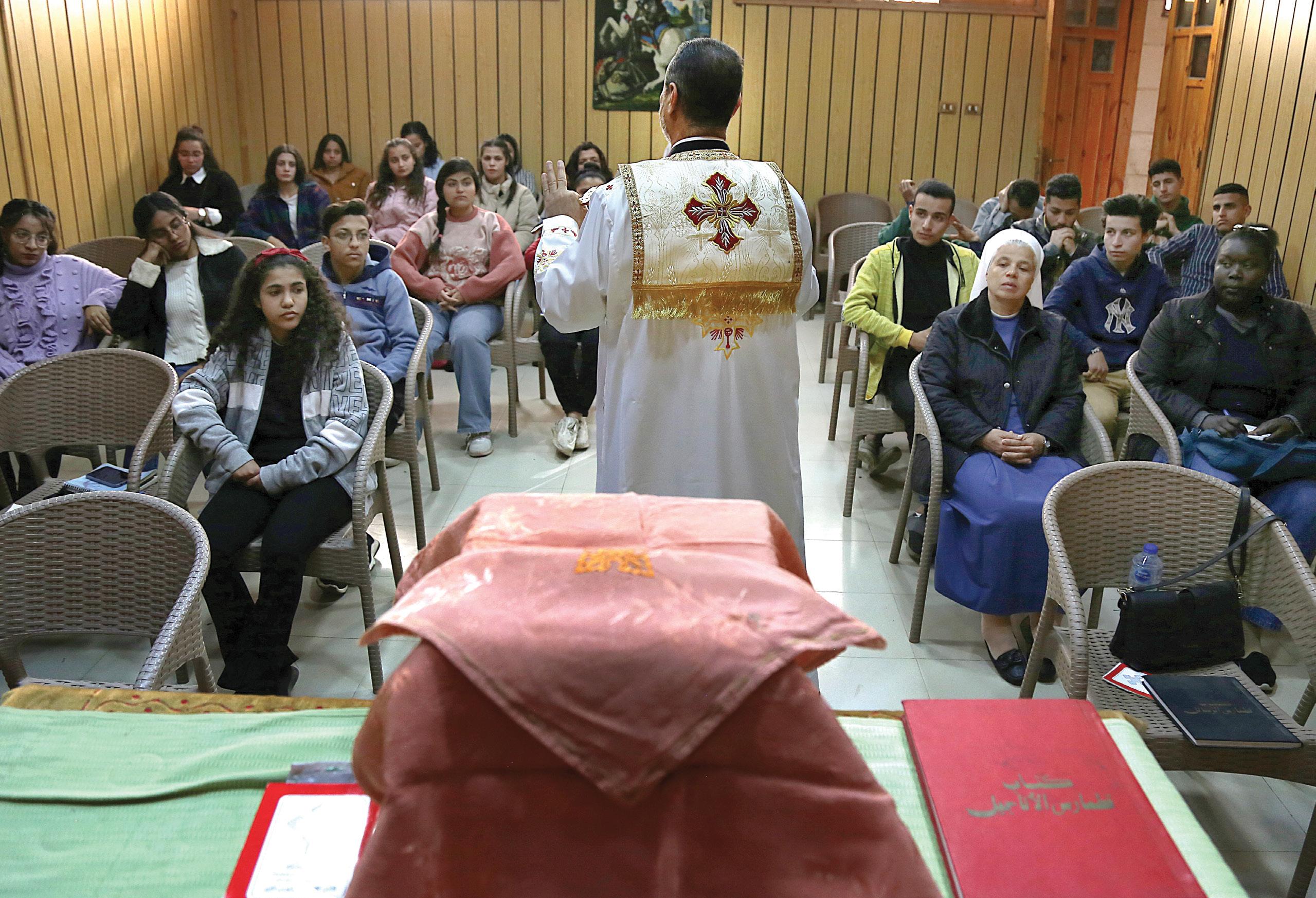
People “need to feel the church’s presence in their daily struggles.”
gains full custody of his minor children, who are now considered Muslim by the state, which is governed by Islamic law.
According to Father Nassif, about 70 percent of conversions to Islam are motivated by a desire to escape child or spousal abuse or unhappy unions, and 30 percent can be attributed to personal conviction.
President el Sisi has called for a revision of the country’s family law, including on the civil status of Christians, but the adoption of such legislation has stalled due to objections by religious authorities.
There have also been occasions when women, who convert to Islam, try to revert to Christianity. The church offers hospitality to these women at a church-sponsored group home at an undisclosed location and accompanies her toward reconciliation with her family, says Father Nassif. Divorce by conversion brings shame on Christian families and causes family rifts. Her safety may also be endangered if she returns to her family without reconciliation. If reconciliation cannot be achieved, the church will help her set out on her own, the priest explains.
The Reverend Ilia Shafik SaadAllah, who follows up on at least one conversion case per month for the Coptic Orthodox eparchy in Minya, says families and their pastors first try to persuade the Christian woman to end her online relationship with the Muslim man, but if she persists and proceeds to run away, local police, of late, will locate her and return her to church officials, who will then facilitate a reconciliation with her family.
“The first step is to help this woman feel accepted and loved, even if she is not loved at home,” he adds. “Because all these cases
Students at the Institute of Religious Education listen to a homily during Divine Liturgy before class begins.
need love, whether it is a wife who does not find love from her husband or a daughter who does not feel loved at home. If there was love in the home, such cases would not happen.”
After hosting a special assembly for the church in the Middle East at the Vatican in 2010, which gathered bishops, pastors and religious engaged in pastoral work in the region, Pope Benedict XVI underlined the need to respect the dignity and equality of women and for the church in the Middle East to do better at resolving “marital questions” to prevent or limit conversion to Islam.
“In those unfortunate instances where litigation takes place between men and women, especially regarding marital questions, the woman’s voice must also be heard and taken into account with a respect equal to that shown towards the man, in order to put an end to certain injustices,” he wrote in his apostolic exhortation “Ecclesia in Medio Oriente” (The Church in the Middle East) in 2012.
“There needs to be a more sound and fair implementation of church law,” he continued. “The church’s justice must be exemplary at every level and in every field in which it is exercised. It is absolutely vital to ensure that litigation on marital questions does not lead to apostasy.”
Bishop Kiroulos emphasizes the need for dialogue within the church to discern how to deal with these contemporary challenges.
“This has become a reality; if we don’t interact with it, we will be left behind,” he says. “We need to raise awareness among ourselves as church leaders to answer the question, where are we going?”
Magdy Samaan in Cairo is the Egypt correspondent for The Times of London. His work also has been published by CNN, the Daily Telegraph and Foreign Policy.

cnewa.org I cnewa.ca
Hear from members of the minority Christian community in Egypt in an exclusive video at cnewa.org/one
ONE@50 37
Support
the Christian community in Egypt
u
The Last Word Perspectives from the president
by Msgr. Peter I. Vaccari

C“Broken hearts and many tears…”
ardinal Timothy M. Dolan, archbishop of New York, repeated this refrain as we approached the date of our pastoral visit to Israel and Palestine, scheduled for 12-18 April — a visit that was unexpectedly cut short.
In recent years, it has been custom for members of CNEWA’s board of trustees to make pastoral visits to locations where CNEWA is at work on the ground. This year, the chair, Cardinal Dolan, made that visit in April to Israel and Palestine. Michael La Civita, CNEWA’s director of communications, and I were included in his delegation.
The visit was scheduled to mark the 75th anniversary of the presence of CNEWA’s operating agency in the Middle East, Pontifical Mission. In the initial itinerary, many sites were prepared for him to visit and review along with their activities, which Pontifical Mission engages through its team in Jerusalem. Under the leadership of Joseph Hazboun, regional director in Jerusalem, Pontifical Mission is engaged in helping in health care, especially for the elderly, education, youth programs for all ages, and formation of community leaders, including future priests.
However, the entire region experienced a profound and dramatic change on 7 October, when an attack was launched against the state of Israel. We are all familiar with the news stories that report the massive loss of innocent human life, Israeli and Palestinian, the taking of hostages, the displacement of people and the separation of so many from their families and friends.
Cardinal Dolan, on this pastoral visit, wished to express his solidarity and concern for the seismic shift
38 CNEWA.ORG/ONE

The cardinal’s faith and radiant joy allowed those we encountered to experience a glimmer of true hope in the crucified and risen Jesus.
experienced by all the people in this region, leaving them with “broken hearts and many tears.”
He met with survivors of the 7 October attacks and with the families of current hostages. He met with President Mahmoud Abbas of Palestine and with President Isaac Herzog of Israel. He visited with Cardinal Pierbattista Pizzaballa, Latin patriarch of Jerusalem, with other Christian leaders, and with displaced Palestinians in the Aida refugee camp near Bethlehem. The cardinal engaged in interfaith dialogue and, along with representatives from the European Union, he attended a ceremony to inaugurate a rehabilitation project for the elderly managed by CNEWA-Pontifical Mission.
Amid such pain, suffering and brokenness, at every stop we made, Cardinal Dolan acknowledged the broken hearts and many tears. Even after an evening of sheltering in place as Israel hunkered down under a barrage of drones and missiles, the cardinal’s faith and radiant joy allowed those we encountered to experience
Cardinal Timothy M. Dolan visits with a resident of the Home Notre Dame des Douleurs during a ribbon-cutting ceremony, 16 April. Opposite, an altar server during Mass at the Church of the Annunciation in Beit Jala, 14 April, marking the 75th anniversary of Pontifical Mission.
a glimmer of true hope in the crucified and risen Jesus, whose pierced and sacred heart declares the final word to be life, not death, because:
“[God] will wipe every tear from their eyes, and there shall be no more death or mourning, wailing or pain, [for] the old order has passed away” (Rev 21:4).
With my gratitude and prayers,
 Peter I. Vaccari President
ONE@50 39
CNEWA a papal agency for humanitarian and pastoral support
1011 First Avenue, New York, NY 10022-4195 • 1-212-826-1480 • cnewa@cnewa.org
223 Main Street, Ottawa, Ontario K1S 1C4 • 1-866-322-4441 • www.cnewa.ca

