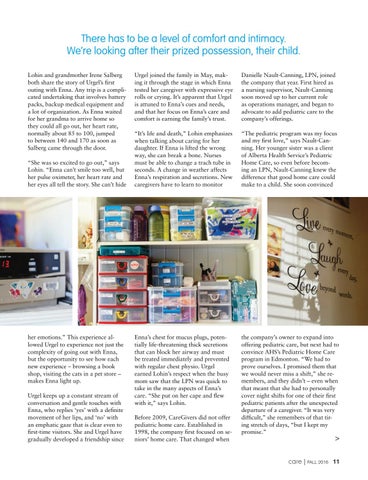
There has to be a level of comfort and intimacy. We’re looking after their prized possession, their child. Lohin and grandmother Irene Salberg both share the story of Urgel’s first outing with Enna. Any trip is a complicated undertaking that involves battery packs, backup medical equipment and a lot of organization. As Enna waited for her grandma to arrive home so they could all go out, her heart rate, normally about 85 to 100, jumped to between 140 and 170 as soon as Salberg came through the door. “She was so excited to go out,” says Lohin. “Enna can’t smile too well, but her pulse oximeter, her heart rate and her eyes all tell the story. She can’t hide
her emotions.” This experience allowed Urgel to experience not just the complexity of going out with Enna, but the opportunity to see how each new experience – browsing a book shop, visiting the cats in a pet store – makes Enna light up. Urgel keeps up a constant stream of conversation and gentle touches with Enna, who replies ‘yes’ with a definite movement of her lips, and ‘no’ with an emphatic gaze that is clear even to first-time visitors. She and Urgel have gradually developed a friendship since
Urgel joined the family in May, making it through the stage in which Enna tested her caregiver with expressive eye rolls or crying. It’s apparent that Urgel is attuned to Enna’s cues and needs, and that her focus on Enna’s care and comfort is earning the family’s trust.
Danielle Nault-Canning, LPN, joined the company that year. First hired as a nursing supervisor, Nault-Canning soon moved up to her current role as operations manager, and began to advocate to add pediatric care to the company’s offerings.
“It’s life and death,” Lohin emphasizes when talking about caring for her daughter. If Enna is lifted the wrong way, she can break a bone. Nurses must be able to change a trach tube in seconds. A change in weather affects Enna’s respiration and secretions. New caregivers have to learn to monitor
“The pediatric program was my focus and my first love,” says Nault-Canning. Her younger sister was a client of Alberta Health Service’s Pediatric Home Care, so even before becoming an LPN, Nault-Canning knew the difference that good home care could make to a child. She soon convinced
Enna’s chest for mucus plugs, potentially life-threatening thick secretions that can block her airway and must be treated immediately and prevented with regular chest physio. Urgel earned Lohin’s respect when the busy mom saw that the LPN was quick to take in the many aspects of Enna’s care. “She put on her cape and flew with it,” says Lohin.
the company’s owner to expand into offering pediatric care, but next had to convince AHS’s Pediatric Home Care program in Edmonton. “We had to prove ourselves. I promised them that we would never miss a shift,” she remembers, and they didn’t – even when that meant that she had to personally cover night shifts for one of their first pediatric patients after the unexpected departure of a caregiver. “It was very difficult,” she remembers of that tiring stretch of days, “but I kept my promise.”
Before 2009, CareGivers did not offer pediatric home care. Established in 1998, the company first focused on seniors’ home care. That changed when
>
care | FALL 2016
11