FOR PROFESSIONAL INVESTMENT SPECIALISTS
AT THE SHARP END
M AGAZINE
GOVERNMENT BACKED - GREAT BRITISH INVESTMENTS - EIS - SEIS - BR - SITR - VCT
We Make It Personal Soak up the sunshine on our leafy terraces with stunning panoramic views over the city. Eight offers two venues with lounge bars, meeting rooms, cinema and restaurant with private dining rooms. Available for conferences, weddings, private dining and parties for up to 500 guests
www.eightclub.co.uk
CONTENTS CHAPTER • 1 Editor’s Welcome
Michael Wilson, Editor In Chief
News
A round up of industry news
CHAPTER • 2 The Hambro Perks Co-Investment Fund Finds its mark
City Editor Neil Martin delves deeper into a fund which has already caught the attention of serious investors
The New Kids on the Block
An investment showcase bringing you the newest offerings from the sector
Film Club
Training the lens on investments with movie star qualities
VCTs in Demand – Will it Continue?
Paul Latham, Managing Director of Octopus Investments, says the surge in demand means advisers need to think about investment into VCTs early
A Golden Time for VCTs
Annabel Brodie-Smith, Communications Director of the AIC, examines whether the Midas touch will remain for VCTs
Wealth Club
Alex Davies, Chief Executive of WealthClub, gives his tips on how to invest clients in a more diverse and competitive VCT market
The Exiteers
Bringing you news of successful exits in the sector
Eye on the VCT Prize
Laurence Calcutt, Partner and Head of Sales at Downing explains to our Editor how advisers need to be quick off the mark with VCTs as demand will start to outstrip supply
Entrepeneurial Spirit Still Alive
John Glencross, CEO of Calculus Capital talks to our Editor about how despite government restrictions the strength of UK Plc means the outlook is good for funds
In land of VCTs
CHAPTER • 3 Film Round Table
Insightful and informative articles emerging from key topics raised. All the news and insight from the GBI Magazine Film Round Table in Belfast
CHAPTER • 4 Open Offers
Our monthly listing of what’s currently available for subscription
GBI Magazine is published by IFA Magazine Publications Ltd, Arcade Chambers, 8 Kings Road, Bristol BS8 4AB
M AGAZINE
Telephone: +44 (0) 1173 258328 Editor-in-Chief: Michael Wilson editor@ifamagazine.com City Editor: Neil Martin neil.martin@ifamagazine.com
Commissioning Editor: Michelle McGagh Publishing director: Alex Sullivan alex.sullivan@ifamagazine.com Design: The Wow Factory www.thewowfactory.co.uk
Full subscription details and eligibility criteria are available at www.gbinvestments.co.uk ©2018. All rights reserved. Full subscription details and eligibility criteria are available at www.gbinvestments.co.uk
GBI Magazine is for professional advisers only. GBI Magazine is a trademark of IFA Magazine Publications Limited. No part of this publication may be reproduced or stored in any printed or electronic retrieval system without prior permission. All material has been carefully checked for accuracy, but no responsibility can be accepted for inaccuracies, independent research and where necessary legal advice should be sought before acting on any information contained in this publication.
What do we mean by ‘government backed’? In the interests of clarity, any reference made by GB Investments to the point that EIS, VCTs and similar investments are government backed relates to the government’s general approval of these schemes, indicated by their having granted them highly tax advantaged status. The use of this term does not imply that government would in any way act in the capacity as a guarantor or backer of last resort in connection with such schemes.
5
EXCELLENT REASONS TO INVEST IN FILM For your free copy call 020 7628 7857 or email info@ironboxcapital.com
Serious Investment Serious Entertainment www.ironboxcapital.com
BREXIT AND BEYOND As Theresa May battles her way through the Brexit barricades that her cabinet colleagues have so thoughtfully erected in her path, let’s spare a thought for those who think a little further ahead than the average Eurosceptic minister. Yes, we’re talking about the Patient Capital investors - the ones who place their faith in the medium-term prospects of smaller enterprises with the innovative power to prosper, no matter what the slings and arrows of Brexit might throw at them. They’re in good heart, it seems
• 18% feel that they will be presented with a higher frequency of SME investments after Brexit.
A striking optimism
The survey also examines the common perception that younger people are more hostile to Brexit than their elders, and it comes up with the impressive finding that the age divisions among investors are now minimal. When asked whether they felt more or less encouraged to invest into UK SME opportunities as a result of Brexit, 22% of the 18-34 age group said that they were more encouraged – compared with 20% of the 35-54 cohort and 19% of the over-55s.
I was recently reading a report from the Enterprise Investment Scheme Association (EISA) on the perceived impact of Brexit for small and medium enterprise investors. It confirmed a high level of investor optimism - not just in the south east, and not just among older, more affluent investors, but among the millennials too. It certainly made a nice change from the doom-laden CBI. The EISA report, entitled “Brexit vs Deal Flow” (www. eisa.org.uk/brexit-vs-deal-flow), was conducted by the British Business Bank from a survey of 2004 “actively investing” or “aspirational” respondents with up to £100,000 in investable assets. And it leads from the front with an affirmation that the June 2016 Brexit vote has done nothing to dent the sector’s vibrancy. The value of SME asset finance deals was up 12% during 2017, the report says, with the value and number of SME equity deals up 79% and 12% respectively. 414,000 new businesses - a record number – were created in the UK in 2017. In particular, EISA says, “the UK tech sector shone through in 2017 with a record £2.99bn attracted by SMEs, while investors put a record £46bn into funds over the year, a 600% increase on 2016.” The survey results themselves paint a rosy picture of how much the respondents expect things to improve after Britain sets sail toward full independence. Here’s a verbatim selection of bullet points from the EISA report:
• 32% of over-55s believe that Brexit will strengthen productivity. • 22% of 18-35 year olds feel more encouraged to invest into UK SMEs as a result of Brexit. Do the young love Brexit?
The respondents were then asked whether they were “encouraged, but holding money back until after Brexit”? And barely 21% of those with £20-25K said that they were. (Compared with 15% of those with £20-50K, and just 11% of those with more than £100K.) One in four Londoners said they were deliberately holding back money until after Brexit, but over a quarter of affluent investors said they feel more encouraged to invest in SMEs after Brexit. So yes, nobody is ducking the challenges. But, in the words of EISA Director General Mark Brownridge, there is clear evidence of “a strong desire for growth and expansion to take advantage of the greater trade opportunities ahead of them outside of the single market.” Hallelujah to that. Michael Wilson, Editor in Chief
• 29% [of respondents] feel Brexit will strengthen SME productivity. • 7.4 million investors say SMEs are more attractive as a result of the increased trade prospects. • 28% feel that knowledge intensive companies such as those in the energy-tech, medtech and fin-tech arenas will benefit as a result of Britain formally exiting the EU.
GB Investment Magazine · June 2018
5
News
Downing behind plans for world’s largest electric vehicle charging vehicle network Investment manager Downing is providing the key investment for the initial stage of a world-first 2GW network of grid-scale batteries and rapid electric vehicle (EV) charging stations across the UK. The batteries will deliver the infrastructure for rapid EV charging technology, while also being capable of storing enough power to supply 235,000 average homes for a day. Downing said that this storage capability creates a key resource for the National Grid, allowing it to better manage increasing supply and demand issues.
Downing aims to provide funding for the first battery project, which will be built on the south coast of England and operational by the middle of 2019. Downing also plans to raise institutional funding to progress the network rollout. Pivot Power plans to have operational batteries at ten sites from 18 months’ time, subject to planning approval. In total, the project intends to build a nationwide network across 45 sites, which will make it the world’s biggest battery network connected to the National Grid as well as the world’s largest network of rapid charging sites. Development for up to 45 sites is being planned near towns and major roads. Each station will aim to support up to 100 rapid chargers offering mass charging at competitive rates. The unprecedented programme is expected to cost £1.6bn in total over a period of up to five years and Pivot Power is also in talks with institutional and strategic investors alongside potential partners, such as car manufacturers, charging providers, and technology and energy companies. Colin Corbally, Partner at Downing, said: “To increase the reliance on renewable energy, the National Grid will need access to more flexible energy assets. There is also the requirement for sufficient power infrastructure to support EV charging stations when the expected growth of EV use is to become a reality. Pivot Power has developed this unique opportunity to build this energy network and make this happen.” Matt Allen, Chief Executive Officer of Pivot Power, added: “Our batteries will provide the infrastructure to underpin clean air policies while introducing valuable flexibility into the energy system. “It will also address the three biggest barriers to EV adoption identified by the Department for Transport: availability of chargers, ‘range anxiety’ (the distance it’s possible to travel between charges), and also cost, as our stations will be able to buy power at a lower price.”
6
GB Investment Magazine · June 2018
News
Universities to power high-growth UK companies Five leading universities have launched a new programme to enable the UK’s best tech SMEs to access university expertise and resources. Called Scale-up, the programme is a collaboration between Bristol, Bath, Exeter, Southampton and Surrey universities. Part of the SETsquared Partnership, the enterprise collaboration between the five universities aims to improve Britain’s investment record in research and development and benefit SME’s, accelerating innovation and growth and in turn providing a boost to the UK economy. The programme hopes to enable scale-up companies to become the sector giants of tomorrow and is expected to generate over £25bn by 2030, creating an additional 30,000 high-skilled jobs in the tech sector. SETsquared’s new Scale-up programme is supported by £5m of government funding through Research England’s Connecting Capability Fund, which will enable 240 of the most innovative scale-up companies to access support. Professor Nishan Canagarajah, Pro Vice-Chancellor of the University of Bristol said: “Since SETsquared started, we have helped over 3,500 businesses who have gone on to create over 20,000 jobs and raise £1.5bn in investment. Today we are launching our new scale-up programme which will help hundreds of SMEs over the coming years access the knowledge and resources of our five Universities to accelerate their innovation and growth. This will benefit the UK economy in a major way.” The Rt Hon Greg Clark, Secretary of State for Business, Energy and Industrial Strategy added: “The SETsquared Partnership has not only helped nurture and grow British technology businesses, but it has also contributed £8.6 billion to the UK economy, which is an incredible achievement.
“Through our modern Industrial Strategy, we’re calling on businesses to invest in the latest technology trends, and through our Sector Deals and Grand Challenges, we want the UK to be at the forefront of the technology revolution and make Britain fit for the future.” The scale-up programme aims to confront the issue of how to ensure more UK tech start-ups develop to become major forces in their field. Warwick Economics estimate technology scale-ups are likely to produce 42% more GVA than traditional scale-ups and generate 16% more jobs. Ministers have committed to increasing productivity in the UK and increasing spending on Research & Development from 1.7% of GDP to 2.4% to tackle these economic challenges. The UK currently ranks 22nd in a list of OECD developed countries. Commenting on the impact that SETsquared’s member companies have on R&D, Professor Canagarajah added: “With the UK’s ‘R&D gap’, we want to show parliamentarians how SETsquared can drive innovation in the UK. Utilising our proven track record of supporting early stage tech companies to raise investment and building R&D partnerships with the Universities we can support these SMEs to become successful enterprises as they grow into global leaders in their industrial sectors.” SETsquared has already undertaken a successful pilot programme with a Bristol-based company. William Hartley, Managing Director at hofer powertrain UK Ltd, said: “The SETsquared Scale-up Programme enabled hofer powertrain to work with the University of Bristol for the first time, this added a new research dimension to a £40 million automotive project that will be at the heart of hofer’s UK growth plans.”
GB Investment Magazine · June 2018
7
THE HAMBRO PERKS CO-INVESTMENT FUND FINDS ITS MARK The Hambro Perks Co-Investment Fund was created with a firm objective in mind. To enable individuals to co-invest alongside and on a fully aligned basis with Hambro Perks, allowing them to benefit from extraordinary access to companies and a proprietary deal flow whilst utilising EIS reliefs. City Editor Neil Martin delves deeper into a fund which has already caught the attention of serious investors Pictured: Eric Wilkinson (left) and Andrew Wyke (right)
8
GB Investment Magazine ¡ June 2018
Every fund likes to accentuate the positives, but when you talk to the team at Hambro Perks, you get the sense that with their Co-Investment Fund, they believe they have got it right. Founded by Rupert Hambro CBE and Dominic Perks in 2013, Hambro Perks has grown rapidly and there are now five partners and 30 staff. Perks is very clear about how the company positions itself and the Fund. He said: “Hambro Perks helps outstanding founders build world-changing businesses. The provision of permanent, patient capital from our own balance sheet means we are completely aligned with the long term goals and interests of the entrepreneurs and investee companies that we support. Our Fund coinvests alongside Hambro Perks on the same basis.”
Sharp end And the firm is not afraid to be at the sharp end, where real value can be added. Eric Wilkinson, Chief Investment Officer, adds: “We aim to take early risk in businesses, investing where we can add significant value through applying and sharing the expertise our team has built over many decades’ combined experience of founding, building, internationalising and exiting companies. “We believe we are the destination of choice for the very best entrepreneurs, and they actively choose us to support them as they build fast growth, techenabled businesses.” The firm’s main areas of focus are education technology, digital health, insurance technology, digital media and FinTech.
Aligned You’ll notice that the word aligned is a key word for the team. Aligned both with the companies in which they invest and with their investors. Hambro explained: “Individuals co-invest alongside us on a fully aligned basis. We launched the Fund earlier this year to meet the growing demand from individuals to co-invest with us in the companies we support.”
Support And when they say they support founding teams, helping them to build and scale their companies, this is not idle talk. The firm provides strategic expertise, and can help with bookkeeping/finance and legal issues (a team of four lawyers and five accountants are available to help), digital marketing and lead generation; and, if required, desk space in their office. Like many other funds, they also usually take a seat on the board of their investee companies, or ask one of their large network of trusted venture partners to sit in their place.
Selection As for what type of investments they seek, Hambro Perks knows that at this level finding the best entrepreneurs and founders is key.
GB Investment Magazine · June 2018
9
They aim to take early risk, sometimes pre-revenue, and are frequently the first external capital invested into an early stage business and this means that they place enormous emphasis on the quality of the team. Perks: “We invest with the aim of following on in the later rounds of successful companies as they develop and require more funding over a potentially long timeframe, so it is very important that we have a strong relationship. In addition, we value humility in founders – we expect them to be open to advice when necessary – and we do not invest in companies where we feel unable to add significant value over and above the capital we provide. “The Hambro Perks team has many decades of experience both in building and internationalising businesses, and in supporting outstanding entrepreneurs as they do the same. Some of the companies in which Hambro Perks has invested have been conceptualised and founded here, meaning the Fund has proprietary access to investment opportunities as a result.”
Minimum investment For investors, the minimum investment is £25,000. There is no maximum although, of course, EIS reliefs are limited to £1m (with exceptions for certain investments). The Fund is evergreen and it aims to raise between £15m to 20m per year. Perks: “We are not asset gatherers. We focus solely on performance, and this is an amount we are able to deploy to support amazing founders each year.” The Fund expects to return to investors at least 2x the capital invested (not taking into account EIS reliefs). The companies in which the Fund invests are small, fast growth businesses and it is not expected that they
10
GB Investment Magazine · June 2018
will pay dividends. Capital is returned at the point of realisation, on an investment by investment basis. The timeframe for realization is expected to be three to five years though, pointed out Perks, this is not guaranteed and returns from venture investing can take significantly longer. The team expect to invest subscribers’ money into 10 to 15 companies over 12 to 18 months from the point they subscribe, though this depends on the opportunities that present themselves. Since its launch in February, the Fund has made three investments. Perks also highlighted the fact that the pipeline over the next couple of quarters is hugely promising, and includes many companies that are showing very high traction in their respective industries and experiencing rapid growth.
Fund’s investments Wilkinson took us through the Fund’s investments to date. Quorso: Founded by Julian Mills, formerly a star partner at McKinsey&Co, Quorso is the world’s first ‘intelligent manager’ software application. With its mission being to help unlock human creativity and collaboration to build happier, more profitable companies, Quorso is an essential tool for corporates that sits alongside human managers and supports them through the end-to-end management process. The software can be activated at the world’s largest organisations in just a few days. The company works with some of the UK’s largest companies and already earns a significant portion of its revenue in the US.
Julian and his team are well known to Hambro Perks, which was Quorso’s first external investor and which has invested in each subsequent round. The team is extremely impressive and this investment is perfectly aligned with the Hambro Perks ethos of supporting outstanding founders and entrepreneurs. The company raised this round of finance with the aim of continuing to build its world class team so that it can capture the huge market opportunity identified. Mettrr: Founded by Seb Lewis, Mettrr is a Do It For Me website builder that aims to help the millions of sole traders and micro SMEs in the world that currently have no online presence by creating bespoke websites for them using its market leading building platform. Once built, Mettrr then charges a monthly subscription to maintain the website, and this provides a strong recurring revenue stream that benefits from high retention rates. Mettrr’s model, driven by machine learning and direct interaction, means that it is able to provide its services across multiple geographies, and the number of countries in which it operates will increase as it incorporates more languages into its offering.
Rupert Hambro CBE Founder
Eric Wilkinson
Dominic Perks Founder
Lara Crowdey
Chief Investment Officer
Director of Finance
George Davies
Andrew Wyke
Peter Soliman
Charlotte Summerfield
Phoebe Reeve
James Dawute
On an operational level, Hambro Perks has provided significant support and expertise in the acquisition of customers, as well as helping to build an experienced board of directors. The company raised this round of finance with the aim of continuing to build its technological capabilities and global scale so that it can develop and monetise the huge market opportunity identified. Tempo: Founded by Ben Chatfield and Ollie Povey, and incubated within Hambro Perks, Tempfair (which trades as Tempo) is a staffing platform which helps businesses to find and hire temporary and permanent office admin staff. Through the use of innovative interfaces and machine learning-driven matching algorithms, Tempo is able to increase the likelihood of suggesting potential employees who will be a good fit while also helping to cut the costs (both in terms of money and time) of hiring borne by its corporate clients. Tempo has been built impressively fast by Ben and Ollie while being incubated by Hambro Perks, which was one of the first investors in the company. This round of funding will allow them to build out both their technology and sales teams, and continue to gain share rapidly in the market.
Partner
General Counsel
Partner
Support Team
Last word One thing is certain about Hambro Perks and its Co-Investment Fund, investors are very clear as to what they get for their money. And for those investors who want to enjoy the benefits of being co-invested and perfectly aligned with one of London’s premier tech company builders, then this is one to consider.
Legal Team
Head of IT
GB Investment Magazine · June 2018
11
THE NEW KIDS ON THE BLOCK An investment showcase bringing you the newest offerings from the sector Investment: Cellmed via SyndicateRoom Aim: Cellmed is a life sciences company aiming to treat cancer in a unique and less invasive way Cellmed is a life sciences company aiming to change the way we deal with cancer through its innovative immuno-oncology treatments. Immuno-oncological treatments are unique in that, unlike more invasive therapies such as radiation or chemotherapy, they attempt to harness the body’s immune system in the fight against cancer. The company’s flagship product, Procure, is aimed at soliciting a strong immune response against solid tumors such as those arising in during ovarian, breast, colorectal, lung and prostate cancers. It does this by targeting dendritic cells and teaching them to recognise cancerous bio-markers. These cells, named for their tree like shapes, are responsible for initiating immuno-responses and function as the ‘sentinels’ of the immune system. Once these cells have been triggered, they activate the body’s adaptive immune system to fight against cancerous tissue. Cellmed is initially focusing on ovarian cancer due to the high medical need (the five-year survival rate falls short of 40%) and has recently completed a clinical Phase I/IIa study on ovarian cancer patients. These trials demonstrated Cellmed’s Procure is able to prolong the time to progression by more than 193% with very a low number of side effects. In the near future, Cellmed is seeking to re-enter the clinic and commence its Phase IIb trials. These pivotal, tightly controlled trials are intended to evaluate the safety and efficacy of a pharmaceutical in-patient with the disease, measuring the drug’s effectiveness in treating, diagnosing or preventing the disease. Should the trials prove to be successful, the company will be one step closer to market while simultaneously becoming much more attractive to anyone seeking to acquire it. Cellmed was founded by Dr Wolfgang Huber, who studied medicine at the University of Vienna, Austria, and who holds an MBA in Finance and Healthcare Management from Columbia Business School. Before Cellmed, Huber founded Synermed Management GmbH, a company that provides management to multiple healthcare institutions. As the Chief Executive of Sisters of Charity Healthcare Systems, he
12
GB Investment Magazine · June 2018
successfully changed the management of a hospital group which had operating losses of over €4 million. The rest of the management team comprises experienced professionals from across the life sciences and financial sectors. Chief Executive Dr Gerhard Huber has been involved with Cellmed since its inception. With his extensive experience leading startups and a strong background in leading negotiations, Gerhard brings a sizeable network of contacts to the table. Dr Karl Krista – Cellmed’s Chief Scientific Officer – holds an MD from the University of Vienna, Austria and an MBA from the Kellogg School of Management, Northwestern University in Illinois, USA. He has managerial expertise from his years as a consultant at McKinsey & Co, where he served multinationals in the pharmaceuticals and diagnostics industries as well as private equity firms in Europe and the US. He has a strong track record in the development of cancer vaccines and ovarian cancer treatment in particular. The company believes this mix of medical specialism and commercial awareness will be instrumental to its success. Currently, the largest investor in the round is NCL’s Kent Life Science Fund, which invests in high-growth SMEs with either game-changing medical technologies or advanced therapeutics. As a new entrant to the UK scene, Cellmed hopes to benefit from NCL’s strategic advice as the company completes further clinical trials on its way to market. How much is being raised? Cellmed is looking to raise a minimum of £500,000 of early-stage funding against a valuation of £2.4 million. The company has recently been reincorporated in the UK from Austria – hence the low valuation – and has access to around $15 millionworth of intellectual property. Monies raised by the company are intended to fuel further commercial and business development as it prepares to undertake Phase IIb trials with its main product, Procure.
What types of investments are being sought? Investment through the SyndicateRoom platform is restricted to sophisticated investors and high-networth individuals. The lead investor for the current round, NCL’s Kent Life Science Fund, is focused on investing in earlystage biotech and healthcare businesses whose intellectual property it identifies as being potentially disruptive. As a large investor, the fund provides businesses with both the resources and institutional investment capital required to turn them into highperforming SMEs. Cellmed is seeking additional funding from sophisticated investors and high-net-worth individuals, whether they are offering specialist advice (‘smart money’), veteran investors looking to diversify their portfolio holdings, or simply looking to fight back against a type of cancer for which no satisfying treatment has been identified and for which mortality rates have not improved in the 40 years since the ‘War on Cancer’ was first declared. What is the minimum investment? The current round is being organised by SyndicateRoom, an online investment platform for
which the minimum investment ticket is £1,000, with investment being restricted to sophisticated investors and high-net-worth individuals. Cellmed is looking to raise a minimum of £500,000 in this round to carry out its business plan, with the overfunding limit set at £1.25 million by the company’s board. What is the targeted return? Naturally at this stage, return on investment is difficult to gauge. The number of mergers and acquisitions in the pharmaceutical industry has continued to rise, with oncology being a particularly active area, and assets increasingly being acquired at earlier stages of their development. It is not uncommon for clinical stage I-O assets with evidence of efficacy to achieve exits or partnership deals worth between £50 million and £500 million. Of particular note is the acquisition of five-yearold and privately held Stemcentrix (a cancer drug developer) by pharmaceutical giant AbbieVie in 2016. The company was valued at $9.86 billion. For the immediate future, all investments in the current around are potentially eligible for EIS tax relief.
GB Investment Magazine · June 2018
13
FILM CLUB Turning the lens on investments with movie star qualities
Fund: Atlantic Screen Media EIS Fund Manager: Atlantic Screen Media
Tell us about the fund Atlantic Screen Media Fund was launched in November 2017 and is different from other funds available in the market in the sense that the strategy is to invest in early stage intellectual property (IP) in TV series development, comic book publishing, and music scores for film and TV. Atlantic has brought together a TV series development company, Dynamic Television, a comic book company, After Shock, and its own music publishing business to offer investors a wider choice of opportunity when it comes to early stage investing in the sector. By owning the publishing rights to films, TV series and music scores, alongside the composers and producers, Atlantic Screen Media creates long term and stable asset-backed income from its investments. Taking the music rights as an example, it works as follows: the majority of music created by the company is the incidental and background music (known as ‘the score’) for film and TV. The company owns the IP of the composed music (alongside the composer) from origination, and will retain ownership of the copyright created for 70 years after the death of the composer. That copyright will earn income in the form of royalties collected worldwide from TV companies and theatres by the worldwide network of performing rights societies. Every time one of the film scores is shown on TV or cable, the company earns royalties based on a minute of music. Most of the scores have at least 60 minutes of music, and a film shown on any European terrestrial channel will earn a royalty of at least £25 per minute, generating an average income on each film of approximately £1,500 and $10,000 on US terrestrial channels. The sector is going into a new period of strong growth as a direct result of the development of communications technology and the plethora of new viewing and listening platforms, such as Netflix, Amazon Fire, and iPlayer hubs. As these become well
14
GB Investment Magazine · June 2018
established, demand for content in this environment is exploding as new and existing consumers adopt these changes and access content through new mediums. The key to successful investment in the sector is the ability to identify the projects with the highest potential from an early stage and to nurture them to become globally recognised brands. As adviser to the fund, Atlantic Screen Media Limited (ASML), has drawn together a team that has wide ranging experience of the media and entertainment sector, with its directors and advisers having been involved in film, TV, comic books, and music publishing for film and television over many decades. Our executive board and our advisers have built significant experience and expertise over the last 30 years in establishing and running their own businesses and raising money in the tax efficient EIS market as well as employing those investment funds in the film and TV media industry. Now, drawing these skills together, the company has created an offering in the form of an EIS fund for investors to participate in a broad range of IP in those sectors as well as the comic book space – where there is great potential.
What investments are in the pipeline? Funds raised in the last four months have not yet been deployed. Atlantic Screen Group has raised two EIS funds and one VCT fund over the last eight years, totalling £6 million, which has been invested in the scores for over 75 films and TV programmes – most recently titles such as Lone Survivor, 2 Guns and Churchill are part of their portfolio.
What film characteristics should investors look out for? A film with a strong cast and preferably TV friendly (so not R rated or horror, so family friendly or action are the best ones). We have recently invested in the new film Show Dogs, via a different fund, which is currently doing very well in the box office.
What is the minimum investment? The minimum investment is £10,000 up to the maximum allowed under EIS rules, which is now £2 million.
How much has been raised? Early stage investment has reached £300,000
What return can investors expect? The target internal rate of return (IRR) for the fund is of 15% per annum. The table below projects the possible valuations of investments at one, three, and five years under different scenarios, assuming that you invest £10,000.
What are the risks? We are not investing directly into film or into the UK. There are risks in investing in any IP as not all ideas will succeed. All of the three companies in our fund have a demonstrable track record of successfully
Stress Scenario
Unfavourable Scenario
Moderate Scenario
Favourable Scenario
creating returns for investors in the past. We aim to create new content in a market that is hungry for it.
Why is there demand for new content in the media industry? PwC predicts the UK media and entertainment sector will grow at a compound rate of 3% per annum over the next five years to be worth £72 billion by 2021. Digital services will account for over 60% of all spend in the sector growing at 5.8% compound annual growth rate per annum. Much of this growth is being driven by fundamental shifts in the way people receive content and where mobile operators are responding to users’ demand for streaming video by emphasising their unlimited wireless data offerings in their marketing. Streaming video devices and smartphones are becoming the channel of choice for both old and new generations of customers. Netflix raised $1.6 billion in 2017 to buy and produce new content. Many other platforms are developing at the same pace.
1 year
3 years
5 years
What you might get back after costs
£0
£0
£0
Average return each year
N/A
N/A
N/A
What you might get back after costs
£7,618
£7,300
£6,800
Average return each year
-23.82%
-9.00%
+6.40%
What you might get back after costs
£9,030
£10,222
£12,950
Average return each year
-9.7%
+0.74%
+5.9%
What you might get back after costs
£10,806
£12,332
£19,756
Average return each year
+8.06%
+7.77%
+19.51%
GB Investment Magazine · June 2018
15
VCTS IN DEMAND: WILL IT CONTINUE? Paul Latham, Managing Director of Octopus Investments, says the surge in demand means advisers need to think about client investments into VCTs early An incredible £728 million was raised by VCTs in the 2017/18 tax year, the second-highest amount ever. Only 2005/06 has seen bigger inflows, and that was helped by higher tax reliefs of 40% and the knowledge that these would most likely be cut in the next tax year. This year’s surge in investor demand meant several VCTs hit their fundraising capacity ahead of tax yearend. They included Octopus Titan VCT, which raised £200 million, the largest ever VCT fundraise since they were first introduced in 1995.
Why changes to pensions and buy-to-let have driven VCT demand There have been two notable changes which have contributed to the increased demand for VCTs, and seen more advisers consider them for their clients as part of a diversified portfolio of investments.
1. Pensions changes Restrictions on annual and lifetime pension contributions mean more people are now looking for tax-efficient ways to complement their retirement planning. As a result, more clients are turning to VCTs as one way to do this. A client worried about exceeding their lifetime allowance, for example, could invest some money into a VCT and claim 30% of the first £200,000 they invest as income tax relief. VCTs offer this tax relief, along with tax-free dividends and capital gains, as an incentive to take on the risk of backing early stage companies, provided they are held for at least five years. That means investors need to be comfortable with the risks of investing in smaller companies, and the fact that they could get back less than they invest. Investors can also use VCTs to take money out of their pension tax efficiently. This works by investing some of the money taken out of the pension into a VCT, and using the upfront income tax relief to offset the tax
16
GB Investment Magazine · June 2018
paid on the money withdrawn. Note that selling VCT shares within the five-year minimum holding period would mean paying back any income tax relief, so clients should be comfortable holding a VCT for at least five years.
2. Buy-to-let Another area where the government has tightened restrictions in recent years is buy-to-let, for example by phasing out mortgage tax relief and raising stamp duty. The costs of being a landlord are rising. For clients who don’t yet want to sell their properties, claiming income tax relief on a VCT investment can be a way to offset these rising costs.
VCTs moving into the mainstream Recent changes to pensions and buy-to-let have definitely helped to raise the profile of VCTs. And, it’s fair to say there is growing awareness of the benefits of VCTs and the role they play in supporting the next generation of UK business. Over the last decade, we have seen increased interest and understanding of VCTs. Whereas a typical VCT investor used to be someone working in the City investing their bonus, today we see the majority of inflows made up of investments in the £5,000 to £15,000 range. This has made VCT investment far more accessible to younger investors, who in previous generations may have considered property investing.
Concerns around legislative changes A concern you often hear about VCTs is that legislative changes risk undermining the investment opportunity, so it’s worth reminding ourselves that successive governments have remained supportive of VCTs since they were first introduced in 1995, and this government is no different. But there are always tweaks to the VCT rules. We expect this and are used to adapting and managing these. What’s important is that VCTs continue to do what they were set up to do – attract investment into UK smaller companies. Most recently, the 2017
autumn Budget saw a number of changes made to the way VCTs can invest their money. In a nutshell, the changes were focused on directing capital to the most dynamic, growth businesses where it can do the most good for the wider economy while helping investors meet their objectives. The incentive to support and invest in these types of companies was made clear by the recent High Growth Small Business Report from Octopus. The report found that a group of 22,000 early stage companies – representing less than 1% of all the companies in the UK – create an incredible 20% of all new jobs and contribute to 22% of economic growth. These are early stage businesses that make a hugely positive impact on our economy. Providing them with long term capital is precisely why VCTs exist, and the government’s Patient Capital Review underlined this in a clear demonstration of support for the sector. Some clients may still be concerned that legislation could change again. It could, but this goes with the territory and has been part of VCT investing since they were first introduced. Nonetheless, it’s one reason why it’s a good idea to choose from one of the more established VCT providers that have experience of adapting to changes when required.
Not all VCTs are created equal This goes without saying, but it’s important to look at a VCTs’ costs, much as you would with a plain vanilla fund. A VCT is a company in its own right, which is listed on the stock exchange. It has to produce annual report and accounts, have an independent board of directors, hold general meetings for shareholders and meet standard corporate governance requirements just like any other public company. All of which costs money. A bigger VCT can spread these fixed costs over a larger asset base, reducing their impact on each individual investor’s returns.
You should also consider how established a VCT is. A newer VCT may still be in the process of building up its holdings, which affects how much your client can know about the investment before they invest. Remember, a client has to hold the investment for five years to keep the upfront income tax relief. While you should expect the holdings of any VCT to change over such a period, the change is likely to be more radical for those still building up their portfolio. Whichever VCT they choose, clients should be aware of the risks, including the fact that the value of their investment may go down as well as up and they may not get back the full amount they put in. In addition, they need to be aware that tax treatment depends on individual circumstances, and tax rules may change in the future. Tax reliefs also depend on the VCT maintaining its VCT-qualifying status. This means sticking to the rules about the types of company VCTs can invest in. There are also rules about the maximum amount of cash they can hold as a percentage of assets, as well as how quickly VCTs must deploy newly-raised fund. It’s also worth remembering that, due to their nature, investments into smaller companies carry increased volatility and liquidity risk.
Will 2018/19 be another record year for VCTs? It’s difficult to say whether VCT investment will reach the same level of investment this year. One of the reasons VCT investment was so high in 2017/18 is because there was a lot of fundraising capacity to satisfy demand, but there’s no guarantee that capacity will be as high next year. If it’s lower, and demand remains at current levels, it will mean VCTs fill up even faster, with the more popular ones closing first. It might seem a little hasty, but this presents an obvious reason to start the conversation about VCT planning with clients now, so they don’t miss out on the VCT of their choice. That way you also get the bonus of securing the early bird discounts on offer too.
GB Investment Magazine · June 2018
17
A GOLDEN TIME FOR VCTS Annabel Brodie-Smith, Communications Director at the Association of Investment Companies, examines whether the Midas touch will remain for VCTs The last six months have been a golden time for VCTs with near record fundraising in the 2017/18 tax year. In this period VCTs raised £728 million, the highest amount ever raised at the current 30% level of upfront tax relief and the second highest amount raised since VCTs’ inception, and a 34% increase on last year’s figure of £542 million. This is a testament to the demand for VCTs from investors and follows hard on the heels of the government’s crucial recognition of VCTs as effective providers of patient capital in the November 2017 Budget. So what’s been driving this demand? This year’s bumper fundraising has been boosted by uncertainty about the government’s Patient Capital Review as there were rumours ahead of the autumn Budget that the Chancellor would change the tax reliefs on VCTs. Clearly some advisers made sure their clients subscribed for their VCT shares early to avoid any potential changes to tax reliefs. However, VCT fundraising remained robust after November when the government confirmed that VCTs’ tax benefits would remain in place and recognised VCTs’ important role in providing patient capital. The government also introduced some significant rule changes, which we will examine later, which were mostly introduced on 6 April 2018, with some held back for 2019.
Fundamental shift It’s clear that something more fundamental is going on with the increasing restrictions around pension contributions being a key driver of demand for VCTs. The significant changes to pension regulations, including the reduction of the lifetime allowance, are prompting many investors and their advisers to look for complementary investment solutions to plan for their retirement. Many
18
GB Investment Magazine · June 2018
who are comfortable with the risks of investing in small unlisted companies have turned to VCTs as a clear way to diversify their portfolios in a tax-efficient way. The tax regime for buy-to-let investments is also less favourable because of new limits on mortgage interest relief and higher rates of stamp duty, and again VCTs can provide an alternative for investors willing to take the risks. Contributing to the demand for VCTs is their strong longterm growth and income record. The average VCT is up 25% over three years, 58% over five years and 105% over 10 years, an impressive record, and clearly some sectors have performed better than others, with the VCT Generalist sector up 21% over three years, 50% over five years and 101% over 10 years. The tax-free yield is also vital for VCT investors, with the average VCT yield being an attractive 7% in this low interest rate environment. Many VCT investors recognise the benefit of VCT investment and expertise to smaller UK companies. VCT fundraising is vital to UK smaller companies as they will benefit from the VCT investment and expertise they need to grow. VCT-backed businesses deliver important economic benefits, with jobs more than doubling after VCT investment. VCTs target the SME finance gap, providing funding to smaller companies which are not well-served by traditional investors. A total of 57% of smaller companies supported by VCTs received total investment of between £2 million and £10 million. The average level of investment received by small businesses was £3.2 million.
All change So let’s look at the VCT rule changes. They are clearly designed to prevent VCTs investing in ‘capital preservation’ type businesses and focus on the amount
of time VCTs have to invest their money. First, there is a new principles-based test for qualifying investments, designed to boost investment in companies where there is long-term growth and development and significant risk. This has already been introduced and whether the test is met will depend on taking a ‘reasonable’ view as to whether an investment has been structured to provide a low-risk return for investors. The condition will have two parts: whether the company has objectives to grow and develop over the long term, and whether there is a significant risk that there could be a loss of capital to the investor greater than the net return. The headline grabbing change was a boost to the annual investment limit for knowledge-intensive firms which will be doubled from £5 million to £10 million for investments made by VCTs. This is clearly designed to boost investment in innovative and higher-risk companies. Knowledge-intensive companies, in case you are wondering, have to invest significantly in R&D and either create intellectual property or have a high percentage of the workforce with higher education degrees. VCTs can invest in knowledge-intensive companies up to 10 years old rather than the usual seven years for other companies and there is now greater flexibility over how the age limit of 10 years is applied. There was another significant rule change which will increase VCTs’ exposure to investee companies (qualifying investments). For accounting periods beginning on or after 6 April 2019, the percentage of funds VCTs must hold in investee companies will increase to 80% from 70%. In addition, from 6 April 2018, VCTs will be required to invest at least 30% of new money raised in investee companies within 12 months, after the end of the accounting period in which the funds are raised. These changes are clearly designed to ensure VCTs invest in the ambitious, ‘innovative companies that are the backbone of the economy’.
The verdict So what’s the industry’s verdict on these changes? Andrew Garside, Manager of the Baronsmead VCTs, was positive about a calmer future: “The VCT industry is looking forward to a period of stability and a renewed focus on investing in small, high-growth companies. VCT fund managers have been kept busy in recent years coping with significant change to the scheme’s regulations.”
Stuart Veale, Managing Partner of Beringea, the manager of the ProVen VCTs, thought the new rules would have little impact on their business. He said: “The changes to the VCT rules announced in the November 2017 Budget were designed primarily to ensure that VCT investment is focused exclusively on entrepreneurial, high-growth companies. “As Beringea has invested exclusively in these types of businesses for many years, these changes will not have any impact on Beringea’s investment strategy. The ability to invest up to £10 million per year in ‘knowledge intensive companies’ now, compared to £5 million previously, will be helpful in enabling Beringea to deploy more investment into these types of companies.” Will the golden time continue for VCTs? Managers are generally optimistic but expect returns could be more volatile as new rules increase the risk scale because they eliminate the possibility of certain safer kinds of investment. Trevor Hope, Partner at Mobeus Equity Partners, said: “The outlook for the VCT sector is positive with growth capital required to provide support to SMEs as they navigate the uncertainties and opportunities which will be presented by Brexit. However, as investment strategies focus on earlier stage companies VCT funds and their shareholders must expect a greater volatility in returns.” It’s also likely that the new rule requiring managers to invest money faster will increase managers’ caution over fundraising: raising too much, too quickly could make your performance suffer, and hence your reputation, and no VCT manager wants that. However, the reasons why demand has increased for VCTs remain in place and the UK’s smaller companies should continue to benefit from VCT investment and expertise. This is summarised by Jo Oliver, Manager of the Octopus Titan VCT, which raised a record £200 million this tax year, who said: “There has never been a more exciting time for VCTs - it’s been a great fundraising season. Investor demand is rising for access to the growth potential of some of the UK’s most dynamic smaller companies, as well as the tax benefits that VCTs can offer.” As for the golden time, we will have to see if King Midas continues to favour VCTs.
GB Investment Magazine · June 2018
19
VCTS: WHERE TO INVEST CLIENTS THIS YEAR Alex Davies, Chief Executive of WealthClub, gives his tips on how to invest clients in a more diverse and competitive VCT market
20
GB Investment Magazine · June 2018
A total £728 million was raised by VCTs in the tax year just ended, the highest amount in 12 years. All the big guns of the VCT world came out to play: Octopus, Northern, Mobeus, Baronsmead, British Smaller Companies. They all had successful fundraises and sold out well before the end of the tax year. The biggest raiser was, fittingly, Octopus Titan VCT, already the largest VCT by some margin. It amassed a record £200 million in 199 days. The quickest raise was from the Northern VCTs. They rustled up £60 million in 54 days, an average of £1.1 million a day.
Why the increased demand? Quite simply because VCTs make a lot of sense for many people. If you are wealthy you’re being taxed more and more. And if you want to save tax, you face ever stricter limitations wherever you turn. Think of the restrictions on pensions, the dividend tax and buy-to-let changes. And if it wasn’t bad enough already, they’ll bite even harder this year. The dividend tax has just reduced from £5,000 to £2,000. So income tax is probably taking a larger chunk of any dividends you get from investments outside an ISA. If you haven’t maxed up your pension already, the most you can add to it might be just £10,000 a year. And this catches more people every year as they run out of unused allowance to carry forward from previous years. Buy-to-let is no better. The amount of higher-rate tax relief you can claim on your mortgage interest payments has been steadily falling since 2016/17. It was 75% last tax year, it’s 50% this tax year and will drop to zero from April 2020. I also believe people are becoming genuinely more interested in these types of investment. Over the last 10 years performance has been very good and backing entrepreneurs is much more in fashion. Also, if like most people you invest in large company shares and perhaps property, VCTs are a great way of adding diversification whilst cutting your income tax bill.
Of course, investing in small businesses might be more risky than investing in a large ones, but it can be a lot more engaging.
How has regulation affected investment? For investors, it is well documented: VCTs over time are going to become more risky. However, hopefully returns could be better, if lumpier. For providers, the changes have been some time in the making. Although a whole new raft of rules have just become effective, the big sea change already happened in November 2015. Since then VCTs have had to concentrate exclusively on growth investments. It took some of the more ‘traditional’ VCTs some time to adjust, but that’s done now. Of the latest raft of rules, perhaps two in my opinion are particularly significant for investors. First of all, 30% of any money raised after 6 April 2018 will have to be invested within 12 months – down from three years. Secondly, from April 2019 the percentage that VCTs need to invest in qualifying stocks will go up from 70% to 80%. What this means is that VCTs will have to invest more money in qualifying stocks and have to do it more quickly. So, in my opinion a few VCTs will think long and hard before setting ambitious fundraising target this year. Indeed, many of the popular players such as Northern and Mobeus have already indicated they will raise little or no money. In other words, at the very time demand is going through the roof, supply (or deals on offer) could go right down.
So where should you invest this year? Despite the near-record demand there were a few deals left on the table that early bird investors may wish to go for. These include Puma, Foresight and Pembroke. In addition, there is a new launch from Seneca Partners. This is effectively the first new VCT offering in five years. It is an interesting option from a well-respected team and we believe it has the potential to do well. For those investors who want to wait, offers tend to open from September. But maybe with the increased interest VCTs are becoming more of a year-round thing and as is increasingly becoming the case, if you spot something now you want to invest in, do it now. Leave it and it might not be around.
GB Investment Magazine · June 2018
21
THE EXITEERS Bringing you news of successful exits in the sector Fund: Par Syndicate, Par Equity Exit: International Correspondence Schools Details of the fund The investment was made by the Par Syndicate, a business angel network established by Par Equity. Par Equity was founded in 2008 to invest in early stage growth companies. It now operates the Par Syndicate EIS Fund which co-invests alongside its own angels and other organised groups. The original investment was made in November 2012 establishing a corporate vehicle to acquire International Correspondence Schools (ICS Learn). After five years of refocusing and growing the business it was sold to a private equity buyer in April 2018. What does the company do? ICS Learn is the world’s most experienced distance learning organisation. It has been a pioneer in teaching skills and qualifications at a distance for over 128 years. In its modern guise it is a provider of online education and is the leader in the provision of professional qualifications such as CIPD, AAT, CIM and YMCA, as well as A-Level and GSCEs. Students study online, accessing course materials through a virtual learning environment (VLE). This is supplemented by tutor support from an allocated subject expert. In many cases course work and examinations are completed online. This allows the student to work at their own pace and fit study around their other commitments eg. work and family. At any one time there are over 15,000 students from over 50 countries studying with ICS Learn. What did the company invest the money in? The investment was made to acquire the company from its foreign owners. At the point of investment, the company was heavily lossmaking and did briefly enter administration. The funds provided working capital to operate the business while a turnaround plan could be put in place and executed.
22
GB Investment Magazine · June 2018
The investment in the business has been focused on four key areas: 1. Staffing: the business has increased staffing levels from below 50 to over 70 during this five year period, including the appointment of a new chief executive in January 2015. Under his stewardship, the company transitioned from a traditional distance learning provider to become a fully-fledged online education specialist. New talent was hired to manage this material change. In particular the online marketing team has grown significantly and is core to the successful growth of the business. 2. Technology: several new technologies were implemented including a VLE, salesforce CRM, automated billing, Act-On marketing automation, and Webex. 3. Course content: the company now focuses on five curriculums – human resources, accounting, business management, personal fitness, and high school. Of these, personal fitness was developed and launched in 2016 and represented a world first in allowing students to complete their qualification completely online using video submissions of their work. This benefits the student by removing the cost and complexity of scheduling real-time gym sessions with examiners. 4. Student tools and support: ICS Learn now caters for over 15,000 students (larger than many colleges). The learning is online and the VLE is an essential resource that has been enhanced and improved during 2016. Also, the tutor model has evolved to allow the provision of full time dedicated subject tutors providing lessons via web conferencing. How much was raised? The total amount raised was £345,000 although the bulk of that was the initial raise of £281,000 to acquire the business. There were 17 Par investors, four of whom joined the board. How was the exit achieved? Having achieved a significant turnaround in the business there was a clear opportunity to exit
and realise a very substantial return on the initial investment. The board did weigh the potential to continue to operate and grow the business, enjoying a healthy dividend stream from the cash generation of the business. However, on balance it was felt there was a further opportunity for the business to expand into new areas of training and education and this would be better supported by new owners. On that basis the company was prepared for sale and marketed to a mixture of trade and financial buyers. The process was exhaustive and from that competitive process a private equity buyer will now take the business forward with its strategic plan. How much was returned to investors? In addition to exit proceeds the company had already paid a maiden dividend in 2017 that more than returned all of the cash invested to that date. Investors who initially paid £2.50 per share in 2012 were rewarded with a dividend of £3.50 per share in April 2017, a pre-tax return of over 140%. Allowing for 30% EIS relief on the initial investment that return becomes 200%. The exit itself exceeded the original expectations by some margin. The internal rate of return (IRR) on the investment was in excess of 120%. For investors who made an initial £1,000 investment, their total return is over 75x their money on a pre-tax basis and over 100x if you take EIS reliefs into account What other benefits has the company provided? At the time of the initial investment the acquisition, by the Par Syndicate backed NewCo, represented the only chance for survival for this business. If it collapsed into administration not only would there have been the loss of around 50 jobs but also would have left thousands of students without the means to complete their studies and achieve the qualifications they had been working towards. As ICS Learn has grown it has expanded the workforce by over 20 full time positions, largely focused on digital content and marketing. Student numbers have also increased dramatically. Although the economic impact of this is hard to measure there must be a benefit from a better educated and qualified workforce. The qualifications gained by students are in many cases directed at achieving a change of career or advancement within their existing sphere of employment.
ICS Learn has put Glasgow and Scotland at the heart of the UK online learning sector - a sector that is redefining how society consumes information, achieves qualifications, and leverages knowledge to improve lives. ICS Learn is the number one or number two UK provider in every sector that it focuses on. It is the fastest growing online education business in the UK. Staffing levels have increased by 40% over a three-year period and will increase by a further 25% in the next 12 months. In practice, Par Equity has helped ICS Learn to first save jobs, and then create significantly more. ICS Learn provides its students the platform to improve their lives by delivering a delightful online education experience that underpins job acquisition and/or promotional opportunity. In today’s knowledge economy people may well change career several times. To facilitate that they will require new skills and qualifications and traditional ways of achieving that may not be suitable. Online distance learning, conducted at the pace of the student and to suit their lifestyle and commitments is likely to become an increasingly essential service. Without the vision, investment and support of Par Equity none of this would have been achieved. ICS would have gone into receivership and the students, staff and wider community would have lost a valuable education resource. How did the Par Syndicate support the company? As well as the Par investors that joined the board the Syndicate provided support, help and advice in a number of areas: Digital marketing: arguably the core skill of ICS Learn is its online marketing activity. This was an early focus area for Par and its investors to revitalise and improve the sales and lead generation for the company. Getting maximum impact from investment in online marketing and advertising was essential to improving the performance of the business. Property: relocating the business was a first step in dramatically reducing the cost base of the business when we acquired it. Par’s connections and expertise helped source and execute a very advantageous office rental. Strategy development: broadening the business into new areas and new territories was another area where insight and connections were useful.
GB Investment Magazine · June 2018
23
EYE ON THE VCT PRIZE Advisers need to ensure they are quick off the mark when it comes to investing in VCTs, as demand will start to outstrip supply With VCT demand hitting new highs and expected to push higher, advisers will need to ensure they are managing the disparity between supply and demand in the coming tax year. VCT demand hit record levels in the last tax year, according to figures from the Association of Investment Companies (AIC), as investors ploughed £728 million into the alternative investment in 2017/18 tax year. This was an increase of over a third (34%) on last year’s total of £542 million. The figure is the highest total since VCT tax relief was cut from 40% to 30% in 2006. Laurence Callcut, Partner and Head of Sales at Downing, says the curtailment of pensions allowances has had a considerable impact on the amount that can be saved in traditional retirement products and pushed up interest in alternative investments,
“VCTs have gradually become more widely understood over the last decade, and the marketing of these products has become more professional. We have also seen the emergence of a core of providers with established track records,” he says. “Additionally, the pressures created by restricted pension funding opportunities has meant that investors are looking wider for alternatives and VCTs can be one of the vehicles to fill the gap.”
Risk and reward Downing launched the Downing ONE VCT offer for the tax year 2017/18, which proved to be a huge success and was fully funded.
“This is combined with a growing interest in investment into smaller, unquoted UK businesses [have] increased interest in VCTs,” he says.
The fund invests has both a growth and income focus; growth investments are in companies with prospects for high capital growth, typically in unquoted companies where there is a reasonable prospect of a trade sale or clear exit strategy. Startups are not generally considered, although earlystage investing is.
While pension changes have been a strong driver of inflows into VCTs, Callcut says the investment is becoming more widely understood and investors are finally understanding the benefits, not just of the tax
The income portion of the fund focuses generally on unquoted businesses with a preference for companies with substantial assets or predictable revenue streams.
Callcut says the changes to pension rules and “the tax burden on higher earners has had an impact”,
24
breaks but also the investment opportunities.
GB Investment Magazine · June 2018
The Downing ONE VCT has recently been the most popular investment, having just raised £30 million. Callcut says its “key feature” is that “it already has a substantial portfolio of maturing assets which generate some income and is also making growth investments”. Under the new rules brought in governing VCTs, the government has made it clear that it is no longer happy for funds to invest entirely in capital preservationstyle assets. Callcut says companies will “need to meet the new directive” and while Downing will need to look at new types of investment, as it had a preference for asset-backed investments under the old rules, the new rules are “not as onerous as people thought they would be”. “An area we were keen on was low-risk structures on asset-backed investments,” he says. “They are not banned and in the guidance on what investments are allowable includes asset-backed investments, so that type of investment does still work, it will just be more difficult. “There will have to be a move to riskier investments.” Callcut is not expecting any more large swathes of changes to the rules around VCTs or any more restrictions to be put in place. “Our view is that we do not expect any further significant changes or restrictions to the regulations in the near future following the Patient Capital Review,” he says. “Indeed, we are hoping for some greater flexibility in the HM Revenue & Customs approval process to speed up investment. Of course there is uncertainty but it looks like the new rules have killed off the activities the government didn’t feel the scheme should support.”
Supply versus demand Despite the substantial funding the Downing ONE VCT received, Callcut says the fund “could have raised significantly more had we had greater capacity”. “Changes to the pension allowance are undoubtedly a significant contributor to this result,” he says. Raising a large sum of money does have its benefits, as a “large VCT...helps with some flexibility and share buybacks”, says Callcut. There have been some substantial fund raises over the last tax year but this is unlikely to be the case going forward due to the tightening of the rules around VCTs. Under the new rules, brought in under the Autumn Budget, VCTs have to invest 80% of funds in qualifying companies, rather than 70% and 30% of funds raised must be invested by the end of the first accounting period following the one in which the fundraise took place. In short, this means fund groups have to put investors’ money to work much quicker than they did previously, and large sums are naturally harder to find homes for. “I think there will be less money raised, not because there is less demand but because there is less supply,” says Callcut. He say many companies embarked on “big fundraisings” last year and they will now “sit back while they get that money spent”. Callcut adds that last year fund groups were worried about a clampdown on VCTs so rushed to raise money before a raft of new legislation came into force. “Lots of people raised early because they thought [the government] would put stringent restrictions on VCTs and now that means they are sitting on a lot of cash,” he says. “We will see less supply but equal if not greater demand than this year.”
GB Investment Magazine · June 2018
25
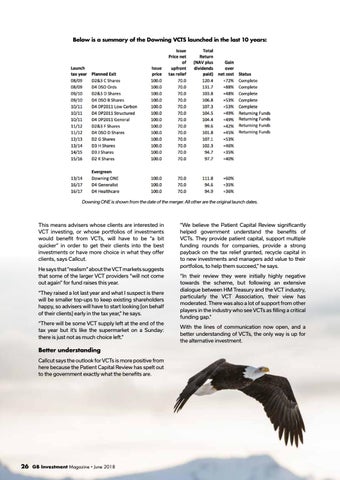
Below is a summary of the Downing VCTS launched in the last 10 years:
Downing ONE is shown from the date of the merger. All other are the original launch dates.
This means advisers whose clients are interested in VCT investing, or whose portfolios of investments would benefit from VCTs, will have to be “a bit quicker” in order to get their clients into the best investments or have more choice in what they offer clients, says Callcut. He says that “realism” about the VCT markets suggests that some of the larger VCT providers “will not come out again” for fund raises this year. “They raised a lot last year and what I suspect is there will be smaller top-ups to keep existing shareholders happy, so advisers will have to start looking [on behalf of their clients] early in the tax year,” he says. “There will be some VCT supply left at the end of the tax year but it’s like the supermarket on a Sunday: there is just not as much choice left.”
Better understanding Callcut says the outlook for VCTs is more positive from here because the Patient Capital Review has spelt out to the government exactly what the benefits are.
26
GB Investment Magazine · June 2018
“We believe the Patient Capital Review significantly helped government understand the benefits of VCTs. They provide patient capital, support multiple funding rounds for companies, provide a strong payback on the tax relief granted, recycle capital in to new investments and managers add value to their portfolios, to help them succeed,” he says. “In their review they were initially highly negative towards the scheme, but following an extensive dialogue between HM Treasury and the VCT industry, particularly the VCT Association, their view has moderated. There was also a lot of support from other players in the industry who see VCTs as filling a critical funding gap.” With the lines of communication now open, and a better understanding of VCTs, the only way is up for the alternative investment.
ENTREPRENEURIAL SPIRIT STILL ALIVE IN LAND OF VCTS The government may have put more restrictions on VCTs, but the strength of UK plc means the outlook is good for funds
Advisers are beginning to understand the investment benefits of VCTs as well as the tax breaks at a time when the UK entrepreneurial economy is looking stronger than ever. Inflows into VCTs reached a record £728 million in the 2017/18 tax year, according to figures from the Association of Investment Companies (AIC). The boost in VCT popularity is down to a number of factors, according to John Glencross, Chief Executive of Calculus Capital. He believes confidence in VCTs has grown as advisers are realising the alternative investment, which has been in operation for 25 years, is a “mature asset class” that operates successfully. He adds that “every year the challenge for advisers is finding the appropriate tax-efficient products for highnet-worth clients”. Much of the challenge for advisers is to do with the continued tightening on pension allowances, that has seen the annual allowance slashed to just £10,000 for the highest earners. “VCTs are not a substitute for pensions for those who have reached the limit, but they show themselves to be an attractive complementary product,” says Glencross.
Although Glencross says VCTs are “still seen as an important tax-based product” advisers are beginning to see the investment benefits behind the tax breaks with “proven success year-onyear”.
Budget implications The changes to pensions have been a slow burn that has ultimately pushed investors into VCTs, but the government has recently introduced a raft of more fast-acting changes to VCT rules that will impact the sector in different ways. In the months since the Autumn statement, much attention has been paid to the changes made to EIS investing as they represent a step-change for the industry, but less attention has been paid to those affecting VCT rules, which are more significant than advisers realise. These changes are best be understood by looking at the Treasury’s particular concerns: 1. It was felt that VCTs were sitting on too much cash stemming from large fundraisings, recent disposals of investments and a relatively slow investment rate.
GB Investment Magazine · June 2018
27
2. Some of the investment terms and structures used, such as liquidity preferences and high coupons on debt instruments, were regarded as too aggressive. 3. The Treasury also felt the interests of VCTs were not sufficiently aligned with entrepreneurs and favoured the VCT too heavily. These terms and structures often meant VCTs could achieve a positive return regardless of the performance of the underlying company. The Treasury made an attempt to address these concerns in the changes announced. 1. Older VCTs have lost their ‘grandfathered’ status. This means that they can no longer operate under previous rules and are pushed towards being growth investors. 2. VCTs are now required to invest 80% of funds, rather than 70%, in qualifying companies. 3. 30% of funds raised must be invested by the end of the first accounting period following the one in which the fundraising took place in a move to speed up investment. 4. The terms under which VCTs can invest now require any debt provided to be unsecured, with a coupon more in line with market rates. The likely impact of the changes and how they affect companies raising finance, and investors is yet to be known but they may have already had a hand in the record-breaking VCT numbers seen in the last tax year. A number of VCTs have raised record sums of money: the large fundraisings may be because, under the new rules, funds raised from 6 April 2018, will need to be invested more quickly.
Move to growth Since the rule changes in 2015, VCTs are also now required to be growth investors when most were, primarily, investors in smaller management buyouts. They have evolved towards being effective growth investors, which caused some increased pressure on VCTs. The recent changes have increased pressures to put money to work faster and, given the level of funds seeking to invest, a general inflation in prices has already been seen. Higher in-costs for investments will, of course, affect returns achieved. Moreover, growth investing is a very specialised skill – which generally sees more volatile patterns in those returns than those produced through MBO investing.
28
GB Investment Magazine · June 2018
Glencross says advisers may have “not fully appreciated the significance of the changes that have taken place” regarding not just the end of the VCTs investing in capital preservation types of investments but that VCTs have to put money to work faster. “If you go back two years to the 2015 Budget, there were significant changes then when VCTs could no longer invest in MBOs so the move to growth investing started and it was then driven home in the last Budget.”
Expected returns Overall, this may mean that VCT returns will not be on a par with those previously achieved and we are likely to see greater volatility, with some VCT portfolios seeing a marked pattern of winners and losers. HMRC has suggested that it may restrict the ability of a VCT to seek advanced approval for investments which further raises the risk profile. Since Calculus usually invests its EIS and VCT funds alongside each other, it will have the comfort of having received ‘advance assurance’ for its EIS funds, which is a reasonable guide to qualification for its VCT. Glencross says the “weight of money is greater than it has been” but some VCTs “logically may not be seeking to raise such large sums going forward, and we may not see the same level of funds raised in 2018/19 as seen in 2017/18”.
Limited choice and returns With a more challenging investment landscape for VCTs and the prospect of smaller levels of fundraisings in the future, investors may find that there will be less choice in the market, which may require investors to be prepared to move quicker to invest. Nevertheless, VCTs remain a significant and important asset class within an overall investment portfolio. Glencross is confident the VCT industry can adjust to the push towards growth investments. “Previously most VCT investments were MBO and capital preservation [types of investments] that have lower volatility and more consistent returns than growth investments,” he says. “Growth investing is more about winners and losers and the industry is yet to see whether VCTs can handle focusing more fully on growth investing with a greater level of volatility.” He says IFAs were currently giving the industry the “benefit of the doubt” that the sector can “adjust and
continue to deliver” but Glencross makes it clear that “three-to-four years down the line we may see VCT returns that are more volatile and at points may be lower and at times higher, rather than the consistent levels of returns we have seen in the past”. “The life of a VCT investment is five years but the losers tend to show themselves quicker than winners, but it’s five years before we get the full picture,” he says. “Lemons ripen before the plums.” The challenges for wealth advisers increase with each passing year. As some VCTs ‘rebrand’ themselves as growth investors whilst others, like Calculus, have always been so, it will be important for advisers to look at the experience and history of the manager they are considering. In particular, its record in growth investing. They will need to pay close attention to whether the performance record put forward is really relevant to today’s focus of growth investment or relates more to types of investment which are no longer permitted.
“It is a very active entrepreneurial economy and for those funds that have historically been growth investors, we have very well-established channels that bring us deals and we very rarely find ourselves competing against people, and sometimes when we do we work successfully together,” says Glencross. “There are challenges but it is a wonderful time to be an investor. I am encouraged by how much it shows the UK is adapting to the needs of being a modern economy.” In many ways, the greatest burden in getting to grips with the new rules will fall on advisers who will need to dig deeper and look even more closely at the evidence before advising their clients.
Entrepreneurial spirit While there may be more VCT money chasing a smaller pool of investments in future, the good news is that the pool consists of good investments and the UK entrepreneurial environment is good. “Having been a growth investor for 20 years, I have never seen the level of entrepreneurial activity in UK as strong as it is today,” says Glencross. “It is rather encouraging that much of it is in areas that are appropriate to the modern economy: technology, and med-tech, and diagnostics, with huge advances in life sciences. Lots of the activity we are seeing is appropriate activity.” He adds: “We focus on those companies that have already shown growth and the ability to stay the course,” says Glencross. “We do not do seed or early-stage investing.” However, he adds that there is “more money chasing investment and some VCTs have got greater problems than others” in deploying that money.
GB Investment Magazine · June 2018
29
M AGAZINE
ROUND TABLE BELFAST
30
GB Investment Magazine · June 2018
Round Table
Contributors Mark Brownridge
Director General | EISA Tel: 020 7620 6789 E: mark.brownridge@eisa.org.uk W: www.eisa.org.uk
Andrew Aldridge
Partner, Head of Marketing | Deepbridge Capital Tel: 01244 746000 E: andrew.aldridge@deepbridgecapital.com W: www.deepbridgecapital.com
Daniel Rodwell
Managing Director| GrowthInvest Tel: 020 7071 3495 E: daniel.rodwell@growthinvest.com W: www.growthinvest.com
Dr. Ilian Iliev
Managing Director | EcoMachines Ventures Tel: 020 3761 6138 E: info@ecomachinesventures.com W: www.ecomachinesventures.com
Boyd Carson Partner | Sapphire Capital Partners LLP Tel: 07917767362 E: boyd@sapphirecapitalpartners.co.uk W: www.sapphirecapitalpartners.co.uk
Richard Moore
Head of New Investments | Calculus Capital Tel: 020 7518 8056 E: richard@calculuscapital.com W: www.calculuscapital.com
Mr Francis Fitzpatrick Entrepreneur
Mr Malcolm Donnelly, IFA Wellington Court Financial Services
Dr Brian Hamilton, IFA Hamilton Financial Services
E: futurumKids@gmail.com
E: malcolm@llewdonnelly.com
E: Drbhamilton@gmail.com
T: 00 353 85 8444115
T: 07973 863704
T: (0)20 7022 1787
GB Investment Magazine ¡ June 2018
31
Due diligence is king in the race to the future Rapid technological advancement means advisers have to be more diligent than ever about the technology investments they put their clients’ money into
With no ‘safe’ technology investments and technological advancement meaning an everincreasingly complex world of investment opportunities, advisers must ensure their due diligence on technology recommendations is watertight. The technology sector has expanded at an astounding rate and continues to do so as smartphones play a vital role in our lives, the problems of ageing populations persist, new digital currencies are invented, and the race to the future continues. For investors, understanding what the technology of the future is is a demanding job and at times may feel almost impossible as the speed at which the technological landscape changes goes into overdrive. Before advisers and their clients can understand what new technology to invest in, they need to understand what ‘tech’ means. Speaking at an GBI Magazine technology investment roundtable event in Belfast, Andrew Aldridge, Head of Marketing at EIS provider Deepbridge Capital, says technology should not be defined by traditional parameters of computers and programmes. “From our perspective, we would not define tech as software or hardware and we don’t confine ourselves to one sector as there are often common characteristics to tech generally,” he says.
32
GB Investment Magazine · June 2018
“Usually it is an innovation that is able to take away human-centric jobs, particularly by creating a disruptive new way of doing things.” For Richard Moore, Head of New Investments at EIS and VCT provider Calculus Capital, tech may not be a specific development but “is something within the product or service that is going to enable it to grow at a rapid rate”.
Risk and reward Independent financial adviser Brian Hamilton, says that technology means different things to different clients and there was no clear definition. even when this is the case it may not mean much to investors as they are not typically experts. “Mostly investors don’t know as they are not tech people,” says Hamilton. “Clients just want to
Round Table
invest in a way that gives them a good return for their money; they want it to be safe and they want a better return for their money than they would get anywhere else.” He adds that “the problem with tech is it is now moving so quickly that it is very difficult to know where to go”. The fast-paced nature of technology investing, coupled with rules around what advisers can and cannot advise on - as well as long memories that can recall the dotcom crash of 2000 means Hamilton errs on the side of caution, he says. “Generally I am cautious and tend to advise on diversified funds rather than anything specific,” he says. “I don’t know whether that is in line with [other advisers] but in this world today, and in this moment in time, I would err on the side of caution and diversification.”
Despite his caution, Hamilton does not perceive technology investing as a high risk sector but notes that advisers need to understand what they are investing in when they drill down further into technologicallyspecific investments. “Tech in general [is not risky] but with tech-specific [investments], you need to know a bit more; and you need to know a lot more before you can arrive at conclusions,” he says. “I don’t see tech as a risk, it is an opportunity, but I remember the tech bubble that burst - I nearly lost a lot of money and I took a long time to invest again.” Investment understanding Understanding the underlying investment is part of an adviser’s due diligence process but it is undoubtedly made harder if the underlying investment is a complex technology, which few people truly understand to start with. Advisers
are relying on the skills of the fund manager to understand the investment and therefore have to work on two sets of due diligence covering both the fund manager’s skill and what they are investing in. Hamilton says he doesn’t “need to know that much detail” about the underlying technology, but that means relying on the fund and “we need to know who is behind” the fund manager. However, Hamilton notes that even fund managers cannot see into the future, and he recalls a seminar he attended in 2015 when he asked a fund manager, who was presenting, whether Brexit would happen and he said it wouldn’t. Aldridge says that, as an EIS manager who invests in technology, it is up to the manager to provide information about investee companies within a portfolio so that an investor, or their adviser, can make up their own minds about investing.
GB Investment Magazine · June 2018
33
“We don’t tell investors what to do but we can provide them with information about the types of company within a portfolio; hardware, software, type of technology, and how those companies are developing.” he says. The key for advisers when undertaking due diligence on fund managers, type of investment vehicle, and the underlying investment - whether that is in the technology sector or otherwise is that there is no safe bet. Dr Ilian Iliev, Managing Director of EcoMachine Ventures, which invests in promising technology companies and actively supports their growth into world class, high-growth enterprises, says investors face a challenging environment. “I think all of us, at the moment, face a challenge: there is no ‘safe’ anymore,” he says. “Fifteen to 20 years ago you could imagine areas that were safe, but that has gone.” Disruptive technology The crux is that sectors no longer operate or look like they did, as whole industries are being disrupted by technology, new business models, policy, and global change. “Every single sector you look at is open to disruption: oil and gas, tech, pension funds, real estate there has been massive flux,” says Iliev. “Models of ownership are being disrupted.” He gives the example of electric and automated vehicles disrupting the transportation sector and oil and gas sector.
34
GB Investment Magazine · June 2018
Round Table
According to figures from Next Greencar, there are currently 132,000 plug-in cars in the UK, 60 different plug-in hybrid models available, and 14,250 charging points, with a huge surge in the number of electric vehicles on the road in the past four years. The growth in this area has led BP to announce it will install charging points at UK petrol stations, a prime example of how technology can be disruptive to sectors and push them to adapt and in turn adopt their own new technologies. Iliev says his company has a focused investment strategy but there was no denying that technology and robotics is an integral part of modern life, and an increasing part. “We have a specific investment strategy but technology permeates everywhere, with robotics and artificial intelligence moving you towards material sciences, and the physical and digital realms are being transformed,” he says. “Having worked with technology for close to 20 years, the rate of change is accelerating.” A unique opportunity While these changes can feel overwhelming to investors, Iliev believes investment managers have an opportunity to help them understand the opportunities out there. “As an investment community we have an opportunity to help investors,” he says. “There are tech investment tools which have been developed over the last 30 years starting with Silicon Valley, which we could use.” In the UK one of these investment tools is the Enterprise Investment
Scheme (EIS), which aims to encourage investors to back small, fledgling business that are typically high risk. In return for putting their faith in the minnows of the UK economy, investors are rewarded with generous tax breaks around income and capital gains. Iliev says the EIS structure is “unique to the UK” and is as “powerful” as it is unique. “We need to be careful about what we invest in but it is a unique investment opportunity in the UK and smaller investors can take part in these opportunities,” he says. “The UK has intellectual property rights and is one of the more entrepreneurial countries within Europe, but ultimately it is about how you increase the investment you make.” Talk of technology investments automatically gets investors thinking about the likes of Facebook and Uber, and the huge sums that can be made from these ‘unicorn’ investments, but Iliev says investing in technology is more subtle than that.
“We are not looking for the next Uber,” he says. “What we are looking for is good intellectual property rights that can meet market needs and we combine that with larger corporates or build partnerships to decrease risk, and [those] who can take it to the market.” The reality of technology investing, exactly like any other type of investing, is that there is no sure thing and fund managers, EIS providers, and advisers all have to work to ensure they are not exposing clients to unnecessary risk. Clients on the other hand will have to understand that investing in small businesses and ones with niche technological specialisms will be inherently risky. “There are strategies you can use to decrease the risk of failure but you cannot mitigate it completely,” says Iliev. “The challenge for the IFA community is around building diverse investment strategies in a portfolio for your clients that decreases the down side.”
GB Investment Magazine · June 2018
35
Technology: in the spirit of the Patient Capital Review The government wants alternative investment vehicles to be the home to risky investments, and technology fits the bill The Patient Capital Review explicitly set out the need for EIS investors to take on more risk, and technology is one sector that lives up to the spirit of alternative investing. The Autumn Budget contained the outcome of the Patient Capital Review – and while the EIS industry was relieved that tax reliefs and minimum holding periods were left alone, the review did bring with it the need to reassess the types of investments held in EIS. No specific sector was penalised by the review, and it could be argued that the Treasury continues on the path it had long set with the removal of renewables as qualifying investments: it does not want EIS to be home to guaranteed or safe investments. Instead, it wants EIS to reflect the original objective of the investment vehicles, to fund companies seeking long-term growth that will in turn bolster the UK economy. To this end, the government has added a new ‘risk to capital’ condition for EIS that HM Revenue & Customs (HMRC) will assess. Under this condition HMRC will look at whether the company has the objective and ability to grow and develop long-term and will consider carefully whether an investor’s capital is
36
GB Investment Magazine · June 2018
at risk. Although full details are not available as yet, it is quite clear that HMRC does not want EIS to be used for capital preservation. EIS with a low return target that rely solely on tax reliefs to boost investors’ pots will no longer be tolerated, and investors will have to accept higher risk investments, that potentially offer higher returns, if they want the bonus of tax relief. To make itself explicit about where it wants to see EIS money channelled, the Treasury also increased investors’ annual EIS investment limits from £1 million to £2 million but the extra £1 million has to be invested in ‘knowledgeintensive companies’. These companies will also be able to raise double the amount in any one year than they were before, with up to £10 million a year being raised. Again, details of what constitutes a ‘knowledge-intensive company’ are still to come but it could focus on the amount of money a company spends on its research and development as a percentage of operating costs, for example. HMRC will be taking it upon itself to determine exactly what a knowledge-intensive company looks like and will have the final word on whether a company qualifies as such and in turn qualifies for inclusion in an EIS.
The UK is already streets ahead of its European cousins when it comes to investing in start-ups, mostly thanks to the EIS and VCT schemes, but there needs to be continued investment in this area, particularly around technology, if the government is to hit its aim to become a world leader in this sector. The Budget saw the government announce a plan to unlock £20 billion to finance growth in innovative firms over the next 10 years, and technology is a natural recipient of such new investment. On top of this, technology companies, by their nature, are knowledge-intensive thanks to the huge amounts of research and development that go into developing and testing new advancements. This ensures that EIS can continue to invest into the companies that are designing the future. Taking on more risk The government’s insistence that EIS moves back to riskier investments means that clients will have to take on that risk, but with the prospect of greater rewards. Speaking at an GBI Magazine technology roundtable event in Belfast, entrepreneur and financial consultant Francis Fitzpatrick
Round Table
says the government wants more money to go into EIS, but “there is risk in EIS”, and only certain clients will be willing to take on that risks and understand those risks. Independent financial adviser Brian Hamilton says most clients sit in the middle of the risk spectrum but will change their minds frequently about what level of risk they are happy taking. “If you ask your average client, on a scale of one-to-10, where do they sit on risk and they will point to the middle,” he says. “You can talk to a client who says ‘spread funds out and I will take a chance on this’ and an hour later they may have changed their minds. Generally I would err on the side of caution and I would go for well-known, well-managed, and profitable companies with a little in the new tech companies.” However, he says advisers have to be careful about where they are putting their clients for fear of complaints. He adds there needs to be “more diversity” in the choice of shares in order to protect client portfolios. No safe investments Diversification is particularly important for EIS investments now capital preservationfocused EIS have been removed by the Patient Capital Review, says Dan Rodwell, Managing Director at EIS and SEIS platform GrowthInvest. “It is pertinent now as there are no ‘safe’ investments,” he says. “Capital preservation has been taken away, and there is a good case for diversification in terms of investing in a management portfolio with a good team investing in good assets with a level of potential failure that the client is comfortable with.”
Hamilton says advisers can diversify a client’s portfolio and explain the nuances of long-term investing, but human nature often means they have short memories and are therefore spooked by short-term movements in markets. “There are probabilities as well as possibilities but investors need to take the longer term view.” A long term view Taking a longer term view is particularly important when dealing with nascent technology, as it may change and adapt over time, growing alongside new technology and becoming a solution to a problem that has not necessarily been thought of yet. Richard Moore, Head of New Investments at Calculus Capital, says funds are looking for developments rather than science. “For us, we are not necessarily interested in the science of tech,” he says. “We are more about the next development, the next algorithm that will revolutionise something in the world.” He says it is a fund manager’s job to look first at what problem the technology is trying to solve rather than approach the technology from a scientific perspective. “People will come to us saying ‘this is fantastic, this will change the world’, and we don’t necessarily know the science but we will look at it and get help from companies around the technology, and in that way we keep a good balance,” says Moore. While fund managers may have the time, resources, and experience to understand new types of technology it is a different situation when that
GB Investment Magazine · June 2018
37
technology has to be explained to clients who are unlikely to have a technology background and are inexperienced when it comes to specific types of technology that are being developed. Moore says Calculus Capital will keep very few clients informed in detail about technology investments as most do not understand it, and the majority just want to see a return. “Investors are after a return and they need to understand how it is managed out,” he says. “We will take one to 10 investors and keep them informed about companies, but how closely they follow that I don’t know. Some maybe, but most just want to receive their capital back with a return.” Dr Ilian Iliev, Managing Director of EcoMachine Ventures, which invests in promising technology companies and actively supports their growth into world class, highgrowth enterprises, says there are three types of technology investor. He says EIS “as an investment tool” lends itself to three types of investor. The first is the “passive investor” which he describes as someone who “relies on your judgement and only calls you when it goes wrong”. The second type is classified by Iliev as an “as an active investor”, a type which is of particular interest to EIS schemes. “These investors are interesting as they might be interested in taking on additional investment,” he says. “They will put money into an EIS vehicle and observe these companies and, over the next two or three years, will talk to their fund manager about putting more money into their chosen companies.” The third group of investors are the family offices, which Iliev says are
38
GB Investment Magazine · June 2018
“the people you have been working with a long time and where you are interested in making them take up a position.” He adds: “You have a mix of the these three types of investor and the challenge is that the investor’s stock has to be compatible with all this.” Show me the returns Whatever the type of investor and whatever their level of involvement and understanding of the underlying technology companies, there is one common theme among all of them, says Fitzpatrick. All clients want to know “how much am I going to make and how soon am I going to walk out”, he says. Andrew Aldridge, Head of Marketing at EIS provider Deepbridge Capital, says advisers may have to field a number of questions from their clients that are technical and it is the responsibility of the fund manager to provide education to assist advisers. Aldridge says the fund manager should be explaining what the preference of the manager is, what the investment criteria is, and what they are looking for in a company. He says that “through our sector experience, we provide advisers and investors with investment opportunities that we believe merit investment, and provide regular updates, but the clear thing to understand is why we are backing these companies.” What the actual technology actually does, is to some degrees irrelevant, it is understanding the commercial opportunity that is important.” Transparency rules Transparency is crucial in all investments, and technology is no different despite the occasional difficulty of understanding the
Round Table
nature of the companies a fund is investing in. Aldridge says that, in all of Deepbridge’s interactions with IFAs, there is “transparency with respect to our portfolios”. Rodwell agrees that transparency is what is needed for EIS investing, when this might be a relatively unknown area for many advisers and investors. However, there is a concern about differences in the market and the way investments are marketed and money is raised. “It is important, especially as we have shifted to EIS growth, that there is transparency but there is also disparity,” he says. “Different investment companies produce different vintages...some fund managers raise money with the expectation of doubling it in 28 days or six months, others have a tax management perspective.” He says this means clients are being offered a number of different types of outcome that they have to pick from as well as trying to pick a manager. “Effectively you are running two products and behind that you are investing in the managers,” he says. “I think, going forward, both IFAs and clients will have to be clear on what their position in the market is. We need to educate investors and IFAs.” Rodwell adds that fund managers investing in technology provide tangible examples to investors rather than giving them jargon and difficult technical texts to wade through. “We need to give them more than a feeling or understanding, but a real life experience in that space so they can say: ‘I get how that can change people’s lives or improve productivity’,’ he says.
“IFAs need to ensure the management team is good and that there are not another 20 competitive products out there.” Aldridge says education comes partly from transparency within the fund so that advisers and their clients understand what is being invested in, and importantly why the manager has chosen those investments. It could be that they work as a theme or that they have a common operational process. “For a tech portfolio, you need five or six projects with a common commercial flavour,” he says. “It goes back to the methodology behind it and ensuring transparency so people can tell what we are investing in.” Although the government’s Patient Capital Review was clear it wants EIS fund managers to increase the risk they are taking in the portfolios, which in turn will increase the potential for returns, Fitzpatrick says alternative investments are also competing against sexier investments such as cryptocurrencies. He also notes the rise of Ethereum, a blockchain technology which operates as an online ledger system underpinning digital currencies like Bitcoin with a technology that allows shared databases to be updated instantly, cutting out middlemen companies like brokers and banks. “There are two new [investments] happening at the moment: cryptocurrency and Ethereum with 5,000% or 10,000% [return] potential, so your client might well ask: ‘why am I wasting my time with an EIS at 10%?’,” says Fitzpatrick. “Unfortunately there are so many of these opportunities...it makes what we are talking about [via EIS] appear a little bit dull in terms of return.”
GB Investment Magazine · June 2018
39
Politics and progress in alternative investing The government is putting a raft of measures in place to ensure the UK is a centre of excellence for technology, but politics can hinder as much as it helps The government has set out its ambitions for the UK to be a worldleading technology hub, but EIS investment experts say political barriers should not get in the way of progress. In its Financing Growth in Innovative Firms consultation response in November, the Treasury said the UK is a worldleading place to start a business but noted that some of the potential is lost as “innovative start-ups can struggle to scale up because of the lack of finance”. Following a consultation with the industry, that involved the Patient Capital Review led by Sir Damon Buffini, the Treasury said it wanted to “create an economy that is driven by innovation that will see the UK becoming a world leader in new technology”. To this end, Chancellor Phillip Hammond used the Autumn Budget to announce an action plan that is expected
40
GB Investment Magazine · June 2018
to unlock £20 billion to finance growth in innovative firms over the next 10 years. This includes establishing a £2.5 billion investment fund incubated in the British Business Bank (BBB), with an intention to float or sell once it is established. This joint venture with the private sector means an estimated total of £7.5 billion of investment will be supported. Investment in a series of private sector large funds of funds by the BBB would also seed a wave of investment totalling £500 million. Further waves of investment will attract total investment of up to £4 billion the government has estimated. Another £1.5 billion will be invested by the BBB into emerging and first-time fund managers and another £1 billion will go to backing overseas investment in UK venture capital.
The launch of a National Security Strategic Investment Fund will potentially invest up to £85 million in advanced technologies that contribute to the UK’s national security. While the government is obviously keen to get new initiatives up and running, it is also counting on existing investment vehicles to help back the UK’s technology boom and support technology businesses. It said it would be “significantly expanding the support that innovative knowledge-intensive companies can receive through EIS and VCTs, while introducing a test to reduce the scope for and redirect low-risk investment”. By forcing EIS and VCT to take on more risk and support knowledgeintensive companies, the government believes £7 billion of new investment can be unlocked through EIS and VCT.
Round Table
From its review of financing and the Patient Capital Review it is clear the government wants to support companies and make it easier to start-up businesses in the UK rather than lose them to other jurisdictions. However, the government - and what some consider to be endless consultations - can do more harm than good by putting political barriers in the way of progress. More change needed Speaking at an GBI Magazine technology invest roundtable event in Belfast, Richard Moore, Head of New Investments at Calculus Capital, says if he were Prime Minister he would focus on building the next generation of technology companies. “I would not create artificial, politically-made barriers,” he says. “I would rejoice that we are building in tech and keep creating investment opportunities for earlystage technologies and build more robust companies to build next generation technology.” Boyd Carson, Director of Sapphire Capital Partners, which specialises in EIS, SEIS, SITR and R&D tax credits, says he would encourage more investors into EIS with a marketing drive, focusing particularly on the expansion of the investment limit from £1 million to £2 million. “I would advertise the expansion of the EIS programme and encourage more money to be put into them
and help take the company and economic growth to the next stage,” he says, adding that he would also bring in a “new form of expanded EIS”.
a number of long-term plans the Treasury has that it hopes will encourage investment into start-ups and help grow the UK economy.
“There is money going into startup companies early on, and more funding opportunities later on, but you need a tax efficient scheme to bridge that gap,” says Carson.
This includes the Pensions Regulator clarifying how pension trustees can include investments such as venture capital in their portfolios. And a working group will be established by the Treasury, institutional investors, and fund managers to “increase the supply of patient capital, including tackling continuing barriers holding back defined contribution pension savers from investing in illiquid assets”.
Independent financial adviser Brian Hamilton, says he would like to see EIS expanded so that UK investors can take stakes in US technology companies. “The government should set up a head-hunting firm that specifically operates in the tech arena and buy up a lot of shares in competitor companies in the US,” he says. However, Dan Rodwell, Managing Director at EIS and SEIS platform GrowthInvest, says the UK lacks the depth of the US technology market. “The reality is we will never have the depth of the US market but you could expand the EIS from start-ups to small capital equity companies and that would bring more people into gap investment,” he says. Long-term plan While the investment experts may have their own opinions on what the government should do to bolster investment in the UK technology sector, they will have to be satisfied with the raft of measures that have already been announced. There are also
The government will also undertake a number of consultations, including carrying out a feasibility study on a new guarantee programme modelled on the US Small Business Investment Company programme. The multi-billion dollar US initiative was founded in 1958 and offers privately-owned companies and investment funds using their own capital and typically operating in certain sectors, loans to make equity and debt investments. In a move that should assist the technology sector, the government is also working with businesses, lenders, insurers, the BBB, and the Intellectual Property Office to “overcome the barriers to high growth, intellectual property-rich firms, such as those in the creative and digital sector, using their intellectual property to access growth funding”.
GB Investment Magazine · June 2018
41
M AGAZINE
OPEN OFFERS Highlighting some of the key offerings currently available to IFAs
Open Offers
EIS Open
Close
July 2017
29 June 2018
Amount to be Raised: £20m Minimum Investment: £50,000
Calculus Capital EIS Fund Pioneers of tax efficient investing, Calculus Capital created the UK’s first approved EIS Fund in 1999. Our 18 year track record of investing in growing UK companies assures investors of our ability to make sensible investments capable of delivering excellent returns at every stage of the economic cycle. Calculus has won multiple awards, including the EIS Association’s ‘Fund Manager of the Year’ in February 2017, the fifth time the firm has been awarded the accolade and more recently was awarded Best EIS Fund Manager at the Tax Efficiency Awards in December 2017. Calculus are recognised as having an incredibly robust investment process and an active portfolio management style - which has led to an impressive track record of successful exits. The Calculus Capital EIS Fund focuses on established companies with growth potential, across a diverse range of sectors. An investor can expect a portfolio of 6-10 companies with the following characteristics: • The ability to achieve our target IRR of 20% • Experienced management teams • Successful sales of proven products or services • Profits or a clear path to profitability • Clear route to exit
T. 020 7493 4940 E. info@calculuscapital.com www.calculuscapital.com
VCT Open
October 2017
Close
31 July 2018
(2018/19 tax year)
Amount to be Raised: £5m Minimum Investment: £5,000
Calculus’ investment strategy is exit led, with a key focus on delivering strong returns to investors. The 18 month investment programme commences after relevant closing date. The next close is taking place 29 June 2018. Calculus value their reputation for client service as much as their investment record, and are focused on building long standing relationships with both clients and advisors. Please get in touch to find out more on 020 7493 4940 or info@calculuscapital.com
Calculus Capital VCT Pioneers of tax efficient investing, Calculus Capital have a strong track record for investing in established, unquoted SMEs. Our experienced investment team and thorough investment process have produced impressive dividend performance and exit returns for investors. By co-investing in selected established companies through both VCT and EIS, we are able to choose larger companies and bigger deals – reducing the risk profile of the investment. The Calculus VCT has the following characteristics: • Targets an annual dividend of 4.5% of NAV • Income tax relief of 30%, tax-free capital gains and dividends • Diversified portfolio, targeting 30 qualifying companies • Share certificates issued 10 days after allotment • Allotments available in both 2017/18 and 2018/19 tax years • Monthly standing order option available • Target 5% discount in respect to share buyback after 2020
T. 020 7493 4940 E. info@calculuscapital.com www.calculuscapital.com
BR Open
Now
Close
Evergreen
Amount to be Raised: Unlimited
The top up offer will be used to both invest in new companies with growth potential and provide further funding to a number of portfolio companies. Calculus value their reputation for personal service as much as their investment record, and are focused on providing an excellent client experience. Please get in touch to find out more on 020 7493 4940 or info@ calculuscapital.com
TIME:Advance TIME:Advance is a discretionary management service that allows investors to access Business Relief (BR) to mitigate their Inheritance Tax (IHT) liabilities. The service offers 100% IHT relief in just two years, alongside a targeted return of 3.5% per annum. Importantly clients retain access and control, so have the option to withdraw a lump sum or set up regular withdrawals in the form of an income. The service focuses on capital preservation by investing in asset backed businesses which qualify for BR. These businesses include secured lending, renewable energy, biomass and self-storage. The product is managed by an expert team, with a proven 22 year track record of success in achieving BR for investors.
T. 020 7391 4747 E. questions@time-investments.com www.time-investments.com
GB Investment Magazine · June 2018
43
BR Open
Close
Evergreen
Evergreen
Amount to be Raised: Unlimited
TIME:CTC (Corporate Trading Companies) TIME:CTC is a bespoke Inheritance Tax (IHT) solution for corporate investors, which boasts an impressive 22 year track record of delivering IHT relief for investors. TIME:CTC is aimed at business owners who have built up surplus cash in their business and could potentially lose Business Relief (BR). The focus of TIME:CTC is on capital preservation by investing in asset backed businesses which qualify for BR. These businesses include secured lending, renewable energy, biomass and self-storage. Our strategy allows business owners to maintain control of their assets, avoiding the need for trusts or gifting to obtain relief. Targeting a return of 3.5% and potentially immediate reinstatement of BR qualifying assets. To date more than 1,000 of our clients have exited and achieved BR.
T. 020 7391 4747 E. questions@time-investments.com www.time-investments.com
BR Open
Evergreen
Close
Evergreen
Amount to be Raised: Unlimited
TIME:AIM TIME:AIM uses our unique ‘smart passive’ approach in selecting companies listed on AIM for inclusion within the investment portfolios we create for investors. Designed to offer lower volatility returns than the AIM market, TIME:AIM will only target AIM listed companies that qualify for BR. SMART because we use an innovative, defensive market screening process PASSIVE because we remove stock picker bias and ignore market sentiment A welcome secondary benefit of this approach is that we are able to offer this service with a lower annual management fee than traditional AIM BR fund managers. We believe our service creates a robust portfolio that will allow investors the opportunity for significant growth potential and mitigation of their IHT liability after only two years. • Available within an ISA and non-ISA wrapper
T. 020 7391 4747 E. questions@time-investments.com www.time-investments.com
BPR / IHT Open
Evergreen
Close
Evergreen
Amount to be Raised: N/A Minimum Investment: £25,000
• IHT relief in just two years • Focus on reducing volatility • Removal of stock picker bias • Lower cost than traditional AIM services
Oxford Capital Estate Planning Service The Oxford Capital Estate Planning Service (OCEPS) can help investors mitigate Inheritance Tax by investing in companies that should qualify for Business Property Relief, subject to the requisite holding period. OCEPS offers investors ‘flexibility and control’ over their investment. Options include Capital Growth and Income. Target returns range from 3% to 5% p.a., and capital can be accessed within 1-6 months through the sale of shares. If an investor’s circumstances change, they can elect to switch to an alternative, more appropriate, investment option. Investors in the Estate Planning Service will acquire shares in unquoted holding companies. These companies will make equity investments in, and loans to, companies which in turn will own and operate revenue-generating assets. Currently the investment strategy is focused on small-scale power generating equipment, property construction and renewable energy assets. Over time, other assets will be added to the portfolio.
T. 01865 860 760 E. info@oxcp.com www.oxcp.com
44
NOTE: No initial fee or dealing fee is payable on investments made before 30 June 2018
GB Investment Magazine · June 2018
Open Offers
EIS Open
Close
Evergreen
Evergreen
Amount to be Raised: N/A Minimum Investment: £25,000
T. 01865 860 760 E. info@oxcp.com www.oxcp.com
IHT
BPR
Open
Close
Evergreen
Evergreen
Minimum Investment: £30,000
Fundamental
T. 01923 713 890 E. enquiries@fundamentalasset.com www.fundamentalasset.com
EIS Open
10.01.2018
SEIS Close
30.06.2018
Amount to be Raised: £2.75m Minimum Investment: £5,000
T. 020 7071 3945 E. enquiries@growthinvest.com
Oxford Capital Growth EIS We will build a portfolio of shares in 12-15 companies for investors over a period of roughly 12-18 months. We invest in early stage technology focused businesses in the UK. We aim to access the best deals, invest early and keep backing the winners. Our current portfolio includes companies in sectors such as fintech, online marketplaces, digital healthcare, AI and machine learning. Recent investee companies include Push Doctor (online health), Monebox (digital savings) and Eporta (online marketplace). Our experienced team works closely with investee companies, typically sitting on the board, helping to accelerate commercial development with the aim of achieving a profitable exit, usually through either a trade sale or a stock market listing. Each portfolio company should be eligible for EIS reliefs, including 30% income tax relief and tax-free gains.
Fundamental AIM IHT Portfolio Fundamental Asset Management is an independent, owner managed, investment management firm with an unrivalled knowledge of the AIM market. It has successfully provided AIM portfolio management with inheritance tax planning to private investors, trusts and institutions since 2004 delivering outstanding returns. Our investment ethos for AIM IHT Portfolios is conservative and value based. At its foundation is our in-depth, in-house research, which includes visiting and meeting senior management of hundreds of companies each year. As well as being available on its own broker platform the Fundamental AIM IHT Portfolio service can also be accessed through the AXA Elevate, Nucleus, Standard Life and Transact platforms.
Dorset County Distilling Co Hutch & Alex Wright established Dorset County Distilling Co’s concept in 2015 and over years have carried out extensive research, completed distillers courses, and more, to fine-tune the concept. Located on a farm nestled in a picturesque North Dorset valley, the distillery will be using German technology, be environmentally responsible & source suppliers locally to produce premium brands of unique flavoured Dorset malt and rye whisky, gin, rum, vodka and eau de vies. The ‘English whisky’ industry is still in its infancy. There are allegedly around 14 whisky distilleries in England, of which only four are substantial non-micro producers. The Springhead Distillery would be the only substantial West Country whisky distiller and the fifth midsize facility. This creates an exciting investment opportunity exclusively available on the GrowthInvest platform.
https://growthinvest.com /investment-opportunities/
SEIS Open
May 2018
Close November 2018
Amount to be Raised: Open Minimum Investment: £10,000
The British Robotics Seed Fund Across the globe, the robotics industry is reaching a tipping point. For the first time, it is becoming cheaper to own, operate and maintain a robotics system, than it is to use manual labour. Robots are expected to perform 25% of industrial work by 2025. The British Robotics Seed Fund 2 (Sidecar), in conjunction with Sapphire Capital Partners LLP, is one of the first SEIS funds to specialise in UK robotics and AI start-ups. It aims to take advantage of the robotic revolution. Highlights: • Predominantly SEIS offer targeting 3x return, not including tax relief (returns not guaranteed); • A portfolio of around ten early stage robotics and artifical intelligence (AI) companies; • Fast growing sector, capitalising on Britain’s strength in robotics and AI;
E. dominic@britbots.com www.britbots.com
• Fund 2 (Sidecar) will invest predominantly in the 2018/19 tax year (with benefits eligible to be carried-back to 2017/18); • Exit targeted in three to eight years (not guaranteed).
GB Investment Magazine · June 2018
45
Open Offers
EIS Open
January 2013
Close
Evergreen
Deepbridge - Technology Growth EIS
Amount to be Raised: Uncapped
The Deepbridge Technology Growth EIS represents an opportunity for private investors to participate in a selected portfolio of innovative growth companies, taking advantage of the tax benefits available under the Enterprise Investment
Minimum Investment: £10,000
Scheme. The Deepbridge EIS focusses principally on three sectors: • Energy and resource innovation; • Medical technologies; • Business enterprise and other high growth IT-based technologies. The Deepbridge Investment Team has a proven track record of working with emerging companies to create value for shareholders through a hands-on investment methodology. The Deepbridge Technology Growth EIS is a manager fee-free EIS opportunity at the point of investment for subscriptions received by a financial adviser. Upfront and ongoing manager fees are paid by the Investee Companies, potentially allowing investors to enjoy up to 100% of EIS tax benefits. Please see costs and fees section in the Information Memorandum for full details.
T. 01244 746000 E. Enquiries @deepbridgecapital.com www.deepbridgecapital.com
SEIS Open
January 2016
Close
Evergreen
Target Raise: £3m per annum Minimum Investment: £10,000
The availability of EIS tax reliefs depends on individual circumstances, may be subject to change in future and depend on underlying companies invested in maintaining their qualifying status. Investment in unquoted companies carries high risks and investors could lose the total value of their investment. Investments in EIS can be difficult to realise. Past performance is not a reliable indicator of future performance. This financial promotion, directed at investment professionals, has been approved by Enterprise Investment Partners LLP (“EIP”). Deepbridge Advisers Limited (FRN: 609786) is an Appointed Representative of EIP, which is authorised and regulated by the Financial Conduct Authority (FRN: 604439).
The Deepbridge Life Sciences SEIS The Deepbridge Life Sciences SEIS represents an opportunity for private investors to participate in a selected portfolio of early stage life sciences companies, taking advantage of the tax benefits available under the Seed Enterprise Investment Scheme. Providing seed investment to emerging companies operating in the life sciences sector, the Deepbridge Life Sciences SEIS seeks to fund companies with exciting new technologies that aim to satisfy the needs of large and growing markets. The Deepbridge Investment Team has a proven track record of working with emerging companies to create value for shareholders through a hands-on investment methodology. The Deepbridge Life Sciences SEIS is a manager fee-free SEIS opportunity at the point of investment for subscriptions received by a financial adviser. Upfront and ongoing manager fees are paid by the Investee Companies, potentially allowing investors to enjoy up to 100% of SEIS tax benefits. Please see costs and fees section in the Information Memorandum for full details.
T. 01244 746000 E. Enquiries @deepbridgecapital.com www.deepbridgecapital.com
EIS Open
March 2017
Close
Evergreen
The availability of SEIS tax reliefs depends on individual circumstances, may be subject to change in future and depend on underlying companies invested in maintaining their qualifying status. Investment in unquoted companies carries high risks and investors could lose the total value of their investment. Investments in SEIS can be difficult to realise. Past performance is not a reliable indicator of future performance. This financial promotion, directed at investment professionals, has been approved by Enterprise Investment Partners LLP (“EIP”). Deepbridge Advisers Limited (FRN: 609786) is an Appointed Representative of EIP, which is authorised and regulated by the Financial Conduct Authority (FRN: 604439).
Deepbridge Life Sciences EIS
Maximum Raise: Uncapped
The Deepbridge Life Sciences EIS represents an opportunity for private investors to participate in a selected portfolio of healthcare innovation, whilst taking advantage of the tax benefits available under the Enterprise Investment Scheme.
Minimum investment: £10,000
The Deepbridge Life Sciences EIS focuses principally, but not exclusively, on three sectors: • Biopharmaceuticals • Biotechnology • Medical Technology. The Deepbridge Investment Team has a proven track record of working with emerging companies to create value for shareholders through a hands-on investment methodology. The Deepbridge Life Sciences EIS is a manager fee-free EIS opportunity at the point of investment for subscriptions received by a financial adviser. Upfront and ongoing manager fees are paid by the Investee Companies, potentially allowing investors to enjoy up to 100% of EIS tax benefits. Please see costs and fees section in the Information Memorandum for full details.
T. 01244 746000 E. Enquiries @deepbridgecapital.com www.deepbridgecapital.com
46
The availability of EIS tax reliefs depends on individual circumstances, may be subject to change in future and depend on underlying companies invested in maintaining their qualifying status. Investment in unquoted companies carries high risks and investors could lose the total value of their investment. Investments in EIS can be difficult to realise. Past performance is not a reliable indicator of future performance. This financial promotion, directed at investment professionals, has been approved by Enterprise Investment Partners LLP (“EIP”).Deepbridge Advisers Limited (FRN: 609786) is an Appointed Representative of EIP, which is authorised and regulated by the Financial Conduct Authority (FRN: 604439).
GB Investment Magazine · June 2018
Open Offers
SEIS Open
Close
Nov 2017
Evergreen
Target Raise: £3m per annum Minimum investment: £10,000
Deepbridge Innovation SEIS The Deepbridge Innovation SEIS represents an opportunity for private investors to participate in a selected portfolio of innovative seed stage innovation companies, taking advantage of the tax benefits available under the Seed Enterprise Investment Scheme. Providing seed investment to emerging technology-focused companies, the Deepbridge Innovation SEIS seeks to fund selected investee companies that possess an exciting new innovative approach to meet the existing and emerging requirements and demands of both corporate and consumer markets. The Deepbridge Investment Team has a proven track record of working with emerging companies to create value for shareholders through a hands-on investment methodology. The Deepbridge Innovation SEIS is a manager fee-free SEIS opportunity at the point of investment for subscriptions received by a financial adviser. Upfront and ongoing manager fees are paid by the Investee Companies, potentially allowing investors to enjoy up to 100% of SEIS tax benefits. Please see costs and fees section in the Information Memorandum for full details.
T. 01244 746000 E. Enquiries @deepbridgecapital.com www.deepbridgecapital.com
EIS Open
01.04.2017
Close
Evergreen
Total Amount to be Raised: £3.6m Minimum Investment: £25,000 or to be negotiated as part of a portfolio’
The availability of SEIS tax reliefs depends on individual circumstances, may be subject to change in future and depend on underlying companies invested in maintaining their qualifying status. Investment in unquoted companies carries high risks and investors could lose the total value of their investment. Investments in SEIS can be difficult to realise. Past performance is not a reliable indicator of future performance. This financial promotion, directed at investment professionals, has been approved by Enterprise Investment Partners LLP (“EIP”). Deepbridge Advisers Limited (FRN: 609786) is an Appointed Representative of EIP, which is authorised and regulated by the Financial Conduct Authority (FRN: 604439).
Ober Private Clients – Fairy Tale of New York Starring Golden Globe winning actor, Kiefer Sutherland (24, Flatliners, Stand By Me, Lost Boys, A Few Good Men and Young Guns) and Kate Bosworth (Superman Returns, Still Alice and Heist), as well as an ensemble of other A-List actors, Fairy Tale of New York is a modern love story based upon the most popular Christmas song of the 21st Century. The world-class film makers, including award winning director, Lee Cleary (Hurt Locker, the X-Men films and Fantastic Four), and producer, Lisa Katselas, (producer of twice Oscar nominated Richard III), are positioning the film to appeal to a broad international audience, aided by the strong brand recognition of the title song and the extensive fan-bases of the cast. Fairy Tale of New York is expected to capture the lucrative seasonal market at Christmas time for many years to come, as one of the few credible festive films available. The subject-matter of the film also assists with the generation of ancillary revenues from soundtrack, merchandise and other commercial activities.
T. 0161 509 8622 E. lizz.ewart@oberprivateclients.com www.oberprivateclients.com
SITR Open
Feb 2016
Close
Evergreen
(with roughly quarterly closes)
Amount to be Raised: £5m Minimum Investment: £20,000
As a film that key cast and crew are deeply passionate and confident about, a large proportion of its costs have been substituted for equity, resulting in a budget that is significantly below production value. Investors also benefit from a priority mechanism to the point they have recouped 130% of gross capital as well as an uncapped share of the upside. For more information on this opportunity and other opportunities offered by Ober Private Clients, please contact Lizz Ewart: lizz.ewart@oberprivateclients.com THIS IS FOR INTERMEDIARY USE ONLY’
Resonance Bristol and West Midlands SITR Funds The Resonance Bristol SITR Fund (a sub-fund of the Resonance SITR Fund), is one of the first investment funds in the country to benefit from Social Investment Tax Relief (SITR). The Fund enables investors to build a portfolio of investments with the potential for attractive returns and tax relief benefits, whilst also helping to dismantle poverty in and around the City of Bristol through investing in the growth of high impact, mission-driven social enterprises. Based on the success of the Resonance Bristol SITR Fund, Resonance has now launched its second SITR Fund in the West Midlands (the Resonance West Midlands SITR Fund), which is now live and open for investment. SITR offers similar tax reliefs to those available through the Enterprise Investment Scheme (EIS), including a 30% income tax relief. The key innovation is that SITR is available on debt, as well as equity. This means that debt focused SITR Funds can offer the flexible, affordable loan capital that social enterprises require to grow their businesses and social impact, whilst also offering investors a more predictable income profile and exit route compared to equity based Funds.
T. 07718 425 306 E. grace.england@resonance.ltd.uk www.resonance.ltd.uk
Resonance has over 16 years of experience in arranging investment into social enterprises, and now has over £160m under management through eight social impact investment Funds. These funds deliver financial return as well as targeted social impact in a range of areas – from tackling homelessness to health inequalities.
GB Investment Magazine · June 2018
47
EIS
SEIS
Open
Close
Now
N/A
Amount to be Raised: £5m Minimum Investment: £15,000
T. 01865 784466 E. info@oxfordtechnology.com www.oxfordtechnology.com
EIS Open
01.09.2017
Close
Evergreen
Amount to be Raised: £40m
Oxford Technology Combined SEIS and EIS Fund - “The Start-up Fund” OT(S)EIS invests in high risk high reward technology start-ups, in general within an hour’s drive of Oxford and has been doing this since 1983. The latest fund OT(S)EIS made its first investment in 2012. By 30 June 2017, 70 investments had been made in 28 companies. The statistics to 31 Dec 2017 are: • Gross amount invested by OT(S)EIS: £4.17m • Cash back to investors via tax refunds: £1.67m • Net cost of these investments after tax relief: £2.50m • Fair value: £9.15m • Tax Free gain (on paper only so far): £6.65m OT(S)EIS remains open for investment at any time. The latest quarterly report, with a page of information on each investment is downloadable from www.oxfordtechnology.com
Oxford Technology EIS Fund - “The Development Fund” Oxford Technology has been investing in technology start-ups since 1983. The Oxford Technology EIS Fund will aim to provide each investor a diversified portfolio of 5 - 10 EIS investments in high risk, but high potential early stage technology companies near Oxford.
Minimum Investment: £15,000
T. 020 7222 3475 E. info@oxfordtechnology.com www.oxfordtechnology.com
EIS Open
Evergreen
SEIS Close
Evergreen
Amount to be Raised: N/A Minimum Investment: £5,000
GrowthInvest - The Tax Efficient Platform for Advisers GrowthInvest is a unique, independent platform which provides access to tax efficient investments to a growing network of UK financial advisers, wealth managers and investors. Originally founded by financial advisers in 2012 as the Seed EIS Platform, we rebranded as GrowthInvest in October 2016 to better reflect the wider range of products and services available: We permit investment into a range of single company offers, as well as Managed EIS Portfolio Services and funds, giving clients a number of different investment options. • We offer a simplified asset transfer process which allows advisers to place all of their clients’ tax efficient investments onto the platform. • We provide intuitive online reporting tools, allowing advisers to monitor, analyse, and provide consolidated performance updates and quarterly reports to their clients. • All investable companies go through one of 3 defined due diligence tiers, giving added peace-of-mind to the adviser.
T. 020 7071 3945 E. enquiries@growthinvest.com www.growthinvest.com
48
• A single, secure online environment for all clients to review and build their tax efficient investment portfolios. We’ve placed the adviser at the heart of everything we do, making it straightforward for advisers to improve the service they offer to their clients in the tax efficient investment arena. Please visit us at growthinvest.com for more details about our current open investment opportunities.
GB Investment Magazine · June 2018
Open Offers
EIS
SEIS
Open
April 2017
Close
Evergreen
Amount to be Raised:
Up to £25,000,000
Minimum Investment: £10,000
T. 020 7071 3945 E. enquiries@growthinvest.com www.growthinvest.com
DMS Open
January 2015
Close
Evergreen
Amount to be Raised: Unlimited Minimum Investment: N/A
GrowthInvest Portfolio Service A discretionary investment management service which seeks to leverage the experience and expertise of the GrowthInvest investment team to select a diversified portfolio of some of the most promising companies that have passed through GrowthInvest due diligence process. GrowthInvest is an independent platform, which provides access to tax efficient investments to a growing network of UK financial advisers, wealth managers and investors. The platform aims to bring the advantages of early stage investing to a wider audience of investors and advisers, who are able to benefit from the potentially higher returns these companies can offer and tax efficiency via government approved schemes, such as SEIS and EIS. From our experience working with advisers on the Platform, the Fund has been designed to consist of three sub-funds, each with a separate investment policy. The first will target Investee Companies which qualify for SEIS Reliefs only. The second will target Investee Companies which qualify for EIS Reliefs only and the third will be a mixed investment policy which will target Investee Companies which qualify for SEIS Reliefs and / or EIS Reliefs. You will be able to choose how much of your subscription to allocate to each of these three sub-funds. The Fund is aiming to exit investments after three to seven years.
Property Partner Discretionary Managed Service (DMS) Property Partner is the UK’s largest property investment platform and stock exchange, allowing investors to take a view on property assets, diversify their portfolio easily, and manage their market exposure at the click of a button. Residential property is a popular investment with a strong track record, but it is not always easy to access. Our purpose is to bring accessibility, simplicity, and liquidity to this asset class. Our proposition makes it really simple for investors to diversify across multiple properties, in multiple locations, with multiple tenants, thereby reducing risk, and also removing all of the hassle associated with traditional buy-to-let. This includes tenant management, ongoing maintenance, and the significant legal and administrative burdens. Property Partner’s Discretionary Managed Service allows your clients to own their share in a number of properties of their choosing, in line with specific investment criteria. Investors will also earn 5% interest on un-invested capital. Income is paid monthly in the form of a dividend, and investors can sell their holdings whenever they like on the resale market. Property Partner is the new way for advisers to engage with clients about buy-to-let. Please get in touch for more details about how to apply.
T. 0203 457 2471 E. john.oliver@propertypartner.co www.propertypartner.co
EIS Launch
May 2017
SEIS Close
Evergreen
Amount to be Raised: £5m Minimum Investment: £10,000
Property Partner™ is the trading name of London House Exchange Limited, which is authorised and regulated by the Financial Conduct Authority (No. 613499). Capital at risk. The value of your investment can go down as well as up. The Financial Services Compensation Scheme (FSCS) protects the cash held in your Property Partner account, however the investments that you make through Property Partner are not protected by the FSCS in the event that you do not receive back the amount that you have invested. Forecasts are not a reliable indicator of future performance. Gross rent, dividends and capital growth may be lower than estimated. 5 yearly exit protection or exit on platform subject to price & demand. Property Partner does not provide tax or investment advice and any general information is provided to help you make your own informed decisions. Customers are advised to obtain appropriate tax or investment advice where necessary.
Jenson SEIS & EIS Fund The Fund targets exciting, innovative and disruptive technologies that are nurtured alongside existing investments (in the current SEIS investee company portfolio) which are ready for follow-on funding to fully exploit commercialisation of a proven business model, via the EIS. Our combined SEIS and EIS structure is designed to provide increased diversification as a portfolio investment; whilst the balance between capital growth, portfolio risk and time horizon is maximised, along with enhancing the tax advantages available. Jenson is a pioneer of SEIS Investments, investing since 2012 and with over 80 investments (£12 million) to date. They actively advise entrepreneurs to re-evaluate business models, reduce projected costs and introduce potential executives, partners, customers and suppliers as part of the value add service they provide. Jenson aims to offer these businesses far more than just funding.
T. 020 7788 7539 E. seis@jensonsolutions.com www.jensonfundingpartners.com
The Investee support programme provides financial and operational assistance to investee companies - enhancing returns, a key differentiator between Jenson and other SEIS and EIS providers. The Jenson SEIS and EIS Fund allows investors to choose whether they want to invest solely via SEIS or EIS or to split their funds across SEIS and EIS investments, enabling the investor to maximise the tax advantages.
GB Investment Magazine · June 2018
49
NEWS
•
REVIEWS
•
COMMENT
•
A N A LY S I S
•
INVESTMENT
Time is precious. Invest it wisely. Comprehensive and in-depth reviews, comment and analysis for today’s discerning financial and investment professional.
www.ifamagazine.com
Open Offers
EIS
EIS
Open
January 2015
Close
Evergreen
Amount to be Raised: Unlimited
CHF Enterprises CHF Enterprises Limited presents an exciting opportunity for UK tax payers to invest in SEIS and EIS qualifying Family Entertainment via CHF’s Investee Companies, whilst benefiting from risk mitigation through considerable investor Tax Relief and government backed Tax Credits. A 40 Year Global Success Story: The CHF creative team can trace its history to UK’s Cosgrove Hall producing household names including Danger Mouse, Wind in the Willows, Noddy, Postman Pat, Roary the Racing Car, Count Ducula… winning 9 BAFTAs and 2 Emmys. The CHF Media Fund was set up in 2015 to offer the opportunity to invest in the new slate of CHF content. Why the CHF Media Fund? • Proven Track Record and award winning team with 250+ years collective industry experience with time also spent at Disney, Henson, Dreamworks and more • Low charges and market leading RIY • 3-5 year Exit Strategy from each show’s launch • Target Return 3 times net investment with unlimited upside and no cap
T. +44 (0)117 214 1149 E. ninacarr@chfmedia.com www.chfenterprises.co.uk
EIS
SEIS
Open
Close
Now
31st July
Amount to be Raised: £3.5m Minimum Investment: £20,000
• Fortnightly Deployments with EIS 3’s issued at earliest opportunity • Unique Multiple Revenue Streams from worldwide broadcast and online sales plus licensing and merchandising • Government Animation Tax Credit benefits should apply to all UK produced CHF shows
Iron Box Capital: Alive in the Morning Ltd. Alive in the Morning Ltd. will develop, produce, finance and market a slate of unique, commercial films in the horror and thriller/horror genres. Horror is one of the most popular and pro table genres in a worldwide Filmed entertainment market that will be worth a forecasted US$104.62 billion a year by 2019. It is consistently commercially successful as people love to watch movies to be scared, whether at the cinema or at home. Horror is also one of the most international genres, as fear is universal, transcending cultural and geographical boundaries. Horror Films additionally can be made on low budgets and do not need star names to attract audiences, offering the potential for a significant return-on-investment.
THE
MORNInG T. 07528616752 E. raimund@ironboxcapital.com www.ironboxcapital.com
SEIS Open
Now
Close
31st July
Amount to be Raised: £750K Minimum Investment: £10,000
Advance Assurance has been given.
Iron Box Film & TV seis channel in the Amersham seis fund The British Film Industry is growing, and is forecast to grow for years to come. This is fuelled by the global demand for films, through multi on-line channels, including Netflix and Amazon Prime. Iron Box’s team of experts has specialist knowledge across development, finance, production and marketing of film & television projects. As a company they are well positioned to capitalise on this growth market. The aim is to focus on the most profitable genres, where there is a clear target audience, and in using proven teams of people that have a track record of making profitable Film & TV shows.
THE
MORNInG T. 020 3011 5096 E. info@symvancapital.com www.symvancapital.com
The Iron Box Film & TV SEIS Channel has been designed for UK tax payers who prefer to invest in a managed portfolio of independent filmed entertainment projects, whether for traditional films or television. There are likely to be around 4 films in each portfolio. The fund will finance projects that are commercial, with strong audience appeal, and suit the international marketplace. The companies will be SEIS eligible.
GB Investment Magazine · June 2018
51
EIS
SEIS
Open
Close
October 2016
Evergreen
Amount to be Raised: Unlimited Minimum Investment: £15,000
Start-Up Series Fund - Investing in product & service start-ups in attractive markets, creating innovation & building the brands of tomorrow - Highly competitive, more than a hundred businesses a month considered for one or two seed investment opportunities - Businesses selected by real world, commercial entrepreneurs with deep brand, marketing, retail & innovation expertise - Ongoing oversight from experienced battle scarred investor directors, skilled in accelerating growth & reducing risk - SEIS investments in carefully constructed ‘mini-portfolios’ of 4 to 6 businesses, selected for fund investors - EIS investment opportunities in discretionary portfolios or individually selected by investors
T. +44 20 3858 0847 E. info@worthcapital.uk worthcapital.uk
EIS Open
Close
Now
N/A
Amount to be Raised: £10m Minimum Investment: £25,000
Worth Capital assess the deal flow, negotiate a fair valuation and make a commercial recommendation to Amersham Investment Management who challenge the rationale and choose to accept (or reject) the recommendation, before conducting further independent due diligence, making the investments and administering the fund on behalf of investors.
EcoMachines Ventures - EMV EIS Fund EcoMachines Ventures (EMV) is a London-based investor in B2B industrial high-tech companies investing in, building, and supporting the growth of high-potential technology SMEs with core technological innovation. EMV has experience working and co-investing with some of the world’s largest industrial players in its focus area including ABB, Philips Lighting, Evonik Industries and Flex. The EMV EIS Fund I is a discretionary portfolio focusing on EIS qualifying investments in high growth technology areas including: • Robotics and artificial intelligence (“AI”) • Power electronics and controls • Internet of things (“IoT”) • Materials science and chemistry The Fund will focus on the use of these technologies within the following broad sectors: • Energy and energy efficiency • Industrial high-tech • Resource efficiency • Smart cities and smart buildings • Smart transport
T. 203 761 6138 E. info@ecomachinesventures.com www.ecomachinesventures.com/emv-eis-fund
EIS Open
December 2016
Close
Evergreen
(Quarterly Investment)
Amount to be Raised: Up to £10m Minimum Investment: £20,000
(Subject to Manager’s discretion)
EMV is acting as exclusive advisor to the fund, bringing its established expertise, analytical framework and network of corporate relationships to provide quality investments and attractive EIS tax relief to investors. The fund manager is Sapphire Capital Partners, an award-winning specialist fund manager focused on EIS and SEIS schemes. The Fund is also supported by Mainspring, a leading UK fund custodian.
Symvan Technology EIS Fund The Symvan Technology EIS Fund is investing across a portfolio of 8-10 companies over the next 12 months. The Symvan investment philosophy can best be described as a ‘blended’ California approach. We invest in disruptive technology companies that each have the potential to provide a 10x return to investors. We take a board seat and actively work with founders to achieve both further funding and an exit. The target return for the Fund is £2.85 for every £1 invested after five years (excluding the effect of any tax relief).
T. 020 3011 5096 E. info@symvancapital.com www.symvancapital.com
52
Symvan anticipates developments during 2018 across its clients and portfolios. The first is a cyber security business which will be floated on NASDAQ. The second is a share for share acquisition in the FinTech sector. The deadline for subscriptions is 29th March. Capacity for carry-back to 2016/17 is available. For urgent last minute pre-tax year end applications, please call 020 3011 5097.
GB Investment Magazine · June 2018
Open Offers
SEIS Open
Close
January 2018
Evergreen
Amount to be Raised: £1.5m Minimum Investment: £10,000
T. 020 3011 5096 E. info@symvancapital.com www.symvancapital.com
EIS Open
Evergreen
Close
Evergreen
Amount to be Raised: Evergreen Minimum Investment: £15,000
Symvan Technology SEIS Fund 3 Symvan third SEIS fund, the Symvan Technology SEIS Fund 3 is investing across a portfolio of companies over the next 12 to 18 months. The target return for the Fund is £2.85 for every £1 invested after 5-7 years (excluding the effect of any tax relief). The Fund’s investment focus is on four subsectors: Machine Learning; Internet of Things; Data driven technologies involving big data analytics, cyber security, block chain, etc.; and Immersive technologies such as Augmented Reality (AR) and Virtual Reality (VR). Companies will mostly be offering software for the most part, often with a business-to-business (B2B) focus. Advance Assurance has been received in respect of qualifying under the SEIS; companies will have experienced and reliable management teams; there is a clear path to recurring sales growth, even at the expense of near-term profitability; the companies have a business model with high margins and relatively low capex requirements; companies require a plausible exit strategy; and must each have the potential to generate a return of ten times the original investment.
Downing Ventures EIS The Downing Ventures EIS invests in high risk, high potential return investment opportunities with a principal focus on early-stage UK technology companies, whilst also providing access to attractive EIS tax reliefs. Downing Ventures will invest across a variety of sectors. The principal focus will be on the technology sector, but we also have considerable expertise in the leisure and energy infrastructure sectors and will consider higher risk/higher return opportunities within these areas. Each of these early-stage businesses will be high risk with a significant chance of failure. However, the following factors should help to manage risk:
T. 020 7630 3319 E. sales@downing.co.uk www.downing.co.uk
IHT Open
Evergreen
BPR Close
Evergreen
Amount to be Raised: Evergreen Minimum Investment: £25,000
Diversification: subscriptions estimated to be spread across approximately 12 - 15 growth businesses. Due diligence: a high number of opportunities will be investigated before each investment is made (up to 30 opportunities per investment). It is anticipated that Investors will be given the opportunity to exit their investments between four and eight years from subscription.
Downing Estate Planning Service The Downing Estate Planning Service aims to preserve investors’ capital by focusing on businesses in two distinct sectors, which we believe are lower risk than some other tax-efficient sectors. It has been designed to offer full IHT relief on subscription after only two years by investing in a portfolio of businesses trading from freehold premises and/or energy businesses through investments that should qualify for Business Relief. The Service has been designed with the following key features: To take advantage of the chance to mitigate IHT liability through Business Relief To target capital growth of 4% per annum over the medium term (this is a target and is not guaranteed)
T. 020 7630 3319 E. sales@downing.co.uk www.downing.co.uk
Create an option to receive distributions (paid quarterly, six-monthly or annually at a level set by the investor) Offer monthly access to capital with no penalties on exit (subject to liquidity)
GB Investment Magazine · June 2018
53
EIS Open
Close
2012
Evergreen
Amount to be Raised: Unlimited Minimum Investment: £20,000
Par Syndicate EIS Fund The Par Syndicate EIS Fund (“the Fund”) is a growth company focused EIS fund, targeting opportunities across a range of technology sub-sectors. Fund manager Par Equity has been investing in this area since 2009 and has developed a distinctive and successful investment model. As well as the Fund, Par Equity serves a large and active business angel group, the Par Syndicate. This expert investor group brings through its members sector knowledge as well as business expertise. The Fund therefore invests alongside, and on the same terms as, experienced industry insiders, so benefiting from a high quality flow of investment opportunities. Typically, companies invested in will be developing or exploiting an innovative technology and aiming at a global market.
T. 0131 523 1057 E. pauline.cassie@parequity.com www.parequity.com
EIS
SEIS
Open
Open
Now
Now
Amount to be Raised: Uncapped Minimum Investment: £5,000
Returns are expected to take the form of outright sales of portfolio companies, with an average holding period of around seven years. The Fund’s benchmark return is 15% per annum after all fees and charges but before tax. Par Equity secured its first exit in 2012 and the Fund, having started investing in 2012, had its first exit in 2016.
Seed Advantage SEIS and EIS Funds Seed Mentors has been successfully involved in Seed EIS since it was first introduced in 2012. Since then they have successfully promoted and closed 11 funds, and invested in over 60 exciting young companies. All companies continue to trade. The fund structure is a discrete investment portfolio service operated through the Fund Manager, Amersham Investment Management Ltd. The Funds adopt as whole of market, holistic approach. Seed Mentors provide practical support and mentoring services to each company and a nominated director. The EIS fund offers the opportunity to support companies that have previously received SEIS funding, and are now looking for capital for growth and expansion.
T. 0203 011 0901 E. s.randall@seedmentors.co.uk www.seedmentors.co.uk
EIS Open
Evergreen
Close
Evergreen
Amount to be Raised: £15m+ Minimum Investment: £25,000
T. 020 3327 4861 E. EIS@hambroperks.com www.hambroperks.com
54
Seed Mentors have now extended the range of funds on offer with the Boxing Advantage Company. In a joint venture with the legendary Barry McGuigan, investors can invest in a portfolio of highly promising boxers through the Seed Advantage EIS Fund. The boxers will be selected and trained by Barry McGuigan and his team.
Hambro Perks Co-Investment Fund Hambro Perks helps outstanding Founders build world-changing businesses. The provision of permanent, patient capital from our own balance sheet means we are completely aligned with the long term goals and interests of the entrepreneurs and investee companies that we support. We aim to take early risk in businesses, investing where we can add significant value through applying and sharing the expertise our team has built over many decades’ combined experience of founding, building, internationalising and exiting companies. We believe we are the destination of choice for the very best entrepreneurs, and they actively choose us to support them as they build fast growth tech-enabled businesses. Our main areas of focus are education technology, digital health, insurance technology, digital media and fintech. The Hambro Perks Co-Investment Fund enables individuals to co-invest alongside and on a fully aligned basis with Hambro Perks, thereby benefiting from this extraordinary access and proprietary dealflow while utilising EIS reliefs. Please get in touch for more information.
GB Investment Magazine · June 2018
JOIN US TODAY
GrowthInvest: Simplifying tax efficient investments. Igniting the UK economy. The tax efficient investment market has changed significantly in recent years. With tax efficiencies being clearly directed toward growing the UK’s most promising young companies, there has never been a better time to get involved.
products, or perhaps considering them for your clients’ portfolios, contact us at GrowthInvest. We’ll show you how you can consolidate historic investments onto our platform and build a diversified portfolio from a wide range of tax efficient product providers.
However, diversification and transparency has never been more important and with this comes an administrative headache.
Through our intuitive online platform you’ll be able to offer your clients easy access to real portfolio growth, secure in the knowledge that these government-backed schemes offer unique tax efficiencies.
At GrowthInvest we provide advisers a single portal to compare, invest in and manage clients’ tax efficient portfolios, integrating seamlessly with your backoffice solutions. Whether you’re already advising on SEIS, EIS, VCT or BPR
Visit us to learn about the products, the pitfalls and how best to advise on this dynamic and evolving sector.
MAKE IT YOUR BUSINESS growthinvest.com
Invest in growing UK businesses Invest in the growth potential of innovative UK companies through the Government’s Enterprise Investment Schemes and Venture Capital Trusts, both of which have been granted generous tax advantages.
Calculus Capital is an award-winning pioneer in
We invest in what we believe to be the brightest
this field, with 18 years experience and a strong
fledgling UK companies. The Calculus EIS Fund
performance track record.
and Calculus VCT are open for subscription.
Before investing in the Calculus VCT or Calculus EIS Fund, you should read their respective Prospectus and Information Memorandum carefully and take professional advice. EIS and VCT are long term investments, and their value can fall as well as rise. Any person making a subscription to the VCT or EIS Fund must be able to bear the associated risks.
To find out more get in touch with us, quoting ‘GBI 2018’: info@calculuscapital.com or +44 20 7493 4940