II. GREAT STREETS A network of interconnected blocks and streets is present in Lynchburg. The historic urban fabric of the city allows for a series of intimate public spaces and streetscapes. Over time, however, the traditionally walkable streets have been affected by road widenings and automobile dominance. In the future these streets must be reclaimed, creating a healthy balance between vehicular and pedestrian traffic. More than any other feature, streets define a community's character. "Great streets" are walkable, accessible to all, interesting, comfortable, safe, and memorable. While great streets accommodate vehicular and pedestrian travel, they are also signature public spaces. Great streets showcase high quality buildings; mixed-use streets provide good addresses for sustainable commerce while residential streets are key to livability in neighborhoods.
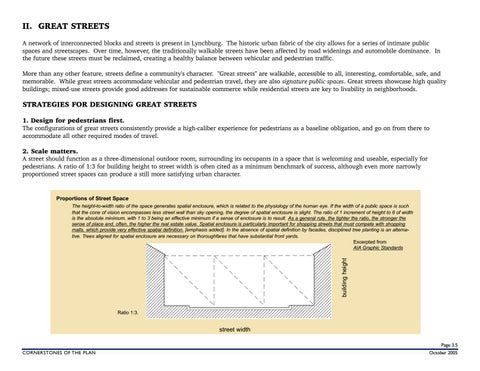
STRATEGIES FOR DESIGNING GREAT STREETS 1. Design for pedestrians first. The configurations of great streets consistently provide a high-caliber experience for pedestrians as a baseline obligation, and go on from there to accommodate all other required modes of travel. 2. Scale matters. A street should function as a three-dimensional outdoor room, surrounding its occupants in a space that is welcoming and useable, especially for pedestrians. A ratio of 1:3 for building height to street width is often cited as a minimum benchmark of success, although even more narrowly proportioned street spaces can produce a still more satisfying urban character.
Proportions of Street Space
building height
The height-to-width ratio of the space generates spatial enclosure, which is related to the physiology of the human eye. If the width of a public space is such that the cone of vision encompasses less street wall than sky opening, the degree of spatial enclosure is slight. The ratio of 1 increment of height to 6 of width is the absolute minimum, with 1 to 3 being an effective minimum if a sense of enclosure is to result. As a general rule, the tighter the ratio, the stronger the sense of place and, often, the higher the real estate value. Spatial enclosure is particularly important for shopping streets that must compete with shopping malls, which provide very effective spatial definition. [emphasis added]. In the absence of spatial definition by facades, disciplined tree planting is an alternative. Trees aligned for spatial enclosure are necessary on thoroughfares that have substantial front yards. Excerpted from AIA Graphic Standards
Ratio 1:3.
street width Page 3.5 CORNERSTONES OF THE PLAN
October 2005