CITY OF CEDAR RAPIDS | AUGUST 2022
A look inside City programs and processes Fall Play! Guide PAGE 25
How Things Work
We are always looking for new ways to make it easy for people to access their government. We find opportunities to improve by asking questions like, “Why is this process laid out like that?” And, “How can we make it better?”
One of the more recent outcomes of this process is My CR — an online reporting tool that residents and visitors can use to access City services around the clock. My CR makes it easy to interact with City departments, make neighborhood improvements, and ask questions.
City staff routinely receive questions from residents about the way things work and why we make the decisions that we do. The level of interest in our processes illustrates a vibrant community invested in its success.
From the why’s to the how’s of simple City processes — to the complex — this issue sheds light on many interesting facts about City operations and some of the decision-making that goes into it all. We hope you’ll find it interesting to learn more about how City government works in Cedar Rapids.
We’re always looking for the best solutions to problems and we welcome your input. Please feel free to contact us at citymanager@cedar-rapids.org or 319-286-5080 if you have questions, concerns, or ideas you would like to share.
 Jeffrey Pomeranz Cedar Rapids City Manager

FROM THE CITY MANAGER • 2 SPECIAL SECTION • 3 NEWS YOU NEED TO KNOW • 22 DIRECTORIES • 24 FALL PLAY! GUIDE • 25 Interested in Advertising with Us? Contact the Our CR Communications Specialist at 319-286-5742. CONNECT WITH CEDAR RAPIDS City of Cedar Rapids Iowa Government @CityofCRIowa City Source Email Newsletter CR News Now Text / Email Alerts CityofCR City of Cedar Rapids on Nextdoor Mobile CR Smartphone App CityofCR.com/Subscribe AUGUST 2022
FROM THE C I TY MANAGER
Every minute of every single day, City of Cedar Rapids employees work hard to provide services and protect residents. This includes countless decisions made on the job — incorporating public input, years of experience, research, and best practices shared by other cities. Residents are often only aware of the result of this work. They don’t often get a chance to see what happens behind the scenes.


In this issue of Our CR, we pull back the curtain to answer some of the frequent questions we hear from the public. We explain how we prioritize projects and share some City operational details we find fascinating. We hope it will help you will gain a better understanding when you use public services and wonder why things happen as they do. As always, we encourage your curiosity and welcome your questions and input!


3
Harnessing the Power of a Dog’s Nose
Elo and Rink – it sounds like a new kids’ television show, but on this Saturday night, Elo and Rink are patrolling the streets of Cedar Rapids. Canine Handler and Police Officer Alex Rink and his canine partner, Elo, spend their 10-hour shift together, responding to a variety of situations, including those where the power of Elo’s nose is extraordinarily helpful.
“Elo’s a very fast-tracking dog,” said Officer Rink, as he holds a 25-foot leather leash and tries to keep up with Elo on a training track. “He’s trained to follow odors that come from disturbances in ground cover, and many other scents, like those from a person.”


Dogs have noses five times more sensitive than human noses. The part of their brain that processes scent can be as much as 40 times more powerful. It’s that nose that makes Cedar Rapids Police Department’s (CRPD) Canine Officers so valuable. All the CRPD canines are dualtrained, meaning they can be used in searches for people, drugs, or explosives. Elo has successfully tracked suspects and missing persons. He’s also helped find drugs in his three years of active duty.


The training process for both partners can be long and arduous — and it never stops. It can take 18 months of intensive practice for a dog to be ready to meet their full-time partner. This is followed by another six months or more of familiarization, socialization, and specialty training specific to local needs. Each shift, members of the CRPD Canine Unit will spend time training. Sometimes, they drill with other handlers and canines to track and exercise. “We try to teach different skills in different places so the canines are always ready for any call we receive,” said Officer Rink.
When the time comes for an active track, handlers and their canine partners will sweep the area where a person was last seen. The canine officer will catalog smells and identify known sources before starting to search for scent trails made by a missing person, suspect, or other source. The handler must learn the subtle body language clues given by their partner to know when they’re ready to start actively tracking, and when they need time to work out changes to the trail. When a well-trained canine finds the source of a scent, it gives a signal and lays down, pointing to the source. One night, Elo tracked a 200-yard-long trail left near a street by another officer. Elo’s pace was kept to a jog by Officer Rink and his 25-foot leather leash. Elo’s excitement made his body quiver.
What’s the payoff at the end of a successful track? Elo’s favorite activity in the world — a few minutes of playing tug with Officer Rink.
HOW THINGS WORK Ryder
OFFICER Lara
OFFICER Mac
OFFICER Bart
OFFICER Korsa
OFFICER Tibi
OFFICER Elo
OFFICER 4
CANINE
CANINE
CANINE
CANINE
CANINE
CANINE
CANINE
CANINE OFFICERS
MEET THE
OUR CR | AUGUST 2022
The Anatomyof a Fingerprint

Fingerprints form in the womb, before birth. They’re created by a layer of deep skin growing faster than the layers above it. This process forms ridges as the skin buckles and folds, leaving one-of-a-kind designs on your fingers that stay with you for the rest of your life.
It’s their unique nature that allows Cedar Rapids Police Department (CRPD) Crime Scene Unit investigators to catalog and identify individuals at crime scenes.
Fingerprints are broken down into three basic shape patterns called arches, loops, and whorls. As you go about your daily routine, you leave prints on your phone, doorknobs, pieces of paper, and hundreds of other surfaces where investigators can locate, “lift,” catalog, and check for matching prints. Those stored prints are held by law enforcement agencies around the country and can come primarily from arrest records. In certain instances, prints are also available from other sources like the U.S. Armed Services.


The process of getting prints from an item is fascinating. Investigators can use a variety of techniques, including ultra-fine powders, chemical washes, and fuming an item with heated glue. All of these options reveal prints that can then be transferred to a digital database for potential matches. Specialty lighting and cameras enhance these prints. Computers help accelerate the search, but final matches are done by human investigators who must prove at least 10 “points-of-minutiae” for a print to be considered a positive identification.
Investigator Jess Harden, a 15-year CRPD veteran, said her best print match came from a case in which she was able to lift 17 fingerprints from a piece of evidence. “I had to unfold a half-roll of tape and take prints from there.” She positively matched 14 prints from four separate suspects. “That was a good feeling.”
Investigators use a variety of techniques and tools to reveal and lift prints from an item.


5 CEDAR-RAPIDS.ORG
ARCH LOOP WHORL
Look inside a Fire Hydrant
Most hydrants in Cedar Rapids deliver 750 to 2,000 gallons of water per minute.

6 HOW THINGS WORK
OUR CR | AUGUST 2022
firefighters at any point in their coverage area.


L O C A

R E S T A U R A N T S L O C A L D E L I V E R Y
Free Delivery Code: OURCR


CEDAR-RAPIDS.ORG 7
L
www.chomp.delivery
Firefighter Jason Hartman demonstrates opening a hydrant and just a small amount of the powerful water pressure available below the surface.
Prioritizing City Projects to Benefit All

We often get asked how we determine priorities. While it may appear to residents that there is madness without a method, or favoritism at play, we follow strategies that are based on best practices, equity, and efficiency. These strategies are developed for the best use of resources, are coordinated across multiple departments, and include input from many people.
Repairing Streets

Paving for Progress is a street-restoration, renewal and replacement program that leverages approximately $20 million each year captured through a voter-approved sales tax. Projects include a mix of repairs, maintenance, and reconstruction. Several factors help determine the order we prioritize streets and how we identify the most cost-effective restoration option. There is usually a cost benefit of performing restorative work early rather than replacement when a street reaches partial or full failure condition.
The City’s strategy includes partial restoration — where doing so will protect a reasonably good street and extend its useful life — and full replacement/reconstruction on streets with very little left to restore. In addition to this Paving for Progress program, the City’s Streets division performs preventative and routine maintenance on a regular basis as needs arise.
A street-repair plan determines the order in which streets receive repairs. A specialized vehicle drives every street to collect data for texture, pavement distress, and roughness. The vehicle captures fresh data every two years so we can keep the plan updated. This ensures streets get prioritized in a way that is data-driven and impartial. It also means the program’s results are measurable.
Neighborhood streets get prioritized through this process. These streets rarely rose to the top of previous priority lists and rarely qualified for federal funding. In total, the Paving for Progress plan ensures we invest in roads before they reach the end of their useful life. It also allows us to completely replace some of our most deteriorated roads over time.
8
HOW THINGS WORK
More than 86 linear miles of City roadway have been improved since Paving for Progress began in 2014 — approximately the distance from downtown Cedar Rapids to downtown Moline, Ill. Our system of streets runs approximately 600 linear miles in total.
Replanting Trees

While recognizing that everyone wants to turn the page on the 2020 Derecho, environmental healing — including the replacement of trees — will take some time. Planting efforts align with need, based on the Street Tree Planting Prioritization Plan. The plan is an earnest effort to equitably determine planting priorities. More than 7,500 street segments were evaluated and scored based on prior canopy, urban heat islands, population density, social vulnerability, derecho tree loss, pedestrian infrastructure demand, road classification, and available planting sites. This numerical prioritization resulted in a year-by-year breakdown of street segments to focus on.


The first years of the plan are “scaling years,” in which we will be planting and caring for over 1,700 new trees each year. In year three, the number jumps to 3,850 trees a year for the remainder of the plan. The scaling years provide time to add resources to meet the plan goals and allow for the supply chain to catch up to demand. A total of 34,230 new street trees will be planted and cared for over the 10 years of the plan.
A dashboard that shows where each street is listed on the plan can be found at CityofCR.com/ReLeaf. If your street segment is not scheduled for planting soon, and you prefer not to wait, you can obtain a no-cost permit to plant your own tree.
Plan to BackBring Treesour

Removing Snow
City snow- and ice-clearing crews work in three shifts around the clock from late November into April. In response to particularly strong storms, the City may declare an all-plow event. During an allplow, staff team up across departments to deploy as much snow-fighting equipment as possible. The goal of an all-plow is to reach every street in the city within 12 hours after the snow stops falling.

Every street may not be completely clear of snow and ice accumulations from curb to curb within 24 hours of any given snowfall. Our overall goal is to clear streets for reasonable and safe travel across the city as quickly as possible.
Crews prioritize streets by emergency and transit routes; use or traffic count; proximity to critical services, such as schools and hospitals; and areas that are difficult to travel, like steep hills. Streets are plowed in the following order:
1 MAIN ARTERIAL STREETS
Highest traffic volumes and posted Emergency Snow Routes
2 COLLECTOR STREETS
Connect major sections of the city
3 RESIDENTIAL STREETS
Neighborhoods and side streets
If it rains less than an inch every 7–10 days, trees that are less than two years old need 5–10 gallons of water. While we are planning to water newly planted trees in the right-of-way, if you want to assist with making sure your tree stays hydrated, you may go ahead!
During heavy or slow-moving storms, crews may need to make multiple passes on the same route before they can move on to the next area of prioritization. They will often return to major roads after a storm to clear additional space for plowing during future storms.
Learn more about snow and ice control at CityofCR.com /Snow.
9
February 2022 Cedar Rapids, Iowa How to Plant and Raise a Tree P. 48 The ReLeaf Rules P. 40 The Master Tree List 44 A
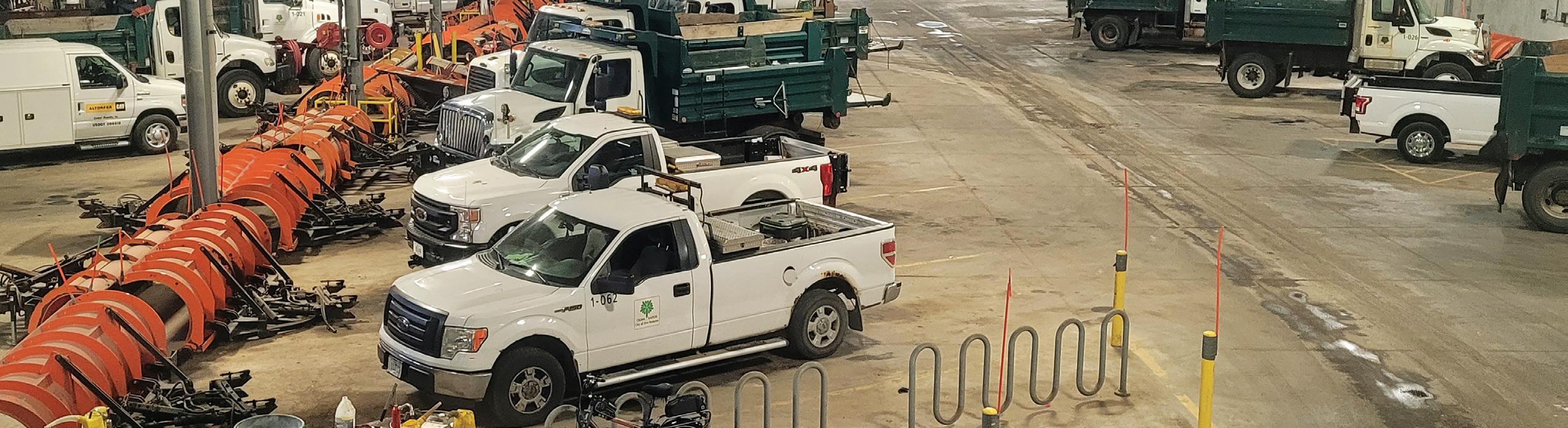
Snow plows stored in the vehicle bay are positioned for efficient attachment and quick preparation for winter weather.
How toRide the Bus
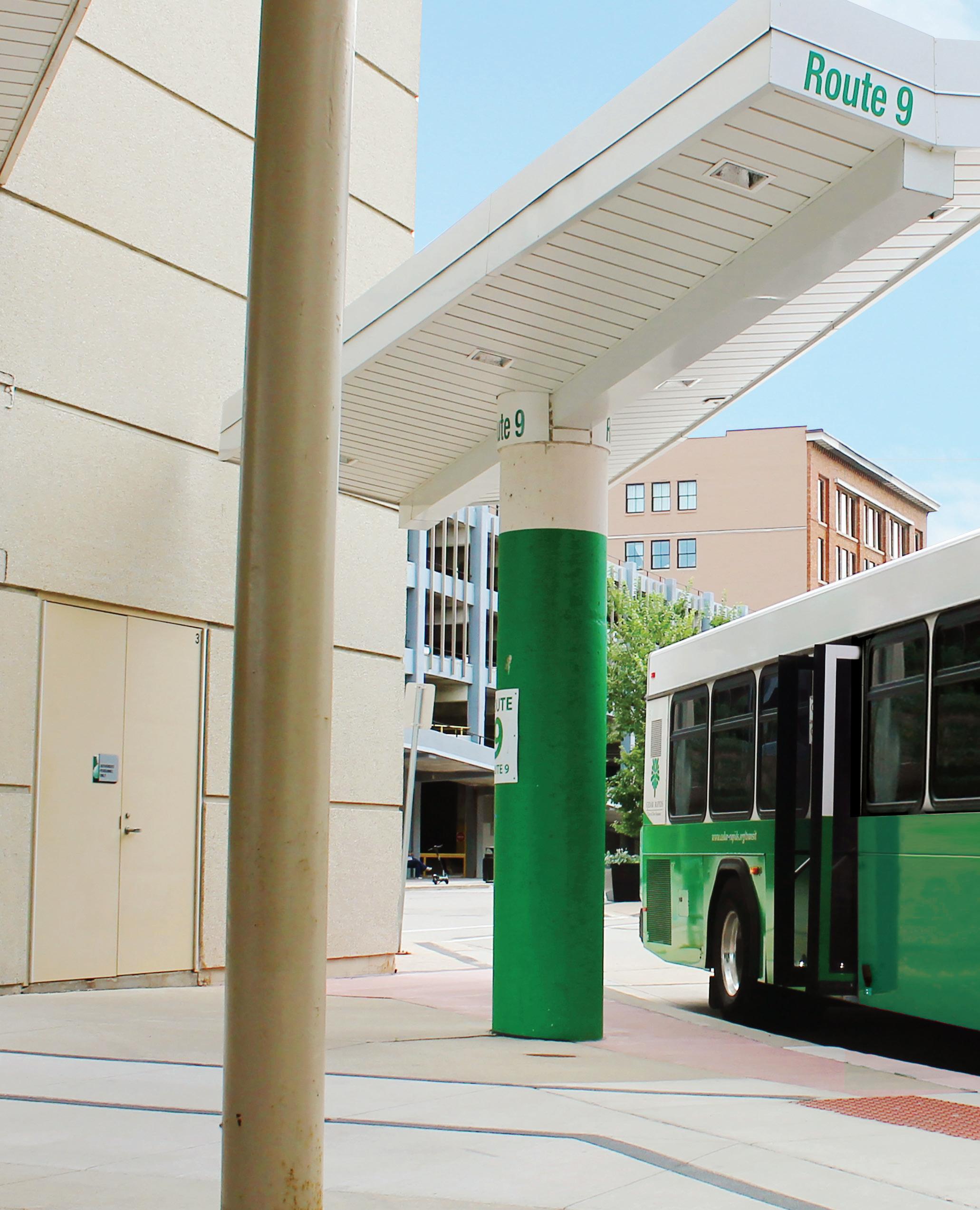
Public transportation is great for the environment, convenient for riders who don’t own a car, and fun for those who simply want more choices in getting around. Cedar Rapids Transit serves a wide array of riders Monday–Saturday. The City partners with Horizons Neighborhood Transportation Service to provide after-hours, curb-to-curb transportation for those with critical employment transportation needs, and with Linn County LIFTS paratransit service to provide rides to customers for essential services.
So, you want to ride the bus — but where do you start? These pages dive into frequently asked questions for choosing transit.
For more information, visit CityofCR.com /Transit .
Riding the Bus Plan Your Trip
Before your ride, plot the route! You can use the Trip Planner tool at CityofCR.com/Transit . Enter your starting and ending locations. If applicable, add the time by which you’d like to arrive at your destination. Click “Get Directions.” The Trip Planner will show you where to walk to get to a bus stop, which bus to to get on and at what time, any transfers you’ll need to other buses, and when you’ll arrive at your destination.

No internet? Call 319-286-5573, or visit the Ground Transportation Center at 450 1st Street SE for help finding bus routes and schedules.
You can also use RideCRT.com or the City’s app — Mobile CR — to find bus stops on a map and view live locations of nearby buses.

Board the Bus
Once you find your bus stop and route, arrive a few minutes ahead of the scheduled time. City buses will only stop to pick up and drop off passengers at posted bus-stop signs.

When your bus arrives, pay your fare using a ticket, bus pass, eligible school ID, or exact cash. Take a seat in an available spot; if none are available, hold on to a handrail. For safety reasons, we ask that you keep conversations with the driver to a minimum. This lets them focus on the drive. Enjoy the ride!
Alert & Depart
When you are ready to depart the bus, alert the driver. Pull the cord at the window one time, about a block before your stop. The driver will follow the signal and stop at the next designated bus stop. Exit using the back doors (unless you are with small children or have a bike to unload from the bike rack at the front of the bus). That’s it — you’ve ridden the bus!

10 HOW THINGS WORK
HOW TO Put Your Bike on a Bus
If a bus stop is close to your departure and destination points, it’s easy to choose the bus. People often walk to their bus stop when it is close by. Sometimes the origin point or destination is difficult to get to. That’s why many riders pair transit with other options — micromobility devices like bikes or scooters, taxis, or ride sharing services — to close the gap.
Cedar Rapids makes it easy to travel that last mile. Each Cedar Rapids Transit bus allows for up to two bikes placed on racks in the front of the bus.

Before you start, be sure to remove any loose items from your bike while you wait at the bus stop. Once the bus arrives, inform the driver you’re loading a bike. Stand at the bike rack, from either on the curb or in front of the bus. Then:
1 Holding your bike with one hand, use your other hand to squeeze the bike rack handle up to release the latch, then fold down the rack. (If another bike is already loaded, you won’t need to fold down the rack.)
2 Lift your bike onto the rack, fitting the wheels into the labeled slots.
3 Raise the support arm up and over the front tire so the hooks rest at the highest point on the front wheel.
4 The support arm will automatically fold down to a secure position.
Now you’re ready to board!
Don’t forget your bike at the end of your ride. Use the front door to exit the bus and inform the driver you’re unloading a bike. Lift your bike out of the rack, squeeze the handle, and fold up the bike rack. Step away from the bus and onto the curb with your bike.


Watch a how-to video at CityofCR.com /Transit .
New Fare Structure
At the time of printing, these fares were pending approval. Visit our website at CityofCR.com/Transit for the most up-to-date information.
Riding the bus requires a bus pass, participating school ID, exact cash, or ticket. Cedar Rapids Transit reduced bus fares from $1.50 to $1 this year — no more fumbling for change! Riders paying with cash will pay money to a machine — not the driver — so exact bills are needed. The bus does not take cards. However, riders may use cards to purchase bus tickets at the Ground Transportation Center. Bus passes are available as monthly, day, or 10-ride passes.
Free Fare
Free fare is available through the Sponsored Student Fare Program; for seniors with proof of age or Free Fare ID Card; passengers with disabilities with Free Fare ID Card or ADA Paratransit Card; Medicare passengers with Medicare Card or Free Fare ID Card; incomebased passengers with Free Fare ID Card; and children ages 12 and under.
Free Fares for Students
Cedar Rapids Transit partners with the Cedar Rapids Community School District (CRCSD), Coe College, and Kirkwood Community College to offer student bus rides at no cost on all fixed-route buses. Students show their student ID and are eligible to ride for free, all year long — even in summer. (CRCSD elementary and middle school students are not required to show ID.)
11
1 2 3 4 CEDAR-RAPIDS.ORG
Where Does our Waste Go?
Most people don’t think much about what happens after they throw away their garbage, recycling, or yard waste. Here’s where your items are hauled and how they’re handled after you put them in your curbside containers.


Recycling Compost
Recyclable items in your home include paper, newspapers, cardboard, clean food boxes, plastic bottles, tin cans, juice cartons, and glass (kept separate from other recyclables). When you place these items in your blue CURBY recycling cart, they are picked up and taken to the Republic Services recycling facility in Cedar Rapids, where large sorting machines separate various types of recoverable materials. These machines use conveyor belts, lifts, teeth, and air jets. Because this system is so intricate, it is important not to send non-recyclable items through the machines.
Collected recyclables are transported to a private material recycling facility, operated by Republic Services. Once they sort out all the recyclable materials, they sell them to both domestic and international buyers. Material prices can fluctuate dramatically due to demand and quality, and the future of recycling becomes uncertain. Additionally, countries that used to accept our recycling are reaching capacity and are no longer accepting as much as they once were.
These industry changes make it crucial that we only send correct items to the recycling facility as well as reduce, reuse, and compost in our homes.
Your green YARDY cart is great for cleaning up the garden, but it also holds fruits and vegetables, rice, pasta, coffee grounds and filters, loose-leaf tea, eggshells, and bread. (Please do not throw the following items in your YARDY: paper towels, plates, or cups; napkins or Kleenex; animal bedding; meat or dairy products; dog waste; or cat litter.)
YARDY contents produce compost for all Linn County residents to use, while sending less to the landfill. On collection day all year long, your YARDY is collected by the same truck that picks up your garbage. The contents then travel to the Solid Waste Agency, where about 30,000 tons of material are composted to produce 11,000 tons of finished product each year. Compost is regularly tested and is regarded among the best in its class by the U.S. Composting Council.
Pick up compost from the Solid Waste Agency at 2250 A Street SW and use it in your gardens, your lawn, and around trees and shrubs. Composting leads to healthy soil and water retention and can eliminate the need for chemical fertilizers. For more information on how to compost with your YARDY, visit CityofCR.com/Compost .
Lucy is a three-foot basset hound, here to help us remember to leave room between our YARDY, GARBY, and CURBY carts and glass recycling buckets. When you leave room for Lucy on collection day, you help make solid waste collection greener and more efficient.
Carts that are placed too close to each other or to other objects don’t leave room for the automated collection arm to safely reach around the cart, forcing the solid waste driver to exit the vehicle, move the cart so there is room for the arm, and climb back into the truck to collect the material. This process slows down the collection, increases idle time for trucks, and increases the chance of property being damaged during the collection.
HOW THINGS WORK
CURBY YARDY
GARBY
Gray GARBY garbage carts hold bags of whatever’s left after you’ve reused materials, composted food and plant waste, and recycled cans and boxes. On your regular garbage collection day, your cart is picked up by a single operator automated garbage truck, utilized to reduce worker injury and additional staffing needs.
The contents of the GARBY are then hauled to the landfill at the Solid Waste Agency, where they are dumped, spread out, compacted, and covered with a large tarp to save valuable landfill space. The decomposition of landfill waste produces methane gas, which may be burned off or captured to produce energy. We anticipate our current landfill site to be filled by 2040, and it’s set to close in 2044, so it is important to reduce consumption of materials, reuse as much as possible, and compost and recycle the rest.
We frequently hear questions about the size of our carts. We use a Pay-as-YouThrow system, where families who use less garbage than the average customer are not asked to pay more to offset the usage of those creating more waste than the average customer. The smaller cart encourages residents to make proper use of CURBY and YARDY carts for items that can be properly disposed of that way. We find the average customer needs more space in their CURBY and less in their GARBY when they’re using the carts effectively.
If reducing, reusing, recycling, and composting leaves too much garbage left over, residents can add an extra GARBY to their collection services or purchase an extra garbage sticker for additional bags that will not fit in the GARBY. For more information on extra garbage and where to purchase stickers, visit CityofCR.com/Garbage.
4 5
Look inside a Garbage Truck
1 Dual steering wheels | Vehicles are equipped with both left and right steering wheels, providing flexibility for operators to drive from either side, depending on collection demands and convenience to items on curbs.

2 Monitor | This screen is used by operators while in reverse, to see carts at curbs, and to watch items being dumped into a temporary holding area. Because the City may be fined for having unacceptable items mixed in with recycling loads, operators may try to remove unacceptable items from the truck when they see them on the monitor, setting those items back on curbs with info tags for residents.
3 Brake button | This yellow button is pulled to lock brakes when the truck is stopped. If this button is not pulled, the truck may roll away on inclines. These trucks don’t have a “park” setting like our cars do.
Get service interruption notices sent straight to your phone! 6


4 Digital video recorder | The recorder captures video of route collections.
5 Joystick | The joystick allows operators to reach out and grab carts, then lift them and dump contents into the truck. The joystick also reverses the process to place carts back on curbs.
6 Packing ram buttons | These colorful buttons are used by operators to activate the packing ram, which pushes garbage from the temporary holding area into the body of the truck.

7 Toggle switches | These switches with various icons are used to:


• Engage the Power Take Off (PTO) for packing mechanisms and hydraulics
• Lock rear axles to better handle driving in mud or snow
• Raise the tailgate prior to dumping loads at the landfill
• Raise the body of the truck to dump out loads
13 CEDAR-RAPIDS.ORG
Garbage
CRNewsNow.com 2 3
• Switch the driving position from the left to the ride side of the cab 1 7
What is the Process for Removing Stumps?
Tree removal from the 2020 Derecho left over 10,000 stumps along the City’s right-of-way. Work is currently underway and prioritized by both the Public Works Department and the Parks and Recreation Department, with dedicated crews working exclusively on removals until they are finished. In addition, the City is working with private contractors to expedite the process, which is anticipated to be completed by the end of the summer in 2023.
While we cannot predict the exact date that stumps will be removed in your neighborhood, the City has developed a dashboard and mapping tool to show you where crews are working now, and where they will be in the future. You can search for your address on the dashboard and see if your zone is marked “In Progress,” “Up Next,” or “Complete.” Currently, there are 25 out of 64 in progress or completed zones.
Look for the dashboard at CityofCR.com /Stumps .

Crews are working zone-by-zone and focusing on areas with fall ReLeaf plantings scheduled. Once work begins in your zone, you will see crews come through and take out stumps along the right-of-way. The City will not remove stumps on private property. The first crew will not remove the chips or complete dirt work following the removal. A second crew will generally follow within two weeks to restore the right-of-way. The timeline is weather dependent, so we urge residents to be patient. Seeding will follow, depending on weather conditions. Once seeded, property owners are again responsible for maintenance.
As a friendly reminder, please remove plants, bricks, rocks, and other decorations from around your stump to prepare our crews. If you need your stump removed before crews are working in your zone, you may do so at your own expense. Find an application for a permit in the “How Can I Help” section of the ReLeaf webpage at CityofCR.org/ReLeaf.

HOW THINGS WORK
14
OUR CR | AUGUST 2022
What is the status of EAB?
While working on reestablishing our urban forest, we are faced with addressing ash trees in decline due to Emerald Ash Borer disease (EAB). Trees with the disease have reached the point of deterioration and have the potential to cause significant damage if they fall. Approximately 1,800 remain on the right-of-way, down from over 7,000 in the 2016 inventory. Of those, 400 are being treated by residents, and 400-700 will be removed each year. Like Dutch Elm Disease, EAB will remain an issue as native pockets of ash resprout. However, the bulk of the trees in decay will be removed within the next three years. Residents who have a healthy ash tree with a full canopy can still treat it to delay the loss of the tree.

Why isn’t the City planting maples?
If Emerald Ash Borer (EAB) and Dutch Elm diseases have taught us anything, it is that we need a canopy that is robust and diverse. Through EAB alone, and aside from the 2020 Derecho, we stand to lose as many as a quarter of our street trees. Planting too many of one species is not resilient or sustainable.
According to our tree inventory, Cedar Rapids residents are in love with maples. We share the maple love, but there are far more planted from this tree group than is healthy for our community. For this reason, maples are not included in the ReLeaf Tree List. We are happy to introduce people to many other tree species that we think they will love as much. Once we achieve the diversity levels that protect us from a large tree loss, we will embrace maples again.
Saving you more. veridiancu.org 319.743.6440 That’s the value of Veridian.
2014
Ash 28% Maple 27% Linden9% Honeylocust7% Oak 6% Other (lg) 4% Other(sm) 4% Conifers4% Crabapple2% Unknown2% Hackberry2% Sycamore 2% Elm 2% Birch 1%
| Before EAB arrived in Cedar Rapids
the Prairie
Before Iowa was settled, prairie covered most of the state. Over 95 percent of tallgrass prairies that developed more than 10,000 years ago have slowly disappeared. Prairies impact the watershed, water quality, wildlife habitat, and pollinator habitat. The City has converted many acres of public land back to prairies over the past five years, but there is more to it than just scattering seed. Here are the steps we take to reestablish prairie.
Prairies are typically in bloom in late summer and early fall.
View prairies at:

• Cedar Hills Park
• Cherokee Park
• Delaney Park
• Hughes Park
• Jacolyn/ Vinton Ditch
• Lincolnway Park
• ManhattanRobins Lake
• Navajo Park
• Noelridge Park
• Shawnee Park
• Edgewood Trail
• Tait Cummins Sports Complex
PHASE 1
Identify a Location
Native prairie grasses require the site to be sunny, open, and well-ventilated. Ideally, areas that have a history of heavy weed growth are avoided, as site prep and maintenance are difficult. It is important that we understand the type of soil that is present in the area, so we can determine the seed mix that should be planted.


PHASE 2
Prepare and Plant the Site
All existing weeds and vegetation must be killed before we can plant seed. This process can take more than two years to do. We prefer to burn off the dead weed thatch for the best results. Once the site prep is completed, seeding can commence. Planting is done in the spring or fall, using either a broadcasting method or a seed drill.

PHASE 3
Maintain
Although prairies need less maintenance than turf grass, maintenance is still required. During the first few years of establishment, we will mow prairies multiple times to keep invasive and unwanted species out. After that, we conduct controlled burns to remove the dead, organic matter at the ground level, and open the way for seeds to naturally find their way to the soil. Burns return nutrients to the soil and prevent invasive species from taking hold.

HOW THINGS WORK 16
1 2 3 Learn more at CityofCR.com /Pollinators .
OUR CR | AUGUST 2022

17 CEDAR-RAPIDS.ORG Find out more at T- Mobile.com/brand/benefits From non-stop streaming to weekly deals & giveaways, our Magenta plans offer customer benefits that let you do a whole lot more than talk—at no extra cost. Limited time offer; subject to change. During congestion, heavy data users (>100GB/mo. for Magenta) and customers choosing lower-prioritized plans may notice lower speeds than other customers; see plan for details. Video typically streams on smartphone/tablet in SD quality, unless you choose HD plan or feature. Tethering at max 3G speeds, unless you choose a plan with high-speed allotment. Sales tax and regulatory fees included in monthly rate plan price for Magenta plans. U.S. roaming and on-network data allotments differ: includes 200MB roaming. Unlimited talk & text features for direct communications between 2 people; others may cost extra. Unlimited high-speed data US only. For full plan details, see rep or visit T-mobile.com/cell-phone-plans. Coverage not available in some areas. Network Management: Service may be slowed, suspended, terminated, or restricted for misuse, abnormal use, interference with our network or ability to provide quality service to other users, or significant roaming. See T-Mobile.com/OpenInternet for details. See Terms and Conditions (including arbitration provision) at www.T-Mobile.com for additional information. T-Mobile, the T logo, Magenta and the magenta color are registered trademarks of Deutsche Telekom AG. © 2022 T-Mobile USA, Inc. Unlimited data comes standard on all our plans All our most popular phone plans include unlimited talk, text and smartphone data on our network. Stay connected on the go Experience Mobile Hotspot data at no extra cost, helping you stay connected when you need it. No hidden fees Taxes and fees are included on our best plans, so what you see is what you pay. Find out more at T- Mobile.com/brand/benefits From non-stop streaming to weekly deals & giveaways, our Magenta plans offer customer benefits that let you do a whole lot more than talk—at no extra cost. Limited time offer; subject to change. During congestion, heavy data users (>100GB/mo. for Magenta) and customers choosing lower-prioritized plans may notice lower speeds than other customers; see plan for details. Video typically streams on smartphone/tablet in SD quality, unless you choose HD plan or feature. Tethering at max 3G speeds, unless you choose a plan with high-speed allotment. Sales tax and regulatory fees included in monthly rate plan price for Magenta plans. U.S. roaming and on-network data allotments differ: includes 200MB roaming. Unlimited talk & text features for direct communications between 2 people; others may cost extra. Unlimited high-speed data US only. For full plan details, see rep or visit T-mobile.com/cell-phone-plans. Coverage not available in some areas. Network Management: Service may be slowed, suspended, terminated, or restricted for misuse, abnormal use, interference with our network or ability to provide quality service to other users, or significant roaming. See T-Mobile.com/OpenInternet for details. See Terms and Conditions (including arbitration provision) at www.T-Mobile.com for additional information. T-Mobile, the T logo, Magenta and the magenta color are registered trademarks of Deutsche Telekom AG. © 2022 T-Mobile USA, Inc. Unlimited data comes standard on all our plans All our most popular phone plans include unlimited talk, text and smartphone data on our network. Stay connected on the go Experience Mobile Hotspot data at no extra cost, helping you stay connected when you need it. No hidden fees Taxes and fees are included on our best plans, so what you see is what you pay. Find out more at T- Mobile.com/brand/benefits From non-stop streaming to weekly deals & giveaways, our Magenta plans offer customer benefits that let you do a whole lot more than talk—at no extra cost. Limited time offer; subject to change. During congestion, heavy data users (>100GB/mo. for Magenta) and customers choosing lower-prioritized plans may notice lower speeds than other customers; see plan for details. Video typically streams on smartphone/tablet in SD quality, unless you choose HD plan or feature. Tethering at max 3G speeds, unless you choose a plan with high-speed allotment. Sales tax and regulatory fees included in monthly rate plan price for Magenta plans. U.S. roaming and on-network data allotments differ: includes 200MB roaming. Unlimited talk & text features for direct communications between 2 people; others may cost extra. Unlimited high-speed data US only. For full plan details, see rep or visit T-mobile.com/cell-phone-plans. Coverage not available in some areas. Network Management: Service may be slowed, suspended, terminated, or restricted for misuse, abnormal use, interference with our network or ability to provide quality service to other users, or significant roaming. See T-Mobile.com/OpenInternet for details. See Terms and Conditions (including arbitration provision) at www.T-Mobile.com for additional information. T-Mobile, the T logo, Magenta and the magenta color are registered trademarks of Deutsche Telekom AG. © 2022 T-Mobile USA, Inc. Unlimited data comes standard on all our plans All our most popular phone plans include unlimited talk, text and smartphone data on our network. Stay connected on the go Experience Mobile Hotspot data at no extra cost, helping you stay connected when you need it. No hidden fees Taxes and fees are included on our best plans, so what you see is what you pay.
HOW FSB GIVES BACK


$200,000+ in donations each year
5,000+ employee volunteer hours per year



Over 1,000 customers served at the annual picnic
26 years of hosting Marion by Moonlight
$303 Million in loans helping the local economy in 2021
More than 25 community events sponsored a year
Farmers State Bank is a family-owned community bank in Cedar Rapids and the surrounding areas that enhances and supports the financial lives of our customers.
Explore all of our products and services now at myfsbonline.com.


`
Flood Water
`
The United States Geological Survey and National Weather Service have tracked river levels for many years. Their data i ndicates increased trends for localized flooding and peak flow conditions in tributaries like Indian Creek and rivers like the Cedar River. Flooding is one of Cedar Rapids’ biggest climate-change risks.
We are building a major flood control system in Cedar Rapids estimated to cost more than $750 million The system will reduce flood risk for homes and businesses on both sides of the Cedar River. How does this system work and what happens when it floods?

Underground Protection
When it is raining, a storm sewer system beneath the streets of Cedar Rapids collects and funnels water into tributary streams and the Cedar River. This keeps our streets from filling up with all that rain and flooding. When the river is too high, flood water from the river can back up into the storm sewer and cause street flooding. Detention basins, pump stations, and storm gates play an important role during a flood. They protect our community from river flooding through underground storm sewers.
During a flood, underground gates close the storm sewer system off from the river. But when it is raining, the rainwater still needs somewhere to go. Pump stations help lift rainwater from the storm sewer system up and over the flood wall. When it is raining hard, the pumps might not be able to keep up. That’s okay, because nearby detention basins can pond up the extra water until the pumps can catch up. When the pumps are ready, water from the detention basins get pumped over the flood wall, too.
Staff from the City’s Water Pollution Control division watch the pump stations while they’re in use. They make sure the system is working to keep rainwater from flooding on the “dry side” of the flood wall.
Aboveground Protection
Permanent earthen levees and flood walls protect the community from high river levels. Openings in the system allow pedestrians, trains, and vehicles to cross the river. When major flooding is forecast, staff activate permanent flood protection measures to seal these gaps. Ten roadway gates will roll or swing into place where streets cross the flood wall. Three roadway gates will be fully removable and stackable.
Temporary walls allow the system to hide in plain sight while not in use. More than 3,000 stackable metal plates — or stoplogs — slide into columns to form temporary flood barriers. Set end-to-end, these stoplogs would stretch out more than seven miles long! Engineers estimate it would take approximately 48 hours to deploy the full system. City staff work around the clock to protect the city and monitor the system during flood events.
Interim Protection
The Cedar River Flood Control System will take years to build. In the meantime, the City uses an Interim Flood Control Plan to protect the community from floods. The interim plan charts our response to major flooding up to 28 feet — just below the level of the 2008 Flood. No interim plan is as reliable as permanent flood control. Staff update the interim plan as new portions of the permanent system come online.
HOW THINGS WORK
19 CEDAR-RAPIDS.ORG
StormwaterSuperpowers
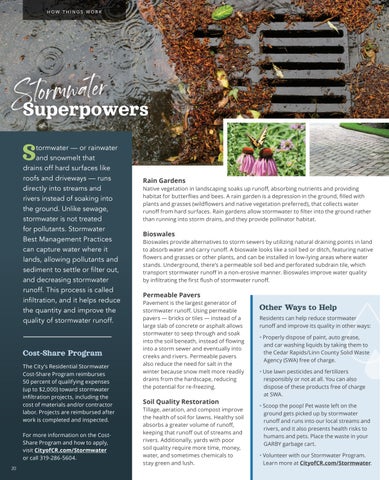
Stormwater — or rainwater and snowmelt that drains off hard surfaces like roofs and driveways — runs directly into streams and rivers instead of soaking into the ground. Unlike sewage, stormwater is not treated for pollutants. Stormwater Best Management Practices can capture water where it lands, allowing pollutants and sediment to settle or filter out, and decreasing stormwater runoff. This process is called infiltration, and it helps reduce the quantity and improve the quality of stormwater runoff.
Rain Gardens
Native vegetation in landscaping soaks up runoff, absorbing nutrients and providing habitat for butterflies and bees. A rain garden is a depression in the ground, filled with plants and grasses (wildflowers and native vegetation preferred), that collects water runoff from hard surfaces. Rain gardens allow stormwater to filter into the ground rather than running into storm drains, and they provide pollinator habitat.
Bioswales
Bioswales provide alternatives to storm sewers by utilizing natural draining points in land to absorb water and carry runoff. A bioswale looks like a soil bed or ditch, featuring native flowers and grasses or other plants, and can be installed in low-lying areas where water stands. Underground, there’s a permeable soil bed and perforated subdrain tile, which transport stormwater runoff in a non-erosive manner. Bioswales improve water quality by infiltrating the first flush of stormwater runoff.
Permeable Pavers

Cost-Share Program
The City’s Residential Stormwater Cost-Share Program reimburses 50 percent of qualifying expenses (up to $2,000) toward stormwater infiltration projects, including the cost of materials and/or contractor labor. Projects are reimbursed after work is completed and inspected.
For more information on the CostShare Program and how to apply, visit CityofCR.com/Stormwater or call 319-286-5604.
Pavement is the largest generator of stormwater runoff. Using permeable pavers — bricks or tiles — instead of a large slab of concrete or asphalt allows stormwater to seep through and soak into the soil beneath, instead of flowing into a storm sewer and eventually into creeks and rivers. Permeable pavers also reduce the need for salt in the winter because snow melt more readily drains from the hardscape, reducing the potential for re-freezing.
Soil Quality Restoration
Tillage, aeration, and compost improve the health of soil for lawns. Healthy soil absorbs a greater volume of runoff, keeping that runoff out of streams and rivers. Additionally, yards with poor soil quality require more time, money, water, and sometimes chemicals to stay green and lush.
Other Ways to Help
Residents can help reduce stormwater runoff and improve its quality in other ways:

• Properly dispose of paint, auto grease, and car washing liquids by taking them to the Cedar Rapids/Linn County Solid Waste Agency (SWA) free of charge.
• Use lawn pesticides and fertilizers responsibly or not at all. You can also dispose of these products free of charge at SWA.
• Scoop the poop! Pet waste left on the ground gets picked up by stormwater runoff and runs into our local streams and rivers, and it also presents health risks to humans and pets. Place the waste in your GARBY garbage cart.
• Volunteer with our Stormwater Program. Learn more at CityofCR.com/Stormwater

20 HOW THINGS WORK
Loose Leaf Collection
All homes will have their loose leaves collected bi-weekly (one time every other week). Please keep and refer to this schedule to determine your collection period. If you have questions, please call the Solid Waste & Recycling Division at 319-286-5897 or visit CityofCR.com/Leaf.
REMINDER: YARDY carts are collected year-round.
OCTOBER 3 - DECEMBER 9, 2022
Southeast Southwest
Northeast Northwest
Leaves must be out by 7:00 a.m. on Monday
Leaves must be out by 7:00 a.m. on Wednesday
LEAVES MUST BE READY BY 7:00 AM ON THE FIRST COLLECTION DAY IN YOUR QUADRANT. COLLECTION MAY OCCUR ON EITHER DAY MARKED.
Tips for a Successful Fall Leaf Collection

For SE and NE quadrants, all leaves must be raked to the edge of the road by 7:00 a.m. on the Monday of your collection week.
For SW and NW quadrants, all leaves must be raked to the edge of the road by 7:00 a.m. on the Wednesday of your collection week.
Rake leaves into long piles on the parking area or grass next to the street. Leaves must be kept out of the street.
Keep leaf piles away from obstacles like your collection carts, mailboxes, cars, and utility poles.
During fall loose leaf collection, brown paper lawn and leaf bags are collected every week with the YARDY cart. The bags cannot exceed 40 pounds.
Collect brush and branches to put in your YARDY cart for collection. Any brush that does not fit in your YARDY cart should be cut into 3-foot lengths and collected into secured bundles that do not exceed 2 feet in diameter or 40 pounds in weight.
21 CEDAR-RAPIDS.ORG Sunday Monday Tuesday Wednesday Thursday Friday Saturday 3 3 3 4 4 4 5 5 5 6 6 6 7 7 7 8 8 8 9 9 9 10 10 10 11 11 12 12 13 13 21 21 22 22 23 23 24 24 25 25 26 26 27 27 14 14 15 15 16 16 17 17 18 18 28 28 19 19 29 29 30 30 31 1 1 20 20 2 2 October November Dec Southwest SW SW SW NW SE SE SE SE Northeast Northwest NW NW NE NE NE NE NW
2 SW NW
Southeast
Save the Date!
City Week Open House
The City of Cedar Rapids is planning an open house event for Wednesday, October 12 from 5–7 PM at the City Services Center, 500 15th Avenue SW. The public is invited to come see behind the scenes of the building, learn about different vehicles and equipment used by departments, visit with City staff, and enjoy fun games and activities for the entire family. Children can climb in City vehicles for a close-up view of equipment different departments use to keep the City running safe.
Check the City’s website for event updates and schedule changes: CityofCR.com/Calendar.

Help Bring Back Our Trees
Cedar Rapids was devastated by the 2020 Derecho, with winds as high as 140 MPH tearing through the city’s tree canopy and vital infrastructure. An estimated 65–70% of the trees in Cedar Rapids were severely damaged or destroyed. Already, work is underway to replant what was lost through the ReLeaf Cedar Rapids plan. This publicprivate partnership between the City of Cedar Rapids and Trees Forever is a 10-year, prioritized plan that will raise $3.7 million annually to restore and plant a resilient tree canopy. Please consider giving to ensure a green future full of trees.
Visit TreesForever.org/ReLeaf to donate today.
Solid Waste and Recycling: Holiday Collection Schedule
Some holidays result in a one-day delay in collection for some or all of our customers.
NEW YEAR’S DAY
No Collection – 1 Day Delay for Remainder of Week
MEMORIAL DAY
No Collection – 1 Day Delay for Remainder of Week
LABOR DAY
No Collection – 1 Day Delay for Remainder of Week
THANKSGIVING DAY
No Collection – 1 Day Delay for Remainder of Week
Volunteers Wanted for Snow Buddies Program
The Snow Buddies program pairs residents in need of assistance with “Snow Heroes” — volunteers who can help clear sidewalks of snow and ice accumulations in the winter. The program is intended to benefit residents who are not physically able to remove snow and do not have other resources to remove snow, such as neighbors, friends or a hired service.
Snow Heroes provide the heavy lifting and help their neighbors in need clear sidewalks of snow and ice. Snow Heroes must be at least 18 years old and provide their own snow-removal equipment. Snow Heroes will not be allowed to solicit or accept money or gifts for their volunteer activities.
Sign up to be a Snow Hero today at CityofCR.com/SnowBuddies .

Applications for Snow Buddy clients will be posted at a future date. Get text and email alerts from the City at CRNewsNow.com or in our app, Mobile CR .
CHRISTMAS DAY
No Collection – 1 Day Delay for Remainder of Week
Although many City offices will be closed, there is NO DELAY in the collection schedule for the following holidays*:
• Martin Luther King Jr. Day
• Independence Day
• Good Friday
• Veterans Day
*City offices will be open on Presidents’ Day. There will be NO DELAY in collection for customers the week of Presidents’ Day.
Learn more at CityofCR.com /Garbage .
22 OUR CR | AUGUST 2022
NEWS YOU NEED TO KNOW

Allergy Audiology Behavioral Health Ear, Nose & Throat /Head & Neck Surgery Envisions Medical Spa General Surgery Heart & Lung Surgery Hematology & Oncology Neurology & Sleep Medicine Orthopedic & Total Joint Center Physical Medicine & Rehabilitation Plastic & Reconstructive Surgery Podiatry & Foot Health Primary Care & Wellness Center Rheumatology Spine Center Urology Center Vascular & Endovascular Surgery Walk-in Care Medical Pavilion 1 202 10th Street SE Cedar Rapids Medical Pavilion 2 275 10th Street SE Cedar Rapids Eastern Iowa’s premier specialty medical center “This is so amazing, having all the specialties in a single place. It’s like having our own Mayo Clinic right here in Cedar Rapids.” ~ Satisfied PCI Patient (319)247-3010 | PCOFIOWA.COM
CITY SERVICES DIRECTORY
and Street City Services Center, 500 15th Avenue SW 319-286-5826
Maintenance
Recreation Programs Northwest Recreation Center, 319-286-5566
Street@Cedar-Rapids.org
Recreation@Cedar-Rapids.org 1340 11th Street NW
Sewer Backup or Problems City Services Center, 500 15th Avenue SW 319-286-5815
Traffic Signals, Signs and City Services Center, 500 15th Avenue SW 319-286-5176
Markings
Utility Billing City Hall, 101 1st Street SE 319-286-5900
Sewer@Cedar-Rapids.org
Traffic@Cedar-Rapids.org
WaterMail@Cedar-Rapids.org
For more information about the City of Cedar Rapids and its services, call 319-286-5080 or visit www.cedar-rapids.org
CITY COUNCIL
To leave a message for a City Council member, call 319-286-5051. Find your district at www.linncountyelections.org

MAYOR Tiffany O’Donnell t.odonnell@cedar-rapids.org

DISTRICT 3
Dale Todd dalet@cedar-rapids.org


AT LARGE
Patrick Loeffler p.loeffler@cedar-rapids.org

DISTRICT 1
Martin Hoeger m.hoeger@cedar-rapids.org
DISTRICT 2 Scott Overland s.overland@cedar-rapids.org
DISTRICT 4 Scott Olson scott.olson@cedar-rapids.org
AT LARGE
Tyler Olson t.olson@cedar-rapids.org
DISTRICT 5 Ashley Vanorny a.vanorny@cedar-rapids.org
AT LARGE Ann Poe ann.poe@cedar-rapids.org

24 OUR CR | AUGUST 2022
CITY SERVICE LOCATION PHONE EMAIL ADDRESS Animals 7241 Washington View Parkway SW 319-286-5993 AnimalControlMgmt@Cedar-Rapids.org Assessor City Services Center, 500 15th Avenue SW 319-286-5888 CRAssessor@Cedar-Rapids.org Bid Opportunities City Hall, 101 1st Street SE 319-286-5021 Bid-Purchasing@Cedar-Rapids.org Building and Housing Codes City Services Center, 500 15th Avenue SW 319-286-5831 Building@Cedar-Rapids.org Buses Ground Transportation Center, 319-286-5573 CRTransit@Cedar-Rapids.org 450 1st Street SE Fire Safety Inspections 713 1st Avenue SE 319-286-5166 CRFire@Cedar-Rapids.org Garbage, Recycling and City Services Center, 500 15th Avenue SW 319-286-5897 Solid-Waste-Recycling@Cedar-Rapids.org Yard Waste Collection Housing Assistance Programs City Hall, 101 1st Street SE 319-286-5872 HSG-Admin@Cedar-Rapids.org Land Development City Hall, 101 1st Street SE 319-286-5822 DevelopmentServices@Cedar-Rapids.org Park Rentals City Services Center, 500 15th Avenue SW 319-286-5566 Recreation@Cedar-Rapids.org Potholes
Visit CityofCR.com/Transit or call 319-286-5573 for more information.