PAVING A PATH FOR THE NEXT WOMEN LEADERS BUSINESS EXECUTIVES MODEL A NEW APPROACH TO MENTORING AND NURTURING.

Whether you’re a start-up or a mid-size company celebrating a landmark anniversary, Heritage Bank can provide the banking solutions and expertise essential to your success. We’re small business banking specialists inspired by our customers’ vision, ingenuity and grit. We’re a community bank vested in the region you call home.
We were founded by entrepreneurs. We understand what small businesses need from a bank.
• Flexible financing
• Agile, responsive bankers
• Digital banking tools & in-person service















• Streamlined approvals























• Local decision making
• Robust Treasury Management services



When you’re ready to bank where you’re a priority, we’re ready to get acquainted.
www.OurHeritage.bank
If your business needs help recruiting and retaining employees, Metro offers programs to help get your employees to work. With increased frequency and 24-hour service, our buses cover all shifts. And free Wi-Fi and charging ports will boost your employees’ productivity.









Leadership Excelleration transforms, inspires, and empowers leaders to succeed.
We are experts serving businesses, government, K-12 and higher education, and non-profits to help leaders and organizations achieve higher performance.

•High
•High
04 LETTER FROM BRENDON CULL
08 BY THE NUMBERS
Women outnumber men in the Cincinnati region and more women are high school and college graduates, yet women still lag behind in median income and employment.
10 CULTURE
OUR NEXT STAGE
The Children’s Theatre of Cincinnati announces details for its OTR theater renovation.
12 TALENT
LEAD BY EXAMPLE
The woman-focused WE Lead program has been changing the region’s C-Suites.
14 REAL ESTATE HOME DEMAND CONTINUES TO EVOLVE
But supply still isn’t meeting the region’s real estate needs.
16 BRANDING EMPOWER PLAY Ad agency veteran Ashlee Clarke plans to build on Empower’s woman-owned legacy.

18 TECHNOLOGY A PURPOSE-DRIVEN LEADER Lisa Knutson drives change as E.W. Scripps’ new chief operating officer.
19 LEADERSHIP SCALE THEM UP A new $100-million growth fund will improve minority business owndership success.
22
PAVING A BETTER PATH FOR THE NEXT LEADERS
Women business leaders embrace their responsibility to nurture and mentor a younger generation in ways that were unavailable to them.

30
THE REGION’S OPPORTUNITY TO “THINK BIG”
A new report recommends six major infrastructure projects for federal funding.
36
DOWNTOWN’S OFFICE TOWERS BECKON WORKERS BACK
CEO Jill P. Meyer
PRESIDENT Brendon Cull
VICE PRESIDENT, STRATEGIC MARKETING AND COMMUNICATIONS Danielle Wilson
TRAFFIC MANAGER Tracey Brachle
BOARD CHAIR Candace McGraw
CEO, Cincinnati/Northern Kentucky International Airport
CHAMBER OFFICE
3 E. Fourth St. Cincinnati, OH 45202 (513) 579-3100
All contents © 2023 Cincinnati USA Regional Chamber. The contents cannot be reproduced in any manner, whole or in part, without written permission from the Cincinnati USA Regional Chamber.
48 ASK ME ABOUT Get to know Libby Hunter of Adventure Crew, Karen Forgus of the Cincinnati Reds, and Gina Douthat of the Transit Authority of Northern Kentucky (TANK).
50 PHOTO ESSAY: ROOKWOOD POTTERY

Maria Longworth’s vision of a renowned woman-owned manufacturing business thrives in Over-the-Rhine 143 years later.
Fifth Third Bank leads the push to bring workers back into the office and restore downtown’s live/work/play economic balance.
42
JILL MEYER LOOKS TO THE FUTURE, ALWAYS
The retiring Chamber CEO reflects on how Cincinnati became a city we all believe in and how that attitude helps the region thrive.
FROM THE PUBLISHERS OF
PUBLISHER Ivy Bayer
EDITOR-IN-CHIEF John Fox
DIRECTOR OF EDITORIAL OPERATIONS
Amanda Boyd Walters
DESIGN DIRECTOR Brittany Dexter
ART DIRECTORS Carlie Burton, Logan Case, Jessica Dunham, Jen Kawanari, Wesley Koogle, Emi Villavicencio
PHOTO CO-OP HATSUE
SENIOR ACCOUNT MANAGERS
Maggie Goecke, Joe Hoffecker, Julie Poyer
ACCOUNT REPRESENTATIVES
Laura Bowling, Hilary Linnenberg
SENIOR MANAGER, SPONSORSHIP SALES
Chris Ohmer
PRODUCTION DIRECTOR Vu Luong
EDITORIAL AND ADVERTISING
Email cmletters@cincinnatimagazine.com
Website cincinnatimagazine.com
Phone (513) 421-4300
Subscriptions (800) 846-4333
am writing this welcome note to you on Opening Day, our region’s unique holiday. It’s a day filled with fun, friends, family, and, hopefully at the end of the game, fireworks. The day is Cincinnati’s universal symbol of hope.
That Opening Day spirit of hope has been coursing through my veins in the last month since I’ve accepted the charge to serve you as your next Cincinnati USA Regional Chamber CEO. I’m more than hopeful about our region’s potential to grow our population, grow our economy, and grow the cultural vibrancy and assets of our community —I’m overwhelmingly confident. And with the Chamber’s incredible team, we’re ready to do the work to build and expand the diverse, welcoming, and thriving region we’re all demanding.
This issue of Realm is a hopeful one, too. You’ll notice a theme: articles and news about some of our region’s most brilliant, daring, and driven women leaders. One of those leaders is, of course, my predecessor, Jill Meyer. Her “exit interview” is on page 42, and I think it will help you realize how lucky we’ve been to have had her as our Chamber President and CEO driving a Future City vision over the last seven and a half years.
The road ahead is a hopeful one full of potential and opportunity. And it’s a road that I am excited to travel with you. Let’s stay connected about how we can serve your growing businesses and this incredible Cincinnati region.
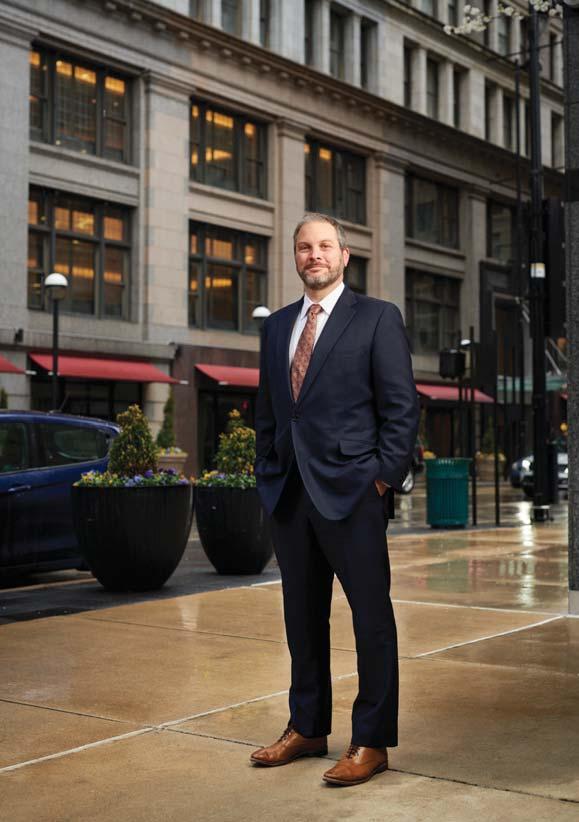 BRENDON CULL BCull@cincinnatichamber.com
Cooperative Education builds resumes and relationships.
Hiring Co-op students offers valuable educational opportunities to students, and also benefits your business:
• A cost-effective way to fill temporary and long-term staffing needs
• An opportunity to evaluate potential future employees

• Cincy State students are local and they STAY local
• A way to fill entry-level professional positions with qualified candidates
Cincinnati State’s career pathways are based in the workforce needs of this community. Make sure you are getting the talent you need for the future of your business.
LEARN HOW to set-up a Co-op Program at your company or post your position to co-op students and recent graduates visit: www.cincinnatistate.edu/coop
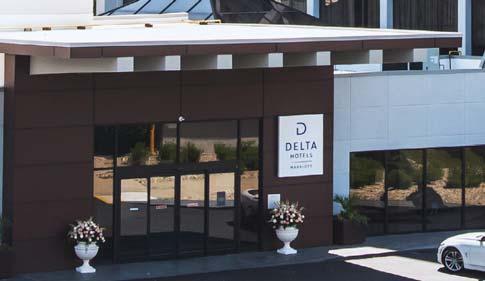
Reserve your stay at the new Delta Hotels Marriott Cincinnati, centrally located right off the intersection of I-275 & I-75. Just 15 minutes north of downtown Cincinnati.

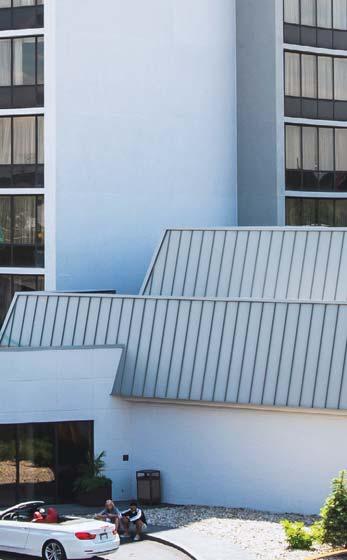
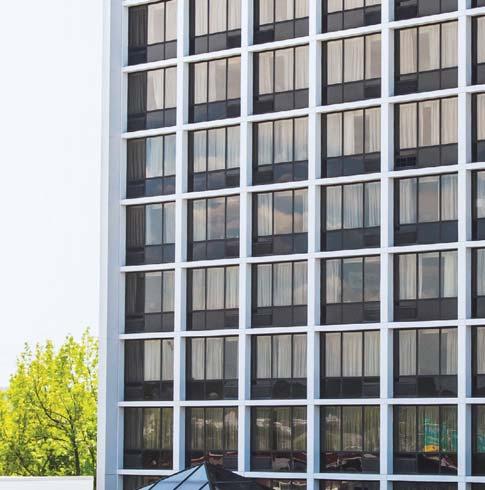



Host conferences in one of our many event rooms with 20,000 square feet of event space configurable to your needs.

513 • 552 • 6369 www.marriott.com/cvgde
nidhi@deltahotelscincinnati.com
POPULATION
FEMALE: 1,147,448 (51%) MALE: 1,114,216 (49%)
MEDIAN EARNINGS
FEMALE: $50,593 MALE: $62,530
POVERTY RATE
FEMALE: 6.8% MALE: 5.3%
Note: Poverty Rate is set by the U.S. government at $27,750 annual income for a family of four.
EDUCATION ATTAINMENT
Women outnumber men in the 16-county Cincinnati region, and more women than men are high school and college graduates. Yet economic data continue to show that women disproportionately lag behind men in job earnings, corporate leadership, unemployment rate, and poverty rate. The numbers suggest that women, as primary caregivers in families, face unique employment challenges. Let’s take a closer look.
Source: 2021 American Community Survey of Adults 25-Plus
UNEMPLOYMENT
With Children Under Age 6 Female With Children Under Age 6 and 6-17
Source: 2021 American Community Survey of Adults 25-Plus
EMPLOYMENT BY INDUSTRY
FEMALE DOMINATED JOBS MALE DOMINATED JOBS
Source: Lightcast
Source: Lightcast

Whether you are an entrepreneur or part of a startup, a corporation, or any other organization, your most critical assets are your proprietary ideas.
At Rooney IP, our mission is to learn your business and its objectives and then protect, preserve, and enhance your intellectual property assets in manners that will exceed your expectations.

We have over ten decades of combined legal and paralegal experience to help you establish, protect, and enforce your intellectual property rights. We are dedicated, experienced specialists in:

• Patents
• Trademarks and Trade Dress
• Licensing and Technology Transfer

• Litigation and Dispute Resolution
• Copyrights
Let’s partner together to take full advantage of your intellectual property Contact us at 513-274-9664 or Rooney iP Law.com
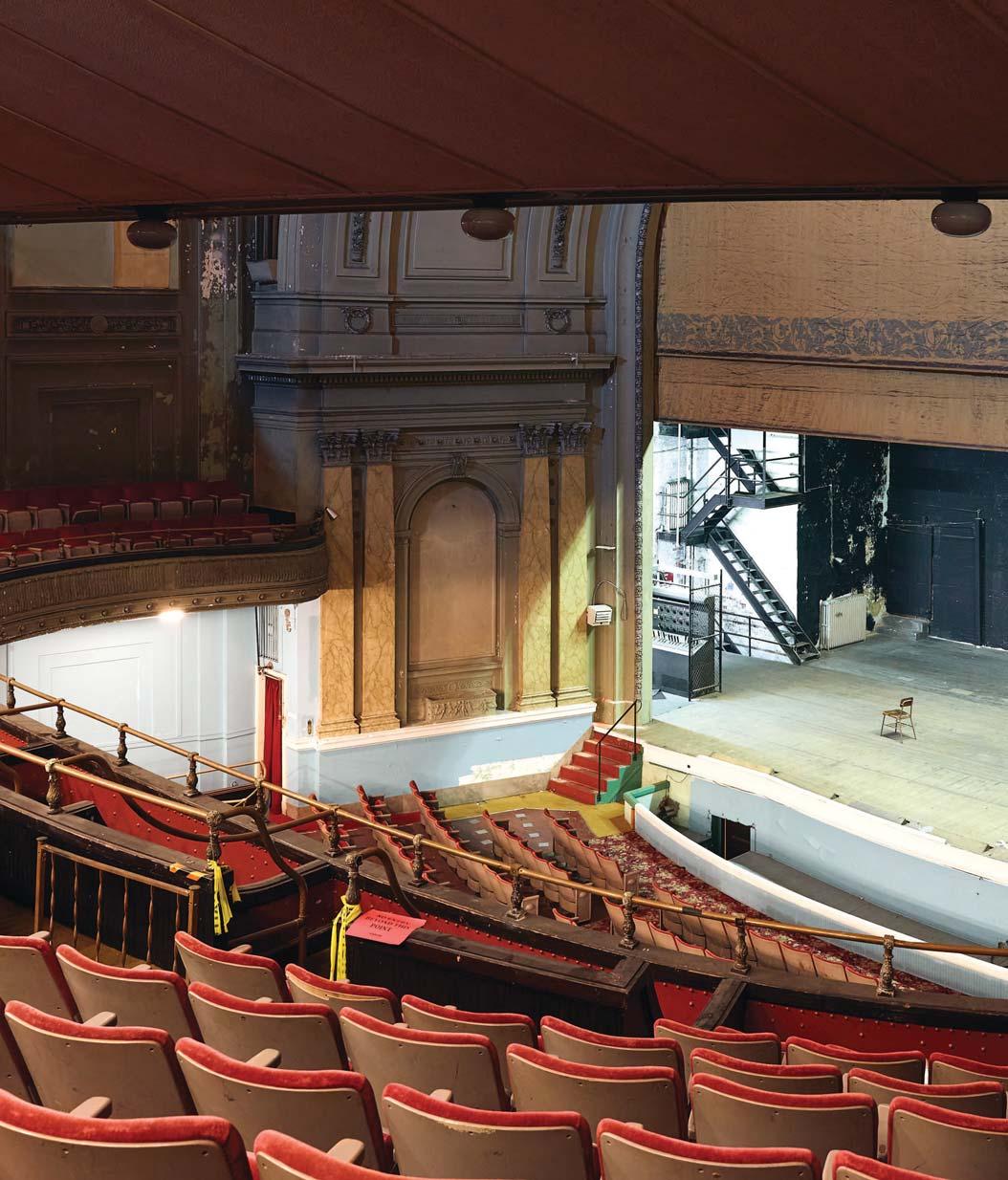
The Children’s Theatre of Cincinnati is staging a $48-million homecoming with its renovation of the Emery Theatre in Over-the-Rhine. The Junior League Players, launched in 1924, officially became Children’s Theatre in 1947 and performed for two decades at the Emery before moving shows to the Taft Theatre. CEO Kim Kern says the building project takes the organization “back home.”
The public fundraising campaign extends to May 1, with an overall goal of $48 million (including $10 million in historic and new market tax credits). The vast majority of the budget is for direct building costs, with $5 million set for programming and an endowment.
Renovation plans include new seats, an expanded lobby along Walnut Street, and state-of-theart performance technology (rendering at right) such as a video wall, interior projection mapping, and a 20-by-20-foot turntable lift for the stage.

Kern says the new space will allow Children’s Theatre to expand its existing show lineup, which has been limited to 40 dates per year at the Taft. “Then we’d like to add new programming targeted to specific age groups and present shows from other children-focused groups,” she says. “We’ll also rent the space for one-off shows and private gatherings.”
The renovation process kicks off April 29 with a block party in front of the Emery Theatre. If construction work starts in the fall as planned, says Kern, the new space will debut in Fall 2025.

Seventeen years ago, a survey by The Cincinnati Post revealed a lack of women in local C-Suites. Why weren’t they advancing? What were their barriers? What tools would help them break through their glass ceilings? The Cincinnati USA Regional Chamber was tasked with addressing these questions and equipping high-potential, goal-oriented women for career growth and launched WE Lead, a yearly 10-month program designed to “elevate the female voice in our community and push women to their next level,” says Devona Stripling, Women Excel (WE) Program Manager.
Each WE Lead cohort includes 54 participants from varying industries and leadership roles—among them marketers, bankers, lawyers, physicians, contractors, scientists, and more. The program begins in September with an overnight retreat followed by five full-day seminars, four half-day coaching sessions, and two private coaching sessions over the subsequent months. Training topics cover personal and professional issues alike, from personal branding and best business practices to building confidence and overcoming impostor syndrome.
For Danielle Lewis Jones, a communications manager in Cohort 16, networking was the program’s most impactful tool. “To be able to connect with so many other young, powerful women in our region was really life-changing for me,” she says. “Sometimes we tend to put ourselves in self-induced silos and think we’re the only ones going through what we’re going through. When you have exposure to other people along your journey, you feel supported.”
Current cohort participant Erica Day says her WE Lead experience has inspired a ripple effect of progress through the First Financial Bank Information Security Team, where she is currently a director. “While facilitating these meetings, I often share topics covered in my WE Lead sessions,” she says. “For example, we recently discussed dealing with burnout and the importance of investing in strong working relationships.”
Channel Smith, a systems manager with Western & Southern, appreciates the WE Lead guidance for navigating a full life of multiple roles as a mother, a partner, and an employee. “One thing they made very clear at the very first session was that you cannot be your best person if you’re not taking care of yourself,” Smith says.
While WE Lead is not designed for women to leave their current place of employment—but rather to enhance the opportunities already around them—participants often find that WE Lead is the spark they need to dislodge career stagnation, whether to grow within their organization or to seek outside opportunities.

With more than 1,000 total graduates across 17 years, WE Lead has become a powerful network that’s here to stay. “What makes WE Lead different is it’s been proven to work,” says Stripling.
Applications for the 18th Cohort of WE Lead are open through May 17.
For nearly two decades, the woman-focused WE Lead program has been changing faces in the region’s C-Suites.
–ELIZABETH MILLER WOOD

The housing market is constantly changing, causing a ripple effect throughout the region’s economy. The pandemic’s initial shock halted most business activity but quickly turned the real estate market upside down with unexpected interest in buying and selling. Fast forward to today, when interest rate hikes have started to deter buyers.
Anne Uchtman, director of agent development at Star One Realtors and 2023 president of the Realtor Alliance of Greater Cincinnati, says that despite the ebb and flow buyers are still buying and sellers are still selling. “COVID changed the way all of us work,” she says. “We thought the pandemic was going to completely stall our market, but we saw an incredible boom. Prices were through the roof, and you’d get up to 50 offers on a home.”
Now it’s all about supply. According to MLS data, the average home in the Greater Cincinnati region is on the market nine days and there’s about a month’s supply of homes—which Uchtman describes as an unbalanced market. She says a five- to sixmonth supply is more balanced, with as many buyers as there are sellers and with buyers having more options and less pressure to submit offers quickly. The lower the supply, the higher the prices and more competitive the market is. “We have an inventory shortage,” she says. “Supply and demand comes into play here. We don’t have a lot of new listings, and depending on the house and the area and how in-demand it is, you might have to bid thousands of dollars over asking price.”

In addition to the general shortage, buyers are seeking amenities such as more bedrooms to accommodate a home office and leisure space to enjoy family time. Uchtman says people like the idea of bringing the vacation to the home with an outdoor space. A new trend that’s becoming common is wanting a pool or a large enough backyard to add one.
“Don’t let the rate stop you from purchasing,” says Uchtman. “Despite rates, people are always going to buy.” Lenders are getting creative, and buying down interest rates is an option. Refinancing once rates drop is a possibility. She says buyers should date the rate and marry the house—the main priority is finding the right house in a competitive market.
“I don’t have a crystal ball,” she says, “but my guess is it evens out a little more. During the housing market crash people took their houses off the market and buyers stopped looking. Things are slowing down, but people are still buying and selling. I had one of my best quarters in the fourth quarter [of 2022].”
—SARAH
We’re saving you a seat! Whether you are hosting an intimate networking reception, company-wide party, or annual fundraising event, McHale’s seamlessly provides the all-inclusive options you’re looking for, including onsite catering, planning and more.

Let
Cincinnati
 –SARAH M. MULLINS
Ashlee Clarke, whose resume runs deep in the advertising and entrepreneurial world, has taken the reins of Empower Media to continue its legacy. As the largest woman-owned U.S. media agency. She is founder, CEO, and chief creative officer of NitroC, a New York City-based media agency with offices in Houston and Palm Beach, Florida. She’s both a successful business leader and a Tony Award-winning producer and both a fast-paced New Yorker and a Georgia native with proud Southern roots.
Clarke and her husband Chris acquired Empower from Jim Price, who will remain on board as non-executive chairman for a year. Ashlee is Empower’s new CEO and Chris is executive chairman. Price’s mother, Mary Beth, launched the agency in 1985, and Price had served as CEO since 2009.
Ashlee Clarke has solidified her career as a self-proclaimed nontraditional advertising leader with a healthy dose of heart, passion, and guts. “I am tenacious and not afraid to go about things a different way,” she says. “It’s definitely
how I’ve managed to infiltrate the advertising boys club industry.”
She supports a client’s business through the eyes of the “heartlander” consumer—understanding what matters most to those of us living in the middle of the country as opposed to consultants who view us through the lens of Madison Avenue. “Empower has been on my radar for years,” she says. “I’ve seen the business transform from being this local juggernaut to becoming a national phenomenon. I saw the opportunity to build on the legacy of female empowerment and marry Empower’s media expertise with my vision for creating meaningful cultural-consumer connections.”
Nearly 70 percent of the company’s staff are women, and Clarke plans to

build on the agency’s mantra #LiveEmpowered that encourages employees and clients to advocate for women, diversity, and inclusion. “I’ve always respected Mary Beth Price’s founding story of Empower and appreciate its strong female presence throughout the years.”
Empower has an average client tenure of eight years, Clarke says, which is three times the industry average. Its client portfolio includes Wendy’s, Bush’s Best, Newell Brands, and Zaxby’s Coffee. “Our clients come to Empower for sustainable growth,” she says. “Our Media Innovation Group has invented new ways to make client media dollars work smarter and harder, measured by our sophisticated inhouse data and analytics team, while focusing on our clients’ ROI.”
As for what’s next, Clarke says the company will maintain its Chicago and Atlanta offices as well as its Over-the-Rhine headquarters. The timing of this acquisition, she says, will set up Empower for success. “We are in a recession, and brands that are geared for growth are going to want to invest in their media to take up market share. We are seeing a sense of urgency and excitement flooding these offices, because now is the time for us to grow. Empower Media is locked in, excited, and expecting significant growth.”
The women of Thompson Hine are elevating the practice of law, transforming business and driving growth.


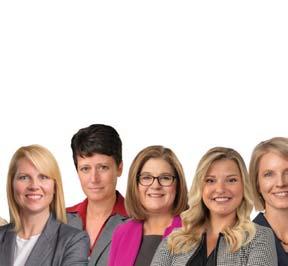
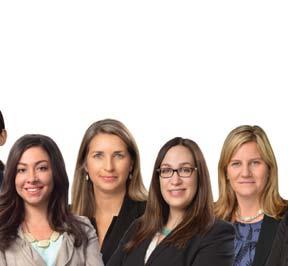
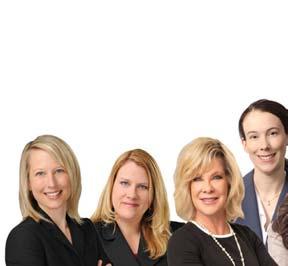
“Thompson Hine is a pacesetter in the advancement of women within our firm, the legal profession and the broader business community. Elevating women in every sector of the legal profession enhances the quality of legal services and paves the way for generations of influential women to come.”

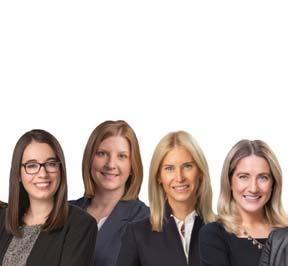

– Megan S. Glowacki, Cincinnati Partner in Charge ThompsonHine.com

 Cincinnati office (left to right): Erin D. Borcherding, Cassandra W. Borchers, Deborah S. Brenneman, Susan C. Cornett, Angela C. Daniele, Megan S. Glowacki, Beth A. Mandel, Suzanne C. McNabb, Kelsey Mehaffie, Emily G. Montion, Emma Off, Avery Hutson Ozimek, Kimberly E. Ramundo, Laura A. Ryan, Carrie A. Shufflebarger, Brianna Vollman, Kim Wilcoxon
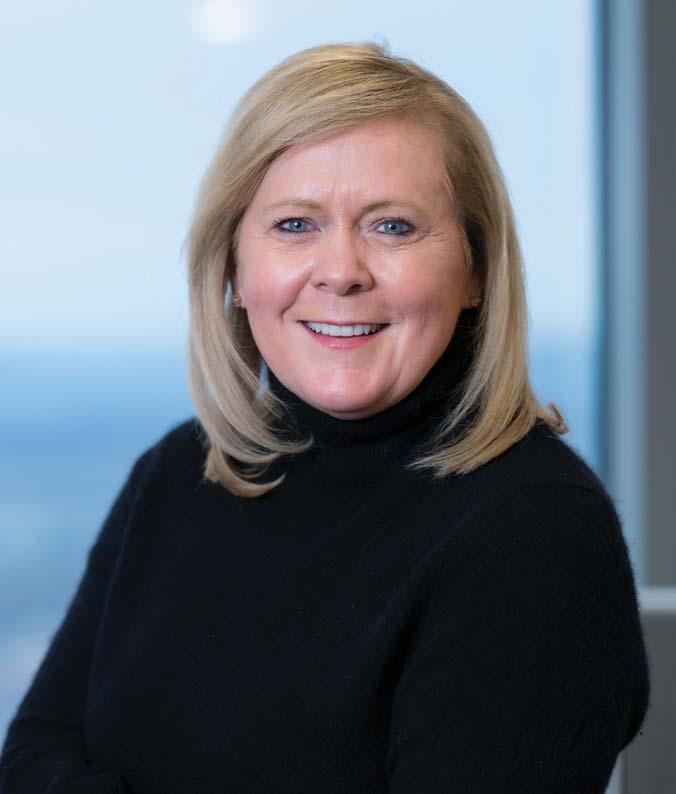
Media guru and financial expert Lisa Knutson is no stranger to taking on a new role and transforming a business division. In fact, she’s been the resident changemaker at E.W. Scripps, one of the nation’s largest local TV broadcasters, for more than 17 years. In January, the downtown-based public company announced a restructuring and reorganization with Knutson taking the reins of local media and Scripps Networks efforts in a new chief operating officer position.
Knutson is immersing herself in the business units. “We’re really in what I would call the discovery phase of understanding how businesses have evolved the last several years,” she says. “We are diligently working to make sure that we’re achieving the objectives we set out to achieve through this restructure, but also honor and support our mission of supporting journalism across the country while looking for ways we can be more efficient, more effective, and more nimble.”
Knutson was born and raised in Cincinnati and graduated from Miami University, which led to her first job in public accounting. She moved up the ranks in her career at Arthur Andersen, worked for a startup, and served as a Fifth Third Bank vice president before joining Scripps in 2005, where she’s served as chief strategy officer and chief administrative officer. Under her leadership, Scripps more than doubled its number of local market TV stations and acquired national broadcast network ION Media in a $2.65-billion deal. The company owns 61 stations in 41 U.S. markets and has almost 70 million viewers per month across eight networks, including ION, which is the largest.
Scripps recently launched its TV stations and the Scripps Network on free ad-supported “over-the-air” television, which is accessible with a digital antenna. “People may or may not know or remember that you can plug in a digital antenna and in some markets get up to 30 television stations for free,” says Knutson. “Especially in a climate like we are today with inflation and a potential recession, free is a compelling value proposition. We’re working to meet the consumer where they are and where they want to watch.”
Knutson was honored in 2022 by MultiChannel News as a “Wonder Woman” for high-performing women executives in TV, streaming, and advertising, and in 2021 by Cynopsis Media as one of its “Top Women in Media.”
“I always say I’m motivated by challenge, change, and purpose,” she says. “I love leading change, and I love a challenge. Working at Scripps added a third lens through which I really make my decisions: purpose. The role we play in our communities in the U.S. in terms of giving people news information and being a watchdog is something I’m very committed to as a leader.”
Lisa Knutson is taking on challenges and driving change as Scripps’ new chief operating officer.
–SARAH M. MULLINS
The COVID-19 pandemic, which compounded long-lingering economic disparities for communities of color, added urgency to the Cincinnati USA Regional Chamber’s Minority Business Accelerator (MBA) 2020 plan to create a sustainable source of growth funding. The result, MBA Fund I, is currently securing commitments toward its $100 million fundraising goal.
First Financial Bank has signed on with a $1.75 million commitment and will continue its support through future phases, according to Roddell McCullough, its chief corporate responsibility officer. “We see our relationship with the accelerator as our opportunity to support and develop minority businesses of scale as well as small businesses within the region,” he says. “This was something easy for us to get behind and see it bring benefit to the region. Our goal as a bank is to help our clients and communities thrive.”
Ed Rigaud, a member of the accelerator’s board of managers, says the fund will help companies facilitate acquisitions. “The key is that there are important companies owned by members of the majority community who do not have succession plans and who are ready to sell their companies,” he says. “We need buyers from minority communities who can assume ownership and control of those companies, and the MBA Fund I can help make that happen.”
The fund’s other important aspect, Rigaud says, is to provide growth funding to scalable minority-owned enterprises, with the focus being on African American and Hispanic-owned firms. “The Cincinnati MBA is unique in that it’s both a mentor and a resource organization,”
he says. “The MBA can work closely with member firms owned by African Americans and Hispanics to enhance strategies for growth, forge new relationships and networks, and obtain the necessary funding to execute business plans and/or make strategic acquisitions.”
McCullough says investing in MBA Fund I builds on First Financial Bank’s community development strategy ALIVE, which is focused on expanding access to lending and financial services in places historically under-resourced, making strategic community investment, and facilitating volunteerism focused on financial education. “When you compare the efforts of Cincinnati to support minority business development, we’re crushing it compared to others,” he says. “But looking at it on a macro scale, it’s still not enough. The more we can do to support minority business development, particularly those businesses of scale that can provide services to Fortune 500 and Fortune 100 companies, it’s good for the region. It’s good for us to encourage other metropolitan areas to do the same.”
Mel Gravely, an entrepreneur and member of the accelerator’s board of managers, says the

fund builds on the Cincinnati region’s reputation as a national model for growing larger-scale minority-owned businesses. “We already have companies of scale, we already have a reputation, we already have a community that understands what we are trying to create,” he says, “and now we have an additional flywheel element that allows it to happen.”
Creating and growing more successful minority-owned companies will increase the size of the region’s overall economic pie, Rigaud says. “This is key to providing opportunities for everyone to participate in our economy at both the worker and owner levels.”
Roddell McCullough of First Financial Bank: “This was easy for us to get behind.”
Ed Rigaud: “The MBA is unique, both a mentor and a resource organization.”

22
Paving a better path for the next women leaders
30
Six new projects to help the region “think big”
36
42
According to the Women’s Business Enterprise National Council, women own 13 million businesses across the country. The National Association of Women Business Owners states that one in five firms with revenue of $1 million or more is woman-owned and that woman-owned firms account for 39 percent of all privately held U.S. firms.
It’s no secret that there are significant barriers to entry, and eventually success, for anyone starting his or her own business, but the stakes are often higher for women. Sexism, ageism, and racism can be magnified for women at all levels of the economic hierarchy. Indeed, the gender pay gap between women and men in the U.S. has held steady for the last two decades—in 2022, according to the Pew Research Center, women earned roughly 82 percent of what men earned. For many women, one solution is attaining a leadership position that allows them to effect change.
“What I continue to see is that there’s just an increase of women and particularly women of color deciding, I want to create my own work culture, I want to start my own business,” says Patrice Borders, a Cincinnati-based board-certified executive coach. “I think a driving force is wanting to really shape a culture of belonging, starting for themselves. That, in many ways, is an absolute testament to confidence versus the messaging sometimes we get about imposter syndrome.”
To receive woman-owned business certification from the Women’s Business Enterprise National Council, a business must have at least 51 percent female ownership. Some 950 firms in the Cincinnati region are woman-owned, accord-

ing to data from the 2018 U.S. Census Bureau’s Annual Business Survey.
“I think as a region we do a great job of acknowledging that we want talent to stay here and we want talent to be invested in our region,” says Borders. “It’s not always a positioning of We need to fix this but creating the op-
portunity for expansion and growth, because organizations acknowledge these are the future solutions to our biggest future problems. We want to make sure they’re at the table and their voices are heard.”
Cincinnati itself has been a huge factor in the success of many of these
businesses, including Pure Romance, the region’s largest woman-owned business. The wellness and intimacy company, founded in 1993, moved its headquarters to downtown Cincinnati in 2014.

“Cincinnati is where Pure Romance began, and it’s important to me to keep our business in the city that’s supported us for the last 30 years,” says CEO Patty Brisben. “I may be biased, but Cincinnati is an incredible city. It’s important to us to create jobs for the community and give back to the place that’s given so much to us.”
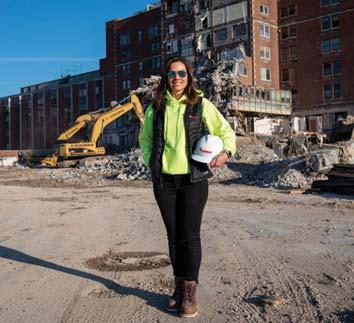
Michele O’Rourke, CEO of O’Rourke Wrecking, a specialty demolition company, shares Brisben’s goal. “As a woman, I love that nurturing part, trying to identify and give support to people that might not have it and mentor them,” says O’Rourke, who took over as CEO in 2019. “I mentor a lot of young women and try to break glass ceilings and pave the way so in 20 years there are tons of
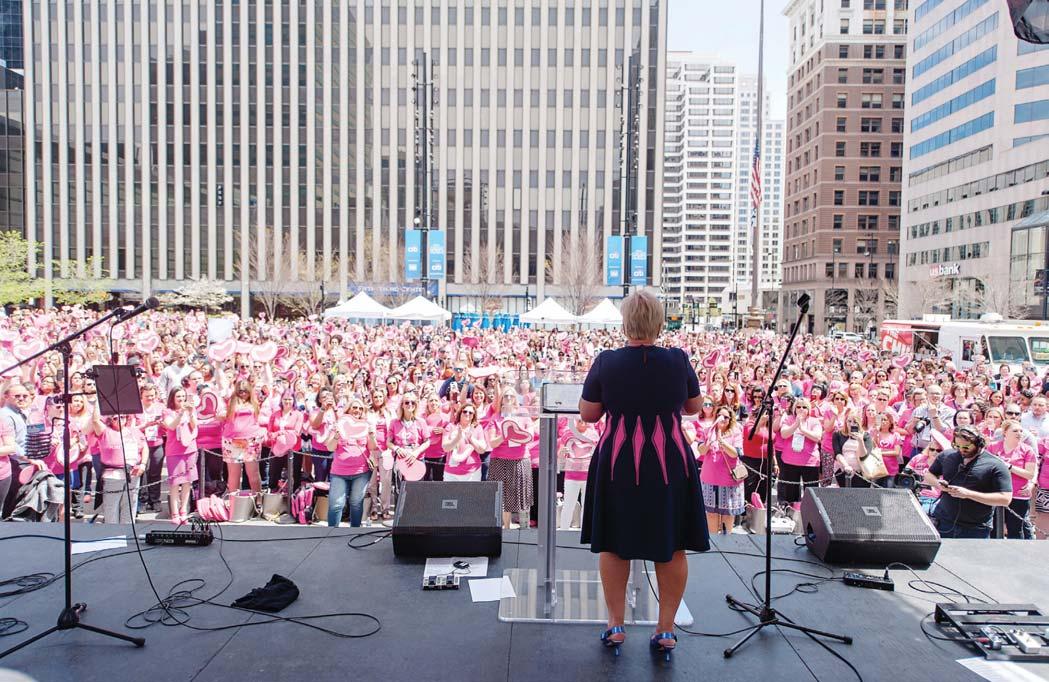
Patty Brisben (welcoming Pure Romance consultants to Cincinnati) founded the region’s largest woman-owned business and says it’s important to her to keep it in the region.
people like me, because I still struggle. I didn’t have a mentor myself. In my early career, there weren’t women mentors in the construction field at all.”
PREVIOUSLY A PHARmaceutical sales rep, O’Rourke joined the family company in 1992. Her father-in-law, the firm’s founder, had passed away, and her husband Mike was tasked with taking over the reins. Michele quit her job to support Mike and took a closer look at company operations, coming aboard initially to help in accounting and provide some stabilization.
“My role at O’Rourke kind of evolved,” she says. “What started as temporary by default has morphed into a career into a C-suite position. I never dreamed when I started I would be here in this role, and I love it.”
Christy Bard, the newly minted CEO of Jancoa, one of the region’s largest commercial cleaning companies, also took on a leadership role at a family company, when she took over from Mary Miller, her mother. “I have the best role model I could ever dream of having,” says Bard. “Her positive spirit and belief that tomorrow can be better and her efforts to find ways to make it better are simply what she did, and we all watched that for so many years that it’s just become what we do now. Her spirit it part of the natural DNA of Jancoa.”
The company was founded by Tony Miller, Bard’s stepfather, in 1972, and his wife, Mary, came on board in 1993. Bard joined Jancoa 10 years ago, starting in business development. Husband Clint is the compa-
ny’s COO, and Tony Miller’s brother, Ron, is executive vice president. The three now comprise the operational leadership team.
“When this transition happened at the end of last year, we were definitely very heavy into the leadership roles already within the day-to-day business,” says Bard. “So it just felt very comfortable to our customers and to our employees, because nothing really changed for them. The transition went beautifully.”
Jancoa employs a team of 550 people, from administrative to cleaning staff, and Bard is proud of the opportunity it provides for full-time
employment at all levels, offering not just a job but a career. “We love our people and do all we can to support them and provide opportunities,” she says. “We take great pride in the diversity we represent within our Jancoa family. Not only women leaders, but also Latino leaders, Nepali leaders, African-American leaders. That makes our heart smile.”
The company’s diversity comes from Bard’s top-down approach and builds on the legacy her mother started at Jancoa. “There’s never been a time when I thought my voice wasn’t being heard or when we didn’t get work because we’re a woman-owned
Executive coach Patrice Borders says businesses are looking for the next generation of women leaders. “We want to make sure they’re at the table and their voices are heard.”
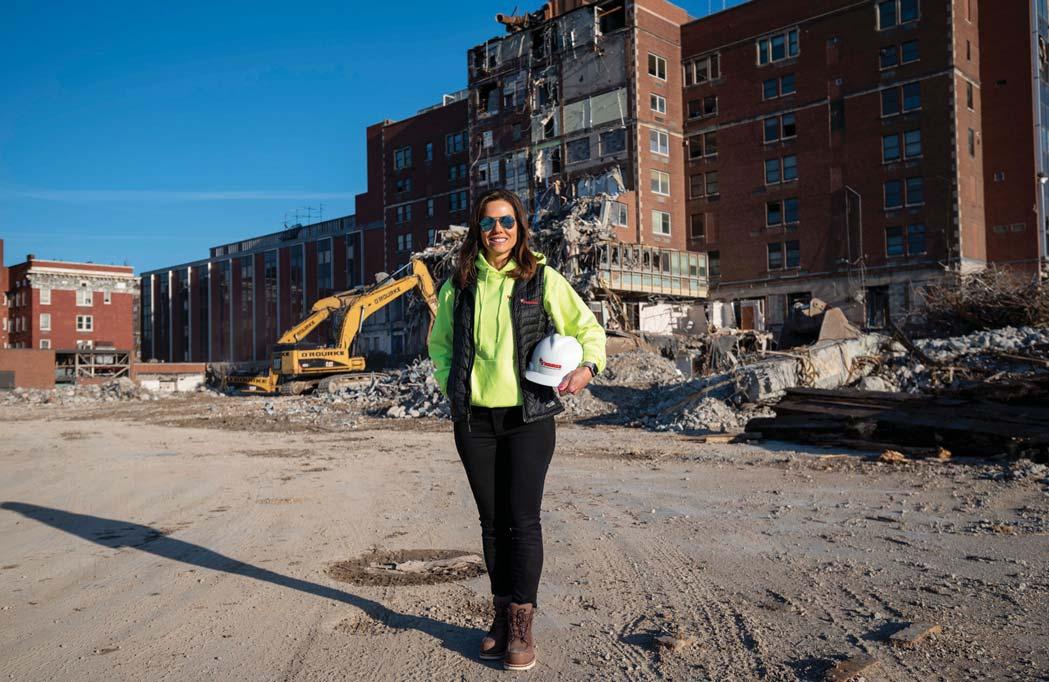
Michele O’Rourke, CEO of O’Rourke Wrecking, is mentoring young women leaders in the construction industry. “We’re trying to get them out of their comfort zones and push them to be assertive and speak up. We just need to empower them.”
business,” she says. “Actually, it would be quite the opposite. I feel that being a woman-owned business opens up more opportunities for us, and we’re very proud to be able to serve customers looking for that kind of vendor.”
In 2015, Bard went through WE Lead, the Cincinnati USA Regional Chamber leadership development program for women. (See more about the program on page 12.) “I built great relationships through that experience, and some of the gals are still my very close friends,” she says. “It’s been a critical part of my leadership development to be able to have conversations about business with other female business leaders and just watch
everybody grow from where they were to where they are now and still have those relationships and that support system.”
She’s keen to provide that same opportunity to the women on her Jancoa team, too. “We have some incredible women,” says Bard. “I want to do all I can to encourage them and support them and see what kind of future they can have here at the company.”
O’Rourke is equally invested in the next generation of leaders in her sector, at both the macro and micro levels. The company itself regularly works with area organizations to expose young people to potential careers in the construction field, including
Building Value’s work program and the Construction Career Advocacy Program. The company also has a robust co-op program.
“Hiring women co-ops and diverse minority co-ops is unbelievable,” says O’Rourke. “There have been preconceived notions about women and minorities in this field, but that mindset is changing. That’s what I’ve been working hard to do. Ten years from now, when I drive by one of our sites, you’re going to see lots of different faces from what you see now.”
O’Rourke says she remains one of the few women present on industry boards and committees. She was just the second woman in the Spirit of
Construction Foundation’s 26-year history to chair its annual gala, and she now serves as board president. O’Rourke is also deeply involved with Ladies Operating for Growth in Construction (LOGIC).
“The goal of LOGIC is to help women who’ve been in the industry get into leadership and C-Suite roles,” she says. “We’re trying to get them out of their comfort zones and push them to be assertive and speak up. You didn’t earn a seat at the table just because you’re a woman—you earned a seat at the table because you’re smart. We just need to empower them.”
AT THE OTHER END OF the woman-owned business spectrum are individual entrepreneurs, or solopreneurs, such as Regina Russo of RRight Communications. A former broadcast journalist, she decided to take the plunge to forge the second career she always wanted.
“I never thought I would be an entrepreneur, because I was a journalist
for 23 years,” says Russo. “I decided to change careers when my kids were born. You’ll find that a lot of women entrepreneurs get their start because they’re pivoting in their career to balance their life.”
After stops in marketing for the Contemporary Arts Center and the Cincinnati Art Museum, Russo’s career path became clear through WE Lead, the same program Bard undertook. “It wasn’t until I was in Cohort 8 of WE Lead that it occurred to me I could do the work of storytelling on my own and support lots of different organizations, teach them how to tell and amplify their story,” she says.
What started as a self-described “garden-variety PR” approach transitioned into what’s become the bread and butter of RRight Now: bridging the gap companies and individuals have with connecting to the public. Russo specializes in strategic communications, from crisis communications to effective public speaking training to media relations management to working with internal teams at various organizations and companies to better tell their stories.
“My business really took off when the Chamber and the Health Collaborative hired me to run the COVID communications center here in the region,” says Russo. “All of the messaging and the cohesive, data-driven, health-educated information had to reach every corner of this region, and I was tasked with pulling that information together and then disseminating it. I did that work alone at my dining room table throughout the pandemic. Most people didn’t know that this Black woman-solopreneur ran that process.”
Russo’s communications business grew to such an extent that she needed more space to house her office and more collaborators to fill her clients’ needs. So she acquired space on the second floor of 817 Main Street downtown, but not before self-doubt crept in.
“That tells you about some of the things women entrepreneurs and women business owners face,” she says. “I was second-guessing myself on whether I should buy this floor. I was immediately thinking, I should just maybe lease a 800-square-foot space and
Communications expert Regina Carswell Russo says women leaders can sometimes doubt themselves, but instead need to stay confident in their goals.


Women leaders in Cincinnati are trying to make the growth path easier for new generations in the workforce than it was for them, says Patrice Borders, a board-certified executive coach. Mentoring, nurturing, and supporting are more intentional now.
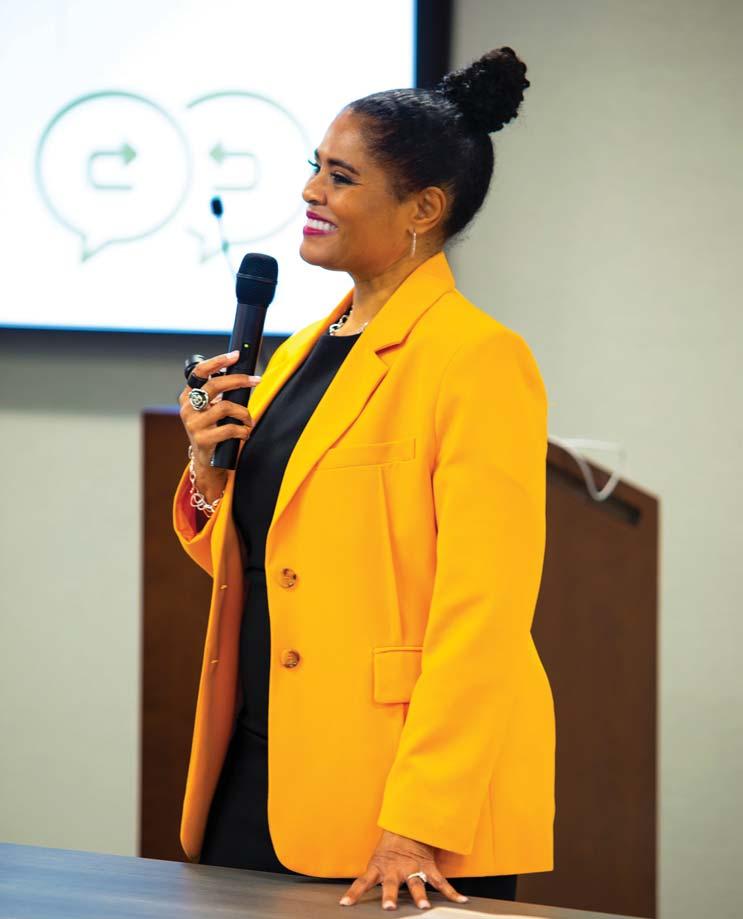
Women can doubt themselves when seeking opportunities or promoting their own accomplishments, but they need to rely on self-confidence and the support of other women leaders in order to flourish, says communications expert Regina Carswell Russo.
Being open to promoting women leaders in all fields, especially in nontraditional industries like construction, will help the Cincinnati region attract and retain talent of all skills and levels.
start out small.”
Russo’s friend Nat Comisar, a Realtor and former restaurateur, had some words of wisdom for her. “He gave me the best advice: You need to grow into where you want your business to flourish, and that requires you to step out further than you think you should be,” says Russo. “I was very thankful for those words, because women don’t hear that very often and don’t own it.”
AS AN EXECUTIVE leadership coach, Borders encounters trepidation from women at all levels of business and entrepreneurship. She has taken cues from leadership experts like Tara Mohr and Peggy Klaus, who coined the concept of the “bragalog,” and teaches clients to embrace the fullness of their strengths and potential.
“One tool I use across my coaching with women is finding that voice of self-advocacy and self-promotion,” says Borders. “Generally, to a fault, we embody this concept of Oh, I don’t want to self-promote, my work should stand for itself and Oh, there’s a negative connotation for self-promotion. We circle back in and discuss how they can change the playbook so they acknowledge that sometimes their work has gone unnoticed because they didn’t elevate it. When you’re talking about the facts, it’s not bragging.”
A component of self-promotion is effective branding, like that of Donna’s Fabulous Furs. Founded by Donna Salyers, her eponymous company has a straightforward backstory: She started selling DIY faux-fur coat kits after
one she made for herself earned rave reviews on a trip to New York City. Her work ethos is part of the brand, which exclusively uses faux fur, and her success has been hard-won.
“It was pretty tough to start out, and I don’t know that you have to be a woman to corner that ‘hard times’
market,” says Salyers. “I think it’s difficult to run any business, especially a startup, and to think it’s going to go somewhere. Failure rates are just horrible. How many small businesses fail before the fifth year? And then for us to be a world leader from Covington, Kentucky, are you crazy?”
More than 30 years later, Donna’s Fabulous Furs, Donna’s Fabulous Bridal, the Madison Event Center, and Hotel Covington have all grown under the umbrella of the Salyers Group, an investment firm headed up by her husband, Jim. The hotel is led by the pair’s son-in-law, Guy van Rooyen, who serves as Salyers Group president. It’s been named to national “best of” hotel rankings, including the No. 1 ranked Kentucky hotel and inclusion in the top 3 percent of all U.S. hotels for 2022 in U.S. News &
“THE RISING TIDE LIFTS ALL BOATS,” SAYS DONNA SALYERS.
“WOMEN COMPANY OWNERS ARE A SORORITY OF PEOPLE WHO ALL HAVE BUSINESS PROBLEMS BUT CAN HELP ONE ANOTHER.”
World Report. Late last year, North by Hotel Covington opened in a vacant YMCA building just to the north on Madison Avenue.
The Salyers were urban pioneers of sorts along that strip of downtown Covington, which has seen a dramatic rise in redevelopment over the last 15 years. An explosion of restaurants and commerce has cropped up in proximity to Salyers Group entities, growth that continues to be good for the city and the region in general.
“The rising tide lifts all boats,” says Salyers. “I think we women company owners are a sorority of people who all
have business problems but can help one another. The camaraderie and willingness to do anything to help each other is really strong in Northern Kentucky and Cincinnati.”
Indeed, for Jancoa, the region’s business network is so strong that the company has eschewed franchising in other markets. “Our foundation is in the Cincinnati area,” says Bard. “My stepdad built the business in Cincinnati, and we have a firm solid foundation within this region. We’ve had a lot of customers try to encourage us to consider other cities, but at this time we’re proud to do what we do very
well right here.”
As evidenced by the success of woman-owned businesses, says Borders, local investment in women leaders can only continue to pay off for the region.
“We have an openness here to the impact of what it means to invest in leaders,” she says. “We really value the capacity of someone to grow her self-awareness, to lead with more insight, to communicate better, to understand that there are different leadership styles and approaches, to collaborate, and to ensure that other voices and perspectives are invited in.”
Donna Saylers has opened and managed a number of businesses in Northern Kentucky, including Donna’s Fabulous Furs and Hotel Covington.

 BY DAVID HOLTHAUS
On November 15, 2021, President Biden signed into law the Infrastructure Investment and Jobs Act, making $1.2 trillion available over five years for roads, bridges, and major transportation projects as well as for passenger and freight rail, power systems, airports, public transit, water lines, broadband, and more. The level of funding is historic, and it’s been called a once-in-a-generation investment in the nation’s competitiveness.
“We have been talking in this country about investing in infrastructure for five presidencies, maybe more than that, and we finally got it done,” says Pete Metz, vice president of civic and regional partnerships at the Cincinnati USA Regional Chamber.
Now comes the complicated part. While the legislation authorizes an enormous amount of spending, it’s generally agreed that the need is even greater, and much of the funding will be competitive among states and municipalities. “Cincinnati is not unique,” says Eric Beightel, principal infrastruc-
ture policy/environmental strategist at HDR Engineering Inc. “Many cities and regions across the country have a backlog for infrastructure. The state of the infrastructure is quite old, and there’s need for improvement.”
The legislation authorizes infrastructure spending on two fronts. It first increases the level of funding that states and municipalities will receive under baseline funding programs that are distributed according to formula. For the Greater Cincinnati region, that formula funding will increase by 24 percent and average $305 million a year for the five-year period, according to a study done by HDR for the Chamber, REDI Cincinnati, the Cincinnati Business Committee, and the Cincinnati Regional Business Committee.
An even bigger impact is expected to come from the creation of more than 20 new grant programs that will award funding on a competitive basis. These “discretionary grant” programs will be administered by government agencies such as the Federal Highway Administration, the Federal Aviation Administration, the Department of Transportation, and others; the recently announced Brent Spence Bridge funding came from this bucket.
To better understand how the Greater Cincinnati metro region could benefit from the federal programs and to begin to prioritize projects for funding, HDR was engaged to connect with stakeholders in the region to analyze potential big projects, assess their readiness for grant applications, prioritize them, and make recommendations for next steps.
The firm worked with the organizations to seek nominations for projects that could compete for the grant programs, then narrowed those down to six. The selection was based on making sure there was a range
of geographic diversity—not just projects in the city of Cincinnati— as well as a range of transportation modes. “We were looking for things that are truly regional and are economic drivers,” Metz says.
Three major infrastructure projects that have already been approved for substantial funding were not included in the report because they’re far along in their development: the Brent Spence Bridge, which has been awarded federal funding of more than $1.6 billion; the Western Hills Viaduct, which is considered fully funded through local, state, and federal funds; and the Reinventing Metro plan for bus service expansion, bus rapid transit, and on-demand service, which Hamilton County voters agreed in 2020 to fund with a sales tax increase.
Other potential projects were considered not to be ready for applications yet, as they lacked enough detail to get them on the drawing board during the five-year window. Those include expansion of the Cincinnati streetcar system and potential rail transit to the airport.
The regional projects were assessed using criteria that included the likelihood of local matching funds, typically 20 percent of the project cost but which could be as much as 50 percent; the project’s readiness; and how the project aligns with U.S. Department of Transportation policy priorities like safety, sustainability, climate action, and equity.
The report then makes recommendations for moving forward on each of the six projects in order to get them ready for competitive grant applications. The recommendations could also be relevant for other projects in the region, says Beightel, the report’s lead consultant. “This process could be replicated across the region. These strategies could apply universally to
complete other important projects.”
Other regional projects will receive funding and will get support from the Chamber and other entities, Metz says, but the recommended ones are in position to be competitive now. “We view this document not as the only six projects that the Chamber supports, but six projects we believe are poised to take advantage of this deluge of federal infrastructure dollars.”
Cincinnati City Councilmember

Meeka Owens says the recommended projects look beyond just car travel.
“This is a huge opportunity not only for the city but for the region,” says Meeka Owens, chair of Cincinnati City Council’s Climate, Environment, and Infrastructure Committee. “It’s an opportunity to think big not only about our climate goals but also about providing multimodal access for residents in this community. Not just getting around by car, but really imagining what public transit looks like, what safer streets and more walkable streets look like, and how we retrofit ourselves for an electric vehicle society.”
Accessing these grants will be important to attracting and keeping businesses in the region, says Kimm Lauterbach, president and CEO of REDI Cincinnati. “Infrastructure is a key component in economic development,” she says. “Both established regional companies looking to grow here and companies that are considering the Cincinnati region to expand or relocate want to know that we have the infrastructure in place to support their business needs.”
Here are the six recommended infrastructure projects, in alphabetical order:
CENTRAL PARKWAY HAS long been one of the city’s principal thoroughfares, built over top of the Miami-Erie Canal, once a
critical transportation corridor for people and goods. The four-lane parkway divides Over-the-Rhine, which has experienced sustained investment and transformation over the last 15 years, and the West End, which has historically experienced disinvestment and decline but is eyeing new investment via FC Cincinnati’s TQL Stadium project.
This project would reimagine a section of the Parkway of roughly 10 blocks from Ezzard Charles Drive (at Music Hall) to Findlay Street (just beyond the entrance to Findlay Mar-
commitments so federal agencies can be confident that local matching dollars are available. “This is an important piece of project readiness,” Beightel says.
Studying and detailing the potential safety, economic, and environmental benefits should be included in a grant application, the report says. And it recommends identifying discrete elements of the project that could be funded in other ways should federal agencies be unwilling to support the entire cost.
Beightel. Federal costs could cover up to 80 percent of the remaining costs, depending on the available local match.
The report recommends including construction of the already-funded east side segment in the application to demonstrate that local matching funds have been secured and to position the project as one that would go a long way to “Completing the Crown.” Beightel also suggests addressing the potentially expensive issue of obtaining rights of way, as the trail will need to cross existing railroad tracks. Securing rights of way early will help demonstrate project readiness, he says.
ket). This stretch would be converted to a “Complete Street,” a thoroughfare that’s usable and safe for everyone and not just those behind the wheel of a car; recommended improvements include a lane for bus traffic, bigger sidewalks, a greenspace median, and a dedicated bicycle pathway. A reconfigured street that can be safely shared by pedestrians, bicyclists, buses, and cars would, in theory, better connect the two neighborhoods. The estimated cost is $20 million.
The HDR report recommends pursuing planning grants so the project’s elements can be better defined, as well as construction grants. It also recommends securing local funding
THE PROPOSED 34mile Cincinnati Riding or Walking Network (CROWN) trail would connect four major trails (Wasson Way, Little Miami Scenic Trail, Ohio River Trail, and Mill Creek Greenway) to form a network across Hamilton County. About 18 miles have been completed so far. Key remaining gaps in the trail network include 3.5 miles of the Mill Creek Greenway Trail from Millvale to Lower Price Hill and 2.2 miles of the Ohio River Trail from Lower Price Hill to Smale Riverfront Park. A plan to complete another 3.4 miles on the east side of town has already secured funding through a capital campaign, the report says.
Good hiking and biking trails aren’t cheap. The cost to complete the Mill Creek Greenway and Ohio River Trail sections is estimated at $25 million, which includes the full cost to design, obtain rights-of-way, and build. “Federal infrastructure funds would make a transformational impact in the region’s ability to deliver this project on a rapid timeline,” says
Several community groups have been involved in planning, designing, and funding CROWN, including TriState Trails, Cincinnati Parks, SORTA, and the Wasson Way group. The report recommends emphasizing this collaboration. “The CROWN is a shining example of building a coalition to deliver on a promise to connect the community,” it says. “These partnerships show community support and the importance of the project to future users.”
THE FEDERAL INFRAstructure law enables historic investments in a national network of electric vehicle charging infrastructure and requires states to develop statewide plans to access funding under a newly devised EV charging network formula. The program will provide nearly $5 billion over five years to help states create a network of charging stations along designated alternative fuel corridors, particularly along the interstate highway system. Ohio and Kentucky officials drafted plans that anticipated
“A REGIONAL EV PLAN CAN POSITION CINCINNATI TO BE A LEADER IN ELECTRIFICATION OF THE TRANSPORTATION SYSTEM,” SAYS THE REPORT.
charging stations at interstate exits. Stations will also be needed in cities and in suburban and rural areas not near interstates, of course. The HDR report recommends that a plan be drafted for creating charging stations and other electric vehicle infrastructure within the Cincinnati region in order to gain funding through grant programs. Such a plan will allow the region to compete for funding from discretionary grant programs, it says. “Those needs must be defined, with locations identified, costs estimated, and partnerships established,” the report says. “A regional EV Plan can accomplish that and potentially more, positioning Cincinnati to be a leader in electrification of the transportation system.”
Most of the states’ planning so far has focused on the new funding formula, the report says, but the region could benefit from a coordinated strategy to access money from grants. Interested partners so far include Duke Energy and OKI, but the network should be broadened. “Achieving this goal will require a coordinated effort across a wide range of stakeholders,” Beightel says.
THE EAST-WEST EXpressway that links Interstate 71 with Interstate 75 in downtown Cincinnati is a product of 1950s-era car-oriented urban plan-

ning. In the early 2000s, the eightlane highway was reconstructed so its footprint was narrower and deeper, enabling pedestrian bridges and streets to cross over top and opening up the riverfront for The Banks development. As part of that construction, the city invested in additional structural pilings to allow for future caps, or decks, to be built over the highway to create additional developable and public space.
City and county officials have supported this project for years, submitting an application for a $42 million grant to begin detailed planning. That application didn’t make the cut, however, and wasn’t included in grants announced by the U.S. Department of Transportation in early March. The
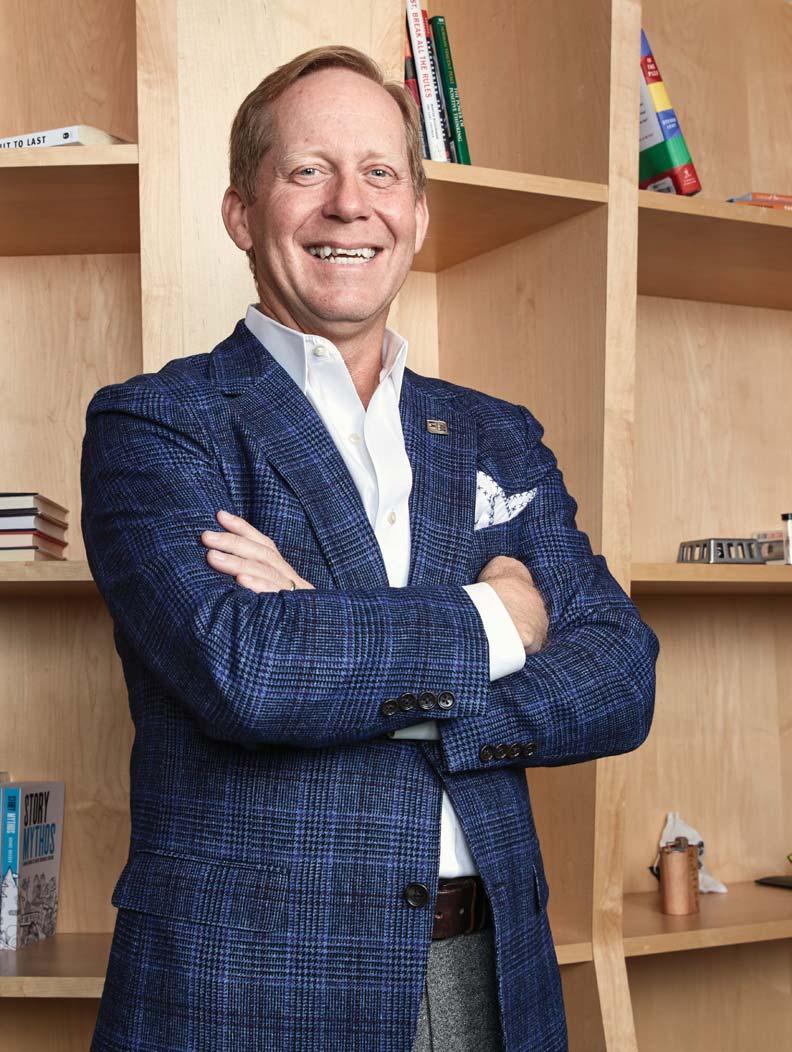
Eric Beightel, lead author of the HDR recommendation report, says every U.S. city has a backlog of infrastructure needs, so the grant process will be very competitive.
The Infrastructure and Jobs Act has opened more than 20 new grant programs awarding funding on a competitive basis; the recently announced Brent Spence Bridge funding came from one of these buckets. HDR Engineering was engaged to recommend regional projects that could apply for infrastructure funding next.
”The CROWN is a shining example of building a coalition to deliver on a promise to connect the community,” HDR says of the necessity for regional leaders to show solidarity and to offer local matching funds in these grant applications.
Winning grants to improve infrastructure will help the region attract and retain jobs, local leaders say, because both new and existing business owners want to know that Cincinnati has the infrastructure in place to support their needs.
application is expected to be resubmitted for consideration in a later round of funding. “If you don’t win in year one, you can come back in year two,” Beightel says.
The report recommends further solidifying support among more stakeholders and detailing the concept in greater detail. “Further defining the vision and seeking and securing letters of support from stakeholders would be another important step,” it says. “Once planning dollars are committed, federal officials may consider the agency ‘invested’ in the project and want to see it through to completion, further enhancing its competitiveness.”
The report also recommends improving readiness by starting work now on an environmental review, which the Department of Transportation will require and which can involve a lengthy process.
THIS IS THE COSTLIEST of the six recommended projects, with an estimated total of $450 million. The interchange connects Interstate 275 with Interstate71/75 in Northern Kentucky and carries more than twice the traffic it was designed for, the report says. It’s the main route to the airport, and thus traffic volume is expected to continue growing. “This escalating traffic, coupled with challenging merges and highway entrance and exit patterns, has resulted in growing congestion, safety concerns and travel delays in the interchange area,” the report says.
The Kentucky Transportation Cabinet is conducting technical studies and gathering data on traffic volume, travel time, and crashes to determine what improvements are needed. The agency expects the project will be completed in phases, although no timetable has been finalized, the report says.
The project’s scale means that identifying specific elements that could be funded through smaller grants may be advisable, the report says. It also recommends identifying
non-interstate improvements that will be necessary, such as noise barriers, that could be funded in other ways. Doing so would demonstrate broader support for the project. “Focusing on these improvements is an opportunity to maximize potential matching funds from other nonDOT project partners,” the report says. “This type of commitment is key to strengthening any discretionary grant application.”
OFFICIALS IN BUTLER
County’s fast-growing Liberty Township have received
HDR RECOMMENDS THAT GRANT APPLICATIONS DESCRIBE IN DETAIL HOW TRAFFIC CONDITIONS WILL BE IMPACTED IF HIGHWAY INTERCHANGES ARE NOT BUILT.
federal approval for a new Interstate 75 interchange at Millikin Way, which planners say would help relieve traffic congestion from the I-75 interchanges at Liberty Way to the south and at Ohio 63 to the north. Ohio 63 has become a major retail and logistics center, adding thousands of vehicles to the transportation network around it, the report says. A new interstate interchange would also open 700 acres of land to development, similar to the Union Centre interchange six miles to the south.
Liberty Township’s population is expected to steadily increase over the next decade, thanks in part to new developments from The Christ Hospital, which has expanded there, and Cincinnati Children’s Hospital, which opened its large Liberty Campus. “With this current and forecasted growth in the area, pro-

viding access to the Interstate to help carry increased commuter and commercial traffic is essential,” the report says.

The interchange is supported by Butler County, Liberty Township, the Ohio Department of Transportation, and the Ohio-Kentucky-Indiana Regional Council of Governments, the report says. That kind of support, as well as the planning that’s already been done around the proposal, demonstrate the kind of public support that federal grant makers look for.
HDR also recommends that federal grant applications estimate and describe in detail how traffic conditions will be impacted if the interchange is not built and development in the township continues as expected. “The narrative needs to describe present-day conditions and contrast them with expected future
conditions with and without the interchange,” Beightel says.
In order to improve competitiveness for federal funding, it’s important to have a coordinated vision for the region, Beightel and his staff write in the HDR report. “This helps communicate to the reviewers that there is a shared vision for the region and that the projects are advanced in a thoughtful and strategic way. Despite the unprecedented funding and the number of discretionary programs to pursue, they are all still likely to be oversubscribed, meaning that certain best practices to help applications rise to the top are still applicable.”
The report recommends that elected officials at the local, state, and federal levels be engaged and asked for support and that project planning and preliminary engineering continue. “It’s critical that project development continue on the key projects to get them ready to receive and spend construction dollars,” it says. For projects that aren’t that far along yet, pursuing grants for planning should be prioritized. It also recommends that local matching funds be maximized to demonstrate support for the projects and to help stretch the federal funding, both of which would be viewed favorably by grantmaking agencies.
“These six projects are critical to economic growth and job creation,” says Gary Lindgren, president of the Cincinnati Business Committee and the Cincinnati Regional Business Committee. “Taking a coordinated, collaborative approach with our local partners will best position us to drive infrastructure investment to the Cincinnati region.”
BUILDIT, AND
BUSINESS WILLCOME REDI CEO Kimm Lauterbach calls infrastructure “a key component in economic development.”
Agust tore through Fountain Square just before noon that day. But no one noticed, except perhaps for the pigeons, perplexed at the solitude and oblivious as to why. It was St. Patrick’s Day, but there were no revelers jamming O’Malley’s in the Alley or Arnold’s. It was also Primary Election Day 2020, but polling places were closed.
The spring breeze was almost ominous, swirling with fear, confusion, uncertainty, frustration, anxiety, isolation, and a bit of anger. Friendships had been reduced to flat screens. Zoom calls were interrupted by a crying baby or a barking dog. You sprayed your mail and Kroger grocery bags with Lysol and obsessing over Tiger King or binged on Friends reruns. You wore a mask wherever you went, if you went anywhere.
Jan-Michele Kearney was scrambling in March 2020. Soon to become the newest member of Cincinnati City Council, she’d invited 100 people to the official announcement of her appointment to complete the term of Councilmember Tamaya Dennard. But two hours before the announcement,
“We had 10,000 soldiers who never left their posts,” says Fifth Third Bank Regional President Tim Elsbrock about the pandemic’s early days. “People needed their bank branches to be open, and we were.”
Gov. Mike DeWine issued an executive order limiting public gatherings in Ohio to 10 people. The now-Vice Mayor realized she had calls to make. “And when I was sworn in a week later, it was just my immediate family who could attend,” she recalls. “I was sworn in and then, Here are your office keys, good luck! and I was on my own. I came to City Hall, and there was no one here. It was a ghost town.”
Just two weeks earlier, thousands of people had packed Bockfest Hall in Over-the-Rhine to enjoy the zany parade and crown a new Sausage Queen. Hamilton had just concluded its electric run at the Aronoff Center for the Arts. March Madness was coming, with Reds baseball was right around the corner. Then COVID-19 hit, and life ground to a crashing halt.
The story of the pandemic, three years later, is now also a story of collaboration, cooperation, and ultimately a comeback. Business leaders and downtown backers are coaxing life back into the ghost town, but the story’s conclusion is far from certain.
figure out how
going to do things and how we were going to work from home,” recalls Tim Elsbrock, Fifth Third Bank’s regional president, about March 2020. “There was a fragility at first as to how to do our work, but that went away in about a month. We didn’t flourish, but we were able to keep the trains running.”
While Fifth Third’s 30-story downtown skyscraper emptied out, the call center in Madisonville and most of the bank’s branch offices remained open, albeit with changes necessary to comply with social-distancing guidelines and state and local government mandates. “We had 10,000 soldiers
who never left their posts,” Elsbrock says proudly. “That’s almost half of our total employees. People needed their bank branches to be open, and we were.” He laughs as we remember the days when customers came wearing a mask and that was normal.
Fifth Third was the first of Cincinnati’s major corporations to begin the process of returning to the office, motivated in large part by senior management’s desire to avoid the appearance of a caste system, where downtown employees are treated differently from the rest of the company. Just six weeks into the shutdown, the bank put out a call for volunteers: We’re going to bring 25 percent of you back. Who wants in?
“I raised my hand, because I really needed to get out of my room,” says Courtney Dulle, 24, a commercial relationship manager. This was the Xavier graduate’s first job out of college, and she readily admits she missed the human interaction of the office. “At first, I was excited about working from home. I could hang out with my dog, get my laundry done, and I figured, You know, a little change like this will keep me on my toes.”
Like most people, Dulle thought the crisis would pass quickly and things would return to normal. “Then it didn’t,” she says. “And after a couple of weeks I got tired of working, sleeping, eating, and always being in my 450-square-foot apartment. My dog liked me being home all the time, but I was getting stir crazy.”
Everything was closed. Friends were two-dimensional on her laptop. Like most, she struggled with office Zoom calls, the technology mostly working but with those annoying attributes we all came to despise: dialogue cutting out, cameras going awry or dark, having to “raise your hand” to speak, and distracting background
noises. She laughs when she remembers those screen-time happy hours “when we really tried hard to keep in touch, but it just wasn’t the same.”
It wasn’t the same in the restaurant business either. Perhaps no other sector of the economy was more impacted and had to scramble more quickly than eating establishments. Particularly hard hit were the full-service spots catering to diners who want waiters, tablecloths, and silverware, not plastic forks and takeout bags delivered curbside by masked and gloved servers.
Jan-Michele
Kearney joined Cincinnati City Council in March 2020, as the pandemic hit. “I was sworn in at City Hall, and there was no one here. It was a ghost town.”
“We moved to carryout as quickly as possible at first,” says Joe Lanni, co-founder and owner of the Thunderdome Restaurant Group. “But it all happened so quickly that we just weren’t ready for it. People were scared and staying home. They certainly weren’t coming out to eat.”
Thunderdome properties include popular restaurants like Pepp & Dolores, Bakersfield, Currito, The Eagle, and Maplewood. It wasn’t long, Lanni remembers, before “it hit us that, to survive, we were going to have to furlough our workers.”
Waiters and chefs can’t work from home, so the decision was as painful for Lanni as it was for every restaurant owner and employee. But layoffs weren’t enough to stop the bleeding. He still had bills to pay, debt to retire, and rent to meet, and he remembers telling his bankers and landlords to “just get me through July.” Then, as the pandemic lingered, “it was, Cover me until the kids go back to school.” But, of course, the kids didn’t go back. COVID wasn’t just a battle—it was a war.
At the 3CDC offices in Over-theRhine, officials wondered what the pandemic shutdown would mean for the tremendous progress the city had made in revitalizing its urban core. 3CDC had helped transformed OTR into a solid
“I T WAS A SCRAMBLE trying to
we were
retail and entertainment district and was finalizing plans for The Foundry at Fountain Square in the old Macy’s store. Would they survive a pandemic?
“We decided early on that we weren’t going to manage a decline,” says Joe Rudemiller, 3CDC’s vice president of communications and marketing. “We felt we had good momentum with the projects underway, and we believed strongly in our urban core. If we continued to move forward, things would bounce back.” Planning continued—remotely at first—but construction at the various sites around town was only minimally impacted. The work was mostly outside in the fresh air, and it wasn’t difficult for workers to comply with the social distancing guidelines in enclosed spaces.
Rudemiller says with satisfaction that the organization’s commitment to work through the pandemic is paying off with some tenants already moved into The Foundry and more to come. “It’s putting vibrant new life back into the Fountain Square area and will have a positive impact on the whole downtown,” he says.
3CDC had its economic challenges even as the construction and planning continued. One of the organization’s most important sources of income, parking garage revenue, dried up as commuters stayed home. Some OTR and downtown residents park in the garages, but the majority are downtown workers and, on weekends, patrons of the city’s entertainment venues. Those revenues pay off millions of dollars in bonds that financed construction of the garages and public spaces, and they disappeared suddenly.
3CDC reworked leases, restructured debts, and used the federal government’s Payment Protection Program (PPP) funding to get them through. “We came out of it battered, but financially in decent shape compared to what it could have been,” says Rudemiller.
There were losses, he acknowledges. The Loring Group was working hard on a residential housing project at West Fourth and Plum streets when the pandemic hit, but momentum slowed and the group hasn’t returned to it. Rudemiller says 3CDC is hopeful that activity will continue to rebound, though, as the economy picks up and work begins in earnest on redeveloping and enlarging the Duke Energy Convention Center.
The pandemic also produced a few winners—or at least survivors. Winners were those fleet-of-foot businesses that had innovative ideas. Rudemiller speaks admiringly of three small brick-and-mortar businesses that collaborated to change their business models, quickly creating a website and social media platform to promote sales. He doen’t want to name them, but he says all three proved to be fantastic marketers and have emerged with healthy businesses both in the store and online.
“The pandemic encouraged entrepreneurship, and the market rewarded it,” he says.
Just as a blizzard or other natural disasters often spur joint action, so did the pandemic. Perhaps the most striking example of Cincinnati’s business community and local government working together was in the restaurant sector.
By early fall 2020, the restaurant business was crippled. The lucrative spring and summer dining seasons had been lost, and yet COVID continued to rage. By the end of September, more than a million people had died worldwide. A week later, President Trump contracted it. We were still two months from an approved vaccine, and, while some restaurants had reopened, indoor dining felt more like a risk than a pleasure. Bars were struggling with state mandates that they close no later than 10 p.m. Happy hours were pretty unhappy.
In October, the city and the Cincinnati USA Regional Chamber collaborated on a critical restaurant rescue program designed to, in then-Mayor John Cranley’s words, “get through this terrible year.” The $4 million Taste of Cincinnati All Winter Long effort was quickly extended to mid-2021, and a buy one/get one free gift card campaign sponsored by area charitable organizations raised $750,000 that went to the dining industry’s bottom line. “It probably
“WE FELT WE HAD GOOD MOMENTUM WITH THE PROJECTS UNDERWAY, AND WE BELIEVED VERY STRONGLY IN OUR URBAN CORE,” SAYS JOE RUDEMILLER ABOUT 3CDC’S ABILITY TO CONTINUE CONSTRUCTION WORK DURING THE PANDEMIC.
saved a lot of businesses and showed Cincinnatians’ love for their city,” says Rudemiller.
Even though a variety of restaurants shut down during the pandemic’s first year, Rudemiller notes, the number of restaurant closures from spring 2020 to mid-2021 closely mirrored a normal year. While revenue was significantly lower for all of the survivors, he says, that business is always volatile and, for some of the restaurants that closed permanently, COVID might have been just one of the reasons they failed.
ON A PLEASANT SATURDAY evening in late February 2023, Overthe-Rhine is alive. Patient customers line up for chicken at The Eagle. A lively, boisterous crowd packs Alcove. The sidewalks are full, and pedestrians are moving faster than the snarled traffic on Vine Street.
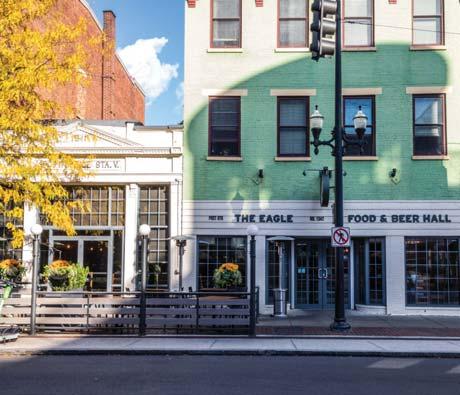
Patrons head to Ensemble Theatre of Cincinnati for the opening weekend of Morning Sun. Many are clad in FC Cincinnati orange and blue, excited for the start of the team’s fifth season. The vibe is coming back just in time for spring and a return of the wildly popular streateries.
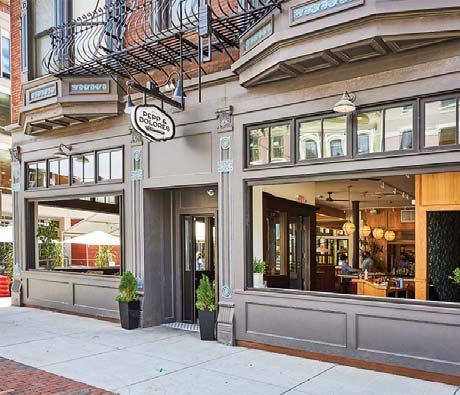
“That was maybe the one silver lining of the pandemic, and the way I can tell is that’s one that will remain,” Lanni says of the outdoor dining spaces created to address the pandemic’s social distancing requirements. Pepp & Dolores was the first to open a streaterie on the asphalt formerly known as 15th Street. Sacred Beast also has seating there, and both establishments give the city administration a round of applause for their efforts to move the idea forward quickly from concept to reality.
The rough temporary barriers that sectioned off these and other outdoor venues have mostly been replaced by permanent structures, including street cutouts and sidewalk bumpouts. Streateries now dot the city and are beloved by patrons who want to dine outdoors in the midst of bustling nightlife.
And now that the social distancing guidelines are in the rear-view mirror, Lanni notes
happily, Pepp & Dolores sports 50 percent more seats than it had pre-pandemic. In a high-volume, low-margin industry, that’s huge. It also creates an entirely different atmosphere. “The streetview has become our culture now,” says Kearney. “When it gets a little warmer, it’ll be so much fun to be just down here and see all the energy. We’re getting a European feel that’s interactive and plays to our city’s natural friendliness.”
While dinner and after-dark bar crawls are coming back, downtown still has a hill to climb. Fifth Third is back in full force, but many companies are currently adopting a hybrid model. The trend of office spaces being converted into residences has accelerated—most notably the old Central Trust/PNC office tower and the old Macy’s headquarters, and perhaps one day even Carew Tower. While business and government officials believe this change will be good for downtown’s future vibrancy, the transition details are challenging.
“We need other companies to come back,” says Fifth Third’s Elsbrock. “We need their staffs to become citizens of the community, not just residents.” He notes that a visible sign of work life returning downtown is the noonhour line of takeout bags on the counter at the Fountain Square Potbelly sandwich shop. “I remember when we first returned to the office, I’d go down there and my bag would be the only one,” he says, laughing.
Cincinnati’s business community pulled together with city government during the pandemic to help restaurants survive. Now those restaurants need office workers to return and put their “feet on the street.”
The pandemic sent traditional office workers home in March 2020, with cascading economic fallout in officeheavy areas like downtown Cincinnati. Some on-site work continued, from outdoor construction to bank branches.
The pandemic hit the restaurant industry especially hard, since its workers couldn’t do their jobs from home or practice safe distancing in the kitchen. Business owners, city officials, and 3CDC quickly devised a solution that’s becoming permanent across Cincinnati: streateries.
A return to the workplace is important for the community’s overall financial health, says Fifth Third Regional President Tim Elsbrock. “We need other companies to come back” downtown as the bank has.
Elsbrock looks at the pandemic experience as the ultimate change agent. Everyone from the mail clerk to the CEO, he says, was compelled to adjust to a new workplace reality overshadowed by a menacing virus. When the federal government initiated the PPP program, Elsbrock recalls, it was all hands on deck at Fifth Third helping customers apply for funds. “Our marketing manager didn’t have anything to market, so he was literally at home at his desk key-stroking applications
city’s 1.8 percent income tax. A court case is pending that would extend that refund to 2020, and city officials are concerned what a mass adoption of the “hybrid work model” could mean for the future.
“Seventy percent of the city’s revenue comes from earned income, so we need people to come back to work,” says Kearney. Abandoned office desktops mean empty buildings, lost parking receipts, closed restaurants, and starved retail. It’s a cascad-

Thunderdome Restaurant Group’s Joe Lanni says some temporary reactions during the pandemic will help the city’s dining scene long-term, especially new outdoor seating.
to go to the Small Business Administration,” he says.
COVID, he insists, revealed high performers at the bank and exposed deficiencies. “This was Darwinism,” he says. “COVID slayed some sacred cows that had lost their usefulness and expedited the product side of things. It also made us a more flexible company. It’s OK now if you have to take a day to work at home because there’s a childcare issue or you have a doctor’s appointment.”
A return to the workplace is important for the community’s overall financial health, Elsbrock notes.
The city of Cincinnati is now in the process of refunding $9 million to non-resident employees who worked from home in 2021 but still paid the
ing effect, the Vice Mayor says, that threatens the viability and vitality of the urban core. Recognizing the fiscal challenges ahead, Mayor Aftab Pureval has turned to an independent commission, led by Procter & Gamble CEO Jon Moeller, to consider new revenue opportunities in this uncertain social environment.
“We saw great leadership when this all started, and now we need to see the leaders of our major businesses, who have always driven Cincinnati forward, back again in our urban core,” says 3CDC’s Rudemiller. “We’re seeing the vibrancy of our community returning, and we have a great story to tell, but the more people who come back down the quicker we’ll see recovery and the progress continue.”
“SEVENTY PERCENT OF THE CITY’S REVENUE COMES FROM EARNED INCOME, SO WE NEED PEOPLE TO COME BACK TO WORK,” SAYS CINCINNATI VICE MAYOR JAN-MICHELE KEARNEY.
On a broad scale, economic development means different things to different people—some think of job creation while others think of business growth. But economic development is so much more—it’s a holistic approach to growing and sustaining local economies, which creates a plethora of long-term benefits for regional business, people, and communities as a whole.
Let’s take a closer look at all that economic development entails and why it is so critical to regional success.

More than half of the world currently lives in a metro region, and by 2050 experts predict it will be two-thirds. There are several factors driving people and businesses to metro regions, including employment opportunities, higher pay and standard of living, lower tax burden, transportation, and better access to resources like healthcare, education, skilled labor, and broadband. Other factors include climate change, culture and diversity, and technology and innovation—especially among millennials who will make up 75% of the global workforce by 2025 and are often labeled the demographic engine of urban growth.
A key part of achieving long-term viability for a region is having a strategic economic development plan with broad stakeholder buy-in that is continually
reviewed and updated to ensure it aligns with ever-changing needs—it can never be just “set it and forget it.” That means doing due diligence through ongoing economic and demographic research and analysis; outreach and communication with local business leaders, community partners and elected officials; and staying on top of market trends, opportunities, and potential risks.
Economic development professionals understand that all of their activities need to count toward maintaining well being in communities and ensuring overall quality of life for the people. How do they do that? They collaborate with educational institutions, business leaders and partner organizations to create programs that improve access to education and enhance the talent pool. They work to attract better companies to create better job opportunities. They support and promote programs
that incentivize revitalization and entrepreneurship to enhance communities. They bring funding opportunities to support startups and small business and develop cultural and innovation centers. And the list goes on.
While these aforementioned efforts are just some of what the economic development experts at REDI Cincinnati and our partners do to ensure the success of our 16-county, tri-state region, we hope this gives you a better idea of what economic development is all about and why it is so critical to our businesses, our people, and our communities. But these efforts aren’t easy—it takes resilience, flexibility, and strength on the part of all regional stakeholders and the support of our local business leaders.
To read more on Economic Development in the Cincinnati region, visit:REDICincinnati.com/success
Jill Meyer distinctly remembers when the idea of serving as CEO of the Cincinnati USA Regional Chamber first entered her mind. Back in 2015, she was member-in-charge of Frost Brown Todd’s Cincinnati office, where she’d been practicing law for 19 years, and was hosting a reception for several women who’d been named CEOs of area organizations in the previous few months.
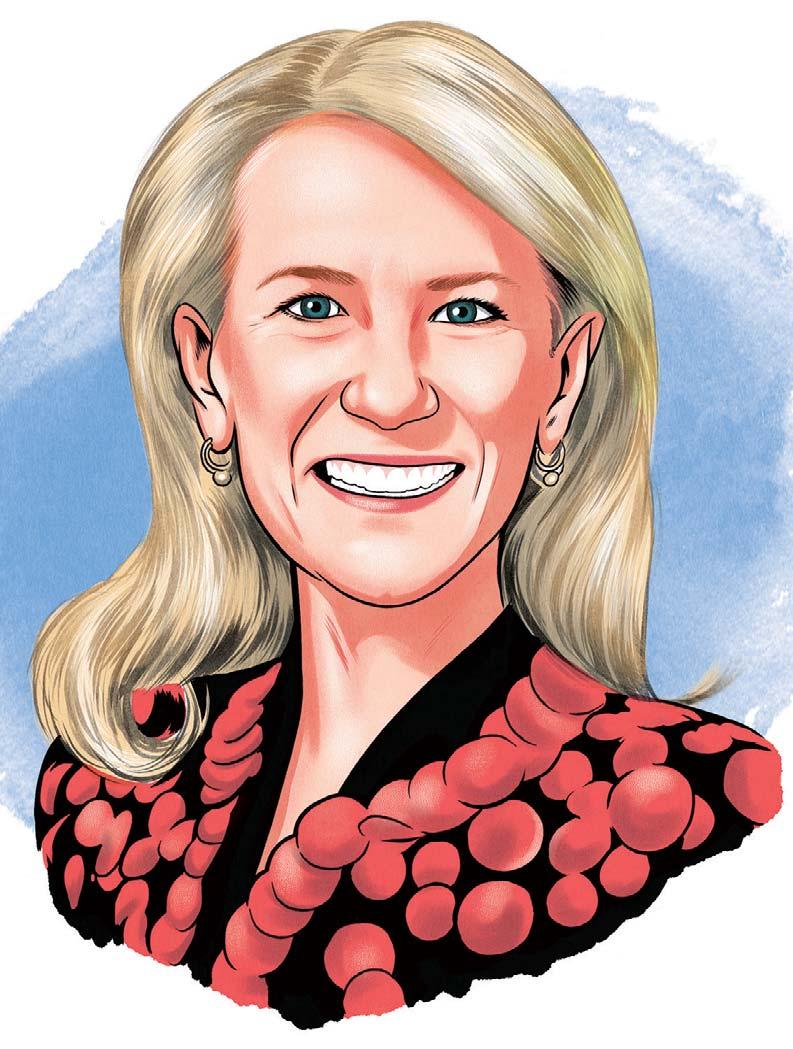
At that time, Julia Poston was the Chamber’s board chair as well as managing partner at EY, and Meyer was serving on the Chamber board. “Julia came to the reception,” Meyer recalls. “I was greeting people as she walked in, and she said to me, Hey, I have a question for you. Will you come run the Chamber? And I looked at her and said, No. Can I get you a glass of champagne?”
Meyer understood the challenges and the opportunities facing Chamber board members as they searched for a new day-to-day leader, and she was excited about the possibilities ahead for Cincinnati’s business community and the region in general. She just hadn’t pictured herself in that role. “I knew the city needed to go further faster or our
window of opportunity would slip away,” she says. “Julia told me, I know you love your law practice and your firm, but I also happen to know you love Cincinnati even more.”
Meyer joined the Chamber as president and CEO in September 2015 and focused on tackling pressing economic issues and building Cincinnati into a stronger destination for people and businesses. Under her leadership, the Chamber launched the Workforce Innovation Center, the Center for Research and Data, the Leadership Center, and Cincinnati Compass; brought the renowned BLINK event to life; planted the stake for a regional transportation infrastructure vision, leading the campaign to pass a first-ever Hamilton County transit and infrastructure funding plan; and launched the Minority Business Accelerator Fund I. Meyer led the business community through COVID-19 and its recovery and has been active in dozens of major community initiatives, including serving as president of the Build Our New Bridge Now coalition to advocate for the Brent Spence Bridge solution.
Meyer recently announced that she’s departing from the Chamber on May 15, when current Chamber President Brendon Cull will become CEO. She sat down for an “exit interview” to discuss her Chamber accomplishments, her focus on population growth as the key component of economic success for the region, her hopes for Cincinnati over the next five years, and her own personal next steps.
If you can think back to 2015, which seems like 1,000 years ago at this point, the city had some pieces that were starting to pop, but we did not have a real strategy. We had a lot of gaps in economic growth areas. We were not a unified, focused business community at that point. I also knew we lacked strategy because I was one of the frustrated Chamber board members who was saying, Let’s do something here.
I saw enough gaps and potentials that I felt like I could really build strategy and create
some vision. It wasn’t like I was coming in to execute a plan; I had to build the plan first. So the city’s business leaders said, We’ll follow your lead, back your strategy, and help you execute it. Wow. People usually don’t get that kind of opportunity.
I would say that the broad strategy was generally supported. There were some people who were early disbelievers who became believers. And, frankly, there were some people who were like, Well, I don’t think project X or Y is that important, but if this is what we’re doing I’ll support it.
I would say overall people got it and leaned in in a really critical way, which is how we’ve been able to get so much done. The Chamber has become an umbrella organization for other specific chambers and for working together with REDI and with Cincinnati Experience. Not to compete with them, but to really take a “big tent” approach. If you look at what’s required for economic growth in a region, lots of different parts and pieces have to come together to work. And you need to have an overriding core strategy that looks 20 years down the road and drives things forward.
The Cincinnati Experience example is a really fun one. Source Cincinnati launched before I was at the Chamber, and it was all about earned media, which was important. And Source was originally under the Convention and Visitor’s Bureau [now VisitCincy], but there were contributions from others. I had a meeting with Johnna Reeder at REDI and Dan Lincoln at the CVB to discuss this opportunity to turn Source—now known as Cincinnati Experience—into a real driver for promoting Cincinnati’s story to the national media. Some business leaders said to us very clearly, Look, you all need to be telling the same story, whether it’s trying to attract visitors, talent, or business. But we’re not interested in paying a separate entity to do what we think is your job. So starting a strong collaboration with John-
na and Dan really set the table nicely for the kinds of partnerships that would follow. Everything hasn’t been easy, but just the concept of working from a core strategy that’s shared across businesses and organizations is an enormous step forward from where we were in the past. Especially the fact that the Chamber and REDI share a strategy. It’s really important that we’re able to piece together who does what, how, and in what order.
CINCINNATI BUSINESS LEADERS GIVE A LOT OF THEIR TIME TO SERVING ON THE CHAMBER BOARD, AS YOU DID BEFORE YOU JOINED AS CEO, AS WELL AS ON BOARDS AT 3CDC, CINCINNATI BUSINESS COMMITTEE, ARTSWAVE, AND UNITED WAY. HOW DOES THAT TRANSLATE INTO STRATEGY AND ACTION IN YOUR ORGANIZATION?
It just always amazes me that corporate leaders who probably don’t have the time still make the time. I’m saying that not to sound like a Cincinnati cheerleader, but because I’ve learned in the last eight years that this involvement is actually a differentiator for Cincinnati.
If you go back to the beginnings of Cincinnati as an economic center, this town was built by private business, not by a university or by state government like Columbus or Indianapolis. If you look at the origins of all of our core components—whether it’s arts, culture, the Chamber, or things like the Mercantile Library and other treasures in our community—they trace back to businessmen, and some women obviously, who said, This is our town, and we need to make this a great place to live. And so they built it. It’s always been that way everywhere, that the companies in town run and take care of their city.
Columbus is a great example because it’s so close and so different. The university and state government define Columbus. Those are the mechanisms of how you get stuff done in Columbus. But in Cincinnati you get it done by getting the private business leaders to say, This is important, and this is what we need to do to make this a favorable community.
So if you’re a government city and you want to get a big thing done, you figure out how to get that money from the government.
You get your check, and you move forward. In Cincinnati, you say, This is a really cool idea. Let’s see how people think about it. Let’s see if somebody has a better idea, and let’s rally the troops around a core idea.
DOES THAT SORT OF BUSINESS-LED MODEL PUT A LOT OF UNDUE PRESSURE ON PROCTER & GAMBLE, KROGER, AND THE OTHER LARGE CORPORATIONS TO LEAD?
It’s a careful balance, for sure. You need P&G and Kroger and Fifth Third for major initiatives. They get asked for everything, whether it’s the big major things or the smaller things. So I’ve
breakdown is consistent with business ownership across the country. So we’ve taken big major initiatives and asked, How do we address the needs of businesses from micros to small to midcaps to big, big companies and everything in between all of those pieces? How do you create a place where there’s a seat at the table for people in all of those roles? That’s something this Chamber has always done well. We have focused in my time to include a wide variety of business leaders at our board table as well as at the other tables we’re seeding to get anything done, and that’s the magic of getting big things done. Because you can’t go to P&G for everything and say, Will you write this check? It isn’t fair to Procter & Gamble, but it’s also not fair to everyone else because there are other people who are passionate and have really great opinions. Their checks don’t have as many zeroes, but they might have lots of other abilities to get things done.
HOW HAVE YOU CREATED AN ORGANIZATION THAT BUSINESSES OF ALL SIZES CAN FEEL A PART OF AND CONTRIBUTE TO?
been careful to make sure that when it’s the Cincinnati Futures Commission— which is studying the city’s economic challenges, engaging the community, and planning for the future—we need [Procter & Gamble CEO] Jon Moeller at the head of that. That’s not going to happen at the scale it should without him. For other things, we can stir the pot maybe a little bit differently and not have to rely on the big firms so much.
But here’s the beauty of a Chamber like ours: 80 percent of our members are not big corporations. That
Earlier in my tenure, when some things had started to happen, people asked me what had changed in Cincinnati to get X, Y, or Z done. What I told everybody then—and I would say even more so now—is that more people have taken ownership of what’s happening in this community. That wasn’t always the case, which I think is symptomatic of when a community has so many big Fortune 500 and other strong privately held businesses. There’s a tendency for some to step back and say, We’ll either wait for them to do it, or we’ll wait for their permission to do it. And that’s changed.
Grassroots is one level, but there
are also just other rooms where they’re saying, You know what, we can do this. And it’d be great if Procter & Gamble wants to come along, but we’re not going to rely on them or put the onus on them. We’re going to own it. That’s happening in a way now that did not happen 10 years ago, no question about it. And what spurred that, I don’t know, other than maybe a combination of being invited in and being asked their opinion and of seeing some things happen. You know, someone has the audacity to go do something like BLINK and it turns into a really big, cool thing. And that’s great for everyone.
When we built the first strategy after I became CEO, it was based on a visual of three pillars. We talked about them as pillars because I realized we needed to reestablish the foundational power of a strong Chamber—and what better way to do that than to have pillars, right? Our pillars were essentially “Business Development,” “Talent,” and “Telling the Story.” Our strategy was focused in all regards on inclusion, and I think my exact words to the board were, Notice I didn’t say diversity, because if anybody needs to understand why diversity is important at this point, I can’t help you.
But what we can do better is look at how inclusive we’re being in Cincinnati. The reality is that no community gets that right. And so I said that we’d focus on modeling inclusion in absolutely everything we do.
The Chamber is a business membership organization. I took the CEO position because I’m a capitalist at heart. I believe that private business is what makes the world go round. You have government funding, you have
“I’M A CAPITALIST AT HEART. HAPPY PEOPLE MAKE PROFITABLE BUSINESSES, AND PROFITABLE BUSINESSES MAKE A HAPPY COMMUNITY.”
Jill Meyer has been advocating for positive change at the Chamber since 2015, with a focus on business development and lifestyle improvements.
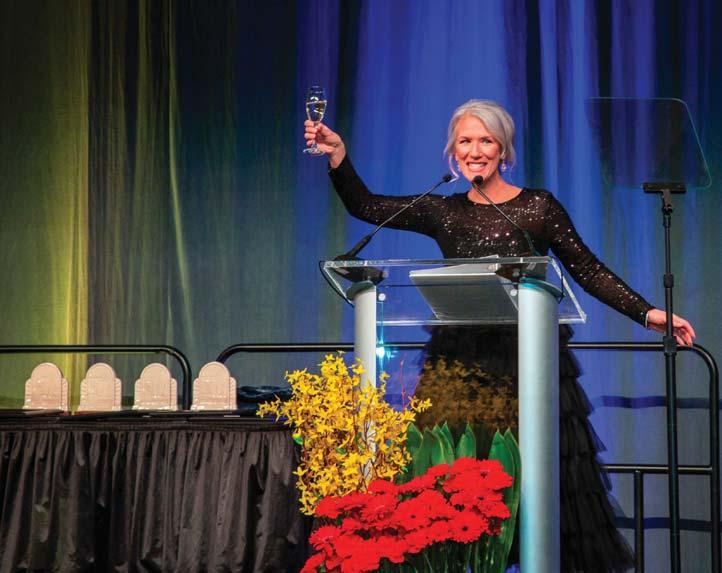
engaged people, you have people with self-sustainability, you have wealth, you have people’s ability to feed themselves and their children—you have all of that because you have private businesses. And when I went to the Chamber, I said, I’m going to come into the room saying I’m here to build businesses.
There remain some Cincinnatians who think the business community is only out for themselves and all that kind of thing. I think we flipped that narrative a little bit on its head by saying, Yes, with no apology, I want to build strong businesses in the Cincinnati region. We need to be a region where the people in those businesses want to live, want to work, want to build their families, and can thrive.
At the end of the day, a community is only as strong as its economic base. And when you have private business as the core driver of our economic base as we do, you can’t have a strong business community without a strong community. Happy people make profitable businesses, and profitable businesses make a happy community.
So much of the drive for the business community is to attract new businesses to come to town, which REDI leads. But the other part of the equation, which sometimes used to get short shrift, is keeping people here once they arrive. If you ask any company why they’re locating where they are, they’ll tell you the economic reasons: tax incentives, tax base, and all of the things that impact how you run your business. But what all of them have added in the last decade is talent and transportation. A company is not going to locate here unless we have talent

Jill Meyer joined the Cincinnati USA Regional Chamber in 2015 to devise and executive a strategy for moving Cincinnati forward. “I felt like I could really build strategy and create some vision,” she says. “The city’s business leaders said, We’ll follow your lead, back your strategy, and help you execute it. Wow. People usually don’t get that kind of opportunity.”
Meyer is proud of her focus on inclusion as CEO and her purposeful recruitment of opinions and leadership from businesses of all shapes and sizes. “Checks from smaller companies don’t have as many zeroes [as funds from P&G or Kroger], but those leaders might have lots of other abilities to get things done.”
The forthcoming Brent Spence Bridge project will be “almost like a monument to Look what we did, you know?” says Meyer, who describes it as “a morale boost unlike anything I can think of. But now we can say we got it. Yeah, we’re rocking now. What’s next? ”
and/or this is a place where talent will come and stay. You don’t add jobs to a community if you’re not a place where people want to be.
These days, it isn’t difficult to get people to move to Cincinnati for a million reasons. There have always been stories of employees at P&G and Fifth Third and other companies coming to Cincinnati to work for an allotted period of time but then staying. We know that once people live here and get ingrained, they love it. But what we’ve also learned more recently with Cincinnati Experience is that once we get people physically to this town to see it, seeing is believing. Anastasia Mileham [executive director of Cincinnati Experience] will confirm that national media reporters tell her regularly—and this was true pre-COVID as well—that when they’re out on the streets in downtown Cincinnati or downtown Covington or wherever they’re going, they feel an energy. They say it’s palpably different from other places. And that’s not by accident. That kind of real, authentic energy gets created only by people who think and believe and lean in because they own this place and believe in this place.
SOME OF THE SUCCESSES YOU TALK ABOUT, FROM NEW STADIUMS TO A REINVIGORATED OVER-THE-RHINE TO BLINK, HAVE GIVEN ALL OF US PERMISSION TO BE PROUD OF CINCINNATI AND TO BE EXCITED ABOUT CINCINNATI. AND THAT JUST WASN’T THE CASE BEFORE. IT WAS ALMOST EMBARRASSING TO TALK POSITIVELY ABOUT CINCINNATI 30 YEARS AGO. Yes, people thought you were crazy. One of my favorite stories involves when I was building that first strategic plan at the Chamber. Before it was finalized, I had a handful of sessions with board members where I said, I’ll
do a review of where we are in the draft right now to get your input and reactions so we can figure out if we’re headed in the right direction. Our vision was to make Cincinnati the hottest city in America, which we stated right up front: Cincinnati will be the hottest city in America. So in one of those sessions, as we went around the table to get board members’ comments, [Reds President] Phil Castellini was quiet, which is unlike him. And then toward the end, he said, Go back to the beginning, Jill. So I went back to the very beginning slide where it had
the vision, and he said, When I sat down in the seat this morning and you showed me that as the vision, I thought, “Oh God, what has she done? She’s lost her mind.” And then we walked through the strategic plan, and now I’m saying, “Hell, yeah, we’re gonna be the hottest city in America.”
Any city’s biggest detractors are their local homegrown population, so we’re not different in that regard. But the number of new Cincinnatians who have said to longtime Cincinnatians You have no idea how good you got it here is a lot, and I think folks are listening to it.
WHERE DO YOU SEE CINCINNATI IN FIVE YEARS IN TERMS OF THESE INITIATIVES YOU’VE STARTED? This is the final year of our current
“I’M REALLY EXCITED ABOUT FIGURING OUT MY NEXT CAREER MOVE. MOST PEOPLE GET MAYBE ONE CHANCE AT THIS.”
three-year strategic plan, which is why I decided it was time for me to depart. Someone else needs to build the next strategic plan.
I would say one of the things impacting the bigger picture is getting everyone more focused on data rather than on opinions, well-founded or not. The Chamber’s Center for Research and Data drives everything we do now, and it will become more of a natural go-to resource for everyone in the region. I’m hoping people will say, Wait a minute, let’s first get the data and then build from the data. That’s what private business does all the time, so it isn’t a new concept. But I think the Chamber will concentrate on the elevated importance of really parsing through the data to see what story it’s telling and can tell.
I would tell you that two places where we have focused an enormous amount of time and resources should be thriving in five years: the Minority Business Accelerator and the Workforce Innovation Center. Both are focused on helping companies understand what inclusive growth really looks like and helping them retain employees. Maybe some business owners aren’t focused on their DEI initiatives, but they want to focus on how to make their workplace a place where everyone would love to work. We can help with that.
I believe that the Minority Business Accelerator’s Fund 1 will be investing additional funds, which will position Cincinnati as a center for where minority business owners go to scale and really grow. (See more about the fund on page 19.)
Related to that—not exclusively in the lane of Cincinnati or of the Chamber—is our whole positioning, understanding, and deployment of capital for business growth in the region. You have folks like Mike Venerable at CincyTech who live and breathe this stuff and know how to get it done. I think you’ll start seeing more people awaken to the importance of investing capital and being investors themselves. When we get solidified around a strategy that we all agree on, we’re going to invest capital to make sure that our economy
keeps growing here.
I’m focused on the urban core, because as Cincinnati goes the region goes. The Innovation District up near UC will become a thriving hub. It’s moving forward. Having that footprint at Reading Road and the I-71 intersection and then into Walnut Hills, where you already see development on Gilbert Avenue, shows that economic growth is coming. That’s critically important, not just because those are employment centers that can continue to grow but for those neighborhoods that are awesome core city neighborhoods where we know people want to live if they’re livable. Walnut Hills, in particular, feels like it’s on the move.
We will also have in five years, I hope, the new Brent Spence Bridge companion bridge. It’ll probably be in the thick of the construction, but nearing its conclusion. Happily. It’s almost like a monument to Look what we did, you know? The morale boost we’ll get when it’s done will be unlike anything I can think of, because everything we’ve done in my time at the Chamber and for 10 or 20 years before that was about getting a new bridge. But now we can say we got it. Yeah, we’re rocking now. What’s next?
Everyone seems to be in disbelief that I don’t know exactly what I’m doing next. This Chamber job is one that you can’t be effective in if you’re looking around the corner to the next thing. I committed to our board leader Leigh Fox [CEO of altafiber] and to Candace McGraw as she took over for him that I was going to stay focused on delivering the Chamber’s agenda until my final day here. I hope to stay in Cincinnati. I love this
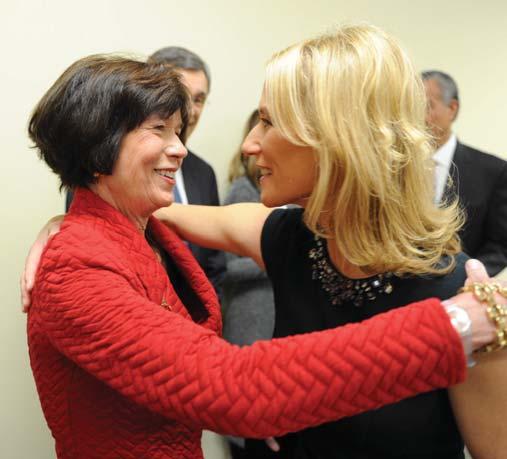
town. I’m a Cincinnati kid, and I want my son to always be a Cincinnati kid. I will start looking to find something that’s as stimulating, challenging, rewarding, and impactful as I feel like my time at the Chamber has been. When I first took the job, I knew it was going to be fun and challenging. I didn’t know it’d be as much fun or as rewarding and impactful as it’s been.
Brendon Cull said to me early on, You know what you’re doing next, right? And I was like, I do not. He said, So why do you keep smiling? And I said it’s because I’m so excited at my opportunity to figure it out. He told me that makes me among the crazy half of people who don’t feel anxiety when they think about what’s next.
I’m really excited about it, but this kind of thing doesn’t happen often in your work life. Most people get maybe one chance at this, so why not enjoy it, right? When I left the law firm to wind up a 20-year legal practice and start as the Chamber CEO, I had one week in between. And the reason I took a week was to kick off ArtsWave’s annual campaign that my husband [Awadagin Pratt] and I were chairing. So I didn’t take a break.
I know myself well enough to know this won’t be too long of a break. I hope I can find enough time to compress and really be thoughtful about where I spend my next chapter.
 ADVENTURE CREW
WHAT DREW YOU TO ADVENTURE
CREW? I think I’d always known that when the time was right to transition out of WordPlay, I would most want to contribute my energy to a role in some aspect of environmental stewardship.
I had long admired the work of Adventure Crew, and when the opening for Executive Director came
OPERATIONS
CINCINNATI REDS
ASK ME ABOUT What’s new for the 2023 baseball season
to my attention it seemed like a rare opportunity to continue working with teens in programs that spark self-growth, positive relationships, and healthy outlets.
HOW DID YOUR EXPERIENCE AT WORDPLAY PREPARE YOU FOR THIS ROLE? I learned to honor community voice as the most essential
ASK ME ABOUT My new role after 10 years at WordPlay Cincy
input to drive a nonprofit’s evolution. I don’t think leaders should stick to the comfort of their own experiences and assumptions or stick with the status quo because that’s how things have always been done. We need to honor the lived experience of those we aim to impact and always scrutinize our motivations
and perspectives.
HOW DO YOU HOPE TO LEAD ADVENTURE CREW IN ITS NEXT CHAPTER?
Areas I’d like to address are growing youth leadership within the organization; providing skills and resources to grow self-sufficiency in accessing “place-based” outdoor experiences in communities where
our teens live; continuing to advance the environmental education, career preparation, and social-emotional learning offered throughout our Crew Pathways program levels; and investing in our staff’s well-being and skill-building.
—ELIZABETH MILLER WOODWHAT INITIATIVES WILL YOU BE PRIORITIZING IN YOUR NEW ROLE? Staff recruiting and retention are of critical importance. I’m excited to find new ways to make sure existing and future employees know that TANK is a great place to be valued and to build a career. Externally, I think there’s a great opportunity to get out into the community and re-educate people on what TANK does. Building on some of the strong partnerships I’ve developed over my time at TANK will continue to be important.
WHAT IS THE STATUS OF THE RECENT FUNDING GRANT REGARDING NEW HYBRID-ELECTRIC BUSES? TANK takes every opportunity to apply for discretionary grants to fund our capital projects, and we were recently notified that one of those grants has been awarded. We will be able
to purchase hybrid-electric buses to replace older (end of life) diesel vehicles with more fuel-efficient vehicles that have positive air quality benefits. We replace anywhere from five to eight buses each year.
HOW WILL THE NEW ELECTRICHYBRID BUSES IMPACT THE FUTURE OF NKY TRANSPORTATION?
Our customers care about having reliable service that’s convenient and safe. Hybridelectric vehicle technology is continuing to improve; almost one-fourth of our fleet is hybrid-electric. We continue to invest in the technology because it’s reliable, provides a clean and quiet ride, and has positive environmental benefits. But at the end of the day, the critical piece is ensuring the reliability and convenience of the service we provide. —E.M.W.
WHAT CAN REDS FANS EXPECT THIS YEAR? We have an exciting young core group of players returning this season, and watch for more young stars from our prolific player pipeline to make an impact as they arrive at the majors. Major League Baseball has also put several new rules in place that will make the games quicker and filled with action, like more stolen
GENERAL MANAGER
TRANSIT AUTHORITY OF NORTHERN KENTUCKY (TANK)
ASK ME ABOUT The organization’s vision for a more sustainable future
base attempts, doubles, triples, and great defensive plays.
ARE THERE ANY NEW STADIUM EXPERIENCES TO REPORT? One highlight is a visit from the New York Yankees May 19-21, the first time ever the Yankees have played a weekend series in Cincinnati. We are thrilled to host a Zac Brown Band PostGame Benefit Concert 4ALS on June 2.
Our Reds Hall of Fame and Museum is inducting a new class, including Bronson Arroyo, Danny Graves, and the late Gabe Paul, the weekend of July 21-23. This season also represents the 20th anniversary of Great American Ball Park’s opening, and we’re celebrating with a ballpark replica giveaway on April 15. New in the ballpark are Chick-fil-A, Fifty West Burger Bar, and the BetMGM
Sportsbook in the Wings and Rings Machine Room.
WHAT DEFINES THE REDS FAN EXPERIENCE?
Enjoying a Reds baseball game with family and friends is part of the summer experience on the banks of the Ohio River. Our goal is to make sure every fan has a great time at the ballpark and can’t wait to come back for their next one. —E.M.W.
Maria Longworth’s vision of a renowned woman-owned pottery manufacturing business thrives in Over-theRhine 143 years later. –JOHN FOX
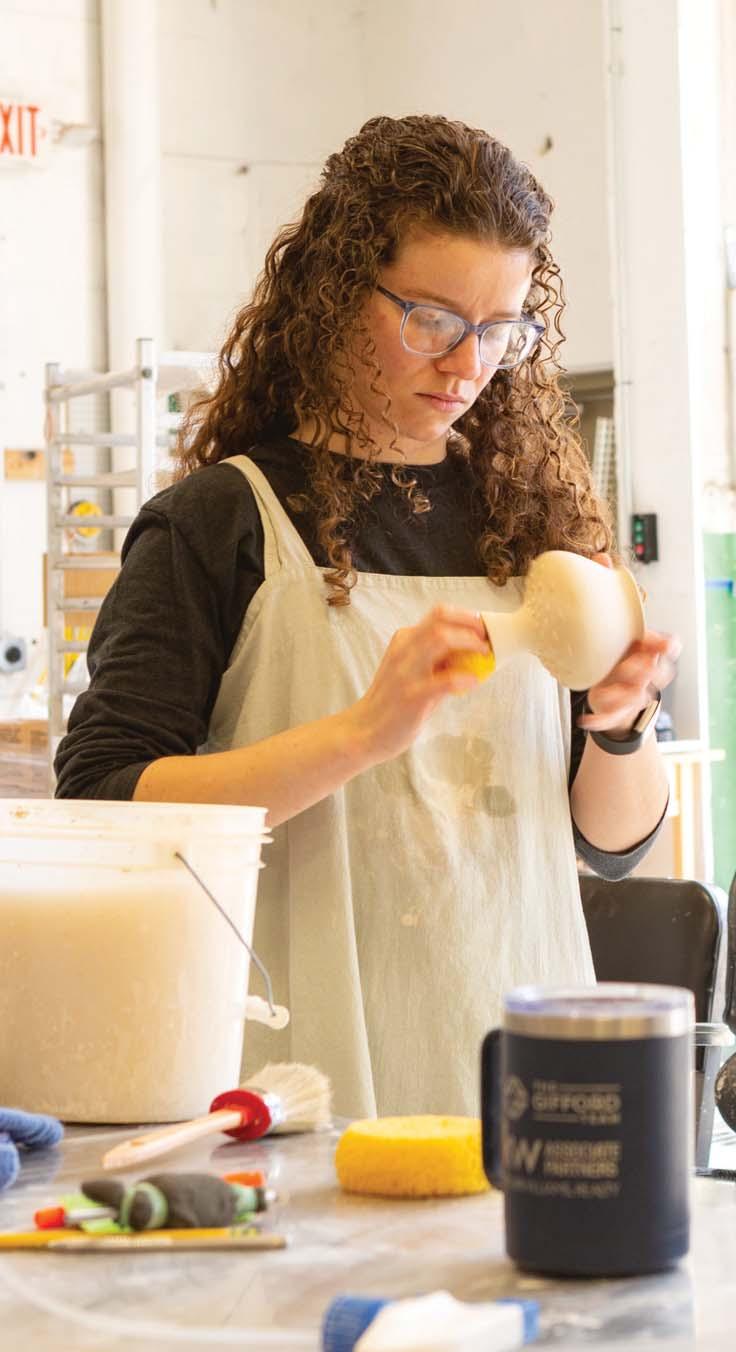 PHOTOGRAPHS BY HATSUE
Rookwood artist Rebecca Rohr uses a damp sponge to smooth the inside surface of the vase she’s thrown by hand, before it’s fired in the kiln.
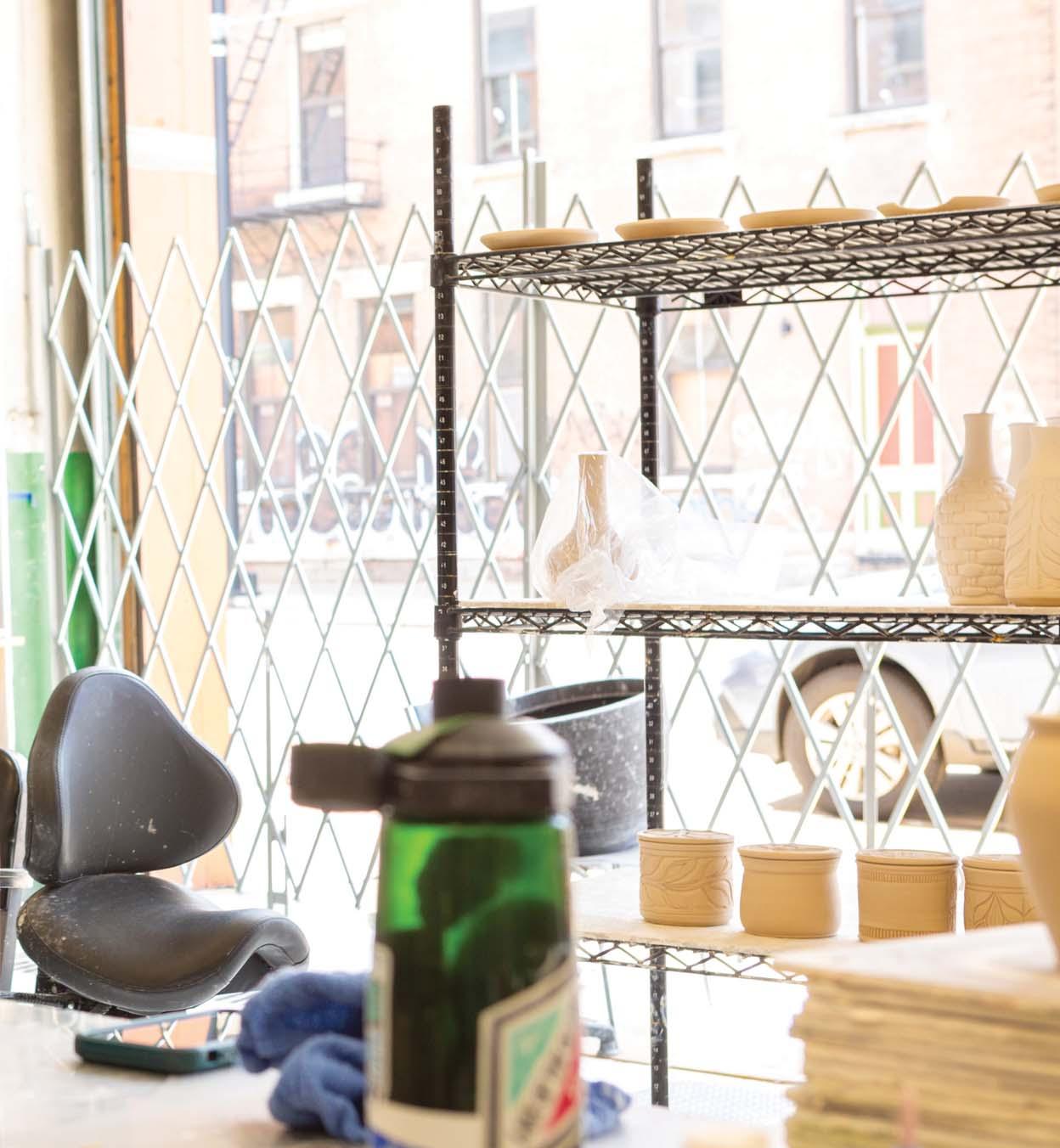
The Rookwood Pottery Company employs more than 70 people at its 88,000-square-foot facility in Over-the-Rhine to produce some of the world’s finest art pottery and architectural tile. The company was founded in Cincinnati by Maria Longworth in 1880 as one of the country’s first woman-owned manufacturing businesses. After several ownership changes in the late 20th Century, Rookwood production returned here in 2009.

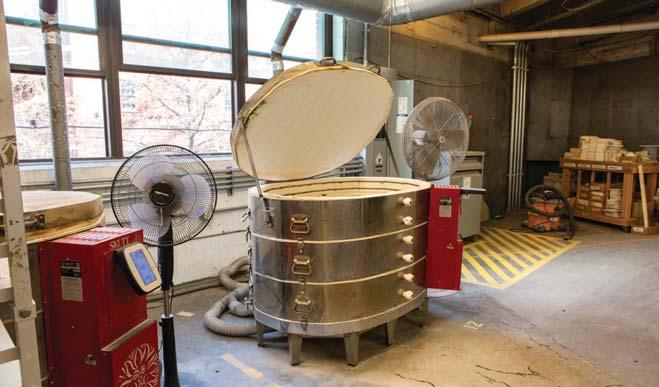
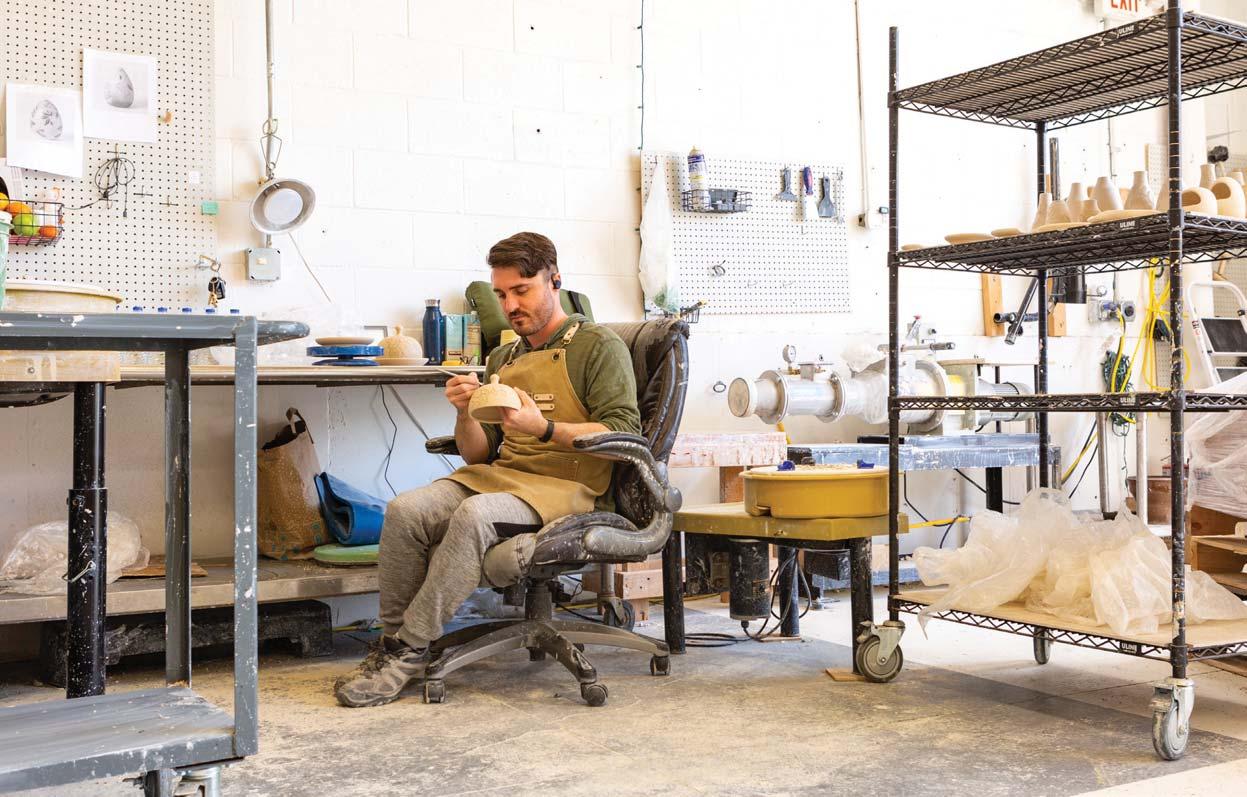
Every piece of pottery or tile touches at least 13 sets of hands, Rookwood explains. Artists such as Joe Paushel (top) sketch and then carve designs on hand-thrown forms, and those designs (above right) are made into plaster molds in order to produce finished pieces.
Each piece of pottery or tile is fired twice in kilns (right). The first removes all moisture and turns it into ceramic material, and the final “glaze firing” bonds the glaze finish to the ceramic.
Maria Longworth’s dream of an American ceramics studio to rival those in Europe and Asia started to come true in Rookwood’s first two decades in business. The company won top medals at the 1889 Exposition Universelle in Paris, the 1893 Chicago World’s Fair, and the 1900 Paris Expo.

Rookwood’s staff employs a “hands on” approach throughout the manufacturing process, from initial form making (left) to hand painting tiles (below). All production work is done on Race Street just north of Findlay Market (bottom), and the site includes a gift shop (center left).
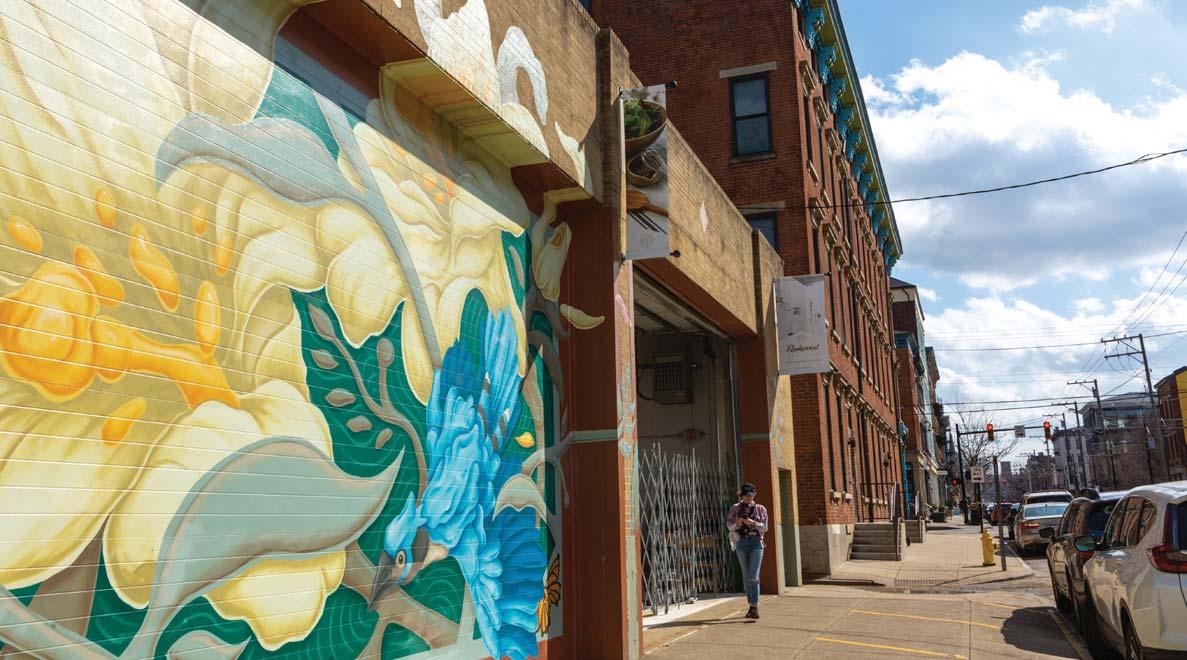
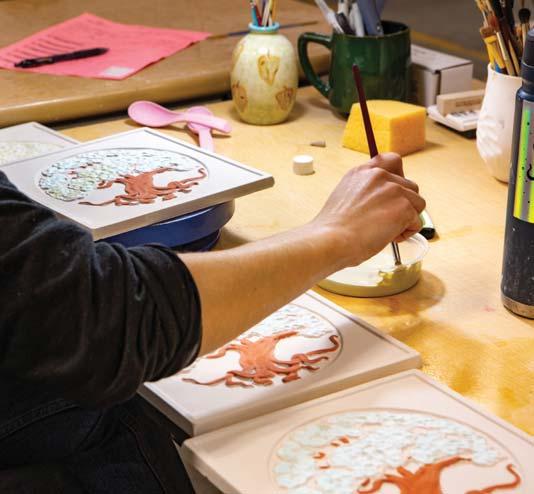

Maria Longworth famously envisioned Rookwood as an arts manufacturing center where “the potter’s wheel will be turned by woman power.” She was the granddaughter of Nicholas Longworth, one of Cincinnati’s first business leaders, whose family home would later become the Taft Museum of Art. Her nephew, Nicholas III, served as Speaker of the U.S. House of Representatives from 1925 to 1931 and married Theodore Roosevelt’s daughter, Alice. Maria died in 1932 at age 83.
All of Rookwood’s ceramic pieces begin as a hand-thrown form on the potter’s wheel, where artist Morgan Willenbrink gets to work (above left).



Luis Laya creates a mug stand (above) for slipcast artists so they can apply handles to mug pieces by hand. The full pieces are then fired in kilns to strengthen the bonds.

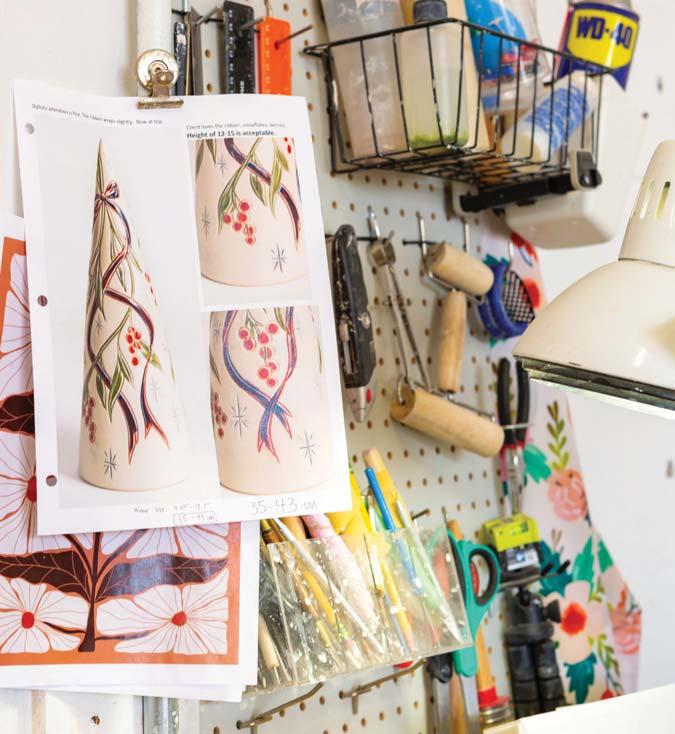
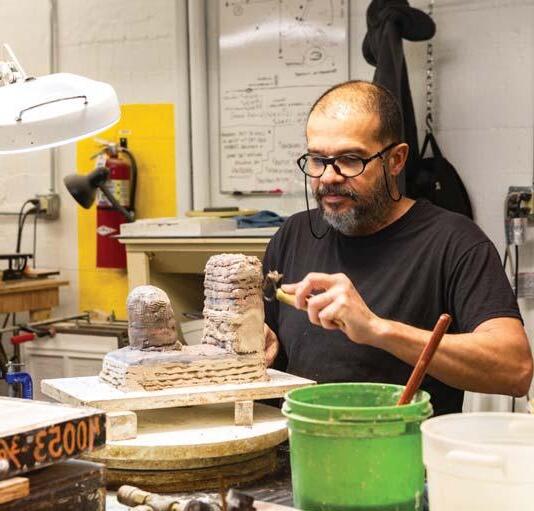

Slipcast artist Lizzy Milligan (below) unboxes an Emilia mug from a mold after the slip (liquid clay) she poured in hours before has settled and dried. She’ll then apply the mug handle by hand. After the mug has been fired, artists will apply glaze and fire it once more in a kiln to produce the final product.
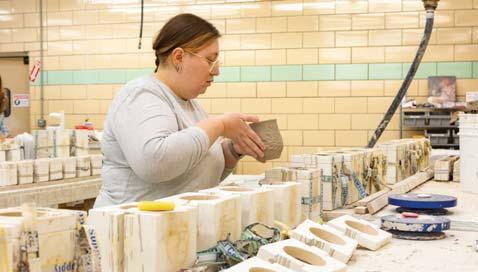
Rookwood Pottery hosts factory tours on Fridays and Saturdays to allow a peek into its time-intensive processes. The $10 tour ticket cost can be applied to purchases of $50 or more in the Rookwood gift shop.


Being a memberof theCincinnati USA Regional Chamber gives you access tovaluable Cost Saving Programs designed to helpyour business thrive even in seasons of unfamiliarity. As yourbusiness changes and adapts with thetimes, werecognizethe need our members havefor this networkof resources now morethan ever.

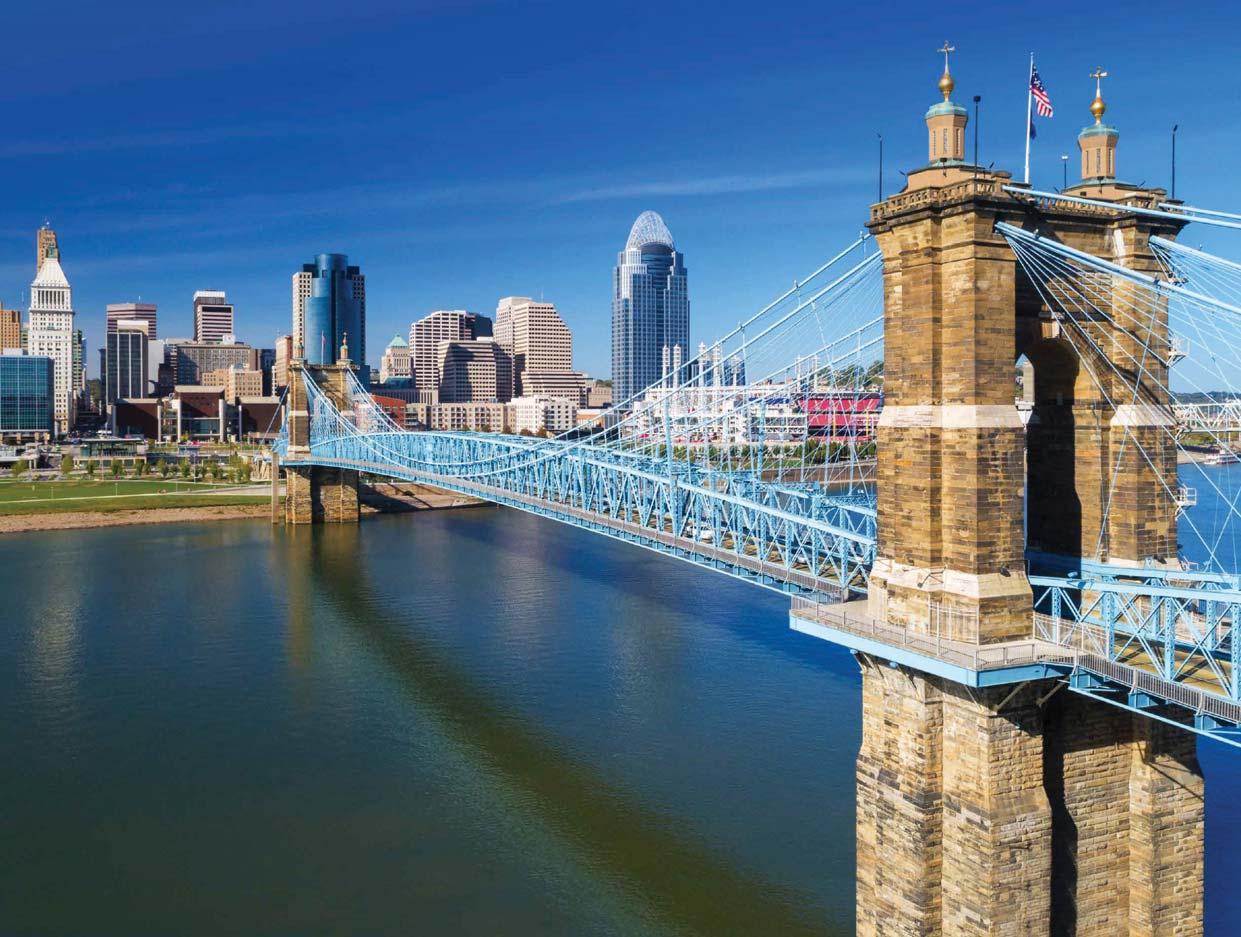
WORKERS’ COMP ChamberComp™ saves you up to 53%on Group Rating, 62% or more on Group Retrospective Rating through Sheakley
Save up to 55% off nearly every item in stock at Office Depot/Office Max
Save up to 40% on your credit card and debit card payment processing with i3 Merchant Solutions
With 6,000 clients and more than $170M in tax-free dollars to business owners, see how much you may qualify for with this congressionally mandated program through Business Group Resources. Sign up for a free analysis
TELECOM & IT SERVICES

The Greater Cincinnati Safety Council is one of the largest Safety Councils in the region. It is comprised of local companies-independent of industry-dedicated to the safety of their employees
ENERGY
Save up to 35% on voice, network, cloud and cybersecurity services with Advanced Technology Consulting
Take control of energy costs with Good Energy
Impact business growth and enhance future value of your business with IdeaTeam