Logistics & Transport nz $15.00
THE OFFICIAL PUBLICATION OF CILT NEW ZEALAND
Volume 18 Issue 3 March 2020
NAPIER PORT – building for the future
Draft New Zealand Rail Plan released RoVE, CoVEs and WDCs – the reform of vocational education ContainerCo’s electric heavy vehicle hits the road
ON THE COVER LOGISTICS & TRANSPORT NZ IS THE OFFICIAL JOURNAL OF THE CHARTERED INSTITUTE OF LOGISTICS & TRANSPORT NZ
In the first of a series of articles on our nation’s air and sea ports, the Napier Port team explain how they are building for the future – see page 12 Photo courtesy of Napier Port
6
Contents Our rising stars 3
Ken Gilligan awarded Life Membership certificate 5 Report on the 2019 China International Logistics Summit 6 Draft New Zealand Rail Plan released 8 RoVE, CoVEs and WDCs – the reform of vocational education 11
8
Napier Port – building for the future 12 ContainerCo’s electric heavy vehicle hits the road 15 Pathway from fossil fuels to sustainable resilient solutions (part II) 16 RCG delivers infrastructure to far-flung corners of NZ 18 In the next edition
15
The editorial team welcomes expressions of interest for submitting an article for the June 2020 edition of this journal. Contributors should in the first instance contact the editorial convenor, Murray King (email murray.king@xtra.co.nz) to discuss their article. Deadline for the June edition: Tuesday 28 April 2020
12
18
SPREAD THE WORD ABOUT CILT … If you enjoy reading this magazine and think others would too, please share it with others – forward to a friend or leave a printed copy out on the coffee table or at reception at work CILT NZ National Office: PO Box 1281, Shortland Street, Auckland Tel: 09 368 4970, Fax: 09 368 4971 ISSN 2703-3236 (Print) ISSN 2703-3244 (Online)
Advertising Contact: CILT national office Tel: 09 368 4970, Email: info@cilt.co.nz Editorial Contact: Lynne Richardson, Aston Publishing Ltd Tel: 09 481 3005, Email: lrichardson@astonpublishing.co.nz
Published under contract by: Aston Publishing Ltd PO Box 340173, Birkenhead, Auckland 0746, New Zealand Fax: 09 480 4768 Email: lrichardson@astonpublishing.co.nz
Disclaimer: This publication is the official magazine of the Chartered Institute of Logistics and Transport New Zealand Inc (CILT NZ). It is published quarterly. All material appearing in this publication is copyright and may not be reproduced without the permission of CILT NZ. The views expressed in this publication are not those of the editorial committee, CILT NZ, its council, officers or Aston Publishing Ltd, unless expressly stated as such.
March 2020
3
YOUNG PROFESSIONALS
Photo by Mel Waite
Our rising stars By Lynne Richardson
THE CILT NZ 2019 Awards recognised a number of outstanding Kiwis working in the transport and logistics sector – including two young women who have been recognised for their progress to date and ambition for the future. Young Achiever of the Year The CILT NZ Young Achiever of the Year is one of the prized excellence awards and recognises a young professional (aged under 35 years) who is actively involved in the day-to-day operation and development of transport and/or logistics in New Zealand. The 2019 award was made to Elizabeth Anderson of Port of Tauranga and her prize package includes attendance at this year’s CILT International conference in Perth, Australia. Elizabeth’s hard work has been recognised by CILT NZ in the past – in 2018 she won the Ministry of Transport Award for outstanding academic achievement at master’s level, and in 2019 was nominated by her employer, Port of Tauranga, for the top young professional award. So how did it feel to be the 2019 winner? “It was a complete surprise!” Elizabeth says. “I wasn’t even aware that my manager and
Isabella Bennich-Wolter, winner of the CILT NZ Rising Star Young Employee of the Year Award 2019, with Associate Minister for Transport Julie Anne Genter
a couple of my colleagues had nominated me for the Young Achiever award – they did well hiding it from me.” She works as a vessel operations and terminal planner at Port of Tauranga, although most of her time is spent on the former. “We plan the exchange of containers from the container vessels to ensure operations run as smoothly as possible,” she says. “Our planners work 24/7 so we work a shift-based roster. I work as the relief planner to fill in the roster where needed, and when I’m not needed as a planner I work on various projects for the team. I’ve been in this position for almost 18 months.” Early interest in shipping Elizabeth (Liz to her friends) grew up in Wellington, and it was her grandfather that spurred her early interest in shipping. “He was an ex sea captain and used to come and stay with us between trips to various ports where he would supervise the unloading and loading of various bulk goods. He worked right up until he retired
at 85,” she says. After completing an economics degree and taking a gap year overseas, Elizabeth returned to New Zealand to do her master’s degree in supply chain management at Lincoln University. Her first job was at SouthPort in Bluff in the container terminal. “I was a yard planner, but being a small container terminal, we all did a bit of everything. It was a fantastic learning experience and a wonderful way to join the industry,” she says. “I was there for a little over a year before the opportunity to move to Tauranga arose.” It was during the thesis year of her master’s that she became involved with the Bay of Plenty Section of CILT NZ, which allowed her to meet with some of the local transport and logistics professionals. “This helped to focus my interest and I realised that I was particularly interested in container shipping,” Elizabeth says. “As I was finishing my degree, there were a few port roles advertised and they all sounded really interesting. I was very lucky to land the role Cont. on page 4
Send us your feedback CILT NZ wishes to encourage debate about the articles included in this magazine. Do you have an opinion or would like to submit feedback? A selection of commentary (along with the sender’s name) will be included in the next edition, subject to space. Email Murray King murray.king@xtra.co.nz or Lynne Richardson lrichardson@astonpublishing.co.nz before
Tuesday 28 April 2020.
4 Logistics & Transport NZ Cont. from page 3 XXXXXXXXXXX
at SouthPort – it was a great introduction XXXXXXXXXXXXXXXX to the industry.” She acknowledges Ginny Christians, a fellow young professional and CILT NZ award-winner, as a key mentor and good friend. “I worked with Ginny at Scion while I did my thesis – she was the one who got me involved with CILT, and helped me figure out that this industry was the one I wanted to be a part of.”
Career highlights Elizabeth explains that she has a project component to her role which involves getting some aspects of the port’s software to work better for the planning team and to improve processes, and she believes it was this work that led to her being nominated for the award. “The autostow project is a part of our operation system that automatically plans the movement of containers from the yard to the ship. I was able to set it up and get it working and it’s since become another tool available to our vessel planning team,” she says. “I really love the project aspect of my role, as well as the problem-solving components of both my vessel planning and project roles. It’s a really good feeling to be able to identify an issue and then find the solution to it, even if it’s something that just saves a minute of time – if that’s a task we do every day as a team, those saved minutes add up really quickly. Sometimes it can be a challenge to figure out the solutions, but that’s what makes it enjoyable.” She says being a young woman in a traditionally male-dominated industry hasn’t been an issue. “There have been no
by Xxxxxx Xxxxxx
Photo by Mel Waite
Xxxxxxxxxxxxxxxxxxxxx
Elizabeth Anderson, Young Achiever of the Year 2019, with Foodstuffs North Island’s Gareth McFarlane
downsides, no negative experiences. I’ve always found people to be very welcoming – you just become one of the team. I have noticed that there tends to be very few women in operational roles and I think gender diversity is important – but just as it is in any industry. Varying perspectives are always good when problem-solving is required.” Elizabeth says the transport and logistics industry is a vital part of the global economy. “Most other industries are dependent on it, and it’s also a very dynamic industry with plenty of opportunities for young people to learn and develop their careers – and young people can often bring a fresh perspective to the roles,” she notes. Would she recommend the industry to another young woman as a career option? “It’s a hugely varied industry with a lot of different opportunities, so it’s possible to find an area that interests you. I’d rec-
ommend trying to start out at a smaller company – you learn so much about how the overall system works and how different things fit together. There’s also more opportunity within a smaller company to see and learn about some of the invisible jobs that this industry is packed with. However, once you’ve found a niche there are great opportunities in larger companies like Port of Tauranga.” And what will the next five years bring her? “I haven’t worked out a new five-year plan yet,” she laughs. “I’ve finally reached a lot of the goals from the last one which has resulted in where I am right now, so who knows what the future holds?”
Young Employee of the Year Award The Rising Star Young Employee of the Year Award was introduced in 2019 in recognition of a young employee (aged under 35) in the sector who embodies the mission of their employer, consistently produces quality work, and displays characteristics that are valued by their peers and colleagues, as well as managers. The award attracted a lot of interest with numerous nominations. The winner was Isabella Bennich-Wolter, an air and ocean team leader at Sorted Logistics in Christchurch, with Rebecca Tuke of Abley Consultants, also in Christchurch, being highly commended. “My employer nominated me, and I really didn’t expect to win the award as the calibre of nominees was so high. I was honoured just to be considered as a finalist,” Isabella says. She started working for Sorted Logistics in August 2017, and has been in her current role for just over two years. “Our operations team cover all coastal and international movements across New Zealand Isabella Bennich-Wolter: “I love the fast-paced nature of my work and I am continually and fromxxxx our head office in Christchurch. My Xxxxxxxx learning x x xxxxxxxxxxxxxxx xxxxxxx x xxxxxxxxxxxxxxx developing on the job – I’m never bored” xxxxx x x xxxxxxxxxxxxxxx xxxx xxxxxxx x xxxxxxxxxxxx Cont. on page 5
March 2020
5
LIFE MEMBERSHIP
Ken Gilligan awarded Life Membership certificate KEN GILLIGAN, MNZM, was presented with his CILT NZ Life Membership certificate on 24 January on the shores of Napier Port. The certificate was presented by David Kriel, general manager commercial at Napier Port, on behalf of CILT NZ national president Keith Robinson. Ken’s achievement was announced at the annual awards ceremony in Wellington in October 2019, but he was unavailable to attend the function that evening. Ken has been a member of the Central Section of CILT NZ for 34 years.
Ken Gilligan (left) receives his Life Membership certificate from David Kriel at Napier Port
David was delighted to be able to present this award to Ken at Napier Port, considering Ken’s history with the port company. Ken served as the managing director at Napier Port for more than
10 years, just one of the many prestigious positions he has held. “We are truly proud of Ken and it is an honour to have him as a life member of the institute,” David says.
her first ‘proper’ work experience. “I started work with a large multinational freight forwarder in their Christchurch satellite office. The role was extremely varied, and I learnt a lot across multiple areas of the business in a short period of time.” Whilst studying at Victoria, she had completed an import/export paper, and now at work the theory came flooding back. “While studying I had found it super interesting as to how businesses managed their supply chains and how to move products to their customers. Once I started in the industry, I really enjoyed the variety of work and the interactions between customers and suppliers,” she says.
ronment we have decreased our paper use by 50% and are utilising our systems more effectively for document management,” Isabella explains. “Another achievement is that we have met our budget and are on target to meet our overall 2019/20 budget.” Not only do the team work hard, but they play hard too. “Last year, as a teambonding experience, we went ziplining at the Christchurch Adventure Park. That was a highlight for many of the team members as it pushed us outside of our comfort zones, especially those who were scared of heights!” she says. Isabella believes it is vital that the transport and logistics industry continues to embrace younger professionals. “Like any industry, it is important to encourage the next generation for continued growth. The opportunities are so broad due to the variation across the industry, which is exciting for personal and career development. In my own role, I have found that I can draw knowledge from colleagues who have more experience.” And what advice would she offer another young woman who might be considering a career in the transport and logistics industry? “Give everything 100% and don’t take yourself too seriously,” she concludes.
Cont. from page 4
main responsibilities are staff training and development, coastal and international operations, revenue management, supplier rate management, and customer service,” she explains. International travel Isabella talks about her early childhood and upbringing which exposed her to many different cultures and languages at a young age. “My mother is Swedish and my dad is a Kiwi, so our family lived between New Zealand and Sweden when I was growing up – which perhaps started my interest in international transport.” She went on to study international business and relations, completing a Bachelor of Commerce at Victoria University in Wellington. “After my degree I received the New Zealand-China Confucius Scholarship, which is awarded to 10 New Zealand students each year. Each student receives a fully funded year of Chinese language study at a Chinese university. “I was lucky to be accepted into Fudan University in Shanghai, one of China’s oldest universities. I didn’t speak a word of Chinese before I left New Zealand, so the first few months were difficult! It was such a great experience to be fully immersed in the Chinese language and culture.” After the year in Shanghai, Isabella returned to New Zealand, to what she calls
An exciting career During her time at Sorted Logistics, the air and ocean team have grown, not only in size but in experience, which Isabella says has been really exciting. “We are a relatively young team, and it is very rewarding to see younger professionals start and then continue their careers in the industry. Seeing the team develop and gaining more experience is the highlight of my role so far. I love the fast-paced nature of my work and I am continually learning and developing on the job – I’m never bored,” she adds. The company has set a number of social and environmental targets for the team this year, and so far they are on track to achieve these. “In order to do our bit for the envi-
Nominations for the CILT NZ 2020 Awards open soon – details will be available on the website at www.cilt.co.nz
6 Logistics & Transport NZ
INTERNATIONAL LOGISTICS
Report on the 2019 China International Logistics Summit LAST NOVEMBER, Fiona Knight was privileged to be an invited guest at the 2019 China International Logistics Summit held in the city of Xuzhou. This is her report of that conference and the main themes that were covered. The conference had two main themes, both under the overall banner of the Belt and Road Initiative: innovation in the industrial logistics and supply chain; and the national logistics hub city and Huaihai international land port. The latter project had been shelved for a couple of years, and restarting it was launched, unveiled and signed by 80 people with great ceremony during the conference. Topics discussed in the conference ranged between two extremes: the city of Xuzhou, and last-mile logistics problems. Xuzhou – China’s happiest city Xuzhou is a large industrial city, with a population of 8 million. It has won several awards, including National Civilised City, China’s Happiest City and the UN Habitat
By Fiona Knight
Scroll of Honour. Within the city there are over 8000 logistics enterprises, which raised the obvious question for me – does New Zealand, with a population of nearly 5 million, have nearly 5000 logistics enterprises? The hinterland of Xuzhou international land port (the Huaihai Economic Zone) has a population of 70 million. Currently, logistics and transport make up 16% of China’s GDP and the aim is to reduce this to 10%. The Government is actively promoting the integration of logistics with what was described as ‘wooden management’, as well as encouraging innovation and greater use of information and communications systems (ICT) and robotics. As part of the process, they are promoting multimodal transport and searching for ways to build on the benefits of containerisation (without which there would have been no globalisation). China’s leadership considers China the best in the world for transport on water (ports), but admits it could do better on roads and railways. They see the challenge as being size: how to maximise the number
Martino Criveller pointed out that countries like Argentina have thousands of kilometres of shoreline and numerous large ports, such as Comodoro Rivadavia in the south, but these ports are mainly focused on commodity trade with little or no infrastructure to support container logistics
Fiona Knight with Joy and Wendy, a couple of English language students, at the 2019 China International Logistics Summit
of containers that can be carried by any means of transport. The issue with transport on land networks then becomes the need to widen tunnels. It was noted that the company that owns the largest number of containers in the USA is a trucking company – the reason being efficiency and cost. The challenge issued to the Chinese logistics companies is to make the investment, both in containers and the hubs for transhipment of goods. In China, the logistics companies manage the loading rather than the trucking companies. Last-mile logistics The problems of last-mile logistics were highlighted by Martino Criveller from Hong Kong. He used as a case study the supply chains for solar energy off-grid projects in countries in South America and Southeast Asia. The upstream part of the supply chain covers the transport from the factories in China to container ports and shipment, finally arriving in warehouses in the destination countries. Here the downstream part starts with containers being deconsolidated, their contents transported to secondary warehouses closer to the project areas, and finally the last mile to the project sites. It is this last part of the chain which causes the problems. These include: • Lack of secondary warehousing infrastructure and supporting services, such as hire of forklifts or security • Poor-quality road networks, often only partly paved; this can cause damage to vehicles and loads – for example, in 2018 a truck with a 20 ft container travelling on a low-quality rural road struck low overhead power lines • Seasonal access caused by flooding, or needing to cross fields full of crops • Lack of road access to the remoter areas where projects are located, requiring transhipment to river barges • Unconventional local modes of
March 2020
transportation, e.g. donkeys are still used in Argentina for local deliveries • Political instability in some of the destination countries, resulting in sabotage, terrorism and political violence, particularly towards foreigners • Language barriers between local dialects and metropolitan forms • Inconsistencies between countries’ HS (harmonised system) codes • Transparency or opacity of local regulations • Creating a relationship of trust between shipper and consignee. Strengths and weaknesses Quite a lot of soul-searching had gone into the presentations, and speakers were not afraid to note weaknesses and suggest ways to improve. Professor Zhao Cheng Feng of Zhejiang University noted that manufacturing in China needs to be transformed from a production to a service focus. The supply of inputs for manufacturing must not be restricted only to the traditional warehousing and distribution roles. He argued that the transport and logistics facilities need to be better coordinated within an effective supply chain. He compared having only a logistics centre to being fully fed, but having received no nutrition. His recommendations included: • That China takes the opportunity to organise the global supply chain • That a third-party platform suitable for Chinese industries be developed with a professional service front end, covering all activities such as warehousing, delivery, inventory management, and so on • That this service is supplied to multiple industries to take the pressure off SMEs. Professor Zhao noted that China has a target to reduce manufacturing costs by 30% and this means that the logistics industry needs to change. Such clusters as he described were just being established in eastern China, where turnover exceeds 100 billion yuan (NZ$22.4 billion) annually. The power of the consumer Another Hong Kong speaker, Vicky Khoo of the Hong Kong Science and Technology Parks Corporation, reminded the audience that they need to look at the power of the consumer, as buying patterns are changing the supply chain. Populations are also changing, with 50% already living in cities, and this is predicted to reach 5 billion by 2030. Millennials (born around 1981–1996) are expected to make up 46% of the workforce this year. Ms Khoo described these people as continuous learners, team players, collaborators,
7
The launch of the Huaihai international land port project was marked with great ceremony (Fiona is on the far right, top photo)
diverse, optimistic, achievement-oriented and socially conscious. I would have added to this list their focus on technology, as this leads directly to the changes identified by Ms Khoo – urbanisation and the increasing use of technology in consumption, itself leading to stores shrinking. The list of retail stores that are diminishing includes well-known brands such as Barnes & Noble, Sears, Macy’s, Kohl’s, Nordstrom, Aldi and (the perhaps wrongly named?) Luckin Coffee. Barnes & Noble, a highly regarded bookseller, moved into selling light groceries, but to stave off bankruptcy moved back into selling books only. Ms Khoo suggested questions for the sector to consider are: • How do automation, artificial intelligence and a digital supply chain impact on supply chain design? • How can we harness big data to be able to make decisions? • How will we manage the change in demand for supply chain transparency? The suggested solution was to use the SCOR (supply chain operations reference) model which focuses on five areas of the supply chain: plan, source, make, deliver, and return. Achieving success and improving the supply chain process takes a concerted effort, likened to what sardines do: swim in the same direction, and face the challenge together to overcome it.
Technology a recurring theme The probe into a digitalised supply chain by Mr Shao Guoqun of Danfoss Power Systems noted three aspects of forecasting we need to be aware of: firstly, the forecast is always wrong; secondly, the longer the horizon, the worse the forecast; and thirdly, the solution is to have an aggregated forecast. Options include time-series forecasting and causal forecasting. He reminded us that causal forecasting has 47 variables and an increased accuracy of 50%. Suppliers need data, he reminded us, so it is imperative to get the forecasts right. A theme of the conference was that everything is about data and calculation. This means analysis of in-house capacity as well as mapping supplier capacity, followed by production planning, material planning, and inventory planning. We were told, rather alarmingly, that we must drive by looking at the rear-vision mirror. Interestingly, one of the presentation slides was from the Visual Capitalist, titled ‘The 20 Easiest Countries for Doing Business’ and who do you think was at number one? Check it out here: www.visualcapitalist.com/ranked-the-20-easiest-countriesfor-doing-business/ Sunday morning was a schedule of visits across Xuzhou, including the inland port site and the worksites of the principal sponsors. The key theme for most of the sites was best use of technology.
Fiona Knight is the principal consultant at Cresmere Consulting in Wellington; she is currently the international vice-president for Australia and New Zealand for CILT International
8 Logistics & Transport NZ
RAIL Photo courtesy of KiwiRail
Draft New Zealand Rail Plan released The draft New Zealand Rail Plan, released in December last year, outlines the Government’s long-term vision and priorities for the future of the national rail network
RAIL IS an integral part of our transport system. It transports people and goods to where they need to go, making it a key part of the multimodal transport system for both freight and passengers in New Zealand. In December 2019, the draft New Zealand Rail Plan (‘the plan’) was released by the Government. It outlines the Government’s long-term vision and priorities for the future of the national rail network. This vision includes a national rail network that provides modern transit systems in our largest cities, and enables increased volumes of freight to be moved off the roads and onto rail.
Following engagement on the draft plan through the formal engagement process on the Government Policy Statement (GPS) 2021, a final Rail Plan will be published later this year. With increasing freight volumes, growing road congestion and maintenance costs, and the need to meet emission reduction targets, rail is a critical part of our transport system. The plan sets the right conditions to maintain our national rail network, and provides a platform for further investment. The plan followed recommendations of the Future of Rail review (‘the review’) which is a cross-agency project led by the Ministry of Transport, working with
Photo courtesy of KiwiRail
The draft plan is the first component of the new planning and funding framework for rail which will allow KiwiRail to plan for long-term investments in national freight rail and passenger rail in Wellington and Auckland
KiwiRail, Waka Kotahi NZ Transport Agency, and the Treasury. The role of rail The review sought to identify the role rail can play in New Zealand’s transport system, as well as put in place a sustainable approach to funding rail over the longer term. As a key part of this, the Government considered how to better integrate rail into the overall planning and funding approach for the land transport system, so that rail is maintained alongside other transport modes. The review showed that there are significant parts of our national rail network facing a state of managed decline. Previous investment in New Zealand’s rail network has lacked a long-term view about rail’s role in the transport system, and has resulted in a continued focus on short-term investment decision-making. The Government understood that investment alone wouldn’t allow rail to play the role this Government wants to see it play in the transport system. It recommended and is implementing a new long-term integrated land transport planning and funding framework, as well as providing remedial investment in order to maintain a sustainable rail network. The draft plan is the first component of the new planning and funding framework for rail. In the past, investment in rail has been made on a year-by-year basis. This is insufficient when making investments for long-life infrastructure assets such as rail. The framework will allow KiwiRail to plan for long-term investments, including investing in national freight rail and passenger rail
9
Photo courtesy of KiwiRail
March 2020
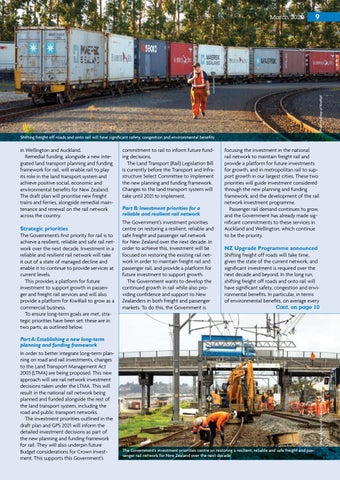
Shifting freight off roads and onto rail will have significant safety, congestion and environmental benefits
in Wellington and Auckland. Remedial funding, alongside a new integrated land transport planning and funding framework for rail, will enable rail to play its role in the land transport system and achieve positive social, economic and environmental benefits for New Zealand. The draft plan will prioritise new freight trains and ferries, alongside remedial maintenance and renewal on the rail network across the country. Strategic priorities The Government’s first priority for rail is to achieve a resilient, reliable and safe rail network over the next decade. Investment in a reliable and resilient rail network will take it out of a state of managed decline and enable it to continue to provide services at current levels. This provides a platform for future investment to support growth in passenger and freight rail services and will also provide a platform for KiwiRail to grow as a commercial business. To ensure long-term goals are met, strategic priorities have been set; these are in two parts, as outlined below.
commitment to rail to inform future funding decisions. The Land Transport (Rail) Legislation Bill is currently before the Transport and Infrastructure Select Committee to implement the new planning and funding framework. Changes to the land transport system will take until 2021 to implement. Part B: Investment priorities for a reliable and resilient rail network The Government’s investment priorities centre on restoring a resilient, reliable and safe freight and passenger rail network for New Zealand over the next decade. In order to achieve this, investment will be focused on restoring the existing rail network in order to maintain freight rail and passenger rail, and provide a platform for future investment to support growth. The Government wants to develop the continued growth in rail while also providing confidence and support to New Zealanders in both freight and passenger markets. To do this, the Government is
focusing the investment in the national rail network to maintain freight rail and provide a platform for future investments for growth, and in metropolitan rail to support growth in our largest cities. These two priorities will guide investment considered through the new planning and funding framework, and the development of the rail network investment programme. Passenger rail demand continues to grow, and the Government has already made significant commitments to these services in Auckland and Wellington, which continue to be the priority. NZ Upgrade Programme announced Shifting freight off roads will take time, given the state of the current network, and significant investment is required over the next decade and beyond. In the long run, shifting freight off roads and onto rail will have significant safety, congestion and environmental benefits. In particular, in terms of environmental benefits, on average every Cont. on page 10
In order to better integrate long-term planning on road and rail investments, changes to the Land Transport Management Act 2003 (LTMA) are being proposed. This new approach will see rail network investment decisions taken under the LTMA. This will result in the national rail network being planned and funded alongside the rest of the land transport system, including the road and public transport networks. The investment priorities outlined in the draft plan and GPS 2021 will inform the detailed investment decisions as part of the new planning and funding framework for rail. They will also underpin future Budget considerations for Crown investment. This supports this Government’s
Photo courtesy of KiwiRail/City Rail Link
Part A: Establishing a new long-term planning and funding framework
The Government’s investment priorities centre on restoring a resilient, reliable and safe freight and passenger rail network for New Zealand over the next decade
Photo courtesy of Auckland Transport
10 Logistics & Transport NZ
Passenger rail demand continues to grow, and the Government has already made significant commitments to these services in Auckland and also Wellington
Cont. from page 9
Regional rail In addition, the Government is separately making lead investment in regional rail projects through the Provincial Growth Fund (PGF). Regional New Zealand plays an important role in our society, both socially and economically. The regions generate the bulk of New Zealand’s commodity exports, such as agriculture products, forestry and manufacturing. The PGF is providing investment for regional rail, including in Northland and tourist rail expansion through the TranzAlpine and Coastal Pacific. It will invest in building the connectivity and economic productivity of regions, and will ensure that the regions get their fair share of the opportunities that rail can provide. Investing in regional rail has many benefits for New Zealand. It increases the throughput of freight and reduces travel times, while improving the resilience and sustainability of the transport infrastructure that connects regions to one another and their exports to markets. It also provides the opportunity to bring tourists to our regions, and creates jobs and economic
development opportunities for regional New Zealanders. Rail is the key transport mode for bulk exports such as forestry products. This means investing in regional rail underpins current and future areas of economic opportunity. Improved intra and interregional transport links can give businesses and investors confidence that they will have reliable access to markets, enabling accelerated business growth and more higher-paid jobs in the regions. The regional focus of the PGF means it has been uniquely placed to invest in transport in the regions, and it has made substantial investment in rail to capture the benefits it offers to those areas. This investment has been focused where it will support regions’ key sectors and exports and have a significant and sustainable impact on their productivity.
Next steps The release of the draft plan was timed prior to the engagement on the draft of the next GPS. This will ensure the vision for rail can be considered in GPS 2021 as well as future Budget decisions. It also allows time for councils to consider the priorities that have been outlined for rail against their regional priorities. Work on the Future of Rail review will continue, and this will support the final plan. The final Rail Plan will be published alongside the final GPS 2021 later this year. In future years, this will continue to be refreshed and the plan updated alongside the GPS. As this is the first draft plan, it is expected that it will evolve and develop over time to reflect changes in investment priorities for rail. The Ministry of Transport is seeking feedback on the draft New Zealand Rail Plan from those with an interest in rail as part of the engagement on the draft GPS 2021; more information on the draft plan and the Future of Rail review can be found at www.transport.govt.nz
The Provincial Growth Fund is providing investment for regional rail, including tourist rail expansion for the TranzAlpine and Coastal Pacific services
Photo courtesy of KiwiRail
tonne of freight moved by rail is estimated to deliver more than a 66% reduction in carbon emissions compared with heavy road freight. The Government’s investment priorities will inform the funding decisions in the development of the next Government Policy Statement on Land Transport, as well as future Budget decisions. The New Zealand Upgrade Programme announced by the Government in January 2020 funds four major rail projects to keep our cities moving and enable effective services. Combined with rail investments announced in Budget 2019, these contribute to achieving the Government’s vision of a resilient and reliable rail network.
There is also investment in some interregional services provided from the National Land Transport Fund, specifically for the Capital Connection from Wellington to Palmerston North, and the Hamilton to Auckland start-up service. Crown funding has also been provided to the mandated ‘Hamilton to Auckland Intercity Connectivity business case’ which will consider the potential for rapid rail between the two cities.
March 2020
RoVE, CoVEs and WDCs – the reform of vocational education By Dr Jean-Paul Thull
©123RF.com
EDUCATION AND TRAINING
The reform of vocational education (RoVE) is underway, with WDCs to be established that will take over some of the key functions of the current ITOs
MINISTER OF Education Chris Hipkins introduced the Education (Vocational Education and Training Reform) Amendment Bill on 26 August 2019 to create a unified and cohesive vocational education and training system and help New Zealanders prepare for the future of work. A major change is the move of industry training organisations (ITOs), which support apprenticeships and other on-the-job training, to the New Zealand Institute of Skills & Technology and other providers like wananga and private training establishments (PTEs). The scope of the reform of vocational education (RoVE) is to create workforce development councils (WDCs) that will: • Develop leadership plans for skills, setting a vision for the workforce around their specific industry and thus able to influence vocational education and training systems • Give advice to the Tertiary Education Commission (TEC) on funding decisions • Endorse programmes or courses that will lead to qualifications (apprenticeships, on/off campus) but only if fully supported by a WDC (which is essentially the industry itself) • Offer advice to employers, but not in charge of organising apprenticeships or other types of training. From ITOs to WDCs WDCs are likely to be established after 1 April 2020 – the time expected for the Education Amendment Bill to be passed. The plan is to establish six WDCs with transport and logistics to be hosted under a WDC that will cover manufacturing, engineering, logistics and technology (MELT). The components of MELT as it stands will be from existing ITOs: • Competenz (except lift and escalator services, forestry, biosecurity, journalism, graphic design, sign making) • MITO
• NZMACITO • Primary ITO (petrochemicals, energy and chemical plant, seafood, meat and dairy processing) • Service IQ (aviation) • Some ICT qualifications developed by NZQA. Each WDC will be made up from industry members, with TEC in charge to identify their governance arrangements and board appointments as the WDCs need to represent all industry interests. Transitional ITOs will be established by 1 April 2020 to maintain current ITO capability until the WDCs are up and running and a provider has taken on the responsibility for arranging training. The transitional timeline is likely to be completed by the end of 2022. Right now, there is no change to the existing training arrangement via ITOs. Extensive consultation was completed regarding WDCs, including five public workshops (attended by 294 people), workshops with ITOs, government organisations and officials, 30 meetings with industry associations (CILT was not included) and regional engagement meetings with MBIE. Next steps The next steps are to establish regional skills leadership groups (RSLGs), which will provide advice about the skills needed within their regions to TEC, the WDCs, and local vocational education providers; and Te Taumata Aronui, a group that will help ensure that RoVE reflects the Government’s commitment to Maori Crown partnerships. A New Zealand Institute of Skills & Technology (NZIST) will bring together the existing 16 ITPs (institutes of technology and polytechnics) to provide a unified, sustainable, public network of regionally accessible vocational education. This will shift the role of supporting workplace learning from ITOs to providers. The new institute and other providers will support workplace-based, on-the-job training as
11
well as delivering education and training in provider-based, off-the-job settings, to achieve seamless integration between the settings and to be well connected with the needs of industry. Stephen Town, current CEO of Auckland Council, was named as the inaugural chief executive of NZIST on 4 February and will take up his role on 6 July 2020. Centres of vocational excellence, or CoVEs, will be established, which will bring together the NZIST, other providers, WDCs, industry experts and leading researchers to grow excellent vocational education provision and share high-quality curriculum and programme design across the system. A unified funding system will apply to all provider-based and work-integrated education at certificate and diploma qualification levels 3 to 7 (excluding degree study) and all industry training. What does it all mean in practical terms? While the transitional period seems straightforward, the next phase is a bit unclear – like who will have the conversation on marketing apprenticeships? Will the courses across the 16 ITPs be fully crosscredited without much fuss (as otherwise it is not worth doing)? How much influence will NZIST have in terms of course or degree choices versus the view of WDCs and RSLGs (as, after all, they have classrooms to fill)? It is also unclear who will be responsible for assessing the quality of the courses across the 16 ITPs to ensure consistency of marking. What will be the influence of territorial local authorities (TLAs), iwi groups and others in terms of the local availability of courses on offer? I expect ITPs to be in charge of high FTE (full-time equivalent) or full degree courses, whereas PTEs may offer short courses. Internationally, there is a trend for industry to offer more on-thejob courses, versus having students wasting time on courses they are not likely to need down the track. It is nevertheless unclear how the very different needs of small and large industries will be balanced by the WDCs. We are likely to see substantial changes with, hopefully, mitigation of the disconnect between industry and training that we have seen in the past.
Dr Jean-Paul Thull is the chair of the CILT NZ education committee
12 Logistics & Transport NZ
NEW ZEALAND’S PORTS
Napier Port – building for the future
By Lynne Richardson
Napier Port on the North Island’s east coast serves the Hawke’s Bay region which is renowned for its agriculture, horticulture, wine and tourism
NEW ZEALAND is a maritime nation, and its economy and wellbeing is dependent on its ports for the efficient handling and distribution of import and export cargo. In this, the first of a series of articles on our nation’s air and sea ports, we look at Napier Port on the North Island’s east coast. There’s been a port at Napier since 1855. Originally located at Ahuriri just north of the city, the port was a thriving centre of commercial activity until the devastating earthquake of 1931, which raised large areas of the seabed, making the port unusable. All operations were relocated to the deeper waters below Bluff Hill where a new breakwater had been constructed, and this remains the port’s principal location. Run by the Napier Harbour Board until the late 1980s, the government waterfront reforms of the time saw the creation of the Port of Napier as a limited liability company. Originally 100% owned by the
Hawke’s Bay Regional Council, in August 2019 the council floated 45% of its stake in the port company through an initial public offering (IPO) on the NZ Stock Exchange. Today, Napier Port is New Zealand’s fourth-largest container port by total TEUs (20 ft equivalent units) and has experienced growth in cargo volumes over the last 10 years. Being a listed company has set the platform for the port’s future growth, including paving the way for the construction of a new sixth wharf, and the company now has approximately 9000 shareholders, including local residents, iwi entities, and 97% of the port’s own employees. Principal commodities and trade Farming, horticulture, wine and tourism are the main industries in the Hawke’s Bay region, with Napier Port acting as the major export/import hub. The port connects the region’s businesses with world markets, and also provides a gateway for cruise visitors to explore the region.
The port’s container terminal is one of the largest in New Zealand and operates six days a week
Napier Port chief executive Todd Dawson joined the port in January 2018
The port handles over 30 different export and import commodity products, predominantly from agriculture, horticulture and forestry, including meat and meat products, wood (sawn and chipped), pulp and paper, wool, wine, and fruit. Hawke’s Bay accounts for two-thirds of New Zealand’s apple and pear (pipfruit) output, and its forestry exports represent approximately 11% of New Zealand’s total. Trade is spread across containerised and bulk cargo products, as well as cruise tourism. Container trade is diversified across a range of largely export-driven primary produce, while 75% of all containers imported are empty containers to service regional exporters. The majority of bulk cargo exports through the port are log and forestry products, while the key bulk cargo imports are fertiliser, petrochemicals and cement. Ten international shipping lines call at the port, including Maersk Line, CMA CGM, Cosco, Hapag-Lloyd, Hamburg Sud, MSC and Swire. The main destinations for exports from the port include Europe and the UK, China, the USA, Japan and Australia. The port also provides a regular service to the Chatham Islands and other domestic service connections. State highways, rural roads, rail lines, freight hubs, coolstores and the port form
March 2020
The port handles over 30 different export and import commodity products, with trade spread across containerised and bulk cargo products – Hawke’s Bay accounts for two-thirds of New Zealand’s pipfruit output
a complex network of supply chain infrastructure across the region and beyond. The port is positioned on New Zealand’s main north-south shipping route, with national rail and road network connectivity. It is linked to the lower North Island by SH2 and to the central North Island by SH5, and the main rail line from Wellington to Hawke’s Bay and Wairoa includes a branch line to Napier Port. Napier Port actively works with the New Zealand Transport Agency, KiwiRail and Hawke’s Bay councils to ensure the right infrastructure is in place to support increasing cargo volumes. Maritime and landside features Napier Port’s onsite port land comprises around 50 ha, with five existing wharves providing six commercial berths and the new wharf planned for 2022. The existing five wharves can berth vessels up to 348 m in length. Being a deepwater port, vessels up to 12.4 m draught – including the giant cruise ship Ovation of the Seas – can be berthed alongside. The port has three harbour tugs. Napier Port’s container terminal is one of the largest in New Zealand and operates six days a week (Monday to Saturday). Facilities include six mobile harbour cranes, over 1000 reefer (refrigerated containers) points and a fleet of heavy machines, including full and empty container handlers. The port utilises the terminal operating system NAVIS N4 and operates a vehicle
Napier Port at a glance (2018/19) • 5.5 million tonnes of cargo handled • 3.4 million tonnes of bulk cargo handled • 2.6 million tonnes of log exports • 271,000 TEUs handled • $99.6 million revenue • 687 ship calls • 70 cruise ship calls • 280 staff
13
Forestry harvests in Hawke’s Bay are expected to grow over the next five to 10 years as more trees come to maturity – the port has a dedicated log storage area of around 10 ha
booking system to keep truck traffic flowing. A contract team from SSA New Zealand provides dedicated stevedoring services, including lashing and unlashing containers onboard a vessel. In addition, the company operates a 10 ha dedicated on-port depot with facilities for the management of empty containers, including wash, repair and pre-trip facilities. This depot is supported by offsite facilities in Thames Street, Pandora – Thames Street I and Thames Street II – which provide an additional 11.6 ha of empty container storage. Around 5 ha is already in use at the Thames Street I Depot, while the remaining area will be available and free up more space on-port when the Thames Street II Depot comes online in early 2020. Thames Street is a key logistics hub that will allow the port to efficiently service growing trade volumes and facilitate customer and regional growth. There is also a dedicated on-port log storage area of around 10 ha. Port Pack is an onsite packing and devanning facility accessible via road and rail. Comprising 8000 sq m of paved and covered area, it is one of the largest packing facilities in New Zealand and provides a central delivery point where bulk cargo can be packed into containers before being moved to the container terminal. Supporting Napier Port’s customers in the lower North Island is the Manawatu Inland Port, which the port has developed in partnership with Ports of Auckland and Hall’s Transport. Situated in Longburn at Palmerston North, the inland port is linked directly to Napier Port via rail and provides an efficient supply chain solution for shippers in the Manawatu region. It provides storage and depot services and includes dry storage, cross-dock and container handling facilities. Cruise tourism brought an estimated $28 million into the Hawke’s Bay economy in the 2018/19 season, and Napier Port welcomes cruise ships from around the world from October to April. In the 2018/19 season, the port experienced 70 cruise ship calls and handled over 115,000 passengers;
the port expects to exceed these figures for the 2019/20 season. Technology Napier Port’s operating environment is increasingly data-driven, with a key focus of the management team’s strategy being to capture, store, connect and analyse data to create efficiencies within its operations and deliver greater value for its customers. It has introduced a number of new technologies in recent years. All shipping lines that call at the port are added to the Automated Load List Reconciliation system which allows shipping lines themselves to validate that vessel loading is the same as the bookings made by cargo customers. The new system has reduced ship planning administration by 60 hours per week in the peak season. Maersk is now rolling this system out to other ports in New Zealand, with further plans to roll it out internationally. The port has developed its own software solution that automatically assesses the position of a container on a ship and identifies visually on a screen whether a container requires a twist lock (used to hold specific containers in place on a vessel). This new automated process replaces the previous manual system and saves 30 minutes per vessel. In collaboration with exporter Winstone Pulp International (WPI), the port has developed an app that allows their team to photograph and report product and packaging issues using their mobile device, with the data immediately integrated into WPI’s system. This means WPI can trace where any damage occurs in their supply chain and proactively work to reduce it. The port will soon launch an in-cab application for crane operators, shipside heavy forklift operators and stevedores that automates the processes for container vessel exchanges. This improvement will extend the container acceptance window for the port’s customers and allow planning to be more dynamic and responsive to Cont. on page 14
14 Logistics & Transport NZ
At 348 m long, the Ovation of the Seas carries more than 4000 passengers and 1300 crew, and is the biggest ship to enter a New Zealand port – it is scheduled to call at Napier Port three times in the 2019/20 season
Cont. from page 13
their needs. The new process will eliminate paper-based processes altogether and reduce Napier Port’s paper consumption by 2.5 tonnes a year. New technologies have also been deployed in the harbour. Through solarpowered monitoring buoys and gauges, the port can collect real-time data on water clarity, temperature, currents, tides and wave height. This information provides a strong picture of the health of the harbour and the mauri (life force) of Pania Reef, and allows the port company to respond quickly to changing conditions in the harbour. Challenges Port environments are inherently complex and high-risk operations. Like all New Zealand ports, Napier Port shares a legacy of old and ageing infrastructure and the associated challenges this presents. Over the last eight years, Napier Port has focused heavily on building a safety culture. This has included the recent introduction of a ‘Culture of Care’, a foundational strategy which encourages care for its people, the local community and the environment. Building leadership and talent is key to this – five senior managers have completed the CILT NZ Leaders for the Future programme. There has also been a sustained focus on critical risk, and a thorough analysis of each of the port’s top eight critical risks has been completed, using a robust methodology for risk assessment and mitigation. A new ID and access system called Port Pass ensures safe, secure and efficient access to the port. While Napier Port has an unwavering commitment to health and safety, it acknowledges that it has also experienced a number of incidents and near-misses in the last year, including two serious harm injuries. Additional resourcing in the health and safety space has been allocated to enable the port to achieve their goals within a shorter timeframe. Recognising the importance of leaving a
positive legacy for future generations and the need to respond to global challenges like climate change, in 2019 Napier Port started work on a sustainability framework which focuses on four interconnected themes: people/manaakitanga, planet/ kaitiakitanga, prosperity/ohanga ora and partnerships/rangapu. Their work is being guided by the United Nations Sustainable Development Goals, which are globally recognised and provide a blueprint to build a better and more sustainable future for all. The port intends to release its final strategy in the second half of 2020, and in coming years will publicly report on progress against sustainability objectives. Its long-term goal is to work towards Global Reporting Initiative (GRI) reporting, which is the global best practice for reporting on economic, environmental and social impacts. Vision for the future Napier Port’s 30-year masterplan, released in 2019, includes options to develop infrastructure over the next three decades. Its most significant project is the construction of 6 Wharf, which is now underway and due to be completed by 2022. 6 Wharf will be able to handle container ships up to 320 m in length with a 48 m beam, and cruise ships up to 360 m long. The port has resource consents to dredge up to 14.5 m in the swing basin and harbour entrance to accommodate larger vessels. In addition, 6 Wharf will be multipurpose and used for both container and cruise ships. It also has the potential to support twin-lift ship-to-shore gantry cranes if needed in the future (the port currently uses mobile harbour cranes). The trend for larger-size container vessels to visit Napier Port looks set to continue as trade volumes increase. The largest container vessel currently calling at the port has a maximum capacity of 5762 TEUs, but the port estimates ships of between 8000 and 12,000 TEUs could be expected on some of their service routes within the next 30 years.
The port has also purchased 12.3 ha of land in the industrial area of Whakatu, midway between Napier and Hastings. With good road and rail connections, the land has the potential to be developed and enable Napier Port to expand its storage capacity and improve the supply chain. The region’s pipfruit export volumes are forecast to continue to grow – estimated at up to 50% in the next 12 years – and getting products to market quickly is key to preserving the quality and presentation of the fruit. The port’s 30-year masterplan addresses the challenges posed by this growth, including the provision of dedicated berths that are not affected by congestion, strong controls to manage biosecurity risks, pests and disease, and the development of inland hubs and transport connectivity to ensure products get to market as quickly as possible. Likewise, forestry harvests in Hawke’s Bay are expected to grow over the next five to 10 years as more trees come to maturity. KiwiRail’s recent reopening of the rail line between Napier and Wairoa, with the help of the Provincial Growth Fund, will offer the region a safe, direct and sustainable alternative to trucking logs via SH2 and help to deliver economic growth. Also on the port’s 30-year wishlist is increased log, pulp and fertiliser facilities, expansion of the container terminal, a dedicated area to berth service craft such as tugs and pilot boats, the development of an on-port rail terminal, and improvements to its western and eastern road entrances. The timing of these actions will be dependent on actual trade volumes, but whatever options are done will be pursued in line with the port’s sustainability strategy and the four objectives of ‘optimise’, ‘grow capacity’, ‘partner’ and ‘preserve’ in mind.
Napier Port senior management team Todd Dawson – chief executive Kristen Lie – chief financial officer David Kriel – g eneral manager, commercial Viv Bull – g eneral manager, culture and community Adam Harvey – g eneral manager, marine and cargo operations Andrea Manley – g eneral manager, strategy and innovation Michel de Vos – g eneral manager, infrastructure Bruce Lochhead – c apability and cruise manager
March 2020
15
ELECTRIC VEHICLES
ContainerCo’s electric heavy vehicle hits the road ContainerCo’s eHV is used on the company’s runs between port and rail facilities and their depots in Auckland
IN DECEMBER last year, ContainerCo (NZL) began operating New Zealand’s largest electric heavy vehicle (eHV). This was done with support from the Energy Efficiency Conservation Authority (EECA). The unit can carry three 20 ft containers and is 22 m long (the maximum size allowed on New Zealand’s roads without a permit). It has an F-series Isuzu cab and chassis with an SEA electric powertrain. It took about a year to design and deploy, and currently moves containers between port and rail facilities and ContainerCo depots in Auckland. It has a theoretical range of 350 km, but real-world conditions will see this reduce, when transporting containers, to around 200 km. When ContainerCo managing director Ken Harris pitched the idea for the electric truck to his tiny Wellington headquarters staff of two, he argued that ContainerCo had an ideal use case – the runs were typically flat, short and frequent trips between set points, all with three-phase commercial power. Ken Harris is a persuasive man, and it only took a year from that pitch for the details to be ironed out and the unit hitting the road. A big step forward At its launch, Mr Harris noted the electric truck marks an important step in reducing air and noise emissions, while being cost-effective to operate, especially with current Government incentives. “We operate our container businesses from sites right around the country, and the ability to silently and cleanly move containers to and from rail and ports in urban environments is a big step forward,” Mr Harris says. “They [the eHVs] open the door for us to move through urban routes at night without disturbing residents. We can see a lot more units in our fleet in the future. We are also looking into electric
ContainerCo’s eHV driver Adam Jordan
forklifts replacing diesel-powered machines inside our facilities quite soon.” ContainerCo worked in a funding partnership with EECA to identify the most energy-efficient option, while maintaining size and operating ability. It was determined that ContainerCo wanted up to 15 hours before recharging. After scoping and identifying suppliers, the block grant was straightforward. EECA staff were helpful every step of the way, including with supplying information to other Government departments when needed, Mr Harris says. “It really was a partnership with EECA. They were committed to seeing us succeed.” The silent runner ContainerCo’s driver is Adam Jordan, who approached the eHV like any true operator. The unit was taken down the motorway a few times at its speed-limited 90 km per hour, the batteries were tested to their limits, and pedestrians warned about the approach of the (otherwise silent) unit via his love of Metallica. Mr Jordan has moved hundreds of containers since starting his runs in December,
and has shown just as many interested conventional-truck drivers in Auckland the eHV and its specs. ContainerCo businesses include not only the empty container terminals, but also the second-largest hire and sales company for modified and unmodified shipping containers in New Zealand. Both business divisions have already laid claim to the truck, and all customers have reacted positively to the news that they can have a fully electric movement for empties between facilities, and to and from port and rail. Ken Harris says the size of this basic task increases year on year as trade grows, and the transport of these containers is frequently within an urban environment and over short distances – less noise and pollution means the increasing intensification is low impact. Expected to be the first of several units, the truck was selected after a review of the available technology, the relevant transport market, and the resulting financial costs and benefits. Reports on its use are being made available to EECA. The project was managed by Margaret Harris.
16 Logistics & Transport NZ
OPINION
Pathway from fossil fuels to sustainable resilient solutions in New Zealand (Part II)
By Dr Jean-Paul Thull
The fully-electric MAN TGM 26.360 E truck on display at NUFAM, the trade fair for the commercial vehicle sector in Germany
WHILE MY previous article (Dec 19) focused on light motor vehicles (LMVs) and looked at the trends and opportunities, this part focuses on heavy motor vehicles. There is a big outcry for battery-operated trucks or hydrogen fuel cell powertrains and less for liquefied natural gas (LNG) or the idea of encouraging the industry to quickly adopt the latest diesel technology to reduce emissions. The first half of this article provides an overview of the broader socio-economic aspects of tackling change, whereas the second part focuses more on the technical details. Climate change discussions and diesel scandals put huge pressure on politicians to turn things around quickly without spending much time analysing and questioning the trucking industry. The 2050 zero carbon strategies are great incentives to push for more sustainable technologies, though right now logistics companies are left in limbo when it comes to replacing their fleet. I visited NUFAM, the trade fair for the commercial vehicle sector in Germany, in late September 2019. The big companies displayed their latest Euro 6d models next to a number of courier-type batteryelectric vehicles (BEVs), often on VW Crafter chassis. MAN had their latest LNG model on display, able to travel 1600 km. LNG is seen as a serious alternative to diesel in Europe, with 300,000-plus LNG trucks expected by 2030. A few startups offered electric trucks and, after questioning, they agreed that they were currently not designed for long haul or quick charging times, though well adapted for shorter daytime trips with lower payloads and able to sit on the yards for a reasonable time to charge the batteries. The effects of a modified weight distribution (due to the battery weight) in winter on gravel roads, and the fire risk with use in tunnels or on ferries, were unclear.
The end of diesel? Climate change lobbyists and anti-diesel activists have been pushing politicians hard over the last two to three years to ban combustion engines without allowing much time for consultation, nor having pragmatic solutions to hand, other than moving quickly to electric or hydrogen. It is interesting to note that a number of large French local authorities decided in late 2019 to start banning diesel vehicles from city centres from 2025 onwards to mitigate air pollution and in particular nitrogen oxides (NOx). These bylaws are likely to be dropped at the next local elections as they have started to create a lot of uncertainty amongst consumers and small business owners who rely on their own delivery vehicles. It is still unclear how inner-city supermarkets will receive their goods as it gets difficult when regulations at set at different government levels. It is crucial to provide an overall clear regulatory pathway for the motorist and a 10-year objective for commercial operators which will enable them to plan their fleet structure ahead of time. Any radical changes will not just affect logistics companies, but also repair shops, requiring them to find additional space, equipment and trained staff to service any new form of powertrains. Trucking depots will need to invest in fast-charging systems if they go electric for part of their fleet. Leasing/ financing companies will see their profits affected as their business is also based on selling vehicles at the end of a lease; without knowing what the future holds, they may struggle to sell their vehicles. Here in New Zealand, the Government may, through the Energy Efficiency and Conservation Authority (the Crown agency responsible for promoting energy efficiency) need to start subsidising BEV/fuel cell trucks to get them onto the road, to prevent trucking companies keeping their vehicles longer than usual.
While it may be easier for large firms to get subsidies (as Alsco and ContainerCo have done), we need to consider the situation of owner-drivers who may struggle to source additional income to service the finance payments for a new BEV truck. Unless these barriers are dealt with ahead of time, I am concerned that any quick dramatic changes will affect the whole distribution industry, including the end consumer. Electric city trucks Overseas literature indicates that BEV trucks are in service for lower payloads on daily distances of 150–200 km with idealised conditions. Eight 26 tonne MAN eTGM trucks have been operating in Austria since 2018 with a capacity of 180 km and charged overnight at MAN 0.4 kV stations which deliver 43–150 kW high-power charging. The average consumption is about 1.5 kW/km. This is just one example of a number of manufacturers who are testing a range of electric city trucks. While known as automobile suppliers, they are turning to manufacturers like Swedish Volta, Schaeffler, ZF, Continental, Orten, Rytle, Valeo, Tesla, Nikola – the list goes on. Mercedes-Benz is currently testing its 750 kW Freightliner eCascadia 36 tonne model in the USA with a 550 kWh battery package enabling 400 km. Their 12–15 tonne eM2 Freightliner, which has 325 kWh batteries that deliver a peak 270 kW, is more likely to become operational quickly as an e-city truck. Other research has shown that both BEVs and fuel cell vehicles can modestly reduce a community’s overall CO2 emissions; the latter carry higher overall costs, primarily due to the hydrogen generation infrastructure. BEVs are therefore a more cost-efficient choice for reducing CO2 emissions, an established fact especially for LMVs. While these new pure-electric trucks are being tested, I believe we may need to con-
March 2020
sider hybrid vehicles at all levels, including LMVs, as the technology is well established and could long term be mixed with biofuels, allowing for the desired CO2 reduction. From a sustainability point of view, irrespective of the power generation, BEVs with smaller batteries will beat combustion engines a lot earlier than large battery packages. This leads me to suggest that, firstly, authorities should cooperate with trucking firms to look at replacing the urban or periurban fleet with electric powertrains while encouraging the latest diesel technology (Euro 6d or 7) for long-haul journeys. Places like Auckland may still be fragile in terms of congestion. Vehicles may not be able to reach their charging destination on time – something that may be solved within the next five to 10 years by integrating induction charging on shared public transport lanes. The adoption of electric buses and experience with different charging mechanisms will identify the best or most convenient and cost-effective option long term. While I have seen a number of gantry-type charging systems in the Northern Hemisphere and understand that induction systems in the road are not flexible enough to compete with changing vehicle technology, we are likely to see charging technology evolving constantly and adding to the costs. While some experts believe the government should pick up these costs, it is questionable how to spread the costs, considering other sectors of government budgets may require more urgent attention. Realistically, to be acceptable to the industry and the consumer, we will require much longer transition times than other countries that have managed to set up more modal choices. Liquefied natural gas LNG is another option. While still a fossil fuel, it has, in comparison to diesel, around 50% less NOx (depending on the source), 95% less particle matter (PM10) and 15–20% less CO2, with no dust or fume emissions. While not of a big advantage in New Zealand, LNG-powered vehicles can be operated at cold temperatures without any additives. Another important factor is that the storage of LNG does not pose any environmental damage compared to diesel when spilled or leaked, as LNG goes up in the air. More detailed research is required to compare the latest diesel versus LNG technology for long-haul transport. Volvo, Iveco and MAN jointly launched their first LNG truck. The MAN power is rated at 460 bhp or 345 kW with a range of 1600 km which is ideal for New Zealand, as not a huge net-
17
The Stralis LNG-powered truck on display at NUFAM
work would be required at the start. Shell Europe is confident about LNG as a transitional energy and anticipates 280,000 LNG trucks to be operating in Europe by 2030. German researchers anticipate 17% of heavy vehicles will run on LNG by 2040. Considering the idea of liquefied biogas (LBG) in the future, LBG-operated trucks could achieve a CO2 reduction of 80%. Hydrogen fuel cell technology The research world is rather clear on assigning the long-term future for LMVs to battery technology and hydrogen fuel cell technology (HFCT) for heavy vehicles. Jochen Hermann, vice president development eDrive, Mercedes-Benz, states that mastering the chemistry of the battery is paramount: “Solid-state batteries are supposed to be a next important technology leap for e-mobility, meaning an alternative to today’s lithium-ion battery systems.” The main problem fuel cells face competing with batteries is additional and highly inefficient energy-conversion steps: first, converting water to H2 with electricity, and then the fuel cell itself is roughly 60% efficient when converting H2 back to electricity and water for the vehicle (with large heat losses). Dr Carlo Locci, a researcher in motorsports and HFCT, argues that, along with hydrogen availability, the higher production cost of a fuel cell stack means that batteries tend to be more competitive compared with hydrogen-based technology. However, amongst other things, more work needs to go into understanding the dry-out or flooding and the ageing and icing of fuel cells. Fuel cells are losing opportunities in heavy-duty segments for a number of reasons. Chinese subsidies will not be renewed from 2020 onwards. Considering half of European pure-electric buses use top-up charging by gantries or
intermittent non-stop charging with bits of catenary, smaller, cheaper batteries will be needed, making fuel cells less competitive. Conclusion With a turnover of NZ$6 billion and approx 20,000 trucks (greater than 3.5 tonnes) on the road, understanding that supermarkets cannot get deliveries by train or cargo cycles and require reliable sources of energy, the next 10–15 years are likely to become a transition period to full electric for urban or peri-urban deliveries, whereas long haul is likely to share a mix of diesel, LNG and HFCT. We need to keep in mind the New Zealand context with much higher payloads than all the countries where the current developments on HFCT are happening, and find a way to cooperate with overseas partners versus trying to run our own Taranakibased R&D. In the medium term (15–20 years), I predict a mix of the latest diesel technology running on biofuel mixes, hybrid technology and trucks having their reefer units running on electricity. This will also apply for environmental protection or workplace areas, with equipment running on batteries or LNG to protect nature and workers from pollution. Without emphasising how future data exchange platforms, artificial intelligence and blockchain solutions will change the movement of freight, we certainly need to improve powertrains, provide incentives to lower our carbon emissions, use financial incentives to avoid billing the end consumer, and to become takers of the products of research and innovation, unless seen as a testbed for particular solutions. While the next decades will continue to concentrate on innovations associated with automation in rail (such as pods running individually), maritime and air freight, we should not forget the aspect of resilience as part of each decision choice.
Dr-Ing Jean-Paul Thull (FCILT) is a freelance adviser in transport, urban planning and logistics and can be contacted at Jean-Paul@Thull.co.nz
18 Logistics & Transport NZ
LOGISTICS
RCG delivers infrastructure to far-flung corners of NZ FIVE-HUNDRED NEW mobile cell towers around rural New Zealand are in the works with the second phase of the Rural Broadband Initiative (RBI2) which is now well underway. The five-year programme will increase the country’s mobile land coverage by 25% and is set for completion in 2023. When the build programme is finished, 33,000 more rural Kiwi households and businesses will be able to access mobile services offered by New Zealand’s three mobile network operators – Spark, Vodafone and 2degrees – for the very first time. In addition, the initiative has been broadened to include the need to address roughly 1400 km of state highways with ‘mobile black spots’ which will soon be within calling reach of emergency services and the AA, and 160 off-the-beaten-track tourist hotspots. In an unusual partnership that is understood to be a world-first, the network build programme is being led by the Rural Connectivity Group (RCG), a non-profit startup funded and overseen as a joint venture between the commercial mobile network operators, who will deliver their services across the new network, and government body Crown Infrastructure Partners. While construction of each new site is heralded by trucks and high-vis-clad workers, the work to get these sites prepared for construction starts many months before, with site selection, stakeholder engagement, design and quoting completed, as well as ensuring essential equipment is ordered and delivered to these remote locations within rural heartland New Zealand. And with work scaling up during the country’s wettest winter of record last year, the ability for the team to get sites scoped and build teams breaking ground quickly, so as to pivot to the next site(s) at
The second phase of the Rural Broadband Initiative (RBI2) will increase the country’s mobile land coverage by 25% and is set for completion in 2023
speed, proved to be a test of teamwork in delivering the ambitious build programme. Wildest winter on record With the first RBI2 sites having gone ‘live’ (mobile service switched on to the public) in July 2019, the arrival of wild weather at that time was almost certainly going to have an effect on the build schedule. Many early sites were Governmentprioritised for the notorious West Coast, where weather dictated how the teams could approach the site build, with each site having its own weather-related obstacles. The elements threw everything at the RCG build teams, including high winds, torrential rain and unforecast snowfall. For areas of the South Island where the geography and the weather proved particularly challenging during a tough winter, replacing cumbersome cherry pickers with easily transportable and widely available drones with built-in cameras gave the surveying crews eye-in-the-sky superpowers. These provided the added benefit of a bird’s-eye view of some of New Zealand’s most picturesque spots. “The first year of any multi-year infrastructure rollout is always going to have an element of ‘trial and error’. It would be
wrong of me to suggest that the build so far has been done with flawless execution. But we are cognisant that if this was an easy job, it would have been easily done before. We are going to places previously in the ‘too hard basket’,” says John Proctor, RCG chief executive officer. “What’s really encouraging is seeing the team and RCG partners come together and problem-solve to streamline and expedite what is under our control – planning and design, logistics, onsite efficiencies and, of course above all else, health and safety of the working crews.” Logistics as an enabler for agile Improvements in remote solar power and backhaul technology (how the site links back into the national telecommunications network) are now ensuring that for previously ‘out of scope’ sites, the technology can be more easily trucked in without too much disruption to the wider environment. The operators of the Western Bay of Plenty’s TECT Park – a 1650 ha all-terrain, recreational park situated on SH36 between Rotorua and Tauranga – had long lobbied for mobile coverage to support the 30,000 park users they host each year. The park is divided into zones, catering for the
About 10% of the RBI2 sites are in areas so remote the only way to get equipment to them is by helicopter
March 2020
Henry Murphy and Clive Stone of Ngatiwai and Jono Carpenter of Geometria discuss the location of a new mobile cell tower at Ohawini Bay in Northland
needs of different users and activities, from horse riding, walking and mountain biking, to motorcycling, target shooting and rally car driving. Given the vast area to be covered by the network, the power and backhaul requirements had proved to be cost preventative. Delivering this world-first has required an innovative approach to traditional build methods and that includes having the right equipment, at the right time and in the right place. A tailor-made logistics strategy has been essential to the success of this ambitious programme. “Our sites are literally in the far-flung corners of New Zealand with weather systems that are less than kind to us. It’s absolutely critical that we have the ability to muster at a moment’s notice,” says Andrea Chapman, RCG logistics manager. “Having our inventory ready to deploy in our dedicated RCG warehouse means we lose no time once we activate our ‘request for equipment’ or call-off process. When Mother Nature gives us a break, we need to jump into action.” Sometimes that jump to action involves creative measures that haven’t ordinarily been thought of, but are necessary as part of a lean and agile response to get equipment to site. It’s not uncommon for the RCG teams to utilise helicopters, quad bikes and four-wheel-drive vehicles to get equipment onsite. They’ve even been known to drag concrete poles up hills using the landowner’s tractor. “Needs must,” Andrea says. “About 10% of all sites in the programme are in areas so remote that the only way to get equipment to the location is by helicopter. That poses massive logistical challenges. Absolutely every nut, bolt and screw has to be factored into the call-off process. There’s no nipping back to the warehouse once we’re on our way – it’s just not possible.” Choppering into the digital divide Perhaps not surprisingly, given these sites had not previously been easily reached by the country’s technology networks, many of the regions targeted in the programme are beyond the beaten track in the extreme. These very small towns and rural hubs are often textbook cases of the ‘digital divide’, and this is a serious concern for residents worried that their social, educational and economic prosperity is at risk due to their physical and digital isolation. The team have worked very closely with Ngati Kuri and the Department of Conversation (DOC) to bring coverage to the top of the Far North. Sites were scoped for Cape Reinga, Te Paki and Waitiki Landing to provide coverage to the rural residents of those areas, the many tourist hotspots and to support the long-term
19
tourism goals of Ngati Kuri across their rohe (area). Waitiki Landing was switched on in October 2019, with the Te Paki site built and switched on in record time to allow coverage for the busy holiday season in the Far North. Te Paki is a heritage site on DOC land. Downer worked with DOC, Ngati Kuri representatives and a Heritage NZ archaeologist before excavating the land, as there were a number of cultural and ecological features, including historic kumara pits, and a native protected snail to watch for. All construction equipment and vehicles were disinfected for each visit, with technicians scrubbing boots to ensure no foreign species or disease were introduced to the important local ecology. To meet these challenges head-on while delivering to the Christmas deadline, the team opted for helicopter access to the site, as due to unseasonal rain the tracks were too wet to support heavy vehicles, such as concrete trucks, to complete the tower build. Says Peter McComish, Downer’s general manager of mobile, ISP & engineering services: “We built this tower in record time – it was started and finished in only nine days (the average time is four weeks). We achieved this with additional project management resource, and we doubled the number of riggers we used onsite. “We like to think we demonstrated in this one site build our commitment to the project, to the wide range of partners, and to the community and environment. It gives us a great sense of momentum and excitement to meet the challenges head-on for the RCG programme.” To learn more about the Rural Connectivity Group and their projects, visit www.thercg.co.nz The elements threw everything at the RCG build teams last winter, including high winds, torrential rain and unforecast snowfall
The National Council and the Northern Section of the Chartered Institute of Logistics & Transport NZ
CILT ANNUAL FORUM AND AWARDS EVENT 2020 Thursday 22 – Sunday 25 October 2020
Planning is underway for this outstanding event, to be held over several days in Auckland, with the Forum and Awards on Friday 23 October at the Royal NZ Yacht Squadron. Sponsorship opportunities are still available for this major event, including overall naming rights, the welcome dinner, forum, site visits, awards dinner, and trips on the harbour and to Hobbiton. Invitations will be sent to members of CILT NZ and CILT International. Don’t miss this opportunity to get your name out to the 34,000 members of the Institute from across the transport and logistics sectors, nationally and internationally.
Proudly sponsored by:
For further details, visit www.cilt.co.nz or contact Keith Robinson at president@cilt.co.nz to discuss the options