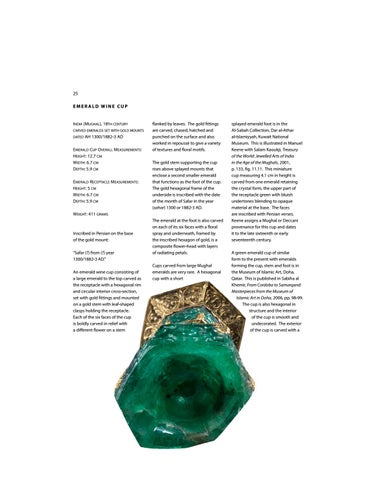
25 EMERALD WINE CUP India (Mughal), 18th century carved emeralds set with gold mounts dated AH 1300/1882-3 AD
Emerald Cup Overall Measurements: Height: 12.7 cm Width: 6.7 cm Depth: 5.9 cm Emerald Receptacle Measurements: Height: 5 cm Width: 6.7 cm Depth: 5.9 cm
flanked by leaves. The gold fittings are carved, chased, hatched and punched on the surface and also worked in repoussé to give a variety of textures and floral motifs. The gold stem supporting the cup rises above splayed mounts that enclose a second smaller emerald that functions as the foot of the cup. The gold hexagonal frame of the underside is inscribed with the date of the month of Safar in the year (sahar) 1300 or 1882-3 AD.
Weight: 411 grams
Inscribed in Persian on the base of the gold mount: “Safar (?) from (?) year 1300/1882-3 AD.” An emerald wine cup consisting of a large emerald to the top carved as the receptacle with a hexagonal rim and circular interior cross-section, set with gold fittings and mounted on a gold stem with leaf-shaped clasps holding the receptacle. Each of the six faces of the cup is boldly carved in relief with a different flower on a stem
The emerald at the foot is also carved on each of its six faces with a floral spray and underneath, framed by the inscribed hexagon of gold, is a composite flower-head with layers of radiating petals. Cups carved from large Mughal emeralds are very rare. A hexagonal cup with a short
splayed emerald foot is in the Al-Sabah Collection, Dar al-Athar al-Islamiyyah, Kuwait National Museum. This is illustrated in Manuel Keene with Salam Kaoukji, Treasury of the World: Jewelled Arts of India in the Age of the Mughals, 2001, p. 133, fig. 11.11. This miniature cup measuring 4.1 cm in height is carved from one emerald retaining the crystal form, the upper part of the receptacle green with bluish undertones blending to opaque material at the base. The faces are inscribed with Persian verses. Keene assigns a Mughal or Deccani provenance for this cup and dates it to the late sixteenth or early seventeenth century. A green emerald cup of similar form to the present with emeralds forming the cup, stem and foot is in the Museum of Islamic Art, Doha, Qatar. This is published in Sabiha al Khemir, From Cordoba to Samarqand: Masterpieces from the Museum of Islamic Art in Doha, 2006, pp. 98-99. The cup is also hexagonal in structure and the interior of the cup is smooth and undecorated. The exterior of the cup is carved with a