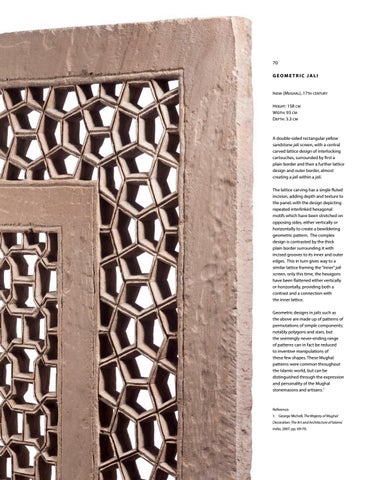
70 GEOMETRIC JALI India (Mughal), 17th century Height: 158 cm Width: 93 cm Depth: 3.3 cm
A double-sided rectangular yellow sandstone jali screen, with a central carved lattice design of interlocking cartouches, surrounded by first a plain border and then a further lattice design and outer border, almost creating a jali within a jali. The lattice carving has a single fluted incision, adding depth and texture to the panel, with the design depicting repeated interlinked hexagonal motifs which have been stretched on opposing sides, either vertically or horizontally to create a bewildering geometric pattern. The complex design is contrasted by the thick plain border surrounding it with incised grooves to its inner and outer edges. This in turn gives way to a similar lattice framing the “inner� jali screen, only this time, the hexagons have been flattened either vertically or horizontally, providing both a contrast and a connection with the inner lattice. Geometric designs in jalis such as the above are made up of patterns of permutations of simple components; notably polygons and stars, but the seemingly never-ending range of patterns can in fact be reduced to inventive manipulations of these few shapes. These Mughal patterns were common throughout the Islamic world, but can be distinguished through the expression and personality of the Mughal stonemasons and artisans.1
Reference: 1. George Michell, The Majesty of Mughal Decoration: The Art and Architecture of Islamic India, 2007, pp. 69-70.