45 K H A N J A H A N LO D I India (Mughal), circa 1630 Folio: Height: 41 cm Width: 28 cm Miniature: Height: 17.4 cm Width: 9.2 cm
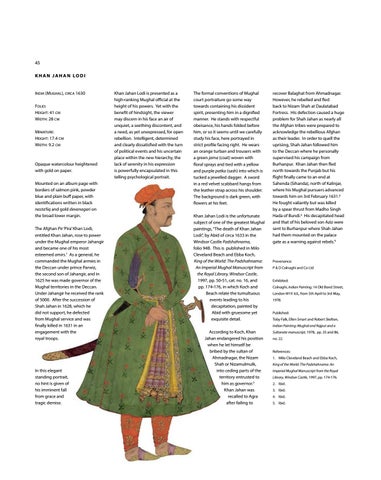
Opaque watercolour heightened with gold on paper. Mounted on an album page with borders of salmon pink, powder blue and plain buff paper, with identifications written in black nastaCliq and gold devanagari on the broad lower margin. The Afghan Pir ‘Pira’ Khan Lodi, entitled Khan Jahan, rose to power under the Mughal emperor Jahangir and became one of his most esteemed amirs.1 As a general, he commanded the Mughal armies in the Deccan under prince Parwiz, the second son of Jahangir, and in 1625 he was made governor of the Mughal territories in the Deccan. Under Jahangir he received the rank of 5000. After the succession of Shah Jahan in 1628, which he did not support, he defected from Mughal service and was finally killed in 1631 in an engagement with the royal troops.
In this elegant standing portrait, no hint is given of his imminent fall from grace and tragic demise.
Khan Jahan Lodi is presented as a high-ranking Mughal official at the height of his powers. Yet with the benefit of hindsight, the viewer may discern in his face an air of unquiet, a seething discontent, and a need, as yet unexpressed, for open rebellion. Intelligent, determined and clearly dissatisfied with the turn of political events and his uncertain place within the new hierarchy, the lack of serenity in his expression is powerfully encapsulated in this telling psychological portrait.
The formal conventions of Mughal court portraiture go some way towards containing his dissident spirit, presenting him in a dignified manner. He stands with respectful obeisance, his hands folded before him, or so it seems until we carefully study his face, here portrayed in strict profile facing right. He wears an orange turban and trousers with a green jama (coat) woven with floral sprays and tied with a yellow and purple patka (sash) into which is tucked a jewelled dagger. A sword in a red velvet scabbard hangs from the leather strap across his shoulder. The background is dark green, with flowers at his feet. Khan Jahan Lodi is the unfortunate subject of one of the greatest Mughal paintings, “The death of Khan Jahan Lodi”, by Abid of circa 1633 in the Windsor Castle Padshahnama, folio 94B. This is published in Milo Cleveland Beach and Ebba Koch, King of the World: The Padshahnama: An Imperial Mughal Manuscript from the Royal Library, Windsor Castle, 1997, pp. 50-51, cat. no. 16, and pp. 174-176, in which Koch and Beach relate the tumultuous events leading to his decapitation, painted by Abid with gruesome yet exquisite detail.
recover Balaghat from Ahmadnagar. However, he rebelled and fled back to Nizam Shah at Daulatabad Fortress. His defection caused a huge problem for Shah Jahan as nearly all the Afghan tribes were prepared to acknowledge the rebellious Afghan as their leader. In order to quell the uprising, Shah Jahan followed him to the Deccan where he personally supervised his campaign from Burhanpur. Khan Jahan then fled north towards the Punjab but his flight finally came to an end at Sahenda (Sihanda), north of Kalinjar, where his Mughal pursuers advanced towards him on 3rd February 1631.3 He fought valiantly but was killed by a spear thrust from Madho Singh Hada of Bundi.4 His decapitated head and that of his beloved son Aziz were sent to Burhanpur where Shah Jahan had them mounted on the palace gate as a warning against rebels.5
Provenance: P & D Colnaghi and Co Ltd Exhibited: Colnaghi, Indian Painting, 14 Old Bond Street, London W1X 4JL, from 5th April to 3rd May, 1978. Published: Toby Falk, Ellen Smart and Robert Skelton, Indian Painting: Mughal and Rajput and a
According to Koch, Khan Jahan endangered his position when he let himself be bribed by the sultan of Ahmadnagar, the Nizam Shah or Nizamulmulk, into ceding parts of the territory entrusted to him as governor.2 Khan Jahan was recalled to Agra after failing to
Sultanate manuscript, 1978, pp. 35 and 86, no. 22. References: 1. Milo Cleveland Beach and Ebba Koch, King of the World: The Padshahnama: An Imperial Mughal Manuscript from the Royal Library, Windsor Castle, 1997, pp. 174-176. 2. Ibid. 3. Ibid. 4. Ibid. 5. Ibid.