ILLUSTRATORS


THE
THE BRITISH ART Of ILLUSTRATIOn 1871-2022


Copyright © Chris Beetles Ltd 2022 8 & 10 Ryder Street St James’s London SW1Y 6QB 020 7839 7551
gallery@chrisbeetles.com www.chrisbeetles.com
ISBN 978-1-914906-05-3
Cataloguing in publication data is available from the British Library
A Chris Beetles Gallery Publication
With contributions by Chris Beetles, Alexander Beetles, Phoebe Ross and David Wootton
Edited by Alexander Beetles, Fiona Nickerson and Pascale Oakley
Design by Fiona Nickerson and Pascale Oakley

Photography by Alper Goldenberg and Julian Huxley-Parlour
Reproduction by www.cast2create.com
Colour separation and printing by Geoff Neal Litho Limited
Dedicated to Ed Koren, the great New Yorker cartoonist and friend of the gallery
Front cover: Edward Ardizzone, The Bar Maid [129 ]
Front endpaper: Rowland Emett, A Harrowing Prospect of Mount Pleasant [147 ]
This page: Mabel Lucie Attwell, I'm hoping good fairies are well on the way To bring you good fortune for every day [95 ]

Title page: Kate Greenaway, Study of a Young Girl with a Feathered Bonnet, Cream Skirt and Brown Jacket [17 ]
Back endpaper: Paul Cox, The Warrington Hotel [309 ]
Back cover: Henry Matthew Brock, Hop O’ My Thumb [49 ]
THE ILLUSTRATORS
THE BRITISH ART Of ILLUSTRATIOn 1871-2022

CHRIS BEETLES GALLERY
8 & 10 Ryder Street, St James’s, London SW1Y 6QB 020 7839 7551 gallery@chrisbeetles.com www.chrisbeetles.com
CONTENTS
1 THE CART OONISTS OF PUNCH
John Tenniel 6
Charles Keene 19 George Du Maurier 23
2 VICTORIAN ILLUSTRATORS & CARTOONISTS
Kate Greenaway 28 Phil May 30
E J Sullivan 33
3 VANITY FAIR
Ape 40 Cöidé 42 Spy 44
4 BROCK BROTHERS
H M Brock 64 C E Brock 64, 69
5 FAIRY & FANTASY
Florence Harrison 74 Honor Appleton 77 Edmund Dulac 81 Margaret Tarrant 82 Dorothy Fitchew 84
6 EARLY 20TH CENTURY ILLUSTRATORS & CARTOONISTS
William Heath Robinson 86
Max Beerbohm 88
Lawson Wood 90
Mabel Lucie Attwell 92
E H Shepard 98

Fougasse 102
H M Bateman 104
David Low 110 Pont 114
7 EDWARD ARDIZZONE 117
8 POST WAR ILLUSTRATORS & CARTOONISTS
Roland Emett 130 Mervyn Peake 131
Ionicus 132 Ronald Searle 135 Norman Thelwell 143 Charles Keeping 147 Larry 149 John Burningham 152
9 WILLIAM SCULLY 154
10 MICHAEL FFOLKES 160
11 JOHN GLASHAN 166
12 WILLIE RUSHTON 182
13 THE AMERICANS
William Steig 194 Bud Handelsman 196 David Levine 201 Edward Sorel 204 Arnold Roth 207
14 CONTEMPORARY ILLUSTRATORS
Richard Shirley Smith 214 Michael Foreman 217 Peter Cross 225 Amanda Hall 228
15 PAUL COX 234 16 ALEX 242
17 CONTEMPORARY CARTOONISTS
Mac 248 Mike Williams 252 Ed McLachlan 253 Peter Brookes 256 Matt 258 Jonathan Cusick 260
SELECT BIBLIOGRAPHY 264 CUMULATIVE INDEX 265 INDEX 270
4
The Cartoo ists o Punch

Cartoonists of Punch
THE CARTOONISTS OF PUNCH JOHN TENNIEL
Sir John Tenniel, RI (1820-1914)
P unch, founded in 1841, was the Victorian periodical with consistently the funniest and most nely drawn cartoons. However, its own identity did not remain static, and evolved through to the turn of the century. Though initially radical, it increasingly communicated establishment values, a reform led in many ways less by the writers than by the cartoonists, a more essentially conservative body. John Leech was the rst signi cant cartoonist for Punch, and his drawings soon became one of the chief reasons for reading the periodical. One of his early contributions (satirising designs for murals for the new Houses of Parliament) even introduced the modern de nition of ‘cartoon’ as a comic drawing. Leech was more memorable in social than political subjects. The work he published was a ectionately satirical about those he knew and understood, the middle classes at home and abroad and in 1851, he was joined at Punch by John Tenniel. It was John Tenniel whose dynamism helped change Punch from a run of the mill comic paper into a National Institution.
Certainly, Tenniel’s speci c talents as a draughtsman gave gravity to the style and the content of the periodical. He had harboured ambitions to be a history painter, and he brought the language of history painting to cartooning. His classical allegorical images took the long view of history and abstracted it. This is not to suggest that Tenniel lacked graphic energy or incisiveness, for his technique injected allegory with new potency. Neither was his work for Punch opposed to the spirit of that of Leech, or of Leech’s successors as social cartoonists: Charles Keene, who was also employed from 1851, and George Du Maurier, who was employed from 1864. Rather, the two approaches worked together, the social cartoonist focussing on the small changes of fashions and manners, and the political cartoonist tending to reject the greater changes. And all tended to conservativism, instilling the sympathetic reader with con dence. The cartoons in this chapter most strongly represent the Punch of the 1870s and 1880s, when its visual ethos was controlled by the triumvirate of Tenniel, Keene and Du Maurier. With the death of Keene in 1891 that would come to an end.
On the whole, they divided the world successfully between themselves into the three sectors of ordinary life, high society and politics. Such a distinct division of experience, aping a class system, was very much intrinsic to the establishment vision. Ordinary life (as depicted by Keene) was the acceptable arena for the joke with its often localised and instantly recognisable archetypes. High society (as satirised by Du Maurier) was the milieu of snobbery, jingoism and dilettantism. Politics (as de ned by Tenniel) was the ideal realm of the grand and reassuring depictions of Empire and Parliamentary strife.
While best remembered as the illustrator of Lewis Carroll’s Alice books, John Tenniel contributed greatly to the look of Punch during the later nineteenth century. Beautifully drawn and highly allusive, his political cartoons remain startling in presenting fantastic imagery with classical polish. John Tenniel was born at 22 Gloucester Place, New Road, Bayswater, London, on 28 February 1820, the third son among six children of John Baptist Tenniel, a fencing and dancing master of Huguenot origins, and his wife, Eliza (née Foster). Brought up in Kensington, he was educated locally and then by his father, before studying at the Royal Academy Schools. In 1840, despite being partially blinded by his father in a fencing accident, he continued in his ambition to be a history painter and joined the Clipstone Street Artists’ Society (later known as the Langham Sketching Club) to increase his chances of exposure. Together with Charles Keene, a sketching companion at the Clipstone Academy, he created ‘The Book of Beauty’ (circa 1846), an unpublished parody of popular anthologies of engravings and verse. He rose to notice through his animal drawings, and attracted the attention of Mark Lemon, the editor of Punch, with his illustrations to the Rev Thomas James’s edition of Aesop’s Fables (1848).
He joined the magazine as second cartoonist to John Leech in November 1850 and, becoming principal cartoonist in 1864, produced over 2,000 cartoons in 50 years. As the one Conservative member of sta , he de ned the cartoon for the Empire through his development of stock types and patriotic symbols, while his early ambitions as an actor and a history painter enriched his imagery. Tenniel married Julia Giani in 1854, and they settled at 10 Portsdown Road, Maida Hill. However, she died of tuberculosis only two years later and he never remarried.
Parallel to his position as a leading cartoonist, Tenniel developed his career as a book illustrator and made best use of his rich vein of fantasy in his work for Lewis Carroll: Alice’s Adventures in Wonderland (1865) and Through the Looking-Glass and What Alice Found There (1872). He was elected to both the associate and full membership of the Institute of Painters in Water Colours in 1874, and was knighted in 1893. Tenniel’s single most famous cartoon, concerning the dismissal of Bismarck and entitled Dropping the Pilot, appeared in Punch on 29 March 1890. Two years later, he gave up his practice of drawing directly on the engraving block and took to photographic reproduction. He retired from Punch at the age of 80, and in 1909 moved with his sister, Victoria, to a at at 52 FitzGeorge Avenue, West Kensington. He died there on 25 February 1914. Punch produced a special commemorative issue on 4 March of that year, which was the date of his funeral.
1 1. The
6
His work is represented in numerous public collections, including the British Museum and the V&A; and New York Public Library.
Further reading:
L Perry Curtis Jnr, ‘Tenniel, Sir John (1820-1914)’, H C G Matthew and Brian Harrison (eds), Oxford Dictionary of National Biography , Oxford University Press, 2004, vol 54, pages 131-134; Rodney Engen, Sir John Tenniel: Alice’s White Knight , London: Scolar Press, 1991; Roger Simpson, Sir John Tenniel: Aspects of His Work , Cranbury: Associated University Presses, 1994


The Cartoonists of Punch

1.
7
Photograph of Sir John Tenniel, circa 1880s
Front cover of Sir John Tenniel’s Cartoons from “Punch” 1871-1890
Cartoonists of Punch

THE REAL ‘A T MN SESSION’
The coming of Autumn traditionally marks the start of the hunting season in England and Scotland, when the shooting of birds such as partridge and duck is permitted. In this cartoon, Mr Punch takes two ctitious members of the Commons and Lords on a shoot as a leisurely alternative to ‘murdering bills at Westminster, and pigeons at Hurlingham’. This is likely a reference to the fact that Parliament had been prorogued on 21 August and sessions would not resume again until November of that year. Shooting pigeons at Hurlingham was a relatively new pastime in 1871, with the Club only having been formed in 1869. It had begun as the Gun Club in 1860, founded by the sportsman, Frank Heathcote, at Hornsey Wood House, a popular site for shooting amongst the aristocracy. In 1867, with the establishment of Finsbury Park, members of the Gun Club needed to nd a new home and approached Richard Naylor, owner of Hurlingham House in Fulham, to request permission to promote pigeon shooting at the estate. A license was granted and the rst competition was held there in 1868. The following year, the estate was leased from Naylor and the Hurlingham Club was formed. Though pigeon shooting at Hurlingham would fall out of fashion, the pigeon remains on the club’s logo to this day.
THE REAL ‘A T MN SESSION’
The cartoon as it appeared in Punch in 1871

Signed with monogram Pencil drawing of Mr Punch and a figure on reverse Pencil
¼ 6 ¼ INCHES Illustrated: Punch , 2 September 1871, page 93
1. The
8
1
MR P NCH ( TO THE EARL OF WHATSITSNAME , AND THE RIGHT HONO RABLE ALGERNON SCR BBINGBR SH , M P.): ‘AHA , MY NOBLE AND RIGHT HONO RABLE FRIENDS ! THIS IS BETTER THAN M RDERING BILLS AT WESTMINSTER , AND PIGEONS AT H RLINGHAM , EH ?’
8
The Cartoonists of Punch

1.
9
Cartoonists of Punch
THE DEMON ‘RO GH’
On 18 May 1874, Conservative politician Egerton Leigh spoke in the House of Commons about the rise in domestic violence against women and that a likely factor was the insu cient punishment in icted upon o enders. Leigh pointed out that men were often not prosecuted at all, and if they were, the sentence of six months’ imprisonment or a ne, was not su cient to stop the rise in violence. He proposed to give the Court a power to order ogging with the cat o’ nine tails when it deemed it necessary, of adding to the number of lashes on the repetition of the o ence, and, nally, of penal servitude. Whilst acknowledging the seriousness of the issue, the Prime Minister Benjamin Disraeli e ectively shelved the issue by reassuring the House that they would attend to the matter when time allowed, but would not be able to address it immediately.

Egerton Leigh had argued that the use of the cat o’ nine tails, the multi-tailed whip that had traditionally been used as punishment in the Navy, had successfully curbed the threat of garrotting in London through its use in gaols. During the 1850s and 60s, a number of moral panics had swept through London over the rise in violent street muggings. Particularly feared was garrotting, where a mugger would approach their victim from behind and subdue them with a cord or an arm around their neck while an accomplice robbed them of their valuables. The press blamed the leniency of punishment on this rise in crime, particularly after the cessation of transportation to Australia. The fear of being garrotted sometimes resulted in members of the public wearing anti-garrotting clothing, such as studded leather collars and cravats with razor blades sewn in, a move which was parodied at the time by Punch. In July 1863, the Security from Violence Act, which speci cally targeted street robbery and become known informally as the Garrotters Act, was passed. The act undid reforms that had abolished ogging for most o ences, allowing garrotters to be ogged in prison for their crime.
A cartoon by John Tenniel on the subject had rst appeared in Punch on 30 May 1874. The present cartoon, published a little over four months later, suggests the matter of violence against women was a subject of debate amongst many.
1. The
10
2 THE DEMON ‘RO GH’ J STICE : ‘ LOOK HERE , YO COWARDLY R FFIAN ! THIS HAS P T DOWN GAROTTERS ! WE SHALL NOW HAVE TO TRY IF IT WON ’ T P T DOWN YO !’ Signed with monogram Pencil 8 ¼ 6 ¼ INCHES Illustrated: Punch , 3 October 1874, page 140
THE J BILEE ‘MEET’
On 20 and 21 June 1887, Queen Victoria celebrated her Golden Jubilee, marking the 50th anniversary of her accession to the throne on 20 June 1837. In this cartoon published on 1 January 1887, Mr Punch welcomes in the new year in the form of a veteran huntsman at the ‘Jubilee Meet’.
3
THE J BILEE ‘MEET’
THE OLD H NTSMAN : ‘ YO STICK TO ME , YO NG SIR I ’ LL SHOW YO THE WAY !!’
Signed with monogram and dated 1887 Pencil

8 6 ¼ INCHES
Illustrated: Punch , 1 January 1887, page 7
1. The Cartoonists of Punch
11
Cartoonists of Punch
4 (opposite)
HOW ABO T THE DONKEY?
ISMAIL : ‘“ GET OFF !” BISMILLAH ! WHO ’ S TO GET ON ? ALL THESE FRANKS –OR SON TEWFIK , WITH THE PADISHAH BEHIND HIM ? PLEASANT LOOK O T FOR THE DONKEY, EITHER WAY !’ ‘ THE S LTAN ’ S FIRMAN HAS ARRIVED AT ALE ANDRIA , PRONO NCING THE DEPOSITION OF KHEDIVE , AND THE NOMINATION OF PRINCE TEWFIK IN HIS STEAD .’ –
RE TER ’ S EASTERN TELEGRAM Signed with monogram Pencil

6 ¼ 8 ¼ INCHES
Illustrated: Punch , 5 July 1879, page 307

HOW ABO T THE DONKEY?
On 26 June 1879, a rman, or Royal mandate, from the Sultan of the Ottoman Empire, Abdul Hamid II, ordered the deposition of the Khedive of Egypt, Ismail Pasha. He was replaced as ruler by his eldest son, Tew k Pasha, though the country was e ectively in control of British and French nancial ministers. After becoming Khedive (or Viceroy) of Egypt and Sudan in 1863, Ismail had run up deep debts to the Western Powers through extravagant borrowing to nance internal reforms, the building of the Suez Canal and, between 1874 and 1876, an expensive war with Ethiopia. In 1876, a British and French report into the state of the Egyptian nances resulted in the establishment of the ‘Caisse de la Dette’, an international commission to supervise the payment of the loans to the European governments. Further investigations led to the establishment of Anglo-French control over nances and the government. Such a degree of European interference was seen as unacceptable to many
Egyptians, who began to unite behind an Egyptian Colonel, Ahmed ‘ rabi, in what became known as the ‘ rabi Revolt. In response to Ismail’s part reluctance and part inability to restore order and control, the British and French governments pressed for his removal and replacement by the more pliable Tew k.
Published a week after Ismail’s removal, he is portrayed in the present cartoon as receiving his deposition whilst astride a donkey representing Egypt. He is shown questioning who exactly may be replacing him, whether it is his son, Tew k, with the Padishah (the Ottman Sultan) behind him, or if it is in fact the ‘Franks’ or Western Powers. The Powers are represented here by Lord Salisbury, the British Foreign Secretary, the German Chancellor Otto von Bismarck, and the Italian Prime Minister Benedetto Cairoli.
1. The
12
The cartoon as it appeared in Punch in 1879
The Cartoonists of Punch

1.
13
Cartoonists of Punch
S GAR!
In April 1888, an International Conference was held in London to discuss the question of sugar bounties, attended by all the bounty-giving powers. The object of the Conference for the British government was to endeavour to mutually agree on the best means of the abolition of these sugar bounties. Pictured here feeding the young John Bull a spoonful of sugar is the President of the Conference and the British Plenipotentiary, Henry de Worms, Conservative politician and nder-Secretary of State for the Colonies. At this time, much of Britain’s sugar was produced and supplied by its colonies, whereas the majority of sugar distributed on the continent was produced from beet sugar in European countries such as Germany. The result of the Conference was the signature of a Convention by the representatives of Great Britain and the bounty-giving Powers, which contained a penal clause by which the signatories agreed to exclude bounty-fed sugar, either by absolute prohibition or by counter-vailing duties levied upon it. A year later however and this agreement had not yet come into e ect and the continuing bounties on sugar production on the continent was seen as a threat to sugar export and production in Britain and its colonies. This cartoon published in Punch in May 1889 suggests a fear amongst the British public that a rising cost of sugar may force sugar producers to add other substances to their sugar in order to keep up with demand.
5 (opposite) S GAR!
The cartoon as it appeared in Punch in 1889

Signed with monogram
Pencil
8 6 ¼ INCHES

Illustrated: Punch , 11 May 1889, page 227
Literature: Sir John Tenniel’s Cartoons From Punch 1882-1891 , London: Bradbury, Agnew & Co, 1895
1. The
14
DR DE WORMS . ‘ NOW THEN MASTER JOHNNIE , OPEN YO R
MO
TH AND SH T YO R EYES , HERE ’ S A NICE SPOONF L OF
S
GAR FOR YO
!’
JOHNNIE B LL ( S SPICIO SLY ).
‘
B T,
I
SAY
! –
IS IT ALL S GAR
?’
The Cartoonists of Punch

1.
15
Cartoonists of Punch

CO NTRY AND D TY
Published during the Whitsun Recess of Parliament (23 May to 2 June 1890), the present cartoon features William Henry Smith (1825-1891), son of the founder of the newsagent and booksellers W H Smith, and the First Lord of the Treasury and Leader of the House of Commons under Lord Salisbury’s Conservative government. The cartoon was published in Punch alongside a satirical song entitled ‘Country and Duty’, sung by ‘Old Morality’, the nickname given to Smith by the Punch writer H W Lucy and by which he became widely known on account of his conscientious and austere manner. In the song, W H Smith revels in the peace and quiet a orded to him by the break in Parliamentary proceedings and that he will be ready to muzzle the ‘yelping and yapping’ and ‘howling and whining’ of his colleagues in the Commons. In the cartoon, he polishes a rusty muzzle in preparation for the return of Parliament.
It was acknowledged at the time that W H Smith led the house when the management of the Commons was particularly di cult, with a number of strong-willed and hot-headed gures at the fore. The strains of the role eventually became too great and he retired from public life less than a year after the publication of the present cartoon due to ill health, dying a few months later on 6 October 1891 of heart failure.

6 CO NTRY AND D TY
1. The
16
MR W H S : ‘ IT ’ S GOT A LITTLE R STY, –B T I ’ LL HAVE IT READY IN TIME !’ Signed with monogram Pencil 8 ¼ 6 ¼ INCHES Illustrated: Punch , 31 May 1890, page 259 The cartoon as it appeared in Punch in 1890
The Cartoonists of Punch

1.
17
of
7 ON THE PROWL Signed with monogram
8
Illustrated: Punch , 28 August 1886
ON THE PROWL

Throughout much of the nineteenth century, diplomatic and political relations between the British and Russian Empires had grown increasingly tense over each side’s respective interests in Central Asia, in what became known as the ‘Great Game’. In 1828, Russian victory in the Russo-Persian War had seen Armenia become part of the Russian Empire, and following the accession of Tsar Alexander II in 1855, Russia had begun an aggressive expansionist policy to the south and the east, primarily to obtain naval access to the Black Sea. British mistrust of Russian foreign policy in the region was borne out of a fear that Russia would eventually push south through Afghanistan and threaten British interests in India. The signing of the Treaty of San Stefano in March 1878 between Russia and the Ottoman Empire, following Russian victory in the Russo-Turkish War of 1877-1878, created a larger, independent Bulgaria under Russian protection, further strengthening Russian in uence in the region.
In 1881, British concerns were heightened further when Russian troops occupied Turkmen lands on the Persian and Afghan borders. Only a diplomatic intervention by Germany prevented an Anglo-Russian war.
In 1885, tensions almost came to a head when Russian forces engaged with and captured an Afghan border fort, in what became known as the Panjdeh Incident. Britain viewed this attack against a British protectorate as a precursor to an imminent invasion of India and prepared for war. However both sides were able to defuse the crisis diplomatically, and the signing of the Delimitation Protocol between Britain and Russia in September 1885 de ned the north-western border of Afghanistan and ended Russian expansion in the region. Almost a year later however, John Tenniel’s cartoon of a Russian bear moving through the Balkans towards Afghanistan, suggests that the British still mistrusted Russian intentions in the region.
1. The Cartoonists
Punch 18
Pencil 6
INCHES
The Cartoonists of Punch
CHARLES KEENE
Charles Samuel Keene (1823-1891)
A ssociated, from the 1860s, with his Punch cartoons of urban street life, Charles Keene developed a great reputation as a draughtsman, and was revered by many of his contemporaries.

Charles Keene was born in Duvals Lane, Hornsey, Middlesex, on 10 August 1823, one of the sons of the solicitor, Samuel Keene, and his wife, Mary (née Sparrow). He spent his childhood in London and Ipswich, where he was educated at the local grammar school. He then spent some time in the o ces of both his late father, at Furnivall’s Inn, London, and the architect, William Pilkington of Scotland Yard. However, nding neither congenial, he entered a ve-year apprenticeship with the wood-engravers, the Whymper Brothers. In addition, he was ‘a compulsive attender’ of the Clipstone Academy, from 1848 into the 1860s.
Keene illustrated books from 1847 and contributed to The Illustrated London News, but it was only in December 1851, when he made his rst, unsigned drawing for Punch, that he found the ideal outlet for his talents. It was a connection that lasted until the day of his death and, from the time he began to use his monogram in 1854, it brought him great celebrity. Keene became a member of the Punch ‘Table’ in 1860 and, on the death of John Leech in 1864, took on the role of chief social commentator. He relied principally on urban street life, thus complementing the drawings of George Du Maurier, who was employed from the same year. He greatly inspired Phil May, who was in some ways his successor, but Keene was less intrinsically funny and made much use of comic situations supplied by his friend Joseph Crawhall senior. His in uence lay for the most part in the areas of style and technique and, as an admirer and correspondent of Adolf Menzel, he did much to introduce the German tradition of draughtsmanship into Britain. Praised by the French, and working late in life in a style reminiscent of Toulouse-Lautrec, he has been described with some justi cation as ‘the English Daumier’ (Gordon Ray, The Illustrator and the Book in England from 1790 to 1914, New York: Pierrepoint Morgan Library, 1976, page 118). Whistler went further and called him ‘the greatest English artist since Hogarth’ (quoted in Joseph Pennell, Pen Drawing and Pen Draughtsmen, New York: Macmillan, 1920, page 236).
Through most of his career, Keene lived ‘in various dilapidated rooms and lodgings’ in London (Houfe, ODNB). However, he also took a cottage in Witley, Surrey, for some years, and spent long holidays in Su olk. Two months after his death on 4 January 1891, at his nal home at 112 Hammersmith Road, London, the Fine Art Society mounted a memorial exhibition. His work is represented in numerous public collections, including the British Museum, the National Portrait Gallery, Tate and the V&A; the Ashmolean Museum (Oxford) and The Fitzwilliam Museum (Cambridge).
Further reading:
Simon Houfe, Charles Keene. ‘the Artist’s Artist’ 1823-1891 , London: Christie’s/Punch, 1991; Simon Houfe, ‘Keene, Charles Samuel (1823-1891)’, H C G Matthew and Brian Harrison (eds), Oxford Dictionary of National Biography , Oxford University Press, 2004, vol 31, pages 29-32; Simon Houfe, The Work of Charles Samuel Keene , London: Scolar Press, 1995; Derek Hudson, Charles Keene , London: Pleiades Books, 1947; Lewis Johnson, ‘Keene, Charles (Samuel) (b London, 10 Aug 1823; d London, 4 Jan 1891)’, Jane Turner (ed), The Dictionary of Art , London: Macmillan, 1996, vol 17, page 877
8
BEWILDERING
MR
1882,
1.
19
W LES ( P FOR THE CATTLE SHOW ): ‘ CHEESE , WAITER !’ ROBERT. ‘ YESSIR ! ROCKFOR , COMMONBARE , GREW ’ ERE , NOOCHATTELL , GORG M O – ‘ MR W LES ( TESTILY ): ‘ NO , NO ! I SAID CHEESE !’ Ink 4 ¾ 4 INCHES Illustrated: Punch , 16 December
page 281

1. The Cartoonists of Punch 20 9 P T TO THE RO T DISTRACTED BANDSTER : ‘ KOMM AVAY – KOMM AVAY – EE HALL NOD GIVE YO NODINGSH –EE VILL BLAY DE MOO EEK ERSELBST ! TE FEL ! [ THEY RETREAT HASTILY.] Signed with initials Ink 4 ¼ 6 ¾ INCHES Illustrated: Punch , 13 July 1878, page 6 Literature: The Strand Magazine , 1899, page 40; J Holt Schooling, A Peep Into ‘Punch’ , London: George Newnes, 1900; J A Hamerton (ed), Book of Mr Punch’s Scottish Humour , London: Educational Book Company, 1910

1. The Cartoonists of Punch 21 10 GENERALLY APPLICABLE; A SCENE IN AN IRISH LAND CO RT S B COMMISSIONER : ‘ NOW M RPHY, HAVE YO EFFECTED ANY IMPROVEMENT IN THIS FARM ’ TENANT: ‘ I HAVE , YER HONO R IVER SINCE I GOT IT, I ’ VE BEEN IMPROVIN IT B T BY JABERS , IT ’ S THAT SORT O ’ LAND THE MORE YE IMPROVE IT THE WORSE IT GETS ’ CO RT RED CES THE RENT 25 PER CENT Signed with initials and bears collector’s stamp ‘GE’ Ink 6 ½ 9 ½ INCHES Illustrated: Punch , 28 March 1885, page 146
Cartoonists of Punch
11 A MISCONCEPTION
PASSENGER : ‘AND WHOSE HO SE IS THAT ON THE TOP OF THE HILL THERE ?’ DRIVER OF THE ‘ RED LION ’ B S : ’ O , THAT ’ S MR MBERBROWN ’ S , SIR HE ’ S WHAT THEY CALL A R . A .’
PASSENGER ( AMATE R ARTIST ): ’ O , INDEED ! AH ! A MAGNIFICENT PAINTER ! YO M ST BE RATHER PRO D OF S CH A GREAT MAN LIVING AMONGST YO DOWN HERE !’

DRIVER : ‘ GREAT MAN , SIR ? LOR ’ BLESS YER , SIR , NOT A BIT OF IT ! WHY, THEY ONLY KEEPS ONE MAN SERVANT, AND HE DON ’ T SLEEP IN THE ’ O SE !!!’
Stamped with monogram Ink
4 ¼ 6 ¾ INCHES
Illustrated: Punch , 20 January 1872, page 32
12
O R RESERVES
COLONEL OF VOL NTEERS ( HAVING CL BBED THE BATTALION SEVERAL TIMES D RING THE DRILL ) ‘ HAS Y ’ WERE ! - ’ALT ! - MARK TIME ! THE ’ OLE WILL BEAR IN MIND THAT MY WORD O ’ COMMAND IS MERELY “A CA TION ”!’
[ A REMARK WITH WHICH THE ’ OLE OF THE REGIMENT ENTIRELY AGREED ] Signed with monogram Ink with bodycolour 7 10 ¼ INCHES
Provenance: Luke Gertler
Illustrated: Punch , 3 August 1878, page 42

1. The
22
The Cartoonists of Punch
GEORGE DU MAURIER
George Louis Palmella Busson Du Maurier (1834-1896)
Equally talented as artist and writer, George Du Maurier developed a cartoon format for Punch that balanced text and image in order to record and satirise the fashions and foibles of society.
The eldest of the three children of the scientist and inventor, Louis-Mathurin Du Maurier, and his wife, Ellen (née Clarke), George Du Maurier was born on 6 March 1834 in the Champs-Elysées, Paris, and baptised in May 1835 at Rother eld, Sussex. He spent his childhood, between England and the continent, in an atmosphere of precarious gentility. His father came from a French family of master glassblowers but, obsessed with social status, gave himself the aristocratic name of Du Maurier. As a novelist, George Du Maurier would rehearse the events of his early life in general but, as a cartoonist for Punch, he would concentrate on dissecting the pretensions and foibles of the society in which he lived, and to which his family had been prey.
Though Du Maurier failed his baccalauréat, his father was determined that he should take up a steady profession. So, in 1851, he enrolled at the Birkbeck Chemical Laboratory, niversity College, London. After a wasted year, he left to work as an analytical chemist, but spent his most pro table hours drawing at the British Museum so that, on the death of his father in 1856, he returned to Paris to study art. He spent a sociable year at the Atelier Gleyre as part of the English group, befriending Edward Poynter and meeting James McNeill Whistler, and then moved to Antwerp to further his studies at the city’s Academy of Arts, under Jacob Van Lerius. The sudden loss of the sight of his left eye, however, led to a period of great uncertainty as to his future career. Joined by his mother, he lived rst at Malines and later at Düsseldorf, desperately consulting oculists while still attempting to work. In 1860, he nally decided to settle in London and, encouraged by the example of John Leech, tried to earn his living as an illustrator.
In London, Du Maurier reacquainted himself with Whistler and members of the English group, and became immersed in an enlightened social circle while beginning to contribute – as artist and writer – to such leading periodicals as, Good Words and The Cornhill Magazine. By evolving his own style from the work of the nest of contemporary illustrators, he developed the extensive repertoire of immediately recognisable motifs and gestures on which he drew increasingly for the satires and parodies that he published in Punch
In 1863, Du Maurier married Emma Wightwick, and they would have ve children, the youngest of whom, Gerald, became famous as an actor-manager. From 1869, he and his family lived in Hampstead, settling at 27 Church Row in 1870, and moving to New Grove House in 1874.
Du Maurier became a regular member of the Punch team in 1864, when John Tenniel and Charles Keene both voted for him to succeed the recently deceased Leech as observer of society. In its pages he developed a very literary type of cartoon, which married often extensive texts to subtle drawing and displayed an understanding of wider cultural issues. This reached its peak in his satires of the upper middle class attempting to follow the fashions of the Aesthetic Movement. Through his career, he moved from a position of Bohemianism – from which he defended the Pre-Raphaelites and tolerated Whistler – to one that, at worst, revealed ‘his essential snobbery, conservatism and loathing of change’ (Ormond, 1969, page 248), and inevitably lost him many friends.
Du Maurier has been dubbed as ‘naturally lazy’ (by Simon Houfe in The Dictionary of 19th Century British Book Illustrators and Caricaturists, Woodbridge: Antique Collectors’ Club, 1996, page 124). However, he had to provide for his wife and children without straining his one good eye. For much of his career, he could work safely for only two hours a day, and during the 1890s considered retiring from illustration in order to become a professional lecturer. By that time, he needed to work with a magnifying glass in order to complete his regular work for Punch.
But as his graphic talent failed, he found new, and phenomenal, success as the novelist of Peter Ibbetson (1891), The Martian (1896) and particularly Trilby (1894), in which he returned to the youthful extremes of Bohemian life that he had eschewed in his cartoons. He died on 8 October 1896 at 17 Oxford Square, Paddington, his home from 1895. A memorial show was held at the Fine Art Society in February 1897.
His work is represented in numerous public collections, including the British Museum and the V&A.
Further reading:
Leonée Ormond, ‘Du Maurier, George Louis Palmella Busson (1834-1896)’, in H C G Matthew and Brian Harrison (eds), Oxford Dictionary of National Biography , Oxford University Press, 2004, volume 17, pages 177-180;
Leonée Ormond, George Du Maurier , London: Routledge & Kegan Paul, 1969; Leonée Ormond, ‘Du Maurier, George (Louis Palmella Busson) (b Paris, 6 March 1834; d London, 8 Oct 1896)’, in Jane Turner (ed), The Dictionary of Art , London: Macmillan, 1996, vol 9, page 384
1.
23

1. The Cartoonists of Punch 24 13 THE CHILD OF THE PERIOD NEW GOVERNESS : ‘ WHY ARE YO TEARING THAT PLACARD , ELSIE ? I THO GHT YO R PAPA WAS A LIBERAL !’ ELSIE : ‘ SO HE IS – AND THE ONLY ONE IN THE FAMILY ’ Signed Signed, inscribed with title and dated ‘Nov 1885’ on text label Ink 4 ¾ 7 ½ INCHES Illustrated: Punch , 12 December 1885, page 282 Exhibited: The Fine Art Society, London, 1887, no 80; The Fine Art Society, London, July 2001
of

1. The Cartoonists
Punch 25 14 THE D MA RIER FAMILY IN CORNWALL Signed Ink 6 ½ 9 ¼ INCHES
SYMPATHETIC EGOISM OF GENI S (A ST DY)
‘
DON ’ T R N AWAY YET, OLD MAN ! IT ’ S Q ITE EARLY, AND I WANT TO HEAR ALL
ABO T YO R ACADEMY PICT RE , WHICH I ’ M TOLD IS SPLENDID .’
[ PROCEEDS TO DESCRIBE HIS OWN AT GREAT LENGTH , AND THEN S DDENLY FINDS
O T HOW LATE IT IS , AND BOLTS ...]
Signed, inscribed with title and dated ‘Jan 91’ Ink; 9 6 ¼ INCHES
Illustrated: Punch , 7 February 1891, page 71
16
THEORY AND PRACTICES
A NT MARY: ‘ WHY DON ’ T YO READ , TOM , INSTEAD OF LOLLING ABO T ’
TOM : ‘ GOT NOTHING TO READ !’
A NT MARY: ‘ THERE ’ S YO R FIRST PRI E IN MONSIE R JOLIVET ’ S FRENCH CLASS , A MOST DELIGHTF L BOOK !’
TOM : ‘ HOW CAN I READ THAT ? IT ’ S IN FRENCH !’
Signed
Signed, inscribed with title and ‘Punch’, and dated ‘Feb 3 1877’ on mount Ink; 5 ¼ 8 ½ INCHES
Illustrated: Punch , 3 February 1877, page 42


1. The Cartoonists of Punch 26
15

Victorian Illustrators & Cartoonists
VICTORIAN ILLUSTRATORS & CARTOONISTS
KATE GREENAWAY kate greenaway i (1846-1901)
The character st c charm of kate greenaway’s llustrat ons res des n a s mpl c ty of both v s on and v sual style. past t me – the e ency – s represented throu h clear outl ne and at wash as the embod ment of nnocence; an eternal n l sh spr n s peopled, for the most part, by raceful youths en a ed n entle occupat on.
kate greenaway was born n oxton, ast ondon, on 17 arch 1846. he urban bac round of her ch ldhood ave her a lon n for the countrys de, a lon n made more de n te and pa nful by happy memor es of fam ly hol days n ott n hamsh re. She would transform these des res nto the enchanted yet homely v sual world that made her name.
he favour te dau hter of a wood-en raver to The Illustrated London News, greenaway stud ed at the nsbury School of rt, the at onal rt ra n n School, South kens n ton, and, n 1870-71, at the eatherley School of ne rt. in 1871, she enrolled at the Slade School of rt, and spent t me n the l fe class of the d rector, dward Poynter, there meet n elen ll n ham, who later became a close fr end. greenaway’s earl est fa ry llustrat ons were robust, pa nterly and even rotesque, so reveal n the n uence of her d stant cous n, chard add. But the ch ld portra ts that she exh b ted at the oyal cademy, from 1877, more clearly mar ed the d rect on of her develop n career. in the same year, she be an to wor for the pr nter and publ sher dmund vans, who reco n sed her or nal ab l ty to emphas se the nnocence of ch ldhood throu h the use of a e ency sett n er llustrated boo s and var ous des ns – ep tom sed by The Kate Greenaway Almanack (wh ch appeared between 1888 and 1897) – soon became enormously popular n both Br ta n and the n ted States. nd, w th us n act n as champ on and adv ser, her fame and stature rap dly ncreased. She was elected to the membersh p of the oyal inst tute of Pa nters n ater Colours ( i) n 1889, and held three solo shows at the ne rt Soc ety (1891, 1893 and 1897). fourth, memor al show was held at the allery n the year follow n her death at ampstead on 6 ovember 1901.
er wor s represented n the collect ons of the Br t sh useum and the V& ; and the shmolean useum ( xford) and anchester rt gallery.
g gi i B , C Ski B J Ck
Signed with initials Watercolour 3 ½ 3 ½ i C S
Provenance: Brown & Phillips, Leicester Galleries, London
Further Reading: Rodney Engen, Kate Greenaway: A Biography , London: Macdonald, 1981; Rosemary Mitchell, ‘Greenaway, Catherine [Kate] (1846-1901)’, H C G Matthew and Brian Harrison (eds), Oxford Dictionary of National Biography , Oxford University Press, 2004, vol 23, pages 549-553; Emma M Routh, ‘Greenaway, Kate (b Hoxton, London, 17 March 1846; d Hampstead, London, 6 Nov 1901), Jane Turner (ed), The Dictionary of Art , London: Macmillan, 1996, vol 13, page 615; M H Spielmann and G S Layard, Kate Greenaway, London: Adam and Charles Black, 1905
2 2. Victorian Illustrators & Cartoonists 28
17 S


2. Victorian Illustrators & Cartoonists 29 19 i gi i Signed with initials Watercolour 10 ½ 7 ½ i C S Provenance: Stark Museum of Art, Texas 18 B SS Watercolour 9 ½ 7 ½ i C S
PHIL MAY
Ph l p ll am ay, i P C (1864-1903)

Somet mes referred to as the ‘ randfather of Br t sh llustrat on’, Ph l ay was one of the most n uent al blac -and-wh te art sts of h s enerat on. arthy, street-w se, and redolent of the mus c hall, h s wor s the ant thes s of that of ubrey Beardsley. or a b o raphy of Ph l ay, please refer to The Illustrators, 2017, pa e 36.
, iSS
Signed Inscribed with title and stamped with M W Ingram collection mark below mount Ink; 10 6 ¾ i C S Provenance: M W Ingram
22 (opposite)
P C
g
C S
Signed and dated 95 Inscribed ‘John Porter’ and ‘Lord Allington’ below mount Ink 10 ¼ 6
Signed, inscribed with title and dated 95 Signed and dated 95 on original mount Pencil 9 ¼ 11

2. Victorian Illustrators & Cartoonists 30
21 i S kS ( C B C SS J S iC ): ‘ g S ’ B Ck g i
V ’
20
¾ i C S
g
i i i
i
¾ i C S

2. Victorian Illustrators & Cartoonists 31
‘To
Provenance: Lear J Drew; Hugh Blaker; Cyril Kenneth Bird, known as ‘Fougasse’, purchased from the Leicester Galleries, 1948 Exhibited: ‘From the Hugh Blaker Collection’, Leicester Galleries, London, March 1948, no 5
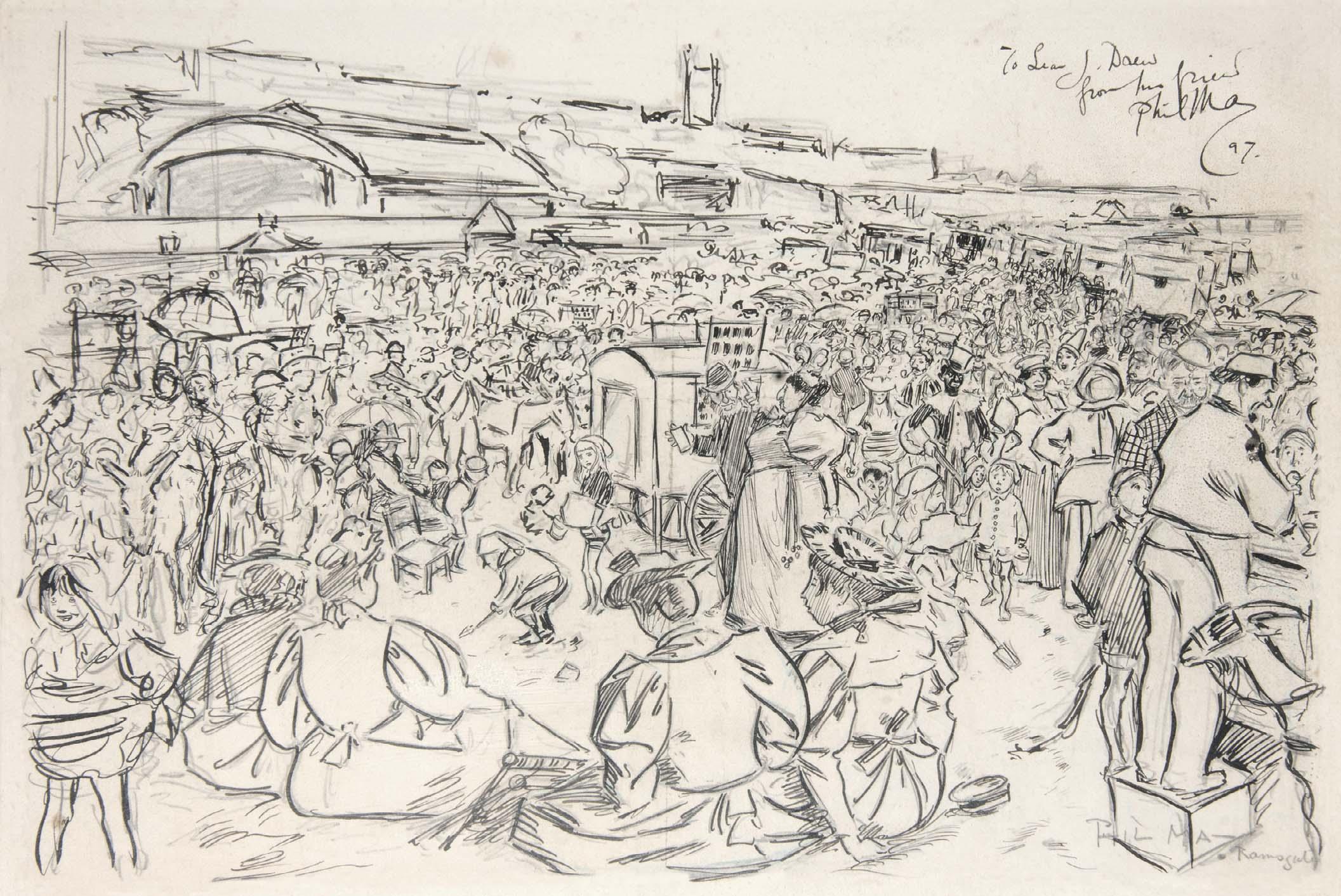
2. Victorian Illustrators & Cartoonists 32 23 Sg S S Signed twice, inscribed
Lear J Drew from his friend’ and ‘Ramsgate’, and dated 97 Ink with pencil 7 ½ 11 ¼ i C S
E J SULLIVAN
dmund Joseph Sull van, S iS (1869-1933)
EJ Sull van was one of the most str n and con dent llustrators of h s enerat on, ran n across many moods and med a, and becom n a part cularly n uent al teacher. or a b o raphy of dmund Joseph Sull van, please refer to The Illustrators, 2016, pa es 6-7.
Publ shed n late 1915, The Kaiser’s Garland was a collect on of 45 cartoons by J Sull van sat r s n the german mperor, ka ser lhelm, and cr t c s n the barbar sm and brutal ty of Pruss an m l tar sm.
24 k iS ’S g
Signed with initials Ink 11 ½ 17 ½ i C S
Illustrated: Edmund J Sullivan, The Kaiser’s Garland , London: William Heinemann, 1915, cover
25 i B , g C !
Inscribed with title on reverse Ink 10 ¼ 7 ¼ i C S
Drawn for but not illustrated in: Edmund J Sullivan, The Kaiser’s Garland , London: William Heinemann, 1915


2. Victorian Illustrators & Cartoonists 33

2. Victorian Illustrators & Cartoonists 34 26 C i g Sk S Ink 10 ¼ 7 i C S Illustrated: Edmund J Sullivan, The Kaiser’s Garland , London: William Heinemann, 1915, page 63
Illustrated: Edmund J
The
Garland
London: William Heinemann, 1915, page 69

Illustrated: Edmund J
The
London: William Heinemann, 1915, page

2. Victorian Illustrators & Cartoonists 35 28 P iS Ink 10 ½ 7 ¼ i C S
Sullivan,
Kaiser’s
,
27 P i B i SS i P i B P S i i S C Signed and dated 1915 Ink 10 ½ 7 ¼ i C S
Sullivan,
Kaiser’s Garland ,
25


2. Victorian Illustrators & Cartoonists 36 30 i i g ‘ g B ki g i iS i ig i B C S i g . ki g iS iVi giV S P Si S .’ - i V. 26-28 Signed and dated 1915 Ink 10 7 i C S Illustrated: Edmund J Sullivan, The Kaiser’s Garland , London: William Heinemann, 1915, page 85 29 C Signed and dated 1915 Ink 10 ½ 7 ¼ i C S Illustrated: Edmund J Sullivan, The Kaiser’s Garland , London: William Heinemann, 1915, page 81
Fair

Vanity
VANITY FAIR
‘I venture to prophesy that, when the history of the Victorian Era comes to be written in true perspective, the most faithful mirror and record of representative men and the spirit of their times will be sought and found in Vanity Fair’ (Leslie Ward, Forty Years of ‘Spy’, page 331)
When, on 7 November 1868, the rst edition of the new ‘society journal’ Vanity Fair was published, there was little indication within its pages of the in uence it was to have on Victorian high society. This rst edition contained no caricatures, its text commented on the week’s social and political events and reviewed the latest literary and theatrical releases. The journal failed to nd immediate success and struggled to compete with other more established papers such as The Owl and The Tomahawk Vanity Fair’s founder, Thomas Gibson Bowles, was the son of a prominent liberal politician, Thomas Milner Gibson, and his wife, Susannah Arethusa Gibson, who was well established in in uential social circles and regularly hosted fashionable salons. Growing up within this environment, Bowles was able to socialise with journalists, actors, artists, politicians and bohemians. Whilst maintaining a junior position at the Board of Trade, he began to contribute to various journals, including The Glow Worm, The Owl and The Tomahawk. Though it was his experiences with these publications that gave Bowles the con dence to create his own journal, it was his social connections that not only helped it get o the ground, but also shaped its future. A close friend, Colonel Frederick Gustavus Burnaby, supplied £100 of the £200 original investment and, although Bowles wrote much of the text himself under the pseudonym ‘Jehu Junior’, he engaged regular contributors to participate. These contributors were selected from fashionable sets for their social as much as their literary quali cations. Indeed, Vanity Fair was written by and for the Victorian and Edwardian establishment.
On 16 January 1869, Bowles promised his readers ‘Some Pictorial Wares of an entirely novel character’. What was to follow not only set Vanity Fair apart from its competitors, but changed the way in which caricature was viewed and received. Two weeks later, a full-page caricature of Benjamin Disraeli by Carlo Pellegrini appeared in Vanity Fair, followed the next week by a caricature of William Gladstone. The images were reproduced by the highly regarded lithographer, Vincent Brooks, using an approach that was virtually unprecedented in England. Until this point, lithography had been reserved largely for topographical and decorative subjects. Cartoons and caricatures, such as those published in popular satirical magazines like Punch, were reproduced through wood-engraving. Pellegrini’s caricatures, completed under the pseudonym ‘Singe’ (later ‘Ape’) were the rst of over 2,300 caricatures to be published in Vanity Fair. These highlyskilled, lithographically reproduced, full-page cartoons, in a journal published in quarto dimensions with 8-10 pages per issue, gave Vanity Fair an instant identity.
Carlo Pellegrini collaborated with Thomas Gibson Bowles and Vincent Brooks with enormous success. A favourite of the Prince of Wales, the immensely popular Neapolitan mixed easily with his subjects and portrayed them gently, making it something of a mark of honour, even a social necessity, to appear in Vanity Fair’s pages. Before then, the nature of English caricature had been shaped by the savage work of the Georgian cartoonists such as Thomas Rowlandson and James Gillray. Pellegrini diluted the ferocity of these cartoons through his own style, in uenced by his early years caricaturing bohemian society in Naples, and by the work of his fellow Neapolitan, Melchiorre Del co (who would later contribute eight drawings to Vanity Fair). The gently humorous style of caricature that was introduced to England by the likes of Pellegrini and Del co was immediately more palatable to the sensibilities of Victorian Society than the more brutal satire made popular in France.
The success of Carlo Pellegrini and the burgeoning popularity of Vanity Fair made the magazine an attractive proposition for foreign artists seeking patronage in the upper echelons of society. In 1869, the French society painter, James Tissot began to contribute under the pseudonym ‘Coïdé’, bringing a more serious, portraiture style to the magazine. This suited the preferences of Thomas Bowles Gibson, but, understanding that Pellegrini’s more satirical drawings were what had brought him success, sought other more humorous collaborators to work alongside him. These included Adriano Cecioni, Melchiorre Del co, Francis Carruthers Gould and the American political cartoonist, Thomas Nast.
The arrival of Leslie Ward at Vanity Fair in 1873 turned the magazine into a national institution. Drawing under the pseudonym ‘Spy’, Ward was industrious, dependable and passionate. Bowles Gibson came to depend on him over the mercurial Pellegrini, who left Vanity Fair on a number of occasions to pursue other ventures. For 40 years, ‘Spy’ caricatured the highest pro le gures in Victorian society, from actors and sportsmen to politicians and royalty. Having grown up rubbing shoulders with those whom he now caricatured, through his family connections and personal acquaintances, he was able to move easily in these social circles. He considered himself no bohemian, rather he saw himself as a professional, dedicated to his craft. To be caricatured by ‘Spy’ and for the result to appear in Vanity Fair was a con rmation of one’s importance to Victorian society. Though Leslie Ward’s approach to his art changed the perception of caricature in Victorian England, it was not always for the better. In Vanity Fair’s early days, this respectable, often attering form of caricature was something entirely new. In the light of this novelty, it was viewed in the right spirit by those portrayed. Later, as Ward lamented in his autobiography, Forty Years of Spy, those he drew began to grow particular and demanding about how they were represented. Ward began his career at Vanity Fair physically seeking out his subjects around London; as he grew busier, he began to request that many came to sit
3 3. Vanity Fair 38
for him at his studio. Frequently, he received sitters who would pay for the privilege of being caricatured. This opened an entirely new form of subject to him, and with it came a more commercial relationship between Ward and his sitters. Despite the ongoing success of Vanity Fair, the attentions of Thomas Gibson Bowles had begun to focus elsewhere by the 1880s, and he was content to leave most of the illustrations to Leslie Ward. He had become more involved in politics (he would become Conservative MP for King’s Lynn in 1892) and had other newspaper interests including The Lady, which he founded in 1884. In 1889, he sold Vanity Fair for £20,000 and was replaced as editor by A G Witherby. Although this did not immediately alter the character of the magazine, the death of Pellegrini in January 1889 left Ward as the only experienced member of sta . For the next decade, the only other regular contributor of illustrations was the French caricaturist, Jean Baptiste Guth.


Though some have argued that Vanity Fair fell into a decline in the twentieth century, having lost some of its wit and irreverence, it remained a proving ground for aspiring young artists, the most notable being Max Beerbohm, who contributed nine drawings to the magazine in its later years. Vanity Fair’s nal caricature, of Joseph Chamberlain drawn by ‘Astz’, was published on 14 January 1914. The following month, it was absorbed by Hearth and Home
Other periodicals founded during this period purported to be society papers, but none came close to matching Vanity Fair. This was undoubtedly due to the consistent quality of cartoons from the likes of Ward and Pellegrini. Ward described Mayfair, a paper he occasionally drew for, as ‘the only Society journal that I can recall having succeeded in any way on the lines of Vanity Fair’ [Forty Years of ‘Spy’, page 337]. A comment published in The Week, a Canadian journal, on 3 April 1884, claimed that whilst it was virtually unknown outside of London, Vanity Fair ‘owes the small place it holds in unkeydom to the clever cartoons of public characters which appear each week’.
Though Vanity Fair was, like many other similar magazines, a purveyor of ‘backstairs court and aristocratic tittle-tattle’ (as described by The Week), Leslie Ward described Vanity Fair in his autobiography as the rst magazine that could rightfully call itself a society journal. Through the acerbic wit of Thomas Gibson Bowles and other contributors, and through the caricatures of ‘Spy’, Vanity Fair became the essential representation of Victorian high society, a paper written by and for the Establishment.
Further Reading:
Roy T. Matthews, Peter Mellini, In ‘Vanity Fair’ , Berkeley, CA: University of California Press, 1982;
Leslie Ward, Forty Years of ‘Spy’ , London: Chatto & Windus, 1915

3. Vanity Fair 39
APE
Carlo Pellegrini (1839-1889), known as ‘Ape’
A longside his colleague Leslie Ward (who took the pen name ‘Spy’), Carlo Pellegrini de ned the look of the Victorian society journal, Vanity Fair. Inspired by the work of Melchiorre Delifco and Honoré Daumier, his caricatures, produced under the pen name ‘Ape’, had an enduring e ect on Victorian high society as a whole. So did Pellegrini himself, as the eccentric Neapolitan caricaturist became known as one of London society’s most well-known and well-loved gures.
Carlo Pellegrini was born in Capua, Campania, Italy, on 25 March 1839, a descendent of the Sedili Capuani, an aristocratic landowning family. He was educated at the Collegio Barnabiti, then at the Sant’ Antonio in Maddaloni, near Caserta. By the age of 20, he had already established himself as a highly popular gure in Neapolitan high society. He was eccentric and funny, kindhearted and generous. He quickly earned himself many friends and patrons and delighted many of them by drawing caricatures for them, though he had no formal artistic training.
In the autumn of 1860, it is possible that the young Pellegrini joined the forces of Giuseppe Garibaldi and fought in the last battles against the Bourbons at the Volturno and at Capua. Although this assertion is the subject of debate, as are many of his anecdotes, according to his Vanity Fair colleague, Leslie Ward.
On 9 November 1892, Pellegrini met the Prince of Wales during a visit to Naples, and celebrated his coming-of-age with him. This encounter was signi cant to his future career, as two years later, when he arrived in London, he was quickly ensconced as a close friend and jester in the Prince’s social circle. Why he left Italy is unclear, though he maintained to friends that it was a combination of unrequited love and the death of his sister. He claims that he initially endured poverty when he rst arrived in London, including periods sleeping rough in Whitehall and Piccadilly, but his reputation and popularity in London’s bohemian society rapidly grew.
As he had done in Naples, Pellegrini regularly drew caricatures for his friends and royal companions. These caricatures came to the attention of Thomas Gibson Bowles, who had recently founded the society paper, Vanity Fair. He commissioned Pellegrini to produce colour portraits of Benjamin Disraeli and William Gladstone. These portraits were reproduced by Vincent Brooks, then London’s premier lithographer and appeared in Vanity Fair in January and February 1869 under the pseudonym ‘Singe’, the French for ‘ape’. His drawings were an immediate success and he became a permanent member of sta at Vanity Fair, producing caricatures under his new pseudonym, ‘Ape’. In the 1870s, he met and struck up a friendship with Edgar Degas, and the two men produced portraits of one another, Pellegrini’s inscribed ‘a vous’, and
Degas’ ‘a lui’. Remaining as highly sociable in London as he had been in Naples, Pellegrini was a member of the Arts Club from 1874 to 1888, and a member of the Beefsteak Club, along with Leslie Ward. It was here that he rst met James McNeill Whistler, who became a great in uence on his work. Pellegrini had long aspired to become a portrait painter to the level of Whistler, and twice left Vanity Fair, rst in 1871 and again in 1876, in an attempt to succeed in this eld. However, his talents for caricature did not extend to portraiture and, after his work in this eld was poorly received by critics, he returned to Vanity Fair early in 1877. Though he was debilitated in his nal years by tuberculosis, he continued to produce cartoons for Vanity Fair until his death on 22 January 1889.
At barely ve feet two inches tall, with a large head and very small feet, Carlo Pellegrini certainly made a huge impression on those he met. He aunted his homosexuality, at a time when it was dangerous to do so and dressed eccentrically, though awlessly. As Leslie Ward observed, ‘he always wore white spats, and their whiteness was ever immaculate, for he rode everywhere, a fact which probably accounted for his bad health in later years. His boots, too, were the acme of perfection, and his nails were as long and pointed as those of a mandarin’ [Forty Years of Spy, page 96]. His story-telling at London society gatherings was legendary, despite his struggles with the language. Ward recalled that when regaling his listeners with his stories, ‘his English, which was ever poor, stumbles and tripped, for although he was rather too quick to recollect slang terms, his grammar remained appalling, but delightfully naive’ [Forty Years of Spy, page 97]. Such was his popularity that when he was debilitated by tuberculosis, his fashionable friends raised the money for his care in a private hospital, settled all his debts, and provided the luxuries to which he was accustomed until his death. The Fine Art Society sold a proof from a destroyed plate of his much admired caricature of Whistler, with Whistler's signature, to pay for his gravestone in Kensal Green Roman Catholic cemetery, London.
His work is represented in the collections of the National Portrait Gallery; and the Royal Library, Windsor.
Further reading:
Maria Cristina Chiusa, ‘Pellegrini, Carlo (b Carrara, Nov 22, 1605; d Carrara, 1649), Grove Art Online , 2003, https://doi.org/10.1093/gao/9781884446054.article.T066088; Peter Mellini, ‘Pellegrini, Carlo [peud. Ape] (1839-1889)’, H C G Matthew and Brian Harrison (eds), Oxford Dictionary of National Biography , Oxford University Press, 2004, https://doi.org/10.1093/ref:odnb/21806;
Leslie Ward, Forty Years of ‘Spy’ , London: Chatto & Windus, 1915
3. Vanity Fair 40
SIR HENR DRUMMOND-WOLFF
Signed Inscribed ‘Drummond Wolf’ and dated ‘5 Sept 74’ on reverse
Watercolour
12 7 INCHES
Illustrated: Vanity Fair, 5 September 1874, Statesmen no 184, ‘Consular Chaplains’
At the time of his appearance in Vanity Fair , Sir Henry Drummond-Wol (1830-1908) had just become MP for Christchurch. He served in this role until 1880, when he became MP for Portsmouth. In 1885, he was sent to Constantinople and Egypt to negotiate as part of the Eastern Question and would serve as the British High Commissioner in Egypt from 1885 to 1887.

3. Vanity Fair 41 31
COÏDÉ
James [Jacques-Joseph] Tissot (1836-1902), known also as ‘Coïdé’
‘His work can hardly be called caricature; for the sketches were rather characteristic and undoubtedly brilliant drawings of his subjects’
(Sir Leslie Ward)
Though best known as the French painter of English society, James Tissot also produced insightful caricatures. These appeared in Vanity Fair, under the name ‘Coïdé’, in the period from 1869 to 1873, alongside those of ‘Ape’ and before the arrival of ‘Spy’.
The second of four sons of a prosperous linen merchant, James Tissot was born in Nantes, on the River Loire, on 15 October 1836. He was educated at Jesuit colleges in Brugelette, Belgium; Vannes, Brittany; and Dôle, Franche-Comté. He considered becoming an architect and then an artist. Moving to Paris by 1856, he studied at the Ecole des Beaux-Arts, under Louis Lamothe and Hippolyte Flandrin. While there, he befriended James McNeill Whistler and Edgar Degas. Exhibiting at the Paris Salon from 1859 and at the Royal Academy, London, from 1864, he soon abandoned medieval subjects in favour of the elegant, polished, often complex, contemporary scenes for which he is best known. In 1869, he also began to produce his rst caricatures for Thomas Gibson Bowles’s society paper, Vanity Fair, signing them ‘Coïdé’, ‘perhaps because they were a collaboration between Bowles’s notions and Tissot’s draughtsmanship, thus “co-idée”’(Richard Thomson, in Anna Gruetzner Robins and Richard Thomson, Degas, Sickert and Toulouse-Lautrec. London and Paris 1870-1910, London: Tate, 2005, page 20).
Following the outbreak of the Franco-Prussian War in 1870, Tissot fought in the defence of Paris, but ed to London a year later. Through the auspices of Bowles, he made many professional and social connections, and his work gained rapid popularity. He lived openly with his Irish mistress, Kathleen Newton, in a house in Grove End Road, St John’s Wood. However, this sojourn came to an end in 1882 when, having contracted tuberculosis, she committed suicide at the age of 28.
Tissot returned to France, and soon turned to religion, both as a way of life and a subject for his art. He even made two visits to the Holy Land, in 1886-87 and 1889, which inspired a large series of watercolour illustrations of the Bible. These drawings were exhibited at the Doré Gallery on his return. On 8 August 1902, he died at the Château de Buillon, Doubs, Franche- Comté, which he had inherited from his father in 1888.
His work is represented in numerous public collections, including the National Portrait Gallery and Tate; Musée d’Orsay; and Brooklyn Museum (New ork) and the Minneapolis Institute of Arts.
Further reading: Willard E Misfeldt, ‘Tissot, James [Jacques-Joseph] (b Nantes, 15 Oct 1836, d Château de Buillon, Doubs, 8 Aug 1902)’, Jane Turner (ed), The Dictionary of Art , London: Macmillan, 1996, vol 31, pages 29-31
32
GENERAL TROCHU, ‘THE HOPE OF FRANCE’ Ink and watercolour with pencil and chalk
11 ¾ 7 INCHES
Illustrated: Vanity Fair, 17 September 1870
Louis-Jules Trochu (1815-1896) had served with distinction in the French armed forces during the Crimean War. During the Franco-Prussian War, he was appointed Governor of Paris and Commander-in-Chief of all forces responsible for the defence of the capital. The leadership he demonstrated during the Siege of Paris saw him named President of the Government of National Defence, the de facto head of state, on 4 September 1870.
3. Vanity Fair 42

3. Vanity Fair 43
SPY
Sir Leslie Ward, RP (1851-1922), known as ‘Spy’

F or almost 40 years, Sir Leslie Ward de ned the look of the society paper, Vanity Fair. His well observed, meticulously conceived cartoons permanently altered the art of caricature in England. From the cruel and often grotesque caricatures made popular by the likes of Gillray and Daumier, Leslie Ward made caricature acceptable and, indeed, necessary to the who’s who of Victorian high society.
Leslie Ward was born at Harewood Square, London (on the site of what is now Marylebone Station), on 21 November 1851. He was exposed to the artistic life from birth as his father, Edward Matthew Ward, and mother, Henrietta Ada Ward, were both professional artists. His father produced historical paintings and his mother was a fashionable painter of portraits. Indeed, the artistic tradition of Ward’s family stretched back further still. His maternal grandfather, George Raphael Ward, was a mezzotint engraver and miniature painter, his mother’s great-uncle was John Jackson RA, portrait painter in ordinary to William IV, and his great-grandfather, James Ward, was a versatile painter of landscapes, animals and portraits, engraver, lithographer and modeller. His godfather, Charles Robert Leslie, after whom he was named, was also a Royal Academician and father to George Dunlop Leslie, who won the Royal Academy Schools Silver Medal in 1814.
Ward was strongly in uenced by the artistic environment in which he found himself as a young child. At the age of four, he holidayed in Calais with his parents, and produced what he considered to be his rst caricatures, of a number of French soldiers loitering at the docks. As his parents were popular and highly sociable in artistic circles, the young Ward was introduced to a great number of the Victorian period’s most in uential literary and artistic gures. The novelist, Wilkie Collins, was a close friend of his parents, as was his brother, Charles Allston Collins, one of the original members of the Pre-Raphaelite Brotherhood. Other artists who visited his parents’ studios when he was child included Daniel Maclise, Sir Edwin Landseer, John Everett Millais and William Holman Hunt. Ward was also introduced to the Queen and Prince Consort, who made regular visits to the studio. One such visit was during the progress of one of his father’s commissioned pictures, The Visit of Queen Victoria to the Tomb of Napoleon I, which was referred to in The Spectator’s review of the Royal Academy Summer Exhibition in 1858 as ‘a stagey, ashy, vulgar a air, with scarcely a redeeming point’.
Leslie Ward enjoyed a happy childhood. While he was still young, the family moved from Harewood Square to Upton Park, Slough, a rural environment that he adored. His artistic surroundings nurtured his desire to become an artist. Despite this, and the fact the he was a regular sitter for his parents, Ward never received a single lesson from either. His father was actually keen
to dissuade him from becoming an artist and wished to see him educated in a more traditional manner. Initially, he attended Chase’s School, Salt Hill, near Slough. However, he did not stay long as the school was soon broken up due to the ill health of the headmaster. As a result, he was sent to study at Eton at a younger age than was planned. At the request of his father, his aptitude and love for drawing was not encouraged whilst he was at Eton. Nevertheless, he
3. Vanity Fair 44
Photograph portrait of Sir Leslie Ward, 1915
continued to indulge his passion, regularly drawing the school’s masters and his fellow pupils, and so becoming Eton’s uno cial caricaturist. While he was still young, the family returned to London, moving to Kent Villa, Kensington, a large house with two studios one on top of the other for his parents. On school holidays, he spent much of his time watching his parents work there, as well as at the temporary studio erected on the terrace of the House of Lords, where he watched his father paint frescoes for the Houses of Parliament.
At the age of 16, Ward turned his attention to modelling and started a bust of his younger brother, Wriothesley Russell Ward. Working on it in his holidays, he nished it in time to submit it to the Royal Academy, where it was accepted and exhibited at the Summer Exhibition of 1867. However, he chose not to follow up on this success, deeming the process too much of a physical and mental strain on him. As a young man, he also indulged in a growing interest in the stage. During his school holidays, he would assist at various playhouses across London by painting scenery and playing in small roles. He rst appeared in front of a large audience at the Bijou Theatre in Bayswater as part of an amateur company called ‘The Shooting Stars’, comprised largely of Cambridge undergraduates.
After leaving school at the age of 16, Leslie Ward travelled to Paris with a group of friends, for little more reason than to enjoy himself and soak up the city’s artistic atmosphere. However, his father’s desire to see him installed in a secure vocation resulted in Ward entering the o ce of Sydney Smirke RA, to study architecture. Smirke was a highly respected architect, whose most well-known works include the Carlton Club and the Reading Room at the British Museum. However, the mechanical process of the profession did not appeal to Ward, and his period with Smirke only served to strengthen his resolve to become an artist. After a year, Smirke had completed his work on the exhibition galleries at the Royal Academy’s Burlington House and decided to retire. During this time, Ward had been made a member of the Architecture Association, and his father arranged for him to continue his architectural studies with Edward Barry RA. However, when he was informed that his period of study with Barry would last for another ve years, Ward declined the o er and resolved nally to tell his father that he wished to pursue a career as an artist. He found an ally in the painter and Royal Academician, William Powell Frith, a close family friend who agreed to mediate between Leslie Ward and his father. The intervention of Frith at last saw his father relent and give his blessing to his chosen career.
His rst commission was to end in unfortunate circumstances. Through his father, Ward obtained work undertaking a series of interior drawings for a family friend, a Mrs Butler Johnson Munro. However, after three months’ work, Mrs Butler Johnson Munro suddenly died, leaving Ward with just a ve pound note he had been paid after his rst day. He did not have the heart to send a claim for full payment to her executors.
A six-week visit to Lord Lytton at Knebworth, in the company of his parents, gave Ward his rst real encouragement that he could succeed as an artist. During his stay, he painted a watercolour of Knebworth’s great hall and had Lord Lytton sit for a portrait. (He also caricatured his host from memory.)
On his return home, his painting of the great hall was accepted by the Royal Academy and, determined to win his father’s approval, he began his preparation to enter the Royal Academy Schools. This preliminary course of instruction included study at the Slade School of Fine Art, under Professor Edward Poynter. In 1871, he entered the Royal Academy Schools as probationer in Architecture, before becoming a full-time student.
Much of his time at the Royal Academy was spent exhibiting portraits in oil and watercolour and he could easily have made a career in that eld. Portraits that he exhibited at the Royal Academy included drawings of his brother, Wriothesley, and his sister, Beatrice. Though he exhibited great talent in portrait painting, and would be elected to the Royal Society of Portrait Painters in 1891, he still held a great love for caricature and continued to draw the various personalities who crossed his path.
Leslie Ward’s association with the society paper, Vanity Fair, began with a garden party hosted by Lord Leven. Here, he observed the eminent zoologist, Professor Richard Owen, who was nicknamed ‘Old Bones’. So taken by what he described as his ‘antediluvian incongruity’, he resolved to caricature him. At this time, Thomas Gibson Bowles, the founder of Vanity Fair, had grown dissatis ed with the artists working for him the absence of his main caricaturist, Carlo Pellegrini, and was searching for new cartoonists. John Everett Millais, having known of Leslie Ward’s skill and enjoyment in creating caricatures and his admiration for Vanity Fair, called to see a collection of his work. Particularly taken with the caricature of ‘Old Bones’, he urged Ward to submit it to Vanity Fair. He did so, and it was accepted and published in 1873. The cartoon was unsigned, as Bowles did not approve of Ward’s original idea for a signature. When Bowles handed Ward a dictionary and suggested he search for a pseudonym, the page fell open on the ’S’s’ and his eye was caught by ‘Spy’. Following the publication of his rst cartoon, Leslie Ward became a permanent sta member at Vanity Fair and he was able to turn his attention ‘whole-heartedly and with in nite pleasure’ to caricature. When he and Vanity Fair’s other great cartoonist, Carlo Pellegrini, were rst introduced at a social event, Pellegrini jokingly told onlookers that he had taught Ward everything he knew. He laughed it o , knowing it not to be the case, but when numerous journalists believed it to be true and put it into print, Ward grew to regret not correcting the comment. Nevertheless, this rst meeting began a lasting friendship and great mutual admiration.
3. Vanity Fair 45
☞
‘Spy’ was an apt pseudonym for Ward, as he often found himself ‘stalking’ his subjects everywhere from the law courts and Houses of Parliament to society gatherings and theatres of London, before drawing them from memory. In his early days at Vanity Fair, he was often given subjects that were refused by Pellegrini, and his caricatures were often the result of hours of continual attempts, watching his subjects as they walked or drove past. In Thomas Gibson Bowles, Ward found a valuable ally when studying his subjects. As Ward explains, ‘he was so thoroughly a man of the world and withal so tactful and resourceful that I was glad when we worked in company. It was a great help for me, and I was able to employ my attention in observing while he took the responsibility of conversations and entertainment of the subject entirely o my hands’. In January 1873, Ward received a commission from William Luson Thomas, editor of The Graphic, and contributed a number of portrait drawings to the paper, including those of Sir John Cockburn, Benjamin Disraeli, William Gladstone and Lord Leighton. In 1876, he left The Graphic and worked exclusively for Vanity Fair alongside Pellegrini. When Pellegrini died in 1889, Ward produced virtually every cartoon.
In 1874, his parents had left London and moved to Windsor. As Ward was required to stay in London, he took rooms in Connaught Street, and a studio in William Street, Lowndes Square. As his fame grew and his time became more precious, he began to require many of his subjects to come to this studio and sit for him. This procedure frequently irritated him, as his sitters often made requests as to how they should be portrayed, or complained about the nal result. Nevertheless, he continued to accept commissions to produce portraits, partly because he remained greatly fond of the process of portrait painting, but also because it was well paid. In an 1897 interview given by Oliver Armstrong Fry, then editor of Vanity Fair, to Frank Ban eld of Cassell’s Magazine, it was reported that Ward received between £300 and £400 for a portrait. Later in life, he would regret not allowing himself more time to work in this genre.
The nature of his work and his association with such a reputable society magazine as Vanity Fair meant that Leslie Ward gured prominently in the upper echelons of Victorian society. In 1874, he joined the Arts Club in Hanover Square, whose members at the time included Punch cartoonists John Tenniel and Charles Keene. He later became a member of the Orleans Club, the Lotus Club and the Pelican Club. In 1876, he became one of the original members of the Beefsteak Club, a bohemian club founded by Archibald Stuart Wortley. He was elected an honorary member of the Lyric Club, and also joined the newly opened Fielding Club and the Gallery Club, held on Sunday nights at the Grosvenor Galleries. In July 1880, he was invited on a cruise aboard the HMS Hercules by the Duke of Edinburgh, who had seen and admired his caricature of the Admiral Sir Reginald MacDonald, which had appeared in Vanity Fair. In 1890, he was given the honour of a sitting by the Prince of Wales at Marlborough House.
After many years as a bachelor, Leslie Ward married in 1899 to society hostess Judith Topham-Watney, the only daughter of Major Richard Topham, of the 4th Queen’s Own Hussars. They had initially courted some years earlier, only for her parents to block their engagement on the grounds that Ward was nancially unworthy. However, in 1899 they happened to meet again on a train journey, their relationship was rekindled and they were married a few months later at St Michael’s Church in Chester Square. Settling down together in Elizabeth Street, Belgravia, they had one daughter, Sidney.
In 1911, Leslie Ward resigned from Vanity Fair, ending an association with the paper that had lasted almost 40 years. He was soon approached by the paper, The World, who o ered him not only the same pay that he received at Vanity Fair, but also permission to retain the rights of his original drawings. As a result, he was able to send a collection of his works to the Turin Exhibition at the request of Sir Isidore Spielmann, for which he received a Grand Prix. He also occasionally produced portraits for Mayfair, which Ward described as ‘the only Society journal that I can recall having succeeded in any way on the lines of Vanity Fair’ [Forty Years of ‘Spy’, page 337]. In 1914, he was commissioned by the sta of the Pall Mall Gazette and The Observer to produce a portrait of their editor, James Louis Garvin.
In 1915, Leslie Ward published his autobiography, Forty Years of ‘Spy’. He was knighted in 1918. He died suddenly of heart failure at 4 Dorset Square, London, on 15 May 1922.
His work is represented in the collections of the National Portrait Gallery. Further reading:
Peter Mellini, ‘Ward, Sir Leslie [pseud. Spy] (1851-1922)’, H C G Matthew and Brian Harrison (eds), Oxford Dictionary of National Biography , Oxford University Press, 2004, vol 57, pages 325-326;
Leslie Ward, Forty Years of ‘Spy’ , London: Chatto & Windus, 1915
3. Vanity Fair 46
HM GEORGE, KING OF GREECE
Signed Watercolour and bodycolour with pen and ink on tinted paper
12 7 ¼ INCHES
Illustrated: Vanity Fair , 21 October 1876, Sovereigns no 12
Spy’s caricature of King George is a reminder of British, and generally international, involvement in the governance of Greece following its independence from the Ottoman Empire in 1830. At the London Conference in 1832, The ‘Great Powers’ – Britain, France and Russia – recognised the country’s autonomy and established a monarchy in Greece under the Bavarian prince, Otto. He reigned for 30 years, but became increasingly unpopular with native Greek politicians, and was deposed in 1862. He was replaced at the suggestion of the Great Powers by the 17 year old Danish prince, William (1845-1913). He was elected the King of the Hellenes in 1863, and took the regnal name of George. At his urging, Greece adopted a more democratic constitution, and greatly developed its parliamentary process.
In the same year, his sister, Alexandria, married (Albert) Edward, the Prince of Wales and future Edward VII. These personal bonds further strengthened relations between Britain and Greece, and helped maintain George’s reputation among the British people, as exempli ed by Spy’s gentle caricature, which was published in 1876. During the nineteenth century there was a desire in Greek politics to unify all areas that had been historically inhabited by the ethnically Greek people. So, in 1897, the Greek population of Crete rose up against its Ottoman rulers, and the Greek Prime Minister, Theodoros Diligiannis, mobilised troops, which invaded Crete and crossed the Macedonian border into the Ottoman Empire. When Greece lost the war that followed, King George considered abdicating. However, when he survived an assassination attempt in 1898, his subjects began to hold him in greater esteem. In 1901, on the death of Queen Victoria he became the second-longest-reigning monarch in Europe.
In 1912, the Kingdom of Montenegro declared war against the Ottoman Empire, Crown Prince Constantine led the victorious Greek forces in support of the Ottoman Empire, in what became known as the First Balkan War. George planned to abdicate in favour of his son immediately after the celebration of his Golden Jubilee in October 1913. However, while walking in Thessaloniki on 18 March 1913, he was assassinated by the anarchist, Alexandros Schinas. Constantine succeeded to the throne.

3. Vanity Fair 47 33
34
REV HENR MONTAGU VILLIERS
Signed Watercolour and bodycolour with pencil 12 7 ½ INCHES
Illustrated: Vanity Fair , 21 August 1902, Men of the Day no 847
Henry Montagu Villiers (1837-1908) held the o ce of Prebendary of St Paul’s Cathedral and later served as the Vicar of St Paul’s Church, Knightsbridge.

3. Vanity Fair 48
35 COL CHARLES NAPIER STURT
Signed Watercolour with bodycolour on tinted paper
12 7 ¼ INCHES
Illustrated: Vanity Fair , 25 November 1876, Men of the Day no 142, ‘A Younger Son’
Charles Napier Sturt (1832-1886) was Conservative MP for Dorchester in the period 1856-74. As a Lieutenant-Colonel in the Grenadier Guards, he was severely wounded in 1854 at the Battle of Inkerman, during the Crimean War.

3. Vanity Fair 49
36
COLONEL WILLIAM CORNWALLIS-WEST MP
Signed Watercolour with bodycolour 15 ½ 7 ½ INCHES
Illustrated: Vanity Fair , 16 July 1892, Statesmen no 595, ‘Denbighshire’ Exhibited: ‘The Long Nineteenth Century: Treasures and Pleasures’, Chris Beetles Gallery, London, March-April 2014, no 140

William Cornwallis-West (1835-1917) was born in Florence, the youngest child of Frederick West of Ruthin Castle, Denbighshire. Following his education – at Eton and Lincoln’s Inn – he returned to Florence and developed his talent as a painter, gaining a reputation as a copyist, and also collecting. On the early death of his elder brother, Frederick, in 1868, he succeeded to the estate of Ruthin, and four years later married 17 year-old Mary Fitzpatrick, who would become a leading socialite (and later have an a air with the Prince of Wales). They shared their time between Ruthin and 49 Eaton Place.
West became High Sheri of Denbighshire (1872), Lord-Lieutenant of Denbighshire (1872-1917), a Justice of the Peace and Honorary Colonel in the 4th battalion of the Royal Welch Fusiliers, and was awarded the Royal Naval Volunteer Reserve O cers’ decoration. In 1885 he was returned to parliament for Denbighshire West, a seat he held until 1892, rst as a Liberal and then as a Liberal Unionist.
On the death of his mother in 1886, West came into possession of Newlands Manor, Lymington, Hampshire, and attempted to develop the resort of Milford on Sea in emulation of the Duke of Devonshire’s project at Eastbourne.
His children included George, who was the second husband of Jennie Jerome, mother of Winston Churchill, and then the second husband of the actress, Mrs Patrick Campbell; Daisy, Princess of Pless; and Constance Edwina, Duchess of Westminster.
3. Vanity Fair 50
37 THE EARL OF SHREWSBUR AND TALBOT
Signed Watercolour and bodycolour 12 ¼ 8 ¼ INCHES Illustrated: Vanity Fair , 30 July 1903, Statesmen no 758, ‘Cabs’
When only seventeen years old, Major Charles Chetwynd-Talbot (1860-1921) inherited the titles of the 20th Earl of Shrewsbury, 20th Earl of Waterford and 5th Earl of Talbot. Passionate about equestrian sports, he developed an interest in horse-drawn transport and, in London in 1888, founded the Shrewsbury and Talbot Cab and Noiseless Tyre Company; this would grow to 210 cabs and 365 horses. Following his separation from his wife in 1896, she remained at Alton Towers, Sta ordshire, while he went to live at Ingestre Hall, in the same county. There, in 1903, he founded the Talbot car company in order to import the French Clément car into Britain, which began in 1905. Domestically designed Talbot cars followed from 1906.

3. Vanity Fair 51
38
LORD KENSINGTON, MP
Signed Ink and watercolour with bodycolour and pencil 13 ¼ 7 ¾ INCHES

Illustrated: Vanity Fair , 7 September 1878, Statesmen no 281, ‘A Whip’
William Edwardes (1835-1896) was Liberal MP for Haverfordwest in Pembrokeshire during the period 1868-85. Though succeeding to the title of Baron Kensington in the Peerage of Ireland in 1872, he remained in the House of Commons, as a Whip, a member of the Privy Council and, latterly, Comptroller of the Household (1880-85). Created 1st Baron Kensington in the Peerage of the United Kingdom in 1886, he then entered the House of Lords, and acted as its Liberal Chief Whip in 1892-96.
3. Vanity Fair 52
39 SIR WALTER FRANCIS HEL -HUTCHINSON, GOVERNOR OF NATAL, SOUTH AFRICA
Signed
Watercolour with bodycolour on tinted paper
6 ¾ 12 ¼ INCHES
Illustrated: Vanity Fair , 7 July 1898, Men of the Day no 717, ‘Natal’
Spy depicts Sir Walter Hely-Hutchinson wearing the Regalia of the Most Distinguished Order of St Michael and St George.

3. Vanity Fair 53
40
JUDICIAL POLITENESS
THE RT HON SIR C S C BOWEN Signed Watercolour and bodycolour 12 10 INCHES
Illustrated: Vanity Fair , 12 March 1892
After being called to the bar at Lincoln’s Inn in 1861, Charles Synge Christopher Bowen rst rose to prominence as part of the prosecution team in the Tichborne Case, a cause célèbre that captured the public imagination in the late 1860s and early 1870s. In 1879 he was appointed a High Court judge in the Queen’s Bench and in 1882 was raised to the position of Lord Justice of Appeal. In 1893, the year after his portrait appeared in Vanity Fair, he was made a Lord of Appeal in Ordinary and a life peer with the title Baron Bowen. In his youth, he played a single rst-class cricket match for Hampshire against the MCC. He is credited with coining the phrase ‘the man on the Clapham omnibus’.

3. Vanity Fair 54
41
MR FRANK LOCKWOOD, QC MP
Signed Watercolour and pencil on tinted paper 7 ½ 12 INCHES
Illustrated: Vanity Fair , 20 August 1887, Statesmen no 526, ‘York’
Frank Lockwood (1846-1897) was a famous lawyer and Liberal MP for ork in the period 1885-97. Having been called to the bar in 1872, he went on to become Solicitor-General in Lord Rosebery’s ministry for the year 1894-95, and was knighted at the same time. A talented amateur artist, he published the Frank Lockwood Sketch-book in 1898.

3. Vanity Fair 55
42 SIR JAMES TA LOR INGHAM, MA KT Signed Watercolour with bodycolour and pencil 16 ¼ 10 ¾ INCHES
Provenance: The Dibben Family, Nash Priory and 4 Smith Square, London SW1
Illustrated: Vanity Fair , 20 February 1886, Men of the Day no 353, ‘Bow Street’
orkshire-born James Taylor Ingham (1805-1890) was called to the bar at the Inner Temple, and initially joined the northern circuit. Becoming a magistrate in London in 1849, he was made Chief Magistrate of London in 1876, sitting at Bow Street. Later that year, he was knighted at Osborne House.

3. Vanity Fair 56
LINLE SAMBOURNE
Signed
Inscribed with title and dated ‘Nov 1891’ below mount Watercolour with bodycolour 12 ½ 9 INCHES
Illustrated: Vanity Fair , 16 January 1892, Men of the Day no 528, ‘Sammy’
Linley Sambourne was an artist, cartoonist and illustrator, who would succeed Sir John Tenniel as the political cartoonist of Punch. For a full biography of Linley Sambourne, please refer to The Illustrators, 2015, page 34.

3. Vanity Fair 57 43
LORD RAGLAN
GEORGE FIT RO HENR SOMERSET
Signed Watercolour with bodycolour and pencil 14 7 ½ INCHES
Illustrated: Vanity Fair , 14 February 1901, Statesmen no 732
Shortly before his portrait appeared in Vanity Fair, the Lord Raglan George Somerset had, in November 1900, been appointed Under-Secretary for War in Lord Salisbury’s Conservative government. His grandfather, Lord FitzRoy Somerset, had served under the Duke of Wellington during the Napoleonic Wars, losing an arm at Waterloo in 1815. He was made Field Marshall of the British Armed Forces in the Crimea, where, in 1854, he was partly responsible for the ill-fated ‘Charge of the Light Brigade’. George Somerset continued the military tradition of his family by joining the Grenadier Guards and seeing action in the Second Anglo-Afghan War, where he was decorated. In 1902, after serving as Under-Secretary for War, he was appointed Lieutenant Governor of the Isle of Man.

3. Vanity Fair 58 44
45
CLEMENT KING SHORTER
THREE EDITORS
Signed Inscribed ‘Clement Shorter Esq’ below mount Watercolour with bodycolour on tinted paper 11 ½ 7 INCHES
Illustrated: Vanity Fair , 24 December 1894, Men of the Day no 607
A journalist and editor, Clement King Shorter began his career as a sub-editor for the Penny Illustrated Paper and columnist for the Star whilst working as a clerk in the Exchequer and Audit Department at Somerset House. In 1891, following the retirement of the editor of The Illustrated London News, John Lash Latey, Shorter o ered himself to the director, William Ingram, for the role and was accepted. Together with Ingram, he founded and became editor of The Sketch in 1892 and, following its acquisition by Ingram in 1893, editor of The English Illustrated Magazine. In the years following his appearance in Vanity Fair, he would become founder and editor of The Sphere (1900) and Tatler (1901).

3. Vanity Fair 59
LORD STANLE OF ALDERLE Signed
Inscribed with title and dated ‘Oct 1st 1883’ below mount Watercolour with bodycolour 10 ½ 7 ¼ INCHES
Drawn for but not illustrated in: Vanity Fair

Henry Stanley, 3rd Baron Stanley of Alderley (1827-1903), was a historian specialising in European exploration and expansion of the sixteenth century. He was Vice-President of the Hakluyt Society, which published his editions and translations, including Ferdinand Magellan’s The First Voyage Round the World (1874).
Fascinated by all things oriental from a young age, Stanley showed an interest in Arabic while at Eton and – as a con dent linguist –began to read it at Cambridge. Leaving university after a year, he became précis writer to Lord Palmerston, the foreign secretary, and worked in various positions in the diplomatic service for over a decade. In 1859, he left the service in order to travel in the Near East and Asia, and reached as far as Indonesia. It was also rumoured that he visited Mecca in order to convert to Islam. Continuing to travel through the 1860s, he made a secret Islamic marriage in 1862, to a Spanish woman, Fabia Fernandez Funes. (They underwent further marriage ceremonies at the register o ce at St George, Hanover Square, in 1869, and at St Alban’s Roman Catholic Church, Maccles eld, in 1874. Only after her death in 1905 was it discovered that Fabia was a bigamist, who had already married in 1851, and whose husband did not die until 1870.)
In 1869, Stanley succeeded his father as the 3rd Baron Alderley and took his place in the House of Lords. However, while intending to announce his conversion to Islam, he seems not to have done so and, despite speaking on questions relating to religion and to India, failed to impress his fellow peers.
As a result of his Muslim principles, he closed the public houses on his Cheshire estate, and ensured that churches built or restored on his land, such as that at Llanbadrig, Anglesey, used exclusively geometrical glass. He was also buried according to Muslim rites. His nephew, Bertrand Russell, described him as ‘de nitely stupid’, but Muriel E Chamberlain, writing in the Oxford Dictionary of National Biography, has countered that he was ‘brilliant, eccentric, and unstable’ (Matthew and Harrison 2004, vol 52, page 214).
3. Vanity Fair 60 46
IAN CHARLES, 8TH EARL OF SEAFIELD SHEEP
Signed, inscribed ‘Vanity Fair’ and dated ‘Sept. 29. 1883’
Inscribed ‘This picture belongs to Lady Nina Knowles, presented by the artist ‘Spy’ – Dec 1917’ on reverse Watercolour and bodycolour
13 ¾ 7 ¾ INCHES
Illustrated: Similar to Vanity Fair , 29 September 1883, Statesmen no 434’
Ian Charles Ogilvy-Grant was a Conservative politician and the 27th Chief of Clan Grant. His portrait in Vanity Fair is titled ‘Sheep’ after the nickname given to him while he was serving in the First Regiment of Life Guards between 1869 and 1877. He sat in the House of Lords until his death at the age of 32, just a few months after he appeared in Vanity Fair As he was unmarried and childless, the earldom passed to his uncle, James Ogilvy-Grant. The present portrait was produced by Leslie Ward in 1917 as a gift to Lady Nina Knowles, the daughter of Francis Ogilvy-Grant, the 10th Earl of Sea eld.

3. Vanity Fair 61 47
48
EGERTON CASTLE
HE INSISTS THAT HIS PEN IS MIGHTIER THAN HIS SWORD Signed Watercolour and bodycolour 14 8 INCHES
Illustrated: Vanity Fair , 9 March 1905
Born into a wealthy publishing family, Egerton Castle was an author and swordsman, and was a leading gure in the revival of the art of historical fencing. In 1885, he wrote Schools and Masters of Fencing: From the Middle Ages to the Eighteenth Century, the standard reference on the sport, and captained the British epeé and sabre teams at the 1908 Olympic Games. He also found fame as writer of ction, co-authoring several novels with his wife, Agnes. A number of these novels, including The Pride of Jennico (1897), Rose of the World (1905) and The Bath Comedy (1900), were later adapted into silent lms.

3. Vanity Fair 62
Brock Brothers

BROTHERS
to develop a degree of historical accuracy much greater than that of their model Hugh Thomson, and so dominate the so-called ‘costume’ school.

H M BROCK
Henry Matthew Brock, RI (1875-1960)
While retaining distinct artistic personalities, the brothers, Charles and Henry Brock, developed a mutually supportive working relationship. As a result, they became leading illustrators of historical subjects, and especially of eighteenth and early nineteenth-century literature.

For many generations, the Brock family farmed an area lying a dozen miles to the south of Cambridge. This tradition was broken by Edmund Brock who, as a reader in medieval and oriental languages for Cambridge niversity ress, lived in London and later in Cambridge itself. In turn, none of his seven children returned to farming. f those that embarked on some kind of artistic career, the most successful were the illustrators, Charles and Henry.
Charles Brock was born in Holloway, London, on 5 February 1870. oon after the birth of the second son, Richard, the family moved to Cambridge, and Henry was born there on 11 July 1875. Brought up in a strict rotestant tradition, the children went regularly to the Zion Chapel and attended the local Church of England chool before moving to Cambridge Grammar chool. Despite their great aptitude for art from an early age, neither Charles nor Henry attended art school. Charles studied for a while under the sculptor, Henry Wiles, but Henry developed through his close association with Charles who, even after leaving his family home, returned every day to work in its studio.
Charles illustrated books from 1891 and established himself three years later with an edition of Gulliver’s Travels published by Macmillan. In the same year, Henry embarked on his career by working with Charles on the illustrations to a history textbook, also for Macmillan. This encouraged the publisher to commission both Charles and Henry as contributing illustrators to a new project, the ‘Macmillan tandard ovels’, alongside such established gures as Hugh Thomson. In 1895, Charles came into direct competition with Thomson when he was asked to illustrate Austen’s Pride and Prejudice for this series. In the same decade, Charles and Henry also illustrated an edition of Austen’s novels (Dent), so impressing their vision of eighteenth and nineteenth century England upon the public.
At the turn of the century, the Brock family moved to Arundine House, making it their permanent home and soon building a large studio in its garden. Here the brothers assembled the large collection of ‘props’ that enabled them
Though they worked side by side, and often illustrated di erent editions of the same book, Charles and Henry still managed to project distinct artistic personalities. Charles produced a delicate, often broken, line that retained something of the quality of his original sketches; it is perhaps best exempli ed by his drawings for The Works of Thackeray and The Works of Lamb (both 1902-3).
Against this delicacy may be set Henry’s strong sense of design, put to good use in a large number of cartoons for Punch (1905-60) and posters for the D’ yly Carte pera Company (1920s).
If Charles was the more technically versatile, sometimes working in oil, Henry tackled a wider range of subjects, being well known as an illustrator of stories of adventure (including those by tevenson and cott). And despite their a nity and mutual a ection, Henry had to continue to work long after the death of his brother. Charles died in Cambridge on 28 February 1938, while Henry retired only in 1950, when his eyesight began to fail. He died on 21 July 1960. The brothers had both been elected to the membership of the Royal Institute of ainters in Water Colours, Henry in 1906, Charles two years later, in 1908.
4. Brock Brothers 64 4BROCK
49 (opposite) H ’ M TH MB Signed Ink and watercolour, 13 ½ 10 I CHE
C E BROCK
Charles
Edmund Brock,
RI (1870-1938) H M
BROCK
Henry
Matthew Brock,
RI (1875-1960)

4. Brock Brothers 65


4. Brock Brothers 66 50 J H MILT Signed Inscribed with title below mount Pencil and watercolour 6 ½ 5 ¼ I CHE 51 M TAIG E Signed Inscribed with title below mount Watercolour with ink 6 ½ 5 ½ I CHE These illustrations ( os 50 55 ) were probably drawn for eeley's Elzevir series. eeley & Co, founded in 1744, was one of Britain's oldest and longest standing publishing rms. Amongst its many publications were reprintings of works published in the 17th and 18th centuries by the Dutch publishers, Elzevir.
LD MITH

WILLIAM BLA E

4. Brock Brothers 67 52 G
Signed Inscribed with title below mount Watercolour with crayon 6 ¼ 5 I CHE 53
Signed Inscribed with title below mount Watercolour with pencil, crayon and ink 7 5 ½ I CHE
ERE D R H BARHAM


with title below mount
and crayon
½ 4 ½ I CHE
Q I CE
with title below mount
with crayon and bodycolour
4 ¾ I CHE
4. Brock Brothers 68 54 RE
Signed Inscribed
Watercolour
6
55 DE
: C FE I F A E GLI H I M EATER Signed Inscribed
Watercolour
6 ¾
THE LA T E A F ELIA
The Last Essays of Elia was the second volume of essays written by Charles Lamb, published in 1833 by Edward Moxon following the publication of Essays of Elia in 1823. These editions were complied from Charles Lamb’s essays that had rst begun appearing in The London Magazine between 1820 and 1825, which he had written under the pseudonym ‘Elia’.
56
THE ERA ATED MA
Signed, inscribed with title and dated 1899 Inscribed ‘Last Essays of Elia’ below mount Ink
9 ¼ 7 I CHE
Illustrated: Charles Lamb, Last Essays of Elia , London: J M Dent & Sons, 1900, page 86

C E BROCK
4. Brock Brothers 69
Charles Edmund Brock, RI (1870-1938)
57
THE ITIABLE I FIRMITIE F LD ME
Signed and dated 1899

Inscribed with title and ‘Stage Illusion. Last Essays of Elia. p 193’ below mount
Ink
9 ¼ 7 ¾ I CHE
Illustrated: Charles Lamb, Last Essays of Elia , London: J M Dent & Sons, 1900, page 28

58
TAGE ILL I
Signed with initials, inscribed with title and dated 1899 Inscribed ‘Last Essays of Elia. Headpiece’ below mount Ink
7 8 ½ I CHE
Illustrated: Charles Lamb, Last Essays of Elia , London: J M Dent & Sons, 1900, page 25
4. Brock Brothers 70
59
A M DE T I FFE I E DE RTME T D E
T ECE ARIL IM L AL R
Signed, inscribed with title and dated 1899

Inscribed ‘Popular Fallacies. No 1’ below mount
Ink
11 ¾ 7 I CHE
Illustrated: Charles Lamb, Last Essays of Elia , London: J M Dent & Sons, 1900, page 211

60
LIGHTED T THE RELIC FR M HI D T TREA RE
Signed and dated 1899
Inscribed with title and ‘Last Essays of Elia. Old China’ below mount
Ink
5 ¾ 5 ¼ I CHE
Illustrated: Charles Lamb, Last Essays of Elia , London: J M Dent & Sons, 1900, page 190
4. Brock Brothers 71
61
R TALL
DI TA T
HA E ALWA
THE AD A TAGE
Signed with initials and dated 1899
Inscribed with title and ‘Popular Fallacies VII. Of two disputants, the warmest is generally in the wrong’ below mount Ink
7 7 ½ I CHE
Illustrated: Charles Lamb, Last Essays of Elia , London: J M Dent & Sons, 1900, page 220
62 EW EAR’ BAT

Inscribed ‘Tailpiece to New Year's Coming of Age’ Ink
2 4 ½ I CHE
Illustrated: Charles Lamb, Last Essays of Elia , London: J M Dent & Sons, 1900, page 172

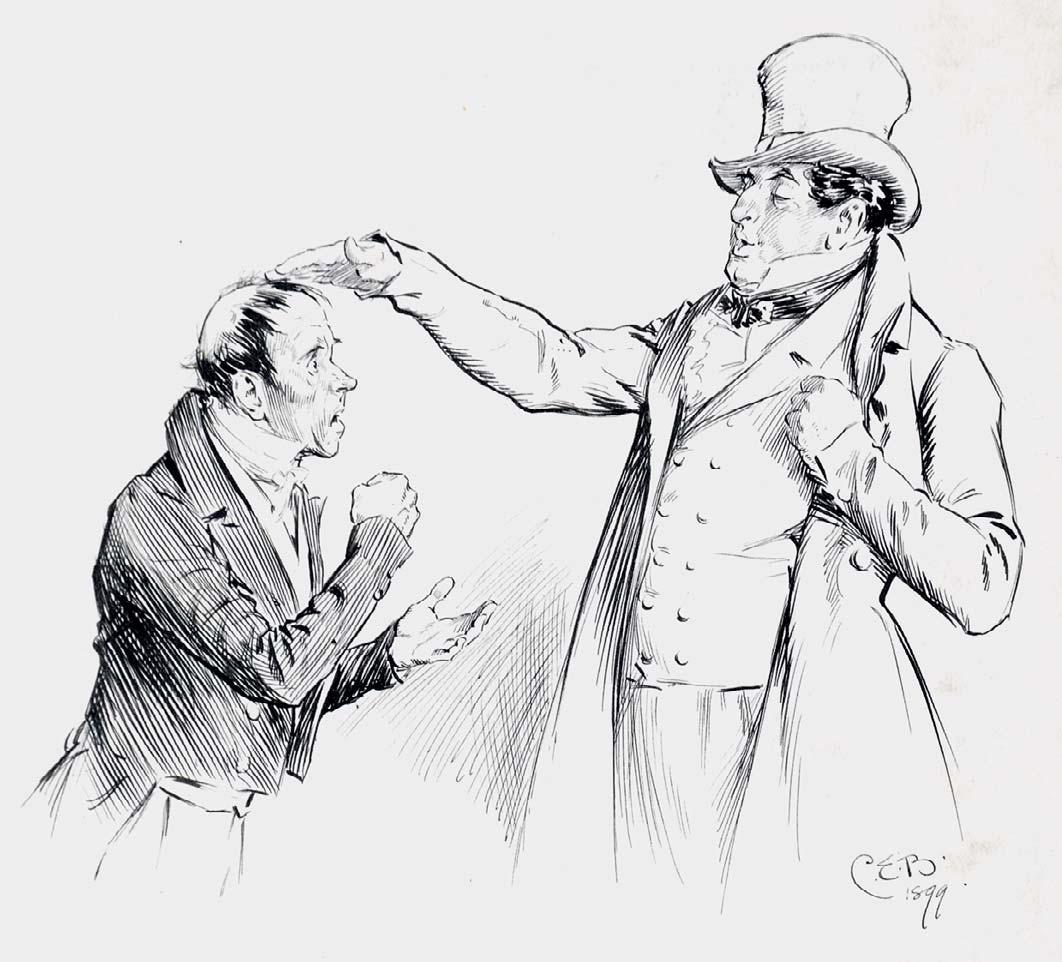
63
IT HA LEAR ED T G T MAR ET
Signed and dated 1899
Inscribed with title and ‘Last Essays of Elia. Popular Fallacies XII’ below mount Ink; 8 ¾ 6 I CHE
Illustrated: Charles Lamb, Last Essays of Elia , London: J M Dent & Sons, 1900, page 235
4. Brock Brothers 72
Fairy & Fantasy

FAIRY & FANTASY
FLORENCE HARRISON
Florence Susan Harrison (1877-1955)
Florence Harrison's fantasical illustrations for children combined
Pre- aphaelite in uences with the practices of n-de-siècle poster artists. ssociated with the publisher, Blackie and Son, throughout her career, Florence Harrison's work ranged from illustrations of her own poetry for children, to omantic literary texts by ossetti, ennyson and Morris, to one of her most celebrated creations, the 1912 book, El n Song
For a biography of Florence Harrison, please refer to The Illustrators, 2014, page 146
Further reading: Mary Jacobs, ‘Florence Susan Harrison’, Studies in Illustration, Imaginative Book Illustration Society, no 46, winter 2010, pages 22-59 (with a bibliography of published illustrations)


Nos 64 75 are all executed in ink and are all illustrated in Florence Harrison, El n Song, London: Blackie & Son, 1912
64 H F I FLO S IN H H N 4 ¼ 2 ½ IN H S Illustrated: page 82, ‘The Changelings’
65 (above) N SO H LL LI L BO 2 2 ¼ IN H S Illustrated: page 41, ‘The Gargoyle and the Chestnut Tree’
66 H F I FLO S IN H H N 4 ¼ 2 ½ IN H S Illustrated: page 82, ‘The Changelings’67 (below right) ON I NO , ON I NO , HO H S N v S N H SNO 4 ¼ 3 ½ IN H S Illustrated: page 59, ‘A Snowy Day’
5 5. Fairy & Fantasy 74


5. Fairy & Fantasy 75 68 (above left) F I I S PL IN B H MOON 3 ¼ 2 ½ IN H S Illustrated: page 6 69 (above centre) PL IN PIP 4 ½ 2 ½ IN H S Illustrated: last page 70 (above) O S Iv SOM -F I H S O M FL FO M SI I 5 3 IN H S Illustrated: page 127, ‘The Runaway Snowman’ 71 (left) H N HIS N L H N S S S LIN IN 4 ½ 7 ½ IN H S Illustrated: page 119, ‘A Christmas Dream’
F I IN OS B SH 3 ¼ 7 IN H S Illustrated: page 12
73 (left)
H I S SO POIN , LON , N HIN 2 ¼ 2 ¾ IN H S Illustrated: page 85, ‘The Changelings’


74 (right)
ILL O OM N LIv I H
M IN M LI L N S Inscribed with title below mount 5 3 IN H S Illustrated: page 73, ‘Thistle Tassel’

O FO
O I H PL S 2 5 ½ IN H S Illustrated: page 90, ‘Pixy Work’
5. Fairy & Fantasy 76 72
75 ILL
HONOR APPLETON
 Honor ppleton (1879-1951)
Honor ppleton represented childhood innocence without resorting to sentimentality, most notably in her illustrations to Mrs radock’s ‘Josephine’ stories. hese are, for the most part, an exquisitely naturalistic depiction of a young girl's life, with occasional, but increasing suggestions that her dolls are also ali e.
Honor ppleton was born at 30 St Michael’s Place, Brighton, Sussex, on 4 February 1879, the third of four children of the e d John ppleton and his wife, eorgina (née ilkie). By 1891, her father had died, and she had mo ed with her mother and siblings to London, and had settled at 41 dith oad, Fulham, London. Ha ing shown a talent for art from an early age, she studied at the National rt raining School, South ensington, and then at Frank alderon’s School of nimal Painting, at 54 Baker Street, where she gained a scholarship. his was followed by a brief period in the studio of Sir rthur ope
In January 1901, ppleton enrolled at the oyal cademy Schools, at the same time as her elder sister, lice. She seems to ha e attended intermittently until 1906, during which time her work was recommended by John atson Nichol. She also in ol ed herself in the social life of the schools, by joining its Ladies Hockey lub. She was skilled at the game, and also played for Sussex, her home county. hile still a student, ppleton began her career as an illustrator, publishing The Bad Mrs Ginger with rant ichards in 1902. ol ing her own distincti e style through the assimilation of such nursery artists as ate reenaway, nnie French and early Mabel Lucie ttwell, she established herself professionally eight years later with Blake’s Songs of Innocence (Herbert and aniel, 1910).
By 1911, ppleton was li ing at 3 ventnor villas, Ho e, Sussex, with her mother and elder sister, achel, and she remained at that address throughout her career. Shrewd and independent, she tra elled only on matters of business, and was content to stay locally with her sister, lice, and her husband in their home in i els eld. She was acti e in her local community, both artistically and socially, and was a member of the Sussex omen’s rt lub. uring wartime, she worked as a nurse for the i il efence.
ontinuing to keep herself well-informed about the work of her contemporaries, ppleton subscribed to Percy Bradshaw’s correspondence course, The Art of the Illustrator, in 1917. uring the following three decades she illustrated o er 150 books. hile the best known of her early illustrations were for the ‘Josephine’ series, published by Blackie, to texts by Mrs radock, she produced much other ne work. In the 1930s and 40s, she mo ed away from nursery subjects to concentrate upon children’s ersions of literary classics for eorge Harrap.
She died at Brooklands Nursing Home, Haywards Heath, on 30 ecember 1951, and was the subject of a memorial show held at Ho e Public Library in the following year.
Further reading: Alan Horne, ‘Appleton, Honor Charlotte (1879-1951)’, H C G Matthew and Brian Harrison (eds), Oxford Dictionary of National Biography , Oxford University Press, 2004, https://doi.org/10.1093/ref:odnb/69285

he ery successful exhibition of work by Honor ppleton which was held by hris Beetles allery in 1990 was the ery rst since her memorial show in 1951. It was accompanied by a 72-page fully-illustrated catalogue, which included an essay and bibliography.

5. Fairy & Fantasy 77
76
BI OF S IN IvI H MI S
Signed
Illustrated: H C Craddock, Josephine and Her Dolls , London: Blackie and Son, 1916, frontispiece

Exhibited: ‘Honor C Appleton (1879-1951)’, Chris Beetles Gallery, London, May 1990, no 5
77 JOS PHIN ’S OLLS
Signed with initials Ink
Illustrated: H C Craddock, Josephine and Her Dolls , London: Blackie and Son, 1916, title page

5. Fairy & Fantasy 78
Inscribed with title below mount Watercolour with pencil 8 ½ 6 ¼ IN H S
10 ½ 7 IN H S
78 HO H H I ! Signed
Inscribed with title below mount
Watercolour with bodycolour, 9 ½ 7 IN H S
Illustrated: Mrs H C Cradock, Josephine’s Pantomime , London: Blackie and Son, 1939, facing page 14


Exhibited: ‘Honor C Appleton (1879-1951)’, Chris Beetles Gallery, London, May 1990, No 217
79 ILLI M P H P ON HIS O N H
Signed and inscribed with title below mount
Watercolour with bodycolour 9 ½ 7 ¼ IN H S
Exhibited: ‘Honor C Appleton (1879-1951)’, Chris Beetles Gallery, May 1990, No 73; ‘The Illustrators’, The Brook Gallery, Budleigh Salterton Literary Festival, September 2010
5. Fairy & Fantasy 79


5. Fairy & Fantasy 80 80 O S v NIN IM .... OL L -OI OM S Signed, inscribed with title and dated 1920 Watercolour 9 ¼ 7 ¾ IN H S 81 MN Signed and inscribed with title Watercolour 5 ½ 3 ¾ IN H S
EDMUND DULAC
dmund ulac (1882-1953)
The multi-talented artist, dmund ulac, contributed more than a dash of French panache to the illustration of nglish gift books. e eloping an exquisite palette and eclectic style, that referenced Japanese prints and Persian miniatures, he complemented the work of his chief ri al, rthur ackham.
For a biography of dmund ulac, please refer to The Illustrators, 2017, pages 63-64
His work is represented in numerous public collections, including the British Museum, the artoon rt rust, the Imperial ar Museum, the Museum of London, the victoria and lbert Museum, the Fitzwilliam Museum ( ambridge); and the New ork Public Library and exas ni ersity.
Further reading: Edmund Dulac: Illustrator and Designer , Sheffield City Art Galleries, 1983; James Hamilton, ‘Dulac, Edmund [Edmond] (1882-1953)’, H C G Matthew and Brian Harrison (eds), Oxford Dictionary of National Biography , Oxford University Press, 2004, vol 17, pages 168-170; Ann Conolly Hughey, Edmund Dulac. His Book Illustrations. A Bibliography , Potomac: Buttonwood Press, 1995; Colin White, Edmund Dulac , London: Studio Vista, 1976
82
ISI O L
Signed, inscribed ‘Apollon Isidoros’ in Greek and dated 1917 Signed, dedicated ‘To S A Serenissime Madame La Princesse de Monaco’ and dated 1917 below mount Watercolour with bodycolour 13 ½ 9 ¾ IN H S
In 1892 the song writer Isidore de Lara was praised for his opera, The Light of Asia Se en years later he dedicated another opera, Messaline, to the Princess of Monaco.

5. Fairy & Fantasy 81
MARGARET TARRANT
Margaret inifred arrant (1888-1959)
From the late 1900s, Margaret arrant was preoccupied with chronicling innocent childhood in its many moods and its great ariety of acti ities. From 1920, her talents were channelled by her most important business relationship, with the Medici Society, which still publishes her books, cards and calendars today. hough her approach could seem highly idealised, e en romanticised, its success lies in the degree to which it was grounded in close obser ation and the discipline of drawing from life.
For a biography of Margaret arrant, please refer to The Illustrators, 2014, page 162

Further reading: John Gurney, Margaret Tarrant and Her Pictures , London: The Medici Society, 1982;
Claire Houghton, ‘Tarrant, Margaret Winifred (1888-1959)’, in H C G Matthew and Brian Harrison (eds), Oxford Dictionary of National Biography , Oxford University Press, 2004, vol 53, pages 791-792
83
ILL S L
Signed and dated ‘13 VIII 49’ Pencil and ink with watercolour on paper 8 5 ¼ IN H S
“Troon” Wonham Way Gomshall 13 VIII 49
Dear Mrs Schoemann
I was walking down the road today, and looking at some laurel leaves, I wondered whether they could be preserved in glycerine for the winter, as was suggested in the book you sent me. Suddenly I had a dreadful thought – I could not remember writing to thank you for it. Did I? If not, I am terribly sorry.
Margaret W Tarrant
5. Fairy & Fantasy 82
H MB
Signed Watercolour with ink and bodycolour 7 ¼ 5 ½ IN H S
Exhibited: ‘The Turn of Women Artists 1837-2018’, Chris Beetles Gallery, London, March-April 2018, no 142

5. Fairy & Fantasy 83 84 OM
DOROTHY FITCHEW
orothy Fitchew (1889-circa 1976)
Dorothy Fitchew was a landscape and gure painter and illustrator, specialising in natural history subjects.
orothy Fitchew was born in amberwell, the daughter of the illustrator and art editor, dward Hubert Fitchew (1851-1934). By 1910, the family was li ing at he Oriels, idmore, Bromley, ent. From there, she sent ‘large and elaborate watercolours of Shakespearean and legendary subjects’ (Simon Houfe) to the oyal cademy and other leading exhibition enues in the years 1911-15.

By 1930, Fitchew was working as an illustrator, in that year collaborating with harles Folkard on an edition of nursery rhymes. Increasingly, she specialised in natural history subjects, her work as an illustrator appearing in such books as W J Stokoe’s Mother Nature’s Wild Animals (1939), S B hitehead’s In Your Flower Garden (1947) and M arey’s Wild Flowers at a Glance (1949). She also wrote and illustrated Good Health to the Garden (1946).
By 1949, Fitchew was a member of the Quekett Microscopical lub, and li ing at 30 he Fairway, Bickley, Bromley, ent. In 1976, the club’s journal recorded her death.
Her work is represented in the collections of the Natural History Museum.
5. Fairy & Fantasy 84
85 F I I S N IN I H L N OF FLO S Signed Ink and watercolour 13 ¼ 18 IN H S
Early 20th Century

Illustrators & Cartoonists
EARLY 20TH CENTURY ILLUSTRATORS & CARTOONISTS
WILLIAM HEATH ROBINSON william heat robinson (1872-1944)

Heat robinson is a ouse old name, and a by o d fo a design o const uction t at is ‘ingeniously o idiculously ove -complicated’ (as de ned by The New Oxford Dictionary of English, 1998, page 848). Yet, e as also a ig ly distinctive and ve satile illust ato , ose o k could touc at one ext eme t e omantic ate colou s of a ulac o rack am, at anot e t e siniste g otesque ies of a Peake, and at yet anot e t e eccent icities of an mett.

o a biog ap y of william heat robinson, please efe to The Illustrators, 2018, page 22.
ssays on va ious aspects of heat robinson’s ac ievements
ave appea ed in p evious editions of The Illustrators: on is illust ations to Rabelais in 1996, pages 112-113; on t e elations ip of is illust ations to t ose of t u rack am in 1997, pages 124-125; on is illust ations to The Arabian Nights Entertainments in 1999, pages 73-74; and on one of is illust ations to Twelfth Night in 2000, pages 17-18.
Beare, William Heath Robinson ,
Chris Beetles,

6 6. Early 20th Century Illustrators & Cartoonists 86
86 Th N w B NT N B r r N Th r Signed Ink and watercolour 13 ¾ 9 ¾ N h Illustrated: The Sunday Graphic , 27 January 1929; W Heath Robinson, Absurdities. A Book of Collected Drawings , London: Hutchinson & Co, 1934 Geoffrey
London:
2011, fully illustrated catalogue, paperback, 163 pages
T e is Beetles alle y as mounted a numbe of signi cant ex ibitions of t e o k of william heat robinson, including:
1. ‘william heat robinson (1872-1944)’, is Beetles alle y, a c 1987 ( it a fully illust ated catalogue)
2. ‘T e B ot e s robinson’, is Beetles alle y and t e royal estival hall, eb ua y 1992 ( it a fully illust ated catalogue)
3. ‘william heat robinson (1872-1944). 50t nnive sa y x ibition’, is Beetles alle y, eptembe 1994
4. ‘T e adget King’, anc este ity t alle ies, heaton hall, ay- ctobe 2000
5. ‘w heat robinson’, ul ic Pictu e alle y, Linbu y room, Novembe 2003 (to complement ul ic ’s o n ex ibition of william heat robinson)
6. ‘heat robinson at Nunnington hall’, National T ust, Nunnington hall, No t Yo ks i e, July 2005
7. ‘ ont aptions. william heat robinson (1872-1944)’, is Beetles alle y, June- ugust 2007 (to launc a volume of ca toons publis ed by uck o t )

8. ‘william heat robinson 1872-1944’, is Beetles alle y, ay-June 2011 ( it a fully illust ated catalogue – see catalogue image)
9. ‘T e nventive t of william heat robinson’, is Beetles alle y, a c p il 2016
and inscribed with title
6. Early 20th Century Illustrators & Cartoonists 87
87 N hr T Signed
Ink and watercolour 14 ½ 9 ½ N h
MAX BEERBOHM
i ax Bee bo m (1872-1956)
Equally valued as a ca icatu ist and ite , ax Bee bo m sustained an elegant detac ment in a t and life. T oug t e tone of is d a ings is often lig tly icked, it is also a ectionate, fo e ated to ound is subjects, most of om e kne and liked. s a esult, e as on safest g ound in sati ising a tists and ite s of t e past, and in making many self-ca icatu es.
o a biog ap y of ax Bee bo m, please efe to The Illustrators, 2014, page 89.
88 K h T rT N
Inscribed ‘G K C’ Pencil 9 ¼ 6 ½ N h
Drawn on reverse of ‘Villino Chiaro Rapallo’ headed paper

89 (opposite) P BL TY r h w T Th L r T : ‘ Br ! w Th T NY BL rN Y, Br ! B T L K h r : Y ’ LL N r T T NL Y Br T.’
Signed, inscribed with title and dated 1929 Watercolour and ink 12 ¼ 14 N h
Illustrated: Manchester Guardian , 23 November 1929
Exhibited: ‘Sir Max Beerbohm’, Leicester Galleries, London, 1952, no 138
Literature: Rupert Hart-Davis (compiler), A Catalogue of the Caricatures of Max Beerbohm , London: Macmillan, 1972, no 1511, page 136
T e p esent o k as executed afte t e publication of robe t B idges’ (poet lau eate 1913-1930) ‘T e Testament of Beauty’ in 1929. robe t B idges and eo ge Be na d a e e bot membe s of t e BB dviso y ommittee on poken nglis , but a as also a successful b oadcaste
6. Early 20th Century Illustrators & Cartoonists 88

6. Early 20th Century Illustrators & Cartoonists 89
LAWSON WOOD
son wood r (1878-1957)

La son wood as an accomplis ed ca toonist, illust ato and poste designe . he gained g eat popula ity it is umo ous illust ations of animals, including dinosau s and monkeys. T e ginge ape, an’pop, p oved a pa ticula favou ite on bot sides of t e tlantic.
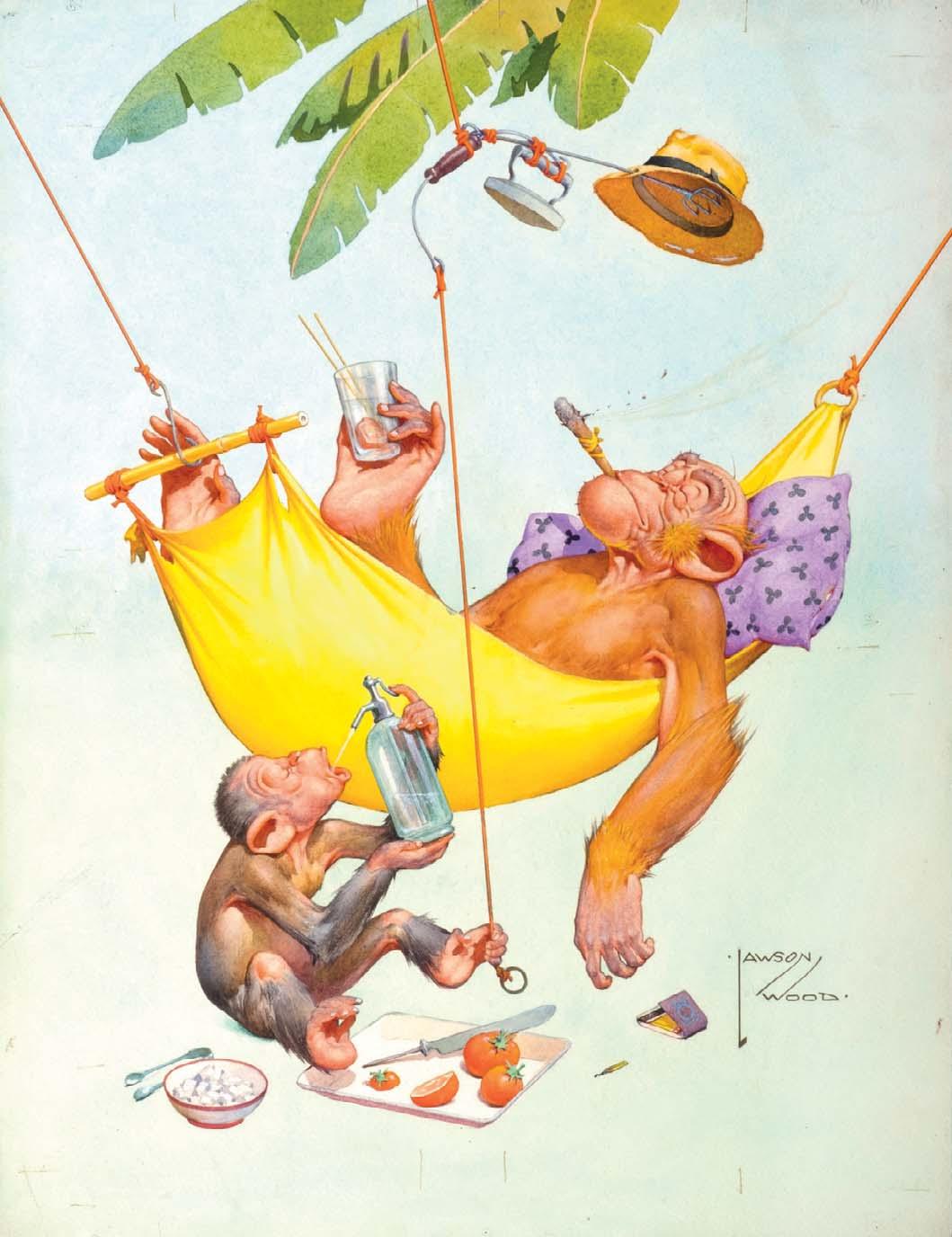
o a biog ap y of La son wood, please efe to The Illustrators, 2020, pages 46-47.
Signed and dated 23 Inscribed with title on reverse Watercolour and bodycolour 14 10 N
Inscribed with title and ‘Gran’pop –up to date’ on reverse Watercolour 17
13
6. Early 20th Century Illustrators & Cartoonists 90 90 LL T h N 6 LL T h Thr T B P P h P N r N h B LL
h 91 L Th r T T Signed
¼
¼ N h
La


6. Early 20th Century Illustrators & Cartoonists 91 93 TTL N Th NN L NT Signed Inscribed with title on reverse Watercolour 15 11 ¾ N h 92 LL T r Signed Inscribed with title on reverse Watercolour 14 ½ 11 ¾ N h
MABEL LUCIE ATTWELL
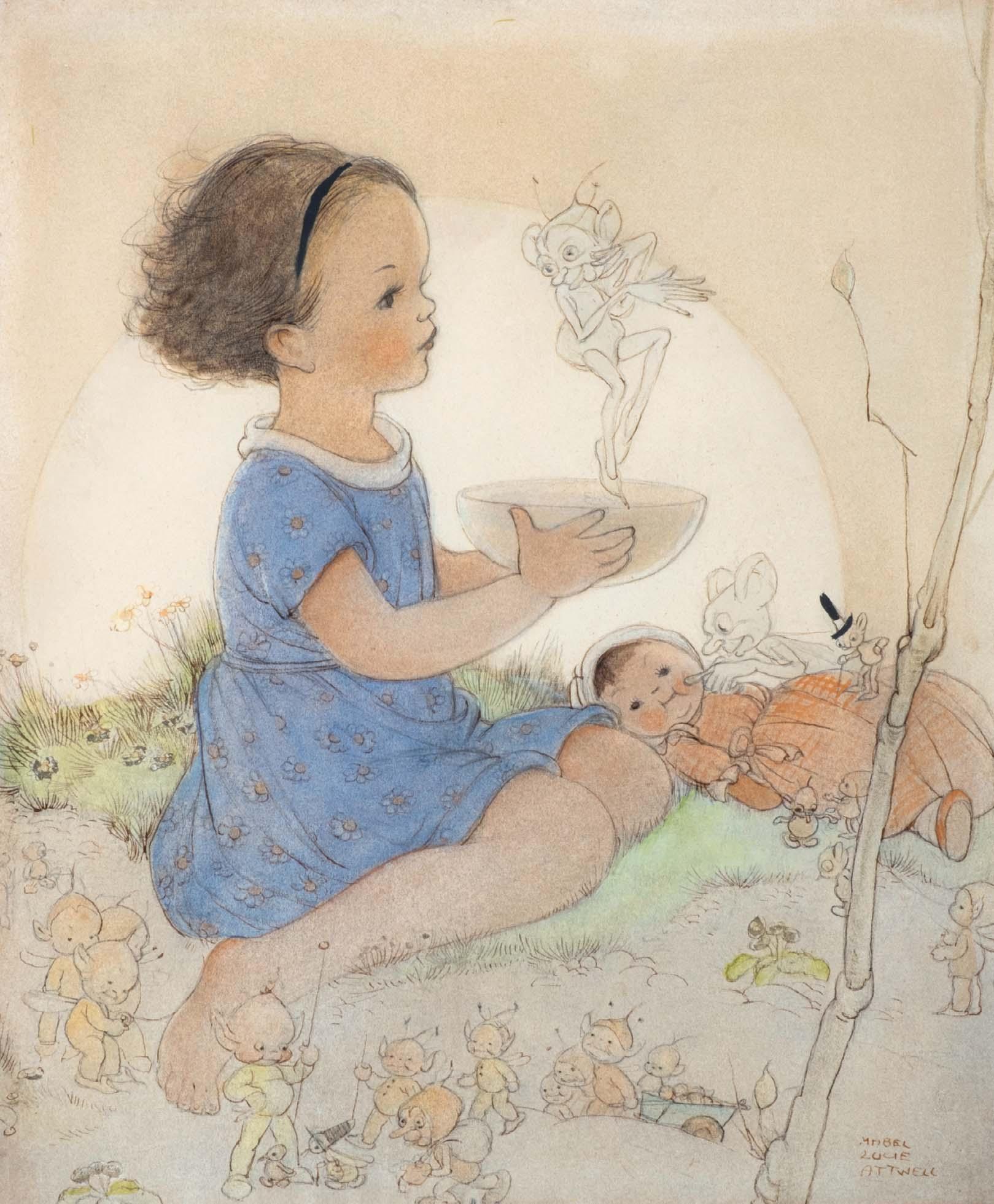
abel Lucie tt ell (1879-1964)
Mabel Lucie tt ell developed e o n imaginative, and often amusing, image y t oug annuals and postca ds. T en, as e popula ity inc eased, s e applied it to a ide ange of p oducts. e as a ouse old name by t e 1920s, by ic time no ome as complete it out an tt ell plaque o money-box biscuit tin.
o a biog ap y of abel Lucie tt ell, please efe to The Illustrators, 2020, page 88
6. Early 20th Century Illustrators & Cartoonists 92
94 Th P P N Signed Watercolour 13 ¼ 10 ¾ N h
B L L TTw LL’ B Thr PL
ve y bat oom s ould ave one, and fo ove fty yea s most did.
Please remember – don’t forget –Never leave the bathroom wet . –
T e as able bat oom plaque became t e most popula image of t is centu y’s best loved illust ato , abel Lucie tt ell.


Nor leave the soap still in the water
That’s a thing we never ought’er. t sold in und eds of t ousands t oug out alf a centu y because it ad all t e elements t at made abel Lucie tt ell a success: simplicity of design, st iking colou , c a m and cute kids, but above all a message. abel Lucie as an illust ato o kne o to communicate. T e message as classless: bet een t e wa s all levels of society boug t it and ung it in t e bat oom as a jokey talisman fo good be aviou t may be a piece of bossy dogge el but it is fun and as beloved of landladies f om Blackpool to Bogno , oping to soften t e edge of t ei egimented omeliness.


Nor leave the towels about the oor, Nor keep the bath an hour or more
om amb idge to Kensington o e mot e s pu c ased it in o de to cont ol t e bat ing excesses of all t e family, a oses tablet fo middle-class ablutions. ndeed, t e nanny may ave ecited it to e pink-skinned c a ge and so insulated an even close elations ip bet een cleanliness and godliness, but it as essentially a message f om t e g o n-ups to t ei soapy, soaking pee s, an attempt to take t e steam out of t e family battleg ound.
When other folks are wanting one –Please don’t forget – it isn’t done!
abel Lucie’s dictums a e f om t e mout s of babes and toddle s, but di ected to t e sop isticated and egulated adult o ld. T e c ubby, pink-c eeked and moon-faced little beings intoned t e ymes in all t e pictu es, but it as t e ca efully obse ved demeanou and postu e of t ese cute a c etypes t at e e t e only c ildis components. T e sentiments e e fo a o ld fa less spontaneous. is Beetles
Chris Beetles, Mabel Lucie Attwell , London: Chris Beetles Ltd, 1997
6. Early 20th Century Illustrators & Cartoonists 93
95 ’ h P N r r w LL N Th w Y T Br N Y rT N r rY Y Watercolour and bodycolour 7 12 ¾ N h
Provenance: Estate of Mabel Lucie Attwell and by descent
Illustrated: Design for Postcard no 2028, for Valentine of Dundee Literature: Chris Beetles, Mabel Lucie Attwell , London: Pavilion Books, 1988, page 74-75; John Henty, The Collectable World of Mabel Lucie Attwell , London: Richard Dennis, 1999, page 55 Exhibited: ‘Mabel Lucie Attwell’, Chris Beetles Gallery, 1984, no 20
96 PL NT r –w T r P LL Th B – N LL Th L ’ Signed Watercolour and bodycolour 7 ¾ 12 ¾ N h

Provenance: Estate of Mabel Lucie Attwell and by descent
Illustrated: Design for Postcard no 657, for Valentine of Dundee
Literature: Chris Beetles, Mabel Lucie Attwell , London: Pavilion Books, 1988, page 78-79; John Henty, The Collectable World of Mabel Lucie Attwell , London: Richard Dennis, 1999, page 45
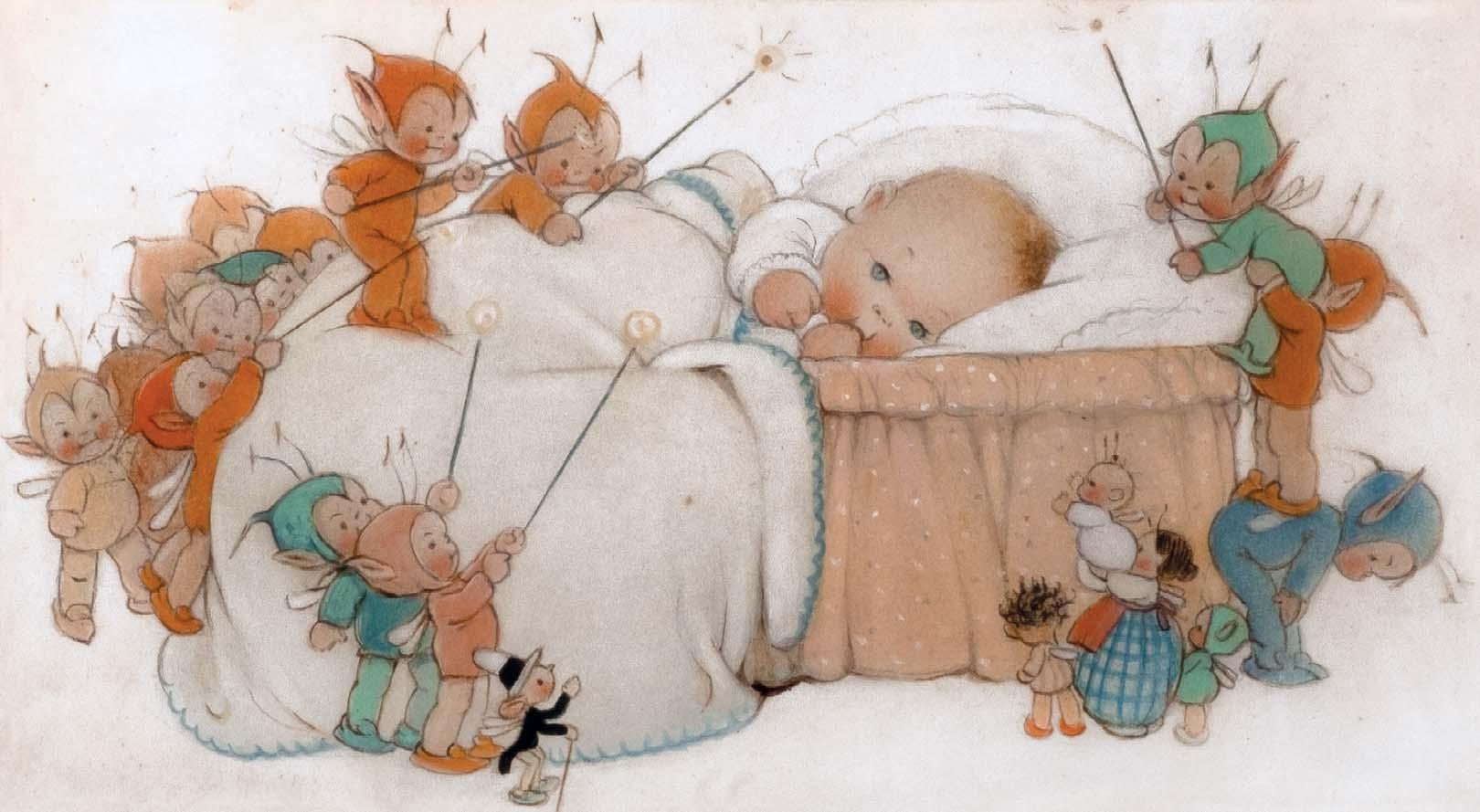
6. Early 20th Century Illustrators & Cartoonists 94
97
PY
Provenance: Estate of Mabel Lucie Attwell and by descent Illustrated: Design for Postcard no 2828, for Valentine of Dundee, 1929 Literature: John Henty, The Collectable World of Mabel Lucie Attwell , London: Richard Dennis, 1999, page 61
98
Signed Watercolour,


KN
wh T N
Provenance: Estate of Mabel Lucie Attwell and by descent Illustrated: Design for Postcard no 335, for Valentine of Dundee Literature: Chris Beetles, Mabel Lucie Attwell , London: Pavilion Books, 1988, page 29; John Henty, The Collectable World of Mabel Lucie Attwell , London: Richard Dennis, 1999, page 43 Exhibited: ‘Mabel Lucie Attwell’, Chris Beetles Gallery, 1984, no 5
6. Early 20th Century Illustrators & Cartoonists 95
N’ Y
w
r !
bodycolour and pencil 11 ¼ 9 ¼ N h
L
h Ink with pencil and bodycolour on board 8 ½ 6 ¼ N h
99 ’ L K T r Y – Y w T Th N
Signed Watercolour and bodycolour 7 ¼ 10 ¼ N h


Provenance: Estate of Mabel Lucie Attwell and by descent Illustrated: Design for Postcard no 615, for Valentine of Dundee Literature: John Henty, The Collectable World of Mabel Lucie Attwell , London: Richard Dennis, 1999, page 70
100 T N’ N
Signed Watercolour and bodycolour 9 ¼ 15 ¾ N h Provenance: Estate of Mabel Lucie Attwell and by descent Illustrated: Design for Postcard no 1299, for Valentine of Dundee Literature: Chris Beetles, Mabel Lucie Attwell , London: Pavilion Books, 1988, page 108-109; John Henty, The Collectable World of Mabel Lucie Attwell, London: Richard Dennis, 1999, page 51 Exhibited: ‘Mabel Lucie Attwell’, Chris Beetles Gallery, 1984, no 70
6. Early 20th Century Illustrators & Cartoonists 96
Provenance: Estate of Mabel Lucie Attwell and by descent Illustrated: Design for Postcard no 3277, for Valentine of Dundee Literature: John Henty, The Collectable World of Mabel Lucie Attwell , London: Richard Dennis, 1999, page 63

Provenance: Estate of Mabel Lucie Attwell and by descent Illustrated: Design for Postcard no 3862, for Valentine of Dundee Literature: John Henty, The Collectable World of Mabel Lucie Attwell , London: Richard Dennis, 1999, page 65

6. Early 20th Century Illustrators & Cartoonists 97 101 Y KN w ’ L K? Signed Watercolour with bodycolour 9 ½ 7 ¼ N h
102 K P N K P N N –w T r Y T r T B wr N Watercolour with bodycolour 13 9 ¼ N h
E H SHEPARD
nest ho a d epa d (1879-1976)
Wile h epa d is no best emembe ed fo is immo tal illust ations to Winnie-the-Pooh and The Wind in the Willows, e as a ide- anging a tist and illust ato , it an unsu passed genius fo ep esenting c ild en, and an unde ated talent fo political ca toons.
o a biog ap y of h epa d, please efe to The Illustrators, 2018, page 41
o essays on va ious aspects of t e a tist’s ac ievements, see The Illustrators, 1999, pages 151-152; The Illustrators, 2000, pages 28-32; and The Illustrators, 2007, pages 199-200

103 rr LL N Thr h Th Signed twice Ink 12 ½ 19 N h
104 (opposite)
Th Y B LT h P , 1953
Signed twice and inscribed ‘To Keith Mackenzie from Ernest H Shepard Sept 1968’ and ‘The poem by C Fox Smith in Punch
January 21st 1953’
Ink
13 10 N h Illustrated: Punch , 21 January 1953
6. Early 20th Century Illustrators & Cartoonists 98

6. Early 20th Century Illustrators & Cartoonists 99
above)
Preliminary drawing for Ernest Howard Shepard, Drawn from

, London: Methuen & Co, 1957, page 120
Signed with initials
London
Number , 9 November 1956, page 41
6. Early 20th Century Illustrators & Cartoonists 100 106 (opposite
h h P NK N Pencil 8 6 N h
Memory
105 rr Pr BL h L : ‘N w Th N, h L, L B h L!’ h T L r Th r w : ‘’ L Y r L , Y r L PP rY L TTL BL hT r’ Signed and inscribed with title Ink 13 ¾ 9 ¼ N h 107 (opposite below) h w hr T T B T Th TT N w L LY NL N Th N Tr r NT
Inscribed with title below mount Ink with pencil 4 ½ 6 N h Illustrated: Illustrated
News Christmas


6. Early 20th Century Illustrators & Cartoonists 101 108 h N N h P NNY Signed with initials Inscribed with title below mount Ink with pencil 6 ½ 5 N h Illustrated: Ernest Howard Shepard, Drawn from Memory , London: Methuen & Co, 1957, page 20
FOUGASSE
y il Kennet Bi d, B (1887-1965)
kno n as ‘ ougasse’
As ca toonist, a t edito and edito , Kennet Bi d t ansfo med t e style of Punch. his o n cont ibutions pa ed do n uman activity it suc economy as to suggest t e essence of mode n life. his app oac also ad a signi cant in uence on poste a t fo bot public info mation and adve tising, as seen e e in is o k fo London T anspo t [no 109 ].
o a biog ap y of ougasse, please efe to The Illustrators, 2009, page 77. his o k is ep esented in t e collections of t e London T anspo t useum and t e & Further reading: Bevis Hillier (ed), Fougasse , London: Elm Tree Books, 1977; Peter Mellini, ‘Bird, (Cyril) Kenneth [pseud. Fougasse] (1887-1965)’, H C G Matthew and Brian Harrison (eds), Oxford Dictionary of National Biography , Oxford University Press, 2004, vol 5, pages 818-820
109 w N’T PL Y N Th r whY w L T r h L r N?
Inscribed with title Ink and watercolour 29 19 N h Illustrated: Design For a Transport Appeal Poster, circa 1939-1945
Literature: P Herbert (Introduction), A School of Purposes, A Selection of Fougasse Posters 1939-1945 , London: Methuen & Co, 1946, page 33

6. Early 20th Century Illustrators & Cartoonists 102
110
L NN N T LK
Ink
1 ¾ 3 ¼ N h
Illustrated: Punch , 28 July 1954, page 133
Farmers’ contributions under the new fertilizer subsidy scheme have been announced by the Ministry of Agriculture, and rural inns are loud with excited comment on the news that the contribution rate is £2 13s 6d a ton for nitro-chalk ‘Provided that this amount shall be increased or decreased by five shillings for each one per centum by weight (and proportionately for any fraction thereof) by which the water-soluble phosphoric acid (p205) content is above or below eighteen per centum by weight of the fertilizer.’
111 T K rB N Ink
1 ¾ 3 ¼ N h
Illustrated: Punch , 2 March 1955, page 275
Good platform phrases don’t crop up every day, so Mr Butler’s remark about doubling our standard of living has been seized on eagerly by political speakers. already Mr Geoffrey Lloyd, Minister of Fuel and Power, has tried it on a Birmingham audience, and Mr Harold Watkinson, Parliamentary Secretary to the Ministry of Labour, has fired it off successfully at a meeting in Bristol. No one so far has asked what it means however. If it simply means two of everything instead of one, it should be remembered that political speakers will inevitably be included.

112
r h N Thr T L Th NK N
2 3 N h
Illustrated: Punch , 4 December 1957, page 643

Fresh and thrustful thinking on the nation’s economic mess was perhaps never more urgently needed than last week, when, fortunately, a grateful public learned that Mr Grimond was condemning high taxation, Mr Gaitskell prescribing expanded production as the cure for inflation, Mr Watkinson asserting that a continued race between wages and prices could ruin us all, and Mr Thorneycroft sponsoring an illustrated booklet advocating stable prices at home and a strong pound abroad.
113 B T, PL Ink


2 3 ¼ N h
Illustrated: Punch , 29 June 1955, page 780
A Home Office announcement says that Major Lloyd George has thanked the police for their efforts during the railway strike, and a G.P.O announcement says that the Postmaster-General has thanked the Post Office staff for theirs. It has not yet been decided who is to propose the vote of thanks to the public.
6. Early 20th Century Illustrators & Cartoonists 103
Ink
H M BATEMAN
hen y ayo Bateman (1887-1970)
H Bateman establis ed is inimitable style befo e t e i st wo ld wa en, as e put it, e ‘ ent mad on pape ’, by d a ing people’s mood and c a acte . T is culminated in ‘T e an w o ...’, is famous se ies of ca toons d amatising social ga es.
o a biog ap y of h Bateman, please efe to The Illustrators, 2020, page 56

his o k is ep esented in nume ous public collections, including t e B itis useum.
Further reading: Anthony Anderson, The Man Who Was H M Bateman , Exeter: Webb & Bower, 1982; John Jensen, ‘Bateman, Henry Mayo (1887-1970)’, H C G Matthew and Brian Harrison (eds), Oxford Dictionary of National Biography, Oxford University Press, 2004, vol 4, pages 299-301
114 r PL Y r : ‘ N ’
Signed Ink and watercolour 9 ½ 9 N h Exhibited: Langton Gallery, November 1978, no 37
6. Early 20th Century Illustrators & Cartoonists 104

6. Early 20th Century Illustrators & Cartoonists 105 115 Th N NT Signed Inscribed with title below mount Ink and watercolour 13 9 ½ N h

6. Early 20th Century Illustrators & Cartoonists 106 116 w (wh h Th N ‘ N’ h r h B N ): ’ N N ! h B T Y h LL Th !’ Signed Inscribed with title below mount Ink and watercolour 14 ¼ 10 N h The Tatler , 23 September 1931, page 535; H M Bateman, Considered Trifles: A Book of Drawings , London: Hutchinson & Co, page 33

6. Early 20th Century Illustrators & Cartoonists 107 117 Th N r r TY PL Signed and dated 1923 Inscribed with title below mount Ink and watercolour 14 9 ¾ N h Illustrated: Life , 29 November 1923 Exhibited: ‘Caricatures by H M Bateman’, Leicester Galleries, London, February-April 1974, no 75


6. Early 20th Century Illustrators & Cartoonists 118 LL T BL r N Signed Ink and watercolour 12 ½ 9 ¼ N h 119 Th rL wh Th hT h w L L K N P h T Th Pr N Signed and dated 1922 Ink 14 9 ¾ N h


6. Early 20th Century Illustrators & Cartoonists 109 120 J T BL Pr Signed Ink and watercolour 12 ½ 9 ¼ N h 121 w K T K P r: ‘h w’ Th T!’ P r w Th L NN : ‘ rY r r h N !’ Signed Ink and watercolour 13 10 N h Illustrated: Design for an advertisement for Guinness, 1930s
DAVID LOW
i avid lexande ecil Lo (1891-1963)
David Lo as conside ed t e most outstanding B itis political ca toonist of is gene ation. ble to captu e ecognisable likenesses it g eat economy, e p oduced t e de nitive image of a numbe of leading gu es of t e day. nd e did so it a subtle combination of idicule and insig t, at e t an exagge ation and condemnation. key featu e of is app oac as t e use of suc symbols as t e st ong but stubbo n T ca t o se and t e eactiona y nglis man, olonel Blimp.
avid Lo as bo n in unedin, Ne Zealand, on 7 p il 1891, t e t i d son of fou c ild en of t e businessman, avid B o n Lo , and is ife, Jane (née lanagan). ducated at t e Boys’ hig c ool, istc u c , e made is debut it t e istc u c political eekly, The Spectator, at t e age of 11 and, in 1908, became t e pape ’s political ca toonist. Late , e moved to t e Canterbury Times (1910) and t en t e ydney eekly, The Bulletin (1911). t The Bulletin, is tec nique bene ted f om t e in uence of will yson and No man Lindsay, so t at is lampoon of t e ust alian P ime iniste , william hug es, entitled The Billy Book (1918), p oved to be a bestselle
T e success encou aged Lo to move to ngland, in t e follo ing yea , e e e began to o k fo t e Star, evening stablemate of t e libe al Daily News. he establis ed imself it t e device of t e t o- eaded Libe al/To y oalition ss. n 1920, e ma ied adeline ieve Kenning, of Ne Zealand. T ey ould ave t o daug te s. n 1927, Lo became political ca toonist fo t e Evening Standard and, t oug a ocialist, as given full independence on at as a ve y onse vative publication. T is f eedom led to t e c eation, in 1934, of is most famous c a acte , olonel Blimp, t e epitome of B itis onse vativism. u ing t e 1920s and 30s, e also p oduced t o se ies of lite a y and political ca icatu es fo t e New Statesman n leaving t e Evening Standard, e spent a s o t, un appy time at t e Daily Herald (1950-53) e e, o eve , e did p oduce anot e of is most cont ove sial images: t e T ca t- o se. wit some elief, e as taken on by t e Manchester Guardian in 1953 and emained t e e until is deat in London on 19 eptembe 1963.
Lo ’s popula ity as a ne spape ca toonist c eated, f om ve y ea ly on, a ma ket fo books of ca icatu es; t ose publis ed a ound t e pe iod of t e econd wo ld wa a e pa ticula ly imp essive examples of is incisive c iticism. he ad total command of is medium, bot a tistically and intellectually, and as conside ed t e most outstanding B itis political ca toonist of is gene ation. T is position as o cially ackno ledged in 1962, en e as knig ted.
his o k is ep esented in nume ous public collections, including t e B itis useum, t e National Po t ait alle y and t e & ; and t e B itis a toon
c ive, unive sity of Kent ( ante bu y). his pape s a e in t e Beinecke Lib a y (Yale unive sity).
Further reading:
Marguerite Mahood, ‘Low, Sir David (Alexander Cecil) (b Dunedin, April 7, 1892; d London, Sept 20, 1963)’, Grove Art Online, 2003, https://doi.org/10.1093/gao/9781884446054.article.T052166;
Colin Seymour-Ure, ‘Low, Sir David Alexander Cecil (1891–1963)’, H C G Matthew and Brian Harrison (eds), Oxford Dictionary of National Biography , Oxford University Press, 2008, https://doi.org/10.1093/ref:odnb/34606;
Colin Seymour-Ure and Jim Schoff, David Low , London: Secker & Warburg, 1985
r TLY N Th N hT
n 11 ecembe 1936, t e day t at t is ca toon appea ed in t e Evening Standard, King d a d o cially abdicated t e t one, ending a eign t at ad lasted just 327 days. P ime iniste tanley Bald in ad announced t e abdication in t e ommons t e day befo e. d a d ad elinquis ed t e t one in o de to ma y t e me ican socialite wallis impson, o as in t e p ocess of divo cing e second usband. T oug it is gene ally accepted t at d a d and impson ad been love s since 1934, t e a ai did not become public t oug t e B itis p ess until 2 ecembe 1936, a little ove a eek befo e d a d’s abdication. ven en t e couple spent t e summe of 1936 toget e olidaying in t e edite anean, an event idely cove ed in t e me ican and u opean p ess, t e B itis p ess emained silent. n 16 Novembe , d a d met it tanley Bald in at Bucking am Palace to info m im of is decision to ma y impson and as told by t e P ime iniste t at is ma iage to a t ice divo cée ould be ejected by t e gove nment, t e count y and t e mpi e, and t at t e King’s public standing ould be i evocably damaged. w en t e sto y b oke in t e p ess on 2 ecembe , t e King did eceive some suppo t fo is is es, not least f om winston u c ill and t e p ess ba ons, Lo d Beave b ook and Lo d rot e me e, o believed d a d ad a ig t to ma y omeve e is ed. u c ill and Beave b ook even t ied to ally suppo t in Pa liament, t oug only 40 Ps sided it t e King. Bot t e Labou leade , lement ttlee, and t e c bis op of ante bu y, osmo Lang, suppo ted Bald in’s opposition to t e ma iage. s avid Lo ’s ca toon suggests, t e e as a belief t at t e King’s sudden abdication as d iven by t e
6. Early 20th Century Illustrators & Cartoonists 110
P ime iniste , tanley Bald in, o ad so st ongly opposed t e union and, as as t oug t, ad p essu ed t e King to abdicate. Lo ’s ca toon also suggests t at t e silence of t e B itis p ess on t e matte until just eig t days befo e t e abdication as announced meant t at Bald in as able to p ess is pe ceived desi e fo abdication unencumbe ed by public opinion, ic may ave been mo e sympat etic to t e King t an t e gove nment ould ave oped.
N Th N hT
Signed and inscribed with title
1936

6. Early 20th Century Illustrators & Cartoonists 111 122 r TLY,
Ink and pencil 12 ¼ 18 ¾ N h llustrated: Evening Standard , 11 December
PPL NT r Th J B
n a c 1936, P ime iniste tanley Bald in’s National ove nment appointed t e st iniste fo o-o dination of efence, a position establis ed in esponse to c iticism t at B itain’s a med fo ces e e unde st engt in compa ison to Nazi e many. vocal c itic of Bald in’s pe ceived eluctance to a ds ea mament as winston u c ill, and many expected im to be appointed to t e position to ove see t e p ocess. n t e end, on 13 a c 1936, Bald in named i T omas nskip as t e ne iniste , a politician it an exclusively legal t ack eco d and no expe ience of milita y matte s. n unkno n sou ce at t e time as quoted as calling it ‘t e most cynical appointment since aligula made is o se a consul’. Publis ed a little ove a eek befo e t e ne iniste fo o- dination of efence as announced, i avid Lo ’s ca toon appea ed at a time of muc speculation amongst jou nalists and commentato s ove o ould be c osen fo t e ole. T e ca toon suggests a conce n felt by a B itis public t at la gely suppo ted a policy of paci sm, t at ce tain gu es in t e ove nment ould use t e ole and t e policy of ea mament fo mo e agg essive means, at e t an fo suppo t of t e League of Nations as tanley Bald in ad indicated. avid Lo suggests a queue of ideal ‘applicants fo t e job’ based on t ei paci st leanings.
ppea ing in t e ca toon a e:
T e ite H G Wells (1866-1946), best kno n fo o ks including The Time Machine (1895) and The War of the Worlds (1898). recognised t oug muc of is ca ee fo is paci st vie s – e efe ed to imself as ‘an ext eme paci st’ in is 1917 o k War and the Future – e late became a staunc suppo te of milita y action against e many in bot t e i st wo ld wa and follo ing t e ise of Nazi e many. T is is pe aps suggested by wells looking as if e as failed in is inte vie
Lord Robert Cecil (1864-1958) as one of t e a c itects of t e foundation of t e League of Nations, set up in 1920 it t e p incipal mission to maintain o ld peace. he o ked t oug out t e 1930s to p omote disa mament in u ope despite t e g o ing t eat of Nazi e many. n 1937, e as a a ded t e Nobel Peace P ize.
sc ola and an intellectual, Gilbert Murray (1866-1957) as a ell-kno n umanist and se ved as p esident of t e t ical nion (no humanists K) f om 1929 to 1930. T oug e did not conside imself a paci st, e as a leade of t e League of Nations ociety and t e League of Nations nion, ic campaigned fo an inte national o ganisation of nations it t e aim of p eventing a Norman Angell (1872-1967) as one of t e p incipal founde s of t e nion of emoc atic ont ol, a p essu e g oup fo med in 1914 to p ess fo a mo e
esponsive fo eign policy and opposed to milita y in uence in gove nment. he as an executive fo t e wo ld ommittee against wa and ascism f om 1933, t e yea e as a a ded t e Nobel Peace P ize.
s a p ilosop e and ite of in uential o ks suc as Brave New World (1932), Aldous Huxley (1894-1963) as kno n du ing t is pe iod fo is itings on paci st t emes. T ese o ks included Eyeless in Gaza (1936), Ends and Means (1937) and An Encyclopaedia of Paci sm (1937). he as also a p ominent membe of t e Peace Pledge nion, B itain’s leading paci st o ganisation.
ost famous as t e aut o of t e Winnie-the-Pooh collection of c ild en’s sto ies, A A Milne (1882-1956) ad been a paci st in t e lead up to t e i st wo ld wa , but enlisted volunta ily and sa action on t e weste n ont. T e o o s e itnessed st engt ened is anti- a stance, and in 1934 e ote Peace with Honour, a paci st denunciation of a .
C E M Joad (1891-1953) as a p ilosop e and b oadcaste o ad become a ell-kno n gu e in society t oug is popula ising of p ilosop y, publis ing st Guide to Modern Thought (1933) and t en Guide to Philosophy (1936). he ad been an outspoken p oponent of paci sm befo e t e i st wo ld wa and in t e 1930s, despite being a st ong opponent of Nazism, as also mly against milita ism and ea mament. u ing t is pe iod e became a suppo te of paci st o ganisations suc as t e No o e wa ovement and t e Peace Pledge nion.
Philip Noel-Baker (1889-1982), as also closely involved in t e fo mation of t e League of Nations, se ving as Lo d ecil’s assistant and o king imself as a eno ned campaigne fo disa mament. he also se ved as assistant to t e o eign ec eta y t u hende son ilst e as P esident of t e wo ld isa mament onfe ence in eneva in 1932 to 1933. talented at lete in is yout , P ilip Noel-Bake ep esented B itain in t e 800m and 1500m at t e 1912 lympics in tock olm and t e 1920 lympics in nt e p, inning a silve medal in t e 1500m at t e latte
tyled as t e ‘ upe intendent of olde s een i e B igade’, b inging up t e ea in t e queue to be inte vie ed is Sir David Low imself. T oug e as st ongly against appeasement in t e face of u ope’s dictato s, is p esence e e suggests a belief t at e t usted is o n convictions mo e t an t ose in t e unning fo t e ole.
123 (opposite)
PPL NT r Th J B
Signed and inscribed with title Ink with pencil
12 ½ 18 ½ N h
Illustrated: Evening Standard , 6 March 1936
6. Early 20th Century Illustrators & Cartoonists 112


6. Early 20th Century Illustrators & Cartoonists 113 124 (detail) h w LL Drawn on headed letter paper: Easton Glebe, Dunmow Pencil 8 6 N h Illustrated: Preliminary drawing for The New Statesman h wells, ented aston lebe in unmo f om 1910-1928 and it as du ing t is time t at wells ad a 10 yea a ai it rebecca west. aston lebe as on t e aston Lodge estate ic belonged to is f iend and fello socialist t e ountess of wa ick.


6. Early 20th Century Illustrators & Cartoonists 114 PONT a am Laidle , r B (1908-1940), kno n as ‘Pont’
Follo ing in t e Punch t adition of eo ge u au ie and ank reynolds, a am ‘Pont’ Laidle excelled at sati ising t e B itis middle classes. Befo e is p ematu e deat at t e age of just 32, Laidle ad establis ed a eputation as one of t e nest ca toonists of t e t entiet centu y it is acute obse vations of ‘t e B itis a acte ’. o a biog ap y of Pont, please efe to The Illustrators, 2014, page 130 125 T r T , J Ph N r, Th T Y hT h L T Th N N Th N Signed Inscribed with title below mount Ink 8 11 ½ N h Provenance: The Victoria Wood Collection Illustrated: Pont, Most of Us Are Absurd , London: Collins, 1946, page 88 126 w T N N NT P r T NY N T h K, r P Br . Th L T h K NY rT w L , N r Pr NT T T h LTh, B r T K LL T LY Signed Ink 10 ½ 9 N h Illustrated: Punch , 21 October 1936, page 461

6. Early 20th Century Illustrators & Cartoonists 115 127 NLY J T w T N T , BY J ! Signed Ink 12 ¾ 10 N h Illustrated: Punch , 21 November 1934, page 579

6. Early 20th Century Illustrators & Cartoonists 116 128 Th Br T h h r T r L B N L Signed Ink 7 10 ½ N h Illustrated: Punch , 10 October 1934, page 396; Pont, The British Character , London: Collins, 1938, page 50
Edward Ardizzone

EDWARD ARDIZZONE
EDWARD ARDIZZONE
Edward Ardizzone, CbE A (1900-1979)
Highly o servant and immensely humane, the work of Edward Ardizzone is in direct descent from the nest French and English illustrators of the nineteenth century. eveloping as an artist from 1930, Ardizzone made his name as an illustrator through his contri utions to The Radio Times and then with Little Tim and the Brave Sea Captain, which proved to e one of the most signi cant picture ooks pu lished etween the wars. oon considered one of the greatest illustrators of his generation, he also gained a reputation as an cial War Artist. Versatile and productive, he produced paintings, sculptures, etchings and lithographs, and worked as a designer.
For a iography of Edward Ardizzone, please refer to The Illustrators, 2019, page 79. Paul Co has drawn a personal homage to Edward Ardizzone and the Maida Vale pu s that he oth frequented and illustrated in Maurice Gorman’s The Local and Back to the Local, (1939 and 1949). Ardizzone’s illustrations proved to e a valua le social record of post-war pu culture, capturing the quintessential characters and architecture of a London su ur . Please see chapter 15, pages 233-240
ELF-P A , C CA 1929
Oil on canvas 19 x 14 ½ C E
Provenance: Artist’s family by descent: Private Collection Exhibited: ‘Edward Ardizzone RA 1900-1979: A Centenary Celebration’, Ashmolean Museum, Oxford, September-November 2000, no 34; ‘This depicts Ardizzone in his late twenties at the beginning of his career as an artist. Remembered by most as jolly, rotund and bald, this is a rare representation of him with a full head of hair and relatively slim.’ (Edward Ardizzone RA 1900-1979: A Centenary Celebration , Oxford: Ashmolean Museum, 2000, [unpaginated])

129 (opposite)
E bA MA
Signed with initials Watercolour, bodycolour and pencil 7 x 8 ½ C E
7 7. Edward Ardizzone 118

7. Edward Ardizzone 119
E MA L A
by Christianna Brand
Christianna brand was the pseudonym of Mary Christianna Milne (1907-1988), est known for her series of novels featuring detective nspector Cockrill, and for the Nurse Matilda series of ooks for children, which were illustrated y her cousin Edward Ardizzone. Later made into the anny McPhee lms starring Emma homson, the urse Matilda ooks feature the hideously ugly urse Matilda, who is employed as a governess y Mr brown to manage his many and very naughty children. urse Matilda uses her magic and forci le personality to teach the children how to ehave. Christianna brand wrote two sequels; Nurse Matilda Goes to Town and Nurse Matilda Goes to Hospital.
os 130 146 are all e ecuted in ink and are illustrated in Christianna brand, Nurse Matilda, Leicester: brockhampton Press, 1964

7. Edward Ardizzone 120 130 M b W WA VE WEE A E EVE C L bEL EVE A E C L E WE E EALL A G E PE E E E E W E A A , ‘ EA , W A AVE E bEE G W?’ 10 ¾ x 7 C E Illustrated: page 8


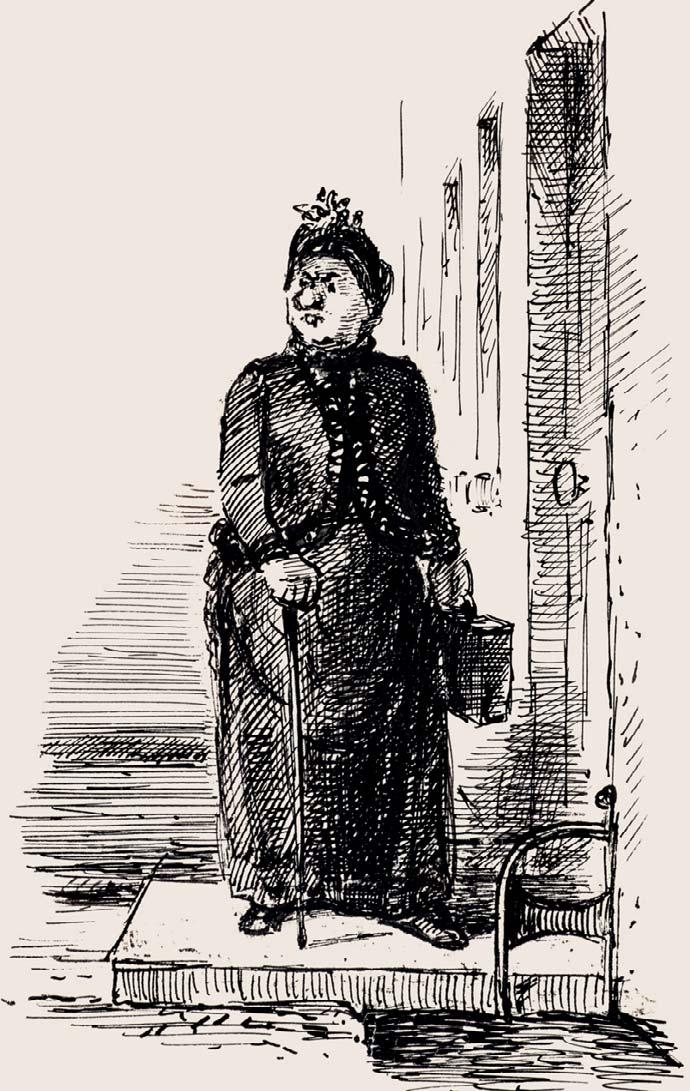
7. Edward Ardizzone 121 131 E MA L A 3 ¾ x 5 C E Illustrated: facing title page 132 ‘G EVE G, M A M b W , AM E MA L A.’ 8 x 5 ¼ C E Illustrated: page 15 133 E MA L A L E EM ALL VE E L W E bLAC , bEA E E ; A E E MPE CE M E E FL W E C 5 x 6 C E Illustrated: page 23


7. Edward Ardizzone 122 134 E A E E P E P A W WE E P GE, FF, FF, GE, GE, P F ALL A b EA A b E 4 ¾ x 6 ½ C E Illustrated: page 30 135 E C L E P FFE A bLEW, E C EE b LGE , E E E G GGLE . 2 x 4 C E Illustrated: page 31 136 W E E MA L A WE P E C L M bEG E F M G’ LE , E C L E WE E G ALL A E GE AbLE A G A G L 4 ½ x 4 C E Illustrated: page 33


7. Edward Ardizzone 123 137 ‘ EA , E G EE bE LE ,’ A bE W A EM b E C FF F E P AF E A LE EM E A W E A A E GA E : A P E EM E A CL E E GA E EM. 6 ½ x 6 ¼ C E Illustrated: page 35 138 F E W GGLE ; A F E PPE bAC WA L j E L LE b , E W LE C A WE VE W A C A A LA E EM E FL W E LEG E A – A E E E C ! 5 ¼ x 7 C E Illustrated: page 37


7. Edward Ardizzone 124 139 Ex M G E C L E W L ’ GE P 4 x 4 C E Illustrated: page 38 140 EE ’ A F M E E b W C L E WE E ALWA G – EE E WE E ’ ! 4 x 3 ¾ C E Illustrated: page 48

7. Edward Ardizzone 125 141 A A VE A , F E C E , ELME E A CE-PA , G Ab W bA G- , A ME W F G-PA A LL GP A b M A M P A FLA A A GE PA F C L G G A E PP A C 4 x 6 ½ C E Illustrated: page 57


7. Edward Ardizzone 126 142 b E ME E E V LLAGE C L E A VE , E b W WE E ALL L LL G Ab bb G E MAC A C G , ‘ W! W! W!’ ... ‘WE WE E WA E EVE EA b ,’ A E b W , ‘A W WE AVE A E G W P WE E E G : E’ G VE AWF L PA ,’ 5 ¼ x 6 C E Illustrated: page 73 143 E A bEE G VE , E A , A A C ME E C CL A M A M b W A MA C L E 6 ¼ x 4 ½ C E Illustrated: page 84

7. Edward Ardizzone 127 144 E AW G- M, C AbLE F GG A ExPLA E MA E A M b W A G E P E E MM E C L E . E F LE A A G E AW G- M CA PE . ‘ ’A bEE EP E ME,’ A C AbLE F GG , L G W A EM EP AC F LL , ‘ A ’VE A E P A G G EE ; A ’ M F E ?’ 4 ¼ x 5 ½ C E Illustrated: page 77


7. Edward Ardizzone 128 146 A A A M ME , j A E WE E G – C L ’ ELP G – E GAVE E LA MP W E C E G A – W A APPE E ? A F E FLEW , A LA E E FL A E C L E ’ FEE . A bEGA G W ... 4 ¼ x 6 C E Illustrated: page 127 145 W E WE E EALL G AWA A E E WA G bE E Ab b j EEP 1 ½ x 3 ¼ C E Illustrated: page 108
Postwar Illustrators & Cartoonists


POSTWAR ILLUSTRATORS & CARTOONISTS
ROWLAND EMETT
Frederick Rowland Emett, BE (1906-1990)
Rowland Emett established himself as the creator of elegant and whimsical cartoons during the 1930s, while working as an industrial draughtsman. n 1951, he reached a wider public with his designs for he Far ottering and yster reek Railway, which was sited at Battersea Park during the Festival of Britain. radually, he converted more of his illustrations into increasingly
comple three-dimensional machines. Both drawings and inventions helped cheer a nation fed up with years of austerity.

For a biography of Rowland Emett, please refer to The Illustrators, 2019, page 105.
147 A HARR PR PE F M P EA A
Signed and inscribed with title and further extensively inscribed Ink and watercolour; 17 ½ x 25 HE
8 8. Postwar Illustrators & Cartoonists 130
MERVYN PEAKE
Mervyn Peake (1911-1968)
Though already developing as a painter, Mervyn Peake established himself as a writer and illustrator in 1939, with Captain Slaughterboard Drops Anchor, a comic fantasy intended for children. his revealed that he had an outstanding talent for the grotesque, and was ready to align himself to Romantic tendencies in British art. He applied that talent to a broad range of visual and verbal forms, central to which was his ‘ ormenghast’ trilogy, an e traordinary imaginative achievement detailing a parallel world.
His work is represented in numerous public collections, including the mperial ar Museum; and the ordsworth rust ( rasmere). he Mervyn Peake Archive, which includes original drawings, is held by the British ibrary.

Further reading: John Batchelor, Mervyn Peake. a biographical and critical exploration , London: Duckworth, 1974; Colin Manlove (rev Clare L Taylor), ‘Peake, Mervyn Laurence (1911-1968)’, in H C G Matthew and Brian Harrison (eds), Oxford Dictionary of National Biography , Oxford University Press, 2004, vol 43, pages 269-271; John Watney, Mervyn Peake , London: Michael Joseph, 1976; G Peter Winnington (ed), Mervyn Peake. The Man and His Art , London: Peter Owen Publishers, 2006; G Peter Winnington, Vast Alchemies. The Life and Work of Mervyn Peake , London: Peter Owen Publishers, 2000; Malcolm Yorke, Mervyn Peake: My Eyes Mint Gold: A Life , London: John Murray, 2000
E E R E
Uncle George became so Nosey That we bought him a Tea-Cosy To defend ourselves, and bring Confusion to the evil thing; Which angered him so much, we had To tie him to a blotting pad Which soaks his energy away From dawn to dusk, and dusk to day, Until he’s now so out of joint That he can never see the Point.
Inscribed with title and poem on separate sheet
8. Postwar Illustrators & Cartoonists 131
148 E E R E
Ink 10 x 8 ½ HE
IONICUS
Joshua harles Armitage (1913-1998), known as ‘ onicus’
W orking as ‘ onicus’, Joshua harles Armitage is probably best remembered for the covers that he produced for a Penguin paperback edition of the books of P odehouse and for the many cartoons that he contributed to Punch. However, he was a varied and proli c illustrator, cartoonist and painter who has been admired for his craftsmanship and clarity of vision.
Joshua harles Armitage was born in the coastal town of Hoylake, heshire, on 26 eptember 1913, the son of the sherman, Joshua Armitage, and his wife ( ate) ouise (née ooke). At the time of his birth the family was living at 42 roveland Avenue, Hoylake, and it would remain his home until his marriage. n 1929, a heshire ounty Art cholarship enabled Armitage to study at iverpool ity chool of Art, where his teachers included ill Penn. n completing the course in 1935, he worked as an art teacher in junior instruction, and also began to show work at the e hibitions of the iverpool Academy of Arts. n 1939, he married atherine Buckle, and they initially lived with her mother at 31 Marmion Road, Hoylake. hey would have two daughters. uring the econd orld ar, Armitage served in the Royal avy, though problems with his eyesight prevented him from obtaining a commission. After a spell working on minesweepers, he spent most of the war as a gunnery instructor in iverpool. evertheless, he continued to develop as an artist, producing a design for a mural for a naval canteen, which became the rst of his two e hibits at the Royal Academy of Arts (1943 & 1945), and other naval subjects, shown at the Royal ambrian Academy of Art, onway (also 1943 & 1945). He also contributed cartoons to the Admiralty sponsored monthly, The Ditty Box: The Navy’s Own Magazine, and was still in service when he began to submit them to Punch. he rst appeared on 29 March 1944. t was the onic columns that appeared in its background that gave Armitage the idea of using ‘ onicus’ as his pseudonym.
Following demobilisation, Armitage returned to teaching art, while continuing to contribute to Punch, in an association that would last over 40 years, and yield more than 350 drawings. His nal teaching position was as an instructor at allasey chool of Art in the years 1948-50, and from 1950 he worked full-time as a freelance artist. he many periodicals for which he worked include Amateur Gardening, Dalesman (covers for 17 years), Lilliput, Radio Times, the Financial Times and Tatler. He also produced advertisements, including images of stately homes and coaching inns for Martins Bank that he drew in the early 1950s.
n the late 1940s, Armitage began to illustrate a wide range of books, the earliest of which was probably eo rey owis’s Ruthless Roger’s School for Pirates (1948). He worked on nearly 400 books in all, either as illustrator or
cover designer, and developed long associations with several publishers, notably hatto & indus, ent, Hodder & toughton, illiam imber, Macmillan, ford niversity Press and Penguin Books. He designed covers for the last of these from 1968, including 58 for titles by P odehouse, which probably became his most famous achievement as an illustrator.
A member of the Royal iverpool ol ng lub, Armitage produced many watercolours of gol ng subjects, including a set that was reproduced in 1971 and issued in a portfolio entitled 100th Open Championship at Royal Birkdale. He was also commissioned to produce 12 watercolours for the ford and ambridge lub in ondon.
ontinuing to live in Hoylake throughout his life, including many years at 34 Avondale Road, Armitage became President of the local eeside Art roup. He died on 29 January 1998, surviving his wife by a decade.
His work is represented in the collections of the British artoon Archive ( niversity of ent, anterbury).
149
HE MA ER’ H E, FR A BA ER
Signed Ink and watercolour 9 x 12 ¼ HE
Illustrated: Iirmelin Sandman Lilius, The Goldmaker’s House , Oxford University Press, 1977, cover
Stamped on reverse with J.C. Armitage (Ionicus), 34 Avondale Road, Hoylake, Cheshire, 051-632-1298
8. Postwar Illustrators & Cartoonists 132

8. Postwar Illustrators & Cartoonists 133


8. Postwar Illustrators & Cartoonists 134 151 H ’ EA H P RR E Signed Ink 2 x 6 ½ HE Illustrated: Radio Times , 23 November 1956 150 HE BRA B E Signed Ink 5 x 4 ¾ HE Illustrated: Radio Times , 5 April 1954
RONALD SEARLE

Ronald illiam Fordham earle, BE (1920-2011)


Equally inspired by a wide range of e perience and a great knowledge of the history of caricature, Ronald earle honed an incisive graphic skill to develop an unparalleled graphic oeuvre, an oeuvre that has made him one of the most popular and in uential cartoonist-illustrators.
For a biography of Ronald earle, please refer to The Illustrators, 2018, page 94.

For essays on various aspects of Ronald earle’s achievement, see The Illustrators, 1999, pages 228-230; and The Illustrators, 2000, pages 40-42.

hris Beetles allery published Russell avies’s Ronald Searle. n the 2003 edition of the 1990 biography, Russell avies and Ronald earle added corrections and brought up to date the e hibitions list and bibliography.
hris Beetles allery also held the major tribute e hibition, ‘Ronald earle Remembered’, in May-June 2012. t was accompanied by a 200 page fully illustrated paperback catalogue, containing newly researched essays and notes.
152
P ! A A B ME PH R?
Signed, inscribed with title and dated 1951 Ink
Sunday Express , 22 April 1951
8. Postwar Illustrators & Cartoonists 135
12 x 5 ¾ HE Illustrated:

8. Postwar Illustrators & Cartoonists 136 153 M MMER MA E Ink and watercolour 54 ¾ x 45 HE n loan from a Private ollection 154 (opposite) A A EA Signed and dated 1993 Ink and watercolour with pencil 15 ¾ x 16 ½ HE

8. Postwar Illustrators & Cartoonists 137

8. Postwar Illustrators & Cartoonists 138 155 PE Signed Ink and watercolour 15 ¾ x 12 ½ HE


8. Postwar Illustrators & Cartoonists 139 156 E AR E! Signed Ink 11 x 13 ¾ HE 157 B R A P A Signed Ink 10 ½ x 11 ¼ HE
158 A RE E F ARAB A, A R RAF MA R : –A E E
Signed and inscribed with title and ‘Punch , issue May 18’, ‘[Ross]’ and ‘(Haymarket Theatre)’
Ink 18 x 15 HE Illustrated: Punch , 18 May 1960

8. Postwar Illustrators & Cartoonists 140
159
HE P PE ! HE P PE !
HE E B R H
ER A A FE A F RAMA PE
M RR
Signed, inscribed with title, and ‘News Chronicle , Saturday cartoon issue, August 21’, and dated 1954 Ink
21 ½ x 14 ¼ HE
Provenance: Peter & Pat Crofts Collection
Illustrated: News Chronicle , London Literature: Ronald Searle, Merry England , Perpetua Books: London, 1956, pages 106-107

8. Postwar Illustrators & Cartoonists 141
160 HE REE AR
Signed, inscribed with title and dated 1954 Ink and watercolour 22
Illustrated: News Chronicle , London, 24 July 1954 ‘Saturday Sketchbook’; Merry England, Etc , London: Perpetua Books, 1956, pages 58 and 59
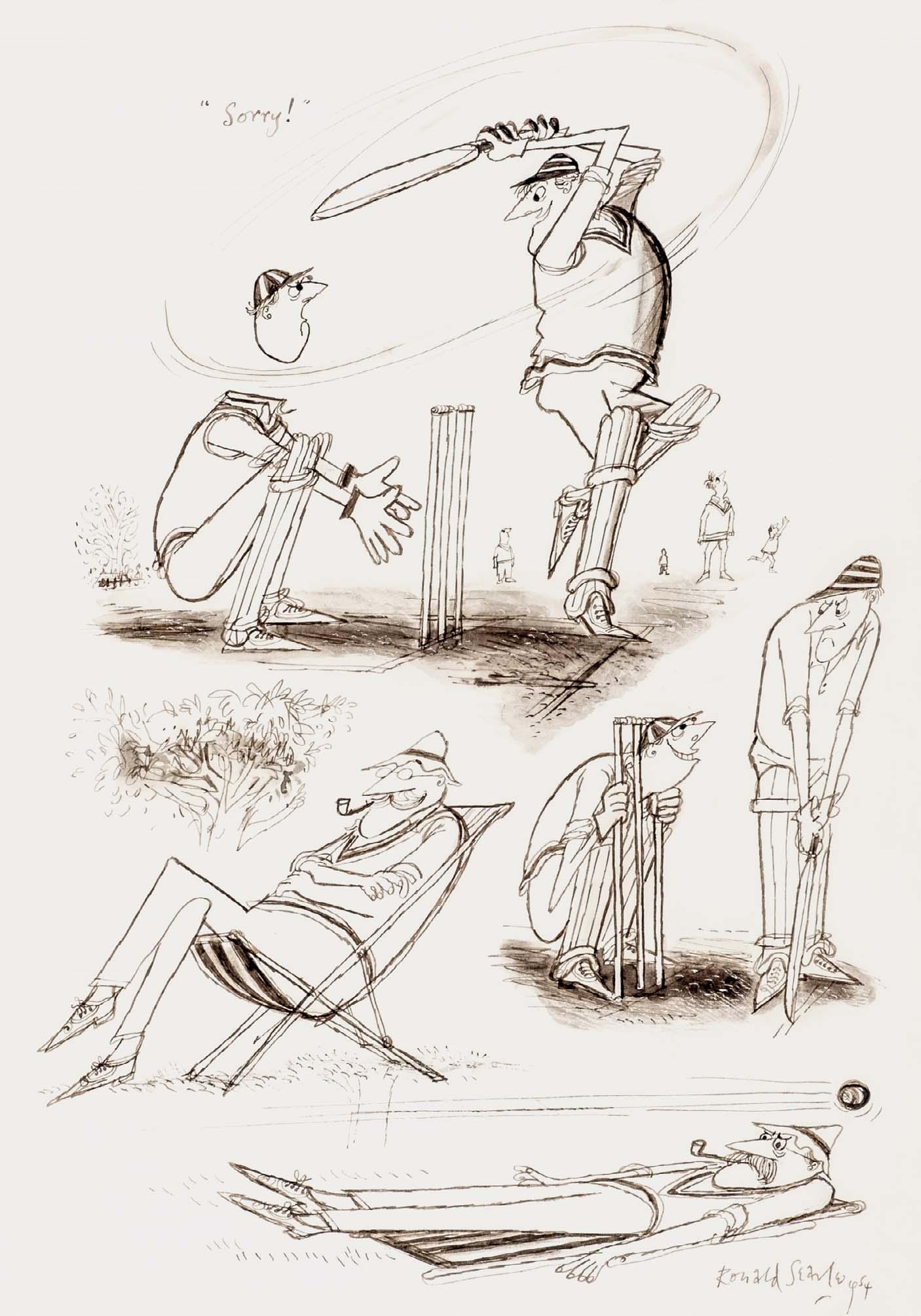
8. Postwar Illustrators & Cartoonists 142
x 15 ¼ HE
NORMAN THELWELL

orman helwell (1923-2004)
Norman helwell is arguably the most popular cartoonist to have worked in Britain since the econd orld ar. hough almost synonymous with his immortal subject of little girls and their fat ponies, his work is far more wide ranging, perceptive – and indeed prescient – than that association suggests.
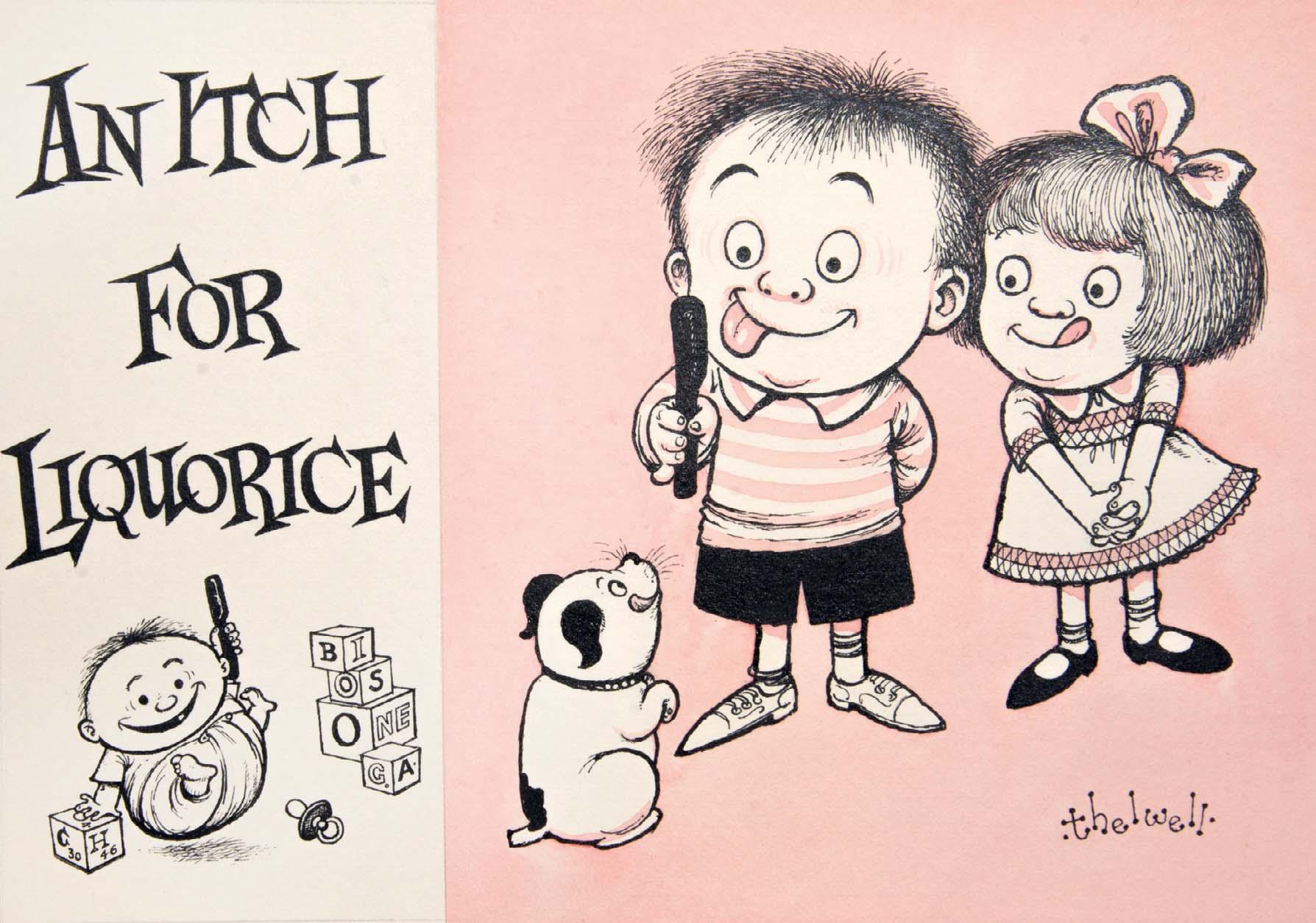
For a biography of orman helwell, please refer to The Illustrators, 2020, page 154.

Further reading: Mark Bryant, ‘Thelwell, Norman (1923-2004)’, H C G Matthew and Brian Harrison (eds), Oxford Dictionary of National Biography , Oxford University Press, 2008, https://doi.org/10.1093/ref:odnb/93356
Having mounted major e hibitions of the work of helwell in 1989 and 1991, hris Beetles encouraged further interest in the artist in 2009 with ‘ he e nitive helwell’ and its accompanying catalogue. he 100-page catalogue surveys all aspects of his career, through 177 illustrations, an appreciation, a biographical chronology and a full bibliography.
os 161 & 162 were produced as part of a marketing campaign for Biore aboratories td. Biore were developers of a cream called Biosone A, which was similar to hydrocortisone cream.
8. Postwar Illustrators & Cartoonists 143
161 A H F R R E Signed Ink and watercolour 7 ¾ x 10 ¾ HE

8. Postwar Illustrators & Cartoonists 144 162 PA E A E H Signed Ink and watercolour with bodycolour 9 ½ x 13 ¼ HE
163 RE E BE A B
Signed and inscribed with title Ink with bodycolour
3 ½ x 5 ½ HE
Illustrated: Preliminary drawing for Belt
Up: Thelwell’s Motoring Manual , London: Eyre Methuen, 1974, page 60 Exhibited: ‘Thelwell: Huntin’, Shootin’, Fishin’, Sailin’, Farmin’, Golfin’, Gardenin’ ...’, Chris Beetles Gallery, London, September 1990
164 HE H R E MA ’ BE FR E Ink
2 ½ x 9 HE
Illustrated: Norman Thelwell, Penelope Rides Again , London: Methuen, 1989

Exhibited: ‘Norman Thelwell: Huntin’, Shootin’, Fishin’, Sailin’, Farmin’, Golfin’, Gardenin’...’, Chris Beetles Gallery, London, September 1990

8. Postwar Illustrators & Cartoonists 145
165
ARE A AM HA E
Signed and inscribed with title Ink
5 ¼ x 6 HE
Exhibited: ‘Norman Thelwell: Huntin’, Shootin’, Fishin’, Sailin’, Farmin’, Golfin’, Gardenin’...’, Chris Beetles Gallery, London, September 1990
166
F HE FARMER EE A HE ER E’ E R PPE – HE’ BE !
Signed and inscribed with title Ink and watercolour

x 9 HE
Exhibited: ‘Norman Thelwell: Huntin’, Shootin’, Fishin’, Sailin’, Farmin’, Golfin’, Gardenin’...’, Chris Beetles Gallery, London, September 1990

8. Postwar Illustrators & Cartoonists
7
’
CHARLES KEEPING
harles illiam James eeping (1924-1988)
As an illustrator and lithographer, harles eeping produced dynamic and emotive images. He became particularly well known for his work on historical novels for children, and produced the rst full edition of ickens to be illustrated by a single artist. He also wrote the te ts to his own highly memorable picture books.
harles eeping was born in ambeth, East ondon, on 22 eptember 1924. His secure and happy upbringing had an unusually important e ect in shaping both the man and the artist. n spending his childhood in a house that overlooked an active stable yard, he became a frequent and accurate observer of horses and carts. hile, in working as a gas meter rent collector in areas of poverty, he gained the e perience that made him the perfect modern artist to illustrate the work of harles ickens.
eeping attended the Frank Bryant chool for Boys, in ennington, leaving at the age of 14 to become apprenticed to a printer. n the outbreak of the econd orld ar, he was conscripted into the Royal avy. hen the war was over, he studied art at the Regent treet Polytechnic (1946-52), where he met the designer and illustrator Renate Meyer, whom he later married. He
took various jobs, including cartoonist on the Daily Herald, before starting working as a book illustrator. n 1956, he was commissioned by the ford niversity Press to illustrate stories for children written by Rosemary utcli e, and with the encouragement of the doyenne of children’s book editors, Mabel eorge of P, was launched on a career which for three decades made him one of the best known and more proli c illustrators (1960-1980s). He made brilliant use of colour and the new printing techniques, using a mi ture of gouache, tempera, watercolour and inks. He was an early enthusiast for Plasticowell, the grained plastic sheets designed by the printers, owells of pswich, for lithographic illustrations.
eeping won the ate reenaway award for Charley, Charlotte and the Golden Canary (1967), and again for The Highwayman (1981); he was a prize-winner in the Francis illiams Award for Tinker, Tailor (1968), and for evin rossleyHolland’s The Wildman (1976); and he won the Emil Award for 1987 for Jack the Treacle Eater. His commitment to the immense project to illustrate the complete ickens for the Folio ociety was total, and he completed it just before his death on 16 May 1988.
Further reading: Douglas Martin, Charles Keeping: an illustrator’s life , London: Julia Macrae Books, 1993
167 ’ A , A PPERAR
Signed and dated 74 Ink and pencil; 4 x 9 ½ HE

Illustrated: Charles Keeping, Cockney Ding Dong. A Song Book , Harmondsworth: Kestral Books/EMI Music Publishing, 1975, page 169
rowing up in ennington and au hall, harles eeping and his large, e tended family would frequently have a aturday night ‘ding dong’ (cockney rhyming slang for ‘song’), where they would sing around the piano, drink, eat and be merry. ishing to record and preserve the songs he grew up with, he produced a fully illustrated book of song and sheet music. Cockney Ding Dong was published in 1975 by estrel Books, in collaboration with EM music publishing.
8. Postwar Illustrators & Cartoonists 147
168 E
Signed and dated 74 Inscribed ‘Altogether Songs’ and ‘159’
Illustrated: Charles Keeping, Cockney Ding Dong , Harmondsworth: Kestral Books/ EMI Publishing, 1975, page 159, ‘Altogether Songs’

8. Postwar Illustrators & Cartoonists 148
below mount Ink 11 ½ x 8 ¾ HE
LARRY
erence Parkes (1927-2003), known as ‘ arry’

Larry was the cartoonist’s cartoonist, highly respected by his peers for his consistently funny work, and cherished by them for his a ability. n the autobiographical Larry on Larry, My Life in Cartoons (1994), he wrote, ‘ seem to have the reputation for a being a beer-swigging Brummie cartoonist’, and while each particular of that statement may have been true, its overall spirit suggests an essential modesty. He even e pressed some reservations about the increasing seriousness with which cartooning was being taken, and yet was steeped in the history of his profession and, more widely, in the history of art. his combination of the easygoing and the erudite informed much of his work, in content and draughtsmanship, and he will long be remembered for both his frequent depiction of an Everyman gure, ‘ arry’s man’, and his parodies of famous works of art.
For a biography of arry, please refer to The Illustrators, 2014, page 226.
Published in 1994, Larry on Larry, My Life in Cartoons is an autobiography of the man known as the cartoonist’s cartoonist, told through his work.


8. Postwar Illustrators & Cartoonists 149
169 E A A B B E H Signed Ink and watercolour 9 ½ x 13 ½ HE


8. Postwar Illustrators & Cartoonists 150 170 (left) HERR H ER H R E EA HE MP B x A M. BER 1936 Signed and inscribed with title Ink and watercolour 9 ¼ x 14 ¼ HE 171 (below left) A – HE F BA EA Signed Watercolour 9 ¾ x 14 HE 172 (below right) E E FE ER Signed Ink and watercolour 9 ½ x 10 ½ HE
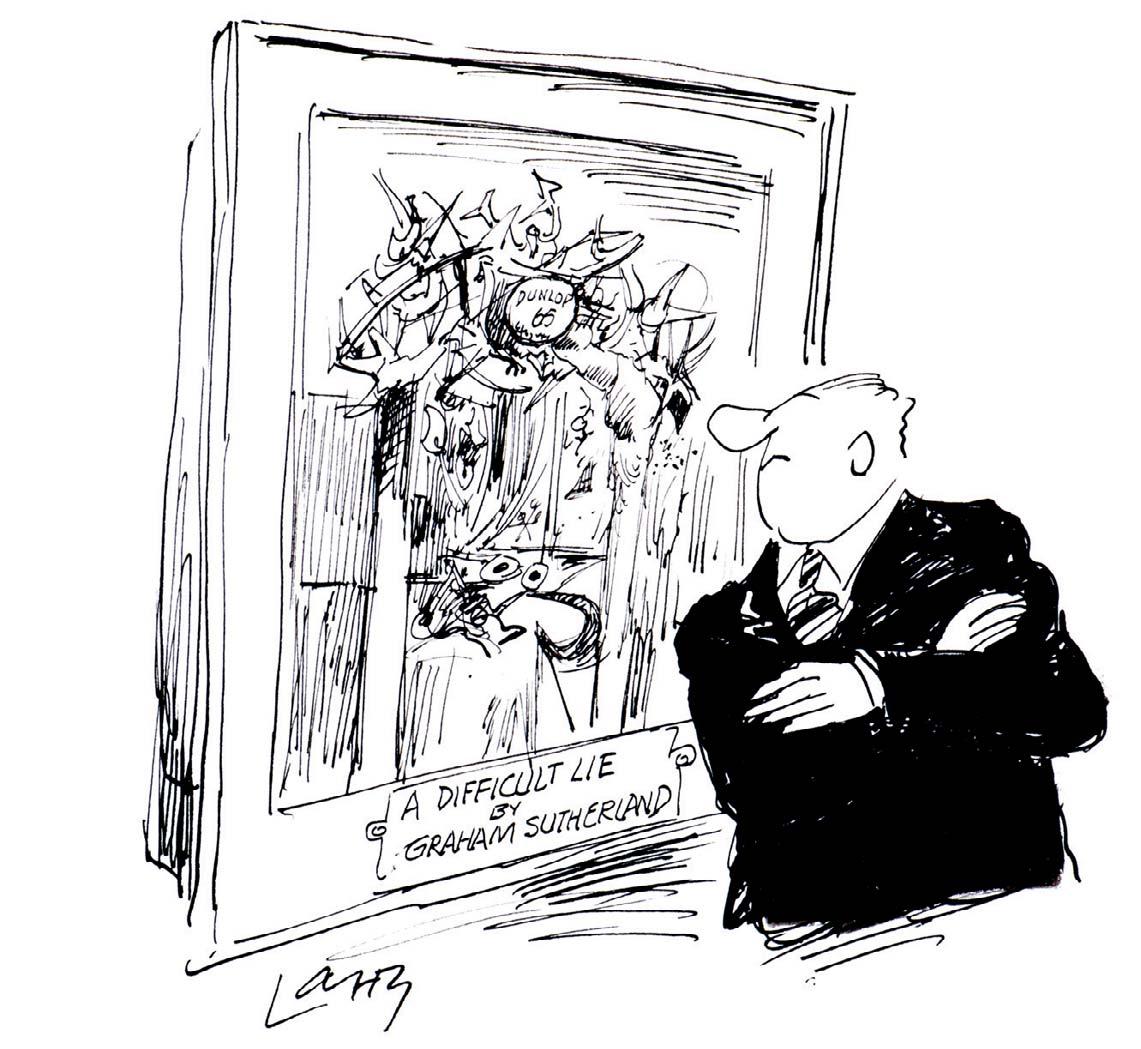


8. Postwar Illustrators & Cartoonists 151 173 (right) A FF E B RAHAM HER A Signed Ink 6 ¼ x 6 HE 174 (below left) A H Signed Ink 6 x 5 ¾ HE 175 (below right) R ’ JA R E Signed Ink 5 ¾ x 6 HE
JOHN BURNINGHAM
 John Mackintosh Burningham (1936-2019)
John Burningham was arguably the greatest British creator of picture books since the econd orld ar, with an oeuvre that ranges from Borka (1963) through Mr Gumpy’s Outing (1970) to late achievements that include Motor Miles (2015) and Mouse House (2017). Popular with all ages, he sometimes aimed a subject particularly at adults, as with John Burningham’s Champagne (2015).
For a biography of John Burningham, please refer to The Illustrators, 2018, page 117.
n ecember 2016, the hris Beetles allery mounted its own major selling retrospective of work by John Burningham. t was accompanied by a fully-illustrated 88-page catalogue, containing an appreciative essay, a chronology and a comprehensive bibliography.
B R A A ER FR E H HE AP A , FRE A F R E H F ER
Bodycolour with ink and elements of collage 16 ½ x 25 ½ inches

Illustrated: John Burningham, Borka: The Adventures of a Goose with No Feathers, London: Jonathan Cape, 1963, [unpaginated]

8. Postwar Illustrators & Cartoonists 152
176
William Scully

SCULLY
WILLIAM SCULLY William scully (1917-2002)
During a career that panned almo t 60 year , William scully forged a reputation a one of the mo t proli c and widely publi hed cartooni t of the twentieth century. i loo e but carefully con idered cartoon were quinte entially riti h in their humour, but with a tyle and wit that could tand compari on with the great cartooni t of The New Yorker. i editor at Punch, William ewi on, de cribed hi work a ‘Marvellou ly free and autographic but with a tight control over the u e of tone. ou are alway aware of pace in a scully drawing.’

William scully wa born on 12 June 1917 in lke ton, Derby hire, the on of a builder and amateur arti t. After graduating from ottingham school of Art, he worked a a pipe-te ter at an ironwork for four year and then for even year in an arti cial ilk factory, before having hi r t cartoon accepted by the Bystander. During the second World War, he erved in the Army rdnance Corp , al o becoming Art ditor of the army magazine AIM from 1943 to 1945. etween 1945 and 1946, he worked on the ta of the magazine Soldier, et up by Jame Friell, the political cartooni t of The Daily Worker who worked under the p eudonym ‘Gabriel’.
For almo t 60 year , William scully’ cartoon appeared weekly in publication including Punch, Spectator, Sketch, London Opinion, Men Only, Lilliput and Tatler a well a in the New Yorker. For many year , ‘scully’ iew’ appeared in the Sunday Telegraph i cartoon were till being publi hed until only week before hi death in ovember 2002, at the age of 85.
A , D G , s M s C ’s AD C
Signed and inscribed with title Ink, watercolour and bodycolour 13 x 9 C s Illustrated: Punch , December 1988, cover
9 9. William Scully 154 WILLIAM
177


9. William Scully 155 178 (above) A s A A F D AC , s Signed and inscribed with title Ink and watercolour 9 ¼ x 8 C s 179 (above right) ’ G A D s ’M s ’ s A D A A Ds F s A A M Signed and inscribed with title Ink and watercolour 9 x 7 C s 180 (right) A WAs FF C , x ss G C C A D s M A – F M , A s Signed and inscribed with title Ink and watercolour 10 ½ x 8 ½ C s

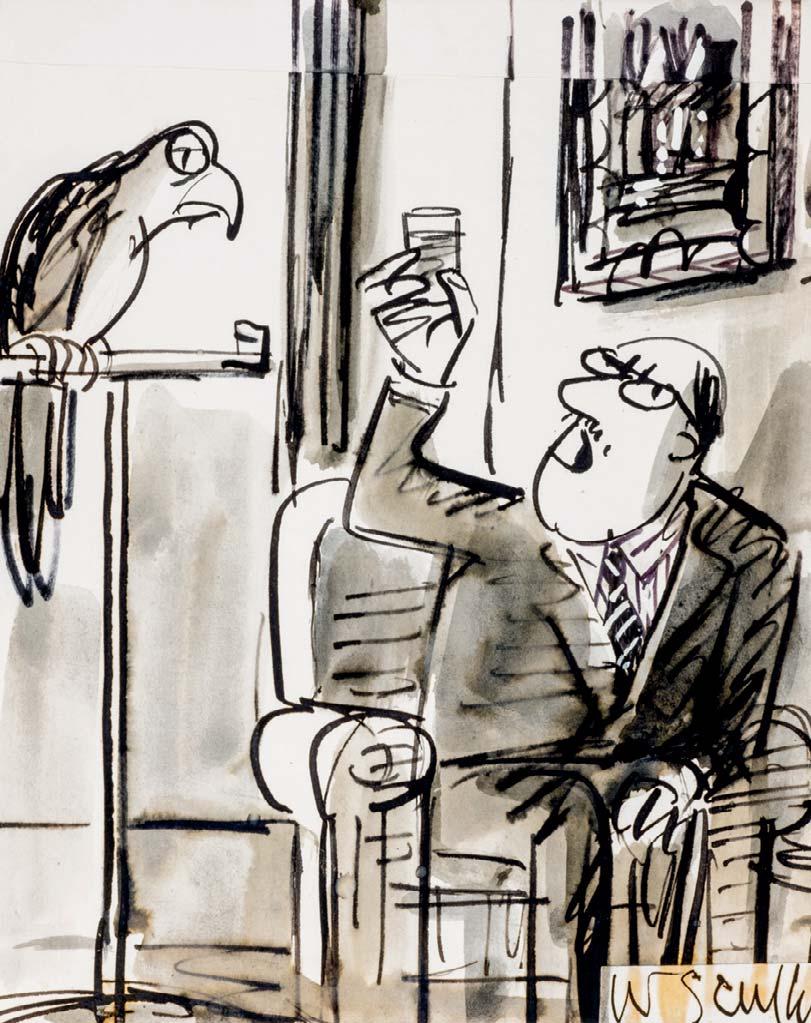

9. William Scully 156 181 (above left) A A A G F s C W D W C M A F W -C s D D MA s Signed and inscribed with title Ink and watercolour 9 ½ x 7 ½ C s 183 (left) W W D A s J C ss CA D C F M C , A D W F D sA s AD ’ F G F A FAs A Ms Inscribed with title Ink and watercolour with bodycolour; 10 x 8 C s 182 (above) D sA F W A sA , W D F D D A G sA Signed Ink and watercolour 9 ¼ x 7 C s Illustrated: Punch , 1996


9. William Scully 157 186 (right) ’M AF A D, s M s , ’ A G . W ’ G A D s FF C F G W D D AM C D Signed and inscribed with title Ink and watercolour with bodycolour 9 ½ x 7 ¼ C s 184 (above) W , s W C , W ’ F D F M s WAG A GA G s ss s. W W WA M , A D W W CA ’ G Signed and inscribed with title Ink and watercolour 10 x 8 C s 185 (above right) A s , M s, C D ’ ss x s W A ’ W , ’ G G C s D A M A A A AD Signed and inscribed with title Ink and watercolour 9 ¾ x 8 ¼ C s

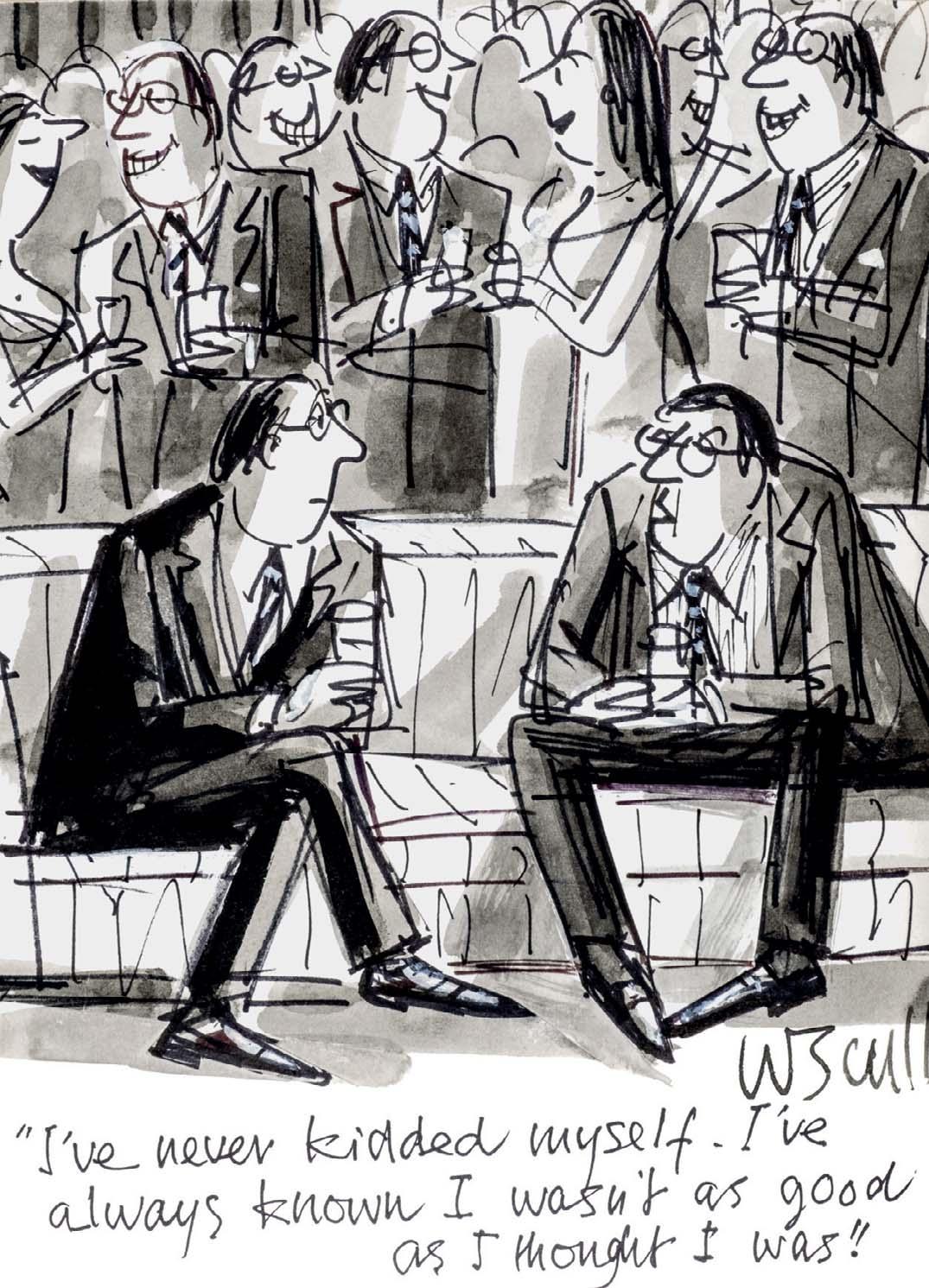
9. William Scully 158 187 F W D A s A GA CA Ass W D A AC Signed and inscribed with title Ink and watercolour 8 ½ x 7 ½ C s Illustrated: Sunday Telegraph , 6 December 1998, ‘Scully’s View’ 188 ’ DD D M s F. ’ A WA s W WAs ’ As G D As G WAs Signed and inscribed with title Ink and watercolour with bodycolour 10 ¼ x 7 ½ C s
Michael ffolkes

MICHAEL FFOLKES
MICHAEL FFOLKES Michael olkes (1925-1988)
An adept watercolourist who worked with a free- owing, sensual line, Michael olkes produced elegant, stylish and amboyant cartoons, often featuring mythological subjects and adorned with large, sexy ladies. Michael olkes was born Brian avis in London on 6 June 1925, the son of Walter Lawrence avis, a commercial artist. He attended Leigh Hall College, a boarding school in Essex, before studying under John Farleigh at St Martin’s School of Art from 1941-1943. In 1942, aged 17, he had his rst cartoon published in Punch. On leaving college, avis worked in various commercial art studios, before joining the Royal Navy in 1943, where he served as a telegraphist in the Far East. Following the end of the Second World War, he returned to his studies, enrolling at Chelsea School of Art in 1946. It was here that he adopted the name ‘Michael olkes’, chosen at random from Burke’s Peerage. It was at this time that his cartoons began appearing regularly in the
Strand Magazine, Lilliput and Punch. He also exhibited at the Royal Academy Summer Exhibition whilst still a student. He turned professional soon after graduating in 1949 and in 1953 he published the rst collection of his cartoons, titled olkes’ anfare! In 1955, he began work with the Daily Telegraph, an association that would last for 30 years, illustrating the ‘Way of the World’ column four days a week, rst with Colin Welch and later with Michael Wharton. In 1960, his work was published in Playboy for the rst time, beginning an association with the magazine that would last for 20 years. He always considered himself a Punch cartoonist at heart and in addition to regularly contributing cartoons; he produced a number of Punch covers and also began producing caricatures to accompany lm reviews from 1961. He considered it one of the greatest honours of his career when he joined the Punch table in 1978.
Ffolkes was also a proli c book illustrator, collaborating on over 50 books, including his own works, olkes Fauna (1977) and olkes’ Cartoon Companion to Classical Mythology (1978). An exhibition of his cinema caricatures was held at the National Film Theatre, London in 1982, and his autobiography was published in 1985 to coincide with further exhibitions at the Palace Theatre and Royal Festival Hall. Ffolkes’ work continued to appear in numerous publications throughout his career, such as Country Fair, Spectator, Private Eye, New Yorker and Reader’s Digest. He died in London on 18 October 1988.
189
WHAT O O MEAN, NO?
Signed and inscribed with title Watercolour and ink 10 ½ 12 ½ INCHES

10 10. Michael ffolkes 160
190
WELL, WHERE O O THIN IT SHO L O?
Signed and inscribed with title Watercolour and ink 11 ¼ 9 ¾ INCHES


192
I LO E O , B T I ON’T THIN WE’RE THE SAME SPECIES
Signed and inscribed with title Watercolour and ink with bodycolour 10 14 ¼ INCHES

191
OH HIM, HE’S THIN NO E IL
Signed and inscribed with title Watercolour and ink 8 ¾ 10 INCHES
10. Michael ffolkes 161
193
STRAI HT OR WITH A LITTLE PIET ?
Signed and inscribed with title Watercolour and ink 10 ½ 13 ¼ INCHES
194 (above right)
EOR E, I THIN O ’ E WATCHE ONE W C
FIEL S MO IE TOO MAN
Signed and inscribed with title Watercolour and ink 10 ½ 8 ½ INCHES
195 (left)
B SINESS IS TERRIBLE
Signed and inscribed with title Ink with watercolour 11 7 ½ INCHES
196 (right)

ALCOHOL BAROMETER


Signed Watercolour and ink 9 ¼ 6 ½ INCHES

10. Michael ffolkes 162
198
A LITTLE MORE OF E HIBIT B, SERJEANT
Signed and inscribed with title Watercolour and ink 8 ¾ 9 ¾ INCHES
197
IT’S A BO S OMESTIC B R N WITHO T AN
ALIT B T I THIN O ’LL BE ST PEFIE B THE PRICE
Signed with initials and inscribed ‘after Th’ Watercolour, ink and collage
8 ½ INCHES
Illustrated: Punch , 26 October 1977, front cover


199
HE ATTEMPTE TO A SALT
Signed and inscribed with title Watercolour and ink 10 9 ¼ INCHES
10. Michael ffolkes 163
q
13
200 (left)
THE I S SA I’M ATTRIB TE TO FRANCIS BACON
Signed Watercolour, ink and collage 24 20 INCHES
Illustrated: Punch , 28 March 1979, front cover


201 (above)
E TRAOR INAR , THE ’ E BEEN ARO N FOR CENT RIES
Signed and inscribed with title Watercolour and ink 11 11 ½ INCHES

202 (left)
I WO L N’T SA THAT O ON’T SATISF ME, EOR E. IT’S J ST THAT, ON THE WHOLE, I WO L PREFER A LAR E RA IOLI
Signed, inscribed ‘ffor George’ and dated ‘25 II 81’ Watercolour, ink and collage 9 ½ 13 ½ INCHES
10. Michael ffolkes 164
John Glashan

JOHN GLASHAN
JOHN GLASHAN
John glashan (1927-1999)
John glashan was best known as the creator of the cartoon strip, ‘genius’, which developed a cult followin durin its ve-year run in the Observer is passion for ne watercolour paintin allowed him to develop his world of tiny ures inhabitin beautiful, vast, baroque interiors and sweepin landscapes. or a bio raphy of John glashan, please refer to The Illustrators, 2017, pa e 216.

Nos 203 217 are all Provenance: the Artist’s Estate
203 D N Ng A E E NE AN E E EN E A EN N
Signed
Watercolour with ink and bodycolour 11 x 14 N E Illustrated: Spectator, 28 September 1991
11 11. John Glashan 166
A E EN P N N P E EA A N NE EN
PE P E D E N EN E NDE A PE PE A E A N g AN E , P DE ED g A , E- N A D AND N N- PE A E A, P DED A PE EN E D’ P P A N AD A E A N AN PP AN E E A E
Signed Watercolour with ink and bodycolour 16 ½ x 21 ¼ N E Illustrated: Spectator , 9 February 1991
Literature: John Glashan’s World , London: Robinson Publishing, 1991, page 42

11. John Glashan 167 204

11. John Glashan 168 205 AN D E N E EAD A NE Signed Watercolour with ink and bodycolour 10 ½ x 14 ¾ N E Illustrated: Spectator , 30 July 1994

11. John Glashan 169 206 E E EE A N’ E A E A N Signed Watercolour with ink and bodycolour 14 ½ x 21 N E Illustrated: Spectator , 25 June 1994

11. John Glashan 170 207 ‘ A E ?’ ‘ A g D. AND ?’ ‘ A A A E E g N.’ ‘ E g N? A ’ A ?’ Signed Watercolour with ink and bodycolour 15 x 22 N E Illustrated: Spectator , 6 June 1992

11. John Glashan 171 208 ‘ EE Ng E g , N ?’ ‘ E , AN .’ Signed Watercolour with ink 11 x 14 N E Illustrated: Spectator , 20 March 1993

11. John Glashan 172 209 E A E PA N E g E A N EgA g APE AND g A N N EA ED NE E END P DE A N E D N N ANE D A N Signed Watercolour with ink and bodycolour 10 ¾ x 14 ¼ N E Illustrated: Spectator , 31 December 1994

11. John Glashan 173 210 ‘ ’ E AD A EAD J ? .’ ‘ E , EE E E AxED AND A E. E ’ E ADE E A AN E AN AND E ’ E A ED E AND PA A EN N A DA , N A P zE A DAN Ng ...’ Signed Watercolour with ink 10 ¾ x 15 N E Illustrated: Spectator , 19 March 1994

11. John Glashan 174 211 AD E E N NE D E E E E, NE D P ? Signed Watercolour with ink and bodycolour 14 ½ x 22 N E Illustrated: Spectator , 18 September 1993

11. John Glashan 175 212 E , E , E Signed Watercolour with ink and bodycolour 10 ¼ x 14 N E Illustrated: Spectator , 23 July 1994

11. John Glashan 176 213 E A E EA ’ NE P zE , ‘ A E Ng N DE Ng N ’ E A AN E Signed Watercolour with ink and bodycolour 14 ¾ x 22 N E Illustrated: Spectator , 12 November 1994

11. John Glashan 177 214 E AND EE NE D g – E’ A E EEN A P AN A AND A EE A Signed Watercolour with ink and bodycolour 11 x 14 ½ N E Illustrated: Spectator , 1 June 1991

11. John Glashan 178 215 E Ex Ng EA E g N E A E, A E P A E N A DA N g E EEN N N ( E NA DE A E ) E EgAA D AND E ( A N A E ) EEg A E Signed Watercolour with ink and bodycolour 11 x 15 N E Illustrated: Spectator , 7 November 1992

11. John Glashan 179 216 A A ED E E E NE E Ng Signed Watercolour with ink 10 ¾ x 15 N E Illustrated: Spectator , 8 June 1991
Signed
Illustrated: Spectator , 11 November 1989
Literature: John Glashan’s World , London: Robinson Publishing, 1991, page 12

11. John Glashan 180 217 ’ E A ED A , N NE ND ED AND E g N, ND ED AND E EN NE AND, EE ND ED AND x N NE E NE ...
Watercolour with ink 11 ½ x 16 N E
Willie Rushton

WILLIE RUSHTON
WILLIE RUSHTON
William George Rushton (1937-1996)
Proli c and highly successful not only as cartoonist and illustrator, but also as writer, actor and comedian, Willie Rushton began his career at the forefront of the 1960s satire boom as a co-founder of the magazine Private Eye. He achieved lasting fame on the BBC television series That Was the Week That Was, alongside the likes of David Frost, before garnering a cult following on the BBC Radio 4 game show, I’m Sorry I Haven’t a Clue, from 1974 until his death. He was the author and illustrator of a number of bestselling books, such as How to Play Football: The Art of Dirty Play and Pigsticking: A Joy for Life
Willie Rushton was born in Chelsea, London, on 18 August 1937, the only child of John Atherton Rushton, a publisher, and his wife Veronica (neé James). He attended Shrewsbury School from 1950, where he met his future Private Eye colleagues Richard Ingrams and Christopher Booker. He showed an early talent for cartooning by producing illustrations for The Wallopian, a satirical version of the school magazine The Salopian, which he produced with Ingrams and Booker. He struggled academically however, claiming to have failed his mathematics O-level seven times. His failure to achieve a Latin O-Level cost him the chance to join his friends at Oxford, and instead he served his two years of national service. He returned to civilian life as a solicitor’s clerk in 1959. During this time he regularly sent cartoons to Punch, none of which were accepted. After quitting his job as a clerk, he worked at the Liberal News, producing the weekly strip, ‘Brimstone Belchers’, between June 1960 and March 1961, and a weekly political cartoon until 1962. He had remained in contact with his friends at Oxford, where Ingrams was editing two magazines, Mesopotamia and Parson’s Pleasure, to which he contributed cartoons. Between them they conceived the idea for a London-based satirical magazine whilst in a Chelsea pub, and the rst issue of Private Eye was published on 25 October 1961, with Rushton producing all the illustrations. Early issues of the paper were put together in Rushton’s bedroom in his mother’s house in Kensington. Having developed a taste for acting whilst accompanying his friends from Shrewsbury in a well-received revue at the Edinburgh Fringe, Willie Rushton made his professional stage debut in 1961 in Spike Milligan’s The Bed-Sitting Room, at the Marlowe Theatre in Canterbury. Not long after, he appeared in cabaret with Richard Ingrams, John Wells and Barbara Windsor at the Room at
the Top, a nightclub above a department store in Ilford, east London. Here, Rushton’s impersonation of Prime Minister Harold Macmillan caught the attention of a BBC producer and, from November 1962 to December 1963, he appeared in the BBC programme That Was the Week That Was, which drew in audiences of up to 13 million and found him immediate fame. In 1965, he met Arlene Dorgan while hosting the variety entertainment show New Stars and Garters. They married in 1968 and together had one son. Though That Was the Week That Was was cancelled in 1964, he continued to work regularly on television, appearing in Not Only… But Also with Peter Cook and Dudley Moore and episodes of popular series such as Up Pompeii! (1970), The Persuaders! (1971) and Colditz (1974). On stage, he appeared in Gulliver’s Travels at the Mermaid in 1971 and 1979, and in Eric Idle’s Pass the Butler at the Globe in 1982. He also had a series of cameo roles in lms such as Magni cent Men in their Flying Machines (1965) and Monte Carlo or Bust (1969). Between 1985 and 1989, Willie Rushton was a regular panellist on the television show Celebrity Squares and a popular story reader on the children’s show Jackanory
Willie Rushton achieved perhaps his widest following and greatest popularity on BBC Radio 4’s I’m Sorry I Haven’t a Clue, which he joined in 1974 and appeared as a regular team member in every yearly series until his death. He appeared alongside fellow comedians such as Tim Brooke Taylor, Graeme Garden and Barry Cryer. In 1996, he teamed up with Barry Cryer, in their own show, Two Old Farts in the Night, performing to full audiences at the Edinburgh Festival, Royal Albert Hall and Royal Festival Hall.
Having not been involved in Private Eye since the later years of the 1960s, Willie Rushton returned in 1978 to illustrate ‘Mrs Wilson’s Diary’ and ‘Auberon Waugh’s Diary’. When Waugh moved to the Daily Telegraph in the mid-1980s, Rushton followed, while also contributing to his Literary Review, providing the monthly coloured covers, while at the same time producing fortnightly caricatures for Private Eye’s literary review page. He contributed a regular contents-page illustration to the Independent Magazine, and from 1993 to 1996 drew cartoons for Channel 4’s television series Rory Bremner… Who Else?. He also published a number of his own humorous books, including How to Play Football: The Art of Dirty Play (1968), Pigsticking, a Joy for Life: a Gentleman’s Guide to Sporting Pastimes (1977), Bureaucrats: how to Annoy

12 12. Willie Rushton 182
Them (under the pseudonym R. T. Fishall) (1981), and Willie Rushton’s Great Moments in History (1984). The original artwork for this latter work was commissioned as a permanent collection at the Victoria and Albert Museum.
Willie Rushton was a passionate cricket fan throughout his life. He received coaching at Lord’s as a boy, later playing for the Lord’s Taverners, and was a regular team captain on BBC Radio 4’s quiz show, Trivia Test Match, running from 1986 to 1993. His 1984 novel, W. G. Grace’s Last Case, was based on a ctional episode in the life of the great cricketer. He died from complications after heart surgery at Cromwell Hospital, Kensington on 11 December 1996, aged 59.
218
MARTIN AMIS AS ROBOCOP
Signed with initial and dated 91 Ink

7
Literary Review , September 1991, cover, Adam Mars-Jones (reviewer), ‘Times Arrow’ by Martin Amis

12. Willie Rushton 183
8
½ INCHES Illustrated:
No 232 , please see page 192
219
IT’S YO R BIRD-BATH, NGRATEF L FOWL
Ink and watercolour
9 ½ 7 ¼ INCHES
Illustrated: Frank Ward and William Rushton, Unarmed Gardening. How To Tame The Thing Outside , London: Macdonald and Jane’s, 1977, page 117, ‘Finding Something To Do’
220 ANTI-THRIPP Ink

9 ½ 7 ½ INCHES
Illustrated: Frank Ward and William Rushton, Unarmed Gardening. How To Tame The Thing Outside , London: Macdonald and Jane’s, 1977, page 100, ‘Squirting’

12. Willie Rushton 184
A TALE OF HORTIC LT RAL ESPIONAGE Ink
9 ½ 7 ¼ INCHES

Illustrated: Frank Ward and William Rushton, Unarmed Gardening. How To Tame The Thing Outside , London: Macdonald and Jane’s, 1977, page 40, ‘Escape Routes Survivors’


12. Willie Rushton 185 221
Rushton
‘I refer, Mr Chairman, to the lavatory at the Nursery End – the Gentlemen’s lavatory, I hasten to add – with the corollary that the term “Gentlemen” is used advisedly as a close inspection of the building will reveat that it is no more than a Post Restante for every homosexualist — every pervert –’
‘Are you suggesting, Sir, that homosexualists pursue the Noble Game?’
(Marylebone Versus the World , page 41)
222 MIN TES OF THE MCC B ILDINGS AND WORKS COMMITTEE Ink
10 7 ½ INCHES
Illustrated: William Rushton, Marylebone Versus the World , London: Pavilion, 1987, page 40


12. Willie
186
223 SNOOKER
POTTING AND P TTING Ink
9 ¼ 7 INCHES
Illustrated: William Rushton, Pigsticking. A Joy For Life, A Gentleman’s Guide to Sporting Pastimes , London: Macdonald and Jane’s, 1977, ‘Snooker’, page 116
224
FREDDIE TR EMAN AND ERIC MORECAMBE Ink
8 ½ 5 INCHES
Illustrated: Fred Trueman, The Thoughts of Trueman Now , London: Macdonald and Jane’s, 1978, page 9


12. Willie Rushton 187
226 THE BEST THINGS ON TELEVISION
Text signed by Auberon Waugh


Ink; 5
Illustrated: Auberon Waugh, The Diaries of Auberon Waugh , London: Private Eye , 3 August 1979


Exhibited: ‘Private Eye Cartoonists: the 50th Anniversary’, Chris Beetles Gallery, London, October-November 2011, no 125

12. Willie Rushton 188
¾ 5 ¼ INCHES
225 P NCH’S RELA NCH PARTY Signed with initial Text signed by Auberon Waugh Ink 4 ¼ 2 ¾ INCHES Illustrated: Daily Telegraph , 7 September 1996, ‘Way of the World’ by Auberon Waugh
TO BRIGHTON WITH A H GE
PARTY OF LORD GNOME’S MINIONS WHERE WE CELEBRATE P.G. WODEHO SE’S CENTENARY WITH A FEAST IN THE ROYAL PAVILION
Signed with initial and dated 81 Text signed by Auberon Waugh Pen and ink

4 ½ 7 INCHES

Illustrated: Private Eye , 23 October 1981; Auberon Waugh, The Diaries of Auberon Waugh , London: Private Eye/Andre Deutsch, 1985, page 133

Exhibited: ‘40 Years of Private Eye’, Chris Beetles Gallery, London, OctoberNovember 2001, No 124;
‘Private Eye Cartoonists: the 50th Anniversary’, Chris Beetles Gallery, London, October-November 2011

228 THE A STRALIANS
Signed with initial and dated ‘92 Ink 7 10 ½ INCHES Illustrated: Sunday Telegraph
12. Willie Rushton 189 227
Harold had a go at joining the Common Market. ‘I cannot see’, he said over a cup of tea, ‘how General de Gaulle can say “No”.’ General de Gaulle said ‘NON!!’. ‘I hadn’t thought of that,’ said Harold, helping himself to a spoonful of Delikat. Then he devalued the Pound. ‘This’, he said, ‘does not mean the Pound in your pocket has been devalued.’ You couldn’t help liking the old rogue. Well, some didn’t and he lost an election to Edward Heath. But four years later he was back. This time by three votes and still pu ng away on his pipe. In public that was. The moment he was back in Number Ten, it was out with the jukebox and Party Tim!
You’d never have guessed from all this just how grim things were, with talk of Military Coups, the International Monetary Fund cancelling our overdraft, and the KGB under the kitchen table at Number Ten. It was all very confusing, certainly for a cat.
(Humphrey, The Nine Lives of the Number Ten Cat , page 22)
229 ‘LET’S BOOGY!’ CRIED HAROLD, ‘LET’S BOP TO THE BEAT. AND CAT, THROW THOSE SEVEN MICE INTO THE STREET’ Ink
10 ½ 8 INCHES
Provenance: Dr Aidan Mcgennis
Illustrated: Willie Rushton, Humphrey, The Nine Lives of the Number Ten Cat , London: Pavilion Books, 1995, page 23

12. Willie Rushton
The dustmen stopped working. All the gravediggers stopped working. I refused to leave the premises. It was very unpleasant out. Chaos. Certainly Un t for Cats.
In a way, you had to admire old Jim. In the middle of all this, like Lord Nelson before him, Jim said, ‘I see no chaos’. Admittedly, when he said it he was on his way back from a Summit Conference in sunny Guadeloupe. He then lost a vote of ‘no con dence’ in the House of Commons by one vote, the one vote being a mad Scots Nat, thus ushering in One Hundred Years of Mrs Thatcher. (Humphrey, The Nine Lives of the Number Ten Cat , page 26)
230

‘THEY’RE ALL ON STRIKE’ SAID HONEST JIM, ‘E CEPT TEN BLASTED MICE. GET RID OF THEM, CAT!’
‘I’M GOING SLOW’ I SAID ‘B T NAME YO R PRICE’
Ink
9 ½ 8 INCHES
Provenance: Dr Aidan Mcgennis Illustrated: Willie Rushton, Humphrey, The Nine Lives of the Number Ten Cat , London: Pavilion Books, 1995, page 27


12. Willie Rushton 191
231 SAINTLY LIVES AND GR ESOME DEATHS
Signed with initial and dated 1993 Ink
10 10 ½ INCHES
Illustrated: Literary Review , August 1993, cover, Brian Masters (reviewer), Jacobus De Voragine, The Golden Legend , Princeton: Princeton University Press, 1993

232 (left)
THE END Ink

3 ¼ 3 INCHES
Illustrated: Jon Talbot, Elephant on the Line! , London: Kaye and Ward, 1979
Exhibited: ‘Quick on the Draw, Drawings by Willie Rushton’, Shrewsbury Museum & Art Gallery, April 2004, No 20
233 JOAN SMITH, ADAM AND EVE
Signed with initial Ink
11 10 ¾ INCHES
Illustrated: Literary Review , November 1996, cover, Lisa Jardine (reviewer) of Joan Smith, Hungry For You: From Cannibalism To Seduction , London: Chatto and Windus, 1996

12. Willie Rushton 192
The Americans

THE AMERICANS
WILLIAM STEIG
William steig (1907-2003)

The American arti t, William steig, r t made hi name with hi highly original cartoon for The New Yorker, and he worked regularly for that magazine for everal decade . Gradually, he widened hi reputation with hi work a a draught man and culptor. hen from hi ixtie , he gained an entirely new audience – and many prize – a an illu trator and writer of popular children’ book , including Shrek! (1990), which proved the ba i for the phenomenally popular erie of animated lm .
or a biography of William steig, plea e refer to The Illustrators, 2020, page 180.
Further reading: Claudia J Nahson, The Art of William Steig , Yale University Press, 2007

4
with
below mount
½ 4
with title below mount
s
13 13. The Americans 194
234 W Signed Inscribed
title
Ink 5 ½
½ s 235 A A A s A A Signed Inscribed
Ink 5
½
o 234 237 are all illu trated in William steig, Till Death Do Us Part: some ballet notes on marriage, ew York: Duell, sloan and Pearce, 1947


236
W Y A D W Y G, AGG
Signed Inscribed with title below mount Ink 5 ½ 4 ½ s
237 A WAYs P Y
Signed Inscribed with title below mount Ink 5 ¼ 4 ½ s
13. The Americans 195
BUD HANDELSMAN
John ernard andel man (1922-2007)
Jandel man achieved great popularity on both ide of the Atlantic a a cartooni t for The New Yorker, Punch and Playboy hough perhap be t known in the a the creator of the trip, ‘ reaky able ’, which ran for 11 year in Punch, hi meticulou line and particularly the harp, dry wit of hi caption tood him out a one of the ne t and mo t memorable New Yorker cartooni t of the twentieth century.
J andel man wa born ernard andel man in anhattan, ew York, on 5 ebruary 1922. i father, ax andel man, wa born in ew York of Jewi h ungarian immigrant and taught ngli h at the Jame onroe igh school in the ronx. i mother, Dinah (née irnbaum) wa al o a teacher. i i ter, dith, wa eight year hi enior and would become a journali t and writer working under the nom de plume dith Ander on. e began drawing cartoon a a young boy, and had decided upon a career a a comic trip arti t by the age of ten.
A a child, andel man grew up in the ronx and wa educated in the ronx public chool y tem, before tudying at the Art student ’ eague from 1938 to 1942. After the sA entered the second World War, he enli ted brie y in the s Army Air orp , though he wa di charged in 1945 due to hi u ering from a thma. ater that year, he enrolled at ew York niver ity to tudy electrical engineering. owever, in 1946, he left univer ity in order to pur ue a career a a commercial arti t, and began working a a typographic de igner in variou ew York adverti ing agencie . At thi time, he al o began working a a freelance cartooni t, ubmitting cartoon to magazine and new paper uch a Playboy, Esquire and The Saturday Evening Post. A a cartooni t, he began to u e the profe ional name ‘J andel man’. e had alway di liked the name given to him at birth, and a an adult had adopted the name John, though he wa known informally a ‘ ud’. n 1960, he began freelance cartooning full-time and the following year ubmitted hi r t cartoon to The New Yorker, beginning an a ociation with the magazine that would continue for 45 year . n 1963, he moved to ngland with hi wife, Gertrude (née Peck), whom he had married in 1950, and hi three children, and ettled in eatherhead, surrey. e believed that hi tyle of cartooning and en e of humour were more uited to a riti h audience, and he began contributing regular cartoon to Punch, a well a to the Evening Standard, Observer, New Statesman and Saturday Review e found particular popularity with hi weekly cartoon erie , ‘ reaky able ’, which ran in Punch for 11 year . andel man wa al o a talented writer and regularly ubmitted hort torie to Punch under an a ortment of p eudonym . i cartoon to Punch were al o often ubmitted under a di erent p eudonym, uch a ‘ squink’ or ‘A J spoop’, but hi unmi takeable line meant that hi editor were never in doubt a to who the true creator wa .
andel man maintained a connection to hi native country and continued to ubmit cartoon to The New Yorker, who o ered him a contract in 1967, and to Playboy n 1971, Playboy publi hed a collection of hi cartoon , You’re Not Serious, I Hope, and in 1978 awarded him their award for e t lack and White artoon. e returned to the nited state in 1982 and continued to di tribute hi cartoon widely. e wa al o ought after a an illu trator of book for adult and for children. e collaborated with John lee e and the p ychiatri t obin skinner on Families and How to Survive Them (1983) and Life and How to Survive It (1993) and with David ro t on The Mid-Atlantic Companion (1986). John lee e referred to andel man a ‘the be t cartooni t alive’. he children’ book he illu trated included Who’s That Stepping on Plymouth Rock? (1975) by Jean ritz and The Funny Side of Science (1973) by elvin erger. n 1992, he created a 10-minute animated lm called ‘ n the eginning’ ba ed on the reation, which wa broadca t on televi ion on hri tma ve of that year. andel man continued to appear weekly in The New Yorker until 2006. ver the cour e of hi career he contributed ju t under 1,000 cartoon for the magazine, along with ve cover e died of lung cancer at hi home in southampton, ew York, on 20 June 2007.

Further Reading: Mark Jacobs, Jumping Up and Down on the Roof, Throwing Bags of Water on People, Garden City , NY: Doubleday, 1980
238 A As P ss Y , D A s , W ’ A G A DAY
Signed Ink and watercolour 6 ¼ 4 ½ s Illustrated: The New Yorker , 18 October 1993, page 81
13. The Americans 196

13. The Americans 197 239 sA Y A s Signed Ink and watercolour with gold pen and collage 12 ½ 10 ¼ s Illustrated: Punch , 23 November 1966, front cover


13. The Americans 198 240 (above) A WAs A P , A A A. s s s sP A D A G AG s, P A Y D D ’ D s A D A W D Signed Ink and watercolour 4 ¾ 6 s Illustrated: The New Yorker , 30 January 1995, page 77 241 (above right) D W A D D , Y WA J DG D W A , As A D D A Signed Ink and watercolour 6 ½ 5 ½ s Illustrated: The New Yorker , 24 February 1997, page 102 242 (left) Y Y G DAYs, AD A D s Gs As AD A G A, A D W A ’ A D As ’ G APP ss Signed and inscribed with title Ink and watercolour 7 ½ 8 ¾ s Illustrated: Playboy


13. The Americans 199 243 ‘ AG A D ’, D D! Y ss A PP Y s W Y Ass A D A , D Y ? Signed Ink and watercolour 7 5 ½ s Illustrated: The New Yorker , 17 January 2000, page 62 244 s! Y s ? G A D! ‘ D A D A D s A A ’ Signed and inscribed with title Ink and watercolour with bodycolour 7 8 ¾ s Illustrated: Playboy


13. The Americans 200 246 sA D, ‘ , DA ! ’ s G s G Y!’ A D s D P A Y A A s Signed and inscribed with title Ink watercolour and bodycolour 13 ½ 9 ½ s Illustrated: Playboy 245 W A A G s s s , ? A D Y P A A D W D ’ G Y Signed and inscribed with title Ink and watercolour with bodycolour 12 7 ¾ s Illustrated: Playboy , May 1970, page 189
DAVID LEVINE
David evine (1926-2009)
David evine wa widely acknowledged a one of the greate t, and mo t in uential, caricaturi t of the econd half of the 20th century. e t known a the ta arti t of The New York Review of Books, he revived the tradition of American political caricature that originated in the nineteenth century with homa a t, and ha been frequently de cribed a equal to onoré Daumier. owever, he u tained an equally di tingui hed career a a painter, producing gurative oil and watercolour in a poetically naturali tic tyle. i love of orot and uillard, akin and sargent, pervade hi tudie of oney land and the Garment Di trict. ut more fundamental to both hi painting and hi caricature i the fact that he aid, ‘ love my pecie ’. or a biography of David evine, plea e refer to The Illustrators, 2010, page 277-278
247 (below left)
A P D A D s
Signed and dated 71 Inscribed ‘T S Eliot’ on reverse Ink; 12 ½ 8 ½ s
Illustrated: The New York Review of Books , 18 November 1971, ‘The First Waste Land’ by Richard Ellmann (A Review of the Waste Land Annotations of Ezra Pound)

248 (below right) sA P PYs Signed and dated 70 Inscribed ‘Pepys’ and ‘N Y Review of Books’ and dated 1970 on reverse Ink; 13 11 s
Illustrated: The New York Review of Books , 8 October 1970, ‘O Calcutta! by Matthew Hodgart, a review of the Diary of Samuel Pepys, edited by Robert Latham and William Matthews

13. The Americans 201
249
sA A s D
Signed and dated 96; Inscribed ‘S Rushdie’ on reverse Ink
13 ¾ 10 s
Illustrated: The New York Review of Books , 21 March 1996, ‘Palimpsest Regained’ by J M Coetzee (a Review of Salman Rushdie’s The Moor’s Last Sigh); The New York Review of Books , 4 October 2001, ‘Puppet Show’ by John Leonard (a Review of Salman Rushdie’s Fury); The New York Review of Books , 6 October 2005, ‘Massacre in Arcadia’ by Pankaj Mishra (a Review of Salman Rushdie’s Shalimar the Clown); The New York Review of Books , 12 June 2008, ‘In The Emperor’s Dream House’ by Joyce Carol Oates, a review of the Enchantress of Florence by Salman Rushdie
250 A D P
Signed and dated 70 Inscribed with title on reverse Ink
9 ½ 8 s
Illustrated: The New York Review of Books , 4 October 2001, ‘Harold Pinter’s Celebration’ by Daniel Mendelsohn (a review of the productions included in the Harold Pinter Festival at the Lincoln Centre)


13. The Americans 202
251 A
Signed and dated 72
Inscribed ‘Chanel’ on reverse Ink
12 ½ 10 s
Illustrated: The New York Review of Books , 10 August 1972, ‘Living It Out’ by Jean Stafford (a review of three books about Parisian women)


252 W Y A s
Signed and dated 66 Inscribed ‘Yeats’ and ‘NYR’ and dated 1966 on reverse Ink
12 ½ 8 s
Illustrated: The London Review of the Books , 6 April 1967, ‘The Politics of Poetry’ by Denis Donoghue
13. The Americans 203
ED SOREL
dward sorel (born 1929)
Edward sorel’ clever and unforgiving atire i the product of a lifetime pent ob erving and critici ing the unplea ant reality of the American Dream. i experience of recent hi tory from the Great Depre ion to Al-Qaeda, and hi di dain for the grea y politic in between, have lent hi cartoon a formidable bite that tho e hi junior rarely match. or a biography of d sorel, plea e refer to The Illustrators, 2020, page 202.

A D s A D s ’ G
Signed Ink and watercolour 16 24 s Illustrated: Vanity Fair , March 2005
13. The Americans 204
253
P D As D-s G D D A A
Signed Pencil sketch of Rupert Murdoch on reverse
and pencil
24 ½ 17 ½ s
Illustrated: Columbia Journalism Review , May-June 1984, ‘Murdoch Stalks Chicago’
Literature: Ed Sorel, Unauthorized Portraits , New York: Afred A Knopf, 1997, page 127

13. The Americans 205 254
Pastel
A A D A A D G A
Signed and inscribed with title
and watercolour
½ 10 ¼
Illustrated: Drawn for The Festival of Purim , The Jewish Museum, New York, 2008

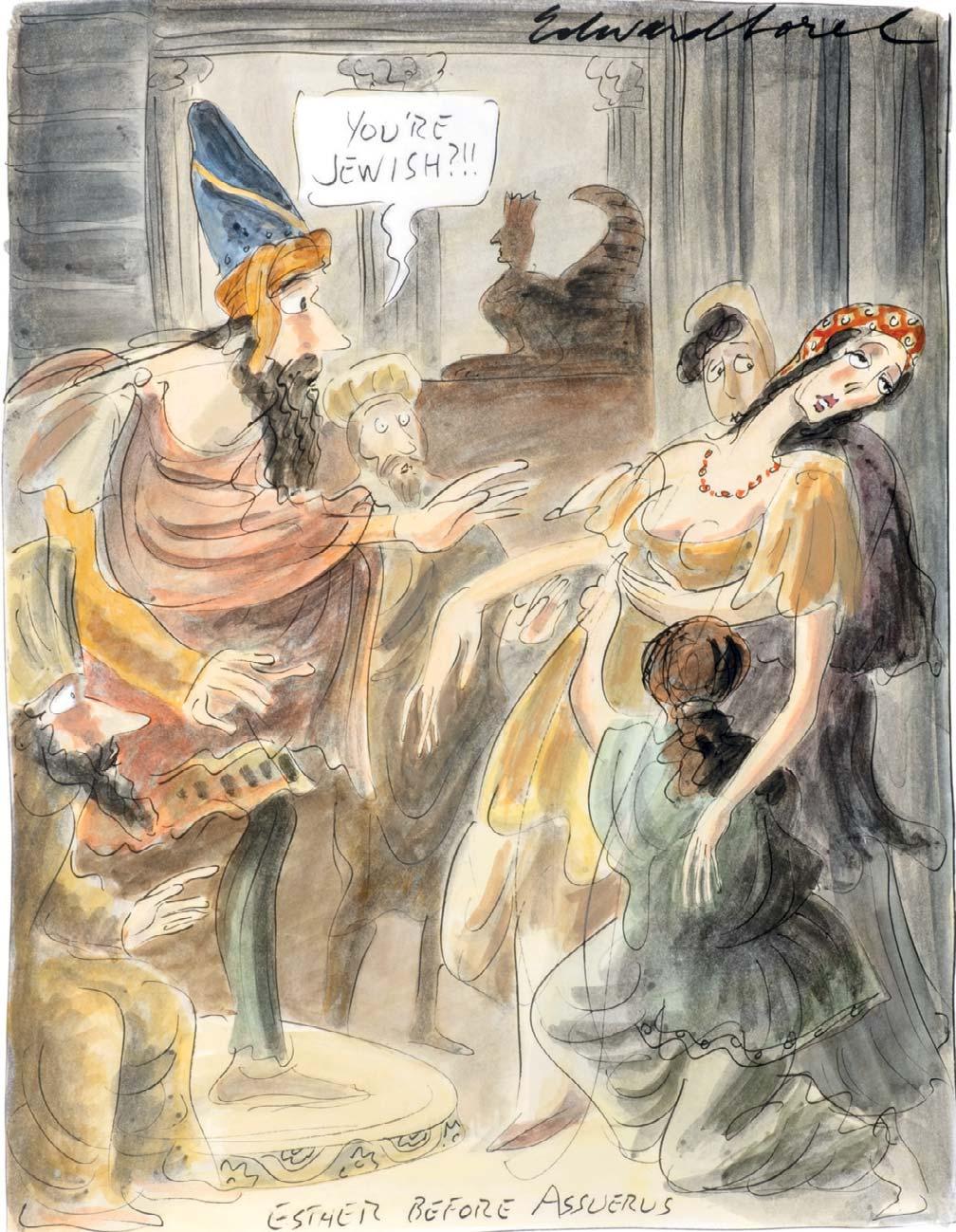
Signed Ink and watercolour 16 11 ½ s
New York Observer
13. The Americans 206 256 Q
A
Illustrated:
255 s Ass s
Ink
13
s
‘
ARNOLD ROTH
Arnold oth (born 1929)
Arnold oth i urely the mo t imaginative and humorou graphic of thi day or any other day. ven ax eerbohm at hi be t would have to take a back eat.’ (George Plimpton, Paris Review) or a biography of Arnold oth, plea e refer to The Illustrators, 2015, page 158.

257 D G Q Signed
Inscribed with title below mount Watercolour and bodycolour 12 ½ 18 s Illustrated: TV Guide , New York
13. The Americans

13. The Americans 208 258 GA s A s P Signed Inscribed with title below mount Watercolour with ink 13 ½ 8 ½ s Illustrated: TV Guide , New York
, 8 January 1972, page 6, ‘From No-No! To Yes, Wow!’ by Maurice Zolotow
‘The current television season may not be the most innovative in history, but it is surely one of the most uninhibited. and the fact that we are not more shocked by this is a measure of how far we have come, and how fast, in accepting a television freed of the taboos of yesteryear.’ ( aurice olotow, page 7)

13. The Americans 209 259 s Signed Inscribed with title of article below mount Ink and watercolour 13 16 s Illustrated: TV Guide
260
PA P D P ss A G Signed Watercolour 5 8 ¼ s
Illustrated: TV Guide , New York Exhibited: ‘Hole in One!’, The Atkinson Gallery Southport, May-August 2017
261 D Y
Signed with initials
Inscribed with title below mount Ink and watercolour with pencil 6 ½ 17 ½ s Illustrated: TV Guide , New York


13. The Americans 210
Signed and inscribed with title Ink and watercolour 15 ½ 16 ½ s
Illustrated: TV Guide , New York


Signed
Inscribed with title below mount Ink and watercolour 10 ½ 9 ¼ s Illustrated: TV Guide , New York, 30 May 1970
13. The Americans 211 262 ( A A Y AG ) Ps
263 , As Y , A P A
EDWARD KOREN
dward oren (born 1935)
Edward oren i undoubtedly one of the mo t loved and revered cartooni t in the hi tory of The New Yorker. With hi r t cartoon appearing in 1962, he ha ince produced over one thou and cartoon , illu tration and cover for the magazine. amou for hi wonderfully fuzzy bea t , oren delight in making, in hi own word , ‘the ordinary and mundane hairy and un horn’. or a biography of dward oren, plea e refer to The Illustrators, 2015, page 170.
P , Y As WAs A s Y P D
Signed and inscribed with title Ink 11 13 ¾ s

13. The Americans 212
264
Contemporary Illustrators

CONTEMPORARY ILLUSTRATORS
RICHARD SHIRLEY SMITH
Richard shirley smith (born 1935)
S elf-taught a a wood engraver, Richard shirley smith ha drawn upon the in piration of talian architecture, theatre, poetry and cla ici m to become recogni ed a one of ritain’ ne t cla ical illu trator and engraver Richard shirley smith wa born in amp tead in 1935, the on of a arley street heart peciali t. a young child, he moved with hi family to rimpton, erk hire, where he r t met the compo er, erald Finzi and hi wife Joy, an arti t and writer. he time he pent at their home in hman worth and the room there dedicated to reading, compo ition and culpture had a profound e ect on the young shirley smith and the Finzi would remain a trong in uence over him throughout hi career. e wa educated at he all school in amp tead, and at arrow, where he wa taught art by the illu trator Maurice Percival. hil t boarding at arrow, he lived next door to the painter and war poet, avid Jone . fter completing hi national ervice in the Royal rtillery riti h rmy of the Rhine, he tudied at the slade school of Fine rt from 1956 to 1960 under John ldridge and nthony ro n 1960, Richard shirley smith travelled to Rome with hi wife, Juliet ood, whom he had married that year, and tudied there for ix month , before travelling to nticoli orrado, beyond ivoli, where he taught him elf wood engraving. hile in nticoli orrado, they were vi ited by Joy Finzi, who wa working on a group of poem entitled A Point of Departure, in pired by her grief at the death of her hu band. shirley smith u ed hi newly acquired kill a a wood engraver to produce eventeen engraving for the poem , which would eventually be publi hed in 1967 by olden ead Pre n hi return to ngland, he howed the e engraving to nthony ro , hi teacher from the slade, who ub equently introduced him to Faber & Faber and xford niver ity Pre . n 1963, he held hi r t olo exhibition, at the Mount allery in amp tead.
aving ettled back in ngland, Richard shirley smith began lecturing part-time at st lban and atford school of rt and working a an extra mural lecturer for ondon and ri tol niver itie n 1966, aged 27, he became the younge t ead of rt to be appointed at Marlborough ollege, a po ition he held until 1971. etween 1969 and 1971, he made three re earch expedition to the Villa of the Veneto, the re ult of which were publi hed in a et of four educational lide trip , The Story of the Venetian Villas, in 1973. n 1970, Richard shirley smith wa commi ioned by John reyfu , the typographer and agent for the imited dition lub of ew ork, to produce 42 wood engraving for stephen spender’ The Poems of Percy Bysshe Shelley
hen thi edition wa publi hed the following year, it e tabli hed hi reputation a one of the country’ leading and mo t ought after engraver n 1973, he illu trated ord he ter eld’ Letters to his Son for the Folio society, for whom he al o illu trated the arl of Roche ter’ Perfect and Imperfect Enjoyment (1992) and vid’ Metamorphoses (1995). n 1976, he wa commi ioned to paint a trompe l’oeil for the oric Villa in Regent’ Park, ondon. hi would be the r t of twelve uch commi ion , including one for the Regalian Project at Ken ington Palace arden in 1991. since 2002, he ha completed a three torey mural at sheepdrove in ungerford, erk hire, entitled The Cycle of Life, and the mural Laskett Shades for hi torian sir Roy strong.
t the age of fty, in 1985, Richard shirley smith wa celebrated with a Retro pective xhibition that went on di play at the hmoleon Mu eum in xford and the R einz allery in ondon, after which the hmoleon acquired a complete et of hi wood engraving n 1994, the collection
The Wood Engravings of Richard Shirley Smith, written by ain ain, wa publi hed by silent ook i collected bookplate were publi hed by he Fleece Pre in 2005.
n May 1999, hri eetle allery held a major olo exhibition of the work of Richard shirley smith.
i work i repre ented in numerou public collection , including the riti h Mu eum and the V& ; the hmolean Mu eum and odleian ibrary ( xford) and ale niver ity ( ew aven, ).
o 265 273 are all woodcut and are illu trated in stephen spender (ed),
Poems of Percy Bysshe Shelley, ambridge: imited dition lub, 1971
14 14. Contemporary Illustrators 214
The
265 ’ s Signed and dated ’71 Inscribed ‘Shelley 15’ below mount 3 2 ¼ s Illustrated: page 149
266 (above)
M R’s M s
Signed and dated ’71
Inscribed ‘Shelley 15’ below mount 3 ¾ 2 ¾ s Illustrated: page 305


268 (above far right) s
Signed and dated ’71
Inscribed ‘Shelley 6’ below mount 4 ¾ 2 ½ s Illustrated: page 132

269 (right) K P R M s M
Signed and dated ’71 Inscribed ‘Shelley 9’ below mount; 2 3 ¾ s Illustrated: page 192
267 (above) V
Signed and dated ’71 Inscribed ‘Shelley 5’ below mount 3 ¾ 2 ¾ s Illustrated: page 258

14. Contemporary Illustrators 215
270 (left)
Signed and dated ’71 Inscribed
271 (right)

Signed and dated
Illustrated:


273
Signed
14. Contemporary Illustrators 216
K F F s
‘Shelley 21’ below mount 2 ½ 2 ¼ s Illustrated: page 59
s K R K –R F s
’71 Inscribed ‘Shelley 23’ below mount 3 ¾ 3 s
page 195 272 (below) FF R Signed and dated ’71 Inscribed ‘Shelley 17’ below mount 2 3 s ; Illustrated: title page
(below) s M K
and dated ’71 Inscribed ‘Shelley 38’ below mount 1 ¾ 2 ¼ s ; Illustrated: page 208
MICHAEL FOREMAN
Michael Foreman, R (born 1938)
While Michael Foreman i perhap be t known a one of the mo t out tanding contemporary creator of children’ book , he i a wide-ranging arti t, illu trating literary cla ic and working a a painter.

For a biography of Michael Foreman, plea e refer to The Illustrators, 2018, page 132-133
274 P R P

Signed, inscribed with title and dated 1987 Watercolour with pencil, ink and bodycolour 9 ½ 7 s
Illustrated: J M Barrie, Peter Pan and Wendy , London: Pavilion, 1988

n 2017, hri eetle allery mounted a major retro pective, ‘Michael Foreman: elling ale ’, which wa accompanied by a fully-illu trated 140-page catalogue.
Recent recipient and award-winning illu trator Michael Foreman ha publi hed in the la t year:
Please Write Soon: An Unforgettable Story of Two Cousins in World War II, written by Michael Ro en and publi hed by schola tic in pril 2022.
Please Write Soon i a companion book to Poppy Field, written by Michael Morpurgo in 2018, and i in pired by a true family tory which explore orld ar and the olocau t.
There Once is a Queen i another collaboration with award winning author Michael Morpurgo, and wa publi hed in May 2022 by arper ollin hildren’ ook . t i a poetic celebration of Queen lizabeth’ reign, for which the publication coincided with the celebration for the Platinum Jubilee.
Flying Scotsman and the Best Birthday Ever, written by Michael Morpurgo, mark the centenary year of the famou locomotive the Flying scot man. he original illu tration will be exhibited at anum allery, onca ter, 11 February-17 June 2023 and then journey to hri eetle allery for an exhibition in July 2023.
14. Contemporary Illustrators 217
P

Noah and the Little Elephant wa publi hed in 2021 by arper ollin hildren’ ook in a ociation with the wildlife con ervation charity u k. he en itive illu tration and heart-warming narrative of the book draw attention to the importance of protecting elephant again t poacher

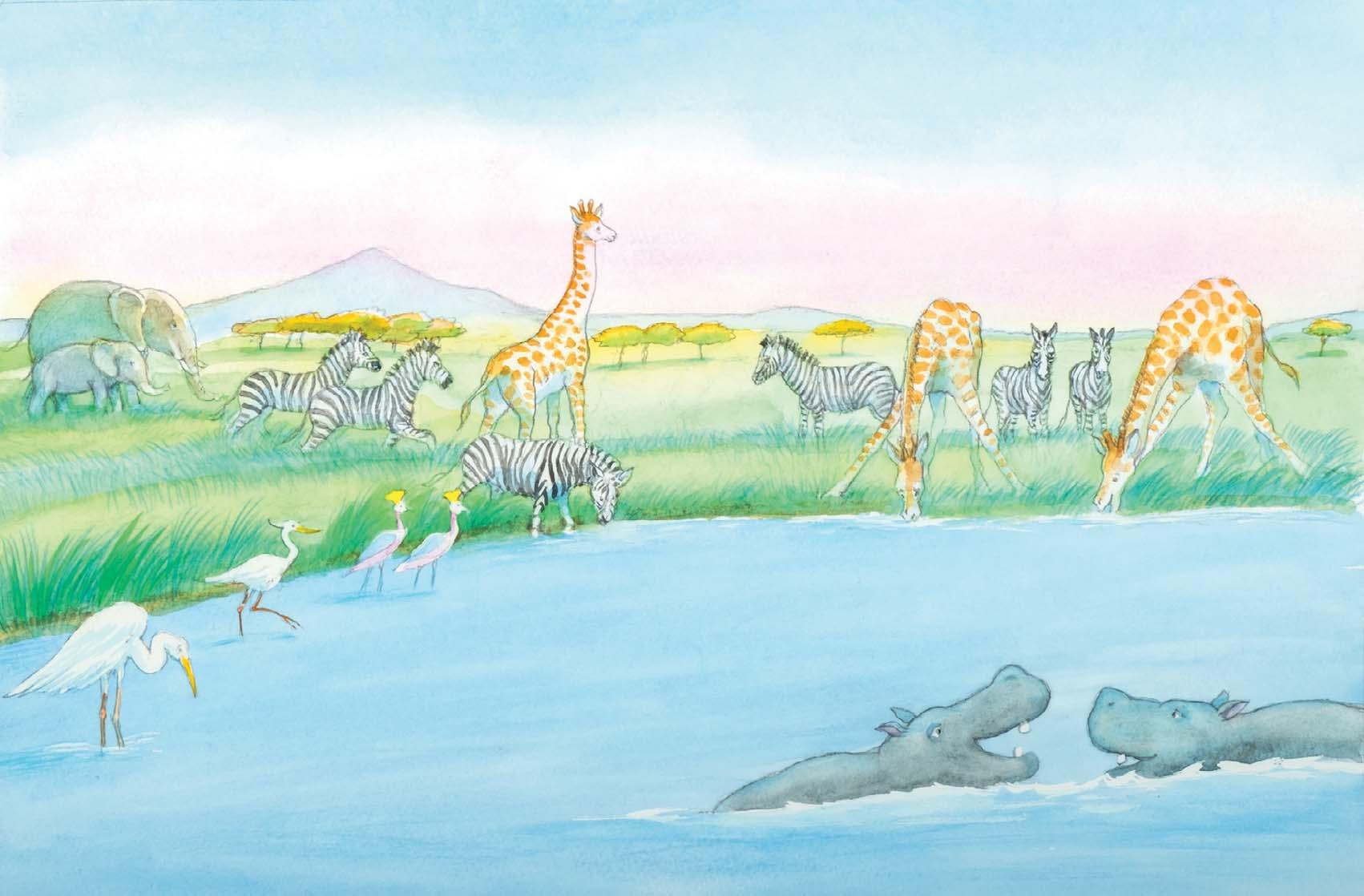

o 275 287 are all illu trated in Michael Foreman, Noa and the Little Elephant, ondon: arper ollin , 2021, [unpaginated]
275 (above left)
P Signed, inscribed with title and dated 2021 Watercolour and pencil 10 ¼ 7 ¾ s Illustrated: front cover
276 (left) K M M s R Rs F R R V R
Signed and dated 2021 Watercolour and pencil 10 ¾ 16 ¾ s
14. Contemporary Illustrators 218
R
Signed and dated 2021
and pencil
¼ 10

R
Signed and dated 2021 Watercolour and pencil with bodycolour 10 ½ 20 s

R
R
14. Contemporary Illustrators 219 277 V
V
Watercolour
10
s 278 M s F , V M
P


14. Contemporary Illustrators 220
279 (opposite above left)
Rs s
P s s P s RR s s R V sKs
Signed and dated 2021 Watercolour and pencil 6 ½ 6 ½ s
280 (opposite above right)
F Rs P s FR s , R s
s R V R K FR
Signed and dated 2021
Watercolour and pencil 8 ¾ 6 ½ s

281 (opposite below)
s M M s F s J P R M s
Signed and dated 2021 Watercolour and pencil 10 ½ 20 s
282 (below) s Ks, P M
J s P R F F M , P R F V F
Signed and dated 2021 Watercolour and pencil 16 ½ 18 ½ s
14. Contemporary Illustrators 221


14. Contemporary Illustrators 222 283 , R s R M s s RM. s F R s s R M F s Signed and dated 2021 Watercolour and pencil 9 ½ 8 ¾ s 284 M R , R V R s R s R R Rs V R Ks. R M K s R s s s F FR M F R Signed and dated 2021 Watercolour and pencil with bodycolour 11 7 ¾ s
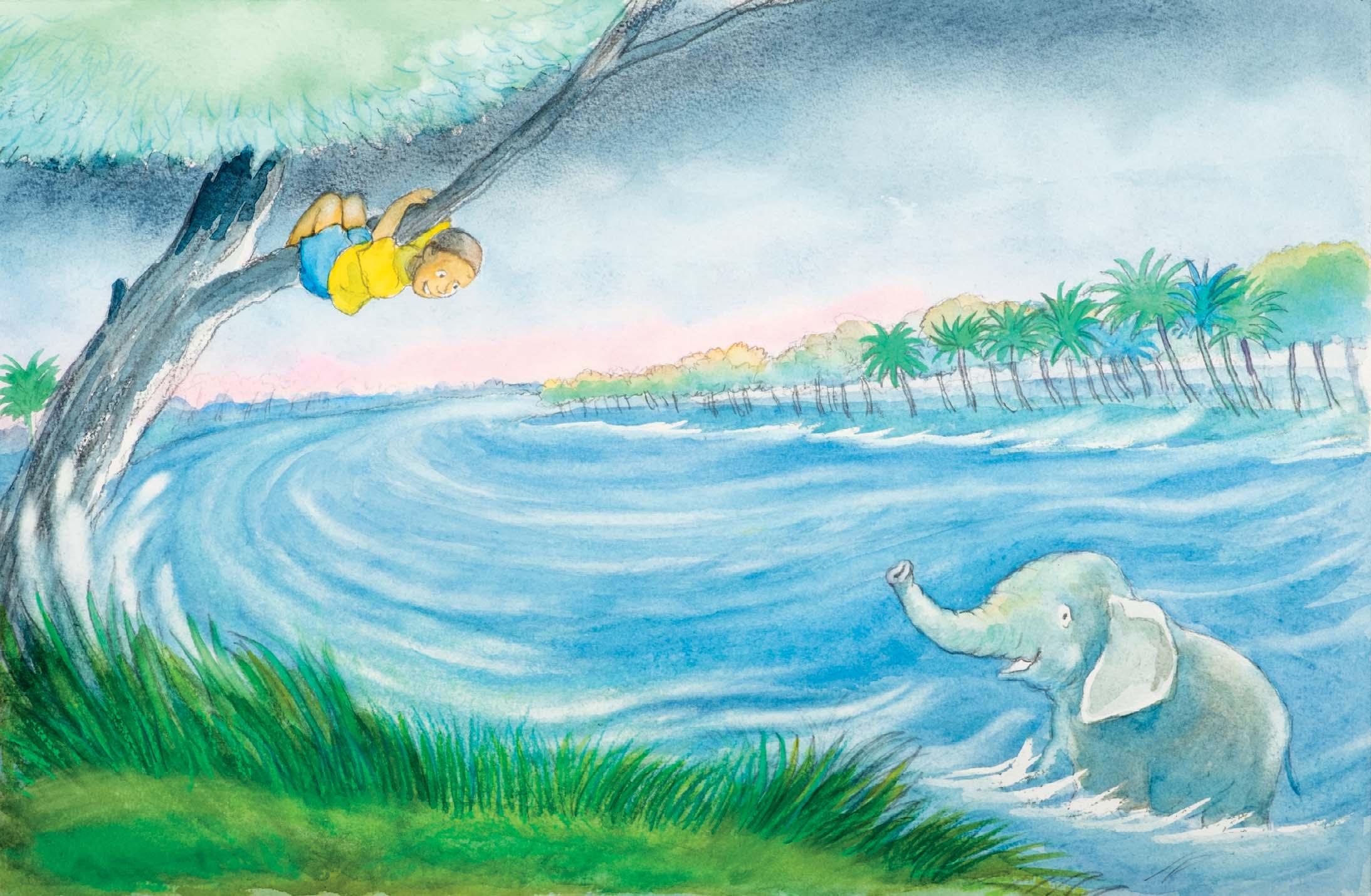
14. Contemporary Illustrators 223 285 s M M R FR M R V R M. ‘s M s ’ ’s F Signed, inscribed with book title below mount and dated 2021 Watercolour and pencil with bodycolour 10 ¼ 16 s
P sP
Signed, inscribed with title below mount and dated 2021 Watercolour, pencil and bodycolour
¼ 10
R P
Signed, inscribed ‘Noa’ below mount and dated 2021 Watercolour and pencil
7 ¾
Illustrated: back cover


14. Contemporary Illustrators 224 286
s
10
s 287 M
11
s
PETER CROSS
Peter ro (born 1951)
From 1975, Peter ro began to emerge a an illu trator of great originality, making hi name with book that continue to delight children and adult alike. nwilling to re trict hi fertile imagination to two dimen ion , he al o created a erie of eccentric cabinet of curio itie . such richne and variety were then directed toward adverti ing and, in particular, to delightful work for the company ine Rack. ro ’ dry, yet charming vi ual-verbal wit ha reached a wide international public through de ign for greeting card , r t for ordon Fra er ( allmark 1995-2000) and then for he reat riti h ard ompany.
For a biography of Peter ro , plea e refer to The Illustrators, 2018, page 150


289 s R Rsssss
Signed with initials and dated 2022 Watercolour and pencil 4 ¾ 4 s
288 (below left) FR M s Rs RM
Signed with initials Ink and watecolour 5 ¼ 4 s
290 M R s F s s
Signed with initials and inscribed with title Watercolour with bodycolour 8 7 ¼ s
14. Contemporary Illustrators 225
291


R ’s R K P PP
Signed with initials and inscribed with title Watercolour with pencil 5 ¼ 3 ¼ s

292 P R V
Signed with initials and inscribed with title Watercolour with pencil 4 3 s
293 R s
Signed with initials and inscribed with title
Watercolour and bodycolour 6 ¾ 4 ¾ s
14. Contemporary Illustrators 226

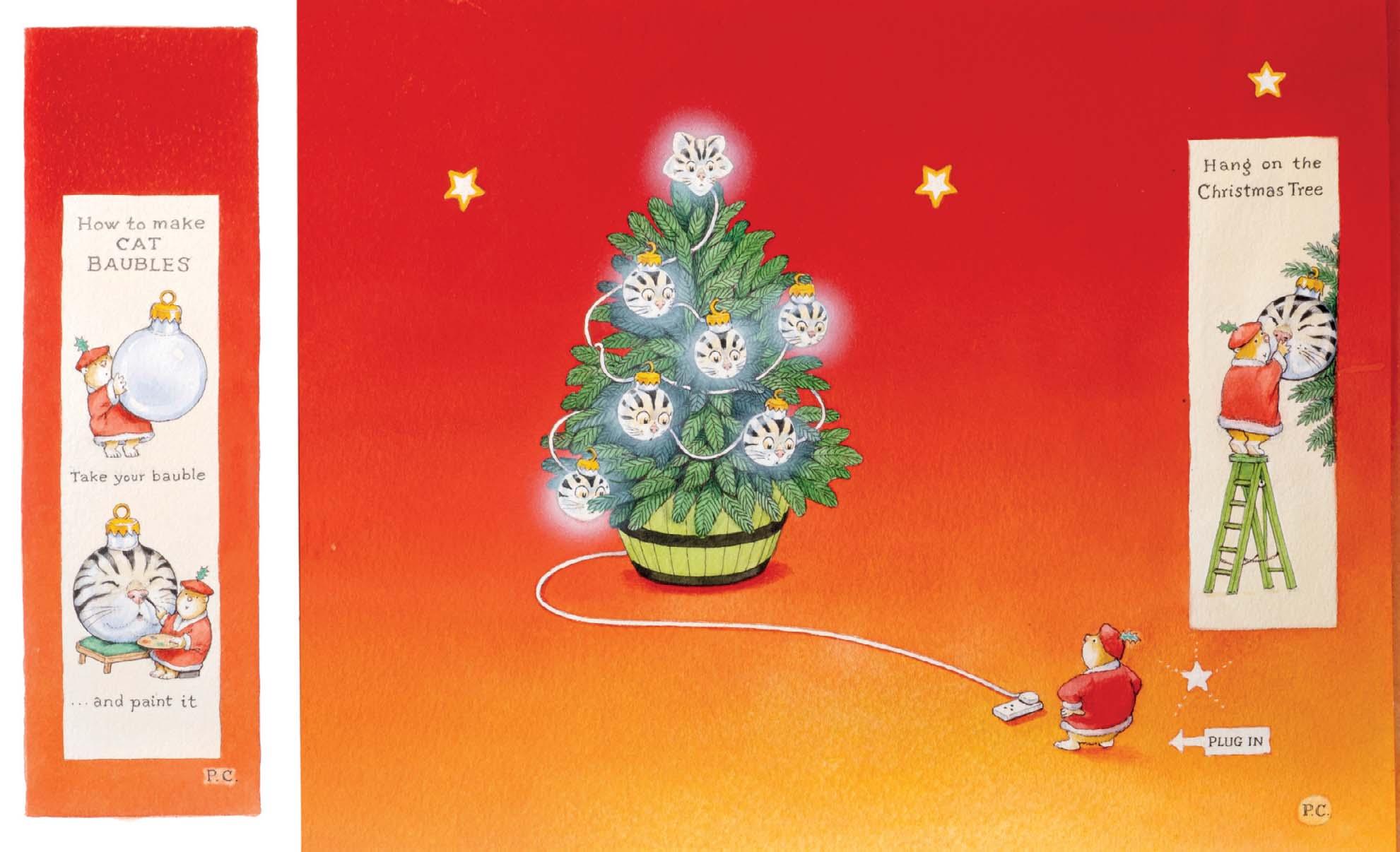

14. Contemporary Illustrators 227 295 M RR R R s M s R ! Watercolour 5 ¾ 4 ¼ s 294 s s Signed with initials and inscribed with title Watercolour with pencil 5 ¼ 4 ¼ s 296 M K s Signed with initials twice Watercolour with bodycolour 9 ¼ 11 ¾ s
AMANDA HALL
manda all (born 1956)
Amanda all i an award-winning contemporary illu trator, particularly renowned for her wonderfully decorative and colourful children’ book illu tration , a well a her work for educational publication both in ritain and merica.
For a biography of manda all, plea e refer to The Illustrators, 2011, page 356
o 297 304 are all illu trated in awn a ey, Little Bear: An Inuit Folktale, loomington, ndiana: i dom ale , 2022

manda all, ha over the la t two year produced an abundance of new work.
Little Bear: An Inuit Folktale, publi hed in 2022 by i dom ale , i her late t illu trated picture book; her econd collaboration with children’ author, awn a ey (following Babushka in 2015). t i a deeply en itive tory ba ed on an nuit folktale; manda all ha captured the warmth of the character in the tory, whil t al o exqui itely depicting the now-covered arctic land cape through the medium of watercolour ink and oft pa tel pencil.


manda all ha ju t completed the illu tration for Jennifer erne’ book How the Sea Came to Be, an evolutionary tale of ea. he book will be publi hed in pril 2023 by erdman ook for oung Reader he hri eetle allery will launch thi beautiful book and di play all the remarkable artwork in a elling exhibition in pril 2023.
with coloured pencil 7 ½ 9 ½
14. Contemporary Illustrators 228
297 s s P , R s P s R. R Signed Watercolour ink
s


14. Contemporary Illustrators 229 299 s s s R P F F R. , s R P – s s V R , sQ K R Signed Watercolour ink with coloured pencil 12 ½ 23 ½ s 298 K , M , M R, M s Signed Watercolour ink with coloured pencil 11 ½ 13 ¼ s
Watercolour ink with coloured pencil 6 12 ½
Signed
ink with coloured pencil 11 13


14. Contemporary Illustrators 230 301 M V Rs F, s
Watercolour
s 300 M F V P R, PR R sP R s M Signed
s

14. Contemporary Illustrators 231 302 sPR , s s , R s M s Ms F Signed Watercolour ink with coloured pencil 11 ½ 13 s
303 “ R”, s P R RMs R s K R Rs R s F R. “ Rs FR ...”
Signed Watercolour ink with coloured pencil 11 12 s 304 s P s R RMs R s K,
Signed Watercolour ink with coloured pencil 11 ½ 21 ½ s


14. Contemporary Illustrators 232
Paul Cox

PAUL COX
PAUL COX
Paul William Cox (born 1957)
Paul Cox’s uid, immediate draughtsmanship and vibrant colour make him one of the most enjoyable, versatile and sought-after of contemporary illustrators. Well known for his warm and witty contributions to books and magazines, he has ranged in his work as a designer from stamps to stage sets. Paul Cox was born in London in 1957, the eldest child of architect Oliver Cox CBE, he was raised in Dorset and Hampshire. Paul Cox studied illustration at Camberwell College of Art and then at the Royal College of Art. After graduating in 1982 he worked as a freelance artist, earning success for his distinctive and lively style of illustration and his work is easily recognised on the pages of the Daily Telegraph, Country Life, The Spectator, The Sunday Times Magazine, Punch, The Times, Blueprint Magazine, Vanity Fair and Esquire
In 1984 Paul Cox began a close professional relationship with the Folio Society, leading to book illustrations that highlight both the warmth and wit of his work. Volumes include: Jerome K Jerome’s Three Men in a Boat (1992) and 17 novels by P G Wodehouse. In 2006, he illustrated the 50th anniversary version of Gerald Durrell’s My Family and other Animals. These illustrations formed two exhibitions at the Durrell Wildlife Foundation, Jersey and Chris Beetles Gallery, London.
Chris Beetles held the rst major retrospective of Paul Cox’s work in 2001, with another in 2013 accompanied by the book A Journey Through His Art. In 2011 Paul Cox moved back from Sussex to his beloved capital:
I have always loved London. I think its in my blood, and I recognise, belatedly, perhaps, that it was somewhere I shouldn’t have left, but I’m glad I had, because I appreciate it more.
It is the city that has inspired much of his work, amongst the vivid depictions of life in Paris, Rome, and New York.
In 2020 he illustrated The Short, The Long and The Tall, a limited-edition collection of short stories by best-selling novelist Je rey Archer. Paul Cox involves himself with a variety of these collaborative works, including stamp designs for the Royal Mail, set designs for the 50th anniversary production of the musical, Salad Days, a mural for the lecture hall at the Royal College of Surgeons, and a variety of work in the States.
Most recently he has completed a series of work exploring the London pubs drawn and frequented by Edward Ardizzone. He continues to live in Highgate with his wife, with whom he has two children.
FOLLOWING IN ARDIZZONE’S FOOTSTEPS
By Robert Bruce
It does seem extraordinary. But if you walk around the area of Maida Vale where Edward Ardizzone lived for most of his life the pubs which he so enjoyed and drew incessantly are largely still there. It is perfectly possible to follow in his footsteps and enjoy the beer, the architectural glories, and the amiable humanity he so loved. He lived at the same house on Elgin Avenue, which now sports a blue plaque to him, from 1920 to 1972. He was a disciplined artist and was at his desk by the window early in the morning working on his books, the Little Tim series, or posters for Guinness, or book and magazine illustrations. And at lunchtime he would pop down to a local pub. There he would continue his work, his son recalled, drawing the locals on the back of a cigarette packet, or a beer mat, or whatever came to hand. These sketches became his pub drawings. And the drawings became books, The Local immediately before the war, and then, the war over, Back To The Local in 1949, both written with Maurice Gorham, an old school chum.
This is what this chapter of paintings by Paul Cox commemorates. ‘There can be no doubt’, Ardizzone’s brother-in-law recorded, ‘that he found the task congenial and he and the author visited the various houses assiduously’. And that is precisely what Paul Cox and I did on some of the hottest days of the summer this year. We stuck to our task. We would visit the Hero of Maida, in Ardizzone’s day called The Shirland, where the winding wooden staircase still exists beneath which in his 1955 etching he shows two delightful old ladies enjoying a drink. We would move to the glory of the Prince Alfred [nos 306 308 ] with its many original bars, its curving etched glass windows and its snob screens to enable demure ladies to preserve their privacy while buying a drink, and think how amazed Ardizzone would be to learn that it has just been granted Grade II* listing, the second highest grade on the National Heritage List of England. Then to The Warrington [no 309 ] with its huge circular bar and the grand staircase on which Ardizzone depicted ‘the girls’ in all their ra sh disarray. It was the most enjoyable research that either of us could imagine. In Cox’s depiction of the main bar in the Prince Alfred [no 307 ] his pint of Guinness is refreshingly in the foreground.
Ardizzone’s son Nicholas once said of his father: ‘It was in pubs he found the humanity that fascinated him, the awed fallible humanity for which he had such a keen visual sense’. Cox has a similarly non-judgemental and sweet attitude to people and he has added to the repertoire of Maida Vale pubs. One pub, up on the border with St John’s Wood, now converted into a private
15 15. Paul Cox 234
house, was The Alma. It was an Ardizzone favourite. He loved the landlord and landlady, the family atmosphere, and the characters attracted to the pub. One would play his cornet at the door, others played the saw, and one would, for a bet, apparently set up a primus stove and fry and then eat his socks on the premises [no 310 ]. As far as we know Ardizzone never drew the scene, but Paul Cox has. Invariably drawing from exactly the same viewpoint as Ardizzone, Paul has commemorated his work from eighty years ago and celebrated the survival of all these extraordinary and joyous pubs.
Please see Edward Ardizzone in chapter 7, pages 117-128
305 THE ELGIN
ELGIN AVEN E
Signed, inscribed with title and dated 22 Ink and watercolour
THE ELGIN
At the other end of Elgin Avenue from their home this would often be a last call on a ramble round the local pubs for Ardizzone, his son and his dog, Toby.

15. Paul Cox 235
16 11 ¼ INCHES
306
THE PRINCE ALFRED CASTELLAIN RD
Signed, inscribed with title and dated 22 Ink and watercolour 15 ¾ 11 ½ INCHES
THE PRINCE ALFRED
Outside the Alfred in the warmth of a summer’s dusk couples gather, bathed by the interior glow through the etched and elaborate glass of the windows.

307
THE PRINCE ALFRED FORMOSA ST
Signed, inscribed with title and dated 22 Ink and watercolour 16 ¼ 22 ¾ INCHES
The artist’s own pint of Guinness is a tempting stretch away. The Ladies Bar with its snob screens, only found in one other pub in London, is at the far end.


15. Paul Cox 236
308 SALOON BAR AT THE PRINCE ALFRED
Signed, inscribed with title and dated 22 Ink and watercolour 15 ½ 11 ½ INCHES
The saloon bar of the Alfred is the place to relish the elaborate woodwork around the Ladies Bar and the towering ornate shelves of bottles topped by its clock, which has long ceased working.

15. Paul Cox 237
309
THE WARRINGTON HOTEL
Signed, inscribed with title and dated 22 Ink and watercolour
THE WARRINGTON HOTEL
This is the most epic of Maida Vale’s pubs and this Cox painting echoes one of Ardizzone’s pictures where he depicts himself, the gent on the right, gazing in a slightly worried fashion up at the lady on the grand staircase.

310 FRYING SOCKS AT THE ALMA
Signed, inscribed with title and dated 22 Ink and watercolour 7 ½ 10 INCHES

15. Paul Cox 238
16 23 INCHES
311 THE BRIDGE HO SE
WESTBO RNE TERRACE
Signed, inscribed with title and dated 22 Ink and watercolour 14 ½ 11 ½ INCHES
THE BRIDGE HO SE
Nightfall again, here at the peaceful Bridge House by the canal at Little Venice. The evening punctuated by the sharp quacks of coots.
312
THE CLIFTON CLIFTON HILL
Signed, inscribed with title and dated 22 Ink and watercolour 15 ½ 11 ½ INCHES

THE CLIFTON
This is the closest you get to a country pub in London. In Ardizzone’s day the long building behind, now occupied by lawyers, was the home of Carlton Film Studios where he had many chums.

15. Paul Cox 239
313
THE WARWICK CASTLE WARWICK PLACE
Signed, inscribed with title and dated 22 Ink and watercolour 20 ½ 16 INCHES
THE WARWICK CASTLE
Ardizzone depicted two men walking towards the pub in keen Sunday morning anticipation. Paul Cox also shows two men, this time in the early evening under the antique illuminated lantern.

15. Paul Cox 240

Peattie + Taylor
Produced by Russell Taylor and Charles Peattie, the Alex strip rst appeared in the London Daily News in 1987. It moved to the Independent later that year, before nding a home at the Daily Telegraph in 1992. The strip celebrated its 30th anniversary with the Telegraph earlier this year.
For over three decades, Alex has followed the daily life of its eponymous lead, a snobbish, narcissistic, materialistic investment banker and those of his friends, colleagues and loved ones. Occurring in ‘real time’, the strip has chronicled all the major news stories, global politics and nancial crises of the last 30 years.
the station’s listenership (many of whom seemingly believed that Alex was a real banker).
Russell moonlights by writing lm and TV music (in collaboration with Steve Cooke). Their programmes, mainly very depressing documentaries, have won seven Emmies, seven BAFTAs, an Amnesty International Award and a Prix Italia. Russell is married to taxidermist, author and promoter Suzette Field. They live in North London with their daughter.
Russell Taylor was born in York in 1960. He read Russian at St Anne’s College, Oxford. His rst book, co-authored with Marc Polonsky, was USSR – From an Original Idea by Karl Marx (Faber 1986) – a humorous guide to the Soviet Union, which earned him what is still the most vituperative review of his career (in Pravda).
Russell met cartoonist Charles Peattie at a Christmas party in 1986 for the magazine Direction on which they both worked. Their rst Alex cartoon strip appeared on February 23rd 1987 in the short-lived London Daily News. When that paper folded ve months later Alex transferred to the Independent. In January 1992 he treacherously defected to the Daily Telegraph where he has resided ever since. Alex also appears in newspapers abroad and is particularly popular in Australia and, perhaps surprisingly, in Germany (who says they don’t have a sense of humour?).
After a brief midlife crisis in the late 90s Russell ran the New York Marathon and wrote a book of his experiences The Looniness of the Long Distance Runner (Andre Deutsch 2001). In 2002 he and Charles were appointed MBE for services to the newspaper industry.
In 2007 the pair wrote and produced Alex the eponymous and successful stage play, starring Robert Bathurst, which was performed at the Arts Theatre in London. The play toured the world and returned to the West End in 2008.
In 2010 Russell and Charles wrote a ten week drive time show for Classic FM, which was hosted by Alex (aka Robert Bathurst) and shocked and scandalised
Charles Peattie was born in 1958. He was educated at Great Walstead Prep School and Charterhouse Public School before studying painting at St Martin’s School of Art. After leaving St Martin’s, Charles began working as a painter of society portraits, but gave up painting professionally in 1985. By this time, he had been submitting gag cartoons to Private Eye for a few years and in 1985 he had begun the cartoon strip ‘Dick’ with writer Mark Warren in the music magazine, Melody Maker.
After meeting Russell Taylor in 1986, the pair published the rst Alex strip in the Daily London News in February 1987. In May of the same year, he began drawing the Celeb strip for Private Eye. Charles would also write the script for the BBC One sitcom series, Celeb, based on the strip. The show starred Harry En eld and Amanda Holden and aired in 2002. In 1999, Charles Peattie would collaborate with Mark Warren on the Grenada television comedy drama Passion Killers, starring Ben Miller and Georgia McKenzie. He also wrote sketches for three seasons of the television sketch show Lenny Henry in Pieces, which ran between 1998 and 2001.

In 2009, Charles produced a series of animated shows designed for telephones, including an animated Alex strip commemorating the Financial Crisis. In 2012, he wrote and drew the Alex Christmas story ‘It’s a Wonderful Crisis’, which ran over the Christmas period in the Daily Telegraph
In 2014-2015, Charles created animated scenes for the backdrop of a stage adaptation of Christopher Reid’s The Song of Lunch, which ran at The Minerva Theatre in Chichester, starring Robert Bathurst.
Charles married his rst wife in 1988 and married again in 2005. He has two daughters from his rst marriage and two sons from his second. He became a grandfather for the rst time in 2014.
16 16. Alex 242 ALEX
ALEX
Charles Peattie (born 1958) + Russell Taylor (born 1960)
314 (above)
LAWRENCE IS A HUGE CRICKET FAN, BUT HIS COMPLIANCE DEPARTMENT WOULDN’T LET HIM ACCEPT OUR INVITAION TO TODAY’S TEST MATCH
Signed Ink with coloured pencil 4 ¼ 14 ¼ INCHES Illustrated: Daily Telegraph , 12 September 2019


315 (below)
MY WIFE HAS BEEN PUTTING PRESSURE ON ME TO GO BACK TO THE OFFICE...
Signed Ink with coloured pencil 4 ½ 14 ¼ INCHES Illustrated: Daily Telegraph , 3 June 2022
16. Alex 243
316 (above)
OUR NEW GRADUATE HIRE WHO SEEMED SO BRIGHT AND KNOWLEDGEABLE TURNS OUT NOT TO BE SO

Signed Ink with coloured pencil 4 ½ 14 ¼ INCHES Illustrated: Daily Telegraph , 7 June 2022
317 (below)
IN A WAY WE HAVE THE PERFECT MODERN RELATIONSHIP IN THAT WE GET TO SPEND ALL DAY TOGETHER
Signed Ink with coloured pencil 4 ½ 14 ¼ INCHES Illustrated: Daily Telegraph , 27 June 2022

16. Alex 244
318 (above)
WELL THE RECENT TEST SERIES AGAINST NEW ZEALAND HAS PRODUCED THREE ENTERTAINING, COMPETITIVE AND COMPELLING GAMES
Signed Ink with coloured pencil 4 ½ 14 ¼ INCHES Illustrated: Daily Telegraph , 1 July 2022
319 (below)
EVERYONE’S SAYING HOW AMAZING IT WAS TO SEE MACCA AND SPRINGSTEEN ON STAGE AT GLASTONBURY AND MICK JAGGER IN HYDE PARK LAST WEEK...

Signed Ink with coloured pencil 4 ½ 14 ¼ INCHES Illustrated: Daily Telegraph , 4 July 2022

16. Alex 245
320 (above)
IN A WAY IT’S GOOD THAT WE PUT OFF GETTING ENGAGED UNTIL NOW, CYRUS ...
Signed Ink with coloured pencil 4 ½ 14 ¼ INCHES
Illustrated: Daily Telegraph , 5 July 2022


321 (below)
SO IT’S ONLY THREE WEEKS TILL YOUR WEDDING, BRIDGET ... YOU MUST BE SO E CITED. WHERE ARE YOU GOING ON YOUR HONEYMOON?
Signed Ink with coloured pencil 4 ½ 14 ¼ INCHES
Illustrated: Daily Telegraph , 22 July 2022
16. Alex 246
Contemporary Cartoonists

CONTEMPORARY CARTOONISTS
Since 1971, and for almost 50 years, Mac has produced regular cartoons for the Daily Mail and then its sister paper, the Mail on Sunday. He has always considered that he is essentially apolitical, and that his role is to brighten ‘the dreary news copy of the daily paper … by putting in a laugh’. He has achieved this through clear, realistically drawn images, replete with mimetic detail and social comment.
Stan McMurtry was born in Edinburgh on 4 May 1936, the son of the commercial traveler, Stanley McMurtry, and his wife, Janet. When he was about the age of 10, he moved with his family to Solihull in Warwickshire, and was educated locally at Sharmans Cross High School for Boys.
Between 1950 and 1953, McMurtry studied at Birmingham College of Arts and Crafts. Then, having undertaken National Service in the Royal Army Ordnance Corps (1954-56), he moved to Henley-on-Thames, in Oxfordshire, to begin work at Nicholas Cartoon Films, an animation production company newly established by Nicholas and Mary Spargo. By the time of his rst marriage, to Maureen Flaye in 1958, he had become one of the company’s key animators, and would work on two lms that won awards at the Cannes Film Festival. He and Maureen would have one son and two daughters. During his spare time, he began to produce gag cartoons, which he would send to newspapers and magazines, in the hope of their being accepted. Eventually, he had a cartoon published in Today on 7 January 1961.
In 1965, McMurtry left Nicholas Cartoon Films in order to establish himself as a freelance cartoonist. While continuing to contribute cartoons to periodicals, such as Punch and the London Evening News, he also drew strips for children’s comics, including ‘Percy’s Pets’ for Smash and ‘Pest of the West’ for Wham!
In 1968, McMurtry became the topical cartoonist for the Daily Sketch (on the retirement of Norman Mansbridge), and from January 1969 produced a daily cartoon, which he signed ‘Mac’. When the Daily Sketch was absorbed by the Daily Mail in 1971, the editor, David English, chose McMurtry over the Daily Mail’s existing political cartoonist, Wally Fawkes. McMurtry then worked in tandem with John Musgrave-Wood (who signed as ‘Emmwood’), until Musgrave-Wood retired in 1975. From that year, McMurtry drew ve cartoons a week, with John Kent contributing the sixth, then from 1979 drew four a week. From 1978, his cartoons were collected in annuals, and later celebrated
in two volumes edited by Mark Bryant: 25 Years of Mac (1996) and 50 years of Mac (2018).
During the 1970s, McMurtry also collaborated with Bernard Cookson on comedy scripts for Dave Allen and Tommy Cooper (1973-76), and produced a children’s book, The Bunjee Venture (1977), which provided the source for four animated cartoons by Hanna-Barbera (1984-85).
Having divorced his rst wife in 1980, McMurtry married Janet Rattle in Maidstone, Kent, in the following year. From that time, he regularly incorporated her likeness into his cartoons. Then, two decades later, in 2003, when he married his third wife, Elizabeth Vaughan, in Kensington, her likeness began to replace that of Janet.
During the 1980s, McMurtry began to receive the rst of many awards. Most notably, the Cartoonists’ Club of Great Britain voted him Social and Political Cartoonist of the Year (1983, 1984), Cartoonist of the Year (1983, 1988) and Master Cartoonist (2000); the UK Press Gazette named him Cartoonist of the Year (1982, 1984, 1999); the What the Papers Say Awards named him Cartoonist of the Year (2003, 2007); the Cartoon Art Trust named him Political Cartoonist of the Year (2007) and presented him with a Lifetime Achievement Award (2010); and the Society of Editors named him Cartoonist of the Year (2016, 2018). In 2004, he was appointed a Member of the Order of the British Empire. A member of several clubs, he was Chairman of the Saints and Sinners for the year 2015-16.
McMurtry retired from the Daily Mail in 2018, in the year following the death of his third wife, Liz. However, he came out of retirement in December 2020 to work for the Mail on Sunday
His work is represented in the collections of the British Cartoon Archive, University of Kent (Canterbury).
17 17. Contemporary Cartoonists 248
MAC
Stanley McMurty, MBE (born 1936), known as ‘Mac’
322
OVER THERE, HAMISH. THE STRANGE CREATURES WITH BUMPS ON THEIR CHESTS, LONG HAIR AND NO TROOSERS. I THINK THEY MUST BE THOSE WOMEN THINGS WE’VE HEARD ABOUT Signed and inscribed with title Ink and watercolour with bodycolour 15 22 INCHES
Illustrated: Daily Mail , 15 March 2017
323
THAT’SH IT. NO MORE DRINKING! HAVE YOU MADE ANY NEW YEAR RESHOLUTIONS, VERA? Signed and inscribed with title Ink and watercolour with bodycolour 14 ¾ 19 ¾ INCHES
Illustrated: Daily Mail , 1 January 2015
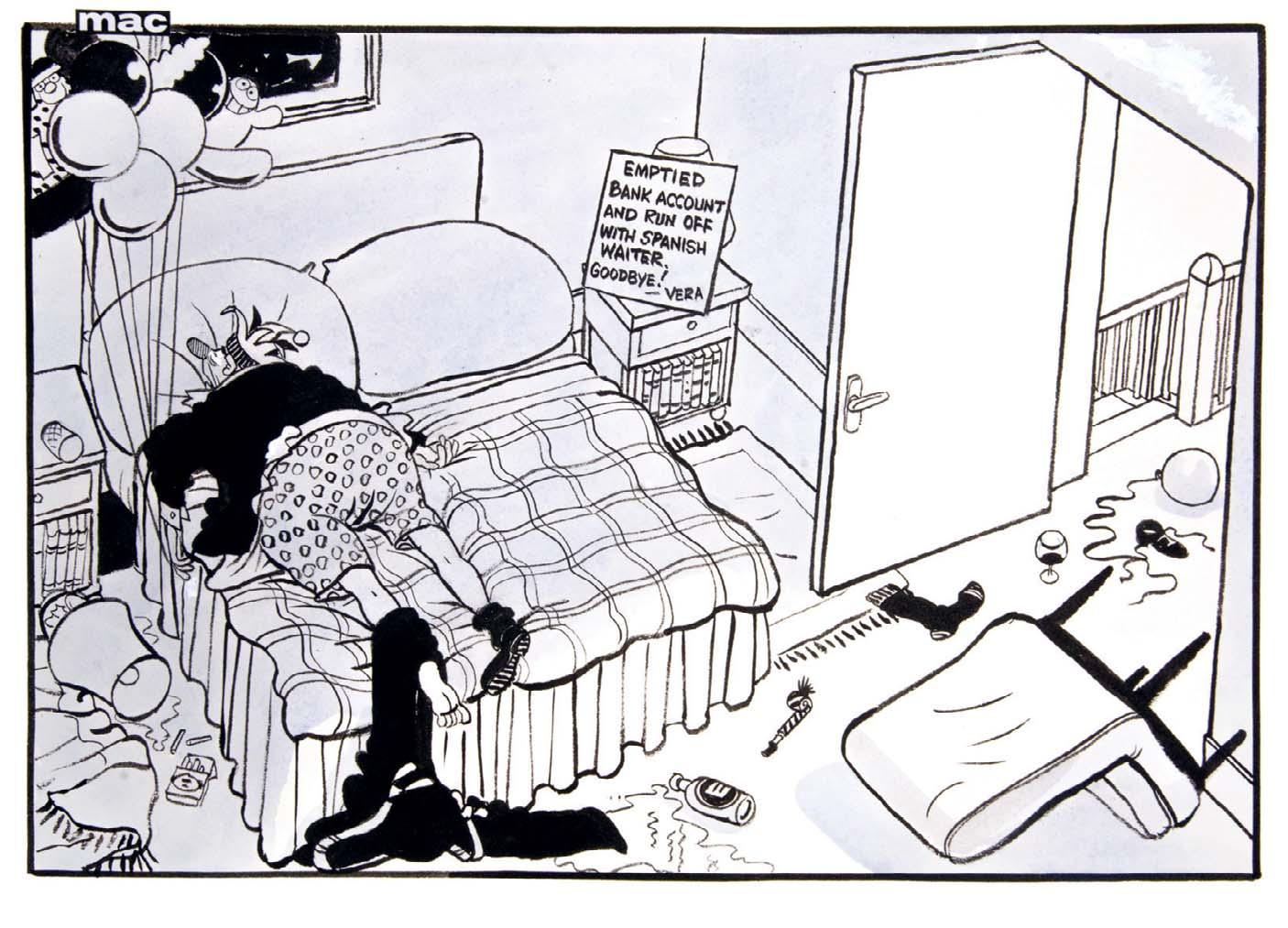

17. Contemporary Cartoonists 249
324 ALL THAT DRILLING AND BANGING. I E PECT ANGUS NE T DOOR IS MAKING ANOTHER OF HIS ENERGY SAVING DEVICES. Signed and inscribed with title Ink and watercolour 15 20 INCHES

Illustrated: Daily Mail , 2 August 2017
325
WELL. HERE’S A LAUGH. IT SAYS ON THE MENU ‘GROPING IS AT YOUR OWN RISK’
Signed and inscribed with title Ink and watercolour with bodycolour 14 ¾ 19 ¾ INCHES
Illustrated: Daily Mail , 25 January 2018

17. Contemporary Cartoonists 250
326 SCOFF ALL YOU LIKE. IT’S MY DUTY AS PRESIDENT OF HIS FAN CLUB TO ARRANGE LITTLE SURPRISES LIKE THIS Signed and inscribed with title Ink and watercolour with bodycolour

14 ¾ 20 INCHES
Illustrated: Mail on Sunday , 19 December 2020, ‘Mac is back!’ (article announcing Mac’s return from retirement)
327 OH NO! HAPPY AND SLEEPY MUST HAVE HAD LINKS WITH THE SLAVE TRADE! Signed and inscribed with title Ink and watercolour
14 ¾ 19 ¾ INCHES
Illustrated: Mail on Sunday , 19 December 2020, ‘Mac is back!’ (article announcing Mac’s return from retirement)

17. Contemporary Cartoonists 251
MIKE WILLIAMS
Michael Charles Williams (born 1940)
Since his rst cartoon was published in Punch in 1967, Mike Williams has contributed regularly to many periodicals. His technically con dent watercolour images have an immediate charm, but can also be darkly humorous. He has a particular interest in comic representations of animal life, which he calls his ‘Animalia’, and of historical events.


For a biography of Mike Williams, please refer to The Illustrators, 1999, page 245.
328
Signed
Signed
17. Contemporary Cartoonists 252
330 (right) ... NO BUT SERIOUSLY ... Signed and inscribed with title Ink and watercolour 12 15 ½ INCHES
(above) NOW DO YOU BELIEVE ME?
Ink and watercolour 10 13 ¾ INCHES 329 (above right) RECYCLING
Ink and watercolour 9 13 INCHES
ED MCLACHLAN
Edward Rolland McLachlan (born 1940)
Widely regarded as one of the greatest living English cartoonists, Ed McLachlan o ers a comical but often cutting commentary on modern life. From his gormless, baggy-suited businessmen to his ungainly bucktoothed women, his undeniably British sense of humour makes him a master of the macabre with an eye for the ridiculous. In every cleverly observed image, he takes the mundane and delivers the hilariously absurd.
For a biography of Ed McLachlan, please refer to The Illustrators, 2002, page 110.


331 (above)
COBBERDOG
7 ½ 10 ½ INCHES
Illustrated: The Oldie , issue 414, June 2022
332
I MUST SAY, THIS IS THE MOST HOSTILE DESERT I’VE EVER E PERIENCED
Signed and inscribed with title
and watercolour 13 ½ 9 INCHES
Illustrated: The Oldie , issue 414, June 2022
333 (left)
DE RAMBOIS SCHOOL OF BALLET
Signed Ink with watercolour 7 ½ 8 ¾ INCHES
Illustrated: The Oldie , issue 415, July 2022, page 67
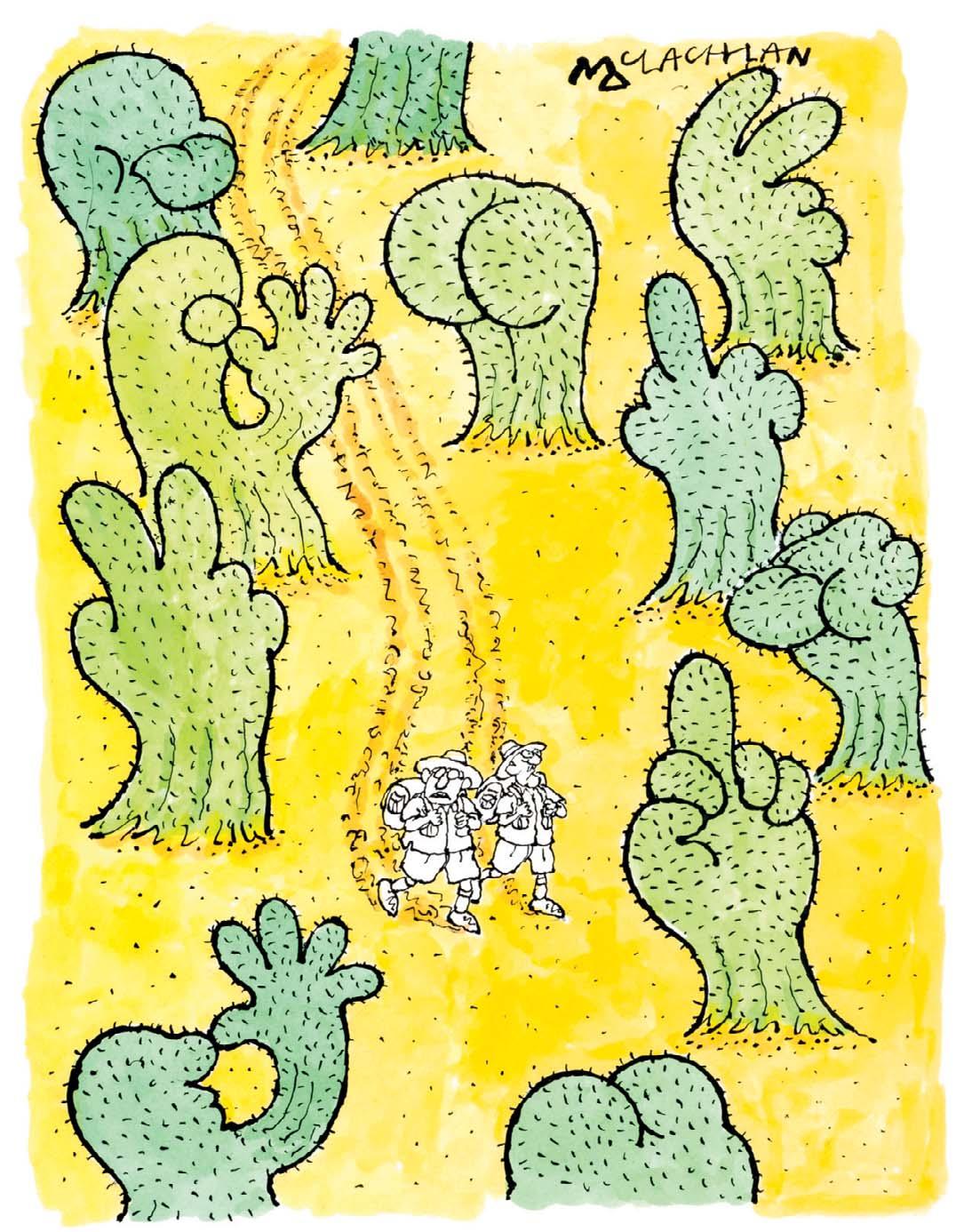
17. Contemporary Cartoonists 253
AUSTRALIA’ S NO 1 DOG WALKING SERVICE Signed Ink and watercolour
Ink
334
HE DIDN’T WANT TO GO ON HOLIDAY WITH HIS FAMILY THIS YEAR SO THEY TOOK THE DOG INSTEAD Signed and inscribed with title Ink with watercolour 10 16 ¼ INCHES

Illustrated: The Oldie , issue 416, August 2022, page 92
335 WITH THE E ORBITANT PRICE OF SCHOOL UNIFORMS NOW, HIS NEW OUTFIT HAS GOT TO LAST HIM UNTIL HE LEAVES
Signed and inscribed with title Ink and watercolour; 8 9 ½ INCHES
Illustrated: Private Eye , issue 1582, 23 September 2022, page 33

336 NOW THAT’S WHAT I CALL REAL NORTHERN LIGHTS!
Signed Ink and watercolour 10 ¼ 16 ¼ INCHES
Illustrated: The Oldie , issue 412, April 2022, page 63
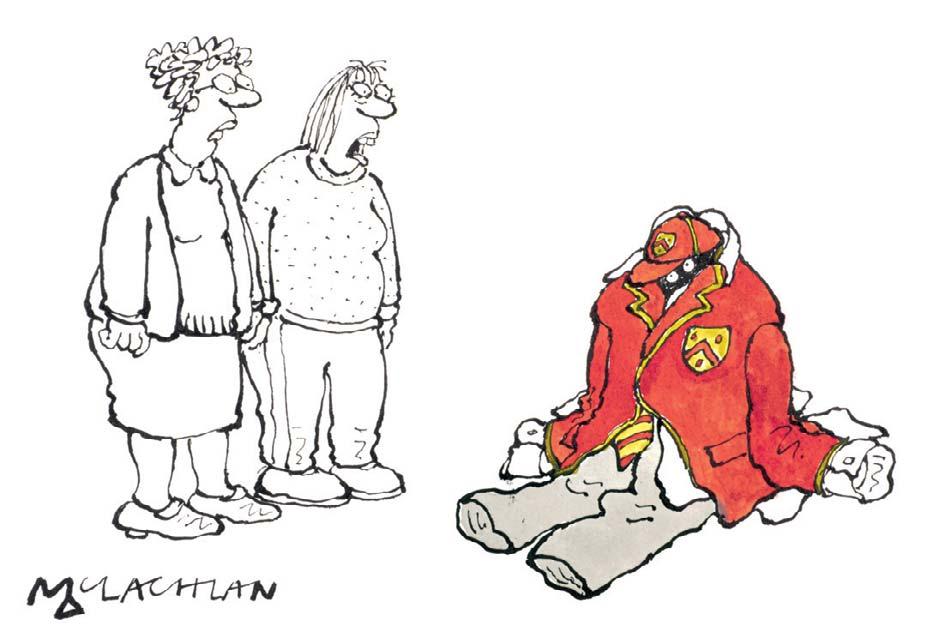
17. Contemporary Cartoonists 254
337
I CAN’T WAIT TO MEET HIM – I WAS TOLD
HE IS A SELF-MADE MAN
Signed and inscribed with title Ink and watercolour 9 10 ½ INCHES
Illustrated: The Oldie
338
NO SNAIL WAS KEPT IN THIS SHELL OVERNIGHT
Signed and inscribed with title
Ink with watercolour 8 ¼ 14 ½ INCHES
Illustrated: The Oldie


339
DO TELL ME IF I’M BORING YOU
Signed Ink and watercolour 9 ½ 13 ¾ INCHES
Illustrated: The Oldie , issue 415, July 2022, page 44

17. Contemporary Cartoonists 255
Cartoonists
PETER BROOKES


Peter Derek Brookes, CBE FRSA RDI (born 1943)
‘His target is rarely the ideology of one politician or another. It is the vanity, inanity and mediocrity of the whole damn lot.’ (Matthew Parris, The Times, 13 October 2009)
Peter Brookes maintains the most consistently high standard of any editorial cartoonist working in Britain today. His daily political cartoons and regular ‘Nature Notes’, produced for The Times, are always inventive, incisive and con dently drawn. They are the fruit of wide experience as a cartoonist and illustrator, and of complete independence from editorial intrusion. For a biography of Peter Brookes, please refer to The Illustrators, 2009, page 164.
His work is represented in the collections of the British Cartoon Archive (University of Kent).
341 ‘Z’ IS FOR ZELENSKY
Signed and dated ‘9 iii 22’ Ink and watercolour 8 11 INCHES Illustrated: The Times , 9 March 2022
342 WORRIED ABOUT PETROL PRICES? TRY THESE
Signed and dated ‘2 iv 22’ Ink and watercolour 8 11 INCHES Illustrated: The Times, 2 April 2022
340
WRECKING BALL...
Signed and dated ‘11 xii 21’ Ink and watercolour 8 11 INCHES Illustrated: The Times , 11 December 2021
17. Contemporary
256
343 FAMILY BUTCHER ...
Signed and dated ‘6 iv 22’ Ink and watercolour 8 11 INCHES Illustrated: The Times , 6 April 2022


344 THIS WAR COULD LAST YEARS, PRIME MINISTER
Signed and dated ‘29 iv 22’ Ink and watercolour 8 11 INCHES Illustrated: The Times , 29 April 2022
345 HIS MASTER’S VOICE

Signed, inscribed ‘with acknowledgements ...’ and dated ‘28 ix 22’ Ink and watercolour 8 11 INCHES Illustrated: The Times , 28 September 2022
346 AH, BOND MARKETS ... I’VE BEEN E PECTING YOU!
Signed and dated ‘24 ix 22’ Ink and watercolour 8 11 INCHES Illustrated: The Times , 24 September 2022
17. Contemporary Cartoonists 257
MATT
Matthew Pritchett, MBE (born 1964), known as ‘Matt’
‘His genius lies in being witty without being nasty’ (Charles Moore, quoted in Max Davidson, Daily Telegraph, 17 October 2008)
Matt’s much-loved pocket cartoons provide a consistently original take on the big news stories of the day.


For a biography of Matt, please refer to The Illustrators, 2009, page 185.
Nos 347 356 are all signed, executed in ink and are illustrated in the Daily Telegraph.
347
I’M TRYING TO ORGANISE AN AIRLIFT TO GET BORIS OUT OF WESTMINSTER BEFORE SOMETHING AWFUL HAPPENS
4 3 INCHES Illustrated: Thursday 27 January 2022
348
I’VE GOT OUR NEW FI TURE LIST. WE PLAY CHINA, THEN CHINA, FOLLOWED BY CHINA, CHINA AND CHINA ... 4 3 INCHES

Illustrated: Tuesday 1 March 2022

Matt Pritchett, Matt 2022 , London: Seven Dials, 2022

349
GET THIS OVER TO FORENSICS
4 3 INCHES
Illustrated: Wednesday 26 January 2022, inside cartoon
350
THEY SAY SOME ANIMALS CAN SENSE WHEN A RISE IN INTEREST RATES IS IMMINENT 4 3 INCHES ; Illustrated: Friday 6 May 2022
17. Contemporary Cartoonists 258
351
A RATINGS AGENCY DOWNGRADED MY HAT 5 4 INCHES
Illustrated: Friday 22 June 2012


352
THOSE AREN’T TEARS OF JOY AT SEEING YOU, HE’S BEEN READING AN ECONOMIC FORECAST 4 3 INCHES
Illustrated: Wednesday 24 August 2022

353
I’M PLEASED YOU’RE ALL ENJOYING OUR CENTRAL HEATING, BUT WOULD SOMEBODY PLEASE BUY A DRINK? 4 3 INCHES
Illustrated: Saturday 3 September 2022
354
DEDICATED TO THE RUSSIAN TROOPS IN UKRAINE 4 3 INCHES

Illustrated: Tuesday 13 September 2022, inside cartoon

355
ISAAC NEWTON DISCOVERS THEY’RE FRACKING NEARBY 4 3 INCHES Illustrated: Friday 23 September 2022

356
THIS IS YOUR TORY MP. FORGET EVERYTHING I’VE SAID FOR THE PAST 12 YEARS
4 3 INCHES Illustrated: Saturday 24 September 2022
17. Contemporary Cartoonists 259
JONATHAN CUSICK
Jonathan Kristofor Cusick (born 1978)
Over the last decade, Jonathan Cusick has gained a strong reputation for his work as an illustrator, and particularly his arresting caricatures, which seem to hold a comically distorting mirror up to personalities who are prominent in the contemporary worlds of politics and entertainment.

For a biography of Jonathan Cusick, please refer to The Illustrators, 2010, page 275.
357
LESTER PIGGOTT

Signed Acrylic on canvas paper 9 ½ 5 ¼ INCHES
Illustrated: Radio Times ; 5 May 2001, page 24
358
“SO DO I, I KEEP MINE IN HERE ... FOR LATER”
Signed Acrylic on canvas paper 12 9 INCHES
17. Contemporary Cartoonists 260
359 NODDY HOLDER

Signed
360 (far right)
DAVID BOWIE


Signed
361 PROFESSOR BRIAN CO
Signed
17. Contemporary Cartoonists 261
Acrylic on canvas paper 9 7 ¼ INCHES
Acrylic on canvas paper 7 11 INCHES
Acrylic on canvas paper 14 ¾ 8 INCHES
362
BENEDICT CUMBERBATCH AND CLARE FOY IN ‘THE ELECTRICAL LIFE OF LOUIS WAIN’
Signed Acrylic on canvas paper

17. Contemporary Cartoonists 262
14 ½ 14 INCHES

17. Contemporary Cartoonists 263 363 HAVE I GOT NEWS FOR YOU Signed Acrylic on canvas paper 14 10 INCHES
SELECT BIBLIOGRAPHY
Backemeyer 2005
Sylvia Backemeyer (ed), Picture This: The Artist as Illustrator, London: Herbert Press, 2005
Baker 2002
Martin Baker, Artists of Radio Times A Golden Age of British Illustration, Oxford: The Ashmolean Press & Chris Beetles Ltd, 2002
Bryant 2000
Mark Bryant, Dictionary of Twentieth-Century British Cartoonists and Caricaturists, London: Ashgate, 2000
Bryant and Heneage 1994
Mark Bryant and Simon Heneage, Dictionary of British Cartoonists and Caricaturists 1730-1980, Aldershot: Scolar Press, 1994
Clark 1998
Alan Clark, Dictionary of British Comic Artists, Writer and Editors, London: The British Library, 1998
Driver 1981
David Driver (compiler), The Art of Radio Times. The First Sixty Years, London: BBC, 1981
Feaver 1981
William Feaver, Masters of Caricature. From Hogarth and Gillray to Scarfe and Levine, London: Weidenfeld and Nicolson, 1981
Horne 1994
Alan Horne, The Dictionary of 20th Century Book Illustrators, Woodbridge: Antique Collectors’ Club, 1994
Houfe 1996
Simon Houfe, The Dictionary of British Book Illustrators and Caricaturists 1800-1914, Woodbridge: Antique Collectors’ Club, 1996 (revised edition)
Johnson and Gruetzner
Jane Johnson and Anna Gruetzner, The Dictionary of British Artists, 1880-1940, Woodbridge: Antique Collectors’ Club, 1986 (reprint)
Khoury 2004
George Khoury (ed), True Brit. A Celebration of the Great Comic Book Artists of the UK, Raleigh, NC: TwoMorrows Publishing, 2004
Lewis 1967
John Lewis, The 20th Century Book, London: Herbert Press, 1967
Mallalieu 1976
Huon Mallalieu, The Dictionary of British Watercolour Artists up to 1920, Woodbridge: Antique Collectors’ Club, 1976
Martin 1989
Douglas Martin, The Telling Line. Essays on fifteen contemporary book illustrators, London: Julia MacRae Books, 1989
Matthew and Harrison 2004
H C G Matthew and Brian Harrison (eds), Oxford Dictionary of National Biography, Oxford University Press, 2004 (61 vols)
Peppin and Mickelthwait 1983
Brigid Peppin and Lucy Mickelthwait, The Dictionary of British Book Illustrators: The Twentieth Century, London: John Murray, 1983
Price 1957
R G G Price, A History of Punch, London: Collins, 1957
Ray 1976
Gordon Norton Ray, The Illustrator and the Book in England from 1790 to 1914, New York: Pierpoint Morgan Library, 1976
Reid 1928
Forrest Reid, Illustrators of the Sixties, London: Faber & Gwyer, 1928
Souter 2007
Nick and Tessa Souter, The Illustration Handbook. A Guide to the World’s Greatest Illustrators, Royston: Eagle Editions, 2007
Spalding 1990
Frances Spalding, 20th Century Painters and Sculptors, Woodbridge: Antique Collectors’ Club, 1990
Spielmann 1895
M H Spielmann, The History of ‘Punch’, London: Cassell and Company, 1895
Suriano 2000
Gregory R Suriano, The Pre-Raphaelite Illustrators, New Castle, Delaware: Oak Knoll Press/London: The British Library, 2000
Turner 1996
Jane Turner (ed), The Dictionary of Art, London: Macmillan, 1996 (34 vols)
Wood 1995
Christopher Wood, The Dictionary of Victorian Painting, Woodbridge: Antique Collectors’ Club, 1995 (2 vols)
Select Bibliography 264
CUMULATIVE INDE OF CATALOGUES (1991-2022)
Dates in bold indicate entire chapters devoted to single illustrators
A Abbey, Edwin Austin: 1997
Adams, Christian: 2011 Adams, Frank: 2007
Addams, Charles: 1991, 2015
Ahlberg, Janet: 1992
Aldin, Cecil: 1991, 1992, 1997, 1999
Aldridge, Alan: 2011
Alex (Charles Peattie & Russell Taylor) 2022 Allen, Daphne: 2003
Allingham, Helen: 1996, 1997
Anderson, Anne: 1991, 1996, 2001, 2011, 2012, 2014, 2017
Anton (Beryl Antonia Thompson and Harold Underwood Yeoman Thompson): 1991
Ape (Carlo Pellegrini) 2022
Appleby, Barry: 2010, 2014
Appleton, Honor: 1991, 1992, 1993, 1997, 1999, 2002, 2003, 2007, 2008, 2009, 2010, 2014, 2017, 2018, 2022
Ardizzone, Edward: 1991, 1992, 1993, 1997, 1999, 2001, 2002, 2003, 2007, 2008, 2011, 2012, 2014, 2015, 2017, 2018, 2019
Aris, Ernest: 2007, 2010, 2011, 2019, 2020, 2022
Armour, George Denholm: 2010 Arno, Peter: 2016, 2019
Atkinson, Maud Tyndal: 1997
Attwell, Mabel Lucie: 1991, 1992, 1993, 1996, 1997, 1999, 2000, 2001, 2002, 2003, 2007, 2008, 2009, 2010, 2012, 2014, 2015, 2017, 2018, 2020, 2022
Austen, John: 1991, 1996, 2012 Ayrton, Michael: 1993, 1997
B V A B: 1991
Bacon, John Henry Frederick: 2012 Badmin, Stanley Roy: 1993, 1997, 2015, 2017 Louis Bailly: 2000
Bairnsfather, Bruce: 1992, 1999, 2007, 2008, 2015
Ball, Wilfrid: 1997
Banbery, Fred: 1999, 2000, 2002, 2017, 2020
Barker, Cicely Mary: 1991, 1992, 1993, 1999, 2018
Barker, Kathleen Frances: 2020
Barrett, Angela: 1992, 1997, 1999
Bartlett, William: 1997 Barton, Rose: 1997 Bastien, A-T-J: 1992
Batchelor, Roland: 1993
Bateman, Henry Mayo: 1991, 1992, 1993, 1997, 1999, 2000, 2001, 2003, 2007, 2008, 2009, 2010, 2011, 2012, 2014, 2015, 2016, 2017, 2019, 2020, 2022
Batt (Oswald Barrett): 1997, 2011
Bauerle, Amelia: 1991
Baumer, Lewis: 1991, 1999, 2010
Bawden, Edward: 1993, 1997 Baxter, Doreen: 1992, 1997 Baxter, Glen: 1997, 2003 Baxter, William Giles: 1993, 1996, 1999, 2003
Beadle, James: 1997
Beardsley, Aubrey: 1999, 2000, 2008, 2010, 2015
Beardsley, Aubrey, follower of: 1999
Bedford, Francis Donkin: 1997 Beek, Harmsen van der: 1999
Beerbohm, Max: 1992, 1993, 1997, 1999, 2000, 2002, 2007, 2008, 2010, 2011, 2012, 2014, 2017, 2020, 2022
Begg, Samuel: 1992
Belcher, George: 1991, 1992, 1993, 1996, 1997, 1999, 2002, 2003, 2007, 2010, 2011, 2014 Bell, Robert Anning: 1993, 1996, 1999, 2003, 2007
Bemelmans, Ludwig: 2020 Bentley, Nicholas: 1991, 2007, 2017
Bérard, Christian: 2016 Bernard, C E B: 1999, 2002 Berndt, Walter: 2015
Bestall, Alfred: 1993, 1999, 2011 Biro, Val: 2002
Blackmore, Katie: 1997 Blair, Preston: 1993, 1999 Blake, Quentin: 1991, 1992, 1997, 1999, 2001, 2003, 2007, 2008, 2010, 2011, 2015, 2016 Blampied, Edmund: 1992, 1993 Blathwayt, Ben: 1992, 2000 Bliss, Douglas Percy: 1993, 1997 Bond, Simon: 1993, 1997, 2001 Bone, Muirhead: 1992 Bonnec, Alain: 2016 Boswell, James: 1997 Boucher, William Henry: 1993 Bowman, Peter: 1992 Boxer, Mark: 1991, 2017, 2018, 2019, 2020
Boyd, Tracey: 1992, 1993 Bradshaw, Percy: 1992 Brandt, Bill: 2011 Brangwyn, Frank: 1992, 1999, 2020
Brickdale, Eleanor Fortescue: 1991
Brierley, Louise: 1997 Briggs, Raymond: 1993, 2003 Brock, Charles Edmund: 1992, 1993, 1997, 1999, 2010, 2012, 2022
Brock, Henry Matthew: 1991, 1992, 1993, 1996, 1999, 2012 Brockbank, Russell: 2002, 2003, 2007, 2022
Brooke, Leslie: 2009 Brookes, Peter: 1993, 1997, 1999, 2003, 2007, 2008, 2009, 2010, 2011, 2012, 2014, 2015, 2018, 2019, 2020, 2022
Browne, Gordon: 2003, 2012 Browne, Tom: 1991, 1992, 1997, 1999
Bryan, Alfred: 1993, 1999, 2003 Bull, René: 1991, 1992, 1997, 2019
Bunbury, Henry William: 1993 Burke, Chris: 1993
Burningham, John: 1993, 2002, 2003, 2007, 2017, 2018, 2019, 2022
Butterworth, Nick: 2002, 2003, 2009, 2010
C
Caldecott, Randolph: 1991, 1992, 1996, 1999, 2003
Cameron, John: 1992
Cameron, Katharine: 1993, 1997, 2009
Canziani, Estella: 1993, 1996, 1999
Caran d’Ache (Emmanuel Poiré): 1992, 1993, 1999
Carse, Duncan: 1992, 2001, 2010, 2015
Cartlidge, Michelle: 2003
Casson, Hugh: 1991, 1992, 2002, 2003
Cattermole, George: 2012
Chalon, Alfred Edward: 1993
Cham (Amédée Charles Henri de Noé): 1991
Chapman, Charles Henry: 1999, 2002
Chapman, June Crisfield: 2007
Chesterton, Gilbert Keith: 1991, 1993, 2012
Churcher, Walter: 1992
Clark, Emma Chichester: 1999, 2008, 2009, 2010, 2011, 2015, 2017
Clarke, Harry: 1991, 1996, 2007, 2011, 2019
Claxton, Adelaide: 2003
Cleaver, Reginald: 1991
Cloke, Rene: 1996, 1999
Cobb, Rebecca: 2012, 2014
Coïdé (James Tissot): 2009, 2022 Cole, Richard: 1992, 1993
Collier, Emily E: 1996
Collins, Clive: 1993
Conder, Charles, follower of: 1993, 1999
Corbould, Edward Henry: 2003
Corbould, Richard: 2003
Cowham, Hilda: 1993, 1999, 2012
Cox, Paul: 1993, 1997, 2003, 2007, 2009, 2010, 2011, 2014, 2015, 2016, 2018, 2022
Crane, Walter: 1996, 1997, 1999, 2002, 2007, 2008, 2009, 2011
265
Cumulative Index (1991-2022)
Cross, Peter: 1991, 1992, 1993, 1996, 1997, 2001, 2002, 2003, 2007, 2008, 2009, 2010, 2011, 2015, 2018, 2019, 2020, 2022
Crowe, Derek: 2007
Crowquill, Alfred: 1993, 2003, 2009
Cruikshank, George: 1991, 1996, 1999, 2011, 2012
Cruikshank jnr, George: 1997, 1999
Cruikshank, Isaac: 1991, 1993, 1996, 1999, 2003, 2014
Cruikshank, Robert: 1993 Cubie, Alex: 1993
Cummings, Michael: 1992, 1997, 1999
Cushing, Howard Gardiner: 1999
Cusick, Jonathan: 2010, 2011, 2012, 2014, 2015, 2018, 2019, 2022
D Dadd, Frank: 2015 Dadd, Philip: 1997 Dadd, Richard: 1997 Daley, Mike: 1992 Darrow, Whitney: 2019 Davidson, Victoria: 2003, 2011, 2014
Davis, Jon: 1991, 1992, 1993 Dawson, Eric: 1993 de Grineau, Bryan: 1992 De La Bere, Stephen Baghot: 1991, 1992, 1997, 2001, 2008
Dennis, Ada: 1996
Dickens, Frank: 1993, 1997, 1999, 2003, 2011, 2014, 2016
Dickinson, Geoffrey: 2011 Dighton, Richard: 2014
Dighton, Robert: 2014
Disney, Walt (and the Disney Studio): 1991, 1993, 1999, 2000, 2002, 2003, 2019
Dixon, Charles: 1992
Dobson, Austin: 1996
Donnison, Thomas Edward: 2011 Doré, Gustave: 1997, 1999, 2009 Douglas (Thomas Douglas England): 1992, 1993 Doyle, Charles: 1991, 1992, 1997, 1999, 2002, 2003, 2007, 2009, 2011, 2012
Doyle, Richard: 1991, 1993, 1996, 1997, 1999, 2002, 2010, 2011
Draner, Jules-Renard: 1993 Drew, Simon: 1991, 1992, 1993, 1997, 1999, 2001, 2002, 2003, 2007, 2008, 2010, 2018, 2020
Du Cane, Ella: 1997
Dulac, Edmund: 1991, 1993, 1996, 1997, 2001, 2003, 2007, 2009, 2010, 2012, 2014, 2015, 2017, 2022
Du Maurier, George: 1991, 1992, 1996, 1997, 1999, 2003, 2007, 2009, 2010, 2011, 2012, 2015, 2016, 2017, 2019, 2022
Duncan, John: 1991 Duncan, Walter: 1996 Dunlop, Jessie: 2016 Dyson, Will: 1993, 1997, 1999
E
Earnshaw, Harold: 1996 East, Alfred: 1997 Edwards, Lionel: 1992 Egan, Beresford: 1997 Elgood, George Samuel: 1997 Elliott, James: 1999 Embleton, Ron: 2012 Emett, Rowland: 1991, 1992, 1993, 1996, 1997, 1999, 2000, 2001, 2003, 2007, 2008, 2009, 2011, 2014, 2016, 2017, 2019, 2020, 2022
Emmwood (John Musgrave Wood): 1991, 1993, 1997, 2002, 2007, 2010, 2011, 2014 Evans, Treyer: 2007
F
Fantoni, Barry: 2014, 2015
Ferguson, Norman: 1993, 1999, 2003
ffolkes, Michael: 1991, 1993, 1997, 1999, 2014, 2022
Fitchew, Dorothy: 2022 Fitzgerald, John Anster: 1991, 1997, 1999, 2012
Flagg, James Montgomery: 2015 Flanders, Dennis: 1992 Flather, Lisa: 1991 Fletcher, Geoffrey Scowcroft: 1993 Flint, Francis Russell: 1992 Flint, William Russell: 1993
Folkard, Charles: 1991, 1992, 1997, 2003, 2010, 2019
Ford, Henry Justice: 2002, 2003, 2007, 2008, 2009
Ford, Noel: 1993
Foreman, Michael: 1991, 1992, 1993, 1997, 1999, 2001, 2003, 2007, 2008, 2009, 2010, 2011, 2012, 2014, 2018, 2019, 2020, 2022
Foster, Myles Birket: 1991, 1999
Fougasse (Cyril Kenneth Bird): 1991, 1992, 1993, 1996, 1999, 2003, 2009, 2014, 2015, 2017, 2019, 2022
François, André: 2009, 2014, 2016, 2017
Fraser, Claude Lovat: 1993 Fraser, Eric: 1991, 1992, 1993, 1997, 2001, 2002, 2003, 2007, 2008, 2009, 2010, 2011, 2012, 2017
Fraser, Gordon: 2015 French, Annie: 1991, 1992, 1997, 2003
Frith, Michael: 2010 Frost, William Edward: 1997, 2011
Fulleylove, John: 1996, 1997 Fullwood, John: 1997 Furniss, Harry: 1991, 1992, 1996, 1999, 2003, 2009, 2012
G
Gaffney, Michael: 1991 Gardiner, Gerald: 1992, 1997, 2011
Garstin, Norman: 2003 Gaze, Harold: 1999, 2007, 2017 Gerrard, Roy: 2010, 2014, 2015, 2017, 2019
Gibbard, Les: 2011
Gibson, Charles Dana: 1991, 1999, 2017
Gilbert, John: 1993, 1996
Giles, (Carl Ronald Giles): 1991, 1992, 1993, 1996, 1997, 1999, 2001, 2002, 2007, 2008, 2009, 2011
Gilliam, Terry: 1992 Gilroy, John: 1997 Ginger, Phyllis: 1991, 1992, 1993 Glaser, Milton: 2015
Glashan, John: 1993, 2014, 2017, 2018, 2019, 2020, 2022
Goble, Warwick: 1997, 2002, 2007, 2008, 2010, 2011
Godfrey, Bob: 1993
Goldsmith, Beatrice May: 1996
Goodall, John Strickland: 1991, 1996, 1997
Goodwin, Harry: 1992
Gould, Francis Carruthers: 1992, 1996, 1999, 2003, 2009, 2010, 2012
Gould, Rupert Thomas: 1996 Grant, Keith: 2017 Granville, Walter: 1992 Greeley, Valerie: 1992 Green, Charles: 1991, 1997, 1999, 2012
Green, John Kenneth: 1993 Green, Winifred: 1996, 1999
Greenaway, Kate: 1991, 1992, 1996, 1997, 1999, 2000, 2001, 2003, 2007, 2010, 2012, 2022
Gruelle, Johnny: 2015
Guthrie, Thomas Anstey: 1997
H I C H: 1997
Haité, George: 1997
Hale, Kathleen: 1991, 1996, 2003, 2007, 2008, 2009, 2010, 2011, 2020
Hall, Amanda: 2011, 2012, 2014, 2015, 2017, 2019, 2020, 2022
Hall, Sidney Prior: 1991 Halswelle, Keeley: 1997 Hammond, Roy: 2017 Hampson, Frank: 2002, 2003, 2008
Hancock, John: 1999
Handelsman, J B: 2022
Hankey, William Lee: 1992, 1999 Hardy, Dorothy: 1991
Hardy, Dudley: 1991, 1992, 1997, 1999, 2014
Hardy, Evelyn Stuart: 1993
Hargreaves, Harry: 2015
Haro (Haro Hodson): 1991
Harris, Herbert H: 2003
Harrison, Florence: 2007, 2008, 2011, 2014, 2015, 2017, 2019, 2022
Harrold, John: 1993
Cumulative Index (1991-2022)
266
Hartrick, Archibald Standish: 1999
Harvey, William: 2014
Haselden, William Kerridge: 2010
Hassall, Ian: 1992, 1997
Hassall, Joan: 1992, 2011
Hassall, John: 1991, 1992, 1993, 1997, 1999, 2003, 2011, 2017
Hatherell, William: 1991, 2003 Hawkins, Colin: 1999
Hay, James Hamilton: 1997 Hayes, Claude: 1997 Haywood, Leslie: 1992 Heath, Michael: 1993 Henderson, Keith: 1992, 2015 Hennell, Thomas: 1991 Hennessy, William John: 2019 Henry, Thomas: 1999 Herbert, Susan: 1996 Hergé (Georges Remi): 1991 Hewison, Bill: 2007
Hickson, Joan: 1993 Hilder, Rowland: 1997
Hirschfeld, Al: 2007, 2015, 2016
Hodges, Cyril Walter: 1991, 1993, 1997, 2011, 2017
Hoffnung, Gerard: 1991, 1992, 1996, 1997, 1999, 2007, 2009, 2010, 2011, 2014, 2015, 2017, 2019, 2020
Honeysett, Martin: 1999 Hopkins, Arthur: 1996 Hopwood, Henry: 1997 Houghton, Arthur Boyd: 2002 Housman, Laurence: 1991, 2010 Howitt, Samuel: 1993 Hughes, Arthur: 2003 Hughes, Shirley: 2003 Hughes, Talbot: 1997
Hughes-Stanton, Herbert: 1997 Hunt, William Henry: 1996 Hunt, William Henry, follower of: 1997
Husband, Tony: 2003, 2007
I Illingworth, Leslie: 1992, 1997 Ionicus (Joshua Charles Armitage): 2022 Ivory, Lesley Anne: 1993, 1996
J Jacobs, Helen: 1992, 1996, 1997, 1999, 2002, 2007, 2008, 2009, 2010, 2011, 2014, 2015, 2016, 2017, 2018, 2020
Jacques, Robin: 1991, 1992, 1997
Jak (Raymond Allen Jackson): 1991, 1993, 1997, 1999
Jalland, G H: 1997
Janny, Georg: 1992, 2020
Jaques, Faith: 1991, 2009
Jeffers, Oliver: 2009, 2010, 2011, 2017
Jensen, John: 1991, 1993, 1997, 2008, 2009, 2011
Johnson, Jane: 1991, 1992, 1999, 2007, 2009
Johnstone, Anne Grahame: 1992, 1997, 1999, 2007
Johnstone, Janet Grahame: 1999, 2007
Jon (William John Philpin Jones): 1991
Jones, Jonah: 2014
K
Kal (Kevin Kallaugher): 1991, 1992, 2014, 2015
Kapp, Edmond avier: 1999, 2007, 2011
Keene, Charles: 1991, 1992, 1993, 1997, 1999, 2003, 2007, 2009, 2010, 2011, 2012, 2014, 2015, 2022
Keeping, Charles: 1997, 2012 Kelly, Walt: 2003
Kimball, Ward: 1993, 2003
King, Jessie Marion: 1997, 1999, 2003
Kliros, Thea: 2003
Knight, Laura: 1993
Koren, Edward: 2015, 2019, 2022
L
Lamb, Lynton: 1993, 1997, 2007, 2010, 2017
Lancaster, Osbert: 1991, 1993, 1997, 1999, 2003, 2008, 2009, 2011
Langdon, David: 1991, 1993, 1997
Langley, Jonathan: 1999, 2000, 2007, 2010
Langley, Walter: 1997
Lantoine, Fernand: 1992 Larcombe, Ethel: 1999
Larry (Terence Parkes): 1991, 1992, 1993, 1997, 1999, 2003, 2007, 2010, 2011, 2014, 2015, 2019, 2022
Lawson, John: 2015 Lear, Edward: 1993, 1996, 2002, 2003, 2012
Le Cain, Errol: 1997 Lee, Alan: 1991 (insert), 2010, 2017, 2020 Lee, Joseph: 2007, 2015 Leech, John: 1991, 1992, 1993, 1996, 2003, 2007, 2012, 2014 Leete, Alfred: 2014 Leighton, John: 2003 Leith, Barry: 2015 Leman, Martin: 1993 Leonard, Michael: 1991 Leslie, Charles Robert: 1993, 1996
Levine, David: 2008, 2010, 2014, 2015, 2016, 2019, 2020, 2022 Lewis, John Frederick: 1991 Linton, James Drogmole: 1997 Lodge, G B: 1991
Low, David: 1991, 1993, 1997, 1999, 2001, 2007, 2008, 2011, 2012, 2014, 2016, 2018, 2022 Lucas, John Seymour: 1997 Lucas, Sydney Seymour: 1993 Lusk, Don: 2003
Lynch, Bohun: 2007 Lynch, Patrick James: 1992
M
Mac (Stanley McMurtry): 2007, 2022
Macbeth-Raeburn, Henry: 1997 Macdonald, Alister K: 1999, 2003, 2017
McDonald, Atholl: 2003, 2007, 2011
Macdonald, R J: 2002
McGill, Donald: 1991, 1992, 1997, 1999, 2010, 2011 Mackenzie, Thomas: 2020
McLachlan, Edward: 1997, 2002, 2003, 2007, 2008, 2010, 2014, 2015, 2018, 2019, 2022
MacWhirter, John: 1997
Maddocks, Peter: 1993, 1997
Magerl, Caroline: 2014, 2018, 2019
Mak, Paul: 2016 Mallet, Dennis: 1991, 2010 Mansbridge, Norman: 1991 Marc: see Boxer, Mark Marks, Henry Stacy: 1991, 1997 Marshall, Herbert Menzies: 1997 Marwood, Timothy: 1999 Matania, Fortunio: 1992 Matt (Matt Pritchett): 2007, 2009, 2010, 2011, 2012, 2014, 2015, 2016, 2018, 2019, 2020, 2022
Matthews, Rodney: 1991, 1993
Mavrogordato, Alexander: 1997 May, Phil: 1991, 1992, 1993, 1996, 1997, 1999, 2003, 2007, 2009, 2011, 2012, 2015, 2017, 2019, 2020, 2022
Mays, Douglas Lionel: 1997, 1999, 2007, 2008
Menpes, Mortimer: 1997, 1999 Meredith, Norman: 1991, 1992, 1993, 1997, 1999
Meugens, Sibyl: 1993
Meyrick, Kathryn: 1991 Midda, Sara: 1991, 1992, 1993, 2003, 2016, 2017, 2020
Mill, W: 1999
Millais, John Everett: 2002
Minnitt, Frank J: 2002
Minton, John: 2003 Moira, Gerald: 1997
Monsell, John Robert: 2003 Moore, Fred: 1993, 1999, 2003
Morrow, Edwin: 1993
Morton-Sale, Isobel: 1999, 2002, 2003, 2007
Morton-Sale, John: 1997, 1999, 2002, 2003, 2007, 2017
Munnings, Alfred: 1991
N
Nash, Paul: 1993, 1997
Neasom, Norman: 2014 Nevinson, Christopher Richard Wynne: 2003
Newman, Henry Roderick: 1996 Newman, Nick: 2007
Nibs (Frederick Drummond Niblett): 2008, 2014, 2015
Nichols, Charles: 1993
267
Cumulative Index (1991-2022)
Nicholson, William: 1992, 1999
Nielsen, Kay: 1993, 2001, 2007
Nixon, John: 1999, 2007 Nixon, Kay: 1997
OOdle, Alan: 1991, 1996, 2007, 2010
Oppenheimer, Joseph: 1997 Orrock, James: 1997
Ospovat, Henry: 2002
Outhwaite, Ida Rentoul: 1991, 1999, 2003, 2007, 2008, 2020
Overend, William Heysham: 2014 Oxenbury, Helen: 2003, 2007, 2008, 2009
P Paget, Wal: 2012
Palmer, Harry Sutton: 1991
Papas, William: 2007, 2014 Park, Bertram: 2011
Parsons, Alfred: 1992, 1997
Partridge, Bernard: 1997, 1999, 2002, 2014
Paton, Joseph Noel: 2003, 2015 Payne, David: 1992
Peake, Mervyn: 1997, 2002, 2003, 2007, 2008, 2010, 2012, 2016, 2018, 2022
Pears, Charles: 1991
Pearse, Susan Beatrice: 1996, 2003, 2014
Pegram, Frederick: 1993
Peploe, William Watson: 1996
Peto, Gladys: 1993, 2007
Phiz (Hablot Knight Browne): 1993, 1999, 2003, 2012
Pickersgill, Frederick Richard: 1997
Pinkney, Jane: 2011, 2012, 2014, 2015, 2016
Pisa, Alberto: 1997
Plauen, E O: 2016
Pogany, Willy: 1992
Pollard, N: 1991, 1996
Pont (Graham Laidler): 1991, 1992, 1993, 1996, 1999, 2014, 2016, 2017, 2018, 2019, 2020, 2022
Potter, Beatrix: 1991, 2002, 2007, 2010, 2011, 2020
Poy (Percy Hutton Fearon): 1999, 2007, 2009, 2010, 2011, 2014
Prance, Bertram: 2003
Preston, Chloë: 1999, 2007 Protheroe, Thomas: 1992 Pullen, Alison: 1993 Purton, William, 2015 Pyne, Ken: 1993
Q
Quiz (Powys Evans): 1993, 2007 R
Rackham, Arthur: 1991, 1992, 1993, 1996, 1997, 1999, 2000, 2001, 2002, 2003, 2007, 2008, 2009, 2010, 2011, 2012, 2014, 2015, 2017, 2018, 2019, 2020
Raemaekers, Louis: 1992, 1999 Ralston, William: 2015
Raven-Hill, Leonard: 1992, 1997, 1999, 2003, 2007, 2010, 2012, 2015
Reed, Edward Tennyson: 1993, 1996, 1999, 2003, 2007, 2011, 2012, 2014, 2015
Reid, Stephen: 2003, 2012
Reitherman, Wolfgang: 1993, 1999, 2003
Réthi, Lili: 2007 Reynolds, Frank: 1991, 1992, 1993, 1996, 1997, 1999, 2001, 2002, 2003, 2007, 2008, 2010, 2011, 2015, 2020
Richards, Frank: 1992 Ricketts, Charles: 1993, 2009 Ridegewell, William Leigh: 2003 Rimington, Alexander: 1997 Ritchie, Alick: 1992 Roberson, Peter: 1992 Robertson, Henry: 1997
Robinson, Charles: 1992, 1993, 1996, 1997, 1999, 2003, 2007, 2010, 2011, 2014, 2015, 2017
Robinson, Thomas Heath: 2003, 2011, 2017
Robinson, William Heath: 1991, 1992, 1993, 1996, 1997, 1999, 2000, 2001, 2002, 2003, 2007, 2008, 2009, 2010, 2011, 2012, 2014, 2015, 2016, 2017, 2018, 2019, 2020, 2022
Rosoman, Leonard: 1997, 2011, 2018
Ross, Tony: 1999
Roth, Arnold: 2015, 2016, 2020, 2022
Rothenstein, William: 1997 Rountree, Harry: 1991, 1992, 1993, 1997, 1999, 2001, 2003, 2007, 2010
Rowlandson, Thomas: 1991, 1993, 1996, 1999, 2003, 2007, 2014
Rushton, William: 2003, 2022 Rutherston, Albert: 1992
S
Sainton, Charles Prosper: 1997 Salaman, F J B: 1999 Salmon, J M Balliol: 1999 Sambourne, Linley: 1996, 2003, 2007, 2010, 2015 Sandy, H C: 1991 Saul, Isabel: 1997
Scarfe, Gerald: 1991, 1992, 1993 Schulz, Charles Monroe: 1991, 1992, 1997, 2019
Schwabe, Randolph: 1997, 2016 Scully, William: 2022
Searle, Ronald: 1991, 1992, 1993, 1996, 1997, 1999, 2000, 2001, 2002, 2007, 2008, 2010, 2011, 2012, 2014, 2015, 2016, 2017, 2018, 2019, 2020, 2022 Severn, Arthur: 1996 Shackleton, William: 2007 Shannon, Charles: 1999 Sheldon, Charles Mill: 1999 Shaw, Byam: 1991, 1997, 2014 Shepard, Ernest Howard: 1991, 1992, 1993, 1996, 1997, 1999, 2000, 2001, 2002, 2003, 2007, 2008, 2009, 2010, 2011, 2012, 2014, 2015, 2016, 2017, 2018, 2019, 2020, 2022 Shepard, Mary: 2014
Shepherd, Thomas Hosmer: 2014 Shepherd, William James Affleck: 1993
Shepperson, Claude: 1997, 2007, 2010, 2012
Sheringham, George: 1992, 1997, 2007
Sherriffs, Robert Stewart: 1997, 2007, 2009, 2010, 2011, 2014 Sillince, William: 1991, 2003, 2014
Sime, Sidney Herbert: 1991, 1996, 1999, 2009, 2011, 2017 Simmons, John: 1997 Simmons, W St Clair: 1999 Simpson, Joseph W: 1993, 2007 Slater, Paul: 1999
Slocombe, Edward: 1997 Slocombe, Frederick: 1997 Small, William: 1999 Smith, Jessie Wilcox: 2007 Smith, Richard Shirley: 2022 Smythe, Reg: 1993, 1999
Soper, Eileen: 1991, 1997, 1999, 2003, 2008
Soper, George: 1991, 1997 Sorel, Ed: 2007, 2008, 2011, 2014, 2015, 2016, 2020, 2022
Sowerby, Millicent: 1991, 1992 Spare, Austin Osman: 1991, 1996
Sprod, George: 1997, 1999, 2010
Spurrier, Steven: 1992, 1999
Spy (Leslie Ward): 2009, 2010, 2011, 2012, 2022
Stacey, Walter Sydney: 2009
Stampa, George Loraine: 1991, 1992, 1993, 1997, 1999, 2003, 2007, 2010, 2012, 2014
Staniforth, Joseph Morewood: 2010
Staniland, Charles Joseph: 2014 Stanton, Charles Rebel: 2020 Steadman, Ralph: 1991, 1992, 1996, 1997
Steig, William: 2020, 2022 Stokes, Adrian: 1997 Stokes, Marianne: 1997 Stothard, Thomas: 1999
Stott, Bill: 2014, 2015
Strang, William: 2007
Strube, Sidney: 1999, 2003, 2007, 2014
Studdy, George Ernest: 1991, 1992, 1997, 1999, 2007, 2010, 2011
Sullivan, Edmund Joseph: 1991, 1992, 1997, 1999, 2009, 2010, 2012, 2016, 2018, 2019, 2020, 2022
Sullivan, James Frank: 2014 Swamy, S N: 2012
Swan, John Macallan: 1997
Cumulative Index (1991-2022)
268
Swanwick, Betty: 1991, 1993, 1997, 2008, 2011, 2017
Szyk, Arthur: 2003

TTansend: 1999
Tarrant, Margaret: 1992, 1993, 1996, 1997, 1999, 2002, 2003, 2007, 2008, 2010, 2012, 2014, 2015, 2017, 2018, 2022
Tarrant, Percy: 1991
Taylor, John Whitfield: 2003
Tennant, Stephen: 2003
Tenniel, John: 1991, 1992, 1993, 1996, 1997, 1999, 2003, 2007, 2009, 2010, 2011, 2012, 2014, 2015, 2019, 2022
Thackeray, Lance: 1992, 1997
Thelwell, Norman: 1991, 1992, 1993, 1997, 1999, 2002, 2007, 2009, 2010, 2011, 2014, 2015, 2017, 2019, 2020, 2022
Thomas, Bert: 1991, 1997, 1999, 2003, 2011, 2015
Thomas, Frank: 1993, 1999, 2003
Thomas, William Fletcher: 1993, 1996, 2003, 2014
Thomson, Hugh: 1991, 1997, 1999, 2015
Thorpe, James: 1991 Thurber, James: 1991 Tidy, Bill: 1993, 2014, 2015 Timlin, William Mitcheson: 1996, 1999
Titcombe, Bill: 1999
Topolski, Feliks: 1991, 2011, 2020 Tourtel, Mary: 1993, 1997, 2000, 2011
Townsend, Frederick Henry: 1999, 2010
Tunnicliffe, Charles Frederick: 2018, 2019
Tyler, Gillian: 2012, 2014, 2015, 2017
Tyndale, Walter: 1997
Tyndall, Robert: 1999 Tytla, Bill: 1993, 1999, 2003
U
Umbstaetter, Nelly: 2007 Underhill, Liz: 1992
Van Abbé, Salomon: 1997, 1999, 2011, 2014
Van der Weyden, Harry: 1992 Vaughan, Keith: 1991
Vicky (Victor Weisz): 1991, 1992, 1993, 1997, 1999, 2001, 2002, 2003, 2007, 2010, 2011, 2015
W
Wain, Louis: 1996, 2007, 2010, 2017
Wainwright, Francis: 1991, 1997 Walker, Frederick: 1991, 1999 Walker, John Cuthbert: 2014 Walker, William Henry Romaine: 1993, 1996, 1999, 2010, 2014 Waller, Pickford: 2010 Ward, John: 2010 Ward, William: 1996 Waterman, Julian: 1993 Wateridge, Jonathan: 2002 Watts, Arthur: 2007 Webb, Clifford: 1993 Webster, Tom: 1992
Weedon, Augustus: 1997 Wehrschmidt, Daniel: 1997 Welch, Patrick: 1991 Wells, Rosemary: 1993 Wheeler, Dorothy: 1991 Wheelhouse, Mary Vermuyden: 2015, 2017
Whistler, Rex: 1991, 2003, 2008, 2009
Whitelaw, George: 2007, 2014 Wilkie, David: 1991 Wilkinson, Thomas: 1993 Williams, Kipper: 2007 Williams, Mike: 1999, 2002, 2003, 2007, 2010, 2014, 2015, 2019, 2022
Wilson, Thomas Walter: 2014 Wimbush, Henry: 1997 Wood, John Norris: 2012 Wood, Lawson: 1991, 1992, 1993, 1997, 1999, 2002, 2007, 2008, 2009, 2010, 2011, 2014, 2022
Wood, Starr: 1992, 1997, 1999, 2003, 2007, 2020
Woodward, George Murgatroyd: 2007
Wootton, Reg: 1991, 2003, 2011
Wright, Alan: 1991, 1996, 1997, 2011, 2012, 2017 Wright, John Masey: 1996 Wright, Patrick: 1993, 1997, 1999
Wyllie, William Lionel: 1997 Wysard, Tony: 2015
Y
Yeats, Jack Butler: 1993
Z
Zinkeisen, Anna: 1993, 2007 Zinkeisen, Doris: 2007, 2008
V
Cumulative Index (1991-2022)
269 C E Brock: [60 ]
Alex (Charles Peattie and Russell Taylor) Page 242-246 Ape (Carlo Pellegrini) 40-41
Honor Appleton 77-80
Edward Ardizzone 118-128 Mabel Lucie Attwell 92-97
Henry Mayo Bateman 104-109
Sir Max Beerbohm 88-89 Charles Edmund Brock 64, 69-72
Henry Matthew Brock 64-68 Peter Brookes 256-257 John Burningham 152
Coïdé (James Tissot) 42-43 Paul Cox 234-240 Peter Cross 225-227
Jonathan Cusick 260-263
Edmund Dulac 81
George Du Maurier 23-26
Rowland Emett 130 Michael olkes 160-164
Dorothy Fitchew 84
Michael Foreman 217-224
Fougasse (Cyril Kenneth Bird) 102-103 John Glashan 166-180


Kate Greenaway 28-29 Amanda Hall 228-232
J B Handelsman 196-200
Florence Harrison 74-76 Ionicus (Joshua Charles Armitage) 132-134
Charles Keene 19-22
Charles Keeping 147-148 Edward Koren 212 Larry (Terence Parkes) 149-151 David Levine 201-203
David Low 110-113 Mac (Stanley McMurtry) 248-251 Edward McLachlan 253-255
Matt (Matthew Pritchett) 258-259 Phil May (1864-1903) 30-32 Mervyn Peake 131 Pont (Graham Laidler) 114-116
William Heath Robinson 86-87
Arnold Roth 207-211 Willie Rushton 182-192 William Scully 154-158 Ronald Searle 135-142
Ernest Howard Shepard 98-101 Richard Shirley Smith 214-216 Edward Sorel 204-206
Spy (Sir Leslie Ward) 44-62 William Steig 194-195 Edmund Joseph Sullivan 33-36 Margaret Tarrant 82-83
Sir John Tenniel 6-18 Norman Thelwell 143-146 Mike Williams 252 Lawson Wood 90-91
Index 2022
INDE 2022 270


CHRIS BEETLES GALLERY 8 & 10 Ryder Street, St James’s, London SW1Y 6QB 020 7839 7551 gallery@chrisbeetles.com www.chrisbeetles.com
