Chicago
H I STORY CHICAG O HISTORY | WIN TER 2019
W I N T E R 2 0 1 9 | $10.00
C H I C AG O H I S T O RY On the cover: Sunbeam Coffeemaster Model C-20, designed by Alfonso Iannelli for the Chicago Flexible Shaft Company, 1938. Chromium-plated copper vessels with Bakelite top, base, and handles. Chicago History Museum, Gift of William E. Meehan, Jr., 2018.13.1–4. Photograph by Timothy Paton Jr.
Editor in Chief Rosemary K. Adams Senior Editor Emily H. Nordstrom Assistant Editor Esther D. Wang Designer Bill Van Nimwegen
Copyright 2018 by the Chicago Historical Society Clark Street at North Avenue Chicago, IL 60614-6038 312.642.4600 chicagohistory.org ISSN 0272-8540 Articles appearing in this journal are abstracted and indexed in Historical Abstracts and America: History and Life.
Photography Timothy Paton Jr. Ashley Gillanders
C H I C AG O H I S T O R I C A L S O C I E T Y OFFICERS
David D. Hiller Chair James L. Alexander Chairman Emeritus Walter C. Carlson First Vice Chair Daniel S. Jaffee Second Vice Chair Tobin E. Hopkins Treasurer Falona Joy Secretary Gary T. Johnson Edgar D. and Deborah R. Jannotta President Russell L. Lewis Executive Vice President and Chief Historian HONORARY T R U S T E E
The Honorable Rahm Emanuel Mayor, City of Chicago
TRUSTEES
James L. Alexander Catherine Arias Gregory J. Besio Matthew J. Blakely Denise R. Cade Paul Carlisle Walter C. Carlson Warren K. Chapman Rita Sola Cook Keith L. Crandell Patrick F. Daly James P. Duff Gabriel Estaban (Amado) Lafayette Ford T. Bondurant French Timothy J. Gilfoyle Gregory L. Goldner Mary Lou Gorno David A. Gupta Brad Henderson David D. Hiller Courtney Hopkins Tobin E. Hopkins Cheryl L. Hyman Philip Isom Daniel S. Jaffee Gary T. Johnson Ronald G. Kaminski Randye A. Kogan Judith H. Konen Michael J. Kupetis Robert C. Lee Russell L. Lewis Ralph G. Moore
Michael A. Nemeroff Kelly Noll M. Bridget Reidy Joseph Seliga Jeff Semenchuk Samuel J. Tinaglia Mark D. Trembacki Ali Velshi Gail D. Ward Jeffrey W. Yingling Robert Yohanan HONORARY LIFE TRUSTEE
The Honorable Richard M. Daley LIFE TRUSTEES
David P. Bolger Laurence O. Booth Stanley J. Calderon John W. Croghan Patrick W. Dolan Paul H. Dykstra Michael H. Ebner Sallie L. Gaines Sharon Gist Gilliam Barbara A. Hamel M. Hill Hammock Susan S. Higinbotham Dennis H. Holtschneider Henry W. Howell, Jr. Philip W. Hummer Edgar D. Jannotta Falona Joy Barbara Levy Kipper W. Paul Krauss
Fred A. Krehbiel Joseph H. Levy, Jr. Josephine Louis R. Eden Martin Robert Meers Josephine Baskin Minow Timothy P. Moen Potter Palmer John W. Rowe Jesse H. Ruiz Gordon I. Segal Larry C. Selander Paul L. Snyder TRUSTEES EMERITUS
Bradford L. Ballast Paul J. Carbone, Jr. Jonathan Fanton Thomas M. Goldstein Cynthia Greenleaf Nena Ivon Douglas Levy Erica C. Meyer Eboo Patel James Reynolds, Jr. Elizabeth Richter Nancy K. Robinson April T. Schink Kristin Noelle Smith Margaret Snorf Sarah D. Sprowl Noren Ungaretti Joan Werhane
The Chicago History Museum gratefully acknowledges the support of the Chicago Park District on behalf of the people of Chicago.
Chicago
H I STORY THE MAGAZINE OF THE CHICAGO HISTORY MUSEUM
Winter 2019 VOLUME XLIII, NUMBER 1
Contents
4
Modern by Design: Chicago Streamlines America Olivia Mahoney
28 40 54
No Coughing. No Sneezing. No Spitting. Rosemary K. Adams
Yesterday’s City Robert M. Marovich
Making History Timothy J. Gilfoyle
This patent drawing for the Burlington Zephyr was filed in 1936 and issued in 1941. It captures the train’s streamlined look, which caused a national sensation and influenced American design for years to come. 4 | Chicago History | Winter 2019
Modern by Design: Chicago Streamlines America OLIVIA MAHONEY
“In the perspective of fifty years hence, the historian will detect in the decade of 1930–40 a period of tremendous significance. He will see it as a period of criticism, unrest and dissatisfaction to the point of disillusion—when new aims were being sought and new beginnings were astir. Doubtless he will ponder that, in the midst of a world-wide melancholy owing to an economic depression, a new age dawned with invigorating conceptions and the horizon lifted.” —Norman Bel Geddes, Horizons, 19321
Emil R. Zettler, director of the design department at the School of the Art Institute of Chicago, designed the official medal (above) of the 1933 world’s fair.
uring the 1930s, Chicago became a national center of streamlined design, a popular style that transformed the look and feel of everyday life in America. Streamlined design is one of several modern styles that emerged in Europe and the United States between the world wars. At the time, many architects and designers were seeking new forms that better suited modern times than traditional historic styles, and they found a winner in streamlined design. Inspired by modern machinery, especially airplanes and automobiles, streamlined design is characterized by smooth flowing lines and unadorned surfaces that express a desire for speed, power, and efficiency. The optimistic style struck a responsive chord with American con-
sumers and, according to design historian Jeffrey L. Meikle, “swept past other expressions of modernity with an irresistible metaphoric power.”2 Chicago introduced streamlined design on a mass scale at the 1933–34 A Century of Progress International Exposition. Held in the depths of the Great Depression, the fair served as a beacon of hope in desperate times and attracted huge crowds; more than 40 million people visited during its two seasons. Fairgoers thrilled at the sights of colorful, modernistic buildings and enjoyed a multitude of informative and entertaining attractions, but they seemed especially drawn to the streamlined Burlington Zephyr, a game-changing train that caused a national sensation.
D
Editor’s note: Curated by Olivia Mahoney, the exhibition Modern by Design: Chicago Streamlines America is on display at the Chicago History Museum from October 27, 2018, to December 1, 2019. The gallery features nearly three hundred objects, photographs, and printed materials dating from the 1930s to 1950s and celebrates Chicago’s role in shaping one of the most popular and enduring design styles in American history. Modern by Design | 5
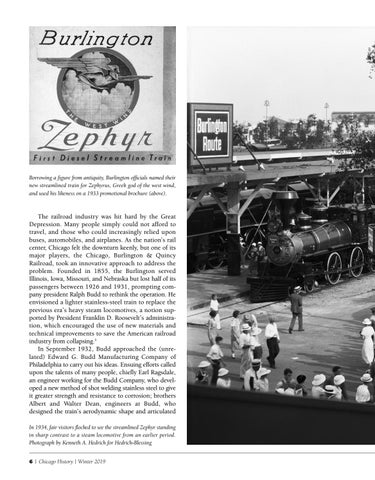
Borrowing a figure from antiquity, Burlington officials named their new streamlined train for Zephyrus, Greek god of the west wind, and used his likeness on a 1933 promotional brochure (above).
The railroad industry was hit hard by the Great Depression. Many people simply could not afford to travel, and those who could increasingly relied upon buses, automobiles, and airplanes. As the nation’s rail center, Chicago felt the downturn keenly, but one of its major players, the Chicago, Burlington & Quincy Railroad, took an innovative approach to address the problem. Founded in 1855, the Burlington served Illinois, Iowa, Missouri, and Nebraska but lost half of its passengers between 1926 and 1931, prompting company president Ralph Budd to rethink the operation. He envisioned a lighter stainless-steel train to replace the previous era’s heavy steam locomotives, a notion supported by President Franklin D. Roosevelt’s administration, which encouraged the use of new materials and technical improvements to save the American railroad industry from collapsing.3 In September 1932, Budd approached the (unrelated) Edward G. Budd Manufacturing Company of Philadelphia to carry out his ideas. Ensuing efforts called upon the talents of many people, chiefly Earl Ragsdale, an engineer working for the Budd Company, who developed a new method of shot welding stainless steel to give it greater strength and resistance to corrosion; brothers Albert and Walter Dean, engineers at Budd, who designed the train’s aerodynamic shape and articulated In 1934, fair visitors flocked to see the streamlined Zephyr standing in sharp contrast to a steam locomotive from an earlier period. Photograph by Kenneth A. Hedrich for Hedrich-Blessing 6 | Chicago History | Winter 2019
Modern by Design | 7
structure that allowed for high-speed travel; and Philadelphia architect Paul Philippe Cret, who devised the distinctive narrow horizontal fluting on the train’s exterior. Last but not least, General Motors of Detroit supplied a revolutionary compact diesel-electric engine that provided much greater power at far less cost than coal-burning steam engines.4 The resulting train consisted of three cars: the engine with a mail car compartment at the front; a combined baggage and passenger car in the middle; and a combined passenger and lounge car at the end. The train’s interior, designed by Cret and John Frederick Harbeson, a principal in Cret’s firm, in consultation with Chicago architects Holabird & Root, continued the modern theme. “Each compartment,” noted Railway Age magazine, “has a distinctive color harmony to which wall colors, window drapes, upholstery and floor coverings all contribute.” The passenger compartments had warm gray walls with a hint of green; soft gray-green mohair Burlington brochures described the Zephyr’s elegant interior (right) as “modern as the moment,” and rival companies soon followed suit with updated train interiors.
The Zephyr’s observation car (above) provided passengers with a modern but comfortable setting in which to enjoy the high-speed dieselpowered ride. 8 | Chicago History | Winter 2019
Designed by Otis Shepard, this 1937 public transit advertisement for Wrigley Gum clearly illustrates the Zephyr’s influence on other areas of American design.
seats with lightweight aluminum frames; matching silk window drapes, and simple taupe carpeting. Similarly, the lounge car had gray walls with a hint of purple-blue; upholstered lounge chairs and Formica tables in the same shade of blue manufactured by S. Karpen Bros. of Chicago; gold window drapes, and platinum-gray carpet. Adhering to modern sensibilities, the only ornamentation consisted of polished stainless-steel bands above the windows and along the ceiling. Light cream-colored ceilings, recessed fluorescent lighting, and air-conditioning throughout the passenger compartments created an atmosphere of calm, soothing comfort.5 On April 18, 1934, Ralph Budd and Edward Budd stood together on a rail platform in Philadelphia and officially christened their new creation the Zephyr, named after the Greek god of the west wind. They then sent the train on a well-publicized national tour that culminated with a high-speed run from Denver to Chicago on May 26, 1934. Its arrival coincided with the opening day of the second season of the A Century of Progress. Sitting next to an old steam engine, the Zephyr looked like a Hollywood glamour girl. Indeed, the train starred in its own movie, The Silver Streak (1934), made by RKO Studios with a plot line based loosely on the train’s dash from Denver. On November 11, 1934, the Zephyr went into regular service between Kansas City, Missouri, and Lincoln, Nebraska. Despite the region’s high unemployment rate, the train attracted so many riders that the company added a fourth car but still had to turn away passengers. Building the Zephyr cost about $250,000, twice the amount of a conventional train, but its popularity and low operating costs doubled Burlington’s profits by 1935, prompting them to order five more from the Budd Company.6
Most major railroads eventually acquired streamlined trains, but the Zephyr’s influence extended well beyond a single industry. Indeed, the train’s enormous popularity inspired local manufacturers to adopt streamlined design for commercial purposed in hopes of sparking sales. Companies employed industrial designers to create a wide range of streamlined goods—from telephones and toasters to tables and tractors—aimed at middle-class consumers. Many of these products came from Chicago, including American Flyer toy trains, Radio Flyer wagons, Schwinn bicycles, Bell & Howell home movie cameras, Motorola radios, and Shure microphones, to name but a few. Additional champions of streamlined design included Montgomery Ward & Company, Sears, Roebuck & Company, Sunbeam, and International Harvester. All ranked among the city’s leading companies and illustrate how Chicago helped make streamlined design a national style. In addition to streamlined design, the fair introduced modern European furniture design to American consumers in the form of tubular steel furniture made by the Howell Company. Founded in 1867, the Howell Company originally operated as a small foundry on the Fox River in Geneva, Illinois, making irons, doorstops, and other cast-iron products. Purchased by Edward E. Ekvall and William McCredie in 1924, the company began making wrought-iron tables, benches, and patio furniture. Some pieces copied the angular, modernistic styles coming from Europe, but most were period revival styles preferred by American consumers. In 1929, Ekvall and McCredie traveled to Europe where they saw chairs made of chromium-plated tubular steel (a new material) designed for mass production by leading modernist designers Ludwig Mies van der Rohe and Marcel Breuer. Modern by Design | 9
Tubular steel furniture made by the Howell Company graced the patio of the General Houses’ Steel House at the 1933–34 Chicago world’s fair. Photograph by Kaufmann & Fabry Company
Returning home inspired, they used imported samples to adapt the designs for their own company’s production. They later employed freelance designers to develop a complete line of modern tubular steel furniture for indoor and outdoor use, the first American company to do so.7 Howell’s timing could not have been better. The Depression forced many Chicago furniture companies out of business. Others survived by reducing their workforces, cutting wages, and making standard items, such as magazine racks and radio cabinets. Hard times called for less expensive furniture and tubular steel pieces fit the bill. Factory workers, not highly skilled craftsmen, could bend tubular steel into pleasing forms in a matter of minutes, not hours. Inexpensive vinyl was quickly tacked onto frames, not laboriously stuffed and sewn like plush upholstery, and sturdy steel-frame chairs and tables were packed and shipped in mass quantities, rather than custom crated for special delivery. Howell displayed its modern wares throughout the 1933–34 Chicago world’s fair, including most of the model homes, one of the fair’s most popular attractions.8 With millions of visitors, the fair gave Howell invaluable exposure and, perhaps more importantly, introduced the company to a talented young designer named Wolfgang Hoffmann. Born and trained in Vienna, Hoffmann was the son of famed architect-designer Josef Hoffmann. He studied architecture and furniture design before joining his father’s firm. In 1925, Wolfgang and his wife, Pola, a 10 | Chicago History | Winter 2019
textile designer, immigrated to New York, where they opened a small shop on Madison Avenue that sold modern decorative arts. Hoffmann worked with the New York–based architect and designer Joseph Urban on the bold color scheme for the A Century of Progress, which gave rise to the nickname “The Rainbow City,” and designed the furniture and interior accessories for the Lumber Industries House, one of the model homes. Hoffmann’s work caught the eye of William McCredie, who offered him a job designing furniture for Howell. Hoffmann agreed and worked for the company from 1934 until 1942, when World War II required Howell to produce military supplies. Hoffmann’s furniture designs were essentially modified versions of more extreme European avant-garde modernism. He catered to a more conservative American market, achieving a sophisticated look suited for mass production and affordable to own. Hoffmann belonged to the first generation of professional industrial designers. Previously, most companies relied on in-house talent to design their products, but this began to change in the late 1920s with the arrival of new designs from Europe. As consumers began to show a preference for more stylish products, companies hired industrial designers to help them compete in the marketplace. Some early practitioners, like Hoffmann, had professional training, but many of them came from other fields, particularly advertising. Most of the big names, including Norman Bel Geddes and Raymond Loewy, were based in New York, but many talented designers found work in Chicago with companies like Howell. A new marketing strategy developed, too, one that promoted the designer alongside the product. Howell featured a photograph of Hoffmann in their catalog, proclaiming he “is internationally recognized as an authority in the development of authentic modern furniture . . . the breadth of his experience and the flexibility of his creative genius are reflected in . . . this catalog.”9 Hoffmann’s line included furniture for homes, offices, and commercial spaces, such as diners, shoe stores, and beauty shops. Howell ultimately achieved its greatest success in the commercial realm where metal furniture had been used for decades. Its kitchen and patio furniture also sold well, but the living room furniture did not catch on: most Americans considered it too radical for such use, preferring traditional design for the rooms in which their families relaxed or gathered for meals and special occasions. The Howell factory, which relocated to St. Charles, Illinois, in 1936, had ready access to major rail lines and shipped its furniture nationwide. Howell maintained showrooms at the American Furniture Mart in Chicago as well as in New York and San Francisco. Marshall Field & Company, Chicago’s leading department store, promoted Howell’s stylish serving cart in the 1935 edition
Wolfgang Hoffmann (above) designed a wide variety of modern tubular steel furniture for the Howell Company, but his basic kitchen chairs (right) outsold his other efforts. Below: A Hoffmann design drawing for a tubular steel chair profile, November 1938.
Modern by Design | 11
Hoffmann’s preliminary sketches for a modern serving cart (above) and a finished prototype (below, c. 1935) illustrate how his design approach achieved a streamlined look.
12 | Chicago History | Winter 2019
The Howell Company promoted its Hoffmann-designed furniture using an equally modern graphic style, as shown in this catalog from 1935.
of their catalog, Fashions of the Hour. They described the cart as “Destined for dining . . . for serving buffet suppers and barbeques and television snacks . . . for storing electrical appliances” and sold it as “kitchen furniture.” Yet, Field’s primarily catered to more affluent customers, who generally preferred upscale traditional or avantgarde design to the more moderate streamlined style, and subsequent issues of their catalog failed to feature Howell furniture.10 On the other hand, Sears, Roebuck & Company sold Howell kitchen furniture throughout the 1930s and beyond. The nation’s largest mail-order company had long catered to a rural and small-town market with conservative tastes but that began to change after World War I, as urban areas swelled and new city dwellers began to develop more sophisticated tastes. During the 1920s, Sears chairman Julius Rosenwald and vice president Robert E. Wood directed a successful effort to build more than three hundred retail stores in small and mid-sized cities, such as Evansville, Indiana, and Greensboro,
North Carolina. They also opened stores in several cities, including Chicago and Boston, and in suburbs like Oak Park. Sears flourished in the 1920s, but their fortunes floundered with the Great Depression. They had a strong presence at the Chicago 1933–34 world’s fair, however, with an ultramodern building that suggested a new direction for the venerable company. The following year, they took an even bolder step by establishing their first in-house design department. Sears hoped the move would revitalize old product lines and revive their sagging fortunes. Their chief competitor, Montgomery Ward & Company, had taken a similar step in 1932 by hiring Anne Swainson to head their newly established Bureau of Design. Born in 1888 in Nevada, Missouri, Swainson previously taught industrial and household arts at the university level and served as director of design at Chase Brass & Copper in Rome, New York. As Ward’s first female executive, Swainson directed a growing team of professional graphic and product designers to bring a fresh new look to the Modern by Design | 13
country’s oldest mail-order company. They redesigned everything, from the catalog itself to irons, toasters, dinnerware, and furniture in the modern way. Their efforts boosted company sales and helped establish design as a critical component of the retail industry.11 Not to be outdone, Sears appointed John “Jack” R. Morgan as chief product designer. Born Juan Ricardo Morgan in Guatemala City, Morgan moved to Canada with his family around 1913. He originally pursued an art career and established a successful studio in Wheeling, Illinois, before working as a designer for General Motors in Detroit during the late 1920s. In his new position at Sears, Morgan and his team designed a wide range of streamlined products for leading American companies that sold through the mail-order giant. Sears didn’t always credit Morgan for his designs but praised his products in glowing sales copy. Morgan’s GrahamBradley tractor “Looks like a Million,” his Elgin bicycle was “America’s most beautiful bike,” and his Kenmore vacuum cleaner was a “New streamlined beauty.” To further entice readers, Sears lowered prices and instituted an easy payment plan to stimulate consumer spending, as did many companies during the Depression.12 Like Hoffmann and Swainson, Morgan brought modern design to mainstream America. He held dozens
14 | Chicago History | Winter 2019
Montgomery Ward & Company mail-order catalogs from 1929 (left) and 1935 (right) illustrate how Anne Swainson (above, pictured in May 1952) updated the company’s image with modern graphic design.
of patents and some of his designs remained in production for years. But, unlike Hoffmann, Morgan concentrated on everyday products typically designed by manufacturers with little artistic or design consideration. Items like tractors, bicycles, and tools were considered the “artless industries” as opposed to the “art industries” of furniture, lighting, and other decorative household items that typically received designers’ attention. Attitudes began to change during the Depression when manufacturers grew more aware of the importance of good design to consumers and the bottom line. In addition to Morgan, Sears enlisted Lyn Colby as their home furnishings advisor, and she too advanced the
As seen in this ad from Ward’s 1936–37 catalog (above), the Bureau of Design’s modern Cascade dinnerware faced stiff competition from more traditional styles.
cause of modern design in the ordinary pages of mailorder catalogs. Little is known about Colby, but she first appeared in 1934 and remained a regular feature for many years. Sears touted Colby as a “national authority on interior decoration,” an early name for the interior design profession that emerged alongside industrial design during the 1930s. While most interior decorators or designers catered to an elite clientele, Colby and Sears pitched a mix of modern and traditional design products Modern by Design | 15
The streamlined Craftsman band saw (above, c. 1940) remained a best-seller from 1939 until 1944, when World War II halted its production. 16 | Chicago History | Winter 2019
to the middle class. Their approach reflected the fact that while some American consumers chose modern, most preferred traditional design, particularly Colonial Revival, for their living spaces. Dating to the late nineteenth century, Colonial Revival drew inspiration from the nation’s early years and experienced a great resurgence during the Great Depression. According to art historian Kristina Wilson, its popularity is related to hard times: “As the grim realities of economic depression emerged in the early 1930s, Americans turned with increasing frequency to the myths and heroes of their national past, searching for inspiration and assurance that their society and its culture would survive.”13 Ever savvy, Sears sold to both camps as illustrated in a double-page spread of the 1934 fall-winter catalog. “America Goes Modern” announces the left-page headline, while the right states, “Colonial too, grows in popularity.” Colby appeared on the left with an introduction As Sears’ chief product designer, John “Jack” Morgan (left, c. 1950) brought modern design to the masses in the form of streamlined products for home, work, and play.
Exactly who designed the streamlined Craftsman air compressor (above, c. 1940) remains unknown, but it has been attributed to Morgan. Modern by Design | 17
Issued immediately after the Chicago world’s fair, Sears, Roebuck & Company’s fall 1934 catalog featured a modern-looking cover (right). Sears furniture ads from the same year (below) announced that “America Goes Modern” while reassuring customers that “Colonial, too, grows in popularity.”
18 | Chicago History | Winter 2019
Lyn Colby (above, c. 1937) routinely appeared in Sears catalogs, promoting both modern and traditional products and offering free advice on home decorating.
from Sears and an invitation to customers to write her for advice: Perhaps you have dreamed of having a real interior decorator give you suggestions on color harmony and balance of design, so that your home would be the pride of your family—and win the admiration of all who visit you. Lyn Colby will make that dream come true. The stunning effects [sic] she attains by combining pieces from Sears catalogs has made her a popular friend of hundreds of our customers. She will advise you, too, if you wish. Just fill out the coupon on opposite page!14 Both pages are chock-full of product drawings and gushing copy typical of Sears’ catalogs. The company pitched modern furniture to “Those who take pleasure in furnishing their homes with the very latest in style” and attempted to capitalize on the city’s recent fair by claiming that the products “bring a new kind of comfort—a new smartness that reflects the modern architecture of Chicago’s Century of Progress Exposition!” Conversely, Sears boasted that its traditional pieces were “as authentically Colonial in design as the original furniture of America’s early settlers” and that “No period design can boast more romance and character than Colonial!” Above all, Sears emphasized comfort for both with wording such as “Modern as Tomorrow/Comfort First!” and boasted that it had “added comfort to its [Colonial’s] quaintness so that it will be perfectly at home in the living room of today.”
In subsequent catalogs, Sears and Colby promoted modern furniture and home décor in the form of modern paint colors, window treatments, and wallpaper. Colby assumed a more expansive role in a 1936 wallpaper guide that featured “a few general rules” of “modern room decoration” that promised to “make your home the beautiful place you want it to be!” She stressed a cohesive modern look rather than the eclectic clutter of Victorian times. For walls, she advised, “Base room color schemes on tints used in the wall paper,” and for floors, “If your rug is plain, use any type [of] paper! If the rug is elaborately patterned . . . then chose a more restful paper.”15 Throughout the 1930s, Sears pushed modern design but always within limits set by consumers. The company stopped selling tubular steel living room furniture after its initial appearance in 1934 but continued selling tubular steel kitchen and patio furniture for decades. In their spring-summer catalog of 1939, Sears, without Colby this time, introduced a new line called “American Modern” based on furniture designed for homes in Greenbelt, Maryland, the planned community built by the Farm Security Administration (FSA) in 1937 as part of Roosevelt’s New Deal. Sears quoted Miss E. Hofflin, a consultant on interior design for the US Housing Authority, as saying: “The effort of Sears to carry on the ideals that were worked into the planning of the Greenbelt furniture is praiseworthy and outstanding because it makes available, to the person with a small home, furniture in scale and other furnishings in character at a very low cost, and already assembled.” Modern by Design | 19
This rare image of the Sunbeam engineers and designers (c. 1940) includes George T. Scharfenberg, principal designer, seated on the far left. Standing immediately behind him is engineer Ludvik Joseph Koci, while chief engineer Ivar Jepson is seated on the far right.
American Modern had the clean simple lines of tubular steel furniture but used wood, not metal, for its frames. A warm material long associated with home furniture, wood held greater appeal for middle-class customers than cold metal. Sears promoted the line as “Youthful, Beautiful, Comfortable, Low Priced” and in tune with the 1939 New York world’s fair theme, “The World of Tomorrow.” Company literature proclaimed, “Sears takes considerable pride in presenting to you a furniture style that will live through ‘all our tomorrows’” and urged customers to “buy this beautiful living room complete” to save “a lot in both time and money.”16 In addition to modern furniture, Sears promoted a wide range of streamlined appliances, most notably those made by the Chicago Flexible Shaft Company, later called the Sunbeam Corporation. Established in 1893 and located on the city’s West Side at Roosevelt Road and Central Avenue, the company originally made sheepshearing and horse-trimming equipment. During the 1910s and 1920s, however, it diversified with a secondary line of electric irons, toasters, clocks, and other appliances that carried the brand name Sunbeam. In 1925, the company hired Ivar Jepson, a Swedish immigrant and brilliant engineer who worked for Sunbeam until retiring in 1963. During the Great Depression, Jepson designed a 20 | Chicago History | Winter 2019
wide range of electrical appliances that helped the company turn a profit despite hard times.17 These products, however, were not Jepson’s work alone but a collaborative effort with others who were more focused on the products’ outward appearances. One was Alfonso Iannelli, an Italian immigrant artist, designer, and sculptor who enjoyed a long and illustrious career in Chicago. Iannelli’s best-known works include the Midway Gardens sprite figures (1914), the Pickwick Theatre interior in Park Ridge, Illinois (1928), the Havoline Thermometer Tower at the 1933–34 A Century of Progress International Exposition, and the bas-relief Rock of Gibraltar on the Prudential Building (1955). In addition, Iannelli designed a wide range of industrial products with artistic flair, including refrigerators, coal stokers, food processors, and telephone booths. Iannelli’s work for Chicago Flexible Shaft included one of the most popular appliances of all time—the Sunbeam Coffeemaster Model C20 (1938)—and influenced another best seller—the Sunbeam Automatic Toaster Model T-9 (1939). The Coffeemaster featured an internal mechanical system designed by Jepson encased in an elegant chromium double-bowl vessel designed by Iannelli. The toaster’s mechanical system owed its existence to a young engineer named Ludvik J. Koci, while
First made in 1938, the streamlined Sunbeam Coffeemaster became an instant best-seller and remained in production with only minor changes until the late1950s.
George T. Scharfenberg designed the exterior case with Iannelli’s embossed logo as seen on the Coffeemaster.18 Scharfenberg began working for Chicago Flexible Shaft in 1936 as their new principal Sunbeam-brand designer. Like John Morgan at Sears, Scharfenberg belonged to the first wave of American industrial designers, and he made his mark with the streamlined Sunbeam Mixmaster, Shavemaster, Ironmaster, and the aforementioned toaster. Best sellers for generations, Scharfenberg’s Sunbeam products illustrate how modern design had its greatest impact in the kitchen and bath-
room, where Americans embraced the latest developments in streamlined style and technology. Perhaps the Sunbeam Mixmaster best illustrates the transformative power of streamlined design. Originally designed by Jepson in 1928 and introduced two years later, the Mixmaster had two detachable beaters with interlocking blades driven by a motor encased in a pivoting arm that extended over a mixing bowl. Quieter and more stable than its competition, the Mixmaster quickly became a national best seller, but its design remained utilitarian until Scharfenberg reshaped the product, first Modern by Design | 21
Every Sunbeam Mixmaster came with an owner’s manual (above, 1940). Published by the Chicago Flexible Shaft Company, the booklet included a recipe page and encouraged each housewife to keep her Mixmaster “where it is convenient to use at a moment’s notice at all times.”
in 1936 and again in 1937 and 1939. Each time, the machine’s appearance and functionality grew ever more streamlined and simplified, an evolution that culminated in the 1939 model, which featured the speed selector in a dome-like tail with easy-to-read settings for adding or mixing ingredients. Scharfenberg’s Mixmaster gave the illusion of an aerodynamic machine, even though it never left the kitchen counter.19 A final example of how Chicago streamlined America comes from the International Harvester Company. Established in Chicago in 1847 and originally called the McCormick Harvesting Machine Company after its founder Cyrus Hall McCormick, International Harvester made a wide array of agricultural implements for American farmers. The company ranked among Chicago’s largest employers with a sprawling factory on the city’s North Side and, beginning in 1926, another plant in Rock Island, Illinois, dedicated solely to the production of a new line of tractors, known as Farmall. Intended for small- and medium-sized family farms, Farmall tractors were all-purpose, affordable machines 22 | Chicago History | Winter 2019
that could do enough routine tasks that they reduced the need for hired hands and eliminated the use of mules. Though technically advanced, the Farmall looked utilitarian—more like a Ford Model T (introduced in 1908) than a new Chevrolet Capitol (1927)—but the tractors sold well, and International Harvester made 100,000 of them by 1930.20 Sales, however, slumped badly with the onset of the Great Depression, and International Harvester looked for ways to revive its flagging fortunes. The company showcased their wares at Chicago 1933–34 world’s fair in a large tent adjacent to the Travel and Transport Building and staged frequent demonstrations of Farmall tractors and implements. American farmers, however, had little money to spare: hard times had hit them first with plunging food prices in the mid1920s, and their misfortune continued as the nation sank into depression. America’s agrarian heartland staggered under the blow, made worse by the severe drought and dust storms that ravaged the Great Plains in the 1930s. As the decade wore on and President Roosevelt’s New Deal programs took hold, however, the farm
Streamlined, efficient, and easy to use, the 1939 Sunbeam Mixmaster Model 5 outsold the competition to become America’s favorite kitchen appliance. Modern by Design | 23
economy and the American economy in general began to recover. Better times prompted International Harvester to engage New York’s Raymond Loewy to redesign their standard line of tractors.21 Loewy, an industrial designer born and trained in France, headed one of the leading industrial design firms in the United States. His early work included the streamlined Coldspot Refrigerator for Sears, Roebuck & Company in 1934. Sears hailed it as the “Thrift Champion of the Nation” and “An Eyeful of Sleek, Sparkling Whiteness” that sold for $128.50 ($2,241 in 2017 dollars). Like his refrigerator, Loewy’s new Farmall tractor sported a streamlined design that looked modern and efficient. The patent, filed on December 30, 1939, by Loewy and Theodore H. Koeber, an industrial designer from Fort Wayne, Indiana, called for a combined radiator cover and hood that enclosed the tractor’s working parts. Loewy and Koeber claimed to “have invented a new, original and ornamental Design.” John Morgan’s streamlined design of the Graham-Bradley tractor, however, preceded Loewy’s by three years. Both featured smoothly rounded corners and a streamlined front grille with horizontal bars that swept around the sides.22 Released in late 1939, the new Farmall line consisted of several models in various sizes designated by letter names, smallest to largest: A, B, BN, H, M, and MD.
International Harvester manufactured Loewy’s streamlined tractors at their plant in Rock Island, Illinois, (above, 1941) and sold them nationwide, using modern-looking advertisements (opposite, 1939).
To promote their new line, International Harvester staged Farmall tractor parades in small towns across America, including Oskaloosa, Iowa (above, 1941). 24 | Chicago History | Winter 2019
Modern by Design | 25
Made from 1939 to 1955, Loewy’s streamlined tractors bested the competition to become the best-selling row-crop tractor of all time. Above: McCormick-Deering Farmall tractor Model B, 1943 (restored by Richard Schmitt)
26 | Chicago History | Winter 2019
Well-built, affordable, and attractive, the streamlined Farmalls proved a boon to International Harvester. The company launched an aggressive advertising campaign to boost sales at their “branch houses,” a network of nearly a hundred outlets scattered throughout rural America. They promoted Farmall tractors in a series of modernlooking ads that featured bold red lettering, asymmetrical layouts, and sans serif text. Farmall ads mostly addressed farmers’ practical concerns but also appealed to their pride, as Farmall tractors quickly became status symbols. One headline read “The Farmer’s Proudest Boast—I Own a Farmall” while employing the age-old practice of quoting a customer (whose name the company would provide upon request), “Two weeks ago . . . we purchased a Farmall, at first doing light work, then gradually heavier jobs at plowing. We were absolutely astonished at the power, the smooth power of the Farmall . . . Thank you again for manufacturing a great tractor, the Farmall.” Sales skyrocketed, making Loewy’s Farmall one of the best-selling tractors of all time. The company tried to
explain its success in a centenary publication: “The depression period of the early ’30s was utilized to advantage in designing new products and redesigning old in preparation for the return of normal markets.”23 Chicago’s output of modern and streamlined goods ground to a halt during World War II, when manufacturers focused on making utilitarian war-time supplies, but it resumed afterward. Indeed, Chicago streamlined products remained popular until the mid-1950s, when a more angular style—largely influenced by Detroit automobile design, which favored sharper lines—came into vogue. Streamlined design eventually faded away, but as Norman Bel Geddes correctly assessed, it had truly “lifted the horizon” of American design. Olivia Mahoney is former senior curator at the Chicago History Museum, where she worked from 1980 to 2018. In addition to Modern by Design: Chicago Streamlines America, her many exhibitions and publications include A House Divided: America in the Age of Lincoln, Chicago: Crossroads of America, Shalom Chicago, and Lincoln’s Undying Words. I L LU S T R AT I O N S | Illustrations are from the collection of the Chicago History Museum, unless otherwise noted. Page 4, Google Patents. 5, ICHi-170569. 6, ICHi-092847A. 6–7, HB02278-B. 8, top: ICHi-092847C; bottom: ICHi-092847D. 9,
ENDNOTES 1 Norman Bel Geddes, Horizons, (Boston: Little, Brown, and Company, 1932), 3. 2 Jeffrey L. Meikle, Design in the USA, Oxford History of Art (Oxford: Oxford University Press, 2005), 113. 3 Mark Reutter, “The Lost Promise of the American Railroad,” Wilson Quarterly, 18, no. 1 (winter 1994), 12–15. 4 Ibid., 15–16. 5 “Burlington ‘Zephyr’ Completed at Budd Plant,” Railway Age, 96, no. 15 (April 14, 1934), 542–43. 6 Reutter, “The Lost Promise of the American Railroad,” 15. 7 Sharon Darling, Chicago Furniture: Art, Craft & Industry, 1833–1983 (Chicago: Chicago Historical Society in association with W. W. Norton & Company, New York and London, 1984), 311–15.
ICHi-092887. 10, ICHi-173794A. 11, top (from left): ICHi040331, ICHi-174612, ICHi-174616; bottom: ICHi-073795. 12, top: ICHi-092874 (detail); bottom: ICHi-073795. 13, ICHi173857. 14, top: ICHi-173832; bottom (from left): ICHi174273, ICHi-092884. 15, ICHi-173846 (detail). 16, ICHi-174536. 17, top: courtesy of Victoria Matranga (detail); bottom: ICHi-174537. 18, top: ICHi-173665; bottom: ICHi173667. 19, ICHi-173676 (detail). 20, courtesy of Tasha Coats. 21, 2018.13.1–4. 22, left: ICHi-173668, right: ICHi-173669. 23, courtesy of William E. Meehan, Jr. 24, courtesy of the Wisconsin State Historical Society. 25, ICHi-173672. 26, courtesy of Richard Schmitt. F U RT H E R R E A D I N G | For additional information, see David A. Hanks and Anne H. Hoy, American Streamlined Design: The World of Tomorrow (Paris: Flammarion, 2005); Jeffrey L. Meikle, Design in the USA (Oxford: Oxford University Press, 2005); and Kristina Wilson, Livable Modernism: Interior Decorating and Design during the Great Depression (New Haven, CT: Yale University Press in association with the Yale University Art Gallery, 2004). The companion volume to the Chicago History Museum’s exhibition is Robert Bruegmann, editor, Art Deco Chicago: Designing Modern America (Chicago: Chicago Art Deco Society, Chicago History Museum; New Haven, CT: distributed by Yale University Press, 2018).
10 Marshall Field & Company, Fashions of the Hour, 1935. 11 Christian K. Narkiewicz-Laine, Anne Swainson: Montgomery Ward’s Bureau of Design (Chicago: The Chicago Athenaeum/The Museum of Architecture and Design, 1994). 12 Carroll Gantz, Founders of American Design (Jefferson, NC: McFarland & Company, 2014), 60; Sears, Roebuck & Company catalog, fall 1934, 646.
17 Electric Shaver Museum, Sunbeam, accessed August 2018, https://pedewei.home.xs4all.nl/sunbnofr. htm, pp. 1–2. 18 William E. Meehan, Jr., “Hotpoint Toaster,” in Art Deco Chicago: Designing Modern America, ed. Robert Bruegmann (Chicago: Chicago Art Deco Society in collaboration with the Chicago History Museum, 2018), 142. 19 Ibid., “Sunbeam Mixmaster,” 312–13.
13 Katrina Wilson, Livable Modernism: Interior Decorating and Design during the Great Depression (New Haven, CT: Yale University Press, 2004), 9–10.
20 International Harvester Company, 100 Years in Agriculture and Industry 1847–1947 (Chicago: International Harvester Company, 1947).
14 Sears, Roebuck & Company catalog, fall-winter 1934, pp. 646–47.
21 Ibid.
8 Ibid., 314–15.
15 Building Technology Heritage, “Sears’ New Color-Perfect Wall Paper, 1936,” accessed August 2018, https://archive.org/details/buildingtechnologyheritagelibrary, p. 553.
22 R. Loewy et al., “Combined Tractor Radiator Cover and Hood,” Design Patent 119,826, April 2, 1940; J.R. Morgan, “Combined Motor Inclusion and Support for Tractors,” Design Patent 105,998, September 7, 1937.
9 The Howell Company, “Howell Modern Chromsteel Furniture.”
16 Sears, Roebuck & Co. catalog, spring-summer 1939.
23 International Harvester, 100 Years in Agriculture and Industry, 20.
Modern by Design | 27
The movement of troops helped spread the influenza virus. The 1918 flu infected approximately 40 percent of the US Navy and 36 percent of the US Army. Above: At Fort Porter, New York, patients’ beds were reversed, so the breath of one was not directed at the face of another, November 19, 1918. Everett Collection Historical / Alamy Stock Photo 28 | Chicago History | Winter 2019
No COUGHING. No SNEEZING. No SPITTING. BY ROSEMARY K. ADAMS
ne hundred years ago, as World War I was winding down after four grueling years of bloody conflict, John Dill Robertson, Chicago’s commissioner of health, issued an urgent request: “Help us to keep Chicago the Healthiest City in the World.” Robertson referred not to the Chicagoans waging war on the battlefields of Europe, but to a new and deadly war at home: the fight the against the Spanish influenza of 1918. Historians are not certain where the outbreak started (its name is a misnomer; Spain was where the pandemic was first discussed publicly, not where it broke out). The first US cases were noted in military camps in Kansas and Massachusetts in the spring of 1918. The disease rolled out in three waves: the spring/summer of 1918, the fall of 1918, and the spring of 1919. Within that year, the Spanish flu killed more people than any other illness in recorded history. The first wave did not seem to concern military or medial officials. In August 1918, in the Chicago Tribune, Dr. W. A. Evans, declared: “Grip for the average man, then, is not a great hazard provided
O
This headline ran on the front page of the Chicago Defender on October 19, 1918. The article reported, “It appears that the epidemic is rapidly spreading, and too strict a caution cannot be observed in our efforts to stamp out this disease.”
he will coddle himself while aching and for a few days thereafter. The threatened oncoming of an epidemic of it need not disturb our equanimity.” Within a month, Chicago’s equanimity was visibly disturbed; daily life in the city changed for everyone, even those who remained healthy. Citizens wore masks and were forbidden by law from sneezing or spitting in public. Public spaces such as churches, theaters, and saloons closed or operated under restricted hours. Ironically, efforts to support American troops in Europe—such as Liberty Loan parades—contributed to spreading the flu and endangering Chicagoans on the home front. The city saw its worst cases in September and October of 1918. In the end, the Spanish influenza infected approximately one-third of the planet’s population and killed 20 to 50 million people worldwide. An estimated 675,000 Americans, including 8,500 to 10,000 Chicagoans, lost their lives in the deadliest pandemic in history. Rosemary K. Adams is the director of print and multimedia publications at the Chicago History Museum. No Coughing. No Sneezing. No Spitting. | 29
In the Chicago Daily Tribune, Dr. W. A. Evans provided advice on “questions pertinent to hygiene, sanitation, and prevention of disease.� In the column of August 23, 1918, Dr. Evans traced the history of Spanish influenza and speculated on how it might manifest in the fall and winter to come.
This mouthwash advertisement called upon the authority of the surgeon general of the US Army, reflecting faith in both medicine and the military. It also appealed to merchants to do their part to control the epidemic by stocking Sozodont liquid, powder, or paste. Chicago Tribune, October 22, 1918
30 | Chicago History | Winter 2019
Gude’s Pepto-Mangan was advertised as “a wonderful general tonic and blood builder.” Despite its many restorative properties, this advertisement cautioned: “Friendly Warning No. 1—Don’t try to doctor yourself for such acute and dangerous diseases as Spanish Influenza or Pneumonia. Even at the first sign of a cold in the head, call in a physician. This precaution may save your life.” VintageCorner / Alamy Stock Photo No Coughing. No Sneezing. No Spitting. | 31
The first documented cases of the Spanish influenza in the US occurred in army camps. The outbreak was unusual because most victims were healthy young adults, rather than young children or the elderly and infirm. Pictured here: An emergency hospital at Camp Funston, Kansas, 1918. Science History Images / Alamy Stock Photo
32 | Chicago History | Winter 2019
A nurse wears a mask as protection against influenza, September 13, 1918. The epidemic resulted in a shortage of nurses, as “their proximity to and interaction with the disease increased the risk of death.” Records of the War Department General and Special Staffs, 1860–1952, record group 165, National Archives, NWDNS-165-WW-269B-5
In an effort to recruit and train new nurses, who were in short supply but high demand, the Chicago School of Nursing promoted a “learn at home” system that was “endorsed by leading physicians.” Collection of the Centers for Disease Control and Prevention No Coughing. No Sneezing. No Spitting. | 33
During World War I, nurses working overseas treated patients in difficult conditions near or just behind the front lines at evacuation stations and makeshift hospitals. Of the more than five hundred American nurses who died during the war, about two hundred succumbed to influenza, contracted as they cared for patients. Above: Women in Red Cross uniforms, c. 1914. Chicago History Museum, ICHi-038748
Alice Lea, born October 1, 1894, served as a nurse for the US Naval Reserve. She died of influenza on December 21, 1918, at age twenty-four, at the Great Lakes Naval Station in Illinois. Chicago History Museum, ICHi-172208 34 | Chicago History | Winter 2019
Alma Marie Erickson was born on April 2, 1887, near Scandia, Kansas. She received her diploma from the School of Graduate Nurses affiliated with the German Hospital in Chicago. As a nurse with the American Red Cross, Erickson served at Fort Logan, Colorado, where she died from influenza on October 28, 1918, at age thirty-one. Chicago History Museum, ICHi-171963
During World War I, American Red Cross canteens provided food and support to those in need. Canteen workers in Charlotte, North Carolina, visited an African American family “all down with the ‘Flu,’” only to discover that the mother had just died. Courtesy of the Library of Congress, Prints and Photographs Division, LC-A6195-3067 [P&P] No Coughing. No Sneezing. No Spitting. | 35
On October 2, 1918, the front page of the Chicago Daily Tribune featured five headlines related to the influenza epidemic. The most hopeful piece described scientific findings toward a vaccine; but according to the article that followed, a Dr. Charles Wahlen predicted that the outbreak would afflict an “estimated 60 to 70 per cent of the population of Chicago� and take the death toll above 15,000 by Christmas. 36 | Chicago History | Winter 2019
By vividly portraying the dangers of contagion, this drawing aimed to prevent the spread of disease through education. Bulletin of Department of Health, Chicago, December 7, 1918. Collection of the Chicago Municipal Library
While many “public places of amusement” were temporarily closed, the Rudolph Wurlitzer Company cleverly promoted its Victrolas as an invaluable source for home entertainment. Chicago Tribune, October 20, 1918 This theater announcement, produced in cooperation with the Department of Health, instructed: “In case you must cough or Sneeze, do so in your own handkerchief, and if the Coughing or Sneezing Persists Leave The Theatre At Once.” Chicago History Museum, ICHi-176190 No Coughing. No Sneezing. No Spitting. | 37
Volunteers for the American Red Cross make masks in an effort to prevent the spread of influenza, Chicago, 1918. Chicago History Museum, photograph by the Chicago Daily News, DN-0070539
As the flu disrupted daily life, some, including this barber, took to wearing masks at work. Chicago History Museum, photograph by the Chicago Daily News, DN-0070554 38 | Chicago History | Winter 2019
The Rensselaer County Tuberculosis Association of Troy, New York, used an illustration of a well-to-do young man “[to counter] the stigma associating disease with poverty or filth.� Images from the History of Medicine, US National Library of Medicine
John Dill Robertson’s report features a series of maps tracking deaths from influenza and its complication, pneumonia. This map, for the week ending October 26, 1918, shows a combined total of 2,288. Initially the North Side was hit hardest, but after the epidemic peaked, the burden shifted to the South Side. Chicago History Museum, ICHi-176187 No Coughing. No Sneezing. No Spitting. | 39
Y E S T E R D AY ’ S C I T Y I
Chicago’s Little Mountain Sweetheart ROBERT M. MAROVICH
eekday afternoons, when the Linne Elementary School dismissal bell rang, Shelby Jean Davis dashed out the door to meet her father to drive downtown to 201 North Wells Street and radio station WJJD.1 Hundreds of thousands of fans from New York to North Carolina waited for her to serenade them during dinnertime. She was their Little Mountain Sweetheart. Never mind that there were no mountains in Chicago; radio was the theater of the imagination. Plus, Shelby’s repertory was nostalgic to those living in the Appalachian Mountains, Midwest farm families, and southern migrants. They all enjoyed hearing Shelby and the Cumberland Ridge Runners perform weekday evenings on WJJD’s Suppertime Frolic. Suppertime Frolic was part of the barn dance radio phenomenon that swept the nation in the years between the two world wars. The songs Shelby sang transported listeners to a simpler time, which they believed was disappearing in the wake of urbanization and industrialization. In Shelby’s plaintive singing, listeners heard a kindred spirit who understood poverty, struggles, and isolation. She seemed a big radio star, but behind the scenes, Shelby and her family experienced financial challenges similar to those of her fans. The money she made helped put food on the family table.
W
“Take Me Back to Renfro Valley” Shelby Jean Davis was born to William Howk Davis and Janet Lusk Davis on December 4, 1926, in Louisville, Kentucky. She spent the first few years of her life in Mount Vernon, Kentucky, a town fifty miles south of Lexington in Rockcastle County. Her brothers were also musical. Bill played guitar and Bob played fiddle. Jack, “The Yodeling Kid,” and Shelby were vocalists. Bob Davis remembered Shelby had a clear singing voice even as a toddler.2 Shelby’s paternal great-grandfather, W. A. B. Davis, was the superintendent of the schools of Rockcastle County and taught at Red Bud School. Originally housed in a log cabin near Mount Vernon, an area known as Renfro Valley, the elementary school educated several 40 | Chicago History | Winter 2019
Kentucky-born Shelby Jean Davis (above, c. 1938) grew up in the Avondale neighborhood on Chicago’s Northwest Side.
musicians and singers, including Karl Davis (William’s brother), Hartford “Harty” Taylor, Doc Hopkins, and John Lair. They laid the groundwork for much of what would become known as country music.
But if 1920s Renfro Valley was a fertile field of folk music, it was no economic haven. John Lair set out to find his fortune, joining a steady migration of Appalachian southerners seeking better opportunities in Chicago. Hearing folk songs emanating from Chicago’s WLS radio station helped Lair adjust to his new home. He paid particular attention to fellow Kentuckian Bradley Kincaid, who was a regular on a series of sponsored segments every Saturday evening that comprised the Barn Dance. Hitting the airwaves in April 1924 when WLS was just a week old, the program featured musical and comedy acts designed to appeal to rural Midwest households.3 Lair approached Kincaid with authentic folk songs from his own collection. When Kincaid showed little interest, Lair went directly to WLS management about hosting a portion of the Saturday evening broadcast.4 His idea was to inject additional authenticity to the Barn Dance through a segment that, according to historian Paul Tyler, would pre-
To promote its product, Hamlin’s Wizard Oil sought to capitalize on the wholesome reputation of John Lair and the Renfro Valley Folks. This ad, c. 1933, reminds readers to tune in to WLS on Saturdays at 10:30 P.M.
Lair recruited Karl Davis (left) and Harty Taylor to be the first two Cumberland Ridge Runners. In 1935, Karl invited his niece Shelby to make a guest appearance.
sent “what [he] viewed as authentic folk music from the Southern Appalachians.”5 Lair proposed featuring genuine mountain songs performed by genuine mountain musicians as well as spoken reminiscences about life in Renfro Valley. Lair was granted his wish. The Aladdin Barn Dance Frolic, sponsored by the Aladdin Lamp Company, debuted in December 1930. Historian Chad Berry notes that the time was ripe for the show because rural Americans, frustrated with the impersonality of modernization, were “engaged in a quest for the authentic.”6 Lair christened the artists he recruited the Cumberland Ridge Runners. Regarded by country music authority Bill Malone as “one of the more valuable of the early groups,”7 the Ridge Runners featured individually talented multi-instrumentalists and comedic showmen. Lair did not have far to go to secure the first two Ridge Runners. Kincaid had already brought Lair’s school pals Karl Davis and Harty Taylor to Chicago, where they were performing and recording as the Renfro Valley Boys. Davis took up the mandolin at age twelve, while Taylor played guitar. After high school, they joined Doc Hopkins as the Kentucky Krazy Kats. By 1929, the group was singing over Louisville radio station WHAS.8 Karl and Harty’s mandolin-guitar accompaniment presaged the string band sound of bluegrass pioneers Bill and Charlie Monroe, while their two-part harmony influenced the Everly Brothers. The next additions to the Ridge Runners were fiddler Homer “Slim” Miller, bass player Clyde “Red” Foley, and banjo player Hugh Cross.9 Genevieve “Jeanne” Muenich was the first female Ridge Runner. Born in Covington, Kentucky, in 1912, Muenich migrated to Hammond, Indiana, where she sang on radio and in nightclubs. Lair overheard Muenich singing at WLS, advertising her nightclub act. He persuaded her to join the Ridge Runners and gave her the stage name Linda Parker.10 She was introduced as “Lindy Yesterday’s City | 41
In 1933, the year before the Carter Family popularized the tune, Parker and the Cumberland Ridge Runners recorded “I’ll Be All Smiles Tonight.”
Parker, the Sunbonnet Girl” to Barn Dance audiences in January 1932. In April 1933, she led the Ridge Runners on commercial recordings of “Take Me Back to Renfro Valley” and “I’ll Be All Smiles Tonight.” In 1933, Miles Laboratories sponsored a one-hour national syndication of the WLS Barn Dance over NBC’s Blue Network. From then on, it was called the National Barn Dance, and the Cumberland Ridge Runners were one of the show’s biggest stars. They opened the weekly program and toured the Midwest with other cast members, collectively known as the “Hayloft Gang.” Tragically, Parker developed appendicitis while performing in August 1935 in Elkhart, Indiana, and died.11 Karl and Harty revised and recorded Parker’s trademark song, “Bury Me Beneath the Willow” as “We Buried Her Beneath the Willow.” On the recording, one can feel the duo’s shock and sadness over the loss of their friend and colleague in the uncharacteristic despondency of their vocal delivery. Not long after Parker’s death, WLS fired Slim Miller over an incident while representing the station at a personal appearance. The Ridge Runners refused to fire Miller unless he were proven guilty and departed WLS.12 They switched to Chicago’s 20,000-watt WJJD and were the main talent for its Suppertime Frolic program. A variation of the National Barn Dance, featuring string band music with folk and sacred singing, nostalgic rapport, and country humor, Suppertime Frolic aired weekday evenings from 6:00 to 8:30 P.M. With Parker gone, however, the group needed a new female soloist. 42 | Chicago History | Winter 2019
“The Little Girl Dressed In Blue” By the early 1930s, William Howk Davis, Karl’s older brother, was feeling the full force of the Great Depression. Karl encouraged him to relocate to Chicago. Upon his arrival, Karl covered his expenses and got William an interview with WLS Prairie Farmer executives. William was soon representing Prairie Farmer activities around Illinois. This included booking National Barn Dance acts into festivals, theaters, and county fairs. William’s wife, Janet, and their children soon joined him. The family settled in an apartment at 3545 North Whipple Street in Avondale. Karl was fond of his niece Shelby and knew she had a good voice. Freshly arrived in Chicago, she was already singing at services at Bethany Methodist Church. It was an era of child stars: Shirley Temple, Judy Garland, Mickey Rooney, and the cast of the movie series Our Gang were American celebrities. George Goebel, another young Chicagoan, played guitar and sang on the National Barn Dance. In this environment and with her talent and family connections, Shelby was ready for a tryout with Suppertime Frolic. In 1935, Karl invited eight-year-old Shelby to make a guest appearance. She sang the folk songs and ballads that the Cumberland Ridge Runners popularized on WLS—the type that registered with farm women, said Bill Davis.13 Les Atlas, one of the brothers who owned WJJD, liked Shelby’s singing and supported her permanent inclusion in the cast.
This photograph of Shelby and her brother Jack (c. 1935) appeared on an advertisement promoting Shelby Jean Davis and the Kentucky Boys as “Entertainment for every occasion: theatres, fairs, picnics, weddings, parties.”
“The Little Girl Dressed in Blue” was Shelby’s first signature song. It begins, “I fell in love with a pretty little girl, Her name I do not know, I meet her in the evening / Wherever I may go, She wears a white lace handkerchief / It’s marked with ‘T’ and ‘U,’ I’ll know her when I see her / The little girl dressed in blue.” Yesterday’s City | 43
The Chicago Tribune published a tribute to Shelby in 2010, reporting that she “made a splash on radio” and “became a fan favorite on WJJD-AM.”
Shelby was not a replacement for Parker, but she followed Parker’s lead in vocal delivery. Neither sang in the authentic twang of the Carter Family or the affected twang of Vernon Dalhart or Carson Robison; they stuck to the straightforward style popular on the National Barn Dance. Bob Davis said that while Shelby performed Linda Parker songs, “she didn’t try to mimic her.”14 No transcription discs of Suppertime Frolic during Shelby’s era (1935 to 1941) have surfaced, so her show repertory needs to be reconstructed from existing ephemera. If a surviving script from Suppertime Frolic is typical of the show’s format, Shelby sang four songs during the program. Her signature song was F. A. Vinyard’s 1932 composition “The Little Girl Dressed in Blue.”15 The sheet music cover featured a photograph of Shelby. Other songs associated with the young singer include “Put My Little Shoes Away,” “Babes in the Wood,” and “My Radio Girl.” “The History Song” recounted a patriotic history of the United States to the tune of “Yankee Doodle.” Although sometimes credited to Karl Davis and to Shelby herself, the lyrics were written by William Davis. Before Arbitron ratings, radio stations measured the popularity of their shows by the volume of fan mail. According to the Kentucky Music Hall of Fame, “Suppertime Frolic performers received over 265,000 letters of fan mail over the course of one year alone.”16
With this holiday greeting, the Cumberland Ridge Runners helped advertise Peruna, a popular patent medicine. Dr. Samuel Brubaker Hartman of Ohio billed his medicine as a cure for catarrh, which he chose to define as “the root cause of virtually all known diseases,” from bronchitis to appendicitis, canker sores to yellow fever. 44 | Chicago History | Winter 2019
Shelby Jean Davis poses with the WJJD wagon. Established in 1924, WJJD-1160 AM operated as a daytime-only station until 1980. Today, after many format changes, the channel operates as Christian-based talk radio, WYLL.
Shelby received as many as 1,700 pieces of fan mail daily. Fans sent birthday and Christmas presents—far more dolls than she could ever play with in a lifetime. She received a beaded belt with deerskin ties from Ronald Red Cloud, “a Native American boy in Wisconsin.” 17 A cabinetmaker in Beloit, Wisconsin, sent a small wooden trunk. One fan sent a Shirley Temple scrapbook, unaware that Shelby was not fond of the film star.18 In addition to fan mail, Shelby’s popularity inspired many namesakes, as many as “nine hundred baby girls,” according to Eddy Arnold’s introduction of Shelby on his 1945 Checkerboard Fun Fest radio show. But not all of Shelby’s namesakes were female. Professor, musician, and North Carolina poet laureate Shelby Dean Stephenson, recalled: “My mother . . . heard the Little Mountain Sweetheart sing on the Philco in 1938. . . . She wanted a girl, but I came along, Shelby, a boy! But I am glad I was named for her.”19 Being a radio personality in 1938 was the equivalent of being a television personality today. A 1938 survey sponsored by Tide magazine reported that 9.4 million rural households in the United States, or more than two-thirds of the households accounted for, had a radio,
and that families listened to the radio an average of fiveand-one-half hours daily.20 Shelby did not think of herself as famous, largely because her family kept her grounded. “I didn’t know any little radio singers who were celebrities,” Shelby said, “and I didn’t consider myself one.” Only years later did she realize her full impact. “I know now in the minds of many of our fans that I must have been a big celebrity,” she said in a 1975 interview conducted by her daughter Camille. “To the rural people, I was no doubt bigger than Shirley Temple because they listened to radio much more than they went to the movies.” 21 Shelby made twenty-five dollars a week—not bad money during the Great Depression—and gave most of her earnings to her parents to help with family expenses. “We may have been considered celebrities, but we were still not making enough to live like celebrities,” she said.22 While Shelby projected wholesomeness on radio, she lived up to her nickname, “Trick.” Shelby pulled pranks on fellow Suppertime Frolic cast members, including sneaking into the twenty-first-floor women’s bathroom, down the hall from the WJJD studio, and locking the stall doors from the inside so the ladies had to crawl under the door to relieve themselves.23 Yesterday’s City | 45
In her heyday as Chicago’s Little Mountain Sweetheart, Shelby received tens of thousands of pieces of fan mail, including this elaborately addressed envelope, postmarked 1938.
Shelby’s enterprising manager, who was also her father, created a wide variety of memorabilia, including this photo card of Shelby with Karl Davis, her uncle and fellow performer. 46 | Chicago History | Winter 2019
Thanks to Shelby’s enterprising father-manager, William, fans could collect a variety of memorabilia featuring the young singer. He sold photo cards of Shelby standing atop a box next to a WJJD microphone and her uncle Karl Davis, as the “Blue Eyed Boy.” The back of the photo card contained the lyrics to “The History Song.” Recognizing the audience overlap between the National Barn Dance and Suppertime Frolic, William advertised the card in WLS’s Stand By! For twenty-five cents, purchasers received “The History Song” card and the lyrics to three other favorites.24 William also collated scrapbooks with Shelby’s image on the front cover. He mailed between twenty and thirty a week for between two and three dollars each. Shelby even had her own book of folk songs. Called Jingling Tunes, the 1940 publication featured her photo on the cover and included a sample of her radio hits. Shelby was also part of the Cumberland Ridge Runners promotional juggernaut. Photographs of her with the group appeared on advertising ephemera of all kinds. Some items promoted New York’s 1939–40 world’s fair and almost all hawked patent medicines. Historian Kristine McCusker suggests the products sought to mirror the healing qualities of listening to wholesome entertainment.25 Karl Davis explained that the Ridge Runners earned money based on the number of units sponsors sold from Suppertime Frolic advertising.26 On the Stage Four of Shelby’s most significant appearances in Chicago occurred soon after joining Suppertime Frolic. One was a promotional appearance with the Cumberland Ridge Runners at the grand opening of Hirsch’s clothing store. Shelby recalled “mobs of people that night and being absolutely exhausted by giving autographs, and finally just sitting down on the floor.”27 Another significant Chicago appearance was at the State-Lake Theater on July 3, 1936, where Shelby sang Ted Weems’s “The Martins and the Coys,” backed by Weems and his orchestra.28 The song combined elements of the nineteenth-century Hatfield and McCoy family feud with the love story of Romeo and Juliet. Weems’s song was so popular that Disney produced a cartoon version to open its 1946 anthology film, Make Mine Music. A short live-action film version starring the Cumberland Ridge Runners—with Shelby as Grace Martin, the female love interest—was reported to have been screened during the State-Lake Theater appearance.29 One of Shelby’s first paid solo performances occurred around 1937. Chicago’s Own Christmas, a fund to buy clothing for children from low-income households, held the charity event “Night of Stars” at the Chicago Stadium. Accompanied by Karl Davis and Harty Taylor, Shelby sang “You’re the Only Star in My Blue Heaven”
To keep the Suppertime Frolic performers in front of their fans, WJJD used this publicity photograph to illustrate a 1941 calendar.
and received a standing ovation.30 William handed Shelby five one-dollar bills for her performance that evening. She recalled gratefully stuffing the bills into her pocket and beaming with pride. “Money was very important to us in those days,” she said. “I remember the landlord knocking on the door for the rent, the light bills not being paid. I remember not knowing from one meal to the next what we would be eating.”31 On December 18, 1937, Shelby appeared as a guest of Lulu Belle Wiseman on WLS’s National Barn Dance. The show was advertised as “a pre-Christmas program . . . especially for children.”32 Shelby performed alongside twelve-year-old Curtis Damrell of Idaville, Indiana, who imitated bird and animal sounds.33 Their 8:00 P.M. appearance suggests they not only performed live at Chicago’s Eighth Street Theater, the program’s home since 1932, but were heard nationwide over NBC.34
On the Road Like other barn dance radio performers, Shelby appeared at state fairs and other venues throughout the Midwest. As her agent, her father kept her busy touring most weekends with the Cumberland Ridge Runners and in particular with Karl and Harty, Doc Hopkins, Slim Miller, and singer Mert Minnick. In promotional photographs with the Ridge Runners, Shelby dressed in a conservative sweater, skirt or dress, bobby socks, and laced shoes—like any other young girl living in Avondale in the 1930s. For personal appearances, however, her dress evoked the pastoral imagery John Lair established for the Ridge Runners. “My mother usually made my costumes,” she recalled. “They were simple print dresses that you would imagine a little mountain girl would wear, gingham dresses.”35 When not accompanied by the Ridge Runners or Karl and Harty, Shelby was backed by the Kentucky Boys, a Yesterday’s City | 47
In the 1940s, Shelby set aside her Little Mountain Sweetheart persona and turned to jazz and other more modern forms of music.
string band consisting of brother Bill on guitar, brother Bob on fiddle, Louis Cetina on accordion, and George Parmeter on bass fiddle.36 Bill said: “Her diction was perfect. When she was singing, you heard every word. When we’d be playing for her and [if] she would forget the words, she would make them up and keep right on going until things straightened up.”37 For Shelby, the road represented “endless miles. A little girl and four, five great big men, with cigar smoke and tobacco chewing, and occasionally a bottle being passed.” On the other hand, she said, “traveling with my father and my uncle was just hilarious. The pranks they’d pull on each other! My father used to get me special treats almost daily. Ice cream cones, sometimes a hot fudge sundae with marshmallows.” Each morning, it was breakfast at a local café, which for patrons must have been quite a sight: “All these men needing shaves, and this one little girl wandering in!”38 Singer-guitarist Betty Kasper served as Shelby’s surrogate mother on the road. Shelby recalled that Kasper taught her things a young woman should know about boys and makeup.39 The weekday radio work and weekend personal appearances helped the Davis family financially, but they took a toll on Shelby’s schoolwork. She was frequently tired on Monday mornings and had few friends at school, which she attributed to her natural shyness.40 “I had the feeling of not belonging,” Shelby wrote. “I was envious of my peer’s [sic] good grades and their time for play.”41 48 | Chicago History | Winter 2019
Although for a short time in February 1942, Shelby had a thirty-minute dinner program on Chicago’s WAAF,42 she ceased radio work when she entered Carl Schurz High School as a freshman around 1940 or 1941. Nevertheless, the demand for personal appearances interfered with Shelby’s studies, and she left Schurz prior to graduation. She later completed her high school degree at the downtown YMCA.43 In 1943, Shelby sang with her brother Jack as the “All American Folk Singing Harmony Team.”44 In 1945, she sang with Karl and Harty on the Breakfast Frolic, a fifteenminute weekday morning WJJD program.45 The nineteenyear-old had reunited with the duo to record for Capitol Records, replicating songs from their Suppertime Frolic repertory for Capitol’s radio transcription service.46 The Capitol transcription discs were sixteen inches in diameter and contained about ten minutes of prerecorded music per side. They were made available to radio stations that had spare airtime to fill or did not have the resources to hire a large staff of announcers or professional musicians. Accompanied by Karl and Harty, Shelby sang a sampling of her repertory on eight transcription discs,47 including “Put My Little Shoes Away,” “Smiles are Made Out of Sunshine,” “Babes in the Wood,” and “I’ll Be All Smiles Tonight.” Shelby gave the folk fare a plaintive but sophisticated reading. With the exception of a homemade disc dated December 21, 1941, of “In My Heart” and “Rose and a Prayer,” the Capitol transcriptions represent her earliest known recordings and provide later generations a sampling of her Suppertime Frolic tenure. The only additional recording of Shelby from this period is of her appearance on an Eddy Arnold Checkerboard Fun Fest radio broadcast. On the 1945 show, which also featured music by the DeZurik Sisters of WLS National Barn Dance fame, Shelby sang “Two Little Blue Little Shoes” and “I’ll Be All Smiles Tonight.”48 But as a young adult, Shelby was eager to put away her Little Mountain Sweetheart persona. As female stars of Chicago barn dance radio were joining WSM’s Grand Ole Opry and recording country songs, Shelby shed her middle name and, as Shelby Davis, began singing show tunes with local dance bands.49 By the mid-1940s, she was broadcasting with Musicians Union czar James Caesar Petrillo and his orchestra over CBS radio in Chicago. Bill did not discover his sister’s appetite for modern music until 1943 when he was a serviceman and took her to an event in Philadelphia: Hank, our master sergeant, spoke to the band leader about my sister being there. She was pretty wellknown then, so he came over and wanted her to sing. I thought, “What the hell kind of deal is this? Is she going to be singing ‘Put My Little Shoes
Shelby met Bill Russo in 1946, and the couple (above) married the following year. Below: Her first commercial single was “Lonely Town,” recorded with Russo’s orchestra in 1948.
Away?’ I thought it wasn’t going to work, but she looked at him and said, “I’ll do ‘People Will Say We’re in Love.’” She got up there and hit that, and she just tore the place up. She sang two or three real popular kind of songs. I didn’t know she was singing this kind of stuff, but from then on out, she sang it at a lot of places.50 Experiments in Modern Jazz In 1946, Shelby visited the Lyon and Healy music store in Chicago’s Loop. A friend who worked there wanted her to meet a music enthusiast around her age—William Russo. Born in Chicago in 1928, Russo was a trombonist, composer, arranger, and from 1950 to 1954, an integral member of the influential Stan Kenton jazz orchestra. Their informal date was spent in a listening booth enjoying Stravinsky’s Firebird Suite.51 They fell in love. Shelby was attracted to Bill’s genius. Russo said Shelby had a better musical ear than he had.50 Both liked modern jazz and boundarypushing music. They wanted to get married right away, but Russo’s mother felt they should wait a year. They complied and were married in Chicago on March 13, 1947.53
Russo immediately brought Shelby into his jazz orchestra as a featured vocalist. Shelby recorded her first commercial single with Russo’s orchestra. “Lonely Town,” a Leonard Bernstein composition from On the Town, was made during a session that lasted from 1:00 to 4:00 A.M at Universal Studios. Southern migrants may have eschewed the jazz arrangement of “Lonely Town” but many would have concurred with Shelby’s gloomy representation of the city: You wander up and down The crowds rush by A million faces pass before your eye Still, it’s a lonely town. The song was included on a 78 rpm disc set Russo released as Experiment in Jazz on the studio’s eponymous label. The year 1951 was the apotheosis of Shelby’s jazz career. She and the Russo Orchestra played regularly at the Hi Note, a jazz club at 450 North Clark Street. Shelby helped Russo write his column for the jazz magazine Downbeat;54 he scored her music for personal appearances, including at Detroit’s famous Flame Club and at the Hi Note. 55 When Stan Kenton Orchestra Yesterday’s City | 49
vocalist June Christy departed to focus on a solo career, Russo considered Shelby as her replacement.56 Shelby embraced this creative chapter in her music career with great verve, remarking to the Sun-Times: “I’d rather experiment with Bill [Russo] in discovering new music than play a thousand engagements singing ‘Tennessee Waltz.’ The only time I’m satisfied musically is when I’m working with him.”57 Husband and wife threw themselves into staging a modern jazz program at Chicago’s Kimball Hall on June 7 and 8, 1951. Shelby sang both nights.58 Expecting her first child, Shelby planned to retire the day after the event, but in August, while eight months pregnant with daughter Camille, she recorded three sides with Russo’s orchestra for David Usher and Dizzy Gillespie’s Dee Gee Records. One was “Strange Fruit,” making Shelby the first white female singer to commercially record Abel Meeropol’s antilynching song, popularized by Billie Holiday in 1939. But her jazz repertory was not all dark and dramatic. She also cut Andy Razaf and Paul Denniker’s “S’posin,” a swinging, lighthearted love song. 50 | Chicago History | Winter 2019
Shelby, standing at far left, at work with the William Russo Orchestra, c. 1951.
The same day, Shelby waxed two Dee Gee songs under her own name: George Gershwin’s “I Can’t Get Started” and the ultimate torch song, “My Man.” She was accompanied by part of the Russo orchestra: Lloyd Lifton on piano, Robert Lesher on guitar, Max Wayne on bass, and Dominic “Mickey” Simonetta on drums. Shelby’s blurred vocal scoops and slides on “My Man” evoked the musky delivery of June Christy and Peggy Lee. Lifton’s introspective piano accentuated her shaded vocal coloration. On November 12, Shelby recorded the up-tempo “Back in Your Own Backyard” on Dee Gee with the Shelly Manne Septet featuring Manne on drums, Russo on trombone, Conte Candoli on trumpet, and Art Pepper on alto sax.59 Although artistically satisfied, Shelby’s personal life was in turmoil, and her marriage unraveled—a victim of the musician lifestyle. Shelby began seeing Maurice “Mauri”
Shelby with Tom Moore for the Mutual Broadcasting Service, 1954
The Lathouwers family photographed around the time Shelby retired from the stage. Pictured from left: Camille, Shelby holding Germaine, Mauri, and Maurice Jr., Wilmette, Illinois, c. 1961.
Lathouwers. Born in 1925 to Belgian immigrants, Lathouwers developed his musical appetite while watching his cousin Ernie play piano at the Belgian American Club on Fullerton Avenue. He merged into the jazz world while in high school, hanging out with classmates Russo and Lee
Konitz, and eventually playing clarinet and saxophone in Russo’s orchestra. Friends at first through Russo, whom she divorced, Shelby and Lathouwers became romantically involved and wed in 1953. The following year, with three-year-old Camille in tow, Shelby and Lathouwers moved to central Florida. She took a job singing with vocalist Ray Evans on Florida Calling with Tom Moore, a Mutual Broadcasting Service radio program. Shelby gave birth to son Maurice Jr. in 1955 and daughter Germaine in 1961. Notwithstanding her passion for jazz and show tunes, Shelby’s last known commercial recording, made in April 1958 for RCA Victor’s Bluebird Children’s Series, originated in her Suppertime Frolic repertory. Using the same lyrics but a modified melody, and accompanied by a Dixieland jazz band, Shelby sang “The History Song” as “Stand Up, Stand Up for Uncle Sam.” Whether she curbed her career to care for her children or was simply burned out, Shelby retired from stage activities by 1962. Her singing was relegated to jingle work, which she found lucrative but dissatisfying.60 Among her clients was Northern Illinois Gas, where she supplied the voice of Princess Penny-Flame, an anthropomorphic flame. Yesterday’s City | 51
Mauri and Shelby Lathouwers in Los Angeles, 1978
Shelby spent the rest of her life raising a family and assisting her husband, whose career was gaining momentum as hers was cooling down. A glowing recommendation from Nat “King” Cole earned Lathouwers a promotion to vice president of artists and repertory at Capitol Records. They moved from Wilmette, Illinois, to Southern California in March 1966. As Lathouwers earned Capitol a Grammy Award for Supersax Plays Bird in 197461 and then moved to Casablanca Records to handle its international sales, Shelby parlayed her longstanding concern for the poor treatment of American Americans into social action. Among her activities was volunteering for the presidential campaign of the Reverend Jesse Jackson. By the time Mauri Lathouwers passed away in Los Angeles on February 17, 2010, Shelby was in an assisted living home.62 Given her own poor health, the family agreed it was best not to tell her that Mauri was gone. It didn’t matter—just a few weeks later, on March 30, at
age eighty-three, Shelby contracted pneumonia and died in a Los Angeles area hospital. Shelby’s weekday appearances on Suppertime Frolic captivated rural listeners in WJJD’s coverage area, which at 20,000 watts was substantial. Broadcasting as far north as Michigan’s Upper Peninsula and as far south as North Carolina, the program became an evening favorite for farm families. The show’s evocation of a bucolic America enabled listeners to escape the reality of a nation changing through industrialization and urbanization. Shelby crooning “Nobody’s Darling on Earth” or “When the Blue Moon Turns to Gold Again” in her melancholy mezzosoprano chased away misery and invited fond memories. And for the tens of thousands of southerners who migrated north, Shelby Jean Davis was a postcard from home. Author’s note: Thank you to Camille and Brad Blinstrub, Robert Davis, William Davis, Mauri Lathouwers Jr., and Karleen Davis for generously sharing their memories of Shelby Jean Davis, providing family photographs, and their encouragement. This article would not have been possible without their assistance. Robert Marovich is an independent historian and author of A City Called Heaven: Chicago and the Birth of Gospel Music (Champaign: University of Illinois Press, 2015). His article “Sing A New Song” was published in the winter 2017 issue of Chicago History. I L L U S T R AT I O N S | All illustrations are courtesy of the author and the family of Shelby Davis Lathouwers, except for page 44, bottom: Cumberland Ridge Runners publicity photograph, Chicago History Museum, ICHi-039837.
ENDNOTES 1 WJJD street address found in Broadcasting, Telecasting, October 25, 1948, 19; twenty-first floor identified as the studio’s location from Shelby Davis, interview with Camille Blinstrub, March 18, 1975. 2 Robert Davis, interview with author, January 10, 2017. 3 Sears, Roebuck & Co. launched both the station and the program Barn Dance in 1924. In 1928, the newspaper Prairie Farmer bought the station to bring its coverage of farming and rural life to the airwaves. 4 Williams, Michael Ann. “The National Folk Festival,” in Berry Chad, ed., The Hayloft Gang: The Story of the National
52 | Chicago History | Winter 2019
Barn Dance. Urbana: University of Illinois Press, 2006, 190–191.
10 McCusker, Kristine M. Lonesome Cowgirls and Honky-Tonk Angels: The
5 Tyler, Paul L. “The Rise of Rural
Women of Barn Dance Radio. Urbana:
Rhythm,” The Hayloft Gang, 30.
University of Illinois Press, 2008, 39.
6 Berry, Chad. “Introduction: Assessing the National Barn Dance,” The Hayloft Gang, 7. 7 Williams, The Hayloft Gang, 190–191; Malone, Bill C., Country Music USA: A Fifty-Year History. Austin: University of Texas Press, 1975, 70. 8 Wolfe, Charles K. Classic Country: Legends of Country Music. New York: Routledge, 2001, 119. 9 The Hayloft Gang, 51.
11 Chicago Daily Tribune, August 13, 1935, 12. 12 A reconstituted Ridge Runners led by Karl and Harty rejoined the WLS Hayloft Gang around 1941. 13 William Davis, interview with author, June 30, 2016. 14 Robert Davis, interview with author, January 10, 2017. 15 Frank Luther recorded the song in 1934 for the Decca label.
16 “Doc Hopkins,” Kentucky Music Hall of Fame. http://www.kentuckymusicmuseum.com/assets/2015_doc_hopkins.pdf, accessed January 1, 2017.
36 Robert Davis, interview with author, January 10, 2017.
17 Shelby Davis Lathouwers, interview with Camille Blinstrub, March 18, 1975.
38 Shelby Davis Lathouwers, interview with Camille Blinstrub, March 18, 1975.
18 Ibid.
39 Ibid.
19 Shelby Dean Stephenson, email to author, December 31, 2016.
40 Ibid.
20 Wolfe, Charles. “The Triumph of the Hills: Country Radio: 1920–50,” in Country Music Foundation, ed., Country: The Music and the Musicians. New York: Abbeville Press, 1988, 62. 21 Shelby Davis Lathouwers, interview with Camille Blinstrub, March 18, 1975.
37 William Davis, interview with author, June 30, 2016.
41 Shelby Davis Lathouwers correspondence, provided to the author by Camille Blinstrub. 42 Chicago Tribune, February 21, 1942, 11. 43 Camille Blinstrub, email exchange with author, August 21, 2018. 44 Billboard, July 22, 1944, 66.
22 Ibid.
45 Billboard, November 24, 1945, 82.
23 Ibid.
46 Karl and Jean Davis, interview with Douglas R. Green for the Country Music Foundation, June 8, 1974.
24 Stand By! March 13, 1937, 11. 25 McCusker, Lonesome Cowgirls and HonkyTonk Angels, 58. 26 Karl and Jean Davis, interview with Douglas R. Green for the Country Music Foundation, June 8, 1974. The author thanks John Rumble, senior historian at the Country Music Hall of Fame and Museum, for providing the interview transcription. 27 Shelby Davis Lathouwers, interview with Camille Blinstrub, March 18, 1975. 28 Chicago Tribune, July 2, 1936, 20. 29 Robert Davis, interview with author, January 10, 2017. Film confirmed to have been completed in Chicago Tribune, July 3, 1936, 20. No copies of the film have surfaced as of this writing. 30 Shelby Davis Lathouwers, interview with Camille Blinstrub, March 18, 1975. 31 Ibid. 32 Chicago Tribune, December 18, 1937, 20; Freeport (IL) Journal-Standard, December 18, 1937, 3. 33 Stand By!, December 11, 1937, 4. 34 Stand By!, December 18, 1937, 14. The schedule identifies the 8:00 P.M. segment as during the NBC Hour. 35 Shelby Davis Lathouwers, interview with Camille Blinstrub, March 18, 1975.
57 Chicago Sun-Times, June 6, 1951. 58 Ibid. 59 Pepper, Art and Laurie, Straight Life: The Story of Art Pepper. New York: Da Capo Press, 1994, 514. When Savoy Records purchased the Dee Gee catalog, it reissued Shelby’s sides on EPs and as part of a various artist collection, titled, Singin’ and Swingin,’ on its Regent subsidiary. 60 Shelby Davis Lathouwers correspondence, provided to author by Camille Blinstrub. 61 Mauri Lathouwers Jr., interview with author, May 4, 2018. 62 Ibid.
47 Special thanks to Mark Atnip of Nauck’s Vintage Records for the discographical information on Shelby Jean Davis appearances on Capitol Transcription Discs. 48 The 1945 broadcast can be heard on the November 2, 2008, episode of the Red Rooster Party. It is archived at http://redroosterparty.com/Links.html, accessed September 9, 2018. 49 Shelby Davis Lathouwers correspondence, provided to author by Camille Blinstrub. 50 William Davis, interview with author, June 30, 2016. 51 Chicago Sun-Times, June 6, 1951. A listening booth was a tiny soundproofed room equipped with a record player so that customers could preview discs prior to purchase. 52 Camille Blinstrub, interview with author, January 20, 2017. 53 Chicago Sun-Times, June 6, 1951. 54 Camille Blinstrub, interview with author, January 20, 2017. 55 Downbeat, April 6, 1951, 6. 56 Camille Blinstrub, interview with author, January 20, 2017. There is no evidence that Shelby joined the Kenton organization.
Yesterday’s City | 53
M A K I N G H I S T O RY I
North Side, South Side, All Around the Town: Making History Interviews with Anne McGlone Burke and Josephine Baskin Minow TIMOTHY J. GILFOYLE
ince the mid-twentieth century, Anne Burke and Jo Minow have embodied a distinctive form of civic engagement in Chicago. Their lifelong commitment to child advocacy—to use the city’s legal and political systems to protect the interests of children—make Burke and Minow heirs to a reform tradition extending back more than a century to the activism of Jane Addams, Louise de Koven Bowen, and Augusta (Mrs. Julius) Rosenwald. Minow has been active in leading child advocacy organizations, serving as president of the board of directors of the Juvenile Protective Association, a board member of the Jane Addams Juvenile Court Foundation, a member of the Citizens Committee of the Juvenile Court of Cook County, the founder of the Children’s Division of the Hospitality and Information Service in Washington, DC, and cochair of the special study on juvenile justice for the Chicago Community Trust.1 Burke was the first female judge on the Illinois Court of Claims, special counsel to Governor Jim Edgar for Child Welfare Services, and a justice of both the Appellate Court of Illinois and the Illinois Supreme Court. From 2002 to 2004, she was interim chair for the controversial Protection of Children and Young People of the US Roman Catholic Church. As a young woman, Anne Burke was the instrumental force in the creation of the Special Olympics half a century ago. The longtime advocate of disabled children Eunice Kennedy Shriver later wrote, “When the history of the Chicago Special Olympics is written there will have to be a special chapter to recount the contributions of Anne Burke”2
S
54 | Chicago History | Winter 2019
Left: The Honorable Anne M. Burke received the 2018 Jane Addams Making History Award for Distinction in Social Service. Portrait by John Reilly Photography, Chicago. Right: Josephine Baskin Minow received the 2018 Caroline Margaret McIlvaine Making History Award for Distinction in Creative Cultural Leadership.
Burke and Minow were born and raised in different Chicago neighborhoods, but nevertheless shared common childhood experiences. Josephine Baskin Minow was born on November 3, 1926, the daughter of Salem N. and Bessie Sampson Baskin. She grew up in an apartment building at 429 Briar Place in the North Side neighborhood of Lakeview, just off Sheridan Road. Like many Chicago families, Minow’s parents never had a car or learned how to drive. Consequently, transit during her childhood consisted of walks, streetcars, and buses. Minow remembers the easily accessible Lake Michigan beach at the end of her street before the construction of Outer Lake Shore Drive. For elementary school, she walked to the nearby Nettelhorst School on Broadway, and for secondary school, she commuted via streetcar to Nicholas Senn High School in Edgewater.3 Both of Minow’s parents were the children of Eastern European Jewish immigrants to Chicago. She speaks of her father with considerable pride. Even though he only possessed an “eighth grade education,” Minow points out that he “ended up lecturing at the University of Chicago, and being on the State Street Council, and having his own advertising agency.” She adds that her father “was the head of the Baskin Stores and then opened the Salem N. Baskin Advertising Agency in the 333 North Michigan building.” Baskin devoted every evening to reading. “He was one of the founders of the Great Books program at the University of Chicago,” Minow adds. “He was extremely scholarly.”4 Anne Marie McGlone Burke was born on February 3, 1944, the daughter of George and Helen Van de Warker McGlone. Burke’s parents were children of Irish immigrants to Chicago and, like Minow’s, came from modest origins. “My parents, neither one of them went to high school,” Burke points out. “They were grammar school–educated only.” George McGlone worked as a bartender while his wife raised their four children.5 Burke proudly identifies as a South Side girl. “I grew up on Chicago’s South Side, and I really haven’t moved much farther north my entire life,” she claims. Like Minow, Burke reports, “I never lived in a home. I always lived in an apartment building.” Burke’s childhood experiences were defined by the streets and Catholic parish neighborhoods in which she resided. “When I was born, we lived at 47th and Ingleside, St. Ambrose Parish in Chicago,” she remembers. As a small child, Burke also lived close to Lake Michigan. “We walked straight down 47th Street, east of 47th Street Beach, which is where I learned to swim.” In retrospect, “I had a great childhood, there’s no question about it.”6
Minow (right) and her brother Mark play in the snow in Lincoln Park, c. 1931. As early as her grammar school days, Minow was a frequent visitor to the Chicago Historical Society, now the Chicago History Museum.
Making History | 55
As a child, Burke (left, 1955) was a natural athlete and a skilled baton twirler, a talent she retains to this day.
Burke’s family always stayed close to her schools and parishes. “When I was around ten, we moved to St. Rita Parish on West 63rd Street, above a hat store, across the street from the church.” When she entered high school, Burke recalls, “I just moved down the street, to a second-floor apartment at 6615 South Washtenaw Avenue, which still is there today. It’s still St. Rita Parish.” Chicago’s South Side so defined Burke’s childhood that she now admits, “I didn’t even know there was a North Side.”7 High school was a formative experience for both Minow and Burke. “I loved Senn High School,” Minow effuses. “It was my world.” She chuckles that her high school yearbook described her as “unusual.” Senn indeed had a huge impact on Minow. Her writing and language talents were honed by Helen Reed, her Latin teacher. “I studied Latin for four years and I just adored her,” states Minow. “That was one of my favorite subjects.”8 56 | Chicago History | Winter 2019
Burke (left, 1960) attended Maria High School, a Roman Catholic, all-girls school in Marquette Park. At the time, her family lived at 6615 South Washtenaw Avenue (above, photographed in 2018).
Minow was also influenced by Henrietta Hafemann, a teacher of history and international relations for forty years at Senn, as well as a published author.9 “She was a very intoxicating personality,” remembers Minow, “and very passionate about foreign affairs, and she got me involved.” Hafemann sparked Minow’s interest in international relations, an activity she continued later in life as an active and then honorary member of the Chicago Council on Foreign Relations, now the Chicago Council on Global Affairs, from 1977 to 2003. Minow remembers how Hafemann “was very respected in her field; she was on radio or television a couple of times.”10 Burke attended Maria High School, a Roman Catholic, all-female school at 6727 South California Avenue on the eastern side of Marquette Park. She admits that “even though I was a C student, I was active in a lot of activities at school, in the plays, and all the athletic programs.” Equally influential was the Chicago Park District. “I hung out at Morrill [Elementary] playground and all the parks,” Burke explains, “and so I grew up in the park and became very active in all the activities, even beanbag throwing. Whatever it was, I was at the park.”11 One teacher was particularly influential for Burke. “Sister Henrietta was concerned about me and always wanted know about what was I going to do when I graduated from high school,” Burke remembers. “I never thought about it, but when I said I love to play basketball, volleyball, twirl my baton, tap dance, swimming, and all that, she said you should be a gym teacher.” Burke believes that encouragement helped her finish high school and become a counselor and recreation leader for the Park District. In 1962, she received a fivehundred-dollar scholarship to George Williams College at 53rd Street and Drexel Avenue, which was ideal for Burke because the school educated most of the physical education teachers and social workers for the YMCAs throughout the country.12
Above: Minow’s childhood home (photographed in 2018) at 429 West Briar Place in Chicago’s Lakeview neighborhood. Left: Jo and Newt (right) pose with Gloria Gasul and Dick Gottlieb at the AEØ House, Northwestern University, 1947. The couple married in 1949 and raised three daughters, who are all lawyers like their father.
Making History | 57
Minow photographed with Adlai Stevenson, former governor of Illinois and presidential nominee, at the Democratic National Convention, Chicago, 1956.
Minow also elected to stay close to home when it came time for college, matriculating at Northwestern University in Evanston. She eventually majored in English literature and was active in the Wildcat Council, an organization that promotes the university, as well as the Alpha Epsilon Phi sorority. After graduating with a BA in 1948, Minow remained active in Northwestern activities. From 1974 to 1996, she served on the Executive Committee of the Northwestern Library Council.13 In 1978, despite the resistance from Northwestern University President Robert Strotz, she was instrumental in founding the Women’s Board. “He didn’t want it,” Minow recounts, “And we talked him into having it, and it’s flourishing.”14 Minow’s contributions to Northwestern will live on, as she has arranged for the creation of a posthumous Josephine Minow Scholarship for Inner-City Students at Northwestern.15 Josephine Baskin also met Newton N. Minow at Northwestern. The young man had recently returned from India after serving in the 835th Signal Service Battalion during World War II. Minow elected to attend Northwestern on the GI Bill, in part because of a special program that allowed him to combine his undergraduate and legal studies. On May 29, 1949, Baskin married Minow at the Standard Club in Chicago.16 Their marriage not only proved enduring, but among the most influential in the history of Chicago. 58 | Chicago History | Winter 2019
Anne Burke encountered two obstacles at George Williams College. First, “I was diagnosed with a ‘perceptual handicap,’ now known as dyslexia,” explains Burke.17 Then at the end of her freshman year, the college moved to suburban Downers Grove, forcing her to drop out because she did not have a car and also needed to work. But Burke was not discouraged. “When that door closed, another opened,” she explains, “and I began working full-time for the Chicago Park District.”18 After teaching physical education as part of her college program, she quickly passed the civil service exam and became a full-time instructor.19 She also volunteered for a new program. “In 1965, the Joseph P. Kennedy Jr. Foundation gave $10,000 to the Chicago Park District to open their municipal facilities for people with disabilities,” remembers Burke. “There was an announcement: does anybody want to volunteer? So I raised my hand.”20 Rarely has such a simple act proven so influential.
Above: Ed and Anne Burke at the first international Special Olympics Games, Soldier Field, July 1968. Below: Following the event, Eunice Kennedy Shriver wrote to thank Burke for her efforts. Shriver’s handwritten postscript begins, “It was the greatest and so were you.”
Making History | 59
Attitudes about individuals with intellectual disabilities were very different in the 1960s. “I had to go begging for kids to come to the park because most of the kids who were diagnosed with a mental disability were in institutions,” recounts Burke. “Medical doctors said put them away, they’re not going to be able to do anything, or they were kept at home in a closet and never brought out publicly.” At West Pullman Park at 123rd and Stewart Streets, Burke and her fellow Park District volunteers did something different. “We had a flourishing program with a hundred kids. We had summer day camps and skill classes, and the kids came all year around.”21 The experience was revealing. Burke realized that disabled youths could throw baseballs, run races, ice skate, and twirl batons. More importantly, it transformed their lives: “Sports competition gave them validation, encouragement, and a stronger self-image,” she says.22 In August 1967, she invited Park District leaders Dan Shannon and William McFetridge to Park Parents’ Night. “They were flabbergasted,” remembers Burke. “I remember Bill McFetridge crying; he said he never saw a disabled child before.” Burke immediately suggested a citywide track-and-field event at Soldier Field. Park District officials downtown would have ignored her, Burke admits, but “they were going to help because I was the person from Bill McFetridge and Dan Shannon, who said that this is what we needed to do.”23 With the support of the Joseph P. Kennedy Jr. Foundation and Eunice Kennedy Shriver, the Chicago Special Olympics were held on July 20, 1968, at Soldier Field with 900 participants from twenty-five states and Canada. That single event quickly developed into a national movement and eventually the International Special Olympics.24 In 2016, Burke made a bold request to add a fifth star to the Chicago flag to represent the city’s role as the birthplace of the Special Olympics.25 60 | Chicago History | Winter 2019
In 1969, Burke helped her husband campaign for alderman of Chicago’s 14th Ward. Ed Burke won the special election, held to replace his late father, Joseph P. Burke, and is now the longest-serving alderman in the history of the city council.
After graduation from Northwestern, Jo Minow briefly worked as an assistant to the advertising director at Mandel Brothers Department Store and then taught at Francis W. Parker and Anshe Emet Day Schools. In 1952, while living in Alexandria, Virginia, during Newton Minow’s clerkship with US Supreme Court Chief Justice Frederick Vinson, she gave birth to the first of their three daughters. The young family returned to metropolitan Chicago a year later, moving into a home at 771 Vernon Avenue in Glencoe and a decade later to 375 Palos Road, also in Glencoe.26 Their North Shore residence was interrupted only by a two-year hiatus in Washington, DC, when Newton Minow served as chair of the Federal Communications Commission in the Cabinet of President John F. Kennedy. For nearly four decades, from 1953 to 1991, the Minows raised their family in Glencoe while remaining influential in Chicago civic life. Jo Minow’s priority has always been her family and raising three accomplished daughters—Nell, Martha, and Mary—each of whom became authors, attorneys, and leaders in their respective professions. Minow nevertheless found the time and energy to lead a vibrant public life, much of which focused on child advocacy. From 1961 to 1963, she was the founder and coordinator of the Children’s Division of the Hospitality and Information Service (THIS) in Washington, DC.27 Minow recognized that public servants on the lower rungs of the diplomatic corps needed more support yet resisted outreach programs. “But they admitted their children
The Minow family visits with President John F. Kennedy in the Oval Office on May 29, 1963. The date marked Jo and Newt’s fourteenth wedding anniversary and JFK’s last birthday.
Making History | 61
needed help, so I thought we would reach them that way,” she explains. “It worked very well, because we got to the kids, and through the kids we got to the parents.”28 In Chicago, Minow was an active member of the Juvenile Protective Association starting in 1958 and serving as president from 1973 to 1975. She cochaired the Special Study on Juvenile Justice for the Chicago Community Trust from 1978 to 1980. Minow participated in the Citizens Committee of the Juvenile Court of Cook County from 1985 to 1996. And she cochaired the Grandparents’ Advisory Committee of the Chicago Children’s Museum in 1999. Minow admits, however, that her work from 1980 to 1983 as chairperson of Know Your Chicago—an annual lecture and tour series designed to promote civic awareness and participation—was “a watershed experience” for her. “It’s been the best organization I’ve ever worked with. I’ve never worked with a group of people like it,” she proclaims. “When they say who wants to, everybody raises their hand. And they never run out of ideas, never repeat themselves, and if they go back to the same venue, it’s from a different vantage point.”29 While Anne McGlone was preparing for the first Special Olympics, she married Edward Burke, a police officer and son of a Chicago alderman. A year later, Ed Burke was elected to succeed his father on the city council; he eventually became the longest serving alderman in Chicago history. By the twenty-first century, Crain’s Chicago Business listed the Burkes as “one of Illinois’ most influential families.”30 Like the Minows, they will be remembered as key actors in the history of Chicago.
62 | Chicago History | Winter 2019
Newt and Jo at a WTTW auction in 1982. Newt became chairman of the WTTW Board of Trustees in 1967, and his highly influential tenure included the station’s inaugural membership drive and first Emmy Award.
Minow is a lifelong advocate of education and civic engagement. She is pictured below (front row, second from left) with the Know Your Chicago Board of Directors in 1998.
After they wed, the Burkes began raising a family. The couple adopted their first child in 1970, and Burke “retired” from the games. She explains, “And then we adopted another baby in 1971 and another baby in 1973.” But Anne Burke was never the stereotypical stay-at-home mom. “My husband thought that going forward in our life that I really should have my college degree,” she explains. “He said, ‘You have to go back to college.’” In 1976, Burke not only graduated from DePaul University with a degree in education, but also published a short book that reflected her experiences with the Special Olympics, titled, Tomorrow’s Flower: Articles of Special Interest for Parents of the Mentally Retarded. Shortly thereafter, she gave birth to their fourth child.31 Like Jo Minow, Anne Burke’s first priority was always her children: Jennifer, Edward Jr., Sarah, Emmett, and Travis. But Ed Burke continued to encourage his wife, convincing her that she could do more for children with disabilities as an attorney than she could through direct service. Anne Burke secretly took the Law School Admission Test and was admitted to ChicagoKent College of Law. In 1983, she graduated and immediately opened a neighborhood law practice focusing on cases of child abuse, neglect, and delinquency as well as parental custody issues.32 Burke quickly moved up the ranks of the legal world. She was admitted to the Illinois bar and federal Northern District of Illinois in 1983, the US Court of Appeals for the 7th Circuit in 1985, and certified for the Northern District’s trial bar in 1987. In 1987, Governor James R. Thompson selected her as the first female judge to serve on the Illinois Court of Claims, and she was reappointed by Governor Jim Edgar in 1991. In 1994, she became special counsel to the governor for Child Welfare Services. In 1995, she was appointed to the Appellate Court, First District, and was subsequently elected to that office in 1996. Upon the retirement of Justice Mary Ann McMorrow in 2006, Burke was named to the Illinois Supreme Court. She was elected to a full ten-year term in 2008 and won reelection in 2018.33 In 2002, Burke’s lifelong interest in child advocacy led to her appointment to the National Review Board for the Protection of Children and Young People (NRB) by the United States Conference of Catholic Bishops (USCCB) of the US Roman Catholic Church. The NRB was created to collaborate with the USCCB in developing a charter to address and prevent the sexual abuse of minors by Catholic clergy and improve guidelines for reconciliation, healing, accountability, and prevention of future acts of abuse.34
Justice Burke and Alderman Burke are the parents of five children—Jennifer, Edward, the late Emmett, Sarah, and Travis—and grandparents of nine. Above: The Burke family in 2017.
Making History | 63
Burke served as interim chair from 2002 to 2004.35 NRB members, Burke recounts, were “relatively prominent in our neighborhoods, in our communities, and felt uniformly that we were going to do what they asked us to do with that charter.”36 To Burke and the NRB, that meant an investigation followed by a report. Many American bishops, however, disagreed. In June 2003, the Catholic Conference of California refused to provide data necessary for the NRB to complete a report.37 “They would not help,” laments Burke. “Even though we tried to explain to them that this is for the church, and this would be a benefit that you’re doing this good work and these people are being transparent, it never occurred to them.” Burke attributes the clerical objections to “institutional protection” and church bureaucracy. Such resistance had a high cost: since 1984, American Roman Catholic dioceses have paid more than $2 billion in sexual abuse settlements, leading to the bankruptcy of several dioceses. According to Burke, the bishops “just circled the wagons around themselves early on.”38 In 2004, despite the clerical opposition, the NRB released “A Report on the Crisis in the Catholic Church in the United States.”39 Relying upon public records, empirical data, social science research, and more than fifty interviews, the NRB report addressed two primary questions: why did pedophiles gain admission to the priesthood, and how did they remain in the priesthood after allegations of abuse became known to church officials? 40 The NRB concluded with twenty-five detailed recommendations for future action and study.41 64 | Chicago History | Winter 2019
Burke’s work at the Chicago Park District evolved into a worldwide movement. Above: Burke with Mayor Richard M. Daley, dignitaries, and Special Olympics medal winners, c. 1991. Photograph by Barbara Lee Cohen
Special Olympics Illinois launched the Polar Plunge fund-raising event in 1999. Since then, more than 72,000 “plungers,” often in costume, have jumped into icy waters in the winter and raised more than $20 million. Above: Burke takes the plunge in 2006. During her interview for the Making History Awards, Justice Burke reflected on the Special Olympics, stating, “We’re [now] in 172 countries. It’s ordinary to be special.” Left: Burke with the original Special Olympics athletes, 2017.
Making History | 65
The NRB’s report initially appeared to be a Pyrrhic victory. During the next decade, Burke publicly voiced complaints that the NRB recommendations were largely ignored by the Roman Catholic hierarchy, that the bishops did not want change but only “business as usual.”42 Today, however, Burke defends the report and the “good work” of the NRB. She argues that “first of all, now we are having a conversation about the topic.” Burke also points out that the report emphasized that sexual abuse is not just a “Catholic problem.” “The topic itself is about criminal sexual assault of a minor by anybody.” Burke invokes history. “These kinds of crimes have been going on since the beginning of mankind, and they know no borders. It could be our church, it could be the Lutheran church, Boy Scouts, schools. The good news is we had a public conversation about it. It wasn’t just the church.”43 Finally, the report laid the foundation for the follow-up investigation, The Causes and Context of Sexual Abuse of Minors by Catholic Priests in the United States, 1950–2010 (2011), by researchers from the John Jay College of Criminal Justice, which provided answers to key questions about the abuse crisis.44 Jo Minow’s interest in child advocacy inspired her to become a children’s author. “I love to write, and my father was primarily an advertising man, but he was a gifted writer,” she explains. “I think whatever I have I got from him.” In 2006, she teamed up with illustrator David Apatoff, who is also her son-in-law, to write Marty the Broken Hearted Artichoke. Six years later, Minow and Apatoff wrote Pineapple Pete’s Remarkable Feat. The same year, Minow and her granddaughter Mira Singer published A Light in Every Window, a story based on a real-life hate crime in which vandals in Billings, Montana, threw a brick through the window of a Jewish family that displayed the Hanukkah Right: Minow’s first children’s book, Marty the Broken Hearted Artichoke, closes with a lesson of acceptance: “We needn’t all have the same faces. / We’ve opened our minds / To all different kinds / Other names, other creeds, other races.” 66 | Chicago History | Winter 2019
Of her countless achievements, Minow says that it is her family that brings her the greatest joys. Above: The family celebrates Jo and Newt’s 50th wedding anniversary at the Chicago History Museum, 1999.
menorah, and other townspeople reacted by displaying menorahs in their windows as a sign of support.45 “It became a rare and joyful event between Christians and Jews that went on for days,” said Minow. Tolerance is the connecting theme in all three books. Minow is the first to say that one of her missions in life is, in her words, “getting people to get along.”46 Minow’s writing reflects her Jewish heritage. While she attended Temple Sholom on Lake Shore Drive as a child, Minow admits she was never a devout practitioner. “My parents both came from Orthodox backgrounds, but they were ultra-reformed, and we ‘endured’ the holidays, but in a secular way,” she explains. But she also emphasizes that “they certainly were proudly Jewish, just not in a religious sense.” That upbringing defines her. “I am very firmly, strongly, and positively Jewish, and proudly so, but I’m not religious.”47 Minow’s attachment to her Jewish culture was reflected in her longtime involvement with the Hebrew Immigrant Aid Society from 1977 to 1998, a contribution for which she received a special award in 1988.48 The organization dearest to Minow’s heart, however, is the Chicago History Museum. Now a life trustee, she has served on the Museum’s board of trustees for more than thirty-five years. But her attachment to the institu-
Minow has left an unforgettable and treasured mark on both the city and the Chicago History Museum. The Museum proudly dedicated the Jo Baskin Minow Balcony Gallery (above) in November 2015. Below: Earlier that year, Gary T. Johnson (left) and Russell Lewis (right) welcomed the Minows among the inaugural members of the Lincoln Honor Roll Society.
Making History | 67
In November 2016, the Minow family traveled to Washington, DC, to see Newt receive the Presidential Medal of Freedom. During the ceremony, President Obama credited the Minows with introducing him to Michelle Robinson, his future wife, and recalled how they bumped into one another at the movies during Barack and Michelle’s first date.
tion goes back to her childhood. “I used to walk after school several times a month when I was in grade school,” Minow recounts. “It was easy for me to walk through Lincoln Park from Briar Place.” Upon arrival, “I savored the treasures. I just adored it.”49 During her active service as a trustee, Minow was a critical figure, serving on numerous committees, including those which selected the annual Making History Award recipients. She established the Josephine Baskin Minow Fellowship for Achievement in American History to enable recent college graduates to work at the Museum and explore career opportunities in museum education. Minow was personally responsible for raising more than $1 million from groups and individuals such as the Kresge Foundation, Arthur Rubloff, and many others. In 2015, the Museum dedicated its second-floor balcony gallery in her honor.50 Burke and Minow place their families and Chicago as the center of their lives. “I’m in love with this country and with Chicago,” Minow proudly proclaims. “Twice we moved away and each time people said, ‘You’ll never come back,’ and I said, ‘Just you wait—I love Chicago.’”51 When asked about her most important accomplishment, Minow replies before the question is even finished: “My children.” Burke likewise attributes any success to “what I did early on. My experience in life, being a mom and a family.” She admits that, “teaching kids with disabilities and that kind of experience has been the fab68 | Chicago History | Winter 2019
Donna La Pietra (right) and her husband Bill Kurtis presented Justice Burke (left) with her Making History Award on June 6, 2018. Dan Rest Photography Anne and Ed Burke visit with Barack Obama in 2017. The Burke family has been called “a Chicago political dynasty second only to the Daleys in influence and durability.�
Making History | 69
Minow was elected to the Chicago Historical Society Board of Trustees in 1983 and helped establish the Making History Awards in 1995. Above: The Minow family honors Jo at the 24th annual Making History Awards, June 6, 2018. Dan Rest Photography
ric of my life.” For the South Sider from Washtenaw Avenue and the North Sider from Briar Place, child advocacy represents a patriotic obligation, or in the words of Anne Burke, “to help the most vulnerable people in society.”52 Timothy J. Gilfoyle teaches history at Loyola University Chicago and is the author of Millennium Park: Creating a Chicago Landmark (2006). I L LU S T R AT I O N S | Illustrations courtesy of the awardees, unless otherwise noted. 56–57, architectural photographs courtesy of the author. 59 bottom, Chicago History Museum Collection, ICHi-174249. 64, Chicago History Museum collection, ICHi176181. 67, photographs by Museum staff, NC_186_002 and NC_145_056. 69 top and 70, Chicago History Museum event photography. F U RT H E R R E A D I N G | The best place to begin any examination of Josephine Baskin Minow is the memoir she coauthored with Newton N. Minow, As Our Parents Planted for Us, So Shall We Plant for Our Children (Chicago: J. B. Minow, 1999). Josephine Minow has written three children’s books: Marty the Broken Hearted Artichoke (Bloomington, IN: Trafford Publishing, 2006); Pineapple Pete’s Remarkable Feat (McLean, VA: Miniver Press, 2012); A Light in Every Window (McLean, VA: Miniver Press, 2012). The Newton N. Minow Papers at the Chicago History Museum include material on Josephine Baskin Minow from her years at the Nettelhorst School and materials related to board meeting minutes, news clippings, and miscellaneous correspondence for the Juvenile Protective Association, WTTW-Channel 11, and other organizations. Coverage of Anne Burke’s role in the founding of the Special Olympics appears in Lucinda Hahn, “Making History: How Anne Burke met Eunice Kennedy Shriver and the Special Olympics began,” Chicago Magazine, November 30, 2009; 70 | Chicago History | Winter 2019
Edward Shorter, The Kennedy Family and the Story of Mental Retardation (Philadelphia: Temple University Press, 2000); and in the Special Olympics Chicago records at the Chicago History Museum. For Anne Burke’s legal career, see Jennifer Smith Tapp, “A Conversation with Justice Anne M. Burke,” Chicago Woman, June 3, 2016, and Margaret Frossard, “A Conversation with Justice Anne Burke,” John Marshall Law School Office of Professionalism & Career Strategy, 2011, at https://bit.ly/2wDsMwE. On the controversies involving the National Review Board for the Protection of Children and Young People of the US Roman Catholic Church, see Thomas G. Plante and Kathleen McChesney, eds., Sexual Abuse in the Catholic Church: A Decade of Crisis, 2002–2012 (Santa Barbara, CA: Praeger, 2011). ENDNOTES 1 “Josephine Baskin Minow,” Prabook World Biographical Encyclopedia, 2018, accessed May 1, 2018, https://bit.ly/2MqTAdG; Josephine Baskin Minow and Newton N. Minow, As Our Parents Planted for Us, So Shall We Plant for Our Children (Chicago: J. B. Minow, 1999), 1. On the influence of the Juvenile Protective Association and its leaders, see Michael Willrich, City of Courts: Socializing Justice in Progressive Era Chicago (Cambridge: Cambridge University Press, 2003), 132–37. 2 Anne Marie McGlone Burke, oral history interview by Timothy J. Gilfoyle, May 7, 2018, deposited in the collection of the Chicago History Museum (hereafter Burke, interview). Also quoted in Lucinda Hahn, “Making History: How Anne Burke met Eunice Kennedy Shriver and the Special Olympics Began,” Chicago Magazine, November 30, 2009, accessed February 1, 2018, https://bit.ly/2BkfSZY; “Anne M. Burke,” Wikipedia, last modified September 19, 2017, accessed February 1, 2018, https://bit.ly/2w637g3. 3 Minow and Minow, As Our Parents Planted for Us, 1–2, 8, 79; Josephine Baskin Minow,” Prabook World Biographical Encyclopedia. 4 Josephine Baskin Minow, oral history interview by Timothy J. Gilfoyle, May 16, 2018, deposited in the collection of the Chicago History Museum (hereafter Minow, interview); Minow and Minow, As Our Parents Planted for Us, 42. 5 Burke, interview; “Anne M. Burke,” Wikipedia; Hahn, “Making History.” 6 Burke, interview. 7 Burke, interview. 8 Minow, interview; Minow and Minow, 82 (unusual).
9 Henrietta Hafemann, “Visualizing Intercultural Relations,” Chicago Schools Journal, 28 (1947). Henrietta Miller’s (née Hafemann) obituary appears in Chicago Sun-Times, April 20, 1995, accessed August 1, 2018, https://ancstry.me/2Bfcobq. 10 Minow, interview; “Josephine Baskin Minow,” Prabook World Biographical Encyclopedia. 11 Burke, interview; “Anne M. Burke,” Wikipedia; “Maria High School (Chicago, Ill.),” Wikipedia, last modified January 22, 2018, accessed February 1, 2018, https://bit.ly/2Bb5m7i. 12 Burke, interview; “Anne M. Burke, Illinois Supreme Court Justice,” The Yale Center for Dyslexia & Creativity, 2017, accessed February 1, 2018, https://bit.ly/2nEwqlV. 13 Minow and Minow, As Our Parents Planted for Us, 38–40; “Josephine Baskin Minow,” Prabook World Biographical Encyclopedia. 14 Minow, interview; Minow and Minow, As Our Parents Planted for Us, 156; “Josephine Baskin Minow,” Prabook World Biographical Encyclopedia. 15 Minow and Minow, As Our Parents Planted for Us, 165. 16 Minow and Minow, As Our Parents Planted for Us, 25, 48, 65. 17 Jennifer Smith Tapp, “A Conversation with Justice Anne M. Burke,” Chicago Woman, June 3, 2016, accessed February 1, 2018, https://bit.ly/2nExs1h. 18 Ibid.; “George Williams College (Chicago),” Wikipedia, last modified July 6, 2017, accessed August 9, 2018, https://bit.ly/2Ben4ah; “Anne M. Burke,” The Yale Center for Dyslexia & Creativity.
Making History | 71
19 “Anne M. Burke,” The Yale Center for Dyslexia & Creativity. 20 Burke, interview. 21 Burke, interview. 22 Tapp, “A Conversation with Justice Anne M. Burke.” 23 Burke, interview. 24 Edward Shorter, The Kennedy Family and the Story of Mental Retardation (Philadelphia: Temple University Press, 2000), 133; Tapp, “A Conversation with Justice Anne M. Burke.” 25 Kim Jannssen, “Add a Fifth Star to Chicago Flag, Justice Anne Burke tells Emanuel,” Chicago Tribune, November 29, 2016, accessed February 1, 2018, https://trib.in/2Pb6c76. 26 Minow and Minow, As Our Parents Planted for Us, 59, 66–68, 110, 148, 191–92; “Josephine Baskin Minow,” Prabook World Biographical Encyclopedia (Mandel Brothers). 27 “Josephine Baskin Minow,” Prabook World Biographical Encyclopedia. 28 Minow, interview. 29 Minow, interview; Minow and Minow, 145, 172 (watershed); “Josephine Baskin Minow,” Prabook World Biographical Encyclopedia. 30 Daniel Rome Levine, “Illinois’ Most Influential Families,” Crain’s Chicago Business, October 15, 2005, 82, https://bit.ly/2PdHQd9; “Edward M. Burke,” Wikipedia, last updated May 4, 2018, accessed August 9, 2018, https://bit.ly/2iL5PCh. 31 Burke, interview; “Anne M. Burke,” The Yale Center for Dyslexia & Creativity. 32 “Anne M. Burke,” The Yale Center for Dyslexia & Creativity. 33 “Anne M. Burke,” Wikipedia; “Anne M. Burke,” The Yale Center for Dyslexia & Creativity. 34 “Charter for the Protection of Children and Young People,” United States Conference of Catholic Bishops, undated, accessed February 3, 2018, https://bit.ly/1AKqwDt. 35 “The National Review Board,” United States Conference of Catholic Bishops, undated, accessed February 3, 2018,
72 | Chicago History | Winter 2019
https://bit.ly/2nFX7qx. The NRB included: Anne Burke (Interim Board Chair), Robert S. Bennett (Research Committee Chair), Dr. Michael Bland, William Burleigh, Nicholas P. Cafardi, Jane Chiles, Dr. Alice Bourke Hayes, Pamela Hayes, Hon. Petra Jimenez Maes, Dr. Paul McHugh, Hon. Leon Panetta, Ray Sigfried II. See National Review Board for the Protection of Children and Young People, “A Report on the Crisis in the Catholic Church in the United States” (Washington, DC: United States Conference of Catholic Bishops, February 27, 2004), accessed February 3, 2018, https://bit.ly/2Mnt7xB; “Anne M. Burke,” Wikipedia. 36 Burke, interview. 37 Michael R. Merz, “Was Archimedes an Insider or an Outsider?” in Thomas G. Plante and Kathleen McChesney, eds., Sexual Abuse in the Catholic Church: A Decade of Crisis, 2002–2012 (Santa Barbara, CA: Praeger, 2011), eBook location 1051. 38 Burke, interview; Michael R. Merz, “Was Archimedes an Insider or an Outsider?” in Plante and McChesney, eds., Sexual Abuse in the Catholic Church, eBook locations 1051, 1108 ($2 billion). For more criticism of Church bureaucracy and the “culture of clericalism,” see Merz, “Was Archimedes an Insider or an Outsider?” eBook location 1129. 39 John Jay College of Criminal Justice, The Nature and Scope of Sexual Abuse of Minors by Catholic Priests and Deacons, 1950–2002 (Washington, DC: United States Conference of Catholic Bishops, 2004). Why it occurred then, why it declined precipitately after 1980, and why so much of the reporting did not occur until 2002 and later is the subject of John Jay College of Criminal Justice, The Causes and Context of the Sexual Abuse Crisis in the Catholic Church (Washington, DC: United States Conference of Catholic Bishops, 2011). Also see Michael R. Merz, “Was Archimedes an Insider or an Outsider?” eBook location 1129–30. 40 National Review Board, “A Report.” 41 Merz, “Was Archimedes an Insider or an Outsider?” eBook location 1055. For revisions to the charter from 2003 to 2011, see United States Conference of Catholic Bishops, “Charter for the Protection of Children and Young
People,” issued June 16, 2011, accessed February 3, 2018, https://bit.ly/2nFX7qx. 42 A. W. Richard Sipe, “Scandal versus Culture: Mother Church and the Rape of Her Children,” in Plante and McChesney, eBook location 1610. 43 Burke, interview; A. W. Richard Sipe, “Scandal versus Culture,” in Plante and McChesney, eds., eBook location 1610 (business as usual). 44 John Jay College of Criminal Justice, The Causes and Context of Sexual Abuse of Minors. The team included: Karen J. Terry, principal investigator; Margaret Leland Smith, data analyst; Katarina Schuth O.S.F., consultant; James R. Kelly, Consultant; Brenda Vollman, research associate; Christina Massey, research associate. Also see Kathleen McChesney, “What Caused the Crisis? Key Findings of the John Jay College Study on Clergy Sexual Abuse,” America 204, no.19 (June 6, 2011), accessed February 3, 2018, https://bit.ly/2vL5OEr. 45 “Menorahs in December: How the People of Billings, MT Rejected Religious Hatred in 1993,” Religious Tolerance, last updated December 27, 2007, accessed August 29, 2018, https://bit.ly/2MGkzTl. 46 Minow, interview; Sandra Pesmen, “Children’s Book Lights up Holidays,” JUF News, November 28, 2012 (joyful event), accessed May 1, 2018, http:// www.juf.org/news/arts.aspx?id=418325. 47 Minow, interview; Minow and Minow, As Our Parents Planted for Us, 1–2, 79. 48 “Josephine Baskin Minow,” Prabook World Biographical Encyclopedia. 49 Minow, interview. 50 Minow and Minow, As Our Parents Planted for Us, 10, 203; “Josephine Baskin Minow,” Prabook World Biographical Encyclopedia; Kristen Thometz, “Celebrating Newton Minow’s 90th Birthday,” WTTW Chicago Tonight, January 14, 2016, accessed August 9, 2018, https://bit.ly/2vMvdh3; “The Josephine Baskin Minow Fellowship for Achievement in American History,” Undergraduate History Internships, March 18, 2015, accessed August 9, 2018, https://bit.ly/2nHJB5E. 51 Minow, interview. 52 Burke, interview.
Chicago
H I STORY CHICAG O HISTORY | WIN TER 2019
W I N T E R 2 0 1 9 | $10.00