Taanabaana Himachal Crafts
Craft Cluster Documentation 2018
A Craft Cluster Document On
Kullu Shawls
and Himachal crafts Submitted to
National Institute of Fashion technology Presented By
Chhavipriya Khush Kakkar Khyati Agarwal Shambhavi Deo Neha Biswas Fashion Design Department Under the mentorship of
Prof. Dr. Monika Gupta
National Institute of Fashion Technology, Hauz Khas, New Delhi June 2018
Photography by Shambhavi Deo and Khush Kakkar Content by Chhavipriya and Shambhavi Deo Document Layout by Chhavipriya Public interaction by Khyati Agarwal and Neha Biswas Illustrations by Chhavipriya
Acknowledgement The following document report on “Kullu Shawls” has been done during a 10 days craft cluster visit to Himachal Pradesh covering Mandi, Kullu, Bhunter, Ganai, Gharwasra, Manali, Rewalsar, Nagwail and Kasol studying the making of Kullu shawls with Krishna Wool and other clusters. We would like to take this opportunity to thank Mr. Om Prakash Malhotra, Mrs. Anshul Malhotra, Mr. Kapil Vaidya (Krishna Wool), Mr. Palzor Bodh (Bodh Shawls), Mr. Om Prakash (Bhuttico), Gulab Chand (Gulab Shawls), and Jugat Ram Thakur and Lata Kocher (Himbunkar) for helping us out during the cluster visits. We would like to thank Ms. Shraddha Gupta and Mr. Vijay Dua for their guidance in creating the layout, Prof. Dr. Monika Gupta and Ms. Nayanika Thakur for their mentorship during the content writing and planning of the cluster, and Mr. Rohit Kumar and Mr. Chand Routh for their guest lecture. We would further like to thank Sr. Prof. Bahni Jha and Prof. Dr. Vandana Narang for guidance to experience field cluster and National Institute of Fashion Technology for granting us opportunity for such exposure in the field of design and crafts.
IN DEX
Preface Acknowledgement Index
Himachal Pradesh 1 Introcuction 3 Geography Flora and Fauna History Culture Religion
Mandi District
7
Bhunter District 9 Himachal Crafts 11
Kullu Shawls 13 Motifs 15 Raw Material 17 Opening and Carding 19 Spinning 23
Warping Preparation of loom Weaving Finishing Product Prices Basket Weaving and plates Silver Jewellery
Cluster Initiative
45 47 51 53 55
The Weavers Conclusion 92 Fibres Directory 94
59
Krishna Wool Bhuttico Bodh Shawls Gulab Shawls
25 27 29 31 33 37 39 43
Cluster information and contacts Bibliography Everybody that helped The Team
Himachal Pradesh
China
Pakistan New Delhi
Nepal Bhutan
Bangladesh
Myanmar
INDIA
Arabian Sea
Bay of Bengal
Himachal Pradesh
Capital: Shimla (Summer), Dharamshal (Winter) Himachal Pradesh is a northern province of India situated in the Western Himalayas bordered by Jammu and Kashmir in the North, Punjab on West, Haryana on South-West and Uttarakhand on the Southeast and Tibet on the East. The state derives its name from the Sanskrit word Him meaning Snow, and anchal meaning home to or abode literally translating to the ‘snow laden province’ . The name was coined by Acharya Diwakar Datt Sharma, an eminent Sanskrit scholar.
1
The state has a diverse culture which is highly influenced by Tibetan presence being home to the Dalai Lama. It is reflected through the large numbers of temples and monasteries in the state. The region is also home to multiple base camps for trekking like Manikaran, Kheer Ganga, Tosh, Beas Kund, Gaddi trail, etc. It is a must visit place in the bucket lists of people around the globe for its scenic beauty. It is all year round abuzz with tourists from around the world. The main destinations are Manali, Kullu, Bir, Spiti, Kasol, etc. They call it the land where God abides deriving from “Dev bhoomi” as said by locals.
A ND M
U
K A S HM IR
J
A
M
Chamba
Lahul and Spiti
C H
A I N
N P U
Kangra Kullu
J
Kinnaur
Mandi
Bilaspur Shimla Solan
H
A
A Sirmaur
R
Y
A
TTAR
B
Una
U
A
Hamirpur
N
A
2
A ND KH
Prashar Lake , Himachal Pradesh.
Prashar Lake, Himachal Pradesh.
Prashar Lake, Himachal Pradesh
Prashar Lake, Himachal Pradesh
Photograph of Prashar Lake taken by Shambhavi Deo.
3
Geography: The state is full of snow clad mountains, flowering valleys, deodar forests, and gushing rivers. It lies on the foothills of Dhauladar range covering an area of 55,673 kms of mountainous region of North India, Shimla being the highest peak. Due to the high altitude geography , the state has a varied count of climatic conditions such as hot and subhumid in the Southern parts and glacial, or alpine as we go toward the north. Some parts receive rainfalls while some suffice with little or no rain (Spiti). The seasons limit to Winter, Summer, and Rainy season. Snowfall is common the highlands above 2,200 m in trans Himalayan region. It is fed by perennial rivers such as Sutlej, Beas, Chenab and Yamuna cutting across the state in crisscross fashion. The drainage consists of both glaciers and rivers draining into Indus and Ganga Basin.
the local tribes of Himachal Pradesh. Several tribes were forced to move further north when the Mongolians and then the Aryans arrived. The Aryans were powerful people with great knowledge. They forced the tribes to move further and further north to the Himalayas. Later the Mauryans arrived with their war strategies and conquered small regions till the terrible war in Ashoka’s time, after which he turned to Buddhism and helped carry the faith and its teaching in the region. The huge influence of Buddhist culture in Himachal was largely possible because of Emperor Ashoka. and conquered small regions till the terrible war in Ashoka’s time, after which he turned to Buddhism and helped carry the faith and its teaching in the region. The huge influence of Buddhist culture in Himachal was largely possible because of Emperor Ashoka. After him the state was captured by the Gorkhas who then lost it to the British in the Anglo-Gorkha war (1814). The British were smitten by the beauty of the state and made Shimla the capital of the Viceroy and built the city in a very Eurocentric architecture. Post-Independence, 30 princely states were brought together forming Himachal Pradesh out of which some were later defined inside the Punjab territory. In 1971, Himachal Pradesh emerged as the 18th State of the Indian Union.
DEV BHO OMI
Flora and Fauna: 66.52% area of Himachal Pradesh is covered densely by forest vegetation. The state is considered the reservoir of the highest number of biological gene pool of India. The state harbours a large variety of medicinal plants and herbs in its far stretched valleys and highlands. One of the most rich district has to be Spiti despite being a cold desert, bearing roots of the most unique, rare and medicinal plants such as Ferula jaeschkeana, Lancea tibetica, and Saussurea bracteata. This fruit bowl of India consists of the most beautiful orchards in the country with it’s its meadows and pastures growing delicious apples, grapes, mangoes, litchi, strawberries, apricot, peaches, cherry, pears, and plums. The forests are covered in high moist Deodar tree, oak forests, moist temperate deciduous forests, coniferous and alpine pastures. Apart from the beautiful flora, one can witness the untamed beauty of the wildlife of the Himalayan sanctuary which has recently been reorganized for its exceptional beauty by UNESCO heritage. Animals like musk deer, brown bear, Goral, Thar, leopard, snow leopard, bharal, serow, monal, Kali, Koklas, Cheer, Tragopan, snow cock etc, reside here. In the Pin valley reserve, one can also witness the grace of Snow Leopards, Siberian Ibex, Himalayan Snowcock, Chukar Partridge, Snow Partridge, Red Fox and Snowfinch Flourish.
Culture: Himachal is a mix of Indian and Tibetan culture which has remained untouched by the outside cultures due to tricky terrains that lead to isolation. The population of more than 80% lives in rural and tribal lands of the state. The people here lead a very simple domestic life. Kangri, Kinaauri, Mandeali, Kulvi, and Bharmauri are some of the local languages spoken in this multilingual state. It also harbours many crafts such as wood carving, basket weaving, silver jewellery and most importantly, weaving. Kullu weaves shawls that are world famous for its colourful borders and Tibetan motifs. Made of pure yak, rabbit, and goat wool. It also produces a brilliant quality of tweed. The famous cultural costume of Himachal, the Pattu is woven by local women on domestic handlooms which are taught to them since childhood. Craft remains deep in the veins of people here. The state’s cuisine is very influenced by Punjabi and Tibetan food. Some places like Kasol also serve excellent Israeli food to cater to the biggest tourist population they receive. Non vegetarian food is also widely accepted in the state.
History: The history of Civilization in Himachal Pradesh dates back to 3 millennium BC when some tribes of the Indus valley travelled to the Himalayan foothills for a peaceful and colder region to live along with Dasas, Koilis, Halis, Dagis, Dhaugris, Khasas and Kinnars,
4
RELIGIO Himachal is a beautiful amalgam of cultures and people. Multiple cultures bend and twist with one another in a grace that can not be seen anywhere else. The state is home to approximately 95.17% Hindus, 2.18% Muslims, 1.16% Sikhs, 1.15% of Buddhists, and 0.18% of Christians. The Hindu and Muslim population is almost equally divided inside the state, whereas Sikhs occupy most of the urban land. The Buddhists constitute of mostly tribal population living in the far north side of the state. Among the Hindus, Shaivism is the most widely spread cult worship of Lord Shiva. These have the highest numbers of temples. Rewalsar, an area in the Mandi district is known to be an important religious place for three major religions namely Hinduism, Buddhism, and Sikhism. Hindus recognise it as the place with the seven rivers as mentioned in the Mahabharata, along with its reference in Skanda Purana as the place where Lomas rishi was blessed by Shiva with secrets of the magical land where gods abide in form of flowers and trees. The Sikhs know it as the sanctuary for the Tenth Guru, Guru Gobind Singh when he went to the kings in the hills to seek help against the Mughal emperor Aurangzeb. Raja Joginder Singh built a gurudwara in 1930 to commemorate his visit. The Buddhists associate the place with their own mythological tale of Padmasambhava who was later known as the second Buddha. The legend has it that the king of Mandi had Padmasambhava burnt alive on a stake after he heard the rumour of him teaching the king’s daughter Mandarva the dharam which wasn’t allowed. The pyre was said to have burnt for almost a week and at the end, a lake appeared. The lake is now known as Tso Pema where after the fire, a lotus emerged with 16 year old Padmasambhava with Mandarva in his arms from within it.
5
ON 6
Mandi district
Mandi district is also known as “Varanasi of the north”
Mandi, also referred to as “Chhoti Kasha”, is the headquarters of Mandi district. It is also the starting point for the famous Parashar lake trek. The name of the city is derived from “Mandav Nagar” its previous name. Its dedicated to great sage rishi “Mandav” who meditated so deep that his presence caused the rocks to blacken. Mandi is also believed to refer to “mandi” which means a market square, because of its famous underground market square in the middle of the city. It has a huge population of Hindus and Sikhs and consists of around 300 temples solely dedicated to Hindu gods and goddesses.
eighty of these are dedicated to Lord Shiva alone due to the Shaivism cult. Each of these temples is beautifully carved on stones. It is also famous for the annual Shivratri fair, which is held for seven full days in the month of March. Mandi is also graced by the presence of Rewalsar Lake which is of great significance to Hindus, Buddhists, and Sikhs. It has immense scenic beauty along with the world famous Parashar Lake and the ferociously flowing river Beas with a hundred temples on its shore.
7
Joginder Nagar
Ner Chowk
MANDI DISTRICT
Sundernagar
Karsog
8
Hathithan Shamshi Seri Behd
BHUNTAR
9
Bhunter
Bhunter is the gateway to the valley of Gods.
Bhunter is a small town about an hour away from Kullu, it falls in the Kullu district and is the place where the Kullu airport ( Bhuntar airport) is constructed. It has a population of about 5000 people, among which makes constitute about 55% males and females 45%. It has a literacy rate of 80% higher than the national average of 59.5%. Bhuntar is surrounded by river Beas and has a warm to pleasant climate in summers and cold in winters. Bhuntar is vented for accessing all the major and minor districts in Himachal Pradesh which include Kasol, Mandi, Manikaran and Manali.
It is a lush green town which is known for temples with splendid architecture and high religious significance. There is a National Park and camping spots around for which Bhuntar is renowned. Hinbunkar, Bhuticco and Bosh situated in Bhunter are major Himachali/Kullu shawls making units which are situated in Bhuntar. Bhuntar serves as a place to many local crafts like basket weaving, wooden and metal carvings, pottery and has a huge silver jewellery market.
10
A photograph of Kullu Shawl by Shambhavi Deo
11
H
HIMACHAL Crafts
Himachal is home to a large population of craftsmen. The crafts of the state range from wood carving to weaving with silver jewellery, basket weaving, and knitting in between. The most widely practiced is weaving on handlooms using handspun yarn to make shawls, pattus and caps. It is practiced in almost every household and children are taught the art of weaving from a very young age. Women of the house weave in between their daily errands during their day. The crafts are in great demand all over the country since after their recognition by the Ministry of Textile. 1) Kullu Shawls 2) Kullu Caps 3) Pattus 4) Basket weaving 5) Silver Jewellery 6) Mwtal Crafts 7) Tweed
12
SH HISTORY at a glance
HAWLS Himachal Pradesh falls in track of an ancient trade route called the “Wool Road” which went through two major villages in the state namely Kinnaur and Kullu. The route stretched between Uzbekistan, to India going through China and Tibet, where travellers came from the high land through the high mountainous routes. The two villages consisted of a huge number of weavers who soon got so influenced by the Tibetan culture and style that it started to show in their weaves and gradually, all their shawls and pattus were made using Tibetan motifs and colors. Even though weaving was practiced in Kinnaur for the past 5000 years, their works bore high resemblance to the foreign cultures. There are many folklores surrounding the origin of this art. According to weaver Dhuni Chand, weaving began in the village of Kinnaur named Shubnam. The inspiration was derived from similar works that were brought by travellers from Tashkent, Uzbekistan. They also bear a striking resemblance to Buddhist mystic spiritual motifs. Color pallet includes bright reds, yellow, green, pink, and blues on neutral shades of natural fiber wool. Deshkar and Bihang are the source of fibre for weaving shawls. The weave usually used is twill, while patterned areas are woven in a tabby weave with an extra weft for designs. The motifs take inspirations from the weaver’s surroundings, their religion, and their village. Most include Buddhist symbols such as the ‘chaabi’ (keys), ‘dorse’ (thunderbolt), ‘kanghu’ (comb), and ‘tara’ (star). These symbols are akin to both Tibet and China.
14
WE SLE EP, BU THE LO OM O LIFE NEVER STOPS , AND T HE PATTER N WHICH WA S
WEAVI NG WHEN THE SUN W E N T DOWN IS WEA VING W HEN IT COMES UP IN HE MO RNING .
Yashin
Staircase
Yaguma or chholopanma
Dorse
Thunderbolt
17 15
Chhoktin Temple
Darje - Setham Town square
Yongrong Goodluck
18 16
The raw materials are usually imported from the high grazing pastures of Ladakh and Leh where yaks, goats , sheeps and angoras are found. The Angora rabbit is a variety of domestic rabbit bred for its long, soft ,warm and sleek wool. Angora is usually found in grey, white, black, white and cream colours. Since they have amazing capabilities of high birth rate and death rate, they are bred for about two or more years and then sold off as meat after the wool extraction. Wool is extracted from these rabbits within every 2-3 months. Angora wool is very soft so it is manually spun on the “takli” which is the spindle. Angora shawls are made of wefts of angora fibre and warps of merino wool to make patterns and motifs on the surface.
Raw Material
17
Pashmina
Pashmina wool is the most superior and finest quality of wool available in the market. Pashmina is a type of fine cashmere wool and the textiles like shawls, stoles and mufflers made from it. The wool comes from pashmina goats, which is a very special breed of goat indigenous to high altitudes of the Himalayas and higher altitudes and is found only at a lowest altitude of 13,500 feet above the sea level. It is really warm and has amazing capacity to capture heat within its air pockets. It is usually imported from countries like Tibet. Pashmina is really expensive due to all of its quality and other measures. The pashmina used are usually of 14-15 micro diameters.
Merino
Yak wool
Merino is one of the most expensive and most consumed wool in the world. It was first found in Australia. And then it was imported to other countries. It is finest of all because these animals consume best nutrient rich grass and amazing blend of water, sun and air. Marino wool is extreamely soft and fine as compared to other wool which is very coarse and rough in nature. Usually yarns of diameter of 24 microns are used for the production of shawls, stoles and mufflers. Besides Australian wool, local cross wool in the purest form is also handspun and used for making costumes and clothing as it is amazingly soft and has a good handle and feel to it. This wool varies from 26 to 30 microns. The other wool used is the local sheep wool mostly goes into knitting footwear, purses and bags. the count of the yarn used for the body usually goes from 2/44’s to 2/ 50’s.
Yak fiber commonly used to refer yak fiber wool produced from the coat hair of yaks which is known as Bos grunniens. It is a long-haired mammal which is mainly found in the tundra, the Himalayan region, Russia , Central Asia, Mangolia and Tibetan Plateau. Cashmere has already been placed very high in the market as yak wool has the capability to be sold as a luxury product due to its properties like softness, breathability, odour resistance and the (currently) sustainable and eco-friendly means used for gathering the fibers. In woollen garments, air pockets are formed between the fibers that lessen the rate of heat exchange. Three types of yak wool are used in the textile industry that is the coarse, mid type and the down fibre. Out of which the mid-type: with a diameter size between 25– 40 microns, this fiber is naturally durable but not stronger than the outer fine as the down fiber for the textile industry
18
Since the natural fibers after basic cleaning (ginning) are transported in a very compressed form in bales to avoid the risk of loss, it becomes necessary to open it. The seed and leaves are usually already removed in the ginning process which leaves the bale pressed with stalk, seed coat, oil, sand, defecation, etc. To remove these impurities, the fibers in the bale are opened in small tufts by the blow process. The blow process is done in the blow room which has machineries to carry out carding. Carding refers to the processes of :
OPENING
1. Willowing 2. Lapping 3. Combing 4. Drawing Willowing (opening) is done in two steps, the entire bale is first opened in small tufts which are then further opened in individual fibers with subsequent passing on the rotor spinning machine. Lapping (dust removal) is done by the action of air flow which along with centrifugal force in a cylindrical chamber causes the dust particle to move away from the fiber and gets collected in a separated part. Combing is done to align all the individual fibers in the same direction using rollers with spikes present at different distances. It starts with combing the fibers with roller which has the spikes placed farthest and subsequently passes them onto narrower rollers which eventually results in a perfectly aligned sliver of fiber. Drawing is done by combining 4 slivers in one. With the increase in drawing, the yarn count can get finer for a better spun yarn. Two or more slivers are combined using drawing process to avoid the irregularities of size and strength in individual slivers. The slivers are then converted directly into rovings because the combined yarn makes it a thick rope. These rovings (or slubbings) are then what are used in the spinning process.
19
and
CARDING
Photographed by Khush Kakkar
20
Mrs. Anshul Malhotra demonstrating dust removal process. Photographed by Khush Kakkar.
Carding machine where the fiber goes after the dust removal (input). Photographed by Khush Kakkar.
21
After going through several levels and sizes of cards, the fiber comes out looking soft and bulky (output). Photographed by Khush Kakkar.
Carded wool ready to be made into thick balls og wool.
22
Blending of fibers is done to obtain the properties of all the fibers blended and also to decrease the raw material and production cost. It can be done at different at stages, before the blow room process or after it.Metered blending done with exact proportions of fibers taken after carding is called Web Blending. Sliver blending is done at the draw frame after which the sliver is processed by spinning it. Spinning of yarns is the process of twisting the drawn-out strands of individual fibers together to form a yarn. There are two ways of doing this which are:
23
1. Hand spinning 2. Machine spinning Hand spinning is done by carding the fibers first by using a carder and then spinning it using a spindle. It is also done by using a manual spinning wheel known as Charkha. Machine spinning is done by Ring spinning machine which converts slivers into bobbins using ring frames which make yarns strong enough to be used as a warp.
SPINNING
Photographed by Shambhavi Deo
The spinning frame winds yarn around a bobbin. Generally, after this step the yarn is wound to a cone for warping. Winding is done to make packages of yarn ready for further usage.
24
and
WARPING Then the numbers of warp threads are calculated according to the width of the fabric needed and the count of the yarn, which is multiplied and extra yarn ends are added for the selvedge. The machine used is called a Warping Drum which is a huge cylinder with markings for length on it, the yarns pass through a reed before getting wounded on the drum to ensure zero tangling. The desired length of the wrapped yarn on the warping drum is then unwounded on the weaver’s beam to be put into the loom Warping is done to prepare a weaving beam which is then used to set up the loom.
25
Spinning and Warping Machines inside the units. Photographed by Khush Kakkar.
26
Preparation of the
HANDLOOM
The last step before weaving is setting up the weaver’s beam on the loom which is done by threading each yarn end through a heald which works with the shafts and a reed which is used for pushing the weft yarn into the perfect place. The process of passing the yarn ends is called Pinning and pulling it out of the heald is called Drawing of the yarn. The selection of heald frames and harnesses for individual warp threads according to the design is called Drafting of the design. After drafting, pinning and drawing the yarn ends through the healds and the reed, it is tied on the warp beam and tightened to achieve a constant tension throughout the width of the warp.
27
Photographed by Khush Kakkar
The loom is now ready for
WEAVING 28
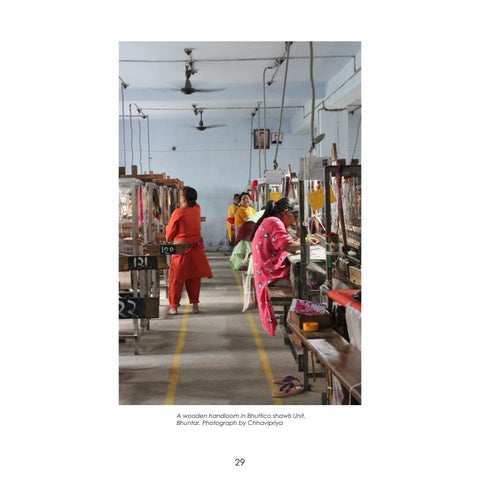
A wooden handloom in Bhuttico shawls Unit, Bhuntar. Photograph by Chhavipriya
29
The interlacing of warp (length-wise) and the weft (filling) is what results in a weaved fabric. The warp threads are passed through healds which are connected to shafts which are manually raised and lowered to create a shed (A shed is the space between the raised and the lowered warp). A shuttle carrying the filling yarn is then passed through this shed which is then beaten into place by a comb like structure called a reed. Shifting the headle then reverses the position of the warp threads, locking the filling yarn and opening a shed. In Himachal, the loims usually have 4 shafts. Lets call them shaft1, shaft2, shaft3, and shaft4. Since Kullu shawls are woven in twill weave, the shafts are moved in the following order: 1,3 2,3 2,4 4,1 and then reversed exactly how it was done i.e. 4,1 2,4 2,3 1,3. And as we reach the border, the weave is changed and goes something like 1.4 2,3 1,4 2,3 1,4.
“
“
Weaving is the process of interlacing the yarns in a desired pattern to create a fabric fit for use. It is done by either a handloom or a machine-loom.
Photographed by Khush Kakkar
31
Finishing Finishing in the textiles sector means the process through which a woven or knitted fabric is converted into a material which is suitable and ready for sale. It improves the fabric performance, look and the feel of the fabric. There are three steps of finishing : 1. Scouring 2. Milling 3. Ironing Scouring refers to the removal of oils which maybe present on the surface of the fabric due to addition during yarn spinning stage, hand contact or naturally. The oil then holds dirt and gives the fabric a yellow tinge. Scouring is done by washing the wool in hot water and detergent which removes the non-wool components and then the fabric is dried. Milling is done to increase the fullness and volume of the fabric which subsequently results in a weaving pattern which becomes obscure. Depending entirely on the kind of fiber used as the scaliness, waviness and fineness affects the amount of felting, it alters the appearance, body, elasticity and strength of the fabric. Milling is done by applying a balanced amount of heat, moisture and pressure to the fabric in a rotary milling machine. Ironing is the last stage of finishing after which the shawl is ready to be packed. It is done by a press and polish machine. The machine has a cylindrical roller which gets hot and has multiple layers padding and final layer of muslin on it. The shawl is passed through it in an even manner when the cylinder spins at a low speed which results in a creaseless and polished fabric.
32
33
Woven tie, Shirts, Caps, Jackets, and Shawls. Photograph by Khush Kakkar (left page) Shambhavi Deo (right page, left image) and Chhavipriya (right page, right image)
34
The ethnic dress of the female folk of Himachal Pradesh, Pattu is spun out of pure wool. The harmonious blend of bright and light colors coupled with exquisite designs with fine silken thread or wool imparts an attractive look to the traditional attire of women. Worn over the dress, Pattu are hand woven by the local craftsmen of the region of Kullu and Manali. The small scale cottage industries of Himachal Pradesh weave different kinds of Pattus: 1. The Plain Pattu is designed with horizontal and vertical straight lines while the borders are red in color. 2. The Chitra Pattu bears a beautiful blend of black and white colors as its base, coupled with a deep red border. 3. Daba is another kind of Pattu with a combination of black and white as its base, while the ends are beautifully designed with colored threads. 4. Ek Phulwala Pattu bears a harmonious blend of a variety of different colors with a single ethnic design on either side. 5. Teen Phulwala Pattu again represents a beautiful combination of bright colors with three different designs on either side. How To Wear: To manage the thick and heavy pattu, the local women generally pin either sides of the traditional attire with a broach made up of silver, which is commonly referred to as the Bumni. To give a royal look, a beautiful chain of silver is worn to join both the broaches.
35
Local women wearing pattu in Kasol village photographed by Chhavipriya
36
S.No.
Raw Material
Price
1
Local sheep wool (low altitude)
750-950/-
2
yak wool (30%) + Sheep wool (70%)
1450/-
3
Handspun wool
850/-
4
angora (50%) + merino wool (50%)
2200-2400/-
5
Pashmina
12000/-
6
Wool (high altitudes)
1200-1500/-
37
S.No.
Product
Price
1
Plain twill weave shawl
300-500
2
Shawl with motifs (Buti)
1000-2500
3
Shawl with border
1500-4500
4
Shawl with intricate work
5000-10Lac
5
Pashmina shawl
7000-3Lac
6
Angora shawl
5000-7000
7
Kullu caps
300-450
8
Pattu
15000-1Lac
9
Tweed jackets
2500-3500
10
Patti
50-70 per metre
38
Gharwasra is a very small village in Bilaspur District of Himachal Pradesh, India. It is controlled by the Gharwasra Panchayat and is located approximately 31 km towards west from head quarters Bilaspur,19 Kilometres from Ghumarwin and86 KM from the State capital Shimla. Sundar Nagar,Nangal , Hamirpur, Rupnagar are some of the near by Cities to Gharwasra. Hamirpur District Bijhri is in the North. Bakroa which is 5 km , Daslehra and Bhakra which is 8 km, Lehri and Saloha is which are 11 km are the nearby villages to Gharwasra. Gharwasra is surrounded by Jhandutta and Ghumarwin Tehsil towards East , towards East , Una Tehsil towards west and the Anandpur Sahib Tehsil towards farther south.
Gharwasra is known for its Basket weaving out of which they produce baskets, boxes, and other storage items/ utensils and the Pattal craft which are plates made out of huge leaves of Palmyra palm which is known as “taad” in hindi. Government has provided the villagers with machines to heat press the leaves and stitch them from the top to make plates. These plates are usually sold during marriages and other ceremonies.
39
BASKET WEAVING The process of basket weaving usually involves slicing this pieces of phloem of the local bamboo bark is approximately of 1-1.5 cm. The bamboo collection is usually done by the males. The males travel to the local forests, explore the flora and collect all the usable bamboo. Afterwards, the sliced bamboo is weaved by both the men women and sometimes children of their families to make baskets and storage boxes. These bamboo utensils usually is used to store warm rice and chapaties during their meals like dinner. Sometimes, the bamboo baskets are usually painted with bright hues of pink, blue or orange which are obtained by the acrylic paints or artificial inks. Pattal includes the same process. Usually males go to the local forests and collect huge Palmyra leaves in bulk. They climb over the trees and pluck them one by one. Palmyra trees are located deep in the forests, so sometimes it takes the artisans 2-4 days to return back to their villages. After their return, women press the leaves via their hands and hand sew them from the top. These days government of Himachal Pradesh and the rotary club has provided legal aids to the local artisans to continue this craft. These machines were introduced in July 2016 to increase the productivity of the Pattal craft. The machines have two metallic plates at top and bottom which are used to press atleast 5-7 leaves together. These can be stitched together on the machines afterwards. Each stack consists of 100 plates which are sold at 200-250Rs. These plates must be used with 15 days otherwise they rot and turn black in colour due to fungal infestation. According the workers people still prefer to buy handmade pattals as they are considered pure for ceremonies and weddings.
40
41
Man holding Pattal Plates in Gharwasra, Leaves for plates, The artisan of pattals Kishan Kumar, photographed by Khush Kakkar
42
SILVER Jewellery
Many goldsmiths up in the region of Kullu and Manali are involved in making beautiful traditional silver jewellery up keeping their damily traditions, hence making it one of the most known crafts here. Metals like silver, gold and guilt are used to make jewellery pieces. Silver is the main meral as it is found cheap in the valley region. The kind of jewellery found here are as follows: Head Ornaments Tunki- made from silver. Used to cover the parting of the hair. Tora- made of silver and looks like a hairband. Tika- it is an elaborated combination of tunki and tora.
Ornament is a very important part of a dress. Across India there are a variety of ornaments from different regions and states all are different from each other.
Ornaments for pattu Boomani- silver neddles joined together with chains. It is used to tie up pattu.
The region of kullu is one of tge very significant place for their collection of unique pieces of jewellery. The significant metal used here is silver.
Feet ornament Jhanjhar- made of silver and is worn in the ankle. It is 3 to 4 inches wide. Bichwa- it is like a ring but worn on the toes
The valley offers typical and distinct design of ornaments which make it different from the rest. Himalayan woman satisfy their craze with silver jewellery and ither less costly metal. Both men and women used to wear a lot if jewellery in the past, but as time passed by men stopped wearing them. It is now that only women can be seen wearing traditional silver jewellery up there.
Ear ornaments. Kundi- made of silver. Worn in the top part of the ear Neck ornaments Sikkamala- it is a necklace made of old silver coins. Chandragar- mlayered silver necklace worn during marriages Ghungrumala- it is made up of small hollow silver beads that make tinkering noise.
Earlier these ornaments were heavily made with bold designs of flora and fauna of the valley and were worn in the heads, forehead, neck, nose, ears, hand, wrist, ankles and feet. Now the the jewelleries are made much lighter keeping in mind the need of a working woman.
43
Photographs of Silver Jewellery by Chhavipriya
44
45
The craft cluster Initiative
The Craft Cluster Initiative program is envisaged to provide the students of NIFT systematic, continuous and regular exposure every year to the diversely rich and unique handlooms and handicrafts of India. -nift.ac.in
46
47
Krishna wool Mr. Om Prakash Malhotra, the founder of Krishna Wool, started weaving early in his childhood with his mother and father. Weaving was already there in his family with his grandfather and father practicing it which motivated him to try it and he then gradually became a professional at it. Having done most of his schooling in Kullu, he completed his Diploma in automobile engineering from Polytechnic University in 1975 and worked under the government for 23 years before establishing Krishna Wool in 1998 with his wife Krishna and daughter Anshul. Krishna Wool was established because of him and his wife’s drive to work after retirement for what they both loved, weaving and traditional textiles. It started with his wife teaching hand spinning to the local women and craftsmen, and him gathering all the information and machinery for the production process. “We had two handlooms at my home when we started and now have over 150 handlooms placed in different villages around Mandi.” Krishna Wool started teaching the craft for free and still follows it. Mr. Om Prakash believes that practicing the craft this way gives opportunity to unskilled women and provides them with an employment to fund their daily needs which then makes them self-dependent within 2 or 3 months of practice. Talking about the future of Himachali Shawls, he thinks there will be a rise in demand for handmade shawls more than machine made cloth since everyone wants something which is authentic and has taken a lot of time to be produced. However, he would like to keep using the original designs without any manipulation as doing so alters the tradition it has been following and the shawl looses the essence of the craft. He believes that the Textile industry has a very good scope in the upcoming time whether it is handmade, machine made or fashion designing in general.
48
Anshul Malhotra weaved her first shawl when she 14 and joined her father in Krishna Wool after completing her graduation in B. Tech. Textiles from Technological Institute of Textile & Sciences, Bhiwani. She told us that weaving in Himachal, is taught mostly in the families which have a loom in their house. Earlier, the government schools had weaving as a subject where they had training sessions including the spinning of yarn and weaving the shawl but since “children are leaving their roots and pursuing other careers, the art is now dying in Himachal.” Her father started Krishna Wool with two main motives, 1. Using only natural fibres with no synthetic mixing to make sure that the environment isn’t affected in a bad way. 2. Conserving the craft of weaving the traditional Kullu shawl by getting more and more people engaged in the process. “The women in living rural areas, unlike the ones in urban cities, do not have the liberty to shut down their doors and leave for work as they have the responsibilities of her household, family and cattle” They provide an extra source of income and empower the women of the villages by providing them looms with the ease of not having to leave home. Since the loom is now at home, they are able to concentrate fully on the work instead of having to worry about their family and cattle which subsequently results in a defect free work and faster rate of production. Krishna wool has a lot of units based inside the homes across different parts of Mandi and is working with 120 women artisans trying to conserve the traditional handloom practices by launching it in the market with new and old designs combined. Krishna Wool did its first international exhibition in Seoul, South Korea. They then exhibited in Slovenia and Moscow. Krishna Wool also won a competition in India hosted by the China Government for which she visited China to exhibit their eco-friendly products. She was also selected out of 500 Indian designers for an-all expense paid trip to Germany to exhibit their designs where they were the only Indian unit representing the textiles sector. When asked about the future, she told us that she believes Krishna Wool is definitely going to expand since they are maintaining the quality standards and people are joining every day. Sustainable fashion is what the future needs and thus they’re selling well on both the national and international fronts. National market is aware of the value of the product and the efforts which go behind it and the international market appreciates natural and sustainable fashion, due to which they are getting an equally good response from both.
49
Kapil Vaidya never thought that he would be a part of the weaving industry but after his marriage his interest diverted towards the Kullu Shawls and crafts and he learnt in weave in the year 2015. He mentioned that it took him 6-7 months to learn about the Kullu Motifs, the types of weave used and still is in the process of learning to weave professionally. What initially attracted Mr Kapil to be a part of Krishna Wool was because of cultural roots, values and heritage of Himachal. His perspective about the textiles completely changed after watching the hardwork and efforts put in the local weavers and craftsmen. Krishna wool provides employment for both skilled and unskilled women making it a work orientation and profit oriented organisation. Kapil says “If the quality of our products is good, good profits will automatically be generated.” He sees Krishna Wool as an organisation which will revive the knowledge of Kullu Shawls in younger generation as it is a dying craft, he believes that international market studies can be a better opportunity to seek more engagement from the customers. Upon being asked if Mr. Kapil thought that workers in Krishna Wool are here out of passion or just to earn a livelihood he said that most of the people work as their livelihood depends on these Shawls and others( mostly female) work here as they are passionate about the revival of the craft but Roti, Kapdah, Makaan” are the basic necessities for survival.
50
51
Bhuttico Bhuttico was a cluster in Shamshi District, Bhunter, Himachal Pradesh. The head weaving Master of this cluster is Om Prakash, NID takes an Initiative to revive these traditional shawls and hence works in alliance with this cluster. They provide files which further develops into sampling and improvement of those designs on the handloom in Bhuttico. Bhuttico was started in 1984 by Thakur Vedram with a buying share of Rs 13 in the share market and the factory is now worth in crores. Bhuttico mostly focuses on the handloom and weaving done hence dyed yarns are sources from outside, Jaishree unit in Kolkata and Univearth being one of them. They work with Merino, Angora (sources from Mahadev unit in Sundernagar), Pashmina and Silk. The price range solely depends on the designs of the shawls. A simple Kullu Shawl with borders start from Rs 1100 and can go up to Rs 20,000 with the increase of complexity of the design. The transitional fabric called Pattu is more costly and gets sold at Rs 22,000-23,000.
52
53
Bodh Shawls Mr.Bodh, before starting his business that is the bodh shwals had done his schooling from Primary School Corporation in himachal pradesh. After a little while he had joined the indian army and was posted in delhi for a quite sometime. He was then swnt near Shimla where he took his training in Ral a place near Sonipat and was posted since 1964 to 1971 that is for 7 years. Weaving was in his blood as told by him. He had learnt weaving in his childhood itself as almost every kid does for it gets very cold during winters. So weaving and knitting is the only survival strategy for people in hills. He has also worked on the spinning wheel and claims to have one in his house itself. Though it is not used in the prest day but he says he wound never discard it because of the emotion it holds of his father and grandfather spinning and earning a livelihood through it. The BODH SHAWLS was mainly started by Mr. Palzor Bodh’s father. It was not aa big as it is back then. Later on mr.Palzor had taken over the business and now his children too are all involved in it. He has four children. Two boys and two girls, who all are married and have children now. The shawls producwd in the unit are made on handlooms using yarns sourced from Australia. They are spun and then dyed in Jai Shree (kolkata).
54
55
Gulab Shawls Gulab shawls were named after Gulab Chand, the son of the original founder, Narottam Ram, who gradually took over the factory. In an interrogative discussion it was found out that naming of the shawls have a history in itself. In the Himachal there is a society called the Himalayan Weavers, and in the beginning the shawls of this factory were sold in the name to Himachali Shawls. Later on the government claimed that Nagwai came under the Kullu region and hence the shawls were sold in the name of Kullu shawls. He believes that there is nothing in the name. If the product is good enough, customer will buy it anyway. Mr. Gulab Chand stated that his father started the weaving business in 1976, which was taken over by him in the year of 2000. He also added that he had learnt it in his school days itself. Along with weaving, he also makes the patterns and design for the shawls himself. He had received National Award for weaving in 2004 by Dr. APJ Abdul Kalam which was the first award for weaving received in the entire Himachal region. Previously the Gulab shawls had its factory on the main road but as the government was making four lane road so they recently had to shift away from the road and so the new factory is still under construction and being expanded. He also added that his house is very near to the new factory. The factory that we visited was the main unit of Gulab shawls but they have units in many other villages which come under 25 kilometres from the place. They have around 100-150 workers and it was difficult for them to travel 25 km every day to come to the main factory and work. So they took small rooms on rent in different villages where they had placed few looms for the weavers of the village to come and work. Few of the villages where they have their outlets are Bomsoi, Paldi, Pnarsa, Balichoki etc. We were also informed that they started the business with only 2 looms. One small and one big. And now they have a lot of them. The Gulab Shawls generally work with sheep wool. But also work with yak and angora wool. In the beginning they only used to work with pashmina but now the current market standard for pashmina has gone down as the processing units do not process pure pashmina. So the real identity of pashmina does not exist anymore. Mr. Gulab Chand has 2 children. His son is in 8th standard and daughter in 6th. His children too are very interested in weaving. In fact both of them know a little bit weaving and are learning more. According to him his children would be continuing the business forward after him. The Gulab Shawls do not have a retail shop, they only make shawls on orders. Maximum of it is online. Orders come by mail. They also have their own site for Gulab shawls. The name is E-shop shawls and they get orders there. Also people who know them by name come there and give their orders personally. They get international orders too. Other than shawls they also make stoles, cushion covers and Himachali hats. The price varies from shawl to shawl depending upon the amount of work. The shawls start from 800 and go up to 1.5 to 2 lakhs. The shawls ranging from 1.5 to 2 lakhs have more intricate designs and motifs and hence are expensive.
56
57
Photographed by Khush Kakkar
58
59
THE HANDS THAT WEAVE
Questionnaire of weavers
60
Surendra Kumar
61
62
Kishan Kumar
63
64
Diluram Kumar
65
66
Meena Devi
67
68
Bhavna
69
70
Rajeshwari
71
72
Nandlala
73
74
Murti
75
76
Hariswar
77
78
Besar Singh
78
79
Daya
81
82
Nirmala
83
84
Aasha
85
86
Kunta Devi
87
88
Sumitra
89
90
91
CON CLU SION
The craft of weaving in Himachal is widespread and has found sanctuary in every household of the state that practices this art like their daily lives. Some of them have made it a part of their everyday chores. It holds together the people and the culture in its long history of arrival and transformation throughout decades. It also provides the insight as to how different cultures merged in and joined hands to form this world famous weaving craft into what we see today. It has become a livelihood for hundreds of people living in the state and has succeeded in providing employment to even those who came later from other parts of the country. A craft, like all arts, does not discriminate. A craft accepts all as one people, and gives them sanctuary between its web, to live and prosper. And furthermore, through different clusters, this craft has found the recognition that it had lacked and has evolved under influential weavers and designers to fit the demands of the modern buyers. It has also formed a bridge towards sustainability of the environment and of the people. The budding industries made sure they used environment friendly methods of developing yarns and weaving shawls using pure fibres obtained directly from herders in highlands such as Ladakh. They have also increased job opportunities by employing weavers to weave on handlooms instead of using machine looms. This step further helped to preserve the authentic hand woven shawls.
92
FIB ERS D
I
R
E
C
93
T
O
R
Y
94
95
Krishna Wool
Krishna wool, Industrial phase, Sauli Khad, Mandi Mr. Om. Prakash 7018027550 Anshul Malhotra 9958803654 Kapil Vaidya 9958803655
Bhuttico
Bhutti Colony P.O. Shamshi Distt, Bhunter, Kullu Ramesh Thakur 9418060218
Bodh Shawls
Shamshi District, Bhunter, Kullu, Himachal Pradesh Palzor Bodh 9816075662
Gulab
Village Takoli, Post Office, Mandi, Nagwain, Himachal Pradesh Gulab Chand 9816075662
Himbunkar
Himbunkar Bhawan, NH-21, Bhunter, Post office Bhuntar Distt. Kullu Ms. Chetna 9418318943 Lata Kochar 9816114058
96
BIBLIO
97
OGRAPHY Websites and Journals www.craftcounciofindia.org
https://www.craftscouncilofindia.org/indian-crafts-map/himachal-pradesh/
www.distmandi.com
https://disttmandi.com/unemployment-in-himachal/
en.wikipedia.org
https://en.wikipedia.org/wiki/Himachal_Pradesh#Demographics
www.thenewshimachal.com
https://www.thenewshimachal.com/2018/01/youth-himachal-pradesh-2018-document-presents-improved-position-state/
www.northindiatours.com
http://www.northindiatours.org/himachal-pradesh-tourism/history-himachal-pradesh.html
www.mapsofindia.com
https://www.mapsofindia.com/himachal-pradesh/
www.indiamirror.com
http://www.indianmirror.com/culture/states-culture/himachal-pradesh.html
ascentdescentadventours.com
http://ascentdescentadventures.com/treks/himachal-pradesh
Himachali Shawl Designs: Traditional to Contemporary by Anjali Sharma Designs from Indian Textile by Chintz Kalamkari
98
That helped in the making
EVERYBODY
NIFT Prof. Dr. Monica Gupta Prof. Dr. Vandana Narang Sr. Prof. Banhi Jha Assistant Prof. Shraddha Gupta Ms. Nayanika Thakur Mr. Vijay Dua GUEST FACULTIES Mr. Rohit Kumar Mr. Chand Routh CLUSTERS Mr. Om. Prakash Anshul Malhotra Kapil Vaidya Palzor Bodh Narottam Ram Om. Prakash Aasha Besar Singh Bhavna Daya Diluram kumar Hariswar Kishan Kumar Kunta Devi Meena Devi Murti Nandlal Nandita Ji TEAM Chhavipriya Khush kakkar Khyati Agarwal Neha Biswas Shambhavi Deo
100
101
(from left to right) Chhavipriya Neha Biswas Khush Kakkar Khyati Agarwal Shambhavi Deo
102
Thankyou to all the weavers and families who contributed to our documentatio.