FEATURES
Hazelwell Report by Trevor Davies (Past Hazelwell Housemaster) Hazelwell was opened in 1866 but in rather different circumstances from the other boarding houses opened at the same time. It was built privately by the Reverend Samuel Green, at his own expense and licensed by College Council for 21 years. A large photograph of Samuel Green until recently glowered down on boys relaxing playing snooker. The result was a very comfortable private House, with well proportioned, sunlit rooms and a stained glass window on the main staircase. There were seven bedrooms and three bathrooms, and Housemasters seemed reluctant to leave such comfort. The Reverend Hatterlsey-Smith stayed 23 years before selling this House to College in 1901. John Gurney reigned for 16 years, the Reverend Nicholas Lowton for 18: five others stayed for 13 or 14 years and four of them were Reverends.
HOUSEMASTERS
The Reverend Percy Hattersley-Smith clearly needed the space because he had two sons and six unmarried daughters. He taught at College for 44 years, and helped out for three more during the First World War. He was a fine games player, and played with W G Grace for Gloucestershire. His top score was 57 against Nottinghamshire. The House won the 1st XV Cup from 1880-1888, amongst many other feats. On the death of Queen Victoria he imposed a twelve hour period of silence on the boys in the House, such was his respect for the Monarchy. When he died in 1918, HV Page said of him in a letter to ‘The Field’ “Few Houses in any school arrived at or reached a higher standard of athletic, moral or intellectual excellence.” Standards the House has aimed to maintain ever since. As
44
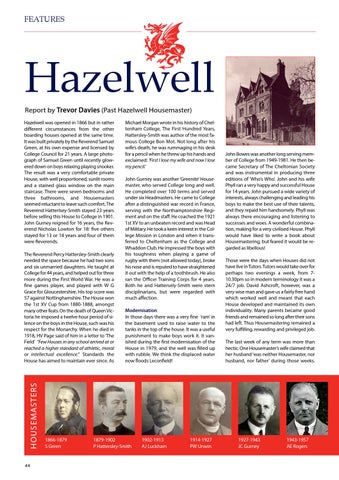
1866-1879 S Green
Michael Morgan wrote in his history of Cheltenham College, The First Hundred Years, Hattersley-Smith was author of the most famous College Bon Mot. Not long after his wife’s death, he was rummaging in his desk for a pencil when he threw up his hands and exclaimed: ‘First I lose my wife and now I lose my pencil.’ John Gurney was another ‘Greenite’ Housemaster, who served College long and well. He completed over 100 terms and served under six Headmasters. He came to College after a distinguished war record in France, serving with the Northamptonshire Regiment and on the staff. He coached the 1921 1st XV to an unbeaten record and was Head of Military. He took a keen interest in the College Mission in London and when it transferred to Cheltenham as the College and Whaddon Club. He impressed the boys with his toughness when playing a game of rugby with them (not allowed today), broke his nose and is reputed to have straightened it out with the help of a toothbrush. He also ran the Officer Training Corps for 4 years. Both he and Hattersely-Smith were stern disciplinarians, but were regarded with much affection. Modernisation In those days there was a very fine ‘ram’ in the basement used to raise water to the tanks in the top of the house. It was a useful punishment to make boys work it. It vanished during the first modernisation of the House in 1979, and the well was filled up with rubble. We think the displaced water now floods Leconfield!
1879-1902 P Hattersley-Smith
1902-1913 AJ Luckham
1914-1927 PW Unwin
John Bowes was another long serving member of College from 1949-1981. He then became Secretary of The Cheltonian Society and was instrumental in producing three editions of ‘Who’s Who’. John and his wife Phyll ran a very happy and successful House for 14 years. John pursued a wide variety of interests, always challenging and leading his boys to make the best use of their talents, and they repaid him handsomely. Phyll was always there encouraging and listening to successes and woes. A wonderful combination, making for a very civilised House. Phyll would have liked to write a book about Housemastering, but feared it would be regarded as libellous! Those were the days when Houses did not have live in Tutors. Tutors would take over for perhaps two evenings a week, from 710.30pm so in modern terminology it was a 24/7 job. David Ashcroft, however, was a very wise man and gave us a fairly free hand which worked well and meant that each House developed and maintained its own individuality. Many parents became good friends and remained so long after their sons had left. Thus Housemastering remained a very fulfilling, rewarding and privileged job. The last week of any term was more than hectic. One Housemaster’s wife claimed that her husband ‘was neither Housemaster, nor husband, nor father’ during those weeks.
1927-1943 JC Gurney
1943-1957 AE Rogers