FIND YOUR
BRITAIN 6
THE OFFICIAL MAGAZINE
TRAVEL CULTURE HERITAGE STYLE
Historic haunts Shadowy tales of London’s spookiest places
WIN
ELIZABETH I
a luxury stay in the
Making of a Tudor Queen
Heart of England
Last invasion of Britain
10 romantic rail journeys York through the ages
www.britain-magazine.com
JAN/FEB 2022 £4.95
WADDESDON MANOR
Discover Durham Mighty castles and medieval treasures
The original party palace
London, Days 10-11
GRAND TOUR OF THE UK 12 DAYS FROM £2,295
Uncover a nation imbued with centuries of history and culture as we experience the ancient attractions, modern cities and wild landscapes of the UK. Day 1
Days 2-3
Day 4
Day 5
Days 6-7
Day 8
Day 9
Day 10
Day 11
Day 12
York
Edinburgh
Fort William
The Jacobite Steam Train
Liverpool
Bristol
Bath
Stonehenge and London
London
Home
UNFORGETTABLE EXPERIENCES Discover historic York on a guided tour, seeing the spectacular Minster and cobbled Shambles. Explore Edinburgh, Scotland’s enticing capital, on a fascinating guided tour, before a Great Scot’s Dinner with lively traditional entertainment. Get to the heart of some of England’s greatest cities as we discover the history and culture of Liverpool, Bristol, and Bath.
INCLUDED IN THE PRICE Visit the famous prehistoric monument of Stonehenge, a fascinating and mysterious site that’s one of the most impressive Bronze Age monuments in England. Explore London, seeing the enticing mix of cosmopolitan and historic in England’s capital as we meet a Yeoman Warder and see the opening ceremony at the iconic Tower of London.
UK Tour Manager all the way All transfers by rail and coach 11 nights in 4 and 5-Star hotels 16 meals All tour excursions 2022 TOUR DATES May 4 11
£2,295 Sep 7
£2,395
£2,295
£2,395
14
Order your free brochure now Call 01904 734008 • Visit GreatRail.com/UKS TRAVEL SAFE
48 YEARS OF EXPERTISE
FULLY ESCORTED
Working with our partners to make sure you feel safe
With five decades of experience at our fingertips we’ll ensure your holiday goes without a hitch
Professional UK Tour Manager with you from start to finish
Protected by ABTOT. Dates and prices are subject to availability. Prices shown are per person, based on 2 people sharing. Prices may change prior to and after publication.
This issue, we’re indulging in the best wintry pursuits that Britain has to offer: cosy up in a vintage train, enjoying the country’s most scenic landscapes from the comfort of your carriage (Romance on the rails, p32); tour the castles of County Durham, at their most impressively forbidding in the winter months (Land of the Prince Bishops, p14); and explore the ancient streets of London, where the ghosts of ages past still lurk in the shadows (Historic haunts, p56). History buffs are in for a treat too. In the first of a two-part series we delve into Elizabeth I’s eventful childhood and the precocious political games she learned from an early age (The making of a Queen, p25). We also tell the little-known tale of Britain’s last invasion – centuries after 1066 (The last invasion, p43). And we amble along the Shambles in medieval York (p77) and discover the city’s many-layered history. You can even win a stay in Leicester, site of the astonishing discovery of the remains of Richard III (Competition, p76). Enjoy the issue!
32
Glenfinnan Viaduct, Scotland
CONTENTS VOLUME 90 ISSUE 1
FEATURES
Natasha Foges, Editor For the best articles straight to your inbox, sign up to our free BRITAIN newsletter at www.britain-magazine.com/newsletter @BRITAINMAGAZINE
14
LAND OF THE PRINCE BISHOPS
25
THE MAKING OF A QUEEN
FACEBOOK/BRITAINMAGAZINE @BRITAIN__ MAGAZINE PINTEREST/BRITAINMAGAZINE
BRITAIN 6
TRAVEL CULTURE HERITAGE STYLE
Historic haunts Shadowy tales of London’s spookiest places
WIN
ELIZABETH I
a luxury stay in the
Making of a Tudor Queen
Heart of England
43
THE LAST INVASION
48
MAGNIFICENT MANOR
Last invasion of Britain
10 romantic rail journeys York through the ages
www.britain-magazine.com
WADDESDON MANOR
OFC_BRI_JanFeb22 final 1.indd 1
Discover Durham
The original party palace
Mighty castles and medieval treasures
25/11/2021 10:53
www.britain-magazine.com
Cover image: The Tower of London © Antonio Bartuccio/ 4Corners Images
In the first of this two-part series telling the story of Elizabeth I, we look back at her journey from pampered princess to royal outcast
ROMANCE ON THE RAILS
THE OFFICIAL MAGAZINE
25
The northeastern county of Durham is full of remarkable treasures that tell the story of 1,000 years of English history
32
FIND YOUR
MAR 2022 USA&CAN $7.99
PHOTOS: © GEORGY KRIVOSHEEV/GEORGE ROBERTSON/ALAMY/ROYAL COLLECTION TRUST/HER MAJESTY QUEEN ELIZABETH II/BRIDGEMAN IMAGES
EDITOR'S LETTER
From the Highlands of Scotland to the cliffs of Cornwall, you can enjoy some of the most heartstirring views of Britain from the comfort of a carriage A little-known French invasion, taking place centuries after 1066, has all but escaped the history books Waddesdon Manor was once an extravagant party venue to rival any in England
14
FEATURES 56 64 68
6
LETTERS
The centuries-old streets of London are full of ghost stories. We take a spine-tingling walk round some of the capital’s most haunted places
HENLEY Beyond its world-famous regatta, Henley-on-Thames offers a serene riverside stay all year round
HEART OF ENGLAND From the astonishing discovery of Richard III’s remains to Iron Age treasure and tales of witchcraft, the unassuming county of Leicestershire is full of surprises
68
Share your stories and memories of Britain, and your thoughts on the magazine
9
THE BULLETIN
76
COMPETITION
77
CITY GUIDE: YORK
82
www.britain-magazine.com
HISTORIC HAUNTS
Your chance to win a two-night stay and a host of activities in historic Leicester From the Roman to the medieval, a visit to York is a journey through layers of history
Publishing Chairman Paul Dobson Managing Director James Dobson Publisher Simon Temlett Group Editor Steve Pill Chief Financial Officer Vicki Gavin EA to Chairman Sophie Easton Subs Marketing Executive Bret Weekes For VisitBritain Sarah Wagner Printed in England by William Gibbons Ltd Production All Points Media
Did you know you can manage your subscription online? Oversee your print and digital subscriptions online today simply by signing up at https://www. subscription.co.uk/chelsea/solo/. Stay up to date with the latest issues, update your personal details, and even renew your subscription with just a click.
LAST WORD Lady Carnarvon, chatelaine of Highclere Castle, takes us through a typical day in the life of ‘the real Downton Abbey’
Annual subscription rates (6 issues) UK – £36; USA and Canada – US $41.70 Australia and New Zealand – AUD $84 Rest of World – £42 www.britain-magazine/subscribe Back issues www.chelseamagazines.com/shop News distribution USA and Canada: NPS Media Group, 2 Corporate Drive, Suite 945, Shelton, CT 06484. UK and Rest of World: Seymour, 2 East Poultry Avenue, London EC1A 9PT, UK Tel: +44 (0)20 7429 4000
IN THIS ISSUE
SCOTLAND
DERRYLONDONDERRY p32 DURHAM p14
NORTHERN IRELAND
YORK p77 EIRE
FISHGUARD p43
4 BRITAIN
Advertising Group Sales Director Catherine Chapman Head of Sales Operations Jodie Green Group Advertising Manager Natasha Syed
SUBSCRIPTION ENQUIRIES USA and Canada: www.britsubs.com/britain Tel: 1-888-321-6378 (toll free) Email: btncustserv@cdsfulfillment.com Post: BRITAIN, PO Box 37518, Boone, IA 50037-0518 (USA only); OR BRITAIN, 1415 Janette Avenue, Windsor, Ontario N8X 1Z1 (Canada only) UK and Rest of World: www.subscription.co.uk/chelsea/help Tel: +44 (0) 1858 438 878 Email: britain@subscription.co.uk Post: BRITAIN, CDS Global, Sovereign Park, Market Harborough, LE16 9EF, UK
Prehistoric cosmology, Roman medicine and medieval manufacturing
77
BRITAIN is the official magazine of VisitBritain, the national tourism agency. BRITAIN is published by The Chelsea Magazine Company Ltd, Jubilee House, 2 Jubilee Place, London SW3 3TQ Tel: 020 7349 3700 Email: info@britain-magazine.com Editorial Editor Natasha Foges Art Editor Clare White Production Editor Jenny Rowe
LEICESTER p68 WADDESDON MANOR p48
WA L E S
ENGLAND
BRITAIN (ISSN 1757-9732) (USPS 004-335) is published bi-monthly by The Chelsea Magazine Company, Jubilee House, 2 Jubilee Place, London SW3 3TQ , UK Distributed in the US by NPS Media Group, 2 Enterprise Drive, Suite 420, Shelton, CT 06484. Periodicals postage paid at Shelton, CT and other mailing offices. POSTMASTER: Send address changes to BRITAIN, PO Box 37518, Boone, IA 50037-0518 Publications Mail Agreement Number 41599077, 1415 Janette Ave, Windsor, ON N8X 1Z1. Canadian GST Registered Number 834045627 RT0001 © The Chelsea Magazine Company Ltd., 2021. All rights reserved. Text and pictures are copyright restricted and must not be reproduced without permission of the publishers The information contained in BRITAIN has been published in good faith and every effort has been made to ensure its accuracy. However, where appropriate, you are strongly advised to check prices, opening times, dates, etc, before making final arrangements. All liability for loss, disappointment, negligence or damage caused by reliance on the information contained within this publication is hereby excluded. The opinions expressed by contributors to BRITAIN are not necessarily those of the publisher or VisitBritain.
HENLEY p64
www.britain-magazine.com
PHOTOS: © WADDESDON IMAGE LIBRARY/HUGO MAERTENS/EYE35 STOCK/EFRAIN PADRO/ALAMY
REGULARS
48
THE OFFICIAL MAGAZINE
WORLD & ANCIENT COINS
PLATINUM NIGHT® & SIGNATURE® AUCTION NYINC – New York | January 10 & 18, 2022
Highlights from Our 2021 NYINC Auction View all lots and bid at HA.com/3097 for Platinum Night® and HA.com/3098 for Signature®
Victoria gold Proof “Una and the Lion” 5 Pounds 1839 PR64 Deep Cameo PCGS
George II gold “East India Company” 5 Guineas 1729 AU58 NGC
William & Mary gold “Elephant & Castle” 5 Guineas 1691 AU55 NGC
William III gold “Fine Work” 5 Guineas 1701 AU58 NGC
Elizabeth I (1558-1603) gold Sovereign of 30 Shillings ND (1584-1586) AU58 NGC
George VI copper-nickel Taler-Edge Pattern Crown 1937-Dated (1950-1951) MS63 NGC
George II gold 5 Guineas 1741/38 MS63 NGC
William & Mary gold 2 Guineas 1693 MS64 NGC
Charles I “Declaration” ½ Pound 1642 AU55 NGC
Accepting consignments year-round for Select, Showcase, and Signature® Auctions. Contact a Heritage Consignment Director today for a free appraisal of your collection. Generous cash advances and competitive purchase offers available. Inquiries: Cole Schenewerk Managing Director, Heritage London +44 (0)207 493 0498 | UK@HA.com DALLAS | NEW YORK | BEVERLY HILLS | SAN FRANCISCO | CHICAGO | PALM BEACH LONDON | PARIS | GENEVA | AMSTERDAM | HONG KONG
BP 20%, see HA.com BP 20%; see HA.com 62088
Always Accepting Quality Consignments in 40+ Categories Immediate Cash Advances Available 1.5 Million+ Online Bidder-Members
YOUR LETTERS
Write to us with your thoughts on the magazine and memories of Britain
STAR LETTER THE MORNING MILK RUN When I was a little girl in the 1960s my Dad was a milkman and Chiswick House was on his early morning milk run. One Easter school holidays I went with him on his round. We were up in the middle of the night, travelling to the depot to collect his three-wheeled electric milkfloat full of milk, bread, and even Easter eggs. Chiswick House was by far the most impressive building on our round and I still remember the sound of the gravel drive as we motored up to the door shown in your July 2021 issue [Vol 89 Issue 3] on page 22 – the below stairs entrance where we waited for the staff to come out and collect what
they needed from the float. One woman commented that it was very dark and cold for a small girl to be out – she gave me a penny. I was rich! I’ve lived in Australia for a long time, but visit when I can, and I was back two years ago, enjoying an afternoon wander around the Chiswick House grounds and taking a look at that door where I stood so long ago. Christine Simpson, by email Our Star Letter wins a copy of The Real Crown Jewels of England: 100 Places That Make Us Great by Clive Aslet, covering national treasures from Devon lanes to the White Cliffs of Dover (£12.99). www.hachette.co.uk
DOCTOR’S ORDERS
FALLING FOR KENSINGTON PALACE
I’m a visitor to Britain (as often as I can) and when my husband and I visited Kensington Palace during my November birthday in 2016, we loved seeing the autumn colours along the walk to the Palace. Polly Curtis, Atascadero, California, USA WRITE TO US! By post: Letters, BRITAIN, The Chelsea Magazine Company, Jubilee House, 2 Jubilee Place, London, SW3 3TQ Via email: editor@britain-magazine.com FOLLOW US! Twitter: @BritainMagazine Instagram: @britain_magazine Facebook: www.facebook.com/BritainMagazine Pinterest: www.pinterest.com/britainmagazine
6
BRITAIN
www.britain-magazine.com
PHOTOS: © STUART BLACK/ANTIQUES & COLLECTABLES/ALAMY
Although this may seem a strange request – since I am a doctor – I would love to see periodic pieces showing the old “faggie” cards which used to be published regularly. The card sets are not linked to tobacco, are colourful, interesting and reflect life in the past. There are hundreds of them – still avidly collected and very interesting. Dr. Robert C. Dickson, Hamilton, Ontario, Canada
Characterful rooms, relaxed fine dining and a warm Cornish welcome. Find this historic hotel in the heart of Cornwall.
THEALVERTON.CO.UK A luxury four star silver hotel in the city
TREGOLLS ROAD TRURO CORNWALL stay@thealverton.co.uk | 01872 276 633
MOOR UP ON OUR PRIVATE PONTOONS, SINK A FEW BREWS IN OUR COSY QUAYSIDE PUB, THEN DIVE INTO AWARD-WINNING FOOD. THIS IS THE CORNISH LIFESTYLE AT ITS BEST. www.greenbank-hotel.co.uk | 01326 312440 | Harbourside Falmouth Cornwall TR11 2SR
Adult learning with Oxford Part-time courses for lifelong learners From short online courses to award and degree programmes – we have a course for you. Join us in Oxford or online. Enrich and extend your knowledge Subjects include history, archaeology, politics, literature, art history, philosophy and more. www.conted.ox.ac.uk/study-2022 @OxfordConted
8 BRITAIN
www.britain-magazine.com
The
BULLETIN
PHOTOS: © ENGLISH HERITAGE/ PHOTO COURTESY OF THE STATE OFFICE FOR HERITAGE MANAGEMENT AND ARCHAEOLOGY SAXONY-ANHALT, JURAJ LIPTÁK
Prehistoric cosmology, Roman medicine and medieval manufacturing
EXHIBITION
Sophisticated Stonehenge While the world-famous stone circle of Stonehenge in Wiltshire remains, in many ways, a mystery, a new exhibition at the British Museum, The World of Stonehenge (17 Feb to 17 July), will use the facts to present prehistoric Britain as a tangible place of big ideas, commerce and travel. The exhibition will take visitors back to around 3,000–2,500 BC, when the circle was created, and bring together hundreds of objects from across the UK and Europe, including the 3,600-year-old Nebra Sky Disc, the oldest surviving representation of the cosmos. www.britishmuseum.org
HISTORY / NEWS / REVIEWS / INSPIRATION
HISTORY
Stories of the skies
Roman physique Visitors are now being welcomed into a newly revealed section of the Roman Baths in the city of Bath: the Roman Gym. The Romans were known to be conscious of the importance of keeping fit and healthy, and the gym was an important part of larger bath houses. Inside, you can explore the ancient exercise yard and visit the remains of the Laconicum (a sauna or steam room), which, thanks to Roman ingenuity, would have been warmed by underfloor heating. Projections and interpretation boards will describe the Romans’ fitness routines, and the gory fundamentals of Roman medicine. www.romanbaths.co.uk
SHOPPING
Remembering rail
ARCHAEOLOGY
Abbey reality A long ‘bowling alley’ extension of the east side of Yorkshire’s Fountains Abbey had previously stumped National Trust historians. That is, until a major archaeology project revealed that this was likely the site of a huge medieval tannery – the largest yet to be discovered at a monastic site. Used to make leather for clothing, belts, bedding, book bindings and vellum or parchment, the surprising size of the tannery suggests it was producing products on an industrial scale for the entire community – and the smells and noises produced by such activity are a far cry from what we have previously conceived as tranquil places of worship. www.nationaltrust.org.uk
If you have nostalgic memories of a railway journey or destination, perhaps prompted by our feature on Britain’s best railways (p32), you’ll love the art prints produced by RailwayPosters.co.uk. Featuring scenic locations from St Ives to Bexhill-on-Sea, Edinburgh to the Isle of Bute, you can also purchase other accessories, such as mugs, printed with similar designs. In the same vein, the National Railway Museum has created a 2022 calendar of vintage posters – perfect for planning your next year of adventures. www.railwayposters.co.uk; shop.sciencemuseum.org.uk
10
BRITAIN
www.britain-magazine.com
PHOTOS: © JOANA KRUSE/ALAMY/NATIONAL RAILWAY MUSEUM/NATIONAL TRUST IMAGES/ANDREW BUTLER/HUFTON+CROW/STADTBIBLIOTHEK IM BILDUNGSCAMPUS NURNBERG
H E R I TAG E
Funded by Historic England, Military Aviation Heritage Networks (MAHN) recently launched a new trail in East Anglia to highlight the area’s rich aviation history. From First World War bases that protected the country from airships and bombers to Cold War bases for aircraft and missiles, 30 historic airfields, museums, memorials and aviation sites make up the trail. A booklet and map can be downloaded from the MAHN website, making it easy to link up several sites to visit in one outing, and many of the sites have shops and cafés too. www.mahn.org.uk/trails
C U LT U R E
world-class collection Set between the two buildings of the OldA Royal Naval College If that’s not reason enough to visit, it is likely to be the home in Greenwich, London, the Queen’s House was England's first of the historic Armada portrait of Queen Elizabeth I (pictured classical building, built in the 17th-century by architect Inigo above), one of the most iconic images of any British monarch. Following a major three-year transformation, London’s era, the permanent collection has been redisplayed and Jones for Anne of Denmark, as a gift from her husband, James I. The painting has been the subject of intensive fundraising Courtauld Gallery has now reopened, allowing guests to once reinterpreted, and includes masterpieces such as Manet’s A Bar Four hundred years later, the splendid royal villa is due to to save it for the nation since it was put up for sale. With the more peruse one of the world’s greatest art collections in the at the Folies-Bergère and Botticelli’s large-scale The Trinity with reopen on 11 October following extensive renovations, which funding target due to be hit this summer, the Queen’s House magnificent setting of Somerset House. Spanning the early Saints. This season, the Courtauld will also be opening the first have seen an overhaul to the galleries housing its famous will be the perfect place to view the portrait: Elizabeth I was medieval period through to the 20th century, and including ever exhibition dedicated to Van Gogh’s self-portraits across collection of art – including key works by Gainsborough and born at Greenwich Palace in 1533 and Queen’s House is the last paintings, sculpture and artefacts from leading artists of each his entire career (3 February to 8 May). www.courtauld.ac.uk Hogarth – and original features, such as the Tulip Staircase. remaining part of the palace complex. www.rmg.co.uk
HISTORY / NEWS / REVIEWS / INSPIRATION
READING CORNER Take inspiration for your British adventures from these great reads
Coinneach likes to use heather honey and Jura whisky in this recipe
RECIPE
Cranachan Chocolate Cups This traditional Scottish dessert, served in chocolate cups for a modern twist, is taken from The Hebridean Baker: Recipes and Wee Stories from the Scottish Islands by Coinneach MacLeod (Black & White Publishing, £20) and will make an ideal addition to your Burns Night menu on 25 January. Born and raised on the Isle of Lewis, Coinneach offers many recipes for classic Scottish dishes in his first cookery book, all accompanied by fascinating stories of Outer Hebridean life.
I n g re d i e n t s : SERVES 4 150g white chocolate
250ml double cream
40g oats
2 tablespoons honey
½ tablespoon brown sugar
2 tablespoons whisky
100g raspberries
Method: Heat the white chocolate in a bowl in the microwave and stir every 30 seconds until fully melted. Use a pastry brush to paint two coats of the melted chocolate into silicone moulds, letting the first coat set before adding the second. Heat a pan over a low heat. Toast the oats and brown sugar, stirring until the sugar has melted. Tip your oats onto greaseproof paper and leave to cool. Mash 75g of the raspberries until smooth. Whip the cream to stiffish peaks, then fold in the honey and whisky. Crumble the cooled oats in your hand as you add three-quarters of it to the cream. Swirl the mashed raspberries through the cream to add a ripple effect. Remove the chocolate spheres from their moulds. Spoon in the cream and top with the remaining raspberries, oats and a drizzle of honey.
12
BRITAIN
The Barn: The Lives, Landscape and Lost Ways of an Old Yorkshire Farm by Sally Coulthard (Head of Zeus, £20). A socio-historic exploration of a small slice of English countryside. A Queen for all Seasons by Joanna Lumley (Hodder & Stoughton, £20). This collection of first-hand writings is a celebration of our much-loved monarch ahead of her Platinum Jubilee. Black Gold: The History of How Coal Made Britain by Jeremy Paxman (William Collins, £25). The lively and absorbing story of coal-mining in Britain from Roman times to the present day. America: Made in Britain by Tom Arms (Amberley, £20). An exploration of the United States' special relationship with the UK, examining the influence of British culture on US development. The Garden Diary of Doctor Darwin by Susan Campbell (Unicorn, £30). The previously unpublished garden diary of Charles Darwin’s father and sister.
www.britain-magazine.com
A family run business with 25 years’ experience, The Carter Company plans and delivers authentic self-guided trips with unique routes designed by us, that uncover the hidden gems and local secrets, as well as the highlights of historic Britain. All our tours are for individuals, so start dates are flexible. With local hosts to meet and brief you, hand-picked luxury or traditional accommodation and attention to every detail, The Carter Company’s holidays are the best way to explore England, Scotland and Wales.
www.britain-magazine.com
BRITAIN 13
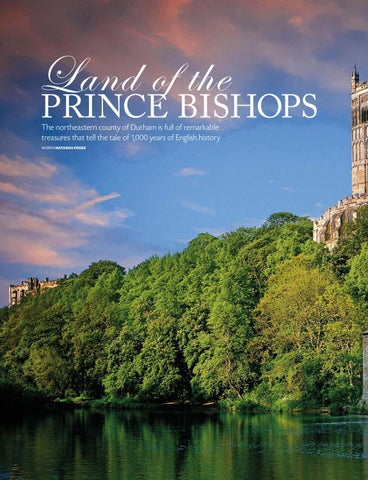
Land of the
PRINCE BISHOPS The northeastern county of Durham is full of remarkable treasures that tell the tale of 1,000 years of English history
ILLUSTRATION: © LAURA HALLETT PHOTOS: © RAY EVANS/TIM GAINEY/ALAMY
WORDS NATASHA FOGES
14
BRITAIN
www.britain-magazine.com
Almshouses built by renowned architect Sir George Gilbert Scott Right: Wildflowers growing near the stone folly, Broadway Tower www.britain-magazine.com
BRITAIN
15
PHOTOS: STUART BLACK/IMAGE BROKER/LOOP IMAGES LTD/ALAMY/ILLUSTRATION: ©LAURA HALLETT
county durham
Left: Thsjfklkjf oieufoieuf oisdjv oiu qe8uf efwei uwo iuwefou
16
BRITAIN
www.britain-magazine.com
county durham
T
mighty Durham Castle. It was built to house the shrine of St Cuthbert, the Northeast’s most venerated saint, who had been a monk and a hermit on the isle of Lindisfarne; fleeing Viking raids, his followers had wandered England for seven years, carrying his coffin, in search of a suitable resting place. In this lofty, tranquil place they had finally found it. Built in 1093, the cathedral is Europe’s supreme example of the Norman-Romanesque style, with a high vaulted nave and enormous stone pillars carved with Moorish-style geometric designs. When Cuthbert’s coffin was opened 11 years after his death, it was discovered that his body was perfectly preserved. This, along with numerous accounts of miracles at the shrine, saw the emergence of a widespread cult that made Durham a major medieval pilgrimage site. You can see St Cuthbert’s shrine – a simple marble slab that replaced a jewel-studded affair destroyed in the
PHOTOS: NAGELESTOCK.COM/EYE35/ALAMY/DURHAM CASTLE, DURHAM UNIVERSITY/ILLUSTRATION: MICHAEL A HILL
Previous page: Durham Cathedral sits in a loop of the River Wear Left, top to bottom: Durham Castle, now University College; pedestrians cross the Wear on Durham's Framwellgate Bridge
he American writer and Anglophile Bill Bryson first visited on a whim, getting off the train at Durham station with the intention of having a quick look at the cathedral before heading on to his destination, Newcastle. But Durham was not to release him so easily. “I fell in love with it instantly in a serious way”, he wrote. “If you have never been to Durham, go at once. Take my car. It’s wonderful.” Many visitors overlook this enchanting city, merely glimpsing it from the train while shuttling between the tourist hotspots of York and Edinburgh. But Durham and its surrounding county boast compelling reasons to visit, not least the magnificent building that Bryson called “the best cathedral on planet earth”. Durham Cathedral sits in a loop of the River Wear, a location chosen for the natural protection afforded by the high riverbanks on three sides and the proximity of the
www.britain-magazine.com
BRITAIN
17
county durham
18
BRITAIN
Clockwise, from right: The 12th-century ruins of Barnard Castle; inside the newly restored Auckland Castle in Bishop Auckland; the open-air and 'living' Beamish Museum
PHOTOS: ALLAN HARTLEY/DAVID FORSTER/NEIL MCALLISTER/ALAMY
Reformation – behind the High Altar. Treasures including his decorated oak coffin and a dazzling gold-and-garnet cross found within his robes are in the cathedral’s museum. Shortly after Cuthbert’s death, William the Conqueror, fearful of the marauding tribes that roamed the Scottish border, granted the bishops of Durham the special title of Prince Bishop. It was a rank that afforded them almost regal power: they were able to form their own parliament, command their own armies, levy their own taxes and mint their own coins. In return, the Prince Bishops would keep the unruly North under control. Their power base was Durham Castle, built in 1072, which stands across Palace Green from the cathedral. The Prince Bishops poured their considerable wealth into the castle, which became a palatial residence. Tours take in highlights including the 17th-century Black Staircase and Norman Chapel, and tell the story of the rise and fall of the Prince Bishops, an astonishing reign of almost 800 years: temporarily subdued by Henry VIII’s Reformation, they clung to their powers until 1836, when they finally ceded them to the Crown. In 1832 the last of the Prince Bishops approved the founding of England’s third university (after Oxford and Cambridge) in Durham. Like its more famous sisters, it maintains a residential college system, and the castle is now home to the lucky students of University College.
www.britain-magazine.com
www.britain-magazine.com
BRITAIN
19
PHOTOS: ©ANDREW LAWSON & THE SHAKESPEARE BIRTHPLACE TRUST/D HALE-SUTTON/ALAMY
county durham
Left: The 14thcentury Raby Castle, the former home of the Nevill family Below: The Blue Bedroom at Raby Castle
PHOTOS: ANTON IVANOV/ALAMY/STUART BLACK/ ROBERTHARDING
Below the castle and cathedral, the centre of Durham is charming. Cobbled streets run between Georgian townhouses, and ancient stone bridges span the picturesque River Wear, along which students lark about in rowing boats or stroll the wooded riverbanks. Among many rewarding day-trips from Durham is the Beamish Museum, an engaging open-air ‘living museum’ spread across 300 acres of countryside. Vintage buses and trams carry visitors between six different areas, where painstakingly restored buildings reflect life in northeast England from the 1820s to the 1950s. You can wander through a 1900s pit village complete with a drift mine; shop in a pre-war high street whose bakery, chemist and sweet shop bustle with costumed shopkeepers; and immerse yourself in wartime family life in a cosy 1940s farmhouse. Some 20 miles south is the market town of Bishop Auckland, whose castle was the country retreat of the Prince Bishops. In a scenic setting high above a meander of the River Wear, Auckland Castle is one of the bestpreserved medieval bishops’ palaces in Europe, whose beautiful state rooms have recently been lavishly restored. The castle is the centrepiece of the Auckland Project, an impressive cultural initiative that has seen the revitalisation of the town of Bishop Auckland. The town sits at the heart of the abandoned Durham coalfields; the mining industry boomed here in the 19th century, declining after the Second World War. The area’s revival has seen the opening of an array of attractions including the Mining Art Gallery,
20
BRITAIN
www.britain-magazine.com
county durham
Raby is a picture-book castle, all crenellated battlements and forbidding stone walls and towers
www.britain-magazine.com
BRITAIN
21
county durham
22
BRITAIN
www.britain-magazine.com
county durham
PHOTOS: YORKSHIRE PICS/ALAMY
Clockwise, from top left: 'Tommy', a statue of a First World War soldier by Ray Lonsdale, located in Seaham; the Bowes Museum in the market town of Barnard Castle; the 250-year-old Silver Swan at the Bowes Museum
which offers a glimpse into the lives and labours of local miners; the Spanish Gallery, dedicated to the Golden Age of Spanish Art in the 16th and 17th centuries; and Auckland Tower, which gives a bird’s-eye view of the town and the surrounding countryside. A few miles southwest is another striking castle, whose medieval towers tantalisingly appear and disappear through the trees as you approach. Raby is a picture-book castle, all crenellated battlements and forbidding stone walls and towers. Built in the 14th century, it was home to the powerful Nevill family until 1569, when it was confiscated by the Crown following Charles Nevill’s involvement in the ‘Rising of the North’, an unsuccessful attempt to depose Elizabeth I and replace her with Mary, Queen of Scots. The estate then passed to Sir Henry Vane, a key member of Charles I’s household, whose family still live in the castle to this day. You can explore Raby’s wonderful interiors, from the elegant Blue Bedroom reserved for the castle’s most important guests, to the medieval kitchen, lined with gleaming copper pots. The grounds are delightful, with a 200-acre deer park and an 18th-century walled garden to explore. Further into the Raby estate is High Force, one of England’s most spectacular waterfalls, where the River Tees plunges 21 metres into the pool below. The Tees meanders through Teesdale, whose rolling dales, wild moorland and lost-in-time villages merit a detour. Teesdale’s ‘capital’ is the market town of Barnard Castle, affectionately known as ‘Barney’, an impossibly quaint place whose high street is lined with antiques shops and tearooms. There is (naturally) a castle here – or at least the remains of one, sitting on a high rock above the Tees. Barnard Castle takes its name from its 12th-century founder, one Bernard de Balliol. It later became the property of Richard III, whose boar emblem is carved above a window in the inner ward. The town’s other big draw is the extraordinary Bowes Museum, a monumental French-style château. It was begun in 1869 by John Bowes, a local MP, and his French actress wife, Joséphine, who spent their lives collecting 15,000 antiques and works of art to fill it. Sadly both died before the museum was completed, but their legacy lives on in rooms full of precious ceramics, paintings, furniture and textiles. The museum’s best-loved piece is the 250-year-old Silver Swan, an automaton that first charmed the Bowes in 1872 (and was once admired by Mark Twain). It is usually operated once a day when, incredibly life-like, it preens and gracefully dips its head to seize a fish. Before leaving the county, make a final stop on Durham’s heritage coastline. The town of Seaham sits on a clifftop with sweeping views of the North Sea – a view once enjoyed by the Romantic poet Lord Byron, who married Annabella Milbanke at her family home, Seaham Hall, in 1815. You can stay at Seaham Hall, now a luxury spa hotel, from which the town’s sights are within easy reach. The ancient St Mary the Virgin Church is one of the earliest Anglo-Saxon churches in existence, while Tommy, the much-loved statue of a weary soldier, commemorates those who fought in the First World War and was recently voted Britain’s favourite outdoor artwork.
www.britain-magazine.com
THE PLANNER GETTING THERE There are direct trains to Durham station from London’s King’s Cross station (3hr), York (45min) and Edinburgh (1hr 45min). Go North East buses serve most places of interest, but it’s easiest to get around by car. www.lner.co.uk; www.gonortheast.co.uk WHERE TO STAY Live like a local at 52 Old Elvet, restored luxury apartments in a handsome Grade-II listed Georgian townhouse in the heart of Durham. Many of the house’s original features have been preserved, from the 300-year-old staircase to the oak panelling, and the property was even once visited by HM The Queen. Seaham Hall is a country-house hotel on the coast. The Georgian building is rich in heritage but the style of the bedrooms is full of contemporary pizzazz, with statement headboards, zingy colours and luxurious details such as wood-fired hot tubs. The vast spa, approached by a calming, dimly-lit walkway, is influenced by Far Eastern healing rituals and staffed by a team of experts. Further south is the destination hotel Rockliffe Hall, a magnificent Victorian hall with a modern extension overlooking rolling parkland. There are plenty of on-site diversions, from the cutting-edge spa and golf course to excellent restaurant The Orangery, whose gourmet nine-course tasting menu makes use of produce grown on the 365-acre estate. The rooms are luxurious and classically furnished, with exceedingly comfortable beds, generous bathrooms and views of the countryside and River Tees. www.52oldelvet.com; www.seaham-hall.co.uk; www.rockliffehall.com WHERE TO EAT The Orangery at Rockliffe Hall (above) offers a standout fine-dining experience, as does the Raby Hunt, the county’s only restaurant with two Michelin stars; work off the 15-course tasting menu with a stroll around the Raby estate. Restaurants in Durham are generally of the cheap-and-cheerful variety, catering to the student population. Your best bet is Vennels Café, where you can have a lunch of pie, soup or salad, or an afternoon snack of homemade scones, under the beams and wonky ceilings of the café’s original 16th-century interior. vennels.com; www.rabyhuntrestaurant.co.uk
i
FURTHER INFORMATION www.thisisdurham.com
The coastal footpath takes in stunning views and offers the chance to watch locals along the beach doing the ‘sea glass stoop’: foraging for the glass that washes up here in a kaleidoscope of colours. The source, a bottleworks that dumped discarded glass into the North Sea, closed 100 years ago, but these jewel-like treasures still wash up here with every tide, tumbled and polished by the waves. Before you leave, be sure to rummage for your own century-old gem, a keepsake of your trip to this land of history and wonder. For more on Britain's castles, go to www.britain-magazine.com BRITAIN
23
Great savings when you subscribe
BRITAIN FIND YOUR
6
As a subscriber you can enjoy these benefits: •Fascinating stories and insider insights into your favourite British castles, cathedrals, stately homes and gardens. •Page-turning tales of our historic heroes and villains, from kings and queens to literary greats.
TRAVEL CULTUR E HER ITA GE STY LE
Wonders of Wiltshire
Standing stones & state
•Free delivery straight to your door, so you never miss an issue.
WIN
a five-star stay in a
COUNTRY HOUSE HOTEL
ly homes
TO P CL AS S
CH ATSWORTH Palace of the Peaks
The colleges of Cambridge
STAN D & DE LIVER
E V SA up to 26%
Highwaymen through history
•Stunning photography that brings Britain’s iconic landmarks, cities and landscapes to life. •Competitions to win luxury holidays in Britain.
THE OFFICI AL M AG AZINE
NOV/D EC 2021 £4.95
www.b ritain-m agazine .com
OFC_BRT_ NovDec21_new
.indd 2
Life below stairs
True stories of servants in
Britain’s grand houses 29/09/2021 12:33
Annual subscription to BRITAIN magazine: UK £21.95 | Rest of World £33.95 | Europe €38.95 | USA $39.95 | Canada $44.95 |Australia $66.95
Two easy ways to order
UK & ROW go to www.chelseamagazines.com/CBRT0122 Or phone +44 (0)1858 438 789 (quoting code CBRT0122) USA & Canada go to www.chelseamagazines.com/BRI-J212S1 Or phone 888-321-6378 (quoting code X156N1) If for any reason you’re not happy with your subscription, you may cancel within 14 days of placing your order
IMAGE: © ROYAL COLLECTION TRUST/HER MAJESTY QUEEN ELIZABETH II 2021/BRIDGEMAN IMAGES
history
The making of a Queen Part One
In the first of this two-part series telling the story of Elizabeth I, we look back at her turbulent journey from pampered princess to royal outcast WORDS NEIL JONES
www.britain-magazine.com
BRITAIN
25
IMAGES: © PUBLIC DOMAIN SOURCED/ACCESS RIGHTS FROM IAN DAGNALL COMPUTING/ALAMY/NATIONAL TRUST IMAGES/HATFIELD HOUSE
history
Previous page: Elizabeth I (1558-1603), aged about 13, attributed to Guillaume Scrots, c.1546 This page, clockwise from above: Hatfield House in Hertfordshire; a detail of a painting entitled 'The Family of Henry VIII' depicting Princess Elizabeth, aged 12 , c.1545; Edward VI (1537-53) by the British School, mid-16th century; Katherine Parr, Henry VIII's sixth wife, by an unknown artist, late 16th century
26
BRITAIN
of Catherine of Aragon had been declared illegitimate following her mother’s fall from grace and to her great humiliation she was now obliged to serve as a lady-inwaiting to Anne. But with whirlwind speed fortunes changed in 1536 when Henry, fed up with Anne, had her beheaded. Elizabeth, not yet three years old, was declared illegitimate and deprived of her place in the succession, and as her household fell into disarray her governess complained that the little girl “hath neither gown, nor kirtle [slip], nor petticoat, nor no manner of linen nor smocks”. Elizabeth was beset by teething pains yet, the governess added reassuringly, she was “as toward [forward] a child and as gentle of conditions, as ever I knew any in my life.” King Henry, once he was assured of a male heir courtesy of his short-lived third wife Jane Seymour, later recognised Mary and Elizabeth as successors if his son Edward’s line failed. But as royal marriages and moods would come and go, and Elizabeth moved between court and country life, she grew “as grave as a woman of forty” it was observed; she was just six years old. Eventually Henry’s sixth and final wife, the kindly
PHOTOS: © JLIMAGES/FRANCISCO MARTINEZ/ALAMY/MARY EVANS PICTURE LIBRARY 2015/NATIONAL CIVIL WAR CENTRE
T
he birth of Anne Boleyn’s daughter Elizabeth at Greenwich Palace on Sunday 7 September 1533 was a bitter disappointment to Henry VIII. The king had broken with the Roman Catholic Church and annulled his marriage to his middleaged first wife Catherine of Aragon in order to wed the more nubile Anne in pursuit of a male heir. Documents optimistically prepared in advance to announce the birth of this longed-for prince were hastily amended and a celebratory tournament was cancelled. Nevertheless the princess was accorded a sumptuous christening and at three months old was sent, with her own household, to be raised at the palace of Hatfield in Hertfordshire. Anyone wanting to get to grips with the courageous, mercurial character of Queen Elizabeth I (as the little princess would become), and to appreciate her dazzling reign against the odds, needs to step back to her childhood and youth and the lessons she learned as she negotiated the quicksands of Tudor courtly life and politics. Fair-skinned and with the reddish-gold hair of her father, Elizabeth was treated as a pampered princess at Hatfield, displacing her Catholic half-sister Mary as heiress presumptive. The latter, teenage daughter
www.britain-magazine.com
history
www.britain-magazine.com
BRITAIN
27
history Left to right: Engraving of Lord High Admiral Thomas Seymour, c.1508-49; Mary I of England (1553-58), also known as 'Bloody Mary', by Hans Eworth, c.1555; Philip II of Spain, aged 24, by Titian, c.1554
IMAGES: © CLASSIC IMAGE/INCAMERASTOCK/GL ARCHIVE/ALAMY
Katherine Parr, brought some stability and union to the divided royal family. Elizabeth shared Edward’s tutors, imbibed the new tenets of English Protestantism, and studied prodigiously in classical languages, French, Italian, rhetoric, history and moral philosophy. Reflecting on her exceptional talents and education, her tutor Roger Ascham recorded with the unselfconscious sexism of the time: “The constitution of her mind is exempt from female weakness, and she is endued with a masculine power of application.” When nine-year-old Edward VI ascended the throne in 1547 following Henry’s death, Elizabeth went to live with Katherine Parr who within months of becoming a widow had married her true love, Edward’s uncle the Lord High Admiral Thomas Seymour. There followed an episode that would threaten Elizabeth’s future, as Seymour, handsome, ambitious and reckless, indulged in boisterous teasing of the teenager, including slapping and tickling her in her bedchamber by way of bidding her a good morning. It was observed that a blushing Elizabeth “did bear some affection” to Thomas and, while at first Katherine allowed the sport, she grew concerned at its
28
BRITAIN
www.britain-magazine.com
For more on the kings and queens of England visit www.britainmagazine.com
www.britain-magazine.com
history
BRITAIN
29
history
unseemliness and quietly sent her stepdaughter away to protect her reputation. Just a year or so later, Katherine having died in childbirth, Thomas was accused of treason for plotting to overthrow his brother as Lord Protector of the child King Edward, while planning to marry 15-year-old Elizabeth to bolster his power. Officials interrogated Elizabeth at Hatfield Palace to see what evidence they could extract to seal a conviction against Seymour and possibly also to incriminate her. With remarkable sangfroid and circumspection in the face of humiliating close questioning about earlier goings-on in the Seymour household, Elizabeth gave polite replies that distanced her from any wrongdoing and her interrogator was forced to admit “she hath a very good wit and nothing is got from her but by great policy”. Seymour was executed but he would not be the last dashing, dangerous man of action to cross Elizabeth’s path. When Lady Jane Grey was briefly proclaimed Queen of England following Edward’s death in 1553, Elizabeth somewhat judiciously said she was too ill to go to London. A few days later when her half-sister Mary had wrested control of the Crown, 19-year-old Elizabeth had however sufficiently recovered and hastened to the capital to show her loyalty.
ELIZABETH AND MARY: Royal Cousins, Rival Queens One of the major crises of Elizabeth I’s reign as Queen of England revolved around her complex relationship with Mary, Queen of Scots. If you can’t wait until the next issue of BRITAIN to read about the plots and paranoia that entangled them, you can explore their drama in Elizabeth and Mary: Royal Cousins, Rival Queens at the British Library, London (until 20 February 2022). Although Elizabeth and Mary never met, their lives were inextricably intertwined by political and religious struggles – and mutual jealousies. This first major exhibition to consider the two queens together reveals their extraordinary story through their own handwritten letters, intriguing ciphered messages, 16th-century documents, beautiful jewellery and portraits. www.bl.uk
30
BRITAIN
www.britain-magazine.com
IMAGES: © BRITISH LIBRARY/ROYAL COLLECTION TRUST/HER MAJESTY QUEEN ELIZABETH II 2021/TIMEWATCH IMAGES/ALAMY/HISTORIC ROYAL PALACES/JAMES BRITTAIN
On the surface the sisters’ relations appeared cordial, but deep mutual resentments from having different mothers bubbled beneath
history
On the surface the sisters’ relations appeared cordial but deep mutual resentments from having rival mothers bubbled beneath and they were soon clashing on matters of religion; Mary the ardent Catholic and Elizabeth raised in their father’s reformed Church of England. Worse, Mary passed legislation that had the effect of making Elizabeth illegitimate again, and she began reversing the Protestantism of Edward’s reign. Her decision to marry Catholic Philip of Spain, raising fears that she would become a Spanish puppet, provoked the ill-fated Wyatt’s Rebellion of 1554, with Elizabeth suspected of involvement. Summoned to London, Elizabeth wrote pleadingly to Mary that “I never practised, counselled, nor consented to anything that might be prejudicial to your person any way, or dangerous to the state by any means”, and begged, “to let me answer afore yourself, and not suffer me to trust to your councillors”. Mary declined to reply and Elizabeth was confined to the Tower of London where, coincidentally, her childhood friend Robert Dudley was languishing for his part in his father’s earlier conspiracy to put Lady Jane Grey on the throne. Sir Thomas Wyatt and other rebels were tried and executed but evidence against Elizabeth was lacking www.britain-magazine.com
and she continued to be held at the Tower until May 1554 when she was taken under guard to the royal palace at Woodstock. That summer Philip of Spain arrived to marry Mary and, surprisingly, suggested to his new wife that she allow Elizabeth back to court (part of a political long game to hedge his bets should anything happen to Mary). Grudgingly Mary agreed, before despatching Elizabeth shortly afterwards to Hatfield where she was kept under house arrest but at least was allowed to hunt and enjoy her studies and music. It was at Hatfield in November 1558 that Elizabeth, according to tradition seated beneath an oak tree in the park reading a Greek bible, was suddenly approached by a group of riders. Whatever fears might have gripped her as she wondered what business brought them is not recorded, but as they delivered the news that Mary was dead and she was now Queen Elizabeth she fell to her knees and exclaimed, “This is the Lord’s doing and it is marvellous in our eyes.” The 25-year-old would need all the survival skills she had so far learned in her dramafilled life in order to face the challenges ahead.
Clockwise, from above: Inside the Tower of London; Mary, Queen of Scots by François Clouet, c.1560-1; Elizabeth I attributed to George Gower, c.1567; an illustration depicting Sir Thomas Wyatt on his way to his execution, 1554
Part two next issue Creating ‘Gloriana’: romance, treason and triumph in Elizabeth’s extraordinary reign BRITAIN
31
PHOTO: ©GEORGY KRIVOSHEEV/ALAMY
Glasgow to Fort William, Scotland The West Highland Line is one of the most popular in the world – and it’s easy to see why. Not only does the journey take you up to Corrour, the highest station in Britain, but it also speeds across the 21-arch Glenfinnan Viaduct with views of vibrant green landscapes to the east and coastal waters to the west. Beginning in the lively cultural city of Glasgow, with its breathtaking Rennie Mackintosh architecture, the train makes its way up the west coast. It crosses Rannoch Moor, a rugged expanse of open country and one of the last remaining wildernesses in Europe. Arriving in Fort William is a treat, thanks to the town’s scenic location at the head of the lovely Loch Linnhe. www.translink.co.uk
JOURNEYS
ROMANCE on the RAILS
From the majestic Highlands of Scotland to the stunning cliffs of Cornwall you can enjoy some of the most heartstirring views of Britain from the comfort of a carriage. Here’s our pick of Britain’s best rail journeys
PHOTO: © SIMON REDDY/ALAMY
WORDS MARTHA ALEXANDER
journeys
Derry-Londonderry to Coleraine, Northern Ireland This 40-minute journey through one of the most picturesque parts of Northern Ireland begins in DerryLondonderry, the completely walled city that is also a cultural hub. The train follows the River Foyle out of the city and into a wonderfully rich green landscape. Before long, the track begins to hug the northern coastline, offering up dramatic views of the Atlantic Ocean as it crashes onto gorgeous sandy beaches. After passing through the seaside town of Castlerock, you’ll enter the tunnels of Castlerock and Downhill, which were specially blasted for the railway line and are the longest railway tunnels in Ireland. As you enter Coleraine, the main town on the Causeway Coast, there is plenty to see. The town lies on the pretty banks of the River Bann and you’ll have an excellent view as the train follows the river’s progression before your journey’s end. www.translink.co.uk
34
BRITAIN
www.britain-magazine.com
journeys
St Erth to St Ives, Cornwall This journey on the St Ives Bay Line may only take 10 minutes, but what it lacks in length, it makes up for in prettiness. This patch of Cornwall is lovely almost without comparison. Starting your journey at St Erth, you will be charmed by the simplicity of this tiny village at the old crossing point of the River Hayle. The train passes through Lelant Saltings, then moves up the dunes above Porth Kidney Sands. Two viaducts are crossed on this journey: the Carbis Viaduct and the St Ives Viaduct, the latter forming part of a dramatic descent into St Ives. Opened in June 1877, the line was the last ‘broad gauge’ railway to be built in Britain. This splendid feat of Victorian engineering follows the cliff edge around the coast to provide a stunning first impression of St Ives’ colourful harbour. www.gwr.com
PHOTOS: © JOHN CHARD ST IVES CORNWALL/ALAMY/NITB PHOTOGRAPHIC LIBRARY/DAVID CORDNER/ VISIT BRITAIN/LEE BEEL
Birmingham to Stratford-uponAvon, Midlands Starting in Britain’s second city, the buzzing metropolis of Birmingham, and finishing in Shakespeare’s birthplace, this journey is known as the Shakespeare Express – England’s only regular main-line, steamhauled excursion, a service that’s only in operation on summer Sundays. The journey itself is possible on modern trains but it’s worth timing your visit for the summer to experience the distinctive jogging rhythm exclusive to steam trains, and to take advantage of the afternoon tea or four-course dinner served on board, as you whistle through beautiful landscapes. The open countryside outside Birmingham is delightful. Passing through Henley-in-Arden and its surrounding forest is a joy, with thatched cottages in abundance providing a taste of Warwickshire. Arriving in Stratford with its Tudor houses and literary heritage is somehow more exciting in a steam train – different histories brewed together to create a truly memorable experience. www.vintagetrains.co.uk www.britain-magazine.com
BRITAIN
35
journeys
Round trip to Edinburgh, Scotland
PHOTOS: © ANDREW FLETCHER (YORKS)/ALAMY
Steam Dreams offer curated itineraries along nostalgic heritage lines, enabling passengers to travel back to a bygone age. Among the options is the Capitals Express, a steam-hauled journey from London Kings Cross to Edinburgh, retracing the historic Flying Scotsman route along the East Coast Main Line. Travelling to the northernmost fringes of Britain, the journey pauses in York before taking in views of the Yorkshire Moors and the Pennines. Beyond the Royal Border Bridge in Northumberland the line runs along the clifftops before descending into Edinburgh, where you spend three nights. You are at leisure to explore Scotland’s capital, and there’s also the chance to travel to Fife via the spectacular Forth Railway Bridge. The bridge is cantilevered and provides an excellent view of its elegant counterpart, the Forth Road Bridge. After exploring the delights of Edinburgh, from the iconic medieval castle to the Royal Yacht Britannia, it’s time to head back to London. The return route takes in the Settle & Carlisle Railway, which forges through the Cumbrian mountains offering photo-worthy views of the Ribblehead Viaduct. www.steamdreams.co.uk
Bedale to Scruton, Yorkshire The Wensleydale Railway cuts right through the Yorkshire Dales National Park from the quaint market town of Leyburn to the charming village of Redmire. This railway line serves both the local community and international tourists alike. Mary, Queen of Scots once roamed this landscape: she stayed at nearby Bolton Castle for six months after she fled from Scotland, defeated by the English. The entire line was 40 miles long when it was completed in the 19th century. It ceased to be a passenger line in the 1950s, and has only recently reopened. At present, the only service running regularly is between the picturesque market town of Bedale and the diminutive village of Scruton, once a 6th- or 7th-century settlement. This part of the Yorkshire Dales is sparsely populated with tiny villages springing up sporadically, and grey-stone farmhouses peppering the valleys. This is also James Herriot country. Herriot was a veterinary surgeon who wrote stories about animals: this journey takes passengers into this innocent, rural world. www.wensleydale-railway.co.uk
36
BRITAIN
www.britain-magazine.com
Do you dream of visiting England, but don’t know where to begin when it comes to deciding, where to stay, what to see, where to eat, what to do?
English Cottage Vacation
your personal luxury, all-inclusive solution
We offer tailor made and set itineries with exquisite 24 hour service, personal chef, private driver and a luxury 18th century thatched cottage set within the rolling hills of the sprawling Dorset Countryside. With prices starting from only $4000 per person for a 7 day vacation including: Set and Bespoke Vacations Include: u Spa treatments u Dining out experience u All meals and drinks u Itinery planning and booking u 24 hour Hosts
Set Itinerary includes:
u Sherbourne u Corfe Castle and Kingston Lacey u Roman City of Bath u Day at the Cottage relaxing with Pimms and Cream Teas and glorious countryside walks.
u Highclere Castle and Stonehenge u Jurassic Coast and Thomas Hardys Cottage
Please visit our website or contact us for further information about our Set and Bespoke Itineraries.
+1 (954) 376 8628 | +44 (0) 1747 812 449 | +44 (0) 7977 564 585 www.englishcottagevacation.com | info@englishcottagevacation.com
www.britain-magazine.com
BRITAIN 37
Eilean Donan Castle, Day 7
EDINBURGH, THE HIGHLANDS AND ISLANDS 9 DAYS FROM £1,495
Majestic lochs and glens lie in wait as we take in Edinburgh and cross the Highlands, making visits to historic castles and the colourful Isle of Mull. Day 1
Day 2
Day 3
Day 4
Day 5
Day 6
Day 7
Day 8
Day 9
Edinburgh
Fort William
The Isle of Mull
Glencoe
The Jacobite Steam Train
Loch Ness
The Kyle Line
Inverness and Edinburgh
Edinburgh
INCLUDED IN THE PRICE
UNFORGETTABLE EXPERIENCES Soak up the Scottish scenery as we recapture a golden era of steam rail travel on the iconic Jacobite Steam Train. Admire the views on the scenic Kyle Line as we journey to Eilean Donan Castle, a striking castle sat atop a tiny island in the middle of a loch. Get a taste of Scotland as we sample unique local flavours. Sip authentic Scottish whisky and celebrate in style in Glencoe with a traditional Scottish meal.
Cruise on world-famous Loch Ness, renowned for its mysterious monster, then step back in time as we explore ancient Urquhart Castle. Sail to the majestic Isle of Mull, cruising across sparkling Loch Linnhe on our way to the beautiful island, where we discover 13thcentury Duart Castle. Be immersed in Scottish history and folklore during an evening with a local storyteller in Fort William.
UK Tour Manager all the way All transfers by rail and coach 8 nights in 3 and 4-Star hotels 16 meals All tour excursions
2022 TOUR DATES Mar Apr
27 3, 7 17, 21 24, 28 May 1, 5 8 12, 19 22, 29 Jun 2 5, 9, 12 16, 19 26 Jul 3 7, 14 17
£1,495 £1,595 £1,645 SOLD OUT SOLD OUT £1,695 SOLD OUT £1,795 £1,795 £1,845 SOLD OUT £1,795 £1,845 £1,795 £1,795
Jul 21, 24 £1,795 Aug 18, 21 £1,995 25 £1,895 Sep 1, 4 SOLD OUT 8 £1,895 11 SOLD OUT 15 £1,895 22 £1,845 25, 29 £1,795 Oct 2 £1,745 6, 9 £1,695 13 £1,645 16 £1,595 20 £1,675 23 £1,595
Order your free brochure now Call 01904 734005 • Visit GreatRail.com/SHS TRAVEL SAFE
48 YEARS OF EXPERTISE
FULLY ESCORTED
Working with our partners to make sure you feel safe
With five decades of experience at our fingertips we’ll ensure your holiday goes without a hitch
Professional UK Tour Manager with you from start to finish
Protected by ABTOT. Dates and prices are subject to availability. Prices shown are per person, based on 2 people sharing. Prices may change prior to and after publication.
journeys
Durham to Edinburgh, Northern England and Scotland As the train pulls out of Durham you are treated to the first of many spectacular views: one of the most admired Norman cathedrals in the world, overlooking the city (see p14). It’s but a short journey to Newcastle-upon-Tyne, where you’ll cross the river, enjoying a fantastic view of the city’s industrial glory. The urban cityscape is soon left behind, replaced by rolling unspoilt Northumbrian countryside. The track hugs the coast north of Newcastle, taking in majestic, unforgettable views. The train passes close to Bamburgh Castle, one of the largest inhabited castles in Britain. With a history dating back 2,000 years, it sits dramatically on the shore. Passengers can later alight at Berwick and make the short journey back to the castle by car or bus to explore. A highlight is surely passing the Holy Island of Lindisfarne, founded by St Aidan in 635 AD. Marooned in the North Sea, it is accessed at low tide by a causeway known as the Pilgrims’ Way. Passing from England to Scotland through border country presents some of the wildest rural scenery you will find. Just before arriving at Berwick-upon-Tweed, the train crosses the Royal Border Bridge – a Grade I-listed railway viaduct opened by Queen Victoria in 1850. The 659m-long bridge doesn’t actually mark the border, though, as this is three miles further north. www.nationalrail.co.uk
PHOTOS: © IAN RUTHERFORD/MARK FERGUSON/ALAMY
Inverness to Thurso, Scottish Highlands This journey offers views of Britain’s least populous region as you travel to the northernmost point of mainland Scotland, discovering all its visual treasures. Your entire journey lasts just under four hours, and there’s never a dull moment. The line is single-track in many places, adding to the remoteness and isolation of the journey, and traces the eastern coastline so that it feels as though the train is running along the beach. The train crosses the ‘flow country’ of Caithness, and the virtually uninhabited landscape has a rare, bleak beauty. At the tiny station of Georgemas Junction the line splits into two branches – one to Wick and the other to Thurso. This last stretch to Thurso is particularly special, as passengers prepare to alight at the northernmost railway station in Britain and take in all that this little Highland town, overlooking the Orkneys, has to offer. www.scotrail.co.uk www.britain-magazine.com
BRITAIN
39
journeys
The collegiate city of Oxford is one of the most beautiful in Britain and a lovely start to any journey. The route from Oxford west to Hereford on the Cotswold Line is equally attractive as it cuts through the heart of this pictureperfect area of southern England, dotted with golden-hued villages. The train passes through the Campden Tunnel beneath the Cotswold escarpment, measuring over 800 metres in length. This is the same tunnel that caused a riot among the navvies who were building it, known as the Battle of Campden Tunnel, in 1851. Later, the line crosses one of the country’s most famous Roman roads, the Fosse Way, and creeps past the Malvern Hills, giving spectacular views of this miniature mountain range. As you enter Hereford, look out for the cathedral, which has a rich history dating back to 1079. www.clpg.org.uk
Caernarfon to Blaenau Ffestiniog, Wales This wonderful journey showcases the splendour of Snowdonia. Founded in 1832, the Ffestiniog Railway is the oldest narrow-gauge railway in the world and the only one to operate double-ended Fairlie steam locomotives. There is magnificent scenery to enjoy en route. The journey begins at historic Caernarfon with its imposing castle looming over the harbour. Passengers cross the whole width of Snowdonia National Park and chug past the foothills of Mount Snowdon – the highest mountain in Wales – before snaking through lush forest to the pretty village of Beddgelert. There’s also the chance to travel the length of the Aberglaslyn Pass, a lovely gorge that runs through Snowdonia, intersecting the Glaslyn River, as it journeys to the Bay of Cardigan. www.festrail.co.uk
40
BRITAIN
www.britain-magazine.com
PHOTOS: © ANDREW ROLAND/ALAMY/VISIT WALES
Oxford to Hereford, Southern England
Enjoy a scenic UK rail holiday in 2022 with The Railway Touring Company The Shetlander – 8 days Wednesday 4th May to Wednesday 11th May Wednesday 14th September to Wednesday 21st September Discover the timeless beauty of the remote Shetland Islands on this ever-popular tour to the most northern outpost of the United Kingdom. From £1795. Bob Green
The Cock O’the North – 7 days Thursday 26th May to Wednesday 1st June Thursday 25th August to Wednesday 31st August Discover the outstanding natural beauty of Scotland’s northern outposts on our ever-popular ‘Cock O’ the North’ rail and road tour. From £1695.
Phil Jones
Snowdonia and the Northern Fells – 8 days Friday 15th July to Friday 22nd July Experience the very best of British steam on this highlight-packed steam rail tour through the magnificent landscapes of Cumbria and North Wales. From £1995.
Bob Green
The Western Isles – 9 days Monday 25th July to Tuesday 2nd August Tuesday 20th September to Wednesday 28th September Discover the scenic splendour of the mountains, glens and lochs of Northwest Scotland and the Western Isles on this unique holiday travel tour. From £2295.
The Isle of Man Adventure – 7 days Friday 12th August to Thursday 18th August The Isle of Man has a story for every season, but late summer is one of the best times to enjoy this idyllic destination. Discover glens and lush plantations on relaxed walks and visit sun-kissed beaches alive with wildlife. From £1695. Bob Green
The West Country Explorer – 6 days Saturday 13th August to Thursday 18th August Explore the delightful coastal and moorland scenery of the counties of Somerset, Devon and Cornwall on this outstanding holiday tour to the West Country. From £1495.
The East Anglian – 7 days Friday 2nd September to Thursday 8th September Experience the very best of East Anglia’s small railways and explore its unique landscape, from delightful coastal towns to vibrant cities, on this inspiring UK tour. From £1595.
We also offer steam hauled day trips within the UK please call us for a brochure or visit our website, railwaytouring.net
24 EST. 1997
For more information please visit railwaytouring.net or phone +44 (0)1553 661 500 The Railway Touring Company 14a Tuesday Market Place, King’s Lynn, Norfolk PE30 1JN The Railway Touring Company’s standard conditions of booking and travel apply. See website or brochures for details.
HOMEMADE HOLIDAYS DISCOVER A VERY SPECIAL WAY TO SEE BRITAIN
Our individually planned tours & self-drive itineraries enable you to see Britain in just the way you want.
Bath Holiday Rentals are a local Bath company providing a personable service. All properties are four and five star and most properties are in exclusive locations around Bath including the famous Royal Crescent, The Circus and Great Pulteney Street. Our extensive portfolio of more than 70 properties has period apartments, stylish and contemporary flats, Georgian town houses, and country homes with saunas, swimming pools, tennis courts, hot tubs and games rooms. We can comfortably accommodate parties from 1 to 20 people. Properties are serviced weekly, all are well-equipped with self-catering facilities and come with Wifi, linens, toiletries, parking and a welcome hamper for guests. When booking please use reference BRITAIN and we will ensure to include a lovely bottle of wine. T: +44 (0)1225 482 225 | E: bhr.office@bathholidayrentals.com T: @bathholsrentals | F: /bathholidayrentals | I: @bath_holiday_rentals
www.bathholidayrentals.com
Tour of English Castles & Mansions A magnificent journey through the South East of England and the Heart of England Join us on a small group tour unlike any other
A 9 day tour in the South East of England with the option to extend to 14 day to include the Heart of England (Days include 3 days international travel) • 6 nights in Canterbury and 5 nights in Worcester
No daily unpacking and packing! Take to the sky and experience a flight in a WWII Supermarine Spitfire over the White Cliffs of Dover or see the Classic Malvern Hills from the seat of a Helicopter We do the unusual
For brochures and more information on the above call Barry Devo on 330 284 4709 EDT Canton OH email barrydevo@prepcotravel.com or visit www.precotravel.com and click on Start Planning 42 BRITAIN
www.britain-magazine.com
history
THE LAST INVASION
While 1066 is the date scored into Anglophiles’ minds as the last major invasion of Britain, a lesser-known offensive centuries later has all but escaped the history books WORDS & IMAGES SIMON WHALEY
www.britain-magazine.com
BRITAIN
43
history
I
Previous page: The memorial plaque and coast path Top to bottom: The last invasion began at Carragwastad Point; Llanwnda Church
44
BRITAIN
n the early hours of 23 February 1797, 1,400 French troops invaded Britain. They were the first hostile foreign troops to set foot on British soil since the Norman invasion of 1066. They scaled the 160-foot rugged Pembrokeshire cliffs at Carregwastad Point, three miles west of Fishguard, in West Wales. This beautiful but isolated headland juts into the Irish Sea and is so windswept the trees have a permanent stoop. Led by Colonel William Tate, an Irish-American who fought against the British during the American War of Independence, their mission was to create an uprising among Britain’s rural peasantry. They hoped this would overthrow the British Government, and further the cause of the French Revolution, which was raging across the Channel. However, these were not France’s finest men. Napoleon had the best soldiers fighting elsewhere, so Tate’s force, who called themselves La Légion Noir (the Black Legion), comprised 600 French soldiers and 800 newly released prisoners, some of whom still wore wrist and ankle shackles. The original plan was to sail into the Bristol Channel, land and capture Bristol – then Britain’s second-largest city – before moving northwards toward Chester and Liverpool. But an ill wind blew the invading force’s four ships off-course, forcing them around St David’s Head into the relative shelter of Cardigan Bay.
history
Above: Mosaic detailing the Last Invasion of Britain at Goodwick Below right: Fishguard Fort, which overlooks the harbour
Under the cover of darkness, 16 boats shuttled back and forth, ferrying ashore their ammunition, finally completing the task by 4am. Next, they had to transport it up the precipitous cliffs; eight men lost their lives in the process. Immediately, the French troops headed inland, and in less than a mile, seized the first property they found, Tre-Howel, which Tate made his command centre. While they were well stocked with ammunition, they’d brought little else in the way of provisions, and many of the troops hadn’t had a decent meal since leaving France. At daybreak, Tate ordered small groups of his men to reconnoitre the area, find some provisions and secure some horses. In reality, his troops ransacked and looted isolated farmsteads and smallholdings, capturing chickens, pigs and sheep, frightening petrified locals who fled and raised the alarm. The troops also discovered large quantities of wine in many of the remote farms, which locals had salvaged from a Portuguese shipwreck a few months previously. At the medieval Llanwnda Church, French soldiers smashed pews to create firewood and ripped pages from a Bible and the parish records to light them. As news of the pillaging invaders spread through the community, Thomas Knox, Commander of the local milita, the Fishguard Fencibles, requested urgent reinforcements from nearby Newport, Haverfordwest and Pembroke. Ironically, the local Pembrokeshire BRITAIN
45
history
PHOTOS: DAN BRIDGE/ALAMY
Above left: A memorial to Jemima Nicholas at St Mary's Church, Fishguard Below: Fishguard Fort in the Bay of Fishguard
militia were on duty on the east coast of England, the Government having assumed that any European attack would come from that direction. In Fishguard, 150 volunteers answered the call, and immediately Knox sent 30 to Fishguard Fort to defend the town from any sea attack. He urged Haverfordwest volunteers to hurry: if they had sufficient manpower, Knox planned to attack the French soldiers the following day. While Knox was struggling to find men, Tate was struggling to control his. Having overindulged on the locals’ salvaged Portuguese wine, many were drunk and more of a danger to themselves. One French soldier took a pot shot at a grandfather clock, convinced the ticking sound was a British soldier preparing his musket. The following day, 47-year-old Jemima Nicholas of Fishguard heard about the invasion and, armed with only a pitchfork, set off to help her fellow neighbours. When she stumbled across twelve inebriated French soldiers, she single-handedly rounded them up and marched them into Fishguard, where they were held in St Mary’s Church. Having only secured 600 volunteers, Knox put on hold his plan to attack. Their reconnaissance efforts correctly suggested they were still heavily outnumbered. Tate’s troops, though, were increasingly worried, claiming to have seen numerous British soldiers in their red and black uniforms scurrying around the Welsh countryside. Realising his troops were no match for the thousands of British militia they believed were in the
46
BRITAIN
www.britain-magazine.com
BOTTOM RIGHT PHOTO: AMGUEDDFA CYMRU - NATIONAL MUSEUM WALES
history
area, Tate sent two of his English-speaking men, Baron de Rochemure and François L’Hanhard, to meet Knox in Fishguard and negotiate a conditional surrender, in what is now the Royal Oak pub. Tate wanted his troops repatriated to France rather than face captivity as prisoners of war. Knox refused, insisting that all French troops surrender on Goodwick Sands, near Fishguard, by 10am the following day. If not, he would send the full force of the British army to attack them, claiming thousands were on their way. With so many of his troops still drunk and the worse for wear, Tate reluctantly agreed. At ten o’clock on 25 February, Tate’s men marched down to Goodwick Sands. Numerous Welsh women gathered to watch – many of them dressed in their local costume of a red tunic, black hat and chest straps that were uncannily reminiscent of the British militia’s bandoliers. Folklore has it that Jemima Nicholas organised these women to march continuously around Bigney Hill, on the opposite side of Goodwick Sands – a scene which, to the French, would have looked alarmingly like thousands www.britain-magazine.com
Above: A section of the Fishguard Tapestry depicting the Last Invasion of Britain, on display in Fishguard's Town Hall Below: A vintage postcard shows the distinctive clothing worn by local women
of British troops descending into Fishguard. It wasn’t until Tate and his men surrendered their weapons on the beach that they spotted the Welsh women in their traditional costumes. Tate realised it was the local women his men had seen scuttling through the countryside, not British soldiers. But it was too late. The last invasion of Britain was over, just two days after it had begun. Twenty-five years ago, to mark the bicentenary of the event, a team of 80 volunteer embroiderers created a 30-metre tapestry, just as the Bayeux Tapestry had commemorated the 1066 French invasion. Housed in Fishguard’s Town Hall, it’s a fascinating and humorous recounting of this lesser-known invasion of British shores. Quaint Fishguard is the perfect base for exploring both the Last Invasion locations and the nearby wonders of the Pembrokeshire National Park. These days you’ll fi nd the locals extremely welcoming (even the ones wielding pitchforks). www.visitfishguard.co.uk For more historic locations across the country, see www.britain-magazine.com BRITAIN
47
stately homes
48
BRITAIN
www.britain-magazine.com
stately homes
PHOTO: © MAURITIUS IMAGES GMBH/ALAMY
PHOTOS: © MIKE FEAR/WADDESDON, A ROTHSCHILD HOUSE & GARDENS/WADDESDON MANOR (NATIONAL TRUST) BEQUEST OF JAMES DE ROTHSCHILD, 1957, ACC. NO. 2315/WADDESDON IMAGE LIBRARY/HUGO MAERTENS
Chiswick House was built in 1729
Magnificent MANOR
Today a showcase for an extraordinary collection of art and antiques, Waddesdon Manor was once an extravagant party venue to rival any in England WORDS NEIL JONES
www.britain-magazine.com
BRITAIN
49
PHOTOS: © WADDESDON, A ROTHSCHILD HOUSE & GARDENS/PHOTO STUDIO 8/MIKE FEAR/CHRIS LACEY/JOHN THOMSON
stately homes
O
n Saturday July 13, 1889, The Bucks Herald newspaper carried a report on the lavish parties thrown by Baron Ferdinand de Rothschild at Waddesdon Manor: “The genial host has been for many years a widower, and he is never so happy as when his lovely home is full of friends… with the lawns open to them for tennis; the grounds for contemplation, and the art galleries, with their countless treasures of pictures, tapestry, china and curiosities, an opportunity for study such as is rarely afforded outside the museums of the great capitals of Europe.” Visiting Waddesdon Manor today – it is now managed by the Rothschild Foundation (a family charitable trust) on behalf of the National Trust – is no less an enthralling experience. Built in the style of a French Renaissance château of the Loire, the extravagantly turreted house rises incongruously from the Buckinghamshire countryside like a fairytale palace where something magical awaits. Baron Ferdinand’s exclusive ‘Saturday to Monday’ summer parties were legendary, bringing together the Victorian social and political elite with European and British royalty. Walking in their footsteps it’s easy to imagine
50
BRITAIN
the scenes, not least in the East Gallery where a large 18th-century elephant automaton catches the eye. On his visit in July 1889, the Shah of Persia, rather peeved that the Prince of Wales was not present, sulked in his room but was tempted out by the bejewelled elephant swinging its trunk and rolling its eyes in time to music. Queen Victoria, intrigued by accounts of the Manor, invited herself for a day in May 1890. The Royal Artillery Band boomed forth in the Conservatory while Her Majesty enjoyed lunch in the Dining Room, including consommé, trout, chicken, quail, two helpings of beef, duckling and asparagus, with little soufflés and ‘Beignets à la Viennoise’ (a sort of fritter) to conclude. “The royal appetite is proverbial”, Ferdinand noted, adding, “the Royal Cook was subsequently sent to learn from mine the secret of making three of the dishes.” The most frequent royal guest to Waddesdon was the fun-loving Prince of Wales, later King Edward VII, with more than ten visits recorded. In one curious incident, on the morning of July 18, 1898, the Prince fell down the West Stairs, tearing ligaments in his left knee. He was discovered by the Baron’s butler, although some say the royal mistress Daisy Warwick was first on the scene.
Previous page, left to right: The Grey Drawing Room; Sévres porcelain pot-pourri vase, 1762 Clockwise from above: The French-style facade; the White Drawing Room; the Tower Drawing Room; Baron Ferdinand de Rothschild with his pet poodle, Poupon
www.britain-magazine.com
stately homes
www.britain-magazine.com
BRITAIN
51
stately homes The rise of the Rothschild family had been phenomenal. Working its way up with outstanding business acumen, from Frankfurt’s Jewish ghetto in Germany, it became the most powerful banking dynasty of the 19th century with monarchs and governments alike as customers. The five sons of founder Mayer Amschel would head up family interests in Paris, Naples, Vienna, London and Frankfurt, their tight-knit unity symbolised in their coat-of-arms of a fist holding five arrows. The family also became renowned as great collectors of fine art and furniture of the highest quality and historical importance. Their style of collecting and interior decoration in the houses they created became known internationally as the ‘goût Rothschild’: Waddesdon Manor, built by Baron Ferdinand, is a rare survivor of that splendour, its collections intact and still growing. Ferdinand (1839–1898), Mayer Amschel’s great-grandson, was descended from the Viennese and English branches of the family via his father and mother respectively. Settled in England, he married an English cousin, Evelina, in 1865, but tragically she died in childbirth the following year and grief-stricken Ferdinand never married again. Instead he threw himself
The Rothschilds became renowned as great collectors of fine art and furniture of the highest quality into travel and collecting works of art. In the 1870s Ferdinand bought some farmland with a 600ft hill at its centre in the Aylesbury Vale – an area known at the time as ‘Rothschildshire’ due to the number of family homes there – and he set about building Waddesdon Manor as a country retreat: a “labour of love” where he could house his treasures and entertain friends away from his London home. It was a monumental task. The hilltop was levelled and the mansion constructed, designed by Gabriel-Hippolyte Destailleur to the Baron’s tastes in the style of French Renaissance châteaux. Grounds were landscaped and planted with mature trees. Visitors today, as in Ferdinand’s time, are dazzled by interiors created using original wall panels from Parisian houses of the 1700s and filled with furniture made for the French royal family, Savonnerie carpets, and tapestries from the royal Gobelins and Beauvais workshops. Baron Ferdinand also had a predilection for
Left to right: The Dining Room; Gainsborough's portrait of Master Francis Nicholls, ‘The Pink Boy’, b.1774
52
BRITAIN
www.britain-magazine.com
PHOTOS: © NATIONAL TRUST IMAGES/IAN WARD/WADDESDON (NATIONAL TRUST) BEQUEST OF JAMES DE ROTHSCHILD, 1957, ACC. NO. 2508/WADDESDON IMAGE LIBRARY/THE PUBLIC CATALOGUE FOUNDATION UK
stately homes
www.britain-magazine.com
BRITAIN
53
stately homes For more on the country's stately homes visit www.britainmagazine.com
54
BRITAIN
www.britain-magazine.com
stately homes
www.britain-magazine.com
Clockwise, from above: A photograph of Miss Alice de Rothschild, 1860; the Blue Dining Room; Waddesdon's wine cellars; musical automaton by Hubert Martinet, c.1768-72; the Armoury Alcove in the Bachelors' Wing
BOOK AHEAD TIMES & TICKETS Waddesdon Manor is an easy day-trip from London; trains run from London Marylebone to Aylesbury (1hr); continue by taxi or bus. The house and grounds at Waddesdon Manor are open from Wednesday to Sunday between March and October, and the grounds are open from mid-November to early January. See the website for ticket prices and to book. www.chilternrailways.co.uk; www.waddesdon.org.uk EAT, DRINK, SLEEP Explore the wine cellars at Waddesdon to find out about famous Rothschild wines, or book a sumptuous afternoon tea featuring the likes of Waddesdon Gin Cured Salmon with Cucumber Gel in the Manor Restaurant. The Five Arrows boutique hotel at the gates of Waddesdon Manor originally accommodated architects and artisans working on the house, and has 16 newly renovated bedrooms, a bar and restaurant. www.fivearrowshotel.co.uk
BRITAIN
55
PHOTOS: © WADDESDON, A ROTHSCHILD HOUSE & GARDENS/MIKE FEAR/SIMON HERITAGE/STUART BEBB/CHRIS LACEY/ WADDESDON (NATIONAL TRUST) BEQUEST OF JAMES DE ROTHSCHILD, 1957, ACC. NO. 2202/WADDESDON IMAGE LIBRARY/ NATIONAL TRUST/WADDESDON (NATIONAL TRUST), ACC. NO. 7310
18th-century English portraits like the Gainsboroughs and Reynolds in the Red Drawing Room, and Dutch Old Master paintings in the Morning Room, where guests relaxed over newspapers during their stay. It was always a highlight of Baron Ferdinand’s ‘Saturday to Monday’ parties to tour the house to admire his “gimcracks” (as he called his treasures). Look out for the rare Sèvres potpourri vase in the shape of a ship (1762) in the Grey Drawing Room, which was Ferdinand’s first important purchase as a collector when he was aged just 21. Meanwhile, mirrors and marble in the Dining Room evoke a mini Versailles: a glittering setting where guests tucked into sumptuous feasts, though they were sometimes alarmed to see that Ferdinand preferred to dine frugally on just toast and water! The chandeliers and wall lights, electrified before the royal visit of May 1890, fascinated Queen Victoria – one wonders what she would have thought of the ‘Porca Miseria’ (‘Oh my Goodness’ in Italian) chandelier made of broken porcelain and cutlery, commissioned for the Blue Dining Room in 2003 by the present Lord Rothschild, who chairs the Rothschild Foundation and continues to add to collections. Special mention should be made, too, of Ferdinand’s sister ‘Miss Alice’, whose surprising collection of arms and armour is displayed in the Bachelors’ Wing where male guests smoked and played billiards, and single men were accommodated. Spinster Miss Alice, who often acted as hostess for Ferdinand and inherited Waddesdon after his death in 1898, applied stringent housekeeping rules to protect treasures that even now inform National Trust conservation policies. Waddesdon will be celebrating Miss Alice’s contribution in 2022, the centenary of her death. Miss Alice was also a passionate gardener and introduced the tradition of 3-D ‘carpet bedding’ planted into the shape of birds. Elsewhere Waddesdon’s gardens are currently undergoing a transition to reinterpret their flamboyant Victorian planting in a more sustainable way, and the restored Aviary takes part in important conservation breeding projects of endangered species. Towards the end of his life Baron Ferdinand fretted that “Waddesdon will share the fate of most properties whose owners have no descendants, and fall into decay.” He needn’t have worried. Since Waddesdon was bequeathed to the National Trust by Miss Alice’s (childless) great-nephew James in 1957 and has been run on its behalf by the Rothschild Foundation, the house, collections and gardens have enjoyed a new lease of life: welcoming thousands to tour rooms full of fabulous “gimcracks”.
haunted london
Historic haunts The centuries-old streets of London are full of ghost stories. We take a spine-tingling walk round some of the capital’s most haunted places
PHOTOS: © HISTORIC ROYAL PALACES/PHILIP VILE/LW THEATRES PROJECTS
WORDS CHRIS FAUTLEY
56
BRITAIN
www.britain-magazine.com
haunted london
www.britain-magazine.com
BRITAIN
57
haunted london
W
hen night fell in Whitechapel on Friday 31 August 1888 it must have felt like any other late summer’s evening. The first delicate nip of an early autumn may have been hanging in the air. But by its end, a positive chill had descended when the body of Mary Ann Nichols was discovered in Buck’s Row. The manner of her demise was meticulous and recognisable – she was an early victim of Jack the Ripper who added, with similar precision, four more women to his tally. (There was possibly a fifth.) At least one of his victims, perhaps others, patronised the Ten Bells pub in Commercial Street immediately prior to her death. And, just maybe, Jack stalked his victims there. Today, Whitechapel has changed beyond recognition. Yet it is hard to wander its streets without sparing a thought for those who met such a violent end all those years ago. In ghostly terms, Jack’s victims generally keep a low profile – although ‘presences’ have been felt at the Ten Bells. Jack, meanwhile, is said to appear at midnight each New Year’s Eve on Westminster Bridge. Tradition says it was from here, on that date in 1888, that he threw himself to his death. Other murder victims, however, have been less shy in manifesting themselves. In St James’ Park, The Headless
58
BRITAIN
Lady of the Lake has a history stretching back to the earliest years of the 19th century. She is reputedly the murdered – beheaded – wife of an 18th-century soldier. Clad in red, she is occasionally seen strolling along Birdcage Walk or emerging from the park’s lake. The Tower of London is traditionally England’s most haunted building. Many have ended their days in this forboding fortress: the great, the good, and the not-sogood. Among them were Princes Richard and Edward, sent there in 1483 by their uncle, soon to become Richard III. It is believed he had them murdered here (hence the “Bloody Tower”), although their precise fate is unknown. Their spirits are occasionally seen, drifting aimlessly. Other royalty said to stalk the Tower include Lady Jane Grey and Anne Boleyn – both imprisoned here prior to execution. Mayfair’s 50 Berkeley Square once laid claim to being London’s most haunted house. It dates from the 1740s and was originally a grand home. Ghostly goings-on commenced in Victorian times: tales of its haunted top-floor bedroom are legion. Some heard mysterious sounds; others saw a kilted girl. A maidservant reputedly went mad, having witnessed… well, nobody knows – she was never able to say. www.britain-magazine.com
PHOTOS: © ALESSANDRO SAFFO/4CORNERS IMAGES/NATHANIEL NOIR/PHOTO EDIT/RIK HAMILTON/ALAMY/ STEPHEN FRAK/ROYAL ALBERT HALL
Previous page, left to right: Kensington Palace; the auditorium at the Theatre Royal, Drury Lane This image: Buckingham Palace, St James’ Park
haunted london
Clockwise, from top left: The Ten Bells pub, famous for its connection to serial killer Jack the Ripper; the auditorium at The Royal Albert Hall; 50 Berkeley Square in Mayfair; The Bank of England on Threadneedle Street
www.britain-magazine.com
BRITAIN
59
haunted london
Inevitably, there were sceptics who were happy to use the room – including one who took a hand bell with him that he would ring, he said, in an emergency. He did just that. And was found dead. Two sailors who later broke into the then abandoned house were similarly confronted by something terrible that has variously described as a ghostly presence or an oleaginous shape. One ran screaming to summon help – and returned to find his friend skewered on the railings outside. These days, all is quiet at No 50; the spirit is, for now, at peace. If all the world’s a stage, then it is hardly surprising that London’s theatres offer a fine variety of spectral
spectacles. The recently restored Theatre Royal, Drury Lane is said to be home to “the man in grey”. He would appear to have good reason to be there: when the theatre was being renovated in 1840, the skeleton of a man with a knife through his ribs was found behind an old wall. The ghost (presumably his ghost) generally appears in the circle – matinees apparently being much-favoured. He then disappears, slipping through the aforesaid wall. The Royal Albert Hall, meanwhile, is haunted by the ghost of Henry Willis, builder of its enormous organ. At 150 tons, with almost 10,000 pipes and requiring a steam engine to operate the bellows, it was the world’s
In 1840, the skeleton of a man with a knife through his ribs was found behind an old wall
60
BRITAIN
www.britain-magazine.com
PHOTOS: © CHRIS LAWRENCE/ALAMY
This image: The Tower of London, England’s most haunted building
haunted london
largest. Small wonder that he occasionally feels the need to return and see that all is well. Of slightly more dubious provenance are two ghostly ‘ladies of the night’ who are said to wander the building during November: it was reputedly built on the site of a brothel. Kensington Palace, a tiara’s glint west, also has more than one supernatural resident, most famously the ghost of George II, who spent his final days there forlornly staring at the weathervane. “Why don’t they come?” he intoned, as he awaited messengers bearing news of his troops in the Seven Years’ War. His ghostly form is still seen here and there, repeating the same message. There have also been multiple ghost sightings at the apartment where the Duke and Duchess of Cambridge live with their three children; the nursery is said to be haunted by the ghost of a ‘wild boy’ named Peter, www.britain-magazine.com
discovered naked and alone in a German forest in 1725 and brought to live as a ‘human pet’ for George I. Additionally, the ghost of Princess Sophia – one of Queen Victoria’s aunts – is often seen sitting at her spinning wheel, something she regularly did during the many days she spent here. London’s financial centre, the City, has a goodly share of ghosts too – not least at the Old Lady of Threadneedle Street, the Bank of England. It is, nevertheless, another old lady who has returned to haunt it. During the early 19th century, her brother was executed for forgery. Unable to come to terms with both his guilt and his death, she regularly returned to the bank, asking after him. To this day, she is reportedly seen wandering the neighbourhood, still enquiring whether anybody has seen her brother. BRITAIN
61
haunted london
PHOTOS: © ALAN WILSON/ALAMY
This image: Postman’s Park near St Paul’s Cathedral
62
BRITAIN
Unsurprisingly, some ghosts have been pure fiction others: “Walter Peart, driver, Harry Dean, fireman, of – the most famous hoax being the Cock Lane ghost in the Windsor express 18 July 1898. Whilst being scalded the City. In 1762, a girl living at No 33 claimed that and burnt sacrificed their lives in saving the train.” knocking noises were coming from the premises. There are no known ghosts here. But even in the According to her father, they were surely from the ghost warmth of a summer’s day, as the fountains dance in of his sister-in-law who had fallen victim to smallpox. the sunlight and trees cast their dappled shade across Reputedly, he could even predict when next the noises the gardens, there is a marked chill in the air. might be heard. Dyed-in-the-wool sceptics might prefer deathly No 33 soon became a great crowd-puller, the writers encounters of a more tangible variety. London happily Samuel Johnson and Horace Walpole being among obliges, not least at the City church of St James those drawn there. Curiously, though, the noises ceased Garlickhythe where a mummified body used to be whenever the young girl was not on the premises. And on display. In recent years, however, “Jimmy Garlick” thus was exposed one of the greatest hoaxes of the age. has been kept locked away – although several visitors For, although the noises were real enough, it was the have reportedly seen him in ghostly form. girl who was making them. During the Second World War a 500lb bomb fell on Other places simply have a deathly feel about the church, but failed to explode; it then had a serious encounter with death-watch beetles. And finally, in them. Close to St Paul’s Cathedral, Postman’s Park 1991, a crane toppled from is particularly noted for the an adjacent building site. Victorian obsession with Maybe such good fortune death. A memorial, in the FRIGHTFULLY GOOD TOURS form of ceramic tiles mounted is due to divine intervention; in a public shelter, records the perhaps Jimmy is keeping An array of operators offer guided tours of haunted untimely, and occasionally an eye on things too. London. Try London Walks (www.walks.com), London grisly, demise of dozens Ghost Walks (www.london-ghost-tour.com) and the Jack the Ripper Tour (www.jack-the-ripper-tour.com). of ordinary citizens who For more on historic London, sacrificed their lives to save see www.britain-magazine.com www.britain-magazine.com
Family run self-drive hire business since 1969
• Cars • Mercedes • BMW Mini • Hybrids • Multiseaters • 9 & 14 seaters • 9st Auto Mercedes
Choose your size or style of vehicle to rent and either collect direct from any of our 12 sites or, if you are flying into Gatwick or Heathrow – let us meet you at the airport.
www.kendallcars.com T: +44 1483 574434 • E: info@kendallcars.com Head office: 34 Aldershot Road,Guildford GU2 8AF Branches in: Ash, Camberley, Canterbury, Chertsey, Guildford, Leatherhead, New Malden, Raynes Park, Wandsworth, Wimbledon, Woking.
Rediscover genius Where great art becomes personal
NOW OPEN
10am-6pm daily (last admission 5.15pm) Somerset House, London
Book tickets in advance Friends and under-18s go free courtauld.ac.uk/gallery
Vincent van Gogh (1853–1890), Self-Portrait with Bandaged Ear, 1889 (detail)
The English Cotswold A magnificent journey of Gardens, Castles, Mansions, Quaint Villages and Scenery Join us on a small group tour unlike any other No daily unpacking and packing! Leave your luggage at the hotel and enjoy 7 separate day excursions in and around the Cotswold Choose from three US departure dates • June 9th • August 11th • August 25th 2022 Other great vacation places of Great Britain are:
CHANNEL ISLES
Everything for a great vacation. Island hopping to places with no cars – think of that peace and fresh air! See the history of the German occupation during WW II
Images courtesy of Visit Guernsey
ISLE OF WIGHT
The holiday location of Queen Victoria and Prince Albert at Osborne House open to public. Visit the Botanic Gardens and experience the steam age which still exists. An island that has given many dinosaur fossils and is known as the Dinosaur Capital. The Royal Show! will be back on the island in 2022
ISLES OF SCILLY
The Caribbean of England with temperatures warmed by the close proximity of the ocean Gulf Stream to support sub-tropical plants and marine life not seen elsewhere in the UK. Great beaches, family run hotels and B&B’s
For brochures and more information on the above call Barry Devo on 330 284 4709 EDT Canton OH email barrydevo@prepcotravel.com or visit www.precotravel.com and click on Start Planning www.britain-magazine.com
BRITAIN 63
weekender
HENLEY
Beyond its world-famous regatta, Henley-on-Thames offers a serene riverside stay all year round WORDS JENNY ROWE
64
BRITAIN
www.britain-magazine.com
PHOTOS: © J BANKS/AWL IMAGES/VISITBRITAIN/SUSIE KEARLEY/ALAMY/MATTHEW BISHOP PHOTOGRAPHY
V
isiting Henley during regatta week is a once-in-a-lifetime experience. The world’s most prestigious rowing regatta pulls out the stops, with stands, enclosures and hospitality tents lining the river as far as the eye can see. Competing teammates sporting stripy rowing blazers dot the raucous crowds, as everyone – rowing fan or not – drinks in the atmosphere at one of the key social fixtures of a great British summer. Founded in 1839, Henley Regatta originally fi lled a single afternoon. A year later, by popular demand, this was extended to two days. HRH Prince Albert granted the event his patronage in 1851, allowing the regatta to be entitled ‘Royal’, and it now lasts almost a full week, fi lled with boating and bonanza. Fortunately, the buzz of regatta weekend never quite leaves this unpretentious British market town. The 1.5-mile stretch of river, chosen for the race because it is one of the few straight sections of the Thames, brims with boats of all kinds year-round, and rowing crews can be found gliding under Henley Bridge on even the most bitterly cold of winter mornings, when the surrounding Mill and March Meadows are silver with frost. The Grade II-listed Angel on the Bridge pub on the waterfront offers an ideal view of the watery goings-on. A walk north up the towpath from here will take you to Temple Island, the famous landmark at the start of the regatta course (Henley Bridge marks the end). A 20-minute boat ride from the town, The Temple is an elegant ornamental folly designed by 18th-century architect James Wyatt as a fishing lodge, albeit an outlandish one. Although only available for private event hire, you can enjoy a river cruise, or hire your own boat courtesy of local institution Hobbs of Henley, to get up close to this historic building. Alternatively, you can celebrate the river from land at the River & Rowing Museum, which is housed in a building designed by award-winning architect David Chipperfield. Its unique collection is made up of more than 20,000 items covering the international sport of rowing, the history of the town, the story of the River Thames, and – a popular exhibit for families – the fictional world of Kenneth Graeme’s The Wind in the Willows. You can while further hours away in the town centre, which hasn’t changed much since the Victorian era. Independent and antique shops spill over onto pavements, with Richard Way Booksellers on Friday www.britain-magazine.com
weekender For more things to see and do in Oxfordshire, see www.britainmagazine.com
Street and Tudor House Antiques and Collectables on Duke Street both firm favourites with visitors. The latter, as the name suggests, is a tiny Tudor building packed to the rafters with intriguing items from yesteryear. Henley is also a good choice for art lovers; the small town has four galleries to its name. Tiny Gallery on Hart Street epitomises the tight-knit community spirit found everywhere in Henley, dedicated as it is to championing local artists and craftspeople. The weekly Charter Market, which fills the pedestrianised and bunting-festooned Market Place on Thursdays, has been held since the 13th century, and is a continuation of this theme. Originally it would have sold grain and other items brought up the river from London: Henley was once the fourth largest internal port in the British Isles. There are plenty of heritage buildings dating from this period and beyond in Henley, all identified with the help of The Henley Trail self-guided walk (downloadable from the Visit Henley website). Don’t miss the cluster of Tudor cottages, including Anne Boleyn Cottage, on New Street. Next door is the vintage Kenton Theatre, which was built in 1804 on the site of a workhouse and still puts on a varied programme of events. On the same street you’ll find the old brewery house of Brakspear, first established in 1779; the brewery now operates from a smaller venue within The Bull pub on Bell Street. The Michelin star-laden village of Bray, just over 10 miles east, has eclipsed Henleyon-Thames’ gastronomic history in recent years, but that all changed when Crockers opened in 2020. Here, two Chef’s Table restaurants offer a live culinary experience to rival anything within driving distance. That said, the short journey to Stonor, from where Crockers source their delicious Hundred Hills English sparkling wine, is worthwhile. This tiny dot on the map not only has its own vineyard but is also home to the stately Stonor Park, a country pile lived in by the Stonor family for over 850 years. After perusing its stunning interiors, including a grand Gothic Revival hall, explore the wider estate, where you’ll gain a new appreciation of Henley and its location within the Chiltern Hills Area of Outstanding Natural Beauty. Henley’s modest size allows its leafy setting to seep in at all sides. Ultimately, a trip to this lively little town is the best of both worlds: a destination balanced on the brink of both town and country, with a large helping of prestige and a sprinkle of contemporary class.
Clockwise, from above: Thames Table at Crockers Henley; Stonor Park in the Chiltern Hills; the town's rowing regatta is an annual highlight; the River Thames sweeps past the market town of Henley-on-Thames
THE PLANNER GETTING THERE AND AROUND It takes between 45 minutes and one hour to travel to Henley-on-Thames from London Paddington using Great Western Railway services. Trains run twice hourly, and the journey includes one change at Twyford. www.gwr.com EAT, DRINK, SLEEP Located on the Market Square, the hub of the town, Crockers has three restaurants in all. Our recommendation is Thames Table, one of Crockers’ two 16-seat Chef’s Table restaurants. Showcasing classic British food with a touch of genius, this intimate concept allows guests to watch and interact with the two talented chefs as each of their complex seven courses is rustled up. After you’ve wined and dined, you can sleep in one of the six rooms that fill this characterful Georgian townhouse, all stylishly furnished and adorned with thoughtful little touches: sumptuous Noble Isle toiletries and Crockers’ own premade cocktails in the minibar. www.henley.crockersuk.com FURTHER INFORMATION In 2022, Henley Women’s Regatta will take place between 17 and 19 June, while Henley Royal Regatta will be hosted from 28 June to 3 July. www.visit-henley.com
i
BRITAIN
65
Leicestershire
UNCOVER THE STORY Now’s the time to book your visit to Leicester and Leicestershire, brimming with history, culture and royal connections
Leicester and Leicestershire tell some of England’s most unique and unusual stories. The area is famous for its connection with one of the bloodiest battles in English history and the gravesite where, more than 500 years later, King Richard III’s remains were discovered. But these are not the only stories to uncover in Leicestershire. Read on to find out why you should add Leicester and Leicestershire to your list of must-see destinations. What to do Leicester is known as the UK’s ‘Space City’ and visitors will enjoy an out of this world experience at the National Space Centre in Leicester, exploring six galleries crammed full of rockets, satellites and meteorites, taking in a show at the UK’s largest domed planetarium, and ascending the iconic rocket tower. Travel pioneer Thomas Cook ran his first railway excursion here in 1841 and visitors can follow the route by steam train today, dining in style on the Great Central Railway, the UK's only double-track, mainline heritage railway.
66
BRITAIN
This image: An ancient alley in Leicester Above: Vintage carriages on the Great Central Railway
From the iconic motorbike that takes Steve McQueen’s character in The Great Escape on a thrilling chase to the scrambler ridden by James Bond in No Time To Die, Leicestershire showcases the best in motorcycle design, racing and popular culture at the Triumph Factory Visitor Experience. Visitors can experience ‘The greatest lost-andfound story ever told’ at the King Richard III Visitor Centre. From dynasty and death to discovery and DNA, you can see the place where the last Plantagenet King’s remains were unearthed after lying undiscovered for more than 500 years. At the award-winning Bosworth Battlefield Heritage Centre, discover how King Richard III was defeated in a conflict which brought the Middle Ages to an end and ushered in the Tudor dynasty, which shaped the future of our country. The National Forest is England’s first forest to be created for 1,000 years. Nine million trees have been planted since 1990 to create a vibrant and varied landscape spanning 200 square miles. Explore circular walking routes, safe off-road cycle trails, or indulge in delicious tea and cake. Try green woodworking www.britain-magazine.com
PROMOTION
Shop for fresh fruit and veg at the city’s outdoor covered market or step into foodie heaven at the Food Hall with its artisan butchers, deli traders and fishmongers.
PHOTO: © MATT SHORT PHOTOGRAPHY
under the trees with a master craftsman, or browse contemporary arts and crafts. Leicestershire is home to a number of quintessentially English market towns, from Ashby de la Zouch with its 12th-century castle and Loughborough with its twice-weekly market dating back 800 years, to Britain in Bloom winner, Market Bosworth with its Georgian architecture; shopper’s paradise Market Harborough; and the regional food capital of Melton Mowbray. Where to eat and drink Leicester and Leicestershire’s food scene is as diverse as its people, making it possible to eat your way around the world without leaving the region. From traditional Melton Mowbray pork pies and Stilton cheese, through to locally brewed ales and the mighty Everards Brewery, experience the best of the region’s food and drink. The city is a UK curry capital and you’ll be spoilt for choice with restaurants serving dishes from across the Indian subcontinent. Leicester’s Belgrave Road – the 'Golden Mile' – offers true Indian flavours and cuisine. www.britain-magazine.com
Where to stay Whether you’re travelling on a budget or want to stay in style there’s accommodation to suit all tastes. In the city, you can choose from boutique, luxury and new aparthotels such as Novotel, Adagio, St Martins Lodge and The Gresham, with other options including The Belmont Hotel, Holiday Inn, Ramada Encore, Mercure, Premier Inn and Ibis Hotels. In the county, the choice continues with luxury hotels such as Stapleford Park and Kilworth House, plus exquisitely kept B&Bs, farm B&Bs, glamping sites, group self-catering and holiday lets.
Top to bottom: The Moira Furnace Museum on the banks of the Ashby de la Zouch Canal; Leicester's National Space Centre; the atmospheric remains of Ashby Castle
For more ideas of must-see attractions, getting around, unique stories, tasty dining spots and places to stay, visit www.visitleicester.info/ uncoverthestory To discover the latest features and events sign up to the e-newsletter at visitleicester.info/newsletter BRITAIN
67
rural britain
Heart of of England
From the astonishing discovery of Richard III’s remains to Iron Age treasure and tales of witchcraft, the unassuming county of Leicestershire is full of surprises
PHOTO © EYE35 STOCK/ALAMY/ILLUSTRATION: © LAURA HALLETT
WORDS CATHERINE JONES
68
BRITAIN
BRITAIN
69
rural britain
70
BRITAIN
www.britain-magazine.com
rural britain
O
Previous page: The Sundial Memorial at Bosworth Battlefield Clockwise, from left: Belvoir Castle; King Richard III; the Roman Jewry Wall ruins
One of the area’s greatest historical treasures was only uncovered 10 years ago when the remains of Richard III were miraculously discovered under a council car park in the heart of Leicester. The last Plantagenet monarch, slain on the battlefield at nearby Bosworth, had lain, un-mourned, in an unmarked grave for more than 500 years. Richard’s remains have been reinterred beneath a simple but striking tomb in the nave of Leicester Cathedral (closed for development works throughout 2022), while a modern visitor centre now stands on the site of his original resting place, where you can unpick the complexities surrounding the turbulent Wars of the Roses along with learning about Richard’s life, death and incredible rediscovery. Meanwhile the Bosworth Battlefield, 13 miles west of the city, boasts a fascinating heritage centre with hands-on activities. Leicester always remained loyal to the Yorkist cause embodied by Richard. But there is much more to Leicestershire than simply a dead king and a 15th-century battlefield. Nestled between seven neighbouring counties and flanked by industrial heartland to the west and Lincolnshire wolds to the east, Leicestershire’s story reflects its important role across two millennia.
PHOTOS: © EYE35 STOCK/PA IMAGES/PHOTIMAGEON/ALAMY
n a Monday morning in early July 1841, 500 people gathered in high spirits on the concourse at Leicester’s recently opened Campbell Street Station to embark on a very special outing. They were accompanied on their chartered train by a band and greeted by waving onlookers as they steamed the 10 miles to nearby Loughborough where they found their destination festooned with flags. The day trip at a shilling a head had been organised by a local printer and Baptist missionary called Thomas Cook. And although he didn’t know it at the time, that short journey through the Leicestershire countryside – a journey you can still enjoy today on the Great Central Railway heritage line – was the start of modern package tourism. Cook went on to forge a global travel empire. But he may have been astonished at the treasures to be found much closer to home. From kings to Vikings, Iron Age forts to medieval churches, and Roman roads to romantic ruins, the history of this often-overlooked corner of the East Midlands is as rich and filling as one of its famous Melton Mowbray pork pies.
www.britain-magazine.com
BRITAIN
71
rural britain
For more on Britain’s historic attractions, see www.britainmagazine.com
72
BRITAIN
www.britain-magazine.com
rural britain
IMAGES: © JEREMY ALAN BAXTER/ALAMY/LEICESTERSHIRE COUNTY COUNCIL MUSEUMS
Left to right: The remains of Kirby Muxloe Castle; the Hallaton helmet
www.britain-magazine.com
In fact, not only is it at the heart of some key moments in British history, but the geographical centre of England is in Leicestershire, with recent calculations pinpointing a spot near Fenny Drayton in the southwest of the county. You can get a sense of Leicestershire’s early history at the Burrough Hill Iron Age Fort, perched on a dramatic limestone hill at Somerby near Melton Mowbray. Meanwhile at Harborough Museum, housed in a former corset factory in picturesque Market Harborough, you can marvel at the Hallaton Treasure, a dazzling collection of Iron Age silver and gold coins and a silver-gilt Roman cavalry helmet. The treasure dates from the 1st Century AD when the Romans also arrived, criss-crossing the county with paved roads – the important 200-mile arteries of Watling Street and the Fosse Way meet at High Cross near Claybrooke Magna – and settling at what they called Ratae Corieltauvorum, the Roman name for modern Leicester. They built a garrison town with a forum and market hall, and while most of Roman Leicester lies deep below its modern-day cityscape, the remains of its public baths can be seen at the imposing Jewry Wall, a 30ft-tall structure which originally formed the entrance to the bath complex; the revamped Jewry Wall Museum is set to reopen in 2023. Later the Vikings too left their mark on the landscape, with Leicester one of the five main sites in Danish Mercia and the county dotted with settlements ending in the Viking suffix ‘by’ – places like Dalby, Ashfordby and Rearsby. If the Richard III story is one jewel in Leicestershire’s historic crown, then another is undoubtedly the fairytale Belvoir Castle, which occupies a promontory overlooking the beautiful Vale of Belvoir (pronounced ‘beaver’) in the north of the county. Belvoir has been the ancestral home of the Dukes of Rutland since the land was first gifted to Norman baron Robert de Todeni by William the Conqueror. The current castle, designed by the prolific Regency neo-Gothic architect James Wyatt, with a dramatic skyline of towers, turrets and crenellations, is the fourth to stand on the same spot since 1067. Its magnificent grounds include the tranquil and elegant Duchess Garden, the Japanese woodland, the seven-acre Hermit Garden with its recently rediscovered Regency grottos, and the restored Capability Brown parkland. BRITAIN
73
While Belvoir remains a family home, the ruins of the 15th-century Kirby Muxloe tell the poignant story of a house that was never lived in. Construction on the red-brick moated mansion – now under the care of English Heritage – was started in 1480 by William, Lord Hastings, who held a powerful place in the court of Edward IV. When Edward died in 1483, Hastings backed the appointment of Richard, Duke of Gloucester as Protector to his nephew, the young Edward V. Hastings was on good terms with Richard, but all was not as it seemed. When Hastings attended what he believed was a routine council meeting called by Richard in the Tower of London, he was arrested on a charge of conspiracy and swiftly executed without trial. Kirby Muxloe remains unfinished to this day. The remains of Bradgate House, northwest of Leicester, tell another tragic tale. Bradgate was the birthplace and childhood home of Lady Jane Grey, daughter of the Duke
Clockwise, from right: A portrait of Lady Jane Grey; Dickinson & Morris’s Ye Olde Pork Pie Shoppe in Melton Mowbray; tomb of Francis Manners, 6th Earl of Rutland at St Mary’s at Bottesford; St Mary de Castro Church in Leicester
of Suffolk and great-granddaughter of Henry VII. A committed Protestant, she was named Edward VI’s successor by the sickly royal teenager, but after his death she famously ruled for only nine days before his sister Mary was proclaimed queen instead, and Jane met an untimely end in the Tower of London aged just 17. The ruins, set in the stunning surroundings of the 830-acre Bradgate Park – where in medieval times deer roamed – are open on selected weekends throughout the year. The county’s royal connections continue at Leicester’s important 12th-century, Grade I-listed St Mary de Castro Church where the four-year-old Henry VI was knighted in 1426. It’s also believed to be the marriage place of 14thcentury storyteller Geoffrey Chaucer. In fact, there are fascinating finds waiting to be discovered in churches across the county: the 300-year-old finger pillory at St Helens in Ashby de la Zouch, which was reserved for those who disrupted services with their ‘indecorous behaviour’; the tomb at Gaddesby topped by a
PHOTOS: © MATT SHORT PHOTOGRAPHY/TRAVELLINGLIGHT/TRAVELIB EUROPE/ALAMY/PUBLIC DOMAIN SOURCED/ACCESS RIGHTS FROM CBW
rural britain
THE PLANNER GETTING THERE Leicester is served by regular trains on the Midland Main Line from London St Pancras (1hr). There are also direct services from Sheffield, Birmingham, Derby, Peterborough and beyond. www.thetrainline.com WHERE TO STAY Live like a lord at Stapleford Park, a Georgian country house in a Capability Brown landscape near Melton Mowbray, or why not stay with a duke? Belvoir offers sumptuous bedrooms in the castle for special occasions like weddings, but also glamping in bell tents and shepherd’s huts on the estate. Alternatively, The Manor House at Quorn is a restaurant with 12 restful boutique bedrooms. www.staplefordpark.com; www.belvoircastle.com; www.themanorhouseatquorn.co.uk
i 74
PHOTOS: © GREG BALFOUR EVANS/NIKREATES/ALAMY
WHERE TO EAT Enjoy home-grown food cooked with flair at Michelin-starred John’s House in Mountsorrel near Loughborough. Leicester is famous for its Indian cuisine and has its own annual Curry Awards. Try Mumbai Inn in the cultural quarter. Don’t leave the area without trying a Melton Mowbray pork pie; Dickinson & Morris have been baking them in the town since 1851. www.johnshouse. co.uk; www.mumbaiinn.co.uk; porkpie.co.uk FURTHER INFORMATION www.visitleicester.info
BRITAIN
www.britain-magazine.com
rural britain In 1616, nine women from Husbands Bosworth were sent to the gallows for reputedly bewitching a young boy, while a century earlier there was a sensation in Market Harborough when a local woman, Agnes Bowker, was accused of having given birth to a cat. It’s less witchcraft than alchemy, however, behind one of Leicestershire’s greatest gifts to the world – Stilton cheese, which is reputed to have first been made by Frances Pawlett in the village of Wymondham 300 years ago. Long Clawson Dairy at Melton Mowbray is one of only six creameries in the world licensed to make the cheese; you can sample it at foodie favourite The Melton Cheeseboard. What better way to take a taste of this fascinating county home with you as a reminder of its riches?
PHOTOS: © COTSWOLDS PHOTO LIBRARY/JULIA GAVIN/ALAMY
sculpture of Edward Cheney, hero of the Royal Scots Greys and immortalised astride one of the four horses that died under him at the Battle of Waterloo; and, in St Mary’s at Bottesford, the final resting place of the 6th Earl of Rutland, with its decoration which tells the intriguing story of the Witches of Belvoir. After Joan Flower and her daughters Margaret and Philippa were dismissed from the employment of the 6th Earl, the noble and his family fell ill, and both his male heirs died. The women were arrested, and while Joan passed away before trial, Margaret and Philippa were sentenced to death after they admitted consorting with a ‘familiar’, a cat called Rutterkin, and casting spells. Theirs isn’t the only tale of strange happenings.
www.britain-magazine.com
BRITAIN
75
competition
WINA TWO-NIGHT BREAK IN
HISTORIC LEICESTER
Enter our competition for the chance to sample the finest experiences Leicester has to offer
O
ne lucky reader and their guest will win a two-night stay in the top-floor junior suite at St Martins Lodge, a stylishly renovated Grade II-listed Georgian building. Right in the historic heart of Leicester, it’s the perfect place from which to explore the city. On one evening of your stay, you’ll be treated to a dining experience for two on the vintage Great Central Railway. Known as the place where popular tourism began, this is the UK’s only double-track mainline heritage railway. The First Class restaurant car serves up a delicious dinner as you take in the views whilst travelling between Loughborough and Leicester.
Also included in the prize are two tickets to the King Richard III Visitor Centre, where you’ll uncover the king’s journey from the battlefield of Bosworth to his final resting place and discover how traditional archaeology and modern science combined to identify his remains. As well as sightseeing, there’ll be the chance to relax with a massage from Femi Health and Beauty, a city oasis for men and TERMS AND CONDITIONS
Closing date for entries is 12pm GMT 14 March 2022. The prize is for two people sharing a room and is subject to availability. The prize is valid for a year, excluding Bank Holidays. Travel and extras other than those featured in the prize are not included.
HOW TO ENTER
ENTRY FORM SEND YOUR COUPON TO: US and Canada readers – Leicester Competition, BRITAIN magazine, PO Box 207, Des Moines, IA 50301, US UK and Rest of World readers – Leicester Competition, BRITAIN magazine, The Chelsea Magazine Company, Jubilee House, 2 Jubilee Place, London SW3 3TQ , UK
For your chance to win the prize go to www. britain-magazine.com/competitions/ leicester to apply online or fill in the coupon below with the answer to the following question:
My answer: Name: Address:
Email:
Please tick if you are a subscriber of BRITAIN magazine ■ Please tick if you are happy to receive relevant information about new products or services from the competition partners via email ■ , post ■ , or phone ■ , and/or The Chelsea Magazine Company via email ■ , post ■ , or phone ■
✁
Postcode: Tel no:
women offering a professional and caring service, using the highest standard of treatments available, in a comfortable and relaxed atmosphere. Our winner and their guest will also enjoy cocktails and dinner with wine at Argentinian restaurant Sonrisa, a Buenos Aires-style modern cafe-bar located in the heart of Leicester’s historic old town: a favourite with locals for the very best seafood, steaks and vegetarian cuisine. You’ll also receive a £100 BID Leicester gift card, which can be spent at hundreds of city centre shops, businesses, bars and restaurants, to round off this fantastic prize.
Q: Which English king is buried in Leicester? a) Edward V b) Richard III c) Henry IV
city guide
TOP 10 YORK From Roman ruins to a magnificent medieval cathedral, a visit to York is a journey through layers of rich and colourful history
PHOTO: © JIM RICHARDSON/VISIT YORK/WWW.VISITYORK.ORG/ILLUSTRATION: © LIZ KAY
W
WORDS NATASHA FOGES
ith medieval alleyways, Roman remains and a Viking treasure trove, York is a history-lover’s dream. Founded as Eboracum by the Romans, called Jorvik by the Vikings and named York by the Normans, the city was the most powerful in northern England by medieval times. The story begins with the Romans, who in 71 AD established a fortress at Eboracum – ‘the place of yew trees’ – which grew into a great military stronghold facing a town across the River Ouse. York is dotted with Roman relics, and much of the old city remains, buried some six metres beneath the narrow cobbled streets. The Vikings followed, sailing up the Ouse in 866 and turning the city into an important trading port. The remarkable Coppergate archaeological dig in 1972 unearthed Viking houses, workshops and countless artefacts, now proudly on display in the Jorvik Viking Centre. www.britain-magazine.com
It was during the Middle Ages that the city’s most stunning architecture was created, from the magnificent Minster to the stonework of the city walls and Clifford’s Tower, all that remains of York’s medieval castle (currently closed for restoration). For a sense of the bustling medieval city, stroll down the Shambles, lined with 14th-century buildings that today house quaint antiques, jewellery and gift shops. Nearby Stonegate, which took its name from the vast quantity of limestone brought up this street for the building of the Minster, once thronged with goldsmiths, glass painters and printers; look out for the red devil on the wall of no.33, the traditional sign of a printer’s shop. You could spend hours exploring the surrounding tangle of narrow medieval alleyways – or ‘snickelways’ as they’re called in York. With so many twists and turns you’re bound to get lost, but what better way to experience this multi-layered city, where every street has its own story to tell? BRITAIN
77
city guide
1
The Shambles This cobbled street – one of England’s most-photographed – was once lined with medieval butcher’s shops, whose crookedly overhanging buildings remain. The street was narrow by design, to keep the meat sold here out of direct sunlight; it’s said that two people in buildings on opposite sides of the street can lean across and shake hands. www.visityork.org
2
3
Tea at Bettys You can’t visit York without a cup of tea and a slice of cake at the world-famous Bettys Café Tea Rooms. Bettys has been keeping locals supplied with tea and cake since 1919, and its Art Deco interiors are a treat in themselves. For a luxurious afternoon tea, book the Belmont Room, with decor inspired by the Queen Mary ocean liner. www.bettys.co.uk
78
BRITAIN
www.britain-magazine.com
PHOTOS: © EFRAIN PADRO/MARK SUNDERLAND PHOTOGRAPHY/ALAMY/NATIONAL RAILWAY MUSEUM/ ANTHONY CHAPPEL-ROSS/VISITYORK/WWW.VISITYORK.ORG
York Minster The jewel in York’s crown is York Minster, the largest Gothic cathedral in northern Europe, built between 1220 and 1472. Highlights are the stained glass (the Minster houses more than half of England’s medieval stained glass in its 128 windows); the vaulted and beautifully carved Chapter House; and the Undercroft, which holds the remains of a Roman barracks. www.yorkminster.org
city guide
4
National Railway Museum A vintage-style ‘Road Train’ shuttles passengers from York Minster to this excellent museum, packed with iconic trains, from Mallard, the world’s fastest steam locomotive built in the 1930s, to the Shinkansen, a Japanese bullet train. You can also admire the world’s finest collection of royal carriages and hop aboard a miniature railway. railwaymuseum.org.uk
5
Merchant Adventurers’ Hall Merchants who risked their own money in overseas trade to bring back wealth to York used to gather at this timber-framed guildhall more than 650 years ago – and they still do, as it remains the base for the Company of Merchant Adventurers of the City of York to this day. www.merchantshallyork.org
7
Jorvik Viking Centre Built on the site of the Coppergate archaeological dig, Jorvik takes you round 10th-century York, whose sights, sounds and even smells have been painstakingly recreated. There’s also the chance to get up close to some of the world’s rarest Viking artefacts. www.jorvikvikingcentre.co.uk
6
City Walls York’s marvellous medieval walls encircle the city and offer elevated views through the ancient arrow slits. Visit in springtime for a stunning display of daffodils blooming on the slopes below the walls. www.yorkwalls.org.uk
www.britain-magazine.com
city guide
8
Castle Howard Just outside York in the Howardian Hills, Castle Howard makes a rewarding day-trip. Built over 300 years ago by Sir John Vanbrugh, it is still home to the Howard family. With magnificent interiors and sweeping parkland, it’s little wonder that it was chosen as a location for Netflix’s Bridgerton. www.castlehoward.co.uk
9
Fairfax House York’s higgledy-higgledy medieval streets are in stark contrast to the austere elegance of Georgian York. This 18th-century townhouse, originally the winter home of Viscount Fairfax, has wonderfully preserved interiors: a masterpiece of Georgian design. www.fairfaxhouse.co.uk
GETTING THERE AND AROUND There are direct trains to York from London’s Kings Cross station (around 2hr). The city’s compact centre can easily be explored on foot. As the sun goes down ghost walks are a popular activity (after all, York is said to be Europe’s most haunted city). Your Victorian guide, dressed in a top hat and frock coat, will tell hair-raising tales and take you to the city’s most ghoulish spots. www.lner.co.uk; www.ghosthunt.co.uk
10
York Castle Museum Set on the former site of York Castle, this enjoyable museum offers a social history of the city. The highlight is the cobbled Kirkgate, a recreated Victorian street – complete with authentic shop fronts sourced from all over the country. It was built on the former exercise yard of the Georgian prison that once stood here; you can also visit the cells, which once housed the infamous highwayman Dick Turpin. www.yorkcastlemuseum.org.uk
80
BRITAIN
WHERE TO STAY The Principal is York’s grande dame, just steps from the train station and an easy stroll into town. Its impressive Victorian architecture (sweeping staircases and soaring ceilings) has been softened with warmly furnished rooms in soothing neutral tones. Or experience a bit of the city’s history first-hand with a stay at the Guy Fawkes Inn, in the shadow of the Minster, where the Gunpowder Plotter was born in 1570. The hotel’s restaurant is atmospherically lit by candles and gaslights. theprincipalyork.ihg.com; www.guyfawkesinnyork.com
WHERE TO EAT AND DRINK Based in the Old Engine House by York’s Museum Gardens, the Star Inn the City offers fine Yorkshire dishes – peppered Thirkleby duck breast with hash browns and braised garden peas, for example – in a scenic riverside location. For a fine-dining treat, book the blind eight-course tasting menu at Le Cochon Aveugle, served in dinner-party style. The culinary flights of fancy of chef Josh Overington make each course a surprise. Josh’s more casual wine bar, Cave du Cochon, is on the same street and has a huge selection of wines by the glass, plus gourmet pizzas and simple plates of cheese and charcuterie. For the sweet-toothed, York’s Chocolate Story is a must. A chocolate-themed tour unwraps York’s long history of the nation’s favourite confectionery, with delicious treats to nibble along the way, and concludes with a chocolate-making session. www.starinnthecity.co.uk; www.lecochonaveugle.uk; www.yorkschocolatestory.com
i
FURTHER INFORMATION www.visityork.org
www.britain-magazine.com
PHOTOS: © ANTHONY CHAPPEL-ROSS/PETER JORDAN_NE/ALAMY/VISITYORK/WWW.VISITYORK.ORG
THE PLANNER
e c n e i r e p Ex the
EXTRAORDINARY ROYAL PAVILION
info@rpmt.org.uk brightonmuseums.org.uk UK: 03000 290900 Overseas: (+44) 1273 071273
NORMAL PRICE £65
GENUINE HARRIS TWEED
NOW ONLY
90 DAY MONEY BACK GUARANTEE
£45
VIOLET
MULTIMEDIA GUIDES GUIDED TOURS TIMED ENTRY GROUP DISCOUNTS
LUXURY STYLE & COMFORT
“I am absolutely thrilled with my tweed slippers. They fit beautifully and the service was brilliant.” Mrs Sells, Cambridge
Ladies Harris Tweed Ballerina Slippers
Style and comfort you can wear all year round
Genuine Harris Tweed is the fabric of choice for only the finest ladies slippers. Lined with silky soft velvet for comfort, these elegant and practical ballerina style slippers are also hard wearing and durable thanks to their antislip rubber soles. Available in six contemporary tweed designs, they’re perfect year-round indoor footwear and also ideal gifts of luxury!
MULTI
Tweed Slippers - Code J584
Was £65
OFFER PRICE £45
DENIM
Shoe sizes (UK/EU): 4 (37), 5 (38), 6 (39), 7 (40), 8 (41)
PASTEL
To order or for a FREE James Alexander catalogue please call quoting BTN68
+44 1908 523150
NAVY MULTI TWEED
LAVENDER
www.britain-magazine.com
www.jamesalexanderclothing.co.uk/btn68 UK P&P £2.95 / Overseas P&P £15. Enter BTN68 at checkout. Offer expires 28.02.22. Fernfield Farm, Little Horwood, Bucks, MK17 0PR
BRITAIN 81
LAST WORD
Lady Carnarvon
7am I start the day doing some emails with a cup of coffee. Then I get up, put my yoga mat over my shoulder, and the dogs and I go for a walk. I take the time out to do some yoga and breathe and stretch my body out, which is getting ever creakier! I’ve got a little playlist and the dogs come and ‘help’, licking my face and my feet. It is hysterical, a very good way to start the day. 8am The gardeners and some of the maintenance team are up and about early. I bump into Simon the farm manager, and one of the gardeners is taking down a brick doorway and rebuilding it again, so I potter outside before I come back and put breakfast together. 9.30am I greet a tour at the house – an opportunity for a delicious cappuccino! It’s Monday, so I publish my blog and then see which phone calls I’ve completely forgotten to make, and what emails I need to be sending. I text Pat, who has been decorating at the castle since the 1950s, as I need to put up a scaffolding platform in order to rehang a painting. And I order a new hoover: at this time of year old houses have a problem with cluster flies and hoovering keeps them at bay to a certain extent. So that was my conversation with the housekeeper Sheena this morning: hoovering! 11am I leave my phone on my desk and go out for a ride with Maggie and Sam, who help me look after the horses. It’s a huge, rewarding weekly treat, and every time of year is quite different, which is why I called my new book Seasons at Highclere. 1pm I make soup for lunch with my husband and we sit down together and catch up. Then I have a walk in the gardens – it is wonderful being outside, and I think all of us hugely appreciate it after the last 18 months. 2pm When the [Downton Abbey] crew are here, in the middle of the day there’s more focus on where the filming is taking place. We need to work out where all their computers are going to sit, what lighting they need, etc. We want them to get the best possible shots and we need to plan how to shape the house in order to accommodate that. 7pm I cook a risotto for supper, then I try and do a bit of writing with a cup of tea. I end up writing at weekends, evenings, into the night. I’ve got a day job as well! But I think that’s how all of our lives are – a bit of a muddle. 9.30pm At the end of the day I take some of the dogs with me for an evening walk around the field in front of the castle. I take the time to have a cuddle with each of the dogs as we’re walking and chat to them. Looking up at the stars and feeling their eternity and timelessness as you walk round, aware of all the people who’ve walked and lived where you’re walking now – it’s a beautiful, settling occupation to end the day. Seasons at Highclere is available now (published by Century; £30). Downton Abbey: A New Era (pictured bottom right) will be in cinemas in March.
82
BRITAIN
PHOTO: © BEN BLACKALL/2021 FOCUS FEATURES, LLC
The chatelaine of Highclere Castle takes us through a typical day in the life of ‘the real Downton Abbey’, location of the much-loved TV series and a new film sequel
www.britain-magazine.com
Holidays by Steam
EDINBURGH
THE LAKE DISTRICT
Join us on a trip of a lifetime combining steam travel in atmospheric vintage carriages with beautiful countryside, fascinating cities, lovely hotels, great food and wine - and above all - the opportunity to enjoy a relaxed and stress-free holiday. Call us or visit the website to order our latest brochures.
VISIT
CALL
steamdreams.co.uk
+4 4( 0)14 83 2 0 9 8 8 8