CO-PUBLISHED CORPORATE PROFILE
Chang Cheng’s pursuit of excellence revealed Find out how Chang Cheng has grown from a single stall to over 230 food stalls and 30 food shops.
C
hang Cheng Group was established in 2001 as a holding company for its food and beverage businesses. Spurred by the visionary leadership of its Founder and Managing Director, Ricky Kok Kuan Hwa, and Executive Director, Yap Wing Sang, it has expanded rapidly from its initial brand of economic Chinese mixed vegetables rice stalls to numerous brands and outlets. Today, it has over 230 outlets all over Singapore, bringing easy reach and convenience to all its customers. A success story from a stall Twenty years ago, Chang Cheng was a single-location, mixed vegetables rice stall with an initial outlay of S$12,000 and two employees. It has now grown into a food and beverage corporation with over 230 food stalls and approximately 30 food shops spanning across Singapore, with more than 1,500 employees and turnover recording to the tune of hundreds of millions. From a modest business owner 20 years ago, Ricky now achieved one of the top 5 positions in the Distinguished Category and a special mention in the SME One Asia Awards 2013. Ricky recalls that as the business started to expand, he began to consider the scalability of operations, as well as the hierarchical progression of employees, such as how they could develop themselves in various roles such as a chef, a supervisor
and a manager. He also believed that if he operated 10 stalls simultaneously, as opposed to operating just one, he’ll save nine years of his time. Following the Asian Financial Crisis in 1997, Ricky rode on the bandwagon of S11, Kopitiam, and Yu Hua coffee shops. He saw the crisis as an opportunity to strengthen the reputation of Chang Cheng when firms were scaling down their businesses while they, on the other hand, expand. “I have always insisted that I fulfill the three-year contracts even if the stalls were making losses. Establishing amicable relationship and credibility amongst the landlords was my priority. And if there were vacant lots, I would be the first to come to the minds of the landlords.” A healthy dose of challenges But all success stories are not without hurdles. According to Ricky, the biggest blow for the business was the 2003 SARS crisis, coupled with rising rentals and cost of ingredients, and manpower shortages. He shares that he first decided to buy over
“Ricky now achieved one of the top 5 positions in the Distinguished Category and a special mention in the SME One Asia Awards 2013.”
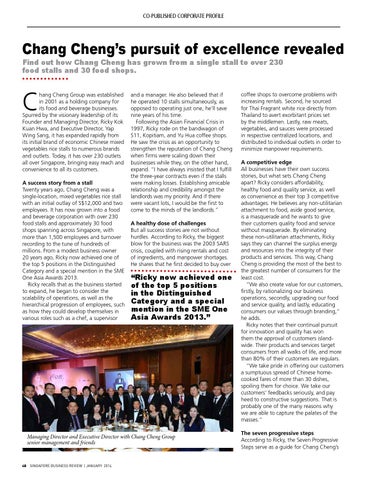
Managing Director and Executive Director with Chang Cheng Group senior management and friends
48 SINGAPORE BUSINESS REVIEW | JANUARY 2014
coffee shops to overcome problems with increasing rentals. Second, he sourced for Thai Fragrant white rice directly from Thailand to avert exorbitant prices set by the middlemen. Lastly, raw meats, vegetables, and sauces were processed in respective centralized locations, and distributed to individual outlets in order to minimize manpower requirements. A competitive edge All businesses have their own success stories, but what sets Chang Cheng apart? Ricky considers affordability, healthy food and quality service, as well as convenience as their top 3 competitive advantages. He believes any non-utilitarian attachment to food, aside good service, is a masquerade and he wants to give their customers quality food and service without masquerade. By eliminating these non-utilitarian attachments, Ricky says they can channel the surplus energy and resources into the integrity of their products and services. This way, Chang Cheng is providing the most of the best to the greatest number of consumers for the least cost. “We also create value for our customers, firstly, by rationalizing our business operations, secondly, upgrading our food and service quality, and lastly, educating consumers our values through branding,” he adds. Ricky notes that their continual pursuit for innovation and quality has won them the approval of customers islandwide. Their products and services target consumers from all walks of life, and more than 80% of their customers are regulars. “We take pride in offering our customers a sumptuous spread of Chinese homecooked fares of more than 30 dishes, spoiling them for choice. We take our customers’ feedbacks seriously, and pay heed to constructive suggestions. That is probably one of the many reasons why we are able to capture the palates of the masses.” The seven progressive steps According to Ricky, the Seven Progressive Steps serve as a guide for Chang Cheng’s