New Programs: One Year MBA, DNP and EdD Return to Chaminade: Dr. Lupita Ruiz-Jones '09
SUMMER 2021
Chaminade Magazine IN THIS ISSUE
Aloha, Over a year ago, in March 2020, the World Health Organization declared COVID-19 a pandemic. In looking back on everything that has transpired since that time, it is easy to focus on the obstacles and the disruptions. There was certainly no shortage of adversity. But it is also important to recognize everything we have overcome, together. Today, we are a stronger and more unified university community. Every step of the way during this crisis, Silverswords have made sacrifices to protect one another and our neighbors. To be sure, the last year has been difficult for everyone. It has tried us and tested us. Whatever the challenge, however, we have met it—thanks to our incredible faculty and staff, our adaptable student body and our steadfastly supportive alumni and broader community. In the face of so much, we have not only delivered on our mission but exceeded it. And we are entering this new chapter in the pandemic, with widescale vaccination efforts underway, as a more nimble, resilient institution. Indeed, the rollout of vaccines to more members of our community means we can plan for more activities that we had to forgo over the last year. This spring, our Commencement ceremony will be held in person and on campus. Undergraduates can look ahead to a fully in-person experience in Fall 2021. As we make this transition, it is so vital that we not only celebrate our progress but recognize the members of our Silversword community who accomplished so much during the pandemic despite the barriers they were facing. We have included some of their stories of success in this issue: • On page 19, read about the cadre of Chaminade Nursing students who stepped up to become vaccinators, offering their time at vaccination sites on Oahu. One of those students, senior Serina Lipman, said she felt so fortunate to be able to do her part to stop the spread of coronavirus. “It felt humbling knowing that we were making a difference,” she said. • You also will not want to miss a great profile on M. Dyer Global president and CEO Anthony Shipp, MBA ‘19, who was able to steer his logistics and shipping company through the choppy waters of the pandemic to end the year in a solid position even while his competitors suffered major losses. He credits his success to a servant leadership style and the relationships he has built, including as a student at Chaminade, to stay in front of market trends. “As a business leader, you need to be prepared for change at all times,” he said. Read more on page 38. • And on page 11, catch an inspiring piece on Alice Potter ‘18, who joined the Peace Corps after graduating from Chaminade with a degree in Communication. Potter served at a high school in East Java, and quickly fell in love with the community that had embraced her. She said her experience was “beautiful” and “eye-opening”—and she hopes to return one day soon. • For marketing executive Kristine Stebbins ‘87, the pandemic offered an opportunity to assess where she was in life and work. And in September 2020, she was delighted to accept a position as Bank of Hawai'i’s senior vice president and director of digital experience innovation and technology, a role created expressly for her. Read about her exciting journey on page 34. • Finally, speaking of new roles, turn to page 28 to read more about Dr. Lupita Ruiz-Jones, who recently joined the university as an assistant professor of Environmental Science. Ruiz-Jones is a familiar face at Chaminade, having graduated with her bachelor’s degree in Environmental Science from Chaminade before going on to complete a doctoral degree in Biology from Stanford University. We are incredibly excited she has come full circle and is bringing her expertise to our team.
These Silverswords underscore our broad commitment to the community: to help drive transformational change with programs that meet the needs of Hawai'i’s people. Indeed, amid the pandemic we have worked tirelessly to not only continue delivering an excellent, service-oriented educational experience, but find and address gap areas identified by key community stakeholders. We are so proud this year to launch several new programs and degrees that are designed to meet critical areas of need or promote new avenues to leadership. These programs include an online Counseling Psychology in School Counseling master’s degree geared toward non-O'ahu students; a Doctor of Education in Organizational Leadership for Adaptation and Change program; a Doctor of Nursing Practice program, which features three concentrations- family nurse practitioner, psychiatric/mental health nurse practitioner and leadership; and a One Year MBA program with a unique hybrid course offering. These new initiatives are a testament to the dedication and tireless work of our team. A year ago, COVID-19 changed just about every aspect of our lives—and threatened to derail our important work. But our tightknit Silversword 'ohana was able to turn challenges into opportunities for innovation, excellence and relevance. Along the way, we put the safety and wellbeing of our community first. After transitioning back to in person instruction for the remainder of 2020, we are delighted to be preparing for a commencement ceremony in-person and on campus. It is a fitting way to recognize our graduates, and we cannot wait to give them a proper sendoff as they prepare to set out to change the world for the better. Before long, you will be reading their stories in these pages, too. Sincerely,
Lynn Babington, Ph.D. President, Chaminade University of Honolulu
4 |
C H A M I N A DE M AGAZI NE
LEADERSHIP
PRESIDENT
BOARD of REGENTS
C H A N C E L LO R
BOARD of GOVERNORS
CHAIR
Michael F. Kerr, J.D.
Lynn M. Babington, Ph.D.
Rev. Oscar Vasquez, S.M.
P R OVO S T & V.P. O F AC A D E M I C A F FA I R S
John D. Field, Jr., M.B.A. ‘84
V.P. FO R M I S S I O N & R E C TO R
Rodney Harano, M.B.A. ‘83
V.P. O F A DVA N C E M E N T
Terry Walsh ‘93
Blaine Rand Y. Lesnik, Psy.D.
S E C R E TA RY
V.P. O F H U M A N R E S O U R C E S & L E G A L A F FA I R S
Ruth Ann Becker
Arnold M. Baptiste, Jr. Richard J. Blangiardi John C. Brogan Margery S. Bronster, Esq. Sai Cheong Chui ‘76, M.B.A. ‘78 Walter A. Dods, Jr. Adelia C. Dung Eddie Flores, Jr. William H. Garrett Col. Christine M. Gayagas, USA (Ret.) Robert S. Harrison Warren H. Haruki Ed Hogan Gary G. Hogan Matthew D. Howard ‘89 Bro. Robert Juenemann, S.M. Lung Nien Lee ‘88 Dawn O. MacNaughton, M.B.A. ‘93 Joseph Melehan RADM Kenneth P. Moritsugu, M.D., M.P.H., F.A.C.P.M., USPHS (Ret.) Donald D. Rodrigues Walter Randall Schoch Marti S.N. Steele ‘92 Richard E. Tanaka Vaughn Vasconcellos Julie T. Watumull Gen. Francis J. Wiercinski, USA (Ret.) Jim R. Yates Adm. R.J. Zlatoper, M.S.A., USN (Ret.)
Lance Askildson, Ph.D.
CHAIR
FIRST VICE CHAIR
Bro. Edward Brink, S.M.
S E CO N D V I C E C H A I R
Gary Cordova
Christine Denton
V.P. O F U N I V E R S I T Y CO M M U N I C AT I O N S & M A R K E T I N G
Lisa Furuta
V.P. O F S T U D E N T A F FA I R S & DEAN OF STUDENTS
Allison Jerome
V.P. O F F I N A N C E & FAC I L I T I E S
Aulani Ka'anoi
V.P. FO R S T R AT E GY & I N N OVAT I O N
Helen Turner, Ph.D.
Gae Bergquist-Trommald Carolyn Berry Wilson Lesley J. Brey, M.B.A. ‘88 Bro. William J. Campbell, S.M., Ed.D. Melissa Ching Benjamin Jerry J. Correa, Jr. Keiki-Pua S. Dancil, Ph.D. Ismael Eustaquio ‘88 Lori Forman, Ph.D. Daniel D. Goo ‘81 Karen Knudsen Bro. Joseph Markel, S.M. Ralph Mesick Bennette E. Misalucha Lance A. Mizumoto, M.B.A. ‘92 Jean Rolles, M.S.J.B.S. ‘93 Dr. Lawrence K.W. Tseu, D.D.S., F.A.G.D. Bro. Edward A. Violett, S.M., Ph.D. Richard F. Wacker Jeannine M. Wiercinski EX OFFICIO
Lynn M. Babington, Ph.D. Michael F. Kerr, J.D. Bro. Jesse O’Neill, S.M. Rev. Oscar Vasquez, S.M. Claire Wright, Ph.D. EMERITUS REGENTS
Gary E. Liebl, Chair Emeritus
VICE CHAIR
Anton Krucky S E CO N D V I C E C H A I R
Sharon McPhee S E C R E TA RY
EX OFFICIO
Lynn M. Babington, Ph.D. John D. Field, Jr., M.B.A ‘84
Chaminade University and the broader Silversword 'ohana mourn the loss this academic year of Martha B. Smith, M.B.A. ‘91, member of the Chaminade Board of Regents; and Lynn Hogan, member of the Chaminade Board of Governors. May their legacies of service to this institution and to Hawai'i serve as a beacon of inspiration to us all.
COVER STORY
FEATURES » 08 New Doctorate of Education Trains Leaders for Adaptation and Change 16 Doctor of Nursing Practice Program: More Than a Degree—An Opportunity to Make a Difference 20 New Online School
Counseling Program for Neighbor Islanders
36 One Year MBA Teaches
Business for Good Through Strategic Decision-Making
| Coming Home to Chaminade
06 Most Reverend Larry Silva Visits Chaminade 11 Service in Action A Peace Corps Volunteer’s Story 12 A Note from Alumni Relations 14 The Women Who Shaped Our Nation 15 Mulatta—Not So Tragic? 18 Mamoru and Aiko Takitani Foundation Grant Supports Scholarships 19 Nursing Students Part of Hawai'i’s COVID Vaccination Efforts 22 Bridging the Age Gap
ABC Stores Support STEM Outreach Program
23 It's Okay to Not Be Okay 24 Holomua Elementary Vice Principal Receives Kawaguchi Award 25 Discovering Passion and Purpose in the Family Business 26 Pushing Boundaries: Sushi with Attitude 32 Making Lemonade Out of Lemons
Cover and photo above feature alumna and Chaminade Assistant Professor Lupita Ruiz-Jones, PhD
28
33 Arthur and Mae Orvis Foundation Supports Performing Arts G.N. Wilcox Trust Grant Supports Distance Learning
34 Coming Full Circle 38 Leader at the Bottom of an Inverted Pyramid 41 Challenges of 2020 Pave the Way for Entrepreneurship 42 Data and Design: A Powerful Storyteller 43 A Winning Pair 44 Samuel N. and Mary Castle Foundation Awards Grant for Scholarships 45 2020 Hawai'i Catholic Schools Teacher of the Year 46 Changing the World, One Student at a Time 48 A Passion for Criminal Justice Reform 49 Letter from the Director of the Annual Fund 51 NASPA Undergraduate Fellows Program 52 Chaminade 'Ohana Celebrates Years of Service 53 New to Chaminade 54 Notables
6 |
C H A M I N A DE M AGAZI NE
Dr. Helen Turner and Dr. Lynn Babington meet with Most Reverend Larry Silva
Most Reverend Larry Silva Visits Chaminade THIS YEAR’S MEETING TOOK ON A DIFFERENT FORM, WITH CHAMINADE HAVING THE EXTREME HONOR OF SAFELY HOSTING THE BISHOP ON CAMPUS. THE VISIT WAS AN OPPORTUNITY TO EXPLORE HOW THE UNIVERSITY AND THE DIOCESE COULD COME TOGETHER DURING THESE UNPRECEDENTED TIMES OF NEED TO SERVE OUR COMMUNITY.
“I thought that meeting some of the people that are doing work that contributes to the shared mission of the diocese and the university would be helpful to him and to us,” says Bro. Edward Brink, S.M., Chaminade’s vice president of mission and rector who helped arrange the visit. “I hope the visit will help both the Bishop and those of us who met with him to think creatively about how the university and the diocese can serve the people of Hawai'i.”
Most Reverend Larry Silva began his visit by meeting with Fr. Martin Solma, S.M.; Dr. Dave Coleman, professor of Religious Studies; Dr. Dustyn Ragasa, director of the Master in Pastoral Theology program; and Jeremiah Carter, director of Campus Ministry. Wearing masks and maintaining a safe distance, the small group discussed Marianist values, focusing on the formation of faith on campus and in the community. Next, he met with Dr. Lynn Babington, president, and Dr. Helen Turner,
S UMME R 2 0 2 1
vice president of strategy and innovation. For first-year students Jerseylee-Rayne Mahiai and Ashley Yoshikawa, the Bishop’s visit left them feeling connected and inspired. They were part of a group of students who joined the Bishop for a safe luncheon after his morning meetings. “The biggest takeaway I had from lunch with Bishop Silva was how engaging he was,” says Mahiai. “One thing that stuck out to me was when he said that we were future leaders. It may not seem like much and I’ve heard that term many times, but Bishop Silva spoke to us as if the world’s next decision had to be made by the five students that were in that room at that moment.” The Bishop asked the students for their thoughts and opinions on how to solve some of Hawai'i’s most pressing issues, like homelessness. “It caught my attention because he asked us for ideas of how to solve this issue,” says Mahiai. “He is so full of wisdom and he has experienced so much, and here he was asking us for advice. It felt like such an honor. The ideas that were brought to the table were very interesting and some things I would have never thought.” Yoshikawa was struck by hearing how the Bishop’s work and church communities have been affected by COVID-19 in many of the same ways as Chaminade.
|
7
“Hearing about his experiences with learning to adapt to COVID-19 regulations was really eye-opening,” she says. “Especially as he mentioned that some were critical of his choices.” As the group sat six feet apart from each other and took precautions to keep each other healthy, many shared their own experiences with COVID-19. For some of the students who are new to the university, one of their biggest takeaways was just getting to meet each other and feel connected during these socially distant times. “It isn’t very often that we can meet with others and talk with them,” says Yoshikawa. “And especially as a first-year student, I’ve missed out on a lot of opportunities to meet and get to know people. So I enjoyed being able to have that in-person connection with people.” Mahiai agreed. “It was good being able to meet new people while feeling safe during this rough time,” she said. Their shared experiences allowed them to explore the reality of COVID-19 and discuss how these challenging times have affected everyone across the board. Together, the Bishop and the students explored their joint responsibility to care for their community. “It has been a difficult time because of COVID-19,” says Yoshikawa. “It has impacted so many communities, and it is more important than ever to reach out to those in need.”
Chaminade students and administration had the opportunity to chat with Most Reverend Larry Silva during a luncheon
8 |
C H A M I N A DE M AGAZI NE
N E W
DOCTORATE O F
E D U C A T I O N
Trains Leaders for Adaptation and Change PROFESSIONALS WHO ARE READY TO STEP ONTO THAT HIGHEST RUNG OF THE EDUCATIONAL LADDER AND EARN A DOCTORAL DEGREE HAVE A NEW ONLINE OPTION. CHAMINADE UNIVERSITY’S NEW DOCTORATE OF EDUCATION (EdD) IN ORGANIZATIONAL LEADERSHIP FOR ADAPTATION AND CHANGE IS FOR WORKING PROFESSIONALS IN INDUSTRIES SUCH AS EDUCATION, BUSINESS AND HEALTHCARE. THE 60-CREDIT PROGRAM IS BEING OFFERED FOR THE FIRST TIME STARTING IN JULY.
“We developed this program to meet the needs of busy, active, working adults who have careers and families,” says Dr. Dale Fryxell, dean of the School of Education and Behavioral Sciences. “An online program lets them fit school into their schedules because they can do the coursework on their own time. It just gives people so much more flexibility. It's a more efficient way for busy people to get a degree and improve their opportunities as a professional.” A doctorate in education helps people build an impressive skill set and advance their careers. It also generally means a higher pay level. According to Chaminade President Lynn Babington, leadership is both an art and a science, and she says the new EdD program has a strong foundation in both. “Here at Chaminade, we believe that transformational
leaders are not born that way but are developed,” she says. “To that end, we designed our new online EdD program to prepare students to become inspirational leaders who are extremely skilled at adapting to changing conditions and new variables while also motivating people and communities.” That focus on adaptation and change is one factor that sets Chaminade's new program apart from other EdD in Organizational Leadership programs. "Educating for adaptation and change" is one of the essential Marianist principles that guide Chaminade University in all its decision-making. While the COVID-19 pandemic has emphasized the importance of pivoting and finding creative solutions, being skilled at working with adaptation and change has always been critical in organizational leadership and always will be.
Photo: Director of Graduate Education Leadership Programs Hans Chun, EdD
S UMME R 2 0 2 1
Ed D F O R E D U C AT O R S , B U S I N E S S PROFESSIONALS AND LEADERS OF INDI GE N O US-SE RV I N G O R GAN I Z AT I O N S
Chaminade’s new EdD program prepares students for success, growth and positive impact in one of three concentrations—educational leadership, indigenous leadership or organization development. The educational leadership track primarily targets experienced education professionals— teachers and administrators—who want to develop their leadership skills and advance in their careers. Fryxell says there are many career paths for those with a doctorate in education, including going into post-secondary education and becoming a professor or moving into administrative positions at K-12 or higher education schools. Others may become director of a religious organization or school or move up to a district- or state-level education position. The educational leadership concentration helps develop action-oriented leaders who are well equipped to lead person-centered learning communities and promote social justice and positive change. Courses specific to this track include Leadership for Educational Administrators, and School-Community Relations. The indigenous leadership concentration focuses on preparing leaders, especially Native Hawaiians and other Pacific Islanders, who work in indigenous cultural organizations. Fryxell points out there are different indigenous leadership styles and approaches to leading people. A positive aspect of this concentration is what he calls "cross-pollination,” or sharing how different cultural groups approach leadership or create pathways. Specific courses in the track include Indigenous Leadership and Organizational Management, and Power, Politics and Policy: Historical and Contemporary Perspectives. There is also an indigenous leaders speaker series, which students in any of the concentrations can attend to learn from indigenous leaders around the world. Fryxell says it’s common for people on the U.S. mainland to follow the third track, an EdD in organization development, after earning an MBA. “That’s what a lot of MBAs do,” he says. “They lead organizations. This program is an opportunity for them to focus even more on developing leadership skills, looking at and using data for decision-making and learning how to streamline their organization and make it more effective.” The organization development track provides an interdisciplinary approach for professionals in the business, healthcare, nonprofit and public sectors who want to drive positive change and transform their organization for success.
|
9
Many nurses get an EdD in organization development, says Fryxell, and use that as a springboard into teaching at the college level. This concentration also attracts training and development managers, human resources personnel, nonprofit directors and high-level management staff. Its track-specific courses include Leading Organizational Change, and Consulting Skills. M E N T O R S H I P A N D R E A L-W O R L D P R O B L E M S O LV I N G
Program directors will work closely with each student, looking at their career goals and aspirations and helping them plan their path through the doctorate. The fact that the new student-centered Chaminade EdD program is 100 percent online does not constrain its emphasis on mentorship. The program is designed to foster mentor relationships that promote personal growth, critical thinking and robust dialogue. In addition to working online with professors, students are also welcome to meet with them in person on campus. Every dissertation committee, chaired by the EdD director, will also consist of a faculty member and someone from the community. “For example, if a student is going to do their dissertation on, say, DOE leadership, they might ask an assistant
superintendent to be on their dissertation committee—somebody that's working in the field and really knows the field to help them through that process,” says Fryxell. “Then they also have the faculty member who's going to help them with the academic rigor, the writing process, and the dissertation development process,” he says. “And then the chair, the EdD director, who will shepherd them through the entire dissertation process, keeping them motivated and on target so they can get that dissertation done and finish up the program.” He says a goal of the EdD program is for students to identify a real-world problem or issue that their organization—whether it’s a school,
10 |
C H A M I N A DE MAGAZI NE
CONTINUED FROM PAGE 9 business or indigenous organization—is currently facing and turn that into a research project. They will determine the problem, come up with a testable hypothesis, research data about the problem and develop a solution. That allows them to come up with innovative solutions in a real-world setting. “As they go along in leadership positions throughout their careers, they will have to make decisions,” he says. “And looking at an action research process will help them be good users of previous knowledge and data to take their organizations to where they want to lead them.” All dissertation work happens as part of a student’s coursework, and students can finish the entire EdD program in 36 months.
“... being skilled at working with adaptation and change has always been critical in organizational leadership and always will be.”
Fryxell says the program is an excellent opportunity for anyone looking to further their career and also advance themself as a person. “I think they'll be able to take what they learn in this program and make positive changes in everything they do. I think it's going to be a great program and have a big impact, not only on our students but also on the community and Hawai'i and across the Pacific.” N E T W O R K I N G A N D C O L L A B O R AT I O N FOR RESILIENT LEADERSHIP
Throughout the EdD program, students will be able to participate in enrichment activities. A virtual brown bag series, for instance, will
feature leaders who speak on various topics. Virtual professional writing practice circles will break classes into small groups that can work together on their writing. “A lot of doctoral work involves writing,” says Fryxell, “and this way students can bounce their ideas and papers off their classmates.” He stresses the importance of students supporting each other, discussing each other’s ideas, and being resources for each other. “A lot of being successful throughout a career has to do with networking and your ability to form and keep relationships, so we're hoping this program will really enhance that,” he says. An EdD student organization will allow students to coordinate social or community service events, whether in person when possible or else online. “We’re expecting there will be students from the mainland and from throughout the Pacific, but there will be various ways for them to connect.” An annual Research Symposium will provide opportunities to participate in local and national conferences, offering more occasions for students to meet, interact and support one another. E D U C AT I N G T H E W H O L E P E R S O N
While the academics at Chaminade are innovative, modern and up-to-date, it’s never only about academics. A central Chaminade principle, built into every academic program, is to educate the whole person. “To be a well-rounded person and a good leader,” says Fryxell, “you have to have psychological strength, intellectual strength and certainly moral strength. You have to take care of your body through exercise and diet. With all our programs, we try to help people remember it's not about any one area of your life. It's really about improving all areas of your life in order to be a better, more effective person.” The school’s professors, themselves leaders and experts in their field and the community, aim to develop future leaders who lead with open minds and understanding in their hearts, are part of the solution, and make a difference in their community. Ideally, students not only move their careers forward but also become changemakers. A Chaminade education is also about values and ethics, including social justice. That’s one of Chaminade’s defined values—educating for service, justice and peace—and it’s an important focus of the EdD program. “The need for social justice is infused throughout our whole program,” he says, “because no matter what organization you're
working for or what environment you're in, that's what you have to keep top-of-mind: What am I doing to help my community? What am I doing to help my workers? How am I contributing to the betterment of mankind?” ONLINE EdD OFFERS FLEXIBILITY AND ACCESS
“If there’s one thing we’ve all learned during the COVID-19 pandemic, it’s how to pivot,” says Fryxell. “How to make things fit into our new lives. How to make it happen.” As we move forward, he says, organizations also must adapt to new and continually changing environments and situations. “What we hope to do in this program is really prepare students to be able to make those continuous changes they're sure to face in their careers,” he says. “I think COVID brought this issue to the forefront— that you have to be adept at changing the way your organization does things, or your organization won’t survive. That’s why the ability to adapt and change is the focus of our entire program. But it’s not only because of COVID. Those abilities were important before the pandemic, and they’ll still be important afterward.” He predicts we’re going to continue seeing significant changes at all levels of education as technology keeps moving forward. “I think online programs will continue to grow and develop, and as technology advances and new software comes up, it will be amazing. We can do things online now that you couldn't do even a year ago. Hardly anybody even knew what Zoom was one year ago.” He says there’s already been a strong online presence at Chaminade for some time. “So many of our professors, including myself, have been teaching online since the beginning of online education. So with COVID and the forced move to technology, it just really had to do with bringing more people along into a modern online world. It’s something we're really well prepared for, and I think it’s going to keep evolving and developing. “And at Chaminade, we’ll be there continuing to evolve and develop right along with it.”
For more information, visit chaminade.edu/edd.
S UMME R 2 0 2 1
|
11
Service in Action
A PEACE CORPS VOLUNTEER’S STORY
“WHEN I’M OLDER, I WANT TO JOIN THE PEACE CORPS.” HER UNCLE’S STORIES OF THE PEACE CORPS, LIVING IN A FARAWAY PLACE CALLED TOGO (WEST AFRICA) AMONG PEOPLE VERY DIFFERENT FROM HIM YET WHO BECAME HIS LIFELONG FRIENDS, HAD CAPTURED THE IMAGINATION OF ALICE POTTER, A PRECOCIOUS FOUR-YEAR-OLD. IT WAS IN HER BLOOD.
Potter and her family grew up in California while her father worked as a software engineer, and they also spent years living abroad in Italy, Germany and France. Returning to the United States for college was never part of Potter’s plan; however, her mother did an internet search for colleges in the U.S. “with a good record of acceptance and graduation rates,” and Chaminade University of Honolulu popped up. The positive reviews about Chaminade’s student-to-faculty ratio, affordable tuition and overall quality, coupled with its location and Hawai'i’s mild weather, all sounded very appealing. Her mother told her that if she got in, she would be going to the Marianist university. And to Potter’s surprise, the acceptance letter came. She was anxious to be going back to the U.S., and of all places the most remote 50th state. T H E R E ’ S N O P L A C E L I K E H AWA I ' I
Intimidated at first, she soon made new friends and began thriving in Chaminade’s customized learning environment. She also shared its values of serving the community by volunteering at the Waikīkī Aquarium. Aside from her studies, Potter also fell in love with Hawai'i’s marine life and flora and enjoyed learning about the Islands’ rich history. “Never before had I encountered a place so profoundly connected to its people like in Hawai'i,” she says. LIVING HER DREAM OF JOINING THE PEACE CORPS
Potter graduated with a bachelor’s degree in Communication in 2018. At age 23, ready for a new adventure, she jumped at the opportunity to live her dream and join the Peace Corps. Because she spoke conversational French, Potter had hoped to be assigned to Africa, specifically in Senegal; however, there was an opening to teach English in Southeast Asia.
She had lived in a variety of places, yet she remembers experiencing culture shock when arriving in Indonesia, the world’s fourth most populous country with more than 267 million people and a Muslim majority. She was immediately struck by the language barrier and the lack of personal space in this bustling yet conservative, spiritual society. The Peace Corps helps new volunteers acclimate to their new country through an intensive two- to three-month pre-service training (PST) program. Potter explains this included language lessons and cultural classes, as well as learning about Peace Corps procedures and the country’s rules and local customs, providing the skills and knowledge trainees need to thrive on their own. During this time, she lived with the first of three host families. “My host family during PST was especially kind, patient, helpful and accepting, and I became very close to them,” Potter says. Her host family warmly welcomed her into their home, introducing Potter to many delicious Indonesian dishes, such as sate (marinated meat skewers), cap cai (stir-fried vegetables sometimes mixed with meat), nasi goring (fried rice) and rawon (beef soup), which became her favorite. Potter was relieved that one of her host twin sisters, Dhea, spoke English, helping her with the transition and translating for her twin, Adhe, and their parents. Once her assignment began, Potter lived with two other host families: a single mother with grown children, a driven career woman who worked as a caterer for weddings and funerals, as well as a seamstress and a makeup artist; and a young couple who introduced her to carp rearing, bird catching and “coffee time.” A neighboring family acted as her “mom and dad” when Potter needed adult assistance, and they took her on day trips.
“Immersing yourself in a different country with a foreign language and culture will humble you, and you’ll learn so much about yourself.” TEACHING IS LEARNING
Potter was assigned to a vocational training high school near East Java, where she taught English to 15- to 18-year-old students, 85 percent of them male. School was held seven days a week from 7 a.m. to 4:30 p.m. with extracurricular activities held on Saturdays. Potter says she taught two or three classes each day; class periods were two hours long for sophomores and juniors and one hour for seniors. The school offered career paths for students in fields such as auto mechanics, electrical work, computer work and broadcasting. “Most of the time my students called me ‘Mister,’ or ‘mbak’ or ‘kak,’ which is equivalent to saying young miss or older sibling,” explains Potter. “I was the youngest teacher at the school,” she adds. Halfway through her service, Potter was riding her bicycle back to school after a lunch break when she was hit by a motorcycle from behind. “Even though I was wearing a helmet, I had a pretty serious concussion. A piece of
12 |
C H A M I N A DE MAGAZI NE
CONTINUED FROM PAGE 11 asphalt got inside one of the helmet vents and cut my scalp,” she says. “I also had cuts on my upper lip, under my eye and the edge of my forehead and some gashes along the right side of my face, arms and legs. Fortunately, I only needed stitches,” she adds. The Peace Corps kept her in the capital for a few weeks for regular check-ups at the hospital. She smiles as she remembers when she returned to school, how the entire community—her host family, students and teachers—all offered to drive her home so she wouldn’t have to walk. “Student after student kept begging me to ride home with them,” she says with a laugh. The community was close-knit, reminding her of her 'ohana at Chaminade. “The insight I gained from the students was invaluable,” she readily admits. As a teacher’s assistant, Potter adds she learned so much more from her students than she could have ever imagined. “My students taught me patience and acceptance. They also taught me to acknowledge the cultural differences of education in Indonesia versus in the U.S. and that young adults, no matter where you are in the world, want to be heard. It was amazing to watch them blossom,” Potter says. Their hospitality and intelligence impressed her day in and day out. Potter learned to speak English, French, Italian and German while growing up and could now count Bahasa Indonesian as her fifth language. A L A S T I N G I M PA C T
The Peace Corps profoundly changed Potter’s life. She learned the importance of keeping an open mind and welcoming others from different backgrounds with appreciation and understanding. While the Peace Corps may not be for everyone, Potter believes everyone could benefit from broadening their perspective by experiencing other cultures. “Immersing yourself in a different country with a foreign language and culture will humble you, and you’ll learn so much about yourself,” she confesses. “The Peace Corps was a beautiful, eye-opening experience that made a lasting impact,” she adds. Potter keeps in touch with her first host family and hopes to go back to Indonesia as soon as it’s safe to do so. Saya meninggalkan sesuatu istimewa. “I left behind something special,” she translates. W H AT ’ S N E X T ?
After her 27-month stint in the Peace Corps, Potter moved back to California. Today, she continues to serve youth by teaching part-time in an after-school program. What’s next for Potter? She hopes to put her communication degree to use and strive toward her next goal of becoming a producer or film director.
A NOTE FROM ALUMNI RELATIONS I want to start by telling you about a special place. A place where you experience both the best AND “best to continue to work on it” of life situations. A place where you are known by name, not number. A place where you are encouraged to not just focus on the best foot forward, but embrace faith to move you forward. A place where you are provided optimal and formative experiences that help propel you to a life of purpose. These are characteristics of a home called Chaminade University. I am honored to be welcomed back into the 'ohana. I am happy to be home. As a student, I had the privilege of receiving quality education and experiences from Chaminade University’s innovative faculty community. As a former staff member, I was a recipient of integral career and professional guidance by other staff. And I have the deepest respect for the Marianist community whose core values had such a transformative impact on not only my faith journey, but also my perception of service and community. This community is my family, OUR family. To return and see the significant changes on campus, and the university's response to the ever-changing times, is an inspiration. But to see that the spirit of Chaminade and the Silversword pride continue to be the heartbeats to their successes as a tiny yet premier university
S UMME R 2 0 2 1
in the middle of the Pacific… well… that is a feat that I am proud to be a part of. As Director of Alumni Relations, I am called to lead and expand Chaminade University’s alumni base through meaningful engagement opportunities. In collaboration with the Institutional Advancement team, we have already taken some important steps to jump-start the vision and continue to create programs centered on the journey of our alumni of yesterday, today and tomorrow. It begins by establishing a presence while they are students and identifying how they are to be engaged at different stages after they graduate. This can be achieved by, and not limited to: • working collaboratively with the campus community, learning their roles and existing initiatives, then creatively and strategically highlighting them in ways that keep the alumni community connected and engaged; • telling stories of alumni successes and life stories that stem from formative experiences of a Chaminade education; and • creating new and elevating existing platforms to connect, communicate and engage—such as an alumni/student mentorship program and alumni to alumni support (career support, reunions), and being more strategic/creative about how we market our alumni engagement and programs. Each one of these goals, a feat in itself. However, I have become a firm believer that before you run and get to your goal, you must first take little steps and learn from the journey. But neither I nor the Chaminade University campus community can do this on our own. We also need our worldwide Silversword 'ohana—you, the alumni, and your family and friends. While I challenge myself, I would like to ask you to take on a similar yet simple challenge of staying connected. We hope you continue to share your life journey with us, follow us on social media platforms, send us an email or postcard, visit campus (when you feel safe of course) and visit our website to continue to see how we are all growing together. There are many ways to stay close. Continuing that effort of connection and cultivation when a student leaves campus is instrumental to the success of our university. For our institution to be involved in the achievements of our alumni, and for them to be informed on the progress of the university, creates a special relationship—one of growth and perpetuation of the Chaminade legacy. I am looking forward to this exciting, integral challenge. I hope you are too! It is all for Chaminade University, it is all for YOU. Go Swords!
Jeannie Lum ‘05, MBA ‘07 Director of Alumni Relations
|
13
14 |
C H A M IN A DE MAGAZI NE
THE WOMEN WHO SHAPED OUR NATION CHAMINADE UNIVERSITY AND HAWAI'I COUNCIL FOR THE HUMANITIES RECENTLY TEAMED UP WITH THE NEW YORK HISTORICAL SOCIETY TO BRING THEIR "WOMEN & THE AMERICAN STORY" INITIATIVE TO EDUCATORS IN HAWAI'I.
The initiative connects teachers across the country with a free curriculum and resources to highlight the various ways women have helped shape our nation. The collaboration hosted a virtual workshop on November 7 to introduce Hawai'i teachers to the curriculum and help them find ways to incorporate more perspectives and contributions of women in their classrooms. The free curriculum is broken up into ten chronological units, each one exploring a different period of time in U.S. history. The November workshop focused on two of the ten time periods: Settler Colonialism and the Revolution (1692–1783) and Confidence and Crises (1920–1948). Led by Vice President of Education Mia Nagawieki of the New York Historical Society, the interactive session walked participants through various resources, including paintings, texts, documents, letters and videos, and explored how each depicted women and what they said about the roles that women played during that time. For each, Nagawiecki shared tips and strategies on how to utilize the resource in the classroom to prompt a discussion and encourage critical thinking. The training began by outlining four core questions for participants to think about during the course of the workshop, including: how did women actively participate in the Revolution? What effect did a woman’s race have on her experiences? And why are women’s stories essential to understanding the events of the American Revolution? The first half of the workshop examined the lives of Colonial women from various geographic regions, including Russia, Alaska, Spanish California, French Louisiana and England’s Thirteen Colonies. It also explored the lives of women from diverse ethnicities,
including Black, White, and Native American, and analyzed how women helped shape the American Revolution. After, participants joined breakout rooms to discuss the four questions posed at the beginning. They also explored how they could utilize the resources in their own classrooms and how they could incorporate more women’s perspectives and contributions into their lesson plans. The second half of the workshop focused on the Confidence and Crises module and explored the role women played during the Great Depression, the Second World War and the beginning of the Cold War, and how women gained the right to vote. This was a period of overt racism, when African American women lived under “Jim Crow” laws, and Asian, Jewish, Italian and Eastern European women faced racist immigration laws. For this section, participants were asked to think about the dramatic shifts women experienced in their roles as women and citizens as well as the ways in which the Great Depression and World War II affected the rush toward modernity that was driving the 1920s. At the conclusion of the section, participants once again joined breakout rooms to discuss what they had just learned and how to incorporate the teachings and resources into their classrooms. “We are thrilled to have had the opportunity to collaborate with the Hawai'i Council of the Humanities and bring this incredible initiative to Hawai'i’s teachers,” says Dr. Cheryl Edelson, dean of the School of Humanities at Chaminade and a speaker at the workshop. “It’s so important that our students see themselves in the stories we teach, and that we introduce them to a broader range of experiences to help them value our nation’s diversity. Through this training and curriculum, the New York Historical Society is helping us do that.”
Historical photograph: Meda Montana Hallyburton Brendall Collection (AFC/2001/001/04951), Veterans History Project, American Folklife Center, Library of Congress Painting: Portrait of Betsy by François Fleischbein (1801/1803–1868) of The Historic New Orleans Collection
S UMME R 2 0 2 1
Mulatta
—NO T SO T RAGIC ? TO COMMEMORATE BLACK HISTORY MONTH, CHAMINADE ENGLISH PROFESSOR DR. ALLISON FRANCIS RECENTLY COLLABORATED WITH KARLA BRUNDAGE, AN ADJUNCT PROFESSOR AT THE UNIVERSITY, TO PRESENT A THOUGHT-PROVOKING VIRTUAL RENSHI POETRY READING SESSION ENTITLED, “MULATTA—NOT SO TRAGIC?”
As part of the event, Francis and Brundage also engaged in a conversation with participants on the history of “mulatta”—which they described as a controversial label “traditionally used to signify progeny of African and European parents.” In unpacking the term and its history, the two also touched on their own life experiences and those of family members seeking to grapple with identity and race. Renshi poetry is also known as “linked poetry.” It’s a contemporary form of verse that relies on collaboration to uncover new understandings of the world and explore shared themes. Collaborators connect their poems by repeating the last line of the previous author’s work. Francis and Brundage said renshi poetry was uniquely equipped to allow them to explore the “sometimes devastating and celebratory dynamics of being bi-racial women in the 21st century.” Brundage noted that renshi poetry doesn’t just connect verses; it links the poet collaborators. She said the two started examining the theme of “being mulatta or being mixed” about a year ago. It was Francis who started the spokenword performance of their poem, “We Feel the Thunder.” “Such a brave woman,” the poem begins, “Rolling words through our heads like boulders.” Following the reading, Francis and Brundage delivered a joint presentation to further explore the themes of “being mulatta.” Francis noted that Hawai'i presents unique— and refreshing—conversations about “hapa” identity, but stressed it is not a place devoid of racism or discrimination. “I think there is a space that many of us can create here living in the islands that allows
for us to embrace both worlds and not have to entirely dismiss one or the other,” Francis said, as she showed a photo of her daughter and explained she grew up in Hawai'i. “But,” Francis added, “that might just be a bubble we created for her, and it’s something we continue to explore in this poetry.” Francis teaches and conducts research across a range of topics, including Victorian and Scottish literature, African-American and Caribbean Women’s literature from the 19th century, and women’s literature with a focus on science fiction and fantasy. She has published extensively, is a performance poet and playwright, and is currently collaborating on a scholarly collection on Scottish literature. Brundage publishes poetry, short stories, and critical essays. In 2020, her poem “Alabama Dirt” was nominated for the Pushcart Prize. She holds a Master of Fine Arts in Poetry from Mills College and is currently working to co-create a Hawai'i-based publishing company, Pacific Raven Press. Pictured, from top down: Professor of English Allison Francis, PhD and Professor of English Karla Brundage
“[Renshi poetry] relies on collaboration to uncover new understandings of the world and explore shared themes.”
|
15
16 |
C H A M I N A DE MAGAZI NE
DOCTOR OF N UR SING PR AC T ICE PROGR A M:
More Than a Degree—An Opportunity to Make a Difference The first students in Chaminade’s new online Doctor of Nursing Practice (DNP) program start in August.* The new doctoral degree is designed for the registered nurse or advanced practice nurse who wants to provide evidence-informed practice to culturally diverse populations and take a leadership role as an advocate for health and social justice using the latest technology for learning and practice. Dr. Pamela Smith, associate dean of Chaminade’s School of Nursing and Health Professions, says potential students should know the school truly cares that each student has a positive and successful experience. She says that’s why interviews are part of the application process. “We want to know what a student’s goals are so we know we can help them succeed. We want it to be a good match.” T H R E E D N P D E G R E E PAT H S
Students will choose one of three Doctor of Nursing Practice tracks: Family Nurse Practitioner (FNP), Psychiatric Mental Health Nurse Practitioner (PMHNP) or Executive Leader (EL). The FNP and PMHNP, both nurse practitioner tracks, will allow graduates to work as advanced practice registered nurses (APRNs) who manage patients’ conditions. Smith says APRNs diagnose, provide treatment and manage patients’ care in a holistic, comprehensive manner. “They’ll have the tools and learn the skills to provide quality improvement in their patient population in
their clinics and hospitals,” she says. “They'll be able to review the evidence-based literature and make clinical decisions based on that evidence.” “The focus is on being able to determine a need and create a plan, implement that plan and evaluate its effectiveness in terms of looking at organizational improvement or patient outcomes improvement, or delivering care as a nurse practitioner.” The nurse practitioner tracks are for nurses who have their BSN and are ready to advance their nursing education and clinical practice. The Executive Leader track is for the qualified nurse who wants the skills, knowledge and career opportunities that come with a DNP degree but chooses to focus on nursing leadership. “Executive leaders are nurse managers and leaders in a hospital, or clinical nurses looking to be able to lead their organization or their unit to improve patient outcomes,” she says. “These nurses have their master's degrees and want the education and career advancement that the DNP provides but do not have the desire to become a nurse practitioner. They want to take their nursing role to an advanced level.” The Post-MSN to DNP option is designed for the advanced practice nurse or registered nurse who already has a Master of Science in Nursing (MSN) and wants to follow the Executive Leader track. *The DNP program is pending WSCUC approval.
S UMME R 2 0 2 1
T H E N E E D F O R D N Ps : S H O R TA G E O F H E A LT H C A R E P R O F E S S I O N A L S
There’s a shortage of primary care providers not only in Hawai'i right now but throughout the country, says Smith, and nurse practitioners can help meet the needs. “Nurse practitioners can deliver accessible care as a provider.” The COVID-19 pandemic highlighted the need for strong healthcare and nursing leadership. “Many advanced practice registered nurses pivoted to providing patient care via telehealth in order to provide accessible care and serve the patient population safely.” And, she says, Chaminade will have the state’s only psychiatric mental health nurse practitioner program. “There’s a huge need for this program because of an increased need for mental health services.” Healthcare needs keep changing, and she points out that “adaptation and change” is one of the Marianist values that Chaminade embraces. “That’s exactly what is happening with COVID,” she says. “We continue to learn new information about COVID. How do we keep our patients and our staff safe? What do we need to do to make a new policy, implement it and carry it through until we realize we have to change it again? These are the problems being solved by well-prepared DNPs.” She says the DNP program is positioned to deliver content that will adapt and change as healthcare and nursing evolves. “We're very willing to implement new technologies and new evidence-based material as they present.” The pandemic, she says, has illuminated the need for strong nursing leadership skills. “Nurse leaders know what their staff and patients need. They know what the day-to-day and system needs are, and our graduates will have the skillset to come up with effective solutions.” AN ONLINE DNP PROGRAM WITH W R A PA R O U N D S U P P O R T
“We wanted to provide a personable online program that’s accessible to people in many different areas across the nation,” says Smith. “Many of our students might be from the neighbor islands, and we might have students from rural parts of America, where it's challenging to drive to a campus while balancing family and work in order to receive a high quality education.” The year-round DNP program consists of two 15-week sessions (in the fall and spring) and a 12-week summer session. The two nurse practitioner programs take three years to complete, and the executive leader program can be completed in just under two years. There are three annual multi-day immersion sessions on campus.
|
17
“The immersions will provide an opportunity for connectedness to the community and for students to gain a sense of place, of where we are. We serve the Native Hawaiian and Pacific Islander populations, and as a university, we feel it will be valuable for all our students to understand the culture in which we provide care, even if they’re from the mainland. Understanding the culture, the health, and health disparities of a specific region allows that information to be applied to other communities of need. “Say somebody is coming from another state, and they learn about the populations we serve here in Hawai'i,” she says. “They can take many of those models of care, or awareness, and apply them where they live for the cultures they serve. We're hoping the immersions will bring light to many of the vulnerabilities our community faces so that students will recognize the vulnerabilities in their own patient populations.”
“... we need to pay attention to the people that need care the most—not only for their benefit, but for the community as a whole.” The DNP program focuses on serving highneed communities. Smith says they want students to learn how to address health disparities and plan optimal and comprehensive care. “One of our Marianist values is social justice—service, justice, and peace.” She says they wove those values into the new curriculum and program goals. “Vulnerabilities need to be identified, and we need to pay attention to the people that need care the most—not only for their benefit, but for the community as a whole. By determining high need areas, and learning how to provide care and striving for health equity, we improve the health of all people.” The first immersion session, in August, will be an introduction to the islands’ culture, an opportunity to connect with peers, and a time to strengthen writing and statistical skills. “They’ll
18 |
C H A M IN A DE MAGAZI NE
CONTINUED FROM PAGE 17 meet the faculty and leadership team, and learn about library resources and other components of our university,” says Smith. Chaminade President Lynn Babington says that although the degree program is online, students will have close relationships with faculty and students of their cohort. “The faculty will support students and connect them with a network of field experts and opportunities.” The second and third immersions will continue to offer unique learning opportunities such as standardized patient simulations, suturing, casting and splinting, and project management. “It’s some of the nuts and bolts of what the students are going to see in their clinical environments,” says Smith. The cohort model, in which small groups of students progress through the program together, creates a supportive peer-learning environment. Each student is also paired with a DNP faculty member who will provide guidance and support through the program until they successfully complete a scholarly project. “The student can come with a project already in mind, something they'd like to implement in their own workplace, or we will assist them in selecting from a menu of projects needed in our community that are appropriate for their specific track and their specific interests,” says Smith. She says they want students to do scholarly projects they're interested in. “And they’ll all learn how to truly care for patients and their populations and communities in a way that is meaningful.” She stresses that the program is very hands-on. “Students are treated as individuals, in terms of what their interests and strengths are, and we will have writing and statistical support for them. It sounds so cliché, but they are not just a number. This is a personalized and intimate university program where we have a lot of collegial support and also opportunities for networking.” She says the potential applicants she’s been meeting with have so far been unique and very strong candidates. “In terms of where they've been as nurses so far, they come with strong backgrounds and have much to offer the world. We want to cultivate those strengths and also discover what their deficiencies are, their gaps, so we can fill those for them.” That’s the purpose of the interview, she says. “We want it to be a good match between the student and our organization. We really do care about each individual and optimizing their pathway.” A M A R I A N I S T F O U N DAT I O N
Dr. Rhoberta Haley, dean of the School of Nursing and Health Professions, says they will care for the DNP students by offering them all the support they need. “We want the students to be successful, and that takes time, dedication, and a lot of support, which we’ll give them.” Smith points out one more benefit of the DNP degree—that it opens doors. “That advanced practice degree on your résumé can help even if you don’t change jobs. You’ll have the tools and skills to perform better, to look at things from a different lens, and to be able to problem-solve with more capabilities. “It's not just a degree,” she says. “It's an opportunity to improve yourself, and therefore improve others.”
For more information, visit chaminade.edu/dnp. Applications for the first cohort, which starts on August 4, 2021, are due on July 1.
MAMORU AND AIKO TAKITANI FOUNDATION GRANT SUPPORTS SCHOLARSHIPS CHAMINADE UNIVERSITY OF HONOLULU RECEIVED A $100,000 GRANT FROM THE MAMORU AND AIKO TAKITANI FOUNDATION FOR STUDENT SCHOLARSHIPS. THE GRANT WAS SPLIT TO FUND CHAMINADE’S LEGACY SCHOLARSHIP AND THE STEM AND NURSING SCHOLARSHIP FOR THE 2020 –2021 SCHOOL YEAR.
The Legacy Scholarship is awarded to undergraduate students who demonstrate a commitment to community service and are in financial need. The STEM and Nursing Scholarship is awarded to undergraduate students studying any Bachelor of Science or Nursing degree. Both scholarships are given to full-time undergraduate students who are residents of Hawai'i and demonstrate leadership qualities and innovative skills. The Mamoru and Aiko Takitani Foundation has provided funding for student scholarships to Chaminade University since 2014. The Foundation was established in 1993 by entrepreneurs Mamoru and Aiko Takitani, founders of Hawaiian Host, to assist the youth of Hawai'i with their goals. Since its establishment, the Foundation has donated $2.3 million in scholarships and provided educational opportunities to students in Hawai'i.
S UMME R 2 0 2 1
|
19
Nursing Students Part of Hawai'i’s COVID Vaccination Efforts ONE VACCINE AT A TIME, HAWAI'I IS BEATING BACK COVID-19. AND CHAMINADE UNIVERSITY IS PROUD TO BE PART OF THE EFFORT.
Working with community healthcare partners, the university has deployed senior Nursing students to clinics on O'ahu to administer COVID-19 vaccines. Dr. Lynn Babington, Chaminade president, said the project underscores the University’s public service mission and its commitment to build a healthier Hawai'i. “Being part of the community and being able to serve our community is part of our mission,” she said, adding that the vaccines are a “light at the end of a long tunnel” and offer hope that many of the activities we used to consider normal will soon be resumed. She said it’s heartening to see students play a key role in “helping to bring the pandemic under control.” Dr. Lorin Ramocki, Chaminade University School of Nursing and Health Professions assistant professor and clinical/academic partnership coordinator, said the students giving vaccinations are seniors in their Public
Health Nursing rotation. To prepare for the challenge, they participated in mock clinics on campus, studied CDC and facility training modules, and attended on-site orientations. The students will be administering vaccines through the duration of vaccination efforts. Nursing senior Serina Lipman is among those serving as vaccinators. She said she feels incredibly fortunate to participate in a vaccination clinic and do her part to stop the spread of COVID-19. “It felt humbling knowing that we were out in the community making a difference,” she said. Her training and preparation at Chaminade helped her feel up to the challenge, Lipton added. “Through this experience, I have learned about how much effort and planning it takes to set up a massive vaccination clinic,” she said. “This experience was one of the best I have had throughout school, and I hope that
I get the opportunity to continue to vaccinate even after graduation.” Dr. Rhoberta Haley, School of Nursing and Health Professions dean, said the vaccination project highlights the importance of experiential learning and strong partnerships in the community. “For our nursing students to play a role in the state’s vaccination efforts not only strengthens our partnerships with healthcare organizations, it gives our students additional first-hand experience,” Haley said. Ramocki said the vaccination clinics are powerful educational experiences, offering students a strong appreciation of the value of focusing on population health, and of the role of community education and disaster response during periods of disease outbreak. “By participating in these efforts, they will be able to make the connection between what they are learning in the classroom and the importance of these topics,” Ramocki said. “They get to be a part of these efforts during one of the greatest public health crises in our lifetime. This is what public health nursing is all about—responding to and meeting the needs of the community.”
20 |
C H A M I N A DE MAGAZI NE
N E W
ON L INE
School Counseling Program for Neighbor Islanders SAY YOU’VE JUST GRADUATED ON ONE OF THE NEIGHBOR ISLANDS WITH A BACHELOR’S DEGREE IN PSYCHOLOGY. YOU WANT TO GET A MASTER’S DEGREE NEXT, SO YOU CAN BECOME A SCHOOL COUNSELOR AND MAKE A POSITIVE DIFFERENCE TO YOUR COMMUNITY’S STUDENTS AND THEIR FAMILIES—BUT THERE’S NO APPROPRIATE MASTER’S PROGRAM ON YOUR ISLAND. CHAMINADE UNIVERSITY IS THE ONLY HAWAI'I UNIVERSITY THAT OFFERS A MASTER OF SCIENCE IN COUNSELING PSYCHOLOGY (MSCP) PROGRAM WITH A CONCENTRATION IN SCHOOL COUNSELING. YOU’D HAVE TO QUIT YOUR JOB AND RELOCATE TO O'AHU FOR TWO AND A HALF YEARS.
“This program will really help our neighbor island students get the training they need to help students in their own communities...”
Or rather, that would have been your only choice last year. Starting this spring semester, exclusively for neighbor island students, Chaminade will offer an online version of its Master of Science in Counseling Psychology (MSCP) with the School Counseling degree program concentration. It solves two problems—not only that of neighbor island student demand but also the state’s need for more trained school counselors throughout Hawai'i. Dr. Darren Iwamoto, clinical director of School Counseling in Chaminade’s School of Education and Behavioral Sciences, says neighbor island students have always been interested in the MSCP program, and it’s always been hard for the school to meet that need because administrators assumed they needed to teach it in person. Pre-COVID-19, they had started working on a plan to send instructors to Maui and Hawai'i Island to offer the MSCP program there. But then came the pandemic, and with it, of course, remote learning. Iwamoto says the university discovered something surprising. “Our faculty found they can be just as effective at teaching using Zoom and other kinds of video conferencing,” he says. He said they found online education still provided personalized learning and allowed students to connect with one another. “Our instructors found that even when they couldn’t teach in person, they were successfully getting that human interaction over video. It was working.” The department conducted a needs assessment to see if there was current
demand for the MSCP program among neighbor island students, and it came back positive. So they decided to start an online program specifically for neighbor island students. While the School Counseling focus starts this spring, Chaminade will begin offering online versions of the other two Counseling Psychology concentrations, Mental Health and Marriage and Family, in the fall. Once all three concentrations are offered this fall, they will be available to students located anywhere. “At that point, we’ll be running a complete MSCP online program alongside the in-person program,” says Iwamoto,“ so students won’t have to fly to O'ahu. Although they can participate in the in-person commencement.” The online, 60-credit-hour, cohorted School Counseling program is taught in four 10-week terms per year. The year-round program, geared toward working professionals, can be completed in 30 months. Upon completing the program, students not only receive a master’s in counseling psychology but are also eligible for a provisional K-12 counseling license and to be hired as a school counselor. “Because they’re trained in school counseling in general, they will also have the skill set and knowledge to work as a counselor in our private and charter schools,” says Iwamoto. He says that while school counselors have always been crucial, that need has been even more significant since the COVID-19 pandemic began a year ago. He says stress, anxiety, and mood challenges, which were already high, have increased with COVID.
S UMME R 2 0 2 1
“What we're finding is that the lack of social connection has probably played the biggest role in altering people's moods,” he says. “That's where counselors can really help, especially in regards to social-emotional learning and helping students, especially the younger ones, learn how to regulate their emotions better.” As the school developed its MSCP program, it carefully considered the university’s Marianist values, including the importance of providing quality education. The program was specifically designed with an “integral quality education” in mind by ensuring it educates the whole person. It does this by not only focusing on academics. “We also educate them in terms of their personal and social development, and spiritually, in terms of getting them in tune with who they are and their value systems, ethics, and morals,” says Iwamoto. “When students go on to become school counselors, they pass those same values on to the community,” he says. “They support students and their families and make a positive difference in their lives.” The program also meets the Chaminade value of educating for adaptation and change. “That's really what all this is about,” says Iwamoto. “Educating students to improve on their social-emotional skills is actually educating them for adaptation and change, for that ability to adapt and be flexible. That's really been a theme with COVID, and so that's what we're promoting.” The Master of Science in Counseling Psychology program is part of Chaminade’s School of Education and Behavioral Sciences. Dr. Dale Fryxell, dean of the School of Education and Behavioral Sciences, says there’s long been a need for more trained school counselors, who play such an essential role in helping students, on the neighbor islands. “This program will really help our neighbor island students get the training they need to help students in their own communities with mental health and other issues.” “School counselors really do help mold the future by emphasizing the importance of education and promoting students’ success,” agrees Dr. Lynn Babington, Chaminade University president. “We’re so glad to be able to take the MSCP school counseling program online,” she says. “There’s a need on the neighbor islands, and when more of our neighbor island students become licensed school counseling professionals, they will truly be able to make a powerful difference in students’ lives.”
|
21
22 |
C H A M IN A DE MAGAZI NE
BRIDGING THE AGE GAP
ABC STORES SUPPORT STEM OUTREACH PROGRAM ABC STORES AWARDED CHAMINADE UNIVERSITY A $10,000 GRANT TO FUND ITS I AM A SCIENTIST (IAS) MOBILE STEM OUTREACH PROGRAM. THE PROGRAM PROVIDES HANDS-ON SCIENCE MODULES FOR ELEMENTARY SCHOOLS IN HAWAI'I TO CREATE EQUAL ACCESS TO QUALITY SCIENCE EDUCATION AND TO INTRODUCE
RELATIONSHIPS ARE ONE OF THE CRITICAL INGREDIENTS IN
STEM SKILLS TO YOUNG STUDENTS.
OUR HAPPINESS AND WELLBEING—BONDING NOT ONLY WITH PARTNERS AND PEERS, BUT ALSO WITH THOSE SPANNING DIFFERENT AGES.
Thirty-two Chaminade nursing students did just that by connecting with kūpuna through Purpose Pals, a pilot program designed to foster friendships across generations through the click of a mouse. “The biggest takeaway from our talks was that I don’t know everything there is to life,” says freshman Kaylen Fernandez. “My kūpuna gave valuable advice in balancing work-life, and the importance of enjoying what you do. If you don’t love it, then it’s time for a change.” Engaging across generations benefits kūpuna and helps students learn and grow as healthcare professionals. “This experience provides the nursing students with a more positive attitude toward aging,” says Purpose Pal organizer Dr. Christy Nishita. “In their future careers, many of their patients will be from our oldest age groups. We hope this experience gives them awareness and empathy toward kūpuna that translates to better care.” Connectedness is more important now than ever, especially since COVID has created social isolation. With an increase of loneliness and stress, Purpose Pals has played a critical role in helping kūpuna stay socially active. Purpose Pals was made available through a service-learning project in Dr. Edna Magpantay-Monroe’s NUR 200 Introduction to Nursing Concepts course. The project not only provided students with an experiential learning opportunity but also forged meaningful relationships with their kūpuna. Many have been inspired to stay in touch with their pals beyond the commitment of the project. Students’ participation in the pilot program has provided a number of key insights for Purpose Pal’s development and capacity building. The goal is to continue to attract new volunteers each semester and continue Chaminade’s mission serving the community and being an active participant in it.
Chaminade’s IAS program is operated by practicing research scientists who bring professional science equipment and supplies to local schools. Topics covered include health science, biology, forensic science, and environmental science. The program is meant to instill a lifelong interest in science starting at an early age. Since the COVID shutdown, IAS has been offered through distance learning. “We’re extremely grateful to ABC Stores for this generous grant that will allow us to continue offering our ‘I Am a Scientist’ program free to Hawai'i DOE schools,” said Chaminade President Lynn Babington. “The program offers grade-level science experiments to not only inspire the scientists of tomorrow but also teach them valuable lessons.” A broader initiative of Chaminade’s School of Natural Sciences and Mathematics, the I Am a Scientist program also hosts community events throughout the year and invites schools to Chaminade’s campus so students gain an understanding of an undergraduate science student’s experience.
S UMME R 2 0 2 1
It’s Okay
|
23
TO NOT BE
OKAY
WITH THE PANDEMIC ROCKING MUCH OF THE COUNTRY,
MENTAL HEALTH IS TAKING A SERIOUS TOLL ACROSS THE
NATION. AN NBC NEWS REPORT FOUND THAT NEARLY ONE IN FOUR INDIVIDUALS REPORTED FEELING ANXIOUS MORE THAN HALF OF THE PREVIOUS SEVEN DAYS, AND ONE IN FIVE REPORTED FEELING DEPRESSED.
Speakers pictured above from top to bottom: Aunty Kehaulani Lum, Reverend Noriaki Fujimori, and Ven. Karma Lekshe Tsomo
But according to the Buddkyo Dendo Kyokai (BDK)-Fujitani Interfaith Program at Chaminade University, it’s okay to not feel okay right now. The program, part of the School of Humanities, Arts and Design, recently invited three guest speakers to share tips on how to stay grounded when things are not okay—the virtual workshop was titled “I’m Not Okay, But It’s Okay: Finding a Middle Way.” Aunty Kehaulani Lum, president of Ali'i Pauahi Hawaiian Civic Club, began the workshop by sharing the Native Hawaiian perspective of the current coronavirus pandemic. “Today’s theme, ‘I’m not okay but it’s okay,’ are words that resonate deeply to Native Hawaiian people,” shared Lum. “They speak with wisdom and experience of generations of people who have survived great epidemics in these islands over the course of 200 years or more.” Lum explained how in 1840, less than a century after British seafarers had landed in Hawai'i, nearly 84 percent of the Hawaiian population had died from diseases from which they had no immunity. To Lum, the greatest answers in explaining our current situation come from looking at the source of the coronavirus pandemic. The virus is believed to have originated in bats in Wuhan, China—and ironically, bats are a symbol of health and longevity in Chinese culture. Specifically, says Lum, the virus was from a bat that was taken from a cave and brought to a market where humans coveted it as a delicacy. She believes there is a lesson there. “We looked to guidance from the Kumulipo and found in the seventh era, just after the birth of the dog and the speckled bird, the springing
forth of the bats,” explained Lum. She continued to share that right after the bats, the very last life form to be noted in the Kumulipo, the Hawaiian creation chant, is the man and the woman. “Can it be that by harming our older siblings through the destruction of their habitat and overconsumption, we have invited harm upon ourselves?” Lum believes that the best medicine right now is to commit our hearts and resources to bringing peace and restoration to the natural environment. To her, doing so is “an act of grace, of holiness and total devotion to divinity—not just to ourselves, but to all of our familiar relationships.” Reverend Noriaki Fujimori, the resident minister of Palolo Hongwanji, believes we can use this crisis as an opportunity to change our way of life. “The Buddhist Master teaches us that encountering adversity is not always a bad thing,” says Fujimori. “It’s a chance to discover a treasure that we never knew we had.” For Fujimori, anxiety and depression tend to stem from fear, and in most cases, we’re afraid of the unknown. But Buddhism guides people to live their life in the present—right here and right now—rather than worrying about an unknown future. “The fear I create so easily in my mind is a preoccupation with what is going to happen in the future,” explains Fujimori. “This way of thinking has nothing to do with reality. No one knows what will happen in the future. We must find the joy in living right here and right now.” He shared Lum’s belief that nature is healing, and explained that working in his
24 |
C H A M IN A DE MAGAZI NE
CONTINUED FROM PAGE 23 garden at home has been very helpful in bringing him back to the present moment and finding joy at home. Venerable Karma Lekshe Tsomo, a Buddhist nun and professor at University of San Diego, offered several Buddhist truths that may bring comfort during these times of uncertainty. The first, said Tsomo, is that life is inherently uncertain. “Life is never satisfactory,” says Tsomo. “Why are we surprised? Whoever said that life was supposed to be a bowl of cherries? It cannot be. But we live in an illusion; we live in a dream world.” The more we can embrace the uncertainty of life, the sooner we will be able to find peace, says Tsomo. The second truth is that of impermanence. Nothing in life is permanent, yet we continuously grasp for happiness outside of ourselves. We rely on things that are continuously changing, continuously evolving to keep us happy. Acknowledging impermanence is a very important step to finding happiness, believes Tsomo.
“... adversity is not always a bad thing.... It’s a chance to discover a treasure that we never knew we had.” “It asks us to acknowledge our own frailty,” she explains. “As human beings, we are actually very fragile. At any moment, it can be ‘poof’ and we’re off to the next life. This body is actually very fragile.” When we can come to that harsh realization and be honest with ourselves about our own vulnerabilities, it frees us up to rest content in the present moment and set aside all of our fears. Despite the hardships, there are many silver linings to come out of this pandemic, offers Tsomo. “It’s a disaster, and it’s especially a disaster for the poor,” says Tsomo. “But it also has the benefit of making us reframe our lives, stepping back and taking a closer look at our priorities. All of the things we’ve been wrapped up in, maybe they’re not as important as we thought. This pandemic can be a teacher.” Tsomo believes a good first step in shifting priorities is to focus on love. “Everyone loves to talk about love—now all we have to do is practice it,” says Tsomo. “We may sometimes get so wrapped up in our own pursuits that we forget about the other 7.5 billion human beings out there, not to mention the billions of fish and insects and animals. We can send loving kindness to all of them. This helps us feel love in our hearts, and this love overcomes so much of our anxiety and depression.”
HOLOMUA ELEMENTARY VICE PRINCIPAL RECEIVES KAWAGUCHI AWARD EACH YEAR, THE KATHY KAWAGUCHI AWARD FOR EXCELLENCE IN EDUCATIONAL LEADERSHIP IS PRESENTED TO AN EXEMPLARY LEADER IN THE FIELD OF EDUCATION IN HAWAI'I. THIS YEAR’S AWARD WENT TO JOYCE YANG, VICE PRINCIPAL AT HOLOMUA ELEMENTARY IN 'EWA BEACH.
“Ms. Yang is a dedicated leader in Hawai'i’s educational community,” says Dr. Dale Fryxell, dean of the School of Education and Behavioral Sciences at Chaminade University. “She leads with intelligence and integrity, and she helps instill these attributes in others. We are honored to be able to present her with this cherished award this year.” The Kathy Kawaguchi Award was created in 2016 in honor of the late Katherine Takeko Kawaguchi. Before passing, Kawaguchi had an extensive career in education and served as director of Leadership and Education Projects at Chaminade University for nearly a decade. She launched and led two major programs at Chaminade: the Castle K-16 Engineering Pipeline Project and the Office of Naval Research Project and Educational Leadership Program. At her celebration of life at Chaminade University in 2016, Bro. Bernard Ploeger, S.M., then-university president, and Dr. Dale Fryxell honored Kawaguchi with a special plaque that inaugurated the annual award. The award is presented each year to an individual who has demonstrated the highest level of professionalism in education and has served as an exemplary leader and stellar role model. Ms. Yang joins Elton Nobuo Kinoshita (2016), Derek K. Santos (2017), Thomas J. Cox and Ken Kakesako (2018) and Diann “Dolly” Wong (2019) in receiving this award. Pictures, from left to right: Hans Chun (Director of Graduate Education Leadership Programs, Chaminade University); Dale Fryxell (Dean of the School of Education and Behavioral Sciences, Chaminade University); and Joyce Yang (Vice Principal, Holomua Elementary School)
S UMME R 2 0 2 1
|
DISCOVERING
PASSION & PURPOSE IN THE FAMILY BUSINESS
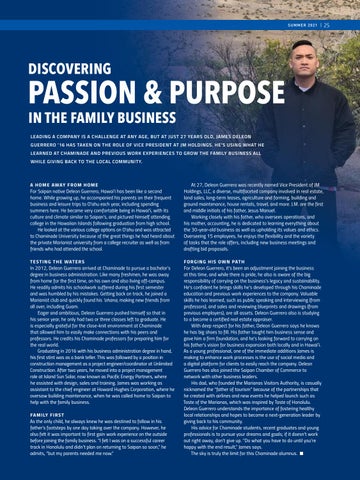
LEADING A COMPANY IS A CHALLENGE AT ANY AGE, BUT AT JUST 27 YEARS OLD, JAMES DELEON GUERRERO ’16 HAS TAKEN ON THE ROLE OF VICE PRESIDENT AT JM HOLDINGS. HE’S USING WHAT HE LEARNED AT CHAMINADE AND PREVIOUS WORK EXPERIENCES TO GROW THE FAMILY BUSINESS ALL WHILE GIVING BACK TO THE LOCAL COMMUNITY.
A H O M E AWAY F R O M H O M E
For Saipan native Deleon Guerrero, Hawai'i has been like a second home. While growing up, he accompanied his parents on their frequent business and leisure trips to O'ahu each year, including spending summers here. He became very comfortable being in Hawai'i, with its culture and climate similar to Saipan’s, and pictured himself attending college in the Hawaiian Islands following graduation from high school. He looked at the various college options on O'ahu and was attracted to Chaminade University because of the great things he had heard about the private Marianist university from a college recruiter as well as from friends who had attended the school. T E S T I N G T H E WAT E R S
In 2012, Deleon Guerrero arrived at Chaminade to pursue a bachelor’s degree in business administration. Like many freshmen, he was away from home for the first time, on his own and also living off-campus. He readily admits his schoolwork suffered during his first semester and was humbled by his mistakes. Getting back on track, he joined a Marianist club and quickly found his 'ohana, making new friends from all over, including Guam. Eager and ambitious, Deleon Guerrero pushed himself so that in his senior year, he only had two or three classes left to graduate. He is especially grateful for the close-knit environment at Chaminade that allowed him to easily make connections with his peers and professors. He credits his Chaminade professors for preparing him for the real world. Graduating in 2016 with his business administration degree in hand, his first stint was as a bank teller. This was followed by a position in construction management as a project engineer/coordinator at Unlimited Construction. After two years, he moved into a project management role at Island Sun Solar, now known as Pacific Energy Partners, where he assisted with design, sales and training. James was working as assistant to the chief engineer at Howard Hughes Corporation, where he oversaw building maintenance, when he was called home to Saipan to help with the family business. FA M I LY F I R S T
As the only child, he always knew he was destined to follow in his father’s footsteps by one day taking over the company. However, he also felt it was important to first gain work experience on the outside before joining the family business. “I felt I was on a successful career track in Honolulu and didn’t plan on returning to Saipan so soon,” he admits, “but my parents needed me now.”
At 27, Deleon Guerrero was recently named Vice President of JM Holdings, LLC, a diverse, multifaceted company involved in real estate, land sales, long-term leases, agriculture and farming, building and ground maintenance, house rentals, travel, and more. J.M. are the first and middle initials of his father, Jesus Manuel. Working closely with his father, who oversees operations, and his mother, accounting, he is dedicated to learning everything about the 30-year-old business as well as upholding its values and ethics. Overseeing 15 employees, he enjoys the flexibility and the variety of tasks that the role offers, including new business meetings and drafting bid proposals. F O R G I N G H I S O W N PAT H
For Deleon Guerrero, it’s been an adjustment joining the business at this time, and while there is pride, he also is aware of the big responsibility of carrying on the business’s legacy and sustainability. He’s confident he brings skills he's developed through his Chaminade education and previous work experiences to the company. Valuable skills he has learned, such as public speaking and interviewing (from professors), and sales and reviewing blueprints and drawings (from previous employers), are all assets. Deleon Guerrero also is studying to a become a certified real estate appraiser. With deep respect for his father, Deleon Guerrero says he knows he has big shoes to fill. His father taught him business sense and gave him a firm foundation, and he’s looking forward to carrying on his father’s vision for business expansion both locally and in Hawai'i. As a young professional, one of the immediate additions James is making to enhance work processes is the use of social media and a digital platform for clients to easily reach the company. Deleon Guerrero has also joined the Saipan Chamber of Commerce to network with other business leaders. His dad, who founded the Marianas Visitors Authority, is casually nicknamed the “father of tourism” because of the partnerships that he created with airlines and new events he helped launch such as Taste of the Marianas, which was inspired by Taste of Honolulu. Deleon Guerrero understands the importance of fostering healthy local relationships and hopes to become a next-generation leader by giving back to his community. His advice for Chaminade students, recent graduates and young professionals is to pursue your dreams and goals; if it doesn’t work out right away, don’t give up. “Do what you have to do until you’re happy with the end result,” James says. The sky is truly the limit for this Chaminade alumnus.
25
26 |
C H A M IN A DE MAGAZI NE
Pushing Boundaries: SUSHI WITH ATTITUDE
AT CHAMINADE UNIVERSITY, WE TALK A LOT ABOUT ADAPTATION AND CHANGE— EDUCATING FOR ADAPTATION AND CHANGE IS ONE OF THE FIVE CORE TENETS OF A MARIANIST EDUCATION. THE CONCEPT IS WOVEN THROUGHOUT OUR CURRICULA, AND OUR STUDENTS LEARN ABOUT THE IMPORTANCE OF EMBRACING CHANGE AND ADAPTING TO MEET IT AS THEY MOVE THROUGH OUR PROGRAMS.
Adapting to change is something that is very familiar to Remi Kohno ‘15. She came to Chaminade University from Pasadena, California to play basketball and major in elementary education. But after her first year, she realized neither of those were the right fit. She didn’t like the competition she found on the basketball court, and teaching wasn’t her passion. So she quit the basketball team and switched her major to communications with a focus in marketing. Her junior year brought even more change when she joined the Hogan Entrepreneurial Program. It quickly started pushing her out of her comfort bubble, and it altered the way she reacted to pressure. “I saw all these great people join the Hogan program and I wanted to be just like them,” recalls Kohno. “Hogan definitely pushed my boundaries, which was nice. It really helped me grow as a person, both professionally and personally.” Students who are accepted into the Hogan Entrepreneurial Program spend one or two years learning what it takes to become a
successful entrepreneur. They mingle and network with some of Hawai'i’s biggest business leaders, they travel, they participate in internships and they work with industry leaders to design their own business plans and fine-tune their public speaking abilities. The program helped Kohno break out of her shell and become more confident in her abilities to lead and engage. One moment in particular stands out in her memory. Every Wednesday evening, Hogan participants gather to welcome and learn from a guest speaker from the Hawai'i business community. Guests range from Mattson Davis, the former president and CEO of Kona Brewing Co., to Chuck Cardinal, a former colonel in the United States Army and the former chief of staff to a WWII commander. On this particular night, the speaker was Eddie Flores, Jr., the founder of L&L Hawaiian BBQ. Flores has an inspiring story—he’s the son of immigrant parents and the eldest of seven children. His family moved to Hawai'i from China when he was a young child. His father worked as a janitor, and his
S UMME R 2 0 2 1
|
27
“[The Hogan Entrepreneurial Program] really helped me grow as a person, both professionally and personally.” Shown above: Remi Kohno '15 and her family
mother worked as a restaurant cashier and dishwasher. He himself struggled with a learning disability growing up that kept him behind in school. But as a young man, he worked hard, ultimately earning enough money to buy his mother a restaurant in what would become the first L&L location. His restaurant chain now has over 200 locations, and in 2019 it was ranked as the No. 1 Asian food franchise by Entrepreneur. Kohno had been designated as the evening’s notetaker, which meant it was her job to document Flores’ speech and at the end of the evening, stand up to present a recap to her classmates while Flores looked on. She was just a little intimidated. “You’re listening and engaging, but you’re also taking notes so that you can structure it into a recap and presentation,” remembers Kohno. “After [Flores] was done, I had to go up in front of the whole class and do a quick overview of what was most important. It was nerve-racking. But then I got to give him a lei, which was nice and helped alleviate any tension.” In Kohno's senior year, right after she had returned from a semester studying abroad in France, one of her professors recommended her for the American Advertising Federation’s Most Promising Multicultural Student program. She was one of only a handful of students selected from across the nation to participate in the intensive immersion program, designed to
connect diverse up-and-coming advertising talent with some of the largest advertisers in the nation. She once again found herself at the airport, ready to embrace the unknown, this time in New York City. Luckily, she had learned how to network and interact with business leaders through the Hogan program. “We got to meet a ton of people and tour their facilities and headquarters,” says Kohno. “It was an opportunity to connect with businesses and send them your resume, and hopefully get a follow-up interview to help jumpstart your career since college.” Through all of the change and opportunity that came her way at Chaminade, Hogan taught Kohno to remain calm and collected, and cool under pressure. Through Hogan and her professors, she learned to see challenge as opportunity. It’s something that has served her well after college, particularly today. Before COVID, her family ran a small restaurant stall called Sushi with Attitude at a night market in Los Angeles. While she has a full-time job at NBC during the day, she helps them on the side. When the pandemic shut down the market, they had to completely rethink their strategy and their focus. With Kohno’s help, they converted the business into a cloud kitchen model, meaning they are operating completely on delivery apps without a storefront, and launched a new product: the sushibi. It’s a combination of sushi and musubi. “We wanted to offer musubi, but a lot of people in Los Angeles don’t know what they
are,” says Kohno. “We also wanted to be able to show up in the sushi category on delivery apps—it is one of the most used keywords. So we rebranded our musubi to be sushibi to bridge the gap.” The business has received a bit of media attention as a result, and Kohno’s Hogan training has come in useful. “Hogan helped me learn to speak and structure what I’m going to say, which has helped a lot with media interviews,” says Kohno. “I recently interviewed with KTLA news. I was really nervous because it was live, but it was nice to be able to do something that I wasn’t really comfortable with, and Hogan taught me how to do that.” Kohno attributes much of her recent success to Hogan and the opportunities she had at Chaminade. “Definitely Hogan, all of the professors I had at Chaminade and being part of the American Advertising Federation, they have all helped me grow into this role that I have right now.” She works full-time as a manager in paid social media at NBC. And only five years after graduating from college, she feels like she’s almost landed her dream job. “I love what I do at NBC. They’re a really great company,” says Kohno. “I want to continue to grow and become a director, and continue to be knowledgeable about all the various platforms and their nuances and updates. That is my dream goal. I think I’m almost there.”
28 |
C H A M I N A DE MAGAZI NE
C O M I N G
H O M E
T O
CHAMINADE DR. LUPITA RUIZ-JONES, ASSISTANT PROFESSOR OF ENVIRONMENTAL SCIENCE AT CHAMINADE UNIVERSITY, WANTS STUDENTS TO PLAN THEIR CAREERS WITH INTENTION SO THEY END UP DOING WORK THEY LOVE.
S UMME R 2 0 2 1
“I always want to remind students to pause, reflect, and ask themselves what they are curious and passionate about,” she says. “I want them to think about what brings them joy and gives meaning to the way they spend their time, so they don’t fall into a routine of checking boxes and then end up somewhere asking themselves, ‘How did I get here?’” The key, she says, is pursuing and doing the things you are interested in, even when you don’t know where they will lead. After all, that’s what worked for her. She was in high school in Santa Fe, New Mexico when she attended a local shopping mall’s small college fair and happened to learn about Chaminade University. “It was very random,” she says. “I don’t think I ever would have heard of Chaminade except for that booth.” She’d never been to Hawai'i, but she’d lived on Sicily for a year during high school, where she loved living on a volcano in the Mediterranean. That had been her first time exposed to marine environments. “In college, I wanted to study human impacts on the environment, and I was also very keen to get out of the desert,” she says. Chaminade offered a major in environmental studies, and she was sold. GOING FOR IT
Seeking out opportunities and going after them has been a lifelong pattern for Ruiz-Jones. It’s especially impressive when you learn she was raised by parents who didn’t complete college and in a family without the trappings of success. Her mother was always supportive but struggled with bipolar disorder. Ruiz-Jones’ father went to prison when she was 12, which
|
29
she says had a significant impact on her. “I really appreciated the ability to choose where I put my attention,” she says. She says she was fortunate to have scholarships and financial aid to help her pay for college. In one of her first classes, Dr. Gail Grabowsky, now dean of the School of Natural Sciences and Mathematics, told the students it was great they were there. “She told us, ‘You’re going to love what you do, you’ll make an impact, but you’re not going to become rich.’” “That was fine with me,” says Ruiz-Jones. “I saw my parents struggle and have no passion for their work. I felt like as long as I loved what I did and made an impact, that was what was important to me.” During her freshman year, she applied and was selected for a five-week summer program in India that usually only accepted upper-level students. “The goal of that trip was to see what small nonprofits were doing in India,” she says. “It wasn't science at all. It was really about human wellbeing and the different ways people were contributing by doing service to the really poor. We spent most of our time going to slums and eating with kids. It was an incredible experience. Very intense.” The group included three students from Chaminade and two from the University of Dayton, a fellow Marianist school. They spent a couple weeks at a center where Marianist brothers taught a trade to boys whose families couldn’t afford to care for them or who were abandoned. They also volunteered at Mother Teresa’s center in Kolkata, working with toddlers abandoned by their family due to the children’s sickness or disease.. “The extent of the poverty and how many people are living and bathing and eating in the street was overwhelming,” she says. “But it was also really amazing to meet people who had dedicated months or years to doing what they could at that very small scale through immediate contact with people.”
30 |
C H A M IN A DE MAGAZI NE
EVOLUTION OF A PLAN
Dr. Lupita Ruiz-Jones doing field research in American Samoa during graduate school
Although Ruiz-Jones ultimately earned a Ph.D. in coral ecophysiology, she started out interested in human well-being and the history of conflicts between nations. Later, when she applied to graduate school, her dream job was to work for the United Nations' environmental program. But the summer after her sophomore year at Chaminade, she started doing undergraduate research at Kewalo Marine Lab. That’s where she first got excited about biology and organisms in coral reefs. “Dr. Gail had this book about sea slugs that live in coral reefs,” she says. “I think she must have lent it to me at some point. I would sit there and flip through the pictures of these sea slugs. They're so colorful and beautiful. I actually ended up buying that book later on. “I think a lot of my motivation to pursue science came from the joy I felt in being in nature and seeing its beauty. Kewalo was also where I started to realize that it's great to be aware of how we're damaging the environment. But I also was fascinated about doing science, gathering data, and asking very specific questions that could be addressed. Not these giant daunting tasks or challenges like addressing poverty.” At the end of her summer research at Kewalo Marine Lab, her advisor, Dr. Mike Hadfield, invited her to continue there in an internship that ultimately stayed for the rest of her school years, including summers. Hadfield also pushed her to take all the science courses she could, even though she didn’t need them for her environmental studies degree. Taking those extra science courses pushed her into a fifth year of college. She didn’t mind, though, because she wanted to participate in a Sea Education Association summer-at-sea sailing program that focused on environmental studies. She’d learned about the summer program from a flyer she saw outside Dr. Gail’s office. She applied, was accepted, and then spent four weeks in Woods Hole, Massachusetts, during that final summer of her undergrad career. Then back to Hawai'i, where students spent four weeks sailing to San Francisco on a tall ship. “Wow, that was a really powerful experience,” she says. “We did biological oceanography research. I focused my project on invertebrates that live on the surface out in the middle of the ocean.” At first, she found the semester at sea very challenging because she was seasick
S UMME R 2 0 2 1
for three full days. “I was miserable, and I got really depressed because you can’t get off the boat, right? But finally I got used to it. And then I thought, ‘Oh my gosh, this is amazing. This is so fun.’ But those first three days were excruciating.’” G R A D U AT E S C H O O L
After graduating with her bachelor’s degree, she stayed on at the Marine Lab for an additional year, where Dr. Hadfield offered her work on a tree snail project. “He's a Hawaiian tree snail scientist who also does a lot of marine biology,” she says. “The job was writing five-year status reviews for endangered Hawaiian tree snails, which was new for me. I got to do really cool things, like we took a couple helicopter rides up to the ridges of the Ko'olaus and the Wai'anae [Range], and we would camp out and look for tree snails that are going extinct. “But mostly I spent time summarizing other people's research and writing reports. I think it motivated me to go to grad school even more. I was thinking, ‘I want to be doing my own research.’” Dr. Hadfield encouraged her to apply to Stanford University for graduate school. She did, was accepted, and spent her first year on the Stanford campus. For the second year, the marine biology students moved to Stanford’s Hopkins Marine Station at Monterey, about an hour and a half away. “One of the main reasons I selected the lab I did, Steve Palumbi’s lab at Stanford, was because he was doing work on coral reefs and he had a field site in American Samoa,” she says. She loved spending time on the beautiful, rural island of Ofu in American Samoa and getting familiar with the community and the reef there. She also appreciated returning to the U.S. through Hawai'i and maintaining her connections there. BECOMING A TEACHER
After graduating Stanford with her Ph.D., she received the Thinking Matters Teaching Fellowship and spent four years team-teaching there. That, she says, is where she developed her identity as a educator and her love for teaching. Since she was off during the summers, she started collaborating with scientists at the Hawai'i Institute of Marine Biology. She found she liked the combination of teaching during the school year and doing research on Hawai'i’s coral reefs in the summers. That’s how she ended up back at Chaminade, as an assistant professor this time,
|
31
“... I want to find a way for students to get exposure to being outside and asking questions about what's going on.”
in fall 2020. Currently she teaches Introduction to Environmental Issues, Marine Environmental Issues and Lab, and Advanced Marine Science and Lab. She talks about how important it is to seek out great mentors. “Recognize what you’re curious and passionate about and pursue those activities,” she says. “That will expose you to potential mentors in that field. It was my mentors who helped me to see opportunities in my future, and shaped my career path, which was really helpful. They had a huge impact, and I’m super grateful.” Dr. Hadfield was one of her mentors. Dr. Gail was another. “She has so much energy and enthusiasm for the material and the students. I remember being in her classes and looking up at her and being so impressed. I remember thinking I could never be in front of a class like that. I could never stand up there and lecture. Now I think that's funny.” STILL TO COME
Right now, she says, her goals are to find ways to integrate her passion for research, coral reef ecology, and restoration into her teaching. “I want to set something up where I'm successful at both developing good teaching pedagogy, finding ways to engage students, and also
maintaining some research activity, which I think is definitely challenging when the teaching load is high.” “But I want to find a way for students to get exposure to being outside and asking questions about what's going on so they can be in the reef, collect data that's valuable to community members, and bring that into the classroom as well.” As for other future goals, she points to Chaminade’s amazing diversity of students from around the world and its unique setting. “Our institution has the potential to become a place where students can really think about the important relationship humans have with nature. You see it so clearly on an island. A lot of our students are Pacific Islanders, and there’s the history of Hawai'i and the Hawaiian culture. There’s a very intimate relationship with and respect and stewardship for nature. I think Chaminade is really incredible in that way. She says she’d love to take students on field trips to neighbor islands or other Pacific islands, referring to a month-long summer course Stanford teaches in Palau. “If we could do something like that where we took students to more remote Pacific islands and did environmental education, that'd be very cool.”
32 |
C H A M IN A DE MAGAZI NE
Lemonade MAK ING
OUT OF LEMONS LIKE MANY OF US, BLAZE MANCILLAS’ 2020 DIDN’T GO QUITE AS HE HAD PLANNED. THE PANDEMIC MEANT THAT THE ACTOR AND COMEDIAN, A 2009 GRADUATE OF CHAMINADE, WASN’T ABLE TO AUDITION AS MUCH AS HE HAD HOPED, COULDN’T DO MANY COMEDY SHOWS OR OTHER EVENTS AND HAD TO SPEND MORE TIME THAN HE EVER HAS IN HIS (SOMEWHAT CRAMPED) NEW YORK APARTMENT.
But lockdowns and COVID precautions didn’t keep Mancillas from staying busy. In fact, his work as a host on app-based music trivia game show “SongPop Live” earned him a 2020 Webby Award, which honors the “best of the internet” in everything from websites to apps. He also launched a podcast called “Let’s Get Lit” that combines two of his loves—comedy and literature. Reached on a recent day, Mancillas was hopeful about what 2021 would bring. As the number of COVID infections in New York has declined, auditions have slowly resumed—and he’s looking forward to new opportunities. He said that after a very difficult year for everyone, he’s grateful for what he has and is charged up to seek out new ways to hone his acting chops and share his comedy. Mancillas scored a hosting role on “SongPop Live” before the pandemic started. When the city shut down, he was sent home with a lot of technical equipment and instructions on what to do next. He and the other three hosts finished out their work for the game show from the comfort of their living rooms. It was a transition for Mancillas, who said before the pandemic he rarely spent much time at all in his apartment. Instead, he would always be out in the city—enjoying all that it has to offer. But he made the most of it and in October launched his new must-listen podcast, in which he reads from a classic book (the first season features War of the Worlds) and invites comedians on to offer commentary. Let's Get Lit is already getting some buzz, including in Paste Magazine and on the Comedy Cake website. Mancillas describes it as a chance to actually read those books you were supposed to read in high school, with some
great comedians to join you to keep things light and keep you laughing. In a recent interview, Mancillas remembered his time at Chaminade fondly. It was there that Mancillas discovered his love of acting. He scored leading roles in Chaminade productions of The Elephant Man, Amadeus, Pippin and The Pirates of Penzance, to name a few. From Chaminade, he headed to New York to study acting at Columbia University. He graduated with a Master of in Fine Arts from Columbia in 2012, and has been building his career ever since. In addition to doing stand-up comedy and hosting for “SongPop Live,” Mancillas has appeared on TV episodes and commercials, and done motion-capture acting for video games. He’s interested in doing more on-screen acting work but also wants to continue to build his chops as a game show host, he said. At Chaminade, Mancillas was a communication major with a minor in performing arts. He credits three mentors—music professor Tim Carney, Father Robert Bouffier and Brother Gary Morris—with recognizing his talent, helping him muster the courage it takes to get out in front of an audience, and then challenging him to apply for graduate school on the mainland. “They left a profound impact on me,” he said. “They were really wonderful.” Mancillas is also thankful to Chaminade for giving him the space to find his passions—and not just in acting. At the university, Mancillas was also on the cross country and golf team, and was an announcer for basketball games. “I was running all over the place,” he said, adding that Chaminade helped him grow as a person and an artist. “There are lots of opportunities to try different things.”
S UMME R 2 0 2 1
|
33
G.N. WILCOX TRUST GRANT SUPPORTS DISTANCE LEARNING CHAMINADE UNIVERSITY OF HONOLULU RECENTLY RECEIVED A $20,000 GRANT FROM THE G.N. WILCOX TRUST, BANK OF HAWAI'I, TRUSTEE TO PROVIDE EDUCATIONAL TECHNOLOGY PACKAGES TO HIGH-NEED STUDENTS. THE
ARTHUR AND MAE ORVIS FOUNDATION SUPPORTS PERFORMING ARTS CHAMINADE UNIVERSITY RECEIVED A $15,000 GRANT FROM THE ARTHUR AND MAE ORVIS FOUNDATION TO SUPPORT ITS PERFORMING ARTS PROGRAM. THE GRANT WILL PROVIDE PROFESSIONAL MUSIC TRAINING TO PERFORMING ARTS STUDENTS PARTICIPATING IN CHAMINADE UNIVERSITY’S ANNUAL SUMMER THEATRE FESTIVAL.
“We are incredibly grateful to the Arthur and Mae Orvis Foundation for this generous donation,” said Chris Patrinos, the new director of Chaminade’s Performing Arts Program. “Though the future for performing arts is uncertain, we are still hoping to hold a festival in the summer of 2021. This gift will allow us to offer the best possible musical support for the student performers and help us to bring first-rate theatre performances to Hawai'i audiences.” Chaminade University Collegiate Theatre Festival began four years ago to give college students from Hawai'i an opportunity to participate in performing arts during the summer. The 2020 festival was cancelled due to COVID-19. The Arthur and Mae Orvis Foundation was founded in 1967 by talented opera singer Mae Orvis. Mae created the foundation in memory of her husband, financier and philanthropist, Arthur. The two loved the arts very much, and were each great supporters of the arts in Hawai'i. Their legacy of generosity lives on through their foundation. Pictured above: Chaminade students act in a stage production of “Spacebar: A Broadway Play by Kyle Sugarman”
PACKAGES WILL INCLUDE A LAPTOP COMPUTER, HEADPHONES WITH A MICROPHONE, AND AN EXTERNAL FLASH DRIVE FOR SECURE DATA STORAGE.
“This generous grant from G.N. Wilcox Trust will help us meet some of our students’ critical technology needs and allow for continued student success,” said Dr. Helen Turner, Chaminade’s vice president for Strategy and Innovation. “Even as face-to-face classes have resumed, ensuring our students have the proper equipment will provide resiliency against future lockdowns, and provide for those students who have elected to stay online because they or their family members have compromised immune systems.” Across the nation, the transition to distance education in response to COVID-19 has exposed a digital divide. The Technology Package program reflects Chaminade’s continuing mission to serve low-income students with an exceptional college education. G.N. Wilcox Trust provides support for programs that better the lives of individuals and families in Hawai'i. It was created by George Norton Wilcox, who began his career growing sugar at Hanalei, Kaua'i in 1863 and later became owner of Grove Farm plantation. He also served as a representative for Kaua'i from 1887 until annexation of the Islands in 1898. As a philanthropist, Wilcox’s interests centered largely around religious and educational work and expanded to include arts and culture, community, environment, health and human services.
34 |
C H A M IN A DE MAGAZI NE
Coming Full Circle
KRISTINE STEBBINS ‘87 REMEMBERS COMPLETING A LONG LIST OF INTERNSHIPS AS A COMMUNICATION UNDERGRADUATE AT CHAMINADE, INCLUDING THE ONE THAT WOULD LAUNCH HER WHIRLWIND CAREER AND EVENTUALLY BRING HER BACK TO THE
ISLANDS FOR AN EXECUTIVE ROLE CREATED EXPRESSLY FOR HER.
Stebbins was recently named senior vice president and director of digital experience innovation and technology at Bank of Hawai'i. The position is an opportunity for the longtime marketing entrepreneur—who has been breaking ground in the industry for decades— to come full circle, returning to the place where she met her husband, attended college and
began to build her marketing philosophy. She described her work at Bank of Hawai'i as “one of those awesome roles.” “I have the opportunity to look five years down the line at the ways we’re planning to build these amazing digital experiences,” she said, adding that digital innovation is an exciting and growing area of the banking
sector that has been put on a fast track because of the pandemic. “Today when you’re looking at marketing in particular, you need to think of yourself as a marketing technologist." Stebbins said her projects at Bank of Hawai'i have allowed her to bring her marketing and digital innovation expertise to bear to create excellent digital customer experiences. Stebbins joined Bank of Hawai'i full-time after previously serving as a consultant for the company, including on a key digital transformation project that helped put the institution on the right footing for the pandemic. In other words, she was designing for the future. And that was a role she was completely comfortable with. After all, Stebbins likes to say the only constant in marketing is change. Every five years or so, there’s a big disruption in the industry—the kind of seismic shifts that companies can learn to dread. Great marketing strategy, she says, is about harnessing those moments and using them to create new opportunities to reach customers. “The pandemic has been a moment where it’s basically made digital interactions in banking a requirement,” she said. “So we’re trying to build out digital experiences that bring humans together.” Her message to young marketing professionals is one she learned early on, too, including as a Chaminade student: Be ready for those moments of disruption by embracing adaptability and change.
S UMME R 2 0 2 1
|
35
“You need to be confident in your abilities. It’s all a matter of being true to who you are.” A S TA R T I N H AWA I ' I — A N D AT CHAMINADE
Indeed, change has defined some of the biggest moments in her life. Stebbins secured her first position in marketing with an internship, which she acquired through Chaminade, at top-rated advertising firm Ogilvy & Mather. She worked in their Honolulu office and got hired shortly after graduation. It was a dream come true. It was also far from the life she’d imagined for herself just a few years earlier. Stebbins had first come to Hawai'i with no intention of staying. She was visiting for the summer to spend time with her brother, who was in the Navy. Stebbins would take the bus into town and then back to Makakilo. And it was at a bus stop at Ala Moana Center that she met her future husband. She’d asked him for directions and the two ended up spending the day together. And then summer together. When it came time to head back home to Texas, she did—and he followed. John Stebbins ended up driving her to the East Coast to drop her off at college and then going back to the islands. A semester later, it was Kristine Stebbins who was knocking on his door. She’d transferred to Chaminade University, and he enrolled a short time later. They were both taking classes together and would graduate within a year of one another. They married in 1988 at Seabury Hall on Maui. Stebbins says she is still grateful to have transferred to Chaminade, and not just to be closer to her husband-tobe. She said Chaminade offered a more individualized experience and gave her access to opportunities she wouldn’t have gotten anywhere else. She counts her experiences at the university as central to setting her up for success and can still rattle off the names of some of the professors who served as her Chaminade mentors, including her Communications professor, the late Dr. Mary Jude Yablonsky.
In addition to an internship at Ogilvy & Mather, Stebbins also worked at Chaminade’s student newspaper and the radio station, and secured an internship at Hawai'i Public Television. She says of her mentors at Chaminade, “Obviously, they stuck with me.” Speaking to Chaminade Magazine, she added, “They were so supportive. They really guided me and encouraged me to get that real-life experience.” “That experience,” she said, “was invaluable.” It gave her an opportunity to apply what she’d learned in classrooms in a real-world setting—doing everything paid employees were doing—and she was hooked. After graduation, Stebbins and her husband stayed in Hawai'i for several years, building their careers. And then they headed to the mainland, moving to new cities—San Francisco, New York City, Seattle—as new opportunities emerged. Stebbins worked as global account director for IBM, senior marketing manager at Microsoft, and as a marketing consultant to some of the world’s biggest brands. She also started her own marketing company, which she later sold. All the while, the two maintained a strong connection to Hawai'i, especially after their daughter was born. (She’s now a junior in high school.) John Stebbins still has family in the islands, and this is where they one day saw themselves returning. They didn’t think it would be quite so soon, Stebbins said. But then, as she often says, embrace change—because it’s inevitable. During the pandemic, Stebbins started to assess her life and her work. She realized she’d been doing the work she wanted to do already, with Bank of Hawai'i. Fast forward several months and they were offering her a
position, a new digital innovation role at the company created just for her. She joined the bank in September, taking the first step in transitioning her family back to Hawai'i. ‘ T H E W O R L D I S D E F I N I T E LY C H A N G I N G ’
In addition to a passion for marketing, Stebbins is committed to helping the next generation. She believes strongly in STEM (Science, Technology, Engineering and Math) education programs, especially those targeted at young girls. She’s even coached a robotics team for the Girl Scouts. Stebbins is also proud to work for a Hawai'i company with a strong commitment to diversity—and no shortage of women in executive positions. Things weren’t always that way in executive suites, she said, and in some places they still aren’t. In fact, Stebbins recalls that when she first started out at Ogilvy & Mather she couldn’t speak at meetings with major clients even when she was a topic’s expert. “You laugh now because it’s so outrageous but is indicative of the experience in terms of how far we’ve come,” she said, adding that there have been many times in which she was the only woman in a boardroom. Her advice if they underestimate you: let them—so you can prove them wrong. “Quite frankly, I’m pretty smart and I know what I’m talking about,” she said, adding young women entering the business now may not face all the same barriers she faced but will undoubtedly face some of them. “You need to be confident in your abilities. It’s all a matter of being true to who you are.” Plus, she added, “The good news is the world is definitely changing.” And Stebbins is all in for that.
36 |
C H A M I N A DE MAGAZI NE
ONE YEAR MBA Teaches Business for Good Through Strategic Decision-Making USING AN INNOVATIVE PROGRAM DESIGN BUILT AROUND A “BUSINESS FOR GOOD” PHILOSOPHY, CHAMINADE UNIVERSITY WILL LAUNCH ITS ONE YEAR MBA PROGRAM THIS FALL. THE NEW PROGRAM IS GEARED TOWARD EXPERIENCED PROFESSIONALS INTERESTED IN ADVANCING THEIR CAREERS AND MAXIMIZING THEIR POSITIVE IMPACT—AS QUICKLY AS POSSIBLE.
S UMME R 2 0 2 1
The One Year MBA, unique in the islands and fully accredited by the International Accreditation Council for Business Education (IACBE), features a specialized hybrid class format. Students will attend daylong courses and participate in project-based learning on campus on alternating Saturdays and then supplement their learning with asynchronous instruction through Chaminade’s easy-touse online platform.
“... we are focused on helping students excel personally and professionally as they make positive contributions to their communities.”
|
Across sectors in Hawai'i and nationally, managers and executives with MBAs are in high demand. At Chaminade, the degree stresses a broad foundation of knowledge, from finance to business analytics to marketing and strategic planning. As part of the program, participants will develop professional business reports, evaluate organizational decision-making and apply their new skills to real-world situations. A M I S S I O N - A N D VA L U E S - B A S E D MBA PROGRAM
Guided by its public service mission, Chaminade also puts a strong emphasis on seeking out opportunities to do “business for good," by considering the societal, environmental and social justice impacts of business on communities. An additional Hawai'i- and Pacific-centered focus allows students to unpack the importance of cultural intelligence and a global perspective in their work. “Business for good means business with a heart,” said Dr. Bill Rhey, dean of Chaminade’s School of Business and Communication. “With our One Year MBA program, we are focused on helping students excel personally and professionally as they make positive contributions to their communities.” A O N E-Y E A R M B A W I T H B U I LT- I N SUPPORT
In addition to the accelerated curriculum that allows students to complete their degree in just 12 months, the program weaves in ample opportunities for networking and professional growth. And as part of a capstone experience, students will have the option to travel internationally together to apply key onsite skills for a client. “The One Year MBA underscores Chaminade’s commitment to provide new avenues to leadership for Hawai'i,” said university President Lynn Babington. “This degree offers the excellence and quality, the access to resources and support and the experienced faculty you can expect from Chaminade in an innovative format that allows working professionals to take the next step in their career goals.”
37
Rhey said he is especially looking forward to welcoming One Year MBA students to Chaminade’s mentorship-focused environment, giving them the individualized support, guidance and tools they need to succeed. The cohort-based program also allows students to build strong relationships with their peers. As each cohort moves through the program together, students will benefit from a growing network of professional support. “Our in-person Saturday instruction won’t be lecture-focused, but experiential and handson. Your relationships with your fellow cohort members will allow you to tackle problems together, learning and collaborating along the way,” Rhey said. “While the program will only last a year, cohort members will continue to learn from and support one another throughout their careers.”
For more information, visit chamiande.edu/mba. Priority applications for the first cohort, which starts on October 4, 2021, are due on August 1.
38 |
C H A M IN A DE MAGAZI NE
Leader at the Bottom of an Inverted Pyramid NOTHING CAN QUITE PREPARE YOU FOR THE KIND OF UNPARALLELED ECONOMIC CRISIS THE WORLD SAW AS THE CORONAVIRUS SHUT DOWN SO MANY ASPECTS OF DAILY LIFE, LOCKING DOWN CITIES, SHUTTERING STORES AND BRINGING TOURISM TO A STANDSTILL. BUT THERE’S NO DOUBT ANTHONY SHIPP, MBA ‘19, WAS MORE PREPARED THAN MOST.
S UMME R 2 0 2 1
Shipp is a Marine veteran who served three combat tours in the Middle East—so he knows a little something about overcoming adversity. During the Great Recession, he was a business owner who saw revenues plummet and the economy go topsy-turvy—so he knows about the importance of preparing for a rainy day, too. And going into the pandemic, as president and CEO of M. Dyer Global, Shipp also knew he’d be relying on his decades of experience in logistics, IT and managing through crisis. That doesn’t mean 2020 was smooth sailing for Shipp or his logistics, freight forwarding and international relocation company, by any stretch. But he’s grateful to have ended the year in a strong position, even while the industry—and many of his competitors—suffered major losses. And he attributes his successes to understanding the importance of acting quickly, taking a few calculated risks and staying true to his servant leadership style. He also takes lifelong learning seriously and says the mentor and peer relationships he built throughout his career, including as a graduate student at Chaminade, have helped him stay on top of—or in front of—market trends. “Nobody would have been able to predict this—everything that’s happened,” Shipp said, in a recent interview with Chaminade Magazine, adding that being adaptable and nimble has proven essential to surviving as the economy only now starts a slow and painstaking recovery process. “As a business leader, you need to be prepared for change at all times.” In fact, when the pandemic first started, Shipp turned his office into a “war room,” gathering his senior leaders to prioritize top projects and prepare for the rocky days ahead. One lesson he learned during the Great Recession, which was solidified in Chaminade’s MBA program, was a seemingly simple one: “cash is king.” So in those early days of the pandemic, he did everything he could to free up cash in his company and prepare for the worst. It was the right move, his first of many amid the crisis. W E AT H E R I N G T H E C R I S I S
Shipp likes to say that he’s never really taken a direct route to anything before. Not to logistics. Not to leadership. Not even to Hawai'i. Straight out of high school, at just 17 years old, he enrolled in the Marines and later completed his undergraduate degree in computer science at Chapman University.
|
39
Pictured above: Anthony Shipp and his M.Dyer Global team
After leaving active duty, he worked in IT then moved to operations and eventually worked his way up to management. But he had to put his career on hold several times to serve his country. While in the Reserve, he got called to active duty three times, serving two combat tours in Iraq and one in Afghanistan before leaving the service. That was in 2006, the same year Shipp designed to open his own trucking and logistics business. “I had big dreams and aspirations,” he said, and they were quickly tempered by the 2008 economic crash. Shipp said he nearly lost his business in the downturn, but was able to keep it afloat and then see it become profitable again as the economy improved. He ended up selling the business around 2010. It was about that time that he took a well-deserved sabbatical to Hawai'i, getting his first taste of the islands and the aloha spirit. Two years later, he would move to the state permanently—and quickly start to learn about the unique logistical and regulatory challenges Hawai'i companies face. He became first the chief technology officer and then the chief commercial officer at Hawai'i Transfer Company, Ltd., a familyowned transportation services business. He was also able to revolutionize their operations, bringing in new efficiencies and successfully wooing big national accounts.
OPPORTUNITY KNOCKS
Shipp was happy where he was, but opportunity came knocking on his door. An executive search firm sought him out to see if he was interested in taking the helm at M. Dyer. It was an opportunity he couldn’t turn down. And so in August 2017, he took over as the company’s president and CEO. About that same time, Shipp was just starting his MBA at Chaminade. “I was in my early 40s and I was coming into a program traditionally for students to learn and gain knowledge,” he said. “I was approaching it from a different student perspective.” And it was a perfect fit. Shipp said Chaminade’s MBA allowed him to build on his foundation of knowledge and focus on academic areas where he wasn’t quite as strong, including finance. Shipp also found great value in the Hogan Entrepreneurial Program, hearing firsthand from Hawai'i executives about how they approach leadership, prepare for market ups and downs and set their companies up for successful futures. “I really loved it because I got to learn from them,” he said, adding he was able to build relationships with those entrepreneurs—along with professors in the program—that remain strong today. “I captured an enormous amount of knowledge and know-how from their perspective.”
40 |
C H A M IN A DE MAGAZI NE
CONTINUED FROM PAGE 39
“Don’t just encapsulate what you learn at school.... It sets the foundation, but you should constantly have this thirst to learn.” That knowledge helped guide Shipp as he took his first steps as M. Dyer’s CEO, focusing first on learning everything he could about the business he now led and reshaping its culture from one in which employees worked in silos to one in which they felt like they were part of a team. When 2020 started, Shipp was hitting his stride and preparing to craft a strategic vision for a quickly evolving industry. And then, seemingly overnight, everything seemed to change. Relying on his experiences, Shipp knew two things: he had to prepare for the worst— and he had to act fast. So he gathered up his senior leaders to develop key strategies for weathering the crisis. And in the weeks and months that followed, Shipp continued to remain out in front of the markets, doing everything he could to retain
customers, attract new business and steel the company for more economic pain. One project that was put on a fast track: a plan to move to paperless transactions. Before the pandemic, the company had a two-year timeline to become paperless to improve the customer experience and streamline the company’s processes. Because of the pandemic, with in-person transactions severely limited, the project was finished in months. In business, Shipp said, “you have to be nimble. Be prepared that things are going to happen quickly.” ' I ’ M H E R E T O S E R V E E V E RY B O DY ’
As a leader, Shipp imagines himself at the bottom of an inverted pyramid. It’s a servant leadership approach in which Shipp serves as a guide, a mentor, a motivator and a relationship builder. “I sit at the bottom and I’m here to serve everybody,” Shipp said, adding that in working with his leadership and broader team he hammers out a project target and a timeline and then asks, “What do you need from me? How can I support you? How can I encourage and motivate you?” Approaching leadership this way, he says, helps bolster empowerment and accountability. Employees know they can make mistakes, as long as they learn from them, in pursuit of shared business goals. They also see themselves as subject matter experts, which means they’re more likely to bring new and innovative ideas to the table and look for efficiencies across departments and the company. Shipp says he frequently offers three pieces of advice to the next generation of business professionals: while in school, develop lifelong mentor relationships, because good counsel
is never overrated; never stop learning; and know the one constant in life is change. “You’ve definitely got to be a lifelong learner,” said Shipp. “Don’t just encapsulate what you learn at school and think that it stops there. It sets the foundation, but you should constantly have this thirst to learn.” After all, Shipp enrolled in postgraduate studies in supply chain management at MIT after graduating with his MBA from Chaminade. And in September 2020, he completed an executive education program in freight transportation and logistics from Northwestern University. As for professional relationships, those also come in handy in hiring decisions. Shipp said he first met his vice president of business administration, Jana Paz, when the two were in Chaminade’s MBA program. (She graduated in 2018.) Shipp likes to say the company has a “little nucleus of Chaminade alum”—plus more than a few parents who have sent their children to the university. That’s linked to M. Dyer’s identity, Shipp said, as a local business with a global reach. Shipp said he’s sought to ensure the aloha spirit and Hawai'i’s community-oriented values are baked right into M. Dyer’s brand. “We have this element of a family within our company’s soul,” Shipp said. As a servant leader—situated at the bottom of that inverted pyramid—Shipp doesn’t only expect his company to embody the aloha spirit. He holds himself to the same standard. “Here in Hawai'i, the bigger picture is at the community level. We have to have the highest level of integrity of trust,” he said. And from his experience, the rest will follow.
S UMME R 2 0 2 1
CHALLENGES OF 2020
Pave the Way for Entrepreneurship THE CHAMINADE UNIVERSITY HOGAN ENTREPRENEURIAL PROGRAM KICKED OFF ITS 2020-2021 YEAR LAST OCTOBER.
The program held a virtual kickoff celebration for Chaminade leaders, faculty and staff; current Hogan students and alumni; and Hogan advisors, mentors and lecturers. As part of the celebration, the Hogan Entrepreneurial Program and American Savings Bank also announced the winners of their 2020 Nonprofit Business Plan Competition. The Hogan Entrepreneurial Program at Chaminade University is a one- or two-year program for Chaminade students to learn successful entrepreneurial skills. Students participate in weekly lectures with guest speakers, network with Hawai'i’s top business leaders and learn how to turn a business idea into a successful startup. This year’s program seems incredibly timely as businesses across the state struggle with the economic impacts of COVID-19 restrictions. Some experts estimate that Hawai'i’s economy will be one of the hardest hit. With the summer tourism season essentially canceled, Hawai'i saw an unemployment rate of 23.5 percent— more than 10 percent higher than the national average. And while the islands are slowly beginning to reopen to visitors, one study recently named Hawai'i as the worst state for unemployment recovery. These struggles provided an opportunity for business leaders to pass down timely advice to this year’s Hogan participants. “For the students out there: keep the faith,” said Gary Hogan, chief executive officer of Hawaiian Hotels & Resorts and president of Royal Pacific Air Charters, Pleasant Aircraft Leasing LLC. “Things are going to get better. It’s going to take a while, but we will all get back together as a family again.” Hogan continued by encouraging students to remain flexible, because as this year has shown, you never know what is going to happen next. “You can see things can change in an instant,” advised Hogan. “What you think is going to be successful and what you have planned may not be. Things change.”
Both Hogan and Dr. Lynn Babington, president of Chaminade University, pointed out that there will be a lot of good case studies for the students to learn from this year as businesses pivoted to adapt. “We are in a time of opportunity to continue learning and creating new and interesting and dynamic changes as things move forward,” said Dr. Babington. “It’s a great time to be in the entrepreneurial space.” Richard Wacker, the president and chief executive officer of American Savings Bank, used the tourism industry struggles to highlight the importance of programs like Hogan, and to motivate the students to get creative and innovate. “We know that our economy today is too dependent on the hospitality sector,” said Wacker. “It’s a wonderful business and it’s a great strength of Hawai'i … but we have to be more than that. We have to be more diverse and resilient. The way we get there is through entrepreneurship and innovation.” Wacker sees an opportunity for Hawai'i to lead innovation in areas like clean energy, ocean studies, sustainable agriculture and digital media. But, he says, in order for businesses to succeed in Hawai'i, we have to be all in. “Doing business in Hawai'i is not a spectator
|
41
sport,” said Wacker. “We don’t have enough leadership, we don’t have enough businesses to have anybody on the sideline. Succeeding for the state, in our state, requires everyone to be in the game.” The finalists of this year’s Nonprofit Business Plan Competition were a great example of Hawai'i community members coming together to innovate and make Hawai'i a stronger, more resilient community. Forty organizations submitted proposals for new programs that would benefit society. Eight were selected as finalists and presented their ideas to a panel of judges, and four were announced as winners at the October 14 event. The first place prize of $12,000 went to the Institute for Human Services for a new program that will offer medically monitored and clinically managed high intensity residential substance abuse detox services. It will be the first program of its kind in Hawai'i. The second place prize of $10,000 was presented to Family Hui Hawai'i for their new pilot Hui in the Workplace program. The initiative offers corporations a 12-week peerled program for employees that explores the joys and challenges of raising young children. The program has been proven to help enhance employee retention and productivity and supports a culture of caring and wellness in the workplace. Other winners included the Assistive Technology Resource Centers of Hawai'i for their new program, The Music Club, which creates a safe space for individuals with disabilities to make music, and the Maui Nui Marine Resource Council for their pilot program that uses oysters to address sediment pollution on coral reefs. “We learned so many things about the diligent efforts of quality entrepreneurs from all over our islands,” said Roy Panzarella, director of the Hogan Entrepreneurial Program, when introducing this year’s competition. “This competition, according to one of our judges, was one of the best to date.”
42 |
C H A M IN A DE MAGAZI NE
DATA AND DESIGN: A POWERFUL STORYTELLER MAJORING IN DATA SCIENCE MEANS YOU SPEND A LOT OF YOUR TIME COMBING THROUGH DATA, LEARNING TO USE CODING SOFTWARE, DIGITALLY MAPPING DATA AND ANALYZING RESULTS. BUT AT CHAMINADE UNIVERSITY, IT ALSO MEANS LEARNING HOW TO TELL A STORY, UNDERSTANDING COLOR THEORY, LEARNING HOW TO USE DESIGN SOFTWARE AND UNDERSTANDING THE PRINCIPLES OF VISUAL COMMUNICATION.
Data Science 403: Digital Humanities is a new interdisciplinary course taught by Dr. Junghwa Suh, associate professor of environmental + interior design and Dr. Laura Tipton, assistant professor of data science, that all data science majors at Chaminade are required to take. The course merges the fields of humanities and data science, and teaches students how to turn data into meaningful, visual stories and relate it back to various dimensions of human living. “We wanted to challenge the more analytic students in the course to think more creatively, both in their presentations and in their topics of study,” says Dr. Suh. “We wanted to show that not every data science analysis is based on a scientific study; sometimes we use data science to analyze classic literature or song lyrics.” For many of the students, this was their first foray into the humanities and they weren’t quite sure what to expect. “At the beginning of the semester, I interpreted digital humanities solely as studying the history of data science and technology,” says Trinity Young, a fourth-year student. “But now, after taking this course, I better understand that digital humanities is the study of applying data and technology to analyze and better understand human society and culture.” In the first iteration of the course this past fall semester, each student was tasked with choosing a topic for a semester-long project that either brings them happiness or sparks their interest and passion. They then spent the first half of the semester collecting and analyzing data, and the second half of the semester learning to develop a visually appealing story out of the data and presenting their findings. “[This course] really gave me another perspective in this area and allowed me to see the story behind everything,” says Taylor Ishisaka, a third-year student who used the project to explore how Miley Cyrus’s public persona has developed throughout various events and albums. “As of now, I truly think that it is necessary to have previous knowledge in
humanities in order to understand the digital world better.” Lilianna Flynn, a senior who is majoring in business administration and minoring in data science, did her project on the recent Australian wildfires. She used data visualizations and word clouds to determine the causes and consequences of the wildfires and to identify solutions. “I believe my word clouds were my best visual aid,” says Flynn. “They displayed the most important words and gave the readers a basic understanding of the news articles.” But her favorite part was seeing how creative her fellow classmates were in choosing their topics. “The best part of the semester was listening to everyone’s presentations,” says Flynn. “Everyone had different ways of analyzing their data and unique presentation designs. Now I believe design is even more important to communicate data visualizations effectively.” While the course was fun and meaningful for the students, the professors also had a good time with it. “I was really excited when I saw this course listed as part of the data science curriculum because it gave me a chance to highlight some of my ‘passion project’ research areas, including dance history and mythology,” says Dr. Tipton. “And it gave me a chance to see what non-science interests the students have.” On the other side, Dr. Suh was excited to take a dive into the sciences. “I have always wanted to teach a course where science meets art and design, and vice versa,” she says. “I usually don’t have a chance to meet students from other disciplines, so it was great interacting with the data science students.” The pair is now brainstorming ways to expand the course in the future. “Now I’m excited to see where this collaboration goes and how we can include students from other majors, like design and other humanities, next year,” says Dr. Tipton.
S UMME R 2 0 2 1
|
43
A Winning Pair WHEN AURELIA VINING AND JACQUELINE (JACI) HARBIN MET DURING THEIR FIRST DESIGN STUDIO COURSE AT CHAMINADE UNIVERSITY, THEY BECAME FAST FRIENDS. THEY HAD BOTH COME FROM ARMY BACKGROUNDS BEFORE JOINING THE ENVIRONMENTAL + INTERIOR DESIGN PROGRAM AS TRANSFER STUDENTS IN 2018, AND THEIR SHARED EXPERIENCES MATCHED WITH THEIR OPPOSING DESIGN APPROACHES QUICKLY PROVED TO BE A WINNING COMBINATION.
They worked on a group project together during that first class, and it went so well that it solidified their partnership for much of the past two years. Since then, they’ve collaborated on several extracurricular projects, including working with the Marianist brothers to design a new exterior patio for the Mystical Rose Oratory. “We had the chance to work on several extracurricular design projects together, and it became clear that we balanced each other well,” says Harbin. “Things that I struggle with, Aurelia has completely mastered and areas where she might not be so strong, I excel.” Their synergy recently came to fruition when it won them the 2020 Award of Excellence at the recent American Society of Interior Designers (ASID), Hawai'i Chapter virtual award ceremony. In January, their senior-level commercial design studio course comprised a semester-
long partner project. The class had chosen to design a boutique hotel—they were all given the footprint of an imaginary hotel in Vancouver, Canada, and the pairs were tasked with designing three public spaces: the ground level, the lower level and the penthouse. The final design was due at the end of the semester in May. “For this project we got to choose our partners, so of course I was going to pick my Ace, Jaci Harbin,” says Vining. “She’s a wonderful designer and our styles are completely opposite of one another. I think that aspect of our relationship makes us question each other enough that we make sure our designs are purposeful, intentional and beautiful.” Harbin and Vining designed The Glacier, an immersive hotel designed to capture the serenity that comes from being in nature. Upon arrival, the design protects guests with
an outdoor vestibule positioned specifically to mitigate the northeastern winds. The lobby is darned with curved woods, semi-transparent materials and multifaceted built-ins that help create a sense of humility and a feeling of being part of something bigger. On the inside, the ground floor includes a lounge with a kids' play space, a bar and space for casual dining, and outside the designers made space for an outdoor lounge, a rental area and an ice skating rink. But the part that really captured the attention of the ASID judges was the outdoor stargazing balcony in the penthouse. The virtual award ceremony specifically called out this area, with a quote from one of the judges, saying, “My favorite is the stargazing area. I like that the students thought through every scenario so that visitors would be able to see the constellations and stars day or night and all times of the year.” The project wasn’t without its challenges—halfway through the semester, COVID-19 hit and in-person classes were canceled. “Zoom presentations are completely different from in-person presentations,” recalls Harbin. “The way you present yourself, how you showcase your work, all of that changes. You cannot have physical material boards because they don’t showcase well on a digital platform, but that also means the client cannot touch the materials.”
Images show Aurelia Vining and Jaci Harbin's design model (above) and rendering (below) for their Glacier project
44 |
C H A M IN A DE MAGAZI NE
CONTINUED FROM PAGE 43 It helped that the pair was already so close and had such a solid partnership to begin with. “The fact that we were already so comfortable with one another made a huge difference—it would have been very difficult to excel if we had just met one another,” admits Harbin. But they did excel. Combined, the two put in over 600 hours to perfect the design of The Glacier. And when the project was completed, they submitted it for the ASID award, and won. “Winning the ASID Hawai'i Award of Excellence is a pinnacle moment for Jaci and Aurelia,” says Joan Riggs, the director of the Environmental + Interior Design program and a cherished professor and mentor. “This pair of emerging professionals hit the ground running with wanting to learn everything about design, taking risks with ideas and stretching themselves from day one.” The two credit a lot of their success to the mentorship they received from both Riggs and their professor, Liza Lockard. “I don’t think [Professor Lockard] ever told us we couldn’t do something—she just guided our explorations in the design process,” says Vining. “I loved when we’d ask her if we could do something and her response would be, ‘I don’t know; can you?’ That was so encouraging and refreshing.” Though they will both graduate this semester, this is likely just the beginning of the duo’s journey together. The day after submitting their final design of The Glacier, they received an email from Joan Riggs saying she had a paid summer project for them if they were interested. The project was to design the tour check-in and retail area for Magnum Helicopter Tours at their Honolulu Airport facility. The space was being constructed, and they were looking to the design students to help them execute their vision. “It was fascinating to watch a project happen in real time,” says Harbin. “There was a real sense of urgency regarding this project, but they were looking to us as the professionals and trusted our opinions and recommendations.” Now, with graduation just a few weeks away, Harbin and Vining are trying to work out the logistics of a long-term professional partnership doing real estate development in San Antonio, Texas, where Vining will be moving next summer. “I think hands down, you have to find someone that you can work with and trust they will put in the same amount of effort,” says Vining. “Jaci and I have been pairing together whenever we can, and have done multiple school projects, service-learning and freelance projects together. She is by far the best partner!”
SAMUEL N. AND MARY CASTLE FOUNDATION SUPPORTS EARLY CHILDHOOD EDUCATION CHAMINADE UNIVERSITY RECEIVED A $50,000 GRANT FROM THE SAMUEL N. AND MARY CASTLE FOUNDATION TO FUND ITS EARLY CHILDHOOD EDUCATION (ECE) TEACHER SCHOLARSHIP PROGRAM. THE GRANT WAS USED TO AWARD OVER 20 SCHOLARSHIPS TO STUDENTS FROM CHAMINADE’S SCHOOL OF EDUCATION AND BEHAVIORAL SCIENCES WHO ARE MAJORING IN EARLY CHILDHOOD EDUCATION.
“The ECE Castle Scholarship funding will play an instrumental role in supporting quality early childhood educators qualified to teach in the public sector throughout the state of Hawai'i,” said Dr. Lynn Babington, president of Chaminade University. “With the generous support from the Samuel N. and Mary Castle Foundation, Chaminade will continue to provide quality education to those who have a passion for educating our young children.” ECE teachers continue to be in high demand across the state and the nation. Chaminade provides ECE programs at the undergraduate and graduate levels. These programs provide not only degrees but also state teaching licensure and internationally accepted Montessori credentials. The Samuel N. and Mary Castle Foundation is a proud supporter of improving the lives of Hawai'i’s children and families through the improvement of early childhood education and development.
S UMME R 2 0 2 1
|
45
2020 HAWAII CATHOLIC SCHOOLS
Teacher of the Year GROWING UP, THE LIBRARY WAS ALWAYS A PLACE WHERE LAUREL OSHIRO FELT SAFE. IT WAS A PLACE WHERE SHE COULD JUST BE HERSELF AND EXPLORE HER OWN INTERESTS. SO WHEN HER FRIEND INTRODUCED HER TO A MASTER’S IN LIBRARY SCIENCE PROGRAM, IT FELT LIKE A NATURAL FIT. OSHIRO WAS IN HER FINAL SEMESTER OF STUDENT TEACHING AT THE TIME, ABOUT TO GRADUATE WITH HER BACHELOR’S, AND FELL IN LOVE WITH THE IDEA OF BECOMING A SCHOOL LIBRARIAN.
“I prayed and prayed for guidance before I graduated,” recalls Oshiro when asked about her decision to become a librarian. “One day, while I was praying, I went to the library and the librarian was super nice. I’ve always loved the library, and I decided to apply for a school librarian graduate program. As soon as I did, it felt like all these doors opened up. My interest in learning was reawakened.” Fast-forward to 2020, and Oshiro has obviously made the right career choice. She was recently named the 2020 Hawaii Catholic Schools Teacher of the Year, an annual award that’s presented by Chaminade University, Hawaii Catholic Schools and John C. and Mary Lou Brogan. The recipient receives a golden pine-“apple” trophy and $1,000. Oshiro’s passion and love for her job are evident the moment you start talking with her. She is the school librarian for grades K-6 at Sacred Hearts Academy, and she is known for her creative programming and knack for bringing new ideas and programs to the school. “One of my administrators joked that I’m a Jill of all trades,” says Oshiro, laughing. “But that’s why I love Sacred Hearts so much … my principals give me so much freedom and so many resources to try to influence and create new programs.” In 2010, Oshiro started a digital media club on campus for grades 4-6. They produce movies that are shared with the entire school community and host an annual red carpet event that is open to the public. Several students have gone on to careers in broadcast journalism. In 2013, she established the iTeach808: Empowering Hawai'i’s Teachers in Technology conference, a free educational technology conference that reaches over 150 teachers from 40 schools across Hawai'i each year. More recently, Oshiro has been spearheading efforts to create a STREAM Innovation Center on campus and is piloting a new program already shown to increase student reading achievement and motivation. An avid sports fan and certified yoga instructor, she’s also been known to coach the school soccer and track and field teams and offer free yoga classes for colleagues. In the summer, she teaches yoga classes at the Sacred Hearts high school for students. She serves as the vice president of membership for the Hawaii Association of School Librarians in her spare time.
For Oshiro, there’s something very special about being in the Catholic school system that she’s excited to return to after maternity leave. She’s a devout Christian, and finds fulfillment in being able to share her faith with her students. “I look forward to Mass every month and being able to talk to the children about God,” says Oshiro. “I love praying with them and helping them. It’s one thing to raise kids to be really smart and have high scores, but it’s another thing to develop their hearts.” She has a profound respect for the teachers that surround her and attributes much of her success to the incredible work that they do every day. “I look at my neighbors, the teachers on my left and the teachers on my right, and I’m like, ‘Boy, they are working so hard,’” she describes. “I think managing a classroom of 25 kids is much harder than what I do. I have the one place on campus where students don’t get graded. That’s why I decided to become a librarian.” As for the teacher of the year award, Oshiro is truly honored. “It was so nice of Chaminade, it felt like the Heisman of teachers' awards—that trophy was enormous!” But she views the award as something her whole school earned. She believes it’s the result of the support network that she has found at Sacred Hearts Academy, and it wouldn’t have been possible if it weren’t for the support of her fellow colleagues and administrators. “It’s such an honor, I’m very humbled by it,” she says. “I hope to steward it well.”
46 |
C H A M I N A DE MAGAZI NE
Changing the World, One Student at a Time DR. BRANDY SATO ’97 ’02 KNOWS A THING OR TWO ABOUT CATHOLIC SCHOOL. A KAILUA NATIVE, HER FAMILY HAS A LEGACY OF ATTENDING EITHER SACRED HEARTS ACADEMY OR ST. LOUIS SCHOOL. SHE FOLLOWED SUIT, AND ATTENDED THE ALL-GIRLS SCHOOL THROUGH HIGH SCHOOL BEFORE MAKING THE TREK ACROSS WAI'ALAE AVENUE TO ATTEND CHAMINADE UNIVERSITY.
“The experience I had at Chaminade is one I want to duplicate for my students ... to make sure we continue to educate the whole child.”
“My family and I have a strong tradition of Catholic education,” says Sato. “I actually only attended Catholic schools until I was an adult in graduate school. Faith is really important to me, and continuing to learn in Catholic institutions has very much filled my heart, filled my soul, and fulfilled me spiritually.” B R I N G I N G T H E FA I T H A L I V E
Sato graduated from Chaminade in 1997 with a degree in business administration and historical and political studies, and immediately joined the financial services industry. But she recognized right away that it wasn’t the right fit. Throughout her entire educational career, Sato had been taught to serve—to give back to her community. The constant focus on money was new to her, and felt at odds with the values of service and faith that she had grown up with. She wanted a career that offered fulfillment— something she could feel good about doing, and know she was having a lasting impact on the communities around her—a way to take her faith and put it into action by serving those around her. She began thinking back to her time teaching Sunday school when she was in high school, and she remembered the joy she felt when working with children. Sato began talking to the director at St. Ann School in Kaneohe, and she soon landed her first teaching job in the three-year-old’s classroom. She loved it. Something clicked, and it felt so natural. So she went back to Chaminade University to get her Master of Education. “Everyone has an opportunity to thrive and contribute to making this world a better place,” says Sato when asked what she loves about teaching. “That’s really what attracts me to
S UMME R 2 0 2 1
Pictured above: Dr. Brandy Sato '97, ME.D. '02
education. You can really make a difference and see that difference. You see that academic growth, and you see them mature as they get older.” Not long after, she started to teach middle school and high school at her alma mater, Sacred Hearts Academy. Not only was it conveniently located across the street from her evening classes at Chaminade, but it was there where she really began to recognize and understand the impact that she could have as a teacher. She was able to help the older students hone in on their passions and interests and start to think about their futures in a way that would steer them for decades to come. I T A L L C O M E S B A C K T O T H E VA L U E S
After graduating from Chaminade a second time, she left the world of Catholic education for the first time. She joined the faculty at Kamehameha Schools and pursued a Ph.D. from the University of Hawai'i in curriculum and instruction. But her time away from Catholic Schools never felt like too much of a change. “In Catholic schools they talk about charisms, or gifts from the holy spirit,” explains Sato. “Those gifts are gifts that you can also find in other academic institutions or organizations that you work with. In every educational setting I’ve worked with, it’s about preparing kids to lead good, value-oriented lives, no matter what their background and where they come from.” Ultimately, she saw a lot of similarities between her work at secular schools and her educational experiences.
“I truly believe that the ethics and values that are taught in secular schools are in alignment with our gospel values as well,” continues Sato. “For me, the venue is just an opportunity to serve, and making a connection between my faith and the values of the organization for which I work is something that is just very natural to me.” After Kamehameha, she spent some time in Houston, Texas working as an assistant superintendent of curriculum and assessment at the Archdiocese of Galveston-Houston. “We had 60 elementary schools and high schools and over 1,000 teachers and 50 elementary principals that I worked closely with,” recalls Sato. “It was great because I got to work with so many educators from all walks of life—there was such great diversity, each school had its own unique charism.” But she’s a Kailua girl at heart, and her island home called to her. When the role of vice principal at Sacred Hearts Academy opened up, she jumped at the chance to come home— both to her island and her school. In June of 2020, Sato assumed the role of secondary school principal at Island Pacific Academy. Naturally, she was attracted to the school’s focus on values. She sees a strong connection between the values that guide Island Pacific—humility, love, respect, generosity and gratitude—with those that she was taught at Sacred Hearts Academy and Chaminade University. “At Island Pacific, we have certain values that we live by and that we teach our children,” says Sato. “Those values are very easy for me to promote because they align with my Catholic faith.” For example, Island Pacific places an emphasis on service and it is a requirement that their students serve in their homes, in their schools and in their communities. Service is also a charism within many Catholic schools, including Chaminade. L E A D I N G W I T H FA I T H
While she learns to navigate her new institution and lead the school through the novel coronavirus pandemic, she finds herself regularly drawing upon her faith. “Faith is a benchmark and the foundation upon which we need to stand during this current health pandemic,” says Sato. “The gospels that were instilled in me throughout my education are really a good compass for how to thrive during these challenging times.” Her time at Chaminade has also helped set a precedent for what she hopes to achieve at Island Pacific. Because Chaminade is
|
47
a small school, it allowed her to learn in a way that best met her needs. It helped her understand the importance of personalized learning—something she’s really taking to heart as Island Pacific works to refine its distance learning program. “During this pandemic, as we look to different ways of instruction, I think a lot about my personalized experience at Chaminade,” says Sato. “It has helped me make sure that we are really connecting with our students, that we know them well enough to continue to educate them in a way that helps them explore their passions.” Chaminade also offers Sato an example of what it means to provide a well-rounded education. “Academics were very important at Chaminade, but so were social opportunities, particularly those that helped me explore my faith,” says Sato. “The experience I had at Chaminade is one I want to duplicate for my students here at Island Pacific, to make sure we continue to educate the whole child.” Despite the challenges that this new learning style and the unpredictable virus brings, Sato is excited for this school year. She sees the challenges as an opportunity for growth and creativity. “We’re in a time that has been disrupted by our current health pandemic,” says Sato. “Our traditional ways of delivering education have greatly changed. But through disruption comes innovation. This is our chance to be creative, and ensure our students will be well equipped to become caring and contributing citizens in our ever-changing world.” Ultimately, for Sato, that’s her life’s mission—to build a new generation of individuals who strive to give back to their communities. Being an educator is the most powerful way for Sato to give back. By inspiring and motivating children, and helping them to reach their dreams and explore their passions, Sato believes she can change the world. “I really want to leave the world in a better place when I’m gone,” says Sato. She pauses for a while, reflecting on her legacy and the meaning behind decades of hard work. “I see that my vocation in life is to inspire and motivate, to provide multiple opportunities for children to reach their dreams and explore their passions, and to help them to have lifelong careers and interests that will make the world a better place.”
48 |
C H A M IN A DE MAGAZI NE
A PASSION FOR CRIMINAL JUSTICE
Reform AT THE AGE OF 16, SHEKINA BOLING HAD HER FIRST EXPERIENCE WITH THE CRIMINAL JUSTICE SYSTEM. IT WAS, AS SHE DESCRIBES IT, “UNFAVORABLE.” SHE HAD BEEN SEXUALLY ASSAULTED, AND THE CRIMINAL JUSTICE PROCESS THAT FOLLOWED HER ATTACK WAS LENGTHY AND UNCOMFORTABLE, TO SAY THE LEAST.
After a drawn-out and emotional trial, Boling’s attacker was ultimately found guilty. She is one of the few—according to the Rape, Abuse and Incest National Network (RAINN), only three out of four sexual assaults are ever reported. And for every 230 sexual assaults that are reported to the police, only 46 reports will lead to arrest and only five cases will lead to a state conviction. “I’m very thankful my assailant was found guilty,” recalls Boling. “My attorney had kept prepping me that it’s not very often these types of individuals are convicted. It shed light on something that I hadn’t realized took place.” The experience was what first made Boling interested in a criminal justice career. And it’s what drove her to pursue her undergraduate degree in public administration and justice administration. But as an undergraduate taking criminal justice classes, she discovered another side of the criminal justice system that she became even more passionate about—wrongful convictions. “After learning these things, I found it was something I felt really strongly about,” describes Boling. “It was always something that saddened me, knowing that wrongful incarceration was a very common occurrence in the U.S. And there still haven’t been a lot of reform efforts to reduce these kinds of things.” Upon graduating, she knew she wanted to get her master’s in criminal justice. The Waipahu native didn’t know what to expect enrolling in graduate school, particularly since she lands on the side of criminal justice reform. She decided to enroll in Chaminade’s Master of Science in Criminal Justice Administration program partly because of Chaminade’s wellknown and well-respected forensic science department. Ultimately, she’d like to work for the Innocence Project, helping to overturn wrongful convictions, and she believes having an understanding of forensic science plays a vital role in proving innocence.
“A lot of the time forensics is used as this infallible idea and it’s not questioned,” says Boling. “I believe the legal system has flaws, and in order to propose effective solutions you need to understand the system to the fullest extent.” Despite her initial nerves, she’s found a welcoming and friendly environment at Chaminade. She knows her calls for criminal justice reform are not always popular within the field, but that’s why she loves Chaminade’s program so much. The classes are small and intimate, and make for a really transparent environment to have lively and informed discussions. “People are all very passionate and are willing to have discussions even if you have contradicting beliefs,” says Boling. “So far everyone has been very respectful, even if they have a different opinion.” She likes the inclusivity that Chaminade promotes, and loves how her professors constantly present ethical dilemmas and questions that force her to reevaluate her positions. “Without a doubt, I would say it’s helping me solidify my beliefs on everything and helping me find my voice,” says Boling. “Every class provides a safe space for voicing your opinions and backing them up.” Boling thinks it’s the perfect time to be pursuing a master’s in criminal justice, with so much of the nation’s spotlight on criminal justice reform. And she’s really enjoying that her professors are not shying away from talking about current events. “Not only is there such an abundance of information that keeps coming out every single day—we’re moving into such a divisive period of American history—but every day illustrates themes that we learn about in the program,” explains Boling. “It’s a way for students to really hone their beliefs and see where they really stand and what they’re for and what they’re against, and find the reasons why they believe what they do.”
S UMME R 2 0 2 1
|
49
As a new member of the Advancement team, I am excited and privileged to be welcomed into the Chaminade 'ohana. Chaminade’s Marianist values, tight-knit community and dedication to students are just a few of the reasons why I was first attracted to this university. Shekina Boling
In order to uphold these values and culture around campus, it is critical that we take part in supporting the annual fund, now called The Chaminade Fund. With the support of the faculty and staff, through
“... in order to propose effective solutions you need to understand the system to the fullest extent.”
the new Faculty and Staff Chaminade Fund Council, we are working hard to create a new culture of engagement throughout campus and into the community. Our constituents are engaged in the mission and values that Chaminade University stands for and in turn, support our university financially. I invite you to take part in this exciting initiative. Get involved as proud alumni. Volunteer to mentor current students. Serve on an advisory committee. And finally, support The Chaminade Fund annually.
This last year in the program has helped Boling solidify her own stance on things and have the substance to back up her own positions. She’s also really enjoyed having friends and classmates that she can text when she sees things in the news, and has enjoyed sharing her passions and interests with them. Boling will graduate in March, and then wants to get her Ph.D. in forensic analysis. She’s looking at programs across the mainland for next fall, while keeping a close eye on the COVID-19 situation. “Because of where we are right now with the pandemic, I’m a little hesitant to want to move,” admits Boling. Since Hawai'i does not currently offer a Ph.D. in forensics, she’s also exploring local internship opportunities in case she chooses to stay local and wait out the pandemic. Long term, she would like to become a State Policy Advocate with the Innocence Project and contribute to policy reform in Hawai'i. To become eligible and competitive for the position, she needs at least three years of experience working with the legislative system. For now, if a Ph.D. program doesn’t work out for the fall, that’s where she plans to start.
Through your gifts, we can further serve our students who will go out to serve in our community and our world.
Kendra Sia
Director of the Annual Fund kendra.sia@chaminade.edu
50 |
C H A M IN A DE MAGAZI NE
Every student at Chaminade University benefits from your support of The Chaminade Fund. Your gift provides extraordinary opportunities—access to higher education through scholarships, academic success through faculty support and academic programs, and co-curricular opportunities to grow as a person and leader. You help provide the tools needed for our students to become the changemakers of tomorrow in their community. The Chaminade Fund plays a critical role in the future of our students by enabling us to immediately respond to the most urgent needs. We rely on the generosity of many to provide the resources that can change our students’ lives. If you are able to participate, please consider a gift to The Chaminade Fund today. We are grateful for your support at whatever level is right for you. chaminade.edu/give
Mahalo if you have already made a gift!
S UMME R 2 0 2 1
NASPA Undergraduate Fellows Program TWO CHAMINADE STUDENTS, ERI LEONG ‘23 AND ANDREW ANCHETA ‘21, WERE ACCEPTED INTO THE 2020–2021 CLASS OF THE NASPA UNDERGRADUATE FELLOWS PROGRAM (NUFP). HOSTED BY THE NATIONAL ASSOCIATION OF STUDENT PERSONNEL ADMINISTRATORS (N A S PA ) IN HIGHER EDUCATION, THE HIGHLY COMPETITIVE FELLOWSHIP GIVES STUDENTS FROM TRADITIONALLY UNDERREPRESENTED AND HISTORICALLY DISENFRANCHISED COMMUNITIES A CHANCE TO LEARN MORE ABOUT CAREERS IN STUDENT AFFAIRS AND HIGHER EDUCATION.
Students apply together with a mentor from their home university, and spend one year participating in on-campus mentorship, professional development events and scholarship opportunities. For her mentor, Leong chose Allison Jerome, vice president for Student Affairs and dean of students at Chaminade. “She seems to be brilliant at everything she does, and if I were to become a student affairs professional, I would want to embody that brilliance of hers as much as possible,” says Leong when asked about her decision. “I chose Dean Allison because I look up to her immensely and I know she has an incredible amount of information to guide me with.” Ancheta had similar praise for the mentor he selected, Joseph Granado, Chaminade’s director of student activities and leadership. “It is easy to tell that Joseph genuinely wants to see all of his students succeed,” says Ancheta. “He knows how to connect with them, how to understand them, and most importantly, how to challenge them to reach for the stars that they desire. He is a great inspiration to many.” Leong and Ancheta both felt connected to the organization’s mission: to increase the number of historically disenfranchised and underrepresented professionals in student affairs and/or higher education, including but not limited to racial and ethnic minority backgrounds, those with disabilities and those identifying as LGBTQ. And they both see student affairs as a potential long-term career path.
“I’ve always loved helping people, and student affairs is a profession that has the joy of getting to do that everyday,” says Leong. “I’m drawn to the possibility of having a profession that allows me to assist the next generation in flourishing into the best possible versions of themselves.” “My lifelong journey is one of selfimprovement,” explains Ancheta. “I am really just hoping to gain the tools and skills that will help me be successful in improving lives. I want to walk with others on their journey toward self-discovery, internal reflection and professional development.”
|
51
Leong and Ancheta will have access to the entire Student Affairs division at Chaminade and gain a better understanding of what a profession in student affairs entails. They’ll also participate in the regional NASPA conference that will be held in November. Although the conference will be virtual, they’re both excited about the networks they’ll create with students from other universities. “I’m looking forward to meeting and connecting with other NUFP members,” says Leong. “People-oriented is a characteristic I heavily consider myself to have, so with every new experience I’m always looking forward to the people I get to meet and learn from.” Similarly, Ancheta says: “As someone who was born and raised in the beautiful state of Hawai'i, it is not too often that I hear fresh perspectives. Hearing new stories from new people is a great way to continue the development of my own personal outlook on life situations, social issues, etc.” In the meantime, they’re just excited to continue learning from their mentors and gaining new insight into student affairs as a profession. “As [Joseph’s] NUFP mentee, I am looking forward to learning more about all of the skills, techniques, and methods that he has picked up throughout his years as a student affairs professional,” says Ancheta. “I have absolute confidence that I will continue to learn from him.”
Pictured below are students Eri Leong '23 (left) and Andrew Ancheta '21 (right)
52 |
C H A M I N A DE MAGAZI NE
C H A M I N A D E ‘ O H A N A C E L E B R AT E S
Years of Service While the tradition of hosting all staff and faculty for an annual luncheon was canceled due to COVID-19, Chaminade University is still pleased to recognize and honor select individuals for their years of service to the university 'ohana. Forty-two individuals were recognized this year for meeting milestones in their careers at Chaminade. This year has brought incredible change to the university, and we continue to be proud of how our community has responded. Our staff, faculty and students have consistently risen to meet the moment, address challenges and adapt to new times, and we could not be more grateful.
5 YEARS OF SERVICE
- Yohko Aquino, Advising and Career Development - Rafael Cabahug, Facilities - Christine Denton, Human Resources and Legal Affairs - Lisa Furuta, University Communications and Marketing - YanYan Imamura, School of Education and Behavioral Sciences - Emelda Laforteza, Facilities - Arial Mendoza, Advising and Career Development 10 YEARS OF SERVICE
- Dr. Maria Brownlow, School of Business and Communication - Dr. Matthew Cochran, School of Natural Sciences and Mathematics - Dr. Richard Hill, School of Humanities, Arts and Design - Marcia Kurahara, Business Office - Koreen Nakahodo, School of Humanities, Arts and Design 15 YEARS OF SERVICE
- Dr. Janet Davidson, Vice Provost for Academic Affairs - Dr. Michael Dohm, School of Natural Sciences and Mathematics - Dr. Cheryl Edelson, School of Humanities, Arts and Design 20 YEARS OF SERVICE
- Lori Aukai-Paia, Facilities - Timothy Carney, School of Humanities, Arts and Design 25 YEARS OF SERVICE
- Myra Baliares, Business Office 40 YEARS OF SERVICE
- Dr. Bryan Man, School of Education and Behavioral Sciences 45 YEARS OF SERVICE
- Marlene Baker, Student Success and Registrar
- Aaron Naone-Blau, Client Services - Dr. Katrina Roseler, School of Education and Behavioral Sciences - Katherine Santiago, Financial Aid - Brian Sakai, Facilities - Malo Sipelii, Business Office - Lynette Teruya, Sullivan Family Library - Alladin Toro, Facilities - Aimee Wakai, Sullivan Family Library - Dr. Michael Weichhaus, School of Natural Sciences and Mathematics
- Rimako Peter, Facilities - Ashlee Shaner, Student Success & Registrar - Dr. Mary Smith, School of Education and Behavioral Sciences - Dcn. Michael Weaver, School of Humanities, Arts and Design
- Dr. Peter Steiger, School of Humanities, Arts and Design - Kent Yamaguchi, Athletics - Shan Yuen, Facilities
- Jerome Honda, Advancement (retired) - Edna Wilson, Business Office
- Percy Perreira, Facilities - Dr. Mitch Yamasaki, School of Humanities, Arts and Design
S UMME R 2 0 2 1
|
53
NEW TO THE CHAMINADE 'OHANA: Asoke Datta, EdD | ASSISTANT DEAN, SCHOOL OF BUSINESS AND COMMUNICATION Dr. Asoke Datta was named assistant dean of the School of Business and Communication. Working closely with the dean, Dr. Datta will assess, develop and implement systems, processes and organizational changes and provide leadership to further the university’s mission. With nearly 20 years of experience, Datta most recently served as assistant dean of the College of Business at Hawai'i Pacific University. Datta began his career in education at Chaminade University, where he served as records specialist in the Office of the Registrar and as program coordinator and academic advisor for the Accelerated Undergraduate Program.
Pamela Smith, EdD, APRN-Rx, FNP-BC, APRN-Rx, RN, FNP | ASSOCIATE DEAN, SCHOOL OF NURSING AND HEALTH PROFESSIONS
Dr. Pamela Smith will lead Chaminade’s Community and Public Health program and help develop the Doctorate of Nursing Practice program. She brings more than 20 years of nursing, health sciences, and administrative experience to the position. Most recently, she served as chief nursing administrator, chair of the Nursing Department, at Hawai'i Pacific University. She has worked as a nurse practitioner at various clinics and hospitals on O'ahu in primary care and surgical practice. Active in professional and community organizations, Dr. Smith serves in the Hawai'i Medical Reserve Corps to assist with COVID response and vaccine administration. She also serves on statewide committees and task forces with the Hawai'i State Center for Nursing.
Jeff Scofield | DEAN, FINANCIAL AID Jeff Scofield was named dean of Financial Aid, where he will oversee operations of the Office of Financial Aid. He brings more than 30 years of experience to the position. He most recently served as assistant vice president, student financial services for Seattle University. Scofield is active in professional organizations; he is a member of the Pacific Financial Aid Association, National Association of Student Financial Aid Administrators, Western Association of Student Financial Aid Administrators and The College Board.
Jill Higashi | ASSISTANT VICE PRESIDENT, ADVANCEMENT Jill Higashi is excited to join the Advancement team. She previously served as the director of the Annual Giving program at Punahou School and more recently as the chief financial officer for Variety School. Jill will manage and develop strategies for the major gift program, annual giving program, alumni giving program, faculty and staff giving, athletics, stewardship and the planned giving program.
Charisse Pudiquet | DEVELOPMENT COORDINATOR, ADVANCEMENT Originally from Waialua, Charisse Pudiquet spent the last eight years in Oregon working in the advancement offices at Pacific University and Willamette University. Charisse joins our team with experience in annual fund, major gifts, and gift planning. In her new role at Chaminade, Charisse is the liaison for the sponsored scholarship program at Chaminade – cultivating and stewarding the university's relationship with its generous donors. She also is the university’s gift planning officer – working closely with alumni and parents and their advisers to help establish their philanthropic legacy with Chaminade.
54 |
C H A M IN A DE MAGAZI NE
N OTA B L E S Dr. Lynn Babington | PRESIDENT Dr. Babington was one of the panelists for Hawaii Business Magazine's CHANGE— Education: A Way Forward roundtable discussion where she discussed the importance of education, transformations in Hawai'i’s education system and dedicating time to students. She also joined Hawaii Business Magazine’s 2020 CEO of the Year panel, where they honored Micah Kāne, CEO and president of Hawai'i Community Foundation, as the 2020 CEO of the Year, and discussed how business and nonprofit leaders can help guide Hawai'i to a better future. Dr. Babington was featured on INSIGHTS on PBS Hawai'i where she discussed the impacts of COVID on high school seniors and higher education.
Dr. Dale Fryxell | DEAN, SCHOOL OF EDUCATION AND BEHAVIORAL SCIENCES
Dr. Fryxell was appointed the new faculty athletics representative. He will serve as the liaison between the faculty and athletics department and will ensure academic integrity and the welfare of student-athletes. Dr. Fryxell, along with Dr. Hans Chun, director of graduate education leadership programs, was featured on Hawaii News Now’s HINow show where they discussed the launch of our new Doctorate of Education in Organizational Leadership for Adaptation and Change. The program’s first cohort began in July.
Dr. Guanlin Gao | ASSISTANT PROFESSOR, SCHOOL OF BUSINESS AND COMMUNICATION
Dr. Vilmarie Baez | ASSISTANT PROFESSOR, CLINICAL PSYCHOLOGY
Dr. Baez was featured on KHON2 discussing “election anxiety”— how to identify anxiety, acknowledge it and engage in healthy activities.
Dr. Gao was named the 2020 recipient of the Fr. John F. Bolin Excellence in Scholarship Award, which recognizes Chaminade faculty members who have contributed substantial scholarship to their field of study.
Dr. Rhoberta Haley | DEAN, SCHOOL OF NURSING AND HEALTH PROFESSIONS
Dr. Jolene Cogbill | ASSISTANT PROFESSOR, SCHOOL OF NATURAL SCIENCES AND MATHEMATICS
Dr. Cogbill was named the inaugural recipient of the 2020 Chaminade University Excellence in Teaching Award. The honor celebrates teaching that has lasting and positive impacts on students and exemplifies innovative or transformative teaching practice.
Dr. Haley was featured on KHON2 where she discussed the shortage of nurses and the increased student interest in the healthcare profession due to COVID.
Dr. Darren Iwamoto | ASSOCIATE PROFESSOR OF PSYCHOLOGY
Dr. Jeremy Creekmore, PMHNP, RN | ASSISTANT PROFESSOR, SCHOOL OF
Dr. Darren Iwamoto was featured on Hawaii News Now’s HINow show where he discussed the launch of a new online modality for the Master of Science in Counseling Psychology in School Counseling program. The program’s first cohort began in April.
NURSING AND HEALTH PROFESSIONS
Dr. Lorin Ramocki, RN | ASSISTANT
Allison Jerome | VICE PRESIDENT FOR
PROFESSOR, SCHOOL OF NURSING AND
STUDENT AFFAIRS AND DEAN OF STUDENTS
HEALTH PROFESSIONS
Allison Jerome received the Region VI Scott Goodnight Award for Outstanding Performance as a Dean/Vice President from the National Association of Student Personnel Administrators. The award recognizes sustained professional achievement in student affairs work, innovative response in meeting students’ needs, effectiveness in developing staff, and leadership in community and college or university affairs.
Dr. Creekmore and Dr. Ramocki were featured on Hawaii News Now’s HINow show discussing our Community and Public Health program.
Dr. Christopher McNally | PROFESSOR, POLITICAL ECONOMY Dr. McNally was one of the panel experts who explored the U.S.’s relations with China during the annual Dr. N.H. Paul Chung Memorial Lecture presented by the Pacific Asian Management Institute and the University of Hawai'i Center for Chinese Studies.
Dr. Bill Rhey | DEAN, SCHOOL OF BUSINESS AND COMMUNICATION
Dr. Rhey was featured in Pacific Business News where he shared his thoughts on the value of an MBA, trends in the industry and how Chaminade's MBA program is preparing future business leaders for success.
Candice Sakuda | DIRECTOR, SERVICE-LEARNING Candice Sakuda received the Mario Pena Award from CFES Brilliant Pathways. The award recognizes an exceptional educator who helps develop and expand collaborations that increase college access and success for underserved youth.
Dr. Sean Scanlan | DIRECTOR, CLINICAL PSYCHOLOGY
Dr. Sean Scanlan was featured on KHON2 where he discussed how high schoolers and adults can stay positive during COVID.
Dr. Pamela Smith, APRN-Rx, RN, FNP | ASSOCIATE DEAN, SCHOOL OF
ChaminadeUniversity
ChaminadeUniversity
chaminade_univ
ChaminadeUniversity
chaminade.edu
NURSING AND HEALTH PROFESSIONS
Dr. Smith was featured on Hawaii News Now’s HINow show where she discussed the launch of Chaminade’s new Doctor of Nursing Practice (DNP) program.
Dr. Helen Turner | VICE PRESIDENT FOR STRATEGY AND INNOVATION
In partnership with Kamehameha Schools, Dr. Helen Turner was featured on Hawaii News Now’s HINow where she discussed the importance of a college education— providing access to jobs and building a foundation to empower students to make an impact in their community.
Chaminade Magazine is produced by: Chaminade University of Honolulu, University Communications and Marketing 3140 Wai'alae Avenue, Honolulu, HI 96816 Chaminade Magazine is published by Chaminade University of Honolulu. © 2021 All rights reserved. Website: chaminade.edu/publications Email: ucm@chaminade.edu Send class notes to: alumni@chaminade.edu Record changes to: records@chaminade.edu
THIS PAPER STOCK HAS BEEN INDEPENDENTLY
FCS Icon FPO
CERTIFIED TO FSC® STANDARDS. ALSO THE INKS SELECTED FOR THIS ISSUE ARE RENEWABLE VEGETABLE-BASED INKS.
NONPROFIT ORG. U.S. POSTAGE
3140 Wai'alae Avenue Honolulu, Hawai'i 96816-1578 CHANGE SERVICE REQUESTED
“... what happiness for us if for the rest of our lives we can walk along the beautiful paths of faith...”
Father Chaminade
PAID
HONOLULU, HI PERMIT NO. 320