

Volume 46 • Issue 1 SPRING-SUMMER 2023



MAKE YOUR MARK 2023 FAEA ANNUAL CONFERENCE #FAEA2023
OUR COVER ARTIST
Sona Deshmukh (grade 5)
Alebrije Cat

Sculpture
The Bolles School Teacher: Elizabeth Miron Duval County
The purpose of this publication is to provide information to members. Fresh Paint is a quarterly publication of Florida Art Education Association, Inc., located at 402 Office Plaza Drive, Tallahassee, Florida 32301-2757.


FALL digital Conference digital Winter digital Spring/Summer digital
FAEA 2023 Editorial Committee
Claire Clum (chair)
Christie Becker-Fitzgerald
Heather Hagy
Dulcie Hause
Dr. Jackie Henson-Dacey
Latonya Hicks
Dr. Heidi Powell
Nancy Puri
Fresh Paint is made possible, in part, by the participation of the businesses whose advertisements appear in this issue. They make it possible to provide membership with a high quality publication and we gratefully acknowledge their support of Florida Art Education Association’s (FAEA) mission. We hope that you take special notice of these advertisements and consider the products and services offered. This is another important way you can support your professional association and the enhancement of Florida art education.
The publisher does not endorse any particular company, product, or service. FAEA is not responsible for the content of any advertisement and reserves the right to accept or refuse any advertisement submitted for publication.

Greetings,
We are almost there! Summer is around the corner! No matter whether you are off the summer months or are working through it, summer brings the opportunity to engage in a slower pace, more time with family and schedules that include more time for you. Whether it is more time outside, in your studio, or travel, I hope that you find activities that recharge and satisfy you!
We are also at that point in the year where we can really see the “fruits” of our work. There are so many ways to celebrate the growth of your students and I am seeing student artwork everywhere I go! From local arts festivals, AP portfolios, for-
mal exhibitions, and competitions, you are getting the work out there and you should take pride in yourself for the work you have done to make these opportunities for your students possible.
It is also important to look back on our work and assess ourselves. Summer is a perfect time to reflect and plan for our next steps in a relaxed environment where we can take our time and enjoy the process. I encourage you to carve out some time for looking closely at your personal and professional goals. Self-reflection is important, we all have areas we are successful in and some that we really need to work on. Looking forward and planning for the future is so much easier and en-
Sawgrass MarRiott Golf Resort & Spa • October 5-8, 2023
Ponte Vedra Beach, FL
Be a part of the 2023 FAEA Annual Conference and share your expertise with fellow art teachers throughout the state. Let everyone in on your deep knowledge and instructional strategies and become a conference presenter. Consider presenting historical, socio-cultural, philosophical, and/or contemporary processes. Additionally, member presenters may share ideas for emerging artists, advanced artists, and education practitioners.
Share a topic through a presentation that will inform and motivate. This should be a lecture or clinic session with interactive question and answer. Not a hands-on activity.
Lead a “hands-on” experience that engages attendees in an in-depth art medium strategy or process.
Demonstrate a topic through an exploration and investigation of an art technique that will inform and inspire.

Membership is open to all art teachers, art supervisors, arts administrators, cultural professionals, university professors and students, those who are retired from the profession, and anyone passionate about our goals.
CLICK HERE TO JOIN
joyable if we have made the effort to think about where we have been.

I want to mention our K-12 Assessment & Art Exhibition, which was a huge success this year! This success is because of you, our art educators who submit their students’ artwork each year. Each teacher receives scores of the artwork they submit which is a valuable piece in striving for constant improvement in the classroom. The exhibition can be viewed on our website, as well as the awards. If you are interested in learning more about this program, please visit our website to see the rubrics used and learn more about this program.
For this summer, there are two things to keep in mind. The first is our awesome summer workshop schedule! There are workshops located around the state, check out the details on the FAEA website. The second thing to keep in mind is the Member Virtual Exhibition which is designed just for you, our artist educators. Please consider submitting this year!
Have a great summer and we will see you in the Fall! I am already looking forward to our Conference in Ponte Vedra in October!
President Nancy Puri
Polk County
President-Elect
Latonya Hicks

Pinellas County
Past President
Dr. Jackie Henson-Dacey


Sarasota County
Secretary
Simoni Limeria-Bonadies
Polk County
Elementary Division
Christie Becker-Fitzgerald
Polk County
Middle School Division
Heather Hagy
St. Johns County
High School Division
Gerald Obregon


Miami-Dade County
Supervision/Administration Division
Jonathan Ogle
Pinellas County
Higher Education Division
Dr. Heidi Powell


Alachua County
Art & Culture Organization Division Director
Miriam Machado
Miami-Dade County
Local Art Education Assembly Representative

Christy Garton


Orange County
Retirees’ Representative
Pat Lamb
Polk County
Member-at-Large
Claire Clum

 Nancy G. Puri President


Palm Beach County
Member-at-Large
Laurie Hoppock
Duval County

The 2023 60-day legislative session that began on March 7, 2023, and ended May 5, 2023, was fast and furious with over 300 bills that were discussed and reviewed. The bills that passed will have a substantial impact on many Floridians, including educators. While not all of the bills have been signed by Governor DeSantis, these are some of the bills that either have been signed or are on his desk.
House Bill 1
HB 1 expanded vouchers and funding for charter and private schools. In addition, it revises provisions relating to Family Empowerment Scholarship Program, Florida Tax Credit Scholarship Program, part-time enrollment in public schools, transportation of students, graduations requirements, Commissioner of Education duties, and educator certifications that included an extension from three to five years for completion.
House Bill 733
HB 733 would change school start time for middle schools to not begin earlier than 8:00AM and High Schools 8:30 AM, effective July 1, 2026.
House Bill 1259
Charter Schools will be eligible for public school district tax dollars for capital costs.
House Bill 1069
Parental Rights bill is expanded to restrict pronouns and restrict speech on LGBTQ+ policies. The bill also expands to prohibit classroom instruction related to gender and sexual orientation until high school.
House Bill 477
School Boards term limits will be reduced to 8 years from 12.
House Joint Resolution 31

The proposed constitutional amendment to change school board elections from nonpartisan races to partisan races will be on the 2024 ballot for voters to decide in the next election.

When the session concludes, it typically takes two or three weeks to compile a comprehensive report detailing all the results of the relevant education bills. The Florida Department of Education (FDOE) interprets the statutes and provides guidance to school districts for implementation. Memorandums from the FDOE have already begun to arrive on Superintendents’ desks to bring forth some clarification to the bills as they are signed by the Governor. Please be sure to watch the Advocacy Page on the FAEA website as we continue to review the implications of the bills in the coming months.
The legislators sent a record $117 billion dollar budget to the Governor for signature. The Governor still has line-item veto available to him, so we will keep you posted on budget items that directly will effect visual arts education.
FAEA annually applies for funding from the DAC “Culture Builds Florida” Matching Grant program. The Florida Legislators sent a bill with an appropriation for this program. The next step is for it to go to Governor DeSantis to sign. We will keep you updated as to the progress of the grant that will have an impact on FAEA.
The 2024 legislative session will be held earlier next year, opening in January and will run for 60 consecutive days to March. While the 2023 session just ended, staff and volunteers will begin working very shortly on strategies to strengthen arts education in Florida. In the meantime, be an advocate for visual arts education by meeting with your legislators this summer. Talk with them about the importance of high-quality arts education for all students in the state of Florida.
Remember the “Arts are Essential” for all Florida students.
•FAEA Award Nomination
Submissions due May 31, 2023
•Conference Session
Proposals
Submissions due June 1, 2023
•Member Virtual Exhibition Submissions due August 15, 2023

•Summer Workshops
June - July, 2023
•2023 FAEA Annual Conference
October 5-8, 2023
Ponte Vedra Beach, FL
The mission of the Association is to promote art education in Florida through professional development, service, advancement of knowledge, and leadership.
Kathleen D. Sanz PhD

“Life is like a rainbow. You need both rain and sun to make its colors appear.” Unknown
As we approach the end of the school year, there is so much to do and so little time. Spring concerts, art shows, festivals, and competitions. At a recent art festival, I saw projects that had been presented at the FAEA 2022 conference. Another teacher commented on a woven llama I had on display, (another conference lesson) that one of my students just finished. It was great to try something new and spread our wings. There are still so many things to look forward to - especially summer!
Summer is the time I reflect on the past school year; what I did, what needs to change, and what I learned. I am finishing my 18th year and I am still learning new things to teach, about my students, and about myself. We are all on a lifelong journey of self-discovery. This also brings me to the much-awaited summer professional development. We have been working tirelessly to provide interesting and relevant topics/subjects. This summer FAEA will be hosting summer sessions in Central Florida in Polk County and Sarasota; North Florida in Jacksonville/ Ponte Vedra and Tallahassee; and South Florida in Ft. Lauderdale. It would be great to make time to go to one and take advantage of the great learning opportunities. Also keep in mind, that the 2023 FAEA Conference is right around the corner at the beginning of October in Ponte Verde.
Please also remember that this is an election year and your vote counts. Education is always a hot topic and so are some bills that directly affect us personally and professionally. Be someone who makes a difference at this time of year.
As always I am your cheerleader! Take care of yourself ... enjoy the sun and have some fun. See you all in the Fall!
Hello Art Teachers! Okay, indulge me here, and listen to Kool and the Gang’s “Celebration” while you are reading this and having daydreams about sleeping in and having conversations with adults.
You made it, folks! Congratulations!
I am finishing up my 10th year of teaching, and I keep an envelope of letters in my desk at school. There is one in familiar handwriting, that I take out the last day of school and put on my desk for when I come back in August.
It is a letter I wrote to myself after my first year. It reminds me that we had fun, that I am getting better at my job, that I learned a lot, and the kids do, too. I always read it on the last day of school, and on the first day of planning. It reminds me of how vulnerable and eager I was (and still am). I think about the program I have built, and how proud I am to be an art teacher.
Before you pack up your room this year, write yourself a letter reminding yourself of your accomplishments and of how teaching is hard. It is a process, and you are getting better at it every year. Also, brave teachers, thank yourself for being a part of a profession that is molding our future, and is making the world a better place! Art creates a citizenship of communicators, of people with empathy, and people who are in touch with their feelings. GOOD JOB!
How do you refill your cup? I cook constantly, take a trip to the mountains with my family, and make art with friends. I also plan to do some PD with FAEA this summer. One workshop is only 30 minutes away, in Ponte Vedra. I also really love textiles, so it is perfect for my interests. I hope that you find a summer program offering near you or in a place you want to travel.
Enjoy the break, however you do it. H.A.G.S. (Have a Great Summer). Peace, Love & ART!
Fresh Paint is is a terrific venue for businesses and organizations to reach art educators and decision-makers.

Can you believe that this school year is almost over? This year has been especially hectic (and we still have a few weeks to go)! I hope that those of you with AP Art Classes were able to successfully wrap things up with your students. I’m sure many of you are putting together your end of the year art exhibitions. I’d love to hear what kind of shows you have. For me, I’ll be putting up work in our gallery as well as producing video slideshows which will be incorporated into our Performing Arts show.
As June approaches, don’t forget to renew your FAEA membership! It’s also a good time to take advantage of the FAEA Summer Workshops. Use the summer break to work on your art and then share it with your colleagues in the Members Virtual Exhibition during conference!
I hope you were able to submit a proposal for a conference session! Sharing your experiences with your fellow teachers benefits everyone. The 2023 FAEA Professional Development Conference will take place at the Sawgrass Marriott Golf Resort and Spa in Ponte Vedra from October 5 - 8th. Voting will take place for the new Board of Directors at that time. I would encourage you to consider running for a position. A lot of good people give their time to put all of this together for you.
Enjoy your summer break! See you at conference in October!


It was wonderful to see so many of you at our fall conference at the Caribe Royale Orlando. Thank you to our retirees for your artistry, experience, and knowledge which were a significant part of the conference.
Please remember to start saving items for the Big Give Away at our 2023 convention. Thanks again to everyone who volunteered at the Big Give Away and especially to Bonnie Bernau for running the show. Please keep in mind what you can bring for next year. It’s great to have lots of gently used materials for our new teachers which are such a help for teachers who are starting their careers.
I hope you will plan to join us at conference in the fall for an opportunity to visit and catch up with old friends. For me, it is always a time of reflection and gratitude for the people who have played such an important part in my professional life. I look forward to meeting our new retirees.
We have discussed an online mentoring program for new teachers. If you are willing to participate as a mentor, please email me at patlamb1@yahoo.com with your preferred grade level. It is a way of giving help to our young professionals, especially in terms of classroom management. Thank you to those who have responded.
Please keep in mind our Patron’s program of giving. Please join me in supporting our organization financially. It is an investment in our organization’s future. More information about becoming a patron is available on our web site.
If you are interested in volunteering during our next conference, please let me know. The 2023 conference will be held October 5 – 8, 2023, at Sawgrass Marriott Resort, Ponte Vedra, FL. It is a great location. If you can, plan to bring your family.
Once again, thank you for your support of FAEA, I hope everyone has a great summer. Please keep in touch with me. Let me know what your summer plans are.
For those seeking employment in schools, cultural organizations, or entities with art education openings.

First, I want to say I hope your Spring is going well! As we come toward the end of the school year, I hope you are thinking about times for creativity, exploration, and research. As I ponder about travel and international engagement—once again sharing with you from the Dominican Republic as a Fulbright Scholar—thinking about the arts spaces, places, and the in between of where we find ourselves. Have you ever taken inventory of goals, things you wish for, or hope to do?
I recently took one of those Checklist of places you’ve been on Facebook and wondered what the list would look like if it was creative ways to explore the places I find myself. What would it include? Creating a plein air painting of a travel destination you have been thinking about, like the French 19th century painter Louise-Joséphine Sarazin de Belmont (1790-1870) who painted View of an Italian City (n.d.); making a sculpture from nature as you take a walk, like Richard Long’s Cornwall Summer Circle (1995), a work composed of stone fragments the artist collected from a walk through the Cornish landscape; or dancing what you create like Sophie Taeuber-Arp (1889-1943) who was both dancer and painter and merged the spirit of her Dada paintings into her physical movement to create something resembling joyous abstraction of the nonsensical (she would have totally nailed it as a TikTok-er). My list goes on but what are some creative things that you can think of doing when you find yourself in local spaces, foreign places, and the in between of the everyday?
This type of arts-based (Barone & Eisner, 2011) exploration and research involves the subtle everyday creative interactions making them visible, something we all can inspire within ourselves and share with others. It is a way of taking what we see, participate in, while adding our own twist. In this way we gather knowledge, make knowledge, make knowledge about knowledge, and also re-make knowledge using our own preferences and circumstances, becoming the expression of creative research rather than having its outcome and product as the object of research. The term art then becomes experiential where we have the opportunity to make sense of who, how, when, where, etc. of ourselves, our hopes, desires, and fosters the creative within us.
It’s time to explore in new ways to foster our creative selves as a place of joy and fulfillment, to find the good we want in the world within our creative selves.As the weather becomes amazing, I hope you find a moment to make your checklist whether in a new place creating, collecting on a journey, or dancing your painting, or whatever you envision that brings your creative soul joy! And please don’t forget to share. Happy Spring!
Barone, T. & Eisner, E. (2011). Arts based research. Sage Publications, Inc.

Long, R. (1995). Cornwall summer circle [collected stones]. RICHARD LONG. http://www.richardlong.org/ Exhibitions/2011exhi-bitions/cornsummer.html
Sarazin de Belmont, L-J. (n.d). View of an Italian city [Oil on linen, laid down on paper]. THE MET. https://www.metmuseum.org/ art/collection/search/440370

Wow, here we are at the end of another school year! I’m sure you did a lot of good this year for the arts and education in your districts, and now I hope you get some well-deserved time off this summer to take care of yourself and do some things you want to do.
As we close out the 2022-2023 school year, please remind your teachers of several things. Encourage your teachers to check out the 2023 FAEA K-12 Student Art Assessment & Virtual Exhibition at www.faea.org. We are delighted to see over 400 more entries than last year, and the variety of work is breathtaking. This show is worth checking out.
The 2023 Members Virtual Exhibition (MVE) is open for submissions through FAEA’s website until early August. I encourage you to enter your artwork too!

A wide range of quality PD for art teachers at all levels has been planned throughout the state this summer. It seems every part of Florida will have something happening, so check out the schedule on the FAEA website.
Finally, encourage your teachers to add the 2023 FAEA State Conference to their calendars now. This year, we will be at Sawgrass Marriott Golf Resort & Spa in Ponte Vedra Beach from October 5-8. I look forward to seeing you and your art teachers there!

Can you believe it is already May, and the end of the school year is just around the corner? I hope that you felt celebrated by your community during Teacher Appreciation Week. I want to take a moment to thank each one of you for all of the outstanding work that you do. “The mediocre teacher tells. The good teacher explains. The superior teacher demonstrates. The great teacher inspires.” Thank you for being great teachers who inspire their students each day.
The end of the school year is a great time to reconnect with your local art education association. Plan a night at a museum, a fun paint night, or just take time to socialize. These are all great ways to develop stronger relationships with your colleagues. LAEAs are full of members like you who are there to help, mentor, share ideas, learn, and be a friend. If you are not a member of your LAEA, I encourage you to get involved.
Don’t forget, FAEA has some great summer programming planned. There are opportunities for for learning all around the state. I can’t wait to see you there!

Congratulations to Danny Huang and their teacher, Lisette Riberon, from Bay Lake Elementary in Orange County for the drawing submission, Keep the Earth Clean and the Rivers Evergreen! Youth Art Month (YAM) was created in 1961 as an event to emphasize the value of visual art education for children. In its 62nd year and coordinated nationally by the Council for Art Education, YAM is typically celebrated in March but is encouraged to take place year round. How do you celebrate YAM? Schools around the state mark YAM in a number of ways: creating a community service project, organizing an exhibition, and developing a fundraiser.
FAEA is proud to celebrate this year’s theme - Your Art, Your Voice. A record number of submissions were adjudicated for the annual YAM Flag Design Competition. This year’s winning design was displayed at the annual National Art Education Association Convention in San Antonio. Many thanks to the volunteers that assisted with this program!

SILVER




BRONZE


FAEA is excited to present the winners of the 2023 FAEA K-12 Student Art Assessment & Virtual Exhibition! Join us in congratulating the winning students and their teachers. Thank you to Blick Art Materials, School Specialty/Sax, and Art Systems of Florida for sponsoring this year ’s award prizes.
As Florida’s premier program for assessing student artwork, the K-12 Student Art Assessment & Virtual Exhibition serves as a tool to help visual arts teachers develop their art programs, foster performance in the classroom, and celebrate the artistic achievements of Florida’s students, teachers, and school art programs.
This year, FAEA received 1868 entries from K-12 students across Florida, which is the the most entries FAEA has ever received! Each entry was evaluated and scored
by trained adjudicators in an anonymous review process using research-based rubrics specific to the student’s academic grade level. Based on the student’s score, the awards consisted of: “Award of Emerging Artist” for those with a score up to 3.0, “Award of Merit” for a score of 3.0-3.4, “Award of Excellence” for a score of 3.5-3.9, and the “Award of Excellence with Distinction” for a perfect score of 4.0.
Entries that received an “Award of Excellence” and an “Award of Excellence with Distinction” are featured in a virtual exhibition on the FAEA website. You may view 2023 virtual exhibitions, along with previous exhibitions, prize structure, submission guidelines, and scoring rubrics on the Student Exhibition page on the FAEA website.
Best in Show Winner sponsored by Blick Art Materials
Olivia Tucker (grade 10)
The King, The Jester, and I Sculpture

Teacher: Rachel Koral

St. Petersburg High School
Pinellas County
Middle School Winner sponsored by Blick Art Materials
Levi Davis (grade 8)
Shroon in Magazine
Mixed Media
Teacher: Estelle Perez
Howard Middle School Academy of Arts
Orange County
Elementary School Winner sponsored by School Specialty/Sax
Alex Bull (grade 5)
Spread Your Wings Sculpture

Teacher: Shannon Livingston
Brooker Creek Elementary
Pinellas County
High School Winner sponsored by Art Systems of Florida
Elizabeth Baggett (grade 12)
Popa’s Lost Conversations
Mixed Media

Teacher: Jerri Benton
Marianna High School
Jackson County
This column provides FAEA members with information about Florida cultural organizations and the academic offerings they provide.
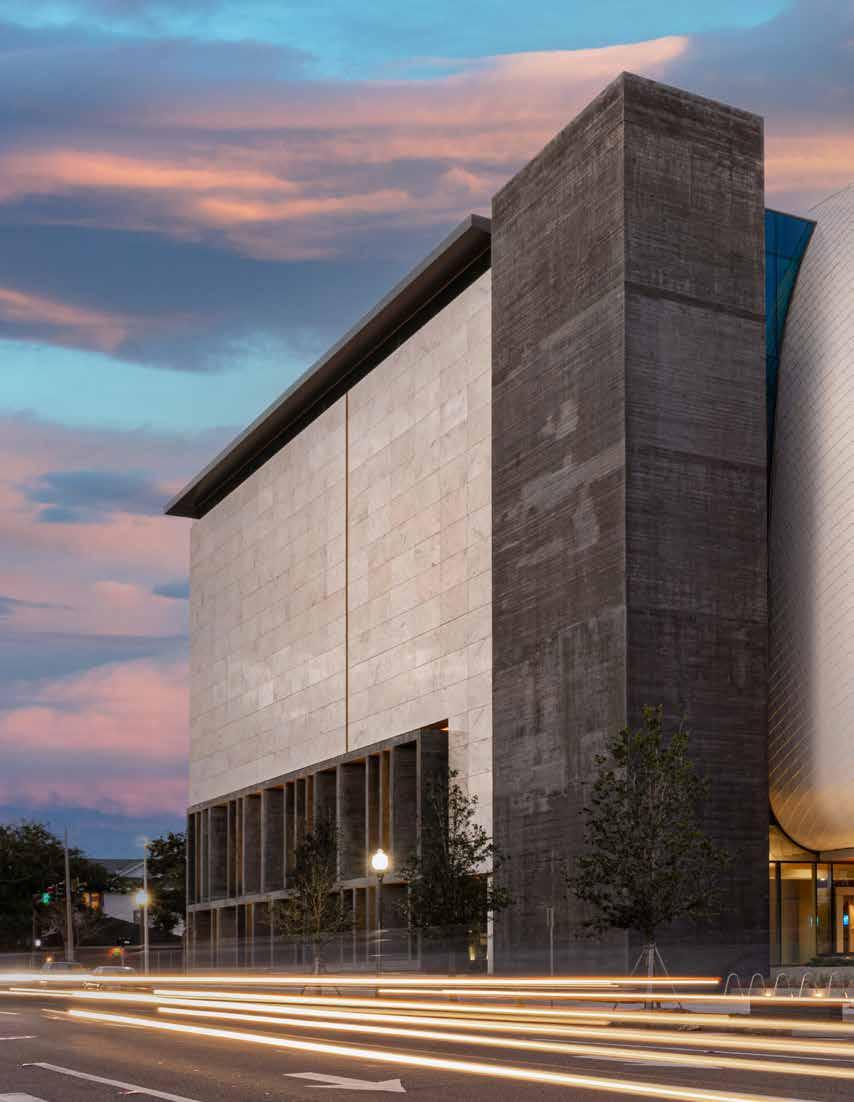
St. Petersburg is known for having a flourishing art scene with many museums and galleries. The Museum of the American Arts & Crafts Movement (MAACM) has become a distinctive feature of this buzzing locale. The museum is the largest, most comprehensive collection of the American Arts & Crafts movement in the world with over 2,000 objects in its collection.

The MAACM is the vision of Rudy Ciccarello, founder and president of the Two Red Roses Foundation. TRRF was founded in the early 2000s with the commitment to promote the understanding of the American Arts & Crafts Movement. Ciccarello began collecting objects from the Arts & Crafts movement in the 1990s. In the mid-2010s, he began planning a new space to highlight this growing collection and opened in 2021. The museum, situated in downtown St. Petersburg, is five-stories tall with over 40,000 square feet dedicated gallery space.
The collection features works by a variety of craftsmen, workshops, and artists such as Gustav Stickley, Tiffany Studios, Newcomb College, Adelaide Alsop Robineau, and Arthur Wesley Dow among many others. The decora-
tive and fine arts in the collection vary and include furniture, pottery, textiles, lighting, ceramic tiles, metalwork, woodblocks, and glass dating from c.1890-1930.
Opportunities to engage with the collection are abundant in its museum programming. Programs range from tours, workshops, family days, and lectures while servicing school groups, youth, adults, and families. Engaging students with museum objects that are familiar and functional, such as tiles, furniture, and pottery allows them to connect in a different manner than perhaps they would with other typical museum works.
The education department is dedicated to creating unique opportunities for teachers and students by collaborating to create rich tours and workshops.

Inquiry-based programming allows students to make relevant connections, bring their own experiences to the table, and take ownership in the conversation. Director of Education Shannon Peck-Bartle remarks, “We believe education is at the heart of our mission to promote an understanding of the American Arts and Crafts Movement and the decorative and fine arts associated with this historical era in America.”

Interdisciplinary docent-led school tours are 50-minutes long, focus on five objects, and include hands-on opportunities. The MAACM offers a variety of art and social studies related themes from Master of Materials to Design Thinking: Form + Function to Industrialism and the American Arts & Crafts Movement.
In addition to themed tours, education staff collaborates with teachers
to craft a workshop to fit the needs of their students. The museum’s education team believes that the ability to create and make while at the museum is just as important as viewing the collection. This creation aids students in processing
and responding to what they view. The most popular topics for groups to explore are engaging students in problem solving – blending art, history, design, and function.
Teachers can also participate in dedicated Teacher Nights at the museum where they can explore the collection and learn about resources available to them. The MAACM also hosts local school districts for professional development opportunities. “Teachers play an integral role in connecting community institutions such as the museum with the learning experiences of students in the classroom. Hosting teacher nights allows for us to collaborate with teachers in the presence of beautiful every day objects connected to the movement, provide teachers an opportunity to learn and share in a space that is outside of the classroom, and allows us to
honor teachers as education professionals,” comments Peck-Bartle.
The MAACM also hosts artmaking workshops for youth and adults. Adults can also participate in lectures and deep dives into meaningful topics such as Byrdcliffe, Woodstock’s Arts and Crafts Colony with Tom Wolf, and Fredrick Hurten Rhead: An American Potter from England with David Rago
Looking to visit with your family?
The MAACM hosts themed family days every month. Families can engage with the collection though artmaking activities, family-friendly guided tours, and special performances.

The Museum of the American Arts & Crafts is a remarkable new addition to St. Petersburg and is worth a visit! The collection demonstrates how art and craft join together to make beautiful functional objects in our everyday life.

FAEA members Miriam Machado and Britt Feingold, as well as FAEA, were recognized at the 2023 National Art Education Association (NAEA) Convention in San Antonio this April for winning NAEA Awards.
NAEA National Museum Education Art Educator Award
Miriam Machado | Miami-Dade County


NAEA Florida Art Educator Award Britt Feingold | Palm Beach County


NAEA Website Award Category II


WARP tour (warp as in Weaving) Cost: $55
Session A/B
June 15, 2023 | 9:30 AM - 4:30 PM
Sarasota, FL
A Match Made in Heaven: 3D Cost: $55
Printing and Ceramics
June 15, 2023 | 8:30 AM - 1:00 PM
Tallahassee, FL
Be inspired by using a 3D printer to create ceramic works using hand-building techniques with Advanced Placement Reader and 33+ year veteran art teacher Marilyn Proctor-Givens.
All Things RAKU: The Heat is On Cost: $55
June 15, 2023 | 8:30 AM - 1:00 PM
Tallahassee, FL
Glaze ceramic pieces and fire them outdoors with the American version of raku, a firing process that originated in Japan. Leave with a finished piece as well as historical and technical information. Taught by Barbara Davis, associate professor at Florida State University.
Speed Creating with Royal Brush! Cost: $30
Flowers, Portraits, & Cake!
July 13, 2023 | 8:30 AM - 2:30 PM
Lakeland, FL
Come and learn with Kris Bakke of Royal Brush. Create 3 lessons using & experimenting with art materials by Royal Brush. After lunch, experience a special tour at Florida Southern College’s Polk Museum of Art with the executive director.
Dye, Spin, and Felt Fibers Cost: $55
July 20, 2023 | 9:30 AM - 12:00 PM
Ponte Vedra, FL
Come and learn how to dye wool, and then break into groups for spinning, weaving and felting fibers in the Fab Lab with Kymberly Thomas.
Join the Sarasota Art Education Association for a tour at the new Sarasota Art Museum, where you will get tangled in the fiber arts exhibit and enjoy listening to guest speaker Tiffany Jennings, PhD Then participate in your choice of of two mixed media creative workshops: Yarn Painting with Felecia Desiano, Lucet Cord Weaving with Sonia Azar, or Fabric Brooches and Fiber Embellishment with Ellen Goldberg. Shop at the museum store and walk a short distance to Art and Frame, Sarasota’s only privately run and family owned art supply store.
WARP tour (warp as in Weaving) Cost: $55 Session C
June 16, 2023 | 9:30 AM - 12:00 PM
Sarasota, FL
Visit local jewel Creative Liberties to tour artist’s studios and participate in a workshop with fiber artist Elizabeth Goodwill. Learn an affordable way to weave on a loom. Elizabeth will lead participants through a cardboard loom weaving based on memories. Bring found objects, fibers, old scarves or other fabrics to weave into this piece of memory art. Plus, bring an old t-shirt to transform into yarn. For lunch, walk across the street to munch and shop at The Bazaar on Apricot and Lime. This special Sarasota experience will allow time to collaborate and network with art teachers.
Making Friends with My Monsters Cost: $20
July 14, 2023 | 11:00 AM - 3:00 PM
Fort Lauderdale, FL
Inspired by mindfulness practice and the current NSU Art Museum exhibition, Emilio Martinez: Van Gogh, Lautrec and Me, participants will create reflective works of mixed media art that personify personal goals, fears, and concerns to celebrate moving toward ownership, understanding, and strength. Participants will use their unique voice and choice of media, including collage, soft sculpture, three-dimensional work, painting, and more. Presented by Lark Keeler.

Scratch art is a unique art form that has been enjoyed by people of all ages for many years. In my classroom, we use prefabricated scratchboard sheets. I then teach them how to create their own scratch art paper and the process is fascinating and terrifying but once completed, it is M-AG-I-C-A-L! Scratch art is a versatile medium that allows for endless possibilities, creativity, and successful for all!
The earliest examples of scratch art can be traced back to ancient China, where artists would use a sharp tool to scratch designs onto the surface of a black lacquer. Over time, this technique evolved into the art form known as sgraffito, which was popularized in Europe during the Renaissance. Sgraffito involves scratching designs into plaster or other surfaces to reveal a contrasting layer underneath. Famous artists such as Pablo Picasso and Karel Appel have used scratch art in their work. Appel’s scratch art pieces were created by layering thick, colorful paint onto a surface and then scratching away the top layer to reveal the colors underneath.

Start the lesson by introducing scratch art and its history. Show examples of scratch art pieces and explain that scratch art is created by layering colors and then scratching away the top layer to reveal the colors underneath. The bright and abstract artwork by artist Wassily Kandinsky can be referenced for inspiration.

Have the students sketch out their design lightly with a pencil on the white drawing paper based on the following drawing prompts. This exercise encour-
By Lily Villalbaages students to listen and follow directions:
• Draw a straight line that touches two sides of your paper.
• Draw a straight line that intersects your first line.
• Draw a line that is parallel to another line.
• Draw a large square or rectangle.
• Draw a large circle.
• Add one shape or line that you feel is missing.
• Draw any type of line that touches two sides of your paper.
• Draw your favorite geometric shape.
Once their compositions are complete, demonstrate how to trace their lines with a black sharpie marker. The purpose of the thick line is to aid in the process of scratching out the patterns. If an area is un-scratchable, then the student knows that this part is an outline and the pattern cannot be changed.
Instruct the students to color their drawing with oil pastels and to avoid coloring over the thick black sharpie lines. Encourage them to use a variety of analogous colors and to blend the colors together to create a variety of values. You may choose to limit their color scheme to cool, warm, monochromatic, complementary colors, etc. Since a large portion of the surface area will be covered with black paint, bright colors are recommended.
Next, black matte acrylic paint is applied over the entire surface of the oil pastel artwork. Be prepared to offer reassurance and encourage your students to continue. “This is terrifying!” was expressed by one student as she was about to apply the black paint. Use a foam or synthetic nylon brush to do this so that no brush marks are evident. Bris-
tle brushes will leave streaks. Allow the surface to dry completely.
As the paint dries, the black sharpie lines become more visible. Once completely dry, instruct the students to use scratch tools to carefully scratch away the paint and reveal the colors underneath. Encourage them to use different scratch tools and techniques to create interesting patterns and textures.
Advanced or older students may use larger paper, for younger students I usually use a 6” x 9” paper. I’ve tried different versions of this lesson and focused the lesson on flowers, insects, fish, and masks; the possibilities are endless! Different scratch tools and techniques to create different effects and textures can be used. Students could collaborate with each other to create a larger scratch art piece. Different color combinations can be used to create interesting patterns and designs.
Working with scratch art is an engaging experience for students and the resulting artworks receive lots of positive attention when displayed. The best part about this lesson is that it is a successful lesson for all!

Mrs. Lily Villalba has taught elementary and middle school art and photography for 11 years at Miami-Dade County Public Schools. She is also a Curriculum Support Specialist and assists new teachers. A former architectural designer, Mrs. Villalba decided to follow her passion and LOVES her job! You can follow her @VillalbArtRoom or contact her at VillalbArtRoom@ dadeschools.net.

As art educators, we’re always looking for ways to support each other and help spread the message of the importance of art and design in the classroom and in the world. Below are several opportunities for teachers and counselors to explore for their own personal development, in addition to free classroom resources.

» Free virtual prerecorded workshops for your classroom
» Virtual Certificate in Design Thinking for K-12 art educators
»Earn 50 SCECH credits
» MA in Art Education (coming in Summer 2023)
» Scholarship competition opportunities for your students
» Portfolio-building tips and workshops
» Classroom visits and portfolio reviews
» Middle school and high school career presentations
Learn more at collegeforcreativestudies.edu/art-educators or contact our Office of Admissions at 313.664.7426.
JOIN THE VIBRANT COMMUNITY OF FELLOW ART EDUCATORS AS AN FAEA VOLUNTEER!

FAEA promotes visual arts education through professional development, service, advancement of knowledge, and leadership. We present public programs; sponsor institutes, conferences, and programs; publish journals, reports, and surveys; and work with other agencies in support of visual arts education.
The core of FAEA is volunteer-driven which provides leadership, advocacy, learning, sharing, and much more. Year after year, our volunteers produce quality programs, events, and information used by visual arts educators.


The FAEA Advocacy Committee completes important visual arts education work together with our management company, the Center for Fine Arts Education (CFAE). CFAE closely monitors and informs FAEA of state legislative and governmental activity concerning the fine arts as well as general educational matters. Over the years, the committee has initiated different campaigns to inform and raise awareness of visual arts education around the state and with political representatives and state agencies.
The committee, led by Gerald Obregon, meets monthly to map out strategies that effectively advocate for art education. In 2022 and 2023, the committee’s campaign focus is Art as a Career.
Art education plays a crucial role in the development of creativity in our kids. This, in turn, leads to higher test scores and more engagement in the learning process while in school. This is a talking point used by those of us who advocate for keeping art classes in school in a time when they are constantly in danger of being eliminated from school curriculums. The perception of those who make policy decisions is that art lessons are frivolous activities that are less important than core classes such as math or language arts.
There is another way to look at the importance keeping art in schools. Art teachers do more than foster the creative process in kids. They prepare students for college and careers. Also, they are job creators. Many of the kids taking art class-

es today go on to become graphic designers, architects, fashion designers, film directors, web designers, photographers, engineers, and much more.
Take a second to look around you, what do you see? The clothes we wear… the buildings we live and work in… the merchandise we buy from stores… the devices we use to communicate with others… the cars we drive… and the entertainment we watch. Professionals who found their calling in art classes created all of these things and so much more. It is the artists of the world that create so much of what society relies upon. The misperception of following an art career is that one will become a starving artist. In fact, there are many opportunities to find a fulfilling career as an artist.
The process of the campaign, Art as a Career, was quite fun for the Advocacy Committee. The members reached out to former students who are working artists. Many times a professional’s interest in art had been established in elementary school and then carried from middle school through high school and often past college. The committee felt it was important to highlight that artistic journey to a successful career in an arts-related field.
The first phase of this campaign was introduced at the FAEA Annual Conference in October 2022. The next phase involves providing the means for art teachers from around the state to highlight their own students. Currently, the committee is developing the template that FAEA members can use to submit information about their own students. The plan is to highlight these success stories through the FAEA website as well as various social media platforms. How exciting for you to share your former students on a statewide level! Additionally, it elevates your program.
If you are interested to assisting the Advocacy Committee, please send an email to info@faea.org and clearly note that you would like to be an active member. The more voices and hands, the better the product, and the further the reach.
Teacher candidates (TCs) embody a liminal space during practicum fieldwork that involves the intersections of space, time, and place. Under traditional formats of student teaching, the practicum occurs during one semester and is performed in mentor teachers’ (MTs) classrooms. As TCs progress through the practicum, some experience a sense of displacement in both place and time as they transition from being college students at a university to becoming professional teachers. Transitional space, “depicts the state when an old paradigm is no longer viable but the new one has not yet taken effect” (Margolin, 2011, p. 9). Since the places that TCs embody are temporal, a transportable space for reflections about the practicum is needed. This article critiques traditional student teaching formats that fail to examine the social conditions of the spaces (in)between the time of becoming and the place of being during practicum fieldwork (Hetrick & Sutters, 2014). Incubation periods of isolation that occur in student teacher placements have been proven to produce uneven developments in TCs’ pedagogical experiences (Britzman, 2007; Zeichner, 1999). Therefore, additional scaffolding and support in communal spaces are needed as TCs transition through fieldwork experiences.
The social practices of teaching can be visualized through arts-based inquiry and shared narratively within a community of educators. Arts-based inquiry and narrative inquiry can provide a spatial examination of the practicum that focuses on a collective of experiences. These methods assist TCs with understanding multiple interpretations of the social conditions of teaching. This paper addresses the call for the creation of reflective spaces, which are private and yet communal forums for art TCs to practice the
JOANA HYATT, PhD - Lamar University. This article critiques traditional student teaching formats that fail to examine the social conditions of the spaces between the time of becoming and the place of being educators during practicum fieldwork. The lack of negotiable spaces for student teachers to resolve problematic situations, myths, cultural differences, and relational aspects of teaching have been documented. Exploring the methods of artsbased inquiry, a group of teacher candidates illustrated their experiences of becoming art educators by producing artwork, videos, and narratives. Student teachers then reflected on their shared roles, making other avenues of collaboration available. When the affective domains of learning to teach are shared narratively within a community, it has the potential to create a heterotopic space of compensation, acting as a space of counterbalance for teacher candidates as they navigate identity fluctuations and pedagogical shifts. Through the heterotopic mirror, the practicum becomes as a space of reflection and a stage of rehearsal, allowing teacher candidates to imagine other political and theoretical positions in their new roles. This paper is a call for supplemental communal spaces that can provide additional support and scaffolding for art teacher candidates as they transition through the (in)between space and time of the student teaching practicum. Correspondence concerning this article should be addressed to the author: joana.hyatt@lamar.edu
“SINCE THE PLACES THAT TEACHER CANDIDATES EMBODY ARE TEMPORAL, A TRANSPORTABLE SPACE FOR REFLECTIONS ABOUT THE PRACTICUM IS NEEDED.”
skills of negotiation, while sharing multiple strategies, as they are in places of being educators in training.
Traditional formats of student teaching operate under modernistic systems that rely heavily upon the selection of expert mentor teachers and supervisors, who are responsible for successfully stewarding preservice teachers through the practicum (Britzman, 2003). Zeichner (1999) noted that it is impossible to guarantee that TCs will receive quality mentorships from teachers and university supervisors (US). Traditional structures of student teaching triads (TC, MT, and US) have not changed significantly in the last twenty years (Zeichner & Liston, 2013). Although areas of this critique concern mentor teacher and university supervisor roles, this article is not about placing blame or suggesting that these positions be abolished. Rather, this critique will suggest how to potentially improve the methods of preparing TCs for the complex social conditions of the classroom through self and community inquiries that are reflective of fieldwork experiences.
The social conditions of what is considered good teaching are transferred through patterns of expected behavior, tacit knowledge is embedded in the everyday rituals that occur in educational classrooms where student teachers complete the practicum (Britzman, 2003, 2007). These conditions include fluctuating identities, conflicting paradigms, and micropolitical practices in student-teaching placements which are rarely examined in traditional teacher education programs or alternative certification programs (Zeichner & Liston, 2013). This oversight causes some TCs to experience misunderstandings about the roles and responsibilities shared with MTs. Conflicting paradigms also encompass theoretical differences in what the university and public schools want from student teachers and their measurements of success in the practicum (Britzman, 2003). However, when tacit knowledge is visualized and shared narratively within a community, preservice educators have the opportunity to reflect on those shared roles, making other avenues of collaboration available.
The struggle begins when the biography of the student teacher contradicts the places that teachers occupy (Britzman, 2003). During preservice training, we often ask TCs to narratively describe their biographies of becoming art educators but we seldom ask them to visualize these fluctuations within the liminal spaces of the practicum. Asking TCs to visually reflect about their own educational biographies and identity fluctuations during the practicum, can affect how they adapt to current teaching environments and how they perceive their
future as educators (Dixon & Senior, 2009; Hyatt, 2014; RifàValls, 2011).
Visualizing change in one’s identity has the potential to advance alternative social practices and beliefs about teaching. Finley (2008) describes arts-based inquiry as a method for relocating inquiry by making use of affective domains of experiences through other ways of knowing such as, imagination, cognitive, and emotional abilities. This includes bodily knowledge that allows the arts-based researcher to explore contingencies of space and place by investigating internal and external sites of conflict and struggle.
What usually remains unspoken, such as implicit knowledge and taboo discourses about the uncertainty and vulnerability of teaching (Britzman, 2003), can be visualized through arts-based inquiry and further explored through narrative inquiry (Leavy, 2009). Reflective spaces, such as digital communities shared with peers and outside mentors, can assist TCs in negotiating differences, finding their voices, and challenging “the politics of their education” (Garoian, 1999, p. 66). Moreover, these spaces have the potential to challenge assumptions about teaching as we engage in community inquiry, which open up avenues of transparency and transformative practices.
Designing a digital space for art TCs on a wiki sitei (Hyatt, 2014), I thought of how to create a temporary forum for preservice educators as they transition between the institutions of universities and schools. The participants were asked to create pseudonyms in order to protect the identities of all parties involved, and to post narratives and images about their fieldwork experiences, as they occurred. The TCs were art education student teachers from two large southern universities. Art education professors invited all 11 of the TCs who participated in the study. Consequently, I did not have control of who the TCs were placed with during the practicum or knowledge of the appointed university supervisors. As an arts-based educational researcher, I acted as connoisseur, advising, appreciating, and critiquing the TC’s images and narratives (Eisner, 1998). Additionally, I assumed the role of teacher educator, providing scaffolding and support when needed and encouraging the TCs to deconstruct their experiences through visual and narrative methods of inquiry.
University supervisors (US) act as liaisons between the mentor teacher and student teacher and many are experienced educators themselves. They work to provide a sense
of cohesion from the beginning to the end of the practicum. Therefore, the digital wiki space was not designed to replace a supportive triad (mentor teacher, university supervisor) that guides the TC through the successful completion of the practicum. But rather, the wiki space was intended as a supportive bridge in-between the time of becoming an art educator, and being a full-time art teacher (Hetrick & Sutter, 2014). Acting as a structural support, anonymous communal spaces can give the TCs a forum in which to ask questions about uncomfortable situations and unresolved conflicts that may otherwise go unspoken, and therefore, unexplored. When TCs avoid such conversations, the messiness of teaching is never fully realized, and myths about what is good teaching remain uncontested (Britzman, 2003, 2007).
A digital wiki community can serve as a reflective space that function as a stage of rehearsal, allowing candidates to try different roles or imagine different political positions as educators as they navigate identity fluctuations, pedagogical shifts, and personality conflicts. Such digital communities can become weigh-stations, operating as temporary checkpoints during the time of becoming educators. The potential to open up dialogic spaces that weigh the checks and balances of particular situations during the practicum can happen within a supportive community of one’s peers and outside mentors.
Garoian (1999) speaks of ways liminal spaces enable students to examine history, place, and culture through a performance art pedagogy that confronts “constructed ideas, images, myths, and utopias” allowing students to reimagine, create, and experience new realities (p. xxvi). Becker (1995) states that we need liminal spaces, “moving between the private and the public, taking from the public to examine the private, taking from the private to examine the public” (p. 58). Garoian (1999) further elaborates that in such (in)between spaces, “contention is a desirable state. It is the principle means by which spectators/students become critical thinkers and participate in society as critical citizens” (p. 43). Ignoring contradictions concerning teaching experiences and fluctuating teacher roles and identities, blocks pedagogical connections, which link ideas, theories, and practices together.
It was in this reflective space that TCs shared emotional and complex situations that occurred in various classroom contexts. As such, the space contested what is often portrayed in teacher education as a linear journey of becoming a teacher. The TC’s
text and images represent both slices of experience, depicting a particular scene or setting, and narratives that illustrate a complete storyline from the beginning to the end of the practicum. Therefore, digital space can reflect the liminal spaces of teaching as a holistic journey or as a fragmented string of dispersed narratives. Multiple interpretations of experience can then act as a counterbalance, providing a heterotopic space of compensation (Foucault, 1986).
“Depending on their purpose, heterotopias serve as steam-releasing sites, deflecting the forces of change by locating them outside society” (Dehaene & De Cauter, 2008, p. 191). Foucault’s (1986) paper, Of Other Spaces, began to outline spaces of heterotopias, which can be physical, mental, or virtual. Unlike utopias, which are unreal spaces, heterotopias are real spaces that exist alongside our everyday space but are considered other, deviating from the social norms of that particular society (Dehaene & De Cauter, 2008; Foucault, 1986). Foucault’s principles of heterotopiasii state that there are two classifications where norms of behavior are suspended—heterotopias of crisis and heterotopias of deviationiii. Both have a precise function and reflect the society in which they exist (Foucault, 1986).
Foucault (1986) recognized that heterotopias mirror aspects of spaces and places of the real world, not exactly as they are but as reflections of multiple realities, including those of utopian ideologies. Foucault (1986) used the mirror as an example of a reflective heterotopia that offered a mixed experience between utopia and heterotopiaiv. The mirror reflected spaces that could be considered utopian, allowing one to see themselves where they were not, in imagined or reflected spaces. The mirror itself, as an object, is real. Therefore, according to Foucault (1986), the mirror is a heterotopic space that reflects both the real and the utopian spaces.
Dehaene and De Cauter (2008) explain the function of Foucault’s (1986) heterotopias in “post civil” societies as a way of organizing space through a grid or networkv. Digital communal spaces for TCs can serve as heterotopic mirrors, enclaves of collective experiences that link together and reveal other pedagogical sites, including institutional spaces separated by time and geography. Wild (2011) speaks of a heterotopic space as a real site that “represents, contests, and reverses culture by allowing difference…Heterotopias are counter-sites, space which contradict the other spaces that we occupy” (p. 424). These heterotopic spaces are reflective places that both sep-
arate and connect spatial experiences of differentiation. Collectives can form a recollection of discontinuity that deflects homogenization. Heterotopias can be about a “collective of experiences of otherness, not a stigmatizing spatial seclusion but rather as the practice of diffusing new forms of urban collective life” (Stavrides, 2007, p. 174).
Dehaene and De Cauter (2008) maintain that heterotopias are paradoxically bounded, and at certain times, permeable. Contemporary heterotopic spaces overlap between public and private spaces, which are “necessarily collective or shared spaces” (Dehaene & De Cauter, 2008, p. 6. Stavrides (2007) believes that the porosity between the experiences of being in places of otherness serves to absorb other ways of knowing, dissolving spatial borders between heterotopic spaces. In this way, the heterotopic space is porous and is reflective of other borders, becoming much like a drawbridge, a penetrable space that separates and connects:
Because this perimeter is full of combining/separating thresholds, heterotopias are not simply places of the other, or the deviant as opposed to normal, but places in which otherness proliferates, spilling over into the neighboring areas of “sameness.” Heterotopias thus mark an osmosis between situated identities and experiences that can effectively destroy those strict taxonomies that ensure social production. Through their osmotic boundaries, heterotopias diffuse a virus of change. (Stavride, 2007, p. 4)
The digital space I shared with the 11 participants on the wiki site was heterotopic, as multiple interpretations and contexts of learning and teaching that the participants encountered were represented through art, videos, and narratives, reflected back into a communal space. The TC’s cultural histories concerning educational practices sometimes conflicted with other students or MTs in their teacher placements. For example, one TC stated that she attended a private religious school that was structured around individualistic learning practices (Johnson & Johnson, 1999). In art classes at her cooperating school, she expected the same behaviors, whereas children would be given instructions and work on individual projects during the class period. Her MT’s teaching philosophy was closely aligned with a social constructivist approach (Vygotsky, 1978), which recognizes an equal distribution of power between the students and teacher is necessary to facilitate a climate focused on social interactions and shared knowledge. Another TC stated that she encountered a very different situation, as she interpreted her MT’s behavior as strict concerning
We are forming a Media Task Force responsible for assessing and increasing our social media presence by developing and implementing a plan to use social media in a more contemporary, effective, and engaging manner across FAEA programming. We need 4 creative and knowledgeable FAEA member “influencers” who have experience and are interested in serving on this Task Force to expand our member interactions, raise engagement, support our advocacy efforts, and “get our message” out.
Contact
FAEA is now accepting nominations for the 2024-2025 FAEA Board of Directors. We are looking for dedicated members who are interested in taking part in the operations of FAEA and are also dedicated to the legacy of the Association.
Nominate yourself or another deserving member by May 26, 2023 for this great leadership opportunity.
More information about Board nominations can be found on the FAEA website.
dress codes, classroom rules, and adherence to administrative regulations. Some of the TCs’ narratives reflected the social conditions present in these institutionalized places. Heterotopic communities can serve to debate the norms of one culture against the norms another, a space that would allow for norms and deviation to be contested and reversed. As art TCs travel through liminal spaces (in)between becoming and being art teachers (Hetrick & Sutters, 2014), a heterotopic community to share, debate, and reflect upon the alternative identities and ways of becoming art teachers has the potential to change the social conditions of teaching by pedagogically spilling over into classrooms (Hyatt, 2014; Wild, 2011).
Crafting spaces of heterotopias can be a form of creative resistance, providing opportunities for reflection on experience. Such spaces can embrace multiple ways of knowing and teaching (Dewey, 1933; Schon, 1987). Garoian (1999) defines these resistive spaces as public/private negotiations, which combine action, theory, and activism. A communal space of reflection grants the arts-based researcher room to inquire through authentic modes of inquiry, discovering how to go about illustrating the tensions between what we know and what we have experienced.
Reflexive learning environments require that we provide thoughtful spaces for preservice educators to critically examine fluctuations in identity that are experienced over time, visualizing the emotions of frustration, uncertainty, and vulnerability that are often present during times of personal change and growth. Arts-based inquiry combined with narrative inquiry can illuminate how TCs handle conflicting situations through various strategies (Diamond & Van Halen-Faber, 2005; Finley, 2008). As the TCs traveled through the spaces of experiencing to the places of being art teachers (Sutters, 2012) many of their images illustrated the shifting social conditions of teaching. The TCs posted narratives and images concerning conflicting paradigms, identity fluctuations, and shared strategies that assisted them in traversing the liminal spaces of the practicum.
Preservice educators and student teachers are not always instructed on how to deconstruct or negotiate conflict during the practicum (Anderson, 2007; Kelchtermans & Ballet, 2002; Zembylas, 2007). When TCs are willing to share the unscripted moments of teacher fieldwork, it opens up a dialogic space that invites critical discussions about misunderstandings, complex learning environments, and multiple ways of handling diffi-
cult situations. Below is an example of how one TC, MyArtEd, describes a visual strategy he used when dealing with uncomfortable feelings during his teacher fieldwork experience.

Throughout my student teaching semester, instead of getting wrapped up in the awkward or uncomfortable moments, I would force myself to take time to look at the bigger picture and focus on the overall purpose of my time in the classroom. In doing this, I would analyze my experience as though I was looking down from the clouds, mapping out my steps and highlighting the moments that were unforgettable, almost like an aerial map (personal communication, 2012).
Decentering is an intentional yet playful kind of mindfulness, a stepping away from what is known, to see what remains hidden. This strategy presents the TC with a different perspective of a particular situation. “Detachment and connection are most generative when regarded as connected” (Bresler, 2013, p.45). Detached connection allows the TC to illustrate the external conditions of teaching that affect the internal processes, which has the potential to alter the TC’s interpretations of fieldwork experiences. Therefore, decentering is a strategy that involves both external and internal processes (Bresler, 2013), as expressed by MyArtEd in figure 1. Reflexive spaces can document a TC’s cumulative experience both visually and narratively. In this way, TCs are exposed to multiple avenues of negotiation by witnessing how other student teachers use visual strategies in coping with stressful situations. Creating narratives or works of art is a reflexive way of working through problems and seeing alternative solutions (Leggo, 2008).
As student teachers reflexively reframe the culture of schools, and contribute those experiences in an anonymous
community, they may create what Clements (1999) refers to as a “fictive voice,” which can entail the retelling of an event, slightly altered or changed by the participants’ own understanding and cultural experience to generate a more desirable or meaningful narrative. Embracing the fictive voice, however, can also become a way for participants to collaborate, using hindsight to make sense of the story (Clandinin, 2007). In the following sections, the participants’ narratives, images, and videos were shared on the wiki site during, and immediately following the conclusion of the practicum experience.
Examples of correspondence shared between the TCs and me involved further exploration of their stories and images, which investigated issues surrounding the constraints of space, time, and place in teacher fieldwork. As an experienced art educator with over 18 years teaching, I have served in all of the positions in traditional student teaching triads. By far the
(1989) call for an “interpretive balance between space, time, and social being” (p. 23). Shaped by both spatial and temporal contexts, “teaching is not only embedded in space, but also in time” (Kelchtermans, 2005, p. 1002).
TCs live a transient existence during the practicum, teaching in a classroom that is not their own, while being a college student transitioning from university life to a professional career. TC, Pinkchix describes the rift (in)between college and the classroom, addressing feelings of displacement:
Through this semester of student teaching, my mind began to unwind and rethread a new understanding, especially during the high school placement, of the small little world I had created in this little town for the past five years. I noticed when I came home from work and would drive through campus, I gradually started feeling out of place in an area I have called my home for half a decade . . .. At stop lights, I would just look at the kids and realize that the freshman were only a year older than the kids I was teaching and, suddenly, I would become incredibly uneasy as I realized how much can change in such a short amount of time. Within the semester, I felt a wide rift grow and mold from my college years to my career years and a creeping feeling sunk into my gut; I belong in the classroom now. (personal communication, 2012)
TC, ArtIsAHammer felt a sense of displacement concerning the fracturing of identity from student to teacher. Spaces to transition with others who are experiencing the same phenomenon could assist student teachers in addressing fluctuating identities.
most difficult position is that of the mentor teacher. As the TCs navigated their new identities as art teachers, I reminded them to be respectful of all parties with the understanding that one day, they too, will be responsible for mentoring student teachers and living constraints of space, time, and place.
The traditional formats of teaching privilege the idea that teaching experience can only be accumulated through the passing of time—a semester for a TC and years for the MT—and in the spaces of MTs’ classrooms. Scholars, including Edward Soja
Student teacher, ArtIsAHammer, created a vimeo presentation of her experiences titled “The Incremental Approach.” “Incremental” suggests slow progress, something increasing in value or something gained. Because of institutional constraints and fragmentation from outdated forms of measuring students’ progress and/or documenting our own practices as teachers, even incremental goals are often difficult to measure. This TC speaks of the everyday realities and struggles to motivate students, something that student teachers and teachers alike face. Even more astute is the way she confronts the myth of becoming a teacher. The journey into becoming a teacher is often portrayed as a mysterious sojourn where a miraculous moment occurs at the conclusion of the practicum. A moment that transforms the TC into a fullfledged teacher ready to take on the daily responsibilities of teaching (Britzman, 2003). ArtIsAHammar’s narrative video illustrates that teaching is not

instantaneous. It is a process, and sometimes it takes longer for TCs to develop as educators.

The practicum is considered an opportunity to explore practical applications of methods and theories in teaching, a time for experimentation and examination of teacher identities. Habitually, institutional criteria mistakenly see the MT as solely responsible for all learning that takes place in the classroom (Britzman, 2003). This situates the MT’s actions or inactions as the problem, in order to provide oversimplified solutions to very complex teaching environments. These social practices are passed on to the TCs, placing great responsibility on the TCs to perform to scripted curriculum methods and mimic the MT, while controlling the classroom and producing predetermined outcomes.
Teacher candidate, Godwilling, explains in her narrative titled “Maybe Not All Teachers Are Cut Out to Be Mentor Teachers” that university experience is not always validated by some classroom teachers and that the MTs roles should be those of a facilitator providing support:
One of the reasons I wanted to write on this topic is because one of my mentor teachers brought this matter to me and we discussed it in detail. She believes that there
are mentor teachers that honestly do not understand their function as a supportive role in the classroom. Preservice students have already gone to school; they have had some classroom experiences. They are not starting from the ground up. They do not need to be taught basics, they need to be supported in front of the students and treated as an equal in order to gain the students’ trust. I believe without this support, the student teacher will be unsuccessful. This is the preservice students’ opportunity to try and test out techniques they have been theorizing 91 about for the last 4 or more years. This is the time when they can find out what works for them and what doesn’t. We should think of it as a dress rehearsal for obtaining tried and true skills to carry with us into our own rooms (personal communication, 2013).
Teacher candidate, Godwilling, describes her journey throughout student teaching as successful stating, “Both of my mentor teachers encouraged me to try different methods of teaching art.” She felt that having MTs who are supportive and respectful creates a sense of collaboration and trust. To visually project her sense of accomplishment, Godwilling views her teaching journey as building blocks to a successful future, (see figure 3). She states that each experience in student teaching adds to her self-confidence, laying the foundation for her to become an integral part of the mentor teacher’s classroom. In, My Success Story, the sliced apple with exposed seeds reveals the fruition of such collaborative journeys, and thus illustrates a hopeful future.
Imagery of teachers varies widely. We may consider the stereotypes of the schoolmarm, spinster, or authoritarian nun and contrast them with conflicting images posed in rock anthems like Van Halen’s Hot for Teacher and movies depicting female teachers as sexual temptresses or child predators (Notes on a Scandal, To Die For) (Keroes, 1999; Weber & Mitchell, 1996). Local knowledge can produce its own set of cultural myths about teaching that suppress multiplicity. The teacher-as-saint identity is often portrayed as someone selflessly giving without expecting a reward. On the surface, this stereotype does not seem harmful. While this theme is implicit in many narratives, one TC’s story, pjammy, takes this notion as a central concern as she writes about teaching at-risk students, asking important questions about the role of teachers:
Student teacher, pjammy – Narrative: A Lost Cause? In
my middle school experience, I came upon some students who were in difficult home situations. I met students with mothers dying from cancer, and overdoses, gang members and arrested parents. These students were barely teenagers, definitely too young to deal with these issues. A boy’s mother was arrested and sentenced to 10 years in prison. He lashed out in class, only did the minimum to pass, and was very disrespectful to my mentor and me. I tried to connect with him and his work. I said, “You really did well on this project,” and he responded, “I know.” He didn’t care about anything I said. He was already apathetic about school. They [students] have no encouragement and support from home. They think they know what is best for them, when they are only 12. They still need guidance and direction. I know that this is why I became a teacher, to help guide and direct students through their journey in education, but I know I am not expected to save all of them. At what point do we decide they are a lost cause? At what point do we let them go? How far do we go to save them? (personal communication, 2012).
Although teachers can be positive role-models in students’ lives, the stereotype of teachers-as-saint can make educators feel guilty if they are not continuously giving of their emotions, time, and money for the betterment of their students’ lives, even possibly to the point of exhaustion and financial ruin. This can directly affect the emotional well-being of a novice educator and lead to burnout and attrition. Below is an excerpt from my response to the student teacher, pjammy:

In reality, you are not expected to save any of them. I think that is an unrealistic goal and dangerous for you to put that much pressure upon yourself as a new teacher. Paulo Freire believes we cannot save others through our teaching but we can enter into fruitful dialogue and con-
tribute towards that learning by being both teacher and student. Learning from our students and sharing our passion and knowledge about the creation of art, as well as engaging with them about issues related to art through critical reflection can be an extremely beneficial and positive outlet for all students. The art you expose them to now may have a positive effect later in their lives. You must not think your teaching is in vain because you do not get an immediate response or a particular response from certain students. These students are dealing with complex issues. Feeling overwhelmed, many of them simply shut down and are not willing to put themselves out there for any kind of evaluation. To answer your question, “At what point do we decide they are a lost cause?” My answer would be, never. We do not make that decision, nor should we. We do what we can, when we can, because we never know what each individual will take from those shared experiences in our classrooms (Joana Hyatt, personal communication, 2012).
Britzman (2003) suggests that for educators to allow students to construct knowledge socially—a process wherein all contribute to knowledge—it is necessary to become comfortable with not knowing, embracing vulnerability and uncertainty in the journey. After years of working with preservice educators, my impression is that they are not comfortable with the idea of uncertainty, which is not surprising considering that educational institutions usually do not tolerate, much less embrace, forms of ambiguity. In teacher education, novice educators search for predetermined stepby-step methods that guarantee positive results and provide certainty. As many of them encounter complexity and feelings of crisis in becoming teachers, that search becomes one of desperation and disillusion. Such dynamics are expressed in the response written by pjammy one week later:
I do understand that I am not expected to actually save/ turn every student into a lover of art and learning. But I think at the time I was searching for a How To.... a
that her MT suggested she not wear low-cut maternity shirts to class because, she warned, “little boys will want to look down your shirt.” Instead, the teacher asked her to wear church shirts in the classroom. The art teacher candidate explained that after her recent pregnancy, all she could fit into were her maternity clothes. The cooperating teacher then suggested that she wear a dickie under her maternity tops.
Female teachers and students’ clothing are often politicized and controlled through school dress codes. Understanding that the field of teaching is a political one, which restricts our choices and constrains our actions and expressions as teachers and students, we must remember that not all actions and rules are produced by the classroom teacher. Usually it is the administration that decides the particulars about dress codes in schools (Raby, 2005). The MTs and USs therefore, must act as advisors, which mean sometimes they censor the new teachers’ dress and actions because they feel they are protecting the student teacher from disciplinary actions by administration (Raby, 2005).
During fieldwork, TCs can feel particularly isolated from other peers and outside mentors. While traveling (in)between the spaces of becoming to being art teachers (Hetrick & Sutters, 2014) TCs can share stories, strategies, and artwork about fluctuations in identity. Such spaces enable us to visualize the social conditions of teaching and the fluctuating roles and responsibilities of MTs and TCs.
step by step instruction. A bit in fantasyland imagining that. The human mind and behavior is not always predictable and people do not always respond the same way in the same circumstances. I hope in time and experience I become stronger in approaching these situations, and I also hope I never become bitter or too weary to work with students (personal communication 2012).
Similarly, TC Venus of Willendorf’s narrative addresses the stereotype of the temptress-teacher, poking fun at herself as a fertility goddess in, figure 5. Venus of Dickies. The TC explains
The image in figure 6, illustrates the uncertainty and struggle involved in teacher identity for some preservice art educators. There is no additional narrative accompanying this image by Dr. Seuss, but the illustrated collage of drawings containing text tells the story of the emotional conflict that is present within student-teaching fieldwork. The vocabulary of becoming an educator is expressed and illustrated in the words on the chalkboard. Words such as “stress,” “fear,” and “anxiety” are clearly marked. Next to them appear other words that mark the contradiction of emotions and feelings concerning teacher fieldwork: “motivation,” “passion,” and “inspire.” This simple drawing illustrates many of the emotional dualities and complexities of learning to teach.
Depicting the uncertainty and nomadic feelings of not belonging in the university or in this particular classroom, next to the image of a red megaphone a question is asked that many preservice teachers wonder, “What is my place?” As the teacher candidate wonders if she is a student or teacher in the classroom. The struggle for voice and identity are present in this narrative, as the student teacher realizes that she is a guest in this class-
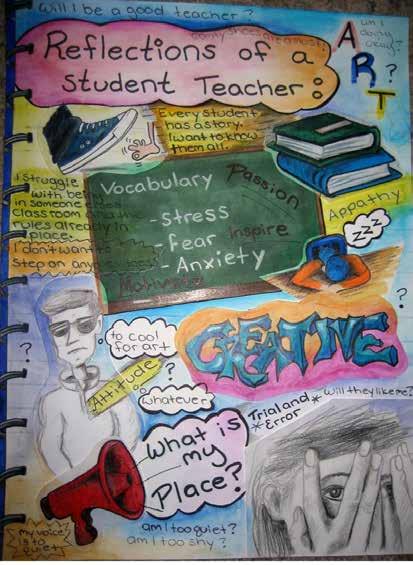
room. Student teaching, no matter how successful one might feel in the practicum, is an uncomfortable space to inhabit.
As I consider the multiple voices of the participants, I realize that the stories they shared were mediated and refashioned to fit their experiences. Garoian (1999) states that fieldwork is “autobiographical in nature” (p. 44). Being open to multiple interpretations of being teachers and effective ways of teaching makes possible the letting go of predetermined ideas of mentoring and teaching. Such a process activates the power of negotiation to foster a critical voice. The cultural norms and the social conditions of teaching can be debated, deconstructed, and reimagined in new contexts beyond institutional spaces.
Visual and narrative inquiries encourage art TCs to explore tacit knowledge about the social conditions of teaching. As TCs reflect upon their practicum in supportive communities of peers who are experiencing a similar journey, they may learn other avenues and ways of being art educators from their peers and mentors. This scaffolds TCs’ fieldwork as a continuous journey, one that does not end at the semester’s conclusion but that can continue into the first years of teaching.
As I share the TCs’ stories and images with my current preservice educators, the TCs’ storylines and artwork serve as examples of how conflicts were resolved in beneficial ways that promote professionalism in reflective learning communities. Visual narratives are necessary in understanding how complex teaching situations manifest and how they can be resolved through negotiation using multiple strategies.
Maxine Greene (1988) wrote about the “crisis of silence,” in teaching, where no one dares to question knowledge, fearing retribution. Interference with one another becomes a necessity in order to challenge our own internal discourses (Britzman, 2003; Garoian, 1999). Therefore, there is an urgent need for greater representation of TC’s perspectives and voices that will advance their interests during the practicum. An (in)between space that is public and yet private, which at time excludes “a delineation of otherness and a closure vis-à-vis public space” (Dehaene & De Cauter, 2008, p. 6) can represent multiple voices. A private but communal space can be a place of rehearsal for TCs as they practice the skills of negotiation, share visual strategies, and discuss fluctuating roles and responsibilities.
As we enter into engaging and mentoring student teachers in these (in)between spaces that examine the public in private and the private in public, we need to be conscientious of the fact that student teachers and educators occupy a vulnerable
position. Therefore, we need to carefully consider how these reflective spaces are created, and by whom, asking who should provide additional mentorship to TCs.
Negotiating undercurrents within my own teaching practices, I question how we, as art educators, can carve out nonhegemonic spaces that welcome uncertainty, conflict, and difference, spaces that move between the public and private, the liminal and the reflective. We should craft spaces where meaning is negotiated to encourage teacher candidates to ask, what is my place? It is our responsibility to provide a reflective space for TCs to envision themselves being art educators as they experience becoming teachers within the liminal spaces of the practicum.
Anderson, D. (2007). The role of cooperating teachers’ power in student teaching. Education, 128(2), 307–323.
Becker, C. (1995). Survival of the artist in the new political climate. In C. Becker (Ed.), The artist in society: Rights, roles, and responsibilities (pp. 56–74). Chicago, IL: New Art Examiner Press.
Bresler, L. (2013). Experiential pedagogies in research education: Drawing on engagement with artworks. In C. J. Stout (Ed.), Teaching and learning emergent research methodologies in art education (pp. 43-64). Reston, VA: National Art Education Association.
Britzman, D. (2003). Practice makes practice. Albany, NY: State University of New York Press.
Britzman, D. (2007). Teacher education as uneven development. International Journal of Leadership in Education, 10(1), 1–12.
Clandinin, D. J. (2007). Handbook of narrative inquiry. Thousand Oaks, CA: Sage.
Clements, P. (1999). Autobiographical research and the emergence of the fictive voice. Cambridge Journal of Education, 29(1), 21–32.
Dehaene, M., & De Cauter, L. (2008). Heterotopia and the city: Public space in a postcivil society. New York, NY: Routledge.
Dewey, J. (1933, April 23). Dewey outlines utopian schools. New York Times, 23, 23.
Diamond, C. T. P., & Halen-Faber, C. V. (2005). Apples of change: Arts-based methodology as a poetic and visual sixth sense (pp. 81–94). In K. O’Reilly-Scanlon, C. Mitchell, & S. Weber (Eds.), Just who do we think we are? Methodologies for autobiography and self-study in teaching. New York, NY: RoutledgeFalmer.
Dixon, M. & Senior, K. (2009). Traversing theory and transgressing academic discourses: Artsbased research in teacher education. International Journal of Education & the Arts, 10(24), 1-22.
Eisner, E., (1998). The enlightened eye: Qualitative inquiry and the enhancement of educational practice. Upper Saddle River, NJ: Prentice Hall.
Finley, S. (2008). Arts-based research. In J. G. Knowles & A. L. Cole (Eds.), Handbook of the arts in qualitative research (pp. 71–82). Thousand Oaks, CA: Sage.
Foucault, M. (1986). Of other spaces. (J. Miskowiec, Trans.). Diacritics, 16(1), 22–27.
Garoian, C. R. (1999). Performing pedagogy: Toward an art of politics. Albany, NY: State University of New York Press.
Gaudelli, W., & Ousley, D. (2009). From clothing to skin: Identity work of student teachers in culminating field experiences. Teaching and Teacher Education, 25(6), 931–939.
Greene, M. (1988). The dialectic of freedom. New York, NY: Teachers College Press.
Hetrick, L. J., & Sutters, J. P. (2014). Becoming (time) and/or being (space) art teacher: A spatio-temporal look at the culture of student teaching in art education. Journal of Cultural Research in Art Education, 31(1), 13–31.
Hyatt, J. S. (2014). Creating a heterotopic space: Reflections on pre-service art educators’ narratives (Doctoral dissertation). Retrieved from http://digital.library.unt.edu/ark:/67531/metadc500166/
Johnson, D. W., & Johnson, R. T. (1999). Making cooperative learning work. Theory into practice, 38(2), 67-73.
Kelchtermans, G. (2005). Teachers’ emotions in educational reforms: Self-understanding, vulnerable commitment and micropolitical literacy. Teaching and Teacher Education, 21(1), 995–1006.
Kelchtermans G., & Ballet, K. (2002). The micropolitics of teacher induction: A narrative-biographical study on teacher socialization. Teaching and Teacher Education, 18(2), 105–120.
Keroes, J. (1999). Tales out of school: Gender, longing, and the teacher in fiction and film. Carbondale, IL: SIU Press.
Leavy, P. (2009). Method meets art: Arts-based research practice. New York, NY: Guilford Press.
Leggo, C. (2008). The ecology of personal and professional experience: A poet’s view. In M. Cahnmann-Taylor & R. Siegesmund (Eds.), Arts-based research in education: Foundations for practice (pp. 231–246). New York, NY: Routledge.
Margolin, I. (2011). Professional development of teacher educators through a transitional space: A surprising outcome of a teacher education program. Teacher Education Quarterly, 38(3), 7-25.
Popkewitz, T. (1998). Struggling for the soul: The politics of schooling and the construction of the teacher. New York, NY: Teachers College Press.
Raby, R. (2005). Polite, well-dressed and on time: Secondary school conduct codes and the production of docile citizens. Canadian Review of Sociology/Revue, 42(1), 71-91.
Rifà-Valls, M. (2011). Experimenting with visual storytelling in students’ portfolios: Narratives of visual pedagogy for preservice teacher education. International Journal of Art & Design Education, 30(2), 293306.
Schon, D. A. (1987). Education the reflective practitioner: Toward a new design for teaching and learning in the profession. San Francisco, CA: Josey-Bass.
Soja, E. W. (1989). Postmodern geographies: The reassertion of space in critical social theory. London, UK: Verso Press.
Stavrides, S. (2007). Heterotopias and the experience of porous urban space. In Karen A. Franck & Quentin Stevens (Eds.). Loose Space:
Possibility and Diversity in Urban Life (pp. 174–192). London, UK: Routledge.
Sutters, J. P. (2012). Taking Place and Mapping Space: How Pre-Service Art Education Students’ Visual Narratives of Field Experiences in Urban/ Inner-City Schools Reveal a Spatial Knowing of Place (Doctoral disserta-tion). Retrieved from http://rave.ohiolink.edu/etdc/view? acc_num =osu1345065866
Vygotsky, L. S. (1978). Mind in society: The development of higher mental process. Cambridge, MA: Harvard University Press.
Weber, S., & Mitchell, C. (1996). Drawing ourselves into teaching: Studying the images that shape and distort teacher education. Teaching and Teacher Education, 12(3), 303-313.
Wild, C. (2011). Making creative spaces: The art and design classroom as a site of performativity International Journal of Art & Design Education, 30(3), 423-432.
Zeichner, K. M. (1999). The new scholarship in teacher education. Educational Researcher, 28(9), 4–15.
Zeichner, K. M., & Liston, D. P (2013). Reflective teaching: An introduction. New York, NY: Routledge.
Zembylas, M. (2007). Emotional ecology: The intersection of emotional knowledge and pedagogical content knowledge in teaching. Teaching and Teacher Education, 23(2), 355–367.
i Digital wiki site:https://postartteachingstories.wikispaces.com/ Welcome+to+Post+Art+Stories
ii According to Foucault (1986), there are six principles of heterotopias; they exist in all cultures but in diverse forms, they change and have multiple functions through different points in history, they juxtapose in a single space several other incompatible spaces, they encapsulate slices of time, culture, and history through accumulation, they have specific openings and closings that are related to rituals, and they function as a space of compensation or illusion.
iii Heterotopias of crisis refer to the spaces that individuals are placed when they are in a state of crisis. These spaces are described as “privileged or sacred or forbidden” (Foucault, 1986, p. 4). For the most part, Foucault believed heterotopias of crisis were disappearing in society as heterotopias of deviation replaced them. Heterotopias of deviation in relation are spaces “for individuals who behavior is deviant in the required mean or norm are placed” (p.5).

FAEA has a wide selection of apparel and merchandise available now for this year’s conference:
• T-Shirts

• Let’s Bucket Hats

• Tumblers
• Coffee Cups


• Stickers
All merchandise will be shipped directly to you! No waiting to pick up at the conference. It must be ordered separately using the button below, it cannot be included in your conference registration. Order at least 2 weeks in advance to have it in time for the conference.
Fresh Paint is the award-winning publication of the Florida Art Education Association (FAEA) that contains articles of interest to art educators of all levels – from kindergarten through college level. It is produced 4 times annually and distributed to more than 850 art teachers, school district art supervisors, museum educators, higher education professionals, community art educators and artists, as well as other state and national art associations.
Fresh Paint is a terrific venue for businesses and organizations to reach art educators and decision-makers.
Learn more at faea.org/publications/advertising
