SPRING/SUMMER 2022
Volume 45 • Issue 1
2
Fresh Paint • Spring/Summer 2022
SPRING/SUMMER 2022 • Volume 45 • Issue 1
C NTENTS features 2022 K-12 Student Art Assessment & Virtual Exhibition Winners | 14
OUR COVER ARTIST Sofia S. (Grade 4) Flowers in a Vase, Mixed Media Pinecrest Elementary Miami-Dade County The purpose of this publication is to provide information to members.
Blacklight Acrylic Painting on Canvas | 21 Improving Equity, Diversity, & Inclusion Practices | 20 Connecting To Art Through the Entry Point Approach | 33
Fresh Paint is a quarterly publication of Florida Art Education Association, Inc., located at 402 Office Plaza Drive, Tallahassee, Florida 32301-2757.
14
FALL digital Conference digital Winter digital Spring/Summer digital FAEA 2022 Editorial Committee
departments President’s Reflection | 4 20-21 Board of Directors | 5 Board Consultant’s Report | 6 Calendar 2022 | 7 Division Updates | 8 Museum Spotlight | 24 From the Field | 29
24
Claire Clum (chair) Christie Becker-Fitzgerald Heather Hagy Dulcie Hause Jackie Henson-Dacey Latonya Hicks Heidi Powell Nancy Puri Periodical postage paid, Tallahassee, Florida (USPS 023179). POSTMASTER: Send address changes to FRESH PAINT, 402 Office Plaza Drive, Tallahassee, Florida 32301-2757. Fresh Paint is made possible, in part, by the participation of the businesses whose advertisements appear in this issue. They make it possible to provide membership with a high quality publication and we gratefully acknowledge their support of Florida Art Education Association’s (FAEA) mission. We hope that you take special notice of these advertisements and consider the products and services offered. This is another important way you can support your professional association and the enhancement of Florida art education. The publisher does not endorse any particular company, product, or service. FAEA is not responsible for the content of any advertisement and reserves the right to accept or refuse any advertisement submitted for publication.
Fresh Paint • Spring/Summer 2022
3
Nancy Puri President, FAEA
President’s REFLECTION
have seen the work that is coming out of classrooms all over the state, at every level, and I am so impressed by what I see. All of this in spite of such significant challenges that all of us have faced – it is impressive! This summer, I know we are all looking forward to diving into that renewal. I hope that you will find the time to create, read, laugh, and enjoy yourself with the people you care about most. As art educators, museum professionals, or retirees, we all need the creative energy that comes from spending time with the art that we love! It seems that we are all ready for this—reflecting, creating, and renewing of ourselves. I find that making art enables me to process my world and actually provides me with more energy for the less desirable pursuits that are necessary in life. Speaking of spending time making art; FAEA is plan-
Greetings! I hope that, as we ease into spring and summer that you are as encouraged as I am for things to come. Spring is always a time of renewal and summer brings rest, reflection, and some much needed fun. We are stepping into a time of year that is often referred to as “the home stretch” and so much is happening. There are many things to celebrate, student exhibitions, awards, and accomplishments or simply arriving at this point in the year when students are wrapping up their work; turning in their portfolios, completing something for exhibition or graduating and taking their next steps. YOU have helped these students grow and develop and that is worth celebrating. For those of you that support teachers and the community, you have done the same and all of you have reason to be proud of that. I
2022 FAEA ANNUAL CONFERENCE
Metamorphosis
Art Evolves OCTOBER 13 - 16, 2022
|
CARIBE ROYALE ORLANDO
SAVE THE DATE 4
Fresh Paint • Spring/Summer 2022
FAEA board of directors ning a great line-up of in-person AND virtual workshops this summer. We will announce the time, dates, and locations soon; so keep an eye out for those announcements. The K-12 Student Art Assessment & Exhibition winners are in this issue. Congratulations to all the winners and thank you to all who submitted artwork this year. The Member Virtual Exhibition opens for entries May 15! Please plan to enter YOUR art this year. We want to see what you are creating and celebrate you! Lastly, I want to mention that our new Board is working on some exciting things that you will hear more about going forward; there are two that I want to mention now: • It is time for FAEA to update the Strategic Plan, work will begin soon on this important initiative. • We will also be working to expand our membership through a membership drive. We will need your help with this; so many of your peer teachers and colleagues don’t know about FAEA and we want to include them in the FAEA. Thank you for your membership in the FAEA, you are the reason we remain a vibrant and meaningful organization. I look forward to the work that we will do together and the road ahead. Enjoy your spring and summer!
President Nancy Puri Polk County President-Elect Latonya Hicks Pinellas County Past President Jackie Henson-Dacey Sarasota County Secretary Simoni Limeria-Bonadies Polk County Elementary Division Christie Becker-Fitzgerald Polk County Middle School Division Heather Hagy St. Johns County High School Division Gerald Obregon Miami-Dade County Supervision/Administration Division Jonathan Ogle Pinellas County Higher Education Division Heidi Powell Alachua County
Nancy G. Puri President
FAEA Job Board For those seeking employment in schools, museums, or organizations with art education related openings. faea.org/programs/job-board
Museum Division Ellen Chastain Polk County Local Art Education Assembly Representative Christy Garton Orange County Retirees’ Representative Pat Lamb Polk County Member-at-Large Claire Clum Palm Beach County Member-at-Large Miriam Machado Miami-Dade County Fresh Paint • Spring/Summer 2022
5
Kathleen D. Sanz, PhD Board Consultant, FAEA
Board Consultant’s report
Advocacy/legislation The regular legislative session closed on March 11, 2022. The Legislature approved a resolution that extended the session through March 14, 2022 for budget bills only.
Several bills have been sent to the Governor including: • CS/CS/HB 1557 Parental Rights in Education—Requires district school boards to adopt procedures that comport with certain provisions of law for notifying students’ parent of specified information; requires such procedures to reinforce fundamental right of parents to make decisions regarding upbringing & control of their children; prohibits school district from adopting procedures or student support forms that prohibit school district personnel from notifying parent about specified information or that encourage student to withhold from parent such information; prohibits school district personnel from discouraging or prohibiting parental notification & involvement in critical decisions affecting student’s mental, emotional, or physical well-being; prohibits classroom discussion about sexual orientation or gender identity in certain grade levels; requires school districts to notify parents of healthcare services; authorizes parent to bring action against school district to obtain declaratory judgment; provides for additional award of injunctive relief, damages, & reasonable attorney fees & court costs to certain parents. The bill will limit discussions teachers and businesses can have about race was approved in the House and Senate. The bill reads in part, “A person should not be instructed that he or she must feel guilt, anguish, or other forms of psychological distress for actions, in which he or she played no part, committed in the past by other members of the same race or sex.” It applies to K-12 public schools, but not universities and and has been signed by the Governor and will take effect July 1, 2022. • CS/HB 1467—The Florida Legislature is imposing 12-year term limits for school board members in 67 school districts, a new standard for locally elected board members who currently don’t have term limits. The term-limit legislation is being sent to the Governor for signature. At issue is whether the bill may overstep local authority or Constitutional rules. Local boards, under the Florida Constitution, have the authority to operate public schools.
6
Fresh Paint • Spring/Summer 2022
• SB 318 Florida Seal of Fine Arts—This session the bill was filed in the Senate with no companion bill in the House. It was indefinitely postponed and withdrawn on March 12, 2022.
budget information K-12 Education Budget. Public schools are slated to be up by 4.96%, raising per pupil funding from $7,758.30 to $8,142.80. The Florida Division of Arts and Culture’s Cultural and Museum Grants, which FAEA falls under for grant funding, were approved by the House and Senate at 100%. Great news! Note that there is always the possibility that Governor DeSantis could veto this line item, but we will keep our fingers crossed. Commissioner of Education. Commissioner of Education Richard Corcoran announced he will be stepping down from his position at the end of April. He has served as the Commissioner of Education for more than three years since his appointment in December 2018, and he has served the state continuously since 2010, including his time as a member and as speaker of the Florida House of Representatives. ESSER funds. While, initially the ESSER funds were very limited, there is funding available for arts education. You need to work closely with your school district and school administration to request the funds. Remember that you have to have a needs assessment and a plan on how the funds would be used for students with specificity. For instance in light of the students learning virtually, the students in 3-dimensional art courses had a difficult time. You could analyze the needs of these students to request additional equipment and materials to provide 3-D art lessons. I hope that the remainder of the year is productive for you and your students.
.
Kathleen D. Sanz, PhD, FAEA Board Consultant
calendar
• SB 1054 Financial Literacy Bill—Passed as we suspected but (in good news) we were able to get the amendment added to put off implementation for one year, meaning it will be effective for students entering grade 9 in the 2023-2024 school year. Thanks to our lobbyists, Tony and Mike, who made this magic happen.
2022
•
FAEA Membership Renewal is open
•
FAEA Award Nominations accepted April 19 - May 31
•
Member Virtual Exhibition entries accepted May 15 - August 31
Summer Workshops • June 16, Miami • June 16, virtual • June 24, St. Petersburg • June 25, St. Petersburg • July 14, Jacksonville •
FAEA Annual Conference October 13-16
Ab ut FAEA MISSION STATEMENT The mission of the Association is to promote art education in Florida through professional development, service, advancement of knowledge, and leadership.
ADVERTISERS FSU | 2 BLICK ART MATERIALS | 9 DAVIS PUBLICATIONS | 10 MAYCO | 11 JACK RICHESON | 18 DALI MUSEUM | 20 RINGLING COLLEGE OF ART AND DESIGN | 31 ART OF EDUCATION UNIVERSITY | 36 COLLEGE OF CREATIVE STUDIES | 38
Division Updates
Middle School Division Division Director Heather Hagy Sebastian Middle School St. Johns County
Elementary School Division Division Director Christie Becker-Fitzgerald Sandhill Elementary School Polk County Hello Art Teachers! Picture this, every morning this crazy art lady is greeting the bus riders with a smile and a cheerful, “Hello”. In the afternoon, I’m out in the parking lot dancing with my Victorian umbrella, waving to the parents and toddlers, while keeping the traffic moving. Sometimes I’m in normal clothes, however, more likely you will see me sporting a tutu, wild leggings, sunglasses, funky hats, and sparkly shoes. When I dress like that administration has trouble keeping a straight face, however, the kids and parents love it! The point is, that on top of teaching, many of us are asked to do so much more than teach Art. This is especially true as we get closer to the end of the year. So, I say embrace it and make it your own. Remember, “the best people are those whose tutus are a little twisted.” As summer approaches, I also want you to think about taking time to create art for yourself, smell the roses, sit on the beach, and relax. This is your time to take care of yourself. You may want to participate in the FAEA summer workshops that are going to be offered, just keep an eye out for more information. With that said, don’t forget to renew your FAEA membership so you can take advantage of these workshops along with the Conference in October that will be at Caribe Royale Orlando. Most of all, keep being the wonderful, funky teachers that you are!
FAEA 2022 SUMMER PROGRAMS JUNE 15-JULY 14 SEE PAGE 13 8
Fresh Paint • Spring/Summer 2022
Hello Middle School Art Educators! As we wind down the year, I would like to share with you how we finish the year at SMS. We PARTY. For real, it is like a big party, and it is a blast.
We tie dye shirts. If you have access to an outdoor space, I highly suggest it. I make a shout out for 5 packs of cotton undershirts, rubber bands, and plastic grocery bags. Between two art teachers, we dye 400 shirts with our students, and by the last couple weeks of school the halls are filled with a rainbow of tie dye kids wear with pride. Just like all big projects, it is exhausting, but worth it! Every shirt has to be labeled with initials of the student, the teacher, and the class period. Kids help rinse and hang up the shirts. We also wash and dry them all so they are sent home color safe. Everyone leaves with a successful project and everyone is happy. Kids, Teachers, Parents, Administration - Everyone. Have fun, make memories with your kids, and end the year on a high note, you deserve it! After you have closed up your classroom, and turned in your keys for the summer, check out the Summer PD offerings this year. Chances are there is one that is close to your area. I’m looking forward to seeing you there! Peace, Love & ART! Resources Giant Bubble Wand: https://youtu.be/stLg07-xFj8 Dharma Trading co: https://www.dharmatrading.com/dyes/
Kindness Coins Lesson Plan for Grades K–12
Share a little art, spread a little kindness. Air dry clay forms a hard, circular base that be decorated with paintings, drawings, stamps, or collage. These little tokens can be a random gift of kindness, left for someone to discover, or offered as encouragement.
DickBlick.com/lesson-plans/kindness-coins BLICK
®
on
art educati materials for
FREE SHIPPING
on orders of $49 or more! Some exceptions apply. See page 648
Artwork by: Sena Runa IG: @senaruna
2022
800.447.8192 DickBlick.com
Request a FREE 2022 Catalog! DickBlick.com/ requests/bigbook
CHECK OUT NEW lesson plans and video workshops at DickBlick.com/lesson-plans. For students of all ages! Alliance for Young Artists Writers
&
Fresh Paint • Spring/Summer 2022
9
Division Updates High School Division Director Gerald Obregon AP Mays Conservatory of the Arts Miami-Dade County The end of the school year is rapidly approaching! It’s a time when we wrap up the school year with art shows highlighting the work of our students. For me, it also means planning lessons that are flexible enough to deal with my students being out of class for “standardized test season”. The end of the school year also means making sure my Advanced Placement students are wrapping up their work on their digital portfolios before the deadline. With summer approaching, don’t forget to renew your FAEA memberships! It’s also a good time to take advantage of the upcoming FAEA Summer Workshops which are quite enjoyable! Don’t forget to submit work to the 2022 Members Virtual Exhibition. It’s a great opportunity for your colleagues to see the kind of work you do outside of the classroom. I hope you were able to submit a proposal for a conference session! The 2022 FAEA Professional Development Conference will be upon us in a few short months. It’s being held at the Caribe Royale Orlando from October 13-16. If you haven’t been to conference, I highly recommend it. It’s a great opportunity to meet your fellow art teachers, share your knowledge, and gain new ideas for your classroom. Enjoy your summer break!
BECOME A MEMBER 10
Membership is open to all art teachers, art supervisors, arts administrators, museum professionals, university professors and students, those who are retired from the profession, and anyone passionate about our goals.
CLICK HERE TO JOIN
Fresh Paint • Spring/Summer 2022
Museum Division Director Ellen Chastain Polk Museum of Art Polk County Are we there yet? From personal losses and grievances to professional achievement, we have all been challenged over the last two years like no other time in our history. We all have felt the weight of the unknown, the stress of recreating, learning new technology, and the overwhelming responsibility to keep our peers and audiences safe. Now, two years into the pandemic, there is certainly a yearning to “arrive” to a new norm. So, are we there? Are we now living closer to a post pandemic life with a clear set or modified programming needs? Are we now able to confidently refuel our volunteer tanks, open classes and tours back up to full capacity, and think about all the programs we have had on hold for years? For FAEA, this may be one of the most significant times to encourage cross-state connections - uniting under the success and pitfalls of the past two years. From small museums to large, we all have pertinent experience to share. As current members, please remember to renew your memberships and invite other museum art education staff to join. Additionally, think about workshops or presentations you may be able to offer during this year’s FAEA conference. We are certainly in this together and will work to foster a new norm for ourselves and our art educators.
Fresh lessons all year! Written by Art Educators for Art Educators Subscribe today and get: • Classroom-Tested Lessons for K–12 • Contemporary Art and artist interviews • Advocacy, Choice-based teaching, Media Arts,
STEAM, classroom management articles, and more. • Companion Digital Edition
Visit SchoolArts.com/Subscribe or call 800-533-2847.
Supervision/Administration Division Director Jonathan Ogle Pinellas County Schools Pinellas County I am honored to serve as your Supervision/Administration Division Director for the next two years. Pam Haas has done a wonderful job for us through the thick of a rough pandemic. Our group will continue to regularly meet virtually to receive the latest news and discuss the concerns we face as arts leaders in our districts. If you’ve not participated, I encourage you to join your colleagues from across the state. I believe you will find the conversations are informative and beneficial. It’s hard to believe this year is almost over. We overcame more obstacles and grew in new ways we didn’t think were ever possible. There are a number of important learnings we can continue to apply moving forward. As you begin to prepare over the summer for next school year, please encourage your visual arts teachers to be part of FAEA. Highlight the benefits of joining their state professional organization such as the 2022 Members Exhibition and the Summer Art Workshop offerings. Getting together to learn, create, and just have fun rejuvenates and inspires us. Please encourage your art teachers to participate while they are taking some well-deserved time off this summer to relax and recharge. Make sure to mention that the 2022 FAEA State Conference will be held at the Caribe Royale in Orlando from October 13-16, 2022. We are looking forward to seeing you and your teachers there this year!
Division Updates Local Art Education Assembly Division Director Christy Garton Orange County Public Schools Orange County What a year it has been! With students back in the classroom, I just knew that things would be just as they were. Boy, was I wrong. This year has been challenging in so many ways for all of us. I’ve changed. Students have changed. Like many of you, I have felt like I am starting all over again. It has been nice to know that I am not alone in that feeling. I’m not sure that I could have made it through without the help of my local art education association. In my LAEA, we not only share lesson plans and classroom tips but are making supporting each other a priority. This year, along with a variety of workshops, are now including what we are calling socials. A fun night at a museum with a private tour and people who love the arts has been a great way to bring inspiration and fun back this year. Our social media has been another great way to keep us connected and provide support. Have a question or just looking for some ideas? Our LAEA social media site has been the place to find it. Your local art education association is a great place to find support as well. LAEAs are full of members who are there to help, mentor, share ideas, learn, and be a friend. If you are not a member of your LAEA, I encourage you to get involved. Don’t forget, FAEA has some great summer programming planned. I can’t wait to see you there!
Fresh Paint • Spring/Summer 2022
11
Division Updates Retiree Representative Patricia Lamb Polk County
Hello Everyone, First of all, big thank you to the past Retirees Division representative, Bonnie Bernau. We appreciate her hard work. It was so good to see everyone in person at the FAEA Conference held October 14-17, at the Caribe Royale Orlando. Thank you to everyone who helped make it possible. Once again the Big Give Away was a resounding success. Please bring materials and books to the conference in 2022, for new teachers who appreciate the resources. As we move into the spring and summer, I hope you will submit your artwork for the Member Virtual Exhibition. We have a vibrant community of retired teachers/artists. It’s a wonderful opportunity to share what you are doing. Also, don’t forget about the Artist’s Bazaar as a venue to show and sell your work at the 2022 conference. Watch for information about the FAEA professional development workshops being held again this summer. Please consider participating in one of them. Again it is a time to learn as well as have fun with our colleagues. Please think about renewing your membership in FAEA and encouraging other retirees to join our group. As retirees, we have a chance to give back to an organization that has been instrumental in our professional careers. Enjoy your summer and let’s plan to see one another at the fall conference.
Higher Education Division Director Dr. Heidi Powell University of Florida Alachua County Greetings! Are we ready for summer yet? As the pandemic subsides, and your finishing up the last To-dos for your semester, I hope you go out and explore your world and enjoy new experiences. Although I wasn’t able to attend NAEA, I heard it was a great success with many of you presenting--and how being face-to-face was encouraging. We emerge into a new normal that has caused us to be adaptable and flexible, so let’s take this opportunity to push the new normal and put arts and culture at its center, the center of wherever you find yourself. As faculty we are often bogged down with the pressures of all the work related to-do lists. I invite you to create a YOU to-do list and look ahead and apply/ plan for something YOU have wanted To-do--but just haven’t yet tried--as inspiration into your practice. To find inspiration personally or professionally, explore your own neighborhood, listen to podcasts (ArtsAREeducation.org, #K12ArtChat), really take a minute to enjoy life and connect locally or globally. Also, as you look ahead to 2023 there are numerous artist residencies, fellowships, and grants offered by various organizations such as Penland School of Craft who hold summer workshops, and the National Endowment for the Humanities Summer Institutes for Academics and others (but planning ahead is a must as many are due well in advance of the event). I also wanted to take a moment to acknowledge the passing of two brilliant art educators—Dr. Elizabeth Delacruz and Dr. Julia Marshall who contributed to our field beyond words and have left us a legacy of inquiry and professional knowledge we can celebrate as part of our current live-acy. They will always be a part of our story and are honored here as a place of remembrance. Thank you for all you do! It matters!
Fresh Paint is is a terrific venue for businesses and organizations to reach art educators and decision-makers.
Learn more at faea.org/publications/advertising 12
Fresh Paint • Spring/Summer 2022
Summer Art Institute: The Art of Gratitude - Fibers & Feelings Frost Art Museum tour and hands-on fiber-based workshop led by Evelyn Politzer. June 16, 2022 - 9:30am - 3:00pm Miami, Florida Cost: $50
Art (Un)Boxed - Chinese Ink Painting (virtual) Live virtual workshop with Dr. Nan Liu. Cost includes art supplies shipped to participants prior to the workshop. June 16, 2022 - 10:00am - 12:00pm ET Cost: $135
Finding Your 3rd Dimension: Create & Celebrate (Session A) Imagine Museum tour and Duncan McClellan sandblasting and hot shop demo. June 24, 2022 - 9:30am - 5:00pm St. Petersburg, Florida Cost: $55
Finding Your 3rd Dimension: Create & Celebrate (Session B) Dali Museum docent tour and 3D ceramic workshop with Charlie Parker. June 25, 2022 - 10:00am - 3:00pm St. Petersburg, Florida Cost: $55
Near & Dear - A Personal Mixed Media Artwork Cummer Museum of Art & Gardens docent tour and mixed media workshop with Dima Kroma. July 14, 2022 - 10:00am - 3:00pm Jacksonville, Florida Cost: $55 Visit FAEA.org to learn more about the summer programs and register.
JULY
JUNE
FAEA 2022 SUMMER PROGRAMS
Fresh Paint • Spring/Summer 2022
13
BEST IN SHOW
2022 K-12 Student Art Assessment & Virtual Exhibition Winners
(sponsored by Blick Art Materials) Kayleigh Bollinger (grade 8) Bountiful Basket Fiber arts Sculptor Charter School Brevard County Teacher: Michelle Akimenko
At the end of every spring semester, FAEA celebrates the artistic achievements of students, teachers, and school art programs by coordinating the K-12 Student Art Assessment & Virtual Exhibition program. As Florida’s premier program for assessing student artwork, the K-12 Student Art Assessment & Virtual Exhibition serves as a tool to help visual arts teachers develop their art programs and foster performance in the classroom. Over 1,400 entries of outstanding artwork from students across all art disciplines were thoroughly evaluated by trained adjudicators in an anonymous review process. Those that scored a perfect score of 4.0 from all of the judges received the “Award of Excellence with Distinction” and were considered for a top award. Entries that received a median score of 3.5-3.9 receive the “Award of Excellence.” All artworks that received an “Award of Excellence” and “Award of Excellence with Distinction” are featured in a virtual exhibition on FAEA’s online gallery. You may view the 2022 virtual exhibition, along with previous virtual exhibitions, prize structure, submission guidelines, and scoring rubrics on the Student Exhibition page on the FAEA website.
14
Fresh Paint • Spring/Summer 2022
(Continued on page 16)
Fresh Paint • Spring/Summer 2022
15
2022 K-12 Student Art Assessment & Virtual Exhibition Winners
ELEMENTARY WINNER
(sponsored by Sargent Art) Gavin Caballes (grade 5) What You Can Find Digital media Lake St. George Elementary Pinellas County Teacher: Eleni Strawn
16
Fresh Paint • Spring/Summer 2022
HIGH SCHOOL WINNER
(sponsored by School Specialty/Sax) Austin Yuan (grade 12) Impulsive Drawing Trinity Preparatory School Seminole County Teacher: Irina Ashcraft
MIDDLE SCHOOL WINNER
(sponsored by Sargent Art) Aurea Norris (grade 8) Hakeen Painting Tarpon Springs Middle School Pinellas County Teacher: Gabrielle Medina
Fresh Paint • Spring/Summer 2022
17
Congratulations to 2022’s Youth Art Month winner 9th-grader Saniya Jones and her teacher, Joshua Steele, from Davenport High School in Polk County! Youth Art Month is a national program administered by the Council for Art Education. This program is designed to encourage the support for quality K-12 school art programs nationally. FAEA participates in Council for Art Education’s annual Flag
and Banner Program. Each year, the winning submission is made into a flag and displayed at NAEA’s annual convention. FAEA appreciates the hundreds of submissions by FAEA’s members and the volunteers that adjudicated the competition.
Semi-Moist Watercolors Tempera Cakes Semi-Moist Metallic W/C Lino Grip Bookmaking Class Pack Semi-Moist Tempera
800.233.2404 richesonart.com
18
Fresh Paint • Spring/Summer 2022
! s r e e t n u l o v hank you FAEA
T
FAEA promotes visual arts education through professional development, service, advancement of knowledge, and leadership. We present public programs; sponsor institutes, conferences, and programs; publish journals, reports, and surveys; and work with other agencies in support of visual arts education. The core of FAEA is volunteer-driven which provides leadership, advocacy, learning, sharing, and much more. Year after year, our volunteers produce quality programs, events, and information used by visual arts educators. This past year, thousands of hours were generously donated to FAEA.
We are indebted to our volunteers and appreciate your loyalty in producing creative, fun, and relevant programs.
Fresh Paint • Spring/Summer 2022
19
NAEA Award Winners FAEA members won three NAEA awards at this year’s annual convention! It was a banner year for Florida with dedicated professionals being awarded for their talent and service. The 2022 NAEA award winners were honored at the Delegates Assembly on March 2 in New York City. Congratulations to Debi Barrett-Hayes and to all of the FAEA members who have contributed to the Fresh Paint magazine and the website! Mac Arthur Goodwin Award for Distinguished Service within the Profession Debi Barrett-Hayes Newsletter Award Category II Honorable Mention Florida Art Education Association Website Award Category II Florida Art Education Association
Susan Convery, Catboat, oil and acrylic on canvas, 2021
FAEA Member Virtual Exhibition OPENS FOR ENTRIES MAY 15 20
Fresh Paint • Spring/Summer 2022
Blacklight Acrylic Painting on Canvas By Suggey Y. Ortiz
Students love when it is time to paint with acrylic on canvas. We usually work on this activity during March and April every year. The duration of the project varies taking approximately 4 to 6 class periods to complete. Every experience is different. During the last 4 years, the students painted animals, houses, landscapes, buildings, and abstracts.
Fresh Paint • Spring/Summer 2022
21
When they walked into the art class-
and revel in the moment. Then, I had
teacher demonstrates the techniques
room, it was very dark; we used black
them focus on the assignment, follow
needed to complete the artwork and
lights to illuminate the classroom.
instructions, and enjoy the creative ex-
will bring in several examples of fin-
Everything was glowing: their socks,
perience.
ished and unfinished art to display and
shoes, shirts, hair bows, and art signs
Each class has studio time in which
teach from. The teachers work with
around the room, everything. The stu-
the students use art materials to create
the group to guide them into making
dents were very excited as it was a total-
a work of art. First class, students draw
a piece of art. The project is not com-
ly different experience for them. Since
onto canvas with pencil, and mix a pal-
plete yet, when students are already
the environment was quite distracting,
ette of simple colors in which to paint
asking what are we painting next year,
I gave them 2-3 minutes to take it in
with brushes of various sizes.
or giving suggestions on what to paint.
22
Fresh Paint • Spring/Summer 2022
The
They can take their painting home, use
previous concepts learned in the art
it as a gift for Mother’s Day, just hang it
class. I extended the painting on can-
in their bedroom or home as a profes-
vas activities, and started doing as an
sional painting.
extracurricular activity, giving parents
I love painting, it is so relaxing, and
the opportunity to work as a team with
you can express yourself. Even in a
their children on painting on a canvas
guided painting class, I find that in a
and with my colleagues at work.
flexible atmosphere, students always get the chance of being creative, mak-
Suggey Y. Ortiz Oyola has worked for the past four years as the art teacher at Cleveland Court Elementary, Lakeland in the Polk County School District. She has worked in different roles over the past 22 years as a drama teacher, information & technology specialist, principal, and art teacher. Being an art teacher is her true passion and she enjoys sharing her creativity with students, other teachers, and her community.
ing decisions, analyzing, and applying
Fresh Paint • Spring/Summer 2022
23
This column provides FAEA members with information about Florida art museums and the academic offerings they provide. Ride with us to Jacksonville to the Cummer Museum of Art & Gardens.
24
Museum Spotlight
THE CUMMER OF ART & GA
Fresh Paint • Spring/Summer 2022
R MUSEUM ARDENS
By Dulcie Hause, Assistant Director of Education, Cummer Museum and FAEA Editorial Committee Member
NESTLED ON THE BANKS OF THE ST. JOHNS RIVER IN THE HEART OF THE RIVERSIDE NEIGHBORHOOD, THE CUMMER MUSEUM OF ART & GARDENS IS TRULY A GEM IN JACKSONVILLE. FEATURING A SURVEY ART COLLECTION AND HISTORIC RIVERFRONT GARDENS, THE CUMMER MUSEUM HAS IT ALL.
Fresh Paint • Spring/Summer 2022
25
The museum is the legacy of Arthur and Ninah Cummer. Originally from Michigan, Arthur’s family lumber business brought the couple to Jacksonville in the 1890s. They relocated to a riverfront Tudor style home on Riverside Avenue. Living adjacent to Arthur’s parents (Wellington and Ada) and his brother and sister-in-law (Waldo and Clara), the Cummer compound filled the entire block. In 1909, Ninah gave birth to a daughter, DeEtte Holden Cummer. Sadly, DeEtte only lived 17 days. After her death, Arthur was busy with the thriving lumber business and Ninah dedicated herself to making the riverfront gardens beautiful and completing
26
charitable work in the city. She was inspired by gardens seen in her travels abroad and hired notable landscape architects to help recreate these in her own backyard. She worked with notable designers such as Thomas Meehan
Fresh Paint • Spring/Summer 2022
& Sons, Ellen Biddle Shipman, and the renowned Olmsted Brothers firm. (The Cummer Gardens was added to the National Register of Historic Places in 2010.) In addition to many other philanthropic initiatives, Ninah was
also instrumental in the development of Memorial Park located a few blocks from the Museum. Arthur and Ninah began collecting art on their honeymoon. After Arthur passed away in 1943, Ninah began focusing on growing her art collection more seriously. She had a keen eye and eventually went on to amass more than 60 artworks created by such artists as Angelo Gaddi, Winslow Homer, and George Inness. It was during this time that Ninah also began to envision her legacy. She deeply desired to create a “center of beauty and culture” for all. Shortly before her death in 1958, Ninah created the DeEtte Holden Cummer Foundation to begin the groundwork for her grand vision.
The Cummer home was not suitable to be used as a museum, so a new building was erected in its place. On November 11, 1961, the Cummer Museum of Art & Gardens opened its doors. Today, the museum’s permanent collection has over 5,000 works of art featuring artwork by Peter Paul Rubens, William-Adolphe Bouguereau, Martin Johnson Heade, Thomas Hart Benton, Augusta Savage, and Mildred Thompson. On November 11, 2021 the Museum kicked off a year-long 60th anniversary celebration. Through this celebratory year, festivities have included a free anniversary weekend, a special exhibition highlighting the Museum through the years, and will conclude this November
with an anniversary dinner party. Art Connections is the museum’s national award-winning interactive gallery and the heart of the education department. Initially opening in the early 1990s, Art Connections allows visitors of all ages to enhance their cultural learning. In 2021, Art Connections received a refresh to create opportunities for close-looking and artful thinking, skills that visitors can take with them throughout the galleries and gardens to create deeper, more meaningful connections to artworks.
Community Impact In keeping with Ninah Cummer’s desire to create a center of beauty and culture for all, the museum has many
Fresh Paint • Spring/Summer 2022
27
initiatives to make art accessible to all members of the community. The museum has a variety of scholarships allowing schools to receive free tours and transportation to help remove a cost barrier. There are also several programs developed for people with differing abilities. Most notably are Women of Vision and the annual Arts4All Festival. Women of Vision is a monthly program for women that have low to no vision. Since its inception in 1998, the program has developed into a close-knit community of about 20 women that meet monthly to write their memoirs and create artwork. As an affiliate of Arts4All Florida, the Museum hosts an annual, multi-day festival. This festival celebrates students with differing abilities to the Museum to experience activities such as creating art, moving to music, and exploring the Cummer with their senses. Additionally, the museum has many opportunities for guests to visit at no
28
charge thanks to the generosity of Vystar Credit Union, PNC Bank, and J. Wayne and Dolores Barr Weaver. Admission is free every Tuesday and Friday evening, as well as on the first Saturday of each month.
Summer at the Cummer There is no better time to visit the Cummer Museum than this summer! There are several special exhibitions for its visitors to enjoy. Frieseke in Florida: Memories of Jacksonville in the 1800s showcases watercolors by notable American Impressionist painter Frederick Carl Frieseke. The featured watercolors were created in the artist’s mid-forties while reflecting on time spent in Jacksonville as a child. Revolve: Spotlight on the Permanent Collection is an exhibition that has paired works from the Museum’s permanent collection with exciting loans from international contemporary artists. These pairings allow the visitor to
Fresh Paint • Spring/Summer 2022
explore the links between the artworks that span generations and geographic boundaries. Visitors can also explore sculptures, bronzes, and ceramics that range from the late 6th century BCE to the early 19th century CE in Buddha and Shiva, Lotus and Dragon: Masterworks from the Mr. And Mrs. John D. Rockefeller 3rd Collection at Asia Society. This exhibition underscores the ability art has to encourage cross-cultural dialogue and influence economic and public policy. In addition to a great selection of special exhibitions, the museum is once again hosting their Summer Fridays. Each Friday night in July and August have visitors experiencing lawn games, live music, artmaking, refreshments, and even picnic basket dinners. Summer Fridays are a great way to close your week and head into the weekend! So, come take a moment and enjoy the gem of Jacksonville.
FROM THE FIELD Dr. Jackie Henson-Dacey Venice High School Reflection and redesign of the high school visual arts curriculum is a fluid and transformational process. Many BIG questions arise as we continue to provide a studio classroom environment as a hub of energy, discovery, and innovation that is personally relevant. How do art educators document student learning? Most of our data collection is qualitative and is in the form of competitions, exhibitions, and external assessments like the College Board Advanced Placement, International Baccalaureate Visual Arts exams, and the FAEA Student Art Assessment. How do art educators make meaningful distinctions between method and methodology in curricular design? Methods can be defined as establishing the routines and expected behaviors, studio habits, and the tools we use to communicate visually. The methodology is how we analyze the methods and procedures we introduce into the studio classroom. How do we embrace and stay committed to inclusive, equitable, and diverse interests in the visual arts? We, as art educators, are actively engaged in action research daily. Action research is a method educators use to improve practices. It involves lesson design, student intentions, success criteria, critical thinking, and reflection. As we gather this data, we are making changes in our daily practices to improve engagement and assist students in developing the critical thinking skills needed to promote agency. Student agency is the biggest goal in the AP and IB studio classrooms. The goal is to teach students to think for themselves, to set their own goals, to act responsibly, and to shape their own destiny. But behind every art educator is an invisible infrastructure of labor. An ethic of care is also manifested in the infra-
structure blending the intrinsic personal interests with the extrinsic institutional values and goals set by state and local officials. Balancing the state’s concerns for Critical Race Theory, the justification and sharing of digital media, and the desire to jump into social justice informed through
identity praxis is built into our internal thought processes. This focus, as an art educator navigating this intersectional pedagogy, creates a space where diversity of perspectives is respected and embraced along with establishing the foundation for critical discourse. This form of qualitative data emerges as we observe and interact with the studio discussions and help redirect and model analysis within a visual arts context. To keep track of the learning, Exit Tickets (using QR codes), has become the easiest and quickest way to keep a finger on the pulse of students’ thinking. Using the data collected through Exit Tickets provides a snapshot of the learning and thinking that occurs weekly. Charting this data has become an easy way to document and reflect on what is needed in each classroom grouping of students. Sharing this data within professional learning communities (PLCs) allows other teachers to see the intrinsic importance of the daily studio learning
and the direct impact of teaching, observing, remediating, and listening. Let me share an example to demonstrate the process. The photography of Sally Mann, specifically The New Mothers, inspired dialogue about parenting, culture and social norms, along with complexities of identity politics through a contextual analysis lens. Designing activities that require students to dive into uncharted personal reactions along with understanding the intentionality of artists provides an avenue for deeper ideation. The audience becomes part of the interpretation, adding experiences and knowledge throughout a spectrum of contemporary art purposes. Engaging students in an initial discussion of ‘What do you see?” brought out a mixed interpretative understanding behind the work of Sally Mann. Layering the knowledge through small group and large group discourse provided contextual basis for her photographic series and the intentionality of the work. Students’ exit tickets from that week revealed some romanticized interpretations along with some false narratives that considered the photographs as a form of child abuse. This evidence revealed that students were climbing onto the edge of social justice discourse. To push their thinking further within a historical, cultural, and contextual context I developed an inquiry session called, Flash Lesson in Art. These mini sessions provided deeper understanding and allowed students to engage in meaningful dialogues about their own bias, their own histories, and how to use this knowledge to propel their own intentions as a visual artist. The field of art education embeds social justice issues while providing students with opportunities to develop ethics and appreciation of diversified voices in the studio art classroom.
Fresh Paint • Spring/Summer 2022
29
FAEA AND NAEA
Improving Equity, Diversity, & Inclusion Practices By Claire Clum, FAEA Board Memberat-Large and FAEA Representative to NAEA’s ED&I Liaison Program There is a common phrase, “Sticks and stones may break my bones, but words will never hurt me.” There is truth and falsity in this statement. Acts of violence can physically harm a person, but equally important is that words can hurt and impact an individual’s life. Therefore, we must act responsibly with all of our endeavors, both words and actions. Think about your work practice and how you may address issues that come about in your workplace. How do you formulate your curriculum/programs? Do you consciously select topics or
projects that reflect different cultures, different aptitudes, provide balance, and a variety of voices? Do you give participants the tools and resources to explore different viewpoints/cultures and encourage thoughtful, civil exchanges? Some FAEA members have been practicing advocacy for years while others have felt uncomfortable, not knowing where or how to start. For many, it can be empowering to initiate challenging topics that foster empathy, understanding, and broaden horizons for our students and co-workers. As educators and artists, we must be active and positive advocates for our students, our colleagues, and our community. The United States has been at a cross-
roads over the past few years confronting and improving a variety of issues concerning social, political, and economic inequalities and injustices. FAEA leadership has addressed ED&I issues and continues to improve its organization and develop relevant programming.
NAEA’s Leadership Among NAEA’s numerous actions to make its organization and programming more inclusive as well as reflective of the needs of the membership, it created the Equity, Diversity & Inclusion (ED&I) State Liaison Program in the Fall 2021. This program provides a direct conduit between membership, state associations, and the ED&I ef-
We Need You
We need dedicated people to continue FAEA’s efforts. Your help is needed!
1
Please complete the upcoming survey about the demographics of our membership.
2
Contact info@faea.org if you want to be a part of the state team that creates and implements our ED&I objectives.
3
If you have questions or suggestions, please reach out to let us know at info@faea.org.
As educators, we strive to improve our practices to provide strong, safe, and positive learning opportunities for our participants. FAEA is excited to collaborate with you on this necessary work!
30
Fresh Paint • Spring/Summer 2022
forts carried out by NAEA nationally. Each state liaison provides insight to its membership on the specific ED&I needs and priorities that NAEA has identified and works toward co-developing professional learning and support that best serves the state’s goals and objectives. The information and insight gained through the pilot year helps determine how each state can build upon these efforts. This program aligns with ongoing commitments and activities that FAEA has already begun. All states were invited to appoint a representative to participate in the year-long process of learning, sharing, and asking for help. FAEA President Nancy Puri appointed me to be Florida’s representative. As your state representative, my duties include: • Serving as a communication conduit between NAEA leadership and FAEA regarding ED&I-related strategic goals, priorities, and organizational needs. • Participating actively in NAEA ED&I trainings (3–4 times per year). • Developing a state ED&I cohort committed to supporting this work and creating a plan with measurable goals. • Gathering and sharing demographic data and information regarding Florida’s particular needs and composition. • Coordinating and facilitating professional learning for state membership (online and/or in person) grounded in the curriculum created by the NAEA Cultural Competency Curriculum Development Team. • Organizing and implementing 2 statewide ED&I training sessions/ workshops: 1) In-person training at the state conference (Fall 2022) 2) Virtual training during the school year (Winter/Spring 2023)
FAEA Selected In January 2022, NAEA’s ED&I State Liaison Program announced the opportunity for 6 states to participate in its Cultural Competency State Level Training. Selection was based on a variety of criteria including the state organization’s past and current activity in addressing ED&I
issues and its strong commitment to advancing sound arts education practices. Florida was one of the six states selected! FAEA’s leadership team will participate in this pilot training program. It is gratifying to see that our volunteer-run organization is a national leader.
Turning passion into profession.
Photo: Karen Arango
Ringling College is dedicated to the pursuit of creative excellence, empowering our students and graduates to redefine what creativity means today. Come see for yourself. www.ringling.edu
Fresh Paint • Spring/Summer 2022
31
THANK YOU 2022 PARTNERS GOLD PARTNERS
SILVER PARTNERS Art Systems of Florida, Inc.
Dali Museum
Jack Richeson & Company
College for Creative Studies
Florida Clay Art Company
Royal & Langnickel Brush
BRONZE PARTNERS Embracing Our Differences
Sargent Art
Gelli Arts, LLC
SCAD
Jacksonville University
School Specialty/Sax
Mayco Colors
Spectrum Glazes, Inc.
New World School of the Arts
32
Fresh Paint • Spring/Summer 2022
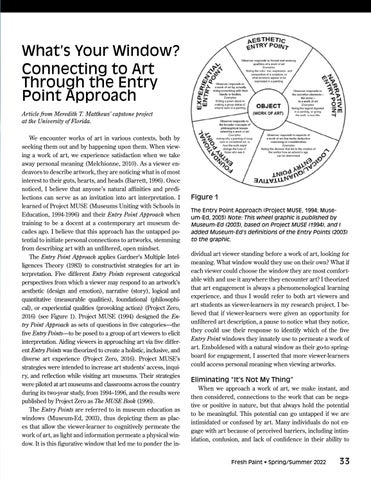
What’s Your Window? Connecting to Art Through the Entry Point Approach Article from Meredith T. Matthews’ capstone project at the University of Florida. We encounter works of art in various contexts, both by seeking them out and by happening upon them. When viewing a work of art, we experience satisfaction when we take away personal meaning (Melchionne, 2010). As a viewer endeavors to describe artwork, they are noticing what is of most interest to their guts, hearts, and heads (Barrett, 1996). Once noticed, I believe that anyone’s natural affinities and predilections can serve as an invitation into art interpretation. I learned of Project MUSE (Museums Uniting with Schools in Education, 1994-1996) and their Entry Point Approach when training to be a docent at a contemporary art museum decades ago. I believe that this approach has the untapped potential to initiate personal connections to artworks, stemming from describing art with an unfiltered, open mindset. The Entry Point Approach applies Gardner’s Multiple Intelligences Theory (1983) to constructivist strategies for art interpretation. Five different Entry Points represent categorical perspectives from which a viewer may respond to an artwork’s aesthetic (design and emotion), narrative (story), logical and quantitative (measurable qualities), foundational (philosophical), or experiential qualities (provoking action) (Project Zero, 2016) (see Figure 1). Project MUSE (1994) designed the Entry Point Approach as sets of questions in five categories—the five Entry Points—to be posed to a group of art viewers to elicit interpretation. Aiding viewers in approaching art via five different Entry Points was theorized to create a holistic, inclusive, and diverse art experience (Project Zero, 2016). Project MUSE’s strategies were intended to increase art students’ access, inquiry, and reflection while visiting art museums. Their strategies were piloted at art museums and classrooms across the country during its two-year study, from 1994–1996, and the results were published by Project Zero as The MUSE Book (1996). The Entry Points are referred to in museum education as windows (Museum-Ed, 2003), thus depicting them as places that allow the viewer-learner to cognitively permeate the work of art, as light and information permeate a physical window. It is this figurative window that led me to ponder the in-
Figure 1 The Entry Point Approach (Project MUSE, 1994; Museum-Ed, 2003) Note: This wheel graphic is published by Museum-Ed (2003), based on Project MUSE (1994), and I added Museum-Ed’s definitions of the Entry Points (2003) to the graphic.
dividual art viewer standing before a work of art, looking for meaning. What window would they use on their own? What if each viewer could choose the window they are most comfortable with and use it anywhere they encounter art? I theorized that art engagement is always a phenomenological learning experience, and thus I would refer to both art viewers and art students as viewer-learners in my research project. I believed that if viewer-learners were given an opportunity for unfiltered art description, a pause to notice what they notice, they could use their response to identify which of the five Entry Point windows they innately use to permeate a work of art. Emboldened with a natural window as their go-to springboard for engagement, I asserted that more viewer-learners could access personal meaning when viewing artworks.
Eliminating “It’s Not My Thing” When we approach a work of art, we make instant, and then considered, connections to the work that can be negative or positive in nature, but that always hold the potential to be meaningful. This potential can go untapped if we are intimidated or confused by art. Many individuals do not engage with art because of perceived barriers, including intimidation, confusion, and lack of confidence in their ability to
Fresh Paint • Spring/Summer 2022
33
glean personally meaningful understandings and/or make meaningful contributions to artistic discourse. I have heard and witnessed these barriers in people I know personally and professionally, and those I have led in art education. It affects young and old, those educated in art and not. Engaging with art requires the ability to answer an invitation into meaning-making. It requires the knowledge that one can make meaning from all artworks. I believe this begins with simply noticing what one notices, a universal endeavor. All immediate, instinctive responses should be considered valid, stemming from anywhere on the spectrum of attraction to repulsion. A window, identified as important and integral to one’s personality and life experiences, can be exactly that—an opening to enter the artistic experience. When asked, What’s your window? any viewer-learner is given a role in the interpretive process and insight into their own thinking. One’s window should be seen as a go-to starting point, freeing up the opportunity to explore artworks and their own interpretive processes. Readied with an enduring, reliable point of access, no work of art—or its meaning— is walled-off from the viewer-learner. I want to help eliminate the common reaction to viewing art that states, “It’s not my thing,” replacing the sentiment with an access point that is based on one’s ‘thing,’—that is, what one is drawn to as an innate and comfortable basis for connection. I believe this is especially important to less experienced viewer-learners, but is useful to all. It is my assertion that one should start by identifying a single window that feels most natural. The reliability of knowing one’s natural window is key to eliminating initial barriers to engagement.
Art Site Visits—Prototyped Description and Distillation Because most art viewing is done without the artist present, the context of interpreting art requires the confident participation of the viewer. The Entry Points act as a conduit for interaction with the art object. I believe one can identify their natural Entry Point, or window, through engaging in the first step of art interpretation—an instinctive, unfiltered description of an artwork—followed by an organization of descriptors that distills them into an identifiable inclination toward a single window. To test this theory, my daughter (7) and I visited several sites for casual art observation and engagement, and with the intention of using description to identify and use our natural Entry Point windows. In open-ended, unguided visits, we attended two art museums, a history museum, and a public art space in Jacksonville, Florida. Our first art site visit, to a con-
34
Fresh Paint • Spring/Summer 2022
Figure 2 Doug Eng, Newfound Gap, 2012, Photographic Print.
temporary art museum, required a brief explanation of the interpretive activity. I told my daughter that I wanted her to pick a piece of art to talk about. I showed her the Entry Point Approach wheel and said, “Let’s see what you notice about art. Then we will know which of these windows [pointing to the Entry Points wheel (see Figure 1) and explaining that I call the five different parts of this circle windows] you look through most when you look at art.” She first chose to stop at Newfound Gap by Doug Eng (see Figure 2)—a landscape format, color photograph of a dense mountainside forest, captured from above. I said, “What do you see?” She answered: “The forest is sad because some of it is brown … a lot of it is brown. There are so many trees, but half are dead. I think lots of animals lived there, but they got scared when there was a fire. Now they live on the other mountain. Do you see the face? It’s sort-of a sad face.” Her full description held various observations, which I jotted down as she spoke. I showed her the Entry Points wheel again and reminded her of the five windows by stating very simple definitions of each (e.g., the story, the measurements, the design, the doing, and the why). “Which one do you think you talked about most?” I asked. “The story,” she answered. I said “I think you use the story window a lot. Do you like to find a story in a piece of art?” She agreed emphatically. Then I said “Alright, let’s look at another piece and see what you notice.” Next, she stopped at Wolf Kahn’s Self-Portrait (see Figure 3). She started describing right away: “I see a lady and she’s made of brush marks. She lives in a paint world! Maybe she fell into the paint world and that’s why she’s made of paint now. There are so many colors because the paint spilled. I love that I can see her but she’s not like in real life. Her face is
Figure 3 Wolf Kahn, Self-Portrait, 1953, Oil on Canvas.
funny—she’s happy she’s made of paint.” I said, “so that’s the story of this painting?” She affirmed this and stood looking at it for a minute more. The important thing that was at play in this lightly-guided interpretive exercise was freedom—freedom to start anywhere, to describe anything that was seen, felt, or inferred. My daughter’s reaction to her window identification was wholly positive and seemed to urge an energetic response to subsequent art viewing. It didn’t mean she would only talk about the story in a piece, but it did provide a reliable starting point that noticeably bolstered her confidence and hastened her engagement. At later art visits, this initial window identification bore out. Narrative is a popular window for children, and it is unlikely that at my daughter’s developmental stage she would consider a work of art through the lens of art history or philosophy. She did, however, remark on aspects that would apply to the use of other windows. Therefore, I decided to organize her responses through a coding system later. Using the notes from our visits, I assigned each Entry Point window a highlighter color and then color-coded her descriptions, adhering to the definitions of the windows. One color was most prevalent, indicating that we had correctly identified her narrative window (see Figures 4 & 5).
Figure 4-5 Highlighter Distillation Process/Result
As I believed prior to this project, I am naturally an aesthetic window user. When viewing Eng’s photograph alongside my daughter, I admittedly had to first move beyond my weak interest in photography. I asked myself, “what is aesthetically interesting here?” I immediately felt drawn into the softness of the treetops, the multiplicity of them, and the clarity of the expanse of air above them. I thought of my love of being in a forest. The photograph became an ode to trees, and I felt contented. Once I looked at the work’s aesthetics and paused to feel any sensorial reactions that ensued, I was able to move forward with interpreting the work. The very act of giving myself permission to not be immediately drawn into understanding the piece as a whole was freeing to my mind. To, at first, simply stay on the periphery of the work, observing and Fresh Paint • Spring/Summer 2022
35
Discovery Learning
Figure 6 Timucuan Canoe, Circa 14th Century, Clay County. Property of Beaches Museum, Jacksonville Beach, Florida.
reacting to specific aspects that were naturally noticeable to me, allowed me to begin asking questions. For me, initiating art interpretation through a trusted window caused a necessary pause that became purposeful. I had a similar experience viewing a Timucuan canoe, circa 14th century (see Figure 6), at a museum exhibit devoted to regional history. Its form was so decayed it simply looked like something banal that I see often—a broken palm tree trunk. My daughter described her imagined story of the people who used it, while I took a minute to focus on the aesthetic qualities of its materiality. As I began to recall similar objects, the poetry of this utilitarian object held my attention. It was this experience that planted the seed in my mind for a new organization and graphic depiction of the Entry Point windows. It was clear that familiarity was a point of connection for me, and I wasn’t sure that it was specifically aesthetic familiarity that I was drawn to. I began to envision new window categories.
The Entry Point Approach was useful to both my daughter and I, and thus proven to be versatile. To a small degree, both my daughter’s window assignment and mine did rely on our age and life stage. However, I believe this use of the Entry Point Approach most represents a continual, phenomenological learning process, one that aligns with the developmental theory of Bruner (1960) that champions cognitive organization through discovery at any age. With a goal of helping a learner acquire “the ability to ‘invent’ [concepts, categories, and problem-solving procedures] for oneself” (McLeod, 2018, p. 1), Bruner’s theory led to the concept of discovery learning. A realigned use of the Entry Point Approach should be informal and fluid, in terms of both the educator’s guidance and the viewer-learner’s engagement, to elicit authentic art response and discovery learning. Discovery learning also allows for a learner’s autonomy. Most art viewers wish to hold authority over their own aesthetic tastes. Melchionne (2010) points out the adage ‘I know nothing about art but I know what I like’ to illustrate this desire. Inauthentic art responses, states Melchionne (2010), occur frequently “to avoid the discomfort of confusion and indifference” (p. 131). In explaining why art seems to provoke knee-jerk responses, Melchionne (2010) states that “having preferences, or at least thinking we do, is more comfortable than floating in ambivalence” (p. 131). Through the act of instinctually describing works of art, one can become attuned to their own satisfaction, using their preferences, and orient toward like experiences in the future.
Email Interview Responses—Organizing Open Art Experiences To keep my realigned strategy contemporary, and informed by those practicing in the fields of art and museum education, I interviewed—via email—a high school art edu-
SEL IN THE ART ROOM Discover how SEL helps students build resilience and deal with emotional obstacles while improving academic performance. Empower yourself with helpful and relevant resources: artofed.info/sel-resources
36
Fresh Paint • Spring/Summer 2022
cator, a professor of art, a museum education director, and two leading art education researchers and professors. I asked them questions about assisting others in art interpretation and in finding personal connections to art. I also corresponded with a psychologist, who specializes in behavioral health in children and families, to gain a perspective on the impact that viewing art has on psychological freedom (Gude 2010) and self-knowledge. The interview participants provided valuable insights and overall support for the use of personal windows into art. When asked how one can best identify their personal window into art, and employ the knowledge to better understand art, the participants were unified on a main point—there is a great need to move past several barriers to art engagement, such as intimidation or the search for beauty. In both the original and realigned uses of the Entry Point Approach, the use of specified windows into art guides the viewer on a different quest than toward judgement, one that deters them from a search for subjective beauty or for an echo of the aesthetic tastes of the art elite. Nearly every interview participant agreed that an art viewer’s psychological freedom, perceived as a sense of “safety,” “comfort,” “belonging,” or “invitation” within the viewing context, was necessary for making personal connections to art. Barrett’s ground-breaking work in art interpretation (1992, 1994, 1996, 2002, 2014) heavily guided my project. In an email response, Barrett stated that for personal connections to be made with art, the viewer-learner must possess an “openness to self, others, and works of art; a sense of wonder; and a sense of curiosity about self, life, and art” (personal communication, June 20, 2021). The most-used word in the whole of my interview responses was “open.” All respondents used “open” many times in their narratives, making this adjective perhaps the best descriptor of both a viewer-learner and an art experience that are primed for successful meaning-making. The very purpose of a window, after all, is to open one space to another.
Becoming Detail Detectives I believe that helping viewer-learners identify and use their natural window into art engagement is an attainable goal. Once familiar with their go-to window, anyone can become a lifelong viewer-learner with an enduring role in the contemporary art conversation. The email responses I received validated the need for personal access to art’s meaning, specifically the need to break down barriers to engagement with artworks. In our uninhibited descriptions of artworks, my daughter and I were led to our preferred windows by way of quick distillation and instinctive choice. This helped us better understand the
Figure 7 What’s Your Window? What Do You Notice? Note: I realigned the Entry Point windows in this graphic, depicting the windows as investigative lenses, and adding active identifiers, to focus on increasing viewer-learners’ self-agency (Matthews, 2021).
works of art we viewed by organizing our discovery process (Bruner, 1960). Our connections to the works of art we viewed were based on what we noticed, a simple but deceptively powerful strategy. When a viewer-learner is told that the ‘thing’ they notice in a work of art is not only a valid discovery but also an important window into making meaning from the work, cognitive barriers drop, and access to inquiry opens. One’s window can be an empowering—and fun—personal identifier, akin to other personality type categories (think astrological sign, Myers-Briggs type, or Harry Potter house). This identification gives them a role in the artistic conversation. I realigned the Entry Point Approach, and adjusted Project MUSE’s Entry Point categories, to increase the viewer-learner’s self-agency. In my version, the redesigned Entry Point windows are graphically depicted as five investigative lenses with associated identifiers (see Figure 7). The lenses are someFresh Paint • Spring/Summer 2022
37
thing a viewer-learner can hold, and the identifiers are active. The viewer-learner is asked to pay attention to what they notice about an artwork and answer the invitation into interpretation by taking a specific role. When viewing art, one may naturally identify as a maker (drawn to an artwork’s composition, in design and craft), a connector (drawn to familiar elements within an artwork), a philosopher (drawn to pondering an artwork’s existence), a storyteller (drawn to the narrative embedded in an artwork), or a feeler (drawn to the emotional response elicited by an artwork) based on what they notice in art. I have created a unit of study titled What’s Your Window? based on this realignment. Lesson plans guide learners in becoming “detail detectives” through scaffolded activities for any learning context.
Conclusion In 2000, just four years after Project Zero published The MUSE Book, Siefert & Drennan (2000) stated, “Project Zero has effected [sic] tremendous impacts on the arts and art education in the U.S., but the entry points approach [sic] exposes the many difficulties with helping untrained art observers to attain specific aesthetic perspectives” (p. 63). I believed at the outset of this project that Project MUSE’s Entry Point
Approach had the untapped potential to create a specific pathway to understanding that is meaningful on a personal level. This project shows that one’s natural window into art can be illuminated by simply noticing what one notices (Barrett, 1992), without preconceived expectations or inhibitions, but instead with Gude’s (2010) notion of psychological freedom. The phenomenological conversation between art and viewer-learner must be considered open to relate to contemporary theories of art’s mutable meaning and embeddedness in culture (Gude, 2008, 2010). Through my realignment, the Entry Point Approach can be an effective, enjoyable, and personally meaningful conduit for this conversation. What’s your window?
References Barrett, T. (1992). Criticizing art with children. In Johnson, A. (Ed.). Art Education: Elementary (pp. 115-129). Washington, DC: NAEA. Barrett, T. (1994). Principles for interpreting art. Art Education, 47(5), 8-13. Barrett, T. (1996). Learning through works of art. A Report: Proceedings of a Regional Conference: Learning from Works of Art Through Museum/School Collaborations, Dallas Museum of Art (pp. 40-56). http://terrybarrettosu.com/wp-content/ uploads/ 2017/08/B_Rep_96.pdf Barrett, T. (2002). Interpreting art: Building communal and individual under-
Educator Resources from CCS As art educators, we’re always looking for ways to support each other and help spread the message of the importance of art and design in the classroom and in the world. Learn more at collegeforcreativestudies.edu/art-educators or contact our Office of Admissions at 313.664.7426.
38
Fresh Paint • Spring/Summer 2022
standings. In Gaudelius, Y. & Speirs, P. (Eds.). Contemporary Issues in Art Education (pp. 291–300). Upper Saddle River, NJ: Prentice Hall. Barrett, T. (2014) Taking it personally. In Acuff, J. & Evans, L. (Eds.), Multiculturalism in Art Museums Today. (pp. 231–244.) Rowman & Littlefield. Gude, O. (2008). Aesthetics making meaning. Studies in Art Education, 50(1), 98-103. Gude, O. (2010). Playing, creativity, possibility. Art Education, 63(2), 31-37. McLeod, S. A. (February 2018). Bruner. Retrieved from https://www.simplypsychology.org/bruner Melchionne, K. (2010). On the old saw “I know nothing about art but I know what I like”. The Journal of Aesthetics and Art Criticism, 68(2), 131–141. Museum-Ed. (2003). Looking at art. Retrieved from https://www.museum-ed. org/looking-at-art/ Project Zero. (2016). Project MUSE. http://www.pz.harvard.edu/projects/project-muse Siefert, L. & Drennan, B. (2000). On the use of entry points to visual art. Visual Arts Research, 26(2), 63-69.
Click here to view the worksheets associated with this article.
S
2022 FAEA ANNUAL CONFERENCE
Metamorphosis
Art Evolves OCTOBER 13 - 16, 2022
|
CARIBE ROYALE ORLANDO
SAVE THE DATE #FAEA2022 Fresh Paint • Spring/Summer 2022
39
Fresh Paint is the award-winning publication of the Florida Art Education Association (FAEA) that contains articles of interest to art educators of all levels – from kindergarten through college level. It is produced 4 times annually and distributed to more than 850 art teachers, school district art supervisors, museum educators, higher education professionals, community art educators and artists, as well as other state and national art associations. Fresh Paint is is a terrific venue for businesses and organizations to reach art educators and decision-makers.
Learn more at faea.org/publications/advertising 40
Fresh Paint • Spring/Summer 2022