ADVERTORIAL FEATURE
RESIDENTIAL ENERGY MANAGEMENT
The circuit behind the smart home: Why AV engineers should be specifying the ABB SCU200 Vimal Mohanan, Product Marketing Specialist – Energy Efficiency, Building Automation & Building Management Systems, ABB Energy costs have risen sharply, and a growing number of homeowners who have treated power as a fixed background expense now want to see it, understand it and control it. Solar, battery storage, and EV chargers have become standard line items on residential projects, and time-of-use tariffs have made energy management something clients expect to interact with daily — on the same screen they use for lighting and climate. The ABB SCU200 InSite system is built to help meet those expectations. For AV and smart home integrators, it’s a natural extension of the systems you already design and support.
What the SCU200 InSite system does
Built for residential installs
The SCU200 is the control unit at the heart of ABB’s InSite platform. It pulls live data from meters, circuit sensors, breakers, EV chargers and solar or battery inverters via Modbus-RTU, Ethernet or ABB’s InSite flat cable, giving a real-time and historical picture of how a property consumes and generates electricity, down to individual circuits.
Commercial-grade monitoring hardware often assumes a facilities team and a dedicated BMS contractor. The SCU200 is scaled the other way, sitting comfortably in a domestic distribution board alongside standard MCBs and RCBOs. It is wired once at first fix and runs without ongoing management. Because it communicates over Modbus-RTU and standard Ethernet, it slots into the same network infrastructure already running for AV, lighting and Wi-Fi, with no proprietary bus and no separate contractor required.
Plug-in expansion modules allow installers to start small and add channels as a project grows, and ABB’s ultra-compact circuit sensors fit inside a standard consumer unit rather than requiring a dedicated enclosure.
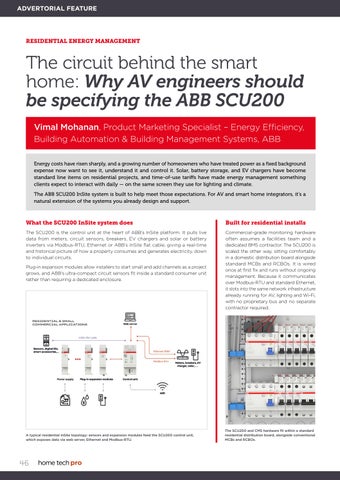
A typical residential InSite topology: sensors and expansion modules feed the SCU200 control unit, which exposes data via web server, Ethernet and Modbus-RTU.
46
home tech pro
The SCU200 and CMS hardware fit within a standard residential distribution board, alongside conventional MCBs and RCBOs.