Bereavement Support Ministry: Offering Support for Our Grieving Parish Families
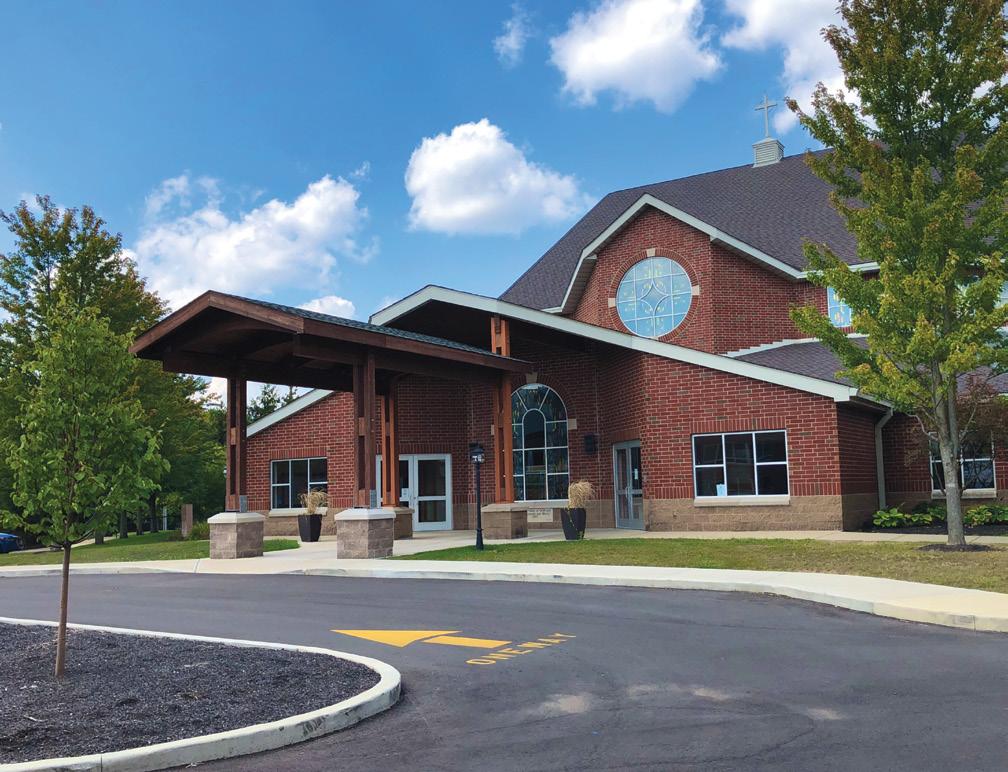
As the Bible tells us, “Blessed are they who mourn, for they will be comforted” (Matthew 5:4). The loss of a loved one is a time of mourning and grief. It is often a difficult time, and those who are mourning can feel especially alone. Here at St. Jude, there is a Bereavement Support Ministry that seeks to provide a place for people to find support as they grieve.
Patti Collins started the group with her husband about 15 years ago, two years after the death of their son. They felt like there had to be other people at the parish who were going through what they were and wanted to find that support.
“Our group helps people know that they are not forgotten and that their loved one is not forgotten,” Patti says. “Sometimes people stop talking about those that have passed and this can be hard for those that are grieving. Support groups are really important for allowing time for conversation.”
The support group meets twice a year for six-week sessions. Attendees are given an opportunity to share with others who have lost loved ones, watch videos,
discuss where they are at in their process of grief, and participate in other activities with the group. When a loved one passes, cards are sent out periodically over the first year to the grieving family — these cards help them know that they are not forgotten and that the parish is still praying for them. If someone
nov / dec / jan 2022
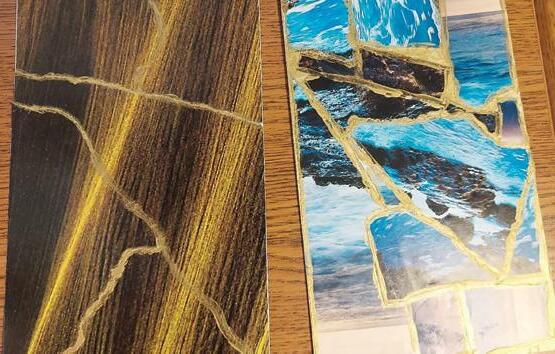
continued on back cover This collage art was created during one of the support group meetings.
STEWARDSHIP OF TREASURE
Giving to God First
Have you ever wondered why no one really becomes uneasy when someone brings up the first two “Ts” of stewardship – giving of your time or talents – but when the third “T” comes up, many of us become uncomfortable?
That third “T” is treasure, and some people simply become so annoyed by the subject, they tune out the words from the pulpit.
Why is there seemingly such an adverse reaction?
Our finances are such a personal subject. Discussing money issues with others is not easy, and having someone tell us what to do with our finances is even worse. We earn the money, after all. So shouldn’t we decide what to do with it?
Of course, the answer is “yes” – we decide every day how to spend our hard-earned dollars. Indeed, the monetary choices we make will either keep our finances in check, or put us into the red. The average American family has about $7,000 in credit card debt – so finances certainly represent a challenge to our current society. Tight budgets, trying to “keep up with the Joneses” or poor financial management may be to blame for our tight resources. Does this mean we do not have anything left over for God?
Stewardship, at its roots,

teaches that we are not supposed to give God our “leftovers.” We should instead strive to return to God a portion of our “first fruits” –giving to God first and then using the rest for our other needs. God gave us our talents that help us earn a living, after all. He should come first.
This idea can be worrisome for many. If our finances are already strained, how will we ever find enough to give back to God? Or, if we do try to give God our “first fruits,” will there be enough left over to cover our required expenses?
Taking the correct financial steps toward good stewardship simply boils down to trust –believing that God, who takes care of all of His creation, will take care of us. Trust that in giving to God first, we are both acknowledging that our multitude of blessings come from Him, and that we are thankful He chose to give them to us. And finally, trust that if we give to Him first, all else will fall into place – because He is in ultimate control.
Stewardship, at its roots, teaches that we are not supposed to give God our “leftovers.” We should instead strive to return to God a portion of our “first fruits” – giving to God first and then using the rest for our other needs.
2
A Time of Hope and Giving Thanks
LETTER FROM OUR PASTOR Dear Parishioners,
In so many ways, November is special to us as Catholics, and to us as Americans. It begins with All Saints Day on Nov. 1 and closes with the First Sunday of Advent on Nov. 27. Of course, the fourth Thursday of the month is Thanksgiving Day.
When it comes to the Solemnity of All Saints, we have always recognized the connection with those who have died and joined the Lord in heaven. All Saints Day was instituted to “honor all saints, known and unknown.” The “unknown” has always fascinated me. How many saints have each of us known among our friends and family, in our parish and our neighborhoods? To me, a “saint” might be someone who has provided an example of what it means to be a disciple of Christ. Thus, we begin the month by paying tribute and recollecting all those in our lives who showed us what it meant to be a good Christian.
Thanksgiving Day also gives me time to remember. It is a day to reflect on the ways in which God has so richly blessed us. Every day and every week should be a time of thanksgiving for us as good stewards. Appreciating that
God is the source of all our blessings is at the heart of stewardship. Just a few days after Thanksgiving, our Church launches our new year with Advent — a time of expectation of the coming of Christ, and a time when we begin the whole process of thanking God for the blessings we have received.
Pope Francis once said in an Advent message, “For the great human family, it is necessary to renew always the common horizon toward which we are journeying. The horizon of hope!” This month should renew our hope, from honoring the saints we have known to our expectation of the coming of Christ. We join the Holy Father in recognizing the journey — may God continue to bless you and keep you on your own journey.
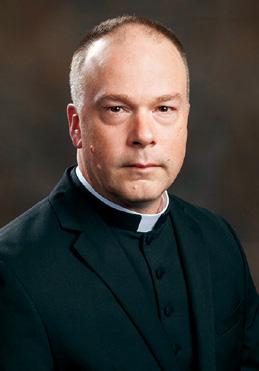
In Christ, Fr. Peter Marshall Pastor

3
A
THE SIGN OF A Powerful Prayer Tradition
As Catholics, we are blessed to be part of a faith tradition that stretches back over 2,000 years to its founding by Jesus Christ. Along with the history of our faith come many customs and sacred rituals that become even more beautiful when we delve a little deeper into their origins and meanings. Certainly, such is the case with one of the most visible outward signs of our Catholic faith — the Sign of the Cross.
Since we say and make the Sign of the Cross so often, it may easily become a rote, perhaps even thoughtless, action. However, it is important to remember that the Sign of the Cross is much more than a simple gesture. Even in its most basic form, the Sign of the Cross — accompanied by the spoken or unspoken words “In the name of the Father, and of the Son, and of the Holy Spirit” — is a prayer, a creed stating our belief in the Holy Trinity, the dual nature of Jesus Christ, and the dependence of our salvation on His crucifixion and resurrection.
In addition, making the Sign of the Cross is an indication of a willingness to take up our own cross and suffer for the sake of Christ. The prayer is considered one of the greatest weapons against Satan and all demons, and an added strength against the temptations of the flesh.
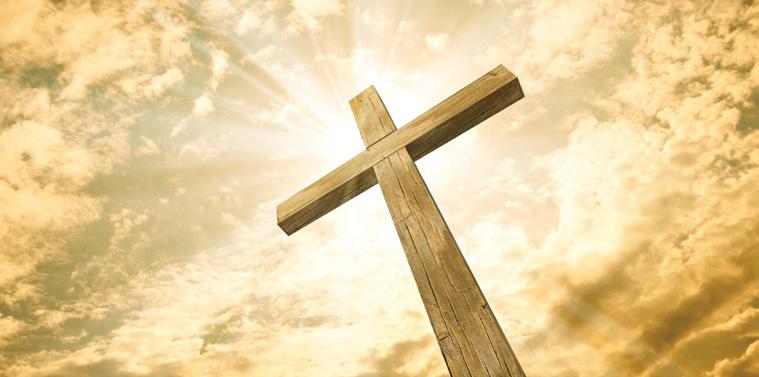
In the Roman Catholic Church today, the Sign of the Cross is typically made with either three fingers or an open hand touching first the forehead, then the chest, followed by the left shoulder and then the right (in the Eastern Church, the right shoulder is touched before the left). The concept of making a sign, or “setting a seal,” upon the forehead of those who place
their faith in the Lord appears in both the Old and New Testaments of the Bible — see Ezek. 9:4 and Rev. 7:3, 9:4, and 14:1.
Early versions of the Sign of the Cross were traced on just the forehead, using the thumb and forefinger held together in the shape of a tiny cross. We still see this version of the blessing performed during Baptisms (with the cross traced on the infant’s forehead) and on Ash Wednesday (with the cross traced in ashes on the foreheads of the faithful). Similarly, when the Gospel is read during the Liturgy of the Word, the priest or deacon leads the congregation in forming this small cross on the forehead, mouth, and chest, indicating a willingness to keep the Word of the Lord in our minds, on our lips, and in our hearts.
There is no doubt that our early Church fathers were strong believers in the sanctifying power of the Sign of the Cross. A second-century ecclesiastical scholar, Tertullian, and a third-century saint, St. Cyril of Jerusalem, both wrote about the necessity of performing the Sign of the Cross at one’s waking and one’s lying down, at entering and leaving a room, at mealtimes, and more. St. Augustine also referenced the importance of marking the cross on the faithful’s
4
THE CROSS:
Tradition in the Catholic Church
forehead during the administration of the sacraments.
It is likely that the sign transformed from the tiny cross on the forehead to the larger, fullbody cross used today sometime in the fifth century when heretics began questioning both the dual nature of Jesus Christ — fully human and fully divine — and the unity of the Holy Trinity. Believers in these crucial Church doctrines began forming the cross with three extended fingers (representing the Trinity), keeping the ring finger and little finger pressed down into the palm (representing Christ’s dual nature), and tracing a cross on their entire upper body so there could be no mistaking the gesture.
Today, the Sign of the Cross still figures predominantly in our prayer life as Roman Catholics. We commonly perform it upon entering a church (with the holy water as a reminder of our Baptism); at the beginning and end of the Catholic Mass, a Benediction, or the Exposition of the Blessed Sacrament; when opening and closing our personal prayers; at mealtimes; and when passing by a Catholic Church (in recognition of Christ, present in the tabernacle). As the Catechism of the Catholic Church reminds us, the frequent, intentional use of the Sign of the Cross can help the faithful dedicate each day to the glory of God and provide strength in the face of trial and temptation (2157).
Now, each time we cross ourselves and proclaim, “In the name of the Father, and of the Son, and of the Holy Spirit,” let us do so with an increased awareness of the rich history of the Sign of the Cross and the abundant graces that come to us through this powerful prayer tradition!
5 OF
Making the Sign of the Cross is an indication of a willingness to take up our own cross and suffering for the sake of Christ. The prayer is considered one of the greatest weapons against Satan and all demons, and an added strength against the temptations of the flesh.
A Significant Moment in Our Prayer The Presentation of the Gifts
Occasionally, you might hear someone jokingly refer to “halftime” during Mass — the interval following the Prayers of the Faithful, as the Liturgy of the Eucharist begins. It can be easy, even tempting, to zone out as you sit, waiting for the collection basket to make its way to your pew.
But if you pay attention, you’ll have the opportunity to enter into something deeper — a significant moment in our prayer.
It’s mentioned by St. Justin Martyr, one of the earliest Christian writers, when describing the Mass in the second century, “Bread is brought up and wine and water…”
This practice, of people bringing up the gifts, has been part of our Catholic tradition from the very begin ning. Although we might think of this action as being merely practical, in reality, it serves a much deeper spiritual purpose.
Each Sunday Mass, someone is chosen, whether an usher, or another member of the parish, to bring forward “the gifts” — bread, wine, and, in many cases, the collec tion of money that has been gathered moments before, from the generosity of the congregation. These gifts not only symbolize but also, in reality, are the work of human hands. The bread and wine are fruit of God’s creation, which, through the effort of human hands, are made into the gifts that we present to the Lord.
Certainly, the collection that is presented to the priest also serves to represent the work and sacrifices of the previous week. Sharing our monetary “treasures” is one of the ways that we embrace stewardship. It’s an opportu nity to generously give back to the Lord, from the fruit of our work.
In his book What Happens At Mass, Fr. Jeremy Driscoll, OSB, explains, “We should not think of the collection of money at this point as some sort of banal, dirty but necessary affair. Money is our work. Money is hours of our lives. And now we give it away, we sacrifice it, for the work of the Church.”
In his letter to the Romans, St. Paul instructs Chris tians to “offer your bodies as a living sacrifice, holy and pleasing to God” (Romans 12:1).
The physical act of carrying the gifts forward to the priest is meant to serve as a tangible reminder of the fact that we are all called to stewardship. We are all called to present to God our lives — our work, our talents, the struggles and victories of the past week — as an offering and gift to God.
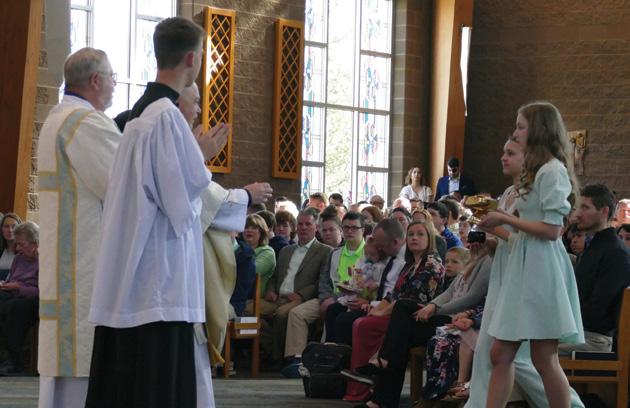
Those who bring forward the gifts each week have the privilege and responsibility of remembering what their action represents — that we are called to give gen erously of our time, talent and treasure to God, who gives us His very self, at Mass. And for those sitting in the pews, tempted to “check out” for a few minutes, seeing the gifts being brought forward should serve as a powerful reminder to offer our lives back to God, through serving and honoring Him.
So next week, don’t just sit back and wait for “halftime.” Come to Mass a few minutes early and approach an usher to ask if you and/or your family may bring up the gifts that week. Don’t be surprised if you start to notice a change in your heart and a desire to be even more gener ous with God in the coming week!
6
Master of Ceremonies and Sacristans
Faithfully Offer Talents to the Liturgy
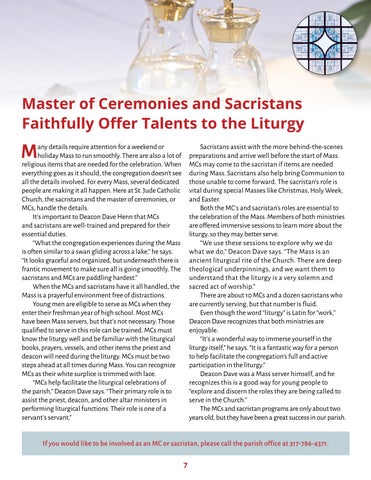
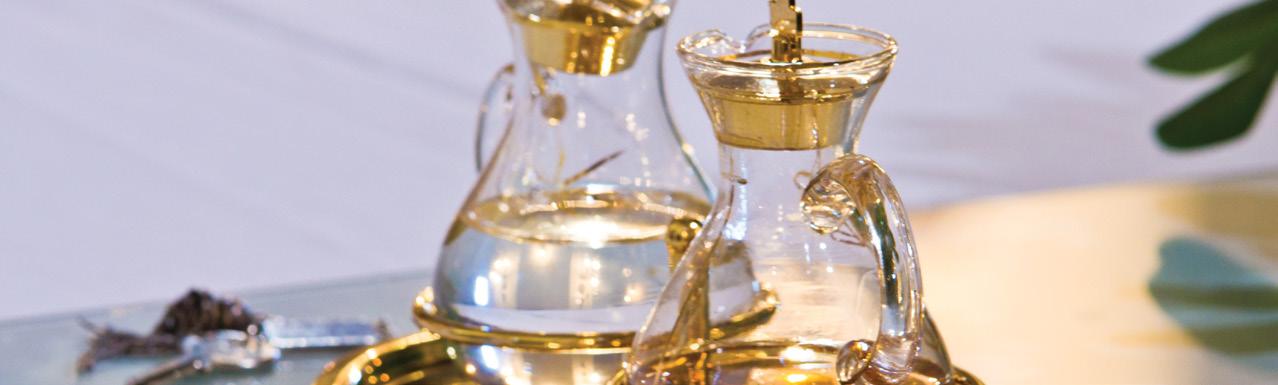
Many details require attention for a weekend or holiday Mass to run smoothly. There are also a lot of religious items that are needed for the celebration. When everything goes as it should, the congregation doesn’t see all the details involved. For every Mass, several dedicated people are making it all happen. Here at St. Jude Catholic Church, the sacristans and the master of ceremonies, or MCs, handle the details.
It’s important to Deacon Dave Henn that MCs and sacristans are well-trained and prepared for their essential duties.
“What the congregation experiences during the Mass is often similar to a swan gliding across a lake,” he says. “It looks graceful and organized, but underneath there is frantic movement to make sure all is going smoothly. The sacristans and MCs are paddling hardest.”
When the MCs and sacristans have it all handled, the Mass is a prayerful environment free of distractions.
Young men are eligible to serve as MCs when they enter their freshman year of high school. Most MCs have been Mass servers, but that’s not necessary. Those qualified to serve in this role can be trained. MCs must know the liturgy well and be familiar with the liturgical books, prayers, vessels, and other items the priest and deacon will need during the liturgy. MCs must be two steps ahead at all times during Mass. You can recognize MCs as their white surplice is trimmed with lace.
“MCs help facilitate the liturgical celebrations of the parish,” Deacon Dave says. “Their primary role is to assist the priest, deacon, and other altar ministers in performing liturgical functions. Their role is one of a servant’s servant.”
Sacristans assist with the more behind-the-scenes preparations and arrive well before the start of Mass. MCs may come to the sacristan if items are needed during Mass. Sacristans also help bring Communion to those unable to come forward. The sacristan’s role is vital during special Masses like Christmas, Holy Week, and Easter.
Both the MC’s and sacristan’s roles are essential to the celebration of the Mass. Members of both ministries are offered immersive sessions to learn more about the liturgy, so they may better serve.
“We use these sessions to explore why we do what we do,” Deacon Dave says. “The Mass is an ancient liturgical rite of the Church. There are deep theological underpinnings, and we want them to understand that the liturgy is a very solemn and sacred act of worship.”
There are about 10 MCs and a dozen sacristans who are currently serving, but that number is fluid.
Even though the word “liturgy” is Latin for “work,” Deacon Dave recognizes that both ministries are enjoyable.
“It’s a wonderful way to immerse yourself in the liturgy itself,” he says. “It is a fantastic way for a person to help facilitate the congregation’s full and active participation in the liturgy.”
Deacon Dave was a Mass server himself, and he recognizes this is a good way for young people to “explore and discern the roles they are being called to serve in the Church.”
The MCs and sacristan programs are only about two years old, but they have been a great success in our parish.
7
If you would like to be involved as an MC or sacristan, please call the parish office at 317-786-4371.
5353 McFarland Rd. Indianapolis, IN 46227 (317) 786-4371
www.stjudeindy.org
MASS SCHEDULE
Weekend Mass
Saturday Anticipation — 4:00 p.m.
Sunday — 7:30 a.m., 10:00 a.m.
Weekday Mass
Tuesday/Thursday — 6:00 p.m.
Wednesday/Friday — 8:30 a.m.
Holy Day Mass See Bulletin Sacrament of Reconciliation
Tuesday/Thursday — 5:00-5:45 p.m. Saturday — 3:00-3:45 p.m. Anytime by appointment
Bereavement Support Ministry
continued from front cover
has lost a spouse or child, they will receive a packet of books that offer guidance and support through the journey of grief.
“We also help the parish as a whole celebrate All Souls Day,” Patti says. “We want to celebrate all those that have passed in our parish. We put up banners, there is a small reception, and Mass is said for all those who have passed.”
Patti is currently looking for volunteers to help her lead one of the two yearly sessions. Anyone who has lost a loved one or feels a connection to this ministry and wants to help is welcome. You do not need to have a background in counseling or grief support — Patti will provide training and will help provide support resources.
“Our group helps people know that they are not forgotten and that their loved one is not forgotten. Sometimes people stop talking about those that have passed and this can be hard for those that are grieving. Support groups are really important for allowing time for conversation.”

— Patti Collins
If you have questions about the group or are interested in volunteering, please contact Patti Collins at pcollins@stjudeindy.org