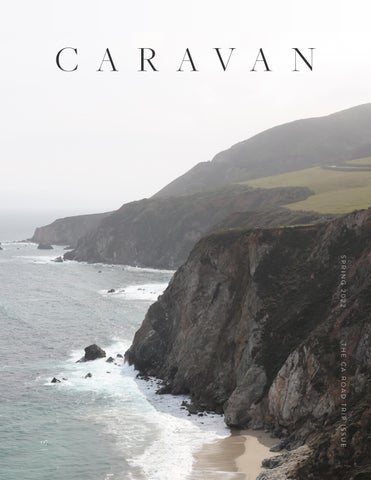
C A R AVA N
SPRING 2022
THE CA ROAD TRIP ISSUE
07
1
MASTHEAD
EDITOR IN CHIEF
magazine
words
photos
design
David Chen
Anjika Pai
Apollonia Cuneo
Christina Kan
Anna Fang
Christina Kan
Darice Wong
CO -EXECUTIVE EDITOR
Lila Bock
Apollonia Cuneo
David Chen
David Chen
CO -EXECUTIVE EDITOR
Miranda Li
Catherine Chu
Eden Porras Harth
Lucy Wan
EXECUTIVE PHOTOGRAPHER
Apollonia Cuneo
David Chen
Emily Langton
Rebecca Wong
EXECUTIVE DESIGNER
Christina Kan
Kat Shok
James Nguyen
Sakeena Baxamusa
Alexandra Garcia
Montserrat Urbina
B U S I N E S S M A N AG E R
James Nguyen
Lila Bock
Niko Frost
E V E N T S M A N AG E R
Nicole Ru
Miranda Li
Shayla Madha
M E D I A M A N AG E R
William Xu
Nicole Ru
William Xu
Niko Frost Robin Ying Samantha Lim Sarena Kuhn Sasha Shahinfar Sophie Yang Stephen Yang Tushar Sondhi
2
LETTER FROM THE EDITOR
M
y earliest memories of California scenery are from road trips to inland deserts. I remember pulling cactus spines from my uncle’s leg in a sweaty cap, pores clogged with sunscreen, parched by dry heat and “quenched” with warm
water from plastic bottles. In college, my drives up and down the 101 were really about efficiency and making sure I didn’t veer off into oncoming traffic. The only visual impressions I got from those long hours on the road were miles of the same orchard kaleidoscopes interrupted by fields of grazing cows. California was obvious to me. I have been spoiled. It’s easy to overlook the things that separate our state from the rest. A quick internet search tells me everything I need to inflate my ego. California is only the nation’s third largest state by land area, but within its borders are the highest and lowest points of elevation in the continental United States. Here, mere miles separate dry deserts from forested mountains and coastal horizons. And though we’re a long way from America’s breadbasket, California produces more agriculture than any other state in the country. We need that agriculture to feed our 39 million people, the highest population of any state, surpassing second place Texas by a cool 10 million. That same population happens to be the most diverse in the U.S., having more Latino than white residents, and having the highest Asian population by a margin of over 5 million. Flip through this magazine — get to know this state that all of us at UC Berkeley call home for at least our time in college. These pages represent an honest effort from 25 of us to chisel away at this place we thought we knew until we looked closer. Last semester, I thought I was writing my last Letter from the Editor. I’m glad I was wrong. I needed one last chance to say my proper goodbyes. Four years ago, Caravan was nothing more than a nagging thought in my head — a fun “what-if” to keep my daydreams active. Since its inception, I have had my highs, I have had my lows, I have been burned out and on the brink of giving up. I do not regret one second of it. I love this magazine, this club, this group of people, with all of myself. I hope that in five years, I can flip through the Tokyo Issue. And that in 55 years, my grandkids can enjoy the Saturn Issue. And that for however long Caravan exists, it will always be a warm space for creatives to share openly and support each other.
Safe Travels, David Chen Editor-in-Chief 3
TABLE OF CONTENTS
6
10
14
N OW A N D F O R E VE R
CONCLUSIONS
IN THE CAR
A stroll through Harmony’s past, present, and future
Seven angles of trees
The place between places
words: Sarena Kuhn
words: Stephen Yang
words: Kat Shok
photos: Emily Langton
photos: Apollonia Cuneo, Christina Kan
photo: Eden Porras Harth
26
30
33
OUT OF THE INN
FLEETING FOOTPRINTS
M O U N TA I N O F G O L D
Unpacking at SLO’s Madonna Inn
Finding meaning in stories at the Oceano Dunes
Sand, water, and sky: a return to Montaña de Oro
words: Lila Bock
words: Robin Ying
words: Niko Frost
photos: William Xu
photos: William Xu
photos: Niko Frost
45
48
52
S TA I N E D G L A S S
OBJECT PERMANENCE
T H E S PAC E I D O N O T F I L L
A new mission for California
Dealing with decay at Cal Poly SLO’s Architecture Graveyard
What we leave behind, now
words: Alexandra Jade Garcia
words: Tushar Sondhi
words: Anjika Pai
photos: Emily Langton
photos: Eden Porras Harth
photos: James Nguyen, Montserrat Arantza Urbina
4
16
20
23
H E AV Y F O O T S T E P S
ROLLING HILLS & WINDSWEPT PLAINS
STORIED S OUNDS CAPES
A journey on foot through Solvang
An exploration of time and place through John Steinbeck
The magic behind Carmel-by-the-Sea’s fairytale cottages
words: Anna Fang
words: Samantha Lim
words: Miranda Li
photos: Emily Langton
photos: Shayla Madha, Niko Frost
photos: Apollonia Cuneo
36
39
42
SIMPLE & SWEET
A TA S T E O F A U T H E N T I C I T Y
O S C I L L AT I O N S
On Solvang’s gas stations and candy factories
Bites of the California coast
Reflections on tea shops and cafés
words: Catherine Chu
words: Nicole Ru
words: Apollonia Cuneo
photos: Niko Frost, Shayla Madha
photos: William Xu
photos: Christina Kan, Apollonia Cuneo
55
58
62
L AY E R S O F L E G A C Y
D E PA RT U R E S
O R I E N TA L W I N E
Spending the morning at the Chumash Painted Cave
On the impermanence of places
A study of grapeskins at Kelsey See Canyon Vineyards
words: Sophie Yang
words: Sasha Shahinfar
words: David Chen
photos: Niko Frost
photos: Eden Porras Harth, David Chen
photos: Eden Porras Harth
5
D
words Sarena Kuhn
efine the car as a space for the present, the capital-n Now. Some vague, pop culture-influenced creation myth tells me a road trip is about the
journey, not the destination. The car is the vessel for the journey, the place
photos
we reside during the in between. For right now, for almost, for no, we’re not
Emily Langton
quite there yet. design David Chen
Define a destination as a place for the future. But more and more often these days, I only want to go to places drawn up from the past. When I drive through California, I rarely want to find something new. I want to revisit the places I’ve been before, recontextualize them, dig my feet into someone’s stomping grounds until I feel like they are mine.
N OW A N D F O R E VE R A stroll through Harmony’s past, present, and future
SANTA CRUZ
HARMONY
SAN LUIS OBISPO SANTA BARBARA
6
Outside the window as we make our way down the 101, rolling, lush, and green hills greet us. Accompanied by an eclectic soundtrack, soon enough we are transported to Harmony, a 2.5-acre, one-block, tiny town. My parents used to bring me to the Central Coast when I was growing up, meeting my cousins who lived in Northern California at a halfway point, staying in Cambria or Morro Bay or Santa Barbara. The memory I have of Harmony, California, is not really a memory; it’s more likely a construction of feelings I’ve built around a photo my mother took of my cousins and me in front of the old creamery. Harmony and I are kindred spirits. We both love to rehash our history. I approach the famous sign, reading: Harmony, Pop 18, Elev 175. The iconic epigraph has been woven Harmony’s past
into the heart of the town: in the pottery shop, there are magnets and mugs and tiles
“The town grew around a thriving dairy industry in
reproducing the sign, these souvenirs surrounded by the work of local artists.
the 1800s, and local farmers participated in coopbased creamery founded in 1907.”
The town grew around a thriving dairy industry in the 1800s, and local farmers participated in coop-based creamery founded in 1907. A mural depicting the town’s history in script tells me the name originates from a shooting death that led residents to declare a pledge to live in Harmony. That’s not quite how it happened, Aarika, a long-time resident and unofficial historian of Harmony, tells me. Apparently, a domestic dispute involving the stabbing of a teacher resolved in the local schoolhouse taking the name Harmony, a moniker the town adopted after. Aarika tells me the hallway behind the creamery was added during revitalization efforts in the 70s, designed to match the rugged historical look of the old creamery, paying attention to details such as reproduced square nails. These restoration efforts took place decades after the dairy industry left Harmony in the 1950s, the town shrinking thereafter. Harmony is a place that refuses to become a ghost story, a town obsessed with its past, waiting for its future. It’s also changed a lot over time. The wedding chapel has a wine cask façade, having served as a wine tasting venue before being repurposed for nuptials. Walking around the block, there’s a memorial for Freddy (short for Alfredo) the cat, who was the town’s unofficial mayor for many years. At the Harmony Glassworks, Terry recalls an early trip to Harmony 32 years ago when she was pregnant with her daughter and passed out at the Italian restaurant, which has since closed.
“These restoration efforts took place decades after the dairy industry
The Now of Harmony is a little trickier to characterize; the present is imported mostly
left Harmony in the 1950s, the town
from nearby Templeton. An ice cream truck and a cheese-based food truck park in
shrinking thereafter.”
the middle of the town for tourists to enjoy. Visitors sit at tables in the town’s center, 7
8
eating ice cream and grilled cheese sandwiches, enjoying company in this cozy pocket next to the highway. “Going to see cows on hills!” reads a recent entry to the town’s visitor booklet, which is filled via ballpoint pen with the inside jokes and travel logs of strangers. Harmony is privately owned by Alan Vander Horst, and plans to revitalize it with a farm-totable restaurant have been complicated by zoning and the need for a water treatment plant installation. Circling the block of Harmony over and over, I wonder how to define a community. I think about a small town as a tenant of some American genesis of neighborly comradery and rural bliss, about a farming town as some embodiment of an American Dream. But maybe Harmony is too small and altogether too peaceful to hold these heavy abstractions. It’s a place filled with whimsical statues of cows; a place to eat ice cream with your friends and enjoy some agricultural history education.
above snaps from Harmony Chapel
left page Harmony Pottery Works
My conversation with Aarika is briefly interrupted when she greets another resident of Harmony, a woman who opens a gate in the middle of the block in order to guide her red car through. There is some irony inherent to living in a place famous for being small. Harmony spends its days as a center of international travel, with people from all over the world coming through. “At night, you have the whole town to yourself,” Aarika says. She tells me about a couple who were gifted a cactus by a friend who passed away shortly after. Looking to house the plant before moving away, they requested to plant it in the drought resistant garden on the pathway to the pottery shop, where it currently thrives. It’s a nice thought. How lovely it must be to live forever in Harmony. harmonytown.com
9
words Stephen Yang
T
he first word in the thousands of lines in the Odyssey is andra — man. The first adjective is polytropos. He of
many turns; tell me about how he fought and loved and lost and
photos
changed. Tell me about how his son became a man.
Apollonia Cuneo
design David Chen
Tell me about Du Fu, hero of Chinese poetry, who in his old age regretted.
CONCLUSIONS
昆吾禦宿自逶迤
Seven angles of trees
香稻啄餘鸚鵡粒
紫閣峰陰入渼陂 碧梧棲老鳳凰枝 佳人拾翠春相問 仙侶同舟晚更移 彩筆昔遊乾氣象 白頭吟望苦低垂 -Du Fu; Stirred by Autumn, No. 8
Trans. Zong-qi Cai:
Kunwu park and Yusu lodge are out there in the remote distances; the shadow of Purple Tower peak enters Meipi lake. Fragrant rice: leftovers from pecking, parrots’ grains; emerald wutong trees: till old age perched, phoenixes’ branches. Lovely ones gathered kingfisher feathers to give as springtime gifts; transcendent companions shared a boat, moving off again toward evening. My many-colored writing brush once strove with the climate; now my white head, chanting and gazing, in despondency droops.
Kunwu Yusu self wandering winding Zige mountain cloudy enter Meibei Scent rice peck remainder parrot grain Plane trees stay old phoenix twig Good men collect green feathers ask each other Forever companions same boat late move on Draw brush past travel dry weather White head prattle whine bitter low
Yusu Brook winds away from Kunwu; Purple Tower’s shadow dips into Meipi lake. Parrots leave shards of rice, so perfumed— And on plane trees perch phoenixes. Pretty people court with green feathers While very good friends sail on. My brush once traced well the environment, But now I lower my white head in despair.
10
We leave Salinas early, well-rested, and in search of coffee, which we’d missed yesterday. We have time to kill, which we’d also missed. This isn’t quite what I’d imagined to be Steinbeck’s Salinas Valley; no pastures of heaven, no sun but mist, but fields, still, stretching out on either side. Rows and rows of spinach and broccoli. Some trees too, maybe avocado. It’s still a bit chilly as we wait in line outside for coffee; I trust Christina and the others in my car to make good decisions on that, so the chill I ignore. The line seems long but isn’t bad. Besides, we won’t be passing by anytime too soon,
昆吾 禦宿 自逶迤 紫閣 峰陰 入渼陂 香稻 啄餘 鸚鵡粒 碧梧 棲老 鳳凰枝 佳人 拾翠春 相問
仙侶 同舟 晚 更移 彩筆 昔遊 乾氣象 白頭 吟望 苦低垂
and a loyal customer base doesn’t mean that businesses will stay open. I taste shadows of Benkyodo mochi in the air from weeks ago; anko, kinako, blueberry. I sip my café au lait here. I’ll need this for the road. I shouldn’t dwell on memories.
The sea is not wine-dark. It gets scaly further
Circumstances change. So must I.
out, further up, but here, it seems soft as it assaults the rock.
Some relevant words pop into my head that sound nice: cordillera, streamlet, pellucid. I roll them around on my tongue, let the air flow from the window into my mouth and around the vowels and back out. Can I feel yet the sweetness as
The poet Li Bai once wrote about seeing the
vowels glide?
Yangtze flow away into the clouds. If I look ahead, the road winds away well traveled, too
We continue down the 1. Trees give way to grasses and huge outcroppings of rock in the distance. It will be a long day on the road, but I cannot err. The mist is gone
solid. If I look to my right, I see the ocean, but there is no line at all to follow.
now; the ocean deep blue. Two and a half years ago, I sat next to Anna as she drove us to Yosemite, as the sun came up in front of us and shone gently on Apple, asleep in the back. Now Apple sits beside me.
We stop at the Bixby Creek Bridge, all cliffs and columns. The sun is well out now, and I understand the view to be wonderful. The ocean reaches toward us far down and away. There
Cove, islets, waves. Diver on the rock somehow. Pathlets going down. I wish I
is plenty of greenery. Miranda makes her way
could kayak down there. I wish I could skip stones on this water. I can feel the kelp
down a bit; careful, I want to say. We live on
forests in my hands.
shifting sands.
11
I used to write purply, in the hope that vocabulary would paint a canvas vivid. I used to think that I could work to cope with grief. I used to hold that good speech could accomplish much. I used to be able to write what I felt. I used to trust language to hold in between words. I used to be able to pull all-nighters, to tolerate vodka, to take spice. I used to take long walks in the rain in the dark.
A meadow is a ways down. There are cows grazing here, all brown
I hope I’ve grown in the last four years.
and white. A lighthouse sits on a promontory in the distance, shrouded somewhat by mist. I’d like to try the paths up, I say. Bike up, bomb the descents, up again in the good cool air. They remind me of roads running up ridge crests I’ve seen in Hawai’i; the hairpins might be too much effort, which I totally understand. We’re a long way from my last roadside cows in Taiwan, flicking their tails at mosquitos hounding them in the midday heat on the road shoulder. We’re a long way from Santa Barbara too, and I don’t have the stamina to take more than eight hours, but I don’t want this to end.
If I glance in the rearview mirror, I might see my partner back in Berkeley. I miss her. If I look ahead enough, I’d find Santa Catalina and elevenyear-old me with my Boy Scout troop, eating the sweetest fruit I’d ever had, fresh off of prickly pears. I’d find myself trapped there for a storm with not-so-high winds but, said the resident doctoral candidate we met there, sixteen to twenty knot winds for four hours will produce high waves. He was studying fish stocks. If I look ahead, I see mist and no oncoming lights. I see more
Yuzu shies from Kunwu.
false flats and leafless trees petrified grasping at the sky.
Purple shadows touch Meipi lake— Birds leave small white spots. Trees, phoenixes. See the young men court. My friends all go now.
Too peaceful, too picturesque. I want to take my Polish friend here and show her all about. I love this place, love this, whatever
Once my hands could make something nice.
this is. I want to share this love.
Just over two years ago, I took another trip to the foggy sea, that
If I look, I dissolve.
time with people I knew before and would have liked to know better, that time up north, that time with greenery and spare trees and some cheese along the way.
A raptor rides thermals and falls down to rise back up. A few more steps and I can join them.
It was windy, too, on the beach at Point Reyes, but I didn’t mind. I like the cold. There were no good skipping stones, though; only a sharply sloping strand and water reaching out from nothing to nip at me. There must be plenty of shipwrecks hidden out there amongst the shoals and the Farallones. Treacherous waters. I wouldn’t have been able to see my skips, in any case. A few days later, I found that I had lost a friend from back home, that place which I thought I’d left behind. She’d gone while we were there, while I watched bare trees disappear into the fog. Her name was Stella. I met her through music; she was one of the best people I’ve ever known. 12
“Life takes place one hour at a time.” —Charles Yu, Interior Chinatown Qu Yuan, the poet, faithful politician, the germ, through suicide, of every dragon boat, took subjective poetic time. Time was subject not to determinations of ripeness or division-making but passions and anxieties. Time for the sake of man and for himself. Time runs so quickly; I’ve lost chances, had others denied me. Time goes. The wind whips on the waves. My music-making will go too. I feel it all slipping away, one hour at a time.
If I crane my neck to the right enough, if I squint enough, I will see a beach on the island of Kinmen, desperately hot and humid in the summer. I will see my grandmother and cousin who calls me 小表哥, younger cousin. If I look just a bit further on from
The drive from the highway is slow; many cars back up a two-lane
the bunkers here, there is Xiamen, on the coast of the mainland.
road. Time’s ticking; we’ve still at least one location, then to meet
It’s so close, says my mother, who was born here in Taiwan. Of
everyone else, and at this point we’re already more than half an
course, I say.
hour behind. Touch and go; I don’t need too long to be able to write a piece. I’m not so sure once I catch a glimpse of the rock.
If I crane my neck to the right enough, I might see a coast closer than I might like.
We’ve come far — six-odd hours — for a giant craggy potato with a side of dried mangoes that I’d gotten at a roadside stand for six
It is getting chillier, even if I don’t want to admit it.
dollars yesterday. They’re practically candied. I needed sugar. It’s a big rock. Could get closer, but parking is a pain. Traffic is horrible. We are traffic, I remind myself. It’s still a big rock, interesting for a
Yuzu, Kunwu. I’ll fan you with feathers and cook you dinner, then reminisce. To hell with it all.
“‘The cradle rocks above an abyss, and common sense tells us that our existence is but a brief crack of light between two eternities of darkness.’ —Nabokov” —My friend Claire, in my high school yearbook Morro Rock was not really on my agenda. I wanted to come on this trip and fade into the background and talk about my observations, but I had to come up with locations on the fly and so I got saddled with this stop.
few pictures even as the light is going, interesting to, I don’t know, geologists, but I’m not one. Might as well get out, even though I already know that I won’t be writing a piece about this or merely about this. A plaque, paraphrased: there are dangerous waters outside the harbor mouth where every day for many years fishermen have ventured. A factory stands behind us, smokestacks quiet. The clouds have unified again around the sun. A fat squirrel pokes its head out from some rocks by the water; the others are fascinated. It is vaguely spotted. Where does it live? Down there? With the tide? The clouds, arrant robbers, allow some pale fire through. The water seems fairly still. I climb down and look for skipping stones. Flat, oblong. Three to four fingers wide. There are a few candidates, which I order by least to most promising. First skip: straight in. The angle’s not shallow enough. Adjust. Splash three more. I’m jerking my arm so that the stones spin at an angle now, not parallel to the surface. I lose my motion more. Just not good today, maxing out around two skips. Maybe later around Oceano, or tomorrow, or never. I turn away. The man and dog drift further out still. 13
14
words Kat Shok
photo Eden Porras Harth
IN THE CAR: T H E P L AC E B E T W E E N P L AC E S
N
o matter where you’re seated in your road trip vehicle, the rhythms of the road ultimately end up lulling you into a sort of trance. Song after song spins; view after view passes; mile and minute tick onwards.
In the driver’s seat, with command over air conditioning and music selection, eyes flit from the odometer to the fuel gauge to the rearview mirrors. Shouted conversations from the backseat drift forward, met with chuckles and the occasional sly comment from the driver. In the passenger seat, rants roll on and stories are spun to keep the dear driver entertained. Navigational skills are tested on Google and Apple Maps; bladders are tested as iced coffee after iced coffee is downed. In the backseat, minds wander and heads turn to take in stupefying green hills and miraculous blue waters. Naps are indulged, snacks are snuck, and minds zone out as long stretches of highway blur into geographical incomprehensibility. Randomly generated car assignments make each Caravan excursion an intense bonding activity. Strangers meet, breaking the ice with majors, minors, and housing details; a hundred miles later, friends divulge tales of trips past, lives led, and maybe even the occasional piece of hot gossip, connecting in this place between places. Eventually, the vehicle becomes a sanctuary. Comments and secrets bounce around its four metal walls, animacy alighting this loving box as, somehow, the best, brightest memories of the trip are played out and reproduced with each turn of the wheel. The sanctity of car conversations is known by every suburban teenager across the country. What happens in the car stays in the car, but the connections created transcend it. This microclimate monitored by music, A/C, naps, talks, chit-chat, road games, and realignment of seating positions is pleasant no matter the weather outside, comforting no matter the right or wrong roads traveled. A good road trip is not the destination or even the journey itself. It’s how interconnection, the interdependence between travelers, can best be originated and evolve. A great road trip is one where riders and drivers in a car leave sharing inside jokes; where laughs and teasing remarks ring out over car-made playlists; where when you get to where you’re going, you almost long to be back in the consoling arms of a blue Prius’ seat. 15
Entrance to
words
Hans Christian
Anna Fang
Andersen Park photos Emily Langton design Rebecca Wong
H E AV Y F O O T S T E P S A journey on foot through Solvang
Chapter 1: How A Heavy Spirit Possesses the Author
P
resident’s Day Eve, 2022. It is lonely at the top, and in command. As I sit at the wheel, as I have for the past two hours
— and maybe another two and a half hours before a three-hour stop in Harmony: population 18, earlier — a heaviness set itself atop of me. Being on top is preferred, being number one is best, because no one remembers number two. But if I were number two today, I would have been able to evade the heaviness of responsibility. For as far as the road stretches, and as far as my eye can see, there is no destination. If I continued in this vehicle and in this direction, would I reach the end of the world? Would I end up back where I started? With the world inside and outside slowly becoming heavy as well — heavy in darkness and silence — the end seemed to be upon me too suddenly but felt unreachable all at the same time. To the right, an open field is fenced into neat squares with wood and wire. I see feathered creatures running around, some sitting, some with friends, some alone. Even from my moving vehicle, I can tell that these creatures are immense in size. Their necks are long enough to lay across the windshield comfortably, or so it seems. A sort of feathered dinosaur, dark brown feathers in some areas, especially in the center, but near bald in other areas, namely the head and feet. What an interesting design; I wonder if their extremities ever get too cold, but perhaps not, as they would be able to tuck their extremities into themselves. My extremities are cold too, as we have finally arrived at the destination and step out into the darkening world and chilling wind.
16
a.
Chapter 2: Confrontation by a Swarm of Angry Bees “Just so you know, the bookstore is closing very soon, in around ten minutes! Feel free to take a look around before then, though.” With permission, I enter the store and float upstairs. The walls around me are made of paper, bound together in different colors and materials and sizes. I wonder if I should enter a different world if I selected one of the pieces of the wall and pulled it out of place, for myself. With or without cracking
b.
open the wall piece, I reckon I would be transported to another world.
a. Outside Mortensen’s, one of Solvang’s
The dimensions beyond may also contain an array of comfortable lounging
most iconic Danish Bakeries
furniture — a space to escape from the chaos and disturbances of the unprotected environment outside the walls.
b. Stickers at the Hans Christian Andersen Museum
Disturbingly, the confines of the walls may also contain an array of uncomfortable lounging furniture, made of cold and unforgiving materials. The walls within the walls may be constructed of the same unforgiving material, and what’s more, they may be adorned with destructive tools and contraptions, only as terrible as the mind of the Creator and Leader of that World. I shudder; the draft enters through an open window. I am now upstairs, surrounded by words from an exhibit, though I admit the lights inside and outside are too dim, and my brain is too fogged up to properly process any of the words. A sudden appearance of footsteps on the floor alarms me, but what turns the corner is not that of a woman, but of a swarm of bees. Where are
SANTA CRUZ
SALINAS
BIG SUR
the feet that she is making these stepping sounds with? “Excuse me, the museum is closed. Yeah. That’s why the area is blocked off, and the signs are there. You’re not allowed to be here anymore.” What a firm voice, and how
S OLVANG
SANTA BARBARA
angry. Or is this not a voice, but just buzzing? Despite my attempts to ward 17
off the buzzing insects, the persistent noise and fluttering of their tiny wings drove me from my stagnant position. Despite my best efforts to ward off the heaviness of the day before, I had neglected to pinpoint the exact time and day of the current moment. I was so occupied with the destination, in finding the endpoint, that I had barged through a barrier indicating a new endpoint. How inflexible and inconsiderate of me, but an honest mistake: why couldn’t the bees have been more gentle? All it takes is one harsh sting to ruin someone’s day, when there was no harm meant by the mistake. Is this what the older generations mean when they say that we’re too soft? That we’re snowflakes? What’s the big idea about being too soft, though, is it not a fine characteristic to be empathetic and understanding? Why is being called a snowflake such an insult to begin with? Of course, residing in California, the temperate winters do not offer very many opportunities to observe the beauty of snowflakes. For me, zero opportunities to study the intricate ice crystals had ever been offered, even in the select few periods of time during which my environment was frigid and unfriendly enough to release solid clouds of white from above. By the time I’d resurfaced from my tangent, I was back downstairs, outside, and in the cold. Feeling wrongfully accused and assaulted by the woman-turnedswarm-of-bees, I sat briefly on the pile of rocks, weighed down by her piercing words and chaotic demeanor. 18
Chapter 3: Food Journey and End We were in line past their closing time, but the owner came out and announced they would be selling as much as the remaining batter
above
would allow. I found it curious that this was not common practice
Scenes from Solvang’s bakeries
because food waste is tragic for both the environment and the establishment’s budget. However, the workers have to stay extra time with little benefit, and the respect I demonstrate for the environment and the extra food should be extended to their time as well.
left page Hamlet Square Windmill
A girl’s monotone yet sentimentally charged voice interjects the silence. Her eyes are powdered in nearly the same tone of red as the dough balls are overflowing with, except with a very slight hue of orange, much like the way in which the sun colored the vast sky above us. With the chill of the air, the sky was deceivingly warm! In her past, she’s encountered the same doughy snowballs regularly on trips to the wilderness with family friends. As her story fades into silence, my mind flies back a decade, and I’m sitting with her in front of the campfire. The snow is falling, the snowflakes have appeared. Though I try to protect them all, they are drawn to the warmth of the fire. Slowly, almost as if dancing, they fall into the wispy flames and are lost forever. And as the colors of the day fade, so the burden of being number one melts, and I tuck into bed, heavy but anticipatory of the next day. 19
SANTA CRUZ
words CARMEL BY-THE- SEA
Miranda Li photos Apollonia Cuneo
SAN LUIS OBISP O SANTA BARBARA
design Darice Wong
STORIED S OUNDS CAPES An inkling of the magic behind Carmel-by-the-Sea’s fairytale cottages
Click, click, click.
I
am walking up, up a hill and up Ocean Avenue and there is a camera shutter winking or the brushing of weathered pages or the flutter of a bluejay’s
wings, and all I can think about is how lovely it sounds, how wholly mundane yet all-enveloping it is. I think I’ve been sedated with sound. … The soundscape of our vehicle, a rental courtesy of Oakland International Airport, is tranquilizing. It is the hum of rubber tires spinning on asphalt, of AC flipping from on to off due to its indecisive passengers, of a scattered queue of songs that can only be described as auditory whiplash. Before our eyes, the landscape unfolds like we are unwinding a reel of film. The scenery changes so gradually that I don’t process it and then all at once, we are exiting the city of Berkeley; we are passing through sprawling acres of planted produce in Watsonville; we are rubbing elbows with the Pacific coastline. I ponder the age-old quip that “you blink and they’re all grown up.” Something about this venture encapsulates this fluctuating timescale. I find that time does not pass linearly.
20
… When we are Here, I’m not sure what distinctly separates this destination from the dozen-or-so stops we have already pulled into on the side of the highway (“Do we want to stop?” “Yes! No! Pass!”), until we step out into the neighborhood, an array of streets climbing up above the surrounding area, and there is no other sound or soul or sign of life. Traveling in a car of five within a larger group of 25, I am acutely aware that this is the first time I’ve heard more silence than sound in a full day. Or maybe it’s much longer than that, maybe it’s more like many days or weeks or it’s been years since I’ve experienced this kind of silence. Silence that grows and changes and maneuvers inside you, that works its way out and then swallows you whole. Through an unvoiced agreement, the audio tour we’ve had buzzing in the background is quickly turned off. … I used to find beauty in the city skyline, in the stacks upon stacks of high-rises and for the most part I still do, though I do find it a bit perverse to consider this a view, to seek beauty and grandeur in this site where the nature that once stood was destroyed. This is not how Hugh Comstock’s cottages exist, though; they embody fluidity and movement and work to accommodate nature, instead of the other way around. I note a fence with gaping holes weaving around an ancient tree, as if the structure grew and adapted organically as well. The fairytale cottages break up the monotony of life I am used to in every way, of the structure and sharp lines of neighborhoods surrounding, of the hustle and bustle of people being passed by time. We are removed from reality and what replaces it is the whimsical spirit of handpainted signs and stirred nostalgia, animated lace lichen draped over coast live oak branches stretching down to greet, our muted footsteps and shared appreciation. 21
CA ROAD TRIP PL AYLIST
continued from “Storied Soundscapes”
… When I will return to Carmel a month later to take more time, take more stops, and embark on a hike in Point Lobos, I will share my favorite soundtrack with my friends — Yes, “How to Train Your Dragon: Music from the Motion Picture” — and as one of us pauses to tie a shoelace, a hiker in passing will say “I find it really antisocial that you are playing music.” And I wouldn’t understand then but I think I understand now. With that being said, the following is the soundtrack to our trip.
22
01
gold rush / Taylor Swift / evermore
02
Marvins room / Drake (Take Care) / Deluxe
03
Let It Pass / Jakob / bedroom tapes
04
Genghis Khan / Miike Snow / iii
05
4’33” / John Cage
06
pyramids / Frank Ocean / channel ORANGE
07
Valerie / Amy Winehouse / Back to Black (Deluxe Edition)
08
Turned Out I Was Everyone / SASAMI / SASAMI
09
Soledad y el Mar / Natalia Lafourcade, Los Macorino / Musas
10
Kendall Drive / The Polar Boys / Now That’s What I Call Polar Boys
11
Sweet Tangerine / The Hush Sound / Like Vines
12
Silver Warehouse / Silver Warehouse
13
Take Care / Drake, Rihanna / Take Care (Deluxe)
14
Ode to a Conversation Stuck in Your Throat / Del Water Gap
15
Rugged Country / Japanese Breakfast
16
Lights Out / Santigold / Santigold
words Samantha Lim photos Niko Frost Shayla Madha design Sakeena Baxamusa
RO L L I N G H I L L S A N D WINDSWEPT PLAINS An exploration of time and place through John Steinbeck
A
n inevitability when one is making their way through the vast California highway: a coalescence of barren farmland and seemingly abandoned ranch
houses begin to mar the invariability of an inland dreamscape. There isn’t a soul in sight, but the milling about of cows and horses allows one to ponder on days past and yonder. It would seem that we’ve traveled back in time, the view unchanged by the moving decades. During our trip along the coast, we spend a night and a morning in Salinas, SANTA CRUZ
California – a locale as memorable as its name, dry and still despite the heavy SALINAS
presence of cars and milling machinery.
BIG SUR
Like many small American towns, there isn’t much to look at. Gas stations, lonely parking lots, and empty shopping centers all contribute to an industrial aesthetic that pales in comparison to the pomp and splendor of cities like Santa Cruz and PISMO BEACH
SANTA BARBARA
Santa Barbara. What do people do in this less-than-eclectic place, I wonder, when every day looks the same and every street corner offers little by way of modern entertainment. 23
But 120 years ago on an unassuming street in the middle of this sightless town, one of America’s greats was born in a small and bespeckled house to a just-as-small family. John Steinbeck — author, traveler, and later, Nobel Prize winner — had dedicated many of his most iconic works to Salinas and towns and cities much like it. We spend an hour or two of our trip visiting the National Steinbeck Center, a museum and exhibit recounting the life and journey of this indubiously memorable individual. Making my way through countless displays on Steinbeck’s novels and upbringing, I am struck by a profound sense of wonderment. The entirety of his remarkable life is condensed into small exhibits that are characterized by forgotten quotes and dusty corners; old books crowd the walls, and the sounds of documentaries disrupt its quietude. I am entranced by the haunting spirit of this building, the haunting spirit of this man. “I think I would like to write the story of this whole valley, of all the little towns and all the farms and the ranches in the wilder hills. I can see how I would like to do it so that it would be the valley of the world,” wrote Steinbeck. Gazing out a foggy window with the Top 40 playing in the background, I get lost in the confines of my mind. Daydreaming through hours of travel — it’s an experience that I imagine predates written history; it heralds the timelessness of books like Steinbeck’s. I’m invited to wonder about the moments before he put his pen on paper. Did he gaze upon the windswept plains that exist right beyond Salinas’ borders, inspired by the fragility of sights so abundant? In his transience, and in the transience of his novels, did he imagine a world of similarly rolling fields, dry wheat, and lush grass covering the thousands of miles that encompass this great big earth? I like to think so.
24
Some of Steinbeck’s most popular works — Of Mice and Men, The Grapes of Wrath, East of Eden — touch on the persistent and transitory nature of the human condition. As the air-conditioned car I doze in continues to accrue miles along the highway, I trace the parallels between our California road trip and the journeys that Steinbeck narrates in his leather bound novels. In East of Eden, Steinbeck’s self-proclaimed magnum opus, the author embarks on his most difficult work yet. A love letter to his young sons, the book goes back in time and offers vivid descriptions of Salinas Valley as it was in the days of his grandfather. The picture he artfully paints misses some of the modern influences that could be found in Salinas during our brief stay there; still, its spirit is unmistakable. What would Steinbeck have thought of our decision to drive along the brambled coasts of California, conversation filling the minute silences only interrupted by the passing of the road beneath our car? As the center so clearly points out, Steinbeck was an adventurer at heart, a journeyer both on paper and in practice. His works are filled with men and women who, although often lost in the toils of survival, find meaning in the metaphorical and metaphysical miles beneath their feet. I hope he would have enjoyed reading our stories of discovery, of searching, of wonderment, and of purpose. I don’t know when I’ll next travel to Salinas. Both my past and my present are defined by major metropolises, and the silence of the town admittedly perturbed me. But it also served as a peek into a past strangely familiar, and as I look back on the hours of driving and window-gazing, I can imagine Steinbeck in the driver’s seat beside me, nodding along to Taylor Swift with the cows and the field starkly behind us. “And all plans, safeguards, policing, and coercion are fruitless. We find after years of struggle that we do not take a trip; a trip takes us.”
steinbeck.org
25
words Lila Bock photos William Xu design Rebecca Wong
OUT OF THE INN Unpacking at SLO’s Madonna Inn
M
erely passing through a place you’re meant to stay in can feel disorienting. For all the years that I’ve been coming to the Madonna Inn, I’ve never actually stayed the night.
Instead, on family trips, on trips with friends, on this trip with Caravan, I stop inside, walk around, maybe take a picture. And then I leave. The first time I came to the Madonna Inn, I was twelve years old. My dad and I were on our way to Santa Barbara to visit some family friends who just had a baby. I was strapped tightly into the passenger seat (my dad drove the car too fast for my taste), and as our car barreled down the 101, the hot pink billboards advertising the Madonna Inn caught my eye. I begged my dad to slow down, to pull over, to let me explore. He obliged, and I ran around the Inn for one glorious hour.
SANTA CRUZ
The Madonna Inn wants you. It begs you to stay longer, later.
MONTEREY
After a long day on the road, the pale pink pleather booths feel luxe. They soak up any residual road rage as you sink into them and make everything feel a little bit softer. The smell of the aging Inn dances with the floral perfume that emanates absolutely from the bleach-blonde SAN LUIS OBISPO
woman who gulps down her Diet Coke at the lunch counter (she isn’t content with her Madonna Inn experience until she’s had her six refills). The gift shop hosts racks of fur coats and shelves of crystal goblets.
SANTA BARBARA
26
I float atop giant roses embossed on the carpet below me.
27
And yet, despite the Inn’s most fervent attempts to lure me in and trap me in one of their themed guest rooms, I leave. I don’t stay in the Old Fashioned Room, in Gypsy Rock, in the Love Nest. Time and time again, I turn my back on this amalgamation of life, of time, of space. Past the families who pour themselves into booths at the diner to stare in awe at the pieces of cake that are bigger than their faces. Past the staff who, in stolen moments, whisper to each other about Kelsi-with-an-I’s latest breakdown in the luxury gift shop (not to be mistaken with the regular gift shop). Past the bridesmaids who assemble in the bathroom to critique the dearth of alcohol at this “party.” Built in 1958, the Madonna Inn remains largely untouched by the outside world. Changes in technology, in politics, in architectural preferences seem to have little to no effect on this hot pink piece of paradise. The Inn is a refuge for travelers looking to escape the repetition of increasingly predictable modernity. The cashier who mans the third-floor gift shop (the non-luxury one) gushes to me about the lore of the Madonna Inn – “the Madonnas Stories from the gift shop “The cashier who mans the third-floor gift shop (the
were so excited to have their first guest that they refunded his room and let him stay for free! Did you know that Alex Madonna
non-luxury one) gushes to me about the lore of the
used to eat steak from that pink restaurant downstairs for three
Madonna Inn – ‘the Madonnas were so excited to
meals a day?” As she bounces around, restocking souvenir cups and
have their first guest that they refunded his room
recounting lost history, her short purple hair bounces, too. She
and let him stay for free! Did you know that Alex Madonna used to eat steak from that pink restaurant downstairs for three meals a day?’”
doesn’t mesh with the older shoppers who grumble about the price of gas at the register, and she doesn’t particularly care. She is wild as she works at the Inn, free to be as she pleases while she sells souvenir t-shirts and recites trivia. I think some of the beauty in this place is that it catches you off guard. The Madonna Inn, in all of its faded fairytale glory, is the type of strange that forces everyone to exhale, to release. The employees are a joy to chat with, the travelers roll in from far and wide. Like the rooms, no two characters here are alike. Everyone seems to be themselves here, for better or for worse. I see a sister hugging her brother, I see a husband yelling at his wife. Nobody seems to be conscious of the other people passing through, watching. Humanity is raw and untamed. Unbothered.
28
People-watching is potent at the Inn. It is delicious and juicy. It stinks of pure life. I drown in the authenticity, lose myself in the intoxicating hullabaloo. My typical observations of humanity are more filtered. I peer through a fogged-up window. Visions of life in the outside world are more processed, more diluted. Here, it’s different. When I leave this time after a mere hour and a half at the Inn, I feel differently than when I arrived. I’ve collected little moments in hotel guests’ lives the same way I collect seashells on the beach. My second-grade teacher used to read us a book called Have You Filled a Bucket Today? A Guide to Daily Happiness for Kids. The book was all about the importance of doing little things to make other people happy. The goal was to fill our friends’ proverbial buckets with happiness. The image of a bucket full of happy was one that has always stuck with me. The idea of a bucket is so painfully literal, and yet, it seems to be the only way to fully capture the immense joy that I derive from a mere themed motel. The Madonna Inn fills my bucket. When I visit I am filled up with little stories and memories from my momentary stay that will sustain me until I inevitably make my way back. I leave more whole than I was when I came in. madonnainn.com
29
words Robin Ying photos William Xu design David Chen
FLEETING FOOTPRINTS Finding meaning in stories at the Oceano Dunes
I
haven’t begun studying for my midterm on Tuesday. I didn’t sleep soundly last night. I showered this morning with nothing
more than a Motel 6 bar of soap whose filmy residue still lingers on my body. As we drive through the entrance of the Guadalupe Sand Dunes, I’m overwhelmed. We just left the Madonna Inn, a chaotic resemblance of every stressed family vacation that I was never able to fully enjoy. I’m currently fueled by caffeine and two large cookies from Santa Cruz’s Pacific Cookie Company. The fight-or-flight switch in my brain has been flicked on. But as we drive further into the alluring land of the dunes, I relax into its embrace. I let its fierce beauty overwhelm me. I take a break from the pressures boggling my tired mind. The world outside of our car is unmarked and uncontained, and my mind follows suit. The Guadalupe Sand Dunes are painted in a moody palette of grays and silvers. Fishermen fish, picnickers picnic, runners run — all squinting under the hazy, overcast sky. Some simply stare into the ocean while listening to the deafening waves. Others walk aimlessly through the fine sand. Our footprints are fleeting as we stomp through the sand towards the beach. They stay imprinted for only a few seconds until the wind blows sand over them — the steps we take aren’t even recorded, and it’s like we’re not even there. A father-daughter pair gleefully strides through the dunes, somehow without tripping through the sand as our group had been. The father delicately holds out a metal detector a few inches above the sand.
30
Smiling wide, the dutiful daughter carries a small shovel a few feet behind. Clearly, they’re experts. This Sunday afternoon endeavor is their weekly tradition, they tell me. “Find anything yet?” I ask. The Dad responds, “nope!”, with an unexpected amount of enthusiasm. The daughter, who introduces herself as an eight-year-old named Anna, finishes her Dad’s sentence, “and that’s okay!” Anna and her dad
Wise for an eight-year-old, I note.
“They open their palms to reveal old rusted coins, pieces of stained glass, and tiny shards
The father whose name I never caught and Anna empty their pockets excitedly to show me their previous weekends’ findings. They open their palms to reveal old rusted coins, pieces of stained glass, and tiny shards of
of dishware. Anna’s father’s face lights up and he exclaims, “Think about the wonderful stories behind these trinkets!”
dishware. Anna’s father’s face lights up and he exclaims, “Think about the wonderful stories behind these trinkets!” I thank Anna and her father for sharing bits and pieces of their Sunday tradition with me, and I continue walking along the beach to observe a group of focused fishermen, utterly enthralled in their endeavor. They purposely stand far enough apart so as to not become distracted by one another, but close enough to collectively celebrate each catch. “Caught anything yet?” Careful to not become distracted, one fisherman responds to me without even looking me in the eye. A sharp, steady “no” is returned. 31
He’s meticulous, concentrated, and reserved — but nevertheless
I stare off into the distance and soon become one of the people I’d
content in his pursuit. Eventually, when the first fish of the day is
just observed, listening to the deafening waves crash and aimlessly
caught, each fisherman expresses a concise yet jubilant nod. They
walking through the fine sand.
then promptly resume their concentration. I wonder what Anna and her father will uncover today, if the I continue my stroll through the windy, uneven terrain. I’m walking
fishermen will catch enough fish for dinner tonight, and if there
upward on a downward escalator. The wind is blowing quicker. As I
will be a second date. I’m inspired by Anna and her father’s
trudge through the sand, my footprints stay imprinted for an even
enthusiasm for uncovering even the most mundane treasures. I’m
shorter period than before. My time here is fading.
perplexed by yet envious of the fishermen’s dedication to their craft. I’m heart-warmed and hopeful for the fate of the couple.
I can’t help but overhear a stray: “What do you want to do with your major?”
I leave the dunes holding onto socks full of sand and vivid observations. I have new impressions of people and purposes like
I realize it’s a pair, on (what I presume to be) their first date. They
the ones Anna and her father attach to their trinkets. The stress
continue to exchange your classic ‘get-to-know-you’s.
of my midterm seems to fade. I have a feeling I’ll sleep soundly tonight. The lingering Motel 6 soap feels a little less sticky.
There’s no exact science behind meeting the right person, but
My footprints have now fully disappeared, but the experience
something within their collective doe-eyed-ness and the way she
of wandering through the timeless dunes has calmed me,
jokingly laughs at him tells me that this is textbook love. It’s your
reinvigorated me, and engaged my mind. And as we drive away,
picturesque, hallmark movie, sunset-silhouette type of love (even
the empty, grayish terrain becomes even more entrancing and
though it’s cloudy, windy, cold, and 3pm).
beautiful.
32
A
blur of eucalyptus, a gust of cool oceanic fog, and the sounds of gulls and crashing waves whisk past us on our drive through the winding road heading towards the
dunes. The climax of the trip is coming, at least for me: Montaña de Oro, the Mountain of Gold. My favorite place in California will be shared with yet another group of people. I’m an avid traveler, so to the unknowing, Montaña de Oro may seem a strangely unremarkable place to call my favorite in California. It lacks the grandeur of Yosemite, the dramatic cliffs of Big Sur, the towering sequoias of the Sierra Nevadas. All of these things I have seen and more, yet Montaña de Oro remains a highlight and a must-visit for me any time I’m driving the length of the California Coast. I fret silently about the weather during the drive — it’s overcast, and the dunes won’t be shining with the same intensity as they do under a full sun. I don’t ponder this for long, however, because we emerge suddenly from the eucalyptus tunnel to find ourselves sandwiched between towering hills inland and great golden dunes lining the coast. The sky hangs pregnant with mist, marrying the tips of yellow mounds. Whatever disappointment words Niko Frost photos Niko Frost design David Chen
I felt over the lack of sun fades quickly; even in gray skies, the dunes maintain their brilliance. We pull into a sandy car lot and get out to stretch our legs, wringing out the hours of driving we’ve endured over the past two days to get here. The excitement I’ve injected into our motley crew has been contagious enough that we are all eager to climb to the top of the Great Wall of Dunes and see what lies behind it.
M O U N TA I N O F G O L D Sand, water, and sky: a return to Montaña de Oro
33
Golden vistas “Here is the magic, the mystique, the unexpected and inexplicable beauty that has brought me to this place so many times. See it once, and it will be in your dreams forever.“
Scaling a hundred-foot sand dune is much harder than it looks. We waddle, awkwardly and bow-legged, up the side of the golden behemoth, while children giggle and sled down on cardboard. At the top, we find ourselves among a large gathering of young parents sipping mimosas and enjoying their ocean view: 180 degrees of glittering ocean vistas that had been hidden by the dune, waiting to be discovered. Sand stretches for miles to our left and right, and if one looks far enough to the north, they can find Morro Rock sitting like an ancient sentinel, guarding its length of the coast.
SANTA CRUZ
Green garlands of sea fig drape the dunes around us, some erupting into vibrant violet blossoms. Here is the magic, the mystique, the unexpected and inexplicable beauty that has brought me to this place so many times. See it once, and it will be in your dreams SAN LUIS OBISPO
MORRO BAY
forever. There’s an intangible quality that makes Montaña de Oro so unique among California’s landmarks. There are innumerable dunes in our
SANTA BARBARA
34
state, hundreds of miles of coastline, thousands of sea figs. There are taller hills and better views. Only the bravest swimmers and
surfers venture into the rough seas here; elsewhere, one can find a plethora of picturesque swim and surf spots. But that’s not the point. Montaña de Oro instills in each visitor something that all other places lack: this place is unequivocally Californian and local — undiscovered yet crowded. I have been here in peak season and low season, seen it swarming with people and completely deserted, and the feeling always remains the same. There is a sense of community here that is lost in many other spots — this is a place for gathering, special to everyone who visits. Even the parents enjoying their drinks echo this sentiment — they too have traveled all the way from Berkeley, because, like me, this is their favorite place. I’m hard-pressed to say what makes this place so remarkable, but I’ve never met someone who’s visited and thought otherwise. Perhaps that’s for the best, though. If it were easy to define the allure of Montaña de Oro, it would likely lose its charm. One has to visit to understand, and once they do, they will keep coming back. That’s how I hope it remains: a gathering place, a hearth to rekindle old memories — a home, for those lucky enough to find it. 35
words Catherine Chu photos Niko Frost Shayla Madha design Sakeena Baxamusa
SIMPLE AND SWEET On Solvang’s gas stations and candy factories
T
he hum of the car ebbs to a pause. Your friend pulls the vehicle in smoothly with a twist of their arm, guiding the vessel to glide into the nearest nozzle. The engine
clicks, and the lever is shifted to park. You yawn and stretch, letting your arms and legs extend as far as they can until they meet with the fuzzy fibers along the inside roof of the car. You exclaim and huff, “I’m going outside for some fresh air.” Traveling along the road to our destination, the occasional pause in the journey is really quite nice, rejuvenating even, and brings a fresh perspective to the destination. Besides the obvious notion of the replenishment of fuel, gas stations provide a pause on the drive to the destination. It’s a place for one to reset, to shake out sore limbs, to take a deep breath outside, and, most importantly, to stock up on snacks. I decided to prove this theory at Jim’s Service Center in Solvang, California. The familyowned gas station is currently run by Chris, one bashful man whose father and grandfather (both named Jim) operated the shop before him. In the past, this gas station has not always been self-serve; its owners used to serve customers at the turquoise tanks. By having a fully operational auto service center connected to the station, they provide weary travelers a place of refuge for their vessels of comfort to be tweaked and looked at. The station’s retro feel and lack of an overhang exposes beautiful blue skies that match the color of the tanks. I’m transported back to the olden days when gas stations were affiliated with auto repair shops, complete with the roars and revs of muscle and antique cars. It is a tribute to the days of soda fountains, oil cans, and telephone booths — a moment frozen in time down the block of the buoyant main street of Solvang. Chris is an interesting fellow indeed. We inquire about the types of people he’s seen, and he comments, “Solvang is very cool and robbery is very low,” all while awkwardly darting his eyes around. He rambles on about the crazy amount of people he’s seen come in and out of the station — from returning customers to frantic new travelers searching for the nearest place to grab gas before heading to the main town. Nodding and smiling tentatively, he is the perfect person to see after a tense and cranky ride through the winding roads, helping to defuse and let steam out of the pressure cooker of a crowded car.
36
Gas stations provide the stoic faces that we see all throughout our travels, never breaking character. Their continuity and commonality bring us a sense of comfort and a welcome transition to the next stop on our road trip. Everyone forgets their squabbles as the car rumbles to a halt. We take it as time to rethink, situate our thoughts and feelings, and come back refreshed, ready to battle. As our lovely friend Chris remarks, “Gas stations are convenient for everyone.”
Polkagris is the Swedish term for “dancing pig.” The Swedish dance, the polka, involves a swirling of feet and music and sounds, twisting and turning this way and that, evoking the candy that has taken after its name. And indeed one may feel like dancing after indulging in this delectable candy. In many ways, this “dancing pig” is representative of the light and fantasy that emanates from one special shop: The Swedish Candy Factory in Solvang, California. From the street, we see a looming coral castle, arched and accentuated by sage ridged roofs, inviting travelers to explore the fantastical candy shop. A bell chimes as I eagerly step inside, the aroma of fruit and melted sugar tempting and seducing the nose. Cheerful smiles from workers donning colorful outfits and personas match the lively composition of the shop. One of the lady workers introduces the story of polkagris as a succulent striped candy that has been conjured up thanks to a woman named Amalia Erikkson from Sweden. She decided to create this candy because the properties of peppermint oil cured her daughter from the flu. It is known as the “original candy cane,” a cross between the flavor of peppermint and the texture of salt water taffy. After explaining the history, the woman excitedly gestures at the trinkets around the store that establish Swedish culture. 37
Gnomes play a huge factor in Swedish tradition; we see these silly fellows brandished all throughout the store to ensure the Swedish spirit is alive and protected. Decorative birdhouses, crafted expertly by the father of the owner, perch around the white ledges of the shop. This “mom and pop” touch draws in the attention of bustling, bushy-tailed, bright-eyed tourists, following the pull of their kid’s hand to view the curious colors and toys that make up one’s childhood. Bob, head baker of the factory, uses his speed and endurance to twist and shape the polkagris from the morning until the evening. With a wide glass window facing the street, passersby can get a glimpse of the man in action, twisting and pulling the candy wax and adding in its beautiful colors and flavors. He kindly offers sample flavors of root beer, peach, and mango to awed onlookers, enticing their sweet tooths and keenly answering their questions. It is simple what the magic of candy — especially this mouthwatering polkagris — can do for the soul. The interactive and delicious experience keeps tourists coming back for more. The repeat customers prove that the genuine workers really contribute to the popularity and success of the shop — the inside is just as beautiful as the outside. 38
swedishcandyfactory.com
words Nicole Ru photos William Xu design Christina Kan
A TA S T E O F AU T H E N T I C I T Y Bites of the California coast
A
s the small parking lot of Companion Bakeshop comes into view, the first thing that catches my attention is the whimsical
logo of a girl holding flowers and bread. When we approach the entrance, I am surprised by the long line that has almost reached the door. I purchase my sandwich and stand off to the side to wait for my lavender chamomile rose tea. After some time, one of the employees asks me what I ordered and goes to check on my drink before assuring me that it will be ready soon. I am touched — it is evident that every customer is important. After finishing our food, a few of us head back inside for a quick bathroom break. While we wait around, an employee comes out from the back with racks of sweet-scented pastries ready to be baked. We move out of the way, expecting him to be in a hurry to get the desserts into the oven. Instead, he teases and remarks, “They don’t taste very good raw. Not sure why.”
39
It’s a surreal experience, being on the other side of the shop (where it
We’re almost at the front of the line when one of the employees
looks to be mainly taken up by storage), chatting with an employee
walks over to the entrance to inform everyone that many things
who surely has more important things to do than make small talk
are sold out. She explains that she “doesn’t want people to be
with some college students in line for the restroom. And yet, this
disappointed if they were waiting for something specific.” It’s evident
encapsulates the experience of eating out — even though buying food
that she, much like the employee at Companion Bakeshop, wants the
is inherently transactional, there is simultaneously something so
best possible experience for her customers.
intimate about people making food for one another. Although the pastries end up being, as expected, a bit too sweet for The next day, we pull into Solvang in the late afternoon, excited to
my taste, I do not regret stopping by Mortensen’s Bakery. More often
explore all that the little town has to offer. To our disappointment,
than not, it’s truly the people that make the experience worth it, as
many stores are just about to close, but we manage to find a bakery
we soon discover in Santa Barbara.
that still has an impressive line winding out the door. When we finally reach the interior, the scents of the pastries — chocolate
We park the car in a nearby garage and walk across Stearns Wharf
croissants, apple strudels, pistachio bars — mingle together into a
to the Santa Barbara Shellfish Company. The waves crash against
sweetness that makes me crave everything, even though I’m not a
the shore, and the lights along the pier twinkle like little stars in the
huge fan of sugary snacks.
night sky.
40
From our outdoor booth, the city lights illuminate the nearby beach, and we see the dark waves receding into the distance to become one with the night sky. I am almost finished devouring my lobster tacos when our server walks by with live crabs and hands one of them to Sophie without any context. It’s so bizarre and comical, and it’s fitting that we have only a blurry, chaotic photo to capture the fleeting nature of the moment. And I am reminded that, although the food is exceptional, it is the people that have made the experience so memorable. The next morning, we head out early to The Shop Kitchen, a local brunch spot, where we have the chance to talk with Dudley Michael, one of the founders and owners of the restaurant. He had kindly agreed to an interview, despite the fact that I had reached out only two days prior. During our conversation, we learn that Dudley never intended to open a brunch spot – in fact, he and his friends originally wanted to open a coffee shop because “there were no good ones nearby.” Unfortunately, the property was too large to be a cafe, so they decided to pivot to a brunch restaurant which ended up being a success. When I ask if he had expected this, Dudley says, “Definitely not.” Given his long career in business, I inquire into what his advice for others would be. “The only way to do well is to be authentic.” Every person we have encountered along our food tour has offered us a glimpse into their personal lives and passions. A baker’s witty jokes about uncooked dough. An employee’s hopes to satisfy a customer’s desires. A server’s unique attempt to offer some unforgettable memories. An owner’s dedication to his craft. All of them have gone above and beyond what one might expect from the service industry, and they have made the road trip exceptional with their jests, aspirations, crabs, and stories. Our final stop is Mission Street Ice Cream & Yogurt. Perhaps there’s no special story here, but the ice cream is delicious. It’s the perfect end to our road trip as we head back home, carrying the memories of the servers and owners who have offered the most authentic versions of themselves through their food. After all, what is more personal and telling of one’s character than handmade cooking? 41
NON-EDITOR CONTRIBUTIONS
words Apollonia Cuneo photos Apollonia Cuneo Christina Kan design Christina Kan
O S C I L L AT I O N S Reflections on tea shops and cafés
When was the last time you went on a road trip and did not drink coffee or tea?
Saturday Tea
M
y vision is filled with midnight blue walls, faint yellow hues from lampshades, and smooth objects glowing orange. I tiptoe
across the wooden floorboards, hugging my tote bag close to my body as I enter the tea shop. A few footsteps ahead, Anna slowly turns toward our group, whispering if anyone wants tea. “Yes, thank you,” we answer. We clutch our scorching paper cups in our hands while we explore — delicate tea sets, garish decorations, and oddities of all shapes and sizes fill the tiny room. My breaths slow down as I ponder the origins of the room’s decor, for I am inside a living curiosity cabinet. Upon stumbling across a baby doll’s head resting atop a large vase, the purpose of this room becomes hazier. Everything is for sale, yet I feel like an intruder who has teleported into someone’s home. The storekeepers are glued behind a counter, waiting for us to ask us questions instead of offering information about the objects on display. Whether an object in this room will ever travel outside of Hidden Peak Tea House remains a mystery. Mulling this over as I travel to the outside patio, my thoughts are interrupted. “No phones,” remind the two storekeepers. “But there are games,” they nudge. I am grateful for my seat, a cool carved log that lies low to the ground. As we sip our tea, Stephen meditates in a sunny corner while the rest of us murmur or sit in silence. Thoughts churn like butter in my head, matching the pace I sip my tea at.
42
captainandstoker.com
Sunday Coffee Tumbling through indecision over where to get coffee, we finally decide to fuel up at Captain + Stoker upon recommendation from a local. It’s a quick Google Maps away, and we are ready to seize the day. As we struggle to park, we overhear shouts from a 10 a.m. yoga class at the Monterey Sports Center. Directly across the street from the corner coffee shop, I imagine parents dropping their kids off for 8 a.m. swim practice and scurrying 200 feet over to Captain + Stoker to down their first coffee of the day. There is a long line seeping out of the shop, sandwiched by a rowdy baseball game on one side and an artisanal ceramics popup on the other. We hesitate to waste any time, wondering if we should stay in the car and move on. Minds made, we scramble over to the end of the white-walled, open-air coffee shop line; we’re behind a stooped lady with a dachshund and a man whose outfit tells me he is in the middle of a biking trip. I’m taunted by Captain + Stoker’s logo stamped on the wall with a bicycle parked below, reminding me I must get out and exercise more. A pang of guilt hits me whenever I remember I did not keep the promise I made to myself last year: bring a bike to college. Despite this, my memory of the last time I rode a bicycle makes me smile. It was during the pandemic: a time when folks worldwide picked up bicycling recreationally. Captain + Stoker’s message is received — I feel encouraged to move my body. Even the design of their shop — high ceilings, bright white walls, wooden tabletops, and a wide breezy entryway — makes the space feel open and freeing. You might spend thirty minutes of your time here, but never more than an hour. Whirring machines and chattering people contribute to the room’s perpetual buzz, a contagious positive energy pushing us forward into the next phase of our journey. I sip on my matcha latte and lime-infused avocado-arugula toast (both worth the wait) in eager anticipation of our next destination.
43
Tea + Coffee What purpose do tea and coffee serve in your life? Do you need coffee to function; would you be productive without it? Does the barista smile at you daily, not hesitating to remember your name? Did you seek out the newest trend and post your drink on social media? Why do you strive to be a connoisseur, understanding nuances in taste? Are you accompanied by a steaming drink on your morning commute to work? Or tea in quiet solitude, by the time night rolls around?
How do these moments make you feel? In elementary school, I visited local coffee shops every weekend with my dad. When I was lucky to be spotted by the busy owner of Los Feliz Café, she would slip me a special sugar-covered star and raisin cookie. Throughout middle and high school, I recall my mom’s hands — a skilled costumier with the grace of a ballerina, she steadily swirled pistachio syrup into homemade matcha lattes and polyculture honey into cupfuls of sleepytime tea. These hands comforted me whenever I was going through a hard time.
I appreciate the deliverers of coffee and tea as a symbol of love. I bask in the friends and family who I experience new tastings with. From these moments, I cherish the warm feelings of nostalgia lingering like the sweet scent of jasmine tea. While coffee reminds us to speed up on our journey of experiencing all of the things our planet has to offer, tea is a counterforce, reminding us to slow down and observe the simple joys of life. 44
hiddenpeakteahouse.com
words Alexandra Jade Garcia photos Emily Langton design Darice Wong
S TA I N E D G L A S S A new mission for California
B
eyond the aging wooden doors of the church, the scent of sanctity lingers. The sun shines through the
purple-stained glass windows, guiding me to sit under its illumination. There’s a family of four at the front: the mother on her knees praying; the father sitting on the bench behind her and staring up at the ceiling, their two children fogging up the glass that partitions off the display of neatly preserved chalices and rosaries. The museum attached to the church is small, and a humble garden out back marks the boundaries of the structure’s entirety. 45
“It’s a replica,” the secretary at the front desk explains to me, “The actual Mission Santa Cruz suffered from two earthquakes.” The self-guided tour pamphlet in my hands describes the atmosphere of Mission Santa Cruz as tranquil, meditative, and historically resonant — a striking contrast from its fight with the persistent forces of nature that rendered its initial ruin. Part of me wonders if the earthquakes that hit Santa Cruz were nature’s retaliation against the greater history the missions hold: Indigenous destruction by colonial powers disguised as religious triumph. As we embark on this trip, I acknowledge my presence within the legacy of the mission system; a physical timeline along the complicated road that is California’s colonial past.
Carmel Mission “It is unmistakable that [its] museum
Nearly three hours later, I am lost within the arcade corridors and lush gardens of Carmel
chooses to conserve the history of its
Mission. Everything feels perfectly preserved — from the arched roof of the church with
later, wealthy residents over the lives of the indigenous people that first inhabited California.”
beams lined in gold to the browning pages of prayer books inscribed with Latin, held together by frayed bindings. Hanging portraits of Junipero Serra follow me at every corner as I search for any remnants of the mission’s Native past. Instead, I’m met with posters of Popes and glass displays of 1920s dresses; it is unmistakable that the museum chooses to conserve the history of its later settlers over the lives of the Indigenous people that first inhabited California. Sewn in with every bead on these dresses is the illusion the missions sold to American settlers after the end of Spanish conquest had reduced them to ruins. Religious imagery and agricultural prosperity attracted land developers to early California, thus beginning the construction of the very highway we began this road trip on. This romanticized version of history persists today, manifesting in the reverence of Serra and enshrined Catholic figures. In the 65 years that the mission system ruled California, the Indigenous population collapsed fifteen-fold, from around 300,000 to 20,000. Although most lost their lives to disease and brutal living conditions, it is said that many died of a broken heart. Nowhere in any church, any museum, or any corridor will this reality be revealed. I want to immerse myself in the architectural beauty that is Carmel Mission, but that proves to be impossible without the acknowledgement of the lives the Native Americans faced — something the landmark itself hardly admits. Indigenous history is told too matter-of-factly, embodied by displays of tightly woven bowls and rusty wagon wheels that omit centuries of erased culture.
46
carmelmission.org
When we arrive at Mission San Luis Obispo the next day, I am confronted with the mission’s 250-year anniversary. A celebration event is taking place, and I stop by a tent labeled “Everyday Indian Experience.” I stand before the tent for what feels like an eternity, listening to a supposed expert tell me how the missions gave the Native Americans “valuable work skills,” preparing them for the generations of conquest California would undergo. He says that for the “Indians,” assimilation to the missions was a choice between destruction and religious integration. The two sound the same to me. It should be incredible that the church bells have stood the test of time, that the adobe walls have remained intact. But for a monument that has survived for 250 years, the current history it portrays lacks depth, accountability, and awareness. Every visitor flows through the missions like a student on a field trip — into the chapels, back to the gardens, past the museums — without a fleeting thought given to the violent truths embedded within the tangled mess of California’s colonial roots. What began as my admiration of design and conservation turns into unrest for the erasure of history. I think about the insistent preservation of Mission Santa Cruz despite nature’s judgment, the stoic emblems of Carmel afforded by wealthy patrons, the questionable representation at San Luis Obispo’s anniversary. The farther we continue down the roads that once connected the missions, the more critical I become of those with the power to tell their history. Still, the family of four could sit peacefully in the religiously sound environment of the first chapel. It’s a moment that reminds me of the services the missions provide today. Rather than masking their complicated past, the missions could foster a sense of community by celebrating Indigenous culture. They could acknowledge every aspect of the Native Americans whose bodies and souls made their construction possible in the first place. Maybe then I too can sit in peace, under the warm glow that shines through the chapel’s purple-stained glass. missionsanluisobispo.org
47
words Tushar Sondhi photos Eden Porras Harth design Darice Wong
OBJECT PERMANENCE Dealing with decay at Cal Poly SLO’s Architecture Graveyard
SANTA CRUZ
MONTEREY
SAN LUIS OBISPO SANTA BARBARA
48
N
ormally, I’d be quite wary of entering a graveyard with a stone archway at its entrance, fearful of being drawn into the realm of the dead. Rest assured, this arch is no portal; there are no bodies buried here, no
caskets for corpses to escape from. The Cal Poly SLO Architecture Graveyard only consists of elaborate tombstones: the projects built by students over the years which now stand idly by as time passes around them. Expecting to see an array of complex structures, I hurry through the arch only to be met by a big brown cow mooing atop a hill. Past this, I see a structure consisting of concrete petals which radiate outward from its center. I cautiously maneuver around the cow, avoiding the stale cow dung that is littered across the field. I climb atop the concrete lotus and get my first good view of my surroundings. Then I set out to explore. My first stop is a suspension bridge built over a hill. I approach with care; I’m not a fan of heights, especially when it involves a bridge that never passed any sort of regulations. Held up only by a set of cables, the triangular platform shakes as I step forward. A little devil inside me tells me to shift my weight around to test the limits, causing the whole structure to bounce along with me, much to the dismay of my cameraman. If it was in the Bay, the bridge would definitely have to be seismically retrofitted.
49
50
I continue to make my way to an earthen hut whose purpose I don’t know. En route to my true destination, I am startled by a cow mooing angrily while making rounds throughout the graveyard. I slowly shuffle past it, careful not to step on the twigs scattered across the ground. Finally at the hut, I circle until I find the entrance, where I am surprised to find a broken sink. Against the wall, where one would normally find a mirror in a bathroom, is some graffiti: “Life is too short to not do what makes you smile.” I try to turn the faucet on, to no avail. I turn the corner to find a Banksyesque image of a boy holding a rocket into the air; above him are the words “Humankind Miniscule.” Next to the boy are the remains of a toilet, pieces of which had splintered off and now lay uselessly on the ground, as if it had been struck down the side by a sledgehammer. Many of the structures I visit are similar. Some are functional, others purely decorative. Some seem to be experiments in materials or design. I expect this artistic and, at times, academic nature of the graveyard, as it largely consists of student projects. What I don’t expect is the ambience of ruin. Although most structures are intact, they have a certain worn out quality about them. Often, they have been damaged in one way or another, with unscrewed signs and smashed objects strewn about. Most are completely covered with grafitti. Although the consequence of vandalism may be a loss of function, vandalism also leads to a transformation in form. I see not just the results of hours of designing, testing, and building, but also the lamentations of
Vandalized structures
someone after a breakup and the transient thoughts of a passerby with a
“I see not just the results of hours of
can of paint.
designing, testing, and building, but also the lamentations of someone after a breakup and the transient thoughts of a passerby with a
These structures are far more than the months of turmoil of a small
can of paint.”
handful of students: they are the culmination of centuries of knowledge that have built up to the technologies of today. Yet, the colorful dashes of neon catch the eye first. These spontaneous figures on the wall tell of the joys, the struggles, and the experiences belonging to the graveyard’s guests. I wonder if, much like the cave paintings in Chumash, all that will be left of our era will be some graffiti on the wall. Like any trip, as my time is nearing its end, I can’t help but feel as if my stay was short-lived. Part of me wants to explore every nook and cranny of the graveyard, discover the purpose of every building and the hieroglyphs etched into their walls. I leave through the stone portal through which I entered, leaving behind an unfinished journey, going toward the ruins of the future. polycanyon.calpoly.edu
51
THE BERKELEY CONNECTION
words Anjika Pai photos James Nguyen Montserrat Arantza Urbina design David Chen
T H E S PAC E I D O N O T F I L L What we leave behind, now
B
erkeley swallowed me as soon as I arrived. I never doubted my insignificance amongst the waves of students I brushed shoulders with
on Sproul. I could travel to apartments at the very ends of the AC Transit bus lines and still find a Berkeley student there. This is the mammoth of college towns, stretching and sprawling to contain the bright minds that migrated to this corner of California. The only memories of past students reside in photo archives and class gifts, collectives that force each student into anonymity. As I work on my senior thesis, I know it will not reach Berkeley’s prime real estate of glass showcases and photo frames. When the final notes of “Pomp and Circumstance” escape the air above Memorial Stadium, I will carry the work from the past four years home with me in a singular hard drive. Perhaps some Environmental Sciences student (Expected Graduation: 2045) will come across my papers through a broken link on the Rausser College website. But my work will not have any physical presence in Berkeley, ever. Berkeley, constantly displaying students’ artifacts, will never know mine. This is alright — I expect this. The mementos that remain were built by students who do more than type. Their hands are magic, pulling something out of nothing as they learn in lecture halls equipped with technology most of us will never recognize. Over four years, they build, then build some more. After a senior capstone
52
course, they end their final year with a product that embodies every
Meet the makers
mechanical engineering lesson from their time at Berkeley. The only
Mechanical engineering students Shaan Jagani (left) and Hadar
requirements are that the final product must move and sense.
Gamliel (right) posing with their senior capstone project, a robot that plays the ukelele.
Students Hadar Gamliel, John John Huddleston, and Shaan Jagani jumped to the only obvious solution to this challenge: a robot that can play the ukulele. Self-identifying as “musically challenged,” John John took on the task of building a robot that could play music better than himself. The robot would sense audio input from the soundhole, then adjust its “fingers” to construct a new chord once a strumming pattern was complete. Together, the team spent days in the windowless basement of Hesse Hall to realize this dream. The time and effort led to an emotional attachment between the team and their project, as well as the robot’s only anthropomorphic trait — the name Ukε (pronounced Yookee). Ukε spent its glory days basking in the praise of the capstone instructor, enjoying its moments of fame under the spotlight at the MechE student symposium. Now, it sits in Hadar’s room, waiting to perform once again. In the upcoming years, it may join the campus’ graveyard of abandoned capstone projects. But this is not the team’s first time dealing with deserted objects. In Hesse Hall, a robot that Hadar helped to take its first step is now unused. As he crosses the McLaughlin Hall breezeway, Shaan regularly passes under canoes built for the first concrete canoe competitions in the 1980s. Windmills from a lower-division course are strewn across cabinets in miscellaneous breezeways, while senior-capstone contraptions of years past lie on classroom machinery. Though the students recognize the melancholic nature of these objects’ fate, they see a life for the rejects beyond simply collecting dust. Hadar’s first mobile robot was just that — the first robot, the first iteration. Newer robots will perform better than the one Hadar handled. Decades-old concrete canoes are examples, proof that all students are capable of completing complex construction projects from scratch. As for Ukε — the robot will be, per the capstone professor’s promise, a case study for future classes. MechE students who excitedly anticipate the capstone classes will know about the 53
students’ hard work and reference Hadar, John John, and Shaan as a source. These products — while seen as “final” for many seniors — were prototypes. In their endof-life stages, the objects make progress towards something better down the line. They are still tools, unwasted, to pass down information. This legacy is more than what Hadar could have hoped for as she worked on her capstone. “It’s not left behind,” she explains. “These projects are just really big stepping stones.” I have always known that I stand on the shoulders of giants, but I cannot imagine myself turning into one. With the work I leave behind, now, I would estimate that I am more of a somewhat-sturdy dwarf. Perhaps it is the aesthetics of the clutter at the College of Engineering that convinces me of this. The past is so tangible; I can try on now-patented cat ear headphones in the Citris Tech Museum and play with the suction cups of a two-year-old wall-climbing robot in Hesse Hall. My endeavors do not take up space in quite the same way. Within a semester, this issue of Caravan will no longer be in Berkeley’s magazine stands. My byline will rest snugly in these pages, which will (hopefully) be placed neatly on coffee tables and bookshelves. My physical presence in Berkeley will be all but erased — but editors long after me will (hopefully) follow the Caravan style guide and thoughtfully consider their balance of individuality and cohesion. My words and stories will (hopefully) be a tool like those left here, efforts unwasted. 54
words Sophie Yang photos Niko Frost Shayla Madha design David Chen
T R AC E S I N T I M E , L AY E R S O F L E G AC Y Spending the morning at the Chumash Painted Cave
W
e carve our path through the contours of the mountain on our journey across California. I
take the window seat and peer outside as we climb higher, enjoying the sweeping views of green covered mountains reminiscent of a wrinkled blanket over piles of haphazardly placed pillows. A couple of hairpin curves and a U-turn later, we find our destination and park on the side of the narrow, two-lane mountain road. The entrance to the Chumash Painted Cave, known as Alaxuluxen in the Chumash language, is so unassuming that if you blink you’ll miss it. I step out of 55
the car, stretching my legs in a wonderful reprieve from the butt-numbing cushioned Prius seats. A few squats and a lap around the car, and I’m ready to see the cave. The sun shines through leaves in beams and lights a patchwork spotlight on the golden sign welcoming our visit: “Chumash Painted Cave — State Historic Park.” I turn my head 90 degrees and am greeted with the first few signs of human markings. Graffitied carvings proclaiming initials of love and existence stand stark gray against a backdrop of mossy green rocks adjacent to the mouth of the cave. A few paces away is another sign of human presence: a small, sienna-colored circular cog painting on the flat side of the mostly pockmarked rocks. Farther up the worn steps is a hulking, crisscrossing grate embedded into the rock walls. I gaze through an especially large diamond in the metal, designed for viewing purposes. Beyond are swirls of dark amber, slate blue, and chalky green in organic shapes similar to leaf branches, amidst large circular paintings depicting wheels with spokes. The grate leaves me feeling as if the viewing is a little secret for just me and the few people that are able to squeeze up the steps alongside me. With every glance, the images seem as if they are on the verge of coming to life to interlock with each other as they float around the cave. However, the magic of the paintings is lost as the grate feels like a suffocating mesh over a mouth struggling to breathe. The burnt orange paintings become frozen in time within a stagnant cave void of air. This unnatural stillness of the cave feels bare in comparison to the vibrant community working to revive the lost meaning behind the art. Currently, Finding meaning in the cave
this art is being restored with 3-D renderings, part of the ongoing
“To many, the Chumash Painted Cave is a mere pit stop
collaborations between educational institutions and the indigenous people.
on a journey down to Solvang and beyond. But for the Chumash people and those interested in their history,
These joint efforts of restoration, and uncovering the narrative behind these
this cave is a legacy of the indigenous community and
paintings, continue to build on the lasting legacy and rich heritage of the
their imprint on the land.”
Chumash.
SANTA CRUZ
SALINAS
PISMO BEACH
CHUMASH PAINTED CAVE
SANTA BARBARA
56
As our team admires the cave, a family of four parks their SUV behind our car and also makes their way up the rocky and worn stairs, waiting their turn to glance into the mouth of the cave. As part of the quintessential road trip, they take a look around, snap a few smiling photos of their boys, and are on their way in a span of just 10 minutes. To many, the Chumash Painted Cave is a mere pit stop on a journey down to Solvang and beyond. But for the Chumash people and those interested in their history, this cave is a legacy of the indigenous community and their imprint on the land. This imprint is just a small stroke in the larger mural of the community — a mural depicting the dynamic culture of the Chumash people. Driving through part of the reserve, I spot the skeleton dome of a new cultural center that signals a continuing effort to educate the public about the community and celebrate their past, present, and future. Encountering the ever-growing culture of the Chumash, I cannot help but think about the spark of magic I felt in the interactions between the historic wall paintings and modern wall taggings. They are a product of the human desire to feel permanence in a world where we are just passing by. Long after artists have come and gone, these cave walls filled with coexisting snapshots of moments in time stand strong as evidence of the universality of humanity. Our team signs our names in the welcome composition book laid out for visitors at the cave, leaving our own mark in remembrance of this small but monumental sight, and go on our way.
57
58
words Sasha Shahinfar
left page Calla Lily Valley
photos Eden Porras Harth David Chen
D E PA R T U R E S On the impermanence of places
design Darice Wong
“A place belongs forever to whoever claims it hardest, remembers it most obsessively, wrenches it from itself, shapes it, renders it, loves it so radically that he remakes it in his image.” —Joan Didion, The White Album
T
he American highway system wasn’t always the vascular network it is today, marking, dividing, connecting, circulating people. In fact, the seemingly permanent concrete roads are less than a century old. Designated as
an “All-American Road,” California’s Highway 1 is a landmark emblematic of our cultural values of efficiency, offering modern solutions to the problem of distance and vastness of landscape. In that same vein, road trips are a staple of American culture. We become kings of the dashboard, and masters of the landscape disappearing into our rearview mirrors. But along the road, those promises dissipate — highways only offer the illusion of mastery. Much of what we encounter is rather unfamiliar and unknown. A highway simply enables passage. To know a place demands a certain agency from the viewer, a desire to take the someplaces with us in memory. Twenty minutes south of the quaint Carmel-By-The-Sea, concealed beneath the highway in the cleavage of two slabs of rock, lies a private garden. Thick-petaled white flowers, elegantly wrapped around yolk-yellow spadices sprout from leafy bushes like gargantuan bouquets. The calla lilies stand tall, fed by a freshwater stream snaking between them, meeting the roaring, spraying sea hundreds of feet away. They smell fresh, surprisingly not floral, but salty like earth. While the flowers are sturdy and meaty like smooth tongues or dog ears, the decay has set in already: a rust-brown rot eats at their white edges. In spite of its gentle beauty, the lily grove was already dying, already departing. The striking realization that I was experiencing an impermanent thing was heightened by the numerous visitors, enmeshed in the valley, every single one snapping dozens of photographs of the whiter lilies. I was surrounded by others who rushed to make meaning, to capture and claim this special place that would soon no longer be. And so I, too, anxiously scrambled to capture the details, inhaling deeper, widening my eyes, drinking in all the stimuli which pricked my senses. I must remember. I must. 59
On the road again, I roll the lilies around in my head, picturing the valley. As we drive past sea cliffs suddenly it seems that I can’t remember them as clearly as I could if I was there. They are fuzzier now, flatter. While I hastily take notes, it is already receding into the distance. I am overwhelmed by my inability to capture them, to conjure the valley back perfectly. Perhaps the lilies I am now imagining are a different valley altogether. Our task as writers is often to communicate our specific experiences. There is bitter irony in confronting our inability to ensnare a particular feeling and pin it carefully to a page. A moment slips by us, dissolving into the ever-moving river of time, meets the bursting sea of life, and cannot be made personal, made forever, or captured again. Nearly three hours south of the lilies, the western monarch butterflies are overwintering. The insects began their 3000-mile journey in Monterey, stopping along the coast at the Eucalyptus grove in Pismo, hugged by a railroad on one end and the ocean on the other. We can make out the grayish undersides of their wings, the butterflies blending into the leaves, delicately perched together. We had just caught the tail end of their migration, evident by the sparse clusters of monarchs fluttering about the air and the high green to orange ratio. A few months earlier, it would have likely been more orange, the peeling branches hanging heavy with monarchs. The emptiness signifies their ongoing departure. Monarch butterflies only live a meager 2 to 6 weeks, and it is already February. What is more striking than the butterflies is the empty space their migration had left behind. I remember seeing the monarchs in Santa Cruz when I was small, stepping over the dead ones and craning my neck at the trees sagging with orange hordes. Now, with so little, the eucalyptus grove felt undecorated. Some passersby who stop to see the butterflies are all comically frozen, everyone gathered around a small patch of the grove where the butterflies congregate. Others take pictures with complicated cameras or purchase Monarch t-shirts, mugs, and postcards from a gift shop on wheels. While the butterfly migration is an annual spectacle, the monarch remains an endangered species. Perpetually, we are imagining a future without their beautiful migrations, and reasonably so. Perhaps there are some things which are only remembered by their departures, by the memory of their fast-approaching denouement. Watching the butterflies, I can’t help but imagine all the human migrations, pilgrimages, diasporas. How daunting it must have been to venture into the unknown, how terrifying and wonderous. The highway reminds me of how unacquainted I am with California’s versatile landscape. My home state, once feeling suffocating and small, became an unfamiliar someplace on the road. 60
As soon as we climb past the beach and into the dunes, I am whisked
around us — it is impressed in me at each location, and is precisely
away. I am nowhere. The rolling dunes stretch in all directions. The
what makes each place so beautiful.
soft sand sinks under the weight of my sneakers. It is dizzying and wonderful, being lost, the only marker of our presence behind us,
In a place far from the time and space of my grandmother, I find
a trail of smudgy footprints. The grains of sand move constantly,
myself thinking of her. Of grief. Of the smaller dwarvish calla lilies
the wind swiftly lifting and rearranging them. And yet, the colossal
in her garden, and the cabbage butterflies they attracted. Of the sand
dunes appear still, indifferent .
in my shoes which she lovingly poured out. The memories, while so beautiful, elicit a most fervent pang of longing and sadness. She is far
As we head back, the wind is already blowing away our tracks, quick
away, and yet I had brought her with me, here. I imagine her; I make
to erase evidence of a visitor. The dunes we saw were there only for
the place my own.
us; the next people to behold them would see a different version. Perhaps to some extent, no place is permanent, no place ever Everywhere we visit is shifting — literally, under us, above our heads.
sparkles with an inherent and imbued magic. The highway
The hot concrete under the rolling rubber. The clouds of butterflies
reveals every place to be ordinary, made equal by the frame of the
dance throughout the air. The calla lily stream bubbles and flows,
windshield, the mirrors, and all the pieces of its reflection scattered
kissing the bottoms of our feet. The sand shifts, the wind gently
about the inside of the car.
writing love letters on the dunes with affectionate ripples. In our memories, places become pieced, too. Stringing those pieces There’s something undeniably, painfully romantic about witnessing
together are our personal histories which follow us to the places we
impermanence. Knowing things will soon be gone, we seek to savor
visit. Maybe they are the only way we can make meaning. Once we
them as they go, to make meaning anyway. Perhaps the most natural,
recognize ourselves in a place, we immediately claim it, transform it,
visceral reaction was to also grieve them.
and love it the hardest.
The anticipatory grief — of something which has not yet been lost,
And suddenly a someplace belongs to us, to everyone who dared to
which is at once living and decaying, coming and going, shifting all
remember it. 61
words David Chen photos Eden Porras Harth design Rebecca Wong
O R I E N TA L W I N E A study of grape skins at Kelsey See Canyon Vineyards
T
here’s evidence of the fog machines here — the ones that turn on early and churn slowly, spilling into the valleys of SLO by
lunchtime. Maybe it’s not fog. Maybe it’s wool and milk and mist. After a full day on the road, Kelsey See Canyon approaches us like your driveway as you roll in on Monday night. It’s home if home had a barn and a hundred peacocks. And a defunct tugboat warehouse that stores barrels and barrels of oak. And Keith. Keith Kelsey of Kelsey See Canyon Vineyards. The guy’s walking around his grass lot in a red hoodie, a little boozed up from hanging out with guests all day, and he gestures hello at us with his wine glass in hand. He definitely wants us to know that Kelsey is not Big Wine. Big Wine with corporate motivations and 11 wineries in Napa and distribution channels across the nation — “Certainly not,” says Keith. But despite its relative lack of prestige, I’m told that Kelsey attracts top talent — winemakers who grew up in small towns, tried the big leagues, but came back because they hated the Machine. And I get it. Who hasn’t thought about the cost of selling their soul? Keith takes us to the back, where stainless steel tanks loom over our heads in front of a wooden picket fence. It’s industrial and not: intimidating, but in a barn. Our wine glasses line up one by one to get filled with wine we didn’t pay for. Hospitality! Keith tells us about his craft for the better part of an hour, then we wrap up and I have an article to write.
62
It’s not boring — a short character piece about small towns and sturdy roots. But it’s not the story. Not the story.
The guy’s walking around his grass lot in a red hoodie, a little boozed up from hanging out with guests all day, and he gestures hello at us with his wine glass in hand. The first question we ask Keith when he walks up to our table is about his parents, and in his response, he calls his mom “a hot-headed Portagee.” Noun. Portagee (pl Portagees) (dated, ethnic slur, derogatory) A person from Portugal or a person of Portuguese descent. At our table, Sasha and Eden look at us and ask, “Did he just call his mom a slur?” I laugh it off for now; people are brought up with different ideas of what’s appropriate to say.
Keith takes us to the back, where stainless steel tanks loom over our heads in front of a wooden picket fence. While Keith is showing us through the process and the machinery, he occasionally takes time to dive into odd digressions about his new homes in Tennessee, his hatred for Gavin Newsom, and the 20-year age gap between him and his wife. The last two minutes of our conversation capture the heart of it: “And the great thing about Tennessee, I went back there… last April? No mask mandate, at all. I saw a few guns on people’s side — I never felt so safe, because if someone tried anything, you can’t always count on police but someone’s gonna be armed there. Because as of July 1st, you can carry concealed… I didn’t see any homeless people there, it’s clean American Pie. The supposed, according to our government and our media, ‘racist’ Dixie flag, flies everywhere. And my wife is so pissed at that, cuz she considers that —”
63
I’m not sure why I interrupt here — probably because I don’t really enjoy listening to Keith defend the Confederate flag. In any case, I blurt out, “but you’re never gonna move down there, right?” Keith pauses, ignores me, and moves right back to his last train of thought: “Well, but all the Dixie flag means is that you’re a proud southerner. It’s nothin’ about racism. And you know, I’m moonshine tasting with all these ethnic groups — I didn’t see racism. I just saw happy people trying to be normal!” Right when “ethnic groups” form on his lips, my eyes shift right and before they can shift back, I’m no longer tasting wines in SLO. I’m an Asian tasting wines in SLO. And if Keith ever tells my story, maybe he’s going to reduce me to a happy ethnic person who’s trying to be normal. 64
Mom says we have perfect, All-American accents because we were raised next to Hollywood — I roll my eyes to hide my relief. Once in a while when Dad messes up his order and I step in to help, it feels like I’m relieving the waitress of some burden. Like – Miss, I’m sorry you had to hear a couple extra seconds of comprehensible English. Let me fix that for you with my Southern Californian accent. She’s one of the many white people I’ve convinced into thinking I’m ordinary. Just like Them.
“Someday, someday, someday I, I will wear a starry crown Some day, some day, some day I’m gonna lay down, like God did, on Sunday”
July 2021
—Kanye West, “Ghost Town”
My family’s rental car is somewhere between Utah and Idaho. Breakfast was five hours ago and our bellies hate us. Mom gets the “oriental” salad; it’s either that or a selection from two laminated pages of a burger’s theme and variations. [Jimmy Fallon reads from the teleprompter] “What’s it like getting called oriental by a plate of Utah coleslaw sprinkled with fried wonton strips soaked in sesame oil and honey?” [Cued laughter] The waiter comes up. Look, sometimes, you just get a dry waiter. But damn, she’s got some jokes at the other tables she’s waiting on. I feel what my siblings feel, what Mom and Dad are starting to feel. But every time she comes to our table to deliver a drink or ask for an order, we’re complimentary and charming with our words, getting her to break a little. She never gives in, but we are not losing this game. And after we’re done eating, Dad tips her extra. [Dad sits down at Jimmy’s desk] “So you’re telling me you gave her more money for doing a bad job?” “Yep!” [Laughter]
Maybe the next time I drive through white America, I’ll be the proverbial apple that fell from the tree and pay a I don’t know why I started this magazine, this club. People ask me
microaggression tax. Probably not. Someday, I’ll be able
that a lot, and most of the time I just recite something from our
to go anywhere I want and not have to be reminded of
mission statement. To our members, I preach about yearning for
where I lie in the demographics of this place. And when
places unexplored, but I’m not sure that’s quite it either. I used to
I’m lucky enough to take my family exploring, I’ll tell
think that travel was only about hearing other people’s stories and
them, “You know, you couldn’t always do this — just be
watching them live. But now I’m thinking about how every new place
yourself around strangers in a place you’ve never been.”
I visit is also experiencing me for the first time. Somehow in that
The little ones will look at me with unbelieving eyes, lay
relationship between place and self, I see who I am more clearly.
down, and go back to sleep. Maybe, someday. kelseywine.com
65
WWW.READCARAVAN.COM