NEWS • REVIEWS • INTERVIEWS • ELECTRIC CARS • EV FEATURES • E-BIKES SEPTEMBER 2026
FREE
LEXUS ES FORMULA E'S WILDEST SEASON Eleven winners and a double champion P30-35
LEXUS LEVELS UP ITS EXECUTIVE SALOON
REVIEWS: CITROEN E-C3 URBAN RANGE & AUDI Q3 E-HYBRID P22-29
ALSO DON’T MISS ALL OF THE LATEST NEWS IN THE EV WORLD & our EV Powered Interview
LESS IS MORE:
We speak to the experts behind the wild Speirling fan car P14
3 EV POWERED MAGAZINE
EDITOR’S NOTE Thinking small
congested cities that I’m surprised we haven’t seen more of them make it over. The e Sky and recently launched Honda Super-N feel like the right cars at the right time. They’re affordable, compact and clean, but offer a “proper” car experience rather than the dubious appeal of quadricycles like the Citroen Ami.
Welcome to the September edition of EV Powered. As I predicted last month, the discussion around the ZEV Mandate has continued to twist and turn in recent weeks – as you can read about on page 5. I could try to analyse the latest machinations and potential impact on the EV world but, frankly, in the time between me writing this and you reading this, things will have changed again and anything I write will have been overtaken by events. So instead of getting tied up in the hypotheticals of the review, I’m going to stick to simpler, cheerier things. Things like the continued presence of my Renault 5 long-termer. Due to summertime logistics snafus, the wee Cinq has stuck around rather longer than planned, and I’m very very happy about it. After racking up the mega holiday miles in our big old Buzz, it’s been refreshing to get back to the little Renault runaround. Don’t get me wrong, I love the Buzz, but for nipping to the shops or taking a child or two to a sports club, the wee Renault is just so much more convenient. Its compact footprint, nimble handling and impressive efficiency – 4.6m/kWh in recent weeks – make it the ideal daily driver. So I’m delighted that the summertime slowdown has allowed me to keep enjoying it for a few extra weeks. Away from my Renault, there’s a bit of a small car theme to this month’s issue. We’ve got a review of the Citroen E-C3 Urban Range – a rival to the R5 but with a smaller, cheaper battery option – and a round-up of the best small EVs on sale right now (guess what’s on that list). Plus a chat with McMurtry Technology’s Iain Wight about why small and light is the future for performance EVs. Then there’s the news that the Suzuki e Sky is heading our way, which has me intrigued.
Perhaps their arrival will just be the start of a kei car revolution. But even if we don’t see a flood of genuine Japanese models, we might still get our own European spin if the European Commission presses ahead with plans for its new M1E class of car. The theory behind this kei car-inspired policy is that European car makers could be rewarded for building EVs in Europe that meet strict limits on size and performance. Such a move could help address problems around urban mobility as well as boosting the auto industry in Europe. Interestingly, it also represents an area where we’ve seen very little from the Chinese brands, perhaps offering ‘legacy’ brands a way to regain some ground in the battle for customers. However things pan out it will be fascinating to watch the progress of smaller, cheaper EVs in the coming years.
Until next month, enjoy the read.
Matt Allan Editor, EV Powered
I’ve long been fascinated by the concept of the kei car – tiny models built to specific rules around size and performance and designed specifically for Japan’s crowded cities. They seem so well suited to many of Europe’s
The EV Powered Team
EV Powered is published in London by
Capital Business Media Ltd, Level 18, 40th Floor, London, E14 5NR. Tel: 020 7148 3861 EV Powered is printed using sustainable paper sources and vegetable ink, and is PEFC certified. Copies are recycled at the end of each month. © EV Powered Ltd a Capital Business Media group brand.
Editor Matt Allan
Content Sales Manager Laura Phillips
Reporter George East
Capital Business Media, Group MD Richard Alvin
Graphic Designer Grace Moseley
Business Development Director Stephen Banks
Videographer Jacob Pinchbeck
Chief Creative Director Stuart Hyde Finance Director Andrew Martin
EV POWERED MAGAZINE 4
Contents 22
News 5 EV The latest from the EV industry.
14
Can't Buy 120 Years Of History' 10 'You Renault UK Managing Director, Adam Wood, speaks exclusively. Is More 14 Less How McMurtry can redefine the electric supercar. ES Review 18 Lexus Can it keep up with its German and Swedish rivals?
30
E-C3 Urban Range Review 22 Citroen Does a shorter range actually mean a bigger appeal? Q3 E-Hybrid Review 26 Audi Third-gen SUV brings new hybrid tech to beat Audi and BMW rivals. E's Wild ExCel Farewell 30 Formula Wehrlein's double and Barnard's tears. Winners & A Double Champion 34 Eleven A look back on a season that refused to behave. Buying Guide: BMW iX3 36 Used Here's all you need to know if you're considering one. Gain M10i: E-Bike Review 40 Orbea The e-road bike that rides like it isn't one. 10 Best Small EVs 2026 42 The The EV Powered team's favourite picks of compact EVs. EVs Flying Off Forecourts 48 Used Secondhand EVs are selling faster than the market average. EV Fairytale 50 Renault The unexpected feel-good hit of the EV world.
42
5 EV NEWS
EV MANDATE REVIEW LAUNCHED as Government rethinks sales targets everyone is cheering, though. Tanya Sinclair, Ministers ask car makers, charging firms and drivers how Not CEO of Electric Vehicles UK, said: “There is a the UK should reach the 2030 petrol and diesel phase-out. remarkable cognitive dissonance in a government The Government has fired the starting gun on its longpromised review of the Zero Emission Vehicle (ZEV) Mandate, asking car makers, charge point operators, dealers and drivers how the UK should reach the 2030 phase-out of new petrol and diesel cars. The consultation, launched jointly with the devolved governments, will consider whether the annual EV sales targets imposed on manufacturers remain appropriate on the road to 100% zero emission new car and van sales by 2035. It runs until 23 October. It arrives with the EV market in rude health. July was the strongest month for new car sales since 2019, EV registrations were up 45 per cent on the same month last year, and more than one in four new cars sold is now electric. There are also more than two million EVs registered on UK roads. Ministers insist the destination is not in question. The review, which delivers on a long-standing commitment to revisit the Mandate by 2027, will instead examine the pathway in the face of what the Government calls challenging global conditions, including supply chain disruption and tariff uncertainty. Manufacturers are currently on
track to meet their 2025 targets, helped by the scheme’s built-in flexibilities.
who is asking whether we should extend the availability of polluting vehicles amid our hottest summer on record.
Transport Secretary Heidi Alexander said: “The UK EV market is strong – sales are up, British manufacturers and charge point operators are investing billions, alongside our backing of £7.5 billion, including our Electric Car Grant that has helped over 160,000 people make the switch.
“It hasn’t rained for weeks, our ground is parched, air quality is poor. Electric vehicles are the most powerful public health and climate change intervention we have to mitigate these changes, as much as we’re able.
“It’s right we keep targets under review to ensure they’re practical and back British industry. The end goal hasn’t changed – but we need to take business with us on the journey, and that’s exactly what we’re doing.” The SMMT, which has previously demanded an urgent reality check on the targets, welcomed the announcement. Chief executive Mike Hawes said: “With the ZEV Mandate conceived under vastly different conditions, this welcome review is a timely opportunity to adjust the transition so it works for all. That means a commercially sustainable transition which supports UK competitiveness, investment and jobs whilst delivering greater choice and affordability for motorists – the sooner, the better.”
“And to top it off, they are cheaper to buy and drive. It’s all upside, so why isn’t this government doing everything in its power to enable their uptake?” Vicky Edmonds, CEO of EVA England, added: “The Government should look honestly at why EV demand has not grown as quickly as expected. But the answer is not to lower the ambition of the ZEV mandate. It has to be to fix the things that are stopping drivers from making the switch. That means targeting incentives where they will make the biggest difference, tackling the unfair premium paid by people who rely on public charging, and making sure the charging network is reliable, simple and convenient to use. “This consultation is a real opportunity to address those barriers rather than dilute the destination.”
EV NEWS 6
Updated RENAULT 5 gets range boost, new tech and fresh colours
Aero and electrical tweaks bring better efficiency to award-winning supermini. The Renault 5 has received a series of subtle updates to help it stay at the top of the electric supermini heap. All versions are now more efficient than before thanks to a new wing mirror design and lower body trim, along with revisions to the battery management system. The adjustments allow the 40kWh model to travel up to 196 miles – two miles further than before. The 52kWh version, meanwhile, can manage 267 miles – an eightmile increase. Away from the drivetrain, Renault has two new exterior colours – Flame Red and Metallic Schist Grey. These and the other paint options can be specified with a black roof with red or warm titanium roof trim line, and new roof and wing decals. Mid- and high-spec cars can also be optioned with gold “Techno” wheels which, paired with the R5’s Midnight Blue paintwork, echo the look of the famous Clio Williams. Inside, the Heather Yellow seat trim has been replaced with a more subdued Heathered Blue. Other interior changes include an upgraded and magnetic wireless phone charger and the introduction of Google Gemini to the infotainment system.
SUZUKI E SKY unveiled as brand’s first all-electric kei car Tiny rival to Renault Twingo and Honda Super-N set to reach the UK as part of Suzuki’s EV expansion. Suzuki has officially launched its first electric kei car – the e Sky – in Japan ahead of an expected UK launch in 2027. The e Sky is scheduled to go on sale in Japan this autumn and is expected to reach the UK next year with a sub-£20,000 price tag to rival the Honda Super-N and Renault Twingo. The tiny EV has been designed to meet Japan’s strict regulations on size and performance and measures just 3,395mm by 1,475mm – 394mm shorter and 245mm narrower than the Twingo. Full technical details are still under wraps, but under kei car rules, it will be restricted to 63bhp – likely to be delivered by a front-mounted motor. Japanese media has reported that the e Sky will feature a 26kWh battery capable of up to 193 miles. That puts it ahead of the 163-mile Twingo, which manages up to 163 miles, and the 128-mile Super-N.
7 EV NEWS
HYUNDAI IONIQ 3 now on sale with pricing starting at £22k
New compact hatch weighs in with competitive pricing and up to 308 miles of range.
Hyundai has announced that its all-electric Ioniq 3 ‘Aero Hatch’ is now on sale in the UK. The latest member of the South Korean firm’s electric-only family, the Ioniq 3 is slightly larger than a Renault 5 or Cupra Raval but priced to compete with the superminis. Priced from £22,245 to £30,445, the Ioniq 3 is available in four trim levels – Advance, Premium, Ultimate and N Line Evo – and with a choice of two batteries. A 42kWh unit is matched to a 144bhp motor, while a 61kWh battery is mated to a 134bhp motor. The smaller battery will return up to 213 miles in Advance spec, while the larger battery is capable of between 266 and 308 miles, depending on the trim level. Thanks to its 400-volt architecture, small battery cars have a fast-charging capability of 119kW, translating into a 10%-80% charge time of 29 minutes, while the bigger pack has a DC rate of 110kW and will take 30 minutes for the same top-up.
Orders open for AION UT, with prices from £28,950 Chinese newcomer boosts range with all-electric hatchback. Aion has confirmed that UK pricing for its all-electric UT supermini will start from £28,950 as order books open. Upon arrival, the UT will be Aion’s second UK model alongside its V SUV. While Aion insists its five-door hatchback is a B-segment car, at 4.3 metres long with a 440-litre boot, it is closer to a Renault Megane than a Renault 5, and is priced closer to the larger model. The UT will be sold in a single trim level which can be built upon with an optional Premium Package, which includes a panoramic glass roof, an electronically powered tailgate, a ventilated driver’s seat, and wireless phone charging. Under the skin, there’s a single powertrain choice – a 60kWh unit promising 268 miles of range, and mated to a front-mounted electric motor producing 210bhp.
EV NEWS 8
First FERRARI LUCE sells for 40 times its estimate Auction blows roof off guide price as chassis number 0 raises millions for charity.
The first Ferrari EV off the line has sold for nearly 40 times its guide price, stunning fans and critics alike. Chassis number 0, the earliest Luce built, sold for $40 million at RM Sotheby’s Monterey Car Week auction, far beyond its pre-sale guidance of
GENESIS GV90 to make UK debut in 2027 with six-figure price tag
around $1.1 million – already more than twice the official list price. The Luce was offered without reserve, and the entire $40 million goes to The Ferrari Foundation to support educational initiatives. Chassis 0 is no standard car. It carries a Tailor Made specification finished in iridescent Madreperla, with colour-matched wheels and brake calipers. Inside, the cabin is trimmed in Le Mans leather in Perla with Grigio Corvara accents, while a special plaque confirms its status as the first seriesproduction electric Ferrari ever made.
Luxury SUV sets its sights on the Range Rover Electric, and might be here first. Genesis has unveiled its GV90 SUV, which is scheduled to go on sale in Europe next year. The GV90 will serve as the South Korean premium brand‘s flagship, and will be available in shortwheelbase and extended ‘Neolun’ configurations. Despite its SWB moniker, the smaller version is 30mm longer than an LWB Range Rover, while the Neolun, with its rear-hinged coach doors and 24-inch wheels, measures up at a Rolls-Royce Cullinan-rivalling 5.3 metres. While the regular GV90 will be a three-row seven-seater, the Neolun offers just four luxurious captain’s chairs as part of its efforts to rival the best luxury SUVs. All versions of the GV90 use a 647bhp twin-motor powertrain with a 123.5kWh battery that can deliver 311 miles of range. There’s no word on a UK launch or official pricing, but if it comes to these shores, expect a Range Rover-like price to match its luxury leanings.
9 EV NEWS
CADILLAC UK launch plans under review
Despite offering a range of three UK-friendly EVs, Caddy’s return appears doomed. General Motors has confirmed that its decision to relaunch Cadillac in the UK is being questioned, despite telling reporters in 2025 that the US brand would return here “soon”. Cadillac’s comeback was set to be spearheaded by its all-electric Lyriq, which is a rival to the BMW iX5 and the Mercedes EQE SUV. Beyond that, the US car maker was expected to launch its Tesla Model Y-rivalling Optiq and seven-seat Vistiq. However, Cadillac recently ditched plans to go allelectric by 2030, and speaking to UK media, a GM spokesperson hinted the plans were on hold. They told Autocar: “As the UK market and EV landscape continues to evolve rapidly with new competitors emerging, we are actively reviewing our future Cadillac plans to ensure they remain aligned with market conditions and customer demand.”
GOVERNMENT’S EV department boss to leave post Richard Bruce CBE set to depart Office of Zero Emission Vehicles to lead global clean transport think tank.
The head of the Government zero-emission vehicle department is leaving the post after 14 years. Richard Bruce CBE, director of the Office of Zero Emission (OZEV), is to step down in late September and take up a new position as chief executive of the International Council on Clean Transport (ICCT) – a think tank focused on decarbonising global transport. Bruce joined the then-Office of Low Emission Vehicles (OLEV) in 2012 and has helped direct government policies on decarbonising transport since, including the introduction of the ZEV Mandate. News of his departure comes after the Government confirmed a review into the flagship policy amid pressure from the automotive industry. During his time at the OLEV/OZEV, Bruce also helped implement the Plug-in Car Grant, Plugin Van Grant and the current Electric Car Grant as means to encourage wider uptake of electric vehicles across passenger and commercial sectors.
AN
INTERVIEW
ADAM WOOD 10
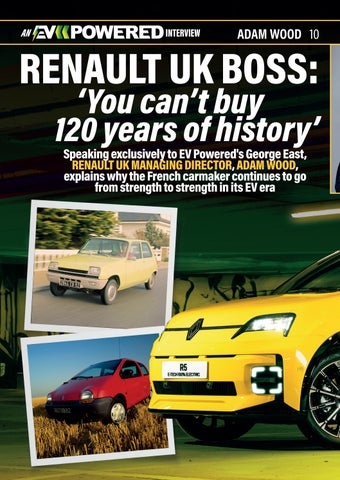
RENAULT UK BOSS: ‘You can’t buy 120 years of history’ Speaking exclusively to EV Powered's George East, RENAULT UK MANAGING DIRECTOR, ADAM WOOD, explains why the French carmaker continues to go from strength to strength in its EV era
11 ADAM WOOD
AN If you’ve been following EV matters with even the slightest interest over the last 18 months, you’ll have noticed that Renault has become synonymous with producing some of the best-in-class EVs: Step forward, the Renaults 4, 5 and Scenic. On more than one occasion, we’ve already gone over what makes these cars brilliant. Yet beyond the technical capability and sharp looks, there’s something deeper and more human that has made Renault’s revived icons such a vital part of the contemporary European EV scene’s fabric. Sure, while Chinese newcomers may promise more toys for less money, Adam Wood, who has seen first-hand the French carmaker’s transformation into a European EV powerhouse, feels that the appeal of Renault’s EVs lies in its heritage. “You simply cannot buy over 120 years’ worth of history, and you certainly can’t buy the connections and emotions we’ve built with
INTERVIEW people and wider society over time,” the Renault UK boss explains. “I meet so many owners who’ve owned an original Renault 5 who’ve now come and bought the new one. “It’s just brilliant to hear the stories, to share the photographs, and to share the childhood memories.” Just ask EV Powered editor Matt. He happily admits that part of his love for his long-term Renault 5 stems from memories of his parents’ original ‘Cinq’, and his mum feels the same, having recently taken the wheel of the electric supermini. But Renault isn’t resting on its laurels with the success of the R4 and the R5. In fact, leveraging the brand’s emotional equity is part of its product roadmap as it looks to fend off the tide of legacyless newcomers.
CONTINUED ON NEXT PAGE
AN
INTERVIEW
By 2030, it aims to launch 12 electric-only models in Europe, including a new Twingo and a new electric Clio arriving early next year.
unique against some other manufacturers is that we understand the benefits of head and heart appeal.
“For us, it’s about continuing to build stories and to build connections with people,” Wood resumes. “I think what makes us
“Cars should bring a smile – they should be fun to drive, and they should be great to look at. “We want that ‘Je ne sais quoi’ magic and French flair to come through in our products, because when all cars are electric – and that isn’t too far in the future – that becomes a real differentiator. A car is a huge purchase at the end of the day.”
ADAM WOOD 12
13 ADAM WOOD
AN
INTERVIEW
‘We wouldn’t say no to an electric Espace’ While SUVs have dominated the EV and wider car landscape for quite some time, recent years have seen a bit of a revival for the trusty people carrier. Spearheaded by van-based fare such as the Citroen E-Berlingo, the electric MPV segment has expanded to include the Volkswagen ID Buzz, Ford E-Tourneo and Kia PV5, with Hyundai’s Staria set to arrive here by the end of 2026. Time, then, for the iconic Renault Espace to make a comeback, non? While Wood is understandably cagey about future product plans, he doesn’t completely discount such an idea.
While Renault has used several historic nameplates to great effect as a part of its EVfocused ‘Renaulution’ strategy, Francophile Wood insists that the brand won’t delve into its history books purely for the sake of it in a cynical attempt to “shift a few cars”. When Ford adopted this approach with the new Capri it prompted a brutal backlash, and the use of the Explorer name (a longterm staple in the US) has meant little to European buyers. In fact, its performance has been so poor that the Blue Oval has had to rethink its European electrification strategy, which, ironically, involves a tie-up with Renault to build a new Fiesta.
"We certainly wouldn't say no [to a revived Espace], but when we rejuvenate or revive iconic names of the past, it has to have modern relevance,” Wood emphasises. "Our plan is to bring accessible, joyful, practical, ubiquitous electric ability for people, and that's a real need of today." Accessible, joyful, practical? Sounds like the Espace. After all, after arriving in 1984, Renault’s firstgeneration MPV went on to become a hit with the British and European public.
So electrification and the blend of technology and heritage is clearly working for Renault. And with so many more EVs to come there could be room among them for some familiar faces...
Yet all of that changed with the 'Renaulution' electrification plan announced by former CEO Luca de Meo in 2021, which sparked new life into the marque and its product line-up. The Renault 5, the first car born from de Meo's bold EV strategy, has been a runaway success, scooping award after award across Europe following its 2025 debut, but that’s backed up by the wider Renault EV range – the Renault 4 SUV, plus the impressive Megane and Scenic. And Renault isn’t stopping there, with big plans for at least 12 new models by 2030, with the focus very much on electrification. Key to this plan is the introduction of its RGEV Medium 2.0 platform, which Wood describes to EV Powered as "a genuine game-changer in terms of electric capability". "It's 800-volt architecture,” he explains. “So, we're talking about electric ranges up to around 800 kilometres (500 miles) alongside the introduction of range extender (REX) technology, which takes us up to about 1,400km (870 miles).
“We don’t have a blanket strategy to simply revive our heritage nameplates or icons of the past without there being any real modern relevance,” Wood emphasises. “Is there a demand for joyful, fun, accessible electric mobility? Absolutely yes, so what better car than the R5?” Indeed, what better car? The Renault 5 has proved a smash hit for the brand and a massive winner with the UK car buying public. In July it was the country’s best selling EV and helped push Renault to the top of the EV retail charts. In fact, 50% of all Renault sales that month were pure EVs.
from UK sales in 2012. Around that time, Renault had also lost ground as a brand and, arguably, lost some of its identity.
Sensibly priced, the Matra-built people mover could lug a family and all their 'stuff' in trad, squishy French-car comfort. With its wedgy design, it looked good, too. It was only with the inexorable rise of the SUV in the 2000s that the Espace and its ilk fell out of favour. The Espace is still on sale in Europe as a shadow of its former self, but was withdrawn
"With this next generation of platform, range anxiety is a thing of the past – we're talking about something that'll give us a 10%-80% charge within 10 minutes, so that really is exciting. In terms of the actual specific models that will form part of that platform, it's a little bit early to talk about them." But such capabilities clearly lend themselves to practical family vehicles. And with the return of the MPV in the electric era, and Renault’s expertise in both areas, it would seem like an obvious choice for Renault to explore. Watch this space...
FEATURE 14
LESS IS MORE
HOW MCMURTRY CAN REDEFINE THE ELECTRIC SUPERCAR MCMURTRY'S HEAD OF APPLIED TECHNOLOGY SALES REVEALS HOW THE BRITISH FIRM IS PUSHING MANUFACTURERS TO RE-THINK HOW THEY GO ABOUT BUILDING THEIR ALL-ELECTRIC SUPERCARS
15 FEATURE
BY GEORGE EAST IT'S A CONTROVERSIAL TAKE, BUT SUPERCARS ARE POSSIBLY THE LEAST INTERESTING THING IN THE WORLD OF EV. Yes, thousands upon thousands of horsepower looks impressive on paper, but it's unusable in the real world. And here’s another unpopular opinion – they look identical. Far lower down the automotive food chain of exotica, early Volkswagen ID cars underwent a bit of a shoeing for looking anamorphic, as do several newer Chinese offerings. None of the above is unfair.
the choice between a £2 million, 1,800bhp quadmotor behemoth and a £20k, 81bhp Renault Twingo, then Le Frog would win out every time. And this isn't just a case of me spouting off for both cathartic and entertainment reasons.
But hear me out. If you stripped the badges from the likes of the Lotus Evija, the Rimac Nevera, and so on, I'd bet what's left on my charge card that you'd struggle to tell the difference.
Speaking from its HQ on an industrial estate in Oxfordshire’s well-heeled Cotswolds the director of McMurtry Technology, Iain Wight, is explaining in great detail the problems manufacturers face when developing and building an electric supercar.
Ultimately, then, the supercar is not my thing. Even in internal combustion land, they never were. At the end of the day, if you gave me
Founded earlier this year, McMurtry Technology is the British small-batch performance car maker’s innovation and technology arm.
This big-brain division takes intellectual property lifted from its all-electric record-breaking Spéirling fan car and sells it to OEMs, which includes everything from McMurtry's patented 'Downforce on Demand' system that generates up to 2,000kg of downforce at the flick of a switch, to lightweight carbon fibre composite structures and equally featherweight, high-performance electric powertrains. Oh, and if you weren't sure, the McMurtry Spéirling is *that* EV, which smashed the Goodwood Festival of Speed Hillclimb record in 2022 in 39 seconds flat with Max Chilton behind the wheel. The Briton’s record remains unbroken. CONTINUED ON NEXT PAGE
FEATURE 16
If there's anyone capable of leading McMurtry Technology, then, it's Wight with over three decades of engineering experience in Formula 1, touring cars, and Formula E to his name. Like many of motorsport's greats, his ego is inversely proportional to his position, and in the case of Wight, his towering stature. Surprisingly – and disarmingly – he delivers his Scottish accent with an Adrian Newey-like softness. "If you look at very high performance cars now, they are adorned by aerodynamic devices – and that presents a number of problems," he explains. "It causes a design problem for starters, and designers hate them because there's not an awful lot you can do with it. "The aero creates a lot of drag within the car, and it makes the car platform very large. If you look at some, and I won't name names, you can barely get in and out of them because it’s so difficult. You can only ever use their performance on track, never off it." Despite my best journalistic efforts, Wight won't be drawn into naming and shaming the latest victims to fall foul of autobesity. However, there's nothing to stop me, so I've run some numbers. Once again using the Evija and the Nevera, the Lotus measures 4.46 metres long while the Rimac is slightly lengthier at 4.7m. The 1,288bhp Yangwang U9, one of China's many electric hypercar
offerings, is even bigger at just three centimetres shy of five metres. All of these cars are quick, yes. Moon-spinningly quick. But none of them, by any stretch of the imagination, is small nor nimble. Weight is the reason. Tipping the scales at 1.84 tonnes, the Lotus is the lightest of the trio. The Rimac is somewhat heftier at 2.15 tonnes, while the Yangwang is 2.5 tonnes, which is more than a Toyota Hilux. The electric version. Let that sink in. Ultimately, supercars don't have to be this heavy. On the way up to Wight's office, proof of that lies in McMurtry's spotless workshop. Under construction is a now-launched, road-legal, track-ready version of the record-breaking Spéirling, dubbed the Spéirling Pure, which tips the scales at less than 1,400kg. Like the prototype, the road-going car's fan system generates up to 2,000kg of downforce and a bone-breaking maximum load of 3G in corners. But unlike the prototype, the single-seat cockpit can be trimmed to the buyer's liking with a broad palette of colours, strips and materials. The one being built is white. It’s under the skin where the real changes have taken place. A 100kWh battery pack offers up to 30 miles of LMP2 car-matching pace, and there's a 'boot' with enough storage for a HANS device and a crash helmet. Headlights, indicators, brake lights, and a full-beam flash complete the package.
While the Pure's 2.2-metre wheelbase is two inches longer than its record-breaking forebearer, McMurtry's first 'production' vehicle – as in, it's road legal, but you wouldn't want to take it to Aldi – remains an extremely small car at just 3.8m long with the bodywork bolted onto the composite chassis. It’s still smaller than a Renault 5 or a Volkswagen ID Polo. According to Wight, the key to retaining the Spéirling Pure's tiny dimensions has been mating the car's two 500bhp electric motors to its 100kWh battery and McMurtry's Downforce on Demand technology. Without getting too nerdy and running the risk of making myself look silly as I’m not an engineer, Downforce on Demand uses two high-speed fans beneath the chassis to suck the car to the ground via an "air skirt". Unlike the prototype, which requires an external air bottle, the Pure is fitted with an onboard air compressor, allowing the skirt to be retracted from inside the car. Wight describes the coming together of the electric motors, the battery, and Downforce on Demand as "three happy bed fellows". "You can run a fan downforce system from a combustion engine, but you would need to have a battery in it to provide you with a reservoir of energy that you would then charge and discharge through the fan system," he explains. "When you have an EV running a fan downforce system, it all
17 FEATURE
ties in together, because you're using the same energy source for your traction motors and for your fans. You're all running at the same voltage effectively and it's all integrated – there's no imbalance or anything between."
"Now you're probably going to say, but the person behind you will hit you. Well, I'd rather have a rear impact than a front impact into something, so in theory, you could use a safety device as well."
The integration between the motors, the battery, and the fan places the Spéirling Pure in an virtuous upward spiral, meaning McMurtry is able keep dimensions within the framework of a traditional sports car of yore, albeit one with blistering performance.
Without a doubt, using fan tech as a replacement for an overly intrusive ADAS system is something a long way off, if not an extreme flight of fantasy. Return to the Spéirling Pure's most likely natural habitat of the track day, however, and it's a triedand-tested concept.
While the Pure is no Caterham 7, its 1,350kg kerbweight and 1,000bhp ensures it can compete with much bigger, much more expensive machinery. With a £995,000 starting price, it's somewhat of a bargain, and its 0-62mph time of 1.5 seconds ensures it’s quicker in a straight line than the hardcore £2.3m Rimac Nevera R. Such is the curse of the 'car guy', the urge to bang on about performance figures is hugely overwhelming, and it's something Wight says he could "do for at least another hour". Nonetheless, the engineer steers the conversation in the most unexpected of directions – and that's using the Spéirling Pure's fans as an alternative safety device. "Imagine you're driving on a motorway or something – it's poor conditions, maybe fog, and you end up in a dangerous situation," he hypothesises. "There's a pile up ahead and you need to minimise your braking distance – we can deploy the downforce system incredibly quickly and stop the car really quickly.
Don't forget that for their £995,000, Spéirling Pure owners are privy to all sorts of perks including track driving lessons with McMurtry’s team of professional peddlers, and the opportunity to participate in a variety of regional competitive events including the USA's Time Attack series, and Time Attack Masters in Europe.
basically loses the car and then he stops – that's it. We timed it. It's 1.3 seconds from when he lost control of the car to when full control was regained. "When you're sideways on with a fan downforce system, you don't lose your aerodynamic platform - you retain your grip right down to zero speed. So that means that if you wanted to buy a high performance car that has wings on it and drive it at speed, you have to work your way up to that very slowly. "Because of the way that the aerodynamics work, you have to go faster to make them work. And that's very scary for a normal driver. For a race driver, it's something that they work up to. With our car you can get in the car and you can enjoy that downforce at any speed."
Once again, the floor belongs to Wight: "I started thinking about using fans as a safety device last year," he says. "We were chasing the lap record on the Nürburgring short configuration with Max [Chilton], and he spun going into turn 13, which is a horrible corner – it's a real 180-degree left hander with a gravel trap wall.
While huge downforce and ground effect aero are someway off of entering the mainstream, the trend of small, all-electric performance cars is very much here, and it’s not just McMurtry. Cue Longbow; step forward SCC; and as soon as January next year, we’ll have an all-electric Alpine A110. In fact, F1’s Pierre Gasly even described the latter as “really enjoyable” at this year’s Goodwood Festival of Speed.
"His corner entry was at 2.7g, which is basically the same apex speed as Formula One qualifying when they used it. He didn't go off the track, and it's the most boring video you'll ever see. He
With the likes of McMurtry driving innovation and electrification getting the thumbs up from a Grand Prix race winner, what was that about EVs being boring?
LEXUS ES By MATT ALLAN
REVIEW 18
I
first drove the Lexus ES when the seventh generation launched in Europe way back in 2018.
Then it felt like a capable but dull hybrid alternative to the likes of the BMW 5 Series and Audi A6. It also felt tarnished by its association with the Toyota Camry. Now, the eighth generation has landed and as well as being free of associations with lesser cars, it’s also being sold as pure EV for the first time. In fact, in the UK it’s only being sold in all-electric guise, so I spent a day on UK roads getting to grips with Lexus’s latest executive saloon to see whether the shift to full electrification can help it compete in a segment dominated by the German “Big Three”. The 2026 ES is still built on an adapted version of the previous model’s platform but has been given a significant exterior makeover to match Lexus’s new “Clean Tech x Elegance” philosophy. It’s still a big, long (5.2m) and low saloon but there’s definitely a more high-tech feel to it. The ES retains a distinctly Lexus look thanks to the “spindle” front end design that pinches inwards around the now smoothed-off grille area. New L-shaped lights that cut in below the bonnet line, and black lower lighting units, emphasise the traditional Lexus design cue and house adaptive LED units. It’s certainly different from the approach of German and Swedish alternatives. From the side, there’s a hint of squashed RZ about the profile, along with some quite striking black moulding that’s apparently there to disguise the fact the ES is taller than before. At the rear there’s a neat “boot-less” design which gives the ES a fastback look but retains the traditional saloon lid. Under that, there’s a 512-litre space big enough for a couple of big suitcases or four golf bags.
CONTINUED ON NEXT PAGE
19 REVIEW
CAN THIS ELECTRIC EXECUTIVE SALOON KEEP UP WITH ITS GERMAN AND SWEDISH RIVALS?
REVIEW 20 to be viewed and managed remotely. For the first time in a Lexus, the central screen can now display charging status, which is a welcome addition. As one of Lexus’s higher-end models, every ES features 19-inch alloys, adaptive LED lights, heated and cooled front seats with memory function for the driver, plus low-energy radiant heaters and a heated steering wheel. Three-zone climate control, a panoramic roof and wireless phone charging are also standard, along with a 10-speaker sound system and the latest Lexus Safety System+. This includes map-connected adaptive cruise control and lane change assist for the first time, along with front cross traffic alert. Higher grade models add touches such as a 17-speaker Mark Levinson stereo, head-up display and “easy-close doors” along with the rear seat comfort pack and 21-inch wheels. Lexus is only bringing the ES to the UK as a full EV, and it’s only bringing one powertrain – a front-driven 221bhp setup with a 72kWh battery.
The new ES is a whopping 16.5cm longer than the old model, and half of that extra length is in the wheelbase, creating more space than ever inside. The result is a massively spacious cabin. Rear legroom is outstanding, with enough for a 6’ 5” passenger to sit behind a driver of the same height and still have plenty of extra knee room. They will be a little tight on headroom, though, but it’s still fine for anyone around the 6ft mark. A lot of attention has been paid to the rear seats and, in top-spec Takumi grade, the ES offers heated and cooled massage seats with a reclining function and powered "ottoman" leg rest. Rear passengers can also slide the front passenger seat forward remotely for even more space, and there are angled phone mounts and chargers for both rear-seat passengers. Those in the front also get newly designed seats that are thinner, lighter and more supportive than before. They’re still a little narrow for bigger-built drivers and set oddly high, which gives a slightly perched driving position. As ever with Lexus, the build quality is impeccable and the material choice interesting. Entry-level cars get faux leather, while higher grades get semianiline leather. Those higher-spec cars also get a wonderful pale bamboo finish to the inner door cars which is crafted to let the animated ambient light diffuse through it. The overall cabin design strikes a pleasing balance between the high-tech overload of its German rivals and the minimalist look of the Volvo ES90. Of particular note are the hidden switches in the dashboard which only illuminate when the car is running. These are similar to the haptic controls on some Kia and Hyundai cars, but the Lexus ones work far better, with a pleasing level of squish beneath the finger that leaves you certain if you’ve pressed it or not. Those hidden switches control functions such as the temperature and demist settings, with most of the rest of the car managed via the 14-inch touchscreen. This is all-new for the Lexus ES and the interface has been designed specifically for European tastes. There are clearer, simpler home screen icons, more easily accessible shortcuts and integration with the 12.3-inch digital instruments. It’s definitely better than previous Lexus efforts, but some functions (especially ADAS-related) still require too many screen presses to reach, and rivals still do it better. Connected services work with the infotainment system and Lexus Link+ mobile app to allow a wide range of data, security and infotainment settings
Officially, that battery will return up to 361 miles on the Premium’s 19-inch wheels and 329 miles on the 21-inch wheels. I tested the Premium Plus car on 21-inchers and the ES’s real-world range worked out at somewhere between 265 and 285 miles. Efficiency was around 3.7m/kWh against an official 3.89m/kWh. That’s not too bad a discrepancy between WLTP and real-world, and is probably good enough for many driver’s day-to-day use. The problem is that the equivalent Audi, Mercedes or Volvo offers significantly longer range. That goes doubly for charging, which is verging on the embarrassing. The Lexus ES has peak DC charging of just 150kW. That means a 10-80% top-up of the comparatively small battery will take 30 minutes. Rivals offer charging rates of between 200kW and 400kW. That means they take less time to charge than the Lexus, despite all boasting larger batteries as well. Rivals also all offer more power and torque than the Lexus, which only comes with that one 221bhp/198lb ft front-mounted motor. It’s the same motor you’ll find in a host of other Lexus/Toyota models and delivers 0-62mph in eight seconds and a top speed of 99mph. When an i5 can hit 62 in under 4 seconds, or a Volvo in a little over six seconds, the Lexus’s performance sounds a little weedy. In truth, though, it’s perfectly adequate, and there’s a pleasant linearity to how the ES builds up to speed. There’s enough instant response for urban manoeuvring and enough mid-range torque to make easy, if unremarkable,
21 REVIEW progress. The brakes lack bite, but this can be addressed by switching up to one of the higher regeneration levels. The ES isn’t really a car for envelope-pushing driving, anyway, and feels developed for easygoing cruising rather than high-speed dynamics. The steering is quick and precise through a beautifully thin steering wheel, but doesn’t deliver much in the way of feedback. The ES is also a big and heavy car, and you’re away of that size as the speed builds. More positively, it’s incredibly refined, with genuinely impressive levels of sound insulation and beautifully sorted damping. Regardless of the road conditions, the ES wafts along, isolating occupants with limo-like levels of ride comfort and noise control. In simple terms, it feels very much like you expect an electric Lexus to feel. The Lexus ES starts at a competitive £59,345 for the ES 350e Premium. That allows it to undercut rivals such as the Audi A6 e-tron, BMW i5, Mercedes EQE and Volvo ES90, which all start at north of £63,000. It also partially offsets some of the gap in technical specs. Above the entry-level Premium model sits the £68,245 Premium Plus, which is expected to be the biggest seller. The range tops out at £72,545 for the Takumi. Every model gets the same motor and battery, and the only options are 21inch wheels for Premium and Premium Plus cars (£1,600), plus a choice of paint colours priced at £850 or £1,200.
LEXUS ES PREMIUM PLUS PRICE: £68,245 (£71,095 as tested) TRANSMISSION: Single-motor, front-wheel-drive BATTERY: 72kWh POWER: 221bhp TORQUE: 198lb ft TOP SPEED: 99mph 0-62MPH: 8 seconds RANGE: 357 miles CONSUMPTION: 3.89m/kWh REAL WORLD RANGE: 265-285 miles REAL WORLD CONSUMPTION: 3.7m/kWh CHARGING: up to 150kW BOOT SPACE: 512 litres
Like every Lexus, the ES comes with a standard three-year warranty that can be extended up to 10 years through regular servicing. The battery, meanwhile is warrantied for 10 years or one million miles. The latest Lexus ES is a thoroughly pleasant and largely very impressive car. It is serenely quiet and smooth, built to last aeons and pleasant but uninvolving to drive. It deftly blends clever new technology with more traditional controls for a user-friendly interface and is hugely spacious and wonderfully comfortable. In short, it’s everything a Lexus should be and traditional Lexus buyers will be delighted by it. But up against its German and Swedish rivals, its tech specs look pretty weedy. While the ES’s range and power are adequate in isolation, any similarly priced alternative offers more of both, along with significantly faster charging.
RIVALS
BMW i5
AUDI A6
VOLVO ES90
More expensive and with only a little more range, but much more dynamic.
Better range and far better charging, but the Lexus interior is better.
Another alternative to the Germans with better tech but frustrating user interface.
CITROEN E-C3 URBAN RANGE
CIT
DOES A SHORTER RANGE ACTUALLY MEAN A BIGGER APPEAL FOR CITROEN’S SUPERMINI? Visually, there’s no difference between the E-C3 Urban Range and the rest of the line-up.
The E-C3 Urban Range is the new entry point to the E-C3 range and lowers the starting price to a fiver under £20,000. On top of that, the car qualifies for the band 1 Electric Car Grant, so buyers can pick one up for just £18,495.
It still has a slight hint of crossover about its boxy, upright shape, which is emphasised by the standard-fit roof rails and “skid plates”. Touches such as those and the coloured “chips” in the lower bumper give it some character, but a Renault 5 remains a far sharper-looking thing.
That creates a noticeable gap between the E-C3 and cars such as the Renault 5, and places it somewhere in the middle of proper B-segment hatches and smaller budgetfocused fayre such as the Dacia Spring and Leapmotor T03. Its closest direct rival is the entry-level BYD Dolphin Surf Active.
Inside, it’s the same story. The E-C3 majors on a simple, easy-to-use interface. The slim instruments are clear and concise and not overburdened with superfluous details. There are simple physical controls for the heating and the worst of the ADAS systems are deactivated by two dashboard buttons.
The clue to how Citroen has achieved the lower price is in the car’s name. Urban Range signifies that this version of the supermini gets a smaller battery, hence the focus on city use. A new 30kWh pack offers around 130 miles on the combined cycle – around the same as the Dacia or Leapmotor – and 70 miles less than the regular 42kWh E-C3.
The central touchscreen is a 10.25-inch unit and while it isn’t the most responsive system, the physical controls for key functions mean you’re not overly reliant on it. It also supports wireless Android and Apple connectivity.
But Citroen argues that doesn’t matter. The French brand is very open that this will be a second car for most of its buyers. It’s intended for short urban use by older motorists or single-child families for the school run and shopping trips. So, in an ever-expanding world of cheap EVs, does that make sense or has Citroen clipped the E-C3’s performance too much?
Like every C3, there’s some clear concession to cost – from the physical key and manual handbrake to the shiny plastic door tops and lower centre console. But in the bits that matter it still looks and feels pretty decent. The main controls are robust and practical and things like the simple dials for the manual air con work with a strangely pleasing physicality.
CONTINUED ON NEXT PAGE
N
Citroen struck a solid blow for affordable EVs last year with the launch of the £22,000 E-C3. But it wants to go further, so now there’s an even cheaper variant about to hit the streets.
TROEN
ITRO
The central touchscreen is a 10.25-inch unit and while it isn’t the most responsive system, the physical controls for key functions mean you’re not overly reliant on it. It also supports wireless Android and Apple connectivity.
REVIEW 24
Like every C3, there’s some clear concession to cost – from the physical key and manual handbrake to the shiny plastic door tops and lower centre console. But in the bits that matter it still looks and feels pretty decent. The main controls are robust and practical and things like the simple dials for the manual air con work with a strangely pleasing physicality. Little touches like the blue plastic strip, the fabric dashboard finish and the little encouraging tags on the door cards also elevate it beyond just a bog-standard budget supermini. At 4m long, the E-C3 is fractionally bigger than a Renault 5, but offers superior rear space and an impressively large 400-litre boot. That boot, however, has a comically deep lip that’s going to make it tricky to get anything heavy or bulky in or out, and the rear legroom comes at the expense of space in the front. The big difference with the Urban Range is, well, its range. The 30kWh battery is good for 130 miles on the WLTP combined cycle or 186 miles on the WLTP city cycle. That puts it in the same sphere as the Dacia Spring and Leapmotor T03 rather than the Renault 5 or Hyundai Inster. Citroen argues that the typical customer for a car like this travels less than 26 miles per day, so even with the reduced range a weekly top-up should be enough to keep them motoring. That’s perhaps just as well because as part of the cost-saving efforts DC charging doesn’t come as standard. Instead, the E-C3 Urban Range relies on regular 7kW AC charging to deliver a 20-80% recharge in around two hours 50 minutes. For those who feel the need for faster top-ups, a 30kW DC option is available and cuts charging time to 36 minutes. We all know WLTP figures can be a little misleading, but on a fairly balanced driving route, my E-C3 Urban Range offered around 100 miles real-world driving. Plenty for an awful lot of second-car use cases. It remains to be seen how it will perform on.a cold rainy night in Stoke. Although the battery is smaller, the E-C3 Urban Range gets the same 111bhp motor as the rest of the range. This delivers a leisurely 0-62mph time of 10.4 seconds, again emphasising the urban focus of the car. From 0-30mph, it’s actually quick enough, but it does need some encouragement. All the controls feel a bit relaxed for urban driving. I want to be able to nip and dart through traffic but the Citroen’s steering and throttle response feel a little soft and ponderous. A heavy right foot reveals enough poke to dive into a gap, but you’re got to be firm. The same goes for the steering.
While it’s definitely intended for urban use, this E-C3 can still handle faster roads like any proper supermini and it’s surprisingly quiet at motorway speeds. Whether on fast roads or around town, the E-C3 Urban Range drives perfectly well in that squishy Citroen way. The ride is the most cosseting and comfortable in its class, backed up by comfortable, supportive seats, and the steering and handling are predictable, if not dynamic. As I already mentioned, the point of the E-C3 Urban Range is to create an even cheaper B-segment hatchback, so it is priced at £19,995 before the ECG and £18,495 once the governmentbacked discount is applied. That’s pretty much on level pegging with the BYD Dolphin Surf Active, £3,000 cheaper than the base Renault 5 and about £1,500 more than a top-spec Spring. The Urban Range comes in just one trim level – Plus – which is more generously specced than European entry-level cars, in recognition of British buyers’ high expectations.
Every car gets 17-inch alloy wheels, roof rails and the Advance Comfort suspension and seats. They also get wireless Android and Apple mirroring via the standard 10.25-inch touchscreen, manual air conditioning, faux leather steering wheel and LED headlights with auto-dipping. Citroen says the E-C3 Urban Range is about offering a more accessible option for an under-served market, and acknowledges that it’s not a car for everyone. It is definitely going to be of limited appeal and some people will make the effort to step up to £21,500 and get the Renault 5 or bigger-batteried E-C3 Standard Range. But for folk who really only need a city car with city range, it’s got a lot going for it. It’s quirky and stylish, comfortably and spacious for the class, and it’s blessedly easy to use. With the grant applied, it’s also a more attractive, robust option than the likes of the Spring or T03, and more spacious than the upcoming Twingo or Super-N.
25 REVIEW
CITROEN E-C3 URBAN RANGE
RIVALS
PRICE: £19,995 (£18,495 after ECG) POWERTRAIN: Single-motor, front-wheel-drive BATTERY: 3 0kWh POWER: 111bhp TORQUE: 92lb ft TOP SPEED: 82mph 0-62MPH: 10.4 seconds RANGE: 130 miles CONSUMPTION: 3.68m/kWh CHARGING: up to 7kW (30kW DC optional)
BYD DOLPHIN SURF
FIAT GRANDE PANDA
LEAPMOTOR T03
Very close on price, range and performance. Offers higher spec for the money but is far less user-friendly.
Uses the same underpinnings as the C3. Only offers the bigger battery, so is more expensive, but is also more stylish.
Delivers similar range and performance plus higher specification for less money, but is smaller and less user-friendly.
REVIEW 26
AUDI Q3 E HYBRID BY MATT ALLAN
27 REVIEW
THIRD-GEN SUV BRINGS NEW HYBRID TECH TO BEAT AUDI AND BMW RIVALS
The Audi Q3 has been an important model in Ingolstadt’s line-up for more than a decade. Launched back in 2012, it has successfully taken the fight to rivals from elsewhere in Germany, as well as Sweden, Japan and beyond, and helped cement Audi’s position as a leader in the SUV field. Its family-friendly blend of space, performance and premium feel has helped it stay at the sharp end of the market but time marches on and to stay competitive. Now in its third generation, the latest Audi Q3 promises a neater design, lots of technology borrowed from more expensive models and, importantly, a much-improved plug-in hybrid setup with nearly 70 miles of electric range.
Cars are getting bigger and the latest Q3 is larger in every direction than before but, in modern terms, it manages to look reasonably compact thanks to a low-ish roofline and well proportioned design. The big grille (and light-up tail badge) leave you in no doubt this is an Audi, but the use of relatively simple lines with soft edges, slimline lights, and a few large elements such as the lower bumper details mean it falls towards the unobjectionable end of the SUV design table. Inside, like every Audi of recent memory, there’s a smattering of piano-black plastic and dark chromecoloured trim, but it’s not as overbearing as in some stablemates. And like most Audis, the leather-wrapped sports seats are supremely supportive and comfortable.
CONTINUED ON NEXT PAGE
REVIEW 28 The first thing I noticed about the Q3’s cabin, however, is that it felt distinctly better made than the A6 e-tron I drove last year. It’s not quite early90s “hewn-from-rock” Audi quality, but it does have the feel of something well screwed together from decent quality materials. Those in the front are generously catered for in terms of space, but the rear seats are also reasonably well appointed, as long as you’re only travelling four-up. Three across the 40:20:40-split rear bench is tight, and rivals do offer a bit more space. The Q3’s 488-litre boot is pretty competitive and can be expanded to 575 litres with the rear bench slid forward. Indicators and stalks in general aren’t usually worthy of note, but Audi’s started doing something a bit odd here. To create more space and a solid one-piece look to the dashboard, the stalks have been replaced with two big control “levers” with a mixture of rocker switches and dials. One manages gear selection (a la Mercedes) while the other does lights, indicators and washer functions. At first they look and feel odd but, in operation, they feel largely similar to the various old-fashioned stalks. Unlike some experimental interior approaches (cough, Tesla) you soon forget they’re any different from what you’re used to. The slab-like approach frees up space in the centre console and gives a clean look that sits beneath the twin digital screens that make up the instrument and infotainment panel. There are a handful of physical controls – for drive modes, ADAS menu and EV modes – but most other functions rely on the touchscreen. The touchscreen is a 12.8-inch affair that flows into the 11.9-inch configurable dials. Unlike previous generations, this latest infotainment setup runs on Android Automotive OS and brings all the connected services we’ve come to expect, including media streaming from the likes of Youtube. While the operating system has changed, Audi’s infotainment remains among the most user-friendly, with clear menus, a logical layout and scope for customisation, plus suitably rapid response times. Elsewhere, the Q3 gets micro-LED tech from its bigger siblings. These multi-element lights can project information such as ice warnings or blind spot alerts directly onto the road in the driver’s eyeline as well as serving the anti-dazzle Matrix system. Various options packs also bring features such as trained parking that will get you in and out of spaces you use regularly, smarter urban parking assist, a reversing assistant, and a Sonos sound system. Every Q3 e-hybrid comes with heated seats, threezone climate control with remote preconditioning, wireless smartphone mirroring and charging, adaptive cruise control and a 360-degree parking camera.
Audi is well on its way to an electric future, but it’s also keen to keep serving the ICE market for as long as it can, and the Q3 is at the heart of that. The Q3 e-Hybrid uses a combination of a turbocharged petrol engine and decent-sized electric motor, paired with a 19.7kWh battery. Audi (and the WLTP testers) say that will return up to 69 miles of electric-only range. I didn’t get a chance to test the battery to its full extent, but I reckon a real-world EV range of around 50 miles is a realistically achievable figure. When the battery runs out, the petrol motor will take over, helping charge the battery when the driving conditions allow. On the road, DC charging of 50kW allows a 10-80% top-up in 26 minutes while 11kW AC charging can deliver a full refill in two and a half hours. A 1.5-litre engine in a mid-sized family SUV doesn’t sound like much but in conjunction with the 85kW e-motor delivers a healthy 268bhp and 184lb ft. That’s enough to get the Q3 e-hybrid from 0-62mph in 6.8 seconds and deliver punchy midrange acceleration. What’s pleasing about the Q3 hybrid’s power delivery is that it is smoother than some plug-in hybrids. The throttle is progressive and predictable, and handover between electric and petrol power mostly avoids the obvious delay and jerkiness some PHEV systems demonstrate. It’s also refined even under quite heavy throttle, contributing to a commendably quiet and calm driving experience that’s enhanced by standard-fit acoustic glass.
The ride can’t quite match the rest of the car’s refinement and displays an occasional sharp edge if you’re on anything but the smoothest of roads. That said, it’s still composed, with good body control, and while the steering lacks much feel it is precise and quick enough to make confident progress. The Q3 e-hybrid range starts at £46,625 for the Sport trim. Above that, the S-Line starts at £49,425 and adds unique exterior and interior styling, including a flat-bottomed steering wheel; tinted rear glass, leather upholstery and additional ambient lighting. It also upgrades the alloy wheels from 18 to 19 inches, adds LED lights with selectable light signatures, and an illuminated tailgate badge.
29 REVIEW AUDI Q3 SUV E-HYBRID S LINE PRICE: £51,800 (£55,000 as tested) TRANSMISSION: 1.5-litre turbo petrol, 85kW electric motor, FWD BATTERY: 19.7kWh POWER: 268bhp TORQUE: 184lb ft TOP SPEED: 134mph 0-62MPH: 6.8 seconds WLTP EV RANGE: 69 miles WLTP CONSUMPTION: 149.3mpg CO2 EMISSIONS: 43g/km CHARGING: up to 50kW The £52,375 Black Edition brings more unique styling and microfibre upholstery, plus a heated steering wheel. Meanwhile, the range-topping Vorsprung grade costs £58,275 and adds a panoramic sunroof, Matrix LED headlights, a head-up display, passenger-side dashboard screen and Sonos stereo. Those prices put the Q3 e-hybrid squarely up against Audi’s traditional rivals.
RIVALS
The BMW X1 and Mercedes GLA offer similar packages and performance for similar money, although the Audi’s more modern hybrid setup offers around 50% more range. There’s also
the Toyota Rav4, which doesn’t have the same premium image but matches the Audi’s technical abilities. Or the Cupra Formentor, which uses the same technical underpinnings as the Audi hidden beneath a sharp Spanish suit. The Audi Q3 has been a long-time winner for Audi and this latest generation looks set to continue that trend. It brings new levels of useful technology in a neatlooking and well-appointed package. Aside from a slightly stiff ride, it’s composed and refined, with an excellent hybrid setup that offers genuinely useful all-electric range.
MERCEDES GLA
BMW X1
TOYOTA RAV4
Current model falls behind the Q3 but there’s a brand new one on the way.
Sharper to drive and potentially cheaper but shorter on EV range.
Lacks the premium badge but new PHEV system is impressive and it’s built like a tank.
FORMULA E 30
WEHRLEIN'S DOUBLE, BARNARD'S TEARS Formula E's wild ExCeL farewell Team orders, a title-deciding tangle, a last-corner lunge from a 22-yearold and a Teams' title regained by Jaguar. The final Formula E weekend at London's ExCeL squeezed a season's worth of drama into two days, writes Richard Alvin. Formula E owed the ExCeL a decent send-off. What the docklands got was a weekend that will take some beating. Over two days in mid-August, the partindoor London circuit staged a crushing pole-to-flag victory, a title settled by a mid-pack collision, the youngest race winner the series has ever produced and a Teams' crown reclaimed. Pascal Wehrlein left as a two-time Drivers' World Champion. Taylor Barnard left with his name in the record books. Jaguar TCS Racing left with the Teams' trophy it lost to Porsche a year ago. And the ExCeL left the calendar altogether, bowing out as the London E-Prix heads to Brands Hatch for the Gen4 era. The arithmetic going in was delicious. Tokyo had left Jake Dennis at the top of the standings, with Mitch Evans and Wehrlein breathing down his neck and just five points covering the three of them. Jaguar led Porsche in the Teams' table. Two races remained, the last of the Gen3 era. Porsche set about Saturday's opener with a ruthlessness that bordered on the theatrical. Both factory cars reached the final qualifying duel, at which point Nico Müller backed off in the last sector and handed pole to his teammate. Wehrlein had said on Friday that he expected team orders to shape the title fight. Nobody could accuse him of bluffing. Dan Ticktum, fresh from victory in Tokyo, qualified his Porsche-powered CUPRA Kiro on the second row alongside Evans. An unusually tidy ExCeL start saw Wehrlein sweep into Turn 1 unchallenged, and by the end of lap one he had three seconds in hand. Behind him, Müller played the wingman with relish, using the tight indooroutdoor layout to hold up Evans and the chasing pack. The Jaguar driver,
31 FORMULA E increasingly irritated, branded Müller's defending "dodgy", and a spell under yellow flags on laps seven and eight, after Zane Maloney's Lola was put out of the race in a clash with Edoardo Mortara's Mahindra, did nothing to improve his mood. Evans gambled when the PIT BOOST window opened around lap 17, pitting at once and taking ATTACK MODE in clean air a lap later. By lap 19 he was past Müller and into a net second place, with Wehrlein yet to stop. Then Lucas di Grassi found the barrier at Turn 9 on lap 21, the resulting caution allowed Wehrlein and much of the field to pit for next to nothing, and the gamble had unravelled. Müller soon reclaimed the place and the Jaguar was left scrapping for a top-10 finish.
Up front, Wehrlein simply cruised. Dennis emerged from the squabbling pack to take third on lap 28, relieved Ticktum of second soon after and was followed through by António Félix da Costa, who put a Jaguar on the rostrum. Ticktum dropped to seventh in a messy scrap with Sébastien Buemi, Mortara and Barnard, then regained sixth when Mortara was penalised for their late Turn 1 coming-together. Evans, Nick Cassidy and Oliver Rowland rounded out the top 10. The winning margin was six seconds. The championship margin was five points, 29 still on the table, and with Evans and Rowland picking up only scraps, Sunday had become a straight fight between Wehrlein and Dennis.
CONTINUED ON NEXT PAGE
FORMULA E 32 It was anything but a formality. Round 17 became a race in which the title picture changed faster than anyone could follow, and Wehrlein spent a worrying chunk of it going backwards. On Lap 27 his engineer instructed him to let a quicker Buemi past in the Envision Racing car. Moments later Dennis, on his first ATTACK MODE, profited from a squeeze by da Costa to climb to eighth, and with Wehrlein languishing in 12th, the Briton was, for a brief and fraught spell, the virtual champion.
Jaguar TCS Racing took the Teams' World Championship for the second time, prising it back from Porsche, which had already wrapped up the Manufacturers' title in Tokyo. The season's three world titles were split between the championship's two heavyweight manufacturers, and the one Stuttgart wanted most had gone to a man whose first crown came at this very venue two years ago.
Then came the moment that settled it. On Lap 31 Wehrlein and Envision's Joel Eriksson made contact at Turn 16. The Porsche tumbled further down the order, but Dennis came off worse, sustaining damage that ended his race and, with it, his title challenge.
"What we did this weekend was outstanding again, delivered when we had to deliver, under pressure," Wehrlein said. "You don't crack under the pressure - we love the pressure, we embrace it, and we get even better with pressure. Tonight, we will celebrate and enjoy this moment, and then reset; work on the GEN4 car and make it even harder for them next year."
Evans could still do it on paper, but only with a win, and by then Barnard and the two Mahindras of Nyck de Vries and Mortara had cleared off at the front. Fourth was the Kiwi's lot. No fairytale for the driver, then, but precisely what the team required.
The race itself, though, belonged to a 22-year-old Briton. Round 17 marked DS Automobiles' farewell to Formula E, and Barnard sent the French marque out a winner. His final ATTACK MODE was deployed to perfection, carrying him
"To be the youngest race winner feels amazing and to do it in front of the home crowd, it feels unbelievable. I've got my whole family here as well. I'm speechless right now, I can't believe it." - TAYLOR BARNARD
33 FORMULA E past Mortara into second, and with two laps left he launched his DS PENSKE down the inside of de Vries at the final corner, a nailbiting move that stuck. At 22 years and 76 days old, he is the youngest race winner in Formula E history, with de Vries and Mortara completing a Mahindra two-three.
much hard work, we've been working in the simulator tirelessly all year," he said. "It's never really gone our way, but today, I think the whole team deserves a break, and honestly, thanks to all of them, the guys did absolutely amazing today."
"That's the first time I've cried for a long time," Barnard admitted. "To be the youngest race winner feels amazing and to do it in front of the home crowd, it feels unbelievable. I've got my whole family here as well. I'm speechless right now, I can't believe it.
The ExCeL signed off in suitably starry fashion. F1 World Champion Damon Hill was among those trackside, alongside Emily in Paris stars Lucien Laviscount and Lucas Bravo, boxer Viddal Riley, MMA legend Alistair Overeem and BelAir actor Jimmy Akingbola, while DJ Isan Elba played a live set and rapper AJ Tracey and DJ Josh Baker took to the grid before the race.
"It was definitely all or nothing moves. I did it in the last corner, both times, actually, in ATTACK MODE so, I think it was just opportunistic, and a tactical, FE move. That was the shakiest last lap I think I'm ever gonna have in my career." The win was reward for a difficult first season with DS PENSKE, the team he joined for Season 12. "After such a tough season, the team have done so
The championship's next British outing will be at Brands Hatch, with Gen4 machinery including Porsche's new 975 RSE, a Jaguar squad with a Teams' title to defend and a double champion who has promised to make life even harder for everyone else. The ExCeL could not have asked for a better goodbye.
FORMULA E 34
ELEVEN WINNERS AND A DOUBLE CHAMPION: Formula E's wildest season
By Richard Alvin won Saturday's race from pole with Nico Müller riding shotgun, the Swiss driver's defending of Evans branded "dodgy" by the Jaguar man. On Sunday the roles reversed. Da Costa, whose relationship with Wehrlein has been strained since their days as Porsche team-mates, forced the German wide and down to 11th, a move Porsche Formula E boss Florian Modlinger said "clearly compromised his own race".
Seventeen races, 11 different winners, a title settled by five points in a finale the champion finished 14th, and farewells to the ExCeL, the Gen3 car, Lucas di Grassi and DS. Richard came the contact with Envision's Joel Eriksson Alvin looks back on a season that refused to behave. Then that left Dennis, scrapping with Wehrlein for Had you asked the paddock in São Paulo last December how the final season of the Gen3 era might unfold, nobody would have dared suggest this. Seventeen races produced 11 different winners. Nine of the ten teams climbed the top step. Five different drivers led the championship, and the title was settled by five points on an afternoon when the man who won it scored nothing at all. Pascal Wehrlein is a two-time World Champion. Jaguar TCS Racing has the Teams' crown back. And the ExCeL, the Gen3 car, Lucas di Grassi and DS Automobiles have all taken their bow, clearing the stage for the 815bhp Gen4 machine that arrives in Jeddah in December.
A title fight that never settled It started with Jake Dennis. The Andretti driver won from the front of the grid in a São Paulo opener that lost eight cars to attrition, rookie Pepe Martí walking away unaided after a barrel-rolling, fiery crash brought out the red flag. A month later Nick Cassidy came from 13th to win in Mexico City, handing Citroën a victory in only its second race, and by February Wehrlein had marked his 100th
start with a dominant win in Jeddah and the first of his several spells at the top of the table. Mitch Evans, meanwhile, was rewriting the record books. His wet-weather win in Miami at the end of January was his 15th, more than any driver in the championship's history, and a charge from 17th on the grid in Berlin in May made it 16. António Félix da Costa, newly arrived from Porsche, gave Jaguar back-to-back wins in Jeddah and at Jarama's Madrid debut, the latter a one-two that left Evans fuming at a late team order to hold station. Edoardo Mortara even led the standings after the first Berlin race. Evans took over in Monaco and held on through Sanya and the first Shanghai round, only for a technical fault to stop him starting the second. Wehrlein's fourth place that day put him nine clear, then the pendulum swung again in Tokyo, where the Porsche driver scored nothing across two rounds and arrived in London third, five points behind Dennis with Evans sandwiched between them. What followed at the ExCeL was Formula E at its most gripping and its most contentious. Wehrlein
position, with race-ending damage. Evans needed a win and could manage only fourth behind Taylor Barnard and the two Mahindras. Wehrlein crossed the line 14th, scored nothing, and took the title by 169 points to Dennis's 164, with Evans on 160.
"What we did this weekend was outstanding again, delivered when we had to deliver, under pressure," Wehrlein said. Quoted by Autosport, he was less diplomatic about da Costa, calling
35 FORMULA E grid and stood on six podiums, yet finished fourth, level on points with Mortara.
his driving "one of the most unsporty and unfair things I have seen" and adding: "That's how it is if you have enemies in the paddock." Dennis told The Race he was "already at peace a bit that that's how they win it", and the same outlet reports the FIA intends to clamp down on such tactics between manufacturers and teams next season. Only Jean-Éric Vergne has also won the title twice, and his came before Formula E held World Championship status. Porsche, which had sealed the Manufacturers' crown in Tokyo, leaves the Gen3 era with six of its ten world titles. Jaguar took the one that got away, beating Porsche to the Teams' championship by 288 points to 271 to reclaim the trophy the German marque had taken from it a year earlier.
A winners' club with 11 members The title fight was only half the story. Müller's maiden win, at the 69th attempt, came in Berlin in a Porsche wrapped in Pink Pig colours for the 75th anniversary of Porsche Motorsport. Nyck de Vries won in Monaco and Tokyo, Mahindra's first double since 2017/18, and helped carry the Indian team to third in the Teams' table. Oliver Rowland, the reigning champion, took his second Monaco win in a row from eighth on the
Then came the records. Lucas di Grassi, 41 years and 328 days old, drove from 18th to pass Vergne at the start of the final lap in Shanghai, his first win since 2022 and Lola's first in the championship, at an age no Formula E winner has matched. Dan Ticktum mugged Dennis at the penultimate corner of Formula E's first Tokyo night race, then used the moment to remind everyone he was "currently a free agent". And Barnard, 22 years and 76 days old, lunged past de Vries at the final corner with two laps to go in London to become the youngest winner of all, taking the record from his own DS Penske teammate Maximilian Günther in DS's last race. Pepe Martí, the Cupra Kiro rookie, became the first Spaniard on a Formula E podium in Monaco. Envision Racing was the only team not to win.
The farewells The ExCeL goes because the Gen4 car is simply too big and too fast for its indoor-outdoor squeeze, so from next season the London E-Prix lives at Brands Hatch. The Gen3 Evo goes with it, retired after a swansong that produced closer racing than the car ever got credit for. Di Grassi goes too. The first driver to sign for Formula E, winner of its first race in Beijing in 2014 and the 2016/17 champion, he bowed out in London with 14 wins to his name. DS Automobiles, sent
off as a winner by Barnard, makes way for Opel, which has already signed Théo Pourchaire. And Evans leaves Jaguar after a decade in which all 16 of his wins came in the team's colours; he is widely reported to be Opel-bound, with Stoffel Vandoorne, Jaguar's reserve, tipped to replace him.
What comes next Gen4 is the biggest leap the series has made. The car produces up to 600kW, around 815bhp, with permanent all-wheel drive, a 0-62mph time of about 1.8 seconds and a 208mph top speed, and Formula E expects it to be seven to eight seconds a lap quicker than the Gen3 Evo. Pre-season testing takes place in Madrid in November before a record 21-race calendar opens in Jeddah on 18 and 19 December. Eight double-headers will pair a traditional E-Prix with a shorter E-Prix Unleashed sprint run with minimal energy saving. Brands Hatch hosts its double-header on 29 and 30 May 2027, Zandvoort follows on 18 and 19 June, and every session will stream on Disney+ across 144 territories, with ITV keeping free-to-air coverage in the UK. Porsche is set to run two factory teams. The champion, at least, is in no mood to rest. "Tonight, we will celebrate and enjoy this moment, and then reset; work on the GEN4 car and make it even harder for them next year," Wehrlein said in London. After a season like this one, nobody would bet on it being that simple.
THE 2025/26 SEASON IN NUMBERS • 17 races in 11 cities: from São Paulo on 6 December 2025 to London on 16 August 2026, the longest season in Formula E history • 11 different winners and nine of the ten teams on the top step: only Envision Racing went without • 9 different winners in nine consecutive rounds: from Madrid in March to Tokyo in July • 5 points: Pascal Wehrlein's winning margin, 169 to Jake Dennis's 164, with Mitch Evans third on 160 • 0 points scored by Wehrlein in the finale: which he finished 14th • 3 wins, six podiums and four poles for the champion: who won on his 100th start in Jeddah • 288 to 271: Jaguar TCS Racing over Porsche for the Teams' title, its second; Porsche took the Manufacturers' crown 498 to 400 • 6 of the Gen3 era's ten world titles: won by Porsche • 16 career wins for Evans: a Formula E record, all of them for Jaguar • 69 starts Nico Müller: needed for his first win, in Berlin • 41 years, 328 days: Lucas di Grassi, the oldest race winner, from 18th on the grid in Shanghai • 22 years, 76 days: Taylor Barnard, the youngest race winner, at the ExCeL's farewell • 13th to first: Nick Cassidy's Mexico City charge for Citroën's maiden win, in its second race • 815bhp and 208mph: the Gen4 car that opens 2026/27 in Jeddah on 18 and 19 December
USED BUYING GUIDE 36
USED
BMW iX3 BUYING GUIDE While the latest-generation iX3 made news with its huge 500-mile range, the previous-gen car still has lots to offer
37 USED BUYING GUIDE
The first-generation BMW iX3 is no range monster like the current model, yet it offers something the latest era of EVs can’t: a sense of familiarity. When it arrived in the UK in summer 2021, the BMW iX3 was a relatively simple beast compared to the Tesla Model Y or the Kia EV6. Instead of riding on dedicated electrical underpinnings, the genone iX3 was built using BMW’s multienergy CLAR (Cluster Architecture) platform. In non-car nerd terms, this meant Munich replaced the X3’s internal combustion engine with an electric motor and a battery... And that was it, really. BMW didn’t really change the already-handsome styling, and it certainly didn’t muck about by transforming the logical,
tried-and-tested interior into a migraine-inducing screenfest. Unsurprisingly, then, the iX3 very much fulfilled its brief: be an electric version of BMW’s X3. By early 2026, the X3 had become BMW’s best-selling model ever, with 3.5 million units sold after its debut two decades prior.
In terms of range, the early iX3 has been thoroughly beaten by the second-gen car and plenty of newer rivals. Yet given the average UK motorist drives 7,600 miles per year, its range from a single charge is more than enough.
The iX3 is important because it normalised electric BMWs for the UK public. It wasn’t visually horrid like the imposing iX, and it didn’t have any of the quirkiness associated with the almost-certain-to-be-classic i3.
The first-gen BMW iX3 remains one of the best-selling EVs in the UK today. Here's why.
Almost certainly, when the iX3 - and then the i4 - went on sale in the UK, they were key in strengthening BMW’s position as a serious EV manufacturer.
UK MODEL HISTORY When the iX3 hit the UK market, BMW set out to keep things simple. It offered its Chinese-built electric SUV with just one battery option, a 74.3kWh unit capable of up to 288 miles on a single charge.
This was paired with a rear-mounted 282bhp electric motor capable of a 6.8-second 0-62mph run. Despite the high-riding SUV looks, the iX3 was never offered with a twin-motor, all-wheel-drive powertrain. The iX3 was first available in two trim levels: Entry-level Premier Edition and range-topping Premier Pro. To keep things as close as possible to the just-updated X3, the iX3's trim levels were swiftly renamed M Sport and M Sport Pro, and the car underwent a facelift almost as soon as it launched in 2021. Continued on next page
USED BUYING GUIDE 38 The updates included a new singlepiece kidney grille with a pearl-effect chrome finish, plus headlights slimmed by 10mm. The front end received L-form outer air intakes and a lower front intake, while the rear benefited from narrower, 3D-effect LEDs and a chunkier rear diffuser layout. Inside, the biggest change was to the centrally-mounted infotainment screen, which grew from 10.25 to 12.5 inches. Pearl-effect chrome design elements continued.
EQUIPMENT The BMW iX3 is well equipped, and its cabin gets plenty of physical buttons and soft, dense plastics. Everything is very much a blast from the past, and in the best way possible. Its shared iDrive system with the i4 is largely reliable and praised for its intuitiveness. Integrated functions are BMW’s home-grown sat-nav system, Bluetooth, a DAB radio, plus Apple CarPlay, Android Auto, and wireless phone charging. Base-spec Premier Edition/M Sport cars ride on 19-inch alloys and come with an electrically operated tailgate. A digital driver’s binnacle is also standard, as is a panoramic sunroof, heated front leather seats, and parking sensors. The M Sport Pro introduces 20-inch ‘aero’ wheels, a driver’s head-up display, automatically dimming headlights, and keyless entry. The sound system is upgraded to a Harman Kardon unit, and the car comes with an Interstellar-style, electronic ‘IconicSounds’ backing track composed by Hans Zimmer.
Inside, the BMW offers plenty of space throughout, and the rear seats can be reclined for a more relaxed seating position. With the 40/20/40 rear seats in place, the iX3 has 510 litres of boot space. Fold them, and the area expands to 1,560l.
Premier Edition Pro versions started from around £65k. iX3 prices on the used market have dropped significantly over the years, but don’t expect to find Tesla Model 3 or Polestar 2 levels of knockdown prices.
The X3’s battery position means some underfloor boot space is reduced over the ICE version, making things more cramped than they are in an Audi Q4 e-tron. Like the i4, the iX3 has several electric blue elements inside and out, which are reminders that the iX3 is one of Munich’s electric-only models.
On AutoTrader, we found 361 iX3s for sale. The cheapest was a 2022 M Sport priced at £17,490, but it had a hefty 115,630 miles to its name. The most expensive was a late 2024 M Sport Pro, with a total mileage of 13,555 miles and a £39,714 asking price from an official BMW dealer network.
PRICE, RANGE AND RUNNING COSTS BMW priced the iX3 from £61,900 for Premier Edition models, while
The most wallet-friendly iX3 we found from a bona fide BMW dealership was an early facelift M Sport, which cost £23,555 and
had covered a total of 49,108 miles since it was registered in 2021. The priciest was the M Sport Pro mentioned above. Based on our numbers, spending £25,000 upwards would be the sweet spot for finding a used BMW iX3. As always, we recommend buying the best model you can afford, and preferably from an approved dealer. With a dedicated home EV charging tariff going as low as 8p per kilowatt hour, the BMW iX3 will cost just £5.94 to charge from 0-100%. Using a public charger will set you back significantly more, as prices can rocket up to an eye-watering 92p/ kWh.
39 USED BUYING GUIDE Charging is where the iX3 shows its age. With a maximum charging speed of 150kW, a 10%-80% charge can take 35 minutes.
insurance. The car falls into groups 44 to 50 - that's out of 50, remember - placing it firmly in Tesla Model Y and Jaguar I-Pace territory.
Note that as of April 1 last year, EVs are no longer exempt from road tax, meaning the BMW iX3 will cost you £200 a year to keep on the road. Thanks to the high original list price, you'll also face the Expensive Car Supplement. This applies in years two to six after the car's first registration and adds another £425 to your annual tax bill.
Insurance costs are also affected by age, line of work, where you live, plus whether you have on- or off-street parking. Remember this when evaluating costs, and don't try to fiddle with the system - you'll only get found out.
INSURANCE BMW is a premium brand, so expect to pay premium prices for the iX3’s
Munich offered the iX3 with a threeyear, unlimited-mileage warranty with a separate mandatory battery warranty covering eight years - the equivalent of 100,000 miles. This means that a 2024 or pre-Neue Klasse car will still be covered.
This is more extensive than Audi's, which offers a three-year, 60,000mile warranty. Nonetheless, it is somewhat stingy compared to Hyundai and Kia, which offer a respective five-year and seven-year warranty, plus an equally rewarding ownership experience.
RELIABILITY The iX3 shares its five-star Euro NCAP safety rating with its gasguzzling X3 cousin, and it’s no surprise, really. BMW has packed the iX3 from battery to beak with plenty of safety kit, including automatic emergency braking (AEB), lane-keeping assist, active side collision protection, and automatic speed limit assist.
Throughout its life, the BMW iX3 proved to be a dependable piece of kit. Unlike the latest Neue Klasse iX3, which was recalled in January this year for zapping owners while charging, the previous-gen car wasn’t recalled once. That doesn’t mean it was perfect, though. Owners reported software issues that caused infotainment glitches or unexplained warning lights. They were, however, often fixed via the tried-and-tested “turning it on and off again” method. Like with all dealer networks, BMW’s are a mixed bag. For half of the time, they were said to be helpful. For the other half, they were criticised for slow appointment times and patchy communication. Our advice is to look around at how well (or poorly...) your nearby dealerships are ranked, then make your decision.
THE 'ONE TO HAVE' To be honest, the simple answer is ‘either of them’. We think that the BMW iX3 Premier Edition/M Sport looks great in white, especially with those blackedout 19-inch wheels and that futuristic electric blue detailing, inside and out. However, we do understand the importance of a good sound system, so the Premier Edition/M Sport Pro’s Harman Kardon setup holds some sway. Knowing you have a Hans Zimmer soundtrack under your right foot does, too... because that’s just cool. Whatever trim level appeals, we’d say both versions of the first-gen BMW iX3 are a great buy. And that's simply because it's another great all-electric BMW.
E-BIKE REVIEW 40 you carry momentum over steep ramps and settle into a steady cadence. Mahle's wired bar-top remote buttons come as standard, and I found myself flicking between the three modes like an extra set of gears on long climbs. Trek's TQ triggers sit in a marginally better spot on the hoods, but Orbea's placement is the next best thing. Range is remarkable for a 353Wh battery. My first ride covered 62.25 miles with 3,795.8ft of climbing and I rolled home with 45 per cent left. Later rides stretched to 93.97 and then 97.68 miles, and lighter or more frugal riders should clear 100. A piggyback range extender is available for bigger days, and a full charge took 3 hours and 5 minutes.
ORBEA GAIN M10i
The rest of the build lives up to the price. DuraAce Di2 shifting is predictably flawless, the 50/34 chainset and close-ratio 11-30 cassette suit the motor perfectly, and the 42mm carbon wheels shape the tubeless Pirelli P Zero tyres true to size. Grip never wavered, from dewy lanes to a couple of light gravel detours, and the riser carbon bar does a fine job of filtering road buzz. The rear is a touch firmer, though I ran slightly higher pressure to offset the hub motor's weight. My only real criticism is that the spec is arguably more than the bike needs. The Ultegra Di2equipped M20i delivers 99 per cent of the same performance for £2,300 less, while the 105 Di2 M30i offers a similarly slick experience at £5,999.
THE E-ROAD BIKE THAT RIDES LIKE IT ISN'T ONE Whichever model you choose, the Gain sets a very
Richard Alvin tests Orbea's £9,299 flagship, which pairs Dura-Ace Di2 with Mahle's X20 hub motor to deliver the most natural-feeling electric road bike he has ridden. Orbea says its third-generation Gain offers a "pure road" ride rather than an ebike dressed up as a road bike. After weeks of testing the flagship M10i, on the climbs around Girona and back home in the UK, I think the Basque brand has delivered exactly that. At £9,299 it is a serious outlay, but it undercuts its most obvious rivals. The Specialized S-Works Turbo Creo SL Evo costs £12,000, Trek's Domane+ SLR 9 is £12,500 and the Wilier Filante SLR Hybrid, reviewed in a previous issue, comes in at £11,800. The frame is beautifully clean. Brake hoses are fully enclosed through an FSA-developed internal routing system that runs through the frame and stem, and only a slightly oversized down tube gives away the electric hardware. Otherwise the silhouette is remarkably close to Orbea's unassisted Orca OMR, with classical tube shapes and just a nod to aero profiling. Hidden mounts for mudguards add year-round appeal, an integrated rear daytime-running light is powered by the ebike system, and the
paintwork, applied at Orbea's Basque facility, is superb. The Gain is also included in the brand's MyO ordering programme, so you can specify your own colours. Geometry sits firmly in endurance territory. My XL test bike carried 613mm of stack against the Orca's 590mm, with reach trimmed to 402mm and the wheelbase extended by 32mm. A 15mm-rise bar relaxes the position further, though a flat version is available. Crucially, the 72.2-degree head angle, 50mm fork rake and 30c tyres combine for a 57mm trail figure, so the steering stays quick and confident. I happily dropped a shoulder into fast, twisty descents without a second thought. The assistance is where the Gain pulls clear of every e-road bike I have tested. Power from the 55Nm Mahle X20 rear hub motor, the brand's lightest and most compact to date, builds in a linear path that mirrors your own effort. Even in the highest mode the bike never surges ahead of you or shoves you up a climb. And when you pass the 15.5mph assistance limit, the power tapers away gently rather than cutting out, which helps
high bar. This is a motor system tuned around the rider rather than the other way round, and it makes the M10i the finest electric road bike I have ridden.
VERDICT Score: 4.5 out of 5 Superb ride feel, balanced handling and near100-mile real-world range make the Gain M10i the best e-road bike I have tested. Most riders will be equally happy saving money on a lower-specced model, but the bar has been set.
ORBEA GAIN M10i £9,299 Price: Mahle X20 rear hub, 55Nm Motor: 353Wh (optional range extender) Battery: Shimano Dura-Ace Di2 R9200 Groupset: 11.7kg Weight: Up to 97.68 miles Range on test: 3 hours 5 minutes Charge time: XS to XXL Sizes:
Thinking about electrifying your commercial fleet?
Electrifying commercial vehicles and HGVs is not just about the vehicles themselves – it involves a detailed consideration of how to keep them on the road without disrupting existing operations. Mer has the experience and knowledge to support you on this journey.
Download Mer’s free eguide for fleet managers to learn more about installing the right EV charging to keep your vehicles powered for their mission-critical journeys Click here to find out more
TOP TEN 42
The 10 BEST SMALL EVs 2026 From RENAULT and FIAT to MINI and HYUNDAI, we pick our favourite compact EVs from the ever-growing list on sale in the UK
It’s fair to say that the electric car landscape is shifting, and shifting quickly.
range. And plenty who don’t have £40,000 or more to spend on an EV.
After its early years were dominated by large and relatively expensive SUVs, the focus is now on small and affordable models that appeal to a wider audience.
Thankfully, the last couple of years have seen a surge in the number of small EVs, with more to come. After the pioneering work of the Renault Zoe and Mini Electric, and the false dawn of the Honda e, the compact, affordable EV sector is booming.
Models like the Tesla Model Y, Kia EV6 and Skoda Enyaq are great for families hauling lots of people and stuff over long distances. But there are plenty of drivers who don’t need all that space or
So to celebrate, we’ve come up with our list of the 10 best small electric cars on sale in 2026.
RENAULT 5
The Renault 5 has won just about every award it’s possible for a car to win, and with good reason. This European Car of the Year is a brilliant blend of value, capability and style. Its exterior and interior design perfectly balance nods to the original R5 with a fresh modern look and feel. Beneath the surface it packs an impressive powertrain offering 118bhp and 191 miles of range or 148bhp and 252 miles. And it drives beautifully as well. With prices from around £21,000 thanks to the Electric Car Grant, it’s also helping make electric motoring more affordable.
HYUNDAI INSTER
Although its styling is all about rough ‘n’ tough SUV-like looks, the Inster is a city car at heart. Beneath its Fisher Price 4×4 looks, this tiny EV measures just 3.8m long. But Hyundai packs a lot into its small package, from houndstooth upholstery to adaptive cruise control, and a surprising amount of space. Powering it all are 96bhp or 115bhp motors and either a 203-mile 42kWh battery or a larger 49kWh unit good for 229 miles – more than enough for most weekly demands. Priced from £23,500, it’s an interesting alternative to the sharp Renault 5 or Citroen E-C3.
CITROEN E-C3
If the Renault 5 is the best small electric car out there, its French rival isn’t too far behind. It’s not quite as sharp looking inside or out, but with a decent 199-mile range and a budget-friendly price it’s easy to recommend. Starting at less than £20,000 for the smaller battery version, the E-C3 is a compact five-door hatch with very mildly SUV-inspired styling and space for four onboard. Despite its low starting price, features such as alloy wheels, a 10.25-inch touchscreen with wireless phone mirroring, auto LED lights, and 100kW charging are standard.
MINI ELECTRIC
The second-generation Mini Cooper is as compact as ever but brings major improvements over the old car in almost every regard. There are now three power options ranging from 181bhp in the basic Cooper E to 215bhp in SE models and 254bhp in JCW variants. There’s also a much bigger, 49.2kWh battery offering 250 miles of range – more than 100 more than before. Added to that is a brilliantly unusual new interior and the same grininducing go-kart handling as before that help offset a steeper asking price.
FIAT GRANDE PANDA
The Grande Panda took its time making it to the UK but was well worth the wait. Proudly drawing on the design and ethos of the original Panda, this new supermini blends brilliant retro design with a smart modern interior and up-to-date powertrain shared with the Citroen E-C3. Its looks and charm will win over hearts, while its 199 miles of range and starting price of just over £20,000, will convince the head too that it is among the best small EVs on sale.
ABARTH 600e
There’s nothing that says all small cars have to be sensible or affordable, which is how the Abarth 600e makes it onto our list. Yes, it’s nearly £40,000, and no, you don’t need 276bhp in a very compact crossover. But, my word, it’s fun. The Abarth gets a delightfully lively chassis, limited slip differential and lots of cosmetic upgrades. As a package, they add up to one of the most engaging “hot hatch” EVs out there, and one you won’t struggle to park at the supermarket.
ALPINE A290
The Alpine A290 was joint European Car of the Year with the Renault 5, largely because the two are so closely related. Although they share the same core, the Alpine is worthy of inclusion thanks to how it transforms the sensible R5 into a characterful hot hatch. Smart cosmetic changes give it a more aggressive look, and there’s a unique 221bhp motor for added oomph. Coupled to major chassis revisions and the Alpine joins the Abarth 600e in proving that small electric cars can be bundles of fun.
CUPRA RAVAL
Cupra took the lead on the Volkswagen Group’s small car family project, and it shows. Allowed to be (relatively) adventurous, the sporty Spanish brand has turned in a striking supermini that looks like a hot hatch even in its most basic versions. Those basic ones will offer 114bhp and start from £24,000 when they arrive later in 2026. For now, only the spicier models are available, including the hot VZ, which packs 222bhp and true hot hatch handling beneath its bold bodywork.
FIAT 500e
The Fiat 500e was one of the first wave of small electric cars and it still holds a certain appeal after more than five years. Its modern take on the iconic 500’s lines are a cute blend of modern and traditional and the interior is littered with neat design details that will make you smile. What’s more, recent ECG-related price cuts mean that the 500e, which has suffered from yo-yoing prices over the years, is now properly affordable, with a starting price of just over £17,000 making it among the cheapest EVs on sale.
NISSAN MICRA
If the Renault 5 is on the list of best small EVs, then we can’t deny the Nissan Micra the same treatment. While it looks different from the outside, under the bug-eyed skin the Nissan uses the same brilliant small car platform as the R5. That means more than 250 miles on a charge, a deft chassis and smart user-friendly interior. It also means full ECG eligibility and a starting price of £21,500, staying true to the Micra’s position as an accessible entry point to motoring for young and old.
RESEARCH 48
USED EVs FLYING OFF FORECOURTS FASTER THAN ANY OTHER MODELS
‘Sweet spot’ secondhand electric cars are selling 10 days faster than the market average in the Middle East, can create short-term surges in electric interest, so it feels significant to see demand being sustained beyond that initial reaction. “Buyers are recognising the affordability now available in the used EV market, while retailers have a clearer view of where demand is strongest and which stock is most likely to perform.
Used electric cars are racing out of showrooms faster than any other fuel type, according to leading marketplace Autotrader. Electrified models account for all 10 of the fastestselling used cars on the site in July. Pure battery electric models (BEVs) made up eight of the top 10, with the other two spots filled by hybrid models from MG and Toyota. Described as a “significant milestone for the used car market”, July marks the first time that no petrol or diesel models have featured in the top 10 since Autotrader started tracking data. The figures mark a major jump for used EVs, which in July 2025 accounted for just four of the top 10 fastest-selling models.
According to the analysis of sales data, three-tofive-year-old EVs emerged as the “sweet spot”, selling in 20 days – 10 days faster than the market average and eight days faster than similarly aged petrol and diesel models. Marc Palmer, Autotrader’s head of strategy and insights, said the latest figures showed a longerterm shift in the used car market. He commented: “July’s data points to a used EV market that is continuing to move in the right direction. “We’ve seen in the past how external shocks, including fuel price volatility linked to the conflict
POSITION
“When that balance is right, the right cars are turning quickly. For retailers, the key to success will be using data to stay agile, identify the right stock, and capitalise on one of the market’s strongest areas of demand.” The data from Autotrader comes as used EV sales continue to grow rapidly. Quarterly figures from the Society of Motor Manufacturers and Traders shows that used EVs enjoyed their strongest performance in two years from April to June, with transactions jumping a massive 67%. In the second quarter of 2026, a total of 110,761 secondhand electric cars changed hands, helping the wider sector to grow 0.7% despite the decline in petrol and diesel sales.
MODEL
AGE
DAYS TO SELL
1
MG ZS Hybrid
1-3 years
13
2
Kia Niro
3-5 years
15
While the hybrid MG ZS was the fastest-selling car in the country in July, with an average sale time of 13 days, it was followed closely by the Kia Niro, which took an average of 15 days, and the Tesla Model 3, which took 17 days to sell.
3
Tesla Model 3
5-10 years
17
4
Volkswagen ID.3
3-5 years
17
5
Polestar 2
3-5 years
18
More pure EV models from Tesla, Volkswagen, Polestar, Mini and Volvo made up the rest of the top 10, along with the hybrid Toyota Yaris in 10th place.
6
Tesla Model Y
3-5 years
19
7
Tesla Model 3
3-5 years
19
The strength of EVs’ performance was reflected at the opposite end of the market, where not a single BEV featured in the month’s list of slowest-selling models. That list was dominated by pure petrol and diesel cars, with just one petrol hybrid featuring.
8
Mini Electric
3-5 years
19
9
Vauxhall Mokka Electric
3-5 years
19
10
Toyota Yaris Hybrid
5-10 years
20
Autotrader’s experts said that strengthening demand, improved affordability and wider stock availability were bringing more buyers to the segment, explaining the increase.
Want more control of your business budgeting?
This is Jasmin. She’s one of many business owners who already use a smart meter to feel more in control of their budgeting, because smart meters help you track your energy use and costs over time.
So like Jasmin, you can spend less time guessing and instead know how much you’re spending on your energy bills. Search ‘get a smart meter’ today.
Eligibility may vary. Consumer action required. ALBERT EINSTEIN rights licensed by the H.U.J./BEN Group, Inc.
RENAULT
THE UNEXPECTED FEEL-GOOD
HIT OF THE EV WORLD
OPINION 50 After taking the decision to revive some of its most-loved, recognisable names, les cleveur madames, et monsieurs at its HQ in BoulogneBillancourt have achieved something most other EV manufacturers have failed to to: tap into the brain’s “feel good” part that produces serotonin, or "leverage brand cachet” in marketing talk. Another crucial part to Renault’s electrifying success, is that it hasn’t been cynical with its naming strategy. In his chat with EV Powered (see page 10), Renault’s UK chief, Adam Wood, explained that the higher-ups didn’t just dive into their back catalogue and hope for the best when it came to Renault’s latest EVs.
5, 4, Mégane, Scénic, Twingo, and possibly even an they were applied to all-electric models Espace on the horizon... Renault has fast-become Instead, with real-world relevance. In other words, Renault somewhat of a fairytale on the automotive landscape has done the complete opposite of what Ford did with the new Capri.
Renault’s success is rooted in something that very few EV manufacturers currently capture: individuality. Sure, the likes of Aion, Leapmotor, Tesla, and others make decent enough cars, but they’re just that – cars. Nothing about them taps into what makes you or a particular car brand individual. Thankfully, though, shoots of individuality are starting to bloom. Ford – and the irony is not lost here – will revive its Fiesta as an R5-based EV, while Vauxhall has re-introduced its GSE title for its rather excellent Corsa and Mokka. The latest, Nissan Leaf captures the gentle, whimsical soul of the groundbreaking original, while the Volvo EX60 is so Scandinavian, it would bring its blocky grandad, the 240, to a single tear. No more, though. That’s just excessive and showy-offy. Unless you’ve been living off-grid, you’ll have noticed that Renault has undergone somewhat of a renaissance in recent years.
the motoring press. On the surface, the why is simple – they’re great cars. But perhaps more importantly, they speak to you on a human level.
With its latest range of electric vehicles, which really kicked off last year with the Renault 5, the French firm’s range of forgettable cars during the 2010s have been firmly – and thankfully – kicked to the automotive dustbin of history.
If, like me, you are of a certain vintage, and you spent your formative years in the mid-2000s, you lived life with a certain (ridiculous) aesthetic.
Do you remember the Renault Kadjar? No, I don’t, either. In fact, I had to look that one up while writing this. But until a few minutes ago, I thought it was Max Verstappen’s teammate. But what’s done is done, and now is now, and the brilliance of Renault’s latest EVs speak for themselves. The 5, the 4, the Mégane and the Scénic have all scooped numerous ‘Car of the Year’ awards from
Beyond that, though, you were part of a “camp” in almost everything you did. Your mobile phone would be a Sony Ericsson, a Motorola, or a Nokia; you’d prefer either Linkin Park or Limp Bizkit. In car terms, your school mate would have passed his test in a Renault Clio or something similar. Your mum may have had an original 5 or a Scénic. Almost certainly, you encountered a Mk1 Twingo, in all its frog-faced loveliness, somewhere in southern Europe. And that’s where Renault’s magic truly lies.
But the brand to thank for all of this? Renault – and that’s for reviving some of its greatest nameplates, and bringing them firmly up to date for motoring’s all-electric era.
COMMUNITY FIBRE